Technical Innovation Management
and Entrepreneurship
Technical Innovation Management and Entrepreneurship
Sub Code: 22BEC501
Credits : 3
Course Learning Objectives
1 Understand basic skills of Management
2 Understand the need for Entrepreneurs and their skills
3 Identify the Management functions and Social
responsibilities
4 Understand economic development,creativity and
Innovation
5
Understand the Ideation process, creation of Business
model, Feasability study and sources of funding
MODULE 1
• Manage
ment
• Plannin
g
MODULE 2
• Organisi
ng and
Staffing
• Directin
g and
Controll
ing
MODULE 3
• Social
Respons
ibilities
of
Busines
s
• Entrepr
eneursh
ip
MODULE 4
• Modern
Small
Busines
s
Enterpri
se
• Idea
generati
on and
Feasibili
ty
Analysis
MODULE 5
• Busines
s Model
• Financin
g and
How to
start a
Busines
s?
• Project
Design
and
Networ
k
Analysis
Course Outcomes
• Understand the fundamental concepts of Management
and Entrepreneurship and opportunities in order to setup
a business
• Describe the functions of Managers, Entrepreneurs and
their social responsibilities
• Understand the components in developing business plan.
• Describe the importance of small scale industry in
economic development and institutional support to start
a small scale industry.
• Awareness about various sources of funding and
institutions supporting entrepreneurs
Text Books
• Principles of Management – P.C Tripathi, P.N Reddy, McGraw
Hill Education, 6th Edition, 2017. ISBN-13:978-93-5260-535-4.
• Entrepreneurship Development Small Business Enterprises-
Poornima M Charantimath, Pearson Education 2008, ISBN 978-
81-7758-260-4.
• Dynamics of Entrepreneurial Development and Management
by Vasant Desai. HPH 2007, ISBN: 978-81-8488-801-2.
• Robert D. Hisrich, Mathew J. Manimala, Michael P Peters and
Dean A. Shepherd, “Entrepreneurship”, 8th
Edition, Tata Mc
Graw Hill Publishing Co. ltd – New Delhi, 2012
MODULE 1
MANAGEMENT AND PLANNING
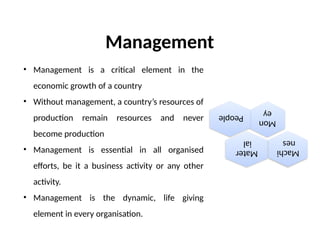
Management
Mon
ey
People
Mater
ial
Machi
nes
• Management is a critical element in the
economic growth of a country
• Without management, a country’s resources of
production remain resources and never
become production
• Management is essential in all organised
efforts, be it a business activity or any other
activity.
• Management is the dynamic, life giving
element in every organisation.
DEFINITIONS
OF
MANAGEMENT
This Photo by Unknown Author is licensed under CC BY
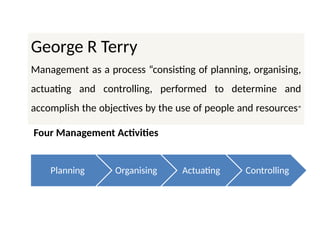
Planning Organising Actuating Controlling
George R Terry
Management as a process “consisting of planning, organising,
actuating and controlling, performed to determine and
accomplish the objectives by the use of people and resources”
Four Management Activities
Mary Parker Follett
“Art of getting things done through people”
Two weaknesses of this definition are
• Art deals with the application of
knowledge. Management also involves
acquisition of knowledge i.e science.
Management based on rules of thumb or
intuition is not correct management
• This definition does not throw light on the
various functions of a manager.
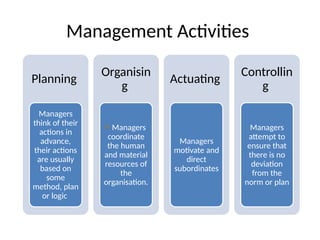
Management Activities
Planning
Managers
think of their
actions in
advance,
their actions
are usually
based on
some
method, plan
or logic
Organisin
g
Managers
coordinate
the human
and material
resources of
the
organisation.
Actuating
Managers
motivate and
direct
subordinates
Controllin
g
Managers
attempt to
ensure that
there is no
deviation
from the
norm or plan
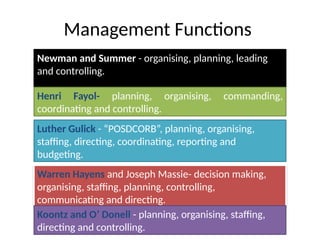
Management Functions
Newman and Summer - organising, planning, leading
and controlling.
Henri Fayol- planning, organising, commanding,
coordinating and controlling.
Luther Gulick - “POSDCORB”, planning, organising,
staffing, directing, coordinating, reporting and
budgeting.
Warren Hayens and Joseph Massie- decision making,
organising, staffing, planning, controlling,
communicating and directing.
Koontz and O’ Donell - planning, organising, staffing,
directing and controlling.
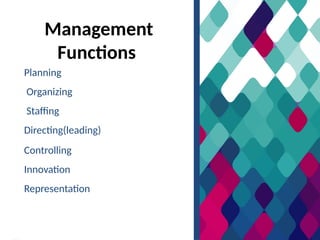
Management
Functions
Planning
Organizing
Staffing
Directing(leading)
Controlling
Innovation
Representation
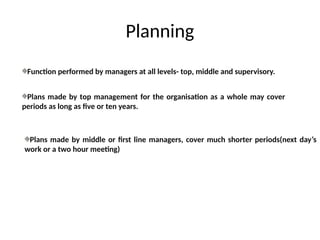
Planning
Function performed by managers at all levels- top, middle and supervisory.
Plans made by top management for the organisation as a whole may cover
periods as long as five or ten years.
Plans made by middle or first line managers, cover much shorter periods(next day’s
work or a two hour meeting)
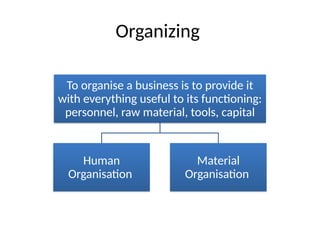
Organizing
To organise a business is to provide it
with everything useful to its functioning:
personnel, raw material, tools, capital
Human
Organisation
Material
Organisation
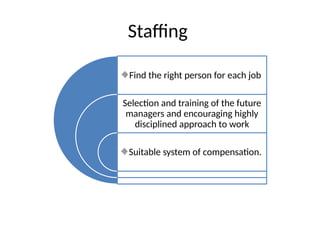
Staffing
Find the right person for each job
Selection and training of the future
managers and encouraging highly
disciplined approach to work
Suitable system of compensation.
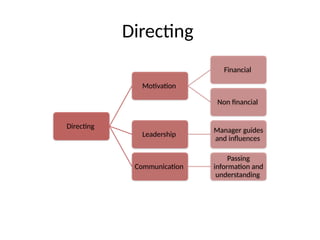
Directing
Directing
Motivation
Financial
Non financial
Leadership
Manager guides
and influences
Communication
Passing
information and
understanding
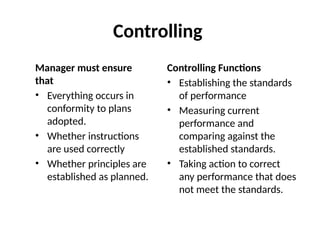
Controlling
Manager must ensure
that
• Everything occurs in
conformity to plans
adopted.
• Whether instructions
are used correctly
• Whether principles are
established as planned.
Controlling Functions
• Establishing the standards
of performance
• Measuring current
performance and
comparing against the
established standards.
• Taking action to correct
any performance that does
not meet the standards.
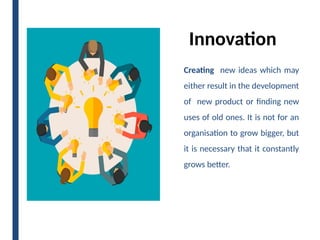
Innovation
Creating new ideas which may
either result in the development
of new product or finding new
uses of old ones. It is not for an
organisation to grow bigger, but
it is necessary that it constantly
grows better.
REPRESENTATION
 Manager has to represent his
organisation to the stake holders,
government officials, labour
unions, financial institution,
supplier, customer etc.
 Manager must win their support
by effectively managing the
social impact of his Organisation.
LEVELS OF MANAGEMENT
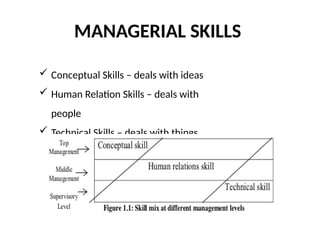
• Top management: consists of Board chairman, the
company Presidents, and the Executive Vice- Presidents.
Top Mangers require conceptual skills.
• Middle management: consists of vast and diversified group
consisting plant managers, personnel managers and
department heads. Middle managers need human relations
skill.
• First-line (Lower) management: is made up of foreman and
white collared supervisors. They require technical skills.
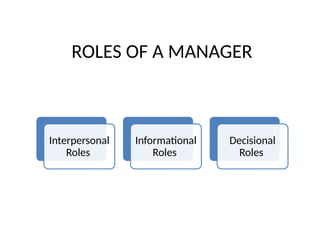
ROLES OF A MANAGER
Interpersonal
Roles
Informational
Roles
Decisional
Roles
Interpersonal Roles
• Figure head: performs duties of ceremonial nature
such as greeting the touring dignitaries, attending the
wedding of an employee, taking an important customer
to lunch etc.
• Leader: every manager must motivate and encourage
their employees, try to reconcile their individual needs
with the goals of the organization.
• Liaison: in this role, every manager must develop
contacts outside the vertical chain of command to
collect information useful for the organization.
Informational Roles
• Monitor: must perpetually scan his environment for
information, interrogates his liaison and subordinates to
get any solicited information useful for the organization.
• Disseminator: manager passes the privileged
information directly to the subordinates who otherwise
would not have access to it.
• Spokesman: may require spending a part of the time in
representing the organization before various outside
groups having some stake in the organization such as
government officials, labour unions, and financial
institutions.
Decisional Roles
• Entrepreneur: in this role the manager proactively looks out for
innovation to improve the organization by means of creating
new ideas, development of new products or services or finding
new uses for the old ones.
• Disturbance handler: assume responsibility for handling an
unexpected event or crisis. Manager must act like a fire-fighter
to seek solutions to various unanticipated problems.
• Resource allocator: must divide work and delegate authority
among his subordinates. Assign resources between functions
and divisions, set budgets of lower managers.
• Negotiator: must spend considerable time in negotiations.
seeks to negotiate solutions between other managers, unions,
customers, or shareholders.
MANAGERIAL SKILLS
 Conceptual Skills – deals with ideas
 Human Relation Skills – deals with
people
 Technical Skills – deals with things
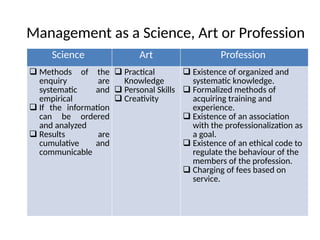
Management as a Science, Art or Profession
Science Art Profession
 Methods of the
enquiry are
systematic and
empirical
 If the information
can be ordered
and analyzed
 Results are
cumulative and
communicable
 Practical
Knowledge
 Personal Skills
 Creativity
 Existence of organized and
systematic knowledge.
 Formalized methods of
acquiring training and
experience.
 Existence of an association
with the professionalization as
a goal.
 Existence of an ethical code to
regulate the behaviour of the
members of the profession.
 Charging of fees based on
service.
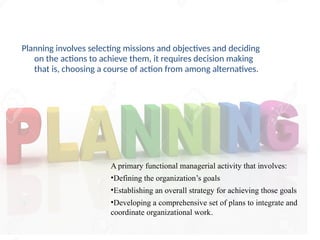
Planning involves selecting missions and objectives and deciding
on the actions to achieve them, it requires decision making
that is, choosing a course of action from among alternatives.
A primary functional managerial activity that involves:
•Defining the organization’s goals
•Establishing an overall strategy for achieving those goals
•Developing a comprehensive set of plans to integrate and
coordinate organizational work.
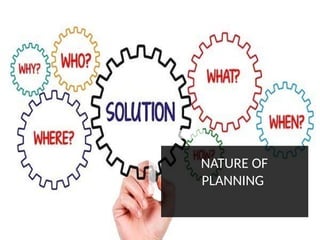
NATURE OF
PLANNING
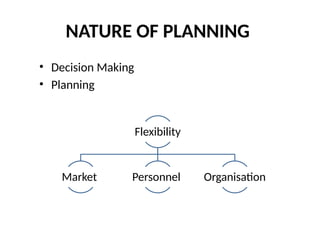
NATURE OF PLANNING
• Decision Making
• Planning
Flexibility
Market Personnel Organisation
IMPORTANCE OF PLANNING
• Minimizes risk and uncertainty
• Leads to success.
• Focus attention on the organizations goals
• Facilitates control
• Trains executives
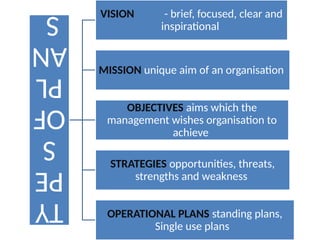
TY
PE
S
OF
PL
AN
S VISION - brief, focused, clear and
inspirational
MISSION unique aim of an organisation
OBJECTIVES aims which the
management wishes organisation to
achieve
STRATEGIES opportunities, threats,
strengths and weakness
OPERATIONAL PLANS standing plans,
Single use plans
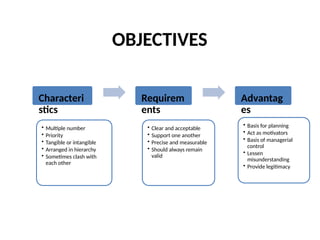
OBJECTIVES
Characteri
stics
• Multiple number
• Priority
• Tangible or intangible
• Arranged in hierarchy
• Sometimes clash with
each other
Requirem
ents
• Clear and acceptable
• Support one another
• Precise and measurable
• Should always remain
valid
Advantag
es
• Basis for planning
• Act as motivators
• Basis of managerial
control
• Lessen
misunderstanding
• Provide legitimacy
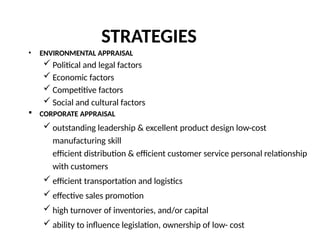
STRATEGIES
• ENVIRONMENTAL APPRAISAL
 Political and legal factors
 Economic factors
 Competitive factors
 Social and cultural factors
 CORPORATE APPRAISAL
 outstanding leadership & excellent product design low-cost
manufacturing skill
efficient distribution & efficient customer service personal relationship
with customers
 efficient transportation and logistics
 effective sales promotion
 high turnover of inventories, and/or capital
 ability to influence legislation, ownership of low- cost
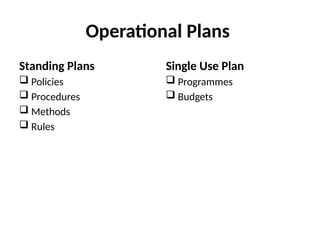
Operational Plans
Standing Plans
 Policies
 Procedures
 Methods
 Rules
Single Use Plan
 Programmes
 Budgets
FORMS OF PLANS
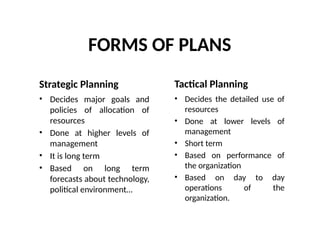
Strategic Planning
• Decides major goals and
policies of allocation of
resources
• Done at higher levels of
management
• It is long term
• Based on long term
forecasts about technology,
political environment…
Tactical Planning
• Decides the detailed use of
resources
• Done at lower levels of
management
• Short term
• Based on performance of
the organization
• Based on day to day
operations of the
organization.
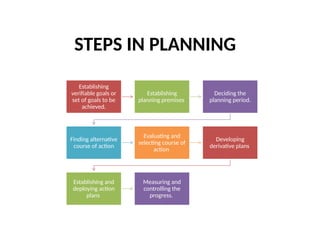
STEPS IN PLANNING
Establishing
verifiable goals or
set of goals to be
achieved.
Establishing
planning premises
Deciding the
planning period.
Finding alternative
course of action
Evaluating and
selecting course of
action
Developing
derivative plans
Establishing and
deploying action
plans
Measuring and
controlling the
progress.
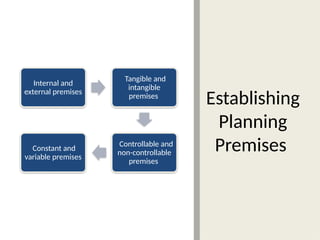
Establishing
Planning
Premises
Internal and
external premises
Tangible and
intangible
premises
Controllable and
non-controllable
premises
Constant and
variable premises
Limitations of Planning
• Planning is costly
• Planning is time consuming
• Scope of planning is limited in the case of
organisations for rapidly changing situations
• Formulating accurate premises is difficult
• Managers are often frustrated in instituting a
new plan simply by unwillingness or inabilbity
of people to accept it.
Decision Making
• managers of any organization decide
what to do, when to do, how to do
and who has to do.
• integral part of planning.
• Decision making and choosing the
best alternative is probably the most
important activity of the planning
process.
• In organizing, the managers decide on
the choice of structure, type of
organization, work allocation,
delegation of authority and
responsibility etc.
• In directing, managers decide the
course of action, the instruction to be
given, providing directions etc
• In controlling the managers decide on
fixing the standards, how to control,
what to control etc.
TYPES OF DECISIONS
• Programmed and non-programmed or Pragmatic &
non Pragmatic decisions
• Individual & group (Collective) decisions
• Minor & Major decisions
• Strategic & Routine decisions
• Simple & Complex decisions
• Temporary & Permanent Decisions
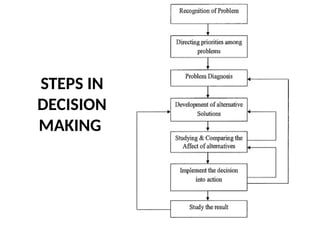
STEPS IN
DECISION
MAKING

management and entrepreneurship module 1

  • 1.
  • 2.
    Technical Innovation Managementand Entrepreneurship Sub Code: 22BEC501 Credits : 3 Course Learning Objectives 1 Understand basic skills of Management 2 Understand the need for Entrepreneurs and their skills 3 Identify the Management functions and Social responsibilities 4 Understand economic development,creativity and Innovation 5 Understand the Ideation process, creation of Business model, Feasability study and sources of funding
  • 3.
    MODULE 1 • Manage ment •Plannin g MODULE 2 • Organisi ng and Staffing • Directin g and Controll ing MODULE 3 • Social Respons ibilities of Busines s • Entrepr eneursh ip MODULE 4 • Modern Small Busines s Enterpri se • Idea generati on and Feasibili ty Analysis MODULE 5 • Busines s Model • Financin g and How to start a Busines s? • Project Design and Networ k Analysis
  • 4.
    Course Outcomes • Understandthe fundamental concepts of Management and Entrepreneurship and opportunities in order to setup a business • Describe the functions of Managers, Entrepreneurs and their social responsibilities • Understand the components in developing business plan. • Describe the importance of small scale industry in economic development and institutional support to start a small scale industry. • Awareness about various sources of funding and institutions supporting entrepreneurs
  • 5.
    Text Books • Principlesof Management – P.C Tripathi, P.N Reddy, McGraw Hill Education, 6th Edition, 2017. ISBN-13:978-93-5260-535-4. • Entrepreneurship Development Small Business Enterprises- Poornima M Charantimath, Pearson Education 2008, ISBN 978- 81-7758-260-4. • Dynamics of Entrepreneurial Development and Management by Vasant Desai. HPH 2007, ISBN: 978-81-8488-801-2. • Robert D. Hisrich, Mathew J. Manimala, Michael P Peters and Dean A. Shepherd, “Entrepreneurship”, 8th Edition, Tata Mc Graw Hill Publishing Co. ltd – New Delhi, 2012
  • 6.
  • 7.
    Management Mon ey People Mater ial Machi nes • Management isa critical element in the economic growth of a country • Without management, a country’s resources of production remain resources and never become production • Management is essential in all organised efforts, be it a business activity or any other activity. • Management is the dynamic, life giving element in every organisation.
  • 8.
    DEFINITIONS OF MANAGEMENT This Photo byUnknown Author is licensed under CC BY
  • 9.
    Planning Organising ActuatingControlling George R Terry Management as a process “consisting of planning, organising, actuating and controlling, performed to determine and accomplish the objectives by the use of people and resources” Four Management Activities
  • 10.
    Mary Parker Follett “Artof getting things done through people” Two weaknesses of this definition are • Art deals with the application of knowledge. Management also involves acquisition of knowledge i.e science. Management based on rules of thumb or intuition is not correct management • This definition does not throw light on the various functions of a manager.
  • 11.
    Management Activities Planning Managers think oftheir actions in advance, their actions are usually based on some method, plan or logic Organisin g Managers coordinate the human and material resources of the organisation. Actuating Managers motivate and direct subordinates Controllin g Managers attempt to ensure that there is no deviation from the norm or plan
  • 12.
    Management Functions Newman andSummer - organising, planning, leading and controlling. Henri Fayol- planning, organising, commanding, coordinating and controlling. Luther Gulick - “POSDCORB”, planning, organising, staffing, directing, coordinating, reporting and budgeting. Warren Hayens and Joseph Massie- decision making, organising, staffing, planning, controlling, communicating and directing. Koontz and O’ Donell - planning, organising, staffing, directing and controlling.
  • 13.
  • 14.
    Planning Function performed bymanagers at all levels- top, middle and supervisory. Plans made by top management for the organisation as a whole may cover periods as long as five or ten years. Plans made by middle or first line managers, cover much shorter periods(next day’s work or a two hour meeting)
  • 15.
    Organizing To organise abusiness is to provide it with everything useful to its functioning: personnel, raw material, tools, capital Human Organisation Material Organisation
  • 16.
    Staffing Find the rightperson for each job Selection and training of the future managers and encouraging highly disciplined approach to work Suitable system of compensation.
  • 17.
    Directing Directing Motivation Financial Non financial Leadership Manager guides andinfluences Communication Passing information and understanding
  • 18.
    Controlling Manager must ensure that •Everything occurs in conformity to plans adopted. • Whether instructions are used correctly • Whether principles are established as planned. Controlling Functions • Establishing the standards of performance • Measuring current performance and comparing against the established standards. • Taking action to correct any performance that does not meet the standards.
  • 19.
    Innovation Creating new ideaswhich may either result in the development of new product or finding new uses of old ones. It is not for an organisation to grow bigger, but it is necessary that it constantly grows better.
  • 20.
    REPRESENTATION  Manager hasto represent his organisation to the stake holders, government officials, labour unions, financial institution, supplier, customer etc.  Manager must win their support by effectively managing the social impact of his Organisation.
  • 21.
    LEVELS OF MANAGEMENT •Top management: consists of Board chairman, the company Presidents, and the Executive Vice- Presidents. Top Mangers require conceptual skills. • Middle management: consists of vast and diversified group consisting plant managers, personnel managers and department heads. Middle managers need human relations skill. • First-line (Lower) management: is made up of foreman and white collared supervisors. They require technical skills.
  • 22.
    ROLES OF AMANAGER Interpersonal Roles Informational Roles Decisional Roles
  • 23.
    Interpersonal Roles • Figurehead: performs duties of ceremonial nature such as greeting the touring dignitaries, attending the wedding of an employee, taking an important customer to lunch etc. • Leader: every manager must motivate and encourage their employees, try to reconcile their individual needs with the goals of the organization. • Liaison: in this role, every manager must develop contacts outside the vertical chain of command to collect information useful for the organization.
  • 24.
    Informational Roles • Monitor:must perpetually scan his environment for information, interrogates his liaison and subordinates to get any solicited information useful for the organization. • Disseminator: manager passes the privileged information directly to the subordinates who otherwise would not have access to it. • Spokesman: may require spending a part of the time in representing the organization before various outside groups having some stake in the organization such as government officials, labour unions, and financial institutions.
  • 25.
    Decisional Roles • Entrepreneur:in this role the manager proactively looks out for innovation to improve the organization by means of creating new ideas, development of new products or services or finding new uses for the old ones. • Disturbance handler: assume responsibility for handling an unexpected event or crisis. Manager must act like a fire-fighter to seek solutions to various unanticipated problems. • Resource allocator: must divide work and delegate authority among his subordinates. Assign resources between functions and divisions, set budgets of lower managers. • Negotiator: must spend considerable time in negotiations. seeks to negotiate solutions between other managers, unions, customers, or shareholders.
  • 26.
    MANAGERIAL SKILLS  ConceptualSkills – deals with ideas  Human Relation Skills – deals with people  Technical Skills – deals with things
  • 28.
    Management as aScience, Art or Profession Science Art Profession  Methods of the enquiry are systematic and empirical  If the information can be ordered and analyzed  Results are cumulative and communicable  Practical Knowledge  Personal Skills  Creativity  Existence of organized and systematic knowledge.  Formalized methods of acquiring training and experience.  Existence of an association with the professionalization as a goal.  Existence of an ethical code to regulate the behaviour of the members of the profession.  Charging of fees based on service.
  • 29.
    Planning involves selectingmissions and objectives and deciding on the actions to achieve them, it requires decision making that is, choosing a course of action from among alternatives. A primary functional managerial activity that involves: •Defining the organization’s goals •Establishing an overall strategy for achieving those goals •Developing a comprehensive set of plans to integrate and coordinate organizational work.
  • 30.
  • 31.
    NATURE OF PLANNING •Decision Making • Planning Flexibility Market Personnel Organisation
  • 32.
    IMPORTANCE OF PLANNING •Minimizes risk and uncertainty • Leads to success. • Focus attention on the organizations goals • Facilitates control • Trains executives
  • 33.
    TY PE S OF PL AN S VISION -brief, focused, clear and inspirational MISSION unique aim of an organisation OBJECTIVES aims which the management wishes organisation to achieve STRATEGIES opportunities, threats, strengths and weakness OPERATIONAL PLANS standing plans, Single use plans
  • 34.
    OBJECTIVES Characteri stics • Multiple number •Priority • Tangible or intangible • Arranged in hierarchy • Sometimes clash with each other Requirem ents • Clear and acceptable • Support one another • Precise and measurable • Should always remain valid Advantag es • Basis for planning • Act as motivators • Basis of managerial control • Lessen misunderstanding • Provide legitimacy
  • 35.
    STRATEGIES • ENVIRONMENTAL APPRAISAL Political and legal factors  Economic factors  Competitive factors  Social and cultural factors  CORPORATE APPRAISAL  outstanding leadership & excellent product design low-cost manufacturing skill efficient distribution & efficient customer service personal relationship with customers  efficient transportation and logistics  effective sales promotion  high turnover of inventories, and/or capital  ability to influence legislation, ownership of low- cost
  • 36.
    Operational Plans Standing Plans Policies  Procedures  Methods  Rules Single Use Plan  Programmes  Budgets
  • 37.
    FORMS OF PLANS StrategicPlanning • Decides major goals and policies of allocation of resources • Done at higher levels of management • It is long term • Based on long term forecasts about technology, political environment… Tactical Planning • Decides the detailed use of resources • Done at lower levels of management • Short term • Based on performance of the organization • Based on day to day operations of the organization.
  • 38.
    STEPS IN PLANNING Establishing verifiablegoals or set of goals to be achieved. Establishing planning premises Deciding the planning period. Finding alternative course of action Evaluating and selecting course of action Developing derivative plans Establishing and deploying action plans Measuring and controlling the progress.
  • 39.
    Establishing Planning Premises Internal and external premises Tangibleand intangible premises Controllable and non-controllable premises Constant and variable premises
  • 40.
    Limitations of Planning •Planning is costly • Planning is time consuming • Scope of planning is limited in the case of organisations for rapidly changing situations • Formulating accurate premises is difficult • Managers are often frustrated in instituting a new plan simply by unwillingness or inabilbity of people to accept it.
  • 41.
    Decision Making • managersof any organization decide what to do, when to do, how to do and who has to do. • integral part of planning. • Decision making and choosing the best alternative is probably the most important activity of the planning process. • In organizing, the managers decide on the choice of structure, type of organization, work allocation, delegation of authority and responsibility etc. • In directing, managers decide the course of action, the instruction to be given, providing directions etc • In controlling the managers decide on fixing the standards, how to control, what to control etc.
  • 42.
    TYPES OF DECISIONS •Programmed and non-programmed or Pragmatic & non Pragmatic decisions • Individual & group (Collective) decisions • Minor & Major decisions • Strategic & Routine decisions • Simple & Complex decisions • Temporary & Permanent Decisions
  • 43.