




Top Management Gurus
Though Leaders and Books
Management Gurus
• Here is a short list of some of the most sought
after business gurus and management experts
and their influential books. Some of these come
from a study by Accenture, the international
consulting firm. Accenture defined them as
business intellectuals but they are better known
as management gurus. Some were picked from a
recent article in the Economist about the state of
the guru industry. They are thought leaders,
providing the latest and best business thinking.
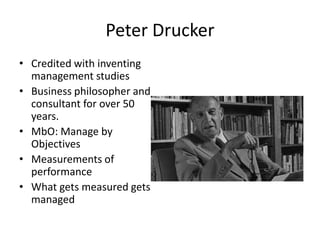
Peter Drucker
• Credited with inventing
management studies
• Business philosopher and
consultant for over 50
years.
• MbO: Manage by
Objectives
• Measurements of
performance
• What gets measured gets
managed
Peter Drucker
• Drucker’s first major work, The End of Economic Man, was
published in 1939. After reading it, Winston Churchill
described Drucker as “one of those writers to whom almost
anything can be forgiven because he not only has a mind of
his own, but has the gift of starting other minds along a
stimulating line of thought.”
• A number of his other books are considered
classics: Concept of the Corporation in 1946, The Practice of
Management in 1954, The Effective Executive in
1967, Management: Tasks, Responsibilities, Practices in
1973, Innovation and Entrepreneurship in 1985, Post-
Capitalist Society in 1993, Management Challenges for the
21st Century in 1999, and in 2001 The Essential Drucker.
Prominent ideas in Drucker's writings:
• Decentralization and simplification. Drucker discounted the command and control model and
asserted that companies work best when they are decentralized. According to Drucker,
corporations tend to produce too many products, hire employees they don't need (when a better
solution would be outsourcing), and expand into economic sectors that they should avoid.
• The concept of what eventually came to be known as outsourcing. He used the example of "front
room" and "back room" of each business: A company should be engaged in only the front room
activities that are critical to supporting its core business. Back room activities should be handed
over to other companies, for whom these tasks are the front room activities.
• “Do what you do best and outsource the rest” is a business tagline first “coined and developed in
the 1990s by Drucker. The slogan was primarily used to advocate outsourcing as a viable business
strategy. Drucker began explaining the concept of outsourcing as early as 1989 in his Wall Street
Journal (WSJ) article entitled “Sell the Mailroom”.
• The need to manage business by balancing a variety of needs and goals, rather than subordinating
an institution to a single value. This concept of management by objectives and self-control forms
the keynote of his 1954 landmark The Practice of Management.
• The concept of "knowledge worker" in his 1959 book "The Landmarks of Tomorrow". Since then,
knowledge-based work has become increasingly important in businesses worldwide.
• A belief that taking action without thinking is the cause of every failure.
• A belief in the notion that great companies could stand among humankind's noblest inventions.
Michael Porter
• Harvard Business School professor and
strategy expert.
• Author of Competitive Strategy: Techniques
for Analyzing Industries and Competitors
• Competitive Advantage
• 5 Forces
• TED talk
Warren Bennis
Edward de Bono
Theodore Levitt
Adolph Berle
Harvard Business Review
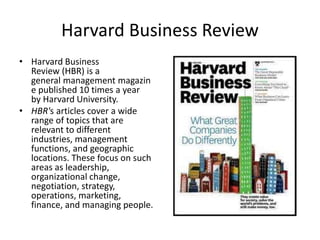
• Harvard Business
Review (HBR) is a
general management magazin
e published 10 times a year
by Harvard University.
• HBR's articles cover a wide
range of topics that are
relevant to different
industries, management
functions, and geographic
locations. These focus on such
areas as leadership,
organizational change,
negotiation, strategy,
operations, marketing,
finance, and managing people.
HBR
• Harvard Business Review has been the
frequent publishing home for scholars and
management thinkers we have discussed here
such as Clayton M. Christensen, Peter F.
Drucker, Michael E. Porter, and Rita Gunther
McGrath , as well as Rosabeth Moss
Kanter, John Hagel III, Thomas H.
Davenport, Gary Hamel, C.K. Prahalad, Vijay
Govindarajan, Robert S. Kaplan, and others.
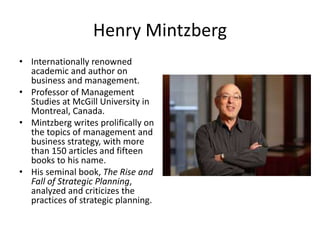
Henry Mintzberg
• Internationally renowned
academic and author on
business and management.
• Professor of Management
Studies at McGill University in
Montreal, Canada.
• Mintzberg writes prolifically on
the topics of management and
business strategy, with more
than 150 articles and fifteen
books to his name.
• His seminal book, The Rise and
Fall of Strategic Planning,
analyzed and criticizes the
practices of strategic planning.
Books by Henry Mintzberg
• 1973 The Nature of Managerial Work
• 1979 The Structuring of Organizations: A Synthesis of the Research
• 1983 Power in and Around Organizations
• 1983 Structure in fives: Designing Effective Organizations
• 1989 Mintzberg on Management: Inside Our Strange World of
Organizations
• 1994 The Rise and Fall of Strategic Planning: Reconceiving the Roles
for Planning, Plans, Planners
• 2004 Managers not MBAs
• 2005 Strategy Bites back
• 2007 Tracking Strategies: Towards a General Theory of Strategy
Formation
• 2009 Managing
• 2009 Management? It's not What you Think!
Kenichi Ohmae
• The Mind of the Strategist
• McKinsey
Clayton Christensen
• The Innovator’s Dilemma
• The Innovator’s Solution
• Harvard Business School
• Disruptive Innovation: successful innovators
create new markets that render established
businesses irrelevant.
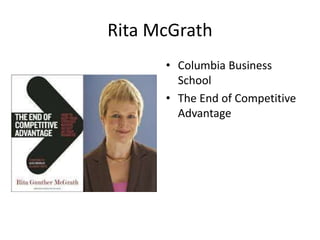
Rita McGrath
• Columbia Business
School
• The End of Competitive
Advantage
Richard D’Aveni
• Dartmouth Tuck School
of Business
• Hyper Competition
Ram Charan
• The Attacker’s
Advantage
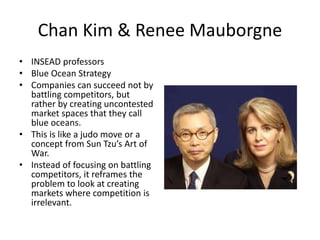
Chan Kim & Renee Mauborgne
• INSEAD professors
• Blue Ocean Strategy
• Companies can succeed not by
battling competitors, but
rather by creating uncontested
market spaces that they call
blue oceans.
• This is like a judo move or a
concept from Sun Tzu’s Art of
War.
• Instead of focusing on battling
competitors, it reframes the
problem to look at creating
markets where competition is
irrelevant.
Examples of Blue Ocean strategies:
• Cirque du Soleil: Blending of opera and ballet with
circus format while eliminating star performer and
animals;
• Southwest Airlines: offering flexibility of bus travel at
the speed of air travel using secondary airports;
• Curves: redefining market boundaries between health
clubs and home exercise programs for women;
• Wii: Rather than releasing a more technologically
advanced video game console with more features as in
previous generations, Nintendo released a console
with innovative
Don Tapscott
• The Digital Economy
Tom Peters & Robert Waterman
• Management consultant and author of In
Search of Excellence.
Jim Collins
• Good to Great
Tom Friedman
• The World is Flat
James Champy & Michael Hammer
• Re-engineering the Corporation
C.K. Prahalad

Management Gurus

  • 1.
    Top Management Gurus ThoughLeaders and Books
  • 2.
    Management Gurus • Hereis a short list of some of the most sought after business gurus and management experts and their influential books. Some of these come from a study by Accenture, the international consulting firm. Accenture defined them as business intellectuals but they are better known as management gurus. Some were picked from a recent article in the Economist about the state of the guru industry. They are thought leaders, providing the latest and best business thinking.
  • 3.
    Peter Drucker • Creditedwith inventing management studies • Business philosopher and consultant for over 50 years. • MbO: Manage by Objectives • Measurements of performance • What gets measured gets managed
  • 4.
    Peter Drucker • Drucker’sfirst major work, The End of Economic Man, was published in 1939. After reading it, Winston Churchill described Drucker as “one of those writers to whom almost anything can be forgiven because he not only has a mind of his own, but has the gift of starting other minds along a stimulating line of thought.” • A number of his other books are considered classics: Concept of the Corporation in 1946, The Practice of Management in 1954, The Effective Executive in 1967, Management: Tasks, Responsibilities, Practices in 1973, Innovation and Entrepreneurship in 1985, Post- Capitalist Society in 1993, Management Challenges for the 21st Century in 1999, and in 2001 The Essential Drucker.
  • 5.
    Prominent ideas inDrucker's writings: • Decentralization and simplification. Drucker discounted the command and control model and asserted that companies work best when they are decentralized. According to Drucker, corporations tend to produce too many products, hire employees they don't need (when a better solution would be outsourcing), and expand into economic sectors that they should avoid. • The concept of what eventually came to be known as outsourcing. He used the example of "front room" and "back room" of each business: A company should be engaged in only the front room activities that are critical to supporting its core business. Back room activities should be handed over to other companies, for whom these tasks are the front room activities. • “Do what you do best and outsource the rest” is a business tagline first “coined and developed in the 1990s by Drucker. The slogan was primarily used to advocate outsourcing as a viable business strategy. Drucker began explaining the concept of outsourcing as early as 1989 in his Wall Street Journal (WSJ) article entitled “Sell the Mailroom”. • The need to manage business by balancing a variety of needs and goals, rather than subordinating an institution to a single value. This concept of management by objectives and self-control forms the keynote of his 1954 landmark The Practice of Management. • The concept of "knowledge worker" in his 1959 book "The Landmarks of Tomorrow". Since then, knowledge-based work has become increasingly important in businesses worldwide. • A belief that taking action without thinking is the cause of every failure. • A belief in the notion that great companies could stand among humankind's noblest inventions.
  • 6.
    Michael Porter • HarvardBusiness School professor and strategy expert. • Author of Competitive Strategy: Techniques for Analyzing Industries and Competitors • Competitive Advantage • 5 Forces • TED talk
  • 7.
  • 8.
  • 9.
  • 10.
  • 11.
    Harvard Business Review •Harvard Business Review (HBR) is a general management magazin e published 10 times a year by Harvard University. • HBR's articles cover a wide range of topics that are relevant to different industries, management functions, and geographic locations. These focus on such areas as leadership, organizational change, negotiation, strategy, operations, marketing, finance, and managing people.
  • 12.
    HBR • Harvard BusinessReview has been the frequent publishing home for scholars and management thinkers we have discussed here such as Clayton M. Christensen, Peter F. Drucker, Michael E. Porter, and Rita Gunther McGrath , as well as Rosabeth Moss Kanter, John Hagel III, Thomas H. Davenport, Gary Hamel, C.K. Prahalad, Vijay Govindarajan, Robert S. Kaplan, and others.
  • 13.
    Henry Mintzberg • Internationallyrenowned academic and author on business and management. • Professor of Management Studies at McGill University in Montreal, Canada. • Mintzberg writes prolifically on the topics of management and business strategy, with more than 150 articles and fifteen books to his name. • His seminal book, The Rise and Fall of Strategic Planning, analyzed and criticizes the practices of strategic planning.
  • 14.
    Books by HenryMintzberg • 1973 The Nature of Managerial Work • 1979 The Structuring of Organizations: A Synthesis of the Research • 1983 Power in and Around Organizations • 1983 Structure in fives: Designing Effective Organizations • 1989 Mintzberg on Management: Inside Our Strange World of Organizations • 1994 The Rise and Fall of Strategic Planning: Reconceiving the Roles for Planning, Plans, Planners • 2004 Managers not MBAs • 2005 Strategy Bites back • 2007 Tracking Strategies: Towards a General Theory of Strategy Formation • 2009 Managing • 2009 Management? It's not What you Think!
  • 15.
    Kenichi Ohmae • TheMind of the Strategist • McKinsey
  • 16.
    Clayton Christensen • TheInnovator’s Dilemma • The Innovator’s Solution • Harvard Business School • Disruptive Innovation: successful innovators create new markets that render established businesses irrelevant.
  • 17.
    Rita McGrath • ColumbiaBusiness School • The End of Competitive Advantage
  • 18.
    Richard D’Aveni • DartmouthTuck School of Business • Hyper Competition
  • 19.
    Ram Charan • TheAttacker’s Advantage
  • 20.
    Chan Kim &Renee Mauborgne • INSEAD professors • Blue Ocean Strategy • Companies can succeed not by battling competitors, but rather by creating uncontested market spaces that they call blue oceans. • This is like a judo move or a concept from Sun Tzu’s Art of War. • Instead of focusing on battling competitors, it reframes the problem to look at creating markets where competition is irrelevant.
  • 21.
    Examples of BlueOcean strategies: • Cirque du Soleil: Blending of opera and ballet with circus format while eliminating star performer and animals; • Southwest Airlines: offering flexibility of bus travel at the speed of air travel using secondary airports; • Curves: redefining market boundaries between health clubs and home exercise programs for women; • Wii: Rather than releasing a more technologically advanced video game console with more features as in previous generations, Nintendo released a console with innovative
  • 22.
    Don Tapscott • TheDigital Economy
  • 23.
    Tom Peters &Robert Waterman • Management consultant and author of In Search of Excellence.
  • 24.
  • 25.
  • 26.
    James Champy &Michael Hammer • Re-engineering the Corporation
  • 27.