Module I
Module I
Strategic Management – Military origin of strategy
Evolution- Concepts and Characteristics of Strategic
Management- types of strategy: functional strategy,
business strategy, global strategy and corporate strategy –
role of vision and mission statements- strategic
management process; role, functions and skills of board
and top management in strategic management. Stake
holders in business and their role in strategic
management. CSR, Ethical and Social Consideration in
Strategic Management-Case Studies
Strategy
"Without a strategy, an organization is like a ship without a rudder,
going around in circles. It’s like a tramp; it has no place to go.”
Joel Ross & Michael Kami
Strategy is the grand design or an overall 'plan' which an
organization chooses in order to move or react towards the set
objectives by using its resources.
An organization is considered efficient and operationally effective
if it is characterized by coordination between objectives and
strategies.
Without an appropriate strategy effectively implemented, the
future is always dark and hence, more are the chances of business
failure.
 The word ‘strategy’ has entered in the field of management from the
military services where it refers to apply the forces against an enemy
to win a war.
 Originally, the word strategy has been derived from Greek 'strategos'
which means generalship. The word was used for the first time in
around 400 BC. The word strategy means the art of the general to
fight in war.
 The dictionary meaning of strategy is, "the art of so moving or
disposing the instrument of warfare as to impose upon enemy, the
place, time and conditions for fighting by one self.“
 According to Glueck, "Strategy is the unified, comprehensive and
integrated plan that relates the strategic advantage of the firm
to the challenges of the environment and is designed to ensure
that basic objectives of the enterprise are achieved through
proper implementation process."
Strategy (different perspectives);
A unified comprehensive and integrated plan addressing
challenges of marketing environment. (There are six main external
factors that influence the marketing strategy of a business or organization.
Some organizations may perform a SLEPT (social, legal, economical,
political, and technological) analysis to obtain information on major
external influences on their business.)
Strategy if properly implemented ensures achievement of basic
objectives.
The objective of strategy is to achieve its goals and mission.
Strategy enables to determine long term goals and objectives,
adopt a courses of action, and allocate resources.
 Strategy is a major course of action through which an
organization relates itself to its environment
 Strategy is the blend of internal and external factors aimed at
resolving opportunities and threats (SUV’s in India).
 Strategy may be a combination of actions aimed to meet a
particular condition, or to solve certain problems or to achieve a
desirable end (the merger of Pfizer with Warner was to reduce
the R&D expenses and become No: 1 Pharma brand).
 Strategy may sometimes be contradictory in nature (Selling of
divisions by Tata’s).
 All strategies are future oriented
 Strategies require systems and norms
 Finally strategy provides overall frame work for guiding an
organization.
Essence of strategy
Strategy is characterized by four important aspects.
1.Long term objectives: Strategy is formulated keeping in mind the long
term objectives of the organization
2.Competitive Advantage: Strategy is formulated so that the firm may
have competitive advantage. Strategy makes the organization competent
enough to meet the external threats and profit from the environmental
opportunities. (Airlines, achieve competitive advantage by cutting costs to a
minimum and pass their savings on to customers in lower prices to grab
market share and ensure their planes are as full as possible, further driving
down cost.)
3.Vector: Strategy is formulated with a series of actions in the same
direction and allocation of resources for meeting long term objectives.
4.Synergy: Strategies boost the prospects by providing synergy, due to the
series of decisions taken to accomplish objectives
Strategic planning and Strategic management
Strategic planning Strategic management
 SP is the process of deciding
on the goals of the
organization and the
strategies for attaining these
goals.
 SP sets priorities, focus
energy and resources,
strengthen operations, ensure
that employees and other
stakeholders are working
toward common goals.
 SP is a document used to
communicate with the
organization on its goals, and
the actions needed to achieve
those goals.
 SM is the art and science of
formulating, implementing and
evaluating cross-functional
decisions
 SM includes understanding the
strategic position of an
organization, and making
strategic choices for the future
and managing strategy in action
 SM also is a process by which
managers of the firm analyze the
internal and external
environments for the purpose of
formulating strategies and
allocating resources to develop a
competitive advantage
Strategic window
 Period of time that is temporary between competitive abilities in
an organization and the markets existing needs.
Four major factors that are responsible for strategic windows are:
 Emerging of a new market space with new primary demand e.g.
Mobile phones shifting from traditional to smart phone
 New technology that creates an obsolete status for the current
technologies used e.g. Android devices
 Usage patterns of products, shift of market definition, channels
and distribution changes. e.g. Smartphone becomes more than a
phone
Strategic positioning
 Strategic positioning is the relative position of the organization
within its industry, while taking into account the changing
environment, plus the systematic realization of that positioning.
 Strategic positioning strategies are derived from the business
world and aims at ensuring the continuity of the organization.
 Strategic positioning should answer the following questions:
 How does the future look like?
 How could the organization be positioned in the future?
 How are things in the organization at present?
 How can opportunities be seized and how can threats be met?
 How can this be put into practice in a systematic way?
Strategic Change
 A restructuring of an organization's business or marketing
plan that is typically performed in order to achieve an
important objective. For example, a strategic change might
include shifts in a corporation's policies, target
market, mission or organizational structure.
Strategic Change
 In March of 1999, Renault Motors acquired the failing Nissan Motors of
Japan. Japanese business culture is famous for its policy of life-long
employment. In an interview for Harvard's "Working Knowledge," Carlos
Ghosn, the man Renault chose as CEO for Nissan, asked, "How do you
make head count reductions in Japan?" He had to reduce manufacturing
overcapacity, get rid of the seniority system at Nissan and replace it with
performance-based management. He focused his attention on cost
reduction, sales of assets, eliminating the ‘keiretsu’, a Japanese term for
interlocking business relationships to develop other kinds of suppliers. The
result was a nearly complete strategic turn-around for Nissan, which went
on to announce its biggest profit ever in May 2001 -- only a year after it had
posted its worst loss in the company's history. The changes made by Renault
included cutting Nissan's cost structure and improving its Infiniti brand
recognition and reputation by a dramatic re-design and introduction of new
models in March 2002.
 Another example of strategic change through branding is Intel's 1991"Intel
Inside" brand campaign to differentiate itself from the other microprocessor
manufacturers. Until Intel's campaign, consumers hardly regarded the brand
of microprocessor in their computers as important. Intel's strategic change
created the image of Intel as the zenith in quality microprocessors.
Computer buyers now look for the Intel name when buying a computer.
Strategy, Policies, Tactics
 Policy is an overall guide that governs and controls managerial
actions. Policies may be general or specific, organizational or
functional, written or implied. They should be clear and
consistent. Policies have to be integrated so that strategy is
implemented successfully and effectively (HR policy).
 Tactics are often specific or subset of strategy where resources are
used for achieving clear deliverables and output (Improving repeat
purchases is a strategy and sending email to customers on new deals will
be one of the tactic)
 Strategies are concerned with the direction in which men and
physical resources are deployed and applied in order to maximize
the chances of achieving organizational objectives in the face of
environmental variables. Strategies are specific actions suggested
to achieve the objectives.
Military origin of strategy Evolution
 Strategy sprung from the need for people to defeat their enemies.
The first treatises that discuss strategy are from the Chinese during
the period of 400 – 200 B.C.
 The term “strategy” is derived indirectly from the Classic and
Byzantine (330 A.D.) Greek “strategos,” which means “general.”
 By the end of the Napoleonic Wars, “strategy” was in use by
military theorists across Europe.
 The potential of mathematics as a guide to the optimum
organization of troops for military engagements was a familiar
theme in the 17th and 18th centuries.
 Strategy decides where to act; logistics brings the troops to this
point; grand tactics decides the manner of execution and the
employment of the troops.
Blitzkrieg
 Blitzkrieg, the definition of lightning war, is a tactical strategy of
overcoming the enemy through speed, coordination and
concentration. Created by Heinz Guderian, this strategy was
employed in World War 2 by the Germans which gained
tremendous victories through this tactic. Use of Blitzkrieg in
business, will revolve around 3 major elements.
 Speed– in releasing your products and services
 Coordination– where there will be a huge market to invest on
 Concentration– where your products and services will
penetrate deeply into the market so the competitors cannot
recuperate
Types of strategy:
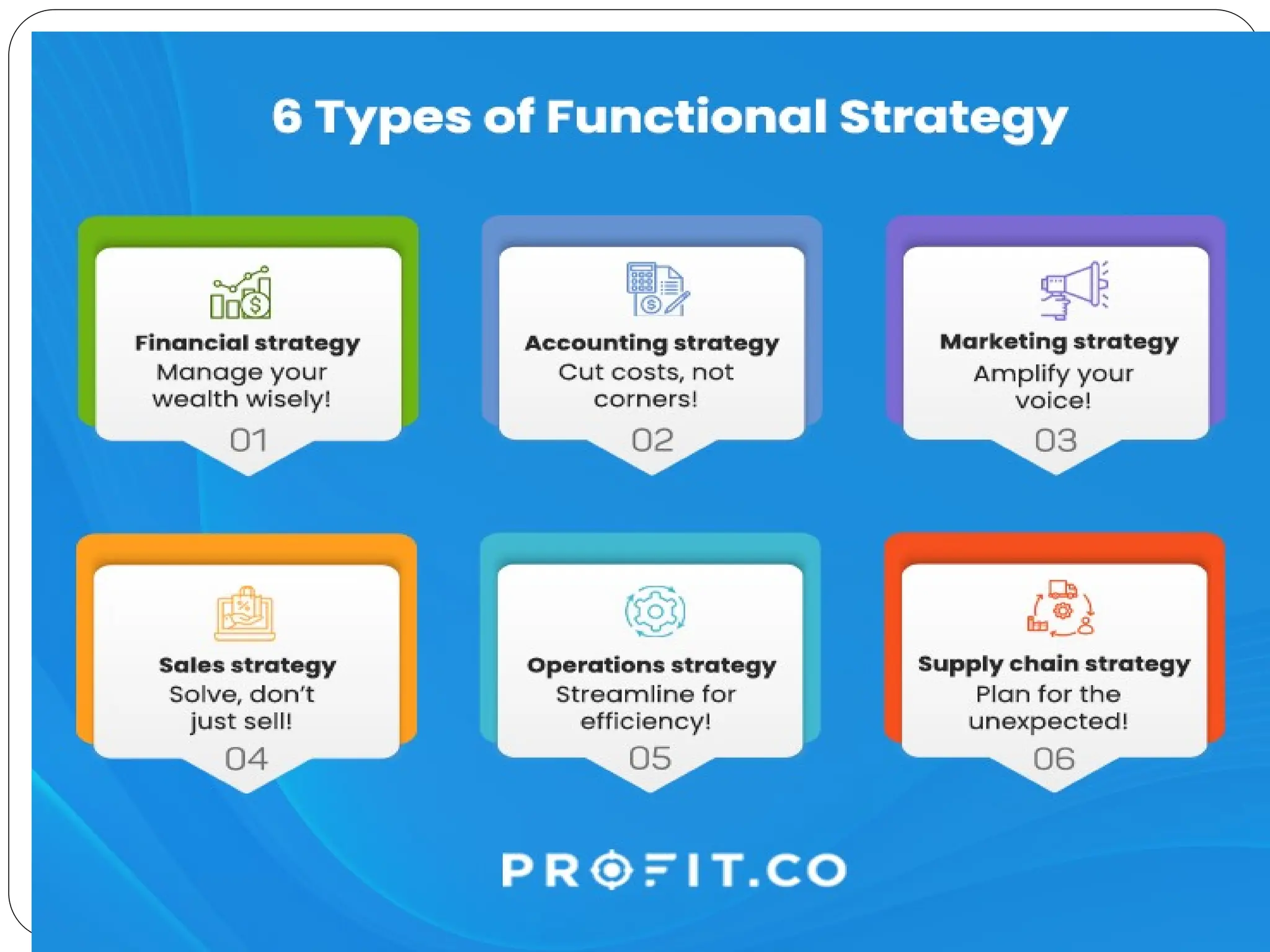
 Functional Strategy: Functional strategy is the set of specific, focused
actions and plans that each department or function within a company
develops and implements to support the overall business strategy and
objectives. (Coca-Cola partners with local bottling companies).
 Business Strategy: Business strategy is the strategic initiatives a
company pursues to create value for the organization and its stakeholders
and gain a competitive advantage in the market. A business strategy
includes decisions about product positioning, customer interaction, and
competition management. (Value-based pricing greatly contributed to the
company's reported global revenue of more than $44 billion in 2021)
 Global strategy: A global strategy is a strategy that a company develops
to expand into the global market. Microsoft, for example, offers the same
software programs around the world but adjusts the programs to match
local languages. Similarly, consumer goods maker Procter & Gamble
attempts to gain efficiency by creating global brands whenever possible.
Types of strategy:
Corporate strategy:
A corporate strategy is a long-term plan that helps a company
achieve its goals and improve its value. It involves:
Defining the company's mission, vision, and values
Setting strategic goals
Identifying the markets and products to focus on
Prioritizing resources
Creating a financial strategy
A corporate strategy should be tailored to respond to changes in
the marketplace.
A corporate strategy builds on business strategy
Components of a corporate strategy include: visioning, objective
setting, resource allocation, and prioritization.
Types of Strategies
 Horizontal Integration Definition
 Horizontal integration is the act of integrating other infrastructures,
assets and companies of the same industry or in the same level of
production. The acquisition of these assets typically results in an
expansion of existing operations rather than the establishment of new
operations. An example of horizontal integration would be one fast food
chain buying another or one oil company purchasing refineries from another oil
company. (Coco cola's buy out of Thumps up in India)
 Vertical Integration Definition
 Vertical integration is the act of expanding into new operations for the
purpose of decreasing a firm's reliability on other firms in the process
of production and distribution. Such integration requires firms to
undertake new aspects of business operations. An example would be a
supermarket firm that, instead of contracting with freight companies, purchases
its own trucks and distribution facilities that it uses to get food items and
household products out to its various locations. (eKart - flipkart’s logistics)
TYPES OF STRATEGIES
 There are three varieties of Vertical integration: backward (upstream)
vertical integration, forward (downstream) vertical integration, and
balanced (both upstream and downstream) vertical integration.
 Backward Vertical Integration: A company exhibits backward
vertical integration when it controls subsidiaries that produce
some of the inputs used in the production of its products. For
example, an automobile company may own a tire company,
a glass company, and a metal company. Amazon became a publisher
and seller of books.
 Forward Vertical Integration: A business strategy that involves a
form of vertical integration whereby activities are expanded to include
control of the direct distribution of its products. For e.g. Raymond
store, Planet fashion
 Balanced vertical integration - a firm owns the subsidiaries that
produce inputs and also distributes outputs. (Vimal manufactures
wool, polyester wool, makes suiting's, ready made suits and
distributes through its own OnlyVimal outlets)
Advantages and disadvantages of VI
Advantages of VI strategy:
Lower costs due to eliminated
market transaction costs
Improved quality of supplies
Critical resources can be acquired
Improved coordination in supply
chain
Greater market share
Secured distribution channels
Facilitates investment in
specialized assets (site, physical-
assets and human-assets)
New competencies
Disadvantages of VI strategy:
Higher costs if the company is
incapable of managing new activities
efficiently
Reduced efficiency
Increased bureaucracy and higher
investments leads to reduced
flexibility
New competencies may clash with
old ones and lead to competitive
disadvantage
Diversification
 Involves a firm moving into a new part of a value chain.
 Many firms accomplish this through a merger or an acquisition,
while others expand into new industries without the
involvement of another firm.
 By-Product Diversification: One of the first diversification
moves that are vertically integrated company makes is to sell by-
products from points along the industry chain.
 Related Diversification. Related Diversification is a strategic
change in which the company moves its core industry into other
industries that are related to the core industry. Honda Motor
Company provides a good example of leveraging a core
competency through related diversification. Although Honda is
best known for its cars and trucks, the company actually started
out in the motorcycle business.
 Unrelated Diversification. The unrelated company has
several centers of gravity, operate in many industries, and
actually seek to avoid relatedness (e.g., electronics, energy).
 Coca-Cola purchased Columbia Pictures in 1982 for $750
million but later sold to Sony for $3.4 billion just seven years
later.
 Harley-Davidson, for example, once tried to sell Harley-
branded bottled water. Starbucks tried to diversify into offering
Starbucks-branded furniture. Both efforts were disasters.
Although Harley-Davidson and Starbucks both enjoy iconic
brands, these strategic resources simply did not transfer
effectively to the bottled water and furniture businesses.
Levels of Strategies
Strategic decision making is the responsibility of top management.
However, Strategy operates at different levels vis-a-vis:
Corporate Level, Business Level and Functional Level
Corporate Level strategy: Strategies are formulated according
to organizational polices. These are value oriented, conceptual and
less concrete. Strategies are characterized by greater risk, cost and
profit potential as well as flexibility. Corporate level strategies are
futuristic, innovative, and pervasive in nature. They occupy the
highest level of strategic decision making. Examples of such
strategies include acquisition decisions, diversification, structural
redesigning etc. The board of Directors and the Chief Executive
Officer are the primary groups involved in this level of strategy
making.
Business Level strategy: Strategies are formulated Strategic Business
Units (SBU’s) based on its resources and the environment it faces.
Objectives of the SBU, allocation of resources among functional areas and
coordination between them for achievement of corporate level objectives
are of prime concern. SBU managers are involved in this level of strategy.
Business strategy defines the choice of product or service and market of
individual business within the firm. However, corporate strategy has
impact on business strategy.
Functional Level Strategy: Strategy relates to a single functional
operation and the activities involved therein. Strategies are concerned
with how different functions of the enterprise like marketing, finance,
manufacturing etc. contribute to the strategy of other levels. Functional
strategy deals with a relatively restricted plan providing objectives for
specific function, allocation of resources among different operations
within the functional area and coordination between them for
achievement of SBU and corporate level objectives.
International strategy and types
 A firm that has operations in more than one country is
known as a multinational corporation (MNC). The
largest MNCs are major players within the international
arena. E.g.: Walmart, Kia motors.
 Multinationals such as Kia and Walmart must choose an
international strategy to guide their efforts in various
countries. There are three main international strategies
available: (1) multi-domestic, (2) global, and (3)
transnational.
 Each strategy involves a different approach trying to build
efficiency across nations and trying to be responsive to
variation in customer preferences and market conditions
across nations.
Multi-domestic Strategy
 A firm using a multi-domestic strategy sacrifices
efficiency in favor of emphasizing responsiveness
to local requirements within each of its markets.
 MTV customizes the programming that is shown on
its channels within dozens of countries, including
New Zealand, Portugal, Pakistan, and India.
 H. J. Heinz adapts its products to match local
preferences. for example, Heinz offers a ketchup
that does not include garlic and onion because some
Indians will not eat them.
A Multi-domestic Strategy
One of the nation's most popular hamburger chains (McDonalds)
is an example of a multi-domestic strategy. The company
researches each country’s local customs and foods before creating
its menu items and opening up a store. For example, the
restaurant's stores in India do not sell any sandwiches made with
beef, since the Indian culture sees cows as sacred.
American theme parks provide another example of multi-domestic
companies. One well-known park (Disney land) has successfully
expanded its operations into France. The theme park caters to
local customs and tailors the rides and attractions to the tastes of
the European public. When the park initially opened, business
suffered because the culture was too unfamiliar. The company did
more research, tailored the park to local preferences, and saw
business increase.
Global Strategy
 A firm using a global strategy sacrifices
responsiveness to local requirements within each of its
markets in favor of emphasizing efficiency.
 Under this strategy, products are much more likely to be
standardized rather than tailored to local markets.
 Microsoft, for example, offers the same software programs
around the world but adjusts the programs to match local
languages.
 Similarly, consumer goods maker Procter & Gamble
attempts to gain efficiency by creating global brands
whenever possible.
Transnational Strategy
 A firm using a transnational strategy seeks a middle
ground between a multi-domestic strategy and a global
strategy.
 A firm tries to balance the desire for efficiency with the
need to adjust to local preferences within various countries.
 For example, large fast-food chains such as McDonald’s and
Kentucky Fried Chicken (KFC) rely on the same brand
names and the same core menu items around the world.
 These firms make some concessions to local tastes too. In
France, for example, wine can be purchased at McDonald’s.
This approach makes sense for McDonald’s because wine is
a central element of French diets.
Transnational strategy Example
A very well-known cola soft drink is one example
of a transnational product. This company's
beverage recipe is kept secret and has not
changed in many years. The product is sold in
over 200 countries worldwide, and this beverage
company retains exactly the same beverage
formulation in each country. The bottle’s label
may reflect the local language, but the logo and
contents remain the same.
Role functions and skills of board members
 Most businesses existing in a corporate form has a board of directors,
elected by stockholders and given ultimate authority and responsibility.
 Boards typically elect a chairperson who is responsible for overseeing board
business, and standing committees which meet regularly to conduct their
business.
 Board of directors plays an important role in the strategic management process.
According to Kenneth Andrews, "A responsible and effective board should require of
its management a unique and durable corporate strategy, review it periodically for its
validity, use its as the reference point for all other board decisions.”
 A Board guides the affairs of corporation and protects stockholder interests it
can also audit various components of an organization's strategic management
process in order to make it more effective and efficient.
 The board functions as the brain and soul of the organization and as the
guardian of shareholders interests, its pervading influence in many aspects of
organizational life believed to enrich the firm.
 Review and evaluate present and future opportunities, threats
and risks in the external environment and current and future
strengths, weaknesses and risks relating to the company.
 Determine strategic options, select those to be pursued, and
decide the means to implement and support them.
 Determine the business strategies and plans that underpin the
corporate strategy.
 Ensure that the company's organisational structure and
capability are appropriate for implementing the chosen
strategies.
 The board will eventually have to pass judgment on the
outcome and the results of the strategy.
Skills required for board members
 The skills or expertise required by specific organizations will vary, but is
likely to include many of the following areas:
 Budgeting: Financial planning and management
 Evaluation and monitoring: Evaluating decisions of the organization and
suggest changes
 Fundraising: Able to negotiate with banks and other financial organizations
for loans and financial assistance or lobbying (Nira Radia tapes bad example
of lobbying) with the government
 Legal awareness: Sound knowledge of legal practices of the country
 Media: Links with media
 Networking & public speaking: Able to net work with different stake
holders
 Policymaking: Play a pivotal role in policy making decisions
 Promotion & marketing: Promoting the organization and its services
among potential customers
 Strategic/operational planning: Help the organization in strategic
planning by finding out new opportunities.
Advantages of Strategic management
 Allows an Objective Assessment: Strategic management provides a
discipline that allows the senior management team to think about the
future of the organization.
 Financial Benefits: It has been shown in many studies that firms that
engage in strategic management are more profitable and successful than
those that who have not.
 Non-Financial Benefits: Firms that engage in strategic management are
more aware of threats, like competitor strengths, weaknesses and
increased employee productivity.
 Professionalism & Creativity: Develops innovation and creativity of
employees, which connects the organization with the environment.
 Enables Measurement of Progress: A strategic management process
forces an organization to set objectives and measures of success.
 Organizational perspective: SM looks at all the components and the
interrelationship between those components
Disadvantages of Strategic management
 Costly: Hiring external consultants to help them develop their
strategy can be expensive.
 Long Term Benefit vs. Immediate Results: Strategic
management processes are designed to provide an organization with
long-term benefits and may not for immediate results.
 Impedes Flexibility: The management may say "no" to some of the
opportunities which may be frustrating.
 Time Consuming: Managers spend a great deal of time preparing,
researching and communicating the strategic management process,
which may impede day-to-day operations and negatively impact the
business.
 Difficult Implementation: The implementation process requires a
clearly communicated plan, implemented in a way that requires full
attention, active participation, and accountability of not only company
leaders, but also of all members across the organization
Module II
Module II
Strategy Analysis and Formulation-Company's
resources and competitive position analysis-
organizational capability analysis-Strategic
advantage analysis-Core competence- Distinctive
competitiveness. Analysis of External
Environment-SWOT Analysis-Industry Analysis-
Porters five forces model of competition-
Corporate portfolio analysis-BCG-GE Models.
Strategy Formulation
 Formulation of strategies is possible only when strategic intent is
clearly set up.
 The term ‘Strategic Intent’ was coined by Hammed and Prahalad.
 Strategic intent is an obsession and may even be out of proportion to
the resources and capabilities an organization has .
 It envisions a derived leadership position and establishes the criterion,
that the organization will use to chart its progress.
 It involves the following: Creating and Communicating a vision,
Designing a mission statement, Defining the business, and Setting
objectives
 Strategic intent makes clear as to “WHAT AN ORGANISATION
STANDS FOR”
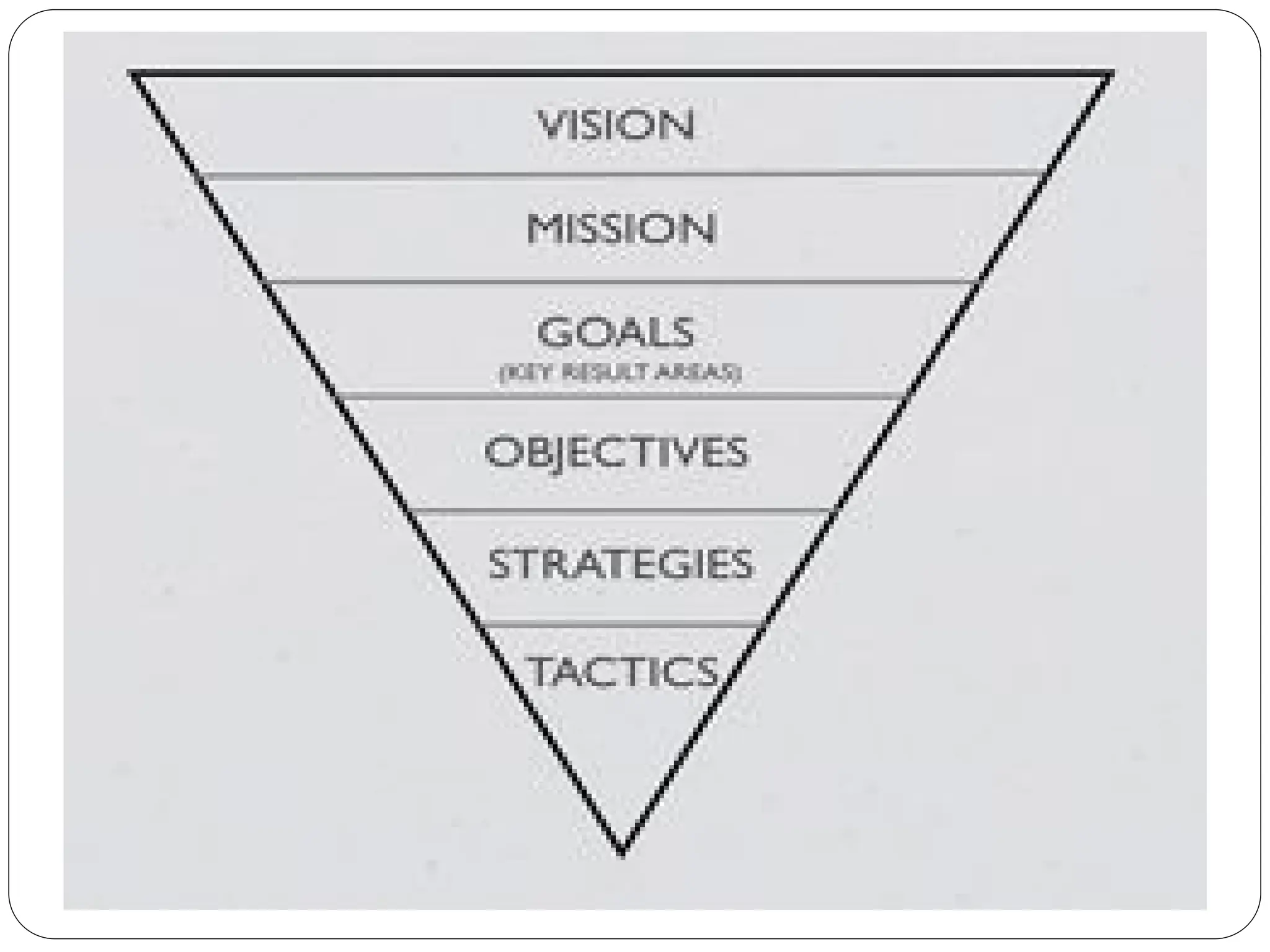
 Strategic intent lays the foundation for strategic management process
by establishing the hierarchy of strategic intent which includes Vision,
Mission, Business definition and objectives .
Vision
 Vision serves the purpose of stating what an organization wishes
to achieve in the long run.
 According to Kotter, vision is a “description of something in
the future.” Miller and Dess defined vision as the “category of
intentions that are broad, all inclusive and forward thinking”
The definitions lays stress on the following:
 Broad and all inclusive intentions
 Is forward thinking process
 Is more of a dream than articulated idea
 Is an aspiration of the organization
 Is a powerful motivator to action and
 Organizations needs to strive and exert to achieve it.
Advantages of having a Vision
Benefits of having a vision:
Is the first step towards strategic management
Identifies direction and purpose
Builds loyalty through involvement
Sets standards of excellence
Inspires enthusiasm and encouragement to align their energies in a
common direction
Fits with the ‘business culture and values of the organization
Results in efficiency and productivity
Reflects the company's unique strengths
Vision pulls employees and stakeholders to understand what they are
doing, and commit themselves to the goals and values of the
organization.
Mission
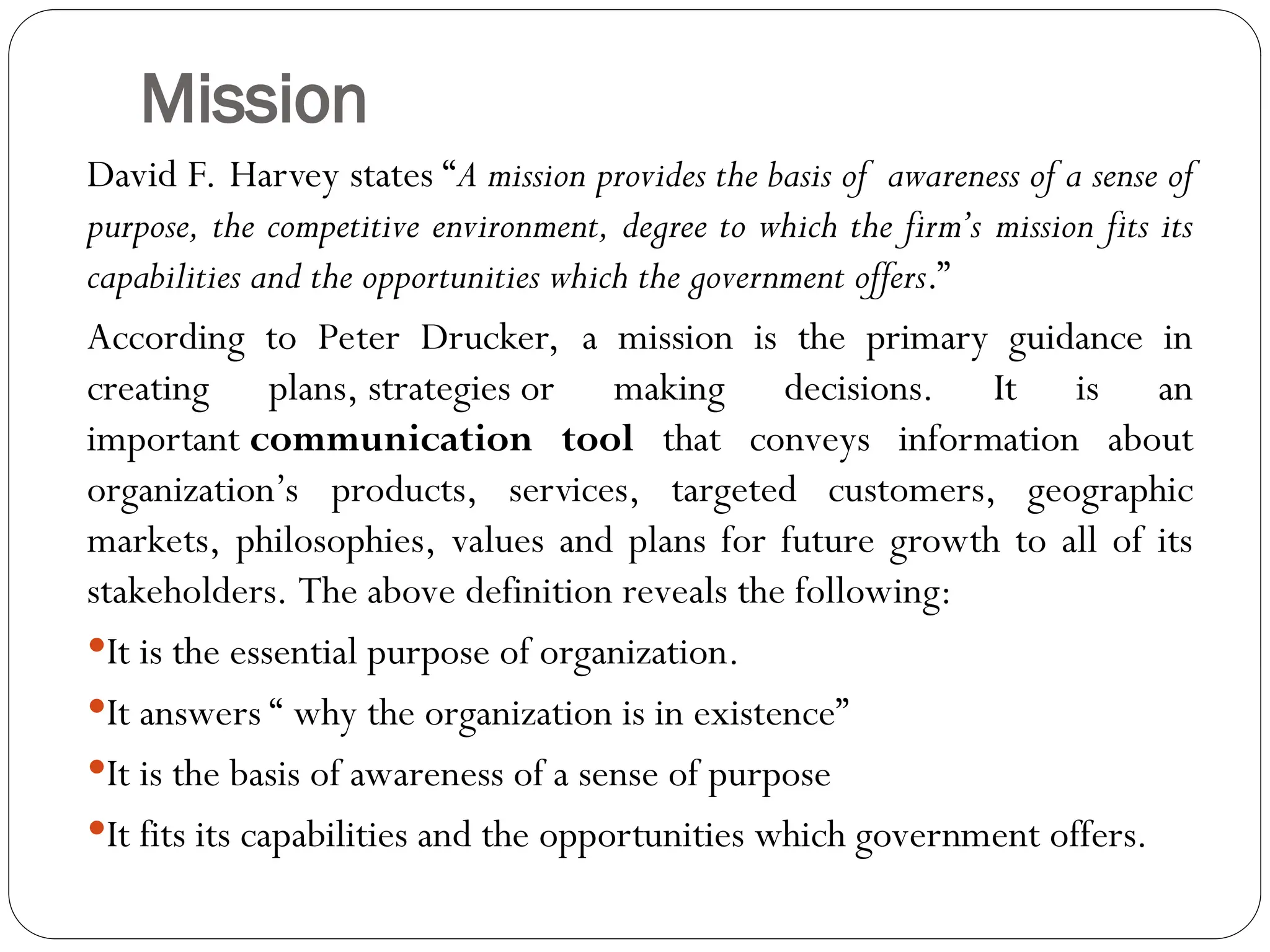
David F. Harvey states “A mission provides the basis of awareness of a sense of
purpose, the competitive environment, degree to which the firm’s mission fits its
capabilities and the opportunities which the government offers.”
According to Peter Drucker, a mission is the primary guidance in
creating plans, strategies or making decisions. It is an
important communication tool that conveys information about
organization’s products, services, targeted customers, geographic
markets, philosophies, values and plans for future growth to all of its
stakeholders. The above definition reveals the following:
It is the essential purpose of organization.
It answers “ why the organization is in existence”
It is the basis of awareness of a sense of purpose
It fits its capabilities and the opportunities which government offers.
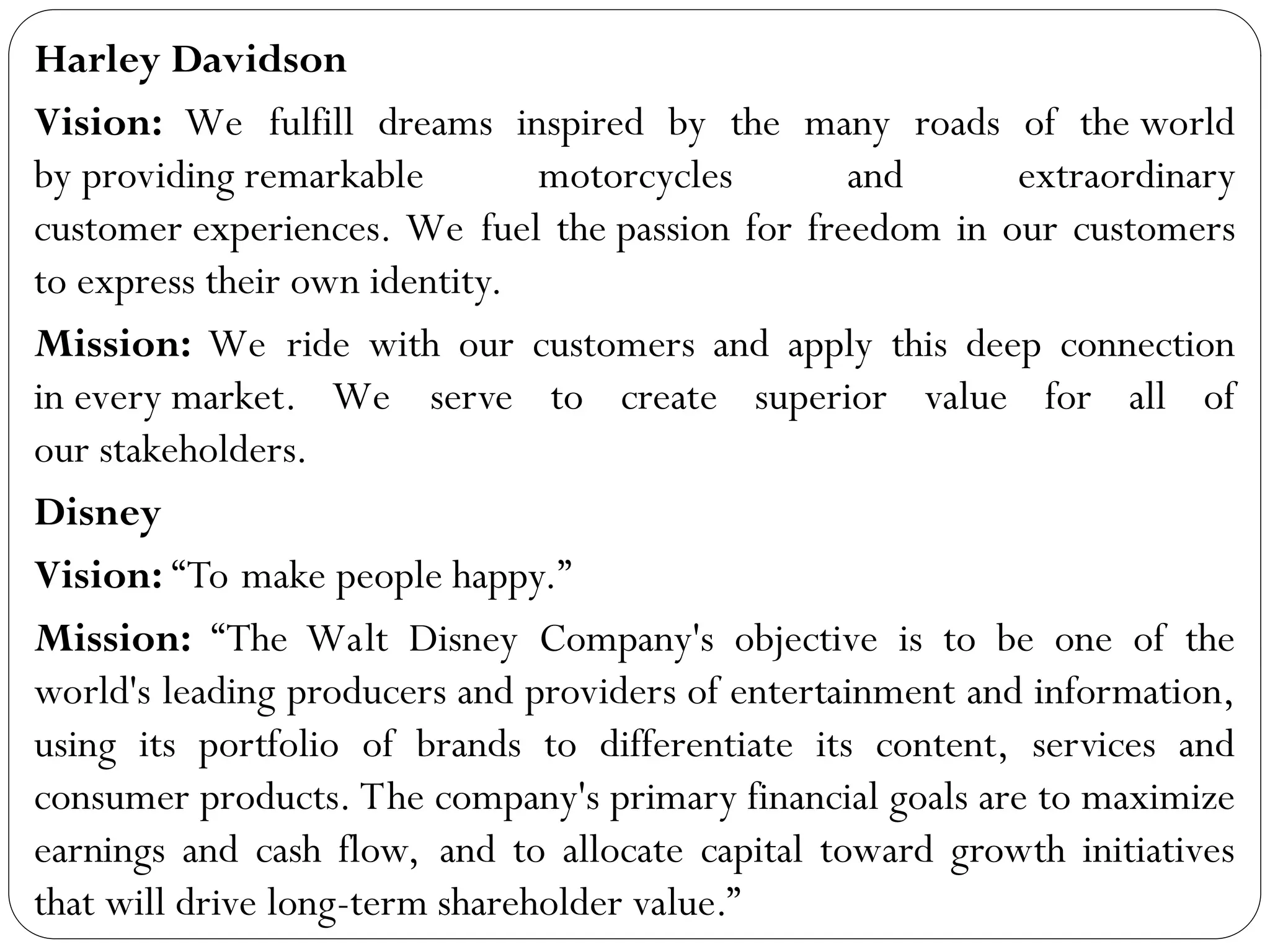
Harley Davidson
Vision: We fulfill dreams inspired by the many roads of the world
by providing remarkable motorcycles and extraordinary
customer experiences. We fuel the passion for freedom in our customers
to express their own identity.
Mission: We ride with our customers and apply this deep connection
in every market. We serve to create superior value for all of
our stakeholders.
Disney
Vision: “To make people happy.”
Mission: “The Walt Disney Company's objective is to be one of the
world's leading producers and providers of entertainment and information,
using its portfolio of brands to differentiate its content, services and
consumer products. The company's primary financial goals are to maximize
earnings and cash flow, and to allocate capital toward growth initiatives
that will drive long-term shareholder value.”
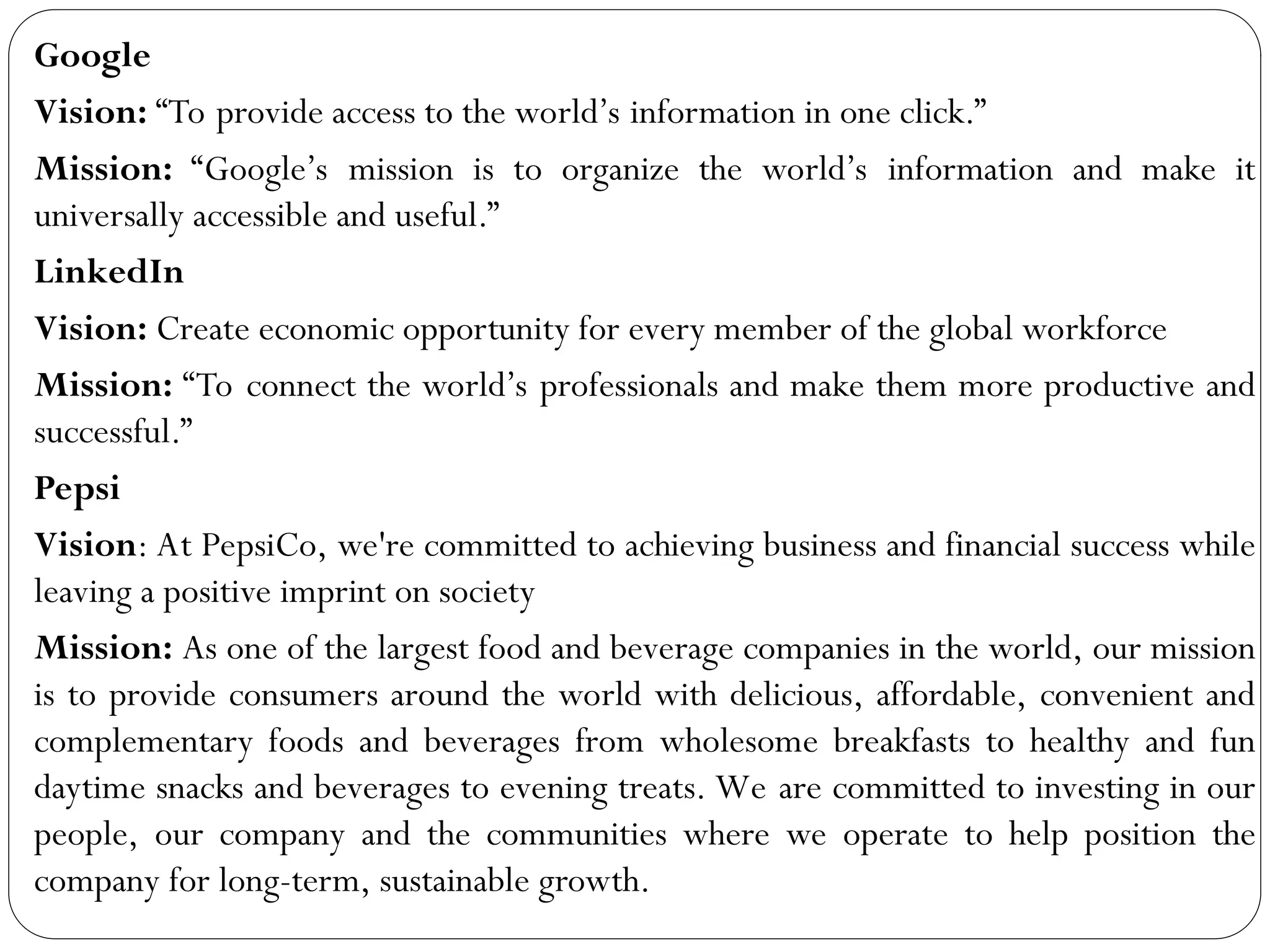
Google
Vision: “To provide access to the world’s information in one click.”
Mission: “Google’s mission is to organize the world’s information and make it
universally accessible and useful.”
LinkedIn
Vision: Create economic opportunity for every member of the global workforce
Mission: “To connect the world’s professionals and make them more productive and
successful.”
Pepsi
Vision: At PepsiCo, we're committed to achieving business and financial success while
leaving a positive imprint on society
Mission: As one of the largest food and beverage companies in the world, our mission
is to provide consumers around the world with delicious, affordable, convenient and
complementary foods and beverages from wholesome breakfasts to healthy and fun
daytime snacks and beverages to evening treats. We are committed to investing in our
people, our company and the communities where we operate to help position the
company for long-term, sustainable growth.
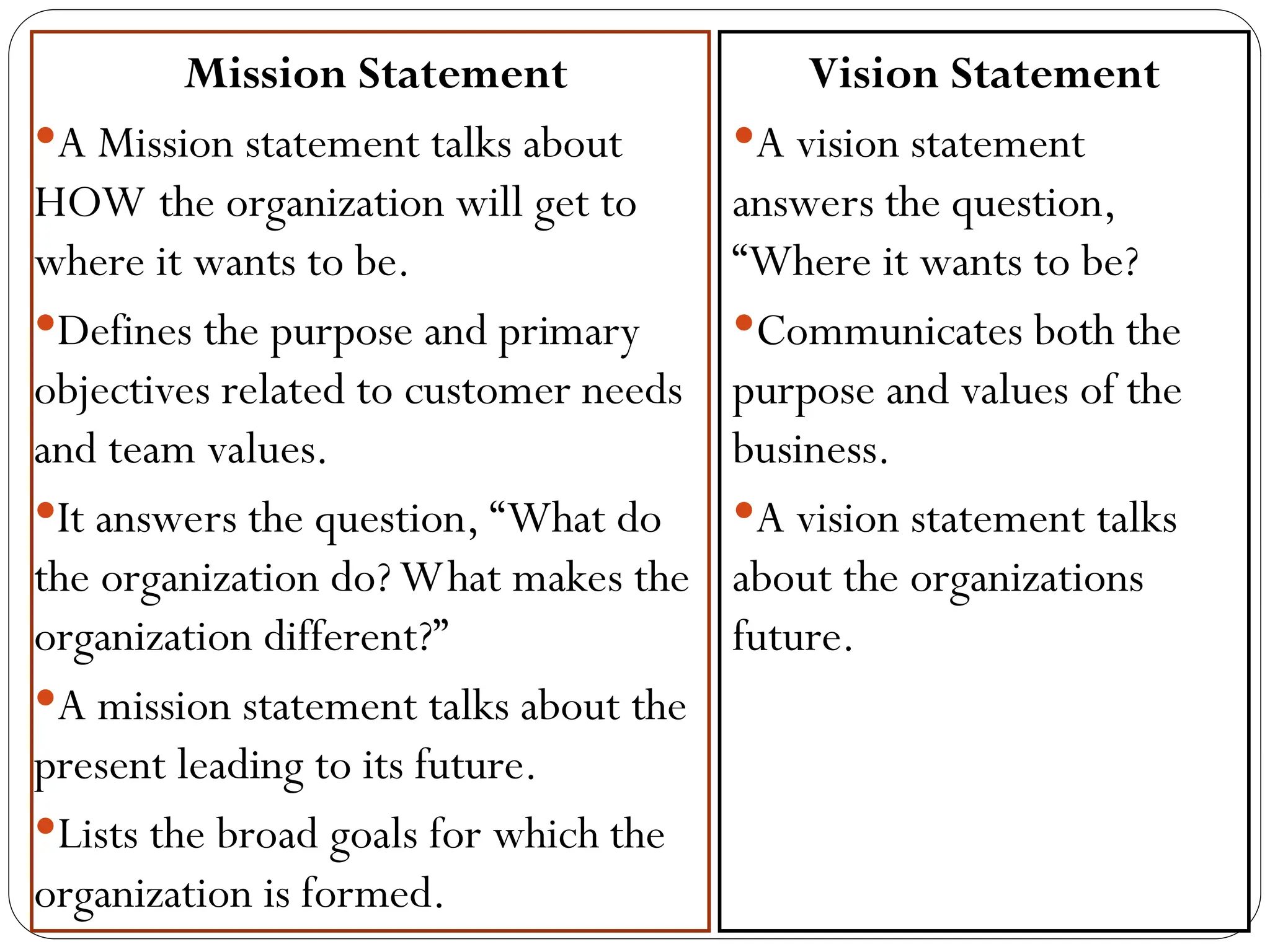
Mission Statement
A Mission statement talks about
HOW the organization will get to
where it wants to be.
Defines the purpose and primary
objectives related to customer needs
and team values.
It answers the question, “What do
the organization do? What makes the
organization different?”
A mission statement talks about the
present leading to its future.
Lists the broad goals for which the
organization is formed.
Vision Statement
A vision statement
answers the question,
“Where it wants to be?
Communicates both the
purpose and values of the
business.
A vision statement talks
about the organizations
future.
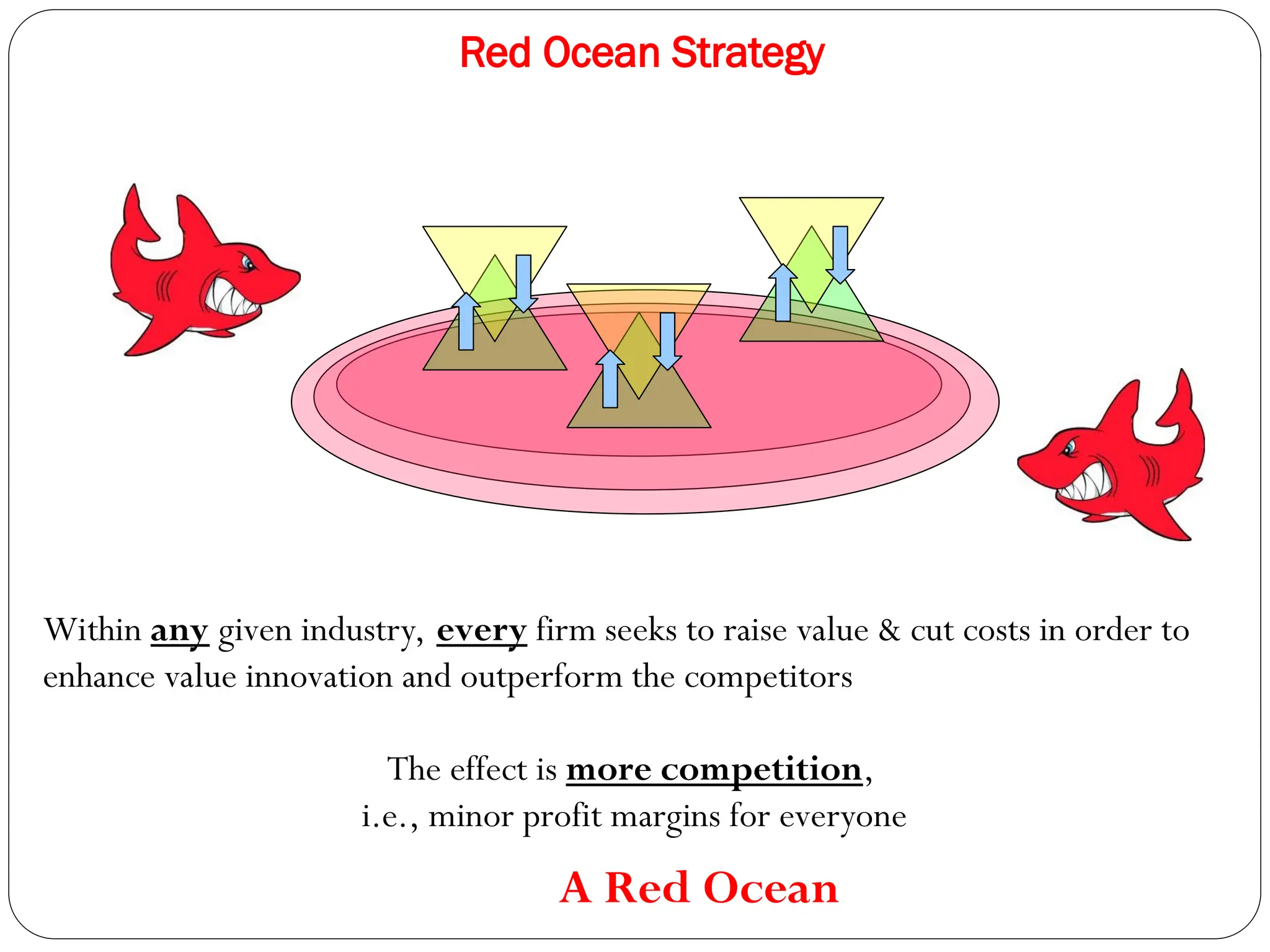
Red Ocean Strategy
Within any given industry, every firm seeks to raise value & cut costs in order to
enhance value innovation and outperform the competitors
The effect is more competition,
i.e., minor profit margins for everyone
A Red Ocean
Blue Ocean Strategy
A successful strategy consists of “pulling ourself out” of the tough
competition by venturing into unchartered “water” where no
other competitors are present (yet)
A Blue Ocean
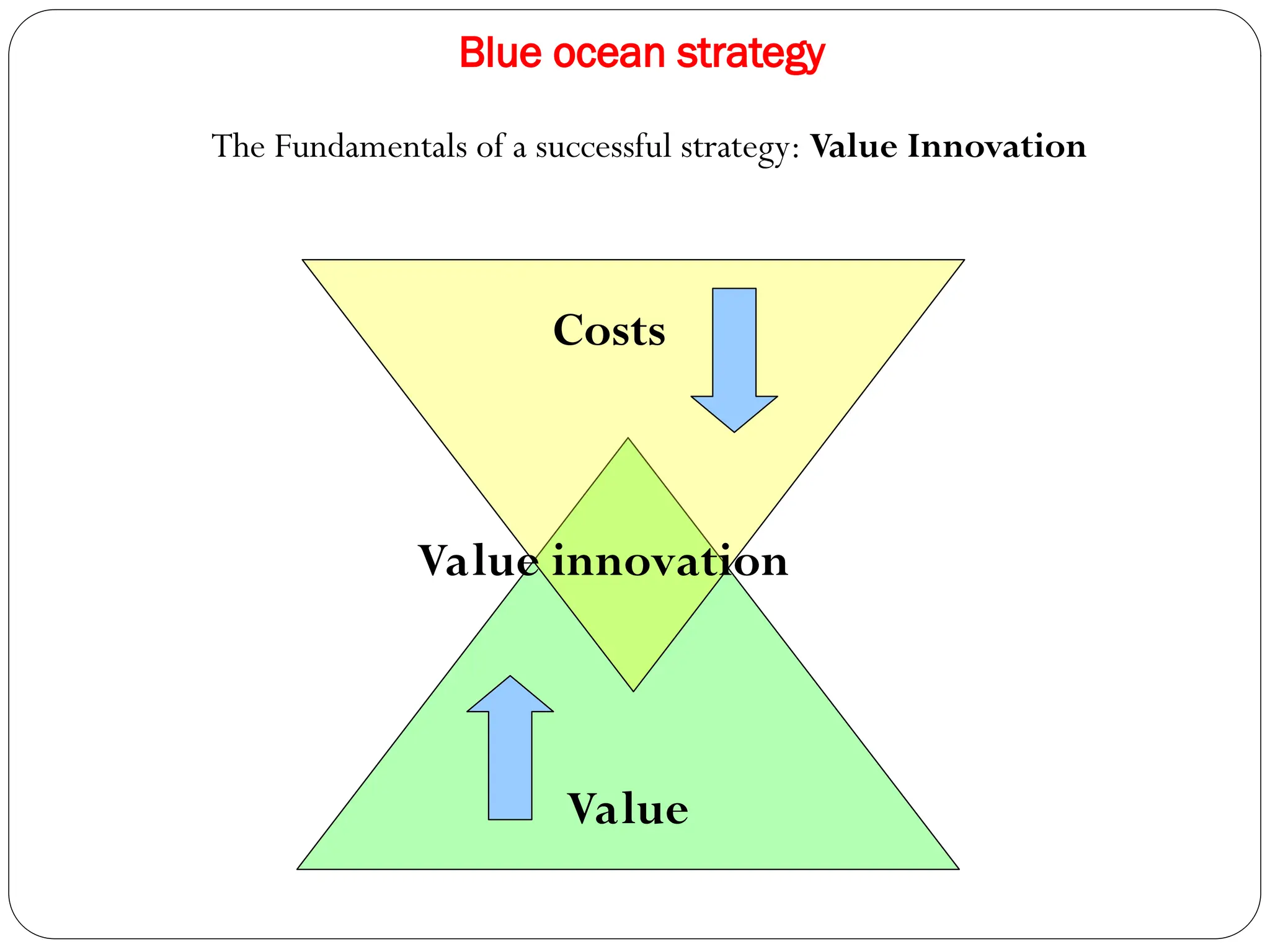
Blue ocean strategy
The Fundamentals of a successful strategy: Value Innovation
Costs
Value
Value innovation
.
The Premise is Simple
To win in the future, companies must stop
competing with each other.
The only way to beat the competition is
to stop trying to beat the competition
Value innovation is the “new” strategic logic
behind Blue Ocean Strategy.
Instead of focussing on beating the
competition, you focus on making it irrelevant
by creating a leap in value for buyers and
creating uncontested market space.
Instances of Blue Ocean Strategy
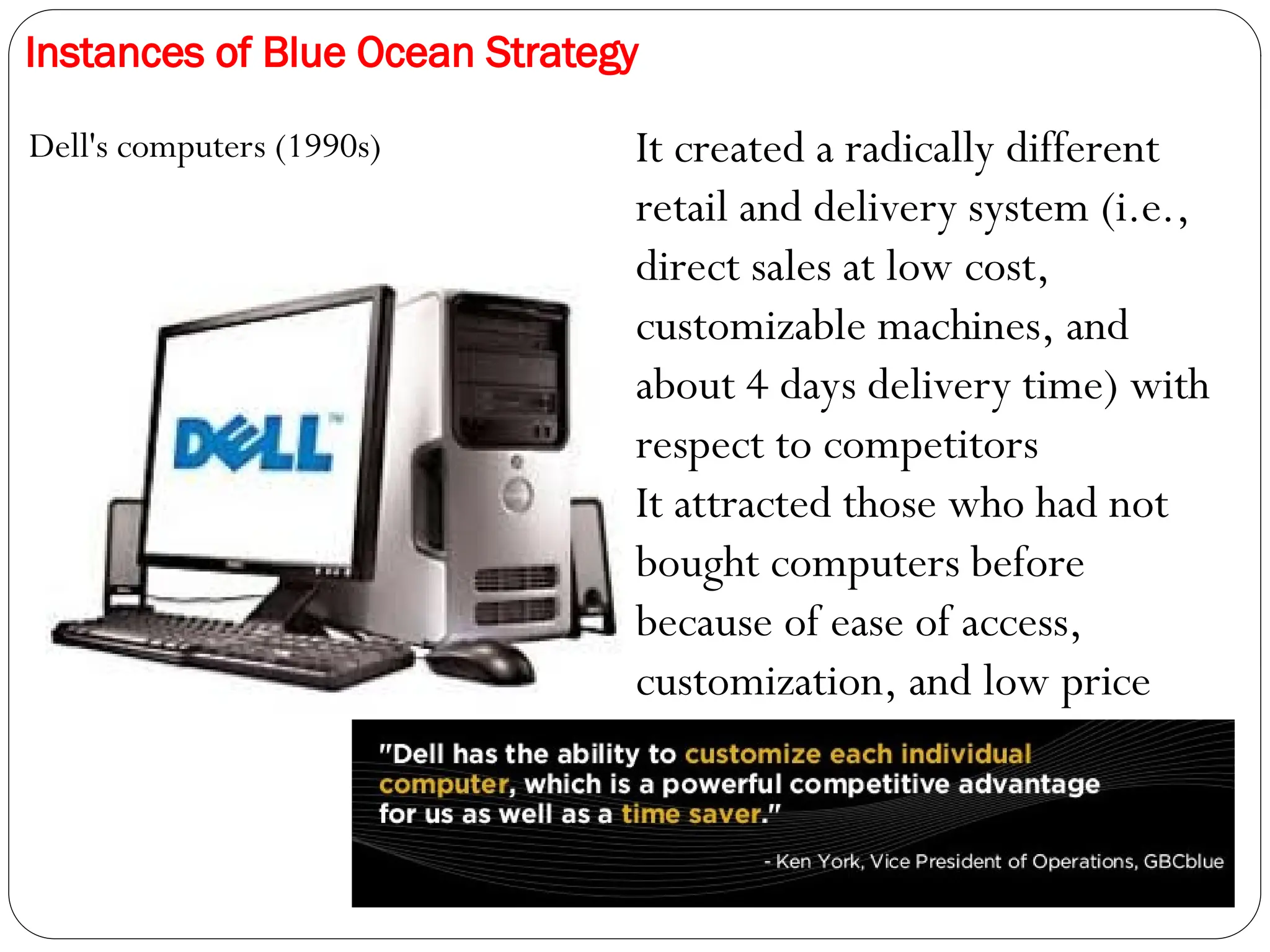
Dell's computers (1990s) It created a radically different
retail and delivery system (i.e.,
direct sales at low cost,
customizable machines, and
about 4 days delivery time) with
respect to competitors
It attracted those who had not
bought computers before
because of ease of access,
customization, and low price
IPL – A classical example of Blue
ocean strategy
The success of the Indian Premier League is yet
another example of how a successful blue ocean has
been created by reducing spectator time, reducing the
emphasis on classic batting and bowling techniques,
raising the pace of the game and emphasis on
athleticism, increasing the entertainment quotient
with Bollywood and cheer leaders. It overall created a
unique entertainment experience coupled with loyalty
to the city.
Strategic analysis
 The process of developing strategy for a business by researching
the business and the environment in which it operates.
Strategic analysis helps organizations to be:
 More sustainable: identifies the need for making changes in
the organization (e.g.: change in HR or marketing policy).
 More resilient: can anticipate future risks and respond
proactively (e.g.: changes in economic policy, political stability)
 More innovative: make aware of cutting edge practice and
develop new solutions for new problems (e.g.: new technology)
 Stay relevant: make aware of how the needs, expectations and
preferences of their current and potential clients are changing
(e.g. : customer satisfaction).
Long, short term and annual objectives
 Long-term objectives define any goal that is realistic and
has a time frame exceeding one year. This can be developing
a new product, developing a comprehensive marketing
strategy.
 Short-term objectives represent the goals an
organization sets that are centered on tasks that can be
achieved within the next six months or, within one year.
E.g.: Increase sales by 10 percent, which is measurable goal and
employees can be held directly accountable for ensuring that it is
met.
 Annual objectives are simply the company’s goals for a
calendar year, these goals should target a degree of
improvement.
Strategic choice
 Strategic choice is a part of the strategic process and
involves elements like the identification and evaluation
of alternatives.
 Strategic choices occur at different levels, at the
business level, at the corporate and at the international
level.
 The options can develop into different directions and
different methods can be of relevance when evaluating
them. A great challenge is to get choices on different
levels to be consistent with each other.
 The main intention is to achieve the strategic fit
between the organization and it’s environment in order
to accomplish the firm’s objectives by using it’s
strengths to overcome it’s weakness
External Audit
 External audit
Focuses on identifying and evaluating trends
and events beyond the control of a single firm
Reveals key opportunities and threats
confronting an organization so that managers
can formulate strategies to take advantage of
the opportunities and avoid or reduce the
impact of threats
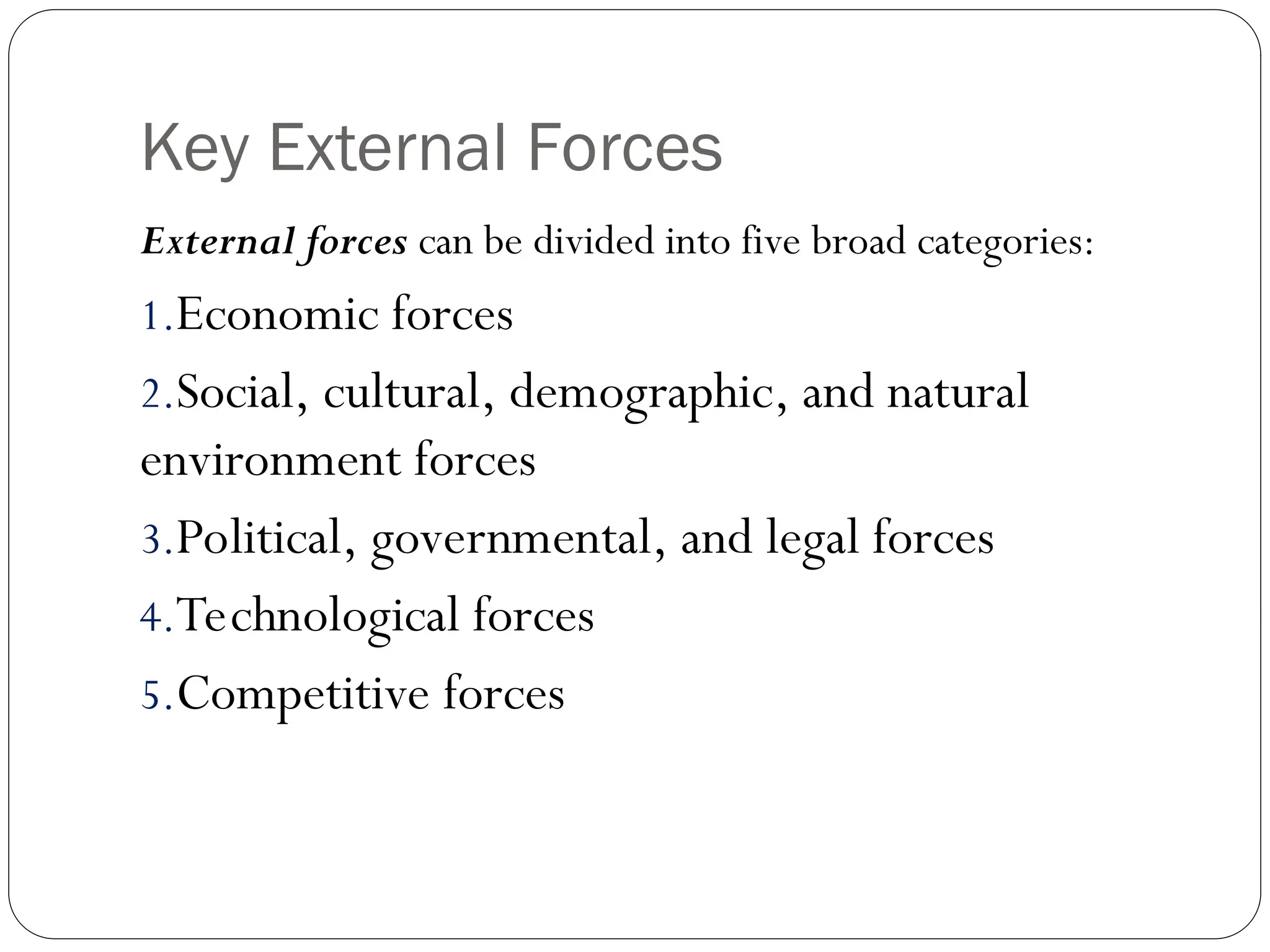
Key External Forces
External forces can be divided into five broad categories:
1.Economic forces
2.Social, cultural, demographic, and natural
environment forces
3.Political, governmental, and legal forces
4.Technological forces
5.Competitive forces
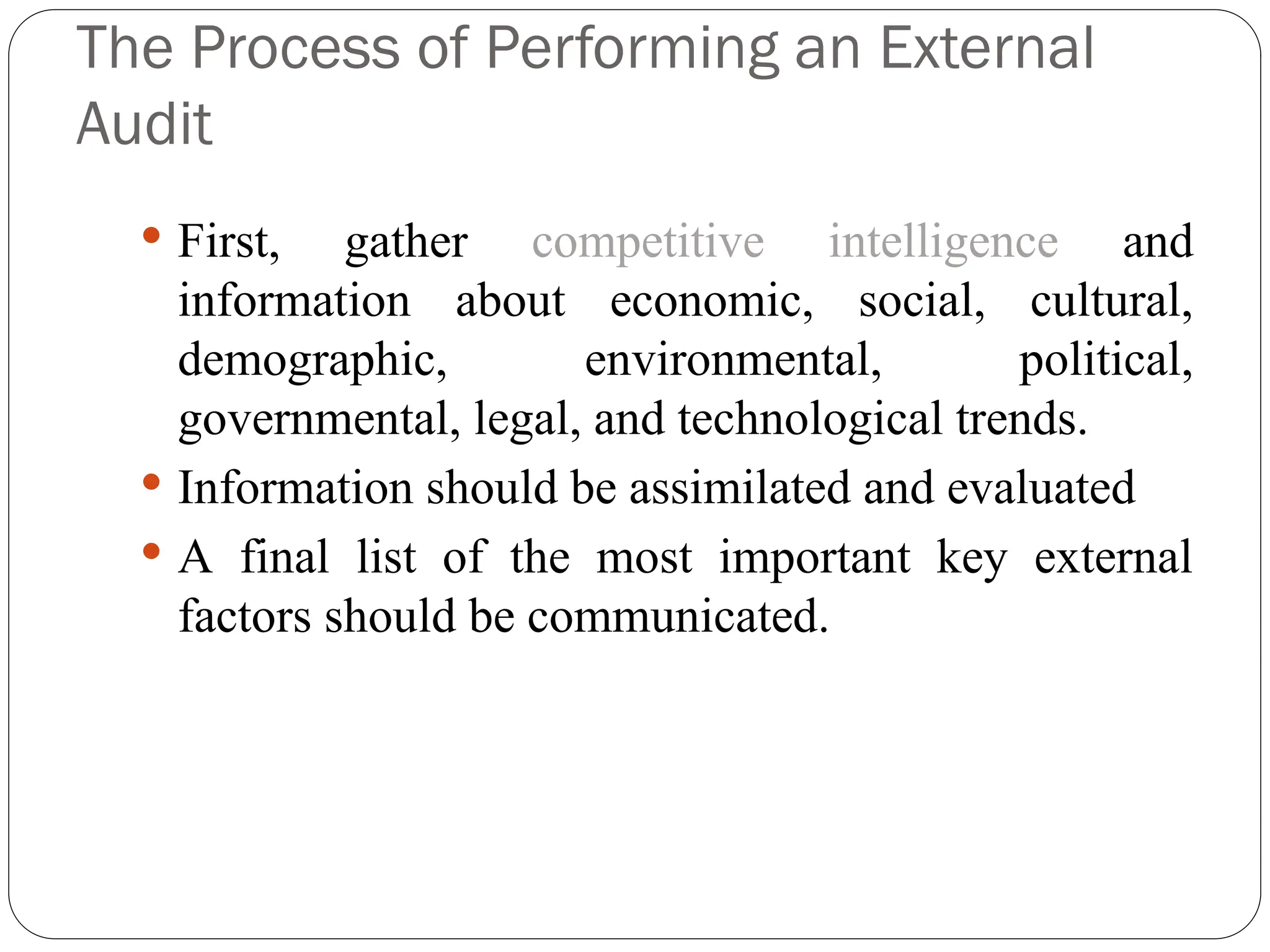
The Process of Performing an External
Audit
 First, gather competitive intelligence and
information about economic, social, cultural,
demographic, environmental, political,
governmental, legal, and technological trends.
 Information should be assimilated and evaluated
 A final list of the most important key external
factors should be communicated.
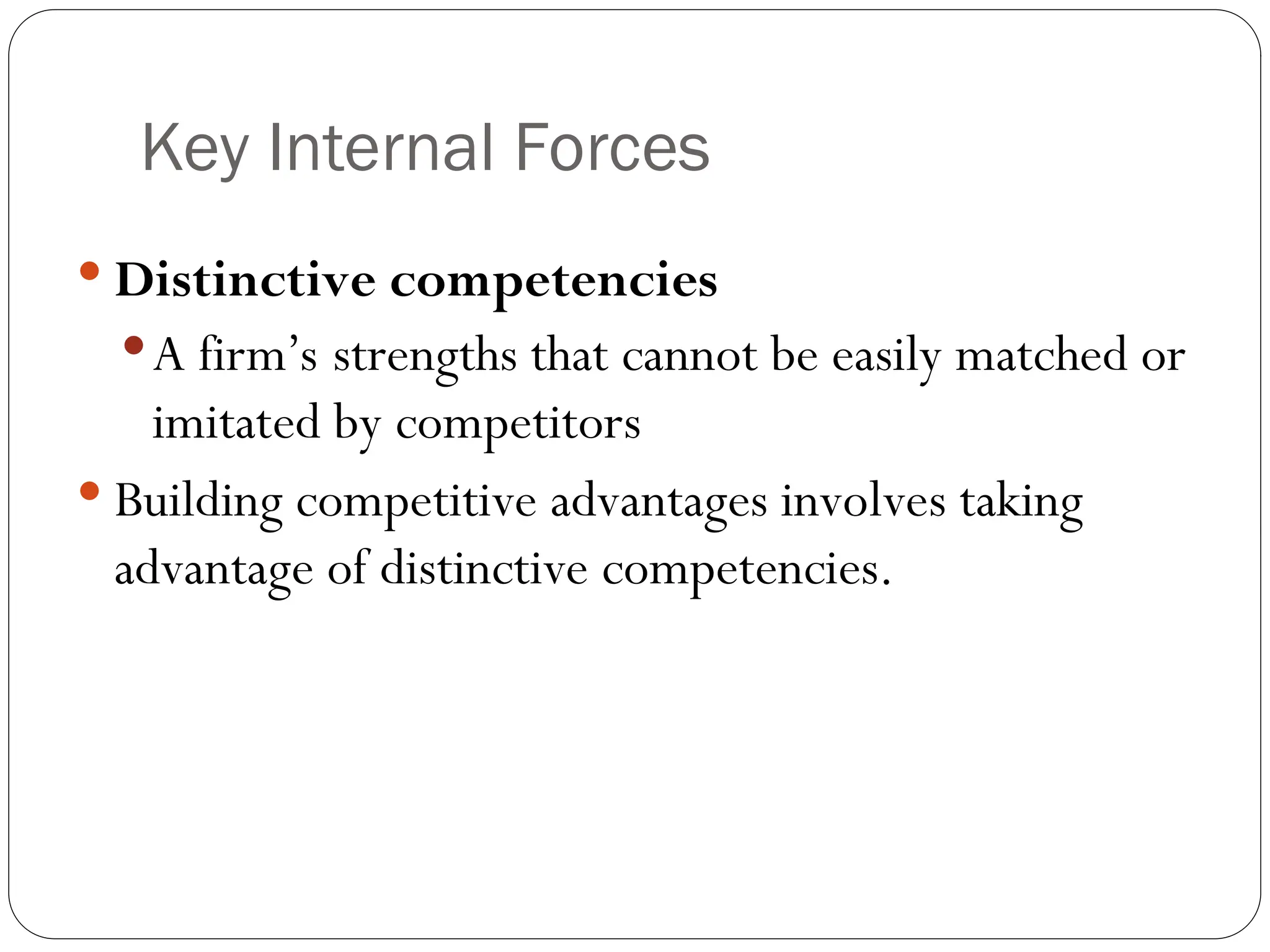
Key Internal Forces
 Distinctive competencies
A firm’s strengths that cannot be easily matched or
imitated by competitors
 Building competitive advantages involves taking
advantage of distinctive competencies.
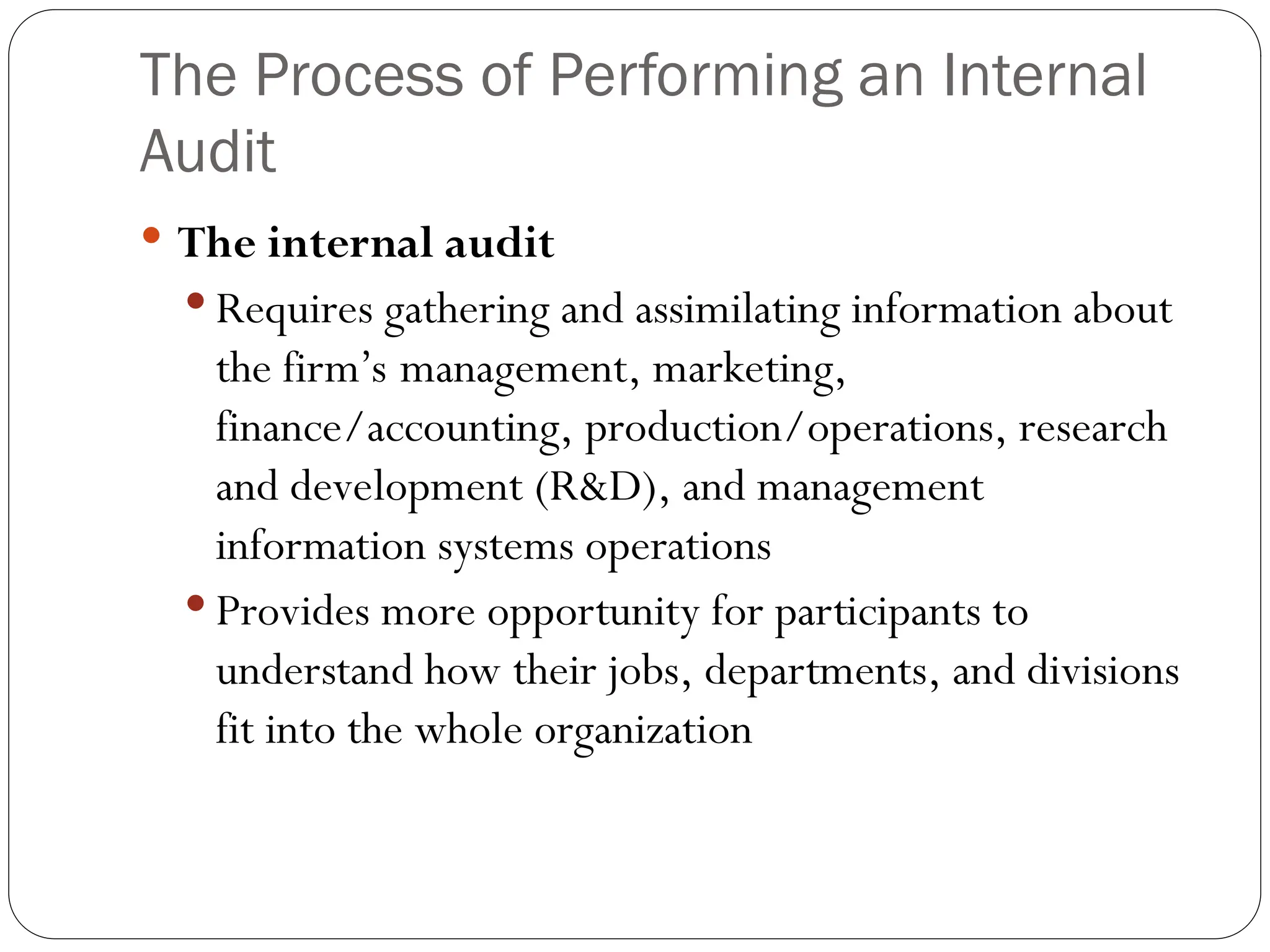
The Process of Performing an Internal
Audit
 The internal audit
 Requires gathering and assimilating information about
the firm’s management, marketing,
finance/accounting, production/operations, research
and development (R&D), and management
information systems operations
 Provides more opportunity for participants to
understand how their jobs, departments, and divisions
fit into the whole organization
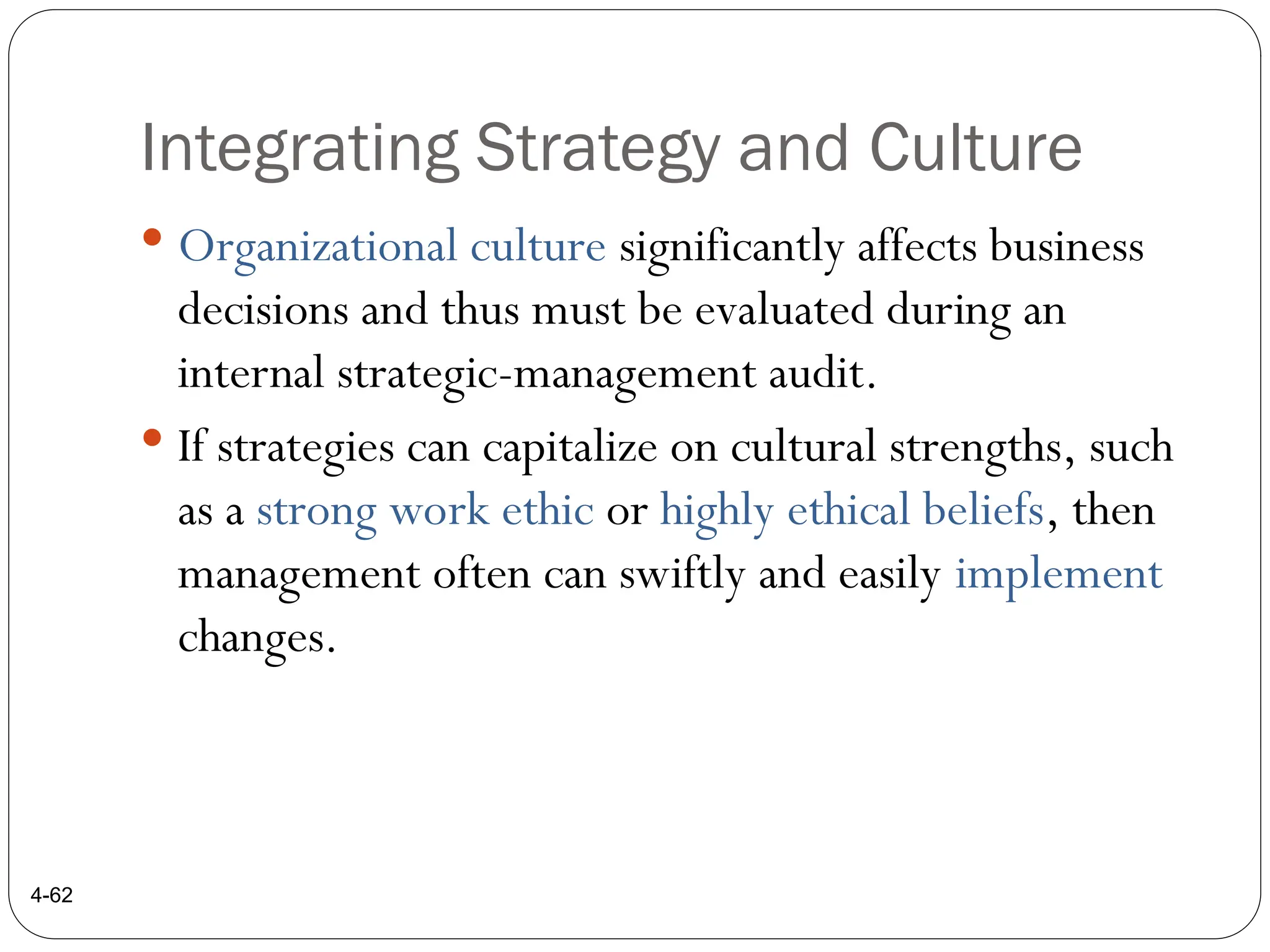
Integrating Strategy and Culture
 Organizational culture significantly affects business
decisions and thus must be evaluated during an
internal strategic-management audit.
 If strategies can capitalize on cultural strengths, such
as a strong work ethic or highly ethical beliefs, then
management often can swiftly and easily implement
changes.
4-62
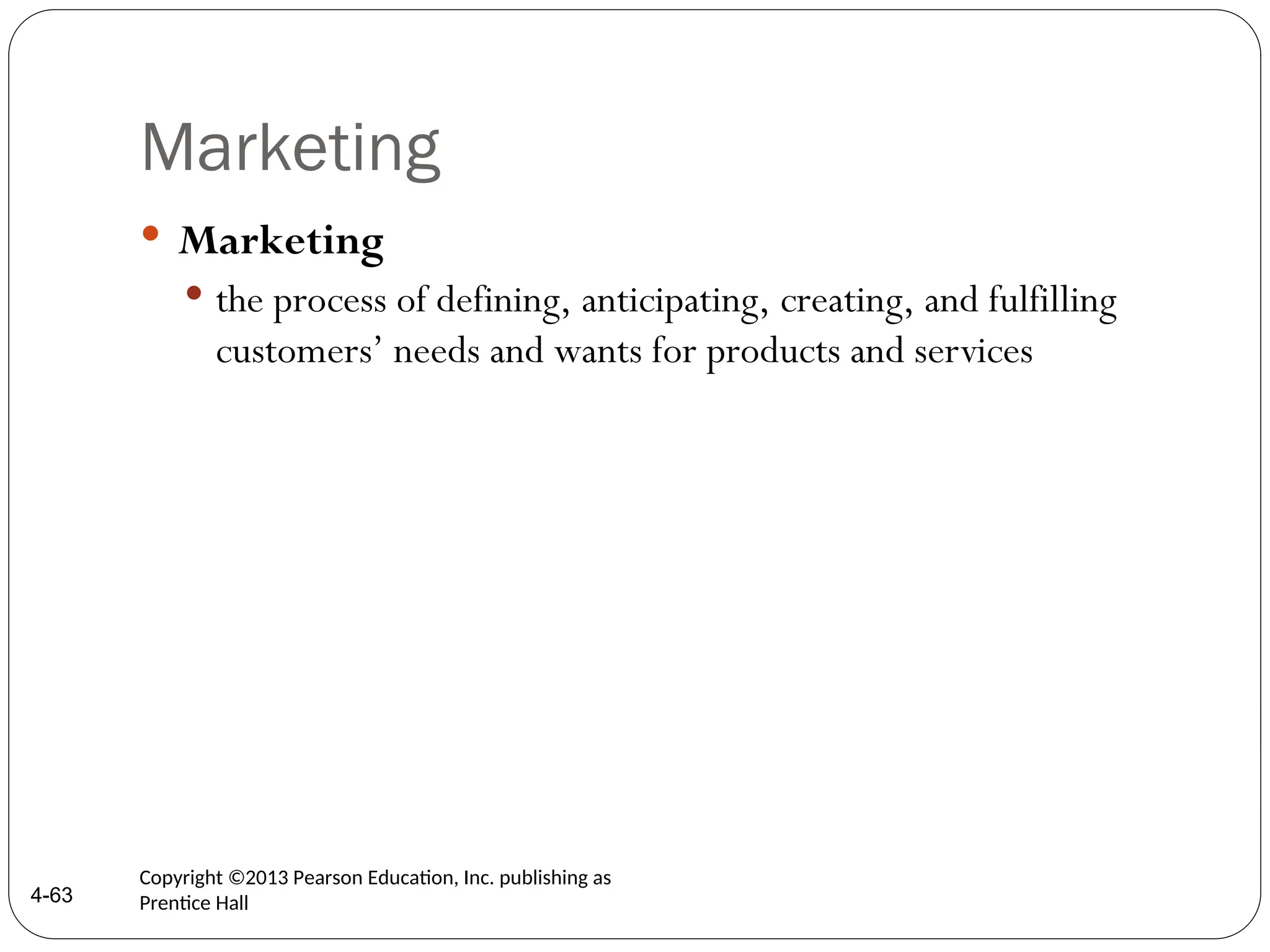
Marketing
 Marketing
 the process of defining, anticipating, creating, and fulfilling
customers’ needs and wants for products and services
4-63
Copyright ©2013 Pearson Education, Inc. publishing as
Prentice Hall
Functions of Marketing
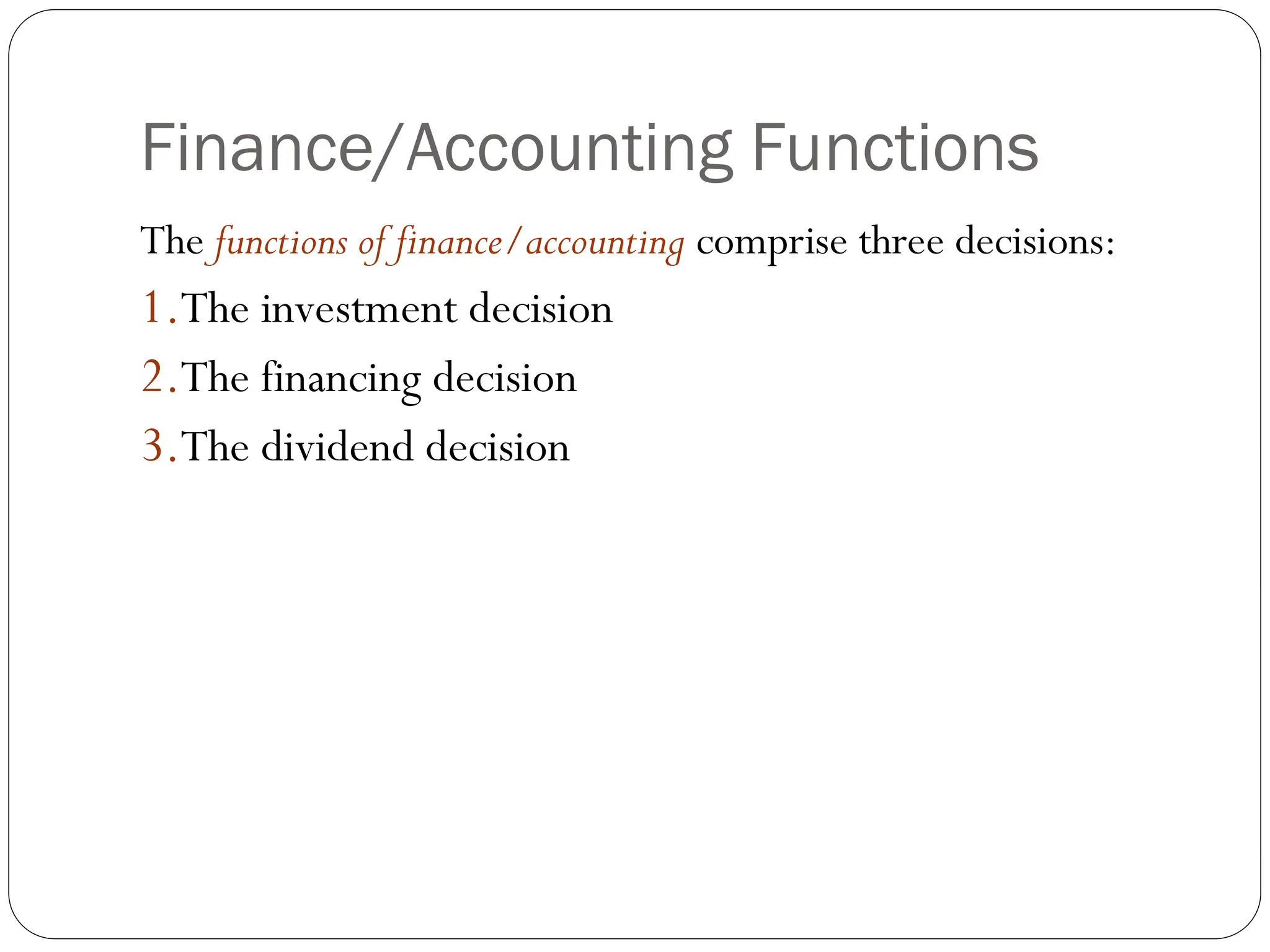
Finance/Accounting Functions
The functions of finance/accounting comprise three decisions:
1.The investment decision
2.The financing decision
3.The dividend decision
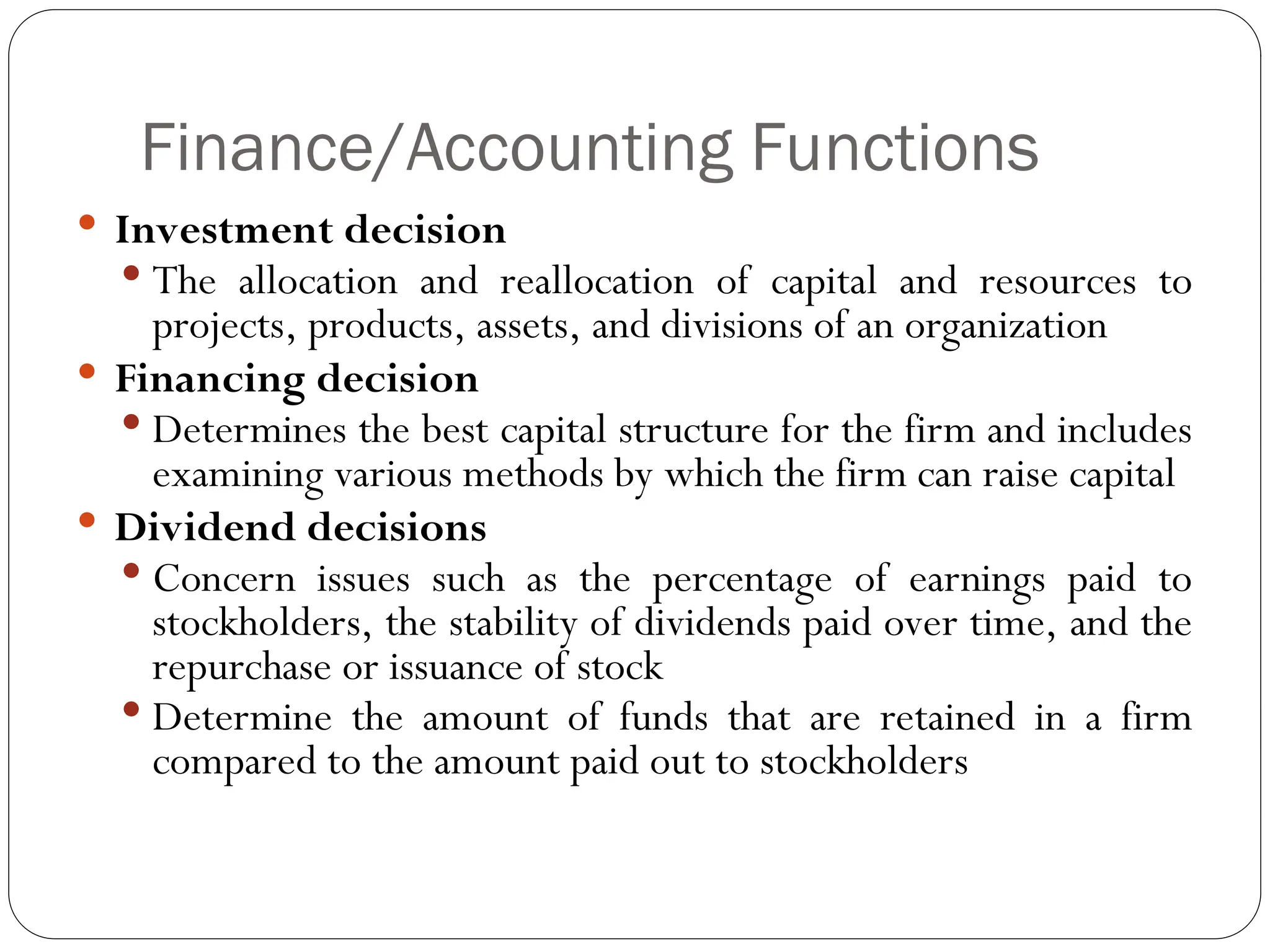
Finance/Accounting Functions
 Investment decision
 The allocation and reallocation of capital and resources to
projects, products, assets, and divisions of an organization
 Financing decision
 Determines the best capital structure for the firm and includes
examining various methods by which the firm can raise capital
 Dividend decisions
 Concern issues such as the percentage of earnings paid to
stockholders, the stability of dividends paid over time, and the
repurchase or issuance of stock
 Determine the amount of funds that are retained in a firm
compared to the amount paid out to stockholders
Production/Operations
 Production/operations function
 consists of all those activities that transforms
inputs into goods and services
 Production/operations management deals with
inputs, transformations, and outputs that vary
across industries and markets.
Steps in strategic choices
There are four steps in the process of strategic
choice as enumerated below:
1.Focusing on strategic alternatives
2.Analyzing the strategic alternatives
3.Evaluating the strategic alternatives
4.Choosing from among the strategic alternatives
Focusing on strategic alternatives
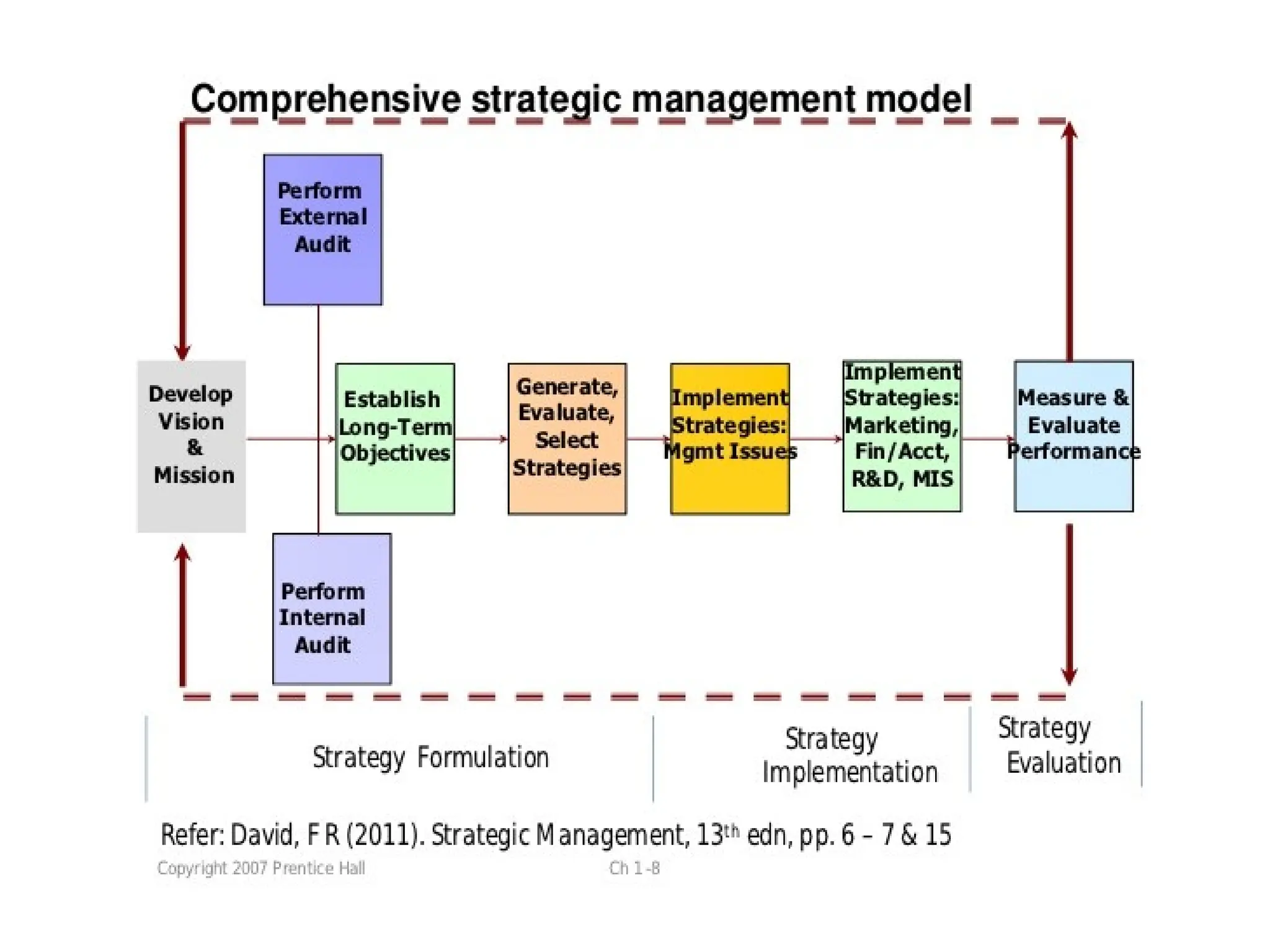
A strategic decision making process involves the following seven steps:
1.Evaluate current performance results in terms of ROI, Profitability
in the light of current mission, objectives and policies.
2.Scan and assess the external environment for opportunities and
threats.
3.Scan and assess the internal corporate environment for strengths and
weaknesses.
4.Analyze problems areas, review and revise if necessary.
5.Generate, evaluate and select the best alternate strategy
6.Implement selected strategies via programs, budgets, and
procedures.
7.Evaluate implemented strategies via feedback systems and the
control of activities to ensure their minimum deviation from plans.
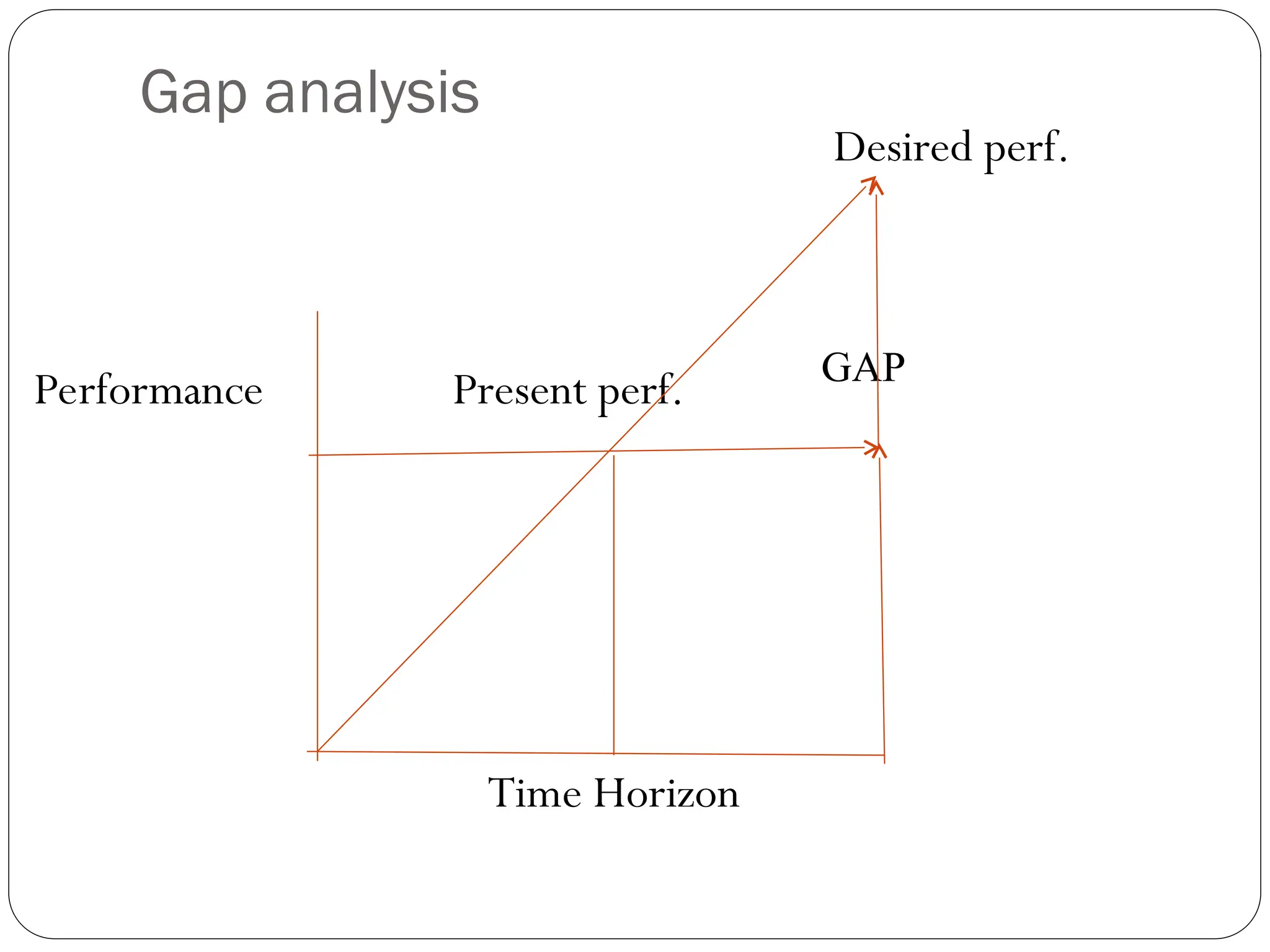
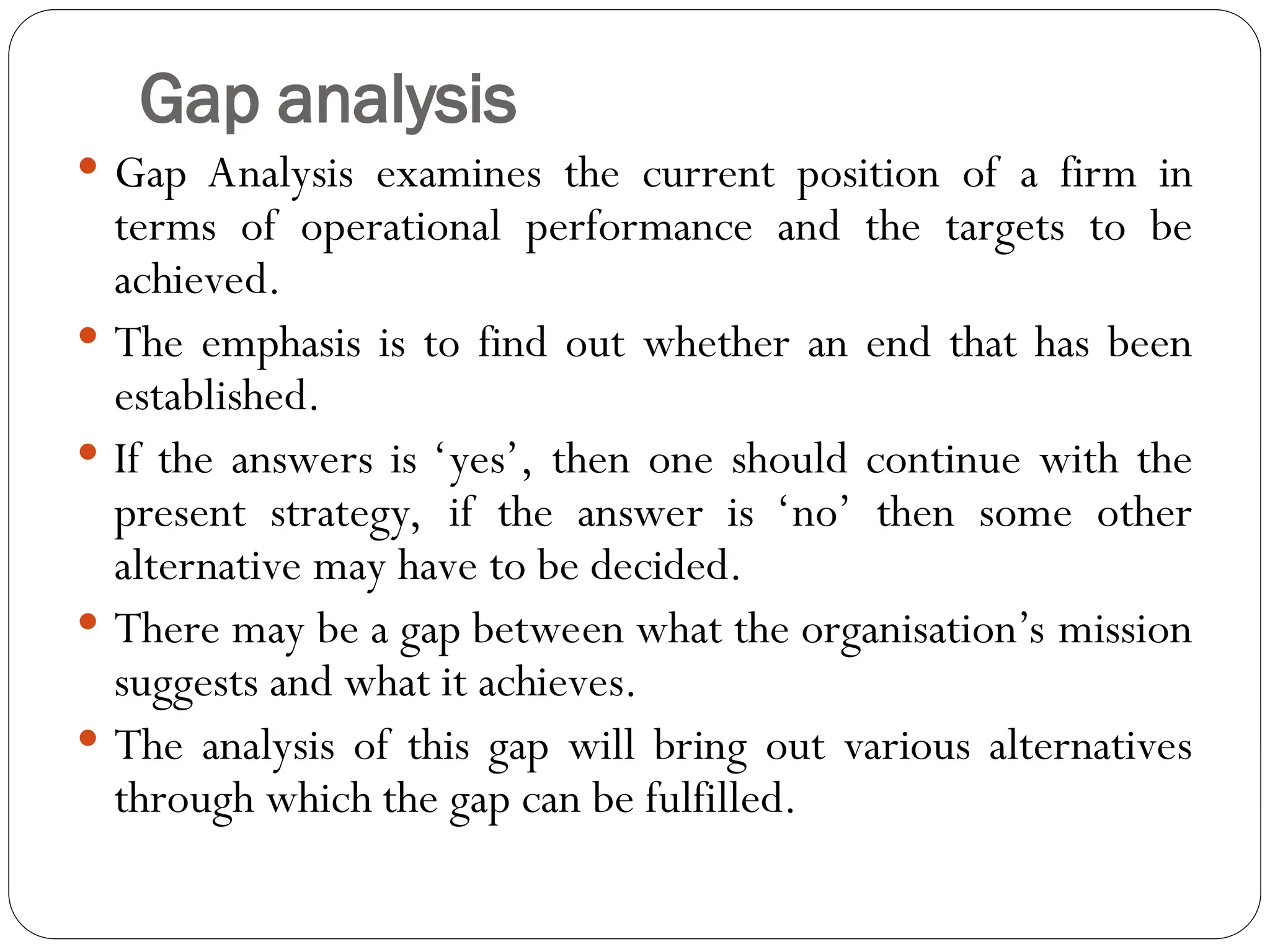
Gap analysis
Desired perf.
Performance Present perf.
Time Horizon
GAP
Gap analysis
 Gap Analysis examines the current position of a firm in
terms of operational performance and the targets to be
achieved.
 The emphasis is to find out whether an end that has been
established.
 If the answers is ‘yes’, then one should continue with the
present strategy, if the answer is ‘no’ then some other
alternative may have to be decided.
 There may be a gap between what the organisation’s mission
suggests and what it achieves.
 The analysis of this gap will bring out various alternatives
through which the gap can be fulfilled.
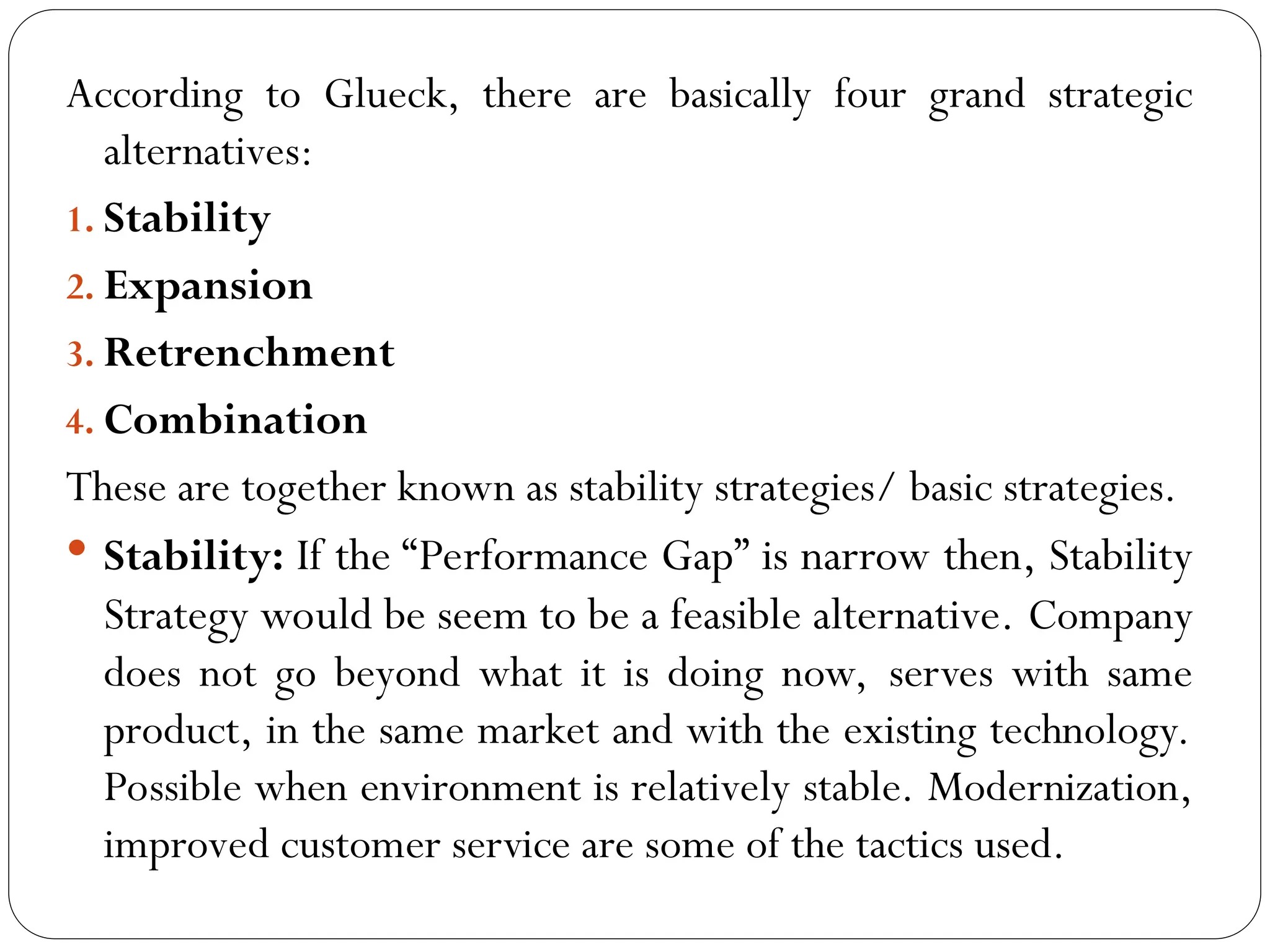
According to Glueck, there are basically four grand strategic
alternatives:
1. Stability
2. Expansion
3. Retrenchment
4. Combination
These are together known as stability strategies/ basic strategies.
 Stability: If the “Performance Gap” is narrow then, Stability
Strategy would be seem to be a feasible alternative. Company
does not go beyond what it is doing now, serves with same
product, in the same market and with the existing technology.
Possible when environment is relatively stable. Modernization,
improved customer service are some of the tactics used.
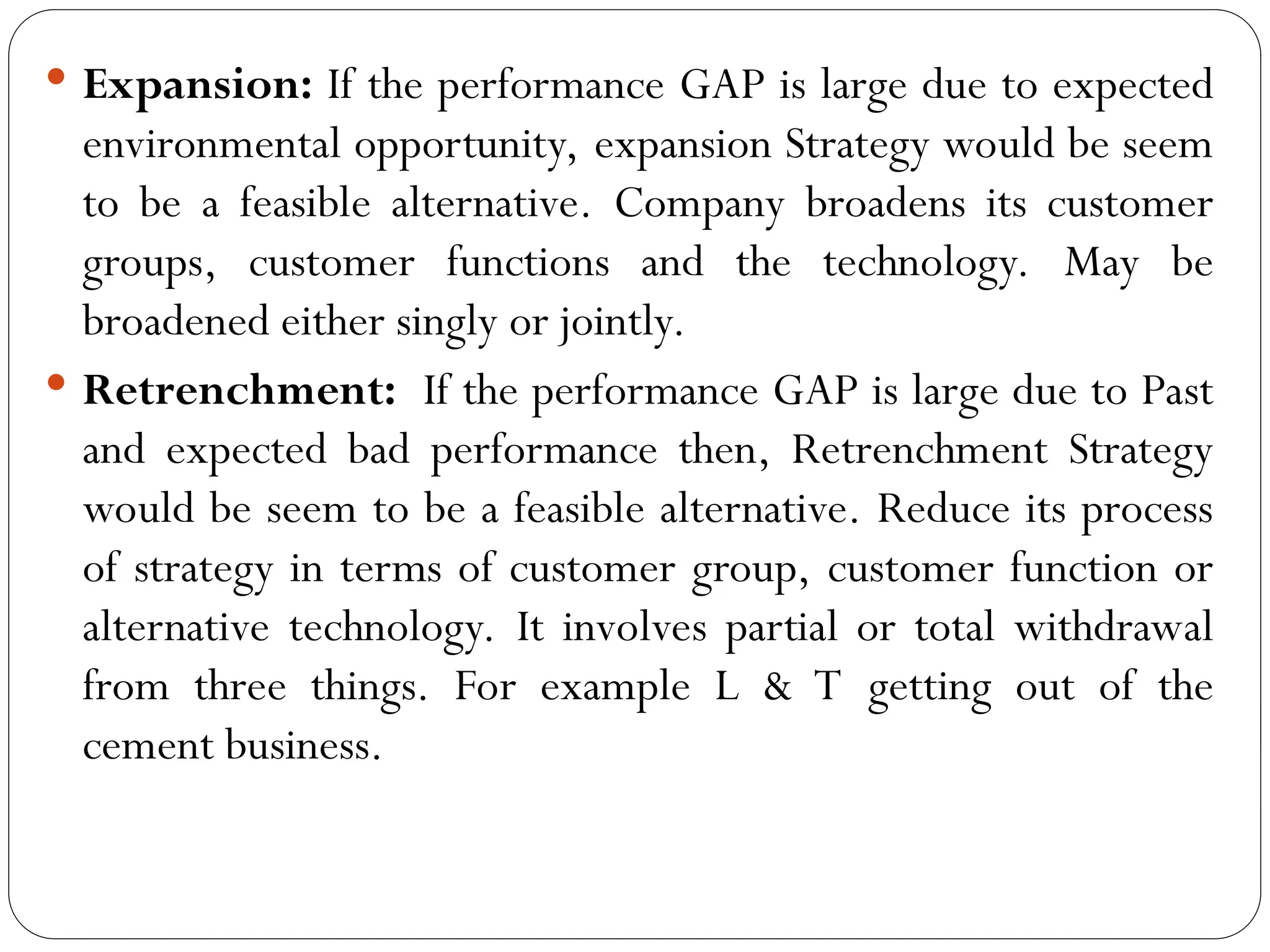
 Expansion: If the performance GAP is large due to expected
environmental opportunity, expansion Strategy would be seem
to be a feasible alternative. Company broadens its customer
groups, customer functions and the technology. May be
broadened either singly or jointly.
 Retrenchment: If the performance GAP is large due to Past
and expected bad performance then, Retrenchment Strategy
would be seem to be a feasible alternative. Reduce its process
of strategy in terms of customer group, customer function or
alternative technology. It involves partial or total withdrawal
from three things. For example L & T getting out of the
cement business.
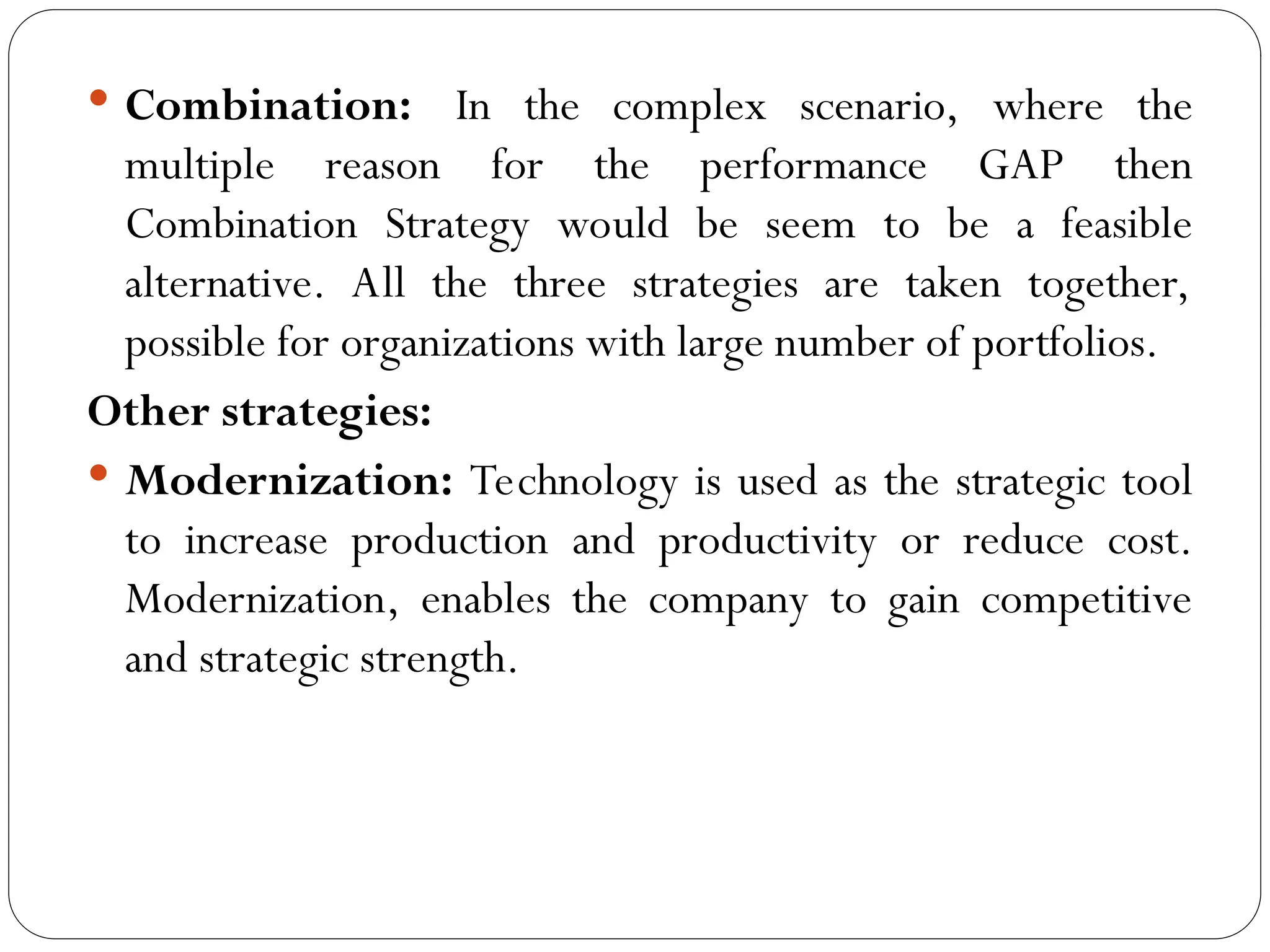
 Combination: In the complex scenario, where the
multiple reason for the performance GAP then
Combination Strategy would be seem to be a feasible
alternative. All the three strategies are taken together,
possible for organizations with large number of portfolios.
Other strategies:
 Modernization: Technology is used as the strategic tool
to increase production and productivity or reduce cost.
Modernization, enables the company to gain competitive
and strategic strength.
 Integration: The company starts producing new products and services
of its own. Integration can either be forward or background in terms
of vertical integration. In forward integration it gains ownership over
distribution or retailers, thus moving towards customers while in
backward integration the company seeks ownership over firm’s
suppliers thus moving towards raw materials. When the organization
gains ownership over competitors, it is engaged in horizontal
integration.
 Diversification: Diversification involves change in business definition
either in terms of customer functions, customer groups or alternative
technology. It is done to minimize the risk by spreading over several
businesses, to capitalize organization strength and minimize
weaknesses, to minimize threats, or to avoid current instability in profit
& sales and to facilitate higher utilization of resources. Diversification
can be either related or unrelated, horizontal. Adding Tomato ketchup and
sauce to the existing "Maggi" brand is a example of concentric diversification.
 Joint-Ventures: In joint ventures, two or more companies form
a temporary partnership (consortium). Companies opt for joint
venture for synergistic advantages to share risk, to diversify and
expand, to bring distinctive competences, to manage political and
cultural difficulty, to take technological advantage and to explore
unexplored market . E.g.: Hero with Honda, Bharti withWalmart.
 Strategic Alliance: When two or more companies unite to
pursue a set agreed upon goals but remain independent it is known
as strategic alliance. The firms share the benefits of the alliance and
control the performance of assigned tasks. The pooling of
resources, investment and risks occur for mutual gain. E.g.:
Starbucks partnered with Barnes and Nobles bookstores in 1993 to provide
in-house coffee shops, benefiting both retailers. Eli Lilly partners with the
Belgium-based company Galapagos to develop treatments for osteoporosis.
 Mergers: It is an external approach to expansion involving two or more than
two organizations. Companies go for merger to become larger, to gain
competitive advantage, to overcome weaknesses and sometimes to get tax
benefits. Merger takes place with mutual consent and common goals. E.g.: In
2015, one of India’s most high-profile mergers through absorption was that of Kotak
Mahindra Bank Ltd., India’s fourth largest private bank, and ING Vysya, the
Indian branch of the Netherland’s ING Bank.
 Horizontal merger:- is a combination of two or more firms in the same area
of business. For example, combining of two book publishers or two luggage manufacturing
or two cool drinks companies to gain dominant market share.
 Vertical merger:- is a combination of two or more firms involved in different
stages of production or distribution of the same product. For example, joining of a
TV manufacturing(assembling) company and a TV marketing company or joining of a
spinning company and a weaving company. Vertical merger may take the form of forward
or backward merger. When a company combines with the supplier of material, it is called
backward merger and when it combines with the customer, it is known as forward merger.
 Conglomerate merger:- is a combination of firms engaged in unrelated lines
of business activity. For example, merging of different businesses like manufacturing of
cement products, fertilizer products, electronic products, insurance investment and
advertising agencies. L&T andVoltas Ltd are examples of such mergers.
 Acquisition: For the organization which acquires another,
it is acquisition and for organization which is acquired, it is
merger.
 Takeovers: In takeovers, there is a strong motive to
acquire others for quick growth and diversification.
 Divestment: In divestment, the company which is
divesting has no ownership and control in that business and
is engaged in complete selling of a unit. It is referred to the
disposing off a part of the business.
 Turnaround Strategy: When the company is sick and
continuously making losses, it goes for turnaround strategy.
It is the efforts in reversing a negative trend and it is the
efforts to keep an organization alive.
Module III
 Choice of Strategic alternative - Environment Analysis,
Industry Analysis and Corporate Analysis, General
environment scanning; SWOT Analysis; tools and techniques
for Strategic Analysis; Value chain analysis; Experience
curve; Critical Success Factor Analysis; Core competence;
Portfolio analysis; BCG Matrix, GEC Model; 7S Framework;
stakeholders‘ expectations analysis; competitive analysis;
Scenario planning.
Choice of strategic alternatives
 Choosing Strategic alternatives is based on the relationship
between a business and its environment.
 The environment in which the business operates has a greater
influence on their successes or failures.
 It is therefore important to understand the forces of external
environment and the internal environment and how they
influence this linkage.
 The external environment is dynamic and holds both
opportunities and threats.
 Thus organizations should attempt at strategic realignments,
to capture these opportunities and avoid emerging threats.
Analyzing strategic alternatives
Analyzing the strategies Alternatives : An analysis has to rely on
certain factors. These factors are termed as selection factors.
 The Objective Factors- Based on analytical techniques and
hard facts or data. E.g.: Market share of a company expressed as
percentage of the total market share of a company.
The Subjective Factors- Based on one’s personal judgment,
collective or descriptive factors. E.g.: Perception of the
company's top management regarding the prospects of the
business in the next 2-3 years.
Evaluating the strategic alternatives
 Five main qualitative areas should be examined when considering
strategic options: Consistency, Validity, Feasibility, Business Risk And
Flexibility
 Consistency: Strategic alternatives must be consistent with achieving
the business’s vision, mission and goals.
 Validity: These assumptions may include the future business
environment, the competition, customers and suppliers and how they
will react to alternative strategies.
 Feasibility: A strategy may, in theory, be capable of delivering the
business’s vision, mission and goals, but in practice it must also be
feasible.
 Business risk: These include ways of minimising the potential risk. The
evaluation should aim to determine whether the residual risk of a
strategic option is at a level commensurate with the anticipated return.
 Flexibility: In today’s rapidly changing business world, the strategy
chosen must have enough flexibility to work if circumstances change.
Strategic choice alternatives
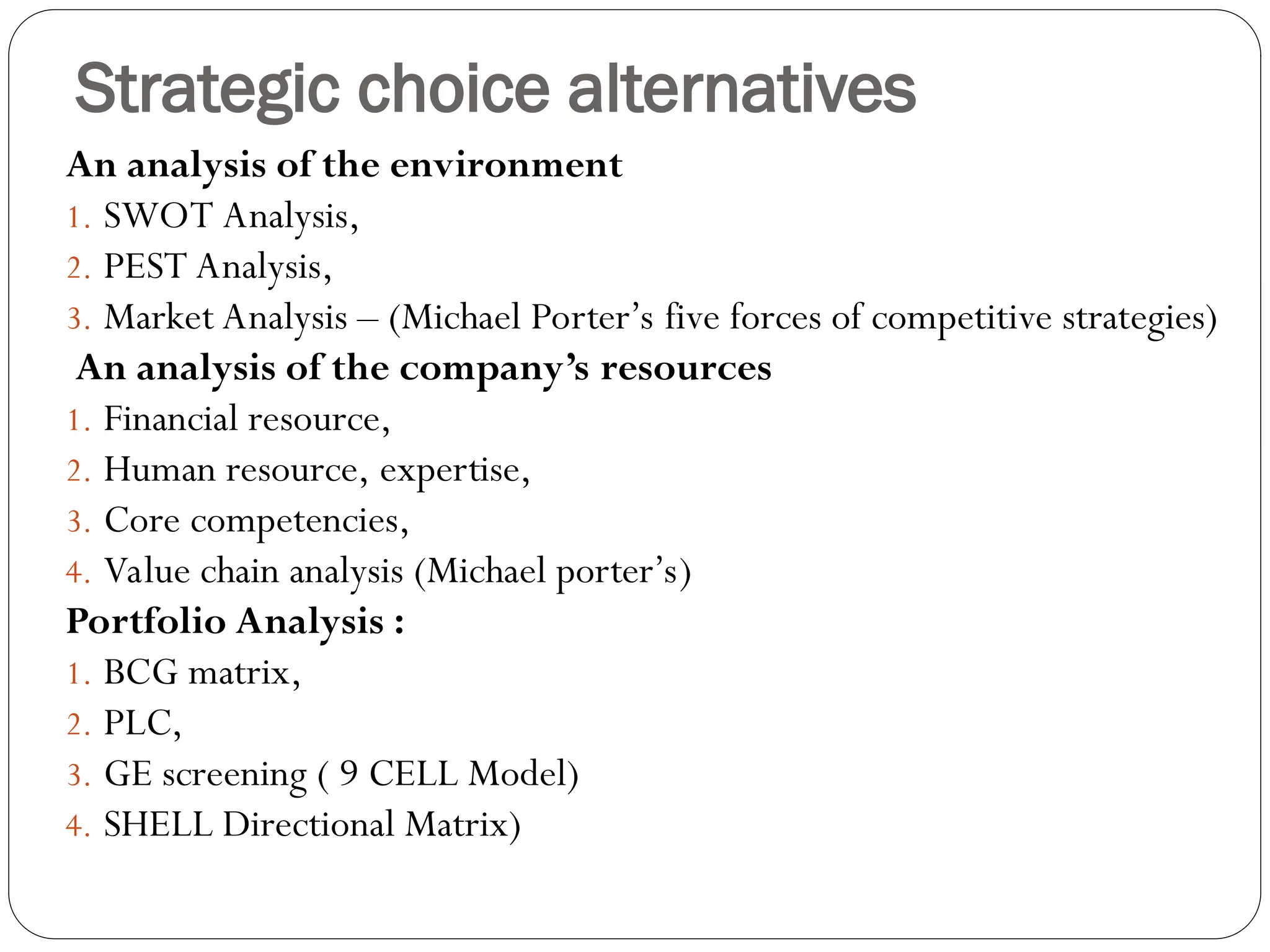
An analysis of the environment
1. SWOT Analysis,
2. PEST Analysis,
3. Market Analysis – (Michael Porter’s five forces of competitive strategies)
An analysis of the company’s resources
1. Financial resource,
2. Human resource, expertise,
3. Core competencies,
4. Value chain analysis (Michael porter’s)
Portfolio Analysis :
1. BCG matrix,
2. PLC,
3. GE screening ( 9 CELL Model)
4. SHELL Directional Matrix)
PESTEL
 The external forces can be classified into six broad categories:
 Political, Economical, Social, Technological, Environmental and
Legal Forces.
 Changes in these external forces affect the changes in consumer
demand for both industrial and consumer products and services.
 The opening up of economy integrated the markets globally and
increased the competition between private and public firms. This
forced the Indian government to revisit its economic policies like
MRTP, which restricted the size of the business in 1991 and were
removed to create opportunities for strengthening the economy.
Political
 Politics has a serious impact on the economic environment of a
country.
 Political ideology and political stability or instability strongly
influence the pace and direction of economic growth.
 Politics can contribute positively or negatively to the economic
environment and can be conducive for some business to grow or
remains indifferent to some businesses as a hurdle.
 The ministry headed by prime minister Rajiv Gandhi is often
credited with ushering in IT revolution in the country. The
country was politically stable and the subsequent governments
supported the policy. American firms like Texas Instruments
(TI) opened up new gateway for software exports from India.
Economical
 Economic factors throw light on the nature and direction of the
economy in which a firm operates.
 For example low interest rates on personal savings may compel
individuals to move towards equity and bond markets leading to
a boom in the capital market activity and the mutual fund
industry.
 Interest rates, inflation rates, unemployment rates and trends in
gross national product, government policies and sectoral growth
rates are other economic influences to be considered.
 Companies like Coca Cola and IBM had to move out of India in
the late 70s which worked towards a closed economy and
continued till the liberalization time when policies were
introduced in 1991
Social
 Demographic Factors: Demographic characteristics such as population,
age distribution, literacy levels, inter-state migration, rural-urban
mobility, income distribution etc. are the key indicators for
understanding the demographic impact on environment.
 Literacy rates in India created opportunities for particular type of
industries and type of jobs. A large number of English speaking
engineers encouraged many software giants to set up shops in India.
 Cultural Factors also influence business practices in a major way.
Festivals in India offer great business opportunity for industries like in
garments, Jewellery, gift items, sweetmeats and many others, the list
could be endless.
 The spread of consumerism, the rise of the middle class the flashy
lifestyles of IT professionals media and multinational companies have
changed the socio-cultural scenario.
Technology
 Technological factors represent major opportunities and threats
which must be taken into account while formulating strategies.
 Technological advancements can open up new markets, change
the relative position of an industry and render existing products
and services obsolete.
 Technological changes can reduce or eliminate cost barriers
between businesses, create shorter production runs, and result in
changing values and expectations of customers and employees.
 IT has specifically brought in the dimension of 'Speed' which
organizations recognize as an advantage beyond low cost and
differentiation. Manufacturers, bankers and retailers have used
IT to carry out their traditional tasks at lower costs and deliver
higher value added products and services.
Legal
 Licensing policies, quota restrictions, import duties, Forex
regulations, restrictions on FDI flows, controls on distribution
and pricing of commodities together made business difficult
during license permit raj before the liberalization policy of
1991.
 However, with economic reforms things have changed and legal
formalities have eased.
 Other issues which has come up with globalization are the rules
of competition, trade mark rights and patents, price controls
and product quality laws and a number of other legal issues in
individual countries have become important and therefore they
need to be included while understanding the general
environment.
Environment
 Environment conservation and protection is an issue, which has
gained prominence because of deteriorating environmental
balance threatening the sustainability of life and nature.
 Business are held responsible for situations as polluting the air
through emissions, water through chemical effluents, usage of bio
non-degradable resources, hazardous radiations that bring life in
danger.
 Currently stakeholders, society and government are creating
movements and legislations to create pressure for an environment
friendly business.
 Companies like Coca Cola and Pepsi have also come under the
purview of the society and community regarding environmental
hazards. The recent Volkswagen emissions issues have also
impacted the motor car business for the company.
SWOT analysis
 SWOT Analysis is the most renowned tool for audit and
analysis of the overall strategic position of the business and
its environment.
 The key purpose of SWOT is to identify the strategies that
will create a firm specific business model that will best align
with its resources and capabilities to the requirements of
the environment in which the firm operates.
 It is the foundation for evaluating the internal potential and
limitations and the probable/likely opportunities and threats
from the external environment.
 It also helps the firm in the decision-making process.
 Strengths - Strengths are the qualities that enable the organization to
accomplish the organization’s mission. Strengths can be either
tangible or intangible. Strengths includes human competencies,
process capabilities, financial resources, products and
services, customer goodwill and brand loyalty. Other examples
of organizational strengths are huge financial resources, broad product
line, no debt, committed employees, etc.
 Weaknesses - Weaknesses are the qualities that prevent the firm
from accomplishing the mission and achieving its full potential.
Weaknesses deteriorates the organization’s success and growth.
Weaknesses in an organization may be depreciating machinery,
insufficient research and development facilities, narrow product range,
poor decision-making, etc. Weaknesses are controllable. They must be
minimized and eliminated. For instance - to overcome obsolete
machinery, new machinery can be purchased. Other examples of
organizational weaknesses are huge debts, high employee turnover,
complex decision making process, narrow product range, large wastage
of raw materials, etc.
 Opportunities - Opportunities are presented by the environment
within which the organization operates. These arise when an organization
can take benefit of conditions in its environment to plan and execute
strategies that enable it to become more profitable. Organizations can
gain competitive advantage by making use of opportunities.
 Opportunities may arise from market, competition,
industry/government and technology. Increasing demand for
telecommunications accompanied by deregulation is a great opportunity
for new firms to enter telecom sector and compete with existing firms
for revenue.
 Threats - Threats arise when conditions in external environment
jeopardize the reliability and profitability of the organization’s business.
They compound the vulnerability when they relate to the weaknesses.
Threats are uncontrollable. When a threat comes, the stability and
survival can be at stake. Examples of threats are - unrest among
employees; ever changing technology; increasing competition leading to
excess capacity, price wars and reducing industry profits; etc.
Advantages and Disadvantages of SWOT
 SWOT analysis can be applied to an organization,
organizational unit, individual or team.
 SWOT method can be used to evaluate a product or brand,
an acquisition or partnership, or the outsourcing of a
business function.
 SWOT analysis can be beneficial in evaluating a particular
supply source, a business process, a product market or the
implementation of a particular technology.
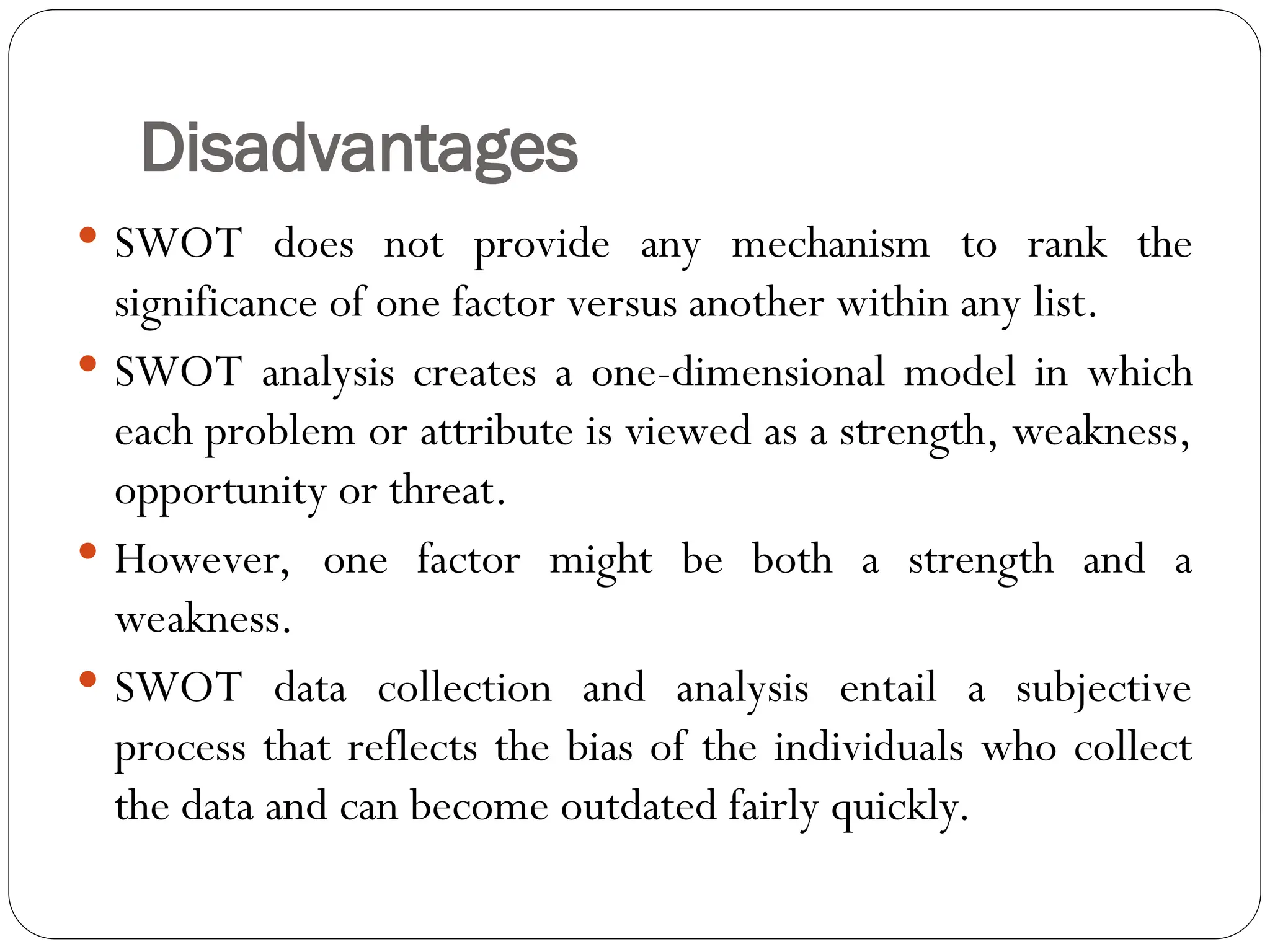
Disadvantages
 SWOT does not provide any mechanism to rank the
significance of one factor versus another within any list.
 SWOT analysis creates a one-dimensional model in which
each problem or attribute is viewed as a strength, weakness,
opportunity or threat.
 However, one factor might be both a strength and a
weakness.
 SWOT data collection and analysis entail a subjective
process that reflects the bias of the individuals who collect
the data and can become outdated fairly quickly.
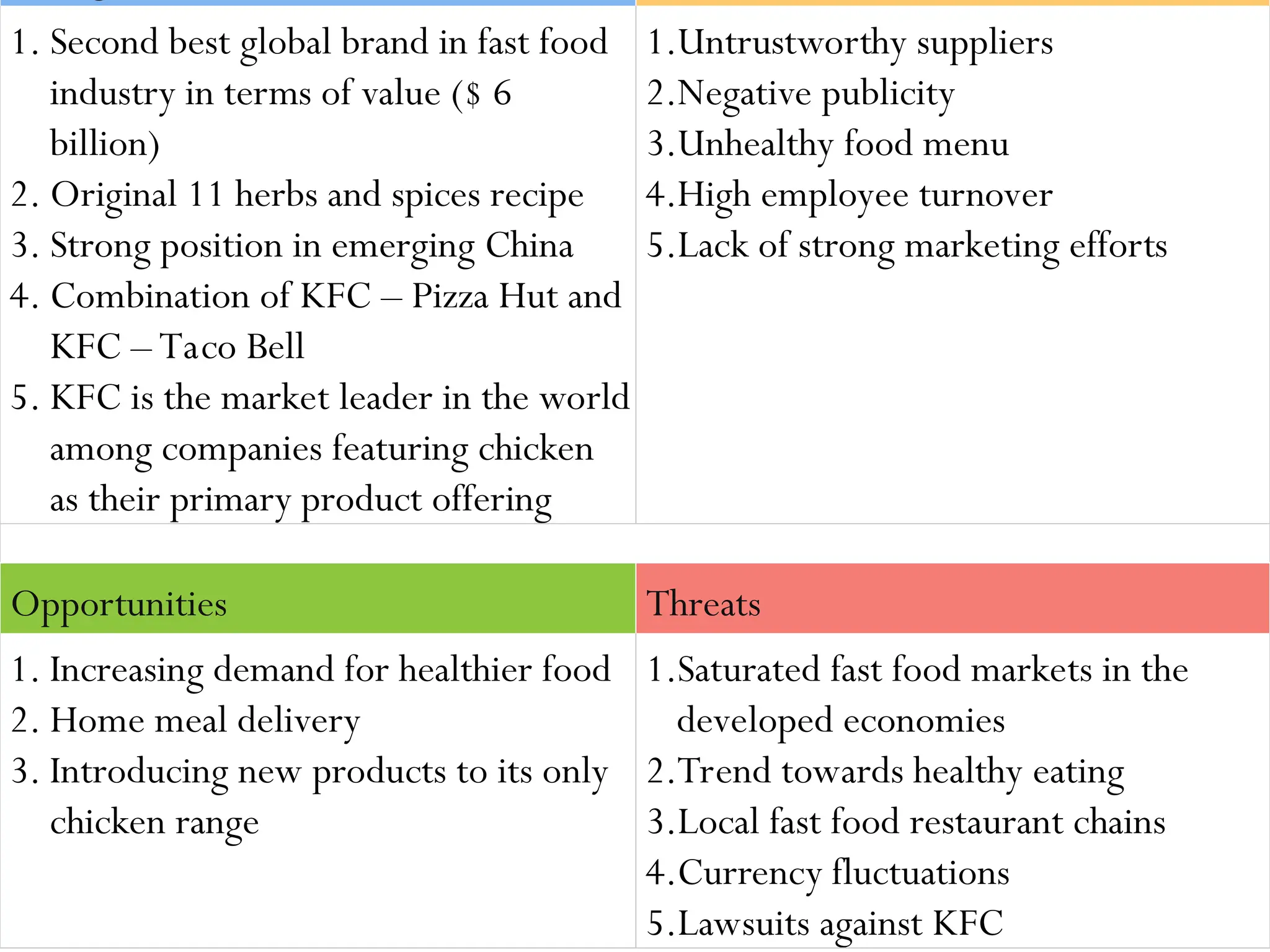
1. Second best global brand in fast food
industry in terms of value ($ 6
billion)
2. Original 11 herbs and spices recipe
3. Strong position in emerging China
4. Combination of KFC – Pizza Hut and
KFC – Taco Bell
5. KFC is the market leader in the world
among companies featuring chicken
as their primary product offering
1.Untrustworthy suppliers
2.Negative publicity
3.Unhealthy food menu
4.High employee turnover
5.Lack of strong marketing efforts
Opportunities Threats
1. Increasing demand for healthier food
2. Home meal delivery
3. Introducing new products to its only
chicken range
1.Saturated fast food markets in the
developed economies
2.Trend towards healthy eating
3.Local fast food restaurant chains
4.Currency fluctuations
5.Lawsuits against KFC
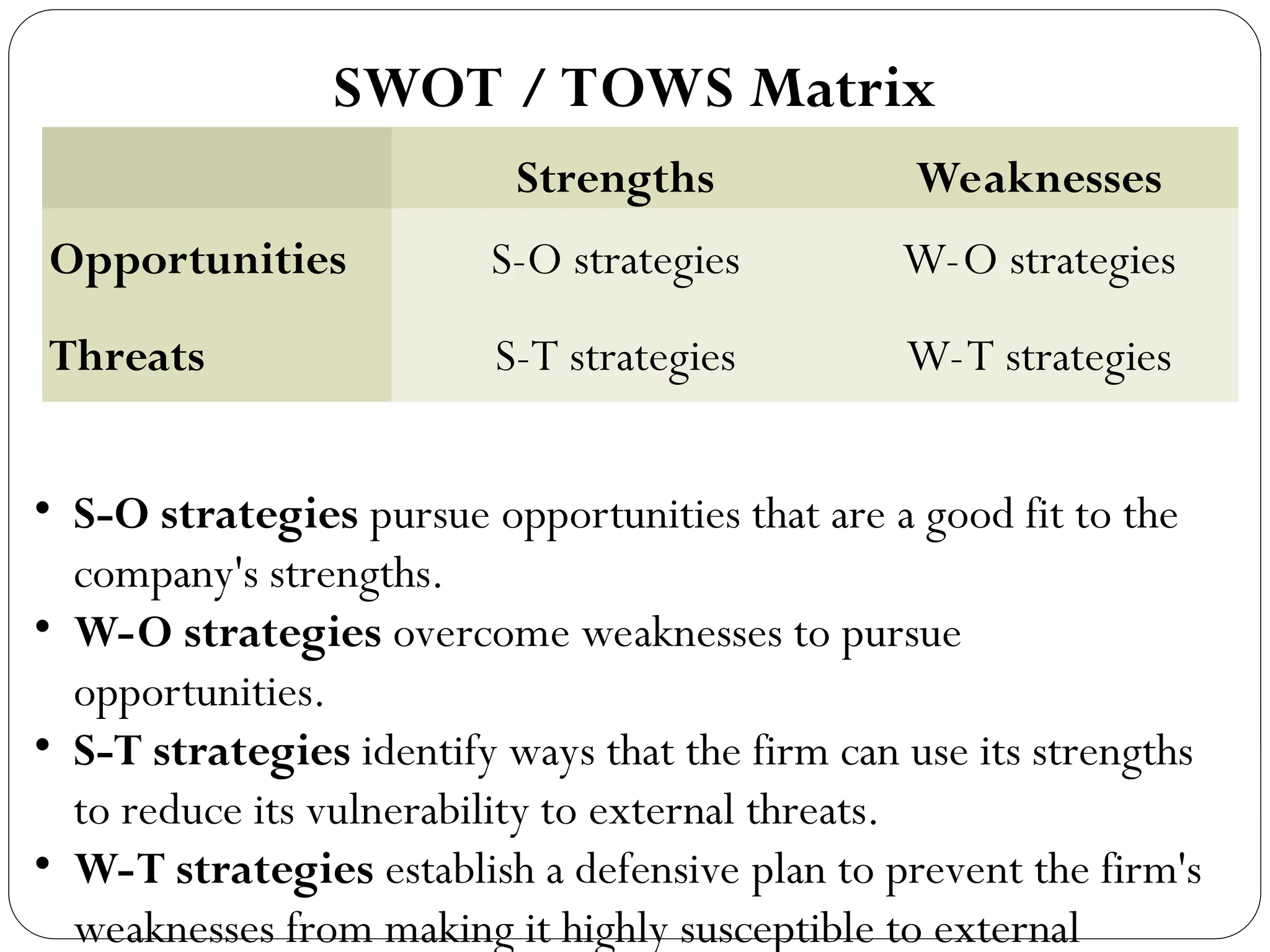
Strengths Weaknesses
Opportunities S-O strategies W-O strategies
Threats S-T strategies W-T strategies
• S-O strategies pursue opportunities that are a good fit to the
company's strengths.
• W-O strategies overcome weaknesses to pursue
opportunities.
• S-T strategies identify ways that the firm can use its strengths
to reduce its vulnerability to external threats.
• W-T strategies establish a defensive plan to prevent the firm's
weaknesses from making it highly susceptible to external
SWOT / TOWS Matrix
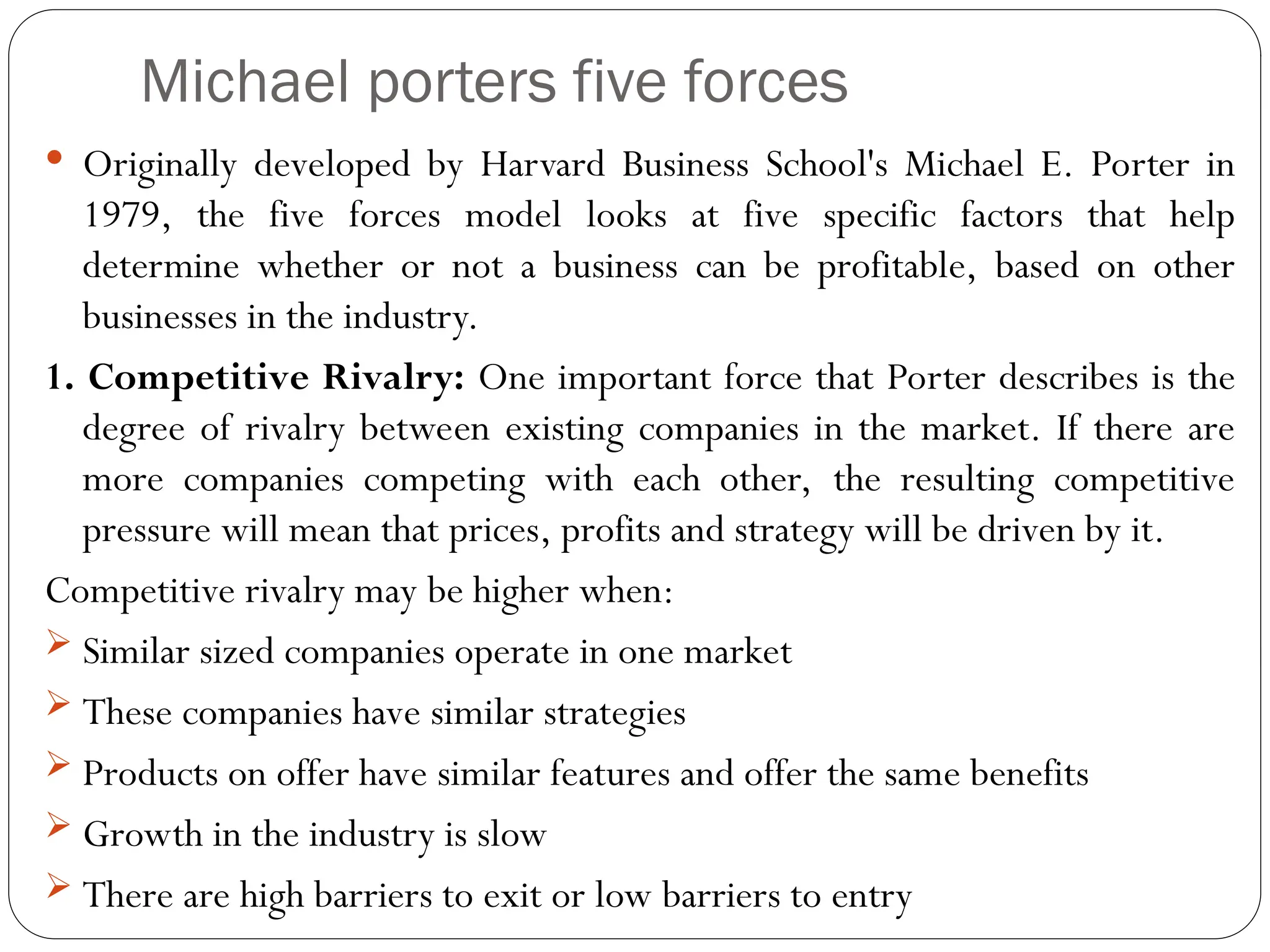
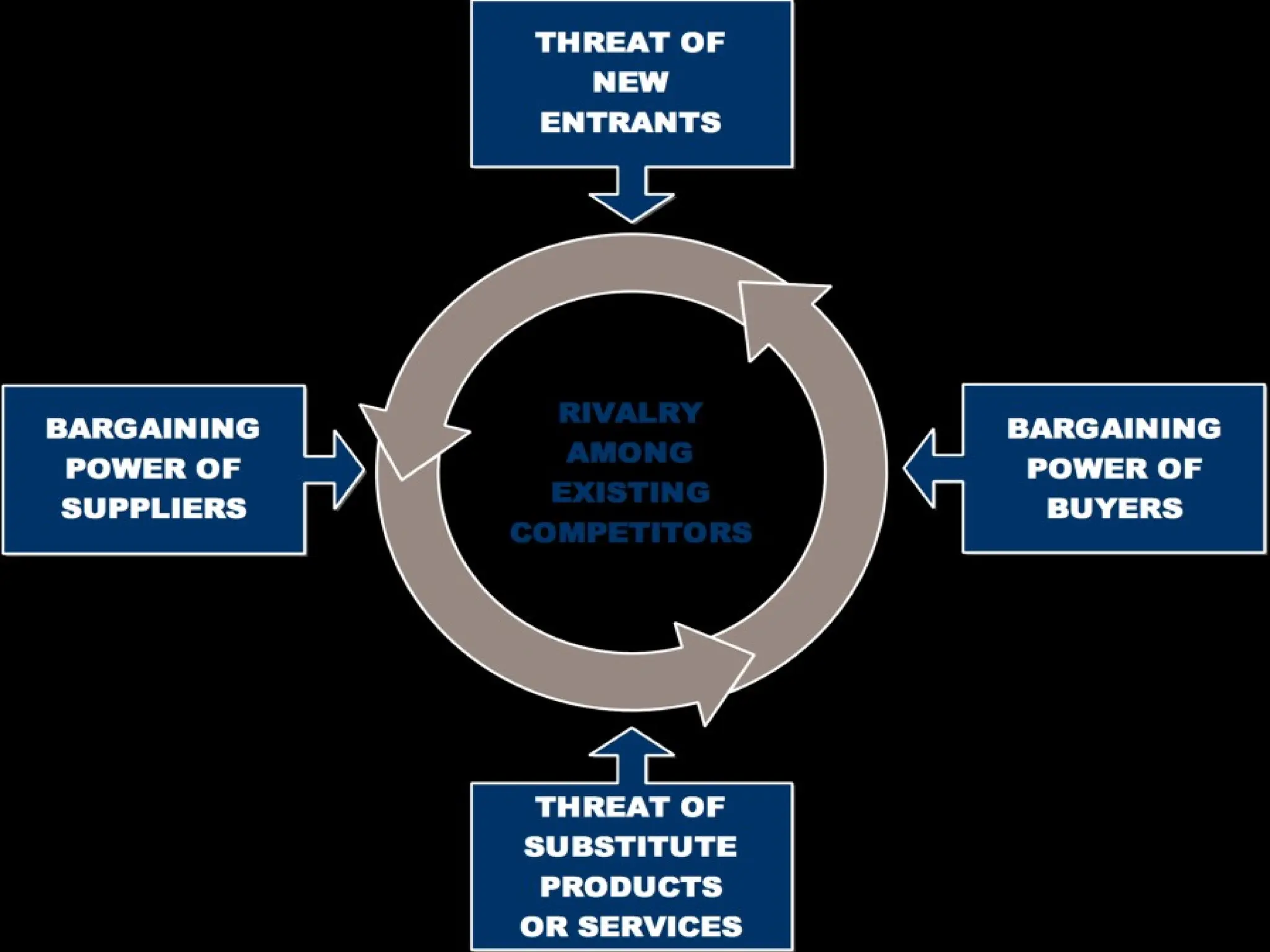
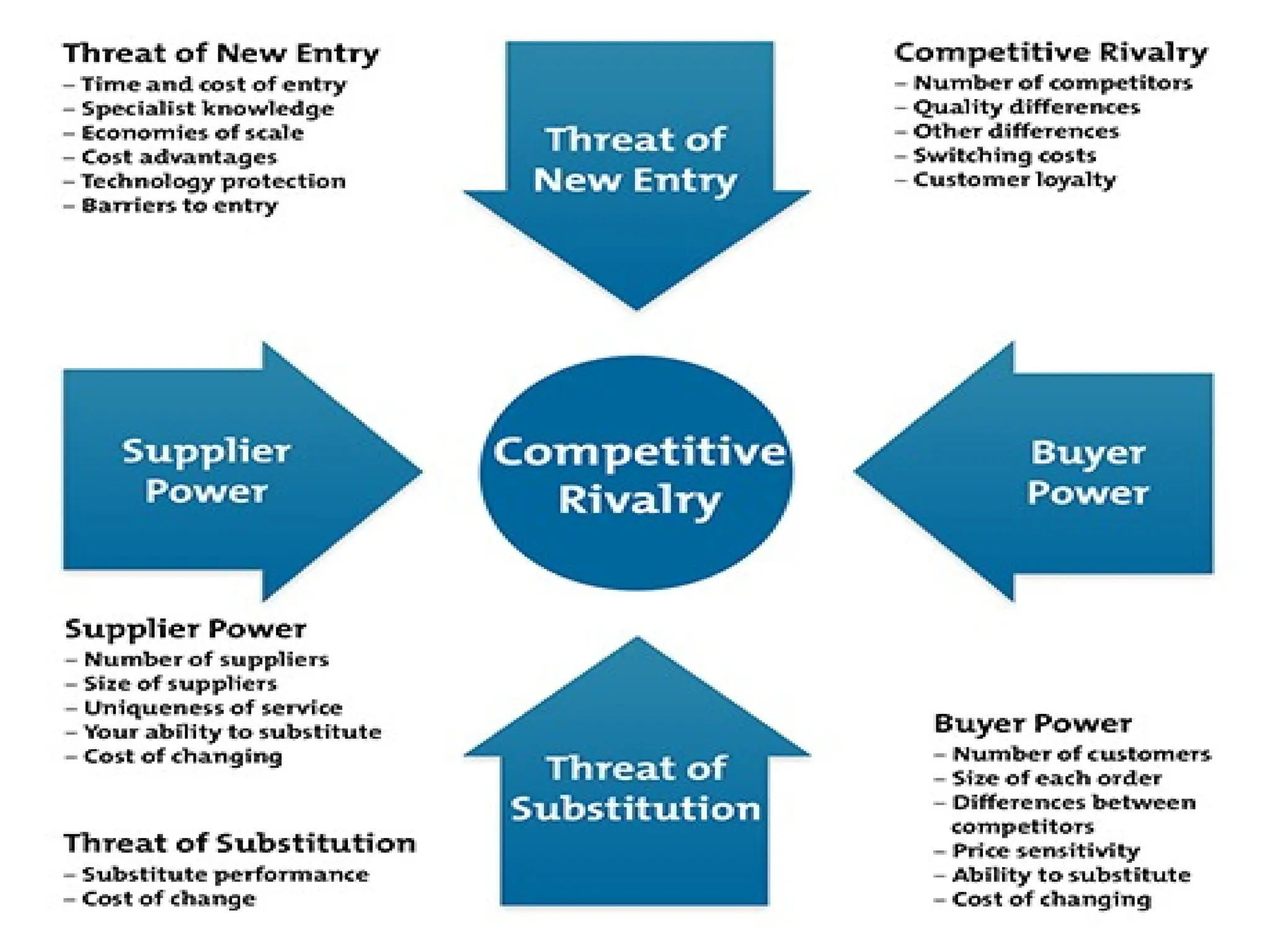
Michael porters five forces
 Originally developed by Harvard Business School's Michael E. Porter in
1979, the five forces model looks at five specific factors that help
determine whether or not a business can be profitable, based on other
businesses in the industry.
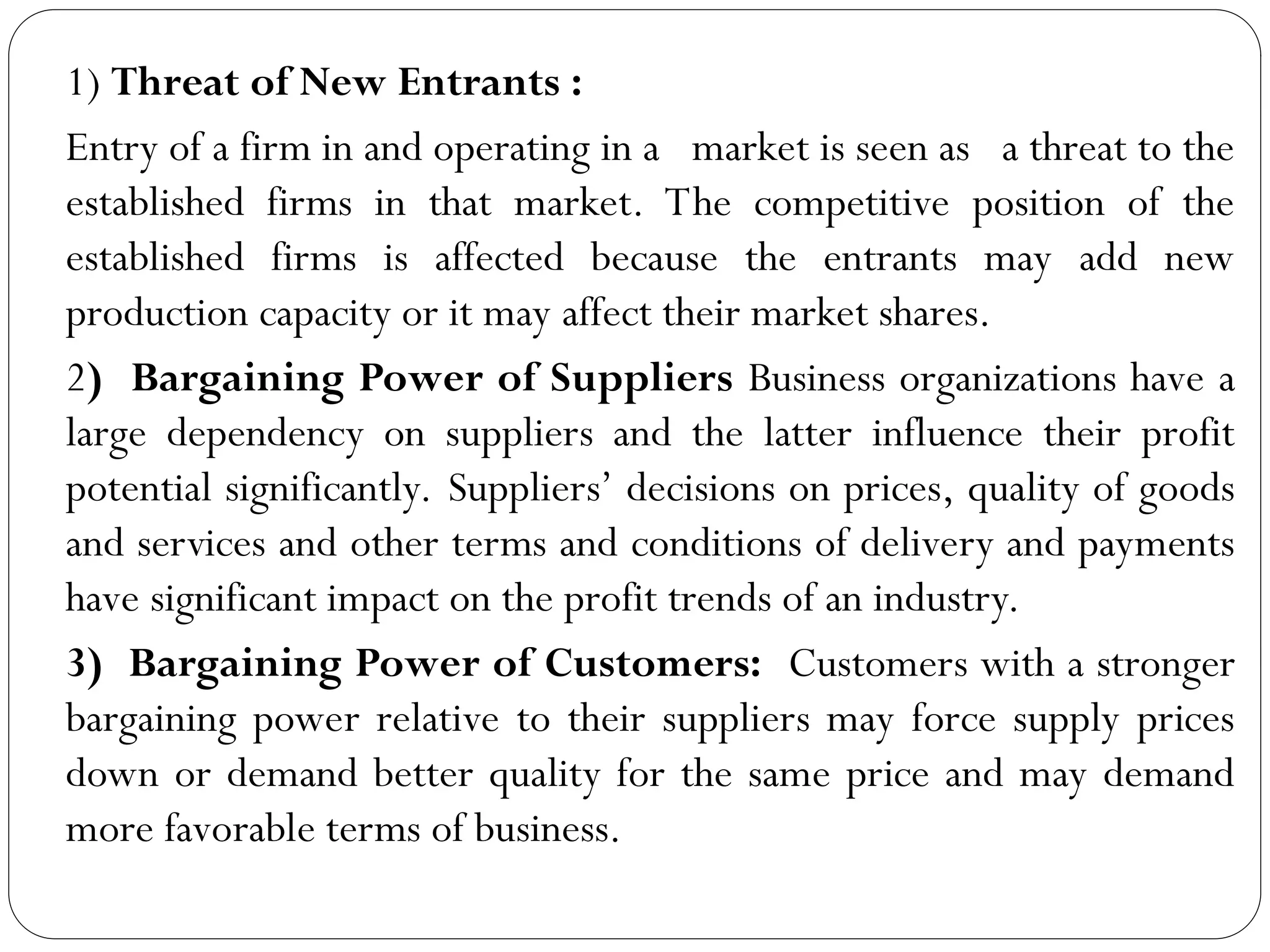
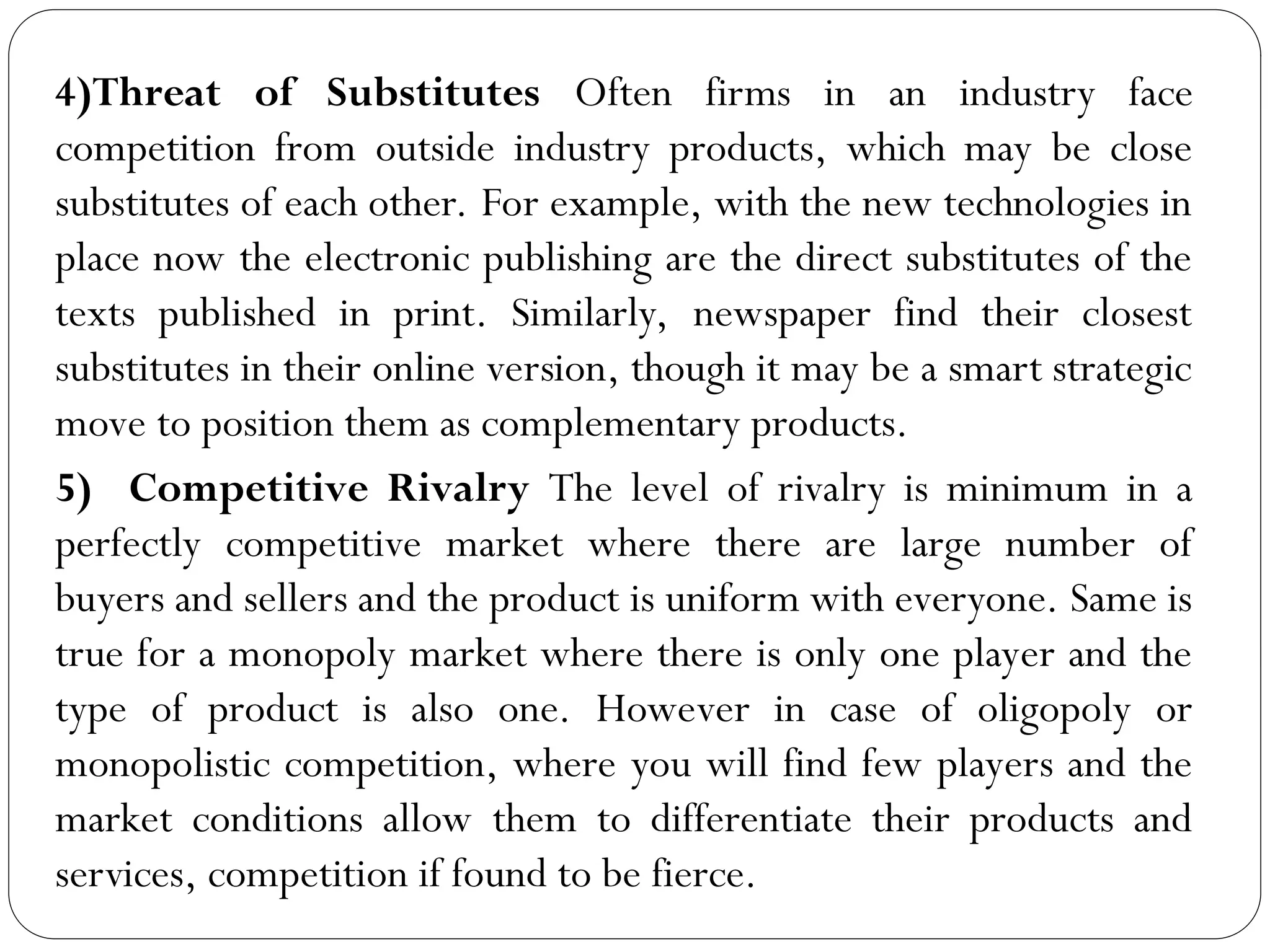
1. Competitive Rivalry: One important force that Porter describes is the
degree of rivalry between existing companies in the market. If there are
more companies competing with each other, the resulting competitive
pressure will mean that prices, profits and strategy will be driven by it.
Competitive rivalry may be higher when:
 Similar sized companies operate in one market
 These companies have similar strategies
 Products on offer have similar features and offer the same benefits
 Growth in the industry is slow
 There are high barriers to exit or low barriers to entry
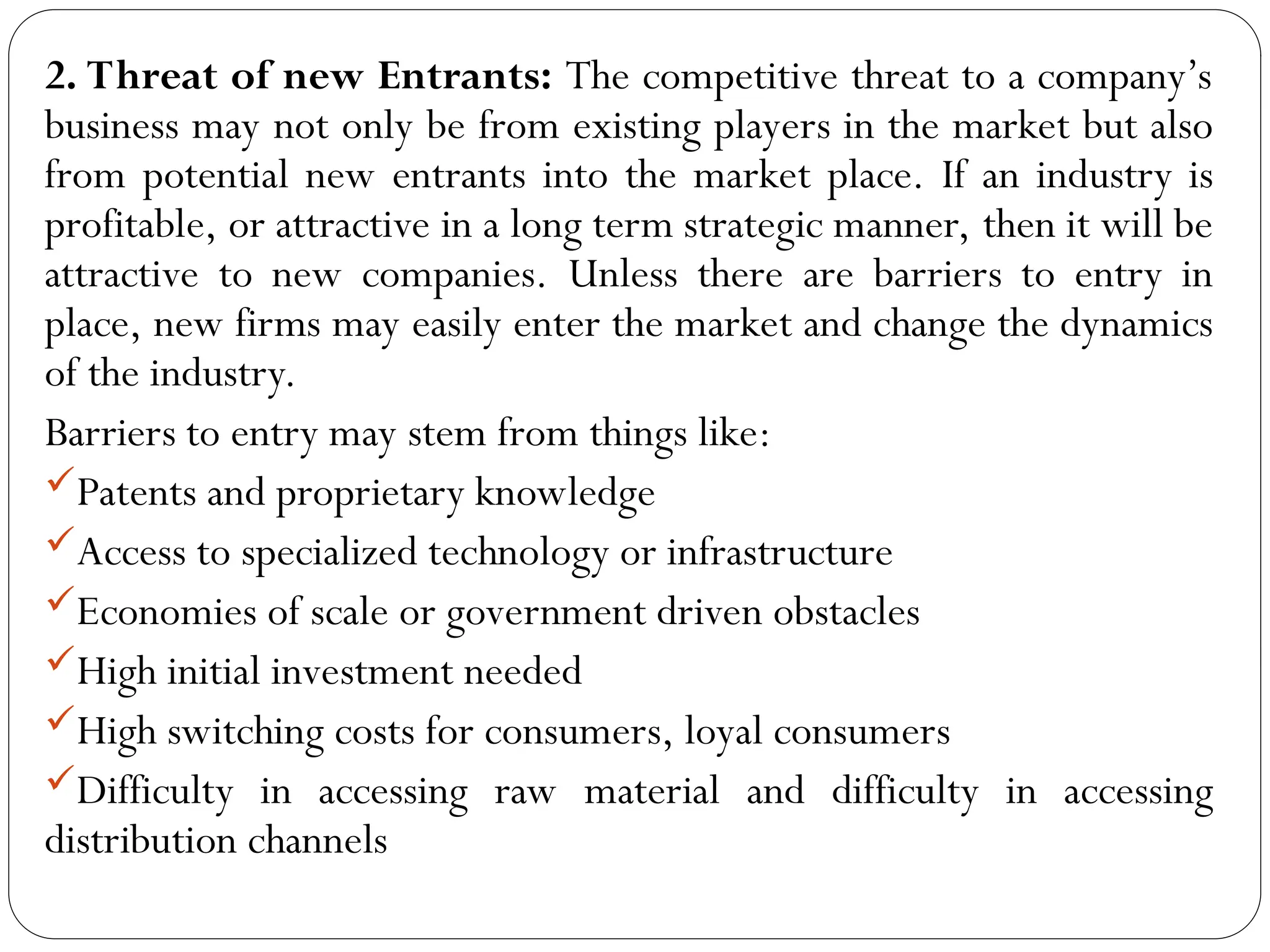
2. Threat of new Entrants: The competitive threat to a company’s
business may not only be from existing players in the market but also
from potential new entrants into the market place. If an industry is
profitable, or attractive in a long term strategic manner, then it will be
attractive to new companies. Unless there are barriers to entry in
place, new firms may easily enter the market and change the dynamics
of the industry.
Barriers to entry may stem from things like:
Patents and proprietary knowledge
Access to specialized technology or infrastructure
Economies of scale or government driven obstacles
High initial investment needed
High switching costs for consumers, loyal consumers
Difficulty in accessing raw material and difficulty in accessing
distribution channels
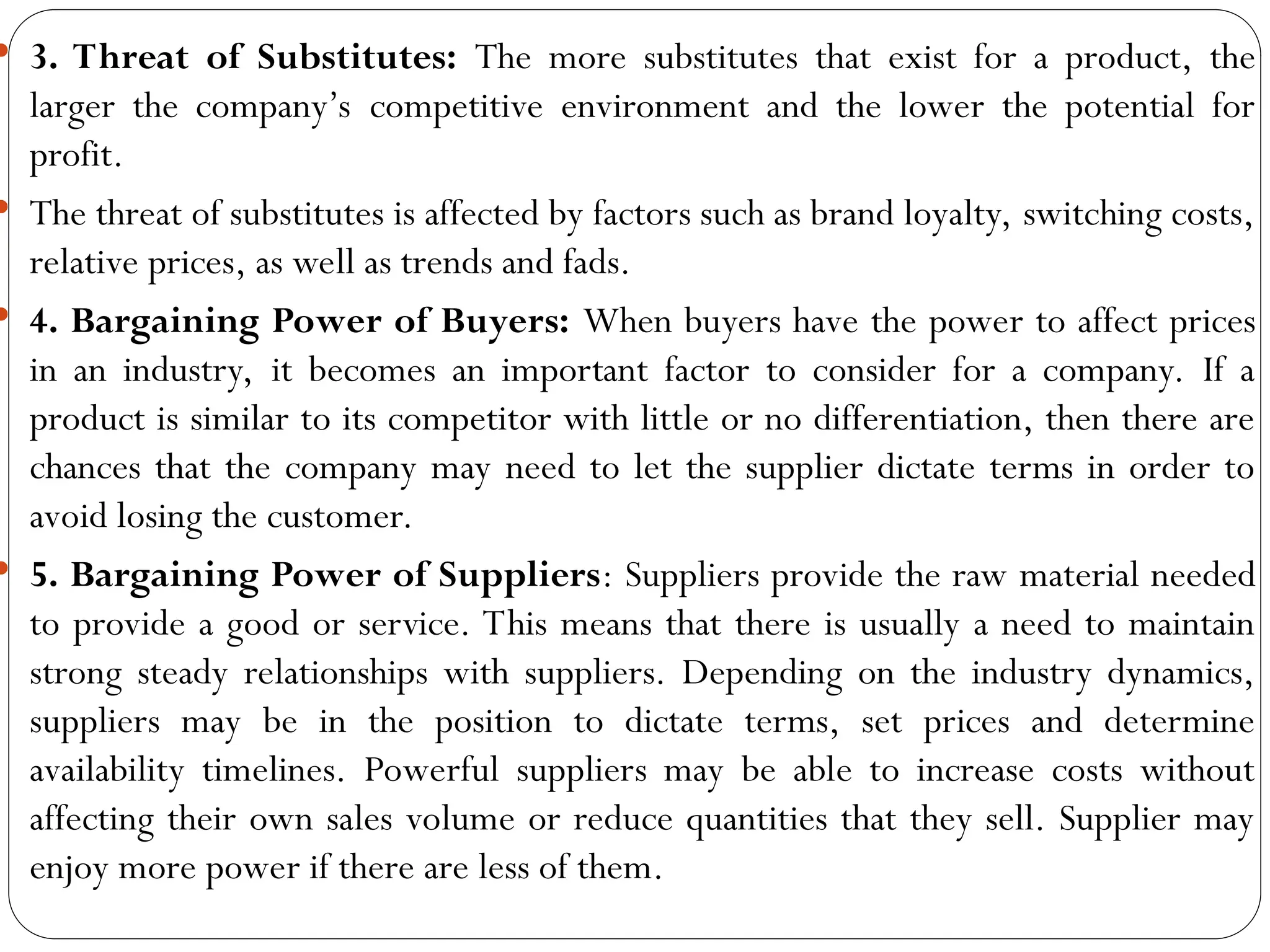
 3. Threat of Substitutes: The more substitutes that exist for a product, the
larger the company’s competitive environment and the lower the potential for
profit.
 The threat of substitutes is affected by factors such as brand loyalty, switching costs,
relative prices, as well as trends and fads.
 4. Bargaining Power of Buyers: When buyers have the power to affect prices
in an industry, it becomes an important factor to consider for a company. If a
product is similar to its competitor with little or no differentiation, then there are
chances that the company may need to let the supplier dictate terms in order to
avoid losing the customer.
 5. Bargaining Power of Suppliers: Suppliers provide the raw material needed
to provide a good or service. This means that there is usually a need to maintain
strong steady relationships with suppliers. Depending on the industry dynamics,
suppliers may be in the position to dictate terms, set prices and determine
availability timelines. Powerful suppliers may be able to increase costs without
affecting their own sales volume or reduce quantities that they sell. Supplier may
enjoy more power if there are less of them.
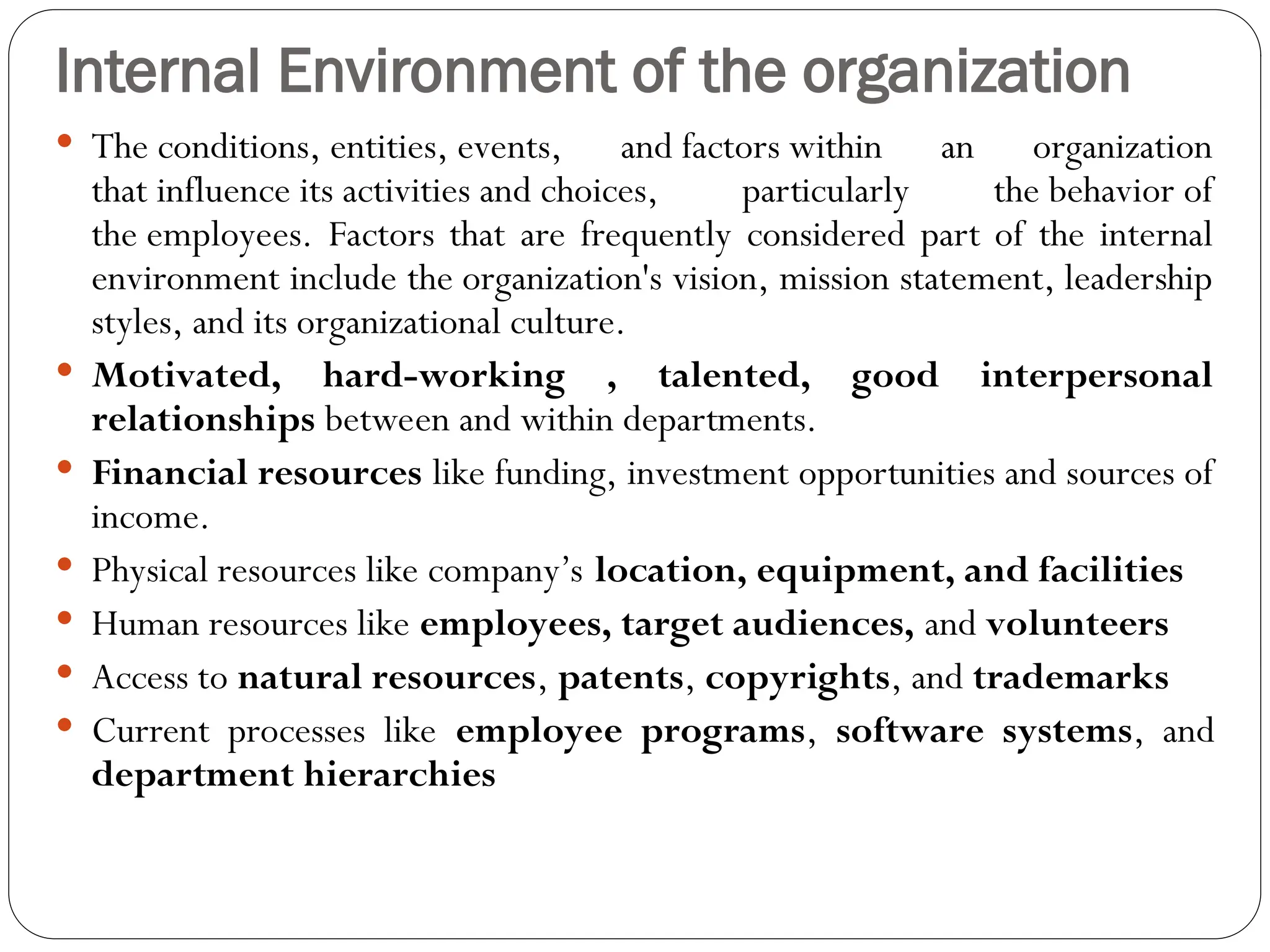
Internal Environment of the organization
 The conditions, entities, events, and factors within an organization
that influence its activities and choices, particularly the behavior of
the employees. Factors that are frequently considered part of the internal
environment include the organization's vision, mission statement, leadership
styles, and its organizational culture.
 Motivated, hard-working , talented, good interpersonal
relationships between and within departments.
 Financial resources like funding, investment opportunities and sources of
income.
 Physical resources like company’s location, equipment, and facilities
 Human resources like employees, target audiences, and volunteers
 Access to natural resources, patents, copyrights, and trademarks
 Current processes like employee programs, software systems, and
department hierarchies
Tools for Internal analysis
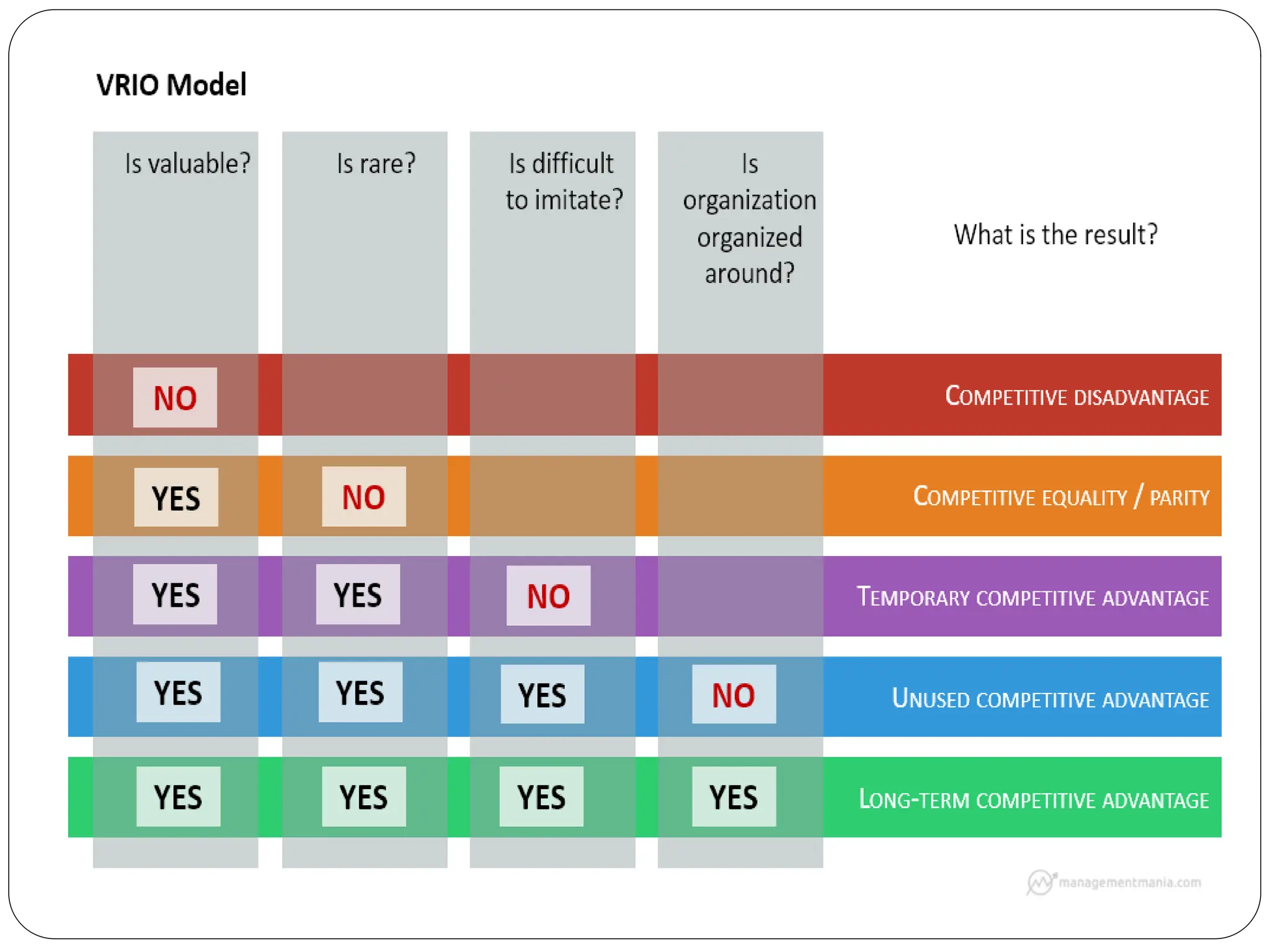
 The VRIO Analysis is an analytical technique which an
organization considers the following questions (evaluation
dimension) for itself as well as for its competitors.
 VRIO is an acronym from the first letters of the names of the
dimensions:
 Value - How expensive is the resource and how easy is it to
obtain on the market (purchase, lease, rent..)?
 Rareness - How rare or limited is the resource?
 Imitability - How difficult is it to imitate the resource?
 Organization, respectively arrangement - Is the resource
supported by any existing arrangements and can the
organization use it properly?
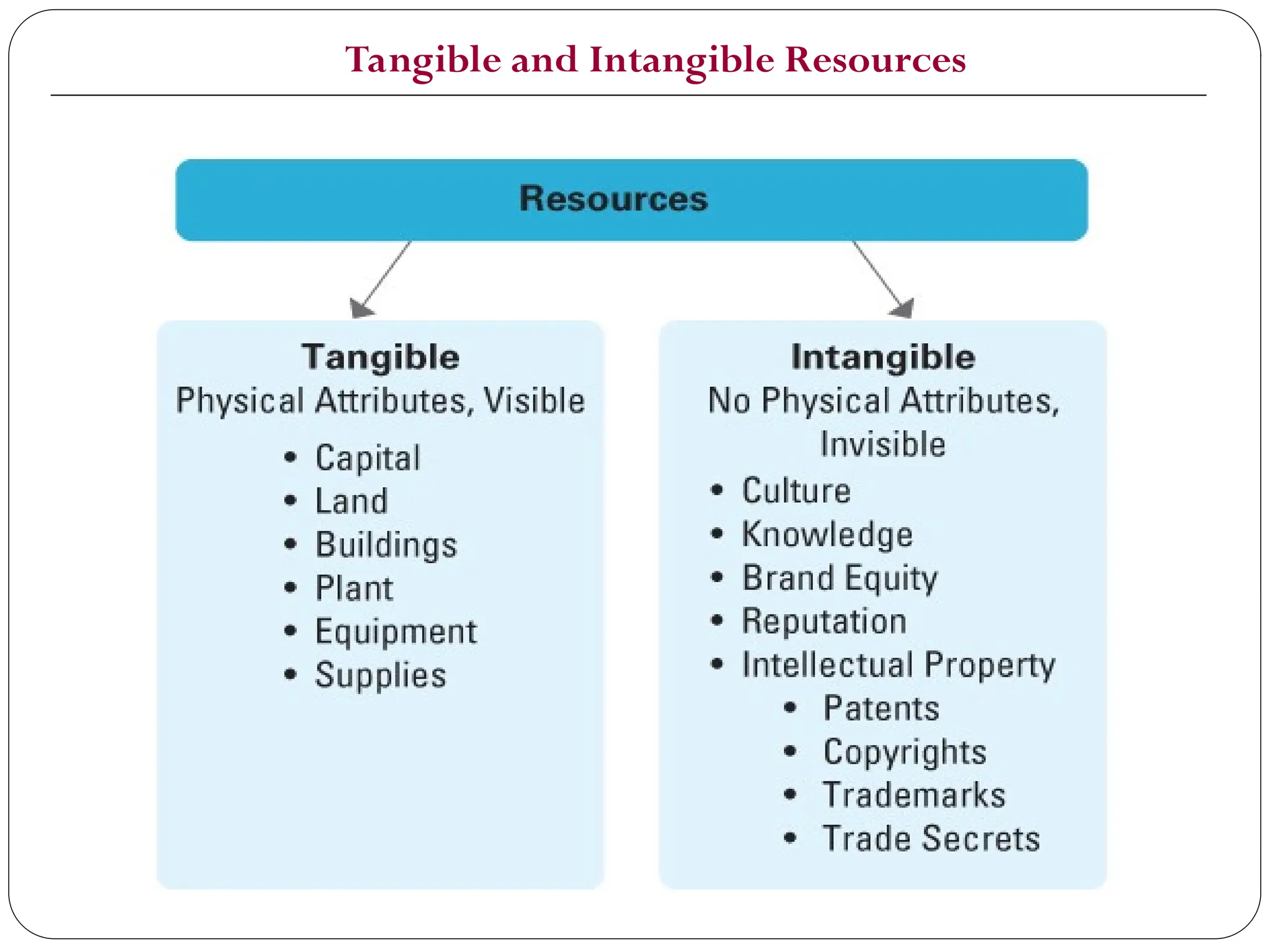
Tangible and Intangible Resources
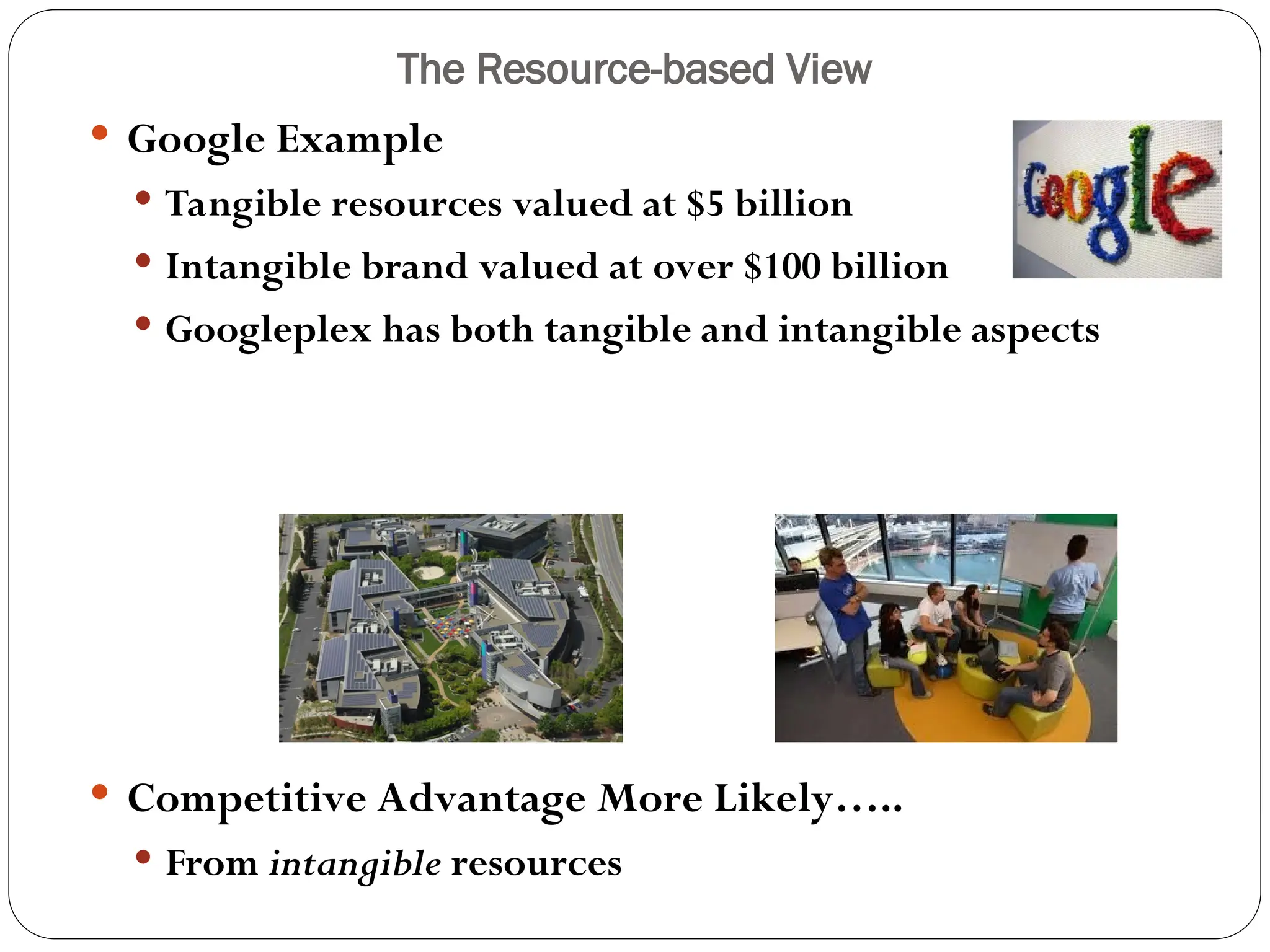
The Resource-based View
 Google Example
 Tangible resources valued at $5 billion
 Intangible brand valued at over $100 billion
 Googleplex has both tangible and intangible aspects
 Competitive Advantage More Likely…..
 From intangible resources
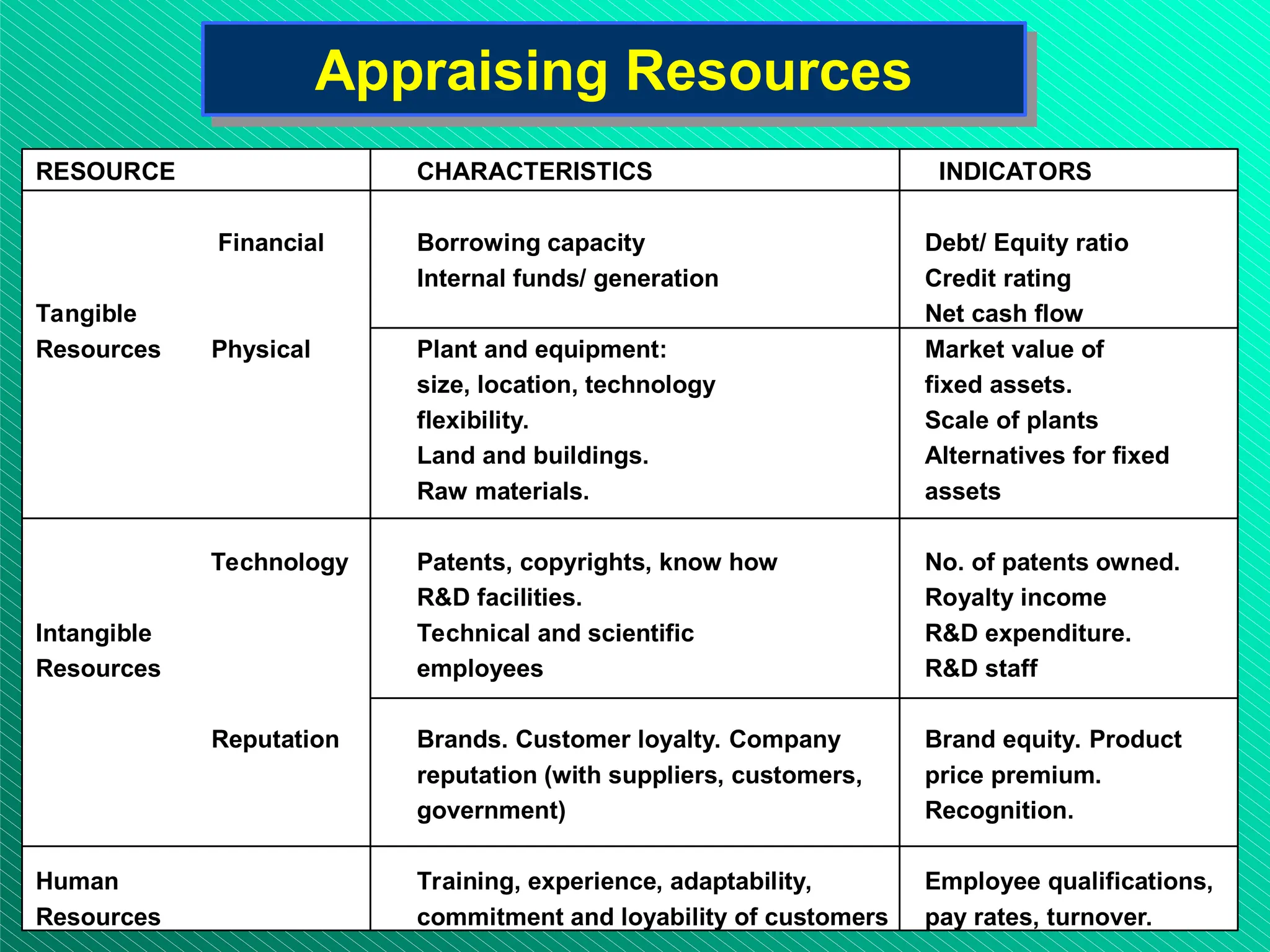
Appraising Resources
RESOURCE CHARACTERISTICS INDICATORS
Financial Borrowing capacity Debt/ Equity ratio
Internal funds/ generation Credit rating
Tangible Net cash flow
Resources Physical Plant and equipment: Market value of
size, location, technology fixed assets.
flexibility. Scale of plants
Land and buildings. Alternatives for fixed
Raw materials. assets
Technology Patents, copyrights, know how No. of patents owned.
R&D facilities. Royalty income
Intangible Technical and scientific R&D expenditure.
Resources employees R&D staff
Reputation Brands. Customer loyalty. Company Brand equity. Product
reputation (with suppliers, customers, price premium.
government) Recognition.
Human Training, experience, adaptability, Employee qualifications,
Resources commitment and loyability of customers pay rates, turnover.
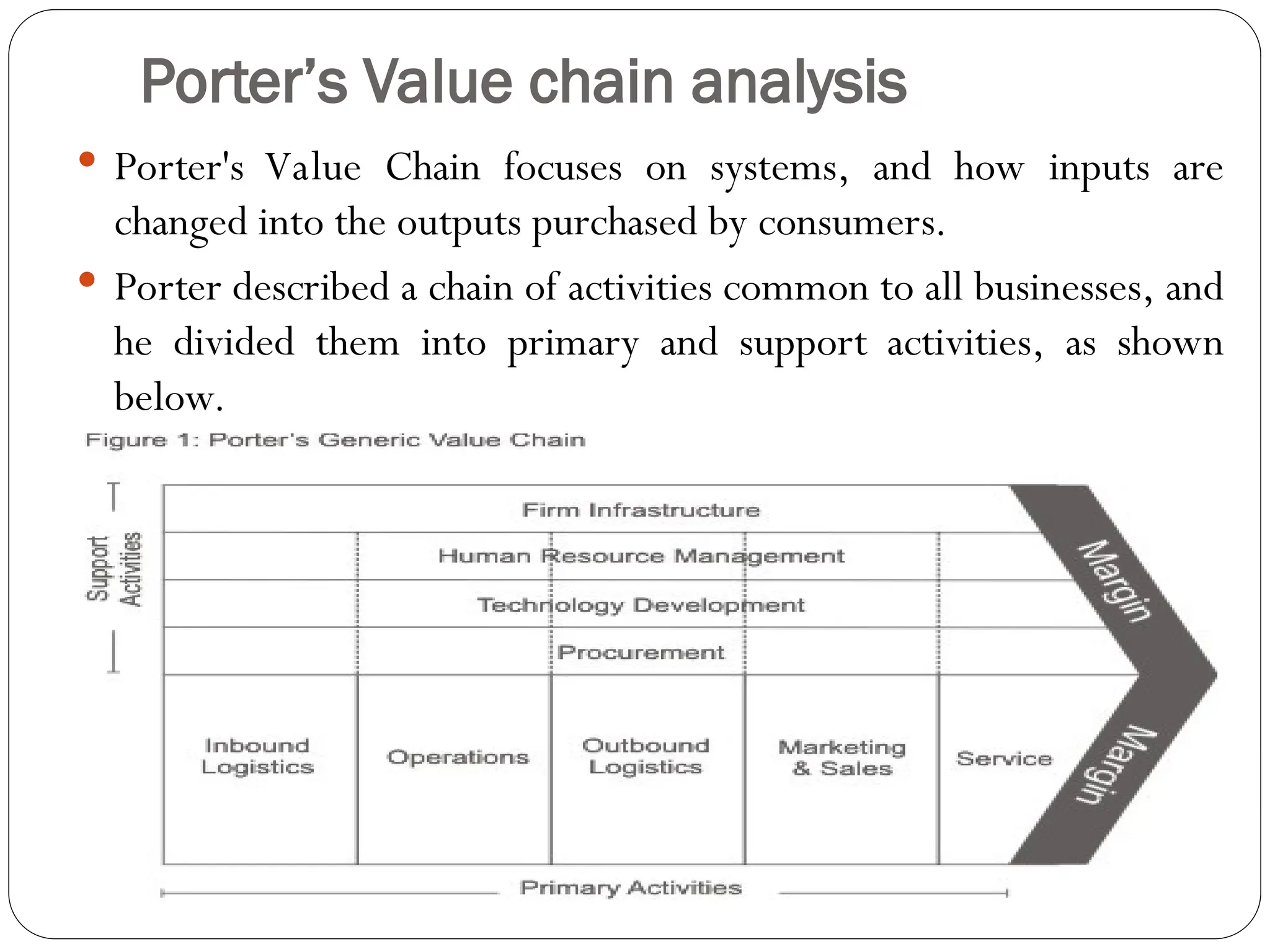
Porter’s Value chain analysis
 Porter's Value Chain focuses on systems, and how inputs are
changed into the outputs purchased by consumers.
 Porter described a chain of activities common to all businesses, and
he divided them into primary and support activities, as shown
below.
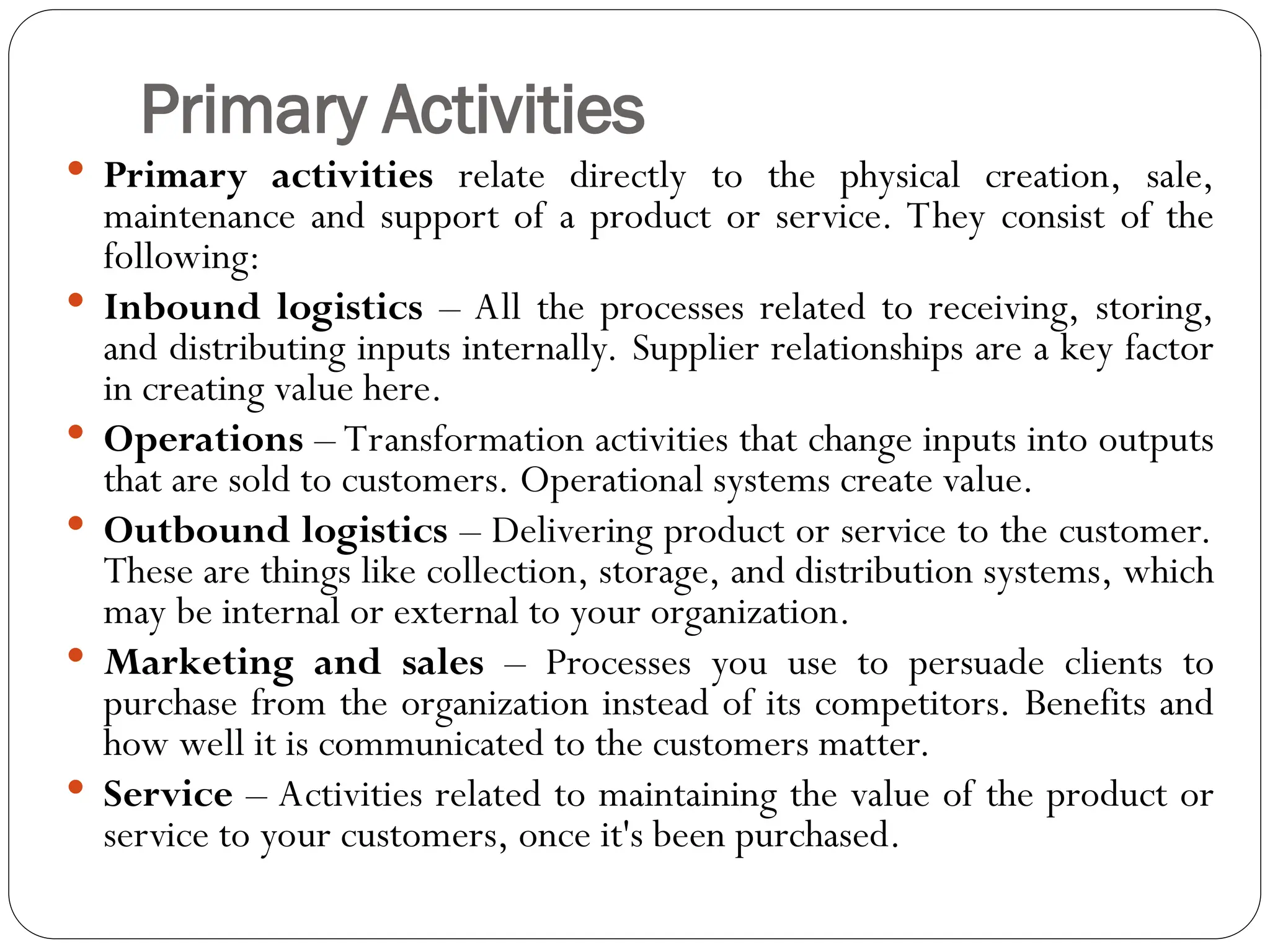
Primary Activities
 Primary activities relate directly to the physical creation, sale,
maintenance and support of a product or service. They consist of the
following:
 Inbound logistics – All the processes related to receiving, storing,
and distributing inputs internally. Supplier relationships are a key factor
in creating value here.
 Operations – Transformation activities that change inputs into outputs
that are sold to customers. Operational systems create value.
 Outbound logistics – Delivering product or service to the customer.
These are things like collection, storage, and distribution systems, which
may be internal or external to your organization.
 Marketing and sales – Processes you use to persuade clients to
purchase from the organization instead of its competitors. Benefits and
how well it is communicated to the customers matter.
 Service – Activities related to maintaining the value of the product or
service to your customers, once it's been purchased.
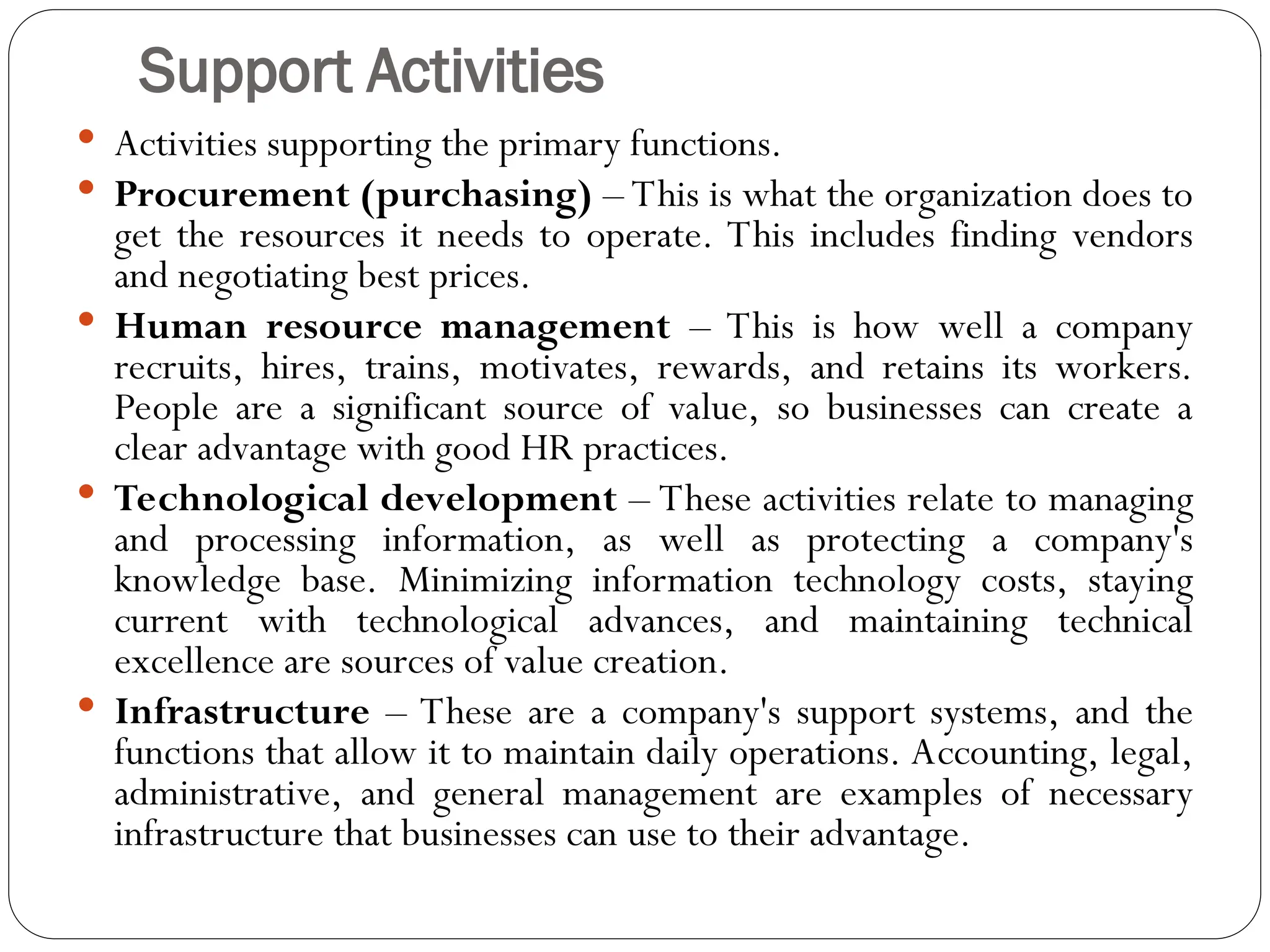
Support Activities
 Activities supporting the primary functions.
 Procurement (purchasing) – This is what the organization does to
get the resources it needs to operate. This includes finding vendors
and negotiating best prices.
 Human resource management – This is how well a company
recruits, hires, trains, motivates, rewards, and retains its workers.
People are a significant source of value, so businesses can create a
clear advantage with good HR practices.
 Technological development – These activities relate to managing
and processing information, as well as protecting a company's
knowledge base. Minimizing information technology costs, staying
current with technological advances, and maintaining technical
excellence are sources of value creation.
 Infrastructure – These are a company's support systems, and the
functions that allow it to maintain daily operations. Accounting, legal,
administrative, and general management are examples of necessary
infrastructure that businesses can use to their advantage.
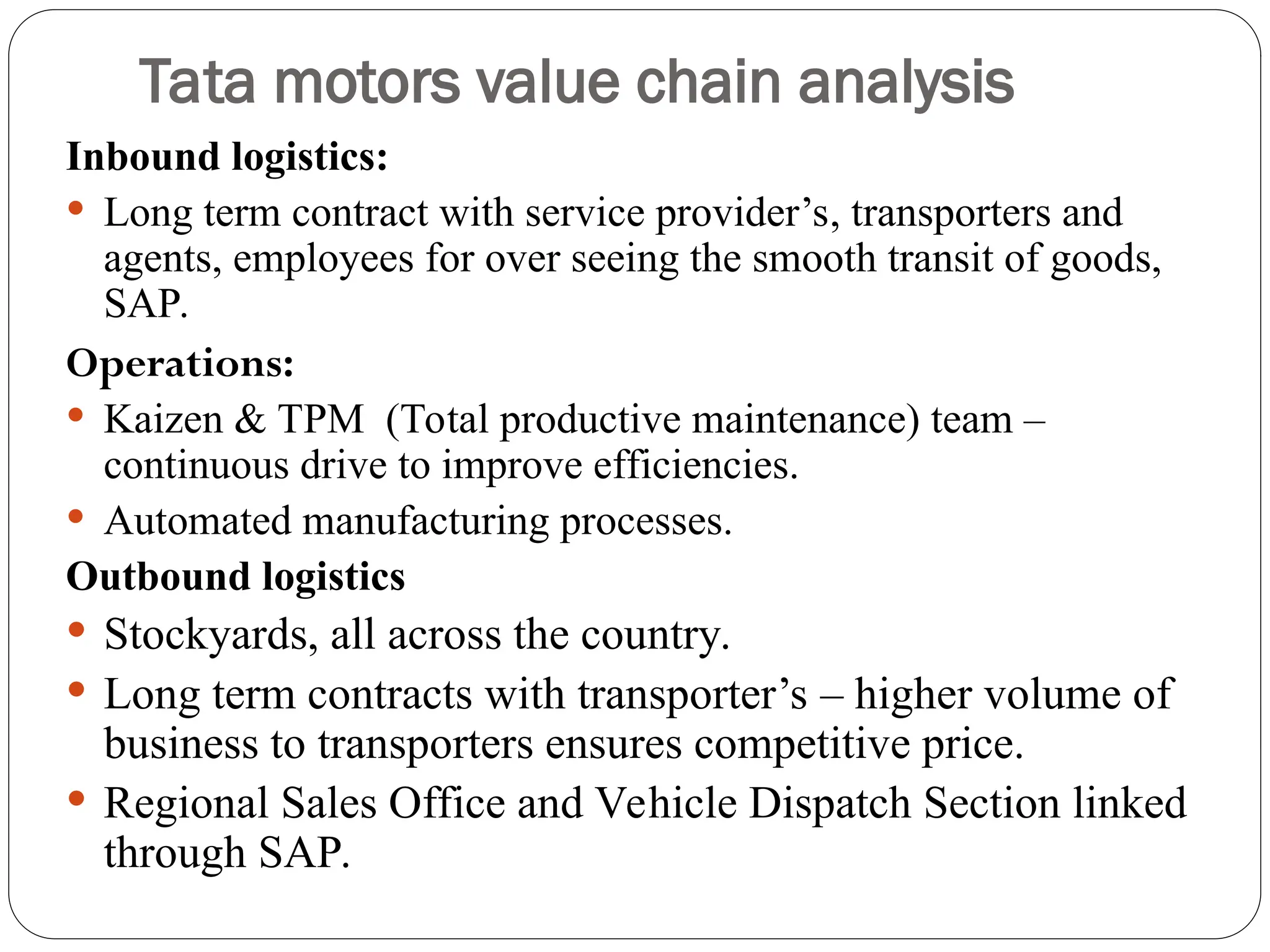
Tata motors value chain analysis
Inbound logistics:
 Long term contract with service provider’s, transporters and
agents, employees for over seeing the smooth transit of goods,
SAP.
Operations:
 Kaizen & TPM (Total productive maintenance) team –
continuous drive to improve efficiencies.
 Automated manufacturing processes.
Outbound logistics
 Stockyards, all across the country.
 Long term contracts with transporter’s – higher volume of
business to transporters ensures competitive price.
 Regional Sales Office and Vehicle Dispatch Section linked
through SAP.
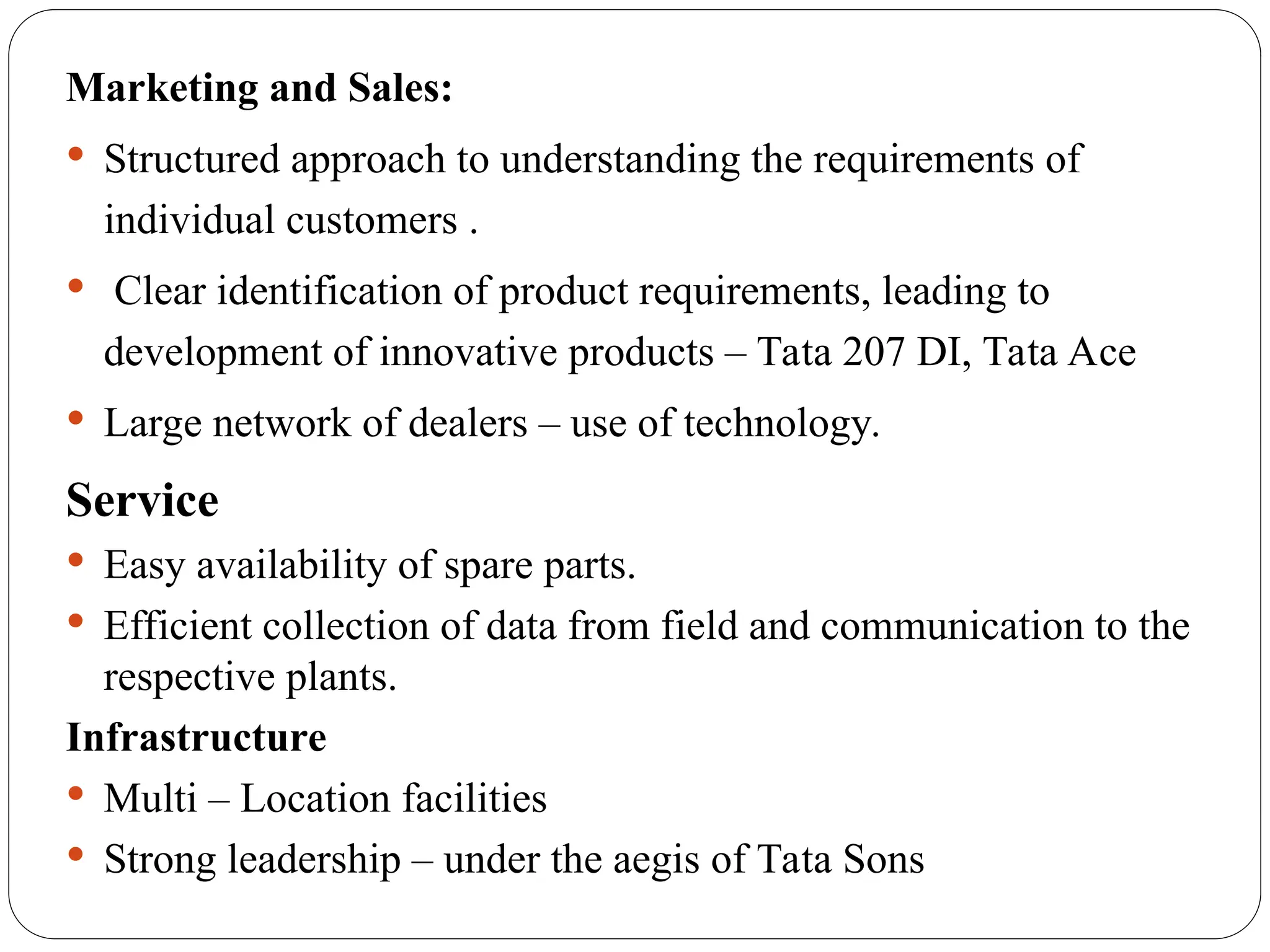
Marketing and Sales:
 Structured approach to understanding the requirements of
individual customers .
 Clear identification of product requirements, leading to
development of innovative products – Tata 207 DI, Tata Ace
 Large network of dealers – use of technology.
Service
 Easy availability of spare parts.
 Efficient collection of data from field and communication to the
respective plants.
Infrastructure
 Multi – Location facilities
 Strong leadership – under the aegis of Tata Sons
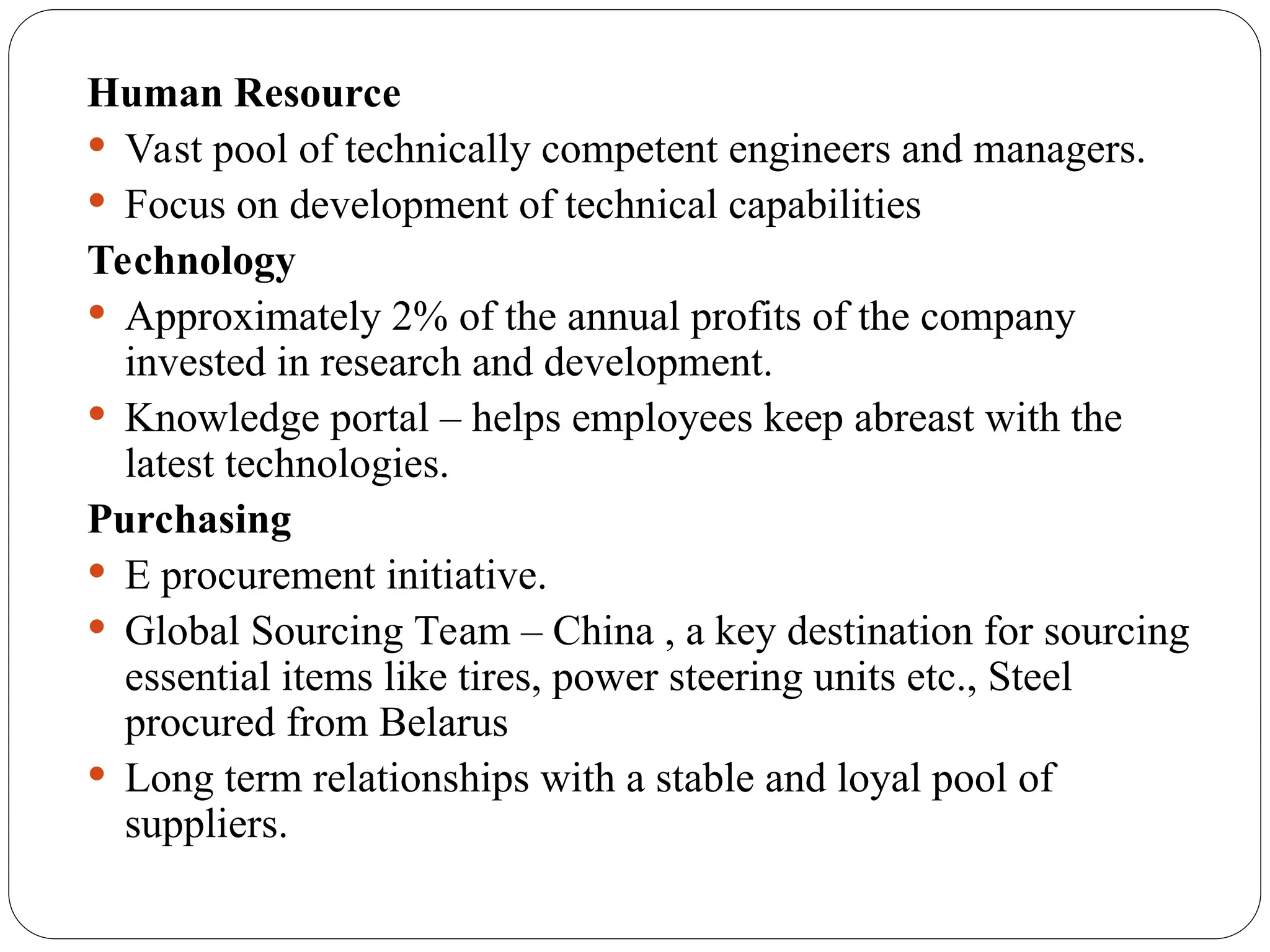
Human Resource
 Vast pool of technically competent engineers and managers.
 Focus on development of technical capabilities
Technology
 Approximately 2% of the annual profits of the company
invested in research and development.
 Knowledge portal – helps employees keep abreast with the
latest technologies.
Purchasing
 E procurement initiative.
 Global Sourcing Team – China , a key destination for sourcing
essential items like tires, power steering units etc., Steel
procured from Belarus
 Long term relationships with a stable and loyal pool of
suppliers.
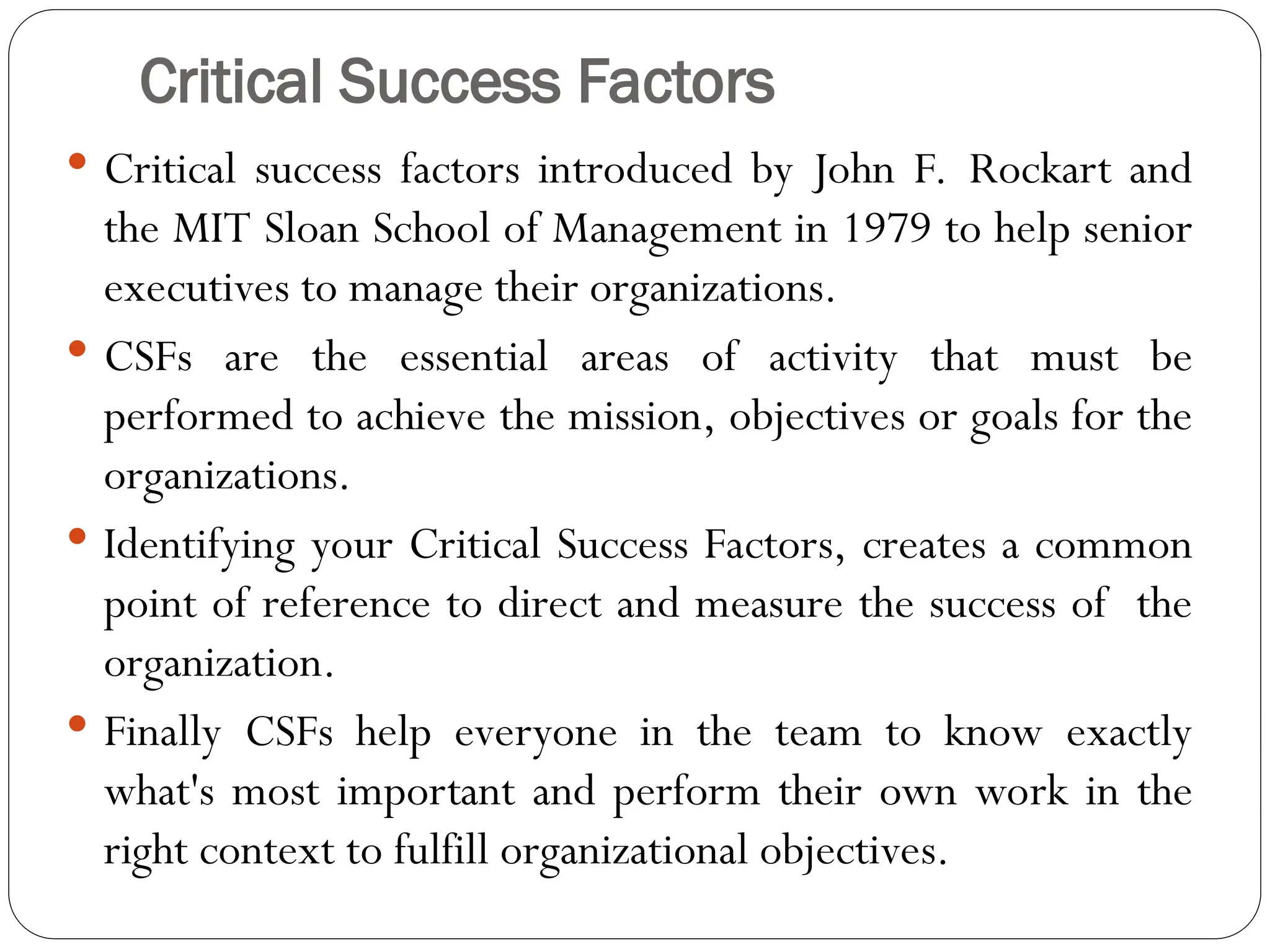
Critical Success Factors
 Critical success factors introduced by John F. Rockart and
the MIT Sloan School of Management in 1979 to help senior
executives to manage their organizations.
 CSFs are the essential areas of activity that must be
performed to achieve the mission, objectives or goals for the
organizations.
 Identifying your Critical Success Factors, creates a common
point of reference to direct and measure the success of the
organization.
 Finally CSFs help everyone in the team to know exactly
what's most important and perform their own work in the
right context to fulfill organizational objectives.
Levels of CSF
 CSFs could differ from company to company and from manager to
manager. There are four specific levels of CSFs: Industry organization,
Division and Individual
 Industry: Key Success Factors (KSFs) in an industry are those things
that determine the ability of members of an industry to prosper in the
industry such as low cost, best quality, good product features, resources
available, competitive capabilities and so on.
 For example:
 a) In Mobile and Computer industry, the reliability of technology, after
sales service and new innovative features.
 b) In Automobile industry, the reliability of technology, after sale
service, safety and fuel efficiency.
 c) In apparel manufacturing, appealing designs and color combinations
(to create buyer interest) and low-cost manufacturing efficiency (to
permit attractive retail pricing and good profit margins).
Organizational Level :
 It may be the current position of the organization in the industry
relative to other competitors, in the industry and also the
leadership position it enjoys, its strategy, and its resources and its
capabilities.
 It may be how the organization adapts to the social, political and
economic climate of the country.
 It may be the HRM practices of an organization which produces
positive outcomes, such as high quality, highly flexible, and
highly committed staff members, who can positively affect
organizational performance.
Division: Divisional-level CSFs result from divisional
requirements. On a divisional level the most practical and
common measure of effectiveness can included market share
and profit margins.
Individual Level:
Experience in using technology
Skills
Knowledge of Reporting Standards
Effectiveness in dealing with Crisis
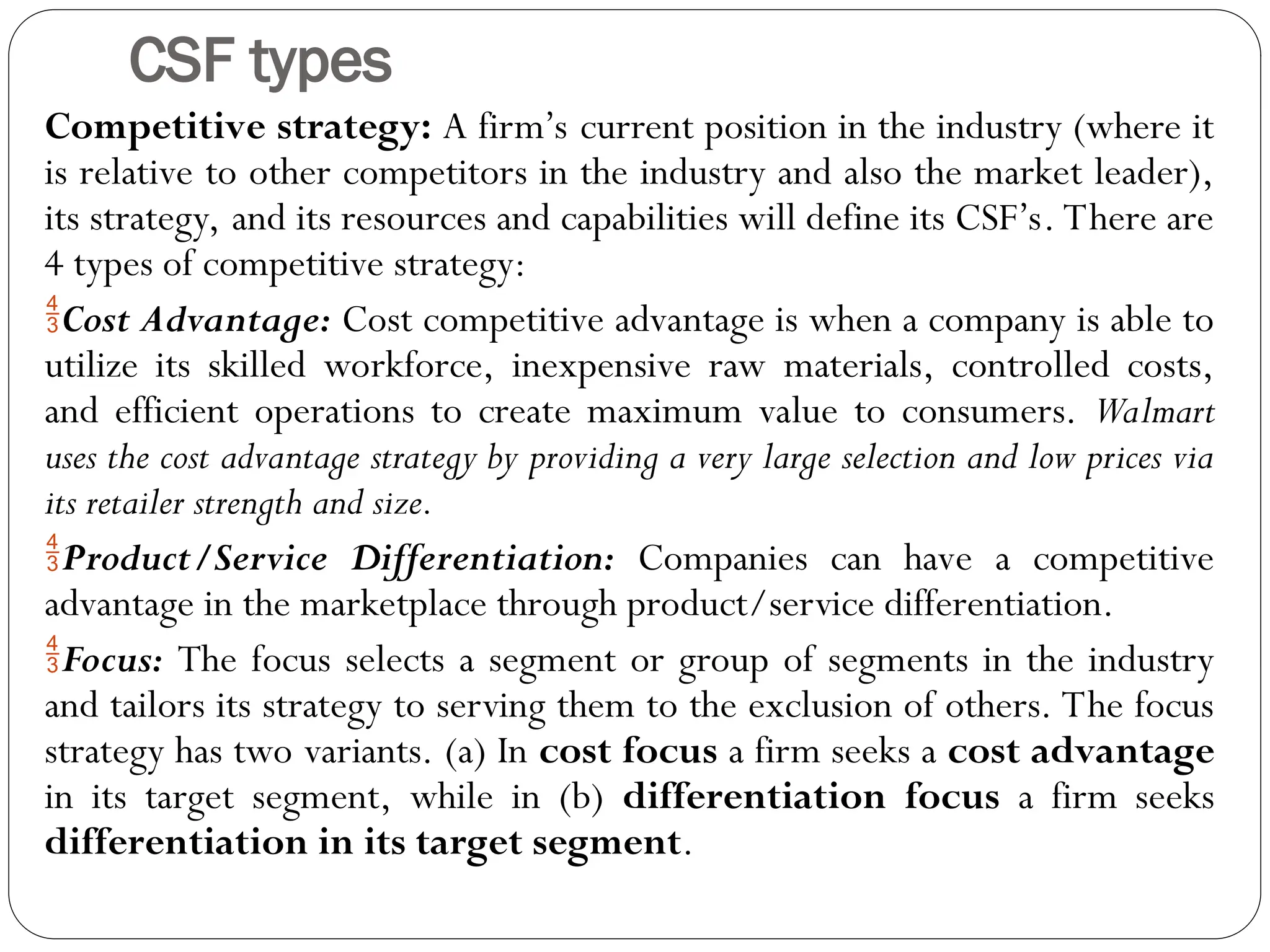
CSF types
 The structure of the particular industry (industry CSFs)
 Competitive strategy and industry position,
geographical location (strategy CSFs)
 The macro environment (environmental CSFs)
 Problems or challenges to the organization (temporal
CSFs)
 Management perspective (management CSFs)
 CSFs are unique to an industry, organization, or manager. But
CSFs are not necessarily unique to the organization, division,
operational unit, or individual to whom they apply.
CSF types
Competitive strategy: A firm’s current position in the industry (where it
is relative to other competitors in the industry and also the market leader),
its strategy, and its resources and capabilities will define its CSF’s. There are
4 types of competitive strategy:
Cost Advantage: Cost competitive advantage is when a company is able to
utilize its skilled workforce, inexpensive raw materials, controlled costs,
and efficient operations to create maximum value to consumers. Walmart
uses the cost advantage strategy by providing a very large selection and low prices via
its retailer strength and size.
Product/Service Differentiation: Companies can have a competitive
advantage in the marketplace through product/service differentiation.
Focus: The focus selects a segment or group of segments in the industry
and tailors its strategy to serving them to the exclusion of others. The focus
strategy has two variants. (a) In cost focus a firm seeks a cost advantage
in its target segment, while in (b) differentiation focus a firm seeks
differentiation in its target segment.
 Macro Environmental: Economic, regulatory, political, and
demographic. These relate to environmental factors that are not in
the control of the organization but which an organization must
consider in developing CSF’s An example of environmental factors
affecting an organization could be a de-merger.
 Temporal: These CSF’s may be important, but are usually short-
lived. Temporal factors are temporary or one-off CSF’s resulting
from a specific event necessitating their inclusion. Shortage of
executive staff due to attrition in an organization can be an example of
Temporal CSF’s.
 Managerial Position: An individual role may generate CSF’s as
performance in a specific manager’s area of responsibility may be
deemed critical to the success of an organization. In organizations
with departments focused on customer relationships, a CSF for managers in
these departments may be customer relationship management.
Core Competencies
 A core competency is a company's unique characteristic or capability that
provides a competitive advantage in the marketplace, delivers value to
customers, and contributes to continued organizational growth.
 Core competencies typically comprise fundamental knowledge, ability or
expertise in a specific subject area or skill set, allow a business to reach a wide
range of markets, and cannot be easily replicated by competitors. The term
core competency was coined by Dr. C.K Prahalad and Prof. Gray Hamel in
1989.
 Core competencies provide the companies with a framework wherein they can
identify their core strengths and strategize accordingly.
 Apple as an organization developed products which are rich in design and user
experience. This gave them a distinguished brand image in the market, which stands
even now in the face of multiple competitors. Apple products are sold with high margins.
 Canon developed a series of core products like disposable cartridges, instant toner fusers,
and other components to decrease the size as well as the cost to create reliable and less
servicing range of printing products which really put Canon towards becoming a
competent player in printer technology.
 Honda’s ability to produce some of the world’s best engines and power trains does
provide customers with highly valued benefits of superior fuel economy, zippy
acceleration, less noise and vibration.
Experience Curve
 The experience curve is one of BCG’s signature concepts and
arguably one of its best known.
 BCG’s experience curve is based on cost analysis and found that
for each doubling of “experience,” in producing a particular
product, the lower are its costs.
 Eventhough there is no fundamental economic law that can predict
the existence of the experience curve, it has been shown to apply
to industries across the board.
 In manufacturing, less labor was needed for a given output
depending on the experience of that labor.
 The strategic implications of the experience curve was closely
related to market share. The competitor with the biggest market
share will have the biggest cost advantage over its rivals.
 Consider a product with the following data about the hours of labor
required to produce a unit:
 Hours required to produce 1st unit: 100
 Hours required to produce 10th unit: 48
 Hours required to produce 25th unit: 35
 Hours required to produce 75th unit: 25
 Hours required to produce 200th unit: 18
Strategic Applications of a Learning Curve
 Frequent Decreases in Selling Price: As the hours
required to produce the most recent unit continually
decreases, the cost to produce the unit continually decreases.
Therefore, it is possible to decrease the selling price without
decreasing total profit. Each decrease in selling price
increases the market share, which in turn makes it tougher
for competition product.
 Reinvest Increased Profits: As the hours required to
produce the most recent unit continually decreases, the cost
to produce the unit continually decreases. Therefore, profits
increases. This profit can be reinvested to improve the
product or the production process.
Port Folio Analysis
 Portfolio analysis is a systematic way to analyze the products and
services that make up an organization's business portfolio.
 Portfolio analysis provides a means of comparing numerous
business activities of an SBU in relation to each other and
establishing the priorities and deciding between winners and losers.
 The Boston Consulting Group (BCG) portfolio matrix is the
first model provides a means of rating products and/or
services in order to assess the future probable cash contributions
and demands of each product or service.
 The factors of business strength can be market share, cost of
competitiveness, technological skills etc. The factors of
industrial attractiveness can be industry growth, inflation
sensitivity, cyclicality- seasonality market etc.
Advantages and Disadvantages of Portfolio Analysis
Portfolio analysis offers the following advantages:
1.It encourages management to evaluate each of the
organization's businesses individually and to set objectives and
allocate resources for each.
2.It stimulates the use of externally oriented data to supplement
management's intuitive judgment.
3.It raises the issue of cash flow availability for use in expansion
and growth.
Portfolio analysis does, however, have some limitations.
1.It is not easy to define product/market segments.
2.It provides an illusion of scientific rigor when some subjective
judgments are involved.
Portfolio analysis should be regarded as a disciplined and organized
way of thinking about asset allocation. It is only a subjective tool,
however, and is not a substitute for the ultimate professional
judgment of the responsible decision-makers.
BCG Matrix
 Boston Consulting Group (BCG) Matrix is developed by Bruce
Henderson of the Boston Consulting Group in the early 1970’s.
 According to this technique, businesses or products are classified as
low or high performers depending upon their market growth rate
and relative market share.
 Market Share : is the percentage of the total market that is
being serviced by the company, measured either in revenue
terms or unit volume terms.
 Market Growth Rate is used as a measure of a market’s
attractiveness. Markets experiencing high growth are ones
where the total market share available is expanding, and there’s
plenty of opportunity for everyone .
 THE BCG GROWTH-SHARE MATRIX is a portfolio planning
model which is based on the observation that a company’s
business units can be classified into four cells:
 STARS: High growth, High market share: Stars are leaders in
business. They also require heavy investment, to maintain its large
market share. It leads to large amount of cash consumption and
cash generation. Attempts should be made to hold the market
share otherwise the star will become a Cash Cow.
 Cash cows: Low growth High market share It is based on the
combination of market growth and market share relative to the
next best competitor. They are foundation of the company and
often the stars of yesterday. They generate more cash than
required. They extract the profits by investing as little cash as
possible. They are located in an industry that is mature, not
growing or declining.
 Dogs: Low growth, Low market share. Dogs are the cash traps.
Dogs do not have potential to bring in much cash. Number of dogs
in the company should be minimized. Business is situated at a
declining stage.
 Problem Child: Low share, High growth: Also sometime
referred to as Question Marks, these products prove to be tricky
ones for product managers. These products are in a high growth
market but does not seem to have a high share of the market. The
reason could be that it may be a very new product to the market.
 BCG matrix can be used to assess the strength of the organization
and its product portfolio.
 As BCG founder Bruce Henderson wrote, "all products eventually
become either cash cows or dogs. The value of a product is
completely dependent upon obtaining a leading share of its market
before the growth slows
Implications of BCG matrix
Organizations should have an ideal mix of cash cows and stars.
There are four assumptions that underpin the BCG Matrix:
BCG matrix can be adapted to help companies drive the strategic
experimentation required for success, even in unpredictable
markets.
Almost all new products start life as ‘question marks’ or ‘problem
child’
High margins and high market share go together.
To gain market share organizations need to invest in a competitive
package
Market share gains have the potential to generate a cash surplus.
No product /market can grow indefinitely.
Criticisms of the BCG Matrix
 The BCG matrix provides a framework for allocating resources among
different business units and allows one to compare between many
business units at a glance. Whilst it has stood the test of time, the Boston
Matrix is not without its critics. Attention has been drawn to the
following shortcomings of the technique:
 The Boston Matrix assumes rigid boundaries for Products and Markets
over a period of time.
 BCG matrix is only a guide to cash management and investment, there is
no guidance on what changes must be bought about in order to achieve a
lead position in a growing market.
 BCG matrix is based on Market Growth and Relative Market share and
does not take account of competitive strengths and customer needs.
 The link between market share and profitability is questionable since
increasing market share can be very expensive.
 BCG model considers market growth at the given rate. In practice a firm
may be able to create or grow the market.
GE McKinsey matrix
 GE Multifactor Portfolio Matrix is a tools that helps managers
develop organizational strategy that is based primarily on market
attractiveness and business strengths.
 Each of the organization’s SBUs are plotted on a 2 dimensional
matrix of Industry Attractiveness and Business Strength.
 Industry Attractiveness might be determined by such factors as:
 No. of Competitors in the Industry
 Rate of Industry Growth
 Weakness of Competitors within an Industry
 Business Strengths might be determined by such factors as:
 Company’s Financial Solid Position
 Good Bargaining Position over Suppliers
 High level of Technology Use.
Objectives of GE McKinsey matrix
The major objectives of a portfolio analysis of SBUs is to achieve the
following:
Analyze its current SBU portfolio to decide which SBUs must receive more
or less investment
Develop growth strategies for adding new SBUs
Decide which SBUs must no longer be retained by the parent organization
 Market Competitiveness of a SBU is estimated by analyzing the market
size of the SBU, the market growth rate, the market profitability, the
competitive intensity/rivalry, the overall risk of returns in the industry, the
entry barriers, the pricing trends, opportunity to differentiate, demand
variability, segmentation, distribution structure and the technological
development.
Competitive Strength of the SBU is estimated by factors such as strength
of assets and competencies, market share, market share growth potential,
brand strength, customer loyalty, relative cost structure, relative
profitability, distribution strength, production capacity, record of
innovation, management strength and access to financial and other
investment resources.
Limitations of GE-McKinsey model
 A major assumption behind the GE-McKinsey matrix is that it can
operate when the economies of scale are achievable in production and
distribution.
 Factors of competitive strength and market competitiveness may be
extremely important for a particular instance, while another instance
may even require even other factors. The top management of the
organization should decide upon these factors very carefully as there is
no generic set of factors with which all SBUs may be evaluated.
 The relative weightage given to each of the factors of competitive
strength and market competitiveness is often arbitrary. While some
methodology such as the Analytic Hierarchy Process may be used to
compute the relative importance of such factors, such is mostly not
done. Thus the overall position of the SBU on the matrix could come
under criticism.
 The core competencies of the firm or the corporation are not
represented in this analysis. The core competencies may be leveraged
across SBUs and can be a deciding factor while judging the competitive
strength of the SBUs
McKinsey’s Frame work
 'McKinsey's 7s Framework' proposes a complex relationship between
strategy, structure, systems, staff, style, skills and shared values.
 Strategy: the plan devised to maintain and build competitive
advantage over the competition.
 Structure: the way the organization is structured and who reports to
whom.
 Systems: the daily activities and procedures that staff members engage
in to get the job done.
 Shared Values: called "superordinate goals" when the model was
first developed, these are the core values of the company that are
evidenced in the corporate culture and the general work ethic.
 Style: the style of leadership adopted.
 Staff: the employees and their general capabilities.
 Skills: the actual skills and competencies of the employees working for
the company.
McKinsey 7s model
 The McKinsey 7S model is a diagnostic management tool used to test the
strength of the strategic degree of fit between a firm’s current and proposed
strategies. It was developed by consultants at McKinsey & Co.
 It is a management tool designed to facilitate the process of strategy
implementation within the context of organizational change.
 Successful implementation of strategy requires management of the
interrelationships between seven elements.
 Hard S are: Strategy, Structure and Systems
 Soft S are: Style, Staff , Skills and Shared Values
 Structure represents the way business divisions and units are organized and
includes the information of who is accountable to whom. In other words,
structure is the organizational chart of the firm. It is also one of the most
visible and easy to change elements of the framework.
 Systems are the processes and procedures of the company, which reveal
business’ daily activities and how decisions are made. Systems are the area of
the firm that determines how business is done and it should be the main focus
for managers during organizational change.
 Skills are the abilities that firm’s employees perform very well.
They also include capabilities and competences. During
organizational change, the question often arises of what skills the
company will really need to reinforce its new strategy or new
structure.
 Staff element is concerned with what type and how many
employees an organization will need and how they will be
recruited, trained, motivated and rewarded.
 Style represents the way the company is managed by top-level
managers, how they interact, what actions do they take and
their symbolic value. In other words, it is the management style
of company’s leaders.
 Shared Values are at the core of McKinsey 7s model. They are
the norms and standards that guide employee behavior and
company actions and thus, are the foundation of every
organization.
Strengths and Advantages
 Emphasis on a firm’s strategy implementation.
 It proved that organizational effectiveness was not dependent
on just strategy and structure.
 Comprehensive because the analyst must consider each of the
seven constructs, and how they interact.
 First model to merge the “hard” and “soft” aspects of the
enterprise.
 Emphasizes coordination of key tasks.
 Model was also one of the first to help connect academic
research with managerial practice.
Weaknesses and Limitations
 May miss some fine-grained areas in which gaps in strategy
conception or execution can arise.
 Little empirical support for the model or of its originator’s
conclusions.
 Remains difficult to properly assess the degree of fit.
 Difficult for analysts to explain what should be done for
implementation using the model.
 The 7S is mostly a static model.
Porter’s Five Forces Framework
 The five forces framework developed by Michael Porter is the
most widely known tool for analyzing the competitive
environment, which helps in explaining how forces in the
competitive environment shape strategies and affect
performance.
 The framework suggests that there are competitive forces other
than direct rivals which shape up the competitive environment.
These competitive forces are as follows:
1) The rivalry among competitors in the industry
2) The potential entrants
3) The substitute products
4) The bargaining power of suppliers
5) The bargaining power of buyers
1) Threat of New Entrants :
Entry of a firm in and operating in a market is seen as a threat to the
established firms in that market. The competitive position of the
established firms is affected because the entrants may add new
production capacity or it may affect their market shares.
2) Bargaining Power of Suppliers Business organizations have a
large dependency on suppliers and the latter influence their profit
potential significantly. Suppliers’ decisions on prices, quality of goods
and services and other terms and conditions of delivery and payments
have significant impact on the profit trends of an industry.
3) Bargaining Power of Customers: Customers with a stronger
bargaining power relative to their suppliers may force supply prices
down or demand better quality for the same price and may demand
more favorable terms of business.
4)Threat of Substitutes Often firms in an industry face
competition from outside industry products, which may be close
substitutes of each other. For example, with the new technologies in
place now the electronic publishing are the direct substitutes of the
texts published in print. Similarly, newspaper find their closest
substitutes in their online version, though it may be a smart strategic
move to position them as complementary products.
5) Competitive Rivalry The level of rivalry is minimum in a
perfectly competitive market where there are large number of
buyers and sellers and the product is uniform with everyone. Same is
true for a monopoly market where there is only one player and the
type of product is also one. However in case of oligopoly or
monopolistic competition, where you will find few players and the
market conditions allow them to differentiate their products and
services, competition if found to be fierce.
Porter’s Analysis of Coca-Cola Company
 Threat of New Entrants/Potential Competitors: Medium
Pressure: Entry barriers are relatively low for the beverage industry:
There is an increasing amount of new brands appearing in the market with
similar prices than Coke products. But Coca-Cola is seen not only as a
beverage but also as a brand. It has held a very significant market share for
a long time and loyal customers are not very likely to try a new brand.
 Threat of Substitute Products: Medium to High pressure: There
are many kinds of energy drinks/soda/juice products in the market. Coca-
Cola doesn’t really have an entirely unique flavor. In a blind taste test,
people can’t tell the difference between Coca-Cola and Pepsi.
 The Bargaining Power of Buyers: Low pressure: The individual
buyer no pressure on Coca-Cola Large retailers, like Wal-Mart, have
bargaining power because of the large order quantity, but the bargaining
power is lessened because of the end consumer brand loyalty.
 The Bargaining Power of Suppliers: Low pressure: The
main ingredients for soft drink include carbonated water,
phosphoric acid, sweetener, and caffeine. The suppliers are not
concentrated or differentiated. Coca-Cola is likely a large, or the
largest customer of any of these suppliers.
 Rivalry Among Existing Firms: High Pressure:
Currently, the main competitor is Pepsi which also has a wide
range of beverage products under its brand. Both Coca-Cola and
Pepsi are the predominant carbonated beverages and committed
heavily to sponsoring outdoor events and activities.
Corporate restructuring
 As per Collins English dictionary, meaning of corporate
restructuring is a change in the business strategy of an
organization resulting in diversification, closing parts of the
business, etc., to increase its long-term profitability.
 Corporate restructuring can involve making dramatic changes to
a business by cutting out or merging departments.
 It implies rearranging the business for increased efficiency and
profitability.
 In other words, it is a comprehensive process, by which a
company can consolidate its business operations and strengthen
its position for achieving corporate objectives-synergies and
continuing as competitive and successful entity.
Types of corporate restructuring
Various types of corporate restructuring strategies include:
Merger
Demerger
Reverse Mergers
Disinvestment
Takeovers
Joint venture
Strategic alliance
Slump Sale
Franchising
Strategic alliance etc.
Merger
 Merger is the combination of two or more companies which can be
merged together either by way of amalgamation or absorption.
 Mergers may be
 (i) Horizontal Merger: A merger of two or more companies that
compete in the same industry. It is a merger with a direct competitor
and hence expands as the firm's operations in the same industry.
Horizontal mergers reduce the number of competitors in the industry.
 (ii) Vertical Merger: It is a merger which takes place upon the
combination of two companies which are operating in the same
industry but at different stages of production or distribution
system. If a company takes over its supplier/producers of raw material,
then it may result in backward integration of its activities. On the
other hand, Forward integration may result if a company decides to take
over the retailer or Customer Company. Vertical merger provides a
way for total integration to those firms which are striving for owning of
all phases of the production schedule together with the marketing network

 (iii) Co-generic Merger: It is the type of merger, where two
companies are in the same or related industries but do not
offer the same products, but related products and may share
similar distribution channels, providing synergies for the
merger. The potential benefit from these mergers is high because
these transactions offer opportunities to diversify around a
common case of strategic resources.
 (iv) Conglomerate Merger: These mergers involve firms engaged
in unrelated type of activities i.e. the business of two companies
are not related to each other horizontally nor vertically. Conglomerate
mergers are merger of different kinds of businesses under one
flagship company. The purpose of merger remains utilization of
financial resources enlarged debt capacity and also synergy of
managerial functions and is favored throughout the world as a
means of diversification.
 Demerger: is a form of corporate restructuring in which the entity's
business operations are segregated into one or more components. A
demerger is often done to help each of the segments operate more
smoothly, as they can focus on a more specific task after demerger.
 Reverse merger is the opportunity for the unlisted companies to
become public listed company, without opting for Initial Public offer
(IPO).In this process the private company acquires the majority shares of
public company, with its own name.
 Disinvestment means the action of an organization or government
selling or liquidating an asset or subsidiary. It is also known as
"divestiture".
 Takeover means an acquirer takes over the control of the target
company. It is also known as acquisition. Normally this type of acquisition
is undertaken to achieve market supremacy. It may be friendly or hostile
takeover.
 Friendly takeover: In this type, one company takes over the management
of the target company with the permission of the board.
 Hostile takeover: In this type, one company takes over the management
of the target company without its knowledge and against the wish of their
management.
 A joint venture is an entity formed by two or more companies to undertake
financial activity together. The parties agree to contribute equity to form a new
entity and share the revenues, expenses, and control of the company. It may be
Project based joint venture or Functional based joint venture.
 Project based Joint venture: The joint venture entered into by the companies in
order to achieve a specific task is known as project based JV.
 Functional based Joint venture: The joint venture entered into by the
companies in order to achieve mutual benefit is known as functional based JV.
 Strategic Alliance: Any agreement between two or more parties to
collaborate with each other, in order to achieve certain objectives while
continuing to remain independent organizations is called strategic alliance.
 Franchising may be defined as an arrangement where one party (franchiser)
grants another party (franchisee) the right to use trade name as well as certain
business systems and process, to produce and market goods or services according
to certain specifications.
 Slump sale means the transfer of one or more undertaking as a result of the sale
of lump sum consideration without values being assigned to the individual assets
and liabilities in such sales. If a company sells or disposes of the whole or
substantially the whole of its undertaking for a predetermined lump sum
consideration, then it results in a slump sale.
Types of restructuring
 Portfolio restructuring: restructuring refers to change in the
portfolio of businesses of the company. The increase in competition has
provoked many companies to divest businesses in which they are not
competitive and to concentrate on their core businesses in which they
tend to grow by setting up new capacity and/or by acquisition. The
dismantling of the entry barriers (de-licensing, de-reservation,
liberalization of policy towards foreign technology and capital
participation, etc.) has opened up enormous new opportunities for
expanding the business.
 Organizational restructuring: Decentralization, de-layering or
flattering and regrouping of activities are important organizational
restructuring measures. Changes in corporate strategy, such as portfolio
strategy, sometimes call for organizational restructuring. Increase or
decrease in activity levels, expansion or contraction of portfolio or
functions etc. may cause modification of organizational structure.
 Functional restructuring: The AMA survey reveals that restructuring of
corporate functions (marketing operations, personnel and finance) has been
very significant both in the public and private sectors.
 Marketing Function: The survey results show that the revamping of the
marketing function meant the creating of a product management team,
building up sales force, restructuring distribution system, and creating
marketing research cell.
 Financial Function: As far as the modifying of the financial function was
concerned the emphasis was on improving the financial reporting system.
 Operations Functions: Restructuring of operations has been very
significant. Re-engineering has become very popular. Technological up
gradation has been an important concern. The acceptance of total quality
management and the requirements of ISO 9000 certification etc. have had
significant influence on operational restructuring.
 Personnel Function: Personnel function was found to receive high priority
in restructuring. The emphasis in both public and private sectors was on
training and succession planning. The private sector also gave the creation of
appropriate rewards and punishments for performance high priority. This was,
however, not so in the case of the public sector.
Business process Reengineering
 Business Process Reengineering involves the radical
redesign of core business processes to achieve dramatic
improvements in productivity, cycle times and quality.
 In Business Process Reengineering, companies start with a blank
sheet of paper and rethink existing processes to deliver more
value to the customer. They typically adopt a new value system
that places increased emphasis on customer needs.
 Companies reduce organizational layers and eliminate
unproductive activities in two key areas. First, they redesign
functional organizations into cross-functional teams. Second, they
use technology to improve data dissemination and decision
making.
How Business Process Reengineering
works:
Business Process Reengineering is a dramatic change initiative that
contains five major steps.
Refocus company values on customer needs
Redesign core processes, often using information technology to
enable improvements
Reorganize the business into cross-functional teams with end-to-
end responsibility for a process
Rethink basic organizational and people issues
Improve business processes across the organization
Business Process Reengineering
Companies use Business Process Reengineering to improve
performance substantially on key processes that impact customers.
Business Process Reengineering can:
Reduce costs and cycle time: Business Process
Reengineering reduces costs and cycle times by eliminating
unproductive activities and the employees who perform them.
Reorganization by teams decreases the need for management
layers, accelerates information flows, and eliminates the errors
and rework caused by multiple handoffs.
Improve quality: Business Process Reengineering improves
quality by reducing the fragmentation of work and establishing
clear ownership of processes. Workers gain responsibility for their
output and can measure their performance based on prompt
feedback.
Scenario Planning
 Scenario planning (sometimes called “scenario and contingency
planning”) is a structured way for organizations to think about the
future.
 Scenario planning, also called scenario thinking or scenario analysis, is a
strategic planning method that some organizations use to make flexible
long-term plans.
 Process of visualizing
1. What future conditions or events are probable?
2. What will be their consequences or effects ?
3. How will we respond or benefit from them?
4. Scenario Planning is a strategic planning method that some organizations
use to make flexible long-term plans.
5. Scenario planning contributes to strategic decision.
6. Scenarios help to think about the consequences of an organization
strategy and help to see the pitfalls beforehand.
 The scenario planning concept first emerged following World War II,
as a method for military planning. The US Air Force tried to imagine
what its opponents might do and to prepare alternative strategies.
 Scenario planning was first introduced in the 1970s at Royal Dutch
Shell as a planning technique that replaced traditional forecasting tools.
The new method helped the company to better handle the 1973 oil
crisis, to which Shell reacted significantly earlier and more successfully
than its competitors.
 Scenario planning is a method for developing and thinking through
possible future states on the basis of different scenarios .
 The aim of the technique is not to accurately predict the future but
rather to develop better strategies by overcoming the perceptual bias
of managers.
 Scenario planning is based on the assumption that future developments
are largely uncertain. Thus, the basic idea of scenario planning is to
force managers to acknowledge this uncertainty and to translate it into
thinking in multiple options.
Scenario planning steps
Scenario planning is a six step process:
1.Definition of scope: The first common process step defines the scope of
the scenario project. This step decides the time frame, scope of analysis and
the participating team.
2.Perception analysis: The aim of this process step is to analyze the
perception of the executives participating in the scenario project. This is
done by first identifying the assumptions and expectations of the company’s
management and challenging them by the interests and expectations of
external stakeholders to obtain a holistic view on possible maps of the
future.
3.Trend and uncertainty analysis: In this phase, the scenario team
analyses the most important driving forces that affect the company or
industry. These factors are then ranked by their degree of uncertainty and
their importance and potential impact for the company to identify the most
crucial environmental drivers.
 Scenario building: The identified key uncertainties are
converted into distinct scenarios complemented by other driving
forces to create consistent and plausible stories for the future.
Scenario creation opens the perception of the participants and sets
the foundation for the subsequent strategy definition phase in which
possible consequences and action plans for each scenario are
developed.
 Strategy definition: In this phase, also called ‘Implications’ or
‘Option Planning’, companies can test decisions and strategic
options against the multiple scenarios that have been generated.
This makes the company’s strategy more robust and applicable in
several possible future situations.
 Monitoring: In this phase, several indicators are first defined and
then monitored to check if strategic changes are needed. It is also
necessary to have a continuous scanning of the environment and
repetition of the scenario process if the environment changes
drastically.
Module IV
 Strategy Implementation - project
implementation - procedural implementation –
behavioral implementation; managing resistance
to change.
165
Strategy Implementation
Implementation Process Questions:
 Who are the people to carry out the
strategic plan?
 What must be done to align operations
with new direction?
 How is work going to be coordinated?
Strategic Implementation
 Strategy implementation is the translation of chosen strategy into
organizational action so as to achieve strategic goals and objectives.
 Strategy implementation is also defined as the manner in which an
organization should develop, utilize, and amalgamate
organizational structure, control systems, and culture to
follow strategies that lead to competitive advantage and a
better performance.
 Implementation of strategy is the process through which a
chosen strategy is put into action. Thus it involves the design
and management of systems to achieve the best integration of
people, structure, processes and resources in achieving
organizational objectives.
 Implementation of Strategy affects an organization from top to
bottom, it affects all the functional and divisional areas of business.
Steps in strategy implementation
The steps in strategy implementation are:
Institutionalization of strategy
Setting Proper Organizational Climate
Developing Appropriate Operating Plans
Developing Appropriate Organization Structures
Review of Implemented Strategy
Sequence in which strategy implementation
Sequence in which strategy implementation issues are to be considered:
Project Implementation
Procedural Implementation
Resource Allocation
Structural Implementation
Functional Implementation
Behavioral Implementation
These activities are not performed in the same order (can be performed
simultaneously, or can be repeated etc.).
Transition from strategy formulation to strategy implementation requires
shift in responsibility from strategist to divisional and functional managers
and their involvement should be maximum during strategy formulation.
Project Implementation
Project Implementation passes through following phases that are as
follows:
 Conception Phase – This phase is an extension of strategy
formulation phase. In this phase, project ideas are generated
during the process of strategic alternatives & strategic choice that
may be implemented in future by organization.
 Project Analysis Phase – The project ideas have to be arranged
according to priority for the purpose of development. Before
selecting a project for development, a preliminary project analysis
have to be made in respect of marketing, technical, finance, etc…
and check out such analysis is required to analyze whether project
would appeal to investors, banks & FI’s.
 Planning Phase – In this phase, management undertakes
detailed planning of project. The detailed planning should cover
different areas of project such as production schedules, plant
design & layout, technical arrangements, marketing, finance,
etc…
Project Implementation
 Organizing Phase – The management must organize for
necessary resources such as manpower, finance, systems and
procedures to implement the project.
 Implementation Phase – During this phase, the
management must undertake engineering, order placement
for equipment & material etc… leading to the testing, trial
& working of plant.
 Operation Phase – The final phase involves handing
over the plant to the operating personnel for operation
purpose. At this stage the production starts.
Procedural Implementation.
In order to implement the strategies, the management must
have good knowledge of the procedural framework within
which the plans, projects and programmes have to be approved
by the government authorities. The government authorities
besides the policy guidelines issued by the government
authorities from time to time. Some of the important procedural
requirements can be elaborated as follows: -
1. Formation of a company – The formation of a
company is governed by the provision of Indian companies act,
1956 as amended from time to time. All activities for formation
should be carried out such as Registration, obtaining certificates,
documentation must be forwarded to registrar of companies,
etc…
Procedural Implementation.
2. Licensing Procedures – Certain industries require licensing
procedures. As per the industrial policy, 1991, six industries
require licensing manufacturing products such as alcohol,
cigarettes, chemical fertilizers, industrial explosives, defense and
Drugs & Pharmaceuticals. Therefore company requiring the
license must apply for the same.
3. FEMA Requirements – if required, organization must fulfill
the necessary requirements of the Foreign Exchange
Management Act, 2000. Those organizations willing to deal in
foreign exchange transactions must ensure that they collect
required information in context to provisions of FEMA.
Procedural Implementation.
4. Import and Export Requirements – Similarly, organization willing to
deal in Import & Export need to follow certain procedural requirements,
such as they have to register with Directorate General of Foreign Trade
(DGFT) and obtain Importers Exporters Code (IEC)
5. Competition Act, 2002 – The government has introduced this act that
aims at promoting competition by restricting anti competitive practices.
Large businesses must have a good understanding of the competitive act.
6. Foreign Collaboration Procedures – For proposals to set up projects with foreign
collaborations require prior government approval. The government authorities
such as Reserve Bank of India (RBI), Foreign Investment Promotion Board
(FIPB) and Project Approval Board are major regulatory bodies for foreign
collaborations including joint ventures abroad.
7. SEBI Requirement – Securities and Exchange Board of INDIA (SEBI) became
active since 1992 with the passing of SEBI Act, 1992. the act empowered SEBI
with necessary powers to regulate the activities connected with marketing of
securities & investments of stock exchanges, merchant banking, portfolio
management, stock brokers and others connected with securities
8) Consumer Protection Act, 1986 – Business firms must
have good knowledge of consumer protection act, 1986.
This act was passed to provide better protection of the
interests of consumers. The act seeks to promote &
protect rights of consumers such as: -
 The right to be protected against the marketing of goods
that are hazardous to life & property.
 The right to be informed about the quality, quantity,
potency, purity standards and price of goods to protect
the consumer against unfair trade practices.
 The right to be heard & be assured that consumers
interests will receive due consideration.
 The right to seek redressal against unfair trade practices
or exploitation of consumers, etc…
9. Pollution Control Requirements – the govt. of India has passed several
laws relating to the protection of environment. The business
organizations should have a good knowledge of such laws. To name few
of them are as follows:
 The Water (Prevention & Control of Pollution), Act, 1974.
 The Air (Prevention & Control of Pollution), Act, 1981.
 The Environment Protection Act, 1986, etc…
10. Labour Legislation Requirements – The govt. of India has passed several
laws to protect the interest of the workers. Business Organizations should
have a good knowledge of such laws, which include:
 The factories Act, 1948.
 The Workmen Compensation Act, 1923.
 The Bonus Act, 1965.
 The Minimum Wages Act, 1948.
 The Industrial Disputes Act, 1947, etc…
Resources Allocation
 Strategy implementation depends on resources and
competencies possessed by the firm
 These include:
 Financial resources
 Physical resources
 Human resources
 Technological resources
Financial Resource Allocation
While allocating the resources, an organization may take two alternative
steps:
I. Resources should be allocated at a place where these have their
maximum contributions, or
 Resources should be put according to the needs of various
organizational units/subunits. Both these alternatives may become
complementary to each other if there is an objective evaluation of the
resource requirement of various units.
1. Budgeting is the means through which resources ‘are allocated to
various organizational the following types of budgeting are more
relevant:
 Capital budgeting
 Performance budgeting
 Zero-base budgeting
 Strategic budgeting
 Capital Budgeting: is the planning of deployment of financial resources
of an organization for the purpose of maximizing the long-term profit
ability of the organization.
 Performance budgeting: emphasizes non-financial measurement of
performance, which can be related to financial measurement in explaining
changes and deviations from planned performance.
 Zero-base budgeting (ZBB) is based on a system where each
function, irrespective of the fact whether it is old or new, must be
justified in its entirety each time a new budget is formulated. It requires
each manager to justify his entire budget in detail from scratch, that is
zero base.
 Strategic budgeting is comparatively a newer concept as a tool of
resource allocation among various SBUs and units of an organization.
Under strategic budgeting, in determining the resource needs of an
organizational unit, the basic question that is put is: ‘What sort of
performance and results do we want to generate?’
Behavioral Implementation
The major issues involved in Behavioral Implementation are:
 Leadership.
 Corporate Culture
Organizational Structure
 Corporate politics & use of power.
Theory of leadership states:
A leader must:
 Develop new qualities to perform effectively.
 Be a visionary Exemplify the values, goals and culture of the
organization.
 Pay attention to strategic thinking and intellectual activities.
 Lead by empowering others.
 Create leadership at lower levels.
 Delegate authority and place emphasis on motivation
Leadership Implementation
‡ The role of appropriate leadership in strategic success is highly
significant.
‡ Leadership plays a critical role in the success and failure of
enterprise.
‡ It is considered as one of the most important elements affecting
organizational performance.
Styles of Leadership:
‡ Risk Taking: Willing to take risks.
‡ Technology: Use of planning, qualified personnel and techniques.
‡ Organicity: Extent of organizational structural flexibility.
‡ Participation: Involvement of managers.
Coercion:
Domination by Top Management.
of the most
ecting organiz
Strategic leadership for implementation
 Strategic leadership is defined as “the leader’s ability to
anticipate, envision, and maintain flexibility and to empower
others to create strategic change as necessary.”
 Strategic leadership is multifunctional, involves managing
through others, and helps organizations cope with change that
seems to be increasing exponentially in today’s globalized
business environment.
 Strategic leadership requires the ability to accommodate and
integrate both the internal and external business environment of
the organization, and to manage and engage in complex
information processing.
Strategic Leadership actions
Several identifiable actions characterize strategic leadership
that positively contributes to effective strategy
implementation :
Determining strategic direction
Establishing balanced organisational controls
Effectively managing the organization's resource portfolio
Sustaining an effective organisational culture
Emphasizing ethical practices.
Corporate Culture
 The phenomenon that often distinguishes good organization from
bad organization is termed as Corporate Culture.
 Well managed organizations apparently have distinct cultures that
are in some way responsible for their ability to
successfully implement strategies.
 Culture is important: because it powerfully influences the
behavior of employees and is difficult to change because its near
invisibility makes it hard to address directly
 Corporate culture change is a prerequisite for successful business
transformation‡
 Lastly organisational transformation requires a change in people A
fundamental shift in the way we do things around.
Composition of Corporate culture
A company’s corporate culture is composed of the following elements:
Employee motivation and loyalty
Internal communication patterns
Methods of decision-making
Operating styles
Organizational philosophy
Organizational structure
Healthy organizational cultures often include the following
characteristics:
Acceptance and appreciation for diversity
Concern for each employee and fair treatment in managing organizational change
Employee pride and enthusiasm for the company
Equal opportunity for each employee to achieve their full potential
Open communication with employees regarding policies and corporate issues
Respect for employees and their contributions to the company
Why is corporate culture important?
‡Schein (1992) suggests that organizational culture is even more important
today than it was in the past. Increased competition, globalization, mergers,
acquisitions, alliances, and various workforce developments have created a
greater need for:
Coordination and integration across organizational units in order to
improve efficiency, quality, and speed of designing, manufacturing, and
delivering products and services
Product/Strategy innovation
‡Process innovation and the ability to successfully introduce new
technologies, such as information technology
Effective management of dispersed work units and increasing workforce
diversity
Cross-cultural management of global enterprises and/or multi-national
partnerships
Construction of meta- or hybrid- cultures that merge aspects of cultures
from what were distinct organizations prior to an acquisition or merger
Management of workforce diversity
Facilitation and support of teamwork.
Organizational Structure
 Organizational design
 Selecting the structure and control systems that are most
strategically effective for pursuing sustainable
competitive advantage.
 The role of structure and control
 To coordinate strategy implementation.
 To motivate and provide incentives for superior performance.
 Vertical differentiation in the distribution of decision-making
authority.
 Horizontal differentiation in dividing up people and tasks
into functions and divisions.
 Integration
 The means used in coordinating people and functions to
accomplish organizational tasks
Matrix Structure
Advantages
 Flexibility of the structure and
membership
 Minimum of direct hierarchical
control
 Maximizes use of employees’
skills
 Motivates employees;
frees up top management
Disadvantages
 High bureaucratic costs
 High costs (time and
money) for building
relationships
 Two-boss employee’s role
conflict
Functional Structure
Advantages
 Task grouping
facilitates specialization
and productivity.
 Better monitoring of
work processes,
reduced costs.
 Greater control over
organizational
activities.
Disadvantages
 Functional orientation creates
communication problems.
 Performance and profitability
measurement problems.
 Location versus function
problems (coordination).
 Strategic problems due to
structural (vertical and
horizontal) mismatches.
Multi-Divisional Structure
Advantages
 Enhanced corporate control
by division
 Enhanced strategic control of
each SBU in portfolio
 Growth is easier. New units
don’t have to be integrated
across organization
 Stronger pursuit of internal
efficiencies. Performance of
individual units is readily
measurable.
Disadvantages
 Establishing the divisional-
corporate authority relationship
 Distortion of information by
divisions
 Competition for resources by
divisions
 Transfer pricing problems
between divisions
 Short-term research and
development focus
 Bureaucratic costs
Strategic Business Unit Structure (SBU)
Groups similar divisions into strategic
business units and delegates authority
and responsibility for each unit to a
senior executive who reports directly
to the chief executive officer.
Centralization or Decentralization?
Advantages of
decentralization
 Reduced information
overload on upper
managers.
 Increased motivation and
accountability throughout
organization.
 Fewer managers; lower
bureaucratic costs.
Advantages of
centralization
 Easier coordination of
organizational activities.
 Decisions fitted to broad
organizational objectives.
 Exercise of strong
leadership in crisis.
 Faster decision making
and response.
Corporate Policies and Use of Power
 Corporate Policy: Usually, a documented set of broad guidelines,
formulated after an analysis of all internal and external factors that
can affect a firm's objectives, operations, and plans.
 Formulated by the firm's board of directors, corporate policy lays
down the firm's response to known and knowable situations and
circumstances. It also determines the formulation and
implementation of strategy, and directs and restricts the
plans, decisions, and actions of the firm's officers in achievement of
its objectives.
 Policies and Procedures are the strategic link between the Company
vision, and its day-to-day operations.
 Business policies and procedures allow employees to clearly
understand their roles and responsibilities within predefined limits.
Basically, policies and procedures allow management to guide
operations without constant management intervention.
Corporate Politics and use of Power
 Max Weber defined power as “ the probability that one actor
within a social relationship will be in a position to carry out his own
will despite resistance.”
 Political scientist Robert Dahl has defined power in the following
way: A has power over B to the extent that he can get B to do
something B would not otherwise do.
 Influence, is also frequently used when discussing the notion of
power. However, influence tends to be subtler, broader, and more
general than power. It is weaker and less reliable than power.
 Authority is the right to command subordinates and expect
compliance. This right results from having a legitimized position of
power in the organization. Power is much broader in meaning and
implication: it need not to bee legitimate.
 These five bases of power are:
 Reward power: Managers can influence subordinates through their
ability to provide them with rewards. For example, to the extent that
subordinates value rewards that the manager can give praise,
promotions, desirable work assignments, time off, more responsibility
they may comply with requests and orders.
 Coercive power: The opposite of reward power is coercive power.
In this instance, managers derive power based on their control over
punishment that can be imposed on subordinates. Punishment may take
the form of assignment of undesirable tasks, closer supervision, loss of
pay. Taken to the extreme, managers threaten employees with lay offs,
demotion, or dismissals.
 Legitimate power: refers to the power and authority a managers
possesses as a result of occupying a particular position or role in the
organization. For example, once a person has been selected as a
supervisor, most workers understand that they are obligated to follow
his direction with respect to work activities. Legitimate power is based
on norms, values, and beliefs which teach that particular persons have
the legitimate power to govern others.
 Referent power comes from manager responsibility
characteristics that command subordinates' identification,
respect, and admiration so they wish to emulate managers. For
example, a young manager may copy the leadership style of an
older, admired, and more experienced manager. Famous
religious leaders and political figures often develop and use
referent power (e.g., Mahatma Gandhi, Martin Luther King).
 Expert power: arises from an individuals' special knowledge,
skill, or expertise. Subordinates are more likely to respond
positively to a manager's attempts to influence their behavior if
the view the manager as competent and in possession of
knowledge and information regarding effective task performance
that they themselves lack. A lack of expert power often plagues
new managers and employees.
Using Power and Politics in SM
 Power-oriented behavior is action directed at developing or using
relationships in which other people are willing to defer wholly or
partially to one’s wishes.
 Acquiring and using power and influence.
 Three dimensions of managerial power and influence.
 Downward.
 Upward.
 Lateral.
 Effective managers build and maintain position power and personal
power to exercise downward, upward, and lateral influence.
 Expanding contacts with senior people.
 Making oral presentations of written work.
 Participating in problem-solving task forces.
 Sending out notices of accomplishment.
 Seeking opportunities to increase name recognition.
198
What are organizational politics?
 Organizational politics is defined as the management of influence
to obtain ends not sanctioned by the organization or to obtain
sanctioned ends through non-sanctioned influence means.
 Politics is a necessary function resulting from differences in the
self-interests of individuals.
 Politics is the art of creative compromise among competing
interests.
 Politics is the use of power to develop socially acceptable ends and
means that balance individual and collective interests
 Positive aspects of organizational politics.
 Overcoming personnel inadequacies
 Coping with change.
 Substituting for formal authority.
Manifestations of Organizational Politics
Common techniques for avoiding action and risk taking.
 Working to the rule.
 Playing dumb
 Passing the buck.
 Buffing (or rigorous documentation).
 Rewriting history.
 Scapegoating
 Blaming the problem on uncontrollable events.
 Escalating commitment to a losing course of action
 Expanding the jobs performed by the work unit.
 Forming and using coalitions.
Managing Organizational Politics
 Empowerment tactics create conditions where subordinates can feel powerful,
especially those who have a high need for power.
 Understanding the needs and concerns of the other person, managing
constructive relationships with superiors, peers and subordinates, using active
listening skills, asking probing questions to understand a countervailing power
position.
 Initiating action first to catch your adversary unprepared, thereby establishing
possible advantage in framing a context for action
 Bargaining tactics involve leader behaviors that attempt to gain influence by
offering to exchange favors or resources
 Coercive tactics are the least effective in influencing strategic decisions. Typical
leader behaviors include: using position power to demand obedient compliance
or blind loyalty, making perfectly clear the costs and consequences of not
"playing the game", publicly abusing and reprimanding people for not
performing, and punishing individuals who do not implement the leader's
requests, orders or instructions.
Managing Resistance to change
 Change management is the application of a structured process and set of
tools for leading the “people side” of change to achieve a desired outcome.
 When change management is done well, people feel engaged in the
change process and work collectively towards a common objective,
realizing benefits and delivering results. There are essentially four types
of change.
 Transformation entails changing an organization's culture. It is a
fundamental change that cannot be handled within the existing
organisational paradigm.
 Realignment does not involve a fundamental reappraisal of the central
assumptions and beliefs.
 Incremental change can take a long period of time, but results in a
fundamentally different organization once completed.
 Big Bang change is likely to be a forced, reactive transformation using
simultaneous initiatives on many fronts, and often in a relatively short
space of time.
Strategic Change uses
 Competitive pressure - when a firm is under intense competitive
pressure and its market position starts to erode quickly, a rapid and
dramatic response might be the only approach possible. Especially when
the organization threatens to slip into a downward spiral towards
insolvency, a bold turnaround can be the only option left to the firm.
 Regulatory pressure - firms can also be put under pressure by the
government or regulatory agencies to push through major changes
within a short period of time. Such externally imposed revolutions can
be witnessed among public sector organizations (e.g. hospitals and
schools) and highly regulated industries (e.g. utilities and
telecommunications), but in other sectors of the economy as well (e.g.
public health regulations). Some larger organizations will, however,
seek to influence and control regulation.
 First mover advantage - a more proactive reason for instigating
revolutionary change, is to be the first firm to introduce a new product,
service or technology and to build up barriers to entry for late movers.
Issues in Strategy Implementation
 Implementation task tests the strategist ability to allocate
resources, design structures, formulate functional
policies, identify leadership styles etc.
 Strategies leads to plans. Plans result in different kinds of
programmes which includes goals, policies, procedures,
rules and steps to be taken in putting them into action.
 Programs leads to formulation of the project which is time
scheduled and costs are predetermined. It requires
allocation of funds based on capital budgeting of the
organization.
 Projects creates need for infrastructure for day to day
operations in organization. Resource allocation is key to
successful projects.
Barriers to implementing Change
 Lack of accountability: No plan could be effectively implemented
without reviewing progress of plans regularly. Plans could not be
effective without proper monitoring system.
 Lack of commitment: Lack of commitment from management in the
planning process is a main and root cause of all the obstacles in effective
strategic planning.
 Inadequate instructions to employees: Managers usually fail to
adequately anticipate the required training and instructions for the
employees in order to equip their employees with the skills required for
the implementation of strategy.
 Power & Influence: Any strategy that could result in a change within
organization and which might disrupt power structures is generally
opposed.
 Culture: Organizations that does not support risk taking will be
restricted towards generic strategies instead of a specific strategy
required by firm
Barriers to strategy implementation
 The barriers to strategy implementation can either be by internal
or external sources within an organization. These barriers are
dependent on the type of strategy, type of organization and
prevailing circumstances .
 An inability to manage change
 Poor or vague strategy
 Lack of guidelines or models of implementation
 Poor or inadequate information sharing
 Unclear responsibility and accountability
 Working against organizational power structure
Module V
 Strategy Evaluation and Control - tools and techniques of
evaluation - control techniques and process - 7S Model;
DuPont Control model, etc. Michael Porter's approach to
strategic management.
Strategy Evaluation
 Last stage of the strategic management process and comes after
strategy formulation and implementation as shown below.
 STRATEGY FORMULATION → STRATEGY IMPLEMENTATION
→ STRATEGY EVALUATION
 An organization can have one of the best formulated and
implemented strategies but if the evaluation of these are not
done, they become obsolete over a period of time.
 Therefore, it becomes important to have an effective evaluation
system so as to help the organization to achieve its objectives.
 The evaluation process involves the control mechanisms, which
helps in taking corrective actions.
Phases in evaluation
 The first phase of this process consists of selecting the Critical Success
Factors, setting standards for the same, and collecting information
about actual situation.
 The second phase consists of comparison with the standards laid
down and initiating action to alter performance, wherever necessary.
 The follow up action could relate to people/business or both and
could be tactical or strategic.
 For instance, if the business has not picked up as expected, it may be
necessary to increase promotional efforts, or revise the product
policy, or as a last resort, the firm may pull out of a particular
business.
Quantitative evaluation criteria
These standards expressed in quantitative terms include:
 Sales (growth of sales)
 Net profit
 Dividend returns
 Return on equity (ROE)
 Return on investment (ROI)
 Return on capital
 Market share
 Earnings per share
 Return on assets (ROA) ratio: Net profit after taxes/Total
assets. This ratio is calculated as net profit after tax divided by the
total assets. This ratio measure for the operating efficiency for the
company based on the firm’s generated profits from its total
assets.
 Return on owner's equity (ROE) ratio: Net profit after
taxes/Total shareholders equity. This ratio is calculated as net
profit after tax divided by the total shareholders equity. This ratio
measures the shareholders rate of return on their investment in
the company.
 Return on investment (ROI) ratio: Net profit after
taxes/Total paid in capital. This ratio is calculated as net profit
after tax divided by the total paid in capital. It measures the firm's
efficiency in utilizing invested capital.
Business Port Folio analysis
 Portfolio analysis is an analysis of the corporation as a portfolio of
different business with the objective of managing it for returns on its
resources.
 The business may be in the forms of organizational units, such as
different subsidiaries or divisions of a parent company or Strategic
Business Units (SBUs).
 Portfolio analysis is primarily concerned with the balancing of the
company’s investments in different products or industries and is
useful for highly diversified multi-product companies operating in a
limited market.
 The different subsidiaries or strategic business units have to be
balanced with respect to the three basic aspects of running the
business:
 Net Cash Flow
 State of Development
 Risk
Qualitative factors
According to Seymour Tilles (David, 1997), six qualitative questions are
useful in evaluating strategies. They are :
1.Is the strategy internally consistent?
2.Is the strategy consistent with the environment?
3.Is the strategy appropriate in view of available resources?
4.Does the strategy involve an acceptable degree of risk?
5.Does the strategy have an appropriate time framework?
6.Is the strategy workable?
Some additional factors also have an impact on strategy evaluation. They can
be :
1.How good is the firm’s balance of investments between high-risk and low-
risk projects?
2.2) How good is the firm’s balance of investments between long-term and
short term projects?
3.3) To what extent are the firm’s alternative strategies socially responsible?
etc.
BALANCED SCORE CARD (BSC)
 Balance Score Card (BSC) is used to measure the performance of
a business thereby evaluating the strategy.
 Developed by Dr. Robert Kaplan (Harvard Business School) and
David Norton (Balance Score and Collaborative) and named it as
‘Balanced Scorecard’ it provides a clear prescription as to what
companies should measure in order to ‘balance’ the financial
perspective.
 BSC is a Management system that enables organizations to clarify
their vision and strategy and translate them into action.
 It provides a feedback around both the internal business processes
and external outcomes so as to improve the strategic performance
and results continuously.
 BSC views the organization from four perspectives:
 The Learning and Growth perspectives
 The Business Process perspective
 The Customer perspective
 The Financial perspective
 The learning and growth perspective includes employee training
and corporate cultural attitudes which are related to both individual and
corporate self improvement.
 The business process perspective refers to paternal business
processes. This includes the strategic management process.
 The customer perspective, as the name suggests, aims at satisfying
the customers’ needs and wants as the customer satisfaction is one of the
performance indicators for any organization.
 The financial perspective relates to the handling and processing of
financial data.
 Financial Perspective
What Balanced Scorecards do
 Articulate the business's vision and strategy
 Identify the performance categories that best link the business's
vision and strategy to its results (e.g., financial performance,
operations, innovation, employee performance)
 Establish objectives that support the business's vision and strategy
 Develop effective measures and meaningful standards, establishing
both short-term milestones and long-term targets
 Ensure companywide acceptance of the measures
 Create appropriate budgeting, tracking, communication, and
reward systems
 Collect and analyze performance data and compare actual results
with desired performance
 Take action to close unfavorable gaps
Companies use Balanced Scorecards to:
 Clarify or update a business's strategy
 Link strategic objectives to long-term targets and annual
budgets
 Track the key elements of the business strategy
 Incorporate strategic objectives into resource allocation
processes
 Facilitate organizational change
 Compare performance of geographically diverse business
units
 Increase companywide understanding of the corporate vision
and strategy
Learning & Growth for Employees
GOALS MEASURES
Increase employee process ownership Employee survey scores
Improve information flows Changes in information reports
Frequencies across supply chain
partners
Increase employee identification of
potential supply chain disruptions
Compare actual disruptions with
reports of potential disruption drivers
RISK-RELATED GOALS
Increase employee awareness Number of employees attending risk
management training
Increase supplier accountability Supplier contract provisions on risk
Increase employee awareness of
supply chain risks & other enterprise
risks
Number of departments participating
in supply chain risk identification &
assessment workshops
Internal Business Processes
GOALS MEASURES
Reduce waste across supply chain Pounds of scrap
Shorten time from start to finish Time from raw material purchase to
product/service delivery to customer
Achieve unit cost reductions Unit costs per product/service delivered
% of target costs achieved
RISK-RELATED GOALS
Reduce probability & impact of threats Number of employees attending risk
management training
Identify specific tolerances for key
processes
Number of process variances exceeding
specified acceptable risk tolerances
Reduce number of exchanges of supply
chain risks to other enterprise processes
Extent of risks realized in other functions
from supply chain process risk drivers
Customer Satisfaction
GOALS MEASURES
Improve product/service quality Number of customer contact points
Improve timeliness of product/service
delivery
Time from customer order to delivery
Improve customer perception of value Customer scores of value
RISK-RELATED GOALS
Reduce customer defections Number of customers retained
Monitor threats to product/service
reputation
Extent of negative coverage of quality
in press
Increase customer feedback Number of completed customer
surveys about delivery comparisons to
other providers
Financial Performance
GOALS MEASURES
Higher profit margins Profit margin by supply chain partner
Improved cash flows Net cash generated over supply chain
Revenue growth Increase in customers & sales per customer
% annual return on supply chain assets
RISK-RELATED GOALS
Reduce threats from price competition Number of customer defections due to
price
Reduce cost overruns Surcharges paid
Holding costs incurred
Overtime charges applied
Reduce costs outside the supply chain from
supply chain processes
Warranty claims incurred
Legal costs paid
Sales returns processed
Finland 2010
CHARACTERISTICS OF AN EFFECTIVE
EVALUATION STRATEGY
In order to make the strategic evaluation effective the
following guidelines should be followed:
The activities of evaluation must be economical.
 The information should neither be too much nor too little.
The control should neither be too much nor too less. It should
be balanced.
The evaluation activities should relate to the firm’s objectives.
It should be designed in such a manner that a true picture is
portrayed.
Thank you
Thank you

949e3568-0cca-47e9-8ba7-df6608cbbb5e.ppt

  • 2.
    Module I Module I StrategicManagement – Military origin of strategy Evolution- Concepts and Characteristics of Strategic Management- types of strategy: functional strategy, business strategy, global strategy and corporate strategy – role of vision and mission statements- strategic management process; role, functions and skills of board and top management in strategic management. Stake holders in business and their role in strategic management. CSR, Ethical and Social Consideration in Strategic Management-Case Studies
  • 3.
    Strategy "Without a strategy,an organization is like a ship without a rudder, going around in circles. It’s like a tramp; it has no place to go.” Joel Ross & Michael Kami Strategy is the grand design or an overall 'plan' which an organization chooses in order to move or react towards the set objectives by using its resources. An organization is considered efficient and operationally effective if it is characterized by coordination between objectives and strategies. Without an appropriate strategy effectively implemented, the future is always dark and hence, more are the chances of business failure.
  • 4.
     The word‘strategy’ has entered in the field of management from the military services where it refers to apply the forces against an enemy to win a war.  Originally, the word strategy has been derived from Greek 'strategos' which means generalship. The word was used for the first time in around 400 BC. The word strategy means the art of the general to fight in war.  The dictionary meaning of strategy is, "the art of so moving or disposing the instrument of warfare as to impose upon enemy, the place, time and conditions for fighting by one self.“  According to Glueck, "Strategy is the unified, comprehensive and integrated plan that relates the strategic advantage of the firm to the challenges of the environment and is designed to ensure that basic objectives of the enterprise are achieved through proper implementation process."
  • 5.
    Strategy (different perspectives); Aunified comprehensive and integrated plan addressing challenges of marketing environment. (There are six main external factors that influence the marketing strategy of a business or organization. Some organizations may perform a SLEPT (social, legal, economical, political, and technological) analysis to obtain information on major external influences on their business.) Strategy if properly implemented ensures achievement of basic objectives. The objective of strategy is to achieve its goals and mission. Strategy enables to determine long term goals and objectives, adopt a courses of action, and allocate resources.
  • 6.
     Strategy isa major course of action through which an organization relates itself to its environment  Strategy is the blend of internal and external factors aimed at resolving opportunities and threats (SUV’s in India).  Strategy may be a combination of actions aimed to meet a particular condition, or to solve certain problems or to achieve a desirable end (the merger of Pfizer with Warner was to reduce the R&D expenses and become No: 1 Pharma brand).  Strategy may sometimes be contradictory in nature (Selling of divisions by Tata’s).  All strategies are future oriented  Strategies require systems and norms  Finally strategy provides overall frame work for guiding an organization.
  • 7.
    Essence of strategy Strategyis characterized by four important aspects. 1.Long term objectives: Strategy is formulated keeping in mind the long term objectives of the organization 2.Competitive Advantage: Strategy is formulated so that the firm may have competitive advantage. Strategy makes the organization competent enough to meet the external threats and profit from the environmental opportunities. (Airlines, achieve competitive advantage by cutting costs to a minimum and pass their savings on to customers in lower prices to grab market share and ensure their planes are as full as possible, further driving down cost.) 3.Vector: Strategy is formulated with a series of actions in the same direction and allocation of resources for meeting long term objectives. 4.Synergy: Strategies boost the prospects by providing synergy, due to the series of decisions taken to accomplish objectives
  • 8.
    Strategic planning andStrategic management Strategic planning Strategic management  SP is the process of deciding on the goals of the organization and the strategies for attaining these goals.  SP sets priorities, focus energy and resources, strengthen operations, ensure that employees and other stakeholders are working toward common goals.  SP is a document used to communicate with the organization on its goals, and the actions needed to achieve those goals.  SM is the art and science of formulating, implementing and evaluating cross-functional decisions  SM includes understanding the strategic position of an organization, and making strategic choices for the future and managing strategy in action  SM also is a process by which managers of the firm analyze the internal and external environments for the purpose of formulating strategies and allocating resources to develop a competitive advantage
  • 9.
    Strategic window  Periodof time that is temporary between competitive abilities in an organization and the markets existing needs. Four major factors that are responsible for strategic windows are:  Emerging of a new market space with new primary demand e.g. Mobile phones shifting from traditional to smart phone  New technology that creates an obsolete status for the current technologies used e.g. Android devices  Usage patterns of products, shift of market definition, channels and distribution changes. e.g. Smartphone becomes more than a phone
  • 10.
    Strategic positioning  Strategicpositioning is the relative position of the organization within its industry, while taking into account the changing environment, plus the systematic realization of that positioning.  Strategic positioning strategies are derived from the business world and aims at ensuring the continuity of the organization.  Strategic positioning should answer the following questions:  How does the future look like?  How could the organization be positioned in the future?  How are things in the organization at present?  How can opportunities be seized and how can threats be met?  How can this be put into practice in a systematic way?
  • 11.
    Strategic Change  Arestructuring of an organization's business or marketing plan that is typically performed in order to achieve an important objective. For example, a strategic change might include shifts in a corporation's policies, target market, mission or organizational structure.
  • 12.
    Strategic Change  InMarch of 1999, Renault Motors acquired the failing Nissan Motors of Japan. Japanese business culture is famous for its policy of life-long employment. In an interview for Harvard's "Working Knowledge," Carlos Ghosn, the man Renault chose as CEO for Nissan, asked, "How do you make head count reductions in Japan?" He had to reduce manufacturing overcapacity, get rid of the seniority system at Nissan and replace it with performance-based management. He focused his attention on cost reduction, sales of assets, eliminating the ‘keiretsu’, a Japanese term for interlocking business relationships to develop other kinds of suppliers. The result was a nearly complete strategic turn-around for Nissan, which went on to announce its biggest profit ever in May 2001 -- only a year after it had posted its worst loss in the company's history. The changes made by Renault included cutting Nissan's cost structure and improving its Infiniti brand recognition and reputation by a dramatic re-design and introduction of new models in March 2002.  Another example of strategic change through branding is Intel's 1991"Intel Inside" brand campaign to differentiate itself from the other microprocessor manufacturers. Until Intel's campaign, consumers hardly regarded the brand of microprocessor in their computers as important. Intel's strategic change created the image of Intel as the zenith in quality microprocessors. Computer buyers now look for the Intel name when buying a computer.
  • 13.
    Strategy, Policies, Tactics Policy is an overall guide that governs and controls managerial actions. Policies may be general or specific, organizational or functional, written or implied. They should be clear and consistent. Policies have to be integrated so that strategy is implemented successfully and effectively (HR policy).  Tactics are often specific or subset of strategy where resources are used for achieving clear deliverables and output (Improving repeat purchases is a strategy and sending email to customers on new deals will be one of the tactic)  Strategies are concerned with the direction in which men and physical resources are deployed and applied in order to maximize the chances of achieving organizational objectives in the face of environmental variables. Strategies are specific actions suggested to achieve the objectives.
  • 14.
    Military origin ofstrategy Evolution  Strategy sprung from the need for people to defeat their enemies. The first treatises that discuss strategy are from the Chinese during the period of 400 – 200 B.C.  The term “strategy” is derived indirectly from the Classic and Byzantine (330 A.D.) Greek “strategos,” which means “general.”  By the end of the Napoleonic Wars, “strategy” was in use by military theorists across Europe.  The potential of mathematics as a guide to the optimum organization of troops for military engagements was a familiar theme in the 17th and 18th centuries.  Strategy decides where to act; logistics brings the troops to this point; grand tactics decides the manner of execution and the employment of the troops.
  • 15.
    Blitzkrieg  Blitzkrieg, thedefinition of lightning war, is a tactical strategy of overcoming the enemy through speed, coordination and concentration. Created by Heinz Guderian, this strategy was employed in World War 2 by the Germans which gained tremendous victories through this tactic. Use of Blitzkrieg in business, will revolve around 3 major elements.  Speed– in releasing your products and services  Coordination– where there will be a huge market to invest on  Concentration– where your products and services will penetrate deeply into the market so the competitors cannot recuperate
  • 16.
    Types of strategy: Functional Strategy: Functional strategy is the set of specific, focused actions and plans that each department or function within a company develops and implements to support the overall business strategy and objectives. (Coca-Cola partners with local bottling companies).  Business Strategy: Business strategy is the strategic initiatives a company pursues to create value for the organization and its stakeholders and gain a competitive advantage in the market. A business strategy includes decisions about product positioning, customer interaction, and competition management. (Value-based pricing greatly contributed to the company's reported global revenue of more than $44 billion in 2021)  Global strategy: A global strategy is a strategy that a company develops to expand into the global market. Microsoft, for example, offers the same software programs around the world but adjusts the programs to match local languages. Similarly, consumer goods maker Procter & Gamble attempts to gain efficiency by creating global brands whenever possible.
  • 18.
    Types of strategy: Corporatestrategy: A corporate strategy is a long-term plan that helps a company achieve its goals and improve its value. It involves: Defining the company's mission, vision, and values Setting strategic goals Identifying the markets and products to focus on Prioritizing resources Creating a financial strategy A corporate strategy should be tailored to respond to changes in the marketplace. A corporate strategy builds on business strategy Components of a corporate strategy include: visioning, objective setting, resource allocation, and prioritization.
  • 19.
    Types of Strategies Horizontal Integration Definition  Horizontal integration is the act of integrating other infrastructures, assets and companies of the same industry or in the same level of production. The acquisition of these assets typically results in an expansion of existing operations rather than the establishment of new operations. An example of horizontal integration would be one fast food chain buying another or one oil company purchasing refineries from another oil company. (Coco cola's buy out of Thumps up in India)  Vertical Integration Definition  Vertical integration is the act of expanding into new operations for the purpose of decreasing a firm's reliability on other firms in the process of production and distribution. Such integration requires firms to undertake new aspects of business operations. An example would be a supermarket firm that, instead of contracting with freight companies, purchases its own trucks and distribution facilities that it uses to get food items and household products out to its various locations. (eKart - flipkart’s logistics)
  • 20.
    TYPES OF STRATEGIES There are three varieties of Vertical integration: backward (upstream) vertical integration, forward (downstream) vertical integration, and balanced (both upstream and downstream) vertical integration.  Backward Vertical Integration: A company exhibits backward vertical integration when it controls subsidiaries that produce some of the inputs used in the production of its products. For example, an automobile company may own a tire company, a glass company, and a metal company. Amazon became a publisher and seller of books.  Forward Vertical Integration: A business strategy that involves a form of vertical integration whereby activities are expanded to include control of the direct distribution of its products. For e.g. Raymond store, Planet fashion  Balanced vertical integration - a firm owns the subsidiaries that produce inputs and also distributes outputs. (Vimal manufactures wool, polyester wool, makes suiting's, ready made suits and distributes through its own OnlyVimal outlets)
  • 21.
    Advantages and disadvantagesof VI Advantages of VI strategy: Lower costs due to eliminated market transaction costs Improved quality of supplies Critical resources can be acquired Improved coordination in supply chain Greater market share Secured distribution channels Facilitates investment in specialized assets (site, physical- assets and human-assets) New competencies Disadvantages of VI strategy: Higher costs if the company is incapable of managing new activities efficiently Reduced efficiency Increased bureaucracy and higher investments leads to reduced flexibility New competencies may clash with old ones and lead to competitive disadvantage
  • 22.
    Diversification  Involves afirm moving into a new part of a value chain.  Many firms accomplish this through a merger or an acquisition, while others expand into new industries without the involvement of another firm.  By-Product Diversification: One of the first diversification moves that are vertically integrated company makes is to sell by- products from points along the industry chain.  Related Diversification. Related Diversification is a strategic change in which the company moves its core industry into other industries that are related to the core industry. Honda Motor Company provides a good example of leveraging a core competency through related diversification. Although Honda is best known for its cars and trucks, the company actually started out in the motorcycle business.
  • 23.
     Unrelated Diversification.The unrelated company has several centers of gravity, operate in many industries, and actually seek to avoid relatedness (e.g., electronics, energy).  Coca-Cola purchased Columbia Pictures in 1982 for $750 million but later sold to Sony for $3.4 billion just seven years later.  Harley-Davidson, for example, once tried to sell Harley- branded bottled water. Starbucks tried to diversify into offering Starbucks-branded furniture. Both efforts were disasters. Although Harley-Davidson and Starbucks both enjoy iconic brands, these strategic resources simply did not transfer effectively to the bottled water and furniture businesses.
  • 24.
    Levels of Strategies Strategicdecision making is the responsibility of top management. However, Strategy operates at different levels vis-a-vis: Corporate Level, Business Level and Functional Level Corporate Level strategy: Strategies are formulated according to organizational polices. These are value oriented, conceptual and less concrete. Strategies are characterized by greater risk, cost and profit potential as well as flexibility. Corporate level strategies are futuristic, innovative, and pervasive in nature. They occupy the highest level of strategic decision making. Examples of such strategies include acquisition decisions, diversification, structural redesigning etc. The board of Directors and the Chief Executive Officer are the primary groups involved in this level of strategy making.
  • 25.
    Business Level strategy:Strategies are formulated Strategic Business Units (SBU’s) based on its resources and the environment it faces. Objectives of the SBU, allocation of resources among functional areas and coordination between them for achievement of corporate level objectives are of prime concern. SBU managers are involved in this level of strategy. Business strategy defines the choice of product or service and market of individual business within the firm. However, corporate strategy has impact on business strategy. Functional Level Strategy: Strategy relates to a single functional operation and the activities involved therein. Strategies are concerned with how different functions of the enterprise like marketing, finance, manufacturing etc. contribute to the strategy of other levels. Functional strategy deals with a relatively restricted plan providing objectives for specific function, allocation of resources among different operations within the functional area and coordination between them for achievement of SBU and corporate level objectives.
  • 26.
    International strategy andtypes  A firm that has operations in more than one country is known as a multinational corporation (MNC). The largest MNCs are major players within the international arena. E.g.: Walmart, Kia motors.  Multinationals such as Kia and Walmart must choose an international strategy to guide their efforts in various countries. There are three main international strategies available: (1) multi-domestic, (2) global, and (3) transnational.  Each strategy involves a different approach trying to build efficiency across nations and trying to be responsive to variation in customer preferences and market conditions across nations.
  • 27.
    Multi-domestic Strategy  Afirm using a multi-domestic strategy sacrifices efficiency in favor of emphasizing responsiveness to local requirements within each of its markets.  MTV customizes the programming that is shown on its channels within dozens of countries, including New Zealand, Portugal, Pakistan, and India.  H. J. Heinz adapts its products to match local preferences. for example, Heinz offers a ketchup that does not include garlic and onion because some Indians will not eat them.
  • 28.
    A Multi-domestic Strategy Oneof the nation's most popular hamburger chains (McDonalds) is an example of a multi-domestic strategy. The company researches each country’s local customs and foods before creating its menu items and opening up a store. For example, the restaurant's stores in India do not sell any sandwiches made with beef, since the Indian culture sees cows as sacred. American theme parks provide another example of multi-domestic companies. One well-known park (Disney land) has successfully expanded its operations into France. The theme park caters to local customs and tailors the rides and attractions to the tastes of the European public. When the park initially opened, business suffered because the culture was too unfamiliar. The company did more research, tailored the park to local preferences, and saw business increase.
  • 29.
    Global Strategy  Afirm using a global strategy sacrifices responsiveness to local requirements within each of its markets in favor of emphasizing efficiency.  Under this strategy, products are much more likely to be standardized rather than tailored to local markets.  Microsoft, for example, offers the same software programs around the world but adjusts the programs to match local languages.  Similarly, consumer goods maker Procter & Gamble attempts to gain efficiency by creating global brands whenever possible.
  • 30.
    Transnational Strategy  Afirm using a transnational strategy seeks a middle ground between a multi-domestic strategy and a global strategy.  A firm tries to balance the desire for efficiency with the need to adjust to local preferences within various countries.  For example, large fast-food chains such as McDonald’s and Kentucky Fried Chicken (KFC) rely on the same brand names and the same core menu items around the world.  These firms make some concessions to local tastes too. In France, for example, wine can be purchased at McDonald’s. This approach makes sense for McDonald’s because wine is a central element of French diets.
  • 31.
    Transnational strategy Example Avery well-known cola soft drink is one example of a transnational product. This company's beverage recipe is kept secret and has not changed in many years. The product is sold in over 200 countries worldwide, and this beverage company retains exactly the same beverage formulation in each country. The bottle’s label may reflect the local language, but the logo and contents remain the same.
  • 32.
    Role functions andskills of board members  Most businesses existing in a corporate form has a board of directors, elected by stockholders and given ultimate authority and responsibility.  Boards typically elect a chairperson who is responsible for overseeing board business, and standing committees which meet regularly to conduct their business.  Board of directors plays an important role in the strategic management process. According to Kenneth Andrews, "A responsible and effective board should require of its management a unique and durable corporate strategy, review it periodically for its validity, use its as the reference point for all other board decisions.”  A Board guides the affairs of corporation and protects stockholder interests it can also audit various components of an organization's strategic management process in order to make it more effective and efficient.  The board functions as the brain and soul of the organization and as the guardian of shareholders interests, its pervading influence in many aspects of organizational life believed to enrich the firm.
  • 33.
     Review andevaluate present and future opportunities, threats and risks in the external environment and current and future strengths, weaknesses and risks relating to the company.  Determine strategic options, select those to be pursued, and decide the means to implement and support them.  Determine the business strategies and plans that underpin the corporate strategy.  Ensure that the company's organisational structure and capability are appropriate for implementing the chosen strategies.  The board will eventually have to pass judgment on the outcome and the results of the strategy.
  • 34.
    Skills required forboard members  The skills or expertise required by specific organizations will vary, but is likely to include many of the following areas:  Budgeting: Financial planning and management  Evaluation and monitoring: Evaluating decisions of the organization and suggest changes  Fundraising: Able to negotiate with banks and other financial organizations for loans and financial assistance or lobbying (Nira Radia tapes bad example of lobbying) with the government  Legal awareness: Sound knowledge of legal practices of the country  Media: Links with media  Networking & public speaking: Able to net work with different stake holders  Policymaking: Play a pivotal role in policy making decisions  Promotion & marketing: Promoting the organization and its services among potential customers  Strategic/operational planning: Help the organization in strategic planning by finding out new opportunities.
  • 35.
    Advantages of Strategicmanagement  Allows an Objective Assessment: Strategic management provides a discipline that allows the senior management team to think about the future of the organization.  Financial Benefits: It has been shown in many studies that firms that engage in strategic management are more profitable and successful than those that who have not.  Non-Financial Benefits: Firms that engage in strategic management are more aware of threats, like competitor strengths, weaknesses and increased employee productivity.  Professionalism & Creativity: Develops innovation and creativity of employees, which connects the organization with the environment.  Enables Measurement of Progress: A strategic management process forces an organization to set objectives and measures of success.  Organizational perspective: SM looks at all the components and the interrelationship between those components
  • 36.
    Disadvantages of Strategicmanagement  Costly: Hiring external consultants to help them develop their strategy can be expensive.  Long Term Benefit vs. Immediate Results: Strategic management processes are designed to provide an organization with long-term benefits and may not for immediate results.  Impedes Flexibility: The management may say "no" to some of the opportunities which may be frustrating.  Time Consuming: Managers spend a great deal of time preparing, researching and communicating the strategic management process, which may impede day-to-day operations and negatively impact the business.  Difficult Implementation: The implementation process requires a clearly communicated plan, implemented in a way that requires full attention, active participation, and accountability of not only company leaders, but also of all members across the organization
  • 37.
    Module II Module II StrategyAnalysis and Formulation-Company's resources and competitive position analysis- organizational capability analysis-Strategic advantage analysis-Core competence- Distinctive competitiveness. Analysis of External Environment-SWOT Analysis-Industry Analysis- Porters five forces model of competition- Corporate portfolio analysis-BCG-GE Models.
  • 38.
    Strategy Formulation  Formulationof strategies is possible only when strategic intent is clearly set up.  The term ‘Strategic Intent’ was coined by Hammed and Prahalad.  Strategic intent is an obsession and may even be out of proportion to the resources and capabilities an organization has .  It envisions a derived leadership position and establishes the criterion, that the organization will use to chart its progress.  It involves the following: Creating and Communicating a vision, Designing a mission statement, Defining the business, and Setting objectives  Strategic intent makes clear as to “WHAT AN ORGANISATION STANDS FOR”  Strategic intent lays the foundation for strategic management process by establishing the hierarchy of strategic intent which includes Vision, Mission, Business definition and objectives .
  • 39.
    Vision  Vision servesthe purpose of stating what an organization wishes to achieve in the long run.  According to Kotter, vision is a “description of something in the future.” Miller and Dess defined vision as the “category of intentions that are broad, all inclusive and forward thinking” The definitions lays stress on the following:  Broad and all inclusive intentions  Is forward thinking process  Is more of a dream than articulated idea  Is an aspiration of the organization  Is a powerful motivator to action and  Organizations needs to strive and exert to achieve it.
  • 40.
    Advantages of havinga Vision Benefits of having a vision: Is the first step towards strategic management Identifies direction and purpose Builds loyalty through involvement Sets standards of excellence Inspires enthusiasm and encouragement to align their energies in a common direction Fits with the ‘business culture and values of the organization Results in efficiency and productivity Reflects the company's unique strengths Vision pulls employees and stakeholders to understand what they are doing, and commit themselves to the goals and values of the organization.
  • 41.
    Mission David F. Harveystates “A mission provides the basis of awareness of a sense of purpose, the competitive environment, degree to which the firm’s mission fits its capabilities and the opportunities which the government offers.” According to Peter Drucker, a mission is the primary guidance in creating plans, strategies or making decisions. It is an important communication tool that conveys information about organization’s products, services, targeted customers, geographic markets, philosophies, values and plans for future growth to all of its stakeholders. The above definition reveals the following: It is the essential purpose of organization. It answers “ why the organization is in existence” It is the basis of awareness of a sense of purpose It fits its capabilities and the opportunities which government offers.
  • 42.
    Harley Davidson Vision: Wefulfill dreams inspired by the many roads of the world by providing remarkable motorcycles and extraordinary customer experiences. We fuel the passion for freedom in our customers to express their own identity. Mission: We ride with our customers and apply this deep connection in every market. We serve to create superior value for all of our stakeholders. Disney Vision: “To make people happy.” Mission: “The Walt Disney Company's objective is to be one of the world's leading producers and providers of entertainment and information, using its portfolio of brands to differentiate its content, services and consumer products. The company's primary financial goals are to maximize earnings and cash flow, and to allocate capital toward growth initiatives that will drive long-term shareholder value.”
  • 43.
    Google Vision: “To provideaccess to the world’s information in one click.” Mission: “Google’s mission is to organize the world’s information and make it universally accessible and useful.” LinkedIn Vision: Create economic opportunity for every member of the global workforce Mission: “To connect the world’s professionals and make them more productive and successful.” Pepsi Vision: At PepsiCo, we're committed to achieving business and financial success while leaving a positive imprint on society Mission: As one of the largest food and beverage companies in the world, our mission is to provide consumers around the world with delicious, affordable, convenient and complementary foods and beverages from wholesome breakfasts to healthy and fun daytime snacks and beverages to evening treats. We are committed to investing in our people, our company and the communities where we operate to help position the company for long-term, sustainable growth.
  • 44.
    Mission Statement A Missionstatement talks about HOW the organization will get to where it wants to be. Defines the purpose and primary objectives related to customer needs and team values. It answers the question, “What do the organization do? What makes the organization different?” A mission statement talks about the present leading to its future. Lists the broad goals for which the organization is formed. Vision Statement A vision statement answers the question, “Where it wants to be? Communicates both the purpose and values of the business. A vision statement talks about the organizations future.
  • 45.
    Red Ocean Strategy Withinany given industry, every firm seeks to raise value & cut costs in order to enhance value innovation and outperform the competitors The effect is more competition, i.e., minor profit margins for everyone A Red Ocean
  • 46.
    Blue Ocean Strategy Asuccessful strategy consists of “pulling ourself out” of the tough competition by venturing into unchartered “water” where no other competitors are present (yet) A Blue Ocean
  • 47.
    Blue ocean strategy TheFundamentals of a successful strategy: Value Innovation Costs Value Value innovation
  • 48.
    . The Premise isSimple To win in the future, companies must stop competing with each other. The only way to beat the competition is to stop trying to beat the competition
  • 49.
    Value innovation isthe “new” strategic logic behind Blue Ocean Strategy. Instead of focussing on beating the competition, you focus on making it irrelevant by creating a leap in value for buyers and creating uncontested market space.
  • 50.
    Instances of BlueOcean Strategy Dell's computers (1990s) It created a radically different retail and delivery system (i.e., direct sales at low cost, customizable machines, and about 4 days delivery time) with respect to competitors It attracted those who had not bought computers before because of ease of access, customization, and low price
  • 51.
    IPL – Aclassical example of Blue ocean strategy The success of the Indian Premier League is yet another example of how a successful blue ocean has been created by reducing spectator time, reducing the emphasis on classic batting and bowling techniques, raising the pace of the game and emphasis on athleticism, increasing the entertainment quotient with Bollywood and cheer leaders. It overall created a unique entertainment experience coupled with loyalty to the city.
  • 52.
    Strategic analysis  Theprocess of developing strategy for a business by researching the business and the environment in which it operates. Strategic analysis helps organizations to be:  More sustainable: identifies the need for making changes in the organization (e.g.: change in HR or marketing policy).  More resilient: can anticipate future risks and respond proactively (e.g.: changes in economic policy, political stability)  More innovative: make aware of cutting edge practice and develop new solutions for new problems (e.g.: new technology)  Stay relevant: make aware of how the needs, expectations and preferences of their current and potential clients are changing (e.g. : customer satisfaction).
  • 53.
    Long, short termand annual objectives  Long-term objectives define any goal that is realistic and has a time frame exceeding one year. This can be developing a new product, developing a comprehensive marketing strategy.  Short-term objectives represent the goals an organization sets that are centered on tasks that can be achieved within the next six months or, within one year. E.g.: Increase sales by 10 percent, which is measurable goal and employees can be held directly accountable for ensuring that it is met.  Annual objectives are simply the company’s goals for a calendar year, these goals should target a degree of improvement.
  • 55.
    Strategic choice  Strategicchoice is a part of the strategic process and involves elements like the identification and evaluation of alternatives.  Strategic choices occur at different levels, at the business level, at the corporate and at the international level.  The options can develop into different directions and different methods can be of relevance when evaluating them. A great challenge is to get choices on different levels to be consistent with each other.  The main intention is to achieve the strategic fit between the organization and it’s environment in order to accomplish the firm’s objectives by using it’s strengths to overcome it’s weakness
  • 57.
    External Audit  Externalaudit Focuses on identifying and evaluating trends and events beyond the control of a single firm Reveals key opportunities and threats confronting an organization so that managers can formulate strategies to take advantage of the opportunities and avoid or reduce the impact of threats
  • 58.
    Key External Forces Externalforces can be divided into five broad categories: 1.Economic forces 2.Social, cultural, demographic, and natural environment forces 3.Political, governmental, and legal forces 4.Technological forces 5.Competitive forces
  • 59.
    The Process ofPerforming an External Audit  First, gather competitive intelligence and information about economic, social, cultural, demographic, environmental, political, governmental, legal, and technological trends.  Information should be assimilated and evaluated  A final list of the most important key external factors should be communicated.
  • 60.
    Key Internal Forces Distinctive competencies A firm’s strengths that cannot be easily matched or imitated by competitors  Building competitive advantages involves taking advantage of distinctive competencies.
  • 61.
    The Process ofPerforming an Internal Audit  The internal audit  Requires gathering and assimilating information about the firm’s management, marketing, finance/accounting, production/operations, research and development (R&D), and management information systems operations  Provides more opportunity for participants to understand how their jobs, departments, and divisions fit into the whole organization
  • 62.
    Integrating Strategy andCulture  Organizational culture significantly affects business decisions and thus must be evaluated during an internal strategic-management audit.  If strategies can capitalize on cultural strengths, such as a strong work ethic or highly ethical beliefs, then management often can swiftly and easily implement changes. 4-62
  • 63.
    Marketing  Marketing  theprocess of defining, anticipating, creating, and fulfilling customers’ needs and wants for products and services 4-63 Copyright ©2013 Pearson Education, Inc. publishing as Prentice Hall
  • 64.
  • 65.
    Finance/Accounting Functions The functionsof finance/accounting comprise three decisions: 1.The investment decision 2.The financing decision 3.The dividend decision
  • 66.
    Finance/Accounting Functions  Investmentdecision  The allocation and reallocation of capital and resources to projects, products, assets, and divisions of an organization  Financing decision  Determines the best capital structure for the firm and includes examining various methods by which the firm can raise capital  Dividend decisions  Concern issues such as the percentage of earnings paid to stockholders, the stability of dividends paid over time, and the repurchase or issuance of stock  Determine the amount of funds that are retained in a firm compared to the amount paid out to stockholders
  • 67.
    Production/Operations  Production/operations function consists of all those activities that transforms inputs into goods and services  Production/operations management deals with inputs, transformations, and outputs that vary across industries and markets.
  • 68.
    Steps in strategicchoices There are four steps in the process of strategic choice as enumerated below: 1.Focusing on strategic alternatives 2.Analyzing the strategic alternatives 3.Evaluating the strategic alternatives 4.Choosing from among the strategic alternatives
  • 69.
    Focusing on strategicalternatives A strategic decision making process involves the following seven steps: 1.Evaluate current performance results in terms of ROI, Profitability in the light of current mission, objectives and policies. 2.Scan and assess the external environment for opportunities and threats. 3.Scan and assess the internal corporate environment for strengths and weaknesses. 4.Analyze problems areas, review and revise if necessary. 5.Generate, evaluate and select the best alternate strategy 6.Implement selected strategies via programs, budgets, and procedures. 7.Evaluate implemented strategies via feedback systems and the control of activities to ensure their minimum deviation from plans.
  • 70.
    Gap analysis Desired perf. PerformancePresent perf. Time Horizon GAP
  • 71.
    Gap analysis  GapAnalysis examines the current position of a firm in terms of operational performance and the targets to be achieved.  The emphasis is to find out whether an end that has been established.  If the answers is ‘yes’, then one should continue with the present strategy, if the answer is ‘no’ then some other alternative may have to be decided.  There may be a gap between what the organisation’s mission suggests and what it achieves.  The analysis of this gap will bring out various alternatives through which the gap can be fulfilled.
  • 72.
    According to Glueck,there are basically four grand strategic alternatives: 1. Stability 2. Expansion 3. Retrenchment 4. Combination These are together known as stability strategies/ basic strategies.  Stability: If the “Performance Gap” is narrow then, Stability Strategy would be seem to be a feasible alternative. Company does not go beyond what it is doing now, serves with same product, in the same market and with the existing technology. Possible when environment is relatively stable. Modernization, improved customer service are some of the tactics used.
  • 73.
     Expansion: Ifthe performance GAP is large due to expected environmental opportunity, expansion Strategy would be seem to be a feasible alternative. Company broadens its customer groups, customer functions and the technology. May be broadened either singly or jointly.  Retrenchment: If the performance GAP is large due to Past and expected bad performance then, Retrenchment Strategy would be seem to be a feasible alternative. Reduce its process of strategy in terms of customer group, customer function or alternative technology. It involves partial or total withdrawal from three things. For example L & T getting out of the cement business.
  • 74.
     Combination: Inthe complex scenario, where the multiple reason for the performance GAP then Combination Strategy would be seem to be a feasible alternative. All the three strategies are taken together, possible for organizations with large number of portfolios. Other strategies:  Modernization: Technology is used as the strategic tool to increase production and productivity or reduce cost. Modernization, enables the company to gain competitive and strategic strength.
  • 75.
     Integration: Thecompany starts producing new products and services of its own. Integration can either be forward or background in terms of vertical integration. In forward integration it gains ownership over distribution or retailers, thus moving towards customers while in backward integration the company seeks ownership over firm’s suppliers thus moving towards raw materials. When the organization gains ownership over competitors, it is engaged in horizontal integration.  Diversification: Diversification involves change in business definition either in terms of customer functions, customer groups or alternative technology. It is done to minimize the risk by spreading over several businesses, to capitalize organization strength and minimize weaknesses, to minimize threats, or to avoid current instability in profit & sales and to facilitate higher utilization of resources. Diversification can be either related or unrelated, horizontal. Adding Tomato ketchup and sauce to the existing "Maggi" brand is a example of concentric diversification.
  • 76.
     Joint-Ventures: Injoint ventures, two or more companies form a temporary partnership (consortium). Companies opt for joint venture for synergistic advantages to share risk, to diversify and expand, to bring distinctive competences, to manage political and cultural difficulty, to take technological advantage and to explore unexplored market . E.g.: Hero with Honda, Bharti withWalmart.  Strategic Alliance: When two or more companies unite to pursue a set agreed upon goals but remain independent it is known as strategic alliance. The firms share the benefits of the alliance and control the performance of assigned tasks. The pooling of resources, investment and risks occur for mutual gain. E.g.: Starbucks partnered with Barnes and Nobles bookstores in 1993 to provide in-house coffee shops, benefiting both retailers. Eli Lilly partners with the Belgium-based company Galapagos to develop treatments for osteoporosis.
  • 77.
     Mergers: Itis an external approach to expansion involving two or more than two organizations. Companies go for merger to become larger, to gain competitive advantage, to overcome weaknesses and sometimes to get tax benefits. Merger takes place with mutual consent and common goals. E.g.: In 2015, one of India’s most high-profile mergers through absorption was that of Kotak Mahindra Bank Ltd., India’s fourth largest private bank, and ING Vysya, the Indian branch of the Netherland’s ING Bank.  Horizontal merger:- is a combination of two or more firms in the same area of business. For example, combining of two book publishers or two luggage manufacturing or two cool drinks companies to gain dominant market share.  Vertical merger:- is a combination of two or more firms involved in different stages of production or distribution of the same product. For example, joining of a TV manufacturing(assembling) company and a TV marketing company or joining of a spinning company and a weaving company. Vertical merger may take the form of forward or backward merger. When a company combines with the supplier of material, it is called backward merger and when it combines with the customer, it is known as forward merger.  Conglomerate merger:- is a combination of firms engaged in unrelated lines of business activity. For example, merging of different businesses like manufacturing of cement products, fertilizer products, electronic products, insurance investment and advertising agencies. L&T andVoltas Ltd are examples of such mergers.
  • 78.
     Acquisition: Forthe organization which acquires another, it is acquisition and for organization which is acquired, it is merger.  Takeovers: In takeovers, there is a strong motive to acquire others for quick growth and diversification.  Divestment: In divestment, the company which is divesting has no ownership and control in that business and is engaged in complete selling of a unit. It is referred to the disposing off a part of the business.  Turnaround Strategy: When the company is sick and continuously making losses, it goes for turnaround strategy. It is the efforts in reversing a negative trend and it is the efforts to keep an organization alive.
  • 79.
    Module III  Choiceof Strategic alternative - Environment Analysis, Industry Analysis and Corporate Analysis, General environment scanning; SWOT Analysis; tools and techniques for Strategic Analysis; Value chain analysis; Experience curve; Critical Success Factor Analysis; Core competence; Portfolio analysis; BCG Matrix, GEC Model; 7S Framework; stakeholders‘ expectations analysis; competitive analysis; Scenario planning.
  • 80.
    Choice of strategicalternatives  Choosing Strategic alternatives is based on the relationship between a business and its environment.  The environment in which the business operates has a greater influence on their successes or failures.  It is therefore important to understand the forces of external environment and the internal environment and how they influence this linkage.  The external environment is dynamic and holds both opportunities and threats.  Thus organizations should attempt at strategic realignments, to capture these opportunities and avoid emerging threats.
  • 81.
    Analyzing strategic alternatives Analyzingthe strategies Alternatives : An analysis has to rely on certain factors. These factors are termed as selection factors.  The Objective Factors- Based on analytical techniques and hard facts or data. E.g.: Market share of a company expressed as percentage of the total market share of a company. The Subjective Factors- Based on one’s personal judgment, collective or descriptive factors. E.g.: Perception of the company's top management regarding the prospects of the business in the next 2-3 years.
  • 82.
    Evaluating the strategicalternatives  Five main qualitative areas should be examined when considering strategic options: Consistency, Validity, Feasibility, Business Risk And Flexibility  Consistency: Strategic alternatives must be consistent with achieving the business’s vision, mission and goals.  Validity: These assumptions may include the future business environment, the competition, customers and suppliers and how they will react to alternative strategies.  Feasibility: A strategy may, in theory, be capable of delivering the business’s vision, mission and goals, but in practice it must also be feasible.  Business risk: These include ways of minimising the potential risk. The evaluation should aim to determine whether the residual risk of a strategic option is at a level commensurate with the anticipated return.  Flexibility: In today’s rapidly changing business world, the strategy chosen must have enough flexibility to work if circumstances change.
  • 83.
    Strategic choice alternatives Ananalysis of the environment 1. SWOT Analysis, 2. PEST Analysis, 3. Market Analysis – (Michael Porter’s five forces of competitive strategies) An analysis of the company’s resources 1. Financial resource, 2. Human resource, expertise, 3. Core competencies, 4. Value chain analysis (Michael porter’s) Portfolio Analysis : 1. BCG matrix, 2. PLC, 3. GE screening ( 9 CELL Model) 4. SHELL Directional Matrix)
  • 84.
    PESTEL  The externalforces can be classified into six broad categories:  Political, Economical, Social, Technological, Environmental and Legal Forces.  Changes in these external forces affect the changes in consumer demand for both industrial and consumer products and services.  The opening up of economy integrated the markets globally and increased the competition between private and public firms. This forced the Indian government to revisit its economic policies like MRTP, which restricted the size of the business in 1991 and were removed to create opportunities for strengthening the economy.
  • 85.
    Political  Politics hasa serious impact on the economic environment of a country.  Political ideology and political stability or instability strongly influence the pace and direction of economic growth.  Politics can contribute positively or negatively to the economic environment and can be conducive for some business to grow or remains indifferent to some businesses as a hurdle.  The ministry headed by prime minister Rajiv Gandhi is often credited with ushering in IT revolution in the country. The country was politically stable and the subsequent governments supported the policy. American firms like Texas Instruments (TI) opened up new gateway for software exports from India.
  • 86.
    Economical  Economic factorsthrow light on the nature and direction of the economy in which a firm operates.  For example low interest rates on personal savings may compel individuals to move towards equity and bond markets leading to a boom in the capital market activity and the mutual fund industry.  Interest rates, inflation rates, unemployment rates and trends in gross national product, government policies and sectoral growth rates are other economic influences to be considered.  Companies like Coca Cola and IBM had to move out of India in the late 70s which worked towards a closed economy and continued till the liberalization time when policies were introduced in 1991
  • 87.
    Social  Demographic Factors:Demographic characteristics such as population, age distribution, literacy levels, inter-state migration, rural-urban mobility, income distribution etc. are the key indicators for understanding the demographic impact on environment.  Literacy rates in India created opportunities for particular type of industries and type of jobs. A large number of English speaking engineers encouraged many software giants to set up shops in India.  Cultural Factors also influence business practices in a major way. Festivals in India offer great business opportunity for industries like in garments, Jewellery, gift items, sweetmeats and many others, the list could be endless.  The spread of consumerism, the rise of the middle class the flashy lifestyles of IT professionals media and multinational companies have changed the socio-cultural scenario.
  • 88.
    Technology  Technological factorsrepresent major opportunities and threats which must be taken into account while formulating strategies.  Technological advancements can open up new markets, change the relative position of an industry and render existing products and services obsolete.  Technological changes can reduce or eliminate cost barriers between businesses, create shorter production runs, and result in changing values and expectations of customers and employees.  IT has specifically brought in the dimension of 'Speed' which organizations recognize as an advantage beyond low cost and differentiation. Manufacturers, bankers and retailers have used IT to carry out their traditional tasks at lower costs and deliver higher value added products and services.
  • 89.
    Legal  Licensing policies,quota restrictions, import duties, Forex regulations, restrictions on FDI flows, controls on distribution and pricing of commodities together made business difficult during license permit raj before the liberalization policy of 1991.  However, with economic reforms things have changed and legal formalities have eased.  Other issues which has come up with globalization are the rules of competition, trade mark rights and patents, price controls and product quality laws and a number of other legal issues in individual countries have become important and therefore they need to be included while understanding the general environment.
  • 90.
    Environment  Environment conservationand protection is an issue, which has gained prominence because of deteriorating environmental balance threatening the sustainability of life and nature.  Business are held responsible for situations as polluting the air through emissions, water through chemical effluents, usage of bio non-degradable resources, hazardous radiations that bring life in danger.  Currently stakeholders, society and government are creating movements and legislations to create pressure for an environment friendly business.  Companies like Coca Cola and Pepsi have also come under the purview of the society and community regarding environmental hazards. The recent Volkswagen emissions issues have also impacted the motor car business for the company.
  • 91.
    SWOT analysis  SWOTAnalysis is the most renowned tool for audit and analysis of the overall strategic position of the business and its environment.  The key purpose of SWOT is to identify the strategies that will create a firm specific business model that will best align with its resources and capabilities to the requirements of the environment in which the firm operates.  It is the foundation for evaluating the internal potential and limitations and the probable/likely opportunities and threats from the external environment.  It also helps the firm in the decision-making process.
  • 92.
     Strengths -Strengths are the qualities that enable the organization to accomplish the organization’s mission. Strengths can be either tangible or intangible. Strengths includes human competencies, process capabilities, financial resources, products and services, customer goodwill and brand loyalty. Other examples of organizational strengths are huge financial resources, broad product line, no debt, committed employees, etc.  Weaknesses - Weaknesses are the qualities that prevent the firm from accomplishing the mission and achieving its full potential. Weaknesses deteriorates the organization’s success and growth. Weaknesses in an organization may be depreciating machinery, insufficient research and development facilities, narrow product range, poor decision-making, etc. Weaknesses are controllable. They must be minimized and eliminated. For instance - to overcome obsolete machinery, new machinery can be purchased. Other examples of organizational weaknesses are huge debts, high employee turnover, complex decision making process, narrow product range, large wastage of raw materials, etc.
  • 93.
     Opportunities -Opportunities are presented by the environment within which the organization operates. These arise when an organization can take benefit of conditions in its environment to plan and execute strategies that enable it to become more profitable. Organizations can gain competitive advantage by making use of opportunities.  Opportunities may arise from market, competition, industry/government and technology. Increasing demand for telecommunications accompanied by deregulation is a great opportunity for new firms to enter telecom sector and compete with existing firms for revenue.  Threats - Threats arise when conditions in external environment jeopardize the reliability and profitability of the organization’s business. They compound the vulnerability when they relate to the weaknesses. Threats are uncontrollable. When a threat comes, the stability and survival can be at stake. Examples of threats are - unrest among employees; ever changing technology; increasing competition leading to excess capacity, price wars and reducing industry profits; etc.
  • 94.
    Advantages and Disadvantagesof SWOT  SWOT analysis can be applied to an organization, organizational unit, individual or team.  SWOT method can be used to evaluate a product or brand, an acquisition or partnership, or the outsourcing of a business function.  SWOT analysis can be beneficial in evaluating a particular supply source, a business process, a product market or the implementation of a particular technology.
  • 95.
    Disadvantages  SWOT doesnot provide any mechanism to rank the significance of one factor versus another within any list.  SWOT analysis creates a one-dimensional model in which each problem or attribute is viewed as a strength, weakness, opportunity or threat.  However, one factor might be both a strength and a weakness.  SWOT data collection and analysis entail a subjective process that reflects the bias of the individuals who collect the data and can become outdated fairly quickly.
  • 96.
    1. Second bestglobal brand in fast food industry in terms of value ($ 6 billion) 2. Original 11 herbs and spices recipe 3. Strong position in emerging China 4. Combination of KFC – Pizza Hut and KFC – Taco Bell 5. KFC is the market leader in the world among companies featuring chicken as their primary product offering 1.Untrustworthy suppliers 2.Negative publicity 3.Unhealthy food menu 4.High employee turnover 5.Lack of strong marketing efforts Opportunities Threats 1. Increasing demand for healthier food 2. Home meal delivery 3. Introducing new products to its only chicken range 1.Saturated fast food markets in the developed economies 2.Trend towards healthy eating 3.Local fast food restaurant chains 4.Currency fluctuations 5.Lawsuits against KFC
  • 97.
    Strengths Weaknesses Opportunities S-Ostrategies W-O strategies Threats S-T strategies W-T strategies • S-O strategies pursue opportunities that are a good fit to the company's strengths. • W-O strategies overcome weaknesses to pursue opportunities. • S-T strategies identify ways that the firm can use its strengths to reduce its vulnerability to external threats. • W-T strategies establish a defensive plan to prevent the firm's weaknesses from making it highly susceptible to external SWOT / TOWS Matrix
  • 98.
    Michael porters fiveforces  Originally developed by Harvard Business School's Michael E. Porter in 1979, the five forces model looks at five specific factors that help determine whether or not a business can be profitable, based on other businesses in the industry. 1. Competitive Rivalry: One important force that Porter describes is the degree of rivalry between existing companies in the market. If there are more companies competing with each other, the resulting competitive pressure will mean that prices, profits and strategy will be driven by it. Competitive rivalry may be higher when:  Similar sized companies operate in one market  These companies have similar strategies  Products on offer have similar features and offer the same benefits  Growth in the industry is slow  There are high barriers to exit or low barriers to entry
  • 99.
    2. Threat ofnew Entrants: The competitive threat to a company’s business may not only be from existing players in the market but also from potential new entrants into the market place. If an industry is profitable, or attractive in a long term strategic manner, then it will be attractive to new companies. Unless there are barriers to entry in place, new firms may easily enter the market and change the dynamics of the industry. Barriers to entry may stem from things like: Patents and proprietary knowledge Access to specialized technology or infrastructure Economies of scale or government driven obstacles High initial investment needed High switching costs for consumers, loyal consumers Difficulty in accessing raw material and difficulty in accessing distribution channels
  • 100.
     3. Threatof Substitutes: The more substitutes that exist for a product, the larger the company’s competitive environment and the lower the potential for profit.  The threat of substitutes is affected by factors such as brand loyalty, switching costs, relative prices, as well as trends and fads.  4. Bargaining Power of Buyers: When buyers have the power to affect prices in an industry, it becomes an important factor to consider for a company. If a product is similar to its competitor with little or no differentiation, then there are chances that the company may need to let the supplier dictate terms in order to avoid losing the customer.  5. Bargaining Power of Suppliers: Suppliers provide the raw material needed to provide a good or service. This means that there is usually a need to maintain strong steady relationships with suppliers. Depending on the industry dynamics, suppliers may be in the position to dictate terms, set prices and determine availability timelines. Powerful suppliers may be able to increase costs without affecting their own sales volume or reduce quantities that they sell. Supplier may enjoy more power if there are less of them.
  • 102.
    Internal Environment ofthe organization  The conditions, entities, events, and factors within an organization that influence its activities and choices, particularly the behavior of the employees. Factors that are frequently considered part of the internal environment include the organization's vision, mission statement, leadership styles, and its organizational culture.  Motivated, hard-working , talented, good interpersonal relationships between and within departments.  Financial resources like funding, investment opportunities and sources of income.  Physical resources like company’s location, equipment, and facilities  Human resources like employees, target audiences, and volunteers  Access to natural resources, patents, copyrights, and trademarks  Current processes like employee programs, software systems, and department hierarchies
  • 103.
    Tools for Internalanalysis  The VRIO Analysis is an analytical technique which an organization considers the following questions (evaluation dimension) for itself as well as for its competitors.  VRIO is an acronym from the first letters of the names of the dimensions:  Value - How expensive is the resource and how easy is it to obtain on the market (purchase, lease, rent..)?  Rareness - How rare or limited is the resource?  Imitability - How difficult is it to imitate the resource?  Organization, respectively arrangement - Is the resource supported by any existing arrangements and can the organization use it properly?
  • 104.
  • 105.
    The Resource-based View Google Example  Tangible resources valued at $5 billion  Intangible brand valued at over $100 billion  Googleplex has both tangible and intangible aspects  Competitive Advantage More Likely…..  From intangible resources
  • 106.
    Appraising Resources Appraising Resources RESOURCECHARACTERISTICS INDICATORS Financial Borrowing capacity Debt/ Equity ratio Internal funds/ generation Credit rating Tangible Net cash flow Resources Physical Plant and equipment: Market value of size, location, technology fixed assets. flexibility. Scale of plants Land and buildings. Alternatives for fixed Raw materials. assets Technology Patents, copyrights, know how No. of patents owned. R&D facilities. Royalty income Intangible Technical and scientific R&D expenditure. Resources employees R&D staff Reputation Brands. Customer loyalty. Company Brand equity. Product reputation (with suppliers, customers, price premium. government) Recognition. Human Training, experience, adaptability, Employee qualifications, Resources commitment and loyability of customers pay rates, turnover.
  • 108.
    Porter’s Value chainanalysis  Porter's Value Chain focuses on systems, and how inputs are changed into the outputs purchased by consumers.  Porter described a chain of activities common to all businesses, and he divided them into primary and support activities, as shown below.
  • 109.
    Primary Activities  Primaryactivities relate directly to the physical creation, sale, maintenance and support of a product or service. They consist of the following:  Inbound logistics – All the processes related to receiving, storing, and distributing inputs internally. Supplier relationships are a key factor in creating value here.  Operations – Transformation activities that change inputs into outputs that are sold to customers. Operational systems create value.  Outbound logistics – Delivering product or service to the customer. These are things like collection, storage, and distribution systems, which may be internal or external to your organization.  Marketing and sales – Processes you use to persuade clients to purchase from the organization instead of its competitors. Benefits and how well it is communicated to the customers matter.  Service – Activities related to maintaining the value of the product or service to your customers, once it's been purchased.
  • 110.
    Support Activities  Activitiessupporting the primary functions.  Procurement (purchasing) – This is what the organization does to get the resources it needs to operate. This includes finding vendors and negotiating best prices.  Human resource management – This is how well a company recruits, hires, trains, motivates, rewards, and retains its workers. People are a significant source of value, so businesses can create a clear advantage with good HR practices.  Technological development – These activities relate to managing and processing information, as well as protecting a company's knowledge base. Minimizing information technology costs, staying current with technological advances, and maintaining technical excellence are sources of value creation.  Infrastructure – These are a company's support systems, and the functions that allow it to maintain daily operations. Accounting, legal, administrative, and general management are examples of necessary infrastructure that businesses can use to their advantage.
  • 111.
    Tata motors valuechain analysis Inbound logistics:  Long term contract with service provider’s, transporters and agents, employees for over seeing the smooth transit of goods, SAP. Operations:  Kaizen & TPM (Total productive maintenance) team – continuous drive to improve efficiencies.  Automated manufacturing processes. Outbound logistics  Stockyards, all across the country.  Long term contracts with transporter’s – higher volume of business to transporters ensures competitive price.  Regional Sales Office and Vehicle Dispatch Section linked through SAP.
  • 112.
    Marketing and Sales: Structured approach to understanding the requirements of individual customers .  Clear identification of product requirements, leading to development of innovative products – Tata 207 DI, Tata Ace  Large network of dealers – use of technology. Service  Easy availability of spare parts.  Efficient collection of data from field and communication to the respective plants. Infrastructure  Multi – Location facilities  Strong leadership – under the aegis of Tata Sons
  • 113.
    Human Resource  Vastpool of technically competent engineers and managers.  Focus on development of technical capabilities Technology  Approximately 2% of the annual profits of the company invested in research and development.  Knowledge portal – helps employees keep abreast with the latest technologies. Purchasing  E procurement initiative.  Global Sourcing Team – China , a key destination for sourcing essential items like tires, power steering units etc., Steel procured from Belarus  Long term relationships with a stable and loyal pool of suppliers.
  • 114.
    Critical Success Factors Critical success factors introduced by John F. Rockart and the MIT Sloan School of Management in 1979 to help senior executives to manage their organizations.  CSFs are the essential areas of activity that must be performed to achieve the mission, objectives or goals for the organizations.  Identifying your Critical Success Factors, creates a common point of reference to direct and measure the success of the organization.  Finally CSFs help everyone in the team to know exactly what's most important and perform their own work in the right context to fulfill organizational objectives.
  • 115.
    Levels of CSF CSFs could differ from company to company and from manager to manager. There are four specific levels of CSFs: Industry organization, Division and Individual  Industry: Key Success Factors (KSFs) in an industry are those things that determine the ability of members of an industry to prosper in the industry such as low cost, best quality, good product features, resources available, competitive capabilities and so on.  For example:  a) In Mobile and Computer industry, the reliability of technology, after sales service and new innovative features.  b) In Automobile industry, the reliability of technology, after sale service, safety and fuel efficiency.  c) In apparel manufacturing, appealing designs and color combinations (to create buyer interest) and low-cost manufacturing efficiency (to permit attractive retail pricing and good profit margins).
  • 116.
    Organizational Level : It may be the current position of the organization in the industry relative to other competitors, in the industry and also the leadership position it enjoys, its strategy, and its resources and its capabilities.  It may be how the organization adapts to the social, political and economic climate of the country.  It may be the HRM practices of an organization which produces positive outcomes, such as high quality, highly flexible, and highly committed staff members, who can positively affect organizational performance.
  • 117.
    Division: Divisional-level CSFsresult from divisional requirements. On a divisional level the most practical and common measure of effectiveness can included market share and profit margins. Individual Level: Experience in using technology Skills Knowledge of Reporting Standards Effectiveness in dealing with Crisis
  • 118.
    CSF types  Thestructure of the particular industry (industry CSFs)  Competitive strategy and industry position, geographical location (strategy CSFs)  The macro environment (environmental CSFs)  Problems or challenges to the organization (temporal CSFs)  Management perspective (management CSFs)  CSFs are unique to an industry, organization, or manager. But CSFs are not necessarily unique to the organization, division, operational unit, or individual to whom they apply.
  • 119.
    CSF types Competitive strategy:A firm’s current position in the industry (where it is relative to other competitors in the industry and also the market leader), its strategy, and its resources and capabilities will define its CSF’s. There are 4 types of competitive strategy: Cost Advantage: Cost competitive advantage is when a company is able to utilize its skilled workforce, inexpensive raw materials, controlled costs, and efficient operations to create maximum value to consumers. Walmart uses the cost advantage strategy by providing a very large selection and low prices via its retailer strength and size. Product/Service Differentiation: Companies can have a competitive advantage in the marketplace through product/service differentiation. Focus: The focus selects a segment or group of segments in the industry and tailors its strategy to serving them to the exclusion of others. The focus strategy has two variants. (a) In cost focus a firm seeks a cost advantage in its target segment, while in (b) differentiation focus a firm seeks differentiation in its target segment.
  • 120.
     Macro Environmental:Economic, regulatory, political, and demographic. These relate to environmental factors that are not in the control of the organization but which an organization must consider in developing CSF’s An example of environmental factors affecting an organization could be a de-merger.  Temporal: These CSF’s may be important, but are usually short- lived. Temporal factors are temporary or one-off CSF’s resulting from a specific event necessitating their inclusion. Shortage of executive staff due to attrition in an organization can be an example of Temporal CSF’s.  Managerial Position: An individual role may generate CSF’s as performance in a specific manager’s area of responsibility may be deemed critical to the success of an organization. In organizations with departments focused on customer relationships, a CSF for managers in these departments may be customer relationship management.
  • 121.
    Core Competencies  Acore competency is a company's unique characteristic or capability that provides a competitive advantage in the marketplace, delivers value to customers, and contributes to continued organizational growth.  Core competencies typically comprise fundamental knowledge, ability or expertise in a specific subject area or skill set, allow a business to reach a wide range of markets, and cannot be easily replicated by competitors. The term core competency was coined by Dr. C.K Prahalad and Prof. Gray Hamel in 1989.  Core competencies provide the companies with a framework wherein they can identify their core strengths and strategize accordingly.  Apple as an organization developed products which are rich in design and user experience. This gave them a distinguished brand image in the market, which stands even now in the face of multiple competitors. Apple products are sold with high margins.  Canon developed a series of core products like disposable cartridges, instant toner fusers, and other components to decrease the size as well as the cost to create reliable and less servicing range of printing products which really put Canon towards becoming a competent player in printer technology.  Honda’s ability to produce some of the world’s best engines and power trains does provide customers with highly valued benefits of superior fuel economy, zippy acceleration, less noise and vibration.
  • 122.
    Experience Curve  Theexperience curve is one of BCG’s signature concepts and arguably one of its best known.  BCG’s experience curve is based on cost analysis and found that for each doubling of “experience,” in producing a particular product, the lower are its costs.  Eventhough there is no fundamental economic law that can predict the existence of the experience curve, it has been shown to apply to industries across the board.  In manufacturing, less labor was needed for a given output depending on the experience of that labor.  The strategic implications of the experience curve was closely related to market share. The competitor with the biggest market share will have the biggest cost advantage over its rivals.
  • 123.
     Consider aproduct with the following data about the hours of labor required to produce a unit:  Hours required to produce 1st unit: 100  Hours required to produce 10th unit: 48  Hours required to produce 25th unit: 35  Hours required to produce 75th unit: 25  Hours required to produce 200th unit: 18
  • 124.
    Strategic Applications ofa Learning Curve  Frequent Decreases in Selling Price: As the hours required to produce the most recent unit continually decreases, the cost to produce the unit continually decreases. Therefore, it is possible to decrease the selling price without decreasing total profit. Each decrease in selling price increases the market share, which in turn makes it tougher for competition product.  Reinvest Increased Profits: As the hours required to produce the most recent unit continually decreases, the cost to produce the unit continually decreases. Therefore, profits increases. This profit can be reinvested to improve the product or the production process.
  • 125.
    Port Folio Analysis Portfolio analysis is a systematic way to analyze the products and services that make up an organization's business portfolio.  Portfolio analysis provides a means of comparing numerous business activities of an SBU in relation to each other and establishing the priorities and deciding between winners and losers.  The Boston Consulting Group (BCG) portfolio matrix is the first model provides a means of rating products and/or services in order to assess the future probable cash contributions and demands of each product or service.  The factors of business strength can be market share, cost of competitiveness, technological skills etc. The factors of industrial attractiveness can be industry growth, inflation sensitivity, cyclicality- seasonality market etc.
  • 126.
    Advantages and Disadvantagesof Portfolio Analysis Portfolio analysis offers the following advantages: 1.It encourages management to evaluate each of the organization's businesses individually and to set objectives and allocate resources for each. 2.It stimulates the use of externally oriented data to supplement management's intuitive judgment. 3.It raises the issue of cash flow availability for use in expansion and growth. Portfolio analysis does, however, have some limitations. 1.It is not easy to define product/market segments. 2.It provides an illusion of scientific rigor when some subjective judgments are involved. Portfolio analysis should be regarded as a disciplined and organized way of thinking about asset allocation. It is only a subjective tool, however, and is not a substitute for the ultimate professional judgment of the responsible decision-makers.
  • 127.
    BCG Matrix  BostonConsulting Group (BCG) Matrix is developed by Bruce Henderson of the Boston Consulting Group in the early 1970’s.  According to this technique, businesses or products are classified as low or high performers depending upon their market growth rate and relative market share.  Market Share : is the percentage of the total market that is being serviced by the company, measured either in revenue terms or unit volume terms.  Market Growth Rate is used as a measure of a market’s attractiveness. Markets experiencing high growth are ones where the total market share available is expanding, and there’s plenty of opportunity for everyone .
  • 129.
     THE BCGGROWTH-SHARE MATRIX is a portfolio planning model which is based on the observation that a company’s business units can be classified into four cells:  STARS: High growth, High market share: Stars are leaders in business. They also require heavy investment, to maintain its large market share. It leads to large amount of cash consumption and cash generation. Attempts should be made to hold the market share otherwise the star will become a Cash Cow.  Cash cows: Low growth High market share It is based on the combination of market growth and market share relative to the next best competitor. They are foundation of the company and often the stars of yesterday. They generate more cash than required. They extract the profits by investing as little cash as possible. They are located in an industry that is mature, not growing or declining.
  • 130.
     Dogs: Lowgrowth, Low market share. Dogs are the cash traps. Dogs do not have potential to bring in much cash. Number of dogs in the company should be minimized. Business is situated at a declining stage.  Problem Child: Low share, High growth: Also sometime referred to as Question Marks, these products prove to be tricky ones for product managers. These products are in a high growth market but does not seem to have a high share of the market. The reason could be that it may be a very new product to the market.  BCG matrix can be used to assess the strength of the organization and its product portfolio.  As BCG founder Bruce Henderson wrote, "all products eventually become either cash cows or dogs. The value of a product is completely dependent upon obtaining a leading share of its market before the growth slows
  • 131.
    Implications of BCGmatrix Organizations should have an ideal mix of cash cows and stars. There are four assumptions that underpin the BCG Matrix: BCG matrix can be adapted to help companies drive the strategic experimentation required for success, even in unpredictable markets. Almost all new products start life as ‘question marks’ or ‘problem child’ High margins and high market share go together. To gain market share organizations need to invest in a competitive package Market share gains have the potential to generate a cash surplus. No product /market can grow indefinitely.
  • 132.
    Criticisms of theBCG Matrix  The BCG matrix provides a framework for allocating resources among different business units and allows one to compare between many business units at a glance. Whilst it has stood the test of time, the Boston Matrix is not without its critics. Attention has been drawn to the following shortcomings of the technique:  The Boston Matrix assumes rigid boundaries for Products and Markets over a period of time.  BCG matrix is only a guide to cash management and investment, there is no guidance on what changes must be bought about in order to achieve a lead position in a growing market.  BCG matrix is based on Market Growth and Relative Market share and does not take account of competitive strengths and customer needs.  The link between market share and profitability is questionable since increasing market share can be very expensive.  BCG model considers market growth at the given rate. In practice a firm may be able to create or grow the market.
  • 133.
    GE McKinsey matrix GE Multifactor Portfolio Matrix is a tools that helps managers develop organizational strategy that is based primarily on market attractiveness and business strengths.  Each of the organization’s SBUs are plotted on a 2 dimensional matrix of Industry Attractiveness and Business Strength.  Industry Attractiveness might be determined by such factors as:  No. of Competitors in the Industry  Rate of Industry Growth  Weakness of Competitors within an Industry  Business Strengths might be determined by such factors as:  Company’s Financial Solid Position  Good Bargaining Position over Suppliers  High level of Technology Use.
  • 135.
    Objectives of GEMcKinsey matrix The major objectives of a portfolio analysis of SBUs is to achieve the following: Analyze its current SBU portfolio to decide which SBUs must receive more or less investment Develop growth strategies for adding new SBUs Decide which SBUs must no longer be retained by the parent organization  Market Competitiveness of a SBU is estimated by analyzing the market size of the SBU, the market growth rate, the market profitability, the competitive intensity/rivalry, the overall risk of returns in the industry, the entry barriers, the pricing trends, opportunity to differentiate, demand variability, segmentation, distribution structure and the technological development. Competitive Strength of the SBU is estimated by factors such as strength of assets and competencies, market share, market share growth potential, brand strength, customer loyalty, relative cost structure, relative profitability, distribution strength, production capacity, record of innovation, management strength and access to financial and other investment resources.
  • 136.
    Limitations of GE-McKinseymodel  A major assumption behind the GE-McKinsey matrix is that it can operate when the economies of scale are achievable in production and distribution.  Factors of competitive strength and market competitiveness may be extremely important for a particular instance, while another instance may even require even other factors. The top management of the organization should decide upon these factors very carefully as there is no generic set of factors with which all SBUs may be evaluated.  The relative weightage given to each of the factors of competitive strength and market competitiveness is often arbitrary. While some methodology such as the Analytic Hierarchy Process may be used to compute the relative importance of such factors, such is mostly not done. Thus the overall position of the SBU on the matrix could come under criticism.  The core competencies of the firm or the corporation are not represented in this analysis. The core competencies may be leveraged across SBUs and can be a deciding factor while judging the competitive strength of the SBUs
  • 137.
    McKinsey’s Frame work 'McKinsey's 7s Framework' proposes a complex relationship between strategy, structure, systems, staff, style, skills and shared values.  Strategy: the plan devised to maintain and build competitive advantage over the competition.  Structure: the way the organization is structured and who reports to whom.  Systems: the daily activities and procedures that staff members engage in to get the job done.  Shared Values: called "superordinate goals" when the model was first developed, these are the core values of the company that are evidenced in the corporate culture and the general work ethic.  Style: the style of leadership adopted.  Staff: the employees and their general capabilities.  Skills: the actual skills and competencies of the employees working for the company.
  • 139.
    McKinsey 7s model The McKinsey 7S model is a diagnostic management tool used to test the strength of the strategic degree of fit between a firm’s current and proposed strategies. It was developed by consultants at McKinsey & Co.  It is a management tool designed to facilitate the process of strategy implementation within the context of organizational change.  Successful implementation of strategy requires management of the interrelationships between seven elements.  Hard S are: Strategy, Structure and Systems  Soft S are: Style, Staff , Skills and Shared Values  Structure represents the way business divisions and units are organized and includes the information of who is accountable to whom. In other words, structure is the organizational chart of the firm. It is also one of the most visible and easy to change elements of the framework.  Systems are the processes and procedures of the company, which reveal business’ daily activities and how decisions are made. Systems are the area of the firm that determines how business is done and it should be the main focus for managers during organizational change.
  • 140.
     Skills arethe abilities that firm’s employees perform very well. They also include capabilities and competences. During organizational change, the question often arises of what skills the company will really need to reinforce its new strategy or new structure.  Staff element is concerned with what type and how many employees an organization will need and how they will be recruited, trained, motivated and rewarded.  Style represents the way the company is managed by top-level managers, how they interact, what actions do they take and their symbolic value. In other words, it is the management style of company’s leaders.  Shared Values are at the core of McKinsey 7s model. They are the norms and standards that guide employee behavior and company actions and thus, are the foundation of every organization.
  • 141.
    Strengths and Advantages Emphasis on a firm’s strategy implementation.  It proved that organizational effectiveness was not dependent on just strategy and structure.  Comprehensive because the analyst must consider each of the seven constructs, and how they interact.  First model to merge the “hard” and “soft” aspects of the enterprise.  Emphasizes coordination of key tasks.  Model was also one of the first to help connect academic research with managerial practice.
  • 142.
    Weaknesses and Limitations May miss some fine-grained areas in which gaps in strategy conception or execution can arise.  Little empirical support for the model or of its originator’s conclusions.  Remains difficult to properly assess the degree of fit.  Difficult for analysts to explain what should be done for implementation using the model.  The 7S is mostly a static model.
  • 143.
    Porter’s Five ForcesFramework  The five forces framework developed by Michael Porter is the most widely known tool for analyzing the competitive environment, which helps in explaining how forces in the competitive environment shape strategies and affect performance.  The framework suggests that there are competitive forces other than direct rivals which shape up the competitive environment. These competitive forces are as follows: 1) The rivalry among competitors in the industry 2) The potential entrants 3) The substitute products 4) The bargaining power of suppliers 5) The bargaining power of buyers
  • 145.
    1) Threat ofNew Entrants : Entry of a firm in and operating in a market is seen as a threat to the established firms in that market. The competitive position of the established firms is affected because the entrants may add new production capacity or it may affect their market shares. 2) Bargaining Power of Suppliers Business organizations have a large dependency on suppliers and the latter influence their profit potential significantly. Suppliers’ decisions on prices, quality of goods and services and other terms and conditions of delivery and payments have significant impact on the profit trends of an industry. 3) Bargaining Power of Customers: Customers with a stronger bargaining power relative to their suppliers may force supply prices down or demand better quality for the same price and may demand more favorable terms of business.
  • 146.
    4)Threat of SubstitutesOften firms in an industry face competition from outside industry products, which may be close substitutes of each other. For example, with the new technologies in place now the electronic publishing are the direct substitutes of the texts published in print. Similarly, newspaper find their closest substitutes in their online version, though it may be a smart strategic move to position them as complementary products. 5) Competitive Rivalry The level of rivalry is minimum in a perfectly competitive market where there are large number of buyers and sellers and the product is uniform with everyone. Same is true for a monopoly market where there is only one player and the type of product is also one. However in case of oligopoly or monopolistic competition, where you will find few players and the market conditions allow them to differentiate their products and services, competition if found to be fierce.
  • 147.
    Porter’s Analysis ofCoca-Cola Company  Threat of New Entrants/Potential Competitors: Medium Pressure: Entry barriers are relatively low for the beverage industry: There is an increasing amount of new brands appearing in the market with similar prices than Coke products. But Coca-Cola is seen not only as a beverage but also as a brand. It has held a very significant market share for a long time and loyal customers are not very likely to try a new brand.  Threat of Substitute Products: Medium to High pressure: There are many kinds of energy drinks/soda/juice products in the market. Coca- Cola doesn’t really have an entirely unique flavor. In a blind taste test, people can’t tell the difference between Coca-Cola and Pepsi.  The Bargaining Power of Buyers: Low pressure: The individual buyer no pressure on Coca-Cola Large retailers, like Wal-Mart, have bargaining power because of the large order quantity, but the bargaining power is lessened because of the end consumer brand loyalty.
  • 148.
     The BargainingPower of Suppliers: Low pressure: The main ingredients for soft drink include carbonated water, phosphoric acid, sweetener, and caffeine. The suppliers are not concentrated or differentiated. Coca-Cola is likely a large, or the largest customer of any of these suppliers.  Rivalry Among Existing Firms: High Pressure: Currently, the main competitor is Pepsi which also has a wide range of beverage products under its brand. Both Coca-Cola and Pepsi are the predominant carbonated beverages and committed heavily to sponsoring outdoor events and activities.
  • 149.
    Corporate restructuring  Asper Collins English dictionary, meaning of corporate restructuring is a change in the business strategy of an organization resulting in diversification, closing parts of the business, etc., to increase its long-term profitability.  Corporate restructuring can involve making dramatic changes to a business by cutting out or merging departments.  It implies rearranging the business for increased efficiency and profitability.  In other words, it is a comprehensive process, by which a company can consolidate its business operations and strengthen its position for achieving corporate objectives-synergies and continuing as competitive and successful entity.
  • 150.
    Types of corporaterestructuring Various types of corporate restructuring strategies include: Merger Demerger Reverse Mergers Disinvestment Takeovers Joint venture Strategic alliance Slump Sale Franchising Strategic alliance etc.
  • 151.
    Merger  Merger isthe combination of two or more companies which can be merged together either by way of amalgamation or absorption.  Mergers may be  (i) Horizontal Merger: A merger of two or more companies that compete in the same industry. It is a merger with a direct competitor and hence expands as the firm's operations in the same industry. Horizontal mergers reduce the number of competitors in the industry.  (ii) Vertical Merger: It is a merger which takes place upon the combination of two companies which are operating in the same industry but at different stages of production or distribution system. If a company takes over its supplier/producers of raw material, then it may result in backward integration of its activities. On the other hand, Forward integration may result if a company decides to take over the retailer or Customer Company. Vertical merger provides a way for total integration to those firms which are striving for owning of all phases of the production schedule together with the marketing network 
  • 152.
     (iii) Co-genericMerger: It is the type of merger, where two companies are in the same or related industries but do not offer the same products, but related products and may share similar distribution channels, providing synergies for the merger. The potential benefit from these mergers is high because these transactions offer opportunities to diversify around a common case of strategic resources.  (iv) Conglomerate Merger: These mergers involve firms engaged in unrelated type of activities i.e. the business of two companies are not related to each other horizontally nor vertically. Conglomerate mergers are merger of different kinds of businesses under one flagship company. The purpose of merger remains utilization of financial resources enlarged debt capacity and also synergy of managerial functions and is favored throughout the world as a means of diversification.
  • 153.
     Demerger: isa form of corporate restructuring in which the entity's business operations are segregated into one or more components. A demerger is often done to help each of the segments operate more smoothly, as they can focus on a more specific task after demerger.  Reverse merger is the opportunity for the unlisted companies to become public listed company, without opting for Initial Public offer (IPO).In this process the private company acquires the majority shares of public company, with its own name.  Disinvestment means the action of an organization or government selling or liquidating an asset or subsidiary. It is also known as "divestiture".  Takeover means an acquirer takes over the control of the target company. It is also known as acquisition. Normally this type of acquisition is undertaken to achieve market supremacy. It may be friendly or hostile takeover.  Friendly takeover: In this type, one company takes over the management of the target company with the permission of the board.  Hostile takeover: In this type, one company takes over the management of the target company without its knowledge and against the wish of their management.
  • 154.
     A jointventure is an entity formed by two or more companies to undertake financial activity together. The parties agree to contribute equity to form a new entity and share the revenues, expenses, and control of the company. It may be Project based joint venture or Functional based joint venture.  Project based Joint venture: The joint venture entered into by the companies in order to achieve a specific task is known as project based JV.  Functional based Joint venture: The joint venture entered into by the companies in order to achieve mutual benefit is known as functional based JV.  Strategic Alliance: Any agreement between two or more parties to collaborate with each other, in order to achieve certain objectives while continuing to remain independent organizations is called strategic alliance.  Franchising may be defined as an arrangement where one party (franchiser) grants another party (franchisee) the right to use trade name as well as certain business systems and process, to produce and market goods or services according to certain specifications.  Slump sale means the transfer of one or more undertaking as a result of the sale of lump sum consideration without values being assigned to the individual assets and liabilities in such sales. If a company sells or disposes of the whole or substantially the whole of its undertaking for a predetermined lump sum consideration, then it results in a slump sale.
  • 155.
    Types of restructuring Portfolio restructuring: restructuring refers to change in the portfolio of businesses of the company. The increase in competition has provoked many companies to divest businesses in which they are not competitive and to concentrate on their core businesses in which they tend to grow by setting up new capacity and/or by acquisition. The dismantling of the entry barriers (de-licensing, de-reservation, liberalization of policy towards foreign technology and capital participation, etc.) has opened up enormous new opportunities for expanding the business.  Organizational restructuring: Decentralization, de-layering or flattering and regrouping of activities are important organizational restructuring measures. Changes in corporate strategy, such as portfolio strategy, sometimes call for organizational restructuring. Increase or decrease in activity levels, expansion or contraction of portfolio or functions etc. may cause modification of organizational structure.
  • 156.
     Functional restructuring:The AMA survey reveals that restructuring of corporate functions (marketing operations, personnel and finance) has been very significant both in the public and private sectors.  Marketing Function: The survey results show that the revamping of the marketing function meant the creating of a product management team, building up sales force, restructuring distribution system, and creating marketing research cell.  Financial Function: As far as the modifying of the financial function was concerned the emphasis was on improving the financial reporting system.  Operations Functions: Restructuring of operations has been very significant. Re-engineering has become very popular. Technological up gradation has been an important concern. The acceptance of total quality management and the requirements of ISO 9000 certification etc. have had significant influence on operational restructuring.  Personnel Function: Personnel function was found to receive high priority in restructuring. The emphasis in both public and private sectors was on training and succession planning. The private sector also gave the creation of appropriate rewards and punishments for performance high priority. This was, however, not so in the case of the public sector.
  • 157.
    Business process Reengineering Business Process Reengineering involves the radical redesign of core business processes to achieve dramatic improvements in productivity, cycle times and quality.  In Business Process Reengineering, companies start with a blank sheet of paper and rethink existing processes to deliver more value to the customer. They typically adopt a new value system that places increased emphasis on customer needs.  Companies reduce organizational layers and eliminate unproductive activities in two key areas. First, they redesign functional organizations into cross-functional teams. Second, they use technology to improve data dissemination and decision making.
  • 158.
    How Business ProcessReengineering works: Business Process Reengineering is a dramatic change initiative that contains five major steps. Refocus company values on customer needs Redesign core processes, often using information technology to enable improvements Reorganize the business into cross-functional teams with end-to- end responsibility for a process Rethink basic organizational and people issues Improve business processes across the organization
  • 159.
    Business Process Reengineering Companiesuse Business Process Reengineering to improve performance substantially on key processes that impact customers. Business Process Reengineering can: Reduce costs and cycle time: Business Process Reengineering reduces costs and cycle times by eliminating unproductive activities and the employees who perform them. Reorganization by teams decreases the need for management layers, accelerates information flows, and eliminates the errors and rework caused by multiple handoffs. Improve quality: Business Process Reengineering improves quality by reducing the fragmentation of work and establishing clear ownership of processes. Workers gain responsibility for their output and can measure their performance based on prompt feedback.
  • 160.
    Scenario Planning  Scenarioplanning (sometimes called “scenario and contingency planning”) is a structured way for organizations to think about the future.  Scenario planning, also called scenario thinking or scenario analysis, is a strategic planning method that some organizations use to make flexible long-term plans.  Process of visualizing 1. What future conditions or events are probable? 2. What will be their consequences or effects ? 3. How will we respond or benefit from them? 4. Scenario Planning is a strategic planning method that some organizations use to make flexible long-term plans. 5. Scenario planning contributes to strategic decision. 6. Scenarios help to think about the consequences of an organization strategy and help to see the pitfalls beforehand.
  • 161.
     The scenarioplanning concept first emerged following World War II, as a method for military planning. The US Air Force tried to imagine what its opponents might do and to prepare alternative strategies.  Scenario planning was first introduced in the 1970s at Royal Dutch Shell as a planning technique that replaced traditional forecasting tools. The new method helped the company to better handle the 1973 oil crisis, to which Shell reacted significantly earlier and more successfully than its competitors.  Scenario planning is a method for developing and thinking through possible future states on the basis of different scenarios .  The aim of the technique is not to accurately predict the future but rather to develop better strategies by overcoming the perceptual bias of managers.  Scenario planning is based on the assumption that future developments are largely uncertain. Thus, the basic idea of scenario planning is to force managers to acknowledge this uncertainty and to translate it into thinking in multiple options.
  • 162.
    Scenario planning steps Scenarioplanning is a six step process: 1.Definition of scope: The first common process step defines the scope of the scenario project. This step decides the time frame, scope of analysis and the participating team. 2.Perception analysis: The aim of this process step is to analyze the perception of the executives participating in the scenario project. This is done by first identifying the assumptions and expectations of the company’s management and challenging them by the interests and expectations of external stakeholders to obtain a holistic view on possible maps of the future. 3.Trend and uncertainty analysis: In this phase, the scenario team analyses the most important driving forces that affect the company or industry. These factors are then ranked by their degree of uncertainty and their importance and potential impact for the company to identify the most crucial environmental drivers.
  • 163.
     Scenario building:The identified key uncertainties are converted into distinct scenarios complemented by other driving forces to create consistent and plausible stories for the future. Scenario creation opens the perception of the participants and sets the foundation for the subsequent strategy definition phase in which possible consequences and action plans for each scenario are developed.  Strategy definition: In this phase, also called ‘Implications’ or ‘Option Planning’, companies can test decisions and strategic options against the multiple scenarios that have been generated. This makes the company’s strategy more robust and applicable in several possible future situations.  Monitoring: In this phase, several indicators are first defined and then monitored to check if strategic changes are needed. It is also necessary to have a continuous scanning of the environment and repetition of the scenario process if the environment changes drastically.
  • 164.
    Module IV  StrategyImplementation - project implementation - procedural implementation – behavioral implementation; managing resistance to change.
  • 165.
    165 Strategy Implementation Implementation ProcessQuestions:  Who are the people to carry out the strategic plan?  What must be done to align operations with new direction?  How is work going to be coordinated?
  • 166.
    Strategic Implementation  Strategyimplementation is the translation of chosen strategy into organizational action so as to achieve strategic goals and objectives.  Strategy implementation is also defined as the manner in which an organization should develop, utilize, and amalgamate organizational structure, control systems, and culture to follow strategies that lead to competitive advantage and a better performance.  Implementation of strategy is the process through which a chosen strategy is put into action. Thus it involves the design and management of systems to achieve the best integration of people, structure, processes and resources in achieving organizational objectives.  Implementation of Strategy affects an organization from top to bottom, it affects all the functional and divisional areas of business.
  • 167.
    Steps in strategyimplementation The steps in strategy implementation are: Institutionalization of strategy Setting Proper Organizational Climate Developing Appropriate Operating Plans Developing Appropriate Organization Structures Review of Implemented Strategy
  • 168.
    Sequence in whichstrategy implementation Sequence in which strategy implementation issues are to be considered: Project Implementation Procedural Implementation Resource Allocation Structural Implementation Functional Implementation Behavioral Implementation These activities are not performed in the same order (can be performed simultaneously, or can be repeated etc.). Transition from strategy formulation to strategy implementation requires shift in responsibility from strategist to divisional and functional managers and their involvement should be maximum during strategy formulation.
  • 169.
    Project Implementation Project Implementationpasses through following phases that are as follows:  Conception Phase – This phase is an extension of strategy formulation phase. In this phase, project ideas are generated during the process of strategic alternatives & strategic choice that may be implemented in future by organization.  Project Analysis Phase – The project ideas have to be arranged according to priority for the purpose of development. Before selecting a project for development, a preliminary project analysis have to be made in respect of marketing, technical, finance, etc… and check out such analysis is required to analyze whether project would appeal to investors, banks & FI’s.  Planning Phase – In this phase, management undertakes detailed planning of project. The detailed planning should cover different areas of project such as production schedules, plant design & layout, technical arrangements, marketing, finance, etc…
  • 170.
    Project Implementation  OrganizingPhase – The management must organize for necessary resources such as manpower, finance, systems and procedures to implement the project.  Implementation Phase – During this phase, the management must undertake engineering, order placement for equipment & material etc… leading to the testing, trial & working of plant.  Operation Phase – The final phase involves handing over the plant to the operating personnel for operation purpose. At this stage the production starts.
  • 171.
    Procedural Implementation. In orderto implement the strategies, the management must have good knowledge of the procedural framework within which the plans, projects and programmes have to be approved by the government authorities. The government authorities besides the policy guidelines issued by the government authorities from time to time. Some of the important procedural requirements can be elaborated as follows: - 1. Formation of a company – The formation of a company is governed by the provision of Indian companies act, 1956 as amended from time to time. All activities for formation should be carried out such as Registration, obtaining certificates, documentation must be forwarded to registrar of companies, etc…
  • 172.
    Procedural Implementation. 2. LicensingProcedures – Certain industries require licensing procedures. As per the industrial policy, 1991, six industries require licensing manufacturing products such as alcohol, cigarettes, chemical fertilizers, industrial explosives, defense and Drugs & Pharmaceuticals. Therefore company requiring the license must apply for the same. 3. FEMA Requirements – if required, organization must fulfill the necessary requirements of the Foreign Exchange Management Act, 2000. Those organizations willing to deal in foreign exchange transactions must ensure that they collect required information in context to provisions of FEMA.
  • 173.
    Procedural Implementation. 4. Importand Export Requirements – Similarly, organization willing to deal in Import & Export need to follow certain procedural requirements, such as they have to register with Directorate General of Foreign Trade (DGFT) and obtain Importers Exporters Code (IEC) 5. Competition Act, 2002 – The government has introduced this act that aims at promoting competition by restricting anti competitive practices. Large businesses must have a good understanding of the competitive act. 6. Foreign Collaboration Procedures – For proposals to set up projects with foreign collaborations require prior government approval. The government authorities such as Reserve Bank of India (RBI), Foreign Investment Promotion Board (FIPB) and Project Approval Board are major regulatory bodies for foreign collaborations including joint ventures abroad. 7. SEBI Requirement – Securities and Exchange Board of INDIA (SEBI) became active since 1992 with the passing of SEBI Act, 1992. the act empowered SEBI with necessary powers to regulate the activities connected with marketing of securities & investments of stock exchanges, merchant banking, portfolio management, stock brokers and others connected with securities
  • 174.
    8) Consumer ProtectionAct, 1986 – Business firms must have good knowledge of consumer protection act, 1986. This act was passed to provide better protection of the interests of consumers. The act seeks to promote & protect rights of consumers such as: -  The right to be protected against the marketing of goods that are hazardous to life & property.  The right to be informed about the quality, quantity, potency, purity standards and price of goods to protect the consumer against unfair trade practices.  The right to be heard & be assured that consumers interests will receive due consideration.  The right to seek redressal against unfair trade practices or exploitation of consumers, etc…
  • 175.
    9. Pollution ControlRequirements – the govt. of India has passed several laws relating to the protection of environment. The business organizations should have a good knowledge of such laws. To name few of them are as follows:  The Water (Prevention & Control of Pollution), Act, 1974.  The Air (Prevention & Control of Pollution), Act, 1981.  The Environment Protection Act, 1986, etc… 10. Labour Legislation Requirements – The govt. of India has passed several laws to protect the interest of the workers. Business Organizations should have a good knowledge of such laws, which include:  The factories Act, 1948.  The Workmen Compensation Act, 1923.  The Bonus Act, 1965.  The Minimum Wages Act, 1948.  The Industrial Disputes Act, 1947, etc…
  • 176.
    Resources Allocation  Strategyimplementation depends on resources and competencies possessed by the firm  These include:  Financial resources  Physical resources  Human resources  Technological resources
  • 177.
    Financial Resource Allocation Whileallocating the resources, an organization may take two alternative steps: I. Resources should be allocated at a place where these have their maximum contributions, or  Resources should be put according to the needs of various organizational units/subunits. Both these alternatives may become complementary to each other if there is an objective evaluation of the resource requirement of various units. 1. Budgeting is the means through which resources ‘are allocated to various organizational the following types of budgeting are more relevant:  Capital budgeting  Performance budgeting  Zero-base budgeting  Strategic budgeting
  • 178.
     Capital Budgeting:is the planning of deployment of financial resources of an organization for the purpose of maximizing the long-term profit ability of the organization.  Performance budgeting: emphasizes non-financial measurement of performance, which can be related to financial measurement in explaining changes and deviations from planned performance.  Zero-base budgeting (ZBB) is based on a system where each function, irrespective of the fact whether it is old or new, must be justified in its entirety each time a new budget is formulated. It requires each manager to justify his entire budget in detail from scratch, that is zero base.  Strategic budgeting is comparatively a newer concept as a tool of resource allocation among various SBUs and units of an organization. Under strategic budgeting, in determining the resource needs of an organizational unit, the basic question that is put is: ‘What sort of performance and results do we want to generate?’
  • 179.
    Behavioral Implementation The majorissues involved in Behavioral Implementation are:  Leadership.  Corporate Culture Organizational Structure  Corporate politics & use of power.
  • 180.
    Theory of leadershipstates: A leader must:  Develop new qualities to perform effectively.  Be a visionary Exemplify the values, goals and culture of the organization.  Pay attention to strategic thinking and intellectual activities.  Lead by empowering others.  Create leadership at lower levels.  Delegate authority and place emphasis on motivation
  • 181.
    Leadership Implementation ‡ Therole of appropriate leadership in strategic success is highly significant. ‡ Leadership plays a critical role in the success and failure of enterprise. ‡ It is considered as one of the most important elements affecting organizational performance. Styles of Leadership: ‡ Risk Taking: Willing to take risks. ‡ Technology: Use of planning, qualified personnel and techniques. ‡ Organicity: Extent of organizational structural flexibility. ‡ Participation: Involvement of managers. Coercion: Domination by Top Management. of the most ecting organiz
  • 182.
    Strategic leadership forimplementation  Strategic leadership is defined as “the leader’s ability to anticipate, envision, and maintain flexibility and to empower others to create strategic change as necessary.”  Strategic leadership is multifunctional, involves managing through others, and helps organizations cope with change that seems to be increasing exponentially in today’s globalized business environment.  Strategic leadership requires the ability to accommodate and integrate both the internal and external business environment of the organization, and to manage and engage in complex information processing.
  • 183.
    Strategic Leadership actions Severalidentifiable actions characterize strategic leadership that positively contributes to effective strategy implementation : Determining strategic direction Establishing balanced organisational controls Effectively managing the organization's resource portfolio Sustaining an effective organisational culture Emphasizing ethical practices.
  • 184.
    Corporate Culture  Thephenomenon that often distinguishes good organization from bad organization is termed as Corporate Culture.  Well managed organizations apparently have distinct cultures that are in some way responsible for their ability to successfully implement strategies.  Culture is important: because it powerfully influences the behavior of employees and is difficult to change because its near invisibility makes it hard to address directly  Corporate culture change is a prerequisite for successful business transformation‡  Lastly organisational transformation requires a change in people A fundamental shift in the way we do things around.
  • 185.
    Composition of Corporateculture A company’s corporate culture is composed of the following elements: Employee motivation and loyalty Internal communication patterns Methods of decision-making Operating styles Organizational philosophy Organizational structure Healthy organizational cultures often include the following characteristics: Acceptance and appreciation for diversity Concern for each employee and fair treatment in managing organizational change Employee pride and enthusiasm for the company Equal opportunity for each employee to achieve their full potential Open communication with employees regarding policies and corporate issues Respect for employees and their contributions to the company
  • 186.
    Why is corporateculture important? ‡Schein (1992) suggests that organizational culture is even more important today than it was in the past. Increased competition, globalization, mergers, acquisitions, alliances, and various workforce developments have created a greater need for: Coordination and integration across organizational units in order to improve efficiency, quality, and speed of designing, manufacturing, and delivering products and services Product/Strategy innovation ‡Process innovation and the ability to successfully introduce new technologies, such as information technology Effective management of dispersed work units and increasing workforce diversity Cross-cultural management of global enterprises and/or multi-national partnerships Construction of meta- or hybrid- cultures that merge aspects of cultures from what were distinct organizations prior to an acquisition or merger Management of workforce diversity Facilitation and support of teamwork.
  • 187.
    Organizational Structure  Organizationaldesign  Selecting the structure and control systems that are most strategically effective for pursuing sustainable competitive advantage.  The role of structure and control  To coordinate strategy implementation.  To motivate and provide incentives for superior performance.  Vertical differentiation in the distribution of decision-making authority.  Horizontal differentiation in dividing up people and tasks into functions and divisions.  Integration  The means used in coordinating people and functions to accomplish organizational tasks
  • 188.
    Matrix Structure Advantages  Flexibilityof the structure and membership  Minimum of direct hierarchical control  Maximizes use of employees’ skills  Motivates employees; frees up top management Disadvantages  High bureaucratic costs  High costs (time and money) for building relationships  Two-boss employee’s role conflict
  • 189.
    Functional Structure Advantages  Taskgrouping facilitates specialization and productivity.  Better monitoring of work processes, reduced costs.  Greater control over organizational activities. Disadvantages  Functional orientation creates communication problems.  Performance and profitability measurement problems.  Location versus function problems (coordination).  Strategic problems due to structural (vertical and horizontal) mismatches.
  • 190.
    Multi-Divisional Structure Advantages  Enhancedcorporate control by division  Enhanced strategic control of each SBU in portfolio  Growth is easier. New units don’t have to be integrated across organization  Stronger pursuit of internal efficiencies. Performance of individual units is readily measurable. Disadvantages  Establishing the divisional- corporate authority relationship  Distortion of information by divisions  Competition for resources by divisions  Transfer pricing problems between divisions  Short-term research and development focus  Bureaucratic costs
  • 191.
    Strategic Business UnitStructure (SBU) Groups similar divisions into strategic business units and delegates authority and responsibility for each unit to a senior executive who reports directly to the chief executive officer.
  • 192.
    Centralization or Decentralization? Advantagesof decentralization  Reduced information overload on upper managers.  Increased motivation and accountability throughout organization.  Fewer managers; lower bureaucratic costs. Advantages of centralization  Easier coordination of organizational activities.  Decisions fitted to broad organizational objectives.  Exercise of strong leadership in crisis.  Faster decision making and response.
  • 193.
    Corporate Policies andUse of Power  Corporate Policy: Usually, a documented set of broad guidelines, formulated after an analysis of all internal and external factors that can affect a firm's objectives, operations, and plans.  Formulated by the firm's board of directors, corporate policy lays down the firm's response to known and knowable situations and circumstances. It also determines the formulation and implementation of strategy, and directs and restricts the plans, decisions, and actions of the firm's officers in achievement of its objectives.  Policies and Procedures are the strategic link between the Company vision, and its day-to-day operations.  Business policies and procedures allow employees to clearly understand their roles and responsibilities within predefined limits. Basically, policies and procedures allow management to guide operations without constant management intervention.
  • 194.
    Corporate Politics anduse of Power  Max Weber defined power as “ the probability that one actor within a social relationship will be in a position to carry out his own will despite resistance.”  Political scientist Robert Dahl has defined power in the following way: A has power over B to the extent that he can get B to do something B would not otherwise do.  Influence, is also frequently used when discussing the notion of power. However, influence tends to be subtler, broader, and more general than power. It is weaker and less reliable than power.  Authority is the right to command subordinates and expect compliance. This right results from having a legitimized position of power in the organization. Power is much broader in meaning and implication: it need not to bee legitimate.
  • 195.
     These fivebases of power are:  Reward power: Managers can influence subordinates through their ability to provide them with rewards. For example, to the extent that subordinates value rewards that the manager can give praise, promotions, desirable work assignments, time off, more responsibility they may comply with requests and orders.  Coercive power: The opposite of reward power is coercive power. In this instance, managers derive power based on their control over punishment that can be imposed on subordinates. Punishment may take the form of assignment of undesirable tasks, closer supervision, loss of pay. Taken to the extreme, managers threaten employees with lay offs, demotion, or dismissals.  Legitimate power: refers to the power and authority a managers possesses as a result of occupying a particular position or role in the organization. For example, once a person has been selected as a supervisor, most workers understand that they are obligated to follow his direction with respect to work activities. Legitimate power is based on norms, values, and beliefs which teach that particular persons have the legitimate power to govern others.
  • 196.
     Referent powercomes from manager responsibility characteristics that command subordinates' identification, respect, and admiration so they wish to emulate managers. For example, a young manager may copy the leadership style of an older, admired, and more experienced manager. Famous religious leaders and political figures often develop and use referent power (e.g., Mahatma Gandhi, Martin Luther King).  Expert power: arises from an individuals' special knowledge, skill, or expertise. Subordinates are more likely to respond positively to a manager's attempts to influence their behavior if the view the manager as competent and in possession of knowledge and information regarding effective task performance that they themselves lack. A lack of expert power often plagues new managers and employees.
  • 197.
    Using Power andPolitics in SM  Power-oriented behavior is action directed at developing or using relationships in which other people are willing to defer wholly or partially to one’s wishes.  Acquiring and using power and influence.  Three dimensions of managerial power and influence.  Downward.  Upward.  Lateral.  Effective managers build and maintain position power and personal power to exercise downward, upward, and lateral influence.  Expanding contacts with senior people.  Making oral presentations of written work.  Participating in problem-solving task forces.  Sending out notices of accomplishment.  Seeking opportunities to increase name recognition.
  • 198.
    198 What are organizationalpolitics?  Organizational politics is defined as the management of influence to obtain ends not sanctioned by the organization or to obtain sanctioned ends through non-sanctioned influence means.  Politics is a necessary function resulting from differences in the self-interests of individuals.  Politics is the art of creative compromise among competing interests.  Politics is the use of power to develop socially acceptable ends and means that balance individual and collective interests  Positive aspects of organizational politics.  Overcoming personnel inadequacies  Coping with change.  Substituting for formal authority.
  • 199.
    Manifestations of OrganizationalPolitics Common techniques for avoiding action and risk taking.  Working to the rule.  Playing dumb  Passing the buck.  Buffing (or rigorous documentation).  Rewriting history.  Scapegoating  Blaming the problem on uncontrollable events.  Escalating commitment to a losing course of action  Expanding the jobs performed by the work unit.  Forming and using coalitions.
  • 200.
    Managing Organizational Politics Empowerment tactics create conditions where subordinates can feel powerful, especially those who have a high need for power.  Understanding the needs and concerns of the other person, managing constructive relationships with superiors, peers and subordinates, using active listening skills, asking probing questions to understand a countervailing power position.  Initiating action first to catch your adversary unprepared, thereby establishing possible advantage in framing a context for action  Bargaining tactics involve leader behaviors that attempt to gain influence by offering to exchange favors or resources  Coercive tactics are the least effective in influencing strategic decisions. Typical leader behaviors include: using position power to demand obedient compliance or blind loyalty, making perfectly clear the costs and consequences of not "playing the game", publicly abusing and reprimanding people for not performing, and punishing individuals who do not implement the leader's requests, orders or instructions.
  • 201.
    Managing Resistance tochange  Change management is the application of a structured process and set of tools for leading the “people side” of change to achieve a desired outcome.  When change management is done well, people feel engaged in the change process and work collectively towards a common objective, realizing benefits and delivering results. There are essentially four types of change.  Transformation entails changing an organization's culture. It is a fundamental change that cannot be handled within the existing organisational paradigm.  Realignment does not involve a fundamental reappraisal of the central assumptions and beliefs.  Incremental change can take a long period of time, but results in a fundamentally different organization once completed.  Big Bang change is likely to be a forced, reactive transformation using simultaneous initiatives on many fronts, and often in a relatively short space of time.
  • 202.
    Strategic Change uses Competitive pressure - when a firm is under intense competitive pressure and its market position starts to erode quickly, a rapid and dramatic response might be the only approach possible. Especially when the organization threatens to slip into a downward spiral towards insolvency, a bold turnaround can be the only option left to the firm.  Regulatory pressure - firms can also be put under pressure by the government or regulatory agencies to push through major changes within a short period of time. Such externally imposed revolutions can be witnessed among public sector organizations (e.g. hospitals and schools) and highly regulated industries (e.g. utilities and telecommunications), but in other sectors of the economy as well (e.g. public health regulations). Some larger organizations will, however, seek to influence and control regulation.  First mover advantage - a more proactive reason for instigating revolutionary change, is to be the first firm to introduce a new product, service or technology and to build up barriers to entry for late movers.
  • 203.
    Issues in StrategyImplementation  Implementation task tests the strategist ability to allocate resources, design structures, formulate functional policies, identify leadership styles etc.  Strategies leads to plans. Plans result in different kinds of programmes which includes goals, policies, procedures, rules and steps to be taken in putting them into action.  Programs leads to formulation of the project which is time scheduled and costs are predetermined. It requires allocation of funds based on capital budgeting of the organization.  Projects creates need for infrastructure for day to day operations in organization. Resource allocation is key to successful projects.
  • 204.
    Barriers to implementingChange  Lack of accountability: No plan could be effectively implemented without reviewing progress of plans regularly. Plans could not be effective without proper monitoring system.  Lack of commitment: Lack of commitment from management in the planning process is a main and root cause of all the obstacles in effective strategic planning.  Inadequate instructions to employees: Managers usually fail to adequately anticipate the required training and instructions for the employees in order to equip their employees with the skills required for the implementation of strategy.  Power & Influence: Any strategy that could result in a change within organization and which might disrupt power structures is generally opposed.  Culture: Organizations that does not support risk taking will be restricted towards generic strategies instead of a specific strategy required by firm
  • 205.
    Barriers to strategyimplementation  The barriers to strategy implementation can either be by internal or external sources within an organization. These barriers are dependent on the type of strategy, type of organization and prevailing circumstances .  An inability to manage change  Poor or vague strategy  Lack of guidelines or models of implementation  Poor or inadequate information sharing  Unclear responsibility and accountability  Working against organizational power structure
  • 206.
    Module V  StrategyEvaluation and Control - tools and techniques of evaluation - control techniques and process - 7S Model; DuPont Control model, etc. Michael Porter's approach to strategic management.
  • 207.
    Strategy Evaluation  Laststage of the strategic management process and comes after strategy formulation and implementation as shown below.  STRATEGY FORMULATION → STRATEGY IMPLEMENTATION → STRATEGY EVALUATION  An organization can have one of the best formulated and implemented strategies but if the evaluation of these are not done, they become obsolete over a period of time.  Therefore, it becomes important to have an effective evaluation system so as to help the organization to achieve its objectives.  The evaluation process involves the control mechanisms, which helps in taking corrective actions.
  • 208.
    Phases in evaluation The first phase of this process consists of selecting the Critical Success Factors, setting standards for the same, and collecting information about actual situation.  The second phase consists of comparison with the standards laid down and initiating action to alter performance, wherever necessary.  The follow up action could relate to people/business or both and could be tactical or strategic.  For instance, if the business has not picked up as expected, it may be necessary to increase promotional efforts, or revise the product policy, or as a last resort, the firm may pull out of a particular business.
  • 209.
    Quantitative evaluation criteria Thesestandards expressed in quantitative terms include:  Sales (growth of sales)  Net profit  Dividend returns  Return on equity (ROE)  Return on investment (ROI)  Return on capital  Market share  Earnings per share
  • 210.
     Return onassets (ROA) ratio: Net profit after taxes/Total assets. This ratio is calculated as net profit after tax divided by the total assets. This ratio measure for the operating efficiency for the company based on the firm’s generated profits from its total assets.  Return on owner's equity (ROE) ratio: Net profit after taxes/Total shareholders equity. This ratio is calculated as net profit after tax divided by the total shareholders equity. This ratio measures the shareholders rate of return on their investment in the company.  Return on investment (ROI) ratio: Net profit after taxes/Total paid in capital. This ratio is calculated as net profit after tax divided by the total paid in capital. It measures the firm's efficiency in utilizing invested capital.
  • 211.
    Business Port Folioanalysis  Portfolio analysis is an analysis of the corporation as a portfolio of different business with the objective of managing it for returns on its resources.  The business may be in the forms of organizational units, such as different subsidiaries or divisions of a parent company or Strategic Business Units (SBUs).  Portfolio analysis is primarily concerned with the balancing of the company’s investments in different products or industries and is useful for highly diversified multi-product companies operating in a limited market.  The different subsidiaries or strategic business units have to be balanced with respect to the three basic aspects of running the business:  Net Cash Flow  State of Development  Risk
  • 212.
    Qualitative factors According toSeymour Tilles (David, 1997), six qualitative questions are useful in evaluating strategies. They are : 1.Is the strategy internally consistent? 2.Is the strategy consistent with the environment? 3.Is the strategy appropriate in view of available resources? 4.Does the strategy involve an acceptable degree of risk? 5.Does the strategy have an appropriate time framework? 6.Is the strategy workable? Some additional factors also have an impact on strategy evaluation. They can be : 1.How good is the firm’s balance of investments between high-risk and low- risk projects? 2.2) How good is the firm’s balance of investments between long-term and short term projects? 3.3) To what extent are the firm’s alternative strategies socially responsible? etc.
  • 213.
    BALANCED SCORE CARD(BSC)  Balance Score Card (BSC) is used to measure the performance of a business thereby evaluating the strategy.  Developed by Dr. Robert Kaplan (Harvard Business School) and David Norton (Balance Score and Collaborative) and named it as ‘Balanced Scorecard’ it provides a clear prescription as to what companies should measure in order to ‘balance’ the financial perspective.  BSC is a Management system that enables organizations to clarify their vision and strategy and translate them into action.  It provides a feedback around both the internal business processes and external outcomes so as to improve the strategic performance and results continuously.
  • 214.
     BSC viewsthe organization from four perspectives:  The Learning and Growth perspectives  The Business Process perspective  The Customer perspective  The Financial perspective  The learning and growth perspective includes employee training and corporate cultural attitudes which are related to both individual and corporate self improvement.  The business process perspective refers to paternal business processes. This includes the strategic management process.  The customer perspective, as the name suggests, aims at satisfying the customers’ needs and wants as the customer satisfaction is one of the performance indicators for any organization.  The financial perspective relates to the handling and processing of financial data.
  • 215.
  • 216.
    What Balanced Scorecardsdo  Articulate the business's vision and strategy  Identify the performance categories that best link the business's vision and strategy to its results (e.g., financial performance, operations, innovation, employee performance)  Establish objectives that support the business's vision and strategy  Develop effective measures and meaningful standards, establishing both short-term milestones and long-term targets  Ensure companywide acceptance of the measures  Create appropriate budgeting, tracking, communication, and reward systems  Collect and analyze performance data and compare actual results with desired performance  Take action to close unfavorable gaps
  • 217.
    Companies use BalancedScorecards to:  Clarify or update a business's strategy  Link strategic objectives to long-term targets and annual budgets  Track the key elements of the business strategy  Incorporate strategic objectives into resource allocation processes  Facilitate organizational change  Compare performance of geographically diverse business units  Increase companywide understanding of the corporate vision and strategy
  • 219.
    Learning & Growthfor Employees GOALS MEASURES Increase employee process ownership Employee survey scores Improve information flows Changes in information reports Frequencies across supply chain partners Increase employee identification of potential supply chain disruptions Compare actual disruptions with reports of potential disruption drivers RISK-RELATED GOALS Increase employee awareness Number of employees attending risk management training Increase supplier accountability Supplier contract provisions on risk Increase employee awareness of supply chain risks & other enterprise risks Number of departments participating in supply chain risk identification & assessment workshops
  • 220.
    Internal Business Processes GOALSMEASURES Reduce waste across supply chain Pounds of scrap Shorten time from start to finish Time from raw material purchase to product/service delivery to customer Achieve unit cost reductions Unit costs per product/service delivered % of target costs achieved RISK-RELATED GOALS Reduce probability & impact of threats Number of employees attending risk management training Identify specific tolerances for key processes Number of process variances exceeding specified acceptable risk tolerances Reduce number of exchanges of supply chain risks to other enterprise processes Extent of risks realized in other functions from supply chain process risk drivers
  • 221.
    Customer Satisfaction GOALS MEASURES Improveproduct/service quality Number of customer contact points Improve timeliness of product/service delivery Time from customer order to delivery Improve customer perception of value Customer scores of value RISK-RELATED GOALS Reduce customer defections Number of customers retained Monitor threats to product/service reputation Extent of negative coverage of quality in press Increase customer feedback Number of completed customer surveys about delivery comparisons to other providers
  • 222.
    Financial Performance GOALS MEASURES Higherprofit margins Profit margin by supply chain partner Improved cash flows Net cash generated over supply chain Revenue growth Increase in customers & sales per customer % annual return on supply chain assets RISK-RELATED GOALS Reduce threats from price competition Number of customer defections due to price Reduce cost overruns Surcharges paid Holding costs incurred Overtime charges applied Reduce costs outside the supply chain from supply chain processes Warranty claims incurred Legal costs paid Sales returns processed Finland 2010
  • 223.
    CHARACTERISTICS OF ANEFFECTIVE EVALUATION STRATEGY In order to make the strategic evaluation effective the following guidelines should be followed: The activities of evaluation must be economical.  The information should neither be too much nor too little. The control should neither be too much nor too less. It should be balanced. The evaluation activities should relate to the firm’s objectives. It should be designed in such a manner that a true picture is portrayed.
  • 224.
Editor's Notes

  • #104 INSTRUCTOR: An Interactive activity is available online through McGraw-Hill Connect on this section of the text.