Strategic
Management
Jhune Clyde F. Pepito
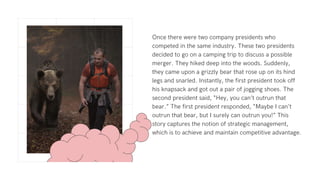
Once there were two company presidents who
competed in the same industry. These two presidents
decided to go on a camping trip to discuss a possible
merger. They hiked deep into the woods. Suddenly,
they came upon a grizzly bear that rose up on its hind
legs and snarled. Instantly, the first president took off
his knapsack and got out a pair of jogging shoes. The
second president said, “Hey, you can’t outrun that
bear.” The first president responded, “Maybe I can’t
outrun that bear, but I surely can outrun you!” This
story captures the notion of strategic management,
which is to achieve and maintain competitive advantage.
What is Strategic
Management ?
Management can be defined as the art and science of formulating,
implementing, and evaluating cross-functional decisions that enable
an organization to achieve its objectives.
This definition implies the implies, strategic management focuses on
integrating management, marketing, finance/accounting,
production/operations, research and development, and information
systems to achieve organizational success.
Is used to refer to strategy formulation,
implementation, and evaluation
Ø Its purpose is to exploit and create new and
different opportunities for tomorrow; long-
range planning, in contrast, tries to optimize
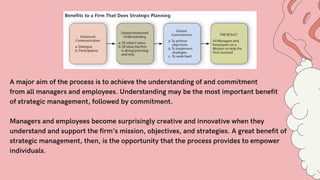
for tomorrow the trends of today.
Ø It is used at many colleges and universities
as the subtitle for the capstone course in
business administration.
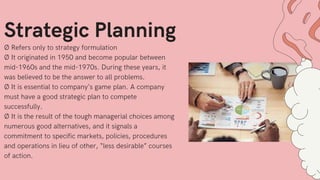
Strategic Planning
Ø Refers only to strategy formulation
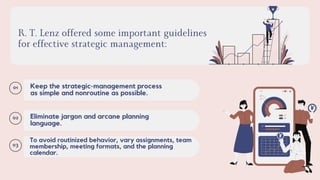
Ø It originated in 1950 and become popular between
mid-1960s and the mid-1970s. During these years, it
was believed to be the answer to all problems.
Ø It is essential to company’s game plan. A company
must have a good strategic plan to compete
successfully.
Ø It is the result of the tough managerial choices among
numerous good alternatives, and it signals a
commitment to specific markets, policies, procedures
and operations in lieu of other, “less desirable” courses
of action.
Stages of Strategic
Management
Strategy formulation
1. 2.Strategy Implementation
3. Strategy Evaluation
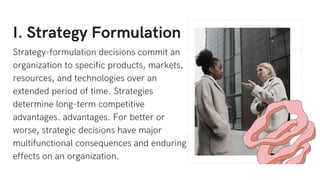
I. Strategy Formulation
Strategy-formulation decisions commit an
organization to specific products, markets,
resources, and technologies over an
extended period of time. Strategies
determine long-term competitive
advantages. advantages. For better or
worse, strategic decisions have major
multifunctional consequences and enduring
effects on an organization.
Strategy
formulation
Objectives
a.Develops mission and vision
b.Identifies the organizations’ external
opportunities and threats
c.Determines strengths and weaknesses
d.Establish long-term objectives
e.Generated alternative strategies
f.Choose particular strategies to pursue.
Strategy-formulation Issues
üdeciding what new businesses to enter
üwhat businesses to abandon, how to allocate
resources
üwhether to expand operations or diversify
ü whether to enter international markets
ü whether to merge or form a joint venture
ühow to avoid a hostile takeover.
II.Strategy Implementation
Often is called the “action stage” of strategic
management.
Implementing strategy means mobilizing employees and
managers to put formulated strategies into action.
Often considered to be the most difficult stage in
strategic management, strategy implementation
requires personal discipline, commitment, and
sacrifice. Successful strategy implementation hinges
upon managers’ ability to motivate employees, which is
more an art than a science. Strategies formulated but
not implemented serve no useful purpose.
Strategy Implementation includes:
üDeveloping a strategy-supportive culture
üCreating an effective organizational structure
üRedirecting marketing efforts
üPreparing budgets
üDevelops and utilizes information systems
üLinks employee compensation to
organizational performance
Strategy Implementation requires the firm:
a.Establish annual obejectives
b.Devise policies
c.Motivate employees
d.Allocate resources
Strategy implementation affects the:
ü Employees
ü Managers in an organization
Must answer the question of:
ü “What must we do to implement our
part of the organization’s strategy?”
ü “How best can we get the job done?”
III.
It is the final stage in strategic management. Managers desperately need to know when particular
strategies are not working well; strategy evaluation is the primary means for obtaining this
information. All strategies are subject to future modification because external and internal factors
are constantly changing.
3 Fundamental Strategy-Evaluation activities
1.Reviewing external and internal factors that are the bases for current strategies
2.Measuring performance
3.Taking corrective actions
Strategy evaluation is needed because success today is no guarantee of success tomorrow!
Success always creates new and different problems; complacent organizations experience
demise.
Strategy formulation, implementation, and evaluation
activities occur at three hierarchical levels in a large
organization:
1.Corporate
2.Divisional or strategic business unit
3.Functional
By fostering communication and interaction among
managers and employees across hierarchical levels,
strategic management helps a firm function as a
competitive team.
Peter Drucker says the prime task of strategic management is
thinking through the . . . that is, of asking the question, “What is
our business?” This leads to the setting of overall mission of a
business: objectives, the development of strategies, and the
making of today’s decisions for tomorrow’s results. This clearly
must be done by a part of the organization that can see the entire
business; that can balance objectives and the needs of today
against the needs of tomorrow; and that can allocate resources of
men and money to key results.
Nine Key Terms
in Strategic
Management
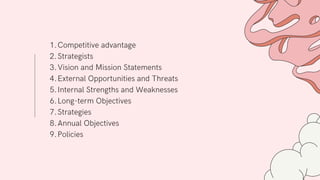
Competitive advantage
Strategists
Vision and Mission Statements
External Opportunities and Threats
Internal Strengths and Weaknesses
Long-term Objectives
Strategies
Annual Objectives
Policies
1.
2.
3.
4.
5.
6.
7.
8.
9.
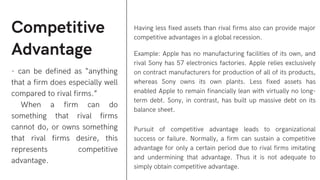
Competitive
Advantage
- can be defined as “anything
that a firm does especially well
compared to rival firms.”
When a firm can do
something that rival firms
cannot do, or owns something
that rival firms desire, this
represents competitive
advantage.
Having less fixed assets than rival firms also can provide major
competitive advantages in a global recession.
Example: Apple has no manufacturing facilities of its own, and
rival Sony has 57 electronics factories. Apple relies exclusively
on contract manufacturers for production of all of its products,
whereas Sony owns its own plants. Less fixed assets has
enabled Apple to remain financially lean with virtually no long-
term debt. Sony, in contrast, has built up massive debt on its
balance sheet.
Pursuit of competitive advantage leads to organizational
success or failure. Normally, a firm can sustain a competitive
advantage for only a certain period due to rival firms imitating
and undermining that advantage. Thus it is not adequate to
simply obtain competitive advantage.
Firms must strive to achieve sustained competitive advantage by:
1. Continually adapting to changes in external trends and events and internal
capabilities, competencies, and resources;
2. Effectively formulating, implementing, and evaluating strategies that capitalize upon
those factors.
Example: Newspaper circulation in the United States is steadily declining. Most national
newspapers are rapidly losing market share to the Internet, and other media that
consumers use to stay informed. Daily newspaper circulation in the United States totals
about 55 million copies annually, which is about the same as it was in 1954. Strategists
ponder whether the newspaper circulation slide can be halted in the digital age. The six
broadcast networks—ABC, CBS, Fox, NBC, UPN, and WB—are being assaulted by cable
channels, video games, broadband, wireless technologies, satellite radio, high-definition
TV, and digital video recorders. The three original broadcast networks captured about
90 percent of the prime-time audience in 1978, but today their combined market share
is less than 50 percent.
Strategists
- are the the individuals who are most
responsible for the success or failure
of an organization.
- it also helps the organization gather,
analyze, and organize information.
They track industry and competitive
trends, develop forecasting models
and scenario analyses, evaluate
corporate and divisional performance,
spot emerging market opportunities,
identify business threats, and develop
creative action plans.
Strategists have various job titles such as:
According to Professor Jay Conger, “All strategists have to be
chief learning officers. We are in an extended period of
change. If our leaders aren’t highly adaptive and great models
during this period, then our companies won’t adapt either,
because ultimately leadership is about being a role model.”
Strategists differ as much as organizations themselves, and
these differences must be considered in the formulation,
implementation, and evaluation of strategies. Strategists differ
in their attitudes, values, ethics, willingness to take risks,
concern for social responsibility, concern for profitability,
concern for short-run versus long-run aims, and management
style.
A. Chief executive officer
B. President
C. Owner
D. Chair of the Board
E. Executive Director
F. Chancellor
G. Dean
H. Entrepreneur
Vision Statements
- is considered as the first
step in strategic planning.
Organization today develops
a vision statement that
answers the question,
“What do we want to
become?”
Vision and Mission Statements
Mission Statements
- are “enduring statements of
purpose that distinguish one business
from other similar firms. It identifies
the scope of a firm’s operations in
product and market terms.”
The basic question for Mission is,
“What is our business?”
A mission statement broadly charts
the future direction of an
organization.
Refer to economic, social, cultural, demographic, environmental, political, legal, governmental,
technological, and competitive trends and events that could significantly benefit or harm an organization in
the future.
External Opportunities and Threats
• Availability of capital can no longer be taken for
granted.
• Consumers expect green operations and products.
• Marketing has moving rapidly to the Internet.
• Consumers must see value in all that they consume.
• Global markets offer the highest growth in revenues.
• As the price of oil has collapsed, oil rich countries are
focused on supporting their
own economies, rather than seeking out investments in
other countries.
• Too much debt can crush even the best firms.
• Layoffs are rampant among many firms as revenues
and profits fall and credit
sources dry up.
• The housing market is depressed.
• Demand for health services does not change much in a
recession. For example,
Almost Family Inc., a Louisville, Kentucky, provider of
home nursing care, more
than doubled its stock price in 2008 to $45.
• Dramatic slowdowns in consumer spending are
apparent in virtually all sectors,
except some discount retailers and restaurants.
Emerging countries' economies could manage to grow
5 percent in 2009, but that is three full percentage
points lower than in 2007.
• U.S. unemployment rates continue to rise to 10 percent
on average.
• Borrowers are faced with much bigger collateral
requirements than in years past.
• Equity lines of credit often now are not being extended.
• Firms that have cash or access to credit have a
competitive advantage over debt-laden firms.
• Discretionary spending has fallen dramatically;
consumers buy only essential items;
this has crippled many luxury and recreational businesses
such as boating and cycling.
• The stock market crash of 2008 left senior citizens with
retirement worries, so millions
of people cut back on spending to the bare essentials.
• The double whammy of falling demand and intense price
competition is plaguing
most firms, especially those with high fixed costs.
• The business world has moved from a credit-based
economy to a cash-based economy.
• There is reduced capital spending in response to reduced
consumer spending.
The types of changes mentioned are creating a different type of
consumer and consequently a need for different types of
products, services, and strategies.
Identifying, monitoring, and evaluating external opportunities
and threats are essential for success.
The process of conducting research and gathering and
assimilating external information is sometimes called
environmental scanning or industry analysis.
Internal Strengths
and Weaknesses
Are an organization’s controllable
activities that are performed especially
well or poorly. They arise in the
management, marketing,
finance/accounting,
production/operations,
research and development, and
management information systems
activities of a business.
Identifying and evaluating
organizational strengths and
weaknesses in the functional areas of
a business is an essential strategic
management activity.
Strengths and weaknesses are determined relative to
competitors. Relative deficiency or superiority is important
information. Also, strengths and weaknesses can be
determined by elements of being rather than performance.
Example:
A strength may involve ownership of natural resources or a
historic reputation for quality. Strengths and weaknesses may
be determined relative to a firm’s own objectives.
Internal factors can be determined in a number of ways,
including computing ratios,
measuring performance, and comparing to past periods and
industry averages.
Objectives can be defined as specific results that an
organization seeks to achieve in pursuing its basic mission.
Long-term means more than one year.
Long-term Objectives
ü Aid in evaluation
ü Create Synergy
ü Reveal Priorities
ü Focus Coordination
ü Provide basis for effective planning,
organizing, motivating, and controlling
activities
Objectives state direction:
Strategies
Are the means by which long-term
objectives will be achieved.
Business Strategies may include:
Strategies are potential actions that require top management
decisions and largeamounts of the firm’s resources. Strategies
affect an organization’s long-term prosperity typically for at
least five years, and thus are future-oriented. Strategies have
multifunctional or multi-divisional consequences and require
consideration of both the external and internal factors facing
the firm.
Geographic expansion
Diversification
Acquisition
Product Development
Market Penetration
iRetrenchment
Divestiture
iLiquidation
Joint Ventures
Like long-term objectives, annual objectives should be measurable,
quantitative, challenging, realistic, consistent, and prioritized.
Annual objectives should be stated in terms of management, marketing,
finance/accounting, production/operations, research and development,
and management information systems (MIS) accomplishments.
Annual objectives are especially important in strategy implementation,
whereas long-term objectives are particularly important in strategy
formulation. Annual objectives represent the basis for allocating resources.
Annual Objectives
Are the means by which annual objectives will be achieved. Policies include
guidelines, rules, and procedures established to support efforts to achieve
stated objectives. Policies are guides to decision making and address
repetitive or recurring situations. It is important for they outline an
organization’s expectations of its employees and managers.
Policies are most often stated in terms of management, marketing,
finance/accounting, production/operations, research and development,
and computer information systems activities. Policies allow consistency and
coordination within and between organizational departments.
Policies
Benefits of
Strategic
Management
Strategic management
-Allows an organization to be more proactive than
reactive in shaping
its own future;
- it allows an organization to initiate and influence
(rather than just respond
to) activities
- exert control over its own destiny
Communication is a key to successful
strategic management. Through
involvement in the process, in other words,
through dialogue and participation,
managers and employees become
committed to supporting the organization.
A major aim of the process is to achieve the understanding of and commitment
from all managers and employees. Understanding may be the most important benefit
of strategic management, followed by commitment.
Managers and employees become surprisingly creative and innovative when they
understand and support the firm’s mission, objectives, and strategies. A great benefit of
strategic management, then, is the opportunity that the process provides to empower
individuals.
Empowerment is the act of strengthening employees’ sense of
effectiveness by encouraging them to participate in decision making and
to exercise initiative and imagination, and rewarding them for doing so.
Although making good strategic decisions is the major responsibility of
an organization’s owner or chief executive officer, both managers and
employees must also be involved in strategy formulation,
implementation, and evaluation activities. Participation is a key to
gaining commitment for needed changes.
An increasing number of corporations and institutions are using
strategic management to make effective decisions. But strategic
management is not a guarantee for success; it can be dysfunctional if
conducted haphazardly.
GUIDELINES FOR
EFFECTIVE
STRATEGIC
MANAGEMENT
JHUNE CLYDE F. PEPITO
Failing to follow certain
guidelines in conducting
strategic management can
foster criticisms of the
process and create problems
for the organization.
Even the most technically perfect
strategic plan will serve little
purpose if it is not implemented.
plan. A technically imperfect plan
that is implemented well will
achieve more than the perfect plan
that never gets off the paper on
which it is typed.
Strategic management must not become ritualistic, stilted,
orchestrated, or too formal, predictable, and rigid. Words supported
by numbers, rather than numbers supported by words, should
represent the medium for explaining strategic issues and
organizational responses.
A key role of strategists is to facilitate continuous
organizational learning and change.
R. T. Lenz offered some important guidelines
for effective strategic management:
01 Keep the strategic-management process
as simple and nonroutine as possible.
02 Eliminate jargon and arcane planning
language.
03
To avoid routinized behavior, vary assignments, team
membership, meeting formats, and the planning
calendar.
R. T. Lenz offered some important guidelines
for effective strategic management:
04
Welcome bad news
05 Do not permit “technicians” to co-opt the
process.
06 To the extent possible, involve managers from all
areas of the firm.
An important guideline for effective strategic management is
open-mindedness. A willingness and eagerness to consider
new information, new viewpoints, new ideas, and new
possibilities is essential; all organizational members must share
a spirit of inquiry and learning.
No organization has unlimited resources. No firm can take on
an unlimited amount of debt or issue an unlimited amount
of stock to raise capital. Therefore, no organization can
pursue all the strategies that potentially could benefit the firm.
Joseph Charyk, CEO of the Communication Satellite
Corporation
(Comsat), said,
“We have to face the cold fact that
Comsat may not be able to do all it
wants. We must make hard choices
on which ventures to keep and
which to fold.”
Subjective factors such as
attitudes toward risk, concern for
social responsibility, and
organizational culture will always
affect strategy-formulation
decisions, but organizations need
to be as objective as
possible in considering
qualitative factors.
Seventeen Guidelines for the Strategic-Planning Process
to Be Effective:
1. It should be a people process more than a paper
process.
2. It should be a learning process for all managers and
employees.
3. It should be words supported by numbers rather than
numbers supported by words.
4. It should be simple and nonroutine.
5. It should vary assignments, team memberships, meeting
formats, and even the planning calendar.
Seventeen Guidelines for the Strategic-Planning Process
to Be Effective:
6. It should challenge the assumptions underlying the
current corporate strategy.
7. It should welcome bad news.
8. It should welcome open-mindness and a spirit of inquiry
and learning.
9. It should not be a bureaucratic mechanism.
10. It should not become ritualistic, stilted, or orchestrated.
11. It should not be too formal, predictable, or rigid.
Seventeen Guidelines for the Strategic-Planning Process
to Be Effective:
12. It should not contain jargon or arcane planning
language.
13. It should not be a formal system for control.
14. It should not disregard qualitative information.
15. It should not be controlled by “technicians.”
16. Do not pursue too many strategies at once.
17. Continually strengthen the “good ethics is good
business” policy.
COMPARING
BUSINESS AND
MILITARY
STRATEGY
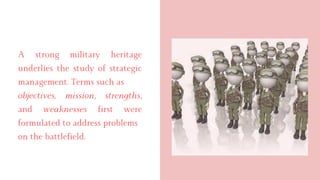
A strong military heritage
underlies the study of strategic
management. Terms such as
objectives, mission, strengths,
and weaknesses first were
formulated to address problems
on the battlefield.
STRATEGY is “the science of
planning and directing large-
scale military operations, of
maneuvering forces into the
most advantageous position
prior to actual engagement with
the enemy."
Definition from Webster’s
New World Dictionary,
Strategos - (greek word) which
refers to a military general and
combines
STRATEGY
Stratos - (greek word) the army
ago - (greek word) to lead
A key aim of both business and military
strategy is
“to gain competitive advantage.”
Business strategy is like military strategy, and
military strategists have earned much over
the centuries that can benefit business
strategists today.
Business or military success is
generally not the happy result of
accidental strategies. Rather,
success is the product of both
continuous attention to
changing external and internal
conditions and the formulation
and implementation of
insightful adaptations to those
conditions.
The element of surprise
provides great competitive
advantages in both military and
business strategy; information
systems that provide data on
opponents’ or competitors’
strategies and resources are
also vitally important.
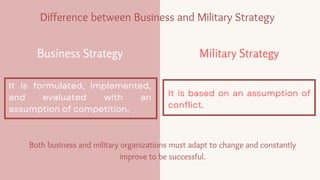
It is formulated, implemented,
and evaluated with an
assumption of competition,
It is based on an assumption of
conflict.
Difference between Business and Military Strategy
Business Strategy Military Strategy
Both business and military organizations must adapt to change and constantly
improve to be successful.
Thank you for
joining me today.

Introduction To Strategic Management.pdf

  • 1.
  • 2.
    Once there weretwo company presidents who competed in the same industry. These two presidents decided to go on a camping trip to discuss a possible merger. They hiked deep into the woods. Suddenly, they came upon a grizzly bear that rose up on its hind legs and snarled. Instantly, the first president took off his knapsack and got out a pair of jogging shoes. The second president said, “Hey, you can’t outrun that bear.” The first president responded, “Maybe I can’t outrun that bear, but I surely can outrun you!” This story captures the notion of strategic management, which is to achieve and maintain competitive advantage.
  • 3.
  • 4.
    Management can bedefined as the art and science of formulating, implementing, and evaluating cross-functional decisions that enable an organization to achieve its objectives. This definition implies the implies, strategic management focuses on integrating management, marketing, finance/accounting, production/operations, research and development, and information systems to achieve organizational success.
  • 5.
    Is used torefer to strategy formulation, implementation, and evaluation Ø Its purpose is to exploit and create new and different opportunities for tomorrow; long- range planning, in contrast, tries to optimize for tomorrow the trends of today. Ø It is used at many colleges and universities as the subtitle for the capstone course in business administration.
  • 6.
    Strategic Planning Ø Refersonly to strategy formulation Ø It originated in 1950 and become popular between mid-1960s and the mid-1970s. During these years, it was believed to be the answer to all problems. Ø It is essential to company’s game plan. A company must have a good strategic plan to compete successfully. Ø It is the result of the tough managerial choices among numerous good alternatives, and it signals a commitment to specific markets, policies, procedures and operations in lieu of other, “less desirable” courses of action.
  • 7.
    Stages of Strategic Management Strategyformulation 1. 2.Strategy Implementation 3. Strategy Evaluation
  • 8.
    I. Strategy Formulation Strategy-formulationdecisions commit an organization to specific products, markets, resources, and technologies over an extended period of time. Strategies determine long-term competitive advantages. advantages. For better or worse, strategic decisions have major multifunctional consequences and enduring effects on an organization.
  • 9.
    Strategy formulation Objectives a.Develops mission andvision b.Identifies the organizations’ external opportunities and threats c.Determines strengths and weaknesses d.Establish long-term objectives e.Generated alternative strategies f.Choose particular strategies to pursue. Strategy-formulation Issues üdeciding what new businesses to enter üwhat businesses to abandon, how to allocate resources üwhether to expand operations or diversify ü whether to enter international markets ü whether to merge or form a joint venture ühow to avoid a hostile takeover.
  • 10.
    II.Strategy Implementation Often iscalled the “action stage” of strategic management. Implementing strategy means mobilizing employees and managers to put formulated strategies into action. Often considered to be the most difficult stage in strategic management, strategy implementation requires personal discipline, commitment, and sacrifice. Successful strategy implementation hinges upon managers’ ability to motivate employees, which is more an art than a science. Strategies formulated but not implemented serve no useful purpose.
  • 11.
    Strategy Implementation includes: üDevelopinga strategy-supportive culture üCreating an effective organizational structure üRedirecting marketing efforts üPreparing budgets üDevelops and utilizes information systems üLinks employee compensation to organizational performance Strategy Implementation requires the firm: a.Establish annual obejectives b.Devise policies c.Motivate employees d.Allocate resources Strategy implementation affects the: ü Employees ü Managers in an organization Must answer the question of: ü “What must we do to implement our part of the organization’s strategy?” ü “How best can we get the job done?”
  • 12.
    III. It is thefinal stage in strategic management. Managers desperately need to know when particular strategies are not working well; strategy evaluation is the primary means for obtaining this information. All strategies are subject to future modification because external and internal factors are constantly changing. 3 Fundamental Strategy-Evaluation activities 1.Reviewing external and internal factors that are the bases for current strategies 2.Measuring performance 3.Taking corrective actions Strategy evaluation is needed because success today is no guarantee of success tomorrow! Success always creates new and different problems; complacent organizations experience demise.
  • 13.
    Strategy formulation, implementation,and evaluation activities occur at three hierarchical levels in a large organization: 1.Corporate 2.Divisional or strategic business unit 3.Functional By fostering communication and interaction among managers and employees across hierarchical levels, strategic management helps a firm function as a competitive team.
  • 14.
    Peter Drucker saysthe prime task of strategic management is thinking through the . . . that is, of asking the question, “What is our business?” This leads to the setting of overall mission of a business: objectives, the development of strategies, and the making of today’s decisions for tomorrow’s results. This clearly must be done by a part of the organization that can see the entire business; that can balance objectives and the needs of today against the needs of tomorrow; and that can allocate resources of men and money to key results.
  • 15.
    Nine Key Terms inStrategic Management
  • 16.
    Competitive advantage Strategists Vision andMission Statements External Opportunities and Threats Internal Strengths and Weaknesses Long-term Objectives Strategies Annual Objectives Policies 1. 2. 3. 4. 5. 6. 7. 8. 9.
  • 17.
    Competitive Advantage - can bedefined as “anything that a firm does especially well compared to rival firms.” When a firm can do something that rival firms cannot do, or owns something that rival firms desire, this represents competitive advantage. Having less fixed assets than rival firms also can provide major competitive advantages in a global recession. Example: Apple has no manufacturing facilities of its own, and rival Sony has 57 electronics factories. Apple relies exclusively on contract manufacturers for production of all of its products, whereas Sony owns its own plants. Less fixed assets has enabled Apple to remain financially lean with virtually no long- term debt. Sony, in contrast, has built up massive debt on its balance sheet. Pursuit of competitive advantage leads to organizational success or failure. Normally, a firm can sustain a competitive advantage for only a certain period due to rival firms imitating and undermining that advantage. Thus it is not adequate to simply obtain competitive advantage.
  • 18.
    Firms must striveto achieve sustained competitive advantage by: 1. Continually adapting to changes in external trends and events and internal capabilities, competencies, and resources; 2. Effectively formulating, implementing, and evaluating strategies that capitalize upon those factors. Example: Newspaper circulation in the United States is steadily declining. Most national newspapers are rapidly losing market share to the Internet, and other media that consumers use to stay informed. Daily newspaper circulation in the United States totals about 55 million copies annually, which is about the same as it was in 1954. Strategists ponder whether the newspaper circulation slide can be halted in the digital age. The six broadcast networks—ABC, CBS, Fox, NBC, UPN, and WB—are being assaulted by cable channels, video games, broadband, wireless technologies, satellite radio, high-definition TV, and digital video recorders. The three original broadcast networks captured about 90 percent of the prime-time audience in 1978, but today their combined market share is less than 50 percent.
  • 19.
    Strategists - are thethe individuals who are most responsible for the success or failure of an organization. - it also helps the organization gather, analyze, and organize information. They track industry and competitive trends, develop forecasting models and scenario analyses, evaluate corporate and divisional performance, spot emerging market opportunities, identify business threats, and develop creative action plans. Strategists have various job titles such as: According to Professor Jay Conger, “All strategists have to be chief learning officers. We are in an extended period of change. If our leaders aren’t highly adaptive and great models during this period, then our companies won’t adapt either, because ultimately leadership is about being a role model.” Strategists differ as much as organizations themselves, and these differences must be considered in the formulation, implementation, and evaluation of strategies. Strategists differ in their attitudes, values, ethics, willingness to take risks, concern for social responsibility, concern for profitability, concern for short-run versus long-run aims, and management style. A. Chief executive officer B. President C. Owner D. Chair of the Board E. Executive Director F. Chancellor G. Dean H. Entrepreneur
  • 20.
    Vision Statements - isconsidered as the first step in strategic planning. Organization today develops a vision statement that answers the question, “What do we want to become?” Vision and Mission Statements Mission Statements - are “enduring statements of purpose that distinguish one business from other similar firms. It identifies the scope of a firm’s operations in product and market terms.” The basic question for Mission is, “What is our business?” A mission statement broadly charts the future direction of an organization.
  • 21.
    Refer to economic,social, cultural, demographic, environmental, political, legal, governmental, technological, and competitive trends and events that could significantly benefit or harm an organization in the future. External Opportunities and Threats • Availability of capital can no longer be taken for granted. • Consumers expect green operations and products. • Marketing has moving rapidly to the Internet. • Consumers must see value in all that they consume. • Global markets offer the highest growth in revenues. • As the price of oil has collapsed, oil rich countries are focused on supporting their own economies, rather than seeking out investments in other countries. • Too much debt can crush even the best firms. • Layoffs are rampant among many firms as revenues and profits fall and credit sources dry up. • The housing market is depressed. • Demand for health services does not change much in a recession. For example, Almost Family Inc., a Louisville, Kentucky, provider of home nursing care, more than doubled its stock price in 2008 to $45. • Dramatic slowdowns in consumer spending are apparent in virtually all sectors, except some discount retailers and restaurants. Emerging countries' economies could manage to grow 5 percent in 2009, but that is three full percentage points lower than in 2007. • U.S. unemployment rates continue to rise to 10 percent on average. • Borrowers are faced with much bigger collateral requirements than in years past. • Equity lines of credit often now are not being extended. • Firms that have cash or access to credit have a competitive advantage over debt-laden firms. • Discretionary spending has fallen dramatically; consumers buy only essential items; this has crippled many luxury and recreational businesses such as boating and cycling. • The stock market crash of 2008 left senior citizens with retirement worries, so millions of people cut back on spending to the bare essentials. • The double whammy of falling demand and intense price competition is plaguing most firms, especially those with high fixed costs. • The business world has moved from a credit-based economy to a cash-based economy. • There is reduced capital spending in response to reduced consumer spending.
  • 22.
    The types ofchanges mentioned are creating a different type of consumer and consequently a need for different types of products, services, and strategies. Identifying, monitoring, and evaluating external opportunities and threats are essential for success. The process of conducting research and gathering and assimilating external information is sometimes called environmental scanning or industry analysis.
  • 23.
    Internal Strengths and Weaknesses Arean organization’s controllable activities that are performed especially well or poorly. They arise in the management, marketing, finance/accounting, production/operations, research and development, and management information systems activities of a business. Identifying and evaluating organizational strengths and weaknesses in the functional areas of a business is an essential strategic management activity. Strengths and weaknesses are determined relative to competitors. Relative deficiency or superiority is important information. Also, strengths and weaknesses can be determined by elements of being rather than performance. Example: A strength may involve ownership of natural resources or a historic reputation for quality. Strengths and weaknesses may be determined relative to a firm’s own objectives. Internal factors can be determined in a number of ways, including computing ratios, measuring performance, and comparing to past periods and industry averages.
  • 24.
    Objectives can bedefined as specific results that an organization seeks to achieve in pursuing its basic mission. Long-term means more than one year. Long-term Objectives ü Aid in evaluation ü Create Synergy ü Reveal Priorities ü Focus Coordination ü Provide basis for effective planning, organizing, motivating, and controlling activities Objectives state direction:
  • 25.
    Strategies Are the meansby which long-term objectives will be achieved. Business Strategies may include: Strategies are potential actions that require top management decisions and largeamounts of the firm’s resources. Strategies affect an organization’s long-term prosperity typically for at least five years, and thus are future-oriented. Strategies have multifunctional or multi-divisional consequences and require consideration of both the external and internal factors facing the firm. Geographic expansion Diversification Acquisition Product Development Market Penetration iRetrenchment Divestiture iLiquidation Joint Ventures
  • 26.
    Like long-term objectives,annual objectives should be measurable, quantitative, challenging, realistic, consistent, and prioritized. Annual objectives should be stated in terms of management, marketing, finance/accounting, production/operations, research and development, and management information systems (MIS) accomplishments. Annual objectives are especially important in strategy implementation, whereas long-term objectives are particularly important in strategy formulation. Annual objectives represent the basis for allocating resources. Annual Objectives
  • 27.
    Are the meansby which annual objectives will be achieved. Policies include guidelines, rules, and procedures established to support efforts to achieve stated objectives. Policies are guides to decision making and address repetitive or recurring situations. It is important for they outline an organization’s expectations of its employees and managers. Policies are most often stated in terms of management, marketing, finance/accounting, production/operations, research and development, and computer information systems activities. Policies allow consistency and coordination within and between organizational departments. Policies
  • 28.
    Benefits of Strategic Management Strategic management -Allowsan organization to be more proactive than reactive in shaping its own future; - it allows an organization to initiate and influence (rather than just respond to) activities - exert control over its own destiny Communication is a key to successful strategic management. Through involvement in the process, in other words, through dialogue and participation, managers and employees become committed to supporting the organization.
  • 29.
    A major aimof the process is to achieve the understanding of and commitment from all managers and employees. Understanding may be the most important benefit of strategic management, followed by commitment. Managers and employees become surprisingly creative and innovative when they understand and support the firm’s mission, objectives, and strategies. A great benefit of strategic management, then, is the opportunity that the process provides to empower individuals.
  • 30.
    Empowerment is theact of strengthening employees’ sense of effectiveness by encouraging them to participate in decision making and to exercise initiative and imagination, and rewarding them for doing so. Although making good strategic decisions is the major responsibility of an organization’s owner or chief executive officer, both managers and employees must also be involved in strategy formulation, implementation, and evaluation activities. Participation is a key to gaining commitment for needed changes. An increasing number of corporations and institutions are using strategic management to make effective decisions. But strategic management is not a guarantee for success; it can be dysfunctional if conducted haphazardly.
  • 31.
  • 32.
    Failing to followcertain guidelines in conducting strategic management can foster criticisms of the process and create problems for the organization. Even the most technically perfect strategic plan will serve little purpose if it is not implemented. plan. A technically imperfect plan that is implemented well will achieve more than the perfect plan that never gets off the paper on which it is typed.
  • 33.
    Strategic management mustnot become ritualistic, stilted, orchestrated, or too formal, predictable, and rigid. Words supported by numbers, rather than numbers supported by words, should represent the medium for explaining strategic issues and organizational responses.
  • 34.
    A key roleof strategists is to facilitate continuous organizational learning and change.
  • 35.
    R. T. Lenzoffered some important guidelines for effective strategic management: 01 Keep the strategic-management process as simple and nonroutine as possible. 02 Eliminate jargon and arcane planning language. 03 To avoid routinized behavior, vary assignments, team membership, meeting formats, and the planning calendar.
  • 36.
    R. T. Lenzoffered some important guidelines for effective strategic management: 04 Welcome bad news 05 Do not permit “technicians” to co-opt the process. 06 To the extent possible, involve managers from all areas of the firm.
  • 37.
    An important guidelinefor effective strategic management is open-mindedness. A willingness and eagerness to consider new information, new viewpoints, new ideas, and new possibilities is essential; all organizational members must share a spirit of inquiry and learning.
  • 38.
    No organization hasunlimited resources. No firm can take on an unlimited amount of debt or issue an unlimited amount of stock to raise capital. Therefore, no organization can pursue all the strategies that potentially could benefit the firm.
  • 39.
    Joseph Charyk, CEOof the Communication Satellite Corporation (Comsat), said, “We have to face the cold fact that Comsat may not be able to do all it wants. We must make hard choices on which ventures to keep and which to fold.”
  • 40.
    Subjective factors suchas attitudes toward risk, concern for social responsibility, and organizational culture will always affect strategy-formulation decisions, but organizations need to be as objective as possible in considering qualitative factors.
  • 41.
    Seventeen Guidelines forthe Strategic-Planning Process to Be Effective: 1. It should be a people process more than a paper process. 2. It should be a learning process for all managers and employees. 3. It should be words supported by numbers rather than numbers supported by words. 4. It should be simple and nonroutine. 5. It should vary assignments, team memberships, meeting formats, and even the planning calendar.
  • 42.
    Seventeen Guidelines forthe Strategic-Planning Process to Be Effective: 6. It should challenge the assumptions underlying the current corporate strategy. 7. It should welcome bad news. 8. It should welcome open-mindness and a spirit of inquiry and learning. 9. It should not be a bureaucratic mechanism. 10. It should not become ritualistic, stilted, or orchestrated. 11. It should not be too formal, predictable, or rigid.
  • 43.
    Seventeen Guidelines forthe Strategic-Planning Process to Be Effective: 12. It should not contain jargon or arcane planning language. 13. It should not be a formal system for control. 14. It should not disregard qualitative information. 15. It should not be controlled by “technicians.” 16. Do not pursue too many strategies at once. 17. Continually strengthen the “good ethics is good business” policy.
  • 44.
  • 45.
    A strong militaryheritage underlies the study of strategic management. Terms such as objectives, mission, strengths, and weaknesses first were formulated to address problems on the battlefield.
  • 46.
    STRATEGY is “thescience of planning and directing large- scale military operations, of maneuvering forces into the most advantageous position prior to actual engagement with the enemy." Definition from Webster’s New World Dictionary,
  • 47.
    Strategos - (greekword) which refers to a military general and combines STRATEGY Stratos - (greek word) the army ago - (greek word) to lead
  • 48.
    A key aimof both business and military strategy is “to gain competitive advantage.” Business strategy is like military strategy, and military strategists have earned much over the centuries that can benefit business strategists today.
  • 49.
    Business or militarysuccess is generally not the happy result of accidental strategies. Rather, success is the product of both continuous attention to changing external and internal conditions and the formulation and implementation of insightful adaptations to those conditions.
  • 50.
    The element ofsurprise provides great competitive advantages in both military and business strategy; information systems that provide data on opponents’ or competitors’ strategies and resources are also vitally important.
  • 51.
    It is formulated,implemented, and evaluated with an assumption of competition, It is based on an assumption of conflict. Difference between Business and Military Strategy Business Strategy Military Strategy Both business and military organizations must adapt to change and constantly improve to be successful.
  • 52.