Participative Leadership
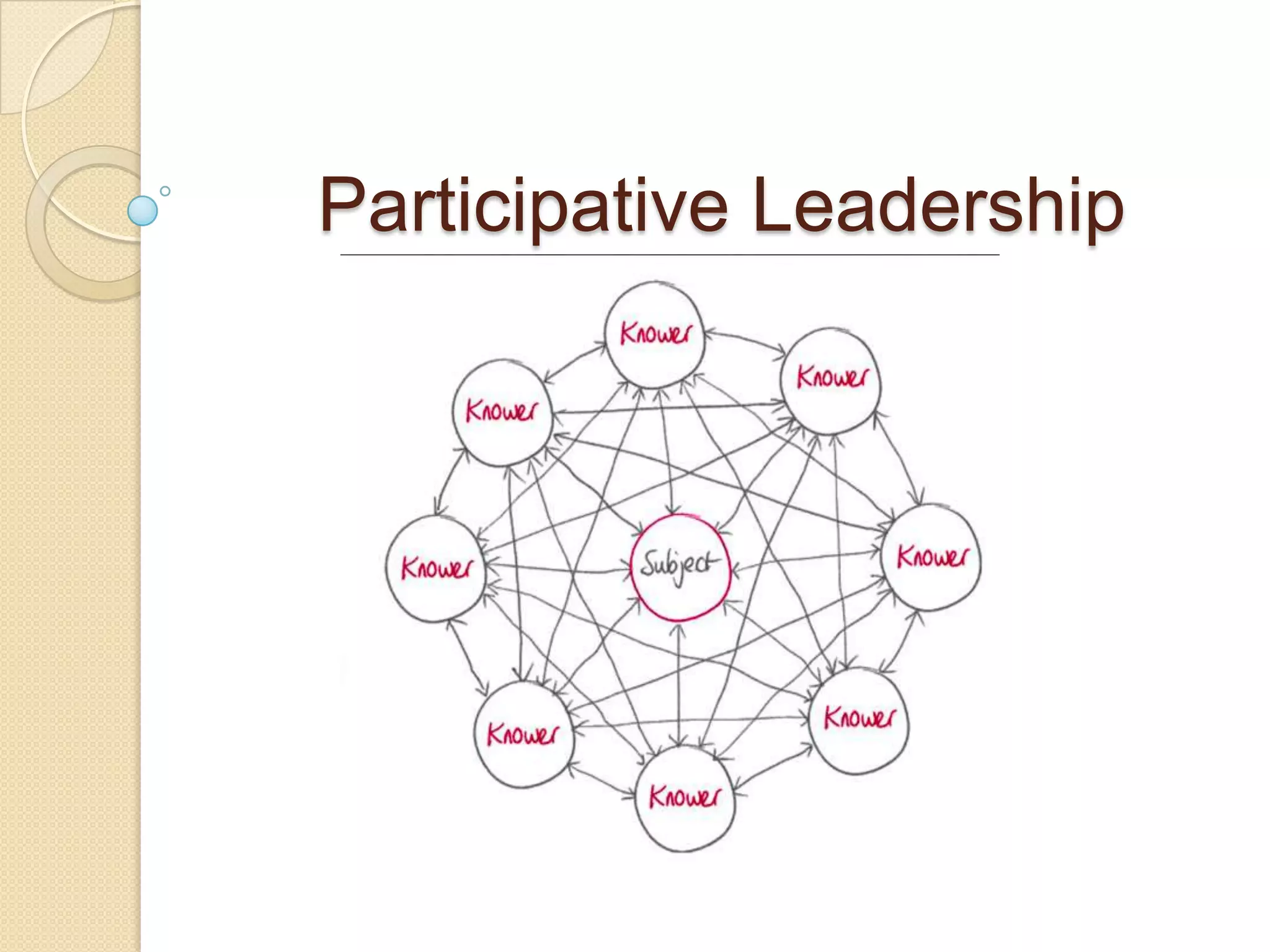
What is Participative
Leadership?
 Also known as Democratic Leaders
 Allows group members to contribute
ideas and participate in decision
making
 Listens and allow inputs from
members
 Enables group members to think
creatively, feel engaged, and
motivated
 Generally the most effective
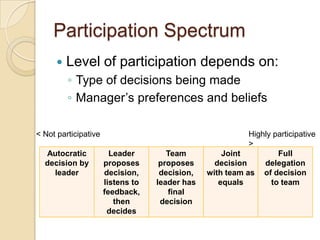
Participation Spectrum
 Level of participation depends on:
◦ Type of decisions being made
◦ Manager’s preferences and beliefs
Autocratic
decision by
leader
Leader
proposes
decision,
listens to
feedback,
then
decides
Team
proposes
decision,
leader has
final
decision
Joint
decision
with team as
equals
Full
delegation
of decision
to team
< Not participative Highly participative
>
Possible Advantages
 Decision makers understand the
issues better when they are more
involved
 Being involved in decision-making
makes people more committed to the
task
 As working on mutual goals, people
tend to be less competitive and more
collaborative
 More people have more ideas to
Disadvantage of Participative
Leadership
 Requires that team members are
“literate, informed and organized”
 People are motivated differently and
some might not be interested in
making decisions
 Can be time-consuming because of a
variety of view-points
 Might creative frustration in some
members who ideas are not approved
for actions
Sources
http://www.meeting-facilitation.co.uk/promeet/participatory-
leadership/definition.html
http://changingminds.org/disciplines/leadership/styles/participati
ve_leadership.htm
http://psychology.about.com/od/leadership/a/leadstyles.htm
http://www.preservearticles.com/2012051932586/7-
disadvantages-of-participative-or-democratic-leadership.html

Participative Leadership