Intellectual Property
Trademarks
STRENGTH OF TRADEMARKS
• A device (such as a word or a logo) can only be
considered a trademark or a service mark if it
is distinctive. A distinctive device is one that is
capable of distinguishing the goods or services
upon which it is used from the goods or
services of others. A non-distinctive device is
one that merely describes or names a
characteristic or quality of the goods or
services.
Spectrum
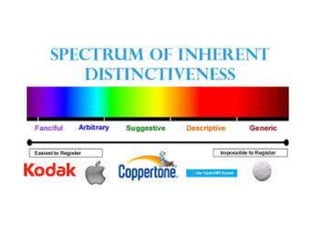
• The distinctiveness of a device can generally be
categorized into one of five categories which fall
along a spectrum of distinctiveness. From most
distinctive to least distinctive, these categories
are
• fanciful
• arbitrary
• suggestive
• descriptive (including surnames)
• generic
• Devices that are fanciful, arbitrary, or
suggestive are considered distinctive enough
to function as trademarks. On the other hand,
if a device is descriptive, the device can
function as a trademark or service mark only if
it has obtained secondary meaning. Generic
devices can never be a trademark.
Strength
• The "strength" of a mark is determined in part
by where it falls on this spectrum. Fanciful
marks are considered stronger than suggestive
marks, and therefore are granted greater
protection by the courts.
FANCIFUL MARKS
• Fanciful marks are devices which have been
invented for the sole purpose of functioning
as a trademark and have no other meaning
than acting as a mark. Fanciful marks are
considered to be the strongest type of mark.
Examples of fanciful marks are:
• EXXON
• KODAK
• XEROX
ARBITRARY MARKS
• An arbitrary mark utilizes a device having a
common meaning that has no relation to the
goods or services being sold. Examples of
arbitrary marks include:
• APPLE (for computers)
• LOTUS (for software)
• SUN (for computers)
• Twitter (for social media)
SUGGESTIVE MARKS
• Suggestive marks are marks that suggest a quality or characteristic of the
goods and services. Despite the fact that suggestive marks are not as
strong as fanciful or arbitrary marks, suggestive marks are far more
common due to the inherent marketing advantage of tying a mark to the
product in a customer's mind. Suggestive marks are often difficult to
distinguish from descriptive marks (described below), since both are
intended to refer to the goods and services in question. Suggestive marks
require some imagination, thought, or perception to reach a conclusion as
to the nature of the goods. Descriptive marks allow one to reach that
conclusion without such imagination, thought or perception. Putting this
distinction into practice clearly is one of the most difficult and disputed
areas of trademark law.
• The following marks can be considered suggestive:
• MICROSOFT (suggestive of software for microcomputers)
• NETSCAPE (suggestive of software which allows traversing the "landscape"
of the Internet)
• SILICON GRAPHICS (suggestive of graphic oriented computers)
DESCRIPTIVE MARKS
Descriptive marks (or more properly, "merely descriptive
marks") are devices which merely describe the services or
goods on which the mark is used. If a device is merely
descriptive, it is not a mark at all, since it does not serve to
identify the source of the goods or services. No trademark
rights are granted to merely descriptive marks.
Suggestive marks require some imagination, thought, or
perception to reach a conclusion as to the nature of the
goods. Descriptive marks allow one to reach that conclusion
without such imagination, thought or perception.
Putting this distinction into practice can be very difficult.
Merely descriptive marks can be registered federally on the
Supplemental Register.
DESCRIPTIVE MARKS
SECONDARY MEANING
The following imaginary marks could be considered merely descriptive for computer peripherals:
• FAST BAUD for modems (describing the quickness of the modem);
• 104 KEY for computer keyboards (describing the number of keys on a keyboard);
• LIGHT for portable computers (describing the computer's weight); and
• TUBELESS for computer monitors (even if misdescriptive for a monitor that contains tubes).
However, it is possible for descriptive marks to "become distinctive" by achieving secondary meaning.
Secondary meaning indicates that although the mark is on its face descriptive of the goods or services,
consumers recognize the mark as having a source indicating function. Once it can be shown that a descriptive
term or phrase has achieved this "second meaning" (the first meaning being the generally understood
meaning of the term or phrase), a protectable trademark is developed. Secondary meaning can be achieved
through long term use, or large amounts of advertising and publicity. The acquisition of secondary meaning is
often proven through the use of consumer surveys, that show that consumers recognize the mark as a brand,
such as "FORD", as opposed to a descriptive term, such as "reliable".
Examples of marks which might be considered descriptive but have clearly developed secondary meaning
include:
• SHARP for televisions;
• DIGITAL for computers;
• WINDOWS for windowing software;
• INTERNATIONAL BUSINESS MACHINES for computers and other business machines
SURNAMES
Marks that are primarily surnames (such as "SMITH SHOES" or
"RODRIGUEZ COMPUTERS") are treated the same as descriptive marks
under U.S. trademark law. As a result, surnames are not given
protection as trademark until they achieve secondary meaning
through advertising or long use. A trademark is "primarily a surname"
if the public would recognize it first as a surname, or if it consists of a
surname and other material that is not registrable.
Once a surname achieves secondary meaning, the mark is protectable
as a trademark. Others cannot use the mark on confusingly similar
goods, even if they have the same name. Thus, Jane McDonald could
not open a restaurant called "MCDONALDS", nor could Joel Hyatt open
a motel under the name "HYATT MOTEL", since the marks
MCDONALDS and HYATT have achieved secondary meaning.
GENERIC "MARKS”
Generic "marks" are devices which actually name a product and are
incapable of functioning as a trademark. Unlike descriptive marks,
generic devices will not become a trademark even if they are
advertised so heavily that secondary meaning can be proven in the
mind of consumers. The rationale for creating the category of generic
marks is that no manufacturer or service provider should be given
exclusive right to use words that generically identify a product.
The following words and phrases can be considered generic and
therefore are incapable of functioning as a trademark:
• SMARTPHONE;
• SOCIAL NETWORK; and
• E-MAIL.
Genericized trademark
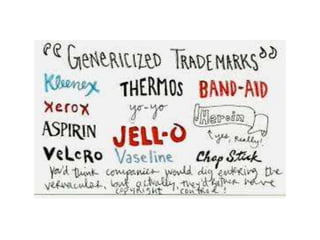
A valid trademark can become generic if the consuming
public misuses the mark sufficiently for the mark to
become the generic name for the product. The prime
examples of former trademarks that became the generic
name for a product are ASPIRIN, Jello and CELLOPHANE.
Current trademarks that were once considered to be
candidates for becoming generic are XEROX and KLEENEX.
XEROX has spent a great deal of advertising money to
prevent misuse of its mark. By doing so, XEROX has likely
avoiding the loss of its trademark.
Intellectual Property
Trademarks

Trademarks and Intellectual Property

  • 1.
  • 2.
    STRENGTH OF TRADEMARKS •A device (such as a word or a logo) can only be considered a trademark or a service mark if it is distinctive. A distinctive device is one that is capable of distinguishing the goods or services upon which it is used from the goods or services of others. A non-distinctive device is one that merely describes or names a characteristic or quality of the goods or services.
  • 3.
    Spectrum • The distinctivenessof a device can generally be categorized into one of five categories which fall along a spectrum of distinctiveness. From most distinctive to least distinctive, these categories are • fanciful • arbitrary • suggestive • descriptive (including surnames) • generic
  • 4.
    • Devices thatare fanciful, arbitrary, or suggestive are considered distinctive enough to function as trademarks. On the other hand, if a device is descriptive, the device can function as a trademark or service mark only if it has obtained secondary meaning. Generic devices can never be a trademark.
  • 5.
    Strength • The "strength"of a mark is determined in part by where it falls on this spectrum. Fanciful marks are considered stronger than suggestive marks, and therefore are granted greater protection by the courts.
  • 7.
    FANCIFUL MARKS • Fancifulmarks are devices which have been invented for the sole purpose of functioning as a trademark and have no other meaning than acting as a mark. Fanciful marks are considered to be the strongest type of mark. Examples of fanciful marks are: • EXXON • KODAK • XEROX
  • 8.
    ARBITRARY MARKS • Anarbitrary mark utilizes a device having a common meaning that has no relation to the goods or services being sold. Examples of arbitrary marks include: • APPLE (for computers) • LOTUS (for software) • SUN (for computers) • Twitter (for social media)
  • 9.
    SUGGESTIVE MARKS • Suggestivemarks are marks that suggest a quality or characteristic of the goods and services. Despite the fact that suggestive marks are not as strong as fanciful or arbitrary marks, suggestive marks are far more common due to the inherent marketing advantage of tying a mark to the product in a customer's mind. Suggestive marks are often difficult to distinguish from descriptive marks (described below), since both are intended to refer to the goods and services in question. Suggestive marks require some imagination, thought, or perception to reach a conclusion as to the nature of the goods. Descriptive marks allow one to reach that conclusion without such imagination, thought or perception. Putting this distinction into practice clearly is one of the most difficult and disputed areas of trademark law. • The following marks can be considered suggestive: • MICROSOFT (suggestive of software for microcomputers) • NETSCAPE (suggestive of software which allows traversing the "landscape" of the Internet) • SILICON GRAPHICS (suggestive of graphic oriented computers)
  • 10.
    DESCRIPTIVE MARKS Descriptive marks(or more properly, "merely descriptive marks") are devices which merely describe the services or goods on which the mark is used. If a device is merely descriptive, it is not a mark at all, since it does not serve to identify the source of the goods or services. No trademark rights are granted to merely descriptive marks. Suggestive marks require some imagination, thought, or perception to reach a conclusion as to the nature of the goods. Descriptive marks allow one to reach that conclusion without such imagination, thought or perception. Putting this distinction into practice can be very difficult. Merely descriptive marks can be registered federally on the Supplemental Register.
  • 11.
    DESCRIPTIVE MARKS SECONDARY MEANING Thefollowing imaginary marks could be considered merely descriptive for computer peripherals: • FAST BAUD for modems (describing the quickness of the modem); • 104 KEY for computer keyboards (describing the number of keys on a keyboard); • LIGHT for portable computers (describing the computer's weight); and • TUBELESS for computer monitors (even if misdescriptive for a monitor that contains tubes). However, it is possible for descriptive marks to "become distinctive" by achieving secondary meaning. Secondary meaning indicates that although the mark is on its face descriptive of the goods or services, consumers recognize the mark as having a source indicating function. Once it can be shown that a descriptive term or phrase has achieved this "second meaning" (the first meaning being the generally understood meaning of the term or phrase), a protectable trademark is developed. Secondary meaning can be achieved through long term use, or large amounts of advertising and publicity. The acquisition of secondary meaning is often proven through the use of consumer surveys, that show that consumers recognize the mark as a brand, such as "FORD", as opposed to a descriptive term, such as "reliable". Examples of marks which might be considered descriptive but have clearly developed secondary meaning include: • SHARP for televisions; • DIGITAL for computers; • WINDOWS for windowing software; • INTERNATIONAL BUSINESS MACHINES for computers and other business machines
  • 12.
    SURNAMES Marks that areprimarily surnames (such as "SMITH SHOES" or "RODRIGUEZ COMPUTERS") are treated the same as descriptive marks under U.S. trademark law. As a result, surnames are not given protection as trademark until they achieve secondary meaning through advertising or long use. A trademark is "primarily a surname" if the public would recognize it first as a surname, or if it consists of a surname and other material that is not registrable. Once a surname achieves secondary meaning, the mark is protectable as a trademark. Others cannot use the mark on confusingly similar goods, even if they have the same name. Thus, Jane McDonald could not open a restaurant called "MCDONALDS", nor could Joel Hyatt open a motel under the name "HYATT MOTEL", since the marks MCDONALDS and HYATT have achieved secondary meaning.
  • 13.
    GENERIC "MARKS” Generic "marks"are devices which actually name a product and are incapable of functioning as a trademark. Unlike descriptive marks, generic devices will not become a trademark even if they are advertised so heavily that secondary meaning can be proven in the mind of consumers. The rationale for creating the category of generic marks is that no manufacturer or service provider should be given exclusive right to use words that generically identify a product. The following words and phrases can be considered generic and therefore are incapable of functioning as a trademark: • SMARTPHONE; • SOCIAL NETWORK; and • E-MAIL.
  • 14.
    Genericized trademark A validtrademark can become generic if the consuming public misuses the mark sufficiently for the mark to become the generic name for the product. The prime examples of former trademarks that became the generic name for a product are ASPIRIN, Jello and CELLOPHANE. Current trademarks that were once considered to be candidates for becoming generic are XEROX and KLEENEX. XEROX has spent a great deal of advertising money to prevent misuse of its mark. By doing so, XEROX has likely avoiding the loss of its trademark.
  • 16.