PLANNING AND
STRATEGIC MANAGEMENT
*LEVELS OF PLANNING
*STRATEGIC PLANNING
REPORTER : RAPHA SHINE C. REVECHE
MPA-1D
Levels of planning
Planning is a critical component that is carried
out in three distinct levels namely functional,
business and corporate levels. Shelett (2002)
indicates that many organizations formulate
strategies in either one or both of the
mentioned levels, but ensure that the plans
they set for each level are aligned to ensure
that the efforts to achieve them are done in
maximum unity.
https://ivypanda.com/essays/types-and-levels-
of-planning-in-organizations/
Importance of Planning
Levels of planning
Corporate level
O An organization’s overall strategic direction is
normally planned at the corporate level. Planning
at the corporate level as Kuye and Oghojafor
(2011) point out is carried out by a senior
leadership within an organization.
O A leader in this case provides a mission and a
vision which is duly needed in the organization
towards accomplishing the set goals and
objectives.
https://ivypanda.com/essays/types-and-levels-
of-planning-in-organizations/
Business level
O At business level, Anderson and Joglekar
(2005) posit that all businesses enterprises
can be categorized under specific
organizations that work within specific
industries.
O These businesses develop strategies which
work at their level and that which reflect
their current position and the amount of
resources they have or need in respect to
the competitive environment they are
operating.
https://ivypanda.com/essays/types-and-levels-
of-planning-in-organizations/
Functional level
O The functional level of planning focuses
on support functions which are
possessed by a business enterprise.
O At the functional level, strategies are
defined, a consideration which
Schellekens et al (2010) suggest that
supports overall corporate and business
strategies.
https://ivypanda.com/essays/types-and-levels-
of-planning-in-organizations/
Strategic planning
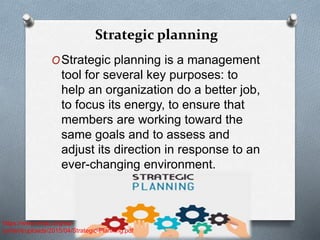
OStrategic planning is a management
tool for several key purposes: to
help an organization do a better job,
to focus its energy, to ensure that
members are working toward the
same goals and to assess and
adjust its direction in response to an
ever-changing environment.
https://www.nmac.org/wp-
content/uploads/2015/04/Strategic-Planning.pdf
Strategic planning does the following:
O✓ Shares an organization’s vision with a
large internal and external audience.
O ✓ Clarifies and makes the organization’s
mission specific.
O✓ Identifies clients, consumers and
stakeholders served by the organization.
O✓ Identifies distinctive strengths and
weaknesses of the organization.
https://www.nmac.org/wp-
content/uploads/2015/04/Strategic-Planning.pdf
Reasons for Strategic Planning
The process of strategic planning can lead to:
O ✓ Creating a forum for understanding why the
organization exists and the values that should influence
decisions.
O ✓ Defining a shared vision of the organization’s future
that can guide the current allocation of scarce
O ✓ Fostering successful communication and building
teamwork among the board of directors, staff and
external constituencies.
O ✓ Laying the groundwork for meaningful change by
stimulating forward thinking and focusing attention on
what is really important to the organization’s long-term
success.
https://www.nmac.org/wp-
content/uploads/2015/04/Strategic-Planning.pdf
The Strategic Planning Process
There are five fundamental steps in
the planning process. These steps
are a recommendation, but they are
not the only recipe for cooking up a
strategic plan.
https://www.nmac.org/wp-
content/uploads/2015/04/Strategic-Planning.pdf
Step 1: Getting Ready
O To prepare for strategic planning, your
organization must first assess if it’s
ready. While a number of issues must
be addressed in assessing readiness,
that determination essentially comes
down to whether your organization’s
leaders are truly committed to the effort
and whether they are able to devote the
necessary attention to the “big picture.”
https://www.nmac.org/wp-
content/uploads/2015/04/Strategic-Planning.pdf
Step 2: Developing the Mission and Vision
O Statements A mission statement is like an
introductory paragraph: It must communicate
the essence of your organization. An
organization’s ability to articulate this indicates
its focus and purpose fulness.
Step 3: Environmental Assessment
O This step is about gathering up-to-date
information about your organization’s strengths,
weaknesses, opportunities, threats and
performance — assessments that will highlight
the critical issues that your organization faces
and that its strategic plan must address.
https://www.nmac.org/wp-
content/uploads/2015/04/Strategic-Planning.pdf
Step 4: Developing Strategies, Goals and
Objectives
OThis can take considerable time and
flexibility: Discussions at this stage
frequently require additional
information or a reevaluation of
conclusions reached during the
environmental assessment. I
https://www.nmac.org/wp-
content/uploads/2015/04/Strategic-Planning.pdf
Step 5: Completing the
Written Plan
OStep 5 essentially involves putting
all that down on paper. Usually one
member of the planning committee,
the executive director, or even a
planning consultant can draft a final
plan document and then submit it
for review by all key decision
makers (usually the board and top
staff).
https://www.nmac.org/wp-
content/uploads/2015/04/Strategic-Planning.pdf
THANK YOU !

Levels of planning report

  • 1.
    PLANNING AND STRATEGIC MANAGEMENT *LEVELSOF PLANNING *STRATEGIC PLANNING REPORTER : RAPHA SHINE C. REVECHE MPA-1D
  • 2.
    Levels of planning Planningis a critical component that is carried out in three distinct levels namely functional, business and corporate levels. Shelett (2002) indicates that many organizations formulate strategies in either one or both of the mentioned levels, but ensure that the plans they set for each level are aligned to ensure that the efforts to achieve them are done in maximum unity. https://ivypanda.com/essays/types-and-levels- of-planning-in-organizations/
  • 3.
  • 4.
    Levels of planning Corporatelevel O An organization’s overall strategic direction is normally planned at the corporate level. Planning at the corporate level as Kuye and Oghojafor (2011) point out is carried out by a senior leadership within an organization. O A leader in this case provides a mission and a vision which is duly needed in the organization towards accomplishing the set goals and objectives. https://ivypanda.com/essays/types-and-levels- of-planning-in-organizations/
  • 5.
    Business level O Atbusiness level, Anderson and Joglekar (2005) posit that all businesses enterprises can be categorized under specific organizations that work within specific industries. O These businesses develop strategies which work at their level and that which reflect their current position and the amount of resources they have or need in respect to the competitive environment they are operating. https://ivypanda.com/essays/types-and-levels- of-planning-in-organizations/
  • 6.
    Functional level O Thefunctional level of planning focuses on support functions which are possessed by a business enterprise. O At the functional level, strategies are defined, a consideration which Schellekens et al (2010) suggest that supports overall corporate and business strategies. https://ivypanda.com/essays/types-and-levels- of-planning-in-organizations/
  • 7.
    Strategic planning OStrategic planningis a management tool for several key purposes: to help an organization do a better job, to focus its energy, to ensure that members are working toward the same goals and to assess and adjust its direction in response to an ever-changing environment. https://www.nmac.org/wp- content/uploads/2015/04/Strategic-Planning.pdf
  • 8.
    Strategic planning doesthe following: O✓ Shares an organization’s vision with a large internal and external audience. O ✓ Clarifies and makes the organization’s mission specific. O✓ Identifies clients, consumers and stakeholders served by the organization. O✓ Identifies distinctive strengths and weaknesses of the organization. https://www.nmac.org/wp- content/uploads/2015/04/Strategic-Planning.pdf
  • 10.
    Reasons for StrategicPlanning The process of strategic planning can lead to: O ✓ Creating a forum for understanding why the organization exists and the values that should influence decisions. O ✓ Defining a shared vision of the organization’s future that can guide the current allocation of scarce O ✓ Fostering successful communication and building teamwork among the board of directors, staff and external constituencies. O ✓ Laying the groundwork for meaningful change by stimulating forward thinking and focusing attention on what is really important to the organization’s long-term success. https://www.nmac.org/wp- content/uploads/2015/04/Strategic-Planning.pdf
  • 11.
    The Strategic PlanningProcess There are five fundamental steps in the planning process. These steps are a recommendation, but they are not the only recipe for cooking up a strategic plan. https://www.nmac.org/wp- content/uploads/2015/04/Strategic-Planning.pdf
  • 12.
    Step 1: GettingReady O To prepare for strategic planning, your organization must first assess if it’s ready. While a number of issues must be addressed in assessing readiness, that determination essentially comes down to whether your organization’s leaders are truly committed to the effort and whether they are able to devote the necessary attention to the “big picture.” https://www.nmac.org/wp- content/uploads/2015/04/Strategic-Planning.pdf
  • 13.
    Step 2: Developingthe Mission and Vision O Statements A mission statement is like an introductory paragraph: It must communicate the essence of your organization. An organization’s ability to articulate this indicates its focus and purpose fulness. Step 3: Environmental Assessment O This step is about gathering up-to-date information about your organization’s strengths, weaknesses, opportunities, threats and performance — assessments that will highlight the critical issues that your organization faces and that its strategic plan must address. https://www.nmac.org/wp- content/uploads/2015/04/Strategic-Planning.pdf
  • 14.
    Step 4: DevelopingStrategies, Goals and Objectives OThis can take considerable time and flexibility: Discussions at this stage frequently require additional information or a reevaluation of conclusions reached during the environmental assessment. I https://www.nmac.org/wp- content/uploads/2015/04/Strategic-Planning.pdf
  • 15.
    Step 5: Completingthe Written Plan OStep 5 essentially involves putting all that down on paper. Usually one member of the planning committee, the executive director, or even a planning consultant can draft a final plan document and then submit it for review by all key decision makers (usually the board and top staff). https://www.nmac.org/wp- content/uploads/2015/04/Strategic-Planning.pdf
  • 16.