MANAGEMENT
DEVELOPMENT PROGRAMMES
& APPROACHES
Management Development Program
• Management Development Program is an attempt to improve
managerial effectiveness through a planned and deliberate learning
process.
Is that what does ‘training’ does?
Unlike the general purpose of training, management development
program aims at developing conceptual and human skills of managers
and executives through organized and systematic procedures.
• All developmental effort focus on managers and supervisors while all
training methods and techniques focus on lower level employees to
make them more productive.
It is not that training methods do not help develop managers and
supervisors. Some of them do help, as for examples cases studies, role
plays, and the like.
• Unlike training, development helps broaden an individual’s vision and
provide a longer term view of the individual’s role in the organization.
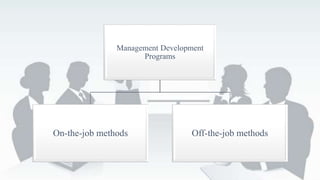
Management Development
Programs
On-the-job methods Off-the-job methods
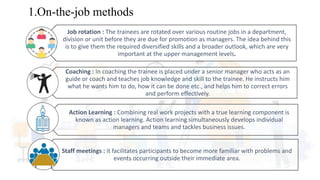
1.On-the-job methods
Job rotation : The trainees are rotated over various routine jobs in a department,
division or unit before they are due for promotion as managers. The idea behind this
is to give them the required diversified skills and a broader outlook, which are very
important at the upper management levels.
Coaching : In coaching the trainee is placed under a senior manager who acts as an
guide or coach and teaches job knowledge and skill to the trainee. He instructs him
what he wants him to do, how it can be done etc., and helps him to correct errors
and perform effectively.
Action Learning : Combining real work projects with a true learning component is
known as action learning. Action learning simultaneously develops individual
managers and teams and tackles business issues.
Staff meetings : it facilitates participants to become more familiar with problems and
events occurring outside their immediate area.
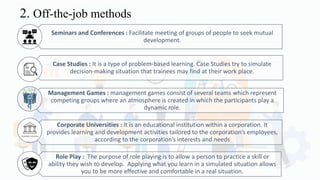
2. Off-the-job methods
Seminars and Conferences : Facilitate meeting of groups of people to seek mutual
development.
Case Studies : It is a type of problem-based learning. Case Studies try to simulate
decision-making situation that trainees may find at their work place.
Management Games : management games consist of several teams which represent
competing groups where an atmosphere is created in which the participants play a
dynamic role.
Corporate Universities : It is an educational institution within a corporation. It
provides learning and development activities tailored to the corporation’s employees,
according to the corporation’s interests and needs
Role Play : The purpose of role playing is to allow a person to practice a skill or
ability they wish to develop. Applying what you learn in a simulated situation allows
you to be more effective and comfortable in a real situation.
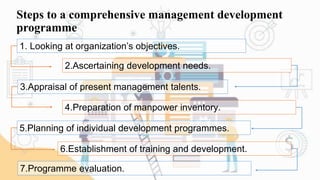
1. Looking at organization’s objectives.
Steps to a comprehensive management development
programme
2.Ascertaining development needs.
3.Appraisal of present management talents.
4.Preparation of manpower inventory.
5.Planning of individual development programmes.
6.Establishment of training and development.
7.Programme evaluation.
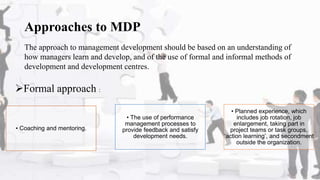
Approaches to MDP
The approach to management development should be based on an understanding of
how managers learn and develop, and of the use of formal and informal methods of
development and development centres.
• Coaching and mentoring.
• The use of performance
management processes to
provide feedback and satisfy
development needs.
• Planned experience, which
includes job rotation, job
enlargement, taking part in
project teams or task groups,
‘action learning’, and secondment
outside the organization.
Formal approach :
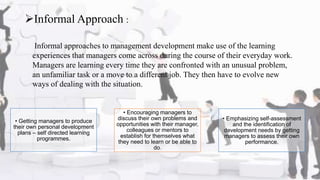
Informal Approach :
• Getting managers to produce
their own personal development
plans – self directed learning
programmes.
• Encouraging managers to
discuss their own problems and
opportunities with their manager,
colleagues or mentors to
establish for themselves what
they need to learn or be able to
do.
• Emphasizing self-assessment
and the identification of
development needs by getting
managers to assess their own
performance.
Informal approaches to management development make use of the learning
experiences that managers come across during the course of their everyday work.
Managers are learning every time they are confronted with an unusual problem,
an unfamiliar task or a move to a different job. They then have to evolve new
ways of dealing with the situation.
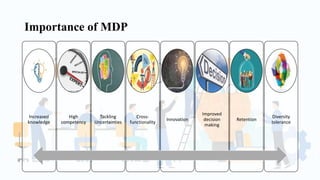
Importance of MDP
Increased
knowledge
High
competency
Tackling
Uncertainties
Cross-
functionality
Innovation
Improved
decision
making
Retention
Diversity
tolerance
THANK YOU
PRESENTATION BY:
NOORAYASMIN

HRM.pptx

  • 1.
  • 2.
    Management Development Program •Management Development Program is an attempt to improve managerial effectiveness through a planned and deliberate learning process. Is that what does ‘training’ does? Unlike the general purpose of training, management development program aims at developing conceptual and human skills of managers and executives through organized and systematic procedures.
  • 3.
    • All developmentaleffort focus on managers and supervisors while all training methods and techniques focus on lower level employees to make them more productive. It is not that training methods do not help develop managers and supervisors. Some of them do help, as for examples cases studies, role plays, and the like. • Unlike training, development helps broaden an individual’s vision and provide a longer term view of the individual’s role in the organization.
  • 4.
  • 5.
    1.On-the-job methods Job rotation: The trainees are rotated over various routine jobs in a department, division or unit before they are due for promotion as managers. The idea behind this is to give them the required diversified skills and a broader outlook, which are very important at the upper management levels. Coaching : In coaching the trainee is placed under a senior manager who acts as an guide or coach and teaches job knowledge and skill to the trainee. He instructs him what he wants him to do, how it can be done etc., and helps him to correct errors and perform effectively. Action Learning : Combining real work projects with a true learning component is known as action learning. Action learning simultaneously develops individual managers and teams and tackles business issues. Staff meetings : it facilitates participants to become more familiar with problems and events occurring outside their immediate area.
  • 6.
    2. Off-the-job methods Seminarsand Conferences : Facilitate meeting of groups of people to seek mutual development. Case Studies : It is a type of problem-based learning. Case Studies try to simulate decision-making situation that trainees may find at their work place. Management Games : management games consist of several teams which represent competing groups where an atmosphere is created in which the participants play a dynamic role. Corporate Universities : It is an educational institution within a corporation. It provides learning and development activities tailored to the corporation’s employees, according to the corporation’s interests and needs Role Play : The purpose of role playing is to allow a person to practice a skill or ability they wish to develop. Applying what you learn in a simulated situation allows you to be more effective and comfortable in a real situation.
  • 7.
    1. Looking atorganization’s objectives. Steps to a comprehensive management development programme 2.Ascertaining development needs. 3.Appraisal of present management talents. 4.Preparation of manpower inventory. 5.Planning of individual development programmes. 6.Establishment of training and development. 7.Programme evaluation.
  • 8.
    Approaches to MDP Theapproach to management development should be based on an understanding of how managers learn and develop, and of the use of formal and informal methods of development and development centres. • Coaching and mentoring. • The use of performance management processes to provide feedback and satisfy development needs. • Planned experience, which includes job rotation, job enlargement, taking part in project teams or task groups, ‘action learning’, and secondment outside the organization. Formal approach :
  • 9.
    Informal Approach : •Getting managers to produce their own personal development plans – self directed learning programmes. • Encouraging managers to discuss their own problems and opportunities with their manager, colleagues or mentors to establish for themselves what they need to learn or be able to do. • Emphasizing self-assessment and the identification of development needs by getting managers to assess their own performance. Informal approaches to management development make use of the learning experiences that managers come across during the course of their everyday work. Managers are learning every time they are confronted with an unusual problem, an unfamiliar task or a move to a different job. They then have to evolve new ways of dealing with the situation.
  • 10.
  • 11.