SRM INSTITUTE OF SCIENCE AND TECHNOLOGY
RAMAPURAM- CHENNAI-89.
STAFF NAME: Dr.S.Mani
COURSE & SECTION: B.Com General – “F” & “K”
COURSE NAME: CORPORATE ACCOUNTING -1I
COURSE CODE: UCM23401J
UNIT – II
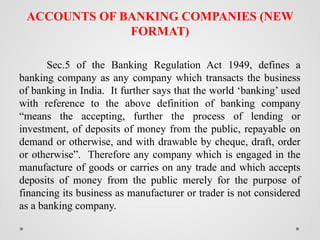
ACCOUNTS OF BANKING COMPANIES (NEW
FORMAT)
Sec.5 of the Banking Regulation Act 1949, defines a
banking company as any company which transacts the business
of banking in India. It further says that the world ‘banking’ used
with reference to the above definition of banking company
“means the accepting, further the process of lending or
investment, of deposits of money from the public, repayable on
demand or otherwise, and with drawable by cheque, draft, order
or otherwise”. Therefore any company which is engaged in the
manufacture of goods or carries on any trade and which accepts
deposits of money from the public merely for the purpose of
financing its business as manufacturer or trader is not considered
as a banking company.
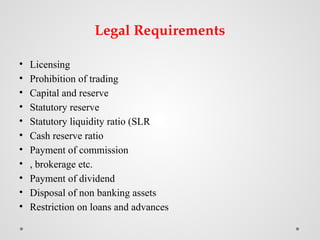
Legal Requirements
• Licensing
• Prohibition of trading
• Capital and reserve
• Statutory reserve
• Statutory liquidity ratio (SLR
• Cash reserve ratio
• Payment of commission
• , brokerage etc.
• Payment of dividend
• Disposal of non banking assets
• Restriction on loans and advances
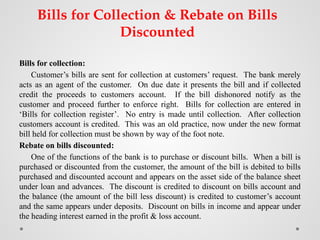
Bills for Collection & Rebate on Bills
Discounted
Bills for collection:
Customer’s bills are sent for collection at customers’ request. The bank merely
acts as an agent of the customer. On due date it presents the bill and if collected
credit the proceeds to customers account. If the bill dishonored notify as the
customer and proceed further to enforce right. Bills for collection are entered in
‘Bills for collection register’. No entry is made until collection. After collection
customers account is credited. This was an old practice, now under the new format
bill held for collection must be shown by way of the foot note.
Rebate on bills discounted:
One of the functions of the bank is to purchase or discount bills. When a bill is
purchased or discounted from the customer, the amount of the bill is debited to bills
purchased and discounted account and appears on the asset side of the balance sheet
under loan and advances. The discount is credited to discount on bills account and
the balance (the amount of the bill less discount) is credited to customer’s account
and the same appears under deposits. Discount on bills in income and appear under
the heading interest earned in the profit & loss account.
Cash Credit
The account remains out of order for more than 180
days. An account is out of order if any of the following
conditions is satisfied:
The outstanding balance remains continuously in
excess of sanctioned limit / drawing power.
Though the outstanding balance is less than the
sanctioned limit,
There are credits continuously for more than 180
days as on the date of balance sheet; or
Creditors during the aforesaid period are not enough
to cover the interest debited during the same period.
Non-Performing Assets
• Provision for non-performing assets:
For the purpose of provisioning they are classified in to
four board groups, namely, standard assets, sub-standard
assets, doubtful assets and loss assets.
• Standard assets: Standard assets is one which is not a
non-performing assets and does not disclose any problem
nor carry more than normal risk attached to the business.
Earlier no provision was required on standard assets.
However from the year ending 31.3.2000 banks are
required to make a provision of 0.25% on global loan
portfolio basis and not on domestic advance alone.
• Sub-standard assets: With effect from 31.3.2001, a sub-
standard assets is one which has remained non-performing
assets for a period less than or equal to 18 months. In the case
of term loans, the installments of principal are overdue for
more than six but less than 18 months. In this case and
general provision of 10% is to be made without making
allowances for DICGC/ECGC guarantee cover and securities
available.
• Doubtful assets: With effect from, 31.3.2001, an assets is to
be classified as doubtful, if it is has remained non-performing
assets for a period exceeding 18 months, with effect from
31.3.2005, the time frame is being further reduced to 12
months.
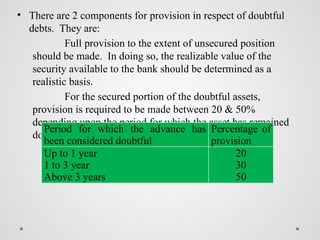
• There are 2 components for provision in respect of doubtful
debts. They are:
Full provision to the extent of unsecured position
should be made. In doing so, the realizable value of the
security available to the bank should be determined as a
realistic basis.
For the secured portion of the doubtful assets,
provision is required to be made between 20 & 50%
depending upon the period for which the asset has remained
doubtful.
Period for which the advance has
been considered doubtful
Percentage of
provision
Up to 1 year
1 to 3 year
Above 3 years
20
30
50
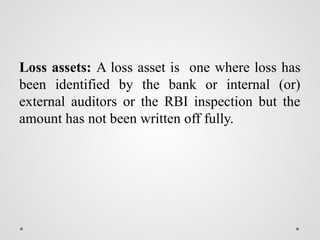
Loss assets: A loss asset is one where loss has
been identified by the bank or internal (or)
external auditors or the RBI inspection but the
amount has not been written off fully.
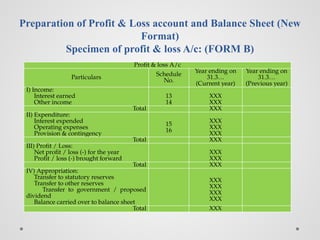
Preparation of Profit & Loss account and Balance Sheet (New
Format)
Specimen of profit & loss A/c: (FORM B)
Profit & loss A/c
Particulars
Schedule
No.
Year ending on
31.3…
(Current year)
Year ending on
31.3…
(Previous year)
I) Income:
Interest earned
Other income
13
14
XXX
XXX
Total XXX
II) Expenditure:
Interest expended
Operating expenses
Provision & contingency
15
16
XXX
XXX
XXX
Total XXX
III) Profit / Loss:
Net profit / loss (-) for the year
Profit / loss (-) brought forward
XXX
XXX
Total XXX
IV) Appropriation:
Transfer to statutory reserves
Transfer to other reserves
Transfer to government / proposed
dividend
Balance carried over to balance sheet
XXX
XXX
XXX
XXX
Total XXX
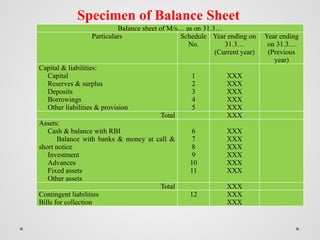
Specimen of Balance Sheet
Balance sheet of M/s… as on 31.3…
Particulars Schedule
No.
Year ending on
31.3…
(Current year)
Year ending
on 31.3…
(Previous
year)
Capital & liabilities:
Capital
Reserves & surplus
Deposits
Borrowings
Other liabilities & provision
1
2
3
4
5
XXX
XXX
XXX
XXX
XXX
Total XXX
Assets:
Cash & balance with RBI
Balance with banks & money at call &
short notice
Investment
Advances
Fixed assets
Other assets
6
7
8
9
10
11
XXX
XXX
XXX
XXX
XXX
XXX
Total XXX
Contingent liabilities
Bills for collection
12 XXX
XXX

CORPORATE ACCOUNTING UNIT II- UNIT II- B.COM

  • 1.
    SRM INSTITUTE OFSCIENCE AND TECHNOLOGY RAMAPURAM- CHENNAI-89. STAFF NAME: Dr.S.Mani COURSE & SECTION: B.Com General – “F” & “K” COURSE NAME: CORPORATE ACCOUNTING -1I COURSE CODE: UCM23401J UNIT – II
  • 2.
    ACCOUNTS OF BANKINGCOMPANIES (NEW FORMAT) Sec.5 of the Banking Regulation Act 1949, defines a banking company as any company which transacts the business of banking in India. It further says that the world ‘banking’ used with reference to the above definition of banking company “means the accepting, further the process of lending or investment, of deposits of money from the public, repayable on demand or otherwise, and with drawable by cheque, draft, order or otherwise”. Therefore any company which is engaged in the manufacture of goods or carries on any trade and which accepts deposits of money from the public merely for the purpose of financing its business as manufacturer or trader is not considered as a banking company.
  • 3.
    Legal Requirements • Licensing •Prohibition of trading • Capital and reserve • Statutory reserve • Statutory liquidity ratio (SLR • Cash reserve ratio • Payment of commission • , brokerage etc. • Payment of dividend • Disposal of non banking assets • Restriction on loans and advances
  • 4.
    Bills for Collection& Rebate on Bills Discounted Bills for collection: Customer’s bills are sent for collection at customers’ request. The bank merely acts as an agent of the customer. On due date it presents the bill and if collected credit the proceeds to customers account. If the bill dishonored notify as the customer and proceed further to enforce right. Bills for collection are entered in ‘Bills for collection register’. No entry is made until collection. After collection customers account is credited. This was an old practice, now under the new format bill held for collection must be shown by way of the foot note. Rebate on bills discounted: One of the functions of the bank is to purchase or discount bills. When a bill is purchased or discounted from the customer, the amount of the bill is debited to bills purchased and discounted account and appears on the asset side of the balance sheet under loan and advances. The discount is credited to discount on bills account and the balance (the amount of the bill less discount) is credited to customer’s account and the same appears under deposits. Discount on bills in income and appear under the heading interest earned in the profit & loss account.
  • 5.
    Cash Credit The accountremains out of order for more than 180 days. An account is out of order if any of the following conditions is satisfied: The outstanding balance remains continuously in excess of sanctioned limit / drawing power. Though the outstanding balance is less than the sanctioned limit, There are credits continuously for more than 180 days as on the date of balance sheet; or Creditors during the aforesaid period are not enough to cover the interest debited during the same period.
  • 6.
    Non-Performing Assets • Provisionfor non-performing assets: For the purpose of provisioning they are classified in to four board groups, namely, standard assets, sub-standard assets, doubtful assets and loss assets. • Standard assets: Standard assets is one which is not a non-performing assets and does not disclose any problem nor carry more than normal risk attached to the business. Earlier no provision was required on standard assets. However from the year ending 31.3.2000 banks are required to make a provision of 0.25% on global loan portfolio basis and not on domestic advance alone.
  • 7.
    • Sub-standard assets:With effect from 31.3.2001, a sub- standard assets is one which has remained non-performing assets for a period less than or equal to 18 months. In the case of term loans, the installments of principal are overdue for more than six but less than 18 months. In this case and general provision of 10% is to be made without making allowances for DICGC/ECGC guarantee cover and securities available. • Doubtful assets: With effect from, 31.3.2001, an assets is to be classified as doubtful, if it is has remained non-performing assets for a period exceeding 18 months, with effect from 31.3.2005, the time frame is being further reduced to 12 months.
  • 8.
    • There are2 components for provision in respect of doubtful debts. They are: Full provision to the extent of unsecured position should be made. In doing so, the realizable value of the security available to the bank should be determined as a realistic basis. For the secured portion of the doubtful assets, provision is required to be made between 20 & 50% depending upon the period for which the asset has remained doubtful. Period for which the advance has been considered doubtful Percentage of provision Up to 1 year 1 to 3 year Above 3 years 20 30 50
  • 9.
    Loss assets: Aloss asset is one where loss has been identified by the bank or internal (or) external auditors or the RBI inspection but the amount has not been written off fully.
  • 10.
    Preparation of Profit& Loss account and Balance Sheet (New Format) Specimen of profit & loss A/c: (FORM B) Profit & loss A/c Particulars Schedule No. Year ending on 31.3… (Current year) Year ending on 31.3… (Previous year) I) Income: Interest earned Other income 13 14 XXX XXX Total XXX II) Expenditure: Interest expended Operating expenses Provision & contingency 15 16 XXX XXX XXX Total XXX III) Profit / Loss: Net profit / loss (-) for the year Profit / loss (-) brought forward XXX XXX Total XXX IV) Appropriation: Transfer to statutory reserves Transfer to other reserves Transfer to government / proposed dividend Balance carried over to balance sheet XXX XXX XXX XXX Total XXX
  • 11.
    Specimen of BalanceSheet Balance sheet of M/s… as on 31.3… Particulars Schedule No. Year ending on 31.3… (Current year) Year ending on 31.3… (Previous year) Capital & liabilities: Capital Reserves & surplus Deposits Borrowings Other liabilities & provision 1 2 3 4 5 XXX XXX XXX XXX XXX Total XXX Assets: Cash & balance with RBI Balance with banks & money at call & short notice Investment Advances Fixed assets Other assets 6 7 8 9 10 11 XXX XXX XXX XXX XXX XXX Total XXX Contingent liabilities Bills for collection 12 XXX XXX