SRM INSTITUTE OFSCIENCE AND TECHNOLOGY
RAMAPURAM- CHENNAI-89.
STAFF NAME: Dr.S.Mani
COURSE & SECTION: B.Com General – “F” & “K”
COURSE NAME: CORPORATE ACCOUNTING -1I
COURSE CODE: UCM23401J
UNIT – III
2.
ACCOUNTS OF HOLDINGCOMPANY
Meaning of holding company:
A holding company is a company which holds the shares of another
company while the first is called holding company, the company which is so
controlled in termed as ‘subsidiary company’. The main advantage of getting a
control over another company is elimination of competition to enjoy economics
of large scale production and to get a assured market for the production of the
company.
Sec. 4 of the Indian Companies Act, 1956 provides that a holding company is
one of it:
Control the board of directors of another company; or Holds more than half of
the nominal value of equity share capital of another company; or Controls a
holding company which in turn controls another subsidiary company. In practice,
acquisition of 50% or more shares in another company makes a company as a
holding company.
3.
What do youmean by subsidiary company?
Meaning of Subsidiary company:
From Sec.4 it is clear that a company is a subsidiary of a holding
company in any of the following three cases:
When the holding company controls the compositions of the board of
directors of the subsidiary company i.e., the holding company is able to
appoint or dismiss the majority of directors of the subsidiary company.
Where the holding company holds more than 50% in nominal value of
the equity share capital of the subsidiary company i.e., the holding
company holds the majority of voting power in the subsidiary company.
When a subsidiary company is a holding company of another subsidiary
company the original holding company is also a holding company of that
other subsidiary company.
4.
Minority interest
The holdingcompany usually acquires the majority of
the shares of the subsidiary company. The remaining
portion as acquired by the outsiders. The outsides are
collectively called minority shareholders. While
preparing the consolidated balance sheet, the interest of
minority shareholders should be shown in the balance
sheet on the liabilities side under the heading ‘minority
interest’.
5.
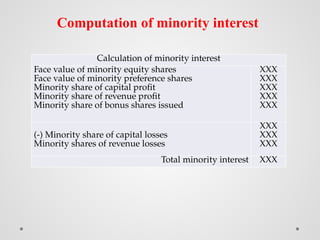
Computation of minorityinterest
Calculation of minority interest
Face value of minority equity shares
Face value of minority preference shares
Minority share of capital profit
Minority share of revenue profit
Minority share of bonus shares issued
XXX
XXX
XXX
XXX
XXX
(-) Minority share of capital losses
Minority shares of revenue losses
XXX
XXX
XXX
Total minority interest XXX
6.
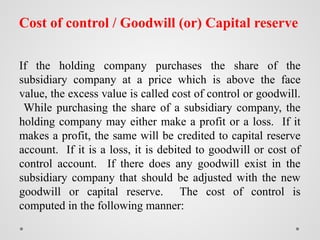
Cost of control/ Goodwill (or) Capital reserve
If the holding company purchases the share of the
subsidiary company at a price which is above the face
value, the excess value is called cost of control or goodwill.
While purchasing the share of a subsidiary company, the
holding company may either make a profit or a loss. If it
makes a profit, the same will be credited to capital reserve
account. If it is a loss, it is debited to goodwill or cost of
control account. If there does any goodwill exist in the
subsidiary company that should be adjusted with the new
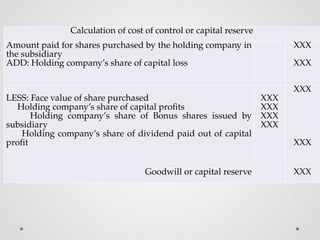
goodwill or capital reserve. The cost of control is
computed in the following manner:
7.
Calculation of costof control or capital reserve
Amount paid for shares purchased by the holding company in
the subsidiary
ADD: Holding company’s share of capital loss
XXX
XXX
LESS: Face value of share purchased
Holding company’s share of capital profits
Holding company’s share of Bonus shares issued by
subsidiary
Holding company’s share of dividend paid out of capital
profit
XXX
XXX
XXX
XXX
XXX
XXX
Goodwill or capital reserve XXX
8.
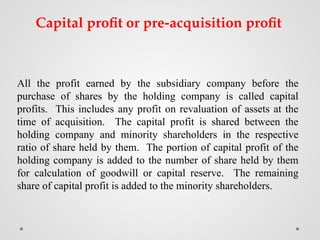
All the profitearned by the subsidiary company before the
purchase of shares by the holding company is called capital
profits. This includes any profit on revaluation of assets at the
time of acquisition. The capital profit is shared between the
holding company and minority shareholders in the respective
ratio of share held by them. The portion of capital profit of the
holding company is added to the number of share held by them
for calculation of goodwill or capital reserve. The remaining
share of capital profit is added to the minority shareholders.
Capital profit or pre-acquisition profit
9.
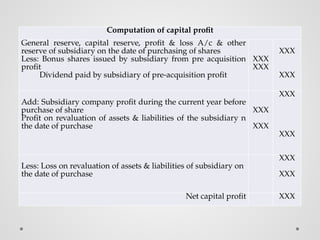
Computation of capitalprofit
General reserve, capital reserve, profit & loss A/c & other
reserve of subsidiary on the date of purchasing of shares
Less: Bonus shares issued by subsidiary from pre acquisition
profit
Dividend paid by subsidiary of pre-acquisition profit
XXX
XXX
XXX
XXX
Add: Subsidiary company profit during the current year before
purchase of share
Profit on revaluation of assets & liabilities of the subsidiary n
the date of purchase
XXX
XXX
XXX
XXX
Less: Loss on revaluation of assets & liabilities of subsidiary on
the date of purchase
XXX
XXX
Net capital profit XXX
10.
Revenue profit (or)post acquisition profit:
The profit earned by the subsidiary company
after the date of acquisition is called revenue
profit (or) post acquisition profit. It may also
be shared by the holding company and
minority shareholders in the respective ratio.
The holding companies share of revenue profit
is added to the existing profit and loss account
and the rest of the amount is added to the
minority shareholders.
11.
Revenue losses orPost-acquisition losses
Similarly, losses of the subsidiary company shown in
the balance sheet on the date of the purchase of share
and divided into two parts i.e., shares of the holding
company share of the outsiders is deducted from the
amount of the minority interest and shares of the
holding company is added to the cost of control or
goodwill or reduced from capital profits which has
become available on purchase of shares of the
subsidiary company at a price lower than the paid up
value.
12.
Revaluation of assets& liabilities
• At the time of acquisition of shares, the assets and
liabilities of a subsidiary company are revalued to
determine the true value of the assets. If there is an
increase in the assets value, it is called capital profit
and is added to existing pre acquisition profit.
• If it is vice versa it is subtracted from the pre
acquisition profit and revenue treatment is given for
liabilities after getting a true capital it showed by
shared by the holding company and minority
shareholders, as per their respective ratios.
13.
Bonus shares
Generally bonusshares are issued out of pre acquisition profit or
post acquisition profit. In case of pre acquisition profit, there
will be no effect on the consolidated balance sheet because while
ascertaining the cost of control, the holding companies shares in
the pre acquisition profit are reduced, and the paid up value of
the shares increase. Therefore the goodwill remains the same as
it was before the issue of bonus shares of the company.
In case of post acquisition profits, the issue of bonus share will
have the effect of reducing the holding companies shares in the
revenue profit and increase the paid up value of shares held by
the holding company.
•
14.
Unrealized profit
An unrealizedprofit exists when a companies stock is at
a selling price i.e., at a profit. It is agreed that this
should be treated as an unrealized profit and it should be
eliminated from stock as well as from profit and loss
account. Towards this, a separate reserve called stock
reserve is normally created. It is considered by a
minority that the whole of such unrealized profit should
be eliminated by creating a stock reserve. Others are of
an opinion that shares of profit of the holding company
alone should be eliminated from the balance sheet of
both the sides.
15.
Dividend
When dividend hasbeen declared by the subsidiary company and the
holding company received it, the treatment of dividend will be as
follows:
Dividend received by the holding company from the capital profit of the
subsidiary company are created to invest in share of the subsidiary
account thereby reducing the cost of control or increasing capital
reserve.
If the dividends received out of the revenue profits are treated as income
and credited to profit & loss account by the holding company.
If dividend declared party out of the capital profits and partly out of
revenue profits, the dividend received is dividend into two parts in
proportion to its declaration out of capital profit and revenue profits.
If the dividend has simply been proposed by the subsidiary. The
holding companies share of it is added to its profit and shown as profit
and loss balance. The share due to minority shareholders may be either
shown as proposed dividend in the balance sheet or added to the
minority interest.
16.
POSSIBLE QUESTIONS
1. Whatdo you mean by holding company?
2. What do you mean by subsidiary company?
3. What is minority interest?
4. How would you ascertain the amount of minority interest?
5. What is cost of control (or) Goodwill (or) Capital Reserve?
6. How would you ascertain the amount of goodwill?
7. What do you understand by ‘Capital profit’ (or) Pre-acquisition profit?
8. what do you understand ‘Revenue profit’ (or) Post-acquisition profit.
9. What do you understand by ‘Revenue losses’ or ‘Post-acquisition losses’?
10. What do you mean by revaluation of assets and liabilities?
11. What is a bonus share issued by subsidiary company?
12. What do you mean by unrealized profit and dividends?
13. How they treat in holding company accounts?