MANAGEMENT
Management:- Management is the process of working with and through
others to effectively achieve organisationalobjective by efficiently using
limited resources in the changing environment.
Feature of Management
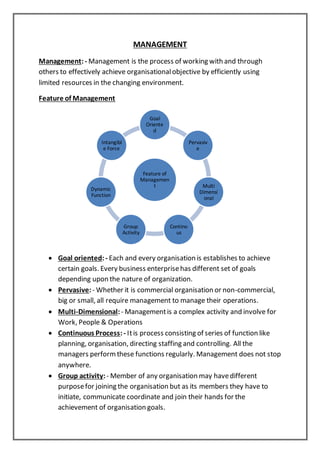
 Goal oriented:- Each and every organisation is establishes to achieve
certain goals. Every business enterprisehas different set of goals
depending upon the nature of organization.
 Pervasive:- Whether it is commercial organisation or non-commercial,
big or small, all require management to manage their operations.
 Multi-Dimensional:- Managementis a complex activity and involve for
Work, People & Operations
 Continuous Process:- Itis process consisting of series of function like
planning, organisation, directing staffing and controlling. All the
managers performthese functions regularly. Management does not stop
anywhere.
 Group activity:- Member of any organisation may havedifferent
purposefor joining the organisation but as its members they have to
initiate, communicate coordinate and join their hands for the
achievement of organisation goals.
Feature of
Managemen
t
Goal
Oriente
d
Pervasiv
e
Multi
Dimensi
onal
Contino
us
Group
Activity
Dynamic
Function
Intangibl
e Force
 Dynamic function:- The environmental which a business exists keeps on
changing in order to be successful, managementmustchanges its goals,
plans and policies according to the needs of its environment
 Intangible force:- Management cannot be seen but we can realise the
presenceof management in the operations of the organisation. Absence
of mismanagementis essential for existence of sound management.
Objective of Management
 Organisational Objectives:- The organisationalobjectives of
management refer to the main objectives require fulfilling the economic
goals of any business organisation. Thechief aim of management is to
utilize the human and material resources in such a manner as should
given maximum advantageto the organisation.
 Social objective:- Every organisation is a part of the society. Thus it has
certain social obligations to fulfil.
 Pollution free methods of production
 Increaseemploymentopportunities especially for the
economically weaker section
 To supply goods and services at reasonable prices
 To providefinancial supportto society by donating for noble
causes
Objective of
Management
Organisati
onal
Objective
Social
Objective
Personal
Objective
 To organizeeducational health and vocational training
programmes
 To participate in social services projects of Governmentaland
(NGOs)
 Personal objective:- Personalobjectives refer to the objectives which
are related to the employees of an organisation. Differentpeople with
different values, experience and objectives become part of the
organisation to satisfy their different needs.
 Financial needs like salaries, incentives and other monetary
benefits
 Social needs like recognition in the organisation
 Higher level needs which include personalgrowth and
development
1. Management as an Art:- An art requires application of personalskills
and knowledgeto achieve the desire results. Itinvolves continuous
practice and creativity.
 Existence of Theoretical Knowledge:- Artinvolves the existence
of theoretical knowledge.
 PersonalisedApplication:- Every individualmakes use of the
basic knowledge in his own personalway.
Nature of
Management
Managem
ent is an
Art
Managem
ent is a
Science
Managem
ent is a
Professio
n
 Basedon Practice and Creativity:- Artinvolves creativity practice
of theoretical knowledgegained in order to be an expert in his/
her field.
2. Management as a Science:- Science is a systematic body of knowledge,
having logically observed principaland finding
 Systematisedbody of knowledge:- Science is a systematised
body of knowledge. Ithas its own systematic theory and principles
based on cause and effect relationship.
 Principles BasedonExperimentation:- The scientific principles
have been developed through observation and experimentation
under controlled conditions.
 Universal validity:- The principles of science are universally
applicable i.e. these principles hold true under each and every
situation.
3. Management as a Profession:- Professionals a well-defined body of
knowledgewhich can be acquired through training and instruction and it
follows ethical standards.
 Well definedbody of knowledge:- All profession arebased on
well-defined body of knowledgethat can be acquired through
training and formalinstruction
 RestrictedEntry:- The entry to a profession is based on
examination or through acquiring an educational degree.
 Professional Association:- All the profession havetheir
representative associations. The professionals arerequired to get
themselves registered with their respective associations for
stating their practice.
 Ethical code of conduct:- Every professionalis required to follow
the code of conduct as laid down by their respective association.
 Service motive:- The main aim of every profession is to serveits
clients by providing them committed service.
Levels of Management
1. Top Management:- Itconsists of managers at the highest level in the
management hierarchy. Their jobs are complex quite stressful
demanding complete dedication and commitment to organisation. Top
level managers are responsiblefor welfareand survivalof the
organisation.
MainFunctionof Top Management
 Developlong termobjective
 Framing of policies
 Organising
 Key Appointments
 Controlling
2. Middle Management:- They are link between top and the supervisory
management. They are mainly known as division head, factory head etc.
they are responsiblefor implementing and controlling plans and
strategies formulated by top management.
Top
Management
Middle
Management
Supervisory Management
Mainfunctionof Middle Management
 Departmental Objectives
 Assignment of Duties
 Link
 Communication
 Coordination
3. Supervisory or Operational Management:- Bottom level of
management is considered as operativemanagement. They are first line
managers who overseethe efforts of the work forceand actually carry
out the operational work in an organisation.
MainFunctionof Supervisory or Operational Management
 Link BetweenMiddleManagement andWorkforce
 Maintenance of Quality
 Act as guide to the Workers
 Act as Supervisors
 Discipline
 Safety
 Training
Functions of Management
1. Planning: - Planning is the basic function of the management and involve
deciding in advancewhatis to be done, how, where, and by whom.
Functionsof
Management
Planning
Organisin
g
Staffing
Directing
Contrlling
Panning is futuristic in nature. It is a continuous process that fills the gap
between where we are and where we wantto reach.
2. Organising:- After deciding the organisationalobjectives, the
management has to determine the various activities and the resources
required to achieve the same
3. Staffing:- Finding right man and placing him to right job is known as
staffing. Itis the most important function of the management and
involves recruitment, selection, placement, training and development of
the employees. Itis also referred to as a human resources function.
4. Directing:- Directing involves leading, guiding, supervising and
motivating the employees to perform their jobs efficiently in order to
achieve organisationalgoal it helps to convertplans into action.
5. Controlling:- Itis the last but very important key function of
management. Itinvolves comparing the actual performancewith the
established standard, finding out deviation, if any and taking corrective
actions to ensurethat activities are going on according to the plans. Itis
referred to as monitoring function of management.

Management

  • 1.
    MANAGEMENT Management:- Management isthe process of working with and through others to effectively achieve organisationalobjective by efficiently using limited resources in the changing environment. Feature of Management  Goal oriented:- Each and every organisation is establishes to achieve certain goals. Every business enterprisehas different set of goals depending upon the nature of organization.  Pervasive:- Whether it is commercial organisation or non-commercial, big or small, all require management to manage their operations.  Multi-Dimensional:- Managementis a complex activity and involve for Work, People & Operations  Continuous Process:- Itis process consisting of series of function like planning, organisation, directing staffing and controlling. All the managers performthese functions regularly. Management does not stop anywhere.  Group activity:- Member of any organisation may havedifferent purposefor joining the organisation but as its members they have to initiate, communicate coordinate and join their hands for the achievement of organisation goals. Feature of Managemen t Goal Oriente d Pervasiv e Multi Dimensi onal Contino us Group Activity Dynamic Function Intangibl e Force
  • 2.
     Dynamic function:-The environmental which a business exists keeps on changing in order to be successful, managementmustchanges its goals, plans and policies according to the needs of its environment  Intangible force:- Management cannot be seen but we can realise the presenceof management in the operations of the organisation. Absence of mismanagementis essential for existence of sound management. Objective of Management  Organisational Objectives:- The organisationalobjectives of management refer to the main objectives require fulfilling the economic goals of any business organisation. Thechief aim of management is to utilize the human and material resources in such a manner as should given maximum advantageto the organisation.  Social objective:- Every organisation is a part of the society. Thus it has certain social obligations to fulfil.  Pollution free methods of production  Increaseemploymentopportunities especially for the economically weaker section  To supply goods and services at reasonable prices  To providefinancial supportto society by donating for noble causes Objective of Management Organisati onal Objective Social Objective Personal Objective
  • 3.
     To organizeeducationalhealth and vocational training programmes  To participate in social services projects of Governmentaland (NGOs)  Personal objective:- Personalobjectives refer to the objectives which are related to the employees of an organisation. Differentpeople with different values, experience and objectives become part of the organisation to satisfy their different needs.  Financial needs like salaries, incentives and other monetary benefits  Social needs like recognition in the organisation  Higher level needs which include personalgrowth and development 1. Management as an Art:- An art requires application of personalskills and knowledgeto achieve the desire results. Itinvolves continuous practice and creativity.  Existence of Theoretical Knowledge:- Artinvolves the existence of theoretical knowledge.  PersonalisedApplication:- Every individualmakes use of the basic knowledge in his own personalway. Nature of Management Managem ent is an Art Managem ent is a Science Managem ent is a Professio n
  • 4.
     Basedon Practiceand Creativity:- Artinvolves creativity practice of theoretical knowledgegained in order to be an expert in his/ her field. 2. Management as a Science:- Science is a systematic body of knowledge, having logically observed principaland finding  Systematisedbody of knowledge:- Science is a systematised body of knowledge. Ithas its own systematic theory and principles based on cause and effect relationship.  Principles BasedonExperimentation:- The scientific principles have been developed through observation and experimentation under controlled conditions.  Universal validity:- The principles of science are universally applicable i.e. these principles hold true under each and every situation. 3. Management as a Profession:- Professionals a well-defined body of knowledgewhich can be acquired through training and instruction and it follows ethical standards.  Well definedbody of knowledge:- All profession arebased on well-defined body of knowledgethat can be acquired through training and formalinstruction  RestrictedEntry:- The entry to a profession is based on examination or through acquiring an educational degree.  Professional Association:- All the profession havetheir representative associations. The professionals arerequired to get themselves registered with their respective associations for stating their practice.  Ethical code of conduct:- Every professionalis required to follow the code of conduct as laid down by their respective association.  Service motive:- The main aim of every profession is to serveits clients by providing them committed service.
  • 5.
    Levels of Management 1.Top Management:- Itconsists of managers at the highest level in the management hierarchy. Their jobs are complex quite stressful demanding complete dedication and commitment to organisation. Top level managers are responsiblefor welfareand survivalof the organisation. MainFunctionof Top Management  Developlong termobjective  Framing of policies  Organising  Key Appointments  Controlling 2. Middle Management:- They are link between top and the supervisory management. They are mainly known as division head, factory head etc. they are responsiblefor implementing and controlling plans and strategies formulated by top management. Top Management Middle Management Supervisory Management
  • 6.
    Mainfunctionof Middle Management Departmental Objectives  Assignment of Duties  Link  Communication  Coordination 3. Supervisory or Operational Management:- Bottom level of management is considered as operativemanagement. They are first line managers who overseethe efforts of the work forceand actually carry out the operational work in an organisation. MainFunctionof Supervisory or Operational Management  Link BetweenMiddleManagement andWorkforce  Maintenance of Quality  Act as guide to the Workers  Act as Supervisors  Discipline  Safety  Training Functions of Management 1. Planning: - Planning is the basic function of the management and involve deciding in advancewhatis to be done, how, where, and by whom. Functionsof Management Planning Organisin g Staffing Directing Contrlling
  • 7.
    Panning is futuristicin nature. It is a continuous process that fills the gap between where we are and where we wantto reach. 2. Organising:- After deciding the organisationalobjectives, the management has to determine the various activities and the resources required to achieve the same 3. Staffing:- Finding right man and placing him to right job is known as staffing. Itis the most important function of the management and involves recruitment, selection, placement, training and development of the employees. Itis also referred to as a human resources function. 4. Directing:- Directing involves leading, guiding, supervising and motivating the employees to perform their jobs efficiently in order to achieve organisationalgoal it helps to convertplans into action. 5. Controlling:- Itis the last but very important key function of management. Itinvolves comparing the actual performancewith the established standard, finding out deviation, if any and taking corrective actions to ensurethat activities are going on according to the plans. Itis referred to as monitoring function of management.