Copyright © 2012 Pearson Education, Inc.
Publishing as Prentice HallManagement, Eleventh Edition by Stephen P. Robbins & Mary Coulter ©2012 Pearson Education, Inc. publishing as Prentice Hall
6-1
Copyright © 2012 Pearson Education, Inc.
Publishing as Prentice HallManagement, Eleventh Edition by Stephen P. Robbins & Mary Coulter ©2012 Pearson Education, Inc. publishing as Prentice Hall
6-2
• Compare and contrast views on the change
process
• Classify types of organizational change
• Explain how to manage resistance to change
• Discuss contemporary issues in managing
change
• Describe techniques for stimulating innovation
Copyright © 2012 Pearson Education, Inc.
Publishing as Prentice HallManagement, Eleventh Edition by Stephen P. Robbins & Mary Coulter ©2012 Pearson Education, Inc. publishing as Prentice Hall
6-3
The Change Process
If it weren’t for change, a manager’s job would be
relatively easy. Planning would be simple because
tomorrow would be no different from today. Similarly,
decision making would be easy.
•But that’s not the way it is. Change is an organizational
reality.
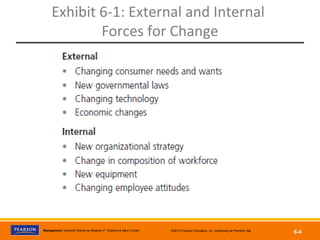
•Organizations face change because external and
internal factors create the need for change
Copyright © 2012 Pearson Education, Inc.
Publishing as Prentice HallManagement, Eleventh Edition by Stephen P. Robbins & Mary Coulter ©2012 Pearson Education, Inc. publishing as Prentice Hall
6-4
Exhibit 6-1: External and Internal
Forces for Change
Copyright © 2012 Pearson Education, Inc.
Publishing as Prentice HallManagement, Eleventh Edition by Stephen P. Robbins & Mary Coulter ©2012 Pearson Education, Inc. publishing as Prentice Hall
6-5
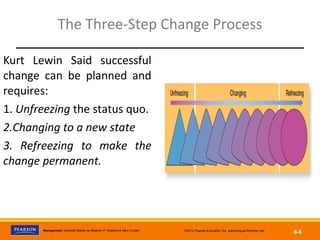
The Three-Step Change Process
Kurt Lewin Said successful
change can be planned and
requires:
1. Unfreezing the status quo.
2.Changing to a new state
3. Refreezing to make the
change permanent.
Copyright © 2012 Pearson Education, Inc.
Publishing as Prentice HallManagement, Eleventh Edition by Stephen P. Robbins & Mary Coulter ©2012 Pearson Education, Inc. publishing as Prentice Hall
6-6
Organizational Change and
Change Agents
• Organizational Change - any alterations in the
people, structure, or technology of an
organization.
• Change Agents - persons who act as catalysts
and assume the responsibility for managing
the change process.
Copyright © 2012 Pearson Education, Inc.
Publishing as Prentice HallManagement, Eleventh Edition by Stephen P. Robbins & Mary Coulter ©2012 Pearson Education, Inc. publishing as Prentice Hall
6-7
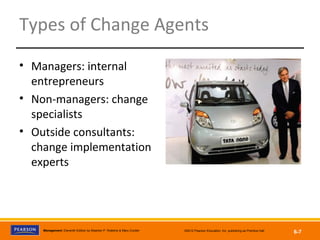
Types of Change Agents
• Managers: internal
entrepreneurs
• Non-managers: change
specialists
• Outside consultants:
change implementation
experts
Copyright © 2012 Pearson Education, Inc.
Publishing as Prentice HallManagement, Eleventh Edition by Stephen P. Robbins & Mary Coulter ©2012 Pearson Education, Inc. publishing as Prentice Hall
6-8
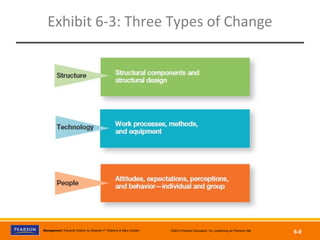
Types of Change
• Structure
– Changing an organization’s structural components or its
structural design
• Technology
– Adopting new equipment, tools, or operating methods
that displace old skills and require new ones
• Automation - replacing certain tasks done by people with
machines
• Computerization
• People
– Changing attitudes, expectations, perceptions, and
behaviors of the workforce
Copyright © 2012 Pearson Education, Inc.
Publishing as Prentice HallManagement, Eleventh Edition by Stephen P. Robbins & Mary Coulter ©2012 Pearson Education, Inc. publishing as Prentice Hall
6-9
Exhibit 6-3: Three Types of Change
Copyright © 2012 Pearson Education, Inc.
Publishing as Prentice HallManagement, Eleventh Edition by Stephen P. Robbins & Mary Coulter ©2012 Pearson Education, Inc. publishing as Prentice Hall
6-10
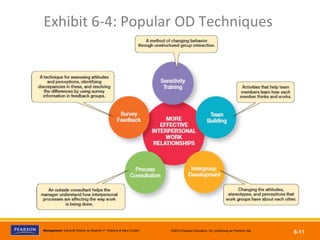
Organizational Development
• Organizational Development (OD) -
techniques or programs to change people and
the nature and quality of interpersonal work
relationships.
Copyright © 2012 Pearson Education, Inc.
Publishing as Prentice HallManagement, Eleventh Edition by Stephen P. Robbins & Mary Coulter ©2012 Pearson Education, Inc. publishing as Prentice Hall
6-11
Exhibit 6-4: Popular OD Techniques
Copyright © 2012 Pearson Education, Inc.
Publishing as Prentice HallManagement, Eleventh Edition by Stephen P. Robbins & Mary Coulter ©2012 Pearson Education, Inc. publishing as Prentice Hall
6-12
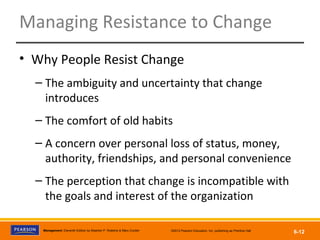
Managing Resistance to Change
• Why People Resist Change
– The ambiguity and uncertainty that change
introduces
– The comfort of old habits
– A concern over personal loss of status, money,
authority, friendships, and personal convenience
– The perception that change is incompatible with
the goals and interest of the organization
Copyright © 2012 Pearson Education, Inc.
Publishing as Prentice HallManagement, Eleventh Edition by Stephen P. Robbins & Mary Coulter ©2012 Pearson Education, Inc. publishing as Prentice Hall
6-13
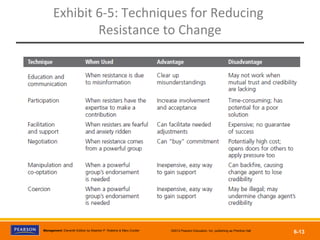
Exhibit 6-5: Techniques for Reducing
Resistance to Change
Copyright © 2012 Pearson Education, Inc.
Publishing as Prentice HallManagement, Eleventh Edition by Stephen P. Robbins & Mary Coulter ©2012 Pearson Education, Inc. publishing as Prentice Hall
6-14
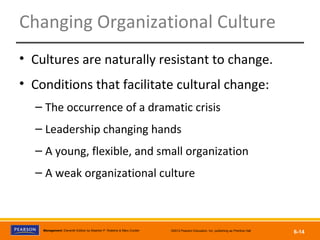
Changing Organizational Culture
• Cultures are naturally resistant to change.
• Conditions that facilitate cultural change:
– The occurrence of a dramatic crisis
– Leadership changing hands
– A young, flexible, and small organization
– A weak organizational culture
Copyright © 2012 Pearson Education, Inc.
Publishing as Prentice HallManagement, Eleventh Edition by Stephen P. Robbins & Mary Coulter ©2012 Pearson Education, Inc. publishing as Prentice Hall
6-15
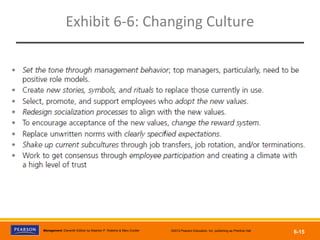
Exhibit 6-6: Changing Culture
Copyright © 2012 Pearson Education, Inc.
Publishing as Prentice HallManagement, Eleventh Edition by Stephen P. Robbins & Mary Coulter ©2012 Pearson Education, Inc. publishing as Prentice Hall
6-16
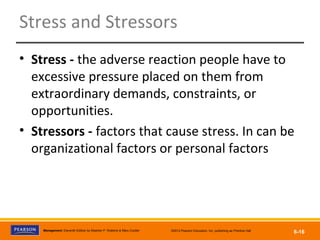
Stress and Stressors
• Stress - the adverse reaction people have to
excessive pressure placed on them from
extraordinary demands, constraints, or
opportunities.
• Stressors - factors that cause stress. In can be
organizational factors or personal factors
Copyright © 2012 Pearson Education, Inc.
Publishing as Prentice HallManagement, Eleventh Edition by Stephen P. Robbins & Mary Coulter ©2012 Pearson Education, Inc. publishing as Prentice Hall
6-17
What Causes Stress? (Organizational
factors)
1. Task demands :factors related to an employee’s
job.
2. Role Demands:
 Role Conflicts - work expectations that are hard to
satisfy.
 Role Overload - having more work to accomplish
than time permits.
 Role Ambiguity - when role expectations are not
clearly understood.
3. Interpersonal demands: pressures created by
other employees. (Lack of social support from
colleagues & poor interpersonal relationships)
Copyright © 2012 Pearson Education, Inc.
Publishing as Prentice HallManagement, Eleventh Edition by Stephen P. Robbins & Mary Coulter ©2012 Pearson Education, Inc. publishing as Prentice Hall
6-18
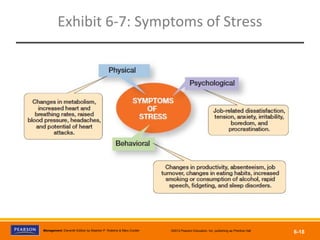
Exhibit 6-7: Symptoms of Stress
Copyright © 2012 Pearson Education, Inc.
Publishing as Prentice HallManagement, Eleventh Edition by Stephen P. Robbins & Mary Coulter ©2012 Pearson Education, Inc. publishing as Prentice Hall
6-19
Innovation
• Innovation is the key to continued success.
• Creativity - the ability to combine ideas in a
unique way or to make an unusual
association.
• Innovation - turning the outcomes of the
creative process into useful products, services,
or work methods.
Copyright © 2012 Pearson Education, Inc.
Publishing as Prentice HallManagement, Eleventh Edition by Stephen P. Robbins & Mary Coulter ©2012 Pearson Education, Inc. publishing as Prentice Hall
6-20
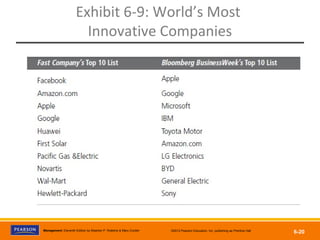
Exhibit 6-9: World’s Most
Innovative Companies
Copyright © 2012 Pearson Education, Inc.
Publishing as Prentice HallManagement, Eleventh Edition by Stephen P. Robbins & Mary Coulter ©2012 Pearson Education, Inc. publishing as Prentice Hall
6-21
Stimulating and Nurturing
Innovation
• Getting the desired outputs (innovative products and
work methods) involves transforming inputs. These inputs
include creative people and groups within the
organization.
• But having creative people isn’t enough. It takes the
right environment to help transform those inputs into
innovative products or work methods.
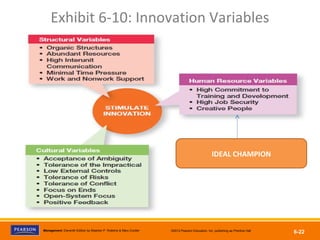
• This “right” environment is, an environment that
stimulates innovation. It includes three variables: the
structural Variable, cultural variable, and human
resource variable.
Copyright © 2012 Pearson Education, Inc.
Publishing as Prentice HallManagement, Eleventh Edition by Stephen P. Robbins & Mary Coulter ©2012 Pearson Education, Inc. publishing as Prentice Hall
6-22
Exhibit 6-10: Innovation Variables
IDEAL CHAMPION
Copyright © 2012 Pearson Education, Inc.
Publishing as Prentice HallManagement, Eleventh Edition by Stephen P. Robbins & Mary Coulter ©2012 Pearson Education, Inc. publishing as Prentice Hall
6-23
Ideal Champions
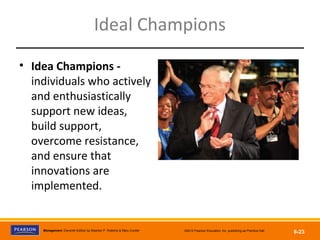
• Idea Champions -
individuals who actively
and enthusiastically
support new ideas,
build support,
overcome resistance,
and ensure that
innovations are
implemented.
Copyright © 2012 Pearson Education, Inc.
Publishing as Prentice HallManagement, Eleventh Edition by Stephen P. Robbins & Mary Coulter ©2012 Pearson Education, Inc. publishing as Prentice Hall
6-24
Terms to Know
• organizational change
• change agent
• organizational development (OD)
• stress
• creativity
• innovation
• idea champion
Copyright © 2012 Pearson Education, Inc.
Publishing as Prentice HallManagement, Eleventh Edition by Stephen P. Robbins & Mary Coulter ©2012 Pearson Education, Inc. publishing as Prentice Hall
6-25

Lec 6 managing change and innovation

  • 1.
    Copyright © 2012Pearson Education, Inc. Publishing as Prentice HallManagement, Eleventh Edition by Stephen P. Robbins & Mary Coulter ©2012 Pearson Education, Inc. publishing as Prentice Hall 6-1
  • 2.
    Copyright © 2012Pearson Education, Inc. Publishing as Prentice HallManagement, Eleventh Edition by Stephen P. Robbins & Mary Coulter ©2012 Pearson Education, Inc. publishing as Prentice Hall 6-2 • Compare and contrast views on the change process • Classify types of organizational change • Explain how to manage resistance to change • Discuss contemporary issues in managing change • Describe techniques for stimulating innovation
  • 3.
    Copyright © 2012Pearson Education, Inc. Publishing as Prentice HallManagement, Eleventh Edition by Stephen P. Robbins & Mary Coulter ©2012 Pearson Education, Inc. publishing as Prentice Hall 6-3 The Change Process If it weren’t for change, a manager’s job would be relatively easy. Planning would be simple because tomorrow would be no different from today. Similarly, decision making would be easy. •But that’s not the way it is. Change is an organizational reality. •Organizations face change because external and internal factors create the need for change
  • 4.
    Copyright © 2012Pearson Education, Inc. Publishing as Prentice HallManagement, Eleventh Edition by Stephen P. Robbins & Mary Coulter ©2012 Pearson Education, Inc. publishing as Prentice Hall 6-4 Exhibit 6-1: External and Internal Forces for Change
  • 5.
    Copyright © 2012Pearson Education, Inc. Publishing as Prentice HallManagement, Eleventh Edition by Stephen P. Robbins & Mary Coulter ©2012 Pearson Education, Inc. publishing as Prentice Hall 6-5 The Three-Step Change Process Kurt Lewin Said successful change can be planned and requires: 1. Unfreezing the status quo. 2.Changing to a new state 3. Refreezing to make the change permanent.
  • 6.
    Copyright © 2012Pearson Education, Inc. Publishing as Prentice HallManagement, Eleventh Edition by Stephen P. Robbins & Mary Coulter ©2012 Pearson Education, Inc. publishing as Prentice Hall 6-6 Organizational Change and Change Agents • Organizational Change - any alterations in the people, structure, or technology of an organization. • Change Agents - persons who act as catalysts and assume the responsibility for managing the change process.
  • 7.
    Copyright © 2012Pearson Education, Inc. Publishing as Prentice HallManagement, Eleventh Edition by Stephen P. Robbins & Mary Coulter ©2012 Pearson Education, Inc. publishing as Prentice Hall 6-7 Types of Change Agents • Managers: internal entrepreneurs • Non-managers: change specialists • Outside consultants: change implementation experts
  • 8.
    Copyright © 2012Pearson Education, Inc. Publishing as Prentice HallManagement, Eleventh Edition by Stephen P. Robbins & Mary Coulter ©2012 Pearson Education, Inc. publishing as Prentice Hall 6-8 Types of Change • Structure – Changing an organization’s structural components or its structural design • Technology – Adopting new equipment, tools, or operating methods that displace old skills and require new ones • Automation - replacing certain tasks done by people with machines • Computerization • People – Changing attitudes, expectations, perceptions, and behaviors of the workforce
  • 9.
    Copyright © 2012Pearson Education, Inc. Publishing as Prentice HallManagement, Eleventh Edition by Stephen P. Robbins & Mary Coulter ©2012 Pearson Education, Inc. publishing as Prentice Hall 6-9 Exhibit 6-3: Three Types of Change
  • 10.
    Copyright © 2012Pearson Education, Inc. Publishing as Prentice HallManagement, Eleventh Edition by Stephen P. Robbins & Mary Coulter ©2012 Pearson Education, Inc. publishing as Prentice Hall 6-10 Organizational Development • Organizational Development (OD) - techniques or programs to change people and the nature and quality of interpersonal work relationships.
  • 11.
    Copyright © 2012Pearson Education, Inc. Publishing as Prentice HallManagement, Eleventh Edition by Stephen P. Robbins & Mary Coulter ©2012 Pearson Education, Inc. publishing as Prentice Hall 6-11 Exhibit 6-4: Popular OD Techniques
  • 12.
    Copyright © 2012Pearson Education, Inc. Publishing as Prentice HallManagement, Eleventh Edition by Stephen P. Robbins & Mary Coulter ©2012 Pearson Education, Inc. publishing as Prentice Hall 6-12 Managing Resistance to Change • Why People Resist Change – The ambiguity and uncertainty that change introduces – The comfort of old habits – A concern over personal loss of status, money, authority, friendships, and personal convenience – The perception that change is incompatible with the goals and interest of the organization
  • 13.
    Copyright © 2012Pearson Education, Inc. Publishing as Prentice HallManagement, Eleventh Edition by Stephen P. Robbins & Mary Coulter ©2012 Pearson Education, Inc. publishing as Prentice Hall 6-13 Exhibit 6-5: Techniques for Reducing Resistance to Change
  • 14.
    Copyright © 2012Pearson Education, Inc. Publishing as Prentice HallManagement, Eleventh Edition by Stephen P. Robbins & Mary Coulter ©2012 Pearson Education, Inc. publishing as Prentice Hall 6-14 Changing Organizational Culture • Cultures are naturally resistant to change. • Conditions that facilitate cultural change: – The occurrence of a dramatic crisis – Leadership changing hands – A young, flexible, and small organization – A weak organizational culture
  • 15.
    Copyright © 2012Pearson Education, Inc. Publishing as Prentice HallManagement, Eleventh Edition by Stephen P. Robbins & Mary Coulter ©2012 Pearson Education, Inc. publishing as Prentice Hall 6-15 Exhibit 6-6: Changing Culture
  • 16.
    Copyright © 2012Pearson Education, Inc. Publishing as Prentice HallManagement, Eleventh Edition by Stephen P. Robbins & Mary Coulter ©2012 Pearson Education, Inc. publishing as Prentice Hall 6-16 Stress and Stressors • Stress - the adverse reaction people have to excessive pressure placed on them from extraordinary demands, constraints, or opportunities. • Stressors - factors that cause stress. In can be organizational factors or personal factors
  • 17.
    Copyright © 2012Pearson Education, Inc. Publishing as Prentice HallManagement, Eleventh Edition by Stephen P. Robbins & Mary Coulter ©2012 Pearson Education, Inc. publishing as Prentice Hall 6-17 What Causes Stress? (Organizational factors) 1. Task demands :factors related to an employee’s job. 2. Role Demands:  Role Conflicts - work expectations that are hard to satisfy.  Role Overload - having more work to accomplish than time permits.  Role Ambiguity - when role expectations are not clearly understood. 3. Interpersonal demands: pressures created by other employees. (Lack of social support from colleagues & poor interpersonal relationships)
  • 18.
    Copyright © 2012Pearson Education, Inc. Publishing as Prentice HallManagement, Eleventh Edition by Stephen P. Robbins & Mary Coulter ©2012 Pearson Education, Inc. publishing as Prentice Hall 6-18 Exhibit 6-7: Symptoms of Stress
  • 19.
    Copyright © 2012Pearson Education, Inc. Publishing as Prentice HallManagement, Eleventh Edition by Stephen P. Robbins & Mary Coulter ©2012 Pearson Education, Inc. publishing as Prentice Hall 6-19 Innovation • Innovation is the key to continued success. • Creativity - the ability to combine ideas in a unique way or to make an unusual association. • Innovation - turning the outcomes of the creative process into useful products, services, or work methods.
  • 20.
    Copyright © 2012Pearson Education, Inc. Publishing as Prentice HallManagement, Eleventh Edition by Stephen P. Robbins & Mary Coulter ©2012 Pearson Education, Inc. publishing as Prentice Hall 6-20 Exhibit 6-9: World’s Most Innovative Companies
  • 21.
    Copyright © 2012Pearson Education, Inc. Publishing as Prentice HallManagement, Eleventh Edition by Stephen P. Robbins & Mary Coulter ©2012 Pearson Education, Inc. publishing as Prentice Hall 6-21 Stimulating and Nurturing Innovation • Getting the desired outputs (innovative products and work methods) involves transforming inputs. These inputs include creative people and groups within the organization. • But having creative people isn’t enough. It takes the right environment to help transform those inputs into innovative products or work methods. • This “right” environment is, an environment that stimulates innovation. It includes three variables: the structural Variable, cultural variable, and human resource variable.
  • 22.
    Copyright © 2012Pearson Education, Inc. Publishing as Prentice HallManagement, Eleventh Edition by Stephen P. Robbins & Mary Coulter ©2012 Pearson Education, Inc. publishing as Prentice Hall 6-22 Exhibit 6-10: Innovation Variables IDEAL CHAMPION
  • 23.
    Copyright © 2012Pearson Education, Inc. Publishing as Prentice HallManagement, Eleventh Edition by Stephen P. Robbins & Mary Coulter ©2012 Pearson Education, Inc. publishing as Prentice Hall 6-23 Ideal Champions • Idea Champions - individuals who actively and enthusiastically support new ideas, build support, overcome resistance, and ensure that innovations are implemented.
  • 24.
    Copyright © 2012Pearson Education, Inc. Publishing as Prentice HallManagement, Eleventh Edition by Stephen P. Robbins & Mary Coulter ©2012 Pearson Education, Inc. publishing as Prentice Hall 6-24 Terms to Know • organizational change • change agent • organizational development (OD) • stress • creativity • innovation • idea champion
  • 25.
    Copyright © 2012Pearson Education, Inc. Publishing as Prentice HallManagement, Eleventh Edition by Stephen P. Robbins & Mary Coulter ©2012 Pearson Education, Inc. publishing as Prentice Hall 6-25