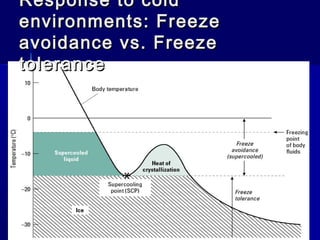
Response to cold
environments: Freeze
avoidance vs. Freeze
tolerance
Dealing with cold—
Mammals







Increase insulation
Decrease heat
loss
Increase
metabolism
Decrease
metabolic costs
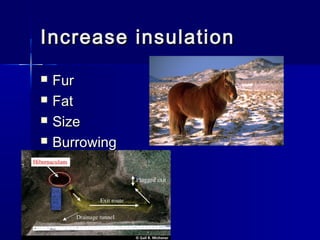
Increase insulation





Fur
Fat
Size
Burrowing
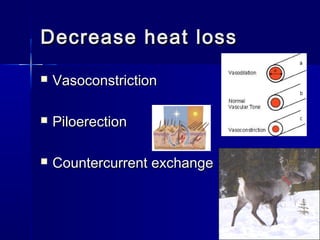
Decrease heat loss


Vasoconstriction



Piloerection



Countercurrent exchange
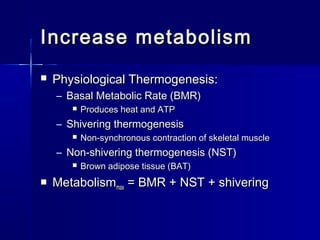
Increase metabolism


Physiological Thermogenesis:
– Basal Metabolic Rate (BMR)


Produces heat and ATP

– Shivering thermogenesis


Non-synchronous contraction of skeletal muscle

– Non-shivering thermogenesis (NST)




Brown adipose tissue (BAT)

Metabolismmax = BMR + NST + shivering
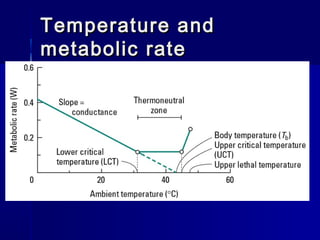
Temperature and
metabolic rate
Torpor and Hibernation




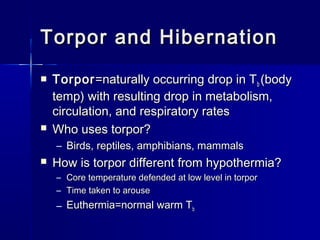
Torpor =naturally occurring drop in Tb (body
temp) with resulting drop in metabolism,
circulation, and respiratory rates
Who uses torpor?
– Birds, reptiles, amphibians, mammals



How is torpor different from hypothermia?
– Core temperature defended at low level in torpor
– Time taken to arouse

– Euthermia=normal warm Tb
Torpor and Hibernation
(cont)



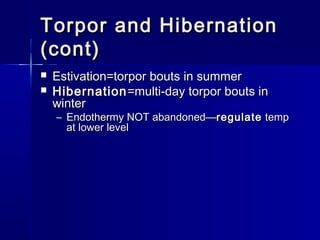
Estivation=torpor bouts in summer
Hibernation =multi-day torpor bouts in
winter

– Endothermy NOT abandoned—regulate temp
at lower level
Hibernation


How developed?
–
–



Ancestral condition
Evolved separately in birds and mammals

Why do only some members of each group
hibernate?
– Size
– Resource availability



‘True’ hibernation vs. ‘winter lethargy’

– True hibernators are smaller, drop Tb to close to
ambient, bouts last several days
– Winter lethargy (bears, carnivores)—temp drops
a few degrees, bouts last weeks-months
The Hibernation Cycle:
Fall (Aug-Oct):
Major fat-building
(lipogenic) period-pack on as much
fat as possible,
prepare burrows
for winter

Winter (Oct-Mar):
Animals enter
hibernation, drop
Tb to near Ta,
drop metabolic
rate, start burning
fat reserves

Summer (MayAug): Continue
feeding to build
fat, sunning to
help store fat,
juveniles mature

Spring (MarMay): Arousal—
males first, then
females; mating,
parturition, start
replacing body
mass lost
Hibernation (cont)


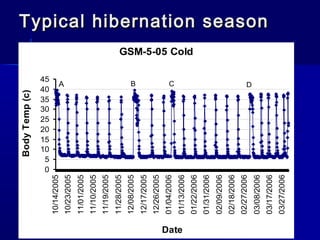
A typical torpor bout (marmot):
– Animal drops Tb to near Ta, slows metabolism
(2-6 hours)



Respiration, heart, metabolic rates drop
Synapses separate in brain—brain dead!

– Animal remains at low tissue temp (6-8 days)


Metabolic process occur at very low levels

– Animal returns to euthermic temperature (1-2
hours)


Synapses re-grow, metabolic & cardiovascular rates
speed up, animal becomes active
Date
03/27/2006

03/17/2006

03/08/2006

C

02/27/2006

02/18/2006

02/09/2006

01/31/2006

01/22/2006

01/13/2006

B

01/04/2006

12/26/2005

12/17/2005

A

12/08/2005

11/28/2005

11/19/2005

11/10/2005

11/01/2005

10/23/2005

45
40
35
30
25
20
15
10
5
0
10/14/2005

Body Temp (c)

Typical hibernation season
GSM-5-05 Cold
D
Obesity and hibernation


Obesity=excessive accumulation of
body fat

– Generally considered pathogenic
– Diabetes, atherosclerosis, osteoarthritis



Hibernating animals become fat
without associated pathologies
– Hormone pathway blocking
– Time span/seasonality of obesity
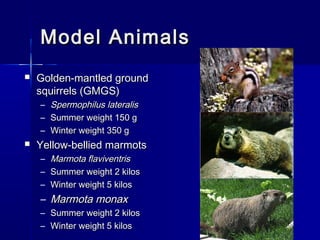
Model Animals


Golden-mantled ground
squirrels (GMGS)
–
–
–



Spermophilus lateralis
Summer weight 150 g
Winter weight 350 g

Yellow-bellied marmots
– Marmota flaviventris
– Summer weight 2 kilos
– Winter weight 5 kilos

– Marmota monax
– Summer weight 2 kilos
– Winter weight 5 kilos
What can we measure?





Body temperature (implanted data
loggers, temp tracking radio collars)
Hormone levels (factors in obesity,
food intake)
Dietary choices (energy levels, fatty
acids for membrane fluidity)
Behavior (constrained by food intake,
dietary choices)

Torpor

Editor's Notes

  • #2 Freeze avoidance=drop Tb below 0 celsius—use supercooling/antifreeze compounds (glycerol, sugars, salt) to prevent ice crystal formation (remove nucleating substances from extracellular fluids) (Arctic GS, polar fishes) Freeze tolerance=slowly controlled ice crystal formation in extracellular fluids—use nucleating agents to control when and where ice crystal formation occurs so cell membranes aren’t punctured (some amphibians and reptiles)