www.bsmimpact.com
Maximising value and building
trust in your digital supply chain
Matthew Burrows | Director | BSMimpact
THE CHANGING LANDSCAPE OF DIGITAL
SUPPLY
3
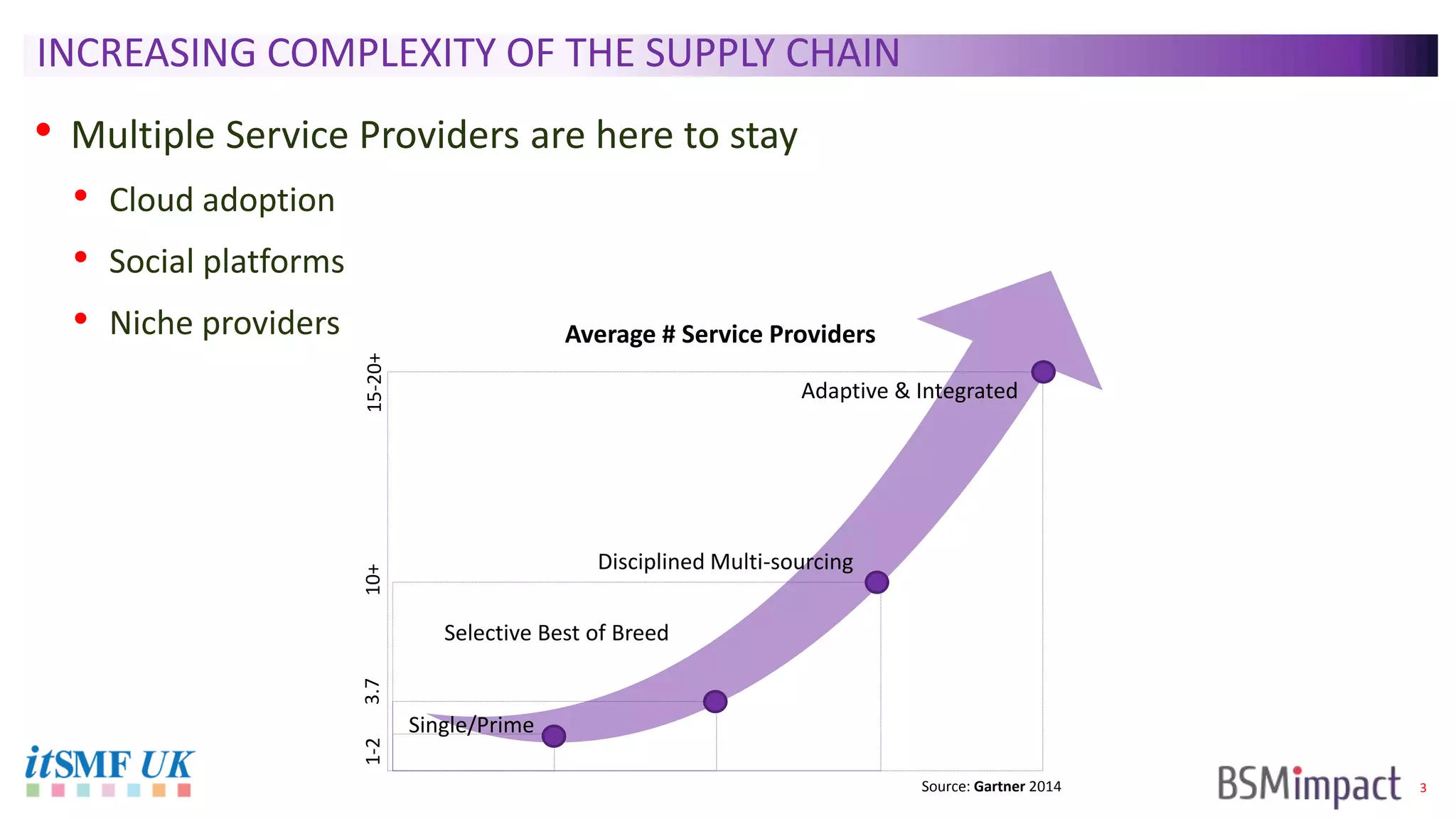
INCREASING COMPLEXITY OF THE SUPPLY CHAIN
• Multiple Service Providers are here to stay
• Cloud adoption
• Social platforms
• Niche providers Average # Service Providers
1-23.710+15-20+
Source: Gartner 2014
Adaptive & Integrated
Disciplined Multi-sourcing
Selective Best of Breed
Single/Prime
4
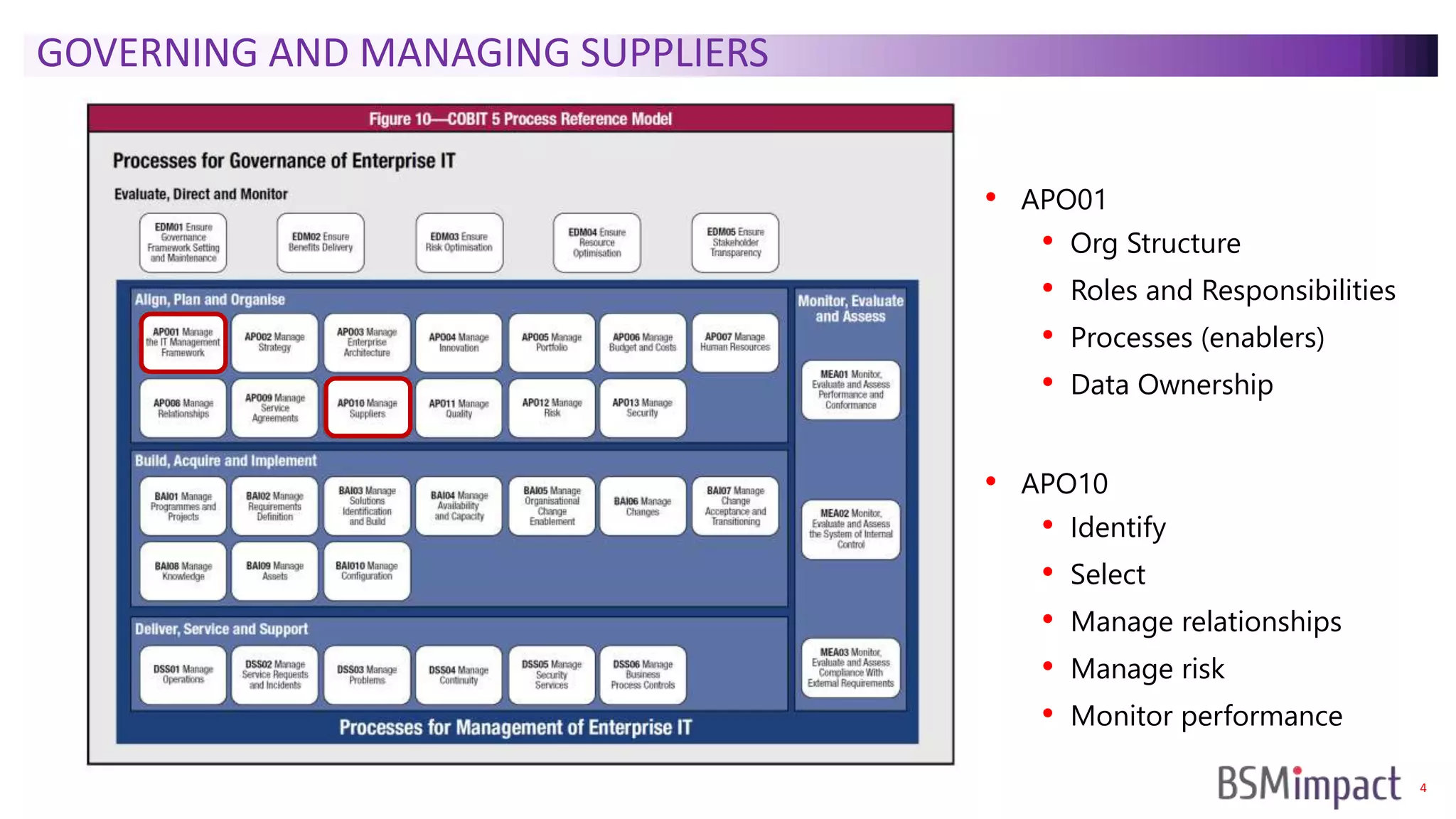
GOVERNING AND MANAGING SUPPLIERS
• APO01
• Org Structure
• Roles and Responsibilities
• Processes (enablers)
• Data Ownership
• APO10
• Identify
• Select
• Manage relationships
• Manage risk
• Monitor performance
5
INTRODUCING SIAM
• Multi Supplier Management with SIAM
• What is SIAM (Service Integration and Management)
• 5 elements
o Governance
o Management
o Integration
o Assurance
o Coordination
6
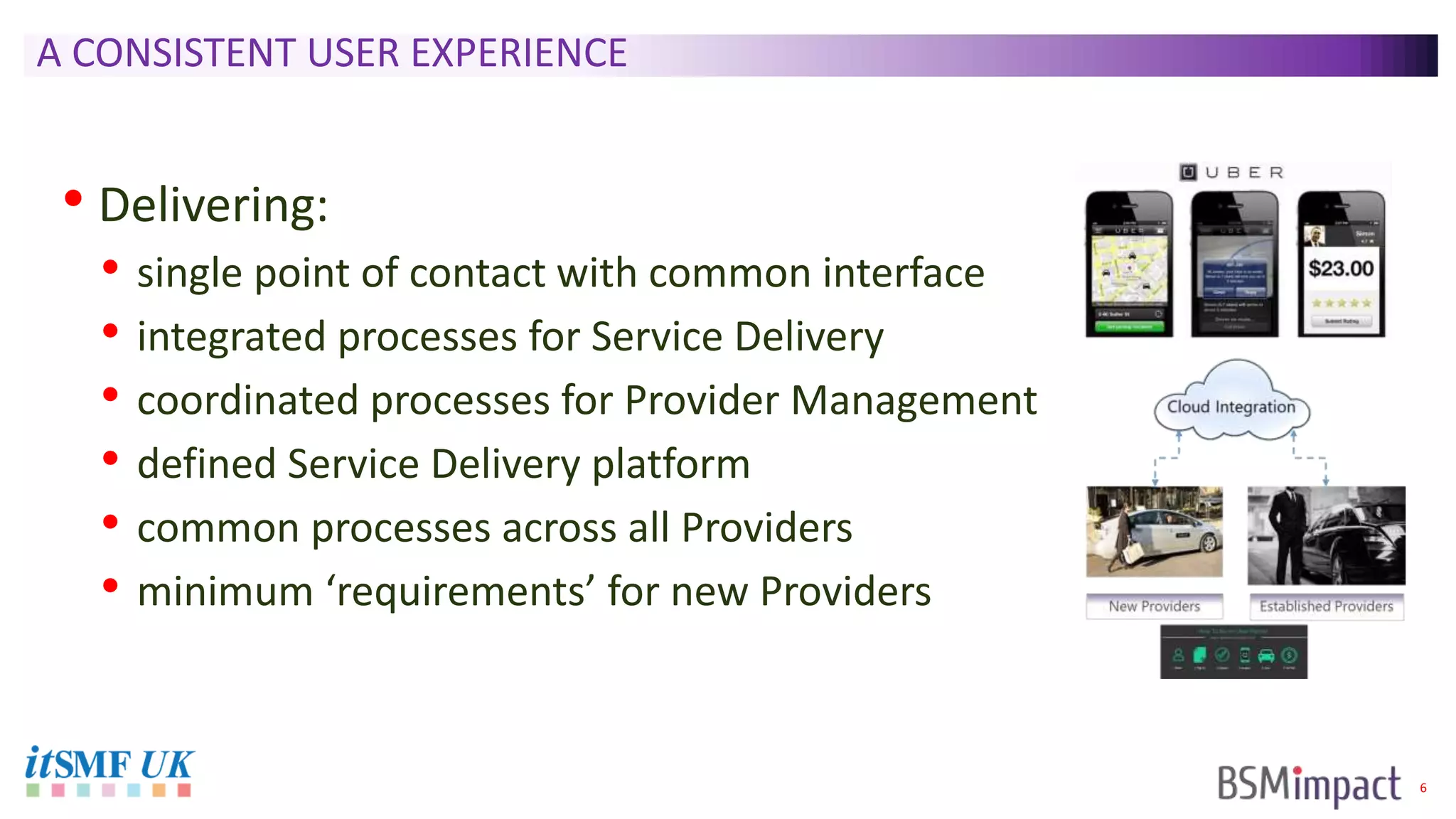
A CONSISTENT USER EXPERIENCE
• Delivering:
• single point of contact with common interface
• integrated processes for Service Delivery
• coordinated processes for Provider Management
• defined Service Delivery platform
• common processes across all Providers
• minimum ‘requirements’ for new Providers
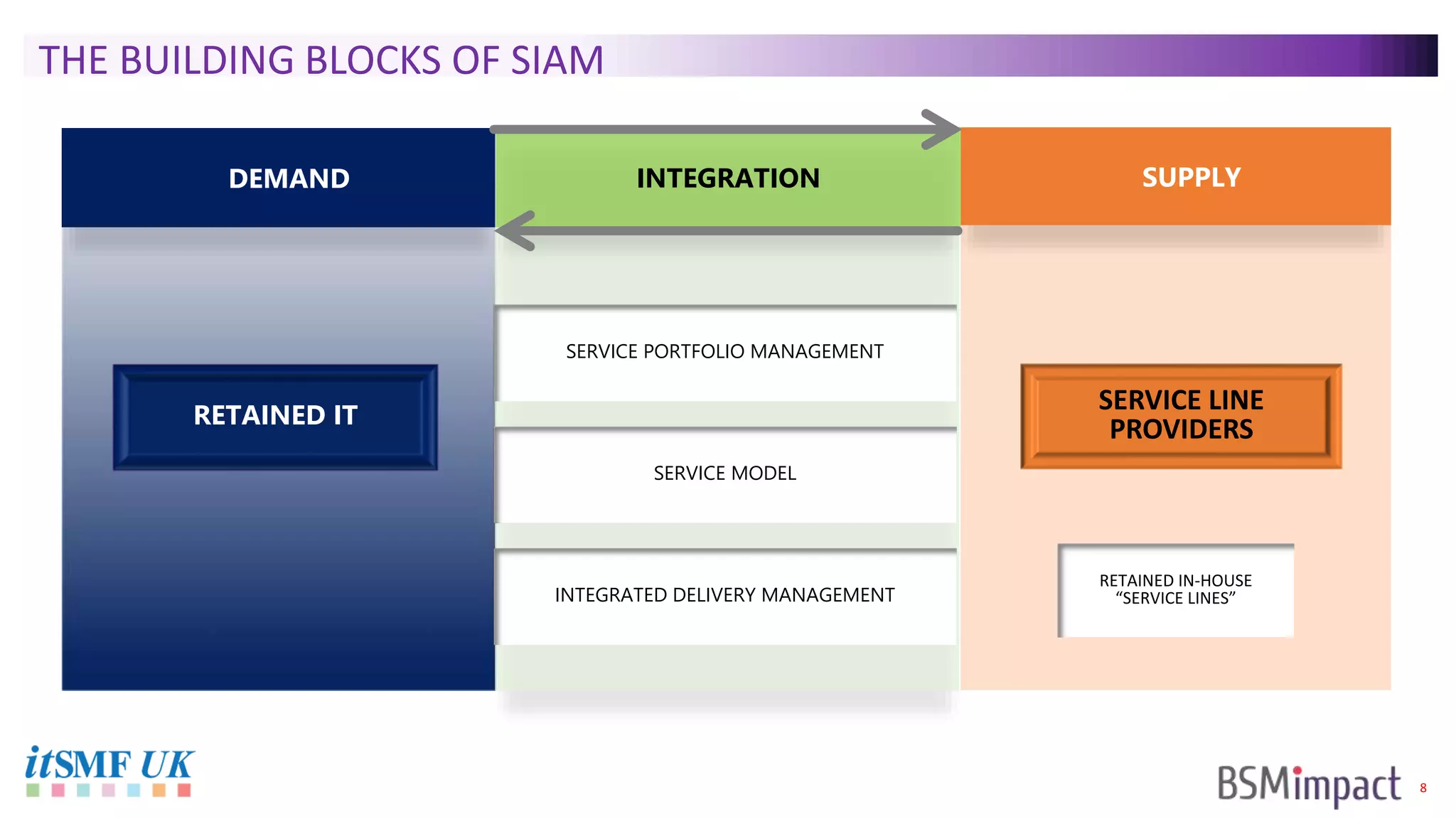
8
SUPPLY
SERVICE LINE
PROVIDERS
RETAINED IN-HOUSE
“SERVICE LINES”
DEMAND
RETAINED IT
SERVICE PORTFOLIO MANAGEMENT
SERVICE MODEL
INTEGRATED DELIVERY MANAGEMENT
INTEGRATION
THE BUILDING BLOCKS OF SIAM
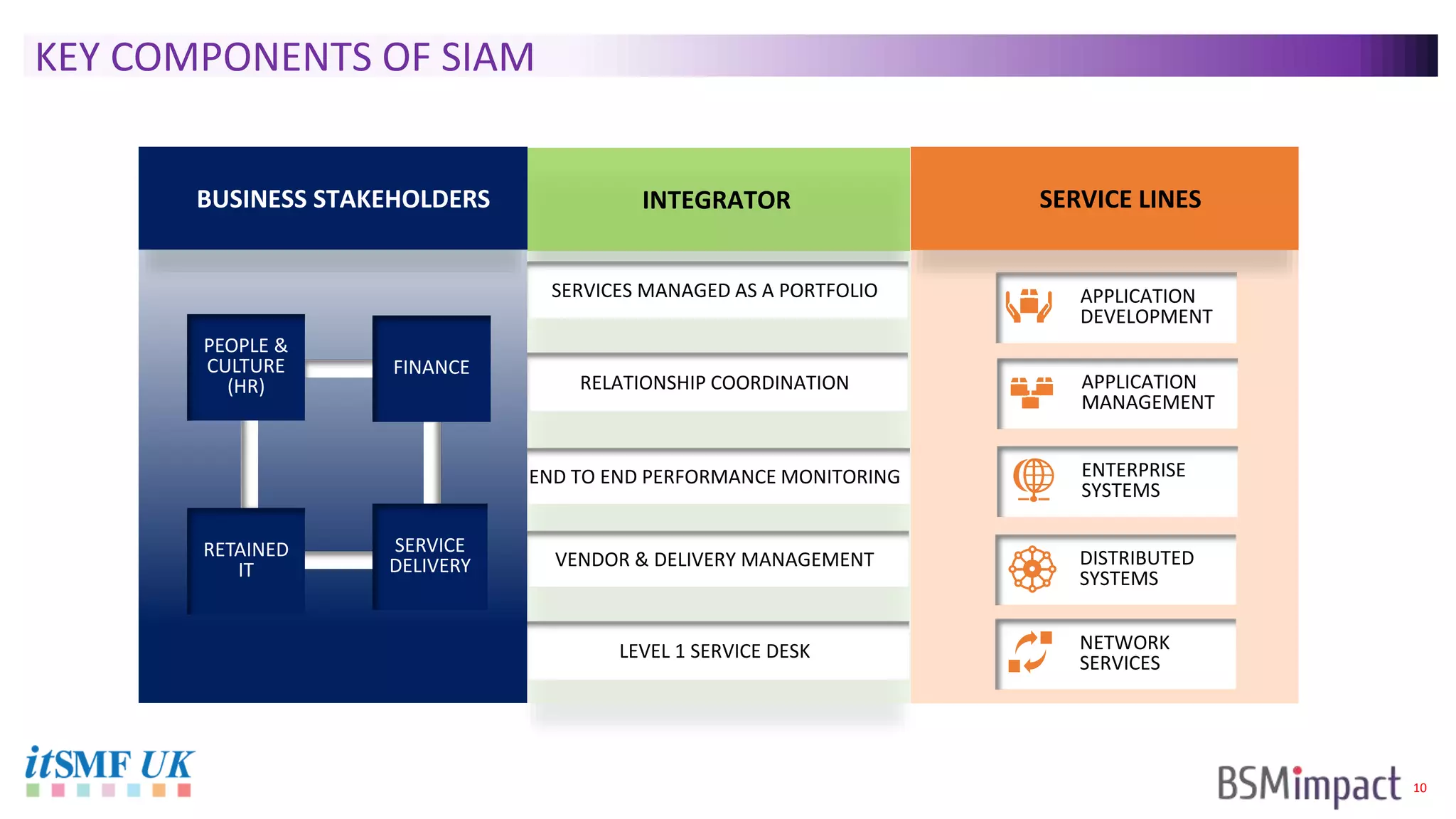
10
INTEGRATOR
SERVICES MANAGED AS A PORTFOLIO
RELATIONSHIP COORDINATION
END TO END PERFORMANCE MONITORING
VENDOR & DELIVERY MANAGEMENT
LEVEL 1 SERVICE DESK
SERVICE LINES
APPLICATION
DEVELOPMENT
APPLICATION
MANAGEMENT
ENTERPRISE
SYSTEMS
DISTRIBUTED
SYSTEMS
NETWORK
SERVICES
BUSINESS STAKEHOLDERS
SERVICE
DELIVERY
RETAINED
IT
PEOPLE &
CULTURE
(HR)
FINANCE
KEY COMPONENTS OF SIAM
12
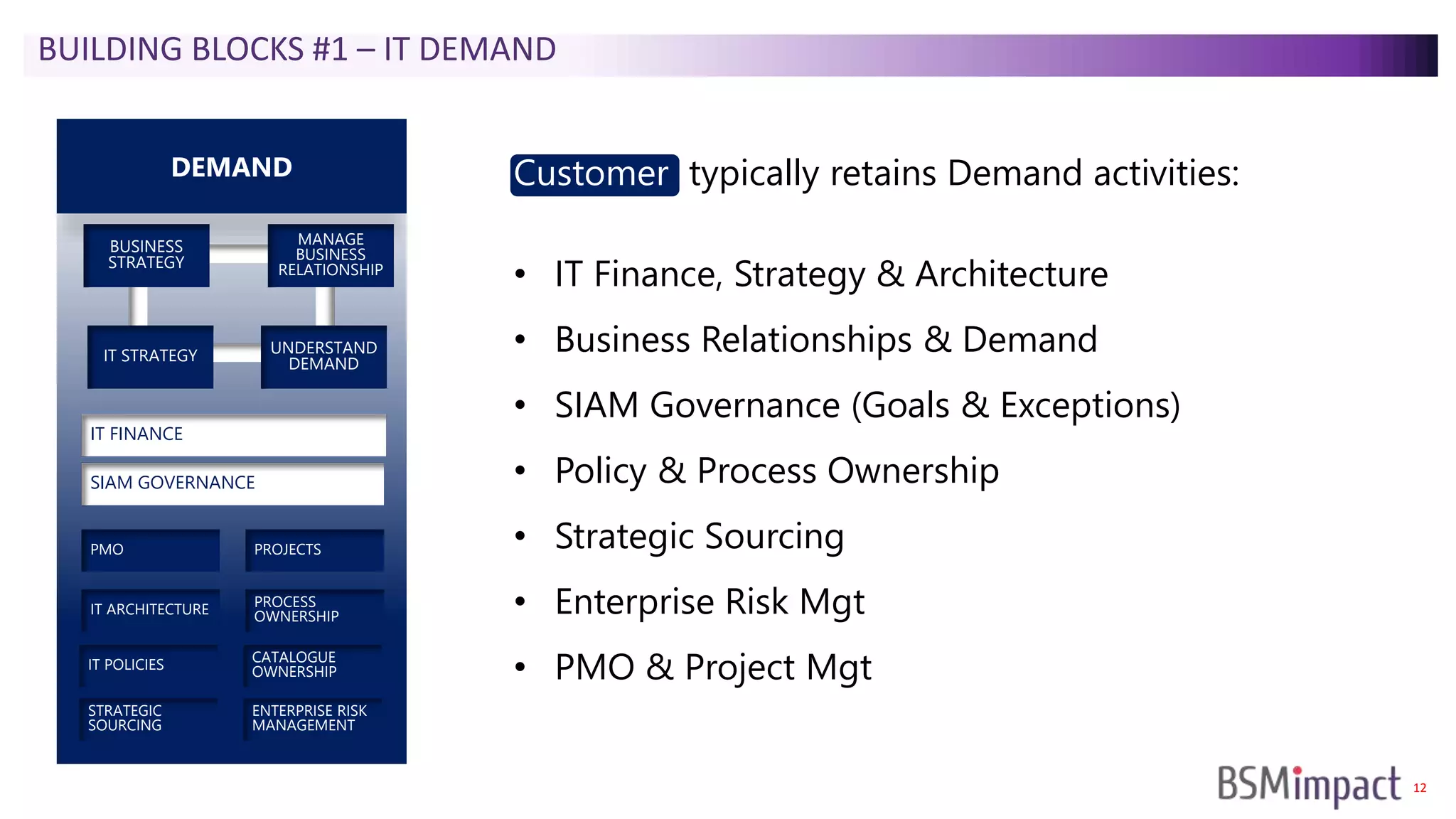
BUILDING BLOCKS #1 – IT DEMAND
Customer typically retains Demand activities:
• IT Finance, Strategy & Architecture
• Business Relationships & Demand
• SIAM Governance (Goals & Exceptions)
• Policy & Process Ownership
• Strategic Sourcing
• Enterprise Risk Mgt
• PMO & Project Mgt
DEMAND
UNDERSTAND
DEMANDIT STRATEGY
BUSINESS
STRATEGY
MANAGE
BUSINESS
RELATIONSHIP
IT FINANCE
SIAM GOVERNANCE
PMO PROJECTS
IT ARCHITECTURE PROCESS
OWNERSHIP
IT POLICIES CATALOGUE
OWNERSHIP
STRATEGIC
SOURCING
ENTERPRISE RISK
MANAGEMENT
14
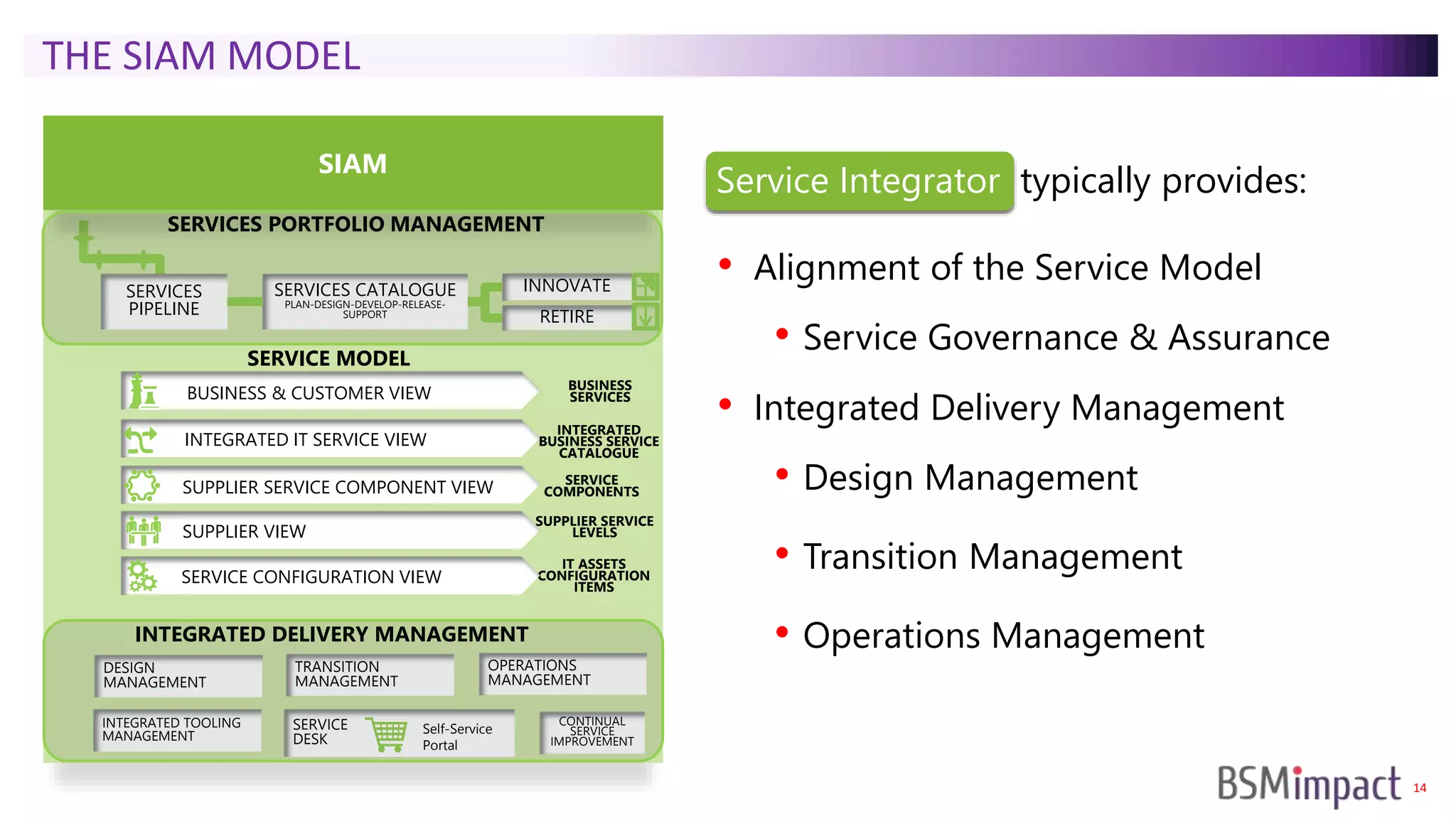
INTEGRATED
BUSINESS SERVICE
CATALOGUE
SERVICE
COMPONENTS
SUPPLIER SERVICE
LEVELS
IT ASSETS
CONFIGURATION
ITEMS
BUSINESS & CUSTOMER VIEW
INTEGRATED IT SERVICE VIEW
SUPPLIER SERVICE COMPONENT VIEW
SERVICES CATALOGUE
PLAN-DESIGN-DEVELOP-RELEASE-
SUPPORT
INNOVATE
RETIRE
SERVICE MODEL
SERVICES PORTFOLIO MANAGEMENT
SERVICES
PIPELINE
SUPPLIER VIEW
SERVICE CONFIGURATION VIEW
INTEGRATED DELIVERY MANAGEMENT
DESIGN
MANAGEMENT
TRANSITION
MANAGEMENT
OPERATIONS
MANAGEMENT
INTEGRATED TOOLING
MANAGEMENT
SERVICE
DESK
Self-Service
Portal
CONTINUAL
SERVICE
IMPROVEMENT
BUSINESS
SERVICES
SIAM
THE SIAM MODEL
• Alignment of the Service Model
• Service Governance & Assurance
• Integrated Delivery Management
• Design Management
• Transition Management
• Operations Management
Service Integrator typically provides:
16
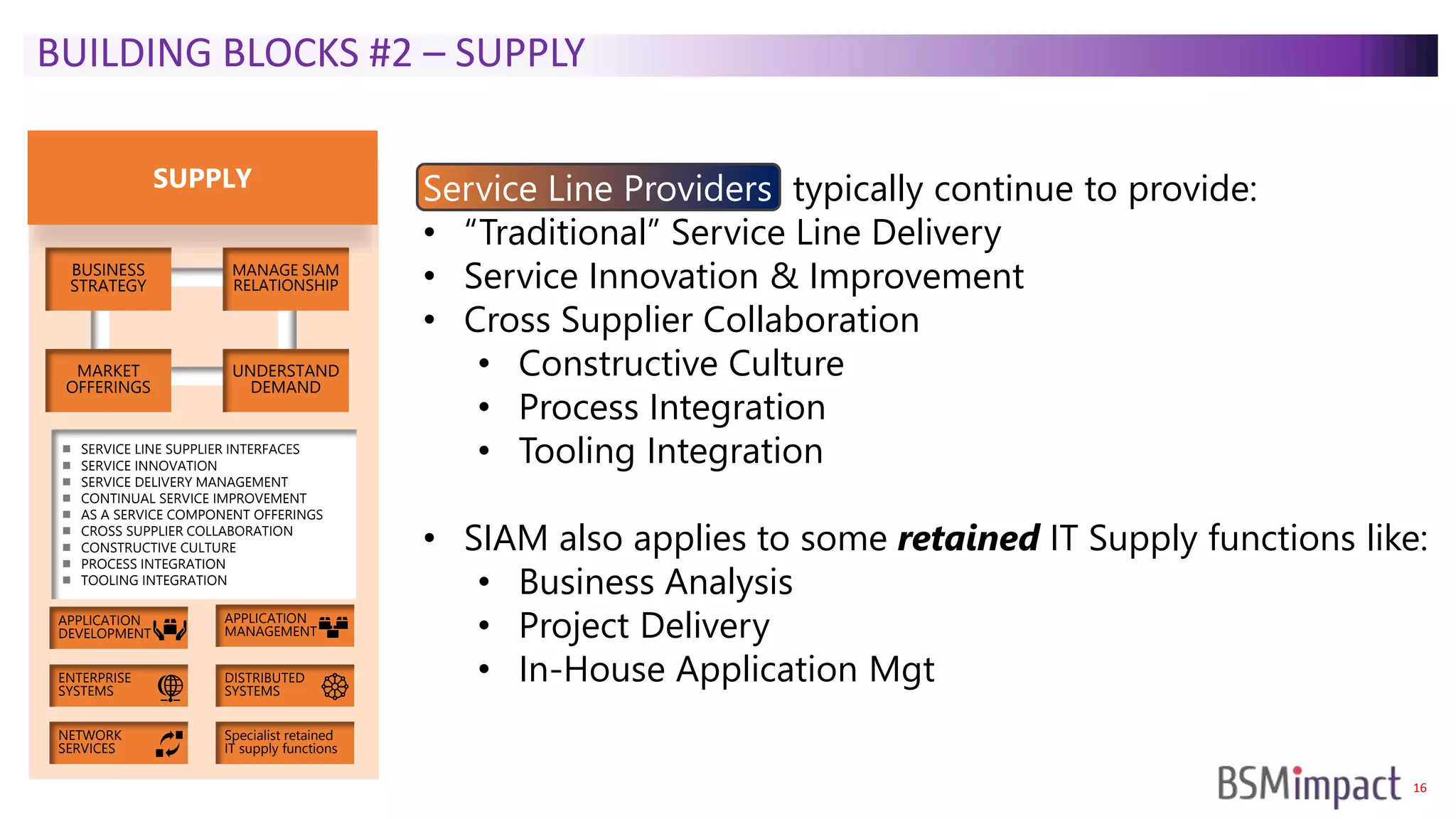
Service Line Providers typically continue to provide:
• “Traditional” Service Line Delivery
• Service Innovation & Improvement
• Cross Supplier Collaboration
• Constructive Culture
• Process Integration
• Tooling Integration
• SIAM also applies to some retained IT Supply functions like:
• Business Analysis
• Project Delivery
• In-House Application Mgt
SUPPLY
UNDERSTAND
DEMAND
MARKET
OFFERINGS
BUSINESS
STRATEGY
MANAGE SIAM
RELATIONSHIP
 SERVICE LINE SUPPLIER INTERFACES
 SERVICE INNOVATION
 SERVICE DELIVERY MANAGEMENT
 CONTINUAL SERVICE IMPROVEMENT
 AS A SERVICE COMPONENT OFFERINGS
 CROSS SUPPLIER COLLABORATION
 CONSTRUCTIVE CULTURE
 PROCESS INTEGRATION
 TOOLING INTEGRATION
APPLICATION
DEVELOPMENT
APPLICATION
MANAGEMENT
ENTERPRISE
SYSTEMS
DISTRIBUTED
SYSTEMS
NETWORK
SERVICES
Specialist retained
IT supply functions
BUILDING BLOCKS #2 – SUPPLY
18
DEMAND
UNDERSTAND
DEMANDIT STRATEGY
BUSINESS
STRATEGY
MANAGE
BUSINESS
RELATIONSHIP
IT FINANCE
SIAM GOVERNANCE
PMO PROJECTS
IT ARCHITECTURE PROCESS
OWNERSHIP
IT POLICIES CATALOGUE
OWNERSHIP
STRATEGIC
SOURCING
ENTERPRISE RISK
MANAGEMENT
SUPPLY
UNDERSTAND
DEMAND
MARKET
OFFERINGS
BUSINESS
STRATEGY
MANAGE SIAM
RELATIONSHIP
 SERVICE LINE SUPPLIER INTERFACES
 SERVICE INNOVATION
 SERVICE DELIVERY MANAGEMENT
 CONTINUAL SERVICE IMPROVEMENT
 AS A SERVICE COMPONENT OFFERINGS
 CROSS SUPPLIER COLLABORATION
 CONSTRUCTIVE CULTURE
 PROCESS INTEGRATION
 TOOLING INTEGRATION
APPLICATION
DEVELOPMENT
APPLICATION
MANAGEMENT
ENTERPRISE
SYSTEMS
DISTRIBUTED
SYSTEMS
NETWORK
SERVICES
Specialist retained
IT supply functions
INTEGRATED
BUSINESS SERVICE
CATALOGUE
SERVICE
COMPONENTS
SUPPLIER SERVICE
LEVELS
IT ASSETS
CONFIGURATION
ITEMS
BUSINESS & CUSTOMER VIEW
INTEGRATED IT SERVICE VIEW
SUPPLIER SERVICE COMPONENT VIEW
SERVICES CATALOGUE
PLAN-DESIGN-DEVELOP-RELEASE-
SUPPORT
INNOVATE
RETIRE
SERVICE MODEL
SERVICES PORTFOLIO MANAGEMENT
SERVICES
PIPELINE
SUPPLIER VIEW
SERVICE CONFIGURATION VIEW
INTEGRATED DELIVERY MANAGEMENT
DESIGN
MANAGEMENT
TRANSITION
MANAGEMENT
OPERATIONS
MANAGEMENT
INTEGRATED TOOLING
MANAGEMENT
SERVICE
DESK
Self-Service
Portal
CONTINUAL
SERVICE
IMPROVEMENT
BUSINESS
SERVICES
INTEGRATION
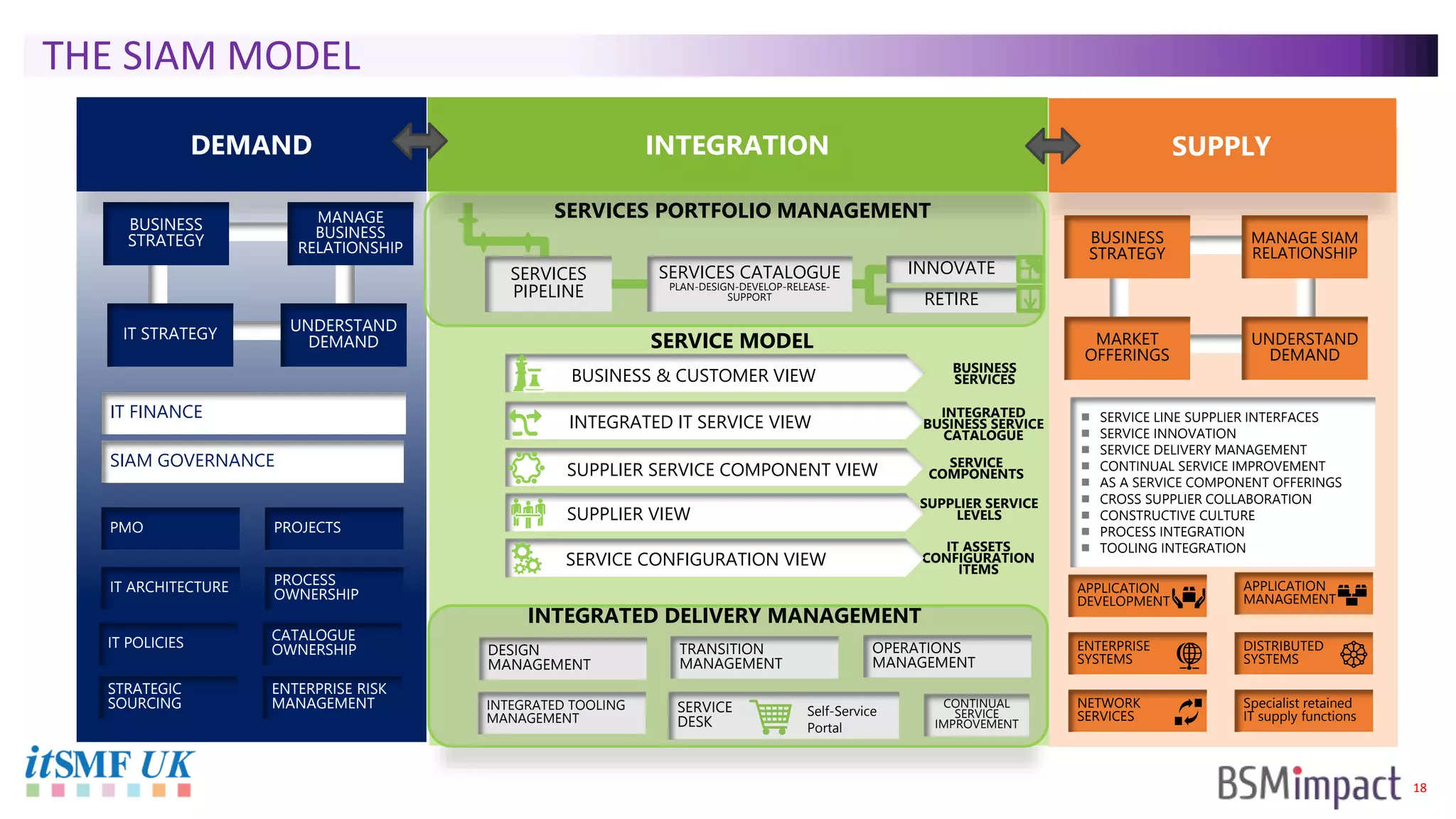
THE SIAM MODEL
20
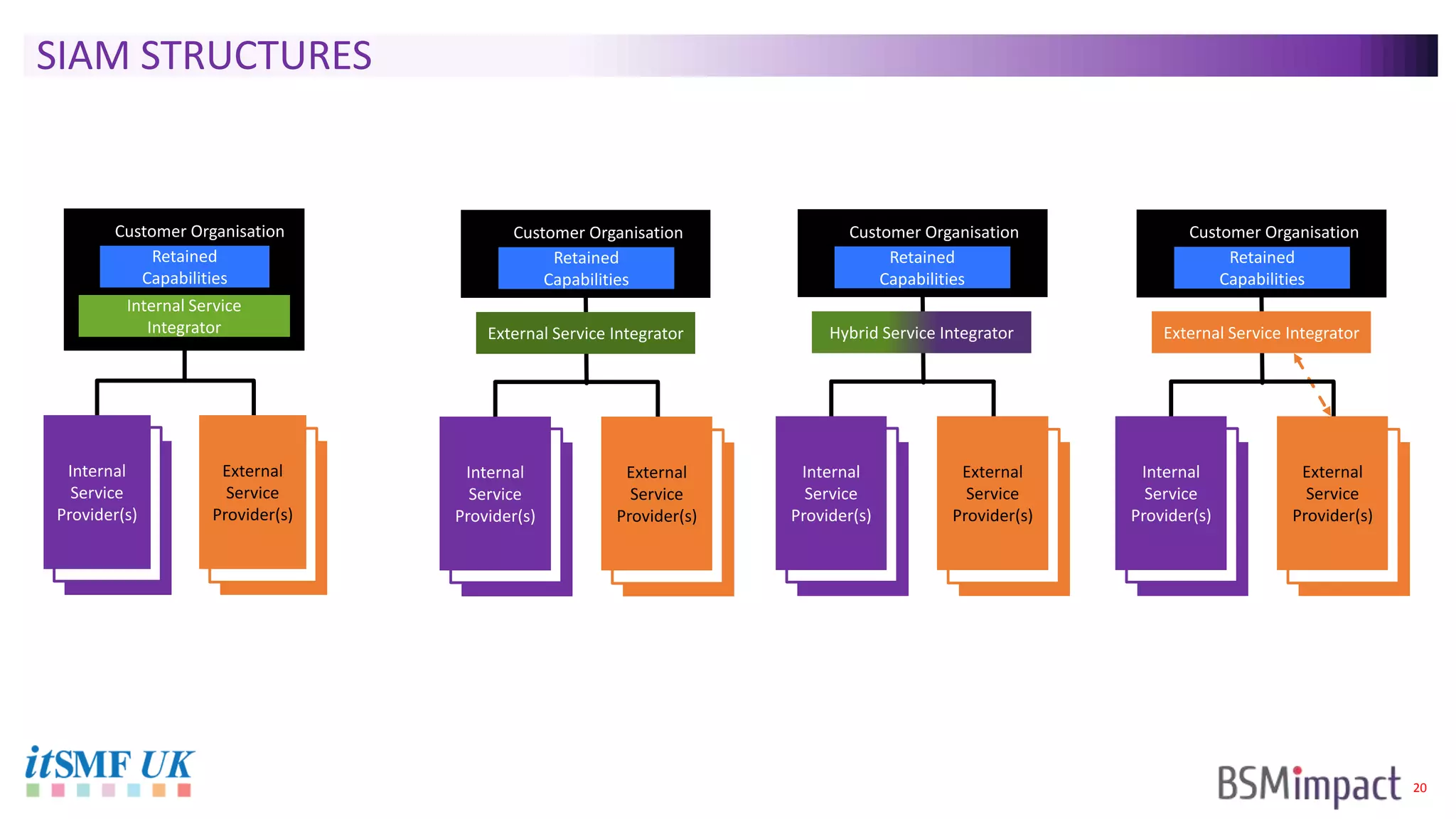
SIAM STRUCTURES
External
Service
Provider(s)
Internal
Service
Provider(s)
Internal
Service
Provider(s)
Customer Organisation
Retained
Capabilities
Internal Service
Integrator
Internal
Service
Provider(s)
External
Service
Provider(s)
External
Service
Provider(s)
Customer Organisation
Retained
Capabilities
External Service Integrator
External
Service
Provider(s)
Internal
Service
Provider(s)
Internal
Service
Provider(s)
Internal
Service
Provider(s)
External
Service
Provider(s)
External
Service
Provider(s)
Customer Organisation
Retained
Capabilities
Hybrid Service Integrator
External
Service
Provider(s)
Internal
Service
Provider(s)
Internal
Service
Provider(s)
Internal
Service
Provider(s)
External
Service
Provider(s)
External
Service
Provider(s)
Customer Organisation
Retained
Capabilities
External Service Integrator
External
Service
Provider(s)
Internal
Service
Provider(s)
Internal
Service
Provider(s)
Internal
Service
Provider(s)
External
Service
Provider(s)
External
Service
Provider(s)
21
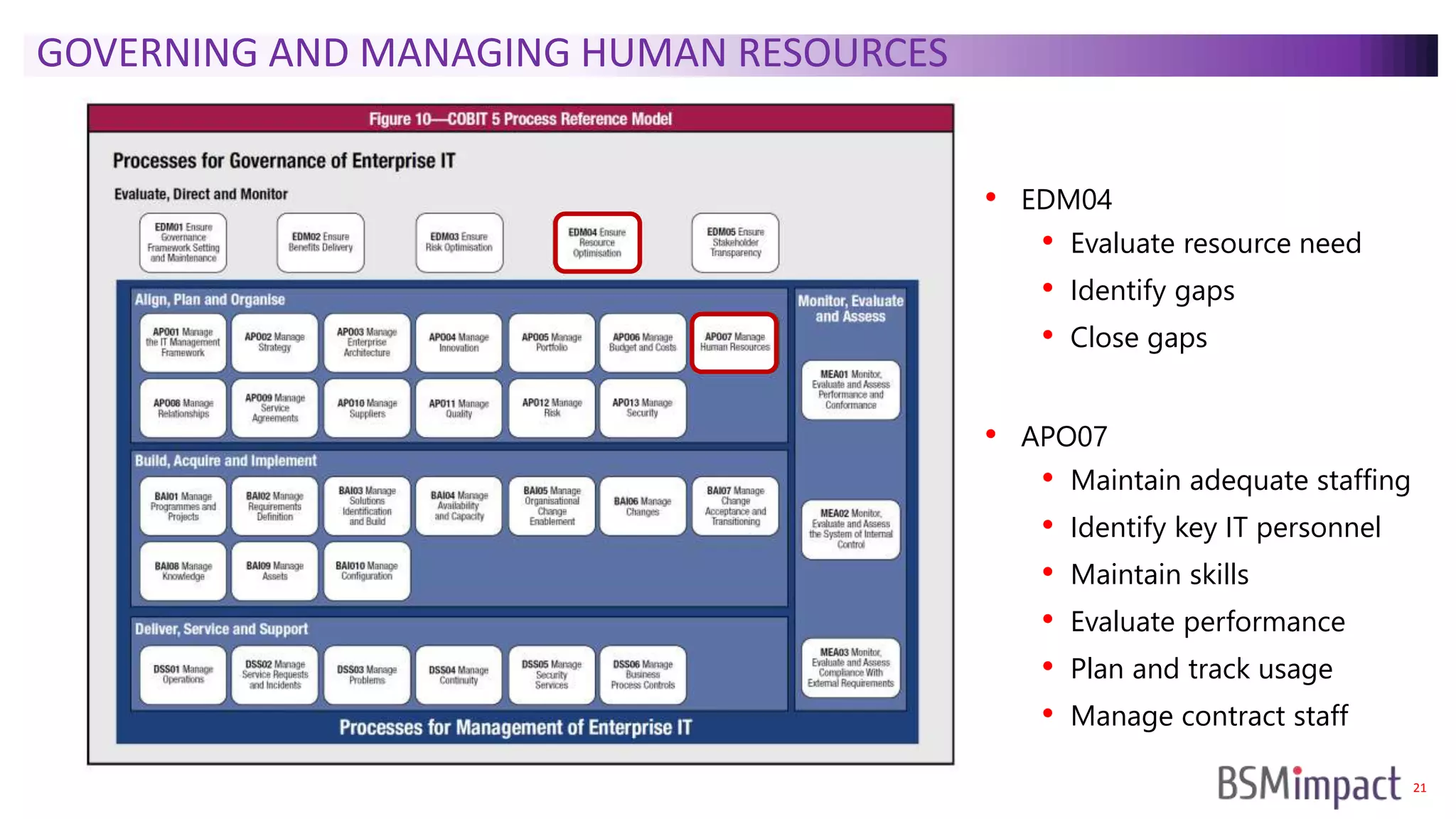
GOVERNING AND MANAGING HUMAN RESOURCES
• EDM04
• Evaluate resource need
• Identify gaps
• Close gaps
• APO07
• Maintain adequate staffing
• Identify key IT personnel
• Maintain skills
• Evaluate performance
• Plan and track usage
• Manage contract staff
22
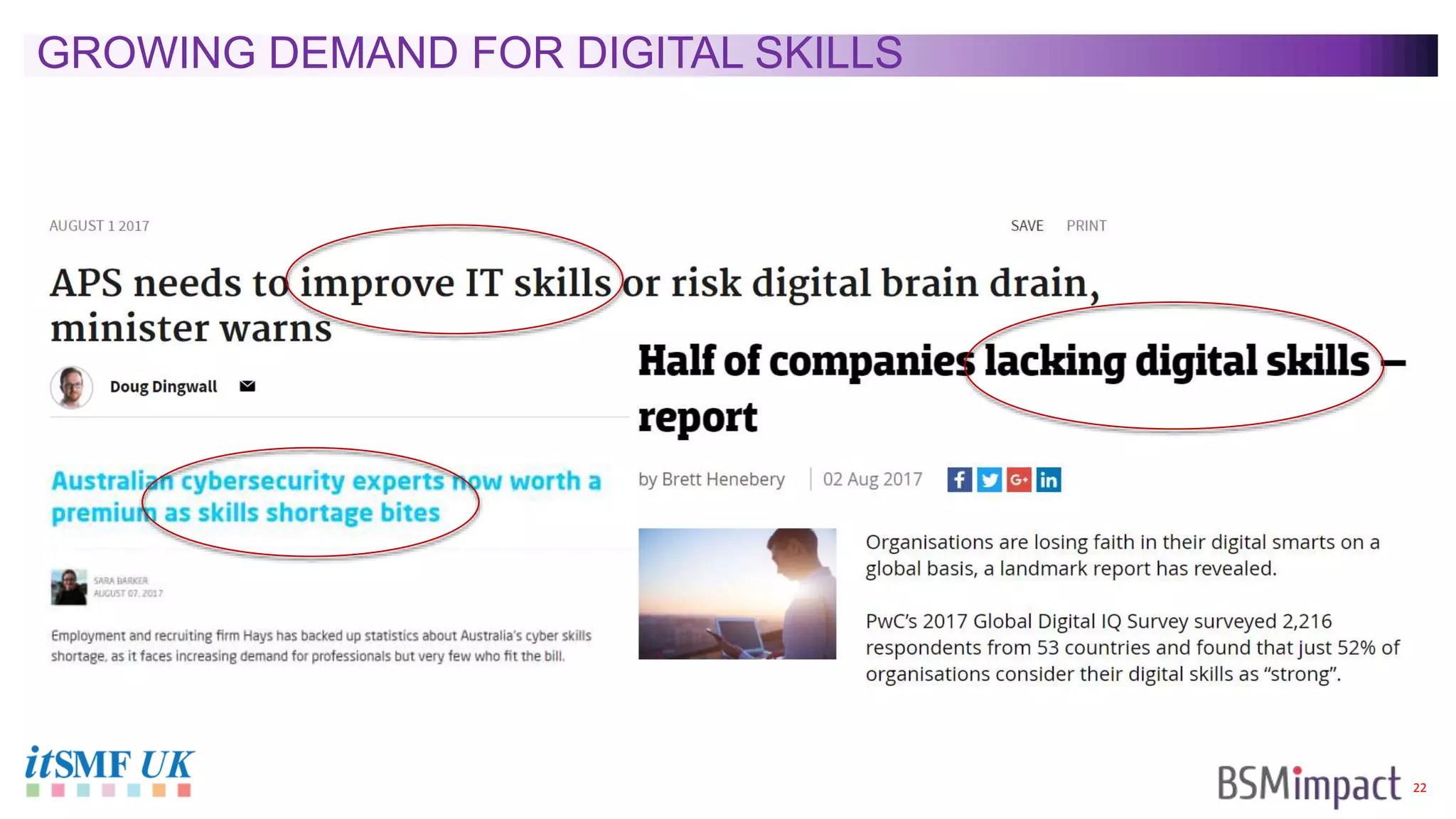
GROWING DEMAND FOR DIGITAL SKILLS
23
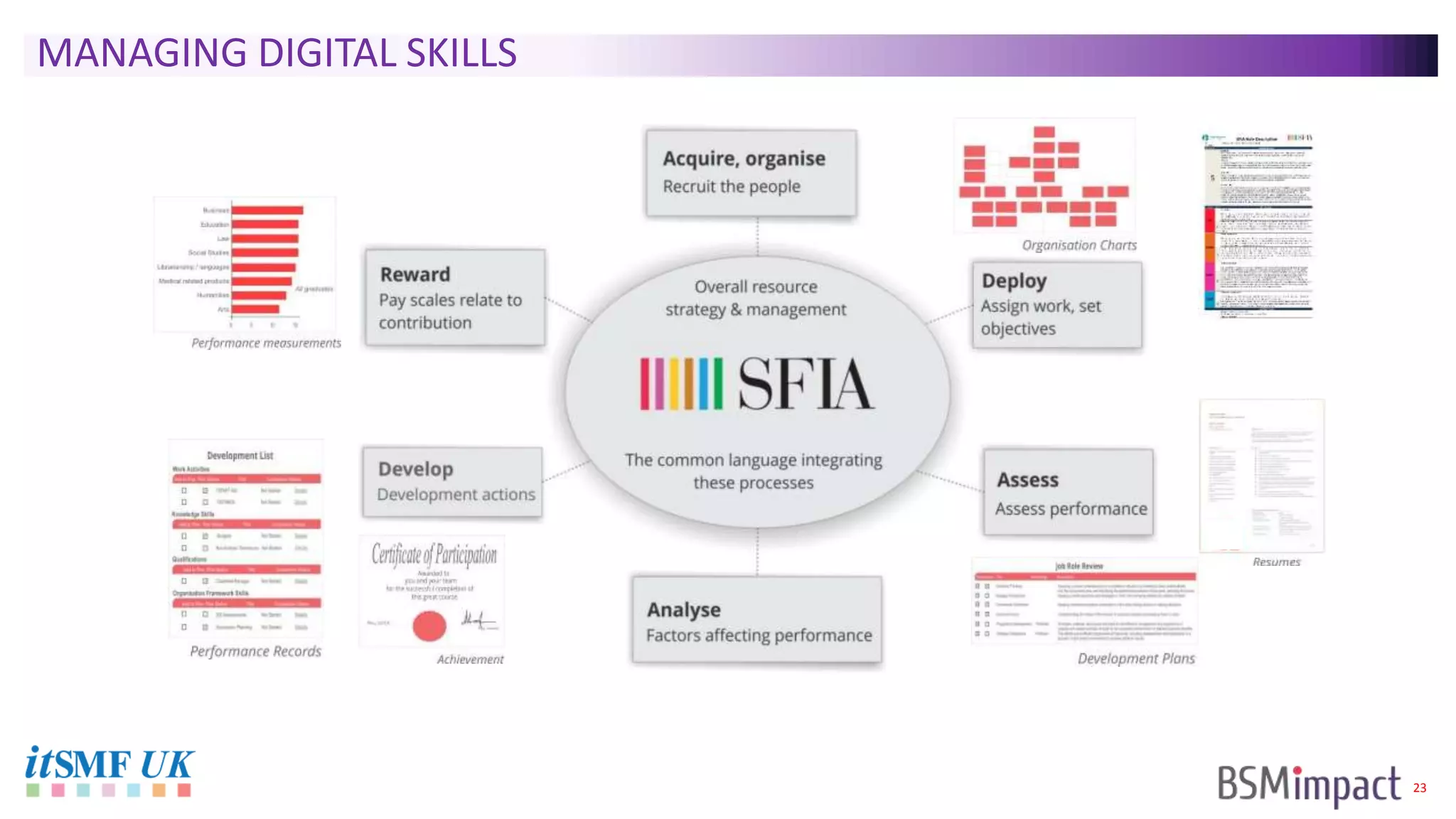
MANAGING DIGITAL SKILLS
24
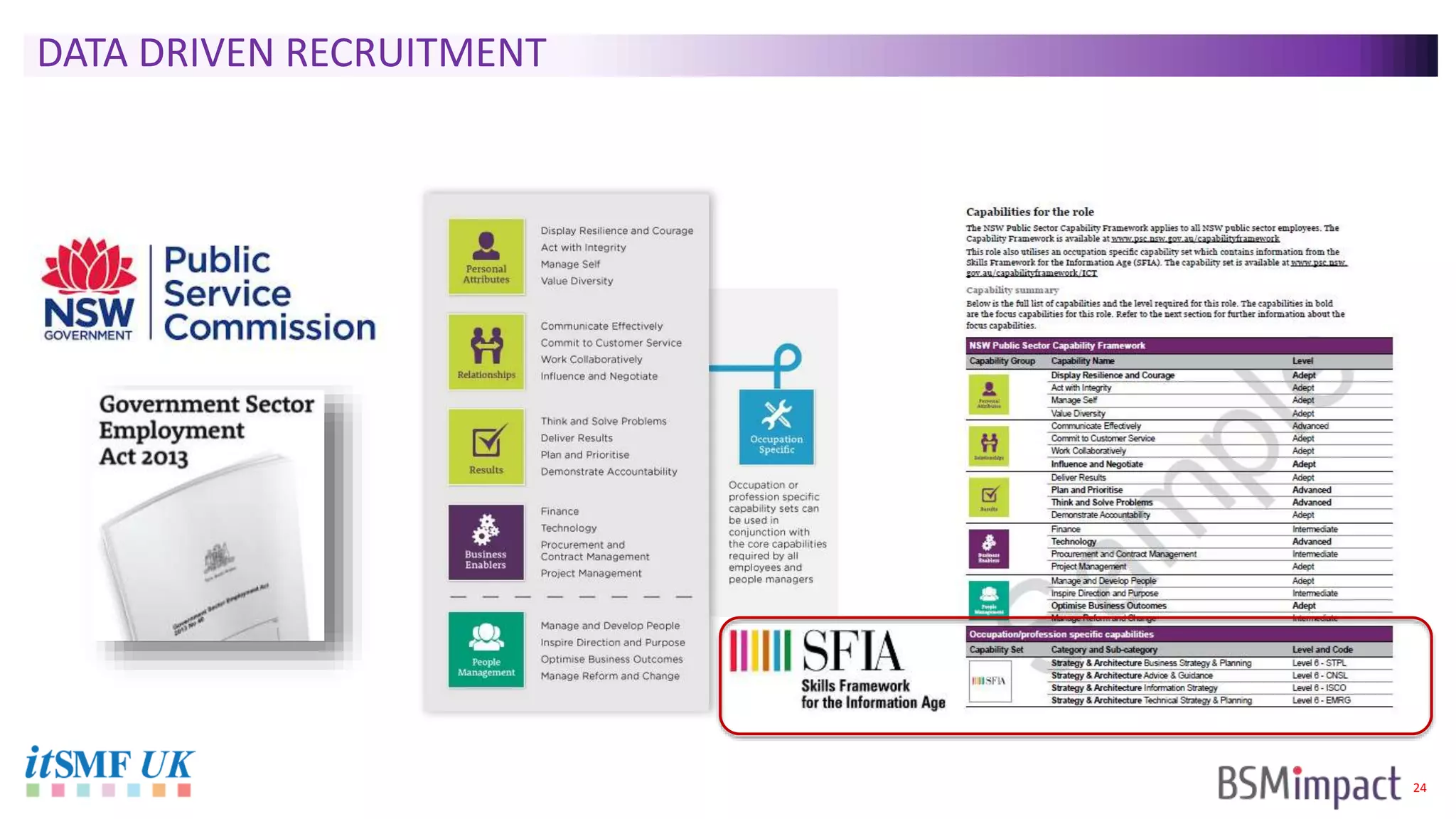
DATA DRIVEN RECRUITMENT
25
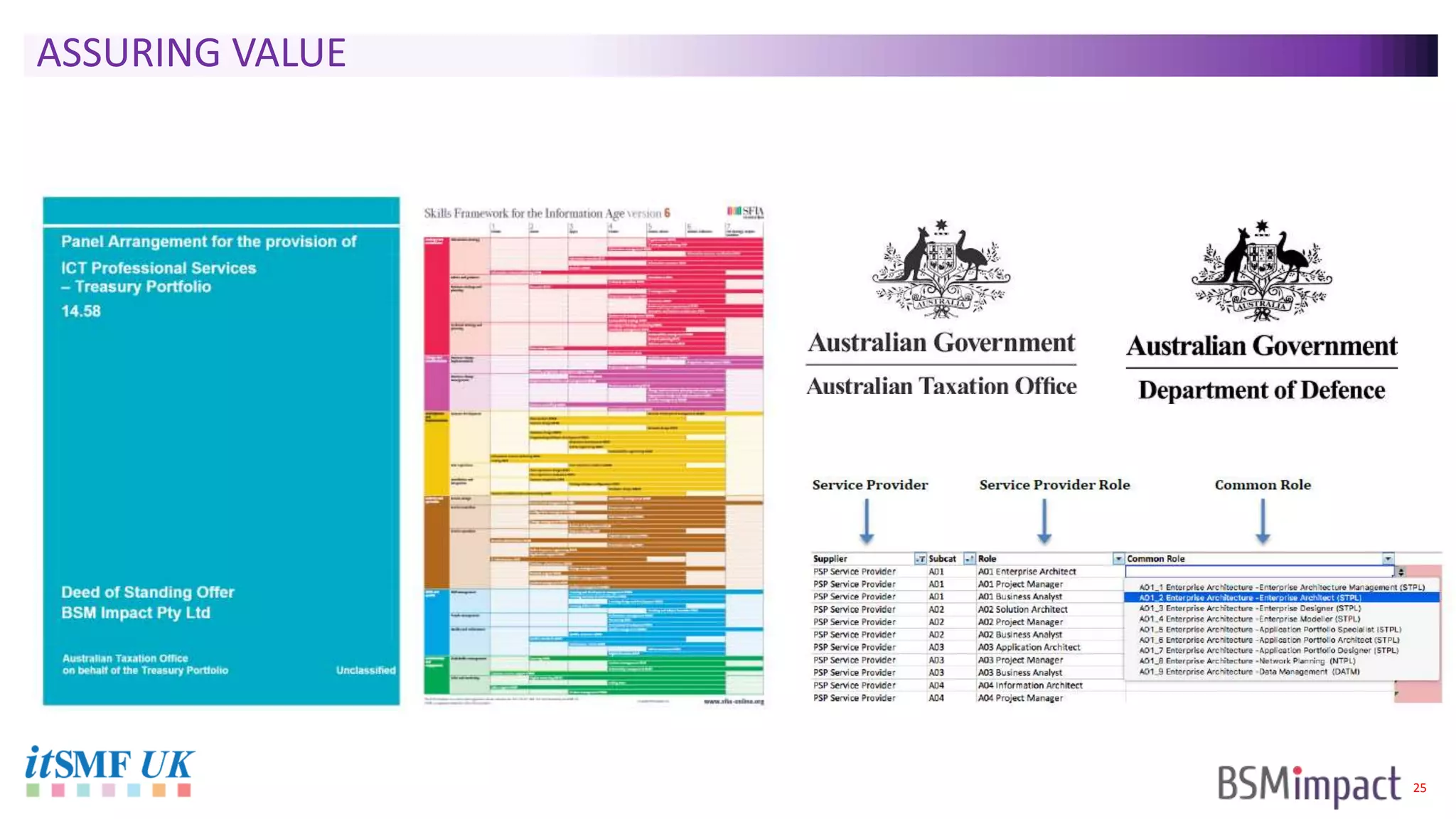
ASSURING VALUE
26
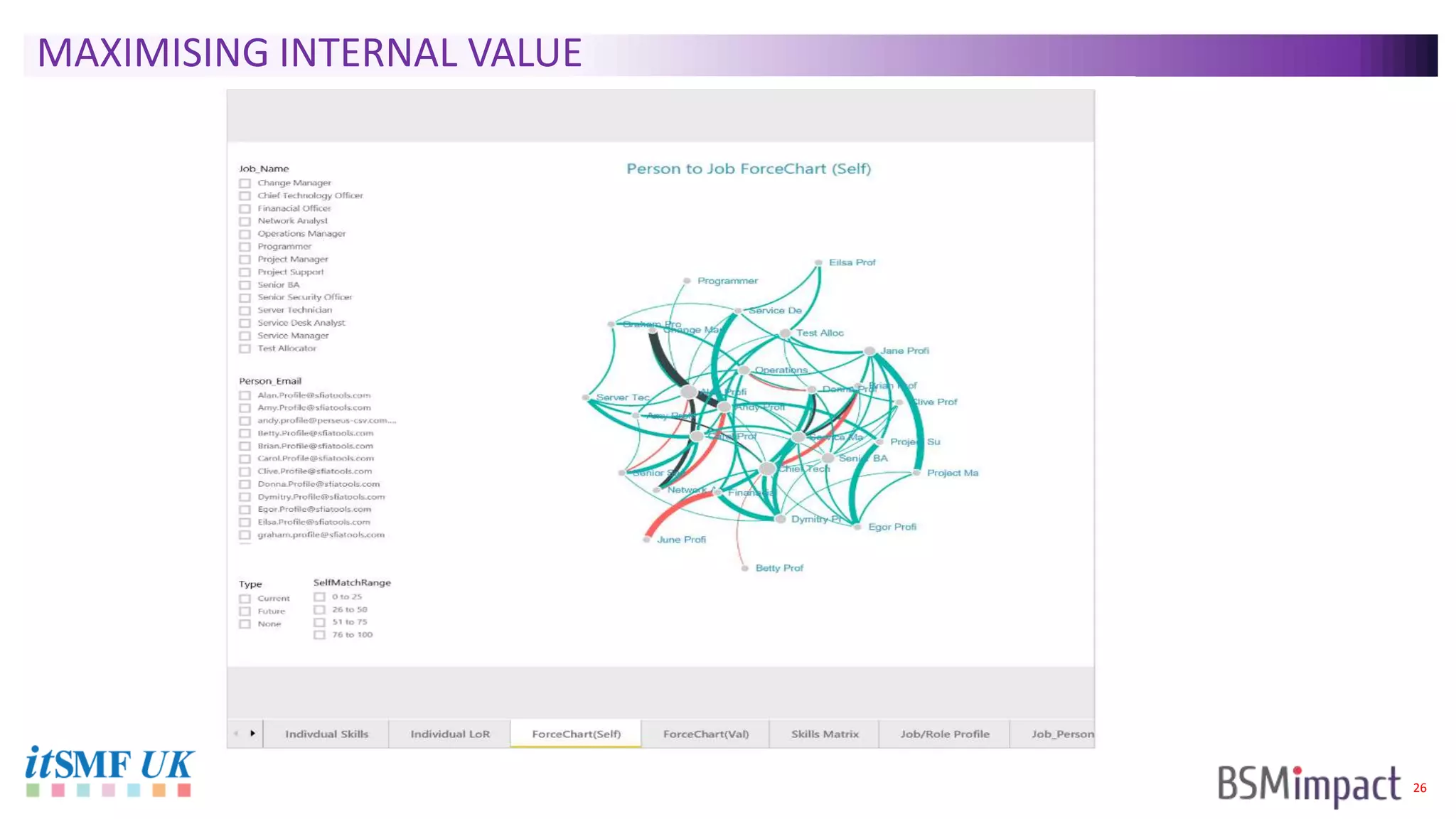
MAXIMISING INTERNAL VALUE
27
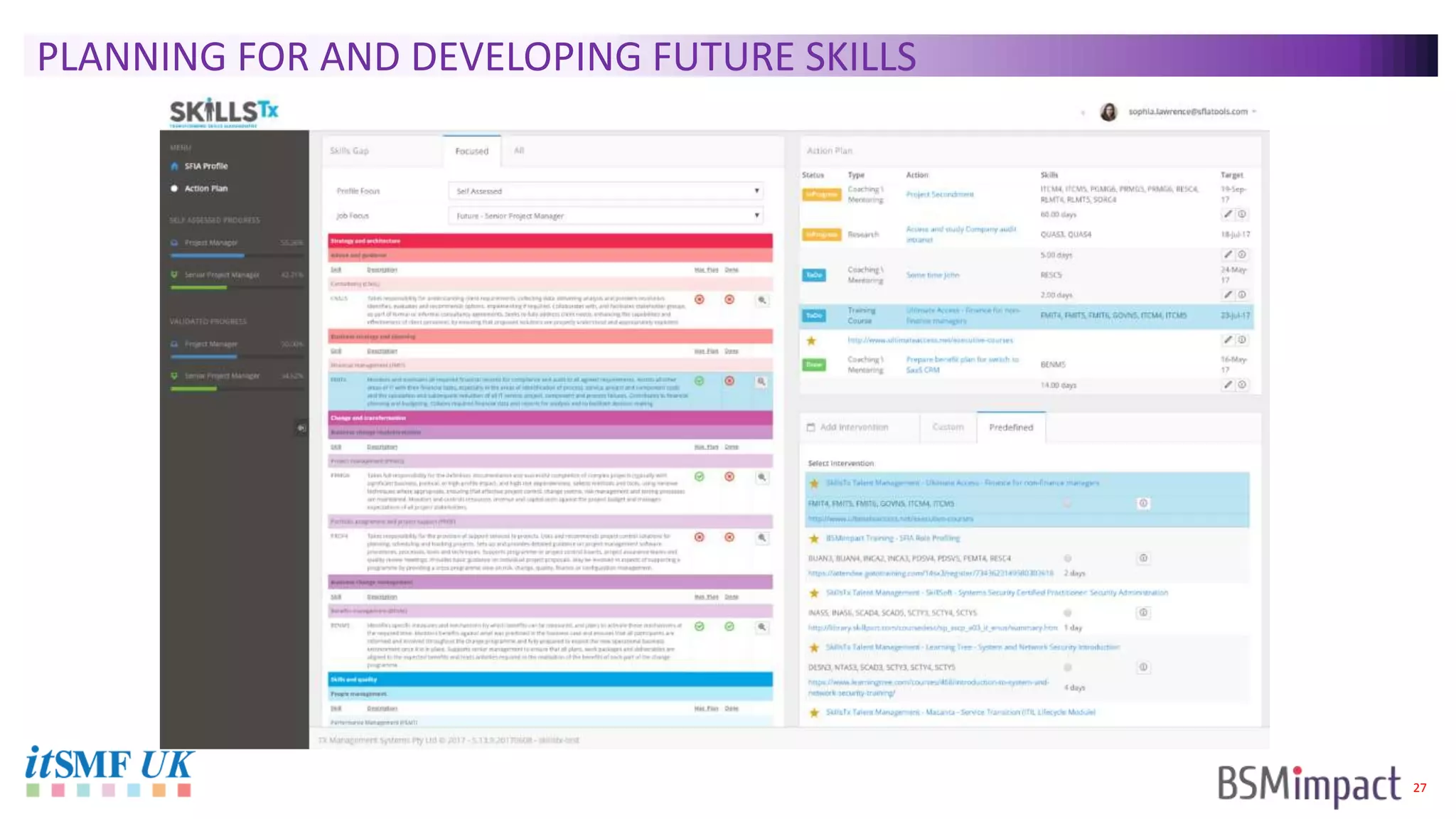
PLANNING FOR AND DEVELOPING FUTURE SKILLS
28
SUMMARY
• Frameworks like SIAM and SFIA can assist you in governing
and managing your digital supply chain
• SIAM defines the Processes, Roles and Structures within a
multi supplier environment
• SFIA provides a common language for capability, allowing
you to build, buy or borrow resources with confidence
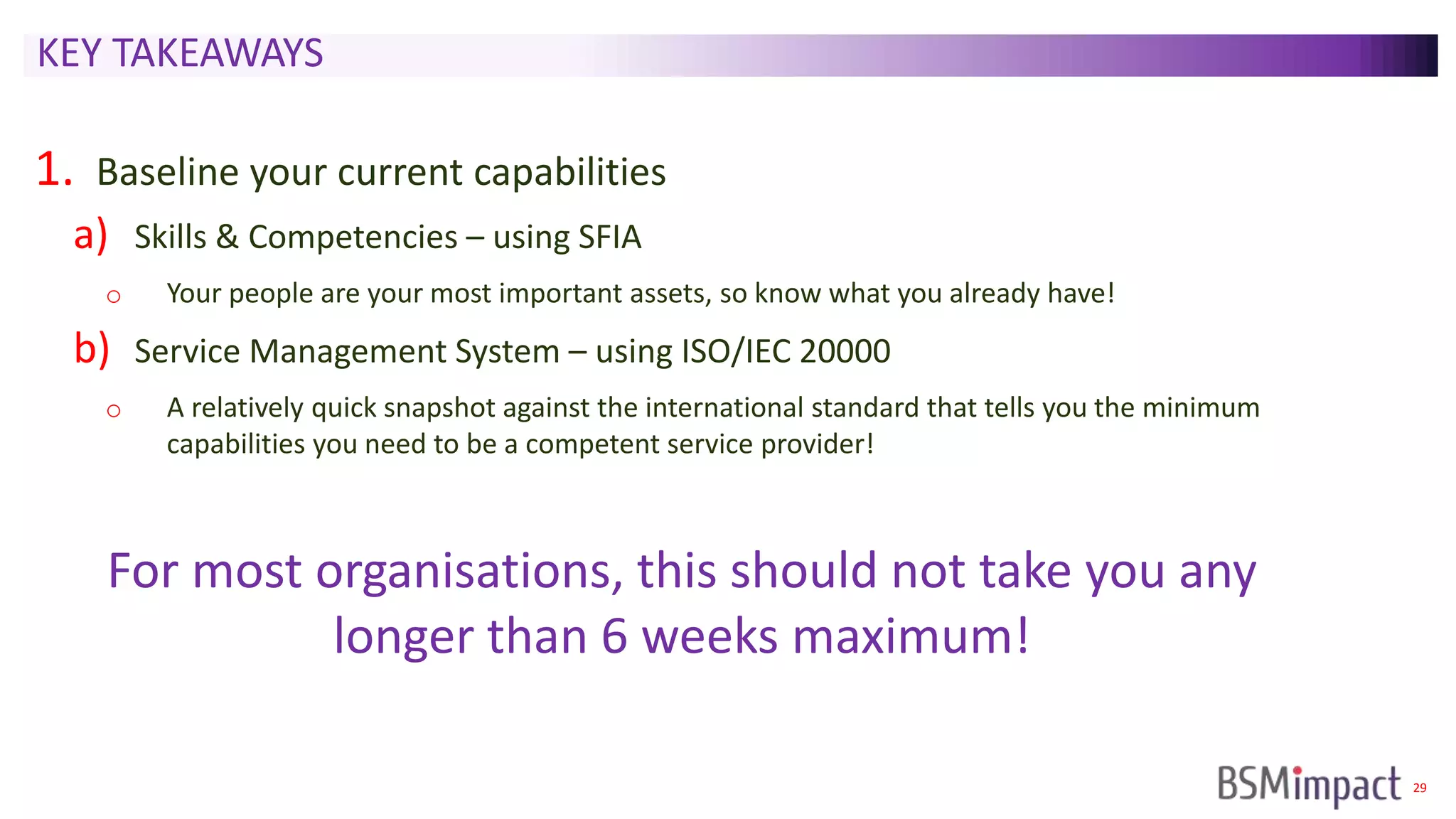
29
KEY TAKEAWAYS
1. Baseline your current capabilities
a) Skills & Competencies – using SFIA
o Your people are your most important assets, so know what you already have!
b) Service Management System – using ISO/IEC 20000
o A relatively quick snapshot against the international standard that tells you the minimum
capabilities you need to be a competent service provider!
For most organisations, this should not take you any
longer than 6 weeks maximum!
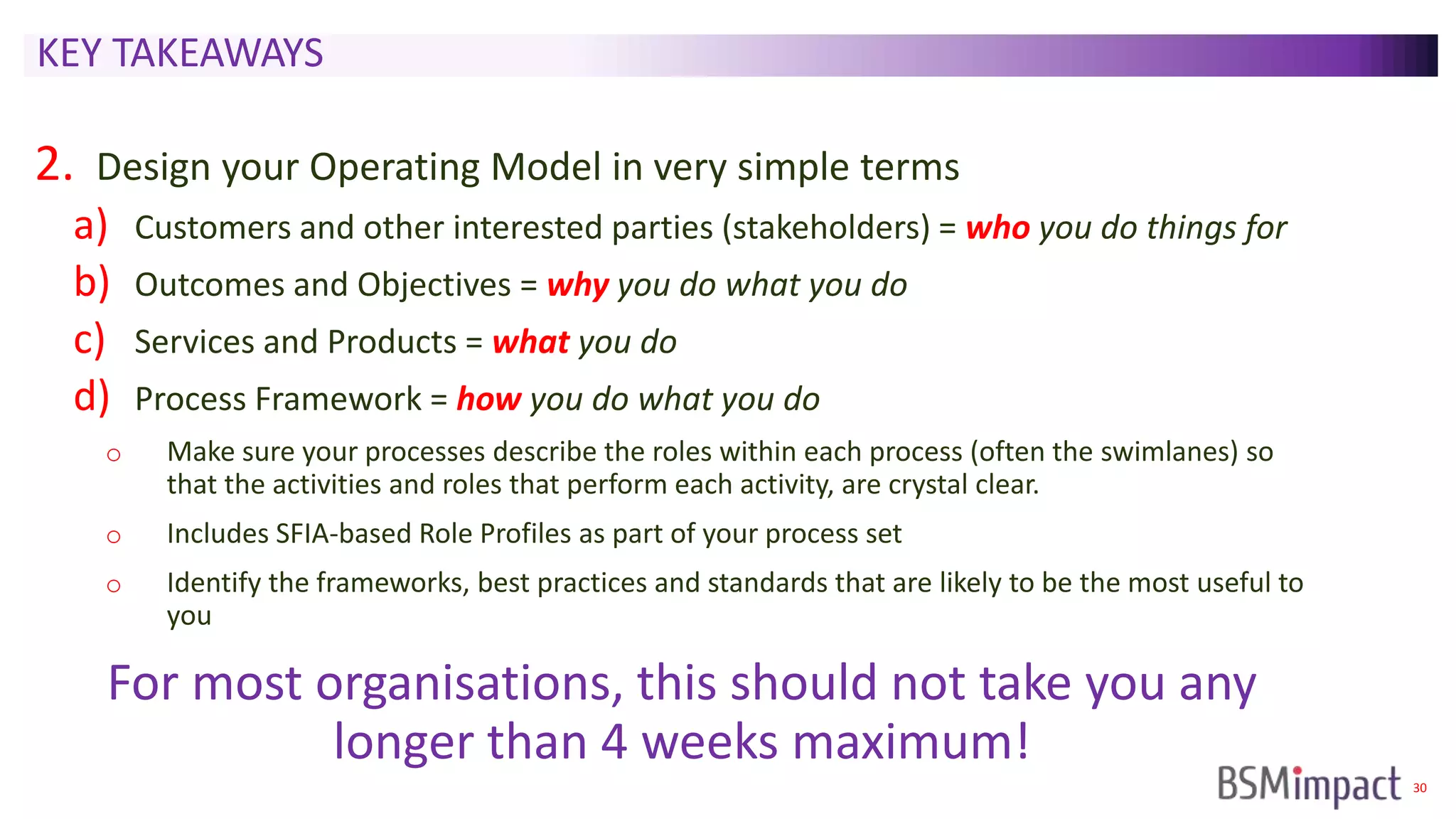
30
KEY TAKEAWAYS
2. Design your Operating Model in very simple terms
a) Customers and other interested parties (stakeholders) = who you do things for
b) Outcomes and Objectives = why you do what you do
c) Services and Products = what you do
d) Process Framework = how you do what you do
o Make sure your processes describe the roles within each process (often the swimlanes) so
that the activities and roles that perform each activity, are crystal clear.
o Includes SFIA-based Role Profiles as part of your process set
o Identify the frameworks, best practices and standards that are likely to be the most useful to
you
For most organisations, this should not take you any
longer than 4 weeks maximum!
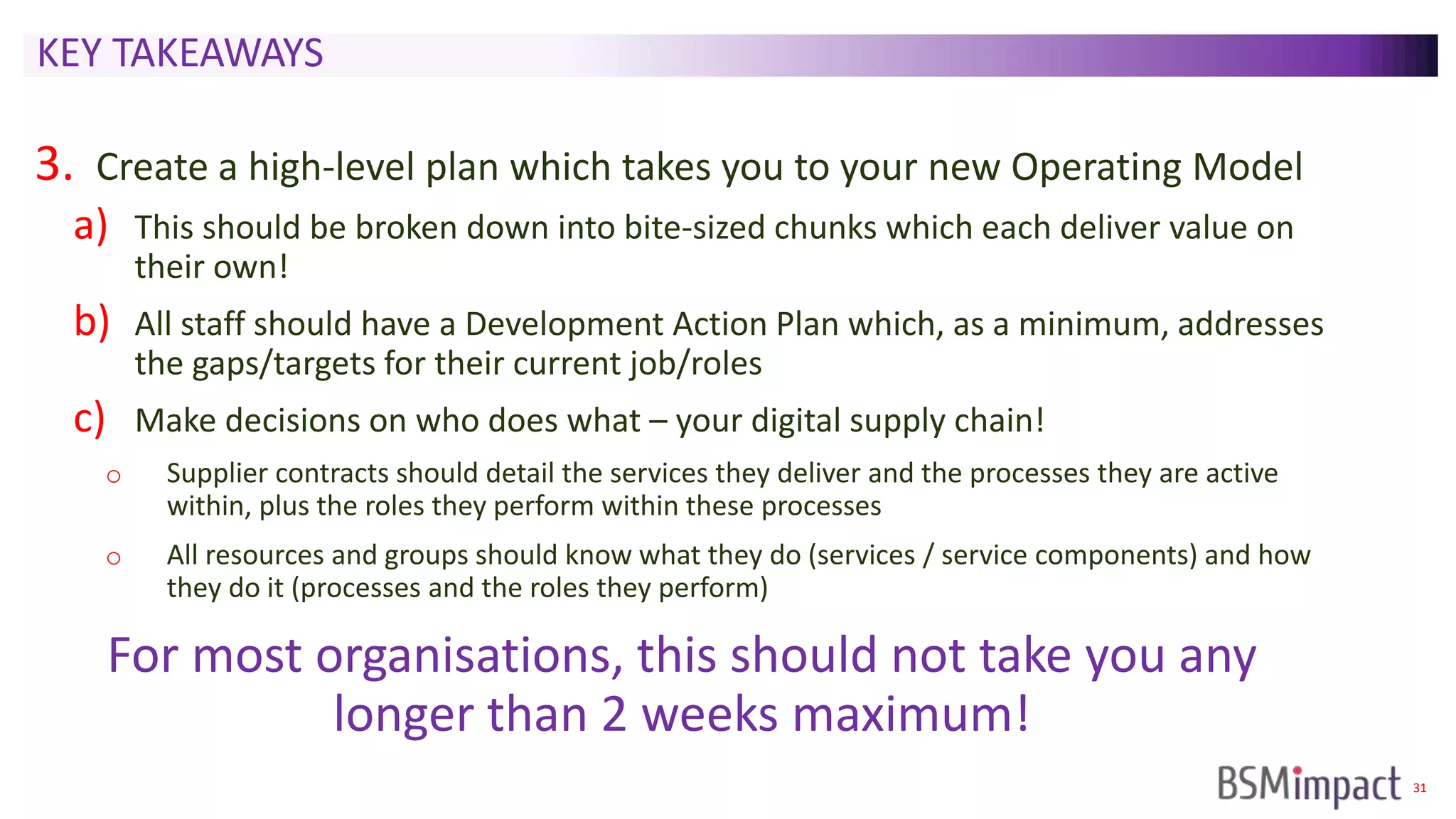
31
KEY TAKEAWAYS
3. Create a high-level plan which takes you to your new Operating Model
a) This should be broken down into bite-sized chunks which each deliver value on
their own!
b) All staff should have a Development Action Plan which, as a minimum, addresses
the gaps/targets for their current job/roles
c) Make decisions on who does what – your digital supply chain!
o Supplier contracts should detail the services they deliver and the processes they are active
within, plus the roles they perform within these processes
o All resources and groups should know what they do (services / service components) and how
they do it (processes and the roles they perform)
For most organisations, this should not take you any
longer than 2 weeks maximum!
32
KEY TAKEAWAYS
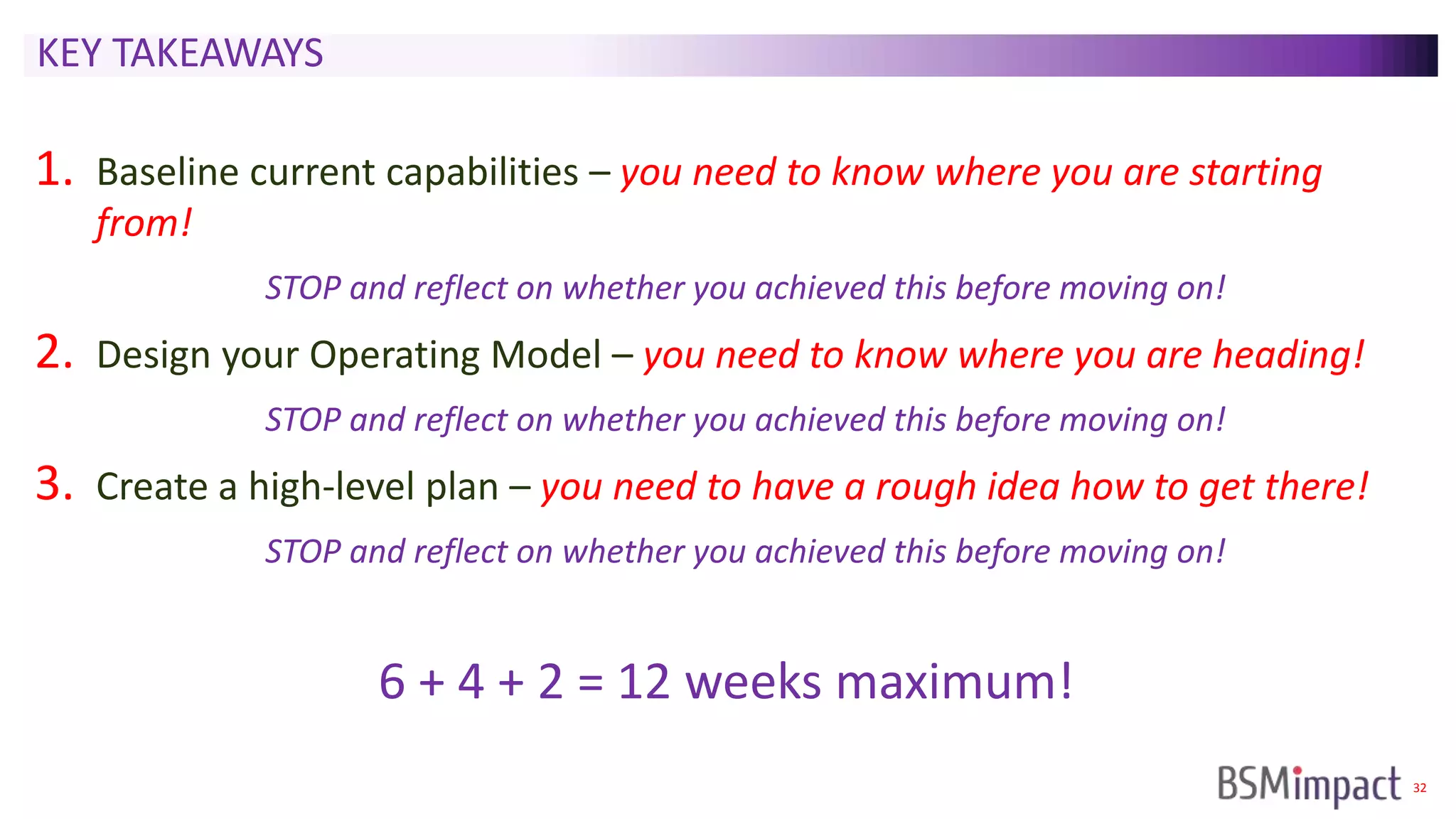
1. Baseline current capabilities – you need to know where you are starting
from!
STOP and reflect on whether you achieved this before moving on!
2. Design your Operating Model – you need to know where you are heading!
STOP and reflect on whether you achieved this before moving on!
3. Create a high-level plan – you need to have a rough idea how to get there!
STOP and reflect on whether you achieved this before moving on!
6 + 4 + 2 = 12 weeks maximum!
www.bsmimpact.comAssisting organisations adopt, adapt and embed
best practice governance and management systems.
Frameworks and standards include SIAM®, SFIA®, ITIL®, P30®, COBIT®,
ISO/IEC 20000, ISO/IEC 27001, ISO 31000 and ISO 9001.
Matthew Burrows
matthew.burrows@bsmimpact.com
@matthewkburrows

Mathew Burrows - Maximising value and building trust in your digital supply chain

  • 1.
    www.bsmimpact.com Maximising value andbuilding trust in your digital supply chain Matthew Burrows | Director | BSMimpact
  • 2.
    THE CHANGING LANDSCAPEOF DIGITAL SUPPLY
  • 3.
    3 INCREASING COMPLEXITY OFTHE SUPPLY CHAIN • Multiple Service Providers are here to stay • Cloud adoption • Social platforms • Niche providers Average # Service Providers 1-23.710+15-20+ Source: Gartner 2014 Adaptive & Integrated Disciplined Multi-sourcing Selective Best of Breed Single/Prime
  • 4.
    4 GOVERNING AND MANAGINGSUPPLIERS • APO01 • Org Structure • Roles and Responsibilities • Processes (enablers) • Data Ownership • APO10 • Identify • Select • Manage relationships • Manage risk • Monitor performance
  • 5.
    5 INTRODUCING SIAM • MultiSupplier Management with SIAM • What is SIAM (Service Integration and Management) • 5 elements o Governance o Management o Integration o Assurance o Coordination
  • 6.
    6 A CONSISTENT USEREXPERIENCE • Delivering: • single point of contact with common interface • integrated processes for Service Delivery • coordinated processes for Provider Management • defined Service Delivery platform • common processes across all Providers • minimum ‘requirements’ for new Providers
  • 7.
    8 SUPPLY SERVICE LINE PROVIDERS RETAINED IN-HOUSE “SERVICELINES” DEMAND RETAINED IT SERVICE PORTFOLIO MANAGEMENT SERVICE MODEL INTEGRATED DELIVERY MANAGEMENT INTEGRATION THE BUILDING BLOCKS OF SIAM
  • 8.
    10 INTEGRATOR SERVICES MANAGED ASA PORTFOLIO RELATIONSHIP COORDINATION END TO END PERFORMANCE MONITORING VENDOR & DELIVERY MANAGEMENT LEVEL 1 SERVICE DESK SERVICE LINES APPLICATION DEVELOPMENT APPLICATION MANAGEMENT ENTERPRISE SYSTEMS DISTRIBUTED SYSTEMS NETWORK SERVICES BUSINESS STAKEHOLDERS SERVICE DELIVERY RETAINED IT PEOPLE & CULTURE (HR) FINANCE KEY COMPONENTS OF SIAM
  • 9.
    12 BUILDING BLOCKS #1– IT DEMAND Customer typically retains Demand activities: • IT Finance, Strategy & Architecture • Business Relationships & Demand • SIAM Governance (Goals & Exceptions) • Policy & Process Ownership • Strategic Sourcing • Enterprise Risk Mgt • PMO & Project Mgt DEMAND UNDERSTAND DEMANDIT STRATEGY BUSINESS STRATEGY MANAGE BUSINESS RELATIONSHIP IT FINANCE SIAM GOVERNANCE PMO PROJECTS IT ARCHITECTURE PROCESS OWNERSHIP IT POLICIES CATALOGUE OWNERSHIP STRATEGIC SOURCING ENTERPRISE RISK MANAGEMENT
  • 10.
    14 INTEGRATED BUSINESS SERVICE CATALOGUE SERVICE COMPONENTS SUPPLIER SERVICE LEVELS ITASSETS CONFIGURATION ITEMS BUSINESS & CUSTOMER VIEW INTEGRATED IT SERVICE VIEW SUPPLIER SERVICE COMPONENT VIEW SERVICES CATALOGUE PLAN-DESIGN-DEVELOP-RELEASE- SUPPORT INNOVATE RETIRE SERVICE MODEL SERVICES PORTFOLIO MANAGEMENT SERVICES PIPELINE SUPPLIER VIEW SERVICE CONFIGURATION VIEW INTEGRATED DELIVERY MANAGEMENT DESIGN MANAGEMENT TRANSITION MANAGEMENT OPERATIONS MANAGEMENT INTEGRATED TOOLING MANAGEMENT SERVICE DESK Self-Service Portal CONTINUAL SERVICE IMPROVEMENT BUSINESS SERVICES SIAM THE SIAM MODEL • Alignment of the Service Model • Service Governance & Assurance • Integrated Delivery Management • Design Management • Transition Management • Operations Management Service Integrator typically provides:
  • 11.
    16 Service Line Providerstypically continue to provide: • “Traditional” Service Line Delivery • Service Innovation & Improvement • Cross Supplier Collaboration • Constructive Culture • Process Integration • Tooling Integration • SIAM also applies to some retained IT Supply functions like: • Business Analysis • Project Delivery • In-House Application Mgt SUPPLY UNDERSTAND DEMAND MARKET OFFERINGS BUSINESS STRATEGY MANAGE SIAM RELATIONSHIP  SERVICE LINE SUPPLIER INTERFACES  SERVICE INNOVATION  SERVICE DELIVERY MANAGEMENT  CONTINUAL SERVICE IMPROVEMENT  AS A SERVICE COMPONENT OFFERINGS  CROSS SUPPLIER COLLABORATION  CONSTRUCTIVE CULTURE  PROCESS INTEGRATION  TOOLING INTEGRATION APPLICATION DEVELOPMENT APPLICATION MANAGEMENT ENTERPRISE SYSTEMS DISTRIBUTED SYSTEMS NETWORK SERVICES Specialist retained IT supply functions BUILDING BLOCKS #2 – SUPPLY
  • 12.
    18 DEMAND UNDERSTAND DEMANDIT STRATEGY BUSINESS STRATEGY MANAGE BUSINESS RELATIONSHIP IT FINANCE SIAMGOVERNANCE PMO PROJECTS IT ARCHITECTURE PROCESS OWNERSHIP IT POLICIES CATALOGUE OWNERSHIP STRATEGIC SOURCING ENTERPRISE RISK MANAGEMENT SUPPLY UNDERSTAND DEMAND MARKET OFFERINGS BUSINESS STRATEGY MANAGE SIAM RELATIONSHIP  SERVICE LINE SUPPLIER INTERFACES  SERVICE INNOVATION  SERVICE DELIVERY MANAGEMENT  CONTINUAL SERVICE IMPROVEMENT  AS A SERVICE COMPONENT OFFERINGS  CROSS SUPPLIER COLLABORATION  CONSTRUCTIVE CULTURE  PROCESS INTEGRATION  TOOLING INTEGRATION APPLICATION DEVELOPMENT APPLICATION MANAGEMENT ENTERPRISE SYSTEMS DISTRIBUTED SYSTEMS NETWORK SERVICES Specialist retained IT supply functions INTEGRATED BUSINESS SERVICE CATALOGUE SERVICE COMPONENTS SUPPLIER SERVICE LEVELS IT ASSETS CONFIGURATION ITEMS BUSINESS & CUSTOMER VIEW INTEGRATED IT SERVICE VIEW SUPPLIER SERVICE COMPONENT VIEW SERVICES CATALOGUE PLAN-DESIGN-DEVELOP-RELEASE- SUPPORT INNOVATE RETIRE SERVICE MODEL SERVICES PORTFOLIO MANAGEMENT SERVICES PIPELINE SUPPLIER VIEW SERVICE CONFIGURATION VIEW INTEGRATED DELIVERY MANAGEMENT DESIGN MANAGEMENT TRANSITION MANAGEMENT OPERATIONS MANAGEMENT INTEGRATED TOOLING MANAGEMENT SERVICE DESK Self-Service Portal CONTINUAL SERVICE IMPROVEMENT BUSINESS SERVICES INTEGRATION THE SIAM MODEL
  • 13.
    20 SIAM STRUCTURES External Service Provider(s) Internal Service Provider(s) Internal Service Provider(s) Customer Organisation Retained Capabilities InternalService Integrator Internal Service Provider(s) External Service Provider(s) External Service Provider(s) Customer Organisation Retained Capabilities External Service Integrator External Service Provider(s) Internal Service Provider(s) Internal Service Provider(s) Internal Service Provider(s) External Service Provider(s) External Service Provider(s) Customer Organisation Retained Capabilities Hybrid Service Integrator External Service Provider(s) Internal Service Provider(s) Internal Service Provider(s) Internal Service Provider(s) External Service Provider(s) External Service Provider(s) Customer Organisation Retained Capabilities External Service Integrator External Service Provider(s) Internal Service Provider(s) Internal Service Provider(s) Internal Service Provider(s) External Service Provider(s) External Service Provider(s)
  • 14.
    21 GOVERNING AND MANAGINGHUMAN RESOURCES • EDM04 • Evaluate resource need • Identify gaps • Close gaps • APO07 • Maintain adequate staffing • Identify key IT personnel • Maintain skills • Evaluate performance • Plan and track usage • Manage contract staff
  • 15.
    22 GROWING DEMAND FORDIGITAL SKILLS
  • 16.
  • 17.
  • 18.
  • 19.
  • 20.
    27 PLANNING FOR ANDDEVELOPING FUTURE SKILLS
  • 21.
    28 SUMMARY • Frameworks likeSIAM and SFIA can assist you in governing and managing your digital supply chain • SIAM defines the Processes, Roles and Structures within a multi supplier environment • SFIA provides a common language for capability, allowing you to build, buy or borrow resources with confidence
  • 22.
    29 KEY TAKEAWAYS 1. Baselineyour current capabilities a) Skills & Competencies – using SFIA o Your people are your most important assets, so know what you already have! b) Service Management System – using ISO/IEC 20000 o A relatively quick snapshot against the international standard that tells you the minimum capabilities you need to be a competent service provider! For most organisations, this should not take you any longer than 6 weeks maximum!
  • 23.
    30 KEY TAKEAWAYS 2. Designyour Operating Model in very simple terms a) Customers and other interested parties (stakeholders) = who you do things for b) Outcomes and Objectives = why you do what you do c) Services and Products = what you do d) Process Framework = how you do what you do o Make sure your processes describe the roles within each process (often the swimlanes) so that the activities and roles that perform each activity, are crystal clear. o Includes SFIA-based Role Profiles as part of your process set o Identify the frameworks, best practices and standards that are likely to be the most useful to you For most organisations, this should not take you any longer than 4 weeks maximum!
  • 24.
    31 KEY TAKEAWAYS 3. Createa high-level plan which takes you to your new Operating Model a) This should be broken down into bite-sized chunks which each deliver value on their own! b) All staff should have a Development Action Plan which, as a minimum, addresses the gaps/targets for their current job/roles c) Make decisions on who does what – your digital supply chain! o Supplier contracts should detail the services they deliver and the processes they are active within, plus the roles they perform within these processes o All resources and groups should know what they do (services / service components) and how they do it (processes and the roles they perform) For most organisations, this should not take you any longer than 2 weeks maximum!
  • 25.
    32 KEY TAKEAWAYS 1. Baselinecurrent capabilities – you need to know where you are starting from! STOP and reflect on whether you achieved this before moving on! 2. Design your Operating Model – you need to know where you are heading! STOP and reflect on whether you achieved this before moving on! 3. Create a high-level plan – you need to have a rough idea how to get there! STOP and reflect on whether you achieved this before moving on! 6 + 4 + 2 = 12 weeks maximum!
  • 26.
    www.bsmimpact.comAssisting organisations adopt,adapt and embed best practice governance and management systems. Frameworks and standards include SIAM®, SFIA®, ITIL®, P30®, COBIT®, ISO/IEC 20000, ISO/IEC 27001, ISO 31000 and ISO 9001. Matthew Burrows matthew.burrows@bsmimpact.com @matthewkburrows

Editor's Notes

  • #9 Building Blocks – IT Demand, SIAM & Supply Based on ITIL, it is a variant of service management Used by government organisations to manage complex / large multi-vendor environments 1st iteration was as a Service Integrator in 2009, SIAM term followed a few years later Resurgence because of cloud
  • #11 Based on ITIL, it is a variant of service management Used by government organisations to manage complex / large multi-vendor environments 1st iteration was as a Service Integrator in 2009, SIAM term followed a few years later Resurgence because of cloud
  • #13 Customer typically retains Demand