This summary provides an overview of key concepts from differential cost analysis and incremental decision making:
Differential cost analysis focuses on the differences in costs and revenues between alternative choices. It considers only costs and revenues that change with the decision. Incremental analysis compares the incremental revenue to the incremental costs of various options to determine the most profitable choice. For example, a company may analyze whether to make or buy a product based on the incremental costs and revenues of each option.
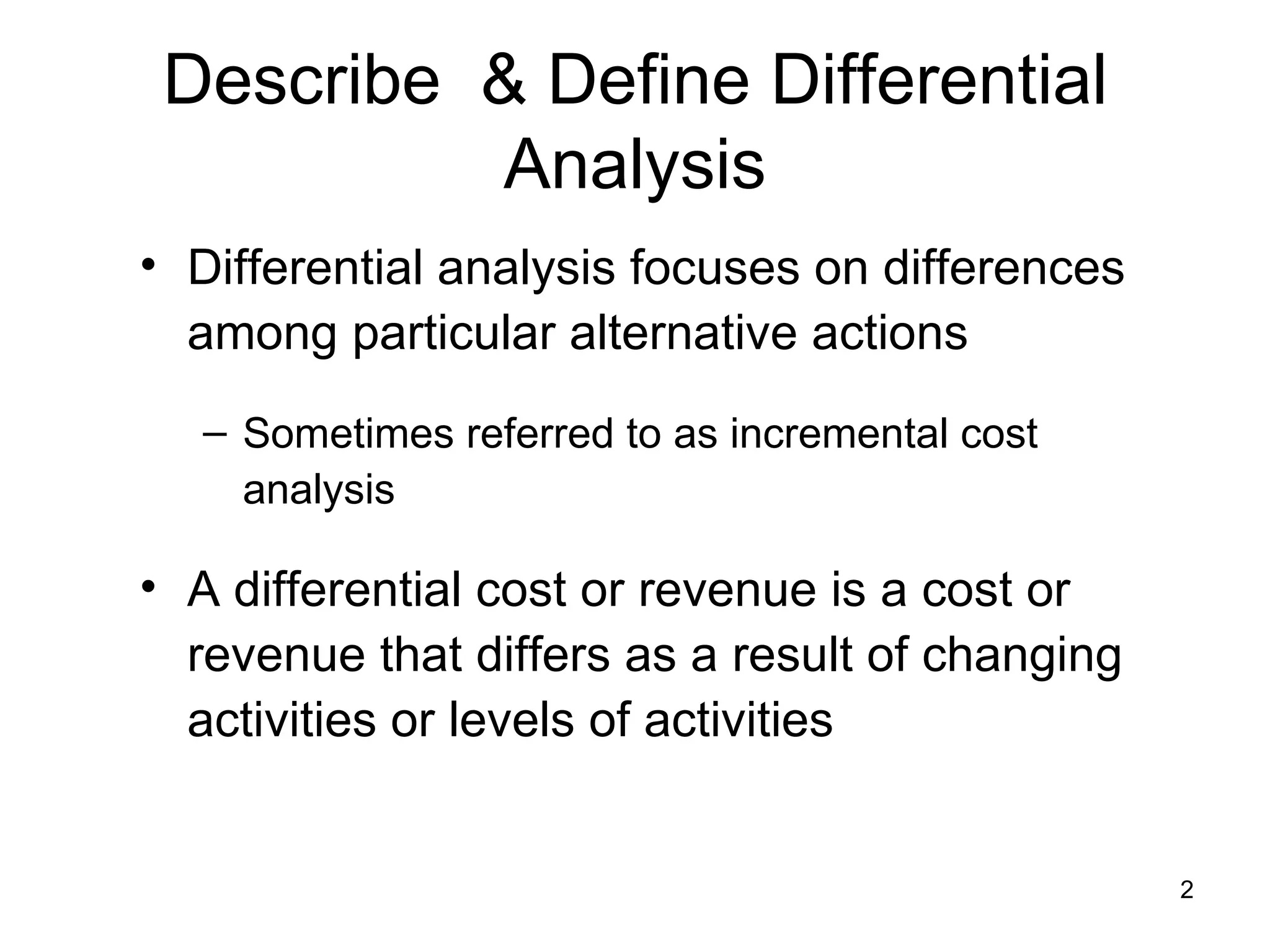
Describe &Define Differential Analysis Differential analysis focuses on differences among particular alternative actions Sometimes referred to as incremental cost analysis A differential cost or revenue is a cost or revenue that differs as a result of changing activities or levels of activities
3.
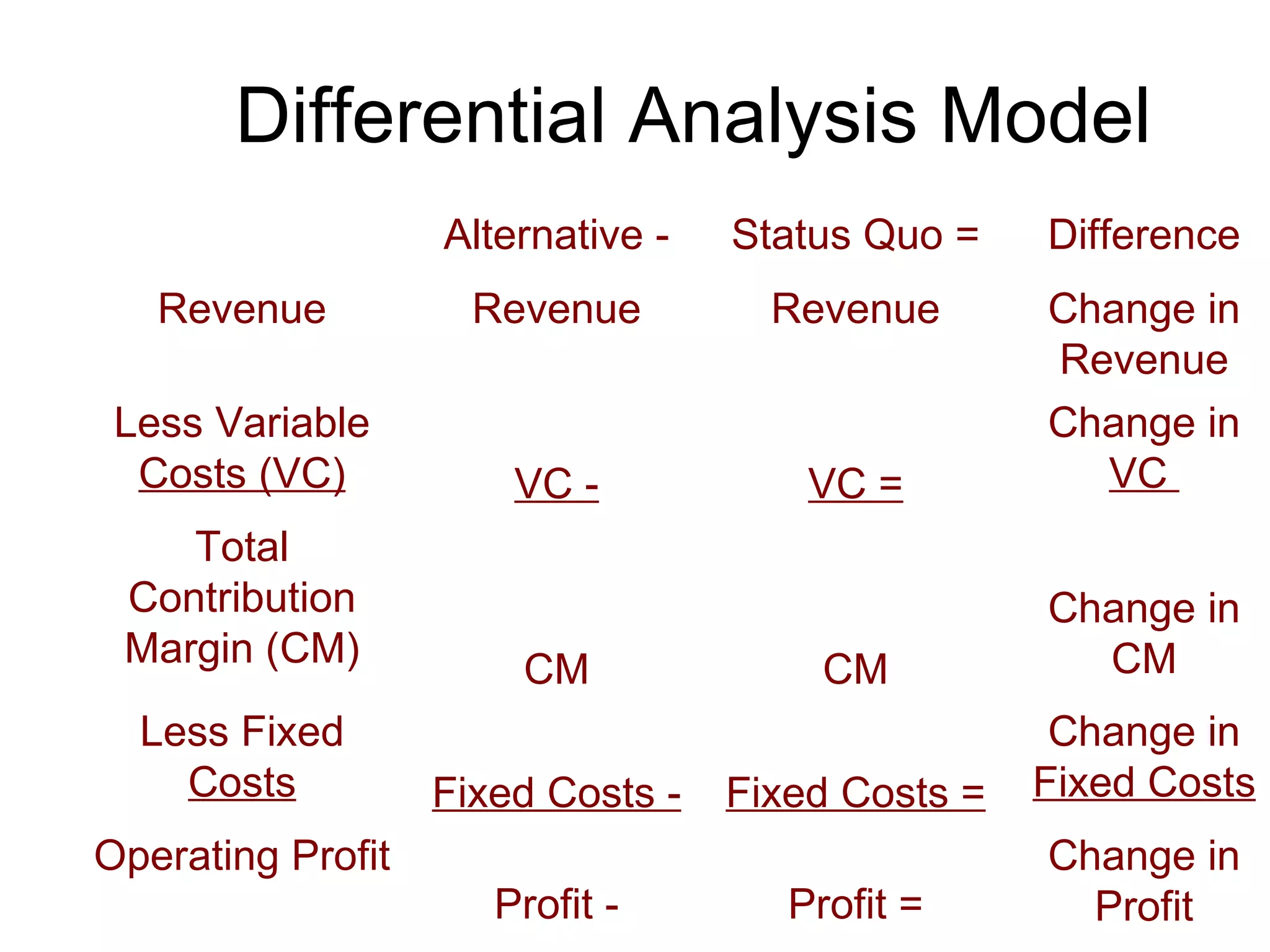
Differential Analysis ModelChange in Profit Profit = Profit - Operating Profit Change in Fixed Costs Fixed Costs = Fixed Costs - Less Fixed Costs Change in CM CM CM Total Contribution Margin (CM) Change in VC VC = VC - Less Variable Costs (VC) Change in Revenue Revenue Revenue Revenue Difference Status Quo = Alternative -
4.
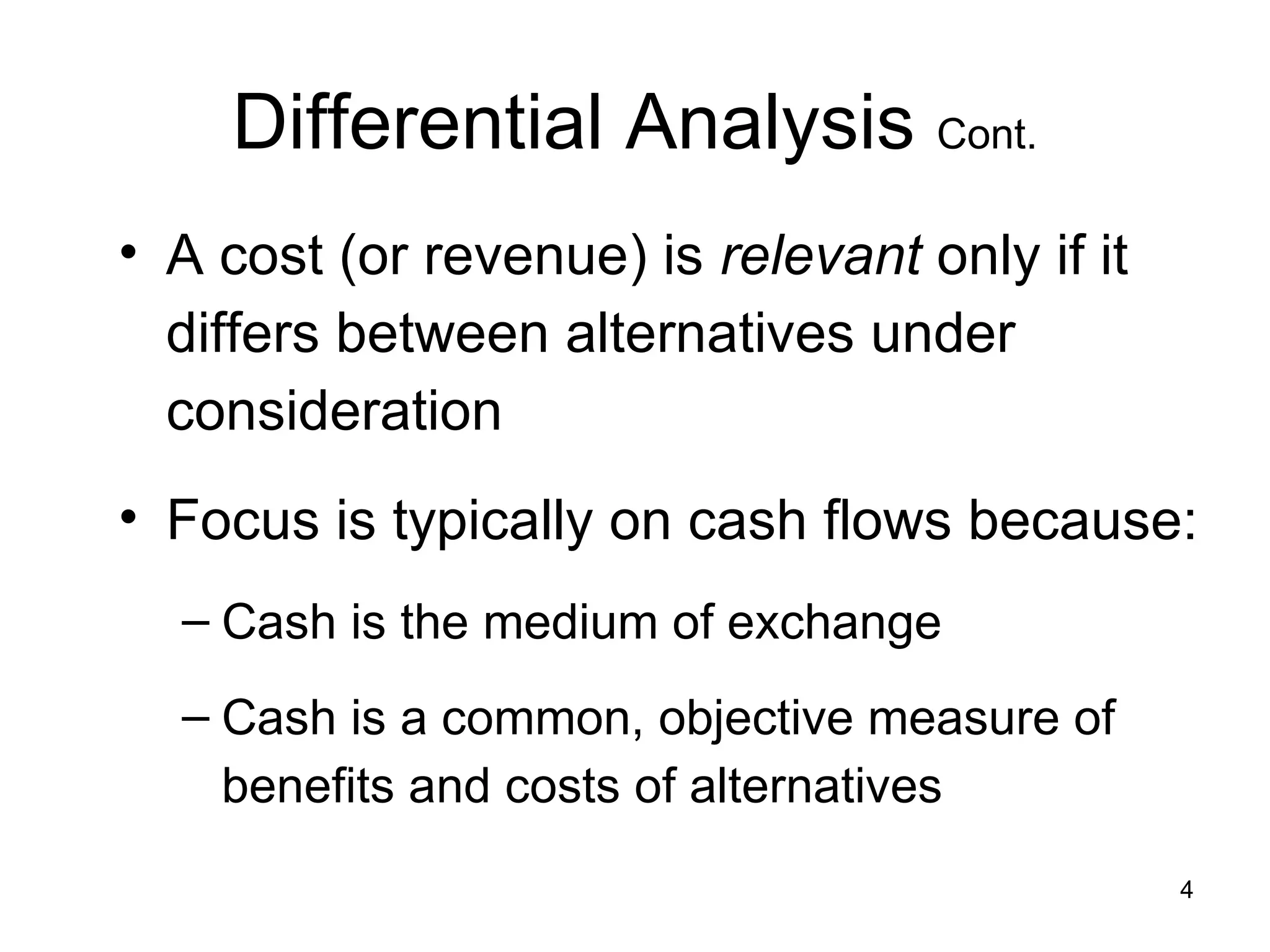
Differential Analysis Cont. A cost (or revenue) is relevant only if it differs between alternatives under consideration Focus is typically on cash flows because: Cash is the medium of exchange Cash is a common, objective measure of benefits and costs of alternatives
5.
Review Short-Run vs.Long-Run Pricing Decisions The time horizon of a decision is important in determining the relevant costs in a pricing decision Short-run decisions include pricing for a one-time special order Long-run decisions include pricing a main product in a major market
6.
What is thedifferential approach to pricing? This approach assumes that the price must be at least equal or greater than the differential cost of producing and selling the product In the short-run the price should provide a positive contribution to covering fixed costs and generating profit In the long-run the price must cover all costs, because both fixed and variable costs become differential in the long run
7.
Long-Run Pricing Decisions (Slide 1 of 3) Define Full cost This is the total cost of producing and selling the product from R & D through customer service Includes all costs incurred by activities making up the value chain
8.
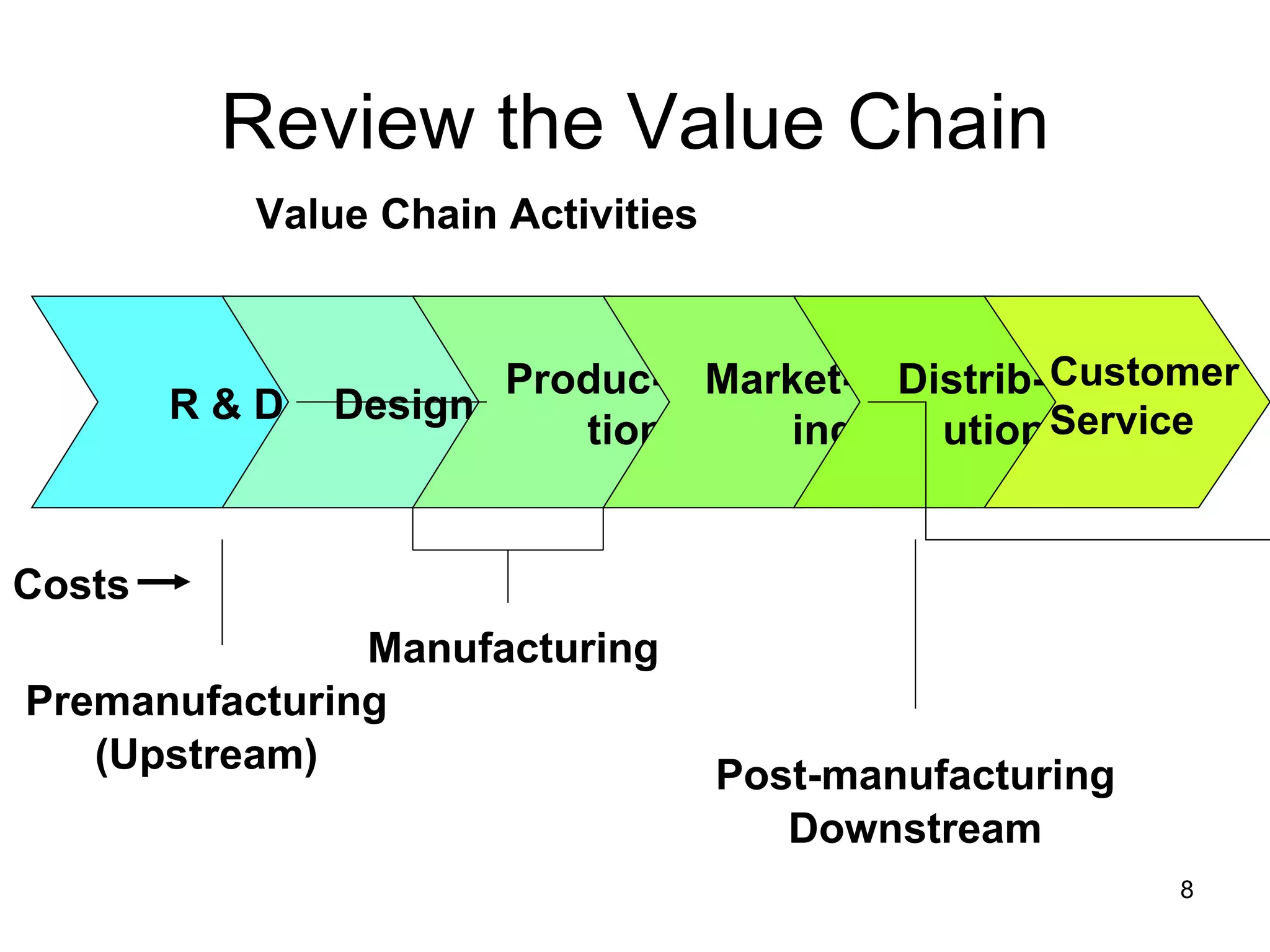
Review the ValueChain R & D Design Produc- tion Market- ing Distrib- ution Customer Service Costs Value Chain Activities Premanufacturing (Upstream) Manufacturing Post-manufacturing Downstream
9.
Long-Run Pricing Decisions (Slide 3 of 3) The full cost approach is justified in pricing decisions when: Entering into long-term contracts to supply a product Developing and producing a customized product Initially setting prices, then adjusting for market conditions
10.
Review Life-Cycle Product Costing and Pricing The product life cycle covers time period from initial R & D through the point at which support to customers is withdrawn This highlights the importance of setting prices that cover all costs in the value chain To be profitable, a firm must generate sufficient revenue to cover all costs
11.
Explain Using TargetPrices to Set Target Costs Target costing is the concept of price-based costing Target price – is the estimated price a potential customer is willing to pay Target Cost = target price – target profit The target cost is the estimated long-run cost of the product or service that enables company to realize targeted profit
12.
Explain Legal IssuesRelating Costs to Prices Pricing must not be predatory i.e., Cannot price products below cost in an effort to drive out competition Cost may be defined as full or variable costs depending on jurisdiction Dumping occurs when a foreign company sells products in U.S. at a price below market value in country of origin
13.
Customer Profitability Differentialanalysis is useful in determining which customers to keep or drop Dropping a customer should result in cost savings in excess of lost revenue The alternative uses of extra capacity available after dropping a customer should be included in the analysis
14.
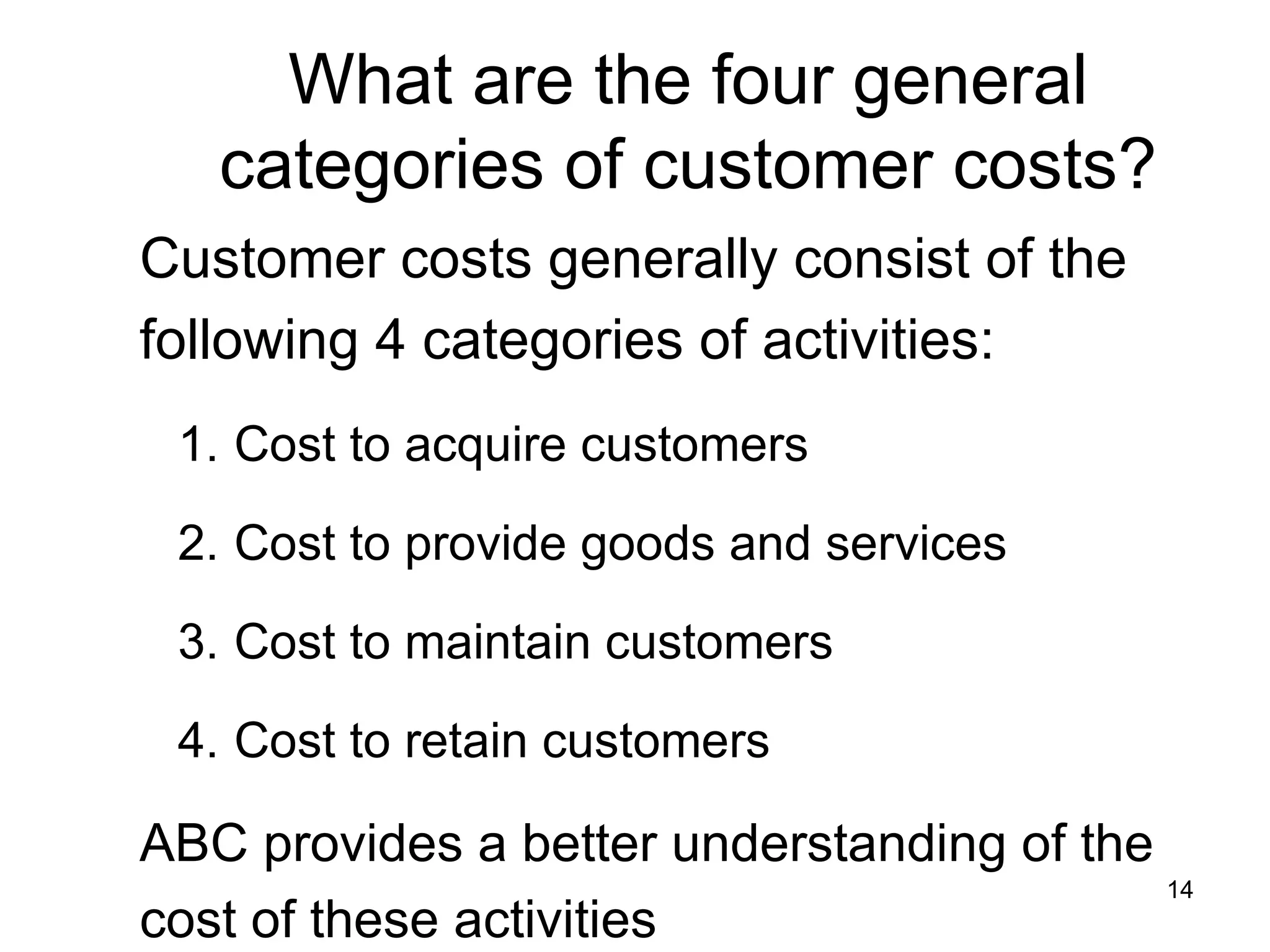
What are thefour general categories of customer costs? Customer costs generally consist of the following 4 categories of activities: Cost to acquire customers Cost to provide goods and services Cost to maintain customers Cost to retain customers ABC provides a better understanding of the cost of these activities
15.
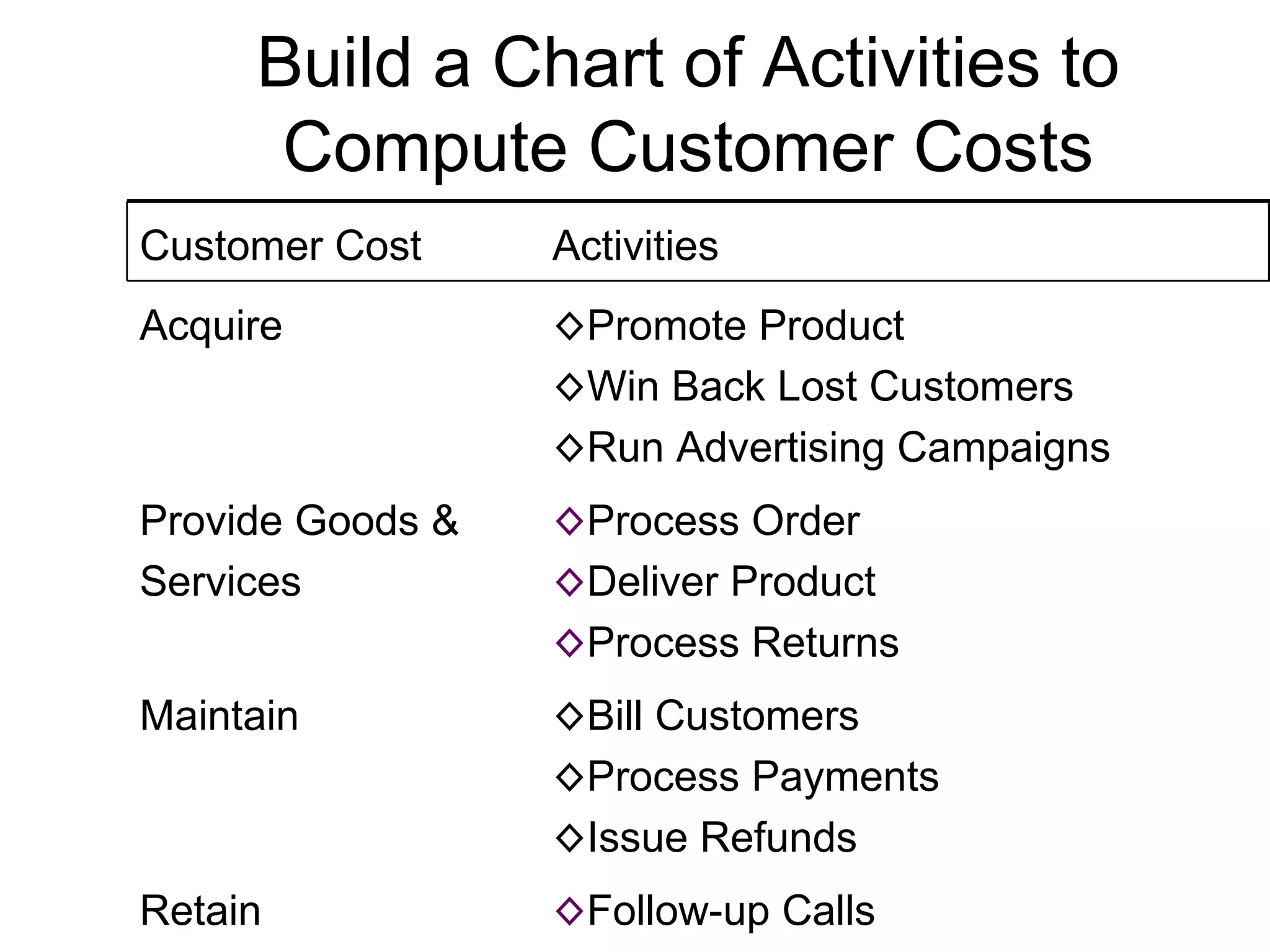
Build a Chartof Activities to Compute Customer Costs Follow-up Calls Retain Bill Customers Process Payments Issue Refunds Maintain Process Order Deliver Product Process Returns Provide Goods & Services Promote Product Win Back Lost Customers Run Advertising Campaigns Acquire Activities Customer Cost
16.
Comment on Decisionswhen Scarce Resources are Limited One of the most difficult decisions a manager must make is how to allocate scarce resources among multiple products. The decisions is not based upon which product has the largest selling price or profit.
17.
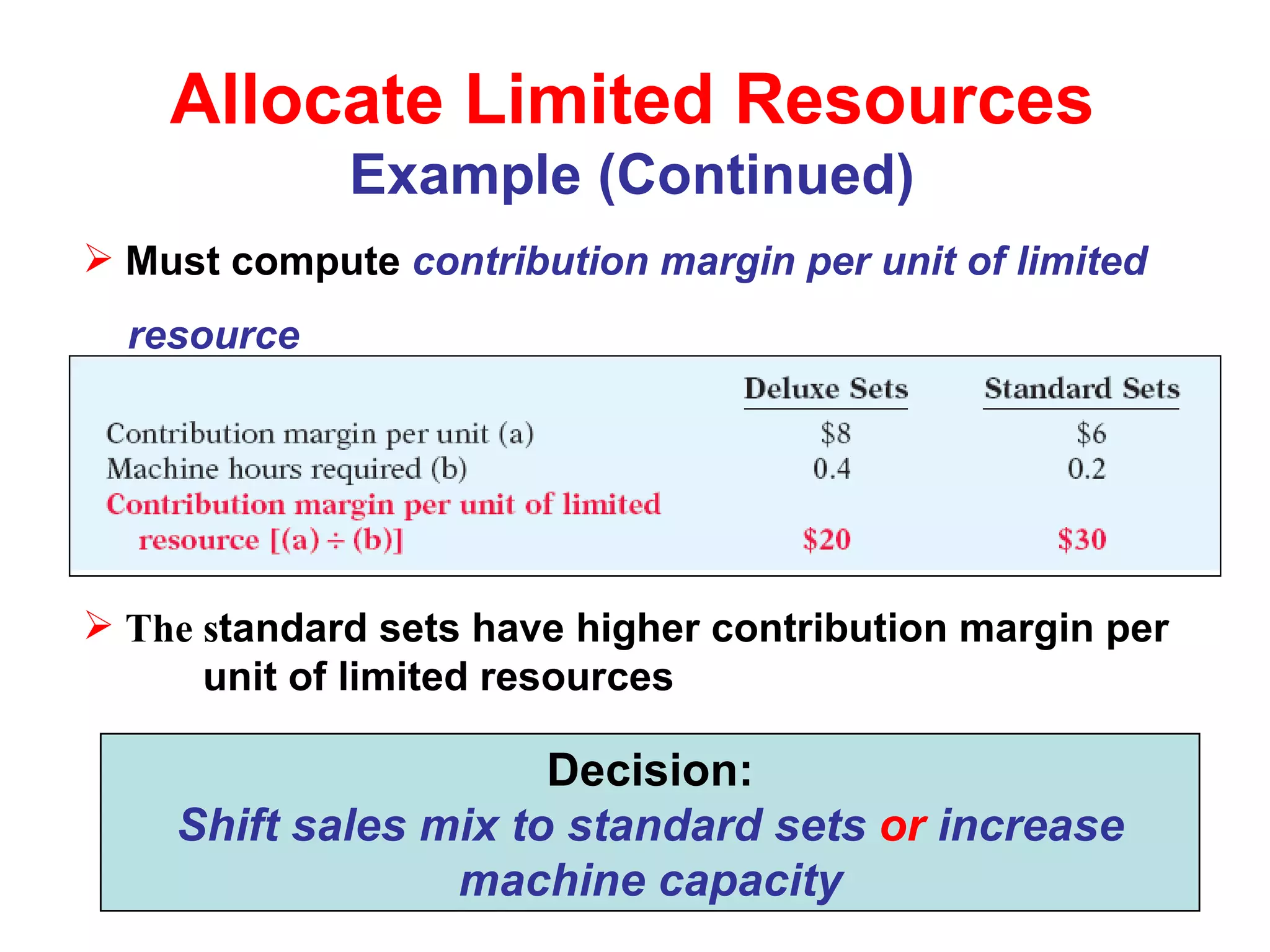
Decisions with ScarceResources The manager must determine how much contribution margin each product makes per unit of the scarce resource. Once that is done the manager decides which product makes the most contribution margin for equal amounts of scarce resource. The product that makes the most contribution margin per unit of the scarce resource is the product to make.
18.
Define the FollowingTheory of Constraints Focusing on increasing incremental revenue over incremental costs when bottlenecks exist Bottleneck When work performed at an operation equals or exceeds its capacity
19.
List the FiveSteps to Managing Bottlenecks Recognize bottlenecks determine throughput for the whole plant Search for the bottlenecks by finding where inventory backs up Subordinate non-bottleneck resources to bottleneck resources Increase bottleneck capacity and efficiency Repeat steps 1 through 4 for new bottlenecks
20.
Explain Make orBuy Decisions Companies have the option of deciding to meet needs internally or to acquire goods or services externally (outsourcing) You should compare the relevant costs of making to buying. The lower cost is the better alternative, all other things being equal. Only costs that differ between the alternatives are relevant costs.
21.
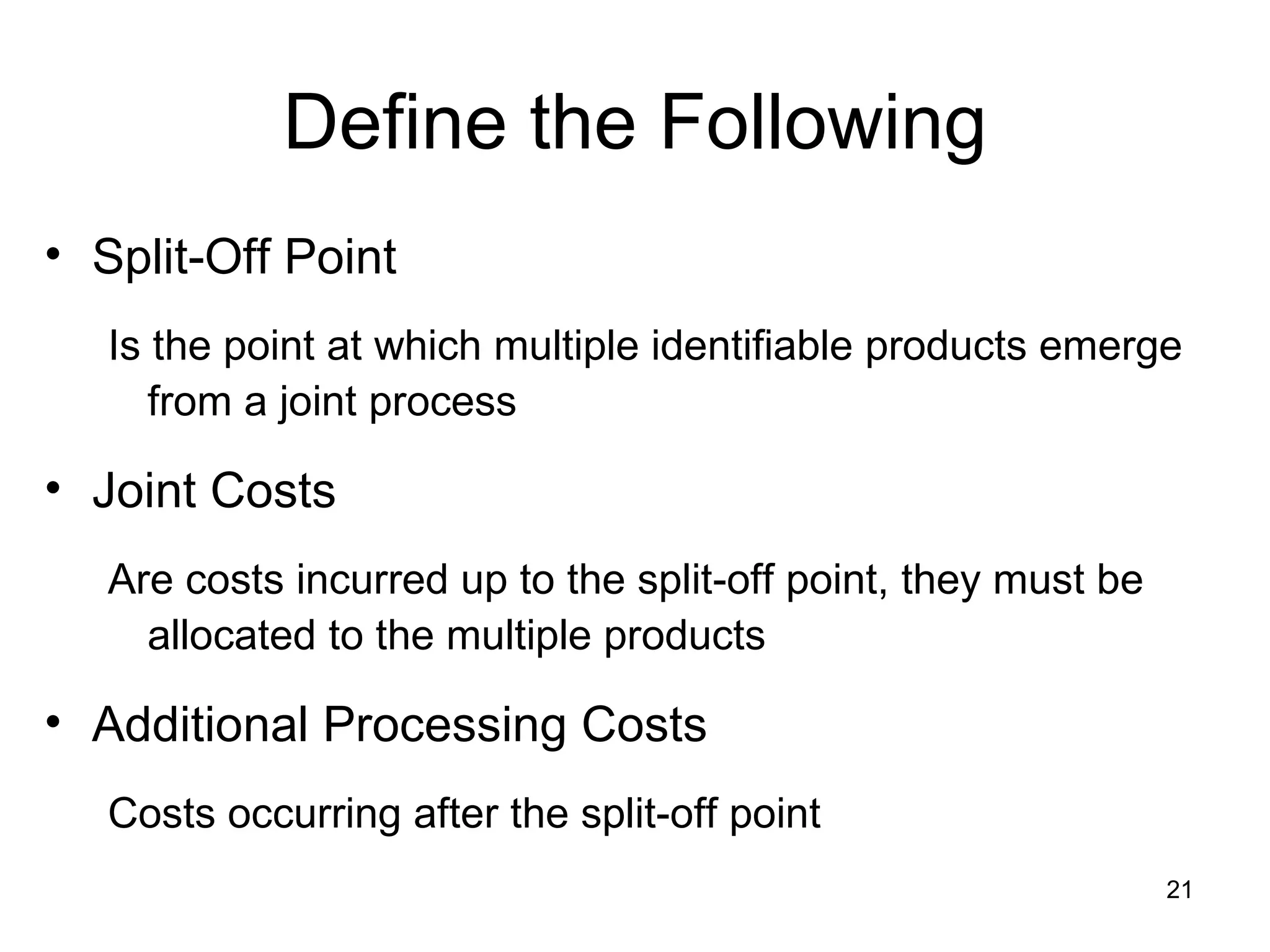
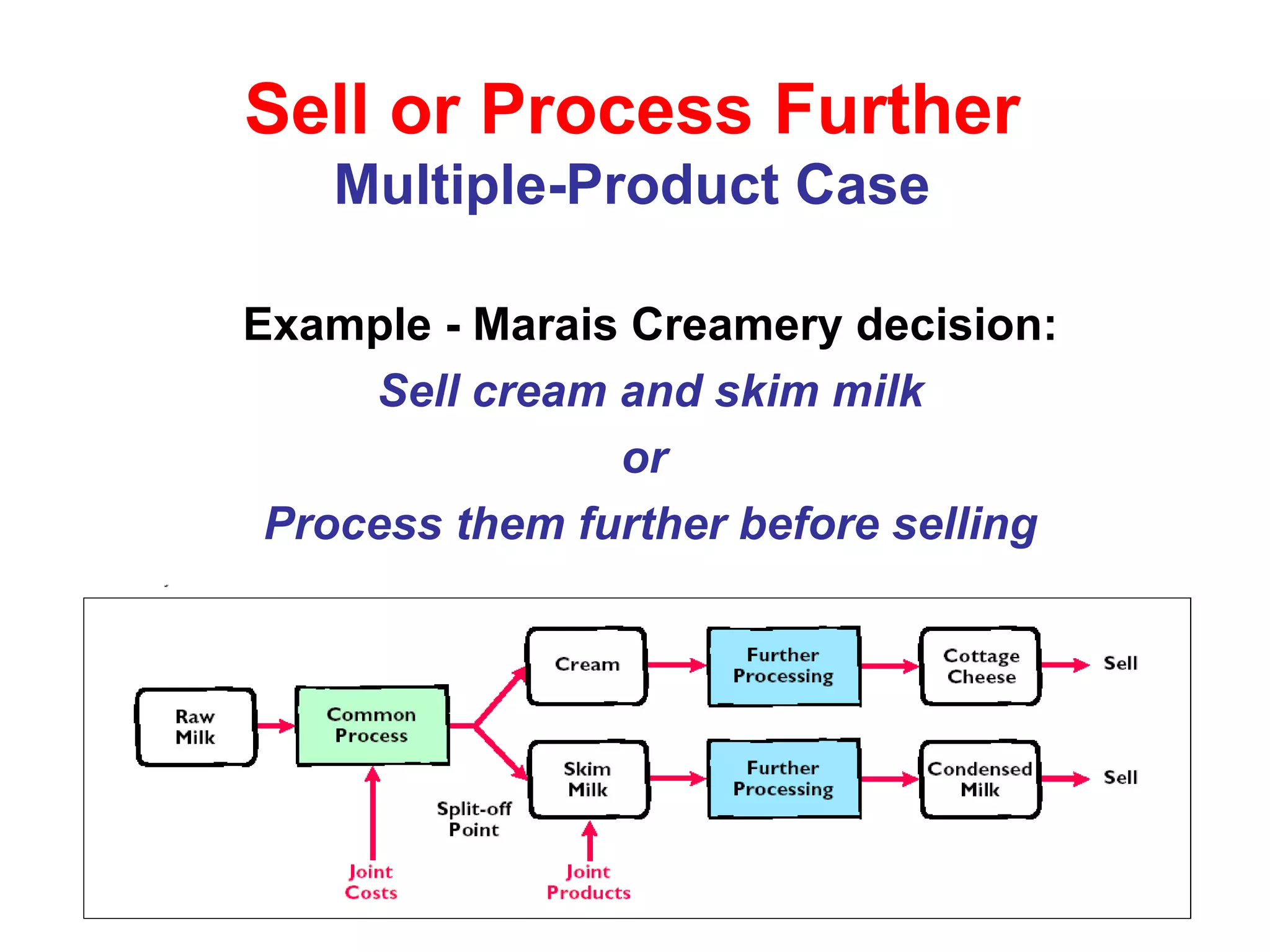
Define the FollowingSplit-Off Point Is the point at which multiple identifiable products emerge from a joint process Joint Costs Are costs incurred up to the split-off point, they must be allocated to the multiple products Additional Processing Costs Costs occurring after the split-off point
22.
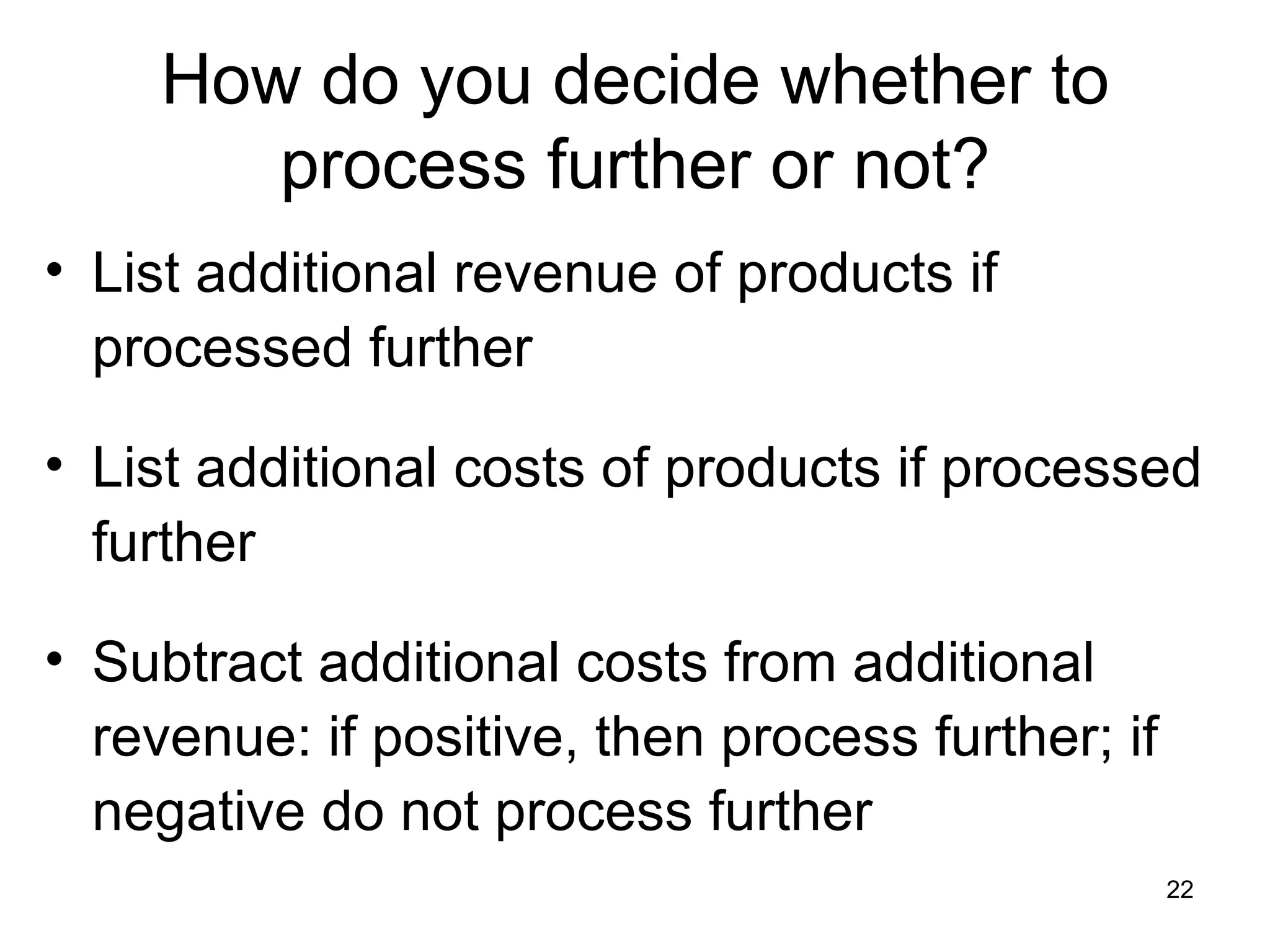
How do youdecide whether to process further or not? List additional revenue of products if processed further List additional costs of products if processed further Subtract additional costs from additional revenue: if positive, then process further; if negative do not process further
23.
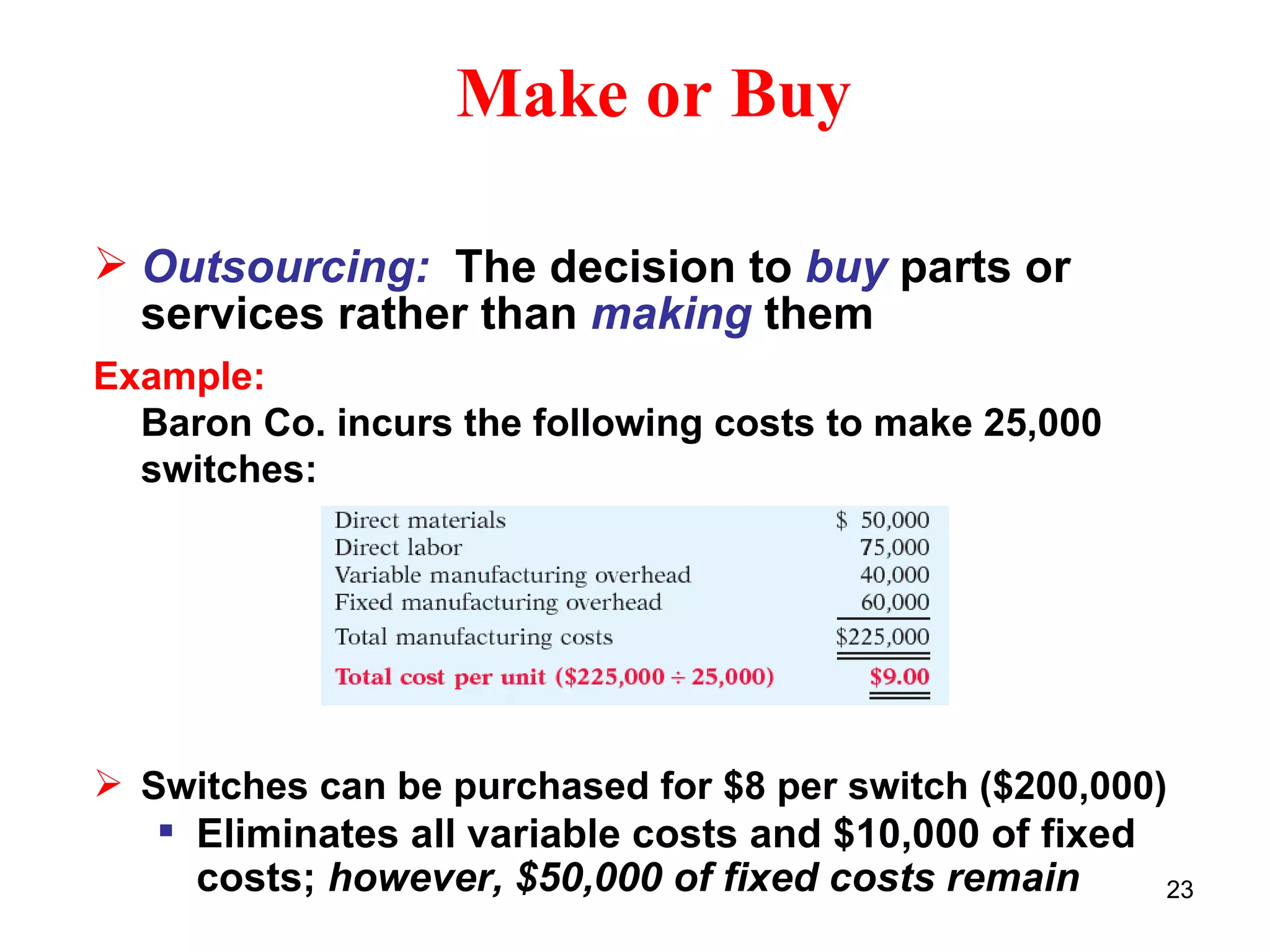
Make or BuyOutsourcing: The decision to buy parts or services rather than making them Example: Baron Co. incurs the following costs to make 25,000 switches: Switches can be purchased for $8 per switch ($200,000) Eliminates all variable costs and $10,000 of fixed costs; however, $50,000 of fixed costs remain
24.
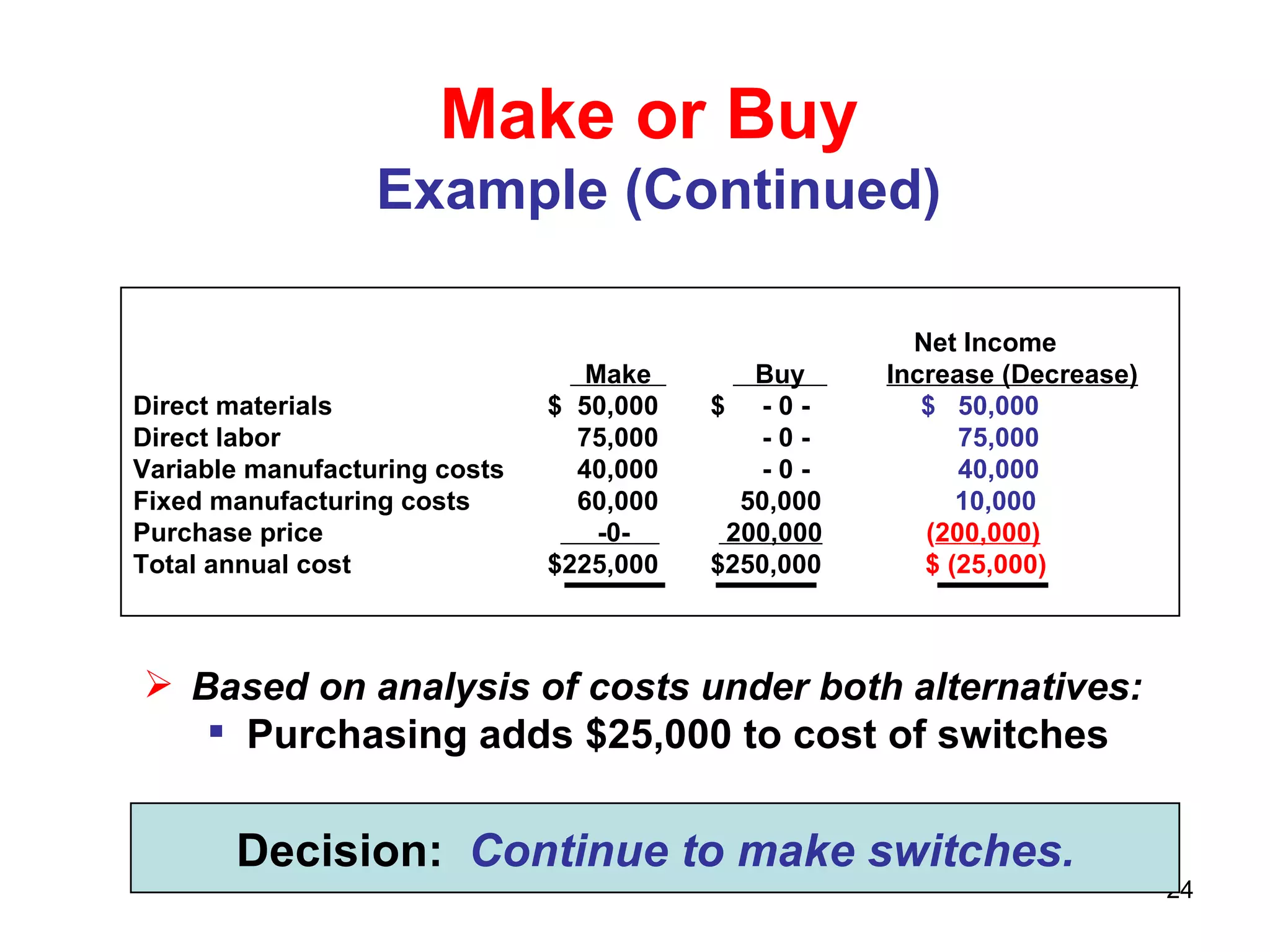
Make or Buy Example (Continued) Based on analysis of costs under both alternatives: Purchasing adds $25,000 to cost of switches Decision: Continue to make switches. Net Income Make Buy Increase (Decrease) Direct materials $ 50,000 $ - 0 - $ 50,000 Direct labor 75,000 - 0 - 75,000 Variable manufacturing costs 40,000 - 0 - 40,000 Fixed manufacturing costs 60,000 50,000 10,000 Purchase price -0- 200,000 ( 200,000) Total annual cost $225,000 $250,000 $ (25,000)
25.
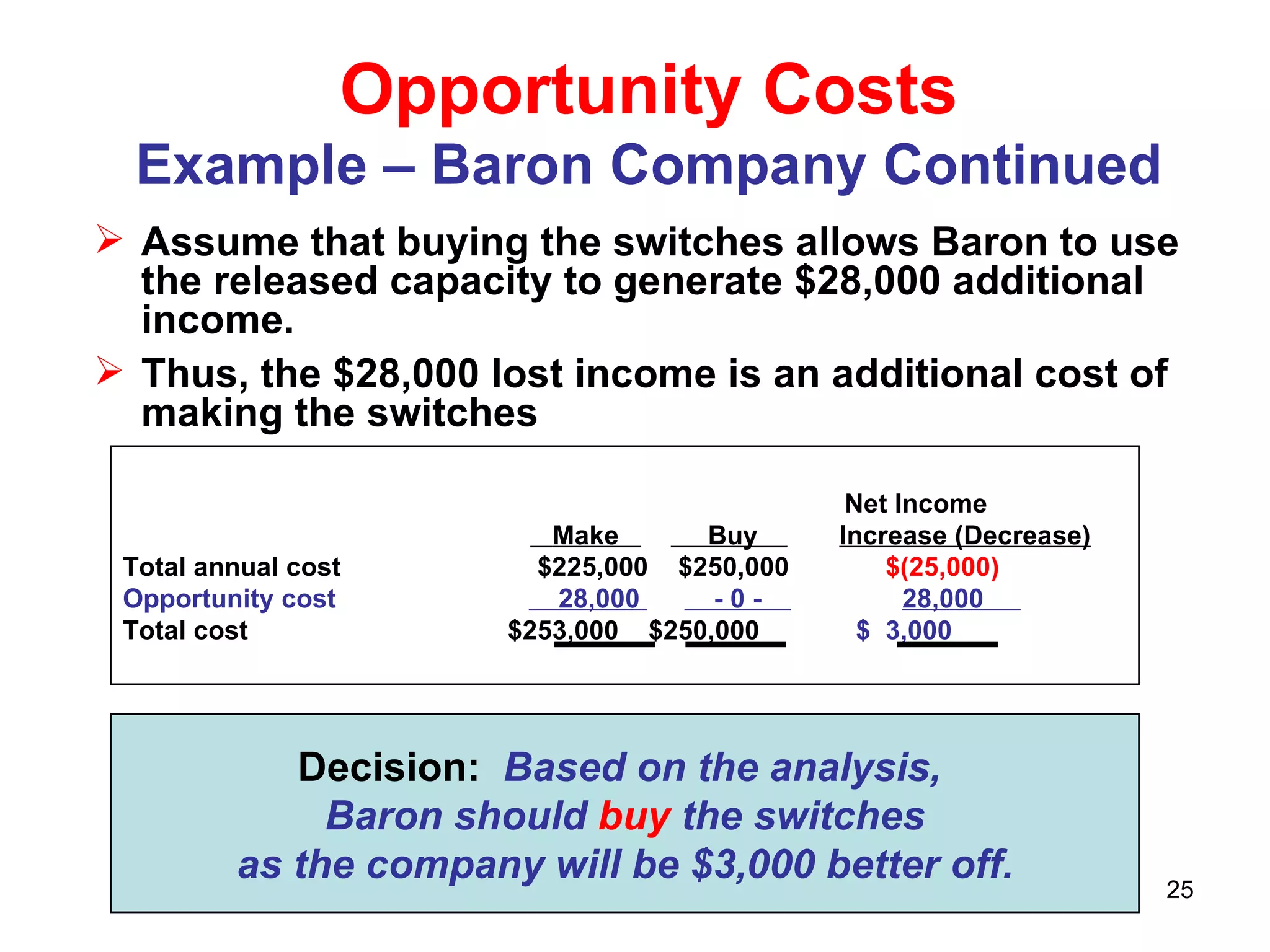
Opportunity Costs Example– Baron Company Continued Assume that buying the switches allows Baron to use the released capacity to generate $28,000 additional income. Thus, the $28,000 lost income is an additional cost of making the switches Net Income Make Buy Increase (Decrease) Total annual cost $225,000 $250,000 $(25,000) Opportunity cost 28,000 - 0 - 28,000 Total cost $253,000 $250,000 $ 3,000 Decision: Based on the analysis, Baron should buy the switches as the company will be $3,000 better off.
26.
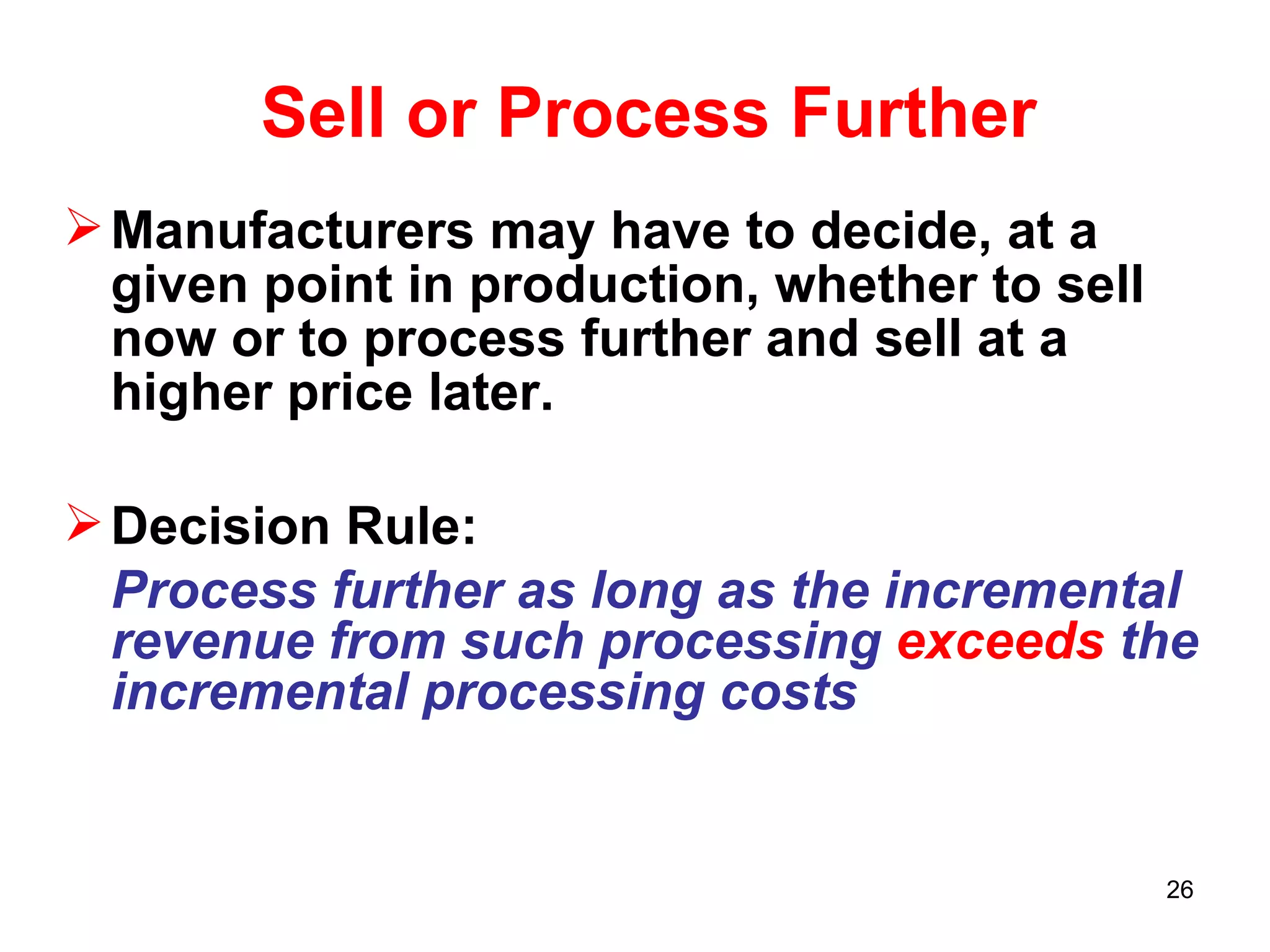
Sell or ProcessFurther Manufacturers may have to decide, at a given point in production, whether to sell now or to process further and sell at a higher price later. Decision Rule: Process further as long as the incremental revenue from such processing exceeds the incremental processing costs
27.
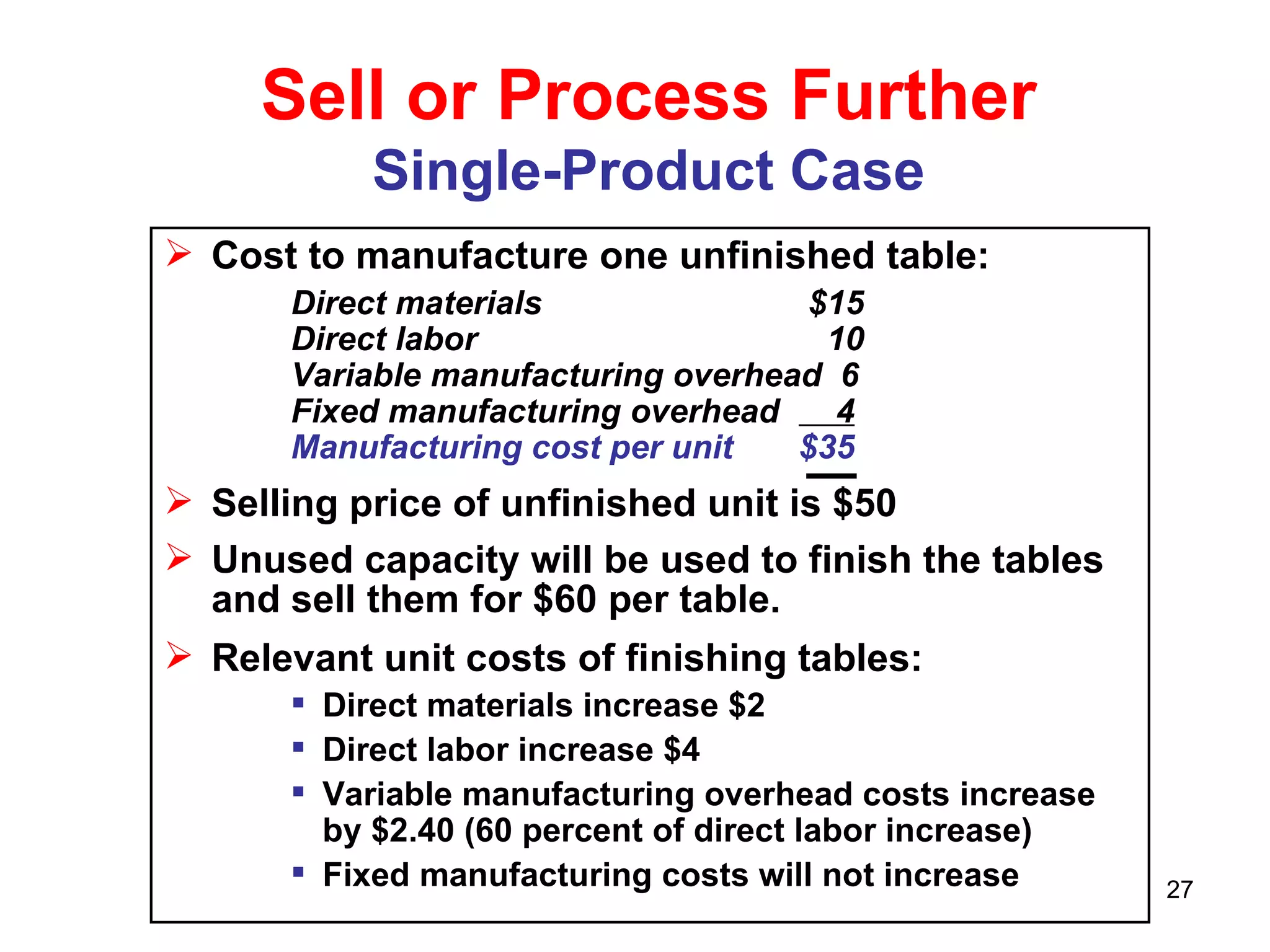
Sell or ProcessFurther Single-Product Case Cost to manufacture one unfinished table: Direct materials $15 Direct labor 10 Variable manufacturing overhead 6 Fixed manufacturing overhead 4 Manufacturing cost per unit $35 Selling price of unfinished unit is $50 Unused capacity will be used to finish the tables and sell them for $60 per table. Relevant unit costs of finishing tables: Direct materials increase $2 Direct labor increase $4 Variable manufacturing overhead costs increase by $2.40 (60 percent of direct labor increase) Fixed manufacturing costs will not increase
28.
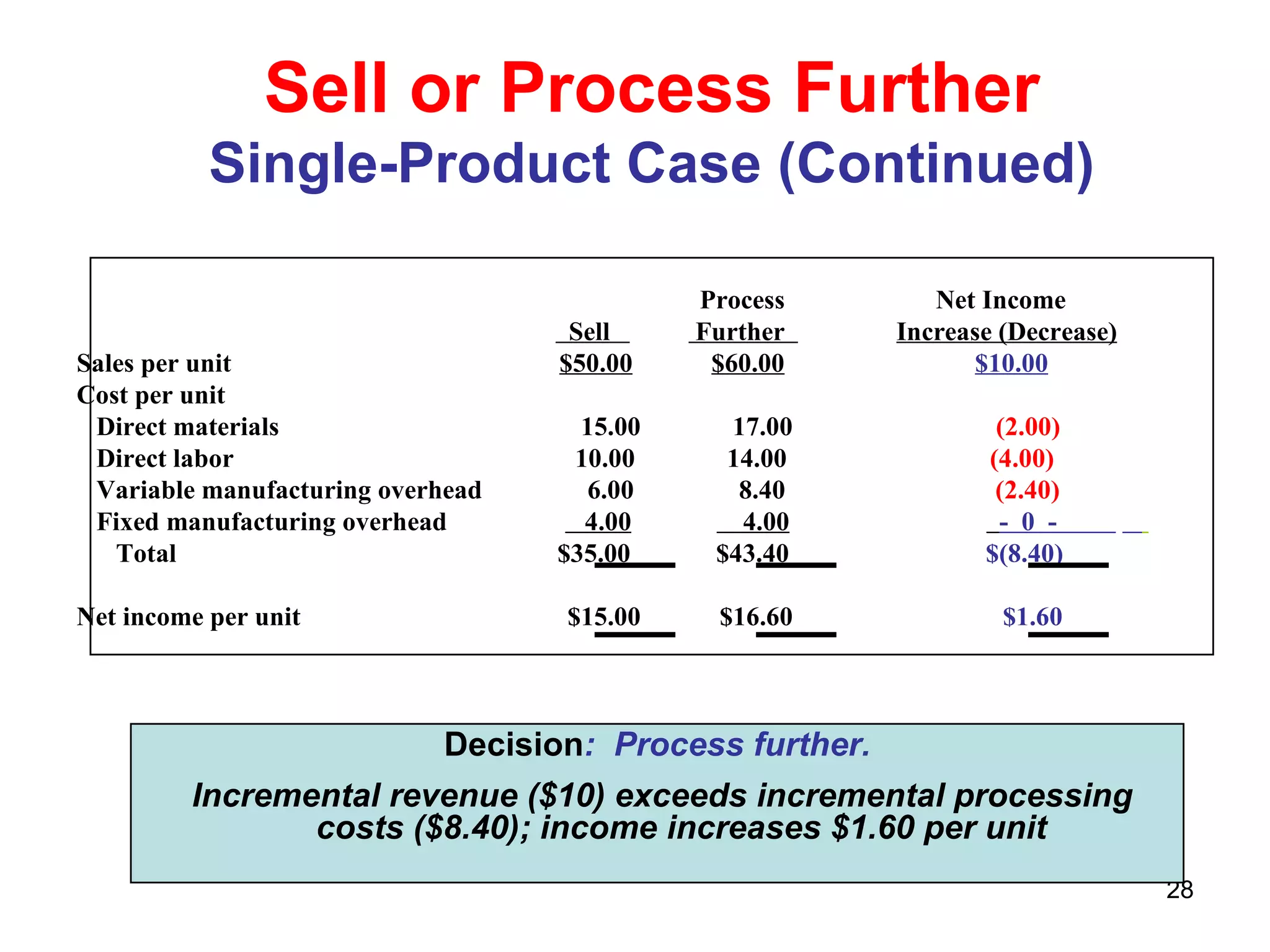
Sell or ProcessFurther Single-Product Case (Continued) Decision : Process further. Incremental revenue ($10) exceeds incremental processing costs ($8.40); income increases $1.60 per unit Process Net Income Sell Further Increase (Decrease) Sales per unit $50.00 $60.00 $10.00 Cost per unit Direct materials 15.00 17.00 (2.00) Direct labor 10.00 14.00 (4.00) Variable manufacturing overhead 6.00 8.40 (2.40) Fixed manufacturing overhead 4.00 4.00 - 0 - Total $35.00 $43.40 $(8.40) Net income per unit $15.00 $16.60 $1.60
29.
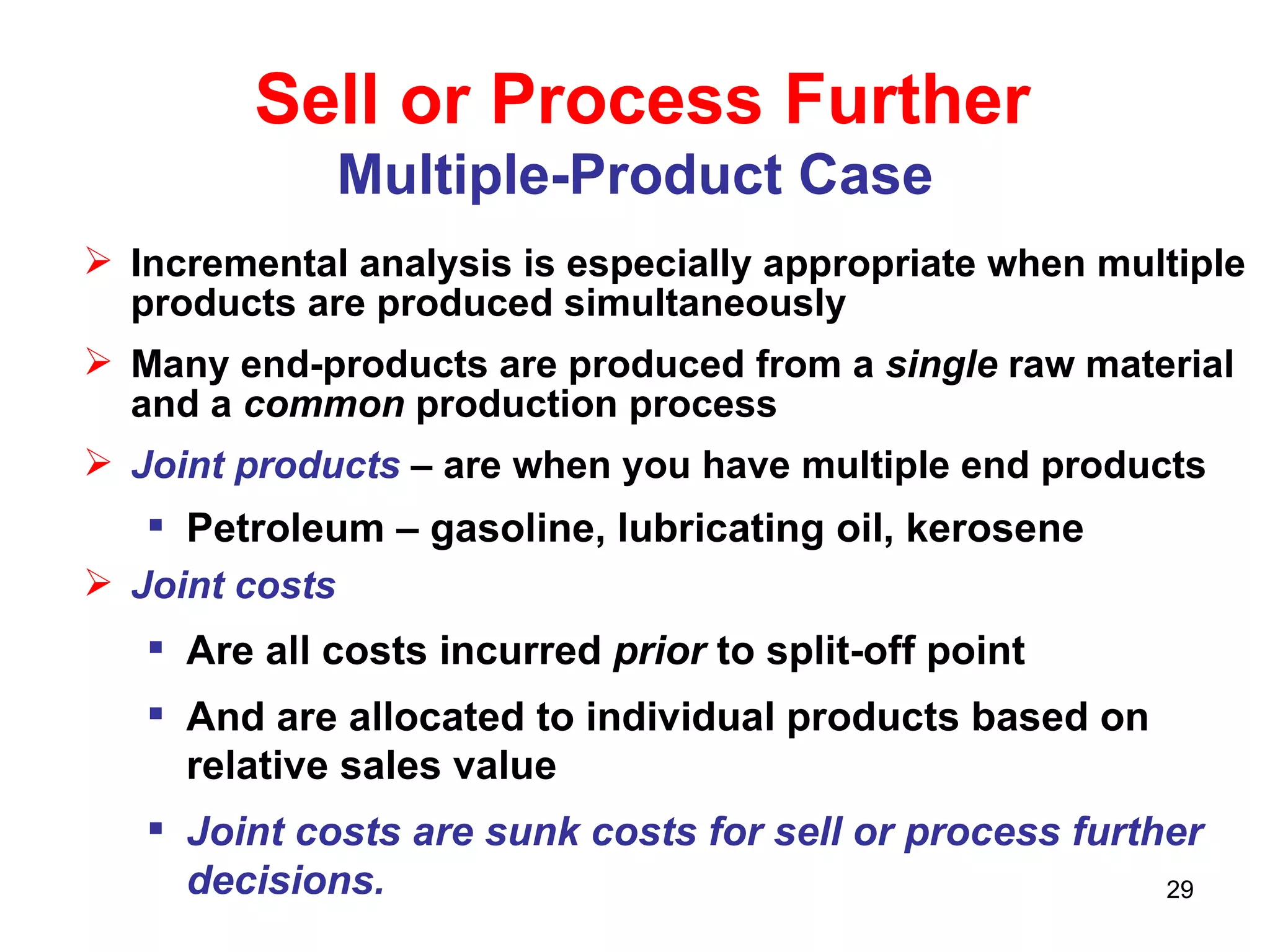
Sell or ProcessFurther Multiple-Product Case Incremental analysis is especially appropriate when multiple products are produced simultaneously Many end-products are produced from a single raw material and a common production process Joint products – are when you have multiple end products Petroleum – gasoline, lubricating oil, kerosene Joint costs Are all costs incurred prior to split-off point And are allocated to individual products based on relative sales value Joint costs are sunk costs for sell or process further decisions.
30.
Sell or ProcessFurther Multiple-Product Case Example - Marais Creamery decision: Sell cream and skim milk or Process them further before selling
31.
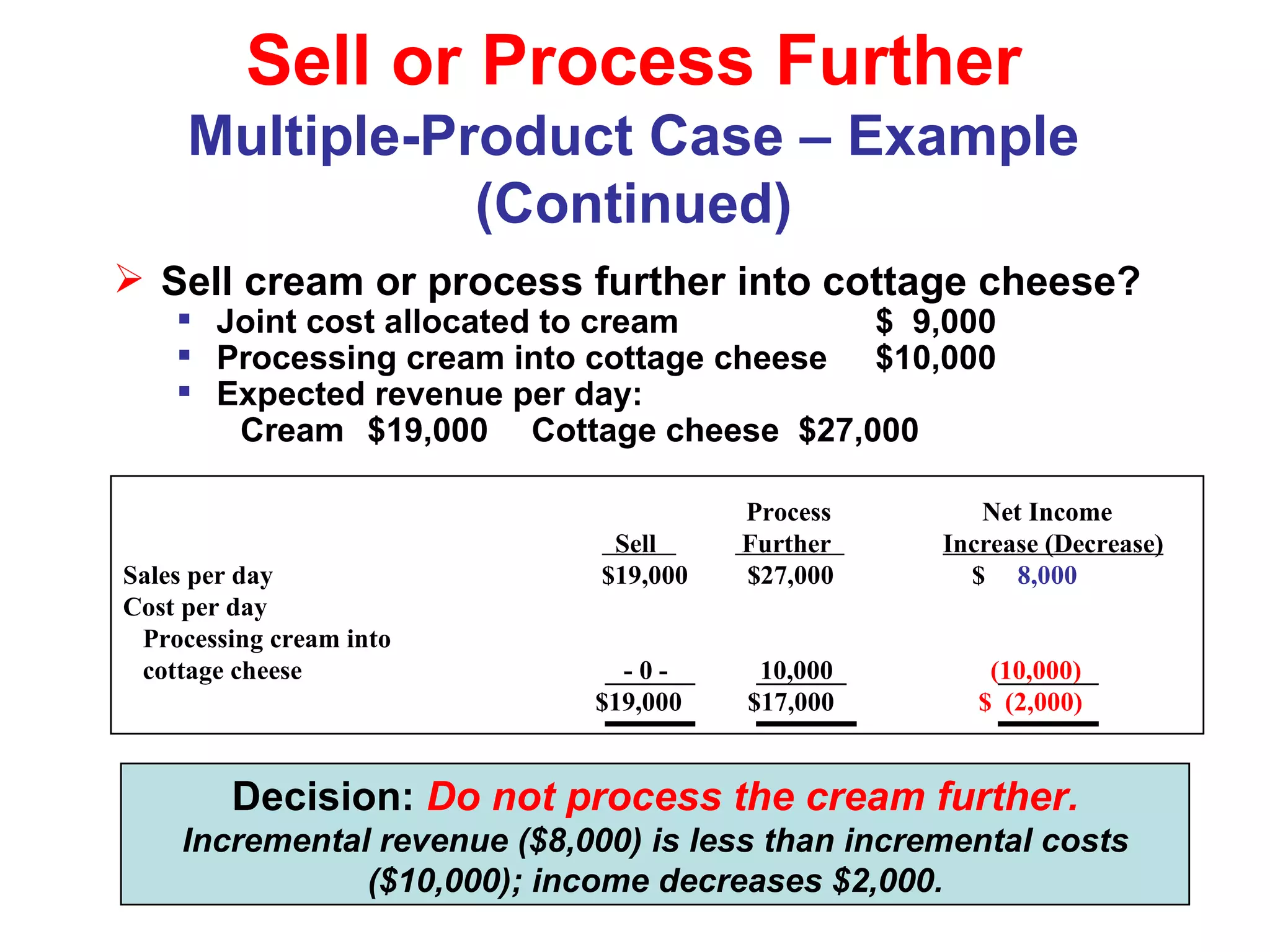
Sell or ProcessFurther Multiple-Product Case – Example (Continued) Sell cream or process further into cottage cheese? Joint cost allocated to cream $ 9,000 Processing cream into cottage cheese $10,000 Expected revenue per day: Cream $19,000 Cottage cheese $27,000 Decision: Do not process the cream further. Incremental revenue ($8,000) is less than incremental costs ($10,000); income decreases $2,000. Process Net Income Sell Further Increase (Decrease) Sales per day $19,000 $27,000 $ 8,000 Cost per day Processing cream into cottage cheese - 0 - 10,000 (10,000) $19,000 $17,000 $ (2,000)
32.
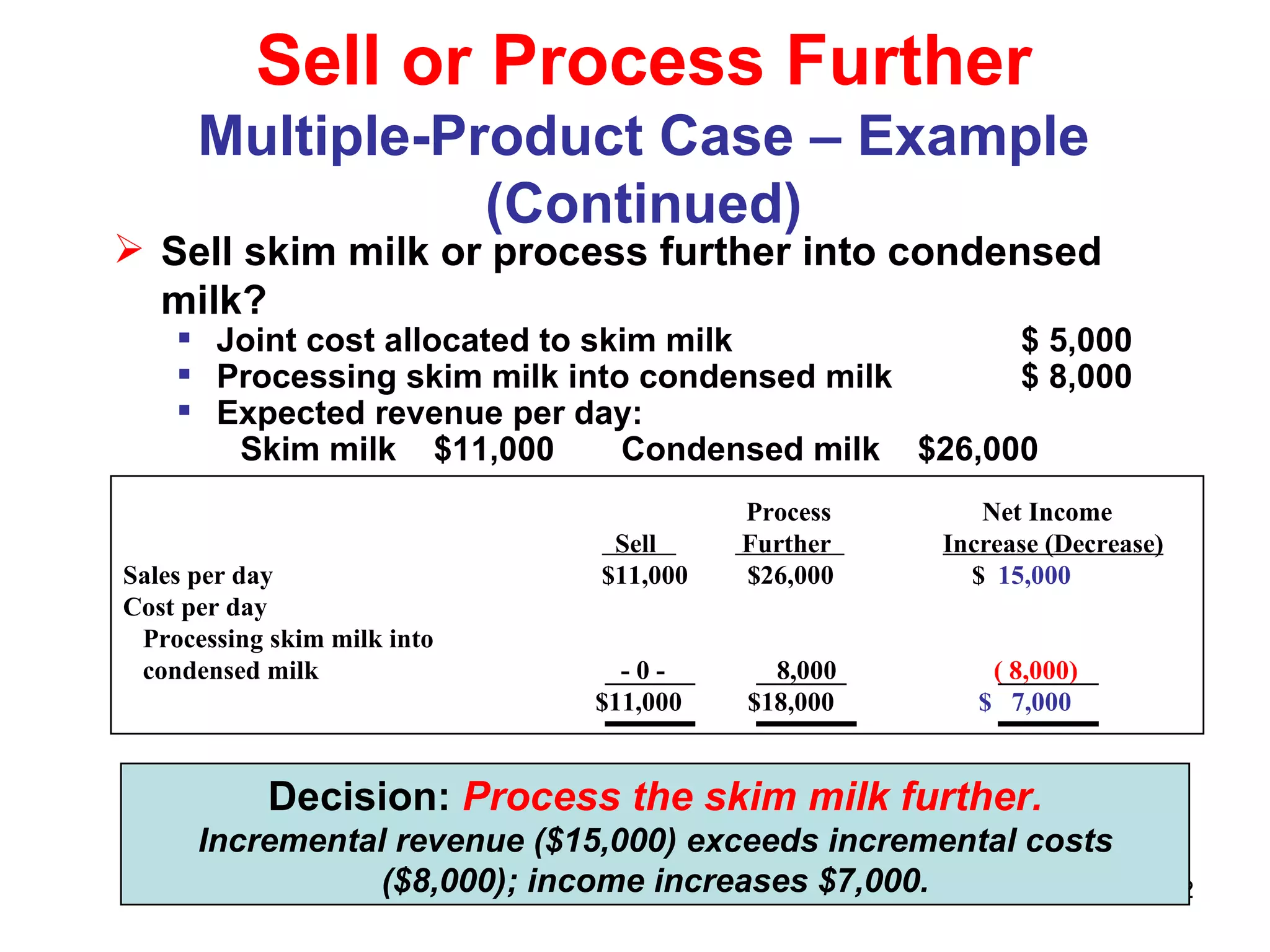
Sell or ProcessFurther Multiple-Product Case – Example (Continued) Sell skim milk or process further into condensed milk? Joint cost allocated to skim milk $ 5,000 Processing skim milk into condensed milk $ 8,000 Expected revenue per day: Skim milk $11,000 Condensed milk $26,000 Decision: Process the skim milk further. Incremental revenue ($15,000) exceeds incremental costs ($8,000); income increases $7,000. Process Net Income Sell Further Increase (Decrease) Sales per day $11,000 $26,000 $ 15,000 Cost per day Processing skim milk into condensed milk - 0 - 8,000 ( 8,000) $11,000 $18,000 $ 7,000
33.
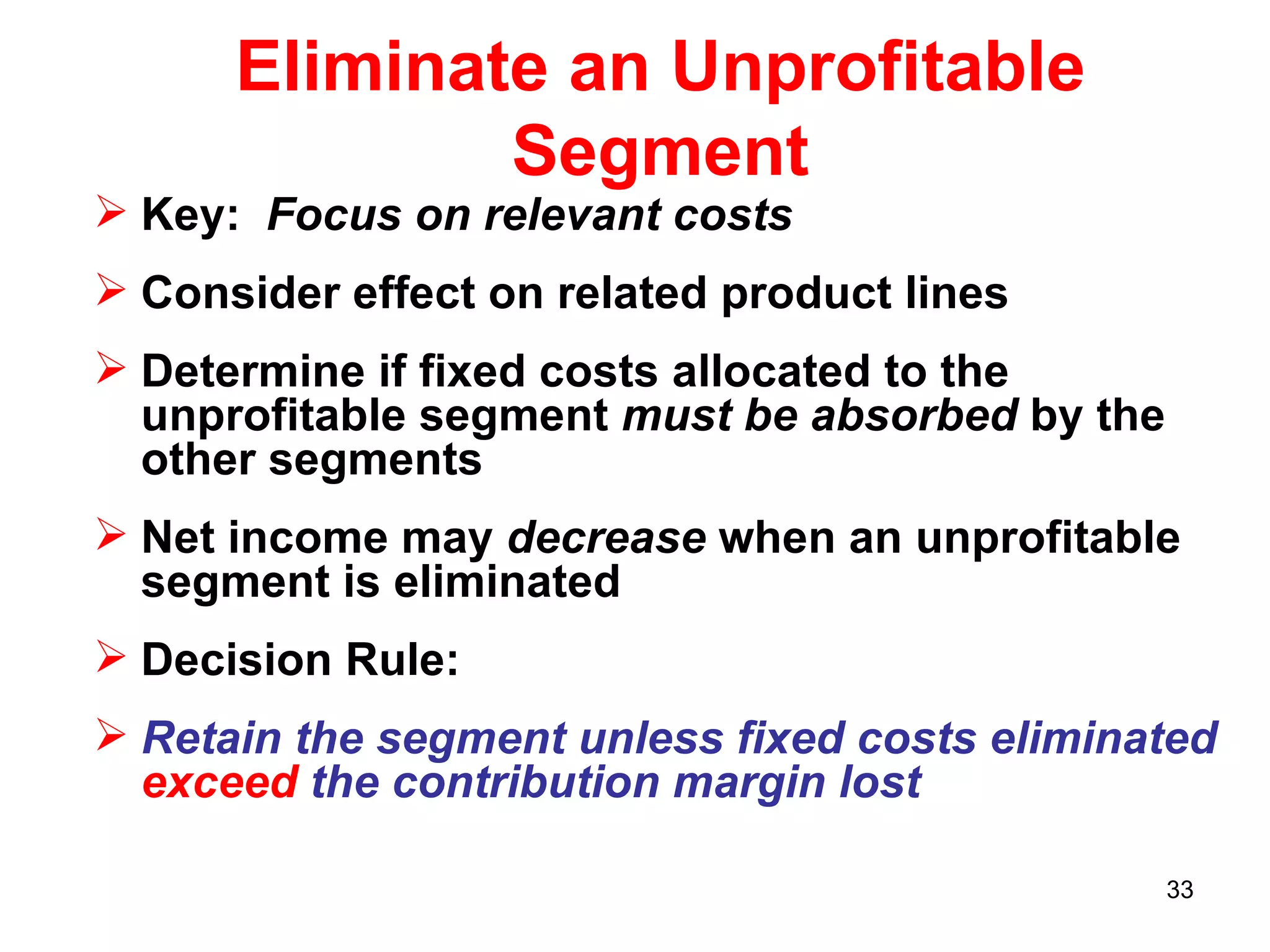
Eliminate an UnprofitableSegment Key: Focus on relevant costs Consider effect on related product lines Determine if fixed costs allocated to the unprofitable segment must be absorbed by the other segments Net income may decrease when an unprofitable segment is eliminated Decision Rule: Retain the segment unless fixed costs eliminated exceed the contribution margin lost
34.
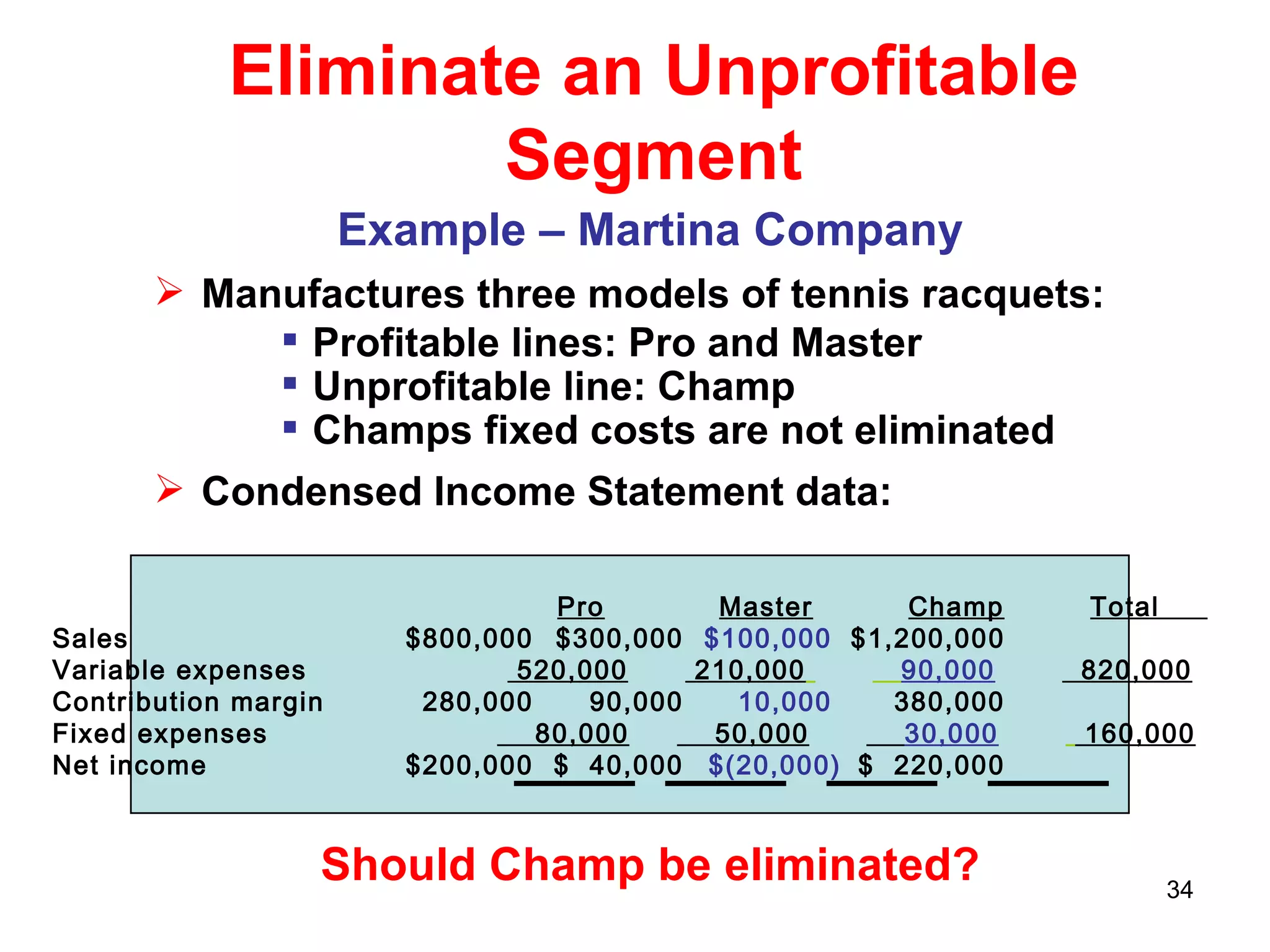
Eliminate an UnprofitableSegment Example – Martina Company Manufactures three models of tennis racquets: Profitable lines: Pro and Master Unprofitable line: Champ Champs fixed costs are not eliminated Condensed Income Statement data: Should Champ be eliminated? Pro Master Champ Total Sales $800,000 $300,000 $100,000 $1,200,000 Variable expenses 520,000 210,000 90,000 820,000 Contribution margin 280,000 90,000 10,000 380,000 Fixed expenses 80,000 50,000 30,000 160,000 Net income $200,000 $ 40,000 $(20,000) $ 220,000
35.
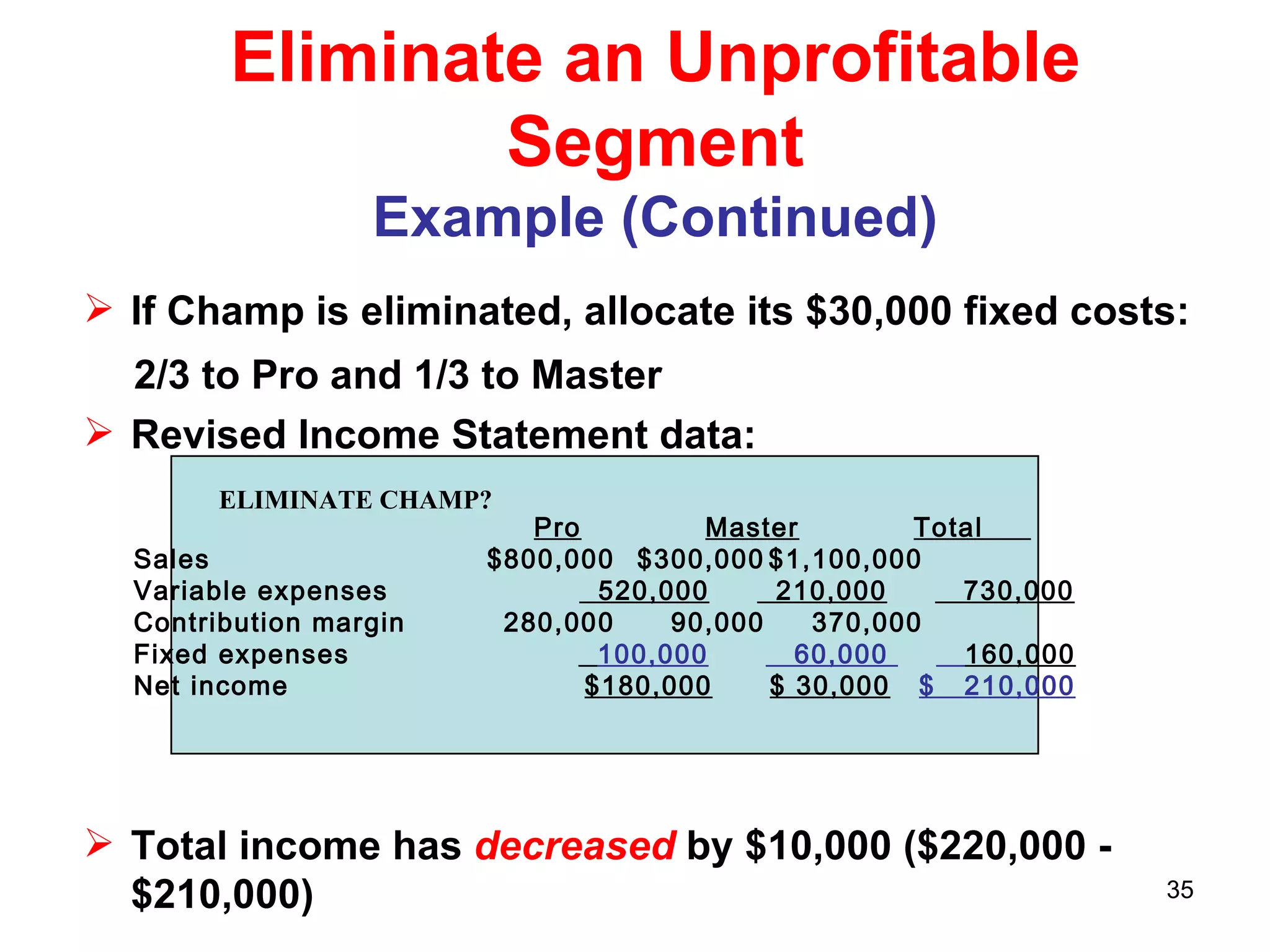
Eliminate an UnprofitableSegment Example (Continued) If Champ is eliminated, allocate its $30,000 fixed costs: 2/3 to Pro and 1/3 to Master Revised Income Statement data: Total income has decreased by $10,000 ($220,000 - $210,000) Pro Master Total Sales $800,000 $300,000 $1,100,000 Variable expenses 520,000 210,000 730,000 Contribution margin 280,000 90,000 370,000 Fixed expenses 100,000 60,000 160,000 Net income $180,000 $ 30,000 $ 210,000 ELIMINATE CHAMP?
36.
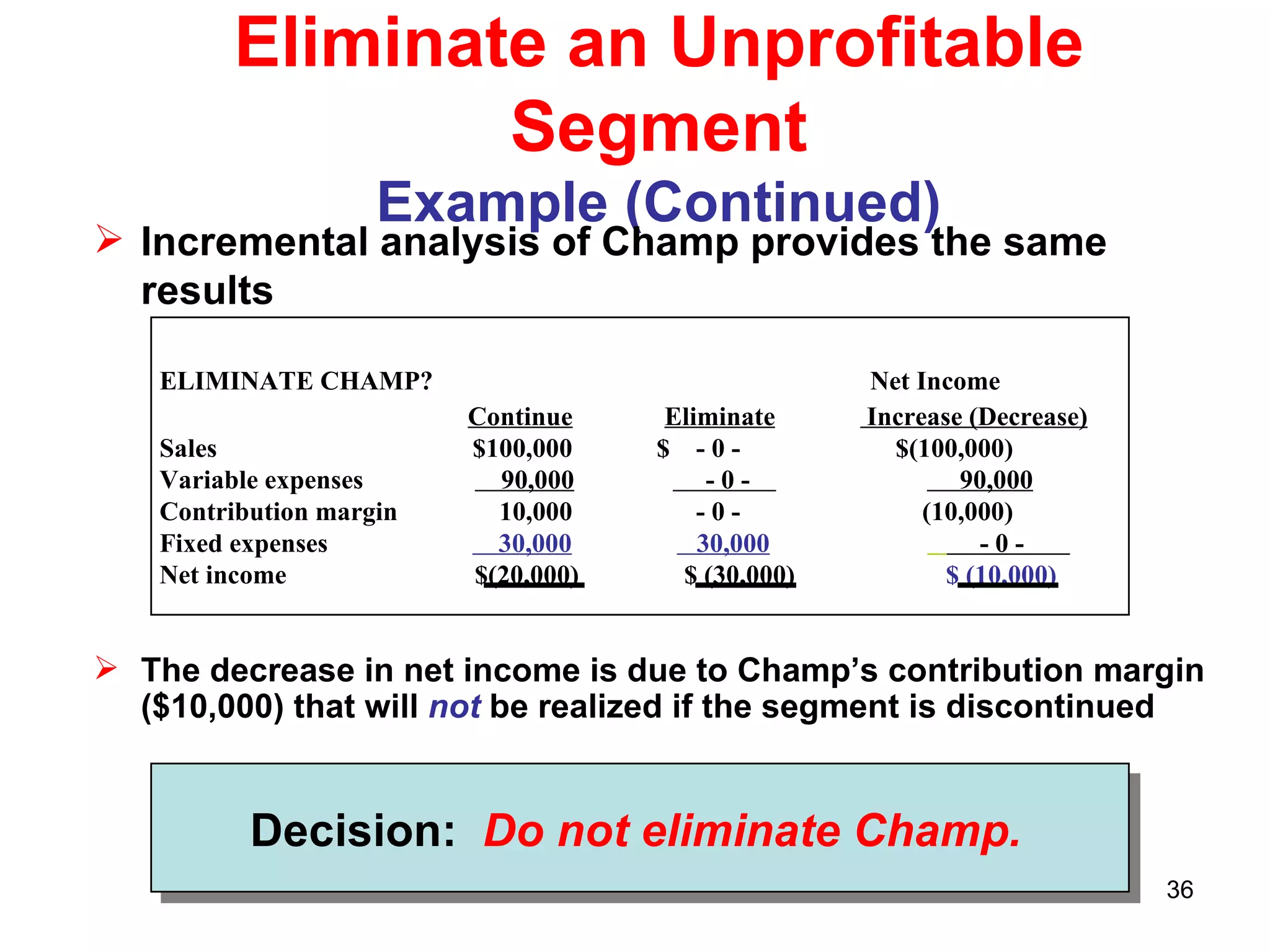
Eliminate an UnprofitableSegment Example (Continued) Incremental analysis of Champ provides the same results The decrease in net income is due to Champ’s contribution margin ($10,000) that will not be realized if the segment is discontinued Decision: Do not eliminate Champ. ELIMINATE CHAMP? Net Income Continue Eliminate Increase (Decrease) Sales $100,000 $ - 0 - $(100,000) Variable expenses 90,000 - 0 - 90,000 Contribution margin 10,000 - 0 - (10,000) Fixed expenses 30,000 30,000 - 0 - Net income $(20,000) $ (30,000) $ (10,000)
37.
Allocate Limited ResourcesResources are always limited. For example: floor space for a retail firm raw material, direct labor hours, or machine capacity for a manufacturing firm Management must decide which products to make and sell to maximize net income
38.
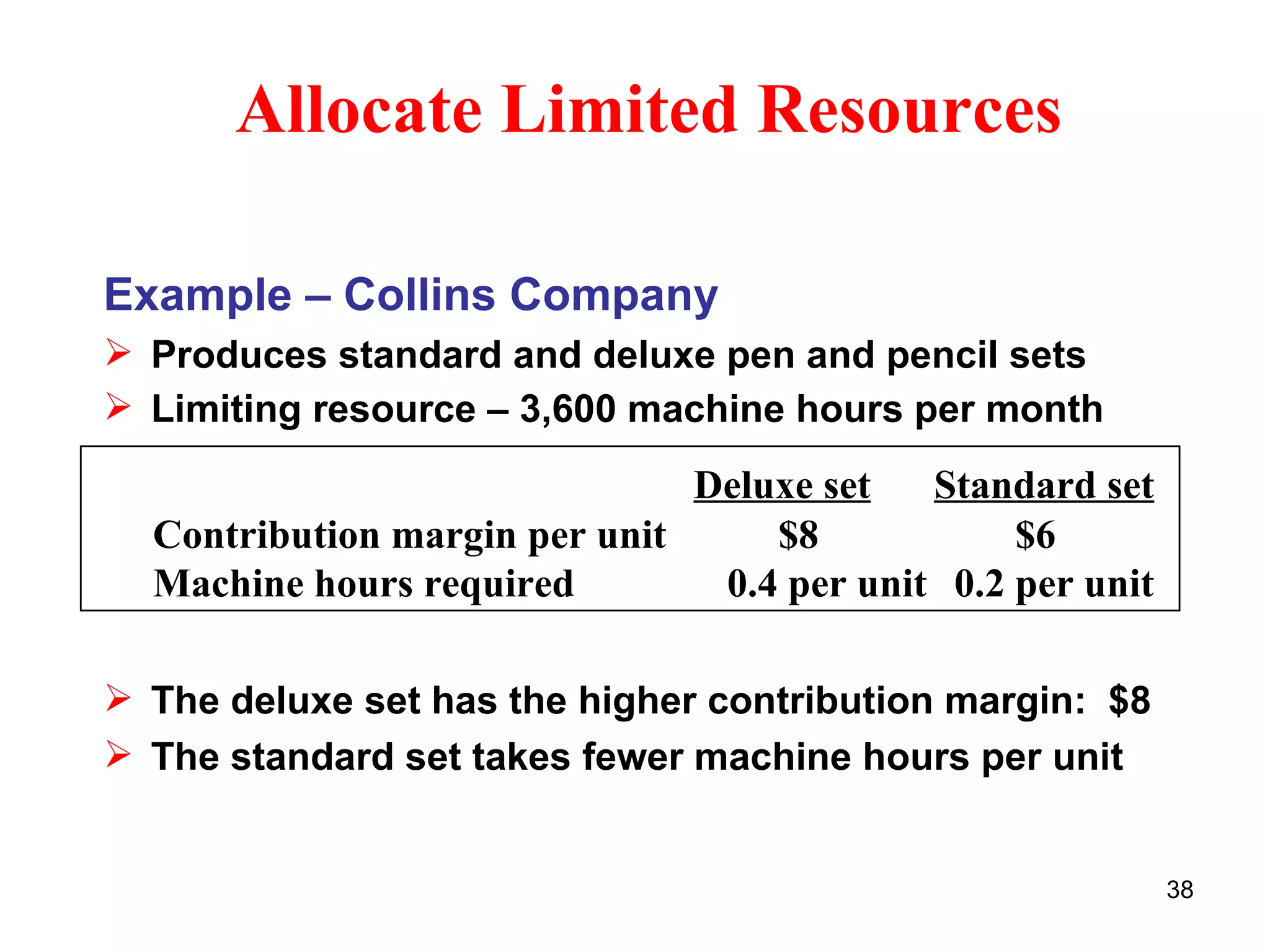
Allocate Limited ResourcesExample – Collins Company Produces standard and deluxe pen and pencil sets Limiting resource – 3,600 machine hours per month The deluxe set has the higher contribution margin: $8 The standard set takes fewer machine hours per unit Deluxe set Standard set Contribution margin per unit $8 $6 Machine hours required 0.4 per unit 0.2 per unit
39.
Allocate Limited ResourcesExample (Continued) Must compute contribution margin per unit of limited resource The s tandard sets have higher contribution margin per unit of limited resources Decision: Shift sales mix to standard sets or increase machine capacity