Topic Name
Language is a purely human and non-instinctive method of communicating ideas,
emotions and desires by means of voluntarily produced symbols. Language is an
aspect of human behaviour. In written form it is a long-term record of knowledge
from one generation to the next while in spoken form it is a means of
communication. Language is the key aspect of human intelligence. Therefore
language is −
a) human speech;
(b)the ability to communicate by this means;
(c) a system of vocal sounds and combinations of such sounds to which meaning is
attributed, used for the expression or communication of thoughts and feelings;
(d) the written representation of such a system.
‣ It is a means of communication.
‣ It is arbitrary word.
‣ It is a system of systems.
‣ It is primarily vocal.
‣ It differs from animal communication in several
ways.
‣ It is a symbol system.
‣ Productivity.
‣ Interchangeability.
‣ It is like biological organism as it is marked by its
origin, growth, development and evolution.
‣ It serves a specific purpose on specific situation.
‣ Language always endeavours to transmit a thought of
the speaker.
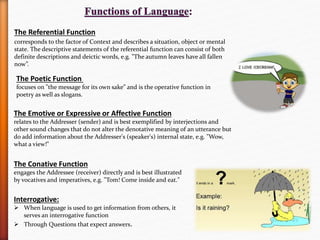
The Referential Function
corresponds to the factor of Context and describes a situation, object or mental
state. The descriptive statements of the referential function can consist of both
definite descriptions and deictic words, e.g. "The autumn leaves have all fallen
now”.
The Poetic Function
focuses on "the message for its own sake” and is the operative function in
poetry as well as slogans.
The Emotive or Expressive or Affective Function
relates to the Addresser (sender) and is best exemplified by interjections and
other sound changes that do not alter the denotative meaning of an utterance but
do add information about the Addresser's (speaker's) internal state, e.g. "Wow,
what a view!"
The Conative Function
engages the Addressee (receiver) directly and is best illustrated
by vocatives and imperatives, e.g. "Tom! Come inside and eat."
Interrogative:
 When language is used to get information from others, it
serves an interrogative function
 Through Questions that expect answers.
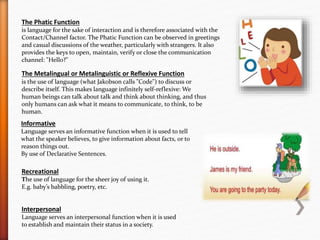
The Phatic Function
is language for the sake of interaction and is therefore associated with the
Contact/Channel factor. The Phatic Function can be observed in greetings
and casual discussions of the weather, particularly with strangers. It also
provides the keys to open, maintain, verify or close the communication
channel: "Hello?"
The Metalingual or Metalinguistic or Reflexive Function
is the use of language (what Jakobson calls "Code") to discuss or
describe itself. This makes language infinitely self-reflexive: We
human beings can talk about talk and think about thinking, and thus
only humans can ask what it means to communicate, to think, to be
human.
Informative
Language serves an informative function when it is used to tell
what the speaker believes, to give information about facts, or to
reason things out.
By use of Declarative Sentences.
Recreational
The use of language for the sheer joy of using it.
E.g. baby’s babbling, poetry, etc.
Interpersonal
Language serves an interpersonal function when it is used
to establish and maintain their status in a society.
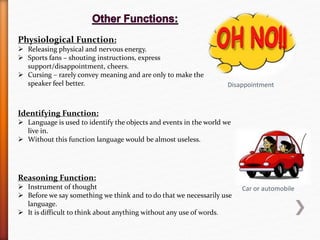
Physiological Function:
 Releasing physical and nervous energy.
 Sports fans – shouting instructions, express
support/disappointment, cheers.
 Cursing – rarely convey meaning and are only to make the
speaker feel better.
Identifying Function:
 Language is used to identify the objects and events in the world we
live in.
 Without this function language would be almost useless.
Reasoning Function:
 Instrument of thought
 Before we say something we think and to do that we necessarily use
language.
 It is difficult to think about anything without any use of words.
Car or automobile
Disappointment
Communicating Function:
 Often the first function that people identify.
 Most commonly used by the majority of speakers.
Requesting, Apologising, Informing,Ordering, Promising,
Refusing.
Activity:
 A means to convey information
 Drawing using only verbal instructions.
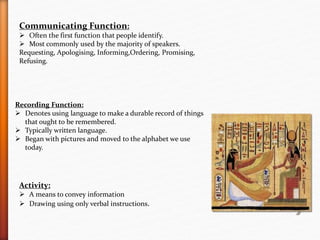
Recording Function:
 Denotes using language to make a durable record of things
that ought to be remembered.
 Typically written language.
 Began with pictures and moved to the alphabet we use
today.
Language has become an inseparable part of human life . Everything we
do we use any of the mentioned functions of language; rarely we use
gestures or signs. With time language has developed and flourished and
resulted in adding up more functions of it.
Functions of Language

Functions of Language

  • 1.
  • 2.
    Language is apurely human and non-instinctive method of communicating ideas, emotions and desires by means of voluntarily produced symbols. Language is an aspect of human behaviour. In written form it is a long-term record of knowledge from one generation to the next while in spoken form it is a means of communication. Language is the key aspect of human intelligence. Therefore language is − a) human speech; (b)the ability to communicate by this means; (c) a system of vocal sounds and combinations of such sounds to which meaning is attributed, used for the expression or communication of thoughts and feelings; (d) the written representation of such a system.
  • 3.
    ‣ It isa means of communication. ‣ It is arbitrary word. ‣ It is a system of systems. ‣ It is primarily vocal. ‣ It differs from animal communication in several ways. ‣ It is a symbol system. ‣ Productivity. ‣ Interchangeability. ‣ It is like biological organism as it is marked by its origin, growth, development and evolution. ‣ It serves a specific purpose on specific situation. ‣ Language always endeavours to transmit a thought of the speaker.
  • 4.
    The Referential Function correspondsto the factor of Context and describes a situation, object or mental state. The descriptive statements of the referential function can consist of both definite descriptions and deictic words, e.g. "The autumn leaves have all fallen now”. The Poetic Function focuses on "the message for its own sake” and is the operative function in poetry as well as slogans. The Emotive or Expressive or Affective Function relates to the Addresser (sender) and is best exemplified by interjections and other sound changes that do not alter the denotative meaning of an utterance but do add information about the Addresser's (speaker's) internal state, e.g. "Wow, what a view!" The Conative Function engages the Addressee (receiver) directly and is best illustrated by vocatives and imperatives, e.g. "Tom! Come inside and eat." Interrogative:  When language is used to get information from others, it serves an interrogative function  Through Questions that expect answers.
  • 5.
    The Phatic Function islanguage for the sake of interaction and is therefore associated with the Contact/Channel factor. The Phatic Function can be observed in greetings and casual discussions of the weather, particularly with strangers. It also provides the keys to open, maintain, verify or close the communication channel: "Hello?" The Metalingual or Metalinguistic or Reflexive Function is the use of language (what Jakobson calls "Code") to discuss or describe itself. This makes language infinitely self-reflexive: We human beings can talk about talk and think about thinking, and thus only humans can ask what it means to communicate, to think, to be human. Informative Language serves an informative function when it is used to tell what the speaker believes, to give information about facts, or to reason things out. By use of Declarative Sentences. Recreational The use of language for the sheer joy of using it. E.g. baby’s babbling, poetry, etc. Interpersonal Language serves an interpersonal function when it is used to establish and maintain their status in a society.
  • 6.
    Physiological Function:  Releasingphysical and nervous energy.  Sports fans – shouting instructions, express support/disappointment, cheers.  Cursing – rarely convey meaning and are only to make the speaker feel better. Identifying Function:  Language is used to identify the objects and events in the world we live in.  Without this function language would be almost useless. Reasoning Function:  Instrument of thought  Before we say something we think and to do that we necessarily use language.  It is difficult to think about anything without any use of words. Car or automobile Disappointment
  • 7.
    Communicating Function:  Oftenthe first function that people identify.  Most commonly used by the majority of speakers. Requesting, Apologising, Informing,Ordering, Promising, Refusing. Activity:  A means to convey information  Drawing using only verbal instructions. Recording Function:  Denotes using language to make a durable record of things that ought to be remembered.  Typically written language.  Began with pictures and moved to the alphabet we use today.
  • 8.
    Language has becomean inseparable part of human life . Everything we do we use any of the mentioned functions of language; rarely we use gestures or signs. With time language has developed and flourished and resulted in adding up more functions of it.