TRAINING PROGRAM ONTRAINING PROGRAM ON
PREDICTIVE MAINTENANCEPREDICTIVE MAINTENANCE
(CONDITION B(CONDITION BASED MAINTENANCE)ASED MAINTENANCE)
MAINTENANCE STRATEGIES
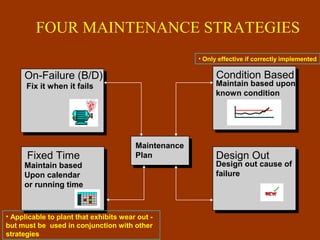
FOUR MAINTENANCE STRATEGIES
On-Failure (B/D)
Fix it when it fails
Fixed Time
Maintain based
Upon calendar
or running time
Condition Based
Maintain based upon
known condition
Design Out
Design out cause of
failure
Maintenance
Plan
• Applicable to plant that exhibits wear out -
but must be used in conjunction with other
strategies
• Only effective if correctly implemented
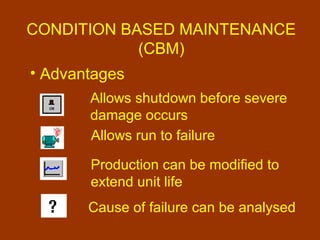
CONDITION BASED MAINTENANCE
(CBM)
• Advantages
Allows shutdown before severe
damage occurs
Allows run to failure
Production can be modified to
extend unit life
Cause of failure can be analysed
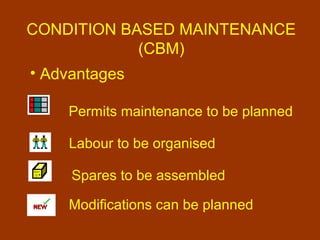
• Advantages
Permits maintenance to be planned
Labour to be organised
Spares to be assembled
Modifications can be planned
CONDITION BASED MAINTENANCE
(CBM)
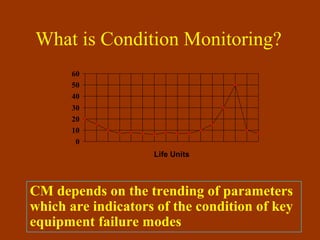
What is Condition Monitoring?
CM depends on the trending of parameters
which are indicators of the condition of key
equipment failure modes
0
10
20
30
40
50
60
Life Units
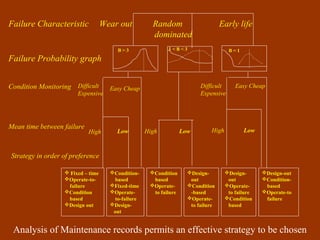
Failure Characteristic
B < 1
Wear out Random
dominated
Early life
Failure Probability graph
B > 3
Difficult
Expensive
Easy Cheap Difficult
Expensive
Easy Cheap
High Low High Low High Low
Condition Monitoring
Mean time between failure
Strategy in order of preference
 Fixed – time
Operate-to-
failure
Condition
based
Design out
Condition-
based
Fixed-time
Operate-
to-failure
Design-
out
Condition
based
Operate-
to failure
Design-
out
Condition
-based
Operate-
to failure
Design-
out
Operate-
to failure
Condition
based
Design-out
Condition-
based
Operate-to
failure
Analysis of Maintenance records permits an effective strategy to be chosen
1 < B < 3
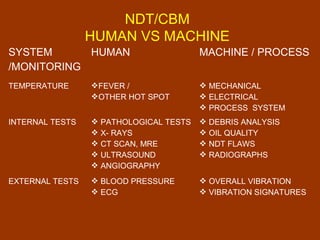
HUMAN VS MACHINE
NDT/CBM
HUMAN VS MACHINE
SYSTEM
/MONITORING
HUMAN MACHINE / PROCESS
TEMPERATURE FEVER /
OTHER HOT SPOT
 MECHANICAL
 ELECTRICAL
 PROCESS SYSTEM
INTERNAL TESTS  PATHOLOGICAL TESTS
 X- RAYS
 CT SCAN, MRE
 ULTRASOUND
 ANGIOGRAPHY
 DEBRIS ANALYSIS
 OIL QUALITY
 NDT FLAWS
 RADIOGRAPHS
EXTERNAL TESTS  BLOOD PRESSURE
 ECG
 OVERALL VIBRATION
 VIBRATION SIGNATURES
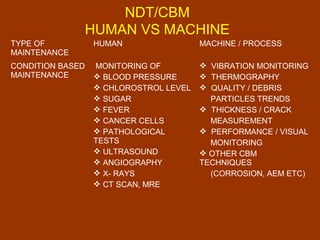
NDT/CBM
HUMAN VS MACHINE
TYPE OF
MAINTENANCE
HUMAN MACHINE / PROCESS
CONDITION BASED
MAINTENANCE
MONITORING OF
 BLOOD PRESSURE
 CHLOROSTROL LEVEL
 SUGAR
 FEVER
 CANCER CELLS
 PATHOLOGICAL
TESTS
 ULTRASOUND
 ANGIOGRAPHY
 X- RAYS
 CT SCAN, MRE
 VIBRATION MONITORING
 THERMOGRAPHY
 QUALITY / DEBRIS
PARTICLES TRENDS
 THICKNESS / CRACK
MEASUREMENT
 PERFORMANCE / VISUAL
MONITORING
 OTHER CBM
TECHNIQUES
(CORROSION, AEM ETC)
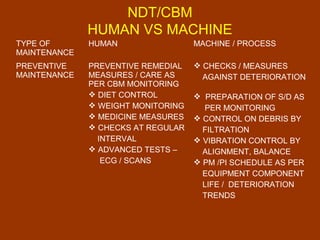
NDT/CBM
HUMAN VS MACHINE
TYPE OF
MAINTENANCE
HUMAN MACHINE / PROCESS
PREVENTIVE
MAINTENANCE
PREVENTIVE REMEDIAL
MEASURES / CARE AS
PER CBM MONITORING
 DIET CONTROL
 WEIGHT MONITORING
 MEDICINE MEASURES
 CHECKS AT REGULAR
INTERVAL
 ADVANCED TESTS –
ECG / SCANS
 CHECKS / MEASURES
AGAINST DETERIORATION
 PREPARATION OF S/D AS
PER MONITORING
 CONTROL ON DEBRIS BY
FILTRATION
 VIBRATION CONTROL BY
ALIGNMENT, BALANCE
 PM /PI SCHEDULE AS PER
EQUIPMENT COMPONENT
LIFE / DETERIORATION
TRENDS
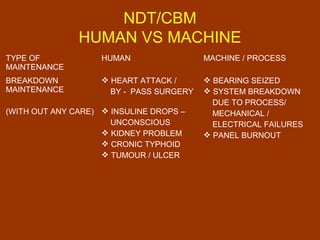
NDT/CBM
HUMAN VS MACHINE
TYPE OF
MAINTENANCE
HUMAN MACHINE / PROCESS
BREAKDOWN
MAINTENANCE
(WITH OUT ANY CARE)
 HEART ATTACK /
BY - PASS SURGERY
 INSULINE DROPS –
UNCONSCIOUS
 KIDNEY PROBLEM
 CRONIC TYPHOID
 TUMOUR / ULCER
 BEARING SEIZED
 SYSTEM BREAKDOWN
DUE TO PROCESS/
MECHANICAL /
ELECTRICAL FAILURES
 PANEL BURNOUT
CONDITION BASEDCONDITION BASED
MAINTENANCEMAINTENANCE
TECHNIQUESTECHNIQUES
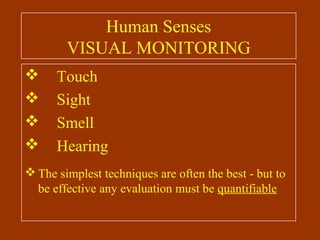
Human Senses
VISUAL MONITORING
 Touch
 Sight
 Smell
 Hearing
 The simplest techniques are often the best - but to
be effective any evaluation must be quantifiable
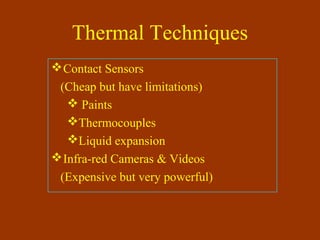
Thermal Techniques
Contact Sensors
(Cheap but have limitations)
 Paints
Thermocouples
Liquid expansion
Infra-red Cameras & Videos
(Expensive but very powerful)
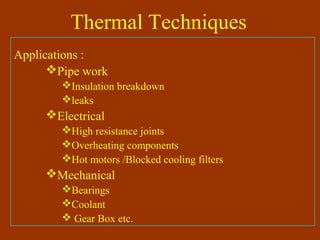
Thermal Techniques
Applications :
Pipe work
Insulation breakdown
leaks
Electrical
High resistance joints
Overheating components
Hot motors /Blocked cooling filters
Mechanical
Bearings
Coolant
 Gear Box etc.
Vibration Monitoring
Versatile tool for condition monitoring of
rotating & reciprocating plant
Wide range of techniques and instrumentations
Careful selection and application of technique is
essential for success
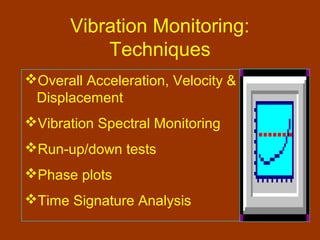
Vibration Monitoring:
Techniques
Overall Acceleration, Velocity &
Displacement
Vibration Spectral Monitoring
Run-up/down tests
Phase plots
Time Signature Analysis
Vibration Monitoring:
Rolling Element Bearing MonitoringRolling Element Bearing Monitoring
 Spike Energy/HFD
 High Frequency Velocity
 Overall Acceleration
 Shock Pulse
Performance Monitoring
Involves the use of existing data,
 Current
 Temp
 Pressure
 Flow rate
Performance Monitoring
Any variable which is indicative of a failure mode
Thermal efficiency
Wear rate
Compressor loading / unloading time
Product Accuracy
Wear Debris Monitoring
Techniques
Spectrographic Oil Analysis (SOA)
Ferrography (direct & analytical)
Particle Quantifier
Microscopic optical assessment
Choice of technique is critical to success
Non Destructive Testing
 Ultrasonic Methods
 Radiography
 Dye Penetrant
 Magnetic Particle
Corrosion Monitoring
 Visual Inspection
 Ultrasonic Leak Detection
 Coupons
 Electrical Resistance Probe
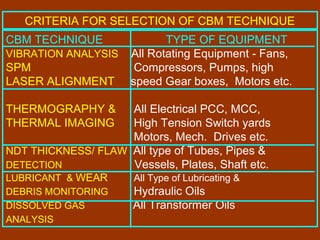
CRITERIA FOR SELECTION OF CBM TECHNIQUE
CBM TECHNIQUE TYPE OF EQUIPMENT
VIBRATION ANALYSIS All Rotating Equipment - Fans,
SPM Compressors, Pumps, high
LASER ALIGNMENT speed Gear boxes, Motors etc.
THERMOGRAPHY & All Electrical PCC, MCC,
THERMAL IMAGING High Tension Switch yards
Motors, Mech. Drives etc.
NDT THICKNESS/ FLAW All type of Tubes, Pipes &
DETECTION Vessels, Plates, Shaft etc.
LUBRICANT & WEAR All Type of Lubricating &
DEBRIS MONITORING Hydraulic Oils
DISSOLVED GAS All Transformer Oils
ANALYSIS
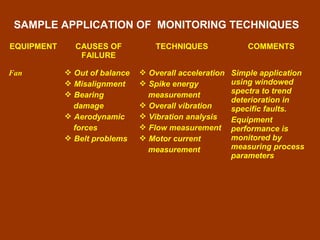
EQUIPMENT CAUSES OF
FAILURE
TECHNIQUES COMMENTS
Fan  Out of balance
 Misalignment
 Bearing
damage
 Aerodynamic
forces
 Belt problems
 Overall acceleration
 Spike energy
measurement
 Overall vibration
 Vibration analysis
 Flow measurement
 Motor current
measurement
Simple application
using windowed
spectra to trend
deterioration in
specific faults.
Equipment
performance is
monitored by
measuring process
parameters
SAMPLE APPLICATION OF MONITORING TECHNIQUES
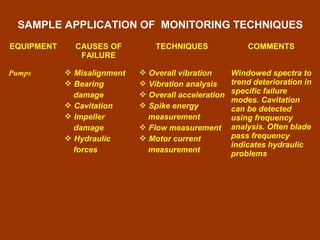
EQUIPMENT CAUSES OF
FAILURE
TECHNIQUES COMMENTS
Pumps  Misalignment
 Bearing
damage
 Cavitation
 Impeller
damage
 Hydraulic
forces
 Overall vibration
 Vibration analysis
 Overall acceleration
 Spike energy
measurement
 Flow measurement
 Motor current
measurement
Windowed spectra to
trend deterioration in
specific failure
modes. Cavitation
can be detected
using frequency
analysis. Often blade
pass frequency
indicates hydraulic
problems
SAMPLE APPLICATION OF MONITORING TECHNIQUES
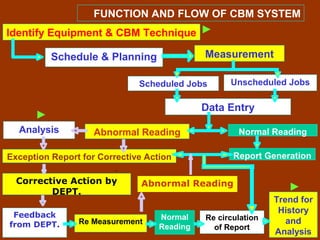
Identify Equipment & CBM Technique
Schedule & Planning Measurement
Unscheduled JobsScheduled Jobs
Data Entry
Analysis Abnormal Reading Normal Reading
Exception Report for Corrective Action Report Generation
Corrective Action by
DEPT.
.
Abnormal Reading
Feedback
from DEPT. Re Measurement
Normal
Reading
Trend for
History
and
Analysis
Re circulation
of Report
FUNCTION AND FLOW OF CBM SYSTEM
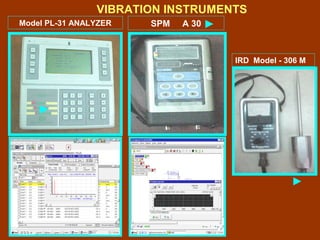
VIBRATION INSTRUMENTS
IRD Model - 306 M
Model PL-31 ANALYZER SPM A 30
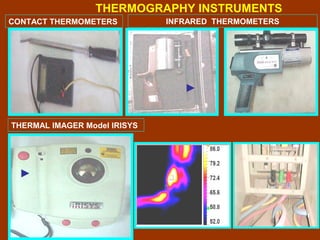
INFRARED THERMOMETERSCONTACT THERMOMETERS
THERMAL IMAGER Model IRISYS
THERMOGRAPHY INSTRUMENTS
LUBRICANT OIL TESTING
WEAR DEBRIS /PARTICLE ANALYSIS
- SEPARATE INFRASTRUCTRUE /LAB
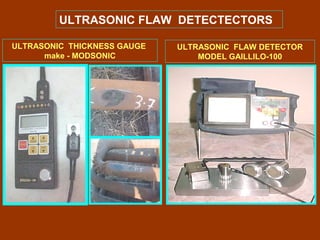
ULTRASONIC THICKNESS GAUGE
make - MODSONIC
ULTRASONIC FLAW DETECTECTORS
ULTRASONIC FLAW DETECTOR
MODEL GAILLILO-100
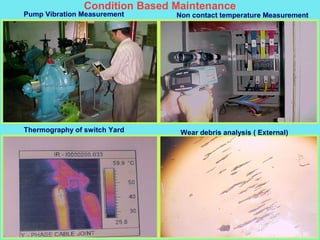
Condition Based Maintenance
Pump Vibration Measurement Non contact temperature Measurement
Thermography of switch Yard Wear debris analysis ( External)

Maintenance strategy & cbm basic introduction

  • 1.
    TRAINING PROGRAM ONTRAININGPROGRAM ON PREDICTIVE MAINTENANCEPREDICTIVE MAINTENANCE (CONDITION B(CONDITION BASED MAINTENANCE)ASED MAINTENANCE)
  • 2.
  • 3.
    FOUR MAINTENANCE STRATEGIES On-Failure(B/D) Fix it when it fails Fixed Time Maintain based Upon calendar or running time Condition Based Maintain based upon known condition Design Out Design out cause of failure Maintenance Plan • Applicable to plant that exhibits wear out - but must be used in conjunction with other strategies • Only effective if correctly implemented
  • 4.
    CONDITION BASED MAINTENANCE (CBM) •Advantages Allows shutdown before severe damage occurs Allows run to failure Production can be modified to extend unit life Cause of failure can be analysed
  • 5.
    • Advantages Permits maintenanceto be planned Labour to be organised Spares to be assembled Modifications can be planned CONDITION BASED MAINTENANCE (CBM)
  • 6.
    What is ConditionMonitoring? CM depends on the trending of parameters which are indicators of the condition of key equipment failure modes 0 10 20 30 40 50 60 Life Units
  • 7.
    Failure Characteristic B <1 Wear out Random dominated Early life Failure Probability graph B > 3 Difficult Expensive Easy Cheap Difficult Expensive Easy Cheap High Low High Low High Low Condition Monitoring Mean time between failure Strategy in order of preference  Fixed – time Operate-to- failure Condition based Design out Condition- based Fixed-time Operate- to-failure Design- out Condition based Operate- to failure Design- out Condition -based Operate- to failure Design- out Operate- to failure Condition based Design-out Condition- based Operate-to failure Analysis of Maintenance records permits an effective strategy to be chosen 1 < B < 3
  • 8.
  • 9.
    NDT/CBM HUMAN VS MACHINE SYSTEM /MONITORING HUMANMACHINE / PROCESS TEMPERATURE FEVER / OTHER HOT SPOT  MECHANICAL  ELECTRICAL  PROCESS SYSTEM INTERNAL TESTS  PATHOLOGICAL TESTS  X- RAYS  CT SCAN, MRE  ULTRASOUND  ANGIOGRAPHY  DEBRIS ANALYSIS  OIL QUALITY  NDT FLAWS  RADIOGRAPHS EXTERNAL TESTS  BLOOD PRESSURE  ECG  OVERALL VIBRATION  VIBRATION SIGNATURES
  • 10.
    NDT/CBM HUMAN VS MACHINE TYPEOF MAINTENANCE HUMAN MACHINE / PROCESS CONDITION BASED MAINTENANCE MONITORING OF  BLOOD PRESSURE  CHLOROSTROL LEVEL  SUGAR  FEVER  CANCER CELLS  PATHOLOGICAL TESTS  ULTRASOUND  ANGIOGRAPHY  X- RAYS  CT SCAN, MRE  VIBRATION MONITORING  THERMOGRAPHY  QUALITY / DEBRIS PARTICLES TRENDS  THICKNESS / CRACK MEASUREMENT  PERFORMANCE / VISUAL MONITORING  OTHER CBM TECHNIQUES (CORROSION, AEM ETC)
  • 11.
    NDT/CBM HUMAN VS MACHINE TYPEOF MAINTENANCE HUMAN MACHINE / PROCESS PREVENTIVE MAINTENANCE PREVENTIVE REMEDIAL MEASURES / CARE AS PER CBM MONITORING  DIET CONTROL  WEIGHT MONITORING  MEDICINE MEASURES  CHECKS AT REGULAR INTERVAL  ADVANCED TESTS – ECG / SCANS  CHECKS / MEASURES AGAINST DETERIORATION  PREPARATION OF S/D AS PER MONITORING  CONTROL ON DEBRIS BY FILTRATION  VIBRATION CONTROL BY ALIGNMENT, BALANCE  PM /PI SCHEDULE AS PER EQUIPMENT COMPONENT LIFE / DETERIORATION TRENDS
  • 12.
    NDT/CBM HUMAN VS MACHINE TYPEOF MAINTENANCE HUMAN MACHINE / PROCESS BREAKDOWN MAINTENANCE (WITH OUT ANY CARE)  HEART ATTACK / BY - PASS SURGERY  INSULINE DROPS – UNCONSCIOUS  KIDNEY PROBLEM  CRONIC TYPHOID  TUMOUR / ULCER  BEARING SEIZED  SYSTEM BREAKDOWN DUE TO PROCESS/ MECHANICAL / ELECTRICAL FAILURES  PANEL BURNOUT
  • 13.
  • 14.
    Human Senses VISUAL MONITORING Touch  Sight  Smell  Hearing  The simplest techniques are often the best - but to be effective any evaluation must be quantifiable
  • 15.
    Thermal Techniques Contact Sensors (Cheapbut have limitations)  Paints Thermocouples Liquid expansion Infra-red Cameras & Videos (Expensive but very powerful)
  • 16.
    Thermal Techniques Applications : Pipework Insulation breakdown leaks Electrical High resistance joints Overheating components Hot motors /Blocked cooling filters Mechanical Bearings Coolant  Gear Box etc.
  • 17.
    Vibration Monitoring Versatile toolfor condition monitoring of rotating & reciprocating plant Wide range of techniques and instrumentations Careful selection and application of technique is essential for success
  • 18.
    Vibration Monitoring: Techniques Overall Acceleration,Velocity & Displacement Vibration Spectral Monitoring Run-up/down tests Phase plots Time Signature Analysis
  • 19.
    Vibration Monitoring: Rolling ElementBearing MonitoringRolling Element Bearing Monitoring  Spike Energy/HFD  High Frequency Velocity  Overall Acceleration  Shock Pulse
  • 20.
    Performance Monitoring Involves theuse of existing data,  Current  Temp  Pressure  Flow rate
  • 21.
    Performance Monitoring Any variablewhich is indicative of a failure mode Thermal efficiency Wear rate Compressor loading / unloading time Product Accuracy
  • 22.
    Wear Debris Monitoring Techniques SpectrographicOil Analysis (SOA) Ferrography (direct & analytical) Particle Quantifier Microscopic optical assessment Choice of technique is critical to success
  • 23.
    Non Destructive Testing Ultrasonic Methods  Radiography  Dye Penetrant  Magnetic Particle
  • 24.
    Corrosion Monitoring  VisualInspection  Ultrasonic Leak Detection  Coupons  Electrical Resistance Probe
  • 25.
    CRITERIA FOR SELECTIONOF CBM TECHNIQUE CBM TECHNIQUE TYPE OF EQUIPMENT VIBRATION ANALYSIS All Rotating Equipment - Fans, SPM Compressors, Pumps, high LASER ALIGNMENT speed Gear boxes, Motors etc. THERMOGRAPHY & All Electrical PCC, MCC, THERMAL IMAGING High Tension Switch yards Motors, Mech. Drives etc. NDT THICKNESS/ FLAW All type of Tubes, Pipes & DETECTION Vessels, Plates, Shaft etc. LUBRICANT & WEAR All Type of Lubricating & DEBRIS MONITORING Hydraulic Oils DISSOLVED GAS All Transformer Oils ANALYSIS
  • 26.
    EQUIPMENT CAUSES OF FAILURE TECHNIQUESCOMMENTS Fan  Out of balance  Misalignment  Bearing damage  Aerodynamic forces  Belt problems  Overall acceleration  Spike energy measurement  Overall vibration  Vibration analysis  Flow measurement  Motor current measurement Simple application using windowed spectra to trend deterioration in specific faults. Equipment performance is monitored by measuring process parameters SAMPLE APPLICATION OF MONITORING TECHNIQUES
  • 27.
    EQUIPMENT CAUSES OF FAILURE TECHNIQUESCOMMENTS Pumps  Misalignment  Bearing damage  Cavitation  Impeller damage  Hydraulic forces  Overall vibration  Vibration analysis  Overall acceleration  Spike energy measurement  Flow measurement  Motor current measurement Windowed spectra to trend deterioration in specific failure modes. Cavitation can be detected using frequency analysis. Often blade pass frequency indicates hydraulic problems SAMPLE APPLICATION OF MONITORING TECHNIQUES
  • 28.
    Identify Equipment &CBM Technique Schedule & Planning Measurement Unscheduled JobsScheduled Jobs Data Entry Analysis Abnormal Reading Normal Reading Exception Report for Corrective Action Report Generation Corrective Action by DEPT. . Abnormal Reading Feedback from DEPT. Re Measurement Normal Reading Trend for History and Analysis Re circulation of Report FUNCTION AND FLOW OF CBM SYSTEM
  • 29.
    VIBRATION INSTRUMENTS IRD Model- 306 M Model PL-31 ANALYZER SPM A 30
  • 30.
    INFRARED THERMOMETERSCONTACT THERMOMETERS THERMALIMAGER Model IRISYS THERMOGRAPHY INSTRUMENTS
  • 31.
    LUBRICANT OIL TESTING WEARDEBRIS /PARTICLE ANALYSIS - SEPARATE INFRASTRUCTRUE /LAB
  • 32.
    ULTRASONIC THICKNESS GAUGE make- MODSONIC ULTRASONIC FLAW DETECTECTORS ULTRASONIC FLAW DETECTOR MODEL GAILLILO-100
  • 33.
    Condition Based Maintenance PumpVibration Measurement Non contact temperature Measurement Thermography of switch Yard Wear debris analysis ( External)

Editor's Notes

  • #4 Key Points An effective Maintenance Plan depends on the targeted use of the appropriate strategy for each significant failure mode. Notes
  • #15 Notes
  • #16 Notes
  • #17 Notes
  • #18 Notes
  • #20 Key Points Spike Energy/HFD : The bearing damage signal is measured in units of acceleration and band pass filtered between 5-20KHz. The output gives a number indicative of bearing condition. High Frequency Velocity : higher frequency peaks typically between 2-5KHz arising from the bearing damage signal exciting the resonance of the transducer. Overall Acceleration : Similar to High Frequency Velocity but can confuse with gear noise or cavitation Envelope Analysis : The complex signal from a bearing is conditioned and then enveloped to filter out unwanted vibration data. The resultant spectrum gives a clear indication of bearing repetition frequencies and problems Shock Pulse : The impacts caused by bearing damage produce shock pulses. These pulses are detected using a transducer which is tuned to resonate at 32 KHz. Analysis of Peak and ‘Carpet’ levels gives good indication of bearing condition and lubrication state. Kurtosis : This is a statistical method based on comparison of the fourth power of the vibration signal averaged and the square of the signal averaged. Not in widespread use.
  • #21 Notes
  • #22 Notes
  • #23 Key Points Effects of Particle Size : As wear progresses, the average particle size tends also to increase, from less than 10 microns to over 1000 microns. This means that techniques such as SOA are good at detecting early wear, but can give deceptive results as the wear progresses, and the average particle size becomes too large to be detected by this technique. This is where simple techniques such as basic wear debris measurement can be very effective. Notes