A Rajput is a member of one of the
patrilineal clans of western,
central, northern India and some
parts of Pakistan. They claim to be
descendants of ruling Hindu
warrior classes of North India.
Rajputs rose to prominence during
the 6th to 12th centuries. Until
the 20th century Rajputs ruled in
the "overwhelming majority" of
the princely states of Rajasthan
and Surashtra, where the largest
number of princely states were
Rajput is from the Sanskrit word Raja-Putra (son
of a king). The word is found in ancient texts,
including the Vedas, the Ramayana, and the
Mahabharata. It was used by the
ancient Sanskrit grammarian Pāṇini in the 4th
century BCE. The word Kshatriya("warrior") was
used for the Vedic community of warriors and
rulers. To differentiate royal warriors from
other Kshatriyas the word Rajputra was
used. Rajputra eventually was shortened to
Rajput; gradually it became a caste. Rajputs claim
descent from various mythological patrilineages,
being Suryavanshi, Chandravanshi, Agnivanshi and
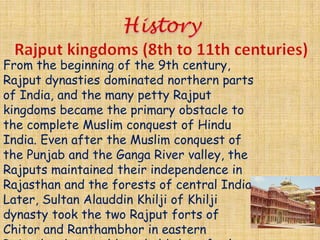
From the beginning of the 9th century,
Rajput dynasties dominated northern parts
of India, and the many petty Rajput
kingdoms became the primary obstacle to
the complete Muslim conquest of Hindu
India. Even after the Muslim conquest of
the Punjab and the Ganga River valley, the
Rajputs maintained their independence in
Rajasthan and the forests of central India.
Later, Sultan Alauddin Khilji of Khilji
dynasty took the two Rajput forts of
Chitor and Ranthambhor in eastern
The British colonial period
The Maratha Confederacy came into conflict with
the British Raj, beginning in 1772. After the Third
Anglo-Maratha War (1817–1818), all the states in the
Rajputana region entered into subsidiary alliance
with the East India Company and became princely
states under the British Raj. The British took direct
control of Ajmer which became the province
of Ajmer-Merwara. There were about 13 main Rajput
states and 2 Jat states namely Bharatpur & Dholpur
in the Rajasthan region. During the British regime
three more states were created in Rajputana. They
were Tonk, Jhalawar and Dholpur. A large number of
other Rajput states in central and western India
made a similar transition. Most of them were placed
under the authority of the Central India Agency and
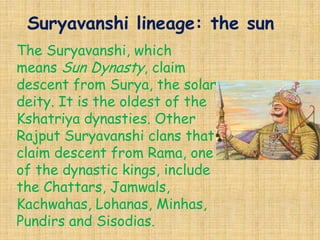
Suryavanshi lineage: the sun
The Suryavanshi, which
means Sun Dynasty, claim
descent from Surya, the solar
deity. It is the oldest of the
Kshatriya dynasties. Other
Rajput Suryavanshi clans that
claim descent from Rama, one
of the dynastic kings, include
the Chattars, Jamwals,
Kachwahas, Lohanas, Minhas,
Pundirs and Sisodias.
Chandravanshi lineage: the moon
The Chandravanshi, which
means Moon Dynasty, claim
descent from Chandra, the
lunar deity. Within the
Chandravanshi is
the Yaduvanshi lineage, which
claims descent from the Hindu
god Krishna and from Yadu,
eldest son of Yayati. Rajput
Chandravanshi clans of the
Yaduvanshi sect include
the Bhatti, Doad, Jadeja, Katoc
h, Khanzada, Sulehria.
Agnivanshi lineage: fire
The Agnivanshi lineage claims descent from Agni, the Vedic
God of Fire. They were the earliest lineage to rise to political
prominence. The legend which addresses the origin of the
Agnivanshi Rajputs is disputed. According to Puranic legend, as
found in Bhavishya Purana (an ancient religious text), many but
not all of the traditional kshatriyas of the land were
exterminated by Parashurama, an avatar of Vishnu. The
sage Vasishta performed a great a yagna (ritual of sacrifice)
at Mount Abu, at the time of emperor Ashoka's sons (Ashoka
died around 232 BCE). From the influence of mantras of the
four Vedas, four kshatriyas were born. They were the
founders of the four Agnivanshi clans:
Parmar (Paramara)
Chamahanas (Chauhan)
Solanki (Chalukya)
The Rajputs were a Martial Race in the
period of the British Raj. This was a
designation created by administrators
that classified each ethnic group as
either "martial" or "non-martial". A
"martial race" was typically considered
brave and well built for fighting, whilst
the remainder were those whom the
British believed to be unfit for battle
because of their sedentary
lifestyles. "Race" in 19th-century
terminology corresponds to the
contemporary term "ethnic group", and
The double-edged scimitar known as the khanda was
a popular weapon among the Rajputs of that era. On
special occasions, a primary chief would break up a
meeting of his vassal chiefs with khanda nariyal, the
distribution of daggers and coconuts. Another
affirmation of the Rajput's reverence for his sword
was the Karga Shapna ("adoration of the sword")
ritual, performed during the
annual Navaratri festival, after which a Rajput is
considered "free to indulge his passion for rapine
and revenge".
By the late 19th century, there was a shift of focus
among Rajputs from politics to a concern with
kinship. Many Rajputs of Rajasthan are nostalgic
about their past and keenly conscious of their
genealogy, emphasizing a Rajput ethos that is
martial in spirit, with a fierce pride in lineage and
tradition.
Lok Sabha Dynasty
156 out of 545* Lok Sabha members
come from political families. That
means close to 30% of the Lok Sabha
members are probably Members of
Parliament only because of their last
names. To add to these 156 MPs
there are several MPs who are
actors/cricketers/business tycoons
etc.
In addition, almost 70% (41 out of
59) of Woman MPs in the Lok Sabha
Ssc ppt

Ssc ppt

  • 2.
    A Rajput isa member of one of the patrilineal clans of western, central, northern India and some parts of Pakistan. They claim to be descendants of ruling Hindu warrior classes of North India. Rajputs rose to prominence during the 6th to 12th centuries. Until the 20th century Rajputs ruled in the "overwhelming majority" of the princely states of Rajasthan and Surashtra, where the largest number of princely states were
  • 3.
    Rajput is fromthe Sanskrit word Raja-Putra (son of a king). The word is found in ancient texts, including the Vedas, the Ramayana, and the Mahabharata. It was used by the ancient Sanskrit grammarian Pāṇini in the 4th century BCE. The word Kshatriya("warrior") was used for the Vedic community of warriors and rulers. To differentiate royal warriors from other Kshatriyas the word Rajputra was used. Rajputra eventually was shortened to Rajput; gradually it became a caste. Rajputs claim descent from various mythological patrilineages, being Suryavanshi, Chandravanshi, Agnivanshi and
  • 4.
    From the beginningof the 9th century, Rajput dynasties dominated northern parts of India, and the many petty Rajput kingdoms became the primary obstacle to the complete Muslim conquest of Hindu India. Even after the Muslim conquest of the Punjab and the Ganga River valley, the Rajputs maintained their independence in Rajasthan and the forests of central India. Later, Sultan Alauddin Khilji of Khilji dynasty took the two Rajput forts of Chitor and Ranthambhor in eastern
  • 5.
    The British colonialperiod The Maratha Confederacy came into conflict with the British Raj, beginning in 1772. After the Third Anglo-Maratha War (1817–1818), all the states in the Rajputana region entered into subsidiary alliance with the East India Company and became princely states under the British Raj. The British took direct control of Ajmer which became the province of Ajmer-Merwara. There were about 13 main Rajput states and 2 Jat states namely Bharatpur & Dholpur in the Rajasthan region. During the British regime three more states were created in Rajputana. They were Tonk, Jhalawar and Dholpur. A large number of other Rajput states in central and western India made a similar transition. Most of them were placed under the authority of the Central India Agency and
  • 7.
    Suryavanshi lineage: thesun The Suryavanshi, which means Sun Dynasty, claim descent from Surya, the solar deity. It is the oldest of the Kshatriya dynasties. Other Rajput Suryavanshi clans that claim descent from Rama, one of the dynastic kings, include the Chattars, Jamwals, Kachwahas, Lohanas, Minhas, Pundirs and Sisodias.
  • 8.
    Chandravanshi lineage: themoon The Chandravanshi, which means Moon Dynasty, claim descent from Chandra, the lunar deity. Within the Chandravanshi is the Yaduvanshi lineage, which claims descent from the Hindu god Krishna and from Yadu, eldest son of Yayati. Rajput Chandravanshi clans of the Yaduvanshi sect include the Bhatti, Doad, Jadeja, Katoc h, Khanzada, Sulehria.
  • 9.
    Agnivanshi lineage: fire TheAgnivanshi lineage claims descent from Agni, the Vedic God of Fire. They were the earliest lineage to rise to political prominence. The legend which addresses the origin of the Agnivanshi Rajputs is disputed. According to Puranic legend, as found in Bhavishya Purana (an ancient religious text), many but not all of the traditional kshatriyas of the land were exterminated by Parashurama, an avatar of Vishnu. The sage Vasishta performed a great a yagna (ritual of sacrifice) at Mount Abu, at the time of emperor Ashoka's sons (Ashoka died around 232 BCE). From the influence of mantras of the four Vedas, four kshatriyas were born. They were the founders of the four Agnivanshi clans: Parmar (Paramara) Chamahanas (Chauhan) Solanki (Chalukya)
  • 10.
    The Rajputs werea Martial Race in the period of the British Raj. This was a designation created by administrators that classified each ethnic group as either "martial" or "non-martial". A "martial race" was typically considered brave and well built for fighting, whilst the remainder were those whom the British believed to be unfit for battle because of their sedentary lifestyles. "Race" in 19th-century terminology corresponds to the contemporary term "ethnic group", and
  • 11.
    The double-edged scimitarknown as the khanda was a popular weapon among the Rajputs of that era. On special occasions, a primary chief would break up a meeting of his vassal chiefs with khanda nariyal, the distribution of daggers and coconuts. Another affirmation of the Rajput's reverence for his sword was the Karga Shapna ("adoration of the sword") ritual, performed during the annual Navaratri festival, after which a Rajput is considered "free to indulge his passion for rapine and revenge". By the late 19th century, there was a shift of focus among Rajputs from politics to a concern with kinship. Many Rajputs of Rajasthan are nostalgic about their past and keenly conscious of their genealogy, emphasizing a Rajput ethos that is martial in spirit, with a fierce pride in lineage and tradition.
  • 13.
    Lok Sabha Dynasty 156out of 545* Lok Sabha members come from political families. That means close to 30% of the Lok Sabha members are probably Members of Parliament only because of their last names. To add to these 156 MPs there are several MPs who are actors/cricketers/business tycoons etc. In addition, almost 70% (41 out of 59) of Woman MPs in the Lok Sabha