By :
Akanksha Rohilla
Achlesh Negi
MAHABHARATA
 Ramayana and Mahabharata, the two great epics
of India, have captivated the hearts of its people for
several millenniam
 Hindu tradition has always considered these two epics
as itihasa (verily did it exist thus) or history.
 Modern scholars have largely conceded that the core
of the epics could have had a historical basis.
DATE AND AUTHORSHIP
 The great war should have taken place during
3139 BC, writings of Megasthenes (312 BC) as
also internal astronomical evidence corroborate
this date.
 Modern historians have assailed this theory and
are inclined to accept a much later date, viz,
1424 BC or 950 BC.
 Traditional lore ascribes the authorship of this
epic to the great sage Veda Vyasa, also known
as Krsna Dvaipayana.
 He was a contemporary of the grandsire Bhisma
and had a firsthand knowledge of most of the
events described in the epic.
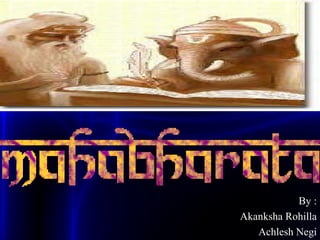
 . Many verses of Mahabhrata composed by Vyasa
were difficult for his scribe, Lord Ganesha to
understand. These verses were understood by Ganesha
in a split second’s break. This break allowed Vyasa to
visualize the further verses. But, these verses are so
difficult that 80% of them remain unsolved even
today. There are 8800 such verses in the Mahabharata.
Major chapters in mahabharat
 Adiparva
 Sabhaparva
 Vanparva/Aranyaparva
 Viratparva
 Udyogaparva
 Bhismaparva
 Dronaparva
 Karnaparya
 Salyaparva
 Sauptikaparva
 Striparva
 Santiparva
 Anusasanikaparva
 Asvamedhikaparva
 Asramavasikaparva
 Mausalaparva
 Mahaparasthanika
 Svargarohana Parvas
Adiparva
The birth and eduction of Pandavas and Kauravas
their early rivalries; marriage of Draupadi, the
Pancala princess, to the Pandavas, Arjuna’s
pilgrimage and marriage with Subhadra, sister of
Sri Krishna.
Sabhaparva
 The second deals mainly with the performance
of the Rajasurya sacrifice by Yudhisthira, the
eldest of the Pandava princes, the game of dice
maneuvered by the wily Duryodhana, the
eldest of the Kauravas, and its tragic
consequences for the former.
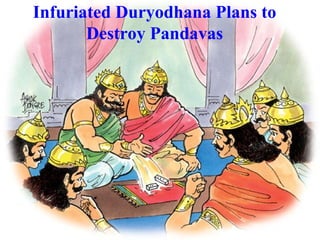
Infuriated Duryodhana Plans to
Destroy Pandavas
Vanaparva/Aranyaparva
 The third chapter that covers the story of the
Pandavas in exile in the Kamyaka forest.
 The famous quiz, Yaksaprasna, belongs to this
book.
 The forth, is one of the smaller chapter dealing
mainly with the stay of the Pandavas incognito
in the kingdom of Virata.
 Slaying of the villain Kicaka and the battle for
rescuing the cattle of the king Virata which had
been captured by the Kauravas to force the
Pandavas to come out of their hiding, as also
the wedding of the Virata princess Uttara with
Abhimanyu, Arjuna’s son, are the chief
incidents portrayed here.
Virataparva
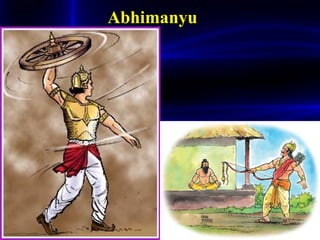
Abhimanyu
Udyogaparva
 The fifth, is also a short chapter which deals with
the peace parleys and preparations for the war
curiously going together.
 The most touching scene of Kunti, the mother of
the Pandavas, disclosing to Karna the secret of
his birth in her womb, and the statesmanship of
Sri Krishna, who makes a last minute bid for
peace, are the highlights of this section.
 The famous discourse of the sage Santsujata to
the blind kind Dhrtarastra, well-known as the
Sanatsujatiya, which is full of philosophical
truths.
Bhismaparva
 Bhismaparva, contains the crown-gem of the
epic, viz., the Bhagavad Gita.
 Details descriptions of the first ten days of the
war containing the superhuman exploits of the
grandsire Bhisma, ultimately ending in his being
mortally wounded by Arjuna, form the bulk of
this section.
 Since Bhisma had the unique boon of dying at
will, he preferred to lie down on the bed of
arrows and postpone his demise till the
beginning of Uttarayana or the northern solstice.
Dronaparva
 The seventh, apart from describing the heroic
exploits of Drona, the preceptor, culminating in
his death through stratagem, also contains an
account of the brilliant achievements of the
boy-hero Abhymanya on the battlefield and his
tragic death.
Karnaparva
 The eight chapter, details the glory death of the
evil genius Dussasana, the second of the
Kaurava brothers, at the hands of the colossal
Bhima, and the fall of Karna himself at the
hands of Arjuna after a bitter fight.
Salyaparva
 The ninth chapter, describes the final encounter
between Bhima and Duryodhana on the last
day of the war, the latter succumbing to the
mortal blow receiving during the duel.
Sauptikaparva
 The tenth chapter, delineates the gruesome
massacre of the Pandava army and its allies, in
the night during sleep, by Asvatthaman,
Drona’s Vengeful son.
Striparva
 The eleventh chapter, describes graphically the
pitiful lamentations of the women and widows
of the dead warriors.
Santiparva / Anusasanikaparva
 The twelfth and the thirteenth chapters,
containing wonderful discourses on all aspects
of Dharma by the patriarch Bhisma at the quest
of Yudhisthira.
 Bhisma’s demise and Yudhisthira’s coronation
are the other incidents dealt with.
 The two well-known hymns,
Visnusahasranama and Sivasahasranama, as
also the Anugita (a subsidiary discourse by Sri
Krishma to Arjuna) are parts of these chapters.
Asvamedhikaparva
 The fifteenth chapter, describes the departure
of the old Dhrtarastra to the forest along with
Gandhari, his spouse, and Kunti and their
subsequent death in a forest fire.
Mausalaparva
 The sixteenth chapter, gives an account of the
mutual destruction of the Yadava heroes as also
the death of Sri Krishna at the hands of a
hunter.
Mahaprasthanika & Svargarohana Parvas
 The last two chapters, give an account of the
final journey of the Pandavas, their death on
the way, with Yudhisthira alone reaching
heaven.
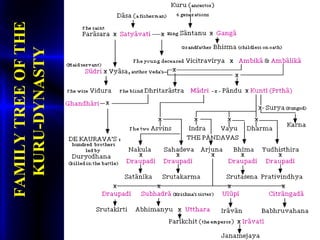
FAMILYTREEOFTHE
KURU-DYNASTY
CHARACTERS
 The Mahabharata presents us with a veritable
arry of human characters, from the sublime to
the ridiculous.
 No type of human emotion, no deed of valour,
generosity, sacrifice or meanness is missed
here.
 Nor is there any artificiality in these portrayals.
 A brief delineation of some of the more
important characters may now be attempted
here.
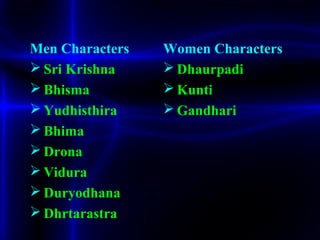
Men Characters
 Sri Krishna
 Bhisma
 Yudhisthira
 Bhima
 Drona
 Vidura
 Duryodhana
 Dhrtarastra
Women Characters
 Dhaurpadi
 Kunti
 Gandhari
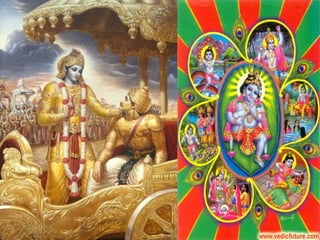
Sri Krishna
 Said by the Vedas to be God, the Supreme
Person, who is the origin of all other
incarnations of the Godhead such as Vishnu
and Nârâyana.
 The Bhâgavata Purâna [Srîmad Bhâgavatam]
contains extensive descriptions of his qualities
and activities.
 He spoke the Bhagavad Gîtâ to Arjuna at the
beginning of the Kurukshetra war.
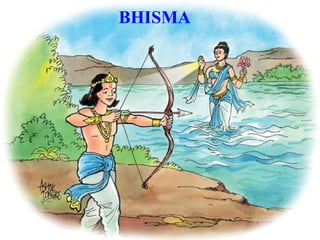
Bhishma
 Son of Shantanu, known as the "grandfather"
of the Kurus.
 Although he never became king, he officiated
at Hastinapura as regent until Vichitravirya was
of age.
 He is said to be an incarnation of Dyau, the
chief Vasu.
 The original text of the Mahâbhârata contains
an entire Parva, the Shanti Parva, devoted to
Bhîshma's instructions on religion and
morality, which he delivered while lying on the
bed of arrows.
BHISMA
Yudhisthira
 Eldest Pândava, born from the union of Kuntî
and the god Dharma.
 He performed a Rajasuya sacrifice which
established him as world emperor.
 Famous for his adherence to virtue and truth,
he is also known as Dharmaraja, as well as
Ajatashatru, which means "one who has no
enemies."
 After the war he ruled the world for thirty-six
years and was succeeded by Parîksit.
YUDHISTHIRA
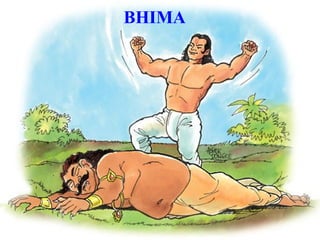
Bhimasena
 Pându and Kuntî's second son, sired by Vayu, the
wind-god.
 After the great war he was installed by Yudhisthira
as crown prince.
 A story is told in the Skanda Purâna that Bhîma
became a little proud after the war, considering that
it was by his own power that he had achieved
success in the war.
 All his brothers attributed their success to Krishna.
 Wanting to curb Bhîma's pride, Krishna took him on
Garuda and traveled a long way to the south, where
they came to a great lake many miles wide.
 Krishna sent Bhîma to find the source of the lake.
 Bhîma ran around its perimeter, but could not discover
its source.
 As he ran he encountered a number of powerful
Asuras.
 Bhîma found himself unable to defeat them and he ran
to Krishna for shelter.
 Krishna lifted and threw the lake away and dispersed
the Asura's (celestial demon).
 He said to Bhîma, "This lake was contained in
Kumbhakarna's skull, the Rakshasa killed by Râma in
a previous age.
 The warriors who attacked you were from a race of
demons who fought with Ravana against Rama."
Drona (Dronâcârya)
 The Kurus' martial teacher.
 The sage Bharadvaja once caught sight of the
Apsara Ghrtachi and, as a result, semen fell
from his body, which he caught in a pot. Drona
was later born from that pot.
 He was taught by Agnivesha and Parasurama.
 Said to be an expansion of Brihaspati, the
celestial seer and preceptor of the gods.
Vidura
 Son of Vyâsadeva and a palace maidservant. He
was said to be an expansion of Yamaraja, the
lord of justice. Once a rishi named Mandavya
was mistaken for a robber. The king arrested and
punished him by having him pierced by a lance.
The sage later went to Yamarâja and asked why
this had happened and was told that in his
childhood he had pierced an insect with a blade
of grass. Hearing that he had received
punishment for a mistake made when he was still
an ignorant child, the sage cursed Yamaraja to
take birth on earth as a s'ûdra. Thus he became
Vidura.
Duryodana
 Eldest of Dhritarâstra's sons and leader of the
Kauravas.
 From childhood he formed an enmity with the
Pândavas, which later resulted in the
Kurukshetra war.
 He was killed by Bhîma and went to the
heavenly planets as a result of his adherence to
kshatriya duties.
 He was said to be an expansion of Kali, the god
presiding over the dark age.
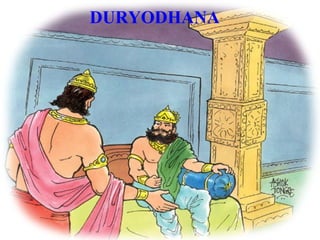
DURYODHANA
Dhritarastra
 The blind son of Vyâsadeva, born of Ambika
after the death of her husband, Vichitravirya.
 He became king in Hastinapura after Pându
retired to the forest.
 He was the father of the Kauravas.
 In the Bhâgavata Purâna it is said that, after
practicing yoga, he achieved liberation,
merging into the Supreme Brahman at the end
of his life
Draupathi / Panchali
 Daughter of Drupada, king of Panchala, and
wife of the five Pândavas.
 In her previous life she was an ascetic woman
named Nalayani who received a boon from
Shiva that she would have five husbands in her
next life.
 The epitome of womanly skills, she once gave
advice on how to serve a husband to
Satyabhama, one of Krishna's principal wives.
 She was said to be an expansion of the
Goddess Lakshmi.
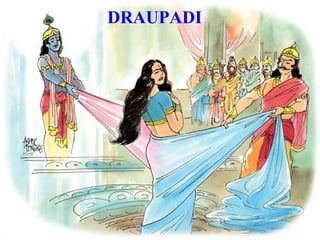
DRAUPADI
Kunti
 The Pândavas' mother.
 She was the sister of Vasudeva, Krishna's
father.
 Her own father, Surasena, had given her as a
baby to his close friend King Kuntibhoja, who
had no children.
 She was named Prithâ at birth, but became
better known as Kuntî after being raised by
Kuntibhoja.
Gandhari
 Daughter of the king of Gandhara, who became
Dhritarâstra's wife.
 Having once pleased Vyâsadeva by her service,
she was blessed by the sage that she would have
one hundred sons.
 After marrying the blind Dhritarâstra, she
covered her own eyes with a cloth for the rest of
her life.
 She is thus famous as one of the most chaste
ladies in Vedic history.
 She died in the forest with her husband and
Kuntî.
BHIMA
Krishna’s role in Mahabharat
A Cleansing War
Vishnu is the metaphysical principle of all that is good. He is
the deity that protects, sustains and supports this universe.
Krishna is said to be an incarnation, an avatar of
Vishnu/Vasudeva, or perhaps we might see this in terms of
Krishna being an incarnation of Vishnu’s metaphysical
principles. The purpose of this incarnation is to rid the world
of those warriors, the Kshatriya who have forgotten
theirDharma, and who have become greedy and cruel.
Krishna has come for a war that will cleanse the earth at the
end of the Dvapara Yuga.
Krishna’s decision
• Before the war, both Arjun and Duryodhan had gone to Krishna asking for
help. Duryodhan had reached Krishna before Arjun and sat near his head.
Arjun came after Duryodhan and sat near krishna's feet. When Krishna woke
up, he saw Arjun first since he was right opposite his eye view and asked him
his purpose of visit.
However, since Duryodhan had come before Arjun, he got angry and
complained that he came first. To this, Krishna replied that since he saw Arjun
first therefore, his wish would be fulfilled first. Arjun given the chance asks
Krishna to come on his side leaving Duryodhan more than happy, as he
wanted the army and not unarmed Krishna.
Manager should decide on a
Goal
A manager should have decided a Goal and Krishna
had 3 clear cut Goals that he followed and achieved
100% targets.
a) Paritranaya Sadhunaam – Welfare for Saints
b) Vinashaya Dushkritaam – Destroy Evil
c) Dharmasansthapanaay Sambhavaami yuge yuge –
To establish and strengthen Religion in every Era.
Motivational
speaker
• When Arjun reached the battle field he loose his
determination to fight when he saw that among the
opponents were many of his relatives young and old and
that he was going to kill them for the sake of Kingdom. He
resisted from fighting and dropped arms. Krishna
motivated him by his speech later named “Bhagwat Gita”
that’s still read and followed. Arjun recovered and decided
to fight.
Stretegies planner
• Pandavas and Kauravas had soldiers and warriors strength
in the ratio of 7:11, Panadvas having 1.53 millions and
2.41 millions. With this count it was clear that the battle
could be won only with Effective Strategies. The fact that
Pandavas won the battle proves that Krishna was
successful not only in buiding stretegies but in
implementing them to achieve success.
Good leader
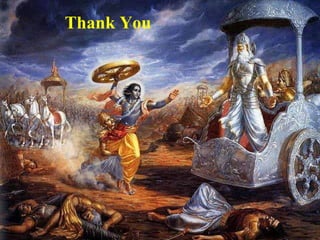
• When Krishna asked Arjuna and Duryodhana to choose
between him and his army, the choice was, in fact,
between a Leader and his Resources. While a Good Leader
can gain from limited resources, a Bad Leader will loose
even with vast resources. Knowing his excellent
Leadership Qualities, Arjuna requested Krishna not only to
lead the entire mission but to personally lead him by
accepting to be his “Saarthi” (Charioteer), guide him and
lead him to success.
Controlled approach
• Controlling an army of 1.53 million soldiers and warriors
to fight against a bigger army was not a easy task. The
1.53 million soldiers were divided in seven divisions, led
by a Commander each, further controlled by a Supreme
Commander who himself was guided by the Pandavas and
Krishna. This all was made possible with with help of Lord
Krishna’s great Management ad Controlling Skills
Thank You

Mahabharata

  • 1.
  • 3.
    MAHABHARATA  Ramayana andMahabharata, the two great epics of India, have captivated the hearts of its people for several millenniam  Hindu tradition has always considered these two epics as itihasa (verily did it exist thus) or history.  Modern scholars have largely conceded that the core of the epics could have had a historical basis.
  • 4.
    DATE AND AUTHORSHIP The great war should have taken place during 3139 BC, writings of Megasthenes (312 BC) as also internal astronomical evidence corroborate this date.  Modern historians have assailed this theory and are inclined to accept a much later date, viz, 1424 BC or 950 BC.  Traditional lore ascribes the authorship of this epic to the great sage Veda Vyasa, also known as Krsna Dvaipayana.
  • 5.
     He wasa contemporary of the grandsire Bhisma and had a firsthand knowledge of most of the events described in the epic.  . Many verses of Mahabhrata composed by Vyasa were difficult for his scribe, Lord Ganesha to understand. These verses were understood by Ganesha in a split second’s break. This break allowed Vyasa to visualize the further verses. But, these verses are so difficult that 80% of them remain unsolved even today. There are 8800 such verses in the Mahabharata.
  • 6.
    Major chapters inmahabharat  Adiparva  Sabhaparva  Vanparva/Aranyaparva  Viratparva  Udyogaparva  Bhismaparva  Dronaparva  Karnaparya  Salyaparva  Sauptikaparva  Striparva  Santiparva  Anusasanikaparva  Asvamedhikaparva  Asramavasikaparva  Mausalaparva  Mahaparasthanika  Svargarohana Parvas
  • 7.
    Adiparva The birth andeduction of Pandavas and Kauravas their early rivalries; marriage of Draupadi, the Pancala princess, to the Pandavas, Arjuna’s pilgrimage and marriage with Subhadra, sister of Sri Krishna.
  • 8.
    Sabhaparva  The seconddeals mainly with the performance of the Rajasurya sacrifice by Yudhisthira, the eldest of the Pandava princes, the game of dice maneuvered by the wily Duryodhana, the eldest of the Kauravas, and its tragic consequences for the former.
  • 9.
    Infuriated Duryodhana Plansto Destroy Pandavas
  • 10.
    Vanaparva/Aranyaparva  The thirdchapter that covers the story of the Pandavas in exile in the Kamyaka forest.  The famous quiz, Yaksaprasna, belongs to this book.
  • 11.
     The forth,is one of the smaller chapter dealing mainly with the stay of the Pandavas incognito in the kingdom of Virata.  Slaying of the villain Kicaka and the battle for rescuing the cattle of the king Virata which had been captured by the Kauravas to force the Pandavas to come out of their hiding, as also the wedding of the Virata princess Uttara with Abhimanyu, Arjuna’s son, are the chief incidents portrayed here. Virataparva
  • 12.
  • 13.
    Udyogaparva  The fifth,is also a short chapter which deals with the peace parleys and preparations for the war curiously going together.  The most touching scene of Kunti, the mother of the Pandavas, disclosing to Karna the secret of his birth in her womb, and the statesmanship of Sri Krishna, who makes a last minute bid for peace, are the highlights of this section.  The famous discourse of the sage Santsujata to the blind kind Dhrtarastra, well-known as the Sanatsujatiya, which is full of philosophical truths.
  • 14.
    Bhismaparva  Bhismaparva, containsthe crown-gem of the epic, viz., the Bhagavad Gita.  Details descriptions of the first ten days of the war containing the superhuman exploits of the grandsire Bhisma, ultimately ending in his being mortally wounded by Arjuna, form the bulk of this section.  Since Bhisma had the unique boon of dying at will, he preferred to lie down on the bed of arrows and postpone his demise till the beginning of Uttarayana or the northern solstice.
  • 15.
    Dronaparva  The seventh,apart from describing the heroic exploits of Drona, the preceptor, culminating in his death through stratagem, also contains an account of the brilliant achievements of the boy-hero Abhymanya on the battlefield and his tragic death.
  • 16.
    Karnaparva  The eightchapter, details the glory death of the evil genius Dussasana, the second of the Kaurava brothers, at the hands of the colossal Bhima, and the fall of Karna himself at the hands of Arjuna after a bitter fight. Salyaparva  The ninth chapter, describes the final encounter between Bhima and Duryodhana on the last day of the war, the latter succumbing to the mortal blow receiving during the duel.
  • 17.
    Sauptikaparva  The tenthchapter, delineates the gruesome massacre of the Pandava army and its allies, in the night during sleep, by Asvatthaman, Drona’s Vengeful son. Striparva  The eleventh chapter, describes graphically the pitiful lamentations of the women and widows of the dead warriors.
  • 18.
    Santiparva / Anusasanikaparva The twelfth and the thirteenth chapters, containing wonderful discourses on all aspects of Dharma by the patriarch Bhisma at the quest of Yudhisthira.  Bhisma’s demise and Yudhisthira’s coronation are the other incidents dealt with.  The two well-known hymns, Visnusahasranama and Sivasahasranama, as also the Anugita (a subsidiary discourse by Sri Krishma to Arjuna) are parts of these chapters.
  • 19.
    Asvamedhikaparva  The fifteenthchapter, describes the departure of the old Dhrtarastra to the forest along with Gandhari, his spouse, and Kunti and their subsequent death in a forest fire. Mausalaparva  The sixteenth chapter, gives an account of the mutual destruction of the Yadava heroes as also the death of Sri Krishna at the hands of a hunter.
  • 20.
    Mahaprasthanika & SvargarohanaParvas  The last two chapters, give an account of the final journey of the Pandavas, their death on the way, with Yudhisthira alone reaching heaven.
  • 21.
  • 22.
    CHARACTERS  The Mahabharatapresents us with a veritable arry of human characters, from the sublime to the ridiculous.  No type of human emotion, no deed of valour, generosity, sacrifice or meanness is missed here.  Nor is there any artificiality in these portrayals.  A brief delineation of some of the more important characters may now be attempted here.
  • 23.
    Men Characters  SriKrishna  Bhisma  Yudhisthira  Bhima  Drona  Vidura  Duryodhana  Dhrtarastra Women Characters  Dhaurpadi  Kunti  Gandhari
  • 24.
    Sri Krishna  Saidby the Vedas to be God, the Supreme Person, who is the origin of all other incarnations of the Godhead such as Vishnu and Nârâyana.  The Bhâgavata Purâna [Srîmad Bhâgavatam] contains extensive descriptions of his qualities and activities.  He spoke the Bhagavad Gîtâ to Arjuna at the beginning of the Kurukshetra war.
  • 26.
    Bhishma  Son ofShantanu, known as the "grandfather" of the Kurus.  Although he never became king, he officiated at Hastinapura as regent until Vichitravirya was of age.  He is said to be an incarnation of Dyau, the chief Vasu.  The original text of the Mahâbhârata contains an entire Parva, the Shanti Parva, devoted to Bhîshma's instructions on religion and morality, which he delivered while lying on the bed of arrows.
  • 27.
  • 28.
    Yudhisthira  Eldest Pândava,born from the union of Kuntî and the god Dharma.  He performed a Rajasuya sacrifice which established him as world emperor.  Famous for his adherence to virtue and truth, he is also known as Dharmaraja, as well as Ajatashatru, which means "one who has no enemies."  After the war he ruled the world for thirty-six years and was succeeded by Parîksit.
  • 29.
  • 30.
    Bhimasena  Pându andKuntî's second son, sired by Vayu, the wind-god.  After the great war he was installed by Yudhisthira as crown prince.  A story is told in the Skanda Purâna that Bhîma became a little proud after the war, considering that it was by his own power that he had achieved success in the war.  All his brothers attributed their success to Krishna.  Wanting to curb Bhîma's pride, Krishna took him on Garuda and traveled a long way to the south, where they came to a great lake many miles wide.
  • 31.
     Krishna sentBhîma to find the source of the lake.  Bhîma ran around its perimeter, but could not discover its source.  As he ran he encountered a number of powerful Asuras.  Bhîma found himself unable to defeat them and he ran to Krishna for shelter.  Krishna lifted and threw the lake away and dispersed the Asura's (celestial demon).  He said to Bhîma, "This lake was contained in Kumbhakarna's skull, the Rakshasa killed by Râma in a previous age.  The warriors who attacked you were from a race of demons who fought with Ravana against Rama."
  • 32.
    Drona (Dronâcârya)  TheKurus' martial teacher.  The sage Bharadvaja once caught sight of the Apsara Ghrtachi and, as a result, semen fell from his body, which he caught in a pot. Drona was later born from that pot.  He was taught by Agnivesha and Parasurama.  Said to be an expansion of Brihaspati, the celestial seer and preceptor of the gods.
  • 33.
    Vidura  Son ofVyâsadeva and a palace maidservant. He was said to be an expansion of Yamaraja, the lord of justice. Once a rishi named Mandavya was mistaken for a robber. The king arrested and punished him by having him pierced by a lance. The sage later went to Yamarâja and asked why this had happened and was told that in his childhood he had pierced an insect with a blade of grass. Hearing that he had received punishment for a mistake made when he was still an ignorant child, the sage cursed Yamaraja to take birth on earth as a s'ûdra. Thus he became Vidura.
  • 34.
    Duryodana  Eldest ofDhritarâstra's sons and leader of the Kauravas.  From childhood he formed an enmity with the Pândavas, which later resulted in the Kurukshetra war.  He was killed by Bhîma and went to the heavenly planets as a result of his adherence to kshatriya duties.  He was said to be an expansion of Kali, the god presiding over the dark age.
  • 35.
  • 36.
    Dhritarastra  The blindson of Vyâsadeva, born of Ambika after the death of her husband, Vichitravirya.  He became king in Hastinapura after Pându retired to the forest.  He was the father of the Kauravas.  In the Bhâgavata Purâna it is said that, after practicing yoga, he achieved liberation, merging into the Supreme Brahman at the end of his life
  • 37.
    Draupathi / Panchali Daughter of Drupada, king of Panchala, and wife of the five Pândavas.  In her previous life she was an ascetic woman named Nalayani who received a boon from Shiva that she would have five husbands in her next life.  The epitome of womanly skills, she once gave advice on how to serve a husband to Satyabhama, one of Krishna's principal wives.  She was said to be an expansion of the Goddess Lakshmi.
  • 38.
  • 39.
    Kunti  The Pândavas'mother.  She was the sister of Vasudeva, Krishna's father.  Her own father, Surasena, had given her as a baby to his close friend King Kuntibhoja, who had no children.  She was named Prithâ at birth, but became better known as Kuntî after being raised by Kuntibhoja.
  • 40.
    Gandhari  Daughter ofthe king of Gandhara, who became Dhritarâstra's wife.  Having once pleased Vyâsadeva by her service, she was blessed by the sage that she would have one hundred sons.  After marrying the blind Dhritarâstra, she covered her own eyes with a cloth for the rest of her life.  She is thus famous as one of the most chaste ladies in Vedic history.  She died in the forest with her husband and Kuntî.
  • 41.
  • 42.
  • 43.
    A Cleansing War Vishnuis the metaphysical principle of all that is good. He is the deity that protects, sustains and supports this universe. Krishna is said to be an incarnation, an avatar of Vishnu/Vasudeva, or perhaps we might see this in terms of Krishna being an incarnation of Vishnu’s metaphysical principles. The purpose of this incarnation is to rid the world of those warriors, the Kshatriya who have forgotten theirDharma, and who have become greedy and cruel. Krishna has come for a war that will cleanse the earth at the end of the Dvapara Yuga.
  • 44.
    Krishna’s decision • Beforethe war, both Arjun and Duryodhan had gone to Krishna asking for help. Duryodhan had reached Krishna before Arjun and sat near his head. Arjun came after Duryodhan and sat near krishna's feet. When Krishna woke up, he saw Arjun first since he was right opposite his eye view and asked him his purpose of visit. However, since Duryodhan had come before Arjun, he got angry and complained that he came first. To this, Krishna replied that since he saw Arjun first therefore, his wish would be fulfilled first. Arjun given the chance asks Krishna to come on his side leaving Duryodhan more than happy, as he wanted the army and not unarmed Krishna.
  • 45.
    Manager should decideon a Goal A manager should have decided a Goal and Krishna had 3 clear cut Goals that he followed and achieved 100% targets. a) Paritranaya Sadhunaam – Welfare for Saints b) Vinashaya Dushkritaam – Destroy Evil c) Dharmasansthapanaay Sambhavaami yuge yuge – To establish and strengthen Religion in every Era.
  • 46.
    Motivational speaker • When Arjunreached the battle field he loose his determination to fight when he saw that among the opponents were many of his relatives young and old and that he was going to kill them for the sake of Kingdom. He resisted from fighting and dropped arms. Krishna motivated him by his speech later named “Bhagwat Gita” that’s still read and followed. Arjun recovered and decided to fight.
  • 47.
    Stretegies planner • Pandavasand Kauravas had soldiers and warriors strength in the ratio of 7:11, Panadvas having 1.53 millions and 2.41 millions. With this count it was clear that the battle could be won only with Effective Strategies. The fact that Pandavas won the battle proves that Krishna was successful not only in buiding stretegies but in implementing them to achieve success.
  • 48.
    Good leader • WhenKrishna asked Arjuna and Duryodhana to choose between him and his army, the choice was, in fact, between a Leader and his Resources. While a Good Leader can gain from limited resources, a Bad Leader will loose even with vast resources. Knowing his excellent Leadership Qualities, Arjuna requested Krishna not only to lead the entire mission but to personally lead him by accepting to be his “Saarthi” (Charioteer), guide him and lead him to success.
  • 49.
    Controlled approach • Controllingan army of 1.53 million soldiers and warriors to fight against a bigger army was not a easy task. The 1.53 million soldiers were divided in seven divisions, led by a Commander each, further controlled by a Supreme Commander who himself was guided by the Pandavas and Krishna. This all was made possible with with help of Lord Krishna’s great Management ad Controlling Skills
  • 50.