1. Teams are requested to wait for their turn
2. Don’t argue with the quizmasters. Their decisions are final and
binding.
3. Each question carries one point unless stated otherwise.
4. Time limit for each question is 2 minutes.
5. If any candidate is found cheating then it will lead to
disqualification of the team.
6. If a team is unable to answer then the question will be passed
on to the next team.
7. Hints by Experts for any two questions: Choose Any: Experts:
Saroj Singh, Amrit, Tanay, Meenanshu
RULES OF THE QUIZ
Team A : Rishika, Tara
Team D: Krish,Dhruv
Team B : Rishi, Mishtu
Team C : Amitav, Anshita
Question 1. The Great
Mahabharat War lasted for
how many days of fighting?
18 long
The war was fought for 18 long days. The Kurukshetra War is a war described in the Indian
epic Mahabharata as a conflict that arose from a dynastic succession struggle between two groups of
cousins of an Indian kingdom called Kuru, the Kauravas and Pandavas, for the throne of Hastinapura.
Question 2. Abhimanyu, the son of
Arjuna and Subhadra, was murdered
while trying to break into a vyuha (army
formation). Which vyuha was it?
Chakravyuha (Chakra = Disc; Vyuha = Formation), also known as Padmavyuha (Padma = Lotus; Vyuha =
Formation), was a type of battle formation used by the Kauravas against the Pandavas on the 13th day of
the Mahabharata war. It resembled a seven-layered circular maze with one entrance when viewed from
above.
Abhimanyu was the re-incarnation of son of the Moon-God Chandra. When Chandra was asked to let his son
incarnate himself on earth, he made a pact that his son will only remain on earth for 16 years, as he could not
bear to be separated from him any longer than that. So, Chandra's son was born as the son
of Arjuna and Subhadra.
Question 3. Who is
Yudhisthira's father?
In the Hindu epic
Mahabharata, Yudhishthira
(Sanskrit: युधिधिर, IAST:
Yudhiṣṭhira) was the eldest son
of King Pandu and Queen
Kunti and the king of
Indraprastha and later of
Hastinapura (Kuru). He was
the leader of the successful
Pandava side in the
Kurukshetra War.
Question 4. What was
Shakuni’s real motive?
Shakuni's main enmity was with Bhishma, who
had humiliatingly defeated and ravaged
Gandhara, when Hastinapur was expanding its
territories under Dhritarashtra. He wanted to
destroy the Kuru empire and the royal lineage
itself, as a revenge for what was done to his
people.
Question 5. In all, how many
sons or daughters did Kunti
give birth to?
4.
Kunti had a special gift that she obtained from the sage,
Durvasa. Durvasa gave Kunti a gift because of her kindness to
him. She had a mantra that allowed her to acquire sons from
the gods. She wanted to test this mantra, so she summoned
Surya, the sun god. Her first son was born and his name was
Karna. Kunti was not married, so she did not want people to
question her about her child. She put Karna in a basket and he
floated down the river. A couple rescued him and they took
care of him.
Kunti later married King Pandu. Kunti used her mantra to have
three children from gods.
Question 6. Who is the
well known charioteer
of Dhritarashtra?
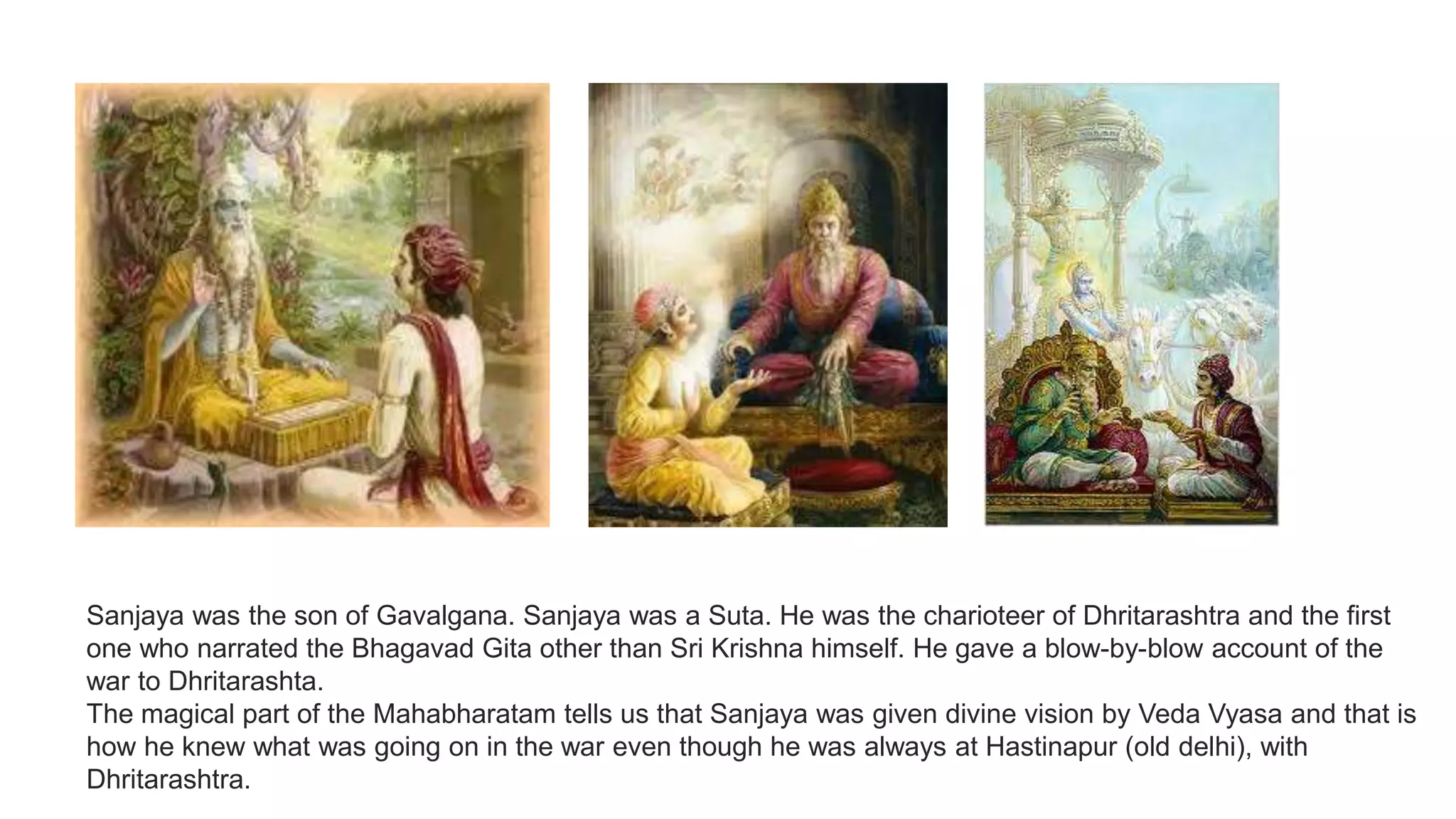
Sanjaya was the son of Gavalgana. Sanjaya was a Suta. He was the charioteer of Dhritarashtra and the first
one who narrated the Bhagavad Gita other than Sri Krishna himself. He gave a blow-by-blow account of the
war to Dhritarashta.
The magical part of the Mahabharatam tells us that Sanjaya was given divine vision by Veda Vyasa and that is
how he knew what was going on in the war even though he was always at Hastinapur (old delhi), with
Dhritarashtra.
Question 7. Who were
the parents of Bhishma?
King Shantanu was Bhishma’s father. Shantanu had him on his first wife
Ganga. Shantanu was the 12th king of a line starting from Dushyanta and
Bharata, though the vansh (family or progeny) is said to have started with
Bharata the great.
Question 8. Krishna was the
charioteer of Arjuna. This gave him
a special name. What was it?
Krishna is also known as Parthasarathy, which translates to charioteer of Partha (another
name for Arjuna), or Sanathana Sarathi, eternal charioteer. Arjuna's chariot is known as
the Kapi Dhwaja. The chariot on which both, Shree Krishna and Arjuna, rode
was given by Agni (the fire-god) to Arjuna, and that was indication that this chariot was
capable of conquering all directions, wherever it was drawn through out the three worlds.
Question 9. What king did
the Pandavas serve during
their 13th year in exile?
Virata Parva, also known as the “Book of
Virata”, is the fourth of eighteen books of
the Indian Epic Mahabharata. Virata Parva
traditionally has 4 sub-books and 72
chapters. The critical edition of Virata Parva
has 4 sub-books and 67 chapters. It
discusses the 13th year of exile which
the Pandavas must spend incognito to avoid
another 12 years of exile in the forest. They
do so in the court of Virata. They
assume a variety of concealed identities.
Yudhishthira assumes the identity of game
entertainer to the king and calls himself
Kanka, Bhima of a cook Ballava, Arjuna
teaches dance and music as
eunuch Brihannala and dresses as a woman,
Nakula tends horses as Granthika, Sahadeva
herds cows as Tantipala
Question 10.What
famous text does Krishna
dictate to Arjuna?
Gita is one of the most
influential treatise in eastern
philosophy. The Bhagavad-
Gita is the eternal message of
spiritual wisdom from ancient
India. The word Gita means
song and the
word. Bhagavad means God,
often the Bhagavad-Gita is
called the Song of God
It is believed that three other
person besides Arjuna listened
the Gita directly from Krishna.
They were Sanjay, Hanuman,
Barbarik son of Ghatotkach.
Question 11.Who
does Duryodhana
appoint as his initial
commander?
It was a general position and only Duryodhan used to give those rights to someone, of course, with a lot of
conflicts. The Mahabharata Kurukshetra war was fought for 18 days.
Day 1–10: Right from the day one, the mighty warrior and the son of Ganga, Bhishma was the commander-in-
chief for the entire Kaurava army comprising of 11 Akshauhinis. Bounded by his promises, he went on fighting
with the Pandava army until he was stopped by Lord Krishna on Day 9.
Question 12. Who wrote
the Mahabharata?
Krishna-Dwaipayan Vyasa,
himself a character in the
epic, composed it; as,
according to tradition, he
dictated the verses and
Ganesha wrote them down.
At 100,000 verses, it is the
longest epic poem ever
written, generally thought
to have been composed in
the 4th century BCE or
earlier.
Question 13. Which Pandava
vowed to kill the evil Dushasana
and drink his blood when he
molested Draupadi?
Dussasana was the warrior who shot the first arrow in the war according to Sanjay when asked by Dhrithrashtra. On the 1st day
of the war he was defeated by Nakula but was spared by him for sake of Bhima's vow. On the 10th day, Dussasana was appointed
to defend Bhishma but he was swept aside by Arjuna. On the 13th day of the war Dussasana was present in the Chakravyuh and
he was badly defeated by Abhimanyu. On the 16th day of the Kurukshetra War, Bhima defeated and killed Dussasana. He and
Dussasana were fighting with bows and arrows. Later, Dussasana's arrows pierced Bhima. Then Bhima attacked Dushasana with
his mace which caused him to fall on the ground. Remembering his vow Bhima tore open Dussasana's chest using a sword and
drank his warm blood. Later he decapitated him.[1] Bhima exclaimed that the taste of the blood was sweeter than that of milk and
danced around his body. Dussasana's brutal death greatly agitated Duryodhana, and demoralized the Kaurava army watching
Bhima in his ecstasy of wrath (soldiers of both sides called Bhima 'Rakshasa' condemning his terrible act). Bhima washed
Draupadi's hair with Dussasana's blood, thus fulfilling her vow as well. However, this did little to end the conflict, as Duryodhana
reaffirmed his view on the continuation of the war.
Question 14. Who shot the
first arrow that killed
Bheeshma?
Shikhandi is a character in the Hindu epic, the Mahabharata. He was born a baby girl, named "Shikhandini,"
to Drupada, the king of Panchala. Shikhandi fought in the Kurukshetra war for the Pandavas along with his father
Drupada and brother Dhristadyumna.
Amba's vengeance was fulfilled when Shikhandi became the cause of Bhishma's death. Shikhandi is killed in
a sword fight with Ashwatthama when Ashwatthama, Kripacharya, and Kritavarma attacked the Pandava camp
on the night of the final day of battle.
Question 15. What does the
Narayanastra do, and who
used it after the fall of Drona?
It shoots weapons continuously - Ashwattama
Ashwattama used the Narayanastra in his anger at the death of his father, Drona. He unjustly used it against an
innocent crowd which was against the rules of Astras.
Ashwathama, a warrior-hero in the epic Mahabharata unleashes this weapon on the Pandava forces.
Lord Krishna, who is an avatar of Vishnu tells the Pandavas and their warriors to drop their weapons and lie
down on the ground, so that they all surrender completely to the power of the weapon.It was also said that this
weapon can be used only once in a war and if one tries to use it twice, then it would devour the user's own army.
Question 16.What does
Draupadi disguise herself as
during the 13th year in exile?
Draupadi in the name of Malini went as Sairandhri(hairdresser) to queen
Shudeshna.[1]
Question 17. Where does
Duryodhana hide right before
he is killed?
On the eighteenth day of the war, with his army reduced to himself, Ashwatthama, Kripa and Kritvarma,
Duryodhana goes to meditate in a lake. When the Pandavas and Krishna eventually find him, Duryodhana
tells them that he wants to gift the kingdom to them, and retire to the forest. Yudhishthira balks at the offer,
telling him that Hastinapur is not Duryodhana's to gift. Instead, he offers that Duryodhana may pick any of
the Pandava brothers to fight against one-to-one with a weapon of his choice, with the winner of the conflict
the victor of the war.
Question 18. Where do the
Pandavas spend their first 12
years of exile?
Kamyaka Forest was situated on the western boundary of the Kuru Kingdom (Kuru Proper + Kurujangala), on the
banks of the Saraswati River. It lay to the west of the Kurukshetra plain. It contained within it a lake called
the Kamyaka lake. Kamyaka forest is mentioned as being situated at the head of the Thar desert, near the
lake Trinavindu. The Pandavas on their way to exile in the woods, left Pramanakoti on the banks of the Ganges and
went towards Kurukshetra, travelling in a western direction, crossing the rivers Yamuna and Drishadvati. They finally
reached the banks of the Saraswati River. There they saw the forest of Kamyaka, the favourite haunt of ascetics,
situated on a level and wild plain on the banks of the Saraswati abounding in birds and deer. There the Pandavas lived
in an ascetic asylum. It took 3 days for Pandavas to reach the Kamyaka forest, setting out from Hastinapura, on their
chariots.
Question 19. How many
warriors did each
elephant carry in the
war?
Each elephant was decked
with ornaments and
carried seven warriors and
their weapons.
Q. 20. What was the yagna performed by
Yudhishthira after the battle of Kurukshetra?
The Ashvamedha is a horse sacrifice ritual followed by the Śrauta tradition of Vedic religion. It was used by ancient
Indian kings to prove their imperial sovereignty: a horse accompanied by the king's warriors would be released to
wander for a period of one year. In the territory traversed by the horse, any rival could dispute the king's authority by
challenging the warriors accompanying it. After one year, if no enemy had managed to kill or capture the horse, the
animal would be guided back to the king's capital. It would be then sacrificed, and the king would be declared as an
undisputed sovereign.
Question 21. Who was the last
commander of the Kaurava army?
Ashvathama (After Duryodhana had fallen in the mace fight against Bheema, Ashvathama came
to him. Before dying, Duryodhana made Ashvathama his commander and made him promise that
he would bring the five severed heads of the Pandavas to him.)
Question 22. How many soldiers and warriors is
Bhishma said to have killed each day of the war?
10000 (Before the war began, Bhishma promised Duryodhana that he would
kill 10,000 soldiers and warriors on the Pandava side each day but would
not kill any of the Pandavas. It was said that Bhishma was invincible till a
bow was in his hand and arrows in his quiver.)
Question 23. Duryodhana and Arjuna both approached Krishna for help
before the war began. Arjuna asked for Krishna himself to aid him. What did
Duryodhana ask for?
A. Narayani Sena (army)( Before the war, Duryodhana and Arjuna came to Krishna to ask for help. Duryodhana came
first, but saw that Krishna was asleep. He sat down on a couch near Krishna's head. Arjuna arrived and, seeing
Krishna asleep, remained standing at Krishna's feet. When Krishna awoke he saw Arjuna first and greeted him. Then
Duryodhana said that he had come before Arjuna and said that he wanted Krishna's help in the war. But Krishna said
that he had seen Arjuna first and thus Arjuna had the right to ask first. Arjuna asked for Krishna himself to aid him in
the war and that left the huge Narayani Sena for Duryodhana, who accepted it gladly.)
Question 24 It is said that because of his Dharma, Yudhishthira's
chariot is approximately _______ above the ground.
The chariot of Yudhishthira is always about two inches above the ground
because he never swerved from the path of Dharma and Truth. The Chariot
sank back to the ground when he told the One Lie to Drona.
Which side broke the most rules in the war?
Rule of War Rule Breaker Victim
No woman shall fight in
the battlefield
Pandavas (Arjuna) Bhishma
No single warrior shall be
attacked by many
Kauravas (Drona) Abhimanyu
No fighting after sunset Pandavas (Arjuna) Jayadhratha
No one shall interfere in a
duel
Pandavas (Satyaki) Bhurishrava
No killing animals Pandavas (Bhima) Ashwatthama the Elephant
No spreading of
misinformation
Pandavas (Yudishtira) Drona
No killing people who have
laid down arms
Pandavas (Dhristadyuma) Drona
No archer shall fight one
who has lowered their
bow
Pandavas (Arjuna) Karna
No one shall strike below
the waist
Pandavas (Bhima) Duryodhana
No attacking people who
are asleep
Kauravas (Ashwatthama) Sons of the Pandavas
Why did the everyone who died on
kurukshetra go to heaven?
King Kuru chose land at the banks of the now extinct Sarasvati River (believed to be dried up c. 1900 BCE)[5] for
embedding spirituality with eight virtues: austerity (Tapas), truth (Satya), forgiveness (Kshama), kindness
(Daya), purity (Shuddha), charity (Daana), devotion (Yajna), and conduct (Brahmacharya). Lord Vishnu was
impressed with the acts of King Kuru and blessed him with two boons—first, that this land forever will be
known as a Holy Land after his name as Kurukshetra (the land of Kuru); second that anyone dying on this land
will go to heaven.
What did Karna have attached to his body
since birth?
Kavach and kundal
Karna was the son of
Surya the sun god
and was born with it
as a boon from his
father

Mahabharata Quiz (1).pptx

  • 2.
    1. Teams arerequested to wait for their turn 2. Don’t argue with the quizmasters. Their decisions are final and binding. 3. Each question carries one point unless stated otherwise. 4. Time limit for each question is 2 minutes. 5. If any candidate is found cheating then it will lead to disqualification of the team. 6. If a team is unable to answer then the question will be passed on to the next team. 7. Hints by Experts for any two questions: Choose Any: Experts: Saroj Singh, Amrit, Tanay, Meenanshu RULES OF THE QUIZ
  • 3.
    Team A :Rishika, Tara Team D: Krish,Dhruv Team B : Rishi, Mishtu Team C : Amitav, Anshita
  • 4.
    Question 1. TheGreat Mahabharat War lasted for how many days of fighting?
  • 5.
    18 long The warwas fought for 18 long days. The Kurukshetra War is a war described in the Indian epic Mahabharata as a conflict that arose from a dynastic succession struggle between two groups of cousins of an Indian kingdom called Kuru, the Kauravas and Pandavas, for the throne of Hastinapura.
  • 6.
    Question 2. Abhimanyu,the son of Arjuna and Subhadra, was murdered while trying to break into a vyuha (army formation). Which vyuha was it?
  • 7.
    Chakravyuha (Chakra =Disc; Vyuha = Formation), also known as Padmavyuha (Padma = Lotus; Vyuha = Formation), was a type of battle formation used by the Kauravas against the Pandavas on the 13th day of the Mahabharata war. It resembled a seven-layered circular maze with one entrance when viewed from above. Abhimanyu was the re-incarnation of son of the Moon-God Chandra. When Chandra was asked to let his son incarnate himself on earth, he made a pact that his son will only remain on earth for 16 years, as he could not bear to be separated from him any longer than that. So, Chandra's son was born as the son of Arjuna and Subhadra.
  • 8.
    Question 3. Whois Yudhisthira's father?
  • 9.
    In the Hinduepic Mahabharata, Yudhishthira (Sanskrit: युधिधिर, IAST: Yudhiṣṭhira) was the eldest son of King Pandu and Queen Kunti and the king of Indraprastha and later of Hastinapura (Kuru). He was the leader of the successful Pandava side in the Kurukshetra War.
  • 10.
    Question 4. Whatwas Shakuni’s real motive?
  • 11.
    Shakuni's main enmitywas with Bhishma, who had humiliatingly defeated and ravaged Gandhara, when Hastinapur was expanding its territories under Dhritarashtra. He wanted to destroy the Kuru empire and the royal lineage itself, as a revenge for what was done to his people.
  • 12.
    Question 5. Inall, how many sons or daughters did Kunti give birth to?
  • 13.
    4. Kunti had aspecial gift that she obtained from the sage, Durvasa. Durvasa gave Kunti a gift because of her kindness to him. She had a mantra that allowed her to acquire sons from the gods. She wanted to test this mantra, so she summoned Surya, the sun god. Her first son was born and his name was Karna. Kunti was not married, so she did not want people to question her about her child. She put Karna in a basket and he floated down the river. A couple rescued him and they took care of him. Kunti later married King Pandu. Kunti used her mantra to have three children from gods.
  • 14.
    Question 6. Whois the well known charioteer of Dhritarashtra?
  • 15.
    Sanjaya was theson of Gavalgana. Sanjaya was a Suta. He was the charioteer of Dhritarashtra and the first one who narrated the Bhagavad Gita other than Sri Krishna himself. He gave a blow-by-blow account of the war to Dhritarashta. The magical part of the Mahabharatam tells us that Sanjaya was given divine vision by Veda Vyasa and that is how he knew what was going on in the war even though he was always at Hastinapur (old delhi), with Dhritarashtra.
  • 16.
    Question 7. Whowere the parents of Bhishma?
  • 17.
    King Shantanu wasBhishma’s father. Shantanu had him on his first wife Ganga. Shantanu was the 12th king of a line starting from Dushyanta and Bharata, though the vansh (family or progeny) is said to have started with Bharata the great.
  • 18.
    Question 8. Krishnawas the charioteer of Arjuna. This gave him a special name. What was it?
  • 19.
    Krishna is alsoknown as Parthasarathy, which translates to charioteer of Partha (another name for Arjuna), or Sanathana Sarathi, eternal charioteer. Arjuna's chariot is known as the Kapi Dhwaja. The chariot on which both, Shree Krishna and Arjuna, rode was given by Agni (the fire-god) to Arjuna, and that was indication that this chariot was capable of conquering all directions, wherever it was drawn through out the three worlds.
  • 20.
    Question 9. Whatking did the Pandavas serve during their 13th year in exile?
  • 21.
    Virata Parva, alsoknown as the “Book of Virata”, is the fourth of eighteen books of the Indian Epic Mahabharata. Virata Parva traditionally has 4 sub-books and 72 chapters. The critical edition of Virata Parva has 4 sub-books and 67 chapters. It discusses the 13th year of exile which the Pandavas must spend incognito to avoid another 12 years of exile in the forest. They do so in the court of Virata. They assume a variety of concealed identities. Yudhishthira assumes the identity of game entertainer to the king and calls himself Kanka, Bhima of a cook Ballava, Arjuna teaches dance and music as eunuch Brihannala and dresses as a woman, Nakula tends horses as Granthika, Sahadeva herds cows as Tantipala
  • 22.
    Question 10.What famous textdoes Krishna dictate to Arjuna?
  • 23.
    Gita is oneof the most influential treatise in eastern philosophy. The Bhagavad- Gita is the eternal message of spiritual wisdom from ancient India. The word Gita means song and the word. Bhagavad means God, often the Bhagavad-Gita is called the Song of God It is believed that three other person besides Arjuna listened the Gita directly from Krishna. They were Sanjay, Hanuman, Barbarik son of Ghatotkach.
  • 24.
    Question 11.Who does Duryodhana appointas his initial commander?
  • 25.
    It was ageneral position and only Duryodhan used to give those rights to someone, of course, with a lot of conflicts. The Mahabharata Kurukshetra war was fought for 18 days. Day 1–10: Right from the day one, the mighty warrior and the son of Ganga, Bhishma was the commander-in- chief for the entire Kaurava army comprising of 11 Akshauhinis. Bounded by his promises, he went on fighting with the Pandava army until he was stopped by Lord Krishna on Day 9.
  • 26.
    Question 12. Whowrote the Mahabharata?
  • 27.
    Krishna-Dwaipayan Vyasa, himself acharacter in the epic, composed it; as, according to tradition, he dictated the verses and Ganesha wrote them down. At 100,000 verses, it is the longest epic poem ever written, generally thought to have been composed in the 4th century BCE or earlier.
  • 28.
    Question 13. WhichPandava vowed to kill the evil Dushasana and drink his blood when he molested Draupadi?
  • 29.
    Dussasana was thewarrior who shot the first arrow in the war according to Sanjay when asked by Dhrithrashtra. On the 1st day of the war he was defeated by Nakula but was spared by him for sake of Bhima's vow. On the 10th day, Dussasana was appointed to defend Bhishma but he was swept aside by Arjuna. On the 13th day of the war Dussasana was present in the Chakravyuh and he was badly defeated by Abhimanyu. On the 16th day of the Kurukshetra War, Bhima defeated and killed Dussasana. He and Dussasana were fighting with bows and arrows. Later, Dussasana's arrows pierced Bhima. Then Bhima attacked Dushasana with his mace which caused him to fall on the ground. Remembering his vow Bhima tore open Dussasana's chest using a sword and drank his warm blood. Later he decapitated him.[1] Bhima exclaimed that the taste of the blood was sweeter than that of milk and danced around his body. Dussasana's brutal death greatly agitated Duryodhana, and demoralized the Kaurava army watching Bhima in his ecstasy of wrath (soldiers of both sides called Bhima 'Rakshasa' condemning his terrible act). Bhima washed Draupadi's hair with Dussasana's blood, thus fulfilling her vow as well. However, this did little to end the conflict, as Duryodhana reaffirmed his view on the continuation of the war.
  • 30.
    Question 14. Whoshot the first arrow that killed Bheeshma?
  • 31.
    Shikhandi is acharacter in the Hindu epic, the Mahabharata. He was born a baby girl, named "Shikhandini," to Drupada, the king of Panchala. Shikhandi fought in the Kurukshetra war for the Pandavas along with his father Drupada and brother Dhristadyumna. Amba's vengeance was fulfilled when Shikhandi became the cause of Bhishma's death. Shikhandi is killed in a sword fight with Ashwatthama when Ashwatthama, Kripacharya, and Kritavarma attacked the Pandava camp on the night of the final day of battle.
  • 32.
    Question 15. Whatdoes the Narayanastra do, and who used it after the fall of Drona?
  • 33.
    It shoots weaponscontinuously - Ashwattama Ashwattama used the Narayanastra in his anger at the death of his father, Drona. He unjustly used it against an innocent crowd which was against the rules of Astras. Ashwathama, a warrior-hero in the epic Mahabharata unleashes this weapon on the Pandava forces. Lord Krishna, who is an avatar of Vishnu tells the Pandavas and their warriors to drop their weapons and lie down on the ground, so that they all surrender completely to the power of the weapon.It was also said that this weapon can be used only once in a war and if one tries to use it twice, then it would devour the user's own army.
  • 34.
    Question 16.What does Draupadidisguise herself as during the 13th year in exile?
  • 35.
    Draupadi in thename of Malini went as Sairandhri(hairdresser) to queen Shudeshna.[1]
  • 36.
    Question 17. Wheredoes Duryodhana hide right before he is killed?
  • 37.
    On the eighteenthday of the war, with his army reduced to himself, Ashwatthama, Kripa and Kritvarma, Duryodhana goes to meditate in a lake. When the Pandavas and Krishna eventually find him, Duryodhana tells them that he wants to gift the kingdom to them, and retire to the forest. Yudhishthira balks at the offer, telling him that Hastinapur is not Duryodhana's to gift. Instead, he offers that Duryodhana may pick any of the Pandava brothers to fight against one-to-one with a weapon of his choice, with the winner of the conflict the victor of the war.
  • 38.
    Question 18. Wheredo the Pandavas spend their first 12 years of exile?
  • 39.
    Kamyaka Forest wassituated on the western boundary of the Kuru Kingdom (Kuru Proper + Kurujangala), on the banks of the Saraswati River. It lay to the west of the Kurukshetra plain. It contained within it a lake called the Kamyaka lake. Kamyaka forest is mentioned as being situated at the head of the Thar desert, near the lake Trinavindu. The Pandavas on their way to exile in the woods, left Pramanakoti on the banks of the Ganges and went towards Kurukshetra, travelling in a western direction, crossing the rivers Yamuna and Drishadvati. They finally reached the banks of the Saraswati River. There they saw the forest of Kamyaka, the favourite haunt of ascetics, situated on a level and wild plain on the banks of the Saraswati abounding in birds and deer. There the Pandavas lived in an ascetic asylum. It took 3 days for Pandavas to reach the Kamyaka forest, setting out from Hastinapura, on their chariots.
  • 40.
    Question 19. Howmany warriors did each elephant carry in the war?
  • 41.
    Each elephant wasdecked with ornaments and carried seven warriors and their weapons.
  • 42.
    Q. 20. Whatwas the yagna performed by Yudhishthira after the battle of Kurukshetra?
  • 43.
    The Ashvamedha isa horse sacrifice ritual followed by the Śrauta tradition of Vedic religion. It was used by ancient Indian kings to prove their imperial sovereignty: a horse accompanied by the king's warriors would be released to wander for a period of one year. In the territory traversed by the horse, any rival could dispute the king's authority by challenging the warriors accompanying it. After one year, if no enemy had managed to kill or capture the horse, the animal would be guided back to the king's capital. It would be then sacrificed, and the king would be declared as an undisputed sovereign.
  • 44.
    Question 21. Whowas the last commander of the Kaurava army?
  • 45.
    Ashvathama (After Duryodhanahad fallen in the mace fight against Bheema, Ashvathama came to him. Before dying, Duryodhana made Ashvathama his commander and made him promise that he would bring the five severed heads of the Pandavas to him.)
  • 46.
    Question 22. Howmany soldiers and warriors is Bhishma said to have killed each day of the war?
  • 47.
    10000 (Before thewar began, Bhishma promised Duryodhana that he would kill 10,000 soldiers and warriors on the Pandava side each day but would not kill any of the Pandavas. It was said that Bhishma was invincible till a bow was in his hand and arrows in his quiver.)
  • 48.
    Question 23. Duryodhanaand Arjuna both approached Krishna for help before the war began. Arjuna asked for Krishna himself to aid him. What did Duryodhana ask for?
  • 49.
    A. Narayani Sena(army)( Before the war, Duryodhana and Arjuna came to Krishna to ask for help. Duryodhana came first, but saw that Krishna was asleep. He sat down on a couch near Krishna's head. Arjuna arrived and, seeing Krishna asleep, remained standing at Krishna's feet. When Krishna awoke he saw Arjuna first and greeted him. Then Duryodhana said that he had come before Arjuna and said that he wanted Krishna's help in the war. But Krishna said that he had seen Arjuna first and thus Arjuna had the right to ask first. Arjuna asked for Krishna himself to aid him in the war and that left the huge Narayani Sena for Duryodhana, who accepted it gladly.)
  • 50.
    Question 24 Itis said that because of his Dharma, Yudhishthira's chariot is approximately _______ above the ground.
  • 51.
    The chariot ofYudhishthira is always about two inches above the ground because he never swerved from the path of Dharma and Truth. The Chariot sank back to the ground when he told the One Lie to Drona.
  • 52.
    Which side brokethe most rules in the war?
  • 53.
    Rule of WarRule Breaker Victim No woman shall fight in the battlefield Pandavas (Arjuna) Bhishma No single warrior shall be attacked by many Kauravas (Drona) Abhimanyu No fighting after sunset Pandavas (Arjuna) Jayadhratha No one shall interfere in a duel Pandavas (Satyaki) Bhurishrava No killing animals Pandavas (Bhima) Ashwatthama the Elephant No spreading of misinformation Pandavas (Yudishtira) Drona No killing people who have laid down arms Pandavas (Dhristadyuma) Drona No archer shall fight one who has lowered their bow Pandavas (Arjuna) Karna No one shall strike below the waist Pandavas (Bhima) Duryodhana No attacking people who are asleep Kauravas (Ashwatthama) Sons of the Pandavas
  • 54.
    Why did theeveryone who died on kurukshetra go to heaven?
  • 55.
    King Kuru choseland at the banks of the now extinct Sarasvati River (believed to be dried up c. 1900 BCE)[5] for embedding spirituality with eight virtues: austerity (Tapas), truth (Satya), forgiveness (Kshama), kindness (Daya), purity (Shuddha), charity (Daana), devotion (Yajna), and conduct (Brahmacharya). Lord Vishnu was impressed with the acts of King Kuru and blessed him with two boons—first, that this land forever will be known as a Holy Land after his name as Kurukshetra (the land of Kuru); second that anyone dying on this land will go to heaven.
  • 56.
    What did Karnahave attached to his body since birth?
  • 57.
    Kavach and kundal Karnawas the son of Surya the sun god and was born with it as a boon from his father