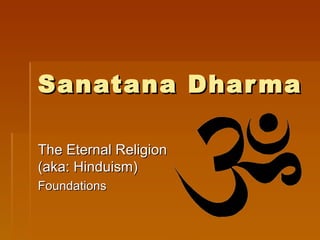
Sanatana Dhar ma

The Eternal Religion
(aka: Hinduism)
Foundations
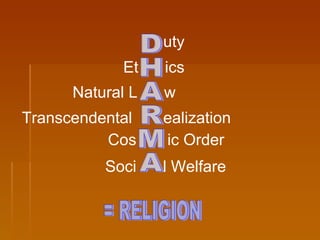
uty
             Et   ics
      Natural L   w
Transcendental    ealization
          Cos     ic Order
          Soci    l Welfare
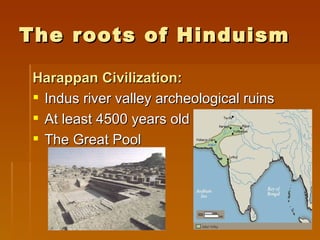
The roots of Hinduism

 Harappan Civilization:
  Indus river valley archeological ruins
  At least 4500 years old
  The Great Pool
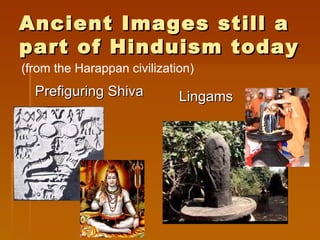
Ancient Images still a
part of Hinduism today
(from the Harappan civilization)
  Prefiguring Shiva          Lingams
The roots of Hinduism

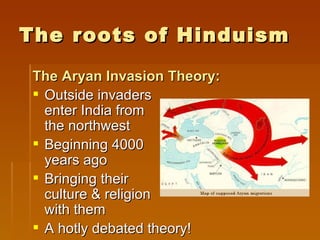
 The Aryan Invasion Theory:
  Outside invaders
   enter India from
   the northwest
  Beginning 4000
   years ago
  Bringing their
   culture & religion
   with them
  A hotly debated theory!
The Vedic Tradition

 Elements presumed to be of Aryan
   influence that continue to be a part of
   Hinduism today:
  Sanskrit language
  Vedic texts (composed in Sanskrit)
  Patriarchal rule
  Social class distinctions (caste) & the role of
   the priests (Brahmins)
  Rituals & the Fire Sacrifice
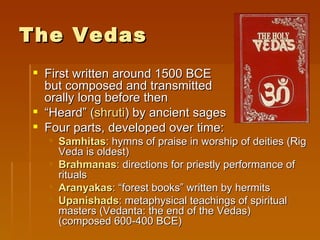
The Vedas
 First written around 1500 BCE
  but composed and transmitted
  orally long before then
 “Heard” (shruti) by ancient sages
 Four parts, developed over time:
   Samhitas: hymns of praise in worship of deities (Rig
    Veda is oldest)
   Brahmanas: directions for priestly performance of
    rituals
   Aranyakas: “forest books” written by hermits
   Upanishads: metaphysical teachings of spiritual
    masters (Vedanta: the end of the Vedas)
    (composed 600-400 BCE)
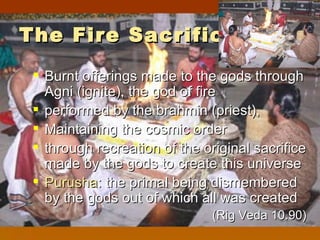
The Fire Sacrifice
  Burnt offerings made to the gods through
   Agni (ignite), the god of fire
  performed by the brahmin (priest),
  Maintaining the cosmic order
  through recreation of the original sacrifice
   made by the gods to create this universe
  Purusha: the primal being dismembered
   by the gods out of which all was created
                               (Rig Veda 10.90)
Philosophy of the
Upanishads
  Spiritual instruction, focused on inner
   experience, as a path to realization and
   immortality
  Brahman: The transcendent, all pervading,
   infinite and everlasting Ultimate Reality
  Atman: that Reality as it is found within
   ourselves – our soul is one with the “soul” of
   the universe
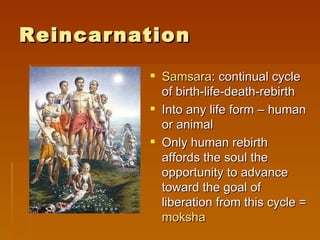
Reincarnation
          Samsara: continual cycle
           of birth-life-death-rebirth
          Into any life form – human
           or animal
          Only human rebirth
           affords the soul the
           opportunity to advance
           toward the goal of
           liberation from this cycle =
           moksha
Karma
 Consequences of our actions
 In this life and beyond – carried over to
  our future lives
 The law of cause and effect:
   Past actions affect our present life
   Present actions affect our future life
      Good deeds  good karma  good experiences
      Bad deeds  bad karma  bad experiences
 Karma keeps samsara going
Yoga - T he Paths to
Moksha
  Moksha: ultimate goal is to eliminate karma so
   as to be liberated from Samsara – the
   limitations of space, time and matter
  Yoga: The path to Union with the divine
  Four options:
      Raja Yoga – the path of meditation
      Jnana Yoga – the path of knowledge
      Karma Yoga – the path of selfless action
      Bhakti Yoga – the path of loving devotion to god
Review Activities

The Vedic Tradition
Upanishadic Metaphysics
Yoga

Access these and other review activities at:
http://www.nvcc.edu/home/lshulman/religions/H
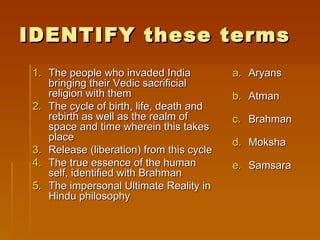
IDENTIFY these terms
1. The people who invaded India           a. Aryans
   bringing their Vedic sacrificial
   religion with them                     b. Atman
2. The cycle of birth, life, death and
   rebirth as well as the realm of        c. Brahman
   space and time wherein this takes
   place                                  d. Moksha
3. Release (liberation) from this cycle
4. The true essence of the human          e. Samsara
   self, identified with Brahman
5. The impersonal Ultimate Reality in
   Hindu philosophy
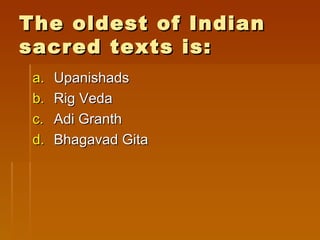
The oldest of Indian
sacred texts is:
 a.   Upanishads
 b.   Rig Veda
 c.   Adi Granth
 d.   Bhagavad Gita
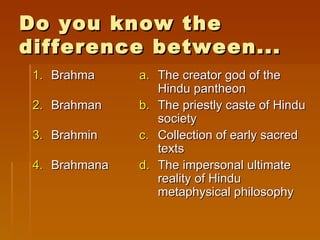
Do you know the
difference between...
 1. Brahma     a. The creator god of the
                  Hindu pantheon
 2. Brahman    b. The priestly caste of Hindu
                  society
 3. Brahmin    c. Collection of early sacred
                  texts
 4. Brahmana   d. The impersonal ultimate
                  reality of Hindu
                  metaphysical philosophy
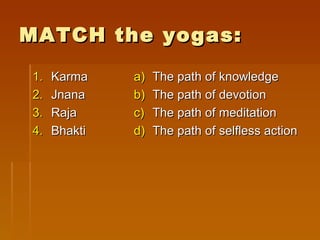
MATCH the yogas:

1.   Karma    a)   The path of knowledge
2.   Jnana    b)   The path of devotion
3.   Raja     c)   The path of meditation
4.   Bhakti   d)   The path of selfless action

Sanatana Dharma

  • 1.
    Sanatana Dhar ma TheEternal Religion (aka: Hinduism) Foundations
  • 2.
    uty Et ics Natural L w Transcendental ealization Cos ic Order Soci l Welfare
  • 3.
    The roots ofHinduism Harappan Civilization:  Indus river valley archeological ruins  At least 4500 years old  The Great Pool
  • 4.
    Ancient Images stilla part of Hinduism today (from the Harappan civilization) Prefiguring Shiva Lingams
  • 5.
    The roots ofHinduism The Aryan Invasion Theory:  Outside invaders enter India from the northwest  Beginning 4000 years ago  Bringing their culture & religion with them  A hotly debated theory!
  • 6.
    The Vedic Tradition Elements presumed to be of Aryan influence that continue to be a part of Hinduism today:  Sanskrit language  Vedic texts (composed in Sanskrit)  Patriarchal rule  Social class distinctions (caste) & the role of the priests (Brahmins)  Rituals & the Fire Sacrifice
  • 7.
    The Vedas  Firstwritten around 1500 BCE but composed and transmitted orally long before then  “Heard” (shruti) by ancient sages  Four parts, developed over time:  Samhitas: hymns of praise in worship of deities (Rig Veda is oldest)  Brahmanas: directions for priestly performance of rituals  Aranyakas: “forest books” written by hermits  Upanishads: metaphysical teachings of spiritual masters (Vedanta: the end of the Vedas) (composed 600-400 BCE)
  • 8.
    The Fire Sacrifice  Burnt offerings made to the gods through Agni (ignite), the god of fire  performed by the brahmin (priest),  Maintaining the cosmic order  through recreation of the original sacrifice made by the gods to create this universe  Purusha: the primal being dismembered by the gods out of which all was created (Rig Veda 10.90)
  • 9.
    Philosophy of the Upanishads  Spiritual instruction, focused on inner experience, as a path to realization and immortality  Brahman: The transcendent, all pervading, infinite and everlasting Ultimate Reality  Atman: that Reality as it is found within ourselves – our soul is one with the “soul” of the universe
  • 10.
    Reincarnation  Samsara: continual cycle of birth-life-death-rebirth  Into any life form – human or animal  Only human rebirth affords the soul the opportunity to advance toward the goal of liberation from this cycle = moksha
  • 11.
    Karma  Consequences ofour actions  In this life and beyond – carried over to our future lives  The law of cause and effect:  Past actions affect our present life  Present actions affect our future life  Good deeds  good karma  good experiences  Bad deeds  bad karma  bad experiences  Karma keeps samsara going
  • 12.
    Yoga - The Paths to Moksha  Moksha: ultimate goal is to eliminate karma so as to be liberated from Samsara – the limitations of space, time and matter  Yoga: The path to Union with the divine  Four options:  Raja Yoga – the path of meditation  Jnana Yoga – the path of knowledge  Karma Yoga – the path of selfless action  Bhakti Yoga – the path of loving devotion to god
  • 13.
    Review Activities The VedicTradition Upanishadic Metaphysics Yoga Access these and other review activities at: http://www.nvcc.edu/home/lshulman/religions/H
  • 14.
    IDENTIFY these terms 1.The people who invaded India a. Aryans bringing their Vedic sacrificial religion with them b. Atman 2. The cycle of birth, life, death and rebirth as well as the realm of c. Brahman space and time wherein this takes place d. Moksha 3. Release (liberation) from this cycle 4. The true essence of the human e. Samsara self, identified with Brahman 5. The impersonal Ultimate Reality in Hindu philosophy
  • 15.
    The oldest ofIndian sacred texts is: a. Upanishads b. Rig Veda c. Adi Granth d. Bhagavad Gita
  • 16.
    Do you knowthe difference between... 1. Brahma a. The creator god of the Hindu pantheon 2. Brahman b. The priestly caste of Hindu society 3. Brahmin c. Collection of early sacred texts 4. Brahmana d. The impersonal ultimate reality of Hindu metaphysical philosophy
  • 17.
    MATCH the yogas: 1. Karma a) The path of knowledge 2. Jnana b) The path of devotion 3. Raja c) The path of meditation 4. Bhakti d) The path of selfless action