BY
DZ
PURPOSE LEARNING
After learnt optical instruments,
student able to identify the

principle application of the
magnifying glass,
The students can use the
magnifying glass well
MAGNIFYING GLASS
 Magnifying glasses normally are used to

produce images that are larger than the
related objects, but they also can produce
images that are smaller than the related
objects
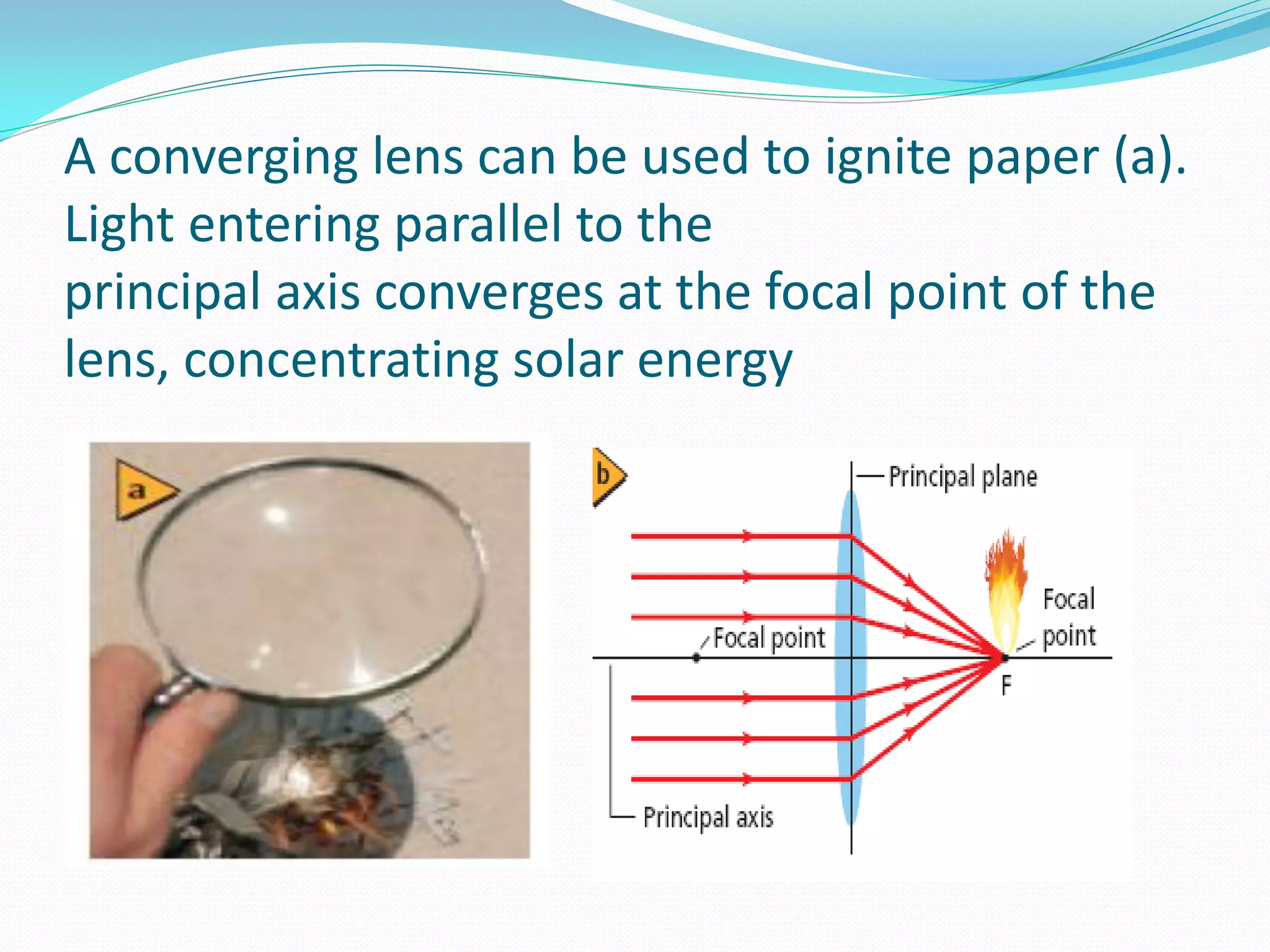
A converging lens can be used to ignite paper (a).
Light entering parallel to the
principal axis converges at the focal point of the
lens, concentrating solar energy
The two principal rays show that a convex lens

forms a virtual image that is upright and larger
compared to the object when the object is
located between the lens and the focal point.
Because the principal rays are simply part of a
model to help locate an image, they do not have to
pass through the picture of the lens in a diagram.
In reality, the image is formed only by the light
that passes through the actual lens.
Look at the picture
Magnification of the magnifying
glasses
 Observe with the accommodation eyes

𝑆𝑛
M=
+1
𝑓
 Observe with non accommodation eyes

𝑆𝑛
M=
𝑓
Example problem
A magnifier with a focal length
of 30 cm is used to view a 1-cm-

tall object. Use ray tracing to
determine the location and size
of the image when the
magnifier is positioned 10 cm
from the object.
THE ANSWER
Analyze and Sketch the
Problem
• Sketch the situation,
locating the object and the
lens.
• Draw the two principal rays.
Known: Unknown:
do 10.0 cm di ?
ho 1.0 cm hi ?
f 30.0 cm
a. Use the thin lens to determine d1
1
𝑓



=

1
𝑑1

do =

=

+

1
𝑑0

𝑓𝑑 𝑜
𝑑 𝑜−𝑓

(30 𝑐𝑚)(10 𝑐𝑚)
(10 𝑐𝑚) −(30 𝑐𝑚)

= - 15 cm( 15 cm away from the lens on
the side opposite the object)
Use the magnification equation and solve for
image height.
M=
 h1 =

ℎ1 −𝑑1
=
ℎ0
𝑑0
−𝑑1.ℎ0
𝑑𝑜

=

−(−15 𝑐𝑚)(2 𝑐𝑚)
10 𝑐𝑚

= 3 cm (3 cm tall)
The positive means that the image is erect.
ConcluSion
The image which is

formed by magnifying
glass is a virtual, erect
and magnified.
Thank you for

your attention…

Magnifying glass

  • 1.
  • 2.
    PURPOSE LEARNING After learntoptical instruments, student able to identify the principle application of the magnifying glass, The students can use the magnifying glass well
  • 3.
    MAGNIFYING GLASS  Magnifyingglasses normally are used to produce images that are larger than the related objects, but they also can produce images that are smaller than the related objects
  • 4.
    A converging lenscan be used to ignite paper (a). Light entering parallel to the principal axis converges at the focal point of the lens, concentrating solar energy
  • 5.
    The two principalrays show that a convex lens forms a virtual image that is upright and larger compared to the object when the object is located between the lens and the focal point. Because the principal rays are simply part of a model to help locate an image, they do not have to pass through the picture of the lens in a diagram. In reality, the image is formed only by the light that passes through the actual lens.
  • 6.
    Look at thepicture
  • 7.
    Magnification of themagnifying glasses  Observe with the accommodation eyes 𝑆𝑛 M= +1 𝑓  Observe with non accommodation eyes 𝑆𝑛 M= 𝑓
  • 8.
    Example problem A magnifierwith a focal length of 30 cm is used to view a 1-cm- tall object. Use ray tracing to determine the location and size of the image when the magnifier is positioned 10 cm from the object.
  • 9.
    THE ANSWER Analyze andSketch the Problem • Sketch the situation, locating the object and the lens. • Draw the two principal rays. Known: Unknown: do 10.0 cm di ? ho 1.0 cm hi ? f 30.0 cm
  • 10.
    a. Use thethin lens to determine d1 1 𝑓  = 1 𝑑1 do = = + 1 𝑑0 𝑓𝑑 𝑜 𝑑 𝑜−𝑓 (30 𝑐𝑚)(10 𝑐𝑚) (10 𝑐𝑚) −(30 𝑐𝑚) = - 15 cm( 15 cm away from the lens on the side opposite the object)
  • 11.
    Use the magnificationequation and solve for image height. M=  h1 = ℎ1 −𝑑1 = ℎ0 𝑑0 −𝑑1.ℎ0 𝑑𝑜 = −(−15 𝑐𝑚)(2 𝑐𝑚) 10 𝑐𝑚 = 3 cm (3 cm tall) The positive means that the image is erect.
  • 12.
    ConcluSion The image whichis formed by magnifying glass is a virtual, erect and magnified.
  • 13.