Chapter 10:  The Citizen and Government
Federal Elections Dissolution PM advises GG to dissolve govt and call election Happens near end of 5 year term, usually after about 3 years Of may happen if govt defeated on a major bill in the HofC (lost on a non-confidence vote) Election usually for 50 days after dissolution
Enumeration GG asks Chief Electoral Officer to issue election writs to get election going Returning officers report to Chief Electoral Officer Enumeration is preparation voters’ list in every province If not on list…can register on the day of the election Each polling station has its own list of voters
Nomination Candidates usually selected by local party leader submit nominations to go onto ballot To run any Canadian citizen 18 years or older can run also pay nominal deposit to returning officer
Campaigning Promotion of their platform and compete for public support Radio, newspaper and TV advertisements, pamphlets, posters, lawn signs, TV appearances and radio shows, public opinion polls, rallies and door-to-door canvassing Election Expenses Act are laws (fed and prov) to regulate money spent by each candidate
Balloting Day of the election voters go to polling stations (schools, places of worship and other public buildings) Cast vote for candidate of their choice then place ballot in ballot box  secret ballot Polling stations open 8am-8pm Issues with time zones
Tabulation Counting up of ballots by deputy returning officer At close of balloting TV, radio can legally being to broadcast results as they come in If vote in riding is very close (approx 100 votes) can ask for a recount If MP dies or resigns then the seat is declared vacant and a by-election is held Usually within a few months of vancancy
Who can vote?  Adult (18) Cdn citizens ie. Universal suffrage Voter turnout rarely reflects wide range of eligibility Voter apathy esp among young voters Lack of awareness about voting process or candidates and disinterest
Canada’s Electoral System Majority government Party wins more than half of the seats in the HofC Other parties considerably fewer MPs, but still  need to have Official Opposition Minority government Party wins more than other party but not more than other parties combined Less power because need to rely on votes of MP of other parties--opposition parites can unite and vote the party out of office Forced to cooperate
Coalition government Like minority, but two or more parties join together to form a govt Leader is chosen to become PM and Cabinet is from among MPs of the parties involved in the coalition First-past-the-post System Candidate with the most votes is declared winner Not necessarily majority of votes
Controversy of FPTP Govt doesn’t represent majority of voters’ wishes because party forms govt by winning the most seats in Parliament not total number of votes (popular vote) Proportional Representation Voters elect candidate on basis of party they represent Number of votes will reflect the number of seats Drawbacks Not every riding will have a local rep so areas of Canada will not have a say Usually will not give a majority therefore need to form coalition  (most of Europe uses this system)
Preferential Ballot  (Single transferable vote) Rank the candidates in order of preference If no one receives a majority then the candidate with the lowest number of votes is dropped and the second place votes are distributed Repeated until one candidate receives a majority Problem is winner may only have the votes of a small part of the population and represent one area of the country
Historical Political Parties Historic political parties which no longer exist Progressive Conservative Party (PC) Want controls on govt spending, tax cuts  Privatization Historically supported tariffs until NAFTA ie. Economic nationalism
Reform Party Forms in MB 1987 Believe West should have stronger voice  Want to reduce national debt with massive cuts to social welfare Wanted to change Constitution ie. stronger, elected Senate Oppose QC demand for special status Right wing
Canadian Alliance Party Spring 2000 Reform and some PC joined to form Canadian Alliance to reach more voters Agree to flat tax rate of 17% for all Cdns Want balanced budget Support free enterprise, “strong families” and “safer streets and secure borders” Joined with rest of PC in 2003 to form the  Conservative Party of Canada
Political Parties Liberal Party of Canada Supports individual freedom and pursuit of equality of opportunity for all Favours expansion of social programs (health and ed) Believes in multiculturalism and sympathetic towards Fr-Cdns Supports more free trade
The Conservative Party of Canada Supports balance between a balanced budge and supporting social programs Believes in equality of all Cdns and in freedom of the individual Supports English and French as official languages Supports free enterprise and free trade
The New Democratic Party (NDP) Believes govt should intervene in important aspects of economy (against privatization of crown corporations) Favours welfare measures (UI and welfare) Believes govt should pay for health and education and all Cdns have equal access to these regardless of ability to pay Official Opposition -  2011 election  Nycole Turmel is interim leader after death of Jack Layton (Aug 2011)
Bloc Quebecois Created in 1990 as a result of failure of Meech Lake Accord Believe that QC should become sovereign state and separate from Canada In 2011 election lost official party status (less than 12 seats)
Party organization Parties have two wings Parliamentary wing  Consists of MP (caucus) Very public and publicized  Extra-parliamentary wing Party officers, and workers
3 levels of extra-parliamentary wing Constituency association “ grassroots” volunteers Provincial association Coordinate activities of constituency offices National association In Ottawa Staffed by paid officials national convention
Regionalism Differences in wishes and needs that exist between Eastern, Central and Western regions of Canada All provs and territories have different economies, different strengths and weaknesses—ideal situation is MPs represented all regions of Canada and all voices were heard HofC most MPs are from ON and QC with few from BC
Influences on the Government Interest groups groups of citizens with a common goal Greenpeace, Amnesty International, Canadian Cancer Society, Canadian Federation of Labour, Canadian Manufacturers’ Association, MADD Representative/lobbyists meet with Cabinet ministers or parliamentary committees Provide research and technical expertise Try to influence public opinion Some change:  new legislation, environmental protection, new govt services and increased funding
Some oppose interest groups Promotion of goals not all citizens share…encouraging govt to pass legislation that does not benefit all of society Also interest groups have contributed large amount of money to particular party at election time, therefore, expect special treatment when elected
Mass Media Media can dictate govt’s focus by covering an issue they feel is important to society Media can accurately reflect community’s views? Or give adequate coverage? Esp since current trend towards media concentration ie. Conglomeration of media ownership…limited number of sources Media concentration goes against democratic principles of diversity and plurality
Protest Groups and Civil Disobedience Rallies, parades, marches, public demonstrations and blockades to draw attention to their causes Civil disobedience is the act of intentionally disobeying a law to get the attention of the govt
Principles of civil disobedience No violence involved Directed agains laws that are seriously harmful Willingness to face punishment Ex. Mahatma Gandhi and Martin Luther King Ex. Clayoquot Sound protest
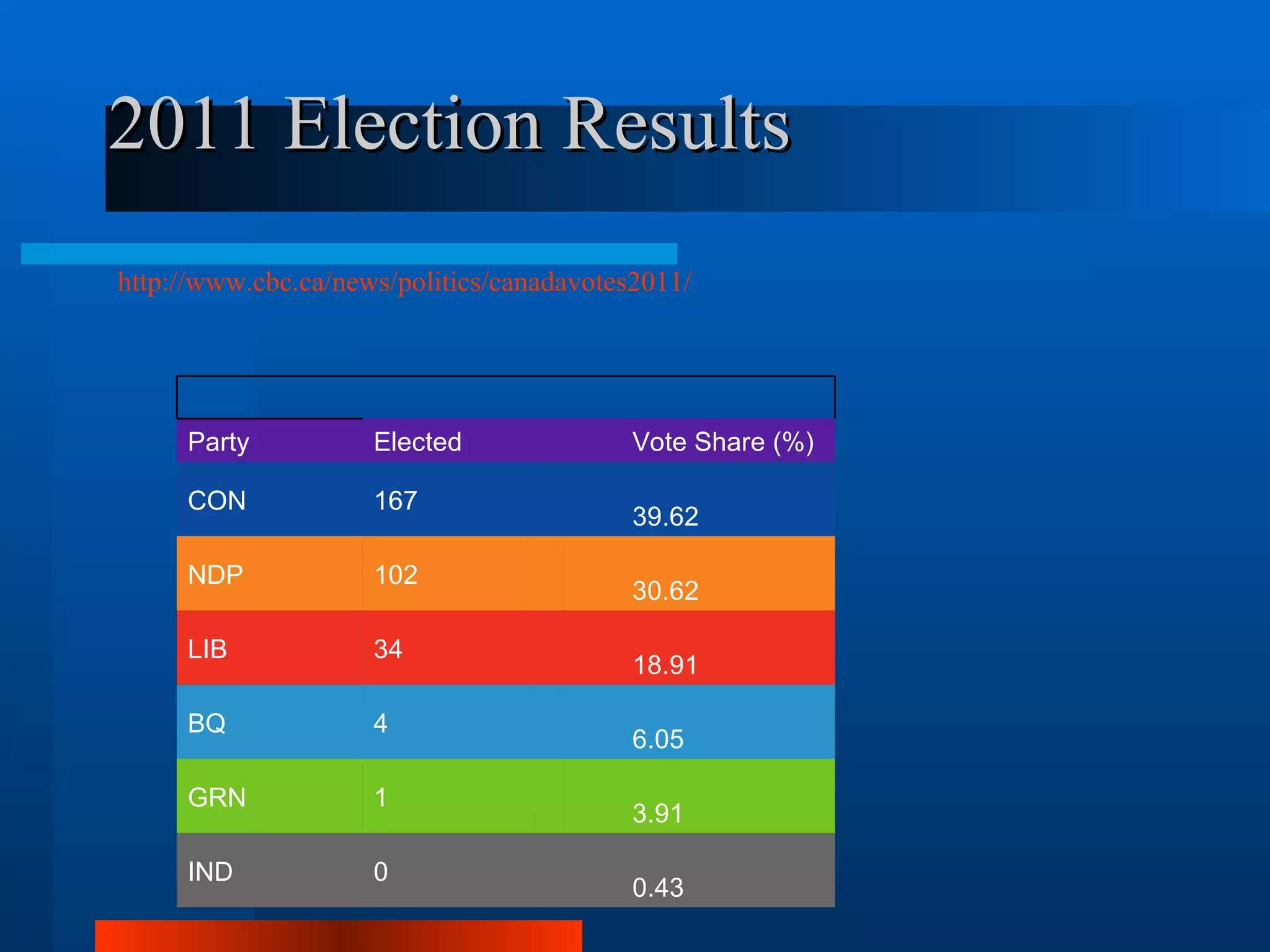
2011 Election Results http://www.cbc.ca/news/politics/canadavotes2011/ Party Elected Vote Share (%) CON 167 39.62 NDP 102 30.62 LIB 34 18.91 BQ 4 6.05 GRN 1 3.91 IND 0 0.43

Chapter 10

  • 1.
    Chapter 10: The Citizen and Government
  • 2.
    Federal Elections DissolutionPM advises GG to dissolve govt and call election Happens near end of 5 year term, usually after about 3 years Of may happen if govt defeated on a major bill in the HofC (lost on a non-confidence vote) Election usually for 50 days after dissolution
  • 3.
    Enumeration GG asksChief Electoral Officer to issue election writs to get election going Returning officers report to Chief Electoral Officer Enumeration is preparation voters’ list in every province If not on list…can register on the day of the election Each polling station has its own list of voters
  • 4.
    Nomination Candidates usuallyselected by local party leader submit nominations to go onto ballot To run any Canadian citizen 18 years or older can run also pay nominal deposit to returning officer
  • 5.
    Campaigning Promotion oftheir platform and compete for public support Radio, newspaper and TV advertisements, pamphlets, posters, lawn signs, TV appearances and radio shows, public opinion polls, rallies and door-to-door canvassing Election Expenses Act are laws (fed and prov) to regulate money spent by each candidate
  • 6.
    Balloting Day ofthe election voters go to polling stations (schools, places of worship and other public buildings) Cast vote for candidate of their choice then place ballot in ballot box  secret ballot Polling stations open 8am-8pm Issues with time zones
  • 7.
    Tabulation Counting upof ballots by deputy returning officer At close of balloting TV, radio can legally being to broadcast results as they come in If vote in riding is very close (approx 100 votes) can ask for a recount If MP dies or resigns then the seat is declared vacant and a by-election is held Usually within a few months of vancancy
  • 8.
    Who can vote? Adult (18) Cdn citizens ie. Universal suffrage Voter turnout rarely reflects wide range of eligibility Voter apathy esp among young voters Lack of awareness about voting process or candidates and disinterest
  • 9.
    Canada’s Electoral SystemMajority government Party wins more than half of the seats in the HofC Other parties considerably fewer MPs, but still need to have Official Opposition Minority government Party wins more than other party but not more than other parties combined Less power because need to rely on votes of MP of other parties--opposition parites can unite and vote the party out of office Forced to cooperate
  • 10.
    Coalition government Likeminority, but two or more parties join together to form a govt Leader is chosen to become PM and Cabinet is from among MPs of the parties involved in the coalition First-past-the-post System Candidate with the most votes is declared winner Not necessarily majority of votes
  • 11.
    Controversy of FPTPGovt doesn’t represent majority of voters’ wishes because party forms govt by winning the most seats in Parliament not total number of votes (popular vote) Proportional Representation Voters elect candidate on basis of party they represent Number of votes will reflect the number of seats Drawbacks Not every riding will have a local rep so areas of Canada will not have a say Usually will not give a majority therefore need to form coalition (most of Europe uses this system)
  • 12.
    Preferential Ballot (Single transferable vote) Rank the candidates in order of preference If no one receives a majority then the candidate with the lowest number of votes is dropped and the second place votes are distributed Repeated until one candidate receives a majority Problem is winner may only have the votes of a small part of the population and represent one area of the country
  • 13.
    Historical Political PartiesHistoric political parties which no longer exist Progressive Conservative Party (PC) Want controls on govt spending, tax cuts Privatization Historically supported tariffs until NAFTA ie. Economic nationalism
  • 14.
    Reform Party Formsin MB 1987 Believe West should have stronger voice Want to reduce national debt with massive cuts to social welfare Wanted to change Constitution ie. stronger, elected Senate Oppose QC demand for special status Right wing
  • 15.
    Canadian Alliance PartySpring 2000 Reform and some PC joined to form Canadian Alliance to reach more voters Agree to flat tax rate of 17% for all Cdns Want balanced budget Support free enterprise, “strong families” and “safer streets and secure borders” Joined with rest of PC in 2003 to form the Conservative Party of Canada
  • 16.
    Political Parties LiberalParty of Canada Supports individual freedom and pursuit of equality of opportunity for all Favours expansion of social programs (health and ed) Believes in multiculturalism and sympathetic towards Fr-Cdns Supports more free trade
  • 17.
    The Conservative Partyof Canada Supports balance between a balanced budge and supporting social programs Believes in equality of all Cdns and in freedom of the individual Supports English and French as official languages Supports free enterprise and free trade
  • 18.
    The New DemocraticParty (NDP) Believes govt should intervene in important aspects of economy (against privatization of crown corporations) Favours welfare measures (UI and welfare) Believes govt should pay for health and education and all Cdns have equal access to these regardless of ability to pay Official Opposition - 2011 election Nycole Turmel is interim leader after death of Jack Layton (Aug 2011)
  • 19.
    Bloc Quebecois Createdin 1990 as a result of failure of Meech Lake Accord Believe that QC should become sovereign state and separate from Canada In 2011 election lost official party status (less than 12 seats)
  • 20.
    Party organization Partieshave two wings Parliamentary wing Consists of MP (caucus) Very public and publicized Extra-parliamentary wing Party officers, and workers
  • 21.
    3 levels ofextra-parliamentary wing Constituency association “ grassroots” volunteers Provincial association Coordinate activities of constituency offices National association In Ottawa Staffed by paid officials national convention
  • 22.
    Regionalism Differences inwishes and needs that exist between Eastern, Central and Western regions of Canada All provs and territories have different economies, different strengths and weaknesses—ideal situation is MPs represented all regions of Canada and all voices were heard HofC most MPs are from ON and QC with few from BC
  • 23.
    Influences on theGovernment Interest groups groups of citizens with a common goal Greenpeace, Amnesty International, Canadian Cancer Society, Canadian Federation of Labour, Canadian Manufacturers’ Association, MADD Representative/lobbyists meet with Cabinet ministers or parliamentary committees Provide research and technical expertise Try to influence public opinion Some change: new legislation, environmental protection, new govt services and increased funding
  • 24.
    Some oppose interestgroups Promotion of goals not all citizens share…encouraging govt to pass legislation that does not benefit all of society Also interest groups have contributed large amount of money to particular party at election time, therefore, expect special treatment when elected
  • 25.
    Mass Media Mediacan dictate govt’s focus by covering an issue they feel is important to society Media can accurately reflect community’s views? Or give adequate coverage? Esp since current trend towards media concentration ie. Conglomeration of media ownership…limited number of sources Media concentration goes against democratic principles of diversity and plurality
  • 26.
    Protest Groups andCivil Disobedience Rallies, parades, marches, public demonstrations and blockades to draw attention to their causes Civil disobedience is the act of intentionally disobeying a law to get the attention of the govt
  • 27.
    Principles of civildisobedience No violence involved Directed agains laws that are seriously harmful Willingness to face punishment Ex. Mahatma Gandhi and Martin Luther King Ex. Clayoquot Sound protest
  • 28.
    2011 Election Resultshttp://www.cbc.ca/news/politics/canadavotes2011/ Party Elected Vote Share (%) CON 167 39.62 NDP 102 30.62 LIB 34 18.91 BQ 4 6.05 GRN 1 3.91 IND 0 0.43