Copyright © 2015 by Pearson Education, Inc. All rights reserved.
8
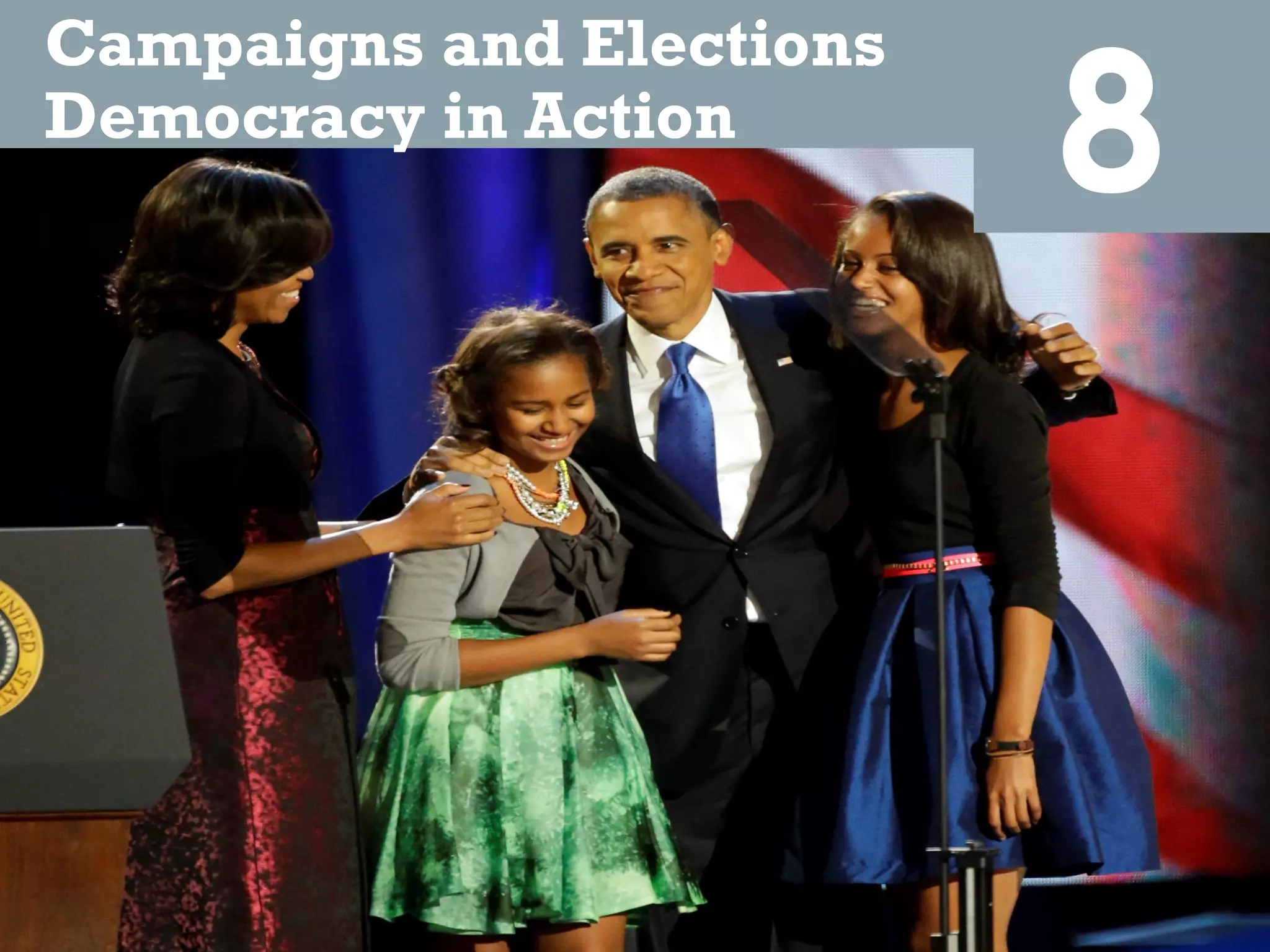
Campaigns and Elections
Democracy in Action
Copyright © 2015 by Pearson Education, Inc. All rights reserved.
8Learning Objectives
8.1
8.2
Assess the implications of election
rules in the United States
Identify problems associated with
administering elections and evaluate
proposed solutions to those problems
Copyright © 2015 by Pearson Education, Inc. All rights reserved.
8Learning Objectives
8.3
8.4
Explain how congressional elections
work and why they are generally not
competitive
Describe the stages in U.S. presidential
elections and the differences in
campaigning at each stage
Copyright © 2015 by Pearson Education, Inc. All rights reserved.
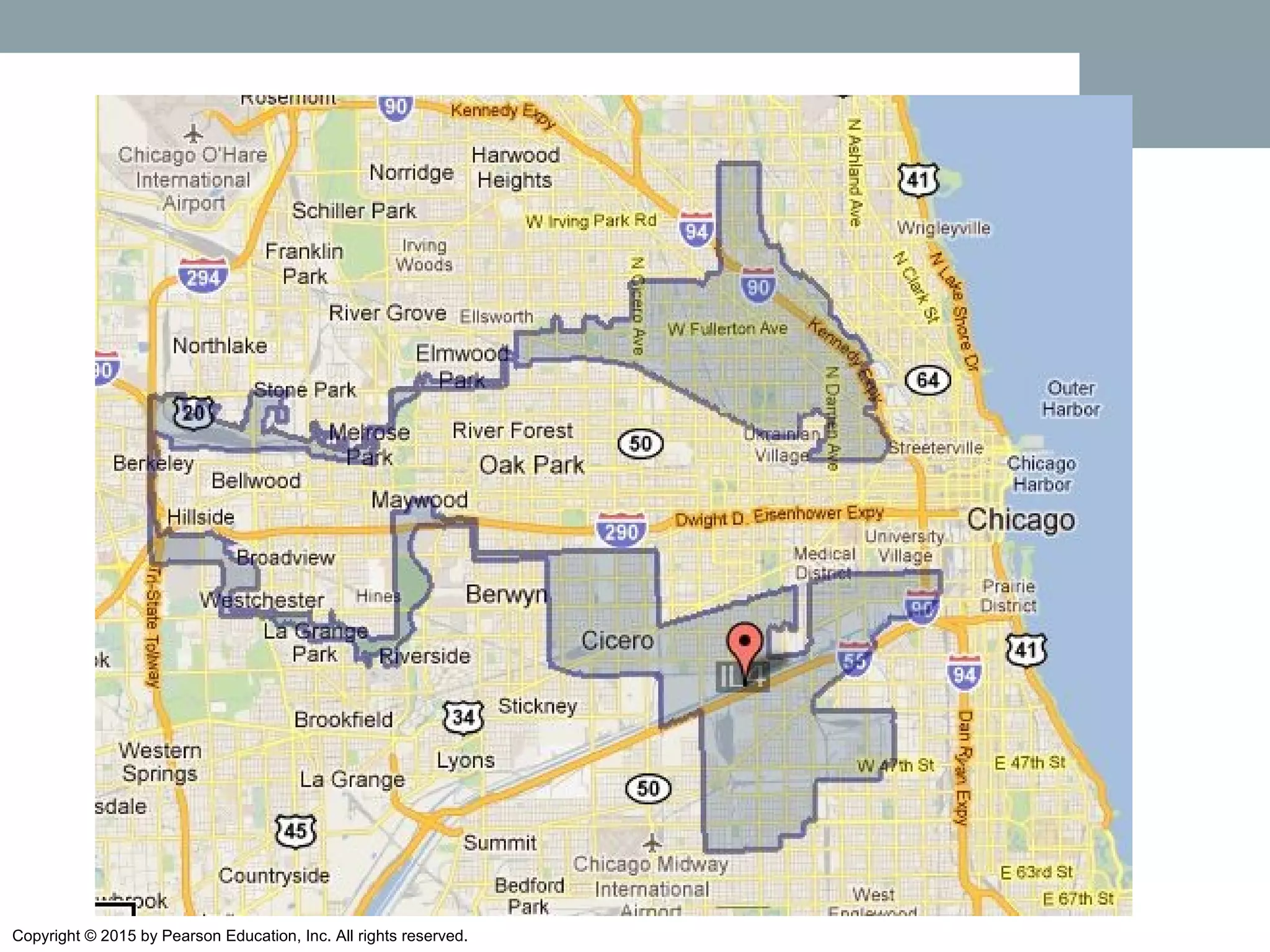
8Learning Objectives
8.5
8.6
Evaluate the influence of money in
American elections and the main
approaches to campaign finance
reform
Assess concerns regarding presidential
elections and reforms that have been
proposed
Copyright © 2015 by Pearson Education, Inc. All rights reserved.
Elections:The Rules of the
Game
 Regularly Scheduled Elections
 Fixed, Staggered, and Sometimes
Limited Terms
 Term Limits
 Winner Take All
 The Electoral College
8.1
Copyright © 2015 by Pearson Education, Inc. All rights reserved.
Regularly Scheduled Elections
 Elections held at fixed intervals
 Party in power cannot change date
 Congressional elections held on the
Tuesday after the first Monday in
November of even-numbered year
 Presidential elections every four years
8.1
Copyright © 2015 by Pearson Education, Inc. All rights reserved.
Fixed, Staggered, and
Sometimes Limited Terms
 Fixed Terms of Office
 U.S. Representative = 2 years
 U.S. Senator = 6 years
 President = 4 years
 Staggered Terms of Office
 All House members run every two years
 Only 1/3 of Senate also run every two years
8.1
Copyright © 2015 by Pearson Education, Inc. All rights reserved.
Term Limits
 President limited to two terms
 Twenty-Second Amendment
 Efforts to limit terms of state legislators
 State-level limits largely adopted in 1990s
 Proposals for federal office limits
defeated by Congress and Supreme
Court
8.1
Copyright © 2015 by Pearson Education, Inc. All rights reserved.
Winner Take All
8.1
 Plurality of votes wins
 Majority is not required
 Favors moderates
 Single-member districts
 Usually only one winner per office
 In combination with winner-take-all system, virtually
guarantees two-party system
 Proportional representation in other countries
Seats are given to candidates from a party based on the
number of votes they receive.
Copyright © 2015 by Pearson Education, Inc. All rights reserved.
The Electoral College
was devised by the Constitution’s framers because they didn't
trust the choice of president to a direct popular vote. (described in
Article II, Section 1 of the Constitution)
8.1
 Electoral system
 Number of electors is the same as the number of
representatives and senators
 Electors vote for candidate who wins plurality in state
 Candidate with majority of electoral votes wins
 If no majority, House of Reps. chooses
 Electoral College influences politics
 Candidates must win in most populous states
 2000 Election – Al Gore lost the election even though
he won the popular vote
Copyright © 2015 by Pearson Education, Inc. All rights reserved.
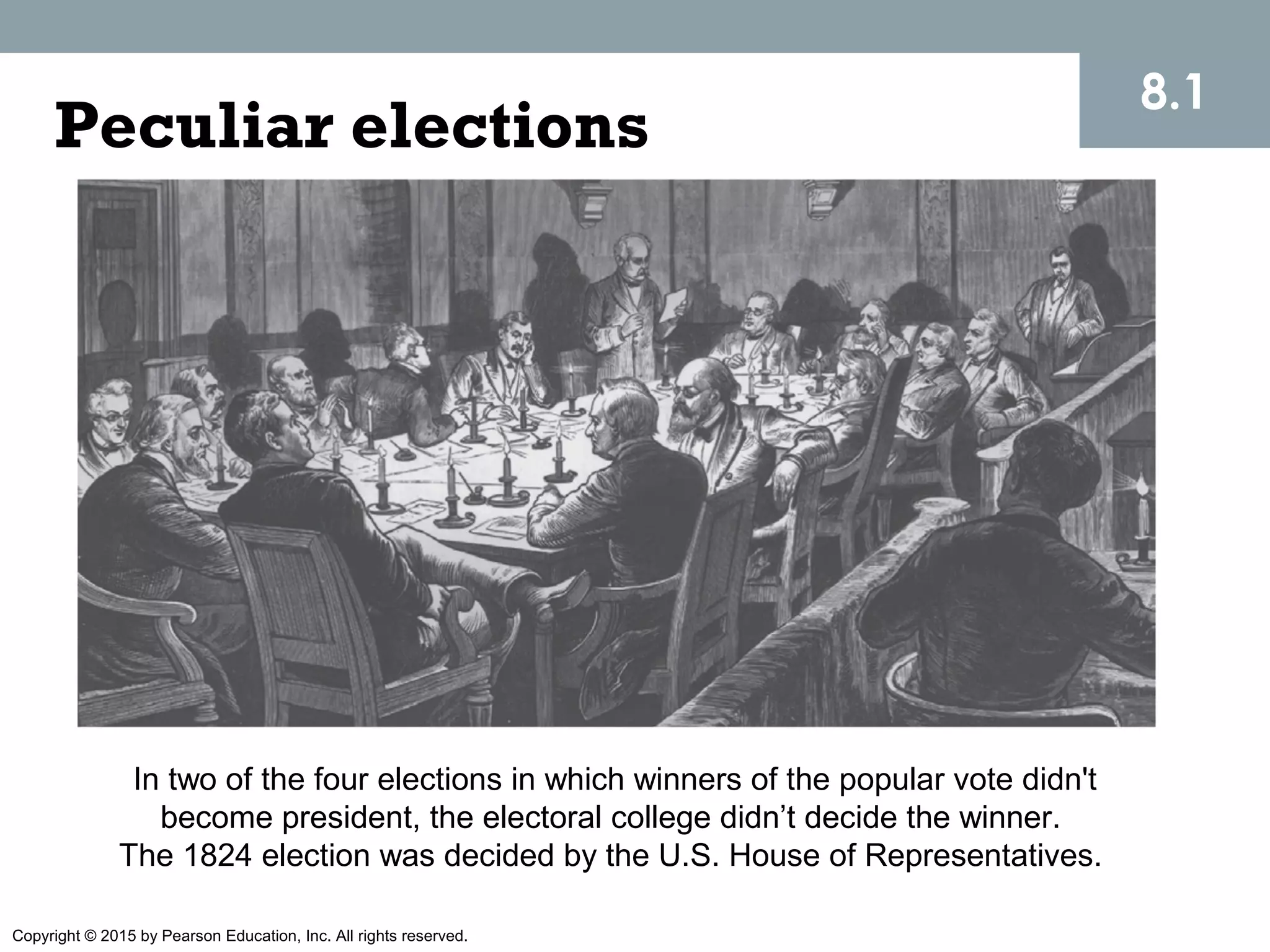
In two of the four elections in which winners of the popular vote didn't
become president, the electoral college didn’t decide the winner.
The 1824 election was decided by the U.S. House of Representatives.
Peculiar elections
8.1
Copyright © 2015 by Pearson Education, Inc. All rights reserved.
2004, 2008, and 2012 battleground states 8.1
Copyright © 2015 by Pearson Education, Inc. All rights reserved.
8.1 Which office is limited to two
four-year terms?
8.1
a. U.S. Representative
b. Chief Justice
c. U.S. Senator
d. President
Copyright © 2015 by Pearson Education, Inc. All rights reserved.
8.1
8.1 Which office is limited to two
four-year terms?
a. U.S. Representative
b. Chief Justice
c. U.S. Senator
d. President
Copyright © 2015 by Pearson Education, Inc. All rights reserved.
CountingVotes
 Different types of ballots – paper, electronic,
punch cards, touchscreens
 Subject to miscounts – election officials have to judge
8.2
Copyright © 2015 by Pearson Education, Inc. All rights reserved.
Hanging Chad 8.2
In the presidential election in 2000, Florida was plagued with vote-counting
and ballot problems. Several counties used punch cards, and some voters
failed to make their vote clear by successfully punching out the “chad” for the
choice selected. In other counties, the format of the ballot itself was
confusing. The Florida problems led to passage of the Help America Vote
Act.
Copyright © 2015 by Pearson Education, Inc. All rights reserved.
CountingVotes
 Absentee ballots and mail voting
 Importance of poll workers
 They need training
 Direct people to the right location
 Determining who can vote - In 2012, some states
began to require photo IDs to make sure that illegal immigrants
can’t vote.
 Provisional ballots are allowed for those not on the rolls
and later confirmed to be registered.
8.2
Copyright © 2015 by Pearson Education, Inc. All rights reserved.
8.2 If registered voters are
challenged, what are they allowed to cast?
8.2
a. Provisional ballot
b. Absentee ballot
c. Ballot by mail
d. Write-in vote
Copyright © 2015 by Pearson Education, Inc. All rights reserved.
8.28.2 If registered voters are
challenged, what are they allowed to cast?
a. Provisional ballot
b. Absentee ballot
c. Ballot by mail
d. Write-in vote
Copyright © 2015 by Pearson Education, Inc. All rights reserved.
Running for Congress
 The House of Representatives
 Most House races are not competitive
 Popular incumbents who’ve held the seat for many terms are
said to hold safe seats. Safe seats limit competition
 Partisan gerrymandering – redrawing voting districts in
ways that favor incumbents
 www.redistrictinggame.org
8.3
Copyright © 2015 by Pearson Education, Inc. All rights reserved.
When officeholders don’t have to fight for their seats, are elections performing their role?
FIGURE 8.1: Safe and competitive House
seats, 2000–2010
8.3
Copyright © 2015 by Pearson Education, Inc. All rights reserved.
Running for Congress
 The Senate
 Better financed than House races
 Midterm elections - candidates sometimes get more votes
when they belong to the same party as a popular president
8.3
Copyright © 2015 by Pearson Education, Inc. All rights reserved.
FIGURE 8.2: Seats gained or lost by the president’s party in midterm
elections,
1974–2010
8.3
Copyright © 2015 by Pearson Education, Inc. All rights reserved.
The House of Representatives
 Mounting a primary campaign
 Fundraising
 Personal organization
 Media visibility
 Campaigning for the general election
 More voters than primary
 Partisanship is more important
 Name recognition for incumbents and
funding
8.3
Copyright © 2015 by Pearson Education, Inc. All rights reserved.
The Senate
 Higher profile
 Six-year terms
 Higher cost of Senate campaigns
 Interest groups often commit more money to
competitive races in smaller states
8.3
Copyright © 2015 by Pearson Education, Inc. All rights reserved.
Figure 8.3: Rising campaign costs in
congressional general elections
8.3
Copyright © 2015 by Pearson Education, Inc. All rights reserved.
The Senate
 Incumbency advantage
 Not as great as U.S. House
8.3
Copyright © 2015 by Pearson Education, Inc. All rights reserved.
8.3 Which of the following is more
likely to be elected?
8.3
a. U.S. Senate challenger
b. U.S. Senate incumbent
c. U.S. House challenger
d. U.S. House incumbent
Copyright © 2015 by Pearson Education, Inc. All rights reserved.
8.3 Which of the following is more
likely to be elected?
8.3
a. U.S. Senate challenger
b. U.S. Senate incumbent
c. U.S. House challenger
d. U.S. House incumbent
Copyright © 2015 by Pearson Education, Inc. All rights reserved.
Running for President
 Stage 1: The Nomination
 Stage 2: The National Party Convention
 Stage 3: The General Election
8.4
Copyright © 2015 by Pearson Education, Inc. All rights reserved.
Stage 1:The Nomination
 Presidential primaries
 Delegates and superdelegates
Delegates are chosen by local partisans to represent
them in the nomination process.
Superdelegates are usually party leaders and do not
have to be elected. May vote for whomever they wish.
 Various types of primaries – caucus and convention
 “Front loading”
8.4
Copyright © 2015 by Pearson Education, Inc. All rights reserved.
Primary debate 8.4
Copyright © 2015 by Pearson Education, Inc. All rights reserved.
Stage 1:The Nomination
 Caucuses and conventions
 Delegates selected by party members - The states have
different means of determining delegates: proportional
representation, winner-take-all, superdelegates, or selection via
presidential poll.
 Strategies
 Appeal to partisanship in primaries
 Appeal to moderates in general elections
8.4
Copyright © 2015 by Pearson Education, Inc. All rights reserved.
Stage 2:The National Party
Convention
 The party platform
 Defines the direction a party wants to take on policy
 The vice presidential nominee
 Choice attracts wide media attention
 The value of conventions – a time for parties to
galvanize a party program and to build unity and
enthusiasm. Candidates define themselves in positive ways.
 Nomination by petition
 Must meet each state’s ballot access requirements
8.4
Copyright © 2015 by Pearson Education, Inc. All rights reserved.
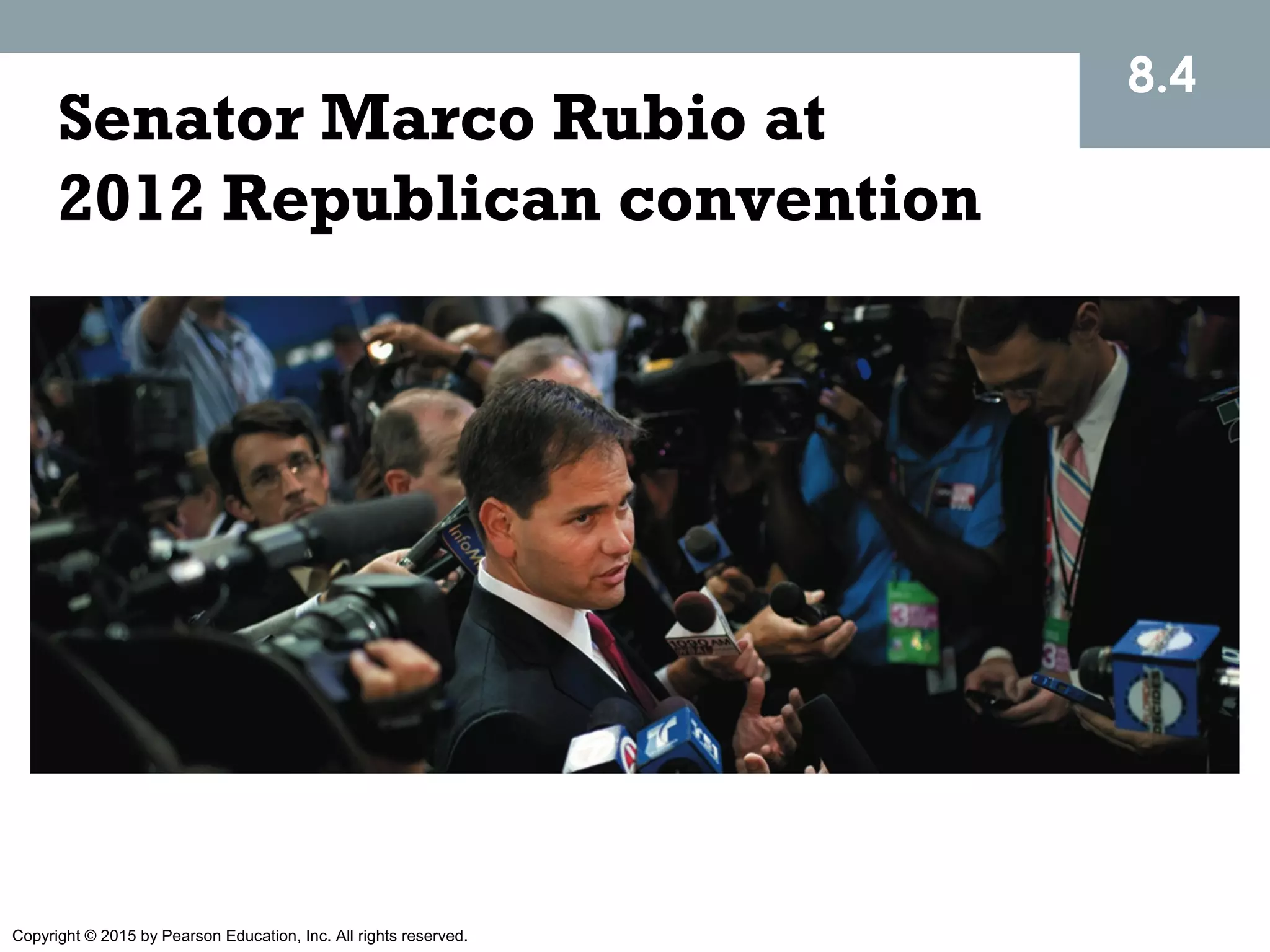
Senator Marco Rubio at
2012 Republican convention
8.4
Copyright © 2015 by Pearson Education, Inc. All rights reserved.
Stage 3:The General Election
 Presidential debates
 “Joint appearance” instead of true debate
 Television and radio advertising
 More aggressive in battleground states
 Target ads to specific audiences
8.4
Copyright © 2015 by Pearson Education, Inc. All rights reserved.
8.4
Romney ad
Copyright © 2015 by Pearson Education, Inc. All rights reserved.
Stage 3:The General Election
 The Outcome
 State of the economy probably most deciding factor of
who wins
8.4
Copyright © 2015 by Pearson Education, Inc. All rights reserved.
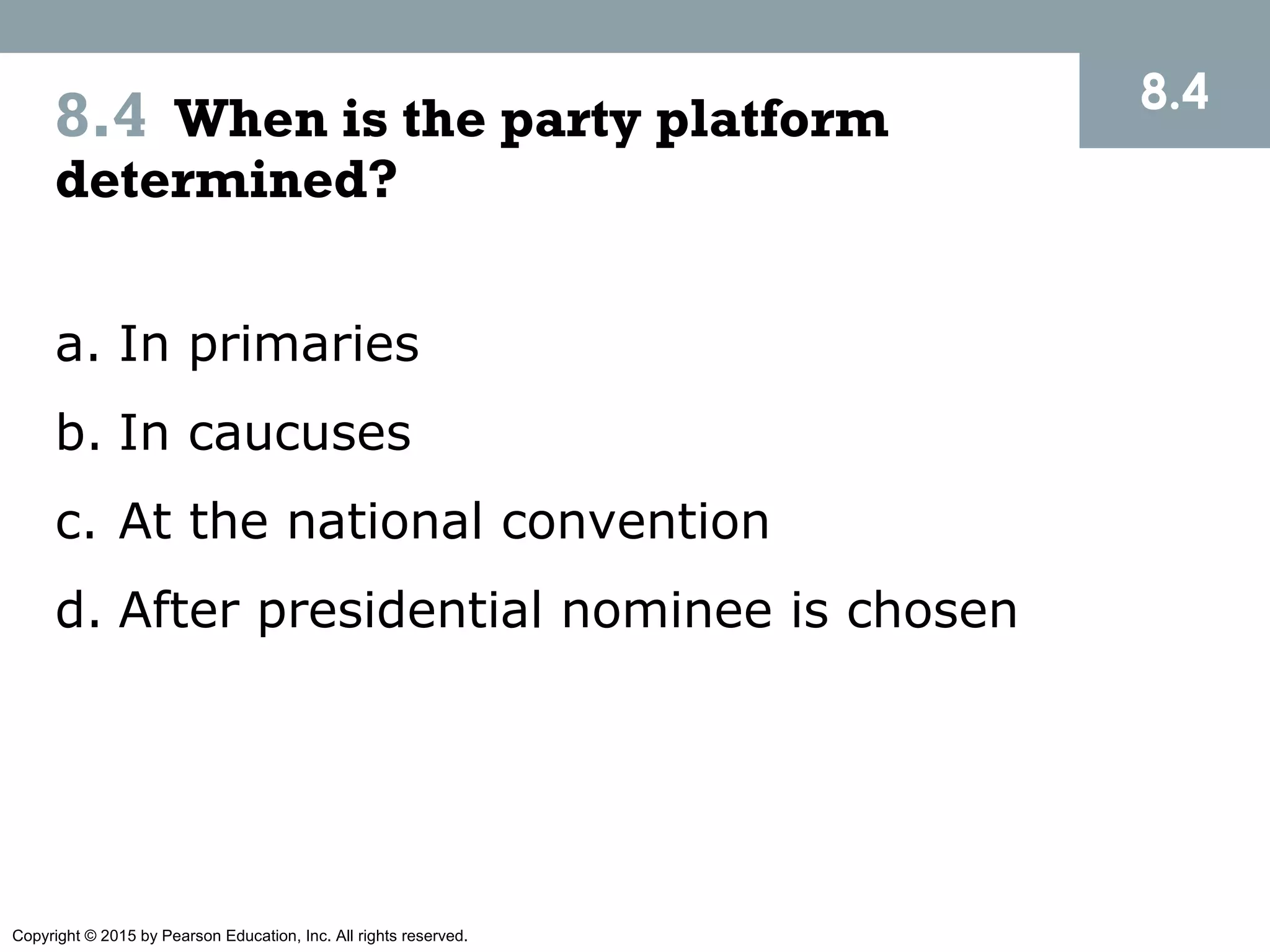
8.4 When is the party platform
determined?
8.4
a. In primaries
b. In caucuses
c. At the national convention
d. After presidential nominee is chosen
Copyright © 2015 by Pearson Education, Inc. All rights reserved.
8.4 When is the party platform
determined?
8.4
a. In primaries
b. In caucuses
c. At the national convention
d. After presidential nominee is chosen
Copyright © 2015 by Pearson Education, Inc. All rights reserved.
Money in U.S. Elections
 Efforts at Reform
 Continuing Problems with Campaign
Finance
8.5
Copyright © 2015 by Pearson Education, Inc. All rights reserved.
Efforts at Reform
 The Federal Election Campaign Act
 limited amounts that candidates for federal office could spend on advertising
and required them to disclose sources of campaign funds.
 Followed by creation of the Federal Election Commission
 Bipartisan Campaign Reform Act (BCRA)
Largely banned party soft money
 Soft money - money raised in unlimited amounts by political parties for party
building
 Hard money – contributions to candidates
 Contribution limits and disclosure - Interest groups have tried to
get around contribution limits or disclosing the names of donors by using ads that
advocate for issues, not candidates.
 Independent expenditures - must be independent of a
candidate and must be disclosed
8.5
Copyright © 2015 by Pearson Education, Inc. All rights reserved.
FIGURE 8.4: Presidential primary cumulative
receipts, 2011–2012 (millions of dollars)
8.5
Copyright © 2015 by Pearson Education, Inc. All rights reserved.
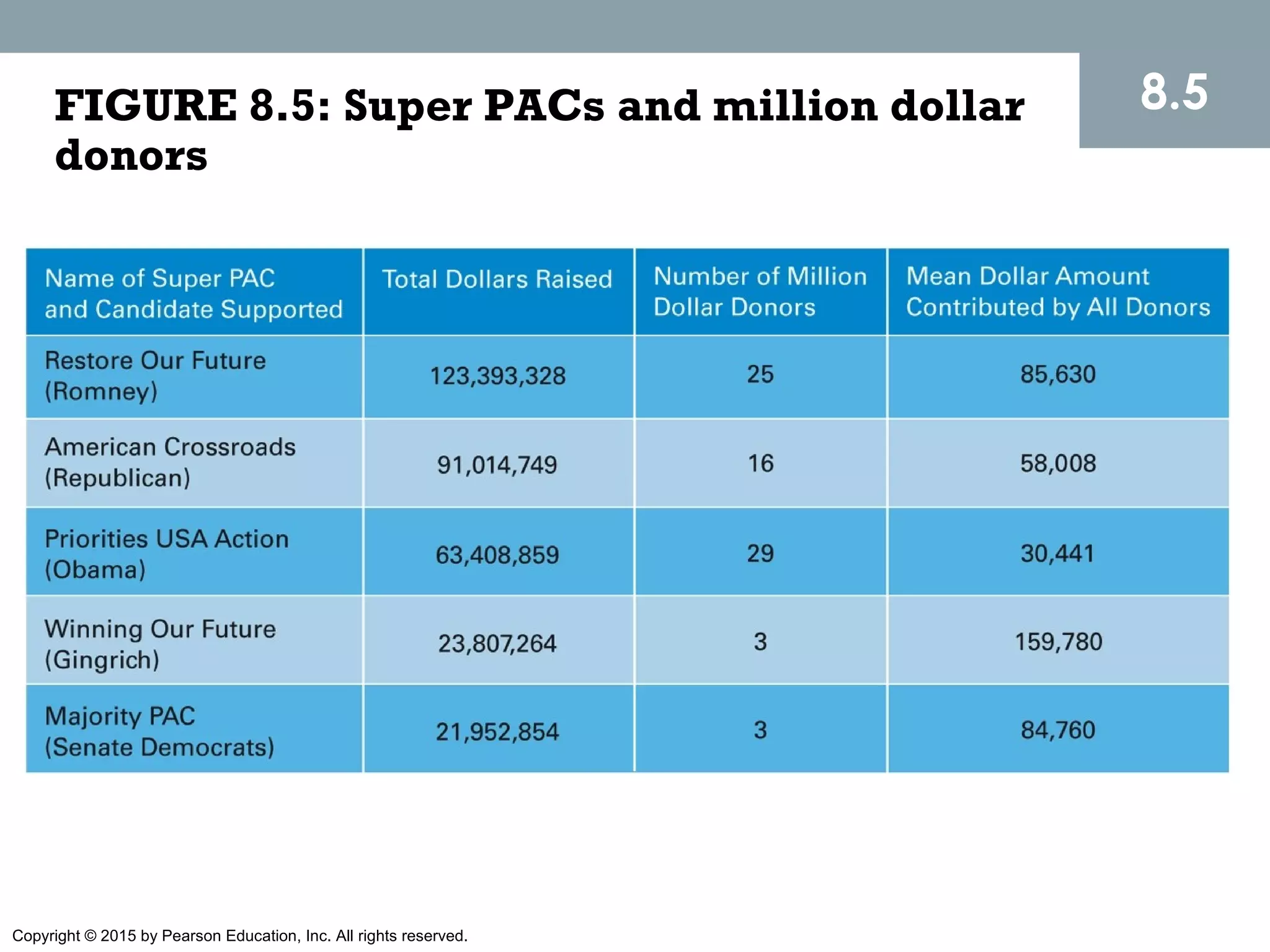
FIGURE 8.5: Super PACs and million dollar
donors
8.5
Copyright © 2015 by Pearson Education, Inc. All rights reserved.
Continuing Problems with
Campaign Finance
 Costly campaigns only for the wealthy
 Incumbents have the advantage
 PAC money goes to incumbents
8.5
Copyright © 2015 by Pearson Education, Inc. All rights reserved.
Average campaign expenditures of candidates for
House of Representatives, 1988–2010 general election
8.5
Copyright © 2015 by Pearson Education, Inc. All rights reserved.
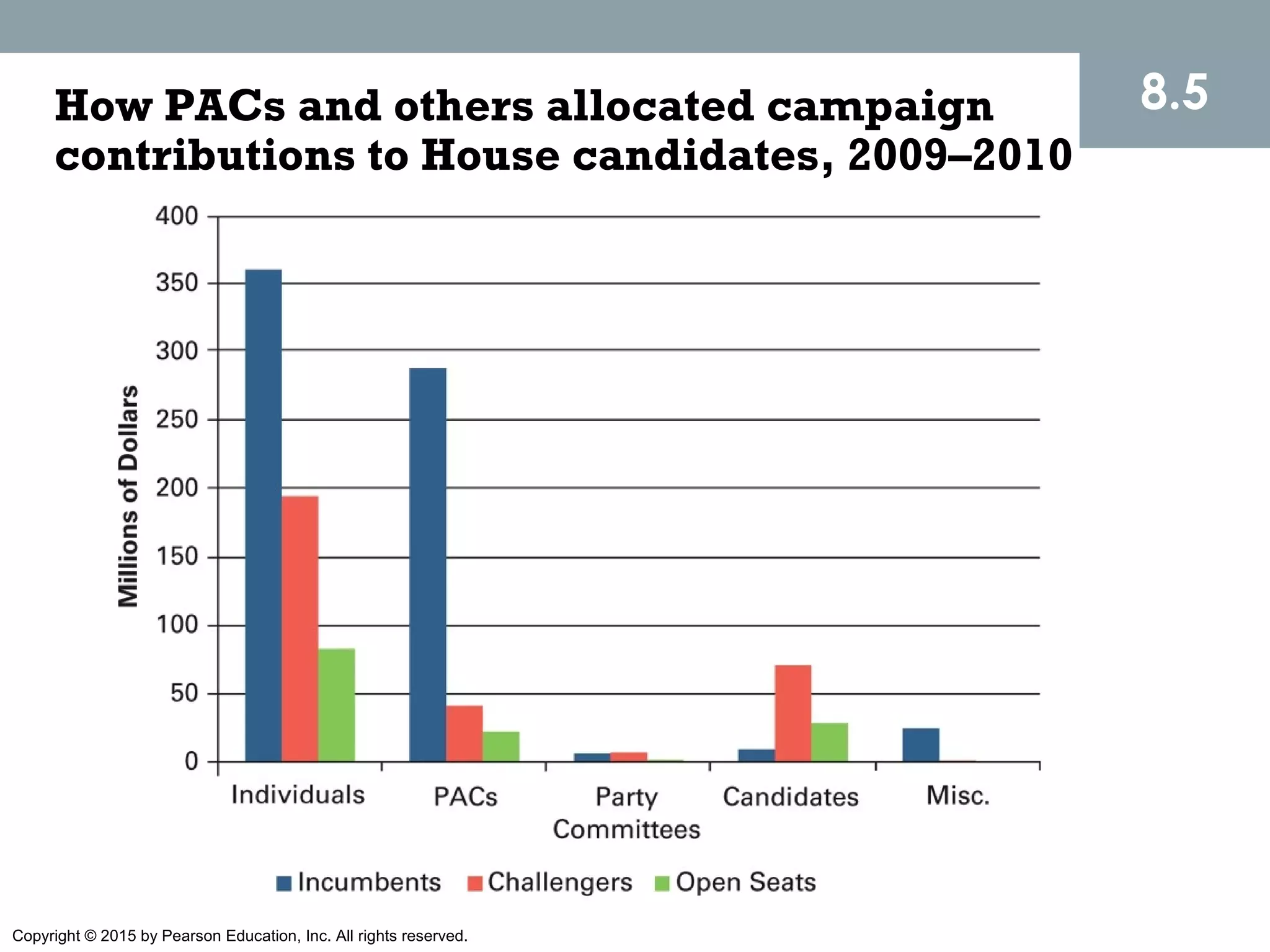
How PACs and others allocated campaign
contributions to House candidates, 2009–2010
8.5
Copyright © 2015 by Pearson Education, Inc. All rights reserved.
Continuing Problems with
Campaign Finance
 Candidates’ personal wealth
 Growth in individual contributions and
use of the Internet to fund campaigns
8.5
Copyright © 2015 by Pearson Education, Inc. All rights reserved.
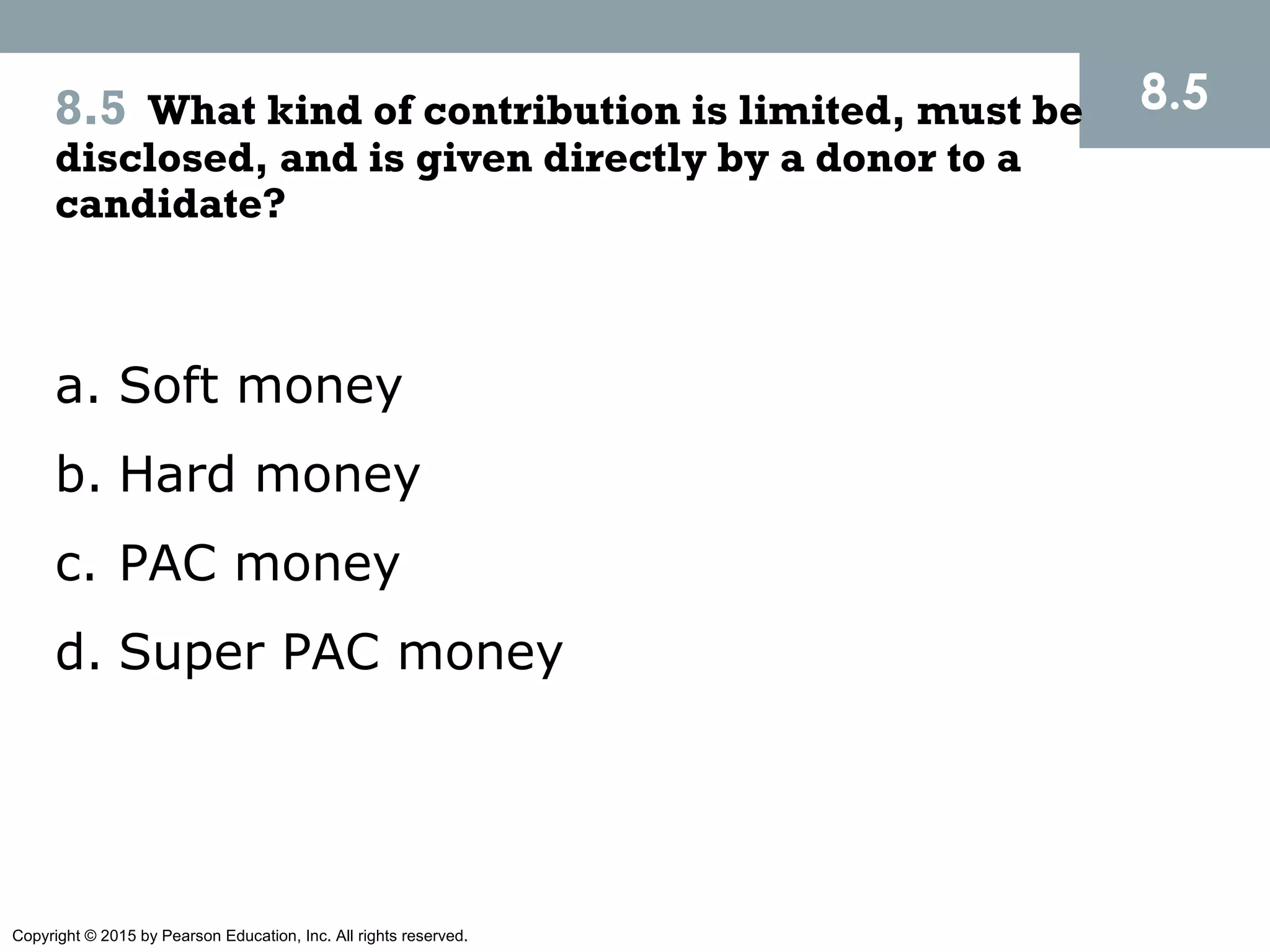
8.58.5 What kind of contribution is limited, must be
disclosed, and is given directly by a donor to a
candidate?
a. Soft money
b. Hard money
c. PAC money
d. Super PAC money
Copyright © 2015 by Pearson Education, Inc. All rights reserved.
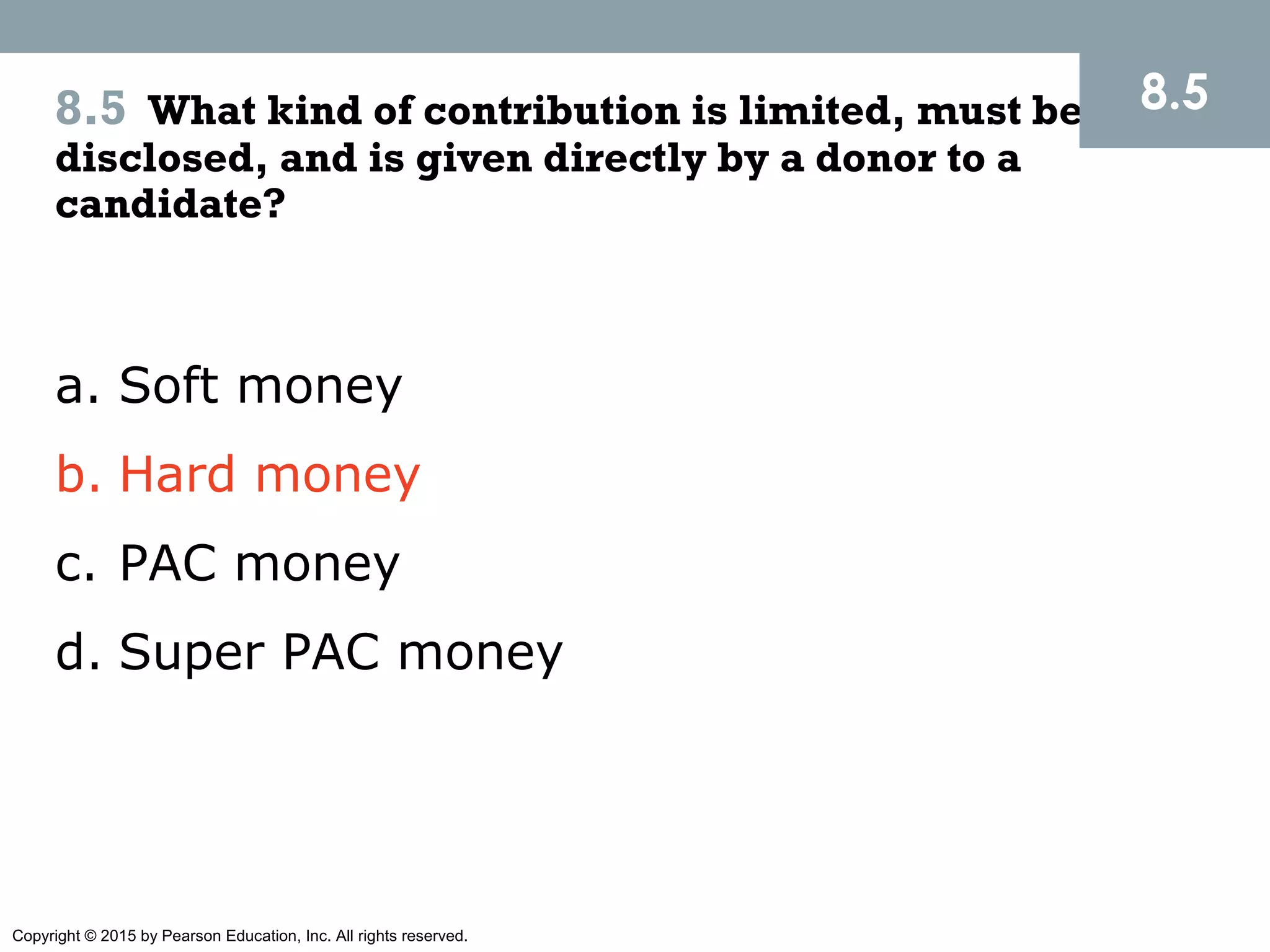
8.5 What kind of contribution is limited, must be
disclosed, and is given directly by a donor to a
candidate?
8.5
a. Soft money
b. Hard money
c. PAC money
d. Super PAC money
Copyright © 2015 by Pearson Education, Inc. All rights reserved.
Improving Elections
 Reforming Campaign Finance
 Reforming the Nominating Process
 Reforming the Electoral College
 The Importance of Elections
8.6
Copyright © 2015 by Pearson Education, Inc. All rights reserved.
8.6
Reforming Campaign Finance
 Regulation of presidential campaign
contributions
 More aggressive reform than BCRA
Some reformers suggest reigning in PACs and restricting the influence of
foreign corporations and those doing business with the government.
 Reform of the FEC – both sides agree it needs to be
changed, but won’t agree on how to change it.
Copyright © 2015 by Pearson Education, Inc. All rights reserved.
 Reasons for reform
 Disproportionate influence of the early primary states
8.6
Reforming the Nominating
Process
Copyright © 2015 by Pearson Education, Inc. All rights reserved.
FIGURE 8.7: Voter turnout in the 2008
presidential primaries
8.6
Copyright © 2015 by Pearson Education, Inc. All rights reserved.
 Reasons for reform
 Strong ideological bias of primary voters
 Difficulty in producing a clear winner
 Proportional voting
 Role of superdelegates - the use of unelected superdelegates in
determining nominees raises concerns about their role in a democratic
process.
8.6
Reforming the Nominating
Process
Copyright © 2015 by Pearson Education, Inc. All rights reserved.
 Direct popular election of president
 Most frequently proposed reform
 Would give every voter equal weight
 Opposition to reform
 Would undermine federalism
 Encourage unrestrained majority rule
 Would hurt most competitive states
8.6
Reforming the Electoral
College
Copyright © 2015 by Pearson Education, Inc. All rights reserved.
Video:
ND Expert: Changing the Presidential Primary System
Copyright © 2015 by Pearson Education, Inc. All rights reserved.
8.6
The Importance of Elections
 Elections are complex
 The rules of the game affect how it is played
 Rules can be changed
 Elections are central to democracy
 Outcome must have legitimacy
 Elections have undergone structural
and institutional improvements
 Participation still most important aspect
Copyright © 2015 by Pearson Education, Inc. All rights reserved.
8.6 What is central to the functioning
of a constitutional democracy?
8.6
a. A system of fair elections
b. A two-party system
c. A single-member district winner-take-all
electoral system
d. A proportional representation electoral
system
Copyright © 2015 by Pearson Education, Inc. All rights reserved.
8.6 What is central to the functioning
of a constitutional democracy?
8.6
a. A system of fair elections
b. A two-party system
c. A single-member district winner-take-all
electoral system
d. A proportional representation electoral
system
Copyright © 2015 by Pearson Education, Inc. All rights reserved.
Discussion Questions
What are some of the strengths and
weaknesses of the electoral process? Has
the way we elect a president been
compromised by PACs and Super PACs?
8

Magleby chapter8 ppt

  • 2.
    Copyright © 2015by Pearson Education, Inc. All rights reserved. 8 Campaigns and Elections Democracy in Action
  • 3.
    Copyright © 2015by Pearson Education, Inc. All rights reserved. 8Learning Objectives 8.1 8.2 Assess the implications of election rules in the United States Identify problems associated with administering elections and evaluate proposed solutions to those problems
  • 4.
    Copyright © 2015by Pearson Education, Inc. All rights reserved. 8Learning Objectives 8.3 8.4 Explain how congressional elections work and why they are generally not competitive Describe the stages in U.S. presidential elections and the differences in campaigning at each stage
  • 5.
    Copyright © 2015by Pearson Education, Inc. All rights reserved. 8Learning Objectives 8.5 8.6 Evaluate the influence of money in American elections and the main approaches to campaign finance reform Assess concerns regarding presidential elections and reforms that have been proposed
  • 6.
    Copyright © 2015by Pearson Education, Inc. All rights reserved. Elections:The Rules of the Game  Regularly Scheduled Elections  Fixed, Staggered, and Sometimes Limited Terms  Term Limits  Winner Take All  The Electoral College 8.1
  • 7.
    Copyright © 2015by Pearson Education, Inc. All rights reserved. Regularly Scheduled Elections  Elections held at fixed intervals  Party in power cannot change date  Congressional elections held on the Tuesday after the first Monday in November of even-numbered year  Presidential elections every four years 8.1
  • 8.
    Copyright © 2015by Pearson Education, Inc. All rights reserved. Fixed, Staggered, and Sometimes Limited Terms  Fixed Terms of Office  U.S. Representative = 2 years  U.S. Senator = 6 years  President = 4 years  Staggered Terms of Office  All House members run every two years  Only 1/3 of Senate also run every two years 8.1
  • 9.
    Copyright © 2015by Pearson Education, Inc. All rights reserved. Term Limits  President limited to two terms  Twenty-Second Amendment  Efforts to limit terms of state legislators  State-level limits largely adopted in 1990s  Proposals for federal office limits defeated by Congress and Supreme Court 8.1
  • 10.
    Copyright © 2015by Pearson Education, Inc. All rights reserved. Winner Take All 8.1  Plurality of votes wins  Majority is not required  Favors moderates  Single-member districts  Usually only one winner per office  In combination with winner-take-all system, virtually guarantees two-party system  Proportional representation in other countries Seats are given to candidates from a party based on the number of votes they receive.
  • 11.
    Copyright © 2015by Pearson Education, Inc. All rights reserved. The Electoral College was devised by the Constitution’s framers because they didn't trust the choice of president to a direct popular vote. (described in Article II, Section 1 of the Constitution) 8.1  Electoral system  Number of electors is the same as the number of representatives and senators  Electors vote for candidate who wins plurality in state  Candidate with majority of electoral votes wins  If no majority, House of Reps. chooses  Electoral College influences politics  Candidates must win in most populous states  2000 Election – Al Gore lost the election even though he won the popular vote
  • 12.
    Copyright © 2015by Pearson Education, Inc. All rights reserved.
  • 13.
    Copyright © 2015by Pearson Education, Inc. All rights reserved.
  • 14.
    Copyright © 2015by Pearson Education, Inc. All rights reserved. In two of the four elections in which winners of the popular vote didn't become president, the electoral college didn’t decide the winner. The 1824 election was decided by the U.S. House of Representatives. Peculiar elections 8.1
  • 15.
    Copyright © 2015by Pearson Education, Inc. All rights reserved. 2004, 2008, and 2012 battleground states 8.1
  • 16.
    Copyright © 2015by Pearson Education, Inc. All rights reserved. 8.1 Which office is limited to two four-year terms? 8.1 a. U.S. Representative b. Chief Justice c. U.S. Senator d. President
  • 17.
    Copyright © 2015by Pearson Education, Inc. All rights reserved. 8.1 8.1 Which office is limited to two four-year terms? a. U.S. Representative b. Chief Justice c. U.S. Senator d. President
  • 18.
    Copyright © 2015by Pearson Education, Inc. All rights reserved. CountingVotes  Different types of ballots – paper, electronic, punch cards, touchscreens  Subject to miscounts – election officials have to judge 8.2
  • 19.
    Copyright © 2015by Pearson Education, Inc. All rights reserved. Hanging Chad 8.2 In the presidential election in 2000, Florida was plagued with vote-counting and ballot problems. Several counties used punch cards, and some voters failed to make their vote clear by successfully punching out the “chad” for the choice selected. In other counties, the format of the ballot itself was confusing. The Florida problems led to passage of the Help America Vote Act.
  • 20.
    Copyright © 2015by Pearson Education, Inc. All rights reserved. CountingVotes  Absentee ballots and mail voting  Importance of poll workers  They need training  Direct people to the right location  Determining who can vote - In 2012, some states began to require photo IDs to make sure that illegal immigrants can’t vote.  Provisional ballots are allowed for those not on the rolls and later confirmed to be registered. 8.2
  • 21.
    Copyright © 2015by Pearson Education, Inc. All rights reserved. 8.2 If registered voters are challenged, what are they allowed to cast? 8.2 a. Provisional ballot b. Absentee ballot c. Ballot by mail d. Write-in vote
  • 22.
    Copyright © 2015by Pearson Education, Inc. All rights reserved. 8.28.2 If registered voters are challenged, what are they allowed to cast? a. Provisional ballot b. Absentee ballot c. Ballot by mail d. Write-in vote
  • 23.
    Copyright © 2015by Pearson Education, Inc. All rights reserved. Running for Congress  The House of Representatives  Most House races are not competitive  Popular incumbents who’ve held the seat for many terms are said to hold safe seats. Safe seats limit competition  Partisan gerrymandering – redrawing voting districts in ways that favor incumbents  www.redistrictinggame.org 8.3
  • 24.
    Copyright © 2015by Pearson Education, Inc. All rights reserved.
  • 25.
    Copyright © 2015by Pearson Education, Inc. All rights reserved.
  • 26.
    Copyright © 2015by Pearson Education, Inc. All rights reserved. When officeholders don’t have to fight for their seats, are elections performing their role? FIGURE 8.1: Safe and competitive House seats, 2000–2010 8.3
  • 27.
    Copyright © 2015by Pearson Education, Inc. All rights reserved. Running for Congress  The Senate  Better financed than House races  Midterm elections - candidates sometimes get more votes when they belong to the same party as a popular president 8.3
  • 28.
    Copyright © 2015by Pearson Education, Inc. All rights reserved. FIGURE 8.2: Seats gained or lost by the president’s party in midterm elections, 1974–2010 8.3
  • 29.
    Copyright © 2015by Pearson Education, Inc. All rights reserved. The House of Representatives  Mounting a primary campaign  Fundraising  Personal organization  Media visibility  Campaigning for the general election  More voters than primary  Partisanship is more important  Name recognition for incumbents and funding 8.3
  • 30.
    Copyright © 2015by Pearson Education, Inc. All rights reserved. The Senate  Higher profile  Six-year terms  Higher cost of Senate campaigns  Interest groups often commit more money to competitive races in smaller states 8.3
  • 31.
    Copyright © 2015by Pearson Education, Inc. All rights reserved. Figure 8.3: Rising campaign costs in congressional general elections 8.3
  • 32.
    Copyright © 2015by Pearson Education, Inc. All rights reserved. The Senate  Incumbency advantage  Not as great as U.S. House 8.3
  • 33.
    Copyright © 2015by Pearson Education, Inc. All rights reserved. 8.3 Which of the following is more likely to be elected? 8.3 a. U.S. Senate challenger b. U.S. Senate incumbent c. U.S. House challenger d. U.S. House incumbent
  • 34.
    Copyright © 2015by Pearson Education, Inc. All rights reserved. 8.3 Which of the following is more likely to be elected? 8.3 a. U.S. Senate challenger b. U.S. Senate incumbent c. U.S. House challenger d. U.S. House incumbent
  • 35.
    Copyright © 2015by Pearson Education, Inc. All rights reserved. Running for President  Stage 1: The Nomination  Stage 2: The National Party Convention  Stage 3: The General Election 8.4
  • 36.
    Copyright © 2015by Pearson Education, Inc. All rights reserved. Stage 1:The Nomination  Presidential primaries  Delegates and superdelegates Delegates are chosen by local partisans to represent them in the nomination process. Superdelegates are usually party leaders and do not have to be elected. May vote for whomever they wish.  Various types of primaries – caucus and convention  “Front loading” 8.4
  • 37.
    Copyright © 2015by Pearson Education, Inc. All rights reserved. Primary debate 8.4
  • 38.
    Copyright © 2015by Pearson Education, Inc. All rights reserved. Stage 1:The Nomination  Caucuses and conventions  Delegates selected by party members - The states have different means of determining delegates: proportional representation, winner-take-all, superdelegates, or selection via presidential poll.  Strategies  Appeal to partisanship in primaries  Appeal to moderates in general elections 8.4
  • 39.
    Copyright © 2015by Pearson Education, Inc. All rights reserved. Stage 2:The National Party Convention  The party platform  Defines the direction a party wants to take on policy  The vice presidential nominee  Choice attracts wide media attention  The value of conventions – a time for parties to galvanize a party program and to build unity and enthusiasm. Candidates define themselves in positive ways.  Nomination by petition  Must meet each state’s ballot access requirements 8.4
  • 40.
    Copyright © 2015by Pearson Education, Inc. All rights reserved. Senator Marco Rubio at 2012 Republican convention 8.4
  • 41.
    Copyright © 2015by Pearson Education, Inc. All rights reserved. Stage 3:The General Election  Presidential debates  “Joint appearance” instead of true debate  Television and radio advertising  More aggressive in battleground states  Target ads to specific audiences 8.4
  • 42.
    Copyright © 2015by Pearson Education, Inc. All rights reserved. 8.4 Romney ad
  • 43.
    Copyright © 2015by Pearson Education, Inc. All rights reserved. Stage 3:The General Election  The Outcome  State of the economy probably most deciding factor of who wins 8.4
  • 44.
    Copyright © 2015by Pearson Education, Inc. All rights reserved. 8.4 When is the party platform determined? 8.4 a. In primaries b. In caucuses c. At the national convention d. After presidential nominee is chosen
  • 45.
    Copyright © 2015by Pearson Education, Inc. All rights reserved. 8.4 When is the party platform determined? 8.4 a. In primaries b. In caucuses c. At the national convention d. After presidential nominee is chosen
  • 46.
    Copyright © 2015by Pearson Education, Inc. All rights reserved. Money in U.S. Elections  Efforts at Reform  Continuing Problems with Campaign Finance 8.5
  • 47.
    Copyright © 2015by Pearson Education, Inc. All rights reserved. Efforts at Reform  The Federal Election Campaign Act  limited amounts that candidates for federal office could spend on advertising and required them to disclose sources of campaign funds.  Followed by creation of the Federal Election Commission  Bipartisan Campaign Reform Act (BCRA) Largely banned party soft money  Soft money - money raised in unlimited amounts by political parties for party building  Hard money – contributions to candidates  Contribution limits and disclosure - Interest groups have tried to get around contribution limits or disclosing the names of donors by using ads that advocate for issues, not candidates.  Independent expenditures - must be independent of a candidate and must be disclosed 8.5
  • 48.
    Copyright © 2015by Pearson Education, Inc. All rights reserved. FIGURE 8.4: Presidential primary cumulative receipts, 2011–2012 (millions of dollars) 8.5
  • 49.
    Copyright © 2015by Pearson Education, Inc. All rights reserved. FIGURE 8.5: Super PACs and million dollar donors 8.5
  • 50.
    Copyright © 2015by Pearson Education, Inc. All rights reserved. Continuing Problems with Campaign Finance  Costly campaigns only for the wealthy  Incumbents have the advantage  PAC money goes to incumbents 8.5
  • 51.
    Copyright © 2015by Pearson Education, Inc. All rights reserved. Average campaign expenditures of candidates for House of Representatives, 1988–2010 general election 8.5
  • 52.
    Copyright © 2015by Pearson Education, Inc. All rights reserved. How PACs and others allocated campaign contributions to House candidates, 2009–2010 8.5
  • 53.
    Copyright © 2015by Pearson Education, Inc. All rights reserved. Continuing Problems with Campaign Finance  Candidates’ personal wealth  Growth in individual contributions and use of the Internet to fund campaigns 8.5
  • 54.
    Copyright © 2015by Pearson Education, Inc. All rights reserved. 8.58.5 What kind of contribution is limited, must be disclosed, and is given directly by a donor to a candidate? a. Soft money b. Hard money c. PAC money d. Super PAC money
  • 55.
    Copyright © 2015by Pearson Education, Inc. All rights reserved. 8.5 What kind of contribution is limited, must be disclosed, and is given directly by a donor to a candidate? 8.5 a. Soft money b. Hard money c. PAC money d. Super PAC money
  • 56.
    Copyright © 2015by Pearson Education, Inc. All rights reserved. Improving Elections  Reforming Campaign Finance  Reforming the Nominating Process  Reforming the Electoral College  The Importance of Elections 8.6
  • 57.
    Copyright © 2015by Pearson Education, Inc. All rights reserved. 8.6 Reforming Campaign Finance  Regulation of presidential campaign contributions  More aggressive reform than BCRA Some reformers suggest reigning in PACs and restricting the influence of foreign corporations and those doing business with the government.  Reform of the FEC – both sides agree it needs to be changed, but won’t agree on how to change it.
  • 58.
    Copyright © 2015by Pearson Education, Inc. All rights reserved.  Reasons for reform  Disproportionate influence of the early primary states 8.6 Reforming the Nominating Process
  • 59.
    Copyright © 2015by Pearson Education, Inc. All rights reserved. FIGURE 8.7: Voter turnout in the 2008 presidential primaries 8.6
  • 60.
    Copyright © 2015by Pearson Education, Inc. All rights reserved.  Reasons for reform  Strong ideological bias of primary voters  Difficulty in producing a clear winner  Proportional voting  Role of superdelegates - the use of unelected superdelegates in determining nominees raises concerns about their role in a democratic process. 8.6 Reforming the Nominating Process
  • 61.
    Copyright © 2015by Pearson Education, Inc. All rights reserved.  Direct popular election of president  Most frequently proposed reform  Would give every voter equal weight  Opposition to reform  Would undermine federalism  Encourage unrestrained majority rule  Would hurt most competitive states 8.6 Reforming the Electoral College
  • 62.
    Copyright © 2015by Pearson Education, Inc. All rights reserved. Video: ND Expert: Changing the Presidential Primary System
  • 63.
    Copyright © 2015by Pearson Education, Inc. All rights reserved. 8.6 The Importance of Elections  Elections are complex  The rules of the game affect how it is played  Rules can be changed  Elections are central to democracy  Outcome must have legitimacy  Elections have undergone structural and institutional improvements  Participation still most important aspect
  • 64.
    Copyright © 2015by Pearson Education, Inc. All rights reserved. 8.6 What is central to the functioning of a constitutional democracy? 8.6 a. A system of fair elections b. A two-party system c. A single-member district winner-take-all electoral system d. A proportional representation electoral system
  • 65.
    Copyright © 2015by Pearson Education, Inc. All rights reserved. 8.6 What is central to the functioning of a constitutional democracy? 8.6 a. A system of fair elections b. A two-party system c. A single-member district winner-take-all electoral system d. A proportional representation electoral system
  • 66.
    Copyright © 2015by Pearson Education, Inc. All rights reserved. Discussion Questions What are some of the strengths and weaknesses of the electoral process? Has the way we elect a president been compromised by PACs and Super PACs? 8

Editor's Notes

  • #3 President Barack Obama, reelected to a second term, walks out on the stage with his wife Michelle and daughters Sasha and Malia at his election night party in Chicago.
  • #4 The United States has more elections than any other democracy, in terms of number and variety. However, the level of political participation in the United States often lags behind other industrialized nations. This chapter examines practices and problems regarding elections. We’ll discuss campaigning, the Electoral College, and the influence of money, as well as proposed reforms in each of these areas.
  • #7 Although the Constitution sets certain conditions and requirements regarding elections, state law determines most electoral rules. In this section, we’ll focus on how presidential and congressional elections are held.
  • #8 Elections are held at fixed intervals that the party in power can’t change. Elections for members of Congress occur on the first Tuesday after the first Monday in November of even-numbered years. The regular timing of elections is one of the major characteristics of American democracy.
  • #9 The Constitution sets fixed terms of office for the U.S. House of Representatives at two years, the Senate at six years, and the presidency at four years. Congress also has “staggered terms” for some offices; all House members are up for election every two years, but only one-third of senators are up for election at the same time.
  • #10 The 22nd Amendment to the Constitution, adopted in 1951, limits presidents to two terms. Efforts to limit the terms of other offices, mostly state legislators, have become a major issue. Term limits at the state level were largely adopted during the 1990s. Despite their popularity at the state level, proposals for term limits for federal offices have been defeated both by Congress and the Supreme Court.
  • #11 In the American “winner-take-all” electoral system, the candidate with the most votes, or a plurality, wins; a majority, or more than half, is not required. Winner-take-all systems favor moderate candidates because they are more likely to receive the most votes. Most U.S. electoral districts are single-member districts, meaning that for most districts, the voters choose only one winner per office. The combination of single-member district and winner-take-all systems makes it hard for minor parties to win and virtually guarantees a two-party political system. Other countries have a proportional representation system. Seats are given to candidates from a party based on the number of votes they receive.
  • #12 The Framers of the U.S. Constitution devised the Electoral College because they didn’t trust the choice of president to a direct popular vote. Under this system, each state has as many electors as it has representatives and senators. Electors are expected to cast their electoral votes for the candidates who get a plurality of the vote in their state. Candidates who win receive all of that state’s electoral votes (except in Nebraska and Maine). It takes a majority of the electoral votes to win. If there is no majority, the election is decided in the House of Representatives. This has happened twice in American history, in 1800 and 1824. It’s possible for a candidate to receive the most popular votes, and yet not get enough electoral votes to be elected president, as happened to Al Gore in 2000. The Electoral College sharply influences presidential politics because, to win an election, a candidate must appeal successfully to voters in populous states; California’s electoral vote of 55 in 2008 exceeded the combined electoral votes of the 14 least populous states.
  • #15 In two of the four elections in which winners of the popular vote didn’t become president, the electoral college didn’t decide the winner. The 1824 election was decided by the U.S. House of Representatives. In the controversial 1876 presidential election between Rutherford B. Hayes and Samuel Tilden, the electoral vote in four states was disputed, resulting in the appointment of an electoral commission to decide how those votes should be counted. The Electoral Commission of 1877, depicted in this drawing, met in secret session, and after many contested votes, Hayes was elected.
  • #16 As the table shows, many of the 2004 battleground states swung strongly in Obama's favor in 2008. That lead lessened in 2012, but Obama still maintained the lead and won reelection.
  • #17 We’ve discussed terms and term limits. Now try to answer this brief review question.
  • #18 The Constitution set the term of office for president at four years but not the term limit. This was set in the 22nd Amendment.
  • #19 The technology used in voting varies greatly from state to state. Some use paper ballots, punch-card ballots, or touchscreens. No matter what the technology, vote counting is imperfect. Election officials have to judge incomplete or flawed ballots (as occurred most famously in the 2000 presidential election), as well as account for absentee or mail voting.
  • #20 The presidential election in 2000 in Florida was plagued with vote-counting and ballot problems. For example, several counties used punch cards, and some voters failed to make their vote clear by successfully punching out the “chad” for the choice selected. This led to discussion of “dangling chads” and “dimpled chads.” In other counties, the format of the ballot itself was confusing. The Florida problems led to passage of the Help America Vote Act.
  • #21 In most states, voters must be registered and are expected to vote in designated polling places. Trained volunteer poll workers are essential in ensuring security and efficiency at polling places. They help voters feel confident about the process, and can direct voters who may have come to the wrong location. In 2012, some states began to require photo IDs to make sure that illegal immigrants can’t vote. Provisional ballots are allowed for those not on the rolls and later confirmed to be registered.
  • #22 Try to answer this review question about voting in the United States.
  • #23 Voters who believe they’re registered are allowed to cast provisional ballots. These ballots are counted after it’s been determined that the voter is in fact on the rolls.
  • #24 There are a number of factors affecting Congressional campaigns, including incumbency, personality, and money. Most House elections aren’t close, unless most people in a district don’t belong to the same party or the incumbent is unpopular. Popular incumbents who’ve held the seat for many terms are said to hold safe seats. Safe seats limit competition. Drawing voting districts in ways that favor incumbents is a process called partisan gerrymandering.
  • #27 As we can see in this table, most House elections are not close. When officeholders don’t have to fight for their seats, are elections performing their role?
  • #28 Competition is more likely when both candidates have adequate funding, as in U.S. Senate elections. In midterm elections, candidates sometimes get more votes when they belong to the same party as a popular president.
  • #29 Based on past midterm elections, how does 2010 compare in terms of the seats lost by the president’s party?
  • #30 In order to hire campaign workers, buy advertising, and conduct polls, fundraising is a necessary first step for candidates. Building a personal organization and gaining media visibility are also crucial steps in developing primary campaigns. In general elections, more voters turn out than in the primaries, and partisanship becomes more important. Since 1970, nearly 94 percent of incumbent House members have won reelection, largely because of name recognition and the ability to outspend their challengers.
  • #31 Senate races are generally more high profile and hotly contested than House campaigns due to the six-year term and the fact that there are only two senators per state. Senate campaigns cost more than individual House races. Candidates must raise large sums of money and hire a professional campaign staff. Because campaigning in very populous states is more expensive, interest groups and parties direct more money to competitive races in small states.
  • #32 What are some of the ways in which the rising cost of campaigns might impact who runs for office, how campaigns are funded, and the priorities of candidates? Activity: Campaign finance has remains a controversial topic, especially in light of the Citizens United decision. An engaging class discussion could focus on the role of money in politics. Ask: Why would some groups and individuals want to avoid disclosing their spending on campaigns? What are some ways voters might access information on who’s funding campaigns? Should disclosure of who funds campaign communications be required?
  • #33 Incumbency is an advantage for senators, although not as much as for U.S. representatives.
  • #34 We’ve discussed House and Senate races, and who is more likely to be elected. Can you answer this brief review question on the likelihood of being elected?
  • #35 House incumbents often hold seats for many terms. When they’re seldom challenged, they’re said to hold safe seats.
  • #36 The formal presidential campaign has three stages: • winning the nomination • campaigning at the convention • mobilizing support in the general election
  • #37 State presidential primaries choose delegates to the national convention. Delegates are chosen by local partisans to represent them in the nomination process. Party leaders can be selected to be superdelegates and so do not have to be elected. The states have different means of determining delegates: proportional representation, winner-take-all, superdelegates, or selection via presidential poll. Early primaries, as in New Hampshire, have had the effect of limiting the choices in states that come later in the process; some states have tried to move their primaries up in a process called “front loading.”
  • #38 Here Republican candidates Rick Perry and Mitt Romney debate one another during the 2012 presidential primaries.
  • #39 The caucus or convention is the oldest method of choosing delegates. Party members or supporters of candidates meet to elect state or national convention delegates. National convention delegates vote for the presidential nominee. The best-known caucus is in Iowa, because Iowa has held the earliest caucuses in the most recent presidential nominating contests. In order to win their party’s nomination, candidates must appeal to the partisan nature of their voter base. In the general election, however, candidates have to win support from moderate voters, many of whom don’t vote in the primaries. So positioning on issues is a delicate matter. The ability of candidates to generate momentum by managing the media’s expectations of their performance is especially important at this stage.
  • #40 Delegates assemble at their national party convention in the summer before the election to pick the party’s presidential and vice presidential candidates. Delegates also decide on the platform, a statement of party perspectives on public policy. The platform defines the direction a party wants to take, and despite the charge that the platform is often ignored, most presidents try to implement much of it. The choice of the vice presidential nominee garners widespread attention and is often timed to increase media coverage going into the convention. Since 1956, the vice presidential nominee has always been chosen by the presidential nominee. For the parties, conventions are a time to galvanize a party program and to build unity and enthusiasm for the fall campaign. For the candidates, conventions are a chance to capture national attention and define themselves in positive ways. Third-party and Independent presidential candidates can qualify for the ballot by meeting each state’s ballot access requirements. These requirements vary in almost all fifty states and range from relative simplicity and cost to increasing complexity and greater expense.
  • #41 Here Senator Marco Rubio of Florida talks to the media at the 2012 Republican National Convention.
  • #42 In recent elections, the candidates have launched directly into all-out campaigning following the conventions. Televised debates are a major feature of presidential elections, although such debates have come to be more of a joint appearance instead of a true debate in which the candidates interact with each other. Presidential candidates communicate with voters through the media. Spending on television time alone was about $1.6 billion in 2008. Media activity in competitive or battleground states tends to be more aggressive and targets ads to specific audiences.
  • #43 Mitt Romney paid homage to Margaret Thatcher, who swept to power in Great Britain in 1979, by using one of her effective advertisements on his Web site.
  • #44 Although most citizens vote primarily on the basis of party and candidate appeal, the state of the economy probably has the most to do with who wins a presidential election. Democratic candidates once had an advantage in the number of people who identified themselves as Democrats, but that number has declined in recent years. Republicans now have a generally higher voter turnout. They also tend to raise more money to pay for ads and to get out the vote.
  • #45 Try to answer this review question about party platforms.
  • #46 Delegates to the national convention hammer out the policies of the party platform.
  • #47 The methods of obtaining money to pay the costs of elections have long been controversial. Money is contributed to candidates from various sources for a variety of reasons. The potential corruption resulting from politicians’ dependence on interested money concerns all. Scandals involving the influence of money on policy and electioneering prompted Congress to enact the body of reforms that still largely regulates the financing of federal elections.
  • #48 A In 1971, Congress passed the Federal Election Campaign Act (FECA). FECA limited amounts that candidates for federal office could spend on advertising and required them to disclose the sources of campaign funds. This was followed in 1974 by the creation of the Federal Election Commission. In 2002, the Bipartisan Campaign Reform Act (BCRA) largely banned party soft money. It also prohibited corporations and labor unions from using their treasury funds for electoral purposes. Soft money is money raised in unlimited amounts by political parties for party building. In contrast, hard money represents contributions to candidates. Interest groups have tried to get around contribution limits or disclosing the names of donors by using ads that advocate for issues, not candidates. A major legal shift in campaign finance took place in 2007 with the Supreme Court decision to allow Super PACs. Super PACs can receive unlimited money from individuals, unions, and corporations. BCRA does not limit “independent expenditures” by groups, political parties, or individuals, as long as those expenditures are independent of the candidate and fully disclosed to the Federal Election Commission.
  • #49 What are some of the benefits for a candidate of raising more money than a competitor?
  • #50 Activity: Discuss the issue of campaign finance. Ask: Why would some groups and individuals want to avoid disclosing their spending on campaigns? What are some ways voters might access information on who is funding campaigns? Should disclosure of who pays for campaign communications be required?
  • #51 Organizing a campaign is expensive and limits the field of challengers to those who have their own resources or who’re able to raise money from interest groups and individuals. The high cost of campaigns weakens competition by discouraging individuals from running for office. Incumbents continue to have the fundraising advantage in seeking reelection. For most congressional incumbents, much of their campaign money comes from political action committees. PACs are pragmatic, giving largely to incumbents in return for access to officeholders.
  • #52 What are the patterns of spending for incumbents, challengers, and open seat candidates across both parties?
  • #53 Why might PACs be more apt than individuals or party committees to skew their funding so heavily to incumbents?
  • #54 Campaign finance legislation can’t constitutionally restrict rich candidates from spending heavily on their own campaigns. In presidential politics, this advantage can be most meaningful before the primaries begin. The BCRA made individuals more important as sources of money to candidates because it increased the amount they could give. The Internet has been used to raise money from small donors, most notably during the 2008 Obama campaign.
  • #55 Can you answer this question about campaign contributions?
  • #56 Hard money is given directly to candidates. The other types of funds are given to candidates indirectly, in theory for the purposes of building the party. However, both hard and soft money is used to fund candidates’ campaigns.
  • #57 Reformers agree that the current election process is flawed, but disagree about which aspects should be changed. Concern centers on three issues: • the funding of presidential elections • presidential primaries and caucuses • the role of the Electoral College
  • #58 The most glaring issue of campaign finance reform remains the question of regulation in presidential campaign contributions. One group of reformers presses for more aggressive reforms than those found in BCRA, including reigning in PACs and restricting the influence of foreign corporations and those doing business with the government. Further, both sides are likely to agree that the Federal Election Commission needs to be changed, but won’t agree on how to change it.
  • #59 One reason for reforming the nomination process is the disproportionate influence of the early primary states.
  • #60 What aspect of the presidential nomination process likely influenced the high voter turnout in New Hampshire compared to Delaware—a state of similar size and political leaning? What can help explain the higher turnout in California and Ohio?
  • #61 Other reasons for reforming the nominating process include the strong ideological bias of primary voters and the difficulty in producing a clear winner from the current process. Both the Democrats’ proportional voting and the Republican use of similar methods has the effect of prolonging their party’s battle for the nomination. Finally, the use of unelected superdelegates in determining nominees raises concerns about their role in a democratic process.
  • #62 The fact that the winner of the popular vote in 2000 did not become president renewed a national debate on the Electoral College. The most frequently proposed reform is direct popular election of the president and abolition of the Electoral College. Supporters argue that direct election would give every voter the same weight in the presidential balloting. However, opponents claim direct presidential elections would undermine federalism, encourage unrestrained majority rule, and hurt the most populous and competitive states. Proposals for a constitutional amendment to elect presidents directly seldom get far in Congress because of strong opposition from small states and minority groups whose role is enlarged by the Electoral College.
  • #64 Elections are complex, and the rules of the game affect how it’s played. Over time, the rules of the electoral game have been changed and our system has expanded the role of citizens and voters. A well-administered system of fair elections with a legitimate outcome is necessary for a constitutional democracy to work. Elections have got better through the secret ballot, the disclosure and limitation of campaign contributions, and the expansion of the role of citizens through primaries. However, for the system to work really well, the people must participate.
  • #65 We’ve talked about factors that are important to the functioning of a constitutional democracy. Now let’s answer this question about something that’s necessary for a constitutional democracy to function.
  • #66 Elections determine who will hold office and what policies the government will adopt. Without fair elections, as well as the participation of citizens, the legitimacy of the government is at risk.
  • #67 Based on what we’ve learned, let’s discuss the electoral process.