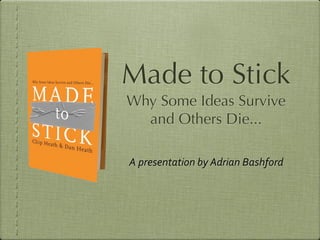
Made to Stick
Why Some Ideas Survive
  and Others Die...

A	
  presentation	
  by	
  Adrian	
  Bashford
Which is True?
• 38 NY citizens stood by and watched as a
  woman was attacked 3 times and murdered
• Coca-Cola rots your bones

• The Great Wall of China is the only man-
  made object visible from the moon

• You use only 10% of your brain
About the Authors
              or their ‘Sticky’ credentials

•   Brothers: Chip and Dan Heath

•   Chip Heath: Professor of organizational behaviour,
    Stanford University & ‘Fast Company’ Magazine
    columnist. Consulted on “making ideas stick” to
    Nike, Ideo (!) and the American Heart Institute.

•   Dan Heath: Founder of Thinkwell Publishing,
    education consultant to Harvard Business School,
    Duke University & winner of the 2005 New Yorker
    Cartoon Caption Contest.
What needs ‘Stickiness’?
• Ideas                 • Brand
• Marketing             • Public health
• Uncommon sense        • Politicians
• Business objectives   • Charities
• Your résumé           • ...
• Urban Myths           • Everything?
Are you inspired?
      “Our mission is to become the
international leader in the space industry
     through maximum team-centred
   innovation and strategically targeted
          aerospace initiatives.”


    Don’t most corporate vision/missions sound like this?
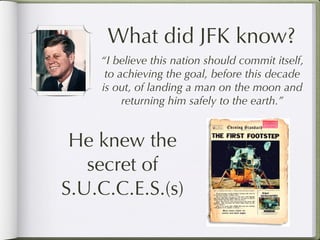
What did JFK know?
    “I believe this nation should commit itself,
     to achieving the goal, before this decade
    is out, of landing a man on the moon and
         returning him safely to the earth.”


 He knew the
   secret of
S.U.C.C.E.S.(s)
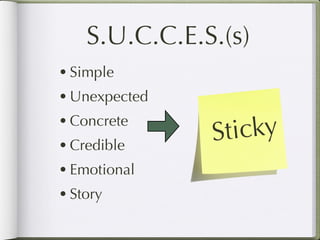
S.U.C.C.E.S.(s)
• Simple
• Unexpected

                ticky
• Concrete
• Credible
               S
• Emotional
• Story
We will talk about...
• Simple - How Clinton used it to get elected
• Unexpected - Why Nordstrom employees stand out

• Concrete - Exactly how unhealthy is theatre popcorn?

• Credible - Winning a court case using a Darth Vader
  toothbrush
• Emotional - Why you’ll donate less after solving a math
  problem
• Story - How a guitar can unite a nation
1. Simple =
     Core & Compact
• The most important decision you have to
  make

• What is the one thing you want people to
  remember

• What is the one thing you want people to do?

To make a profound idea compact you've got to pack
    a lot of meaning into a little bit of messaging.
Getting to Simple
• The 3 Why?’s (or 5 if you are Toyota)

• Avoiding the ‘Curse of Knowledge’

• Use what’s there: Analogies, Schemas*
 & Generative Metaphors


          *Material covered in more detail
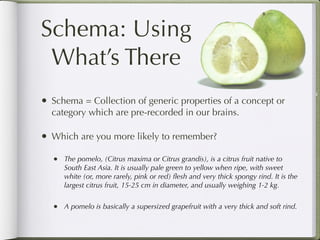
Schema: Using
 What’s There
•   Schema = Collection of generic properties of a concept or
    category which are pre-recorded in our brains.

•   Which are you more likely to remember?

    •   The pomelo, (Citrus maxima or Citrus grandis), is a citrus fruit native to
        South East Asia. It is usually pale green to yellow when ripe, with sweet
        white (or, more rarely, pink or red) flesh and very thick spongy rind. It is the
        largest citrus fruit, 15-25 cm in diameter, and usually weighing 1-2 kg.


    •   A pomelo is basically a supersized grapefruit with a very thick and soft rind.
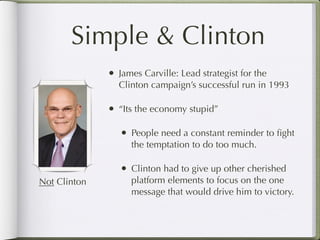
Simple & Clinton
              •   James Carville: Lead strategist for the
                  Clinton campaign’s successful run in 1993

              •   “Its the economy stupid”

                  •   People need a constant reminder to fight
                      the temptation to do too much.

                  •   Clinton had to give up other cherished
Not Clinton           platform elements to focus on the one
                      message that would drive him to victory.
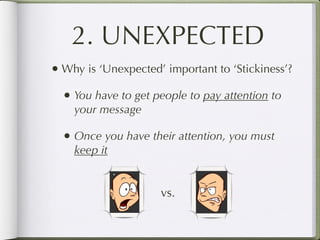
2. UNEXPECTED
• Why is ‘Unexpected’ important to ‘Stickiness’?
  • You have to get people to pay attention to
    your message

  • Once you have their attention, you must
    keep it


                     vs.
Getting Interest
• Methods:

  • Break a pattern

  • Open a knowledge gap

  • Pose a question or puzzle

  • Challenge people to predict an outcome

  • Use a mystery story
Maintaining Interest
•   Methods:

    •   The gap theory of curiosity

    •   Close knowledge gaps while opening new ones

    •   Turning point concept

    •   Shift from conveying information to deciding
        what questions you want your audience to ask
Examples
• Nordstroms

• Ad Council - The Enclave Minivan

• WestJet & Southwest Airlines

• Subway

      You don’t get what you
     expect, so you remember!
3. CONCRETE
• Why is ‘Concreteness’ important to ‘Stickiness’?

  • You need to connect a diverse audience to
    your idea

  • To get your message across you must be clear

  • Your message must be memorable


          Concreteness is used to dispel
           ‘The Curse of Knowledge’
Concrete: Examples
•   Why did Kennedy choose “landing a man on the
    moon and returning him safely to the earth” instead
    of “strategically targeted aerospace initiatives”?

•   When presented a difficult concept, people desire ‘an
    example’

•   The average American would not resonate with
    achieving an ‘aerospace initiative’, but ‘man on
    moon’ was very Concrete.
Concrete: Images
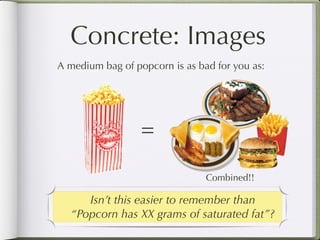
A medium bag of popcorn is as bad for you as:


                  =
                                Combined!!

     Isn’t this easier to remember than
  “Popcorn has XX grams of saturated fat”?
4. CREDIBLE
• Why is ‘Credibility’ important to ‘Stickiness’?

  • So far, you have decided on your message,
    got people’s attention and made memorable...

  • Now you have to get people to believe it!
Making the Incredible
Credible (for Mortals)
• The self-testable credential*
• Borrow someone else’s credibility
• The anti-authority (stories with real people)
• Lies, damn lies & statistics
• The significant impact of detail*
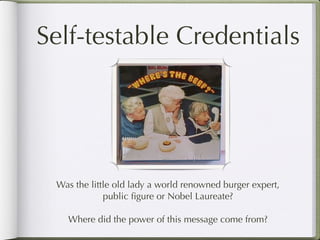
Self-testable Credentials


 Was the little old lady a world renowned burger expert,
             public figure or Nobel Laureate?

   Where did the power of this message come from?
Detail
                          Credibility & the Darth Vader
                                   toothbrush.
•   Study included several multiple identical court cases, each
    identical, with two variables:
    •   Evidence was presented with additional vivid –but
        irrelevant– detail either in defence or in prosecution
        evidence against ‘bad parents’
    •   Jurors were different for each trial
•   5.8/10 jurors found the parents guilty in one scenario, 4.3/10
    in the other

          Make sure your alibi has lots of detail!*
5. EMOTIONAL
Emotion = Action
• Think about the previous video:
  •   Who was the target audience?
  •   What emotions would it elicit in that audience?
  •   Why would this translate into action?

 ‘Truth Campaign’ facts:
            Remembered spontaneously by 22% of kids

  Kids exposed to this campaign were 66% LESS likely to smoke.

      2 years later, smoking had dropped 18% in high school and
                         40% in middle school.
Emotional Hurdles
•   People are usually reluctant to spell out the ‘WIIFM’

•   Semantic Stretch - Words that have a lot of emotional
    impact get overused

•   Our analytical brain - Much like surprise and anger
    being ‘Sticky’ opposites, so are analytical thought
    and emotion

•   We are hard-wired to feel emotion for people, not
    abstractions*

•   People aren’t motivated by the same things, or even
    necessarily by self-interest!
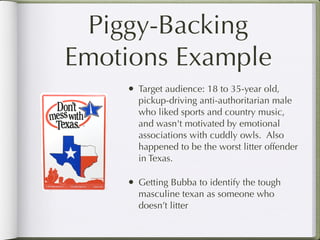
Piggy-Backing
Emotions Example
    •   Target audience: 18 to 35-year old,
        pickup-driving anti-authoritarian male
        who liked sports and country music,
        and wasn't motivated by emotional
        associations with cuddly owls. Also
        happened to be the worst litter offender
        in Texas.

    •   Getting Bubba to identify the tough
        masculine texan as someone who
        doesn’t litter
Caring About the
            Individual
"If I look at the mass, I will never act. If I look at the one, I will."
                                            - Agnesë Gonxhe Bojaxhiu
                                           (Blessed Theresa of Calcutta)


     •   IDEO video from the perspective of a patient that
         goes into the hospital for a leg fracture

     •   The doctor as patient

     •   The doe-eyed Ethiopian child vs. statistics
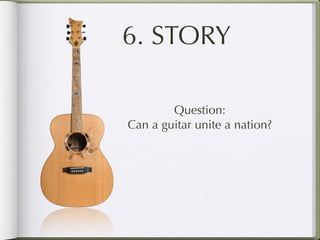
6. STORY

        Question:
Can a guitar unite a nation?
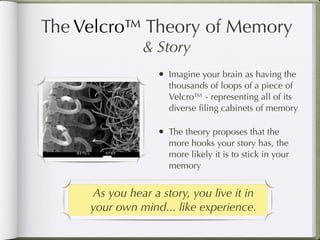
The Velcro™ Theory of Memory
                & Story
                   •   Imagine your brain as having the
                       thousands of loops of a piece of
                       Velcro™ - representing all of its
                       diverse filing cabinets of memory

                   •   The theory proposes that the
                       more hooks your story has, the
                       more likely it is to stick in your
                       memory


     As you hear a story, you live it in
     your own mind... like experience.
Inspirational Plots
•   Of all plot types, 3/25 are ‘inspirational’:

    •   The Challenge Plot

    •   The Creativity Plot

    •   The Connection Plot

•   Chicken Soup stories: 80% are ‘inspirational’

•   People Magazine: 60% of non-celebrity stories


                Inspiration leads to action.
Six String Nation’s
           SUCCESs
•   Simple - 1 Canada: not ‘red’ or ‘blue’
•   Unexpected - Someone built a guitar out of 64 parts that
    represent Canada?
•   Concrete - Guitar is based on real objects that represent parts of
    Canada
•   Credible - Borrows credibility from famous people and places,
    as well as anti-authorities
•   Emotional - Feeling of patriotism, all Canadians have a link to
    this guitar in some way, love of music
•   Story - Each part has a story, and the guitar itself now is creating
    many more!
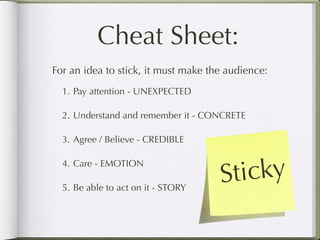
Cheat Sheet:
For an idea to stick, it must make the audience:
  1. Pay attention - UNEXPECTED

  2. Understand and remember it - CONCRETE

  3. Agree / Believe - CREDIBLE


                                      ticky
  4. Care - EMOTION

  5. Be able to act on it - STORY
                                     S
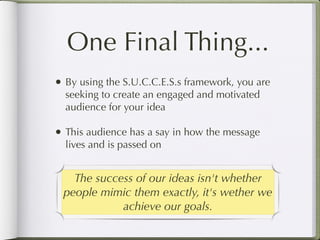
One Final Thing...
• By using the S.U.C.C.E.S.s framework, you are
  seeking to create an engaged and motivated
  audience for your idea

• This audience has a say in how the message
  lives and is passed on


   The success of our ideas isn't whether
 people mimic them exactly, it's wether we
            achieve our goals.

Made To Stick

  • 1.
    Made to Stick WhySome Ideas Survive and Others Die... A  presentation  by  Adrian  Bashford
  • 2.
    Which is True? •38 NY citizens stood by and watched as a woman was attacked 3 times and murdered • Coca-Cola rots your bones • The Great Wall of China is the only man- made object visible from the moon • You use only 10% of your brain
  • 3.
    About the Authors or their ‘Sticky’ credentials • Brothers: Chip and Dan Heath • Chip Heath: Professor of organizational behaviour, Stanford University & ‘Fast Company’ Magazine columnist. Consulted on “making ideas stick” to Nike, Ideo (!) and the American Heart Institute. • Dan Heath: Founder of Thinkwell Publishing, education consultant to Harvard Business School, Duke University & winner of the 2005 New Yorker Cartoon Caption Contest.
  • 4.
    What needs ‘Stickiness’? •Ideas • Brand • Marketing • Public health • Uncommon sense • Politicians • Business objectives • Charities • Your résumé • ... • Urban Myths • Everything?
  • 5.
    Are you inspired? “Our mission is to become the international leader in the space industry through maximum team-centred innovation and strategically targeted aerospace initiatives.” Don’t most corporate vision/missions sound like this?
  • 6.
    What did JFKknow? “I believe this nation should commit itself, to achieving the goal, before this decade is out, of landing a man on the moon and returning him safely to the earth.” He knew the secret of S.U.C.C.E.S.(s)
  • 7.
    S.U.C.C.E.S.(s) • Simple • Unexpected ticky • Concrete • Credible S • Emotional • Story
  • 8.
    We will talkabout... • Simple - How Clinton used it to get elected • Unexpected - Why Nordstrom employees stand out • Concrete - Exactly how unhealthy is theatre popcorn? • Credible - Winning a court case using a Darth Vader toothbrush • Emotional - Why you’ll donate less after solving a math problem • Story - How a guitar can unite a nation
  • 9.
    1. Simple = Core & Compact • The most important decision you have to make • What is the one thing you want people to remember • What is the one thing you want people to do? To make a profound idea compact you've got to pack a lot of meaning into a little bit of messaging.
  • 10.
    Getting to Simple •The 3 Why?’s (or 5 if you are Toyota) • Avoiding the ‘Curse of Knowledge’ • Use what’s there: Analogies, Schemas* & Generative Metaphors *Material covered in more detail
  • 11.
    Schema: Using What’sThere • Schema = Collection of generic properties of a concept or category which are pre-recorded in our brains. • Which are you more likely to remember? • The pomelo, (Citrus maxima or Citrus grandis), is a citrus fruit native to South East Asia. It is usually pale green to yellow when ripe, with sweet white (or, more rarely, pink or red) flesh and very thick spongy rind. It is the largest citrus fruit, 15-25 cm in diameter, and usually weighing 1-2 kg. • A pomelo is basically a supersized grapefruit with a very thick and soft rind.
  • 12.
    Simple & Clinton • James Carville: Lead strategist for the Clinton campaign’s successful run in 1993 • “Its the economy stupid” • People need a constant reminder to fight the temptation to do too much. • Clinton had to give up other cherished Not Clinton platform elements to focus on the one message that would drive him to victory.
  • 13.
    2. UNEXPECTED • Whyis ‘Unexpected’ important to ‘Stickiness’? • You have to get people to pay attention to your message • Once you have their attention, you must keep it vs.
  • 14.
    Getting Interest • Methods: • Break a pattern • Open a knowledge gap • Pose a question or puzzle • Challenge people to predict an outcome • Use a mystery story
  • 15.
    Maintaining Interest • Methods: • The gap theory of curiosity • Close knowledge gaps while opening new ones • Turning point concept • Shift from conveying information to deciding what questions you want your audience to ask
  • 16.
    Examples • Nordstroms • AdCouncil - The Enclave Minivan • WestJet & Southwest Airlines • Subway You don’t get what you expect, so you remember!
  • 17.
    3. CONCRETE • Whyis ‘Concreteness’ important to ‘Stickiness’? • You need to connect a diverse audience to your idea • To get your message across you must be clear • Your message must be memorable Concreteness is used to dispel ‘The Curse of Knowledge’
  • 18.
    Concrete: Examples • Why did Kennedy choose “landing a man on the moon and returning him safely to the earth” instead of “strategically targeted aerospace initiatives”? • When presented a difficult concept, people desire ‘an example’ • The average American would not resonate with achieving an ‘aerospace initiative’, but ‘man on moon’ was very Concrete.
  • 19.
    Concrete: Images A mediumbag of popcorn is as bad for you as: = Combined!! Isn’t this easier to remember than “Popcorn has XX grams of saturated fat”?
  • 20.
    4. CREDIBLE • Whyis ‘Credibility’ important to ‘Stickiness’? • So far, you have decided on your message, got people’s attention and made memorable... • Now you have to get people to believe it!
  • 21.
    Making the Incredible Credible(for Mortals) • The self-testable credential* • Borrow someone else’s credibility • The anti-authority (stories with real people) • Lies, damn lies & statistics • The significant impact of detail*
  • 22.
    Self-testable Credentials Wasthe little old lady a world renowned burger expert, public figure or Nobel Laureate? Where did the power of this message come from?
  • 23.
    Detail Credibility & the Darth Vader toothbrush. • Study included several multiple identical court cases, each identical, with two variables: • Evidence was presented with additional vivid –but irrelevant– detail either in defence or in prosecution evidence against ‘bad parents’ • Jurors were different for each trial • 5.8/10 jurors found the parents guilty in one scenario, 4.3/10 in the other Make sure your alibi has lots of detail!*
  • 24.
  • 25.
    Emotion = Action •Think about the previous video: • Who was the target audience? • What emotions would it elicit in that audience? • Why would this translate into action? ‘Truth Campaign’ facts: Remembered spontaneously by 22% of kids Kids exposed to this campaign were 66% LESS likely to smoke. 2 years later, smoking had dropped 18% in high school and 40% in middle school.
  • 26.
    Emotional Hurdles • People are usually reluctant to spell out the ‘WIIFM’ • Semantic Stretch - Words that have a lot of emotional impact get overused • Our analytical brain - Much like surprise and anger being ‘Sticky’ opposites, so are analytical thought and emotion • We are hard-wired to feel emotion for people, not abstractions* • People aren’t motivated by the same things, or even necessarily by self-interest!
  • 27.
    Piggy-Backing Emotions Example • Target audience: 18 to 35-year old, pickup-driving anti-authoritarian male who liked sports and country music, and wasn't motivated by emotional associations with cuddly owls. Also happened to be the worst litter offender in Texas. • Getting Bubba to identify the tough masculine texan as someone who doesn’t litter
  • 28.
    Caring About the Individual "If I look at the mass, I will never act. If I look at the one, I will." - Agnesë Gonxhe Bojaxhiu (Blessed Theresa of Calcutta) • IDEO video from the perspective of a patient that goes into the hospital for a leg fracture • The doctor as patient • The doe-eyed Ethiopian child vs. statistics
  • 29.
    6. STORY Question: Can a guitar unite a nation?
  • 30.
    The Velcro™ Theoryof Memory & Story • Imagine your brain as having the thousands of loops of a piece of Velcro™ - representing all of its diverse filing cabinets of memory • The theory proposes that the more hooks your story has, the more likely it is to stick in your memory As you hear a story, you live it in your own mind... like experience.
  • 31.
    Inspirational Plots • Of all plot types, 3/25 are ‘inspirational’: • The Challenge Plot • The Creativity Plot • The Connection Plot • Chicken Soup stories: 80% are ‘inspirational’ • People Magazine: 60% of non-celebrity stories Inspiration leads to action.
  • 32.
    Six String Nation’s SUCCESs • Simple - 1 Canada: not ‘red’ or ‘blue’ • Unexpected - Someone built a guitar out of 64 parts that represent Canada? • Concrete - Guitar is based on real objects that represent parts of Canada • Credible - Borrows credibility from famous people and places, as well as anti-authorities • Emotional - Feeling of patriotism, all Canadians have a link to this guitar in some way, love of music • Story - Each part has a story, and the guitar itself now is creating many more!
  • 33.
    Cheat Sheet: For anidea to stick, it must make the audience: 1. Pay attention - UNEXPECTED 2. Understand and remember it - CONCRETE 3. Agree / Believe - CREDIBLE ticky 4. Care - EMOTION 5. Be able to act on it - STORY S
  • 34.
    One Final Thing... •By using the S.U.C.C.E.S.s framework, you are seeking to create an engaged and motivated audience for your idea • This audience has a say in how the message lives and is passed on The success of our ideas isn't whether people mimic them exactly, it's wether we achieve our goals.