DECEMBER
2018
MACROECONOMIC
DEVELOPMENTS
REPORT
MACROECONOMIC DEVELOPMENTS REPORT
December 2018
MACROECONOMIC DEVELOPMENTS REPORT
December 2018, No 28
© Latvijas Banka, 2018
The source is to be indicated when reproduced.
Latvijas Banka
K. Valdemāra iela 2A, Riga, LV-1050, Latvia
Tel.: +371 67022300 info@bank.lv
http://www.bank.lv; https://www.macroeconomics.lv
2
MACROECONOMIC DEVELOPMENTS REPORT
December 2018
CONTENTS
Contents
Abbreviations	3
Introduction	4
1. 	External Demand	 5
2. 	Financial Conditions	 9
2.1 	ECB policy	 9
2.2 	Other central bank decisions and financial markets	 10
2.3 	Securities market 	 14
2.4 	Interest rates	 15
2.5 	Loans and deposits	 17
3. 	Sectoral Development	 21
3.1 	Manufacturing	 23
3.2	Construction	 23
3.3	Real estate market	 25
3.4 	Trade	 25
3.5 	Transport	 26
4. 	GDPAnalysis from the Demand Side	 28
4.1 	Private consumption	 29
4.2	Investment	 29
4.3	Exports	 30
4.4	Imports	 31
4.5	Government consumption	 31
5. 	Labour Market	 33
6.	Costs and Prices	 35
7. Conclusions and Forecasts	 38
8. The Fiscal Impact of Inequality Measures. Analysis of Scenarios	 40
Statistics	42
Additional Information	 94
3
MACROECONOMIC DEVELOPMENTS REPORT
December 2018
Abbreviations
APP – asset purchase programme
AS – join stock company
CSB – Central Statistical Bureau of Latvia
EC – European Commission
ECB – European Central Bank
EONIA – euro overnight index average
ESI – Economic Sentiment Indicator
EU – European Union
EU28 – 28 countries of the EU
EURIBOR – Euro Interbank Offered Rate
Eurostat – statistical office of the European Union
FOMC – Federal Open Market Committee
FRS – US Federal Reserve System
GDP – gross domestic product
HICP – Harmonised Index of Consumer Prices
JSC – joint stock company
MFI – monetary financial institution
OPEC – Organization of Petroleum Exporting Countries
PIT – personal income tax
PMI – Purchasing Managers' Index
SEA – State Employment Agency
UK – United Kingdom
UN – United Nations
US – United States of America
VAS – state join stock company
VAT – value added tax
ABBREVIATIONS
4
MACROECONOMIC DEVELOPMENTS REPORT
December 2018
Introduction
Latvijas Banka remains optimistic with regard to Latvia's economic growth prospects over
the last half of the year: its GDP growth forecast for 2018 has been upgraded considering the
high rates reported in the second and third quarters of 2018. The future outlook, however,
remains unchanged. Following the accelerated cyclical upswing, GDP growth is expected
to slow down gradually over the next few years on account of selected growth-supporting
factors losing momentum. Uncertainty in the global environment and weaker external
demand are likely to constrain economic growth already in 2019, whereas demand side
limitations, e.g. labour shortage and still inadequate investment levels in the environment of
high production capacity utilisation, will be obstacles for ensuring sustainable rapid growth
in the medium term.
A decline in the economic growth in several trade partners is bound to subdue increases in
manufacturing and exports. Moreover, the current wage-productivity gap serves as a basis
for concern regarding the sustainability of competitiveness that requires addressing the issue
of labour availability. At the same time, the rapid growth of selected export-oriented high
technology production and services sectors observed over the last few years persisted. To
ensure balanced and sustained growth, however, it is essential that most sectors strengthen
competitiveness.
In the circumstances of a weaker external demand, the role of domestic demand in
supporting economic growth will become more important. Absorption of EU funds and
implementation of private sector projects will find reflection in an increase in investment.
This will also further support the real estate and construction sector activity. Nevertheless,
the issue on the production factor adequacy in the construction sector is becoming
increasingly topical as it may prevent the sector's growth in the medium term. In the labour
shortage circumstances, a stable rise in wages will persist. With the workforce reserves
running low, however, labour contribution to growth is likely to turn negative. Consequently,
the contribution of private consumption is also expected to contract and increasing labour
productivity will become more and more important for ensuring economic growth.
On account of the strong economic growth, the pressure of domestic demand on consumer
prices is gradually increasing, although not as quickly as expected. Annual inflation hovering
around 3% is currently a characteristic of a healthy economy and reflects sustainable income
convergence as well as economic growth slightly above its potential. Both the increasing
labour shortage and high degree of production capacity utilisation in most sectors testify to
that. With unemployment declining and the labour market remaining tight, the rise in wages
and salaries has accelerated considerably over the recent years. It means that although a
moderate inflation rate appropriate for balanced economic growth is expected to persist in
the future, it will be increasingly determined by domestic factors in particular.
INTRODUCTION
5
MACROECONOMIC DEVELOPMENTS REPORT
December 2018
1. EXTERNAL DEMAND
1. External Demand1
Previous assessment Developments since the previous report New assessment1
External demand
Growth will further continue
also in 2018, yet at a slower
pace than in 2017 due to
decelerating advance in a
number of euro area countries,
stronger risks of rising trade
tariffs, and trouble with US
and European cooperation
associated with Iran's nuclear
arms plan. The demand in
global economy as a whole
and Latvia's major trade
partner countries continues on
an upward trend.
– Brexit negotiations have entered the final phase
before the upcoming UK Parliament's vote;
– despite a temporary truce in trade wars,
uncertainty remains high;
– a fall in prices of oil and other commodities;
– the new Italian government's budget battle with
the EC;
– global trade continues to expand;
– sentiment indicators are deteriorating;
– in Germany, Sweden and Lithuania, growth
has decelerated in the third quarter as a result of
one-off factors;
– forecast for external demand has been revised
downwards.
Economic growth
is expected to
moderate in 2019
in comparison
with this year.
The continued
uncertainty
surrounding Brexit
and materialised
impact from trade
wars strengthen the
downside risks to
future growth.
Although the global economy continued to grow in the second half of 2018, the disparities
across regions and countries are increasing. Cyclical upswing continued in the advanced
economies overall, including the US. In the euro area countries, however, the pace of growth
decelerated further. With uncertainties surrounding Brexit persisting, the UK's economic
growth was also moderate.
Tightening of the financial conditions over the second half of 2018, particularly in the US
where the FRS was moving towards a neutral monetary policy stance, and rising long-term
interest rates caused various asset price changes and posed new challenges associated with
a heightened risk perception to the emerging economies. For example, the Argentine peso
lost half its value in the course of 2018, forcing the government to apply for an IMF loan.
At the same time, with its currency depreciating, Turkey is facing higher risks associated
with excessive current account deficit and foreign currency debt burden. Currently, financial
markets expect that the target range for the federal funds rate will be raised again in
December and, as a minimum, once also in 2019. Unemployment in the US fell to 3.7% in
September, which is the lowest mark since the beginning of 1969. This was also reflected
in robust economic growth (3.5% in the third quarter), although its benefits are distributed
quite unevenly: in a situation where the headline annual inflation stands at 2.3%, real wages
of employees have grown by merely 0.7%. Moreover, with the GDP growing strongly, prices
continue to increase gradually and, given that the target range for the federal funds rate
will continue on an upward trend, this could exert a downward pressure on consumption.
The rising interest rates also contributed to deterioration of consumer confidence in the
second half of the year. PMIs for manufacturing and services sectors remained in a positive
territory, although the most recent months saw a moderate downward trend. The trade war
between China and the US culminated in September when the US administration imposed an
additional 10% tariff on 200 billion USD worth of Chinese products, to be increased to 25%
from the start of the next year, and the Chinese government retaliated by imposing additional
tariffs on US imports worth another 60 billion USD. Nevertheless, during the G20 summit
the leaders of both administrations agreed to reopen negotiations in order to resolve their
trade disputes. Trade wars with other global economies have been almost completely put
on hold, considering that the US government has managed to negotiate the terms of the free
trade agreements with Mexico and Canada.
1
  Colours in tables are used to show differences in the assessment of impact on Latvia's GDP and inflation vis-à-vis the
previous forecast.
Worsened Unchanged Improved
6
MACROECONOMIC DEVELOPMENTS REPORT
December 2018
Following a period of robust growth in the second quarter, a 0.6% quarter-on-quarter drop
in GDP was reported in Japan in the third quarter as a consequence of several episodes of
natural disasters and shrinking trade volumes. Neither the government, nor the central bank
have so far managed to make the future outlook of the private sector and consumers more
optimistic; therefore, investment and consumption remain volatile. In mid-July, the EU
finalised negotiations for a trade agreement with Japan removing almost all bilateral trade
tariffs. The agreement will be ratified by the end of the year and it is scheduled to take effect
as of February 2019. GDP growth rate in China also decelerated to 6.5% in the third quarter,
despite the implementation of accommodative monetary and fiscal policies. Moreover, the
downward effect of trade wars on growth will manifest itself only in the fourth quarter data.
Although the euro area economic growth still remained above the post-crisis average, in the
third quarter of 2018 it fell to 1.6% year-on-year, the lowest level since the fourth quarter
of 2014. Deceleration was primarily caused by a part of the core countries – Germany,
Italy and the Netherlands – together accounting for 50.3% of the euro area economy. The
reasons were different in each of the above-mentioned countries. In Germany, deceleration
was caused by shrinking exports and disruption to car production, in Italy it was affected
by a fall in industrial output, whereas in the Netherlands by lower investment inflows and
rising imports. Despite a slightly lower pace, the euro area economic growth remained
positive, with unemployment shrinking to 8.2% in October and exerting an upward pressure
on wages. This resulted in a 4.5% and 4.1% rise in wages at current prices in Germany and
Spain respectively or a 2.7% and 2.4% increase in real terms respectively. Nevertheless,
the tightening of the labour market is yet to be reflected in a more substantial growth of
consumer prices, as in November the year-on-year increase amounted to merely 1.9%. Some
positive signals can be observed in the field of loans for house purchase (a 3.2% increase in
October; gently sloping upward trend). EC survey results show that the views concerning
the future outlook for the euro area economy development differ: a slight deterioration of
the overall economic sentiment indicator in the fourth quarter masks a fall in consumer
confidence and an improvement in industry confidence and retail trade confidence. PMI data
paint a somewhat more negative picture: despite remaining positive, they have decreased
considerably both in manufacturing and in services.
Economic growth has started to lose momentum in several Latvia's major trade partners.
As a result, external demand in 2018 turned out to be lower than projected in June. Despite
further shrinking of unemployment and rising of private consumption, the economic
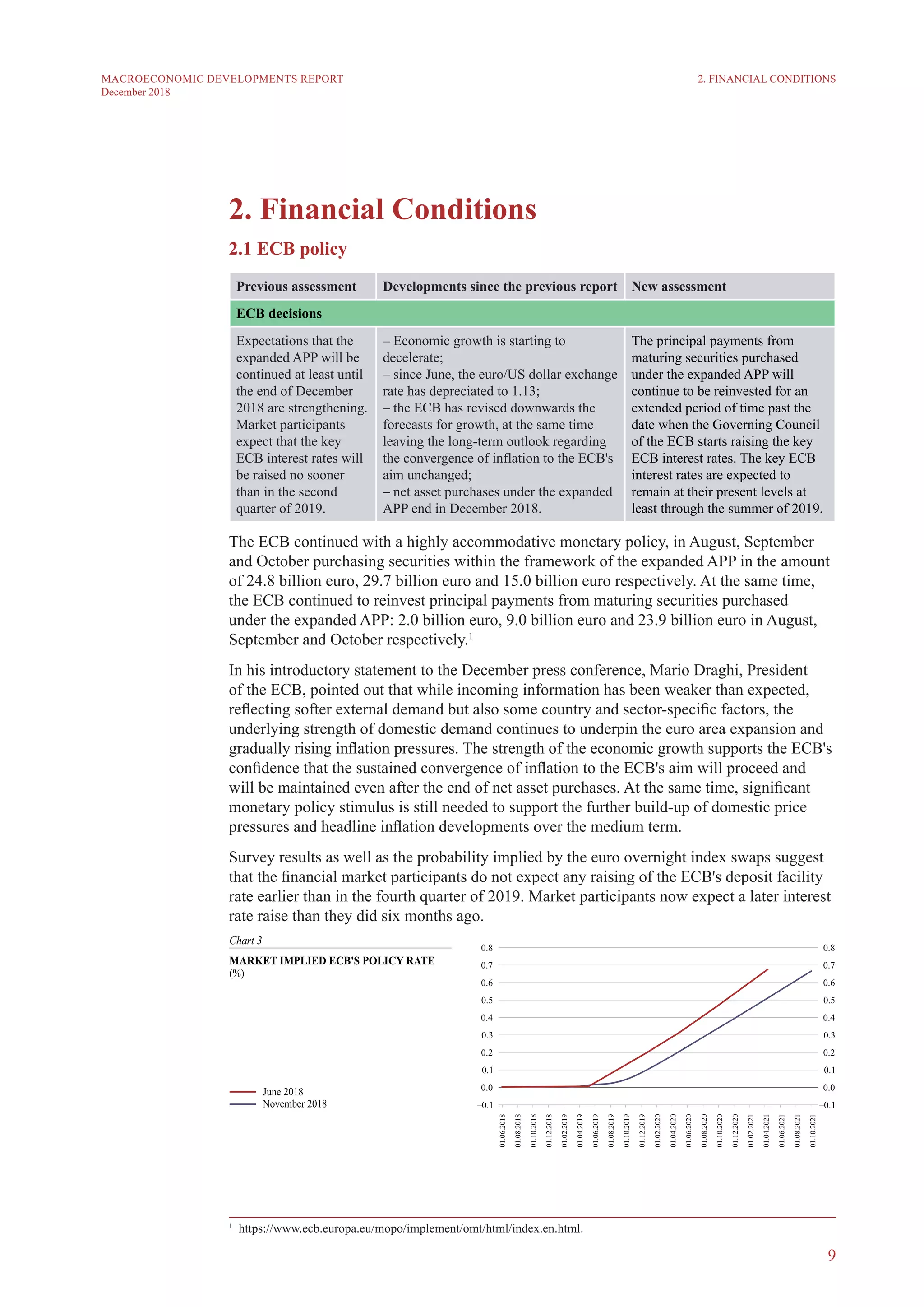
sentiment indicator has deteriorated. Although the EU average economic sentiment indicator
still remains considerably above the long-term average, in November it declined to the
lowest point since the beginning of summer 2017. It is projected that in 2019 the growth of
external demand will be more moderate than previously expected, although only marginally
lower than in 2018. Remaining uncertainties surrounding Brexit and more recently observed
geopolitical tensions could also have a downward effect on external demand.
Like in Latvia, private consumption supported by shrinking unemployment and rising
disposable income remains the main driver of economic growth in Latvia's Baltic
neighbours. In the third quarter, Lithuania's GDP decreased by 0.3% quarter-on-quarter.
This, however, was caused by short-term factors (problems in agriculture due to a poor
grain harvest caused by the unusually hot and dry weather conditions in summer), and
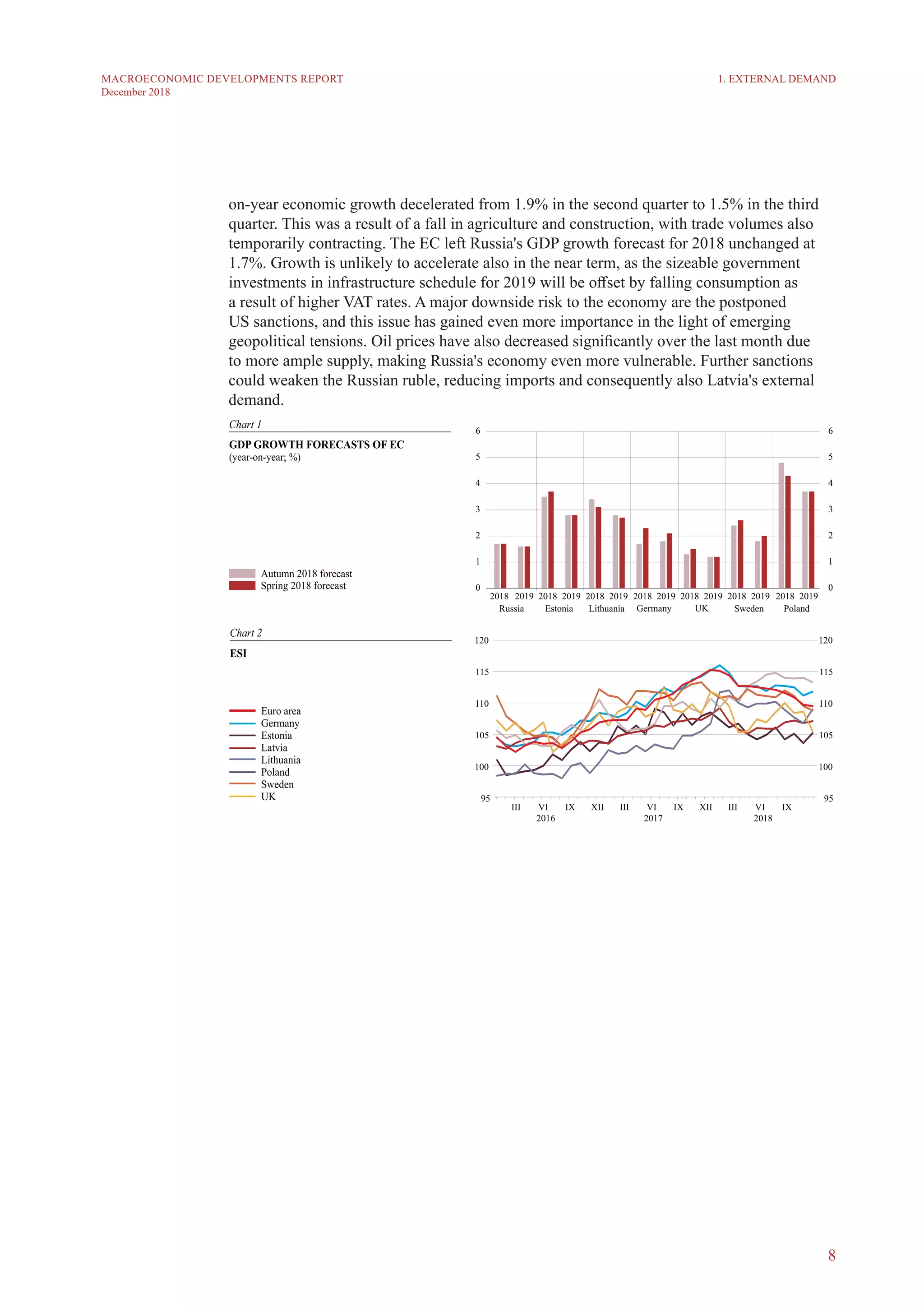
the economy is expected to recover in the fourth quarter. The EC revised the 2018 GDP
growth forecast for Lithuania upwards from 3.1% in the spring forecast to 3.4%, as trade
and construction continue to contribute significantly to economic growth. A similar rate
is projected by the EC for Estonia: due to lower investment flows the forecast for 2018
has been slightly revised downwards from 3.7% in the spring forecast to 3.5%. Estonia's
GDP grew by 0.4% in the third quarter, with the main contributors being construction and
manufacturing. Trade continued to expand, pointing to strong private consumption supported
1. EXTERNAL DEMAND
7
MACROECONOMIC DEVELOPMENTS REPORT
December 2018
by the rising real wages. In October, the international credit rating agency Fitch Ratings
upgraded Estonia's credit rating to AA–, which is going to have a positive effect on future
investment inflows. In 2019, economic growth is expected to decelerate and fall below 3% in
Lithuania and Estonia. It will continue to be supported by strengthening EU funding inflows
and private consumption, with a weakening external demand and a tight labour market
acting as dampening factors.
Germany's GDP contracted by 0.2% quarter-on-quarter in the third quarter due to
temporary factors as the disruption to car production decreased the overall industrial
output. The disruption as well as a fall in sales and exports of motor vehicles was caused
by the introduction of new and more rigorous emission standards as of 1 September. The
economy is expected to recover towards the end of the year, as the degree of capacity
utilisation remains well above average and the industry slump is just a temporary set-back.
Nevertheless, growth has moderated in 2018 overall. On account of weakening external
demand, the EC revised Germany's GDP growth projections downwards from 2.3% in its
spring forecast to 1.7%. At the same time, unemployment continues to shrink and wages
remain on an upward trend, thereby supporting consumption. In combination with an
accommodative fiscal policy, this will ensure steady growth in 2019.
In Sweden, economic growth continued to decelerate against the background of further
shrinking of investment in construction. Although the depreciation of the Swedish krona
had a positive effect on exports, the EC revised Sweden's GDP growth forecast for 2018
downwards from 2.6% in its spring forecast to 2.4%. The incoming data for the third quarter
show a quarter-on-quarter decrease of GDP for the first time since 2013. This decrease
by 0.2% can be explained by the shrinking trade and consumption as car sales declined
as a consequence of the implemented tax policy and the new vehicle emission standards.
GDP growth is expected to decelerate in 2019, as construction confidence deteriorated
significantly in November and the economic sentiment indicator has fallen to the lowest
level since 2016. The EC projects that it will be below 2%. The medium-term growth
prospects are weakened by the unresolved structural unemployment challenges and shortage
of qualified labour as well as lower external demand. Political uncertainty, i.e. failure to form
a new government following September elections, also does not support stronger economic
growth expectations.
In the UK, the uncertainties surrounding Brexit continue to weigh down on economic
growth. The EC revised the UK's GDP growth forecast for 2018 downwards from 1.5% in
its spring forecast to 1.3%, due to diminished investment inflows caused by uncertainties.
According to the GDP flash estimate, GDP grew by 0.6% quarter-on-quarter in the third
quarter, supported by exports and consumption. Unemployment was low in the third quarter
(4.1%), but with growth decelerating, it is likely to increase. Private consumption will be
suppressed by the moderate growth of wages (real wages increased by merely 0.9%) and
accumulation of savings. At the same time, inflation growth is decelerating and stood at
2.2% in October. Despite some progress achieved in Brexit negotiations, the risk of a no-
deal exit for the UK still remains. This could slow down investment inflows and economic
growth, thereby having a negative effect on Latvia's external demand.
Poland's economic growth remains robust. The EC revised Poland's GDP growth forecast for
2018 upwards from 4.3% in its spring forecast to 4.8%. This was supported by the low level
of unemployment and high consumer confidence that boosted private consumption. Third-
quarter GDP data were also optimistic as the quarter-on-quarter growth accelerated from
1.1% in the second quarter to 1.7%. Although the EU funding inflows will continue to have a
positive effect on the economic development in 2019, the pace of growth is likely to decline
in the circumstances of the labour market tightening and prevailing external uncertainties.
According to the estimates of the Central Bank of the Russian Federation, Russia's year-
1. EXTERNAL DEMAND
8
MACROECONOMIC DEVELOPMENTS REPORT
December 2018
on-year economic growth decelerated from 1.9% in the second quarter to 1.5% in the third
quarter. This was a result of a fall in agriculture and construction, with trade volumes also
temporarily contracting. The EC left Russia's GDP growth forecast for 2018 unchanged at
1.7%. Growth is unlikely to accelerate also in the near term, as the sizeable government
investments in infrastructure schedule for 2019 will be offset by falling consumption as
a result of higher VAT rates. A major downside risk to the economy are the postponed
US sanctions, and this issue has gained even more importance in the light of emerging
geopolitical tensions. Oil prices have also decreased significantly over the last month due
to more ample supply, making Russia's economy even more vulnerable. Further sanctions
could weaken the Russian ruble, reducing imports and consequently also Latvia's external
demand.
1. EXTERNAL DEMAND
9
MACROECONOMIC DEVELOPMENTS REPORT
December 2018
2. Financial Conditions
2.1 ECB policy
Previous assessment Developments since the previous report New assessment
ECB decisions
Expectations that the
expanded APP will be
continued at least until
the end of December
2018 are strengthening.
Market participants
expect that the key
ECB interest rates will
be raised no sooner
than in the second
quarter of 2019.
– Economic growth is starting to
decelerate;
– since June, the euro/US dollar exchange
rate has depreciated to 1.13;
– the ECB has revised downwards the
forecasts for growth, at the same time
leaving the long-term outlook regarding
the convergence of inflation to the ECB's
aim unchanged;
– net asset purchases under the expanded
APP end in December 2018.
The principal payments from
maturing securities purchased
under the expanded APP will
continue to be reinvested for an
extended period of time past the
date when the Governing Council
of the ECB starts raising the key
ECB interest rates. The key ECB
interest rates are expected to
remain at their present levels at
least through the summer of 2019.
The ECB continued with a highly accommodative monetary policy, in August, September
and October purchasing securities within the framework of the expanded APP in the amount
of 24.8 billion euro, 29.7 billion euro and 15.0 billion euro respectively. At the same time,
the ECB continued to reinvest principal payments from maturing securities purchased
under the expanded APP: 2.0 billion euro, 9.0 billion euro and 23.9 billion euro in August,
September and October respectively.1
In his introductory statement to the December press conference, Mario Draghi, President
of the ECB, pointed out that while incoming information has been weaker than expected,
reflecting softer external demand but also some country and sector-specific factors, the
underlying strength of domestic demand continues to underpin the euro area expansion and
gradually rising inflation pressures. The strength of the economic growth supports the ECB's
confidence that the sustained convergence of inflation to the ECB's aim will proceed and
will be maintained even after the end of net asset purchases. At the same time, significant
monetary policy stimulus is still needed to support the further build-up of domestic price
pressures and headline inflation developments over the medium term.
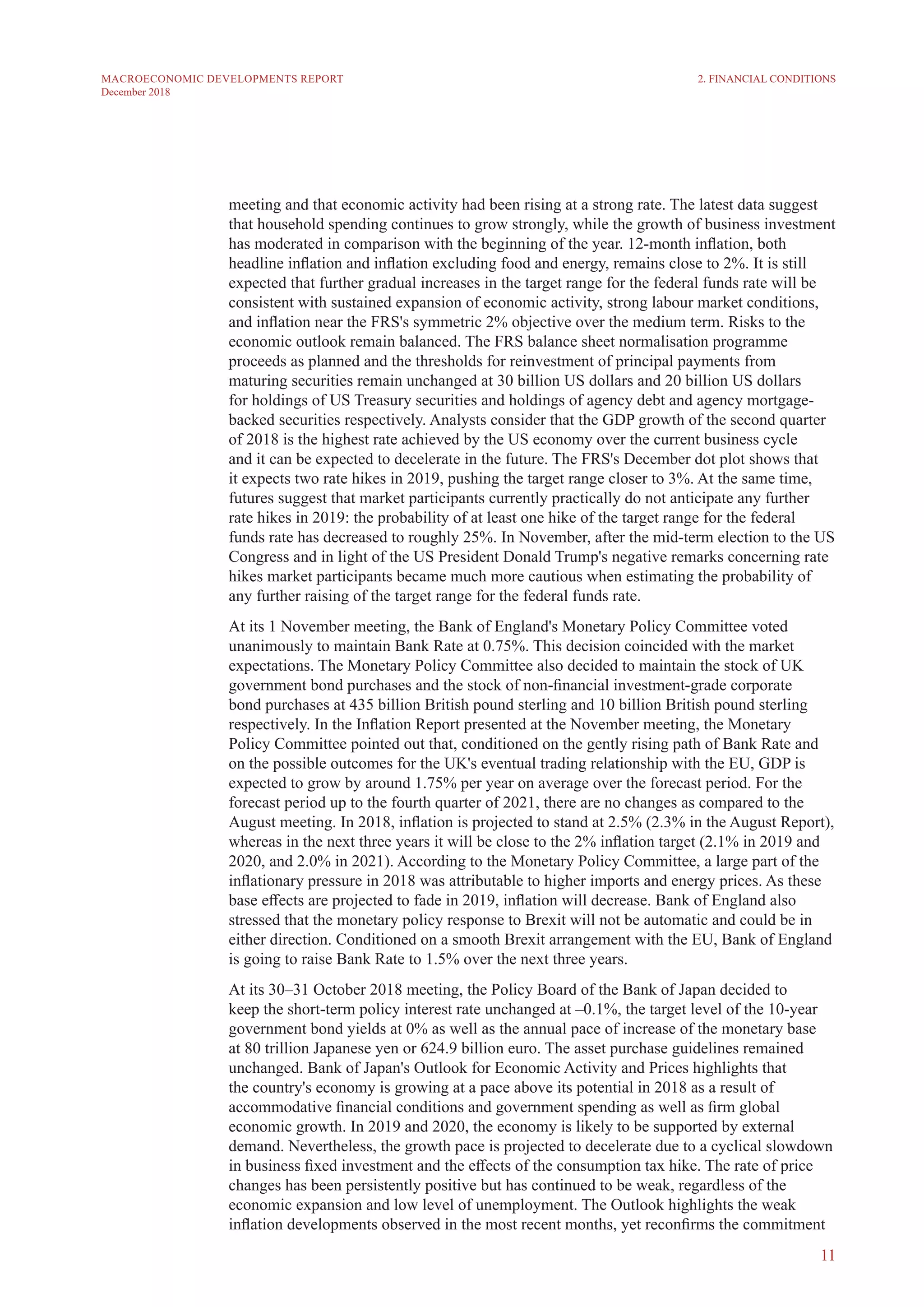
Survey results as well as the probability implied by the euro overnight index swaps suggest
that the financial market participants do not expect any raising of the ECB's deposit facility
rate earlier than in the fourth quarter of 2019. Market participants now expect a later interest
rate raise than they did six months ago.
1
  https://www.ecb.europa.eu/mopo/implement/omt/html/index.en.html.
2. FINANCIAL CONDITIONS
10
MACROECONOMIC DEVELOPMENTS REPORT
December 2018
2.2 Other central bank decisions and financial markets1
Previous assessment Developments since the previous report New assessment
FRS decisions
Market participants expect
further raising of the target
range for the federal funds
rate at the June meeting: these
expectations are strengthened
by the comments of the FRS
decision-makers.
Market expectations remain
unchanged in the medium term,
with participants anticipating
more substantial interest rate
raises.
– At its June meeting, the FRS raised
the target range for the federal funds
rate by 25 basis points. At the end of
July meeting, the target range was left
unchanged, whereas at the September and
December meetings it was again raised by
25 basis points1
;
– US labour market conditions continue to
improve, economic activity strengthens,
while inflation is close to 2%, the
symmetric inflation objective of the FRS;
– the FRS balance sheet normalisation
process accelerates as planned.
The FRS has signalled
that the target range for
the federal funds rate
could be raised twice
in 2019, approaching
3%. Nevertheless, at the
current juncture market
participants do not expect
further raising of the target
range for the federal funds
rate in 2019.
Bank of England's decisions
Following the last meeting
of the Bank of England's
Monetary Policy Committee,
market participants anticipate
that the next raising of the
Bank Rate by 25 basis points
could happen by the end of
2018. Low unemployment and
growing wages are expected to
increase the upward pressure
on inflation which is above
the Bank of England's target
already.
– In August, the Bank of England raised
the Bank Rate by 25 basis points (to
0.75%) and left it unchanged in the
subsequent months;
– Inflation Report published in August
stated that GDP is expected to grow by
around 1.75% per year on average over
the next three years; the projection was
left unchanged at the end-of-October
meeting;
– annual inflation stood at 2.4% in
November and exceeded the Bank of
England's inflation target of 2%.
Following the October
meeting of the Bank
of England's Monetary
Policy Committee,
market participants do
not anticipate any further
raising of the Bank Rate
in the near term. Further
progress with Brexit will
have a decisive role in the
UK's future development
and monetary policy
setting.
Bank of Japan's decisions
Although the Governor of
the Bank of Japan has hinted
in his latest speeches that an
expansionary monetary policy
cannot be pursued forever,
the current monetary policy
is expected to persist in the
medium term.
– Bank of Japan left the GDP forecast
for 2018, 2019 and 2020 unchanged at
1.3%–1.5%, 0.8%–0.9% and 0.6%–0.9%
respectively;
– the inflation forecast for 2018 and
2019 was slightly adjusted downwards,
whereas that for 2020 was left unchanged:
0.9%–1.0%, 1.8%–2.0% and 1.9%–2.1%
respectively.
Although the Governor
of the Bank of Japan
has hinted in his
latest speeches that an
expansionary monetary
policy cannot be pursued
forever, the current
monetary policy is
expected to persist in the
medium term.
EUR/USD exchange rate
Market participants anticipate
that the euro exchange rate
against the USD will be 1.27 in
a year's time.
– Political risks in the euro area are
associated with the decisions of the Italian
government and progress with Brexit;
– euro area's macroeconomic fundamentals
point to deceleration of growth;
– monetary policy implemented by
the FRS and the ECB is becoming
increasingly more divergent.
Market participants
anticipate that the euro
exchange rate against the
USD will be 1.22 in a
year's time.
At its 7–8 November meeting, the FOMC decided to leave the target range for the federal
funds rate unchanged at 2.00%–2.25%, and that was in line with the market expectations.
It was pointed out that the labour market had continued to strengthen since the September
1
  At its December meeting, the FRS raised the target range for the federal funds rate to 2.25%–2.50%.
2. FINANCIAL CONDITIONS
11
MACROECONOMIC DEVELOPMENTS REPORT
December 2018
meeting and that economic activity had been rising at a strong rate. The latest data suggest
that household spending continues to grow strongly, while the growth of business investment
has moderated in comparison with the beginning of the year. 12-month inflation, both
headline inflation and inflation excluding food and energy, remains close to 2%. It is still
expected that further gradual increases in the target range for the federal funds rate will be
consistent with sustained expansion of economic activity, strong labour market conditions,
and inflation near the FRS's symmetric 2% objective over the medium term. Risks to the
economic outlook remain balanced. The FRS balance sheet normalisation programme
proceeds as planned and the thresholds for reinvestment of principal payments from
maturing securities remain unchanged at 30 billion US dollars and 20 billion US dollars
for holdings of US Treasury securities and holdings of agency debt and agency mortgage-
backed securities respectively. Analysts consider that the GDP growth of the second quarter
of 2018 is the highest rate achieved by the US economy over the current business cycle
and it can be expected to decelerate in the future. The FRS's December dot plot shows that
it expects two rate hikes in 2019, pushing the target range closer to 3%. At the same time,
futures suggest that market participants currently practically do not anticipate any further
rate hikes in 2019: the probability of at least one hike of the target range for the federal
funds rate has decreased to roughly 25%. In November, after the mid-term election to the US
Congress and in light of the US President Donald Trump's negative remarks concerning rate
hikes market participants became much more cautious when estimating the probability of
any further raising of the target range for the federal funds rate.
At its 1 November meeting, the Bank of England's Monetary Policy Committee voted
unanimously to maintain Bank Rate at 0.75%. This decision coincided with the market
expectations. The Monetary Policy Committee also decided to maintain the stock of UK
government bond purchases and the stock of non-financial investment-grade corporate
bond purchases at 435 billion British pound sterling and 10 billion British pound sterling
respectively. In the Inflation Report presented at the November meeting, the Monetary
Policy Committee pointed out that, conditioned on the gently rising path of Bank Rate and
on the possible outcomes for the UK's eventual trading relationship with the EU, GDP is
expected to grow by around 1.75% per year on average over the forecast period. For the
forecast period up to the fourth quarter of 2021, there are no changes as compared to the
August meeting. In 2018, inflation is projected to stand at 2.5% (2.3% in the August Report),
whereas in the next three years it will be close to the 2% inflation target (2.1% in 2019 and
2020, and 2.0% in 2021). According to the Monetary Policy Committee, a large part of the
inflationary pressure in 2018 was attributable to higher imports and energy prices. As these
base effects are projected to fade in 2019, inflation will decrease. Bank of England also
stressed that the monetary policy response to Brexit will not be automatic and could be in
either direction. Conditioned on a smooth Brexit arrangement with the EU, Bank of England
is going to raise Bank Rate to 1.5% over the next three years.
At its 30–31 October 2018 meeting, the Policy Board of the Bank of Japan decided to
keep the short-term policy interest rate unchanged at –0.1%, the target level of the 10-year
government bond yields at 0% as well as the annual pace of increase of the monetary base
at 80 trillion Japanese yen or 624.9 billion euro. The asset purchase guidelines remained
unchanged. Bank of Japan's Outlook for Economic Activity and Prices highlights that
the country's economy is growing at a pace above its potential in 2018 as a result of
accommodative financial conditions and government spending as well as firm global
economic growth. In 2019 and 2020, the economy is likely to be supported by external
demand. Nevertheless, the growth pace is projected to decelerate due to a cyclical slowdown
in business fixed investment and the effects of the consumption tax hike. The rate of price
changes has been persistently positive but has continued to be weak, regardless of the
economic expansion and low level of unemployment. The Outlook highlights the weak
inflation developments observed in the most recent months, yet reconfirms the commitment
2. FINANCIAL CONDITIONS
12
MACROECONOMIC DEVELOPMENTS REPORT
December 2018
to achieve the inflation target in the medium and long term. The Bank of Japan believes that
the risks to economic growth and price outlook are skewed to the downside.
Financial market developments continued to be influenced by uncertainties and geopolitical
risks. Tensions were escalated by the US President Donald Trump's announcements of
potential new and higher trade tariffs in addition to the already existing ones, affecting
250 billion US dollars worth of Chinese goods. At the same time, in Europe the new Italian
government unveiled its programme, triggering a fall in demand for Italian government
securities. Turkey's economic problems and its collapsing currency were another source
of concern for investors. Nevertheless, relatively good second-quarter corporate earnings
figures in the US and global economic growth (particularly, in the US), allowed investors to
preserve their optimistic to a certain extent, and, after the data on the third quarter corporate
earnings in the US were released, even announce that the earnings had peaked. At the same
time, also the strong economic growth and FRS forecasts concerning future interest rate
hikes made investors rethink their investment strategies. Global economic growth also
started to decelerate. The effects of the trade tariffs began to take toll on China's economy,
inter alia strengthening investors concerns about the decelerating euro area economy as well.
Since the beginning of June, the yields on 10-year US Treasury bonds in debt markets have
grown by 15 basis points, to 3.05%. The yield on comparable German government bonds
has lost 2 basis points, decreasing to 0.36%. As a result, the spread between the yields
on German and US government bonds has widened. Overall, the yields on government
securities increased up to the end of September, but since the beginning of the fourth quarter
risk aversion dominates in financial markets.
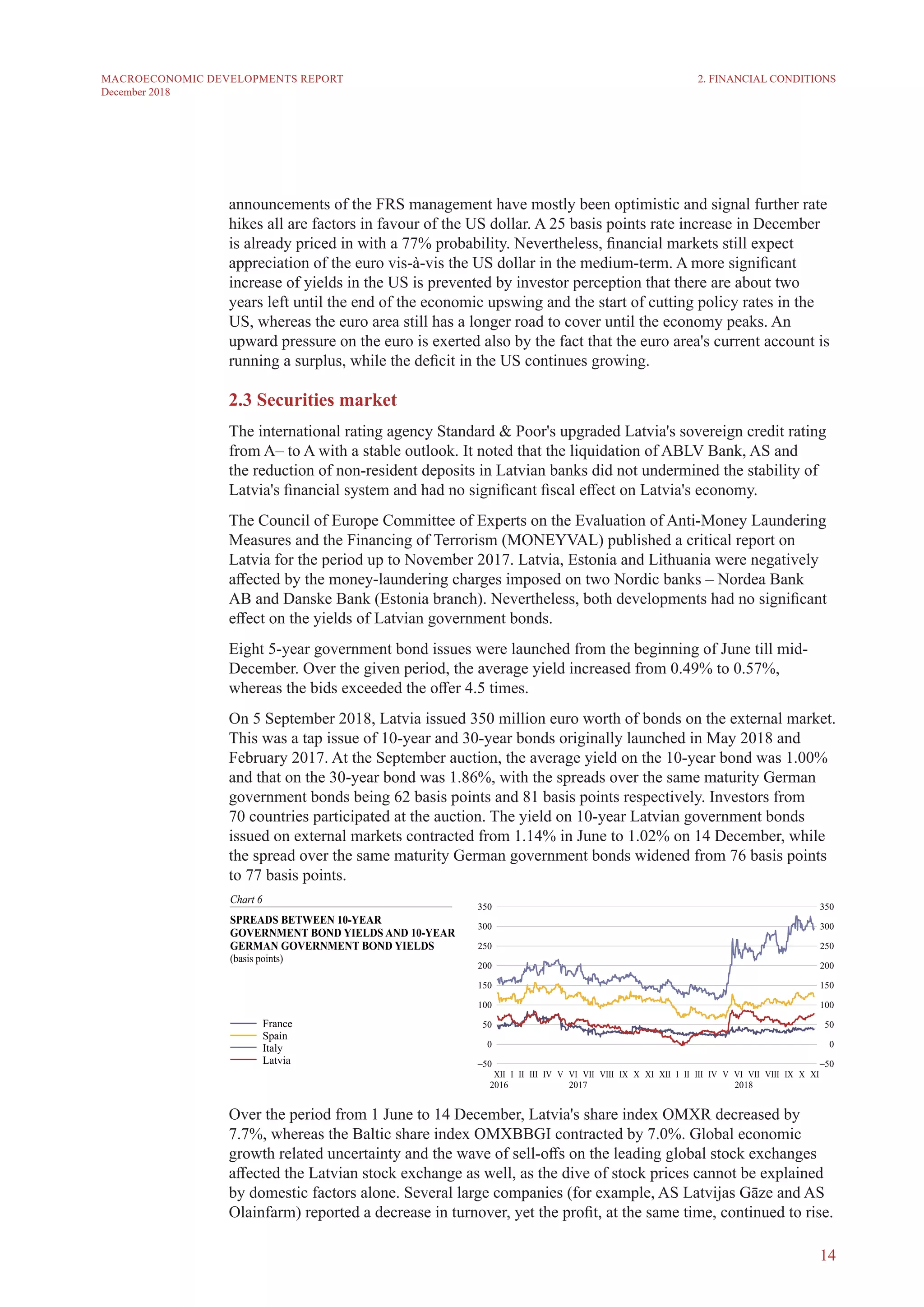
In most euro area countries, the yields on sovereign debt securities have increased. Markets
were influenced also by the political developments in Italy. Investors became increasingly
more concerned whether the Italian government was going to respect the fiscal discipline,
triggering a sell-off of Italian government bonds. This, however, had only a minor effect on
the yields of other euro area government securities. The yield on 10-year Italian government
bonds rose by 60 basis points, to 3.27%. At the same time, the international rating agency
Moody's Investors Service downgraded Italy's sovereign debt rating from Baa2 to Baa3,
which is just one notch above junk status. Outlook is viewed as stable, thereby slightly
softening the effect on the market. The international rating agency Standard & Poor's also
reviewed Italy's sovereign debt rating and lowered its outlook from stable to negative, at
the same time leaving the rating at BBB, which is two notches above junk status. From the
beginning of June, the yields on 10-year Spanish and Portuguese government bonds have
grown by 13 basis points and 3 basis points respectively, to 1.56% and 1.88%. This rise
was caused by the developments in Italy that made investors to reassess the risks in Spain
and Portugal as well. A lower yield on 10-year Portuguese government bonds can be partly
explained by Moody's decision to raise Portugal's rating one notch from Ba1 to Baa3, with
a stable outlook. The yield on 10-year French government bonds rose by 3 basis points, to
0.74%. At the same time, the yield on 10-year Greek government bonds has decreased by
9 basis points since the beginning of June, to 4.37%. The spreads between 10-year German
2. FINANCIAL CONDITIONS
13
MACROECONOMIC DEVELOPMENTS REPORT
December 2018
government bonds and other euro area government bonds have been growing from the
beginning of September, pointing to an increased risk perception. The yield on 10-year UK
government bonds grew by 13 basis points, to 1.41%.
US stock market index S & P 500 decreased by 2.4% from the beginning of June, to
2673.45. The period up to the end of September was successful for the US stock market,
yet at the beginning of September market sentiment changed and triggered an adjustment.
S&P 500 Banks Index decreased by 3.73%, whereas Dow Jones Industrial Average remained
broadly unchanged as compared to the beginning of June. The fall of S&P 500 Banks Index
is associated with the concerns about the persistently narrow spreads between shorter-term
and longer-term rates negatively affecting the long-term profitability of banks. At the same
time, the costs of capital are increasing, whereas the competition in the banking sector
remains tight.
European stock markets have also continued to fall since June. Contrary to the US stock
market, there was no improvement over the summer months; therefore, the adjustment
that started in October had a much stronger effect on stock market indices. For example,
EURO STOXX 50 characterising the euro area stock market dropped by 8.13%, whereas
the STOXX Europe 600 characterising Europe's overall market decreased by 7.39%. The
deepest fall was observed in the banking, energy and car production sectors and it was
associated with the developments in Italy, lower oil prices and potential trade barriers. At the
same time, the new car emissions regulation caused significant problems to car producers.
EURO STOXX Banks index characterising the euro area banking sector decreased by
13.46% against the background of rising concerns about the bank investment made in
Turkey and other emerging economies and developments in Italy. At the same time, the UK
stock market index FTSE 100 lost 8.64% and the UK banking sector index FTSE 350 Banks
declined by 10.55%. Brexit uncertainties continue to exert a downward pressure on asset
prices in the UK.
Japan's stock market index Nikkei 225 has decreased by 1.62% since the beginning of
June, whereas the emerging markets stock index MSCI EM has dropped 13.59%. Japan's
stock market was supported by the depreciation of the Japanese yen against the US dollar.
Meanwhile, the slump in the emerging market stocks can be explained by the exacerbating
concerns about the rising interest rates in the US. Changes in the US–China trade tariffs
are also starting to have their toll on China's growth rate which is very important for the
global market. The above-mentioned negative effects are unlikely to fade in the near term;
therefore, the downward pressure on asset prices could still continue for some time.
The exchange rate of the euro against the US dollar has decreased by 2.91% since the
beginning of June, to 1.132 US dollars per euro. The downward pressure on the euro
stemming from the hard-to-predict Italian government decisions and 2019 budget
negotiations with the EC, Brexit uncertainties and weaker euro area growth in the third
quarter slightly undermined the investor confidence in the euro. The widening spreads
between the yields on US and German government debt securities as well as the fact that the
2. FINANCIAL CONDITIONS
14
MACROECONOMIC DEVELOPMENTS REPORT
December 2018
announcements of the FRS management have mostly been optimistic and signal further rate
hikes all are factors in favour of the US dollar. A 25 basis points rate increase in December
is already priced in with a 77% probability. Nevertheless, financial markets still expect
appreciation of the euro vis-à-vis the US dollar in the medium-term. A more significant
increase of yields in the US is prevented by investor perception that there are about two
years left until the end of the economic upswing and the start of cutting policy rates in the
US, whereas the euro area still has a longer road to cover until the economy peaks. An
upward pressure on the euro is exerted also by the fact that the euro area's current account is
running a surplus, while the deficit in the US continues growing.
2.3 Securities market
The international rating agency Standard & Poor's upgraded Latvia's sovereign credit rating
from A– to A with a stable outlook. It noted that the liquidation of ABLV Bank, AS and
the reduction of non-resident deposits in Latvian banks did not undermined the stability of
Latvia's financial system and had no significant fiscal effect on Latvia's economy.
The Council of Europe Committee of Experts on the Evaluation of Anti-Money Laundering
Measures and the Financing of Terrorism (MONEYVAL) published a critical report on
Latvia for the period up to November 2017. Latvia, Estonia and Lithuania were negatively
affected by the money-laundering charges imposed on two Nordic banks – Nordea Bank
AB and Danske Bank (Estonia branch). Nevertheless, both developments had no significant
effect on the yields of Latvian government bonds.
Eight 5-year government bond issues were launched from the beginning of June till mid-
December. Over the given period, the average yield increased from 0.49% to 0.57%,
whereas the bids exceeded the offer 4.5 times.
On 5 September 2018, Latvia issued 350 million euro worth of bonds on the external market.
This was a tap issue of 10-year and 30-year bonds originally launched in May 2018 and
February 2017. At the September auction, the average yield on the 10-year bond was 1.00%
and that on the 30-year bond was 1.86%, with the spreads over the same maturity German
government bonds being 62 basis points and 81 basis points respectively. Investors from
70 countries participated at the auction. The yield on 10-year Latvian government bonds
issued on external markets contracted from 1.14% in June to 1.02% on 14 December, while
the spread over the same maturity German government bonds widened from 76 basis points
to 77 basis points.
Over the period from 1 June to 14 December, Latvia's share index OMXR decreased by
7.7%, whereas the Baltic share index OMXBBGI contracted by 7.0%. Global economic
growth related uncertainty and the wave of sell-offs on the leading global stock exchanges
affected the Latvian stock exchange as well, as the dive of stock prices cannot be explained
by domestic factors alone. Several large companies (for example, AS Latvijas Gāze and AS
Olainfarm) reported a decrease in turnover, yet the profit, at the same time, continued to rise.
2. FINANCIAL CONDITIONS
15
MACROECONOMIC DEVELOPMENTS REPORT
December 2018
The largest share turnover was reported for AS MADARA Cosmetics when one shareholder
sold the shares to another investor. The price of the company's shares grew by 4%. The
second largest turnover was reported for two pharmaceutical companies (AS Olainfarm and
AS GRINDEKS), while their shares depreciated by 19% and 16% respectively. At the same
time, the price of AS Latvijas Gāze shares declined by 5%.
2.4 Interest rates
Previous assessment Developments since the
previous report
New assessment
Interest rate on loans to non-financial corporations
Weighted average lending rates
are not expected to decrease
(except for temporary declines
on account of the financing of
relatively safer projects).
– Interest rates on large loans
have started to recover from their
historical lows.
Weighted average lending rates are
not expected to decrease (except
for temporary declines on account
of the financing of relatively safer
projects).
Interest rates on household loans
Weighted average lending rates
are not expected to decrease.
– Interest rates on consumer
credit are no longer increasing;
– interest rates with long initial
rate fixation periods applied to
loans for house purchase rose.
Weighted average lending rates are
not expected to decrease.
From April to October 2018, the weighted average interest rates on deposits by non-financial
corporations and household deposits continued to decrease, whereas the respective lending
rates were volatile. As a result, the profitability of credit institutions was stable and even
somewhat improved. Deposit rates decreased primarily in the household sector, with mostly
the rates on fixed-term deposits and their share in total deposits shrinking. Interest rates on
deposits of non-financial corporations in euro contracted relatively little.
Interest rates on loans to non-financial corporations and consumer credit decreased on
account of repayments of the most expensive loans and credit institutions granting loans on
2. FINANCIAL CONDITIONS
16
MACROECONOMIC DEVELOPMENTS REPORT
December 2018
better terms and conditions in some months. Lending rates in the segment of household loans
for house purchase slightly increased as more loans previously granted at lower interest
rates matured, and, at the same time, the lending rates applied to new loans and the euro
money market rates did not decrease. Competition made credit institutions cut their margins
on consumer credit and other lending to households, and loans with higher interest rates
compared to the newly-granted loans were maturing. From June to October, interest rates
on loans to non-financial corporations in euro ranged from 2.5%–2.6%, those on household
loans for house purchase were from 2.2% to 2.3%, while those on consumer credit and other
lending to households declined by 0.2 percentage point (to 11.3%).
Overall costs of borrowing for new loans to non-financial corporations and households
lingered at roughly the same level, yet the rate developments were different across various
loan segments. Weighted average interest rate on new loans to non-financial corporations
increased from 2.1% in April 2018 to 2.9% in October, returning to the level of 2017. The
main contributor was the weighted average rate on large loans (above 1 million euro): in
April 2018, it started to recover after April 2018, having dropped to the lowest level since
2004 when a interest rate reporting methodology common with the euro area countries was
introduced in Latvia. At the same time, the respective interest rate on small loans (up to
250 thousand euro) tended to decrease, with the weighted average rate on medium-size loans
(from 250 thousand euro to 1 million euro) remaining broadly unchanged.
Interest rates on new loans to households in euro in the major lending segments continued to
decline or remained broadly unchanged. Weighted average rate on household loans for house
purchase remained broadly unchanged, going down from 2.7% in April to 2.6% in October,
as a result different developments across various segments of loans for house purchase. The
lending rates on collateralised loans for house purchase tended to decrease slowly, whereas
those on uncollateralised loans increased. Floating interest rate and interest rate with the
initial rate fixation period of up to 1 year on new loans to households for house purchase in
euro also slightly decreased over the period from June to November, whereas the respective
rate with a longer initial rate fixation period increased. Interest rate on new consumer credit
in euro continued to decline up to July 2018 and then remained broadly unchanged. Overall,
it decreased by 1.3 percentage points (14.6% in October), mainly as a result of lower risks
2. FINANCIAL CONDITIONS
17
MACROECONOMIC DEVELOPMENTS REPORT
December 2018
associated with the credit granted and credit institutions competing for new clients and to
retain the existing ones. The respective interest rate on other lending to households shrank
by 0.2 percentage point (3.9% in October).
Considering the trends observed earlier with respect to the interest rates applied by credit
institutions, those on deposits are overall expected to closely mirror the euro money market
rates. The rates on household loans for house purchase and loans to non-financial corporations
will slowly rise, whereas those on consumer credit will continue to fall. At the same time,
the interest rates on new loans will remain broadly unchanged, as they will be affected by
counteracting factors. Economic development and shrinking unemployment are likely to
compress the risk premiums on loans, while uncertainties relating to further monetary policy
development and higher risk scores assigned to credit institutions because of the money
laundering scandal will acting in the opposite direction. Moreover, credit institutions could
ease the credit standards applied to riskier customers in pursuit of a higher profitability.
2.5 Loans and deposits
Despite some signs of lending recovery and prevailing favourable lending conditions, the
domestic loan portfolio increased only marginally in the second and third quarters of 2018
and in October1
, with loans to non-financial corporations remaining broadly unchanged and
household loans slightly expanding. Looking at new loans, only the amount newly-granted
of household loans was larger as compared to the respective period of the previous year,
whereas the amounts of both loans to non-financial corporations and domestic loans overall
were significantly smaller. The adjusted rate of change in household loans, despite remaining
negative, approached zero and was still following an upward trend. This was facilitated by
the state support programme for house purchase, GDP growth and build-up of savings as
well as the tight labour market conditions. At the same time, the annual rate of change in
loans to non-financial corporations was lingering around zero, with developments being
primarily influenced by disbursements and repayments of short-term loans. The overall
growth of deposits with credit institutions was rather moderate, with household deposits
steadily growing and deposits by non-financial corporations exhibiting volatility.
1
  The effects of banking sector restructuring excluded.
2. FINANCIAL CONDITIONS
18
MACROECONOMIC DEVELOPMENTS REPORT
December 2018
Previous assessment Developments since the previous report New assessment
Lending
Although credit institutions project
an increase in the demand for loans,
the actual development in late 2017
and early 2018 as well as the expected
deceleration in the overall GDP growth
have the effect of reducing the forecast
of corporate lending expansion. The
loan portfolio growth in 2018 and
2019 will gradually recover; however,
at a lower-than-expected pace. The
key factors contributing to corporate
lending growth will be absorption of
EU funds and the necessity to boost
capacity, but unwillingness to take
risks will reduce the demand for loans.
The trends observed so far will persist
in lending to households.
– New loans granted to households
continue to gradually increase; consumer
credit portfolio is slowly expanding;
household loans for house purchase also
follow an upward trend and, the effects
of banking sector restructuring excluded,
their growth has returned to a positive
territory;
– growth is underpinned by economic
development, shrinking unemployment
and overall favourable labour market
conditions for employees;
– new loans to non-financial corporations
continue to decrease, with the adjusted
annual rate of change being close to zero;
– the role of leasing in providing
financing continues to grow.
Although the
actual lending
developments are
in line with the
projections, because
of the high degree
of uncertainty and
potentially higher
risk aversion, the
forecast for lending
growth has been
revised downwards.
Loan portfolio will
continue to grow in
2019, yet at a lower
pace than previously
expected.
The annual rate of decrease of the domestic loan portfolio was –4.6% in October (an
increase of 1.0% excluding the effects of the banking sector restructuring). The annual rate
of change in loans to non-financial corporations was –5.5% (0.4% excluding the effects of
restructuring), whereas that of household loans was –5.9% (–0.4% in adjusted terms). At the
same time, the growth of loans to the non-bank financial sector decelerated.
The overall increase in loans, including corporate lending, over the first ten months of 2018
still suggested that market participants remain quite cautious and was lower than over the
same period of the previous year. Moreover, the amount of new loans granted in the third
quarter of 2018 was smaller than the amounts granted in the first or second quarter. From
January to October 2018, only new loans to households exceeded the respective figure of
2017 (by 7.9%; including loans for house purchase by 10.0%), while new loans to non-
financial corporations posted a 29.8% decrease year-on-year.
2. FINANCIAL CONDITIONS
19
MACROECONOMIC DEVELOPMENTS REPORT
December 2018
The results of the euro area bank lending survey of October 2018 also suggest that the
attitude towards lending development prospects remains cautious: responses show that the
demand for loans is not expected to grow in the first quarter of 2019.
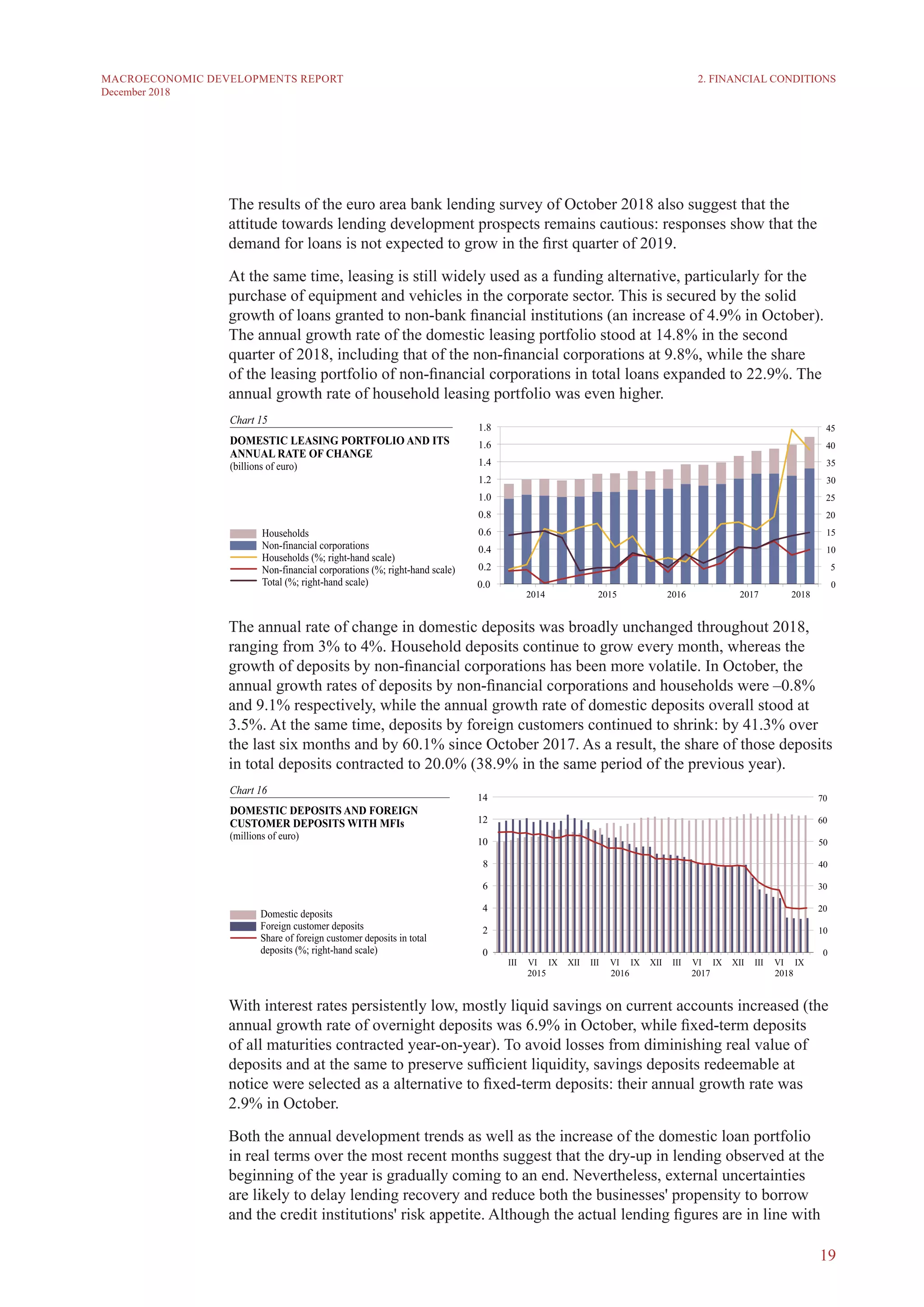
At the same time, leasing is still widely used as a funding alternative, particularly for the
purchase of equipment and vehicles in the corporate sector. This is secured by the solid
growth of loans granted to non-bank financial institutions (an increase of 4.9% in October).
The annual growth rate of the domestic leasing portfolio stood at 14.8% in the second
quarter of 2018, including that of the non-financial corporations at 9.8%, while the share
of the leasing portfolio of non-financial corporations in total loans expanded to 22.9%. The
annual growth rate of household leasing portfolio was even higher.
The annual rate of change in domestic deposits was broadly unchanged throughout 2018,
ranging from 3% to 4%. Household deposits continue to grow every month, whereas the
growth of deposits by non-financial corporations has been more volatile. In October, the
annual growth rates of deposits by non-financial corporations and households were –0.8%
and 9.1% respectively, while the annual growth rate of domestic deposits overall stood at
3.5%. At the same time, deposits by foreign customers continued to shrink: by 41.3% over
the last six months and by 60.1% since October 2017. As a result, the share of those deposits
in total deposits contracted to 20.0% (38.9% in the same period of the previous year).
With interest rates persistently low, mostly liquid savings on current accounts increased (the
annual growth rate of overnight deposits was 6.9% in October, while fixed-term deposits
of all maturities contracted year-on-year). To avoid losses from diminishing real value of
deposits and at the same to preserve sufficient liquidity, savings deposits redeemable at
notice were selected as a alternative to fixed-term deposits: their annual growth rate was
2.9% in October.
Both the annual development trends as well as the increase of the domestic loan portfolio
in real terms over the most recent months suggest that the dry-up in lending observed at the
beginning of the year is gradually coming to an end. Nevertheless, external uncertainties
are likely to delay lending recovery and reduce both the businesses' propensity to borrow
and the credit institutions' risk appetite. Although the actual lending figures are in line with
2. FINANCIAL CONDITIONS
20
MACROECONOMIC DEVELOPMENTS REPORT
December 2018
the previous forecasts and lending is expected to grow also over the next years, the pace
will be lower than previously projected: in 2019, the growth rates of loans to non-financial
corporations and household loans will be just slightly above zero.
Deposits will preserve the currently observed trends in 2019, i.e. an increase in household
savings on account of growing wages and a tight labour market will support moderate
overall growth. At the same time, deposits by non-financial corporations will be volatile,
depending on their investment needs and the necessity to finance their growing imports.
2. FINANCIAL CONDITIONS
21
MACROECONOMIC DEVELOPMENTS REPORT
December 2018
3. Sectoral Development1
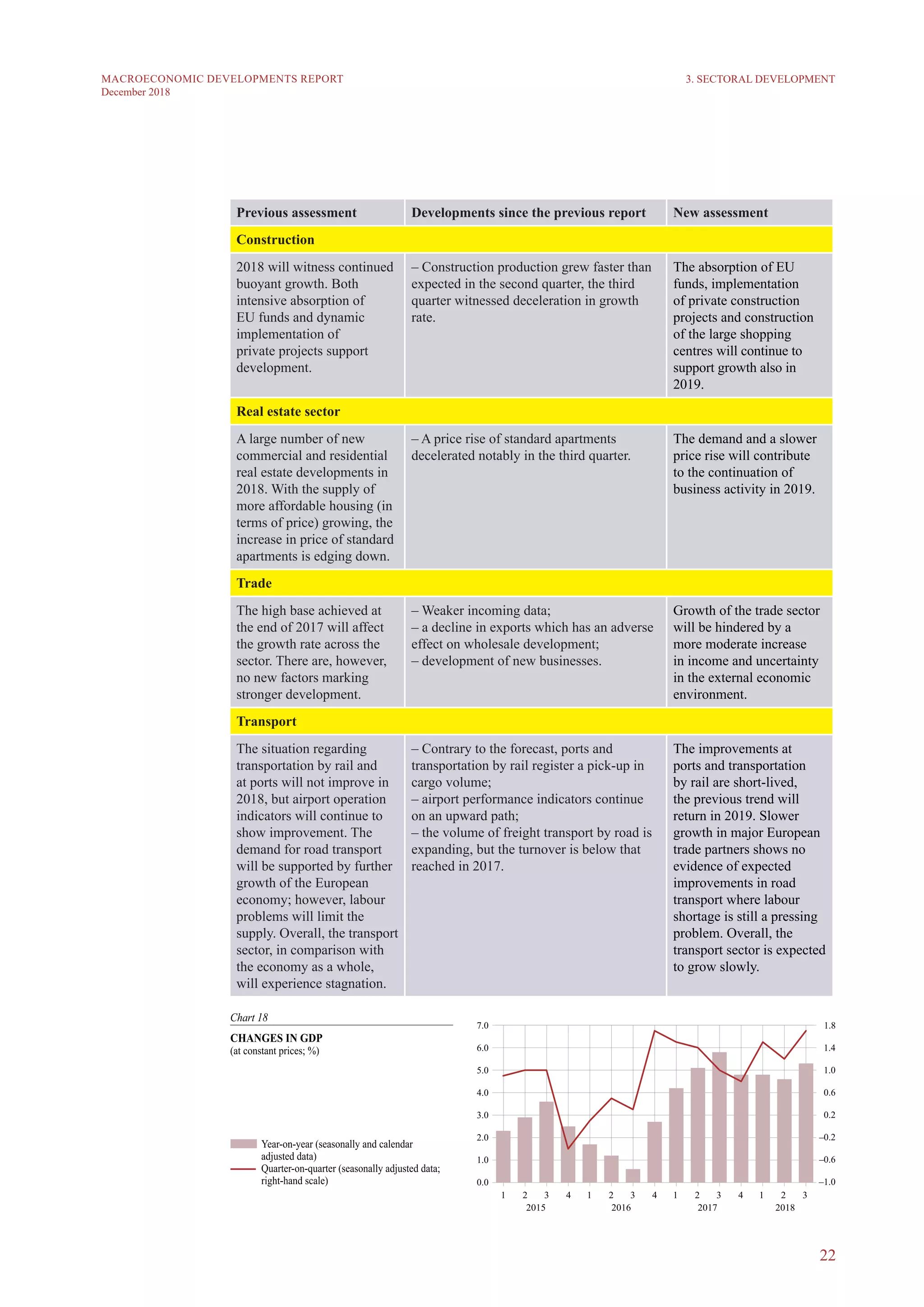
Economic growth seen in the third quarter was faster than expected and reached the rate not
observed since the fourth quarter of 2016. Construction contributed markedly to growth over
the year, but the third quarter witnessed a slight reduction in activity, with information and
communication as well as transportation and storage services developing more successfully.
Overall, industrial development was relatively successful; however, manufacturing growth
was volatile and well behind the upward path recorded in the previous year during both the
third quarter and the year. Drought across the whole region and repairs of the Lithuanian–
Swedish interconnection maintained high energy prices, resulting in accelerated growth of
the electricity generated in cogeneration plants in the third quarter. This offset the drought-
driven fall in electricity output generated by hydroelectric power stations. Due to higher
average outdoor temperatures, heat consumption was in all likelihood lower than in the
third quarter of the previous year. However, overall growth of the mining and quarrying,
energy and water supply sectors was somewhat stronger than expected. Growth in the
trading sector is gradually shrinking. Despite the short-term rise in September (which could
be explained by the opening of the IKEA store and possibly the postponed consumption),
retail growth slowed down. Taking account of the upswing in cargoes at ports, the pick-
up in freight transportation by rail and persistently good performance of the air passenger
transport, the contribution by the transport sector was positive. Growth of the information
and communication services sector has been stable and buoyant since the beginning of the
year. Despite the fact that the XXVI Nationwide Latvian Song and XVI Dance Celebration
took place in summer, the accommodation and catering sector experienced a drop in the third
quarter. However, the real estate sector surged, and the third quarter saw a notable increase
in the contribution of indirect taxes.
Previous assessment Developments since the previous report New assessment
Manufacturing
Sustainable growth in
2018 and 2019 supported
by both the external
and domestic demand.
Investment is projected
to increase. The problem
of labour shortage will
intensify; therefore,
entrepreneurs will focus
more on automation
processes.
– Sectoral development in the first half of
2018 was weaker than expected, performance
in the third quarter was also weak;
– many sub-sectors have reached a high
degree of capacity utilisation, the problem of
labour shortage has increased;
– the high wood prices prevailing in wood
processing have already created both
opportunities and risks in various segments of
wood processing since spring;
– labour shortages contribute to business
investment in automation processes; however,
investment made in expansion of production
is low;
– the poor grain harvest triggered by the
drought has led to the sharp increase in grain
prices which give rise to concerns about
profitability of the food industry;
– the third quarter saw slowdown of economic
growth or even its decline in some trading
partners.
Growth will remain
moderate at the end of
2018 and in 2019. Faster
growth will be constrained
by the weak capacity of
the supply side. The risks
of moderation in external
demand growth have
heightened.
1
  The Chapter "Sectoral Development" analyses GDP and sectoral value added at constant prices, using seasonally and
calendar adjusted data (unless otherwise specified).
3. SECTORAL DEVELOPMENT
22
MACROECONOMIC DEVELOPMENTS REPORT
December 2018
Previous assessment Developments since the previous report New assessment
Construction
2018 will witness continued
buoyant growth. Both
intensive absorption of
EU funds and dynamic
implementation of
private projects support
development.
– Construction production grew faster than
expected in the second quarter, the third
quarter witnessed deceleration in growth
rate.
The absorption of EU
funds, implementation
of private construction
projects and construction
of the large shopping
centres will continue to
support growth also in
2019.
Real estate sector
A large number of new
commercial and residential
real estate developments in
2018. With the supply of
more affordable housing (in
terms of price) growing, the
increase in price of standard
apartments is edging down.
– A price rise of standard apartments
decelerated notably in the third quarter.
The demand and a slower
price rise will contribute
to the continuation of
business activity in 2019.
Trade
The high base achieved at
the end of 2017 will affect
the growth rate across the
sector. There are, however,
no new factors marking
stronger development.
– Weaker incoming data;
– a decline in exports which has an adverse
effect on wholesale development;
– development of new businesses.
Growth of the trade sector
will be hindered by a
more moderate increase
in income and uncertainty
in the external economic
environment.
Transport
The situation regarding
transportation by rail and
at ports will not improve in
2018, but airport operation
indicators will continue to
show improvement. The
demand for road transport
will be supported by further
growth of the European
economy; however, labour
problems will limit the
supply. Overall, the transport
sector, in comparison with
the economy as a whole,
will experience stagnation.
– Contrary to the forecast, ports and
transportation by rail register a pick-up in
cargo volume;
– airport performance indicators continue
on an upward path;
– the volume of freight transport by road is
expanding, but the turnover is below that
reached in 2017.
The improvements at
ports and transportation
by rail are short-lived,
the previous trend will
return in 2019. Slower
growth in major European
trade partners shows no
evidence of expected
improvements in road
transport where labour
shortage is still a pressing
problem. Overall, the
transport sector is expected
to grow slowly.
3. SECTORAL DEVELOPMENT
23
MACROECONOMIC DEVELOPMENTS REPORT
December 2018
3.1 Manufacturing
The major obstacle to faster growth of manufacturing is the insufficient capacity of the
supply side: as a result of the labour shortage and high production capacity utilisation,
the supply fails to satisfy the strong demand. Several professional associations, e.g. the
Association of Mechanical Engineering and Metalworking Industries of Latvia, have pointed
to the high demand. However, the macroeconomic indicators confirm growth deceleration in
Latvia's trade partners and thus a potential moderation of the external demand.
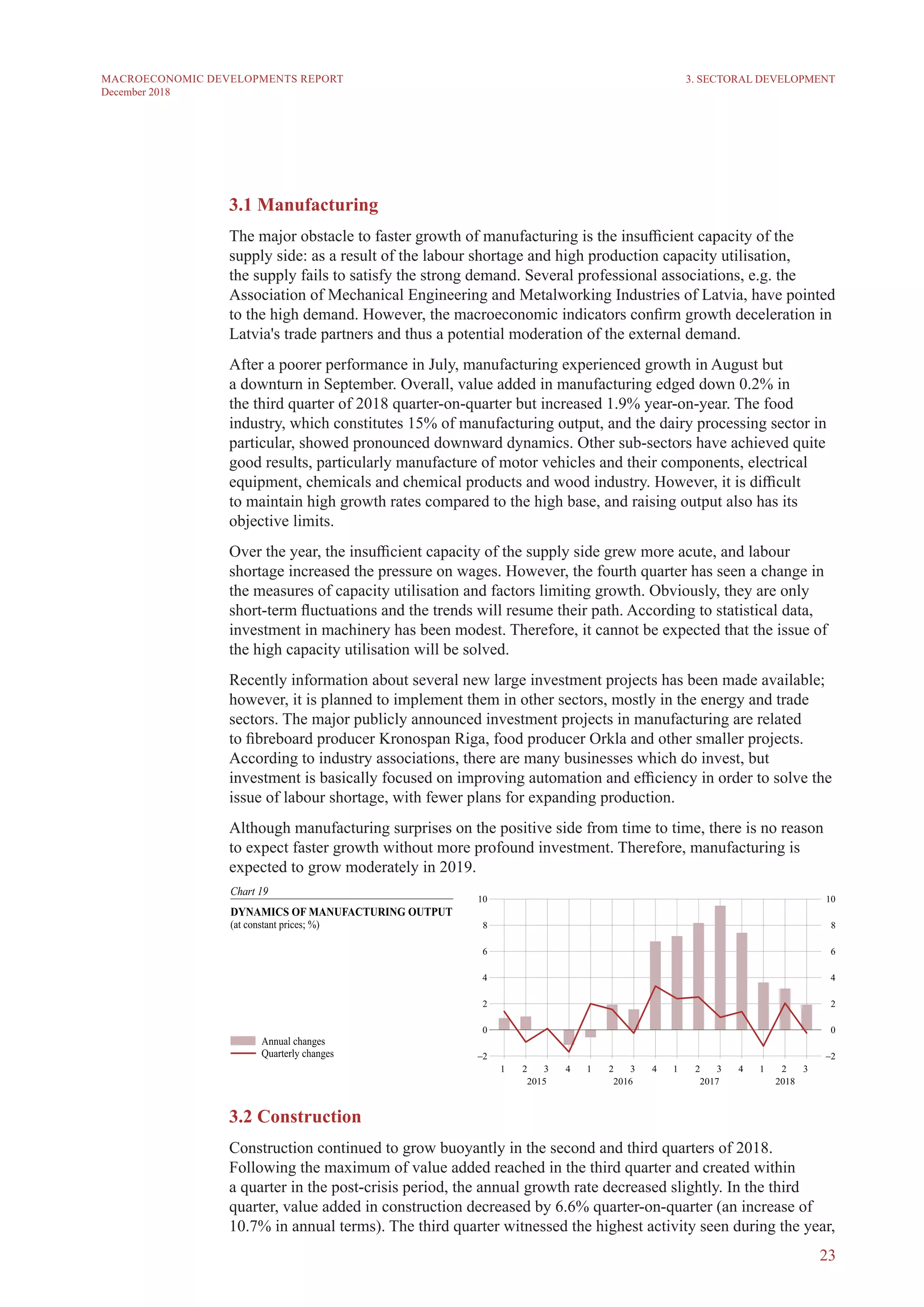
After a poorer performance in July, manufacturing experienced growth in August but
a downturn in September. Overall, value added in manufacturing edged down 0.2% in
the third quarter of 2018 quarter-on-quarter but increased 1.9% year-on-year. The food
industry, which constitutes 15% of manufacturing output, and the dairy processing sector in
particular, showed pronounced downward dynamics. Other sub-sectors have achieved quite
good results, particularly manufacture of motor vehicles and their components, electrical
equipment, chemicals and chemical products and wood industry. However, it is difficult
to maintain high growth rates compared to the high base, and raising output also has its
objective limits.
Over the year, the insufficient capacity of the supply side grew more acute, and labour
shortage increased the pressure on wages. However, the fourth quarter has seen a change in
the measures of capacity utilisation and factors limiting growth. Obviously, they are only
short-term fluctuations and the trends will resume their path. According to statistical data,
investment in machinery has been modest. Therefore, it cannot be expected that the issue of
the high capacity utilisation will be solved.
Recently information about several new large investment projects has been made available;
however, it is planned to implement them in other sectors, mostly in the energy and trade
sectors. The major publicly announced investment projects in manufacturing are related
to fibreboard producer Kronospan Riga, food producer Orkla and other smaller projects.
According to industry associations, there are many businesses which do invest, but
investment is basically focused on improving automation and efficiency in order to solve the
issue of labour shortage, with fewer plans for expanding production.
Although manufacturing surprises on the positive side from time to time, there is no reason
to expect faster growth without more profound investment. Therefore, manufacturing is
expected to grow moderately in 2019.
3.2 Construction
Construction continued to grow buoyantly in the second and third quarters of 2018.
Following the maximum of value added reached in the third quarter and created within
a quarter in the post-crisis period, the annual growth rate decreased slightly. In the third
quarter, value added in construction decreased by 6.6% quarter-on-quarter (an increase of
10.7% in annual terms). The third quarter witnessed the highest activity seen during the year,
3. SECTORAL DEVELOPMENT
24
MACROECONOMIC DEVELOPMENTS REPORT
December 2018
and the quarterly decline shows that the growth rate will be lower than the results of the first
half of the year (30%) when a new maximum of the sector's value added is reached.
Continued development of various construction sub-sectors was observed in the third quarter.
Construction output data at current prices suggested that road construction was still the
major contributor to output growth, and engineering works also enjoyed the most sustained
development as a whole. In the segment of construction of non-residential buildings,
construction of commercial space continued to make the largest contribution in the third
quarter, and active construction of office buildings also persisted. Construction of residential
buildings contributed markedly to the overall construction volume. 1 878 places of residence
were built in the first nine months of 2018 (a year-on-year increase of 15%; this represents
the first significant increase in housing construction since 2014 when dwellings were built
expeditiously due to the forthcoming changes in the regulations specifying the purchase
of housing in exchange for the entitlement to temporary residence permits). The example
of Estonia and Lithuania suggests that an increase in apartment construction has a great
potential. Over the past five years, the above countries have built approximately three times
more apartments, in proportion to the size of their population, than in Latvia. Employment
dynamics are growing in the regions outside Riga experiencing an upturn in the economic
activity; however, they face an acute shortage of affordable apartments in terms of price.
During the period of buoyant growth of construction, structural arrangement of the sector
both at government level and at the initiative of economic operators also takes place. Several
reforms contributing to the sector's productivity are being implemented, e.g. an opportunity
to coordinate a construction idea by electronic means, mandatory from 2019, will reduce
the time spent on the construction process. A financial support policy measure has also
been designed, allowing local government capital companies to receive loans from the
Treasury for the construction of rental apartments outside Riga. In addition to promoting the
construction and real estate sectors, when engaging in development of rental apartments,
this measure will also contribute to the overall economic development, enabling regions to
attract labour. The support is expected to be available from early 2019, but it requires EC
approval. At the initiative of the Partnership of Latvian Construction Entrepreneurs, the
required number of sectoral businesses has agreed to conclude a collective agreement aimed
at reducing the shadow economy and ensuring fair competition. The collective agreement,
under which the minimum wage should be raised in the sector, is not currently being
implemented as the President of Latvia has referred the related amendments to the Labour
Law to the Saeima of the Republic of Latvia for re-examination.
Sentiment of construction contractors, after having stabilised at a positive level for several
months, deteriorated in October and November to –0.7 and –0.8 respectively due to more
negative employment forecasts, which remained positive overall over the three-month
period. Sentiment indicators of construction contractors have been stabilising for several
months at high levels in a longer-term perspective. It was in September when the sector's
overall sentiment indicator became positive for the first time since late 2007. Employment
assessment, a component of the above indicator, has already been positive since mid-
2017, and the trend of improvement is also reflected in the assessment by businesses of
development of orders received.
In addition to the increase in the availability of EU funding, development of the sector is
driven by strong demand in several private sector segments concurrently, i.e. construction of
residential and non-residential buildings. Thus, construction has far exceeded the maximum
level observed in the recent past, but it substantially lags behind that achieved during
economic overheating. Although the current growth trajectory is flatter and not based on
strong lending expansion, the wage index is already approaching the highest level reached
in 2008. Despite the rise in wages, the increase in the number of employees is much more
modest, illustrating difficulties in attracting labour.
3. SECTORAL DEVELOPMENT
25
MACROECONOMIC DEVELOPMENTS REPORT
December 2018
3.3 Real estate market
Real estate market activity remains high. The sector's value added increased by 7.4% in
the third quarter of 2018 quarter-on-quarter. In the third quarter, the number of real estate
purchases registered with the Land Register increased for the second consecutive quarter.
In response to the market demand, developers plan to implement several budget-class
residential projects in 2018; the first nine months of 2018 saw the number of finished
housing grow. Data on the issued building permits show an expected further increase.
According to real estate companies, this should reduce the lack of supply. Information
published by real estate companies on prices of transactions with standard apartments in
August and September shows that their annual growth rate continued to fall, approaching 5%
(above 9% on average in 2017). In addition to the strong market demand, development of
the sector could be stimulated by policy initiatives, e.g. the availability of the above funding
for construction of municipal rental apartments could set in motion the long-stagnating
apartment rental market as well as improvement of the draft Residential Tenancy Law, which
is being prepared for the second reading by the Saeima of the Republic of Latvia, could
arrange relationships between tenants and renters.
3.4 Trade
Overall, development of the trade sector decelerated in the third quarter. First, despite the
decline in unemployment and relatively stable consumer sentiment, one of the largest trade
sectors, i.e. the retail trade, suffered a significant decline in growth rates during the summer
months (the annual growth rate of retail trade was 3.0% in the third quarter; 5.0% in the
second quarter). The increase in retail sales observed in September was temporary (possibly
linked to the postponed consumption, which coincided with IKEA's first month of operation
in Latvia), and the pace of development of the sector slowed again in October. In the third
quarter, retail trade growth rates of car fuel and food continued to decrease. Trade had
increased considerably in these commodity groups in the past.
In October, plans to be implemented by the LIDL retail chain on the Latvian market became
more pronounced, i.e. construction of the logistics centre was launched, and the retail chain
3. SECTORAL DEVELOPMENT
26
MACROECONOMIC DEVELOPMENTS REPORT
December 2018
announced its plan to open 10 stores over a period of two and a half years, with the total
investment around 125 million euro, the amount similar to that invested in Lithuania within
the same time-frame. LIDL's impact on retail development will partly manifest itself as
market reallocation effect and will intensify competition.
Sales of motor vehicles have already been contracting for the second consecutive quarter.
However, this shrinkage is not equivalent to the decline in the automotive sector encountered
by Europe's largest automotive countries due to delays in certification.
As already suggested by monthly data of nominal exports of goods and their unit value,
weaker exports should have also been reflected in the wholesale trade and the value added of
the trade sector which decreased by 0.2% in the third quarter in quarterly terms and posted
an annual increase of a mere 1.6%.
3.5 Transport
Although the cargo volume declined at the beginning of 2018, the second and third quarters
witnessed successful development of the transport sector. In the third quarter, the transport
sector's value added increased by 4.3% quarter-on-quarter (by 7.2% year-on-year), also
contributing positively to faster GDP growth. This is also confirmed by the pick-up in
exports of transportation services (10.9%) observed in the third quarter. This development
was driven mainly by the increase in freight volume in rail transport and at ports where the
transported volume of coal and timber grew. The number of passengers at the airport has
also continued on an upward path, while freight turnover by road has declined.
Following a drop in cargo volume in the first quarter, the second and third quarters saw rail
freight volume increase significantly. Cargo volume increased even by 37.6% in the third
quarter, and cargo turnover also boosted notably. Domestic freight transport decreased,
but imported cargo volume demonstrated a robust upswing (around 80% of the total cargo
volume). The increase in cargo volume received from Russia and Belarus had a major role
to play in ensuring the above growth. The rise in Russian cargo volume was supported by
repairs taking place at Russian port terminals, e.g. Ustjluga, and therefore cargoes were
temporarily shifted to Latvia. The cargo volume received from Belarus increased by about
a fifth. This was facilitated by the opening of an VAS Latvijas Dzelzceļš office in Minsk in
2017, which has helped to improve cooperation and create new partnerships with Belarusian
companies. Similarly, the launch of the freight express train line Minsk–Riga in 2018 has
improved the efficiency of cargo transportation.
In the second and third quarters of 2018, cargo turnover at ports elevated, yet the situation
was not uniform across all ports. Cargo volume grew at all ports in the third quarter, but the
first 10 months of 2018 saw their increase at Riga and Liepāja ports, while Ventspils port still
recorded a fall year-on-year. The steepest cargo volume growth rate at ports was observed in
July and October, but it was slower in other months. With coal transportation growing, the
largest positive contribution was on account of bulk cargoes in the third quarter as well as in
3. SECTORAL DEVELOPMENT
27
MACROECONOMIC DEVELOPMENTS REPORT
December 2018
October. The volume of liquid and general cargoes also mounted. The high prices have also
increased the volume of transported timber, providing the second largest contribution to the
rise in port cargoes. Following the 11-quarter drop, contribution of oil products also became
slightly positive. Although the third quarter was favourable for ports, exports of services of
freight transportation by sea declined to minimum.
Air transport also saw positive continued development, with the number of air passengers
serviced increasing. In the third quarter, the AS STARPTAUTISKĀ LIDOSTA "RĪGA"
provided services to 14.8% more passengers year-on-year. This is due to a higher airport load
during the summer months as well as on account of new flight destinations. It should be noted
that the AS STARPTAUTISKĀ LIDOSTA "RĪGA" was the only Baltic airport repeatedly
recognised as one of the fastest growing European airports in 2018 (ranking second in the first
quarter). However, the increase in freight transportation, following the rapid growth witnessed
in the first quarter, decreased (by 7.2% in the third quarter year-on-year).
The trends observed in road transport in the first quarter persisted, i.e. the volume of freight
transported by road rose in the third quarter, but turnover decreased year-on-year. In the first
nine months of 2018, the volume of freight transported by road exceeded the level reached in
the corresponding period of the previous year by 10.6%, while turnover contracted by 1.7%.
International transport saw the steepest drop in turnover and the largest increase in volume.
Although EU demand has remained high for the time being, it could decrease due to declining
growth rates in trade partners. The balance of payments data also suggest that the contribution
of road transport to the export growth of transport services was in negative territory.
Moreover, labour shortage, which holds back growth of transport services, is still relevant.
Despite the positive results achieved in the transport sector, there is no guarantee that
the above trend will continue in the long term. The increase in volume of cargoes in rail
transport and at ports is largely linked to the above-mentioned repairs taking place in
Ustjluga, owing to which Russian coal cargoes have been exported through Latvian ports.
However, following the completion of the terminal repairs, in particular in view of the
escalation of the geopolitical situation, Russia is likely to return to its long-term policy, i.e.
shifting energy cargoes to its ports, at the earliest opportunity. In the more distant future, the
construction of a terminal in Ustjluga planned by the Russian fertiliser producer Uralhim
will have an adverse effect on port operation. As a result, it has also been planned to
suspend transhipment of dry fertilisers at the port of Riga by 2022. In order to improve the
availability of labour in the road transport sector, an association of road hauliers "Latvijas
Auto" has invited the respective authorities to ease the rules for recruiting foreign drivers;
however, nothing has changed in this respect so far. Moreover, although the EU's economic
growth remains stable, it is becoming more moderate. Therefore, there is no reason to expect
a rapid rise in the road transport sector. In the long term, significant air traffic projects
will have more positive impact on the transport sector, thus opening wider development
prospects. Investment is expected to increase the capacity of the public part of the airport's
terminal by 49%, enhancing competitiveness.
3. SECTORAL DEVELOPMENT
28
MACROECONOMIC DEVELOPMENTS REPORT
December 2018
4. GDPAnalysis from the Demand Side1
Previous assessment Developments since the previous report New assessment
Private consumption
Private consumption will grow
steadily; however, temporary
caution in spending is likely.
– Employment rate is moving up;
– unemployment continues to shrink;
– a rise in average remuneration persists;
– retail trade growth is slowing down;
– higher assessment of savings on account
of downward revisions of consumption
levels of the previous years.
Private consumption
will grow steadily;
spending of previous
period savings is likely
as a result of a slower
increase in income.
Investment
Following the rapid growth in
2017, investment will moderate
in 2018.
– Investment growth has been higher than
expected;
– investment in machinery and equipment
has improved;
– new investment projects are submitted,
implementation of large projects
continues.
Investment growth rate
will exceed that of the
economy.
Exports
Export development assessment,
which would otherwise improve
due to a more positive external
demand assessment, has become
less optimistic on account of
deteriorating external economic
and geopolitical environment as
well as problems in the financial
services sector.
– External demand forecasts have been
revised slightly downwards for 2019;
– weak export growth in the third quarter;
– euro area manufacturing growth has
slowed down;
– producer sentiment has improved.
Deterioration of the
external economic
environment makes the
export development
assessment more
cautious.
Imports
As a result of investment
activity, in 2018 the growth
rate of imports of goods will
continue to accelerate steadily,
with its growth rate exceeding
that of exports.
– Imports are expanding robustly along
with a higher rise in investment and stable
private consumption growth.
On account of the high
investment activity,
imports of goods will
continue on a stable
upward path, exceeding
the growth rate of
exports.
Government consumption
The government spending
policy is in line with the
planned policy.
– Budget expenditure growth reflecting
government consumption has been
observed due to the decisions made
on allocating additional funding for
defence and envisaging wage rises for the
employees of public and local government
structural units.
The end of 2018 will
see solid government
consumption growth.
Meanwhile, a slower
pace of increase has been
forecast for the coming
years.
Domestic demand was strong, both on account of growing investment and expanding private
and public consumption. On the demand side, external demand still represents the major risk
for further growth. Although the impact of the global trade wars has not been felt up to now,
concern regarding its materialisation and a fall in the external demand persists.
1
  This chapter analyses GDP and demand components at constant prices, using seasonally and calendar adjusted data
(unless otherwise specified).
4. GDP ANALYSIS FROM THE DEMAND SIDE
29
MACROECONOMIC DEVELOPMENTS REPORT
December 2018
4.1 Private consumption
With the employment rate moving up and the average remuneration on the rise, private
consumption also provides a substantial contribution to GDP growth. The third quarter
was no exception in this respect, with the growth rate remaining high at 1.2% and 4.4%
quarter-on-quarter and year-on-year respectively. The impact of the postponed consumption
on the quarterly indicator is not significant overall: in view of the expected entry of a new
market participant in the segment of housing-related and other manufactured goods, part of
households were likely to postpone their purchases in July and August in order to make them
in September. The rate of remuneration increase moderated somewhat in the third quarter,
with the consumer sentiment becoming more cautious in October and November. This makes
the projections of the private consumption growth more moderate for 2019.
4.2 Investment
The first three quarters of 2018 saw volatile investment growth, and the third quarter results,
given the drop in construction activity, actually was a surprise: 4.2% and 15.4% quarter-on-
quarter and year-on-year respectively. Investment in machinery posted a much higher rise
than before. New investment projects kept being submitted, therefore the pace of investment
increase is likely to exceed the overall economic growth also in 2019. However, it is going
to slow down following the rapid expansion observed in 2017 and 2018.
4. GDP ANALYSIS FROM THE DEMAND SIDE
30
MACROECONOMIC DEVELOPMENTS REPORT
December 2018
4.3 Exports
Along weaker growth in several trade partners and also a further decline in exports of
financial services, the contribution of real exports of Latvian goods and services to GDP
turned negative, with the rate of export decline reaching 0.4% over the third quarter of 2018,
but their annual increase standing at a mere 2.3%.
In terms of value, exports of goods shrank in the third quarter, but posted a 4.8% increase
year-on-year. The major export commodity groups recorded positive annual growth. Like
in the previous quarters, the increase in the real volume of exports was the main contributor
to the growth in exports of goods, with the price effect being less important. The largest
positive contribution to export growth came from expanding exports of products of
wood, articles of base metals, transport vehicles and prepared foodstuffs. Moderation in
exports of goods resulted from declining re-export flows of selected electrical equipment
and mechanical appliances and poorer grain harvest after the extremely dry summer. A
slowdown in the economic growth in several major trade partners of Latvia is also a factor
weakening exports.
Exports of services were volatile: following a more subdued increase in the first quarter
of 2018, they posted higher growth in the second quarter. This was mostly supported by
exports of transportation services (both by air and rail), persistently high export growth
of information and communication services, as well as exports of construction services,
notwithstanding the unfavourable situation in the UK and Sweden, Latvia's major export
markets. Meanwhile, a fall of 25.1% and 10.4% in the financial services and construction
sectors respectively contributed to export contraction in the third quarter. While the drop
in exports of financial services could have been expected as a result of the shrinking
non-resident deposits in Latvia, so steep a fall in exports of construction services was
unexpected. This was probably on account of the high demand prevailing in the domestic
market and its limited capacity, particularly shortage of employees, as well as due to
materialisation of downside risks in the UK and a sharp decrease in exports to non-
conventional markets.
Geopolitical risks, various tariff and sanction wars between the leading global economies
still threaten the growth prospects of external trade. A high degree of production capacity
4. GDP ANALYSIS FROM THE DEMAND SIDE
31
MACROECONOMIC DEVELOPMENTS REPORT
December 2018
utilisation and limited availability of labour also persist. In view of the above, export growth
is expected to slow down.
4.4 Imports
With investment growth moving up quarter-on-quarter and private and public consumption
also posting a steady increase, imports of goods and services expanded by 2.1% in the third
quarter reaching 3.5% in annual terms. Imports of goods continue to benefit from access to
EU structural funds. In August and September, a major role in import growth was played by
the filling of Inčukalns gas storage facility. Expenditure on imports posted a relatively fast
annual growth, i.e. 12.9%, as the import unit value increased.
Imports of services expanded quite rapidly, with their growth rate reaching 12.9% in the
third quarter. Despite the still negative rate of increase in imports of financial services,
it was offset by growing imports in other services groups with a larger share in total
services. Imports of information and communication services as well as other business
services continued to surge, with their share in total imports also expanding. Imports of
construction services were also growing rapidly, while their share in total services amounted
to approximately a mere 1.5%. Import growth of transportation services continued on a
downward trend in annual terms, despite the rise in imports of air transport services expected
to continue also in the near future.
4.5 Government consumption
The overall increase in government expenditure has accelerated since mid-2018, reflecting
a more active implementation of EU co-financed projects, as well as allocation of additional
funding for defence and health. Overall, the annual increase in government expenditure
reached 11.1% at the end of October 2018.1
From the beginning of 2018, government consumption in real terms expanded gradually.
Budget expenditure on compensation and that on goods and services, both reflecting
government consumption dynamics at current prices, grew by 7.2% and 13.1% year-on-
year respectively. An increase in additional expenditure for defence in order to have funding
for defence reach 2% of GDP in 2018, as well as remuneration rises for the employees of
public and local government structural units were the major factors affecting government
consumption. Expenditure growth was observed for all items, except interest expenditure.
The most pronounced rise was recorded in those items of government expenditure that
traditionally reflect implementation of EU co-financed projects, e.g. an increase in capital
expenditure or government investment, as well as subsidies and grants. In the first 10 months
of 2018, capital expenditure surged by 22.7%. Implementation of EU co-financed projects
incorporated projects with funding allocated by local governments for EU co-financed
projects and projects implemented by higher education institutions and co-financed by EU.
1
  Treasury data on the consolidated general government budget revenue and expenditure in January–October 2018.
4. GDP ANALYSIS FROM THE DEMAND SIDE
32
MACROECONOMIC DEVELOPMENTS REPORT
December 2018
Overall, economic growth is supported by higher government consumption and an expansion
in investment; the overall tax revenue developments also point to positive trends in the
economic development. In the last two months of 2018, a generally stable rise in government
expenditure, including government consumption, is expected.
4. GDP ANALYSIS FROM THE DEMAND SIDE
33
MACROECONOMIC DEVELOPMENTS REPORT
December 2018
5. Labour Market
Previous assessment Developments since the previous report New assessment
Unemployment
A gradual decline in
unemployment (slightly
below its natural level).
– The unemployment rate decreases somewhat
faster than expected (7.0% of the economically
active population in the third quarter of 2018);
– there are moderately increasing signs of labour
shortages.
A gradual decline in
unemployment.
Remuneration
The average wage growth
stood at 8% in 2018. The
medium-term assessment
has not been changed
significantly.
– In the third quarter of 2018, the average wage
growth (8%) was close to the projected one;
– a collective agreement on the minimum wage in
the construction has been signed;
– the minimum remuneration level for the teaching
staff has been somewhat increased.
In 2018, the average
wage growth slightly
exceeded 8%; in 2019,
it will be somewhat
above 6%.
The most recent data on labour market developments confirm the previous trends, while both
registered and actual unemployment rates have declined somewhat faster than projected.
The number of vacancies continues to grow. Employment and participation rates which
have so far been above the EU average increased further. Although there is still room for
improvement of the participation rate in view of the regional and structural breakdown of
unemployment rates, this resource for the purpose of increasing the number of employed
persons, however, is limited. Given the worrisome demographic trends and the continuously
negative migration balance, no increase and even a decrease in the number of employed
persons can be expected in the medium and longer term; therefore, boosting productivity
plays an increasingly important role in economic development.
The business survey data suggest that employment expectations for the coming months
are positive in various sectors, but an increasing number of businesses, particularly in the
construction and services sectors, indicate that it is the labour shortage that significantly
weighs on business activities. The competition over hiring staff among businesses is also
reflected in the wage increase rate that moderated year-on-year in the third quarter in Latvia
(8.0%); however, this rise could be viewed as stable since the growth in base wages played a
more important role than the irregular component of remuneration. The gross nominal wage
has exceeded the limit of 1 000 euro, and the real net wage signals a continued upward trend,
thus pointing to an increase in households' purchasing power.
As regards other recent developments in the labour market, a higher minimum wage for the
teaching staff is not expected to have a significant impact on the overall wage level in the
economy, taking into account the number of teachers and the facts that already now some of
them are earning remuneration above the minimum wage level and that the increase in the
minimum wage for the teaching staff is insignificant (30 euro). A collective agreement on the
minimum wage in the construction (780 euro) is likely to have a stronger impact on changes
in the average wage as a low officially paid wage rate is also determined by the prevalence
of the so-called envelope wages in the sector (about one fifth of the persons employed in the
sector work for the minimum wage or remuneration below it, while approximately 45% of
employed persons are paid wages up to 700 euro). To see these changes, a transitional period
has been foreseen; therefore the effect could be more pronounced in 2020. Currently, the
issue regarding the potential conclusion of a collective agreement in the hospitality sector
that would trigger a rise in the average wage rate appropriate for the market situation has
become topical, but businesses of the sector require the introduction of the reduced VAT rate
on public catering services in exchange for it.
5. LABOUR MARKET
34
MACROECONOMIC DEVELOPMENTS REPORT
December 2018
5. LABOUR MARKET
35
MACROECONOMIC DEVELOPMENTS REPORT
December 2018
6. Costs and Prices
Previous assessment Developments since the previous report New assessment
Oil prices
The average oil price
is expected to be 73
US dollars per barrel in
2018, but 70 US dollars
per barrel in 2019.
– The oil price recorded a gradual pick-up, exceeding
85 US dollars per barrel for a short time in the middle
of October (the highest price over the past four years);
– the US sanctions against Iran lead to considerably
lower-than-expected decrease in oil supply. Following
a several months' pause, the market is again concerned
about excessive oil supply;
– OPEC reduces oil output.
The average oil price
is expected to be 72
US dollars per barrel
in 2018, 68 US dollars
per barrel in 2019
and 66 US dollars per
barrel in 2020.
Global food prices
A moderate rise in
global food prices is
projected, but from the
lower initial level.
– The hot and dry summer in Europe reduced the
global wheat harvest to a record low of the last five
years, and the global prices of wheat increased;
– the prices of sugar and coffee declined significantly.
A moderate rise in
global food prices is
projected.
Domestic labour costs and inflation expectations
In 2018, the average
wage growth will
slightly exceed 8%,
standing at 6% in 2019.
– Labour costs rose in line with forecasts in the first
three quarters of 2018;
– potential GDP and output gap forecast was revised
slightly upwards;
– inflation expectations remained broadly unchanged.
In 2018, the average
wage growth will
slightly exceed 8%,
while in 2019 – 6%.
Indirect taxes and administered prices
Changes in excise tax
rates have been taken
into account according
to the approved levels
and a significant rise
in tariff rates approved
by "Rīgas Ūdens" Ltd.
in June 2018 has been
considered.
– The natural gas and heating prices gradually follow
an upward path, thus reflecting a rise in the prices of
oil products during previous months;
– the heating price in this season might increase by
3%–4% (the contribution to inflation – 0.1 percentage
point);
– PUC approves new tariffs for unsorted municipal
waste disposal at landfill sites "Getliņi" and "Cinīši"
(the contribution to annual inflation in 2019 – up to
0.1 percentage point).
A gradual increase
in administered
prices is projected.
The assessment has
not been changed
significantly in
comparison with June.
In the second half of 2018, inflation was somewhat lower than expected. With strong
economic growth and rises in remuneration persisting, the inflationary effect of domestic
demand increased gradually; however, the growth was slower in comparison with the June
forecast. At the same time, the prices of food and energy products were close to expectations
overall.
6. COSTS AND PRICES
36
MACROECONOMIC DEVELOPMENTS REPORT
December 2018
GDP growth forecast has been revised upwards since June. Potential GDP obviously grows
faster than expected, thus reflecting a sustainable process of income convergence towards
the rest of the EU countries. A close positive correlation between the income and prices
levels exists at the EU level. Therefore, the EU countries with rapidly growing income
(including Latvia) likewise experience higher increases in prices (in particular the prices of
non-tradables and services).
Moreover, Latvia's economy will continue to grow somewhat faster than the potential level,
and the unemployment rate will remain below its natural level. In comparison with the June
forecast, the output gap is currently expected to achieve its maximum a few quarters later.
Other euro area countries where the economy functions close to its potential or even slightly
above it, also have a slightly higher inflation rate than the countries where the economy is
functioning considerably below its potential.
Both higher potential GDP and output gap estimation mean that the gradual upward trend of
core inflation1
is most likely to persist also over the coming quarters.
In response to contradictory US oil output and supply data, signals from OPEC and
the uncertain geopolitical outlook, the prices of oil continued to rise until mid-October.
However, in October it became clear that the US sanctions against Iran lead to considerably
1
  Inflation, excluding food and energy prices, taxes and administered prices.
6. COSTS AND PRICES
37
MACROECONOMIC DEVELOPMENTS REPORT
December 2018
lower-than-expected decline in oil supply. Following a several months' pause, the market
is again concerned about excessive oil supply. Even the decision taken by OPEC at the
beginning of December to cut oil output slightly more than expected could not mitigate the
concerns.
Overall, the oil price forecast has remained broadly unchanged since June. Oil price
volatility is relatively quickly (within a few weeks) reflected in fuel price lists, while
natural gas and heating tariffs usually display it with a few months' lag. Although AS Rīgas
Siltums has announced that it does not intend to change the heating tariff significantly, a
modest heating price rise in other cities may increase the total heating price in this season
by 3%–4% (the contribution to inflation – 0.1 percentage point). Moreover, higher tariffs
for unsorted municipal waste disposal at landfill sites "Getliņi" and "Cinīši" may push up
inflation by almost 0.1 percentage point in 2019.
The impact of energy price rises expected in January 2019 (this reflects the increase in
electricity price levels at Nord Pool Spot observed over the last months due to the hot and
dry summer) on inflation in 2019 is estimated to be 0.2 percentage point. Moreover, the hot
and dry summer in Europe reduced the global wheat harvest to a record low of the last five
years. However, the impact of grain price hikes on inflation forecasts was largely offset by a
considerable fall in the prices of sugar and coffee. Thus the projected impact of global food
prices on inflation remained broadly unchanged.
Inflation in Latvia will still slightly exceed the euro area average in the medium term.
Robust economic growth will determine that the inflationary effect of domestic demand will
continue on a gradual upward trend. Annual inflation hovering around 3% is currently a
characteristic of a healthy economy and reflects sustainable income convergence as well as
the fact that the economy is operating slightly above its potential.
6. COSTS AND PRICES
38
MACROECONOMIC DEVELOPMENTS REPORT
December 2018
7. Conclusions and Forecasts
In 2018, Latvia's economic development was faster than expected and maintained the
momentum achieved in the previous year. It continued to be driven by domestic demand
supported by the strong rise in disposable income and investment activity. By contract, in
the second half of 2018 several countries started to experience slowdowns in their pace
of economic growth, with the economic and geopolitical risks for Latvia associated with
the external developments remaining significant. This has also started to be reflected in
relatively weak export growth.
In the first three quarters of 2018 and particularly in the third quarter, stronger-than-projected
GDP growth rates mainly contributed both to the upward revision of the GDP forecast for
2018 and the carry-over effect on the growth rates in 2019, although the future outlook had
not improved overall. In the third quarter, robust growth was recorded in several services
sectors, and this led to improvements in the development assessment of, for instance, the
information and communication services sector. However, not all the factors underpinning
growth will be sustainable. The improvements in Latvian port services and transportation
services by rail can be viewed as short-lived since they are related to infrastructure repairs
in Russia. The real estate and financial services sectors are highly volatile. Uncertainty in
the financial sector is determined by changes in the segment of credit institutions providing
services to foreign customers that might persist over the year to come depending on the
credit institutions' capacity to adjust to market conditions. At the same time, the construction
sector development slowed down already in the third quarter, expecting some moderation
in the rapid pace of growth in the future. The development of manufacturing and trade
has moderated significantly and will be adversely affected by the weakening of the global
environment also in the future.
Latvijas Banka has revised its GDP growth forecast for 2018 upwards to 4.9% according to
seasonally and calendar adjusted data (3.9% in June) and to 4.7% according to non-adjusted
data (3.9% in June). The GDP growth forecast for 2019 has been revised upwards to 3.5%
(3.0% in June) and to 3.6% (3.0% in June) respectively. In line with Latvijas Banka's
expectations, in 2020 GDP growth will amount to 3.1% according to seasonally and calendar
adjusted data and to 3.5% according to non-adjusted data.
Although the GDP forecast has been revised upwards and the inflationary effect of domestic
demand is gradually increasing, this rise has been lower than expected. Therefore, Latvijas
Banka's inflation forecast for 2018 has been revised downwards from 2.9% in June to 2.6%.
The inflation forecast for 2019 has remained unchanged (2.9%). The inflationary effect
of domestic demand is expected to continue on a gradual upward trend, thus reflecting
sustainable income convergence and the fact that the economy is operating slightly above
its potential. With concerns about excessive oil supply reviving in the oil market and the oil
price having lost almost one third of its value since the middle of October, the current oil
price forecast is slightly lower than the June forecast. However, the energy component of
inflation will be pushed up by higher electricity prices at the beginning of 2019, reflecting
7. CONCLUSIONS AND FORECASTS
39
MACROECONOMIC DEVELOPMENTS REPORT
December 2018
electricity price hikes at the Nord Pool Spot Exchange due to the hot and dry summer. The
process of income convergence will determine that inflation is most likely to exceed the euro
area average also in the years to come. Latvijas Banka's inflation forecast for 2020 for Latvia
is 2.5%.
Table
FORECASTS OF MACROECONOMIC INDICATORS
(%)
2018 2019 2020
ECONOMIC ACTIVITY (annual change at constant prices; seasonally and calendar adjusted data)
GDP 4.9 3.5 3.1
Private consumption 4.3 3.9 3.5
Government consumption 5.4 2.3 2.1
Investment 14.1 4.8 5.2
Exports 4.0 3.1 3.4
Imports 4.7 4.3 4.3
INFLATION (annual HICP inflation) 2.6 2.9 2.5
LABOUR MARKET
Unemployment (% of the economically active population) 7.4 7.0 6.9
Nominal gross wage (annual change) 8.5 6.5 5.7
CURRENT ACCOUNT BALANCE (% of GDP) 0.9 –0.4 –1.1
FISCAL SECTOR (% of GDP)
General government debt 37.2 36.5 37.7
General government consolidated budget surplus/deficit (–) –0.5 –0.7 –0.7
7. CONCLUSIONS AND FORECASTS
40
MACROECONOMIC DEVELOPMENTS REPORT
December 2018
8. The Fiscal Impact of Inequality Measures.
Analysis of Scenarios
Motivation
Unequal distribution of income is one of the problems faced by the Latvian public and to be
addressed not only due to ethical, but also economic reasons (high inequality of income also
contributes to unequal access to education and health care services, thus adversely affecting
the human capital). It is no surprise that this issue was also topical in the context of the
elections of the 13th Saeima of the Republic of Latvia, with several political parties listing
the range of activities to reduce inequality and poverty risks, including the raising of the
minimum wage and the non-taxable minimum.
However, given the limited budgetary resources, not all ideas can be implemented.
Therefore, Latvijas Banka has assessed the fiscal impact of these measures and their
effectiveness in reducing inequality and poverty risks, using the EUROMOD1
and DSGE
model for Latvia2
.
Simulations
The estimates are based on four scenarios, which, as of 2019, foresee:
1) the raising of the non-taxable minimum for wages from 230 euro to 500 euro, with the
current differentiating mechanism maintained;
2) the increasing of the non-taxable minimum for pensions from 270 euro to 500 euro;
3) the simultaneous implementation of the measures envisaged under the first and the second
scenarios;
4) the simultaneous implementation of the measures envisaged under the first and the second
scenarios and the raising of the minimum wage from 430 euro to 500 euro.
The EUROMOD microsimulation model allowing to assess the effect of legislative changes
on disposable income of individuals and paid taxes is used in the calculation of the direct
impact of the measures on the budget, their impact on inequality and the poverty risk. At the
same time, a DSGE model for Latvia is used to calculate the indirect effect on the budget,
reflecting the economic activity growing as a result of the measures implemented.
Results
The first scenario. When raising the non-taxable minimum for wages, the reduction of the
value of the inequality indicator is insignificant. As only a small percentage (10%) of the
lowest-income households comprise members in employment, they would not be affected
by changes in the non-taxable minimum. Moreover, technically the share of people at risk of
poverty would increase (higher median income). Although the effect on inequality indicators
is negligible, the impact of the measure on the budget is quite substantial. The decrease in
the personal income tax (PIT) revenue by 142 million euro (0.45% of GDP) would be only
marginally offset by higher private consumption, wich in turn would lead to approximately
38 million euro (0.12% of GDP) being directed back into the budget. Thus, the total cost of
the measure would be approximately 104 million euro – only a somewhat smaller amount
than that of the budget expenditure for environmental protection for 2016 (135 million euro).
1
  EUROMOD is a a tax-benefit microsimulation model for the EU that is maintained and developed by the Institute for
Social and Economic Research (ISER) at the University of Essex, in collaboration with national expert teams from EU
Member States. The Latvian national expert team is based at the Baltic International Centre for Economic Policy Studies
(BICEPS). For more detailed information about the EUROMOD-Latvia model, see Pluta, A., Recchia, P., Zasova, A.
EUROMOD country report: Latvia 2014–2017 (available at https://www.euromod.ac.uk/sites/default/files/country-reports/
year8/Y8_CR_LV_Final.pdf).
2
  Bušs, G. Wage formation, unemployment and business cycle in Latvia. Riga: Latvijas Banka, 2017. Working Paper
1/2017, 70 p.
8. THE FISCAL IMPACT OF INEQUALITY MEASURES. ANALYSIS OF SCENARIOS
41
MACROECONOMIC DEVELOPMENTS REPORT
December 2018
The second scenario. The raising of the non-taxable minimum for pensions would also
only marginally reduce the share of people at risk of inequality and poverty. Already now,
the statutory non-taxable minimum applies to a large number of recipients of low pensions;
therefore the recipients of average pensions would benefit most. The overall impact of
the measure on the budget would be less pronounced than in the case of the first scenario
(67 million euro; 0.2% of GDP).
The third scenario. Both these measures together would reduce the GINI coefficient from
0.360 to 0.355, and this would not substantially change Latvia's position in the EU: it has
one of the five highest inequality indicators in EU countries. Moreover, this would lead to
budget losses of 171 million euro (0.5% of GDP; the amount approximately equals that of
the budget expenditure for higher education).
The fourth scenario. When implementing the above measures and increasing the minimum
wage, the inequality indicator would decrease to 0.351; moreover, technically the share of
people at risk of poverty would be lower as well. The cost of these measures would reach
163 million euro (0.5% of GDP; that is slightly less than in the case of the third scenario
as, with the minimum wage rising, the compulsory social security contribution base also
follows an upward trend). However, the total cost of the measures could be higher since the
calculation has not taken into account the fact that, along with the raising of the minimum
wage, the public sector wages would likewise increase. The regional breakdown has
not been included in the calculation either: namely, with the minimum wage increasing,
unemployment in Latgale is most likely to grow faster than in Riga.
Conclusions
Overall, the simulation results suggest that higher minimum wage and non-taxable minimum
thresholds are insufficient to reduce inequality in Latvia effectively. Only a small percentage
of the lowest-income households comprise members in employment; therefore, the
improvement of the social benefit system would be a far more effective solution, instead of
tax levers (and the minimum wage). In comparison with other European countries, the role
of benefits in reducing inequality in Latvia is currently insignificant (see more information
here).
Likewise, it can be concluded that the budgetary impact of the raising of the minimum wage
and the non-taxable minimum is particularly relevant. With the total cost of the measures
reaching approximately 170 million euro, extra-budgetary funds (0.5% of GDP) would have
to be found. Given the impact of the measures already approved (increased financing for
the health care sector and the tax reform), the budget has limited room for manoeuvre to
implement such scale measures in the near future. Therefore, Latvia needs a well-targeted
social policy strategy that would address inequality in a longer-term perspective, bearing
budget constraints in mind.
8. THE FISCAL IMPACT OF INEQUALITY MEASURES. ANALYSIS OF SCENARIOS
42
MACROECONOMIC DEVELOPMENTS REPORT
December 2018
Statistics
List of tables
1.	 Monetary Indicators and Interest Rates	 44
2.ab	 Real Sector Indicators and Prices	 45
3.	 Analytical Accounts of the Central Bank	 46
4.	 Monetary Aggregates and Counterparts in the Euro Area: Latvian Contribution 	 47
5.	 Key ECB Interest Rates	 48
6.	 Assets and Liabilities of Latvijas Banka	 49
7.	 Aggregated Balance Sheet of MFIs (excluding Latvijas Banka) 	 51
8.	 Consolidated Balance Sheet of MFIs 	 52
9.ab	 Aggregated Balance Sheet of MFIs (excluding Latvijas Banka)	 53
10.	 Monetary Survey MFI's (excluding Latvijas Banka)	 56
11.ab	 Foreign Assets and Liabilities of MFIs (excluding Latvijas Banka)	 57
12.	 Selected Items in the Monthly Financial Position Report of MFIs (excluding
	 Latvijas Banka) by Group of Countries	 58
13.	 Maturity Profile of Deposits of Resident Financial Institutions, Non-Financial
Corporations and Households	 59
14.a	 Deposits by Financial Institutions	 60
14.b	 Deposits by Non-Financial Corporations	 62
14.c	 Deposits by Households	 63
14.d	 Deposits by Government and Non-Residents	 63
15.	 Maturity Profile of Loans to Resident Financial Institutions, Non-Financial
Corporations and Households	 64
16.a	 Loans to Financial Institutions and Non-Financial Corporations	 65
16.b	 Loans to Households	 66
16.c	 Loans to Government and Non-Residents	 66
17.ab	 Loans to Financial Institutions and Non-Financial Corporations in the National
Economy	 67
18.	 Lending to Resident Financial Institutions, Non-Financial Corporations and
Households	 68
19.a	 Holdings of Securities Other than Shares	 69
19.b	 Holdings of Shares and Other Equity	 69
20.a	 Currency Breakdown of Resident Deposits 	 70
20.b	 Currency Breakdown of Non-Resident Deposits 	 70
20.c	 Currency Breakdown of Loans to Residents	 71
20.d	 Currency Breakdown of Loans to Non-Residents	 71
20.e	 Currency Breakdown of Holdings of Resident Securities Other than Shares	 72
20.f	 Currency Breakdown of Holdings of Non-Resident Securities Other than
Shares	 72
20.g	 Currency Breakdown of Debt Securities Issued by MFIs	 73
21.a	 Weighted Average Interest Rates Charged by MFIs in Transactions with
Resident Non-Financial Corporations and Households in Euro	 73
21.b	 Weighted Average Interest Rates Charged by MFIs in Transactions with
Resident Non-Financial Corporations and Households in US Dollars	 77
21.c 	 Weighted Average Interest Rates Charged by MFIs in Transactions with Resident
Non-Financial Corporations (new business)	 81
22.	 Lending in the Interbank Markets 	 82
23.	 Interest Rates in the Domestic Interbank Market	 83
24.	 Principal Foreign Exchange Transactions (by type, counterparty and currency)	 83
STATISTICS
43
MACROECONOMIC DEVELOPMENTS REPORT
December 2018
25.	 Non-cash Foreign Exchange Transactions	 84
26.	 Euro Foreign Exchange Reference Rates Published by the ECB	 84
27.	 Weighted Average Exchange Rates (cash transactions)	 85
28.	 Structure of Government Securities 	 85
29.	 Auctions of Government Securities in the Primary Market	 87
30.	 Dynamics of GDP	 87
31.	 Changes in the Average Monthly Wages and Salaries and Unemployment	 87
32.	 Latvian Foreign Trade Balance	 88
33.	 Main Export Goods of Latvia	 88
34.	 Main Import Goods of Latvia	 89
35.	 Latvian Foreign Trade Partners	 90
36. 	 Convenience and Extended Credit, Revolving Loans and Overdraft to Resident
Non-financial Corporations and Households	 90
37.a	 Loans to Resident Non-financial Corporations in the Breakdown
by Residual Maturity and by Interest Rate Reset Period	 91
37.b	 Loans to Resident Households in the Breakdown by Residual Maturity and
by Interest Rate Reset Period	 91
38. 	 Volumes of New Business and Renegotiated Loans in Euro in MFI Transactions
	 with Resident Non-Financial Corporations and Households	 92
39.	 Latvia's Balance of Payments 	 93
STATISTICS
44
MONETARY INDICATORS AND INTEREST RATES
2017 2018
Q1 Q2 Q3 Q4 Q1 Q2 Q3
Overnight deposits1
(Latvian
contribution to the euro area M1) 5.9 8.2 3.5 1.5 5.9 5.5 4.8 14.9
Latvian contribution to the euro
area M21 3.4 6.0 2.4 0.8 3.4 4.7 5.1 12.8
Latvian contribution to the euro
area M31 3.2 6.1 2.4 0.6 3.2 4.5 5.1 12.5
Loans to resident financial
institutions, non-financial
corporations and households1
–2.5 2.8 0.9 –3.6 –2.5 –2.9 –2.9 –3.3
Deposits of resident financial
institutions, non-financial
corporations and households1
2.5 4.7 2.1 0.8 2.5 3.7 3.8 4.4
Long-term interest rate for
convergence assessment purposes2
0.83 0.94 0.88 0.85 0.66 0.73 0.86 0.98
EURIBOR (3-month loans)3
–0.329 –0.328 –0.330 –0.330 –0.329 –0.328 –0.325 –0.320
Weighted average yield on
government bonds 0.24
0.24
0.24
– 0.24
0.54
0.54
0.54
OMXR3
903.7 753.0 846.3 995.7 1 019.1 1 028.1 1 049.6 1 001.0
1.
2017 2018
VII VIII IX X XI XII I II III IV V VI VII VIII IX
Overnight deposits1
(Latvian
contribution to the euro area M1)
3.5 4.2 1.5 4.6 5.5 5.9 8.8 7.9 5.5 4.6 3.7 4.8 13.8 12.8 14.9
Latvian contribution to the euro
area M21 1.9 2.8 0.8 2.9 2.9 3.4 6.3 6.4 4.7 4.5 3.6 5.1 13.2 11.9 12.8
Latvian contribution to the euro
area M31 1.9 2.8 0.6 2.8 2.8 3.2 5.9 6.2 4.5 4.3 3.5 5.1 12.9 11.5 12.5
Loans to resident financial
institutions, non-financial
corporations and households1
1.0 0.8 –3.6 –2.2 –2.3 –2.5 –2.8 –2.8 –2.9 –3.6 –3.1 –2.9 –8.2 –7.6 –3.3
Deposits of resident financial
institutions, non-financial
corporations and households1
2.5 2.7 0.8 2.5 3.7 2.5 5.6 2.8 3.7 4.9 4.1 3.8 4.1 3.6 4.4
Long-term interest rate for
convergence assessment purposes2
0.98 0.85 0.72 0.71 0.69 0.59 0.60 0.75 0.83 0.80 0.86 0.93 1.06 0.95 0.94
EURIBOR (3-month loans)3
–0.330 –0.329 –0.329 –0.330 –0.329 –0.328 –0.328 –0.329 –0.328 –0.329 –0.326 –0.322 –0.321 –0.319 –0.319
Weighted average yield on
government bonds – – – – 0.24
0.24
0.44
0.54
– 0.54
0.54
0.54
0.54
0.54
0.54
OMXR3
982.5 1 007.6 995.8 1 009.8 1 034.0 1 013.4 1 028.8 1 018.9 1 036.3 1 043.2 1 056.7 1 048.7 1 029.0 998.8 972.7
1
Year-on-year changes (%).
2
Average secondary market yield of 10-year government bonds.
3
Average of the period.
4
Weighted average primary market yield of 5-year government bonds.
45
REAL SECTOR INDICATORS AND PRICES
20171
2018
Q1 Q2 Q3 Q4 Q1 Q2 Q3
Industrial output2
Increase/decrease3
(at constant
prices; working day adjusted
data; %) 8.2 6.6 8.9 9.3 7.7 4.5 2.5 2.4
Cargoes loaded and unloaded at ports
Turnover (thousands of tons) 61 877 18 491 15 498 13 723 14 165 15 556 16 885 16 279
Increase/decrease3
(%) –2.0 8.7 5.1 –3.1 –17.6 –15.9 8.9 18.6
Retail trade turnover 2, 4
Turnover (at current prices;
millions of euro)
7 187.4 1 597.9 1 788.8 1 888.1 1 912.6 1 700.9 1 934.3 2 004.0
Increase/decrease3
(at constant
prices; %)
4.4 2.7 3.8 5.0 5.8 5.4 5.0 3.0
Unemployment rate (%) 6.8 8.3 7.2 6.6 6.8 7.0 6.4 6.1
Producer prices2
(increase/decrease
compared with the previous period;
%) 2.6 1.4 0.8 0.9 0.1 1.5 1.4 2.1
Consumer price inflation (HICP)
Year-on-year basis (%) 2.9 3.1 3.0 2.9 2.5 2.0 2.4 2.9
Quarter-on-quarter basis (%) x 1.0 1.4 –0.5 0.5 0.6 1.8 0.1
Financial surplus/deficit in the consolidated general government budget
Surplus/deficit (millions of euro) –221.7 99.8 130.9 130.1 –582.5 227.9 249.8 213.6
Ratio to GDP (%) 0.8 1.7 1.9* 1.8 8.0* 3.6 3.4 2.8
1
Data have been revised.
2
Data are calculated according to the Statistical classification of economic activities in the European Community (NACE Rev. 2).
3
Year-on-year basis.
4
Sale of motor vehicles and motorcycles not included.
2.a
46
ANALYTICAL ACCOUNTS OF THE CENTRAL BANK
(at end of period; millions of euro)
2017 2018
VII VIII IX X XI XII I II III IV V VI VII VIII IX
Latvia's contribution to the euro
area monetary base 8 120.4 8 377.1 8 477.5 9 433.7 9 381.4 10 143.0 9 928.9 9 391.9 9 702.3 10 128.2 9 696.7 9 729.3 8 461.7 8 679.0 8 673.9
Currency in circulation 4 322.7 4 317.7 4 326.7 4 339.9 4 334.2 4 430.0 4 332.3 4 333.1 4 394.7 4 403.7 4 422.1 4 461.3 4 492.0 4 505.7 4 513.8
Current accounts (covering
the minimum reserve system) 3 797.7 4 059.4 4 150.8 5 093.8 5 047.2 5 713.0 5 596.6 5 058.8 5 307.6 5 724.5 5 274.6 5 268.0 3 969.7 4 173.3 4 160.1
Deposit facility and other
liabilities related to monetary
policy operations 0 0 0 0 0 0 0 0 0 0 0 0 0 0 0
Credit 7 683.3 7 818.3 8 004.5 8 176.4 8 539.4 8 731.4 8 834.4 9 171.0 8 937.3 9 013.3 9 071.9 8 967.8 9 035.5 9 066.9 9 123.0
To MFIs in the euro area 504.6 499.2 495.1 482.8 509.6 506.8 506.5 746.2 491.5 478.6 504.6 302.2 338.1 275.1 273.5
To the general government
sector in the euro area 1 822.9 1 846.5 1 871.4 1 899.9 2 055.1 2 099.3 2 130.1 2 162.4 2 120.3 2 136.9 2 172.6 2 221.0 2 255.9 2 268.3 2 269.3
To other euro area residents 5 355.8 5 472.6 5 638.0 5 793.7 5 974.7 6 125.3 6 197.8 6 262.4 6 325.5 6 397.8 6 394.7 6 444.6 6 441.5 6 523.5 6 580.2
Foreign assets outside the euro
area 3 473.3 3 537.7 3 611.8 3 660.1 3 968.6 3 940.9 3 813.3 3 927.2 3 909.0 3 993.5 4 042.6 3 952.5 3 956.2 3 979.3 3 976.7
Foreign liabilities outside the
euro area 19.8 23.5 4.9 1.1 12.2 3.2 25.4 6.7 4.6 1.1 1.1 1.6 1.3 11.2 5.5
REAL SECTOR INDICATORS AND PRICES
2017 2018
VII VIII IX X XI XII I II III IV V VI VII VIII IX
Industrial output1
Increase/decrease2
(at constant prices;
working day adjusted data; %) 8.3 12.5 7.2 6.1 9.4 7.7 5.1 7.7 1.6 2.2 3.2 2.1 1.1 4.2 2.0
Cargoes loaded and unloaded at ports
Turnover (thousands of tons) 4 221 4 854 4 648 4 301 5 141 4 723 5 021 5 222 5 313 6 001 5 516 5 369 5 533 5 494 5 252
Increase/decrease2
(%) –13.5 8.6 –3.6 –25.5 –2.2 –23.4 –22.1 –5.1 –18.7 –0.6 16.8 13.4 31.1 13.2 13.0
Retail trade turnover1, 3
Turnover (at current prices;
millions of euro) 629.7 648.5 603.0 614.9 597.1 700.6 572.1 523.8 605.0 602.8 666.5 665.0 678.5 687.4 638.1
Increase/decrease2
(at constant
prices; %) 4.5 5.3 5.1 4.4 5.6 7.3 6.3 3.5 6.3 3.1 6.7 5.2 4.3 1.4 3.4
Unemployment rate (%) 7.1 6.9 6.6 6.6 6.7 6.8 7.0 7.1 7.0 6.7 6.4 6.4 6.4 6.3 6.1
Producer prices1
(increase/decrease
compared with the previous period; %) 0.4 0.1 0.3 –0.2 0.1 0.2 0.9 0.5 0.2 0.6 0.1 1.0 0.9 1.0 –0.4
Consumer price inflation (HICP)
Year-on-year basis (%) 2.6 3.2 3.0 2.7 2.7 2.2 2.0 1.8 2.3 2.1 2.4 2.7 2.7 2.8 3.3
Month-on-month basis (%) –0.8 –0.1 0.2 0.4 0.1 0.0 –0.1 0.2 1.3 0.3 0.5 0.7 –0.8 0.0 0.6
Annual core inflation (total HICP
excluding fuel, regulated and
unprocessed food prices; %) 2.0 2.7 2.4 2.3 2.3 1.8 1.8 1.9 2.2 1.9 1.9 2.0 2.0 1.9 2.3
Financial surplus/deficit in the
consolidated general government
budget (millions of euro) 62.9 74.2 –7.0 –99.0 –145.2 –338.3 172.8 127.1 –72.0 12.0 267.1 –29.3 200.4 45.8 –32.6
1
Data are calculated according to the Statistical classification of economic activities in the European Community (NACE Rev. 2).
2
Year-on-year basis.
3
Sale of motor vehicles and motorcycles not included.
2.b
3.
47
MONETARY AGGREGATES AND COUNTERPARTS IN THE EURO AREA: LATVIAN CONTRIBUTION
(at end of period; millions of euro)
2017 2018
VII VIII IX X XI XII I II III IV V VI VII VIII IX
Monetary aggregates: Latvian contribution
M3 12 093.3 12 306.7 12 065.0 12 364.1 12 571.5 12 773.7 12 846.2 13 069.6 12 899.2 13 052.8 12 797.1 12 843.2 13 653.5 13 722.8 13 571.1
Repurchase
agreements 0 0 0 0 0 0 0 0 0 0 0 0 0 0 0
Money market
fund shares and
units 0 0 0 0 0 0 0 0 0 0 0 0 0 0 0
Debt securities
issued with
maturity of up to
2 years 23.0 27.8 24.1 26.7 25.2 45.1 43.4 17.8 19.3 20.1 22.6 22.8 –12.3 –12.3 –11.0
Deposits with
agreed maturity
of up to 2 years 1 037.1 1 071.4 1 112.2 1 070.1 1 044.7 1 014.5 1 033.1 1 076.6 1 088.0 1 167.2 1 186.1 1 148.5 1 198.4 1 186.5 1 140.4
Deposits
redeemable at
notice of up to
3 months 897.9 901.9 904.9 908.1 914.9 951.2 954.7 954.9 953.5 948.4 938.6 941.8 931.3 922.4 926.7
Overnight
deposits 10 135.2 10 305.6 10 023.9 10 359.1 10 586.7 10 762.8 10 815.0 11 020.3 10 838.4 10 917.1 10 649.8 10 730.0 11 536.0 11 626.2 11 515.1
Counterparts of monetary aggregates and longer-term financial liabilities: Latvian contribution
Deposits of central
government 980.8 1 030.2 1 030.7 997.4 805.8 703.4 841.1 1 041.1 899.4 956.4 1 182.3 1 158.7 1 245.4 905.9 954.0
Longer-term
financial liabilities 3 819.7 3 868.4 4 071.3 4 060.2 4 047.0 4 009.0 3 949.1 3 926.3 3 849.0 3 863.3 3 854.3 3 865.0 3 485.6 3 525.5 3 531.4
Deposits with
agreed maturity
of over 2 years 307.4 306.4 297.3 286.3 286.8 284.1 278.7 274.1 267.8 272.1 275.2 287.0 296.0 309.7 318.7
Deposits
redeemable at
notice of over
3 months 8.3 8.2 8.3 8.3 8.2 8.3 8.4 8.4 8.4 8.2 8.0 8.0 7.9 7.9 7.9
Debt securities
issued with
maturity of over
2 years 82.7 83.6 76.7 79.0 98.8 99.9 102.2 103.0 106.6 109.1 108.9 110.2 61.0 55.2 61.0
Capital and
reserves 3 421.3 3 470.3 3 689.0 3 686.5 3 653.2 3 616.8 3 559.9 3 540.8 3 466.3 3 473.9 3 462.2 3 459.8 3 120.7 3 152.6 3 143.8
Credit to euro area
residents 17 461.9 17 559.3 16 964.2 17 213.2 17 417.5 17 413.3 17 194.4 17 288.2 17 072.5 16 935.7 17 002.8 17 128.1 16 161.4 16 234.5 16 269.2
Credit to general
government 3 162.7 3 180.4 3 122.7 3 167.6 3 359.2 3 407.4 3 282.5 3 362.8 3 203.2 3 146.9 3 199.9 3 192.7 3 113.6 3 108.0 3 129.9
Credit to other
euro area residents 14 299.2 14 379.0 13 841.5 14 045.6 14 058.2 14 005.8 13 912.0 13 925.5 13 869.3 13 788.8 13 802.9 13 935.5 13 047.9 13 126.5 13 139.4
Loans 13 494.9 13 574.5 13 041.7 13 203.9 13 219.0 13 169.9 13 094.9 13 123.8 13 085.5 13 012.2 13 019.3 13 170.3 12 479.6 12 558.7 12 552.4
Net external assets
outside euro area –667.3 –859.6 446.4 –164.7 382.8 –152.1 113.6 837.7 404.7 580.7 935.2 859.9 2 485.9 2 494.1 2 552.9
4.
48
KEY ECB INTEREST RATES
(percentages per annum)
With effect from
(dd.mm.yyyy)
Deposit facility Main refinancing operations Marginal lending facility
Fixed rate tenders Variable rate tenders
Fixed rate Minimum bid rate
01.01.1999 2.00 3.00 – 4.50
04.01.1999 2.75 3.00 – 3.25
22.01.1999 2.00 3.00 – 4.50
09.04.1999 1.50 2.50 – 3.50
05.11.1999 2.00 3.00 – 4.00
04.02.2000 2.25 3.25 – 4.25
17.03.2000 2.50 3.50 – 4.50
28.04.2000 2.75 3.75 – 4.75
09.06.2000 3.25 4.25 – 5.25
28.06.2000 3.25 – 4.25 5.25
01.09.2000 3.50 – 4.50 5.50
06.10.2000 3.75 – 4.75 5.75
11.05.2001 3.50 – 4.50 5.50
31.08.2001 3.25 – 4.25 5.25
18.09.2001 2.75 – 3.75 4.75
09.11.2001 2.25 – 3.25 4.25
06.12.2002 1.75 – 2.75 3.75
07.03.2003 1.50 – 2.50 3.50
06.06.2003 1.00 – 2.00 3.00
06.12.2005 1.25 – 2.25 3.25
08.03.2006 1.50 – 2.50 3.50
15.06.2006 1.75 – 2.75 3.75
09.08.2006 2.00 – 3.00 4.00
11.10.2006 2.25 – 3.25 4.25
13.12.2006 2.50 – 3.50 4.50
14.03.2007 2.75 – 3.75 4.75
13.06.2007 3.00 – 4.00 5.00
09.07.2008 3.25 – 4.25 5.25
08.10.2008 2.75 – – 4.75
09.10.2008 3.25 – – 4.25
15.10.2008 3.25 3.75 – 4.25
12.11.2008 2.75 3.25 – 3.75
10.12.2008 2.00 2.50 – 3.00
21.01.2009 1.00 2.00 – 3.00
11.03.2009 0.50 1.50 – 2.50
08.04.2009 0.25 1.25 – 2.25
13.05.2009 0.25 1.00 – 1.75
13.04.2011 0.50 1.25 – 2.00
13.07.2011 0.75 1.50 – 2.25
09.11.2011 0.50 1.25 – 2.00
14.12.2011 0.25 1.00 – 1.75
11.07.2012 0.00 0.75 – 1.50
08.05.2013 0.00 0.50 – 1.00
13.11.2013 0.00 0.25 – 0.75
11.06.2014 –0.10 0.15 – 0.40
10.09.2014 –0.20 0.05 – 0.30
09.12.2015 –0.30 0.05 – 0.30
16.03.2016 –0.40 0.00 – 0.25
5.
49
ASSETS AND LIABILITIES OF LATVIJAS BANKA
(at end of period; millions of euro)
2017 2018
VII VIII IX X XI XII I II III IV V VI VII VIII IX
ASSETS
Gold and gold
receivables 230.8 235.6 232.5 233.3 230.6 230.9 230.2 230.4 229.5 232.1 238.0 229.0 221.9 220.6 218.1
Claims on non-euro area
residents denominated in
foreign currency 3 121.0 3 189.3 3 263.6 3 307.4 3 635.1 3 608.7 3 480.3 3 594.6 3 576.0 3 645.6 3 687.6 3 616.3 3 575.7 3 606.5 3 604.0
Claims on euro area
residents denominated in
foreign currency 288.8 294.3 297.8 283.1 339.2 355.1 349.0 369.7 359.8 354.6 351.7 348.1 349.6 324.2 336.2
Claims on non-euro area
residents denominated in
euro 121.5 112.8 115.7 119.5 102.9 101.3 102.8 102.2 103.5 115.9 117.0 107.2 158.5 152.3 154.6
Lending to euro area
credit institutions related
to monetary policy
operations denominated
in euro 244.7 244.7 244.7 244.7 244.7 244.7 244.7 194.7 247.7 247.7 247.7 58.8 58.8 58.8 43.3
Main refinancing
operations 0 0 0 0 0 0 0 0 0 0 0 0 0 0 4.5
Longer-term
refinancing operations 244.7 244.7 244.7 244.7 244.7 244.7 244.7 194.7 247.7 247.7 247.7 58.8 58.8 58.8 38.8
Fine-tuning reverse
operations 0 0 0 0 0 0 0 0 0 0 0 0 0 0 0
Structural reverse
operations 0 0 0 0 0 0 0 0 0 0 0 0 0 0 0
Marginal lending
facility
0 0 0 0 0 0 0 0 0 0 0 0 0 0 0
Credits related to
margin calls
0 0 0 0 0 0 0 0 0 0 0 0 0 0 0
Other claims on euro
area credit institutions
denominated in euro 1.4 0.1 2.0 6.5 0.1 0.4 0.6 298.7 0.1 5.9 14.9 5.1 41.9 0.1 2.2
Securities of euro area
residents denominated in
euro 7 148.4 7 279.3 7 460.0 7 642.1 7 955.3 8 131.2 8 240.0 8 307.8 8 329.7 8 405.1 8 457.6 8 555.8 8 585.3 8 683.8 8 741.3
Securities held for
monetary policy
purposes 5 860.8 6 018.7 6 214.5 6 411.3 6 602.9 6 720.0 6 800.5 6 882.9 6 889.4 6 966.8 7 051.6 7 146.4 7 187.3 7 292.4 7 352.2
Other securities 1 287.6 1 260.6 1 245.5 1 230.9 1 352.5 1 411.2 1 439.5 1 424.9 1 440.3 1 438.3 1 406.0 1 409.4 1 398.0 1 391.4 1 389.1
Intra-Eurosystem claims 4 399.7 4 441.4 4 466.1 4 502.1 4 518.3 4 596.5 4 582.6 4 585.7 4 619.5 4 645.2 4 688.9 4 709.4 4 762.0 4 804.0 4 818.1
Other assets 248.6 226.8 158.5 148.3 222.3 230.0 318.0 195.2 194.5 164.0 167.4 181.0 194.8 212.8 176.9
Total assets 15 804.8 16 024.2 16 240.9 16 486.9 17 248.6 17 498.7 17 548.2 17 879.1 17 660.3 17 816.1 17 970.8 17 810.7 17 948.5 18 063.0 18 094.7
6.
50
ASSETS AND LIABILITIES OF LATVIJAS BANKA (CONT.)
(at end of period; millions of euro)
2017 2018
VII VIII IX X XI XII I II III IV V VI VII VIII IX
LIABILITIES
Banknotes in circulation 4 211.2 4 205.5 4 213.8 4 226.7 4 219.5 4 314.1 4 227.0 4 228.0 4 289.5 4 298.2 4 315.7 4 353.9 4 383.3 4 396.3 4 403.0
Liabilities to euro area
credit institutions
related to monetary
policy operations
denominated in euro 3 797.7 4 059.4 4 150.8 5 093.8 5 047.2 5 713.0 5 596.6 5 058.8 5 307.6 5 724.5 5 274.6 5 268.0 3 969.7 4 173.3 4 160.1
Current accounts
(covering the
minimum reserve
system) 3 797.7 4 059.4 4 150.8 5 093.8 5 047.2 5 713.0 5 596.6 5 058.8 5 307.6 5 724.5 5 274.6 5 268.0 3 969.7 4 173.3 4 160.1
Deposit facility 0 0 0 0 0 0 0 0 0 0 0 0 0 0 0
Fixed-term deposits 0 0 0 0 0 0 0 0 0 0 0 0 0 0 0
Fine-tuning reverse
operations 0 0 0 0 0 0 0 0 0 0 0 0 0 0 0
Deposits related to
margin calls 0 0 0 0 0 0 0 0 0 0 0 0 0 0 0
Other liabilities to euro
area credit institutions
denominated in euro 18.7 30.4 1.4 0 7.6 22.6 38.9 20.5 23.6 20.1 20.6 20.6 21.0 26.5 24.3
Liabilities to other euro
area residents
denominated in euro 277.7 324.2 243.6 206.2 204.7 215.7 214.2 719.3 821.9 836.7 731.3 680.0 1 930.4 1 505.9 1 516.7
General government 98.2 145.5 61.5 18.3 17.6 29.5 21.1 43.8 230.2 291.1 226.1 212.1 480.2 80.7 127.0
Other liabilities 179.5 178.8 182.1 187.9 187.1 186.2 193.1 675.6 591.6 545.6 505.2 467.9 1 450.2 1 425.2 1 389.7
Liabilities to non-euro
area residents
denominated in euro 16.6 18.7 4.0 1.1 10.5 2.5 21.9 6.3 4.6 1.1 1.1 1.6 1.3 9.0 5.0
Liabilities to euro area
residents denominated
in foreign currency 149.5 146.1 150.4 148.5 150.6 144.3 142.7 143.9 142.9 147.0 147.1 147.4 148.0 145.6 146.4
Liabilities to non-euro
area residents
denominated in foreign
currency 3.2 4.8 0.9 0 1.6 0.6 3.5 0.4 0 0 0 0 0 2.2 0.6
Intra-Eurosystem
liabilities 6 587.9 6 463.4 6 703.4 6 025.7 6 860.1 6 339.7 6 599.2 6 976.6 6 368.9 6 041.6 6 729.5 6 640.9 6 837.4 7 132.4 7 169.0
Other liabilities 264.4 271.4 292.2 301.7 269.7 305.3 308.2 350.6 308.7 379.0 379.7 330.7 306.4 309.8 330.2
Capital and reserves 478.0 500.3 480.5 483.3 477.2 440.9 395.9 374.7 392.7 368.0 371.1 367.5 351.0 362.1 339.5
Total liabilities 15 804.8 16 024.2 16 240.9 16 486.9 17 248.6 17 498.7 17 548.2 17 879.1 17 660.3 17 816.1 17 970.8 17 810.7 17 948.5 18 063.0 18 094.7
6.
51
AGGREGATED BALANCE SHEET OF MFIs (EXCLUDING LATVIJAS BANKA)
(at end of period; millions of euro)
2017 2018
VII VIII IX X XI XII I II III IV V VI VII VIII IX
ASSETS
Loans to euro area
residents 18 802.4 19 142.8 18 522.3 19 460.5 19 361.2 19 818.0 19 790.0 19 298.3 19 312.2 19 524.5 19 193.4 19 282.3 17 222.5 17 434.9 17 294.9
General government 151.5 152.1 73.5 76.3 67.9 65.6 65.5 65.0 64.8 60.0 84.2 84.0 83.0 82.7 82.0
Other residents 13 494.9 13 574.5 13 041.7 13 203.9 13 219.0 13 169.9 13 094.9 13 123.8 13 085.5 13 012.2 13 019.3 13 170.3 12 479.6 12 558.7 12 552.4
MFIs 5 156.0 5 416.2 5 407.2 6 180.3 6 074.3 6 582.6 6 629.6 6 109.4 6 161.9 6 452.3 6 089.9 6 028.0 4 659.9 4 793.5 4 660.5
Holdings of securities
other than shares
issued by euro area
residents 1 911.6 1 883.9 1 781.1 1 816.9 1 857.1 1 837.3 1 695.9 1 536.5 1 355.1 1 165.7 1 153.7 1 091.5 957.3 934.5 980.4
General government 1 188.4 1 181.7 1 177.9 1 191.4 1 236.2 1 242.5 1 086.9 1 135.4 1 018.2 949.9 943.1 887.7 774.7 757.0 778.6
Other residents 146.3 141.1 133.1 139.2 144.0 148.2 173.4 160.2 146.6 123.3 122.9 116.4 104.4 103.3 119.7
MFIs 576.9 561.1 470.1 486.4 476.9 446.6 435.6 240.9 190.3 92.5 87.8 87.4 78.1 74.2 82.1
Holdings of money
market fund shares or
units issued by euro
area residents 0 0 0 0 0 0 0 0 0 0 0 0 0 0 0
Holdings of shares/
other equity issued by
euro area residents 728.8 734.9 739.0 775.1 767.7 760.2 709.0 706.7 702.6 718.1 720.8 709.4 500.4 501.1 503.8
External1
assets 6 030.1 5 882.7 5 468.8 5 474.6 5 459.1 5 026.4 5 226.1 4 576.0 3 291.5 2 760.0 2 675.7 2 449.6 2 140.1 2 120.3 2 254.0
Fixed assets 175.6 175.4 175.0 175.2 175.7 174.4 174.7 191.4 190.6 187.4 187.8 186.8 184.1 183.7 183.9
Remaining assets 698.1 693.2 697.7 695.8 653.6 694.2 697.2 936.6 769.5 705.0 691.9 669.1 641.0 624.5 641.4
Total assets 28 346.6 28 513.1 27 384.0 28 398.1 28 274.5 28 310.6 28 292.9 27 245.5 25 621.6 25 060.7 24 623.3 24 388.8 21 645.3 21 799.0 21 858.5
LIABILITIES
Currency in
circulation x x x x x x x x x x x x x x x
Deposits of euro area
residents 13 794.9 13 832.5 14 162.2 14 529.0 14 552.1 14 637.4 14 852.6 15 029.6 14 312.3 14 438.9 14 473.5 14 481.3 14 137.9 14 327.6 14 216.7
Central government 733.1 738.6 818.9 830.6 637.6 529.6 677.2 853.4 526.3 518.3 809.2 799.3 617.2 679.5 680.6
Other residents 12 206.5 12 414.7 12 164.5 12 444.1 12 654.2 12 834.7 12 896.8 12 658.8 12 564.5 12 767.4 12 552.5 12 647.4 12 519.4 12 627.6 12 519.1
MFIs 855.3 679.1 1 178.8 1 254.3 1 260.3 1 273.2 1 278.5 1 517.4 1 221.6 1 153.1 1 111.9 1 034.6 1 001.3 1 020.5 1 017.0
Money market fund
shares or units held by
euro area residents 0 0 0 0 0 0 0 0 0 0 0 0 0 0 0
Debt securities issued
with a maturity of
over 2 years held by
euro area residents 86.2 87.0 80.1 82.3 102.4 104.4 104.6 104.9 104.0 104.0 110.8 113.2 61.4 61.4 61.4
Capital and reserves 2 943.3 2 969.9 3 208.5 3 203.2 3 176.0 3 175.9 3 163.9 3 166.1 3 073.6 3 105.9 3 091.1 3 092.3 2 769.7 2 790.6 2 804.3
External1
liabilities 10 147.2 10 252.8 8 625.9 9 294.8 9 028.9 9 111.5 8 897.8 7 653.4 6 790.1 6 173.5 5 778.3 5 536.0 3 608.6 3 588.1 3 671.9
Remaining liabilities 1 374.9 1 370.9 1 307.3 1 288.7 1 415.1 1 281.4 1 274.1 1 291.5 1 341.6 1 238.4 1 169.6 1 166.0 1 067.7 1 031.4 1 104.2
Total liabilities 28 346.6 28 513.1 27 384.0 28 398.1 28 274.5 28 310.6 28 292.9 27 245.5 25 621.6 25 060.7 24 623.3 24 388.8 21 645.3 21 799.0 21 858.5
1
Non-euro area countries.
7.
52
CONSOLIDATED BALANCE SHEET OF MFIs
(at end of period; millions of euro)
2017 2018
VII VIII IX X XI XII I II III IV V VI VII VIII IX
ASSETS
Loans to residents 12 936.4 12 938.8 12 316.8 12 485.2 12 517.8 12 458.4 12 445.4 12 442.8 12 443.8 12 366.7 12 398.7 12 456.0 11 813.3 11 897.5 11 922.3
General government 151.5 152.1 73.5 76.3 67.9 65.6 65.5 65.0 64.8 60.0 84.2 84.0 83.0 82.7 82.0
Other residents 12 784.9 12 786.7 12 243.3 12 408.9 12 449.9 12 392.8 12 379.9 12 377.8 12 379.0 12 306.6 12 314.5 12 372.0 11 730.3 11 814.7 11 840.3
Holdings of securities
other than shares
issued by other
residents 1 770.8 1 793.5 1 820.3 1 867.1 1 923.3 1 937.1 1 789.5 1 826.6 1 727.7 1 729.9 1 767.1 1 828.6 1 758.3 1 755.8 1 773.2
General government 1 748.8 1 771.6 1 798.1 1 844.9 1 901.3 1 925.4 1 778.1 1 816.4 1 716.1 1 720.5 1 757.5 1 819.1 1 752.1 1 749.8 1 764.4
Other residents 22.1 22.0 22.2 22.2 22.0 11.7 11.4 10.2 11.6 9.5 9.6 9.6 6.1 6.0 8.8
Holdings of shares
and other equity
issued by other
residents 637.6 640.7 644.0 679.8 674.3 665.1 620.9 618.7 615.0 631.3 638.9 626.7 441.6 439.4 440.5
Foreign assets 23 929.0 24 021.3 23 686.2 23 704.3 24 300.4 23 935.9 24 270.5 23 760.7 22 028.5 21 330.3 21 458.5 21 149.4 20 814.9 20 838.5 20 966.3
Fixed assets 214.2 214.4 214.2 214.9 215.4 214.1 214.1 230.5 229.5 226.6 226.8 225.6 222.8 222.2 222.3
Remaining assets 351.6 346.9 291.1 310.9 326.1 332.3 355.8 400.9 409.0 359.5 328.9 332.2 295.9 290.7 302.2
Total assets 39 839.5 39 955.6 38 972.5 39 262.2 39 957.3 39 542.8 39 696.2 39 280.3 37 453.5 36 644.3 36 818.9 36 618.6 35 346.7 35 444.0 35 626.8
LIABILITIES
Currency outside
MFIs 4 085.5 4 080.0 4 092.9 4 090.3 4 093.1 4 177.5 4 098.7 4 102.2 4 145.5 4 162.7 4 191.4 4 226.9 4 257.1 4 274.4 4 285.2
Deposits of central
government 980.0 1 029.4 1 029.9 996.8 805.1 703.0 840.4 1 040.4 898.6 1 473.7 1 659.7 1 599.3 1 652.6 1 277.1 1 290.7
Deposits of other
general government
and other residents 11 360.8 11 504.4 11 297.9 11 531.7 11 738.0 11 889.3 11 965.7 12 330.8 12 301.3 11 946.4 11 697.6 11 723.7 12 695.2 12 799.0 12 680.9
Money market fund
shares and units 0 0 0 0 0 0 0 0 0 0 0 0 0 0 0
Debt securities issued 84.4 84.8 80.8 82.8 102.7 113.9 113.4 98.2 97.3 97.3 97.1 97.1 61.3 61.3 61.3
Capital and rezerves 3 421.3 3 470.3 3 689.0 3 686.5 3 653.2 3 616.4 3 559.9 3 540.8 3 466.3 3 473.9 3 462.2 3 459.8 3 120.7 3 152.6 3 143.8
External liabilities 18 547.2 18 396.5 17 458.3 17 559.9 18 243.2 17 733.3 17 799.4 16 805.3 15 139.1 14 177.5 14 434.9 14 238.5 12 347.7 12 642.6 12 798.5
Remaining liabilities 1 360.7 1 389.3 1 323.5 1 314.9 1 329.5 1 317.3 1 324.4 1 371.4 1 407.3 1 316.9 1 283.9 1 274.3 1 194.9 1 191.6 1 260.6
Excess of inter-MFI
liabilities –0.3 1.0 0.2 –0.5 –7.6 –8.0 –5.6 –8.8 –1.9 –4.2 –8.0 –1.0 17.2 45.3 105.8
Total liabilities 39 839.5 39 955.6 38 972.5 39 262.2 39 957.3 39 542.8 39 696.2 39 280.3 37 453.5 36 644.3 36 818.9 36 618.6 35 346.7 35 444.0 35 626.8
8.
53
AGGREGATED BALANCE SHEET OF MFIs (EXCLUDING LATVIJAS BANKA)
(at end of period; millions of euro)
2017 2018
VII VIII IX X XI XII I II III IV V VI VII VIII IX
MFI reserves 3 985.1 4 247.5 4 335.1 5 294.2 5 238.8 5 938.0 5 812.3 5 272.1 5 534.8 5 941.9 5 487.9 5 465.5 4 165.0 4 334.6 4 258.7
Vault cash in euro 187.2 187.8 184.3 200.4 192.0 203.6 195.2 192.8 211.2 203.3 193.3 197.2 197.9 194.4 192.0
Deposits with
Latvijas Banka 3 797.9 4 059.7 4 150.8 5 093.9 5 046.8 5 734.4 5 617.1 5 079.3 5 323.6 5 738.5 5 294.5 5 268.3 3 967.1 4 140.2 4 066.7
Foreign assets 9 347.2 9 245.3 8 719.6 8 519.1 8 397.8 7 791.3 8 107.6 7 524.5 5 720.9 4 888.3 4 896.7 4 619.5 4 165.0 4 091.0 4 170.2
Claims on the central
government 943.4 944.6 867.5 892.6 916.7 933.6 753.3 760.4 702.9 682.5 709.5 731.3 628.8 610.0 625.9
Loans 124.0 124.5 46.6 50.2 42.0 39.7 39.3 39.1 38.8 38.5 64.5 64.6 64.2 63.6 63.9
Holdings of
securities other
than shares 819.4 820.1 820.9 842.4 874.7 893.9 714.0 721.3 664.0 644.0 645.0 666.7 564.6 546.4 562.0
Claims on the local
government 27.8 28.0 27.2 26.5 26.3 26.3 26.5 26.3 26.3 21.9 20.1 19.8 18.8 19.2 18.1
Loans 27.4 27.6 26.8 26.1 25.9 25.9 26.1 25.9 25.9 21.5 19.7 19.4 18.8 19.2 18.1
Holdings of
securities other
than shares 0.4 0.4 0.4 0.4 0.4 0.4 0.4 0.4 0.4 0.4 0.4 0.4 0 0 0
Claims on the
financial institutions 1 583.5 1 588.0 1 583.0 1 759.8 1 744.4 1 702.6 1 720.7 1 720.9 1 717.3 1 726.5 1 754.5 1 757.1 1 661.4 1 665.9 1 656.8
Loans 1 121.3 1 130.8 1 123.8 1 269.0 1 269.0 1 256.0 1 292.2 1 291.8 1 298.6 1 313.6 1 339.5 1 353.4 1 328.8 1 335.6 1 325.9
Holdings of
securities other
than shares 1.7 1.6 1.6 2.0 1.8 2.3 2.0 1.5 1.3 1.3 1.2 1.2 2.2 2.1 1.6
Holdings of shares
and other equity 460.5 455.7 457.6 488.9 473.6 444.4 426.5 427.5 417.3 411.6 413.7 402.5 330.4 328.2 329.3
Claims on public
non-financial
corporations 675.8 677.4 405.6 395.9 422.4 486.2 481.4 478.6 478.7 484.4 447.7 497.4 502.1 503.3 504.0
Loans 671.8 673.3 401.5 391.8 418.3 484.9 480.1 477.2 476.2 482.9 446.1 495.7 500.4 501.7 499.1
Holdings of
securities other
than shares 4.0 4.1 4.1 4.1 4.1 1.3 1.3 1.5 2.5 1.5 1.6 1.7 1.7 1.6 4.9
Holdings of shares
and other equity 0 0 0 0 0 0 0 0 0 0 0 0 0 0 0
Claims on private
non-financial
corporations 5 922.0 5 916.0 5 627.1 5 661.5 5 692.4 5 626.9 5 567.3 5 573.6 5 584.7 5 511.5 5 518.6 5 508.0 5 055.3 5 117.9 5 160.6
Loans 5 728.5 5 714.7 5 424.2 5 454.4 5 475.4 5 398.0 5 364.8 5 375.3 5 379.4 5 285.1 5 286.6 5 277.0 4 941.8 5 004.5 5 047.3
Holdings of
securities other
than shares 16.3 16.3 16.5 16.2 16.2 8.1 8.1 7.2 7.8 6.7 6.7 6.7 2.3 2.3 2.2
Holdings of shares
and other equity 177.1 185.0 186.4 190.9 200.7 220.7 194.4 191.2 197.6 219.7 225.2 224.3 111.2 111.2 111.1
Claims on
households 5 263.3 5 268.0 5 293.8 5 293.7 5 287.1 5 254.0 5 242.9 5 233.6 5 224.8 5 225.0 5 242.3 5 245.8 4 959.3 4 972.9 4 968.1
Loans 5 263.3 5 268.0 5 293.8 5 293.7 5 287.1 5 254.0 5 242.9 5 233.6 5 224.8 5 225.0 5 242.3 5 245.8 4 959.3 4 972.9 4 968.1
Holdings of
securities other
than shares 0 0 0 0 0 0 0 0 0 0 0 0 0 0 0
Fixed assets 175.6 175.4 175.0 175.2 175.7 174.4 174.7 191.4 190.6 187.4 187.8 186.8 184.1 183.7 183.9
Other assets 340.8 333.4 277.4 295.7 290.7 293.8 318.3 383.9 394.6 348.3 318.7 301.1 282.1 275.8 287.7
Claims on resident
MFIs 74.7 82.0 65.2 76.8 75.2 76.4 80.6 73.1 38.7 35.9 32.5 49.5 23.4 24.6 24.4
Holdings of MFI
securities other than
shares 7.4 7.4 7.4 7.0 6.9 7.3 7.3 7.1 7.1 7.1 7.1 7.1 0 0 0
Money market fund
shares and units 0 0 0 0 0 0 0 0 0 0 0 0 0 0 0
Holdings of MFI
shares and other
equity 0 0 0 0 0 0 0 0 0 0 0 0 0 0 0
TOTAL ASSETS 28 346.6 28 513.1 27 384.0 28 398.1 28 274.5 28 310.6 28 292.9 27 245.5 25 621.6 25 060.7 24 623.3 24 388.8 21 645.3 21 799.0 21 858.5
9.a
54
AGGREGATED BALANCE SHEET OF MFIs (EXCLUDING LATVIJAS BANKA)
(at end of period; millions of euro)
2017 2018
VII VIII IX X XI XII I II III IV V VI VII VIII IX
Overnight deposits in
euro
7 838.8 7 927.8 7 757.8 7 971.6 8 220.0 8 439.3 8 460.1 8 347.7 8 511.2 8 675.4 8 432.4 8 520.5 8 525.0 8 608.5 8 573.6
Financial institutions 462.6 510.4 460.2 442.6 484.7 442.1 467.3 386.0 385.5 382.6 423.1 409.7 404.1 463.0 413.7
Public non-financial
corporations 441.8 429.0 392.3 456.2 505.2 559.2 610.2 625.5 667.4 716.3 564.1 481.2 476.3 468.1 460.6
Private non-financial
corporations 2 854.9 2 928.0 2 762.1 2 884.1 2 968.3 2 970.7 2 964.0 2 901.9 2 971.9 3 021.2 2 901.8 2 953.5 2 958.1 2 977.8 2 979.8
Households 4 079.6 4 060.4 4 143.2 4 188.7 4 261.8 4 467.3 4 418.7 4 434.3 4 486.5 4 555.4 4 543.5 4 676.1 4 686.5 4 699.6 4 719.5
Time deposits in euro 870.8 871.6 883.4 843.4 810.8 798.8 788.5 806.7 788.6 839.4 844.7 798.2 775.7 773.1 752.5
Financial institutions 147.1 143.9 150.4 137.5 140.4 140.1 136.2 139.0 135.8 136.6 134.1 89.1 69.5 67.8 66.8
Public non-financial
corporations 5.3 14.6 15.9 15.9 15.2 14.9 16.3 21.3 21.3 80.7 80.7 80.7 69.7 54.1 33.8
Private non-financial
corporations 103.6 102.5 108.9 93.5 68.7 63.1 58.1 76.3 62.4 61.5 65.1 62.8 64.8 75.3 75.6
Households 614.8 610.6 608.3 596.6 586.6 580.8 578.0 570.2 569.1 560.5 564.9 565.7 571.8 575.9 576.3
Deposits redeemable at
notice in euro 850.6 853.3 857.9 862.3 869.9 896.6 906.4 912.0 912.9 908.6 898.4 901.3 892.3 883.1 887.5
Financial institutions 1.4 1.4 2.1 2.3 2.4 3.5 3.8 3.9 4.3 3.4 3.0 5.6 4.5 5.0 5.1
Public non-financial
corporations 16.6 16.6 16.6 18.1 18.1 18.1 18.3 18.4 18.5 14.2 18.6 18.6 18.6 10.6 10.6
Private non-financial
corporations 45.8 47.5 47.7 44.4 45.1 62.5 63.7 63.3 62.8 62.1 45.5 44.8 39.5 36.4 37.2
Households 786.8 787.7 791.5 797.5 804.2 812.6 820.6 826.4 827.3 828.9 831.4 832.3 829.8 831.1 834.7
Repos in euro 0 0 0 0 0 0 0 0 0 0 0 0 0 0 0
Foreign currency
deposits of residents 1 312.6 1 339.6 1 298.2 1 330.9 1 302.8 1 266.8 1 296.7 1 242.4 1 150.7 1 138.5 1 127.8 1 142.4 1 127.2 1 121.9 1 063.6
Financial institutions 124.1 137.0 137.3 111.0 128.1 107.8 130.7 107.2 90.0 71.9 83.7 90.4 66.7 67.2 52.7
Public non-financial
corporations 4.4 3.5 4.4 7.2 8.8 8.7 7.4 9.0 9.9 12.8 5.8 8.8 12.7 9.2 9.4
Private non-financial
corporations 534.9 550.7 498.5 546.5 505.2 493.5 505.5 479.9 427.1 428.5 407.9 420.5 428.5 438.4 389.0
Households 649.2 648.4 658.0 666.2 660.6 656.8 653.1 646.3 623.8 625.3 630.4 622.7 619.2 607.1 612.6
Deposits of central
government 732.3 737.8 818.1 829.9 637.0 529.2 676.5 852.7 525.5 517.6 808.3 798.6 616.7 678.8 679.9
Overnight deposits in
euro 399.2 408.0 488.3 541.0 362.0 328.9 435.4 612.9 458.9 450.8 699.7 689.1 508.6 569.2 576.2
Time deposits in euro 304.1 299.1 299.0 258.0 258.0 183.0 224.0 224.0 51.9 51.9 92.9 92.9 90.8 90.8 89.8
Deposits redeemable
at notice and repos in
euro 13.0 12.6 12.1 12.1 11.8 11.3 11.2 11.4 11.6 11.7 12.2 12.4 12.5 13.2 8.7
Foreign currency
deposits 16.0 18.2 18.7 18.8 5.1 5.9 5.9 4.5 3.1 3.2 3.5 4.3 4.8 5.6 5.2
Deposits of local
government 308.4 333.3 318.5 335.5 347.4 301.5 320.9 346.4 346.3 357.0 367.3 334.5 332.5 359.1 351.4
Overnight deposits in
euro 305.3 326.2 310.9 328.2 341.5 295.7 315.0 343.1 342.9 353.7 364.0 331.1 329.1 355.6 347.9
Time deposits in euro 0 4.0 4.0 4.0 2.5 2.5 2.5 0 0 0 0 0 0 0 0
Deposits redeemable
at notice and repos in
euro 3.0 3.1 3.6 3.3 3.3 3.4 3.4 3.3 3.3 3.3 3.3 3.3 3.4 3.5 3.5
Foreign currency
deposits 0 0 0 0 0 0 0 0 0 0 0 0 0 0 0
9.b
55
AGGREGATED BALANCE SHEET OF MFIs (EXCLUDING LATVIJAS BANKA) (CONT.)
(at end of period; millions of euro)
2017 2018
VII VIII IX X XI XII I II III IV V VI VII VIII IX
Foreign liabilities 11 910.8 11 862.8 10 711.2 11 487.5 11 351.3 11 375.9 11 141.4 9 772.7 8 746.5 8 064.4 7 618.4 7 558.0 5 496.9 5 477.7 5 586.7
Liabilities to Latvijas
Banka 244.7 244.7 244.7 244.7 244.8 244.7 244.7 491.9 247.7 247.7 247.7 58.8 58.8 58.8 43.3
Money market fund
shares and units 0 0 0 0 0 0 0 0 0 0 0 0 0 0 0
Debt securities issued 91.9 92.2 88.3 89.8 109.6 121.2 120.7 105.3 104.4 104.4 104.2 104.2 61.3 61.3 61.3
Capital and reserves 2 943.3 2 969.9 3 208.5 3 203.2 3 176.0 3 175.9 3 163.9 3 166.1 3 073.6 3 105.9 3 091.1 3 092.3 2 769.7 2 790.6 2 804.3
Residents 1 231.7 1 258.3 1 266.3 1 261.0 1 233.8 1 233.5 1 221.5 1 223.7 1 131.1 1 163.4 1 148.6 1 149.7 841.0 861.8 878.6
Retained earnings of
the reporting year 197.4 218.6 218.9 230.6 236.2 235.8 33.8 39.0 90.1 127.4 131.2 132.1 185.3 211.8 229.9
Non-residents 1 711.7 1 711.7 1 942.2 1 942.2 1 942.2 1 942.4 1 942.4 1 942.4 1 942.5 1 942.5 1 942.5 1 942.6 1 928.7 1 928.7 1 925.7
Provisions 751.8 747.3 733.5 719.9 715.8 719.2 687.1 685.4 696.3 654.9 643.3 619.3 584.4 584.8 586.6
Other liabilities (incl.
subordinated liabilities) 415.9 449.5 398.5 402.8 421.8 372.6 410.8 451.8 485.9 421.3 415.7 432.4 387.2 385.1 451.5
Liabilities to resident
MFIs 74.6 83.3 65.4 76.4 67.3 68.8 75.1 64.4 31.9 25.6 23.9 28.2 17.6 16.2 16.3
TOTAL LIABILITIES 28 346.6 28 513.1 27 384.0 28 398.1 28 274.5 28 310.6 28 292.9 27 245.5 25 621.6 25 060.7 24 623.3 24 388.8 21 645.3 21 799.0 21 858.5
Memo items
Trust assets 691.1 741.2 718.5 704.8 710.6 710.4 732.4 737.3 1 113.5 994.3 934.0 883.2 822.5 811.2 837.0
Foreign 576.2 625.2 603.3 585.5 599.5 596.5 625.1 632.7 1 010.6 890.4 839.2 767.1 702.7 662.0 630.7
Domestic 114.9 116.0 115.2 119.3 111.1 113.9 107.3 104.6 102.8 104.0 94.8 116.1 119.8 149.2 206.3
Trust liabilities 691.1 741.2 718.5 704.8 710.6 710.4 732.4 737.3 1 113.5 994.3 934.0 883.2 822.5 811.2 837.0
Foreign 596.7 624.8 604.8 589.3 601.1 600.6 621.6 629.2 630.5 559.2 540.6 507.6 497.4 492.9 490.4
Domestic 94.4 116.4 113.6 115.5 109.5 109.8 110.8 108.1 482.9 435.2 393.4 375.6 325.2 318.2 346.7
9.b
56
Net foreign
assets
Net domestic assets Total
Credit to residents Other items (net)
General
government
(net)
Households Financial
institutions and
private
non-financial
corporations
Public
non-financial
corporations
2017
VII –2 563.7 13 375.1 –69.5 5 263.3 7 505.5 675.8 61.5 13 436.6 10 872.9
VIII –2 617.9 13 350.8 –98.6 5 268.0 7 504.0 677.4 259.4 13 610.2 10 992.3
IX –1 991.6 12 667.6 –241.9 5 293.8 7 210.1 405.6 121.3 12 788.9 10 797.3
X –2 968.4 12 864.5 –246.4 5 293.7 7 421.3 395.9 1 112.2 13 976.7 11 008.3
XI –2 953.5 13 104.9 –41.3 5 287.1 7 436.7 422.4 1 052.1 14 157.0 11 203.5
XII –3 584.6 13 198.9 129.2 5 254.0 7 329.5 486.2 1 787.4 14 986.2 11 401.6
2018
I –3 033.8 12 794.7 –217.6 5 242.9 7 288.0 481.4 1 690.8 14 485.5 11 451.7
II –2 248.2 12 594.3 –412.4 5 233.6 7 294.5 478.6 962.8 13 557.1 11 308.9
III –3 025.6 12 863.0 –142.5 5 224.8 7 302.0 478.7 1 526.0 14 389.0 11 363.4
IV –3 176.1 12 777.3 –170.1 5 225.0 7 238.0 484.4 1 960.7 14 738.0 11 561.9
V –2 721.7 12 517.0 –446.0 5 242.3 7 273.0 447.7 1 508.0 14 025.0 11 303.3
VI –2 938.5 12 626.2 –382.1 5 245.8 7 265.1 497.4 1 674.8 14 301.0 11 362.5
VII –1 332.0 11 876.5 –301.6 4 959.3 6 716.7 502.1 775.7 12 652.2 11 320.2
VIII –1 386.6 11 851.3 –408.8 4 972.9 6 783.9 503.3 921.9 12 773.2 11 386.6
IX –1 416.5 11 902.3 –387.3 4 968.1 6 817.5 504.0 791.5 12 693.8 11 277.3
MONETARY SURVEY OF MFIs (EXCLUDING LATVIJAS BANKA)
(at end of period; millions of euro)
Overnight deposits (resident) Deposits with agreed maturity and redeemable at notice (resident) Total
Households Financial
institutions and
private
non-financial
corporations
Public
non-financial
corporations
Households Financial
institutions and
private
non-financial
corporations
Public
non-financial
corporations
2017
VII 8 709.8 4 496.7 3 767.3 445.9 2 163.0 1 633.6 507.2 22.2 10 872.9
VIII 8 828.9 4 473.9 3 922.9 432.1 2 163.4 1 633.3 498.5 31.6 10 992.3
IX 8 610.6 4 564.5 3 649.9 396.2 2 186.7 1 636.5 517.2 33.0 10 797.3
X 8 848.3 4 609.8 3 775.6 462.9 2 159.9 1 639.1 486.3 34.5 11 008.3
XI 9 069.9 4 677.5 3 878.9 513.5 2 133.5 1 635.7 464.0 33.8 11 203.5
XII 9 299.2 4 887.5 3 843.8 567.8 2 102.4 1 630.0 439.4 33.1 11 401.6
2018
I 9 338.4 4 824.4 3 896.5 617.5 2 113.3 1 645.8 432.8 34.7 11 451.7
II 9 188.5 4 837.9 3 716.2 634.4 2 120.5 1 639.4 441.3 39.8 11 308.9
III 9 259.6 4 870.5 3 711.9 677.1 2 103.8 1 636.3 427.8 39.8 11 363.4
IV 9 433.5 4 948.8 3 756.5 728.2 2 128.5 1 621.2 411.5 95.8 11 561.9
V 9 185.3 4 939.5 3 675.9 569.8 2 118.1 1 630.6 388.2 99.3 11 303.3
VI 9 298.2 5 060.7 3 748.8 488.7 2 064.2 1 636.1 327.5 100.6 11 362.5
VII 9 269.2 5 072.4 3 709.2 487.7 2 051.0 1 634.9 326.5 89.6 11 320.2
VIII 9 375.1 5 073.4 3 825.7 475.9 2 011.6 1 640.3 305.2 66.1 11 386.6
IX 9 297.5 5 093.9 3 734.9 468.7 1 979.7 1 649.1 284.9 45.7 11 277.3
10.
57
FOREIGN ASSETS AND LIABILITIES OF MFIs (EXCLUDING LATVIJAS BANKA)
(at end of period; millions of euro)
2017 2018
VII VIII IX X XI XII I II III IV V VI VII VIII IX
Claims on MFIs 4 752.2 4 607.9 3 935.0 3 770.7 3 689.3 3 148.5 3 543.8 3 105.7 2 574.1 1 988.0 2 080.0 1 869.8 1 658.7 1 566.1 1 691.7
Loans
Overnight 2 994.9 2 894.1 2 671.7 2 543.3 2 468.4 1 959.5 2 336.1 2 159.7 1 811.4 1 341.3 1 478.4 1 363.5 1 198.0 1 117.9 1 283.0
Short-term 638.5 616.6 306.1 233.4 222.2 213.4 285.3 272.8 259.5 269.3 244.8 151.2 150.0 148.6 98.8
Long-term 1.0 0.8 0.7 17.1 49.2 49.2 19.1 19.1 17.9 17.9 13.1 13.1 13.1 13.1 13.1
Redeemable at
notice
0.0 0.0 0.0 0.0 0.0 0.0 0.0 0.0 0.0 0 0 0 0 0 0
Holdings of
securities other than
shares 983.5 961.3 820.4 840.6 814.2 794.0 777.8 574.9 406.1 280.9 269.8 267.5 247.3 236.2 246.5
Holdings of shares
and other equity 2.2 3.0 3.6 3.9 3.7 3.6 3.8 3.8 3.9 3.2 3.1 3.7 0 0 0
Other claims 132.2 132.2 132.5 132.5 131.7 128.9 121.7 75.4 75.4 75.4 70.8 70.8 50.4 50.4 50.4
Claims on non-MFIs 4 390.9 4 430.0 4 507.9 4 512.0 4 500.7 4 411.4 4 347.1 4 020.2 2 948.6 2 710.2 2 595.8 2 544.2 2 306.1 2 331.5 2 280.4
Loans
Short-term 838.2 937.8 940.4 907.8 831.0 786.1 788.9 817.6 720.4 662.8 617.0 619.5 604.7 602.3 567.4
Long-term 1 177.3 1 174.5 1 192.3 1 165.6 1 133.4 1 099.7 1 043.6 1 009.4 1 003.2 1 001.8 991.9 1 023.2 932.7 947.0 934.1
Holdings of
securities other than
shares
General
government sector 1 241.5 1 232.5 1 312.6 1 377.7 1 468.9 1 488.5 1 481.0 1 286.8 639.5 537.2 493.8 425.9 384.4 392.5 364.9
Private sector 1 063.7 1 019.0 996.1 992.9 1 003.2 971.3 965.7 827.9 510.4 431.8 414.4 395.6 308.0 308.8 330.3
Holdings of shares
and other equity 36.3 37.2 37.5 38.7 35.4 37.3 39.5 39.8 36.6 38.3 39.5 40.9 37.2 42.1 44.7
Other claims 33.9 29.0 29.0 29.4 28.8 28.5 28.4 38.6 38.5 38.4 39.3 39.1 39.0 38.9 38.9
Vault cash in foreign
currencies 33.9 35.3 40.8 36.7 36.8 34.6 32.9 38.7 34.6 36.8 41.0 34.7 39.3 39.1 36.3
Other assets
Other assets 170.1 172.0 236.0 199.7 171.0 196.8 183.7 359.9 163.6 153.3 179.9 170.7 160.9 154.3 161.8
Total foreign assets 9 347.2 9 245.3 8 719.6 8 519.1 8 397.8 7 791.3 8 107.6 7 524.5 5 720.9 4 888.3 4 896.7 4 619.5 4 165.0 4 091.0 4 170.2
Memo items
Trust assets 576.2 625.2 603.3 585.5 599.5 596.5 625.1 632.7 1 010.6 890.4 839.2 767.1 702.7 662.0 630.7
11.a
58
FOREIGN ASSETS AND LIABILITIES OF MFIs (EXCLUDING LATVIJAS BANKA)
(at end of period; millions of euro)
2017 2018
VII VIII IX X XI XII I II III IV V VI VII VIII IX
Liabilities to MFIs
Overnight 721.4 439.3 933.8 779.8 544.4 313.3 317.2 322.6 316.9 320.1 329.0 359.6 340.3 352.0 344.9
Short-term 1 642.3 1 838.7 650.8 1 560.9 1 548.1 1 771.9 1 541.2 1 313.5 1 341.0 1 146.2 802.2 824.2 903.1 872.5 1 028.9
Long-term 939.8 890.1 768.9 666.2 686.3 745.7 743.3 842.4 850.6 748.9 958.9 953.9 945.8 1 040.3 1 054.9
Redeemable at notice 0 0 0 0 0 0 0 0 0 0 0 0 0 0 0
Of which liabilities to
associated and affiliated
MFIs 3 274.0 3 143.8 2 332.4 2 988.7 2 759.2 2 809.3 2 581.0 2 462.1 2 486.9 2 200.1 2 074.8 2 121.9 2 182.2 2 260.8 2 424.2
Non-MFI deposits
Overnight 7 083.9 7 149.8 6 830.9 6 972.3 6 948.1 7 045.7 7 119.3 5 574.1 4 788.5 4 497.4 4 240.9 4 085.3 2 296.9 2 198.5 2 139.4
Short-term 211.4 256.6 264.5 236.5 261.9 272.3 242.5 659.4 449.6 340.0 304.5 291.2 344.7 363.2 347.7
Long-term 465.8 481.0 469.6 458.3 445.0 449.9 442.2 422.1 377.7 387.8 410.6 445.6 459.3 478.5 494.0
Redeemable at notice 103.2 104.2 104.3 99.3 101.2 102.0 98.5 72.4 52.5 45.9 40.2 62.8 37.7 38.0 37.4
Other liabilities
Other liabilities1
743.0 703.2 688.4 714.3 816.2 675.2 637.2 566.2 569.7 616.3 532.2 535.3 169.1 134.8 139.6
Total foreign liabilities 11 910.8 11 862.8 10 711.2 11 487.5 11 351.3 11 375.9 11 141.4 9 772.7 8 746.5 8 102.6 7 618.4 7 558.0 5 496.9 5 477.7 5 586.7
Memo items
Trust liabilities 596.7 624.8 604.8 589.3 601.1 600.6 621.6 629.2 630.5 559.2 540.6 507.6 497.4 492.9 490.4
1
Including subordinated liabilities.
11.b
SELECTED ITEMS IN THE MONTHLY FINANCIAL POSITION REPORT OF MFIs (EXCLUDING LATVIJAS BANKA) BY
GROUP OF COUNTRIES
(excluding Latvia; at end of period; millions of euro)
Claims on MFIs Loans to non-MFIs Liabilities to MFIs Deposits by non-MFIs
EU Other
countries and
international
institutions
EU Other
countries and
international
institutions
EU Other
countries and
international
institutions
EU Other
countries and
international
institutions
incl. euro area
countries
incl. euro
area countries
incl. euro area
countries
incl. euro area
countries
2017
VII 2 481.8 1 283.4 1 152.6 987.5 710.0 1 028.0 2 779.1 536.0 524.3 2 812.6 1 026.0 5 051.8
VIII 2 374.0 1 274.6 1 137.4 1 073.4 787.8 1 039.0 2 635.2 351.1 532.9 2 870.3 1 089.9 5 121.2
IX 2 113.1 1 191.2 865.4 1 060.8 798.4 1 071.9 1 851.9 868.8 501.6 2 742.9 1 049.4 4 926.4
X 2 072.1 1 009.6 721.7 1 003.8 795.0 1 069.5 2 376.1 933.2 630.7 2 845.0 1 101.0 4 921.4
XI 1 992.5 952.2 747.2 970.1 769.1 994.3 2 144.2 948.2 634.7 2 886.3 1 104.0 4 869.9
XII 1 372.2 771.8 849.8 940.0 777.0 945.9 2 209.6 959.6 621.2 3 084.6 1 132.0 4 785.3
2018
I 1 962.5 931.9 678.1 896.1 715.0 936.5 1 966.4 958.7 635.3 3 116.9 1 124.9 4 785.6
II 1 866.3 956.9 585.4 939.2 746.1 887.8 1 839.1 961.1 639.3 2 713.4 1 004.2 4 014.7
III 1 531.2 799.6 557.5 869.0 706.5 854.6 1 892.1 941.9 616.4 2 231.6 855.5 3 436.7
IV 1 243.7 677.9 384.7 856.3 705.5 808.2 1 645.5 879.9 569.7 2 062.8 849.2 3 208.3
V 1 380.1 762.8 356.1 838.1 704.8 770.8 1 560.6 840.3 529.4 1 989.2 882.7 3 007.0
VI 1 171.1 710.3 356.6 924.6 798.3 718.1 1 542.5 947.6 595.2 1 962.5 951.1 2 922.3
VII 1 099.9 669.4 261.2 877.1 749.3 660.3 1 615.6 924.9 573.6 1 484.2 867.2 1 654.4
VIII 1 008.7 628.6 270.9 881.8 744.0 667.5 1 680.9 945.5 583.9 1 487.7 882.5 1 590.4
IX 1 107.0 569.4 287.8 842.3 712.1 659.2 1 845.5 957.4 583.1 1 477.1 891.2 1 541.3
12.
59
MATURITY PROFILE OF DEPOSITS OF RESIDENT FINANCIAL INSTITUTIONS, NON-FINANCIAL CORPORATIONS AND
HOUSEHOLDS
(at end of period; millions of euro)
2017 2018
VII VIII IX X XI XII I II III IV V VI VII VIII IX
Overnight deposits
Amount 8 709.9 8 828.9 8 610.6 8 848.3 9 069.9 9 299.2 9 338.4 9 188.5 9 259.6 9 433.5 9 185.3 9 298.2 9 269.2 9 375.1 9 297.5
%1
80.1 80.3 79.7 80.4 81.0 81.6 81.5 81.3 81.5 81.6 81.3 81.8 81.8 82.3 82.4
Time deposits
Maturity of
1–6 months
Amount 243.6 260.1 283.8 273.2 277.4 218.0 239.5 186.7 198.6 222.8 258.3 238.6 246.8 216.2 168.8
%1
2.2 2.4 2.6 2.5 2.5 1.9 2.1 1.7 1.7 1.9 2.3 2.1 2.2 1.9 1.5
Maturity of
6–12 months
Amount 562.9 541.2 534.3 526.6 486.5 477.9 473.4 547.3 526.6 540.2 499.5 459.5 441.4 439.0 439.8
%1
5.2 4.9 5.0 4.8 4.3 4.2 4.1 4.8 4.6 4.6 4.4 4.0 3.9 3.9 3.9
Long-term
Amount 458.7 459.0 463.0 451.3 454.2 455.9 445.5 430.3 422.9 414.8 419.5 423.1 429.6 432.0 442.7
%1
4.2 4.2 4.3 4.1 4.1 4.0 3.9 3.8 3.8 3.6 3.6 3.7 3.8 3.8 3.9
Maturity of
1–2 years
Amount 195.2 196.3 210.1 210.0 212.5 217.3 211.9 201.1 200.9 193.1 197.8 198.6 203.0 205.8 214.7
%1
1.8 1.8 2.0 1.9 1.9 1.9 1.9 1.8 1.8 1.7 1.7 1.7 1.8 1.8 1.9
Maturity of
over 2 years
Amount 263.5 262.7 252.9 241.3 241.7 238.6 233.6 229.2 222.0 221.8 221.7 224.6 226.6 226.2 227.9
%1
2.4 2.4 2.3 2.2 2.2 2.1 2.0 2.0 2.0 1.9 2.0 2.0 2.0 2.0 2.0
Deposits redeemable at notice
Up to 3 months
Amount 889.8 895.1 897.5 900.9 907.5 942.8 946.8 948.1 947.7 942.7 932.8 935.2 925.5 916.5 920.7
%1
8.2 8.1 8.3 8.1 8.0 8.2 8.3 8.3 8.3 8.2 8.3 8.3 8.2 8.0 8.2
Over 3 months
Amount 8.0 8.0 8.0 8.0 7.9 7.9 8.0 8.0 8.0 8.0 7.9 7.9 7.8 7.8 7.8
%1
0.1 0.1 0.1 0.1 0.1 0.1 0.1 0.1 0.1 0.1 0.1 0.1 0.1 0.1 0.1
Repos
Amount 0 0 0 0 0 0 0 0 0 0 0 0 0 0 0
%1
0 0 0 0 0 0 0 0 0 0 0 0 0 0 0
Total deposits 10 872.9 10 992.3 10 797.3 11 008.3 11 203.5 11 401.6 11 451.7 11 308.9 11 363.4 11 561.9 11 303.3 11 362.5 11 320.2 11 386.6 11 277.3
1
As percent of total deposits of resident financial institutions, non-financial corporations and households.
13.
60
DEPOSITS BY FINANCIAL INSTITUTIONS
(at end of period; millions of euro)
Overnight With agreed maturity Redeemable at notice Repos Total deposits
Up to 1 year 1–2 years Over 2 years Up to 3 months Over 3 months In euro
Insurance corporations
2017
VII 80.6 1.2 0.0 4.6 0.8 0 0 87.3 83.3
VIII 78.2 1.2 0.0 4.6 0.8 0 0 84.8 80.8
IX 71.8 1.2 10.0 3.4 0.8 0 0 87.2 83.2
X 68.5 2.2 10.0 3.3 0.8 0 0 84.8 80.4
XI 72.1 2.2 10.0 3.2 0.8 0 0 88.3 84.0
XII 80.5 2.2 10.0 3.1 0.8 0 0 96.7 92.4
2018
I 77.5 2.2 10.0 3.0 0.8 0 0 93.6 89.9
II 68.6 2.9 10.0 3.0 0.8 0 0 85.3 81.3
III 65.6 2.9 10.0 2.9 0.8 0 0 82.2 77.8
IV 64.4 5.9 10.0 2.9 0.8 0 0 84.0 79.1
V 63.0 6.1 10.0 2.9 0.8 0 0 82.8 78.0
VI 62.9 6.1 10.0 2.9 0.3 0 0 82.2 77.4
VII 62.5 4.8 10.0 2.9 0.3 0 0 80.4 76.5
VIII 64.5 5.0 10.3 2.9 0.3 0 0 82.9 78.9
IX 67.3 5.0 10.3 1.9 0.3 0 0 84.8 80.9
Pension funds
2017
VII 233.8 19.8 6.0 13.6 0 0 0 273.2 216.0
VIII 306.8 12.8 6.0 13.6 0 0 0 339.1 268.2
IX 245.0 10.6 6.0 13.6 0 0 0 275.2 204.2
X 202.9 7.9 6.0 13.6 0 0 0 230.3 189.1
XI 232.8 6.6 6.5 14.2 0 0 0 260.1 203.4
XII 184.4 5.0 6.6 14.2 0 0 0 210.1 175.5
2018
I 212.9 5.1 7.3 13.5 0 0 0 238.8 194.3
II 155.9 4.5 7.3 10.5 0 0 0 178.2 140.6
III 177.3 2.9 7.3 10.5 0 0 0 198.0 162.9
IV 173.1 2.9 7.3 10.5 0 0 0 193.8 161.4
V 181.4 0.2 8.3 9.6 0 0 0 199.4 160.8
VI 193.9 0.2 8.3 9.6 0 0 0 211.9 163.9
VII 156.5 1.2 6.7 10.2 0 0 0 174.6 155.5
VIII 221.8 2.4 5.5 10.2 0 0 0 239.8 220.2
IX 169.5 2.6 5.4 10.2 0 0 0 187.6 175.9
14.a
61
DEPOSITS BY FINANCIAL INSTITUTIONS (CONT.)
(at end of period; millions of euro)
Overnight With agreed maturity Redeemable at notice Repos Total deposits
Up to 1 year 1–2 years Over 2 years Up to 3 months Over 3 months In euro
Other financial institutions
2017
VII 238.0 66.3 3.7 4.3 0.7 0 0 313.1 261.7
VIII 228.2 68.0 4.1 4.3 0.7 0 0 305.3 256.9
IX 252.1 66.8 4.1 5.6 1.3 0 0 330.0 279.0
X 255.1 52.1 4.1 5.0 1.4 0 0 317.7 264.4
XI 270.7 52.1 4.9 5.4 1.6 0 0 334.8 281.3
XII 248.6 51.9 4.9 5.1 2.6 0 0 313.2 258.3
2018
I 270.5 48.3 4.6 5.1 2.9 0.2 0 331.6 265.7
II 250.9 54.3 3.6 5.1 3.1 0.2 0 317.2 260.4
III 219.7 50.3 3.9 5.1 3.5 0.2 0 282.6 238.0
IV 202.2 50.4 4.6 5.1 2.6 0.1 0 265.0 234.6
V 249.1 51.0 4.6 5.1 2.1 0.1 0 312.0 276.2
VI 232.5 24.3 4.1 5.1 5.2 0.1 0 271.3 237.1
VII 241.6 5.1 4.1 5.1 4.1 0.1 0 260.0 220.1
VIII 233.7 3.4 3.5 5.1 4.7 0.1 0 250.6 210.2
IX 216.9 4.2 3.5 5.0 4.7 0.1 0 234.5 200.9
Investment funds, excluding money market funds, and alternative investment funds
2017
VII 19.7 40.1 0.0 0.0 1.9 0 0 61.7 50.2
VIII 17.8 40.6 0.0 0.0 5.1 0 0 63.5 49.9
IX 15.6 40.1 0.0 0.0 1.7 0 0 57.4 46.1
X 18.0 40.6 0.7 0.4 0.7 0 0 60.4 48.4
XI 29.9 40.6 1.1 0.4 0.6 0 0 72.5 58.8
XII 25.3 40.6 1.1 0.4 6.2 0 0 73.5 59.6
2018
I 29.0 40.6 1.1 0.4 3.0 0 0 74.0 57.5
II 12.1 41.3 1.1 0.4 0.6 0 0 55.5 46.5
III 9.9 41.3 1.1 0.4 0.1 0 0 52.7 47.0
IV 8.9 41.3 1.1 0.4 0.1 0 0 51.8 47.6
V 9.4 38.6 1.1 0.4 0.1 0 0 49.6 45.0
VI 7.4 20.4 1.1 0.4 0.1 0 0 29.4 26.0
VII 7.7 20.4 1.1 0.4 0.1 0 0 29.7 25.9
VIII 7.7 20.4 1.1 0.4 0.1 0 0 29.7 26.5
IX 9.7 11.1 10.1 0.4 0.1 0 0 31.4 27.9
14.a
62
DEPOSITS BY NON-FINANCIAL CORPORATIONS
(at end of period; millions of euro)
Overnight With agreed maturity Redeemable at notice Repos Total deposits
Up to 1 year 1–2 years Over 2 years Up to 3 months Over 3 months In euro
Public non-financial corporations
2017
VII 445.9 5.4 0.2 0.1 16.6 0 0 468.1 463.6
VIII 432.1 14.8 0.2 0.1 16.6 0 0 463.7 460.2
IX 396.2 16.1 0.2 0.1 16.6 0 0 429.2 424.8
X 462.9 16.1 0.2 0.1 18.1 0 0 497.4 490.2
XI 513.5 15.4 0.2 0.1 18.1 0 0 547.3 538.4
XII 567.8 14.7 0.2 0.1 18.1 0 0 600.9 592.2
2018
I 617.5 16.1 0.2 0.1 18.3 0 0 652.2 644.7
II 634.4 21.1 0.2 0.1 18.4 0 0 674.2 665.2
III 677.1 21.1 0.2 0.1 18.5 0 0 716.9 707.1
IV 728.2 81.3 0.2 0.1 14.2 0 0 824.0 811.2
V 569.8 80.5 0.2 0.1 18.6 0 0 669.2 663.3
VI 488.7 81.8 0.2 0.1 18.6 0 0 589.4 580.5
VII 487.7 70.8 0.2 0.1 18.6 0 0 577.3 564.6
VIII 475.9 53.8 1.6 0.1 10.6 0 0 542.0 532.8
IX 468.7 33.4 1.6 0.1 10.6 0 0 514.4 505.0
Private non-financial corporations
2017
VII 3 195.1 266.2 9.0 22.5 46.4 0 0 3 539.2 3 004.4
VIII 3 292.0 257.2 9.0 22.4 48.1 0 0 3 628.7 3 078.0
IX 3 065.3 276.7 9.5 16.7 49.1 0 0 3 417.2 2 918.7
X 3 231.0 265.1 10.0 16.7 45.7 0 0 3 568.6 3 022.0
XI 3 273.4 240.9 10.2 16.3 46.4 0 0 3 587.2 3 082.1
XII 3 305.0 194.8 8.8 17.3 63.8 0 0 3 589.7 3 096.2
2018
I 3 306.5 194.8 8.6 17.0 64.2 0 0 3 591.2 3 085.7
II 3 228.7 203.3 8.5 17.0 63.9 0 0 3 521.3 3 041.5
III 3 239.5 195.4 8.4 17.0 63.8 0 0 3 524.1 3 097.0
IV 3 307.9 176.7 8.5 17.2 63.1 0 0 3 573.4 3 144.8
V 3 173.0 175.0 8.1 17.7 46.5 0 0 3 420.3 3 012.4
VI 3 252.1 157.6 8.1 18.2 45.5 0 0 3 481.5 3 061.0
VII 3 240.9 183.7 9.3 16.9 40.1 0 0 3 490.9 3 062.4
VIII 3 298.1 164.9 10.7 16.9 37.3 0 0 3 527.9 3 089.5
IX 3 271.5 144.0 11.1 16.9 38.1 0 0 3 481.6 3 092.7
14.b
63
DEPOSITS BY GOVERNMENT AND NON-RESIDENTS
(at end of period; millions of euro)
General government Non-residents
Central
government
Local
government
In euro MFIs Non-MFIs In euro
General
government
Other
2017
VII 732.3 308.4 1 040.7 1 024.7 3 303.5 7 864.4 3.7 7 860.6 11 167.8 5 886.7
VIII 737.8 333.3 1 071.1 1 053.0 3 168.1 7 991.5 3.9 7 987.6 11 159.6 5 836.0
IX 818.1 318.5 1 136.6 1 117.9 2 353.5 7 669.3 9.2 7 660.1 10 022.8 5 193.5
X 829.9 335.5 1 165.5 1 146.6 3 006.8 7 766.4 10.2 7 756.2 10 773.2 5 900.7
XI 637.0 347.4 984.4 979.2 2 778.9 7 756.2 3.8 7 752.4 10 535.1 5 690.1
XII 529.2 301.5 830.7 824.8 2 830.8 7 869.9 2.9 7 867.0 10 700.7 5 957.9
2018
I 676.5 320.9 997.4 991.5 2 601.7 7 902.5 3.4 7 899.2 10 504.2 5 904.1
II 852.7 346.4 1 199.1 1 194.6 2 478.4 6 728.1 3.7 6 724.3 9 206.5 5 351.2
III 525.5 346.3 871.7 868.6 2 508.5 5 668.3 9.4 5 658.9 8 176.8 5 976.9
IV 517.6 357.0 874.5 871.3 2 215.2 5 271.2 4.7 5 266.4 7 486.4 5 915.1
V 808.3 367.3 1 175.7 1 172.1 2 090.0 4 996.2 5.3 4 990.8 7 086.2 5 676.2
VI 798.6 334.5 1 133.1 1 128.8 2 137.8 4 884.9 4.9 4 880.0 7 022.6 5 672.7
VII 616.7 332.5 949.2 944.3 2 189.2 3 138.6 4.4 3 134.2 5 327.8 4 107.1
VIII 678.9 359.1 1 038.0 1 032.3 2 264.8 3 078.1 4.0 3 074.1 5 342.9 4 152.0
IX 679.9 351.4 1 031.3 1 026.0 2 428.6 3 018.5 3.9 3 014.6 5 447.1 4 339.2
14.d
DEPOSITS BY HOUSEHOLDS
(at end of period; millions of euro)
Overnight With agreed maturity Redeemable at notice Repos Total deposits
Up to 1 year 1–2 years Over 2 years Up to 3 months Over 3 months In euro
Households
2017
VII 4 496.7 407.5 176.3 218.5 823.3 8.0 0 6 130.3 5 481.1
VIII 4 473.9 406.8 177.1 217.7 823.7 7.9 0 6 107.2 5 458.8
IX 4 564.5 406.4 180.5 213.6 828.0 8.0 0 6 201.1 5 543.0
X 4 609.8 415.7 179.1 202.3 834.0 8.0 0 6 248.9 5 582.7
XI 4 677.5 406.1 179.6 202.2 839.9 7.9 0 6 313.2 5 652.6
XII 4 887.5 386.7 185.7 198.4 851.3 7.8 0 6 517.5 5 860.7
2018
I 4 824.4 405.8 180.2 194.5 857.5 7.9 0 6 470.2 5 817.2
II 4 837.9 406.6 170.6 193.0 861.3 7.8 0 6 477.2 5 830.9
III 4 870.5 411.2 170.1 186.0 861.1 7.8 0 6 506.8 5 882.9
IV 4 948.8 404.4 161.5 185.6 861.8 7.8 0 6 570.0 5 944.7
V 4 939.5 406.3 165.7 186.0 864.7 7.8 0 6 570.1 5 939.7
VI 5 060.7 407.8 166.9 188.3 865.5 7.8 0 6 696.8 6 074.1
VII 5 072.4 402.2 171.7 191.1 862.2 7.7 0 6 707.3 6 088.1
VIII 5 073.4 405.4 173.1 190.7 863.5 7.7 0 6 713.7 6 106.6
IX 5 093.9 408.3 172.8 193.5 866.8 7.7 0 6 743.0 6 130.4
14.c
64
MATURITY PROFILE OF LOANS TO RESIDENT FINANCIAL INSTITUTIONS, NON-FINANCIAL CORPORATIONS AND
HOUSEHOLDS
(at end of period; millions of euro)
2017 2018
VII VIII IX X XI XII I II III IV V VI VII VIII IX
Short-term
Amount 1 879.1 1 871.8 1 877.5 2 064.2 2 062.5 1 973.0 2 029.0 2 055.7 2 021.2 1 990.3 2 052.2 2 359.3 2 354.2 2 427.3 2 442.7
%1
14.7 14.6 15.3 16.6 16.6 15.9 16.4 16.6 16.3 16.2 16.7 19.1 20.1 20.5 20.6
Maturity of 1–5 years
Amount 2 442.3 2 442.4 2 351.8 2 337.6 2 317.5 2 302.4 2 241.2 2 240.5 2 273.3 2 288.7 2 223.5 2 229.6 2 239.9 2 263.4 2 286.4
%1
19.1 19.1 19.2 18.9 18.6 18.6 18.1 18.1 18.4 18.6 18.0 18.0 19.1 19.2 19.3
Maturity of over 5 years
Amount 8 463.6 8 472.6 8 014.0 8 007.0 8 069.9 8 117.5 8 109.7 8 081.5 8 084.5 8 027.7 8 038.8 7 783.1 7 136.2 7 124.0 7 111.2
%1
66.2 66.3 65.5 64.5 64.8 65.5 65.5 65.3 65.3 65.2 65.3 62.9 60.8 60.3 60.1
Total loans 12 784.9 12 786.7 12 243.3 12 408.9 12 449.9 12 392.8 12 379.9 12 377.8 12 379.0 12 306.6 12 314.5 12 372.0 11 730.3 11 814.7 11 840.3
1
As percent of total loans to resident financial institutions, non-financial corporations and households.
15.
65
LOANS TO FINANCIAL INSTITUTIONS AND NON-FINANCIAL CORPORATIONS
(at end of period; millions of euro)
Insurance corporations and
pension funds
OFIs and financial auxiliaries Public non-financial corporations Private non-financial corporations
Up to
1 year
In euro Up to
1 year
In euro Up to
1 year
1–5
years
Over
5 years
In euro Up to
1 year
1–5
years
Over
5 years
In euro
2017
VII 0.0 0 0 x x x 8.6 82.7 580.5 671.8 631.3 1 207.5 1 780.4 2 740.6 5 728.5 5 546.4
VIII 0.0 0 0 x x x 10.3 82.1 580.9 673.3 632.6 1 191.2 1 779.9 2 743.6 5 714.7 5 534.9
IX 0.0 0 0 x x x 9.3 54.0 338.3 401.5 401.5 1 195.0 1 726.1 2 503.2 5 424.2 5 254.4
X 0.0 0 0 x x x 7.1 55.3 329.4 391.8 391.8 1 194.1 1 723.8 2 536.6 5 454.4 5 281.2
XI 0.0 0 0 x x x 19.8 69.5 329.0 418.3 418.3 1 194.0 1 690.5 2 590.9 5 475.4 5 295.6
XII 0.0 0 0 x x x 23.5 88.7 372.7 484.9 484.9 1 120.0 1 658.8 2 619.3 5 398.0 5 249.4
2018
I 0.0 0 0 x x x 21.1 88.3 370.7 480.1 480.1 1 182.5 1 606.8 2 575.4 5 364.8 5 200.4
II 0.2 0 0 x x x 22.1 87.1 368.0 477.2 477.2 1 215.8 1 609.5 2 549.9 5 375.3 5 193.2
III 0.2 0 0 x x x 23.6 86.8 365.8 476.2 476.2 1 181.6 1 640.0 2 557.8 5 379.4 5 225.0
IV 0.2 0 0 x x x 18.8 85.3 378.8 482.9 482.9 1 166.4 1 638.6 2 480.1 5 285.1 5 137.4
V 0.0 0 0 x x x 11.6 58.7 375.8 446.1 446.1 1 217.0 1 590.0 2 479.6 5 286.6 5 148.8
VI 0.0 0 0 x x x 13.5 58.1 424.2 495.7 495.7 1 194.9 1 584.4 2 497.7 5 277.0 5 159.3
VII 0.0 0 0 x x x 21.8 48.2 430.4 500.4 500.4 1 185.7 1 582.9 2 173.3 4 941.8 4 835.2
VIII 0.0 0 0 x x x 26.2 48.0 427.5 501.7 501.7 1 245.9 1 604.3 2 154.3 5 004.5 4 889.3
IX 0.0 0 0 x x x 16.2 57.7 425.2 499.1 499.1 1 262.9 1 628.3 2 156.1 5 047.3 4 935.6
16.a
Investment funds, excluding money market funds, and alternative
investment funds
Other financial institutions
Up to 1 year In euro Up to 1 year 1–5 years Over 5 years In euro
2017
VII 0.0 0.0 0.0 420.1 248.6 452.6 1 121.3 1 091.5
VIII 0.0 0.0 0.0 427.1 247.5 456.2 1 130.8 1 105.6
IX 0.0 0.0 0.0 431.7 226.1 466.0 1 123.8 1 098.8
X 0.0 0.0 0.0 581.7 221.1 466.2 1 269.0 1 242.1
XI 0.0 0.0 0.0 575.0 222.4 471.6 1 269.0 1 243.7
XII 0.0 0.0 0.0 577.6 223.5 454.8 1 256.0 1 233.5
2018
I 0.0 0.0 0.0 572.6 218.5 501.0 1 292.1 1 268.1
II 2.0 2.0 0.2 567.3 218.4 503.9 1 289.6 1 261.4
III 1.2 1.2 0.0 570.1 222.7 504.7 1 297.5 1 268.9
IV 0.0 0.0 0.0 570.6 241.8 501.3 1 313.6 1 295.8
V 0.0 0.0 0.0 587.7 248.8 503.0 1 339.5 1 327.6
VI 0.0 0.0 0.0 920.5 260.3 172.7 1 353.4 1 342.8
VII 0.0 0.0 0.0 926.3 282.7 119.8 1 328.8 1 316.5
VIII 0.0 0.0 0.0 932.3 286.1 117.2 1 335.6 1 324.0
IX 0.0 0.0 0.0 942.1 276.6 107.2 1 325.9 1 313.1
66
LOANS TO HOUSEHOLDS
(at end of period; millions of euro)
Households
Consumer credit Lending for house purchase Other lending In euro
Up to
1 year
1–5 years Over
5 years
Up to
1 year
1–5 years Over
5 years
Up to
1 year
1–5 years Over
5 years
2017
VII 500.2 129.0 221.8 149.4 4 366.9 82.6 66.4 4 217.9 396.1 31.3 42.3 322.5 5 263.3 5 141.3
VIII 505.8 131.5 223.6 150.8 4 367.4 80.5 67.2 4 219.8 394.7 31.4 42.1 321.2 5 268.0 5 149.1
IX 509.0 130.9 226.1 152.0 4 365.3 77.2 64.2 4 223.9 419.5 33.4 55.4 330.6 5 293.8 5 175.2
X 511.1 141.4 224.2 145.5 4 367.1 97.0 61.3 4 208.9 415.5 42.9 52.0 320.5 5 293.7 5 176.1
XI 509.4 140.9 223.0 145.5 4 370.0 93.7 60.9 4 215.4 407.7 39.1 51.1 317.4 5 287.1 5 171.7
XII 490.5 124.5 220.5 145.6 4 362.8 88.8 58.9 4 215.0 400.7 38.6 52.0 310.1 5 254.0 5 143.1
2018
I 493.7 127.9 219.0 146.8 4 352.6 87.0 57.0 4 208.6 396.6 37.8 51.6 307.2 5 242.9 5 135.2
II 491.7 126.7 217.9 147.1 4 348.9 85.4 55.8 4 207.7 393.0 36.2 51.8 305.0 5 233.6 5 125.8
III 492.8 126.3 218.4 148.1 4 342.6 83.3 54.4 4 205.0 389.4 35.1 51.1 303.2 5 224.8 5 121.2
IV 494.1 124.8 219.8 149.5 4 342.2 73.9 52.6 4 215.8 388.7 35.8 50.7 302.2 5 225.0 5 122.5
V 503.0 127.7 223.1 152.2 4 352.2 75.1 51.2 4 226.0 387.0 33.1 51.7 302.3 5 242.3 5 135.5
VI 504.1 125.3 224.9 153.9 4 355.3 72.2 49.7 4 233.4 386.3 33.0 52.2 301.2 5 245.8 5 140.0
VII 505.3 122.8 227.3 155.3 4 076.8 66.0 47.5 3 963.4 377.1 31.7 51.4 294.0 4 959.3 4 858.2
VIII 512.2 124.3 229.9 158.0 4 084.7 65.8 45.6 3 973.3 376.0 32.8 49.5 293.7 4 972.9 4 871.8
IX 515.1 124.7 231.1 159.3 4 087.0 63.9 44.9 3 978.3 366.0 32.9 47.9 285.2 4 968.1 4 867.9
16.b
LOANS TO GOVERNMENT AND NON-RESIDENTS
(at end of period; millions of euro)
General government Non-residents
Central
government
Local
government
In euro MFIs Non-MFIs In euro
General
government
Other
2017
VII 124.0 27.4 151.5 121.8 3 634.4 2 015.5 0 2 015.5 5 649.9 2 550.5
VIII 124.5 27.6 152.1 122.5 3 511.5 2 112.4 0 2 112.3 5 623.8 2 499.0
IX 46.6 26.8 73.5 73.5 2 978.5 2 132.7 0 2 132.7 5 111.2 2 369.3
X 50.2 26.1 76.3 76.3 2 793.7 2 073.3 0 2 073.3 4 867.1 2 370.2
XI 42.0 25.9 67.9 67.9 2 739.7 1 964.4 0 1 964.4 4 704.1 2 196.6
XII 39.7 25.9 65.6 65.6 2 222.0 1 885.9 0 1 885.9 4 107.9 1 606.1
2018
I 39.3 26.1 65.5 65.5 2 640.6 1 832.6 0 1 832.6 4 473.2 2 143.1
II 39.1 25.9 65.0 65.0 2 451.7 1 827.0 0 1 827.0 4 278.7 2 165.9
III 38.8 25.9 64.8 64.8 2 088.7 1 723.6 0 1 723.6 3 812.3 2 100.9
IV 38.5 21.5 60.0 60.0 1 628.5 1 664.5 0 1 664.5 3 293.0 1 947.4
V 64.5 19.7 84.2 84.2 1 736.2 1 608.8 0 1 608.8 3 345.1 2 098.1
VI 64.6 19.4 84.0 84.0 1 527.7 1 642.7 0 1 642.7 3 170.5 1 849.5
VII 64.2 18.8 83.0 83.0 1 361.1 1 537.4 0 1 537.4 2 898.5 1 868.8
VIII 63.6 19.2 82.7 82.7 1 279.5 1 549.3 0 1 549.3 2 828.8 1 819.7
IX 63.9 18.1 82.0 82.0 1 394.8 1 501.5 0 1 501.5 2 896.4 1 921.9
16.c
67
LOANS TO FINANCIAL INSTITUTIONS AND NON-FINANCIAL CORPORATIONS IN THE NATIONAL ECONOMY
(at end of Q2 2018, millions of euro; structure, %)
With residual maturity of up to
1 year
With residual maturity of over
1 and up to 5 years
With residual maturity of over
5 years
Total loans
Amount % Of which
in euro
% Amount % Of which
in euro
% Amount % Of which
in euro
% Amount % Of which
in euro
%
1 843.4 100.0 1 768.7 100.0 4 606.9 100.0 4 560.0 100.0 705.9 100.0 699.2 100.0 7 156.1 100.0 7 027.9 100.0Total
A Agriculture, forestry and
fishing 132.6 7.2 113.9 6.4 387.3 8.4 387.1 8.5 56.4 8.0 56.4 8.1 576.3 8.1 557.4 7.9
B Mining and quarrying 4.0 0.2 4.0 0.2 9.9 0.2 9.9 0.2 1.2 0.2 1.2 0.2 15.1 0.2 15.1 0.2
C Manufacturing 263.6 14.3 260.0 14.7 392.9 8.5 379.0 8.3 62.7 8.9 56.5 8.1 719.2 10.0 695.5 9.9
D Electricity, gas, steam
and air conditioning
supply 27.5 1.5 27.5 1.6 345.7 7.5 345.7 7.6 63.7 9.0 63.7 9.1 436.9 6.1 436.9 6.2
E Water supply; sewerage,
waste management and
remediation activities 15.7 0.9 15.7 0.9 46.5 1.0 46.5 1.0 9.4 1.3 9.4 1.3 71.6 1.0 71.6 1.0
F Construction 53.1 2.9 53.1 3.0 58.5 1.3 58.5 1.3 22.9 3.2 22.9 3.3 134.6 1.9 134.5 1.9
G Wholesale and retail
trade; repair of motor
vehicles and motorcycles 421.6 22.9 386.9 21.9 252.4 5.5 249.3 5.5 19.9 2.8 19.9 2.8 693.9 9.7 656.1 9.3
H Transportation and
storage 84.3 4.6 77.5 4.4 238.7 5.2 236.2 5.2 240.0 34.0 240.0 34.3 562.9 7.9 553.7 7.9
I Accommodation and
food service activities 38.7 2.1 38.7 2.2 117.9 2.6 117.9 2.6 22.5 3.2 22.5 3.2 179.1 2.5 179.1 2.6
J Information and
communication 48.1 2.6 48.0 2.7 100.7 2.2 100.3 2.2 0.5 0.1 0.5 0.1 149.3 2.1 148.8 2.1
K Financial and insurance
activities 198.2 10.7 191.6 10.8 785.2 17.0 783.8 17.2 1.6 0.2 1.1 0.2 984.9 13.8 976.5 13.9
L Real estate activities 511.4 27.7 507.4 28.7 1 344.6 29.2 1 322.8 29.0 162.7 23.1 162.7 23.3 2 018.8 28.2 1 992.9 28.4
M Professional, scientific
and technical activities 4.2 0.2 4.2 0.2 10.0 0.2 10.0 0.2 3.5 0.5 3.5 0.5 17.7 0.2 17.7 0.3
N Administrative and
support service activities 5.4 0.3 5.4 0.3 381.4 8.3 377.8 8.3 4.6 0.6 4.6 0.6 391.3 5.5 387.8 5.5
O Public administration
and defence; compulsory
social security 0 0 0 0 7.8 0.2 7.8 0.2 0 0 0 0 7.9 0.1 7.8 0.1
P Education 12.8 0.7 12.8 0.7 20.1 0.4 20.1 0.4 1.1 0.2 1.1 0.2 34.0 0.5 34.0 0.5
Q Human health and social
work activities 3.2 0.2 3.2 0.2 31.3 0.7 31.3 0.7 2.0 0.3 2.0 0.3 36.5 0.5 36.5 0.5
R Arts, entertainment and
recreation 2.7 0.1 2.7 0.2 25.6 0.5 25.6 0.5 2.9 0.4 2.9 0.4 31.2 0.4 31.2 0.5
S Other service activities 16.3 0.9 16.1 0.9 50.4 1.1 50.4 1.1 28.3 4.0 28.3 4.0 94.9 1.3 94.8 1.3
17.a
68
LOANS TO FINANCIAL INSTITUTIONS AND NON-FINANCIAL CORPORATIONS IN THE NATIONAL ECONOMY
(at end of Q3 2018, millions of euro; structure, %)
With residual maturity of up to
1 year
With residual maturity of over
1 and up to 5 years
With residual maturity of over
5 years
Total loans
Amount % Of which
in euro
% Amount % Of which
in euro
% Amount % Of which
in euro
% Amount % Of which
in euro
%
2 248.6 100.0 2 159.6 100.0 4 001.0 100.0 3 974.9 100.0 652.1 100.0 645.2 100.0 6 901.7 100.0 6 779.7 100.0Total
A Agriculture, forestry and
fishing 112.0 5.0 93.7 4.3 417.0 10.4 416.7 10.5 45.3 6.9 45.3 7.0 574.3 8.3 555.7 8.2
B Mining and quarrying 3.9 0.2 3.9 0.2 10.1 0.3 10.1 0.3 1.3 0.2 1.3 0.2 15.3 0.2 15.3 0.2
C Manufacturing 282.9 12.6 279.2 12.9 366.5 9.2 352.8 8.9 53.9 8.3 47.6 7.4 703.2 10.2 679.6 10.0
D Electricity, gas, steam
and air conditioning
supply 61.0 2.7 61.0 2.8 336.5 8.4 336.4 8.5 60.2 9.2 60.2 9.3 457.6 6.6 457.6 6.7
E Water supply; sewerage,
waste management and
remediation activities 14.8 0.7 14.8 0.7 44.4 1.1 44.4 1.1 9.5 1.4 9.4 1.5 68.7 1.0 68.6 1.0
F Construction 49.5 2.2 49.5 2.3 55.1 1.4 55.1 1.4 28.5 4.4 28.5 4.4 133.1 1.9 133.1 2.0
G Wholesale and retail
trade; repair of motor
vehicles and
motorcycles 501.4 22.3 449.3 20.8 240.0 6.0 239.3 6.0 22.0 3.4 22.0 3.4 763.4 11.1 710.6 10.5
H Transportation and
storage 47.1 2.1 39.9 1.9 245.2 6.1 243.9 6.1 208.3 31.9 208.3 32.3 500.6 7.3 492.1 7.3
I Accommodation and
food service activities 26.4 1.2 26.4 1.2 74.7 1.9 74.7 1.9 14.0 2.2 14.0 2.2 115.1 1.7 115.1 1.7
J Information and
communication 36.2 1.6 35.8 1.7 89.7 2.2 89.7 2.3 0.4 0.1 0.4 0.1 126.3 1.8 125.9 1.8
K Financial and insurance
activities 526.1 23.4 519.7 24.1 479.5 12.0 477.3 12.0 4.1 0.6 3.6 0.5 1 009.7 14.6 1 000.6 14.8
L Real estate activities 539.5 24.0 538.8 25.0 1 134.3 28.4 1 128.9 28.4 162.6 24.9 162.6 25.2 1 836.4 26.6 1 830.3 27.0
M Professional, scientific
and technical activities 5.1 0.2 5.1 0.2 9.7 0.2 9.7 0.2 3.2 0.5 3.2 0.5 18.0 0.3 18.0 0.3
N Administrative and
support service
activities 5.6 0.2 5.6 0.3 392.9 9.8 390.5 9.8 5.1 0.8 5.1 0.8 403.7 5.8 401.2 5.9
O Public administration
and defence;
compulsory social
security 0.0 0.0 0.0 0.0 7.4 0.2 7.4 0.2 0.0 0.0 0.0 0.0 7.5 0.1 7.4 0.1
P Education 17.6 0.8 17.6 0.8 15.6 0.4 15.6 0.4 1.1 0.2 1.1 0.2 34.3 0.5 34.3 0.5
Q Human health and
social work activities 5.0 0.2 5.1 0.2 25.4 0.6 25.4 0.6 1.9 0.3 1.9 0.3 32.4 0.5 32.4 0.5
R Arts, entertainment and
recreation 2.9 0.1 2.9 0.1 13.1 0.3 13.1 0.3 2.9 0.4 2.9 0.4 18.9 0.3 18.9 0.3
S Other service activities 11.6 0.5 11.3 0.5 43.9 1.1 43.9 1.1 27.8 4.3 27.8 4.3 83.2 1.2 83.0 1.2
17.b
LENDING TO RESIDENT FINANCIAL INSTITUTIONS, NON-FINANCIAL CORPORATIONS AND HOUSEHOLDS
(at end of period; millions of euro)
2016 2017
XII III VI IX XII
Commercial credit 2 623.3 2 680.8 2 697.8 2 653.7 2 752.2
Industrial credit 1 311.5 1 293.5 1 296.9 1 130.6 1 129.3
Reverse repo 0.3 0.5 0.4 0.3 0.4
Financial leasing 64.0 67.9 71.6 74.3 77.0
Consumer credit 320.1 333.8 346.6 360.1 345.0
Mortgage loans 6 666.3 6 599.8 6 571.4 6 365.2 6 388.2
Factoring 1.3 1.2 1.0 0.9 0.9
Other credit 1 726.2 1 770.6 1 760.3 1 655.1 1 725.0
Total loans 12 713.0 12 748.0 12 746.1 12 240.3 12 417.9
18.
69
HOLDINGS OF SHARES AND OTHER EQUITY
(at end of period; millions of euro)
Shares and other equity
MFIs Other residents Non-residents In euro
2017
VII 0 637.6 204.5 842.1 776.5
VIII 0 640.7 201.4 842.1 775.5
IX 0 644.0 202.6 846.5 779.8
X 0 679.8 204.5 884.3 815.9
XI 0 674.3 199.6 873.9 807.2
XII 0 665.1 198.2 863.3 800.6
2018
I 0 620.9 193.3 814.3 751.8
II 0 618.7 157.6 776.3 713.3
III 0 615.0 154.5 769.4 714.8
IV 0 631.3 155.3 786.6 734.2
V 0 638.9 152.8 791.7 738.0
VI 0 626.7 154.5 781.2 726.7
VII 0 441.6 126.6 568.2 525.6
VIII 0 439.4 131.3 570.7 526.7
IX 0 440.5 134.0 574.5 529.4
19.b
HOLDINGS OF SECURITIES OTHER THAN SHARES
(at end of period; millions of euro)
Securities other than shares
MFIs General government Other residents Non-residents In euro
incl. long-term incl. long-term incl. long-term incl. long-term
2017
VII 7.4 7.4 819.7 819.7 22.1 22.1 3 288.7 3 147.3 4 137.9 1 307.6
VIII 7.4 7.4 820.5 820.5 22.0 22.0 3 212.8 3 071.8 4 062.7 1 292.1
IX 7.4 7.4 821.3 821.3 22.2 22.2 3 129.1 2 988.1 3 980.0 1 290.9
X 7.0 7.0 842.7 842.7 22.2 22.2 3 211.2 3 072.2 4 083.2 1 307.6
XI 6.9 6.9 875.1 875.1 22.0 22.0 3 286.3 3 152.3 4 190.4 1 343.6
XII 7.3 7.3 894.3 894.3 11.7 11.7 3 253.8 3 140.1 4 167.0 1 357.4
2018
I 7.3 7.3 714.4 714.4 11.4 11.4 3 224.5 3 108.9 3 957.6 1 256.7
II 7.1 7.1 721.7 721.7 10.2 10.2 2 689.6 2 569.4 3 428.5 1 342.3
III 7.1 7.1 664.4 664.4 11.6 11.6 1 556.0 1 435.5 2 239.1 1 220.6
IV 7.1 7.1 644.4 644.4 9.5 9.5 1 250.0 1 107.4 1 910.9 1 158.8
V 7.1 7.1 645.4 645.4 9.6 9.6 1 178.0 1 073.1 1 840.1 1 146.8
VI 7.1 7.1 667.1 667.1 9.6 9.6 1 089.1 1 047.0 1 772.8 1 061.2
VII 0.0 0.0 564.6 564.6 6.1 6.1 939.7 896.8 1 510.4 918.7
VIII 0.0 0.0 546.4 546.4 6.0 6.0 937.6 887.7 1 490.0 899.3
IX 0.0 0.0 562.0 562.0 8.8 8.8 941.7 927.1 1 512.6 959.0
19.a
70
CURRENCY BREAKDOWN OF RESIDENT DEPOSITS
(at end of period)
MFIs Non-MFIs
Outstanding
amount (all
currencies;
millions of
euro)
Structure (%) Outstanding
amount (all
currencies;
millions of
euro)
Structure (%)
In euro In foreign currencies In euro In foreign currencies
incl. USD incl. JPY incl. CHF incl. GBP incl. USD incl. JPY incl. CHF incl. GBP
2017
VII 319.2 82.8 17.2 15.0 0.0 0.2 0.4 11 913.6 88.8 11.2 9.2 0.0 0.1 0.8
VIII 328.0 78.8 21.2 18.4 0.0 0.1 0.6 12 063.4 88.7 11.3 9.3 0.0 0.1 0.8
IX 310.1 83.3 16.7 13.2 0.0 0.1 1.0 11 933.9 89.0 11.0 9.1 0.0 0.1 0.7
X 321.0 81.0 19.0 15.1 0.0 0.1 0.8 12 173.7 88.9 11.1 9.2 0.0 0.1 0.7
XI 312.0 82.5 17.5 12.4 0.0 0.1 1.7 12 187.8 89.3 10.7 8.8 0.1 0.1 0.7
XII 313.6 84.6 15.4 11.8 0.0 0.1 1.5 12 232.3 89.6 10.4 8.6 0.0 0.1 0.7
2018
I 319.8 83.0 17.0 11.8 0.0 0.1 1.5 12 449.1 89.5 10.5 8.5 0.0 0.1 0.6
II 556.3 91.7 8.3 5.7 0.0 0.0 0.4 12 508.0 90.0 10.0 8.1 0.0 0.1 0.6
III 279.7 93.0 7.0 3.8 0.0 0.0 0.8 12 235.2 90.6 9.4 7.6 0.0 0.1 0.7
IV 273.3 94.5 5.5 2.4 0.0 0.0 0.8 12 436.5 90.8 9.2 7.4 0.0 0.1 0.6
V 271.6 95.0 5.0 2.8 0.0 0.0 0.0 12 479.0 90.9 9.1 7.3 0.0 0.1 0.6
VI 87.0 86.1 13.9 7.0 0.0 0.0 0.0 12 495.6 90.8 9.2 7.4 0.0 0.1 0.6
VII 76.4 89.4 10.6 3.0 0.0 0.0 0.0 12 269.4 90.8 9.2 7.4 0.0 0.1 0.7
VIII 75.0 89.1 10.9 3.5 0.0 0.0 0.0 12 424.6 90.9 9.1 7.3 0.0 0.1 0.7
IX 59.6 85.1 14.9 5.0 0.0 0.0 0.0 12 308.5 91.3 8.7 6.9 0.0 0.1 0.6
20.a
CURRENCY BREAKDOWN OF NON-RESIDENT DEPOSITS
(at end of period)
MFIs Non-MFIs
Outstanding
amount (all
currencies;
millions of
euro)
Structure (%) Outstanding
amount (all
currencies;
millions of
euro)
Structure (%)
In euro In foreign currencies In euro In foreign currencies
incl. USD incl. JPY incl. CHF incl. GBP incl. USD incl. JPY incl. CHF incl. GBP
2017
VII 3 303.5 89.4 10.6 4.7 0.0 1.8 0.7 7 864.4 37.3 62.7 58.2 0.1 0.3 1.8
VIII 3 168.1 89.0 11.0 4.5 0.0 2.0 0.9 7 991.5 37.7 62.3 57.7 0.1 0.3 1.8
IX 2 353.5 93.7 6.3 3.1 0.0 1.8 0.2 7 669.3 39.0 61.0 56.2 0.1 0.3 1.8
X 3 006.8 95.5 4.5 3.5 0.0 0.1 0.2 7 766.4 39.0 61.0 56.3 0.1 0.3 2.0
XI 2 778.9 94.8 5.2 4.1 0.1 0.0 0.1 7 756.2 39.4 60.6 55.7 0.1 0.2 1.8
XII 2 830.8 94.5 5.5 3.8 0.7 0.0 0.1 7 869.9 41.7 58.3 54.1 0.1 0.2 1.8
2018
I 2 601.7 94.6 5.4 4.3 0.0 0.1 0.2 7 902.5 43.6 56.4 51.9 0.1 0.2 1.8
II 2 478.4 94.3 5.7 4.7 0.0 0.1 0.1 6 728.1 44.8 55.2 50.0 0.0 0.3 1.9
III 2 508.5 94.6 5.4 4.3 0.0 0.0 0.1 5 668.3 63.6 36.4 31.7 0.0 0.3 1.4
IV 2 215.2 95.4 4.6 3.3 0.0 0.1 0.1 5 271.2 72.1 27.9 23.5 0.0 0.3 1.3
V 2 090.0 95.4 4.6 3.2 0.0 0.1 0.1 4 996.2 73.7 26.3 22.2 0.0 0.3 1.1
VI 2 137.8 96.1 3.9 2.8 0.0 0.1 0.1 4 884.9 74.1 25.9 20.5 0.0 0.2 1.0
VII 2 189.2 96.4 3.6 2.7 0.0 0.1 0.1 3 138.6 63.6 36.4 29.5 0.0 0.4 1.6
VIII 2 264.8 96.6 3.4 2.6 0.0 0.1 0.1 3 078.1 63.8 36.2 29.1 0.0 0.4 1.6
IX 2 428.6 97.1 2.9 2.0 0.0 0.2 0.1 3 018.5 65.6 34.4 29.0 0.0 0.4 1.6
20.b
71
CURRENCY BREAKDOWN OF LOANS TO RESIDENTS
(at end of period)
Non-MFIs
Outstanding amount (all
currencies; millions of
euro)
Structure (%)
In euro In foreign currencies
incl. USD incl. CHF incl. GBP
2017
VII 12 936.4 96.9 3.1 2.0 0.5 0.0
VIII 12 938.8 97.0 3.0 1.9 0.4 0.0
IX 12 316.8 97.5 2.5 1.9 0.5 0.1
X 12 485.2 97.5 2.5 1.9 0.4 0.1
XI 12 517.8 97.4 2.6 1.9 0.4 0.0
XII 12 458.4 97.7 2.3 1.7 0.4 0.0
2018
I 12 445.4 97.6 2.4 1.8 0.4 0.0
II 12 442.8 97.4 2.6 2.0 0.4 0.1
III 12 443.8 97.7 2.3 1.7 0.4 0.1
IV 12 366.7 97.8 2.2 1.6 0.4 0.0
V 12 398.7 97.9 2.1 1.5 0.4 0.1
VI 12 456.0 98.1 1.9 1.3 0.4 0.1
VII 11 813.3 98.1 1.9 1.3 0.4 0.1
VIII 11 897.5 98.1 1.9 1.4 0.4 0.0
IX 11 922.3 98.1 1.9 1.3 0.4 0.1
20.c
CURRENCY BREAKDOWN OF LOANS TO NON-RESIDENTS
(at end of period)
MFIs Non-MFIs
Outstanding
amount (all
currencies;
millions of
euro)
Structure (%) Outstanding
amount (all
currencies;
millions of
euro)
Structure (%)
In euro In foreign currencies In euro In foreign currencies
incl. USD incl. JPY incl. CHF incl. GBP incl. USD incl. CHF incl. GBP
2017
VII 3 634.4 45.2 54.8 39.8 1.4 1.4 5.1 2 015.5 45.1 54.9 53.0 0.1 1.5
VIII 3 511.5 42.8 57.2 42.7 1.2 1.3 4.7 2 112.4 47.1 52.9 51.1 0.1 1.4
IX 2 978.5 46.5 53.5 38.5 1.8 0.7 4.6 2 132.7 46.2 53.8 52.1 0.1 1.3
X 2 793.7 49.6 50.4 36.5 1.2 0.7 4.3 2 073.3 47.5 52.5 50.7 0.1 1.4
XI 2 739.7 44.5 55.5 40.1 0.6 0.7 4.0 1 964.4 49.7 50.3 48.3 0.1 1.7
XII 2 222.0 29.7 70.3 48.9 1.6 5.5 4.7 1 885.9 50.2 49.8 47.8 0.2 1.6
2018
I 2 640.6 47.0 53.0 37.2 1.3 1.3 4.2 1 832.6 49.2 50.8 48.8 0.2 1.5
II 2 451.7 51.0 49.0 33.0 1.3 1.3 4.1 1 827.0 50.1 49.9 47.9 0.2 1.6
III 2 088.7 51.6 48.4 28.2 1.5 4.8 3.1 1 723.6 59.4 40.6 38.4 0.2 1.8
IV 1 628.5 54.9 45.1 27.4 0.3 1.0 3.6 1 664.5 63.2 36.8 34.7 0.2 1.6
V 1 736.2 60.8 39.2 23.7 0.2 1.0 3.7 1 608.8 64.8 35.2 33.3 0.2 1.6
VI 1 527.7 48.2 51.8 28.8 3.9 1.0 4.3 1 642.7 67.8 32.2 30.4 0.2 1.4
VII 1 361.1 57.3 42.7 24.3 2.2 1.2 4.8 1 537.4 70.8 29.2 24.2 0.2 1.5
VIII 1 279.5 57.3 42.7 22.9 1.4 1.4 4.3 1 549.3 70.1 29.9 25.1 0.3 1.4
IX 1 394.8 58.5 41.5 20.0 3.8 1.1 4.4 1 501.5 73.6 26.4 24.9 0.3 1.1
20.d
72
CURRENCY BREAKDOWN OF HOLDINGS OF NON-RESIDENT SECURITIES OTHER THAN SHARES
(at end of period)
MFIs Non-MFIs
Outstanding
amount (all
currencies;
millions of
euro)
Structure (%) Outstanding
amount (all
currencies;
millions of
euro)
Structure (%)
In euro In foreign currencies In euro In foreign currencies
incl. USD incl. JPY incl. CHF incl. GBP incl. USD incl. JPY incl. CHF incl. GBP
2017
VII 983.5 16.8 83.2 80.4 0.0 0.0 1.6 2 305.2 16.4 83.6 82.3 0.0 0.2 0.8
VIII 961.3 16.5 83.5 81.1 0.0 0.1 1.6 2 251.5 16.4 83.6 82.3 0.0 0.2 0.8
IX 820.4 19.6 80.4 77.5 0.0 0.1 2.0 2 308.7 15.9 84.1 82.7 0.0 0.2 0.8
X 840.6 19.0 81.0 78.0 0.0 0.1 1.9 2 370.6 16.1 83.9 82.5 0.0 0.2 0.8
XI 814.2 19.6 80.4 78.4 0.0 0.1 1.8 2 472.1 16.6 83.4 82.1 0.0 0.2 0.7
XII 794.0 20.6 79.4 76.7 0.0 0.1 1.5 2 459.8 16.9 83.1 81.6 0.0 0.2 0.7
2018
I 777.8 21.2 78.8 75.9 0.0 0.1 1.6 2 446.7 20.0 80.0 78.6 0.0 0.2 0.7
II 574.9 29.2 70.8 67.0 0.0 0.1 2.1 2 114.7 26.3 73.7 72.1 0.0 0.0 0.7
III 406.1 37.4 62.6 56.9 0.0 0.1 3.0 1 149.9 44.5 55.5 52.0 0.0 0.0 1.6
IV 280.9 51.7 48.3 44.5 0.0 0.2 0.0 969.0 48.4 51.6 48.1 0.0 0.0 1.9
V 269.8 53.8 46.2 42.5 0.0 0.0 0.0 908.2 50.6 49.4 46.9 0.0 0.0 0.8
VI 267.5 53.4 46.6 42.9 0.0 0.0 0.0 821.5 43.3 56.7 49.4 4.2 0.0 1.1
VII 247.3 55.3 44.7 40.2 0.0 0.0 0.0 692.5 48.0 52.0 44.4 5.0 0.0 1.0
VIII 236.2 57.0 43.0 39.4 0.0 0.0 0.0 701.4 47.6 52.4 44.9 5.0 0.0 1.0
IX 246.5 59.2 40.8 37.6 0.0 0.0 0.0 695.3 52.5 47.5 44.9 0.0 0.0 1.0
20.f
CURRENCY BREAKDOWN OF HOLDINGS OF RESIDENT SECURITIES OTHER THAN SHARES
(at end of period)
MFIs Non-MFIs
Outstanding amount (all currencies; millions of
euro)
Outstanding amount (all currencies; millions
of euro)
Structure (%)
In euro USD
2017
VII 7.4 841.8 89.8 10.2
VIII 7.4 842.5 89.8 10.2
IX 7.4 843.4 89.6 10.4
X 7.0 865.0 87.8 12.2
XI 6.9 897.1 85.5 14.5
XII 7.3 905.9 85.1 14.9
2018
I 7.3 725.8 82.1 17.9
II 7.1 731.9 83.6 16.4
III 7.1 676.0 81.3 18.7
IV 7.1 653.9 82.2 17.3
V 7.1 655.0 81.6 18.1
VI 7.1 676.7 82.1 17.6
VII 0.0 570.7 78.8 20.8
VIII 0.0 552.4 78.0 21.6
IX 0.0 570.8 78.5 21.1
20.e
73
CURRENCY BREAKDOWN OF DEBT SECURITIES ISSUED BY MFIs
(at end of period)
Outstanding amount (all currencies; millions of euro) Structure (%)
In euro In foreign currencies
2017
VII 668.8 34.9 65.1
VIII 662.4 35.5 64.5
IX 643.0 35.1 64.9
X 680.9 34.3 65.7
XI 691.2 36.4 63.6
XII 666.1 39.0 61.0
2018
I 639.1 40.5 59.5
II 552.4 41.3 58.7
III 549.9 41.6 58.4
IV 555.8 41.1 58.9
V 562.6 40.0 60.0
VI 562.0 40.1 59.9
VII 134.4 78.0 22.0
VIII 134.6 77.9 22.1
IX 134.8 77.8 22.2
20.g
WEIGHTED AVERAGE INTEREST RATES CHARGED BY MFIs IN TRANSACTIONS WITH RESIDENT NON-FINANCIAL
CORPORATIONS AND HOUSEHOLDS IN EURO
(%)
1. Interest rates on deposits (new business)
2017 2018
VII VIII IX X XI XII I II III IV V VI VII VIII IX
Deposits from households
Overnight1
0.02 0.02 0.02 0.02 0.02 0.03 0.03 0.03 0.03 0.03 0.03 0.03 0.01 0.01 0.01
With agreed maturity
Up to 1 year 0.41 0.31 0.25 0.22 0.33 0.39 0.46 0.72 0.25 0.27 0.40 0.31 0.31 0.26 0.29
Over 1 and up to 2 years 1.11 1.05 1.14 1.19 1.22 1.08 1.28 1.17 0.95 1.09 0.96 1.12 1.16 1.20 1.30
Over 2 years 1.42 1.09 1.67 1.26 1.43 1.36 1.72 1.17 0.87 1.21 0.68 0.99 1.15 0.78 1.22
Redeemable at notice2
Up to 3 months 0.05 0.05 0.06 0.06 0.06 0.05 0.05 0.05 0.06 0.06 0.06 0.06 0.06 0.06 0.06
Over 3 months 2.59 2.59 2.61 2.63 2.66 2.67 2.67 x x 2.69 2.70 2.71 2.73 2.73 2.72
Deposits from non-financial corporations
Overnight1
0.01 0.01 0.01 0.00 0.00 0.00 0.00 0.00 0.00 0.00 0.00 0.00 0.00 0.00 0.00
With agreed maturity
Up to 1 year 0.00 0.04 0.19 0.54 0.38 0.15 0.01 0.57 0.00 0.03 0.01 0.02 0.00 0.03 0.00
Over 1 and up to 2 years x x x x x x 1.20 x 0.71 0.72 x – x x 0.16
Over 2 years x x 0.00 x x 3.33 2.88 x 0.03 x 0.93 0.70 0.94 x 0.10
Repos – – – – – – – – – – – – – – –
1
End-of-period.
2
For this instrument category, households and non-financial corporations are merged and allocated to the household sector.
21.a
74
WEIGHTED AVERAGE INTEREST RATES CHARGED BY MFIs IN TRANSACTIONS WITH RESIDENT NON-FINANCIAL
CORPORATIONS AND HOUSEHOLDS IN EURO (CONT.)
(%)
21.a
2. Interest rates on deposits (outstanding amounts)
2017 2018
VII VIII IX X XI XII I II III IV V VI VII VIII IX
Households
Overnight1
0.02 0.02 0.02 0.02 0.02 0.03 0.03 0.03 0.03 0.03 0.03 0.03 0.01 0.01 0.01
With agreed maturity
Up to 2 years 0.76 0.77 0.77 0.77 0.76 0.75 0.74 0.75 0.76 0.76 0.76 0.75 0.76 0.76 0.76
Over 2 years 2.30 2.29 2.30 2.30 2.29 2.23 2.23 2.23 2.17 2.15 2.14 2.11 2.08 2.07 2.07
Redeemable at notice2
Up to 3 months 0.05 0.05 0.06 0.06 0.06 0.05 0.05 0.05 0.06 0.06 0.06 0.06 0.06 0.06 0.06
Over 3 months 2.59 2.59 2.61 2.63 2.66 2.67 2.67 x x 2.69 2.70 2.71 2.73 2.73 2.72
Non-financial corporations
Overnight1
0.01 0.01 0.01 0.00 0.00 0.00 0.00 0.00 0.00 0.00 0.00 0.00 0.00 0.00 0.00
With agreed maturity
Up to 2 years 0.12 0.13 0.34 0.38 0.50 0.19 0.19 0.17 0.31 0.16 0.18 0.16 0.17 0.19 0.22
Over 2 years 0.76 0.75 0.51 0.52 0.52 0.57 0.55 0.50 0.50 0.51 0.53 0.56 0.63 0.63 0.63
Repos – – – – – – – – – – – – – – –
1
End-of-period.
2
For this instrument category, households and non-financial corporations are merged and allocated to the household sector.
75
WEIGHTED AVERAGE INTEREST RATES CHARGED BY MFIs IN TRANSACTIONS WITH RESIDENT NON-FINANCIAL
CORPORATIONS AND HOUSEHOLDS IN EURO (CONT.)
(%)
21.a
1
End-of-period.
2
The annual percentage rate of charge covers the total cost of a loan. The total cost comprises an interest rate component and a component of other (related) charges, such as the cost of
inquiries, administration, preparation of documents, guarantees, etc.
3. Interest rates on loans to households (new business)
2017 2018
VII VIII IX X XI XII I II III IV V VI VII VIII IX
Bank overdraft1
– – – – – – – – – – – – – – –
Revolving loans and overdraft1
18.11 17.72 17.07 16.61 16.43 16.27 16.58 16.28 16.27 15.70 16.29 15.97 16.05 15.88 15.79
Extended credit card credit1
22.54 22.51 22.45 22.44 22.38 22.34 22.32 22.25 22.25 22.18 22.05 21.97 21.89 21.79 21.71
Lending for house purchase
By initial rate fixation
Floating rate and up to 1 year 2.31 2.42 2.34 2.40 2.41 2.36 2.37 2.32 2.38 2.36 2.34 2.32 2.29 2.35 2.32
of wich with collateral or
guarantees 2.39 2.50 2.40 2.44 2.48 2.42 2.49 2.37 2.43 2.40 2.36 2.38 2.31 2.41 2.37
Over 1 and up to 5 years 5.67 5.79 5.79 5.42 6.00 6.10 6.88 7.66 7.08 8.46 8.79 9.18 10.96 10.66 8.61
of wich with collateral or
guarantees 3.53 3.36 3.33 3.27 3.42 3.83 3.13 4.10 2.88 3.92 3.95 4.37 5.42 4.65 2.77
Over 5 and up to 10 years 10.62 11.43 10.69 11.31 11.03 11.14 10.43 10.70 11.86 11.51 11.76 11.11 11.28 10.82 x
of wich with collateral or
guarantees 7.87 10.09 8.30 9.15 8.26 8.48 8.25 x 10.51 9.21 10.02 9.68 8.01 8.77 x
Over 10 years 4.70 4.87 5.56 5.86 5.92 4.97 4.47 4.40 4.99 5.37 4.93 x x 5.49 x
of wich with collateral or
guarantees 4.79 x 5.62 x x x 5.28 5.58 5.66 x x x x x x
Annual percentage rate of charge2
2.88 2.89 2.80 2.84 2.83 2.72 2.73 2.80 2.86 2.84 2.87 2.85 2.85 2.86 2.83
Consumer credit
By initial rate fixation
Floating rate and up to 1 year 17.72 16.85 17.28 17.11 17.62 17.76 16.75 17.46 17.88 17.87 17.58 17.49 16.52 16.74 17.79
of wich with collateral or
guarantees 9.21 7.68 9.90 7.43 9.29 7.70 4.53 6.08 11.01 8.98 10.20 10.34 4.96 6.86 8.42
Over 1 year 15.68 15.59 15.81 15.75 16.01 15.92 15.50 16.05 15.00 14.62 14.33 13.90 13.56 13.42 13.35
of wich with collateral or
guarantees 17.71 17.48 17.79 18.73 17.96 18.82 19.40 19.70 16.48 14.74 15.84 16.18 17.19 13.75 13.52
Annual percentage rate of charge2
21.60 20.91 21.37 22.36 21.92 21.94 20.87 21.38 21.00 20.53 20.10 19.86 19.14 19.42 19.67
Other lending by initial rate fixation
Floating rate and up to 1 year 3.92 4.14 4.18 3.55 2.98 3.32 4.02 4.27 3.91 3.70 3.97 3.42 3.90 3.96 3.69
Over 1 year 7.98 9.82 7.85 6.85 6.31 5.70 9.29 9.86 8.21 9.11 3.96 6.91 10.92 11.10 9.16
76
WEIGHTED AVERAGE INTEREST RATES CHARGED BY MFIs IN TRANSACTIONS WITH RESIDENT NON-FINANCIAL
CORPORATIONS AND HOUSEHOLDS IN EURO (CONT.)
(%)
21.a
4. Interest rates on loans to non-financial corporations (new business)
2017 2018
VII VIII IX X XI XII I II III IV V VI VII VIII IX
Bank overdraft1
– – – – – – – – – – – – – – –
Revolving loans and overdraft1
2.77 2.64 2.62 2.64 2.64 2.61 2.61 2.58 2.57 2.60 2.54 2.54 2.56 2.49 2.49
Extended credit card credit1
18.32 18.21 17.97 17.69 17.19 17.74 17.98 18.05 17.88 17.89 17.85 18.04 18.13 18.20 18.22
Other loans up to 0.25 million euro by initial rate fixation
Floating rate and up to 1 year 3.56 3.73 3.47 3.39 4.27 3.84 3.44 3.44 3.93 3.71 3.91 3.72 3.47 3.84 3.68
of wich with collateral or
guarantees 3.91 4.08 3.66 3.86 4.09 3.81 3.47 3.58 4.12 3.86 3.95 3.82 3.55 3.84 3.82
Over 1 year 6.11 8.50 6.76 4.60 7.20 3.41 5.49 5.71 6.11 9.52 7.10 2.52 9.54 7.66 6.45
of wich with collateral or
guarantees 6.05 x 7.21 5.95 7.50 6.36 x 5.40 6.47 9.65 8.02 x 8.93 8.44 7.84
Other loans over 0.25 million euro and up to 1 million euro by initial rate fixation
Floating rate and up to 1 year 3.52 3.46 3.65 3.59 3.50 3.58 3.46 3.46 3.48 3.40 3.69 3.37 3.02 3.45 3.14
of wich with collateral or
guarantees 3.78 3.80 4.13 3.81 3.67 3.82 3.60 3.56 3.77 3.53 4.00 3.42 3.05 3.48 3.55
Over 1 year 1.67 x x x x 1.93 x x x x 8.59 x 5.70 x x
of wich with collateral or
guarantees x x x x x 3.50 x x x – x x x x x
Other loans over 1 million euro by initial rate fixation
Floating rate and up to 1 year 2.36 2.69 2.63 2.23 2.92 2.39 2.75 3.19 2.82 1.91 2.78 2.42 2.55 2.59 2.98
of wich with collateral or
guarantees 2.86 2.59 2.70 3.18 3.16 3.25 3.03 3.27 2.89 1.97 2.81 2.88 2.90 2.63 3.29
Over 1 year x x 1.55 x x 2.02 x x – x – x 2.19 x x
of wich with collateral or
guarantees x x 1.55 x x x x x – x – x 2.19 x x
1
End-of-period.
77
WEIGHTED AVERAGE INTEREST RATES CHARGED BY MFIs IN TRANSACTIONS WITH RESIDENT NON-FINANCIAL
CORPORATIONS AND HOUSEHOLDS IN EURO (CONT.)
(%)
21.a
1
Including revolving loans, overdrafts, and extended and convenience credit card credit.
2
Including bank overdraft.
1
End-of-period.
2
For this instrument category, households and non-financial corporations are merged and allocated to the household sector.
WEIGHTED AVERAGE INTEREST RATES CHARGED BY MFIs IN TRANSACTIONS WITH RESIDENT NON-FINANCIAL
CORPORATIONS AND HOUSEHOLDS IN US DOLLARS
(%)
21.b
5. Interest rates on loans (outstanding amounts)
2017 2018
VII VIII IX X XI XII I II III IV V VI VII VIII IX
Loans to households
Lending for house purchase, with
maturity
Up to 1 year 3.76 3.37 3.44 2.89 2.96 3.08 2.87 2.81 2.76 2.69 2.68 2.69 2.59 2.62 2.59
Over 1 and up to 5 years 6.32 6.46 6.60 6.74 6.74 6.77 6.85 6.92 7.00 7.13 7.28 7.46 7.67 7.90 7.97
Over 5 years 2.17 2.17 2.17 2.17 2.17 2.19 2.16 2.16 2.16 2.16 2.16 2.17 2.19 2.19 2.19
Consumer credit and other loans,
with maturity1
Up to 1 year2
20.10 20.16 19.86 19.59 19.97 19.20 19.45 19.46 19.51 19.40 19.58 19.45 19.27 19.09 18.89
Over 1 and up to 5 years 15.30 15.26 14.59 14.69 14.70 14.64 14.65 14.61 14.57 14.51 14.37 14.26 14.21 14.18 14.18
Over 5 years 6.95 6.99 6.93 6.89 6.89 6.93 6.94 6.93 6.90 6.89 6.88 6.86 6.92 6.92 7.00
Loans to non-financial corporations
With maturity1
Up to 1 year2
2.94 2.98 2.96 2.80 2.87 2.84 2.88 2.84 2.82 2.85 2.87 2.92 2.93 2.84 2.85
Over 1 and up to 5 years 2.69 2.68 2.76 2.76 2.77 2.73 2.72 2.69 2.70 2.72 3.00 2.77 2.73 2.71 2.68
Over 5 years 2.28 2.29 2.41 2.45 2.41 2.45 2.41 2.39 2.36 2.36 2.35 2.32 2.28 2.27 2.27
1. Interest rates on deposits (new business)
2017 2018
VII VIII IX X XI XII I II III IV V VI VII VIII IX
Deposits from households
Overnight1
0.33 0.30 0.29 0.32 0.32 0.24 0.24 0.27 0.26 0.26 0.26 0.26 0.26 0.27 0.27
With agreed maturity
Up to 1 year 1.14 1.14 1.34 1.20 1.11 1.08 1.17 1.04 1.05 1.11 1.07 1.21 1.07 1.18 1.46
Over 1 and up to 2 years 1.37 1.33 1.05 1.43 1.44 1.50 1.85 1.90 1.43 1.28 1.60 2.00 2.10 1.68 1.47
Over 2 years 1.72 2.69 2.20 2.94 3.13 2.54 2.26 2.51 1.41 1.42 1.40 2.07 3.00 2.17 4.13
Redeemable at notice2
Up to 3 months 0.16 0.16 0.16 0.16 0.16 0.20 0.21 0.15 0.15 0.15 0.15 0.15 0.15 0.15 0.15
Over 3 months x x x x x x x x x x x x x x x
Deposits from non-financial corporations
Overnight1
0.23 0.32 0.23 0.29 0.24 0.16 0.15 0.20 0.20 0.34 0.26 0.38 0.27 0.29 0.23
With agreed maturity
Up to 1 year 1.10 1.07 1.08 1.04 1.03 0.97 1.04 1.22 1.15 1.11 1.16 1.13 1.19 1.05 0.92
Over 1 and up to 2 years – – x x – x x x x – – x x x –
Over 2 years – – x – – x – – – – x x – x –
Repos – – – – – – – – – – – – – – –
78
WEIGHTED AVERAGE INTEREST RATES CHARGED BY MFIs IN TRANSACTIONS WITH RESIDENT NON-FINANCIAL
CORPORATIONS AND HOUSEHOLDS IN US DOLLARS (CONT.)
(%)
21.b
1
End-of-period.
2
For this instrument category, households and non-financial corporations are merged and allocated to the household sector.
2. Interest rates on deposits (outstanding amounts)
2017 2018
VII VIII IX X XI XII I II III IV V VI VII VIII IX
Deposits from households
Overnight1
0.33 0.30 0.29 0.32 0.32 0.24 0.24 0.27 0.26 0.26 0.26 0.26 0.26 0.27 0.27
With agreed maturity
Up to 2 years 1.20 1.23 1.23 1.23 1.24 1.24 1.31 1.30 1.32 1.32 1.35 1.44 1.45 1.48 1.46
Over 2 years 3.15 3.16 3.11 3.10 3.11 3.11 3.14 3.14 3.08 3.10 3.08 3.18 3.19 3.18 3.20
Redeemable at notice2
Up to 3 months 0.16 0.16 0.16 0.16 0.16 0.20 0.21 0.15 0.15 0.15 0.15 0.15 0.15 0.15 0.15
Over 3 months x x x x x x x x x x x x x x x
Deposits from non-financial corporations
Overnight1
0.23 0.32 0.23 0.29 0.24 0.16 0.15 0.20 0.20 0.34 0.26 0.38 0.27 0.29 0.23
With agreed maturity
Up to 2 years 1.23 1.26 1.28 1.29 1.28 1.29 1.42 1.47 1.60 1.68 1.76 1.79 1.80 1.87 1.87
Over 2 years 3.90 3.90 4.01 4.01 4.01 4.01 4.01 4.01 4.01 4.01 4.01 4.36 4.36 4.16 4.16
Repos – – – – – – – – – – – – – – –
79
1
End-of-period.
2
The annual percentage rate of charge covers the total cost of a loan. The total cost comprises an interest rate component and a component of other (related) charges, such as the cost of
inquiries, administration, preparation of documents, guarantees, etc.
WEIGHTED AVERAGE INTEREST RATES CHARGED BY MFIs IN TRANSACTIONS WITH RESIDENT NON-FINANCIAL
CORPORATIONS AND HOUSEHOLDS IN US DOLLARS (CONT.)
(%)
21.b
3. Interest rates on loans to households (new business)
2017 2018
VII VIII IX X XI XII I II III IV V VI VII VIII IX
Bank overdraft1
– – – – – – – – – – – – – – –
Revolving loans and overdraft1
12.51 13.35 17.56 11.74 11.12 15.49 18.40 7.90 10.20 9.12 10.32 10.67 14.67 15.11 15.30
Extended credit card credit1
25.31 26.79 25.80 25.28 30.22 27.02 29.05 29.77 28.18 27.94 26.61 27.03 26.61 26.57 24.10
Lending for house purchase
By initial rate fixation
Floating rate and up to 1 year 3.97 x 2.47 2.92 3.48 3.24 x 4.57 x x 5.66 – 4.84 5.60 x
of wich with collateral or
guarantees x x x 2.82 3.24 x x 4.57 x x 5.95 – 5.37 6.15 x
Over 1 and up to 5 years x – x x x x – – – – – – – – –
of wich with collateral or
guarantees x – – – – x – – – – – – – – –
Over 5 and up to 10 years x x – – – x x x – – – – – – –
of wich with collateral or
guarantees – x – – – – – – – – – – – – –
Over 10 years x x – – – – – – x x x x x x x
of wich with collateral or
guarantees – – – – – – – – x – – x x – –
Annual percentage rate of charge2
4.22 3.91 2.57 2.96 3.53 4.00 4.59 4.61 4.64 4.55 5.27 x 4.94 5.36 x
Consumer credit
By initial rate fixation
Floating rate and up to 1 year x x x x x x x 8.89 x x x x x x x
of wich with collateral or
guarantees x x – x x x x – x – x – – x x
Over 1 year – – – – – – – – x x x x x x x
of wich with collateral or
guarantees – – – – – – – – – – – – – – –
Annual percentage rate of charge2
x x x x x x x 8.89 x x x x x x x
Other lending by initial rate fixation
Floating rate and up to 1 year 4.10 x x x x – x x – x x x x – x
Over 1 year – – – – – – – – – – – – – – –
80
WEIGHTED AVERAGE INTEREST RATES CHARGED BY MFIs IN TRANSACTIONS WITH RESIDENT NON-FINANCIAL
CORPORATIONS AND HOUSEHOLDS IN US DOLLARS (CONT.)
(%)
21.b
1
End-of-period.
4. Interest rates on loans to non-financial corporations (new business)
2017 2018
VII VIII IX X XI XII I II III IV V VI VII VIII IX
Bank overdraft1
– – – – – – – – – – – – – – –
Revolving loans and overdraft¹ 4.34 4.38 4.94 4.94 5.02 5.52 5.23 5.43 5.49 5.53 5.69 5.98 5.80 5.69 5.60
Extended credit card credit¹ x x 32.10 x x x 31.89 x x x x x x x x
Other loans up to 0.25 million euro by initial rate fixation
Floating rate and up to 1 year 4.14 4.85 x x x x 5.42 x – – – x x x x
of wich with collateral or
guarantees x 4.85 x x x x 5.42 x – – – x x x x
Over 1 year – – x x x – x – – – x – – – –
of wich with collateral or
guarantees – – – – – – – – – – – – – – –
Other loans over 0.25 million euro and up to 1 million euro by initial rate fixation
Floating rate and up to 1 year x – x x – – – – – – x x – x –
of wich with collateral or
guarantees – – – x – – – – – – x x – – –
Over 1 year – – – – – – – x – – – x – – –
of wich with collateral or
guarantees – – – – – – – x – – – x – – –
Other loans over 1 million euro by initial rate fixation
Floating rate and up to 1 year – x x x – x x x x – x x – – –
of wich with collateral or
guarantees – x x x – x x x x – x x – – –
Over 1 year – – – – – – – – – – – – – – –
of wich with collateral or
guarantees – – – – – – – – – – – – – – –
81
WEIGHTED AVERAGE INTEREST RATES CHARGED BY MFIs IN TRANSACTIONS WITH RESIDENT NON-FINANCIAL
CORPORATIONS AND HOUSEHOLDS IN US DOLLARS (CONT.)
(%)
21.b
1
Including revolving loans, overdrafts, and extended and convenience credit card credit.
2
Including bank overdraft.
5. Interest rates on loans (outstanding amounts)
2017 2018
VII VIII IX X XI XII I II III IV V VI VII VIII IX
Loans to households
Lending for house purchase, with
maturity
Up to 1 year 2.83 2.89 2.77 4.45 1.42 1.43 1.44 1.48 2.43 2.57 2.23 2.15 2.35 2.47 3.27
Over 1 and up to 5 years 4.82 4.85 4.99 5.05 5.16 4.91 5.07 5.10 5.11 5.36 5.36 5.38 5.44 5.39 5.41
Over 5 years 3.40 3.41 3.42 3.54 3.57 3.47 3.76 3.86 3.98 4.14 4.24 4.31 4.32 4.33 4.34
Consumer credit and other loans,
with maturity1
Up to 1 year2
12.11 13.46 13.60 13.38 13.13 13.56 13.85 12.38 13.60 13.40 14.59 14.40 15.08 15.12 14.31
Over 1 and up to 5 years 5.79 5.81 6.14 6.13 6.13 5.74 5.75 5.79 6.22 6.57 6.55 7.01 7.02 7.02 7.32
Over 5 years 4.26 4.36 4.30 4.48 4.50 4.57 4.65 4.74 5.03 5.10 5.28 5.46 5.47 5.48 5.51
Loans to non-financial corporations
With maturity1
Up to 1 year2
4.43 4.72 5.29 5.67 5.33 5.90 5.28 6.17 6.40 5.52 5.67 7.02 6.69 6.46 6.40
Over 1 and up to 5 years 5.56 5.56 5.57 5.58 5.61 6.04 6.89 7.01 6.87 6.91 6.23 6.25 5.35 5.37 5.42
Over 5 years 7.47 7.43 7.51 7.48 7.31 6.87 6.78 6.71 6.71 7.45 7.47 7.54 6.19 6.19 6.18
2017 2018
VII VIII IX X XI XII I II III IV V VI VII VIII IX
In euro
Loans up to an amount of
0.25 million euro 3.53 3.72 3.62 3.89 4.50 3.95 3.66 3.51 3.98 3.79 3.90 3.85 3.36 3.87 3.72
of wich with collateral or
guarantees 3.93 4.10 3.90 4.11 4.20 3.88 3.74 3.69 4.22 4.10 3.93 4.08 3.42 3.83 3.94
Loans over an amount of
0.25 million euro and up to
1 million euro 3.37 3.49 3.60 3.40 3.53 3.59 3.56 3.54 3.57 3.40 3.64 3.84 2.97 3.53 3.23
of wich with collateral or
guarantees 3.63 3.77 4.02 3.50 3.67 3.81 3.74 3.69 3.91 3.56 3.96 4.04 2.98 3.62 3.72
Loans over 1 million euro 2.39 2.63 2.67 2.33 2.94 2.44 2.75 3.16 2.69 1.84 2.66 2.52 2.43 2.58 3.00
of wich with collateral or
guarantees 2.88 2.56 2.70 3.31 3.10 3.35 3.07 3.24 2.73 1.87 2.65 3.21 2.79 2.62 3.11
In US dollars
Loans up to an amount of
0.25 million euro x – – – – – x x – – – x – – –
of wich with collateral or
guarantees x – – – – – x x – – – x – – –
Loans over an amount of
0.25 million euro and up to
1 million euro – – – – – – – – – – x x – – –
of wich with collateral or
guarantees – – – – – – – – – – x x – – –
Loans over 1 million euro – x – – – x x x x – x x – – –
of wich with collateral or
guarantees – x – – – x – x x – x x – – –
WEIGHTED AVERAGE INTEREST RATES CHARGED BY MFIs IN TRANSACTIONS WITH RESIDENT NON-FINANCIAL
CORPORATIONS (NEW BUSINESS)
(with floating interest rate, up to 1 year initial rate fixation and original maturity of over 1 year; %)
21.c
82
Loans to non-resident MFIs Total loans
Overnight Up to 1 month 1–3 months Over 3 months
2017
VII 14 459.4 1 460.8 20.6 7.6 15 948.4 16 264.8
VIII 14 543.9 1 464.9 13.7 7.8 16 030.3 16 362.9
IX 11 835.1 1 265.6 35.7 4.4 13 140.8 13 376.7
X 12 911.1 493.6 20.1 0.2 13 425.0 13 636.3
XI 13 333.6 647.4 14.4 6.5 14 001.9 14 256.1
XII 12 099.8 533.1 63.5 0.1 12 696.5 12 950.1
2018
I 13 621.1 468.1 70.0 0.9 14 160.1 14 466.6
II 11 675.5 444.0 1.6 9.0 12 130.1 12 365.4
III 10 852.8 578.1 132.5 26.8 11 590.2 11 652.1
IV 6 983.6 405.9 0.0 – 7 389.5 7 442.7
V 5 078.4 426.5 – – 5 504.9 5 578.0
VI 5 278.1 391.6 5.6 21.6 5 696.9 5 773.3
VII 4 402.8 442.6 40.0 – 4 885.4 4 954.1
VIII 4 178.0 267.2 – – 4 445.2 4 509.9
IX 3 395.9 294.0 27.0 – 3 716.9 3 770.5
LENDING IN THE INTERBANK MARKETS
(transactions; millions of euro)
Loans to resident MFIs
In euro In foreign currencies
Overnight Up to
1 month
1–3 months Over
3 months
Overnight Up to
1 month
1–3 months Over
3 months
2017
VII 18.8 1.6 1.2 – 21.6 230.1 64.0 0.7 – 294.8 316.4
VIII 10.6 1.1 1.1 0.3 13.1 258.2 61.3 – – 319.5 332.6
IX 1.3 – – – 1.3 157.3 76.9 0.4 – 234.6 235.9
X 14.3 1.5 0.3 – 16.1 118.9 75.5 0.8 – 195.2 211.3
XI 9.4 0.2 – – 9.6 182.5 59.9 2.2 – 244.6 254.2
XII 0.8 0.8 1.5 – 3.1 187.5 61.3 1.7 – 250.5 253.6
2018
I 25.7 0.6 2.1 – 28.4 216.7 60.7 0.7 – 278.1 306.5
II 12.6 0.8 0.0 – 13.4 168.2 50.8 2.9 – 221.9 235.3
III 3.0 – – 0.4 3.4 37.3 20.8 0.4 – 58.5 61.9
IV – 0.4 0.9 0.4 1.7 28.0 23.5 – – 51.5 53.2
V 11.9 0.9 – – 12.8 32.2 28.1 – – 60.3 73.1
VI 19.4 1.4 0.4 – 21.2 30.9 24.3 – – 55.2 76.4
VII 12.1 1.1 0.5 – 13.7 30.8 24.2 – – 55.0 68.7
VIII 0.6 0.8 – – 1.4 36.3 27.0 – – 63.3 64.7
IX – 0.4 – 0.4 0.8 29.3 23.5 – – 52.8 53.6
22.
83
INTEREST RATES IN THE DOMESTIC INTERBANK MARKET
(% per annum)
2017 2018
VII VIII IX X XI XII I II III IV V VI VII VIII IX
Weighted average interest rates on loans in euro
Overnight –0.4 –0.4 –0.4 –0.4 –0.4 –0.4 –0.4 –0.4 –0.4 – –0.4 –0.4 –0.4 –0.4 –
Up to 1 month –0.4 –0.4 – 1.7 –0.4 –0.4 –0.4 –0.4 – –0.4 –0.4 –0.4 –0.4 –0.4 –0.4
1–3 months –0.3 –0.4 – 0.0 – –0.4 –0.4 –0.4 – –0.3 – –0.4 –0.3 – –
Over 3 months – –0.4 – – – – – – –0.3 –0.4 – – – – –0.4
Weighted average interest rates on loans in foreign currencies
Overnight 0.6 0.6 0.6 0.6 0.6 0.7 0.8 0.7 0.2 0.0 0.0 0.0 0.0 0.0 0.0
Up to 1 month 2.3 2.5 2.6 3.3 2.8 3.1 2.7 3.0 3.1 4.6 4.9 4.6 4.6 4.9 4.7
1–3 months 1.0 – 1.0 1.0 0.5 1.3 1.0 0.7 1.0 – – – – – –
Over 3 months – – – – – – – – – – – – – – –
PRINCIPAL FOREIGN EXCHANGE TRANSACTIONS (BY TYPE, COUNTERPARTY AND CURRENCY)1
(millions of euro)
2017 2018
VII VIII IX X XI XII I II III IV V VI VII VIII IX
Type of transaction
Spot exchange
transactions 4 581.2 4 736.5 4 271.5 4 650.9 5 302.4 5 866.5 5 755.3 6 575.5 7 560.8 6 165.6 4 827.8 3 805.6 4 065.8 4 077.8 3 151.8
Forward exchange
contracts 205.9 208.0 242.9 352.8 333.3 583.2 308.2 319.7 477.3 210.0 313.5 167.6 334.5 275.5 181.8
Currency swap
arrangements 33 813.1 33 454.9 28 717.3 30 716.1 28 906.8 27 242.6 21 378.7 19 116.3 21 142.7 17 086.5 16 333.6 14 616.6 15 499.3 15 681.6 14 685.3
Counterparties
Resident MFIs 1 623.6 1 247.2 1 075.3 1 160.7 1 117.6 1 263.0 1 154.6 1 249.5 1 682.7 1 570.6 1 479.9 1 347.0 1 476.9 1 509.6 1 227.9
Resident other financial
intermediaries, financial
auxiliaries, insurance
corporations and pension
funds 185.1 204.8 123.0 282.1 262.5 461.5 328.8 268.1 230.8 174.7 303.5 160.4 271.2 256.0 259.2
Resident government,
non-financial corporations
and non-profit institutions
serving households 261.9 328.8 294.4 394.7 342.3 399.4 321.1 375.2 338.4 380.5 405.6 332.7 300.8 353.3 364.3
Non-resident MFIs 29 435.8 30 517.7 24 752.5 27 553.0 27 303.2 25 199.0 20 373.3 19 308.7 20 999.9 16 281.6 14 564.6 13 527.0 13 518.2 13 919.8 12 424.6
Non-resident other
financial intermediaries,
financial auxiliaries,
insurance corporations
and pension funds 3 888.6 2 651.1 3 218.0 2 491.5 2 075.5 2 405.0 2 477.0 1 981.7 2 277.5 2 798.9 3 173.9 1 877.6 2 925.2 2 556.5 2 403.8
Non-resident government,
non-financial corporations
and non-profit institutions
serving households 2 756.5 2 794.0 3 129.9 3 180.2 2 976.0 3 546.4 2 486.4 2 539.6 3 101.4 1 828.1 1 153.3 1 004.9 975.0 911.0 834.2
Households 448.7 655.7 638.6 657.6 465.4 418.1 301.1 288.6 550.2 427.8 394.0 340.3 432.4 528.7 505.1
Currencies
Total in all currencies 38 600.2 38 399.4 33 231.7 35 719.8 34 542.4 33 692.3 27 442.3 26 011.5 29 180.8 23 462.1 21 474.9 18 589.8 19 899.6 20 034.9 18 019.0
incl. USD for EUR 25 823.7 26 539.9 23 000.3 24 375.7 22 809.0 21 578.8 18 298.9 17 148.4 21 149.5 15 819.8 15 137.2 12 180.8 13 026.9 13 503.8 12 272.0
incl. GBP for EUR 794.1 1 565.6 1 838.2 1 831.2 1 909.7 1 720.9 1 911.7 925.1 857.1 867.4 791.2 717.1 841.4 1 163.2 1 266.6
incl. other currencies for
EUR 2 936.9 2 578.4 1 999.8 2 911.8 2 903.7 2 708.8 2 440.6 2 913.8 2 865.4 2 776.2 2 005.7 2 034.3 1 754.8 1 697.5 1 491.0
1
Including the cash and non-cash transactions performed by credit institutions. The volume of cash and non-cash transactions has been translated into euro applying the exchange rate of
the respective foreign currency as set by Latvijas Banka on the last day of the reporting month.
23.
24.
84
NON-CASH FOREIGN EXCHANGE TRANSACTIONS1
(millions of euro)
2017 2018
VII VIII IX X XI XII I II III IV V VI VII VIII IX
USD for EUR2
Amount 25 816.6 26 531.9 22 994.0 24 367.5 22 802.6 21 572.2 18 295.0 17 144.0 21 145.1 15 814.2 15 127.3 12 173.0 13 018.2 13 492.9 12 267.0
%4
66.7 68.6 68.7 67.9 65.8 64.0 66.7 65.7 72.3 67.4 70.4 65.5 65.4 67.1 68.0
GBP for EUR2
Amount 790.2 1 561.4 1 832.9 1 825.3 1 904.2 1 715.2 1 906.2 919.7 852.1 863.9 786.3 712.0 836.5 1 156.3 1 262.7
%4
2.0 4.0 5.5 5.1 5.5 5.1 6.9 3.5 2.9 3.7 3.7 3.8 4.2 5.8 7.0
Other currencies (except
USD and GBP) for EUR2
Amount 2 930.4 2 573.0 1 996.5 2 908.7 2 901.9 2 706.2 2 443.2 2 915.2 2 864.4 2 775.3 2 000.8 2 030.3 1 751.7 1 693.2 1 488.8
%4
7.6 6.7 6.0 8.1 8.4 8.0 8.9 11.2 9.8 11.8 9.3 10.9 8.8 8.4 8.3
RUB for USD3
Amount 2 062.6 3 165.1 3 034.7 2 993.1 3 476.1 4 478.9 2 048.2 2 796.1 2 408.3 2 086.3 1 915.4 1 979.4 2 469.5 1 781.0 1 223.8
%4
5.3 8.2 9.1 8.3 10.0 13.3 7.5 10.7 8.2 8.9 8.9 10.7 12.4 8.9 6.8
GBP for USD3
Amount 1 351.8 927.1 814.6 1 282.6 1 236.1 939.9 898.3 610.6 675.0 894.1 616.8 545.0 732.9 713.9 744.1
%4
3.5 2.4 2.4 3.6 3.6 2.8 3.3 2.4 2.3 3.8 2.9 2.9 3.7 3.6 4.1
SEK for USD3
Amount 30.5 71.0 55.2 46.0 49.0 42.7 56.4 34.1 20.4 10.1 14.8 12.5 53.6 24.1 23.2
%4
0.1 0.2 0.2 0.1 0.1 0.1 0.2 0.1 0.1 0.0 0.1 0.1 0.3 0.1 0.1
Other currencies (except
EUR, RUB, GBP and
SEK) for USD3
Amount 5 496.2 3 660.9 2 533.2 2 183.4 2 025.3 1 942.4 1 614.6 1 497.9 1 122.2 852.6 948.4 1 083.9 993.2 1 185.9 982.9
%4
14.2 9.5 7.6 6.1 5.8 5.8 5.9 5.8 3.8 3.6 4.4 5.8 5.0 5.9 5.4
Other currencies (except
EUR and USD) for other
currencies3
Amount 202.2 187.3 216.2 279.5 248.1 299.5 181.0 163.8 155.6 161.8 64.8 44.3 42.0 44.2 48.1
%4
0.6 0.4 0.5 0.8 0.8 0.9 0.6 0.6 0.6 0.8 0.3 0.3 0.2 0.2 0.3
¹ Including non-cash transactions performed by credit institutions, reported by major currency.
2
The transaction volume has been translated into euro using the weighted average exchange rate of the respective foreign currency for the reporting month.
3
The volume of non-cash transactions has been translated into euro applying the accounting exchange rate of the respective foreign currency on the last day of the reporting month
(where the currency is not quoted by the ECB, exchange rates are determined using Thomson Reuters end-of-month closing price).
4
As per cent of the total.
25.
EURO FOREIGN EXCHANGE REFERENCE RATES PUBLISHED BY THE ECB
(end-of-period; foreign currency vs 1 EUR)
2017 2018
31July
31August
30September
31October
30November
31December
31January
28February
31March
30April
31May
30June
31July
31August
30September
USD 1.1727 1.1825 1.1806 1.1638 1.1849 1.1993 1.2457 1.2214 1.2321 1.2079 1.1699 1.1658 1.1736 1.1651 1.1576
GBP 0.8942 0.9197 0.8818 0.8785 0.8799 0.8872 0.8791 0.8842 0.8749 0.8796 0.8768 0.8861 0.8922 0.8974 0.8873
JPY 129.7000 130.8100 132.8200 132.0000 133.0800 135.0100 135.6000 130.7200 131.1500 132.1200 127.3300 129.0400 130.8400 129.0500 131.2300
CHF 1.1359 1.1446 1.1457 1.1622 1.1699 1.1702 1.1631 1.1520 1.1779 1.1968 1.1526 1.1569 1.1592 1.1281 1.1316
26.
85
WEIGHTED AVERAGE EXCHANGE RATES (CASH TRANSACTIONS)1
(foreign currency vs EUR)
2017 2018
VII VIII IX X XI XII I II III IV V VI VII VIII IX
USD
Buy 1.1649 1.1936 1.2037 1.1856 1.1833 1.1959 1.2327 1.2462 1.2458 1.2392 1.1949 1.1803 1.1816 1.1654 1.1778
Sell 1.1486 1.1773 1.1876 1.1688 1.1663 1.1782 1.2129 1.2294 1.2265 1.2218 1.1781 1.1711 1.1705 1.1609 1.1601
GBP
Buy 0.8972 0.9224 0.9037 0.8976 0.8943 0.8919 0.8912 0.8917 0.8919 0.8824 0.8892 0.8890 0.8980 0.9067 0.9043
Sell 0.8778 0.9025 0.8898 0.8810 0.8784 0.8791 0.8732 0.8728 0.8723 0.8662 0.8754 0.8745 0.8800 0.8912 0.8904
JPY
Buy 133.0279 138.6858 132.1771 135.3819 135.0158 138.5233 140.2987 137.5215 132.9858 136.3654 131.5764 135.7596 137.5514 132.8377 139.2643
Sell 126.4765 125.8436 126.4943 129.9128 129.4281 130.3241 131.8036 129.7007 127.3229 127.2054 126.0154 125.7149 128.9185 125.5652 128.0749
SEK
Buy 9.7125 9.6624 9.6413 9.6945 9.9364 10.0854 10.0045 10.0911 10.3111 10.5683 10.5258 10.4242 10.4617 10.5516 10.6159
Sell 9.4808 9.4672 9.3789 9.5230 9.7087 9.8080 9.6692 9.7753 9.9856 10.2106 10.1658 10.1186 10.1931 10.3352 10.2294
RUB
Buy 68.6531 70.5106 69.3660 68.7172 69.8231 70.2032 70.1413 70.7458 70.8334 74.3882 73.8119 73.5242 73.5941 76.1835 78.7434
Sell 66.0500 68.0874 67.3682 66.9792 67.9917 68.2273 68.1830 68.9990 69.1790 72.5457 71.2241 71.0819 71.0467 73.4726 76.1424
CHF
Buy 1.1213 1.1569 1.1569 1.1699 1.1797 1.1859 1.1888 1.1700 1.1857 1.2050 1.1904 1.1732 1.1788 1.1579 1.1448
Sell 1.0885 1.1286 1.1321 1.1436 1.1511 1.1603 1.1638 1.1412 1.1554 1.1725 1.1683 1.1433 1.1484 1.1334 1.1182
1
Including the weighted average exchange rates of cash transactions performed by credit institutions and currency exchange bureaus.
27.
86
STRUCTURE OF GOVERNMENT SECURITIES
(at end of period; millions of euro)
2017 2018
VII VIII IX X XI XII I II III IV V VI VII VIII IX
Stock of government
securities outstanding 1 108.1 1 108.1 1 108.1 1 108.1 1 138.1 1 168.1 967.2 987.2 1 017.2 1 057.2 1 077.2 1 097.2 1 117.2 1 117.5 1 130.5
Residents 992.7 1 002.2 1 001.8 1 002.5 1 019.3 1 043.3 851.6 869.0 884.0 909.2 924.3 940.5 956.0 958.1 961.2
Non-financial
corporations 16.8 16.8 16.8 16.8 15.0 15.0 16.8 20.2 20.2 20.2 20.2 20.2 20.2 20.2 20.2
Central bank 169.1 169.8 169.8 169.9 176.9 180.9 160.5 160.5 177.0 195.8 195.8 195.8 205.6 210.4 210.4
Credit institutions 497.3 502.1 501.7 506.4 516.8 533.0 357.8 369.7 378.3 368.4 372.2 391.5 380.5 361.7 374.6
Money market funds 0 0 0 0 0 0 0 0 0 0 0 0 0 0 0
Other financial
intermediaries excluding
investment funds 0.3 0.3 0.3 0.3 0.3 0.3 0.3 0.3 0.3 0.3 0.3 0.3 5.4 5.4 5.4
Financial auxiliaries 17.8 17.8 17.8 17.8 18.5 21.0 20.1 20.1 20.1 20.1 20.1 20.4 20.4 19.6 19.6
Insurance corporations
and pension funds 253.8 257.8 257.8 253.8 254.3 255.5 258.5 260.5 250.5 266.8 278.0 274.7 286.3 302.4 292.6
Insurance
corporations 22.7 22.7 22.7 23.7 22.7 22.7 21.1 21.1 21.1 22.1 23.1 23.1 26.1 27.0 28.5
Pension funds 231.1 235.1 235.1 230.0 231.5 232.8 237.4 239.4 229.4 244.7 254.9 251.6 260.2 275.4 264.1
Central government 32.1 32.1 32.1 32.1 32.1 32.1 32.1 32.1 32.1 32.1 32.1 32.1 32.1 32.1 32.1
Households 1.7 1.7 1.7 1.7 1.7 1.7 1.7 1.7 1.7 1.7 1.7 1.7 1.7 1.5 1.5
Non-profit institutions
serving households 3.9 3.9 3.9 3.9 3.9 3.9 3.9 3.9 3.9 3.9 3.9 3.9 3.9 4.9 4.9
Non-residents 115.4 105.9 106.2 105.5 118.8 124.8 115.6 118.2 133.2 148.0 152.9 156.7 161.2 159.3 169.3
Non-financial
corporations 0 0 0 0 0 0 0 0 0 0 0 0 0 0 0
Credit institutions 63.2 63.2 63.2 64.2 68.0 70.8 59.8 61.8 69.4 69.4 70.4 64.6 74.4 74.4 74.4
Money market funds 0 0 0 0 0 0 0 0 0 0 0 0 0 0 0
MFIs excluding central
banks, credit institutions
and money market funds 0 0 0 0 0 0 0 0 0 0 0 0 0 0 0
Other financial
intermediaries excluding
investment funds 0 0 0 0 0 0 0 0 0 0 0 0 0 0 0
Financial auxiliaries 51.2 41.7 42.1 41.4 49.8 53.0 54.7 55.4 62.7 78.5 81.5 90.1 84.8 82.9 91.3
Insurance corporations
and pension funds 1.0 1.0 1.0 0.0 1.0 1.0 1.0 1.0 1.0 0 1.0 2.0 2.0 2.0 3.5
Central government 0 0 0 0 0 0 0 0 0 0 0 0 0 0 0
Households 0 0 0 0 0 0 0 0 0 0 0 0 0 0 0
Non-profit institutions
serving households 0 0 0 0 0 0 0 0 0 0 0 0 0 0 0
28.
87
AUCTIONS OF GOVERNMENT SECURITIES IN THE PRIMARY MARKET
(Q2 and Q3 2018)
Date Initial maturity (months) Supply (thousands of euro) Demand (thousands of euro) Purchase (thousands of euro) Weighted average discount rate
(%)
Competitive multi-price auctions
4 April 60 30 000 96 970 30 000 0.494
30 May 60 16 000 39 300 16 000 0.487
20 June 60 16 000 56 200 16 000 0.488
11 July 60 16 000 57 100 16 000 0.478
29 August 60 16 000 98 750 16 000 0.459
19 September 60 16 000 52 387 16 000 0.475
Primary placement of government securities via outright sales of securities
4 April 60 10 000 12 500 10 000 0.494
30 May 60 4 000 8 850 4 000 0.487
20 June 60 4 000 21 700 4 000 0.488
11 July 60 4 000 20 300 4 000 0.478
29 August 60 4 000 31 100 4 000 0.459
19 September 60 4 000 13 100 4 000 0.475
29.
DYNAMICS OF GDP
20171
2018
Q1 Q2 Q3 Q4 Q11
Q2 Q3
At current prices (millions of euro) 27 033.1 5 922.5 6 743.6 7 108.0 7 259.0 6 377.3 7 377.7 7 760.5
At constant prices2
(millions of euro) 22 777.8 5 024.4 5 701.3 5 932.9 6 119.2 5 223.8 6 003.0 6 208.8
Annual growth rate (%) 4.6 4.3 4.4 5.5 4.3 4.0 5.3 4.7
Gross value added (%) 4.9 4.6 4.4 5.7 4.7 3.3 4.9 4.1
1
Data have been revised.
2
Chain-linked; average prices in 2010. Data seasonally non-adjusted.
30.
CHANGES IN THE AVERAGE MONTHLY WAGES AND SALARIES AND UNEMPLOYMENT
20171
2018
VII VIII IX X XI XII I1
II1
III1
IV V VI VII VIII IX
EUR per month 935 940 920 927 944 1 013 960¹ 941¹ 985 991 1 007 1 015 1 020 1 017 982
Year-on-year changes (%) 108.0 108.6 108.3 108.9 107.8 106.1 109.4¹ 109.4¹ 107.5 108.8 108.6 107.9 109.1 108.1 106.7
Real net wage index
(year-on-year basis; %) 104.5 104.6 104.6 105.0 104.0 102.8 108.8¹ 109.0¹ 106.8 108.2 107.7 106.4 107.8 106.6 104.8
Number of registered unemployed persons
At end of month 65 554 63 717 61 461 61 014 61 538 63 121 65 136 65 282 64 631 61 882 59 548 59 119 58 888 58 051 56 734
Year-on-year changes (%) 84.7 84.2 82.7 82.4 81.7 80.6 –18.6 –17.5 –15.4 –13.7 –13.0 –11.4 –10.2 –8.9 –7.7
1
Data have been revised.
31.
88
LATVIAN FOREIGN TRADE BALANCE
(millions of euro; exports – in FOB prices, imports – in CIF prices)
20171
2018
Q1 Q2 Q3 Q4 Q11
Q2 Q3
Exports 11 507.0 2 681.2 2 753.3 2 922.9 3 149.7 2 892.5 3 097.3 3 062.6
Imports 14 041.1 3 229.7 3 422.2 3 730.5 3 658.7 3 446.5 3 779.7 4 212.3
Balance –2 534.0 –548.4 –668.9 –807.6 –509.0 –554.0 –682.4 –1 149.7
20171
2018
VII VIII IX X XI XII I1
II1
III1
IV V VI VII VIII IX
Exports 877.0 1 000.5 1 045.3 1 082.9 1 110.3 956.4 968.8 949.6 974.1 990.4 1 054.8 1 052.0 949.8 1 078.3 1 034.5
Imports 1 183.6 1 292.2 1 254.8 1 262.3 1 197.6 1 198.8 1 103.0 1 118.2 1 225.3 1 155.2 1 290.1 1 334.3 1 355.4 1 473.3 1 383.6
Balance –306.6 –291.6 –209.4 –179.4 –87.2 –242.4 –134.2 –168.6 –251.2 –164.8 –235.3 –282.3 –405.7 –394.9 –349.1
1
Data have been revised.
32.
MAIN EXPORT GOODS OF LATVIA
(in FOB prices)
20171
2018
Q11
Q2 Q3
Millions of
euro
% Millions of
euro
% Millions of
euro
% Millions of
euro
%
Total 11 507.0 100.0 2 892.5 100.0 3 097.3 100.0 3 062.6 100.0
Agricultural and food products 2 380.2 20.7 523.5 18.1 569.1 18.4 591.0 19.3
Mineral products 528.2 4.6 133.4 4.6 132.1 4.3 139.6 4.6
Products of the chemical and allied industries 871.0 7.6 211.8 7.3 231.1 7.5 218.4 7.1
Plastics and articles thereof; rubber and articles
thereof 366.8 3.2 85.6 3.0 99.7 3.2 91.5 3.0
Wood and articles of wood 1 905.4 16.6 510.2 17.6 577.8 18.7 569.7 18.6
Pulp of wood; paper and paperboard 247.7 2.2 60.9 2.1 62.0 2.0 72.1 2.4
Textiles and textile articles 347.5 3.0 85.1 2.9 81.0 2.6 85.1 2.8
Articles of stone, plaster, cement, glassware and
ceramic products 315.3 2.7 79.0 2.7 84.6 2.7 79.0 2.6
Base metals and articles of base metals 1 008.7 8.8 289.1 10.0 302.0 9.8 291.1 9.5
Machinery and mechanical appliances; electrical
equipment 2 059.1 17.9 540.7 18.7 546.6 17.6 570.7 18.6
Transport vehicles 718.3 6.2 190.9 6.6 202.6 6.5 182.9 6.0
Miscellaneous manufactured articles 416.8 3.6 100.5 3.5 109.7 3.5 105.1 3.4
Other goods 342.1 2.9 81.9 2.9 99.0 3.2 66.4 2.1
1
Data have been revised.
33.
89
MAIN IMPORT GOODS OF LATVIA
(in CIF prices)
20171
2018
Q11
Q2 Q3
Millions of
euro
% Millions of
euro
% Millions of
euro
% Millions of
euro
%
Total 14 041.1 100.0 3 446.5 100.0 3 779.7 100.0 4 212.3 100.0
Agricultural and food products 2 370.7 16.9 576.5 16.7 627.1 16.6 697.1 16.5
Mineral products 1 327.8 9.5 281.6 8.2 286.3 7.6 559.0 13.3
Products of the chemical and allied industries
1 407.7 10.0 358.9 10.4 364.1 9.6 360.0 8.5
Plastics and articles thereof; rubber and articles
thereof 788.2 5.6 196.7 5.7 209.0 5.5 218.9 5.2
Wood and articles of wood 449.5 3.2 130.0 3.8 155.3 4.1 146.9 3.5
Pulp of wood; paper and paperboard 295.5 2.1 70.7 2.1 74.4 2.0 79.3 1.9
Textiles and textile articles 500.4 3.6 123.0 3.6 118.5 3.1 134.6 3.2
Articles of stone, plaster, cement, glassware and
ceramic products 258.5 1.8 57.4 1.7 66.6 1.8 73.5 1.7
Base metals and articles of base metals
1 124.8 8.0 321.6 9.3 337.1 8.9 337.3 8.0
Machinery and mechanical appliances; electrical
equipment 2 996.8 21.3 754.6 21.9 874.9 23.1 874.8 20.8
Transport vehicles 1 613.5 11.5 359.1 10.4 441.0 11.7 481.8 11.4
Miscellaneous manufactured articles 332.5 2.4 72.1 2.1 78.9 2.1 93.7 2.2
Other goods 575.2 4.1 144.4 4.1 146.4 3.9 155.4 3.8
1
Data have been revised.
34.
90
LATVIAN FOREIGN TRADE PARTNERS
(exports – in FOB prices, imports – in CIF prices)
2018 Q11
Q2 Q3
Millions of euro % of the total Millions of euro % of the total Millions of euro % of the total
Exports Imports Balance Exports Imports Exports Imports Balance Exports Imports Exports Imports Balance Exports Imports
Total 2 892.5 3 446.5 –554.0 100.0 100.0 3 097.3 3 779.7 –682.4 100.0 100.0 3 062.6 4 212.3 –1 149.7 100.0 100.0
Euro area
countries 1 398.1 1 913.6 –515.4 48.3 55.5 1 443.8 2 136.5 –692.7 46.6 56.5 1 449.8 2 187.7 –737.9 47.3 51.9
EU28 countries 2 100.6 2 601.8 –501.2 72.6 75.5 2 192.4 2 863.3 –670.9 70.8 75.8 2 181.7 2 957.0 –775.3 71.2 70.2
incl. Germany 209.6 599.5 –389.9 7.2 17.4 209.6 669.1 –459.5 6.8 17.7 226.9 753.8 –527.0 7.4 17.9
Sweden 209.3 112.7 96.6 7.2 3.3 230.6 116.4 114.3 7.4 3.1 220.9 115.0 105.9 7.2 2.7
UK 146.9 76.8 70.0 5.1 2.2 182.2 83.6 98.6 5.9 2.2 199.0 103.8 95.2 6.5 2.5
Finland 66.5 155.0 –88.5 2.3 4.5 77.8 163.4 –85.6 2.5 4.3 78.6 166.4 –87.8 2.6 4.0
Denmark 145.7 79.0 66.7 5.0 2.3 124.6 79.9 44.7 4.0 2.1 128.3 79.8 48.5 4.2 1.9
Netherlands 67.3 133.0 –65.7 2.3 3.9 74.2 141.2 –67.0 2.4 3.7 71.9 129.4 –57.5 2.3 3.1
Lithuania 463.8 599.5 –135.7 16.0 17.4 484.6 669.1 –184.5 15.6 17.7 496.9 753.8 –257.0 16.2 17.9
Estonia 334.1 275.7 58.4 11.6 8.0 352.1 303.9 48.2 11.4 8.0 347.2 286.7 60.5 11.3 6.8
Poland 123.1 320.3 –197.2 4.3 9.3 132.3 342.3 –210.0 4.3 9.1 120.0 358.2 –238.2 3.9 8.5
CIS 334.7 387.4 –52.7 11.6 11.2 392.8 348.8 44.0 12.7 9.2 394.5 557.5 –163.0 12.9 13.2
incl. Russia 225.5 270.3 –44.8 7.8 7.8 273.5 220.4 53.1 8.8 5.8 284.7 425.7 –141.0 9.3 10.1
Other countries 457.1 457.3 –0.2 15.8 13.3 512.0 567.6 –55.6 16.5 15.0 486.3 697.8 –211.5 15.9 16.6
incl. USA 105.2 56.9 48.3 3.6 1.7 128.2 92.1 36.1 4.1 2.4 141.0 65.9 75.1 4.6 1.6
Norway 67.3 16.8 50.5 2.3 0.5 70.3 17.3 53.0 2.3 0.5 62.7 19.1 43.6 2.0 0.5
China 39.7 127.5 –87.8 1.4 3.7 33.7 115.0 –81.3 1.1 3.0 35.0 131.5 –96.5 1.1 3.1
1
Data have been revised.
35.
CONVENIENCE AND EXTENDED CREDIT, REVOLVING LOANS AND OVERDRAFT TO RESIDENT NON-FINANCIAL
CORPORATIONS AND HOUSEHOLDS
(at end of period; millions of euro)
Non-financial corporations Households
Revolving loans and
overdraft
Convenience credit Extended credit Revolving loans and
overdraft
Convenience credit Extended credit
2017
VII 745.0 1.4 8.1 33.3 5.8 119.0
VIII1
853.4 1.5 8.1 34.5 6.0 121.2
IX 883.5 1.5 7.8 35.9 6.7 120.7
X 870.9 1.6 7.7 47.6 6.9 121.3
XI 853.8 1.9 8.0 47.4 7.1 120.5
XII 820.8 1.5 7.6 45.1 6.3 118.5
2018
I 827.2 1.3 8.2 46.5 4.7 121.3
II 874.2 1.3 9.1 46.1 4.9 119.3
III 881.2 1.4 10.0 45.5 5.0 119.8
IV 863.4 1.5 10.7 46.4 5.2 118.6
V 904.7 1.5 11.7 46.5 5.0 122.5
VI 911.7 1.5 12.6 45.2 5.0 121.1
VII 920.3 1.6 12.5 45.5 5.1 121.8
VIII 973.9 1.4 13.0 46.2 5.0 123.7
IX 979.8 1.4 13.6 46.6 4.8 124.5
36.
1
In August 2017, changes in stock positions of revolving loans and overdraft granted to resident non-financial corporations are mainly related to the changes in credit instrument
classification made by several credit institutions.
91
LOANS TO RESIDENT NON-FINANCIAL CORPORATIONS IN THE BREAKDOWN BY RESIDUAL MATURITY AND BY
INTEREST RATE RESET PERIOD
(at end of period; millions of euro)
In euro
With original maturity of over 1 year With original maturity of over 2 years
with a residual maturity
of up to 1 year
with a residual maturity of
over 1 year and interest
rate reset period ≤1 year
with a residual maturity
of up to 2 years
with a residual maturity of
over 2 years and interest
rate reset period ≤2 years
2017
IX 4 550.6 723.3 3 684.7 4 408.5 1 274.9 3 031.8
XII 4 659.4 703.9 3 691.6 4 525.7 1 294.8 3 055.2
2018
III 4 583.8 749.7 3 629.7 4 468.3 1 328.0 3 019.7
VI 4 513.0 587.8 3 691.8 4 403.5 1 226.3 3 017.6
IX 4 236.5 614.0 3 356.2 4 118.2 1 164.5 2 749.4
37.a
LOANS TO RESIDENT HOUSEHOLDS IN THE BREAKDOWN BY RESIDUAL MATURITY AND BY INTEREST RATE RESET
PERIOD
(at end of period; millions of euro)
In euro
With original maturity of over 1 year With original maturity of over 2 years
with a residual maturity
of up to 1 year
with a residual maturity of
over 1 year and interest
rate reset period ≤1 year
with a residual maturity
of up to 2 years
with a residual maturity of
over 2 years and interest
rate reset period ≤2 years
2017
IX 4 938.8 160.3 4 315.6 4 898.5 267.3 4 294.4
XII 4 897.3 121.0 4 243.0 4 861.6 224.1 4 220.6
2018
III 4 882.7 117.1 4 309.3 4 850.7 216.7 4 293.0
VI 4 915.9 113.1 4 328.7 4 884.6 205.2 4 320.2
IX 4 652.0 82.3 3 944.7 4 621.5 160.0 3 949.6
37.b
92
VOLUMES OF NEW BUSINESS AND RENEGOTIATED LOANS1
IN EURO IN MFI TRANSACTIONS WITH RESIDENT
NON-FINANCIAL CORPORATIONS AND HOUSEHOLDS
(millions of euro)
Loans to households other than revolving loans and overdrafts, convenience and extended credit card debt Loans to non-financial corporations other
than revolving loans and overdrafts,
convenience and extended credit card debtFor house purchase For consumption For other purpose
of which
renegotiated loans
of which
renegotiated loans
of which
renegotiated loans
of which
renegotiated loans
2017
VII 78.4 35.6 24.0 2.2 6.8 3.9 495.5 352.9
VIII 84.1 36.9 25.2 1.9 8.9 3.7 377.5 205.9
IX 87.8 37.3 20.7 1.9 13.0 7.6 403.8 289.4
X 86.2 37.3 20.9 2.2 23.0 18.7 427.4 305.6
XI 76.6 26.7 19.3 2.2 20.4 15.8 335.2 223.3
XII 76.0 26.9 18.1 2.0 16.5 9.3 532.3 299.0
2018
I 85.2 28.9 21.9 1.8 6.2 2.4 280.4 185.7
II 67.8 27.7 18.9 2.2 8.3 5.2 263.2 207.0
III 75.2 28.6 20.9 2.6 12.2 8.8 411.4 315.8
IV 82.2 29.3 23.3 3.6 12.9 6.7 505.9 439.5
V 84.2 31.3 25.7 4.5 14.5 6.3 383.9 314.2
VI 85.5 31.5 23.3 2.8 11.6 4.1 417.9 240.5
VII 79.7 32.1 26.1 3.7 9.0 4.6 354.4 293.0
VIII 83.9 29.6 26.9 3.0 10.4 4.4 251.9 161.3
IX 70.2 26.5 23.2 2.6 11.2 7.9 222.6 175.4
38.
1
Loans whose contracts have been renegotiated following the active involvement of the household or non-financial corporation in adjusting the terms and conditions of an existing
contract, including the interest rate.
93
LATVIA'S BALANCE OF PAYMENTS
2017 2018
Q1 Q2 Q3
Analytical data (% of GDP)1
Current account 0.7 3.2 0.5 –5.7
External debt
Gross 141.4 130.8 127.5 126.0
Net 24.7 23.2 22.9 21.7
Foreign direct investment in Latvia
Transactions 2.4 1.7 0.3 3.1
Closing position 54.4 54.7 53.2 51.7
Transactions (millions of EUR)
Current account 191 201 35 –444
Goods –2 308 –576 –492 –942
Credit (export) 11 543 2 820 3 072 2 972
Debit (import) 13 851 3 395 3 564 3 914
Services 2 332 534 648 628
Credit (export) 4 972 1 177 1 342 1 412
Debit (import) 2 640 643 695 784
Primary income –190 208 –235 –200
Credit 1 445 557 298 271
Debit 1 635 349 533 471
Secondary income 357 35 115 70
Credit 1 074 233 301 280
Debit 718 198 186 210
Capital account 215 24 111 299
Credit 223 28 112 301
Debit 8 4 1 3
Financial account 341 478 465 31
Direct investment –526 –74 –1 –201
Assets 498 71 –187 –125
Liabilities 1 024 145 –187 76
Portfolio investment 2 220 –748 –845 –37
Assets 2 242 –1 219 –264 355
Liabilities 22 –471 581 392
Financial derivatives –486 –69 119 –7
Assets –705 –160 –31 –79
Liabilities –219 –91 –150 –73
Other investment –1 758 1 271 1 310 296
Assets 30 –543 265 694
Liabilities 1 788 –1 815 –1 044 397
Reserve assets 892 97 –118 –21
39.
1
Data have been revised.
Additional Information
General notes
The cut-off date for the information used in the publication Macroeconomic Developments
Report (December 2018, No. 28) is 14 December 2018.
The Macroeconomic Developments Report (December 2018, No. 28) published by Latvijas
Banka is based on data provided by the CSB, ECB, Treasury, Nasdaq Riga, AS, Euribor-EBF
and Latvijas Banka.
Data sources for charts are the EC (Charts 1, 2, 25, 26, 32, 34 and 35), Bloomberg (Charts 3, 4,
6, 9 and 37), Reuters (Charts 5 and 37), the Treasury (Charts 7 and 30), Latvijas Banka (Charts
8, 10–17, 28, 29, 31 and 33–41), the CSB (Charts 15, 18–25, 27, 31, 33, 36, 38 and 39) and the
SEA (Chart 31).
Data sources for Statistics tables are Latvijas Banka (Tables 1, 3, 4, 6–25, 27, 28 and 36–39),
Nasdaq Riga, AS (Table 1), the Treasury (Tables 1, 2.ab and 29), Euribor-EBF (Table 1), the
CSB (Tables 2.ab and 30–35) and ECB (Tables 5 and 26).
Details may not add because of rounding-off.
FOB value is the price of a commodity on the border of the exporting country, including the
transportation and insurance costs only up to the border.
CIF value is the price of a commodity on the border of the importing country, including the
transportation and insurance costs only up to the border.
"–" – no transactions in the period; "x" – no data available, no computation of indicators
possible or insufficient number of respondents to publish information.
Money and banking sector
Calculation of monetary aggregates includes the balance sheet data of Latvijas Banka and
information from the financial position reports of other MFIs, prepared using methodology
of Latvijas Banka (see Latvijas Banka Regulation No. 132 "Regulation for Compiling the
'Monthly Financial Position Report' of Monetary Financial Institutions" of 16 May 2014).
In the publication, the following terms have been used:
MFIs – financial institutions forming the money-issuing sector. In Latvia, MFIs include
Latvijas Banka, credit institutions and other MFIs in compliance with the List of Monetary
Financial Institutions of the Republic of Latvia compiled by Latvijas Banka. In the EU,
MFIs include the ECB, the national central banks of the euro area, credit institutions and
other MFIs (money market funds) in compliance with the original List of MFIs published by
the ECB.
Non-MFIs – entities other than MFIs.
Financial institutions – other financial intermediaries, excluding insurance corporations and
pension funds, (hereinafter, OFIs), financial auxiliaries, insurance corporations and pension
funds.
OFIs – financial corporations that are primarily engaged in financial intermediation by
incurring liabilities in forms other than currency, deposits and close substitutes for deposits
from their customers other than MFIs, or insurance technical reserves. OFIs are corporations
engaged in lending (e.g. financial leasing companies, factoring companies, export/import
financing companies), investment funds, investment brokerage companies, financial vehicle
corporations, financial holding corporations, and venture capital corporations. OFIs data
include also financial auxiliaries' data.
94
ADDITIONAL INFORMATIONMACROECONOMIC DEVELOPMENTS REPORT
December 2018
Financial auxiliaries – financial corporations that are primarily engaged in auxiliary financial
activities, i.e. activities that are closely related to financial intermediation but are not
financial intermediation themselves, e.g. investment brokers who do not engage in financial
intermediation services on their own behalf, corporations that provide infrastructure for
financial markets, central supervisory institutions of financial institutions and the financial
market provided that they are separate institutional units. In Latvia, the FCMC and the
Nasdaq Riga, AS shall also be regarded as financial auxiliaries. Financial auxiliaries' data are
included in OFIs data.
Non-financial corporations – economic entities producing goods or providing non-financial
services with the aim of gaining profit or other yield.
Households – natural persons or groups of natural persons whose principal activity is
consumption and who produce goods and services exclusively for their own consumption,
as well as non-profit institutions serving households. The following are also regarded as
households in the Republic of Latvia: persons engaged in individual entrepreneurship
provided that they have not registered their activity with the Commercial Register of the
Enterprise Register of the Republic of Latvia.
Holdings of securities other than shares – financial assets, which are instruments of the
holder, usually negotiable and traded or compensated on secondary markets and which do
not grant the holder any ownership rights over the issuing institutional unit.
The following information is published in accordance with the ECB methodology:
1) Assets and liabilities of Latvijas Banka (Table 6), expanding the range of reported
financial instruments;
2) Aggregated balance sheet of MFIs (excluding Latvijas Banka), i.e. the sum of the
harmonised balance sheets of Latvia's MFIs, excluding Latvijas Banka (Table 7);
3) monetary aggregates and their components (Table 4) reflect Latvia's contributions to
the euro area monetary aggregates and their counterparts. These are obtained from the
consolidated balance sheet of MFIs. Latvia's contributions to the following monetary
aggregates are calculated and published:
– overnight deposits in all currencies held with MFIs;
– deposits redeemable at a period of notice of up to and including 3 months (i.e. short-term
savings deposits) made in all currencies and deposits with an agreed maturity of up to and
including 2 years (i.e. short-term time deposits) in all currencies held with MFIs.
– repurchase agreements, debt securities with a maturity of up to and including 2 years
issued by MFIs, and money market fund shares and units.
The monetary aggregates of Latvijas Banka (Table 3) are also published comprising the
national contribution to the euro area monetary base and the counterparts, as well as a
monetary survey of Latvia's MFIs (excluding Latvijas Banka; Table 10).
In view of the fact that Latvijas Banka collects more comprehensive information, the
following is also published:
1) consolidated balance sheet of MFIs obtained by netting out inter-MFI positions in the
aggregated balance sheet of Latvia's MFIs (Table 8). Due to slight accounting methodology
differences, the sum of the inter-MFI positions is not always zero; therefore, the balance is
reported under the item Excess of inter-MFI liabilities.
2) Aggregated balance sheet of Latvia's MFIs (excluding Latvijas Banka) which is the sum
of the harmonised balance sheets (Tables 9ab);
3) Information characterising foreign assets and foreign liabilities of MFIs (excluding
Latvijas Banka; Tables 11ab), including selected items in the monthly financial position
report of MFIs (excluding Latvijas Banka) by group of countries (Table 12);
95
ADDITIONAL INFORMATIONMACROECONOMIC DEVELOPMENTS REPORT
December 2018
4) Information characterising the maturity profile and types of deposits (including repo
agreements) of Latvia's financial institutions, non-financial corporations and households with
MFIs (excluding Latvijas Banka; Tables 13 and 14abc) as well as government and non-
resident deposits (Table 14d). Deposits redeemable at notice have been grouped by period
of notice. Long-term deposits include deposits with the original maturity of over 1 year. The
breakdown of MFI (excluding Latvijas Banka) deposits by currency is provided in Tables
20ab;
5) Information characterising the maturity profile and types of MFI (excluding Latvijas
Banka) loans to Latvia's financial institutions, non-financial corporations and households
(Tables 15, 16ab, 17, 18, 36 and 37) as well as government and non-resident loans (Table
16c). The breakdown of MFI (excluding Latvijas Banka) loans by currency is provided in
Tables 20cd;
6) Information characterising MFI (excluding Latvijas Banka) securities holdings (Tables
19ab and 20ef);
7) Information characterising debt securities issued by MFIs (excluding Latvijas Banka;
Table 20g).
Interest rates
The interest rates calculation includes information from MFI reports prepared in compliance
with Latvijas Banka Regulation No. 133 "Regulation for Compiling Interest Rate Reports of
Monetary Financial Institutions" of 16 May 2014. Based on the methodology laid out in the
above Regulation, credit institutions, branches of foreign credit institutions and particular
credit unions registered in the Republic of Latvia have to provide information on interest
rates on deposits and loans applied in transactions with resident non-financial corporations
and households.
Information on interest rates on deposits and loans applied in transactions with non-financial
corporations and households provided by credit institutions, branches of foreign credit
institutions and credit unions registered in the Republic of Latvia is collected (Table 21).
Interest rate statistics is collected on new business and outstanding amounts. All rates
included in the interest rate statistics are weighted average rates. When preparing the interest
rate statistics, credit institutions use annualised agreed rates (AAR) or narrowly defined
effective rates (NDER) and annual percentage rate of charge (APRC). Credit institutions
have to select the calculation of the AAR or the NDER based on the terms and conditions
of the agreement. The NDER can be calculated on any deposit or loan. In addition to the
AAR or the NDER, the APRC is reported for loans to households for house purchase and
consumer credits.
The interest rates on new business with overnight deposits and deposits redeemable at notice
and on their outstanding amounts coincide.
Interest rates on new loans are reported on the basis of the initial rate fixation period set in
the agreement, whereas overdraft interest rates are reported on loan balances.
When reporting the interest rates on consumer credit and other credit to households with the
maturity of up to 1 year and loans to non-financial corporations with the maturity of up to
1 year, interest rates on overdraft are included.
Interbank market lending interest rates (Table 23) are reported as weighted average interest
rates on new business, aggregating the information submitted by credit institutions, prepared
based on the methodology of Latvijas Banka (see Latvijas Banka Regulation No. 102
"Regulation for Compiling the 'Report on Monetary Market Transactions'" of 16 May 2013).
96
ADDITIONAL INFORMATIONMACROECONOMIC DEVELOPMENTS REPORT
December 2018
Foreign exchange and exchange rates
Information characterising the foreign currency selling and buying transactions is reported
based on the methodology of Latvijas Banka (see Latvijas Banka Regulation No. 36
"Regulation for Purchasing and Selling Cash Foreign Currency" of 13 May 2009 and
Latvijas Banka Regulation No. 101 "Regulation for Compiling Reports on Foreign Currency
Purchases and Sales" of 16 May 2013). The principal foreign exchange transactions (Table
24) comprise the cash and non-cash transactions conducted by credit institutions and
branches of foreign credit institutions, reported by transaction type and counterparty, and
currency. Non-cash foreign exchange transactions (Table 25) comprise non-cash transactions
performed by credit institutions and branches of foreign credit institutions, reported by major
currency.
The euro reference rates published by the ECB (Table 26) are reported as monthly
mathematical averages. Weighted average exchange rates (cash transactions; Table 27) are
reported based on the information provided by credit institutions and branches of foreign
credit institutions as well as currency exchange bureaus.
97
ADDITIONAL INFORMATIONMACROECONOMIC DEVELOPMENTS REPORT
December 2018

Macroeconomic Developments Report. December 2018

  • 1.
  • 2.
    MACROECONOMIC DEVELOPMENTS REPORT December2018 MACROECONOMIC DEVELOPMENTS REPORT December 2018, No 28 © Latvijas Banka, 2018 The source is to be indicated when reproduced. Latvijas Banka K. Valdemāra iela 2A, Riga, LV-1050, Latvia Tel.: +371 67022300 info@bank.lv http://www.bank.lv; https://www.macroeconomics.lv
  • 3.
    2 MACROECONOMIC DEVELOPMENTS REPORT December2018 CONTENTS Contents Abbreviations 3 Introduction 4 1. External Demand 5 2. Financial Conditions 9 2.1 ECB policy 9 2.2 Other central bank decisions and financial markets 10 2.3 Securities market 14 2.4 Interest rates 15 2.5 Loans and deposits 17 3. Sectoral Development 21 3.1 Manufacturing 23 3.2 Construction 23 3.3 Real estate market 25 3.4 Trade 25 3.5 Transport 26 4. GDPAnalysis from the Demand Side 28 4.1 Private consumption 29 4.2 Investment 29 4.3 Exports 30 4.4 Imports 31 4.5 Government consumption 31 5. Labour Market 33 6. Costs and Prices 35 7. Conclusions and Forecasts 38 8. The Fiscal Impact of Inequality Measures. Analysis of Scenarios 40 Statistics 42 Additional Information 94
  • 4.
    3 MACROECONOMIC DEVELOPMENTS REPORT December2018 Abbreviations APP – asset purchase programme AS – join stock company CSB – Central Statistical Bureau of Latvia EC – European Commission ECB – European Central Bank EONIA – euro overnight index average ESI – Economic Sentiment Indicator EU – European Union EU28 – 28 countries of the EU EURIBOR – Euro Interbank Offered Rate Eurostat – statistical office of the European Union FOMC – Federal Open Market Committee FRS – US Federal Reserve System GDP – gross domestic product HICP – Harmonised Index of Consumer Prices JSC – joint stock company MFI – monetary financial institution OPEC – Organization of Petroleum Exporting Countries PIT – personal income tax PMI – Purchasing Managers' Index SEA – State Employment Agency UK – United Kingdom UN – United Nations US – United States of America VAS – state join stock company VAT – value added tax ABBREVIATIONS
  • 5.
    4 MACROECONOMIC DEVELOPMENTS REPORT December2018 Introduction Latvijas Banka remains optimistic with regard to Latvia's economic growth prospects over the last half of the year: its GDP growth forecast for 2018 has been upgraded considering the high rates reported in the second and third quarters of 2018. The future outlook, however, remains unchanged. Following the accelerated cyclical upswing, GDP growth is expected to slow down gradually over the next few years on account of selected growth-supporting factors losing momentum. Uncertainty in the global environment and weaker external demand are likely to constrain economic growth already in 2019, whereas demand side limitations, e.g. labour shortage and still inadequate investment levels in the environment of high production capacity utilisation, will be obstacles for ensuring sustainable rapid growth in the medium term. A decline in the economic growth in several trade partners is bound to subdue increases in manufacturing and exports. Moreover, the current wage-productivity gap serves as a basis for concern regarding the sustainability of competitiveness that requires addressing the issue of labour availability. At the same time, the rapid growth of selected export-oriented high technology production and services sectors observed over the last few years persisted. To ensure balanced and sustained growth, however, it is essential that most sectors strengthen competitiveness. In the circumstances of a weaker external demand, the role of domestic demand in supporting economic growth will become more important. Absorption of EU funds and implementation of private sector projects will find reflection in an increase in investment. This will also further support the real estate and construction sector activity. Nevertheless, the issue on the production factor adequacy in the construction sector is becoming increasingly topical as it may prevent the sector's growth in the medium term. In the labour shortage circumstances, a stable rise in wages will persist. With the workforce reserves running low, however, labour contribution to growth is likely to turn negative. Consequently, the contribution of private consumption is also expected to contract and increasing labour productivity will become more and more important for ensuring economic growth. On account of the strong economic growth, the pressure of domestic demand on consumer prices is gradually increasing, although not as quickly as expected. Annual inflation hovering around 3% is currently a characteristic of a healthy economy and reflects sustainable income convergence as well as economic growth slightly above its potential. Both the increasing labour shortage and high degree of production capacity utilisation in most sectors testify to that. With unemployment declining and the labour market remaining tight, the rise in wages and salaries has accelerated considerably over the recent years. It means that although a moderate inflation rate appropriate for balanced economic growth is expected to persist in the future, it will be increasingly determined by domestic factors in particular. INTRODUCTION
  • 6.
    5 MACROECONOMIC DEVELOPMENTS REPORT December2018 1. EXTERNAL DEMAND 1. External Demand1 Previous assessment Developments since the previous report New assessment1 External demand Growth will further continue also in 2018, yet at a slower pace than in 2017 due to decelerating advance in a number of euro area countries, stronger risks of rising trade tariffs, and trouble with US and European cooperation associated with Iran's nuclear arms plan. The demand in global economy as a whole and Latvia's major trade partner countries continues on an upward trend. – Brexit negotiations have entered the final phase before the upcoming UK Parliament's vote; – despite a temporary truce in trade wars, uncertainty remains high; – a fall in prices of oil and other commodities; – the new Italian government's budget battle with the EC; – global trade continues to expand; – sentiment indicators are deteriorating; – in Germany, Sweden and Lithuania, growth has decelerated in the third quarter as a result of one-off factors; – forecast for external demand has been revised downwards. Economic growth is expected to moderate in 2019 in comparison with this year. The continued uncertainty surrounding Brexit and materialised impact from trade wars strengthen the downside risks to future growth. Although the global economy continued to grow in the second half of 2018, the disparities across regions and countries are increasing. Cyclical upswing continued in the advanced economies overall, including the US. In the euro area countries, however, the pace of growth decelerated further. With uncertainties surrounding Brexit persisting, the UK's economic growth was also moderate. Tightening of the financial conditions over the second half of 2018, particularly in the US where the FRS was moving towards a neutral monetary policy stance, and rising long-term interest rates caused various asset price changes and posed new challenges associated with a heightened risk perception to the emerging economies. For example, the Argentine peso lost half its value in the course of 2018, forcing the government to apply for an IMF loan. At the same time, with its currency depreciating, Turkey is facing higher risks associated with excessive current account deficit and foreign currency debt burden. Currently, financial markets expect that the target range for the federal funds rate will be raised again in December and, as a minimum, once also in 2019. Unemployment in the US fell to 3.7% in September, which is the lowest mark since the beginning of 1969. This was also reflected in robust economic growth (3.5% in the third quarter), although its benefits are distributed quite unevenly: in a situation where the headline annual inflation stands at 2.3%, real wages of employees have grown by merely 0.7%. Moreover, with the GDP growing strongly, prices continue to increase gradually and, given that the target range for the federal funds rate will continue on an upward trend, this could exert a downward pressure on consumption. The rising interest rates also contributed to deterioration of consumer confidence in the second half of the year. PMIs for manufacturing and services sectors remained in a positive territory, although the most recent months saw a moderate downward trend. The trade war between China and the US culminated in September when the US administration imposed an additional 10% tariff on 200 billion USD worth of Chinese products, to be increased to 25% from the start of the next year, and the Chinese government retaliated by imposing additional tariffs on US imports worth another 60 billion USD. Nevertheless, during the G20 summit the leaders of both administrations agreed to reopen negotiations in order to resolve their trade disputes. Trade wars with other global economies have been almost completely put on hold, considering that the US government has managed to negotiate the terms of the free trade agreements with Mexico and Canada. 1   Colours in tables are used to show differences in the assessment of impact on Latvia's GDP and inflation vis-à-vis the previous forecast. Worsened Unchanged Improved
  • 7.
    6 MACROECONOMIC DEVELOPMENTS REPORT December2018 Following a period of robust growth in the second quarter, a 0.6% quarter-on-quarter drop in GDP was reported in Japan in the third quarter as a consequence of several episodes of natural disasters and shrinking trade volumes. Neither the government, nor the central bank have so far managed to make the future outlook of the private sector and consumers more optimistic; therefore, investment and consumption remain volatile. In mid-July, the EU finalised negotiations for a trade agreement with Japan removing almost all bilateral trade tariffs. The agreement will be ratified by the end of the year and it is scheduled to take effect as of February 2019. GDP growth rate in China also decelerated to 6.5% in the third quarter, despite the implementation of accommodative monetary and fiscal policies. Moreover, the downward effect of trade wars on growth will manifest itself only in the fourth quarter data. Although the euro area economic growth still remained above the post-crisis average, in the third quarter of 2018 it fell to 1.6% year-on-year, the lowest level since the fourth quarter of 2014. Deceleration was primarily caused by a part of the core countries – Germany, Italy and the Netherlands – together accounting for 50.3% of the euro area economy. The reasons were different in each of the above-mentioned countries. In Germany, deceleration was caused by shrinking exports and disruption to car production, in Italy it was affected by a fall in industrial output, whereas in the Netherlands by lower investment inflows and rising imports. Despite a slightly lower pace, the euro area economic growth remained positive, with unemployment shrinking to 8.2% in October and exerting an upward pressure on wages. This resulted in a 4.5% and 4.1% rise in wages at current prices in Germany and Spain respectively or a 2.7% and 2.4% increase in real terms respectively. Nevertheless, the tightening of the labour market is yet to be reflected in a more substantial growth of consumer prices, as in November the year-on-year increase amounted to merely 1.9%. Some positive signals can be observed in the field of loans for house purchase (a 3.2% increase in October; gently sloping upward trend). EC survey results show that the views concerning the future outlook for the euro area economy development differ: a slight deterioration of the overall economic sentiment indicator in the fourth quarter masks a fall in consumer confidence and an improvement in industry confidence and retail trade confidence. PMI data paint a somewhat more negative picture: despite remaining positive, they have decreased considerably both in manufacturing and in services. Economic growth has started to lose momentum in several Latvia's major trade partners. As a result, external demand in 2018 turned out to be lower than projected in June. Despite further shrinking of unemployment and rising of private consumption, the economic sentiment indicator has deteriorated. Although the EU average economic sentiment indicator still remains considerably above the long-term average, in November it declined to the lowest point since the beginning of summer 2017. It is projected that in 2019 the growth of external demand will be more moderate than previously expected, although only marginally lower than in 2018. Remaining uncertainties surrounding Brexit and more recently observed geopolitical tensions could also have a downward effect on external demand. Like in Latvia, private consumption supported by shrinking unemployment and rising disposable income remains the main driver of economic growth in Latvia's Baltic neighbours. In the third quarter, Lithuania's GDP decreased by 0.3% quarter-on-quarter. This, however, was caused by short-term factors (problems in agriculture due to a poor grain harvest caused by the unusually hot and dry weather conditions in summer), and the economy is expected to recover in the fourth quarter. The EC revised the 2018 GDP growth forecast for Lithuania upwards from 3.1% in the spring forecast to 3.4%, as trade and construction continue to contribute significantly to economic growth. A similar rate is projected by the EC for Estonia: due to lower investment flows the forecast for 2018 has been slightly revised downwards from 3.7% in the spring forecast to 3.5%. Estonia's GDP grew by 0.4% in the third quarter, with the main contributors being construction and manufacturing. Trade continued to expand, pointing to strong private consumption supported 1. EXTERNAL DEMAND
  • 8.
    7 MACROECONOMIC DEVELOPMENTS REPORT December2018 by the rising real wages. In October, the international credit rating agency Fitch Ratings upgraded Estonia's credit rating to AA–, which is going to have a positive effect on future investment inflows. In 2019, economic growth is expected to decelerate and fall below 3% in Lithuania and Estonia. It will continue to be supported by strengthening EU funding inflows and private consumption, with a weakening external demand and a tight labour market acting as dampening factors. Germany's GDP contracted by 0.2% quarter-on-quarter in the third quarter due to temporary factors as the disruption to car production decreased the overall industrial output. The disruption as well as a fall in sales and exports of motor vehicles was caused by the introduction of new and more rigorous emission standards as of 1 September. The economy is expected to recover towards the end of the year, as the degree of capacity utilisation remains well above average and the industry slump is just a temporary set-back. Nevertheless, growth has moderated in 2018 overall. On account of weakening external demand, the EC revised Germany's GDP growth projections downwards from 2.3% in its spring forecast to 1.7%. At the same time, unemployment continues to shrink and wages remain on an upward trend, thereby supporting consumption. In combination with an accommodative fiscal policy, this will ensure steady growth in 2019. In Sweden, economic growth continued to decelerate against the background of further shrinking of investment in construction. Although the depreciation of the Swedish krona had a positive effect on exports, the EC revised Sweden's GDP growth forecast for 2018 downwards from 2.6% in its spring forecast to 2.4%. The incoming data for the third quarter show a quarter-on-quarter decrease of GDP for the first time since 2013. This decrease by 0.2% can be explained by the shrinking trade and consumption as car sales declined as a consequence of the implemented tax policy and the new vehicle emission standards. GDP growth is expected to decelerate in 2019, as construction confidence deteriorated significantly in November and the economic sentiment indicator has fallen to the lowest level since 2016. The EC projects that it will be below 2%. The medium-term growth prospects are weakened by the unresolved structural unemployment challenges and shortage of qualified labour as well as lower external demand. Political uncertainty, i.e. failure to form a new government following September elections, also does not support stronger economic growth expectations. In the UK, the uncertainties surrounding Brexit continue to weigh down on economic growth. The EC revised the UK's GDP growth forecast for 2018 downwards from 1.5% in its spring forecast to 1.3%, due to diminished investment inflows caused by uncertainties. According to the GDP flash estimate, GDP grew by 0.6% quarter-on-quarter in the third quarter, supported by exports and consumption. Unemployment was low in the third quarter (4.1%), but with growth decelerating, it is likely to increase. Private consumption will be suppressed by the moderate growth of wages (real wages increased by merely 0.9%) and accumulation of savings. At the same time, inflation growth is decelerating and stood at 2.2% in October. Despite some progress achieved in Brexit negotiations, the risk of a no- deal exit for the UK still remains. This could slow down investment inflows and economic growth, thereby having a negative effect on Latvia's external demand. Poland's economic growth remains robust. The EC revised Poland's GDP growth forecast for 2018 upwards from 4.3% in its spring forecast to 4.8%. This was supported by the low level of unemployment and high consumer confidence that boosted private consumption. Third- quarter GDP data were also optimistic as the quarter-on-quarter growth accelerated from 1.1% in the second quarter to 1.7%. Although the EU funding inflows will continue to have a positive effect on the economic development in 2019, the pace of growth is likely to decline in the circumstances of the labour market tightening and prevailing external uncertainties. According to the estimates of the Central Bank of the Russian Federation, Russia's year- 1. EXTERNAL DEMAND
  • 9.
    8 MACROECONOMIC DEVELOPMENTS REPORT December2018 on-year economic growth decelerated from 1.9% in the second quarter to 1.5% in the third quarter. This was a result of a fall in agriculture and construction, with trade volumes also temporarily contracting. The EC left Russia's GDP growth forecast for 2018 unchanged at 1.7%. Growth is unlikely to accelerate also in the near term, as the sizeable government investments in infrastructure schedule for 2019 will be offset by falling consumption as a result of higher VAT rates. A major downside risk to the economy are the postponed US sanctions, and this issue has gained even more importance in the light of emerging geopolitical tensions. Oil prices have also decreased significantly over the last month due to more ample supply, making Russia's economy even more vulnerable. Further sanctions could weaken the Russian ruble, reducing imports and consequently also Latvia's external demand. 1. EXTERNAL DEMAND
  • 10.
    9 MACROECONOMIC DEVELOPMENTS REPORT December2018 2. Financial Conditions 2.1 ECB policy Previous assessment Developments since the previous report New assessment ECB decisions Expectations that the expanded APP will be continued at least until the end of December 2018 are strengthening. Market participants expect that the key ECB interest rates will be raised no sooner than in the second quarter of 2019. – Economic growth is starting to decelerate; – since June, the euro/US dollar exchange rate has depreciated to 1.13; – the ECB has revised downwards the forecasts for growth, at the same time leaving the long-term outlook regarding the convergence of inflation to the ECB's aim unchanged; – net asset purchases under the expanded APP end in December 2018. The principal payments from maturing securities purchased under the expanded APP will continue to be reinvested for an extended period of time past the date when the Governing Council of the ECB starts raising the key ECB interest rates. The key ECB interest rates are expected to remain at their present levels at least through the summer of 2019. The ECB continued with a highly accommodative monetary policy, in August, September and October purchasing securities within the framework of the expanded APP in the amount of 24.8 billion euro, 29.7 billion euro and 15.0 billion euro respectively. At the same time, the ECB continued to reinvest principal payments from maturing securities purchased under the expanded APP: 2.0 billion euro, 9.0 billion euro and 23.9 billion euro in August, September and October respectively.1 In his introductory statement to the December press conference, Mario Draghi, President of the ECB, pointed out that while incoming information has been weaker than expected, reflecting softer external demand but also some country and sector-specific factors, the underlying strength of domestic demand continues to underpin the euro area expansion and gradually rising inflation pressures. The strength of the economic growth supports the ECB's confidence that the sustained convergence of inflation to the ECB's aim will proceed and will be maintained even after the end of net asset purchases. At the same time, significant monetary policy stimulus is still needed to support the further build-up of domestic price pressures and headline inflation developments over the medium term. Survey results as well as the probability implied by the euro overnight index swaps suggest that the financial market participants do not expect any raising of the ECB's deposit facility rate earlier than in the fourth quarter of 2019. Market participants now expect a later interest rate raise than they did six months ago. 1   https://www.ecb.europa.eu/mopo/implement/omt/html/index.en.html. 2. FINANCIAL CONDITIONS
  • 11.
    10 MACROECONOMIC DEVELOPMENTS REPORT December2018 2.2 Other central bank decisions and financial markets1 Previous assessment Developments since the previous report New assessment FRS decisions Market participants expect further raising of the target range for the federal funds rate at the June meeting: these expectations are strengthened by the comments of the FRS decision-makers. Market expectations remain unchanged in the medium term, with participants anticipating more substantial interest rate raises. – At its June meeting, the FRS raised the target range for the federal funds rate by 25 basis points. At the end of July meeting, the target range was left unchanged, whereas at the September and December meetings it was again raised by 25 basis points1 ; – US labour market conditions continue to improve, economic activity strengthens, while inflation is close to 2%, the symmetric inflation objective of the FRS; – the FRS balance sheet normalisation process accelerates as planned. The FRS has signalled that the target range for the federal funds rate could be raised twice in 2019, approaching 3%. Nevertheless, at the current juncture market participants do not expect further raising of the target range for the federal funds rate in 2019. Bank of England's decisions Following the last meeting of the Bank of England's Monetary Policy Committee, market participants anticipate that the next raising of the Bank Rate by 25 basis points could happen by the end of 2018. Low unemployment and growing wages are expected to increase the upward pressure on inflation which is above the Bank of England's target already. – In August, the Bank of England raised the Bank Rate by 25 basis points (to 0.75%) and left it unchanged in the subsequent months; – Inflation Report published in August stated that GDP is expected to grow by around 1.75% per year on average over the next three years; the projection was left unchanged at the end-of-October meeting; – annual inflation stood at 2.4% in November and exceeded the Bank of England's inflation target of 2%. Following the October meeting of the Bank of England's Monetary Policy Committee, market participants do not anticipate any further raising of the Bank Rate in the near term. Further progress with Brexit will have a decisive role in the UK's future development and monetary policy setting. Bank of Japan's decisions Although the Governor of the Bank of Japan has hinted in his latest speeches that an expansionary monetary policy cannot be pursued forever, the current monetary policy is expected to persist in the medium term. – Bank of Japan left the GDP forecast for 2018, 2019 and 2020 unchanged at 1.3%–1.5%, 0.8%–0.9% and 0.6%–0.9% respectively; – the inflation forecast for 2018 and 2019 was slightly adjusted downwards, whereas that for 2020 was left unchanged: 0.9%–1.0%, 1.8%–2.0% and 1.9%–2.1% respectively. Although the Governor of the Bank of Japan has hinted in his latest speeches that an expansionary monetary policy cannot be pursued forever, the current monetary policy is expected to persist in the medium term. EUR/USD exchange rate Market participants anticipate that the euro exchange rate against the USD will be 1.27 in a year's time. – Political risks in the euro area are associated with the decisions of the Italian government and progress with Brexit; – euro area's macroeconomic fundamentals point to deceleration of growth; – monetary policy implemented by the FRS and the ECB is becoming increasingly more divergent. Market participants anticipate that the euro exchange rate against the USD will be 1.22 in a year's time. At its 7–8 November meeting, the FOMC decided to leave the target range for the federal funds rate unchanged at 2.00%–2.25%, and that was in line with the market expectations. It was pointed out that the labour market had continued to strengthen since the September 1   At its December meeting, the FRS raised the target range for the federal funds rate to 2.25%–2.50%. 2. FINANCIAL CONDITIONS
  • 12.
    11 MACROECONOMIC DEVELOPMENTS REPORT December2018 meeting and that economic activity had been rising at a strong rate. The latest data suggest that household spending continues to grow strongly, while the growth of business investment has moderated in comparison with the beginning of the year. 12-month inflation, both headline inflation and inflation excluding food and energy, remains close to 2%. It is still expected that further gradual increases in the target range for the federal funds rate will be consistent with sustained expansion of economic activity, strong labour market conditions, and inflation near the FRS's symmetric 2% objective over the medium term. Risks to the economic outlook remain balanced. The FRS balance sheet normalisation programme proceeds as planned and the thresholds for reinvestment of principal payments from maturing securities remain unchanged at 30 billion US dollars and 20 billion US dollars for holdings of US Treasury securities and holdings of agency debt and agency mortgage- backed securities respectively. Analysts consider that the GDP growth of the second quarter of 2018 is the highest rate achieved by the US economy over the current business cycle and it can be expected to decelerate in the future. The FRS's December dot plot shows that it expects two rate hikes in 2019, pushing the target range closer to 3%. At the same time, futures suggest that market participants currently practically do not anticipate any further rate hikes in 2019: the probability of at least one hike of the target range for the federal funds rate has decreased to roughly 25%. In November, after the mid-term election to the US Congress and in light of the US President Donald Trump's negative remarks concerning rate hikes market participants became much more cautious when estimating the probability of any further raising of the target range for the federal funds rate. At its 1 November meeting, the Bank of England's Monetary Policy Committee voted unanimously to maintain Bank Rate at 0.75%. This decision coincided with the market expectations. The Monetary Policy Committee also decided to maintain the stock of UK government bond purchases and the stock of non-financial investment-grade corporate bond purchases at 435 billion British pound sterling and 10 billion British pound sterling respectively. In the Inflation Report presented at the November meeting, the Monetary Policy Committee pointed out that, conditioned on the gently rising path of Bank Rate and on the possible outcomes for the UK's eventual trading relationship with the EU, GDP is expected to grow by around 1.75% per year on average over the forecast period. For the forecast period up to the fourth quarter of 2021, there are no changes as compared to the August meeting. In 2018, inflation is projected to stand at 2.5% (2.3% in the August Report), whereas in the next three years it will be close to the 2% inflation target (2.1% in 2019 and 2020, and 2.0% in 2021). According to the Monetary Policy Committee, a large part of the inflationary pressure in 2018 was attributable to higher imports and energy prices. As these base effects are projected to fade in 2019, inflation will decrease. Bank of England also stressed that the monetary policy response to Brexit will not be automatic and could be in either direction. Conditioned on a smooth Brexit arrangement with the EU, Bank of England is going to raise Bank Rate to 1.5% over the next three years. At its 30–31 October 2018 meeting, the Policy Board of the Bank of Japan decided to keep the short-term policy interest rate unchanged at –0.1%, the target level of the 10-year government bond yields at 0% as well as the annual pace of increase of the monetary base at 80 trillion Japanese yen or 624.9 billion euro. The asset purchase guidelines remained unchanged. Bank of Japan's Outlook for Economic Activity and Prices highlights that the country's economy is growing at a pace above its potential in 2018 as a result of accommodative financial conditions and government spending as well as firm global economic growth. In 2019 and 2020, the economy is likely to be supported by external demand. Nevertheless, the growth pace is projected to decelerate due to a cyclical slowdown in business fixed investment and the effects of the consumption tax hike. The rate of price changes has been persistently positive but has continued to be weak, regardless of the economic expansion and low level of unemployment. The Outlook highlights the weak inflation developments observed in the most recent months, yet reconfirms the commitment 2. FINANCIAL CONDITIONS
  • 13.
    12 MACROECONOMIC DEVELOPMENTS REPORT December2018 to achieve the inflation target in the medium and long term. The Bank of Japan believes that the risks to economic growth and price outlook are skewed to the downside. Financial market developments continued to be influenced by uncertainties and geopolitical risks. Tensions were escalated by the US President Donald Trump's announcements of potential new and higher trade tariffs in addition to the already existing ones, affecting 250 billion US dollars worth of Chinese goods. At the same time, in Europe the new Italian government unveiled its programme, triggering a fall in demand for Italian government securities. Turkey's economic problems and its collapsing currency were another source of concern for investors. Nevertheless, relatively good second-quarter corporate earnings figures in the US and global economic growth (particularly, in the US), allowed investors to preserve their optimistic to a certain extent, and, after the data on the third quarter corporate earnings in the US were released, even announce that the earnings had peaked. At the same time, also the strong economic growth and FRS forecasts concerning future interest rate hikes made investors rethink their investment strategies. Global economic growth also started to decelerate. The effects of the trade tariffs began to take toll on China's economy, inter alia strengthening investors concerns about the decelerating euro area economy as well. Since the beginning of June, the yields on 10-year US Treasury bonds in debt markets have grown by 15 basis points, to 3.05%. The yield on comparable German government bonds has lost 2 basis points, decreasing to 0.36%. As a result, the spread between the yields on German and US government bonds has widened. Overall, the yields on government securities increased up to the end of September, but since the beginning of the fourth quarter risk aversion dominates in financial markets. In most euro area countries, the yields on sovereign debt securities have increased. Markets were influenced also by the political developments in Italy. Investors became increasingly more concerned whether the Italian government was going to respect the fiscal discipline, triggering a sell-off of Italian government bonds. This, however, had only a minor effect on the yields of other euro area government securities. The yield on 10-year Italian government bonds rose by 60 basis points, to 3.27%. At the same time, the international rating agency Moody's Investors Service downgraded Italy's sovereign debt rating from Baa2 to Baa3, which is just one notch above junk status. Outlook is viewed as stable, thereby slightly softening the effect on the market. The international rating agency Standard & Poor's also reviewed Italy's sovereign debt rating and lowered its outlook from stable to negative, at the same time leaving the rating at BBB, which is two notches above junk status. From the beginning of June, the yields on 10-year Spanish and Portuguese government bonds have grown by 13 basis points and 3 basis points respectively, to 1.56% and 1.88%. This rise was caused by the developments in Italy that made investors to reassess the risks in Spain and Portugal as well. A lower yield on 10-year Portuguese government bonds can be partly explained by Moody's decision to raise Portugal's rating one notch from Ba1 to Baa3, with a stable outlook. The yield on 10-year French government bonds rose by 3 basis points, to 0.74%. At the same time, the yield on 10-year Greek government bonds has decreased by 9 basis points since the beginning of June, to 4.37%. The spreads between 10-year German 2. FINANCIAL CONDITIONS
  • 14.
    13 MACROECONOMIC DEVELOPMENTS REPORT December2018 government bonds and other euro area government bonds have been growing from the beginning of September, pointing to an increased risk perception. The yield on 10-year UK government bonds grew by 13 basis points, to 1.41%. US stock market index S & P 500 decreased by 2.4% from the beginning of June, to 2673.45. The period up to the end of September was successful for the US stock market, yet at the beginning of September market sentiment changed and triggered an adjustment. S&P 500 Banks Index decreased by 3.73%, whereas Dow Jones Industrial Average remained broadly unchanged as compared to the beginning of June. The fall of S&P 500 Banks Index is associated with the concerns about the persistently narrow spreads between shorter-term and longer-term rates negatively affecting the long-term profitability of banks. At the same time, the costs of capital are increasing, whereas the competition in the banking sector remains tight. European stock markets have also continued to fall since June. Contrary to the US stock market, there was no improvement over the summer months; therefore, the adjustment that started in October had a much stronger effect on stock market indices. For example, EURO STOXX 50 characterising the euro area stock market dropped by 8.13%, whereas the STOXX Europe 600 characterising Europe's overall market decreased by 7.39%. The deepest fall was observed in the banking, energy and car production sectors and it was associated with the developments in Italy, lower oil prices and potential trade barriers. At the same time, the new car emissions regulation caused significant problems to car producers. EURO STOXX Banks index characterising the euro area banking sector decreased by 13.46% against the background of rising concerns about the bank investment made in Turkey and other emerging economies and developments in Italy. At the same time, the UK stock market index FTSE 100 lost 8.64% and the UK banking sector index FTSE 350 Banks declined by 10.55%. Brexit uncertainties continue to exert a downward pressure on asset prices in the UK. Japan's stock market index Nikkei 225 has decreased by 1.62% since the beginning of June, whereas the emerging markets stock index MSCI EM has dropped 13.59%. Japan's stock market was supported by the depreciation of the Japanese yen against the US dollar. Meanwhile, the slump in the emerging market stocks can be explained by the exacerbating concerns about the rising interest rates in the US. Changes in the US–China trade tariffs are also starting to have their toll on China's growth rate which is very important for the global market. The above-mentioned negative effects are unlikely to fade in the near term; therefore, the downward pressure on asset prices could still continue for some time. The exchange rate of the euro against the US dollar has decreased by 2.91% since the beginning of June, to 1.132 US dollars per euro. The downward pressure on the euro stemming from the hard-to-predict Italian government decisions and 2019 budget negotiations with the EC, Brexit uncertainties and weaker euro area growth in the third quarter slightly undermined the investor confidence in the euro. The widening spreads between the yields on US and German government debt securities as well as the fact that the 2. FINANCIAL CONDITIONS
  • 15.
    14 MACROECONOMIC DEVELOPMENTS REPORT December2018 announcements of the FRS management have mostly been optimistic and signal further rate hikes all are factors in favour of the US dollar. A 25 basis points rate increase in December is already priced in with a 77% probability. Nevertheless, financial markets still expect appreciation of the euro vis-à-vis the US dollar in the medium-term. A more significant increase of yields in the US is prevented by investor perception that there are about two years left until the end of the economic upswing and the start of cutting policy rates in the US, whereas the euro area still has a longer road to cover until the economy peaks. An upward pressure on the euro is exerted also by the fact that the euro area's current account is running a surplus, while the deficit in the US continues growing. 2.3 Securities market The international rating agency Standard & Poor's upgraded Latvia's sovereign credit rating from A– to A with a stable outlook. It noted that the liquidation of ABLV Bank, AS and the reduction of non-resident deposits in Latvian banks did not undermined the stability of Latvia's financial system and had no significant fiscal effect on Latvia's economy. The Council of Europe Committee of Experts on the Evaluation of Anti-Money Laundering Measures and the Financing of Terrorism (MONEYVAL) published a critical report on Latvia for the period up to November 2017. Latvia, Estonia and Lithuania were negatively affected by the money-laundering charges imposed on two Nordic banks – Nordea Bank AB and Danske Bank (Estonia branch). Nevertheless, both developments had no significant effect on the yields of Latvian government bonds. Eight 5-year government bond issues were launched from the beginning of June till mid- December. Over the given period, the average yield increased from 0.49% to 0.57%, whereas the bids exceeded the offer 4.5 times. On 5 September 2018, Latvia issued 350 million euro worth of bonds on the external market. This was a tap issue of 10-year and 30-year bonds originally launched in May 2018 and February 2017. At the September auction, the average yield on the 10-year bond was 1.00% and that on the 30-year bond was 1.86%, with the spreads over the same maturity German government bonds being 62 basis points and 81 basis points respectively. Investors from 70 countries participated at the auction. The yield on 10-year Latvian government bonds issued on external markets contracted from 1.14% in June to 1.02% on 14 December, while the spread over the same maturity German government bonds widened from 76 basis points to 77 basis points. Over the period from 1 June to 14 December, Latvia's share index OMXR decreased by 7.7%, whereas the Baltic share index OMXBBGI contracted by 7.0%. Global economic growth related uncertainty and the wave of sell-offs on the leading global stock exchanges affected the Latvian stock exchange as well, as the dive of stock prices cannot be explained by domestic factors alone. Several large companies (for example, AS Latvijas Gāze and AS Olainfarm) reported a decrease in turnover, yet the profit, at the same time, continued to rise. 2. FINANCIAL CONDITIONS
  • 16.
    15 MACROECONOMIC DEVELOPMENTS REPORT December2018 The largest share turnover was reported for AS MADARA Cosmetics when one shareholder sold the shares to another investor. The price of the company's shares grew by 4%. The second largest turnover was reported for two pharmaceutical companies (AS Olainfarm and AS GRINDEKS), while their shares depreciated by 19% and 16% respectively. At the same time, the price of AS Latvijas Gāze shares declined by 5%. 2.4 Interest rates Previous assessment Developments since the previous report New assessment Interest rate on loans to non-financial corporations Weighted average lending rates are not expected to decrease (except for temporary declines on account of the financing of relatively safer projects). – Interest rates on large loans have started to recover from their historical lows. Weighted average lending rates are not expected to decrease (except for temporary declines on account of the financing of relatively safer projects). Interest rates on household loans Weighted average lending rates are not expected to decrease. – Interest rates on consumer credit are no longer increasing; – interest rates with long initial rate fixation periods applied to loans for house purchase rose. Weighted average lending rates are not expected to decrease. From April to October 2018, the weighted average interest rates on deposits by non-financial corporations and household deposits continued to decrease, whereas the respective lending rates were volatile. As a result, the profitability of credit institutions was stable and even somewhat improved. Deposit rates decreased primarily in the household sector, with mostly the rates on fixed-term deposits and their share in total deposits shrinking. Interest rates on deposits of non-financial corporations in euro contracted relatively little. Interest rates on loans to non-financial corporations and consumer credit decreased on account of repayments of the most expensive loans and credit institutions granting loans on 2. FINANCIAL CONDITIONS
  • 17.
    16 MACROECONOMIC DEVELOPMENTS REPORT December2018 better terms and conditions in some months. Lending rates in the segment of household loans for house purchase slightly increased as more loans previously granted at lower interest rates matured, and, at the same time, the lending rates applied to new loans and the euro money market rates did not decrease. Competition made credit institutions cut their margins on consumer credit and other lending to households, and loans with higher interest rates compared to the newly-granted loans were maturing. From June to October, interest rates on loans to non-financial corporations in euro ranged from 2.5%–2.6%, those on household loans for house purchase were from 2.2% to 2.3%, while those on consumer credit and other lending to households declined by 0.2 percentage point (to 11.3%). Overall costs of borrowing for new loans to non-financial corporations and households lingered at roughly the same level, yet the rate developments were different across various loan segments. Weighted average interest rate on new loans to non-financial corporations increased from 2.1% in April 2018 to 2.9% in October, returning to the level of 2017. The main contributor was the weighted average rate on large loans (above 1 million euro): in April 2018, it started to recover after April 2018, having dropped to the lowest level since 2004 when a interest rate reporting methodology common with the euro area countries was introduced in Latvia. At the same time, the respective interest rate on small loans (up to 250 thousand euro) tended to decrease, with the weighted average rate on medium-size loans (from 250 thousand euro to 1 million euro) remaining broadly unchanged. Interest rates on new loans to households in euro in the major lending segments continued to decline or remained broadly unchanged. Weighted average rate on household loans for house purchase remained broadly unchanged, going down from 2.7% in April to 2.6% in October, as a result different developments across various segments of loans for house purchase. The lending rates on collateralised loans for house purchase tended to decrease slowly, whereas those on uncollateralised loans increased. Floating interest rate and interest rate with the initial rate fixation period of up to 1 year on new loans to households for house purchase in euro also slightly decreased over the period from June to November, whereas the respective rate with a longer initial rate fixation period increased. Interest rate on new consumer credit in euro continued to decline up to July 2018 and then remained broadly unchanged. Overall, it decreased by 1.3 percentage points (14.6% in October), mainly as a result of lower risks 2. FINANCIAL CONDITIONS
  • 18.
    17 MACROECONOMIC DEVELOPMENTS REPORT December2018 associated with the credit granted and credit institutions competing for new clients and to retain the existing ones. The respective interest rate on other lending to households shrank by 0.2 percentage point (3.9% in October). Considering the trends observed earlier with respect to the interest rates applied by credit institutions, those on deposits are overall expected to closely mirror the euro money market rates. The rates on household loans for house purchase and loans to non-financial corporations will slowly rise, whereas those on consumer credit will continue to fall. At the same time, the interest rates on new loans will remain broadly unchanged, as they will be affected by counteracting factors. Economic development and shrinking unemployment are likely to compress the risk premiums on loans, while uncertainties relating to further monetary policy development and higher risk scores assigned to credit institutions because of the money laundering scandal will acting in the opposite direction. Moreover, credit institutions could ease the credit standards applied to riskier customers in pursuit of a higher profitability. 2.5 Loans and deposits Despite some signs of lending recovery and prevailing favourable lending conditions, the domestic loan portfolio increased only marginally in the second and third quarters of 2018 and in October1 , with loans to non-financial corporations remaining broadly unchanged and household loans slightly expanding. Looking at new loans, only the amount newly-granted of household loans was larger as compared to the respective period of the previous year, whereas the amounts of both loans to non-financial corporations and domestic loans overall were significantly smaller. The adjusted rate of change in household loans, despite remaining negative, approached zero and was still following an upward trend. This was facilitated by the state support programme for house purchase, GDP growth and build-up of savings as well as the tight labour market conditions. At the same time, the annual rate of change in loans to non-financial corporations was lingering around zero, with developments being primarily influenced by disbursements and repayments of short-term loans. The overall growth of deposits with credit institutions was rather moderate, with household deposits steadily growing and deposits by non-financial corporations exhibiting volatility. 1   The effects of banking sector restructuring excluded. 2. FINANCIAL CONDITIONS
  • 19.
    18 MACROECONOMIC DEVELOPMENTS REPORT December2018 Previous assessment Developments since the previous report New assessment Lending Although credit institutions project an increase in the demand for loans, the actual development in late 2017 and early 2018 as well as the expected deceleration in the overall GDP growth have the effect of reducing the forecast of corporate lending expansion. The loan portfolio growth in 2018 and 2019 will gradually recover; however, at a lower-than-expected pace. The key factors contributing to corporate lending growth will be absorption of EU funds and the necessity to boost capacity, but unwillingness to take risks will reduce the demand for loans. The trends observed so far will persist in lending to households. – New loans granted to households continue to gradually increase; consumer credit portfolio is slowly expanding; household loans for house purchase also follow an upward trend and, the effects of banking sector restructuring excluded, their growth has returned to a positive territory; – growth is underpinned by economic development, shrinking unemployment and overall favourable labour market conditions for employees; – new loans to non-financial corporations continue to decrease, with the adjusted annual rate of change being close to zero; – the role of leasing in providing financing continues to grow. Although the actual lending developments are in line with the projections, because of the high degree of uncertainty and potentially higher risk aversion, the forecast for lending growth has been revised downwards. Loan portfolio will continue to grow in 2019, yet at a lower pace than previously expected. The annual rate of decrease of the domestic loan portfolio was –4.6% in October (an increase of 1.0% excluding the effects of the banking sector restructuring). The annual rate of change in loans to non-financial corporations was –5.5% (0.4% excluding the effects of restructuring), whereas that of household loans was –5.9% (–0.4% in adjusted terms). At the same time, the growth of loans to the non-bank financial sector decelerated. The overall increase in loans, including corporate lending, over the first ten months of 2018 still suggested that market participants remain quite cautious and was lower than over the same period of the previous year. Moreover, the amount of new loans granted in the third quarter of 2018 was smaller than the amounts granted in the first or second quarter. From January to October 2018, only new loans to households exceeded the respective figure of 2017 (by 7.9%; including loans for house purchase by 10.0%), while new loans to non- financial corporations posted a 29.8% decrease year-on-year. 2. FINANCIAL CONDITIONS
  • 20.
    19 MACROECONOMIC DEVELOPMENTS REPORT December2018 The results of the euro area bank lending survey of October 2018 also suggest that the attitude towards lending development prospects remains cautious: responses show that the demand for loans is not expected to grow in the first quarter of 2019. At the same time, leasing is still widely used as a funding alternative, particularly for the purchase of equipment and vehicles in the corporate sector. This is secured by the solid growth of loans granted to non-bank financial institutions (an increase of 4.9% in October). The annual growth rate of the domestic leasing portfolio stood at 14.8% in the second quarter of 2018, including that of the non-financial corporations at 9.8%, while the share of the leasing portfolio of non-financial corporations in total loans expanded to 22.9%. The annual growth rate of household leasing portfolio was even higher. The annual rate of change in domestic deposits was broadly unchanged throughout 2018, ranging from 3% to 4%. Household deposits continue to grow every month, whereas the growth of deposits by non-financial corporations has been more volatile. In October, the annual growth rates of deposits by non-financial corporations and households were –0.8% and 9.1% respectively, while the annual growth rate of domestic deposits overall stood at 3.5%. At the same time, deposits by foreign customers continued to shrink: by 41.3% over the last six months and by 60.1% since October 2017. As a result, the share of those deposits in total deposits contracted to 20.0% (38.9% in the same period of the previous year). With interest rates persistently low, mostly liquid savings on current accounts increased (the annual growth rate of overnight deposits was 6.9% in October, while fixed-term deposits of all maturities contracted year-on-year). To avoid losses from diminishing real value of deposits and at the same to preserve sufficient liquidity, savings deposits redeemable at notice were selected as a alternative to fixed-term deposits: their annual growth rate was 2.9% in October. Both the annual development trends as well as the increase of the domestic loan portfolio in real terms over the most recent months suggest that the dry-up in lending observed at the beginning of the year is gradually coming to an end. Nevertheless, external uncertainties are likely to delay lending recovery and reduce both the businesses' propensity to borrow and the credit institutions' risk appetite. Although the actual lending figures are in line with 2. FINANCIAL CONDITIONS
  • 21.
    20 MACROECONOMIC DEVELOPMENTS REPORT December2018 the previous forecasts and lending is expected to grow also over the next years, the pace will be lower than previously projected: in 2019, the growth rates of loans to non-financial corporations and household loans will be just slightly above zero. Deposits will preserve the currently observed trends in 2019, i.e. an increase in household savings on account of growing wages and a tight labour market will support moderate overall growth. At the same time, deposits by non-financial corporations will be volatile, depending on their investment needs and the necessity to finance their growing imports. 2. FINANCIAL CONDITIONS
  • 22.
    21 MACROECONOMIC DEVELOPMENTS REPORT December2018 3. Sectoral Development1 Economic growth seen in the third quarter was faster than expected and reached the rate not observed since the fourth quarter of 2016. Construction contributed markedly to growth over the year, but the third quarter witnessed a slight reduction in activity, with information and communication as well as transportation and storage services developing more successfully. Overall, industrial development was relatively successful; however, manufacturing growth was volatile and well behind the upward path recorded in the previous year during both the third quarter and the year. Drought across the whole region and repairs of the Lithuanian– Swedish interconnection maintained high energy prices, resulting in accelerated growth of the electricity generated in cogeneration plants in the third quarter. This offset the drought- driven fall in electricity output generated by hydroelectric power stations. Due to higher average outdoor temperatures, heat consumption was in all likelihood lower than in the third quarter of the previous year. However, overall growth of the mining and quarrying, energy and water supply sectors was somewhat stronger than expected. Growth in the trading sector is gradually shrinking. Despite the short-term rise in September (which could be explained by the opening of the IKEA store and possibly the postponed consumption), retail growth slowed down. Taking account of the upswing in cargoes at ports, the pick- up in freight transportation by rail and persistently good performance of the air passenger transport, the contribution by the transport sector was positive. Growth of the information and communication services sector has been stable and buoyant since the beginning of the year. Despite the fact that the XXVI Nationwide Latvian Song and XVI Dance Celebration took place in summer, the accommodation and catering sector experienced a drop in the third quarter. However, the real estate sector surged, and the third quarter saw a notable increase in the contribution of indirect taxes. Previous assessment Developments since the previous report New assessment Manufacturing Sustainable growth in 2018 and 2019 supported by both the external and domestic demand. Investment is projected to increase. The problem of labour shortage will intensify; therefore, entrepreneurs will focus more on automation processes. – Sectoral development in the first half of 2018 was weaker than expected, performance in the third quarter was also weak; – many sub-sectors have reached a high degree of capacity utilisation, the problem of labour shortage has increased; – the high wood prices prevailing in wood processing have already created both opportunities and risks in various segments of wood processing since spring; – labour shortages contribute to business investment in automation processes; however, investment made in expansion of production is low; – the poor grain harvest triggered by the drought has led to the sharp increase in grain prices which give rise to concerns about profitability of the food industry; – the third quarter saw slowdown of economic growth or even its decline in some trading partners. Growth will remain moderate at the end of 2018 and in 2019. Faster growth will be constrained by the weak capacity of the supply side. The risks of moderation in external demand growth have heightened. 1   The Chapter "Sectoral Development" analyses GDP and sectoral value added at constant prices, using seasonally and calendar adjusted data (unless otherwise specified). 3. SECTORAL DEVELOPMENT
  • 23.
    22 MACROECONOMIC DEVELOPMENTS REPORT December2018 Previous assessment Developments since the previous report New assessment Construction 2018 will witness continued buoyant growth. Both intensive absorption of EU funds and dynamic implementation of private projects support development. – Construction production grew faster than expected in the second quarter, the third quarter witnessed deceleration in growth rate. The absorption of EU funds, implementation of private construction projects and construction of the large shopping centres will continue to support growth also in 2019. Real estate sector A large number of new commercial and residential real estate developments in 2018. With the supply of more affordable housing (in terms of price) growing, the increase in price of standard apartments is edging down. – A price rise of standard apartments decelerated notably in the third quarter. The demand and a slower price rise will contribute to the continuation of business activity in 2019. Trade The high base achieved at the end of 2017 will affect the growth rate across the sector. There are, however, no new factors marking stronger development. – Weaker incoming data; – a decline in exports which has an adverse effect on wholesale development; – development of new businesses. Growth of the trade sector will be hindered by a more moderate increase in income and uncertainty in the external economic environment. Transport The situation regarding transportation by rail and at ports will not improve in 2018, but airport operation indicators will continue to show improvement. The demand for road transport will be supported by further growth of the European economy; however, labour problems will limit the supply. Overall, the transport sector, in comparison with the economy as a whole, will experience stagnation. – Contrary to the forecast, ports and transportation by rail register a pick-up in cargo volume; – airport performance indicators continue on an upward path; – the volume of freight transport by road is expanding, but the turnover is below that reached in 2017. The improvements at ports and transportation by rail are short-lived, the previous trend will return in 2019. Slower growth in major European trade partners shows no evidence of expected improvements in road transport where labour shortage is still a pressing problem. Overall, the transport sector is expected to grow slowly. 3. SECTORAL DEVELOPMENT
  • 24.
    23 MACROECONOMIC DEVELOPMENTS REPORT December2018 3.1 Manufacturing The major obstacle to faster growth of manufacturing is the insufficient capacity of the supply side: as a result of the labour shortage and high production capacity utilisation, the supply fails to satisfy the strong demand. Several professional associations, e.g. the Association of Mechanical Engineering and Metalworking Industries of Latvia, have pointed to the high demand. However, the macroeconomic indicators confirm growth deceleration in Latvia's trade partners and thus a potential moderation of the external demand. After a poorer performance in July, manufacturing experienced growth in August but a downturn in September. Overall, value added in manufacturing edged down 0.2% in the third quarter of 2018 quarter-on-quarter but increased 1.9% year-on-year. The food industry, which constitutes 15% of manufacturing output, and the dairy processing sector in particular, showed pronounced downward dynamics. Other sub-sectors have achieved quite good results, particularly manufacture of motor vehicles and their components, electrical equipment, chemicals and chemical products and wood industry. However, it is difficult to maintain high growth rates compared to the high base, and raising output also has its objective limits. Over the year, the insufficient capacity of the supply side grew more acute, and labour shortage increased the pressure on wages. However, the fourth quarter has seen a change in the measures of capacity utilisation and factors limiting growth. Obviously, they are only short-term fluctuations and the trends will resume their path. According to statistical data, investment in machinery has been modest. Therefore, it cannot be expected that the issue of the high capacity utilisation will be solved. Recently information about several new large investment projects has been made available; however, it is planned to implement them in other sectors, mostly in the energy and trade sectors. The major publicly announced investment projects in manufacturing are related to fibreboard producer Kronospan Riga, food producer Orkla and other smaller projects. According to industry associations, there are many businesses which do invest, but investment is basically focused on improving automation and efficiency in order to solve the issue of labour shortage, with fewer plans for expanding production. Although manufacturing surprises on the positive side from time to time, there is no reason to expect faster growth without more profound investment. Therefore, manufacturing is expected to grow moderately in 2019. 3.2 Construction Construction continued to grow buoyantly in the second and third quarters of 2018. Following the maximum of value added reached in the third quarter and created within a quarter in the post-crisis period, the annual growth rate decreased slightly. In the third quarter, value added in construction decreased by 6.6% quarter-on-quarter (an increase of 10.7% in annual terms). The third quarter witnessed the highest activity seen during the year, 3. SECTORAL DEVELOPMENT
  • 25.
    24 MACROECONOMIC DEVELOPMENTS REPORT December2018 and the quarterly decline shows that the growth rate will be lower than the results of the first half of the year (30%) when a new maximum of the sector's value added is reached. Continued development of various construction sub-sectors was observed in the third quarter. Construction output data at current prices suggested that road construction was still the major contributor to output growth, and engineering works also enjoyed the most sustained development as a whole. In the segment of construction of non-residential buildings, construction of commercial space continued to make the largest contribution in the third quarter, and active construction of office buildings also persisted. Construction of residential buildings contributed markedly to the overall construction volume. 1 878 places of residence were built in the first nine months of 2018 (a year-on-year increase of 15%; this represents the first significant increase in housing construction since 2014 when dwellings were built expeditiously due to the forthcoming changes in the regulations specifying the purchase of housing in exchange for the entitlement to temporary residence permits). The example of Estonia and Lithuania suggests that an increase in apartment construction has a great potential. Over the past five years, the above countries have built approximately three times more apartments, in proportion to the size of their population, than in Latvia. Employment dynamics are growing in the regions outside Riga experiencing an upturn in the economic activity; however, they face an acute shortage of affordable apartments in terms of price. During the period of buoyant growth of construction, structural arrangement of the sector both at government level and at the initiative of economic operators also takes place. Several reforms contributing to the sector's productivity are being implemented, e.g. an opportunity to coordinate a construction idea by electronic means, mandatory from 2019, will reduce the time spent on the construction process. A financial support policy measure has also been designed, allowing local government capital companies to receive loans from the Treasury for the construction of rental apartments outside Riga. In addition to promoting the construction and real estate sectors, when engaging in development of rental apartments, this measure will also contribute to the overall economic development, enabling regions to attract labour. The support is expected to be available from early 2019, but it requires EC approval. At the initiative of the Partnership of Latvian Construction Entrepreneurs, the required number of sectoral businesses has agreed to conclude a collective agreement aimed at reducing the shadow economy and ensuring fair competition. The collective agreement, under which the minimum wage should be raised in the sector, is not currently being implemented as the President of Latvia has referred the related amendments to the Labour Law to the Saeima of the Republic of Latvia for re-examination. Sentiment of construction contractors, after having stabilised at a positive level for several months, deteriorated in October and November to –0.7 and –0.8 respectively due to more negative employment forecasts, which remained positive overall over the three-month period. Sentiment indicators of construction contractors have been stabilising for several months at high levels in a longer-term perspective. It was in September when the sector's overall sentiment indicator became positive for the first time since late 2007. Employment assessment, a component of the above indicator, has already been positive since mid- 2017, and the trend of improvement is also reflected in the assessment by businesses of development of orders received. In addition to the increase in the availability of EU funding, development of the sector is driven by strong demand in several private sector segments concurrently, i.e. construction of residential and non-residential buildings. Thus, construction has far exceeded the maximum level observed in the recent past, but it substantially lags behind that achieved during economic overheating. Although the current growth trajectory is flatter and not based on strong lending expansion, the wage index is already approaching the highest level reached in 2008. Despite the rise in wages, the increase in the number of employees is much more modest, illustrating difficulties in attracting labour. 3. SECTORAL DEVELOPMENT
  • 26.
    25 MACROECONOMIC DEVELOPMENTS REPORT December2018 3.3 Real estate market Real estate market activity remains high. The sector's value added increased by 7.4% in the third quarter of 2018 quarter-on-quarter. In the third quarter, the number of real estate purchases registered with the Land Register increased for the second consecutive quarter. In response to the market demand, developers plan to implement several budget-class residential projects in 2018; the first nine months of 2018 saw the number of finished housing grow. Data on the issued building permits show an expected further increase. According to real estate companies, this should reduce the lack of supply. Information published by real estate companies on prices of transactions with standard apartments in August and September shows that their annual growth rate continued to fall, approaching 5% (above 9% on average in 2017). In addition to the strong market demand, development of the sector could be stimulated by policy initiatives, e.g. the availability of the above funding for construction of municipal rental apartments could set in motion the long-stagnating apartment rental market as well as improvement of the draft Residential Tenancy Law, which is being prepared for the second reading by the Saeima of the Republic of Latvia, could arrange relationships between tenants and renters. 3.4 Trade Overall, development of the trade sector decelerated in the third quarter. First, despite the decline in unemployment and relatively stable consumer sentiment, one of the largest trade sectors, i.e. the retail trade, suffered a significant decline in growth rates during the summer months (the annual growth rate of retail trade was 3.0% in the third quarter; 5.0% in the second quarter). The increase in retail sales observed in September was temporary (possibly linked to the postponed consumption, which coincided with IKEA's first month of operation in Latvia), and the pace of development of the sector slowed again in October. In the third quarter, retail trade growth rates of car fuel and food continued to decrease. Trade had increased considerably in these commodity groups in the past. In October, plans to be implemented by the LIDL retail chain on the Latvian market became more pronounced, i.e. construction of the logistics centre was launched, and the retail chain 3. SECTORAL DEVELOPMENT
  • 27.
    26 MACROECONOMIC DEVELOPMENTS REPORT December2018 announced its plan to open 10 stores over a period of two and a half years, with the total investment around 125 million euro, the amount similar to that invested in Lithuania within the same time-frame. LIDL's impact on retail development will partly manifest itself as market reallocation effect and will intensify competition. Sales of motor vehicles have already been contracting for the second consecutive quarter. However, this shrinkage is not equivalent to the decline in the automotive sector encountered by Europe's largest automotive countries due to delays in certification. As already suggested by monthly data of nominal exports of goods and their unit value, weaker exports should have also been reflected in the wholesale trade and the value added of the trade sector which decreased by 0.2% in the third quarter in quarterly terms and posted an annual increase of a mere 1.6%. 3.5 Transport Although the cargo volume declined at the beginning of 2018, the second and third quarters witnessed successful development of the transport sector. In the third quarter, the transport sector's value added increased by 4.3% quarter-on-quarter (by 7.2% year-on-year), also contributing positively to faster GDP growth. This is also confirmed by the pick-up in exports of transportation services (10.9%) observed in the third quarter. This development was driven mainly by the increase in freight volume in rail transport and at ports where the transported volume of coal and timber grew. The number of passengers at the airport has also continued on an upward path, while freight turnover by road has declined. Following a drop in cargo volume in the first quarter, the second and third quarters saw rail freight volume increase significantly. Cargo volume increased even by 37.6% in the third quarter, and cargo turnover also boosted notably. Domestic freight transport decreased, but imported cargo volume demonstrated a robust upswing (around 80% of the total cargo volume). The increase in cargo volume received from Russia and Belarus had a major role to play in ensuring the above growth. The rise in Russian cargo volume was supported by repairs taking place at Russian port terminals, e.g. Ustjluga, and therefore cargoes were temporarily shifted to Latvia. The cargo volume received from Belarus increased by about a fifth. This was facilitated by the opening of an VAS Latvijas Dzelzceļš office in Minsk in 2017, which has helped to improve cooperation and create new partnerships with Belarusian companies. Similarly, the launch of the freight express train line Minsk–Riga in 2018 has improved the efficiency of cargo transportation. In the second and third quarters of 2018, cargo turnover at ports elevated, yet the situation was not uniform across all ports. Cargo volume grew at all ports in the third quarter, but the first 10 months of 2018 saw their increase at Riga and Liepāja ports, while Ventspils port still recorded a fall year-on-year. The steepest cargo volume growth rate at ports was observed in July and October, but it was slower in other months. With coal transportation growing, the largest positive contribution was on account of bulk cargoes in the third quarter as well as in 3. SECTORAL DEVELOPMENT
  • 28.
    27 MACROECONOMIC DEVELOPMENTS REPORT December2018 October. The volume of liquid and general cargoes also mounted. The high prices have also increased the volume of transported timber, providing the second largest contribution to the rise in port cargoes. Following the 11-quarter drop, contribution of oil products also became slightly positive. Although the third quarter was favourable for ports, exports of services of freight transportation by sea declined to minimum. Air transport also saw positive continued development, with the number of air passengers serviced increasing. In the third quarter, the AS STARPTAUTISKĀ LIDOSTA "RĪGA" provided services to 14.8% more passengers year-on-year. This is due to a higher airport load during the summer months as well as on account of new flight destinations. It should be noted that the AS STARPTAUTISKĀ LIDOSTA "RĪGA" was the only Baltic airport repeatedly recognised as one of the fastest growing European airports in 2018 (ranking second in the first quarter). However, the increase in freight transportation, following the rapid growth witnessed in the first quarter, decreased (by 7.2% in the third quarter year-on-year). The trends observed in road transport in the first quarter persisted, i.e. the volume of freight transported by road rose in the third quarter, but turnover decreased year-on-year. In the first nine months of 2018, the volume of freight transported by road exceeded the level reached in the corresponding period of the previous year by 10.6%, while turnover contracted by 1.7%. International transport saw the steepest drop in turnover and the largest increase in volume. Although EU demand has remained high for the time being, it could decrease due to declining growth rates in trade partners. The balance of payments data also suggest that the contribution of road transport to the export growth of transport services was in negative territory. Moreover, labour shortage, which holds back growth of transport services, is still relevant. Despite the positive results achieved in the transport sector, there is no guarantee that the above trend will continue in the long term. The increase in volume of cargoes in rail transport and at ports is largely linked to the above-mentioned repairs taking place in Ustjluga, owing to which Russian coal cargoes have been exported through Latvian ports. However, following the completion of the terminal repairs, in particular in view of the escalation of the geopolitical situation, Russia is likely to return to its long-term policy, i.e. shifting energy cargoes to its ports, at the earliest opportunity. In the more distant future, the construction of a terminal in Ustjluga planned by the Russian fertiliser producer Uralhim will have an adverse effect on port operation. As a result, it has also been planned to suspend transhipment of dry fertilisers at the port of Riga by 2022. In order to improve the availability of labour in the road transport sector, an association of road hauliers "Latvijas Auto" has invited the respective authorities to ease the rules for recruiting foreign drivers; however, nothing has changed in this respect so far. Moreover, although the EU's economic growth remains stable, it is becoming more moderate. Therefore, there is no reason to expect a rapid rise in the road transport sector. In the long term, significant air traffic projects will have more positive impact on the transport sector, thus opening wider development prospects. Investment is expected to increase the capacity of the public part of the airport's terminal by 49%, enhancing competitiveness. 3. SECTORAL DEVELOPMENT
  • 29.
    28 MACROECONOMIC DEVELOPMENTS REPORT December2018 4. GDPAnalysis from the Demand Side1 Previous assessment Developments since the previous report New assessment Private consumption Private consumption will grow steadily; however, temporary caution in spending is likely. – Employment rate is moving up; – unemployment continues to shrink; – a rise in average remuneration persists; – retail trade growth is slowing down; – higher assessment of savings on account of downward revisions of consumption levels of the previous years. Private consumption will grow steadily; spending of previous period savings is likely as a result of a slower increase in income. Investment Following the rapid growth in 2017, investment will moderate in 2018. – Investment growth has been higher than expected; – investment in machinery and equipment has improved; – new investment projects are submitted, implementation of large projects continues. Investment growth rate will exceed that of the economy. Exports Export development assessment, which would otherwise improve due to a more positive external demand assessment, has become less optimistic on account of deteriorating external economic and geopolitical environment as well as problems in the financial services sector. – External demand forecasts have been revised slightly downwards for 2019; – weak export growth in the third quarter; – euro area manufacturing growth has slowed down; – producer sentiment has improved. Deterioration of the external economic environment makes the export development assessment more cautious. Imports As a result of investment activity, in 2018 the growth rate of imports of goods will continue to accelerate steadily, with its growth rate exceeding that of exports. – Imports are expanding robustly along with a higher rise in investment and stable private consumption growth. On account of the high investment activity, imports of goods will continue on a stable upward path, exceeding the growth rate of exports. Government consumption The government spending policy is in line with the planned policy. – Budget expenditure growth reflecting government consumption has been observed due to the decisions made on allocating additional funding for defence and envisaging wage rises for the employees of public and local government structural units. The end of 2018 will see solid government consumption growth. Meanwhile, a slower pace of increase has been forecast for the coming years. Domestic demand was strong, both on account of growing investment and expanding private and public consumption. On the demand side, external demand still represents the major risk for further growth. Although the impact of the global trade wars has not been felt up to now, concern regarding its materialisation and a fall in the external demand persists. 1   This chapter analyses GDP and demand components at constant prices, using seasonally and calendar adjusted data (unless otherwise specified). 4. GDP ANALYSIS FROM THE DEMAND SIDE
  • 30.
    29 MACROECONOMIC DEVELOPMENTS REPORT December2018 4.1 Private consumption With the employment rate moving up and the average remuneration on the rise, private consumption also provides a substantial contribution to GDP growth. The third quarter was no exception in this respect, with the growth rate remaining high at 1.2% and 4.4% quarter-on-quarter and year-on-year respectively. The impact of the postponed consumption on the quarterly indicator is not significant overall: in view of the expected entry of a new market participant in the segment of housing-related and other manufactured goods, part of households were likely to postpone their purchases in July and August in order to make them in September. The rate of remuneration increase moderated somewhat in the third quarter, with the consumer sentiment becoming more cautious in October and November. This makes the projections of the private consumption growth more moderate for 2019. 4.2 Investment The first three quarters of 2018 saw volatile investment growth, and the third quarter results, given the drop in construction activity, actually was a surprise: 4.2% and 15.4% quarter-on- quarter and year-on-year respectively. Investment in machinery posted a much higher rise than before. New investment projects kept being submitted, therefore the pace of investment increase is likely to exceed the overall economic growth also in 2019. However, it is going to slow down following the rapid expansion observed in 2017 and 2018. 4. GDP ANALYSIS FROM THE DEMAND SIDE
  • 31.
    30 MACROECONOMIC DEVELOPMENTS REPORT December2018 4.3 Exports Along weaker growth in several trade partners and also a further decline in exports of financial services, the contribution of real exports of Latvian goods and services to GDP turned negative, with the rate of export decline reaching 0.4% over the third quarter of 2018, but their annual increase standing at a mere 2.3%. In terms of value, exports of goods shrank in the third quarter, but posted a 4.8% increase year-on-year. The major export commodity groups recorded positive annual growth. Like in the previous quarters, the increase in the real volume of exports was the main contributor to the growth in exports of goods, with the price effect being less important. The largest positive contribution to export growth came from expanding exports of products of wood, articles of base metals, transport vehicles and prepared foodstuffs. Moderation in exports of goods resulted from declining re-export flows of selected electrical equipment and mechanical appliances and poorer grain harvest after the extremely dry summer. A slowdown in the economic growth in several major trade partners of Latvia is also a factor weakening exports. Exports of services were volatile: following a more subdued increase in the first quarter of 2018, they posted higher growth in the second quarter. This was mostly supported by exports of transportation services (both by air and rail), persistently high export growth of information and communication services, as well as exports of construction services, notwithstanding the unfavourable situation in the UK and Sweden, Latvia's major export markets. Meanwhile, a fall of 25.1% and 10.4% in the financial services and construction sectors respectively contributed to export contraction in the third quarter. While the drop in exports of financial services could have been expected as a result of the shrinking non-resident deposits in Latvia, so steep a fall in exports of construction services was unexpected. This was probably on account of the high demand prevailing in the domestic market and its limited capacity, particularly shortage of employees, as well as due to materialisation of downside risks in the UK and a sharp decrease in exports to non- conventional markets. Geopolitical risks, various tariff and sanction wars between the leading global economies still threaten the growth prospects of external trade. A high degree of production capacity 4. GDP ANALYSIS FROM THE DEMAND SIDE
  • 32.
    31 MACROECONOMIC DEVELOPMENTS REPORT December2018 utilisation and limited availability of labour also persist. In view of the above, export growth is expected to slow down. 4.4 Imports With investment growth moving up quarter-on-quarter and private and public consumption also posting a steady increase, imports of goods and services expanded by 2.1% in the third quarter reaching 3.5% in annual terms. Imports of goods continue to benefit from access to EU structural funds. In August and September, a major role in import growth was played by the filling of Inčukalns gas storage facility. Expenditure on imports posted a relatively fast annual growth, i.e. 12.9%, as the import unit value increased. Imports of services expanded quite rapidly, with their growth rate reaching 12.9% in the third quarter. Despite the still negative rate of increase in imports of financial services, it was offset by growing imports in other services groups with a larger share in total services. Imports of information and communication services as well as other business services continued to surge, with their share in total imports also expanding. Imports of construction services were also growing rapidly, while their share in total services amounted to approximately a mere 1.5%. Import growth of transportation services continued on a downward trend in annual terms, despite the rise in imports of air transport services expected to continue also in the near future. 4.5 Government consumption The overall increase in government expenditure has accelerated since mid-2018, reflecting a more active implementation of EU co-financed projects, as well as allocation of additional funding for defence and health. Overall, the annual increase in government expenditure reached 11.1% at the end of October 2018.1 From the beginning of 2018, government consumption in real terms expanded gradually. Budget expenditure on compensation and that on goods and services, both reflecting government consumption dynamics at current prices, grew by 7.2% and 13.1% year-on- year respectively. An increase in additional expenditure for defence in order to have funding for defence reach 2% of GDP in 2018, as well as remuneration rises for the employees of public and local government structural units were the major factors affecting government consumption. Expenditure growth was observed for all items, except interest expenditure. The most pronounced rise was recorded in those items of government expenditure that traditionally reflect implementation of EU co-financed projects, e.g. an increase in capital expenditure or government investment, as well as subsidies and grants. In the first 10 months of 2018, capital expenditure surged by 22.7%. Implementation of EU co-financed projects incorporated projects with funding allocated by local governments for EU co-financed projects and projects implemented by higher education institutions and co-financed by EU. 1   Treasury data on the consolidated general government budget revenue and expenditure in January–October 2018. 4. GDP ANALYSIS FROM THE DEMAND SIDE
  • 33.
    32 MACROECONOMIC DEVELOPMENTS REPORT December2018 Overall, economic growth is supported by higher government consumption and an expansion in investment; the overall tax revenue developments also point to positive trends in the economic development. In the last two months of 2018, a generally stable rise in government expenditure, including government consumption, is expected. 4. GDP ANALYSIS FROM THE DEMAND SIDE
  • 34.
    33 MACROECONOMIC DEVELOPMENTS REPORT December2018 5. Labour Market Previous assessment Developments since the previous report New assessment Unemployment A gradual decline in unemployment (slightly below its natural level). – The unemployment rate decreases somewhat faster than expected (7.0% of the economically active population in the third quarter of 2018); – there are moderately increasing signs of labour shortages. A gradual decline in unemployment. Remuneration The average wage growth stood at 8% in 2018. The medium-term assessment has not been changed significantly. – In the third quarter of 2018, the average wage growth (8%) was close to the projected one; – a collective agreement on the minimum wage in the construction has been signed; – the minimum remuneration level for the teaching staff has been somewhat increased. In 2018, the average wage growth slightly exceeded 8%; in 2019, it will be somewhat above 6%. The most recent data on labour market developments confirm the previous trends, while both registered and actual unemployment rates have declined somewhat faster than projected. The number of vacancies continues to grow. Employment and participation rates which have so far been above the EU average increased further. Although there is still room for improvement of the participation rate in view of the regional and structural breakdown of unemployment rates, this resource for the purpose of increasing the number of employed persons, however, is limited. Given the worrisome demographic trends and the continuously negative migration balance, no increase and even a decrease in the number of employed persons can be expected in the medium and longer term; therefore, boosting productivity plays an increasingly important role in economic development. The business survey data suggest that employment expectations for the coming months are positive in various sectors, but an increasing number of businesses, particularly in the construction and services sectors, indicate that it is the labour shortage that significantly weighs on business activities. The competition over hiring staff among businesses is also reflected in the wage increase rate that moderated year-on-year in the third quarter in Latvia (8.0%); however, this rise could be viewed as stable since the growth in base wages played a more important role than the irregular component of remuneration. The gross nominal wage has exceeded the limit of 1 000 euro, and the real net wage signals a continued upward trend, thus pointing to an increase in households' purchasing power. As regards other recent developments in the labour market, a higher minimum wage for the teaching staff is not expected to have a significant impact on the overall wage level in the economy, taking into account the number of teachers and the facts that already now some of them are earning remuneration above the minimum wage level and that the increase in the minimum wage for the teaching staff is insignificant (30 euro). A collective agreement on the minimum wage in the construction (780 euro) is likely to have a stronger impact on changes in the average wage as a low officially paid wage rate is also determined by the prevalence of the so-called envelope wages in the sector (about one fifth of the persons employed in the sector work for the minimum wage or remuneration below it, while approximately 45% of employed persons are paid wages up to 700 euro). To see these changes, a transitional period has been foreseen; therefore the effect could be more pronounced in 2020. Currently, the issue regarding the potential conclusion of a collective agreement in the hospitality sector that would trigger a rise in the average wage rate appropriate for the market situation has become topical, but businesses of the sector require the introduction of the reduced VAT rate on public catering services in exchange for it. 5. LABOUR MARKET
  • 35.
  • 36.
    35 MACROECONOMIC DEVELOPMENTS REPORT December2018 6. Costs and Prices Previous assessment Developments since the previous report New assessment Oil prices The average oil price is expected to be 73 US dollars per barrel in 2018, but 70 US dollars per barrel in 2019. – The oil price recorded a gradual pick-up, exceeding 85 US dollars per barrel for a short time in the middle of October (the highest price over the past four years); – the US sanctions against Iran lead to considerably lower-than-expected decrease in oil supply. Following a several months' pause, the market is again concerned about excessive oil supply; – OPEC reduces oil output. The average oil price is expected to be 72 US dollars per barrel in 2018, 68 US dollars per barrel in 2019 and 66 US dollars per barrel in 2020. Global food prices A moderate rise in global food prices is projected, but from the lower initial level. – The hot and dry summer in Europe reduced the global wheat harvest to a record low of the last five years, and the global prices of wheat increased; – the prices of sugar and coffee declined significantly. A moderate rise in global food prices is projected. Domestic labour costs and inflation expectations In 2018, the average wage growth will slightly exceed 8%, standing at 6% in 2019. – Labour costs rose in line with forecasts in the first three quarters of 2018; – potential GDP and output gap forecast was revised slightly upwards; – inflation expectations remained broadly unchanged. In 2018, the average wage growth will slightly exceed 8%, while in 2019 – 6%. Indirect taxes and administered prices Changes in excise tax rates have been taken into account according to the approved levels and a significant rise in tariff rates approved by "Rīgas Ūdens" Ltd. in June 2018 has been considered. – The natural gas and heating prices gradually follow an upward path, thus reflecting a rise in the prices of oil products during previous months; – the heating price in this season might increase by 3%–4% (the contribution to inflation – 0.1 percentage point); – PUC approves new tariffs for unsorted municipal waste disposal at landfill sites "Getliņi" and "Cinīši" (the contribution to annual inflation in 2019 – up to 0.1 percentage point). A gradual increase in administered prices is projected. The assessment has not been changed significantly in comparison with June. In the second half of 2018, inflation was somewhat lower than expected. With strong economic growth and rises in remuneration persisting, the inflationary effect of domestic demand increased gradually; however, the growth was slower in comparison with the June forecast. At the same time, the prices of food and energy products were close to expectations overall. 6. COSTS AND PRICES
  • 37.
    36 MACROECONOMIC DEVELOPMENTS REPORT December2018 GDP growth forecast has been revised upwards since June. Potential GDP obviously grows faster than expected, thus reflecting a sustainable process of income convergence towards the rest of the EU countries. A close positive correlation between the income and prices levels exists at the EU level. Therefore, the EU countries with rapidly growing income (including Latvia) likewise experience higher increases in prices (in particular the prices of non-tradables and services). Moreover, Latvia's economy will continue to grow somewhat faster than the potential level, and the unemployment rate will remain below its natural level. In comparison with the June forecast, the output gap is currently expected to achieve its maximum a few quarters later. Other euro area countries where the economy functions close to its potential or even slightly above it, also have a slightly higher inflation rate than the countries where the economy is functioning considerably below its potential. Both higher potential GDP and output gap estimation mean that the gradual upward trend of core inflation1 is most likely to persist also over the coming quarters. In response to contradictory US oil output and supply data, signals from OPEC and the uncertain geopolitical outlook, the prices of oil continued to rise until mid-October. However, in October it became clear that the US sanctions against Iran lead to considerably 1   Inflation, excluding food and energy prices, taxes and administered prices. 6. COSTS AND PRICES
  • 38.
    37 MACROECONOMIC DEVELOPMENTS REPORT December2018 lower-than-expected decline in oil supply. Following a several months' pause, the market is again concerned about excessive oil supply. Even the decision taken by OPEC at the beginning of December to cut oil output slightly more than expected could not mitigate the concerns. Overall, the oil price forecast has remained broadly unchanged since June. Oil price volatility is relatively quickly (within a few weeks) reflected in fuel price lists, while natural gas and heating tariffs usually display it with a few months' lag. Although AS Rīgas Siltums has announced that it does not intend to change the heating tariff significantly, a modest heating price rise in other cities may increase the total heating price in this season by 3%–4% (the contribution to inflation – 0.1 percentage point). Moreover, higher tariffs for unsorted municipal waste disposal at landfill sites "Getliņi" and "Cinīši" may push up inflation by almost 0.1 percentage point in 2019. The impact of energy price rises expected in January 2019 (this reflects the increase in electricity price levels at Nord Pool Spot observed over the last months due to the hot and dry summer) on inflation in 2019 is estimated to be 0.2 percentage point. Moreover, the hot and dry summer in Europe reduced the global wheat harvest to a record low of the last five years. However, the impact of grain price hikes on inflation forecasts was largely offset by a considerable fall in the prices of sugar and coffee. Thus the projected impact of global food prices on inflation remained broadly unchanged. Inflation in Latvia will still slightly exceed the euro area average in the medium term. Robust economic growth will determine that the inflationary effect of domestic demand will continue on a gradual upward trend. Annual inflation hovering around 3% is currently a characteristic of a healthy economy and reflects sustainable income convergence as well as the fact that the economy is operating slightly above its potential. 6. COSTS AND PRICES
  • 39.
    38 MACROECONOMIC DEVELOPMENTS REPORT December2018 7. Conclusions and Forecasts In 2018, Latvia's economic development was faster than expected and maintained the momentum achieved in the previous year. It continued to be driven by domestic demand supported by the strong rise in disposable income and investment activity. By contract, in the second half of 2018 several countries started to experience slowdowns in their pace of economic growth, with the economic and geopolitical risks for Latvia associated with the external developments remaining significant. This has also started to be reflected in relatively weak export growth. In the first three quarters of 2018 and particularly in the third quarter, stronger-than-projected GDP growth rates mainly contributed both to the upward revision of the GDP forecast for 2018 and the carry-over effect on the growth rates in 2019, although the future outlook had not improved overall. In the third quarter, robust growth was recorded in several services sectors, and this led to improvements in the development assessment of, for instance, the information and communication services sector. However, not all the factors underpinning growth will be sustainable. The improvements in Latvian port services and transportation services by rail can be viewed as short-lived since they are related to infrastructure repairs in Russia. The real estate and financial services sectors are highly volatile. Uncertainty in the financial sector is determined by changes in the segment of credit institutions providing services to foreign customers that might persist over the year to come depending on the credit institutions' capacity to adjust to market conditions. At the same time, the construction sector development slowed down already in the third quarter, expecting some moderation in the rapid pace of growth in the future. The development of manufacturing and trade has moderated significantly and will be adversely affected by the weakening of the global environment also in the future. Latvijas Banka has revised its GDP growth forecast for 2018 upwards to 4.9% according to seasonally and calendar adjusted data (3.9% in June) and to 4.7% according to non-adjusted data (3.9% in June). The GDP growth forecast for 2019 has been revised upwards to 3.5% (3.0% in June) and to 3.6% (3.0% in June) respectively. In line with Latvijas Banka's expectations, in 2020 GDP growth will amount to 3.1% according to seasonally and calendar adjusted data and to 3.5% according to non-adjusted data. Although the GDP forecast has been revised upwards and the inflationary effect of domestic demand is gradually increasing, this rise has been lower than expected. Therefore, Latvijas Banka's inflation forecast for 2018 has been revised downwards from 2.9% in June to 2.6%. The inflation forecast for 2019 has remained unchanged (2.9%). The inflationary effect of domestic demand is expected to continue on a gradual upward trend, thus reflecting sustainable income convergence and the fact that the economy is operating slightly above its potential. With concerns about excessive oil supply reviving in the oil market and the oil price having lost almost one third of its value since the middle of October, the current oil price forecast is slightly lower than the June forecast. However, the energy component of inflation will be pushed up by higher electricity prices at the beginning of 2019, reflecting 7. CONCLUSIONS AND FORECASTS
  • 40.
    39 MACROECONOMIC DEVELOPMENTS REPORT December2018 electricity price hikes at the Nord Pool Spot Exchange due to the hot and dry summer. The process of income convergence will determine that inflation is most likely to exceed the euro area average also in the years to come. Latvijas Banka's inflation forecast for 2020 for Latvia is 2.5%. Table FORECASTS OF MACROECONOMIC INDICATORS (%) 2018 2019 2020 ECONOMIC ACTIVITY (annual change at constant prices; seasonally and calendar adjusted data) GDP 4.9 3.5 3.1 Private consumption 4.3 3.9 3.5 Government consumption 5.4 2.3 2.1 Investment 14.1 4.8 5.2 Exports 4.0 3.1 3.4 Imports 4.7 4.3 4.3 INFLATION (annual HICP inflation) 2.6 2.9 2.5 LABOUR MARKET Unemployment (% of the economically active population) 7.4 7.0 6.9 Nominal gross wage (annual change) 8.5 6.5 5.7 CURRENT ACCOUNT BALANCE (% of GDP) 0.9 –0.4 –1.1 FISCAL SECTOR (% of GDP) General government debt 37.2 36.5 37.7 General government consolidated budget surplus/deficit (–) –0.5 –0.7 –0.7 7. CONCLUSIONS AND FORECASTS
  • 41.
    40 MACROECONOMIC DEVELOPMENTS REPORT December2018 8. The Fiscal Impact of Inequality Measures. Analysis of Scenarios Motivation Unequal distribution of income is one of the problems faced by the Latvian public and to be addressed not only due to ethical, but also economic reasons (high inequality of income also contributes to unequal access to education and health care services, thus adversely affecting the human capital). It is no surprise that this issue was also topical in the context of the elections of the 13th Saeima of the Republic of Latvia, with several political parties listing the range of activities to reduce inequality and poverty risks, including the raising of the minimum wage and the non-taxable minimum. However, given the limited budgetary resources, not all ideas can be implemented. Therefore, Latvijas Banka has assessed the fiscal impact of these measures and their effectiveness in reducing inequality and poverty risks, using the EUROMOD1 and DSGE model for Latvia2 . Simulations The estimates are based on four scenarios, which, as of 2019, foresee: 1) the raising of the non-taxable minimum for wages from 230 euro to 500 euro, with the current differentiating mechanism maintained; 2) the increasing of the non-taxable minimum for pensions from 270 euro to 500 euro; 3) the simultaneous implementation of the measures envisaged under the first and the second scenarios; 4) the simultaneous implementation of the measures envisaged under the first and the second scenarios and the raising of the minimum wage from 430 euro to 500 euro. The EUROMOD microsimulation model allowing to assess the effect of legislative changes on disposable income of individuals and paid taxes is used in the calculation of the direct impact of the measures on the budget, their impact on inequality and the poverty risk. At the same time, a DSGE model for Latvia is used to calculate the indirect effect on the budget, reflecting the economic activity growing as a result of the measures implemented. Results The first scenario. When raising the non-taxable minimum for wages, the reduction of the value of the inequality indicator is insignificant. As only a small percentage (10%) of the lowest-income households comprise members in employment, they would not be affected by changes in the non-taxable minimum. Moreover, technically the share of people at risk of poverty would increase (higher median income). Although the effect on inequality indicators is negligible, the impact of the measure on the budget is quite substantial. The decrease in the personal income tax (PIT) revenue by 142 million euro (0.45% of GDP) would be only marginally offset by higher private consumption, wich in turn would lead to approximately 38 million euro (0.12% of GDP) being directed back into the budget. Thus, the total cost of the measure would be approximately 104 million euro – only a somewhat smaller amount than that of the budget expenditure for environmental protection for 2016 (135 million euro). 1   EUROMOD is a a tax-benefit microsimulation model for the EU that is maintained and developed by the Institute for Social and Economic Research (ISER) at the University of Essex, in collaboration with national expert teams from EU Member States. The Latvian national expert team is based at the Baltic International Centre for Economic Policy Studies (BICEPS). For more detailed information about the EUROMOD-Latvia model, see Pluta, A., Recchia, P., Zasova, A. EUROMOD country report: Latvia 2014–2017 (available at https://www.euromod.ac.uk/sites/default/files/country-reports/ year8/Y8_CR_LV_Final.pdf). 2   Bušs, G. Wage formation, unemployment and business cycle in Latvia. Riga: Latvijas Banka, 2017. Working Paper 1/2017, 70 p. 8. THE FISCAL IMPACT OF INEQUALITY MEASURES. ANALYSIS OF SCENARIOS
  • 42.
    41 MACROECONOMIC DEVELOPMENTS REPORT December2018 The second scenario. The raising of the non-taxable minimum for pensions would also only marginally reduce the share of people at risk of inequality and poverty. Already now, the statutory non-taxable minimum applies to a large number of recipients of low pensions; therefore the recipients of average pensions would benefit most. The overall impact of the measure on the budget would be less pronounced than in the case of the first scenario (67 million euro; 0.2% of GDP). The third scenario. Both these measures together would reduce the GINI coefficient from 0.360 to 0.355, and this would not substantially change Latvia's position in the EU: it has one of the five highest inequality indicators in EU countries. Moreover, this would lead to budget losses of 171 million euro (0.5% of GDP; the amount approximately equals that of the budget expenditure for higher education). The fourth scenario. When implementing the above measures and increasing the minimum wage, the inequality indicator would decrease to 0.351; moreover, technically the share of people at risk of poverty would be lower as well. The cost of these measures would reach 163 million euro (0.5% of GDP; that is slightly less than in the case of the third scenario as, with the minimum wage rising, the compulsory social security contribution base also follows an upward trend). However, the total cost of the measures could be higher since the calculation has not taken into account the fact that, along with the raising of the minimum wage, the public sector wages would likewise increase. The regional breakdown has not been included in the calculation either: namely, with the minimum wage increasing, unemployment in Latgale is most likely to grow faster than in Riga. Conclusions Overall, the simulation results suggest that higher minimum wage and non-taxable minimum thresholds are insufficient to reduce inequality in Latvia effectively. Only a small percentage of the lowest-income households comprise members in employment; therefore, the improvement of the social benefit system would be a far more effective solution, instead of tax levers (and the minimum wage). In comparison with other European countries, the role of benefits in reducing inequality in Latvia is currently insignificant (see more information here). Likewise, it can be concluded that the budgetary impact of the raising of the minimum wage and the non-taxable minimum is particularly relevant. With the total cost of the measures reaching approximately 170 million euro, extra-budgetary funds (0.5% of GDP) would have to be found. Given the impact of the measures already approved (increased financing for the health care sector and the tax reform), the budget has limited room for manoeuvre to implement such scale measures in the near future. Therefore, Latvia needs a well-targeted social policy strategy that would address inequality in a longer-term perspective, bearing budget constraints in mind. 8. THE FISCAL IMPACT OF INEQUALITY MEASURES. ANALYSIS OF SCENARIOS
  • 43.
    42 MACROECONOMIC DEVELOPMENTS REPORT December2018 Statistics List of tables 1. Monetary Indicators and Interest Rates 44 2.ab Real Sector Indicators and Prices 45 3. Analytical Accounts of the Central Bank 46 4. Monetary Aggregates and Counterparts in the Euro Area: Latvian Contribution 47 5. Key ECB Interest Rates 48 6. Assets and Liabilities of Latvijas Banka 49 7. Aggregated Balance Sheet of MFIs (excluding Latvijas Banka) 51 8. Consolidated Balance Sheet of MFIs 52 9.ab Aggregated Balance Sheet of MFIs (excluding Latvijas Banka) 53 10. Monetary Survey MFI's (excluding Latvijas Banka) 56 11.ab Foreign Assets and Liabilities of MFIs (excluding Latvijas Banka) 57 12. Selected Items in the Monthly Financial Position Report of MFIs (excluding Latvijas Banka) by Group of Countries 58 13. Maturity Profile of Deposits of Resident Financial Institutions, Non-Financial Corporations and Households 59 14.a Deposits by Financial Institutions 60 14.b Deposits by Non-Financial Corporations 62 14.c Deposits by Households 63 14.d Deposits by Government and Non-Residents 63 15. Maturity Profile of Loans to Resident Financial Institutions, Non-Financial Corporations and Households 64 16.a Loans to Financial Institutions and Non-Financial Corporations 65 16.b Loans to Households 66 16.c Loans to Government and Non-Residents 66 17.ab Loans to Financial Institutions and Non-Financial Corporations in the National Economy 67 18. Lending to Resident Financial Institutions, Non-Financial Corporations and Households 68 19.a Holdings of Securities Other than Shares 69 19.b Holdings of Shares and Other Equity 69 20.a Currency Breakdown of Resident Deposits 70 20.b Currency Breakdown of Non-Resident Deposits 70 20.c Currency Breakdown of Loans to Residents 71 20.d Currency Breakdown of Loans to Non-Residents 71 20.e Currency Breakdown of Holdings of Resident Securities Other than Shares 72 20.f Currency Breakdown of Holdings of Non-Resident Securities Other than Shares 72 20.g Currency Breakdown of Debt Securities Issued by MFIs 73 21.a Weighted Average Interest Rates Charged by MFIs in Transactions with Resident Non-Financial Corporations and Households in Euro 73 21.b Weighted Average Interest Rates Charged by MFIs in Transactions with Resident Non-Financial Corporations and Households in US Dollars 77 21.c Weighted Average Interest Rates Charged by MFIs in Transactions with Resident Non-Financial Corporations (new business) 81 22. Lending in the Interbank Markets 82 23. Interest Rates in the Domestic Interbank Market 83 24. Principal Foreign Exchange Transactions (by type, counterparty and currency) 83 STATISTICS
  • 44.
    43 MACROECONOMIC DEVELOPMENTS REPORT December2018 25. Non-cash Foreign Exchange Transactions 84 26. Euro Foreign Exchange Reference Rates Published by the ECB 84 27. Weighted Average Exchange Rates (cash transactions) 85 28. Structure of Government Securities 85 29. Auctions of Government Securities in the Primary Market 87 30. Dynamics of GDP 87 31. Changes in the Average Monthly Wages and Salaries and Unemployment 87 32. Latvian Foreign Trade Balance 88 33. Main Export Goods of Latvia 88 34. Main Import Goods of Latvia 89 35. Latvian Foreign Trade Partners 90 36. Convenience and Extended Credit, Revolving Loans and Overdraft to Resident Non-financial Corporations and Households 90 37.a Loans to Resident Non-financial Corporations in the Breakdown by Residual Maturity and by Interest Rate Reset Period 91 37.b Loans to Resident Households in the Breakdown by Residual Maturity and by Interest Rate Reset Period 91 38. Volumes of New Business and Renegotiated Loans in Euro in MFI Transactions with Resident Non-Financial Corporations and Households 92 39. Latvia's Balance of Payments 93 STATISTICS
  • 45.
    44 MONETARY INDICATORS ANDINTEREST RATES 2017 2018 Q1 Q2 Q3 Q4 Q1 Q2 Q3 Overnight deposits1 (Latvian contribution to the euro area M1) 5.9 8.2 3.5 1.5 5.9 5.5 4.8 14.9 Latvian contribution to the euro area M21 3.4 6.0 2.4 0.8 3.4 4.7 5.1 12.8 Latvian contribution to the euro area M31 3.2 6.1 2.4 0.6 3.2 4.5 5.1 12.5 Loans to resident financial institutions, non-financial corporations and households1 –2.5 2.8 0.9 –3.6 –2.5 –2.9 –2.9 –3.3 Deposits of resident financial institutions, non-financial corporations and households1 2.5 4.7 2.1 0.8 2.5 3.7 3.8 4.4 Long-term interest rate for convergence assessment purposes2 0.83 0.94 0.88 0.85 0.66 0.73 0.86 0.98 EURIBOR (3-month loans)3 –0.329 –0.328 –0.330 –0.330 –0.329 –0.328 –0.325 –0.320 Weighted average yield on government bonds 0.24 0.24 0.24 – 0.24 0.54 0.54 0.54 OMXR3 903.7 753.0 846.3 995.7 1 019.1 1 028.1 1 049.6 1 001.0 1. 2017 2018 VII VIII IX X XI XII I II III IV V VI VII VIII IX Overnight deposits1 (Latvian contribution to the euro area M1) 3.5 4.2 1.5 4.6 5.5 5.9 8.8 7.9 5.5 4.6 3.7 4.8 13.8 12.8 14.9 Latvian contribution to the euro area M21 1.9 2.8 0.8 2.9 2.9 3.4 6.3 6.4 4.7 4.5 3.6 5.1 13.2 11.9 12.8 Latvian contribution to the euro area M31 1.9 2.8 0.6 2.8 2.8 3.2 5.9 6.2 4.5 4.3 3.5 5.1 12.9 11.5 12.5 Loans to resident financial institutions, non-financial corporations and households1 1.0 0.8 –3.6 –2.2 –2.3 –2.5 –2.8 –2.8 –2.9 –3.6 –3.1 –2.9 –8.2 –7.6 –3.3 Deposits of resident financial institutions, non-financial corporations and households1 2.5 2.7 0.8 2.5 3.7 2.5 5.6 2.8 3.7 4.9 4.1 3.8 4.1 3.6 4.4 Long-term interest rate for convergence assessment purposes2 0.98 0.85 0.72 0.71 0.69 0.59 0.60 0.75 0.83 0.80 0.86 0.93 1.06 0.95 0.94 EURIBOR (3-month loans)3 –0.330 –0.329 –0.329 –0.330 –0.329 –0.328 –0.328 –0.329 –0.328 –0.329 –0.326 –0.322 –0.321 –0.319 –0.319 Weighted average yield on government bonds – – – – 0.24 0.24 0.44 0.54 – 0.54 0.54 0.54 0.54 0.54 0.54 OMXR3 982.5 1 007.6 995.8 1 009.8 1 034.0 1 013.4 1 028.8 1 018.9 1 036.3 1 043.2 1 056.7 1 048.7 1 029.0 998.8 972.7 1 Year-on-year changes (%). 2 Average secondary market yield of 10-year government bonds. 3 Average of the period. 4 Weighted average primary market yield of 5-year government bonds.
  • 46.
    45 REAL SECTOR INDICATORSAND PRICES 20171 2018 Q1 Q2 Q3 Q4 Q1 Q2 Q3 Industrial output2 Increase/decrease3 (at constant prices; working day adjusted data; %) 8.2 6.6 8.9 9.3 7.7 4.5 2.5 2.4 Cargoes loaded and unloaded at ports Turnover (thousands of tons) 61 877 18 491 15 498 13 723 14 165 15 556 16 885 16 279 Increase/decrease3 (%) –2.0 8.7 5.1 –3.1 –17.6 –15.9 8.9 18.6 Retail trade turnover 2, 4 Turnover (at current prices; millions of euro) 7 187.4 1 597.9 1 788.8 1 888.1 1 912.6 1 700.9 1 934.3 2 004.0 Increase/decrease3 (at constant prices; %) 4.4 2.7 3.8 5.0 5.8 5.4 5.0 3.0 Unemployment rate (%) 6.8 8.3 7.2 6.6 6.8 7.0 6.4 6.1 Producer prices2 (increase/decrease compared with the previous period; %) 2.6 1.4 0.8 0.9 0.1 1.5 1.4 2.1 Consumer price inflation (HICP) Year-on-year basis (%) 2.9 3.1 3.0 2.9 2.5 2.0 2.4 2.9 Quarter-on-quarter basis (%) x 1.0 1.4 –0.5 0.5 0.6 1.8 0.1 Financial surplus/deficit in the consolidated general government budget Surplus/deficit (millions of euro) –221.7 99.8 130.9 130.1 –582.5 227.9 249.8 213.6 Ratio to GDP (%) 0.8 1.7 1.9* 1.8 8.0* 3.6 3.4 2.8 1 Data have been revised. 2 Data are calculated according to the Statistical classification of economic activities in the European Community (NACE Rev. 2). 3 Year-on-year basis. 4 Sale of motor vehicles and motorcycles not included. 2.a
  • 47.
    46 ANALYTICAL ACCOUNTS OFTHE CENTRAL BANK (at end of period; millions of euro) 2017 2018 VII VIII IX X XI XII I II III IV V VI VII VIII IX Latvia's contribution to the euro area monetary base 8 120.4 8 377.1 8 477.5 9 433.7 9 381.4 10 143.0 9 928.9 9 391.9 9 702.3 10 128.2 9 696.7 9 729.3 8 461.7 8 679.0 8 673.9 Currency in circulation 4 322.7 4 317.7 4 326.7 4 339.9 4 334.2 4 430.0 4 332.3 4 333.1 4 394.7 4 403.7 4 422.1 4 461.3 4 492.0 4 505.7 4 513.8 Current accounts (covering the minimum reserve system) 3 797.7 4 059.4 4 150.8 5 093.8 5 047.2 5 713.0 5 596.6 5 058.8 5 307.6 5 724.5 5 274.6 5 268.0 3 969.7 4 173.3 4 160.1 Deposit facility and other liabilities related to monetary policy operations 0 0 0 0 0 0 0 0 0 0 0 0 0 0 0 Credit 7 683.3 7 818.3 8 004.5 8 176.4 8 539.4 8 731.4 8 834.4 9 171.0 8 937.3 9 013.3 9 071.9 8 967.8 9 035.5 9 066.9 9 123.0 To MFIs in the euro area 504.6 499.2 495.1 482.8 509.6 506.8 506.5 746.2 491.5 478.6 504.6 302.2 338.1 275.1 273.5 To the general government sector in the euro area 1 822.9 1 846.5 1 871.4 1 899.9 2 055.1 2 099.3 2 130.1 2 162.4 2 120.3 2 136.9 2 172.6 2 221.0 2 255.9 2 268.3 2 269.3 To other euro area residents 5 355.8 5 472.6 5 638.0 5 793.7 5 974.7 6 125.3 6 197.8 6 262.4 6 325.5 6 397.8 6 394.7 6 444.6 6 441.5 6 523.5 6 580.2 Foreign assets outside the euro area 3 473.3 3 537.7 3 611.8 3 660.1 3 968.6 3 940.9 3 813.3 3 927.2 3 909.0 3 993.5 4 042.6 3 952.5 3 956.2 3 979.3 3 976.7 Foreign liabilities outside the euro area 19.8 23.5 4.9 1.1 12.2 3.2 25.4 6.7 4.6 1.1 1.1 1.6 1.3 11.2 5.5 REAL SECTOR INDICATORS AND PRICES 2017 2018 VII VIII IX X XI XII I II III IV V VI VII VIII IX Industrial output1 Increase/decrease2 (at constant prices; working day adjusted data; %) 8.3 12.5 7.2 6.1 9.4 7.7 5.1 7.7 1.6 2.2 3.2 2.1 1.1 4.2 2.0 Cargoes loaded and unloaded at ports Turnover (thousands of tons) 4 221 4 854 4 648 4 301 5 141 4 723 5 021 5 222 5 313 6 001 5 516 5 369 5 533 5 494 5 252 Increase/decrease2 (%) –13.5 8.6 –3.6 –25.5 –2.2 –23.4 –22.1 –5.1 –18.7 –0.6 16.8 13.4 31.1 13.2 13.0 Retail trade turnover1, 3 Turnover (at current prices; millions of euro) 629.7 648.5 603.0 614.9 597.1 700.6 572.1 523.8 605.0 602.8 666.5 665.0 678.5 687.4 638.1 Increase/decrease2 (at constant prices; %) 4.5 5.3 5.1 4.4 5.6 7.3 6.3 3.5 6.3 3.1 6.7 5.2 4.3 1.4 3.4 Unemployment rate (%) 7.1 6.9 6.6 6.6 6.7 6.8 7.0 7.1 7.0 6.7 6.4 6.4 6.4 6.3 6.1 Producer prices1 (increase/decrease compared with the previous period; %) 0.4 0.1 0.3 –0.2 0.1 0.2 0.9 0.5 0.2 0.6 0.1 1.0 0.9 1.0 –0.4 Consumer price inflation (HICP) Year-on-year basis (%) 2.6 3.2 3.0 2.7 2.7 2.2 2.0 1.8 2.3 2.1 2.4 2.7 2.7 2.8 3.3 Month-on-month basis (%) –0.8 –0.1 0.2 0.4 0.1 0.0 –0.1 0.2 1.3 0.3 0.5 0.7 –0.8 0.0 0.6 Annual core inflation (total HICP excluding fuel, regulated and unprocessed food prices; %) 2.0 2.7 2.4 2.3 2.3 1.8 1.8 1.9 2.2 1.9 1.9 2.0 2.0 1.9 2.3 Financial surplus/deficit in the consolidated general government budget (millions of euro) 62.9 74.2 –7.0 –99.0 –145.2 –338.3 172.8 127.1 –72.0 12.0 267.1 –29.3 200.4 45.8 –32.6 1 Data are calculated according to the Statistical classification of economic activities in the European Community (NACE Rev. 2). 2 Year-on-year basis. 3 Sale of motor vehicles and motorcycles not included. 2.b 3.
  • 48.
    47 MONETARY AGGREGATES ANDCOUNTERPARTS IN THE EURO AREA: LATVIAN CONTRIBUTION (at end of period; millions of euro) 2017 2018 VII VIII IX X XI XII I II III IV V VI VII VIII IX Monetary aggregates: Latvian contribution M3 12 093.3 12 306.7 12 065.0 12 364.1 12 571.5 12 773.7 12 846.2 13 069.6 12 899.2 13 052.8 12 797.1 12 843.2 13 653.5 13 722.8 13 571.1 Repurchase agreements 0 0 0 0 0 0 0 0 0 0 0 0 0 0 0 Money market fund shares and units 0 0 0 0 0 0 0 0 0 0 0 0 0 0 0 Debt securities issued with maturity of up to 2 years 23.0 27.8 24.1 26.7 25.2 45.1 43.4 17.8 19.3 20.1 22.6 22.8 –12.3 –12.3 –11.0 Deposits with agreed maturity of up to 2 years 1 037.1 1 071.4 1 112.2 1 070.1 1 044.7 1 014.5 1 033.1 1 076.6 1 088.0 1 167.2 1 186.1 1 148.5 1 198.4 1 186.5 1 140.4 Deposits redeemable at notice of up to 3 months 897.9 901.9 904.9 908.1 914.9 951.2 954.7 954.9 953.5 948.4 938.6 941.8 931.3 922.4 926.7 Overnight deposits 10 135.2 10 305.6 10 023.9 10 359.1 10 586.7 10 762.8 10 815.0 11 020.3 10 838.4 10 917.1 10 649.8 10 730.0 11 536.0 11 626.2 11 515.1 Counterparts of monetary aggregates and longer-term financial liabilities: Latvian contribution Deposits of central government 980.8 1 030.2 1 030.7 997.4 805.8 703.4 841.1 1 041.1 899.4 956.4 1 182.3 1 158.7 1 245.4 905.9 954.0 Longer-term financial liabilities 3 819.7 3 868.4 4 071.3 4 060.2 4 047.0 4 009.0 3 949.1 3 926.3 3 849.0 3 863.3 3 854.3 3 865.0 3 485.6 3 525.5 3 531.4 Deposits with agreed maturity of over 2 years 307.4 306.4 297.3 286.3 286.8 284.1 278.7 274.1 267.8 272.1 275.2 287.0 296.0 309.7 318.7 Deposits redeemable at notice of over 3 months 8.3 8.2 8.3 8.3 8.2 8.3 8.4 8.4 8.4 8.2 8.0 8.0 7.9 7.9 7.9 Debt securities issued with maturity of over 2 years 82.7 83.6 76.7 79.0 98.8 99.9 102.2 103.0 106.6 109.1 108.9 110.2 61.0 55.2 61.0 Capital and reserves 3 421.3 3 470.3 3 689.0 3 686.5 3 653.2 3 616.8 3 559.9 3 540.8 3 466.3 3 473.9 3 462.2 3 459.8 3 120.7 3 152.6 3 143.8 Credit to euro area residents 17 461.9 17 559.3 16 964.2 17 213.2 17 417.5 17 413.3 17 194.4 17 288.2 17 072.5 16 935.7 17 002.8 17 128.1 16 161.4 16 234.5 16 269.2 Credit to general government 3 162.7 3 180.4 3 122.7 3 167.6 3 359.2 3 407.4 3 282.5 3 362.8 3 203.2 3 146.9 3 199.9 3 192.7 3 113.6 3 108.0 3 129.9 Credit to other euro area residents 14 299.2 14 379.0 13 841.5 14 045.6 14 058.2 14 005.8 13 912.0 13 925.5 13 869.3 13 788.8 13 802.9 13 935.5 13 047.9 13 126.5 13 139.4 Loans 13 494.9 13 574.5 13 041.7 13 203.9 13 219.0 13 169.9 13 094.9 13 123.8 13 085.5 13 012.2 13 019.3 13 170.3 12 479.6 12 558.7 12 552.4 Net external assets outside euro area –667.3 –859.6 446.4 –164.7 382.8 –152.1 113.6 837.7 404.7 580.7 935.2 859.9 2 485.9 2 494.1 2 552.9 4.
  • 49.
    48 KEY ECB INTERESTRATES (percentages per annum) With effect from (dd.mm.yyyy) Deposit facility Main refinancing operations Marginal lending facility Fixed rate tenders Variable rate tenders Fixed rate Minimum bid rate 01.01.1999 2.00 3.00 – 4.50 04.01.1999 2.75 3.00 – 3.25 22.01.1999 2.00 3.00 – 4.50 09.04.1999 1.50 2.50 – 3.50 05.11.1999 2.00 3.00 – 4.00 04.02.2000 2.25 3.25 – 4.25 17.03.2000 2.50 3.50 – 4.50 28.04.2000 2.75 3.75 – 4.75 09.06.2000 3.25 4.25 – 5.25 28.06.2000 3.25 – 4.25 5.25 01.09.2000 3.50 – 4.50 5.50 06.10.2000 3.75 – 4.75 5.75 11.05.2001 3.50 – 4.50 5.50 31.08.2001 3.25 – 4.25 5.25 18.09.2001 2.75 – 3.75 4.75 09.11.2001 2.25 – 3.25 4.25 06.12.2002 1.75 – 2.75 3.75 07.03.2003 1.50 – 2.50 3.50 06.06.2003 1.00 – 2.00 3.00 06.12.2005 1.25 – 2.25 3.25 08.03.2006 1.50 – 2.50 3.50 15.06.2006 1.75 – 2.75 3.75 09.08.2006 2.00 – 3.00 4.00 11.10.2006 2.25 – 3.25 4.25 13.12.2006 2.50 – 3.50 4.50 14.03.2007 2.75 – 3.75 4.75 13.06.2007 3.00 – 4.00 5.00 09.07.2008 3.25 – 4.25 5.25 08.10.2008 2.75 – – 4.75 09.10.2008 3.25 – – 4.25 15.10.2008 3.25 3.75 – 4.25 12.11.2008 2.75 3.25 – 3.75 10.12.2008 2.00 2.50 – 3.00 21.01.2009 1.00 2.00 – 3.00 11.03.2009 0.50 1.50 – 2.50 08.04.2009 0.25 1.25 – 2.25 13.05.2009 0.25 1.00 – 1.75 13.04.2011 0.50 1.25 – 2.00 13.07.2011 0.75 1.50 – 2.25 09.11.2011 0.50 1.25 – 2.00 14.12.2011 0.25 1.00 – 1.75 11.07.2012 0.00 0.75 – 1.50 08.05.2013 0.00 0.50 – 1.00 13.11.2013 0.00 0.25 – 0.75 11.06.2014 –0.10 0.15 – 0.40 10.09.2014 –0.20 0.05 – 0.30 09.12.2015 –0.30 0.05 – 0.30 16.03.2016 –0.40 0.00 – 0.25 5.
  • 50.
    49 ASSETS AND LIABILITIESOF LATVIJAS BANKA (at end of period; millions of euro) 2017 2018 VII VIII IX X XI XII I II III IV V VI VII VIII IX ASSETS Gold and gold receivables 230.8 235.6 232.5 233.3 230.6 230.9 230.2 230.4 229.5 232.1 238.0 229.0 221.9 220.6 218.1 Claims on non-euro area residents denominated in foreign currency 3 121.0 3 189.3 3 263.6 3 307.4 3 635.1 3 608.7 3 480.3 3 594.6 3 576.0 3 645.6 3 687.6 3 616.3 3 575.7 3 606.5 3 604.0 Claims on euro area residents denominated in foreign currency 288.8 294.3 297.8 283.1 339.2 355.1 349.0 369.7 359.8 354.6 351.7 348.1 349.6 324.2 336.2 Claims on non-euro area residents denominated in euro 121.5 112.8 115.7 119.5 102.9 101.3 102.8 102.2 103.5 115.9 117.0 107.2 158.5 152.3 154.6 Lending to euro area credit institutions related to monetary policy operations denominated in euro 244.7 244.7 244.7 244.7 244.7 244.7 244.7 194.7 247.7 247.7 247.7 58.8 58.8 58.8 43.3 Main refinancing operations 0 0 0 0 0 0 0 0 0 0 0 0 0 0 4.5 Longer-term refinancing operations 244.7 244.7 244.7 244.7 244.7 244.7 244.7 194.7 247.7 247.7 247.7 58.8 58.8 58.8 38.8 Fine-tuning reverse operations 0 0 0 0 0 0 0 0 0 0 0 0 0 0 0 Structural reverse operations 0 0 0 0 0 0 0 0 0 0 0 0 0 0 0 Marginal lending facility 0 0 0 0 0 0 0 0 0 0 0 0 0 0 0 Credits related to margin calls 0 0 0 0 0 0 0 0 0 0 0 0 0 0 0 Other claims on euro area credit institutions denominated in euro 1.4 0.1 2.0 6.5 0.1 0.4 0.6 298.7 0.1 5.9 14.9 5.1 41.9 0.1 2.2 Securities of euro area residents denominated in euro 7 148.4 7 279.3 7 460.0 7 642.1 7 955.3 8 131.2 8 240.0 8 307.8 8 329.7 8 405.1 8 457.6 8 555.8 8 585.3 8 683.8 8 741.3 Securities held for monetary policy purposes 5 860.8 6 018.7 6 214.5 6 411.3 6 602.9 6 720.0 6 800.5 6 882.9 6 889.4 6 966.8 7 051.6 7 146.4 7 187.3 7 292.4 7 352.2 Other securities 1 287.6 1 260.6 1 245.5 1 230.9 1 352.5 1 411.2 1 439.5 1 424.9 1 440.3 1 438.3 1 406.0 1 409.4 1 398.0 1 391.4 1 389.1 Intra-Eurosystem claims 4 399.7 4 441.4 4 466.1 4 502.1 4 518.3 4 596.5 4 582.6 4 585.7 4 619.5 4 645.2 4 688.9 4 709.4 4 762.0 4 804.0 4 818.1 Other assets 248.6 226.8 158.5 148.3 222.3 230.0 318.0 195.2 194.5 164.0 167.4 181.0 194.8 212.8 176.9 Total assets 15 804.8 16 024.2 16 240.9 16 486.9 17 248.6 17 498.7 17 548.2 17 879.1 17 660.3 17 816.1 17 970.8 17 810.7 17 948.5 18 063.0 18 094.7 6.
  • 51.
    50 ASSETS AND LIABILITIESOF LATVIJAS BANKA (CONT.) (at end of period; millions of euro) 2017 2018 VII VIII IX X XI XII I II III IV V VI VII VIII IX LIABILITIES Banknotes in circulation 4 211.2 4 205.5 4 213.8 4 226.7 4 219.5 4 314.1 4 227.0 4 228.0 4 289.5 4 298.2 4 315.7 4 353.9 4 383.3 4 396.3 4 403.0 Liabilities to euro area credit institutions related to monetary policy operations denominated in euro 3 797.7 4 059.4 4 150.8 5 093.8 5 047.2 5 713.0 5 596.6 5 058.8 5 307.6 5 724.5 5 274.6 5 268.0 3 969.7 4 173.3 4 160.1 Current accounts (covering the minimum reserve system) 3 797.7 4 059.4 4 150.8 5 093.8 5 047.2 5 713.0 5 596.6 5 058.8 5 307.6 5 724.5 5 274.6 5 268.0 3 969.7 4 173.3 4 160.1 Deposit facility 0 0 0 0 0 0 0 0 0 0 0 0 0 0 0 Fixed-term deposits 0 0 0 0 0 0 0 0 0 0 0 0 0 0 0 Fine-tuning reverse operations 0 0 0 0 0 0 0 0 0 0 0 0 0 0 0 Deposits related to margin calls 0 0 0 0 0 0 0 0 0 0 0 0 0 0 0 Other liabilities to euro area credit institutions denominated in euro 18.7 30.4 1.4 0 7.6 22.6 38.9 20.5 23.6 20.1 20.6 20.6 21.0 26.5 24.3 Liabilities to other euro area residents denominated in euro 277.7 324.2 243.6 206.2 204.7 215.7 214.2 719.3 821.9 836.7 731.3 680.0 1 930.4 1 505.9 1 516.7 General government 98.2 145.5 61.5 18.3 17.6 29.5 21.1 43.8 230.2 291.1 226.1 212.1 480.2 80.7 127.0 Other liabilities 179.5 178.8 182.1 187.9 187.1 186.2 193.1 675.6 591.6 545.6 505.2 467.9 1 450.2 1 425.2 1 389.7 Liabilities to non-euro area residents denominated in euro 16.6 18.7 4.0 1.1 10.5 2.5 21.9 6.3 4.6 1.1 1.1 1.6 1.3 9.0 5.0 Liabilities to euro area residents denominated in foreign currency 149.5 146.1 150.4 148.5 150.6 144.3 142.7 143.9 142.9 147.0 147.1 147.4 148.0 145.6 146.4 Liabilities to non-euro area residents denominated in foreign currency 3.2 4.8 0.9 0 1.6 0.6 3.5 0.4 0 0 0 0 0 2.2 0.6 Intra-Eurosystem liabilities 6 587.9 6 463.4 6 703.4 6 025.7 6 860.1 6 339.7 6 599.2 6 976.6 6 368.9 6 041.6 6 729.5 6 640.9 6 837.4 7 132.4 7 169.0 Other liabilities 264.4 271.4 292.2 301.7 269.7 305.3 308.2 350.6 308.7 379.0 379.7 330.7 306.4 309.8 330.2 Capital and reserves 478.0 500.3 480.5 483.3 477.2 440.9 395.9 374.7 392.7 368.0 371.1 367.5 351.0 362.1 339.5 Total liabilities 15 804.8 16 024.2 16 240.9 16 486.9 17 248.6 17 498.7 17 548.2 17 879.1 17 660.3 17 816.1 17 970.8 17 810.7 17 948.5 18 063.0 18 094.7 6.
  • 52.
    51 AGGREGATED BALANCE SHEETOF MFIs (EXCLUDING LATVIJAS BANKA) (at end of period; millions of euro) 2017 2018 VII VIII IX X XI XII I II III IV V VI VII VIII IX ASSETS Loans to euro area residents 18 802.4 19 142.8 18 522.3 19 460.5 19 361.2 19 818.0 19 790.0 19 298.3 19 312.2 19 524.5 19 193.4 19 282.3 17 222.5 17 434.9 17 294.9 General government 151.5 152.1 73.5 76.3 67.9 65.6 65.5 65.0 64.8 60.0 84.2 84.0 83.0 82.7 82.0 Other residents 13 494.9 13 574.5 13 041.7 13 203.9 13 219.0 13 169.9 13 094.9 13 123.8 13 085.5 13 012.2 13 019.3 13 170.3 12 479.6 12 558.7 12 552.4 MFIs 5 156.0 5 416.2 5 407.2 6 180.3 6 074.3 6 582.6 6 629.6 6 109.4 6 161.9 6 452.3 6 089.9 6 028.0 4 659.9 4 793.5 4 660.5 Holdings of securities other than shares issued by euro area residents 1 911.6 1 883.9 1 781.1 1 816.9 1 857.1 1 837.3 1 695.9 1 536.5 1 355.1 1 165.7 1 153.7 1 091.5 957.3 934.5 980.4 General government 1 188.4 1 181.7 1 177.9 1 191.4 1 236.2 1 242.5 1 086.9 1 135.4 1 018.2 949.9 943.1 887.7 774.7 757.0 778.6 Other residents 146.3 141.1 133.1 139.2 144.0 148.2 173.4 160.2 146.6 123.3 122.9 116.4 104.4 103.3 119.7 MFIs 576.9 561.1 470.1 486.4 476.9 446.6 435.6 240.9 190.3 92.5 87.8 87.4 78.1 74.2 82.1 Holdings of money market fund shares or units issued by euro area residents 0 0 0 0 0 0 0 0 0 0 0 0 0 0 0 Holdings of shares/ other equity issued by euro area residents 728.8 734.9 739.0 775.1 767.7 760.2 709.0 706.7 702.6 718.1 720.8 709.4 500.4 501.1 503.8 External1 assets 6 030.1 5 882.7 5 468.8 5 474.6 5 459.1 5 026.4 5 226.1 4 576.0 3 291.5 2 760.0 2 675.7 2 449.6 2 140.1 2 120.3 2 254.0 Fixed assets 175.6 175.4 175.0 175.2 175.7 174.4 174.7 191.4 190.6 187.4 187.8 186.8 184.1 183.7 183.9 Remaining assets 698.1 693.2 697.7 695.8 653.6 694.2 697.2 936.6 769.5 705.0 691.9 669.1 641.0 624.5 641.4 Total assets 28 346.6 28 513.1 27 384.0 28 398.1 28 274.5 28 310.6 28 292.9 27 245.5 25 621.6 25 060.7 24 623.3 24 388.8 21 645.3 21 799.0 21 858.5 LIABILITIES Currency in circulation x x x x x x x x x x x x x x x Deposits of euro area residents 13 794.9 13 832.5 14 162.2 14 529.0 14 552.1 14 637.4 14 852.6 15 029.6 14 312.3 14 438.9 14 473.5 14 481.3 14 137.9 14 327.6 14 216.7 Central government 733.1 738.6 818.9 830.6 637.6 529.6 677.2 853.4 526.3 518.3 809.2 799.3 617.2 679.5 680.6 Other residents 12 206.5 12 414.7 12 164.5 12 444.1 12 654.2 12 834.7 12 896.8 12 658.8 12 564.5 12 767.4 12 552.5 12 647.4 12 519.4 12 627.6 12 519.1 MFIs 855.3 679.1 1 178.8 1 254.3 1 260.3 1 273.2 1 278.5 1 517.4 1 221.6 1 153.1 1 111.9 1 034.6 1 001.3 1 020.5 1 017.0 Money market fund shares or units held by euro area residents 0 0 0 0 0 0 0 0 0 0 0 0 0 0 0 Debt securities issued with a maturity of over 2 years held by euro area residents 86.2 87.0 80.1 82.3 102.4 104.4 104.6 104.9 104.0 104.0 110.8 113.2 61.4 61.4 61.4 Capital and reserves 2 943.3 2 969.9 3 208.5 3 203.2 3 176.0 3 175.9 3 163.9 3 166.1 3 073.6 3 105.9 3 091.1 3 092.3 2 769.7 2 790.6 2 804.3 External1 liabilities 10 147.2 10 252.8 8 625.9 9 294.8 9 028.9 9 111.5 8 897.8 7 653.4 6 790.1 6 173.5 5 778.3 5 536.0 3 608.6 3 588.1 3 671.9 Remaining liabilities 1 374.9 1 370.9 1 307.3 1 288.7 1 415.1 1 281.4 1 274.1 1 291.5 1 341.6 1 238.4 1 169.6 1 166.0 1 067.7 1 031.4 1 104.2 Total liabilities 28 346.6 28 513.1 27 384.0 28 398.1 28 274.5 28 310.6 28 292.9 27 245.5 25 621.6 25 060.7 24 623.3 24 388.8 21 645.3 21 799.0 21 858.5 1 Non-euro area countries. 7.
  • 53.
    52 CONSOLIDATED BALANCE SHEETOF MFIs (at end of period; millions of euro) 2017 2018 VII VIII IX X XI XII I II III IV V VI VII VIII IX ASSETS Loans to residents 12 936.4 12 938.8 12 316.8 12 485.2 12 517.8 12 458.4 12 445.4 12 442.8 12 443.8 12 366.7 12 398.7 12 456.0 11 813.3 11 897.5 11 922.3 General government 151.5 152.1 73.5 76.3 67.9 65.6 65.5 65.0 64.8 60.0 84.2 84.0 83.0 82.7 82.0 Other residents 12 784.9 12 786.7 12 243.3 12 408.9 12 449.9 12 392.8 12 379.9 12 377.8 12 379.0 12 306.6 12 314.5 12 372.0 11 730.3 11 814.7 11 840.3 Holdings of securities other than shares issued by other residents 1 770.8 1 793.5 1 820.3 1 867.1 1 923.3 1 937.1 1 789.5 1 826.6 1 727.7 1 729.9 1 767.1 1 828.6 1 758.3 1 755.8 1 773.2 General government 1 748.8 1 771.6 1 798.1 1 844.9 1 901.3 1 925.4 1 778.1 1 816.4 1 716.1 1 720.5 1 757.5 1 819.1 1 752.1 1 749.8 1 764.4 Other residents 22.1 22.0 22.2 22.2 22.0 11.7 11.4 10.2 11.6 9.5 9.6 9.6 6.1 6.0 8.8 Holdings of shares and other equity issued by other residents 637.6 640.7 644.0 679.8 674.3 665.1 620.9 618.7 615.0 631.3 638.9 626.7 441.6 439.4 440.5 Foreign assets 23 929.0 24 021.3 23 686.2 23 704.3 24 300.4 23 935.9 24 270.5 23 760.7 22 028.5 21 330.3 21 458.5 21 149.4 20 814.9 20 838.5 20 966.3 Fixed assets 214.2 214.4 214.2 214.9 215.4 214.1 214.1 230.5 229.5 226.6 226.8 225.6 222.8 222.2 222.3 Remaining assets 351.6 346.9 291.1 310.9 326.1 332.3 355.8 400.9 409.0 359.5 328.9 332.2 295.9 290.7 302.2 Total assets 39 839.5 39 955.6 38 972.5 39 262.2 39 957.3 39 542.8 39 696.2 39 280.3 37 453.5 36 644.3 36 818.9 36 618.6 35 346.7 35 444.0 35 626.8 LIABILITIES Currency outside MFIs 4 085.5 4 080.0 4 092.9 4 090.3 4 093.1 4 177.5 4 098.7 4 102.2 4 145.5 4 162.7 4 191.4 4 226.9 4 257.1 4 274.4 4 285.2 Deposits of central government 980.0 1 029.4 1 029.9 996.8 805.1 703.0 840.4 1 040.4 898.6 1 473.7 1 659.7 1 599.3 1 652.6 1 277.1 1 290.7 Deposits of other general government and other residents 11 360.8 11 504.4 11 297.9 11 531.7 11 738.0 11 889.3 11 965.7 12 330.8 12 301.3 11 946.4 11 697.6 11 723.7 12 695.2 12 799.0 12 680.9 Money market fund shares and units 0 0 0 0 0 0 0 0 0 0 0 0 0 0 0 Debt securities issued 84.4 84.8 80.8 82.8 102.7 113.9 113.4 98.2 97.3 97.3 97.1 97.1 61.3 61.3 61.3 Capital and rezerves 3 421.3 3 470.3 3 689.0 3 686.5 3 653.2 3 616.4 3 559.9 3 540.8 3 466.3 3 473.9 3 462.2 3 459.8 3 120.7 3 152.6 3 143.8 External liabilities 18 547.2 18 396.5 17 458.3 17 559.9 18 243.2 17 733.3 17 799.4 16 805.3 15 139.1 14 177.5 14 434.9 14 238.5 12 347.7 12 642.6 12 798.5 Remaining liabilities 1 360.7 1 389.3 1 323.5 1 314.9 1 329.5 1 317.3 1 324.4 1 371.4 1 407.3 1 316.9 1 283.9 1 274.3 1 194.9 1 191.6 1 260.6 Excess of inter-MFI liabilities –0.3 1.0 0.2 –0.5 –7.6 –8.0 –5.6 –8.8 –1.9 –4.2 –8.0 –1.0 17.2 45.3 105.8 Total liabilities 39 839.5 39 955.6 38 972.5 39 262.2 39 957.3 39 542.8 39 696.2 39 280.3 37 453.5 36 644.3 36 818.9 36 618.6 35 346.7 35 444.0 35 626.8 8.
  • 54.
    53 AGGREGATED BALANCE SHEETOF MFIs (EXCLUDING LATVIJAS BANKA) (at end of period; millions of euro) 2017 2018 VII VIII IX X XI XII I II III IV V VI VII VIII IX MFI reserves 3 985.1 4 247.5 4 335.1 5 294.2 5 238.8 5 938.0 5 812.3 5 272.1 5 534.8 5 941.9 5 487.9 5 465.5 4 165.0 4 334.6 4 258.7 Vault cash in euro 187.2 187.8 184.3 200.4 192.0 203.6 195.2 192.8 211.2 203.3 193.3 197.2 197.9 194.4 192.0 Deposits with Latvijas Banka 3 797.9 4 059.7 4 150.8 5 093.9 5 046.8 5 734.4 5 617.1 5 079.3 5 323.6 5 738.5 5 294.5 5 268.3 3 967.1 4 140.2 4 066.7 Foreign assets 9 347.2 9 245.3 8 719.6 8 519.1 8 397.8 7 791.3 8 107.6 7 524.5 5 720.9 4 888.3 4 896.7 4 619.5 4 165.0 4 091.0 4 170.2 Claims on the central government 943.4 944.6 867.5 892.6 916.7 933.6 753.3 760.4 702.9 682.5 709.5 731.3 628.8 610.0 625.9 Loans 124.0 124.5 46.6 50.2 42.0 39.7 39.3 39.1 38.8 38.5 64.5 64.6 64.2 63.6 63.9 Holdings of securities other than shares 819.4 820.1 820.9 842.4 874.7 893.9 714.0 721.3 664.0 644.0 645.0 666.7 564.6 546.4 562.0 Claims on the local government 27.8 28.0 27.2 26.5 26.3 26.3 26.5 26.3 26.3 21.9 20.1 19.8 18.8 19.2 18.1 Loans 27.4 27.6 26.8 26.1 25.9 25.9 26.1 25.9 25.9 21.5 19.7 19.4 18.8 19.2 18.1 Holdings of securities other than shares 0.4 0.4 0.4 0.4 0.4 0.4 0.4 0.4 0.4 0.4 0.4 0.4 0 0 0 Claims on the financial institutions 1 583.5 1 588.0 1 583.0 1 759.8 1 744.4 1 702.6 1 720.7 1 720.9 1 717.3 1 726.5 1 754.5 1 757.1 1 661.4 1 665.9 1 656.8 Loans 1 121.3 1 130.8 1 123.8 1 269.0 1 269.0 1 256.0 1 292.2 1 291.8 1 298.6 1 313.6 1 339.5 1 353.4 1 328.8 1 335.6 1 325.9 Holdings of securities other than shares 1.7 1.6 1.6 2.0 1.8 2.3 2.0 1.5 1.3 1.3 1.2 1.2 2.2 2.1 1.6 Holdings of shares and other equity 460.5 455.7 457.6 488.9 473.6 444.4 426.5 427.5 417.3 411.6 413.7 402.5 330.4 328.2 329.3 Claims on public non-financial corporations 675.8 677.4 405.6 395.9 422.4 486.2 481.4 478.6 478.7 484.4 447.7 497.4 502.1 503.3 504.0 Loans 671.8 673.3 401.5 391.8 418.3 484.9 480.1 477.2 476.2 482.9 446.1 495.7 500.4 501.7 499.1 Holdings of securities other than shares 4.0 4.1 4.1 4.1 4.1 1.3 1.3 1.5 2.5 1.5 1.6 1.7 1.7 1.6 4.9 Holdings of shares and other equity 0 0 0 0 0 0 0 0 0 0 0 0 0 0 0 Claims on private non-financial corporations 5 922.0 5 916.0 5 627.1 5 661.5 5 692.4 5 626.9 5 567.3 5 573.6 5 584.7 5 511.5 5 518.6 5 508.0 5 055.3 5 117.9 5 160.6 Loans 5 728.5 5 714.7 5 424.2 5 454.4 5 475.4 5 398.0 5 364.8 5 375.3 5 379.4 5 285.1 5 286.6 5 277.0 4 941.8 5 004.5 5 047.3 Holdings of securities other than shares 16.3 16.3 16.5 16.2 16.2 8.1 8.1 7.2 7.8 6.7 6.7 6.7 2.3 2.3 2.2 Holdings of shares and other equity 177.1 185.0 186.4 190.9 200.7 220.7 194.4 191.2 197.6 219.7 225.2 224.3 111.2 111.2 111.1 Claims on households 5 263.3 5 268.0 5 293.8 5 293.7 5 287.1 5 254.0 5 242.9 5 233.6 5 224.8 5 225.0 5 242.3 5 245.8 4 959.3 4 972.9 4 968.1 Loans 5 263.3 5 268.0 5 293.8 5 293.7 5 287.1 5 254.0 5 242.9 5 233.6 5 224.8 5 225.0 5 242.3 5 245.8 4 959.3 4 972.9 4 968.1 Holdings of securities other than shares 0 0 0 0 0 0 0 0 0 0 0 0 0 0 0 Fixed assets 175.6 175.4 175.0 175.2 175.7 174.4 174.7 191.4 190.6 187.4 187.8 186.8 184.1 183.7 183.9 Other assets 340.8 333.4 277.4 295.7 290.7 293.8 318.3 383.9 394.6 348.3 318.7 301.1 282.1 275.8 287.7 Claims on resident MFIs 74.7 82.0 65.2 76.8 75.2 76.4 80.6 73.1 38.7 35.9 32.5 49.5 23.4 24.6 24.4 Holdings of MFI securities other than shares 7.4 7.4 7.4 7.0 6.9 7.3 7.3 7.1 7.1 7.1 7.1 7.1 0 0 0 Money market fund shares and units 0 0 0 0 0 0 0 0 0 0 0 0 0 0 0 Holdings of MFI shares and other equity 0 0 0 0 0 0 0 0 0 0 0 0 0 0 0 TOTAL ASSETS 28 346.6 28 513.1 27 384.0 28 398.1 28 274.5 28 310.6 28 292.9 27 245.5 25 621.6 25 060.7 24 623.3 24 388.8 21 645.3 21 799.0 21 858.5 9.a
  • 55.
    54 AGGREGATED BALANCE SHEETOF MFIs (EXCLUDING LATVIJAS BANKA) (at end of period; millions of euro) 2017 2018 VII VIII IX X XI XII I II III IV V VI VII VIII IX Overnight deposits in euro 7 838.8 7 927.8 7 757.8 7 971.6 8 220.0 8 439.3 8 460.1 8 347.7 8 511.2 8 675.4 8 432.4 8 520.5 8 525.0 8 608.5 8 573.6 Financial institutions 462.6 510.4 460.2 442.6 484.7 442.1 467.3 386.0 385.5 382.6 423.1 409.7 404.1 463.0 413.7 Public non-financial corporations 441.8 429.0 392.3 456.2 505.2 559.2 610.2 625.5 667.4 716.3 564.1 481.2 476.3 468.1 460.6 Private non-financial corporations 2 854.9 2 928.0 2 762.1 2 884.1 2 968.3 2 970.7 2 964.0 2 901.9 2 971.9 3 021.2 2 901.8 2 953.5 2 958.1 2 977.8 2 979.8 Households 4 079.6 4 060.4 4 143.2 4 188.7 4 261.8 4 467.3 4 418.7 4 434.3 4 486.5 4 555.4 4 543.5 4 676.1 4 686.5 4 699.6 4 719.5 Time deposits in euro 870.8 871.6 883.4 843.4 810.8 798.8 788.5 806.7 788.6 839.4 844.7 798.2 775.7 773.1 752.5 Financial institutions 147.1 143.9 150.4 137.5 140.4 140.1 136.2 139.0 135.8 136.6 134.1 89.1 69.5 67.8 66.8 Public non-financial corporations 5.3 14.6 15.9 15.9 15.2 14.9 16.3 21.3 21.3 80.7 80.7 80.7 69.7 54.1 33.8 Private non-financial corporations 103.6 102.5 108.9 93.5 68.7 63.1 58.1 76.3 62.4 61.5 65.1 62.8 64.8 75.3 75.6 Households 614.8 610.6 608.3 596.6 586.6 580.8 578.0 570.2 569.1 560.5 564.9 565.7 571.8 575.9 576.3 Deposits redeemable at notice in euro 850.6 853.3 857.9 862.3 869.9 896.6 906.4 912.0 912.9 908.6 898.4 901.3 892.3 883.1 887.5 Financial institutions 1.4 1.4 2.1 2.3 2.4 3.5 3.8 3.9 4.3 3.4 3.0 5.6 4.5 5.0 5.1 Public non-financial corporations 16.6 16.6 16.6 18.1 18.1 18.1 18.3 18.4 18.5 14.2 18.6 18.6 18.6 10.6 10.6 Private non-financial corporations 45.8 47.5 47.7 44.4 45.1 62.5 63.7 63.3 62.8 62.1 45.5 44.8 39.5 36.4 37.2 Households 786.8 787.7 791.5 797.5 804.2 812.6 820.6 826.4 827.3 828.9 831.4 832.3 829.8 831.1 834.7 Repos in euro 0 0 0 0 0 0 0 0 0 0 0 0 0 0 0 Foreign currency deposits of residents 1 312.6 1 339.6 1 298.2 1 330.9 1 302.8 1 266.8 1 296.7 1 242.4 1 150.7 1 138.5 1 127.8 1 142.4 1 127.2 1 121.9 1 063.6 Financial institutions 124.1 137.0 137.3 111.0 128.1 107.8 130.7 107.2 90.0 71.9 83.7 90.4 66.7 67.2 52.7 Public non-financial corporations 4.4 3.5 4.4 7.2 8.8 8.7 7.4 9.0 9.9 12.8 5.8 8.8 12.7 9.2 9.4 Private non-financial corporations 534.9 550.7 498.5 546.5 505.2 493.5 505.5 479.9 427.1 428.5 407.9 420.5 428.5 438.4 389.0 Households 649.2 648.4 658.0 666.2 660.6 656.8 653.1 646.3 623.8 625.3 630.4 622.7 619.2 607.1 612.6 Deposits of central government 732.3 737.8 818.1 829.9 637.0 529.2 676.5 852.7 525.5 517.6 808.3 798.6 616.7 678.8 679.9 Overnight deposits in euro 399.2 408.0 488.3 541.0 362.0 328.9 435.4 612.9 458.9 450.8 699.7 689.1 508.6 569.2 576.2 Time deposits in euro 304.1 299.1 299.0 258.0 258.0 183.0 224.0 224.0 51.9 51.9 92.9 92.9 90.8 90.8 89.8 Deposits redeemable at notice and repos in euro 13.0 12.6 12.1 12.1 11.8 11.3 11.2 11.4 11.6 11.7 12.2 12.4 12.5 13.2 8.7 Foreign currency deposits 16.0 18.2 18.7 18.8 5.1 5.9 5.9 4.5 3.1 3.2 3.5 4.3 4.8 5.6 5.2 Deposits of local government 308.4 333.3 318.5 335.5 347.4 301.5 320.9 346.4 346.3 357.0 367.3 334.5 332.5 359.1 351.4 Overnight deposits in euro 305.3 326.2 310.9 328.2 341.5 295.7 315.0 343.1 342.9 353.7 364.0 331.1 329.1 355.6 347.9 Time deposits in euro 0 4.0 4.0 4.0 2.5 2.5 2.5 0 0 0 0 0 0 0 0 Deposits redeemable at notice and repos in euro 3.0 3.1 3.6 3.3 3.3 3.4 3.4 3.3 3.3 3.3 3.3 3.3 3.4 3.5 3.5 Foreign currency deposits 0 0 0 0 0 0 0 0 0 0 0 0 0 0 0 9.b
  • 56.
    55 AGGREGATED BALANCE SHEETOF MFIs (EXCLUDING LATVIJAS BANKA) (CONT.) (at end of period; millions of euro) 2017 2018 VII VIII IX X XI XII I II III IV V VI VII VIII IX Foreign liabilities 11 910.8 11 862.8 10 711.2 11 487.5 11 351.3 11 375.9 11 141.4 9 772.7 8 746.5 8 064.4 7 618.4 7 558.0 5 496.9 5 477.7 5 586.7 Liabilities to Latvijas Banka 244.7 244.7 244.7 244.7 244.8 244.7 244.7 491.9 247.7 247.7 247.7 58.8 58.8 58.8 43.3 Money market fund shares and units 0 0 0 0 0 0 0 0 0 0 0 0 0 0 0 Debt securities issued 91.9 92.2 88.3 89.8 109.6 121.2 120.7 105.3 104.4 104.4 104.2 104.2 61.3 61.3 61.3 Capital and reserves 2 943.3 2 969.9 3 208.5 3 203.2 3 176.0 3 175.9 3 163.9 3 166.1 3 073.6 3 105.9 3 091.1 3 092.3 2 769.7 2 790.6 2 804.3 Residents 1 231.7 1 258.3 1 266.3 1 261.0 1 233.8 1 233.5 1 221.5 1 223.7 1 131.1 1 163.4 1 148.6 1 149.7 841.0 861.8 878.6 Retained earnings of the reporting year 197.4 218.6 218.9 230.6 236.2 235.8 33.8 39.0 90.1 127.4 131.2 132.1 185.3 211.8 229.9 Non-residents 1 711.7 1 711.7 1 942.2 1 942.2 1 942.2 1 942.4 1 942.4 1 942.4 1 942.5 1 942.5 1 942.5 1 942.6 1 928.7 1 928.7 1 925.7 Provisions 751.8 747.3 733.5 719.9 715.8 719.2 687.1 685.4 696.3 654.9 643.3 619.3 584.4 584.8 586.6 Other liabilities (incl. subordinated liabilities) 415.9 449.5 398.5 402.8 421.8 372.6 410.8 451.8 485.9 421.3 415.7 432.4 387.2 385.1 451.5 Liabilities to resident MFIs 74.6 83.3 65.4 76.4 67.3 68.8 75.1 64.4 31.9 25.6 23.9 28.2 17.6 16.2 16.3 TOTAL LIABILITIES 28 346.6 28 513.1 27 384.0 28 398.1 28 274.5 28 310.6 28 292.9 27 245.5 25 621.6 25 060.7 24 623.3 24 388.8 21 645.3 21 799.0 21 858.5 Memo items Trust assets 691.1 741.2 718.5 704.8 710.6 710.4 732.4 737.3 1 113.5 994.3 934.0 883.2 822.5 811.2 837.0 Foreign 576.2 625.2 603.3 585.5 599.5 596.5 625.1 632.7 1 010.6 890.4 839.2 767.1 702.7 662.0 630.7 Domestic 114.9 116.0 115.2 119.3 111.1 113.9 107.3 104.6 102.8 104.0 94.8 116.1 119.8 149.2 206.3 Trust liabilities 691.1 741.2 718.5 704.8 710.6 710.4 732.4 737.3 1 113.5 994.3 934.0 883.2 822.5 811.2 837.0 Foreign 596.7 624.8 604.8 589.3 601.1 600.6 621.6 629.2 630.5 559.2 540.6 507.6 497.4 492.9 490.4 Domestic 94.4 116.4 113.6 115.5 109.5 109.8 110.8 108.1 482.9 435.2 393.4 375.6 325.2 318.2 346.7 9.b
  • 57.
    56 Net foreign assets Net domesticassets Total Credit to residents Other items (net) General government (net) Households Financial institutions and private non-financial corporations Public non-financial corporations 2017 VII –2 563.7 13 375.1 –69.5 5 263.3 7 505.5 675.8 61.5 13 436.6 10 872.9 VIII –2 617.9 13 350.8 –98.6 5 268.0 7 504.0 677.4 259.4 13 610.2 10 992.3 IX –1 991.6 12 667.6 –241.9 5 293.8 7 210.1 405.6 121.3 12 788.9 10 797.3 X –2 968.4 12 864.5 –246.4 5 293.7 7 421.3 395.9 1 112.2 13 976.7 11 008.3 XI –2 953.5 13 104.9 –41.3 5 287.1 7 436.7 422.4 1 052.1 14 157.0 11 203.5 XII –3 584.6 13 198.9 129.2 5 254.0 7 329.5 486.2 1 787.4 14 986.2 11 401.6 2018 I –3 033.8 12 794.7 –217.6 5 242.9 7 288.0 481.4 1 690.8 14 485.5 11 451.7 II –2 248.2 12 594.3 –412.4 5 233.6 7 294.5 478.6 962.8 13 557.1 11 308.9 III –3 025.6 12 863.0 –142.5 5 224.8 7 302.0 478.7 1 526.0 14 389.0 11 363.4 IV –3 176.1 12 777.3 –170.1 5 225.0 7 238.0 484.4 1 960.7 14 738.0 11 561.9 V –2 721.7 12 517.0 –446.0 5 242.3 7 273.0 447.7 1 508.0 14 025.0 11 303.3 VI –2 938.5 12 626.2 –382.1 5 245.8 7 265.1 497.4 1 674.8 14 301.0 11 362.5 VII –1 332.0 11 876.5 –301.6 4 959.3 6 716.7 502.1 775.7 12 652.2 11 320.2 VIII –1 386.6 11 851.3 –408.8 4 972.9 6 783.9 503.3 921.9 12 773.2 11 386.6 IX –1 416.5 11 902.3 –387.3 4 968.1 6 817.5 504.0 791.5 12 693.8 11 277.3 MONETARY SURVEY OF MFIs (EXCLUDING LATVIJAS BANKA) (at end of period; millions of euro) Overnight deposits (resident) Deposits with agreed maturity and redeemable at notice (resident) Total Households Financial institutions and private non-financial corporations Public non-financial corporations Households Financial institutions and private non-financial corporations Public non-financial corporations 2017 VII 8 709.8 4 496.7 3 767.3 445.9 2 163.0 1 633.6 507.2 22.2 10 872.9 VIII 8 828.9 4 473.9 3 922.9 432.1 2 163.4 1 633.3 498.5 31.6 10 992.3 IX 8 610.6 4 564.5 3 649.9 396.2 2 186.7 1 636.5 517.2 33.0 10 797.3 X 8 848.3 4 609.8 3 775.6 462.9 2 159.9 1 639.1 486.3 34.5 11 008.3 XI 9 069.9 4 677.5 3 878.9 513.5 2 133.5 1 635.7 464.0 33.8 11 203.5 XII 9 299.2 4 887.5 3 843.8 567.8 2 102.4 1 630.0 439.4 33.1 11 401.6 2018 I 9 338.4 4 824.4 3 896.5 617.5 2 113.3 1 645.8 432.8 34.7 11 451.7 II 9 188.5 4 837.9 3 716.2 634.4 2 120.5 1 639.4 441.3 39.8 11 308.9 III 9 259.6 4 870.5 3 711.9 677.1 2 103.8 1 636.3 427.8 39.8 11 363.4 IV 9 433.5 4 948.8 3 756.5 728.2 2 128.5 1 621.2 411.5 95.8 11 561.9 V 9 185.3 4 939.5 3 675.9 569.8 2 118.1 1 630.6 388.2 99.3 11 303.3 VI 9 298.2 5 060.7 3 748.8 488.7 2 064.2 1 636.1 327.5 100.6 11 362.5 VII 9 269.2 5 072.4 3 709.2 487.7 2 051.0 1 634.9 326.5 89.6 11 320.2 VIII 9 375.1 5 073.4 3 825.7 475.9 2 011.6 1 640.3 305.2 66.1 11 386.6 IX 9 297.5 5 093.9 3 734.9 468.7 1 979.7 1 649.1 284.9 45.7 11 277.3 10.
  • 58.
    57 FOREIGN ASSETS ANDLIABILITIES OF MFIs (EXCLUDING LATVIJAS BANKA) (at end of period; millions of euro) 2017 2018 VII VIII IX X XI XII I II III IV V VI VII VIII IX Claims on MFIs 4 752.2 4 607.9 3 935.0 3 770.7 3 689.3 3 148.5 3 543.8 3 105.7 2 574.1 1 988.0 2 080.0 1 869.8 1 658.7 1 566.1 1 691.7 Loans Overnight 2 994.9 2 894.1 2 671.7 2 543.3 2 468.4 1 959.5 2 336.1 2 159.7 1 811.4 1 341.3 1 478.4 1 363.5 1 198.0 1 117.9 1 283.0 Short-term 638.5 616.6 306.1 233.4 222.2 213.4 285.3 272.8 259.5 269.3 244.8 151.2 150.0 148.6 98.8 Long-term 1.0 0.8 0.7 17.1 49.2 49.2 19.1 19.1 17.9 17.9 13.1 13.1 13.1 13.1 13.1 Redeemable at notice 0.0 0.0 0.0 0.0 0.0 0.0 0.0 0.0 0.0 0 0 0 0 0 0 Holdings of securities other than shares 983.5 961.3 820.4 840.6 814.2 794.0 777.8 574.9 406.1 280.9 269.8 267.5 247.3 236.2 246.5 Holdings of shares and other equity 2.2 3.0 3.6 3.9 3.7 3.6 3.8 3.8 3.9 3.2 3.1 3.7 0 0 0 Other claims 132.2 132.2 132.5 132.5 131.7 128.9 121.7 75.4 75.4 75.4 70.8 70.8 50.4 50.4 50.4 Claims on non-MFIs 4 390.9 4 430.0 4 507.9 4 512.0 4 500.7 4 411.4 4 347.1 4 020.2 2 948.6 2 710.2 2 595.8 2 544.2 2 306.1 2 331.5 2 280.4 Loans Short-term 838.2 937.8 940.4 907.8 831.0 786.1 788.9 817.6 720.4 662.8 617.0 619.5 604.7 602.3 567.4 Long-term 1 177.3 1 174.5 1 192.3 1 165.6 1 133.4 1 099.7 1 043.6 1 009.4 1 003.2 1 001.8 991.9 1 023.2 932.7 947.0 934.1 Holdings of securities other than shares General government sector 1 241.5 1 232.5 1 312.6 1 377.7 1 468.9 1 488.5 1 481.0 1 286.8 639.5 537.2 493.8 425.9 384.4 392.5 364.9 Private sector 1 063.7 1 019.0 996.1 992.9 1 003.2 971.3 965.7 827.9 510.4 431.8 414.4 395.6 308.0 308.8 330.3 Holdings of shares and other equity 36.3 37.2 37.5 38.7 35.4 37.3 39.5 39.8 36.6 38.3 39.5 40.9 37.2 42.1 44.7 Other claims 33.9 29.0 29.0 29.4 28.8 28.5 28.4 38.6 38.5 38.4 39.3 39.1 39.0 38.9 38.9 Vault cash in foreign currencies 33.9 35.3 40.8 36.7 36.8 34.6 32.9 38.7 34.6 36.8 41.0 34.7 39.3 39.1 36.3 Other assets Other assets 170.1 172.0 236.0 199.7 171.0 196.8 183.7 359.9 163.6 153.3 179.9 170.7 160.9 154.3 161.8 Total foreign assets 9 347.2 9 245.3 8 719.6 8 519.1 8 397.8 7 791.3 8 107.6 7 524.5 5 720.9 4 888.3 4 896.7 4 619.5 4 165.0 4 091.0 4 170.2 Memo items Trust assets 576.2 625.2 603.3 585.5 599.5 596.5 625.1 632.7 1 010.6 890.4 839.2 767.1 702.7 662.0 630.7 11.a
  • 59.
    58 FOREIGN ASSETS ANDLIABILITIES OF MFIs (EXCLUDING LATVIJAS BANKA) (at end of period; millions of euro) 2017 2018 VII VIII IX X XI XII I II III IV V VI VII VIII IX Liabilities to MFIs Overnight 721.4 439.3 933.8 779.8 544.4 313.3 317.2 322.6 316.9 320.1 329.0 359.6 340.3 352.0 344.9 Short-term 1 642.3 1 838.7 650.8 1 560.9 1 548.1 1 771.9 1 541.2 1 313.5 1 341.0 1 146.2 802.2 824.2 903.1 872.5 1 028.9 Long-term 939.8 890.1 768.9 666.2 686.3 745.7 743.3 842.4 850.6 748.9 958.9 953.9 945.8 1 040.3 1 054.9 Redeemable at notice 0 0 0 0 0 0 0 0 0 0 0 0 0 0 0 Of which liabilities to associated and affiliated MFIs 3 274.0 3 143.8 2 332.4 2 988.7 2 759.2 2 809.3 2 581.0 2 462.1 2 486.9 2 200.1 2 074.8 2 121.9 2 182.2 2 260.8 2 424.2 Non-MFI deposits Overnight 7 083.9 7 149.8 6 830.9 6 972.3 6 948.1 7 045.7 7 119.3 5 574.1 4 788.5 4 497.4 4 240.9 4 085.3 2 296.9 2 198.5 2 139.4 Short-term 211.4 256.6 264.5 236.5 261.9 272.3 242.5 659.4 449.6 340.0 304.5 291.2 344.7 363.2 347.7 Long-term 465.8 481.0 469.6 458.3 445.0 449.9 442.2 422.1 377.7 387.8 410.6 445.6 459.3 478.5 494.0 Redeemable at notice 103.2 104.2 104.3 99.3 101.2 102.0 98.5 72.4 52.5 45.9 40.2 62.8 37.7 38.0 37.4 Other liabilities Other liabilities1 743.0 703.2 688.4 714.3 816.2 675.2 637.2 566.2 569.7 616.3 532.2 535.3 169.1 134.8 139.6 Total foreign liabilities 11 910.8 11 862.8 10 711.2 11 487.5 11 351.3 11 375.9 11 141.4 9 772.7 8 746.5 8 102.6 7 618.4 7 558.0 5 496.9 5 477.7 5 586.7 Memo items Trust liabilities 596.7 624.8 604.8 589.3 601.1 600.6 621.6 629.2 630.5 559.2 540.6 507.6 497.4 492.9 490.4 1 Including subordinated liabilities. 11.b SELECTED ITEMS IN THE MONTHLY FINANCIAL POSITION REPORT OF MFIs (EXCLUDING LATVIJAS BANKA) BY GROUP OF COUNTRIES (excluding Latvia; at end of period; millions of euro) Claims on MFIs Loans to non-MFIs Liabilities to MFIs Deposits by non-MFIs EU Other countries and international institutions EU Other countries and international institutions EU Other countries and international institutions EU Other countries and international institutions incl. euro area countries incl. euro area countries incl. euro area countries incl. euro area countries 2017 VII 2 481.8 1 283.4 1 152.6 987.5 710.0 1 028.0 2 779.1 536.0 524.3 2 812.6 1 026.0 5 051.8 VIII 2 374.0 1 274.6 1 137.4 1 073.4 787.8 1 039.0 2 635.2 351.1 532.9 2 870.3 1 089.9 5 121.2 IX 2 113.1 1 191.2 865.4 1 060.8 798.4 1 071.9 1 851.9 868.8 501.6 2 742.9 1 049.4 4 926.4 X 2 072.1 1 009.6 721.7 1 003.8 795.0 1 069.5 2 376.1 933.2 630.7 2 845.0 1 101.0 4 921.4 XI 1 992.5 952.2 747.2 970.1 769.1 994.3 2 144.2 948.2 634.7 2 886.3 1 104.0 4 869.9 XII 1 372.2 771.8 849.8 940.0 777.0 945.9 2 209.6 959.6 621.2 3 084.6 1 132.0 4 785.3 2018 I 1 962.5 931.9 678.1 896.1 715.0 936.5 1 966.4 958.7 635.3 3 116.9 1 124.9 4 785.6 II 1 866.3 956.9 585.4 939.2 746.1 887.8 1 839.1 961.1 639.3 2 713.4 1 004.2 4 014.7 III 1 531.2 799.6 557.5 869.0 706.5 854.6 1 892.1 941.9 616.4 2 231.6 855.5 3 436.7 IV 1 243.7 677.9 384.7 856.3 705.5 808.2 1 645.5 879.9 569.7 2 062.8 849.2 3 208.3 V 1 380.1 762.8 356.1 838.1 704.8 770.8 1 560.6 840.3 529.4 1 989.2 882.7 3 007.0 VI 1 171.1 710.3 356.6 924.6 798.3 718.1 1 542.5 947.6 595.2 1 962.5 951.1 2 922.3 VII 1 099.9 669.4 261.2 877.1 749.3 660.3 1 615.6 924.9 573.6 1 484.2 867.2 1 654.4 VIII 1 008.7 628.6 270.9 881.8 744.0 667.5 1 680.9 945.5 583.9 1 487.7 882.5 1 590.4 IX 1 107.0 569.4 287.8 842.3 712.1 659.2 1 845.5 957.4 583.1 1 477.1 891.2 1 541.3 12.
  • 60.
    59 MATURITY PROFILE OFDEPOSITS OF RESIDENT FINANCIAL INSTITUTIONS, NON-FINANCIAL CORPORATIONS AND HOUSEHOLDS (at end of period; millions of euro) 2017 2018 VII VIII IX X XI XII I II III IV V VI VII VIII IX Overnight deposits Amount 8 709.9 8 828.9 8 610.6 8 848.3 9 069.9 9 299.2 9 338.4 9 188.5 9 259.6 9 433.5 9 185.3 9 298.2 9 269.2 9 375.1 9 297.5 %1 80.1 80.3 79.7 80.4 81.0 81.6 81.5 81.3 81.5 81.6 81.3 81.8 81.8 82.3 82.4 Time deposits Maturity of 1–6 months Amount 243.6 260.1 283.8 273.2 277.4 218.0 239.5 186.7 198.6 222.8 258.3 238.6 246.8 216.2 168.8 %1 2.2 2.4 2.6 2.5 2.5 1.9 2.1 1.7 1.7 1.9 2.3 2.1 2.2 1.9 1.5 Maturity of 6–12 months Amount 562.9 541.2 534.3 526.6 486.5 477.9 473.4 547.3 526.6 540.2 499.5 459.5 441.4 439.0 439.8 %1 5.2 4.9 5.0 4.8 4.3 4.2 4.1 4.8 4.6 4.6 4.4 4.0 3.9 3.9 3.9 Long-term Amount 458.7 459.0 463.0 451.3 454.2 455.9 445.5 430.3 422.9 414.8 419.5 423.1 429.6 432.0 442.7 %1 4.2 4.2 4.3 4.1 4.1 4.0 3.9 3.8 3.8 3.6 3.6 3.7 3.8 3.8 3.9 Maturity of 1–2 years Amount 195.2 196.3 210.1 210.0 212.5 217.3 211.9 201.1 200.9 193.1 197.8 198.6 203.0 205.8 214.7 %1 1.8 1.8 2.0 1.9 1.9 1.9 1.9 1.8 1.8 1.7 1.7 1.7 1.8 1.8 1.9 Maturity of over 2 years Amount 263.5 262.7 252.9 241.3 241.7 238.6 233.6 229.2 222.0 221.8 221.7 224.6 226.6 226.2 227.9 %1 2.4 2.4 2.3 2.2 2.2 2.1 2.0 2.0 2.0 1.9 2.0 2.0 2.0 2.0 2.0 Deposits redeemable at notice Up to 3 months Amount 889.8 895.1 897.5 900.9 907.5 942.8 946.8 948.1 947.7 942.7 932.8 935.2 925.5 916.5 920.7 %1 8.2 8.1 8.3 8.1 8.0 8.2 8.3 8.3 8.3 8.2 8.3 8.3 8.2 8.0 8.2 Over 3 months Amount 8.0 8.0 8.0 8.0 7.9 7.9 8.0 8.0 8.0 8.0 7.9 7.9 7.8 7.8 7.8 %1 0.1 0.1 0.1 0.1 0.1 0.1 0.1 0.1 0.1 0.1 0.1 0.1 0.1 0.1 0.1 Repos Amount 0 0 0 0 0 0 0 0 0 0 0 0 0 0 0 %1 0 0 0 0 0 0 0 0 0 0 0 0 0 0 0 Total deposits 10 872.9 10 992.3 10 797.3 11 008.3 11 203.5 11 401.6 11 451.7 11 308.9 11 363.4 11 561.9 11 303.3 11 362.5 11 320.2 11 386.6 11 277.3 1 As percent of total deposits of resident financial institutions, non-financial corporations and households. 13.
  • 61.
    60 DEPOSITS BY FINANCIALINSTITUTIONS (at end of period; millions of euro) Overnight With agreed maturity Redeemable at notice Repos Total deposits Up to 1 year 1–2 years Over 2 years Up to 3 months Over 3 months In euro Insurance corporations 2017 VII 80.6 1.2 0.0 4.6 0.8 0 0 87.3 83.3 VIII 78.2 1.2 0.0 4.6 0.8 0 0 84.8 80.8 IX 71.8 1.2 10.0 3.4 0.8 0 0 87.2 83.2 X 68.5 2.2 10.0 3.3 0.8 0 0 84.8 80.4 XI 72.1 2.2 10.0 3.2 0.8 0 0 88.3 84.0 XII 80.5 2.2 10.0 3.1 0.8 0 0 96.7 92.4 2018 I 77.5 2.2 10.0 3.0 0.8 0 0 93.6 89.9 II 68.6 2.9 10.0 3.0 0.8 0 0 85.3 81.3 III 65.6 2.9 10.0 2.9 0.8 0 0 82.2 77.8 IV 64.4 5.9 10.0 2.9 0.8 0 0 84.0 79.1 V 63.0 6.1 10.0 2.9 0.8 0 0 82.8 78.0 VI 62.9 6.1 10.0 2.9 0.3 0 0 82.2 77.4 VII 62.5 4.8 10.0 2.9 0.3 0 0 80.4 76.5 VIII 64.5 5.0 10.3 2.9 0.3 0 0 82.9 78.9 IX 67.3 5.0 10.3 1.9 0.3 0 0 84.8 80.9 Pension funds 2017 VII 233.8 19.8 6.0 13.6 0 0 0 273.2 216.0 VIII 306.8 12.8 6.0 13.6 0 0 0 339.1 268.2 IX 245.0 10.6 6.0 13.6 0 0 0 275.2 204.2 X 202.9 7.9 6.0 13.6 0 0 0 230.3 189.1 XI 232.8 6.6 6.5 14.2 0 0 0 260.1 203.4 XII 184.4 5.0 6.6 14.2 0 0 0 210.1 175.5 2018 I 212.9 5.1 7.3 13.5 0 0 0 238.8 194.3 II 155.9 4.5 7.3 10.5 0 0 0 178.2 140.6 III 177.3 2.9 7.3 10.5 0 0 0 198.0 162.9 IV 173.1 2.9 7.3 10.5 0 0 0 193.8 161.4 V 181.4 0.2 8.3 9.6 0 0 0 199.4 160.8 VI 193.9 0.2 8.3 9.6 0 0 0 211.9 163.9 VII 156.5 1.2 6.7 10.2 0 0 0 174.6 155.5 VIII 221.8 2.4 5.5 10.2 0 0 0 239.8 220.2 IX 169.5 2.6 5.4 10.2 0 0 0 187.6 175.9 14.a
  • 62.
    61 DEPOSITS BY FINANCIALINSTITUTIONS (CONT.) (at end of period; millions of euro) Overnight With agreed maturity Redeemable at notice Repos Total deposits Up to 1 year 1–2 years Over 2 years Up to 3 months Over 3 months In euro Other financial institutions 2017 VII 238.0 66.3 3.7 4.3 0.7 0 0 313.1 261.7 VIII 228.2 68.0 4.1 4.3 0.7 0 0 305.3 256.9 IX 252.1 66.8 4.1 5.6 1.3 0 0 330.0 279.0 X 255.1 52.1 4.1 5.0 1.4 0 0 317.7 264.4 XI 270.7 52.1 4.9 5.4 1.6 0 0 334.8 281.3 XII 248.6 51.9 4.9 5.1 2.6 0 0 313.2 258.3 2018 I 270.5 48.3 4.6 5.1 2.9 0.2 0 331.6 265.7 II 250.9 54.3 3.6 5.1 3.1 0.2 0 317.2 260.4 III 219.7 50.3 3.9 5.1 3.5 0.2 0 282.6 238.0 IV 202.2 50.4 4.6 5.1 2.6 0.1 0 265.0 234.6 V 249.1 51.0 4.6 5.1 2.1 0.1 0 312.0 276.2 VI 232.5 24.3 4.1 5.1 5.2 0.1 0 271.3 237.1 VII 241.6 5.1 4.1 5.1 4.1 0.1 0 260.0 220.1 VIII 233.7 3.4 3.5 5.1 4.7 0.1 0 250.6 210.2 IX 216.9 4.2 3.5 5.0 4.7 0.1 0 234.5 200.9 Investment funds, excluding money market funds, and alternative investment funds 2017 VII 19.7 40.1 0.0 0.0 1.9 0 0 61.7 50.2 VIII 17.8 40.6 0.0 0.0 5.1 0 0 63.5 49.9 IX 15.6 40.1 0.0 0.0 1.7 0 0 57.4 46.1 X 18.0 40.6 0.7 0.4 0.7 0 0 60.4 48.4 XI 29.9 40.6 1.1 0.4 0.6 0 0 72.5 58.8 XII 25.3 40.6 1.1 0.4 6.2 0 0 73.5 59.6 2018 I 29.0 40.6 1.1 0.4 3.0 0 0 74.0 57.5 II 12.1 41.3 1.1 0.4 0.6 0 0 55.5 46.5 III 9.9 41.3 1.1 0.4 0.1 0 0 52.7 47.0 IV 8.9 41.3 1.1 0.4 0.1 0 0 51.8 47.6 V 9.4 38.6 1.1 0.4 0.1 0 0 49.6 45.0 VI 7.4 20.4 1.1 0.4 0.1 0 0 29.4 26.0 VII 7.7 20.4 1.1 0.4 0.1 0 0 29.7 25.9 VIII 7.7 20.4 1.1 0.4 0.1 0 0 29.7 26.5 IX 9.7 11.1 10.1 0.4 0.1 0 0 31.4 27.9 14.a
  • 63.
    62 DEPOSITS BY NON-FINANCIALCORPORATIONS (at end of period; millions of euro) Overnight With agreed maturity Redeemable at notice Repos Total deposits Up to 1 year 1–2 years Over 2 years Up to 3 months Over 3 months In euro Public non-financial corporations 2017 VII 445.9 5.4 0.2 0.1 16.6 0 0 468.1 463.6 VIII 432.1 14.8 0.2 0.1 16.6 0 0 463.7 460.2 IX 396.2 16.1 0.2 0.1 16.6 0 0 429.2 424.8 X 462.9 16.1 0.2 0.1 18.1 0 0 497.4 490.2 XI 513.5 15.4 0.2 0.1 18.1 0 0 547.3 538.4 XII 567.8 14.7 0.2 0.1 18.1 0 0 600.9 592.2 2018 I 617.5 16.1 0.2 0.1 18.3 0 0 652.2 644.7 II 634.4 21.1 0.2 0.1 18.4 0 0 674.2 665.2 III 677.1 21.1 0.2 0.1 18.5 0 0 716.9 707.1 IV 728.2 81.3 0.2 0.1 14.2 0 0 824.0 811.2 V 569.8 80.5 0.2 0.1 18.6 0 0 669.2 663.3 VI 488.7 81.8 0.2 0.1 18.6 0 0 589.4 580.5 VII 487.7 70.8 0.2 0.1 18.6 0 0 577.3 564.6 VIII 475.9 53.8 1.6 0.1 10.6 0 0 542.0 532.8 IX 468.7 33.4 1.6 0.1 10.6 0 0 514.4 505.0 Private non-financial corporations 2017 VII 3 195.1 266.2 9.0 22.5 46.4 0 0 3 539.2 3 004.4 VIII 3 292.0 257.2 9.0 22.4 48.1 0 0 3 628.7 3 078.0 IX 3 065.3 276.7 9.5 16.7 49.1 0 0 3 417.2 2 918.7 X 3 231.0 265.1 10.0 16.7 45.7 0 0 3 568.6 3 022.0 XI 3 273.4 240.9 10.2 16.3 46.4 0 0 3 587.2 3 082.1 XII 3 305.0 194.8 8.8 17.3 63.8 0 0 3 589.7 3 096.2 2018 I 3 306.5 194.8 8.6 17.0 64.2 0 0 3 591.2 3 085.7 II 3 228.7 203.3 8.5 17.0 63.9 0 0 3 521.3 3 041.5 III 3 239.5 195.4 8.4 17.0 63.8 0 0 3 524.1 3 097.0 IV 3 307.9 176.7 8.5 17.2 63.1 0 0 3 573.4 3 144.8 V 3 173.0 175.0 8.1 17.7 46.5 0 0 3 420.3 3 012.4 VI 3 252.1 157.6 8.1 18.2 45.5 0 0 3 481.5 3 061.0 VII 3 240.9 183.7 9.3 16.9 40.1 0 0 3 490.9 3 062.4 VIII 3 298.1 164.9 10.7 16.9 37.3 0 0 3 527.9 3 089.5 IX 3 271.5 144.0 11.1 16.9 38.1 0 0 3 481.6 3 092.7 14.b
  • 64.
    63 DEPOSITS BY GOVERNMENTAND NON-RESIDENTS (at end of period; millions of euro) General government Non-residents Central government Local government In euro MFIs Non-MFIs In euro General government Other 2017 VII 732.3 308.4 1 040.7 1 024.7 3 303.5 7 864.4 3.7 7 860.6 11 167.8 5 886.7 VIII 737.8 333.3 1 071.1 1 053.0 3 168.1 7 991.5 3.9 7 987.6 11 159.6 5 836.0 IX 818.1 318.5 1 136.6 1 117.9 2 353.5 7 669.3 9.2 7 660.1 10 022.8 5 193.5 X 829.9 335.5 1 165.5 1 146.6 3 006.8 7 766.4 10.2 7 756.2 10 773.2 5 900.7 XI 637.0 347.4 984.4 979.2 2 778.9 7 756.2 3.8 7 752.4 10 535.1 5 690.1 XII 529.2 301.5 830.7 824.8 2 830.8 7 869.9 2.9 7 867.0 10 700.7 5 957.9 2018 I 676.5 320.9 997.4 991.5 2 601.7 7 902.5 3.4 7 899.2 10 504.2 5 904.1 II 852.7 346.4 1 199.1 1 194.6 2 478.4 6 728.1 3.7 6 724.3 9 206.5 5 351.2 III 525.5 346.3 871.7 868.6 2 508.5 5 668.3 9.4 5 658.9 8 176.8 5 976.9 IV 517.6 357.0 874.5 871.3 2 215.2 5 271.2 4.7 5 266.4 7 486.4 5 915.1 V 808.3 367.3 1 175.7 1 172.1 2 090.0 4 996.2 5.3 4 990.8 7 086.2 5 676.2 VI 798.6 334.5 1 133.1 1 128.8 2 137.8 4 884.9 4.9 4 880.0 7 022.6 5 672.7 VII 616.7 332.5 949.2 944.3 2 189.2 3 138.6 4.4 3 134.2 5 327.8 4 107.1 VIII 678.9 359.1 1 038.0 1 032.3 2 264.8 3 078.1 4.0 3 074.1 5 342.9 4 152.0 IX 679.9 351.4 1 031.3 1 026.0 2 428.6 3 018.5 3.9 3 014.6 5 447.1 4 339.2 14.d DEPOSITS BY HOUSEHOLDS (at end of period; millions of euro) Overnight With agreed maturity Redeemable at notice Repos Total deposits Up to 1 year 1–2 years Over 2 years Up to 3 months Over 3 months In euro Households 2017 VII 4 496.7 407.5 176.3 218.5 823.3 8.0 0 6 130.3 5 481.1 VIII 4 473.9 406.8 177.1 217.7 823.7 7.9 0 6 107.2 5 458.8 IX 4 564.5 406.4 180.5 213.6 828.0 8.0 0 6 201.1 5 543.0 X 4 609.8 415.7 179.1 202.3 834.0 8.0 0 6 248.9 5 582.7 XI 4 677.5 406.1 179.6 202.2 839.9 7.9 0 6 313.2 5 652.6 XII 4 887.5 386.7 185.7 198.4 851.3 7.8 0 6 517.5 5 860.7 2018 I 4 824.4 405.8 180.2 194.5 857.5 7.9 0 6 470.2 5 817.2 II 4 837.9 406.6 170.6 193.0 861.3 7.8 0 6 477.2 5 830.9 III 4 870.5 411.2 170.1 186.0 861.1 7.8 0 6 506.8 5 882.9 IV 4 948.8 404.4 161.5 185.6 861.8 7.8 0 6 570.0 5 944.7 V 4 939.5 406.3 165.7 186.0 864.7 7.8 0 6 570.1 5 939.7 VI 5 060.7 407.8 166.9 188.3 865.5 7.8 0 6 696.8 6 074.1 VII 5 072.4 402.2 171.7 191.1 862.2 7.7 0 6 707.3 6 088.1 VIII 5 073.4 405.4 173.1 190.7 863.5 7.7 0 6 713.7 6 106.6 IX 5 093.9 408.3 172.8 193.5 866.8 7.7 0 6 743.0 6 130.4 14.c
  • 65.
    64 MATURITY PROFILE OFLOANS TO RESIDENT FINANCIAL INSTITUTIONS, NON-FINANCIAL CORPORATIONS AND HOUSEHOLDS (at end of period; millions of euro) 2017 2018 VII VIII IX X XI XII I II III IV V VI VII VIII IX Short-term Amount 1 879.1 1 871.8 1 877.5 2 064.2 2 062.5 1 973.0 2 029.0 2 055.7 2 021.2 1 990.3 2 052.2 2 359.3 2 354.2 2 427.3 2 442.7 %1 14.7 14.6 15.3 16.6 16.6 15.9 16.4 16.6 16.3 16.2 16.7 19.1 20.1 20.5 20.6 Maturity of 1–5 years Amount 2 442.3 2 442.4 2 351.8 2 337.6 2 317.5 2 302.4 2 241.2 2 240.5 2 273.3 2 288.7 2 223.5 2 229.6 2 239.9 2 263.4 2 286.4 %1 19.1 19.1 19.2 18.9 18.6 18.6 18.1 18.1 18.4 18.6 18.0 18.0 19.1 19.2 19.3 Maturity of over 5 years Amount 8 463.6 8 472.6 8 014.0 8 007.0 8 069.9 8 117.5 8 109.7 8 081.5 8 084.5 8 027.7 8 038.8 7 783.1 7 136.2 7 124.0 7 111.2 %1 66.2 66.3 65.5 64.5 64.8 65.5 65.5 65.3 65.3 65.2 65.3 62.9 60.8 60.3 60.1 Total loans 12 784.9 12 786.7 12 243.3 12 408.9 12 449.9 12 392.8 12 379.9 12 377.8 12 379.0 12 306.6 12 314.5 12 372.0 11 730.3 11 814.7 11 840.3 1 As percent of total loans to resident financial institutions, non-financial corporations and households. 15.
  • 66.
    65 LOANS TO FINANCIALINSTITUTIONS AND NON-FINANCIAL CORPORATIONS (at end of period; millions of euro) Insurance corporations and pension funds OFIs and financial auxiliaries Public non-financial corporations Private non-financial corporations Up to 1 year In euro Up to 1 year In euro Up to 1 year 1–5 years Over 5 years In euro Up to 1 year 1–5 years Over 5 years In euro 2017 VII 0.0 0 0 x x x 8.6 82.7 580.5 671.8 631.3 1 207.5 1 780.4 2 740.6 5 728.5 5 546.4 VIII 0.0 0 0 x x x 10.3 82.1 580.9 673.3 632.6 1 191.2 1 779.9 2 743.6 5 714.7 5 534.9 IX 0.0 0 0 x x x 9.3 54.0 338.3 401.5 401.5 1 195.0 1 726.1 2 503.2 5 424.2 5 254.4 X 0.0 0 0 x x x 7.1 55.3 329.4 391.8 391.8 1 194.1 1 723.8 2 536.6 5 454.4 5 281.2 XI 0.0 0 0 x x x 19.8 69.5 329.0 418.3 418.3 1 194.0 1 690.5 2 590.9 5 475.4 5 295.6 XII 0.0 0 0 x x x 23.5 88.7 372.7 484.9 484.9 1 120.0 1 658.8 2 619.3 5 398.0 5 249.4 2018 I 0.0 0 0 x x x 21.1 88.3 370.7 480.1 480.1 1 182.5 1 606.8 2 575.4 5 364.8 5 200.4 II 0.2 0 0 x x x 22.1 87.1 368.0 477.2 477.2 1 215.8 1 609.5 2 549.9 5 375.3 5 193.2 III 0.2 0 0 x x x 23.6 86.8 365.8 476.2 476.2 1 181.6 1 640.0 2 557.8 5 379.4 5 225.0 IV 0.2 0 0 x x x 18.8 85.3 378.8 482.9 482.9 1 166.4 1 638.6 2 480.1 5 285.1 5 137.4 V 0.0 0 0 x x x 11.6 58.7 375.8 446.1 446.1 1 217.0 1 590.0 2 479.6 5 286.6 5 148.8 VI 0.0 0 0 x x x 13.5 58.1 424.2 495.7 495.7 1 194.9 1 584.4 2 497.7 5 277.0 5 159.3 VII 0.0 0 0 x x x 21.8 48.2 430.4 500.4 500.4 1 185.7 1 582.9 2 173.3 4 941.8 4 835.2 VIII 0.0 0 0 x x x 26.2 48.0 427.5 501.7 501.7 1 245.9 1 604.3 2 154.3 5 004.5 4 889.3 IX 0.0 0 0 x x x 16.2 57.7 425.2 499.1 499.1 1 262.9 1 628.3 2 156.1 5 047.3 4 935.6 16.a Investment funds, excluding money market funds, and alternative investment funds Other financial institutions Up to 1 year In euro Up to 1 year 1–5 years Over 5 years In euro 2017 VII 0.0 0.0 0.0 420.1 248.6 452.6 1 121.3 1 091.5 VIII 0.0 0.0 0.0 427.1 247.5 456.2 1 130.8 1 105.6 IX 0.0 0.0 0.0 431.7 226.1 466.0 1 123.8 1 098.8 X 0.0 0.0 0.0 581.7 221.1 466.2 1 269.0 1 242.1 XI 0.0 0.0 0.0 575.0 222.4 471.6 1 269.0 1 243.7 XII 0.0 0.0 0.0 577.6 223.5 454.8 1 256.0 1 233.5 2018 I 0.0 0.0 0.0 572.6 218.5 501.0 1 292.1 1 268.1 II 2.0 2.0 0.2 567.3 218.4 503.9 1 289.6 1 261.4 III 1.2 1.2 0.0 570.1 222.7 504.7 1 297.5 1 268.9 IV 0.0 0.0 0.0 570.6 241.8 501.3 1 313.6 1 295.8 V 0.0 0.0 0.0 587.7 248.8 503.0 1 339.5 1 327.6 VI 0.0 0.0 0.0 920.5 260.3 172.7 1 353.4 1 342.8 VII 0.0 0.0 0.0 926.3 282.7 119.8 1 328.8 1 316.5 VIII 0.0 0.0 0.0 932.3 286.1 117.2 1 335.6 1 324.0 IX 0.0 0.0 0.0 942.1 276.6 107.2 1 325.9 1 313.1
  • 67.
    66 LOANS TO HOUSEHOLDS (atend of period; millions of euro) Households Consumer credit Lending for house purchase Other lending In euro Up to 1 year 1–5 years Over 5 years Up to 1 year 1–5 years Over 5 years Up to 1 year 1–5 years Over 5 years 2017 VII 500.2 129.0 221.8 149.4 4 366.9 82.6 66.4 4 217.9 396.1 31.3 42.3 322.5 5 263.3 5 141.3 VIII 505.8 131.5 223.6 150.8 4 367.4 80.5 67.2 4 219.8 394.7 31.4 42.1 321.2 5 268.0 5 149.1 IX 509.0 130.9 226.1 152.0 4 365.3 77.2 64.2 4 223.9 419.5 33.4 55.4 330.6 5 293.8 5 175.2 X 511.1 141.4 224.2 145.5 4 367.1 97.0 61.3 4 208.9 415.5 42.9 52.0 320.5 5 293.7 5 176.1 XI 509.4 140.9 223.0 145.5 4 370.0 93.7 60.9 4 215.4 407.7 39.1 51.1 317.4 5 287.1 5 171.7 XII 490.5 124.5 220.5 145.6 4 362.8 88.8 58.9 4 215.0 400.7 38.6 52.0 310.1 5 254.0 5 143.1 2018 I 493.7 127.9 219.0 146.8 4 352.6 87.0 57.0 4 208.6 396.6 37.8 51.6 307.2 5 242.9 5 135.2 II 491.7 126.7 217.9 147.1 4 348.9 85.4 55.8 4 207.7 393.0 36.2 51.8 305.0 5 233.6 5 125.8 III 492.8 126.3 218.4 148.1 4 342.6 83.3 54.4 4 205.0 389.4 35.1 51.1 303.2 5 224.8 5 121.2 IV 494.1 124.8 219.8 149.5 4 342.2 73.9 52.6 4 215.8 388.7 35.8 50.7 302.2 5 225.0 5 122.5 V 503.0 127.7 223.1 152.2 4 352.2 75.1 51.2 4 226.0 387.0 33.1 51.7 302.3 5 242.3 5 135.5 VI 504.1 125.3 224.9 153.9 4 355.3 72.2 49.7 4 233.4 386.3 33.0 52.2 301.2 5 245.8 5 140.0 VII 505.3 122.8 227.3 155.3 4 076.8 66.0 47.5 3 963.4 377.1 31.7 51.4 294.0 4 959.3 4 858.2 VIII 512.2 124.3 229.9 158.0 4 084.7 65.8 45.6 3 973.3 376.0 32.8 49.5 293.7 4 972.9 4 871.8 IX 515.1 124.7 231.1 159.3 4 087.0 63.9 44.9 3 978.3 366.0 32.9 47.9 285.2 4 968.1 4 867.9 16.b LOANS TO GOVERNMENT AND NON-RESIDENTS (at end of period; millions of euro) General government Non-residents Central government Local government In euro MFIs Non-MFIs In euro General government Other 2017 VII 124.0 27.4 151.5 121.8 3 634.4 2 015.5 0 2 015.5 5 649.9 2 550.5 VIII 124.5 27.6 152.1 122.5 3 511.5 2 112.4 0 2 112.3 5 623.8 2 499.0 IX 46.6 26.8 73.5 73.5 2 978.5 2 132.7 0 2 132.7 5 111.2 2 369.3 X 50.2 26.1 76.3 76.3 2 793.7 2 073.3 0 2 073.3 4 867.1 2 370.2 XI 42.0 25.9 67.9 67.9 2 739.7 1 964.4 0 1 964.4 4 704.1 2 196.6 XII 39.7 25.9 65.6 65.6 2 222.0 1 885.9 0 1 885.9 4 107.9 1 606.1 2018 I 39.3 26.1 65.5 65.5 2 640.6 1 832.6 0 1 832.6 4 473.2 2 143.1 II 39.1 25.9 65.0 65.0 2 451.7 1 827.0 0 1 827.0 4 278.7 2 165.9 III 38.8 25.9 64.8 64.8 2 088.7 1 723.6 0 1 723.6 3 812.3 2 100.9 IV 38.5 21.5 60.0 60.0 1 628.5 1 664.5 0 1 664.5 3 293.0 1 947.4 V 64.5 19.7 84.2 84.2 1 736.2 1 608.8 0 1 608.8 3 345.1 2 098.1 VI 64.6 19.4 84.0 84.0 1 527.7 1 642.7 0 1 642.7 3 170.5 1 849.5 VII 64.2 18.8 83.0 83.0 1 361.1 1 537.4 0 1 537.4 2 898.5 1 868.8 VIII 63.6 19.2 82.7 82.7 1 279.5 1 549.3 0 1 549.3 2 828.8 1 819.7 IX 63.9 18.1 82.0 82.0 1 394.8 1 501.5 0 1 501.5 2 896.4 1 921.9 16.c
  • 68.
    67 LOANS TO FINANCIALINSTITUTIONS AND NON-FINANCIAL CORPORATIONS IN THE NATIONAL ECONOMY (at end of Q2 2018, millions of euro; structure, %) With residual maturity of up to 1 year With residual maturity of over 1 and up to 5 years With residual maturity of over 5 years Total loans Amount % Of which in euro % Amount % Of which in euro % Amount % Of which in euro % Amount % Of which in euro % 1 843.4 100.0 1 768.7 100.0 4 606.9 100.0 4 560.0 100.0 705.9 100.0 699.2 100.0 7 156.1 100.0 7 027.9 100.0Total A Agriculture, forestry and fishing 132.6 7.2 113.9 6.4 387.3 8.4 387.1 8.5 56.4 8.0 56.4 8.1 576.3 8.1 557.4 7.9 B Mining and quarrying 4.0 0.2 4.0 0.2 9.9 0.2 9.9 0.2 1.2 0.2 1.2 0.2 15.1 0.2 15.1 0.2 C Manufacturing 263.6 14.3 260.0 14.7 392.9 8.5 379.0 8.3 62.7 8.9 56.5 8.1 719.2 10.0 695.5 9.9 D Electricity, gas, steam and air conditioning supply 27.5 1.5 27.5 1.6 345.7 7.5 345.7 7.6 63.7 9.0 63.7 9.1 436.9 6.1 436.9 6.2 E Water supply; sewerage, waste management and remediation activities 15.7 0.9 15.7 0.9 46.5 1.0 46.5 1.0 9.4 1.3 9.4 1.3 71.6 1.0 71.6 1.0 F Construction 53.1 2.9 53.1 3.0 58.5 1.3 58.5 1.3 22.9 3.2 22.9 3.3 134.6 1.9 134.5 1.9 G Wholesale and retail trade; repair of motor vehicles and motorcycles 421.6 22.9 386.9 21.9 252.4 5.5 249.3 5.5 19.9 2.8 19.9 2.8 693.9 9.7 656.1 9.3 H Transportation and storage 84.3 4.6 77.5 4.4 238.7 5.2 236.2 5.2 240.0 34.0 240.0 34.3 562.9 7.9 553.7 7.9 I Accommodation and food service activities 38.7 2.1 38.7 2.2 117.9 2.6 117.9 2.6 22.5 3.2 22.5 3.2 179.1 2.5 179.1 2.6 J Information and communication 48.1 2.6 48.0 2.7 100.7 2.2 100.3 2.2 0.5 0.1 0.5 0.1 149.3 2.1 148.8 2.1 K Financial and insurance activities 198.2 10.7 191.6 10.8 785.2 17.0 783.8 17.2 1.6 0.2 1.1 0.2 984.9 13.8 976.5 13.9 L Real estate activities 511.4 27.7 507.4 28.7 1 344.6 29.2 1 322.8 29.0 162.7 23.1 162.7 23.3 2 018.8 28.2 1 992.9 28.4 M Professional, scientific and technical activities 4.2 0.2 4.2 0.2 10.0 0.2 10.0 0.2 3.5 0.5 3.5 0.5 17.7 0.2 17.7 0.3 N Administrative and support service activities 5.4 0.3 5.4 0.3 381.4 8.3 377.8 8.3 4.6 0.6 4.6 0.6 391.3 5.5 387.8 5.5 O Public administration and defence; compulsory social security 0 0 0 0 7.8 0.2 7.8 0.2 0 0 0 0 7.9 0.1 7.8 0.1 P Education 12.8 0.7 12.8 0.7 20.1 0.4 20.1 0.4 1.1 0.2 1.1 0.2 34.0 0.5 34.0 0.5 Q Human health and social work activities 3.2 0.2 3.2 0.2 31.3 0.7 31.3 0.7 2.0 0.3 2.0 0.3 36.5 0.5 36.5 0.5 R Arts, entertainment and recreation 2.7 0.1 2.7 0.2 25.6 0.5 25.6 0.5 2.9 0.4 2.9 0.4 31.2 0.4 31.2 0.5 S Other service activities 16.3 0.9 16.1 0.9 50.4 1.1 50.4 1.1 28.3 4.0 28.3 4.0 94.9 1.3 94.8 1.3 17.a
  • 69.
    68 LOANS TO FINANCIALINSTITUTIONS AND NON-FINANCIAL CORPORATIONS IN THE NATIONAL ECONOMY (at end of Q3 2018, millions of euro; structure, %) With residual maturity of up to 1 year With residual maturity of over 1 and up to 5 years With residual maturity of over 5 years Total loans Amount % Of which in euro % Amount % Of which in euro % Amount % Of which in euro % Amount % Of which in euro % 2 248.6 100.0 2 159.6 100.0 4 001.0 100.0 3 974.9 100.0 652.1 100.0 645.2 100.0 6 901.7 100.0 6 779.7 100.0Total A Agriculture, forestry and fishing 112.0 5.0 93.7 4.3 417.0 10.4 416.7 10.5 45.3 6.9 45.3 7.0 574.3 8.3 555.7 8.2 B Mining and quarrying 3.9 0.2 3.9 0.2 10.1 0.3 10.1 0.3 1.3 0.2 1.3 0.2 15.3 0.2 15.3 0.2 C Manufacturing 282.9 12.6 279.2 12.9 366.5 9.2 352.8 8.9 53.9 8.3 47.6 7.4 703.2 10.2 679.6 10.0 D Electricity, gas, steam and air conditioning supply 61.0 2.7 61.0 2.8 336.5 8.4 336.4 8.5 60.2 9.2 60.2 9.3 457.6 6.6 457.6 6.7 E Water supply; sewerage, waste management and remediation activities 14.8 0.7 14.8 0.7 44.4 1.1 44.4 1.1 9.5 1.4 9.4 1.5 68.7 1.0 68.6 1.0 F Construction 49.5 2.2 49.5 2.3 55.1 1.4 55.1 1.4 28.5 4.4 28.5 4.4 133.1 1.9 133.1 2.0 G Wholesale and retail trade; repair of motor vehicles and motorcycles 501.4 22.3 449.3 20.8 240.0 6.0 239.3 6.0 22.0 3.4 22.0 3.4 763.4 11.1 710.6 10.5 H Transportation and storage 47.1 2.1 39.9 1.9 245.2 6.1 243.9 6.1 208.3 31.9 208.3 32.3 500.6 7.3 492.1 7.3 I Accommodation and food service activities 26.4 1.2 26.4 1.2 74.7 1.9 74.7 1.9 14.0 2.2 14.0 2.2 115.1 1.7 115.1 1.7 J Information and communication 36.2 1.6 35.8 1.7 89.7 2.2 89.7 2.3 0.4 0.1 0.4 0.1 126.3 1.8 125.9 1.8 K Financial and insurance activities 526.1 23.4 519.7 24.1 479.5 12.0 477.3 12.0 4.1 0.6 3.6 0.5 1 009.7 14.6 1 000.6 14.8 L Real estate activities 539.5 24.0 538.8 25.0 1 134.3 28.4 1 128.9 28.4 162.6 24.9 162.6 25.2 1 836.4 26.6 1 830.3 27.0 M Professional, scientific and technical activities 5.1 0.2 5.1 0.2 9.7 0.2 9.7 0.2 3.2 0.5 3.2 0.5 18.0 0.3 18.0 0.3 N Administrative and support service activities 5.6 0.2 5.6 0.3 392.9 9.8 390.5 9.8 5.1 0.8 5.1 0.8 403.7 5.8 401.2 5.9 O Public administration and defence; compulsory social security 0.0 0.0 0.0 0.0 7.4 0.2 7.4 0.2 0.0 0.0 0.0 0.0 7.5 0.1 7.4 0.1 P Education 17.6 0.8 17.6 0.8 15.6 0.4 15.6 0.4 1.1 0.2 1.1 0.2 34.3 0.5 34.3 0.5 Q Human health and social work activities 5.0 0.2 5.1 0.2 25.4 0.6 25.4 0.6 1.9 0.3 1.9 0.3 32.4 0.5 32.4 0.5 R Arts, entertainment and recreation 2.9 0.1 2.9 0.1 13.1 0.3 13.1 0.3 2.9 0.4 2.9 0.4 18.9 0.3 18.9 0.3 S Other service activities 11.6 0.5 11.3 0.5 43.9 1.1 43.9 1.1 27.8 4.3 27.8 4.3 83.2 1.2 83.0 1.2 17.b LENDING TO RESIDENT FINANCIAL INSTITUTIONS, NON-FINANCIAL CORPORATIONS AND HOUSEHOLDS (at end of period; millions of euro) 2016 2017 XII III VI IX XII Commercial credit 2 623.3 2 680.8 2 697.8 2 653.7 2 752.2 Industrial credit 1 311.5 1 293.5 1 296.9 1 130.6 1 129.3 Reverse repo 0.3 0.5 0.4 0.3 0.4 Financial leasing 64.0 67.9 71.6 74.3 77.0 Consumer credit 320.1 333.8 346.6 360.1 345.0 Mortgage loans 6 666.3 6 599.8 6 571.4 6 365.2 6 388.2 Factoring 1.3 1.2 1.0 0.9 0.9 Other credit 1 726.2 1 770.6 1 760.3 1 655.1 1 725.0 Total loans 12 713.0 12 748.0 12 746.1 12 240.3 12 417.9 18.
  • 70.
    69 HOLDINGS OF SHARESAND OTHER EQUITY (at end of period; millions of euro) Shares and other equity MFIs Other residents Non-residents In euro 2017 VII 0 637.6 204.5 842.1 776.5 VIII 0 640.7 201.4 842.1 775.5 IX 0 644.0 202.6 846.5 779.8 X 0 679.8 204.5 884.3 815.9 XI 0 674.3 199.6 873.9 807.2 XII 0 665.1 198.2 863.3 800.6 2018 I 0 620.9 193.3 814.3 751.8 II 0 618.7 157.6 776.3 713.3 III 0 615.0 154.5 769.4 714.8 IV 0 631.3 155.3 786.6 734.2 V 0 638.9 152.8 791.7 738.0 VI 0 626.7 154.5 781.2 726.7 VII 0 441.6 126.6 568.2 525.6 VIII 0 439.4 131.3 570.7 526.7 IX 0 440.5 134.0 574.5 529.4 19.b HOLDINGS OF SECURITIES OTHER THAN SHARES (at end of period; millions of euro) Securities other than shares MFIs General government Other residents Non-residents In euro incl. long-term incl. long-term incl. long-term incl. long-term 2017 VII 7.4 7.4 819.7 819.7 22.1 22.1 3 288.7 3 147.3 4 137.9 1 307.6 VIII 7.4 7.4 820.5 820.5 22.0 22.0 3 212.8 3 071.8 4 062.7 1 292.1 IX 7.4 7.4 821.3 821.3 22.2 22.2 3 129.1 2 988.1 3 980.0 1 290.9 X 7.0 7.0 842.7 842.7 22.2 22.2 3 211.2 3 072.2 4 083.2 1 307.6 XI 6.9 6.9 875.1 875.1 22.0 22.0 3 286.3 3 152.3 4 190.4 1 343.6 XII 7.3 7.3 894.3 894.3 11.7 11.7 3 253.8 3 140.1 4 167.0 1 357.4 2018 I 7.3 7.3 714.4 714.4 11.4 11.4 3 224.5 3 108.9 3 957.6 1 256.7 II 7.1 7.1 721.7 721.7 10.2 10.2 2 689.6 2 569.4 3 428.5 1 342.3 III 7.1 7.1 664.4 664.4 11.6 11.6 1 556.0 1 435.5 2 239.1 1 220.6 IV 7.1 7.1 644.4 644.4 9.5 9.5 1 250.0 1 107.4 1 910.9 1 158.8 V 7.1 7.1 645.4 645.4 9.6 9.6 1 178.0 1 073.1 1 840.1 1 146.8 VI 7.1 7.1 667.1 667.1 9.6 9.6 1 089.1 1 047.0 1 772.8 1 061.2 VII 0.0 0.0 564.6 564.6 6.1 6.1 939.7 896.8 1 510.4 918.7 VIII 0.0 0.0 546.4 546.4 6.0 6.0 937.6 887.7 1 490.0 899.3 IX 0.0 0.0 562.0 562.0 8.8 8.8 941.7 927.1 1 512.6 959.0 19.a
  • 71.
    70 CURRENCY BREAKDOWN OFRESIDENT DEPOSITS (at end of period) MFIs Non-MFIs Outstanding amount (all currencies; millions of euro) Structure (%) Outstanding amount (all currencies; millions of euro) Structure (%) In euro In foreign currencies In euro In foreign currencies incl. USD incl. JPY incl. CHF incl. GBP incl. USD incl. JPY incl. CHF incl. GBP 2017 VII 319.2 82.8 17.2 15.0 0.0 0.2 0.4 11 913.6 88.8 11.2 9.2 0.0 0.1 0.8 VIII 328.0 78.8 21.2 18.4 0.0 0.1 0.6 12 063.4 88.7 11.3 9.3 0.0 0.1 0.8 IX 310.1 83.3 16.7 13.2 0.0 0.1 1.0 11 933.9 89.0 11.0 9.1 0.0 0.1 0.7 X 321.0 81.0 19.0 15.1 0.0 0.1 0.8 12 173.7 88.9 11.1 9.2 0.0 0.1 0.7 XI 312.0 82.5 17.5 12.4 0.0 0.1 1.7 12 187.8 89.3 10.7 8.8 0.1 0.1 0.7 XII 313.6 84.6 15.4 11.8 0.0 0.1 1.5 12 232.3 89.6 10.4 8.6 0.0 0.1 0.7 2018 I 319.8 83.0 17.0 11.8 0.0 0.1 1.5 12 449.1 89.5 10.5 8.5 0.0 0.1 0.6 II 556.3 91.7 8.3 5.7 0.0 0.0 0.4 12 508.0 90.0 10.0 8.1 0.0 0.1 0.6 III 279.7 93.0 7.0 3.8 0.0 0.0 0.8 12 235.2 90.6 9.4 7.6 0.0 0.1 0.7 IV 273.3 94.5 5.5 2.4 0.0 0.0 0.8 12 436.5 90.8 9.2 7.4 0.0 0.1 0.6 V 271.6 95.0 5.0 2.8 0.0 0.0 0.0 12 479.0 90.9 9.1 7.3 0.0 0.1 0.6 VI 87.0 86.1 13.9 7.0 0.0 0.0 0.0 12 495.6 90.8 9.2 7.4 0.0 0.1 0.6 VII 76.4 89.4 10.6 3.0 0.0 0.0 0.0 12 269.4 90.8 9.2 7.4 0.0 0.1 0.7 VIII 75.0 89.1 10.9 3.5 0.0 0.0 0.0 12 424.6 90.9 9.1 7.3 0.0 0.1 0.7 IX 59.6 85.1 14.9 5.0 0.0 0.0 0.0 12 308.5 91.3 8.7 6.9 0.0 0.1 0.6 20.a CURRENCY BREAKDOWN OF NON-RESIDENT DEPOSITS (at end of period) MFIs Non-MFIs Outstanding amount (all currencies; millions of euro) Structure (%) Outstanding amount (all currencies; millions of euro) Structure (%) In euro In foreign currencies In euro In foreign currencies incl. USD incl. JPY incl. CHF incl. GBP incl. USD incl. JPY incl. CHF incl. GBP 2017 VII 3 303.5 89.4 10.6 4.7 0.0 1.8 0.7 7 864.4 37.3 62.7 58.2 0.1 0.3 1.8 VIII 3 168.1 89.0 11.0 4.5 0.0 2.0 0.9 7 991.5 37.7 62.3 57.7 0.1 0.3 1.8 IX 2 353.5 93.7 6.3 3.1 0.0 1.8 0.2 7 669.3 39.0 61.0 56.2 0.1 0.3 1.8 X 3 006.8 95.5 4.5 3.5 0.0 0.1 0.2 7 766.4 39.0 61.0 56.3 0.1 0.3 2.0 XI 2 778.9 94.8 5.2 4.1 0.1 0.0 0.1 7 756.2 39.4 60.6 55.7 0.1 0.2 1.8 XII 2 830.8 94.5 5.5 3.8 0.7 0.0 0.1 7 869.9 41.7 58.3 54.1 0.1 0.2 1.8 2018 I 2 601.7 94.6 5.4 4.3 0.0 0.1 0.2 7 902.5 43.6 56.4 51.9 0.1 0.2 1.8 II 2 478.4 94.3 5.7 4.7 0.0 0.1 0.1 6 728.1 44.8 55.2 50.0 0.0 0.3 1.9 III 2 508.5 94.6 5.4 4.3 0.0 0.0 0.1 5 668.3 63.6 36.4 31.7 0.0 0.3 1.4 IV 2 215.2 95.4 4.6 3.3 0.0 0.1 0.1 5 271.2 72.1 27.9 23.5 0.0 0.3 1.3 V 2 090.0 95.4 4.6 3.2 0.0 0.1 0.1 4 996.2 73.7 26.3 22.2 0.0 0.3 1.1 VI 2 137.8 96.1 3.9 2.8 0.0 0.1 0.1 4 884.9 74.1 25.9 20.5 0.0 0.2 1.0 VII 2 189.2 96.4 3.6 2.7 0.0 0.1 0.1 3 138.6 63.6 36.4 29.5 0.0 0.4 1.6 VIII 2 264.8 96.6 3.4 2.6 0.0 0.1 0.1 3 078.1 63.8 36.2 29.1 0.0 0.4 1.6 IX 2 428.6 97.1 2.9 2.0 0.0 0.2 0.1 3 018.5 65.6 34.4 29.0 0.0 0.4 1.6 20.b
  • 72.
    71 CURRENCY BREAKDOWN OFLOANS TO RESIDENTS (at end of period) Non-MFIs Outstanding amount (all currencies; millions of euro) Structure (%) In euro In foreign currencies incl. USD incl. CHF incl. GBP 2017 VII 12 936.4 96.9 3.1 2.0 0.5 0.0 VIII 12 938.8 97.0 3.0 1.9 0.4 0.0 IX 12 316.8 97.5 2.5 1.9 0.5 0.1 X 12 485.2 97.5 2.5 1.9 0.4 0.1 XI 12 517.8 97.4 2.6 1.9 0.4 0.0 XII 12 458.4 97.7 2.3 1.7 0.4 0.0 2018 I 12 445.4 97.6 2.4 1.8 0.4 0.0 II 12 442.8 97.4 2.6 2.0 0.4 0.1 III 12 443.8 97.7 2.3 1.7 0.4 0.1 IV 12 366.7 97.8 2.2 1.6 0.4 0.0 V 12 398.7 97.9 2.1 1.5 0.4 0.1 VI 12 456.0 98.1 1.9 1.3 0.4 0.1 VII 11 813.3 98.1 1.9 1.3 0.4 0.1 VIII 11 897.5 98.1 1.9 1.4 0.4 0.0 IX 11 922.3 98.1 1.9 1.3 0.4 0.1 20.c CURRENCY BREAKDOWN OF LOANS TO NON-RESIDENTS (at end of period) MFIs Non-MFIs Outstanding amount (all currencies; millions of euro) Structure (%) Outstanding amount (all currencies; millions of euro) Structure (%) In euro In foreign currencies In euro In foreign currencies incl. USD incl. JPY incl. CHF incl. GBP incl. USD incl. CHF incl. GBP 2017 VII 3 634.4 45.2 54.8 39.8 1.4 1.4 5.1 2 015.5 45.1 54.9 53.0 0.1 1.5 VIII 3 511.5 42.8 57.2 42.7 1.2 1.3 4.7 2 112.4 47.1 52.9 51.1 0.1 1.4 IX 2 978.5 46.5 53.5 38.5 1.8 0.7 4.6 2 132.7 46.2 53.8 52.1 0.1 1.3 X 2 793.7 49.6 50.4 36.5 1.2 0.7 4.3 2 073.3 47.5 52.5 50.7 0.1 1.4 XI 2 739.7 44.5 55.5 40.1 0.6 0.7 4.0 1 964.4 49.7 50.3 48.3 0.1 1.7 XII 2 222.0 29.7 70.3 48.9 1.6 5.5 4.7 1 885.9 50.2 49.8 47.8 0.2 1.6 2018 I 2 640.6 47.0 53.0 37.2 1.3 1.3 4.2 1 832.6 49.2 50.8 48.8 0.2 1.5 II 2 451.7 51.0 49.0 33.0 1.3 1.3 4.1 1 827.0 50.1 49.9 47.9 0.2 1.6 III 2 088.7 51.6 48.4 28.2 1.5 4.8 3.1 1 723.6 59.4 40.6 38.4 0.2 1.8 IV 1 628.5 54.9 45.1 27.4 0.3 1.0 3.6 1 664.5 63.2 36.8 34.7 0.2 1.6 V 1 736.2 60.8 39.2 23.7 0.2 1.0 3.7 1 608.8 64.8 35.2 33.3 0.2 1.6 VI 1 527.7 48.2 51.8 28.8 3.9 1.0 4.3 1 642.7 67.8 32.2 30.4 0.2 1.4 VII 1 361.1 57.3 42.7 24.3 2.2 1.2 4.8 1 537.4 70.8 29.2 24.2 0.2 1.5 VIII 1 279.5 57.3 42.7 22.9 1.4 1.4 4.3 1 549.3 70.1 29.9 25.1 0.3 1.4 IX 1 394.8 58.5 41.5 20.0 3.8 1.1 4.4 1 501.5 73.6 26.4 24.9 0.3 1.1 20.d
  • 73.
    72 CURRENCY BREAKDOWN OFHOLDINGS OF NON-RESIDENT SECURITIES OTHER THAN SHARES (at end of period) MFIs Non-MFIs Outstanding amount (all currencies; millions of euro) Structure (%) Outstanding amount (all currencies; millions of euro) Structure (%) In euro In foreign currencies In euro In foreign currencies incl. USD incl. JPY incl. CHF incl. GBP incl. USD incl. JPY incl. CHF incl. GBP 2017 VII 983.5 16.8 83.2 80.4 0.0 0.0 1.6 2 305.2 16.4 83.6 82.3 0.0 0.2 0.8 VIII 961.3 16.5 83.5 81.1 0.0 0.1 1.6 2 251.5 16.4 83.6 82.3 0.0 0.2 0.8 IX 820.4 19.6 80.4 77.5 0.0 0.1 2.0 2 308.7 15.9 84.1 82.7 0.0 0.2 0.8 X 840.6 19.0 81.0 78.0 0.0 0.1 1.9 2 370.6 16.1 83.9 82.5 0.0 0.2 0.8 XI 814.2 19.6 80.4 78.4 0.0 0.1 1.8 2 472.1 16.6 83.4 82.1 0.0 0.2 0.7 XII 794.0 20.6 79.4 76.7 0.0 0.1 1.5 2 459.8 16.9 83.1 81.6 0.0 0.2 0.7 2018 I 777.8 21.2 78.8 75.9 0.0 0.1 1.6 2 446.7 20.0 80.0 78.6 0.0 0.2 0.7 II 574.9 29.2 70.8 67.0 0.0 0.1 2.1 2 114.7 26.3 73.7 72.1 0.0 0.0 0.7 III 406.1 37.4 62.6 56.9 0.0 0.1 3.0 1 149.9 44.5 55.5 52.0 0.0 0.0 1.6 IV 280.9 51.7 48.3 44.5 0.0 0.2 0.0 969.0 48.4 51.6 48.1 0.0 0.0 1.9 V 269.8 53.8 46.2 42.5 0.0 0.0 0.0 908.2 50.6 49.4 46.9 0.0 0.0 0.8 VI 267.5 53.4 46.6 42.9 0.0 0.0 0.0 821.5 43.3 56.7 49.4 4.2 0.0 1.1 VII 247.3 55.3 44.7 40.2 0.0 0.0 0.0 692.5 48.0 52.0 44.4 5.0 0.0 1.0 VIII 236.2 57.0 43.0 39.4 0.0 0.0 0.0 701.4 47.6 52.4 44.9 5.0 0.0 1.0 IX 246.5 59.2 40.8 37.6 0.0 0.0 0.0 695.3 52.5 47.5 44.9 0.0 0.0 1.0 20.f CURRENCY BREAKDOWN OF HOLDINGS OF RESIDENT SECURITIES OTHER THAN SHARES (at end of period) MFIs Non-MFIs Outstanding amount (all currencies; millions of euro) Outstanding amount (all currencies; millions of euro) Structure (%) In euro USD 2017 VII 7.4 841.8 89.8 10.2 VIII 7.4 842.5 89.8 10.2 IX 7.4 843.4 89.6 10.4 X 7.0 865.0 87.8 12.2 XI 6.9 897.1 85.5 14.5 XII 7.3 905.9 85.1 14.9 2018 I 7.3 725.8 82.1 17.9 II 7.1 731.9 83.6 16.4 III 7.1 676.0 81.3 18.7 IV 7.1 653.9 82.2 17.3 V 7.1 655.0 81.6 18.1 VI 7.1 676.7 82.1 17.6 VII 0.0 570.7 78.8 20.8 VIII 0.0 552.4 78.0 21.6 IX 0.0 570.8 78.5 21.1 20.e
  • 74.
    73 CURRENCY BREAKDOWN OFDEBT SECURITIES ISSUED BY MFIs (at end of period) Outstanding amount (all currencies; millions of euro) Structure (%) In euro In foreign currencies 2017 VII 668.8 34.9 65.1 VIII 662.4 35.5 64.5 IX 643.0 35.1 64.9 X 680.9 34.3 65.7 XI 691.2 36.4 63.6 XII 666.1 39.0 61.0 2018 I 639.1 40.5 59.5 II 552.4 41.3 58.7 III 549.9 41.6 58.4 IV 555.8 41.1 58.9 V 562.6 40.0 60.0 VI 562.0 40.1 59.9 VII 134.4 78.0 22.0 VIII 134.6 77.9 22.1 IX 134.8 77.8 22.2 20.g WEIGHTED AVERAGE INTEREST RATES CHARGED BY MFIs IN TRANSACTIONS WITH RESIDENT NON-FINANCIAL CORPORATIONS AND HOUSEHOLDS IN EURO (%) 1. Interest rates on deposits (new business) 2017 2018 VII VIII IX X XI XII I II III IV V VI VII VIII IX Deposits from households Overnight1 0.02 0.02 0.02 0.02 0.02 0.03 0.03 0.03 0.03 0.03 0.03 0.03 0.01 0.01 0.01 With agreed maturity Up to 1 year 0.41 0.31 0.25 0.22 0.33 0.39 0.46 0.72 0.25 0.27 0.40 0.31 0.31 0.26 0.29 Over 1 and up to 2 years 1.11 1.05 1.14 1.19 1.22 1.08 1.28 1.17 0.95 1.09 0.96 1.12 1.16 1.20 1.30 Over 2 years 1.42 1.09 1.67 1.26 1.43 1.36 1.72 1.17 0.87 1.21 0.68 0.99 1.15 0.78 1.22 Redeemable at notice2 Up to 3 months 0.05 0.05 0.06 0.06 0.06 0.05 0.05 0.05 0.06 0.06 0.06 0.06 0.06 0.06 0.06 Over 3 months 2.59 2.59 2.61 2.63 2.66 2.67 2.67 x x 2.69 2.70 2.71 2.73 2.73 2.72 Deposits from non-financial corporations Overnight1 0.01 0.01 0.01 0.00 0.00 0.00 0.00 0.00 0.00 0.00 0.00 0.00 0.00 0.00 0.00 With agreed maturity Up to 1 year 0.00 0.04 0.19 0.54 0.38 0.15 0.01 0.57 0.00 0.03 0.01 0.02 0.00 0.03 0.00 Over 1 and up to 2 years x x x x x x 1.20 x 0.71 0.72 x – x x 0.16 Over 2 years x x 0.00 x x 3.33 2.88 x 0.03 x 0.93 0.70 0.94 x 0.10 Repos – – – – – – – – – – – – – – – 1 End-of-period. 2 For this instrument category, households and non-financial corporations are merged and allocated to the household sector. 21.a
  • 75.
    74 WEIGHTED AVERAGE INTERESTRATES CHARGED BY MFIs IN TRANSACTIONS WITH RESIDENT NON-FINANCIAL CORPORATIONS AND HOUSEHOLDS IN EURO (CONT.) (%) 21.a 2. Interest rates on deposits (outstanding amounts) 2017 2018 VII VIII IX X XI XII I II III IV V VI VII VIII IX Households Overnight1 0.02 0.02 0.02 0.02 0.02 0.03 0.03 0.03 0.03 0.03 0.03 0.03 0.01 0.01 0.01 With agreed maturity Up to 2 years 0.76 0.77 0.77 0.77 0.76 0.75 0.74 0.75 0.76 0.76 0.76 0.75 0.76 0.76 0.76 Over 2 years 2.30 2.29 2.30 2.30 2.29 2.23 2.23 2.23 2.17 2.15 2.14 2.11 2.08 2.07 2.07 Redeemable at notice2 Up to 3 months 0.05 0.05 0.06 0.06 0.06 0.05 0.05 0.05 0.06 0.06 0.06 0.06 0.06 0.06 0.06 Over 3 months 2.59 2.59 2.61 2.63 2.66 2.67 2.67 x x 2.69 2.70 2.71 2.73 2.73 2.72 Non-financial corporations Overnight1 0.01 0.01 0.01 0.00 0.00 0.00 0.00 0.00 0.00 0.00 0.00 0.00 0.00 0.00 0.00 With agreed maturity Up to 2 years 0.12 0.13 0.34 0.38 0.50 0.19 0.19 0.17 0.31 0.16 0.18 0.16 0.17 0.19 0.22 Over 2 years 0.76 0.75 0.51 0.52 0.52 0.57 0.55 0.50 0.50 0.51 0.53 0.56 0.63 0.63 0.63 Repos – – – – – – – – – – – – – – – 1 End-of-period. 2 For this instrument category, households and non-financial corporations are merged and allocated to the household sector.
  • 76.
    75 WEIGHTED AVERAGE INTERESTRATES CHARGED BY MFIs IN TRANSACTIONS WITH RESIDENT NON-FINANCIAL CORPORATIONS AND HOUSEHOLDS IN EURO (CONT.) (%) 21.a 1 End-of-period. 2 The annual percentage rate of charge covers the total cost of a loan. The total cost comprises an interest rate component and a component of other (related) charges, such as the cost of inquiries, administration, preparation of documents, guarantees, etc. 3. Interest rates on loans to households (new business) 2017 2018 VII VIII IX X XI XII I II III IV V VI VII VIII IX Bank overdraft1 – – – – – – – – – – – – – – – Revolving loans and overdraft1 18.11 17.72 17.07 16.61 16.43 16.27 16.58 16.28 16.27 15.70 16.29 15.97 16.05 15.88 15.79 Extended credit card credit1 22.54 22.51 22.45 22.44 22.38 22.34 22.32 22.25 22.25 22.18 22.05 21.97 21.89 21.79 21.71 Lending for house purchase By initial rate fixation Floating rate and up to 1 year 2.31 2.42 2.34 2.40 2.41 2.36 2.37 2.32 2.38 2.36 2.34 2.32 2.29 2.35 2.32 of wich with collateral or guarantees 2.39 2.50 2.40 2.44 2.48 2.42 2.49 2.37 2.43 2.40 2.36 2.38 2.31 2.41 2.37 Over 1 and up to 5 years 5.67 5.79 5.79 5.42 6.00 6.10 6.88 7.66 7.08 8.46 8.79 9.18 10.96 10.66 8.61 of wich with collateral or guarantees 3.53 3.36 3.33 3.27 3.42 3.83 3.13 4.10 2.88 3.92 3.95 4.37 5.42 4.65 2.77 Over 5 and up to 10 years 10.62 11.43 10.69 11.31 11.03 11.14 10.43 10.70 11.86 11.51 11.76 11.11 11.28 10.82 x of wich with collateral or guarantees 7.87 10.09 8.30 9.15 8.26 8.48 8.25 x 10.51 9.21 10.02 9.68 8.01 8.77 x Over 10 years 4.70 4.87 5.56 5.86 5.92 4.97 4.47 4.40 4.99 5.37 4.93 x x 5.49 x of wich with collateral or guarantees 4.79 x 5.62 x x x 5.28 5.58 5.66 x x x x x x Annual percentage rate of charge2 2.88 2.89 2.80 2.84 2.83 2.72 2.73 2.80 2.86 2.84 2.87 2.85 2.85 2.86 2.83 Consumer credit By initial rate fixation Floating rate and up to 1 year 17.72 16.85 17.28 17.11 17.62 17.76 16.75 17.46 17.88 17.87 17.58 17.49 16.52 16.74 17.79 of wich with collateral or guarantees 9.21 7.68 9.90 7.43 9.29 7.70 4.53 6.08 11.01 8.98 10.20 10.34 4.96 6.86 8.42 Over 1 year 15.68 15.59 15.81 15.75 16.01 15.92 15.50 16.05 15.00 14.62 14.33 13.90 13.56 13.42 13.35 of wich with collateral or guarantees 17.71 17.48 17.79 18.73 17.96 18.82 19.40 19.70 16.48 14.74 15.84 16.18 17.19 13.75 13.52 Annual percentage rate of charge2 21.60 20.91 21.37 22.36 21.92 21.94 20.87 21.38 21.00 20.53 20.10 19.86 19.14 19.42 19.67 Other lending by initial rate fixation Floating rate and up to 1 year 3.92 4.14 4.18 3.55 2.98 3.32 4.02 4.27 3.91 3.70 3.97 3.42 3.90 3.96 3.69 Over 1 year 7.98 9.82 7.85 6.85 6.31 5.70 9.29 9.86 8.21 9.11 3.96 6.91 10.92 11.10 9.16
  • 77.
    76 WEIGHTED AVERAGE INTERESTRATES CHARGED BY MFIs IN TRANSACTIONS WITH RESIDENT NON-FINANCIAL CORPORATIONS AND HOUSEHOLDS IN EURO (CONT.) (%) 21.a 4. Interest rates on loans to non-financial corporations (new business) 2017 2018 VII VIII IX X XI XII I II III IV V VI VII VIII IX Bank overdraft1 – – – – – – – – – – – – – – – Revolving loans and overdraft1 2.77 2.64 2.62 2.64 2.64 2.61 2.61 2.58 2.57 2.60 2.54 2.54 2.56 2.49 2.49 Extended credit card credit1 18.32 18.21 17.97 17.69 17.19 17.74 17.98 18.05 17.88 17.89 17.85 18.04 18.13 18.20 18.22 Other loans up to 0.25 million euro by initial rate fixation Floating rate and up to 1 year 3.56 3.73 3.47 3.39 4.27 3.84 3.44 3.44 3.93 3.71 3.91 3.72 3.47 3.84 3.68 of wich with collateral or guarantees 3.91 4.08 3.66 3.86 4.09 3.81 3.47 3.58 4.12 3.86 3.95 3.82 3.55 3.84 3.82 Over 1 year 6.11 8.50 6.76 4.60 7.20 3.41 5.49 5.71 6.11 9.52 7.10 2.52 9.54 7.66 6.45 of wich with collateral or guarantees 6.05 x 7.21 5.95 7.50 6.36 x 5.40 6.47 9.65 8.02 x 8.93 8.44 7.84 Other loans over 0.25 million euro and up to 1 million euro by initial rate fixation Floating rate and up to 1 year 3.52 3.46 3.65 3.59 3.50 3.58 3.46 3.46 3.48 3.40 3.69 3.37 3.02 3.45 3.14 of wich with collateral or guarantees 3.78 3.80 4.13 3.81 3.67 3.82 3.60 3.56 3.77 3.53 4.00 3.42 3.05 3.48 3.55 Over 1 year 1.67 x x x x 1.93 x x x x 8.59 x 5.70 x x of wich with collateral or guarantees x x x x x 3.50 x x x – x x x x x Other loans over 1 million euro by initial rate fixation Floating rate and up to 1 year 2.36 2.69 2.63 2.23 2.92 2.39 2.75 3.19 2.82 1.91 2.78 2.42 2.55 2.59 2.98 of wich with collateral or guarantees 2.86 2.59 2.70 3.18 3.16 3.25 3.03 3.27 2.89 1.97 2.81 2.88 2.90 2.63 3.29 Over 1 year x x 1.55 x x 2.02 x x – x – x 2.19 x x of wich with collateral or guarantees x x 1.55 x x x x x – x – x 2.19 x x 1 End-of-period.
  • 78.
    77 WEIGHTED AVERAGE INTERESTRATES CHARGED BY MFIs IN TRANSACTIONS WITH RESIDENT NON-FINANCIAL CORPORATIONS AND HOUSEHOLDS IN EURO (CONT.) (%) 21.a 1 Including revolving loans, overdrafts, and extended and convenience credit card credit. 2 Including bank overdraft. 1 End-of-period. 2 For this instrument category, households and non-financial corporations are merged and allocated to the household sector. WEIGHTED AVERAGE INTEREST RATES CHARGED BY MFIs IN TRANSACTIONS WITH RESIDENT NON-FINANCIAL CORPORATIONS AND HOUSEHOLDS IN US DOLLARS (%) 21.b 5. Interest rates on loans (outstanding amounts) 2017 2018 VII VIII IX X XI XII I II III IV V VI VII VIII IX Loans to households Lending for house purchase, with maturity Up to 1 year 3.76 3.37 3.44 2.89 2.96 3.08 2.87 2.81 2.76 2.69 2.68 2.69 2.59 2.62 2.59 Over 1 and up to 5 years 6.32 6.46 6.60 6.74 6.74 6.77 6.85 6.92 7.00 7.13 7.28 7.46 7.67 7.90 7.97 Over 5 years 2.17 2.17 2.17 2.17 2.17 2.19 2.16 2.16 2.16 2.16 2.16 2.17 2.19 2.19 2.19 Consumer credit and other loans, with maturity1 Up to 1 year2 20.10 20.16 19.86 19.59 19.97 19.20 19.45 19.46 19.51 19.40 19.58 19.45 19.27 19.09 18.89 Over 1 and up to 5 years 15.30 15.26 14.59 14.69 14.70 14.64 14.65 14.61 14.57 14.51 14.37 14.26 14.21 14.18 14.18 Over 5 years 6.95 6.99 6.93 6.89 6.89 6.93 6.94 6.93 6.90 6.89 6.88 6.86 6.92 6.92 7.00 Loans to non-financial corporations With maturity1 Up to 1 year2 2.94 2.98 2.96 2.80 2.87 2.84 2.88 2.84 2.82 2.85 2.87 2.92 2.93 2.84 2.85 Over 1 and up to 5 years 2.69 2.68 2.76 2.76 2.77 2.73 2.72 2.69 2.70 2.72 3.00 2.77 2.73 2.71 2.68 Over 5 years 2.28 2.29 2.41 2.45 2.41 2.45 2.41 2.39 2.36 2.36 2.35 2.32 2.28 2.27 2.27 1. Interest rates on deposits (new business) 2017 2018 VII VIII IX X XI XII I II III IV V VI VII VIII IX Deposits from households Overnight1 0.33 0.30 0.29 0.32 0.32 0.24 0.24 0.27 0.26 0.26 0.26 0.26 0.26 0.27 0.27 With agreed maturity Up to 1 year 1.14 1.14 1.34 1.20 1.11 1.08 1.17 1.04 1.05 1.11 1.07 1.21 1.07 1.18 1.46 Over 1 and up to 2 years 1.37 1.33 1.05 1.43 1.44 1.50 1.85 1.90 1.43 1.28 1.60 2.00 2.10 1.68 1.47 Over 2 years 1.72 2.69 2.20 2.94 3.13 2.54 2.26 2.51 1.41 1.42 1.40 2.07 3.00 2.17 4.13 Redeemable at notice2 Up to 3 months 0.16 0.16 0.16 0.16 0.16 0.20 0.21 0.15 0.15 0.15 0.15 0.15 0.15 0.15 0.15 Over 3 months x x x x x x x x x x x x x x x Deposits from non-financial corporations Overnight1 0.23 0.32 0.23 0.29 0.24 0.16 0.15 0.20 0.20 0.34 0.26 0.38 0.27 0.29 0.23 With agreed maturity Up to 1 year 1.10 1.07 1.08 1.04 1.03 0.97 1.04 1.22 1.15 1.11 1.16 1.13 1.19 1.05 0.92 Over 1 and up to 2 years – – x x – x x x x – – x x x – Over 2 years – – x – – x – – – – x x – x – Repos – – – – – – – – – – – – – – –
  • 79.
    78 WEIGHTED AVERAGE INTERESTRATES CHARGED BY MFIs IN TRANSACTIONS WITH RESIDENT NON-FINANCIAL CORPORATIONS AND HOUSEHOLDS IN US DOLLARS (CONT.) (%) 21.b 1 End-of-period. 2 For this instrument category, households and non-financial corporations are merged and allocated to the household sector. 2. Interest rates on deposits (outstanding amounts) 2017 2018 VII VIII IX X XI XII I II III IV V VI VII VIII IX Deposits from households Overnight1 0.33 0.30 0.29 0.32 0.32 0.24 0.24 0.27 0.26 0.26 0.26 0.26 0.26 0.27 0.27 With agreed maturity Up to 2 years 1.20 1.23 1.23 1.23 1.24 1.24 1.31 1.30 1.32 1.32 1.35 1.44 1.45 1.48 1.46 Over 2 years 3.15 3.16 3.11 3.10 3.11 3.11 3.14 3.14 3.08 3.10 3.08 3.18 3.19 3.18 3.20 Redeemable at notice2 Up to 3 months 0.16 0.16 0.16 0.16 0.16 0.20 0.21 0.15 0.15 0.15 0.15 0.15 0.15 0.15 0.15 Over 3 months x x x x x x x x x x x x x x x Deposits from non-financial corporations Overnight1 0.23 0.32 0.23 0.29 0.24 0.16 0.15 0.20 0.20 0.34 0.26 0.38 0.27 0.29 0.23 With agreed maturity Up to 2 years 1.23 1.26 1.28 1.29 1.28 1.29 1.42 1.47 1.60 1.68 1.76 1.79 1.80 1.87 1.87 Over 2 years 3.90 3.90 4.01 4.01 4.01 4.01 4.01 4.01 4.01 4.01 4.01 4.36 4.36 4.16 4.16 Repos – – – – – – – – – – – – – – –
  • 80.
    79 1 End-of-period. 2 The annual percentagerate of charge covers the total cost of a loan. The total cost comprises an interest rate component and a component of other (related) charges, such as the cost of inquiries, administration, preparation of documents, guarantees, etc. WEIGHTED AVERAGE INTEREST RATES CHARGED BY MFIs IN TRANSACTIONS WITH RESIDENT NON-FINANCIAL CORPORATIONS AND HOUSEHOLDS IN US DOLLARS (CONT.) (%) 21.b 3. Interest rates on loans to households (new business) 2017 2018 VII VIII IX X XI XII I II III IV V VI VII VIII IX Bank overdraft1 – – – – – – – – – – – – – – – Revolving loans and overdraft1 12.51 13.35 17.56 11.74 11.12 15.49 18.40 7.90 10.20 9.12 10.32 10.67 14.67 15.11 15.30 Extended credit card credit1 25.31 26.79 25.80 25.28 30.22 27.02 29.05 29.77 28.18 27.94 26.61 27.03 26.61 26.57 24.10 Lending for house purchase By initial rate fixation Floating rate and up to 1 year 3.97 x 2.47 2.92 3.48 3.24 x 4.57 x x 5.66 – 4.84 5.60 x of wich with collateral or guarantees x x x 2.82 3.24 x x 4.57 x x 5.95 – 5.37 6.15 x Over 1 and up to 5 years x – x x x x – – – – – – – – – of wich with collateral or guarantees x – – – – x – – – – – – – – – Over 5 and up to 10 years x x – – – x x x – – – – – – – of wich with collateral or guarantees – x – – – – – – – – – – – – – Over 10 years x x – – – – – – x x x x x x x of wich with collateral or guarantees – – – – – – – – x – – x x – – Annual percentage rate of charge2 4.22 3.91 2.57 2.96 3.53 4.00 4.59 4.61 4.64 4.55 5.27 x 4.94 5.36 x Consumer credit By initial rate fixation Floating rate and up to 1 year x x x x x x x 8.89 x x x x x x x of wich with collateral or guarantees x x – x x x x – x – x – – x x Over 1 year – – – – – – – – x x x x x x x of wich with collateral or guarantees – – – – – – – – – – – – – – – Annual percentage rate of charge2 x x x x x x x 8.89 x x x x x x x Other lending by initial rate fixation Floating rate and up to 1 year 4.10 x x x x – x x – x x x x – x Over 1 year – – – – – – – – – – – – – – –
  • 81.
    80 WEIGHTED AVERAGE INTERESTRATES CHARGED BY MFIs IN TRANSACTIONS WITH RESIDENT NON-FINANCIAL CORPORATIONS AND HOUSEHOLDS IN US DOLLARS (CONT.) (%) 21.b 1 End-of-period. 4. Interest rates on loans to non-financial corporations (new business) 2017 2018 VII VIII IX X XI XII I II III IV V VI VII VIII IX Bank overdraft1 – – – – – – – – – – – – – – – Revolving loans and overdraft¹ 4.34 4.38 4.94 4.94 5.02 5.52 5.23 5.43 5.49 5.53 5.69 5.98 5.80 5.69 5.60 Extended credit card credit¹ x x 32.10 x x x 31.89 x x x x x x x x Other loans up to 0.25 million euro by initial rate fixation Floating rate and up to 1 year 4.14 4.85 x x x x 5.42 x – – – x x x x of wich with collateral or guarantees x 4.85 x x x x 5.42 x – – – x x x x Over 1 year – – x x x – x – – – x – – – – of wich with collateral or guarantees – – – – – – – – – – – – – – – Other loans over 0.25 million euro and up to 1 million euro by initial rate fixation Floating rate and up to 1 year x – x x – – – – – – x x – x – of wich with collateral or guarantees – – – x – – – – – – x x – – – Over 1 year – – – – – – – x – – – x – – – of wich with collateral or guarantees – – – – – – – x – – – x – – – Other loans over 1 million euro by initial rate fixation Floating rate and up to 1 year – x x x – x x x x – x x – – – of wich with collateral or guarantees – x x x – x x x x – x x – – – Over 1 year – – – – – – – – – – – – – – – of wich with collateral or guarantees – – – – – – – – – – – – – – –
  • 82.
    81 WEIGHTED AVERAGE INTERESTRATES CHARGED BY MFIs IN TRANSACTIONS WITH RESIDENT NON-FINANCIAL CORPORATIONS AND HOUSEHOLDS IN US DOLLARS (CONT.) (%) 21.b 1 Including revolving loans, overdrafts, and extended and convenience credit card credit. 2 Including bank overdraft. 5. Interest rates on loans (outstanding amounts) 2017 2018 VII VIII IX X XI XII I II III IV V VI VII VIII IX Loans to households Lending for house purchase, with maturity Up to 1 year 2.83 2.89 2.77 4.45 1.42 1.43 1.44 1.48 2.43 2.57 2.23 2.15 2.35 2.47 3.27 Over 1 and up to 5 years 4.82 4.85 4.99 5.05 5.16 4.91 5.07 5.10 5.11 5.36 5.36 5.38 5.44 5.39 5.41 Over 5 years 3.40 3.41 3.42 3.54 3.57 3.47 3.76 3.86 3.98 4.14 4.24 4.31 4.32 4.33 4.34 Consumer credit and other loans, with maturity1 Up to 1 year2 12.11 13.46 13.60 13.38 13.13 13.56 13.85 12.38 13.60 13.40 14.59 14.40 15.08 15.12 14.31 Over 1 and up to 5 years 5.79 5.81 6.14 6.13 6.13 5.74 5.75 5.79 6.22 6.57 6.55 7.01 7.02 7.02 7.32 Over 5 years 4.26 4.36 4.30 4.48 4.50 4.57 4.65 4.74 5.03 5.10 5.28 5.46 5.47 5.48 5.51 Loans to non-financial corporations With maturity1 Up to 1 year2 4.43 4.72 5.29 5.67 5.33 5.90 5.28 6.17 6.40 5.52 5.67 7.02 6.69 6.46 6.40 Over 1 and up to 5 years 5.56 5.56 5.57 5.58 5.61 6.04 6.89 7.01 6.87 6.91 6.23 6.25 5.35 5.37 5.42 Over 5 years 7.47 7.43 7.51 7.48 7.31 6.87 6.78 6.71 6.71 7.45 7.47 7.54 6.19 6.19 6.18 2017 2018 VII VIII IX X XI XII I II III IV V VI VII VIII IX In euro Loans up to an amount of 0.25 million euro 3.53 3.72 3.62 3.89 4.50 3.95 3.66 3.51 3.98 3.79 3.90 3.85 3.36 3.87 3.72 of wich with collateral or guarantees 3.93 4.10 3.90 4.11 4.20 3.88 3.74 3.69 4.22 4.10 3.93 4.08 3.42 3.83 3.94 Loans over an amount of 0.25 million euro and up to 1 million euro 3.37 3.49 3.60 3.40 3.53 3.59 3.56 3.54 3.57 3.40 3.64 3.84 2.97 3.53 3.23 of wich with collateral or guarantees 3.63 3.77 4.02 3.50 3.67 3.81 3.74 3.69 3.91 3.56 3.96 4.04 2.98 3.62 3.72 Loans over 1 million euro 2.39 2.63 2.67 2.33 2.94 2.44 2.75 3.16 2.69 1.84 2.66 2.52 2.43 2.58 3.00 of wich with collateral or guarantees 2.88 2.56 2.70 3.31 3.10 3.35 3.07 3.24 2.73 1.87 2.65 3.21 2.79 2.62 3.11 In US dollars Loans up to an amount of 0.25 million euro x – – – – – x x – – – x – – – of wich with collateral or guarantees x – – – – – x x – – – x – – – Loans over an amount of 0.25 million euro and up to 1 million euro – – – – – – – – – – x x – – – of wich with collateral or guarantees – – – – – – – – – – x x – – – Loans over 1 million euro – x – – – x x x x – x x – – – of wich with collateral or guarantees – x – – – x – x x – x x – – – WEIGHTED AVERAGE INTEREST RATES CHARGED BY MFIs IN TRANSACTIONS WITH RESIDENT NON-FINANCIAL CORPORATIONS (NEW BUSINESS) (with floating interest rate, up to 1 year initial rate fixation and original maturity of over 1 year; %) 21.c
  • 83.
    82 Loans to non-residentMFIs Total loans Overnight Up to 1 month 1–3 months Over 3 months 2017 VII 14 459.4 1 460.8 20.6 7.6 15 948.4 16 264.8 VIII 14 543.9 1 464.9 13.7 7.8 16 030.3 16 362.9 IX 11 835.1 1 265.6 35.7 4.4 13 140.8 13 376.7 X 12 911.1 493.6 20.1 0.2 13 425.0 13 636.3 XI 13 333.6 647.4 14.4 6.5 14 001.9 14 256.1 XII 12 099.8 533.1 63.5 0.1 12 696.5 12 950.1 2018 I 13 621.1 468.1 70.0 0.9 14 160.1 14 466.6 II 11 675.5 444.0 1.6 9.0 12 130.1 12 365.4 III 10 852.8 578.1 132.5 26.8 11 590.2 11 652.1 IV 6 983.6 405.9 0.0 – 7 389.5 7 442.7 V 5 078.4 426.5 – – 5 504.9 5 578.0 VI 5 278.1 391.6 5.6 21.6 5 696.9 5 773.3 VII 4 402.8 442.6 40.0 – 4 885.4 4 954.1 VIII 4 178.0 267.2 – – 4 445.2 4 509.9 IX 3 395.9 294.0 27.0 – 3 716.9 3 770.5 LENDING IN THE INTERBANK MARKETS (transactions; millions of euro) Loans to resident MFIs In euro In foreign currencies Overnight Up to 1 month 1–3 months Over 3 months Overnight Up to 1 month 1–3 months Over 3 months 2017 VII 18.8 1.6 1.2 – 21.6 230.1 64.0 0.7 – 294.8 316.4 VIII 10.6 1.1 1.1 0.3 13.1 258.2 61.3 – – 319.5 332.6 IX 1.3 – – – 1.3 157.3 76.9 0.4 – 234.6 235.9 X 14.3 1.5 0.3 – 16.1 118.9 75.5 0.8 – 195.2 211.3 XI 9.4 0.2 – – 9.6 182.5 59.9 2.2 – 244.6 254.2 XII 0.8 0.8 1.5 – 3.1 187.5 61.3 1.7 – 250.5 253.6 2018 I 25.7 0.6 2.1 – 28.4 216.7 60.7 0.7 – 278.1 306.5 II 12.6 0.8 0.0 – 13.4 168.2 50.8 2.9 – 221.9 235.3 III 3.0 – – 0.4 3.4 37.3 20.8 0.4 – 58.5 61.9 IV – 0.4 0.9 0.4 1.7 28.0 23.5 – – 51.5 53.2 V 11.9 0.9 – – 12.8 32.2 28.1 – – 60.3 73.1 VI 19.4 1.4 0.4 – 21.2 30.9 24.3 – – 55.2 76.4 VII 12.1 1.1 0.5 – 13.7 30.8 24.2 – – 55.0 68.7 VIII 0.6 0.8 – – 1.4 36.3 27.0 – – 63.3 64.7 IX – 0.4 – 0.4 0.8 29.3 23.5 – – 52.8 53.6 22.
  • 84.
    83 INTEREST RATES INTHE DOMESTIC INTERBANK MARKET (% per annum) 2017 2018 VII VIII IX X XI XII I II III IV V VI VII VIII IX Weighted average interest rates on loans in euro Overnight –0.4 –0.4 –0.4 –0.4 –0.4 –0.4 –0.4 –0.4 –0.4 – –0.4 –0.4 –0.4 –0.4 – Up to 1 month –0.4 –0.4 – 1.7 –0.4 –0.4 –0.4 –0.4 – –0.4 –0.4 –0.4 –0.4 –0.4 –0.4 1–3 months –0.3 –0.4 – 0.0 – –0.4 –0.4 –0.4 – –0.3 – –0.4 –0.3 – – Over 3 months – –0.4 – – – – – – –0.3 –0.4 – – – – –0.4 Weighted average interest rates on loans in foreign currencies Overnight 0.6 0.6 0.6 0.6 0.6 0.7 0.8 0.7 0.2 0.0 0.0 0.0 0.0 0.0 0.0 Up to 1 month 2.3 2.5 2.6 3.3 2.8 3.1 2.7 3.0 3.1 4.6 4.9 4.6 4.6 4.9 4.7 1–3 months 1.0 – 1.0 1.0 0.5 1.3 1.0 0.7 1.0 – – – – – – Over 3 months – – – – – – – – – – – – – – – PRINCIPAL FOREIGN EXCHANGE TRANSACTIONS (BY TYPE, COUNTERPARTY AND CURRENCY)1 (millions of euro) 2017 2018 VII VIII IX X XI XII I II III IV V VI VII VIII IX Type of transaction Spot exchange transactions 4 581.2 4 736.5 4 271.5 4 650.9 5 302.4 5 866.5 5 755.3 6 575.5 7 560.8 6 165.6 4 827.8 3 805.6 4 065.8 4 077.8 3 151.8 Forward exchange contracts 205.9 208.0 242.9 352.8 333.3 583.2 308.2 319.7 477.3 210.0 313.5 167.6 334.5 275.5 181.8 Currency swap arrangements 33 813.1 33 454.9 28 717.3 30 716.1 28 906.8 27 242.6 21 378.7 19 116.3 21 142.7 17 086.5 16 333.6 14 616.6 15 499.3 15 681.6 14 685.3 Counterparties Resident MFIs 1 623.6 1 247.2 1 075.3 1 160.7 1 117.6 1 263.0 1 154.6 1 249.5 1 682.7 1 570.6 1 479.9 1 347.0 1 476.9 1 509.6 1 227.9 Resident other financial intermediaries, financial auxiliaries, insurance corporations and pension funds 185.1 204.8 123.0 282.1 262.5 461.5 328.8 268.1 230.8 174.7 303.5 160.4 271.2 256.0 259.2 Resident government, non-financial corporations and non-profit institutions serving households 261.9 328.8 294.4 394.7 342.3 399.4 321.1 375.2 338.4 380.5 405.6 332.7 300.8 353.3 364.3 Non-resident MFIs 29 435.8 30 517.7 24 752.5 27 553.0 27 303.2 25 199.0 20 373.3 19 308.7 20 999.9 16 281.6 14 564.6 13 527.0 13 518.2 13 919.8 12 424.6 Non-resident other financial intermediaries, financial auxiliaries, insurance corporations and pension funds 3 888.6 2 651.1 3 218.0 2 491.5 2 075.5 2 405.0 2 477.0 1 981.7 2 277.5 2 798.9 3 173.9 1 877.6 2 925.2 2 556.5 2 403.8 Non-resident government, non-financial corporations and non-profit institutions serving households 2 756.5 2 794.0 3 129.9 3 180.2 2 976.0 3 546.4 2 486.4 2 539.6 3 101.4 1 828.1 1 153.3 1 004.9 975.0 911.0 834.2 Households 448.7 655.7 638.6 657.6 465.4 418.1 301.1 288.6 550.2 427.8 394.0 340.3 432.4 528.7 505.1 Currencies Total in all currencies 38 600.2 38 399.4 33 231.7 35 719.8 34 542.4 33 692.3 27 442.3 26 011.5 29 180.8 23 462.1 21 474.9 18 589.8 19 899.6 20 034.9 18 019.0 incl. USD for EUR 25 823.7 26 539.9 23 000.3 24 375.7 22 809.0 21 578.8 18 298.9 17 148.4 21 149.5 15 819.8 15 137.2 12 180.8 13 026.9 13 503.8 12 272.0 incl. GBP for EUR 794.1 1 565.6 1 838.2 1 831.2 1 909.7 1 720.9 1 911.7 925.1 857.1 867.4 791.2 717.1 841.4 1 163.2 1 266.6 incl. other currencies for EUR 2 936.9 2 578.4 1 999.8 2 911.8 2 903.7 2 708.8 2 440.6 2 913.8 2 865.4 2 776.2 2 005.7 2 034.3 1 754.8 1 697.5 1 491.0 1 Including the cash and non-cash transactions performed by credit institutions. The volume of cash and non-cash transactions has been translated into euro applying the exchange rate of the respective foreign currency as set by Latvijas Banka on the last day of the reporting month. 23. 24.
  • 85.
    84 NON-CASH FOREIGN EXCHANGETRANSACTIONS1 (millions of euro) 2017 2018 VII VIII IX X XI XII I II III IV V VI VII VIII IX USD for EUR2 Amount 25 816.6 26 531.9 22 994.0 24 367.5 22 802.6 21 572.2 18 295.0 17 144.0 21 145.1 15 814.2 15 127.3 12 173.0 13 018.2 13 492.9 12 267.0 %4 66.7 68.6 68.7 67.9 65.8 64.0 66.7 65.7 72.3 67.4 70.4 65.5 65.4 67.1 68.0 GBP for EUR2 Amount 790.2 1 561.4 1 832.9 1 825.3 1 904.2 1 715.2 1 906.2 919.7 852.1 863.9 786.3 712.0 836.5 1 156.3 1 262.7 %4 2.0 4.0 5.5 5.1 5.5 5.1 6.9 3.5 2.9 3.7 3.7 3.8 4.2 5.8 7.0 Other currencies (except USD and GBP) for EUR2 Amount 2 930.4 2 573.0 1 996.5 2 908.7 2 901.9 2 706.2 2 443.2 2 915.2 2 864.4 2 775.3 2 000.8 2 030.3 1 751.7 1 693.2 1 488.8 %4 7.6 6.7 6.0 8.1 8.4 8.0 8.9 11.2 9.8 11.8 9.3 10.9 8.8 8.4 8.3 RUB for USD3 Amount 2 062.6 3 165.1 3 034.7 2 993.1 3 476.1 4 478.9 2 048.2 2 796.1 2 408.3 2 086.3 1 915.4 1 979.4 2 469.5 1 781.0 1 223.8 %4 5.3 8.2 9.1 8.3 10.0 13.3 7.5 10.7 8.2 8.9 8.9 10.7 12.4 8.9 6.8 GBP for USD3 Amount 1 351.8 927.1 814.6 1 282.6 1 236.1 939.9 898.3 610.6 675.0 894.1 616.8 545.0 732.9 713.9 744.1 %4 3.5 2.4 2.4 3.6 3.6 2.8 3.3 2.4 2.3 3.8 2.9 2.9 3.7 3.6 4.1 SEK for USD3 Amount 30.5 71.0 55.2 46.0 49.0 42.7 56.4 34.1 20.4 10.1 14.8 12.5 53.6 24.1 23.2 %4 0.1 0.2 0.2 0.1 0.1 0.1 0.2 0.1 0.1 0.0 0.1 0.1 0.3 0.1 0.1 Other currencies (except EUR, RUB, GBP and SEK) for USD3 Amount 5 496.2 3 660.9 2 533.2 2 183.4 2 025.3 1 942.4 1 614.6 1 497.9 1 122.2 852.6 948.4 1 083.9 993.2 1 185.9 982.9 %4 14.2 9.5 7.6 6.1 5.8 5.8 5.9 5.8 3.8 3.6 4.4 5.8 5.0 5.9 5.4 Other currencies (except EUR and USD) for other currencies3 Amount 202.2 187.3 216.2 279.5 248.1 299.5 181.0 163.8 155.6 161.8 64.8 44.3 42.0 44.2 48.1 %4 0.6 0.4 0.5 0.8 0.8 0.9 0.6 0.6 0.6 0.8 0.3 0.3 0.2 0.2 0.3 ¹ Including non-cash transactions performed by credit institutions, reported by major currency. 2 The transaction volume has been translated into euro using the weighted average exchange rate of the respective foreign currency for the reporting month. 3 The volume of non-cash transactions has been translated into euro applying the accounting exchange rate of the respective foreign currency on the last day of the reporting month (where the currency is not quoted by the ECB, exchange rates are determined using Thomson Reuters end-of-month closing price). 4 As per cent of the total. 25. EURO FOREIGN EXCHANGE REFERENCE RATES PUBLISHED BY THE ECB (end-of-period; foreign currency vs 1 EUR) 2017 2018 31July 31August 30September 31October 30November 31December 31January 28February 31March 30April 31May 30June 31July 31August 30September USD 1.1727 1.1825 1.1806 1.1638 1.1849 1.1993 1.2457 1.2214 1.2321 1.2079 1.1699 1.1658 1.1736 1.1651 1.1576 GBP 0.8942 0.9197 0.8818 0.8785 0.8799 0.8872 0.8791 0.8842 0.8749 0.8796 0.8768 0.8861 0.8922 0.8974 0.8873 JPY 129.7000 130.8100 132.8200 132.0000 133.0800 135.0100 135.6000 130.7200 131.1500 132.1200 127.3300 129.0400 130.8400 129.0500 131.2300 CHF 1.1359 1.1446 1.1457 1.1622 1.1699 1.1702 1.1631 1.1520 1.1779 1.1968 1.1526 1.1569 1.1592 1.1281 1.1316 26.
  • 86.
    85 WEIGHTED AVERAGE EXCHANGERATES (CASH TRANSACTIONS)1 (foreign currency vs EUR) 2017 2018 VII VIII IX X XI XII I II III IV V VI VII VIII IX USD Buy 1.1649 1.1936 1.2037 1.1856 1.1833 1.1959 1.2327 1.2462 1.2458 1.2392 1.1949 1.1803 1.1816 1.1654 1.1778 Sell 1.1486 1.1773 1.1876 1.1688 1.1663 1.1782 1.2129 1.2294 1.2265 1.2218 1.1781 1.1711 1.1705 1.1609 1.1601 GBP Buy 0.8972 0.9224 0.9037 0.8976 0.8943 0.8919 0.8912 0.8917 0.8919 0.8824 0.8892 0.8890 0.8980 0.9067 0.9043 Sell 0.8778 0.9025 0.8898 0.8810 0.8784 0.8791 0.8732 0.8728 0.8723 0.8662 0.8754 0.8745 0.8800 0.8912 0.8904 JPY Buy 133.0279 138.6858 132.1771 135.3819 135.0158 138.5233 140.2987 137.5215 132.9858 136.3654 131.5764 135.7596 137.5514 132.8377 139.2643 Sell 126.4765 125.8436 126.4943 129.9128 129.4281 130.3241 131.8036 129.7007 127.3229 127.2054 126.0154 125.7149 128.9185 125.5652 128.0749 SEK Buy 9.7125 9.6624 9.6413 9.6945 9.9364 10.0854 10.0045 10.0911 10.3111 10.5683 10.5258 10.4242 10.4617 10.5516 10.6159 Sell 9.4808 9.4672 9.3789 9.5230 9.7087 9.8080 9.6692 9.7753 9.9856 10.2106 10.1658 10.1186 10.1931 10.3352 10.2294 RUB Buy 68.6531 70.5106 69.3660 68.7172 69.8231 70.2032 70.1413 70.7458 70.8334 74.3882 73.8119 73.5242 73.5941 76.1835 78.7434 Sell 66.0500 68.0874 67.3682 66.9792 67.9917 68.2273 68.1830 68.9990 69.1790 72.5457 71.2241 71.0819 71.0467 73.4726 76.1424 CHF Buy 1.1213 1.1569 1.1569 1.1699 1.1797 1.1859 1.1888 1.1700 1.1857 1.2050 1.1904 1.1732 1.1788 1.1579 1.1448 Sell 1.0885 1.1286 1.1321 1.1436 1.1511 1.1603 1.1638 1.1412 1.1554 1.1725 1.1683 1.1433 1.1484 1.1334 1.1182 1 Including the weighted average exchange rates of cash transactions performed by credit institutions and currency exchange bureaus. 27.
  • 87.
    86 STRUCTURE OF GOVERNMENTSECURITIES (at end of period; millions of euro) 2017 2018 VII VIII IX X XI XII I II III IV V VI VII VIII IX Stock of government securities outstanding 1 108.1 1 108.1 1 108.1 1 108.1 1 138.1 1 168.1 967.2 987.2 1 017.2 1 057.2 1 077.2 1 097.2 1 117.2 1 117.5 1 130.5 Residents 992.7 1 002.2 1 001.8 1 002.5 1 019.3 1 043.3 851.6 869.0 884.0 909.2 924.3 940.5 956.0 958.1 961.2 Non-financial corporations 16.8 16.8 16.8 16.8 15.0 15.0 16.8 20.2 20.2 20.2 20.2 20.2 20.2 20.2 20.2 Central bank 169.1 169.8 169.8 169.9 176.9 180.9 160.5 160.5 177.0 195.8 195.8 195.8 205.6 210.4 210.4 Credit institutions 497.3 502.1 501.7 506.4 516.8 533.0 357.8 369.7 378.3 368.4 372.2 391.5 380.5 361.7 374.6 Money market funds 0 0 0 0 0 0 0 0 0 0 0 0 0 0 0 Other financial intermediaries excluding investment funds 0.3 0.3 0.3 0.3 0.3 0.3 0.3 0.3 0.3 0.3 0.3 0.3 5.4 5.4 5.4 Financial auxiliaries 17.8 17.8 17.8 17.8 18.5 21.0 20.1 20.1 20.1 20.1 20.1 20.4 20.4 19.6 19.6 Insurance corporations and pension funds 253.8 257.8 257.8 253.8 254.3 255.5 258.5 260.5 250.5 266.8 278.0 274.7 286.3 302.4 292.6 Insurance corporations 22.7 22.7 22.7 23.7 22.7 22.7 21.1 21.1 21.1 22.1 23.1 23.1 26.1 27.0 28.5 Pension funds 231.1 235.1 235.1 230.0 231.5 232.8 237.4 239.4 229.4 244.7 254.9 251.6 260.2 275.4 264.1 Central government 32.1 32.1 32.1 32.1 32.1 32.1 32.1 32.1 32.1 32.1 32.1 32.1 32.1 32.1 32.1 Households 1.7 1.7 1.7 1.7 1.7 1.7 1.7 1.7 1.7 1.7 1.7 1.7 1.7 1.5 1.5 Non-profit institutions serving households 3.9 3.9 3.9 3.9 3.9 3.9 3.9 3.9 3.9 3.9 3.9 3.9 3.9 4.9 4.9 Non-residents 115.4 105.9 106.2 105.5 118.8 124.8 115.6 118.2 133.2 148.0 152.9 156.7 161.2 159.3 169.3 Non-financial corporations 0 0 0 0 0 0 0 0 0 0 0 0 0 0 0 Credit institutions 63.2 63.2 63.2 64.2 68.0 70.8 59.8 61.8 69.4 69.4 70.4 64.6 74.4 74.4 74.4 Money market funds 0 0 0 0 0 0 0 0 0 0 0 0 0 0 0 MFIs excluding central banks, credit institutions and money market funds 0 0 0 0 0 0 0 0 0 0 0 0 0 0 0 Other financial intermediaries excluding investment funds 0 0 0 0 0 0 0 0 0 0 0 0 0 0 0 Financial auxiliaries 51.2 41.7 42.1 41.4 49.8 53.0 54.7 55.4 62.7 78.5 81.5 90.1 84.8 82.9 91.3 Insurance corporations and pension funds 1.0 1.0 1.0 0.0 1.0 1.0 1.0 1.0 1.0 0 1.0 2.0 2.0 2.0 3.5 Central government 0 0 0 0 0 0 0 0 0 0 0 0 0 0 0 Households 0 0 0 0 0 0 0 0 0 0 0 0 0 0 0 Non-profit institutions serving households 0 0 0 0 0 0 0 0 0 0 0 0 0 0 0 28.
  • 88.
    87 AUCTIONS OF GOVERNMENTSECURITIES IN THE PRIMARY MARKET (Q2 and Q3 2018) Date Initial maturity (months) Supply (thousands of euro) Demand (thousands of euro) Purchase (thousands of euro) Weighted average discount rate (%) Competitive multi-price auctions 4 April 60 30 000 96 970 30 000 0.494 30 May 60 16 000 39 300 16 000 0.487 20 June 60 16 000 56 200 16 000 0.488 11 July 60 16 000 57 100 16 000 0.478 29 August 60 16 000 98 750 16 000 0.459 19 September 60 16 000 52 387 16 000 0.475 Primary placement of government securities via outright sales of securities 4 April 60 10 000 12 500 10 000 0.494 30 May 60 4 000 8 850 4 000 0.487 20 June 60 4 000 21 700 4 000 0.488 11 July 60 4 000 20 300 4 000 0.478 29 August 60 4 000 31 100 4 000 0.459 19 September 60 4 000 13 100 4 000 0.475 29. DYNAMICS OF GDP 20171 2018 Q1 Q2 Q3 Q4 Q11 Q2 Q3 At current prices (millions of euro) 27 033.1 5 922.5 6 743.6 7 108.0 7 259.0 6 377.3 7 377.7 7 760.5 At constant prices2 (millions of euro) 22 777.8 5 024.4 5 701.3 5 932.9 6 119.2 5 223.8 6 003.0 6 208.8 Annual growth rate (%) 4.6 4.3 4.4 5.5 4.3 4.0 5.3 4.7 Gross value added (%) 4.9 4.6 4.4 5.7 4.7 3.3 4.9 4.1 1 Data have been revised. 2 Chain-linked; average prices in 2010. Data seasonally non-adjusted. 30. CHANGES IN THE AVERAGE MONTHLY WAGES AND SALARIES AND UNEMPLOYMENT 20171 2018 VII VIII IX X XI XII I1 II1 III1 IV V VI VII VIII IX EUR per month 935 940 920 927 944 1 013 960¹ 941¹ 985 991 1 007 1 015 1 020 1 017 982 Year-on-year changes (%) 108.0 108.6 108.3 108.9 107.8 106.1 109.4¹ 109.4¹ 107.5 108.8 108.6 107.9 109.1 108.1 106.7 Real net wage index (year-on-year basis; %) 104.5 104.6 104.6 105.0 104.0 102.8 108.8¹ 109.0¹ 106.8 108.2 107.7 106.4 107.8 106.6 104.8 Number of registered unemployed persons At end of month 65 554 63 717 61 461 61 014 61 538 63 121 65 136 65 282 64 631 61 882 59 548 59 119 58 888 58 051 56 734 Year-on-year changes (%) 84.7 84.2 82.7 82.4 81.7 80.6 –18.6 –17.5 –15.4 –13.7 –13.0 –11.4 –10.2 –8.9 –7.7 1 Data have been revised. 31.
  • 89.
    88 LATVIAN FOREIGN TRADEBALANCE (millions of euro; exports – in FOB prices, imports – in CIF prices) 20171 2018 Q1 Q2 Q3 Q4 Q11 Q2 Q3 Exports 11 507.0 2 681.2 2 753.3 2 922.9 3 149.7 2 892.5 3 097.3 3 062.6 Imports 14 041.1 3 229.7 3 422.2 3 730.5 3 658.7 3 446.5 3 779.7 4 212.3 Balance –2 534.0 –548.4 –668.9 –807.6 –509.0 –554.0 –682.4 –1 149.7 20171 2018 VII VIII IX X XI XII I1 II1 III1 IV V VI VII VIII IX Exports 877.0 1 000.5 1 045.3 1 082.9 1 110.3 956.4 968.8 949.6 974.1 990.4 1 054.8 1 052.0 949.8 1 078.3 1 034.5 Imports 1 183.6 1 292.2 1 254.8 1 262.3 1 197.6 1 198.8 1 103.0 1 118.2 1 225.3 1 155.2 1 290.1 1 334.3 1 355.4 1 473.3 1 383.6 Balance –306.6 –291.6 –209.4 –179.4 –87.2 –242.4 –134.2 –168.6 –251.2 –164.8 –235.3 –282.3 –405.7 –394.9 –349.1 1 Data have been revised. 32. MAIN EXPORT GOODS OF LATVIA (in FOB prices) 20171 2018 Q11 Q2 Q3 Millions of euro % Millions of euro % Millions of euro % Millions of euro % Total 11 507.0 100.0 2 892.5 100.0 3 097.3 100.0 3 062.6 100.0 Agricultural and food products 2 380.2 20.7 523.5 18.1 569.1 18.4 591.0 19.3 Mineral products 528.2 4.6 133.4 4.6 132.1 4.3 139.6 4.6 Products of the chemical and allied industries 871.0 7.6 211.8 7.3 231.1 7.5 218.4 7.1 Plastics and articles thereof; rubber and articles thereof 366.8 3.2 85.6 3.0 99.7 3.2 91.5 3.0 Wood and articles of wood 1 905.4 16.6 510.2 17.6 577.8 18.7 569.7 18.6 Pulp of wood; paper and paperboard 247.7 2.2 60.9 2.1 62.0 2.0 72.1 2.4 Textiles and textile articles 347.5 3.0 85.1 2.9 81.0 2.6 85.1 2.8 Articles of stone, plaster, cement, glassware and ceramic products 315.3 2.7 79.0 2.7 84.6 2.7 79.0 2.6 Base metals and articles of base metals 1 008.7 8.8 289.1 10.0 302.0 9.8 291.1 9.5 Machinery and mechanical appliances; electrical equipment 2 059.1 17.9 540.7 18.7 546.6 17.6 570.7 18.6 Transport vehicles 718.3 6.2 190.9 6.6 202.6 6.5 182.9 6.0 Miscellaneous manufactured articles 416.8 3.6 100.5 3.5 109.7 3.5 105.1 3.4 Other goods 342.1 2.9 81.9 2.9 99.0 3.2 66.4 2.1 1 Data have been revised. 33.
  • 90.
    89 MAIN IMPORT GOODSOF LATVIA (in CIF prices) 20171 2018 Q11 Q2 Q3 Millions of euro % Millions of euro % Millions of euro % Millions of euro % Total 14 041.1 100.0 3 446.5 100.0 3 779.7 100.0 4 212.3 100.0 Agricultural and food products 2 370.7 16.9 576.5 16.7 627.1 16.6 697.1 16.5 Mineral products 1 327.8 9.5 281.6 8.2 286.3 7.6 559.0 13.3 Products of the chemical and allied industries 1 407.7 10.0 358.9 10.4 364.1 9.6 360.0 8.5 Plastics and articles thereof; rubber and articles thereof 788.2 5.6 196.7 5.7 209.0 5.5 218.9 5.2 Wood and articles of wood 449.5 3.2 130.0 3.8 155.3 4.1 146.9 3.5 Pulp of wood; paper and paperboard 295.5 2.1 70.7 2.1 74.4 2.0 79.3 1.9 Textiles and textile articles 500.4 3.6 123.0 3.6 118.5 3.1 134.6 3.2 Articles of stone, plaster, cement, glassware and ceramic products 258.5 1.8 57.4 1.7 66.6 1.8 73.5 1.7 Base metals and articles of base metals 1 124.8 8.0 321.6 9.3 337.1 8.9 337.3 8.0 Machinery and mechanical appliances; electrical equipment 2 996.8 21.3 754.6 21.9 874.9 23.1 874.8 20.8 Transport vehicles 1 613.5 11.5 359.1 10.4 441.0 11.7 481.8 11.4 Miscellaneous manufactured articles 332.5 2.4 72.1 2.1 78.9 2.1 93.7 2.2 Other goods 575.2 4.1 144.4 4.1 146.4 3.9 155.4 3.8 1 Data have been revised. 34.
  • 91.
    90 LATVIAN FOREIGN TRADEPARTNERS (exports – in FOB prices, imports – in CIF prices) 2018 Q11 Q2 Q3 Millions of euro % of the total Millions of euro % of the total Millions of euro % of the total Exports Imports Balance Exports Imports Exports Imports Balance Exports Imports Exports Imports Balance Exports Imports Total 2 892.5 3 446.5 –554.0 100.0 100.0 3 097.3 3 779.7 –682.4 100.0 100.0 3 062.6 4 212.3 –1 149.7 100.0 100.0 Euro area countries 1 398.1 1 913.6 –515.4 48.3 55.5 1 443.8 2 136.5 –692.7 46.6 56.5 1 449.8 2 187.7 –737.9 47.3 51.9 EU28 countries 2 100.6 2 601.8 –501.2 72.6 75.5 2 192.4 2 863.3 –670.9 70.8 75.8 2 181.7 2 957.0 –775.3 71.2 70.2 incl. Germany 209.6 599.5 –389.9 7.2 17.4 209.6 669.1 –459.5 6.8 17.7 226.9 753.8 –527.0 7.4 17.9 Sweden 209.3 112.7 96.6 7.2 3.3 230.6 116.4 114.3 7.4 3.1 220.9 115.0 105.9 7.2 2.7 UK 146.9 76.8 70.0 5.1 2.2 182.2 83.6 98.6 5.9 2.2 199.0 103.8 95.2 6.5 2.5 Finland 66.5 155.0 –88.5 2.3 4.5 77.8 163.4 –85.6 2.5 4.3 78.6 166.4 –87.8 2.6 4.0 Denmark 145.7 79.0 66.7 5.0 2.3 124.6 79.9 44.7 4.0 2.1 128.3 79.8 48.5 4.2 1.9 Netherlands 67.3 133.0 –65.7 2.3 3.9 74.2 141.2 –67.0 2.4 3.7 71.9 129.4 –57.5 2.3 3.1 Lithuania 463.8 599.5 –135.7 16.0 17.4 484.6 669.1 –184.5 15.6 17.7 496.9 753.8 –257.0 16.2 17.9 Estonia 334.1 275.7 58.4 11.6 8.0 352.1 303.9 48.2 11.4 8.0 347.2 286.7 60.5 11.3 6.8 Poland 123.1 320.3 –197.2 4.3 9.3 132.3 342.3 –210.0 4.3 9.1 120.0 358.2 –238.2 3.9 8.5 CIS 334.7 387.4 –52.7 11.6 11.2 392.8 348.8 44.0 12.7 9.2 394.5 557.5 –163.0 12.9 13.2 incl. Russia 225.5 270.3 –44.8 7.8 7.8 273.5 220.4 53.1 8.8 5.8 284.7 425.7 –141.0 9.3 10.1 Other countries 457.1 457.3 –0.2 15.8 13.3 512.0 567.6 –55.6 16.5 15.0 486.3 697.8 –211.5 15.9 16.6 incl. USA 105.2 56.9 48.3 3.6 1.7 128.2 92.1 36.1 4.1 2.4 141.0 65.9 75.1 4.6 1.6 Norway 67.3 16.8 50.5 2.3 0.5 70.3 17.3 53.0 2.3 0.5 62.7 19.1 43.6 2.0 0.5 China 39.7 127.5 –87.8 1.4 3.7 33.7 115.0 –81.3 1.1 3.0 35.0 131.5 –96.5 1.1 3.1 1 Data have been revised. 35. CONVENIENCE AND EXTENDED CREDIT, REVOLVING LOANS AND OVERDRAFT TO RESIDENT NON-FINANCIAL CORPORATIONS AND HOUSEHOLDS (at end of period; millions of euro) Non-financial corporations Households Revolving loans and overdraft Convenience credit Extended credit Revolving loans and overdraft Convenience credit Extended credit 2017 VII 745.0 1.4 8.1 33.3 5.8 119.0 VIII1 853.4 1.5 8.1 34.5 6.0 121.2 IX 883.5 1.5 7.8 35.9 6.7 120.7 X 870.9 1.6 7.7 47.6 6.9 121.3 XI 853.8 1.9 8.0 47.4 7.1 120.5 XII 820.8 1.5 7.6 45.1 6.3 118.5 2018 I 827.2 1.3 8.2 46.5 4.7 121.3 II 874.2 1.3 9.1 46.1 4.9 119.3 III 881.2 1.4 10.0 45.5 5.0 119.8 IV 863.4 1.5 10.7 46.4 5.2 118.6 V 904.7 1.5 11.7 46.5 5.0 122.5 VI 911.7 1.5 12.6 45.2 5.0 121.1 VII 920.3 1.6 12.5 45.5 5.1 121.8 VIII 973.9 1.4 13.0 46.2 5.0 123.7 IX 979.8 1.4 13.6 46.6 4.8 124.5 36. 1 In August 2017, changes in stock positions of revolving loans and overdraft granted to resident non-financial corporations are mainly related to the changes in credit instrument classification made by several credit institutions.
  • 92.
    91 LOANS TO RESIDENTNON-FINANCIAL CORPORATIONS IN THE BREAKDOWN BY RESIDUAL MATURITY AND BY INTEREST RATE RESET PERIOD (at end of period; millions of euro) In euro With original maturity of over 1 year With original maturity of over 2 years with a residual maturity of up to 1 year with a residual maturity of over 1 year and interest rate reset period ≤1 year with a residual maturity of up to 2 years with a residual maturity of over 2 years and interest rate reset period ≤2 years 2017 IX 4 550.6 723.3 3 684.7 4 408.5 1 274.9 3 031.8 XII 4 659.4 703.9 3 691.6 4 525.7 1 294.8 3 055.2 2018 III 4 583.8 749.7 3 629.7 4 468.3 1 328.0 3 019.7 VI 4 513.0 587.8 3 691.8 4 403.5 1 226.3 3 017.6 IX 4 236.5 614.0 3 356.2 4 118.2 1 164.5 2 749.4 37.a LOANS TO RESIDENT HOUSEHOLDS IN THE BREAKDOWN BY RESIDUAL MATURITY AND BY INTEREST RATE RESET PERIOD (at end of period; millions of euro) In euro With original maturity of over 1 year With original maturity of over 2 years with a residual maturity of up to 1 year with a residual maturity of over 1 year and interest rate reset period ≤1 year with a residual maturity of up to 2 years with a residual maturity of over 2 years and interest rate reset period ≤2 years 2017 IX 4 938.8 160.3 4 315.6 4 898.5 267.3 4 294.4 XII 4 897.3 121.0 4 243.0 4 861.6 224.1 4 220.6 2018 III 4 882.7 117.1 4 309.3 4 850.7 216.7 4 293.0 VI 4 915.9 113.1 4 328.7 4 884.6 205.2 4 320.2 IX 4 652.0 82.3 3 944.7 4 621.5 160.0 3 949.6 37.b
  • 93.
    92 VOLUMES OF NEWBUSINESS AND RENEGOTIATED LOANS1 IN EURO IN MFI TRANSACTIONS WITH RESIDENT NON-FINANCIAL CORPORATIONS AND HOUSEHOLDS (millions of euro) Loans to households other than revolving loans and overdrafts, convenience and extended credit card debt Loans to non-financial corporations other than revolving loans and overdrafts, convenience and extended credit card debtFor house purchase For consumption For other purpose of which renegotiated loans of which renegotiated loans of which renegotiated loans of which renegotiated loans 2017 VII 78.4 35.6 24.0 2.2 6.8 3.9 495.5 352.9 VIII 84.1 36.9 25.2 1.9 8.9 3.7 377.5 205.9 IX 87.8 37.3 20.7 1.9 13.0 7.6 403.8 289.4 X 86.2 37.3 20.9 2.2 23.0 18.7 427.4 305.6 XI 76.6 26.7 19.3 2.2 20.4 15.8 335.2 223.3 XII 76.0 26.9 18.1 2.0 16.5 9.3 532.3 299.0 2018 I 85.2 28.9 21.9 1.8 6.2 2.4 280.4 185.7 II 67.8 27.7 18.9 2.2 8.3 5.2 263.2 207.0 III 75.2 28.6 20.9 2.6 12.2 8.8 411.4 315.8 IV 82.2 29.3 23.3 3.6 12.9 6.7 505.9 439.5 V 84.2 31.3 25.7 4.5 14.5 6.3 383.9 314.2 VI 85.5 31.5 23.3 2.8 11.6 4.1 417.9 240.5 VII 79.7 32.1 26.1 3.7 9.0 4.6 354.4 293.0 VIII 83.9 29.6 26.9 3.0 10.4 4.4 251.9 161.3 IX 70.2 26.5 23.2 2.6 11.2 7.9 222.6 175.4 38. 1 Loans whose contracts have been renegotiated following the active involvement of the household or non-financial corporation in adjusting the terms and conditions of an existing contract, including the interest rate.
  • 94.
    93 LATVIA'S BALANCE OFPAYMENTS 2017 2018 Q1 Q2 Q3 Analytical data (% of GDP)1 Current account 0.7 3.2 0.5 –5.7 External debt Gross 141.4 130.8 127.5 126.0 Net 24.7 23.2 22.9 21.7 Foreign direct investment in Latvia Transactions 2.4 1.7 0.3 3.1 Closing position 54.4 54.7 53.2 51.7 Transactions (millions of EUR) Current account 191 201 35 –444 Goods –2 308 –576 –492 –942 Credit (export) 11 543 2 820 3 072 2 972 Debit (import) 13 851 3 395 3 564 3 914 Services 2 332 534 648 628 Credit (export) 4 972 1 177 1 342 1 412 Debit (import) 2 640 643 695 784 Primary income –190 208 –235 –200 Credit 1 445 557 298 271 Debit 1 635 349 533 471 Secondary income 357 35 115 70 Credit 1 074 233 301 280 Debit 718 198 186 210 Capital account 215 24 111 299 Credit 223 28 112 301 Debit 8 4 1 3 Financial account 341 478 465 31 Direct investment –526 –74 –1 –201 Assets 498 71 –187 –125 Liabilities 1 024 145 –187 76 Portfolio investment 2 220 –748 –845 –37 Assets 2 242 –1 219 –264 355 Liabilities 22 –471 581 392 Financial derivatives –486 –69 119 –7 Assets –705 –160 –31 –79 Liabilities –219 –91 –150 –73 Other investment –1 758 1 271 1 310 296 Assets 30 –543 265 694 Liabilities 1 788 –1 815 –1 044 397 Reserve assets 892 97 –118 –21 39. 1 Data have been revised.
  • 95.
    Additional Information General notes Thecut-off date for the information used in the publication Macroeconomic Developments Report (December 2018, No. 28) is 14 December 2018. The Macroeconomic Developments Report (December 2018, No. 28) published by Latvijas Banka is based on data provided by the CSB, ECB, Treasury, Nasdaq Riga, AS, Euribor-EBF and Latvijas Banka. Data sources for charts are the EC (Charts 1, 2, 25, 26, 32, 34 and 35), Bloomberg (Charts 3, 4, 6, 9 and 37), Reuters (Charts 5 and 37), the Treasury (Charts 7 and 30), Latvijas Banka (Charts 8, 10–17, 28, 29, 31 and 33–41), the CSB (Charts 15, 18–25, 27, 31, 33, 36, 38 and 39) and the SEA (Chart 31). Data sources for Statistics tables are Latvijas Banka (Tables 1, 3, 4, 6–25, 27, 28 and 36–39), Nasdaq Riga, AS (Table 1), the Treasury (Tables 1, 2.ab and 29), Euribor-EBF (Table 1), the CSB (Tables 2.ab and 30–35) and ECB (Tables 5 and 26). Details may not add because of rounding-off. FOB value is the price of a commodity on the border of the exporting country, including the transportation and insurance costs only up to the border. CIF value is the price of a commodity on the border of the importing country, including the transportation and insurance costs only up to the border. "–" – no transactions in the period; "x" – no data available, no computation of indicators possible or insufficient number of respondents to publish information. Money and banking sector Calculation of monetary aggregates includes the balance sheet data of Latvijas Banka and information from the financial position reports of other MFIs, prepared using methodology of Latvijas Banka (see Latvijas Banka Regulation No. 132 "Regulation for Compiling the 'Monthly Financial Position Report' of Monetary Financial Institutions" of 16 May 2014). In the publication, the following terms have been used: MFIs – financial institutions forming the money-issuing sector. In Latvia, MFIs include Latvijas Banka, credit institutions and other MFIs in compliance with the List of Monetary Financial Institutions of the Republic of Latvia compiled by Latvijas Banka. In the EU, MFIs include the ECB, the national central banks of the euro area, credit institutions and other MFIs (money market funds) in compliance with the original List of MFIs published by the ECB. Non-MFIs – entities other than MFIs. Financial institutions – other financial intermediaries, excluding insurance corporations and pension funds, (hereinafter, OFIs), financial auxiliaries, insurance corporations and pension funds. OFIs – financial corporations that are primarily engaged in financial intermediation by incurring liabilities in forms other than currency, deposits and close substitutes for deposits from their customers other than MFIs, or insurance technical reserves. OFIs are corporations engaged in lending (e.g. financial leasing companies, factoring companies, export/import financing companies), investment funds, investment brokerage companies, financial vehicle corporations, financial holding corporations, and venture capital corporations. OFIs data include also financial auxiliaries' data. 94 ADDITIONAL INFORMATIONMACROECONOMIC DEVELOPMENTS REPORT December 2018
  • 96.
    Financial auxiliaries –financial corporations that are primarily engaged in auxiliary financial activities, i.e. activities that are closely related to financial intermediation but are not financial intermediation themselves, e.g. investment brokers who do not engage in financial intermediation services on their own behalf, corporations that provide infrastructure for financial markets, central supervisory institutions of financial institutions and the financial market provided that they are separate institutional units. In Latvia, the FCMC and the Nasdaq Riga, AS shall also be regarded as financial auxiliaries. Financial auxiliaries' data are included in OFIs data. Non-financial corporations – economic entities producing goods or providing non-financial services with the aim of gaining profit or other yield. Households – natural persons or groups of natural persons whose principal activity is consumption and who produce goods and services exclusively for their own consumption, as well as non-profit institutions serving households. The following are also regarded as households in the Republic of Latvia: persons engaged in individual entrepreneurship provided that they have not registered their activity with the Commercial Register of the Enterprise Register of the Republic of Latvia. Holdings of securities other than shares – financial assets, which are instruments of the holder, usually negotiable and traded or compensated on secondary markets and which do not grant the holder any ownership rights over the issuing institutional unit. The following information is published in accordance with the ECB methodology: 1) Assets and liabilities of Latvijas Banka (Table 6), expanding the range of reported financial instruments; 2) Aggregated balance sheet of MFIs (excluding Latvijas Banka), i.e. the sum of the harmonised balance sheets of Latvia's MFIs, excluding Latvijas Banka (Table 7); 3) monetary aggregates and their components (Table 4) reflect Latvia's contributions to the euro area monetary aggregates and their counterparts. These are obtained from the consolidated balance sheet of MFIs. Latvia's contributions to the following monetary aggregates are calculated and published: – overnight deposits in all currencies held with MFIs; – deposits redeemable at a period of notice of up to and including 3 months (i.e. short-term savings deposits) made in all currencies and deposits with an agreed maturity of up to and including 2 years (i.e. short-term time deposits) in all currencies held with MFIs. – repurchase agreements, debt securities with a maturity of up to and including 2 years issued by MFIs, and money market fund shares and units. The monetary aggregates of Latvijas Banka (Table 3) are also published comprising the national contribution to the euro area monetary base and the counterparts, as well as a monetary survey of Latvia's MFIs (excluding Latvijas Banka; Table 10). In view of the fact that Latvijas Banka collects more comprehensive information, the following is also published: 1) consolidated balance sheet of MFIs obtained by netting out inter-MFI positions in the aggregated balance sheet of Latvia's MFIs (Table 8). Due to slight accounting methodology differences, the sum of the inter-MFI positions is not always zero; therefore, the balance is reported under the item Excess of inter-MFI liabilities. 2) Aggregated balance sheet of Latvia's MFIs (excluding Latvijas Banka) which is the sum of the harmonised balance sheets (Tables 9ab); 3) Information characterising foreign assets and foreign liabilities of MFIs (excluding Latvijas Banka; Tables 11ab), including selected items in the monthly financial position report of MFIs (excluding Latvijas Banka) by group of countries (Table 12); 95 ADDITIONAL INFORMATIONMACROECONOMIC DEVELOPMENTS REPORT December 2018
  • 97.
    4) Information characterisingthe maturity profile and types of deposits (including repo agreements) of Latvia's financial institutions, non-financial corporations and households with MFIs (excluding Latvijas Banka; Tables 13 and 14abc) as well as government and non- resident deposits (Table 14d). Deposits redeemable at notice have been grouped by period of notice. Long-term deposits include deposits with the original maturity of over 1 year. The breakdown of MFI (excluding Latvijas Banka) deposits by currency is provided in Tables 20ab; 5) Information characterising the maturity profile and types of MFI (excluding Latvijas Banka) loans to Latvia's financial institutions, non-financial corporations and households (Tables 15, 16ab, 17, 18, 36 and 37) as well as government and non-resident loans (Table 16c). The breakdown of MFI (excluding Latvijas Banka) loans by currency is provided in Tables 20cd; 6) Information characterising MFI (excluding Latvijas Banka) securities holdings (Tables 19ab and 20ef); 7) Information characterising debt securities issued by MFIs (excluding Latvijas Banka; Table 20g). Interest rates The interest rates calculation includes information from MFI reports prepared in compliance with Latvijas Banka Regulation No. 133 "Regulation for Compiling Interest Rate Reports of Monetary Financial Institutions" of 16 May 2014. Based on the methodology laid out in the above Regulation, credit institutions, branches of foreign credit institutions and particular credit unions registered in the Republic of Latvia have to provide information on interest rates on deposits and loans applied in transactions with resident non-financial corporations and households. Information on interest rates on deposits and loans applied in transactions with non-financial corporations and households provided by credit institutions, branches of foreign credit institutions and credit unions registered in the Republic of Latvia is collected (Table 21). Interest rate statistics is collected on new business and outstanding amounts. All rates included in the interest rate statistics are weighted average rates. When preparing the interest rate statistics, credit institutions use annualised agreed rates (AAR) or narrowly defined effective rates (NDER) and annual percentage rate of charge (APRC). Credit institutions have to select the calculation of the AAR or the NDER based on the terms and conditions of the agreement. The NDER can be calculated on any deposit or loan. In addition to the AAR or the NDER, the APRC is reported for loans to households for house purchase and consumer credits. The interest rates on new business with overnight deposits and deposits redeemable at notice and on their outstanding amounts coincide. Interest rates on new loans are reported on the basis of the initial rate fixation period set in the agreement, whereas overdraft interest rates are reported on loan balances. When reporting the interest rates on consumer credit and other credit to households with the maturity of up to 1 year and loans to non-financial corporations with the maturity of up to 1 year, interest rates on overdraft are included. Interbank market lending interest rates (Table 23) are reported as weighted average interest rates on new business, aggregating the information submitted by credit institutions, prepared based on the methodology of Latvijas Banka (see Latvijas Banka Regulation No. 102 "Regulation for Compiling the 'Report on Monetary Market Transactions'" of 16 May 2013). 96 ADDITIONAL INFORMATIONMACROECONOMIC DEVELOPMENTS REPORT December 2018
  • 98.
    Foreign exchange andexchange rates Information characterising the foreign currency selling and buying transactions is reported based on the methodology of Latvijas Banka (see Latvijas Banka Regulation No. 36 "Regulation for Purchasing and Selling Cash Foreign Currency" of 13 May 2009 and Latvijas Banka Regulation No. 101 "Regulation for Compiling Reports on Foreign Currency Purchases and Sales" of 16 May 2013). The principal foreign exchange transactions (Table 24) comprise the cash and non-cash transactions conducted by credit institutions and branches of foreign credit institutions, reported by transaction type and counterparty, and currency. Non-cash foreign exchange transactions (Table 25) comprise non-cash transactions performed by credit institutions and branches of foreign credit institutions, reported by major currency. The euro reference rates published by the ECB (Table 26) are reported as monthly mathematical averages. Weighted average exchange rates (cash transactions; Table 27) are reported based on the information provided by credit institutions and branches of foreign credit institutions as well as currency exchange bureaus. 97 ADDITIONAL INFORMATIONMACROECONOMIC DEVELOPMENTS REPORT December 2018