MACROECONOMIC
DEVELOPMENTS
REPORT 2013
JULY
2
MACROECONOMIC DEVELOPMENTS REPORT
July 2013
CONTENTS
Contents
Abbreviations	3
Executive Summary 	 4
1. External sector and exports	6
1.1 External economic environment	 6
1.2 Latvia's competitiveness and expansion of commodity exports	 8
2. Financial market developments	10
2.1 Foreign financial markets 	 10
2.2 The Bank of Latvia's operations and credit institution liquidity 	 12
2.3 Securities market 	 14
2.4 Interest rates 	 15
2.5 Money supply	 17
3. Domestic Demand	 22
3.1 Private consumption 	 24
3.2 Private investment 	 24
3.3 Government expenditure and budget	 25
4. Aggregate Supply	 26
4.1 Industry and construction	 26
4.2 Services	 29
4.3 Labour market 	 31
5. Costs and Prices	 34
6. Balance of Payments	 37
7. Conclusions and Forecasts	 39
7.1 Economic developments 	 39
7.2 Inflation	 40
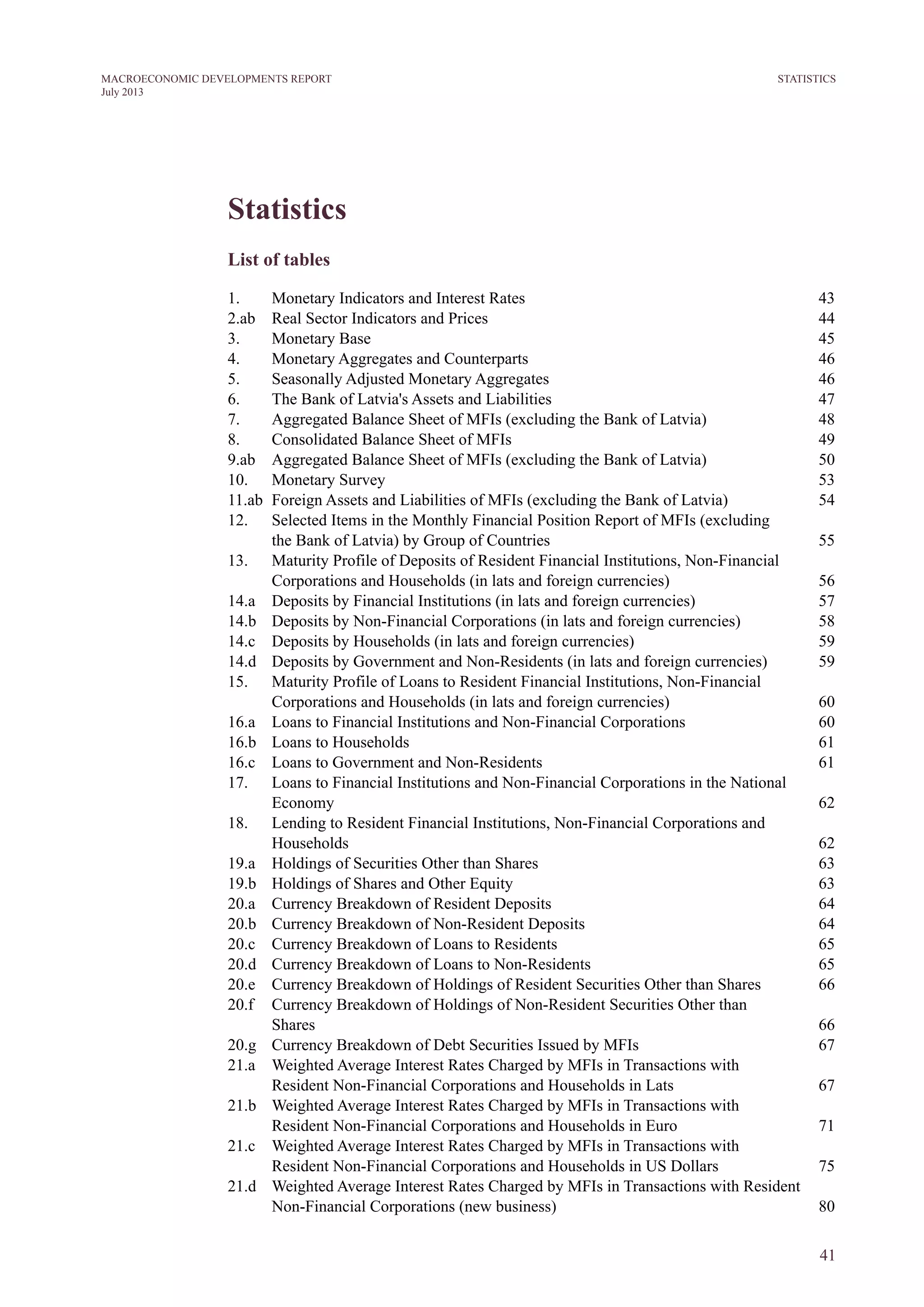
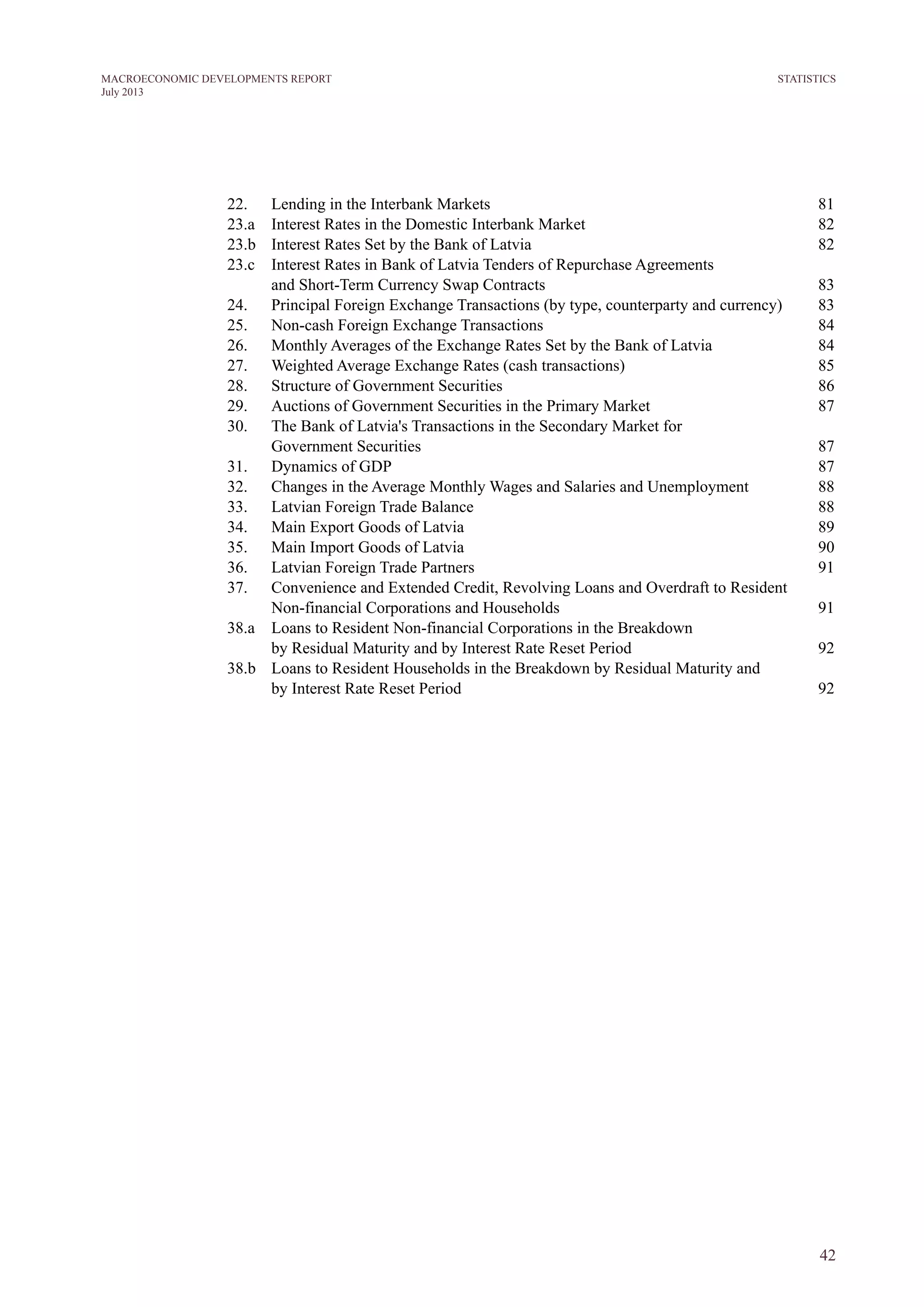
Statistics	41
Additional Information	 93
3
MACROECONOMIC DEVELOPMENTS REPORT
July 2013
Abbreviations
CIF – cost, insurance and freight at the importer's border
CPI – Consumer Price Index
CSB – Central Statistical Bureau of Latvia
EC – European Commission
ECB – European Central Bank
ESA 95 – European System of Accounts 1995
EU – European Union
EU12 – countries which joined the EU on 1 May 2004 and on 1 January 2007
EU15 – EU countries before 1 May 2004
EU27 – EU countries before 1 July 2013
EURIBOR – Euro Interbank Offered Rate
FOB – free on board at the exporter's border
FCMC – Financial and Capital Market Commission
FRS – Federal Reserve System
GDP – gross domestic product
HICP – Harmonised Index of Consumer Prices
IMF – International Monetary Fund
JSC – joint stock company
MPC – mandatory procurement component
MFI – monetary financial institution
NA – no answer
NI – no information
OECD – Organisation for Economic Cooperation and Development
OFI – other financial intermediary (other than an insurance corporation or a pension fund)
OMXR – NASDAQ OMX Riga index
PPI – Producer Price Index
RIGIBOR – Riga Interbank Offered Rate
SEA – State Employment Agency
SJSC – state joint stock company
ULC – unit labour costs
UK – United Kingdom
UN – United Nations
US – United States of America
VAT – value added tax
WTO – World Trade Organisation
ABBREVIATIONS
4
M ACROECONOM I C DEVELOPM ENTS REPORT
J uly 2013
Executive Summary
As the growth in the first quarter was slower than expected, the IMF lowered substantially its
economic growth forecast for 2013 for a number of countries. In three major trade partners
of Latvia, i.e. Estonia, Lithuania and Russia, a rather rapid growth is anticipated, yet the
2013 growth forecasts for these countries are gradually declining as well.
Despite the stagnation observed in the external markets, the expansion of Latvia's exports
of goods at the beginning of 2013 was driven by the exporters' competitiveness. However,
as a result of the contracting external demand and on account of the base effect, the annual
growth rate of Latvian exports decelerated.
A decrease in currency in circulation as the population prepared for the euro changeover,
as well as the lats market exchange rate against the euro approaching the peg rate were the
major monetary developments. Moreover, in view of Latvia's prospective joining the euro
area, the lats money market rates of all maturities continued on a downward trend; hence, the
spread between the lats and euro market rates continued to narrow.
At the same time the annual rate of decrease in loans granted to residents continued on a
downward trend, standing at 4.5% in May. An increase in lending to businesses resumed
in May, following the decline observed in the autumn of 2012. In May, loans granted to
non-financial corporations grew by 0.6%; hence, the annual rate of decrease in loans to non-
financial corporations was a mere 1.7%. With the current trends persisting, more pronounced
growth in lending to non-financial corporations can be expected in the foreseeable future.
In the first quarter of 2013, GDP grew 1.4% quarter-on-quarter and 3.6% year-on-year
(seasonally adjusted data). The above said notwithstanding, most of the provisional data,
when broken by month, point to deceleration in the GDP growth rate. Industrial performance
is moderating, and export expansion is losing momentum. With export expansion
decelerating, private consumption became the main driver of GDP growth in the first quarter.
At the same time, the main factor restricting spending was housing-maintenance-related
expenditure; in 2013, the latter increased mostly due to higher energy consumption. Despite
its pace slowing down, private consumption could be the main contributor to growth in the
next quarters as well; however, it seems unlikely to compensate the slowdown in exports and
investment, therefore moderation of the overall economic growth is expected in the quarters
to come.
In the first five months of 2013, revenue of the consolidated general government budget
continued to grow (by 13.8% year-on-year), mostly as a result of non-tax revenue; tax
revenue expanded by slightly more than 7%, with tax collections somewhat exceeding the
budget plan.
In the first quarter, value added in manufacturing at constant prices recorded a decrease
both year-on-year and quarter-on-quarter. A negative annual and quarterly growth rate was
last seen in the fourth and second quarters of 2009 respectively. The signals from business
surveys differ, albeit overall the concern about the future development of the sector deepens.
Businesses still reported the limited demand to be the major growth-restrictive factor in the
second quarter of 2013, and the value of the above indicator reversed again after following
a continued downward path. However, taking into consideration the problems encountered
by Latvia's major manufacturing company and also the manufacture of wood and articles
of wood and cork, the contribution of manufacturing to GDP growth is likely to be negative
also in the second quarter.
EXECUTIVE SUMMARY
5
M ACROECONOM I C DEVELOPM ENTS REPORT
J uly 2013
In the first quarter, value added of the services sector at constant prices recorded a year-on-
year increase. Real estate activities, wholesale and retail trade, transportation and storage
and information and communication services accounted for the major positive contribution.
Preliminary data for the second quarter of 2013 do not suggest any improvement of the
situation in ports and railway.
Unemployment continued on a downward trend while employment was on the rise, pointing
to a further recovery of the Latvian labour market. The registered unemployment rate stood
below 10% in May for the first time in the last four years. The growing number of occupied
posts and vacancies testified to the recovery of labour market; however, its pace differs
within the regions of Latvia.
The average wage and salary slightly exceeded the pre-crisis level and lagged behind its
historic peak somewhat in real terms. However, the increasing wages and salaries were in
balance with the labour productivity growth, thus posing no risks to price stability and the
economic competitiveness.
Annual consumer price inflation, driven by energy prices, declined substantially and was
negative in the context of positive economic growth for the first time since such inflation
statistics has been made available. Inflation drivers were still on the supply side. They
were the resource prices on the global market, on the one hand, and specific features of the
domestic price setting mechanism (an increase in MPC, and price monitoring prior to the
euro changeover), on the other hand.
EXECUTIVE SUMMARY
6
M ACROECONOM I C DEVELOPM ENTS REPORT
J uly 2013
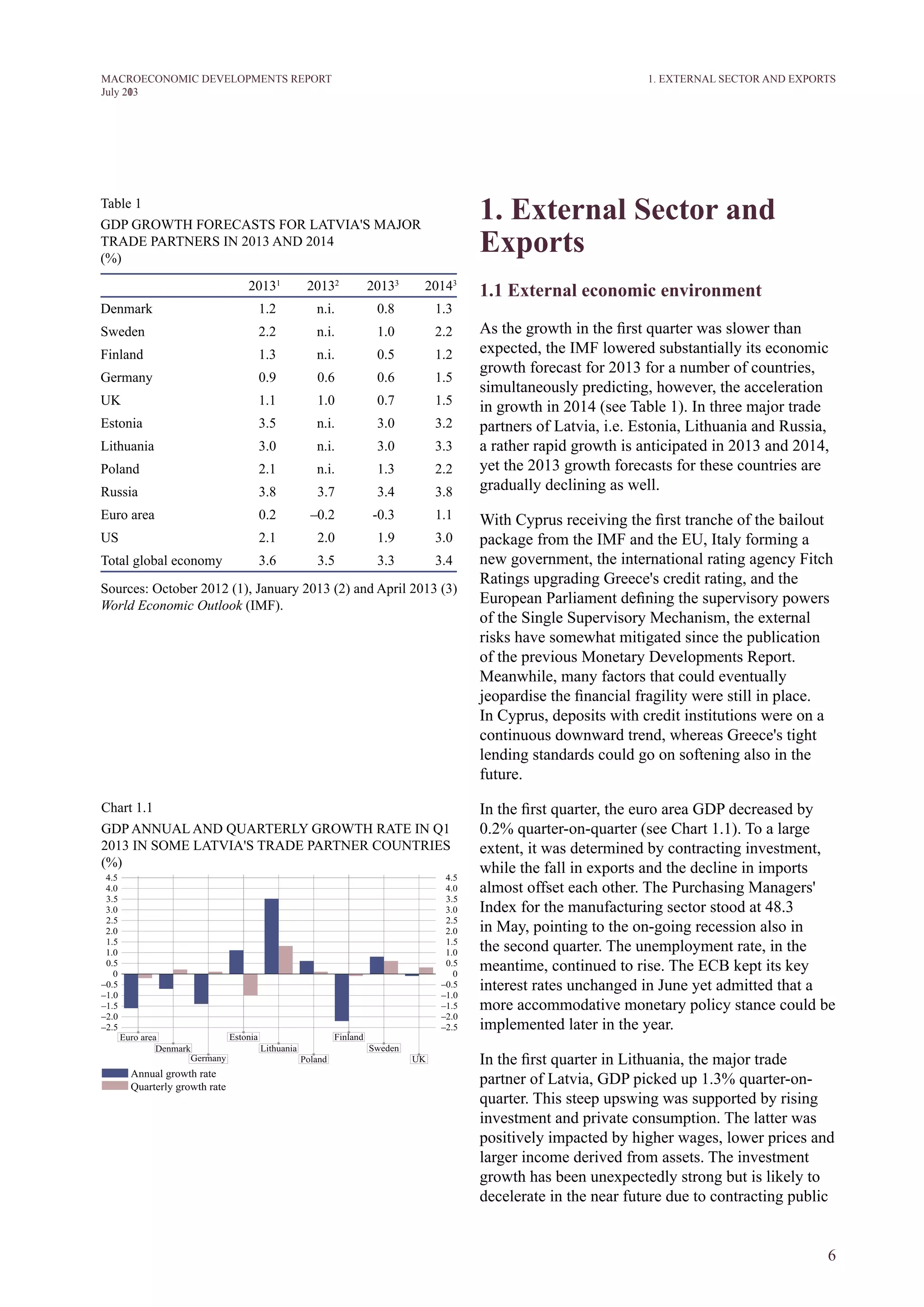
Table 1
GDP GROWTH FORECASTS FOR LATVIA'S MAJOR
TRADE PARTNERS IN 2013 AND 2014
(%)
20131
20132
20133
20143
Denmark 1.2 n.i. 0.8 1.3
Sweden 2.2 n.i. 1.0 2.2
Finland 1.3 n.i. 0.5 1.2
Germany 0.9 0.6 0.6 1.5
UK 1.1 1.0 0.7 1.5
Estonia 3.5 n.i. 3.0 3.2
Lithuania 3.0 n.i. 3.0 3.3
Poland 2.1 n.i. 1.3 2.2
Russia 3.8 3.7 3.4 3.8
Euro area 0.2 –0.2 -0.3 1.1
US 2.1 2.0 1.9 3.0
Total global economy 3.6 3.5 3.3 3.4
Sources: October 2012 (1), January 2013 (2) and April 2013 (3)
World Economic Outlook (IMF).
1. EXTERNAL SECTOR AND EXPORTS
1. External Sector and
Exports
1.1 External economic environment
As the growth in the first quarter was slower than
expected, the IMF lowered substantially its economic
growth forecast for 2013 for a number of countries,
simultaneously predicting, however, the acceleration
in growth in 2014 (see Table 1). In three major trade
partners of Latvia, i.e. Estonia, Lithuania and Russia,
a rather rapid growth is anticipated in 2013 and 2014,
yet the 2013 growth forecasts for these countries are
gradually declining as well.
With Cyprus receiving the first tranche of the bailout
package from the IMF and the EU, Italy forming a
new government, the international rating agency Fitch
Ratings upgrading Greece's credit rating, and the
European Parliament defining the supervisory powers
of the Single Supervisory Mechanism, the external
risks have somewhat mitigated since the publication
of the previous Monetary Developments Report.
Meanwhile, many factors that could eventually
jeopardise the financial fragility were still in place.
In Cyprus, deposits with credit institutions were on a
continuous downward trend, whereas Greece's tight
lending standards could go on softening also in the
future.
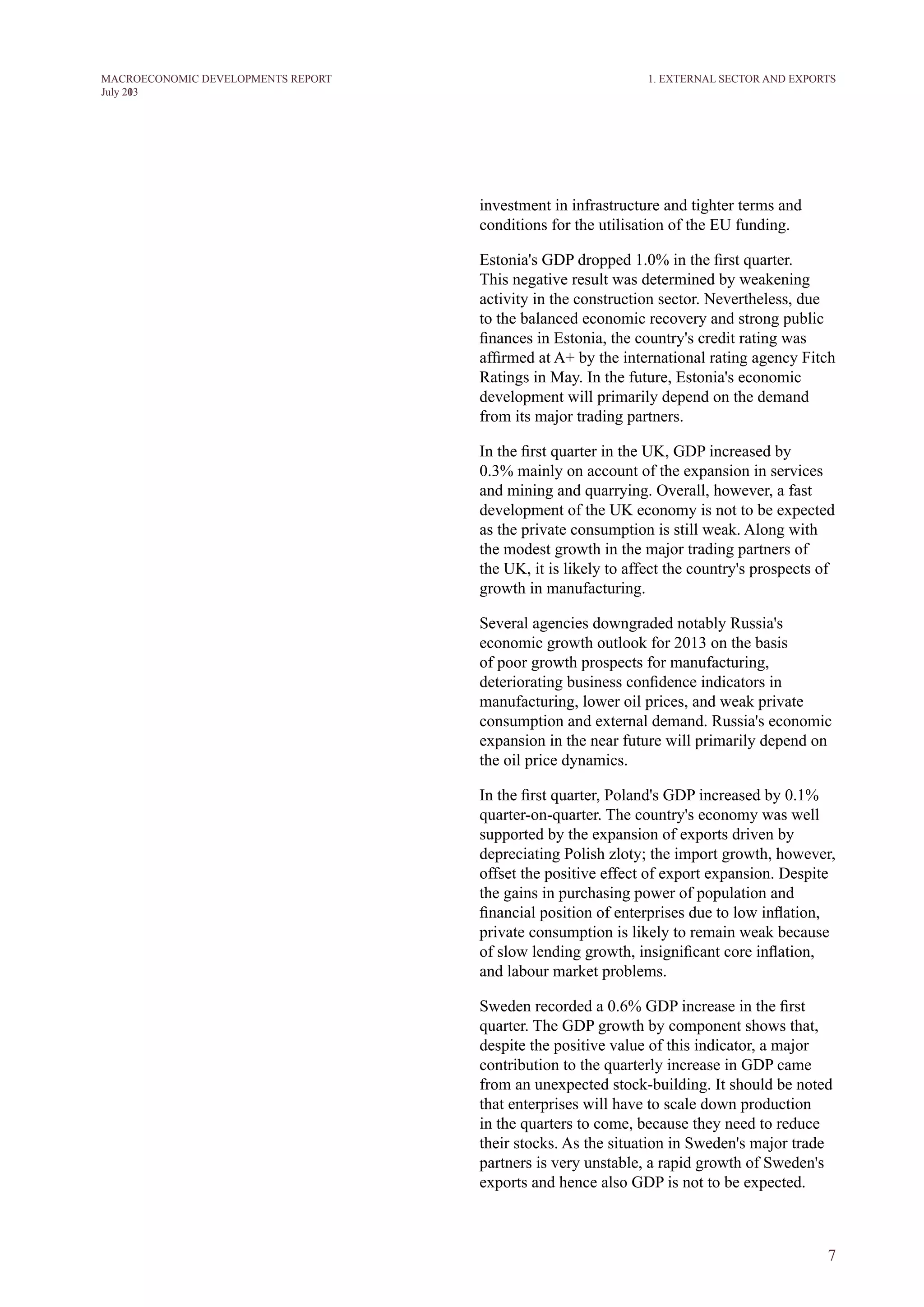
In the first quarter, the euro area GDP decreased by
0.2% quarter-on-quarter (see Chart 1.1). To a large
extent, it was determined by contracting investment,
while the fall in exports and the decline in imports
almost offset each other. The Purchasing Managers'
Index for the manufacturing sector stood at 48.3
in May, pointing to the on-going recession also in
the second quarter. The unemployment rate, in the
meantime, continued to rise. The ECB kept its key
interest rates unchanged in June yet admitted that a
more accommodative monetary policy stance could be
implemented later in the year.
In the first quarter in Lithuania, the major trade
partner of Latvia, GDP picked up 1.3% quarter-on-
quarter. This steep upswing was supported by rising
investment and private consumption. The latter was
positively impacted by higher wages, lower prices and
larger income derived from assets. The investment
growth has been unexpectedly strong but is likely to
decelerate in the near future due to contracting public
Chart 1.1
GDP ANNUAL AND QUARTERLY GROWTH RATE IN Q1
2013 IN SOME LATVIA'S TRADE PARTNER COUNTRIES
(%)
7
M ACROECONOM I C DEVELOPM ENTS REPORT
J uly 2013
investment in infrastructure and tighter terms and
conditions for the utilisation of the EU funding.
Estonia's GDP dropped 1.0% in the first quarter.
This negative result was determined by weakening
activity in the construction sector. Nevertheless, due
to the balanced economic recovery and strong public
finances in Estonia, the country's credit rating was
affirmed at A+ by the international rating agency Fitch
Ratings in May. In the future, Estonia's economic
development will primarily depend on the demand
from its major trading partners.
In the first quarter in the UK, GDP increased by
0.3% mainly on account of the expansion in services
and mining and quarrying. Overall, however, a fast
development of the UK economy is not to be expected
as the private consumption is still weak. Along with
the modest growth in the major trading partners of
the UK, it is likely to affect the country's prospects of
growth in manufacturing.
Several agencies downgraded notably Russia's
economic growth outlook for 2013 on the basis
of poor growth prospects for manufacturing,
deteriorating business confidence indicators in
manufacturing, lower oil prices, and weak private
consumption and external demand. Russia's economic
expansion in the near future will primarily depend on
the oil price dynamics.
In the first quarter, Poland's GDP increased by 0.1%
quarter-on-quarter. The country's economy was well
supported by the expansion of exports driven by
depreciating Polish zloty; the import growth, however,
offset the positive effect of export expansion. Despite
the gains in purchasing power of population and
financial position of enterprises due to low inflation,
private consumption is likely to remain weak because
of slow lending growth, insignificant core inflation,
and labour market problems.
Sweden recorded a 0.6% GDP increase in the first
quarter. The GDP growth by component shows that,
despite the positive value of this indicator, a major
contribution to the quarterly increase in GDP came
from an unexpected stock-building. It should be noted
that enterprises will have to scale down production
in the quarters to come, because they need to reduce
their stocks. As the situation in Sweden's major trade
partners is very unstable, a rapid growth of Sweden's
exports and hence also GDP is not to be expected.
1. EXTERNAL SECTOR AND EXPORTS
8
M ACROECONOM I C DEVELOPM ENTS REPORT
J uly 2013
In Finland, GDP lost 0.1% in the first quarter.
Unemployment is on the rise in this country. The main
indicators do not signal good prospects for economic
progress. Meanwhile, the sluggish external demand
supported a decline in manufacturing. In addition, the
domestic demand was still weak.
In Denmark, GDP picked up 0.2% in the course of
the first quarter. It was on account of a larger-than-
expected increase in private consumption. So far,
however, private consumption has been weak in
Denmark, and this one-off pickup does not imply a
change in the trend for the time being. The rise in
private consumption is likely to be hindered by slowly
growing wages and also by the fact that in an attempt
to succeed in debt servicing the Danish people are
more often opting for saving and investing in financial
assets than spending.
1.2 Latvia's competitiveness and expansion
of commodity exports
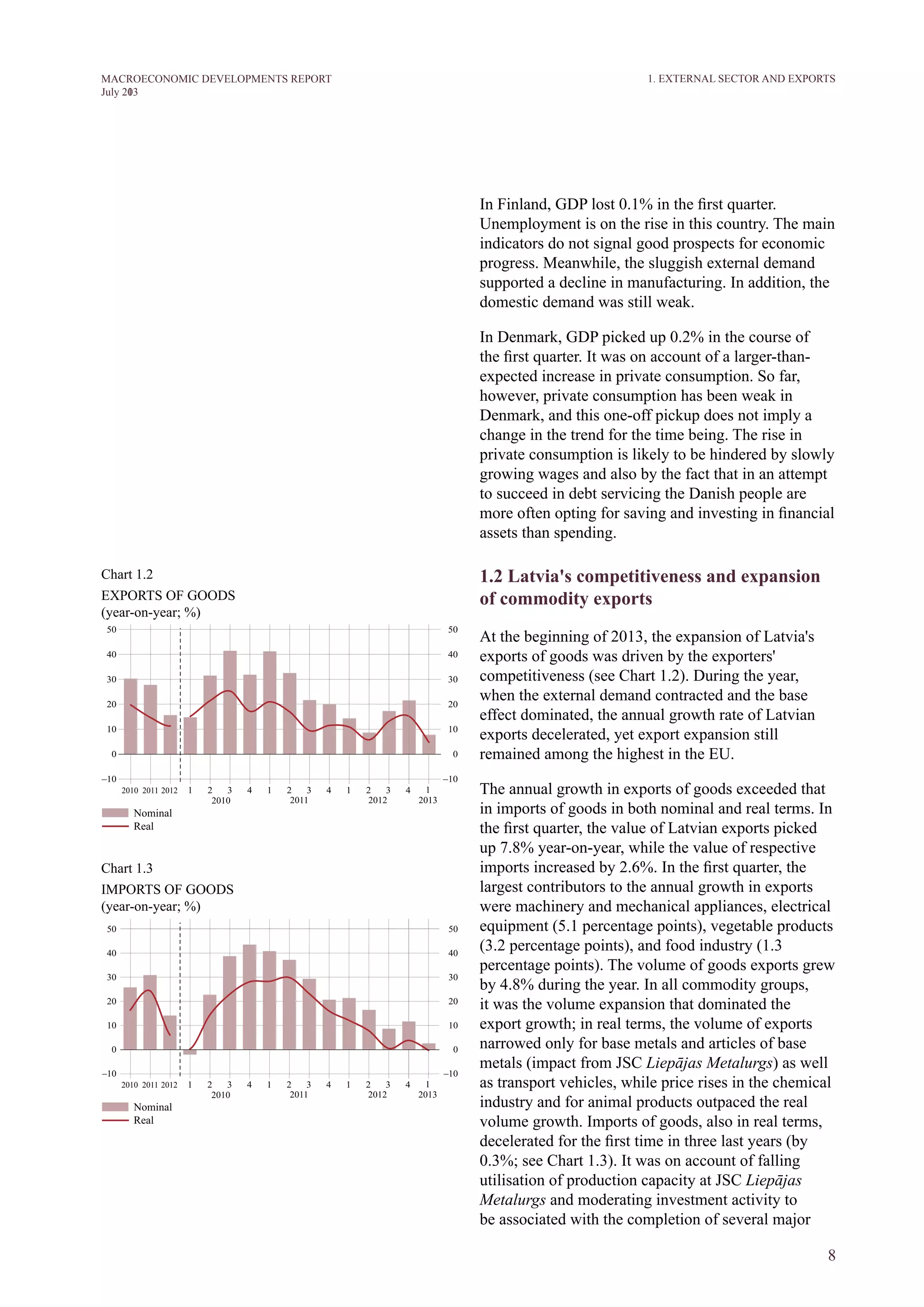
At the beginning of 2013, the expansion of Latvia's
exports of goods was driven by the exporters'
competitiveness (see Chart 1.2). During the year,
when the external demand contracted and the base
effect dominated, the annual growth rate of Latvian
exports decelerated, yet export expansion still
remained among the highest in the EU.
The annual growth in exports of goods exceeded that
in imports of goods in both nominal and real terms. In
the first quarter, the value of Latvian exports picked
up 7.8% year-on-year, while the value of respective
imports increased by 2.6%. In the first quarter, the
largest contributors to the annual growth in exports
were machinery and mechanical appliances, electrical
equipment (5.1 percentage points), vegetable products
(3.2 percentage points), and food industry (1.3
percentage points). The volume of goods exports grew
by 4.8% during the year. In all commodity groups,
it was the volume expansion that dominated the
export growth; in real terms, the volume of exports
narrowed only for base metals and articles of base
metals (impact from JSC Liepājas Metalurgs) as well
as transport vehicles, while price rises in the chemical
industry and for animal products outpaced the real
volume growth. Imports of goods, also in real terms,
decelerated for the first time in three last years (by
0.3%; see Chart 1.3). It was on account of falling
utilisation of production capacity at JSC Liepājas
Metalurgs and moderating investment activity to
be associated with the completion of several major
Chart 1.2
EXPORTS OF GOODS
(year-on-year; %)
Chart 1.3
IMPORTS OF GOODS
(year-on-year; %)
1. EXTERNAL SECTOR AND EXPORTS
9
M ACROECONOM I C DEVELOPM ENTS REPORT
J uly 2013
1. EXTERNAL SECTOR AND EXPORTS
investment projects, including the TEC (heat and
power generating plant) project.
According to the first quarter data provided by the
WTO, Latvia's export market share in global imports
contracted by 14.0% vis-á-vis the fourth quarter of
2012; year-on-year, however, an increase was still
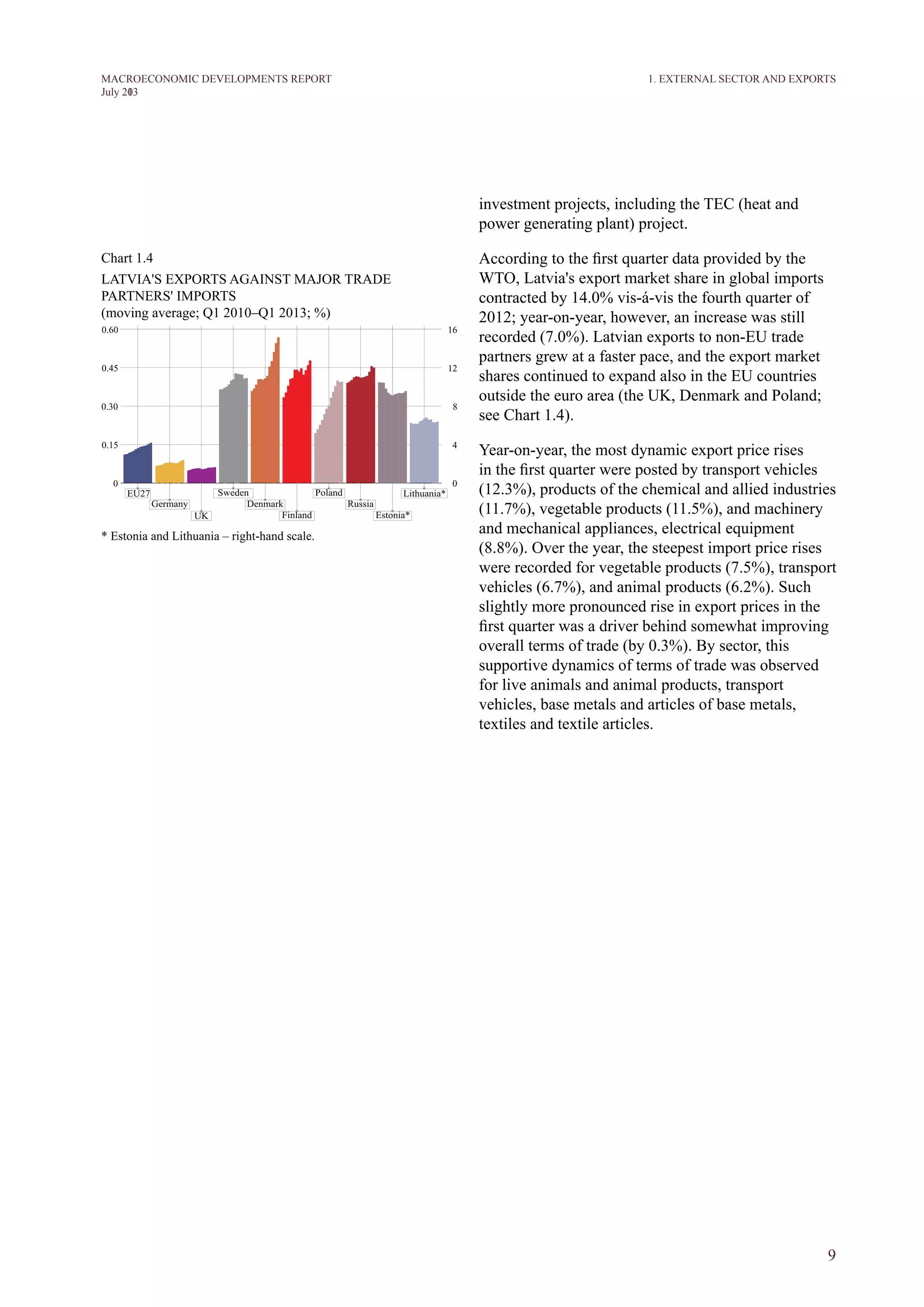
recorded (7.0%). Latvian exports to non-EU trade
partners grew at a faster pace, and the export market
shares continued to expand also in the EU countries
outside the euro area (the UK, Denmark and Poland;
see Chart 1.4).
Year-on-year, the most dynamic export price rises
in the first quarter were posted by transport vehicles
(12.3%), products of the chemical and allied industries
(11.7%), vegetable products (11.5%), and machinery
and mechanical appliances, electrical equipment
(8.8%). Over the year, the steepest import price rises
were recorded for vegetable products (7.5%), transport
vehicles (6.7%), and animal products (6.2%). Such
slightly more pronounced rise in export prices in the
first quarter was a driver behind somewhat improving
overall terms of trade (by 0.3%). By sector, this
supportive dynamics of terms of trade was observed
for live animals and animal products, transport
vehicles, base metals and articles of base metals,
textiles and textile articles.
Chart 1.4
LATVIA'S EXPORTS AGAINST MAJOR TRADE
PARTNERS' IMPORTS
(moving average; Q1 2010–Q1 2013; %)
* Estonia and Lithuania – right-hand scale.
10
M ACROECONOM I C DEVELOPM ENTS REPORT
J uly 2013
2. Financial market
developments
2.1 Foreign financial markets
In February 2013, the European financial markets
were gripped by stronger anxiety about the
parliamentary election results in Italy and the
situation in Cyprus which needed a new agreement
on the bailout package. The initial agreement and
particularly the proposed all-inclusive bank deposit
levy had set off a strong wave of domestic protests
and international repercussions. Consequently, the
negotiations about a more acceptable version of
the bailout programme had to be continued, and
the Cypriot President and the EU and IMF officials
managed to reach the final agreement only at the end
of March.
The settlement of the Cyprus issue was followed by
positive developments in the euro area countries in
April and May: market participants' risk aversion
softened and their risk appetites, i.e. investing in
more risky assets, grew. In the reviewed period,
Portugal and Ireland both got a seven-year bailout
loan extension, the next tranche of the bailout package
was approved for Greece, and the international rating
agency Fitch Ratings upgraded Greece's sovereign
credit rating a notch (to B–) with a stable future
outlook. Following a protracted period of political
uncertainty, Italy got a new government, while
Slovenia succeeded in issuing bonds despite its
downgraded sovereign credit rating. The European
Parliament played an important role in reducing
market participants' risk aversion: it adopted
legislative acts establishing the powers of the Single
Supervisory Mechanism. However, at the end of
May and beginning of June, market participants were
feeling worrisome about the euro area economic
performance which suggested that the gradual euro
area recovery might be delayed and its magnitude
might fall behind the expected. Similarly, some
market unrest was caused by publicly spreading
suppositions regarding the need to write off a part of
Greece's debt in a couple of years to come.
Consistently with the dynamic developments,
European stock market prices were volatile. They
were rising between mid-February and mid-March,
yet, given the market participants' risk aversion and
concerns about bank potential losses, which were
spurred by the events in Cyprus and other European
2. FINANCIAL MARKET DEVELOPMENTS
11
M ACROECONOM I C DEVELOPM ENTS REPORT
J uly 2013
countries hit by the debt crisis, the stock prices
moderated in the period from mid-March to mid-
April. Later, from mid-April to the beginning of
June, when the situation in Cyprus stabilised in line
with the market participants' inclination to invest
in riskier assets and sustainably low bond yields,
European stock market prices climbed up. In June, the
situation reverted again under the impact of dropping
stock prices in other global stock markets and with
the discussion regarding the necessity to write off
Greece's sovereign debt over a longer horizon re-
emerging. Between 15 February and 15 June, the
European stock market index DJ EURO STOXX 50
moved up by 2.0%. In the reference period, the MSCI
stock price indices' provider resolved to reclassify
Greece from Developed Markets to Emerging Markets
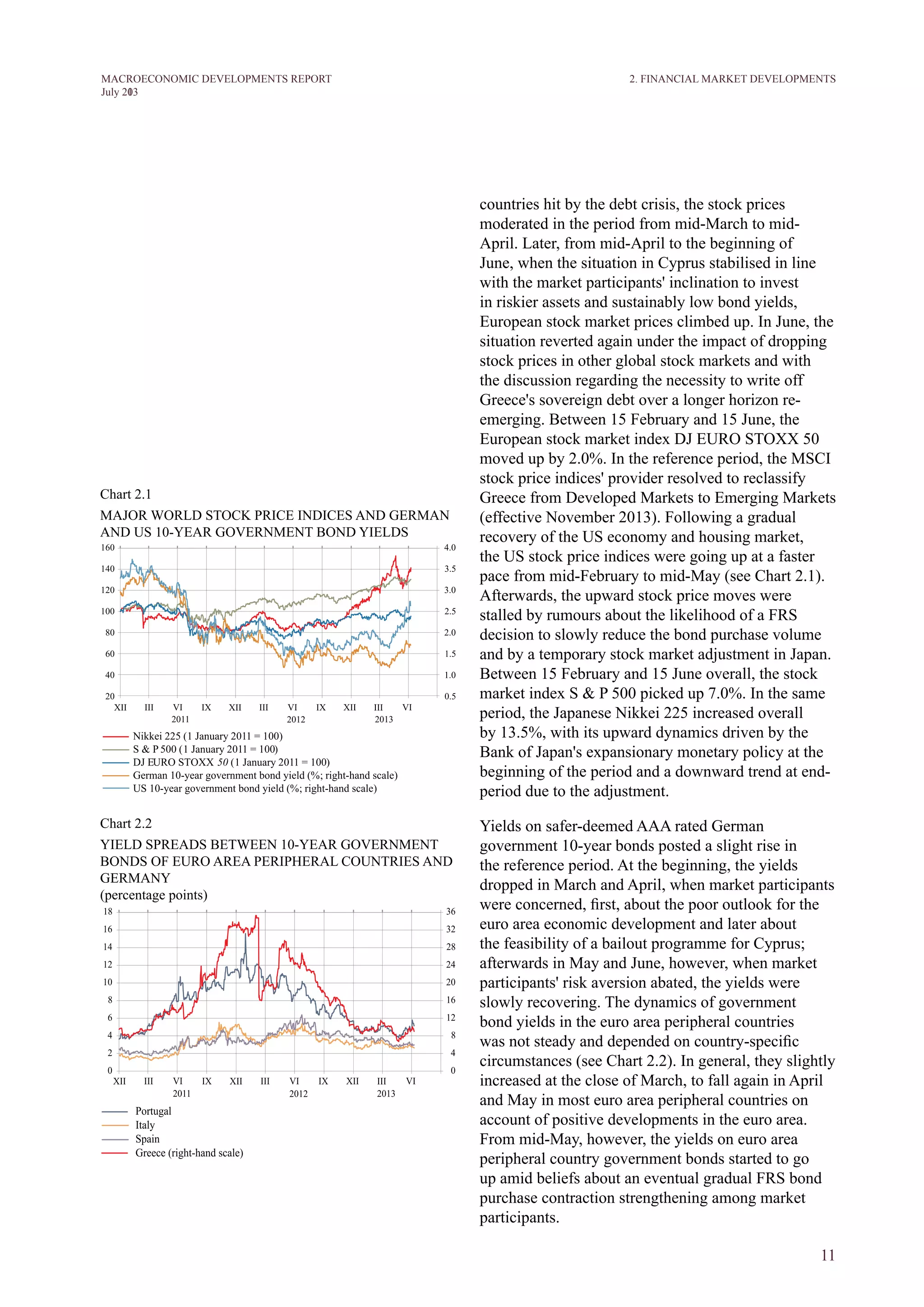
(effective November 2013). Following a gradual
recovery of the US economy and housing market,
the US stock price indices were going up at a faster
pace from mid-February to mid-May (see Chart 2.1).
Afterwards, the upward stock price moves were
stalled by rumours about the likelihood of a FRS
decision to slowly reduce the bond purchase volume
and by a temporary stock market adjustment in Japan.
Between 15 February and 15 June overall, the stock
market index S & P 500 picked up 7.0%. In the same
period, the Japanese Nikkei 225 increased overall
by 13.5%, with its upward dynamics driven by the
Bank of Japan's expansionary monetary policy at the
beginning of the period and a downward trend at end-
period due to the adjustment.
Yields on safer-deemed AAA rated German
government 10-year bonds posted a slight rise in
the reference period. At the beginning, the yields
dropped in March and April, when market participants
were concerned, first, about the poor outlook for the
euro area economic development and later about
the feasibility of a bailout programme for Cyprus;
afterwards in May and June, however, when market
participants' risk aversion abated, the yields were
slowly recovering. The dynamics of government
bond yields in the euro area peripheral countries
was not steady and depended on country-specific
circumstances (see Chart 2.2). In general, they slightly
increased at the close of March, to fall again in April
and May in most euro area peripheral countries on
account of positive developments in the euro area.
From mid-May, however, the yields on euro area
peripheral country government bonds started to go
up amid beliefs about an eventual gradual FRS bond
purchase contraction strengthening among market
participants.
Chart 2.1
MAJOR WORLD STOCK PRICE INDICES AND GERMAN
AND US 10-YEAR GOVERNMENT BOND YIELDS
Chart 2.2
YIELD SPREADS BETWEEN 10-YEAR GOVERNMENT
BONDS OF EURO AREA PERIPHERAL COUNTRIES AND
GERMANY
(percentage points)
2. FINANCIAL MARKET DEVELOPMENTS
12
M ACROECONOM I C DEVELOPM ENTS REPORT
J uly 2013
2. FINANCIAL MARKET DEVELOPMENTS
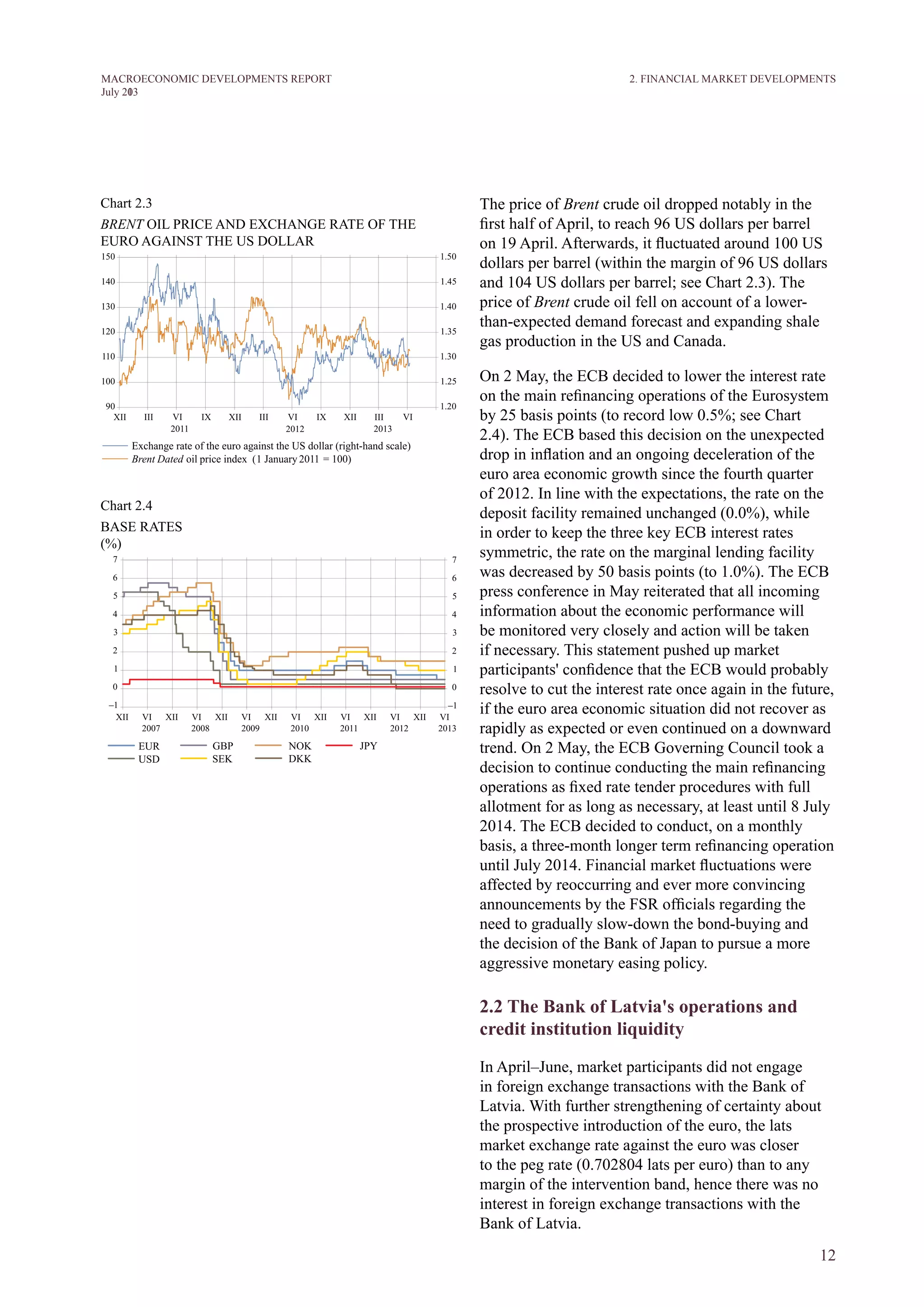
The price of Brent crude oil dropped notably in the
first half of April, to reach 96 US dollars per barrel
on 19 April. Afterwards, it fluctuated around 100 US
dollars per barrel (within the margin of 96 US dollars
and 104 US dollars per barrel; see Chart 2.3). The
price of Brent crude oil fell on account of a lower-
than-expected demand forecast and expanding shale
gas production in the US and Canada.
On 2 May, the ECB decided to lower the interest rate
on the main refinancing operations of the Eurosystem
by 25 basis points (to record low 0.5%; see Chart
2.4). The ECB based this decision on the unexpected
drop in inflation and an ongoing deceleration of the
euro area economic growth since the fourth quarter
of 2012. In line with the expectations, the rate on the
deposit facility remained unchanged (0.0%), while
in order to keep the three key ECB interest rates
symmetric, the rate on the marginal lending facility
was decreased by 50 basis points (to 1.0%). The ECB
press conference in May reiterated that all incoming
information about the economic performance will
be monitored very closely and action will be taken
if necessary. This statement pushed up market
participants' confidence that the ECB would probably
resolve to cut the interest rate once again in the future,
if the euro area economic situation did not recover as
rapidly as expected or even continued on a downward
trend. On 2 May, the ECB Governing Council took a
decision to continue conducting the main refinancing
operations as fixed rate tender procedures with full
allotment for as long as necessary, at least until 8 July
2014. The ECB decided to conduct, on a monthly
basis, a three-month longer term refinancing operation
until July 2014. Financial market fluctuations were
affected by reoccurring and ever more convincing
announcements by the FSR officials regarding the
need to gradually slow-down the bond-buying and
the decision of the Bank of Japan to pursue a more
aggressive monetary easing policy.
2.2 The Bank of Latvia's operations and
credit institution liquidity
In April–June, market participants did not engage
in foreign exchange transactions with the Bank of
Latvia. With further strengthening of certainty about
the prospective introduction of the euro, the lats
market exchange rate against the euro was closer
to the peg rate (0.702804 lats per euro) than to any
margin of the intervention band, hence there was no
interest in foreign exchange transactions with the
Bank of Latvia.
Chart 2.3
BrEnt OIL PRICE AND EXCHANGE RATE OF THE
EURO AGAINST THE US DOLLAR
Chart 2.4
bASE RATES
(%)
13
M ACROECONOM I C DEVELOPM ENTS REPORT
J uly 2013
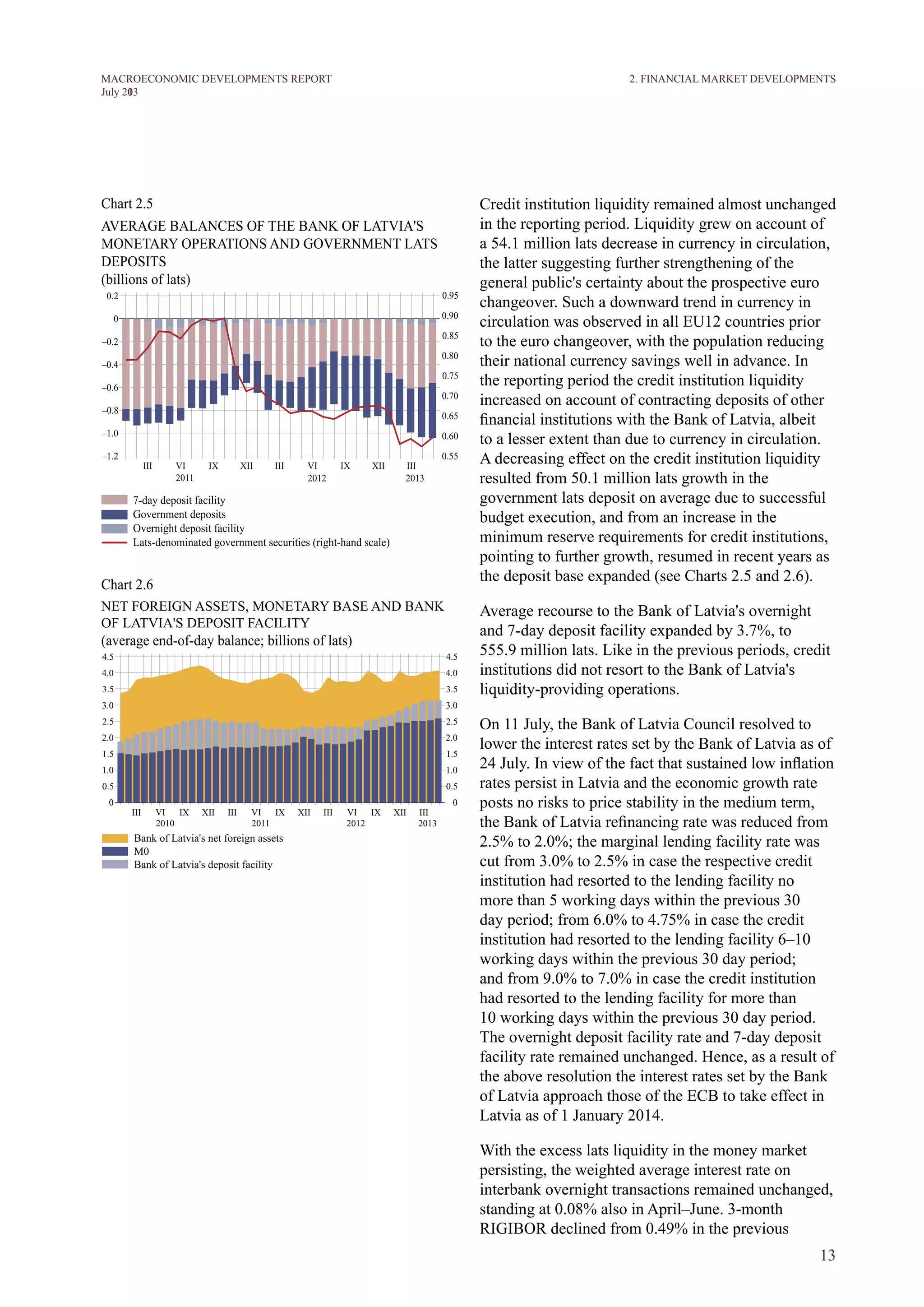
Credit institution liquidity remained almost unchanged
in the reporting period. Liquidity grew on account of
a 54.1 million lats decrease in currency in circulation,
the latter suggesting further strengthening of the
general public's certainty about the prospective euro
changeover. Such a downward trend in currency in
circulation was observed in all EU12 countries prior
to the euro changeover, with the population reducing
their national currency savings well in advance. In
the reporting period the credit institution liquidity
increased on account of contracting deposits of other
financial institutions with the Bank of Latvia, albeit
to a lesser extent than due to currency in circulation.
A decreasing effect on the credit institution liquidity
resulted from 50.1 million lats growth in the
government lats deposit on average due to successful
budget execution, and from an increase in the
minimum reserve requirements for credit institutions,
pointing to further growth, resumed in recent years as
the deposit base expanded (see Charts 2.5 and 2.6).
Average recourse to the Bank of Latvia's overnight
and 7-day deposit facility expanded by 3.7%, to
555.9 million lats. Like in the previous periods, credit
institutions did not resort to the Bank of Latvia's
liquidity-providing operations.
On 11 July, the Bank of Latvia Council resolved to
lower the interest rates set by the Bank of Latvia as of
24 July. In view of the fact that sustained low inflation
rates persist in Latvia and the economic growth rate
posts no risks to price stability in the medium term,
the Bank of Latvia refinancing rate was reduced from
2.5% to 2.0%; the marginal lending facility rate was
cut from 3.0% to 2.5% in case the respective credit
institution had resorted to the lending facility no
more than 5 working days within the previous 30
day period; from 6.0% to 4.75% in case the credit
institution had resorted to the lending facility 6–10
working days within the previous 30 day period;
and from 9.0% to 7.0% in case the credit institution
had resorted to the lending facility for more than
10 working days within the previous 30 day period.
The overnight deposit facility rate and 7-day deposit
facility rate remained unchanged. Hence, as a result of
the above resolution the interest rates set by the Bank
of Latvia approach those of the ECB to take effect in
Latvia as of 1 January 2014.
With the excess lats liquidity in the money market
persisting, the weighted average interest rate on
interbank overnight transactions remained unchanged,
standing at 0.08% also in April–June. 3-month
RIGIBOR declined from 0.49% in the previous
2. FINANCIAL MARKET DEVELOPMENTS
Chart 2.5
AVERAGE BALANCES OF THE BANK OF LATVIA'S
MONETARY OPERATIONS AND GOVERNMENT LATS
DEPOSITS
(billions of lats)
Chart 2.6
NET FOREIGN ASSETS, MONETARY BASE AND BANK
OF LATVIA'S DEPOSIT FACILITY
(average end-of-day balance; billions of lats)
14
M ACROECONOM I C DEVELOPM ENTS REPORT
J uly 2013
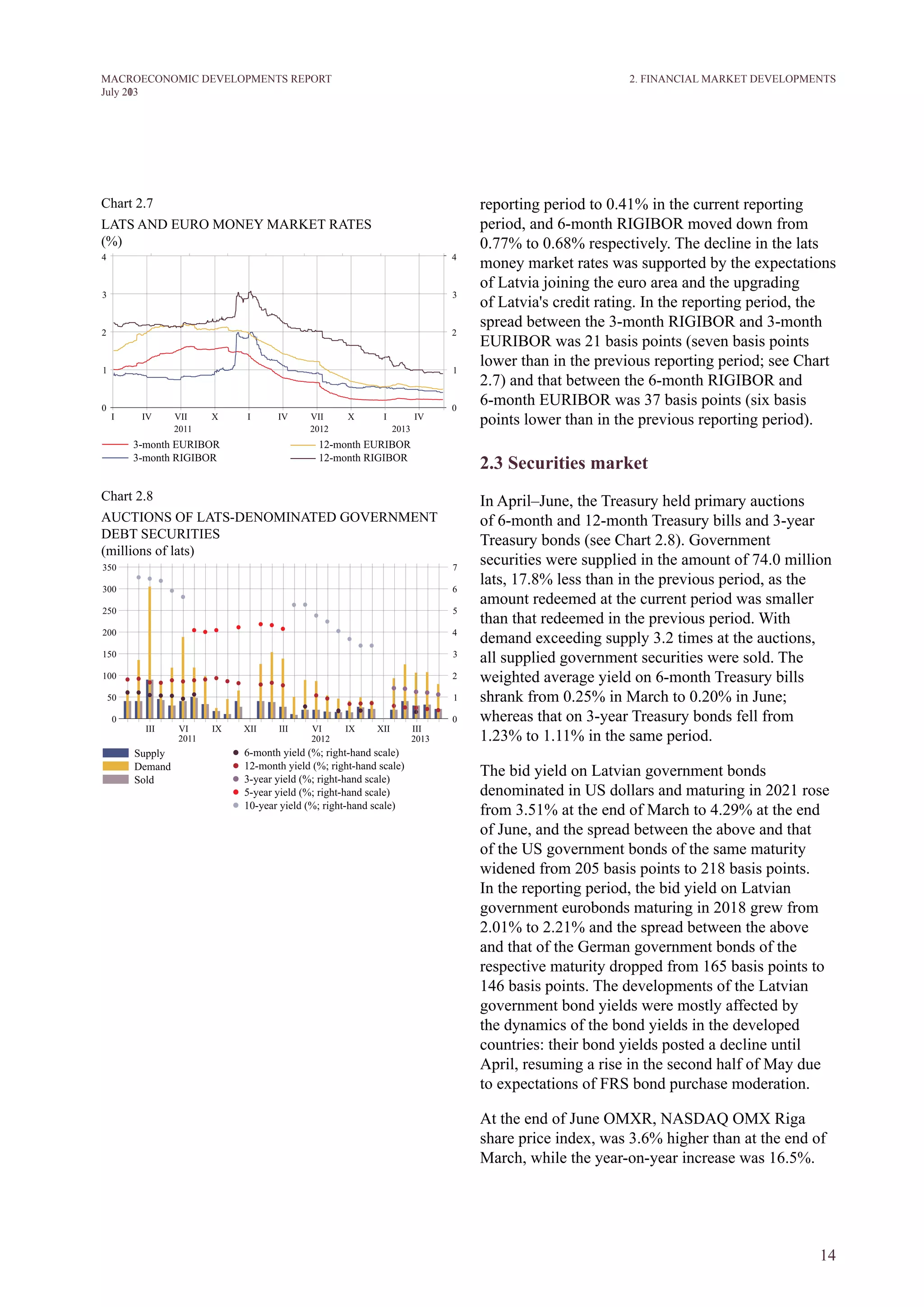
reporting period to 0.41% in the current reporting
period, and 6-month RIGIBOR moved down from
0.77% to 0.68% respectively. The decline in the lats
money market rates was supported by the expectations
of Latvia joining the euro area and the upgrading
of Latvia's credit rating. In the reporting period, the
spread between the 3-month RIGIBOR and 3-month
EURIBOR was 21 basis points (seven basis points
lower than in the previous reporting period; see Chart
2.7) and that between the 6-month RIGIBOR and
6-month EURIBOR was 37 basis points (six basis
points lower than in the previous reporting period).
2.3 Securities market
In April–June, the Treasury held primary auctions
of 6-month and 12-month Treasury bills and 3-year
Treasury bonds (see Chart 2.8). Government
securities were supplied in the amount of 74.0 million
lats, 17.8% less than in the previous period, as the
amount redeemed at the current period was smaller
than that redeemed in the previous period. With
demand exceeding supply 3.2 times at the auctions,
all supplied government securities were sold. The
weighted average yield on 6-month Treasury bills
shrank from 0.25% in March to 0.20% in June;
whereas that on 3-year Treasury bonds fell from
1.23% to 1.11% in the same period.
The bid yield on Latvian government bonds
denominated in US dollars and maturing in 2021 rose
from 3.51% at the end of March to 4.29% at the end
of June, and the spread between the above and that
of the US government bonds of the same maturity
widened from 205 basis points to 218 basis points.
In the reporting period, the bid yield on Latvian
government eurobonds maturing in 2018 grew from
2.01% to 2.21% and the spread between the above
and that of the German government bonds of the
respective maturity dropped from 165 basis points to
146 basis points. The developments of the Latvian
government bond yields were mostly affected by
the dynamics of the bond yields in the developed
countries: their bond yields posted a decline until
April, resuming a rise in the second half of May due
to expectations of FRS bond purchase moderation.
At the end of June OMXR, NASDAQ OMX Riga
share price index, was 3.6% higher than at the end of
March, while the year-on-year increase was 16.5%.
2. FINANCIAL MARKET DEVELOPMENTS
Chart 2.7
LATS AND EURO MONEY MARKET RATES
(%)
Chart 2.8
AUCTIONS OF LATS-DENOMINATED GOVERNMENT
DEBT SECURITIES
(millions of lats)
15
M ACROECONOM I C DEVELOPM ENTS REPORT
J uly 2013
2.4 Interest rates
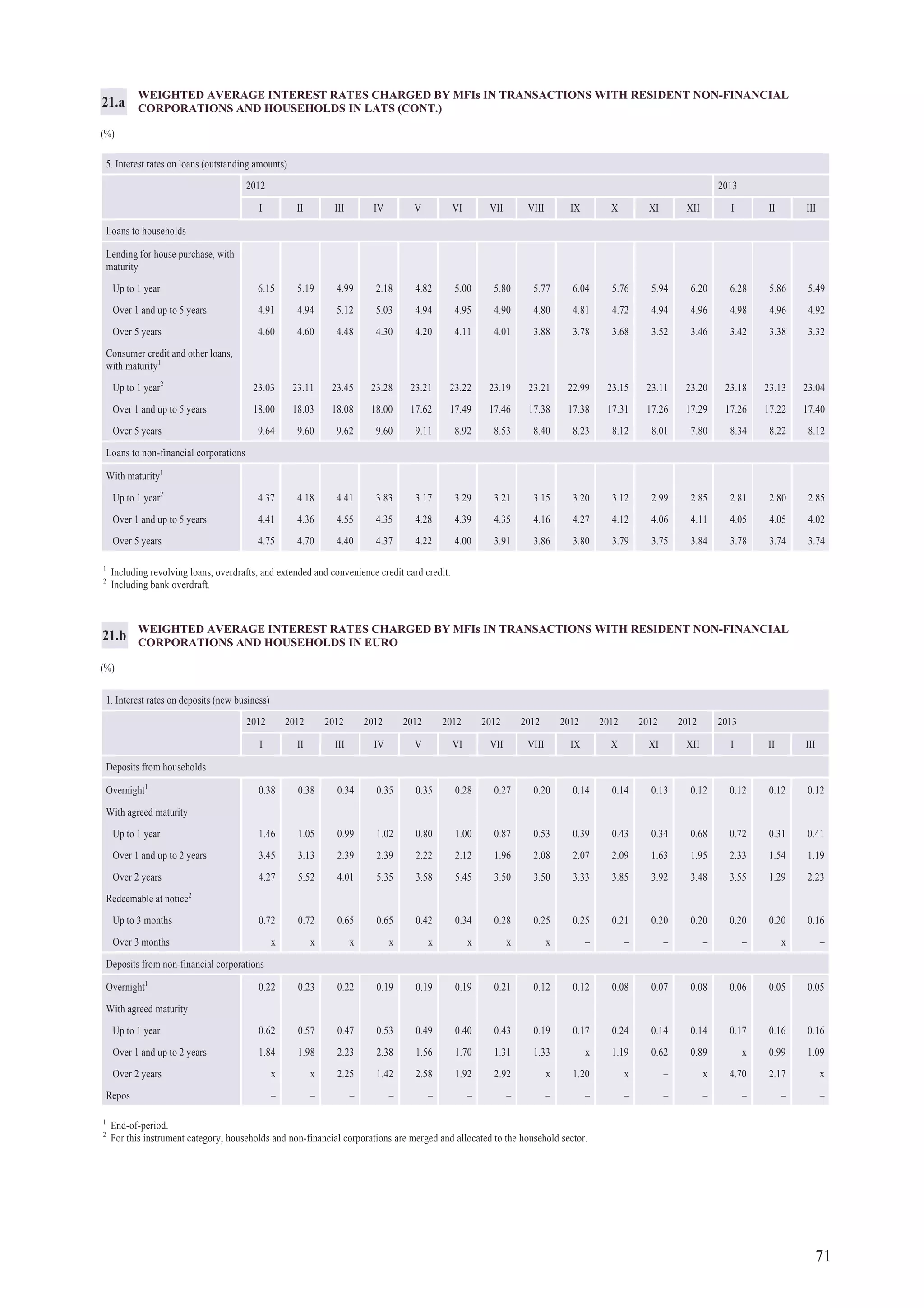
In March–May MFIs granted more loans to non-
financial corporations, offering for the most demanded
loans (granted in euro) pricing conditions similar to
the previous ones.
Financing cost gap between the non-financial
corporations which have been granted large size loans
and those with small or medium size loans almost
disappeared. Nevertheless, the MFIs dominating on
the lending market were less favourably inclined
towards households: the spreads on new loans to
households and non-interest payments slightly
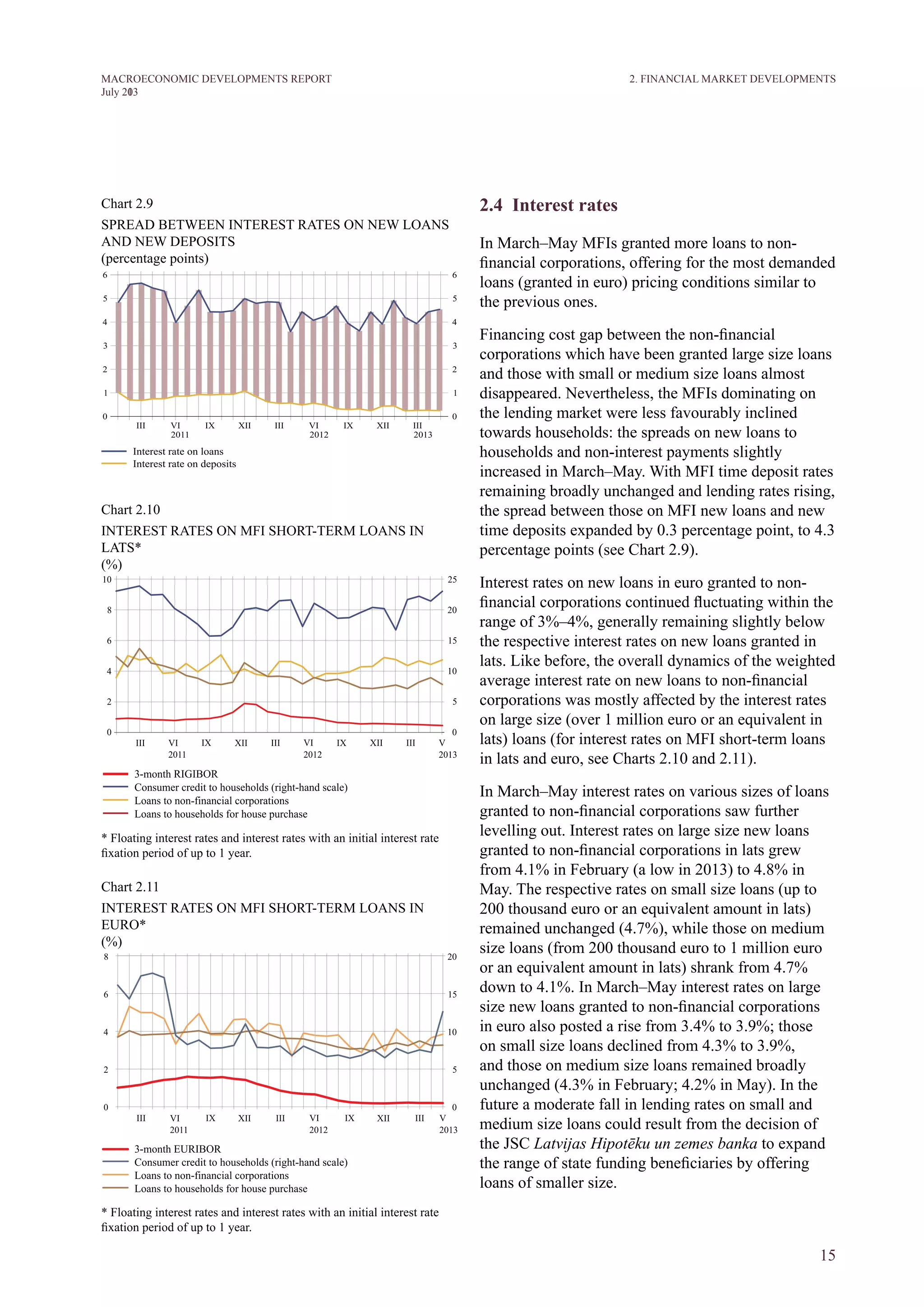
increased in March–May. With MFI time deposit rates
remaining broadly unchanged and lending rates rising,
the spread between those on MFI new loans and new
time deposits expanded by 0.3 percentage point, to 4.3
percentage points (see Chart 2.9).
Interest rates on new loans in euro granted to non-
financial corporations continued fluctuating within the
range of 3%–4%, generally remaining slightly below
the respective interest rates on new loans granted in
lats. Like before, the overall dynamics of the weighted
average interest rate on new loans to non-financial
corporations was mostly affected by the interest rates
on large size (over 1 million euro or an equivalent in
lats) loans (for interest rates on MFI short-term loans
in lats and euro, see Charts 2.10 and 2.11).
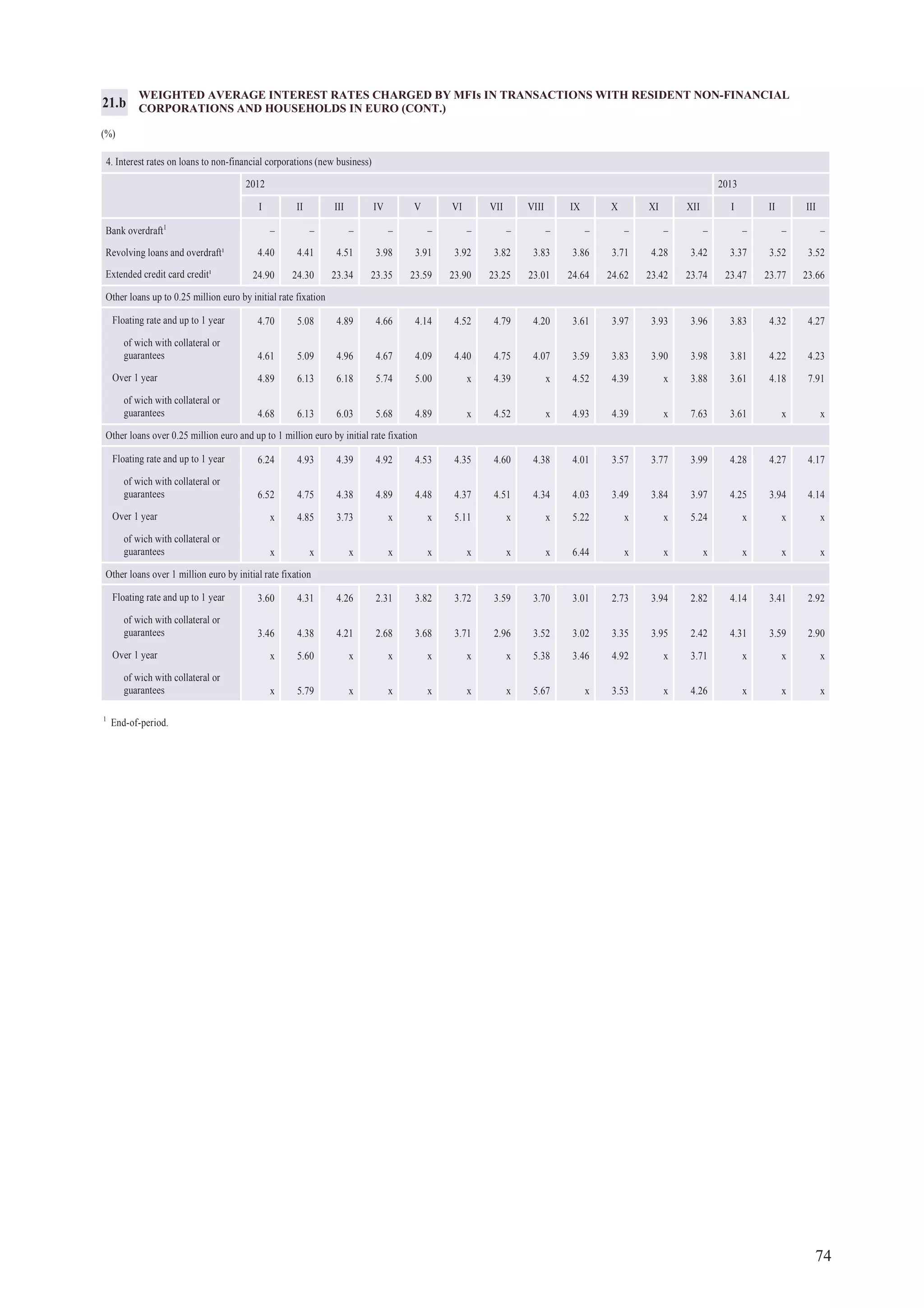
In March–May interest rates on various sizes of loans
granted to non-financial corporations saw further
levelling out. Interest rates on large size new loans
granted to non-financial corporations in lats grew
from 4.1% in February (a low in 2013) to 4.8% in
May. The respective rates on small size loans (up to
250 thousand euro or an equivalent amount in lats)
remained unchanged (4.7%), while those on medium
size loans (from 250 thousand euro to 1 million euro
or an equivalent amount in lats) shrank from 4.7%
down to 4.1%. In March–May interest rates on large
size new loans granted to non-financial corporations
in euro also posted a rise from 3.4% to 3.9%; those
on small size loans declined from 4.3% to 3.9%,
and those on medium size loans remained broadly
unchanged (4.3% in February; 4.2% in May). In the
future a moderate fall in lending rates on small and
medium size loans could result from the decision of
the JSC Latvijas Hipotēku un zemes banka to expand
the range of state funding beneficiaries by offering
loans of smaller size.
Chart 2.9
SPREAD BETWEEN INTEREST RATES ON NEW LOANS
AND NEW DEPOSITS
(percentage points)
Chart 2.10
INTEREST RATES ON MFI SHORT-TERM LOANS IN
LATS*
(%)
* Floating interest rates and interest rates with an initial interest rate
fixation period of up to 1 year.
Chart 2.11
INTEREST RATES ON MFI SHORT-TERM LOANS IN
EURO*
(%)
* Floating interest rates and interest rates with an initial interest rate
fixation period of up to 1 year.
2. FINANCIAL MARKET DEVELOPMENTS
16
MACROECONOMIC DEVELOPMENTS REPORT
July 2013
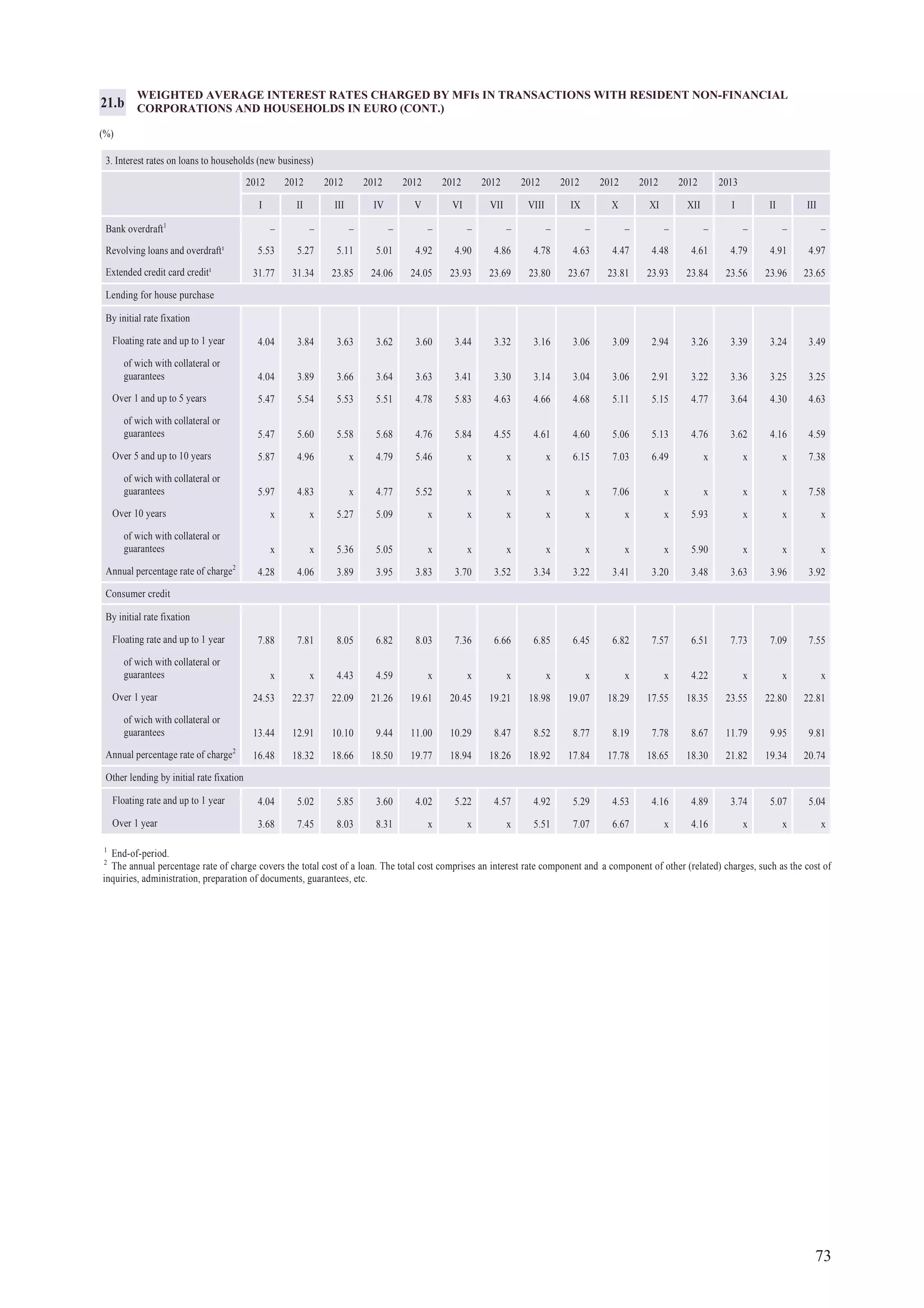
As expected, the rise in interest rate on new euro loans
to households for house purchase with the floating
rate and initial rate fixation period of up to 1 year,
observed in late 2012, was permanent as a result
of an increase in the interest rate spread over the
money market index. Also in March–May the above
interest rate fluctuated at 3.3%–3.5%, exceeding a
low of 2.9%, reached in November 2012, as several
market segment players further tightened their pricing
conditions and the share of higher-risk loans in
aggregate loans expanded.
The interest rates on loans to households for house
purchase granted in lats, previously standing at lower
levels in comparison with the respective lending rates
in euro, moved up to the level of the former ones.
The respective interest rates on loans granted in lats
grew as a result of some major credit institutions
raising the margins over the money market indices in
the reporting period. Overall, the margin above the
3-month RIGIBOR on new loans in lats granted to
households for house purchase with a floating interest
rate and the initial rate fixation period of up to 1 year
increased from 2.3 percentage points in February to
2.7 percentage points in May.
The interest rate on new consumer credit in lats
to households with the floating rate and initial
rate fixation period of up to one year posted a
slight increase, while those on the same type of
credit in euro, being lower in comparison with the
above, recorded a surge in May as several major
credit institutions of this market segment changed
their classification of the types of loans granted
to households. The effective interest rates on new
consumer credit granted to households rose more
rapidly than the respective annualised agreed rates,
suggesting that MFIs start requesting higher non-
interest payments (e.g. commission fees and loan
administration costs) for loans granted to households.
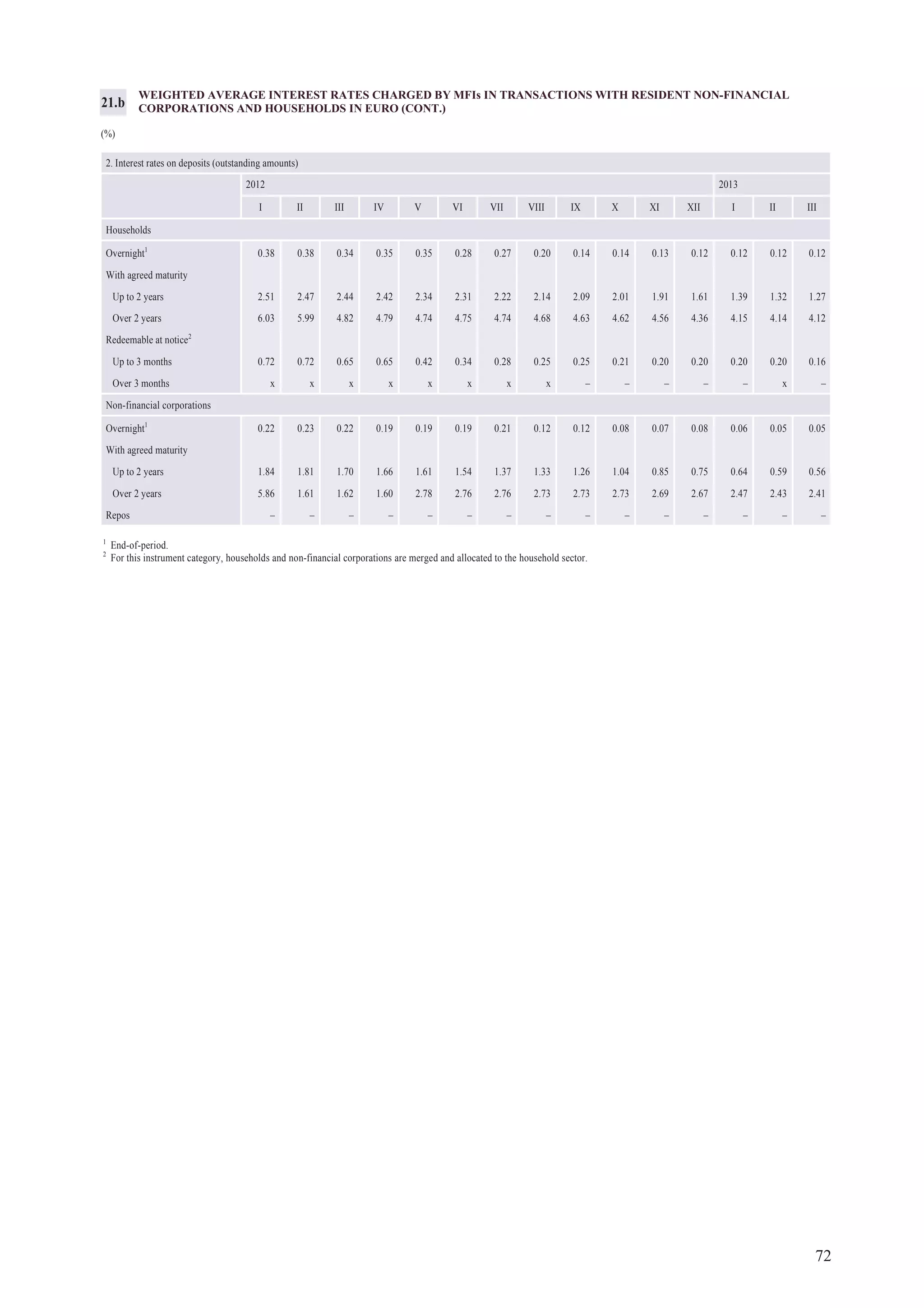
Interest rates on new time deposits received from both
non-financial corporations and households remained
broadly unchanged in March–May. Interest rates on
outstanding longer-term time deposits continued on a
rapid downward trend, with new time deposits with a
low interest rate replacing those received in previous
periods with a higher interest rate.
2. Financial Market Developments
17
M ACROECONOM I C DEVELOPM ENTS REPORT
J uly 2013
2.5 money supply
In the last three months money supply has been
relatively stable: a decrease in March was followed
by an increase in April and a minor drop in May. The
gradual fall in currency in circulation (44.6 million
lats) was partly offset by a slight rise in deposits in
April. Household deposits posted stable growth,
supported by higher income levels and declining
unemployment rates, but moderated by relatively
active consumption trends. As to the non-financial
corporation deposits, their fluctuations were affected
by both import and export cash flows as well as
repayment of several loans. The economic position
of the exporting industries remained stable, and the
demand for loans encouraged credit institutions to
become more active in lending to businesses again. In
May, the aggregate domestic loan portfolio recorded
an increase for the first time in the last nine months
as a result of expanding lending to non-financial
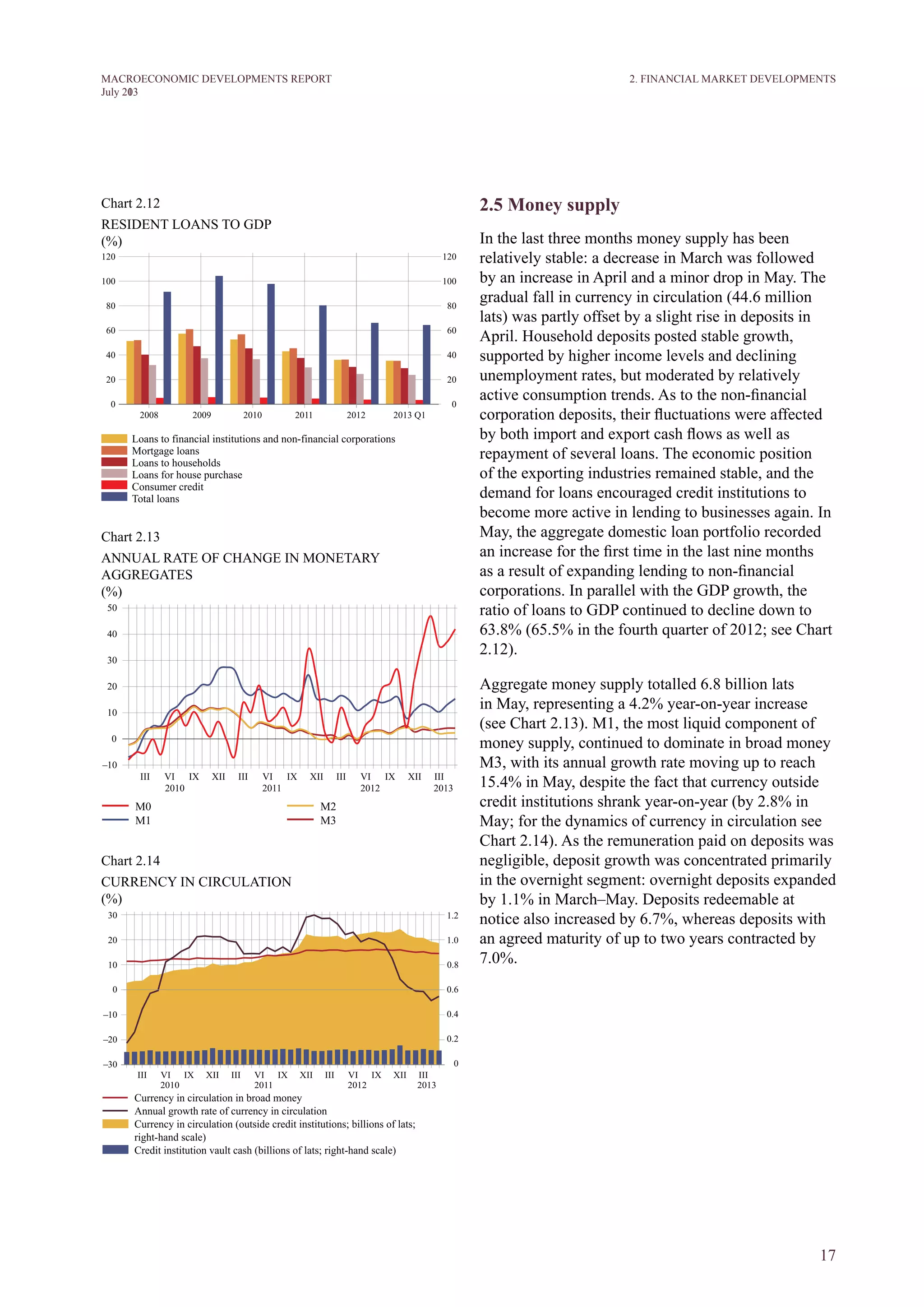
corporations. In parallel with the GDP growth, the
ratio of loans to GDP continued to decline down to
63.8% (65.5% in the fourth quarter of 2012; see Chart
2.12).
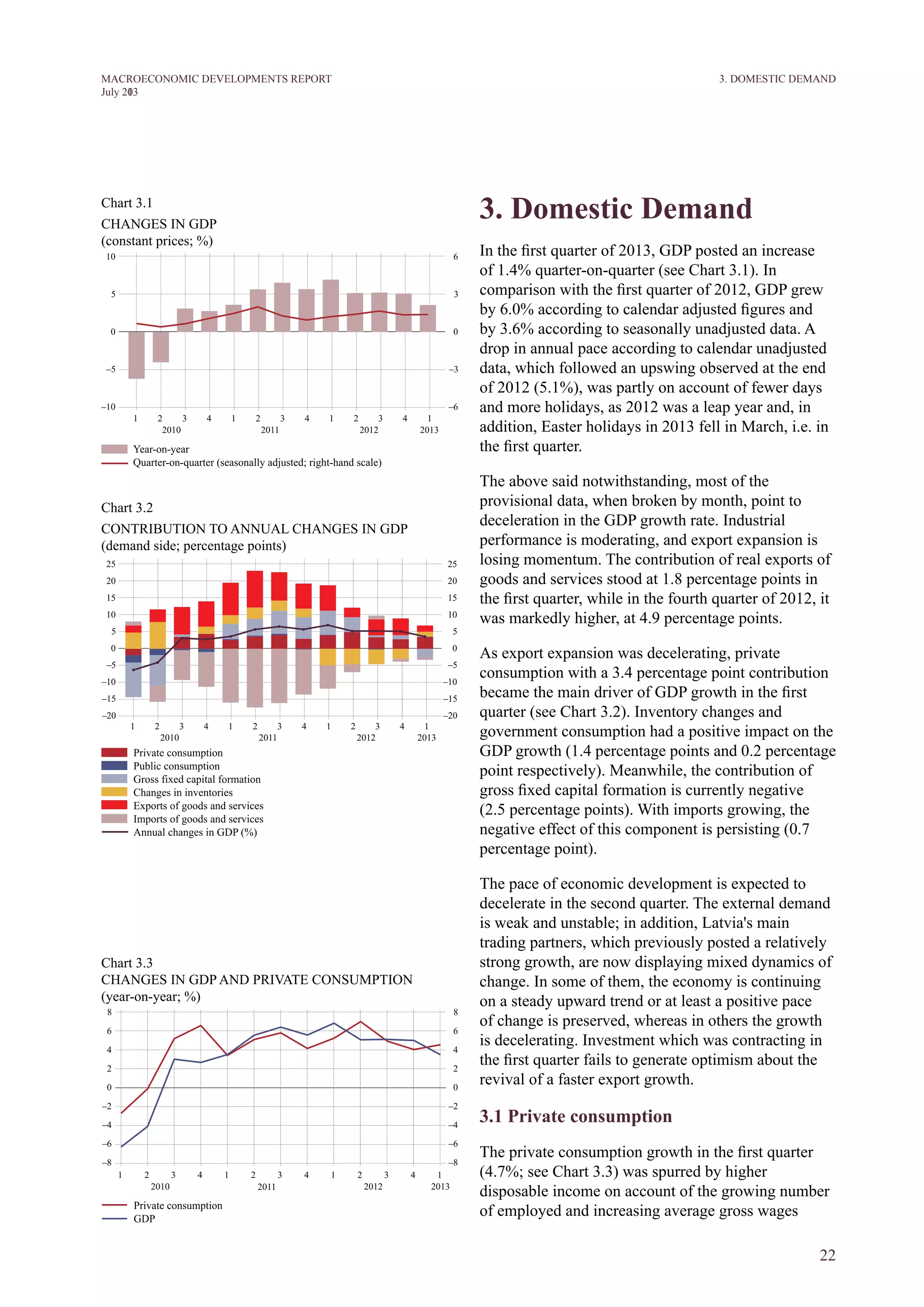
Aggregate money supply totalled 6.8 billion lats
in May, representing a 4.2% year-on-year increase
(see Chart 2.13). M1, the most liquid component of
money supply, continued to dominate in broad money
M3, with its annual growth rate moving up to reach
15.4% in May, despite the fact that currency outside
credit institutions shrank year-on-year (by 2.8% in
May; for the dynamics of currency in circulation see
Chart 2.14). As the remuneration paid on deposits was
negligible, deposit growth was concentrated primarily
in the overnight segment: overnight deposits expanded
by 1.1% in March–May. Deposits redeemable at
notice also increased by 6.7%, whereas deposits with
an agreed maturity of up to two years contracted by
7.0%.
2. FINANCIAL MARKET DEVELOPMENTS
Chart 2.12
RESIDENT LOANS TO GDP
(%)
Chart 2.13
ANNUAL RATE OF CHANGE IN MONETARY
AGGREGATES
(%)
Chart 2.14
CURRENCY IN CIRCULATION
(%)
18
M ACROECONOM I C DEVELOPM ENTS REPORT
J uly 2013
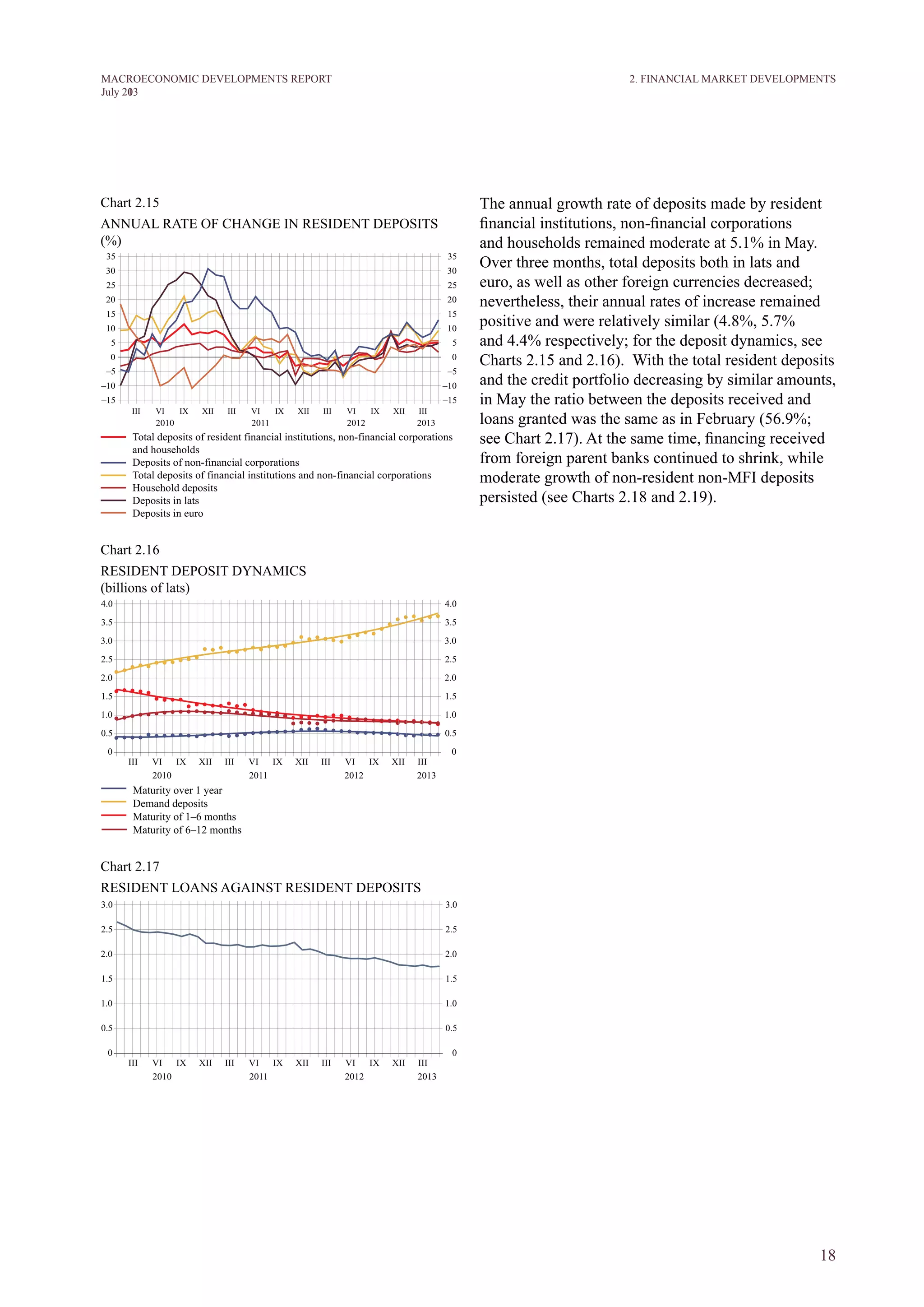
The annual growth rate of deposits made by resident
financial institutions, non-financial corporations
and households remained moderate at 5.1% in May.
Over three months, total deposits both in lats and
euro, as well as other foreign currencies decreased;
nevertheless, their annual rates of increase remained
positive and were relatively similar (4.8%, 5.7%
and 4.4% respectively; for the deposit dynamics, see
Charts 2.15 and 2.16). With the total resident deposits
and the credit portfolio decreasing by similar amounts,
in May the ratio between the deposits received and
loans granted was the same as in February (56.9%;
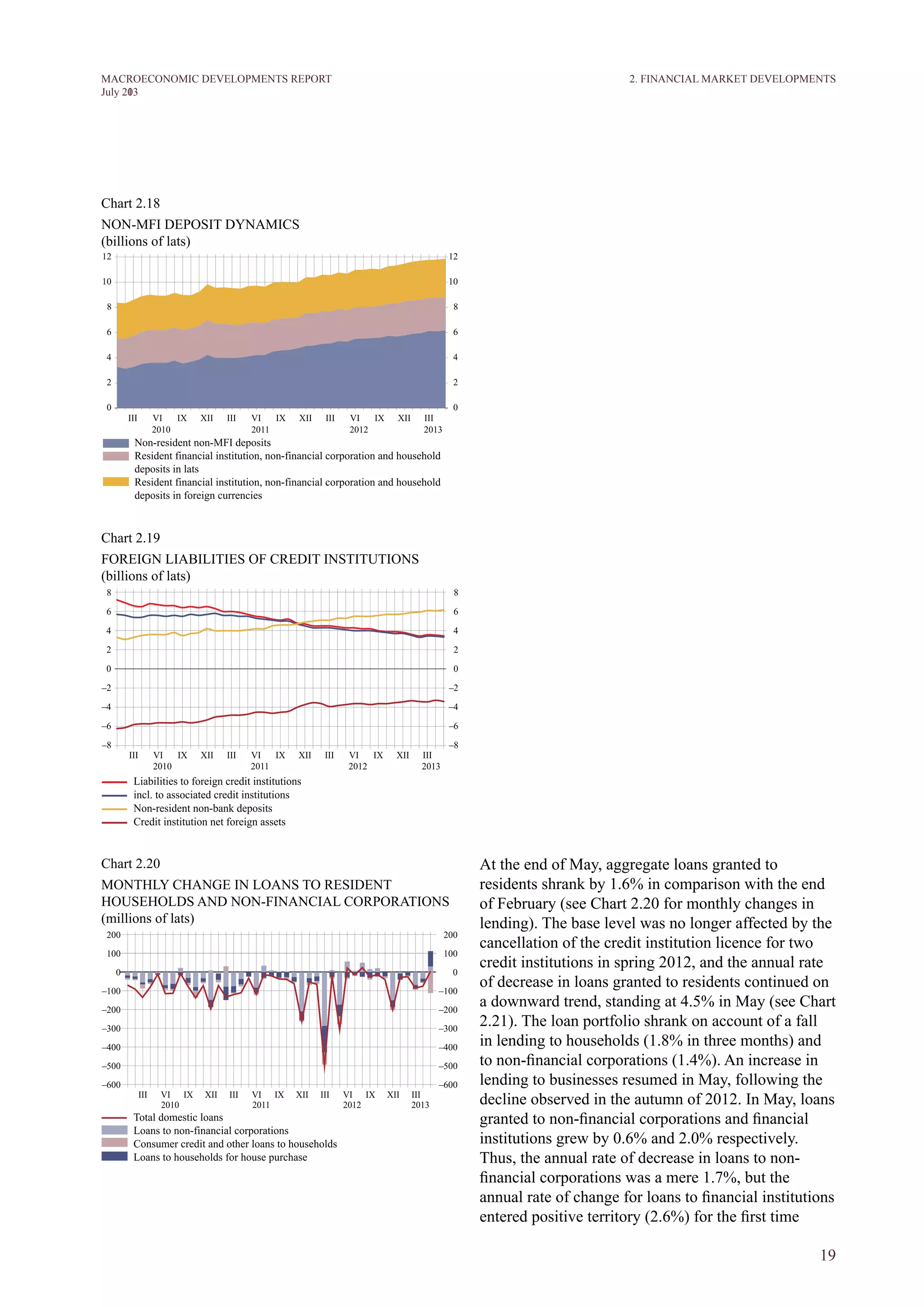
see Chart 2.17). At the same time, financing received
from foreign parent banks continued to shrink, while
moderate growth of non-resident non-MFI deposits
persisted (see Charts 2.18 and 2.19).
2. FINANCIAL MARKET DEVELOPMENTS
Chart 2.15
ANNUAL RATE OF CHANGE IN RESIDENT DEPOSITS
(%)
Chart 2.16
RESIDENT DEPOSIT DYNAMICS
(billions of lats)
Chart 2.17
RESIDENT LOANS AGAINST RESIDENT DEPOSITS
19
M ACROECONOM I C DEVELOPM ENTS REPORT
J uly 2013
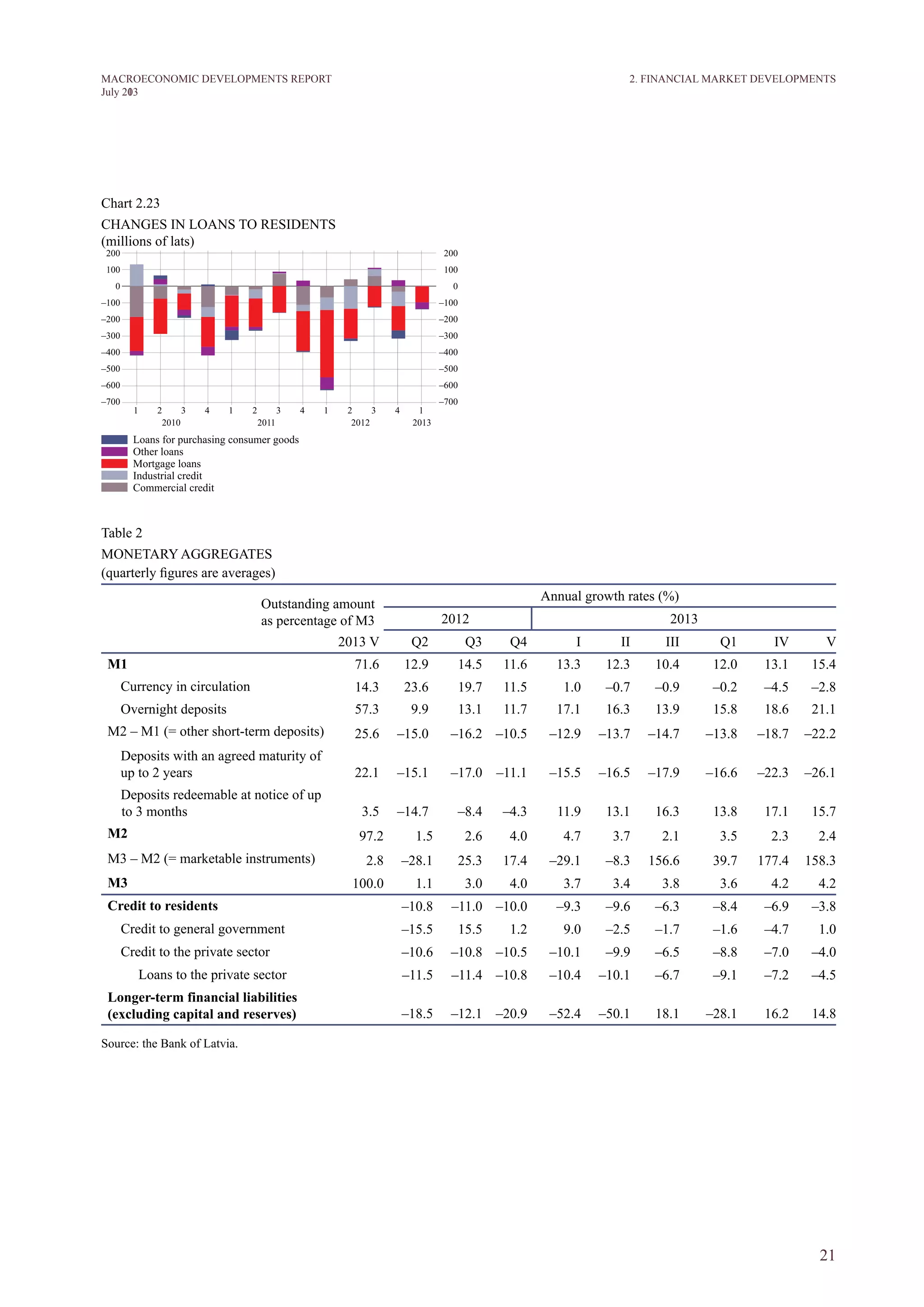
At the end of May, aggregate loans granted to
residents shrank by 1.6% in comparison with the end
of February (see Chart 2.20 for monthly changes in
lending). The base level was no longer affected by the
cancellation of the credit institution licence for two
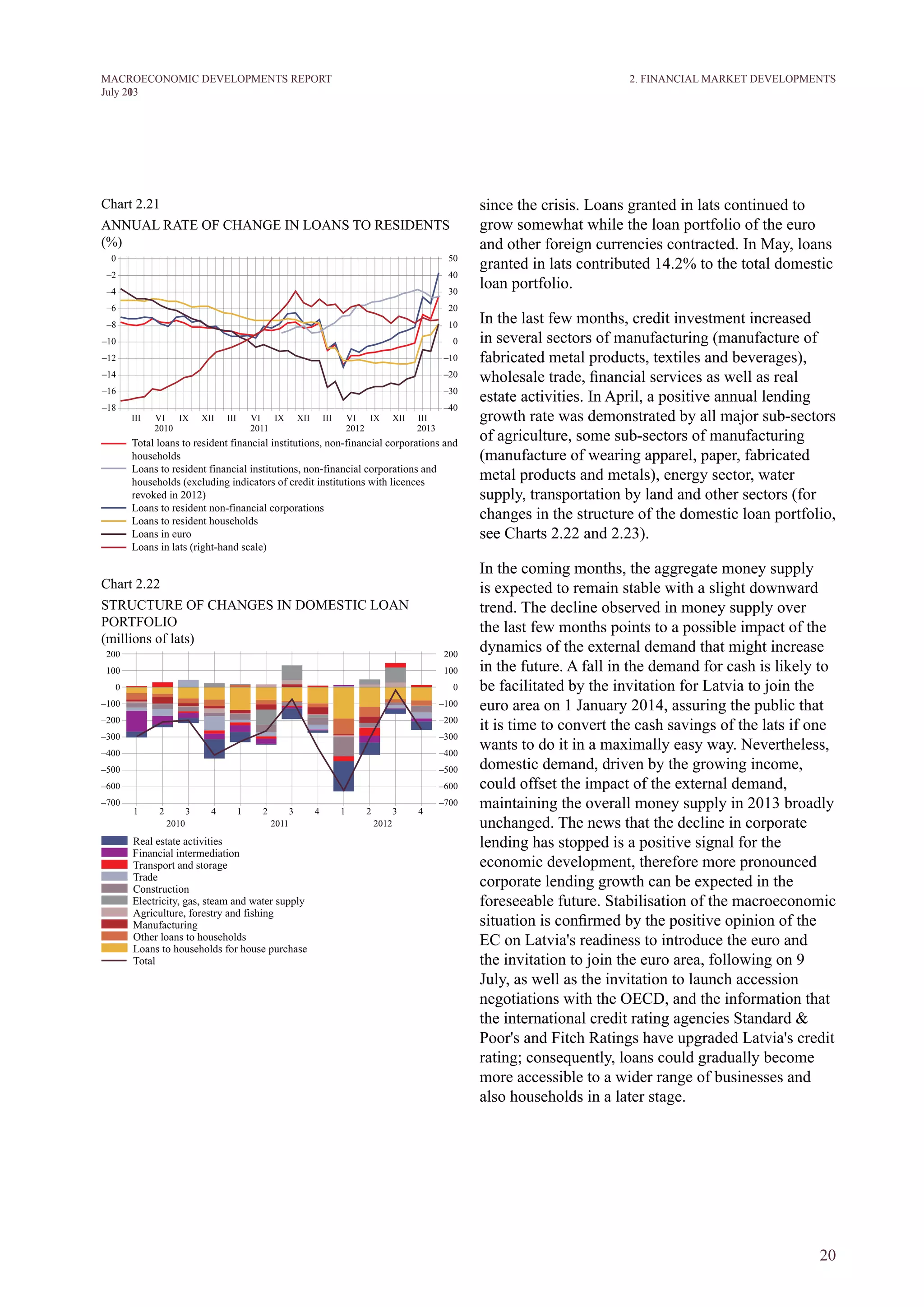
credit institutions in spring 2012, and the annual rate
of decrease in loans granted to residents continued on
a downward trend, standing at 4.5% in May (see Chart
2.21). The loan portfolio shrank on account of a fall
in lending to households (1.8% in three months) and
to non-financial corporations (1.4%). An increase in
lending to businesses resumed in May, following the
decline observed in the autumn of 2012. In May, loans
granted to non-financial corporations and financial
institutions grew by 0.6% and 2.0% respectively.
Thus, the annual rate of decrease in loans to non-
financial corporations was a mere 1.7%, but the
annual rate of change for loans to financial institutions
entered positive territory (2.6%) for the first time
Chart 2.18
NON-MFI DEPOSIT DYNAMICS
(billions of lats)
Chart 2.19
FOREIGN LIABILITIES OF CREDIT INSTITUTIONS
(billions of lats)
Chart 2.20
MONTHLY CHANGE IN LOANS TO RESIDENT
HOUSEHOLDS AND NON-FINANCIAL CORPORATIONS
(millions of lats)
2. FINANCIAL MARKET DEVELOPMENTS
20
M ACROECONOM I C DEVELOPM ENTS REPORT
J uly 2013
since the crisis. Loans granted in lats continued to
grow somewhat while the loan portfolio of the euro
and other foreign currencies contracted. In May, loans
granted in lats contributed 14.2% to the total domestic
loan portfolio.
In the last few months, credit investment increased
in several sectors of manufacturing (manufacture of
fabricated metal products, textiles and beverages),
wholesale trade, financial services as well as real
estate activities. In April, a positive annual lending
growth rate was demonstrated by all major sub-sectors
of agriculture, some sub-sectors of manufacturing
(manufacture of wearing apparel, paper, fabricated
metal products and metals), energy sector, water
supply, transportation by land and other sectors (for
changes in the structure of the domestic loan portfolio,
see Charts 2.22 and 2.23).
In the coming months, the aggregate money supply
is expected to remain stable with a slight downward
trend. The decline observed in money supply over
the last few months points to a possible impact of the
dynamics of the external demand that might increase
in the future. A fall in the demand for cash is likely to
be facilitated by the invitation for Latvia to join the
euro area on 1 January 2014, assuring the public that
it is time to convert the cash savings of the lats if one
wants to do it in a maximally easy way. Nevertheless,
domestic demand, driven by the growing income,
could offset the impact of the external demand,
maintaining the overall money supply in 2013 broadly
unchanged. The news that the decline in corporate
lending has stopped is a positive signal for the
economic development, therefore more pronounced
corporate lending growth can be expected in the
foreseeable future. Stabilisation of the macroeconomic
situation is confirmed by the positive opinion of the
EC on Latvia's readiness to introduce the euro and
the invitation to join the euro area, following on 9
July, as well as the invitation to launch accession
negotiations with the OECD, and the information that
the international credit rating agencies Standard &
Poor's and Fitch Ratings have upgraded Latvia's credit
rating; consequently, loans could gradually become
more accessible to a wider range of businesses and
also households in a later stage.
Chart 2.21
ANNUAL RATE OF CHANGE IN LOANS TO RESIDENTS
(%)
Chart 2.22
STRUCTURE OF CHANGES IN DOMESTIC LOAN
PORTFOLIO
(millions of lats)
2. FINANCIAL MARKET DEVELOPMENTS
21
M ACROECONOM I C DEVELOPM ENTS REPORT
J uly 2013
2. FINANCIAL MARKET DEVELOPMENTS
Chart 2.23
CHANGES IN LOANS TO RESIDENTS
(millions of lats)
Table 2
MONETARY AGGREGATES
(quarterly figures are averages)
Outstanding amount
as percentage of M3
2013 V
Annual growth rates (%)
2012 2013
Q2 Q3 Q4 I II III Q1 IV V
m1 71.6 12.9 14.5 11.6 13.3 12.3 10.4 12.0 13.1 15.4
Currency in circulation 14.3 23.6 19.7 11.5 1.0 –0.7 –0.9 –0.2 –4.5 –2.8
Overnight deposits 57.3 9.9 13.1 11.7 17.1 16.3 13.9 15.8 18.6 21.1
M2 – M1 (= other short-term deposits) 25.6 –15.0 –16.2 –10.5 –12.9 –13.7 –14.7 –13.8 –18.7 –22.2
Deposits with an agreed maturity of
up to 2 years 22.1 –15.1 –17.0 –11.1 –15.5 –16.5 –17.9 –16.6 –22.3 –26.1
Deposits redeemable at notice of up
to 3 months 3.5 –14.7 –8.4 –4.3 11.9 13.1 16.3 13.8 17.1 15.7
m2 97.2 1.5 2.6 4.0 4.7 3.7 2.1 3.5 2.3 2.4
M3 – M2 (= marketable instruments) 2.8 –28.1 25.3 17.4 –29.1 –8.3 156.6 39.7 177.4 158.3
m3 100.0 1.1 3.0 4.0 3.7 3.4 3.8 3.6 4.2 4.2
Credit to residents –10.8 –11.0 –10.0 –9.3 –9.6 –6.3 –8.4 –6.9 –3.8
Credit to general government –15.5 15.5 1.2 9.0 –2.5 –1.7 –1.6 –4.7 1.0
Credit to the private sector –10.6 –10.8 –10.5 –10.1 –9.9 –6.5 –8.8 –7.0 –4.0
Loans to the private sector –11.5 –11.4 –10.8 –10.4 –10.1 –6.7 –9.1 –7.2 –4.5
Longer-term financial liabilities
(excluding capital and reserves) –18.5 –12.1 –20.9 –52.4 –50.1 18.1 –28.1 16.2 14.8
Source: the Bank of Latvia.
22
M ACROECONOM I C DEVELOPM ENTS REPORT
J uly 2013
3. domestic demand
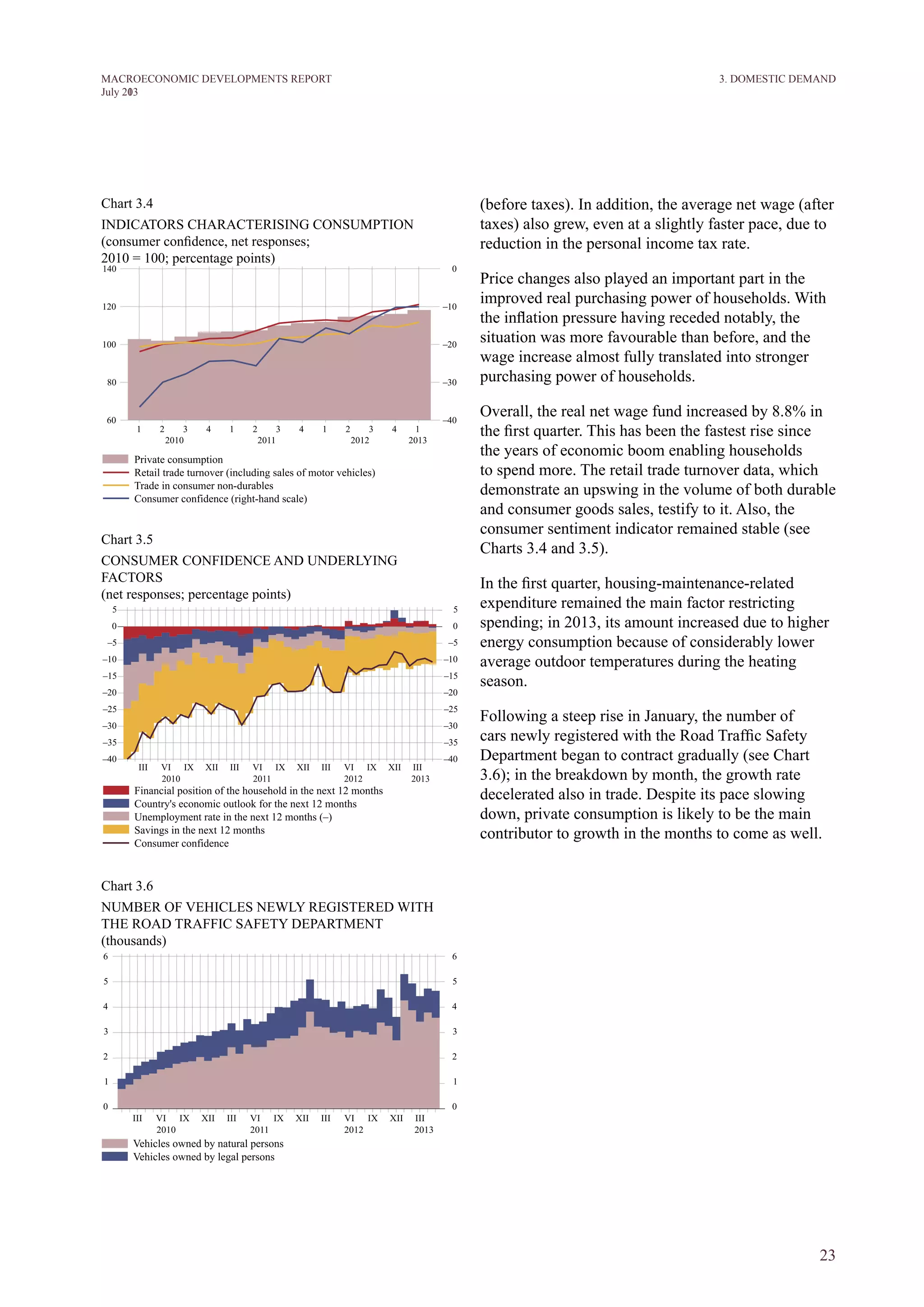
In the first quarter of 2013, GDP posted an increase
of 1.4% quarter-on-quarter (see Chart 3.1). In
comparison with the first quarter of 2012, GDP grew
by 6.0% according to calendar adjusted figures and
by 3.6% according to seasonally unadjusted data. A
drop in annual pace according to calendar unadjusted
data, which followed an upswing observed at the end
of 2012 (5.1%), was partly on account of fewer days
and more holidays, as 2012 was a leap year and, in
addition, Easter holidays in 2013 fell in March, i.e. in
the first quarter.
The above said notwithstanding, most of the
provisional data, when broken by month, point to
deceleration in the GDP growth rate. Industrial
performance is moderating, and export expansion is
losing momentum. The contribution of real exports of
goods and services stood at 1.8 percentage points in
the first quarter, while in the fourth quarter of 2012, it
was markedly higher, at 4.9 percentage points.
As export expansion was decelerating, private
consumption with a 3.4 percentage point contribution
became the main driver of GDP growth in the first
quarter (see Chart 3.2). Inventory changes and
government consumption had a positive impact on the
GDP growth (1.4 percentage points and 0.2 percentage
point respectively). Meanwhile, the contribution of
gross fixed capital formation is currently negative
(2.5 percentage points). With imports growing, the
negative effect of this component is persisting (0.7
percentage point).
The pace of economic development is expected to
decelerate in the second quarter. The external demand
is weak and unstable; in addition, Latvia's main
trading partners, which previously posted a relatively
strong growth, are now displaying mixed dynamics of
change. In some of them, the economy is continuing
on a steady upward trend or at least a positive pace
of change is preserved, whereas in others the growth
is decelerating. Investment which was contracting in
the first quarter fails to generate optimism about the
revival of a faster export growth.
3.1 Private consumption
The private consumption growth in the first quarter
(4.7%; see Chart 3.3) was spurred by higher
disposable income on account of the growing number
of employed and increasing average gross wages
Chart 3.1
CHANGES IN GDP
(constant prices; %)
Chart 3.2
CONTRIBUTION TO ANNUAL CHANGES IN GDP
(demand side; percentage points)
Chart 3.3
CHANGES IN GDP AND PRIVATE CONSUMPTION
(year-on-year; %)
3. DOMESTIC DEMAND
23
M ACROECONOM I C DEVELOPM ENTS REPORT
J uly 2013
(before taxes). In addition, the average net wage (after
taxes) also grew, even at a slightly faster pace, due to
reduction in the personal income tax rate.
Price changes also played an important part in the
improved real purchasing power of households. With
the inflation pressure having receded notably, the
situation was more favourable than before, and the
wage increase almost fully translated into stronger
purchasing power of households.
Overall, the real net wage fund increased by 8.8% in
the first quarter. This has been the fastest rise since
the years of economic boom enabling households
to spend more. The retail trade turnover data, which
demonstrate an upswing in the volume of both durable
and consumer goods sales, testify to it. Also, the
consumer sentiment indicator remained stable (see
Charts 3.4 and 3.5).
In the first quarter, housing-maintenance-related
expenditure remained the main factor restricting
spending; in 2013, its amount increased due to higher
energy consumption because of considerably lower
average outdoor temperatures during the heating
season.
Following a steep rise in January, the number of
cars newly registered with the Road Traffic Safety
Department began to contract gradually (see Chart
3.6); in the breakdown by month, the growth rate
decelerated also in trade. Despite its pace slowing
down, private consumption is likely to be the main
contributor to growth in the months to come as well.
Chart 3.4
INDICATORS CHARACTERISING CONSUMPTION
(consumer confidence, net responses;
2010 = 100; percentage points)
Chart 3.5
CONSUMER CONFIDENCE AND UNDERLYING
FACTORS
(net responses; percentage points)
Chart 3.6
NUMBER OF VEHICLES NEWLY REGISTERED WITH
THE ROAD TRAFFIC SAFETY DEPARTMENT
(thousands)
3. DOMESTIC DEMAND
24
M ACROECONOM I C DEVELOPM ENTS REPORT
J uly 2013
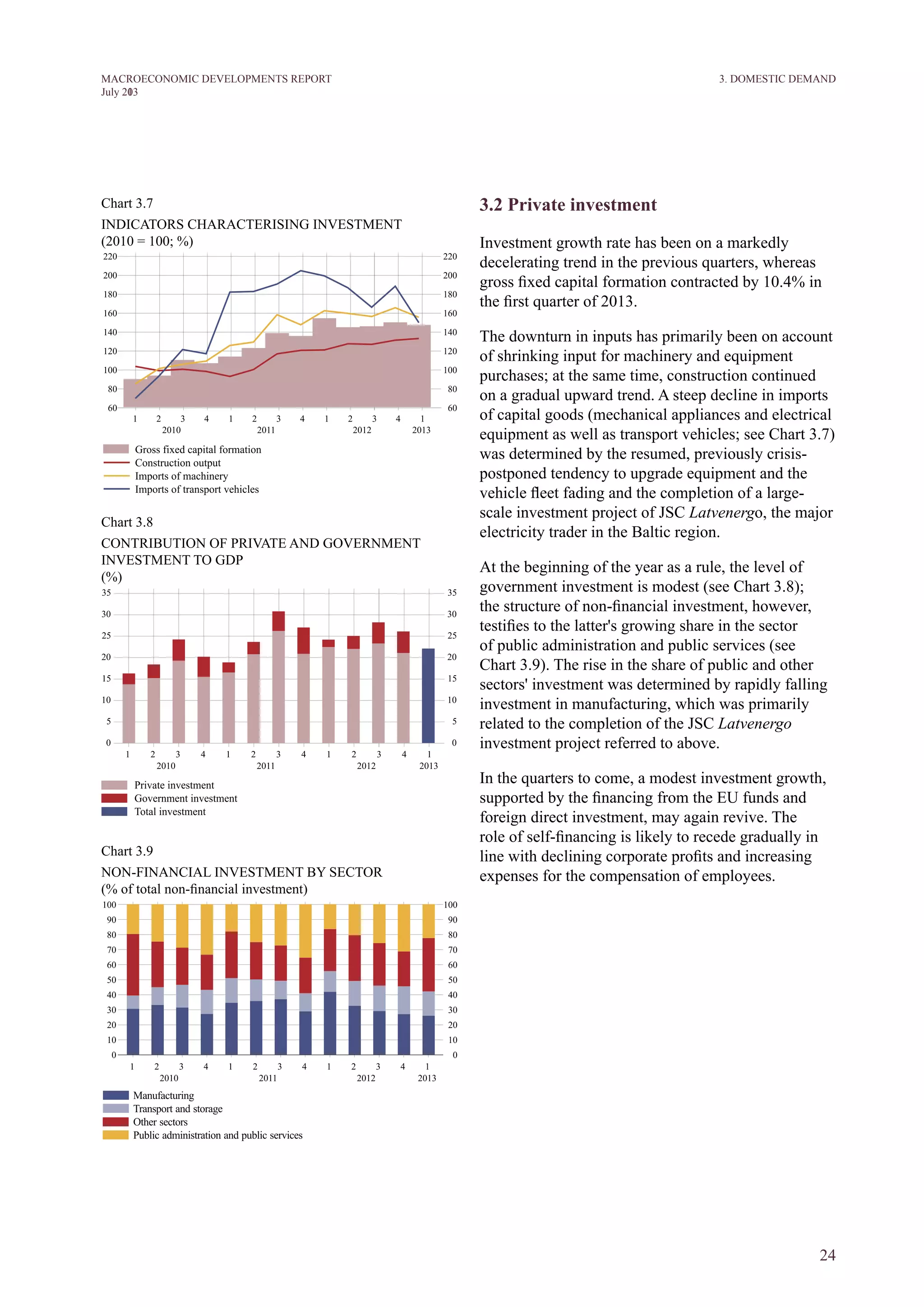
3.2 Private investment
Investment growth rate has been on a markedly
decelerating trend in the previous quarters, whereas
gross fixed capital formation contracted by 10.4% in
the first quarter of 2013.
The downturn in inputs has primarily been on account
of shrinking input for machinery and equipment
purchases; at the same time, construction continued
on a gradual upward trend. A steep decline in imports
of capital goods (mechanical appliances and electrical
equipment as well as transport vehicles; see Chart 3.7)
was determined by the resumed, previously crisis-
postponed tendency to upgrade equipment and the
vehicle fleet fading and the completion of a large-
scale investment project of JSC Latvenergo, the major
electricity trader in the baltic region.
At the beginning of the year as a rule, the level of
government investment is modest (see Chart 3.8);
the structure of non-financial investment, however,
testifies to the latter's growing share in the sector
of public administration and public services (see
Chart 3.9). The rise in the share of public and other
sectors' investment was determined by rapidly falling
investment in manufacturing, which was primarily
related to the completion of the JSC Latvenergo
investment project referred to above.
In the quarters to come, a modest investment growth,
supported by the financing from the EU funds and
foreign direct investment, may again revive. The
role of self-financing is likely to recede gradually in
line with declining corporate profits and increasing
expenses for the compensation of employees.
Chart 3.7
INDICATORS CHARACTERISING INVESTMENT
(2010 = 100; %)
Chart 3.8
CONTRIBUTION OF PRIVATE AND GOVERNMENT
INVESTMENT TO GDP
(%)
Chart 3.9
NON-FINANCIAL INVESTMENT BY SECTOR
(% of total non-financial investment)
3. DOMESTIC DEMAND
25
MACROECONOMIC DEVELOPMENTS REPORT
July 2013
3. Domestic Demand
3.3 Government expenditure and budget
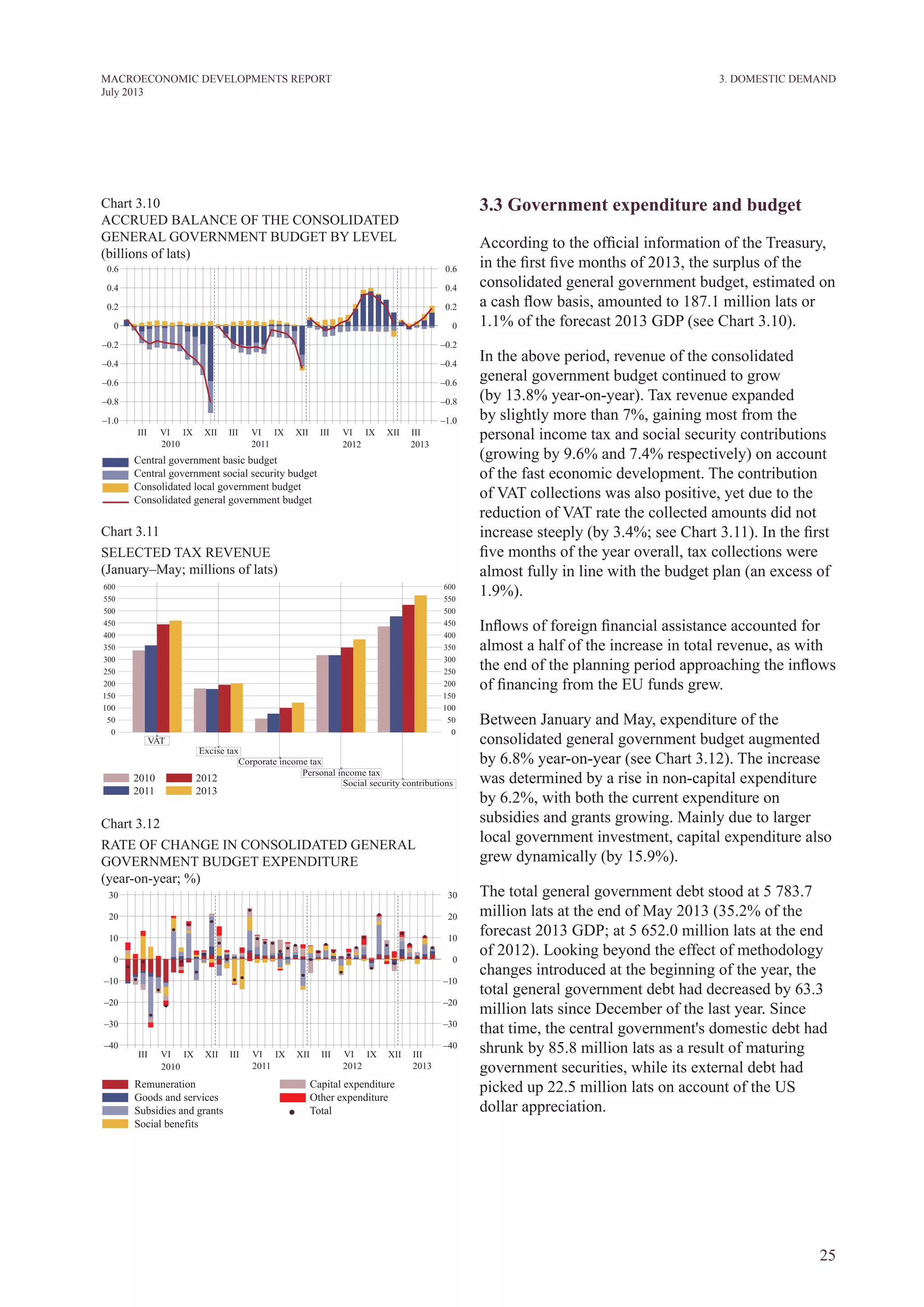
According to the official information of the Treasury,
in the first five months of 2013, the surplus of the
consolidated general government budget, estimated on
a cash flow basis, amounted to 187.1 million lats or
1.1% of the forecast 2013 GDP (see Chart 3.10).
In the above period, revenue of the consolidated
general government budget continued to grow
(by 13.8% year-on-year). Tax revenue expanded
by slightly more than 7%, gaining most from the
personal income tax and social security contributions
(growing by 9.6% and 7.4% respectively) on account
of the fast economic development. The contribution
of VAT collections was also positive, yet due to the
reduction of VAT rate the collected amounts did not
increase steeply (by 3.4%; see Chart 3.11). In the first
five months of the year overall, tax collections were
almost fully in line with the budget plan (an excess of
1.9%).
Inflows of foreign financial assistance accounted for
almost a half of the increase in total revenue, as with
the end of the planning period approaching the inflows
of financing from the EU funds grew.
Between January and May, expenditure of the
consolidated general government budget augmented
by 6.8% year-on-year (see Chart 3.12). The increase
was determined by a rise in non-capital expenditure
by 6.2%, with both the current expenditure on
subsidies and grants growing. Mainly due to larger
local government investment, capital expenditure also
grew dynamically (by 15.9%).
The total general government debt stood at 5 783.7
million lats at the end of May 2013 (35.2% of the
forecast 2013 GDP; at 5 652.0 million lats at the end
of 2012). Looking beyond the effect of methodology
changes introduced at the beginning of the year, the
total general government debt had decreased by 63.3
million lats since December of the last year. Since
that time, the central government's domestic debt had
shrunk by 85.8 million lats as a result of maturing
government securities, while its external debt had
picked up 22.5 million lats on account of the US
dollar appreciation.
Chart 3.10
ACCRUED BALANCE OF THE CONSOLIDATED
GENERAL GOVERNMENT BUDGET BY level
(billions of lats)
Chart 3.11
SELECTED TAX REVENUE
(January–May; millions of lats)
Chart 3.12
RATE OF CHANGE IN CONSOLIDATED GENERAL
GOVERNMENT BUDGET EXPENDITURE
(year-on-year; %)
26
M ACROECONOM I C DEVELOPM ENTS REPORT
J uly 2013
4. Aggregate Supply
4.1 Industry and construction
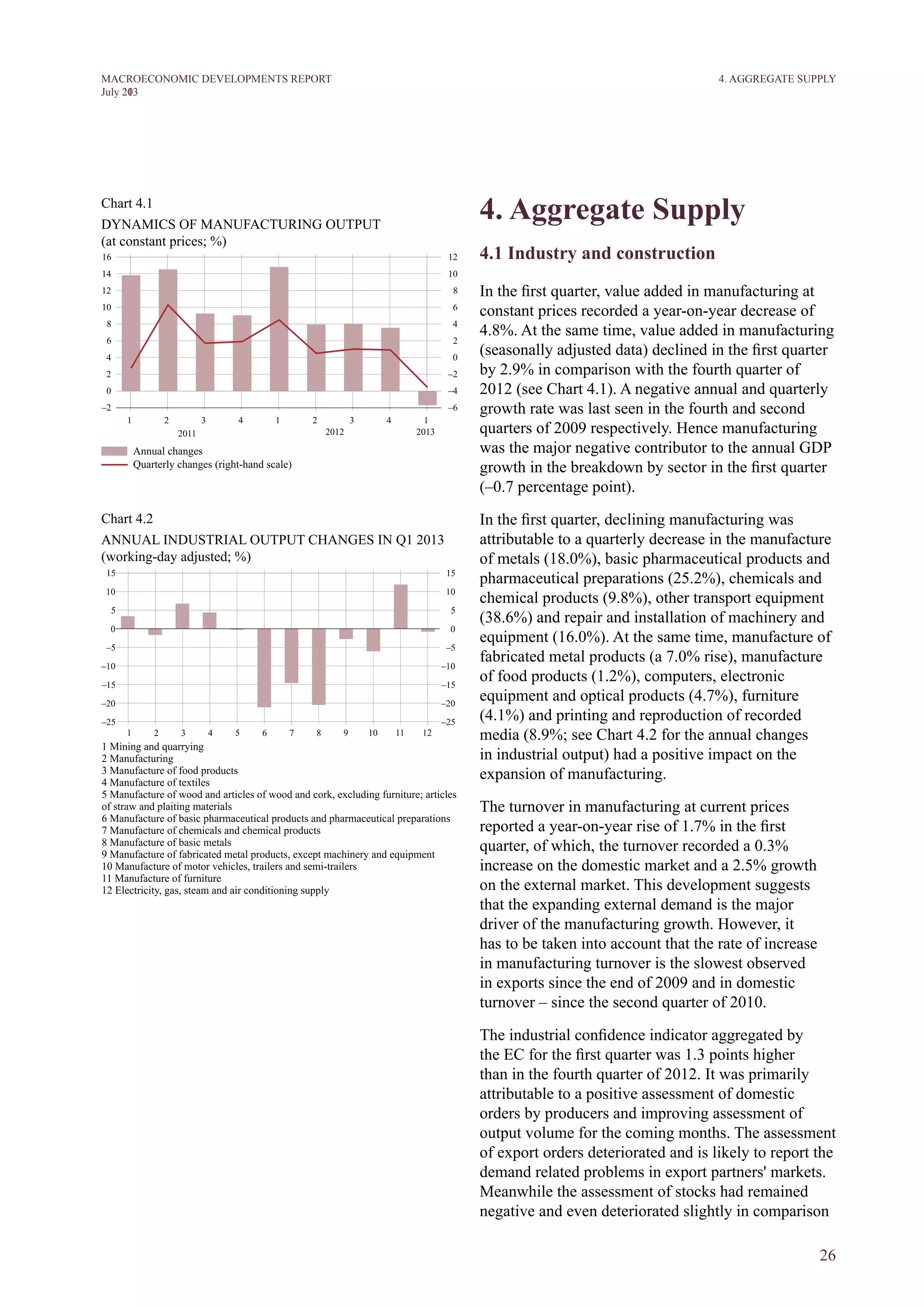
In the first quarter, value added in manufacturing at
constant prices recorded a year-on-year decrease of
4.8%. At the same time, value added in manufacturing
(seasonally adjusted data) declined in the first quarter
by 2.9% in comparison with the fourth quarter of
2012 (see Chart 4.1). A negative annual and quarterly
growth rate was last seen in the fourth and second
quarters of 2009 respectively. Hence manufacturing
was the major negative contributor to the annual GDP
growth in the breakdown by sector in the first quarter
(–0.7 percentage point).
In the first quarter, declining manufacturing was
attributable to a quarterly decrease in the manufacture
of metals (18.0%), basic pharmaceutical products and
pharmaceutical preparations (25.2%), chemicals and
chemical products (9.8%), other transport equipment
(38.6%) and repair and installation of machinery and
equipment (16.0%). At the same time, manufacture of
fabricated metal products (a 7.0% rise), manufacture
of food products (1.2%), computers, electronic
equipment and optical products (4.7%), furniture
(4.1%) and printing and reproduction of recorded
media (8.9%; see Chart 4.2 for the annual changes
in industrial output) had a positive impact on the
expansion of manufacturing.
The turnover in manufacturing at current prices
reported a year-on-year rise of 1.7% in the first
quarter, of which, the turnover recorded a 0.3%
increase on the domestic market and a 2.5% growth
on the external market. This development suggests
that the expanding external demand is the major
driver of the manufacturing growth. However, it
has to be taken into account that the rate of increase
in manufacturing turnover is the slowest observed
in exports since the end of 2009 and in domestic
turnover – since the second quarter of 2010.
The industrial confidence indicator aggregated by
the EC for the first quarter was 1.3 points higher
than in the fourth quarter of 2012. It was primarily
attributable to a positive assessment of domestic
orders by producers and improving assessment of
output volume for the coming months. The assessment
of export orders deteriorated and is likely to report the
demand related problems in export partners' markets.
Meanwhile the assessment of stocks had remained
negative and even deteriorated slightly in comparison
4. AGGREGATE SUPPLY
Chart 4.1
DYNAMICS OF MANUFACTURING OUTPUT
(at constant prices; %)
Chart 4.2
ANNUAL INDUSTRIAL OUTPUT CHANGES IN Q1 2013
(working-day adjusted; %)
27
M ACROECONOM I C DEVELOPM ENTS REPORT
J uly 2013
with the previous quarter, pointing to shrinking
inventories of finished goods at the producers'
disposal, which in turn might confirm a further
potential growth of the sector. The signals from
business surveys differ, albeit overall the concern
about the future development of the sector deepens.
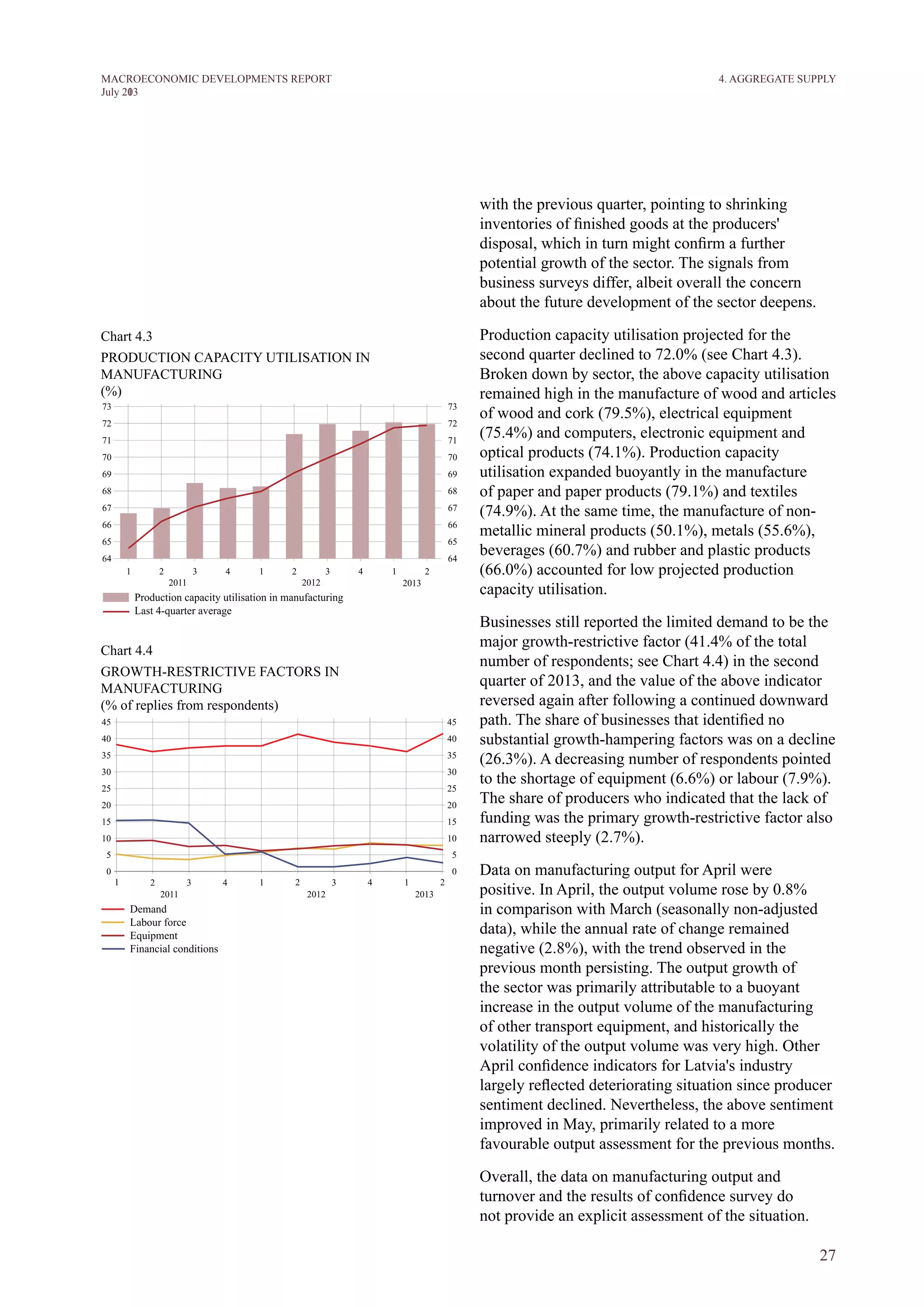
Production capacity utilisation projected for the
second quarter declined to 72.0% (see Chart 4.3).
Broken down by sector, the above capacity utilisation
remained high in the manufacture of wood and articles
of wood and cork (79.5%), electrical equipment
(75.4%) and computers, electronic equipment and
optical products (74.1%). Production capacity
utilisation expanded buoyantly in the manufacture
of paper and paper products (79.1%) and textiles
(74.9%). At the same time, the manufacture of non-
metallic mineral products (50.1%), metals (55.6%),
beverages (60.7%) and rubber and plastic products
(66.0%) accounted for low projected production
capacity utilisation.
businesses still reported the limited demand to be the
major growth-restrictive factor (41.4% of the total
number of respondents; see Chart 4.4) in the second
quarter of 2013, and the value of the above indicator
reversed again after following a continued downward
path. The share of businesses that identified no
substantial growth-hampering factors was on a decline
(26.3%). A decreasing number of respondents pointed
to the shortage of equipment (6.6%) or labour (7.9%).
The share of producers who indicated that the lack of
funding was the primary growth-restrictive factor also
narrowed steeply (2.7%).
Data on manufacturing output for April were
positive. In April, the output volume rose by 0.8%
in comparison with March (seasonally non-adjusted
data), while the annual rate of change remained
negative (2.8%), with the trend observed in the
previous month persisting. The output growth of
the sector was primarily attributable to a buoyant
increase in the output volume of the manufacturing
of other transport equipment, and historically the
volatility of the output volume was very high. Other
April confidence indicators for Latvia's industry
largely reflected deteriorating situation since producer
sentiment declined. Nevertheless, the above sentiment
improved in May, primarily related to a more
favourable output assessment for the previous months.
Overall, the data on manufacturing output and
turnover and the results of confidence survey do
not provide an explicit assessment of the situation.
Chart 4.3
PRODUCTION CAPACITY UTILISATION IN
MANUFACTURING
(%)
Chart 4.4
GROWTH-RESTRICTIVE FACTORS IN
MANUFACTURING
(% of replies from respondents)
4. AGGREGATE SUPPLY
28
M ACROECONOM I C DEVELOPM ENTS REPORT
J uly 2013
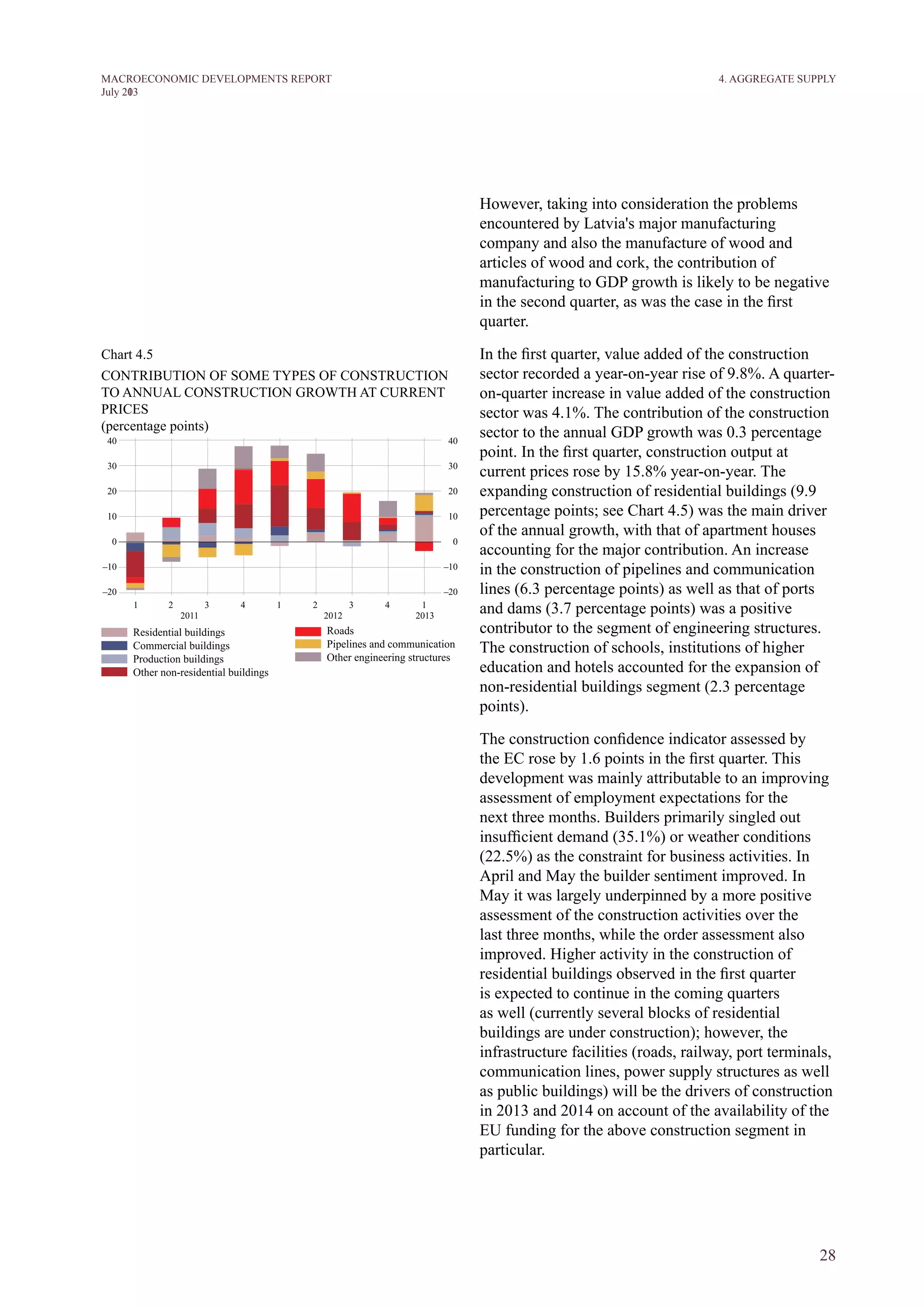
Chart 4.5
CONTRIBUTION OF SOME TYPES OF CONSTRUCTION
TO ANNUAL CONSTRUCTION GROWTH AT CURRENT
PRICES
(percentage points)
However, taking into consideration the problems
encountered by Latvia's major manufacturing
company and also the manufacture of wood and
articles of wood and cork, the contribution of
manufacturing to GDP growth is likely to be negative
in the second quarter, as was the case in the first
quarter.
In the first quarter, value added of the construction
sector recorded a year-on-year rise of 9.8%. A quarter-
on-quarter increase in value added of the construction
sector was 4.1%. The contribution of the construction
sector to the annual GDP growth was 0.3 percentage
point. In the first quarter, construction output at
current prices rose by 15.8% year-on-year. The
expanding construction of residential buildings (9.9
percentage points; see Chart 4.5) was the main driver
of the annual growth, with that of apartment houses
accounting for the major contribution. An increase
in the construction of pipelines and communication
lines (6.3 percentage points) as well as that of ports
and dams (3.7 percentage points) was a positive
contributor to the segment of engineering structures.
The construction of schools, institutions of higher
education and hotels accounted for the expansion of
non-residential buildings segment (2.3 percentage
points).
The construction confidence indicator assessed by
the EC rose by 1.6 points in the first quarter. This
development was mainly attributable to an improving
assessment of employment expectations for the
next three months. builders primarily singled out
insufficient demand (35.1%) or weather conditions
(22.5%) as the constraint for business activities. In
April and May the builder sentiment improved. In
May it was largely underpinned by a more positive
assessment of the construction activities over the
last three months, while the order assessment also
improved. Higher activity in the construction of
residential buildings observed in the first quarter
is expected to continue in the coming quarters
as well (currently several blocks of residential
buildings are under construction); however, the
infrastructure facilities (roads, railway, port terminals,
communication lines, power supply structures as well
as public buildings) will be the drivers of construction
in 2013 and 2014 on account of the availability of the
EU funding for the above construction segment in
particular.
4. AGGREGATE SUPPLY
29
M ACROECONOM I C DEVELOPM ENTS REPORT
J uly 2013
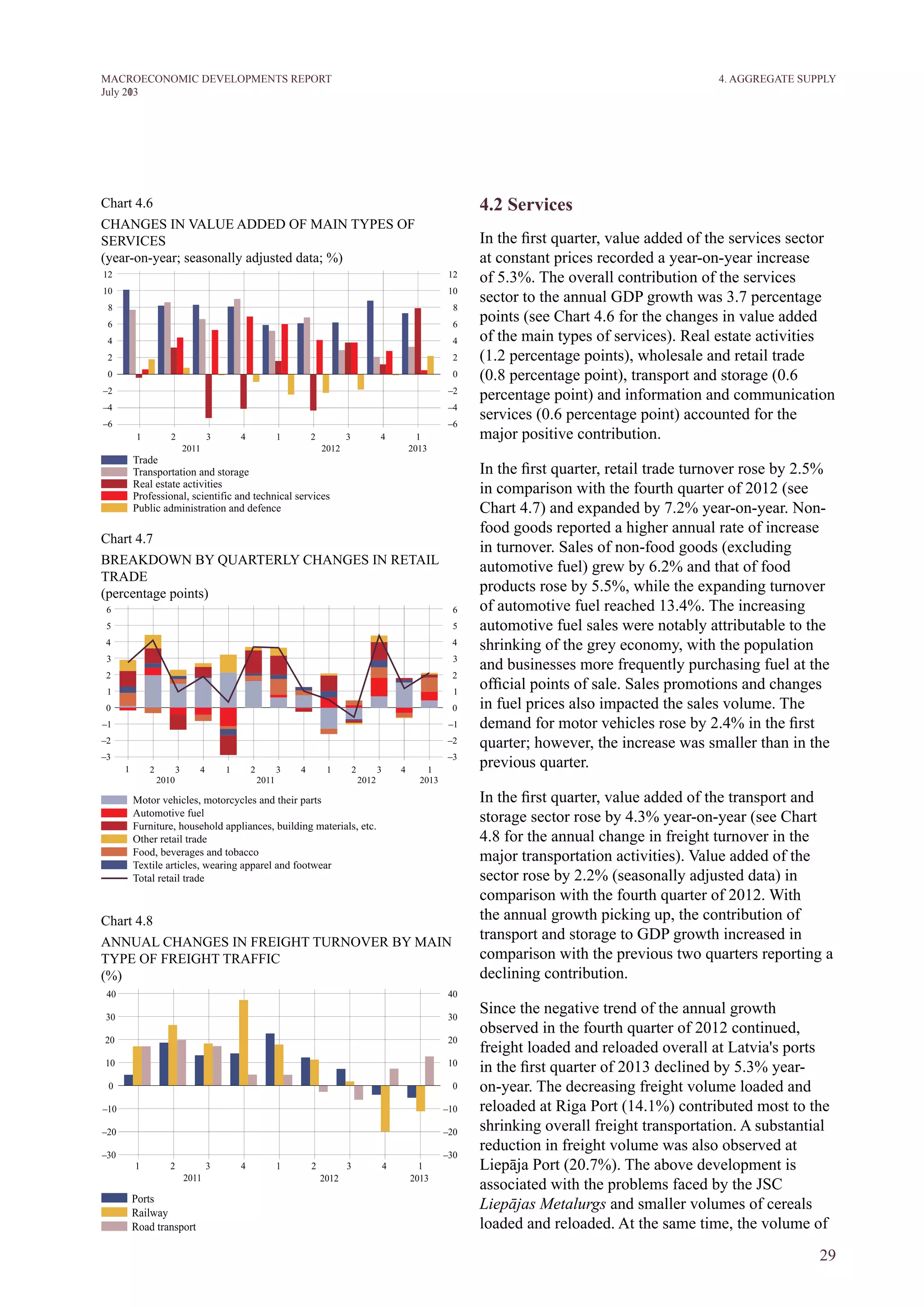
4.2 Services
In the first quarter, value added of the services sector
at constant prices recorded a year-on-year increase
of 5.3%. The overall contribution of the services
sector to the annual GDP growth was 3.7 percentage
points (see Chart 4.6 for the changes in value added
of the main types of services). Real estate activities
(1.2 percentage points), wholesale and retail trade
(0.8 percentage point), transport and storage (0.6
percentage point) and information and communication
services (0.6 percentage point) accounted for the
major positive contribution.
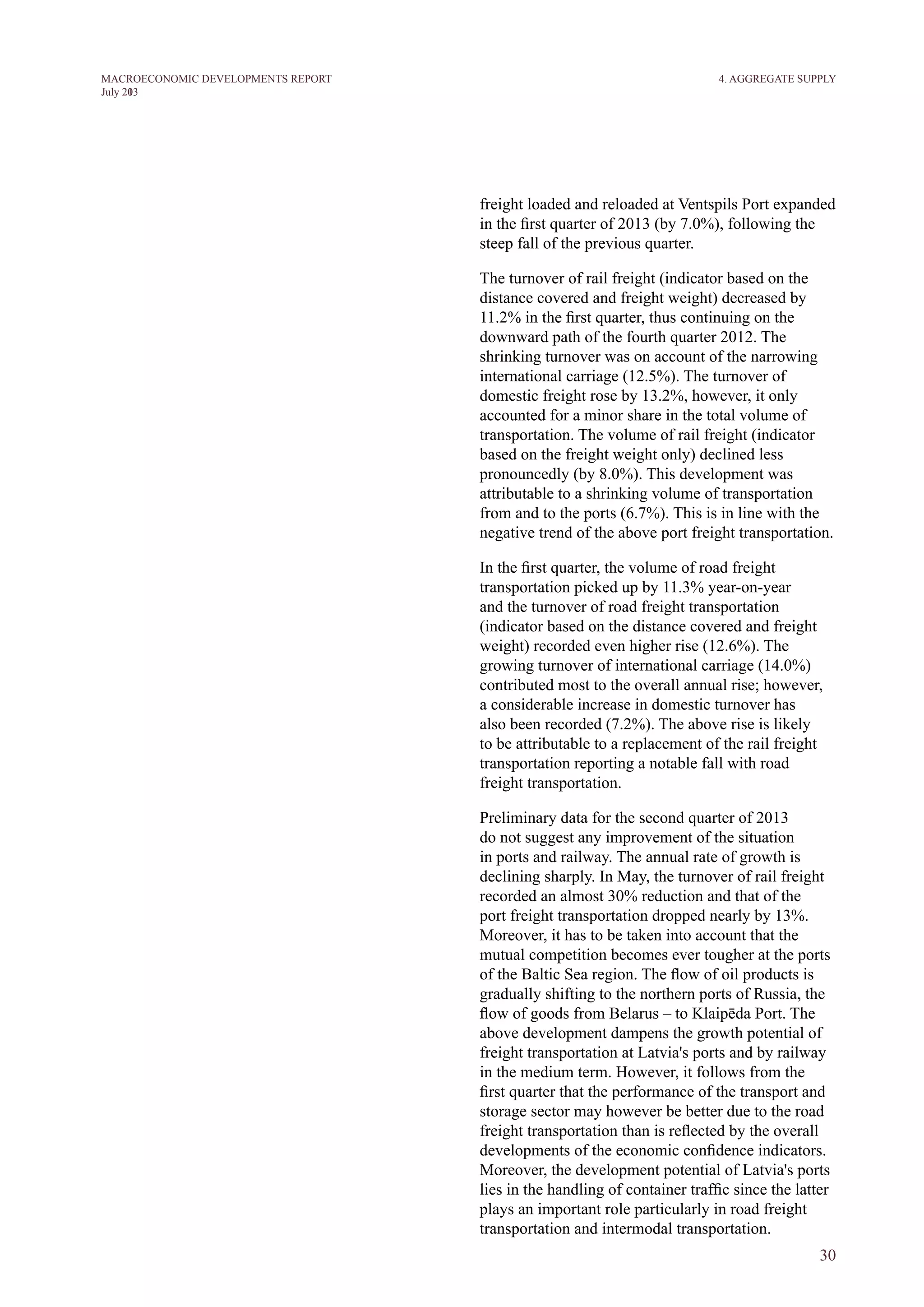
In the first quarter, retail trade turnover rose by 2.5%
in comparison with the fourth quarter of 2012 (see
Chart 4.7) and expanded by 7.2% year-on-year. Non-
food goods reported a higher annual rate of increase
in turnover. Sales of non-food goods (excluding
automotive fuel) grew by 6.2% and that of food
products rose by 5.5%, while the expanding turnover
of automotive fuel reached 13.4%. The increasing
automotive fuel sales were notably attributable to the
shrinking of the grey economy, with the population
and businesses more frequently purchasing fuel at the
official points of sale. Sales promotions and changes
in fuel prices also impacted the sales volume. The
demand for motor vehicles rose by 2.4% in the first
quarter; however, the increase was smaller than in the
previous quarter.
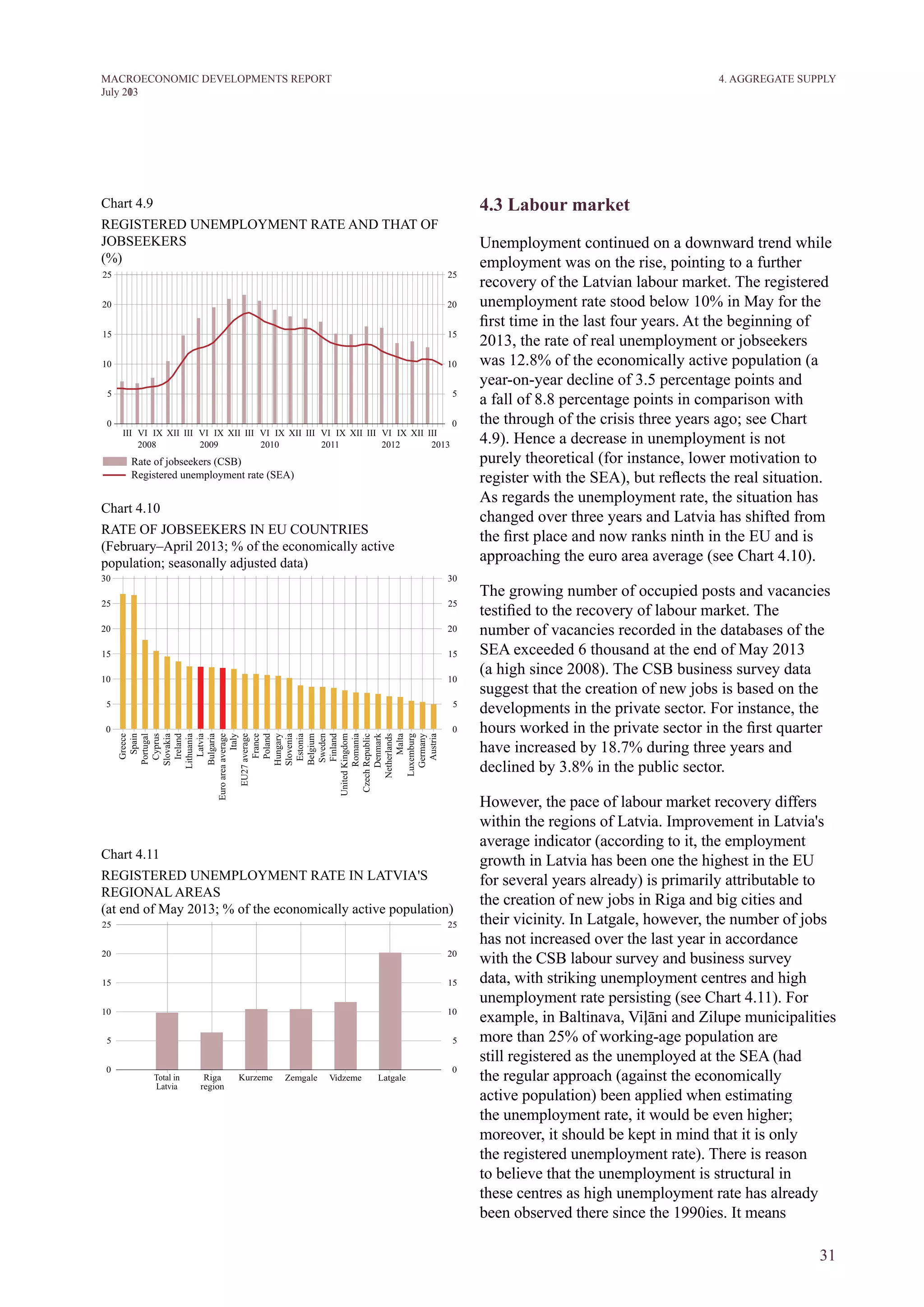
In the first quarter, value added of the transport and
storage sector rose by 4.3% year-on-year (see Chart
4.8 for the annual change in freight turnover in the
major transportation activities). Value added of the
sector rose by 2.2% (seasonally adjusted data) in
comparison with the fourth quarter of 2012. With
the annual growth picking up, the contribution of
transport and storage to GDP growth increased in
comparison with the previous two quarters reporting a
declining contribution.
Since the negative trend of the annual growth
observed in the fourth quarter of 2012 continued,
freight loaded and reloaded overall at Latvia's ports
in the first quarter of 2013 declined by 5.3% year-
on-year. The decreasing freight volume loaded and
reloaded at Riga Port (14.1%) contributed most to the
shrinking overall freight transportation. A substantial
reduction in freight volume was also observed at
Liepāja Port (20.7%). The above development is
associated with the problems faced by the JSC
Liepājas Metalurgs and smaller volumes of cereals
loaded and reloaded. At the same time, the volume of
Chart 4.6
CHANGES IN VALUE ADDED OF MAIN TYPES OF
SERVICES
(year-on-year; seasonally adjusted data; %)
Chart 4.7
BREAKDOWN BY QUARTERLY CHANGES IN RETAIL
TRADE
(percentage points)
Chart 4.8
ANNUAL CHANGES IN FREIGHT TURNOVER BY MAIN
TYPE OF FREIGHT TRAFFIC
(%)
4. AGGREGATE SUPPLY
30
M ACROECONOM I C DEVELOPM ENTS REPORT
J uly 2013
freight loaded and reloaded at Ventspils Port expanded
in the first quarter of 2013 (by 7.0%), following the
steep fall of the previous quarter.
The turnover of rail freight (indicator based on the
distance covered and freight weight) decreased by
11.2% in the first quarter, thus continuing on the
downward path of the fourth quarter 2012. The
shrinking turnover was on account of the narrowing
international carriage (12.5%). The turnover of
domestic freight rose by 13.2%, however, it only
accounted for a minor share in the total volume of
transportation. The volume of rail freight (indicator
based on the freight weight only) declined less
pronouncedly (by 8.0%). This development was
attributable to a shrinking volume of transportation
from and to the ports (6.7%). This is in line with the
negative trend of the above port freight transportation.
In the first quarter, the volume of road freight
transportation picked up by 11.3% year-on-year
and the turnover of road freight transportation
(indicator based on the distance covered and freight
weight) recorded even higher rise (12.6%). The
growing turnover of international carriage (14.0%)
contributed most to the overall annual rise; however,
a considerable increase in domestic turnover has
also been recorded (7.2%). The above rise is likely
to be attributable to a replacement of the rail freight
transportation reporting a notable fall with road
freight transportation.
Preliminary data for the second quarter of 2013
do not suggest any improvement of the situation
in ports and railway. The annual rate of growth is
declining sharply. In May, the turnover of rail freight
recorded an almost 30% reduction and that of the
port freight transportation dropped nearly by 13%.
Moreover, it has to be taken into account that the
mutual competition becomes ever tougher at the ports
of the Baltic Sea region. The flow of oil products is
gradually shifting to the northern ports of Russia, the
flow of goods from Belarus – to Klaipēda Port. The
above development dampens the growth potential of
freight transportation at Latvia's ports and by railway
in the medium term. However, it follows from the
first quarter that the performance of the transport and
storage sector may however be better due to the road
freight transportation than is reflected by the overall
developments of the economic confidence indicators.
Moreover, the development potential of Latvia's ports
lies in the handling of container traffic since the latter
plays an important role particularly in road freight
transportation and intermodal transportation.
4. AGGREGATE SUPPLY
31
M ACROECONOM I C DEVELOPM ENTS REPORT
J uly 2013
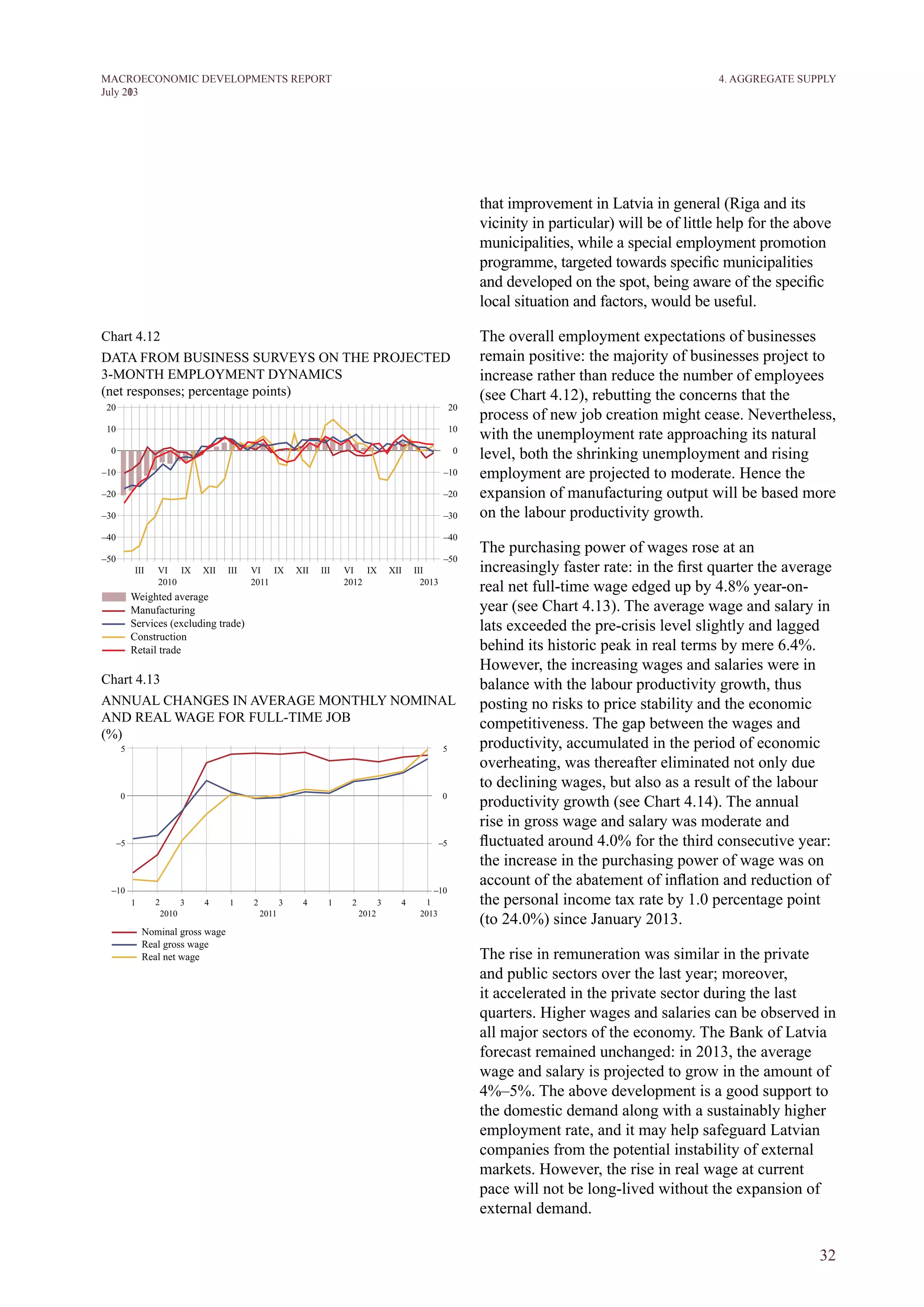
4.3 Labour market
Unemployment continued on a downward trend while
employment was on the rise, pointing to a further
recovery of the Latvian labour market. The registered
unemployment rate stood below 10% in May for the
first time in the last four years. At the beginning of
2013, the rate of real unemployment or jobseekers
was 12.8% of the economically active population (a
year-on-year decline of 3.5 percentage points and
a fall of 8.8 percentage points in comparison with
the through of the crisis three years ago; see Chart
4.9). Hence a decrease in unemployment is not
purely theoretical (for instance, lower motivation to
register with the SEA), but reflects the real situation.
As regards the unemployment rate, the situation has
changed over three years and Latvia has shifted from
the first place and now ranks ninth in the EU and is
approaching the euro area average (see Chart 4.10).
The growing number of occupied posts and vacancies
testified to the recovery of labour market. The
number of vacancies recorded in the databases of the
SEA exceeded 6 thousand at the end of May 2013
(a high since 2008). The CSB business survey data
suggest that the creation of new jobs is based on the
developments in the private sector. For instance, the
hours worked in the private sector in the first quarter
have increased by 18.7% during three years and
declined by 3.8% in the public sector.
However, the pace of labour market recovery differs
within the regions of Latvia. Improvement in Latvia's
average indicator (according to it, the employment
growth in Latvia has been one the highest in the EU
for several years already) is primarily attributable to
the creation of new jobs in Riga and big cities and
their vicinity. In Latgale, however, the number of jobs
has not increased over the last year in accordance
with the CSB labour survey and business survey
data, with striking unemployment centres and high
unemployment rate persisting (see Chart 4.11). For
example, in Baltinava, Viļāni and Zilupe municipalities
more than 25% of working-age population are
still registered as the unemployed at the SEA (had
the regular approach (against the economically
active population) been applied when estimating
the unemployment rate, it would be even higher;
moreover, it should be kept in mind that it is only
the registered unemployment rate). There is reason
to believe that the unemployment is structural in
these centres as high unemployment rate has already
been observed there since the 1990ies. It means
4. AGGREGATE SUPPLY
Chart 4.9
REGISTERED UNEMPLOYMENT RATE AND THAT OF
JOBSEEKERS
(%)
Chart 4.10
RATE OF JOBSEEKERS IN EU COUNTRIES
(February–April 2013; % of the economically active
population; seasonally adjusted data)
Chart 4.11
REGISTERED UNEMPLOYMENT RATE IN LATVIA'S
REGIONAL AREAS
(at end of May 2013; % of the economically active population)
32
M ACROECONOM I C DEVELOPM ENTS REPORT
J uly 2013
4. AGGREGATE SUPPLY
that improvement in Latvia in general (Riga and its
vicinity in particular) will be of little help for the above
municipalities, while a special employment promotion
programme, targeted towards specific municipalities
and developed on the spot, being aware of the specific
local situation and factors, would be useful.
The overall employment expectations of businesses
remain positive: the majority of businesses project to
increase rather than reduce the number of employees
(see Chart 4.12), rebutting the concerns that the
process of new job creation might cease. Nevertheless,
with the unemployment rate approaching its natural
level, both the shrinking unemployment and rising
employment are projected to moderate. Hence the
expansion of manufacturing output will be based more
on the labour productivity growth.
The purchasing power of wages rose at an
increasingly faster rate: in the first quarter the average
real net full-time wage edged up by 4.8% year-on-
year (see Chart 4.13). The average wage and salary in
lats exceeded the pre-crisis level slightly and lagged
behind its historic peak in real terms by mere 6.4%.
However, the increasing wages and salaries were in
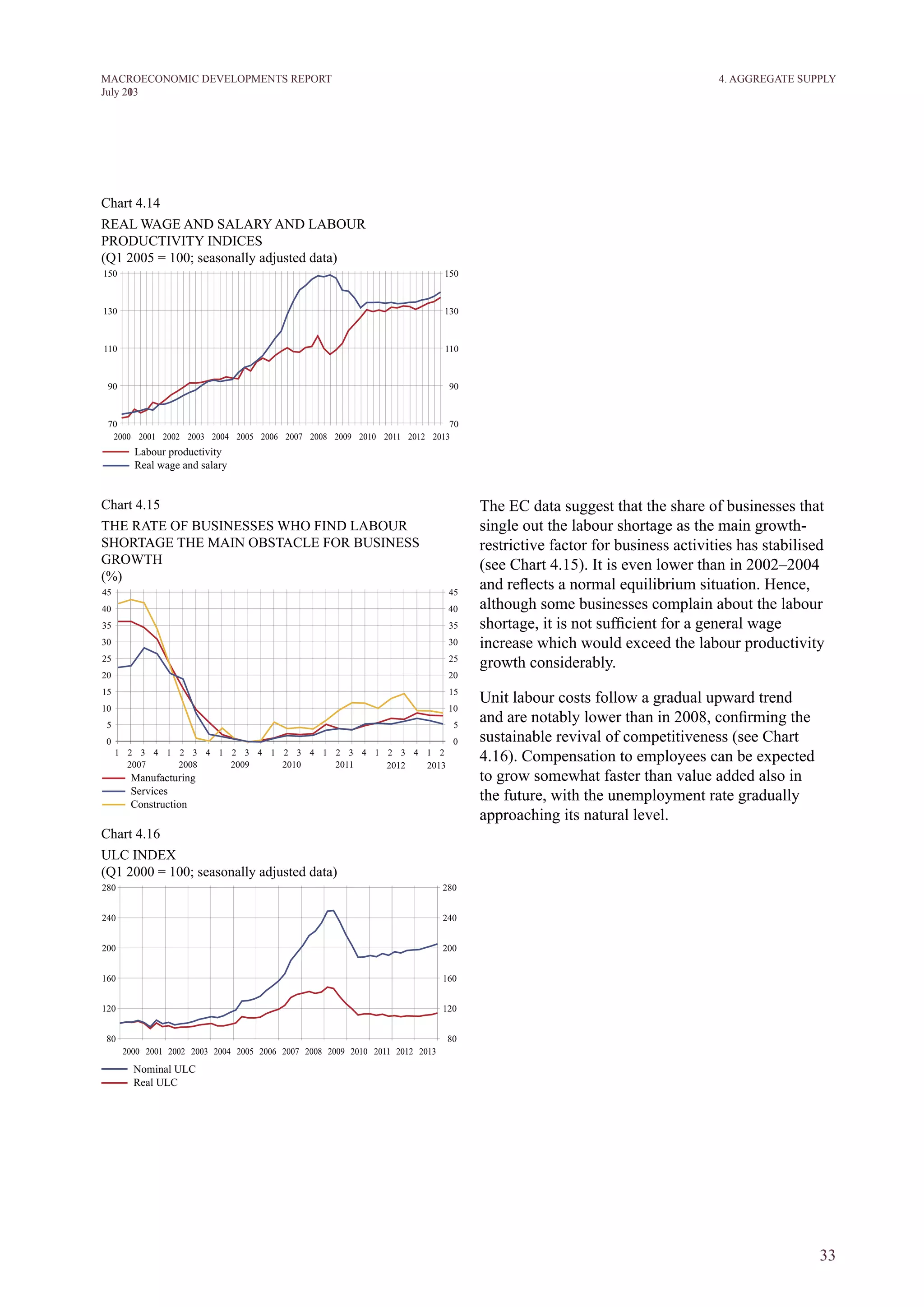
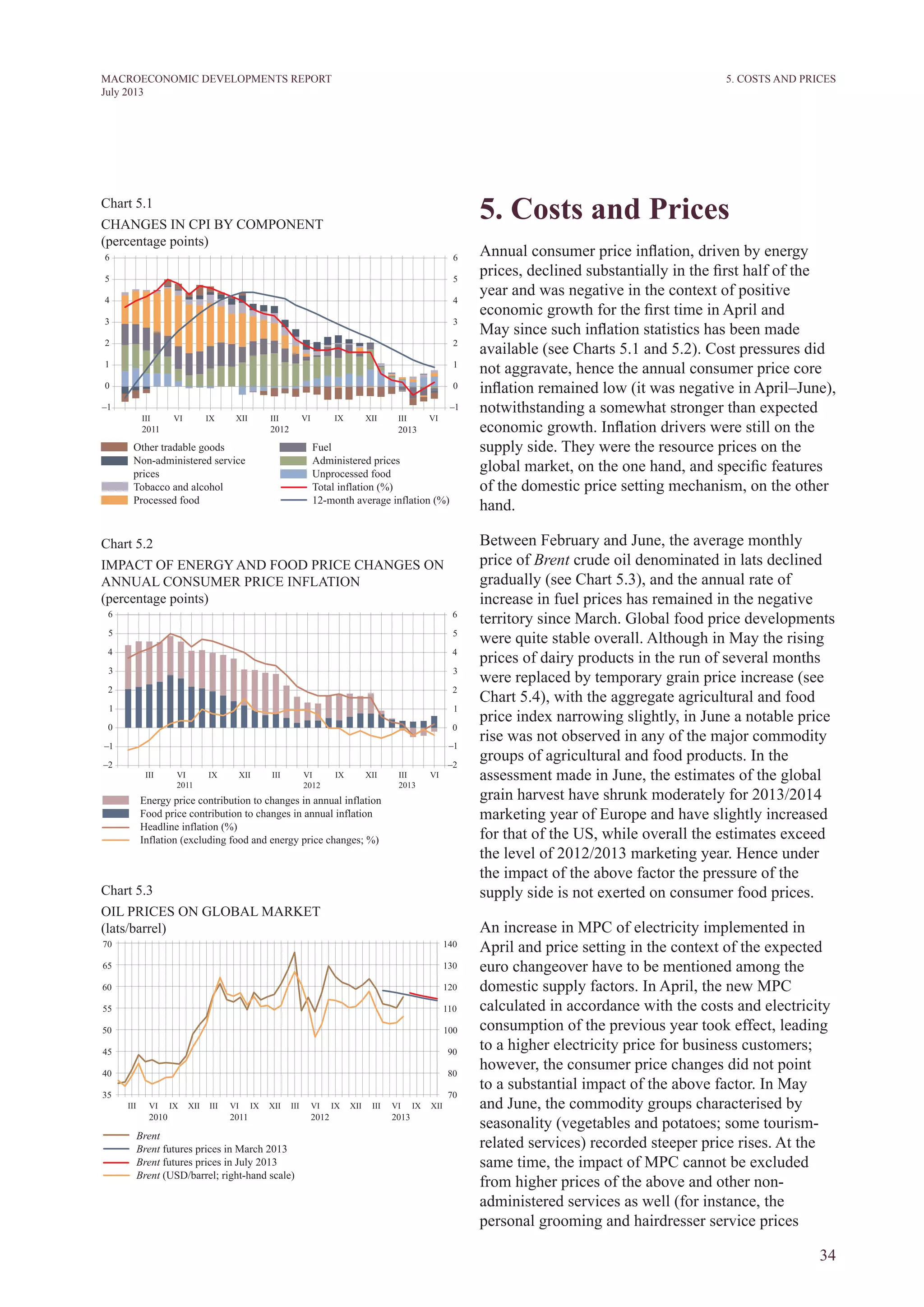
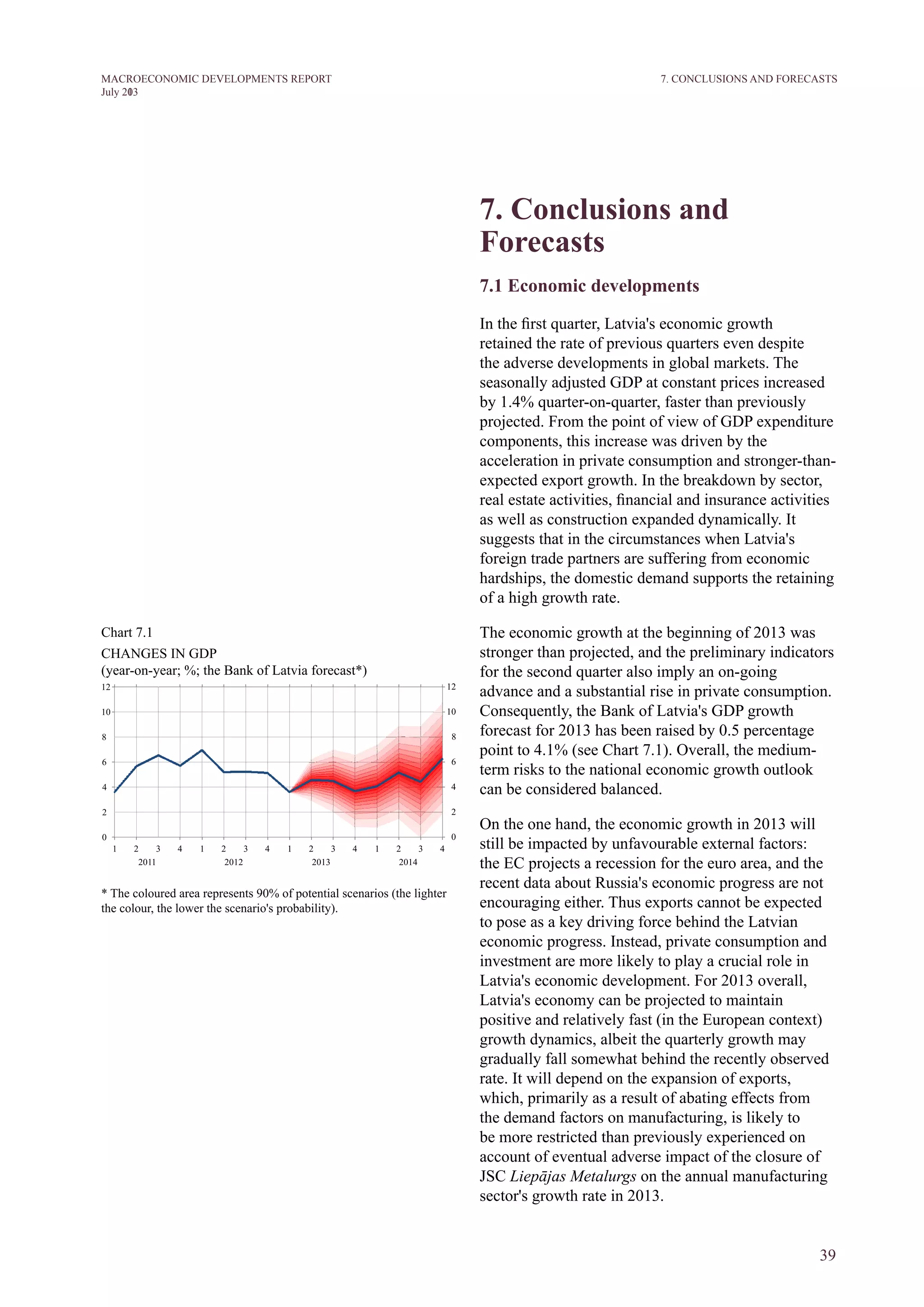
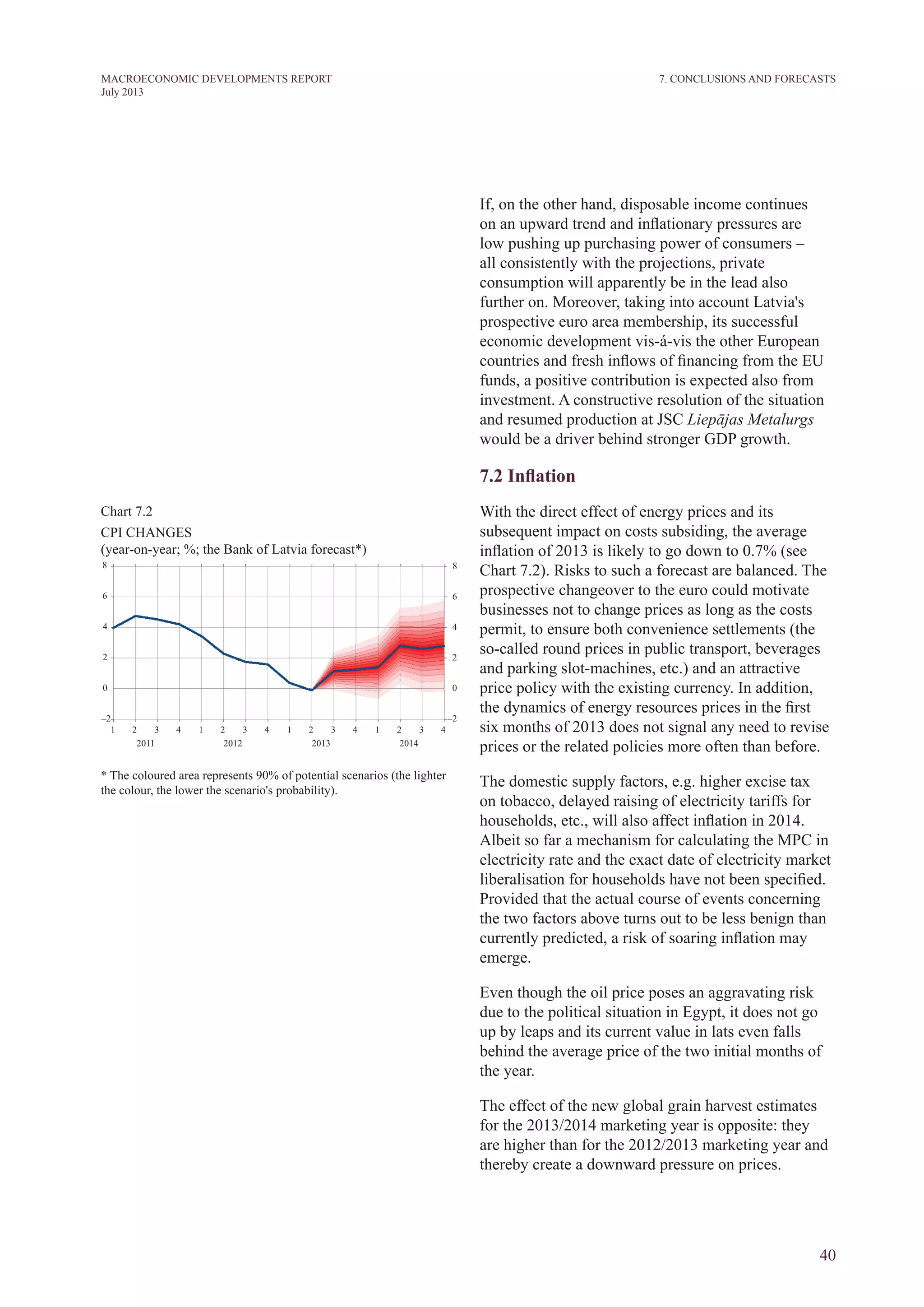
balance with the labour productivity growth, thus
posting no risks to price stability and the economic
competitiveness. The gap between the wages and
productivity, accumulated in the period of economic
overheating, was thereafter eliminated not only due
to declining wages, but also as a result of the labour
productivity growth (see Chart 4.14). The annual
rise in gross wage and salary was moderate and
fluctuated around 4.0% for the third consecutive year:
the increase in the purchasing power of wage was on
account of the abatement of inflation and reduction of
the personal income tax rate by 1.0 percentage point
(to 24.0%) since January 2013.
The rise in remuneration was similar in the private
and public sectors over the last year; moreover,
it accelerated in the private sector during the last
quarters. Higher wages and salaries can be observed in
all major sectors of the economy. The Bank of Latvia
forecast remained unchanged: in 2013, the average
wage and salary is projected to grow in the amount of
4%–5%. The above development is a good support to
the domestic demand along with a sustainably higher
employment rate, and it may help safeguard Latvian
companies from the potential instability of external
markets. However, the rise in real wage at current
pace will not be long-lived without the expansion of
external demand.
Chart 4.12
DATA FROM BUSINESS SURVEYS ON THE PROJECTED
3-MONTH EMPLOYMENT DYNAMICS
(net responses; percentage points)
Chart 4.13
ANNUAL CHANGES IN AVERAGE MONTHLY NOMINAL
AND REAL WAGE FOR FULL-TIME JOB
(%)
33
M ACROECONOM I C DEVELOPM ENTS REPORT
J uly 2013
4. AGGREGATE SUPPLY
The EC data suggest that the share of businesses that
single out the labour shortage as the main growth-
restrictive factor for business activities has stabilised
(see Chart 4.15). It is even lower than in 2002–2004
and reflects a normal equilibrium situation. Hence,
although some businesses complain about the labour
shortage, it is not sufficient for a general wage
increase which would exceed the labour productivity
growth considerably.
Unit labour costs follow a gradual upward trend
and are notably lower than in 2008, confirming the
sustainable revival of competitiveness (see Chart
4.16). Compensation to employees can be expected
to grow somewhat faster than value added also in
the future, with the unemployment rate gradually
approaching its natural level.
Chart 4.14
REAL WAGE AND SALARY AND LABOUR
PRODUCTIVITY INDICES
(Q1 2005 = 100; seasonally adjusted data)
Chart 4.15
THE RATE OF BUSINESSES WHO FIND LABOUR
SHORTAGE THE MAIN OBSTACLE FOR BUSINESS
GROWTH
(%)
Chart 4.16
ULC INDEX
(Q1 2000 = 100; seasonally adjusted data)
34
MACROECONOMIC DEVELOPMENTS REPORT
July 2013
5. Costs and Prices
Annual consumer price inflation, driven by energy
prices, declined substantially in the first half of the
year and was negative in the context of positive
economic growth for the first time in April and
May since such inflation statistics has been made
available (see Charts 5.1 and 5.2). Cost pressures did
not aggravate, hence the annual consumer price core
inflation remained low (it was negative in April–June),
notwithstanding a somewhat stronger than expected
economic growth. Inflation drivers were still on the
supply side. They were the resource prices on the
global market, on the one hand, and specific features
of the domestic price setting mechanism, on the other
hand.
Between February and June, the average monthly
price of Brent crude oil denominated in lats declined
gradually (see Chart 5.3), and the annual rate of
increase in fuel prices has remained in the negative
territory since March. Global food price developments
were quite stable overall. Although in May the rising
prices of dairy products in the run of several months
were replaced by temporary grain price increase (see
Chart 5.4), with the aggregate agricultural and food
price index narrowing slightly, in June a notable price
rise was not observed in any of the major commodity
groups of agricultural and food products. In the
assessment made in June, the estimates of the global
grain harvest have shrunk moderately for 2013/2014
marketing year of Europe and have slightly increased
for that of the US, while overall the estimates exceed
the level of 2012/2013 marketing year. Hence under
the impact of the above factor the pressure of the
supply side is not exerted on consumer food prices.
An increase in MPC of electricity implemented in
April and price setting in the context of the expected
euro changeover have to be mentioned among the
domestic supply factors. In April, the new MPC
calculated in accordance with the costs and electricity
consumption of the previous year took effect, leading
to a higher electricity price for business customers;
however, the consumer price changes did not point
to a substantial impact of the above factor. In May
and June, the commodity groups characterised by
seasonality (vegetables and potatoes; some tourism-
related services) recorded steeper price rises. At the
same time, the impact of MPC cannot be excluded
from higher prices of the above and other non-
administered services as well (for instance, the
personal grooming and hairdresser service prices
5. Costs and prices
Chart 5.1
CHANGES IN CPI BY COMPONENT
(percentage points)
Chart 5.2
IMPACT OF ENERGY AND FOOD PRICE CHANGES ON
ANNUAL CONSUMER PRICE INFLATION
(percentage points)
Chart 5.3
OIL PRICES ON GLOBAL MARKET
(lats/barrel)
35
M ACROECONOM I C DEVELOPM ENTS REPORT
J uly 2013
have also moved up), since changes in the price list
may reflect the influence of both seasonal and other
topical factors. It is important to note that inflation
expectations have decreased again (see Chart 5.5), and
stable energy prices as well as the postponement of
electricity market liberalisation for households might
also be the reason for this development.
Other domestic supply-side factors, in turn, have
somewhat dampened the price changes. For instance,
publishing of popular consumer goods and service
prices, i.e. within the framework of price monitoring
(see: http://www.em.gov.lv/em/2nd/?cat=30844) prior
to the euro changeover, points to the fact that the
popularity of sales promotions has neither consistently
grown nor declined. In the groups of goods and
services where a merchant or a service provider used
to maintain convenient or attractive prices, such prices
in lats were still retained; moreover, in some cases
they even shrank. With the period of dual display of
prices in lats and euro approaching, other initiatives
will be implemented, such as the "Honest Introducer
of the Euro", which could involve a considerably
larger number of businesses, thus helping to maintain
price stability.
Low inflation was the key to ensuring the compliance
with the Maastricht criteria, as has been specified in
the EC Convergence Report on 5 June 2013.
In April, the producer prices of goods sold on the
domestic market rose primarily in the sector of
energy production. This was largely driven by the
raised MPC. The contribution of the sector of energy
production to the producer price rise was negative
already in May. In April and May, the increase in
manufacturing prices was attributable to the export-
oriented manufacture of articles of wood. Overall,
producer prices recorded a moderate annual growth
and exerted no pressure on consumer prices.
The dynamics of real effective exchange rate of the
lats remained favourable for retaining competitiveness
in the external market under the circumstances of low
inflation: the CPI-deflated real effective exchange
rate of the lats was somewhat lower in the first five
months of 2013 than at the end of 2012 (see Chart
5.6). The PPI-deflated real effective exchange rate of
the lats has also remained fairly stable. Data for April
might reveal an impact of one-off factor on account of
higher energy prices.
Chart 5.4
GLOBAL FOOD PRICES
(average monthly indicator of 2002–2004 = 100)
Chart 5.5
ANNUAL INFLATION AND INFLATION EXPECTATIONS
(%)
Chart 5.6
EFFECTIVE EXCHANGE RATE OF THE LATS
(index: January 2000/Q1 = 100)
5. COSTS AND PRICES
36
MACROECONOMIC DEVELOPMENTS REPORT
July 2013
Driven by external supply-side factors, annual
inflation turned temporarily negative; however, the
estimate of energy prices for the coming months
enables to forecast a relatively low inflation also in
the near future. For instance, in July the JSC Latvijas
Gāze published its assessment about the dynamics
of the nine-month moving average of heating oil
prices and set a slightly lower (by one degree) natural
gas trading price as of July. Both the above factor
and new tariff table approved by the Public Utilities
Commission for the JSC Rīgas Siltums after launching
the bio fuel plants are attributable to a further low
contribution of energy prices to the average annual
inflation.
5. Costs and prices
37
M ACROECONOM I C DEVELOPM ENTS REPORT
J uly 2013
6. Balance of Payments
In the first quarter, the current account deficit of
Latvia's balance of payments amounted to 49.9
million lats or 1.4% of GDP (see Chart 6.1). It rose
quarter-on-quarter as the goods foreign trade deficit
increased, and current transfers were received to a
lesser extent than previously. However, the current
account deficit was smaller than in 2012 on average,
when it stood at 1.7% of GDP, and also smaller than
in the first quarter of 2012 when it amounted to 3.1%
of GDP. Preliminary data for April 2013 indicate that
the current account has recorded a surplus this month
(23.7 million lats), and the results of the first four
months of 2013 suggest that the current account is
expected to record a small deficit in 2013.
In the first quarter, the goods and services foreign
trade deficit increased to 109.6 million lats or 3.0%
of GDP. Due to seasonal factors the foreign trade
activity subsided, the annual growth of goods and
services exports amounted to 7.1%, while the growth
in imports was more moderate (4.6%). In the first
quarter, services delivered to non-residents decreased
quarter-on-quarter both due to seasonal factors and
given the weakening of the foreign demand. Various
small sub-sectors of services posted a notable drop,
whereas exports of transportation services accounting
for the most significant share of Latvia's services
exports remained broadly unchanged (see Chart 6.2).
The income account deficit rose to 31.5 million lats or
0.9% of GDP in the first quarter when a bigger part of
the profit was paid out in dividends quarter-on-quarter.
At the same time, the surplus of the current transfers
account decreased somewhat to 91.1 million lats or
2.5% of GDP, while that of the capital account fell
to 88.4 million lats or 2.5% of GDP. However, such
a decrease is temporary as preliminary data suggest
that overall 338.8 million lats were received from EU
funds in the first five months of 2013 (207.5 million
lats – in the first five months of 2012). This will also
affect the current transfers and capital accounts of the
balance of payments in the coming months.
The inflow of foreign direct investment in Latvia
persisted, albeit at a slower pace than in 2012. In the
first quarter, net inflow of foreign direct investment
accounted for 2.7% of GDP (see Chart 6.3), and
the weaker overall activity was mainly determined
by lower intensity of foreign direct investment
inflows in the financial and real estate sectors where
the largest foreign direct investment flows were
Chart 6.1
CURRENT ACCOUNT OF LATVIA'S BALANCE OF
PAYMENTS AND ITS COMPONENTS
(% of GDP)
Chart 6.2
GROWTH RATE OF EXPORTS AND IMPORTS OF GOODS
AND SERVICES
(year-on-year; %)
Chart 6.3
FOREIGN DIRECT INVESTMENT IN LATVIA
(% of GDP)
6. BALANCE OF PAYMENTS
38
M ACROECONOM I C DEVELOPM ENTS REPORT
J uly 2013
Chart 6.4
NET FLOWS OF FOREIGN DIRECT INVESTMENT
(millions of lats)
experienced so far (Chart 6.4). In the first quarter, the
largest inflows of such investment were recorded in
wholesale, mining, energy sector and manufacturing
(woodworking, manufacture of food products and
electrical equipment).
6. BALANCE OF PAYMENTS
39
M ACROECONOM I C DEVELOPM ENTS REPORT
J uly 2013
7. Conclusions and
Forecasts
7.1 Economic developments
In the first quarter, Latvia's economic growth
retained the rate of previous quarters even despite
the adverse developments in global markets. The
seasonally adjusted GDP at constant prices increased
by 1.4% quarter-on-quarter, faster than previously
projected. From the point of view of GDP expenditure
components, this increase was driven by the
acceleration in private consumption and stronger-than-
expected export growth. In the breakdown by sector,
real estate activities, financial and insurance activities
as well as construction expanded dynamically. It
suggests that in the circumstances when Latvia's
foreign trade partners are suffering from economic
hardships, the domestic demand supports the retaining
of a high growth rate.
The economic growth at the beginning of 2013 was
stronger than projected, and the preliminary indicators
for the second quarter also imply an on-going
advance and a substantial rise in private consumption.
Consequently, the Bank of Latvia's GDP growth
forecast for 2013 has been raised by 0.5 percentage
point to 4.1% (see Chart 7.1). Overall, the medium-
term risks to the national economic growth outlook
can be considered balanced.
On the one hand, the economic growth in 2013 will
still be impacted by unfavourable external factors:
the EC projects a recession for the euro area, and the
recent data about Russia's economic progress are not
encouraging either. Thus exports cannot be expected
to pose as a key driving force behind the Latvian
economic progress. Instead, private consumption and
investment are more likely to play a crucial role in
Latvia's economic development. For 2013 overall,
Latvia's economy can be projected to maintain
positive and relatively fast (in the European context)
growth dynamics, albeit the quarterly growth may
gradually fall somewhat behind the recently observed
rate. It will depend on the expansion of exports,
which, primarily as a result of abating effects from
the demand factors on manufacturing, is likely to
be more restricted than previously experienced on
account of eventual adverse impact of the closure of
JSC Liepājas Metalurgs on the annual manufacturing
sector's growth rate in 2013.
Chart 7.1
CHANGES IN GDP
(year-on-year; %; the Bank of Latvia forecast*)
* The coloured area represents 90% of potential scenarios (the lighter
the colour, the lower the scenario's probability).
7. CONCLUSIONS AND FORECASTS
40
MACROECONOMIC DEVELOPMENTS REPORT
July 2013
If, on the other hand, disposable income continues
on an upward trend and inflationary pressures are
low pushing up purchasing power of consumers –
all consistently with the projections, private
consumption will apparently be in the lead also
further on. Moreover, taking into account Latvia's
prospective euro area membership, its successful
economic development vis-á-vis the other European
countries and fresh inflows of financing from the EU
funds, a positive contribution is expected also from
investment. A constructive resolution of the situation
and resumed production at JSC Liepājas Metalurgs
would be a driver behind stronger GDP growth.
7.2 Inflation
With the direct effect of energy prices and its
subsequent impact on costs subsiding, the average
inflation of 2013 is likely to go down to 0.7% (see
Chart 7.2). Risks to such a forecast are balanced. The
prospective changeover to the euro could motivate
businesses not to change prices as long as the costs
permit, to ensure both convenience settlements (the
so-called round prices in public transport, beverages
and parking slot-machines, etc.) and an attractive
price policy with the existing currency. In addition,
the dynamics of energy resources prices in the first
six months of 2013 does not signal any need to revise
prices or the related policies more often than before.
The domestic supply factors, e.g. higher excise tax
on tobacco, delayed raising of electricity tariffs for
households, etc., will also affect inflation in 2014.
Albeit so far a mechanism for calculating the MPC in
electricity rate and the exact date of electricity market
liberalisation for households have not been specified.
Provided that the actual course of events concerning
the two factors above turns out to be less benign than
currently predicted, a risk of soaring inflation may
emerge.
Even though the oil price poses an aggravating risk
due to the political situation in Egypt, it does not go
up by leaps and its current value in lats even falls
behind the average price of the two initial months of
the year.
The effect of the new global grain harvest estimates
for the 2013/2014 marketing year is opposite: they
are higher than for the 2012/2013 marketing year and
thereby create a downward pressure on prices.
7. Conclusions and Forecasts
Chart 7.2
CPI CHANGES
(year-on-year; %; the Bank of Latvia forecast*)
* The coloured area represents 90% of potential scenarios (the lighter
the colour, the lower the scenario's probability).
41
MACROECONOMIC DEVELOPMENTS REPORT
July 2013
Statistics
Statistics
List of tables
1.	 Monetary Indicators and Interest Rates	 43
2.ab	 Real Sector Indicators and Prices	 44
3.	 Monetary Base	 45
4.	 Monetary Aggregates and Counterparts 	 46
5.	 Seasonally Adjusted Monetary Aggregates	 46
6.	 The Bank of Latvia's Assets and Liabilities 	 47
7.	 Aggregated Balance Sheet of MFIs (excluding the Bank of Latvia) 	 48
8.	 Consolidated Balance Sheet of MFIs 	 49
9.ab	 Aggregated Balance Sheet of MFIs (excluding the Bank of Latvia)	 50
10.	 Monetary Survey	 53
11.ab	 Foreign Assets and Liabilities of MFIs (excluding the Bank of Latvia)	 54
12.	 Selected Items in the Monthly Financial Position Report of MFIs (excluding
	 the Bank of Latvia) by Group of Countries	 55
13.	 Maturity Profile of Deposits of Resident Financial Institutions, Non-Financial
Corporations and Households (in lats and foreign currencies)	 56
14.a	 Deposits by Financial Institutions (in lats and foreign currencies)	 57
14.b	 Deposits by Non-Financial Corporations (in lats and foreign currencies)	 58
14.c	 Deposits by Households (in lats and foreign currencies)	 59
14.d	 Deposits by Government and Non-Residents (in lats and foreign currencies)	 59
15.	 Maturity Profile of Loans to Resident Financial Institutions, Non-Financial
Corporations and Households (in lats and foreign currencies)	 60
16.a	 Loans to Financial Institutions and Non-Financial Corporations	 60
16.b	 Loans to Households	 61
16.c	 Loans to Government and Non-Residents	 61
17.	 Loans to Financial Institutions and Non-Financial Corporations in the National
Economy	62
18.	 Lending to Resident Financial Institutions, Non-Financial Corporations and
Households	62
19.a	 Holdings of Securities Other than Shares	 63
19.b	 Holdings of Shares and Other Equity	 63
20.a	 Currency Breakdown of Resident Deposits 	 64
20.b	 Currency Breakdown of Non-Resident Deposits 	 64
20.c	 Currency Breakdown of Loans to Residents	 65
20.d	 Currency Breakdown of Loans to Non-Residents	 65
20.e	 Currency Breakdown of Holdings of Resident Securities Other than Shares	 66
20.f	 Currency Breakdown of Holdings of Non-Resident Securities Other than
Shares	66
20.g	 Currency Breakdown of Debt Securities Issued by MFIs	 67
21.a	 Weighted Average Interest Rates Charged by MFIs in Transactions with
Resident Non-Financial Corporations and Households in Lats	 67
21.b	 Weighted Average Interest Rates Charged by MFIs in Transactions with
Resident Non-Financial Corporations and Households in Euro	 71
21.c	 Weighted Average Interest Rates Charged by MFIs in Transactions with
Resident Non-Financial Corporations and Households in US Dollars	 75
21.d 	 Weighted Average Interest Rates Charged by MFIs in Transactions with Resident
Non-Financial Corporations (new business)	 80
42
MACROECONOMIC DEVELOPMENTS REPORT
July 2013
Statistics
22.	 Lending in the Interbank Markets 	 81
23.a	 Interest Rates in the Domestic Interbank Market	 82
23.b	 Interest Rates Set by the Bank of Latvia	 82
23.c	 Interest Rates in Bank of Latvia Tenders of Repurchase Agreements
and Short-Term Currency Swap Contracts	 83
24.	 Principal Foreign Exchange Transactions (by type, counterparty and currency)	 83
25.	 Non-cash Foreign Exchange Transactions	 84
26.	 Monthly Averages of the Exchange Rates Set by the Bank of Latvia	 84
27.	 Weighted Average Exchange Rates (cash transactions)	 85
28.	 Structure of Government Securities 	 86
29.	 Auctions of Government Securities in the Primary Market	 87
30.	 The Bank of Latvia's Transactions in the Secondary Market for
Government Securities	 87
31.	 Dynamics of GDP	 87
32.	 Changes in the Average Monthly Wages and Salaries and Unemployment	 88
33.	 Latvian Foreign Trade Balance	 88
34.	 Main Export Goods of Latvia	 89
35.	 Main Import Goods of Latvia	 90
36.	 Latvian Foreign Trade Partners	 91
37. 	 Convenience and Extended Credit, Revolving Loans and Overdraft to Resident
Non-financial Corporations and Households	 91
38.a	 Loans to Resident Non-financial Corporations in the Breakdown
by Residual Maturity and by Interest Rate Reset Period	 92
38.b	 Loans to Resident Households in the Breakdown by Residual Maturity and
by Interest Rate Reset Period	 92
43
MONETARY INDICATORS AND INTEREST RATES
2011 2012 2013
Q1 Q2 Q3 Q4 Q1
M11
15.6 10.9 16.6 12.8 14.8 10.9 10.4
M21
0.3 3.8 0.5 2.4 1.9 3.8 2.1
M31
1.7 2.8 –0.1 2.0 2.3 2.8 3.8
M2X1
1.5 4.5 1.3 2.3 2.6 4.5 3.3
Loans to resident financial institutions, non-
financial corporations and households1
–8.3 –10.6 –11.0 –11.6 –11.2 –10.6 –6.7
Deposits of resident financial institutions, non
-financial corporations and households1
–2.4 4.5 –2.5 –0.8 –0.2 4.5 4.1
Long-term interest rate for convergence
assessment purposes2
5.91 4.57 5.45 5.11 4.35 3.36 3.20
RIGIBOR (3-month loans)3
1.0 0.9 1.4 1.0 0.6 0.5 0.5
Average yield on government bonds 4.14
4.95
4.34
5.25
4.15
3.15
1.46
OMXR3
407.2 383.9 388.3 379.4 382.8 384.7 405.8
1.
2012 2013
I II III IV V VI VII VIII IX X XI XII I II III
M11
15.3 14.5 16.6 14.9 11.0 12.8 14.9 13.9 14.8 15.9 8.0 10.9 13.3 12.3 10.4
M21
–0.1 0.5 0.5 2.0 0.1 2.4 3.0 3.0 1.9 3.7 4.4 3.8 4.7 3.7 2.1
M31
1.4 1.5 –0.1 1.5 –0.3 2.0 3.3 3.3 2.3 4.0 5.1 2.8 3.7 3.4 3.8
M2X1
1.0 1.7 1.3 3.0 0.2 2.3 3.4 3.6 2.6 5.1 8.9 4.5 5.4 4.2 3.3
Loans to resident financial
institutions, non-financial
corporations and households1
–8.2 –7.7 –11.0 –10.3 –12.7 –11.6 –11.6 –11.3 –11.2 –11.0 –10.9 –10.6 –10.4 –10.1 –6.7
Deposits of resident financial
institutions, non-financial
corporations and households1
–3.1 –2.1 –2.5 –0.5 –3.0 –0.8 0.8 0.9 –0.2 2.9 8.3 4.5 6.2 5.2 4.1
Long-term interest rate for
convergence assessment
purposes2
5.74 5.45 5.15 5.10 5.15 5.07 4.67 4.45 3.92 3.52 3.32 3.24 3.21 3.22 3.17
RIGIBOR (3-month loans)3
1.8 1.3 1.2 1.0 0.9 0.9 0.7 0.6 0.6 0.5 0.5 0.5 0.5 0.5 0.5
Average yield on government
bonds 4.44
4.34
4.14
5.35
5.35
4.85
4.45
4.05
3.65
3.15
– – 1.46
1.46
1.26
OMXR3
379.9 391.4 393.7 392.3 380.3 367.6 381.4 381.3 386.0 384.6 381.3 389.3 404.7 399.5 413.2
1
Year-on-year changes (%).
2
Average secondary market yield of 10-year government bonds.
3
Average of the period.
4
Weighted average primary market yield of 5-year government bonds.
5
Weighted average primary market yield of 10-year government bonds.
44
REAL SECTOR INDICATORS AND PRICES
2011 2012 2013
Q1 Q2 Q3 Q4 Q1
Industrial output1
Increase/decrease2
(at constant
prices; working day adjusted data; %) 11.5 9.3 14.9 8.0 8.1 7.6 –1.7
Cargoes loaded and unloaded at ports
Turnover (thousands of tons) 68 821 75 193 20 032 20 309 17 722 17 129 18 969
Increase/decrease2
(%) 12.5 9.3 22.6 12.2 7.2 –4.0 –5.3
Retail trade turnover 1
Turnover (at current prices; millions of lats) 3 914.4 4 273.3 946.9 1 047.7 1 147.9 1 130.8 1 010.3
Increase/decrease2
(at constant prices; %) 2.4 7.3 9.3 6.7 7.4 6.2 7.2
Unemployment rate (%) 11.5 10.5 11.7 11.9 11.0 10.5 10.8
Producer prices1
(increase/decrease compared with
the previous period; %) 7.7 3.7 1.6 0.5 0.8 0.3 0.4
Consumer price inflation
Year-on-year basis (%) 4.4 2.3 3.4 2.3 1.8 1.6 0.3
Quarter-on-quarter basis (%) x x 1.1 0.9 –0.6 0.2 –0.1
Financial surplus/deficit in the consolidated general government budget
Surplus/deficit (millions of lats) –444.9 19.1 –43.9 106.3 279.0 –322.2 31.8
Ratio to GDP (%) 3.1 0.1 1.3 2.8 6.9 7.6 0.9
1
Data are calculated according to the revised version of the EU statistical Classification of Economic Activities (NACE Rev. 2).
2
Year-on-year basis.
3
Data have been revised.
2.a
45
REAL SECTOR INDICATORS AND PRICES
2012 2013
I II III IV V VI VII VIII IX X XI XII I II III
Industrial output1
Increase/decrease2
(at constant
prices; working day adjusted data;%) 17.7 11.8 15.3 8.6 7.4 8.2 7.3 12.6 4.3 5.5 7.4 10.1 –0.1 1.6 –5.7
Cargoes loaded and unloaded at ports
Turnover (thousands of tons) 6 999 5 800 7 233 7 082 6 910 6 317 5 913 5 894 5 915 5 337 5 825 5 967 6 553 5 614 6 802
Increase/decrease2
(%) 36.4 21.8 12.0 11.5 9.2 16.4 1.1 9.7 11.4 –9.3 0.4 –3.0 –6.4 –3.2 –6.0
Retail trade turnover1
Turnover (at current prices;
millions of lats) 314.9 301.4 330.6 327.7 353.5 366.5 379.0 397.5 371.4 373.6 350.5 406.8 339.2 317.4 353.7
Increase/decrease2
(at constant
prices; %) 12.4 8.9 6.9 5.2 6.3 8.4 8.7 8.2 5.2 8.3 5.5 5.1 6.8 5.1 6.8
Unemployment rate (%) 11.7 11.8 11.7 12.9 12.3 11.9 11.6 11.3 11.0 10.7 10.6 10.5 10.9 10.9 10.8
Producer prices1
(increase/decrease
compared with the previous period; %) 1.8 0.2 –0.4 0.9 –0.4 0.2 0.5 0.5 0 0.2 –0.2 0.2 0.3 –0.2 0.1
Consumer price inflation
Year-on-year basis (%) 3.6 3.4 3.3 2.8 2.2 1.9 1.7 1.7 1.8 1.6 1.6 1.6 0.6 0.3 0.2
Month-on-month basis (%) 0.8 0.1 0.6 0.6 –0.2 –0.1 –0.5 –0.3 0.5 0 –0.1 0 –0.2 –0.1 0.5
Annual core inflation (%) 2.5 1.9 1.7 1.6 1.1 0.5 0.3 –0.2 –0.3 –0.5 0.1 –0.6 –0.5 –0.3 0
Financial surplus/deficit in the
consolidated general government
budget (millions of lats) 82.0 –68.1 –57.8 20.5 55.2 30.6 114.3 153.5 11.2 –63.1 –76.2 –182.9 56.8 –70.7 45.7
1
Data are calculated according to the revised version of the EU statistical Classification of Economic Activities (NACE Rev. 2).
2
Year-on-year basis.
3
Data have been revised.
2.b
MONETARY BASE
(at end of period; millions of lats)
2012 2012 2012 2012 2012 2012 2012 2012 2012 2012 2012 2012 2013 2013 2013
I II III IV V VI VII VIII IX X XI XII I II III
Currency in
circulation 1 132.4 1 127.6 1 133.6 1 146.8 1 117.3 1 136.2 1 158.1 1 167.6 1 173.5 1 167.7 1 179.0 1 234.1 1 147.3 1 126.3 1 134.8
Currency as percent
of the monetary base 63.2 63.5 60.8 61.8 60.3 59.2 56.2 52.9 52.0 50.5 48.2 46.3 46.7 43.1 44.8
Deposits with the
Bank of Latvia in
lats 562.3 578.4 649.4 625.8 597.2 616.0 626.2 621.2 676.9 676.4 708.9 866.3 654.0 748.7 671.3
Deposits with the
Bank of Latvia in
foreign currencies 98.4 71.1 82.6 81.6 137.8 167.6 275.7 417.7 404.9 466.6 555.7 567.2 657.7 736.6 724.5
Deposits as percent
of the monetary base 36.8 36.5 39.2 38.2 39.7 40.8 43.8 47.1 48.0 49.5 51.8 53.7 53.3 56.9 55.2
M0 1 793.0 1 777.1 1 865.7 1 854.2 1 852.3 1 919.9 2 060.0 2 206.6 2 255.3 2 310.7 2 443.6 2 667.7 2 459.1 2 611.7 2 530.7
Net foreign assets 3 316.3 3 865.2 3 789.6 3 675.0 3 736.4 3 643.5 3 856.1 4 080.9 3 793.5 3 759.8 3 874.9 4 025.8 3 874.1 3 988.3 4 051.7
Loans to MFIs 0 0 0 0 0 0 0 0 0 0 0 0 0 0 0
Credit to central
government (net) –793.0
–1
240.6 –1 104.4 –1 066.7 –1 124.8 –1 064.8 –1 145.0 –1 161.1 –873.9 –766.7 –792.7 –761.2 –625.4 –528.7 –606.5
Other items (net) –730.3 –847.4 –819.5 –754.1 –759.3 –658.8 –651.2 –713.3 –664.4 –682.4 –638.5 –597.0 –789.6 –847.8 –914.6
Total 1 793.0 1 777.1 1 865.7 1 854.2 1 852.3 1 919.9 2 060.0 2 206.6 2 255.3 2 310.7 2 443.6 2 667.7 2 459.1 2 611.7 2 530.7
3.
46
MONETARY AGGREGATES AND COUNTERPARTS
(at end of period; millions of lats)
2012 2013
I II III IV V VI VII VIII IX X XI XII I II III
Monetary aggregates
M3 6 582.7 6 642.8 6 509.9 6 549.2 6 526.9 6 611.9 6 656.6 6 723.2 6 633.4 6 682.8 6 802.7 6 845.7 6 824.8 6 869.0 6 754.8
Repos 0 0 0 0 0 0 0 0 0 0 0 0 0 0 0
Money market fund
shares and units 67.5 68.5 71.8 69.4 74.4 72.4 64.9 65.0 65.1 66.2 66.2 62.0 64.7 64.4 63.6
Debt securities issued
with maturity of up to
2 years 133.1 107.4 0 0 0 0 50.5 51.0 50.2 50.0 72.8 77.7 77.6 96.9 120.7
M2 6 382.1 6 467.0 6 438.0 6 479.7 6 452.4 6 539.5 6 541.1 6 607.2 6 518.1 6 566.7 6 663.7 6 706.1 6 682.5 6 707.7 6 570.5
Deposits with an
agreed maturity of
up to 2 years 1 893.4 1 931.5 1 932.8 1 998.4 2 028.3 1 966.4 1 900.6 1 900.2 1 783.8 1 754.3 1 729.1 1 658.6 1 600.5 1 613.0 1 586.3
Deposits
redeemable at notice
of up to 3 months 196.7 199.0 201.3 202.0 207.5 211.9 209.5 208.3 208.8 209.9 212.9 215.7 220.1 225.0 234.2
M1 4 292.0 4 336.5 4 303.9 4 279.3 4 216.6 4 361.2 4 431.0 4 498.7 4 525.6 4 602.5 4 721.7 4 831.7 4 862.0 4 869.6 4 750.0
Currency outside
MFIs
1 024.6 1 020.8 1 021.2 1 028.2 997.2 1 029.3 1 042.8 1 051.9 1 062.8 1 053.4 1 058.2 1 082.4 1 035.3 1 013.7 1 011.8
Overnight
deposits
3 267.4 3 315.7 3 282.6 3 251.1 3 219.4 3 331.9 3 388.3 3 446.8 3 462.7 3 549.1 3 663.4 3 749.3 3 826.7 3 855.9 3 738.2
Counterparts of monetary aggregates and longer-term financial liabilities
Deposits of central
government 1 011.8 1 430.8 1 290.9 1 268.8 1 343.4 1 261.2 1 341.8 1 457.8 1 285.7 1 242.5 1 232.8 1 287.3 1 292.5 1 151.2 1 202.7
Longer-term financial
liabilities 2 629.7 2 591.0 2 245.5 2 250.5 2 405.6 2 465.9 2 479.1 2 507.4 2 544.3 2 583.0 2 576.2 2 585.3 2 602.8 2 631.4 2 585.7
Deposits with an
agreed maturity of
over 2 years 257.7 258.8 230.4 230.7 227.7 233.3 231.0 238.7 244.9 246.0 247.5 250.6 255.8 258.9 267.2
Deposits redeemable
at notice of over 3
months 0 0 0 0 0 0 0 0 0 0 0 0 0 0 0
Debt securities issued
with maturity of over
2 years 409.1 385.3 52.8 53.6 55.5 68.4 45.5 44.5 56.9 63.5 65.9 61.9 61.5 62.5 67.1
Capital and reserves 1 962.9 1 946.9 1 962.4 1 966.2 2 122.3 2 164.2 2 202.6 2 224.1 2 242.5 2 273.6 2 262.8 2 272.8 2 285.6 2 310.0 2 251.4
Credit to residents 12 158.6 12 093.6 11 586.7 11 556.3 11 228.6 11 281.9 11 248.8 11 278.4 11 269.5 11 278.7 11 233.4 11 051.1 11 024.0 10 929.4 10 858.3
Credit to general
government 504.2 489.1 492.7 485.4 486.6 501.3 497.5 506.1 521.6 542.2 542.8 554.0 549.5 476.7 484.6
Credit to other
residents
11 654.3 11 604.5 11 093.9 11 070.9 10 742.0 10 780.6 10 751.3 10 772.3 10 747.9 10 736.5 10 690.7 10 497.1 10 474.5 10 452.7 10 373.7
Loans 11 314.9 11 249.1 10 747.3 10 726.9 10 418.2 10 439.3 10 424.3 10 447.4 10 420.9 10 408.8 10 367.1 10 165.4 10 138.1 10 111.9 10 025.5
Net external assets –183.2 270.1 –131.4 –121.9 64.2 54.2 249.9 378.6 155.0 202.8 378.0 613.7 577.3 610.8 642.1
Other items (net) 1 751.1 1 699.0 1 409.1 1 365.8 1 017.0 997.1 1 021.2 968.7 961.2 973.0 999.7 946.4 881.2 888.7 957.2
4.
SEASONALLY ADJUSTED MONETARY AGGREGATES
(at end of period; millions of lats)
2012 2013
I II III IV V VI VII VIII IX X XI XII I II III
M1 4 275.9 4 312.5 4 358.6 4 304.8 4 263.2 4 348.5 4 406.1 4 482.0 4 550.9 4 633.4 4 730.8 4 724.6 4 839.4 4 847.7 4 780.8
M2 6 390.7 6 435.7 6 435.9 6 454.5 6 448.5 6 520.6 6 552.0 6 596.9 6 561.2 6 644.9 6 696.4 6 628.7 6 683.7 6 667.9 6 571.4
M3 6 588.8 6 609.5 6 506.7 6 525.5 6 525.9 6 592.3 6 669.9 6 715.6 6 679.3 6 764.5 6 837.0 6 767.9 6 824.1 6 827.9 6 775.1
5.
47
THE BANK OF LATVIA'S ASSETS AND LIABILITIES
(at end of period; millions of lats)
20132012
I II III IV V VI VII VIII IX X XI XII I II III
ASSETS
Loans to residents 0 0 0 0 0 0 0 0 0 0 0 0 0 0 0
General government 0 0 0 0 0 0 0 0 0 0 0 0 0 0 0
Other residents 0 0 0 0 0 0 0 0 0 0 0 0 0 0 0
MFIs 0 0 0 0 0 0 0 0 0 0 0 0 0 0 0
Holdings of securities
other than shares issued
by residents 0 0 0 0 0 0 0 0 0 0 0 0 0 0 0
General government 0 0 0 0 0 0 0 0 0 0 0 0 0 0 0
Other residents 0 0 0 0 0 0 0 0 0 0 0 0 0 0 0
MFIs 0 0 0 0 0 0 0 0 0 0 0 0 0 0 0
Holdings of shares and
other equity issued by
residents x x x x x x x x x x x x x x x
External assets 3 350.7 3 891.7 3 813.9 3 709.1 3 818.0 3 685.2 3 965.2 4 115.0 3 818.3 3 786.5 3 892.9 4 053.5 3 925.7 4 046.8 4 083.1
Fixed assets 30.5 30.5 30.4 30.8 30.9 31.2 31.7 31.5 31.5 32.2 32.1 32.0 31.7 31.6 31.4
Remaining assets 1.1 1.1 1.1 1.2 1.2 1.0 0.8 0.9 0.9 0.7 0.8 0.9 0.8 1.1 1.1
Total 3 382.2 3 923.3 3 845.3 3 741.1 3 850.0 3 717.4 3 997.7 4 147.4 3 850.7 3 819.5 3 925.8 4 086.3 3 958.2 4 079.5 4 115.6
LIABILITIES
Currency in circulation 1 132.4 1 127.6 1 133.6 1 146.8 1 117.3 1 136.2 1 158.1 1 167.6 1 173.5 1 167.7 1 179.0 1 234.1 1 147.3 1 126.3 1 134.8
Deposits of residents 1 868.3 2 416.0 2 308.9 2 223.6 2 311.7 2 196.9 2 375.9 2 587.9 2 292.0 2 261.2 2 364.5 2 460.3 2 399.7 2 529.5 2 565.3
Central government 793.0 1 240.6 1 104.4 1 066.7 1 124.8 1 064.8 1 145.0 1 161.1 873.9 766.7 792.7 761.2 625.4 528.7 606.5
Other residents 31.0 24.9 21.4 22.3 65.9 66.7 70.2 71.3 72.5 32.5 11.4 10.8 11.5 21.7 10.2
MFIs 1 044.4 1 150.5 1 183.1 1 134.6 1 121.0 1 065.4 1 160.7 1 355.5 1 345.7 1 462.0 1 560.3 1 688.3 1 762.8 1 979.0 1 948.7
Debt securities issued 0 0 0 0 0 0 0 0 0 0 0 0 0 0 0
Capital and reserves 344.3 350.5 354.5 334.5 336.8 340.6 351.6 356.0 358.0 361.4 362.3 362.0 356.7 362.3 359.8
External liabilities 34.3 26.6 24.3 34.1 81.6 41.7 109.1 34.0 24.8 26.7 18.1 27.7 51.6 58.5 31.4
Remaining liabilities 2.8 2.6 24.1 2.1 2.7 2.0 3.0 1.8 2.4 2.5 1.9 2.2 2.8 2.9 24.3
Total 3 382.2 3 923.3 3 845.3 3 741.1 3 850.0 3 717.4 3 997.7 4 147.4 3 850.7 3 819.5 3 925.8 4 086.3 3 958.2 4 079.5 4 115.6
6.
48
AGGREGATED BALANCE SHEET OF MFIs (EXCLUDING THE BANK OF LATVIA)
(at end of period; millions of lats)
20132012
I II III IV V VI VII VIII IX X XI XII I II III
ASSETS
Loans to residents 12 751.1 12 786.5 12 290.8 12 234.3 11 840.1 11 895.5 11 875.0 12 102.8 12 092.9 12 166.0 12 226.0 12 173.1 12 232.1 12 361.4 12 246.5
General
government 65.1 64.7 64.2 63.8 64.1 64.7 64.9 69.4 68.5 70.5 70.6 73.0 75.7 75.2 74.6
Other residents 11 314.9 11 249.1 10 747.3 10 726.9 10 418.2 10 439.3 10 424.3 10 447.4 10 420.9 10 408.8 10 367.1 10 165.4 10 138.1 10 111.9 10 025.5
MFIs 1 371.0 1 472.6 1 479.4 1 443.6 1 357.8 1 391.5 1 385.8 1 586.0 1 603.4 1 686.6 1 788.4 1 934.7 2 018.3 2 174.4 2 146.4
Holdings of
securities other than
shares issued by
residents 451.3 425.8 430.0 423.0 423.6 437.7 433.7 437.8 454.2 472.8 473.4 485.3 484.0 411.1 422.1
General
government 439.1 424.4 428.6 421.6 422.5 436.6 432.6 436.7 453.1 471.7 472.2 481.0 473.8 401.5 410.0
Other residents 0.3 0.3 0.3 0.3 0.2 0.2 0.2 0.2 0.2 0.2 0.2 4.3 10.2 9.6 12.1
MFIs 11.9 1.2 1.1 1.1 1.0 0.9 0.9 0.9 0.9 1.0 1.0 0 0 0 0
Money market fund
shares and units 0.4 0.4 0.4 0.4 0.4 0.4 0.4 0.4 0.4 0.4 0.4 0.4 0.4 0.4 0.4
Holdings of shares
and other equity
issued by residents 339.1 355.1 346.3 343.6 323.7 341.1 326.9 324.7 326.8 327.5 323.4 327.4 326.2 331.3 336.1
External assets 6 048.6 6 103.9 5 997.1 6 096.5 6 020.3 6 314.9 6 201.3 6 217.4 6 081.6 6 232.8 6 186.8 6 323.3 6 404.5 6 179.2 6 419.1
Fixed assets 99.7 99.8 98.8 98.2 91.1 88.1 87.7 87.4 86.8 87.1 88.4 87.2 85.1 89.6 89.8
Remaining assets 621.1 690.1 691.5 718.5 530.6 507.6 519.8 491.4 483.2 475.7 462.2 523.7 464.4 449.8 472.5
Total 20 311.3 20 461.6 19 855.0 19 914.5 19 229.8 19 585.3 19 444.7 19 662.0 19 525.9 19 762.2 19 760.7 19 920.5 19 996.7 19 822.8 19 986.5
LIABILITIES
Deposits of residents 6 088.0 6 147.8 6 062.3 6 124.1 6 071.3 6 200.6 6 080.8 6 249.8 6 297.4 6 426.6 6 513.2 6 635.9 6 813.7 6 748.6 6 609.8
Central
government 218.8 190.2 186.5 202.1 218.6 196.4 196.8 296.7 411.8 475.9 440.1 526.2 667.1 622.4 596.3
Other residents 5 584.3 5 680.1 5 625.8 5 660.0 5 617.0 5 676.7 5 659.1 5 722.7 5 627.7 5 726.8 5 841.5 5 863.5 5 891.4 5 931.2 5 815.8
MFIs 284.9 277.6 250.1 262.0 235.7 327.4 224.9 230.4 257.8 224.0 231.6 246.2 255.1 195.0 197.7
Money market fund
shares and units 67.9 68.8 72.2 69.8 74.8 72.8 65.3 65.4 65.5 66.6 66.5 62.4 65.0 64.8 64.0
Debt securities
issued 542.2 492.7 52.8 53.6 55.5 68.4 96.0 95.5 107.0 113.5 138.7 139.6 139.0 159.4 187.8
Capital and reserves 1 618.5 1 596.4 1 607.9 1 631.6 1 785.4 1 823.6 1 851.0 1 868.1 1 884.6 1 912.2 1 900.5 1 910.8 1 928.9 1 947.8 1 891.6
External liabilities 9 548.1 9 699.0 9 918.1 9 893.5 9 692.5 9 904.2 9 807.5 9 919.8 9 720.1 9 789.8 9 683.7 9 735.5 9 701.3 9 556.6 9 828.7
Remaining liabilities 2 446.5 2 456.9 2 141.7 2 141.9 1 550.3 1 515.7 1 544.1 1 463.5 1 451.4 1 453.6 1 458.1 1 436.4 1 348.7 1 345.6 1 404.6
Total 20 311.3 20 461.6 19 855.0 19 914.5 19 229.8 19 585.3 19 444.7 19 662.0 19 525.9 19 762.2 19 760.7 19 920.5 19 996.7 19 822.8 19 986.5
7.
49
CONSOLIDATED BALANCE SHEET OF MFIs
(at end of period; millions of lats)
2012 2013
I II III IV V VI VII VIII IX X XI XII I II III
ASSETS
Loans to residents 11 380.1 11 313.9 10 811.5 10 790.7 10 482.3 10 504.0 10 489.2 10 516.8 10 489.4 10 479.3 10 437.6 10 238.5 10 213.8 10 187.0 10 100.1
General
government 65.1 64.7 64.2 63.8 64.1 64.7 64.9 69.4 68.5 70.5 70.6 73.0 75.7 75.2 74.6
Other residents 11 314.9 11 249.1 10 747.3 10 726.9 10 418.2 10 439.3 10 424.3 10 447.4 10 420.9 10 408.8 10 367.1 10 165.4 10 138.1 10 111.9 10 025.5
Holdings of securities
other than shares
issued by other
residents 439.4 424.6 429.2 421.9 422.7 436.8 432.7 436.9 453.3 471.8 472.4 485.3 484.0 411.1 422.1
General
government 439.1 424.4 428.9 421.6 422.5 436.6 432.6 436.7 453.1 471.7 472.2 481.0 473.8 401.5 410.0
Other residents 0.3 0.3 0.3 0.3 0.2 0.2 0.2 0.2 0.2 0.2 0.2 4.3 10.2 9.6 12.1
Holdings of shares
and other equity
issued by other
residents 339.1 355.1 346.3 343.6 323.7 341.1 326.9 324.7 326.8 327.5 323.4 327.4 326.2 331.3 336.1
External assets 9 399.3 9 995.7 9 811.0 9 805.6 9 838.3 10 000.1 10 166.4 10 332.4 9 900.0 10 019.3 10 079.8 10 376.8 10 330.2 10 225.9 10 502.2
Fixed assets 130.2 130.3 129.2 129.0 122.0 119.2 120.2 118.9 118.3 119.3 120.5 119.2 116.8 121.2 121.2
Remaining assets 514.4 584.4 580.2 601.1 411.7 401.7 404.5 376.7 373.4 362.1 342.2 372.9 353.1 338.3 350.6
Total 22 202.4 22 804.0 22 107.4 22 091.9 21 600.6 21 802.9 21 939.9 22 106.3 21 661.2 21 779.4 21 775.9 21 920.0 21 824.2 21 614.8 21 832.3
LIABILITIES
Currency outside
MFIs 1 024.6 1 020.8 1 021.2 1 028.2 997.2 1 029.3 1 042.8 1 051.9 1 062.8 1 053.4 1 058.2 1 082.4 1 035.3 1 013.7 1 011.8
Deposits of central
government 1 011.8 1 430.8 1 290.9 1 268.8 1 343.4 1 261.2 1 341.8 1 457.8 1 285.7 1 242.5 1 232.8 1 287.3 1 292.5 1 151.2 1 202.7
Deposits of other
general government
and other residents 5 615.2 5 705.0 5 647.2 5 682.3 5 683.0 5 743.5 5 729.3 5 794.0 5 700.2 5 759.3 5 853.0 5 874.3 5 903.0 5 952.9 5 825.9
Money market fund
shares and units 67.5 68.5 71.8 69.4 74.4 72.4 64.9 65.0 65.1 66.2 66.2 62.0 64.7 64.4 63.6
Debt securities issued 530.3 491.5 51.7 52.5 54.6 67.5 95.1 94.5 106.1 112.5 137.7 139.6 139.0 159.4 187.8
Capital and reserves 1 962.9 1 946.9 1 962.4 1 966.2 2 122.3 2 164.2 2 202.6 2 224.1 2 242.5 2 273.6 2 262.8 2 272.8 2 285.6 2 310.0 2 251.4
External liabilities 9 582.5 9 725.5 9 942.3 9 927.5 9 774.1 9 945.9 9 916.6 9 953.8 9 744.9 9 816.5 9 701.8 9 763.1 9 752.9 9 615.1 9 860.1
Remaining liabilities 2 449.3 2 459.5 2 165.8 2 144.0 1 552.8 1 517.7 1 547.0 1 465.3 1 453.8 1 456.1 1 459.9 1 438.5 1 351.5 1 348.5 1 429.0
Excess of inter-MFI
liabilities –41.7 –44.5 –45.9 –47.0 –1.1 1.3 –0.2 –0.1 0.1 –0.6 3.5 –0.1 –0.4 –0.3 0
Total 22 202.4 22 804.0 22 107.4 22 091.9 21 600.6 21 802.9 21 939.9 22 106.3 21 661.2 21 779.4 21 775.9 21 920.0 21 824.2 21 614.8 21 832.3
8.
50
AGGREGATED BALANCE SHEET OF MFIs (EXCLUDING THE BANK OF LATVIA)
(at end of period; millions of lats)
20132012
I II III IV V VI VII VIII IX X XI XII I II III
MFI reserves 1 149.6 1 254.8 1 295.5 1 253.2 1 241.1 1 172.3 1 276.1 1 471.2 1 456.4 1 576.3 1 681.1 1 840.1 1 874.8 2 091.7 2 071.7
Vault cash in
national currency 107.8 106.8 112.4 118.6 120.1 106.9 115.3 115.7 110.7 114.3 120.8 151.8 112.0 112.7 123.0
Deposits with the
Bank of Latvia 1 041.9 1 148.0 1 183.1 1 134.6 1 121.0 1 065.4 1 160.7 1 355.5 1 345.7 1 462.0 1 560.3 1 688.3 1 762.8 1 979.0 1 948.7
Foreign assets 6 048.6 6 103.9 5 997.1 6 096.5 6 020.3 6 314.9 6 201.3 6 217.4 6 081.6 6 232.8 6 186.8 6 323.3 6 404.5 6 179.2 6 419.1
Claims on the central
government 439.0 424.2 428.4 421.4 422.3 436.4 432.4 436.5 452.9 472.6 473.5 483.1 477.0 404.8 413.0
Loans 0 0 0 0 0 0 0 0 0 1.1 1.5 2.2 3.4 3.4 3.2
Holdings of
securities other
than shares 439.0 424.2 428.4 421.4 422.3 436.4 432.4 436.5 452.9 471.5 472.0 480.8 473.6 401.3 409.8
Claims on the local
government 65.3 64.9 64.3 64.0 64.3 64.8 65.1 69.6 68.7 69.5 69.2 71.0 72.5 71.9 71.6
Loans 65.1 64.7 64.2 63.8 64.1 64.7 64.9 69.4 68.5 69.4 69.1 70.8 72.3 71.7 71.4
Holdings of
securities other
than shares 0.2 0.2 0.2 0.2 0.2 0.2 0.2 0.2 0.2 0.2 0.2 0.2 0.2 0.2 0.2
Claims on the
financial institutions 586.2 586.8 582.6 588.7 555.7 561.8 547.8 548.8 547.5 539.8 529.3 529.1 543.7 547.9 562.2
Loans 318.0 315.0 308.3 315.2 285.8 287.6 288.0 291.8 290.9 285.4 277.1 279.5 295.4 294.5 304.4
Holdings of
securities other
than shares 0 0 0.1 0.2 0 0 0 0 0 0 0 0 0 0 0
Holdings of shares
and other equity 268.1 271.8 274.2 273.4 269.8 274.1 259.9 257.0 256.7 254.4 252.2 249.6 248.3 253.4 257.8
Claims on public
non-financial
corporations 430.4 431.7 430.6 436.7 430.5 487.4 494.1 501.1 500.8 499.5 503.2 504.5 504.1 496.2 499.2
Loans 430.4 431.7 430.6 436.7 430.5 487.4 494.1 501.1 500.8 499.5 503.2 502.0 502.2 494.9 495.8
Holdings of
securities other
than shares 0 0 0 0 0 0 0 0 0 0 0 2.5 1.9 1.3 3.4
Holdings of shares
and other equity 0 0 0 0 0 0 0 0 0 0 0 0 0 0 0
Claims on private
non-financial
corporations 5 376.5 5 363.8 5 065.3 5 066.5 4 881.7 4 893.9 4 893.8 4 937.0 4 954.7 4 979.4 4 972.2 4 830.4 4 828.3 4 833.6 4 764.1
Loans 5 305.3 5 280.3 4 993.0 4 996.1 4 827.7 4 826.8 4 826.7 4 869.2 4 884.4 4 906.2 4 900.8 4 750.8 4 742.2 4 747.5 4 677.1
Holdings of
securities other
than shares 0.2 0.2 0.2 0.2 0.2 0.2 0.2 0.2 0.2 0.2 0.2 1.8 8.3 8.3 8.7
Holdings of shares
and other equity 71.0 83.3 72.1 70.2 53.8 67.0 67.0 67.7 70.1 73.1 71.2 77.8 77.8 77.9 78.4
Claims on households 5 261.2 5 222.2 5 015.4 4 979.0 4 874.1 4 837.5 4 815.5 4 785.4 4 744.8 4 717.7 4 686.0 4 633.1 4 598.4 4 575.0 4 548.2
Loans 5 261.2 5 222.2 5 015.4 4 979.0 4 874.1 4 837.5 4 815.5 4 785.4 4 744.8 4 717.7 4 686.0 4 633.1 4 598.4 4 575.0 4 548.2
Holdings of
securities other
than shares 0 0 0 0 0 0 0 0 0 0 0 0 0 0 0
Fixed assets 99.7 99.8 98.8 98.2 91.1 88.1 87.7 87.4 86.8 87.1 88.4 87.2 85.1 89.6 89.8
Other assets 513.4 583.3 579.1 599.8 410.5 400.6 404.5 375.7 372.6 361.4 341.5 372.0 352.4 337.1 349.5
Claims on resident
MFIs 329.1 324.6 296.3 309.0 236.8 326.2 225.1 230.5 257.7 224.7 228.1 246.3 255.5 195.3 197.7
Holdings of MFI
securities other than
shares 11.9 1.2 1.1 1.1 1.0 0.9 0.9 0.9 0.9 1.0 1.0 0 0 0 0
Money market fund
shares and units 0.4 0.4 0.4 0.4 0.4 0.4 0.4 0.4 0.4 0.4 0.4 0.4 0.4 0.4 0.4
Holdings of MFI
shares and other equity 0 0 0 0 0 0 0 0 0 0 0 0 0 0 0
TOTAL ASSETS 20 311.3 20 461.6 19 855.0 19 914.5 19 229.8 19 585.3 19 444.7 19 662.0 19 525.9 19 762.2 19 760.7 19 920.5 19 996.7 19 822.8 19 986.5
9.a
51
AGGREGATED BALANCE SHEET OF MFIs (EXCLUDING THE BANK OF LATVIA)
(at end of period; millions of lats)
2012 2013
I II III IV V VI VII VIII IX X XI XII I II III
Overnight deposits in
lats
1 733.3 1 754.8 1 715.9 1 731.4 1 667.6 1 695.8 1 742.4 1 761.3 1 758.1 1 828.4 1 903.6 2 025.7 1 964.6 1 984.1 1 935.5
Financial institutions 53.8 57.3 57.3 58.9 50.8 50.5 61.1 64.6 56.5 69.5 60.1 67.1 63.7 59.8 52.1
Public non-financial
corporations 147.1 151.9 166.8 157.5 100.6 83.3 92.2 94.5 95.1 107.1 125.2 121.6 126.3 143.4 144.3
Private non-financial
corporations 734.6 732.9 682.1 691.9 674.1 688.0 713.5 728.6 733.2 773.7 812.4 877.2 847.7 838.4 784.7
Households 797.7 812.6 809.7 823.1 842.1 874.0 875.5 873.6 873.3 878.1 905.9 959.8 926.9 942.5 954.4
Time deposits in lats 728.9 741.3 729.4 747.4 758.5 722.4 661.7 656.9 655.0 643.4 623.8 593.6 588.8 582.4 583.3
Financial institutions 144.9 141.8 141.3 140.1 137.3 137.6 118.1 118.7 135.5 118.8 118.1 108.3 106.4 109.7 112.4
Public non-financial
corporations 76.8 76.3 90.8 92.1 102.2 98.1 75.6 76.8 67.5 79.5 73.2 87.9 71.6 69.8 77.2
Private non-financial
corporations 105.8 117.4 117.5 133.4 134.1 113.0 95.6 90.3 82.3 77.0 76.0 70.7 83.9 79.1 77.1
Households 401.5 405.8 379.8 381.8 384.9 373.7 372.4 371.1 369.7 368.0 356.4 326.7 327.0 323.8 316.6
Deposits redeemable at
notice in lats 78.6 79.5 80.8 81.4 83.0 84.3 86.2 87.2 87.4 88.1 90.7 93.7 96.6 99.0 103.9
Financial institutions 7.5 7.4 7.4 7.4 7.4 7.4 7.3 7.3 7.3 7.4 7.4 7.3 7.4 7.3 7.2
Public non-financial
corporations 0.8 0.9 0.9 0.9 0.8 0.9 0.8 1.3 1.2 0.6 0.6 0.6 0.6 0.7 0.7
Private non-financial
corporations 7.2 7.8 7.7 7.3 6.6 6.6 7.1 6.5 6.0 5.3 5.1 5.2 5.1 5.4 8.6
Households 63.1 63.4 64.8 65.9 68.2 69.5 71.0 72.1 72.9 74.9 77.6 80.6 83.5 85.6 87.4
Repos in lats 0 0 0 0 0 0 0 0 0 0 0 0 0 0 0
Foreign currency
deposits of residents 2 835.4 2 892.5 2 876.0 2 867.9 2 876.4 2 948.7 2 946.9 2 987.5 2 908.5 2 949.9 3 007.9 2 980.0 3 060.5 3 084.7 3 003.2
Financial institutions 233.4 266.3 281.4 268.7 261.4 261.0 245.3 263.3 264.5 275.2 271.1 280.4 300.0 331.5 291.9
Public non-financial
corporations 111.1 122.1 128.4 119.1 105.7 160.5 129.9 133.6 147.5 131.0 156.8 150.2 156.9 153.9 134.1
Private non-financial
corporations 852.7 871.7 840.8 860.2 843.6 879.5 938.9 961.9 892.7 939.9 972.8 925.0 989.8 977.2 948.6
Households 1 638.2 1 632.3 1 625.4 1 619.9 1 665.7 1 647.6 1 632.7 1 628.7 1 603.8 1 603.7 1 607.2 1 624.5 1 613.8 1 622.1 1 628.7
Deposits of central
government 218.8 190.2 186.5 202.1 218.6 196.4 196.8 296.7 411.8 475.9 440.1 526.2 667.1 622.4 596.3
Overnight deposits in
lats 9.5 10.1 9.9 9.6 10.7 11.4 8.7 11.0 16.1 17.7 16.1 13.6 12.8 12.7 11.9
Time deposits in lats 86.8 90.0 86.0 80.7 82.0 55.4 57.5 61.1 57.4 57.0 50.7 52.6 56.1 45.7 47.6
Deposits redeemable
at notice and repos in
lats 0.1 0.1 0.1 0.1 0.1 0.1 0.1 0 0 0 0 0 0 0 0
Foreign currency
deposits 122.5 90.0 90.5 111.8 125.9 129.6 130.5 224.5 338.3 401.1 373.3 460.0 598.2 563.9 536.7
Deposits of local
government 208.0 212.0 223.7 231.9 231.5 225.6 221.9 229.7 218.7 217.0 215.6 170.5 180.9 181.0 189.9
Overnight deposits in
lats 143.0 148.9 161.8 163.1 158.7 155.2 154.0 156.0 148.9 145.0 145.4 106.6 120.7 124.7 130.7
Time deposits in lats 16.2 15.3 15.5 16.1 15.3 15.5 15.3 15.2 15.2 14.4 14.6 12.8 2.0 2.0 2.1
Deposits redeemable
at notice and repos in
lats 2.0 2.1 1.9 1.9 2.0 2.0 2.0 2.0 2.0 2.1 2.1 2.0 1.7 1.7 1.7
Foreign currency
deposits 46.8 45.7 44.5 50.8 55.5 52.9 50.6 56.5 52.7 55.5 53.5 49.1 56.5 52.6 55.3
Transit funds x x x x x x x x x x x x x x x
9.b
52
AGGREGATED BALANCE SHEET OF MFIs (EXCLUDING THE BANK OF LATVIA) (CONT.)
(at end of period; millions of lats)
20132012
I II III IV V VI VII VIII IX X XI XII I II III
Foreign liabilities 9 548.1 9 699.0 9 918.1 9 893.5 9 692.5 9 904.2 9 807.5 9 919.8 9 720.1 9 789.8 9 683.7 9 735.5 9 701.3 9 556.6 9 828.7
Liabilities to the Bank
of Latvia 0 0 0 0 0 0 0 0 0 0 0 0 0 0 0
Money market fund
shares and units 67.9 68.8 72.2 69.8 74.8 72.8 65.3 65.4 65.5 66.6 66.5 62.4 65.0 64.8 64.0
Debt securities issued 542.2 492.7 52.8 53.6 55.5 68.4 96.0 95.5 107.0 113.5 138.7 139.6 139.0 159.4 187.8
Capital and reserves 1 618.5 1 596.4 1 607.9 1 631.6 1 785.4 1 823.6 1 851.0 1 868.1 1 884.6 1 912.2 1 900.5 1 910.8 1 928.9 1 947.8 1 891.6
Rezidents 144.4 134.0 204.6 220.2 406.3 443.1 454.4 471.6 488.0 512.2 500.5 493.4 511.5 529.2 471.3
Retained earnings of
the reporting year –1.1 –6.6 37.3 54.6 72.5 78.7 90.0 105.7 119.3 140.5 128.3 122.4 22.7 39.7 45.8
Non-residents 1 474.1 1 462.3 1 403.3 1 411.4 1 379.1 1 380.5 1 396.5 1 396.5 1 396.5 1 400.0 1 400.0 1 417.4 1 417.4 1 418.6 1 420.2
Provisions 1 813.5 1 809.6 1 506.3 1 494.5 1 206.5 1 183.2 1 177.1 1 167.4 1 143.0 1 126.4 1 115.3 1 053.3 1 033.4 1 027.6 1 015.3
Other liabilities (incl.
subordinated liabilities) 633.2 647.3 635.4 647.3 343.8 332.6 367.0 296.0 308.4 327.0 342.7 383.1 315.4 318.0 389.3
Liabilities to resident
MFIs 284.9 277.6 250.1 262.0 235.7 327.4 224.9 230.4 257.8 224.0 231.6 246.2 255.1 195.0 197.7
TOTAL LIABILITIES 20 311.3 20 461.6 19 855.0 19 914.5 19 229.8 19 585.3 19 444.7 19 662.0 19 525.9 19 762.2 19 760.7 19 920.5 19 996.7 19 822.8 19 986.5
Memo items
Trust assets 614.8 710.5 573.8 586.5 534.0 717.6 607.3 615.1 580.8 578.8 688.7 686.0 647.3 704.3 716.2
Foreign 501.9 604.1 471.7 486.9 434.8 624.6 516.4 523.2 489.1 484.7 612.1 611.5 534.5 595.3 609.0
Domestic 112.9 106.4 102.0 99.6 99.2 93.0 91.0 91.9 91.7 94.0 76.6 74.5 112.8 108.9 107.2
Trust liabilities 614.8 710.5 573.8 586.5 534.0 717.6 607.3 615.1 580.8 578.8 688.7 686.0 647.3 704.3 716.2
Foreign 538.3 639.1 507.5 524.5 475.0 660.3 552.6 560.9 527.5 523.4 633.2 636.1 597.5 653.1 664.9
Domestic 76.5 71.4 66.3 62.0 59.0 57.3 54.7 54.2 53.3 55.4 55.4 49.9 49.8 51.2 51.3
9.b
53
Net foreign
assets
Net domestic assets Total (M2X)
Credit to residents Other items (net)
General
government
(net)
Households Financial
institutions and
private
non-financial
corporations
Public
non-financial
corporations
2011
I –183.2 10 938.7 –715.6 5 261.2 5 962.7 430.4 –4 354.6 6 584.1 6 400.9
II 270.1 10 450.8 –1 153.7 5 222.2 5 950.6 431.7 –4 232.1 6 218.7 6 488.9
III –131.4 10 072.1 –1 021.8 5 015.4 5 647.9 430.6 –3 517.4 6 554.7 6 423.4
IV –121.9 10 055.6 –1 015.3 4 979.0 5 655.2 436.7 –3 477.3 6 578.3 6 456.3
V 64.2 9 653.7 –1 088.3 4 874.1 5 437.4 430.5 –3 335.1 6 318.6 6 382.8
VI 54.2 9 795.0 –985.6 4 837.5 5 455.7 487.4 –3 368.8 6 426.2 6 480.4
VII 249.9 9 685.1 –1 066.2 4 815.5 5 441.7 494.1 –3 455.0 6 230.1 6 479.9
VIII 378.6 9 590.9 –1 181.4 4 785.4 5 485.8 501.1 –3 424.6 6 166.3 6 544.9
IX 155.0 9 765.2 –982.7 4 744.8 5 502.3 500.8 –3 448.4 6 316.8 6 471.8
X 202.8 9 819.2 –917.3 4 717.7 5 519.3 499.5 –3 458.8 6 360.4 6 563.2
XI 378.0 9 785.1 –905.6 4 686.0 5 501.5 503.2 –3 478.8 6 306.3 6 684.2
XII 613.7 9 593.3 –903.8 4 633.1 5 359.5 504.5 –3 431.6 6 161.7 6 775.4
2013
I 577.3 9 550.6 –923.9 4 598.4 5 372.0 504.1 –3 382.0 6 168.6 6 745.8
II 610.8 9 597.3 –855.4 4 575.0 5 381.5 496.2 –3 444.3 6 153.0 6 763.9
III 642.1 9 465.7 –908.0 4 548.2 5 326.3 499.2 –3 470.1 5 995.6 6 637.7
MONETARY SURVEY
(at end of period; millions of lats)
Currency
outside MFIs
Overnight deposits (resident) Time deposits (resident) Total (M2X)
Households Financial
institutions and
private
non-financial
corporations
Public
non-financial
corporations
Households Financial
institutions and
private
non-financial
corporations
Public
non-financial
corporations
2012
I 1 024.6 3 051.4 1 415.1 1 462.5 173.8 2 324.9 1 485.4 677.5 162.0 6 400.9
II 1 020.8 3 100.3 1 417.0 1 499.8 183.5 2 367.7 1 497.1 702.8 167.8 6 488.9
III 1 021.2 3 058.9 1 423.3 1 434.6 200.9 2 343.3 1 456.3 700.9 186.0 6 423.4
IV 1 028.2 3 023.2 1 433.5 1 394.5 195.2 2 404.8 1 457.1 773.3 174.4 6 456.3
V 997.2 2 982.9 1 476.8 1 377.4 128.7 2 402.7 1 484.1 737.9 180.7 6 382.8
VI 1 029.3 3 100.3 1 520.2 1 422.6 157.5 2 350.7 1 444.5 720.9 185.3 6 480.4
VII 1 042.8 3 158.1 1 519.6 1 506.3 132.2 2 279.1 1 432.1 680.6 166.4 6 479.9
VIII 1 051.9 3 234.3 1 527.5 1 567.7 139.1 2 258.6 1 418.0 673.5 167.1 6 544.9
IX 1 062.8 3 202.3 1 533.4 1 511.5 157.4 2 206.7 1 386.3 666.4 154.0 6 471.8
X 1 053.4 3 327.6 1 556.8 1 600.0 170.8 2 182.3 1 367.9 666.9 147.5 6 563.2
XI 1 058.2 3 457.1 1 614.3 1 643.1 199.7 2 168.9 1 332.8 680.0 156.1 6 684.2
XII 1 082.4 3 586.6 1 712.4 1 692.3 181.9 2 106.4 1 279.1 648.9 178.4 6 775.4
2013
I 1 035.3 3 647.0 1 668.7 1 774.2 204.1 2 063.4 1 282.4 629.8 151.2 6 745.8
II 1 013.7 3 667.1 1 686.0 1 775.5 205.6 2 083.2 1 288.1 632.9 162.2 6 763.9
III 1 011.8 3 550.6 1 709.4 1 649.5 191.7 2 075.3 1 277.7 633.0 164.6 6 637.7
10.
54
FOREIGN ASSETS AND LIABILITIES OF MFIs (EXCLUDING THE BANK OF LATVIA)
(at end of period; millions of lats)
20132012
I II III IV V VI VII VIII IX X XI XII I II III
Claims on MFIs 3 616.1 3 655.9 3 634.3 3 701.3 3 604.9 3 788.5 3 608.0 3 716.6 3 661.2 3 792.7 3 760.7 3 953.6 4 088.7 3 734.2 3 891.4
Loans
Overnight 2 485.2 2 380.4 2 295.4 1 998.0 2 233.1 2 380.8 2 160.6 2 161.5 2 285.6 2 326.3 2 283.4 2 332.3 2 456.9 2 190.6 2 262.4
Short-term 523.8 665.3 676.5 1 020.1 665.0 852.6 883.5 981.2 802.1 877.0 859.8 1 010.0 1 021.5 903.6 1 006.5
Long-term 172.8 172.7 173.7 173.7 175.3 14.1 13.1 12.4 12.2 15.2 15.3 15.1 15.0 22.1 22.5
Redeemable at notice 0.1 0.1 0.1 0.1 0 0 0 0 0 0 13.7 13.1 17.4 11.1 10.8
Holdings of securities
other than shares 393.2 396.2 447.5 468.3 490.2 499.8 509.4 520.1 519.8 518.7 532.9 527.4 522.1 551.0 533.4
Holdings of shares and
other equity 0.5 0.7 0.6 0.6 0.8 0.8 0.8 0.9 0.9 0.9 1.0 1.1 1.2 1.2 1.2
Other claims 40.5 40.5 40.5 40.5 40.5 40.5 40.5 40.5 40.5 54.6 54.6 54.6 54.6 54.6 54.6
Claims on non-MFIs 2 165.8 2 146.0 2 094.5 2 110.2 2 090.8 2 225.9 2 256.1 2 217.7 2 160.1 2 163.2 2 174.8 2 115.0 2 077.8 2 172.7 2 239.7
Loans
Short-term 540.1 563.7 464.5 456.1 432.4 448.9 447.7 466.8 455.3 459.1 484.3 471.2 443.8 464.9 486.0
Long-term 859.1 802.0 666.7 692.0 682.7 694.9 724.9 711.7 705.7 702.3 706.3 702.8 700.1 717.3 742.1
Holdings of securities
other than shares
Government 351.8 365.5 564.3 547.5 557.4 672.1 676.6 635.1 598.6 620.2 578.1 537.9 539.3 573.4 592.1
Private sector 350.0 343.7 330.4 341.8 352.5 344.1 338.6 339.2 325.2 320.5 342.1 337.5 324.9 347.9 351.3
Holdings of shares and
other equity 30.4 36.7 37.8 42.2 35.2 33.4 36.0 32.5 31.9 31.9 34.8 34.5 38.5 38.5 37.5
Other claims 34.4 34.4 30.7 30.7 30.7 32.4 32.4 32.4 43.3 29.3 29.3 31.1 31.1 30.6 30.6
Vault cash in foreign
currencies 87.0 82.2 71.6 74.0 113.8 74.3 90.3 74.2 75.9 76.1 70.1 76.9 72.7 70.6 63.5
Other assets
Other assets 179.7 219.8 196.8 211.0 210.8 226.1 246.9 208.9 184.5 200.7 181.2 177.8 165.3 201.7 224.6
Total foreign assets 6 048.6 6 103.9 5 997.1 6 096.5 6 020.3 6 314.9 6 201.3 6 217.4 6 081.6 6 232.8 6 186.8 6 323.3 6 404.5 6 179.2 6 419.1
Memo items
Trust assets 501.9 604.1 471.7 486.9 434.8 624.6 516.4 523.2 489.1 484.7 612.1 611.5 534.5 595.3 609.0
11.a
55
SELECTED ITEMS IN THE MONTHLY FINANCIAL POSITION REPORT OF MFIs (EXCLUDING THE BANK OF LATVIA) BY
GROUP OF COUNTRIES
(at end of period; millions of lats)
Claims on MFIs Loans to non-MFIs Liabilities to MFIs Deposits by non-MFIs
EU Other
countries
and
international
institutions
EU Other
countries
and
international
institutions
EU Other
countries
and
international
institutions
EU Other
countries
and
international
institutions
incl. euro area
countries
incl. euro
area
countries
incl. euro
area countries
incl. euro area
countries
2012
I 2 402.2 1 289.1 779.7 651.5 374.8 747.7 3 690.4 1 751.2 767.5 1 379.0 432.0 3 584.0
II 2 417.9 1 183.0 800.6 651.9 374.6 713.8 3 778.8 1 794.8 688.4 1 533.0 580.9 3 557.8
III 2 365.6 1 246.8 780.1 531.2 320.8 600.1 3 738.4 1 746.0 745.9 1 540.5 579.5 3 579.8
IV 2 348.1 1 263.3 843.8 537.5 322.3 610.6 3 695.9 1 764.8 742.7 1 618.1 616.2 3 691.7
V 2 317.9 1 225.4 755.4 509.5 318.6 605.7 3 540.2 1 643.0 743.0 1 522.5 551.3 3 736.8
VI 2 434.3 1 200.5 813.1 535.1 342.6 608.7 3 516.3 1 705.1 763.5 1 609.2 602.6 3 883.1
VII 2 307.4 1 233.8 749.8 534.4 342.0 638.1 3 433.6 1 692.1 735.3 1 596.3 581.5 3 911.7
VIII 2 424.4 1 265.9 730.7 538.2 361.5 640.3 3 498.8 1 703.3 720.9 1 626.1 577.3 3 923.0
IX 2 283.1 1 226.5 816.9 533.3 360.6 627.7 3 300.7 1 661.1 679.7 1 751.2 669.7 3 823.6
X 2 389.6 1 352.6 828.9 532.8 364.6 628.7 3 261.9 1 694.2 640.2 1 745.8 619.1 3 972.8
XI 2 287.8 1 189.2 884.4 548.8 349.2 641.8 3 169.1 1 688.5 690.5 1 714.3 614.7 3 954.3
XII 2 380.9 1 225.2 989.6 549.3 351.4 624.7 3 144.9 1 705.1 683.4 1 727.4 640.3 4 024.4
2013
I 2 548.1 1 555.1 962.7 546.0 355.5 597.9 2 933.0 1 647.3 703.5 1 790.5 642.7 4 095.8
II 2 178.9 1 320.1 948.5 541.4 352.5 640.8 2 814.7 1 626.7 637.5 1 772.6 609.3 4 162.4
III 2 187.4 1 339.2 1 114.8 575.0 363.9 653.1 2 943.8 1 670.9 634.2 1 872.3 667.9 4 217.4
FOREIGN ASSETS AND LIABILITIES OF MFIs (EXCLUDING THE BANK OF LATVIA)
(at end of period; millions of lats)
20132012
I II III IV V VI VII VIII IX X XI XII I II III
Liabilities to MFIs
Overnight 295.2 246.3 220.8 280.5 269.9 272.3 254.3 200.4 269.5 333.1 339.1 313.0 377.0 343.2 502.1
Short-term 168.6 185.8 208.8 226.8 213.5 440.4 480.9 666.0 564.0 545.9 511.8 552.2 372.7 345.9 373.1
Long-term 3 994.2 4 035.1 4 054.6 3 931.3 3 799.8 3 567.2 3 433.6 3 353.3 3 146.9 3 023.1 3 008.7 2 963.1 2 886.8 2 763.2 2 702.8
Redeemable at notice 0 0 0 0 0 0 0 0 0 0 0 0 0 0 0
From which liabilities to
associated and affiliated
MFIs 4 305.1 4 319.6 4 308.1 4 247.5 4 098.1 4 019.2 3 987.2 4 049.5 3 856.8 3 776.1 3 736.8 3 713.5 3 518.0 3 311.8 3 439.5
Non-MFI deposits
Overnight 3 867.8 3 982.9 4 018.5 4 167.4 4 210.0 4 436.3 4 557.8 4 536.5 4 620.5 4 828.4 4 799.9 4 901.9 5 095.6 5 130.7 5 290.4
Short-term 449.4 439.6 444.2 498.2 458.5 467.1 388.8 400.6 375.6 341.1 324.3 326.9 294.3 309.9 288.8
Long-term 493.2 506.7 505.9 498.6 468.3 454.0 442.6 484.3 471.3 452.1 457.0 441.2 421.9 421.4 455.6
Redeemable at notice 152.7 161.7 151.6 145.5 122.4 134.9 118.7 127.8 107.3 97.0 87.3 81.8 74.4 72.9 73.4
Other liabilities
Other liabilities1
127.1 141.0 313.7 145.1 150.1 132.0 130.7 150.9 164.9 169.2 155.5 155.5 178.7 169.4 142.5
Total foreign liabilities 9 548.1 9 699.0 9 918.1 9 893.5 9 692.5 9 904.2 9 807.5 9 919.8 9 720.1 9 789.8 9 683.7 9 735.5 9 701.3 9 556.6 9 828.7
Memo items
Trust liabilities 538.3 639.1 507.5 524.5 475.0 660.3 552.6 560.9 527.5 523.4 633.2 636.1 597.5 653.1 664.9
1
Including subordinated liabilities.
11.b
12.
56
MATURITY PROFILE OF DEPOSITS OF RESIDENT FINANCIAL INSTITUTIONS, NON-FINANCIAL CORPORATIONS AND
HOUSEHOLDS (IN LATS AND FOREIGN CURRENCIES)
(at end of period; millions of lats)
20132012
I II III IV V VI VII VIII IX X XI XII I II III
Overnight deposits
Amount 3 051.3 3 100.3 3 058.9 3 023.3 2 982.9 3 100.3 3 158.1 3 234.4 3 202.4 3 327.5 3 457.1 3 586.6 3 647.1 3 667.0 3 550.6
%1
56.8 56.7 56.6 55.7 55.4 56.9 58.1 58.9 59.2 60.4 61.5 63.0 63.9 63.8 63.1
Time deposits
Maturity of 1–6 months
Amount 737.6 779.3 740.2 787.0 775.0 719.9 670.8 661.4 638.4 620.2 633.0 635.5 594.6 610.4 578.9
%1
13.7 14.3 13.7 14.5 14.4 13.2 12.3 12.0 11.8 11.2 11.3 11.2 10.4 10.6 10.3
Maturity of 6–12 months
Amount 780.4 764.3 814.7 841.9 862.1 870.0 881.1 878.0 849.9 847.3 833.4 778.4 803.6 810.9 797.1
%1
14.5 14.0 15.1 15.5 16.0 16.0 16.2 16.0 15.7 15.4 14.8 13.7 14.1 14.1 14.2
Long-term
Amount 612.2 627.3 589.0 575.9 560.0 551.0 519.8 513.0 511.6 506.9 491.7 479.0 446.9 438.5 466.9
%1
11.4 11.5 10.9 10.6 10.4 10.1 9.6 9.3 9.5 9.2 8.7 8.4 7.8 7.6 8.3
Maturity of 1–2
years
Amount 354.4 368.5 358.7 345.1 332.3 317.8 288.8 274.3 266.8 260.9 244.2 228.4 191.1 179.6 199.6
%1
6.6 6.7 6.6 6.4 6.2 5.8 5.3 5.0 4.9 4.7 4.3 4.0 3.3 3.1 3.5
Maturity of over
2 years
Amount 257.7 258.8 230.4 230.7 227.7 233.3 231.0 238.7 244.9 246.0 247.5 250.6 255.8 258.9 267.2
%1
4.8 4.7 4.3 4.3 4.2 4.3 4.2 4.3 4.5 4.5 4.4 4.4 4.5 4.5 4.7
Deposits redeemable at
notice
Up to 3 months
Amount 194.7 196.8 199.4 200.1 205.5 209.9 207.5 206.2 206.8 207.8 210.8 213.7 218.3 223.3 232.5
%1
3.6 3.6 3.7 3.7 3.8 3.8 3.8 3.8 3.8 3.8 3.7 3.7 3.8 3.9 4.1
Over 3 months
Amount 0 0 0 0 0 0 0 0 0 0 0 0 0 0 0
%1
0 0 0 0 0 0 0 0 0 0 0 0 0 0 0
Repos
Amount 0 0 0 0 0 0 0 0 0 0 0 0 0 0 0
%1
0 0 0 0 0 0 0 0 0 0 0 0 0 0 0
Total deposits 5 376.2 5 468.1 5 402.1 5 428.1 5 385.5 5 451.1 5 437.2 5 493.0 5 409.0 5 509.8 5 626.0 5 693.0 5 710.5 5 750.2 5 625.9
¹ As percent of total deposits of resident financial institutions, non-financial corporations and households.
13.
57
OFIs and financial auxiliaries
Overnight With agreed maturity Redeemable at notice Repos In lats
Up to 1 year 1–2 years Over 2 years Up to 3 months Over 3 months
2012
I 48.9 28.6 12.3 61.6 10.0 0 0 161.3 53.2
II 48.3 49.0 14.3 61.8 9.9 0 0 183.3 54.7
III 78.3 44.9 13.7 63.1 9.9 0 0 209.9 58.1
IV 53.3 69.6 12.7 63.1 9.3 0 0 208.0 54.4
V 35.0 54.2 12.4 61.3 7.9 0 0 170.8 51.7
VI 41.2 60.8 11.8 61.3 7.9 0 0 183.0 51.9
VII 40.2 40.7 6.6 60.5 7.4 0 0 155.4 47.8
VIII 48.6 42.4 5.5 59.9 7.3 0 0 163.8 48.0
IX 55.0 40.2 4.8 60.2 7.3 0 0 167.6 50.8
X 58.5 51.1 2.6 60.3 7.4 0 0 179.9 47.6
XI 61.6 27.6 1.1 59.0 7.4 0 0 156.8 47.7
XII 64.8 26.7 1.1 59.1 7.3 0 0 159.1 44.4
2013
I 65.5 25.9 4.9 58.6 7.4 0 0 162.2 47.4
II 66.7 25.7 5.1 58.8 7.3 0 0 163.6 41.1
III 57.2 18.7 5.1 65.0 7.2 0 0 153.2 36.2
DEPOSITS BY FINANCIAL INSTITUTIONS (IN LATS AND FOREIGN CURRENCIES)
(at end of period; millions of lats)
Insurance corporations and pension funds
Overnight With agreed maturity Redeemable at notice Repos In lats
Up to 1 year 1–2 years Over 2 years Up to 3 months Over 3 months
2012
I 107.1 78.4 47.3 44.7 0.8 0 0 278.3 153.0
II 117.4 77.6 50.4 43.4 0.7 0 0 289.6 151.8
III 98.3 81.1 49.5 47.8 0.7 0 0 277.4 147.9
IV 79.3 92.0 47.2 47.8 0.7 0 0 267.0 152.0
V 88.0 102.3 42.8 52.2 0.7 0 0 286.1 143.8
VI 80.1 100.5 40.6 51.4 0.7 0 0 273.4 143.5
VII 94.7 97.2 33.5 50.4 0.7 0 0 276.5 138.8
VIII 105.8 100.8 33.2 49.6 0.7 0 0 290.1 142.5
IX 86.2 117.9 39.0 52.5 0.5 0 0 296.1 148.5
X 84.9 108.5 46.1 51.0 0.5 0 0 291.0 148.1
XI 82.3 117.9 47.8 51.5 0.5 0 0 300.0 138.0
XII 88.4 117.6 45.1 52.5 0.4 0 0 304.0 138.3
2013
I 113.3 105.5 43.1 53.0 0.4 0 0 315.3 130.0
II 129.7 116.7 41.7 56.3 0.4 0 0 344.8 135.7
III 111.6 88.4 52.4 57.6 0.4 0 0 310.4 135.6
14.a
58
Private non-financial corporations
Overnight With agreed maturity Redeemable at notice Repos In lats
Up to 1 year 1–2 years Over 2 years Up to 3 months Over 3 months
2012
I 1 306.5 320.9 36.3 18.9 17.8 0 0 1 700.4 847.7
II 1 334.1 322.8 34.7 19.1 19.0 0 0 1 729.7 858.0
III 1 258.0 316.7 34.0 20.6 18.9 0 0 1 648.2 807.3
IV 1 261.9 358.0 33.8 20.8 18.4 0 0 1 692.8 832.5
V 1 254.4 341.5 29.7 14.6 18.4 0 0 1 658.5 814.8
VI 1 301.2 321.6 27.5 16.8 20.0 0 0 1 687.1 807.6
VII 1 371.5 317.9 28.9 16.0 20.8 0 0 1 755.1 816.2
VIII 1 413.3 310.8 23.9 20.2 19.1 0 0 1 787.3 825.4
IX 1 370.4 280.1 21.4 23.5 18.7 0 0 1 714.2 821.5
X 1 456.5 278.2 20.3 24.3 16.7 0 0 1 796.0 856.0
XI 1 499.1 306.4 21.0 24.7 15.1 0 0 1 866.3 893.4
XII 1 539.1 278.5 21.0 24.7 14.8 0 0 1 878.1 953.1
2013
I 1 595.5 274.5 15.8 25.9 14.7 0 0 1 926.5 936.7
II 1 579.1 265.0 14.9 26.0 15.1 0 0 1 900.1 922.9
III 1 480.8 270.3 20.6 26.5 20.7 0 0 1 818.9 870.4
DEPOSITS BY NON-FINANCIAL CORPORATIONS (IN LATS AND FOREIGN CURRENCIES)
(at end of period; millions of lats)
Public non-financial corporations
Overnight With agreed maturity Redeemable at notice Repos In lats
Up to 1 year 1–2 years Over 2 years Up to 3 months Over 3 months
2012
I 173.8 142.8 18.1 0 1.0 0 0 335.7 224.6
II 183.5 147.6 19.1 0 1.1 0 0 351.3 229.2
III 200.9 164.7 19.8 0 1.5 0 0 387.0 258.6
IV 195.2 153.0 19.8 0 1.6 0 0 369.6 250.5
V 128.7 155.0 23.9 0 1.7 0 0 309.3 203.7
VI 157.5 159.6 23.9 0 1.8 0 0 342.8 182.3
VII 132.2 146.7 17.7 0.1 1.9 0 0 298.6 168.6
VIII 139.1 146.9 17.5 0.1 2.5 0 0 306.2 172.6
IX 157.4 133.1 18.2 0.1 2.6 0 0 311.4 163.9
X 170.8 125.0 20.3 0.1 2.1 0 0 318.2 187.2
XI 199.7 138.1 15.8 0.1 2.2 0 0 355.8 199.0
XII 181.9 162.1 15.4 0.1 0.8 0 0 360.3 210.1
2013
I 204.1 141.0 9.2 0.1 0.9 0 0 355.4 198.5
II 205.6 151.8 9.2 0.1 1.1 0 0 367.7 213.8
III 191.7 153.1 10.2 0.1 1.2 0 0 356.3 222.2
14.b
59
DEPOSITS BY GOVERNMENT AND NON-RESIDENTS (IN LATS AND FOREIGN CURRENCIES)
(at end of period; millions of lats)
General government Non-residents
Central
government
Local
government
In lats MFIs Non-MFIs In lats
General
government
Other
2012
I 218.8 208.0 426.9 257.6 4 458.0 4 963.0 6.2 4 956.9 9 421.0 159.6
II 190.2 212.0 402.2 266.4 4 467.2 5 090.8 7.7 5 083.1 9 558.0 97.0
III 186.5 223.7 410.1 275.2 4 484.2 5 120.3 7.8 5 112.5 9 604.5 112.6
IV 202.1 231.9 434.0 271.5 4 438.6 5 309.7 8.3 5 301.4 9 748.4 116.9
V 218.6 231.5 450.1 268.7 4 283.2 5 259.3 7.3 5 252.0 9 542.5 98.1
VI 196.4 225.6 422.0 239.5 4 279.9 5 492.3 2.5 5 489.8 9 772.2 117.0
VII 196.8 221.9 418.7 237.6 4 168.8 5 508.0 2.7 5 505.2 9 676.8 102.3
VIII 296.7 229.7 526.4 245.4 4 219.7 5 549.2 7.8 5 541.4 9 768.9 114.5
IX 411.8 218.7 630.5 239.5 3 980.4 5 574.8 2.8 5 572.0 9 555.2 118.7
X 475.9 217.0 692.8 236.2 3 902.0 5 718.6 8.2 5 710.4 9 620.7 139.1
XI 440.1 215.6 655.7 228.9 3 859.6 5 668.6 8.2 5 660.4 9 528.2 137.6
XII 526.2 170.5 696.7 187.5 3 828.2 5 751.7 10.9 5 740.9 9 580.0 162.4
2013
I 667.1 180.9 848.0 193.4 3 636.5 5 886.2 7.9 5 878.3 9 522.7 187.3
II 622.4 181.0 803.4 186.9 3 452.3 5 935.0 4.0 5 930.9 9 387.2 171.7
III 596.3 189.9 786.1 194.1 3 578.0 6 108.2 4.2 6 104.0 9 686.2 171.2
14.d
DEPOSITS BY HOUSEHOLDS (IN LATS AND FOREIGN CURRENCIES)
(at end of period; millions of lats)
Households
Overnight With agreed maturity Redeemable at notice Repos In lats
Up to 1 year 1–2 years Over 2 years Up to 3 months Over 3 months
2012
I 1 415.1 947.3 240.4 132.6 165.2 0 0 2 900.5 1 262.3
II 1 417.0 946.7 249.8 134.4 166.2 0 0 2 914.2 1 281.8
III 1 423.3 947.5 241.5 98.8 168.5 0 0 2 879.7 1 254.3
IV 1 433.5 956.3 231.6 99.0 170.1 0 0 2 890.6 1 270.8
V 1 476.8 984.2 223.4 99.6 176.8 0 0 2 960.9 1 295.2
VI 1 520.3 947.4 213.9 103.8 179.4 0 0 2 964.8 1 317.1
VII 1 519.6 949.4 202.0 103.9 176.7 0 0 2 951.7 1 318.9
VIII 1 527.5 938.4 194.1 108.8 176.6 0 0 2 945.5 1 316.9
IX 1 533.4 916.9 183.2 108.5 177.6 0 0 2 919.7 1 315.9
X 1 556.8 904.8 171.6 110.4 181.1 0 0 2 924.7 1 320.9
XI 1 614.3 876.5 158.5 112.2 185.7 0 0 2 947.1 1 339.9
XII 1 712.4 828.9 145.8 114.1 190.4 0 0 2 991.6 1 367.1
2013
I 1 668.7 851.4 118.1 118.0 194.9 0 0 2 951.1 1 337.4
II 1 686.0 862.0 108.8 117.7 199.4 0 0 2 974.0 1 351.9
III 1 709.4 845.5 111.3 117.9 202.9 0 0 2 987.1 1 358.5
14.c
60
LOANS TO FINANCIAL INSTITUTIONS AND NON-FINANCIAL CORPORATIONS
(at end of period; millions of lats)
Insurance corporations and
pension funds
OFIs and financial auxiliaries Public non-financial corporations Private non-financial corporations
Up to
1 year
In lats Up to
1 year
In lats Up to
1 year
1–5
years
Over
5 years
In lats Up to
1 year
1–5 years Over
5 years
In lats
2012
I 0.8 0.9 0.6 161.0 317.2 57.1 5.8 38.3 386.3 430.4 10.2 1 315.0 1 292.7 2 697.6 5 305.3 623.3
II 0.1 0.1 0.1 162.5 314.9 58.1 4.5 32.6 394.6 431.7 17.1 1 300.1 1 283.2 2 697.0 5 280.3 659.0
III 0.1 0.1 0.1 161.2 308.2 59.6 4.4 33.9 392.2 430.6 17.1 1 166.6 1 212.1 2 614.4 4 993.0 629.9
IV 0.1 0.1 0.1 168.7 315.1 61.0 4.2 33.0 399.5 436.7 17.3 1 191.4 1 221.1 2 583.6 4 996.1 642.8
V 0.3 0.3 0.3 138.1 285.6 60.4 2.8 31.7 396.0 430.5 17.5 1 154.0 1 164.2 2 509.6 4 827.7 674.8
VI 0 0.1 0.1 141.4 287.6 60.6 2.8 31.1 453.5 487.4 17.8 1 154.1 1 181.6 2 491.1 4 826.8 710.3
VII 0.4 0.4 0.4 147.3 287.6 59.9 3.0 31.6 459.4 494.1 20.9 1 148.8 1 190.0 2 487.9 4 826.7 721.0
VIII 0.3 0.3 0.3 166.3 291.4 55.1 3.3 33.0 464.9 501.1 23.3 1 192.5 1 177.4 2 499.3 4 869.2 732.2
IX 0 0 0 167.2 290.8 53.5 3.6 32.7 464.6 500.8 25.7 1 222.1 1 173.0 2 489.3 4 884.4 750.0
X 0 0 0 162.2 285.4 53.8 3.3 31.9 464.4 499.5 27.8 1 255.2 1 218.5 2 432.5 4 906.2 763.5
XI 0 0 0 144.1 277.1 59.4 3.3 30.7 469.2 503.2 30.0 1 246.9 1 239.7 2 414.2 4 900.8 777.0
XII 0 0 0 144.6 279.5 62.6 10.2 30.0 461.8 502.0 38.1 1 100.4 1 246.0 2 404.4 4 750.8 780.3
2013
I 0 0.1 0 140.7 295.3 69.0 11.1 31.6 459.4 502.2 43.2 1 115.7 1 229.2 2 397.3 4 742.2 779.2
II 0 0 0 142.8 294.5 66.9 10.8 31.1 453.0 494.9 42.4 1 155.8 1 216.3 2 375.3 4 747.5 794.2
III 0 0 0 144.9 304.4 70.9 10.3 30.4 455.1 495.8 41.6 1 094.5 1 231.4 2 351.1 4 677.1 785.8
16.a
MATURITY PROFILE OF LOANS TO RESIDENT FINANCIAL INSTITUTIONS, NON-FINANCIAL CORPORATIONS AND
HOUSEHOLDS (IN LATS AND FOREIGN CURRENCIES)
(at end of period; millions of lats)
2012 2013
I II III IV V VI VII VIII IX X XI XII I II III
Short-term
Amount 1 991.6 1 982.8 1 786.2 1 811.9 1 726.2 1 725.4 1 725.6 1 804.3 1 832.6 1 856.4 1 825.2 1 671.6 1 685.4 1 723.8 1 657.7
%1
17.6 17.6 16.6 16.9 16.6 16.5 16.6 17.3 17.6 17.8 17.6 16.4 16.6 17.0 16.5
Maturity of 1–5 years
Amount 1 795.5 1 766.3 1 675.2 1 678.2 1 606.9 1 612.7 1 620.0 1 616.6 1 601.8 1 646.2 1 695.1 1 694.7 1 692.3 1 676.3 1 692.2
%1
15.9 15.7 15.6 15.6 15.4 15.5 15.5 15.5 15.4 15.8 16.4 16.7 16.7 16.6 16.9
Maturity of over 5 years
Amount 7 527.8 7 500.1 7 285.9 7 236.8 7 085.0 7 101.3 7 078.8 7 026.5 6 986.5 6 906.2 6 846.8 6 799.1 6 760.3 6 711.8 6 675.6
%1
66.5 66.7 67.8 67.5 68.0 68.0 67.9 67.2 67.0 66.4 66.0 66.9 66.7 66.4 66.6
Total loans 11 314.9 11 249.1 10 747.3 10 726.9 10 418.2 10 439.3 10 424.3 10 447.4 10 420.9 10 408.8 10 367.1 10 165.4 10 138.1 10 111.9 10 025.5
1
As percent of total loans to resident financial institutions, non-financial corporations and households.
15.
61
LOANS TO HOUSEHOLDS
(at end of period; millions of lats)
Households
Consumer credit Lending for house purchase Other lending In lats
Up to
1 year
1–5 years Over
5 years
Up to
1 year
1–5 years Over
5 years
Up to
1 year
1–5 years Over
5 years
2012
I 601.7 201.8 94.1 305.8 4 186.7 201.9 208.0 3 776.8 472.8 105.3 88.1 279.3 5 261.2 528.4
II 594.0 199.6 93.9 300.5 4 161.9 210.2 198.6 3 753.0 466.3 105.8 85.6 274.9 5 222.2 524.6
III 587.4 195.2 93.6 298.7 4 021.0 177.0 187.8 3 656.3 407.0 81.8 78.6 246.5 5 015.4 513.2
IV 583.4 193.8 93.0 296.5 3 993.9 171.9 185.9 3 636.1 401.7 81.8 75.9 244.1 4 979.0 509.7
V 571.9 193.4 89.1 289.4 3 931.6 167.9 180.1 3 583.6 370.6 69.8 73.1 227.7 4 874.1 490.6
VI 567.4 190.6 89.5 287.3 3 902.7 162.8 175.5 3 564.4 367.4 73.7 67.8 225.9 4 837.5 488.8
VII 565.2 190.0 90.6 284.6 3 886.8 162.7 174.2 3 549.8 363.5 73.3 65.3 225.0 4 815.5 490.6
VIII 564.9 190.8 92.2 281.9 3 861.0 181.1 153.9 3 525.9 359.5 70.0 65.6 223.9 4 785.4 494.3
IX 564.2 190.7 93.1 280.4 3 829.4 178.7 148.2 3 502.5 351.2 70.4 61.4 219.5 4 744.8 495.4
X 563.7 189.9 93.7 280.0 3 806.4 176.6 146.5 3 483.3 347.6 69.2 61.6 216.8 4 717.7 499.1
XI 554.8 186.9 92.7 275.3 3 785.0 176.0 165.2 3 443.9 346.1 68.1 62.7 215.4 4 686.0 499.7
XII 546.0 183.6 90.4 272.1 3 748.9 171.1 158.7 3 419.1 338.2 61.7 63.3 213.1 4 633.1 497.5
2013
I 545.6 184.9 90.4 270.4 3 717.5 170.4 151.3 3 395.8 335.2 62.5 62.8 209.9 4 598.4 499.4
II 502.6 181.4 89.7 231.4 3 700.4 170.6 152.0 3 377.8 372.0 62.4 62.6 247.0 4 575.0 500.0
III 500.5 179.6 89.5 231.4 3 680.3 168.2 147.9 3 364.2 367.5 60.3 62.4 244.7 4 548.2 500.2
16.b
LOANS TO GOVERNMENT AND NON-RESIDENTS
(at end of period; millions of lats)
General government Non-residents
Central
government
Local
government
In lats MFIs Non-MFIs In lats
General
government
Other
2012
I 0 65.1 65.1 5.6 3 181.9 1 399.2 0 1 399.2 4 581.1 330.0
II 0 64.7 64.7 5.3 3 218.5 1 365.7 0 1 365.7 4 584.2 283.4
III 0 64.2 64.2 5.3 3 145.7 1 131.3 0 1 131.3 4 276.9 255.1
IV 0 63.8 63.8 5.2 3 191.9 1 148.0 0 1 148.0 4 339.9 302.2
V 0 64.1 64.1 5.6 3 073.3 1 115.1 0 1 115.1 4 188.4 294.5
VI 0 64.7 64.7 6.0 3 247.4 1 143.9 0 1 143.9 4 391.3 279.2
VII 0 64.9 64.9 6.7 3 057.2 1 172.6 0 1 172.6 4 229.7 283.0
VIII 0 69.4 69.4 7.3 3 155.2 1 178.5 0 1 178.5 4 333.6 302.2
IX 0 68.5 68.5 6.9 3 100.0 1 161.0 0 1 161.0 4 261.0 335.8
X 1.1 69.4 70.5 8.6 3 218.5 1 161.4 0 1 161.4 4 379.9 319.7
XI 1.5 69.1 70.6 9.3 3 172.2 1 190.6 0 1 190.6 4 362.8 298.5
XII 2.2 70.8 73.0 10.3 3 370.5 1 174.0 0 1 174.0 4 544.5 316.3
2013
I 3.4 72.3 75.7 11.6 3 510.9 1 143.9 0 1 143.9 4 654.8 275.5
II 3.4 71.7 75.2 11.3 3 127.4 1 182.2 0 1 182.2 4 309.6 270.2
III 3.2 71.4 74.6 10.6 3 302.2 1 228.2 0 1 228.2 4 530.4 296.9
16.c
62
LOANS TO FINANCIAL INSTITUTIONS AND NON-FINANCIAL CORPORATIONS IN THE NATIONAL ECONOMY
(at end of Q1 2013, millions of lats; structure, %)
With residual maturity of up to
1 year
With residual maturity of over
1 and up to 5 years
With residual maturity of over
5 years
Total loans
Amount % Of
which in
lats
% Amount % Of
which in
lats
% Amount % Of
which in
lats
% Amount % Of
which in
lats
%
1 868.8 100.0 380.5 100.0 2 552.5 100.0 393.2 100.0 1 055.9 100.0 149.0 100.0 5 477.2 100.0 922.7 100.0Total
A Agriculture, forestry and
fishing
108.6 5.8 27.4 7.2 174.1 6.8 48.6 12.4 63.1 6.0 22.1 14.8 345.7 6.3 98.1 10.6
B Mining and quarrying 10.4 0.6 2.2 0.6 9.3 0.4 1.3 0.3 2.6 0.2 0 0 22.3 0.4 3.5 0.4
C Manufacturing 295.7 15.8 48.2 12.7 347.7 13.6 16.7 4.2 110.0 10.4 11.4 7.7 753.4 13.8 76.3 8.3
D Electricity, gas, steam
and air conditioning
supply 29.0 1.6 14.5 3.8 239.4 9.4 20.7 5.3 98.8 9.3 2.8 1.9 367.1 6.7 38.0 4.1
E Water supply; sewerage,
waste management and
remediation activities 9.8 0.5 5.8 1.5 19.4 0.8 7.1 1.8 31.1 2.9 7.8 5.2 60.3 1.1 20.7 2.3
F Construction 111.9 6.0 21.3 5.6 101.0 4.0 7.5 1.9 177.3 16.8 37.2 25.0 390.1 7.1 66.0 7.2
G Wholesale and retail
trade; repair of motor
vehicles and motorcycles 355.3 19.0 86.5 22.7 201.5 7.9 34.7 8.8 62.9 6.0 14.0 9.4 619.6 11.3 135.2 14.7
H Transportation and
storage 64.3 3.5 22.9 6.0 181.3 7.1 16.1 4.1 110.6 10.5 0.8 0.5 356.2 6.5 39.8 4.3
I Accommodation and food
service activities 28.7 1.5 3.9 1.0 65.3 2.6 3.1 0.8 19.8 1.9 1.1 0.7 113.8 2.1 8.1 0.9
J Information and
communication 7.3 0.4 2.3 0.6 18.6 0.7 1.6 0.4 13.7 1.3 0.1 0.1 39.7 0.7 4.0 0.4
K Financial and insurance
activities 135.8 7.3 23.3 6.1 199.4 7.8 44.4 11.3 16.5 1.6 0.6 0.4 351.6 6.4 68.3 7.4
L Real estate activities 594.2 31.8 82.5 21.7 902.0 35.3 167.7 42.6 281.8 26.7 32.4 21.7 1 778.0 32.5 282.6 30.6
M Professional, scientific
and technical activities 5.8 0.3 1.7 0.4 9.8 0.4 2.1 0.5 3.8 0.4 0.2 0.1 19.4 0.4 4.0 0.4
N Administrative and
support service activities 56.3 3.0 25.4 6.7 16.4 0.6 1.0 0.3 10.6 1.0 0.4 0.3 83.4 1.5 26.8 2.9
O Public administration and
defence; compulsory
social security 0.5 0 0 0 0.5 0 0.2 0.1 0 0 0 0 0.9 0 0.2 0
P Education 1.9 0.1 0.2 0.1 1.5 0.1 0.1 0 0.6 0.1 0 0 4.1 0.1 0.3 0
Q Human health and social
work activities 6.3 0.3 2.2 0.6 10.4 0.4 2.7 0.7 2.6 0.2 1.5 1.0 19.3 0.3 6.4 0.7
R Arts, entertainment and
recreation 7.1 0.4 1.4 0.4 6.2 0.2 1.1 0.3 9.8 0.9 1.0 0.7 23.2 0.4 3.5 0.4
S Other service activities 39.9 2.1 8.8 2.3 48.8 1.9 16.5 4.2 40.3 3.8 15.6 10.5 129.1 2.4 40.9 4.4
17.
LENDING TO RESIDENT FINANCIAL INSTITUTIONS, NON-FINANCIAL CORPORATIONS AND HOUSEHOLDS
(at end of period; millions of lats)
20132012
III VI IX XII1
III
Commercial credit 1 588.2 1 629.0 1 690.2 1 656.3 1 659.1
Industrial credit 1 943.1 1 805.6 1 846.9 1 759.9 1 758.2
Reverse repo 0.6 0.7 0.6 0.5 0.6
Financial leasing 23.3 26.6 28.6 30.9 30.0
Consumer credit 411.2 397.6 392.5 343.7 340.9
Mortgage loans 6 013.5 5 835.1 5 710.9 5 563.8 5 467.2
Factoring 2.3 1.8 1.8 1.8 1.9
Other credit 747.7 742.7 748.7 778.2 739.5
Total loans 10 730.0 10 439.2 10 420.2 10 135.1 9 997.4
1
Data have been revised.
18.
63
HOLDINGS OF SHARES AND OTHER EQUITY
(at end of period; millions of lats)
Shares and other equity
MFIs Other residents Non-residents In lats
2012
I 0.4 339.1 105.8 445.3 238.6
II 0.4 355.1 112.4 467.9 250.9
III 0.4 346.3 109.6 456.3 235.9
IV 0.4 343.6 114.0 458.0 233.9
V 0.4 323.7 107.3 431.3 206.1
VI 0.4 341.1 107.2 448.7 219.2
VII 0.4 326.9 109.8 437.0 224.7
VIII 0.4 324.7 106.3 431.4 222.9
IX 0.4 326.8 116.7 443.9 225.3
X 0.4 327.5 116.7 444.6 223.9
XI 0.4 323.4 119.6 443.4 222.9
XII 0.4 327.4 121.3 449.1 233.1
2013
I 0.4 326.2 125.4 452.0 233.0
II 0.4 331.3 124.9 456.5 237.5
III 0.4 336.1 123.9 460.4 243.8
19.b
HOLDINGS OF SECURITIES OTHER THAN SHARES
(at end of period; millions of lats)
Securities other than shares
MFIs General government Other residents Non-residents In lats
incl. long-term incl. long-term incl. long-term incl. long-term
2012
I 11.9 11.9 439.1 302.7 0.3 0.3 1 095.0 1 088.8 1 546.3 416.5
II 1.2 1.2 424.4 265.1 0.3 0.3 1 105.3 1 097.3 1 531.2 389.1
III 1.1 1.1 428.6 283.2 0.3 0.3 1 342.2 1 246.3 1 772.3 386.9
IV 1.1 1.1 421.6 287.0 0.3 0.3 1 357.6 1 294.2 1 780.6 375.9
V 1.0 1.0 422.5 292.7 0.2 0.2 1 400.0 1 339.9 1 823.6 369.7
VI 0.9 0.9 436.6 310.9 0.2 0.2 1 516.0 1 363.9 1 953.7 368.6
VII 0.9 0.9 432.6 312.8 0.2 0.2 1 524.6 1 367.4 1 958.3 364.1
VIII 0.9 0.9 436.7 315.8 0.2 0.2 1 494.4 1 360.0 1 932.2 369.0
IX 0.9 0.9 453.1 322.2 0.2 0.2 1 443.6 1 338.6 1 897.8 383.2
X 1.0 1.0 471.7 326.7 0.2 0.2 1 459.4 1 384.6 1 932.2 400.2
XI 1.0 1.0 472.2 327.4 0.2 0.2 1 453.1 1 387.9 1 926.5 398.4
XII 0 0 481.0 336.1 4.3 4.3 1 402.8 1 349.9 1 888.0 395.5
2013
I 0 0 473.8 352.7 10.2 10.2 1 386.3 1 332.1 1 870.3 380.8
II 0 0 401.5 301.2 9.6 9.6 1 472.4 1 415.8 1 883.5 296.6
III 0 0 410.0 305.1 12.1 12.1 1 476.8 1 416.8 1 898.9 303.0
19.a
64
CURRENCY BREAKDOWN OF RESIDENT DEPOSITS
(at end of period)
MFIs Non-MFIs
Outstanding
amount (all
currencies;
millions of lats)
Structure (%) Outstanding
amount (all
currencies;
millions of lats)
Structure (%)
In lats In foreign currencies In lats In foreign currencies
incl. EUR incl. USD incl. EUR incl. USD
2012
I 284.9 33.6 66.4 47.9 16.5 5 803.1 48.2 51.8 43.9 6.2
II 277.6 38.5 61.5 47.5 11.9 5 870.3 48.4 51.6 43.3 6.6
III 250.1 46.9 53.1 40.8 10.0 5 812.3 48.2 51.8 43.4 6.7
IV 262.0 45.1 54.9 41.4 10.4 5 862.1 48.3 51.7 43.2 6.9
V 235.7 52.3 47.7 35.8 9.7 5 835.7 47.6 52.4 43.7 6.9
VI 327.4 29.7 70.3 48.0 20.0 5 873.1 46.7 53.3 44.3 7.1
VII 224.9 34.5 65.5 42.3 21.4 5 855.9 46.6 53.4 43.9 7.5
VIII 230.4 32.4 67.6 39.2 26.5 6 019.4 45.7 54.3 44.4 7.9
IX 257.8 35.8 64.2 39.0 23.0 6 039.5 45.4 54.6 45.5 7.1
X 224.0 31.8 68.2 43.4 22.6 6 202.6 45.1 54.9 45.6 7.3
XI 231.6 31.1 68.9 36.3 30.8 6 281.7 45.3 54.7 45.1 7.3
XII 246.2 23.8 76.2 38.6 35.4 6 389.7 45.4 54.6 45.6 6.9
2013
I 255.1 18.6 81.4 39.9 39.6 6 558.5 43.4 56.6 47.6 6.9
II 195.0 21.1 78.9 49.6 26.2 6 553.6 43.5 56.5 47.7 6.8
III 197.7 24.0 76.0 46.2 27.0 6 412.1 43.9 56.1 47.5 6.6
20.a
CURRENCY BREAKDOWN OF NON-RESIDENT DEPOSITS
(at end of period)
MFIs Non-MFIs
Outstanding
amount (all
currencies;
millions of
lats)
Structure (%) Outstanding
amount (all
currencies;
millions of lats)
Structure (%)
In lats In foreign currencies In lats In foreign currencies
incl. EUR incl. USD incl. EUR incl. USD
2012
I 4 458.0 2.5 97.5 90.0 2.2 4 963.0 1.0 99.0 30.9 63.2
II 4 467.2 1.0 99.0 91.6 2.3 5 090.8 1.0 99.0 29.6 65.2
III 4 484.2 1.4 98.6 90.3 2.5 5 120.3 1.0 99.0 29.9 65.1
IV 4 438.6 1.5 98.5 89.6 3.2 5 309.7 0.9 99.1 29.8 64.7
V 4 283.2 1.0 99.0 90.0 3.3 5 259.3 1.1 98.9 29.6 64.4
VI 4 279.9 1.5 98.5 87.5 4.6 5 492.3 1.0 99.0 27.7 64.8
VII 4 168.8 1.1 98.9 88.5 3.7 5 508.0 1.0 99.0 28.0 66.1
VIII 4 219.7 1.1 98.9 88.1 4.1 5 549.2 1.2 98.8 27.8 66.3
IX 3 980.4 1.4 98.6 88.3 4.2 5 574.8 1.2 98.8 26.8 67.2
X 3 902.0 1.7 98.3 87.1 4.1 5 718.6 1.3 98.7 27.0 67.0
XI 3 859.6 1.7 98.3 87.1 3.9 5 668.6 1.3 98.7 28.0 66.1
XII 3 828.2 2.3 97.7 87.4 3.4 5 751.7 1.3 98.7 26.7 66.8
2013
I 3 636.5 3.3 96.7 85.6 3.7 5 886.2 1.2 98.8 26.5 67.4
II 3 452.3 3.2 96.8 84.7 4.5 5 935.0 1.1 98.9 27.0 67.1
III 3 578.0 2.9 97.1 85.0 4.7 6 108.2 1.1 98.9 26.6 66.9
20.b
65
CURRENCY BREAKDOWN OF LOANS TO NON-RESIDENTS
(at end of period)
MFIs Non-MFIs
Outstanding
amount (all
currencies;
millions of
lats)
Structure (%) Outstanding
amount (all
currencies;
millions of lats)
Structure (%)
In lats In foreign currencies In lats In foreign currencies
incl. EUR incl. USD incl. EUR incl. USD
2012
I 3 181.9 9.7 90.3 30.1 54.0 1 399.2 1.5 98.5 41.2 53.0
II 3 218.5 8.1 91.9 28.1 58.6 1 365.7 1.6 98.4 41.2 53.7
III 3 145.7 7.4 92.6 28.7 58.2 1 131.3 2.1 97.9 35.7 59.7
IV 3 191.9 8.7 91.3 30.2 53.6 1 148.0 2.2 97.8 35.5 59.8
V 3 073.3 8.7 91.3 33.3 51.1 1 115.1 2.4 97.6 32.3 62.5
VI 3 247.4 7.8 92.2 35.8 48.9 1 143.9 2.3 97.7 32.8 62.0
VII 3 057.2 8.3 91.7 29.8 54.6 1 172.6 2.4 97.6 31.7 63.3
VIII 3 155.2 8.9 91.1 32.9 50.7 1 178.5 1.8 98.2 32.0 63.2
IX 3 100.0 10.1 89.9 30.1 52.2 1 161.0 1.8 98.2 31.5 63.9
X 3 218.5 9.3 90.7 33.5 49.5 1 161.4 1.8 98.2 31.9 63.6
XI 3 172.2 8.8 91.2 33.1 50.9 1 190.6 1.7 98.3 31.2 64.2
XII 3 370.5 8.8 91.2 34.1 49.6 1 174.0 1.7 98.3 30.7 64.8
2013
I 3 510.9 7.3 92.7 36.2 50.0 1 143.9 1.8 98.2 32.1 62.8
II 3 127.4 8.1 91.9 35.4 48.4 1 182.2 1.3 98.7 31.2 64.2
III 3 302.2 8.5 91.5 30.2 53.6 1 228.2 1.3 98.7 30.8 64.6
20.d
CURRENCY BREAKDOWN OF LOANS TO RESIDENTS
(at end of period)
Non-MFIs
Outstanding amount (all
currencies; millions of lats)
Structure (%)
In lats In foreign currencies
incl. EUR incl. USD
2012
I 11 380.1 10.8 89.2 85.2 1.9
II 11 313.9 11.2 88.8 84.9 1.9
III 10 811.5 11.3 88.7 84.7 1.9
IV 10 790.7 11.5 88.5 84.5 2.0
V 10 482.3 11.9 88.1 83.9 2.1
VI 10 504.0 12.2 87.8 83.2 2.1
VII 10 489.2 12.4 87.6 83.0 2.1
VIII 10 516.8 12.5 87.5 83.0 2.1
IX 10 489.5 12.7 87.3 82.8 2.1
X 10 479.3 12.9 87.1 82.3 2.0
XI 10 437.6 13.2 86.8 82.0 2.1
XII 10 238.5 13.6 86.4 81.5 2.2
2013
I 10 213.8 13.7 86.3 81.4 2.2
II 10 187.0 13.9 86.1 81.1 2.3
III 10 100.1 13.9 86.1 80.9 2.4
20.c
66
CURRENCY BREAKDOWN OF HOLDINGS OF RESIDENT SECURITIES OTHER THAN SHARES
(at end of period)
MFIs Non-MFIs
Outstanding
amount (all
currencies;
millions of
lats)
Structure (%) Outstanding
amount (all
currencies;
millions of
lats)
Structure (%)
In lats In foreign currencies In lats In foreign currencies
incl. EUR incl. USD incl. EUR incl. USD
2012
I 11.9 33.6 66.4 66.4 0 439.4 93.9 6.1 3.3 2.8
II 1.2 0 100.0 100.0 0 424.6 91.6 8.4 3.4 5.0
III 1.1 0 100.0 100.0 0 428.9 90.2 9.8 3.7 6.1
IV 1.1 0 100.0 100.0 0 421.9 89.1 10.9 3.8 7.1
V 1.0 0 100.0 100.0 0 422.7 87.5 12.5 4.1 8.4
VI 0.9 0 100.0 100.0 0 436.8 84.4 15.6 7.2 8.4
VII 0.9 0 100.0 100.0 0 432.7 84.1 15.9 7.4 8.5
VIII 0.9 0 100.0 100.0 0 436.9 84.5 15.5 7.5 8.0
IX 0.9 0 100.0 100.0 0 453.3 84.5 15.5 7.9 7.5
X 1.0 0 100.0 100.0 0 471.8 84.8 15.2 8.0 7.2
XI 1.0 0 100.0 100.0 0 472.4 84.3 15.7 8.4 7.3
XII 0 0 0 0 0 485.3 81.5 18.5 9.6 8.9
2013
I 0 0 0 0 0 484.0 78.7 21.3 12.6 8.7
II 0 0 0 0 0 411.1 72.2 27.8 16.8 11.0
III 0 0 0 0 0 422.1 71.8 28.2 16.9 11.3
20.e
CURRENCY BREAKDOWN OF HOLDINGS OF NON-RESIDENT SECURITIES OTHER THAN SHARES
(at end of period)
MFIs Non-MFIs
Outstanding
amount (all
currencies;
millions of
lats)
Structure (%) Outstanding
amount (all
currencies;
millions of lats)
Structure (%)
In lats In foreign currencies In lats In foreign currencies
incl. EUR incl. USD incl. EUR incl. USD
2012
I 393.2 0 100.0 31.0 66.9 701.8 0 100.0 22.7 73.5
II 396.2 0 100.0 36.0 61.9 709.2 0 100.0 20.9 75.3
III 447.5 0 100.0 29.9 68.9 894.7 0 100.0 17.2 80.4
IV 468.3 0 100.0 29.0 70.2 889.3 0 100.0 19.9 77.9
V 490.2 0 100.0 27.3 71.8 909.8 0 100.0 18.8 79.0
VI 499.8 0 100.0 26.4 72.2 1 016.2 0 100.0 16.9 80.7
VII 509.4 0 100.0 25.8 73.0 1 015.2 0 100.0 16.9 80.5
VIII 520.1 0 100.0 25.0 73.8 974.3 0 100.0 17.8 80.1
IX 519.8 0 100.0 25.0 73.8 923.8 0 100.0 18.0 79.9
X 518.7 0 100.0 26.7 72.1 940.6 0 100.0 18.5 79.2
XI 532.9 0 100.0 26.8 71.5 920.2 0 100.0 19.6 78.0
XII 527.4 0 100.0 25.7 72.7 875.3 0 100.0 18.6 78.9
2013
I 522.1 0 100.0 25.7 72.7 864.2 0 100.0 18.8 78.6
II 551.0 0 100.0 23.9 74.7 921.4 0 100.0 17.7 79.8
III 533.4 0 100.0 22.1 76.9 943.4 0 100.0 16.3 81.4
20.f
67
CURRENCY BREAKDOWN OF DEBT SECURITIES ISSUED BY MFIs
(at end of period)
Outstanding amount (all currencies; millions of lats) Structure (%)
In lats In foreign currencies
2012
I 542.2 3.2 96.8
II 492.7 1.7 98.3
III 52.8 0 100.0
IV 53.6 0 100.0
V 55.5 0 100.0
VI 68.4 0 100.0
VII 96.0 0 100.0
VIII 95.5 0 100.0
IX 107.0 0 100.0
X 113.5 0 100.0
XI 138.7 0 100.0
XII 139.6 0 100.0
2013
I 139.0 0 100.0
II 159.4 0 100.0
III 187.8 0 100.0
20.g
1
End-of-period.
2
For this instrument category, households and non-financial corporations are merged and allocated to the household sector.
WEIGHTED AVERAGE INTEREST RATES CHARGED BY MFIs IN TRANSACTIONS WITH RESIDENT NON-FINANCIAL
CORPORATIONS AND HOUSEHOLDS IN LATS
(%)
21.a
1. Interest rates on deposits (new business)
2012 2013
I II III IV V VI VII VIII IX X XI XII I II III
Deposits from households
Overnight1
0.28 0.30 0.26 0.23 0.24 0.23 0.22 0.20 0.14 0.14 0.13 0.12 0.12 0.12 0.09
With agreed maturity
Up to 1 year 1.54 1.12 1.40 1.40 1.13 1.16 1.20 1.08 1.00 0.88 0.62 1.10 1.09 0.65 0.62
Over 1 and up to 2 years 3.27 3.06 2.24 2.48 2.02 1.83 1.93 1.54 1.87 1.81 1.64 1.25 1.60 1.15 0.94
Over 2 years 4.36 3.46 3.49 2.93 3.26 2.50 3.04 3.29 3.61 3.67 3.70 3.80 3.92 1.99 1.69
Redeemable at notice2
Up to 3 months 0.24 0.23 0.22 0.21 0.21 0.18 0.15 0.14 0.13 0.13 0.13 0.13 0.13 0.13 0.14
Over 3 months x x x x x x x x x – – – – x –
Deposits from non-financial corporations
Overnight1
0.13 0.15 0.12 0.11 0.13 0.11 0.08 0.08 0.06 0.05 0.05 0.04 0.05 0.04 0.04
With agreed maturity
Up to 1 year 0.39 0.40 0.34 0.31 0.31 0.34 0.20 0.11 0.08 0.10 0.08 0.12 0.12 0.06 0.09
Over 1 and up to 2 years 2.42 1.81 1.76 1.81 2.10 1.61 1.81 1.76 1.85 1.36 0.92 1.05 0.97 0.90 0.90
Over 2 years 1.97 x x x 1.74 2.78 2.13 2.87 1.67 1.26 1.61 1.06 1.45 x 0.80
Repos – – – – – – – – – – – – – – –
68
WEIGHTED AVERAGE INTEREST RATES CHARGED BY MFIs IN TRANSACTIONS WITH RESIDENT NON-FINANCIAL
CORPORATIONS AND HOUSEHOLDS IN LATS (CONT.)
(%)
21.a
2. Interest rates on deposits (outstanding amounts)
2012 2013
I II III IV V VI VII VIII IX X XI XII I II III
Households
Overnight1
0.28 0.30 0.26 0.23 0.24 0.23 0.22 0.20 0.14 0.14 0.13 0.12 0.12 0.12 0.09
With agreed maturity
Up to 2 years 2.13 2.09 2.09 2.09 2.06 2.02 1.98 1.93 1.89 1.86 1.79 1.49 1.35 1.32 1.29
Over 2 years 4.96 4.93 5.09 5.03 4.88 4.82 4.74 4.70 4.63 4.57 4.50 4.36 4.27 4.26 4.13
Redeemable at notice2
Up to 3 months 0.24 0.23 0.22 0.21 0.21 0.18 0.15 0.14 0.13 0.13 0.13 0.13 0.13 0.13 0.14
Over 3 months x x x x x x x x x – – – – x –
Non-financial corporations
Overnight1
0.13 0.15 0.12 0.11 0.13 0.11 0.08 0.08 0.06 0.05 0.05 0.04 0.05 0.04 0.04
With agreed maturity
Up to 2 years 1.77 1.72 1.66 1.53 1.33 1.36 1.39 1.21 1.12 0.97 0.91 0.83 0.78 0.72 0.69
Over 2 years 3.16 2.69 2.23 2.22 2.06 2.25 2.49 2.45 2.38 2.26 2.24 2.17 2.13 2.16 2.31
Repos – – – – – – – – – – – – – – –
1
End-of-period.
2
For this instrument category, households and non-financial corporations are merged and allocated to the household sector.
69
WEIGHTED AVERAGE INTEREST RATES CHARGED BY MFIs IN TRANSACTIONS WITH RESIDENT NON-FINANCIAL
CORPORATIONS AND HOUSEHOLDS IN LATS (CONT.)
(%)
21.a
1
End-of-period.
2
The annual percentage rate of charge covers the total cost of a loan. The total cost comprises an interest rate component and a component of other (related) charges, such as the cost of
inquiries, administration, preparation of documents, guarantees, etc.
3. Interest rates on loans to households (new business)
2012 2013
I II III IV V VI VII VIII IX X XI XII I II III
Bank overdraft1
– – – – – – – – – – – – – – –
Revolving loans and overdraft¹ 22.76 22.80 22.71 22.62 22.65 22.53 22.54 22.56 22.52 22.61 22.56 22.55 22.65 22.67 22.91
Extended credit card credit¹ 24.14 24.11 23.23 23.25 23.24 23.29 23.26 23.22 23.15 23.09 23.08 23.07 23.00 22.99 22.99
Lending for house purchase
By initial rate fixation
Floating rate and up to 1 year 4.04 3.63 3.65 3.57 3.14 3.56 3.34 3.44 3.18 2.88 2.84 2.94 3.06 2.83 3.26
of wich with collateral or
guarantees 3.80 3.50 3.56 3.66 3.13 3.56 3.28 3.37 3.01 2.88 2.81 2.99 3.02 2.82 3.15
Over 1 and up to 5 years 9.57 7.50 9.66 4.39 6.54 6.70 7.26 9.75 8.67 6.95 9.66 13.15 14.22 6.61 16.90
of wich with collateral or
guarantees x 6.00 8.93 3.75 5.86 5.91 x 7.59 6.94 5.55 7.27 x 9.14 8.46 12.66
Over 5 and up to 10 years x x 7.75 6.49 x 6.86 7.68 6.24 x 7.28 x x 6.52 x 4.75
of wich with collateral or
guarantees x x 8.70 x x x 9.13 x x 7.28 x x 6.92 x 4.54
Over 10 years x x 6.36 x x x 5.49 x x x 4.57 4.95 x x x
of wich with collateral or
guarantees x x 6.17 x x – x x x x 4.02 4.52 x x x
Annual percentage rate of charge2
4.56 4.10 4.44 3.89 3.73 4.06 3.87 4.12 3.68 3.20 3.23 3.25 3.90 3.26 4.17
Consumer credit
By initial rate fixation
Floating rate and up to 1 year 20.34 19.85 21.50 21.63 17.29 21.07 19.96 18.62 18.72 19.59 20.40 20.21 16.71 21.69 22.23
of wich with collateral or
guarantees 6.93 5.09 4.59 4.91 3.87 5.03 4.53 4.54 4.22 4.76 4.54 3.52 4.92 4.81 4.94
Over 1 year 15.70 16.46 17.04 18.67 17.44 17.54 17.56 17.78 15.92 14.31 16.12 13.84 6.19 18.34 19.28
of wich with collateral or
guarantees 4.94 6.69 6.47 8.21 8.30 8.79 7.50 7.92 6.08 5.02 7.28 5.28 1.25 8.57 12.01
Annual percentage rate of charge2
22.68 22.54 21.61 22.52 22.01 22.29 22.16 21.92 22.06 21.84 21.31 22.05 19.30 22.41 23.12
Other lending by initial rate fixation
Floating rate and up to 1 year 7.24 6.37 7.25 6.95 7.29 6.49 7.79 12.93 7.89 6.15 7.26 6.87 5.28 5.48 5.69
Over 1 year 13.42 11.69 12.97 14.23 x x 15.02 14.28 11.74 x 14.50 11.91 14.50 x x
70
WEIGHTED AVERAGE INTEREST RATES CHARGED BY MFIs IN TRANSACTIONS WITH RESIDENT NON-FINANCIAL
CORPORATIONS AND HOUSEHOLDS IN LATS (CONT.)
(%)
21.a
4. Interest rates on loans to non-financial corporations (new business)
2012 2012 2012 2012 2012 2012 2012 2012 2012 2012 2012 2012 2013
I II III IV V VI VII VIII IX X XI XII I II III
Bank overdraft1
– – – – – – – – – – – – – – –
Revolving loans and overdraft¹ 3.50 3.41 3.38 3.27 2.86 2.87 2.78 2.76 2.75 2.67 2.60 2.43 2.43 2.43 2.50
Extended credit card credit¹ 23.32 23.61 23.03 23.03 24.16 24.15 24.13 24.14 24.69 24.36 24.29 24.55 24.97 25.25 25.97
Other loans up to 0.25 million euro by initial rate fixation
Floating rate and up to 1 year 5.78 5.45 4.97 5.07 4.93 4.73 4.58 4.33 4.55 4.34 4.58 4.81 4.57 4.70 4.89
of wich with collateral or
guarantees 5.71 5.22 5.01 4.61 4.76 4.69 4.43 4.20 4.47 4.14 4.38 4.66 4.50 4.52 4.79
Over 1 year 4.92 5.62 x 4.59 3.35 4.70 3.67 4.72 x x x 5.35 5.21 5.07 x
of wich with collateral or
guarantees x x x x 3.44 x 3.57 x x x x 5.59 4.82 5.88 x
Other loans over 0.25 million euro and up to 1 million euro by initial rate fixation
Floating rate and up to 1 year x x 5.25 4.03 4.62 5.21 5.35 4.89 4.98 4.86 3.41 3.46 4.91 4.74 4.43
of wich with collateral or
guarantees x x 5.49 4.06 4.62 5.03 5.40 4.89 4.66 4.69 3.41 3.39 4.98 4.96 4.50
Over 1 year x x x x x x x x x x x x x x –
of wich with collateral or
guarantees x x x x x x x x x x x x x x –
Other loans over 1 million euro by initial rate fixation
Floating rate and up to 1 year x 3.26 x x x 3.09 2.90 x 3.36 x x 6.08 – 4.09 4.62
of wich with collateral or
guarantees – x x x x 5.26 3.38 x 3.70 x x x – x 4.62
Over 1 year x x x x x x x x – – x x x – x
of wich with collateral or
guarantees x – x x x x x x – – – – x – x
1
End-of-period.
71
WEIGHTED AVERAGE INTEREST RATES CHARGED BY MFIs IN TRANSACTIONS WITH RESIDENT NON-FINANCIAL
CORPORATIONS AND HOUSEHOLDS IN LATS (CONT.)
(%)
21.a
1
Including revolving loans, overdrafts, and extended and convenience credit card credit.
2
Including bank overdraft.
1
End-of-period.
2
For this instrument category, households and non-financial corporations are merged and allocated to the household sector.
WEIGHTED AVERAGE INTEREST RATES CHARGED BY MFIs IN TRANSACTIONS WITH RESIDENT NON-FINANCIAL
CORPORATIONS AND HOUSEHOLDS IN EURO
(%)
21.b
5. Interest rates on loans (outstanding amounts)
2012 2013
I II III IV V VI VII VIII IX X XI XII I II III
Loans to households
Lending for house purchase, with
maturity
Up to 1 year 6.15 5.19 4.99 2.18 4.82 5.00 5.80 5.77 6.04 5.76 5.94 6.20 6.28 5.86 5.49
Over 1 and up to 5 years 4.91 4.94 5.12 5.03 4.94 4.95 4.90 4.80 4.81 4.72 4.94 4.96 4.98 4.96 4.92
Over 5 years 4.60 4.60 4.48 4.30 4.20 4.11 4.01 3.88 3.78 3.68 3.52 3.46 3.42 3.38 3.32
Consumer credit and other loans,
with maturity1
Up to 1 year2
23.03 23.11 23.45 23.28 23.21 23.22 23.19 23.21 22.99 23.15 23.11 23.20 23.18 23.13 23.04
Over 1 and up to 5 years 18.00 18.03 18.08 18.00 17.62 17.49 17.46 17.38 17.38 17.31 17.26 17.29 17.26 17.22 17.40
Over 5 years 9.64 9.60 9.62 9.60 9.11 8.92 8.53 8.40 8.23 8.12 8.01 7.80 8.34 8.22 8.12
Loans to non-financial corporations
With maturity1
Up to 1 year2
4.37 4.18 4.41 3.83 3.17 3.29 3.21 3.15 3.20 3.12 2.99 2.85 2.81 2.80 2.85
Over 1 and up to 5 years 4.41 4.36 4.55 4.35 4.28 4.39 4.35 4.16 4.27 4.12 4.06 4.11 4.05 4.05 4.02
Over 5 years 4.75 4.70 4.40 4.37 4.22 4.00 3.91 3.86 3.80 3.79 3.75 3.84 3.78 3.74 3.74
1. Interest rates on deposits (new business)
2012 2012 2012 2012 2012 2012 2012 2012 2012 2012 2012 2012 2013
I II III IV V VI VII VIII IX X XI XII I II III
Deposits from households
Overnight1
0.38 0.38 0.34 0.35 0.35 0.28 0.27 0.20 0.14 0.14 0.13 0.12 0.12 0.12 0.12
With agreed maturity
Up to 1 year 1.46 1.05 0.99 1.02 0.80 1.00 0.87 0.53 0.39 0.43 0.34 0.68 0.72 0.31 0.41
Over 1 and up to 2 years 3.45 3.13 2.39 2.39 2.22 2.12 1.96 2.08 2.07 2.09 1.63 1.95 2.33 1.54 1.19
Over 2 years 4.27 5.52 4.01 5.35 3.58 5.45 3.50 3.50 3.33 3.85 3.92 3.48 3.55 1.29 2.23
Redeemable at notice2
Up to 3 months 0.72 0.72 0.65 0.65 0.42 0.34 0.28 0.25 0.25 0.21 0.20 0.20 0.20 0.20 0.16
Over 3 months x x x x x x x x – – – – – x –
Deposits from non-financial corporations
Overnight1
0.22 0.23 0.22 0.19 0.19 0.19 0.21 0.12 0.12 0.08 0.07 0.08 0.06 0.05 0.05
With agreed maturity
Up to 1 year 0.62 0.57 0.47 0.53 0.49 0.40 0.43 0.19 0.17 0.24 0.14 0.14 0.17 0.16 0.16
Over 1 and up to 2 years 1.84 1.98 2.23 2.38 1.56 1.70 1.31 1.33 x 1.19 0.62 0.89 x 0.99 1.09
Over 2 years x x 2.25 1.42 2.58 1.92 2.92 x 1.20 x – x 4.70 2.17 x
Repos – – – – – – – – – – – – – – –
72
WEIGHTED AVERAGE INTEREST RATES CHARGED BY MFIs IN TRANSACTIONS WITH RESIDENT NON-FINANCIAL
CORPORATIONS AND HOUSEHOLDS IN EURO (CONT.)
(%)
21.b
1
End-of-period.
2
For this instrument category, households and non-financial corporations are merged and allocated to the household sector.
2. Interest rates on deposits (outstanding amounts)
2012 2013
I II III IV V VI VII VIII IX X XI XII I II III
Households
Overnight1
0.38 0.38 0.34 0.35 0.35 0.28 0.27 0.20 0.14 0.14 0.13 0.12 0.12 0.12 0.12
With agreed maturity
Up to 2 years 2.51 2.47 2.44 2.42 2.34 2.31 2.22 2.14 2.09 2.01 1.91 1.61 1.39 1.32 1.27
Over 2 years 6.03 5.99 4.82 4.79 4.74 4.75 4.74 4.68 4.63 4.62 4.56 4.36 4.15 4.14 4.12
Redeemable at notice2
Up to 3 months 0.72 0.72 0.65 0.65 0.42 0.34 0.28 0.25 0.25 0.21 0.20 0.20 0.20 0.20 0.16
Over 3 months x x x x x x x x – – – – – x –
Non-financial corporations
Overnight1
0.22 0.23 0.22 0.19 0.19 0.19 0.21 0.12 0.12 0.08 0.07 0.08 0.06 0.05 0.05
With agreed maturity
Up to 2 years 1.84 1.81 1.70 1.66 1.61 1.54 1.37 1.33 1.26 1.04 0.85 0.75 0.64 0.59 0.56
Over 2 years 5.86 1.61 1.62 1.60 2.78 2.76 2.76 2.73 2.73 2.73 2.69 2.67 2.47 2.43 2.41
Repos – – – – – – – – – – – – – – –
73
1
End-of-period.
2
The annual percentage rate of charge covers the total cost of a loan. The total cost comprises an interest rate component and a component of other (related) charges, such as the cost of
inquiries, administration, preparation of documents, guarantees, etc.
WEIGHTED AVERAGE INTEREST RATES CHARGED BY MFIs IN TRANSACTIONS WITH RESIDENT NON-FINANCIAL
CORPORATIONS AND HOUSEHOLDS IN EURO (CONT.)
(%)
21.b
3. Interest rates on loans to households (new business)
2012 2012 2012 2012 2012 2012 2012 2012 2012 2012 2012 2012 2013
I II III IV V VI VII VIII IX X XI XII I II III
Bank overdraft1
– – – – – – – – – – – – – – –
Revolving loans and overdraft¹ 5.53 5.27 5.11 5.01 4.92 4.90 4.86 4.78 4.63 4.47 4.48 4.61 4.79 4.91 4.97
Extended credit card credit¹ 31.77 31.34 23.85 24.06 24.05 23.93 23.69 23.80 23.67 23.81 23.93 23.84 23.56 23.96 23.65
Lending for house purchase
By initial rate fixation
Floating rate and up to 1 year 4.04 3.84 3.63 3.62 3.60 3.44 3.32 3.16 3.06 3.09 2.94 3.26 3.39 3.24 3.49
of wich with collateral or
guarantees 4.04 3.89 3.66 3.64 3.63 3.41 3.30 3.14 3.04 3.06 2.91 3.22 3.36 3.25 3.25
Over 1 and up to 5 years 5.47 5.54 5.53 5.51 4.78 5.83 4.63 4.66 4.68 5.11 5.15 4.77 3.64 4.30 4.63
of wich with collateral or
guarantees 5.47 5.60 5.58 5.68 4.76 5.84 4.55 4.61 4.60 5.06 5.13 4.76 3.62 4.16 4.59
Over 5 and up to 10 years 5.87 4.96 x 4.79 5.46 x x x 6.15 7.03 6.49 x x x 7.38
of wich with collateral or
guarantees 5.97 4.83 x 4.77 5.52 x x x x 7.06 x x x x 7.58
Over 10 years x x 5.27 5.09 x x x x x x x 5.93 x x x
of wich with collateral or
guarantees x x 5.36 5.05 x x x x x x x 5.90 x x x
Annual percentage rate of charge2
4.28 4.06 3.89 3.95 3.83 3.70 3.52 3.34 3.22 3.41 3.20 3.48 3.63 3.96 3.92
Consumer credit
By initial rate fixation
Floating rate and up to 1 year 7.88 7.81 8.05 6.82 8.03 7.36 6.66 6.85 6.45 6.82 7.57 6.51 7.73 7.09 7.55
of wich with collateral or
guarantees x x 4.43 4.59 x x x x x x x 4.22 x x x
Over 1 year 24.53 22.37 22.09 21.26 19.61 20.45 19.21 18.98 19.07 18.29 17.55 18.35 23.55 22.80 22.81
of wich with collateral or
guarantees 13.44 12.91 10.10 9.44 11.00 10.29 8.47 8.52 8.77 8.19 7.78 8.67 11.79 9.95 9.81
Annual percentage rate of charge2
16.48 18.32 18.66 18.50 19.77 18.94 18.26 18.92 17.84 17.78 18.65 18.30 21.82 19.34 20.74
Other lending by initial rate fixation
Floating rate and up to 1 year 4.04 5.02 5.85 3.60 4.02 5.22 4.57 4.92 5.29 4.53 4.16 4.89 3.74 5.07 5.04
Over 1 year 3.68 7.45 8.03 8.31 x x x 5.51 7.07 6.67 x 4.16 x x x
74
WEIGHTED AVERAGE INTEREST RATES CHARGED BY MFIs IN TRANSACTIONS WITH RESIDENT NON-FINANCIAL
CORPORATIONS AND HOUSEHOLDS IN EURO (CONT.)
(%)
21.b
1
End-of-period.
4. Interest rates on loans to non-financial corporations (new business)
2012 2013
I II III IV V VI VII VIII IX X XI XII I II III
Bank overdraft1
– – – – – – – – – – – – – – –
Revolving loans and overdraft¹ 4.40 4.41 4.51 3.98 3.91 3.92 3.82 3.83 3.86 3.71 4.28 3.42 3.37 3.52 3.52
Extended credit card credit¹ 24.90 24.30 23.34 23.35 23.59 23.90 23.25 23.01 24.64 24.62 23.42 23.74 23.47 23.77 23.66
Other loans up to 0.25 million euro by initial rate fixation
Floating rate and up to 1 year 4.70 5.08 4.89 4.66 4.14 4.52 4.79 4.20 3.61 3.97 3.93 3.96 3.83 4.32 4.27
of wich with collateral or
guarantees 4.61 5.09 4.96 4.67 4.09 4.40 4.75 4.07 3.59 3.83 3.90 3.98 3.81 4.22 4.23
Over 1 year 4.89 6.13 6.18 5.74 5.00 x 4.39 x 4.52 4.39 x 3.88 3.61 4.18 7.91
of wich with collateral or
guarantees 4.68 6.13 6.03 5.68 4.89 x 4.52 x 4.93 4.39 x 7.63 3.61 x x
Other loans over 0.25 million euro and up to 1 million euro by initial rate fixation
Floating rate and up to 1 year 6.24 4.93 4.39 4.92 4.53 4.35 4.60 4.38 4.01 3.57 3.77 3.99 4.28 4.27 4.17
of wich with collateral or
guarantees 6.52 4.75 4.38 4.89 4.48 4.37 4.51 4.34 4.03 3.49 3.84 3.97 4.25 3.94 4.14
Over 1 year x 4.85 3.73 x x 5.11 x x 5.22 x x 5.24 x x x
of wich with collateral or
guarantees x x x x x x x x 6.44 x x x x x x
Other loans over 1 million euro by initial rate fixation
Floating rate and up to 1 year 3.60 4.31 4.26 2.31 3.82 3.72 3.59 3.70 3.01 2.73 3.94 2.82 4.14 3.41 2.92
of wich with collateral or
guarantees 3.46 4.38 4.21 2.68 3.68 3.71 2.96 3.52 3.02 3.35 3.95 2.42 4.31 3.59 2.90
Over 1 year x 5.60 x x x x x 5.38 3.46 4.92 x 3.71 x x x
of wich with collateral or
guarantees x 5.79 x x x x x 5.67 x 3.53 x 4.26 x x x
75
WEIGHTED AVERAGE INTEREST RATES CHARGED BY MFIs IN TRANSACTIONS WITH RESIDENT NON-FINANCIAL
CORPORATIONS AND HOUSEHOLDS IN EURO (CONT.)
(%)
21.b
1
Including revolving loans, overdrafts, and extended and convenience credit card credit.
2
Including bank overdraft.
WEIGHTED AVERAGE INTEREST RATES CHARGED BY MFIs IN TRANSACTIONS WITH RESIDENT NON-FINANCIAL
CORPORATIONS AND HOUSEHOLDS IN US DOLLARS
(%)
21.c
1
End-of-period.
2
For this instrument category, households and non-financial corporations are merged and allocated to the household sector.
5. Interest rates on loans (outstanding amounts)
2012 2013
I II III IV V VI VII VIII IX X XI XII I II III
Loans to households
Lending for house purchase, with
maturity
Up to 1 year 2.99 21.40 25.58 4.04 25.49 21.25 7.72 21.19 20.89 2.85 20.81 5.02 3.79 3.05 19.81
Over 1 and up to 5 years 5.16 5.13 4.98 4.88 4.78 4.67 4.48 4.25 4.06 4.17 4.07 4.15 4.07 4.08 4.05
Over 5 years 3.71 3.62 3.50 3.37 3.28 3.21 3.09 3.00 2.90 2.80 2.72 2.67 2.61 2.59 2.57
Consumer credit and other loans,
with maturity1
Up to 1 year2
8.56 8.75 9.36 10.18 9.25 9.06 9.13 9.32 9.16 9.33 9.45 9.75 9.81 10.09 10.25
Over 1 and up to 5 years 9.84 9.93 10.12 10.12 10.01 9.95 10.01 10.05 10.04 9.94 9.92 10.01 10.10 10.23 10.24
Over 5 years 5.26 5.21 5.06 4.95 4.84 4.74 4.65 4.56 4.48 4.39 4.32 4.28 4.23 4.22 4.21
Loans to non-financial corporations
With maturity1
Up to 1 year2
5.22 5.27 4.81 4.38 4.36 4.28 4.06 4.40 3.93 3.84 4.43 3.58 3.51 3.87 3.69
Over 1 and up to 5 years 4.68 5.43 4.36 4.25 4.03 4.22 3.87 3.74 3.62 3.51 3.43 3.43 3.47 3.50 3.37
Over 5 years 3.69 3.62 3.47 3.39 3.24 3.22 3.18 3.11 3.08 3.00 2.95 2.93 2.89 2.88 2.87
1. Interest rates on deposits (new business)
2012 2013
I II III IV V VI VII VIII IX X XI XII I II III
Deposits from households
Overnight1
0.17 0.23 0.18 0.18 0.28 0.26 0.24 0.21 0.18 0.18 0.18 0.15 0.14 0.13 0.13
With agreed maturity
Up to 1 year 0.52 0.43 0.42 0.39 0.41 0.52 0.43 0.31 0.34 0.27 0.25 0.52 0.37 0.24 0.28
Over 1 and up to 2 years 2.89 2.37 1.77 1.43 1.59 1.43 1.80 1.92 1.05 1.58 1.52 2.05 1.83 1.72 3.82
Over 2 years 3.27 3.20 1.96 3.64 3.61 3.70 3.03 3.49 3.76 4.44 3.56 3.65 4.00 2.82 1.92
Redeemable at notice2
Up to 3 months 0.27 0.25 0.25 0.25 0.24 0.24 0.24 0.24 0.24 0.21 0.21 0.21 0.21 0.21 0.19
Over 3 months – – – – – – – – – – – – – x –
Deposits from non-financial corporations
Overnight1
0.06 0.07 0.05 0.08 0.06 0.08 0.09 0.12 0.07 0.08 0.09 0.07 0.07 0.09 0.10
With agreed maturity
Up to 1 year 0.16 0.21 0.19 0.15 0.14 0.13 0.14 0.15 0.11 0.13 0.12 0.15 0.13 0.13 0.14
Over 1 and up to 2 years x – – x – – – – – – – – – – –
Over 2 years x – – – x – – – x – – – – – –
Repos – – – – – – – – – – – – – – –
76
1
End-of-period.
2
For this instrument category, households and non-financial corporations are merged and allocated to the household sector.
WEIGHTED AVERAGE INTEREST RATES CHARGED BY MFIs IN TRANSACTIONS WITH RESIDENT NON-FINANCIAL
CORPORATIONS AND HOUSEHOLDS IN US DOLLARS (CONT.)
(%)
21.c
2. Interest rates on deposits (outstanding amounts)
2012 2013
I II III IV V VI VII VIII IX X XI XII I II III
Households
Overnight1
0.17 0.23 0.18 0.18 0.28 0.26 0.24 0.21 0.18 0.18 0.18 0.15 0.14 0.13 0.13
With agreed maturity
Up to 2 years 1.57 1.48 1.50 1.49 1.42 1.41 1.38 1.35 1.33 1.27 1.24 1.12 1.05 1.07 1.07
Over 2 years 4.12 4.07 4.03 4.01 4.00 3.96 3.86 3.70 3.50 3.38 3.30 3.19 3.10 3.17 3.19
Redeemable at notice2
Up to 3 months 0.27 0.25 0.25 0.25 0.24 0.24 0.24 0.24 0.24 0.21 0.21 0.21 0.21 0.21 0.19
Over 3 months – – – – – – – – – – – – – x –
Non-financial corporations
Overnight1
0.06 0.07 0.05 0.08 0.06 0.08 0.09 0.12 0.07 0.08 0.09 0.07 0.07 0.09 0.10
With agreed maturity
Up to 2 years 0.81 0.55 0.51 0.62 0.74 0.77 0.80 0.71 0.56 0.56 0.44 0.38 0.47 0.45 0.49
Over 2 years 3.58 3.58 3.58 3.58 3.58 3.55 3.55 3.55 3.55 3.57 3.53 3.53 3.53 3.53 3.53
Repos – – – – – – – – – – – – – – –
77
WEIGHTED AVERAGE INTEREST RATES CHARGED BY MFIs IN TRANSACTIONS WITH RESIDENT NON-FINANCIAL
CORPORATIONS AND HOUSEHOLDS IN US DOLLARS (CONT.)
(%)
21.c
1
End-of-period.
2
The annual percentage rate of charge covers the total cost of a loan. The total cost comprises an interest rate component and a component of other (related) charges, such as the cost of
inquiries, administration, preparation of documents, guarantees, etc.
3. Interest rates on loans to households (new business)
2012 2013
I II III IV V VI VII VIII IX X XI XII I II III
Bank overdraft1
– – – – – – – – – – – – – – –
Revolving loans and overdraft¹ 8.22 8.11 7.46 7.16 7.27 7.22 7.18 7.26 6.78 7.32 7.47 7.57 7.79 8.14 6.17
Extended credit card credit¹ 25.30 25.65 25.27 24.86 24.96 24.94 24.75 24.78 25.22 25.04 25.66 25.92 25.86 24.76 24.96
Lending for house purchase
By initial rate fixation
Floating rate and up to 1 year 3.57 3.50 2.67 2.43 3.25 3.20 2.54 3.19 4.20 4.02 2.50 2.46 5.27 3.44 2.38
of wich with collateral or
guarantees 3.78 3.50 2.67 2.63 3.09 3.17 3.10 3.32 4.19 3.93 2.16 2.91 5.87 3.27 2.44
Over 1 and up to 5 years – x x x x 5.82 5.79 x x – – – – – x
of wich with collateral or
guarantees – x x x x x x x x – – – – – –
Over 5 and up to 10 years x x x – – x x 1.20 x x x x x x –
of wich with collateral or
guarantees x x x – – x x x – x – x – – –
Over 10 years x – x – – – x – – – x – – – –
of wich with collateral or
guarantees x – – – – – x – – – x – – – –
Annual percentage rate of charge2
3.63 3.63 3.24 2.69 3.27 3.49 4.28 2.94 4.22 4.29 3.54 2.66 5.75 3.75 2.57
Consumer credit
By initial rate fixation
Floating rate and up to 1 year x x 15.54 15.03 13.57 x 16.95 8.39 15.99 12.43 x 17.92 x 16.12 15.75
of wich with collateral or
guarantees – – x x x – x x x x x x x x x
Over 1 year – – x x – x – – – x x – – x –
of wich with collateral or
guarantees – – x – – – – – – x – – – – –
Annual percentage rate of charge2
16.73 20.91 14.31 18.34 14.33 17.84 20.68 12.25 18.63 18.25 15.00 14.37 24.55 13.82 18.21
Other lending by initial rate fixation
Floating rate and up to 1 year 5.14 4.20 4.46 4.64 7.26 4.35 4.65 14.59 6.84 x 6.37 4.83 – x 6.21
Over 1 year – x x – x – x – – x – x x – x
78
1
End-of-period.
WEIGHTED AVERAGE INTEREST RATES CHARGED BY MFIs IN TRANSACTIONS WITH RESIDENT NON-FINANCIAL
CORPORATIONS AND HOUSEHOLDS IN US DOLLARS (CONT.)
(%)
21.c
4. Interest rates on loans to non-financial corporations (new business)
2012 2013
I II III IV V VI VII VIII IX X XI XII I II III
Bank overdraft1
– – – – – – – – – – – – – – –
Revolving loans and overdraft¹ 4.56 4.80 4.70 4.35 3.97 3.89 3.90 3.73 3.64 3.65 3.72 3.73 3.74 3.63 3.67
Extended credit card credit¹ 16.76 13.34 10.56 16.24 15.63 18.04 18.05 20.12 19.56 13.94 17.66 15.94 17.10 16.38 15.02
Other loans up to 0.25 million euro by initial rate fixation
Floating rate and up to 1 year x 5.88 4.95 x 2.00 3.04 x 5.36 x x x x x 6.33 7.00
of wich with collateral or
guarantees x 7.11 6.56 x x x x x x x x x x x x
Over 1 year – x x – x – x – – x – – – – –
of wich with collateral or
guarantees – x x – x – x – – x – – – – –
Other loans over 0.25 million euro and up to 1 million euro by initial rate fixation
Floating rate and up to 1 year x x x x x – x x x x x x x 9.14 x
of wich with collateral or
guarantees – x x x x – x x x x x x x x x
Over 1 year – x x – x x x x – – – – – – –
of wich with collateral or
guarantees – x – – x x x x – – – – – – –
Other loans over 1 million euro by initial rate fixation
Floating rate and up to 1 year x – x – x x x x x – x 7.77 x x x
of wich with collateral or
guarantees x – x – x x – x x – x 7.77 x x x
Over 1 year x – – – – – – – – x – x – – –
of wich with collateral or
guarantees – – – – – – – – – x – x – – –
79
1
Including revolving loans, overdrafts, extended credit card credit and convenience credit card credit.
2
Including bank overdraft.
WEIGHTED AVERAGE INTEREST RATES CHARGED BY MFIs IN TRANSACTIONS WITH RESIDENT NON-FINANCIAL
CORPORATIONS AND HOUSEHOLDS IN US DOLLARS (CONT.)
(%)
21.c
5. Interest rates on loans (outstanding amounts)
2012 2013
I II III IV V VI VII VIII IX X XI XII I II III
Loans to households
Lending for house purchase, with
maturity
Up to 1 year 1.83 1.79 1.83 1.93 1.96 1.91 2.51 2.35 5.06 2.05 2.19 1.97 1.98 2.84 2.71
Over 1 and up to 5 years 4.27 4.77 4.77 4.72 5.11 5.29 5.38 5.46 5.71 5.63 5.50 5.57 5.85 5.39 5.36
Over 5 years 3.07 3.09 3.02 2.99 3.00 2.98 3.03 3.02 3.02 3.00 2.94 2.91 2.87 2.83 2.82
Consumer credit and other loans,
with maturity1
Up to 1 year2
14.14 13.89 10.55 10.58 9.66 11.22 11.13 10.20 10.55 11.35 10.98 9.50 9.57 9.57 10.08
Over 1 and up to 5 years 10.87 10.85 10.84 10.83 11.05 7.97 7.73 11.40 7.33 7.39 7.30 7.31 7.33 7.14 6.71
Over 5 years 4.22 4.24 4.23 4.17 4.09 4.02 4.02 4.01 4.00 3.96 3.90 3.93 3.90 3.92 3.81
Loans to non-financial corporations
With maturity1
Up to 1 year2
5.15 5.49 5.36 4.96 4.57 4.49 4.52 4.39 4.11 4.13 4.35 4.66 4.77 4.59 4.72
Over 1 and up to 5 years 5.37 5.50 5.33 5.35 5.15 5.26 5.55 5.85 5.81 5.73 5.21 5.23 5.35 5.45 5.54
Over 5 years 5.30 5.21 5.30 5.21 5.17 5.12 4.92 4.48 4.06 4.36 4.67 5.79 5.83 5.54 5.48
80
2012 2013
I II III IV V VI VII VIII IX X XI XII I II III
In lats
Loans up to an amount of
0.25 million euro 5.94 5.35 5.40 4.61 4.94 4.82 4.67 4.25 4.48 4.23 4.53 4.74 4.70 4.92 4.99
of wich with collateral or
guarantees 5.72 5.18 5.32 4.53 4.73 4.75 4.48 4.11 4.34 3.96 4.37 4.50 4.60 4.57 4.82
Loans over an amount
0.25 million euro and up to
1 million euro x x 5.25 3.94 3.86 4.92 4.38 4.01 4.87 4.11 3.17 3.48 4.19 4.63 4.07
of wich with collateral or
guarantees x x 5.49 3.98 3.86 4.67 4.43 3.95 4.54 4.11 3.17 3.39 4.15 4.63 4.14
Loans over 1 million euro x x x 4.49 x 2.85 2.90 2.93 x x 4.86 x – 4.47 4.78
of wich with collateral or
guarantees – x x 4.49 x 4.22 3.38 x x x 5.10 x – 4.47 4.78
In euro
Loans up to an amount of
0.25 million euro 3.90 5.08 4.87 4.60 4.10 4.64 5.07 3.83 3.62 3.93 3.87 4.11 3.83 4.01 4.05
of wich with collateral or
guarantees 3.86 5.08 4.90 4.59 4.01 4.53 5.06 3.79 3.58 3.82 3.83 4.04 3.80 3.94 3.99
Loans over an amount
0.25 million euro and up to
1 million euro 5.22 4.74 4.44 4.68 4.64 4.71 4.71 4.50 4.02 3.45 3.61 4.11 4.09 3.95 4.15
of wich with collateral or
guarantees 5.34 4.72 4.44 4.63 4.56 4.70 4.80 4.49 4.04 3.33 3.69 4.02 4.06 3.95 4.15
Loans over 1 million euro 3.11 3.82 4.14 2.14 3.70 3.97 3.41 3.58 2.87 2.65 3.77 2.80 4.01 3.33 3.00
of wich with collateral or
guarantees 2.82 3.72 4.06 2.47 3.50 4.03 3.47 3.34 2.87 3.26 3.77 2.37 4.30 3.47 2.99
In US dollars
Loans up to an amount of
0.25 million euro x 7.97 5.56 x x x x x x x x x 6.75 6.71 x
of wich with collateral or
guarantees x x 5.56 – x x – x x – x x x 6.59 x
Loans over an amount
0.25 million euro and up to
1 million euro x x x x x – x x 5.50 x x x – x x
of wich with collateral or
guarantees – x x x x – x x x x x x – x x
Loans over 1 million euro x – – – – x – x x – x 7.13 – x x
of wich with collateral or
guarantees x – – – – x – x x – x 7.13 – x x
WEIGHTED AVERAGE INTEREST RATES CHARGED BY MFIS IN TRANSACTIONS WITH RESIDENT NON-FINANCIAL
CORPORATIONS (NEW BUSINESS)
(with floating interest rate, up to 1 year initial rate fixation and original maturity of over 1 year; %)
21.d
81
Loans to non-resident MFIs Total loans
Overnight Up to 1 month 1–3 months Over 3 months
2012
I 33 585.8 1 245.3 57.1 51.3 34 939.5 37 057.8
II 32 170.3 1 434.3 107.7 29.4 33 741.7 35 651.9
III 34 120.7 1 441.1 18.4 66.7 35 646.9 37 102.9
IV 27 346.0 2 274.8 99.5 1.6 29 721.9 30 988.1
V 29 258.2 1 483.9 13.8 17.8 30 773.7 31 931.9
VI 28 648.4 1 437.5 119.4 34.0 30 239.3 31 999.9
VII 22 623.2 1 409.6 37.6 19.6 24 090.0 25 933.7
VIII 24 397.0 1 427.6 8.0 64.9 25 897.5 28 420.0
IX 18 455.3 910.2 260.4 23.8 19 649.7 21 053.0
X 23 274.4 1 362.8 17.7 15.1 24 670.0 26 350.4
XI 20 294.9 1 367.2 7.6 12.8 21 682.5 23 568.3
XII 19 114.4 1 101.7 74.3 11.7 20 302.1 21 906.6
2013
I 19 923.1 2 576.6 35.4 13.4 22 548.5 24 376.5
II 18 295.5 1 584.2 4.6 36.7 19 921.0 20 948.6
III 19 353.9 2 137.4 83.8 28.6 21 603.7 22 756.5
LENDING IN THE INTERBANK MARKETS
(transactions; millions of lats)
Loans to resident MFIs
In lats In foreign currencies
Overnight Up to
1 month
1–3 months Over
3 months
Overnight Up to
1 month
1–3 months Over
3 months
2012
I 779.2 28.6 2.6 5.5 815.9 971.9 330.5 – – 1 302.4 2 118.3
II 671.6 33.2 20.0 12.0 736.8 1 047.6 125.4 0.3 0.1 1 173.4 1 910.2
III 710.2 33.5 1.0 1.0 745.7 589.7 120.5 0.1 – 710.3 1 456.0
IV 603.6 60.6 6.6 5.0 675.8 451.0 139.1 0.3 – 590.4 1 266.2
V 572.6 31.3 6.0 – 609.9 395.1 153.2 – – 548.3 1 158.2
VI 406.3 29.4 2.0 – 437.7 1 242.4 79.2 0.3 1.0 1 322.9 1 760.6
VII 553.9 37.7 0.1 – 591.7 1 138.9 113.1 – – 1 252.0 1 843.7
VIII 754.1 29.6 – – 783.7 1 579.9 158.9 0 – 1 738.8 2 522.5
IX 543.2 33.1 18.7 0.5 595.5 675.3 125.1 7.4 – 807.8 1 403.3
X 475.3 23.4 7.1 – 505.8 1 009.3 165.3 – – 1 174.6 1 680.4
XI 477.6 51.2 3.0 – 531.8 1 173.5 176.5 – 4.0 1 354.0 1 885.8
XII 339.0 42.0 – 0.5 381.5 1 051.9 167.1 4.0 – 1 223.0 1 604.5
2013
I 472.8 48.2 9.1 – 530.1 1 068.4 215.8 2.8 10.9 1 297.9 1 828.0
II 248.2 26.5 – 5.0 279.7 618.1 129.8 – – 747.9 1 027.6
III 236.6 18.8 0.3 1.5 257.2 727.7 167.6 0.3 – 895.6 1 152.8
22.22.
82
INTEREST RATES IN THE DOMESTIC INTERBANK MARKET
(% per annum)
2012 2013
I II III IV V VI VII VIII IX X XI XII I II III
Weighted average interest rates on loans in lats
Overnight 0.4 0.3 0.3 0.3 0.3 0.3 0.3 0.2 0.1 0.1 0.1 0.1 0.1 0.1 0.1
Up to 1 month 0.6 0.5 0.4 0.4 0.5 0.4 0.4 0.3 0.2 0.2 0.2 0.2 0.1 0.1 0.1
1–3 months 1.1 1.0 1.5 0.7 0.5 1.0 0.4 – 0.3 0.3 0.7 – 0.3 – 0.1
Over 3 months 1.7 1.3 1.3 1.0 – – – – 1.0 – – 0.1 – 0.7 0.8
Weighted average interest rates on loans in foreign currencies
Overnight 0.2 0.2 0.2 0.2 0.2 0.2 0.2 0.2 0.2 0.2 0.2 0.2 0.2 0.2 0.2
Up to 1 month 0.2 0.3 0.3 0.3 0.3 0.3 0.2 0.1 0.1 0.1 0.1 0.1 0.1 0.1 0.2
1–3 months – 0.2 0.3 0.1 – 0.2 – 0.2 0.2 – – 0.4 0.2 – 0.2
Over 3 months – 1.7 – – – 1.1 – – – – 0.8 – 0.4 – –
23.a
INTEREST RATES SET BY THE BANK OF LATVIA
(% per annum)
Effective date
(dd.mm.yyyy)
Bank of Latvia
refinancing rate
Lombard rates Interest rates on time deposits
Up to the 10th day 11th–20th day Over 20 days 7-day deposits 14-day deposits
17.03.2000 3.5 5.5 6.5 7.5 1.5 1.75
19.11.2001 – – – – 3.0 3.25
17.05.2002 – – – – 2.5 2.75
16.09.2002 3.0 5.0 6.0 7.0 2.0 2.25
11.03.2004 3.5 – – – – –
12.11.2004 4.0 – – – – –
15.07.2006 4.5 5.5 6.5 7.5 – –
17.11.2006 5.0 6.0 7.0 8.0 – –
Bank of Latvia marginal lending facility rate Deposit facility rate with the Bank of Latvia
(overnight deposits)
24.03.2007 5.5 6.5 2.0
18.05.2007 6.0 7.5 –
24.02.2008 – – 3.0
To credit institutions that
have used the facility no
more than 5 working
days within the previous
30 day period
To credit institutions
that have used the
facility 6–10 working
days within the previous
30 day period
To credit institutions that
have used the facility
more than 10 working
days within the previous
30 day period
09.12.2008 – 7.5 15.0 30.0 –
24.01.2009 – – – – 2.0
24.03.2009 5.0 – – – 1.0
24.05.2009 4.0 – – – –
Deposit facility rate with the Bank of Latvia
Overnight deposits 7-day deposits
24.03.2010 3.5 – – – 0.5 1.0
24.07.2010 – – – – 0.375 0.5
24.11.2010 – – – – 0.25 0.375
24.03.2012 – 5.0 10.0 15.0 – –
24.07.2012 3.0 4.0 7.0 10.0 0.1 0.125
24.09.2012 2.5 3.0 6.0 9.0 0.05 0.075
23.b
83
INTEREST RATES IN THE BANK OF LATVIA TENDERS OF REPURCHASE AGREEMENTS AND SHORT-TERM CURRENCY
SWAP CONTRACTS
(% per annum)
2012 2013
I II III IV V VI VII VIII IX X XI XII I II III
Main refinancing operation with
maturity 7 days average interest rate – – – – – – – – – – – – – – –
Weighted average interest rate
on short-term currency swaps – – – – – – – – – – – – – – –
PRINCIPAL FOREIGN EXCHANGE TRANSACTIONS (BY TYPE, COUNTERPARTY AND CURRENCY)1
(millions of lats)
2012 2013
IV V VI VII VIII IX X XI XII I II III
Type of transaction
Spot exchange transactions 22 706.6 26 075.0 21 324.6 26 686.6 27 988.4 30 733.3 32 272.4 29 128.7 23 204.4 20 526.2 23 588.8 23 904.6
Forward exchange contracts 320.9 348.7 386.8 396.7 449.8 375.7 315.8 410.2 714.0 374.4 326.6 562.2
Currency swap arrangements 31 561.8 38 531.2 40 220.2 42 063.4 50 062.3 43 422.6 48 919.5 43 290.0 39 273.8 46 723.3 40 305.8 37 633.1
Counterparties
Resident MFIs 3 084.6 3 882.6 4 457.0 3 333.3 6 989.6 6 522.9 7 411.2 6 263.0 3 603.8 3 703.2 2 874.4 1 521.1
Resident other financial intermediaries,
financial auxiliaries, insurance corporations
and pension funds 275.4 305.2 306.3 305.1 293.3 326.3 327.3 294.0 307.1 381.6 289.1 271.8
Resident government, non-financial
corporations and non-profit institutions
serving households 926.3 1 083.5 932.2 840.1 857.3 815.2 972.1 906.0 1 038.8 800.6 858.9 898.2
Non-resident MFIs 31 274.6 37 293.8 37 524.5 40 543.2 45 710.9 42 587.7 47 995.8 44 145.3 39 074.6 43 693.8 40 820.0 39 118.6
Non-resident other financial intermediaries,
financial auxiliaries, insurance corporations
and pension funds 1 283.3 1 052.8 1 076.4 871.6 749.3 505.8 633.7 647.0 659.0 475.5 716.7 663.1
Non-resident government, non-financial
corporations and non-profit institutions
serving households 12 737.6 15 727.6 12 912.5 16 994.5 17 254.4 17 933.0 19 133.1 16 148.6 14 466.8 14 891.5 14 672.2 13 886.3
Households 5 007.4 5 609.4 4 722.7 6 258.9 6 645.6 5 840.7 5 034.3 4 425.0 4 042.2 3 677.6 3 990.0 5 740.7
Currencies
Total in all currencies 54 589.2 64 954.8 61 931.5 69 146.7 78 500.5 74 531.6 81 507.6 72 828.9 63 192.2 67 623.9 64 221.3 62 099.9
incl. lats for euro 4 109.5 4 812.1 5 487.8 5 669.3 7 306.9 6 560.8 6 618.7 10 970.5 8 985.4 8 736.6 6 508.2 6 139.3
incl. lats for US dollars 426.5 469.1 515.6 477.1 280.3 555.8 712.0 352.3 282.7 311.6 213.4 221.1
incl. lats for other currencies 65.8 90.0 83.2 87.6 100.3 68.7 84.2 74.5 78.2 58.4 55.4 68.5
1
Including the cash and non-cash transactions performed by credit institutions and branches of foreign credit institutions. The volume of cash and non-cash transactions has been
translated into lats applying the exchange rate of the respective foreign currency as set by the Bank of Latvia on the last day of the reporting month.
23.c
24.
84
NON-CASH FOREIGN EXCHANGE TRANSACTIONS1
(millions of lats)
2012 2013
IV V VI VII VIII IX X XI XII I II III
EUR for LVL2
Amount 4 073.0 4 763.0 5 425.4 5 595.1 7 216.4 6 485.8 6 539.6 10 853.8 8 891.0 8 660.5 6 461.8 6 107.9
%3
7.5 7.3 8.8 8.1 9.2 8.7 8.0 14.9 14.1 12.8 10.1 9.8
USD for LVL2
Amount 413.4 434.0 495.4 457.0 268.8 545.6 689.9 339.9 271.0 303.0 196.5 206.2
%3
0.8 0.7 0.8 0.7 0.4 0.7 0.8 0.5 0.4 0.4 0.3 0.3
Other currencies for LVL2
Amount 57.2 80.2 70.7 71.6 87.8 59.7 74.5 65.5 68.9 51.3 49.5 60.7
%3
0.1 0.1 0.1 0.1 0.1 0.1 0.1 0.1 0.1 0.1 0.1 0.1
USD for EUR
Amount 29 141.0 35 584.9 32 539.5 38 723.1 43 904.9 41 993.1 46 707.5 37 984.4 31 461.8 36 893.3 39 026.3 34 853.5
%3
53.4 54.9 52.6 56.1 56.0 56.4 57.4 52.3 49.9 54.6 60.8 56.2
GBP for EUR
Amount 706.7 824.1 832.6 909.0 853.8 1 173.2 1 713.4 1 432.6 689.7 724.8 1 180.7 1 087.5
%3
1.3 1.3 1.3 1.3 1.1 1.6 2.1 2.0 1.1 1.1 1.8 1.8
Other currencies (except LVL) for EUR
Amount 2 799.2 3 553.7 5 376.6 5 548.3 3 742.5 3 678.8 3 881.0 3 441.7 2 783.2 3 282.0 2 859.1 2 483.0
%3
5.1 5.4 8.7 8.0 4.8 4.9 4.8 4.7 4.4 4.9 4.5 4.0
RUB for USD
Amount 4 345.1 4 333.1 3 689.0 4 518.8 7 479.6 6 451.6 6 915.2 6 471.0 9 273.6 5 492.1 6 140.4 7 229.9
%3
8.0 6.7 6.0 6.5 9.5 8.7 8.5 8.9 14.7 8.1 9.6 11.7
GBP for USD
Amount 6 702.9 6 794.4 5 978.4 5 718.6 5 758.9 4 869.4 4 831.1 3 983.9 3 387.1 5 515.4 3 150.3 4 326.0
%3
12.3 10.5 9.7 8.3 7.4 6.5 5.9 5.5 5.4 8.2 4.9 7.0
SEK for USD
Amount 19.0 51.6 53.6 135.9 23.9 30.4 52.9 72.7 21.6 32.0 14.6 25.2
%3
0 0.1 0.1 0.2 0 0 0.1 0.1 0 0 0 0
Other currencies (except LVL and EUR) for
USD
Amount 5 059.5 7 526.3 6 231.5 6 318.4 7 387.1 7 344.5 8 417.3 5 774.6 4 188.6 4 644.1 3 182.3 3 106.7
%3
9.3 11.6 10.1 9.2 9.4 9.9 10.4 7.9 6.7 6.9 5.0 5.0
Other currencies (except LVL, EUR and
USD) for other currencies
Amount 1 214.1 915.4 1 143.7 1 040.6 1 662.1 1 805.2 1 574.2 2 270.7 2 040.3 1 927.7 1 890.5 2 559.2
%3
2.2 1.4 1.8 1.5 2.1 2.5 1.9 3.1 3.2 2.9 2.9 4.1
1
Including non-cash transactions performed by credit institutions and branches of foreign credit institutions, reported by major currency.
2
The transaction volume has been translated into lats using the weighted average exchange rate of the respective foreign currency for the reporting month.
3
As percentage of the total.
25.
MONTHLY AVERAGES OF THE EXCHANGE RATES SET BY THE BANK OF LATVIA
(LVL vs foreign currency)
2012 2013
I II III IV V VI VII VIII IX X XI XII I II III
EUR 0.7028 0.7028 0.7028 0.7028 0.7028 0.7028 0.7028 0.7028 0.7028 0.7028 0.7028 0.7028 0.7028 0.7028 0.7028
USD 0.5449 0.5320 0.5319 0.5334 0.5468 0.5603 0.5707 0.5679 0.5484 0.5421 0.5478 0.5361 0.5305 0.5243 0.5415
GBP 0.8446 0.8397 0.8412 0.8525 0.8732 0.8710 0.8893 0.8916 0.8809 0.8717 0.8748 0.8652 0.8487 0.8144 0.8168
100 JPY 0.7076 0.6808 0.6453 0.6534 0.6841 0.7069 0.7218 0.7218 0.7013 0.6875 0.6783 0.6421 0.5990 0.5641 0.5723
26.
85
WEIGHTED AVERAGE EXCHANGE RATES (CASH TRANSACTIONS)
(LVL vs foreign currency)
20132012
IV V VI VII VIII IX X XI XII I II III
EUR
Buy 0.6947 0.6922 0.6913 0.6901 0.6913 0.6928 0.6914 0.6917 0.6915 0.6922 0.6961 0.6974
Sell 0.7006 0.6991 0.6983 0.6974 0.6972 0.6971 0.6968 0.6977 0.6976 0.6991 0.7019 0.7034
USD
Buy 0.5278 0.5419 0.5520 0.5618 0.5580 0.5376 0.5334 0.5392 0.5273 0.5218 0.5207 0.5375
Sell 0.5316 0.5463 0.5587 0.5666 0.5634 0.5425 0.5383 0.5437 0.5324 0.5254 0.5236 0.5408
GBP
Buy 0.8378 0.8554 0.8515 0.8690 0.8710 0.8610 0.8517 0.8481 0.8427 0.8288 0.8007 0.8061
Sell 0.8499 0.8688 0.8647 0.8820 0.8828 0.8730 0.8645 0.8676 0.8577 0.8439 0.8146 0.8182
100 JPY
Buy 0.6427 0.6548 0.6722 0.7039 0.6835 0.6545 0.6392 0.6489 0.5860 0.5725 0.5379 0.5481
Sell 0.6435 0.6822 0.6936 0.6893 0.6966 0.6888 0.6917 0.6597 0.6256 0.5923 0.5719 0.5736
SEK
Buy 0.0766 0.0755 0.0763 0.0794 0.0824 0.0805 0.0797 0.0796 0.0789 0.0794 0.0808 0.0826
Sell 0.0795 0.0787 0.0789 0.0816 0.0845 0.0826 0.0813 0.0811 0.0807 0.0817 0.0825 0.0842
RUB
Buy 0.0179 0.0174 0.0167 0.0171 0.0172 0.0170 0.0171 0.0169 0.0170 0.0170 0.0171 0.0173
Sell 0.0181 0.0178 0.0170 0.0174 0.0178 0.0173 0.0174 0.0173 0.0173 0.0173 0.0174 0.0176
CHF
Buy 0.5718 0.5722 0.5706 0.5711 0.5715 0.5680 0.5670 0.5695 0.5680 0.5618 0.5607 0.5638
Sell 0.5832 0.5830 0.5843 0.5827 0.5814 0.5793 0.5785 0.5803 0.5789 0.5718 0.5709 0.5744
27.
86
STRUCTURE OF GOVERNMENT SECURITIES
(at end of period; millions of lats)
2012 2013
IV V VI VII VIII IX X XI XII I II III
Stock of government securities outstanding 657.5 662.7 662.6 648.7 643.0 657.3 670.9 675.1 675.1 665.1 581.0 594.2
Residents 641.3 646.5 646.1 632.0 625.7 639.7 651.5 655.9 654.5 643.2 559.0 571.5
Non-financial corporations 39.0 33.9 31.9 25.3 23.4 20.9 20.9 20.9 20.8 20.8 21.4 84.7
Credit institutions 361.8 356.0 352.7 348.6 348.6 360.0 371.2 363.7 364.5 347.2 272.2 277.4
Money market funds 12.3 11.0 11.4 10.2 13.6 13.8 18.8 23.6 21.5 22.7 17.5 17.9
MFIs excluding central banks, credit
institutions and money market funds 0 0 0 0 0 0 0 0 0 0 0 0
Other financial intermediaries excluding
investment funds 64.6 76.6 73.4 71.3 71.3 71.5 72.5 72.5 72.5 72.5 69.3 4.9
Financial auxiliaries 0.1 0.1 0.1 0.1 0.1 0.1 0.1 0.1 0.1 0.1 0 0
Insurance corporations and pension funds 155.9 160.6 168.5 168.2 159.9 164.4 159.0 166.1 166.1 170.8 174.0 182.4
Central government 0 0 0 0 0 0 0 0 0 0 0 0
Households 3.0 3.1 2.7 2.9 3.4 3.5 3.5 3.5 3.5 3.6 2.9 2.5
Non-profit institutions serving households 4.6 5.2 5.4 5.4 5.4 5.5 5.5 5.5 5.5 5.5 1.7 1.7
Non-residents 16.2 16.2 16.5 16.7 17.3 17.6 19.4 19.2 20.6 21.9 22.0 22.7
Non-financial corporations 0 0 0 0 0 0 0 0 0 0 0 0
Credit institutions 12.1 12.1 12.2 12.3 12.1 12.4 12.4 13.9 13.9 13.9 15.2 15.7
Money market funds 0 0 0 0 0 0 0 0 0 0 0 0
MFIs excluding central banks, credit
institutions and money market funds 0 0 0 0 0 0 0 0 0 0 0 0
Other financial intermediaries excluding
investment funds 0 0 0 0 0 0 0 0 0 0 0 0
Financial auxiliaries 4.1 4.1 4.3 4.4 5.2 5.2 7.0 5.3 6.7 8.0 6.8 7.0
Insurance corporations and pension funds 0 0 0 0 0 0 0 0 0 0 0 0
Central government 0 0 0 0 0 0 0 0 0 0 0 0
Households 0 0 0 0 0 0 0 0 0 0 0 0
Non-profit institutions serving households 0 0 0 0 0 0 0 0 0 0 0 0
28.
87
AUCTIONS OF GOVERNMENT SECURITIES IN THE PRIMARY MARKET
(Q1 2013)
Date (dd.mm.) Initial maturity (months) Supply (thousands of lats) Demand (thousands of lats) Purchase (thousands of lats) Weighted average discount rate
(%)
Competitive multi-price auctions
09.01. 36 8 000 37 100 8 000 1.421
30.01. 12 8 000 34 900 8 000 0.520
13.02. 36 24 000 59 555 24 000 1.389
20.02. 12 8 000 29 500 8 000 0.440
06.03. 6 8 000 28 500 8 000 0.247
20.03. 12 8 000 28 750 8 000 0.419
26.03. 36 8 000 30 000 8 000 1.226
Primary placement of government securities via outright sales of securities
10.01. 36 2 000 14 000 2 000 1.421
31.01. 12 2 000 7 200 2 000 0.520
14.02. 36 6 000 29 900 6 000 1.389
21.02. 12 2 000 6 450 2 000 0.440
07.03. 6 2 000 5 500 2 000 0.247
21.03. 12 2 000 6 750 2 000 0.419
27.03. 36 2 000 6 400 2 000 1.226
29.
DYNAMICS OF GDP
2012 2012
Q1 Q2 Q3 Q4 Q1
At current prices; millions of lats 15 520.5 3 403.1 3 818.6 4 042.4 4 256.4 3 597.2
At constant prices1
; millions of lats 7 488.0 1 623.0 1 841.8 1 988.0 2 035.1 1 681.5
Annual growth rate (%) 5.6 7.0 5.2 5.2 5.1 3.6
Gross value added 5.2 6.3 5.1 5.1 4.6 3.4
Goods-producing sector 8.5 12.4 10.1 6.9 5.8 –1.9
Services sector 4.0 4.2 3.3 4.4 4.1 5.3
1
Chain-linked; average prices in 2000.
31.
THE BANK OF LATVIA'S TRANSACTIONS IN THE SECONDARY MARKET FOR GOVERNMENT SECURITIES
(millions of lats)
2012 2013
I II III IV V VI VII VIII IX X XI XII I II III
Securities purchased 0 0 0 0 0 0 0 0 0 0 0 0 0 0 0
Securities sold 0 0 0 0 0 0 0 0 0 0 0 0 0 0 0
30.
88
2012 2013
I II III IV V¹ VI¹ VII¹ VIII¹ IX¹ X¹ XI¹ XII I II III
Exports 473.3 491.3 553.0 506.8 566.5 544.4 559.4 632.3 652.4 697.2 698.7 554.1 528.8 538.6 567.3
Imports 634.9 648.8 725.3 698.1 724.4 734.4 742.5 784.6 748.7 862.3 795.4 683.4 655.5 644.7 734.7
Balance –161.6 –157.5 –172.3 –191.2 –157.9 –190.0 –183.1 –152.3 –96.3 –165.1 –96.7 –129.3 –126.7 –106.1 –167.4
1
Data have been revised.
CHANGES IN THE AVERAGE MONTHLY WAGES AND SALARIES AND UNEMPLOYMENT
2012 2013
I II III IV V VI VII VIII IX X XI XII I II III
Average gross wages and salaries
LVL per month 464 459 475 479 478 485 494 485 470 486 477 513 487 477 494
Year-on-year changes (%) 103.8 104.5 102.7 104.0 103.6 103.5 104.7 103.4 102.4 105.3 102.8 102.6 104.9 103.8 103.9
Real net wage index
(year-on-year basis; %) 100.4 101.3 99.6 101.3 101.6 101.9 103.1 101.9 100.6 103.7 101.3 100.8 105.3 104.5 104.6
Number of registered unemployed persons
At end of month 132 575 133 413 132 158 127 783 121 994 117 606 114 689 111 542 108 322 105 670 104 414 104 052 107 488 107 687 107 063
Year-on-year changes (%) 80.6 80.9 80.9 80.9 81.5 82.6 83.3 83.1 82.3 80.9 80.2 79.9 81.1 80.7 81.0
1
Data have been revised.
32.
LATVIAN FOREIGN TRADE BALANCE
(millions of lats; exports – in FOB prices, imports – in CIF prices)
2012 20123
Q11
Q21
Q31
Q4
Exports 6 929.5 1 517.7 1 617.8 1 844.1 1 949.9 1 634.8
Imports 8 782.8 2 009.1 2 156.8 2 275.8 2 341.1 2 034.9
Balance –1 853.3 –491.4 –539.0 –431.7 –391.2 –400.1
33.
89
MAIN EXPORT GOODS OF LATVIA
(in FOB prices)
2012 1
2013
Q1 Q2 Q3 Q4 Q1
Millions
of lats
% Millions
of lats
% Millions
of lats
% Millions
of lats
% Millions
of lats
% Millions
of lats
%
Total 6 929.5 100.0 1 517.7 100.0 1 617.8 100.0 1 844.1 100.0 1 949.9 100.0 1 634.8 100.0
Agricultural and food
products 1 412.9 20.4 251.2 16.6 265.6 16.4 383.1 20.8 513.0 26.3 313.1 19.2
Mineral products 608.9 8.8 133.7 8.8 144.8 8.9 169.3 9.2 161.2 8.3 136.5 8.4
Products of the chemical
and allied industries 441.5 6.4 95.3 6.3 106.1 6.6 114.9 6.2 125.3 6.4 106.3 6.5
Plastics and articles thereof;
rubber and articles thereof 211.2 3.0 43.6 2.9 54.2 3.3 59.5 3.2 54.0 2.8 50.4 3.1
Wood and articles of wood 1 034.2 14.9 256.9 16.9 271.3 16.8 251.2 13.6 254.8 13.1 271.6 16.6
Pulp of wood; paper and
paperboard 138.8 2.0 32.5 2.1 32.8 2.0 37.2 2.0 36.2 1.8 38.4 2.3
Textiles and textile articles 272.4 3.9 62.5 4.1 64.4 4.0 74.9 4.1 70.6 3.6 66.9 4.1
Articles of stone, plaster,
cement, glassware and
ceramic products 132.6 1.9 28.5 1.9 32.4 2.0 37.2 2.0 34.5 1.8 31.2 1.9
Base metals and articles of
base metals 973.0 14.0 249.9 16.5 239.9 14.8 267.6 14.5 215.6 11.0 221.7 13.6
Machinery and mechanical
appliances; electrical
equipment 947.7 13.7 193.5 12.7 216.9 13.4 248.8 13.5 288.4 14.8 252.7 15.5
Transport vehicles 373.7 5.4 86.5 5.7 93.7 5.8 93.9 5.1 99.6 5.1 61.1 3.7
Miscellaneous
manufactured articles 183.3 2.6 39.7 2.6 44.3 2.7 48.9 2.7 50.3 2.6 49.7 3.0
Other goods 199.3 3.0 43.9 2.9 51.4 3.3 57.6 3.1 46.5 2.4 35.2 2.1
1
Data have been revised.
34.
90
MAIN IMPORT GOODS OF LATVIA
(in CIF prices)
20121
2012
Q1 Q2 Q3 Q4 Q1
Millions
of lats
% Millions
of lats
% Millions
of lats
% Millions
of lats
% Millions
of lats
% Millions
of lats
%
Total 8 782.8 100.0 2 009.1 100.0 2 156.8 100.0 2 275.8 100.0 2 341.1 100.0 2 034.9 100.0
Agricultural and food
products
1 351.9 15.4 300.6 15.0 330.9 15.3 352.3 15.5 368.1 15.7 318.4 15.6
Mineral products 1 556.5 17.7 388.0 19.3 366.7 17.0 401.9 17.7 399.8 17.1 398.5 19.6
Products of the chemical and
allied industries
777.7 8.9 182.9 9.1 193.0 9.0 187.3 8.2 214.5 9.2 200.1 9.8
Plastics and articles thereof;
rubber and articles thereof 455.1 5.2 98.1 4.9 115.2 5.3 126.9 5.6 115.0 4.9 108.8 5.3
Wood and articles of wood 141.2 1.6 31.0 1.5 34.2 1.6 35.8 1.6 40.2 1.7 44.8 2.2
Pulp of wood; paper and
paperboard 188.2 2.1 42.3 2.1 44.0 2.1 48.8 2.1 53.1 2.3 50.2 2.5
Textiles and textile articles 368.3 4.2 85.6 4.3 84.1 3.9 100.0 4.4 98.5 4.2 90.6 4.5
Articles of stone, plaster,
cement, glassware and
ceramic products 138.4 1.6 26.2 1.3 35.8 1.7 39.7 1.7 36.7 1.6 29.4 1.4
Base metals and articles of
base metals 916.0 10.4 226.2 11.3 256.8 11.9 219.3 9.6 213.7 9.1 200.1 9.8
Machinery and mechanical
appliances; electrical
equipment 1 607.2 18.3 357.6 17.8 370.9 17.2 425.7 18.7 453.0 19.3 352.7 17.3
Transport vehicles 750.3 8.5 155.2 7.7 203.8 9.4 182.6 8.0 208.6 8.9 124.3 6.1
Miscellaneous
manufactured articles 189.1 2.2 38.7 1.9 45.9 2.1 51.4 2.3 53.1 2.3 40.3 2.0
Other goods 342.9 3.9 76.7 3.8 75.5 3.5 104.1 4.6 86.7 3.7 76.6 3.9
1
Data have been revised.
35.
91
LATVIAN FOREIGN TRADE PARTNERS
(exports – in FOB prices, imports – in CIF prices)
20121
2013
Q1
Millions of lats % of the total Millions of lats % of the total
Exports Imports Balance Exports Imports Exports Imports Balance Exports Imports
Total 6 929.5 8 782.8 –1 853.3 100.0 100.0 1 634.8 2 034.9 –400.1 100.0 100.0
EU15 countries 2 174.4 3 235.3 –1 060.9 31.4 36.8 524.3 733.6 –209.4 32.1 36.1
EU27 countries 4 812.3 6 788.3 –1 976.0 69.5 77.3 1 168.7 1 514.9 –346.2 71.5 74.4
incl. Germany 541.8 1 012.6 –470.8 7.8 11.5 131.0 219.4 –88.4 8.0 10.8
Sweden 360.8 295.7 65.1 5.2 3.4 86.3 66.2 20.1 5.3 3.3
UK 224.3 142.1 82.2 3.2 1.6 51.0 31.9 19.1 3.1 1.6
Finland 190.5 401.3 –210.8 2.7 4.6 48.2 92.6 –44.4 2.9 4.6
Denmark 273.4 198.7 74.7 3.9 2.3 77.6 48.8 28.8 4.7 2.4
Netherlands 183.4 298.2 –114.8 2.6 3.4 34.8 69.1 –34.3 2.1 3.4
Lithuania 1 110.5 1 737.4 –626.8 16.0 19.8 260.9 361.0 –100.1 16.0 17.7
Estonia 904.0 682.0 222.0 13.0 7.8 220.4 155.3 65.1 13.5 7.6
Poland 419.1 753.3 –334.2 6.0 8.6 102.3 186.9 –84.6 6.3 9.2
CIS 1 070.4 1 320.7 –250.3 15.4 15.0 215.5 355.8 –140.3 13.2 17.5
incl. Russia 791.9 828.0 –36.2 11.4 9.4 151.0 259.8 –108.8 9.2 12.8
Other countries 1 046.8 673.8 373.0 15.1 7.7 250.6 164.2 86.4 15.3 8.1
incl. USA 77.1 66.1 10.9 1.1 0.8 19.2 11.9 7.3 1.2 0.6
Norway 182.7 49.0 133.7 2.6 0.6 47.4 10.0 37.4 2.9 0.5
China 32.7 244.9 –212.2 0.5 2.8 13.0 6.6 6.4 0.8 0.3
1
Data have been revised.
36.
CONVENIENCE AND EXTENDED CREDIT, REVOLVING LOANS AND OVERDRAFT TO RESIDENT NON-FINANCIAL
CORPORATIONS AND HOUSEHOLDS
(at end of period; millions of lats)
Non-financial corporations Households
In lats In euro In lats In euro
Revolving
loans and
overdraft
Convenience
credit
Extended
credit
Revolving
loans and
overdraft
Convenience
credit
Extended
credit
Revolving
loans and
overdraft
Convenience
credit
Extended
credit
Revolving
loans and
overdraft
Convenience
credit
Extended
credit
2012
I 193.6 1.0 1.3 485.9 0.2 0.1 56.9 20.3 103.7 18.7 2.1 2.6
II 201.1 1.0 1.2 475.6 0.2 0.1 54.6 19.8 103.5 18.1 1.9 2.7
III 201.7 1.0 1.1 488.6 0.2 0.1 54.1 16.5 103.3 18.4 1.3 2.7
IV 204.8 1.0 1.2 496.4 0.2 0.1 53.2 16.3 102.2 18.2 1.4 2.6
V 237.5 1.0 1.0 472.6 0.2 0.1 52.5 16.5 101.5 18.2 1.4 2.5
VI 235.4 0.9 1.0 464.8 0.3 0.1 51.0 16.2 99.7 18.1 1.3 2.5
VII 237.0 0.9 1.0 455.8 0.2 0.1 50.8 16.1 99.2 17.8 1.4 2.5
VIII 239.6 0.9 1.0 460.5 0.2 0.1 51.2 16.1 99.2 17.6 1.3 2.5
IX 242.9 0.9 1.0 472.9 0.2 0.1 51.2 16.0 98.7 17.4 1.3 2.5
X 251.7 1.0 0.9 501.1 0.3 0.1 50.5 15.9 98.6 17.2 1.3 2.6
XI 263.1 0.8 0.9 485.5 0.2 0.1 49.4 15.7 97.3 16.5 1.2 2.5
XII 267.8 0.9 0.9 451.9 0.2 0.1 47.9 14.1 95.7 14.5 1.2 2.4
2013
I 265.6 0.9 0.9 465.9 0.2 0.1 48.8 14.2 96.2 13.9 1.2 2.5
II 277.4 0.8 0.8 466.8 0.2 0.1 47.8 13.9 94.6 13.4 1.2 2.4
III 265.1 0.8 0.8 442.2 0.2 0.1 47.0 13.8 94.2 13.5 1.2 2.4
37.
92
LOANS TO RESIDENT NON-FINANCIAL CORPORATIONS IN THE BREAKDOWN BY RESIDUAL MATURITY AND BY
INTEREST RATE RESET PERIOD
(at end of period; millions of lats)
In lats In euro
With original maturity of over 1 year With original maturity of over 2 years With original maturity of over 1 year With original maturity of over 2 years
with a
residual
maturity of
up to 1 year
with a
residual
maturity of
over 1 year
and interest
rate reset
period
≤1 year
with a
residual
maturity of
up to
2 years
with a
residual
maturity of
over 2 years
and interest
rate reset
period
≤2 years
with a
residual
maturity of
up to 1 year
with a
residual
maturity of
over 1 year
and interest
rate reset
period
≤1 year
with a
residual
maturity of
up to
2 years
with a
residual
maturity of
over 2 years
and interest
rate reset
period
≤2 years
2012
III 406.5 43.4 302.8 381.8 74.3 191.0 3 650.1 745.8 2 321.2 3 432.2 977.1 2 131.6
VI 460.4 49.0 306.3 431.9 108.5 193.8 3 469.8 726.7 2 281.5 3 213.9 894.9 2 044.9
IX 496.6 52.0 343.4 464.9 107.2 224.4 3 437.0 754.2 2 240.3 3 185.2 913.1 2 006.1
XII 515.2 51.4 363.2 485.6 111.4 239.1 3 356.1 711.7 2 215.0 3 125.9 887.3 1 991.0
2013
III 527.0 66.4 360.1 500.0 124.6 240.0 3 267.2 655.8 2 193.0 3 071.9 894.2 1 949.7
38.a
LOANS TO RESIDENT HOUSEHOLDS IN THE BREAKDOWN BY RESIDUAL MATURITY AND BY INTEREST RATE RESET
PERIOD
(at end of period; millions of lats)
In lats In euro
With original maturity of over 1 year With original maturity of over 2 years With original maturity of over 1 year With original maturity of over 2 years
with a
residual
maturity of
up to 1 year
with a
residual
maturity of
over 1 year
and interest
rate reset
period
≤1 year
with a
residual
maturity of
up to
2 years
with a
residual
maturity of
over 2 years
and interest
rate reset
period
≤2 years
with a
residual
maturity of
up to 1 year
with a
residual
maturity of
over 1 year
and interest
rate reset
period
≤1 year
with a
residual
maturity of
up to
2 years
with a
residual
maturity of
over 2 years
and interest
rate reset
period
≤2 years
2012
III 332.2 33.9 119.1 314.2 49.0 132.0 4 078.9 245.9 3 266.2 4 025.0 313.1 3 393.2
VI 319.5 36.1 120.1 302.4 47.0 134.1 3 943.8 235.6 3 176.8 3 890.0 307.1 3 259.9
IX 327.6 34.6 135.0 309.7 50.7 147.1 3 836.5 204.1 3 107.5 3 797.3 301.6 3 158.9
XII 336.3 33.2 158.2 317.8 52.2 168.2 3 746.0 157.4 3 118.4 3 705.6 248.2 3 167.7
2013
III 342.3 30.5 169.1 324.1 52.4 175.4 3 665.3 148.1 3 032.5 3 626.1 239.4 3 070.9
38.b
Additional Information
General notes
The Bank of Latvia's publication Macroeconomic Developments Report is based on data
provided by the CSB, Ministry of Finance of the Republic of Latvia, FCMC, NASDAQ
OMX Riga and Bank of Latvia.
Data sources for charts are EC (Charts 1.1, 1.4, 3.4, 3.5, 4.3, 4.4, 4.10, 4.12, 4.15. and 5.5),
CSB (Charts 1.2–1.4, 2.12, 3.1–3.4, 3.7–3.9, 4.1, 4.2, 4.5–4.9, 4.13, 4.14, 4.16, 5.1, 5.2 and
5.5), Bloomberg (Charts 2.1–2.4), Reuters (Charts 2.7 and 5.3), the Bank of Latvia (Charts
2.5–2.7, 2.9–2.23, 4.12, 4.14, 4.16, 5.1, 5.2, 5.6, 6.1–6.4, 7.1 and 7.2), Treasury (Charts 2.8
and 3.10–3.12), Road Traffic Safety Directorate (Chart 3.6), SEA (Charts 4.9 and 4.11) and
Food and Agriculture Organisation of the United Nations (Chart 5.4).
Data sources for Statistics tables are the Bank of Latvia (Tables 1, 3–28, 30, 37 and 38),
NASDAQ OMX Riga (Table 1), Ministry of Finance of the Republic of Latvia (Tables 2ab
and 29) and CSB (Tables 2ab and 31–36).
Details may not add because of rounding-off.
FOB value is the price of a commodity on the border of the exporting country, including the
transportation and insurance costs only up to the border.
CIF value is the price of a commodity on the border of the importing country, including the
transportation and insurance costs only up to the border.
"–" – no transactions in the period; "x" – no data available, no computation of indicators
possible or insufficient number of respondents to publish information.
money and banking sector
Calculation of monetary aggregates includes the Bank of Latvia's balance sheet data and
information from the financial position reports of other MFIs, prepared using the Bank
of Latvia's methodology (see the Bank of Latvia's Regulation No. 40 "Regulation for
Compiling the Monthly Financial Position Report of Monetary Financial Institutions"
of 16 July 2009, based on Regulation (EC) No. 25/2009 of the ECB of 19 December
2008 concerning the balance sheet of the monetary financial institutions sector (recast;
ECB/2008/32).
In the publication, the following terms have been used:
MFIs – financial institutions forming the money-issuing sector. In Latvia, MFIs include the
Bank of Latvia, credit institutions and other MFIs in compliance with the List of Monetary
Financial Institutions of the Republic of Latvia compiled by the Bank of Latvia. In the EU,
MFIs include the ECB, the national central banks of the euro area, credit institutions and
other monetary financial institutions (money market funds) in compliance with the original
List of Monetary Financial Institutions published by the ECB.
Non-MFIs – entities other than MFIs.
Financial institutions – other financial intermediaries, excluding insurance corporations and
pension funds, (hereinafter, OFIs), financial auxiliaries, insurance corporations and pension
funds.
OFIs – financial corporations that are primarily engaged in financial intermediation by
incurring liabilities in forms other than currency, deposits and close substitutes for deposits
93
ADDITIONAL INFORMATIONMACROECONOMIC DEVELOPMENTS REPORT
July 2013
from their customers other than MFIs, or insurance technical reserves. OFIs are corporations
engaged in lending (e.g. financial leasing companies, factoring companies, export/import
financing companies), investment funds, investment brokerage companies, financial vehicle
corporations, financial holding corporations, and venture capital corporations. OFIs data
include also financial auxiliaries' data.
Financial auxiliaries – financial corporations that are primarily engaged in auxiliary financial
activities, i.e. activities that are closely related to financial intermediation but are not
financial intermediation themselves, e.g. investment brokers who do not engage in financial
intermediation services on their own behalf, corporations that provide infrastructure for
financial markets, central supervisory institutions of financial institutions and the financial
market provided that they are separate institutional units. The Financial and Capital Market
Commission and the NASDAQ OMX Riga shall be regarded as financial auxiliaries.
Financial auxiliaries' data are included in OFIs data.
Non-financial corporations – economic entities producing goods or providing non-financial
services with the aim of gaining profit or other yield.
Households – natural persons or groups of natural persons whose principal activity is
consumption and who produce goods and services exclusively for their own consumption,
as well as non-profit institutions serving households. The following are also regarded as
households in the Republic of Latvia: persons engaged in individual entrepreneurship
provided that they have not registered their activity with the Commercial Register of the
Enterprise Register of the Republic of Latvia.
Holdings of securities other than shares – financial assets, which are instruments of the
holder, usually negotiable and traded or compensated on secondary markets and which do
not grant the holder any ownership rights over the issuing institutional unit.
The following information is published in accordance with the ECB methodology:
1) The Bank of Latvia's assets and liabilities (Table 6), expanding the range of reported
financial instruments;
2) Aggregated balance sheet of MFIs (excluding the Bank of Latvia), i.e. the sum of the
harmonised balance sheets of Latvia's MFIs, excluding the Bank of Latvia (Table 7);
3) Consolidated balance sheet of MFIs, obtained by netting out inter-MFI positions on the
aggregated MFI balance sheet (Table 8). Due to slight differences in accounting techniques,
the sum of inter-MFI positions does not always equal zero; therefore, the balance is included
in the item "Excess of inter-MFI liabilities";
4) Monetary aggregates and counterparts (Table 4) comprise Latvia's monetary aggregates
and their balance sheet counterparts derived from the consolidated balance sheet of MFIs.
See Table 5 for seasonally adjusted monetary aggregates. When seasonally adjusting the
time series, DEMETRA + Version 1.0.21605 of the programme is used. The following
monetary aggregates are calculated and published:
M1 – narrow monetary aggregate, comprising currency in circulation (the lats banknotes and
coins issued by the Bank of Latvia excluding vault cash of MFIs) plus overnight deposits in
all currencies held with MFIs.
M2 – intermediate monetary aggregate comprising M1 and deposits redeemable at a period
of notice of up to and including 3 months (i.e. short-term savings deposits) made in all
currencies and deposits with an agreed maturity of up to and including 2 years (i.e. short-
term time deposits) in all currencies held with MFIs.
94
ADDITIONAL INFORMATIONMACROECONOMIC DEVELOPMENTS REPORT
July 2013

Macroeconomic Developments Report. July 2013

  • 1.
  • 3.
    2 MACROECONOMIC DEVELOPMENTS REPORT July2013 CONTENTS Contents Abbreviations 3 Executive Summary 4 1. External sector and exports 6 1.1 External economic environment 6 1.2 Latvia's competitiveness and expansion of commodity exports 8 2. Financial market developments 10 2.1 Foreign financial markets 10 2.2 The Bank of Latvia's operations and credit institution liquidity 12 2.3 Securities market 14 2.4 Interest rates 15 2.5 Money supply 17 3. Domestic Demand 22 3.1 Private consumption 24 3.2 Private investment 24 3.3 Government expenditure and budget 25 4. Aggregate Supply 26 4.1 Industry and construction 26 4.2 Services 29 4.3 Labour market 31 5. Costs and Prices 34 6. Balance of Payments 37 7. Conclusions and Forecasts 39 7.1 Economic developments 39 7.2 Inflation 40 Statistics 41 Additional Information 93
  • 4.
    3 MACROECONOMIC DEVELOPMENTS REPORT July2013 Abbreviations CIF – cost, insurance and freight at the importer's border CPI – Consumer Price Index CSB – Central Statistical Bureau of Latvia EC – European Commission ECB – European Central Bank ESA 95 – European System of Accounts 1995 EU – European Union EU12 – countries which joined the EU on 1 May 2004 and on 1 January 2007 EU15 – EU countries before 1 May 2004 EU27 – EU countries before 1 July 2013 EURIBOR – Euro Interbank Offered Rate FOB – free on board at the exporter's border FCMC – Financial and Capital Market Commission FRS – Federal Reserve System GDP – gross domestic product HICP – Harmonised Index of Consumer Prices IMF – International Monetary Fund JSC – joint stock company MPC – mandatory procurement component MFI – monetary financial institution NA – no answer NI – no information OECD – Organisation for Economic Cooperation and Development OFI – other financial intermediary (other than an insurance corporation or a pension fund) OMXR – NASDAQ OMX Riga index PPI – Producer Price Index RIGIBOR – Riga Interbank Offered Rate SEA – State Employment Agency SJSC – state joint stock company ULC – unit labour costs UK – United Kingdom UN – United Nations US – United States of America VAT – value added tax WTO – World Trade Organisation ABBREVIATIONS
  • 5.
    4 M ACROECONOM IC DEVELOPM ENTS REPORT J uly 2013 Executive Summary As the growth in the first quarter was slower than expected, the IMF lowered substantially its economic growth forecast for 2013 for a number of countries. In three major trade partners of Latvia, i.e. Estonia, Lithuania and Russia, a rather rapid growth is anticipated, yet the 2013 growth forecasts for these countries are gradually declining as well. Despite the stagnation observed in the external markets, the expansion of Latvia's exports of goods at the beginning of 2013 was driven by the exporters' competitiveness. However, as a result of the contracting external demand and on account of the base effect, the annual growth rate of Latvian exports decelerated. A decrease in currency in circulation as the population prepared for the euro changeover, as well as the lats market exchange rate against the euro approaching the peg rate were the major monetary developments. Moreover, in view of Latvia's prospective joining the euro area, the lats money market rates of all maturities continued on a downward trend; hence, the spread between the lats and euro market rates continued to narrow. At the same time the annual rate of decrease in loans granted to residents continued on a downward trend, standing at 4.5% in May. An increase in lending to businesses resumed in May, following the decline observed in the autumn of 2012. In May, loans granted to non-financial corporations grew by 0.6%; hence, the annual rate of decrease in loans to non- financial corporations was a mere 1.7%. With the current trends persisting, more pronounced growth in lending to non-financial corporations can be expected in the foreseeable future. In the first quarter of 2013, GDP grew 1.4% quarter-on-quarter and 3.6% year-on-year (seasonally adjusted data). The above said notwithstanding, most of the provisional data, when broken by month, point to deceleration in the GDP growth rate. Industrial performance is moderating, and export expansion is losing momentum. With export expansion decelerating, private consumption became the main driver of GDP growth in the first quarter. At the same time, the main factor restricting spending was housing-maintenance-related expenditure; in 2013, the latter increased mostly due to higher energy consumption. Despite its pace slowing down, private consumption could be the main contributor to growth in the next quarters as well; however, it seems unlikely to compensate the slowdown in exports and investment, therefore moderation of the overall economic growth is expected in the quarters to come. In the first five months of 2013, revenue of the consolidated general government budget continued to grow (by 13.8% year-on-year), mostly as a result of non-tax revenue; tax revenue expanded by slightly more than 7%, with tax collections somewhat exceeding the budget plan. In the first quarter, value added in manufacturing at constant prices recorded a decrease both year-on-year and quarter-on-quarter. A negative annual and quarterly growth rate was last seen in the fourth and second quarters of 2009 respectively. The signals from business surveys differ, albeit overall the concern about the future development of the sector deepens. Businesses still reported the limited demand to be the major growth-restrictive factor in the second quarter of 2013, and the value of the above indicator reversed again after following a continued downward path. However, taking into consideration the problems encountered by Latvia's major manufacturing company and also the manufacture of wood and articles of wood and cork, the contribution of manufacturing to GDP growth is likely to be negative also in the second quarter. EXECUTIVE SUMMARY
  • 6.
    5 M ACROECONOM IC DEVELOPM ENTS REPORT J uly 2013 In the first quarter, value added of the services sector at constant prices recorded a year-on- year increase. Real estate activities, wholesale and retail trade, transportation and storage and information and communication services accounted for the major positive contribution. Preliminary data for the second quarter of 2013 do not suggest any improvement of the situation in ports and railway. Unemployment continued on a downward trend while employment was on the rise, pointing to a further recovery of the Latvian labour market. The registered unemployment rate stood below 10% in May for the first time in the last four years. The growing number of occupied posts and vacancies testified to the recovery of labour market; however, its pace differs within the regions of Latvia. The average wage and salary slightly exceeded the pre-crisis level and lagged behind its historic peak somewhat in real terms. However, the increasing wages and salaries were in balance with the labour productivity growth, thus posing no risks to price stability and the economic competitiveness. Annual consumer price inflation, driven by energy prices, declined substantially and was negative in the context of positive economic growth for the first time since such inflation statistics has been made available. Inflation drivers were still on the supply side. They were the resource prices on the global market, on the one hand, and specific features of the domestic price setting mechanism (an increase in MPC, and price monitoring prior to the euro changeover), on the other hand. EXECUTIVE SUMMARY
  • 7.
    6 M ACROECONOM IC DEVELOPM ENTS REPORT J uly 2013 Table 1 GDP GROWTH FORECASTS FOR LATVIA'S MAJOR TRADE PARTNERS IN 2013 AND 2014 (%) 20131 20132 20133 20143 Denmark 1.2 n.i. 0.8 1.3 Sweden 2.2 n.i. 1.0 2.2 Finland 1.3 n.i. 0.5 1.2 Germany 0.9 0.6 0.6 1.5 UK 1.1 1.0 0.7 1.5 Estonia 3.5 n.i. 3.0 3.2 Lithuania 3.0 n.i. 3.0 3.3 Poland 2.1 n.i. 1.3 2.2 Russia 3.8 3.7 3.4 3.8 Euro area 0.2 –0.2 -0.3 1.1 US 2.1 2.0 1.9 3.0 Total global economy 3.6 3.5 3.3 3.4 Sources: October 2012 (1), January 2013 (2) and April 2013 (3) World Economic Outlook (IMF). 1. EXTERNAL SECTOR AND EXPORTS 1. External Sector and Exports 1.1 External economic environment As the growth in the first quarter was slower than expected, the IMF lowered substantially its economic growth forecast for 2013 for a number of countries, simultaneously predicting, however, the acceleration in growth in 2014 (see Table 1). In three major trade partners of Latvia, i.e. Estonia, Lithuania and Russia, a rather rapid growth is anticipated in 2013 and 2014, yet the 2013 growth forecasts for these countries are gradually declining as well. With Cyprus receiving the first tranche of the bailout package from the IMF and the EU, Italy forming a new government, the international rating agency Fitch Ratings upgrading Greece's credit rating, and the European Parliament defining the supervisory powers of the Single Supervisory Mechanism, the external risks have somewhat mitigated since the publication of the previous Monetary Developments Report. Meanwhile, many factors that could eventually jeopardise the financial fragility were still in place. In Cyprus, deposits with credit institutions were on a continuous downward trend, whereas Greece's tight lending standards could go on softening also in the future. In the first quarter, the euro area GDP decreased by 0.2% quarter-on-quarter (see Chart 1.1). To a large extent, it was determined by contracting investment, while the fall in exports and the decline in imports almost offset each other. The Purchasing Managers' Index for the manufacturing sector stood at 48.3 in May, pointing to the on-going recession also in the second quarter. The unemployment rate, in the meantime, continued to rise. The ECB kept its key interest rates unchanged in June yet admitted that a more accommodative monetary policy stance could be implemented later in the year. In the first quarter in Lithuania, the major trade partner of Latvia, GDP picked up 1.3% quarter-on- quarter. This steep upswing was supported by rising investment and private consumption. The latter was positively impacted by higher wages, lower prices and larger income derived from assets. The investment growth has been unexpectedly strong but is likely to decelerate in the near future due to contracting public Chart 1.1 GDP ANNUAL AND QUARTERLY GROWTH RATE IN Q1 2013 IN SOME LATVIA'S TRADE PARTNER COUNTRIES (%)
  • 8.
    7 M ACROECONOM IC DEVELOPM ENTS REPORT J uly 2013 investment in infrastructure and tighter terms and conditions for the utilisation of the EU funding. Estonia's GDP dropped 1.0% in the first quarter. This negative result was determined by weakening activity in the construction sector. Nevertheless, due to the balanced economic recovery and strong public finances in Estonia, the country's credit rating was affirmed at A+ by the international rating agency Fitch Ratings in May. In the future, Estonia's economic development will primarily depend on the demand from its major trading partners. In the first quarter in the UK, GDP increased by 0.3% mainly on account of the expansion in services and mining and quarrying. Overall, however, a fast development of the UK economy is not to be expected as the private consumption is still weak. Along with the modest growth in the major trading partners of the UK, it is likely to affect the country's prospects of growth in manufacturing. Several agencies downgraded notably Russia's economic growth outlook for 2013 on the basis of poor growth prospects for manufacturing, deteriorating business confidence indicators in manufacturing, lower oil prices, and weak private consumption and external demand. Russia's economic expansion in the near future will primarily depend on the oil price dynamics. In the first quarter, Poland's GDP increased by 0.1% quarter-on-quarter. The country's economy was well supported by the expansion of exports driven by depreciating Polish zloty; the import growth, however, offset the positive effect of export expansion. Despite the gains in purchasing power of population and financial position of enterprises due to low inflation, private consumption is likely to remain weak because of slow lending growth, insignificant core inflation, and labour market problems. Sweden recorded a 0.6% GDP increase in the first quarter. The GDP growth by component shows that, despite the positive value of this indicator, a major contribution to the quarterly increase in GDP came from an unexpected stock-building. It should be noted that enterprises will have to scale down production in the quarters to come, because they need to reduce their stocks. As the situation in Sweden's major trade partners is very unstable, a rapid growth of Sweden's exports and hence also GDP is not to be expected. 1. EXTERNAL SECTOR AND EXPORTS
  • 9.
    8 M ACROECONOM IC DEVELOPM ENTS REPORT J uly 2013 In Finland, GDP lost 0.1% in the first quarter. Unemployment is on the rise in this country. The main indicators do not signal good prospects for economic progress. Meanwhile, the sluggish external demand supported a decline in manufacturing. In addition, the domestic demand was still weak. In Denmark, GDP picked up 0.2% in the course of the first quarter. It was on account of a larger-than- expected increase in private consumption. So far, however, private consumption has been weak in Denmark, and this one-off pickup does not imply a change in the trend for the time being. The rise in private consumption is likely to be hindered by slowly growing wages and also by the fact that in an attempt to succeed in debt servicing the Danish people are more often opting for saving and investing in financial assets than spending. 1.2 Latvia's competitiveness and expansion of commodity exports At the beginning of 2013, the expansion of Latvia's exports of goods was driven by the exporters' competitiveness (see Chart 1.2). During the year, when the external demand contracted and the base effect dominated, the annual growth rate of Latvian exports decelerated, yet export expansion still remained among the highest in the EU. The annual growth in exports of goods exceeded that in imports of goods in both nominal and real terms. In the first quarter, the value of Latvian exports picked up 7.8% year-on-year, while the value of respective imports increased by 2.6%. In the first quarter, the largest contributors to the annual growth in exports were machinery and mechanical appliances, electrical equipment (5.1 percentage points), vegetable products (3.2 percentage points), and food industry (1.3 percentage points). The volume of goods exports grew by 4.8% during the year. In all commodity groups, it was the volume expansion that dominated the export growth; in real terms, the volume of exports narrowed only for base metals and articles of base metals (impact from JSC Liepājas Metalurgs) as well as transport vehicles, while price rises in the chemical industry and for animal products outpaced the real volume growth. Imports of goods, also in real terms, decelerated for the first time in three last years (by 0.3%; see Chart 1.3). It was on account of falling utilisation of production capacity at JSC Liepājas Metalurgs and moderating investment activity to be associated with the completion of several major Chart 1.2 EXPORTS OF GOODS (year-on-year; %) Chart 1.3 IMPORTS OF GOODS (year-on-year; %) 1. EXTERNAL SECTOR AND EXPORTS
  • 10.
    9 M ACROECONOM IC DEVELOPM ENTS REPORT J uly 2013 1. EXTERNAL SECTOR AND EXPORTS investment projects, including the TEC (heat and power generating plant) project. According to the first quarter data provided by the WTO, Latvia's export market share in global imports contracted by 14.0% vis-á-vis the fourth quarter of 2012; year-on-year, however, an increase was still recorded (7.0%). Latvian exports to non-EU trade partners grew at a faster pace, and the export market shares continued to expand also in the EU countries outside the euro area (the UK, Denmark and Poland; see Chart 1.4). Year-on-year, the most dynamic export price rises in the first quarter were posted by transport vehicles (12.3%), products of the chemical and allied industries (11.7%), vegetable products (11.5%), and machinery and mechanical appliances, electrical equipment (8.8%). Over the year, the steepest import price rises were recorded for vegetable products (7.5%), transport vehicles (6.7%), and animal products (6.2%). Such slightly more pronounced rise in export prices in the first quarter was a driver behind somewhat improving overall terms of trade (by 0.3%). By sector, this supportive dynamics of terms of trade was observed for live animals and animal products, transport vehicles, base metals and articles of base metals, textiles and textile articles. Chart 1.4 LATVIA'S EXPORTS AGAINST MAJOR TRADE PARTNERS' IMPORTS (moving average; Q1 2010–Q1 2013; %) * Estonia and Lithuania – right-hand scale.
  • 11.
    10 M ACROECONOM IC DEVELOPM ENTS REPORT J uly 2013 2. Financial market developments 2.1 Foreign financial markets In February 2013, the European financial markets were gripped by stronger anxiety about the parliamentary election results in Italy and the situation in Cyprus which needed a new agreement on the bailout package. The initial agreement and particularly the proposed all-inclusive bank deposit levy had set off a strong wave of domestic protests and international repercussions. Consequently, the negotiations about a more acceptable version of the bailout programme had to be continued, and the Cypriot President and the EU and IMF officials managed to reach the final agreement only at the end of March. The settlement of the Cyprus issue was followed by positive developments in the euro area countries in April and May: market participants' risk aversion softened and their risk appetites, i.e. investing in more risky assets, grew. In the reviewed period, Portugal and Ireland both got a seven-year bailout loan extension, the next tranche of the bailout package was approved for Greece, and the international rating agency Fitch Ratings upgraded Greece's sovereign credit rating a notch (to B–) with a stable future outlook. Following a protracted period of political uncertainty, Italy got a new government, while Slovenia succeeded in issuing bonds despite its downgraded sovereign credit rating. The European Parliament played an important role in reducing market participants' risk aversion: it adopted legislative acts establishing the powers of the Single Supervisory Mechanism. However, at the end of May and beginning of June, market participants were feeling worrisome about the euro area economic performance which suggested that the gradual euro area recovery might be delayed and its magnitude might fall behind the expected. Similarly, some market unrest was caused by publicly spreading suppositions regarding the need to write off a part of Greece's debt in a couple of years to come. Consistently with the dynamic developments, European stock market prices were volatile. They were rising between mid-February and mid-March, yet, given the market participants' risk aversion and concerns about bank potential losses, which were spurred by the events in Cyprus and other European 2. FINANCIAL MARKET DEVELOPMENTS
  • 12.
    11 M ACROECONOM IC DEVELOPM ENTS REPORT J uly 2013 countries hit by the debt crisis, the stock prices moderated in the period from mid-March to mid- April. Later, from mid-April to the beginning of June, when the situation in Cyprus stabilised in line with the market participants' inclination to invest in riskier assets and sustainably low bond yields, European stock market prices climbed up. In June, the situation reverted again under the impact of dropping stock prices in other global stock markets and with the discussion regarding the necessity to write off Greece's sovereign debt over a longer horizon re- emerging. Between 15 February and 15 June, the European stock market index DJ EURO STOXX 50 moved up by 2.0%. In the reference period, the MSCI stock price indices' provider resolved to reclassify Greece from Developed Markets to Emerging Markets (effective November 2013). Following a gradual recovery of the US economy and housing market, the US stock price indices were going up at a faster pace from mid-February to mid-May (see Chart 2.1). Afterwards, the upward stock price moves were stalled by rumours about the likelihood of a FRS decision to slowly reduce the bond purchase volume and by a temporary stock market adjustment in Japan. Between 15 February and 15 June overall, the stock market index S & P 500 picked up 7.0%. In the same period, the Japanese Nikkei 225 increased overall by 13.5%, with its upward dynamics driven by the Bank of Japan's expansionary monetary policy at the beginning of the period and a downward trend at end- period due to the adjustment. Yields on safer-deemed AAA rated German government 10-year bonds posted a slight rise in the reference period. At the beginning, the yields dropped in March and April, when market participants were concerned, first, about the poor outlook for the euro area economic development and later about the feasibility of a bailout programme for Cyprus; afterwards in May and June, however, when market participants' risk aversion abated, the yields were slowly recovering. The dynamics of government bond yields in the euro area peripheral countries was not steady and depended on country-specific circumstances (see Chart 2.2). In general, they slightly increased at the close of March, to fall again in April and May in most euro area peripheral countries on account of positive developments in the euro area. From mid-May, however, the yields on euro area peripheral country government bonds started to go up amid beliefs about an eventual gradual FRS bond purchase contraction strengthening among market participants. Chart 2.1 MAJOR WORLD STOCK PRICE INDICES AND GERMAN AND US 10-YEAR GOVERNMENT BOND YIELDS Chart 2.2 YIELD SPREADS BETWEEN 10-YEAR GOVERNMENT BONDS OF EURO AREA PERIPHERAL COUNTRIES AND GERMANY (percentage points) 2. FINANCIAL MARKET DEVELOPMENTS
  • 13.
    12 M ACROECONOM IC DEVELOPM ENTS REPORT J uly 2013 2. FINANCIAL MARKET DEVELOPMENTS The price of Brent crude oil dropped notably in the first half of April, to reach 96 US dollars per barrel on 19 April. Afterwards, it fluctuated around 100 US dollars per barrel (within the margin of 96 US dollars and 104 US dollars per barrel; see Chart 2.3). The price of Brent crude oil fell on account of a lower- than-expected demand forecast and expanding shale gas production in the US and Canada. On 2 May, the ECB decided to lower the interest rate on the main refinancing operations of the Eurosystem by 25 basis points (to record low 0.5%; see Chart 2.4). The ECB based this decision on the unexpected drop in inflation and an ongoing deceleration of the euro area economic growth since the fourth quarter of 2012. In line with the expectations, the rate on the deposit facility remained unchanged (0.0%), while in order to keep the three key ECB interest rates symmetric, the rate on the marginal lending facility was decreased by 50 basis points (to 1.0%). The ECB press conference in May reiterated that all incoming information about the economic performance will be monitored very closely and action will be taken if necessary. This statement pushed up market participants' confidence that the ECB would probably resolve to cut the interest rate once again in the future, if the euro area economic situation did not recover as rapidly as expected or even continued on a downward trend. On 2 May, the ECB Governing Council took a decision to continue conducting the main refinancing operations as fixed rate tender procedures with full allotment for as long as necessary, at least until 8 July 2014. The ECB decided to conduct, on a monthly basis, a three-month longer term refinancing operation until July 2014. Financial market fluctuations were affected by reoccurring and ever more convincing announcements by the FSR officials regarding the need to gradually slow-down the bond-buying and the decision of the Bank of Japan to pursue a more aggressive monetary easing policy. 2.2 The Bank of Latvia's operations and credit institution liquidity In April–June, market participants did not engage in foreign exchange transactions with the Bank of Latvia. With further strengthening of certainty about the prospective introduction of the euro, the lats market exchange rate against the euro was closer to the peg rate (0.702804 lats per euro) than to any margin of the intervention band, hence there was no interest in foreign exchange transactions with the Bank of Latvia. Chart 2.3 BrEnt OIL PRICE AND EXCHANGE RATE OF THE EURO AGAINST THE US DOLLAR Chart 2.4 bASE RATES (%)
  • 14.
    13 M ACROECONOM IC DEVELOPM ENTS REPORT J uly 2013 Credit institution liquidity remained almost unchanged in the reporting period. Liquidity grew on account of a 54.1 million lats decrease in currency in circulation, the latter suggesting further strengthening of the general public's certainty about the prospective euro changeover. Such a downward trend in currency in circulation was observed in all EU12 countries prior to the euro changeover, with the population reducing their national currency savings well in advance. In the reporting period the credit institution liquidity increased on account of contracting deposits of other financial institutions with the Bank of Latvia, albeit to a lesser extent than due to currency in circulation. A decreasing effect on the credit institution liquidity resulted from 50.1 million lats growth in the government lats deposit on average due to successful budget execution, and from an increase in the minimum reserve requirements for credit institutions, pointing to further growth, resumed in recent years as the deposit base expanded (see Charts 2.5 and 2.6). Average recourse to the Bank of Latvia's overnight and 7-day deposit facility expanded by 3.7%, to 555.9 million lats. Like in the previous periods, credit institutions did not resort to the Bank of Latvia's liquidity-providing operations. On 11 July, the Bank of Latvia Council resolved to lower the interest rates set by the Bank of Latvia as of 24 July. In view of the fact that sustained low inflation rates persist in Latvia and the economic growth rate posts no risks to price stability in the medium term, the Bank of Latvia refinancing rate was reduced from 2.5% to 2.0%; the marginal lending facility rate was cut from 3.0% to 2.5% in case the respective credit institution had resorted to the lending facility no more than 5 working days within the previous 30 day period; from 6.0% to 4.75% in case the credit institution had resorted to the lending facility 6–10 working days within the previous 30 day period; and from 9.0% to 7.0% in case the credit institution had resorted to the lending facility for more than 10 working days within the previous 30 day period. The overnight deposit facility rate and 7-day deposit facility rate remained unchanged. Hence, as a result of the above resolution the interest rates set by the Bank of Latvia approach those of the ECB to take effect in Latvia as of 1 January 2014. With the excess lats liquidity in the money market persisting, the weighted average interest rate on interbank overnight transactions remained unchanged, standing at 0.08% also in April–June. 3-month RIGIBOR declined from 0.49% in the previous 2. FINANCIAL MARKET DEVELOPMENTS Chart 2.5 AVERAGE BALANCES OF THE BANK OF LATVIA'S MONETARY OPERATIONS AND GOVERNMENT LATS DEPOSITS (billions of lats) Chart 2.6 NET FOREIGN ASSETS, MONETARY BASE AND BANK OF LATVIA'S DEPOSIT FACILITY (average end-of-day balance; billions of lats)
  • 15.
    14 M ACROECONOM IC DEVELOPM ENTS REPORT J uly 2013 reporting period to 0.41% in the current reporting period, and 6-month RIGIBOR moved down from 0.77% to 0.68% respectively. The decline in the lats money market rates was supported by the expectations of Latvia joining the euro area and the upgrading of Latvia's credit rating. In the reporting period, the spread between the 3-month RIGIBOR and 3-month EURIBOR was 21 basis points (seven basis points lower than in the previous reporting period; see Chart 2.7) and that between the 6-month RIGIBOR and 6-month EURIBOR was 37 basis points (six basis points lower than in the previous reporting period). 2.3 Securities market In April–June, the Treasury held primary auctions of 6-month and 12-month Treasury bills and 3-year Treasury bonds (see Chart 2.8). Government securities were supplied in the amount of 74.0 million lats, 17.8% less than in the previous period, as the amount redeemed at the current period was smaller than that redeemed in the previous period. With demand exceeding supply 3.2 times at the auctions, all supplied government securities were sold. The weighted average yield on 6-month Treasury bills shrank from 0.25% in March to 0.20% in June; whereas that on 3-year Treasury bonds fell from 1.23% to 1.11% in the same period. The bid yield on Latvian government bonds denominated in US dollars and maturing in 2021 rose from 3.51% at the end of March to 4.29% at the end of June, and the spread between the above and that of the US government bonds of the same maturity widened from 205 basis points to 218 basis points. In the reporting period, the bid yield on Latvian government eurobonds maturing in 2018 grew from 2.01% to 2.21% and the spread between the above and that of the German government bonds of the respective maturity dropped from 165 basis points to 146 basis points. The developments of the Latvian government bond yields were mostly affected by the dynamics of the bond yields in the developed countries: their bond yields posted a decline until April, resuming a rise in the second half of May due to expectations of FRS bond purchase moderation. At the end of June OMXR, NASDAQ OMX Riga share price index, was 3.6% higher than at the end of March, while the year-on-year increase was 16.5%. 2. FINANCIAL MARKET DEVELOPMENTS Chart 2.7 LATS AND EURO MONEY MARKET RATES (%) Chart 2.8 AUCTIONS OF LATS-DENOMINATED GOVERNMENT DEBT SECURITIES (millions of lats)
  • 16.
    15 M ACROECONOM IC DEVELOPM ENTS REPORT J uly 2013 2.4 Interest rates In March–May MFIs granted more loans to non- financial corporations, offering for the most demanded loans (granted in euro) pricing conditions similar to the previous ones. Financing cost gap between the non-financial corporations which have been granted large size loans and those with small or medium size loans almost disappeared. Nevertheless, the MFIs dominating on the lending market were less favourably inclined towards households: the spreads on new loans to households and non-interest payments slightly increased in March–May. With MFI time deposit rates remaining broadly unchanged and lending rates rising, the spread between those on MFI new loans and new time deposits expanded by 0.3 percentage point, to 4.3 percentage points (see Chart 2.9). Interest rates on new loans in euro granted to non- financial corporations continued fluctuating within the range of 3%–4%, generally remaining slightly below the respective interest rates on new loans granted in lats. Like before, the overall dynamics of the weighted average interest rate on new loans to non-financial corporations was mostly affected by the interest rates on large size (over 1 million euro or an equivalent in lats) loans (for interest rates on MFI short-term loans in lats and euro, see Charts 2.10 and 2.11). In March–May interest rates on various sizes of loans granted to non-financial corporations saw further levelling out. Interest rates on large size new loans granted to non-financial corporations in lats grew from 4.1% in February (a low in 2013) to 4.8% in May. The respective rates on small size loans (up to 250 thousand euro or an equivalent amount in lats) remained unchanged (4.7%), while those on medium size loans (from 250 thousand euro to 1 million euro or an equivalent amount in lats) shrank from 4.7% down to 4.1%. In March–May interest rates on large size new loans granted to non-financial corporations in euro also posted a rise from 3.4% to 3.9%; those on small size loans declined from 4.3% to 3.9%, and those on medium size loans remained broadly unchanged (4.3% in February; 4.2% in May). In the future a moderate fall in lending rates on small and medium size loans could result from the decision of the JSC Latvijas Hipotēku un zemes banka to expand the range of state funding beneficiaries by offering loans of smaller size. Chart 2.9 SPREAD BETWEEN INTEREST RATES ON NEW LOANS AND NEW DEPOSITS (percentage points) Chart 2.10 INTEREST RATES ON MFI SHORT-TERM LOANS IN LATS* (%) * Floating interest rates and interest rates with an initial interest rate fixation period of up to 1 year. Chart 2.11 INTEREST RATES ON MFI SHORT-TERM LOANS IN EURO* (%) * Floating interest rates and interest rates with an initial interest rate fixation period of up to 1 year. 2. FINANCIAL MARKET DEVELOPMENTS
  • 17.
    16 MACROECONOMIC DEVELOPMENTS REPORT July2013 As expected, the rise in interest rate on new euro loans to households for house purchase with the floating rate and initial rate fixation period of up to 1 year, observed in late 2012, was permanent as a result of an increase in the interest rate spread over the money market index. Also in March–May the above interest rate fluctuated at 3.3%–3.5%, exceeding a low of 2.9%, reached in November 2012, as several market segment players further tightened their pricing conditions and the share of higher-risk loans in aggregate loans expanded. The interest rates on loans to households for house purchase granted in lats, previously standing at lower levels in comparison with the respective lending rates in euro, moved up to the level of the former ones. The respective interest rates on loans granted in lats grew as a result of some major credit institutions raising the margins over the money market indices in the reporting period. Overall, the margin above the 3-month RIGIBOR on new loans in lats granted to households for house purchase with a floating interest rate and the initial rate fixation period of up to 1 year increased from 2.3 percentage points in February to 2.7 percentage points in May. The interest rate on new consumer credit in lats to households with the floating rate and initial rate fixation period of up to one year posted a slight increase, while those on the same type of credit in euro, being lower in comparison with the above, recorded a surge in May as several major credit institutions of this market segment changed their classification of the types of loans granted to households. The effective interest rates on new consumer credit granted to households rose more rapidly than the respective annualised agreed rates, suggesting that MFIs start requesting higher non- interest payments (e.g. commission fees and loan administration costs) for loans granted to households. Interest rates on new time deposits received from both non-financial corporations and households remained broadly unchanged in March–May. Interest rates on outstanding longer-term time deposits continued on a rapid downward trend, with new time deposits with a low interest rate replacing those received in previous periods with a higher interest rate. 2. Financial Market Developments
  • 18.
    17 M ACROECONOM IC DEVELOPM ENTS REPORT J uly 2013 2.5 money supply In the last three months money supply has been relatively stable: a decrease in March was followed by an increase in April and a minor drop in May. The gradual fall in currency in circulation (44.6 million lats) was partly offset by a slight rise in deposits in April. Household deposits posted stable growth, supported by higher income levels and declining unemployment rates, but moderated by relatively active consumption trends. As to the non-financial corporation deposits, their fluctuations were affected by both import and export cash flows as well as repayment of several loans. The economic position of the exporting industries remained stable, and the demand for loans encouraged credit institutions to become more active in lending to businesses again. In May, the aggregate domestic loan portfolio recorded an increase for the first time in the last nine months as a result of expanding lending to non-financial corporations. In parallel with the GDP growth, the ratio of loans to GDP continued to decline down to 63.8% (65.5% in the fourth quarter of 2012; see Chart 2.12). Aggregate money supply totalled 6.8 billion lats in May, representing a 4.2% year-on-year increase (see Chart 2.13). M1, the most liquid component of money supply, continued to dominate in broad money M3, with its annual growth rate moving up to reach 15.4% in May, despite the fact that currency outside credit institutions shrank year-on-year (by 2.8% in May; for the dynamics of currency in circulation see Chart 2.14). As the remuneration paid on deposits was negligible, deposit growth was concentrated primarily in the overnight segment: overnight deposits expanded by 1.1% in March–May. Deposits redeemable at notice also increased by 6.7%, whereas deposits with an agreed maturity of up to two years contracted by 7.0%. 2. FINANCIAL MARKET DEVELOPMENTS Chart 2.12 RESIDENT LOANS TO GDP (%) Chart 2.13 ANNUAL RATE OF CHANGE IN MONETARY AGGREGATES (%) Chart 2.14 CURRENCY IN CIRCULATION (%)
  • 19.
    18 M ACROECONOM IC DEVELOPM ENTS REPORT J uly 2013 The annual growth rate of deposits made by resident financial institutions, non-financial corporations and households remained moderate at 5.1% in May. Over three months, total deposits both in lats and euro, as well as other foreign currencies decreased; nevertheless, their annual rates of increase remained positive and were relatively similar (4.8%, 5.7% and 4.4% respectively; for the deposit dynamics, see Charts 2.15 and 2.16). With the total resident deposits and the credit portfolio decreasing by similar amounts, in May the ratio between the deposits received and loans granted was the same as in February (56.9%; see Chart 2.17). At the same time, financing received from foreign parent banks continued to shrink, while moderate growth of non-resident non-MFI deposits persisted (see Charts 2.18 and 2.19). 2. FINANCIAL MARKET DEVELOPMENTS Chart 2.15 ANNUAL RATE OF CHANGE IN RESIDENT DEPOSITS (%) Chart 2.16 RESIDENT DEPOSIT DYNAMICS (billions of lats) Chart 2.17 RESIDENT LOANS AGAINST RESIDENT DEPOSITS
  • 20.
    19 M ACROECONOM IC DEVELOPM ENTS REPORT J uly 2013 At the end of May, aggregate loans granted to residents shrank by 1.6% in comparison with the end of February (see Chart 2.20 for monthly changes in lending). The base level was no longer affected by the cancellation of the credit institution licence for two credit institutions in spring 2012, and the annual rate of decrease in loans granted to residents continued on a downward trend, standing at 4.5% in May (see Chart 2.21). The loan portfolio shrank on account of a fall in lending to households (1.8% in three months) and to non-financial corporations (1.4%). An increase in lending to businesses resumed in May, following the decline observed in the autumn of 2012. In May, loans granted to non-financial corporations and financial institutions grew by 0.6% and 2.0% respectively. Thus, the annual rate of decrease in loans to non- financial corporations was a mere 1.7%, but the annual rate of change for loans to financial institutions entered positive territory (2.6%) for the first time Chart 2.18 NON-MFI DEPOSIT DYNAMICS (billions of lats) Chart 2.19 FOREIGN LIABILITIES OF CREDIT INSTITUTIONS (billions of lats) Chart 2.20 MONTHLY CHANGE IN LOANS TO RESIDENT HOUSEHOLDS AND NON-FINANCIAL CORPORATIONS (millions of lats) 2. FINANCIAL MARKET DEVELOPMENTS
  • 21.
    20 M ACROECONOM IC DEVELOPM ENTS REPORT J uly 2013 since the crisis. Loans granted in lats continued to grow somewhat while the loan portfolio of the euro and other foreign currencies contracted. In May, loans granted in lats contributed 14.2% to the total domestic loan portfolio. In the last few months, credit investment increased in several sectors of manufacturing (manufacture of fabricated metal products, textiles and beverages), wholesale trade, financial services as well as real estate activities. In April, a positive annual lending growth rate was demonstrated by all major sub-sectors of agriculture, some sub-sectors of manufacturing (manufacture of wearing apparel, paper, fabricated metal products and metals), energy sector, water supply, transportation by land and other sectors (for changes in the structure of the domestic loan portfolio, see Charts 2.22 and 2.23). In the coming months, the aggregate money supply is expected to remain stable with a slight downward trend. The decline observed in money supply over the last few months points to a possible impact of the dynamics of the external demand that might increase in the future. A fall in the demand for cash is likely to be facilitated by the invitation for Latvia to join the euro area on 1 January 2014, assuring the public that it is time to convert the cash savings of the lats if one wants to do it in a maximally easy way. Nevertheless, domestic demand, driven by the growing income, could offset the impact of the external demand, maintaining the overall money supply in 2013 broadly unchanged. The news that the decline in corporate lending has stopped is a positive signal for the economic development, therefore more pronounced corporate lending growth can be expected in the foreseeable future. Stabilisation of the macroeconomic situation is confirmed by the positive opinion of the EC on Latvia's readiness to introduce the euro and the invitation to join the euro area, following on 9 July, as well as the invitation to launch accession negotiations with the OECD, and the information that the international credit rating agencies Standard & Poor's and Fitch Ratings have upgraded Latvia's credit rating; consequently, loans could gradually become more accessible to a wider range of businesses and also households in a later stage. Chart 2.21 ANNUAL RATE OF CHANGE IN LOANS TO RESIDENTS (%) Chart 2.22 STRUCTURE OF CHANGES IN DOMESTIC LOAN PORTFOLIO (millions of lats) 2. FINANCIAL MARKET DEVELOPMENTS
  • 22.
    21 M ACROECONOM IC DEVELOPM ENTS REPORT J uly 2013 2. FINANCIAL MARKET DEVELOPMENTS Chart 2.23 CHANGES IN LOANS TO RESIDENTS (millions of lats) Table 2 MONETARY AGGREGATES (quarterly figures are averages) Outstanding amount as percentage of M3 2013 V Annual growth rates (%) 2012 2013 Q2 Q3 Q4 I II III Q1 IV V m1 71.6 12.9 14.5 11.6 13.3 12.3 10.4 12.0 13.1 15.4 Currency in circulation 14.3 23.6 19.7 11.5 1.0 –0.7 –0.9 –0.2 –4.5 –2.8 Overnight deposits 57.3 9.9 13.1 11.7 17.1 16.3 13.9 15.8 18.6 21.1 M2 – M1 (= other short-term deposits) 25.6 –15.0 –16.2 –10.5 –12.9 –13.7 –14.7 –13.8 –18.7 –22.2 Deposits with an agreed maturity of up to 2 years 22.1 –15.1 –17.0 –11.1 –15.5 –16.5 –17.9 –16.6 –22.3 –26.1 Deposits redeemable at notice of up to 3 months 3.5 –14.7 –8.4 –4.3 11.9 13.1 16.3 13.8 17.1 15.7 m2 97.2 1.5 2.6 4.0 4.7 3.7 2.1 3.5 2.3 2.4 M3 – M2 (= marketable instruments) 2.8 –28.1 25.3 17.4 –29.1 –8.3 156.6 39.7 177.4 158.3 m3 100.0 1.1 3.0 4.0 3.7 3.4 3.8 3.6 4.2 4.2 Credit to residents –10.8 –11.0 –10.0 –9.3 –9.6 –6.3 –8.4 –6.9 –3.8 Credit to general government –15.5 15.5 1.2 9.0 –2.5 –1.7 –1.6 –4.7 1.0 Credit to the private sector –10.6 –10.8 –10.5 –10.1 –9.9 –6.5 –8.8 –7.0 –4.0 Loans to the private sector –11.5 –11.4 –10.8 –10.4 –10.1 –6.7 –9.1 –7.2 –4.5 Longer-term financial liabilities (excluding capital and reserves) –18.5 –12.1 –20.9 –52.4 –50.1 18.1 –28.1 16.2 14.8 Source: the Bank of Latvia.
  • 23.
    22 M ACROECONOM IC DEVELOPM ENTS REPORT J uly 2013 3. domestic demand In the first quarter of 2013, GDP posted an increase of 1.4% quarter-on-quarter (see Chart 3.1). In comparison with the first quarter of 2012, GDP grew by 6.0% according to calendar adjusted figures and by 3.6% according to seasonally unadjusted data. A drop in annual pace according to calendar unadjusted data, which followed an upswing observed at the end of 2012 (5.1%), was partly on account of fewer days and more holidays, as 2012 was a leap year and, in addition, Easter holidays in 2013 fell in March, i.e. in the first quarter. The above said notwithstanding, most of the provisional data, when broken by month, point to deceleration in the GDP growth rate. Industrial performance is moderating, and export expansion is losing momentum. The contribution of real exports of goods and services stood at 1.8 percentage points in the first quarter, while in the fourth quarter of 2012, it was markedly higher, at 4.9 percentage points. As export expansion was decelerating, private consumption with a 3.4 percentage point contribution became the main driver of GDP growth in the first quarter (see Chart 3.2). Inventory changes and government consumption had a positive impact on the GDP growth (1.4 percentage points and 0.2 percentage point respectively). Meanwhile, the contribution of gross fixed capital formation is currently negative (2.5 percentage points). With imports growing, the negative effect of this component is persisting (0.7 percentage point). The pace of economic development is expected to decelerate in the second quarter. The external demand is weak and unstable; in addition, Latvia's main trading partners, which previously posted a relatively strong growth, are now displaying mixed dynamics of change. In some of them, the economy is continuing on a steady upward trend or at least a positive pace of change is preserved, whereas in others the growth is decelerating. Investment which was contracting in the first quarter fails to generate optimism about the revival of a faster export growth. 3.1 Private consumption The private consumption growth in the first quarter (4.7%; see Chart 3.3) was spurred by higher disposable income on account of the growing number of employed and increasing average gross wages Chart 3.1 CHANGES IN GDP (constant prices; %) Chart 3.2 CONTRIBUTION TO ANNUAL CHANGES IN GDP (demand side; percentage points) Chart 3.3 CHANGES IN GDP AND PRIVATE CONSUMPTION (year-on-year; %) 3. DOMESTIC DEMAND
  • 24.
    23 M ACROECONOM IC DEVELOPM ENTS REPORT J uly 2013 (before taxes). In addition, the average net wage (after taxes) also grew, even at a slightly faster pace, due to reduction in the personal income tax rate. Price changes also played an important part in the improved real purchasing power of households. With the inflation pressure having receded notably, the situation was more favourable than before, and the wage increase almost fully translated into stronger purchasing power of households. Overall, the real net wage fund increased by 8.8% in the first quarter. This has been the fastest rise since the years of economic boom enabling households to spend more. The retail trade turnover data, which demonstrate an upswing in the volume of both durable and consumer goods sales, testify to it. Also, the consumer sentiment indicator remained stable (see Charts 3.4 and 3.5). In the first quarter, housing-maintenance-related expenditure remained the main factor restricting spending; in 2013, its amount increased due to higher energy consumption because of considerably lower average outdoor temperatures during the heating season. Following a steep rise in January, the number of cars newly registered with the Road Traffic Safety Department began to contract gradually (see Chart 3.6); in the breakdown by month, the growth rate decelerated also in trade. Despite its pace slowing down, private consumption is likely to be the main contributor to growth in the months to come as well. Chart 3.4 INDICATORS CHARACTERISING CONSUMPTION (consumer confidence, net responses; 2010 = 100; percentage points) Chart 3.5 CONSUMER CONFIDENCE AND UNDERLYING FACTORS (net responses; percentage points) Chart 3.6 NUMBER OF VEHICLES NEWLY REGISTERED WITH THE ROAD TRAFFIC SAFETY DEPARTMENT (thousands) 3. DOMESTIC DEMAND
  • 25.
    24 M ACROECONOM IC DEVELOPM ENTS REPORT J uly 2013 3.2 Private investment Investment growth rate has been on a markedly decelerating trend in the previous quarters, whereas gross fixed capital formation contracted by 10.4% in the first quarter of 2013. The downturn in inputs has primarily been on account of shrinking input for machinery and equipment purchases; at the same time, construction continued on a gradual upward trend. A steep decline in imports of capital goods (mechanical appliances and electrical equipment as well as transport vehicles; see Chart 3.7) was determined by the resumed, previously crisis- postponed tendency to upgrade equipment and the vehicle fleet fading and the completion of a large- scale investment project of JSC Latvenergo, the major electricity trader in the baltic region. At the beginning of the year as a rule, the level of government investment is modest (see Chart 3.8); the structure of non-financial investment, however, testifies to the latter's growing share in the sector of public administration and public services (see Chart 3.9). The rise in the share of public and other sectors' investment was determined by rapidly falling investment in manufacturing, which was primarily related to the completion of the JSC Latvenergo investment project referred to above. In the quarters to come, a modest investment growth, supported by the financing from the EU funds and foreign direct investment, may again revive. The role of self-financing is likely to recede gradually in line with declining corporate profits and increasing expenses for the compensation of employees. Chart 3.7 INDICATORS CHARACTERISING INVESTMENT (2010 = 100; %) Chart 3.8 CONTRIBUTION OF PRIVATE AND GOVERNMENT INVESTMENT TO GDP (%) Chart 3.9 NON-FINANCIAL INVESTMENT BY SECTOR (% of total non-financial investment) 3. DOMESTIC DEMAND
  • 26.
    25 MACROECONOMIC DEVELOPMENTS REPORT July2013 3. Domestic Demand 3.3 Government expenditure and budget According to the official information of the Treasury, in the first five months of 2013, the surplus of the consolidated general government budget, estimated on a cash flow basis, amounted to 187.1 million lats or 1.1% of the forecast 2013 GDP (see Chart 3.10). In the above period, revenue of the consolidated general government budget continued to grow (by 13.8% year-on-year). Tax revenue expanded by slightly more than 7%, gaining most from the personal income tax and social security contributions (growing by 9.6% and 7.4% respectively) on account of the fast economic development. The contribution of VAT collections was also positive, yet due to the reduction of VAT rate the collected amounts did not increase steeply (by 3.4%; see Chart 3.11). In the first five months of the year overall, tax collections were almost fully in line with the budget plan (an excess of 1.9%). Inflows of foreign financial assistance accounted for almost a half of the increase in total revenue, as with the end of the planning period approaching the inflows of financing from the EU funds grew. Between January and May, expenditure of the consolidated general government budget augmented by 6.8% year-on-year (see Chart 3.12). The increase was determined by a rise in non-capital expenditure by 6.2%, with both the current expenditure on subsidies and grants growing. Mainly due to larger local government investment, capital expenditure also grew dynamically (by 15.9%). The total general government debt stood at 5 783.7 million lats at the end of May 2013 (35.2% of the forecast 2013 GDP; at 5 652.0 million lats at the end of 2012). Looking beyond the effect of methodology changes introduced at the beginning of the year, the total general government debt had decreased by 63.3 million lats since December of the last year. Since that time, the central government's domestic debt had shrunk by 85.8 million lats as a result of maturing government securities, while its external debt had picked up 22.5 million lats on account of the US dollar appreciation. Chart 3.10 ACCRUED BALANCE OF THE CONSOLIDATED GENERAL GOVERNMENT BUDGET BY level (billions of lats) Chart 3.11 SELECTED TAX REVENUE (January–May; millions of lats) Chart 3.12 RATE OF CHANGE IN CONSOLIDATED GENERAL GOVERNMENT BUDGET EXPENDITURE (year-on-year; %)
  • 27.
    26 M ACROECONOM IC DEVELOPM ENTS REPORT J uly 2013 4. Aggregate Supply 4.1 Industry and construction In the first quarter, value added in manufacturing at constant prices recorded a year-on-year decrease of 4.8%. At the same time, value added in manufacturing (seasonally adjusted data) declined in the first quarter by 2.9% in comparison with the fourth quarter of 2012 (see Chart 4.1). A negative annual and quarterly growth rate was last seen in the fourth and second quarters of 2009 respectively. Hence manufacturing was the major negative contributor to the annual GDP growth in the breakdown by sector in the first quarter (–0.7 percentage point). In the first quarter, declining manufacturing was attributable to a quarterly decrease in the manufacture of metals (18.0%), basic pharmaceutical products and pharmaceutical preparations (25.2%), chemicals and chemical products (9.8%), other transport equipment (38.6%) and repair and installation of machinery and equipment (16.0%). At the same time, manufacture of fabricated metal products (a 7.0% rise), manufacture of food products (1.2%), computers, electronic equipment and optical products (4.7%), furniture (4.1%) and printing and reproduction of recorded media (8.9%; see Chart 4.2 for the annual changes in industrial output) had a positive impact on the expansion of manufacturing. The turnover in manufacturing at current prices reported a year-on-year rise of 1.7% in the first quarter, of which, the turnover recorded a 0.3% increase on the domestic market and a 2.5% growth on the external market. This development suggests that the expanding external demand is the major driver of the manufacturing growth. However, it has to be taken into account that the rate of increase in manufacturing turnover is the slowest observed in exports since the end of 2009 and in domestic turnover – since the second quarter of 2010. The industrial confidence indicator aggregated by the EC for the first quarter was 1.3 points higher than in the fourth quarter of 2012. It was primarily attributable to a positive assessment of domestic orders by producers and improving assessment of output volume for the coming months. The assessment of export orders deteriorated and is likely to report the demand related problems in export partners' markets. Meanwhile the assessment of stocks had remained negative and even deteriorated slightly in comparison 4. AGGREGATE SUPPLY Chart 4.1 DYNAMICS OF MANUFACTURING OUTPUT (at constant prices; %) Chart 4.2 ANNUAL INDUSTRIAL OUTPUT CHANGES IN Q1 2013 (working-day adjusted; %)
  • 28.
    27 M ACROECONOM IC DEVELOPM ENTS REPORT J uly 2013 with the previous quarter, pointing to shrinking inventories of finished goods at the producers' disposal, which in turn might confirm a further potential growth of the sector. The signals from business surveys differ, albeit overall the concern about the future development of the sector deepens. Production capacity utilisation projected for the second quarter declined to 72.0% (see Chart 4.3). Broken down by sector, the above capacity utilisation remained high in the manufacture of wood and articles of wood and cork (79.5%), electrical equipment (75.4%) and computers, electronic equipment and optical products (74.1%). Production capacity utilisation expanded buoyantly in the manufacture of paper and paper products (79.1%) and textiles (74.9%). At the same time, the manufacture of non- metallic mineral products (50.1%), metals (55.6%), beverages (60.7%) and rubber and plastic products (66.0%) accounted for low projected production capacity utilisation. businesses still reported the limited demand to be the major growth-restrictive factor (41.4% of the total number of respondents; see Chart 4.4) in the second quarter of 2013, and the value of the above indicator reversed again after following a continued downward path. The share of businesses that identified no substantial growth-hampering factors was on a decline (26.3%). A decreasing number of respondents pointed to the shortage of equipment (6.6%) or labour (7.9%). The share of producers who indicated that the lack of funding was the primary growth-restrictive factor also narrowed steeply (2.7%). Data on manufacturing output for April were positive. In April, the output volume rose by 0.8% in comparison with March (seasonally non-adjusted data), while the annual rate of change remained negative (2.8%), with the trend observed in the previous month persisting. The output growth of the sector was primarily attributable to a buoyant increase in the output volume of the manufacturing of other transport equipment, and historically the volatility of the output volume was very high. Other April confidence indicators for Latvia's industry largely reflected deteriorating situation since producer sentiment declined. Nevertheless, the above sentiment improved in May, primarily related to a more favourable output assessment for the previous months. Overall, the data on manufacturing output and turnover and the results of confidence survey do not provide an explicit assessment of the situation. Chart 4.3 PRODUCTION CAPACITY UTILISATION IN MANUFACTURING (%) Chart 4.4 GROWTH-RESTRICTIVE FACTORS IN MANUFACTURING (% of replies from respondents) 4. AGGREGATE SUPPLY
  • 29.
    28 M ACROECONOM IC DEVELOPM ENTS REPORT J uly 2013 Chart 4.5 CONTRIBUTION OF SOME TYPES OF CONSTRUCTION TO ANNUAL CONSTRUCTION GROWTH AT CURRENT PRICES (percentage points) However, taking into consideration the problems encountered by Latvia's major manufacturing company and also the manufacture of wood and articles of wood and cork, the contribution of manufacturing to GDP growth is likely to be negative in the second quarter, as was the case in the first quarter. In the first quarter, value added of the construction sector recorded a year-on-year rise of 9.8%. A quarter- on-quarter increase in value added of the construction sector was 4.1%. The contribution of the construction sector to the annual GDP growth was 0.3 percentage point. In the first quarter, construction output at current prices rose by 15.8% year-on-year. The expanding construction of residential buildings (9.9 percentage points; see Chart 4.5) was the main driver of the annual growth, with that of apartment houses accounting for the major contribution. An increase in the construction of pipelines and communication lines (6.3 percentage points) as well as that of ports and dams (3.7 percentage points) was a positive contributor to the segment of engineering structures. The construction of schools, institutions of higher education and hotels accounted for the expansion of non-residential buildings segment (2.3 percentage points). The construction confidence indicator assessed by the EC rose by 1.6 points in the first quarter. This development was mainly attributable to an improving assessment of employment expectations for the next three months. builders primarily singled out insufficient demand (35.1%) or weather conditions (22.5%) as the constraint for business activities. In April and May the builder sentiment improved. In May it was largely underpinned by a more positive assessment of the construction activities over the last three months, while the order assessment also improved. Higher activity in the construction of residential buildings observed in the first quarter is expected to continue in the coming quarters as well (currently several blocks of residential buildings are under construction); however, the infrastructure facilities (roads, railway, port terminals, communication lines, power supply structures as well as public buildings) will be the drivers of construction in 2013 and 2014 on account of the availability of the EU funding for the above construction segment in particular. 4. AGGREGATE SUPPLY
  • 30.
    29 M ACROECONOM IC DEVELOPM ENTS REPORT J uly 2013 4.2 Services In the first quarter, value added of the services sector at constant prices recorded a year-on-year increase of 5.3%. The overall contribution of the services sector to the annual GDP growth was 3.7 percentage points (see Chart 4.6 for the changes in value added of the main types of services). Real estate activities (1.2 percentage points), wholesale and retail trade (0.8 percentage point), transport and storage (0.6 percentage point) and information and communication services (0.6 percentage point) accounted for the major positive contribution. In the first quarter, retail trade turnover rose by 2.5% in comparison with the fourth quarter of 2012 (see Chart 4.7) and expanded by 7.2% year-on-year. Non- food goods reported a higher annual rate of increase in turnover. Sales of non-food goods (excluding automotive fuel) grew by 6.2% and that of food products rose by 5.5%, while the expanding turnover of automotive fuel reached 13.4%. The increasing automotive fuel sales were notably attributable to the shrinking of the grey economy, with the population and businesses more frequently purchasing fuel at the official points of sale. Sales promotions and changes in fuel prices also impacted the sales volume. The demand for motor vehicles rose by 2.4% in the first quarter; however, the increase was smaller than in the previous quarter. In the first quarter, value added of the transport and storage sector rose by 4.3% year-on-year (see Chart 4.8 for the annual change in freight turnover in the major transportation activities). Value added of the sector rose by 2.2% (seasonally adjusted data) in comparison with the fourth quarter of 2012. With the annual growth picking up, the contribution of transport and storage to GDP growth increased in comparison with the previous two quarters reporting a declining contribution. Since the negative trend of the annual growth observed in the fourth quarter of 2012 continued, freight loaded and reloaded overall at Latvia's ports in the first quarter of 2013 declined by 5.3% year- on-year. The decreasing freight volume loaded and reloaded at Riga Port (14.1%) contributed most to the shrinking overall freight transportation. A substantial reduction in freight volume was also observed at Liepāja Port (20.7%). The above development is associated with the problems faced by the JSC Liepājas Metalurgs and smaller volumes of cereals loaded and reloaded. At the same time, the volume of Chart 4.6 CHANGES IN VALUE ADDED OF MAIN TYPES OF SERVICES (year-on-year; seasonally adjusted data; %) Chart 4.7 BREAKDOWN BY QUARTERLY CHANGES IN RETAIL TRADE (percentage points) Chart 4.8 ANNUAL CHANGES IN FREIGHT TURNOVER BY MAIN TYPE OF FREIGHT TRAFFIC (%) 4. AGGREGATE SUPPLY
  • 31.
    30 M ACROECONOM IC DEVELOPM ENTS REPORT J uly 2013 freight loaded and reloaded at Ventspils Port expanded in the first quarter of 2013 (by 7.0%), following the steep fall of the previous quarter. The turnover of rail freight (indicator based on the distance covered and freight weight) decreased by 11.2% in the first quarter, thus continuing on the downward path of the fourth quarter 2012. The shrinking turnover was on account of the narrowing international carriage (12.5%). The turnover of domestic freight rose by 13.2%, however, it only accounted for a minor share in the total volume of transportation. The volume of rail freight (indicator based on the freight weight only) declined less pronouncedly (by 8.0%). This development was attributable to a shrinking volume of transportation from and to the ports (6.7%). This is in line with the negative trend of the above port freight transportation. In the first quarter, the volume of road freight transportation picked up by 11.3% year-on-year and the turnover of road freight transportation (indicator based on the distance covered and freight weight) recorded even higher rise (12.6%). The growing turnover of international carriage (14.0%) contributed most to the overall annual rise; however, a considerable increase in domestic turnover has also been recorded (7.2%). The above rise is likely to be attributable to a replacement of the rail freight transportation reporting a notable fall with road freight transportation. Preliminary data for the second quarter of 2013 do not suggest any improvement of the situation in ports and railway. The annual rate of growth is declining sharply. In May, the turnover of rail freight recorded an almost 30% reduction and that of the port freight transportation dropped nearly by 13%. Moreover, it has to be taken into account that the mutual competition becomes ever tougher at the ports of the Baltic Sea region. The flow of oil products is gradually shifting to the northern ports of Russia, the flow of goods from Belarus – to Klaipēda Port. The above development dampens the growth potential of freight transportation at Latvia's ports and by railway in the medium term. However, it follows from the first quarter that the performance of the transport and storage sector may however be better due to the road freight transportation than is reflected by the overall developments of the economic confidence indicators. Moreover, the development potential of Latvia's ports lies in the handling of container traffic since the latter plays an important role particularly in road freight transportation and intermodal transportation. 4. AGGREGATE SUPPLY
  • 32.
    31 M ACROECONOM IC DEVELOPM ENTS REPORT J uly 2013 4.3 Labour market Unemployment continued on a downward trend while employment was on the rise, pointing to a further recovery of the Latvian labour market. The registered unemployment rate stood below 10% in May for the first time in the last four years. At the beginning of 2013, the rate of real unemployment or jobseekers was 12.8% of the economically active population (a year-on-year decline of 3.5 percentage points and a fall of 8.8 percentage points in comparison with the through of the crisis three years ago; see Chart 4.9). Hence a decrease in unemployment is not purely theoretical (for instance, lower motivation to register with the SEA), but reflects the real situation. As regards the unemployment rate, the situation has changed over three years and Latvia has shifted from the first place and now ranks ninth in the EU and is approaching the euro area average (see Chart 4.10). The growing number of occupied posts and vacancies testified to the recovery of labour market. The number of vacancies recorded in the databases of the SEA exceeded 6 thousand at the end of May 2013 (a high since 2008). The CSB business survey data suggest that the creation of new jobs is based on the developments in the private sector. For instance, the hours worked in the private sector in the first quarter have increased by 18.7% during three years and declined by 3.8% in the public sector. However, the pace of labour market recovery differs within the regions of Latvia. Improvement in Latvia's average indicator (according to it, the employment growth in Latvia has been one the highest in the EU for several years already) is primarily attributable to the creation of new jobs in Riga and big cities and their vicinity. In Latgale, however, the number of jobs has not increased over the last year in accordance with the CSB labour survey and business survey data, with striking unemployment centres and high unemployment rate persisting (see Chart 4.11). For example, in Baltinava, Viļāni and Zilupe municipalities more than 25% of working-age population are still registered as the unemployed at the SEA (had the regular approach (against the economically active population) been applied when estimating the unemployment rate, it would be even higher; moreover, it should be kept in mind that it is only the registered unemployment rate). There is reason to believe that the unemployment is structural in these centres as high unemployment rate has already been observed there since the 1990ies. It means 4. AGGREGATE SUPPLY Chart 4.9 REGISTERED UNEMPLOYMENT RATE AND THAT OF JOBSEEKERS (%) Chart 4.10 RATE OF JOBSEEKERS IN EU COUNTRIES (February–April 2013; % of the economically active population; seasonally adjusted data) Chart 4.11 REGISTERED UNEMPLOYMENT RATE IN LATVIA'S REGIONAL AREAS (at end of May 2013; % of the economically active population)
  • 33.
    32 M ACROECONOM IC DEVELOPM ENTS REPORT J uly 2013 4. AGGREGATE SUPPLY that improvement in Latvia in general (Riga and its vicinity in particular) will be of little help for the above municipalities, while a special employment promotion programme, targeted towards specific municipalities and developed on the spot, being aware of the specific local situation and factors, would be useful. The overall employment expectations of businesses remain positive: the majority of businesses project to increase rather than reduce the number of employees (see Chart 4.12), rebutting the concerns that the process of new job creation might cease. Nevertheless, with the unemployment rate approaching its natural level, both the shrinking unemployment and rising employment are projected to moderate. Hence the expansion of manufacturing output will be based more on the labour productivity growth. The purchasing power of wages rose at an increasingly faster rate: in the first quarter the average real net full-time wage edged up by 4.8% year-on- year (see Chart 4.13). The average wage and salary in lats exceeded the pre-crisis level slightly and lagged behind its historic peak in real terms by mere 6.4%. However, the increasing wages and salaries were in balance with the labour productivity growth, thus posting no risks to price stability and the economic competitiveness. The gap between the wages and productivity, accumulated in the period of economic overheating, was thereafter eliminated not only due to declining wages, but also as a result of the labour productivity growth (see Chart 4.14). The annual rise in gross wage and salary was moderate and fluctuated around 4.0% for the third consecutive year: the increase in the purchasing power of wage was on account of the abatement of inflation and reduction of the personal income tax rate by 1.0 percentage point (to 24.0%) since January 2013. The rise in remuneration was similar in the private and public sectors over the last year; moreover, it accelerated in the private sector during the last quarters. Higher wages and salaries can be observed in all major sectors of the economy. The Bank of Latvia forecast remained unchanged: in 2013, the average wage and salary is projected to grow in the amount of 4%–5%. The above development is a good support to the domestic demand along with a sustainably higher employment rate, and it may help safeguard Latvian companies from the potential instability of external markets. However, the rise in real wage at current pace will not be long-lived without the expansion of external demand. Chart 4.12 DATA FROM BUSINESS SURVEYS ON THE PROJECTED 3-MONTH EMPLOYMENT DYNAMICS (net responses; percentage points) Chart 4.13 ANNUAL CHANGES IN AVERAGE MONTHLY NOMINAL AND REAL WAGE FOR FULL-TIME JOB (%)
  • 34.
    33 M ACROECONOM IC DEVELOPM ENTS REPORT J uly 2013 4. AGGREGATE SUPPLY The EC data suggest that the share of businesses that single out the labour shortage as the main growth- restrictive factor for business activities has stabilised (see Chart 4.15). It is even lower than in 2002–2004 and reflects a normal equilibrium situation. Hence, although some businesses complain about the labour shortage, it is not sufficient for a general wage increase which would exceed the labour productivity growth considerably. Unit labour costs follow a gradual upward trend and are notably lower than in 2008, confirming the sustainable revival of competitiveness (see Chart 4.16). Compensation to employees can be expected to grow somewhat faster than value added also in the future, with the unemployment rate gradually approaching its natural level. Chart 4.14 REAL WAGE AND SALARY AND LABOUR PRODUCTIVITY INDICES (Q1 2005 = 100; seasonally adjusted data) Chart 4.15 THE RATE OF BUSINESSES WHO FIND LABOUR SHORTAGE THE MAIN OBSTACLE FOR BUSINESS GROWTH (%) Chart 4.16 ULC INDEX (Q1 2000 = 100; seasonally adjusted data)
  • 35.
    34 MACROECONOMIC DEVELOPMENTS REPORT July2013 5. Costs and Prices Annual consumer price inflation, driven by energy prices, declined substantially in the first half of the year and was negative in the context of positive economic growth for the first time in April and May since such inflation statistics has been made available (see Charts 5.1 and 5.2). Cost pressures did not aggravate, hence the annual consumer price core inflation remained low (it was negative in April–June), notwithstanding a somewhat stronger than expected economic growth. Inflation drivers were still on the supply side. They were the resource prices on the global market, on the one hand, and specific features of the domestic price setting mechanism, on the other hand. Between February and June, the average monthly price of Brent crude oil denominated in lats declined gradually (see Chart 5.3), and the annual rate of increase in fuel prices has remained in the negative territory since March. Global food price developments were quite stable overall. Although in May the rising prices of dairy products in the run of several months were replaced by temporary grain price increase (see Chart 5.4), with the aggregate agricultural and food price index narrowing slightly, in June a notable price rise was not observed in any of the major commodity groups of agricultural and food products. In the assessment made in June, the estimates of the global grain harvest have shrunk moderately for 2013/2014 marketing year of Europe and have slightly increased for that of the US, while overall the estimates exceed the level of 2012/2013 marketing year. Hence under the impact of the above factor the pressure of the supply side is not exerted on consumer food prices. An increase in MPC of electricity implemented in April and price setting in the context of the expected euro changeover have to be mentioned among the domestic supply factors. In April, the new MPC calculated in accordance with the costs and electricity consumption of the previous year took effect, leading to a higher electricity price for business customers; however, the consumer price changes did not point to a substantial impact of the above factor. In May and June, the commodity groups characterised by seasonality (vegetables and potatoes; some tourism- related services) recorded steeper price rises. At the same time, the impact of MPC cannot be excluded from higher prices of the above and other non- administered services as well (for instance, the personal grooming and hairdresser service prices 5. Costs and prices Chart 5.1 CHANGES IN CPI BY COMPONENT (percentage points) Chart 5.2 IMPACT OF ENERGY AND FOOD PRICE CHANGES ON ANNUAL CONSUMER PRICE INFLATION (percentage points) Chart 5.3 OIL PRICES ON GLOBAL MARKET (lats/barrel)
  • 36.
    35 M ACROECONOM IC DEVELOPM ENTS REPORT J uly 2013 have also moved up), since changes in the price list may reflect the influence of both seasonal and other topical factors. It is important to note that inflation expectations have decreased again (see Chart 5.5), and stable energy prices as well as the postponement of electricity market liberalisation for households might also be the reason for this development. Other domestic supply-side factors, in turn, have somewhat dampened the price changes. For instance, publishing of popular consumer goods and service prices, i.e. within the framework of price monitoring (see: http://www.em.gov.lv/em/2nd/?cat=30844) prior to the euro changeover, points to the fact that the popularity of sales promotions has neither consistently grown nor declined. In the groups of goods and services where a merchant or a service provider used to maintain convenient or attractive prices, such prices in lats were still retained; moreover, in some cases they even shrank. With the period of dual display of prices in lats and euro approaching, other initiatives will be implemented, such as the "Honest Introducer of the Euro", which could involve a considerably larger number of businesses, thus helping to maintain price stability. Low inflation was the key to ensuring the compliance with the Maastricht criteria, as has been specified in the EC Convergence Report on 5 June 2013. In April, the producer prices of goods sold on the domestic market rose primarily in the sector of energy production. This was largely driven by the raised MPC. The contribution of the sector of energy production to the producer price rise was negative already in May. In April and May, the increase in manufacturing prices was attributable to the export- oriented manufacture of articles of wood. Overall, producer prices recorded a moderate annual growth and exerted no pressure on consumer prices. The dynamics of real effective exchange rate of the lats remained favourable for retaining competitiveness in the external market under the circumstances of low inflation: the CPI-deflated real effective exchange rate of the lats was somewhat lower in the first five months of 2013 than at the end of 2012 (see Chart 5.6). The PPI-deflated real effective exchange rate of the lats has also remained fairly stable. Data for April might reveal an impact of one-off factor on account of higher energy prices. Chart 5.4 GLOBAL FOOD PRICES (average monthly indicator of 2002–2004 = 100) Chart 5.5 ANNUAL INFLATION AND INFLATION EXPECTATIONS (%) Chart 5.6 EFFECTIVE EXCHANGE RATE OF THE LATS (index: January 2000/Q1 = 100) 5. COSTS AND PRICES
  • 37.
    36 MACROECONOMIC DEVELOPMENTS REPORT July2013 Driven by external supply-side factors, annual inflation turned temporarily negative; however, the estimate of energy prices for the coming months enables to forecast a relatively low inflation also in the near future. For instance, in July the JSC Latvijas Gāze published its assessment about the dynamics of the nine-month moving average of heating oil prices and set a slightly lower (by one degree) natural gas trading price as of July. Both the above factor and new tariff table approved by the Public Utilities Commission for the JSC Rīgas Siltums after launching the bio fuel plants are attributable to a further low contribution of energy prices to the average annual inflation. 5. Costs and prices
  • 38.
    37 M ACROECONOM IC DEVELOPM ENTS REPORT J uly 2013 6. Balance of Payments In the first quarter, the current account deficit of Latvia's balance of payments amounted to 49.9 million lats or 1.4% of GDP (see Chart 6.1). It rose quarter-on-quarter as the goods foreign trade deficit increased, and current transfers were received to a lesser extent than previously. However, the current account deficit was smaller than in 2012 on average, when it stood at 1.7% of GDP, and also smaller than in the first quarter of 2012 when it amounted to 3.1% of GDP. Preliminary data for April 2013 indicate that the current account has recorded a surplus this month (23.7 million lats), and the results of the first four months of 2013 suggest that the current account is expected to record a small deficit in 2013. In the first quarter, the goods and services foreign trade deficit increased to 109.6 million lats or 3.0% of GDP. Due to seasonal factors the foreign trade activity subsided, the annual growth of goods and services exports amounted to 7.1%, while the growth in imports was more moderate (4.6%). In the first quarter, services delivered to non-residents decreased quarter-on-quarter both due to seasonal factors and given the weakening of the foreign demand. Various small sub-sectors of services posted a notable drop, whereas exports of transportation services accounting for the most significant share of Latvia's services exports remained broadly unchanged (see Chart 6.2). The income account deficit rose to 31.5 million lats or 0.9% of GDP in the first quarter when a bigger part of the profit was paid out in dividends quarter-on-quarter. At the same time, the surplus of the current transfers account decreased somewhat to 91.1 million lats or 2.5% of GDP, while that of the capital account fell to 88.4 million lats or 2.5% of GDP. However, such a decrease is temporary as preliminary data suggest that overall 338.8 million lats were received from EU funds in the first five months of 2013 (207.5 million lats – in the first five months of 2012). This will also affect the current transfers and capital accounts of the balance of payments in the coming months. The inflow of foreign direct investment in Latvia persisted, albeit at a slower pace than in 2012. In the first quarter, net inflow of foreign direct investment accounted for 2.7% of GDP (see Chart 6.3), and the weaker overall activity was mainly determined by lower intensity of foreign direct investment inflows in the financial and real estate sectors where the largest foreign direct investment flows were Chart 6.1 CURRENT ACCOUNT OF LATVIA'S BALANCE OF PAYMENTS AND ITS COMPONENTS (% of GDP) Chart 6.2 GROWTH RATE OF EXPORTS AND IMPORTS OF GOODS AND SERVICES (year-on-year; %) Chart 6.3 FOREIGN DIRECT INVESTMENT IN LATVIA (% of GDP) 6. BALANCE OF PAYMENTS
  • 39.
    38 M ACROECONOM IC DEVELOPM ENTS REPORT J uly 2013 Chart 6.4 NET FLOWS OF FOREIGN DIRECT INVESTMENT (millions of lats) experienced so far (Chart 6.4). In the first quarter, the largest inflows of such investment were recorded in wholesale, mining, energy sector and manufacturing (woodworking, manufacture of food products and electrical equipment). 6. BALANCE OF PAYMENTS
  • 40.
    39 M ACROECONOM IC DEVELOPM ENTS REPORT J uly 2013 7. Conclusions and Forecasts 7.1 Economic developments In the first quarter, Latvia's economic growth retained the rate of previous quarters even despite the adverse developments in global markets. The seasonally adjusted GDP at constant prices increased by 1.4% quarter-on-quarter, faster than previously projected. From the point of view of GDP expenditure components, this increase was driven by the acceleration in private consumption and stronger-than- expected export growth. In the breakdown by sector, real estate activities, financial and insurance activities as well as construction expanded dynamically. It suggests that in the circumstances when Latvia's foreign trade partners are suffering from economic hardships, the domestic demand supports the retaining of a high growth rate. The economic growth at the beginning of 2013 was stronger than projected, and the preliminary indicators for the second quarter also imply an on-going advance and a substantial rise in private consumption. Consequently, the Bank of Latvia's GDP growth forecast for 2013 has been raised by 0.5 percentage point to 4.1% (see Chart 7.1). Overall, the medium- term risks to the national economic growth outlook can be considered balanced. On the one hand, the economic growth in 2013 will still be impacted by unfavourable external factors: the EC projects a recession for the euro area, and the recent data about Russia's economic progress are not encouraging either. Thus exports cannot be expected to pose as a key driving force behind the Latvian economic progress. Instead, private consumption and investment are more likely to play a crucial role in Latvia's economic development. For 2013 overall, Latvia's economy can be projected to maintain positive and relatively fast (in the European context) growth dynamics, albeit the quarterly growth may gradually fall somewhat behind the recently observed rate. It will depend on the expansion of exports, which, primarily as a result of abating effects from the demand factors on manufacturing, is likely to be more restricted than previously experienced on account of eventual adverse impact of the closure of JSC Liepājas Metalurgs on the annual manufacturing sector's growth rate in 2013. Chart 7.1 CHANGES IN GDP (year-on-year; %; the Bank of Latvia forecast*) * The coloured area represents 90% of potential scenarios (the lighter the colour, the lower the scenario's probability). 7. CONCLUSIONS AND FORECASTS
  • 41.
    40 MACROECONOMIC DEVELOPMENTS REPORT July2013 If, on the other hand, disposable income continues on an upward trend and inflationary pressures are low pushing up purchasing power of consumers – all consistently with the projections, private consumption will apparently be in the lead also further on. Moreover, taking into account Latvia's prospective euro area membership, its successful economic development vis-á-vis the other European countries and fresh inflows of financing from the EU funds, a positive contribution is expected also from investment. A constructive resolution of the situation and resumed production at JSC Liepājas Metalurgs would be a driver behind stronger GDP growth. 7.2 Inflation With the direct effect of energy prices and its subsequent impact on costs subsiding, the average inflation of 2013 is likely to go down to 0.7% (see Chart 7.2). Risks to such a forecast are balanced. The prospective changeover to the euro could motivate businesses not to change prices as long as the costs permit, to ensure both convenience settlements (the so-called round prices in public transport, beverages and parking slot-machines, etc.) and an attractive price policy with the existing currency. In addition, the dynamics of energy resources prices in the first six months of 2013 does not signal any need to revise prices or the related policies more often than before. The domestic supply factors, e.g. higher excise tax on tobacco, delayed raising of electricity tariffs for households, etc., will also affect inflation in 2014. Albeit so far a mechanism for calculating the MPC in electricity rate and the exact date of electricity market liberalisation for households have not been specified. Provided that the actual course of events concerning the two factors above turns out to be less benign than currently predicted, a risk of soaring inflation may emerge. Even though the oil price poses an aggravating risk due to the political situation in Egypt, it does not go up by leaps and its current value in lats even falls behind the average price of the two initial months of the year. The effect of the new global grain harvest estimates for the 2013/2014 marketing year is opposite: they are higher than for the 2012/2013 marketing year and thereby create a downward pressure on prices. 7. Conclusions and Forecasts Chart 7.2 CPI CHANGES (year-on-year; %; the Bank of Latvia forecast*) * The coloured area represents 90% of potential scenarios (the lighter the colour, the lower the scenario's probability).
  • 42.
    41 MACROECONOMIC DEVELOPMENTS REPORT July2013 Statistics Statistics List of tables 1. Monetary Indicators and Interest Rates 43 2.ab Real Sector Indicators and Prices 44 3. Monetary Base 45 4. Monetary Aggregates and Counterparts 46 5. Seasonally Adjusted Monetary Aggregates 46 6. The Bank of Latvia's Assets and Liabilities 47 7. Aggregated Balance Sheet of MFIs (excluding the Bank of Latvia) 48 8. Consolidated Balance Sheet of MFIs 49 9.ab Aggregated Balance Sheet of MFIs (excluding the Bank of Latvia) 50 10. Monetary Survey 53 11.ab Foreign Assets and Liabilities of MFIs (excluding the Bank of Latvia) 54 12. Selected Items in the Monthly Financial Position Report of MFIs (excluding the Bank of Latvia) by Group of Countries 55 13. Maturity Profile of Deposits of Resident Financial Institutions, Non-Financial Corporations and Households (in lats and foreign currencies) 56 14.a Deposits by Financial Institutions (in lats and foreign currencies) 57 14.b Deposits by Non-Financial Corporations (in lats and foreign currencies) 58 14.c Deposits by Households (in lats and foreign currencies) 59 14.d Deposits by Government and Non-Residents (in lats and foreign currencies) 59 15. Maturity Profile of Loans to Resident Financial Institutions, Non-Financial Corporations and Households (in lats and foreign currencies) 60 16.a Loans to Financial Institutions and Non-Financial Corporations 60 16.b Loans to Households 61 16.c Loans to Government and Non-Residents 61 17. Loans to Financial Institutions and Non-Financial Corporations in the National Economy 62 18. Lending to Resident Financial Institutions, Non-Financial Corporations and Households 62 19.a Holdings of Securities Other than Shares 63 19.b Holdings of Shares and Other Equity 63 20.a Currency Breakdown of Resident Deposits 64 20.b Currency Breakdown of Non-Resident Deposits 64 20.c Currency Breakdown of Loans to Residents 65 20.d Currency Breakdown of Loans to Non-Residents 65 20.e Currency Breakdown of Holdings of Resident Securities Other than Shares 66 20.f Currency Breakdown of Holdings of Non-Resident Securities Other than Shares 66 20.g Currency Breakdown of Debt Securities Issued by MFIs 67 21.a Weighted Average Interest Rates Charged by MFIs in Transactions with Resident Non-Financial Corporations and Households in Lats 67 21.b Weighted Average Interest Rates Charged by MFIs in Transactions with Resident Non-Financial Corporations and Households in Euro 71 21.c Weighted Average Interest Rates Charged by MFIs in Transactions with Resident Non-Financial Corporations and Households in US Dollars 75 21.d Weighted Average Interest Rates Charged by MFIs in Transactions with Resident Non-Financial Corporations (new business) 80
  • 43.
    42 MACROECONOMIC DEVELOPMENTS REPORT July2013 Statistics 22. Lending in the Interbank Markets 81 23.a Interest Rates in the Domestic Interbank Market 82 23.b Interest Rates Set by the Bank of Latvia 82 23.c Interest Rates in Bank of Latvia Tenders of Repurchase Agreements and Short-Term Currency Swap Contracts 83 24. Principal Foreign Exchange Transactions (by type, counterparty and currency) 83 25. Non-cash Foreign Exchange Transactions 84 26. Monthly Averages of the Exchange Rates Set by the Bank of Latvia 84 27. Weighted Average Exchange Rates (cash transactions) 85 28. Structure of Government Securities 86 29. Auctions of Government Securities in the Primary Market 87 30. The Bank of Latvia's Transactions in the Secondary Market for Government Securities 87 31. Dynamics of GDP 87 32. Changes in the Average Monthly Wages and Salaries and Unemployment 88 33. Latvian Foreign Trade Balance 88 34. Main Export Goods of Latvia 89 35. Main Import Goods of Latvia 90 36. Latvian Foreign Trade Partners 91 37. Convenience and Extended Credit, Revolving Loans and Overdraft to Resident Non-financial Corporations and Households 91 38.a Loans to Resident Non-financial Corporations in the Breakdown by Residual Maturity and by Interest Rate Reset Period 92 38.b Loans to Resident Households in the Breakdown by Residual Maturity and by Interest Rate Reset Period 92
  • 44.
    43 MONETARY INDICATORS ANDINTEREST RATES 2011 2012 2013 Q1 Q2 Q3 Q4 Q1 M11 15.6 10.9 16.6 12.8 14.8 10.9 10.4 M21 0.3 3.8 0.5 2.4 1.9 3.8 2.1 M31 1.7 2.8 –0.1 2.0 2.3 2.8 3.8 M2X1 1.5 4.5 1.3 2.3 2.6 4.5 3.3 Loans to resident financial institutions, non- financial corporations and households1 –8.3 –10.6 –11.0 –11.6 –11.2 –10.6 –6.7 Deposits of resident financial institutions, non -financial corporations and households1 –2.4 4.5 –2.5 –0.8 –0.2 4.5 4.1 Long-term interest rate for convergence assessment purposes2 5.91 4.57 5.45 5.11 4.35 3.36 3.20 RIGIBOR (3-month loans)3 1.0 0.9 1.4 1.0 0.6 0.5 0.5 Average yield on government bonds 4.14 4.95 4.34 5.25 4.15 3.15 1.46 OMXR3 407.2 383.9 388.3 379.4 382.8 384.7 405.8 1. 2012 2013 I II III IV V VI VII VIII IX X XI XII I II III M11 15.3 14.5 16.6 14.9 11.0 12.8 14.9 13.9 14.8 15.9 8.0 10.9 13.3 12.3 10.4 M21 –0.1 0.5 0.5 2.0 0.1 2.4 3.0 3.0 1.9 3.7 4.4 3.8 4.7 3.7 2.1 M31 1.4 1.5 –0.1 1.5 –0.3 2.0 3.3 3.3 2.3 4.0 5.1 2.8 3.7 3.4 3.8 M2X1 1.0 1.7 1.3 3.0 0.2 2.3 3.4 3.6 2.6 5.1 8.9 4.5 5.4 4.2 3.3 Loans to resident financial institutions, non-financial corporations and households1 –8.2 –7.7 –11.0 –10.3 –12.7 –11.6 –11.6 –11.3 –11.2 –11.0 –10.9 –10.6 –10.4 –10.1 –6.7 Deposits of resident financial institutions, non-financial corporations and households1 –3.1 –2.1 –2.5 –0.5 –3.0 –0.8 0.8 0.9 –0.2 2.9 8.3 4.5 6.2 5.2 4.1 Long-term interest rate for convergence assessment purposes2 5.74 5.45 5.15 5.10 5.15 5.07 4.67 4.45 3.92 3.52 3.32 3.24 3.21 3.22 3.17 RIGIBOR (3-month loans)3 1.8 1.3 1.2 1.0 0.9 0.9 0.7 0.6 0.6 0.5 0.5 0.5 0.5 0.5 0.5 Average yield on government bonds 4.44 4.34 4.14 5.35 5.35 4.85 4.45 4.05 3.65 3.15 – – 1.46 1.46 1.26 OMXR3 379.9 391.4 393.7 392.3 380.3 367.6 381.4 381.3 386.0 384.6 381.3 389.3 404.7 399.5 413.2 1 Year-on-year changes (%). 2 Average secondary market yield of 10-year government bonds. 3 Average of the period. 4 Weighted average primary market yield of 5-year government bonds. 5 Weighted average primary market yield of 10-year government bonds.
  • 45.
    44 REAL SECTOR INDICATORSAND PRICES 2011 2012 2013 Q1 Q2 Q3 Q4 Q1 Industrial output1 Increase/decrease2 (at constant prices; working day adjusted data; %) 11.5 9.3 14.9 8.0 8.1 7.6 –1.7 Cargoes loaded and unloaded at ports Turnover (thousands of tons) 68 821 75 193 20 032 20 309 17 722 17 129 18 969 Increase/decrease2 (%) 12.5 9.3 22.6 12.2 7.2 –4.0 –5.3 Retail trade turnover 1 Turnover (at current prices; millions of lats) 3 914.4 4 273.3 946.9 1 047.7 1 147.9 1 130.8 1 010.3 Increase/decrease2 (at constant prices; %) 2.4 7.3 9.3 6.7 7.4 6.2 7.2 Unemployment rate (%) 11.5 10.5 11.7 11.9 11.0 10.5 10.8 Producer prices1 (increase/decrease compared with the previous period; %) 7.7 3.7 1.6 0.5 0.8 0.3 0.4 Consumer price inflation Year-on-year basis (%) 4.4 2.3 3.4 2.3 1.8 1.6 0.3 Quarter-on-quarter basis (%) x x 1.1 0.9 –0.6 0.2 –0.1 Financial surplus/deficit in the consolidated general government budget Surplus/deficit (millions of lats) –444.9 19.1 –43.9 106.3 279.0 –322.2 31.8 Ratio to GDP (%) 3.1 0.1 1.3 2.8 6.9 7.6 0.9 1 Data are calculated according to the revised version of the EU statistical Classification of Economic Activities (NACE Rev. 2). 2 Year-on-year basis. 3 Data have been revised. 2.a
  • 46.
    45 REAL SECTOR INDICATORSAND PRICES 2012 2013 I II III IV V VI VII VIII IX X XI XII I II III Industrial output1 Increase/decrease2 (at constant prices; working day adjusted data;%) 17.7 11.8 15.3 8.6 7.4 8.2 7.3 12.6 4.3 5.5 7.4 10.1 –0.1 1.6 –5.7 Cargoes loaded and unloaded at ports Turnover (thousands of tons) 6 999 5 800 7 233 7 082 6 910 6 317 5 913 5 894 5 915 5 337 5 825 5 967 6 553 5 614 6 802 Increase/decrease2 (%) 36.4 21.8 12.0 11.5 9.2 16.4 1.1 9.7 11.4 –9.3 0.4 –3.0 –6.4 –3.2 –6.0 Retail trade turnover1 Turnover (at current prices; millions of lats) 314.9 301.4 330.6 327.7 353.5 366.5 379.0 397.5 371.4 373.6 350.5 406.8 339.2 317.4 353.7 Increase/decrease2 (at constant prices; %) 12.4 8.9 6.9 5.2 6.3 8.4 8.7 8.2 5.2 8.3 5.5 5.1 6.8 5.1 6.8 Unemployment rate (%) 11.7 11.8 11.7 12.9 12.3 11.9 11.6 11.3 11.0 10.7 10.6 10.5 10.9 10.9 10.8 Producer prices1 (increase/decrease compared with the previous period; %) 1.8 0.2 –0.4 0.9 –0.4 0.2 0.5 0.5 0 0.2 –0.2 0.2 0.3 –0.2 0.1 Consumer price inflation Year-on-year basis (%) 3.6 3.4 3.3 2.8 2.2 1.9 1.7 1.7 1.8 1.6 1.6 1.6 0.6 0.3 0.2 Month-on-month basis (%) 0.8 0.1 0.6 0.6 –0.2 –0.1 –0.5 –0.3 0.5 0 –0.1 0 –0.2 –0.1 0.5 Annual core inflation (%) 2.5 1.9 1.7 1.6 1.1 0.5 0.3 –0.2 –0.3 –0.5 0.1 –0.6 –0.5 –0.3 0 Financial surplus/deficit in the consolidated general government budget (millions of lats) 82.0 –68.1 –57.8 20.5 55.2 30.6 114.3 153.5 11.2 –63.1 –76.2 –182.9 56.8 –70.7 45.7 1 Data are calculated according to the revised version of the EU statistical Classification of Economic Activities (NACE Rev. 2). 2 Year-on-year basis. 3 Data have been revised. 2.b MONETARY BASE (at end of period; millions of lats) 2012 2012 2012 2012 2012 2012 2012 2012 2012 2012 2012 2012 2013 2013 2013 I II III IV V VI VII VIII IX X XI XII I II III Currency in circulation 1 132.4 1 127.6 1 133.6 1 146.8 1 117.3 1 136.2 1 158.1 1 167.6 1 173.5 1 167.7 1 179.0 1 234.1 1 147.3 1 126.3 1 134.8 Currency as percent of the monetary base 63.2 63.5 60.8 61.8 60.3 59.2 56.2 52.9 52.0 50.5 48.2 46.3 46.7 43.1 44.8 Deposits with the Bank of Latvia in lats 562.3 578.4 649.4 625.8 597.2 616.0 626.2 621.2 676.9 676.4 708.9 866.3 654.0 748.7 671.3 Deposits with the Bank of Latvia in foreign currencies 98.4 71.1 82.6 81.6 137.8 167.6 275.7 417.7 404.9 466.6 555.7 567.2 657.7 736.6 724.5 Deposits as percent of the monetary base 36.8 36.5 39.2 38.2 39.7 40.8 43.8 47.1 48.0 49.5 51.8 53.7 53.3 56.9 55.2 M0 1 793.0 1 777.1 1 865.7 1 854.2 1 852.3 1 919.9 2 060.0 2 206.6 2 255.3 2 310.7 2 443.6 2 667.7 2 459.1 2 611.7 2 530.7 Net foreign assets 3 316.3 3 865.2 3 789.6 3 675.0 3 736.4 3 643.5 3 856.1 4 080.9 3 793.5 3 759.8 3 874.9 4 025.8 3 874.1 3 988.3 4 051.7 Loans to MFIs 0 0 0 0 0 0 0 0 0 0 0 0 0 0 0 Credit to central government (net) –793.0 –1 240.6 –1 104.4 –1 066.7 –1 124.8 –1 064.8 –1 145.0 –1 161.1 –873.9 –766.7 –792.7 –761.2 –625.4 –528.7 –606.5 Other items (net) –730.3 –847.4 –819.5 –754.1 –759.3 –658.8 –651.2 –713.3 –664.4 –682.4 –638.5 –597.0 –789.6 –847.8 –914.6 Total 1 793.0 1 777.1 1 865.7 1 854.2 1 852.3 1 919.9 2 060.0 2 206.6 2 255.3 2 310.7 2 443.6 2 667.7 2 459.1 2 611.7 2 530.7 3.
  • 47.
    46 MONETARY AGGREGATES ANDCOUNTERPARTS (at end of period; millions of lats) 2012 2013 I II III IV V VI VII VIII IX X XI XII I II III Monetary aggregates M3 6 582.7 6 642.8 6 509.9 6 549.2 6 526.9 6 611.9 6 656.6 6 723.2 6 633.4 6 682.8 6 802.7 6 845.7 6 824.8 6 869.0 6 754.8 Repos 0 0 0 0 0 0 0 0 0 0 0 0 0 0 0 Money market fund shares and units 67.5 68.5 71.8 69.4 74.4 72.4 64.9 65.0 65.1 66.2 66.2 62.0 64.7 64.4 63.6 Debt securities issued with maturity of up to 2 years 133.1 107.4 0 0 0 0 50.5 51.0 50.2 50.0 72.8 77.7 77.6 96.9 120.7 M2 6 382.1 6 467.0 6 438.0 6 479.7 6 452.4 6 539.5 6 541.1 6 607.2 6 518.1 6 566.7 6 663.7 6 706.1 6 682.5 6 707.7 6 570.5 Deposits with an agreed maturity of up to 2 years 1 893.4 1 931.5 1 932.8 1 998.4 2 028.3 1 966.4 1 900.6 1 900.2 1 783.8 1 754.3 1 729.1 1 658.6 1 600.5 1 613.0 1 586.3 Deposits redeemable at notice of up to 3 months 196.7 199.0 201.3 202.0 207.5 211.9 209.5 208.3 208.8 209.9 212.9 215.7 220.1 225.0 234.2 M1 4 292.0 4 336.5 4 303.9 4 279.3 4 216.6 4 361.2 4 431.0 4 498.7 4 525.6 4 602.5 4 721.7 4 831.7 4 862.0 4 869.6 4 750.0 Currency outside MFIs 1 024.6 1 020.8 1 021.2 1 028.2 997.2 1 029.3 1 042.8 1 051.9 1 062.8 1 053.4 1 058.2 1 082.4 1 035.3 1 013.7 1 011.8 Overnight deposits 3 267.4 3 315.7 3 282.6 3 251.1 3 219.4 3 331.9 3 388.3 3 446.8 3 462.7 3 549.1 3 663.4 3 749.3 3 826.7 3 855.9 3 738.2 Counterparts of monetary aggregates and longer-term financial liabilities Deposits of central government 1 011.8 1 430.8 1 290.9 1 268.8 1 343.4 1 261.2 1 341.8 1 457.8 1 285.7 1 242.5 1 232.8 1 287.3 1 292.5 1 151.2 1 202.7 Longer-term financial liabilities 2 629.7 2 591.0 2 245.5 2 250.5 2 405.6 2 465.9 2 479.1 2 507.4 2 544.3 2 583.0 2 576.2 2 585.3 2 602.8 2 631.4 2 585.7 Deposits with an agreed maturity of over 2 years 257.7 258.8 230.4 230.7 227.7 233.3 231.0 238.7 244.9 246.0 247.5 250.6 255.8 258.9 267.2 Deposits redeemable at notice of over 3 months 0 0 0 0 0 0 0 0 0 0 0 0 0 0 0 Debt securities issued with maturity of over 2 years 409.1 385.3 52.8 53.6 55.5 68.4 45.5 44.5 56.9 63.5 65.9 61.9 61.5 62.5 67.1 Capital and reserves 1 962.9 1 946.9 1 962.4 1 966.2 2 122.3 2 164.2 2 202.6 2 224.1 2 242.5 2 273.6 2 262.8 2 272.8 2 285.6 2 310.0 2 251.4 Credit to residents 12 158.6 12 093.6 11 586.7 11 556.3 11 228.6 11 281.9 11 248.8 11 278.4 11 269.5 11 278.7 11 233.4 11 051.1 11 024.0 10 929.4 10 858.3 Credit to general government 504.2 489.1 492.7 485.4 486.6 501.3 497.5 506.1 521.6 542.2 542.8 554.0 549.5 476.7 484.6 Credit to other residents 11 654.3 11 604.5 11 093.9 11 070.9 10 742.0 10 780.6 10 751.3 10 772.3 10 747.9 10 736.5 10 690.7 10 497.1 10 474.5 10 452.7 10 373.7 Loans 11 314.9 11 249.1 10 747.3 10 726.9 10 418.2 10 439.3 10 424.3 10 447.4 10 420.9 10 408.8 10 367.1 10 165.4 10 138.1 10 111.9 10 025.5 Net external assets –183.2 270.1 –131.4 –121.9 64.2 54.2 249.9 378.6 155.0 202.8 378.0 613.7 577.3 610.8 642.1 Other items (net) 1 751.1 1 699.0 1 409.1 1 365.8 1 017.0 997.1 1 021.2 968.7 961.2 973.0 999.7 946.4 881.2 888.7 957.2 4. SEASONALLY ADJUSTED MONETARY AGGREGATES (at end of period; millions of lats) 2012 2013 I II III IV V VI VII VIII IX X XI XII I II III M1 4 275.9 4 312.5 4 358.6 4 304.8 4 263.2 4 348.5 4 406.1 4 482.0 4 550.9 4 633.4 4 730.8 4 724.6 4 839.4 4 847.7 4 780.8 M2 6 390.7 6 435.7 6 435.9 6 454.5 6 448.5 6 520.6 6 552.0 6 596.9 6 561.2 6 644.9 6 696.4 6 628.7 6 683.7 6 667.9 6 571.4 M3 6 588.8 6 609.5 6 506.7 6 525.5 6 525.9 6 592.3 6 669.9 6 715.6 6 679.3 6 764.5 6 837.0 6 767.9 6 824.1 6 827.9 6 775.1 5.
  • 48.
    47 THE BANK OFLATVIA'S ASSETS AND LIABILITIES (at end of period; millions of lats) 20132012 I II III IV V VI VII VIII IX X XI XII I II III ASSETS Loans to residents 0 0 0 0 0 0 0 0 0 0 0 0 0 0 0 General government 0 0 0 0 0 0 0 0 0 0 0 0 0 0 0 Other residents 0 0 0 0 0 0 0 0 0 0 0 0 0 0 0 MFIs 0 0 0 0 0 0 0 0 0 0 0 0 0 0 0 Holdings of securities other than shares issued by residents 0 0 0 0 0 0 0 0 0 0 0 0 0 0 0 General government 0 0 0 0 0 0 0 0 0 0 0 0 0 0 0 Other residents 0 0 0 0 0 0 0 0 0 0 0 0 0 0 0 MFIs 0 0 0 0 0 0 0 0 0 0 0 0 0 0 0 Holdings of shares and other equity issued by residents x x x x x x x x x x x x x x x External assets 3 350.7 3 891.7 3 813.9 3 709.1 3 818.0 3 685.2 3 965.2 4 115.0 3 818.3 3 786.5 3 892.9 4 053.5 3 925.7 4 046.8 4 083.1 Fixed assets 30.5 30.5 30.4 30.8 30.9 31.2 31.7 31.5 31.5 32.2 32.1 32.0 31.7 31.6 31.4 Remaining assets 1.1 1.1 1.1 1.2 1.2 1.0 0.8 0.9 0.9 0.7 0.8 0.9 0.8 1.1 1.1 Total 3 382.2 3 923.3 3 845.3 3 741.1 3 850.0 3 717.4 3 997.7 4 147.4 3 850.7 3 819.5 3 925.8 4 086.3 3 958.2 4 079.5 4 115.6 LIABILITIES Currency in circulation 1 132.4 1 127.6 1 133.6 1 146.8 1 117.3 1 136.2 1 158.1 1 167.6 1 173.5 1 167.7 1 179.0 1 234.1 1 147.3 1 126.3 1 134.8 Deposits of residents 1 868.3 2 416.0 2 308.9 2 223.6 2 311.7 2 196.9 2 375.9 2 587.9 2 292.0 2 261.2 2 364.5 2 460.3 2 399.7 2 529.5 2 565.3 Central government 793.0 1 240.6 1 104.4 1 066.7 1 124.8 1 064.8 1 145.0 1 161.1 873.9 766.7 792.7 761.2 625.4 528.7 606.5 Other residents 31.0 24.9 21.4 22.3 65.9 66.7 70.2 71.3 72.5 32.5 11.4 10.8 11.5 21.7 10.2 MFIs 1 044.4 1 150.5 1 183.1 1 134.6 1 121.0 1 065.4 1 160.7 1 355.5 1 345.7 1 462.0 1 560.3 1 688.3 1 762.8 1 979.0 1 948.7 Debt securities issued 0 0 0 0 0 0 0 0 0 0 0 0 0 0 0 Capital and reserves 344.3 350.5 354.5 334.5 336.8 340.6 351.6 356.0 358.0 361.4 362.3 362.0 356.7 362.3 359.8 External liabilities 34.3 26.6 24.3 34.1 81.6 41.7 109.1 34.0 24.8 26.7 18.1 27.7 51.6 58.5 31.4 Remaining liabilities 2.8 2.6 24.1 2.1 2.7 2.0 3.0 1.8 2.4 2.5 1.9 2.2 2.8 2.9 24.3 Total 3 382.2 3 923.3 3 845.3 3 741.1 3 850.0 3 717.4 3 997.7 4 147.4 3 850.7 3 819.5 3 925.8 4 086.3 3 958.2 4 079.5 4 115.6 6.
  • 49.
    48 AGGREGATED BALANCE SHEETOF MFIs (EXCLUDING THE BANK OF LATVIA) (at end of period; millions of lats) 20132012 I II III IV V VI VII VIII IX X XI XII I II III ASSETS Loans to residents 12 751.1 12 786.5 12 290.8 12 234.3 11 840.1 11 895.5 11 875.0 12 102.8 12 092.9 12 166.0 12 226.0 12 173.1 12 232.1 12 361.4 12 246.5 General government 65.1 64.7 64.2 63.8 64.1 64.7 64.9 69.4 68.5 70.5 70.6 73.0 75.7 75.2 74.6 Other residents 11 314.9 11 249.1 10 747.3 10 726.9 10 418.2 10 439.3 10 424.3 10 447.4 10 420.9 10 408.8 10 367.1 10 165.4 10 138.1 10 111.9 10 025.5 MFIs 1 371.0 1 472.6 1 479.4 1 443.6 1 357.8 1 391.5 1 385.8 1 586.0 1 603.4 1 686.6 1 788.4 1 934.7 2 018.3 2 174.4 2 146.4 Holdings of securities other than shares issued by residents 451.3 425.8 430.0 423.0 423.6 437.7 433.7 437.8 454.2 472.8 473.4 485.3 484.0 411.1 422.1 General government 439.1 424.4 428.6 421.6 422.5 436.6 432.6 436.7 453.1 471.7 472.2 481.0 473.8 401.5 410.0 Other residents 0.3 0.3 0.3 0.3 0.2 0.2 0.2 0.2 0.2 0.2 0.2 4.3 10.2 9.6 12.1 MFIs 11.9 1.2 1.1 1.1 1.0 0.9 0.9 0.9 0.9 1.0 1.0 0 0 0 0 Money market fund shares and units 0.4 0.4 0.4 0.4 0.4 0.4 0.4 0.4 0.4 0.4 0.4 0.4 0.4 0.4 0.4 Holdings of shares and other equity issued by residents 339.1 355.1 346.3 343.6 323.7 341.1 326.9 324.7 326.8 327.5 323.4 327.4 326.2 331.3 336.1 External assets 6 048.6 6 103.9 5 997.1 6 096.5 6 020.3 6 314.9 6 201.3 6 217.4 6 081.6 6 232.8 6 186.8 6 323.3 6 404.5 6 179.2 6 419.1 Fixed assets 99.7 99.8 98.8 98.2 91.1 88.1 87.7 87.4 86.8 87.1 88.4 87.2 85.1 89.6 89.8 Remaining assets 621.1 690.1 691.5 718.5 530.6 507.6 519.8 491.4 483.2 475.7 462.2 523.7 464.4 449.8 472.5 Total 20 311.3 20 461.6 19 855.0 19 914.5 19 229.8 19 585.3 19 444.7 19 662.0 19 525.9 19 762.2 19 760.7 19 920.5 19 996.7 19 822.8 19 986.5 LIABILITIES Deposits of residents 6 088.0 6 147.8 6 062.3 6 124.1 6 071.3 6 200.6 6 080.8 6 249.8 6 297.4 6 426.6 6 513.2 6 635.9 6 813.7 6 748.6 6 609.8 Central government 218.8 190.2 186.5 202.1 218.6 196.4 196.8 296.7 411.8 475.9 440.1 526.2 667.1 622.4 596.3 Other residents 5 584.3 5 680.1 5 625.8 5 660.0 5 617.0 5 676.7 5 659.1 5 722.7 5 627.7 5 726.8 5 841.5 5 863.5 5 891.4 5 931.2 5 815.8 MFIs 284.9 277.6 250.1 262.0 235.7 327.4 224.9 230.4 257.8 224.0 231.6 246.2 255.1 195.0 197.7 Money market fund shares and units 67.9 68.8 72.2 69.8 74.8 72.8 65.3 65.4 65.5 66.6 66.5 62.4 65.0 64.8 64.0 Debt securities issued 542.2 492.7 52.8 53.6 55.5 68.4 96.0 95.5 107.0 113.5 138.7 139.6 139.0 159.4 187.8 Capital and reserves 1 618.5 1 596.4 1 607.9 1 631.6 1 785.4 1 823.6 1 851.0 1 868.1 1 884.6 1 912.2 1 900.5 1 910.8 1 928.9 1 947.8 1 891.6 External liabilities 9 548.1 9 699.0 9 918.1 9 893.5 9 692.5 9 904.2 9 807.5 9 919.8 9 720.1 9 789.8 9 683.7 9 735.5 9 701.3 9 556.6 9 828.7 Remaining liabilities 2 446.5 2 456.9 2 141.7 2 141.9 1 550.3 1 515.7 1 544.1 1 463.5 1 451.4 1 453.6 1 458.1 1 436.4 1 348.7 1 345.6 1 404.6 Total 20 311.3 20 461.6 19 855.0 19 914.5 19 229.8 19 585.3 19 444.7 19 662.0 19 525.9 19 762.2 19 760.7 19 920.5 19 996.7 19 822.8 19 986.5 7.
  • 50.
    49 CONSOLIDATED BALANCE SHEETOF MFIs (at end of period; millions of lats) 2012 2013 I II III IV V VI VII VIII IX X XI XII I II III ASSETS Loans to residents 11 380.1 11 313.9 10 811.5 10 790.7 10 482.3 10 504.0 10 489.2 10 516.8 10 489.4 10 479.3 10 437.6 10 238.5 10 213.8 10 187.0 10 100.1 General government 65.1 64.7 64.2 63.8 64.1 64.7 64.9 69.4 68.5 70.5 70.6 73.0 75.7 75.2 74.6 Other residents 11 314.9 11 249.1 10 747.3 10 726.9 10 418.2 10 439.3 10 424.3 10 447.4 10 420.9 10 408.8 10 367.1 10 165.4 10 138.1 10 111.9 10 025.5 Holdings of securities other than shares issued by other residents 439.4 424.6 429.2 421.9 422.7 436.8 432.7 436.9 453.3 471.8 472.4 485.3 484.0 411.1 422.1 General government 439.1 424.4 428.9 421.6 422.5 436.6 432.6 436.7 453.1 471.7 472.2 481.0 473.8 401.5 410.0 Other residents 0.3 0.3 0.3 0.3 0.2 0.2 0.2 0.2 0.2 0.2 0.2 4.3 10.2 9.6 12.1 Holdings of shares and other equity issued by other residents 339.1 355.1 346.3 343.6 323.7 341.1 326.9 324.7 326.8 327.5 323.4 327.4 326.2 331.3 336.1 External assets 9 399.3 9 995.7 9 811.0 9 805.6 9 838.3 10 000.1 10 166.4 10 332.4 9 900.0 10 019.3 10 079.8 10 376.8 10 330.2 10 225.9 10 502.2 Fixed assets 130.2 130.3 129.2 129.0 122.0 119.2 120.2 118.9 118.3 119.3 120.5 119.2 116.8 121.2 121.2 Remaining assets 514.4 584.4 580.2 601.1 411.7 401.7 404.5 376.7 373.4 362.1 342.2 372.9 353.1 338.3 350.6 Total 22 202.4 22 804.0 22 107.4 22 091.9 21 600.6 21 802.9 21 939.9 22 106.3 21 661.2 21 779.4 21 775.9 21 920.0 21 824.2 21 614.8 21 832.3 LIABILITIES Currency outside MFIs 1 024.6 1 020.8 1 021.2 1 028.2 997.2 1 029.3 1 042.8 1 051.9 1 062.8 1 053.4 1 058.2 1 082.4 1 035.3 1 013.7 1 011.8 Deposits of central government 1 011.8 1 430.8 1 290.9 1 268.8 1 343.4 1 261.2 1 341.8 1 457.8 1 285.7 1 242.5 1 232.8 1 287.3 1 292.5 1 151.2 1 202.7 Deposits of other general government and other residents 5 615.2 5 705.0 5 647.2 5 682.3 5 683.0 5 743.5 5 729.3 5 794.0 5 700.2 5 759.3 5 853.0 5 874.3 5 903.0 5 952.9 5 825.9 Money market fund shares and units 67.5 68.5 71.8 69.4 74.4 72.4 64.9 65.0 65.1 66.2 66.2 62.0 64.7 64.4 63.6 Debt securities issued 530.3 491.5 51.7 52.5 54.6 67.5 95.1 94.5 106.1 112.5 137.7 139.6 139.0 159.4 187.8 Capital and reserves 1 962.9 1 946.9 1 962.4 1 966.2 2 122.3 2 164.2 2 202.6 2 224.1 2 242.5 2 273.6 2 262.8 2 272.8 2 285.6 2 310.0 2 251.4 External liabilities 9 582.5 9 725.5 9 942.3 9 927.5 9 774.1 9 945.9 9 916.6 9 953.8 9 744.9 9 816.5 9 701.8 9 763.1 9 752.9 9 615.1 9 860.1 Remaining liabilities 2 449.3 2 459.5 2 165.8 2 144.0 1 552.8 1 517.7 1 547.0 1 465.3 1 453.8 1 456.1 1 459.9 1 438.5 1 351.5 1 348.5 1 429.0 Excess of inter-MFI liabilities –41.7 –44.5 –45.9 –47.0 –1.1 1.3 –0.2 –0.1 0.1 –0.6 3.5 –0.1 –0.4 –0.3 0 Total 22 202.4 22 804.0 22 107.4 22 091.9 21 600.6 21 802.9 21 939.9 22 106.3 21 661.2 21 779.4 21 775.9 21 920.0 21 824.2 21 614.8 21 832.3 8.
  • 51.
    50 AGGREGATED BALANCE SHEETOF MFIs (EXCLUDING THE BANK OF LATVIA) (at end of period; millions of lats) 20132012 I II III IV V VI VII VIII IX X XI XII I II III MFI reserves 1 149.6 1 254.8 1 295.5 1 253.2 1 241.1 1 172.3 1 276.1 1 471.2 1 456.4 1 576.3 1 681.1 1 840.1 1 874.8 2 091.7 2 071.7 Vault cash in national currency 107.8 106.8 112.4 118.6 120.1 106.9 115.3 115.7 110.7 114.3 120.8 151.8 112.0 112.7 123.0 Deposits with the Bank of Latvia 1 041.9 1 148.0 1 183.1 1 134.6 1 121.0 1 065.4 1 160.7 1 355.5 1 345.7 1 462.0 1 560.3 1 688.3 1 762.8 1 979.0 1 948.7 Foreign assets 6 048.6 6 103.9 5 997.1 6 096.5 6 020.3 6 314.9 6 201.3 6 217.4 6 081.6 6 232.8 6 186.8 6 323.3 6 404.5 6 179.2 6 419.1 Claims on the central government 439.0 424.2 428.4 421.4 422.3 436.4 432.4 436.5 452.9 472.6 473.5 483.1 477.0 404.8 413.0 Loans 0 0 0 0 0 0 0 0 0 1.1 1.5 2.2 3.4 3.4 3.2 Holdings of securities other than shares 439.0 424.2 428.4 421.4 422.3 436.4 432.4 436.5 452.9 471.5 472.0 480.8 473.6 401.3 409.8 Claims on the local government 65.3 64.9 64.3 64.0 64.3 64.8 65.1 69.6 68.7 69.5 69.2 71.0 72.5 71.9 71.6 Loans 65.1 64.7 64.2 63.8 64.1 64.7 64.9 69.4 68.5 69.4 69.1 70.8 72.3 71.7 71.4 Holdings of securities other than shares 0.2 0.2 0.2 0.2 0.2 0.2 0.2 0.2 0.2 0.2 0.2 0.2 0.2 0.2 0.2 Claims on the financial institutions 586.2 586.8 582.6 588.7 555.7 561.8 547.8 548.8 547.5 539.8 529.3 529.1 543.7 547.9 562.2 Loans 318.0 315.0 308.3 315.2 285.8 287.6 288.0 291.8 290.9 285.4 277.1 279.5 295.4 294.5 304.4 Holdings of securities other than shares 0 0 0.1 0.2 0 0 0 0 0 0 0 0 0 0 0 Holdings of shares and other equity 268.1 271.8 274.2 273.4 269.8 274.1 259.9 257.0 256.7 254.4 252.2 249.6 248.3 253.4 257.8 Claims on public non-financial corporations 430.4 431.7 430.6 436.7 430.5 487.4 494.1 501.1 500.8 499.5 503.2 504.5 504.1 496.2 499.2 Loans 430.4 431.7 430.6 436.7 430.5 487.4 494.1 501.1 500.8 499.5 503.2 502.0 502.2 494.9 495.8 Holdings of securities other than shares 0 0 0 0 0 0 0 0 0 0 0 2.5 1.9 1.3 3.4 Holdings of shares and other equity 0 0 0 0 0 0 0 0 0 0 0 0 0 0 0 Claims on private non-financial corporations 5 376.5 5 363.8 5 065.3 5 066.5 4 881.7 4 893.9 4 893.8 4 937.0 4 954.7 4 979.4 4 972.2 4 830.4 4 828.3 4 833.6 4 764.1 Loans 5 305.3 5 280.3 4 993.0 4 996.1 4 827.7 4 826.8 4 826.7 4 869.2 4 884.4 4 906.2 4 900.8 4 750.8 4 742.2 4 747.5 4 677.1 Holdings of securities other than shares 0.2 0.2 0.2 0.2 0.2 0.2 0.2 0.2 0.2 0.2 0.2 1.8 8.3 8.3 8.7 Holdings of shares and other equity 71.0 83.3 72.1 70.2 53.8 67.0 67.0 67.7 70.1 73.1 71.2 77.8 77.8 77.9 78.4 Claims on households 5 261.2 5 222.2 5 015.4 4 979.0 4 874.1 4 837.5 4 815.5 4 785.4 4 744.8 4 717.7 4 686.0 4 633.1 4 598.4 4 575.0 4 548.2 Loans 5 261.2 5 222.2 5 015.4 4 979.0 4 874.1 4 837.5 4 815.5 4 785.4 4 744.8 4 717.7 4 686.0 4 633.1 4 598.4 4 575.0 4 548.2 Holdings of securities other than shares 0 0 0 0 0 0 0 0 0 0 0 0 0 0 0 Fixed assets 99.7 99.8 98.8 98.2 91.1 88.1 87.7 87.4 86.8 87.1 88.4 87.2 85.1 89.6 89.8 Other assets 513.4 583.3 579.1 599.8 410.5 400.6 404.5 375.7 372.6 361.4 341.5 372.0 352.4 337.1 349.5 Claims on resident MFIs 329.1 324.6 296.3 309.0 236.8 326.2 225.1 230.5 257.7 224.7 228.1 246.3 255.5 195.3 197.7 Holdings of MFI securities other than shares 11.9 1.2 1.1 1.1 1.0 0.9 0.9 0.9 0.9 1.0 1.0 0 0 0 0 Money market fund shares and units 0.4 0.4 0.4 0.4 0.4 0.4 0.4 0.4 0.4 0.4 0.4 0.4 0.4 0.4 0.4 Holdings of MFI shares and other equity 0 0 0 0 0 0 0 0 0 0 0 0 0 0 0 TOTAL ASSETS 20 311.3 20 461.6 19 855.0 19 914.5 19 229.8 19 585.3 19 444.7 19 662.0 19 525.9 19 762.2 19 760.7 19 920.5 19 996.7 19 822.8 19 986.5 9.a
  • 52.
    51 AGGREGATED BALANCE SHEETOF MFIs (EXCLUDING THE BANK OF LATVIA) (at end of period; millions of lats) 2012 2013 I II III IV V VI VII VIII IX X XI XII I II III Overnight deposits in lats 1 733.3 1 754.8 1 715.9 1 731.4 1 667.6 1 695.8 1 742.4 1 761.3 1 758.1 1 828.4 1 903.6 2 025.7 1 964.6 1 984.1 1 935.5 Financial institutions 53.8 57.3 57.3 58.9 50.8 50.5 61.1 64.6 56.5 69.5 60.1 67.1 63.7 59.8 52.1 Public non-financial corporations 147.1 151.9 166.8 157.5 100.6 83.3 92.2 94.5 95.1 107.1 125.2 121.6 126.3 143.4 144.3 Private non-financial corporations 734.6 732.9 682.1 691.9 674.1 688.0 713.5 728.6 733.2 773.7 812.4 877.2 847.7 838.4 784.7 Households 797.7 812.6 809.7 823.1 842.1 874.0 875.5 873.6 873.3 878.1 905.9 959.8 926.9 942.5 954.4 Time deposits in lats 728.9 741.3 729.4 747.4 758.5 722.4 661.7 656.9 655.0 643.4 623.8 593.6 588.8 582.4 583.3 Financial institutions 144.9 141.8 141.3 140.1 137.3 137.6 118.1 118.7 135.5 118.8 118.1 108.3 106.4 109.7 112.4 Public non-financial corporations 76.8 76.3 90.8 92.1 102.2 98.1 75.6 76.8 67.5 79.5 73.2 87.9 71.6 69.8 77.2 Private non-financial corporations 105.8 117.4 117.5 133.4 134.1 113.0 95.6 90.3 82.3 77.0 76.0 70.7 83.9 79.1 77.1 Households 401.5 405.8 379.8 381.8 384.9 373.7 372.4 371.1 369.7 368.0 356.4 326.7 327.0 323.8 316.6 Deposits redeemable at notice in lats 78.6 79.5 80.8 81.4 83.0 84.3 86.2 87.2 87.4 88.1 90.7 93.7 96.6 99.0 103.9 Financial institutions 7.5 7.4 7.4 7.4 7.4 7.4 7.3 7.3 7.3 7.4 7.4 7.3 7.4 7.3 7.2 Public non-financial corporations 0.8 0.9 0.9 0.9 0.8 0.9 0.8 1.3 1.2 0.6 0.6 0.6 0.6 0.7 0.7 Private non-financial corporations 7.2 7.8 7.7 7.3 6.6 6.6 7.1 6.5 6.0 5.3 5.1 5.2 5.1 5.4 8.6 Households 63.1 63.4 64.8 65.9 68.2 69.5 71.0 72.1 72.9 74.9 77.6 80.6 83.5 85.6 87.4 Repos in lats 0 0 0 0 0 0 0 0 0 0 0 0 0 0 0 Foreign currency deposits of residents 2 835.4 2 892.5 2 876.0 2 867.9 2 876.4 2 948.7 2 946.9 2 987.5 2 908.5 2 949.9 3 007.9 2 980.0 3 060.5 3 084.7 3 003.2 Financial institutions 233.4 266.3 281.4 268.7 261.4 261.0 245.3 263.3 264.5 275.2 271.1 280.4 300.0 331.5 291.9 Public non-financial corporations 111.1 122.1 128.4 119.1 105.7 160.5 129.9 133.6 147.5 131.0 156.8 150.2 156.9 153.9 134.1 Private non-financial corporations 852.7 871.7 840.8 860.2 843.6 879.5 938.9 961.9 892.7 939.9 972.8 925.0 989.8 977.2 948.6 Households 1 638.2 1 632.3 1 625.4 1 619.9 1 665.7 1 647.6 1 632.7 1 628.7 1 603.8 1 603.7 1 607.2 1 624.5 1 613.8 1 622.1 1 628.7 Deposits of central government 218.8 190.2 186.5 202.1 218.6 196.4 196.8 296.7 411.8 475.9 440.1 526.2 667.1 622.4 596.3 Overnight deposits in lats 9.5 10.1 9.9 9.6 10.7 11.4 8.7 11.0 16.1 17.7 16.1 13.6 12.8 12.7 11.9 Time deposits in lats 86.8 90.0 86.0 80.7 82.0 55.4 57.5 61.1 57.4 57.0 50.7 52.6 56.1 45.7 47.6 Deposits redeemable at notice and repos in lats 0.1 0.1 0.1 0.1 0.1 0.1 0.1 0 0 0 0 0 0 0 0 Foreign currency deposits 122.5 90.0 90.5 111.8 125.9 129.6 130.5 224.5 338.3 401.1 373.3 460.0 598.2 563.9 536.7 Deposits of local government 208.0 212.0 223.7 231.9 231.5 225.6 221.9 229.7 218.7 217.0 215.6 170.5 180.9 181.0 189.9 Overnight deposits in lats 143.0 148.9 161.8 163.1 158.7 155.2 154.0 156.0 148.9 145.0 145.4 106.6 120.7 124.7 130.7 Time deposits in lats 16.2 15.3 15.5 16.1 15.3 15.5 15.3 15.2 15.2 14.4 14.6 12.8 2.0 2.0 2.1 Deposits redeemable at notice and repos in lats 2.0 2.1 1.9 1.9 2.0 2.0 2.0 2.0 2.0 2.1 2.1 2.0 1.7 1.7 1.7 Foreign currency deposits 46.8 45.7 44.5 50.8 55.5 52.9 50.6 56.5 52.7 55.5 53.5 49.1 56.5 52.6 55.3 Transit funds x x x x x x x x x x x x x x x 9.b
  • 53.
    52 AGGREGATED BALANCE SHEETOF MFIs (EXCLUDING THE BANK OF LATVIA) (CONT.) (at end of period; millions of lats) 20132012 I II III IV V VI VII VIII IX X XI XII I II III Foreign liabilities 9 548.1 9 699.0 9 918.1 9 893.5 9 692.5 9 904.2 9 807.5 9 919.8 9 720.1 9 789.8 9 683.7 9 735.5 9 701.3 9 556.6 9 828.7 Liabilities to the Bank of Latvia 0 0 0 0 0 0 0 0 0 0 0 0 0 0 0 Money market fund shares and units 67.9 68.8 72.2 69.8 74.8 72.8 65.3 65.4 65.5 66.6 66.5 62.4 65.0 64.8 64.0 Debt securities issued 542.2 492.7 52.8 53.6 55.5 68.4 96.0 95.5 107.0 113.5 138.7 139.6 139.0 159.4 187.8 Capital and reserves 1 618.5 1 596.4 1 607.9 1 631.6 1 785.4 1 823.6 1 851.0 1 868.1 1 884.6 1 912.2 1 900.5 1 910.8 1 928.9 1 947.8 1 891.6 Rezidents 144.4 134.0 204.6 220.2 406.3 443.1 454.4 471.6 488.0 512.2 500.5 493.4 511.5 529.2 471.3 Retained earnings of the reporting year –1.1 –6.6 37.3 54.6 72.5 78.7 90.0 105.7 119.3 140.5 128.3 122.4 22.7 39.7 45.8 Non-residents 1 474.1 1 462.3 1 403.3 1 411.4 1 379.1 1 380.5 1 396.5 1 396.5 1 396.5 1 400.0 1 400.0 1 417.4 1 417.4 1 418.6 1 420.2 Provisions 1 813.5 1 809.6 1 506.3 1 494.5 1 206.5 1 183.2 1 177.1 1 167.4 1 143.0 1 126.4 1 115.3 1 053.3 1 033.4 1 027.6 1 015.3 Other liabilities (incl. subordinated liabilities) 633.2 647.3 635.4 647.3 343.8 332.6 367.0 296.0 308.4 327.0 342.7 383.1 315.4 318.0 389.3 Liabilities to resident MFIs 284.9 277.6 250.1 262.0 235.7 327.4 224.9 230.4 257.8 224.0 231.6 246.2 255.1 195.0 197.7 TOTAL LIABILITIES 20 311.3 20 461.6 19 855.0 19 914.5 19 229.8 19 585.3 19 444.7 19 662.0 19 525.9 19 762.2 19 760.7 19 920.5 19 996.7 19 822.8 19 986.5 Memo items Trust assets 614.8 710.5 573.8 586.5 534.0 717.6 607.3 615.1 580.8 578.8 688.7 686.0 647.3 704.3 716.2 Foreign 501.9 604.1 471.7 486.9 434.8 624.6 516.4 523.2 489.1 484.7 612.1 611.5 534.5 595.3 609.0 Domestic 112.9 106.4 102.0 99.6 99.2 93.0 91.0 91.9 91.7 94.0 76.6 74.5 112.8 108.9 107.2 Trust liabilities 614.8 710.5 573.8 586.5 534.0 717.6 607.3 615.1 580.8 578.8 688.7 686.0 647.3 704.3 716.2 Foreign 538.3 639.1 507.5 524.5 475.0 660.3 552.6 560.9 527.5 523.4 633.2 636.1 597.5 653.1 664.9 Domestic 76.5 71.4 66.3 62.0 59.0 57.3 54.7 54.2 53.3 55.4 55.4 49.9 49.8 51.2 51.3 9.b
  • 54.
    53 Net foreign assets Net domesticassets Total (M2X) Credit to residents Other items (net) General government (net) Households Financial institutions and private non-financial corporations Public non-financial corporations 2011 I –183.2 10 938.7 –715.6 5 261.2 5 962.7 430.4 –4 354.6 6 584.1 6 400.9 II 270.1 10 450.8 –1 153.7 5 222.2 5 950.6 431.7 –4 232.1 6 218.7 6 488.9 III –131.4 10 072.1 –1 021.8 5 015.4 5 647.9 430.6 –3 517.4 6 554.7 6 423.4 IV –121.9 10 055.6 –1 015.3 4 979.0 5 655.2 436.7 –3 477.3 6 578.3 6 456.3 V 64.2 9 653.7 –1 088.3 4 874.1 5 437.4 430.5 –3 335.1 6 318.6 6 382.8 VI 54.2 9 795.0 –985.6 4 837.5 5 455.7 487.4 –3 368.8 6 426.2 6 480.4 VII 249.9 9 685.1 –1 066.2 4 815.5 5 441.7 494.1 –3 455.0 6 230.1 6 479.9 VIII 378.6 9 590.9 –1 181.4 4 785.4 5 485.8 501.1 –3 424.6 6 166.3 6 544.9 IX 155.0 9 765.2 –982.7 4 744.8 5 502.3 500.8 –3 448.4 6 316.8 6 471.8 X 202.8 9 819.2 –917.3 4 717.7 5 519.3 499.5 –3 458.8 6 360.4 6 563.2 XI 378.0 9 785.1 –905.6 4 686.0 5 501.5 503.2 –3 478.8 6 306.3 6 684.2 XII 613.7 9 593.3 –903.8 4 633.1 5 359.5 504.5 –3 431.6 6 161.7 6 775.4 2013 I 577.3 9 550.6 –923.9 4 598.4 5 372.0 504.1 –3 382.0 6 168.6 6 745.8 II 610.8 9 597.3 –855.4 4 575.0 5 381.5 496.2 –3 444.3 6 153.0 6 763.9 III 642.1 9 465.7 –908.0 4 548.2 5 326.3 499.2 –3 470.1 5 995.6 6 637.7 MONETARY SURVEY (at end of period; millions of lats) Currency outside MFIs Overnight deposits (resident) Time deposits (resident) Total (M2X) Households Financial institutions and private non-financial corporations Public non-financial corporations Households Financial institutions and private non-financial corporations Public non-financial corporations 2012 I 1 024.6 3 051.4 1 415.1 1 462.5 173.8 2 324.9 1 485.4 677.5 162.0 6 400.9 II 1 020.8 3 100.3 1 417.0 1 499.8 183.5 2 367.7 1 497.1 702.8 167.8 6 488.9 III 1 021.2 3 058.9 1 423.3 1 434.6 200.9 2 343.3 1 456.3 700.9 186.0 6 423.4 IV 1 028.2 3 023.2 1 433.5 1 394.5 195.2 2 404.8 1 457.1 773.3 174.4 6 456.3 V 997.2 2 982.9 1 476.8 1 377.4 128.7 2 402.7 1 484.1 737.9 180.7 6 382.8 VI 1 029.3 3 100.3 1 520.2 1 422.6 157.5 2 350.7 1 444.5 720.9 185.3 6 480.4 VII 1 042.8 3 158.1 1 519.6 1 506.3 132.2 2 279.1 1 432.1 680.6 166.4 6 479.9 VIII 1 051.9 3 234.3 1 527.5 1 567.7 139.1 2 258.6 1 418.0 673.5 167.1 6 544.9 IX 1 062.8 3 202.3 1 533.4 1 511.5 157.4 2 206.7 1 386.3 666.4 154.0 6 471.8 X 1 053.4 3 327.6 1 556.8 1 600.0 170.8 2 182.3 1 367.9 666.9 147.5 6 563.2 XI 1 058.2 3 457.1 1 614.3 1 643.1 199.7 2 168.9 1 332.8 680.0 156.1 6 684.2 XII 1 082.4 3 586.6 1 712.4 1 692.3 181.9 2 106.4 1 279.1 648.9 178.4 6 775.4 2013 I 1 035.3 3 647.0 1 668.7 1 774.2 204.1 2 063.4 1 282.4 629.8 151.2 6 745.8 II 1 013.7 3 667.1 1 686.0 1 775.5 205.6 2 083.2 1 288.1 632.9 162.2 6 763.9 III 1 011.8 3 550.6 1 709.4 1 649.5 191.7 2 075.3 1 277.7 633.0 164.6 6 637.7 10.
  • 55.
    54 FOREIGN ASSETS ANDLIABILITIES OF MFIs (EXCLUDING THE BANK OF LATVIA) (at end of period; millions of lats) 20132012 I II III IV V VI VII VIII IX X XI XII I II III Claims on MFIs 3 616.1 3 655.9 3 634.3 3 701.3 3 604.9 3 788.5 3 608.0 3 716.6 3 661.2 3 792.7 3 760.7 3 953.6 4 088.7 3 734.2 3 891.4 Loans Overnight 2 485.2 2 380.4 2 295.4 1 998.0 2 233.1 2 380.8 2 160.6 2 161.5 2 285.6 2 326.3 2 283.4 2 332.3 2 456.9 2 190.6 2 262.4 Short-term 523.8 665.3 676.5 1 020.1 665.0 852.6 883.5 981.2 802.1 877.0 859.8 1 010.0 1 021.5 903.6 1 006.5 Long-term 172.8 172.7 173.7 173.7 175.3 14.1 13.1 12.4 12.2 15.2 15.3 15.1 15.0 22.1 22.5 Redeemable at notice 0.1 0.1 0.1 0.1 0 0 0 0 0 0 13.7 13.1 17.4 11.1 10.8 Holdings of securities other than shares 393.2 396.2 447.5 468.3 490.2 499.8 509.4 520.1 519.8 518.7 532.9 527.4 522.1 551.0 533.4 Holdings of shares and other equity 0.5 0.7 0.6 0.6 0.8 0.8 0.8 0.9 0.9 0.9 1.0 1.1 1.2 1.2 1.2 Other claims 40.5 40.5 40.5 40.5 40.5 40.5 40.5 40.5 40.5 54.6 54.6 54.6 54.6 54.6 54.6 Claims on non-MFIs 2 165.8 2 146.0 2 094.5 2 110.2 2 090.8 2 225.9 2 256.1 2 217.7 2 160.1 2 163.2 2 174.8 2 115.0 2 077.8 2 172.7 2 239.7 Loans Short-term 540.1 563.7 464.5 456.1 432.4 448.9 447.7 466.8 455.3 459.1 484.3 471.2 443.8 464.9 486.0 Long-term 859.1 802.0 666.7 692.0 682.7 694.9 724.9 711.7 705.7 702.3 706.3 702.8 700.1 717.3 742.1 Holdings of securities other than shares Government 351.8 365.5 564.3 547.5 557.4 672.1 676.6 635.1 598.6 620.2 578.1 537.9 539.3 573.4 592.1 Private sector 350.0 343.7 330.4 341.8 352.5 344.1 338.6 339.2 325.2 320.5 342.1 337.5 324.9 347.9 351.3 Holdings of shares and other equity 30.4 36.7 37.8 42.2 35.2 33.4 36.0 32.5 31.9 31.9 34.8 34.5 38.5 38.5 37.5 Other claims 34.4 34.4 30.7 30.7 30.7 32.4 32.4 32.4 43.3 29.3 29.3 31.1 31.1 30.6 30.6 Vault cash in foreign currencies 87.0 82.2 71.6 74.0 113.8 74.3 90.3 74.2 75.9 76.1 70.1 76.9 72.7 70.6 63.5 Other assets Other assets 179.7 219.8 196.8 211.0 210.8 226.1 246.9 208.9 184.5 200.7 181.2 177.8 165.3 201.7 224.6 Total foreign assets 6 048.6 6 103.9 5 997.1 6 096.5 6 020.3 6 314.9 6 201.3 6 217.4 6 081.6 6 232.8 6 186.8 6 323.3 6 404.5 6 179.2 6 419.1 Memo items Trust assets 501.9 604.1 471.7 486.9 434.8 624.6 516.4 523.2 489.1 484.7 612.1 611.5 534.5 595.3 609.0 11.a
  • 56.
    55 SELECTED ITEMS INTHE MONTHLY FINANCIAL POSITION REPORT OF MFIs (EXCLUDING THE BANK OF LATVIA) BY GROUP OF COUNTRIES (at end of period; millions of lats) Claims on MFIs Loans to non-MFIs Liabilities to MFIs Deposits by non-MFIs EU Other countries and international institutions EU Other countries and international institutions EU Other countries and international institutions EU Other countries and international institutions incl. euro area countries incl. euro area countries incl. euro area countries incl. euro area countries 2012 I 2 402.2 1 289.1 779.7 651.5 374.8 747.7 3 690.4 1 751.2 767.5 1 379.0 432.0 3 584.0 II 2 417.9 1 183.0 800.6 651.9 374.6 713.8 3 778.8 1 794.8 688.4 1 533.0 580.9 3 557.8 III 2 365.6 1 246.8 780.1 531.2 320.8 600.1 3 738.4 1 746.0 745.9 1 540.5 579.5 3 579.8 IV 2 348.1 1 263.3 843.8 537.5 322.3 610.6 3 695.9 1 764.8 742.7 1 618.1 616.2 3 691.7 V 2 317.9 1 225.4 755.4 509.5 318.6 605.7 3 540.2 1 643.0 743.0 1 522.5 551.3 3 736.8 VI 2 434.3 1 200.5 813.1 535.1 342.6 608.7 3 516.3 1 705.1 763.5 1 609.2 602.6 3 883.1 VII 2 307.4 1 233.8 749.8 534.4 342.0 638.1 3 433.6 1 692.1 735.3 1 596.3 581.5 3 911.7 VIII 2 424.4 1 265.9 730.7 538.2 361.5 640.3 3 498.8 1 703.3 720.9 1 626.1 577.3 3 923.0 IX 2 283.1 1 226.5 816.9 533.3 360.6 627.7 3 300.7 1 661.1 679.7 1 751.2 669.7 3 823.6 X 2 389.6 1 352.6 828.9 532.8 364.6 628.7 3 261.9 1 694.2 640.2 1 745.8 619.1 3 972.8 XI 2 287.8 1 189.2 884.4 548.8 349.2 641.8 3 169.1 1 688.5 690.5 1 714.3 614.7 3 954.3 XII 2 380.9 1 225.2 989.6 549.3 351.4 624.7 3 144.9 1 705.1 683.4 1 727.4 640.3 4 024.4 2013 I 2 548.1 1 555.1 962.7 546.0 355.5 597.9 2 933.0 1 647.3 703.5 1 790.5 642.7 4 095.8 II 2 178.9 1 320.1 948.5 541.4 352.5 640.8 2 814.7 1 626.7 637.5 1 772.6 609.3 4 162.4 III 2 187.4 1 339.2 1 114.8 575.0 363.9 653.1 2 943.8 1 670.9 634.2 1 872.3 667.9 4 217.4 FOREIGN ASSETS AND LIABILITIES OF MFIs (EXCLUDING THE BANK OF LATVIA) (at end of period; millions of lats) 20132012 I II III IV V VI VII VIII IX X XI XII I II III Liabilities to MFIs Overnight 295.2 246.3 220.8 280.5 269.9 272.3 254.3 200.4 269.5 333.1 339.1 313.0 377.0 343.2 502.1 Short-term 168.6 185.8 208.8 226.8 213.5 440.4 480.9 666.0 564.0 545.9 511.8 552.2 372.7 345.9 373.1 Long-term 3 994.2 4 035.1 4 054.6 3 931.3 3 799.8 3 567.2 3 433.6 3 353.3 3 146.9 3 023.1 3 008.7 2 963.1 2 886.8 2 763.2 2 702.8 Redeemable at notice 0 0 0 0 0 0 0 0 0 0 0 0 0 0 0 From which liabilities to associated and affiliated MFIs 4 305.1 4 319.6 4 308.1 4 247.5 4 098.1 4 019.2 3 987.2 4 049.5 3 856.8 3 776.1 3 736.8 3 713.5 3 518.0 3 311.8 3 439.5 Non-MFI deposits Overnight 3 867.8 3 982.9 4 018.5 4 167.4 4 210.0 4 436.3 4 557.8 4 536.5 4 620.5 4 828.4 4 799.9 4 901.9 5 095.6 5 130.7 5 290.4 Short-term 449.4 439.6 444.2 498.2 458.5 467.1 388.8 400.6 375.6 341.1 324.3 326.9 294.3 309.9 288.8 Long-term 493.2 506.7 505.9 498.6 468.3 454.0 442.6 484.3 471.3 452.1 457.0 441.2 421.9 421.4 455.6 Redeemable at notice 152.7 161.7 151.6 145.5 122.4 134.9 118.7 127.8 107.3 97.0 87.3 81.8 74.4 72.9 73.4 Other liabilities Other liabilities1 127.1 141.0 313.7 145.1 150.1 132.0 130.7 150.9 164.9 169.2 155.5 155.5 178.7 169.4 142.5 Total foreign liabilities 9 548.1 9 699.0 9 918.1 9 893.5 9 692.5 9 904.2 9 807.5 9 919.8 9 720.1 9 789.8 9 683.7 9 735.5 9 701.3 9 556.6 9 828.7 Memo items Trust liabilities 538.3 639.1 507.5 524.5 475.0 660.3 552.6 560.9 527.5 523.4 633.2 636.1 597.5 653.1 664.9 1 Including subordinated liabilities. 11.b 12.
  • 57.
    56 MATURITY PROFILE OFDEPOSITS OF RESIDENT FINANCIAL INSTITUTIONS, NON-FINANCIAL CORPORATIONS AND HOUSEHOLDS (IN LATS AND FOREIGN CURRENCIES) (at end of period; millions of lats) 20132012 I II III IV V VI VII VIII IX X XI XII I II III Overnight deposits Amount 3 051.3 3 100.3 3 058.9 3 023.3 2 982.9 3 100.3 3 158.1 3 234.4 3 202.4 3 327.5 3 457.1 3 586.6 3 647.1 3 667.0 3 550.6 %1 56.8 56.7 56.6 55.7 55.4 56.9 58.1 58.9 59.2 60.4 61.5 63.0 63.9 63.8 63.1 Time deposits Maturity of 1–6 months Amount 737.6 779.3 740.2 787.0 775.0 719.9 670.8 661.4 638.4 620.2 633.0 635.5 594.6 610.4 578.9 %1 13.7 14.3 13.7 14.5 14.4 13.2 12.3 12.0 11.8 11.2 11.3 11.2 10.4 10.6 10.3 Maturity of 6–12 months Amount 780.4 764.3 814.7 841.9 862.1 870.0 881.1 878.0 849.9 847.3 833.4 778.4 803.6 810.9 797.1 %1 14.5 14.0 15.1 15.5 16.0 16.0 16.2 16.0 15.7 15.4 14.8 13.7 14.1 14.1 14.2 Long-term Amount 612.2 627.3 589.0 575.9 560.0 551.0 519.8 513.0 511.6 506.9 491.7 479.0 446.9 438.5 466.9 %1 11.4 11.5 10.9 10.6 10.4 10.1 9.6 9.3 9.5 9.2 8.7 8.4 7.8 7.6 8.3 Maturity of 1–2 years Amount 354.4 368.5 358.7 345.1 332.3 317.8 288.8 274.3 266.8 260.9 244.2 228.4 191.1 179.6 199.6 %1 6.6 6.7 6.6 6.4 6.2 5.8 5.3 5.0 4.9 4.7 4.3 4.0 3.3 3.1 3.5 Maturity of over 2 years Amount 257.7 258.8 230.4 230.7 227.7 233.3 231.0 238.7 244.9 246.0 247.5 250.6 255.8 258.9 267.2 %1 4.8 4.7 4.3 4.3 4.2 4.3 4.2 4.3 4.5 4.5 4.4 4.4 4.5 4.5 4.7 Deposits redeemable at notice Up to 3 months Amount 194.7 196.8 199.4 200.1 205.5 209.9 207.5 206.2 206.8 207.8 210.8 213.7 218.3 223.3 232.5 %1 3.6 3.6 3.7 3.7 3.8 3.8 3.8 3.8 3.8 3.8 3.7 3.7 3.8 3.9 4.1 Over 3 months Amount 0 0 0 0 0 0 0 0 0 0 0 0 0 0 0 %1 0 0 0 0 0 0 0 0 0 0 0 0 0 0 0 Repos Amount 0 0 0 0 0 0 0 0 0 0 0 0 0 0 0 %1 0 0 0 0 0 0 0 0 0 0 0 0 0 0 0 Total deposits 5 376.2 5 468.1 5 402.1 5 428.1 5 385.5 5 451.1 5 437.2 5 493.0 5 409.0 5 509.8 5 626.0 5 693.0 5 710.5 5 750.2 5 625.9 ¹ As percent of total deposits of resident financial institutions, non-financial corporations and households. 13.
  • 58.
    57 OFIs and financialauxiliaries Overnight With agreed maturity Redeemable at notice Repos In lats Up to 1 year 1–2 years Over 2 years Up to 3 months Over 3 months 2012 I 48.9 28.6 12.3 61.6 10.0 0 0 161.3 53.2 II 48.3 49.0 14.3 61.8 9.9 0 0 183.3 54.7 III 78.3 44.9 13.7 63.1 9.9 0 0 209.9 58.1 IV 53.3 69.6 12.7 63.1 9.3 0 0 208.0 54.4 V 35.0 54.2 12.4 61.3 7.9 0 0 170.8 51.7 VI 41.2 60.8 11.8 61.3 7.9 0 0 183.0 51.9 VII 40.2 40.7 6.6 60.5 7.4 0 0 155.4 47.8 VIII 48.6 42.4 5.5 59.9 7.3 0 0 163.8 48.0 IX 55.0 40.2 4.8 60.2 7.3 0 0 167.6 50.8 X 58.5 51.1 2.6 60.3 7.4 0 0 179.9 47.6 XI 61.6 27.6 1.1 59.0 7.4 0 0 156.8 47.7 XII 64.8 26.7 1.1 59.1 7.3 0 0 159.1 44.4 2013 I 65.5 25.9 4.9 58.6 7.4 0 0 162.2 47.4 II 66.7 25.7 5.1 58.8 7.3 0 0 163.6 41.1 III 57.2 18.7 5.1 65.0 7.2 0 0 153.2 36.2 DEPOSITS BY FINANCIAL INSTITUTIONS (IN LATS AND FOREIGN CURRENCIES) (at end of period; millions of lats) Insurance corporations and pension funds Overnight With agreed maturity Redeemable at notice Repos In lats Up to 1 year 1–2 years Over 2 years Up to 3 months Over 3 months 2012 I 107.1 78.4 47.3 44.7 0.8 0 0 278.3 153.0 II 117.4 77.6 50.4 43.4 0.7 0 0 289.6 151.8 III 98.3 81.1 49.5 47.8 0.7 0 0 277.4 147.9 IV 79.3 92.0 47.2 47.8 0.7 0 0 267.0 152.0 V 88.0 102.3 42.8 52.2 0.7 0 0 286.1 143.8 VI 80.1 100.5 40.6 51.4 0.7 0 0 273.4 143.5 VII 94.7 97.2 33.5 50.4 0.7 0 0 276.5 138.8 VIII 105.8 100.8 33.2 49.6 0.7 0 0 290.1 142.5 IX 86.2 117.9 39.0 52.5 0.5 0 0 296.1 148.5 X 84.9 108.5 46.1 51.0 0.5 0 0 291.0 148.1 XI 82.3 117.9 47.8 51.5 0.5 0 0 300.0 138.0 XII 88.4 117.6 45.1 52.5 0.4 0 0 304.0 138.3 2013 I 113.3 105.5 43.1 53.0 0.4 0 0 315.3 130.0 II 129.7 116.7 41.7 56.3 0.4 0 0 344.8 135.7 III 111.6 88.4 52.4 57.6 0.4 0 0 310.4 135.6 14.a
  • 59.
    58 Private non-financial corporations OvernightWith agreed maturity Redeemable at notice Repos In lats Up to 1 year 1–2 years Over 2 years Up to 3 months Over 3 months 2012 I 1 306.5 320.9 36.3 18.9 17.8 0 0 1 700.4 847.7 II 1 334.1 322.8 34.7 19.1 19.0 0 0 1 729.7 858.0 III 1 258.0 316.7 34.0 20.6 18.9 0 0 1 648.2 807.3 IV 1 261.9 358.0 33.8 20.8 18.4 0 0 1 692.8 832.5 V 1 254.4 341.5 29.7 14.6 18.4 0 0 1 658.5 814.8 VI 1 301.2 321.6 27.5 16.8 20.0 0 0 1 687.1 807.6 VII 1 371.5 317.9 28.9 16.0 20.8 0 0 1 755.1 816.2 VIII 1 413.3 310.8 23.9 20.2 19.1 0 0 1 787.3 825.4 IX 1 370.4 280.1 21.4 23.5 18.7 0 0 1 714.2 821.5 X 1 456.5 278.2 20.3 24.3 16.7 0 0 1 796.0 856.0 XI 1 499.1 306.4 21.0 24.7 15.1 0 0 1 866.3 893.4 XII 1 539.1 278.5 21.0 24.7 14.8 0 0 1 878.1 953.1 2013 I 1 595.5 274.5 15.8 25.9 14.7 0 0 1 926.5 936.7 II 1 579.1 265.0 14.9 26.0 15.1 0 0 1 900.1 922.9 III 1 480.8 270.3 20.6 26.5 20.7 0 0 1 818.9 870.4 DEPOSITS BY NON-FINANCIAL CORPORATIONS (IN LATS AND FOREIGN CURRENCIES) (at end of period; millions of lats) Public non-financial corporations Overnight With agreed maturity Redeemable at notice Repos In lats Up to 1 year 1–2 years Over 2 years Up to 3 months Over 3 months 2012 I 173.8 142.8 18.1 0 1.0 0 0 335.7 224.6 II 183.5 147.6 19.1 0 1.1 0 0 351.3 229.2 III 200.9 164.7 19.8 0 1.5 0 0 387.0 258.6 IV 195.2 153.0 19.8 0 1.6 0 0 369.6 250.5 V 128.7 155.0 23.9 0 1.7 0 0 309.3 203.7 VI 157.5 159.6 23.9 0 1.8 0 0 342.8 182.3 VII 132.2 146.7 17.7 0.1 1.9 0 0 298.6 168.6 VIII 139.1 146.9 17.5 0.1 2.5 0 0 306.2 172.6 IX 157.4 133.1 18.2 0.1 2.6 0 0 311.4 163.9 X 170.8 125.0 20.3 0.1 2.1 0 0 318.2 187.2 XI 199.7 138.1 15.8 0.1 2.2 0 0 355.8 199.0 XII 181.9 162.1 15.4 0.1 0.8 0 0 360.3 210.1 2013 I 204.1 141.0 9.2 0.1 0.9 0 0 355.4 198.5 II 205.6 151.8 9.2 0.1 1.1 0 0 367.7 213.8 III 191.7 153.1 10.2 0.1 1.2 0 0 356.3 222.2 14.b
  • 60.
    59 DEPOSITS BY GOVERNMENTAND NON-RESIDENTS (IN LATS AND FOREIGN CURRENCIES) (at end of period; millions of lats) General government Non-residents Central government Local government In lats MFIs Non-MFIs In lats General government Other 2012 I 218.8 208.0 426.9 257.6 4 458.0 4 963.0 6.2 4 956.9 9 421.0 159.6 II 190.2 212.0 402.2 266.4 4 467.2 5 090.8 7.7 5 083.1 9 558.0 97.0 III 186.5 223.7 410.1 275.2 4 484.2 5 120.3 7.8 5 112.5 9 604.5 112.6 IV 202.1 231.9 434.0 271.5 4 438.6 5 309.7 8.3 5 301.4 9 748.4 116.9 V 218.6 231.5 450.1 268.7 4 283.2 5 259.3 7.3 5 252.0 9 542.5 98.1 VI 196.4 225.6 422.0 239.5 4 279.9 5 492.3 2.5 5 489.8 9 772.2 117.0 VII 196.8 221.9 418.7 237.6 4 168.8 5 508.0 2.7 5 505.2 9 676.8 102.3 VIII 296.7 229.7 526.4 245.4 4 219.7 5 549.2 7.8 5 541.4 9 768.9 114.5 IX 411.8 218.7 630.5 239.5 3 980.4 5 574.8 2.8 5 572.0 9 555.2 118.7 X 475.9 217.0 692.8 236.2 3 902.0 5 718.6 8.2 5 710.4 9 620.7 139.1 XI 440.1 215.6 655.7 228.9 3 859.6 5 668.6 8.2 5 660.4 9 528.2 137.6 XII 526.2 170.5 696.7 187.5 3 828.2 5 751.7 10.9 5 740.9 9 580.0 162.4 2013 I 667.1 180.9 848.0 193.4 3 636.5 5 886.2 7.9 5 878.3 9 522.7 187.3 II 622.4 181.0 803.4 186.9 3 452.3 5 935.0 4.0 5 930.9 9 387.2 171.7 III 596.3 189.9 786.1 194.1 3 578.0 6 108.2 4.2 6 104.0 9 686.2 171.2 14.d DEPOSITS BY HOUSEHOLDS (IN LATS AND FOREIGN CURRENCIES) (at end of period; millions of lats) Households Overnight With agreed maturity Redeemable at notice Repos In lats Up to 1 year 1–2 years Over 2 years Up to 3 months Over 3 months 2012 I 1 415.1 947.3 240.4 132.6 165.2 0 0 2 900.5 1 262.3 II 1 417.0 946.7 249.8 134.4 166.2 0 0 2 914.2 1 281.8 III 1 423.3 947.5 241.5 98.8 168.5 0 0 2 879.7 1 254.3 IV 1 433.5 956.3 231.6 99.0 170.1 0 0 2 890.6 1 270.8 V 1 476.8 984.2 223.4 99.6 176.8 0 0 2 960.9 1 295.2 VI 1 520.3 947.4 213.9 103.8 179.4 0 0 2 964.8 1 317.1 VII 1 519.6 949.4 202.0 103.9 176.7 0 0 2 951.7 1 318.9 VIII 1 527.5 938.4 194.1 108.8 176.6 0 0 2 945.5 1 316.9 IX 1 533.4 916.9 183.2 108.5 177.6 0 0 2 919.7 1 315.9 X 1 556.8 904.8 171.6 110.4 181.1 0 0 2 924.7 1 320.9 XI 1 614.3 876.5 158.5 112.2 185.7 0 0 2 947.1 1 339.9 XII 1 712.4 828.9 145.8 114.1 190.4 0 0 2 991.6 1 367.1 2013 I 1 668.7 851.4 118.1 118.0 194.9 0 0 2 951.1 1 337.4 II 1 686.0 862.0 108.8 117.7 199.4 0 0 2 974.0 1 351.9 III 1 709.4 845.5 111.3 117.9 202.9 0 0 2 987.1 1 358.5 14.c
  • 61.
    60 LOANS TO FINANCIALINSTITUTIONS AND NON-FINANCIAL CORPORATIONS (at end of period; millions of lats) Insurance corporations and pension funds OFIs and financial auxiliaries Public non-financial corporations Private non-financial corporations Up to 1 year In lats Up to 1 year In lats Up to 1 year 1–5 years Over 5 years In lats Up to 1 year 1–5 years Over 5 years In lats 2012 I 0.8 0.9 0.6 161.0 317.2 57.1 5.8 38.3 386.3 430.4 10.2 1 315.0 1 292.7 2 697.6 5 305.3 623.3 II 0.1 0.1 0.1 162.5 314.9 58.1 4.5 32.6 394.6 431.7 17.1 1 300.1 1 283.2 2 697.0 5 280.3 659.0 III 0.1 0.1 0.1 161.2 308.2 59.6 4.4 33.9 392.2 430.6 17.1 1 166.6 1 212.1 2 614.4 4 993.0 629.9 IV 0.1 0.1 0.1 168.7 315.1 61.0 4.2 33.0 399.5 436.7 17.3 1 191.4 1 221.1 2 583.6 4 996.1 642.8 V 0.3 0.3 0.3 138.1 285.6 60.4 2.8 31.7 396.0 430.5 17.5 1 154.0 1 164.2 2 509.6 4 827.7 674.8 VI 0 0.1 0.1 141.4 287.6 60.6 2.8 31.1 453.5 487.4 17.8 1 154.1 1 181.6 2 491.1 4 826.8 710.3 VII 0.4 0.4 0.4 147.3 287.6 59.9 3.0 31.6 459.4 494.1 20.9 1 148.8 1 190.0 2 487.9 4 826.7 721.0 VIII 0.3 0.3 0.3 166.3 291.4 55.1 3.3 33.0 464.9 501.1 23.3 1 192.5 1 177.4 2 499.3 4 869.2 732.2 IX 0 0 0 167.2 290.8 53.5 3.6 32.7 464.6 500.8 25.7 1 222.1 1 173.0 2 489.3 4 884.4 750.0 X 0 0 0 162.2 285.4 53.8 3.3 31.9 464.4 499.5 27.8 1 255.2 1 218.5 2 432.5 4 906.2 763.5 XI 0 0 0 144.1 277.1 59.4 3.3 30.7 469.2 503.2 30.0 1 246.9 1 239.7 2 414.2 4 900.8 777.0 XII 0 0 0 144.6 279.5 62.6 10.2 30.0 461.8 502.0 38.1 1 100.4 1 246.0 2 404.4 4 750.8 780.3 2013 I 0 0.1 0 140.7 295.3 69.0 11.1 31.6 459.4 502.2 43.2 1 115.7 1 229.2 2 397.3 4 742.2 779.2 II 0 0 0 142.8 294.5 66.9 10.8 31.1 453.0 494.9 42.4 1 155.8 1 216.3 2 375.3 4 747.5 794.2 III 0 0 0 144.9 304.4 70.9 10.3 30.4 455.1 495.8 41.6 1 094.5 1 231.4 2 351.1 4 677.1 785.8 16.a MATURITY PROFILE OF LOANS TO RESIDENT FINANCIAL INSTITUTIONS, NON-FINANCIAL CORPORATIONS AND HOUSEHOLDS (IN LATS AND FOREIGN CURRENCIES) (at end of period; millions of lats) 2012 2013 I II III IV V VI VII VIII IX X XI XII I II III Short-term Amount 1 991.6 1 982.8 1 786.2 1 811.9 1 726.2 1 725.4 1 725.6 1 804.3 1 832.6 1 856.4 1 825.2 1 671.6 1 685.4 1 723.8 1 657.7 %1 17.6 17.6 16.6 16.9 16.6 16.5 16.6 17.3 17.6 17.8 17.6 16.4 16.6 17.0 16.5 Maturity of 1–5 years Amount 1 795.5 1 766.3 1 675.2 1 678.2 1 606.9 1 612.7 1 620.0 1 616.6 1 601.8 1 646.2 1 695.1 1 694.7 1 692.3 1 676.3 1 692.2 %1 15.9 15.7 15.6 15.6 15.4 15.5 15.5 15.5 15.4 15.8 16.4 16.7 16.7 16.6 16.9 Maturity of over 5 years Amount 7 527.8 7 500.1 7 285.9 7 236.8 7 085.0 7 101.3 7 078.8 7 026.5 6 986.5 6 906.2 6 846.8 6 799.1 6 760.3 6 711.8 6 675.6 %1 66.5 66.7 67.8 67.5 68.0 68.0 67.9 67.2 67.0 66.4 66.0 66.9 66.7 66.4 66.6 Total loans 11 314.9 11 249.1 10 747.3 10 726.9 10 418.2 10 439.3 10 424.3 10 447.4 10 420.9 10 408.8 10 367.1 10 165.4 10 138.1 10 111.9 10 025.5 1 As percent of total loans to resident financial institutions, non-financial corporations and households. 15.
  • 62.
    61 LOANS TO HOUSEHOLDS (atend of period; millions of lats) Households Consumer credit Lending for house purchase Other lending In lats Up to 1 year 1–5 years Over 5 years Up to 1 year 1–5 years Over 5 years Up to 1 year 1–5 years Over 5 years 2012 I 601.7 201.8 94.1 305.8 4 186.7 201.9 208.0 3 776.8 472.8 105.3 88.1 279.3 5 261.2 528.4 II 594.0 199.6 93.9 300.5 4 161.9 210.2 198.6 3 753.0 466.3 105.8 85.6 274.9 5 222.2 524.6 III 587.4 195.2 93.6 298.7 4 021.0 177.0 187.8 3 656.3 407.0 81.8 78.6 246.5 5 015.4 513.2 IV 583.4 193.8 93.0 296.5 3 993.9 171.9 185.9 3 636.1 401.7 81.8 75.9 244.1 4 979.0 509.7 V 571.9 193.4 89.1 289.4 3 931.6 167.9 180.1 3 583.6 370.6 69.8 73.1 227.7 4 874.1 490.6 VI 567.4 190.6 89.5 287.3 3 902.7 162.8 175.5 3 564.4 367.4 73.7 67.8 225.9 4 837.5 488.8 VII 565.2 190.0 90.6 284.6 3 886.8 162.7 174.2 3 549.8 363.5 73.3 65.3 225.0 4 815.5 490.6 VIII 564.9 190.8 92.2 281.9 3 861.0 181.1 153.9 3 525.9 359.5 70.0 65.6 223.9 4 785.4 494.3 IX 564.2 190.7 93.1 280.4 3 829.4 178.7 148.2 3 502.5 351.2 70.4 61.4 219.5 4 744.8 495.4 X 563.7 189.9 93.7 280.0 3 806.4 176.6 146.5 3 483.3 347.6 69.2 61.6 216.8 4 717.7 499.1 XI 554.8 186.9 92.7 275.3 3 785.0 176.0 165.2 3 443.9 346.1 68.1 62.7 215.4 4 686.0 499.7 XII 546.0 183.6 90.4 272.1 3 748.9 171.1 158.7 3 419.1 338.2 61.7 63.3 213.1 4 633.1 497.5 2013 I 545.6 184.9 90.4 270.4 3 717.5 170.4 151.3 3 395.8 335.2 62.5 62.8 209.9 4 598.4 499.4 II 502.6 181.4 89.7 231.4 3 700.4 170.6 152.0 3 377.8 372.0 62.4 62.6 247.0 4 575.0 500.0 III 500.5 179.6 89.5 231.4 3 680.3 168.2 147.9 3 364.2 367.5 60.3 62.4 244.7 4 548.2 500.2 16.b LOANS TO GOVERNMENT AND NON-RESIDENTS (at end of period; millions of lats) General government Non-residents Central government Local government In lats MFIs Non-MFIs In lats General government Other 2012 I 0 65.1 65.1 5.6 3 181.9 1 399.2 0 1 399.2 4 581.1 330.0 II 0 64.7 64.7 5.3 3 218.5 1 365.7 0 1 365.7 4 584.2 283.4 III 0 64.2 64.2 5.3 3 145.7 1 131.3 0 1 131.3 4 276.9 255.1 IV 0 63.8 63.8 5.2 3 191.9 1 148.0 0 1 148.0 4 339.9 302.2 V 0 64.1 64.1 5.6 3 073.3 1 115.1 0 1 115.1 4 188.4 294.5 VI 0 64.7 64.7 6.0 3 247.4 1 143.9 0 1 143.9 4 391.3 279.2 VII 0 64.9 64.9 6.7 3 057.2 1 172.6 0 1 172.6 4 229.7 283.0 VIII 0 69.4 69.4 7.3 3 155.2 1 178.5 0 1 178.5 4 333.6 302.2 IX 0 68.5 68.5 6.9 3 100.0 1 161.0 0 1 161.0 4 261.0 335.8 X 1.1 69.4 70.5 8.6 3 218.5 1 161.4 0 1 161.4 4 379.9 319.7 XI 1.5 69.1 70.6 9.3 3 172.2 1 190.6 0 1 190.6 4 362.8 298.5 XII 2.2 70.8 73.0 10.3 3 370.5 1 174.0 0 1 174.0 4 544.5 316.3 2013 I 3.4 72.3 75.7 11.6 3 510.9 1 143.9 0 1 143.9 4 654.8 275.5 II 3.4 71.7 75.2 11.3 3 127.4 1 182.2 0 1 182.2 4 309.6 270.2 III 3.2 71.4 74.6 10.6 3 302.2 1 228.2 0 1 228.2 4 530.4 296.9 16.c
  • 63.
    62 LOANS TO FINANCIALINSTITUTIONS AND NON-FINANCIAL CORPORATIONS IN THE NATIONAL ECONOMY (at end of Q1 2013, millions of lats; structure, %) With residual maturity of up to 1 year With residual maturity of over 1 and up to 5 years With residual maturity of over 5 years Total loans Amount % Of which in lats % Amount % Of which in lats % Amount % Of which in lats % Amount % Of which in lats % 1 868.8 100.0 380.5 100.0 2 552.5 100.0 393.2 100.0 1 055.9 100.0 149.0 100.0 5 477.2 100.0 922.7 100.0Total A Agriculture, forestry and fishing 108.6 5.8 27.4 7.2 174.1 6.8 48.6 12.4 63.1 6.0 22.1 14.8 345.7 6.3 98.1 10.6 B Mining and quarrying 10.4 0.6 2.2 0.6 9.3 0.4 1.3 0.3 2.6 0.2 0 0 22.3 0.4 3.5 0.4 C Manufacturing 295.7 15.8 48.2 12.7 347.7 13.6 16.7 4.2 110.0 10.4 11.4 7.7 753.4 13.8 76.3 8.3 D Electricity, gas, steam and air conditioning supply 29.0 1.6 14.5 3.8 239.4 9.4 20.7 5.3 98.8 9.3 2.8 1.9 367.1 6.7 38.0 4.1 E Water supply; sewerage, waste management and remediation activities 9.8 0.5 5.8 1.5 19.4 0.8 7.1 1.8 31.1 2.9 7.8 5.2 60.3 1.1 20.7 2.3 F Construction 111.9 6.0 21.3 5.6 101.0 4.0 7.5 1.9 177.3 16.8 37.2 25.0 390.1 7.1 66.0 7.2 G Wholesale and retail trade; repair of motor vehicles and motorcycles 355.3 19.0 86.5 22.7 201.5 7.9 34.7 8.8 62.9 6.0 14.0 9.4 619.6 11.3 135.2 14.7 H Transportation and storage 64.3 3.5 22.9 6.0 181.3 7.1 16.1 4.1 110.6 10.5 0.8 0.5 356.2 6.5 39.8 4.3 I Accommodation and food service activities 28.7 1.5 3.9 1.0 65.3 2.6 3.1 0.8 19.8 1.9 1.1 0.7 113.8 2.1 8.1 0.9 J Information and communication 7.3 0.4 2.3 0.6 18.6 0.7 1.6 0.4 13.7 1.3 0.1 0.1 39.7 0.7 4.0 0.4 K Financial and insurance activities 135.8 7.3 23.3 6.1 199.4 7.8 44.4 11.3 16.5 1.6 0.6 0.4 351.6 6.4 68.3 7.4 L Real estate activities 594.2 31.8 82.5 21.7 902.0 35.3 167.7 42.6 281.8 26.7 32.4 21.7 1 778.0 32.5 282.6 30.6 M Professional, scientific and technical activities 5.8 0.3 1.7 0.4 9.8 0.4 2.1 0.5 3.8 0.4 0.2 0.1 19.4 0.4 4.0 0.4 N Administrative and support service activities 56.3 3.0 25.4 6.7 16.4 0.6 1.0 0.3 10.6 1.0 0.4 0.3 83.4 1.5 26.8 2.9 O Public administration and defence; compulsory social security 0.5 0 0 0 0.5 0 0.2 0.1 0 0 0 0 0.9 0 0.2 0 P Education 1.9 0.1 0.2 0.1 1.5 0.1 0.1 0 0.6 0.1 0 0 4.1 0.1 0.3 0 Q Human health and social work activities 6.3 0.3 2.2 0.6 10.4 0.4 2.7 0.7 2.6 0.2 1.5 1.0 19.3 0.3 6.4 0.7 R Arts, entertainment and recreation 7.1 0.4 1.4 0.4 6.2 0.2 1.1 0.3 9.8 0.9 1.0 0.7 23.2 0.4 3.5 0.4 S Other service activities 39.9 2.1 8.8 2.3 48.8 1.9 16.5 4.2 40.3 3.8 15.6 10.5 129.1 2.4 40.9 4.4 17. LENDING TO RESIDENT FINANCIAL INSTITUTIONS, NON-FINANCIAL CORPORATIONS AND HOUSEHOLDS (at end of period; millions of lats) 20132012 III VI IX XII1 III Commercial credit 1 588.2 1 629.0 1 690.2 1 656.3 1 659.1 Industrial credit 1 943.1 1 805.6 1 846.9 1 759.9 1 758.2 Reverse repo 0.6 0.7 0.6 0.5 0.6 Financial leasing 23.3 26.6 28.6 30.9 30.0 Consumer credit 411.2 397.6 392.5 343.7 340.9 Mortgage loans 6 013.5 5 835.1 5 710.9 5 563.8 5 467.2 Factoring 2.3 1.8 1.8 1.8 1.9 Other credit 747.7 742.7 748.7 778.2 739.5 Total loans 10 730.0 10 439.2 10 420.2 10 135.1 9 997.4 1 Data have been revised. 18.
  • 64.
    63 HOLDINGS OF SHARESAND OTHER EQUITY (at end of period; millions of lats) Shares and other equity MFIs Other residents Non-residents In lats 2012 I 0.4 339.1 105.8 445.3 238.6 II 0.4 355.1 112.4 467.9 250.9 III 0.4 346.3 109.6 456.3 235.9 IV 0.4 343.6 114.0 458.0 233.9 V 0.4 323.7 107.3 431.3 206.1 VI 0.4 341.1 107.2 448.7 219.2 VII 0.4 326.9 109.8 437.0 224.7 VIII 0.4 324.7 106.3 431.4 222.9 IX 0.4 326.8 116.7 443.9 225.3 X 0.4 327.5 116.7 444.6 223.9 XI 0.4 323.4 119.6 443.4 222.9 XII 0.4 327.4 121.3 449.1 233.1 2013 I 0.4 326.2 125.4 452.0 233.0 II 0.4 331.3 124.9 456.5 237.5 III 0.4 336.1 123.9 460.4 243.8 19.b HOLDINGS OF SECURITIES OTHER THAN SHARES (at end of period; millions of lats) Securities other than shares MFIs General government Other residents Non-residents In lats incl. long-term incl. long-term incl. long-term incl. long-term 2012 I 11.9 11.9 439.1 302.7 0.3 0.3 1 095.0 1 088.8 1 546.3 416.5 II 1.2 1.2 424.4 265.1 0.3 0.3 1 105.3 1 097.3 1 531.2 389.1 III 1.1 1.1 428.6 283.2 0.3 0.3 1 342.2 1 246.3 1 772.3 386.9 IV 1.1 1.1 421.6 287.0 0.3 0.3 1 357.6 1 294.2 1 780.6 375.9 V 1.0 1.0 422.5 292.7 0.2 0.2 1 400.0 1 339.9 1 823.6 369.7 VI 0.9 0.9 436.6 310.9 0.2 0.2 1 516.0 1 363.9 1 953.7 368.6 VII 0.9 0.9 432.6 312.8 0.2 0.2 1 524.6 1 367.4 1 958.3 364.1 VIII 0.9 0.9 436.7 315.8 0.2 0.2 1 494.4 1 360.0 1 932.2 369.0 IX 0.9 0.9 453.1 322.2 0.2 0.2 1 443.6 1 338.6 1 897.8 383.2 X 1.0 1.0 471.7 326.7 0.2 0.2 1 459.4 1 384.6 1 932.2 400.2 XI 1.0 1.0 472.2 327.4 0.2 0.2 1 453.1 1 387.9 1 926.5 398.4 XII 0 0 481.0 336.1 4.3 4.3 1 402.8 1 349.9 1 888.0 395.5 2013 I 0 0 473.8 352.7 10.2 10.2 1 386.3 1 332.1 1 870.3 380.8 II 0 0 401.5 301.2 9.6 9.6 1 472.4 1 415.8 1 883.5 296.6 III 0 0 410.0 305.1 12.1 12.1 1 476.8 1 416.8 1 898.9 303.0 19.a
  • 65.
    64 CURRENCY BREAKDOWN OFRESIDENT DEPOSITS (at end of period) MFIs Non-MFIs Outstanding amount (all currencies; millions of lats) Structure (%) Outstanding amount (all currencies; millions of lats) Structure (%) In lats In foreign currencies In lats In foreign currencies incl. EUR incl. USD incl. EUR incl. USD 2012 I 284.9 33.6 66.4 47.9 16.5 5 803.1 48.2 51.8 43.9 6.2 II 277.6 38.5 61.5 47.5 11.9 5 870.3 48.4 51.6 43.3 6.6 III 250.1 46.9 53.1 40.8 10.0 5 812.3 48.2 51.8 43.4 6.7 IV 262.0 45.1 54.9 41.4 10.4 5 862.1 48.3 51.7 43.2 6.9 V 235.7 52.3 47.7 35.8 9.7 5 835.7 47.6 52.4 43.7 6.9 VI 327.4 29.7 70.3 48.0 20.0 5 873.1 46.7 53.3 44.3 7.1 VII 224.9 34.5 65.5 42.3 21.4 5 855.9 46.6 53.4 43.9 7.5 VIII 230.4 32.4 67.6 39.2 26.5 6 019.4 45.7 54.3 44.4 7.9 IX 257.8 35.8 64.2 39.0 23.0 6 039.5 45.4 54.6 45.5 7.1 X 224.0 31.8 68.2 43.4 22.6 6 202.6 45.1 54.9 45.6 7.3 XI 231.6 31.1 68.9 36.3 30.8 6 281.7 45.3 54.7 45.1 7.3 XII 246.2 23.8 76.2 38.6 35.4 6 389.7 45.4 54.6 45.6 6.9 2013 I 255.1 18.6 81.4 39.9 39.6 6 558.5 43.4 56.6 47.6 6.9 II 195.0 21.1 78.9 49.6 26.2 6 553.6 43.5 56.5 47.7 6.8 III 197.7 24.0 76.0 46.2 27.0 6 412.1 43.9 56.1 47.5 6.6 20.a CURRENCY BREAKDOWN OF NON-RESIDENT DEPOSITS (at end of period) MFIs Non-MFIs Outstanding amount (all currencies; millions of lats) Structure (%) Outstanding amount (all currencies; millions of lats) Structure (%) In lats In foreign currencies In lats In foreign currencies incl. EUR incl. USD incl. EUR incl. USD 2012 I 4 458.0 2.5 97.5 90.0 2.2 4 963.0 1.0 99.0 30.9 63.2 II 4 467.2 1.0 99.0 91.6 2.3 5 090.8 1.0 99.0 29.6 65.2 III 4 484.2 1.4 98.6 90.3 2.5 5 120.3 1.0 99.0 29.9 65.1 IV 4 438.6 1.5 98.5 89.6 3.2 5 309.7 0.9 99.1 29.8 64.7 V 4 283.2 1.0 99.0 90.0 3.3 5 259.3 1.1 98.9 29.6 64.4 VI 4 279.9 1.5 98.5 87.5 4.6 5 492.3 1.0 99.0 27.7 64.8 VII 4 168.8 1.1 98.9 88.5 3.7 5 508.0 1.0 99.0 28.0 66.1 VIII 4 219.7 1.1 98.9 88.1 4.1 5 549.2 1.2 98.8 27.8 66.3 IX 3 980.4 1.4 98.6 88.3 4.2 5 574.8 1.2 98.8 26.8 67.2 X 3 902.0 1.7 98.3 87.1 4.1 5 718.6 1.3 98.7 27.0 67.0 XI 3 859.6 1.7 98.3 87.1 3.9 5 668.6 1.3 98.7 28.0 66.1 XII 3 828.2 2.3 97.7 87.4 3.4 5 751.7 1.3 98.7 26.7 66.8 2013 I 3 636.5 3.3 96.7 85.6 3.7 5 886.2 1.2 98.8 26.5 67.4 II 3 452.3 3.2 96.8 84.7 4.5 5 935.0 1.1 98.9 27.0 67.1 III 3 578.0 2.9 97.1 85.0 4.7 6 108.2 1.1 98.9 26.6 66.9 20.b
  • 66.
    65 CURRENCY BREAKDOWN OFLOANS TO NON-RESIDENTS (at end of period) MFIs Non-MFIs Outstanding amount (all currencies; millions of lats) Structure (%) Outstanding amount (all currencies; millions of lats) Structure (%) In lats In foreign currencies In lats In foreign currencies incl. EUR incl. USD incl. EUR incl. USD 2012 I 3 181.9 9.7 90.3 30.1 54.0 1 399.2 1.5 98.5 41.2 53.0 II 3 218.5 8.1 91.9 28.1 58.6 1 365.7 1.6 98.4 41.2 53.7 III 3 145.7 7.4 92.6 28.7 58.2 1 131.3 2.1 97.9 35.7 59.7 IV 3 191.9 8.7 91.3 30.2 53.6 1 148.0 2.2 97.8 35.5 59.8 V 3 073.3 8.7 91.3 33.3 51.1 1 115.1 2.4 97.6 32.3 62.5 VI 3 247.4 7.8 92.2 35.8 48.9 1 143.9 2.3 97.7 32.8 62.0 VII 3 057.2 8.3 91.7 29.8 54.6 1 172.6 2.4 97.6 31.7 63.3 VIII 3 155.2 8.9 91.1 32.9 50.7 1 178.5 1.8 98.2 32.0 63.2 IX 3 100.0 10.1 89.9 30.1 52.2 1 161.0 1.8 98.2 31.5 63.9 X 3 218.5 9.3 90.7 33.5 49.5 1 161.4 1.8 98.2 31.9 63.6 XI 3 172.2 8.8 91.2 33.1 50.9 1 190.6 1.7 98.3 31.2 64.2 XII 3 370.5 8.8 91.2 34.1 49.6 1 174.0 1.7 98.3 30.7 64.8 2013 I 3 510.9 7.3 92.7 36.2 50.0 1 143.9 1.8 98.2 32.1 62.8 II 3 127.4 8.1 91.9 35.4 48.4 1 182.2 1.3 98.7 31.2 64.2 III 3 302.2 8.5 91.5 30.2 53.6 1 228.2 1.3 98.7 30.8 64.6 20.d CURRENCY BREAKDOWN OF LOANS TO RESIDENTS (at end of period) Non-MFIs Outstanding amount (all currencies; millions of lats) Structure (%) In lats In foreign currencies incl. EUR incl. USD 2012 I 11 380.1 10.8 89.2 85.2 1.9 II 11 313.9 11.2 88.8 84.9 1.9 III 10 811.5 11.3 88.7 84.7 1.9 IV 10 790.7 11.5 88.5 84.5 2.0 V 10 482.3 11.9 88.1 83.9 2.1 VI 10 504.0 12.2 87.8 83.2 2.1 VII 10 489.2 12.4 87.6 83.0 2.1 VIII 10 516.8 12.5 87.5 83.0 2.1 IX 10 489.5 12.7 87.3 82.8 2.1 X 10 479.3 12.9 87.1 82.3 2.0 XI 10 437.6 13.2 86.8 82.0 2.1 XII 10 238.5 13.6 86.4 81.5 2.2 2013 I 10 213.8 13.7 86.3 81.4 2.2 II 10 187.0 13.9 86.1 81.1 2.3 III 10 100.1 13.9 86.1 80.9 2.4 20.c
  • 67.
    66 CURRENCY BREAKDOWN OFHOLDINGS OF RESIDENT SECURITIES OTHER THAN SHARES (at end of period) MFIs Non-MFIs Outstanding amount (all currencies; millions of lats) Structure (%) Outstanding amount (all currencies; millions of lats) Structure (%) In lats In foreign currencies In lats In foreign currencies incl. EUR incl. USD incl. EUR incl. USD 2012 I 11.9 33.6 66.4 66.4 0 439.4 93.9 6.1 3.3 2.8 II 1.2 0 100.0 100.0 0 424.6 91.6 8.4 3.4 5.0 III 1.1 0 100.0 100.0 0 428.9 90.2 9.8 3.7 6.1 IV 1.1 0 100.0 100.0 0 421.9 89.1 10.9 3.8 7.1 V 1.0 0 100.0 100.0 0 422.7 87.5 12.5 4.1 8.4 VI 0.9 0 100.0 100.0 0 436.8 84.4 15.6 7.2 8.4 VII 0.9 0 100.0 100.0 0 432.7 84.1 15.9 7.4 8.5 VIII 0.9 0 100.0 100.0 0 436.9 84.5 15.5 7.5 8.0 IX 0.9 0 100.0 100.0 0 453.3 84.5 15.5 7.9 7.5 X 1.0 0 100.0 100.0 0 471.8 84.8 15.2 8.0 7.2 XI 1.0 0 100.0 100.0 0 472.4 84.3 15.7 8.4 7.3 XII 0 0 0 0 0 485.3 81.5 18.5 9.6 8.9 2013 I 0 0 0 0 0 484.0 78.7 21.3 12.6 8.7 II 0 0 0 0 0 411.1 72.2 27.8 16.8 11.0 III 0 0 0 0 0 422.1 71.8 28.2 16.9 11.3 20.e CURRENCY BREAKDOWN OF HOLDINGS OF NON-RESIDENT SECURITIES OTHER THAN SHARES (at end of period) MFIs Non-MFIs Outstanding amount (all currencies; millions of lats) Structure (%) Outstanding amount (all currencies; millions of lats) Structure (%) In lats In foreign currencies In lats In foreign currencies incl. EUR incl. USD incl. EUR incl. USD 2012 I 393.2 0 100.0 31.0 66.9 701.8 0 100.0 22.7 73.5 II 396.2 0 100.0 36.0 61.9 709.2 0 100.0 20.9 75.3 III 447.5 0 100.0 29.9 68.9 894.7 0 100.0 17.2 80.4 IV 468.3 0 100.0 29.0 70.2 889.3 0 100.0 19.9 77.9 V 490.2 0 100.0 27.3 71.8 909.8 0 100.0 18.8 79.0 VI 499.8 0 100.0 26.4 72.2 1 016.2 0 100.0 16.9 80.7 VII 509.4 0 100.0 25.8 73.0 1 015.2 0 100.0 16.9 80.5 VIII 520.1 0 100.0 25.0 73.8 974.3 0 100.0 17.8 80.1 IX 519.8 0 100.0 25.0 73.8 923.8 0 100.0 18.0 79.9 X 518.7 0 100.0 26.7 72.1 940.6 0 100.0 18.5 79.2 XI 532.9 0 100.0 26.8 71.5 920.2 0 100.0 19.6 78.0 XII 527.4 0 100.0 25.7 72.7 875.3 0 100.0 18.6 78.9 2013 I 522.1 0 100.0 25.7 72.7 864.2 0 100.0 18.8 78.6 II 551.0 0 100.0 23.9 74.7 921.4 0 100.0 17.7 79.8 III 533.4 0 100.0 22.1 76.9 943.4 0 100.0 16.3 81.4 20.f
  • 68.
    67 CURRENCY BREAKDOWN OFDEBT SECURITIES ISSUED BY MFIs (at end of period) Outstanding amount (all currencies; millions of lats) Structure (%) In lats In foreign currencies 2012 I 542.2 3.2 96.8 II 492.7 1.7 98.3 III 52.8 0 100.0 IV 53.6 0 100.0 V 55.5 0 100.0 VI 68.4 0 100.0 VII 96.0 0 100.0 VIII 95.5 0 100.0 IX 107.0 0 100.0 X 113.5 0 100.0 XI 138.7 0 100.0 XII 139.6 0 100.0 2013 I 139.0 0 100.0 II 159.4 0 100.0 III 187.8 0 100.0 20.g 1 End-of-period. 2 For this instrument category, households and non-financial corporations are merged and allocated to the household sector. WEIGHTED AVERAGE INTEREST RATES CHARGED BY MFIs IN TRANSACTIONS WITH RESIDENT NON-FINANCIAL CORPORATIONS AND HOUSEHOLDS IN LATS (%) 21.a 1. Interest rates on deposits (new business) 2012 2013 I II III IV V VI VII VIII IX X XI XII I II III Deposits from households Overnight1 0.28 0.30 0.26 0.23 0.24 0.23 0.22 0.20 0.14 0.14 0.13 0.12 0.12 0.12 0.09 With agreed maturity Up to 1 year 1.54 1.12 1.40 1.40 1.13 1.16 1.20 1.08 1.00 0.88 0.62 1.10 1.09 0.65 0.62 Over 1 and up to 2 years 3.27 3.06 2.24 2.48 2.02 1.83 1.93 1.54 1.87 1.81 1.64 1.25 1.60 1.15 0.94 Over 2 years 4.36 3.46 3.49 2.93 3.26 2.50 3.04 3.29 3.61 3.67 3.70 3.80 3.92 1.99 1.69 Redeemable at notice2 Up to 3 months 0.24 0.23 0.22 0.21 0.21 0.18 0.15 0.14 0.13 0.13 0.13 0.13 0.13 0.13 0.14 Over 3 months x x x x x x x x x – – – – x – Deposits from non-financial corporations Overnight1 0.13 0.15 0.12 0.11 0.13 0.11 0.08 0.08 0.06 0.05 0.05 0.04 0.05 0.04 0.04 With agreed maturity Up to 1 year 0.39 0.40 0.34 0.31 0.31 0.34 0.20 0.11 0.08 0.10 0.08 0.12 0.12 0.06 0.09 Over 1 and up to 2 years 2.42 1.81 1.76 1.81 2.10 1.61 1.81 1.76 1.85 1.36 0.92 1.05 0.97 0.90 0.90 Over 2 years 1.97 x x x 1.74 2.78 2.13 2.87 1.67 1.26 1.61 1.06 1.45 x 0.80 Repos – – – – – – – – – – – – – – –
  • 69.
    68 WEIGHTED AVERAGE INTERESTRATES CHARGED BY MFIs IN TRANSACTIONS WITH RESIDENT NON-FINANCIAL CORPORATIONS AND HOUSEHOLDS IN LATS (CONT.) (%) 21.a 2. Interest rates on deposits (outstanding amounts) 2012 2013 I II III IV V VI VII VIII IX X XI XII I II III Households Overnight1 0.28 0.30 0.26 0.23 0.24 0.23 0.22 0.20 0.14 0.14 0.13 0.12 0.12 0.12 0.09 With agreed maturity Up to 2 years 2.13 2.09 2.09 2.09 2.06 2.02 1.98 1.93 1.89 1.86 1.79 1.49 1.35 1.32 1.29 Over 2 years 4.96 4.93 5.09 5.03 4.88 4.82 4.74 4.70 4.63 4.57 4.50 4.36 4.27 4.26 4.13 Redeemable at notice2 Up to 3 months 0.24 0.23 0.22 0.21 0.21 0.18 0.15 0.14 0.13 0.13 0.13 0.13 0.13 0.13 0.14 Over 3 months x x x x x x x x x – – – – x – Non-financial corporations Overnight1 0.13 0.15 0.12 0.11 0.13 0.11 0.08 0.08 0.06 0.05 0.05 0.04 0.05 0.04 0.04 With agreed maturity Up to 2 years 1.77 1.72 1.66 1.53 1.33 1.36 1.39 1.21 1.12 0.97 0.91 0.83 0.78 0.72 0.69 Over 2 years 3.16 2.69 2.23 2.22 2.06 2.25 2.49 2.45 2.38 2.26 2.24 2.17 2.13 2.16 2.31 Repos – – – – – – – – – – – – – – – 1 End-of-period. 2 For this instrument category, households and non-financial corporations are merged and allocated to the household sector.
  • 70.
    69 WEIGHTED AVERAGE INTERESTRATES CHARGED BY MFIs IN TRANSACTIONS WITH RESIDENT NON-FINANCIAL CORPORATIONS AND HOUSEHOLDS IN LATS (CONT.) (%) 21.a 1 End-of-period. 2 The annual percentage rate of charge covers the total cost of a loan. The total cost comprises an interest rate component and a component of other (related) charges, such as the cost of inquiries, administration, preparation of documents, guarantees, etc. 3. Interest rates on loans to households (new business) 2012 2013 I II III IV V VI VII VIII IX X XI XII I II III Bank overdraft1 – – – – – – – – – – – – – – – Revolving loans and overdraft¹ 22.76 22.80 22.71 22.62 22.65 22.53 22.54 22.56 22.52 22.61 22.56 22.55 22.65 22.67 22.91 Extended credit card credit¹ 24.14 24.11 23.23 23.25 23.24 23.29 23.26 23.22 23.15 23.09 23.08 23.07 23.00 22.99 22.99 Lending for house purchase By initial rate fixation Floating rate and up to 1 year 4.04 3.63 3.65 3.57 3.14 3.56 3.34 3.44 3.18 2.88 2.84 2.94 3.06 2.83 3.26 of wich with collateral or guarantees 3.80 3.50 3.56 3.66 3.13 3.56 3.28 3.37 3.01 2.88 2.81 2.99 3.02 2.82 3.15 Over 1 and up to 5 years 9.57 7.50 9.66 4.39 6.54 6.70 7.26 9.75 8.67 6.95 9.66 13.15 14.22 6.61 16.90 of wich with collateral or guarantees x 6.00 8.93 3.75 5.86 5.91 x 7.59 6.94 5.55 7.27 x 9.14 8.46 12.66 Over 5 and up to 10 years x x 7.75 6.49 x 6.86 7.68 6.24 x 7.28 x x 6.52 x 4.75 of wich with collateral or guarantees x x 8.70 x x x 9.13 x x 7.28 x x 6.92 x 4.54 Over 10 years x x 6.36 x x x 5.49 x x x 4.57 4.95 x x x of wich with collateral or guarantees x x 6.17 x x – x x x x 4.02 4.52 x x x Annual percentage rate of charge2 4.56 4.10 4.44 3.89 3.73 4.06 3.87 4.12 3.68 3.20 3.23 3.25 3.90 3.26 4.17 Consumer credit By initial rate fixation Floating rate and up to 1 year 20.34 19.85 21.50 21.63 17.29 21.07 19.96 18.62 18.72 19.59 20.40 20.21 16.71 21.69 22.23 of wich with collateral or guarantees 6.93 5.09 4.59 4.91 3.87 5.03 4.53 4.54 4.22 4.76 4.54 3.52 4.92 4.81 4.94 Over 1 year 15.70 16.46 17.04 18.67 17.44 17.54 17.56 17.78 15.92 14.31 16.12 13.84 6.19 18.34 19.28 of wich with collateral or guarantees 4.94 6.69 6.47 8.21 8.30 8.79 7.50 7.92 6.08 5.02 7.28 5.28 1.25 8.57 12.01 Annual percentage rate of charge2 22.68 22.54 21.61 22.52 22.01 22.29 22.16 21.92 22.06 21.84 21.31 22.05 19.30 22.41 23.12 Other lending by initial rate fixation Floating rate and up to 1 year 7.24 6.37 7.25 6.95 7.29 6.49 7.79 12.93 7.89 6.15 7.26 6.87 5.28 5.48 5.69 Over 1 year 13.42 11.69 12.97 14.23 x x 15.02 14.28 11.74 x 14.50 11.91 14.50 x x
  • 71.
    70 WEIGHTED AVERAGE INTERESTRATES CHARGED BY MFIs IN TRANSACTIONS WITH RESIDENT NON-FINANCIAL CORPORATIONS AND HOUSEHOLDS IN LATS (CONT.) (%) 21.a 4. Interest rates on loans to non-financial corporations (new business) 2012 2012 2012 2012 2012 2012 2012 2012 2012 2012 2012 2012 2013 I II III IV V VI VII VIII IX X XI XII I II III Bank overdraft1 – – – – – – – – – – – – – – – Revolving loans and overdraft¹ 3.50 3.41 3.38 3.27 2.86 2.87 2.78 2.76 2.75 2.67 2.60 2.43 2.43 2.43 2.50 Extended credit card credit¹ 23.32 23.61 23.03 23.03 24.16 24.15 24.13 24.14 24.69 24.36 24.29 24.55 24.97 25.25 25.97 Other loans up to 0.25 million euro by initial rate fixation Floating rate and up to 1 year 5.78 5.45 4.97 5.07 4.93 4.73 4.58 4.33 4.55 4.34 4.58 4.81 4.57 4.70 4.89 of wich with collateral or guarantees 5.71 5.22 5.01 4.61 4.76 4.69 4.43 4.20 4.47 4.14 4.38 4.66 4.50 4.52 4.79 Over 1 year 4.92 5.62 x 4.59 3.35 4.70 3.67 4.72 x x x 5.35 5.21 5.07 x of wich with collateral or guarantees x x x x 3.44 x 3.57 x x x x 5.59 4.82 5.88 x Other loans over 0.25 million euro and up to 1 million euro by initial rate fixation Floating rate and up to 1 year x x 5.25 4.03 4.62 5.21 5.35 4.89 4.98 4.86 3.41 3.46 4.91 4.74 4.43 of wich with collateral or guarantees x x 5.49 4.06 4.62 5.03 5.40 4.89 4.66 4.69 3.41 3.39 4.98 4.96 4.50 Over 1 year x x x x x x x x x x x x x x – of wich with collateral or guarantees x x x x x x x x x x x x x x – Other loans over 1 million euro by initial rate fixation Floating rate and up to 1 year x 3.26 x x x 3.09 2.90 x 3.36 x x 6.08 – 4.09 4.62 of wich with collateral or guarantees – x x x x 5.26 3.38 x 3.70 x x x – x 4.62 Over 1 year x x x x x x x x – – x x x – x of wich with collateral or guarantees x – x x x x x x – – – – x – x 1 End-of-period.
  • 72.
    71 WEIGHTED AVERAGE INTERESTRATES CHARGED BY MFIs IN TRANSACTIONS WITH RESIDENT NON-FINANCIAL CORPORATIONS AND HOUSEHOLDS IN LATS (CONT.) (%) 21.a 1 Including revolving loans, overdrafts, and extended and convenience credit card credit. 2 Including bank overdraft. 1 End-of-period. 2 For this instrument category, households and non-financial corporations are merged and allocated to the household sector. WEIGHTED AVERAGE INTEREST RATES CHARGED BY MFIs IN TRANSACTIONS WITH RESIDENT NON-FINANCIAL CORPORATIONS AND HOUSEHOLDS IN EURO (%) 21.b 5. Interest rates on loans (outstanding amounts) 2012 2013 I II III IV V VI VII VIII IX X XI XII I II III Loans to households Lending for house purchase, with maturity Up to 1 year 6.15 5.19 4.99 2.18 4.82 5.00 5.80 5.77 6.04 5.76 5.94 6.20 6.28 5.86 5.49 Over 1 and up to 5 years 4.91 4.94 5.12 5.03 4.94 4.95 4.90 4.80 4.81 4.72 4.94 4.96 4.98 4.96 4.92 Over 5 years 4.60 4.60 4.48 4.30 4.20 4.11 4.01 3.88 3.78 3.68 3.52 3.46 3.42 3.38 3.32 Consumer credit and other loans, with maturity1 Up to 1 year2 23.03 23.11 23.45 23.28 23.21 23.22 23.19 23.21 22.99 23.15 23.11 23.20 23.18 23.13 23.04 Over 1 and up to 5 years 18.00 18.03 18.08 18.00 17.62 17.49 17.46 17.38 17.38 17.31 17.26 17.29 17.26 17.22 17.40 Over 5 years 9.64 9.60 9.62 9.60 9.11 8.92 8.53 8.40 8.23 8.12 8.01 7.80 8.34 8.22 8.12 Loans to non-financial corporations With maturity1 Up to 1 year2 4.37 4.18 4.41 3.83 3.17 3.29 3.21 3.15 3.20 3.12 2.99 2.85 2.81 2.80 2.85 Over 1 and up to 5 years 4.41 4.36 4.55 4.35 4.28 4.39 4.35 4.16 4.27 4.12 4.06 4.11 4.05 4.05 4.02 Over 5 years 4.75 4.70 4.40 4.37 4.22 4.00 3.91 3.86 3.80 3.79 3.75 3.84 3.78 3.74 3.74 1. Interest rates on deposits (new business) 2012 2012 2012 2012 2012 2012 2012 2012 2012 2012 2012 2012 2013 I II III IV V VI VII VIII IX X XI XII I II III Deposits from households Overnight1 0.38 0.38 0.34 0.35 0.35 0.28 0.27 0.20 0.14 0.14 0.13 0.12 0.12 0.12 0.12 With agreed maturity Up to 1 year 1.46 1.05 0.99 1.02 0.80 1.00 0.87 0.53 0.39 0.43 0.34 0.68 0.72 0.31 0.41 Over 1 and up to 2 years 3.45 3.13 2.39 2.39 2.22 2.12 1.96 2.08 2.07 2.09 1.63 1.95 2.33 1.54 1.19 Over 2 years 4.27 5.52 4.01 5.35 3.58 5.45 3.50 3.50 3.33 3.85 3.92 3.48 3.55 1.29 2.23 Redeemable at notice2 Up to 3 months 0.72 0.72 0.65 0.65 0.42 0.34 0.28 0.25 0.25 0.21 0.20 0.20 0.20 0.20 0.16 Over 3 months x x x x x x x x – – – – – x – Deposits from non-financial corporations Overnight1 0.22 0.23 0.22 0.19 0.19 0.19 0.21 0.12 0.12 0.08 0.07 0.08 0.06 0.05 0.05 With agreed maturity Up to 1 year 0.62 0.57 0.47 0.53 0.49 0.40 0.43 0.19 0.17 0.24 0.14 0.14 0.17 0.16 0.16 Over 1 and up to 2 years 1.84 1.98 2.23 2.38 1.56 1.70 1.31 1.33 x 1.19 0.62 0.89 x 0.99 1.09 Over 2 years x x 2.25 1.42 2.58 1.92 2.92 x 1.20 x – x 4.70 2.17 x Repos – – – – – – – – – – – – – – –
  • 73.
    72 WEIGHTED AVERAGE INTERESTRATES CHARGED BY MFIs IN TRANSACTIONS WITH RESIDENT NON-FINANCIAL CORPORATIONS AND HOUSEHOLDS IN EURO (CONT.) (%) 21.b 1 End-of-period. 2 For this instrument category, households and non-financial corporations are merged and allocated to the household sector. 2. Interest rates on deposits (outstanding amounts) 2012 2013 I II III IV V VI VII VIII IX X XI XII I II III Households Overnight1 0.38 0.38 0.34 0.35 0.35 0.28 0.27 0.20 0.14 0.14 0.13 0.12 0.12 0.12 0.12 With agreed maturity Up to 2 years 2.51 2.47 2.44 2.42 2.34 2.31 2.22 2.14 2.09 2.01 1.91 1.61 1.39 1.32 1.27 Over 2 years 6.03 5.99 4.82 4.79 4.74 4.75 4.74 4.68 4.63 4.62 4.56 4.36 4.15 4.14 4.12 Redeemable at notice2 Up to 3 months 0.72 0.72 0.65 0.65 0.42 0.34 0.28 0.25 0.25 0.21 0.20 0.20 0.20 0.20 0.16 Over 3 months x x x x x x x x – – – – – x – Non-financial corporations Overnight1 0.22 0.23 0.22 0.19 0.19 0.19 0.21 0.12 0.12 0.08 0.07 0.08 0.06 0.05 0.05 With agreed maturity Up to 2 years 1.84 1.81 1.70 1.66 1.61 1.54 1.37 1.33 1.26 1.04 0.85 0.75 0.64 0.59 0.56 Over 2 years 5.86 1.61 1.62 1.60 2.78 2.76 2.76 2.73 2.73 2.73 2.69 2.67 2.47 2.43 2.41 Repos – – – – – – – – – – – – – – –
  • 74.
    73 1 End-of-period. 2 The annual percentagerate of charge covers the total cost of a loan. The total cost comprises an interest rate component and a component of other (related) charges, such as the cost of inquiries, administration, preparation of documents, guarantees, etc. WEIGHTED AVERAGE INTEREST RATES CHARGED BY MFIs IN TRANSACTIONS WITH RESIDENT NON-FINANCIAL CORPORATIONS AND HOUSEHOLDS IN EURO (CONT.) (%) 21.b 3. Interest rates on loans to households (new business) 2012 2012 2012 2012 2012 2012 2012 2012 2012 2012 2012 2012 2013 I II III IV V VI VII VIII IX X XI XII I II III Bank overdraft1 – – – – – – – – – – – – – – – Revolving loans and overdraft¹ 5.53 5.27 5.11 5.01 4.92 4.90 4.86 4.78 4.63 4.47 4.48 4.61 4.79 4.91 4.97 Extended credit card credit¹ 31.77 31.34 23.85 24.06 24.05 23.93 23.69 23.80 23.67 23.81 23.93 23.84 23.56 23.96 23.65 Lending for house purchase By initial rate fixation Floating rate and up to 1 year 4.04 3.84 3.63 3.62 3.60 3.44 3.32 3.16 3.06 3.09 2.94 3.26 3.39 3.24 3.49 of wich with collateral or guarantees 4.04 3.89 3.66 3.64 3.63 3.41 3.30 3.14 3.04 3.06 2.91 3.22 3.36 3.25 3.25 Over 1 and up to 5 years 5.47 5.54 5.53 5.51 4.78 5.83 4.63 4.66 4.68 5.11 5.15 4.77 3.64 4.30 4.63 of wich with collateral or guarantees 5.47 5.60 5.58 5.68 4.76 5.84 4.55 4.61 4.60 5.06 5.13 4.76 3.62 4.16 4.59 Over 5 and up to 10 years 5.87 4.96 x 4.79 5.46 x x x 6.15 7.03 6.49 x x x 7.38 of wich with collateral or guarantees 5.97 4.83 x 4.77 5.52 x x x x 7.06 x x x x 7.58 Over 10 years x x 5.27 5.09 x x x x x x x 5.93 x x x of wich with collateral or guarantees x x 5.36 5.05 x x x x x x x 5.90 x x x Annual percentage rate of charge2 4.28 4.06 3.89 3.95 3.83 3.70 3.52 3.34 3.22 3.41 3.20 3.48 3.63 3.96 3.92 Consumer credit By initial rate fixation Floating rate and up to 1 year 7.88 7.81 8.05 6.82 8.03 7.36 6.66 6.85 6.45 6.82 7.57 6.51 7.73 7.09 7.55 of wich with collateral or guarantees x x 4.43 4.59 x x x x x x x 4.22 x x x Over 1 year 24.53 22.37 22.09 21.26 19.61 20.45 19.21 18.98 19.07 18.29 17.55 18.35 23.55 22.80 22.81 of wich with collateral or guarantees 13.44 12.91 10.10 9.44 11.00 10.29 8.47 8.52 8.77 8.19 7.78 8.67 11.79 9.95 9.81 Annual percentage rate of charge2 16.48 18.32 18.66 18.50 19.77 18.94 18.26 18.92 17.84 17.78 18.65 18.30 21.82 19.34 20.74 Other lending by initial rate fixation Floating rate and up to 1 year 4.04 5.02 5.85 3.60 4.02 5.22 4.57 4.92 5.29 4.53 4.16 4.89 3.74 5.07 5.04 Over 1 year 3.68 7.45 8.03 8.31 x x x 5.51 7.07 6.67 x 4.16 x x x
  • 75.
    74 WEIGHTED AVERAGE INTERESTRATES CHARGED BY MFIs IN TRANSACTIONS WITH RESIDENT NON-FINANCIAL CORPORATIONS AND HOUSEHOLDS IN EURO (CONT.) (%) 21.b 1 End-of-period. 4. Interest rates on loans to non-financial corporations (new business) 2012 2013 I II III IV V VI VII VIII IX X XI XII I II III Bank overdraft1 – – – – – – – – – – – – – – – Revolving loans and overdraft¹ 4.40 4.41 4.51 3.98 3.91 3.92 3.82 3.83 3.86 3.71 4.28 3.42 3.37 3.52 3.52 Extended credit card credit¹ 24.90 24.30 23.34 23.35 23.59 23.90 23.25 23.01 24.64 24.62 23.42 23.74 23.47 23.77 23.66 Other loans up to 0.25 million euro by initial rate fixation Floating rate and up to 1 year 4.70 5.08 4.89 4.66 4.14 4.52 4.79 4.20 3.61 3.97 3.93 3.96 3.83 4.32 4.27 of wich with collateral or guarantees 4.61 5.09 4.96 4.67 4.09 4.40 4.75 4.07 3.59 3.83 3.90 3.98 3.81 4.22 4.23 Over 1 year 4.89 6.13 6.18 5.74 5.00 x 4.39 x 4.52 4.39 x 3.88 3.61 4.18 7.91 of wich with collateral or guarantees 4.68 6.13 6.03 5.68 4.89 x 4.52 x 4.93 4.39 x 7.63 3.61 x x Other loans over 0.25 million euro and up to 1 million euro by initial rate fixation Floating rate and up to 1 year 6.24 4.93 4.39 4.92 4.53 4.35 4.60 4.38 4.01 3.57 3.77 3.99 4.28 4.27 4.17 of wich with collateral or guarantees 6.52 4.75 4.38 4.89 4.48 4.37 4.51 4.34 4.03 3.49 3.84 3.97 4.25 3.94 4.14 Over 1 year x 4.85 3.73 x x 5.11 x x 5.22 x x 5.24 x x x of wich with collateral or guarantees x x x x x x x x 6.44 x x x x x x Other loans over 1 million euro by initial rate fixation Floating rate and up to 1 year 3.60 4.31 4.26 2.31 3.82 3.72 3.59 3.70 3.01 2.73 3.94 2.82 4.14 3.41 2.92 of wich with collateral or guarantees 3.46 4.38 4.21 2.68 3.68 3.71 2.96 3.52 3.02 3.35 3.95 2.42 4.31 3.59 2.90 Over 1 year x 5.60 x x x x x 5.38 3.46 4.92 x 3.71 x x x of wich with collateral or guarantees x 5.79 x x x x x 5.67 x 3.53 x 4.26 x x x
  • 76.
    75 WEIGHTED AVERAGE INTERESTRATES CHARGED BY MFIs IN TRANSACTIONS WITH RESIDENT NON-FINANCIAL CORPORATIONS AND HOUSEHOLDS IN EURO (CONT.) (%) 21.b 1 Including revolving loans, overdrafts, and extended and convenience credit card credit. 2 Including bank overdraft. WEIGHTED AVERAGE INTEREST RATES CHARGED BY MFIs IN TRANSACTIONS WITH RESIDENT NON-FINANCIAL CORPORATIONS AND HOUSEHOLDS IN US DOLLARS (%) 21.c 1 End-of-period. 2 For this instrument category, households and non-financial corporations are merged and allocated to the household sector. 5. Interest rates on loans (outstanding amounts) 2012 2013 I II III IV V VI VII VIII IX X XI XII I II III Loans to households Lending for house purchase, with maturity Up to 1 year 2.99 21.40 25.58 4.04 25.49 21.25 7.72 21.19 20.89 2.85 20.81 5.02 3.79 3.05 19.81 Over 1 and up to 5 years 5.16 5.13 4.98 4.88 4.78 4.67 4.48 4.25 4.06 4.17 4.07 4.15 4.07 4.08 4.05 Over 5 years 3.71 3.62 3.50 3.37 3.28 3.21 3.09 3.00 2.90 2.80 2.72 2.67 2.61 2.59 2.57 Consumer credit and other loans, with maturity1 Up to 1 year2 8.56 8.75 9.36 10.18 9.25 9.06 9.13 9.32 9.16 9.33 9.45 9.75 9.81 10.09 10.25 Over 1 and up to 5 years 9.84 9.93 10.12 10.12 10.01 9.95 10.01 10.05 10.04 9.94 9.92 10.01 10.10 10.23 10.24 Over 5 years 5.26 5.21 5.06 4.95 4.84 4.74 4.65 4.56 4.48 4.39 4.32 4.28 4.23 4.22 4.21 Loans to non-financial corporations With maturity1 Up to 1 year2 5.22 5.27 4.81 4.38 4.36 4.28 4.06 4.40 3.93 3.84 4.43 3.58 3.51 3.87 3.69 Over 1 and up to 5 years 4.68 5.43 4.36 4.25 4.03 4.22 3.87 3.74 3.62 3.51 3.43 3.43 3.47 3.50 3.37 Over 5 years 3.69 3.62 3.47 3.39 3.24 3.22 3.18 3.11 3.08 3.00 2.95 2.93 2.89 2.88 2.87 1. Interest rates on deposits (new business) 2012 2013 I II III IV V VI VII VIII IX X XI XII I II III Deposits from households Overnight1 0.17 0.23 0.18 0.18 0.28 0.26 0.24 0.21 0.18 0.18 0.18 0.15 0.14 0.13 0.13 With agreed maturity Up to 1 year 0.52 0.43 0.42 0.39 0.41 0.52 0.43 0.31 0.34 0.27 0.25 0.52 0.37 0.24 0.28 Over 1 and up to 2 years 2.89 2.37 1.77 1.43 1.59 1.43 1.80 1.92 1.05 1.58 1.52 2.05 1.83 1.72 3.82 Over 2 years 3.27 3.20 1.96 3.64 3.61 3.70 3.03 3.49 3.76 4.44 3.56 3.65 4.00 2.82 1.92 Redeemable at notice2 Up to 3 months 0.27 0.25 0.25 0.25 0.24 0.24 0.24 0.24 0.24 0.21 0.21 0.21 0.21 0.21 0.19 Over 3 months – – – – – – – – – – – – – x – Deposits from non-financial corporations Overnight1 0.06 0.07 0.05 0.08 0.06 0.08 0.09 0.12 0.07 0.08 0.09 0.07 0.07 0.09 0.10 With agreed maturity Up to 1 year 0.16 0.21 0.19 0.15 0.14 0.13 0.14 0.15 0.11 0.13 0.12 0.15 0.13 0.13 0.14 Over 1 and up to 2 years x – – x – – – – – – – – – – – Over 2 years x – – – x – – – x – – – – – – Repos – – – – – – – – – – – – – – –
  • 77.
    76 1 End-of-period. 2 For this instrumentcategory, households and non-financial corporations are merged and allocated to the household sector. WEIGHTED AVERAGE INTEREST RATES CHARGED BY MFIs IN TRANSACTIONS WITH RESIDENT NON-FINANCIAL CORPORATIONS AND HOUSEHOLDS IN US DOLLARS (CONT.) (%) 21.c 2. Interest rates on deposits (outstanding amounts) 2012 2013 I II III IV V VI VII VIII IX X XI XII I II III Households Overnight1 0.17 0.23 0.18 0.18 0.28 0.26 0.24 0.21 0.18 0.18 0.18 0.15 0.14 0.13 0.13 With agreed maturity Up to 2 years 1.57 1.48 1.50 1.49 1.42 1.41 1.38 1.35 1.33 1.27 1.24 1.12 1.05 1.07 1.07 Over 2 years 4.12 4.07 4.03 4.01 4.00 3.96 3.86 3.70 3.50 3.38 3.30 3.19 3.10 3.17 3.19 Redeemable at notice2 Up to 3 months 0.27 0.25 0.25 0.25 0.24 0.24 0.24 0.24 0.24 0.21 0.21 0.21 0.21 0.21 0.19 Over 3 months – – – – – – – – – – – – – x – Non-financial corporations Overnight1 0.06 0.07 0.05 0.08 0.06 0.08 0.09 0.12 0.07 0.08 0.09 0.07 0.07 0.09 0.10 With agreed maturity Up to 2 years 0.81 0.55 0.51 0.62 0.74 0.77 0.80 0.71 0.56 0.56 0.44 0.38 0.47 0.45 0.49 Over 2 years 3.58 3.58 3.58 3.58 3.58 3.55 3.55 3.55 3.55 3.57 3.53 3.53 3.53 3.53 3.53 Repos – – – – – – – – – – – – – – –
  • 78.
    77 WEIGHTED AVERAGE INTERESTRATES CHARGED BY MFIs IN TRANSACTIONS WITH RESIDENT NON-FINANCIAL CORPORATIONS AND HOUSEHOLDS IN US DOLLARS (CONT.) (%) 21.c 1 End-of-period. 2 The annual percentage rate of charge covers the total cost of a loan. The total cost comprises an interest rate component and a component of other (related) charges, such as the cost of inquiries, administration, preparation of documents, guarantees, etc. 3. Interest rates on loans to households (new business) 2012 2013 I II III IV V VI VII VIII IX X XI XII I II III Bank overdraft1 – – – – – – – – – – – – – – – Revolving loans and overdraft¹ 8.22 8.11 7.46 7.16 7.27 7.22 7.18 7.26 6.78 7.32 7.47 7.57 7.79 8.14 6.17 Extended credit card credit¹ 25.30 25.65 25.27 24.86 24.96 24.94 24.75 24.78 25.22 25.04 25.66 25.92 25.86 24.76 24.96 Lending for house purchase By initial rate fixation Floating rate and up to 1 year 3.57 3.50 2.67 2.43 3.25 3.20 2.54 3.19 4.20 4.02 2.50 2.46 5.27 3.44 2.38 of wich with collateral or guarantees 3.78 3.50 2.67 2.63 3.09 3.17 3.10 3.32 4.19 3.93 2.16 2.91 5.87 3.27 2.44 Over 1 and up to 5 years – x x x x 5.82 5.79 x x – – – – – x of wich with collateral or guarantees – x x x x x x x x – – – – – – Over 5 and up to 10 years x x x – – x x 1.20 x x x x x x – of wich with collateral or guarantees x x x – – x x x – x – x – – – Over 10 years x – x – – – x – – – x – – – – of wich with collateral or guarantees x – – – – – x – – – x – – – – Annual percentage rate of charge2 3.63 3.63 3.24 2.69 3.27 3.49 4.28 2.94 4.22 4.29 3.54 2.66 5.75 3.75 2.57 Consumer credit By initial rate fixation Floating rate and up to 1 year x x 15.54 15.03 13.57 x 16.95 8.39 15.99 12.43 x 17.92 x 16.12 15.75 of wich with collateral or guarantees – – x x x – x x x x x x x x x Over 1 year – – x x – x – – – x x – – x – of wich with collateral or guarantees – – x – – – – – – x – – – – – Annual percentage rate of charge2 16.73 20.91 14.31 18.34 14.33 17.84 20.68 12.25 18.63 18.25 15.00 14.37 24.55 13.82 18.21 Other lending by initial rate fixation Floating rate and up to 1 year 5.14 4.20 4.46 4.64 7.26 4.35 4.65 14.59 6.84 x 6.37 4.83 – x 6.21 Over 1 year – x x – x – x – – x – x x – x
  • 79.
    78 1 End-of-period. WEIGHTED AVERAGE INTERESTRATES CHARGED BY MFIs IN TRANSACTIONS WITH RESIDENT NON-FINANCIAL CORPORATIONS AND HOUSEHOLDS IN US DOLLARS (CONT.) (%) 21.c 4. Interest rates on loans to non-financial corporations (new business) 2012 2013 I II III IV V VI VII VIII IX X XI XII I II III Bank overdraft1 – – – – – – – – – – – – – – – Revolving loans and overdraft¹ 4.56 4.80 4.70 4.35 3.97 3.89 3.90 3.73 3.64 3.65 3.72 3.73 3.74 3.63 3.67 Extended credit card credit¹ 16.76 13.34 10.56 16.24 15.63 18.04 18.05 20.12 19.56 13.94 17.66 15.94 17.10 16.38 15.02 Other loans up to 0.25 million euro by initial rate fixation Floating rate and up to 1 year x 5.88 4.95 x 2.00 3.04 x 5.36 x x x x x 6.33 7.00 of wich with collateral or guarantees x 7.11 6.56 x x x x x x x x x x x x Over 1 year – x x – x – x – – x – – – – – of wich with collateral or guarantees – x x – x – x – – x – – – – – Other loans over 0.25 million euro and up to 1 million euro by initial rate fixation Floating rate and up to 1 year x x x x x – x x x x x x x 9.14 x of wich with collateral or guarantees – x x x x – x x x x x x x x x Over 1 year – x x – x x x x – – – – – – – of wich with collateral or guarantees – x – – x x x x – – – – – – – Other loans over 1 million euro by initial rate fixation Floating rate and up to 1 year x – x – x x x x x – x 7.77 x x x of wich with collateral or guarantees x – x – x x – x x – x 7.77 x x x Over 1 year x – – – – – – – – x – x – – – of wich with collateral or guarantees – – – – – – – – – x – x – – –
  • 80.
    79 1 Including revolving loans,overdrafts, extended credit card credit and convenience credit card credit. 2 Including bank overdraft. WEIGHTED AVERAGE INTEREST RATES CHARGED BY MFIs IN TRANSACTIONS WITH RESIDENT NON-FINANCIAL CORPORATIONS AND HOUSEHOLDS IN US DOLLARS (CONT.) (%) 21.c 5. Interest rates on loans (outstanding amounts) 2012 2013 I II III IV V VI VII VIII IX X XI XII I II III Loans to households Lending for house purchase, with maturity Up to 1 year 1.83 1.79 1.83 1.93 1.96 1.91 2.51 2.35 5.06 2.05 2.19 1.97 1.98 2.84 2.71 Over 1 and up to 5 years 4.27 4.77 4.77 4.72 5.11 5.29 5.38 5.46 5.71 5.63 5.50 5.57 5.85 5.39 5.36 Over 5 years 3.07 3.09 3.02 2.99 3.00 2.98 3.03 3.02 3.02 3.00 2.94 2.91 2.87 2.83 2.82 Consumer credit and other loans, with maturity1 Up to 1 year2 14.14 13.89 10.55 10.58 9.66 11.22 11.13 10.20 10.55 11.35 10.98 9.50 9.57 9.57 10.08 Over 1 and up to 5 years 10.87 10.85 10.84 10.83 11.05 7.97 7.73 11.40 7.33 7.39 7.30 7.31 7.33 7.14 6.71 Over 5 years 4.22 4.24 4.23 4.17 4.09 4.02 4.02 4.01 4.00 3.96 3.90 3.93 3.90 3.92 3.81 Loans to non-financial corporations With maturity1 Up to 1 year2 5.15 5.49 5.36 4.96 4.57 4.49 4.52 4.39 4.11 4.13 4.35 4.66 4.77 4.59 4.72 Over 1 and up to 5 years 5.37 5.50 5.33 5.35 5.15 5.26 5.55 5.85 5.81 5.73 5.21 5.23 5.35 5.45 5.54 Over 5 years 5.30 5.21 5.30 5.21 5.17 5.12 4.92 4.48 4.06 4.36 4.67 5.79 5.83 5.54 5.48
  • 81.
    80 2012 2013 I IIIII IV V VI VII VIII IX X XI XII I II III In lats Loans up to an amount of 0.25 million euro 5.94 5.35 5.40 4.61 4.94 4.82 4.67 4.25 4.48 4.23 4.53 4.74 4.70 4.92 4.99 of wich with collateral or guarantees 5.72 5.18 5.32 4.53 4.73 4.75 4.48 4.11 4.34 3.96 4.37 4.50 4.60 4.57 4.82 Loans over an amount 0.25 million euro and up to 1 million euro x x 5.25 3.94 3.86 4.92 4.38 4.01 4.87 4.11 3.17 3.48 4.19 4.63 4.07 of wich with collateral or guarantees x x 5.49 3.98 3.86 4.67 4.43 3.95 4.54 4.11 3.17 3.39 4.15 4.63 4.14 Loans over 1 million euro x x x 4.49 x 2.85 2.90 2.93 x x 4.86 x – 4.47 4.78 of wich with collateral or guarantees – x x 4.49 x 4.22 3.38 x x x 5.10 x – 4.47 4.78 In euro Loans up to an amount of 0.25 million euro 3.90 5.08 4.87 4.60 4.10 4.64 5.07 3.83 3.62 3.93 3.87 4.11 3.83 4.01 4.05 of wich with collateral or guarantees 3.86 5.08 4.90 4.59 4.01 4.53 5.06 3.79 3.58 3.82 3.83 4.04 3.80 3.94 3.99 Loans over an amount 0.25 million euro and up to 1 million euro 5.22 4.74 4.44 4.68 4.64 4.71 4.71 4.50 4.02 3.45 3.61 4.11 4.09 3.95 4.15 of wich with collateral or guarantees 5.34 4.72 4.44 4.63 4.56 4.70 4.80 4.49 4.04 3.33 3.69 4.02 4.06 3.95 4.15 Loans over 1 million euro 3.11 3.82 4.14 2.14 3.70 3.97 3.41 3.58 2.87 2.65 3.77 2.80 4.01 3.33 3.00 of wich with collateral or guarantees 2.82 3.72 4.06 2.47 3.50 4.03 3.47 3.34 2.87 3.26 3.77 2.37 4.30 3.47 2.99 In US dollars Loans up to an amount of 0.25 million euro x 7.97 5.56 x x x x x x x x x 6.75 6.71 x of wich with collateral or guarantees x x 5.56 – x x – x x – x x x 6.59 x Loans over an amount 0.25 million euro and up to 1 million euro x x x x x – x x 5.50 x x x – x x of wich with collateral or guarantees – x x x x – x x x x x x – x x Loans over 1 million euro x – – – – x – x x – x 7.13 – x x of wich with collateral or guarantees x – – – – x – x x – x 7.13 – x x WEIGHTED AVERAGE INTEREST RATES CHARGED BY MFIS IN TRANSACTIONS WITH RESIDENT NON-FINANCIAL CORPORATIONS (NEW BUSINESS) (with floating interest rate, up to 1 year initial rate fixation and original maturity of over 1 year; %) 21.d
  • 82.
    81 Loans to non-residentMFIs Total loans Overnight Up to 1 month 1–3 months Over 3 months 2012 I 33 585.8 1 245.3 57.1 51.3 34 939.5 37 057.8 II 32 170.3 1 434.3 107.7 29.4 33 741.7 35 651.9 III 34 120.7 1 441.1 18.4 66.7 35 646.9 37 102.9 IV 27 346.0 2 274.8 99.5 1.6 29 721.9 30 988.1 V 29 258.2 1 483.9 13.8 17.8 30 773.7 31 931.9 VI 28 648.4 1 437.5 119.4 34.0 30 239.3 31 999.9 VII 22 623.2 1 409.6 37.6 19.6 24 090.0 25 933.7 VIII 24 397.0 1 427.6 8.0 64.9 25 897.5 28 420.0 IX 18 455.3 910.2 260.4 23.8 19 649.7 21 053.0 X 23 274.4 1 362.8 17.7 15.1 24 670.0 26 350.4 XI 20 294.9 1 367.2 7.6 12.8 21 682.5 23 568.3 XII 19 114.4 1 101.7 74.3 11.7 20 302.1 21 906.6 2013 I 19 923.1 2 576.6 35.4 13.4 22 548.5 24 376.5 II 18 295.5 1 584.2 4.6 36.7 19 921.0 20 948.6 III 19 353.9 2 137.4 83.8 28.6 21 603.7 22 756.5 LENDING IN THE INTERBANK MARKETS (transactions; millions of lats) Loans to resident MFIs In lats In foreign currencies Overnight Up to 1 month 1–3 months Over 3 months Overnight Up to 1 month 1–3 months Over 3 months 2012 I 779.2 28.6 2.6 5.5 815.9 971.9 330.5 – – 1 302.4 2 118.3 II 671.6 33.2 20.0 12.0 736.8 1 047.6 125.4 0.3 0.1 1 173.4 1 910.2 III 710.2 33.5 1.0 1.0 745.7 589.7 120.5 0.1 – 710.3 1 456.0 IV 603.6 60.6 6.6 5.0 675.8 451.0 139.1 0.3 – 590.4 1 266.2 V 572.6 31.3 6.0 – 609.9 395.1 153.2 – – 548.3 1 158.2 VI 406.3 29.4 2.0 – 437.7 1 242.4 79.2 0.3 1.0 1 322.9 1 760.6 VII 553.9 37.7 0.1 – 591.7 1 138.9 113.1 – – 1 252.0 1 843.7 VIII 754.1 29.6 – – 783.7 1 579.9 158.9 0 – 1 738.8 2 522.5 IX 543.2 33.1 18.7 0.5 595.5 675.3 125.1 7.4 – 807.8 1 403.3 X 475.3 23.4 7.1 – 505.8 1 009.3 165.3 – – 1 174.6 1 680.4 XI 477.6 51.2 3.0 – 531.8 1 173.5 176.5 – 4.0 1 354.0 1 885.8 XII 339.0 42.0 – 0.5 381.5 1 051.9 167.1 4.0 – 1 223.0 1 604.5 2013 I 472.8 48.2 9.1 – 530.1 1 068.4 215.8 2.8 10.9 1 297.9 1 828.0 II 248.2 26.5 – 5.0 279.7 618.1 129.8 – – 747.9 1 027.6 III 236.6 18.8 0.3 1.5 257.2 727.7 167.6 0.3 – 895.6 1 152.8 22.22.
  • 83.
    82 INTEREST RATES INTHE DOMESTIC INTERBANK MARKET (% per annum) 2012 2013 I II III IV V VI VII VIII IX X XI XII I II III Weighted average interest rates on loans in lats Overnight 0.4 0.3 0.3 0.3 0.3 0.3 0.3 0.2 0.1 0.1 0.1 0.1 0.1 0.1 0.1 Up to 1 month 0.6 0.5 0.4 0.4 0.5 0.4 0.4 0.3 0.2 0.2 0.2 0.2 0.1 0.1 0.1 1–3 months 1.1 1.0 1.5 0.7 0.5 1.0 0.4 – 0.3 0.3 0.7 – 0.3 – 0.1 Over 3 months 1.7 1.3 1.3 1.0 – – – – 1.0 – – 0.1 – 0.7 0.8 Weighted average interest rates on loans in foreign currencies Overnight 0.2 0.2 0.2 0.2 0.2 0.2 0.2 0.2 0.2 0.2 0.2 0.2 0.2 0.2 0.2 Up to 1 month 0.2 0.3 0.3 0.3 0.3 0.3 0.2 0.1 0.1 0.1 0.1 0.1 0.1 0.1 0.2 1–3 months – 0.2 0.3 0.1 – 0.2 – 0.2 0.2 – – 0.4 0.2 – 0.2 Over 3 months – 1.7 – – – 1.1 – – – – 0.8 – 0.4 – – 23.a INTEREST RATES SET BY THE BANK OF LATVIA (% per annum) Effective date (dd.mm.yyyy) Bank of Latvia refinancing rate Lombard rates Interest rates on time deposits Up to the 10th day 11th–20th day Over 20 days 7-day deposits 14-day deposits 17.03.2000 3.5 5.5 6.5 7.5 1.5 1.75 19.11.2001 – – – – 3.0 3.25 17.05.2002 – – – – 2.5 2.75 16.09.2002 3.0 5.0 6.0 7.0 2.0 2.25 11.03.2004 3.5 – – – – – 12.11.2004 4.0 – – – – – 15.07.2006 4.5 5.5 6.5 7.5 – – 17.11.2006 5.0 6.0 7.0 8.0 – – Bank of Latvia marginal lending facility rate Deposit facility rate with the Bank of Latvia (overnight deposits) 24.03.2007 5.5 6.5 2.0 18.05.2007 6.0 7.5 – 24.02.2008 – – 3.0 To credit institutions that have used the facility no more than 5 working days within the previous 30 day period To credit institutions that have used the facility 6–10 working days within the previous 30 day period To credit institutions that have used the facility more than 10 working days within the previous 30 day period 09.12.2008 – 7.5 15.0 30.0 – 24.01.2009 – – – – 2.0 24.03.2009 5.0 – – – 1.0 24.05.2009 4.0 – – – – Deposit facility rate with the Bank of Latvia Overnight deposits 7-day deposits 24.03.2010 3.5 – – – 0.5 1.0 24.07.2010 – – – – 0.375 0.5 24.11.2010 – – – – 0.25 0.375 24.03.2012 – 5.0 10.0 15.0 – – 24.07.2012 3.0 4.0 7.0 10.0 0.1 0.125 24.09.2012 2.5 3.0 6.0 9.0 0.05 0.075 23.b
  • 84.
    83 INTEREST RATES INTHE BANK OF LATVIA TENDERS OF REPURCHASE AGREEMENTS AND SHORT-TERM CURRENCY SWAP CONTRACTS (% per annum) 2012 2013 I II III IV V VI VII VIII IX X XI XII I II III Main refinancing operation with maturity 7 days average interest rate – – – – – – – – – – – – – – – Weighted average interest rate on short-term currency swaps – – – – – – – – – – – – – – – PRINCIPAL FOREIGN EXCHANGE TRANSACTIONS (BY TYPE, COUNTERPARTY AND CURRENCY)1 (millions of lats) 2012 2013 IV V VI VII VIII IX X XI XII I II III Type of transaction Spot exchange transactions 22 706.6 26 075.0 21 324.6 26 686.6 27 988.4 30 733.3 32 272.4 29 128.7 23 204.4 20 526.2 23 588.8 23 904.6 Forward exchange contracts 320.9 348.7 386.8 396.7 449.8 375.7 315.8 410.2 714.0 374.4 326.6 562.2 Currency swap arrangements 31 561.8 38 531.2 40 220.2 42 063.4 50 062.3 43 422.6 48 919.5 43 290.0 39 273.8 46 723.3 40 305.8 37 633.1 Counterparties Resident MFIs 3 084.6 3 882.6 4 457.0 3 333.3 6 989.6 6 522.9 7 411.2 6 263.0 3 603.8 3 703.2 2 874.4 1 521.1 Resident other financial intermediaries, financial auxiliaries, insurance corporations and pension funds 275.4 305.2 306.3 305.1 293.3 326.3 327.3 294.0 307.1 381.6 289.1 271.8 Resident government, non-financial corporations and non-profit institutions serving households 926.3 1 083.5 932.2 840.1 857.3 815.2 972.1 906.0 1 038.8 800.6 858.9 898.2 Non-resident MFIs 31 274.6 37 293.8 37 524.5 40 543.2 45 710.9 42 587.7 47 995.8 44 145.3 39 074.6 43 693.8 40 820.0 39 118.6 Non-resident other financial intermediaries, financial auxiliaries, insurance corporations and pension funds 1 283.3 1 052.8 1 076.4 871.6 749.3 505.8 633.7 647.0 659.0 475.5 716.7 663.1 Non-resident government, non-financial corporations and non-profit institutions serving households 12 737.6 15 727.6 12 912.5 16 994.5 17 254.4 17 933.0 19 133.1 16 148.6 14 466.8 14 891.5 14 672.2 13 886.3 Households 5 007.4 5 609.4 4 722.7 6 258.9 6 645.6 5 840.7 5 034.3 4 425.0 4 042.2 3 677.6 3 990.0 5 740.7 Currencies Total in all currencies 54 589.2 64 954.8 61 931.5 69 146.7 78 500.5 74 531.6 81 507.6 72 828.9 63 192.2 67 623.9 64 221.3 62 099.9 incl. lats for euro 4 109.5 4 812.1 5 487.8 5 669.3 7 306.9 6 560.8 6 618.7 10 970.5 8 985.4 8 736.6 6 508.2 6 139.3 incl. lats for US dollars 426.5 469.1 515.6 477.1 280.3 555.8 712.0 352.3 282.7 311.6 213.4 221.1 incl. lats for other currencies 65.8 90.0 83.2 87.6 100.3 68.7 84.2 74.5 78.2 58.4 55.4 68.5 1 Including the cash and non-cash transactions performed by credit institutions and branches of foreign credit institutions. The volume of cash and non-cash transactions has been translated into lats applying the exchange rate of the respective foreign currency as set by the Bank of Latvia on the last day of the reporting month. 23.c 24.
  • 85.
    84 NON-CASH FOREIGN EXCHANGETRANSACTIONS1 (millions of lats) 2012 2013 IV V VI VII VIII IX X XI XII I II III EUR for LVL2 Amount 4 073.0 4 763.0 5 425.4 5 595.1 7 216.4 6 485.8 6 539.6 10 853.8 8 891.0 8 660.5 6 461.8 6 107.9 %3 7.5 7.3 8.8 8.1 9.2 8.7 8.0 14.9 14.1 12.8 10.1 9.8 USD for LVL2 Amount 413.4 434.0 495.4 457.0 268.8 545.6 689.9 339.9 271.0 303.0 196.5 206.2 %3 0.8 0.7 0.8 0.7 0.4 0.7 0.8 0.5 0.4 0.4 0.3 0.3 Other currencies for LVL2 Amount 57.2 80.2 70.7 71.6 87.8 59.7 74.5 65.5 68.9 51.3 49.5 60.7 %3 0.1 0.1 0.1 0.1 0.1 0.1 0.1 0.1 0.1 0.1 0.1 0.1 USD for EUR Amount 29 141.0 35 584.9 32 539.5 38 723.1 43 904.9 41 993.1 46 707.5 37 984.4 31 461.8 36 893.3 39 026.3 34 853.5 %3 53.4 54.9 52.6 56.1 56.0 56.4 57.4 52.3 49.9 54.6 60.8 56.2 GBP for EUR Amount 706.7 824.1 832.6 909.0 853.8 1 173.2 1 713.4 1 432.6 689.7 724.8 1 180.7 1 087.5 %3 1.3 1.3 1.3 1.3 1.1 1.6 2.1 2.0 1.1 1.1 1.8 1.8 Other currencies (except LVL) for EUR Amount 2 799.2 3 553.7 5 376.6 5 548.3 3 742.5 3 678.8 3 881.0 3 441.7 2 783.2 3 282.0 2 859.1 2 483.0 %3 5.1 5.4 8.7 8.0 4.8 4.9 4.8 4.7 4.4 4.9 4.5 4.0 RUB for USD Amount 4 345.1 4 333.1 3 689.0 4 518.8 7 479.6 6 451.6 6 915.2 6 471.0 9 273.6 5 492.1 6 140.4 7 229.9 %3 8.0 6.7 6.0 6.5 9.5 8.7 8.5 8.9 14.7 8.1 9.6 11.7 GBP for USD Amount 6 702.9 6 794.4 5 978.4 5 718.6 5 758.9 4 869.4 4 831.1 3 983.9 3 387.1 5 515.4 3 150.3 4 326.0 %3 12.3 10.5 9.7 8.3 7.4 6.5 5.9 5.5 5.4 8.2 4.9 7.0 SEK for USD Amount 19.0 51.6 53.6 135.9 23.9 30.4 52.9 72.7 21.6 32.0 14.6 25.2 %3 0 0.1 0.1 0.2 0 0 0.1 0.1 0 0 0 0 Other currencies (except LVL and EUR) for USD Amount 5 059.5 7 526.3 6 231.5 6 318.4 7 387.1 7 344.5 8 417.3 5 774.6 4 188.6 4 644.1 3 182.3 3 106.7 %3 9.3 11.6 10.1 9.2 9.4 9.9 10.4 7.9 6.7 6.9 5.0 5.0 Other currencies (except LVL, EUR and USD) for other currencies Amount 1 214.1 915.4 1 143.7 1 040.6 1 662.1 1 805.2 1 574.2 2 270.7 2 040.3 1 927.7 1 890.5 2 559.2 %3 2.2 1.4 1.8 1.5 2.1 2.5 1.9 3.1 3.2 2.9 2.9 4.1 1 Including non-cash transactions performed by credit institutions and branches of foreign credit institutions, reported by major currency. 2 The transaction volume has been translated into lats using the weighted average exchange rate of the respective foreign currency for the reporting month. 3 As percentage of the total. 25. MONTHLY AVERAGES OF THE EXCHANGE RATES SET BY THE BANK OF LATVIA (LVL vs foreign currency) 2012 2013 I II III IV V VI VII VIII IX X XI XII I II III EUR 0.7028 0.7028 0.7028 0.7028 0.7028 0.7028 0.7028 0.7028 0.7028 0.7028 0.7028 0.7028 0.7028 0.7028 0.7028 USD 0.5449 0.5320 0.5319 0.5334 0.5468 0.5603 0.5707 0.5679 0.5484 0.5421 0.5478 0.5361 0.5305 0.5243 0.5415 GBP 0.8446 0.8397 0.8412 0.8525 0.8732 0.8710 0.8893 0.8916 0.8809 0.8717 0.8748 0.8652 0.8487 0.8144 0.8168 100 JPY 0.7076 0.6808 0.6453 0.6534 0.6841 0.7069 0.7218 0.7218 0.7013 0.6875 0.6783 0.6421 0.5990 0.5641 0.5723 26.
  • 86.
    85 WEIGHTED AVERAGE EXCHANGERATES (CASH TRANSACTIONS) (LVL vs foreign currency) 20132012 IV V VI VII VIII IX X XI XII I II III EUR Buy 0.6947 0.6922 0.6913 0.6901 0.6913 0.6928 0.6914 0.6917 0.6915 0.6922 0.6961 0.6974 Sell 0.7006 0.6991 0.6983 0.6974 0.6972 0.6971 0.6968 0.6977 0.6976 0.6991 0.7019 0.7034 USD Buy 0.5278 0.5419 0.5520 0.5618 0.5580 0.5376 0.5334 0.5392 0.5273 0.5218 0.5207 0.5375 Sell 0.5316 0.5463 0.5587 0.5666 0.5634 0.5425 0.5383 0.5437 0.5324 0.5254 0.5236 0.5408 GBP Buy 0.8378 0.8554 0.8515 0.8690 0.8710 0.8610 0.8517 0.8481 0.8427 0.8288 0.8007 0.8061 Sell 0.8499 0.8688 0.8647 0.8820 0.8828 0.8730 0.8645 0.8676 0.8577 0.8439 0.8146 0.8182 100 JPY Buy 0.6427 0.6548 0.6722 0.7039 0.6835 0.6545 0.6392 0.6489 0.5860 0.5725 0.5379 0.5481 Sell 0.6435 0.6822 0.6936 0.6893 0.6966 0.6888 0.6917 0.6597 0.6256 0.5923 0.5719 0.5736 SEK Buy 0.0766 0.0755 0.0763 0.0794 0.0824 0.0805 0.0797 0.0796 0.0789 0.0794 0.0808 0.0826 Sell 0.0795 0.0787 0.0789 0.0816 0.0845 0.0826 0.0813 0.0811 0.0807 0.0817 0.0825 0.0842 RUB Buy 0.0179 0.0174 0.0167 0.0171 0.0172 0.0170 0.0171 0.0169 0.0170 0.0170 0.0171 0.0173 Sell 0.0181 0.0178 0.0170 0.0174 0.0178 0.0173 0.0174 0.0173 0.0173 0.0173 0.0174 0.0176 CHF Buy 0.5718 0.5722 0.5706 0.5711 0.5715 0.5680 0.5670 0.5695 0.5680 0.5618 0.5607 0.5638 Sell 0.5832 0.5830 0.5843 0.5827 0.5814 0.5793 0.5785 0.5803 0.5789 0.5718 0.5709 0.5744 27.
  • 87.
    86 STRUCTURE OF GOVERNMENTSECURITIES (at end of period; millions of lats) 2012 2013 IV V VI VII VIII IX X XI XII I II III Stock of government securities outstanding 657.5 662.7 662.6 648.7 643.0 657.3 670.9 675.1 675.1 665.1 581.0 594.2 Residents 641.3 646.5 646.1 632.0 625.7 639.7 651.5 655.9 654.5 643.2 559.0 571.5 Non-financial corporations 39.0 33.9 31.9 25.3 23.4 20.9 20.9 20.9 20.8 20.8 21.4 84.7 Credit institutions 361.8 356.0 352.7 348.6 348.6 360.0 371.2 363.7 364.5 347.2 272.2 277.4 Money market funds 12.3 11.0 11.4 10.2 13.6 13.8 18.8 23.6 21.5 22.7 17.5 17.9 MFIs excluding central banks, credit institutions and money market funds 0 0 0 0 0 0 0 0 0 0 0 0 Other financial intermediaries excluding investment funds 64.6 76.6 73.4 71.3 71.3 71.5 72.5 72.5 72.5 72.5 69.3 4.9 Financial auxiliaries 0.1 0.1 0.1 0.1 0.1 0.1 0.1 0.1 0.1 0.1 0 0 Insurance corporations and pension funds 155.9 160.6 168.5 168.2 159.9 164.4 159.0 166.1 166.1 170.8 174.0 182.4 Central government 0 0 0 0 0 0 0 0 0 0 0 0 Households 3.0 3.1 2.7 2.9 3.4 3.5 3.5 3.5 3.5 3.6 2.9 2.5 Non-profit institutions serving households 4.6 5.2 5.4 5.4 5.4 5.5 5.5 5.5 5.5 5.5 1.7 1.7 Non-residents 16.2 16.2 16.5 16.7 17.3 17.6 19.4 19.2 20.6 21.9 22.0 22.7 Non-financial corporations 0 0 0 0 0 0 0 0 0 0 0 0 Credit institutions 12.1 12.1 12.2 12.3 12.1 12.4 12.4 13.9 13.9 13.9 15.2 15.7 Money market funds 0 0 0 0 0 0 0 0 0 0 0 0 MFIs excluding central banks, credit institutions and money market funds 0 0 0 0 0 0 0 0 0 0 0 0 Other financial intermediaries excluding investment funds 0 0 0 0 0 0 0 0 0 0 0 0 Financial auxiliaries 4.1 4.1 4.3 4.4 5.2 5.2 7.0 5.3 6.7 8.0 6.8 7.0 Insurance corporations and pension funds 0 0 0 0 0 0 0 0 0 0 0 0 Central government 0 0 0 0 0 0 0 0 0 0 0 0 Households 0 0 0 0 0 0 0 0 0 0 0 0 Non-profit institutions serving households 0 0 0 0 0 0 0 0 0 0 0 0 28.
  • 88.
    87 AUCTIONS OF GOVERNMENTSECURITIES IN THE PRIMARY MARKET (Q1 2013) Date (dd.mm.) Initial maturity (months) Supply (thousands of lats) Demand (thousands of lats) Purchase (thousands of lats) Weighted average discount rate (%) Competitive multi-price auctions 09.01. 36 8 000 37 100 8 000 1.421 30.01. 12 8 000 34 900 8 000 0.520 13.02. 36 24 000 59 555 24 000 1.389 20.02. 12 8 000 29 500 8 000 0.440 06.03. 6 8 000 28 500 8 000 0.247 20.03. 12 8 000 28 750 8 000 0.419 26.03. 36 8 000 30 000 8 000 1.226 Primary placement of government securities via outright sales of securities 10.01. 36 2 000 14 000 2 000 1.421 31.01. 12 2 000 7 200 2 000 0.520 14.02. 36 6 000 29 900 6 000 1.389 21.02. 12 2 000 6 450 2 000 0.440 07.03. 6 2 000 5 500 2 000 0.247 21.03. 12 2 000 6 750 2 000 0.419 27.03. 36 2 000 6 400 2 000 1.226 29. DYNAMICS OF GDP 2012 2012 Q1 Q2 Q3 Q4 Q1 At current prices; millions of lats 15 520.5 3 403.1 3 818.6 4 042.4 4 256.4 3 597.2 At constant prices1 ; millions of lats 7 488.0 1 623.0 1 841.8 1 988.0 2 035.1 1 681.5 Annual growth rate (%) 5.6 7.0 5.2 5.2 5.1 3.6 Gross value added 5.2 6.3 5.1 5.1 4.6 3.4 Goods-producing sector 8.5 12.4 10.1 6.9 5.8 –1.9 Services sector 4.0 4.2 3.3 4.4 4.1 5.3 1 Chain-linked; average prices in 2000. 31. THE BANK OF LATVIA'S TRANSACTIONS IN THE SECONDARY MARKET FOR GOVERNMENT SECURITIES (millions of lats) 2012 2013 I II III IV V VI VII VIII IX X XI XII I II III Securities purchased 0 0 0 0 0 0 0 0 0 0 0 0 0 0 0 Securities sold 0 0 0 0 0 0 0 0 0 0 0 0 0 0 0 30.
  • 89.
    88 2012 2013 I IIIII IV V¹ VI¹ VII¹ VIII¹ IX¹ X¹ XI¹ XII I II III Exports 473.3 491.3 553.0 506.8 566.5 544.4 559.4 632.3 652.4 697.2 698.7 554.1 528.8 538.6 567.3 Imports 634.9 648.8 725.3 698.1 724.4 734.4 742.5 784.6 748.7 862.3 795.4 683.4 655.5 644.7 734.7 Balance –161.6 –157.5 –172.3 –191.2 –157.9 –190.0 –183.1 –152.3 –96.3 –165.1 –96.7 –129.3 –126.7 –106.1 –167.4 1 Data have been revised. CHANGES IN THE AVERAGE MONTHLY WAGES AND SALARIES AND UNEMPLOYMENT 2012 2013 I II III IV V VI VII VIII IX X XI XII I II III Average gross wages and salaries LVL per month 464 459 475 479 478 485 494 485 470 486 477 513 487 477 494 Year-on-year changes (%) 103.8 104.5 102.7 104.0 103.6 103.5 104.7 103.4 102.4 105.3 102.8 102.6 104.9 103.8 103.9 Real net wage index (year-on-year basis; %) 100.4 101.3 99.6 101.3 101.6 101.9 103.1 101.9 100.6 103.7 101.3 100.8 105.3 104.5 104.6 Number of registered unemployed persons At end of month 132 575 133 413 132 158 127 783 121 994 117 606 114 689 111 542 108 322 105 670 104 414 104 052 107 488 107 687 107 063 Year-on-year changes (%) 80.6 80.9 80.9 80.9 81.5 82.6 83.3 83.1 82.3 80.9 80.2 79.9 81.1 80.7 81.0 1 Data have been revised. 32. LATVIAN FOREIGN TRADE BALANCE (millions of lats; exports – in FOB prices, imports – in CIF prices) 2012 20123 Q11 Q21 Q31 Q4 Exports 6 929.5 1 517.7 1 617.8 1 844.1 1 949.9 1 634.8 Imports 8 782.8 2 009.1 2 156.8 2 275.8 2 341.1 2 034.9 Balance –1 853.3 –491.4 –539.0 –431.7 –391.2 –400.1 33.
  • 90.
    89 MAIN EXPORT GOODSOF LATVIA (in FOB prices) 2012 1 2013 Q1 Q2 Q3 Q4 Q1 Millions of lats % Millions of lats % Millions of lats % Millions of lats % Millions of lats % Millions of lats % Total 6 929.5 100.0 1 517.7 100.0 1 617.8 100.0 1 844.1 100.0 1 949.9 100.0 1 634.8 100.0 Agricultural and food products 1 412.9 20.4 251.2 16.6 265.6 16.4 383.1 20.8 513.0 26.3 313.1 19.2 Mineral products 608.9 8.8 133.7 8.8 144.8 8.9 169.3 9.2 161.2 8.3 136.5 8.4 Products of the chemical and allied industries 441.5 6.4 95.3 6.3 106.1 6.6 114.9 6.2 125.3 6.4 106.3 6.5 Plastics and articles thereof; rubber and articles thereof 211.2 3.0 43.6 2.9 54.2 3.3 59.5 3.2 54.0 2.8 50.4 3.1 Wood and articles of wood 1 034.2 14.9 256.9 16.9 271.3 16.8 251.2 13.6 254.8 13.1 271.6 16.6 Pulp of wood; paper and paperboard 138.8 2.0 32.5 2.1 32.8 2.0 37.2 2.0 36.2 1.8 38.4 2.3 Textiles and textile articles 272.4 3.9 62.5 4.1 64.4 4.0 74.9 4.1 70.6 3.6 66.9 4.1 Articles of stone, plaster, cement, glassware and ceramic products 132.6 1.9 28.5 1.9 32.4 2.0 37.2 2.0 34.5 1.8 31.2 1.9 Base metals and articles of base metals 973.0 14.0 249.9 16.5 239.9 14.8 267.6 14.5 215.6 11.0 221.7 13.6 Machinery and mechanical appliances; electrical equipment 947.7 13.7 193.5 12.7 216.9 13.4 248.8 13.5 288.4 14.8 252.7 15.5 Transport vehicles 373.7 5.4 86.5 5.7 93.7 5.8 93.9 5.1 99.6 5.1 61.1 3.7 Miscellaneous manufactured articles 183.3 2.6 39.7 2.6 44.3 2.7 48.9 2.7 50.3 2.6 49.7 3.0 Other goods 199.3 3.0 43.9 2.9 51.4 3.3 57.6 3.1 46.5 2.4 35.2 2.1 1 Data have been revised. 34.
  • 91.
    90 MAIN IMPORT GOODSOF LATVIA (in CIF prices) 20121 2012 Q1 Q2 Q3 Q4 Q1 Millions of lats % Millions of lats % Millions of lats % Millions of lats % Millions of lats % Millions of lats % Total 8 782.8 100.0 2 009.1 100.0 2 156.8 100.0 2 275.8 100.0 2 341.1 100.0 2 034.9 100.0 Agricultural and food products 1 351.9 15.4 300.6 15.0 330.9 15.3 352.3 15.5 368.1 15.7 318.4 15.6 Mineral products 1 556.5 17.7 388.0 19.3 366.7 17.0 401.9 17.7 399.8 17.1 398.5 19.6 Products of the chemical and allied industries 777.7 8.9 182.9 9.1 193.0 9.0 187.3 8.2 214.5 9.2 200.1 9.8 Plastics and articles thereof; rubber and articles thereof 455.1 5.2 98.1 4.9 115.2 5.3 126.9 5.6 115.0 4.9 108.8 5.3 Wood and articles of wood 141.2 1.6 31.0 1.5 34.2 1.6 35.8 1.6 40.2 1.7 44.8 2.2 Pulp of wood; paper and paperboard 188.2 2.1 42.3 2.1 44.0 2.1 48.8 2.1 53.1 2.3 50.2 2.5 Textiles and textile articles 368.3 4.2 85.6 4.3 84.1 3.9 100.0 4.4 98.5 4.2 90.6 4.5 Articles of stone, plaster, cement, glassware and ceramic products 138.4 1.6 26.2 1.3 35.8 1.7 39.7 1.7 36.7 1.6 29.4 1.4 Base metals and articles of base metals 916.0 10.4 226.2 11.3 256.8 11.9 219.3 9.6 213.7 9.1 200.1 9.8 Machinery and mechanical appliances; electrical equipment 1 607.2 18.3 357.6 17.8 370.9 17.2 425.7 18.7 453.0 19.3 352.7 17.3 Transport vehicles 750.3 8.5 155.2 7.7 203.8 9.4 182.6 8.0 208.6 8.9 124.3 6.1 Miscellaneous manufactured articles 189.1 2.2 38.7 1.9 45.9 2.1 51.4 2.3 53.1 2.3 40.3 2.0 Other goods 342.9 3.9 76.7 3.8 75.5 3.5 104.1 4.6 86.7 3.7 76.6 3.9 1 Data have been revised. 35.
  • 92.
    91 LATVIAN FOREIGN TRADEPARTNERS (exports – in FOB prices, imports – in CIF prices) 20121 2013 Q1 Millions of lats % of the total Millions of lats % of the total Exports Imports Balance Exports Imports Exports Imports Balance Exports Imports Total 6 929.5 8 782.8 –1 853.3 100.0 100.0 1 634.8 2 034.9 –400.1 100.0 100.0 EU15 countries 2 174.4 3 235.3 –1 060.9 31.4 36.8 524.3 733.6 –209.4 32.1 36.1 EU27 countries 4 812.3 6 788.3 –1 976.0 69.5 77.3 1 168.7 1 514.9 –346.2 71.5 74.4 incl. Germany 541.8 1 012.6 –470.8 7.8 11.5 131.0 219.4 –88.4 8.0 10.8 Sweden 360.8 295.7 65.1 5.2 3.4 86.3 66.2 20.1 5.3 3.3 UK 224.3 142.1 82.2 3.2 1.6 51.0 31.9 19.1 3.1 1.6 Finland 190.5 401.3 –210.8 2.7 4.6 48.2 92.6 –44.4 2.9 4.6 Denmark 273.4 198.7 74.7 3.9 2.3 77.6 48.8 28.8 4.7 2.4 Netherlands 183.4 298.2 –114.8 2.6 3.4 34.8 69.1 –34.3 2.1 3.4 Lithuania 1 110.5 1 737.4 –626.8 16.0 19.8 260.9 361.0 –100.1 16.0 17.7 Estonia 904.0 682.0 222.0 13.0 7.8 220.4 155.3 65.1 13.5 7.6 Poland 419.1 753.3 –334.2 6.0 8.6 102.3 186.9 –84.6 6.3 9.2 CIS 1 070.4 1 320.7 –250.3 15.4 15.0 215.5 355.8 –140.3 13.2 17.5 incl. Russia 791.9 828.0 –36.2 11.4 9.4 151.0 259.8 –108.8 9.2 12.8 Other countries 1 046.8 673.8 373.0 15.1 7.7 250.6 164.2 86.4 15.3 8.1 incl. USA 77.1 66.1 10.9 1.1 0.8 19.2 11.9 7.3 1.2 0.6 Norway 182.7 49.0 133.7 2.6 0.6 47.4 10.0 37.4 2.9 0.5 China 32.7 244.9 –212.2 0.5 2.8 13.0 6.6 6.4 0.8 0.3 1 Data have been revised. 36. CONVENIENCE AND EXTENDED CREDIT, REVOLVING LOANS AND OVERDRAFT TO RESIDENT NON-FINANCIAL CORPORATIONS AND HOUSEHOLDS (at end of period; millions of lats) Non-financial corporations Households In lats In euro In lats In euro Revolving loans and overdraft Convenience credit Extended credit Revolving loans and overdraft Convenience credit Extended credit Revolving loans and overdraft Convenience credit Extended credit Revolving loans and overdraft Convenience credit Extended credit 2012 I 193.6 1.0 1.3 485.9 0.2 0.1 56.9 20.3 103.7 18.7 2.1 2.6 II 201.1 1.0 1.2 475.6 0.2 0.1 54.6 19.8 103.5 18.1 1.9 2.7 III 201.7 1.0 1.1 488.6 0.2 0.1 54.1 16.5 103.3 18.4 1.3 2.7 IV 204.8 1.0 1.2 496.4 0.2 0.1 53.2 16.3 102.2 18.2 1.4 2.6 V 237.5 1.0 1.0 472.6 0.2 0.1 52.5 16.5 101.5 18.2 1.4 2.5 VI 235.4 0.9 1.0 464.8 0.3 0.1 51.0 16.2 99.7 18.1 1.3 2.5 VII 237.0 0.9 1.0 455.8 0.2 0.1 50.8 16.1 99.2 17.8 1.4 2.5 VIII 239.6 0.9 1.0 460.5 0.2 0.1 51.2 16.1 99.2 17.6 1.3 2.5 IX 242.9 0.9 1.0 472.9 0.2 0.1 51.2 16.0 98.7 17.4 1.3 2.5 X 251.7 1.0 0.9 501.1 0.3 0.1 50.5 15.9 98.6 17.2 1.3 2.6 XI 263.1 0.8 0.9 485.5 0.2 0.1 49.4 15.7 97.3 16.5 1.2 2.5 XII 267.8 0.9 0.9 451.9 0.2 0.1 47.9 14.1 95.7 14.5 1.2 2.4 2013 I 265.6 0.9 0.9 465.9 0.2 0.1 48.8 14.2 96.2 13.9 1.2 2.5 II 277.4 0.8 0.8 466.8 0.2 0.1 47.8 13.9 94.6 13.4 1.2 2.4 III 265.1 0.8 0.8 442.2 0.2 0.1 47.0 13.8 94.2 13.5 1.2 2.4 37.
  • 93.
    92 LOANS TO RESIDENTNON-FINANCIAL CORPORATIONS IN THE BREAKDOWN BY RESIDUAL MATURITY AND BY INTEREST RATE RESET PERIOD (at end of period; millions of lats) In lats In euro With original maturity of over 1 year With original maturity of over 2 years With original maturity of over 1 year With original maturity of over 2 years with a residual maturity of up to 1 year with a residual maturity of over 1 year and interest rate reset period ≤1 year with a residual maturity of up to 2 years with a residual maturity of over 2 years and interest rate reset period ≤2 years with a residual maturity of up to 1 year with a residual maturity of over 1 year and interest rate reset period ≤1 year with a residual maturity of up to 2 years with a residual maturity of over 2 years and interest rate reset period ≤2 years 2012 III 406.5 43.4 302.8 381.8 74.3 191.0 3 650.1 745.8 2 321.2 3 432.2 977.1 2 131.6 VI 460.4 49.0 306.3 431.9 108.5 193.8 3 469.8 726.7 2 281.5 3 213.9 894.9 2 044.9 IX 496.6 52.0 343.4 464.9 107.2 224.4 3 437.0 754.2 2 240.3 3 185.2 913.1 2 006.1 XII 515.2 51.4 363.2 485.6 111.4 239.1 3 356.1 711.7 2 215.0 3 125.9 887.3 1 991.0 2013 III 527.0 66.4 360.1 500.0 124.6 240.0 3 267.2 655.8 2 193.0 3 071.9 894.2 1 949.7 38.a LOANS TO RESIDENT HOUSEHOLDS IN THE BREAKDOWN BY RESIDUAL MATURITY AND BY INTEREST RATE RESET PERIOD (at end of period; millions of lats) In lats In euro With original maturity of over 1 year With original maturity of over 2 years With original maturity of over 1 year With original maturity of over 2 years with a residual maturity of up to 1 year with a residual maturity of over 1 year and interest rate reset period ≤1 year with a residual maturity of up to 2 years with a residual maturity of over 2 years and interest rate reset period ≤2 years with a residual maturity of up to 1 year with a residual maturity of over 1 year and interest rate reset period ≤1 year with a residual maturity of up to 2 years with a residual maturity of over 2 years and interest rate reset period ≤2 years 2012 III 332.2 33.9 119.1 314.2 49.0 132.0 4 078.9 245.9 3 266.2 4 025.0 313.1 3 393.2 VI 319.5 36.1 120.1 302.4 47.0 134.1 3 943.8 235.6 3 176.8 3 890.0 307.1 3 259.9 IX 327.6 34.6 135.0 309.7 50.7 147.1 3 836.5 204.1 3 107.5 3 797.3 301.6 3 158.9 XII 336.3 33.2 158.2 317.8 52.2 168.2 3 746.0 157.4 3 118.4 3 705.6 248.2 3 167.7 2013 III 342.3 30.5 169.1 324.1 52.4 175.4 3 665.3 148.1 3 032.5 3 626.1 239.4 3 070.9 38.b
  • 94.
    Additional Information General notes TheBank of Latvia's publication Macroeconomic Developments Report is based on data provided by the CSB, Ministry of Finance of the Republic of Latvia, FCMC, NASDAQ OMX Riga and Bank of Latvia. Data sources for charts are EC (Charts 1.1, 1.4, 3.4, 3.5, 4.3, 4.4, 4.10, 4.12, 4.15. and 5.5), CSB (Charts 1.2–1.4, 2.12, 3.1–3.4, 3.7–3.9, 4.1, 4.2, 4.5–4.9, 4.13, 4.14, 4.16, 5.1, 5.2 and 5.5), Bloomberg (Charts 2.1–2.4), Reuters (Charts 2.7 and 5.3), the Bank of Latvia (Charts 2.5–2.7, 2.9–2.23, 4.12, 4.14, 4.16, 5.1, 5.2, 5.6, 6.1–6.4, 7.1 and 7.2), Treasury (Charts 2.8 and 3.10–3.12), Road Traffic Safety Directorate (Chart 3.6), SEA (Charts 4.9 and 4.11) and Food and Agriculture Organisation of the United Nations (Chart 5.4). Data sources for Statistics tables are the Bank of Latvia (Tables 1, 3–28, 30, 37 and 38), NASDAQ OMX Riga (Table 1), Ministry of Finance of the Republic of Latvia (Tables 2ab and 29) and CSB (Tables 2ab and 31–36). Details may not add because of rounding-off. FOB value is the price of a commodity on the border of the exporting country, including the transportation and insurance costs only up to the border. CIF value is the price of a commodity on the border of the importing country, including the transportation and insurance costs only up to the border. "–" – no transactions in the period; "x" – no data available, no computation of indicators possible or insufficient number of respondents to publish information. money and banking sector Calculation of monetary aggregates includes the Bank of Latvia's balance sheet data and information from the financial position reports of other MFIs, prepared using the Bank of Latvia's methodology (see the Bank of Latvia's Regulation No. 40 "Regulation for Compiling the Monthly Financial Position Report of Monetary Financial Institutions" of 16 July 2009, based on Regulation (EC) No. 25/2009 of the ECB of 19 December 2008 concerning the balance sheet of the monetary financial institutions sector (recast; ECB/2008/32). In the publication, the following terms have been used: MFIs – financial institutions forming the money-issuing sector. In Latvia, MFIs include the Bank of Latvia, credit institutions and other MFIs in compliance with the List of Monetary Financial Institutions of the Republic of Latvia compiled by the Bank of Latvia. In the EU, MFIs include the ECB, the national central banks of the euro area, credit institutions and other monetary financial institutions (money market funds) in compliance with the original List of Monetary Financial Institutions published by the ECB. Non-MFIs – entities other than MFIs. Financial institutions – other financial intermediaries, excluding insurance corporations and pension funds, (hereinafter, OFIs), financial auxiliaries, insurance corporations and pension funds. OFIs – financial corporations that are primarily engaged in financial intermediation by incurring liabilities in forms other than currency, deposits and close substitutes for deposits 93 ADDITIONAL INFORMATIONMACROECONOMIC DEVELOPMENTS REPORT July 2013
  • 95.
    from their customersother than MFIs, or insurance technical reserves. OFIs are corporations engaged in lending (e.g. financial leasing companies, factoring companies, export/import financing companies), investment funds, investment brokerage companies, financial vehicle corporations, financial holding corporations, and venture capital corporations. OFIs data include also financial auxiliaries' data. Financial auxiliaries – financial corporations that are primarily engaged in auxiliary financial activities, i.e. activities that are closely related to financial intermediation but are not financial intermediation themselves, e.g. investment brokers who do not engage in financial intermediation services on their own behalf, corporations that provide infrastructure for financial markets, central supervisory institutions of financial institutions and the financial market provided that they are separate institutional units. The Financial and Capital Market Commission and the NASDAQ OMX Riga shall be regarded as financial auxiliaries. Financial auxiliaries' data are included in OFIs data. Non-financial corporations – economic entities producing goods or providing non-financial services with the aim of gaining profit or other yield. Households – natural persons or groups of natural persons whose principal activity is consumption and who produce goods and services exclusively for their own consumption, as well as non-profit institutions serving households. The following are also regarded as households in the Republic of Latvia: persons engaged in individual entrepreneurship provided that they have not registered their activity with the Commercial Register of the Enterprise Register of the Republic of Latvia. Holdings of securities other than shares – financial assets, which are instruments of the holder, usually negotiable and traded or compensated on secondary markets and which do not grant the holder any ownership rights over the issuing institutional unit. The following information is published in accordance with the ECB methodology: 1) The Bank of Latvia's assets and liabilities (Table 6), expanding the range of reported financial instruments; 2) Aggregated balance sheet of MFIs (excluding the Bank of Latvia), i.e. the sum of the harmonised balance sheets of Latvia's MFIs, excluding the Bank of Latvia (Table 7); 3) Consolidated balance sheet of MFIs, obtained by netting out inter-MFI positions on the aggregated MFI balance sheet (Table 8). Due to slight differences in accounting techniques, the sum of inter-MFI positions does not always equal zero; therefore, the balance is included in the item "Excess of inter-MFI liabilities"; 4) Monetary aggregates and counterparts (Table 4) comprise Latvia's monetary aggregates and their balance sheet counterparts derived from the consolidated balance sheet of MFIs. See Table 5 for seasonally adjusted monetary aggregates. When seasonally adjusting the time series, DEMETRA + Version 1.0.21605 of the programme is used. The following monetary aggregates are calculated and published: M1 – narrow monetary aggregate, comprising currency in circulation (the lats banknotes and coins issued by the Bank of Latvia excluding vault cash of MFIs) plus overnight deposits in all currencies held with MFIs. M2 – intermediate monetary aggregate comprising M1 and deposits redeemable at a period of notice of up to and including 3 months (i.e. short-term savings deposits) made in all currencies and deposits with an agreed maturity of up to and including 2 years (i.e. short- term time deposits) in all currencies held with MFIs. 94 ADDITIONAL INFORMATIONMACROECONOMIC DEVELOPMENTS REPORT July 2013