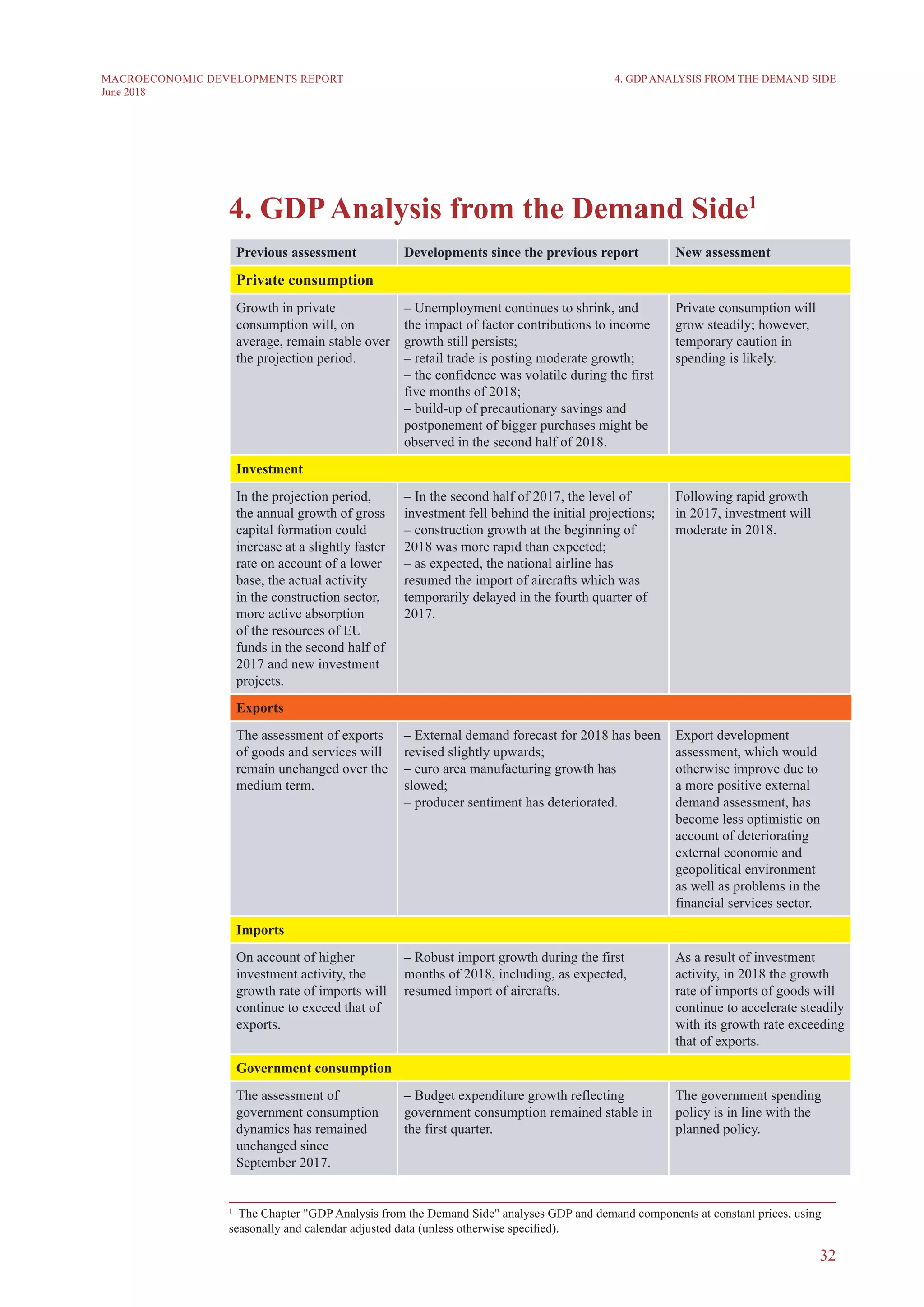
JUNE
2018
MACROECONOMIC
DEVELOPMENTS
REPORT
MACROECONOMIC DEVELOPMENTS REPORT
June 2018
MACROECONOMIC DEVELOPMENTS REPORT
June 2018, No 27
© Latvijas Banka, 2018
The source is to be indicated when reproduced.
Latvijas Banka
K. Valdemāra iela 2A, Riga, LV-1050, Latvia
Tel.: +371 67022300 info@bank.lv
http://www.bank.lv; https://www.macroeconomics.lv
2
MACROECONOMIC DEVELOPMENTS REPORT
June 2018
CONTENTS
	 3
Introduction	 4
1. External Demand	 5
2. Financial Conditions	 9
2.1 	ECB policy	 9	
2.2 	Other central bank decisions and financial markets	 10
2.3 	Latvia's balance of payments and cross-border financial flows	 14
2.4 	Securities market	 15
2.5 	Interest rates	 16
2.6 	Credits and deposits	 18
3. Sectoral Developments	 22
3.1 	Manufacturing	 24
3.2	Agriculture and forestry	 25
3.3 	Construction	 26
3.4 	Real estate market	 27
3.5 	Trade	 28
3.6 	Transport	 29
3.7	Financial and insurance activities	 30
4. GDPAnalysis from the Demand Side	 32
4.1 Private consumption	 33
4.2 Investment	 34
4.3 Exports	 34
4.4 Imports	 35
4.5 Government consumption	 36
5. Labour Market	 38
6. Costs and Prices	 40
7. Conclusions and Forecasts	 43
8. Analysis of Scenarios	 45
8.1 The potential impact of the US tariffs on imports	 45
Statistics	 48
Additional Information	 100
3
MACROECONOMIC DEVELOPMENTS REPORT
June 2018
Abbreviations
AML/CFT – anti-money laundering and combating the financing of
terrorism
APP – asset purchase programme
CIT – corporate income tax
CSB – Central Statistical Bureau of Latvia
EC – European Commission
ECB – European Central Bank
ESI – Economic Sentiment Indicator
EU – European Union
EU28 – 28 countries of the EU
EURIBOR – Euro Interbank Offered Rate
Eurostat – statistical office of the European Union
FinCEN – Financial crimes enforcement network of the US Department
of the Treasury
FOMC – Federal Open Market Committee
FRS – US Federal Reserve System
GDP – gross domestic product
HICP – Harmonised Index of Consumer Prices
IMF – International Monetary Fund
JSC – joint stock company
Ltd. – limited liability company
MFI – monetary financial institution
OPEC – Organization of Petroleum Exporting Countries
PIT – personal income tax
PMI – Purchasing Managers' Index
SEA – State Employment Agency
SJSC – state joint stock company
UK – United Kingdom
UN – United Nations
US – United States of America
VaR – value at risk
VAT – value added tax
ABBREVIATIONS
4
MACROECONOMIC DEVELOPMENTS REPORT
June 2018
Introduction
In the course of the last six months, Latvijas Banka's assessment of Latvia's economic
outlook has been revised downwards. In 2017, economic expansion reached its highest rate
seen in the last six years, and GDP growth also surprised on the upside in the first quarter of
2018. However, the recent developments in the financial sector and less optimistic signals
coming from the external environment call for a downward revision of the GDP forecast.
Significantly lower figures were reported by the financial sector already in 2017 due to the
continuously contracting business with foreign customers, and an even more substantial fall
can be expected in 2018 as a result of increased focussing on eliminating business with risky
customers and the restructuring of the financial sector, reducing the sector's contribution to
GDP changes. Meanwhile, economic growth will be supported by other sectors and by a
steep rise in construction activity in particular, as projects co-financed by the resources of
the EU funds and private investment projects gain momentum. With the overall tax revenue
development still suggesting positive trends in the economic activity, economic growth
is also expected to be supported by higher consumption and an expansion in investment.
So far, external demand has remained stable; however, the external environment has seen
slower economic growth: the sentiment indicators of the European countries point to more
moderate optimism, and heightened protectionism and geopolitical risks are evident. Further
development may be hampered by risk factors such as the deterioration of external economic
environment, problems in Latvia's financial services sector, the record-high level of capacity
utilisation, insufficient investment in production capacity and weak lending activity.
Inflation dynamics is in line with the inflation forecast for 2018. As expected, the impact
of the domestic demand on inflation is gradually increasing, whereas the rising global oil
prices are offset by lower food prices. The effect of higher oil prices on the prices of other
energy recourses is expected to surface in 2019. With the number of the employed increasing
and that of the unemployment declining, the labour market conditions have become more
favourable for employees. Nevertheless, the lowering of the unemployment rate remains a
topical issue. The above may be achieved by implementing well-considered active labour
market policy measures and – in the long term – by supporting Latvia's human capital with
higher-quality education and health care.
INTRODUCTION
5
MACROECONOMIC DEVELOPMENTS REPORT
June 2018
1. EXTERNAL DEMAND
1. External Demand1
Previous assessment Developments since previous report New assessment1
External demand
Ongoing growth,
based on strong
overall demand
globally and in
Latvia's major trade
partner countries as
well.
– Increase of oil and other commodity
prices;
– ongoing recovery of global trade;
– deterioration of sentiment indicators;
– weaker 1st quarter performance in
Germany due to one-off factors;
– slightly more explicit Brexit related
developments;
– rising likelihood of the so-called trade
war;
– political disagreement in Europe and
between Europe and the US;
– upward revision of external demand
forecasts.
Growth will further continue
also in 2018, yet at a slower
pace than in 2017 due to
decelerating advance in a
number of euro area countries,
stronger risks of rising trade
tariffs, and trouble with US and
European cooperation associated
with Iran's nuclear arms plan.
The demand in global economy
as a whole and Latvia's major
trade partner countries continues
on an upward trend.
Advanced countries still enjoy favourable financial conditions; so far in 2018, the FRS has
been the only major central bank in the world to raise its federal funds target rate (up to
the range of 1.50%–1.75% on 21 March 2018). Currently, financial markets have priced
in two more such interest rate range rises for 2018. Having dropped to 3.9% in April, the
US unemployment rate is only 0.1 percentage point above the lowest rate reached in the
21st century so far (reported in April 2000). In addition, a strong effect of labour market
on consumer prices is observed: in April, the inflation rate of personal consumption
expenditures stood above the target level (2%). In its statement at the policy meeting on
1–2 May 2018, in connection with the future market expectations the FOMC pointed
out that the inflation target is symmetric: after lingering below the target for some years,
inflation can be running above the target for some time. This signalled that the 2% inflation
target is not a ceiling for the FRS, and the 12 month inflation target symmetry was taken as
FRS's acceptance of inflation running slightly above the 2% target in the medium term and
sustainably returning to the symmetric target level in a longer term. The retained record-high
level of economic sentiment indicators (PIM, Consumer Confidence, etc.), coupled with tax
rebates approved at the end of 2017, imply a stronger economic development in the future.
By contrast, it is quite likely that the US and global economies will be affected by trade
talks launched by governments; in the event of their failure, looming are the risks of the
outset of a trade war between the US and major part of its partners. Speaking about the most
severe trade battle between the US and China, instead of previously estimated 60 billion
dollar worth of Chinese goods, the total value of goods to be subject to the US trade tariffs
has increased to 150 billion US dollars. Additional geopolitical risks arise from nuclear
negotiations with North Korea and Iran.
In the UK, the growth rate has not managed to recover since early 2018. Unemployment is
still lingering at a record low level, and its implications for wages or prices are marginal.
Inflation decelerated in May, coming closer to the Bank of England's inflation target.
Tightness of the labour market, stagnating wages, deceleration of inflation and Brexit-related
downside risks deliver obscure environment for the monetary policy decision-making.
Japan lived through a particularly tough first quarter of 2018: its GDP lost 0.6% on account
of falling private sector consumption and investment in combination with weaker growth
1
  Colours in tables are used to show differences in the assessment of impact on Latvia's GDP and inflation vis-à-vis the
previous forecast.
Worsened Unchanged Improved
6
MACROECONOMIC DEVELOPMENTS REPORT
June 2018
in export volumes. Moreover, the Bank of Japan has abandoned the target date for inflation
to reach 2%. It had delayed this target date six times (in the period from 2015 to 2019 in
January 2018 forecast). On the back of unexpected expansion of private consumption,
China's GDP reached 6.8%, thus exceeding the first quarter projections by 0.1 percentage
point. Despite progress being broad-based and dynamic, GDP growth, by contrast,
is expected to lose pace over the remaining part of the year on account of the central
government's endeavour to curb the expenditure of regional authorities.
In January–March 2018, the euro area GDP picked up 2.5% year-on-year, outpacing both the
UK and the US (1.2% and 2.3% respectively). Economic sentiments in the euro area are still
restricted by the geopolitical situation and domestic conditions. The likelihood of trade wars
and withdrawal of the US from the agreement with Iran on restricting its nuclear programme
generate adverse risks for the euro area economic growth. The US administration has
decided to impose sanctions on all European companies which after the US withdrawal from
participation in the so-called Iranian nuclear deal would continue operation in the Islamic
Republic of Iran. Western allies did not succeed in taking a single stance with respect to
Russia, since the EU declined a list of new sanctions but extended the existing ones up
until 15 September 2018. Problems arise in connection with sanctioned Russian companies
with deep integration into the EU production chains (e.g. United Company Rusal in the
European steel and aluminium market) and the Nord Stream 2 project. Whereas sanctions
against Russia are imposed on individual entities, those in the case of Iran are aimed against
the state as a whole, hence enabling the US administration to impose them also against
cooperation partners of the respective country. At this juncture, the US does not impose
sanctions against EU companies operating in Russia, while those on the US imports of
aluminium and steel are in force as of 1 June.
Meanwhile, problems with the formation of the government in Italy and the political
corruption scandal of the People's Party in Spain are sources of internal tensions, which
undeniably are obstacles on the way of structural reform processes in both states and
effective cooperation with the EU institutions. These uncertainties are reflected by
economic sentiment indicators. Despite their sustainably high level in historic terms, some
gradual deterioration and convergence with the long-term average are observed. Financing
conditions remain favourable in the euro area, and their positive impact on lending is
translating into a robust pickup. Although in 2018 overall unemployment contracted by a
mere 0.1 percentage point, employment continues on an upswing. According to the flash
estimate, inflation in the euro area is above the projected, almost reaching the ECB inflation
target. The upward trend is primarily on account of rising energy and service prices and the
base effect of the previous year. Euro area inflation according to the flash estimate was 1.9%
in May (ECB forecast for the second quarter overall – 1.5%).
A more dynamic growth in Latvia's major trade partners in the fourth quarter of 2017
determined more buoyant improvements of external demand in 2017 than were projected
in December. The determining factors were falling unemployment, stronger private
consumption, renewed inflows of EU financing, and interest rates still supportive of
economic growth. Nevertheless, the pace of external demand showed some deceleration at
the beginning of 2018. Euro area ESI continues on a downward trend since it reached a high
in January, while oil prices are still on an upswing, and this, along with depreciation of the
euro against the US dollar, may have some impact on inflation.
The situation in Latvia's major trade partners in the euro area remains positive, although
some indicators point to eventual limitations on the economic growth due to reduced supply
capacity. The EC has raised its spring 2018 projections of the real GDP growth in 2018 (as
compared with the autumn 2017 forecast) for both the euro area (2.3%; +0.2 percentage
point against previous projections) and Germany (2.3%; +0.2 percentage point against
previous projections). Amidst ongoing German economic growth, some performance data
1. EXTERNAL DEMAND
7
MACROECONOMIC DEVELOPMENTS REPORT
June 2018
(e.g. private consumption and construction index) towards the end of 2017 and industrial
output in the first quarter of 2018 fell albeit below the expected. In Germany, ESI and
PMI are declining further. However, the weak first-quarter performance might be mainly
determined by one-off factors (strikes, flue, weather) and is expected to be offset, at least
in part, in the second quarter. Some longer term impact is likely to come from the German
coalition negotiations which are an impediment to reaching a concert on issues vital for the
economic growth and health care.
The EC real GDP growth forecast for 2018 has been raised also for Lithuania (3.1%;
+0.2 percentage point vis-à-vis previous projections). The estimation by Lietuvos bankas
is similar (3.2%), as its previous March forecast was raised and the elevation explained as
being on account of both domestic and external factors. As the inflow of EU funding, which
was moderate in the previous two years, is likely to increase, Lithuania expects a boost in
investing in 2018. The domestic demand is strengthened also by a minimum wage increase
and the tax reform, promoting both private consumption and business investment. The EC
has raised the respective projections also for Estonia (3.7%; +0.5 percentage point vis-à-vis
previous projections), where the growth is supported by both domestic and external demand.
Even though contractions in the number of working age population are partly offset by a
positive migration balance, the expansion of production depends on the limited capacity
and slow productivity growth. When analysing the economic growth of our neighbours, it
should be noted that in 2017 Latvia lost its goods export market shares in both Lithuania and
Estonia, hence the potential positive impact on Latvia of the advance in the two states, albeit
remaining heightened, is weakening.
With respect to the UK, the EC increased its GDP growth forecast for 2018 as well (1.5%;
+0.2 percentage point vis-à-vis previous projections). Against the slightly more dynamic
growth in 2017, such deceleration will be on account of slowly strengthening consumption.
After a one-year break, the pace of household disposable income growth became positive
again in early 2018; nevertheless in the medium term, its annual growth is expected to be
limited (around 1%) and affect consumption growth accordingly. Like elsewhere in Europe,
the UK's ESI has started to follow a downward trend. With respect to the UK's exit from
the EU, on the other hand, the trends have turned strongly favourable since December:
agreements have been reached on some future migration policy issues (plans for hard border
between Ireland and the UK abandoned, mutual protection of citizen rights) and the so-
called divorce bill (estimated to amount to 35–39 billion British pound sterling), thus giving
green light for the launch of trade talks between the UK and the EU.
The EC projections for GDP growth in Poland in 2018 were also raised (4.3%;
+0.5 percentage point vis-à-vis previous projections), with growth mainly supported by a
fast and sustainable advance in household consumption and hiking investment due to the
renewed cycle of the EU funding. Imports are likely to expand on account of the strong
domestic consumption and investment growth in 2018; despite similarly expected export
expansion, some slight adverse effect on GDP growth of net foreign trade is also anticipated.
After the buoyant recovery of the Russian economy from recession in 2017, the EC foresees
an even faster GDP growth in 2018 (1.7%; +0.1 percentage point vis-à-vis previous
projections). It will be supported by stronger domestic demand (private consumption is
likely to rise due to increased disposable income). Positive will be the impact from the
expanding exports of goods and services. The 2018 FIFA World Cup finals in 11 cities
of Russia is a one-off factor with a positive effect. The main risk factor for the Russian
economic growth in 2018 is sanctions – the impact from the US currently imposed ones as
well as those looming in the future. Notably, in its March 2018 forecast the Central Bank of
the Russian Federation revised the base scenario's average annual oil price for 2018 upwards
from 55 US dollars per barrel to 60 US dollars per barrel, thus adding some positive scope to
the import growth prospects.
1. EXTERNAL DEMAND
8
MACROECONOMIC DEVELOPMENTS REPORT
June 2018
1. EXTERNAL DEMAND
9
MACROECONOMIC DEVELOPMENTS REPORT
June 2018
2. Financial Conditions
2.1 ECB policy1
Previous assessment Developments since previous report New assessment
ECB decisions
Expectations that, with further
implementation of the expanded
APP at least until September
2018, the interest rates will
remain low for an extended
period of time are strengthening.
Market participants expect that
the key ECB interest rates will
be raised during the first half of
2019.
– Economic growth fundamentals and
monetary aggregates continue to improve;
– euro appreciated from 1.20 to 1.25 vis-
à-vis the US dollar in the first quarter of
2018 and afterwards depreciated to 1.17;
– the most recent data suggest that
inflation will converge towards the
level of below, but close to, 2% over the
medium term.
Expectations that the
expanded APP will be
continued at least until
the end of December
2018 are strengthening.
Market participants
expect that the key ECB
interest rates will be
raised no sooner than
in the second quarter of
2019.1
The ECB continued with a highly accommodative monetary policy, purchasing securities
within the framework of the expanded APP at a monthly pace of 30 billion euro. The
practice of reinvesting the principal payments from maturing securities purchased under the
expanded APP was also continued, with the respective amount totalling 47.7 billion euro in
the first quarter of 2018.2
At the press conference in April, Mario Draghi, President of the ECB, stressed that the
ECB believes that, following several quarters of higher than expected growth, incoming
information points towards some moderation, while remaining consistent with a solid and
broad-based expansion of the euro area economy. The growth rate of the euro area economy
continues to support the ECB's confidence that inflation will converge towards the level of
below, but close to, 2% over the medium term. Turning to risks, it was pointed out that the
risks surrounding the euro area growth outlook remain broadly balanced. However, risks
related to global factors, including the threat of growing protectionism, have become more
prominent.
In the first quarter of 2018, euro area GDP increased by 2.5% year-on-year and by 0.4%
quarter-on-quarter which is less than in the last three quarters when the respective rate
was 0.7%. Despite deceleration of growth, labour market remained strong, with the
unemployment rate standing at 8.5% in April. Annual inflation (excluding unprocessed food
and energy) was 1.2% in April (1.3% in March).
1
  At its 14 June meeting, the Governing Council of the ECB kept the key ECB interest rates unchanged and announced
that, subject to incoming data confirming the ECB's medium-term inflation outlook, the current monthly pace of the net
asset purchases of 30 billion euro will be reduced to 15 billion euro in October–December 2018 and then net purchases
will be ended. The Governing Council of the ECB expects the key ECB interest rates to remain at their present levels at
least through the summer of 2019 and in any case for as long as necessary.
2
  https://www.ecb.europa.eu/mopo/implement/omt/html/index.en.html.
2. FINANCIAL CONDITIONS
10
MACROECONOMIC DEVELOPMENTS REPORT
June 2018
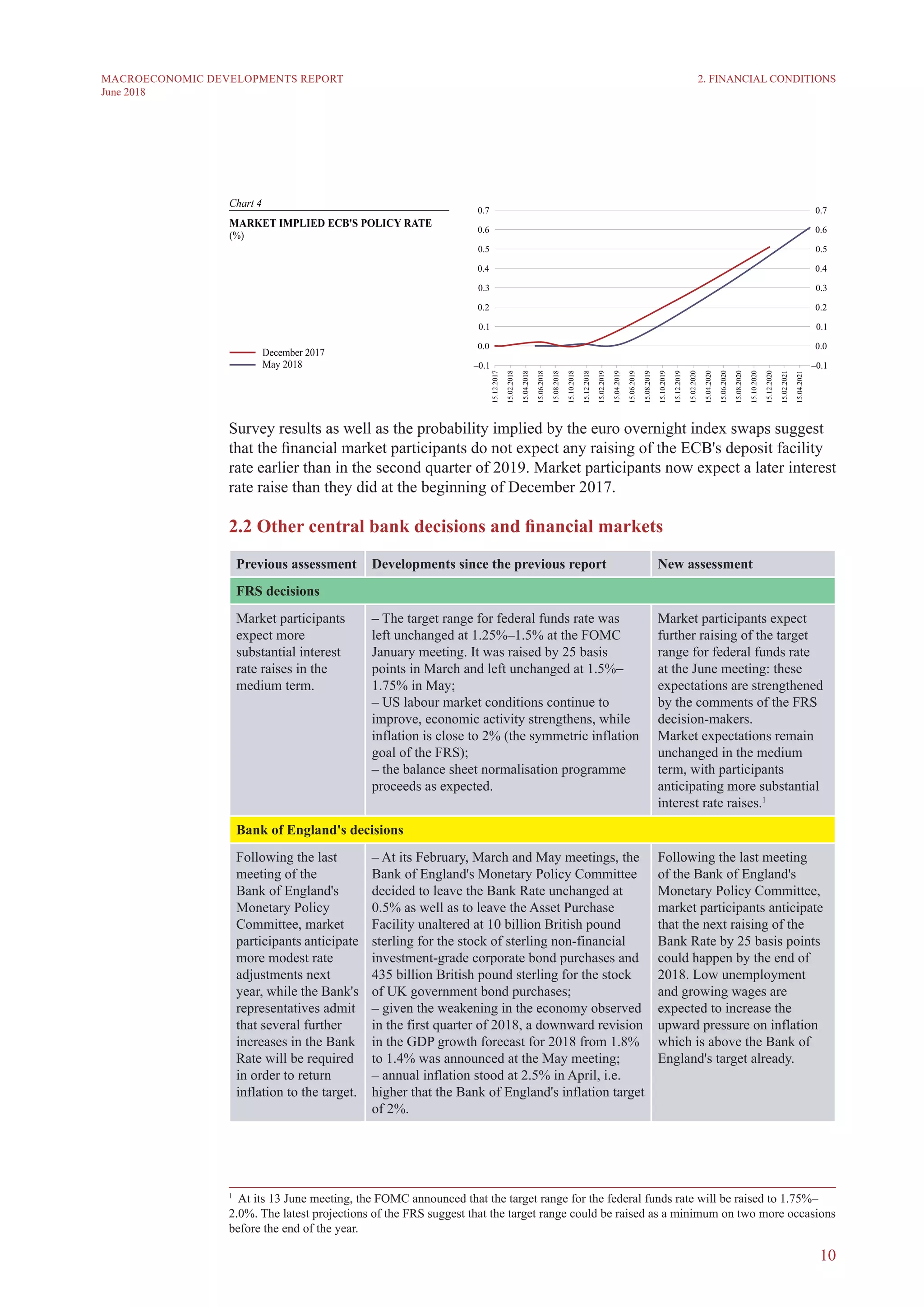
Survey results as well as the probability implied by the euro overnight index swaps suggest
that the financial market participants do not expect any raising of the ECB's deposit facility
rate earlier than in the second quarter of 2019. Market participants now expect a later interest
rate raise than they did at the beginning of December 2017.
2.2 Other central bank decisions and financial markets1
Previous assessment Developments since the previous report New assessment
FRS decisions
Market participants
expect more
substantial interest
rate raises in the
medium term.
– The target range for federal funds rate was
left unchanged at 1.25%–1.5% at the FOMC
January meeting. It was raised by 25 basis
points in March and left unchanged at 1.5%–
1.75% in May;
– US labour market conditions continue to
improve, economic activity strengthens, while
inflation is close to 2% (the symmetric inflation
goal of the FRS);
– the balance sheet normalisation programme
proceeds as expected.
Market participants expect
further raising of the target
range for federal funds rate
at the June meeting: these
expectations are strengthened
by the comments of the FRS
decision-makers.
Market expectations remain
unchanged in the medium
term, with participants
anticipating more substantial
interest rate raises.1
Bank of England's decisions
Following the last
meeting of the
Bank of England's
Monetary Policy
Committee, market
participants anticipate
more modest rate
adjustments next
year, while the Bank's
representatives admit
that several further
increases in the Bank
Rate will be required
in order to return
inflation to the target.
– At its February, March and May meetings, the
Bank of England's Monetary Policy Committee
decided to leave the Bank Rate unchanged at
0.5% as well as to leave the Asset Purchase
Facility unaltered at 10 billion British pound
sterling for the stock of sterling non-financial
investment-grade corporate bond purchases and
435 billion British pound sterling for the stock
of UK government bond purchases;
– given the weakening in the economy observed
in the first quarter of 2018, a downward revision
in the GDP growth forecast for 2018 from 1.8%
to 1.4% was announced at the May meeting;
– annual inflation stood at 2.5% in April, i.e.
higher that the Bank of England's inflation target
of 2%.
Following the last meeting
of the Bank of England's
Monetary Policy Committee,
market participants anticipate
that the next raising of the
Bank Rate by 25 basis points
could happen by the end of
2018. Low unemployment
and growing wages are
expected to increase the
upward pressure on inflation
which is above the Bank of
England's target already.
1
  At its 13 June meeting, the FOMC announced that the target range for the federal funds rate will be raised to 1.75%–
2.0%. The latest projections of the FRS suggest that the target range could be raised as a minimum on two more occasions
before the end of the year.
2. FINANCIAL CONDITIONS
11
MACROECONOMIC DEVELOPMENTS REPORT
June 2018
Previous assessment Developments since the previous report New assessment
Bank of Japan's decisions
Bank of Japan
continues to
highlight the
necessity to preserve
the expansionary
monetary policy in a
longer term, which
is in line with the
market expectations.
– Bank of Japan raises the GDP forecast for
2018 and 2019;
– inflation forecast for 2018 has been adjusted
downwards, with the forecast for 2019
remaining unchanged.
Although the Governor of
the Bank of Japan has hinted
in his latest speeches that an
expansionary monetary policy
cannot be pursued forever,
the current monetary policy
is expected to persist in the
medium term.
EUR/USD exchange rate
Market participants
anticipate that the
euro exchange rate
against the USD will
be 1.20 USD per euro
in a year's time.
– Political risks in the euro area remain:
uncertainty regarding Catalonia; the outcome
of the Italian election and uncertainty regarding
a potential change in the economic policy
direction;
– euro area's macroeconomic fundamentals are
improving;
– monetary policy implemented by the FRS
and the ECB is becoming increasingly more
divergent.
Market participants anticipate
that the euro exchange rate
against the USD will be 1.27
USD per euro in a year's time.
At its 1–2 May meeting, the FOMC decided to leave the target range for the federal funds
rate unchanged at 1.5%–1.75%, and that was in line with the market expectations. The
monetary policy remained accommodative. It was also pointed out that the labour market
had continued to strengthen and that economic activity had slowly increased further since
the March meeting. The latest data show that household spending has accelerated slightly
in comparison with the strong fourth-quarter pace, while business investment continues to
grow strongly. The US fiscal policy stimulus associated with tax reforms and the subsequent
increase of the sovereign debt provides an additional impetus for the country's economic
growth. Against the background of an economic growth with full employment and an
achieved inflation goal, this could make the FRS to continue with more substantial interest
rate raises, thereby negatively affecting the financial markets and increasing the vulnerability
of emerging economies, and hence potentially dampening global economic growth.
12-month inflation, both headline inflation and inflation excluding food and energy, is close
to 2%. Inflation is expected to stay close to 2% which is the symmetric inflation goal of the
FRS in the medium term. The risks to the economic outlook remain balanced. The balance
sheet normalisation programme of the FRS proceeds as planned. Relative to the forecast
published in December, the most recent economic growth projections of the FRS for 2018
and 2019 have been revised upwards and are currently 2.7% and 2.4% (previously, 2.5%
and 2.1%) The latest projections of the target range for the federal funds rate suggest that the
management of the FRS is increasingly optimistic about the economic development of the
country. Currently, the median for 2018 and 2019 is projected as 2.1% and 2.9% respectively
(previously, 2.1% and 2.7%). The market expects that the target range for the federal funds
rate could be raised, as a minimum, on two more occasions in 2018, to 2.00%–2.25%.
As already expected by the market for a few weeks ahead of the meeting, the Monetary
Policy Council of the Bank of England voted by a majority of 7 : 2 to maintain the Bank
Rate at 0.50% at its meeting ending on 9 May 2018. Two members voting against the
proposition preferred to increase the Bank Rate by 25 basis points, to 0.75%. The Committee
voted unanimously to maintain the stock of UK government bond purchases at 435 billion
British pound sterling and the stock of sterling non-financial investment-grade corporate
bond purchases at 10 billion British pound sterling. Bank of England recognises that the first
2. FINANCIAL CONDITIONS
12
MACROECONOMIC DEVELOPMENTS REPORT
June 2018
quarter growth outturn (0.1%) is considerably lower than 0.4% expected in February and
this is likely to reflect the adverse weather conditions. Nevertheless, despite the weak first
quarter growth, the central or long-term forecast of the Monetary Policy Committee of the
Bank of England remained unchanged: conditioned on the path of the Bank Rate implied
by current market yields, GDP is expected to grow by around 1.75% per year on average
over the forecast period. The most significant contributors to growth are trade and business
investment, whereas the contribution of consumption to overall growth is decreasing.
Although business investment is still restrained by uncertainties related to Brexit, it remains
on a high level, supported by strong global demand and accommodative financial conditions.
Household consumption growth remains subdued, in line with the slow growth in wages
over the medium term. Currently, the market expects that the Bank of England could raise
the Bank Rate by 25 basis points (to 0.75%) in 2018 and that would be the highest level
of the post-crisis period. Nevertheless, market expectations can swing significantly if the
economic growth remains lower than expected.
At its 26–27 April 2018 meeting, the Policy Board of the Bank of Japan decided, by an
8 : 1 majority vote, to keep the short-term policy interest rate unchanged at –0.1%, the target
level of the 10-year government bond yields at 0% as well as the annual pace of increase
of the monetary base at 80 trillion Japanese yen or 608.1 billion euro. The asset purchase
guidelines remained unchanged. In its Outlook for Economic Activity and Prices, the Bank
of Japan pointed out that Japan's economy is expected to grow at a pace above its potential in
the fiscal year 2018. The Bank of Japan's Policy Board believes that this will happen mainly
against the background of highly accommodative financial conditions, expansionary fiscal
policy and solid growth in trade partner economies. The economy is expected to continue on
an expanding trend in the fiscal years 2019 and 2020, mainly supported by external demand.
The Outlook highlights the weak inflation developments observed in the most recent months
and reconfirms the commitment to achieve the inflation target in the medium and long term.
The Bank of Japan believes that the risks to GDP and price outlook are balanced.
Financial markets were dominated by uncertainty and volatility in the first half of 2018.
The uncertainty was partly caused by the US President Donald Trump launching his
protectionism campaign and imposing new tariffs on aluminium and steel imports.
Renegotiation of trade agreements with China and other US trade partners caused more
concern to the investors. Moreover, the United States withdrawal from Iran nuclear deal has
increased tensions in the Middle East.
Since the beginning of the year, the yields on US 10-year Treasury bonds in debt markets
have grown by 57 basis points, to 2.98%. At the same time, those on comparable German
securities have edged up by 5 basis points, reaching 0.47%. Similar as in the previous
period, the spreads have continued to widen in the reporting period, making the US Treasury
bonds more attractive to investors, and this is a positive factor for the US dollar. The rise in
the US Treasury bond yields was supported by the investors' confidence that the FRS would
continue to conduct the monetary policy as pre-defined in its guidelines.
2. FINANCIAL CONDITIONS
13
MACROECONOMIC DEVELOPMENTS REPORT
June 2018
Changes in the yields of German securities have been less pronounced. Despite the
expectations regarding the ECB's monetary policy normalisation, yields have increased only
slightly, and this could be partly explained by the fact that the published data for the first
quarter of 2018 point to moderation of economic growth, causing concern to investors.
The weighted average yield on Spanish 10-year government bonds has contracted by
roughly 17 basis points, to 1.39%. The tensions in Catalonia have eased and their initial
negative effect on the economy has been weaker than expected. The weighted average
yields on French and Portuguese10-year government bonds have decreased by 2 basis points
(currently, 0.76% and 1.89% respectively). The yields of comparable Italian and Greek
securities have also grown by 39 basis points and 16 basis points respectively, to 2.39% and
4.23%. Since the beginning of the year, the spreads between the German and most other euro
area government bonds have narrowed suggesting that investors consider that the country-
specific risks, with the exception of Italy's and Greece's, are declining. Complications with
forming a populist government in Italy resulted in a substantial increase in the yields of
Italian debt securities.
The weighted average yield on British 10-year government bonds has grown by 21 basis
points, reaching 1.40%, since the beginning of 2018. This was supported by the expectations
that, given the current level of inflation, Bank of England will be forced to raise the Bank
Rate.
Since the beginning of 2018, S&P 500 index has grown by 1.9% and it has also become
more volatile. Stock price volatility was largely influenced by the trade negotiations between
the US and China: the resounding calls have not been followed by equally strong action so
far. Recent developments in Syria, with the Western powers attacking Bashar al-Assad forces
in reaction to the regime using chemical weapons, did not help to reduce this volatility.
Largest appreciation was seen for the stocks of information technology companies, whereas
the most significant negative contributors were counter-cyclical stocks normally paying
high dividends. With bond yields growing, the investor preference for high dividend stocks
decreased. S&P 500 Banks index, rising by 1.5%, performed slightly worse than the stock
market overall.
Similar to the US markets, European stock markets have also been quite volatile since the
beginning of the year. Euro Stoxx 50 has increased by 2.4%, whereas Stoxx Europe 600
has risen by 2.0%. Euro Stoxx Banks index, however, has dropped by 3.9%. Political
developments in Italy, triggering a rise in the borrowing costs in Italy and consequently
having a negative effect on the Italian banks' profitability and capital, had the most negative
contribution to this index characterising the European banking sector. At the same time, the
UK stock market index FTSE 100 increased by 2.5%. In a similar manner, the UK's banking
sector index FTSE 350 Banks has also performed worse than the stock market overall and
has contracted by 1.3%.
2. FINANCIAL CONDITIONS
14
MACROECONOMIC DEVELOPMENTS REPORT
June 2018
Japan's stock market index Nikkei 225 has grown by 0.9% since the beginning of 2018,
whereas the emerging markets stock index MSCI EM has decreased by roughly 1.3%.
Japan's stock market growth was supported by depreciation of the Japanese yen against the
US dollar.
The exchange rate of the euro against the US dollar has decreased by 2.8% since the
beginning of the year (to 1.168 US dollars per euro). Exchange rate movements were mostly
affected by the economic data publications. Deceleration of the euro area GDP growth in
combination with raising the target range for the federal funds rate of the FRS put an end
to the euro appreciation. Further publications of weaker-than expected data and a growing
probability of a populist government being formed in Italy caused a steep fall in the
exchange rate of the euro. Nevertheless, the analysts of leading investment banks expect that
the euro could appreciate by 7% in comparison with its current exchange rate by the end of
2018. Although the spread between the US and euro area government bond yields continues
to widen and the FRS intends to raise the target range for the federal funds rate on at least
two more occasions in 2018, a longer-term appreciation of the US dollar is not expected.
A more substantial raising of the interest rates in the US is prevented by the investors'
projections that there are approximately 2–3 years left to the end of the business cycle for
the US economy, while for the euro area it is a bit further down the road. A positive factor
for the euro is also the euro area's current account surplus as opposed to the growing deficit
in the USA.
Overall, the macroeconomic fundamentals continue to show the best results of the last few
years; therefore, the major central banks have started to gradually withdraw their monetary
stimulus.
2.3 Latvia's balance of payments and cross-border financial flows
The balance of payments data on cross-border financial flows in the fourth quarter of
2017 and 2017 overall show that foreign assets increased more than foreign liabilities,
by 910 million euro and 848 million euro and by 2.7 billion euro and 2.5 billion euro
respectively. This resulted in a net outflow of financing from Latvia. At the same time,
foreign assets and foreign liabilities decreased by 1.8 billion euro and 2.3 billion euro
respectively in the first quarter of 2018.
The increase of foreign financial assets in the fourth quarter and 2017 overall was primarily
driven by the public sector. Latvijas Banka continued to participate in the expanded APP
within the Eurosystem's monetary policy framework. Foreign reserve assets in the form of
securities also grew. Recovering from the low levels reported in 2016, the foreign direct
investment inflows in Latvia were again close to their historical average in 2017, reaching
2.4% of GDP. The largest foreign direct investment inflows in 2017 overall were recorded
in the financial sector, trade, transport and agriculture, mostly from Sweden, Lithuania and
Luxembourg. In the first quarter of 2018, the most significant inflows were related to the
decrease of foreign deposits with Latvia's credit institutions observed in the credit institution
sector. The portfolio investment assets and other foreign assets of the credit institutions
were used to repay them. The government deposits abroad (the financing borrowed on
international markets in 2017) mainly used for the redemption of matured international
debt securities also shrank during this period. In the first quarter, inflows of foreign direct
investment in Latvia accounted for 157 million euro, remaining at the average quarterly
level of the previous year. The largest flows were registered in trade, real estate, energy and
construction sectors, with the most significant contributions coming from the Netherlands,
Estonia, Russia and Germany.
2. FINANCIAL CONDITIONS
15
MACROECONOMIC DEVELOPMENTS REPORT
June 2018
2.4 Securities market
In January–May 2018, five issues of 5-year government bonds took place. At these auctions,
the average yield increased from 0.36% in January to 0.49% in May. Its upward trend was
affected by strengthening of confidence in gradual normalisation of the ECB accommodative
monetary policy as well as by the spread of negative information about the sector of Latvia's
credit institutions which started in mid-February. At the end of February, JSC ABLV Bank
took a decision on self-liquidation. Therefore, the number of primary dealers at primary
auctions of domestic government securities edged down from five to four. This had limited
effects on the total demand, but did not affect the allocation of the offered amount.
In May, Latvia issued a new 10-year bond on the international markets as well as carried
out an additional issue of the previously issued 30-year bond. The average yields on bonds
with a 10-year maturity stood at 1.15% and those on bonds with a 30-year maturity recorded
1.94%, but the margins over the average swap rate were 15 and 37 basis points respectively.
Compared with the yields on similar credit rating bonds issued by European countries, it can
be concluded that the yields on Latvian government bonds still remain among the lowest
ones.
The yields on the Latvian government bonds issued on the international markets and
maturing on 7 June 2026 increased by 34 basis points (to 0.92%) in comparison with the
end of 2017. The spread over the same maturity German government bonds expanded by
26 basis points (to 69 basis points) primarily due to the above uncertainty in the sector of
Latvian credit institutions.
Latvia's share price index OMXR appreciated and on 7 June exceeded that of the end of
2017 by 5.1%, but the Baltic share price index OMXBBGI grew by 2.9%. The shares issued
by pharmaceutical companies posted the largest turnover at JSC "Nasdaq Riga", and their
prices also climbed. Several businesses saw share prices fall, e.g. businesses associated
with shipping and shipbuilding. There were also businesses reporting a decline in turnover
and profit figures in comparison with the previous year. During the reporting period,
JSC "VALMIERAS STIKLA ŠĶIEDRA", one of the large enterprises listed by JSC "Nasdaq
Riga", made a mandatory share buyout offer of 2.0% of its shares.
2. FINANCIAL CONDITIONS
16
MACROECONOMIC DEVELOPMENTS REPORT
June 2018
2.5 Interest rates
Previous assessment Developments since the previous report New assessment
Interest rate on loans to non-financial corporations
Weighted average
interest rate is not
expected to decrease.
– Demand for loans to small and medium-sized
enterprises continues to grow, and demand for
loans to large enterprises is recovering slightly.
Weighted average interest rate
is not expected to decrease
(except for temporary declines
on account of the financing of
relatively safer projects).
Interest rates on household loans
A slight decrease
in lending rates
as a result of the
narrowing of the
margins.
– Margins on consumer credit decreased, and
the share of consumer credit in the total amount
of new loans to households expanded;
– interest rates with long initial rate fixation
periods applied to loans for house purchase rose.
Weighted average interest rate
is not expected to decrease.
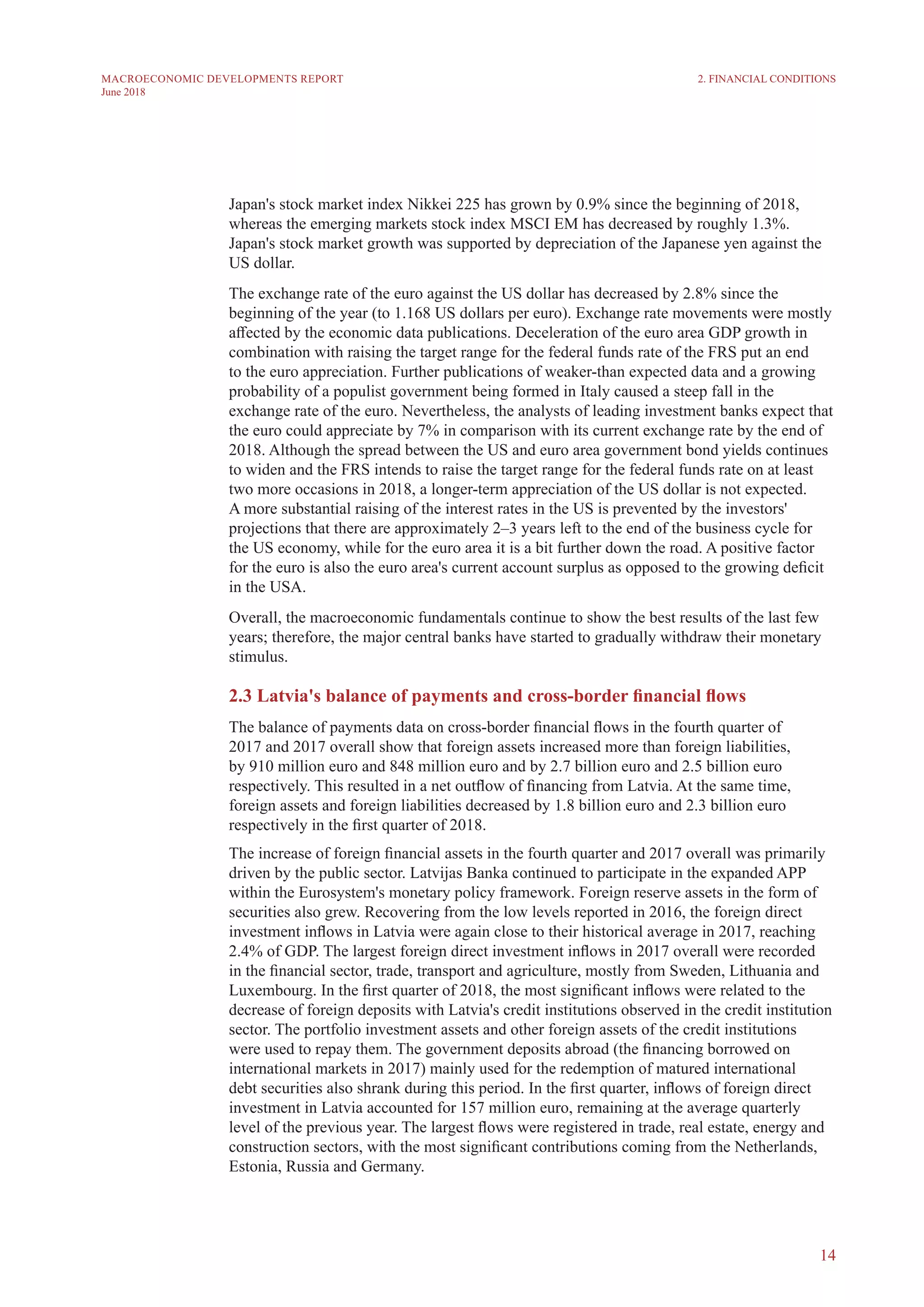
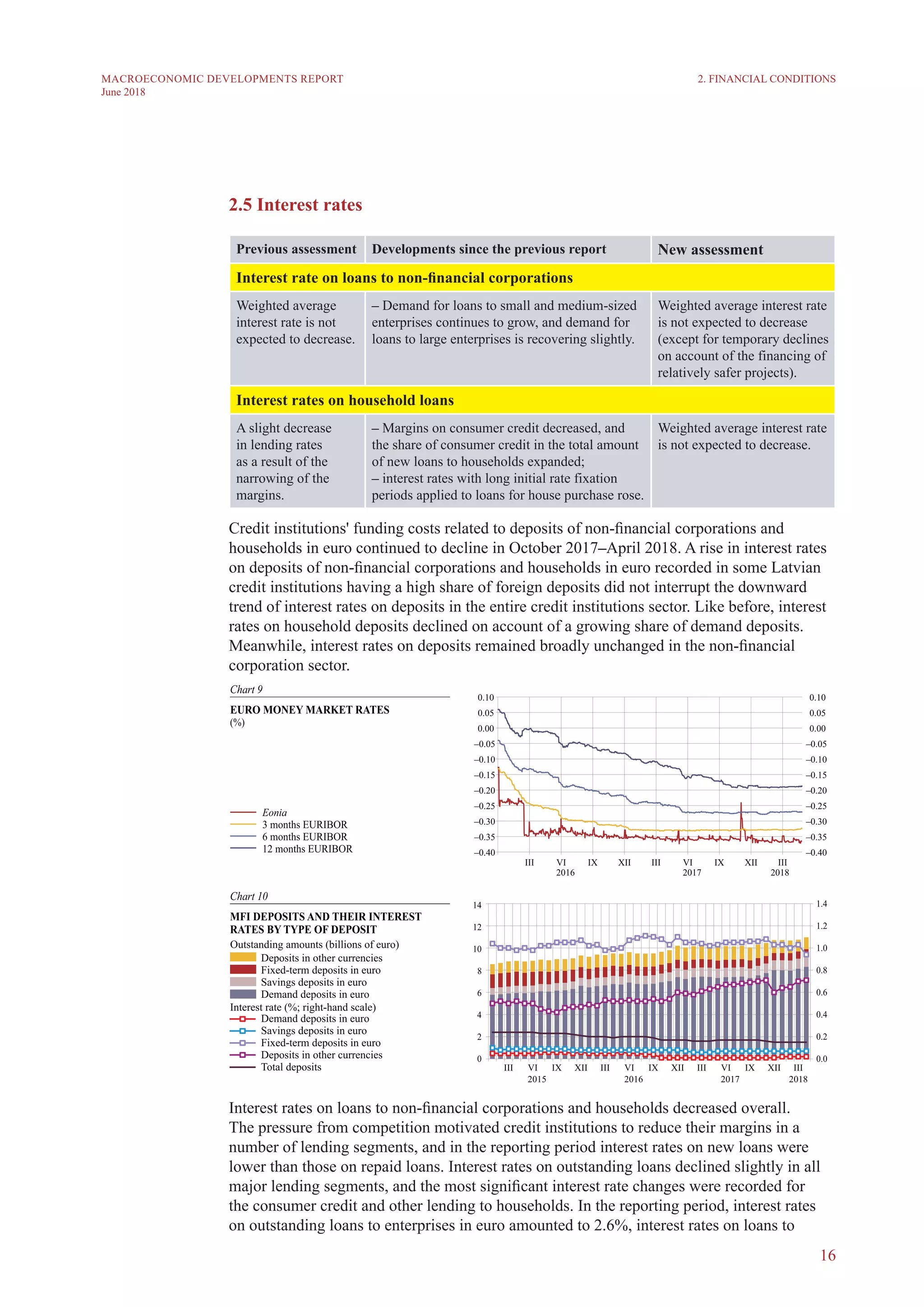
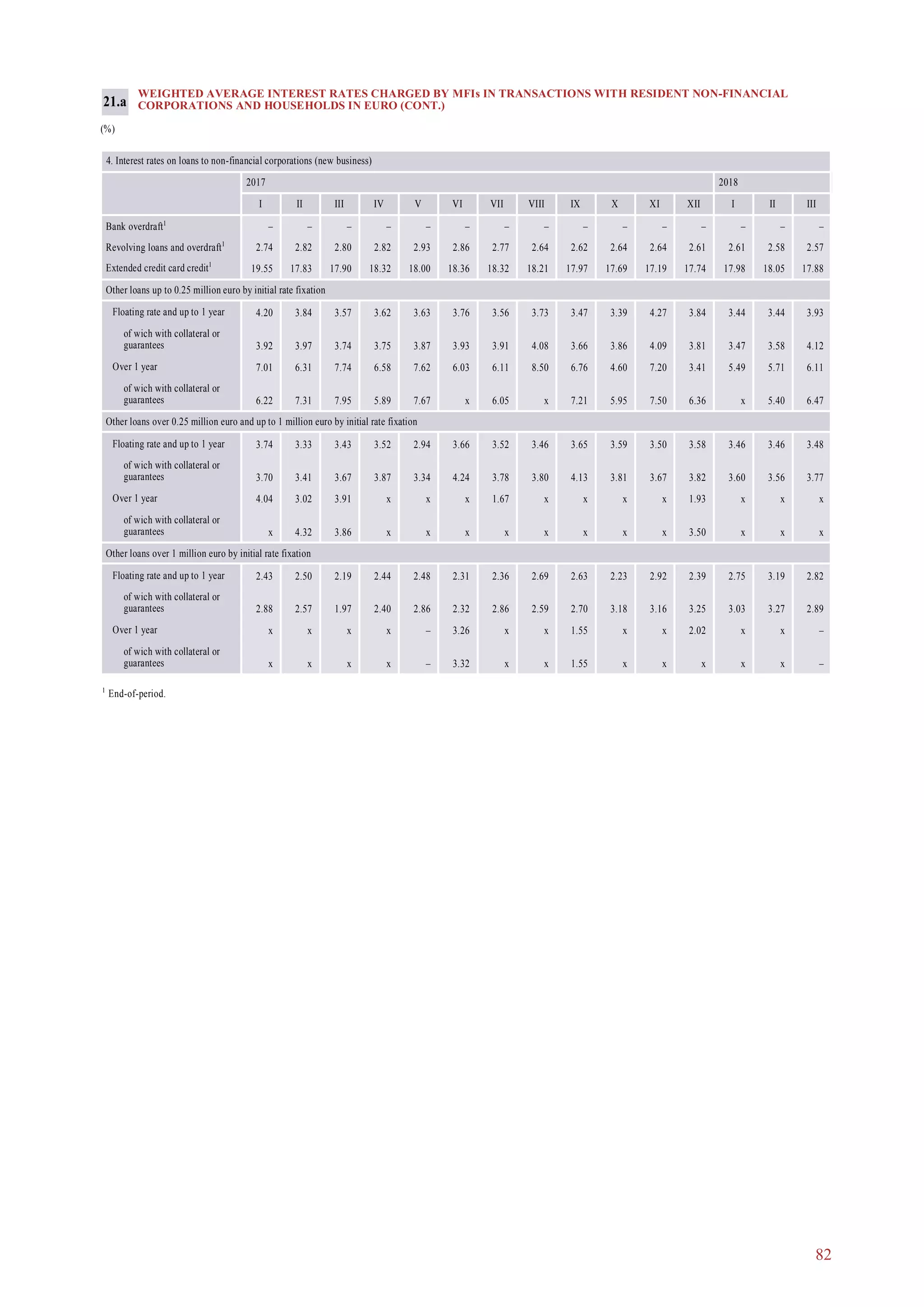
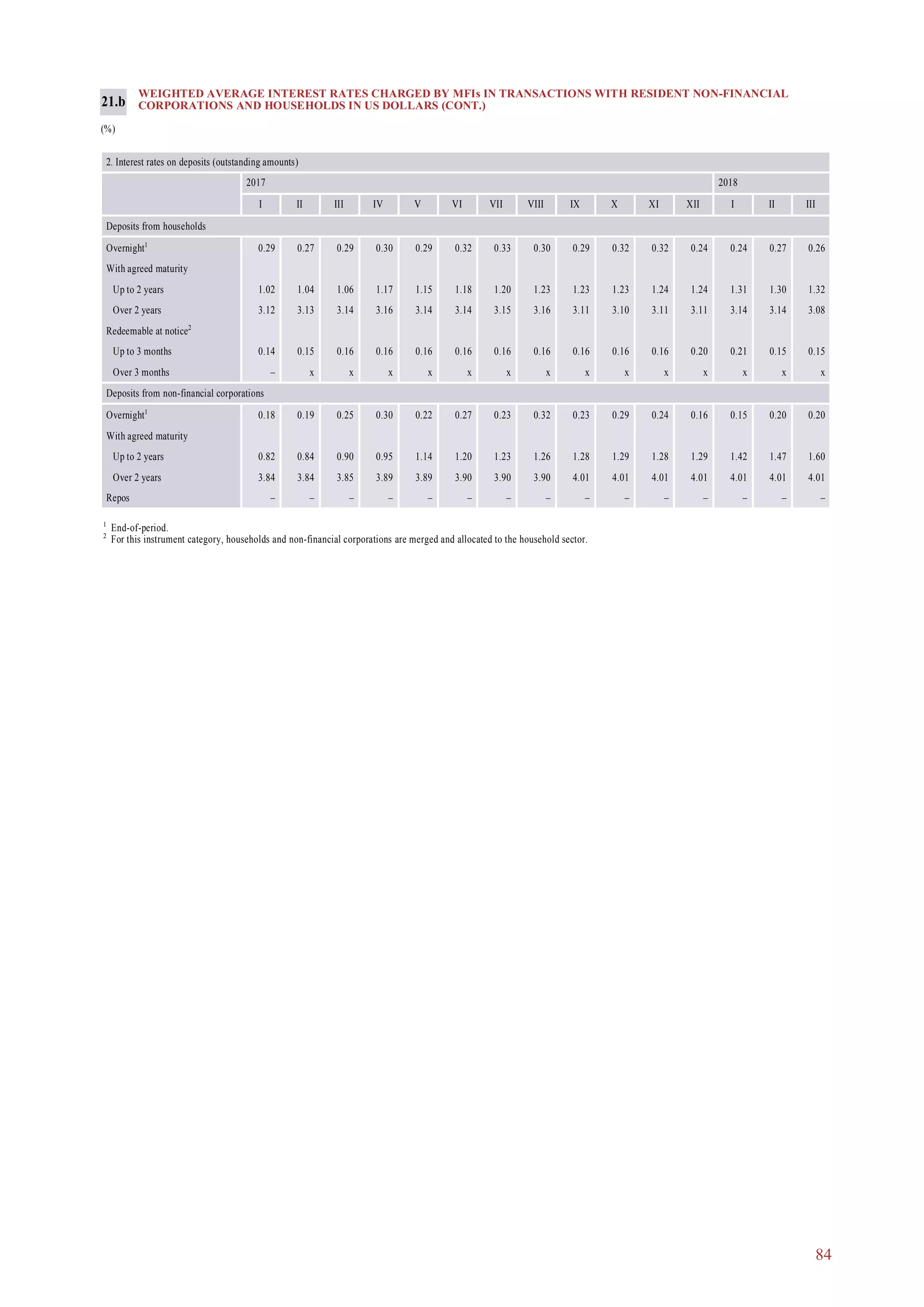
Credit institutions' funding costs related to deposits of non-financial corporations and
households in euro continued to decline in October 2017–April 2018. A rise in interest rates
on deposits of non-financial corporations and households in euro recorded in some Latvian
credit institutions having a high share of foreign deposits did not interrupt the downward
trend of interest rates on deposits in the entire credit institutions sector. Like before, interest
rates on household deposits declined on account of a growing share of demand deposits.
Meanwhile, interest rates on deposits remained broadly unchanged in the non-financial
corporation sector.
Interest rates on loans to non-financial corporations and households decreased overall.
The pressure from competition motivated credit institutions to reduce their margins in a
number of lending segments, and in the reporting period interest rates on new loans were
lower than those on repaid loans. Interest rates on outstanding loans declined slightly in all
major lending segments, and the most significant interest rate changes were recorded for
the consumer credit and other lending to households. In the reporting period, interest rates
on outstanding loans to enterprises in euro amounted to 2.6%, interest rates on loans to
2. FINANCIAL CONDITIONS
17
MACROECONOMIC DEVELOPMENTS REPORT
June 2018
households for house purchase ranged from 2.2% to 2.3%, while those on consumer credit
and other lending to households declined by 0.4 percentage point (down to 11.5%).
Interest rates on new loans to enterprises in euro were rather volatile in the reporting period.
At the beginning of 2018, they were affected by short-lived turbulence in the sector of credit
institutions servicing foreign customers. However, against the backdrop of the growing
corporate demand for loans and relatively tight competition among credit institutions,
already in April 2018 interest rate on large loans (over 1 million euro) to enterprises dropped
to 1.9% as compared to 2.2% in October 2017, reaching the lowest level since 2004 when
a uniform methodology for aggregating the interest rates of euro area banks was introduced
in Latvia. Interest rates on new small and medium-sized loans (up to 1 million euro) to
enterprises in euro increased slightly in the reporting period. Overall, interest rates on new
loans to enterprises in euro declined by 0.3 percentage point (down to 2.1%). Interest rates
on new loans to households in euro in the major lending segments continued to decline
or remained broadly unchanged. Floating interest rate and interest rate with the initial
rate fixation period of up to 1 year on new loans to households for house purchase in euro
remained broadly unchanged in the reporting period. The interest rate on new consumer
credit in euro declined by 0.5 percentage point (down to 15.9%), whereas that on other
lending to households decreased by 0.2 percentage point (down to 4.1%).
Considering the trends observed earlier with respect to the credit institutions' interest rates,
those on deposits are overall expected to remain closely linked to the euro money market
rates; however, they will not decline below zero. Interest rates on loans will continue to
decrease slowly, while those on new loans will remain broadly unchanged since they will
be affected by counteracting factors. Economic growth and a decline in unemployment will
have a downward effect on the risk premiums priced into the interest rates on loans. At the
same time, credit institutions could ease their credit standards for riskier borrowers in search
of higher profitability, individual credit institutions with a high share of foreign customers
might see an increase in the financing costs, and credit institutions overall may refrain from
reducing their margins as they face further uncertainty surrounding the monetary policy
orientation.
2. FINANCIAL CONDITIONS
18
MACROECONOMIC DEVELOPMENTS REPORT
June 2018
2.6 Credits and deposits
Previous assessment Developments since the
previous report
New assessment
Lending
A slight increase in the total loan
portfolio and that of non-financial
corporations will continue in 2018
(in annual terms – excluding the
impact of transfer of the loan
portfolio to a foreign parent bank).
However, growth projections have
been reduced due to slower lending
to enterprises. The key factors are
as follows: more active absorption
of the resources of EU funds,
the necessity to boost capacity
driven by mounting foreign and
domestic demand, growing capital
of businesses and their readiness
for investment. Recovery of the
annual growth rate of lending to
households in the first half of 2018,
with government continuing the
state support programme for house
purchase and expanding the range of
beneficiaries of guarantees by adding
young specialists as well as with the
demand for consumer credits rising.
– New loans to households
are increasing slowly,
those to non-financial
corporations continue to
shrink;
– the range of beneficiaries
of guarantees under the
state support programme
for house purchase has
been expanded by including
young specialists in the
programme;
– an active construction
sector and the real estate
market are the sectors
whose enterprises receive
the largest volume of loans;
– leasing plays a growing
role in providing finance.
Although credit institutions project
an increase in the demand for
loans, the actual development in
late 2017 and early 2018 as well
as the expected deceleration in
the overall GDP growth have the
effect of reducing the forecast of
corporate lending expansion. The
loan portfolio growth in 2018
and 2019 will gradually recover;
however, at a lower-than-expected
pace. The key factors contributing
to corporate lending growth will
be absorption of the resources
of EU funds and the necessity to
boost capacity, but unwillingness
to take risks will reduce the
demand for loans. The trends
observed so far will persist in
lending to households.
Lending activity remained weak, although lending conditions are very favourable for quite
some time. In the fourth quarter of 2017 and in the first quarter of 2018, the domestic loan
portfolio remained almost unchanged, with the non-financial corporations' loan portfolio
expanding somewhat, but with loans to households falling. Meanwhile, April of 2018 saw
the non-financial corporations' loan portfolio contract due to repayment of certain sizeable
loans, but the shrinking of the household loan portfolio did not persist anymore. It was only
lending to households where new loans exceeded the amounts granted during the respective
period of the previous year, but new loans to non-financial corporations and domestic
loans as a whole significantly lagged behind. Thus, the annual rate of change in loans to
households, although still negative, continued to improve slowly. This was affected by
the state support programme for house purchase, GDP growth and an increase in savings.
Meanwhile, the annual rate of change in the total domestic loans and loans to non-financial
corporations was negative. Moreover, with regard to loans to non-financial corporations, the
above rate was negative even despite the effects of the transfer of the loan portfolio of the
2. FINANCIAL CONDITIONS
19
MACROECONOMIC DEVELOPMENTS REPORT
June 2018
Latvian Branch of Nordea Bank AB to the parent bank. At the same time, the rise in deposits
received by credit institutions was relatively steep, particularly in the household sector.
The annual rate of decrease in the domestic loan portfolio reached –3.6% in April
(irrespective of the transfer of the corporate loan portfolio of the Latvian Branch of Nordea
Bank AB to the parent bank in Sweden – +0.9%). The annual rate of change in loans to
non-financial corporations stood at –10.2% (irrespective of the transfer of the corporate loan
portfolio of the Latvian Branch of Nordea Bank AB to the parent bank in Sweden – –1.3%),
but the annual pace of contraction in loans to households moderated to –1.0%. An increase
in loans to the non-bank financial sector remained positive (the annual growth rate reached
22.7% in April).
The total amount of new loans and those granted to the corporate sector suggested a certain
decline in market developments during the first months of the year. The total amount of
new loans lagged behind both the indicators of the fourth quarter and those of early 2017.
In January–April 2018, new loans to households exceeded the respective indicator of 2017
by 11.7%, including loans for house purchase by 21.3%, while new loans to non-financial
corporations posted a 15.3% decrease year-on-year.
Although the results of the euro area bank lending survey conducted in April point to
positive trends in the demand for loans (respondents indicated that the demand for loans
both by businesses and households increased in the first quarter of 2018, and a rise in the
demand is expected also in the second quarter), the actual data show that businesses are not
active enough in seeking funding, and quite often they even do not contact credit institutions.
At the same time, leasing is increasingly used as an alternative option to attract funding
particularly for the purchase of equipment and vehicles in the corporate sector. In late 2017,
the growth rate of leasing portfolio was considerably steeper than the increase in loans and
exceeded the level of 12% (19% with regard to households). The share of leasing in the
overall financing also elevated, reaching 13% (including businesses – 21%; 11% and 18%
respectively at the end of 2016).
Meanwhile, the total loan portfolio of non-bank creditors expanded by 16% in 2017 (by 17%
2. FINANCIAL CONDITIONS
20
MACROECONOMIC DEVELOPMENTS REPORT
June 2018
in 2016), reaching 612.3 million euro and ensuring approximately two thirds of consumer
funding in the segment of short-term resources.
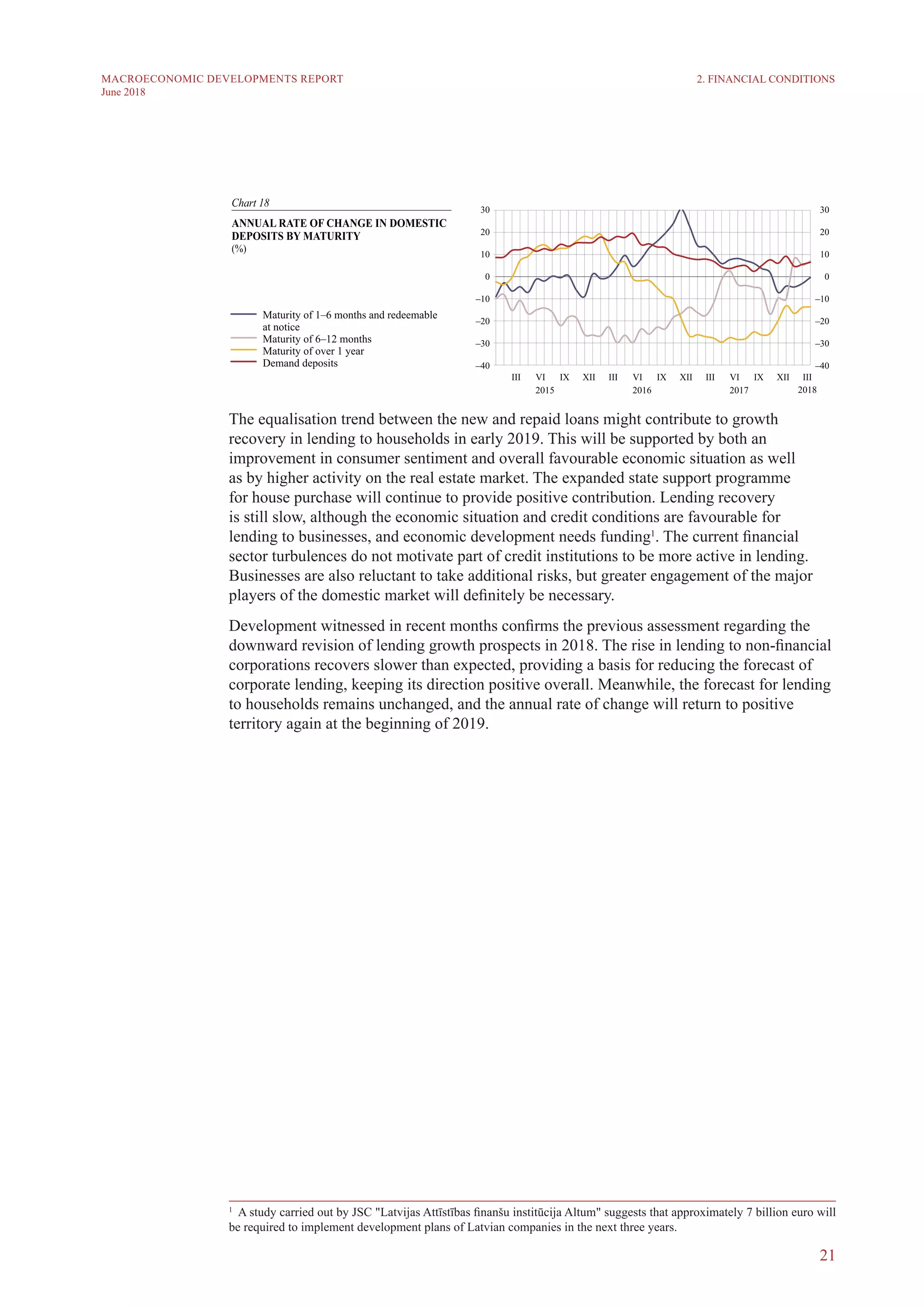
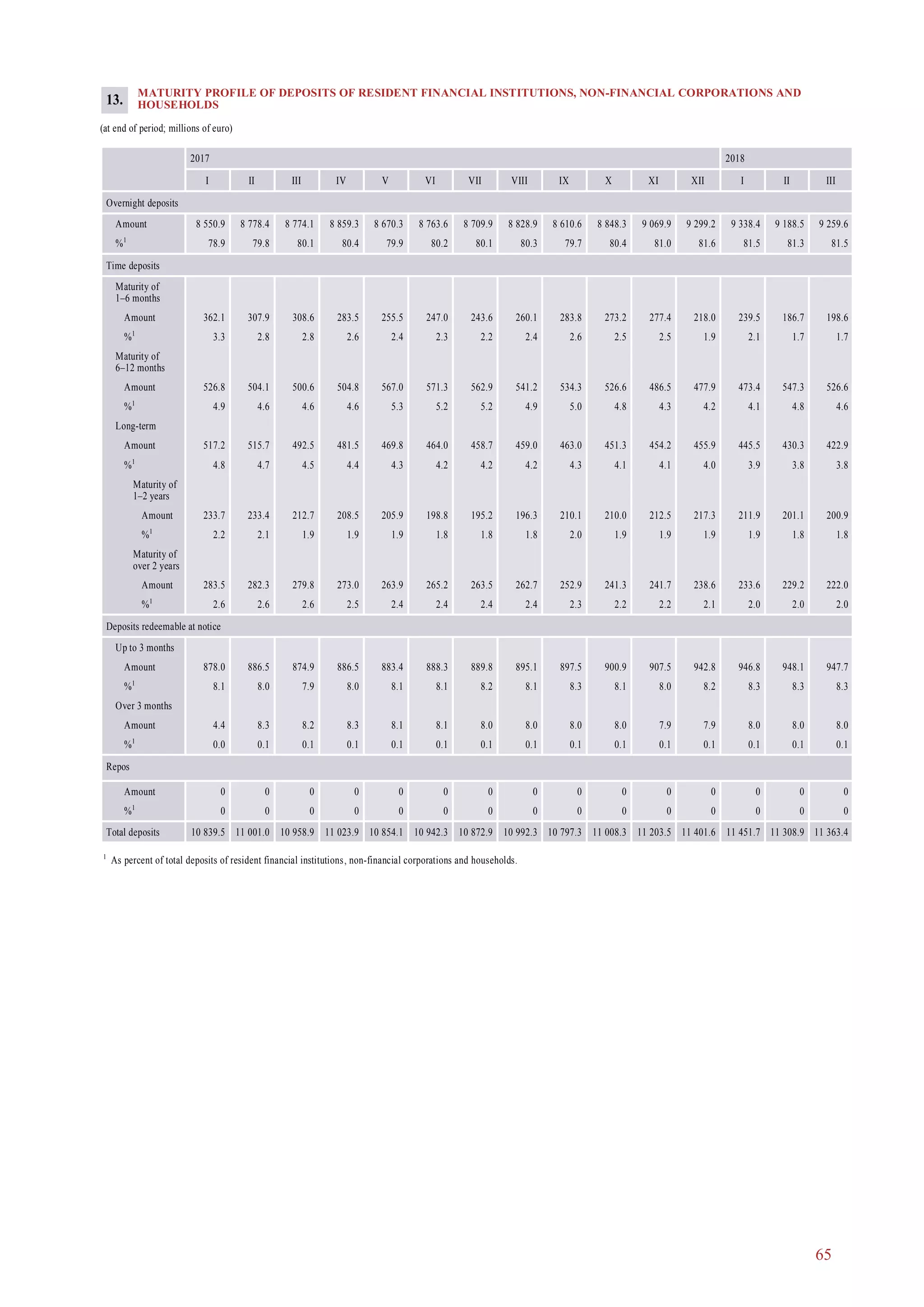
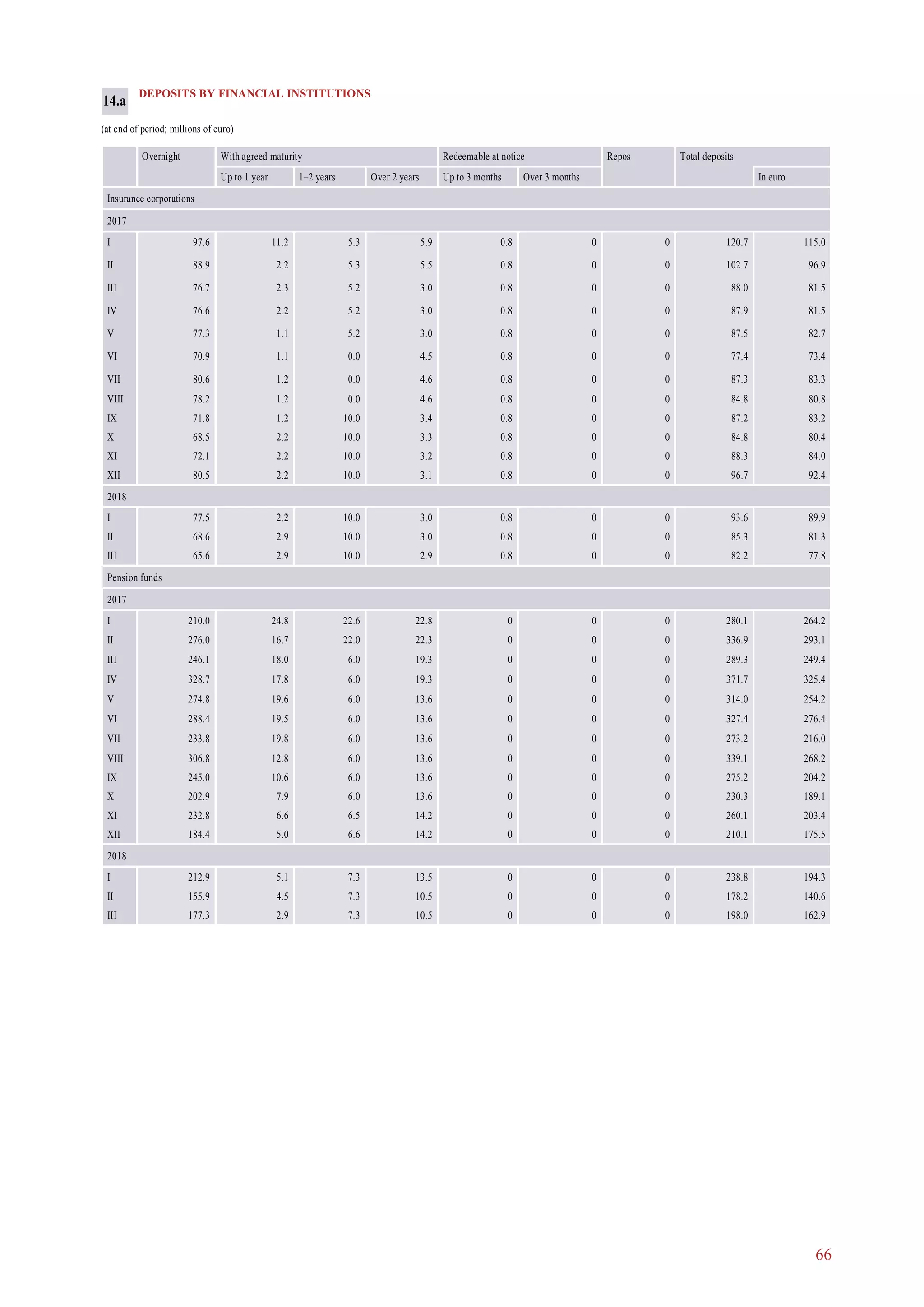
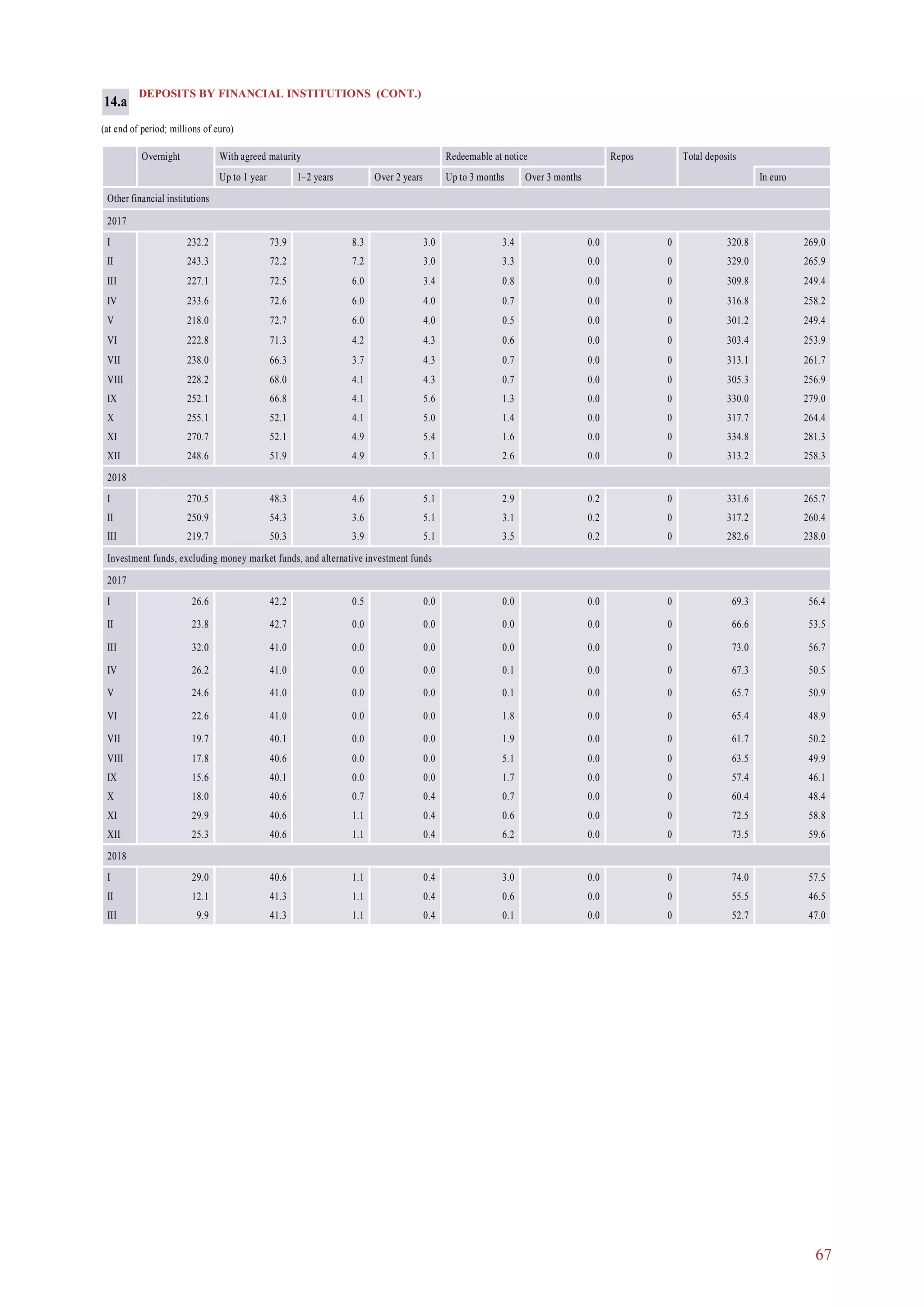
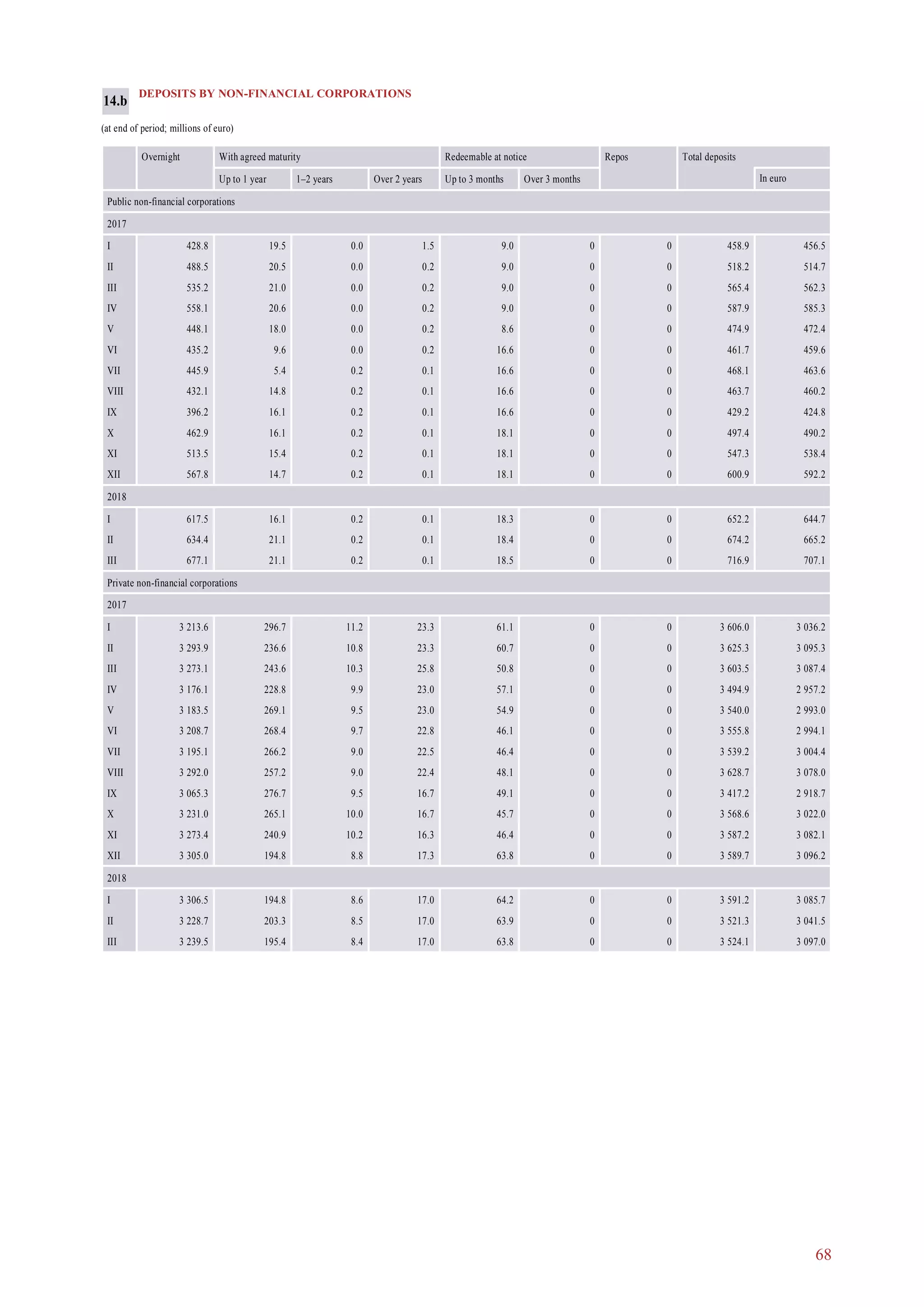
Developments of domestic deposits were more dynamic. In the fourth quarter of 2017 and
in January–April 2018, they mounted by 764.6 million euro, with the annual growth rate
reaching 4.9%. The increase in household deposits was more stable but that of non-financial
corporations – more volatile. However, their annual rate of growth was almost identical
in April, i.e. 7.8% and 7.7% respectively. A decrease in deposits of financial institutions
(pension funds in particular) still decelerated the expansion of total deposits.
With depositors preferring liquidity in the low interest rate environment, it was mainly
settlement accounts they used to build up deposits (the annual growth rate of demand
deposits remains positive for the eighth consecutive year). With a view to bringing down
the drop in the value of real deposits, but at the same time maintaining sufficient liquidity,
smaller amounts of short-term deposits and savings deposits redeemable at a period of notice
are deposited, and they also show a positive trend. Meanwhile, long-term deposits continue
to shrink.
The turbulences having affected certain financial market participants in the recent months
have not had a substantial impact on the domestic loan portfolio and the received deposits,
although the structural changes associated with the self-liquidation of the JSC ABLV
Bank can still be expected to influence monetary aggregates. Nevertheless, even if the
implementation of projects financed by the above credit institution might be delayed,
the funding currently available in the credit institutions sector allows to expect that the
potentially profitable projects will be implemented, while the domestic deposits are
gradually shifted to accounts of other credit institutions in Latvia.
The trends observed so far will remain unchanged in 2018, i.e. an increase in household
savings supported by growing wages and labour demand will ensure moderate overall
growth. Meanwhile, deposits by non-financial corporations will increase at a subdued rate,
with entrepreneurs making greater use of their revenue to finance investment and imports.
2. FINANCIAL CONDITIONS
21
MACROECONOMIC DEVELOPMENTS REPORT
June 2018
The equalisation trend between the new and repaid loans might contribute to growth
recovery in lending to households in early 2019. This will be supported by both an
improvement in consumer sentiment and overall favourable economic situation as well
as by higher activity on the real estate market. The expanded state support programme
for house purchase will continue to provide positive contribution. Lending recovery
is still slow, although the economic situation and credit conditions are favourable for
lending to businesses, and economic development needs funding1
. The current financial
sector turbulences do not motivate part of credit institutions to be more active in lending.
Businesses are also reluctant to take additional risks, but greater engagement of the major
players of the domestic market will definitely be necessary.
Development witnessed in recent months confirms the previous assessment regarding the
downward revision of lending growth prospects in 2018. The rise in lending to non-financial
corporations recovers slower than expected, providing a basis for reducing the forecast of
corporate lending, keeping its direction positive overall. Meanwhile, the forecast for lending
to households remains unchanged, and the annual rate of change will return to positive
territory again at the beginning of 2019.
1
  A study carried out by JSC "Latvijas Attīstības finanšu institūcija Altum" suggests that approximately 7 billion euro will
be required to implement development plans of Latvian companies in the next three years.
2. FINANCIAL CONDITIONS
22
MACROECONOMIC DEVELOPMENTS REPORT
June 2018
3. Sectoral Developments1
In 2017, economic growth reached the highest rate seen in the last six years. This was
primarily on account of the contribution provided by the construction, manufacturing, trade
and transport sectors. Meanwhile, the poor performance (–16.6%) of the financial sector is
attributable to a decline in foreign customer service.
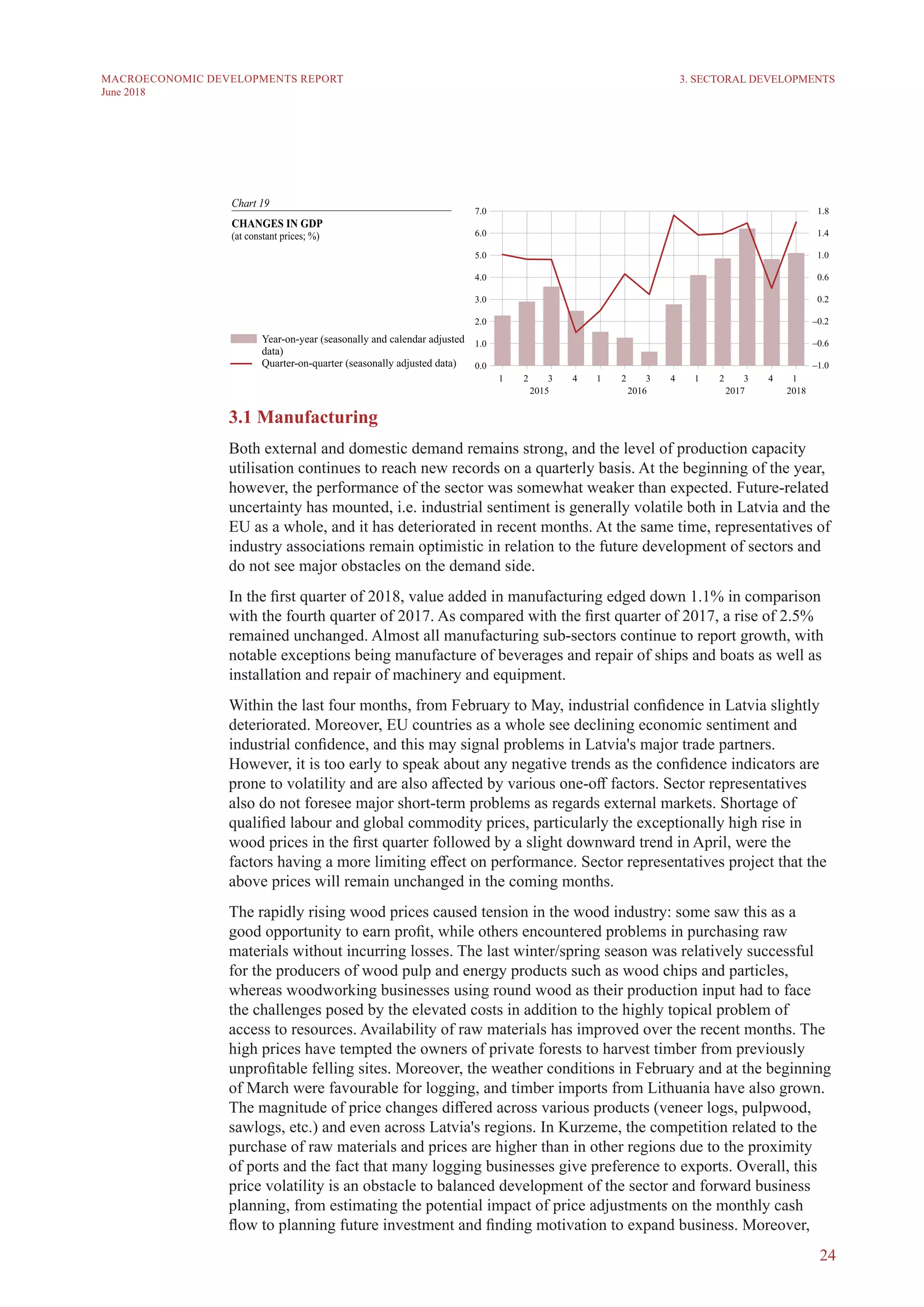
Despite the successful overall annual growth, GDP growth rate fluctuated. In the fourth
quarter of 2017, GDP growth rate was slower than in the previous quarters (+0.4% quarter-
on-quarter and +4.8% year-on-year), while growth had a pleasant surprise in store in the first
quarter of 2018 (+1.6% and +5.1% respectively).
At the beginning of the year, growth was underpinned by a very robust upswing posted by
the construction sector. Construction of roads and utilities, backed by the resources of EU
funds, as well as construction of administrative and commercial buildings, financed mainly
from private investment sources, increased. The real estate sector also showed strong growth
at the beginning of the year. With optimism on external markets waning, the contribution
provided by manufacturing to first-quarter growth was smaller than in the previous quarters.
However, following the excellent results achieved in 2017, its performance has still been
found to be good. The energy sector also provided a positive contribution to GDP growth
since energy production in co-generation plants edged up due to the cold weather conditions
persisting at the beginning of the year. Meanwhile, downturn of the financial sector, which
signalled problems since middle of the first quarter, continued and deepened.
Previous assessment Developments since the previous report New assessment
Manufacturing
Sustainable growth
in 2018 and 2019
supported by both the
external and domestic
demand. Investment is
projected to increase.
The problem of labour
shortage will intensify;
therefore, entrepreneurs
will focus more on
automation processes.
– The sector's development was somewhat
weaker than expected at the beginning of the
year; confidence indicators of the sector's
businesses have also deteriorated;
– capacity utilisation continues to grow rapidly
in individual sub-sectors (especially in the
pharmaceutical sub-sector), and the issue of
shortage of employees has become greater;
– the problem of access to raw materials has
diminished in wood processing, but the sharp
increase in wood prices has created both
opportunities and risks;
– sectors and businesses are still optimistic
about 2018 and 2019.
Sustainable growth in 2018
and 2019 supported by both
the external and domestic
demand. Investment is
projected to increase. The
problem of labour shortage
will intensify; therefore,
entrepreneurs will focus
more on automation
processes.
Construction
A large number of
projects are under
development, and
availability of EU funds
will facilitate buoyant
growth also in 2018.
– Construction production grew faster than
expected in the first quarter.
2018 will witness continued
buoyant growth. Both
intensive absorption of the
resources of EU funds and
dynamic implementation
of private projects support
development.
1
  The Chapter "Sectoral Developments" analyses GDP and sectoral value added at constant prices, using seasonally and
calendar adjusted data (unless otherwise specified).
3. SECTORAL DEVELOPMENTS
23
MACROECONOMIC DEVELOPMENTS REPORT
June 2018
Previous assessment Developments since the previous report New assessment
Real estate sector
High activity of transactions
on the apartment market
will continue in 2018.
– A price rise of standard apartments
decelerated during the first months of the
year;
– the range of beneficiaries of guarantees
under the state support programme for
house purchase has been expanded.
A large number of new
facilities in commercial and
dwelling spaces are under
development in 2018. With
the supply of more affordable
housing (in terms of price)
growing, the increase in
price of standard apartments
is edging down.
Trade
In line with the forecast, the
trade sector's growth rate
can somewhat pick up in
the coming years, mainly
in wholesale and non-food
retail trade.
– Strong expansion of the retail trade in
late 2017 and during the first months of
2018 (with regard to non-food products in
particular);
– uncertainty prevailing in consumer
sentiment and in planning of bigger
spending.
The high base achieved at the
end of 2017 will affect the
growth rate across the sector.
There are, however, no new
factors marking stronger
development.
Transport
The situation with regard to
transportation by rail and
at ports will not improve
in 2018. However, a slow
increase in transportation by
road could be observed if
new protectionist measures
are not implemented
and economic recovery
of Europe and Russia
continues. The transport
sector, in comparison with
the economy as a whole,
will experience stagnation.
– Developments at ports and transportation
by rail occur according to projections,
i.e. a decline in the volumes of cargoes is
ongoing;
– airport operation indicators sharply
increased also in early 2018;
– the growth rate of road transport
volumes was slower at the beginning of
2018 than in 2017.
The situation with regard to
transportation by rail and at
ports will fail to improve in
2018, but airport operation
indicators will continue
to show an increase. The
demand for road transport
will be supported by further
growth of the European
economy; however, labour
problems will limit the
supply. Overall, the transport
sector, in comparison with
the economy as a whole, will
experience stagnation.
Financial and insurance activities
Operation of credit
institutions providing
services to domestic
customers will still be
stable in 2018 and 2019. It
will be driven by a strong
domestic demand and
expansion of production
by exporting companies.
Meanwhile, the segment of
credit institutions providing
services to foreign
customers will continue to
narrow.
– Enforced AML/CFT measures
implemented at domestic and global levels
caused a reduction in operation of credit
institutions providing services to foreign
customers.
The reduction in operation of
credit institutions providing
services to foreign customers
will accelerate, consolidation
of credit institutions and
development of new lines of
action are possible.
3. SECTORAL DEVELOPMENTS
24
MACROECONOMIC DEVELOPMENTS REPORT
June 2018
3.1 Manufacturing
Both external and domestic demand remains strong, and the level of production capacity
utilisation continues to reach new records on a quarterly basis. At the beginning of the year,
however, the performance of the sector was somewhat weaker than expected. Future-related
uncertainty has mounted, i.e. industrial sentiment is generally volatile both in Latvia and the
EU as a whole, and it has deteriorated in recent months. At the same time, representatives of
industry associations remain optimistic in relation to the future development of sectors and
do not see major obstacles on the demand side.
In the first quarter of 2018, value added in manufacturing edged down 1.1% in comparison
with the fourth quarter of 2017. As compared with the first quarter of 2017, a rise of 2.5%
remained unchanged. Almost all manufacturing sub-sectors continue to report growth, with
notable exceptions being manufacture of beverages and repair of ships and boats as well as
installation and repair of machinery and equipment.
Within the last four months, from February to May, industrial confidence in Latvia slightly
deteriorated. Moreover, EU countries as a whole see declining economic sentiment and
industrial confidence, and this may signal problems in Latvia's major trade partners.
However, it is too early to speak about any negative trends as the confidence indicators are
prone to volatility and are also affected by various one-off factors. Sector representatives
also do not foresee major short-term problems as regards external markets. Shortage of
qualified labour and global commodity prices, particularly the exceptionally high rise in
wood prices in the first quarter followed by a slight downward trend in April, were the
factors having a more limiting effect on performance. Sector representatives project that the
above prices will remain unchanged in the coming months.
The rapidly rising wood prices caused tension in the wood industry: some saw this as a
good opportunity to earn profit, while others encountered problems in purchasing raw
materials without incurring losses. The last winter/spring season was relatively successful
for the producers of wood pulp and energy products such as wood chips and particles,
whereas woodworking businesses using round wood as their production input had to face
the challenges posed by the elevated costs in addition to the highly topical problem of
access to resources. Availability of raw materials has improved over the recent months. The
high prices have tempted the owners of private forests to harvest timber from previously
unprofitable felling sites. Moreover, the weather conditions in February and at the beginning
of March were favourable for logging, and timber imports from Lithuania have also grown.
The magnitude of price changes differed across various products (veneer logs, pulpwood,
sawlogs, etc.) and even across Latvia's regions. In Kurzeme, the competition related to the
purchase of raw materials and prices are higher than in other regions due to the proximity
of ports and the fact that many logging businesses give preference to exports. Overall, this
price volatility is an obstacle to balanced development of the sector and forward business
planning, from estimating the potential impact of price adjustments on the monthly cash
flow to planning future investment and finding motivation to expand business. Moreover,
3. SECTORAL DEVELOPMENTS
25
MACROECONOMIC DEVELOPMENTS REPORT
June 2018
such developments are also observed in other sectors. Many producers face the challenge of
declining profit margins caused by the fact that the rising global commodity prices increase
production costs, while the potential to increase prices on final products is limited.
One of the major problems faced by manufacturing is the shortage of labour. At the same
time, this could serve as an incentive to increase the degree of automation and invest in more
simple-to-handle equipment as well as support the development of higher quality products
and services. Such processes are observed in virtually all sub-sectors. For example, the
importance of quality and service factors in manufacture of building materials is growing:
the focus is on products that can be more easily handled in production (and usually are
more expensive) and on delivery at an exact time and to an exact location. Manufacturers
of building materials admit that the above processes will continue to occur as several major
construction projects have been launched, the availability of the resources of EU funds is
high and the housing insulation improvement programme has been relaunched after a break
of several years. These changes affecting automation and demand support productivity
gains. However, investment is insufficient, and this is demonstrated by the fact that the
industrial capacity utilisation is rising higher and higher. Although the industry and business
representatives mention the importance of automation and their plans in this regard, data
on investment in machinery and equipment show no significant upward path at this point in
time.
3.2 Agriculture and forestry
Although the agricultural sector was adversely affected by price changes of animal products
(milk and meat) due to the global drop in prices, but flooded Latvian forests hindered
transportation of forestry products out of woods at the end of 2017, the results of the fourth
quarter reported by the sector were in general positive. The sector's value added at constant
prices increased by 2.4% quarter-on-quarter and by 3.2% year-on-year. The results of 2017
reported by the sector were also positive overall. Value added in the sector grew by 1.9%.
Meanwhile, cultivation of grain and animal production were the main contributors to net
turnover and also profit of agricultural non-financial merchants. The sector saw continued
development also in the first quarter of 2018. The data show that grain purchases were
good and prices slightly increased as well as meat production went up. The planned felling
volumes for the first quarter of 2018 specified in felling acknowledgements also increased,
thus making it possible to forecast the sector's growth.
In the fourth quarter of 2017, purchases of grain (in tons) augmented by 10.7% year-on-
year, and in 2017 overall it also exceeded the purchases made in the preceding year. The
first quarter of 2018 also saw a 21.4% increase in grain purchases both in terms of volume
and price, albeit from a long-term perspective, grain prices are still relatively low due to
significant grain stocks. Grain price upswings were affected by the price development in
global stock exchanges, where it elevated for four consecutive months since the beginning of
the year. Factors related to unfavourable weather conditions in certain regions of the world
3. SECTORAL DEVELOPMENTS
26
MACROECONOMIC DEVELOPMENTS REPORT
June 2018
as well as robust demand contributed to the price rise. It was in mid-May when sowing of
summer cereals was completed in Latvia. Agricultural experts acknowledge that the situation
regarding grain sowing areas is complicated due to the prolonged drought. It is projected that
farmers will experience yield losses, but the situation is not critical.
According to the information compiled by the Agricultural Data Centre, the quantity of raw
milk purchased in 2017 remained at the same level as in the previous year, although the
number of cows had gradually decreased. Meanwhile, with the number of dairy cows falling,
the quantity of delivered raw milk slumped in Latvia in January–April 2018 year-on-year.
The average milk purchase price started to pick up in March 2017, but it began to decline
at the end of the year along with the average EU milk purchase price. The milk purchase
price tumbled also in January–March, while April witnessed its slight increase. However,
according to industry experts, the price rise did not significantly change the overall situation
prevailing on the dairy market.
Production of meat products and pork price mounted in the animal production sector both
at domestic and global levels in the fourth quarter of 2017 and the year as a whole. The
quantity of produced animal products continued on an upward path also in the first quarter of
2018, with the quantity of pork and beef increasing most substantially. During the first four
months of 2018, the global meat price remained close to the price observed at the end of the
previous year. Overall, the price was 20% lower than the record high level reached in 2014,
and the low prices have an adverse effect on Latvian producers as well. The year 2018 will
be less favourable for exports of animal products owing to a downward price pressure and an
increase in meat production in the US, Canada and Brazil, especially if Russia maintains its
ban on imports. However, taking account of the fall in pork prices in the EU, exports could
recover as EU pork price will once again become more competitive in global markets.
Weather conditions placed the forestry and logging industry at a disadvantage at the end of
2017. Thus, the above industry experienced difficulties with access to raw materials, but the
situation normalised when colder weather set in. The information published by the Ministry
of Agriculture of the Republic of Latvia suggests that exports of forest products posted a
6.0% rise in 2017. Overall, net turnover and profit of non-financial merchants elevated in
2017 year-on-year. According to the comments provided by industry experts to the mass
media, the beginning of 2018 was also successful for the sector. The growing demand for
timber both on domestic and external markets, driven by an active construction market,
continues to promote the upward trend. The planned felling volumes for the first quarter of
2018 specified in felling acknowledgements have augmented year-on-year.
The general outlook for the agricultural sector in 2018 is more positive than the previous
projections, which were affected by negative expectations arising from winter sowing areas.
The previously considered risk related to re-sowing of most of the areas under winter cereals
damaged by flooding has been partially absorbed since sowing areas, on the whole, had
survived the winter. Summer cereals were sown in the areas where winter cereals were lost.
However, the prolonged lack of precipitation has an adverse effect on sowing areas, creating
new risks of harvest losses. Dynamic movements in grain, meat and milk prices have not
been projected for 2018.
3.3 Construction
The beginning of 2018 saw the construction sector on the same steep upward trend as in
2017, supported by a vast range of output diversity. In the first quarter of 2018, value added
in construction picked up 33.0% year-on-year. Ignoring the traditional low construction
activity in the first quarter of year, this notable growth is likely to affect the annual
growth rate strongly as well, with seasonally adjusted construction output data implying
a pronounced rise (15.2% against the fourth quarter of 2017). Towards the close of 2017,
3. SECTORAL DEVELOPMENTS
27
MACROECONOMIC DEVELOPMENTS REPORT
June 2018
the construction growth was mostly spurred by road building as well as pipeline and other
communication line construction, basically financed by the resources of EU funds. These sub-
sectors recorded a sustained dynamic progress also in the first quarter of 2018. The
contribution from the segment of non-residential, particularly office and commercial, building
construction has increased over some recent quarters, even outpacing the significance of road
building in the first quarter. The expansion of office space construction was determined by the
existing inadequate supply of quality and spacious office premises, whereas the
implementation of a number of large construction projects, the entry of new market
participants (IKEA, trade centre "Akropole") and the expansion of some already existing
premises (trade centre "Origo", trade park "Alfa") affect the situation in the
trade sector. Construction of residential buildings contributed markedly to the aggregate
construction output in the first quarter. The number of permits for multi-apartment residential
buildings has increased. The residential building activity in Latvia has long lagged behind that
of its neighbours. The recent income hikes and standard apartment price rises point to
unsatisfied supply, with the demand ready to absorb the offer if the price level is adequate.
In the first quarter of 2018, the overall construction confidence indicator stabilised above the
level recorded in the fourth quarter of 2017, thus reaching a longer-term high. The assessment
of anticipated orders continued to improve in the first quarter, and the estimates of near-term
employment also linger at a very high level. The information about particular large-scale
construction projects supports sustainability of long-term progress. In 2018, an electricity
transmission system development project will be launched; investment by the Freeport of Riga
Authority in development will notably increase; SJSC "Latvijas dzelzceļš" is going to
commence several massive projects of infrastructure upgrading. The construction volumes in
2018 are expected to elevate to the highest level (leaving out indicators of the period of
economic overheating). Consequently, the sector is likely to experience more radical labour
shortages. Given the anticipated major long-term infrastructure projects and remuneration
growth across all economic sectors, extensive growth, based on quantitative labour increases,
is most unlikely.
Several activities, incorporated in the Development Strategy for the Latvian Construction
Sector for 2017–2024 approved in 2017, are planned for implementation in 2018. Measures
aimed at improving the effectiveness of administrative processes in construction, including
cutting the time needed for building regulations approval, setting up an electronic building
project approval system, and launching a digital document circulation system, will be of
particular significance. The Partnership of Latvian Construction Entrepreneurs is on the way
towards a collective agreement on minimum wage in the sector, aimed at reducing the shadow
economy and developing a growth model based on productivity and long-term stability.
3.4 Real estate sector
The scope of real estate purchase transactions in the first quarter of 2018 was similar
to that of the same period of the previous year. Transaction dynamics has remained at a
relatively high level since 2016. According to the data of real estate companies, standard
3. SECTORAL DEVELOPMENTS
28
MACROECONOMIC DEVELOPMENTS REPORT
June 2018
apartment price hikes continued on an upward trend in the first quarter, yet the pace
decelerated slightly, with the annual growth declining from 9% at the end of 2017 to 7% in
March 2018. With developers responding to the market demand, a number of budget class
residential building projects are likely to be completed in 2018 and, consequently, according
to real estate companies, will boost the supply. In the area of sector policy, the problems
of housing availability in regions and rental segment across the country are addressed. A
draft residential tenancy law, providing for elimination of obstacles to the development of
residential buildings for rent, was submitted to the Cabinet of Ministers of the Republic of
Latvia in April. The Ministry of Economy of the Republic of Latvia proposes to create a
financial instrument in the form of grants to local governments supporting the development
of the rental segment in the regions. The state aid programme for purchase of housing was
expanded in 2018, and the JSC "Attīstības finanšu institūcija Altum" reports that both young
specialists and individuals previously complying with the programme requirements have
showed large interest in it. Real estate companies expect the activity accelerate further, with
new office space and residential buildings entering the market.
3.5 Trade
Spurred by the stable income growth, the annual growth of retail trade turnover (at
constant prices) gained momentum towards the end of 2017; the respective indicator
remained high also in the first quarter of 2018 (5.5%). Having assessed the developments
in demand, businesses of the trade sector proceeded with bustling expansion of commercial
centre premises; new market participants are gradually entering the market as well. The
contribution of trade in food products and household related goods to the pickup in the
aggregate retail trade turnover remained significant at the end of 2017 and also in the first
quarter of 2018, while that of retail trade in some non-food goods and products (e.g. wearing
apparel and footwear, and pharmaceutical products) strengthened.
In comparison with 2017, the development of wholesale trade became slower in the first
quarter of 2018, even though the foreign trade flows remained stable in late 2017 and early
2018 and had a potential of fostering the expansion. This could be partially explained by
large imports or exports of certain of goods bypassing the wholesale trade channels.
The outlook for the trade sector growth in 2018 has not improved since December 2017
3. SECTORAL DEVELOPMENTS
29
MACROECONOMIC DEVELOPMENTS REPORT
June 2018
projections; however, due to the very high level recorded at the end of 2017, the average
annual pace may be above the 2017 indicator.
3.6 Transport
Despite further contracting of freight turnover at ports and in rail transport, the growth in
the sector as a whole was buoyant in 2017 overall, with its value added picking up 6.0%
over the year. So good an outcome was on account of expanding freight turnover by road
and also the perfect performance of the airport. The year 2018 is on a similar track: freight
turnover at ports and in rail transport continues on a downward trend, while the airport can
boast of rising passenger numbers. Unfortunately, the pace of freight turnover by road has
decelerated, and the first-quarter freight turnover has contracted. Overall, quarter-on-quarter
value added has remained unchanged in the first quarter, while year-on-year, a 2.1% growth
has been recorded.
In the period between end-2017 and early 2018, cargo turnover at ports shrank, yet not
all ports record the same position. The ports of Ventspils and Riga experienced notably
shrinking cargo volumes due to declines in coal and oil product transportation. Cargo
volumes at the port of Liepāja, on the other hand, expanded at the end of 2017 on account
of growing roll-on/roll-off freights as well as those of construction materials and chemical
substances, while in the first quarter of 2018, bulkier transported grain volumes impacted
the growth. The preliminary April data point to a better situation at the port of Riga, where
coal cargo volumes have rebounded (albeit likely for a short span) and the dynamic rise in
cargoes of wood and articles of wood continued. The size of container transhipment also
kept on increasing. Cargo volumes were shrinking further at the port of Ventspils, and the
port of Liepāja, having experienced a five-month upward trend, followed suit in April. Cargo
volume shrinkages in the two ports were determined by coal and oil product transportation.
Freight transport by rail posted an 8.4% volume contraction in 2017 and a 15.4% decrease in
the first quarter of 2018; in April in this respect, a minor upward trend was observed. SJSC
"Latvijas dzelzceļš" takes it as a signal of potential to retain freight volumes at the 2017
level. However, given that no positive changes in the relations with Russia are in place and
penetration into new markets is not as effective as hoped, shrinkages in freight volumes are
expected to continue in 2018 as well.
Competition for port and rail cargoes is likely to be heighten by increases in the capacity
of local ports, rail transport and pipelines in Russia and also other neighbouring countries.
For instance, Lithuanian Minister of Transport Rokas Masiulis announced at the OECD
International Transport Forum that his country planned to triple the capacity of Klaipēda port
to make the infrastructure ready for future freights in a 50 year perspective.
Looking into the past, port and rail freights accounted for three fourths of all transport
services exports in 2000; in 2016, the income from exporting freight by road was almost on
par with the income earned from transporting freight via ports and by rail. In 2017, however,
the share of freight transported by road in the income from exports constituted 41%, while
that of rail transport and shipping accounted for only 34%. In early 2018, the volume of
freight transported by road exceeded the level of the previous year by 3.0%, whereas the
turnover contracted by 5.4%. Transportation services delivered abroad recorded the steepest
fall. A higher demand for freight transportation by road is determined by the robust ongoing
growth in the EU, yet the main obstacle is the lack of labour, which is becoming ever more
vital and eventually may hinder the growth.
In 2017, the SJSC "STARPTAUTISKĀ LIDOSTA "RĪGA"" provided services to 12.9%
more passengers and reached a new passenger servicing high. Progress continued also in the
first quarter of 2018, when the increase amounted to almost 20%, and cargo volumes picked
up as much as 70%. Passenger numbers increased on account of the opening of new routes,
3. SECTORAL DEVELOPMENTS
30
MACROECONOMIC DEVELOPMENTS REPORT
June 2018
new JSC "Air Baltic Corporation" aircraft, and the improvement of overall purchasing power
of customers. The outlook for air transport seems to be promising, since the industry has
recently received bulky investments, some investment projects are ongoing, and significant
investment plans are projected for future implementation. For instance, the construction of a
new multifunctional passenger servicing complex to connect the airport with the European
railway network Rail Baltica will commence in 2019.
3.7 Financial and insurance activities
The financial sector of Latvia is undergoing cardinal structural changes: functions of the
foreign client servicing credit institutions are narrowing due to reinforced implementation of
AML/CFT measures. As a result, value added of financial services fell by 16.6% in 2017 and
by 27.1% year-on-year in the first quarter of 2018. In the second quarter, drop in financial
and insurance sector's value added is projected to be even more pronounced.
Historically, the share of foreign client deposits in total deposits of the credit institution
sector has been within the range of 40%–55% (33% at the end of the first quarter of 2018).
In the course of two previous years, the assets and financing of credit institutions servicing
foreign customers (basically non-resident deposits) lost around one third of their value.
In March 2018 against the end of 2015, deposits of foreign clients have shrunk by around
55%, while the volume of payments made by clients in US dollars decreased by 85% within
the month. These developments resulted from the reinforcement of AML/CFT measures
domestically and on the international scale and the enhanced capacity of supervisory
authorities. Credit institutions servicing foreign clients boosted their resources for meeting
the requirements, conducted compliance control audits, reviewed the composition of their
client basis to scrap most risky customers, and launched other risk minimisation procedures.
The narrowing scope of activities significantly depended also on the US credit institutions
suspending direct correspondent banking relationships.
In February 2018, following a FinCEN's proposal for a legislative amendment, the
country's fourth largest bank found itself in a situation that compelled it to announce a
voluntary liquidation process (see Latvijas Banka's "Financial Stability Report 2018"). This
development, coupled with subsequent legislative amendments (most important of which is
the ban on transactions with "shell companies" that do not engage in any economic activity
and create little or no economic value, and, at the same time, are registered in a country
whose legislation does not provide for preparing and submitting financial reports) intensifies
the operational narrowing of foreign clients servicing credit institutions, reduces value added
of the sector, and may potentially affect the functioning of enterprises in other industries as
well (e.g. real estate, trade and transport sectors).
The weakening of activities of foreign clients servicing institutions adversely affected profits
of the latter, posting a substantial drop. Consequently, overall profits of credit institutions
are also decreasing even in the face of the robust profitability indicators of domestic clients
servicing credit institutions. Accounting for the fall in sector's total profitability in the first
3. SECTORAL DEVELOPMENTS
31
MACROECONOMIC DEVELOPMENTS REPORT
June 2018
quarter and even more faster shrinkages projected for the second quarter and thereafter due
to a further performance weakening, the outlook for industry's value added has been revised
downward. According to Latvijas Banka's forecasts, the financial sector problems are likely
to decelerate the GDP growth rate by 0.5 percentage point in 2018 and 0.2 percentage point
in 2019 vis-à-vis the previous projections. However, this adverse effect is likely to be partly
offset by a more positive performance of other sectors. Considerations behind the revision
of the overall GDP forecast, accounting for the impact of all sectors and all components of
utilisation, are dealt with in Chapter 7 "Conclusions and Forecasts".
Structural changes in the financial sector will continue in the years to come. The
performance of credit institutions servicing domestic clients is likely to be stable in 2018 and
2019 due to robust domestic and external demand. That of foreign clients servicing credit
institutions, by contrast, will continue on a downward trend, with possible credit institution
consolidation attempts and development of new activity types in place. The financial sector
is expected to have numbers of employees reduced, while thus freed labour resources will
be partly absorbed by enterprises of other sectors. The pace of economic growth above its
potential growth rate and labour demand above the labour market supply are positive factors,
driving reintegration of labour into the labour market in a relatively short time. It would
simultaneously reduce the existing supply side restrictions for enterprises in other sectors.
3. SECTORAL DEVELOPMENTS
32
MACROECONOMIC DEVELOPMENTS REPORT
June 2018
4. GDPAnalysis from the Demand Side1
Previous assessment Developments since the previous report New assessment
Private consumption
Growth in private
consumption will, on
average, remain stable over
the projection period.
– Unemployment continues to shrink, and
the impact of factor contributions to income
growth still persists;
– retail trade is posting moderate growth;
– the confidence was volatile during the first
five months of 2018;
– build-up of precautionary savings and
postponement of bigger purchases might be
observed in the second half of 2018.
Private consumption will
grow steadily; however,
temporary caution in
spending is likely.
Investment
In the projection period,
the annual growth of gross
capital formation could
increase at a slightly faster
rate on account of a lower
base, the actual activity
in the construction sector,
more active absorption
of the resources of EU
funds in the second half of
2017 and new investment
projects.
– In the second half of 2017, the level of
investment fell behind the initial projections;
– construction growth at the beginning of
2018 was more rapid than expected;
– as expected, the national airline has
resumed the import of aircrafts which was
temporarily delayed in the fourth quarter of
2017.
Following rapid growth
in 2017, investment will
moderate in 2018.
Exports
The assessment of exports
of goods and services will
remain unchanged over the
medium term.
– External demand forecast for 2018 has been
revised slightly upwards;
– euro area manufacturing growth has
slowed;
– producer sentiment has deteriorated.
Export development
assessment, which would
otherwise improve due to
a more positive external
demand assessment, has
become less optimistic on
account of deteriorating
external economic and
geopolitical environment
as well as problems in the
financial services sector.
Imports
On account of higher
investment activity, the
growth rate of imports will
continue to exceed that of
exports.
– Robust import growth during the first
months of 2018, including, as expected,
resumed import of aircrafts.
As a result of investment
activity, in 2018 the growth
rate of imports of goods will
continue to accelerate steadily
with its growth rate exceeding
that of exports.
Government consumption
The assessment of
government consumption
dynamics has remained
unchanged since
September 2017.
– Budget expenditure growth reflecting
government consumption remained stable in
the first quarter.
The government spending
policy is in line with the
planned policy.
1
  The Chapter "GDP Analysis from the Demand Side" analyses GDP and demand components at constant prices, using
seasonally and calendar adjusted data (unless otherwise specified).
4. GDP ANALYSIS FROM THE DEMAND SIDE
33
MACROECONOMIC DEVELOPMENTS REPORT
June 2018
Economic growth slowed down somewhat at the end of 2017, and the investment activity
fell behind the initial projections in the second half of the year. Nevertheless, against
the backdrop of the low base, overall annual increase in investment was rapid, and its
contribution to GDP growth approached that of private consumption which was supported
by a robust rise in income. Meanwhile, in the first quarter of 2018 growth slightly exceeded
expectations. As a result of a very rapid construction sector development, resumed import of
aircrafts by the national airline as well as successful absorption of the resources of EU funds,
investment remained an important factor contributing to growth also at the beginning of
2018. However, owing to the high base of 2017, the average annual investment growth rate
is expected to be lower. At the end of 2017 and the beginning of 2018, export development
was still supported by higher external demand. However, further development may be
hampered by risk factors such as the deterioration of external economic and geopolitical
environment, problems in Latvia's financial services sector and insufficient investment in
production capacity.
4.1 Private consumption
With income rising steadily, supported by labour productivity growth, labour market
conditions which continued to be favourable for employees (increasing labour demand and
growing labour shortage as one of the factors dampening the future development), a rise in
the minimum wage and changes in taxes, the growth rate of private consumption remained
high at the end of 2017 and the beginning of 2018 (0.9% quarter-on-quarter and 4.3% year-
on-year).
As problems in the financial services sector aggravated, consumer confidence deteriorated
temporarily and, compared with the months at the turn of the year, pessimism rose due to
unemployment expectations. Considering the overall labour market situation, household
sentiment did not deteriorate in April; however, with the amount of financial services
provided to non-residents declining further and exports of financial services weakening,
consumer sentiment showed no tendency to improve.
With part of the labour force laid off due to the financial sector problems, temporary
precautionary savings might accumulate since the dismissed employees might not spend
4. GDP ANALYSIS FROM THE DEMAND SIDE
34
MACROECONOMIC DEVELOPMENTS REPORT
June 2018
their severance payments or unemployment benefits in the same amount as they would
spend their salaries when employed. If the caution increases with respect to larger purchases,
private consumption growth could moderate slightly in the second half of 2018.
4.2 Investment
Investment activity is driven both by a large number of private sector projects and
continuous financing from the EU funds for infrastructure objects. In the second half of
2017, investment activity was weaker than previously estimated; nevertheless, overall annual
investment increased rapidly on the back of the previous year's low base. In the first quarter
of 2018, investment also expanded substantially by 10.2% quarter-on-quarter and by 17.8%
year-on-year. This was already signalled previously by an increase in the government capital
expenditure, very rapid construction sector development and, as projected, also the resumed
imports of aircrafts by the national airline. The ongoing construction of logistics and trading
centres as well as other infrastructure objects remains active, and the implementation of
projects for Latvia's centenary celebration continues. However, the implementation of
projects related to the financing from the credit institutions providing services to non-residents
might be delayed, and this could be reflected in the indicators of the second quarter of 2018.
4.3 Exports
At the end of 2017 and in the first months of 2018, exports continued to benefit from solid
global economic expansion. In the first quarter of 2018, external demand growth supported
the increase in the real volume of Latvia's exports of goods, while exports of services were
adversely affected by the financial sector problems and the unfavourable development of the
transport sector. Thus, in the first quarter of 2018 the overall expansion of exports of goods
and services was weaker than before, with the annual growth rate reaching only 2.3%.
While exports of domestically produced goods continued on an upward trend, in the first
quarter of 2018 the main driver of the increase in exports of goods was re-export growth.
The largest positive contribution was made by re-exports of turbojet engines to the US, re-
exports of vegetable products and vehicles to Lithuania as well as re-exports of machinery to
Germany. Meanwhile, growth in domestic exports was still largely supported by expanding
exports of wood and products of wood. Exports of products of wood were favourably affected
by rising exports of unprocessed wood and fibreboard to Sweden, Finland and France.
In the first quarter of 2018, the annual increase in the real volume of exports of goods
was more significant, whereas the price effect was less pronounced. The largest positive
contribution to export growth came from expanding exports of machinery and electrical
equipment, products of wood, articles of base metals and prepared foodstuffs. Positive
annual growth was supported by the relatively stable growth in manufacturing seen in the
preceding months as well as increases in global prices of oil, miscellaneous food products,
cereals, wood and metals.
In the first quarter of 2018, the development of exports of services was weaker than in the
4. GDP ANALYSIS FROM THE DEMAND SIDE
35
MACROECONOMIC DEVELOPMENTS REPORT
June 2018
previous year on account of slower growth in exports of transport services. At the same time,
exports of telecommunication and computer services followed an upward trend, and higher
spending of foreign visitors was recorded. The latter was facilitated by a 15.3% pickup in
the number of foreign visitors and a 14.3% increase in the duration of their stay as compared
to the first quarter of 2017. Visitors from Russia, Estonia, Lithuania, Germany and the UK
continued to account for the largest number of arrivals.
Latvia's export market share in global imports remained stable in 2017. Meanwhile, the
Constant Market Share Analysis (CMSA), which is based on the Eurostat data, suggests
that over twelve months until February the export share of Latvia's goods in the EU market
remained lower as compared to the previous twelve months but the markets supporting this
trend have changed. Latvia's situation has remained stable or has improved in the markets
of several major trade partners, e.g. Estonia, Poland and Finland (following unfavourable
developments observed in these countries in 2017, the beginning of 2018 saw some
improvement) as well as Germany and Sweden, whereas the situation deteriorated in the
markets of Denmark, Lithuania and the Netherlands.
The economic confidence indicators for EU countries published by the EC remain high on
average, albeit slightly lower than in 2017. Euro area manufacturing growth decelerated
and the producer sentiment deteriorated over the past few months. These factors as well as
the high degree of capacity utilisation, shortages of skilled labour and the moderation of the
trade partners' economic growth are likely to prevent exports of goods from expanding at the
same pace as in 2017. Export growth prospects are also weakened by declining optimism in
the external economic environment, including global protectionist measures started by the
US at the beginning of 2018.
Overall, income from exports of services is expected to rise in 2018, supported by the still
favourable dynamics of computer and construction services exports as well as the income
from spending of foreign visitors which is expected to increase due to Latvia's centenary
celebration. However, with non-resident deposits in Latvia shrinking, the volume of financial
services provided by credit institutions is also contracting. On account of this factor, the
services export forecast has been revised downwards.
Therefore, despite a slightly higher external demand forecast, an upward revision of the
export forecast according to the changes in external demand estimates would not be justified.
On the contrary, the outlook of Latvia's export growth has been revised downwards.
4.4 Imports
Investment growth, the availability of the resources of EU structural funds and a sustained
increase in private consumption led to robust expansion of imports of goods and services
both in 2017 and in the first quarter of 2018 (by 1.8% quarter-on-quarter and 6.6% year-on-
year).
Strong domestic demand, successful absorption of the resources of EU funds, high degree
4. GDP ANALYSIS FROM THE DEMAND SIDE
36
MACROECONOMIC DEVELOPMENTS REPORT
June 2018
of capacity utilisation in businesses and anticipated domestic investment growth are also
likely to boost the demand for imports. As in 2017, the renewal and replenishment of the
fleet of the JSC Air Baltic Corporation will provide a substantial contribution to the increase
in imports of goods. The airline received the eighth Bombardier CS300 already in February
2018 (overall, 20 aircrafts have been ordered). JSC Air Baltic Corporation plans to receive
seven more Bombardier CS300 aircrafts by the end of 2018 and, as from May, four airplanes
Diamond Aircraft intended for training purposes at the Pilot Academy of the Air Baltic
Training Ltd. recently established by the airline.
In 2017, expansion of services imports was dampened by a drop in the volume of the
received telecommunication services. In the first quarter of 2018, nominal imports of
services grew by 11.8%, faster than exports, mainly supported by an increase in imports
of freight transport services, those by air in particular, as well as the dynamics of
telecommunication services, computer services and information services.
4.5 Government consumption
At the beginning of 2018, government consumption growth continued at a solid pace as a
result of the active implementation of EU co-financed projects, the allocation of additional
funding for the implementation of government functions, e.g. defence and restoration of
roadways, as well as the provision of funds for compensation, along with the raising of the
minimum wage, and funds for expenditure on goods and services, giving an overall insight
into the development of the government consumption. In the first quarter of 2018, budget
expenditure on compensation and that on goods and services saw more moderate growth
rates than in the fourth quarter of 2017, posting year-on-year increases of 6.2% and 7.1%
respectively.
A rise in the budget capital expenditure by almost one quarter recorded in the first quarter of
2018 points to active absorption of the resources of EU funds observed with respect to the
local government budgets in particular. So far, the development of the capital expenditure
has been in line with the budget execution estimates for 2018.
4. GDP ANALYSIS FROM THE DEMAND SIDE
37
MACROECONOMIC DEVELOPMENTS REPORT
June 2018
Despite a 5.0% year-on-year rise in the government expenditure in the first quarter of 2018,
tax revenue, mainly that from social security contributions, VAT and excise tax, grew by
8.4% facilitating an improvement in the consolidated budget balance.
Overall, economic growth is supported by higher government consumption and an expansion
in investment. Moreover, the overall tax revenue development suggests positive trends in the
economic activity. The government expenditure is projected to increase in the months ahead
under the impact of the above factors. At the same time, the performance assessment of the
revenue from certain taxes, such as the personal income tax, VAT and corporate income
tax, should be treated with caution in the context of the tax reform introduced in 2018. Tax
revenue collections for the first quarter of 2018 suggest that the tax revenue is below or close
to the level projected by the government.
4. GDP ANALYSIS FROM THE DEMAND SIDE
38
MACROECONOMIC DEVELOPMENTS REPORT
June 2018
5. Labour Market
Previous assessment Developments since the previous report New assessment
Unemployment
A gradual decline in
unemployment (close to
its natural level).
– The unemployment rate decreases
somewhat faster than expected;
– there are slowly increasing signs of
labour shortages.
A gradual decline in
unemployment (slightly below
its natural level).
Remuneration
In 2018, the average wage
will increase by 8%. The
medium-term assessment
has not been changed
significantly.
– In 2017, the average wage rose by 7.9%,
as previously projected;
– the minimum wage has increased by
13% since January 2018;
– in the first quarter of 2018, the average
wage growth (8.6%) is close to the
projected one.
In 2017 and 2018, the average
wage will rise by 8%. The
medium-term assessment has
not been changed significantly.
The most recent data confirm a further development of the labour market. Both registered
and actual unemployment rates decline somewhat faster than projected, representing a
decrease of more than 1 percentage point per annum. Employment and participation rates
are historically high, exceeding the EU average. The number of unfilled vacancies continues
to grow. All four available employment statistical data sources signal an increase in the
number of employed persons for the first time since 2013. Over the medium term, economic
growth will continue, mainly through boosting productivity. The number of employed
persons has remained almost unchanged over the last four years since a higher labour
market participation rate (in the age group above 55 years, in particular) and the decline
in unemployment (in all age groups) were offset by a population decrease (among young
people, in particular).
Over the last year, the unemployment rate went below its natural rate; however, this does
not mean that a further reduction in the unemployment rate is not possible or should not
be pursued. Natural unemployment in Latvia is significantly higher than that in Estonia,
Germany or the Czech Republic; not trying to reduce it by implementing well-considered
5. LABOUR MARKET
39
MACROECONOMIC DEVELOPMENTS REPORT
June 2018
competence development and regional mobility programmes and – in the long term – by
improving the quality of education and health care would mean an unforgivable waste of
human capital. Regional disparities of unemployment also continue to be pronounced,
despite a downward trend. However, it is also clear that an additional boost to aggregate
domestic demand would currently be more risky than beneficial.
With the economy balancing around the macroeconomic equilibrium, the risks of labour
market overheating raise a legitimate concern. The fact that, over the past few years,
remuneration has been increasing faster than labour productivity and that core inflation
continues to grow directly results from the warming up of Latvia's labour market. While
it is clear that the wage share in the total value added cannot increase indefinitely, no
serious competitiveness issues, however, have been observed so far: a record high share of
businesses report no significant obstacles to their activity; businesses' profitability ratios and
the share of Latvia's exports in global imports are stable. At the same time, improvements in
labour market conditions represent an opportunity for the long-term unemployed to re-enter
Latvia's labour market and facilitate re-emigration.
Latvijas Banka forecasts that, with actual and natural unemployment rates decreasing,
unemployment will stabilise at a level below its natural rate and that in 2018, the rate of
jobseekers will be, on average, 8.0% of the economically active population (the forecast
has been reduced by 0.4 percentage point). A further gradual decline (to 7.7%) in the
unemployment rate is projected in 2019. The survey data suggest that businesses are
ready to increase the number of employees also in 2018. However, further employment
growth opportunities, given the contracting population, are limited, and this could facilitate
remuneration growth. Although in 2018 productivity growth is most likely to be slower than
in 2017, the average wage growth may slightly exceed the level recorded in 2017 (7.9%).
This will be also supported by a significant rise in the minimum wage.
5. LABOUR MARKET
40
MACROECONOMIC DEVELOPMENTS REPORT
June 2018
6. Costs and Prices
Previous assessment Developments since the previous report New assessment
Oil prices
It was expected that
the average oil price
would be 54.1 US
dollars per barrel in
2017, 60.2 US dollars
per barrel in 2018 and
57.7 US dollars per
barrel in 2019.
– The average oil price was 54.4 US dollars per
barrel in 2017, while the price of Brent crude oil
exceeded 75 US dollars per barrel in May 2018;
– Saudi Arabia and Russia finally inform of their
intention to expand the oil production levels;
– the aggregated geopolitical situation in the Middle
East;
– although oil production has reached a record high,
oil stocks in the US demonstrate a downward trend.
The average oil price is
expected to be 73.0 US
dollars per barrel in 2018
and 70.0 US dollars per
barrel in 2019.
Global food prices
A moderate rise in
global food prices is
projected.
– The prices of dairy products declined significantly
around the turn of 2017, while rebounding again in
spring of 2018;
– global sugar prices continue to shrink.
A moderate rise in global
food prices is projected,
but from the lowest
initial level.
Domestic labour costs and inflation expectations
In 2017 and 2018,
the average wage will
increase by 8%.
– Labour costs rose in line with forecasts;
– inflation expectations stabilised.
In 2018, the average
wage growth will slightly
exceed 8%, standing at
6% in 2019.
Indirect taxes and administered prices
Changes in VAT
and excise tax rates
have been taken into
account according to
the approved levels.
– A reduced VAT rate on vegetables and fruit typical
of Latvia has affected inflation more than projected;
– the heating price in the 2017/2018 heating season
remained broadly unchanged.
Changes in excise tax
rates have been taken
into account according to
the approved levels and
a significant rise in tariff
rates approved by "Rīgas
ūdens" Ltd. in June 2018
has been considered.
In the first quarter of 2018, inflation declined in line with forecasts. The prices of
unprocessed food were somewhat lower than projected since inflation was affected by a
reduced VAT rate on vegetables and fruit typical of Latvia more than expected. Although
oil prices were higher than anticipated, resulting in a steeper than expected increase in fuel
prices, heating prices remained broadly unchanged. The inflationary effect of domestic
demand was close to expectations.
In May, the price of Brent crude oil exceeded 75 US dollars per barrel, representing
the highest level recorded during three and a half years. Although oil production is still
6. COSTS AND PRICES
41
MACROECONOMIC DEVELOPMENTS REPORT
June 2018
expanding in the US, oil stocks demonstrate a downward trend. Saudi Arabia (OPEC) and
Russia initially hinted at their intention to continue cooperation and even to extend the
agreement on oil output cuts next year; however, at the end of May, with the oil price hitting
80 US dollars per barrel, they started to signal a possible oil output increase. Oil prices were
also positively affected by geopolitical uncertainties, with the US withdrawing from the
nuclear deal which limited Iran's nuclear programme. The average market price of Brent
crude oil is currently projected to be close to 73 US dollars per barrel in 2018 (63 US dollars
per barrel in December and 66 US dollars per barrel in March); however, higher oil prices
will increasingly boost oil production in the US in the medium term.
Fuel prices reflected the oil price dynamics on the global stock exchanges and the
fluctuations of the euro against the US dollar with a delay of a couple of weeks. In mid-May,
the price of 95 octane petrol was 1.25 euro per litre or 8 cents more than half a year ago.
About half of the fuel price surge resulted from the increase in excise tax rates observed in
January 2018, while the rest of it – from the oil price hikes, which were only partly offset
by the appreciation of the euro vis-à-vis the US dollar. The current oil price forecast gives
reason to believe that the fuel price will continue to rise in nearest weeks, reaching, on
average, 1.30 euro per litre during the summer months.
Global food prices are broadly stable, although some products have exhibited substantial
price fluctuations. As global supply picked up faster than global demand, the prices of dairy
products declined significantly at the end of 2017 and at the beginning of 2018, while rising
moderately again in spring. Sugar prices continue to fall rapidly, reflecting record harvests in
Thailand and India. At the same time, the price of cereals records a moderate increase, with
the estimation of global cereal harvests deteriorating somewhat.
The rise in administered prices was lower than headline inflation. The price of natural gas
for households fell somewhat at the beginning of 2018, reflecting a downward trend in the
prices of oil products in mid-2017. The heating price recorded almost no increase in the
2017/2018 heating season, inter alia, the tariff rate approved by JSC "RĪGAS SILTUMS"
remained unchanged (44.39 euro (excluding VAT) per megawatt hour). At the end of April,
the Public Utilities Commission approved new water service tariffs in Riga taking effect in
6. COSTS AND PRICES
42
MACROECONOMIC DEVELOPMENTS REPORT
June 2018
June 2018 and, according to Latvijas Banka's estimates, pushing up the overall price level by
0.1%.
The inflationary effect of domestic demand is strengthening gradually. Underlying inflation
(inflation excluding taxes, food, energy and administered prices) is expected to increase
almost twofold in 2018 compared to 2017. Underlying inflation may remain high also in
2019, thus reflecting a rise in labour costs and indirect effects of the oil price hikes.
6. COSTS AND PRICES
43
MACROECONOMIC DEVELOPMENTS REPORT
June 2018
7. Conclusions and Forecasts
In 2017, the growth of Latvian economy saw a high of the last six years. The strong
performance (5.0% GDP growth according to seasonally and calendar adjusted data and
4.5% GDP growth according to non-adjusted data) was a result of very favourable trends
observed in the external environment as well as the domestic developments facilitating an
expansion of domestic demand and a recovery in investment in particular.
As suggested by the GDP growth data for the first quarter of 2018 (increases of 1.6%
quarter-on-quarter and 5.1% year-on-year according to seasonally and calendar adjusted
data; a 4.3% increase according to non-adjusted data), Latvia's economy continues to expand
at a solid rate also in 2018. The factors behind the growth rate, which was even somewhat
faster than projected, were similar to those observed in 2017: the development of significant
private investment projects, more active absorption of the financing of EU funds, robustly
growing household income in the circumstances of persistently moderate inflation as well as
continued strong demand in the major external markets.
Economic growth in the major trade partners is projected to remain sustained, and several
countries' growth outlook has even been revised upwards somewhat. However, export
markets are expected to grow at a slower pace than in 2017 overall. Moreover, the beginning
of 2018 was marked by an unexpected decrease in optimism in the external environment,
manifesting itself in deteriorating sentiment and real data, as the growth estimates for the
first quarter were lower than projected in a number of countries. The downturn in economic
activity was largely caused by one-off factors. However, while remaining at a historically
high level, the latest short-term development indicators do not suggest a strong improvement
as compared to the first quarter. The problems faced by the financial sector have created
additional obstacles in the domestic environment. Owing to recent developments and
legislative changes, Latvijas Banka revised the forecast for the value added of the financial
sector downwards. The activity of credit institutions providing services to foreign customers
is expected to decrease further causing a slowdown in the growth of value added in both
2018 and 2019. At the same time, several sectors are facing increasing limitations on the
supply side which, without sizeable investment in higher productivity, will undermine
further growth.
According to Latvijas Banka, in light of the problems faced by the financial sector, the GDP
growth rates might be lower than projected, posting decreases of 0.5 and 0.2 percentage
point in 2018 and 2019 respectively. Nevertheless, the surprisingly positive GDP data for
the first quarter largely offset the declining optimism in the external environment and the
negative contribution brought about by the shrinking of Latvia's financial sector. Overall,
the GDP growth rate is expected to be slower than in 2017. Latvijas Banka revised its GDP
forecast for 2018 slightly downwards from 4.1% to 3.9%, according to seasonally and
calendar adjusted data and according to non-adjusted data, and its GDP forecast for 2019 –
from 3.2% to 3.0%.
7. CONCLUSIONS AND FORECASTS
44
MACROECONOMIC DEVELOPMENTS REPORT
June 2018
In the last few months, inflation dynamics was lower than projected mainly because the
reduced VAT rate on vegetables and fruit typical of Latvia affected inflation more than
projected and the heating price increased only slightly. Nevertheless, the projection of
2.9% inflation growth in 2018 has remained unchanged on account of climbing oil prices.
Meanwhile, the inflation projection for 2019 was revised upwards by 0.3 percentage point, to
2.9%, reflecting the expected effect of higher oil prices on the heating and natural gas prices
and an indirect effect on the underlying inflation.
7. CONCLUSIONS AND FORECASTS
45
MACROECONOMIC DEVELOPMENTS REPORT
June 2018
8. Analysis of Scenarios
8.1 The potential impact of the US tariffs on imports
1. Motivation
The international trade confrontation between the US and other countries has escalated
in recent months. The US administration has expressed its determination to protect the
domestic producers and to narrow the US trade deficit. The US has already materialised its
threats by imposing tariffs on a number of products and product groups. So far, the tariffs
on imports of washing machines, solar panels as well as steel, aluminium and their products
have taken effect.1
To estimate the existing and potential effects of the increase in tariffs
on Latvia's economy, the global vector autoregressive (VAR) model comprising data on
37 countries2
was used in the calculation. Taking account of the specific nature of the model,
the impact of introducing tariffs, i.e. restricting exports, is modelled by using the aggregate
supply shock in the countries or groups of countries (the US, China and the euro area)
affected by the raised tariffs.
2. Simulation
Three scenarios have been considered, all based on the assumption that the US imposes
tariffs on imports of different commodity groups from a certain country or a group of
countries, while the affected countries respond by imposing similar tariffs on imports from
the US. The total values affected by tariffs are expressed in US dollars and as a percentage of
exports from the country affected by the tariffs to the country having introduced them.
The first scenario incorporates the fact that, based on a national security threat according
to Section 232 of the US Trade Expansion Act of 1962, the US has approved the tariffs on
imports of steel (25%), aluminium (10%) and their products of products from China3
with
their total value amounting to 2.8 billion US dollars or 0.6% of China's total exports to the
US (see Table 1). Meanwhile, China responded by imposing tariffs on imports from the US
worth 2.4 billion US dollars or 1.8% of the US total exports to China. China introduced
a 25% tariff on aluminium scrap and pork, as well as a 15% tariff on fruit, nuts and other
products.
Table 1
THE VOLUME OF EXPORTS AFFECTED BY TARIFFS
(%)
Vis-à-vis China's
total exports to
the US
Vis-à-vis the US
total exports to
China
Vis-à-vis the EU
total exports to
the US
Vis-à-vis the US
total exports to
the EU
Scenario 1 0.6 1.8 – – 
Scenario 2 0.6 1.8 1.6 1.0
Scenario 3 9.6 38.2 1.6 1.0
The second scenario covers the potential situation where the US also imposes tariffs on
imports from the euro area. Thus, the second scenario includes both the tariffs described
in the first scenario and those on imports of metals from the euro area with the total value
amounting to approximately 7.3 billion US dollars or 1.6% of EU exports to the US. Euro
area responds by imposing tariffs in the amount of 25% on individual commodity groups,
1
  https://www.cbp.gov/trade/programs.administration/entry-summary/232-tariffs-aluminum-and-steel; https://legcounsel.
house.gov/Comps/93-618.pdf.
2
  Benecká, S., Fadejeva, L., Feldkircher, M. Spillovers from Euro Area Monetary Policy: A focus on Emerging Europe.
CNB Working Paper (forthcoming in 2018).
3
  https://ustr.gov/sites/default/files/files/Press/Releases/301FRN.pdf.
8. ANALYSIS OF SCENARIOS
46
MACROECONOMIC DEVELOPMENTS REPORT
June 2018
including motorcycles, beauty products and other goods with their total value amounting to
3.1 billion US dollars or 1.0% of the US exports to the EU.1
The third scenario describes the most pessimistic situation where, in addition to the tariffs
described in the second scenario, a list of 1 333 products imported from China and subject to
a 25% tariff is included based on the unfair trade practices specified in Section 301 of the US
Trade Act of 1974. These tariffs would affect China's imports in the amount of 46.2 billion
US dollars or 9.6% of China's total exports to the US, with vehicles, machinery and
mechanical appliances and electrical devices accounting for the largest share (34.2 billion
US dollars). Consequently, China responds by approving a list of products worth 49.8 billion
US dollars or 38.2% of the US total exports to China. Vehicles worth 27.6 billion US dollars
and food products worth 13 billion US dollars are subject to the largest impact.
Higher tariffs drive up prices on imports from the respective country thereby decreasing the
volume of imports from that country. The potential decline in the volume of imports can be
estimated based on the changes in the price elasticity of exports and the changes in price (see
Chart 2). Based on the share of exports in the respective country's real GDP, it is possible to
project the decrease in real GDP caused by the introduced tariffs.
Table 2
CHANGES IN PRICE ELASTICITY OF EXPORTS AND PRICE CHANGES CAUSED BY
TARIFFS2345
Price elasticity of exports Price changes2
(%)
Minimum3
Medium Maximum4
Scenario 1 Scenarios 2 and 3
China –2.05
–2.8 –3.5 15% 25%
US –1.5 –2.9 –4.3 22% 25%
Euro area –0.8 –2.0 –3.2 23% 25%
Chart 40 shows the potential cumulative changes in Latvia's real GDP and the euro area real
GDP after a period of one month (immediate effect or the first reaction; given that the time
period of the model is a quarter, it can be theoretically referred to as the effect after a period
of one month), one year and two years as compared to the period before the introduction of
tariffs under the respective scenarios. The decline in real GDP is represented in a range of
values with the maximum and minimum values corresponding to different values pertaining
to the price elasticity of exports.
1
  https://eur-lex.europa.eu/legal-content/EN/TXT/?uri=uriserv:OJ.L_.2018.122.01.0014.01.ENG.
2
  Price changes are calculated as a weighted average, taking account of the tariff structure and the structure of the
respective export volume.
3
  Houthakker, H. S., Magee, S. P. Income and Price Elasticities in World Trade. The Review of Economics and Statistics,
vol. 51, No. 2, May 1969, pp. 111–125.
4
  Imbs, J., Mejean, I. Trade Elasticities. Review of International Economics, vol. 25, issue 2, May 2017, pp. 383–402.
5
  Authors' estimate taking account of the price elasticities of exports of other countries and based on the methodology
referred to in footnote 3.
8. ANALYSIS OF SCENARIOS
47
MACROECONOMIC DEVELOPMENTS REPORT
June 2018
3. Conclusions
The results obtained under the first and second scenarios suggest that, after a period of one
or two years, neither the initial nor the cumulative effect on economic growth in Latvia and
the euro area, caused by the existing tariffs on the US imports of metals from China and
the potential tariffs on EU goods as well as the tariffs applied in response to the above, is
significant (below 0.1% of GDP). In both scenarios, this can be explained by the fact that
the volume of goods affected by the import tariffs is relatively small (see Table 1) and does
not create a sufficiently large supply shock to influence, directly or indirectly (under the first
scenario), the economic growth in Latvia and euro area as a whole. Meanwhile, the tariffs
on imports under the third scenario, also including those under the first and the second
scenarios, in terms of volume affect a much larger share of the total trade in the respective
countries, thereby creating a sufficiently strong supply shock to significantly influence global
trade flows and, thus, the economic growth in Latvia and euro area. The results obtained by
using the above model suggest that, under a scenario this negative, the cumulative effect on
Latvia's GDP and that on the euro area GDP might amount to 1.2% and 1.0% respectively
in two years. Under all three scenarios, the impact on Latvia's economy is larger than the
average impact on the euro area. This is a result of both higher degree of openness of the
Latvian economy (i.e. on average, the ratio of foreign trade to GDP is relatively higher in
Latvia than in the euro area) and more pronounced sensitivity to external shocks. The three
scenarios presented in this simulation cover data on the existing and planned tariffs on
imports, based on the information available up to May. However, the US administration has
suggested that it might take more tariff-related decisions in future1
.
1
  https://www.reuters.com/article/us-usa-trump-autos/u-s-sets-public-hearings-on-auto-import-tariff-probe-
idUSKCN1IU271.
8. ANALYSIS OF SCENARIOS
48
MACROECONOMIC DEVELOPMENTS REPORT
June 2018
Statistics
List of tables
1.	 Monetary Indicators and Interest Rates	 50
2.ab	 Real Sector Indicators and Prices	 51
3.	 Analytical Accounts of the Central Bank	 52
4.	 Monetary Aggregates and Counterparts in the Euro Area: Latvian Contribution	 53
5.	 Key ECB Interest Rates	 54
6.	 Assets and Liabilities of Latvijas Banka	 55
7.	 Aggregated Balance Sheet of MFIs (excluding Latvijas Banka)	 58
8.	 Consolidated Balance Sheet of MFIs	 58
9.ab	 Aggregated Balance Sheet of MFIs (excluding Latvijas Banka)	 59
10.	 Monetary Survey MFI's (excluding Latvijas Banka)	 62
11.ab	 Foreign Assets and Liabilities of MFIs (excluding Latvijas Banka)	 63
12.	 Selected Items in the Monthly Financial Position Report of MFIs (excluding	
Latvijas Banka) by Group of Countries	 64
13.	 Maturity Profile of Deposits of Resident Financial Institutions, Non-Financial
Corporations and Households	 65
14.a	 Deposits by Financial Institutions	 66
14.b	 Deposits by Non-Financial Corporations	 68
14.c	 Deposits by Households	 69
14.d	 Deposits by Government and Non-Residents	 69
15.	 Maturity Profile of Loans to Resident Financial Institutions, Non-Financial
Corporations and Households	 70
16.a	 Loans to Financial Institutions and Non-Financial Corporations	 71
16.b	 Loans to Households	 72
16.c	 Loans to Government and Non-Residents	 72
17.ab	 Loans to Financial Institutions and Non-Financial Corporations in the National
Economy	 73
18.	 Lending to Resident Financial Institutions, Non-Financial Corporations and
Households	 74
19.a	 Holdings of Securities Other than Shares	 75
19.b	 Holdings of Shares and Other Equity	 75
20.a	 Currency Breakdown of Resident Deposits	 76
20.b	 Currency Breakdown of Non-Resident Deposits	 76
20.c	 Currency Breakdown of Loans to Residents	 77
20.d	 Currency Breakdown of Loans to Non-Residents	 77
20.e	 Currency Breakdown of Holdings of Resident Securities Other than Shares	 78
20.f	 Currency Breakdown of Holdings of Non-Resident Securities Other than
Shares	 78
20.g	 Currency Breakdown of Debt Securities Issued by MFIs	 79
21.a	 Weighted Average Interest Rates Charged by MFIs in Transactions with
Resident Non-Financial Corporations and Households in Euro	 79
21.b	 Weighted Average Interest Rates Charged by MFIs in Transactions with
Resident Non-Financial Corporations and Households in US Dollars	 83
21.c 	 Weighted Average Interest Rates Charged by MFIs in Transactions with Resident
Non-Financial Corporations (new business)	 87
22.	 Lending in the Interbank Markets	 88
23.	 Interest Rates in the Domestic Interbank Market	 89
24.	 Principal Foreign Exchange Transactions (by type, counterparty and currency)	 89
STATISTICS
49
MACROECONOMIC DEVELOPMENTS REPORT
June 2018
25.	 Non-cash Foreign Exchange Transactions	 90
26.	 Euro Foreign Exchange Reference Rates Published by the ECB	 90
27.	 Weighted Average Exchange Rates (cash transactions)	 91
28.	 Structure of Government Securities	 91
29.	 Auctions of Government Securities in the Primary Market	 93
30.	 Dynamics of GDP	 93
31.	 Changes in the Average Monthly Wages and Salaries and Unemployment	 93
32.	 Latvian Foreign Trade Balance	 94
33.	 Main Export Goods of Latvia	 94
34.	 Main Import Goods of Latvia	 95
35.	 Latvian Foreign Trade Partners	 96
36.	 Convenience and Extended Credit, Revolving Loans and Overdraft to Resident
Non-financial Corporations and Households	 96
37.a	 Loans to Resident Non-financial Corporations in the Breakdown
by Residual Maturity and by Interest Rate Reset Period	 97
37.b	 Loans to Resident Households in the Breakdown by Residual Maturity and
by Interest Rate Reset Period	 97
38.	 Volumes of New Business and Renegotiated Loans in Euro in MFI Transactions	
with Resident Non-Financial Corporations and Households	 98
39.	 Latvia's Balance of Payments	 99
STATISTICS
50
MONETARY INDICATORS AND INTEREST RATES
2017 2018
Q1 Q2 Q3 Q4 Q1
Overnight deposits1
(Latvian
contribution to the euro area M1) 5.9 8.2 3.5 1.5 5.9 5.5
Latvian contribution to the euro
area M21 3.4 6.0 2.4 0.8 3.4 4.7
Latvian contribution to the euro
area M31 3.2 6.1 2.4 0.6 3.2 4.5
Loans to resident financial
institutions, non-financial
corporations and households1
–2.5 2.8 0.9 –3.6 –2.5 –2.9
Deposits of resident financial
institutions, non-financial
corporations and households1
2.5 4.7 2.1 0.8 2.5 3.7
Long-term interest rate for
convergence assessment purposes2
0.83 0.94 0.88 0.85 0.66 0.73
EURIBOR (3-month loans)3
–0.329 –0.328 –0.330 –0.330 –0.329 –0.328
Weighted average yield on
government bonds 0.24
0.24
0.24
– 0.24
0.54
OMXR3
903.7 753.0 846.3 995.7 1 019.1 1 028.1
1.
2017 2018
I II III IV V VI VII VIII IX X XI XII I II III
Overnight deposits1
(Latvian
contribution to the euro area M1)
6.4 6.3 8.2 7.7 5.4 3.5 3.5 4.2 1.5 4.6 5.5 5.9 8.8 7.9 5.5
Latvian contribution to the euro
area M21 5.9 5.0 6.0 5.7 4.7 2.4 1.9 2.8 0.8 2.9 2.9 3.4 6.3 6.4 4.7
Latvian contribution to the euro
area M31 6.1 4.9 6.1 5.9 4.8 2.4 1.9 2.8 0.6 2.8 2.8 3.2 5.9 6.2 4.5
Loans to resident financial
institutions, non-financial
corporations and households1
3.8 3.8 2.8 2.5 0.7 0.9 1.0 0.8 –3.6 –2.2 –2.3 –2.5 –2.8 –2.8 –2.9
Deposits of resident financial
institutions, non-financial
corporations and households1
6.0 4.7 4.7 4.0 2.1 2.1 2.5 2.7 0.8 2.5 3.7 2.5 5.6 2.8 3.7
Long-term interest rate for
convergence assessment purposes2
0.89 0.99 0.94 0.92 0.88 0.85 0.98 0.85 0.72 0.71 0.69 0.59 0.60 0.75 0.83
EURIBOR (3-month loans)3
–0.325 –0.329 –0.329 –0.330 –0.329 –0.330 –0.330 –0.329 –0.329 –0.330 –0.329 –0.328 –0.328 –0.329 –0.328
Weighted average yield on
government bonds –0.035
– 0.24
– 0.24
– – – – – 0.24
0.24
0.44
0.54
–
OMXR3
742.6 745.8 769.3 796.2 834.0 900.4 982.5 1 007.6 995.8 1 009.8 1 034.0 1 013.4 1 028.8 1 018.9 1 036.3
1
Year-on-year changes (%).
2
Average secondary market yield of 10-year government bonds.
3
Average of the period.
4
Weighted average primary market yield of 5-year government bonds.
5
Weighted average primary market yield of 3-year government bonds.
51
REAL SECTOR INDICATORS AND PRICES
20171
2018
Q1 Q2 Q3 Q4 Q1
Industrial output2
Increase/decrease3
(at constant
prices; working day adjusted data; %) 8.2 6.6 8.9 9.3 7.7 4.5
Cargoes loaded and unloaded at ports
Turnover (thousands of tons) 61 877 18 491 15 498 13 723 14 165 15 556
Increase/decrease3
(%) –2.0 8.7 5.1 –3.1 –17.6 –15.9
Retail trade turnover 2, 4
Turnover (at current prices; millions of
euro)
7 180.4 1 597.9 1 788.8 1 881.3 1 912.6 1 701.1
Increase/decrease3
(at constant prices; %) 4.3 2.6 3.8 5.0 5.8 5.5
Unemployment rate (%) 6.8 8.3 7.2 6.6 6.8 7.0
Producer prices2
(increase/decrease compared
with the previous period; %) 2.6 1.4 0.8 0.9 0.1 1.5
Consumer price inflation (HICP)
Year-on-year basis (%) 2.9 3.1 3.0 2.9 2.5 2.0
Quarter-on-quarter basis (%) x 1.0 1.4 –0.5 0.5 0.6
Financial surplus/deficit in the consolidated general government budget
Surplus/deficit (millions of euro) –221.7 99.8 130.9 130.1 –582.5 227.9
Ratio to GDP (%) 0.8 1.7 2.0 1.8 8.1 3.6
1
Data have been revised.
2
Data are calculated according to the Statistical classification of economic activities in the European Community (NACE Rev. 2).
3
Year-on-year basis.
4
Sale of motor vehicles and motorcycles not included.
2.a
52
ANALYTICAL ACCOUNTS OF THE CENTRAL BANK
(at end of period; millions of euro)
2017 2018
I II III IV V VI I II IIIVII VIII IX X XI XII
Latvia's contribution to the euro
area monetary base 8 109.5 8 201.1 8 020.7 8 545.8 8 254.9 8 305.4 9 928.9 9 391.9 9 702.38 120.4 8 377.1 8 477.5 9 433.7 9 381.4 10 143.0
Currency in circulation 4 199.3 4 206.7 4 217.5 4 256.8 4 260.0 4 300.4 4 332.3 4 333.1 4 394.74 322.7 4 317.7 4 326.7 4 339.9 4 334.2 4 430.0
Current accounts (covering
the minimum reserve system) 3 910.2 3 994.4 3 803.2 4 289.0 3 994.9 4 005.0 5 596.6 5 058.8 5 307.63 797.7 4 059.4 4 150.8 5 093.8 5 047.2 5 713.0
Deposit facility and other
liabilities related to monetary
policy operations 0 0 0 0 0 0 0 0 00 0 0 0 0 0
Credit 7 059.7 6 741.2 7 011.0 7 239.5 7 402.1 7 039.6 8 834.4 9 171.0 8 937.37 683.3 7 818.3 8 004.5 8 176.4 8 539.4 8 731.4
To MFIs in the euro area 520.8 530.2 523.2 519.9 530.6 524.8 506.5 746.2 491.5504.6 499.2 495.1 482.8 509.6 506.8
To the general government
sector in the euro area 2 242.4 1 698.1 1 746.0 1 794.1 1 824.1 1 297.1 2 130.1 2 162.4 2 120.31 822.9 1 846.5 1 871.4 1 899.9 2 055.1 2 099.3
To other euro area residents 4 296.5 4 512.9 4 741.8 4 925.5 5 047.4 5 217.7 6 197.8 6 262.4 6 325.55 355.8 5 472.6 5 638.0 5 793.7 5 974.7 6 125.3
Foreign assets outside the euro
area 3 416.7 3 540.9 3 459.5 3 407.2 3 424.9 3 460.5 3 813.3 3 927.2 3 909.03 473.3 3 537.7 3 611.8 3 660.1 3 968.6 3 940.9
Foreign liabilities outside the
euro area 6.6 1.1 9.1 13.5 24.3 11.1 25.4 6.7 4.619.8 23.5 4.9 1.1 12.2 3.2
REAL SECTOR INDICATORS AND PRICES
2017 2018
I II III IV V VI VII VIII IX X XI XII I II III
Industrial output1
Increase/decrease2
(at constant prices;
working day adjusted data; %) 7.6 4.9 7.2 6.4 10.1 10.0 8.3 12.5 7.1 6.1 9.4 7.7 5.1 7.7 1.5
Cargoes loaded and unloaded at ports
Turnover (thousands of tons) 6 449 5 503 6 538 6 038 4 724 4 736 4 221 4 854 4 648 4 301 5 141 4 723 5 021 5 222 5 313
Increase/decrease2
(%) 13.4 –2.2 14.7 16.2 –9.2 8.9 –13.5 8.6 –3.6 –25.5 –2.2 –23.4 –22.1 –5.1 –18.7
Retail trade turnover1, 3
Turnover (at current prices;
millions of euro) 530.7 498.8 568.3 569.7 608.2 611.0 629.7 648.5 603.0 614.9 597.1 700.6 571.8 523.7 605.6
Increase/decrease2
(at constant
prices; %) 3.5 2.3 2.1 3.6 4.1 3.5 4.6 5.4 5.1 4.3 5.5 7.3 6.3 3.5 6.5
Unemployment rate (%) 8.5 8.4 8.3 7.8 7.4 7.2 7.1 6.9 6.6 6.6 6.7 6.8 7.0 7.1 7.0
Producer prices1
(increase/decrease
compared with the previous period; %) 0.7 0.4 0.1 0.1 0.4 0.5 0.4 0.1 0.3 –0.2 0.1 0.2 0.9 0.5 0.2
Consumer price inflation (HICP)
Year-on-year basis (%) 2.9 3.2 3.3 3.3 2.7 3.1 2.6 3.2 3.0 2.7 2.7 2.2 2.0 1.8 2.3
Month-on-month basis (%) 0.1 0.4 0.9 0.4 0.2 0.4 –0.8 –0.1 0.2 0.4 0.1 0.0 –0.1 0.2 1.3
Annual core inflation (total HICP
excluding fuel, regulated and
unprocessed food prices; %) 2.4 2.3 2.6 3.0 2.3 2.8 2.0 2.7 2.4 2.3 2.3 1.8 1.8 1.9 2.2
Financial surplus/deficit in the
consolidated general government
budget (millions of euro) 121.8 11.0 –33.0 70.9 79.4 –19.4 62.9 74.2 –7.0 –99.0 –145.2 –338.3 172.8 127.1 –72.0
1
Data are calculated according to the Statistical classification of economic activities in the European Community (NACE Rev. 2).
2
Year-on-year basis.
3
Sale of motor vehicles and motorcycles not included.
2.b
3.
53
MONETARY AGGREGATES AND COUNTERPARTS IN THE EURO AREA: LATVIAN CONTRIBUTION
(at end of period; millions of euro)
2017 2018
I II III IV V VI I II IIIVII VIII IX X XI XII
Monetary aggregates: Latvian contribution
M3 12 128.2 12 303.5 12 345.9 12 508.8 12 367.7 12 219.3 12 846.2 13 069.6 12 899.212 093.3 12 306.7 12 065.0 12 364.1 12 571.5 12 773.7
Repurchase
agreements 0 0 0 0 0 0 0 0 00 0 0 0 0 0
Money market
fund shares and
units 0 0 0 0 0 0 0 0 00 0 0 0 0 0
Debt securities
issued with
maturity of up to
2 years 80.2 40.9 46.5 35.6 33.9 18.5 43.4 17.8 19.323.0 27.8 24.1 26.7 25.2 45.1
Deposits with
agreed maturity
of up to 2 years 1 225.7 1 153.5 1 143.0 1 138.7 1 169.3 1 070.0 1 033.1 1 076.6 1 088.01 037.1 1 071.4 1 112.2 1 070.1 1 044.7 1 014.5
Deposits
redeemable at
notice of up to
3 months 884.7 893.1 881.2 893.2 890.1 895.1 954.7 954.9 953.5897.9 901.9 904.9 908.1 914.9 951.2
Overnight
deposits 9 937.6 10 216.0 10 275.3 10 441.3 10 274.5 10 235.7 10 815.0 11 020.3 10 838.410 135.2 10 305.6 10 023.9 10 359.1 10 586.7 10 762.8
Counterparts of monetary aggregates and longer-term financial liabilities: Latvian contribution
Deposits of central
government 1 105.3 1 096.9 925.2 927.2 849.6 984.9 841.1 1 041.1 899.4980.8 1 030.2 1 030.7 997.4 805.8 703.4
Longer-term
financial liabilities 3 897.7 3 921.4 3 846.4 3 730.8 3 820.9 3 784.6 3 949.1 3 926.3 3 849.03 819.7 3 868.4 4 071.3 4 060.2 4 047.0 4 009.0
Deposits with
agreed maturity of
over 2 years 321.0 320.2 317.2 310.2 300.5 302.5 278.7 274.1 267.8307.4 306.4 297.3 286.3 286.8 284.1
Deposits
redeemable at
notice of over
3 months 4.4 8.4 8.3 8.4 8.3 8.3 8.4 8.4 8.48.3 8.2 8.3 8.3 8.2 8.3
Debt securities
issued with
maturity of over
2 years 110.2 111.0 111.5 113.0 114.2 86.1 102.2 103.0 106.682.7 83.6 76.7 79.0 98.8 99.9
Capital and
reserves 3 462.1 3 481.8 3 409.4 3 299.3 3 398.0 3 387.7 3 559.9 3 540.8 3 466.33 421.3 3 470.3 3 689.0 3 686.5 3 653.2 3 616.8
Credit to euro area
residents 17 994.9 17 193.1 17 313.0 17 329.5 17 392.0 16 867.1 17 194.4 17 288.2 17 072.517 461.9 17 559.3 16 964.2 17 213.2 17 417.5 17 413.3
Credit to general
government 3 719.7 2 919.1 3 009.5 3 043.5 3 145.6 2 630.5 3 282.5 3 362.8 3 203.23 162.7 3 180.4 3 122.7 3 167.6 3 359.2 3 407.4
Credit to other
euro area residents 14 275.2 14 274.0 14 303.5 14 285.9 14 246.4 14 236.6 13 912.0 13 925.5 13 869.314 299.2 14 379.0 13 841.5 14 045.6 14 058.2 14 005.8
Loans 13 489.9 13 482.8 13 527.1 13 506.2 13 461.3 13 453.4 13 094.9 13 123.8 13 085.513 494.9 13 574.5 13 041.7 13 203.9 13 219.0 13 169.9
Net external assets
outside euro area –929.3 –383.9 –595.6 –811.7 –473.1 –1 256.7 113.6 837.7 404.7–667.3 –859.6 446.4 –164.7 382.8 –152.1
4.
54
KEY ECB INTEREST RATES
(percentages per annum)
With effect from
(dd.mm.yyyy)
Deposit facility Main refinancing operations Marginal lending facility
Fixed rate tenders Variable rate tenders
Fixed rate Minimum bid rate
01.01.1999 2.00 3.00 – 4.50
04.01.1999 2.75 3.00 – 3.25
22.01.1999 2.00 3.00 – 4.50
09.04.1999 1.50 2.50 – 3.50
05.11.1999 2.00 3.00 – 4.00
04.02.2000 2.25 3.25 – 4.25
17.03.2000 2.50 3.50 – 4.50
28.04.2000 2.75 3.75 – 4.75
09.06.2000 3.25 4.25 – 5.25
28.06.2000 3.25 – 4.25 5.25
01.09.2000 3.50 – 4.50 5.50
06.10.2000 3.75 – 4.75 5.75
11.05.2001 3.50 – 4.50 5.50
31.08.2001 3.25 – 4.25 5.25
18.09.2001 2.75 – 3.75 4.75
09.11.2001 2.25 – 3.25 4.25
06.12.2002 1.75 – 2.75 3.75
07.03.2003 1.50 – 2.50 3.50
06.06.2003 1.00 – 2.00 3.00
06.12.2005 1.25 – 2.25 3.25
08.03.2006 1.50 – 2.50 3.50
15.06.2006 1.75 – 2.75 3.75
09.08.2006 2.00 – 3.00 4.00
11.10.2006 2.25 – 3.25 4.25
13.12.2006 2.50 – 3.50 4.50
14.03.2007 2.75 – 3.75 4.75
13.06.2007 3.00 – 4.00 5.00
09.07.2008 3.25 – 4.25 5.25
08.10.2008 2.75 – – 4.75
09.10.2008 3.25 – – 4.25
15.10.2008 3.25 3.75 – 4.25
12.11.2008 2.75 3.25 – 3.75
10.12.2008 2.00 2.50 – 3.00
21.01.2009 1.00 2.00 – 3.00
11.03.2009 0.50 1.50 – 2.50
08.04.2009 0.25 1.25 – 2.25
13.05.2009 0.25 1.00 – 1.75
13.04.2011 0.50 1.25 – 2.00
13.07.2011 0.75 1.50 – 2.25
09.11.2011 0.50 1.25 – 2.00
14.12.2011 0.25 1.00 – 1.75
11.07.2012 0.00 0.75 – 1.50
08.05.2013 0.00 0.50 – 1.00
13.11.2013 0.00 0.25 – 0.75
11.06.2014 –0.10 0.15 – 0.40
10.09.2014 –0.20 0.05 – 0.30
09.12.2015 –0.30 0.05 – 0.30
16.03.2016 –0.40 0.00 – 0.25
5.
55
ASSETS AND LIABILITIES OF LATVIJAS BANKA
(at end of period; millions of euro)
2017 2018
I II III IV V VI I II IIIVII VIII IX X XI XII
ASSETS
Gold and gold
receivables 239.0 252.5 247.9 247.6 240.8 232.6 230.2 230.4 229.5230.8 235.6 232.5 233.3 230.6 230.9
Claims on non-euro area
residents denominated in
foreign currency 3 058.9 3 158.4 3 101.3 3 048.7 3 070.7 3 104.9 3 480.3 3 594.6 3 576.03 121.0 3 189.3 3 263.6 3 307.4 3 635.1 3 608.7
Claims on euro area
residents denominated in
foreign currency 299.7 310.3 326.0 328.8 308.0 302.3 349.0 369.7 359.8288.8 294.3 297.8 283.1 339.2 355.1
Claims on non-euro area
residents denominated in
euro 118.7 130.0 110.3 110.8 113.3 123.1 102.8 102.2 103.5121.5 112.8 115.7 119.5 102.9 101.3
Lending to euro area
credit institutions related
to monetary policy
operations denominated
in euro 257.2 244.7 244.7 244.7 244.7 244.7 244.7 194.7 247.7244.7 244.7 244.7 244.7 244.7 244.7
Main refinancing
operations 0 0 0 0 0 0 0 0 00 0 0 0 0 0
Longer-term
refinancing operations 257.2 244.7 244.7 244.7 244.7 244.7 244.7 194.7 247.7244.7 244.7 244.7 244.7 244.7 244.7
Fine-tuning reverse
operations 0 0 0 0 0 0 0 0 00 0 0 0 0 0
Structural reverse
operations 0 0 0 0 0 0 0 0 00 0 0 0 0 0
Marginal lending
facility
0 0 0 0 0 0 0 0 00 0 0 0 0 0
Credits related to
margin calls
0 0 0 0 0 0 0 0 00 0 0 0 0 0
Other claims on euro
area credit institutions
denominated in euro 0.0 9.7 0.1 0.1 0.1 0.3 0.6 298.7 0.11.4 0.1 2.0 6.5 0.1 0.4
Securities of euro area
residents denominated in
euro 6 502.8 6 176.6 6 440.3 6 666.0 6 849.4 6 492.4 8 240.0 8 307.8 8 329.77 148.4 7 279.3 7 460.0 7 642.1 7 955.3 8 131.2
Securities held for
monetary policy
purposes 4 586.6 4 823.8 5 075.2 5 275.7 5 465.4 5 666.0 6 800.5 6 882.9 6 889.45 860.8 6 018.7 6 214.5 6 411.3 6 602.9 6 720.0
Other securities 1 916.2 1 352.8 1 365.1 1 390.3 1 384.0 826.4 1 439.5 1 424.9 1 440.31 287.6 1 260.6 1 245.5 1 230.9 1 352.5 1 411.2
Intra-Eurosystem claims 4 177.4 4 196.0 4 221.1 4 272.2 4 311.1 4 355.4 4 582.6 4 585.7 4 619.54 399.7 4 441.4 4 466.1 4 502.1 4 518.3 4 596.5
Other assets 203.4 144.6 162.3 214.7 233.6 197.4 318.0 195.2 194.5248.6 226.8 158.5 148.3 222.3 230.0
Total assets 14 857.1 14 622.7 14 853.9 15 133.5 15 371.6 15 053.0 17 548.2 17 879.1 17 660.315 804.8 16 024.2 16 240.9 16 486.9 17 248.6 17 498.7
6.
56
ASSETS AND LIABILITIES OF LATVIJAS BANKA (CONT.)
(at end of period; millions of euro)
2017 2018
I II III IV V VI I II IIIVII VIII IX X XI XII
LIABILITIES
Banknotes in circulation 4 087.0 4 094.2 4 106.8 4 146.6 4 149.7 4 189.4 4 227.0 4 228.0 4 289.54 211.2 4 205.5 4 213.8 4 226.7 4 219.5 4 314.1
Liabilities to euro area
credit institutions
related to monetary
policy operations
denominated in euro 3 910.2 3 994.4 3 803.2 4 289.0 3 994.9 4 005.0 5 596.6 5 058.8 5 307.63 797.7 4 059.4 4 150.8 5 093.8 5 047.2 5 713.0
Current accounts
(covering the
minimum reserve
system) 3 910.2 3 994.4 3 803.2 4 289.0 3 994.9 4 005.0 5 596.6 5 058.8 5 307.63 797.7 4 059.4 4 150.8 5 093.8 5 047.2 5 713.0
Deposit facility 0 0 0 0 0 0 0 0 00 0 0 0 0 0
Fixed-term deposits 0 0 0 0 0 0 0 0 00 0 0 0 0 0
Fine-tuning reverse
operations 0 0 0 0 0 0 0 0 00 0 0 0 0 0
Deposits related to
margin calls 0 0 0 0 0 0 0 0 00 0 0 0 0 0
Other liabilities to euro
area credit institutions
denominated in euro 6.0 0.0 5.9 9.5 12.2 5.2 38.9 20.5 23.618.7 30.4 1.4 0.0 7.6 22.6
Liabilities to other euro
area residents
denominated in euro 181.7 225.7 192.9 208.6 190.1 262.7 214.2 719.3 821.9277.7 324.2 243.6 206.2 204.7 215.7
General government 10.9 55.7 23.7 33.5 15.7 89.0 21.1 43.8 230.298.2 145.5 61.5 18.3 17.6 29.5
Other liabilities 170.7 170.0 169.2 175.0 174.5 173.6 193.1 675.6 591.6179.5 178.8 182.1 187.9 187.1 186.2
Liabilities to non-euro
area residents
denominated in euro 6.4 1.1 8.7 12.6 22.1 9.8 21.9 6.3 4.616.6 18.7 4.0 1.1 10.5 2.5
Liabilities to euro area
residents denominated
in foreign currency 155.9 163.9 160.3 153.3 149.1 154.5 142.7 143.9 142.9149.5 146.1 150.4 148.5 150.6 144.3
Liabilities to non-euro
area residents
denominated in foreign
currency 0.1 0.0 0.4 0.9 2.2 1.3 3.5 0.4 0.03.2 4.8 0.9 0.0 1.6 0.6
Intra-Eurosystem
liabilities 5 830.1 5 399.8 5 860.5 5 572.0 6 103.9 5 688.7 6 599.2 6 976.6 6 368.96 587.9 6 463.4 6 703.4 6 025.7 6 860.1 6 339.7
Other liabilities 272.5 298.0 273.9 279.5 263.4 260.3 308.2 350.6 308.7264.4 271.4 292.2 301.7 269.7 305.3
Capital and reserves 407.2 445.6 441.4 461.6 484.0 476.1 395.9 374.7 392.7478.0 500.3 480.5 483.3 477.2 440.9
Total liabilities 14 857.1 14 622.7 14 853.9 15 133.5 15 371.6 15 053.0 17 548.2 17 879.1 17 660.315 804.8 16 024.2 16 240.9 16 486.9 17 248.6 17 498.7
6.
57
AGGREGATED BALANCE SHEET OF MFIs (EXCLUDING LATVIJAS BANKA)
(at end of period; millions of euro)
2017 2018
I II III IV V VI VII VIII IX X XI XII I II III
ASSETS
Loans to euro area
residents 18 992.2 19 008.5 18 897.1 19 404.0 19 075.7 19 376.5 18 802.4 19 142.8 18 522.3 19 460.5 19 361.2 19 818.0 19 790.0 19 298.3 19 312.2
General government 111.1 111.5 110.5 109.1 163.3 153.8 151.5 152.1 73.5 76.3 67.9 65.6 65.5 65.0 64.8
Other residents 13 489.9 13 482.8 13 527.1 13 506.2 13 461.3 13 453.4 13 494.9 13 574.5 13 041.7 13 203.9 13 219.0 13 169.9 13 094.9 13 123.8 13 085.5
MFIs 5 391.2 5 414.2 5 259.4 5 788.8 5 451.1 5 769.3 5 156.0 5 416.2 5 407.2 6 180.3 6 074.3 6 582.6 6 629.6 6 109.4 6 161.9
Holdings of securities
other than shares
issued by euro area
residents 2 156.3 1 885.0 1 905.1 1 888.8 1 912.5 1 920.0 1 911.6 1 883.9 1 781.1 1 816.9 1 857.1 1 837.3 1 695.9 1 536.5 1 355.1
General government 1 366.3 1 109.4 1 152.9 1 140.4 1 158.2 1 179.5 1 188.4 1 181.7 1 177.9 1 191.4 1 236.2 1 242.5 1 086.9 1 135.4 1 018.2
Other residents 142.1 147.5 144.6 146.2 153.8 149.3 146.3 141.1 133.1 139.2 144.0 148.2 173.4 160.2 146.6
MFIs 647.9 628.1 607.7 602.2 600.4 591.1 576.9 561.1 470.1 486.4 476.9 446.6 435.6 240.9 190.3
Holdings of money
market fund shares or
units issued by euro
area residents 0 0 0 0 0 0 0 0 0 0 0 0 0 0 0
Holdings of shares/
other equity issued by
euro area residents 712.0 712.6 700.7 702.4 700.1 703.6 728.8 734.9 739.0 775.1 767.7 760.2 709.0 706.7 702.6
External1
assets 6 484.9 6 752.6 6 562.5 6 153.7 5 971.2 5 835.4 6 030.1 5 882.7 5 468.8 5 474.6 5 459.1 5 026.4 5 226.1 4 576.0 3 291.5
Fixed assets 175.8 176.8 177.2 174.5 174.8 177.0 175.6 175.4 175.0 175.2 175.7 174.4 174.7 191.4 190.6
Remaining assets 906.2 797.1 782.3 774.2 722.8 724.5 698.1 693.2 697.7 695.8 653.6 694.2 697.2 936.6 769.5
Total assets 29 427.5 29 332.5 29 024.9 29 097.6 28 557.1 28 736.9 28 346.6 28 513.1 27 384.0 28 398.1 28 274.5 28 310.6 28 292.9 27 245.5 25 621.6
LIABILITIES
Currency in
circulation x x x x x x x x x x x x x x x
Deposits of euro area
residents 13 961.8 14 061.5 13 925.3 14 228.8 14 303.9 13 824.3 13 794.9 13 832.5 14 162.2 14 529.0 14 552.1 14 637.4 14 852.6 15 029.6 14 312.3
Central government 938.5 877.2 741.2 740.4 684.8 741.4 733.1 738.6 818.9 830.6 637.6 529.6 677.2 853.4 526.3
Other residents 12 202.8 12 421.2 12 455.7 12 616.8 12 468.1 12 337.9 12 206.5 12 414.7 12 164.5 12 444.1 12 654.2 12 834.7 12 896.8 12 658.8 12 564.5
MFIs 820.5 763.1 728.4 871.7 1 151.0 744.9 855.3 679.1 1 178.8 1 254.3 1 260.3 1 273.2 1 278.5 1 517.4 1 221.6
Money market fund
shares or units held by
euro area residents 0 0 0 0 0 0 0 0 0 0 0 0 0 0 0
Debt securities issued
with a maturity of
over 2 years held by
euro area residents 112.5 113.6 114.0 115.6 117.5 89.6 86.2 87.0 80.1 82.3 102.4 104.4 104.6 104.9 104.0
Capital and reserves 3 054.9 3 036.2 2 968.0 2 837.6 2 914.0 2 911.5 2 943.3 2 969.9 3 208.5 3 203.2 3 176.0 3 175.9 3 163.9 3 166.1 3 073.6
External1
liabilities 10 821.9 10 673.3 10 605.7 10 356.2 9 841.3 10 537.7 10 147.2 10 252.8 8 625.9 9 294.8 9 028.9 9 111.5 8 897.8 7 653.4 6 790.1
Remaining liabilities 1 476.5 1 448.0 1 411.8 1 559.4 1 380.4 1 373.8 1 374.9 1 370.9 1 307.3 1 288.7 1 415.1 1 281.4 1 274.1 1 291.5 1 341.6
Total liabilities 29 427.5 29 332.5 29 024.9 29 097.6 28 557.1 28 736.9 28 346.6 28 513.1 27 384.0 28 398.1 28 274.5 28 310.6 28 292.9 27 245.5 25 621.6
1
Non-euro area countries.
7.
58
CONSOLIDATED BALANCE SHEET OF MFIs
(at end of period; millions of euro)
2017 2018
I II III IV V VI VII VIII IX X XI XII I II III
ASSETS
Loans to residents 12 846.5 12 847.7 12 862.5 12 876.7 12 866.0 12 900.6 12 936.4 12 938.8 12 316.8 12 485.2 12 517.8 12 458.4 12 445.4 12 442.8 12 443.8
General government 111.1 111.5 110.5 109.1 163.3 153.8 151.5 152.1 73.5 76.3 67.9 65.6 65.5 65.0 64.8
Other residents 12 735.4 12 736.2 12 752.0 12 767.6 12 702.7 12 746.8 12 784.9 12 786.7 12 243.3 12 408.9 12 449.9 12 392.8 12 379.9 12 377.8 12 379.0
Holdings of securities
other than shares
issued by other
residents 1 766.2 1 550.1 1 620.3 1 647.1 1 697.6 1 732.0 1 770.8 1 793.5 1 820.3 1 867.1 1 923.3 1 937.1 1 789.5 1 826.6 1 727.7
General government 1 745.1 1 529.1 1 598.8 1 625.6 1 676.0 1 710.5 1 748.8 1 771.6 1 798.1 1 844.9 1 901.3 1 925.4 1 778.1 1 816.4 1 716.1
Other residents 21.1 21.0 21.5 21.5 21.6 21.5 22.1 22.0 22.2 22.2 22.0 11.7 11.4 10.2 11.6
Holdings of shares
and other equity
issued by other
residents 618.2 618.6 611.9 613.1 610.8 613.4 637.6 640.7 644.0 679.8 674.3 665.1 620.9 618.7 615.0
Foreign assets 23 944.7 23 810.4 23 850.9 23 720.5 23 696.8 23 442.9 23 929.0 24 021.3 23 686.2 23 704.3 24 300.4 23 935.9 24 270.5 23 760.7 22 028.5
Fixed assets 213.2 214.1 214.6 212.2 213.0 215.5 214.2 214.4 214.2 214.9 215.4 214.1 214.1 230.5 229.5
Remaining assets 411.0 370.0 363.3 360.4 330.6 358.2 351.6 346.9 291.1 310.9 326.1 332.3 355.8 400.9 409.0
Total assets 39 799.7 39 411.0 39 523.5 39 430.0 39 414.8 39 262.6 39 839.5 39 955.6 38 972.5 39 262.2 39 957.3 39 542.8 39 696.2 39 280.3 37 453.5
LIABILITIES
Currency outside
MFIs 3 960.8 3 968.1 3 976.3 4 016.4 4 023.4 4 064.8 4 085.5 4 080.0 4 092.9 4 090.3 4 093.1 4 177.5 4 098.7 4 102.2 4 145.5
Deposits of central
government 1 104.8 1 096.2 924.5 926.6 848.9 984.3 980.0 1 029.4 1 029.9 996.8 805.1 703.0 840.4 1 040.4 898.6
Deposits of other
general government
and other residents 11 290.5 11 463.3 11 449.6 11 523.3 11 369.4 11 422.7 11 360.8 11 504.4 11 297.9 11 531.7 11 738.0 11 889.3 11 965.7 12 330.8 12 301.3
Money market fund
shares and units 0 0 0 0 0 0 0 0 0 0 0 0 0 0 0
Debt securities issued 86.1 82.5 84.9 86.8 89.4 90.5 84.4 84.8 80.8 82.8 102.7 113.9 113.4 98.2 97.3
Capital and rezerves 3 462.1 3 481.8 3 409.4 3 299.3 3 398.0 3 387.7 3 421.3 3 470.3 3 689.0 3 686.5 3 653.2 3 616.4 3 559.9 3 540.8 3 466.3
External liabilities 18 439.4 17 919.0 18 265.2 18 004.3 18 300.1 17 921.5 18 547.2 18 396.5 17 458.3 17 559.9 18 243.2 17 733.3 17 799.4 16 805.3 15 139.1
Remaining liabilities 1 456.0 1 399.3 1 413.3 1 572.9 1 385.6 1 391.2 1 360.7 1 389.3 1 323.5 1 314.9 1 329.5 1 317.3 1 324.4 1 371.4 1 407.3
Excess of inter-MFI
liabilities 0.0 0.9 0.3 0.4 –0.1 0.1 –0.3 1.0 0.2 –0.5 –7.6 –8.0 –5.6 –8.8 –1.9
Total liabilities 39 799.7 39 411.0 39 523.5 39 430.0 39 414.8 39 262.6 39 839.5 39 955.6 38 972.5 39 262.2 39 957.3 39 542.8 39 696.2 39 280.3 37 453.5
8.
59
AGGREGATED BALANCE SHEET OF MFIs (EXCLUDING LATVIJAS BANKA )
(at end of period; millions of euro)
2017 2018
I II III IV V VI VII VIII IX X XI XII I II III
MFI reserves 4 097.2 4 181.8 3 993.4 4 478.8 4 181.2 4 190.3 3 985.1 4 247.5 4 335.1 5 294.2 5 238.8 5 938.0 5 812.3 5 272.1 5 534.8
Vault cash in euro 187.1 187.4 190.1 189.5 186.0 185.3 187.2 187.8 184.3 200.4 192.0 203.6 195.2 192.8 211.2
Deposits with
Latvijas Banka 3 910.1 3 994.4 3 803.3 4 289.3 3 995.2 4 005.0 3 797.9 4 059.7 4 150.8 5 093.9 5 046.8 5 734.4 5 617.1 5 079.3 5 323.6
Foreign assets 10 158.8 10 273.3 10 113.9 9 728.4 9 492.3 9 584.9 9 347.2 9 245.3 8 719.6 8 519.1 8 397.8 7 791.3 8 107.6 7 524.5 5 720.9
Claims on the central
government 1 062.1 822.0 857.2 856.0 935.7 933.8 943.4 944.6 867.5 892.6 916.7 933.6 753.3 760.4 702.9
Loans 82.0 82.7 82.2 81.0 135.8 125.9 124.0 124.5 46.6 50.2 42.0 39.7 39.3 39.1 38.8
Holdings of
securities other
than shares 980.1 739.4 775.0 775.0 799.9 807.9 819.4 820.1 820.9 842.4 874.7 893.9 714.0 721.3 664.0
Claims on the local
government 29.4 29.2 28.7 28.5 27.8 28.3 27.8 28.0 27.2 26.5 26.3 26.3 26.5 26.3 26.3
Loans 29.1 28.9 28.3 28.1 27.4 27.9 27.4 27.6 26.8 26.1 25.9 25.9 26.1 25.9 25.9
Holdings of
securities other
than shares 0.4 0.4 0.4 0.4 0.4 0.4 0.4 0.4 0.4 0.4 0.4 0.4 0.4 0.4 0.4
Claims on the
financial institutions 1 518.2 1 519.6 1 511.2 1 533.2 1 547.4 1 568.9 1 583.5 1 588.0 1 583.0 1 759.8 1 744.4 1 702.6 1 720.7 1 720.9 1 717.3
Loans 1 047.9 1 049.0 1 047.3 1 070.7 1 086.8 1 112.9 1 121.3 1 130.8 1 123.8 1 269.0 1 269.0 1 256.0 1 292.2 1 291.8 1 298.6
Holdings of
securities other
than shares 1.7 1.7 1.7 1.7 1.8 1.7 1.7 1.6 1.6 2.0 1.8 2.3 2.0 1.5 1.3
Holdings of shares
and other equity 468.5 468.9 462.2 460.8 458.7 454.2 460.5 455.7 457.6 488.9 473.6 444.4 426.5 427.5 417.3
Claims on public
non-financial
corporations 684.8 682.8 686.0 681.5 671.6 679.6 675.8 677.4 405.6 395.9 422.4 486.2 481.4 478.6 478.7
Loans 681.2 679.3 682.0 677.5 667.6 675.6 671.8 673.3 401.5 391.8 418.3 484.9 480.1 477.2 476.2
Holdings of
securities other
than shares 3.6 3.5 4.0 4.0 4.0 4.0 4.0 4.1 4.1 4.1 4.1 1.3 1.3 1.5 2.5
Holdings of shares
and other equity 0 0 0 0 0 0 0 0 0 0 0 0 0 0 0
Claims on private
non-financial
corporations 5 872.3 5 882.6 5 905.4 5 910.0 5 839.2 5 864.3 5 922.0 5 916.0 5 627.1 5 661.5 5 692.4 5 626.9 5 567.3 5 573.6 5 584.8
Loans 5 706.8 5 717.1 5 740.0 5 741.9 5 671.3 5 689.3 5 728.5 5 714.7 5 424.2 5 454.4 5 475.4 5 398.0 5 364.8 5 375.3 5 379.4
Holdings of
securities other
than shares 15.8 15.8 15.8 15.8 15.8 15.8 16.3 16.3 16.5 16.2 16.2 8.1 8.1 7.2 7.8
Holdings of shares
and other equity 149.7 149.7 149.7 152.4 152.1 159.2 177.1 185.0 186.4 190.9 200.7 220.7 194.4 191.2 197.6
Claims on
households 5 299.5 5 290.8 5 282.8 5 277.5 5 277.0 5 269.0 5 263.3 5 268.0 5 293.8 5 293.7 5 287.1 5 254.0 5 242.9 5 233.6 5 224.8
Loans 5 299.5 5 290.8 5 282.8 5 277.5 5 277.0 5 269.0 5 263.3 5 268.0 5 293.8 5 293.7 5 287.1 5 254.0 5 242.9 5 233.6 5 224.8
Holdings of
securities other
than shares 0 0 0 0 0 0 0 0 0 0 0 0 0 0 0
Fixed assets 175.8 176.8 177.2 174.5 174.8 177.0 175.6 175.4 175.0 175.2 175.7 174.4 174.7 191.4 190.6
Other assets 398.9 355.7 351.9 351.5 322.0 348.6 340.8 333.4 277.4 295.7 290.7 293.8 318.3 383.9 394.6
Claims on resident
MFIs 121.9 109.3 109.8 70.1 80.6 85.0 74.7 82.0 65.2 76.8 75.2 76.4 80.6 73.1 38.7
Holdings of MFI
securities other than
shares 8.7 8.6 7.5 7.5 7.4 7.4 7.4 7.4 7.4 7.0 6.9 7.3 7.3 7.1 7.1
Money market fund
shares and units 0 0 0 0 0 0 0 0 0 0 0 0 0 0 0
Holdings of MFI
shares and other
equity 0 0 0 0 0 0 0 0 0 0 0 0 0 0 0
TOTAL ASSETS 29 427.5 29 332.5 29 024.9 29 097.6 28 557.1 28 736.9 28 346.6 28 513.1 27 384.0 28 398.1 28 274.5 28 310.6 28 292.9 27 245.5 25 621.6
9.a
60
AGGREGATED BALANCE SHEET OF MFIs (EXCLUDING LATVIJAS BANKA)
(at end of period; millions of euro)
2017 2018
I II III IV V VI VII VIII IX X XI XII I II III
Overnight deposits in
euro
7 704.5 7 871.6 7 889.1 7 938.9 7 773.0 7 870.2 7 838.8 7 927.8 7 757.8 7 971.6 8 220.0 8 439.3 8 460.1 8 347.7 8 511.2
Financial institutions 494.1 519.1 472.7 550.9 478.2 498.9 462.6 510.4 460.2 442.6 484.7 442.1 467.3 386.0 385.5
Public non-financial
corporations 426.4 486.0 533.1 555.5 445.9 433.5 441.8 429.0 392.3 456.2 505.2 559.2 610.2 625.5 667.4
Private non-financial
corporations 2 868.6 2 935.7 2 935.4 2 802.1 2 838.2 2 848.5 2 854.9 2 928.0 2 762.1 2 884.1 2 968.3 2 970.7 2 964.0 2 901.9 2 971.9
Households 3 915.4 3 930.9 3 948.0 4 030.5 4 010.7 4 089.3 4 079.6 4 060.4 4 143.2 4 188.7 4 261.8 4 467.3 4 418.7 4 434.3 4 486.5
Time deposits in euro 973.1 947.2 916.5 896.3 886.0 876.5 870.8 871.6 883.4 843.4 810.8 798.8 788.5 806.7 788.6
Financial institutions 206.3 186.3 162.6 163.2 157.7 152.3 147.1 143.9 150.4 137.5 140.4 140.1 136.2 139.0 135.8
Public non-financial
corporations 21.1 19.8 20.3 20.9 17.9 9.5 5.3 14.6 15.9 15.9 15.2 14.9 16.3 21.3 21.3
Private non-financial
corporations 109.9 102.3 104.6 101.3 100.6 100.1 103.6 102.5 108.9 93.5 68.7 63.1 58.1 76.3 62.4
Households 635.7 638.8 629.0 610.9 609.8 614.6 614.8 610.6 608.3 596.6 586.6 580.8 578.0 570.2 569.1
Deposits redeemable at
notice in euro 831.8 841.6 830.1 842.8 843.6 847.7 850.6 853.3 857.9 862.3 869.9 896.6 906.4 912.0 912.9
Financial institutions 4.1 4.0 1.6 1.4 1.2 1.4 1.4 1.4 2.1 2.3 2.4 3.5 3.8 3.9 4.3
Public non-financial
corporations 9.0 9.0 9.0 9.0 8.6 16.6 16.6 16.6 16.6 18.1 18.1 18.1 18.3 18.4 18.5
Private non-financial
corporations 57.7 57.3 47.5 53.9 54.2 45.4 45.8 47.5 47.7 44.4 45.1 62.5 63.7 63.3 62.8
Households 761.0 771.3 772.1 778.5 779.6 784.2 786.8 787.7 791.5 797.5 804.2 812.6 820.6 826.4 827.3
Repos in euro 0 0 0 0 0 0 0 0 0 0 0 0 0 0 0
Foreign currency
deposits of residents 1 330.1 1 340.5 1 323.1 1 345.9 1 351.4 1 347.9 1 312.6 1 339.6 1 298.2 1 330.9 1 302.8 1 266.8 1 296.7 1 242.4 1 150.7
Financial institutions 86.3 125.7 123.3 128.2 131.2 120.9 124.1 137.0 137.3 111.0 128.1 107.8 130.7 107.2 90.0
Public non-financial
corporations 2.4 3.5 3.1 2.6 2.6 2.1 4.4 3.5 4.4 7.2 8.8 8.7 7.4 9.0 9.9
Private non-financial
corporations 569.8 530.0 516.0 537.7 547.0 561.7 534.9 550.7 498.5 546.5 505.2 493.5 505.5 479.9 427.1
Households 671.6 681.3 680.7 677.5 670.6 663.2 649.2 648.4 658.0 666.2 660.6 656.8 653.1 646.3 623.8
Deposits of central
government 937.9 876.5 740.5 739.8 684.1 740.8 732.3 737.8 818.1 829.9 637.0 529.2 676.5 852.7 525.5
Overnight deposits in
euro 397.9 486.7 383.7 387.0 330.9 407.0 399.2 408.0 488.3 541.0 362.0 328.9 435.4 612.9 458.9
Time deposits in euro 480.1 333.0 302.0 301.7 304.7 304.1 304.1 299.1 299.0 258.0 258.0 183.0 224.0 224.0 51.9
Deposits redeemable
at notice and repos in
euro 12.1 15.1 14.8 14.3 14.1 13.6 13.0 12.6 12.1 12.1 11.8 11.3 11.2 11.4 11.6
Foreign currency
deposits 47.9 41.7 40.0 36.7 34.5 16.0 16.0 18.2 18.7 18.8 5.1 5.9 5.9 4.5 3.1
Deposits of local
government 280.3 292.3 321.5 324.4 340.8 306.8 308.4 333.3 318.5 335.5 347.4 301.5 320.9 346.4 346.3
Overnight deposits in
euro 272.2 284.3 313.5 319.4 338.0 303.9 305.3 326.2 310.9 328.2 341.5 295.7 315.0 343.1 342.9
Time deposits in euro 5.3 5.3 5.3 2.3 0.0 0.0 0.0 4.0 4.0 4.0 2.5 2.5 2.5 0.0 0.0
Deposits redeemable
at notice and repos in
euro 2.7 2.7 2.7 2.8 2.8 2.8 3.0 3.1 3.6 3.3 3.3 3.4 3.4 3.3 3.3
Foreign currency
deposits 0 0 0 0 0 0 0 0 0 0 0 0 0 0 0
9.b
61
AGGREGATED BALANCE SHEET OF MFIs (EXCLUDING LATVIJAS BANKA) (CONT.)
(at end of period; millions of euro)
2017 2018
I II III IV V VI I II IIIVII VIII IX X XI XII
Foreign liabilities 12 580.1 12 476.4 12 369.6 12 399.4 12 150.1 12 209.5 11 141.4 9 772.7 8 746.511 910.8 11 862.8 10 711.2 11 487.5 11 351.3 11 375.9
Liabilities to Latvijas
Banka 257.2 244.7 244.7 244.7 244.7 244.7 244.7 491.9 247.7244.7 244.7 244.7 244.7 244.8 244.7
Money market fund
shares and units 0 0 0 0 0 0 0 0 00 0 0 0 0 0
Debt securities issued 94.7 91.1 92.4 94.3 96.9 97.9 120.7 105.3 104.491.9 92.2 88.3 89.8 109.6 121.2
Capital and reserves 3 054.9 3 036.2 2 968.0 2 837.6 2 914.0 2 911.5 3 163.9 3 166.1 3 073.62 943.3 2 969.9 3 208.5 3 203.2 3 176.0 3 175.9
Residents 1 344.3 1 326.7 1 258.6 1 128.2 1 202.8 1 199.9 1 221.5 1 223.7 1 131.11 231.7 1 258.3 1 266.3 1 261.0 1 233.8 1 233.5
Retained earnings of
the reporting year 32.9 60.8 104.2 135.7 165.3 164.7 33.8 39.0 90.1197.4 218.6 218.9 230.6 236.2 235.8
Non-residents 1 710.6 1 709.4 1 709.4 1 709.4 1 711.3 1 711.7 1 942.4 1 942.4 1 942.51 711.7 1 711.7 1 942.2 1 942.2 1 942.2 1 942.4
Provisions 760.8 766.7 783.4 775.1 758.2 762.6 687.1 685.4 696.3751.8 747.3 733.5 719.9 715.8 719.2
Other liabilities (incl.
subordinated liabilities) 500.0 437.6 435.8 587.6 433.4 435.8 410.8 451.8 485.9415.9 449.5 398.5 402.8 421.8 372.6
Liabilities to resident
MFIs 122.1 110.2 110.2 70.9 80.9 85.0 75.1 64.4 31.974.6 83.3 65.4 76.4 67.3 68.8
TOTAL LIABILITIES 29 427.5 29 332.5 29 024.9 29 097.6 28 557.1 28 736.9 28 292.9 27 245.5 25 621.628 346.6 28 513.1 27 384.0 28 398.1 28 274.5 28 310.6
Memo items
Trust assets 812.8 806.7 799.5 787.6 726.8 733.8 732.4 737.3 1 113.5691.1 741.2 718.5 704.8 710.6 710.4
Foreign 691.3 691.0 680.5 671.6 610.0 618.0 625.1 632.7 1 010.6576.2 625.2 603.3 585.5 599.5 596.5
Domestic 121.6 115.7 119.0 115.9 116.8 115.8 107.3 104.6 102.8114.9 116.0 115.2 119.3 111.1 113.9
Trust liabilities 812.8 806.7 799.5 787.6 726.8 733.8 732.4 737.3 1 113.5691.1 741.2 718.5 704.8 710.6 710.4
Foreign 714.9 710.2 699.6 689.0 629.6 640.2 621.6 629.2 630.5596.7 624.8 604.8 589.3 601.1 600.6
Domestic 97.9 96.6 99.9 98.5 97.2 93.6 110.8 108.1 482.994.4 116.4 113.6 115.5 109.5 109.8
9.b
62
Net foreign
assets
Net domestic assets Total
Credit to residents Other items (net)
General
government
(net)
Households Financial
institutions and
private
non-financial
corporations
Public
non-financial
corporations
2017
I –2 421.3 13 248.1 –126.7 5 299.5 7 390.5 684.8 12.7 13 260.8 10 839.5
II –2 203.1 13 058.2 –317.6 5 290.8 7 402.2 682.8 145.9 13 204.1 11 001.0
III –2 255.8 13 209.3 –176.1 5 282.8 7 416.6 686.0 5.4 13 214.7 10 958.9
IV –2 671.0 13 222.6 –179.7 5 277.5 7 443.3 681.5 472.3 13 694.9 11 023.9
V –2 657.8 13 273.8 –61.4 5 277.0 7 386.6 671.6 238.1 13 511.9 10 854.1
VI –2 624.6 13 296.3 –85.4 5 269.0 7 433.1 679.6 270.6 13 566.9 10 942.3
VII –2 563.7 13 375.1 –69.5 5 263.3 7 505.5 675.8 61.5 13 436.6 10 872.9
VIII –2 617.9 13 350.8 –98.6 5 268.0 7 504.0 677.4 259.4 13 610.2 10 992.3
IX –1 991.6 12 667.6 –241.9 5 293.8 7 210.1 405.6 121.3 12 788.9 10 797.3
X –2 968.4 12 864.5 –246.4 5 293.7 7 421.3 395.9 1 112.2 13 976.7 11 008.3
XI –2 953.5 13 104.9 –41.3 5 287.1 7 436.7 422.4 1 052.1 14 157.0 11 203.5
XII –3 584.6 13 198.9 129.2 5 254.0 7 329.5 486.2 1 787.4 14 986.2 11 401.6
2018
I –3 033.8 12 794.7 –217.6 5 242.9 7 288.0 481.4 1 690.8 14 485.5 11 451.7
II –2 248.2 12 594.3 –412.4 5 233.6 7 294.5 478.6 962.8 13 557.1 11 308.9
III –3 025.6 12 863.0 –142.5 5 224.8 7 302.0 478.7 1 526.0 14 389.0 11 363.4
MONETARY SURVEY OF MFIs (EXCLUDING LATVIJAS BANKA)
(at end of period; millions of euro)
Overnight deposits (resident) Deposits with agreed maturity and redeemable at notice (resident) Total
Households Financial
institutions and
private
non-financial
corporations
Public
non-financial
corporations
Households Financial
institutions and
private
non-financial
corporations
Public
non-financial
corporations
2017
I 8 550.9 4 342.2 3 779.9 428.8 2 288.5 1 641.5 617.0 30.0 10 839.5
II 8 778.4 4 364.0 3 925.9 488.5 2 222.6 1 658.3 534.6 29.7 11 001.0
III 8 774.1 4 383.9 3 854.9 535.2 2 184.8 1 645.9 508.7 30.2 10 958.9
IV 8 859.3 4 460.0 3 841.2 558.1 2 164.7 1 637.4 497.4 29.9 11 023.9
V 8 670.3 4 444.0 3 778.2 448.1 2 183.8 1 626.8 530.2 26.8 10 854.1
VI 8 763.6 4 514.9 3 813.4 435.2 2 178.6 1 636.3 515.9 26.4 10 942.3
VII 8 709.8 4 496.7 3 767.3 445.9 2 163.0 1 633.6 507.2 22.2 10 872.9
VIII 8 828.9 4 473.9 3 922.9 432.1 2 163.4 1 633.3 498.5 31.6 10 992.3
IX 8 610.6 4 564.5 3 649.9 396.2 2 186.7 1 636.5 517.2 33.0 10 797.3
X 8 848.3 4 609.8 3 775.6 462.9 2 159.9 1 639.1 486.3 34.5 11 008.3
XI 9 069.9 4 677.5 3 878.9 513.5 2 133.5 1 635.7 464.0 33.8 11 203.5
XII 9 299.2 4 887.5 3 843.8 567.8 2 102.4 1 630.0 439.4 33.1 11 401.6
2018
I 9 338.4 4 824.4 3 896.5 617.5 2 113.3 1 645.8 432.8 34.7 11 451.7
II 9 188.5 4 837.9 3 716.2 634.4 2 120.5 1 639.4 441.3 39.8 11 308.9
III 9 259.6 4 870.5 3 711.9 677.1 2 103.8 1 636.3 427.8 39.8 11 363.4
10.
63
FOREIGN ASSETS AND LIABILITIES OF MFIs (EXCLUDING LATVIJAS BANKA)
(at end of period; millions of euro)
2017 2018
I II III IV V VI I II IIIVII VIII IX X XI XII
Claims on MFIs 5 058.9 5 192.7 5 048.7 4 899.2 4 715.3 5 013.5 3 543.8 3 105.7 2 574.14 752.2 4 607.9 3 935.0 3 770.7 3 689.3 3 148.5
Loans
Overnight 2 912.4 3 113.0 3 022.7 2 940.5 2 757.8 3 143.0 2 336.1 2 159.7 1 811.42 994.9 2 894.1 2 671.7 2 543.3 2 468.4 1 959.5
Short-term 743.2 706.2 706.6 690.4 730.2 713.9 285.3 272.8 259.5638.5 616.6 306.1 233.4 222.2 213.4
Long-term 1.5 0.2 0.2 0.2 1.0 1.0 19.1 19.1 17.91.0 0.8 0.7 17.1 49.2 49.2
Redeemable at
notice
1.9 1.9 0.0 0.0 0.0 0.0 0.0 0.0 0.00.0 0.0 0.0 0.0 0.0 0.0
Holdings of
securities other than
shares 1 263.6 1 233.8 1 180.5 1 130.0 1 089.5 1 020.4 777.8 574.9 406.1983.5 961.3 820.4 840.6 814.2 794.0
Holdings of shares
and other equity 0.4 0.5 0.4 0.4 0.3 1.2 3.8 3.8 3.92.2 3.0 3.6 3.9 3.7 3.6
Other claims 135.9 137.2 138.3 137.7 136.5 134.0 121.7 75.4 75.4132.2 132.2 132.5 132.5 131.7 128.9
Claims on non-MFIs 4 747.2 4 787.3 4 791.8 4 559.2 4 523.9 4 351.3 4 347.1 4 020.2 2 948.64 390.9 4 430.0 4 507.9 4 512.0 4 500.7 4 411.4
Loans
Short-term 929.6 971.7 967.8 901.3 903.3 820.8 788.9 817.6 720.4838.2 937.8 940.4 907.8 831.0 786.1
Long-term 1 258.3 1 223.7 1 235.1 1 200.8 1 217.3 1 211.8 1 043.6 1 009.4 1 003.21 177.3 1 174.5 1 192.3 1 165.6 1 133.4 1 099.7
Holdings of
securities other than
shares
General govern-
ment sector 1 200.6 1 210.5 1 215.9 1 134.8 1 136.8 1 138.7 1 481.0 1 286.8 639.51 241.5 1 232.5 1 312.6 1 377.7 1 468.9 1 488.5
Private sector 1 285.9 1 307.2 1 303.0 1 252.0 1 196.4 1 110.5 965.7 827.9 510.41 063.7 1 019.0 996.1 992.9 1 003.2 971.3
Holdings of shares
and other equity 39.1 40.4 35.4 36.0 35.9 35.6 39.5 39.8 36.636.3 37.2 37.5 38.7 35.4 37.3
Other claims 33.8 33.8 34.5 34.3 34.1 33.9 28.4 38.6 38.533.9 29.0 29.0 29.4 28.8 28.5
Vault cash in foreign
currencies 32.4 39.3 33.0 36.8 38.3 29.5 32.9 38.7 34.633.9 35.3 40.8 36.7 36.8 34.6
Other assets
Other assets 320.3 254.1 240.4 233.2 214.8 190.6 183.7 359.9 163.6170.1 172.0 236.0 199.7 171.0 196.8
Total foreign assets 10 158.8 10 273.3 10 113.9 9 728.4 9 492.3 9 584.9 8 107.6 7 524.5 5 720.99 347.2 9 245.3 8 719.6 8 519.1 8 397.8 7 791.3
Memo items
Trust assets 691.3 691.0 680.5 671.6 610.0 618.0 625.1 632.7 1 010.6576.2 625.2 603.3 585.5 599.5 596.5
11.a
64
FOREIGN ASSETS AND LIABILITIES OF MFIs (EXCLUDING LATVIJAS BANKA)
(at end of period; millions of euro)
2017 2018
I II III IV V VI I II IIIVII VIII IX X XI XII
Liabilities to MFIs
Overnight 407.4 373.9 345.0 533.4 825.5 411.5 317.2 322.6 316.9721.4 439.3 933.8 779.8 544.4 313.3
Short-term 1 722.3 1 693.8 1 638.6 1 575.6 1 272.4 2 070.6 1 541.2 1 313.5 1 341.01 642.3 1 838.7 650.8 1 560.9 1 548.1 1 771.9
Long-term 911.2 846.0 939.4 958.3 956.3 951.3 743.3 842.4 850.6939.8 890.1 768.9 666.2 686.3 745.7
Redeemable at notice 0 0 0 0 0 0 0 0 00 0 0 0 0 0
Of which liabilities to
associated and affiliated
MFIs 3 005.8 2 887.8 2 903.1 3 044.2 3 027.6 3 412.2 2 581.0 2 462.1 2 486.93 274.0 3 143.8 2 332.4 2 988.7 2 759.2 2 809.3
Non-MFI deposits
Overnight 7 912.4 7 889.3 7 805.7 7 718.7 7 517.2 7 306.7 7 119.3 5 574.1 4 788.57 083.9 7 149.8 6 830.9 6 972.3 6 948.1 7 045.7
Short-term 227.0 228.0 226.8 201.9 212.9 239.7 242.5 659.4 449.6211.4 256.6 264.5 236.5 261.9 272.3
Long-term 577.2 576.7 581.9 578.7 558.4 467.9 442.2 422.1 377.7465.8 481.0 469.6 458.3 445.0 449.9
Redeemable at notice 98.8 93.5 95.6 94.8 90.1 86.2 98.5 72.4 52.5103.2 104.2 104.3 99.3 101.2 102.0
Other liabilities
Other liabilities1
723.9 775.3 736.6 737.9 717.2 675.6 637.2 566.2 569.7743.0 703.2 688.4 714.3 816.2 675.2
Total foreign liabilities 12 580.1 12 476.4 12 369.6 12 399.4 12 150.1 12 209.5 11 141.4 9 772.7 8 746.511 910.8 11 862.8 10 711.2 11 487.5 11 351.3 11 375.9
Memo items
Trust liabilities 714.9 710.2 699.6 689.0 629.6 640.2 621.6 629.2 630.5596.7 624.8 604.8 589.3 601.1 600.6
1
Including subordinated liabilities.
11.b
SELECTED ITEMS IN THE MONTHLY FINANCIAL POSITION REPORT OF MFIs (EXCLUDING LATVIJAS BANKA) BY
GROUP OF COUNTRIES
(excluding Latvia; at end of period; millions of euro)
Claims on MFIs Loans to non-MFIs Liabilities to MFIs Deposits by non-MFIs
EU Other
countries and
international
institutions
EU Other
countries and
international
institutions
EU Other
countries and
international
institutions
EU Other
countries and
international
institutions
incl. euro area
countries
incl. euro
area countries
incl. euro area
countries
incl. euro area
countries
2017
I 2 369.7 1 359.2 1 289.3 991.9 754.5 1 195.9 2 439.5 441.3 601.4 3 161.1 1 083.5 5 654.3
II 2 484.1 1 310.5 1 337.1 1 010.2 746.6 1 185.1 2 338.6 408.3 575.0 3 219.8 1 128.6 5 567.6
III 2 452.1 1 346.3 1 277.4 1 035.3 775.1 1 167.6 2 381.3 373.6 541.7 3 172.2 1 176.1 5 537.9
IV 2 490.5 1 429.3 1 140.6 988.8 738.6 1 113.3 2 499.7 556.2 567.5 3 236.5 1 269.1 5 357.7
V 2 298.2 1 375.3 1 190.9 1 036.1 758.6 1 084.5 2 497.8 825.5 556.4 3 142.8 1 273.9 5 235.8
VI 2 698.2 1 679.3 1 159.7 970.0 706.7 1 062.5 2 903.2 415.2 530.2 2 913.2 1 089.5 5 187.3
VII 2 481.8 1 283.4 1 152.6 987.5 710.0 1 028.0 2 779.1 536.0 524.3 2 812.6 1 026.0 5 051.8
VIII 2 374.0 1 274.6 1 137.4 1 073.4 787.8 1 039.0 2 635.2 351.1 532.9 2 870.3 1 089.9 5 121.2
IX 2 113.1 1 191.2 865.4 1 060.8 798.4 1 071.9 1 851.9 868.8 501.6 2 742.9 1 049.4 4 926.4
X 2 072.1 1 009.6 721.7 1 003.8 795.0 1 069.5 2 376.1 933.2 630.7 2 845.0 1 101.0 4 921.4
XI 1 992.5 952.2 747.2 970.1 769.1 994.3 2 144.2 948.2 634.7 2 886.3 1 104.0 4 869.9
XII 1 372.2 771.8 849.8 940.0 777.0 945.9 2 209.6 959.6 621.2 3 084.6 1 132.0 4 785.3
2018
I 1 962.5 931.9 678.1 896.1 715.0 936.5 1 966.4 958.7 635.3 3 116.9 1 124.9 4 785.6
II 1 866.3 956.9 585.4 939.2 746.1 887.8 1 839.1 961.1 639.3 2 713.4 1 004.2 4 014.7
III 1 531.2 799.6 557.5 869.0 706.5 854.6 1 892.1 941.9 616.4 2 231.6 855.5 3 436.7
12.
65
MATURITY PROFILE OF DEPOSITS OF RESIDENT FINANCIAL INSTITUTIONS, NON-FINANCIAL CORPORATIONS AND
HOUSEHOLDS
(at end of period; millions of euro)
2017 2018
I II III IV V VI I II IIIVII VIII IX X XI XII
Overnight deposits
Amount 8 550.9 8 778.4 8 774.1 8 859.3 8 670.3 8 763.6 9 338.4 9 188.5 9 259.68 709.9 8 828.9 8 610.6 8 848.3 9 069.9 9 299.2
%1
78.9 79.8 80.1 80.4 79.9 80.2 81.5 81.3 81.580.1 80.3 79.7 80.4 81.0 81.6
Time deposits
Maturity of
1–6 months
Amount 362.1 307.9 308.6 283.5 255.5 247.0 239.5 186.7 198.6243.6 260.1 283.8 273.2 277.4 218.0
%1
3.3 2.8 2.8 2.6 2.4 2.3 2.1 1.7 1.72.2 2.4 2.6 2.5 2.5 1.9
Maturity of
6–12 months
Amount 526.8 504.1 500.6 504.8 567.0 571.3 473.4 547.3 526.6562.9 541.2 534.3 526.6 486.5 477.9
%1
4.9 4.6 4.6 4.6 5.3 5.2 4.1 4.8 4.65.2 4.9 5.0 4.8 4.3 4.2
Long-term
Amount 517.2 515.7 492.5 481.5 469.8 464.0 445.5 430.3 422.9458.7 459.0 463.0 451.3 454.2 455.9
%1
4.8 4.7 4.5 4.4 4.3 4.2 3.9 3.8 3.84.2 4.2 4.3 4.1 4.1 4.0
Maturity of
1–2 years
Amount 233.7 233.4 212.7 208.5 205.9 198.8 211.9 201.1 200.9195.2 196.3 210.1 210.0 212.5 217.3
%1
2.2 2.1 1.9 1.9 1.9 1.8 1.9 1.8 1.81.8 1.8 2.0 1.9 1.9 1.9
Maturity of
over 2 years
Amount 283.5 282.3 279.8 273.0 263.9 265.2 233.6 229.2 222.0263.5 262.7 252.9 241.3 241.7 238.6
%1
2.6 2.6 2.6 2.5 2.4 2.4 2.0 2.0 2.02.4 2.4 2.3 2.2 2.2 2.1
Deposits redeemable at notice
Up to 3 months
Amount 878.0 886.5 874.9 886.5 883.4 888.3 946.8 948.1 947.7889.8 895.1 897.5 900.9 907.5 942.8
%1
8.1 8.0 7.9 8.0 8.1 8.1 8.3 8.3 8.38.2 8.1 8.3 8.1 8.0 8.2
Over 3 months
Amount 4.4 8.3 8.2 8.3 8.1 8.1 8.0 8.0 8.08.0 8.0 8.0 8.0 7.9 7.9
%1
0.0 0.1 0.1 0.1 0.1 0.1 0.1 0.1 0.10.1 0.1 0.1 0.1 0.1 0.1
Repos
Amount 0 0 0 0 0 0 0 0 00 0 0 0 0 0
%1
0 0 0 0 0 0 0 0 00 0 0 0 0 0
Total deposits 10 839.5 11 001.0 10 958.9 11 023.9 10 854.1 10 942.3 11 451.7 11 308.9 11 363.410 872.9 10 992.3 10 797.3 11 008.3 11 203.5 11 401.6
1
As percent of total deposits of resident financial institutions, non-financial corporations and households.
13.
66
DEPOSITS BY FINANCIAL INSTITUTIONS
(at end of period; millions of euro)
Overnight With agreed maturity Redeemable at notice Repos Total deposits
Up to 1 year 1–2 years Over 2 years Up to 3 months Over 3 months In euro
Insurance corporations
2017
I 97.6 11.2 5.3 5.9 0.8 0 0 120.7 115.0
II 88.9 2.2 5.3 5.5 0.8 0 0 102.7 96.9
III 76.7 2.3 5.2 3.0 0.8 0 0 88.0 81.5
IV 76.6 2.2 5.2 3.0 0.8 0 0 87.9 81.5
V 77.3 1.1 5.2 3.0 0.8 0 0 87.5 82.7
VI 70.9 1.1 0.0 4.5 0.8 0 0 77.4 73.4
VII 80.6 1.2 0.0 4.6 0.8 0 0 87.3 83.3
VIII 78.2 1.2 0.0 4.6 0.8 0 0 84.8 80.8
IX 71.8 1.2 10.0 3.4 0.8 0 0 87.2 83.2
X 68.5 2.2 10.0 3.3 0.8 0 0 84.8 80.4
XI 72.1 2.2 10.0 3.2 0.8 0 0 88.3 84.0
XII 80.5 2.2 10.0 3.1 0.8 0 0 96.7 92.4
2018
I 77.5 2.2 10.0 3.0 0.8 0 0 93.6 89.9
II 68.6 2.9 10.0 3.0 0.8 0 0 85.3 81.3
III 65.6 2.9 10.0 2.9 0.8 0 0 82.2 77.8
Pension funds
2017
I 210.0 24.8 22.6 22.8 0 0 0 280.1 264.2
II 276.0 16.7 22.0 22.3 0 0 0 336.9 293.1
III 246.1 18.0 6.0 19.3 0 0 0 289.3 249.4
IV 328.7 17.8 6.0 19.3 0 0 0 371.7 325.4
V 274.8 19.6 6.0 13.6 0 0 0 314.0 254.2
VI 288.4 19.5 6.0 13.6 0 0 0 327.4 276.4
VII 233.8 19.8 6.0 13.6 0 0 0 273.2 216.0
VIII 306.8 12.8 6.0 13.6 0 0 0 339.1 268.2
IX 245.0 10.6 6.0 13.6 0 0 0 275.2 204.2
X 202.9 7.9 6.0 13.6 0 0 0 230.3 189.1
XI 232.8 6.6 6.5 14.2 0 0 0 260.1 203.4
XII 184.4 5.0 6.6 14.2 0 0 0 210.1 175.5
2018
I 212.9 5.1 7.3 13.5 0 0 0 238.8 194.3
II 155.9 4.5 7.3 10.5 0 0 0 178.2 140.6
III 177.3 2.9 7.3 10.5 0 0 0 198.0 162.9
14.a
67
DEPOSITS BY FINANCIAL INSTITUTIONS (CONT.)
(at end of period; millions of euro)
Overnight With agreed maturity Redeemable at notice Repos Total deposits
Up to 1 year 1–2 years Over 2 years Up to 3 months Over 3 months In euro
Other financial institutions
2017
I 232.2 73.9 8.3 3.0 3.4 0.0 0 320.8 269.0
II 243.3 72.2 7.2 3.0 3.3 0.0 0 329.0 265.9
III 227.1 72.5 6.0 3.4 0.8 0.0 0 309.8 249.4
IV 233.6 72.6 6.0 4.0 0.7 0.0 0 316.8 258.2
V 218.0 72.7 6.0 4.0 0.5 0.0 0 301.2 249.4
VI 222.8 71.3 4.2 4.3 0.6 0.0 0 303.4 253.9
VII 238.0 66.3 3.7 4.3 0.7 0.0 0 313.1 261.7
VIII 228.2 68.0 4.1 4.3 0.7 0.0 0 305.3 256.9
IX 252.1 66.8 4.1 5.6 1.3 0.0 0 330.0 279.0
X 255.1 52.1 4.1 5.0 1.4 0.0 0 317.7 264.4
XI 270.7 52.1 4.9 5.4 1.6 0.0 0 334.8 281.3
XII 248.6 51.9 4.9 5.1 2.6 0.0 0 313.2 258.3
2018
I 270.5 48.3 4.6 5.1 2.9 0.2 0 331.6 265.7
II 250.9 54.3 3.6 5.1 3.1 0.2 0 317.2 260.4
III 219.7 50.3 3.9 5.1 3.5 0.2 0 282.6 238.0
Investment funds, excluding money market funds, and alternative investment funds
2017
I 26.6 42.2 0.5 0.0 0.0 0.0 0 69.3 56.4
II 23.8 42.7 0.0 0.0 0.0 0.0 0 66.6 53.5
III 32.0 41.0 0.0 0.0 0.0 0.0 0 73.0 56.7
IV 26.2 41.0 0.0 0.0 0.1 0.0 0 67.3 50.5
V 24.6 41.0 0.0 0.0 0.1 0.0 0 65.7 50.9
VI 22.6 41.0 0.0 0.0 1.8 0.0 0 65.4 48.9
VII 19.7 40.1 0.0 0.0 1.9 0.0 0 61.7 50.2
VIII 17.8 40.6 0.0 0.0 5.1 0.0 0 63.5 49.9
IX 15.6 40.1 0.0 0.0 1.7 0.0 0 57.4 46.1
X 18.0 40.6 0.7 0.4 0.7 0.0 0 60.4 48.4
XI 29.9 40.6 1.1 0.4 0.6 0.0 0 72.5 58.8
XII 25.3 40.6 1.1 0.4 6.2 0.0 0 73.5 59.6
2018
I 29.0 40.6 1.1 0.4 3.0 0.0 0 74.0 57.5
II 12.1 41.3 1.1 0.4 0.6 0.0 0 55.5 46.5
III 9.9 41.3 1.1 0.4 0.1 0.0 0 52.7 47.0
14.a
68
DEPOSITS BY NON-FINANCIAL CORPORATIONS
(at end of period; millions of euro)
Overnight With agreed maturity Redeemable at notice Repos Total deposits
Up to 1 year 1–2 years Over 2 years Up to 3 months Over 3 months In euro
Public non-financial corporations
2017
I 428.8 19.5 0.0 1.5 9.0 0 0 458.9 456.5
II 488.5 20.5 0.0 0.2 9.0 0 0 518.2 514.7
III 535.2 21.0 0.0 0.2 9.0 0 0 565.4 562.3
IV 558.1 20.6 0.0 0.2 9.0 0 0 587.9 585.3
V 448.1 18.0 0.0 0.2 8.6 0 0 474.9 472.4
VI 435.2 9.6 0.0 0.2 16.6 0 0 461.7 459.6
VII 445.9 5.4 0.2 0.1 16.6 0 0 468.1 463.6
VIII 432.1 14.8 0.2 0.1 16.6 0 0 463.7 460.2
IX 396.2 16.1 0.2 0.1 16.6 0 0 429.2 424.8
X 462.9 16.1 0.2 0.1 18.1 0 0 497.4 490.2
XI 513.5 15.4 0.2 0.1 18.1 0 0 547.3 538.4
XII 567.8 14.7 0.2 0.1 18.1 0 0 600.9 592.2
2018
I 617.5 16.1 0.2 0.1 18.3 0 0 652.2 644.7
II 634.4 21.1 0.2 0.1 18.4 0 0 674.2 665.2
III 677.1 21.1 0.2 0.1 18.5 0 0 716.9 707.1
Private non-financial corporations
2017
I 3 213.6 296.7 11.2 23.3 61.1 0 0 3 606.0 3 036.2
II 3 293.9 236.6 10.8 23.3 60.7 0 0 3 625.3 3 095.3
III 3 273.1 243.6 10.3 25.8 50.8 0 0 3 603.5 3 087.4
IV 3 176.1 228.8 9.9 23.0 57.1 0 0 3 494.9 2 957.2
V 3 183.5 269.1 9.5 23.0 54.9 0 0 3 540.0 2 993.0
VI 3 208.7 268.4 9.7 22.8 46.1 0 0 3 555.8 2 994.1
VII 3 195.1 266.2 9.0 22.5 46.4 0 0 3 539.2 3 004.4
VIII 3 292.0 257.2 9.0 22.4 48.1 0 0 3 628.7 3 078.0
IX 3 065.3 276.7 9.5 16.7 49.1 0 0 3 417.2 2 918.7
X 3 231.0 265.1 10.0 16.7 45.7 0 0 3 568.6 3 022.0
XI 3 273.4 240.9 10.2 16.3 46.4 0 0 3 587.2 3 082.1
XII 3 305.0 194.8 8.8 17.3 63.8 0 0 3 589.7 3 096.2
2018
I 3 306.5 194.8 8.6 17.0 64.2 0 0 3 591.2 3 085.7
II 3 228.7 203.3 8.5 17.0 63.9 0 0 3 521.3 3 041.5
III 3 239.5 195.4 8.4 17.0 63.8 0 0 3 524.1 3 097.0
14.b
69
DEPOSITS BY GOVERNMENT AND NON-RESIDENTS
(at end of period; millions of euro)
General government Non-residents
Central
government
Local
government
In euro MFIs Non-MFIs In euro
General
government
Other
2017
I 937.9 280.3 1 218.2 1 170.3 3 040.9 8 815.4 11.9 8 803.5 11 856.3 5 645.7
II 876.5 292.3 1 168.8 1 127.2 2 913.6 8 787.5 6.1 8 781.4 11 701.1 5 502.2
III 740.5 321.5 1 062.0 1 021.9 2 923.0 8 710.1 5.5 8 704.6 11 633.1 5 504.5
IV 739.8 324.4 1 064.2 1 027.4 3 067.3 8 594.2 5.9 8 588.3 11 661.4 5 703.4
V 684.1 340.8 1 024.9 990.4 3 054.2 8 378.6 9.9 8 368.7 11 432.8 5 682.7
VI 740.8 306.8 1 047.5 1 031.5 3 433.4 8 100.5 8.1 8 092.4 11 533.9 6 007.4
VII 732.3 308.4 1 040.7 1 024.7 3 303.5 7 864.4 3.7 7 860.6 11 167.8 5 886.7
VIII 737.8 333.3 1 071.1 1 053.0 3 168.1 7 991.5 3.9 7 987.6 11 159.6 5 836.0
IX 818.1 318.5 1 136.6 1 117.9 2 353.5 7 669.3 9.2 7 660.1 10 022.8 5 193.5
X 829.9 335.5 1 165.5 1 146.6 3 006.8 7 766.4 10.2 7 756.2 10 773.2 5 900.7
XI 637.0 347.4 984.4 979.2 2 778.9 7 756.2 3.8 7 752.4 10 535.1 5 690.1
XII 529.2 301.5 830.7 824.8 2 830.8 7 869.9 2.9 7 867.0 10 700.7 5 957.9
2018
I 676.5 320.9 997.4 991.5 2 601.7 7 902.5 3.4 7 899.2 10 504.2 5 904.1
II 852.7 346.4 1 199.1 1 194.6 2 478.4 6 728.1 3.7 6 724.3 9 206.5 5 351.2
III 525.5 346.3 871.7 868.6 2 508.5 5 668.3 9.4 5 658.9 8 176.8 5 976.9
14.d
DEPOSITS BY HOUSEHOLDS
(at end of period; millions of euro)
Overnight With agreed maturity Redeemable at notice Repos Total deposits
Up to 1 year 1–2 years Over 2 years Up to 3 months Over 3 months In euro
Households
2017
I 4 342.2 420.6 185.7 227.1 803.7 4.4 0 5 983.7 5 312.1
II 4 364.0 421.2 188.1 228.2 812.6 8.3 0 6 022.3 5 341.0
III 4 383.9 410.8 185.2 228.2 813.5 8.2 0 6 029.8 5 349.1
IV 4 460.0 405.3 181.5 223.5 818.9 8.2 0 6 097.4 5 419.9
V 4 444.0 400.9 179.2 220.1 818.5 8.1 0 6 070.8 5 400.2
VI 4 514.9 407.5 178.8 219.7 822.3 8.1 0 6 151.3 5 488.0
VII 4 496.7 407.5 176.3 218.5 823.3 8.0 0 6 130.3 5 481.1
VIII 4 473.9 406.8 177.1 217.7 823.7 7.9 0 6 107.2 5 458.8
IX 4 564.5 406.4 180.5 213.6 828.0 8.0 0 6 201.1 5 543.0
X 4 609.8 415.7 179.1 202.3 834.0 8.0 0 6 248.9 5 582.7
XI 4 677.5 406.1 179.6 202.2 839.9 7.9 0 6 313.2 5 652.6
XII 4 887.5 386.7 185.7 198.4 851.3 7.8 0 6 517.5 5 860.7
2018
I 4 824.4 405.8 180.2 194.5 857.5 7.9 0 6 470.2 5 817.2
II 4 837.9 406.6 170.6 193.0 861.3 7.8 0 6 477.2 5 830.9
III 4 870.5 411.2 170.1 186.0 861.1 7.8 0 6 506.8 5 882.9
14.c
70
MATURITY PROFILE OF LOANS TO RESIDENT FINANCIAL INSTITUTIONS, NON-FINANCIAL CORPORATIONS AND
HOUSEHOLDS
(at end of period; millions of euro)
2017 2018
I II III IV V VI I II IIIVII VIII IX X XI XII
Short-term
Amount 1 808.6 1 821.4 1 846.8 1 869.8 1 861.2 1 843.0 2 029.0 2 055.7 2 021.21 879.1 1 871.8 1 877.5 2 064.2 2 062.5 1 973.0
%1
14.2 14.3 14.5 14.6 14.7 14.5 16.4 16.6 16.314.7 14.6 15.3 16.6 16.6 15.9
Maturity of 1–5 years
Amount 2 435.4 2 424.2 2 412.3 2 434.8 2 439.5 2 438.2 2 241.2 2 240.5 2 273.32 442.3 2 442.4 2 351.8 2 337.6 2 317.5 2 302.4
%1
19.1 19.0 18.9 19.1 19.2 19.1 18.1 18.1 18.419.1 19.1 19.2 18.9 18.6 18.6
Maturity of over 5 years
Amount 8 491.4 8 490.6 8 492.9 8 463.0 8 402.0 8 465.5 8 109.7 8 081.5 8 084.58 463.6 8 472.6 8 014.0 8 007.0 8 069.9 8 117.5
%1
66.7 66.7 66.6 66.3 66.1 66.4 65.5 65.3 65.366.2 66.3 65.5 64.5 64.8 65.5
Total loans 12 735.4 12 736.2 12 752.0 12 767.6 12 702.7 12 746.8 12 379.9 12 377.8 12 379.012 784.9 12 786.7 12 243.3 12 408.9 12 449.9 12 392.8
1
As percent of total loans to resident financial institutions, non-financial corporations and households.
15.
71
LOANS TO FINANCIAL INSTITUTIONS AND NON-FINANCIAL CORPORATIONS
(at end of period; millions of euro)
Insurance corporations and
pension funds
OFIs and financial auxiliaries Public non-financial corporations Private non-financial corporations
Up to
1 year
In euro Up to
1 year
In euro Up to
1 year
1–5
years
Over
5 years
In euro Up to
1 year
1–5
years
Over
5 years
In euro
2017
I 0.0 0 0 x x x 15.0 75.9 590.3 681.2 640.3 1 166.1 1 791.2 2 749.6 5 706.8 5 479.6
II 0.0 0 0 x x x 8.2 77.9 593.3 679.3 638.9 1 170.5 1 788.2 2 758.4 5 717.1 5 483.9
III 0.0 0 0 x x x 11.2 77.3 593.4 682.0 641.4 1 188.9 1 781.1 2 769.9 5 740.0 5 521.6
IV 0.0 0 0 x x x 8.6 77.6 591.3 677.5 637.4 1 206.3 1 788.6 2 747.0 5 741.9 5 545.4
V 0.0 0 0 x x x 11.4 76.5 579.6 667.6 628.0 1 185.4 1 790.4 2 695.5 5 671.3 5 484.3
VI 0.0 0 0 x x x 14.0 83.3 578.4 675.6 635.5 1 172.9 1 773.4 2 743.0 5 689.3 5 516.7
VII 0.0 0 0 x x x 8.6 82.7 580.5 671.8 631.3 1 207.5 1 780.4 2 740.6 5 728.5 5 546.4
VIII 0.0 0 0 x x x 10.3 82.1 580.9 673.3 632.6 1 191.2 1 779.9 2 743.6 5 714.7 5 534.9
IX 0.0 0 0 x x x 9.3 54.0 338.3 401.5 401.5 1 195.0 1 726.1 2 503.2 5 424.2 5 254.4
X 0.0 0 0 x x x 7.1 55.3 329.4 391.8 391.8 1 194.1 1 723.8 2 536.6 5 454.4 5 281.2
XI 0.0 0 0 x x x 19.8 69.5 329.0 418.3 418.3 1 194.0 1 690.5 2 590.9 5 475.4 5 295.6
XII 0.0 0 0 x x x 23.5 88.7 372.7 484.9 484.9 1 120.0 1 658.8 2 619.3 5 398.0 5 249.4
2018
I 0.0 0 0 x x x 21.1 88.3 370.7 480.1 480.1 1 182.5 1 606.8 2 575.4 5 364.8 5 200.4
II 0.2 0 0 x x x 22.1 87.1 368.0 477.2 477.2 1 215.8 1 609.5 2 549.9 5 375.3 5 193.2
III 0.2 0 0 x x x 23.6 86.8 365.8 476.2 476.2 1 181.6 1 640.0 2 557.8 5 379.4 5 225.0
16.a
Investment funds, excluding money market funds, and alternative
investment funds
Other financial institutions
Up to 1 year In euro Up to 1 year 1–5 years Over 5 years In euro
2017
I 0.0 0.0 0.0 374.4 241.3 432.2 1 047.9 1 018.5
II 0.0 0.0 0.0 374.8 239.9 434.4 1 049.0 1 017.2
III 0.0 0.0 0.0 381.4 232.5 433.5 1 047.3 1 019.1
IV 0.0 0.0 0.0 391.6 244.7 434.3 1 070.7 1 042.4
V 0.0 0.0 0.0 402.0 246.8 438.0 1 086.8 1 058.2
VI 0.0 0.0 0.0 409.6 252.7 450.6 1 112.9 1 083.2
VII 0.0 0.0 0.0 420.1 248.6 452.6 1 121.3 1 091.5
VIII 0.0 0.0 0.0 427.1 247.5 456.2 1 130.8 1 105.6
IX 0.0 0.0 0.0 431.7 226.1 466.0 1 123.8 1 098.8
X 0.0 0.0 0.0 581.7 221.1 466.2 1 269.0 1 242.1
XI 0.0 0.0 0.0 575.0 222.4 471.6 1 269.0 1 243.7
XII 0.0 0.0 0.0 577.6 223.5 454.8 1 256.0 1 233.5
2018
I 0.0 0.0 0.0 572.6 218.5 501.0 1 292.1 1 268.1
II 2.0 2.0 0.2 567.3 218.4 503.9 1 289.6 1 261.4
III 1.2 1.2 0.0 570.1 222.7 504.7 1 297.5 1 268.9
72
LOANS TO HOUSEHOLDS
(at end of period; millions of euro)
Households
Consumer credit Lending for house purchase Other lending In euro
Up to
1 year
1–5 years Over
5 years
Up to
1 year
1–5 years Over
5 years
Up to
1 year
1–5 years Over
5 years
2017
I 494.4 126.8 195.3 172.2 4 402.9 73.0 82.6 4 247.3 402.2 53.3 49.1 299.8 5 299.5 5 157.1
II 474.2 128.7 203.6 141.9 4 407.0 102.4 73.0 4 231.6 409.6 36.9 41.6 331.1 5 290.8 5 149.0
III 481.7 131.1 207.4 143.2 4 394.6 98.8 71.4 4 224.4 406.6 35.4 42.7 328.5 5 282.8 5 143.4
IV 485.1 129.6 210.9 144.5 4 385.4 97.2 70.6 4 217.5 407.1 36.5 42.3 328.2 5 277.5 5 142.0
V 492.8 130.7 215.2 146.8 4 379.6 95.1 69.1 4 215.4 404.6 36.5 41.5 326.6 5 277.0 5 146.3
VI 493.9 127.7 218.5 147.6 4 374.2 85.7 67.5 4 221.0 400.8 33.0 42.9 324.9 5 269.0 5 141.6
VII 500.2 129.0 221.8 149.4 4 366.9 82.6 66.4 4 217.9 396.1 31.3 42.3 322.5 5 263.3 5 141.3
VIII 505.8 131.5 223.6 150.8 4 367.4 80.5 67.2 4 219.8 394.7 31.4 42.1 321.2 5 268.0 5 149.1
IX 509.0 130.9 226.1 152.0 4 365.3 77.2 64.2 4 223.9 419.5 33.4 55.4 330.6 5 293.8 5 175.2
X 511.1 141.4 224.2 145.5 4 367.1 97.0 61.3 4 208.9 415.5 42.9 52.0 320.5 5 293.7 5 176.1
XI 509.4 140.9 223.0 145.5 4 370.0 93.7 60.9 4 215.4 407.7 39.1 51.1 317.4 5 287.1 5 171.7
XII 490.5 124.5 220.5 145.6 4 362.8 88.8 58.9 4 215.0 400.7 38.6 52.0 310.1 5 254.0 5 143.1
2018
I 493.7 127.9 219.0 146.8 4 352.6 87.0 57.0 4 208.6 396.6 37.8 51.6 307.2 5 242.9 5 135.2
II 491.7 126.7 217.9 147.1 4 348.9 85.4 55.8 4 207.7 393.0 36.2 51.8 305.0 5 233.6 5 125.8
III 492.8 126.3 218.4 148.1 4 342.6 83.3 54.4 4 205.0 389.4 35.1 51.1 303.2 5 224.8 5 121.2
16.b
LOANS TO GOVERNMENT AND NON-RESIDENTS
(at end of period; millions of euro)
General government Non-residents
Central
government
Local
government
In euro MFIs Non-MFIs In euro
General
government
Other
2017
I 82.0 29.1 111.1 79.3 3 659.0 2 187.8 0 2 187.8 5 846.8 2 391.8
II 82.7 28.9 111.5 80.5 3 821.2 2 195.4 0 2 195.4 6 016.6 2 455.1
III 82.2 28.3 110.5 79.6 3 729.5 2 202.9 0 2 202.9 5 932.4 2 402.2
IV 81.0 28.1 109.1 78.8 3 631.1 2 102.1 0 2 102.1 5 733.2 2 329.1
V 135.8 27.4 163.3 133.7 3 489.0 2 120.6 0 2 120.6 5 609.6 2 278.8
VI 125.9 27.9 153.8 124.2 3 857.9 2 032.6 0 2 032.6 5 890.5 2 679.6
VII 124.0 27.4 151.5 121.8 3 634.4 2 015.5 0 2 015.5 5 649.9 2 550.5
VIII 124.5 27.6 152.1 122.5 3 511.5 2 112.4 0 2 112.3 5 623.8 2 499.0
IX 46.6 26.8 73.5 73.5 2 978.5 2 132.7 0 2 132.7 5 111.2 2 369.3
X 50.2 26.1 76.3 76.3 2 793.7 2 073.3 0 2 073.3 4 867.1 2 370.2
XI 42.0 25.9 67.9 67.9 2 739.7 1 964.4 0 1 964.4 4 704.1 2 196.6
XII 39.7 25.9 65.6 65.6 2 222.0 1 885.9 0 1 885.9 4 107.9 1 606.1
2018
I 39.3 26.1 65.5 65.5 2 640.6 1 832.6 0 1 832.6 4 473.2 2 143.1
II 39.1 25.9 65.0 65.0 2 451.7 1 827.0 0 1 827.0 4 278.7 2 165.9
III 38.8 25.9 64.8 64.8 2 088.7 1 723.6 0 1 723.6 3 812.3 2 100.9
16.c
73
LOANS TO FINANCIAL INSTITUTIONS AND NON-FINANCIAL CORPORATIONS IN THE NATIONAL ECONOMY
(at end of Q4 2017, millions of euro; structure, %)
With residual maturity of up to
1 year
With residual maturity of over
1 and up to 5 years
With residual maturity of over
5 years
Total loans
Amount % Of which
in euro
% Amount % Of which
in euro
% Amount % Of which
in euro
% Amount % Of which
in euro
%
2 415.5 100.0 2 322.7 100.0 3 958.1 100.0 3 884.8 100.0 768.0 100.0 762.6 100.0 7 141.6 100.0 6 970.1 100.0Total
A Agriculture, forestry and
fishing 149.6 6.2 132.6 5.7 343.2 8.7 343.2 8.8 55.4 7.2 55.4 7.3 548.2 7.7 531.2 7.6
B Mining and quarrying 2.1 0.1 2.1 0.1 11.8 0.3 11.8 0.3 1.6 0.2 1.6 0.2 15.6 0.2 15.5 0.2
C Manufacturing 265.1 11.0 260.2 11.2 392.0 9.9 374.9 9.6 87.8 11.4 83.4 10.9 745.0 10.4 718.5 10.3
D Electricity, gas, steam
and air conditioning
supply 45.7 1.9 45.7 2.0 340.8 8.6 340.8 8.8 79.1 10.3 79.0 10.4 465.5 6.5 465.5 6.7
E Water supply; sewerage,
waste management and
remediation activities 5.6 0.2 5.6 0.2 49.5 1.2 49.5 1.3 10.2 1.3 10.2 1.3 65.3 0.9 65.3 0.9
F Construction 52.7 2.2 52.0 2.2 49.0 1.2 49.0 1.3 20.5 2.7 20.5 2.7 122.2 1.7 121.5 1.8
G Wholesale and retail
trade; repair of motor
vehicles and motorcycles 407.5 16.9 369.8 15.9 246.5 6.2 243.3 6.3 17.1 2.2 17.0 2.2 671.0 9.4 630.1 9.1
H Transportation and
storage 74.5 3.1 64.7 2.8 196.5 5.0 186.8 4.8 257.0 33.5 257.0 33.7 528.0 7.4 508.5 7.3
I Accommodation and
food service activities 19.9 0.8 19.9 0.9 132.8 3.4 132.8 3.4 23.1 3.0 23.1 3.0 175.9 2.5 175.8 2.5
J Information and
communication 34.8 1.4 31.6 1.4 105.5 2.7 104.9 2.7 0.5 0.1 0.5 0.1 140.8 2.0 137.0 2.0
K Financial and insurance
activities 403.5 16.7 393.0 16.9 545.6 13.8 535.2 13.8 1.7 0.2 1.1 0.2 950.7 13.3 929.3 13.3
L Real estate activities 591.9 24.5 585.9 25.2 1 359.3 34.3 1 327.0 34.2 165.2 21.5 165.0 21.6 2 116.5 29.7 2 077.9 29.8
M Professional, scientific
and technical activities 4.9 0.2 4.9 0.2 15.3 0.4 15.3 0.4 3.5 0.5 3.5 0.5 23.7 0.3 23.7 0.4
N Administrative and
support service activities 324.9 13.4 322.1 13.9 35.7 0.9 35.7 0.9 2.4 0.3 2.4 0.3 363.0 5.1 360.2 5.2
O Public administration
and defence; compulsory
social security 0.0 0.0 0.0 0.0 2.4 0.1 2.4 0.1 6.3 0.8 6.3 0.8 8.8 0.1 8.7 0.1
P Education 13.6 0.6 13.6 0.6 19.9 0.5 19.9 0.5 0.8 0.1 0.8 0.1 34.3 0.5 34.3 0.5
Q Human health and social
work activities 2.8 0.1 2.8 0.1 32.3 0.8 32.3 0.8 2.1 0.3 2.1 0.3 37.3 0.5 37.2 0.5
R Arts, entertainment and
recreation 3.9 0.2 3.9 0.2 23.6 0.6 23.6 0.6 3.0 0.4 3.0 0.4 30.4 0.4 30.5 0.4
S Other service activities 12.5 0.5 12.3 0.5 56.4 1.4 56.4 1.4 30.7 4.0 30.7 4.0 99.5 1.4 99.4 1.4
17.a
74
LOANS TO FINANCIAL INSTITUTIONS AND NON-FINANCIAL CORPORATIONS IN THE NATIONAL ECONOMY
(at end of Q1 2018, millions of euro; structure, %)
With residual maturity of up to
1 year
With residual maturity of over
1 and up to 5 years
With residual maturity of over
5 years
Total loans
Amount % Of which
in euro
% Amount % Of which
in euro
% Amount % Of which
in euro
% Amount % Of which
in euro
%
2 468.9 100.0 2 359.9 100.0 3 974.1 100.0 3 905.4 100.0 706.7 100.0 700.1 100.0 7 149.7 100.0 6 965.4 100.0Total
A Agriculture, forestry and
fishing 144.2 5.8 126.0 5.3 358.5 9.0 357.2 9.1 57.1 8.1 57.1 8.1 559.8 7.8 540.3 7.8
B Mining and quarrying 4.1 0.2 4.1 0.2 10.4 0.3 10.4 0.3 0.9 0.1 0.9 0.1 15.5 0.2 15.4 0.2
C Manufacturing 282.2 11.4 278.7 11.8 403.5 10.2 384.1 9.8 50.6 7.2 44.9 6.4 736.4 10.3 707.7 10.2
D Electricity, gas, steam
and air conditioning
supply 54.6 2.2 54.6 2.3 345.6 8.7 345.6 8.8 58.5 8.3 58.5 8.4 458.8 6.4 458.7 6.6
E Water supply; sewerage,
waste management and
remediation activities 12.4 0.5 12.4 0.5 48.1 1.2 48.1 1.2 9.5 1.3 9.5 1.4 69.9 1.0 70.0 1.0
F Construction 51.9 2.1 51.9 2.2 64.7 1.6 64.7 1.7 19.8 2.8 19.8 2.8 136.3 1.9 136.4 2.0
G Wholesale and retail
trade; repair of motor
vehicles and
motorcycles 426.9 17.3 370.8 15.7 252.4 6.3 245.8 6.3 19.2 2.7 19.2 2.7 698.6 9.8 635.8 9.1
H Transportation and
storage 92.8 3.8 86.7 3.7 167.8 4.2 159.3 4.1 251.4 35.6 251.4 35.9 512.0 7.2 497.4 7.1
I Accommodation and
food service activities 31.0 1.3 31.0 1.3 125.3 3.1 125.3 3.2 23.9 3.4 23.9 3.4 180.2 2.5 180.2 2.6
J Information and
communication 35.1 1.4 34.5 1.5 102.6 2.6 102.1 2.6 0.5 0.1 0.5 0.1 138.2 1.9 137.1 2.0
K Financial and insurance
activities 372.6 15.1 358.0 15.2 578.9 14.6 575.0 14.7 1.6 0.2 1.1 0.2 953.1 13.3 934.1 13.4
L Real estate activities 593.8 24.0 587.9 24.9 1 327.5 33.4 1 298.8 33.3 168.1 23.8 167.9 24.0 2 089.4 29.2 2 054.6 29.5
M Professional, scientific
and technical activities 4.1 0.2 4.1 0.2 15.0 0.4 15.0 0.4 3.2 0.4 3.2 0.5 22.2 0.3 22.3 0.3
N Administrative and
support service
activities 329.6 13.4 325.9 13.8 35.5 0.9 35.5 0.9 2.1 0.3 2.0 0.3 367.2 5.2 363.4 5.2
O Public administration
and defence;
compulsory social
security 0.0 0.0 0.0 0.0 2.3 0.1 2.3 0.1 6.0 0.9 6.0 0.9 8.3 0.1 8.3 0.1
P Education 13.5 0.5 13.5 0.6 19.9 0.5 20.0 0.5 0.8 0.1 0.8 0.1 34.2 0.5 34.3 0.5
Q Human health and
social work activities 3.5 0.1 3.5 0.1 32.4 0.8 32.4 0.8 2.1 0.3 2.1 0.3 38.0 0.5 38.0 0.5
R Arts, entertainment and
recreation 3.9 0.2 3.9 0.2 25.7 0.6 25.7 0.7 3.0 0.4 3.0 0.4 32.5 0.5 32.6 0.5
S Other service activities 12.6 0.5 12.4 0.5 58.1 1.5 58.1 1.5 28.3 4.0 28.3 4.0 99.0 1.4 98.8 1.4
17.b
LENDING TO RESIDENT FINANCIAL INSTITUTIONS, NON-FINANCIAL CORPORATIONS AND HOUSEHOLDS
(at end of period; millions of euro)
2016 2017
IX XII III VI IX1
XII
Commercial credit 2 659.1 2 623.3 2 680.8 2 697.8 2 653.7 2 753.5
Industrial credit 1 346.8 1 311.5 1 293.5 1 296.9 1 130.6 1 128.0
Reverse repo 1.7 0.3 0.5 0.4 0.3 0.4
Financial leasing 61.1 64.0 67.9 71.6 74.3 77.0
Consumer credit 313.1 320.1 333.8 346.6 360.1 344.9
Mortgage loans 6 693.6 6 666.3 6 599.8 6 571.4 6 365.2 6 388.7
Factoring 1.1 1.3 1.2 1.0 0.9 0.9
Other credit 1 646.9 1 726.2 1 770.6 1 760.3 1 655.1 1 723.6
Total loans 12 723.5 12 713.0 12 748.0 12 746.1 12 240.3 12 417.0
1
Data have been revised.
18.
75
HOLDINGS OF SHARES AND OTHER EQUITY
(at end of period; millions of euro)
Shares and other equity
MFIs Other residents Non-residents In euro
2017
I 0 618.2 209.2 827.4 761.6
II 0 618.6 211.9 830.5 762.2
III 0 611.9 208.6 820.6 757.7
IV 0 613.1 208.5 821.6 759.1
V 0 610.8 206.8 817.6 756.0
VI 0 613.4 204.7 818.0 757.3
VII 0 637.6 204.5 842.1 776.5
VIII 0 640.7 201.4 842.1 775.5
IX 0 644.0 202.6 846.5 779.8
X 0 679.8 204.5 884.3 815.9
XI 0 674.3 199.6 873.9 807.2
XII 0 665.1 198.2 863.3 800.6
2018
I 0 620.9 193.3 814.3 751.8
II 0 618.7 157.6 776.3 713.3
III 0 615.0 154.5 769.4 714.8
19.b
HOLDINGS OF SECURITIES OTHER THAN SHARES
(at end of period; millions of euro)
Securities other than shares
MFIs General government Other residents Non-residents In euro
incl. long-term incl. long-term incl. long-term incl. long-term
2017
I 8.7 8.7 980.4 980.4 21.1 21.1 3 750.1 3 623.6 4 760.3 1 269.1
II 8.6 8.6 739.7 739.7 21.0 21.0 3 751.5 3 629.0 4 520.8 1 248.9
III 7.5 7.5 775.3 775.3 21.5 21.5 3 699.4 3 574.7 4 503.7 1 241.9
IV 7.5 7.5 775.4 775.4 21.5 21.5 3 516.8 3 397.4 4 321.2 1 259.5
V 7.4 7.4 800.3 800.3 21.6 21.6 3 422.8 3 304.6 4 252.1 1 321.8
VI 7.4 7.4 808.3 808.3 21.5 21.5 3 269.6 3 127.2 4 106.9 1 307.3
VII 7.4 7.4 819.7 819.7 22.1 22.1 3 288.7 3 147.3 4 137.9 1 307.6
VIII 7.4 7.4 820.5 820.5 22.0 22.0 3 212.8 3 071.8 4 062.7 1 292.1
IX 7.4 7.4 821.3 821.3 22.2 22.2 3 129.1 2 988.1 3 980.0 1 290.9
X 7.0 7.0 842.7 842.7 22.2 22.2 3 211.2 3 072.2 4 083.2 1 307.6
XI 6.9 6.9 875.1 875.1 22.0 22.0 3 286.3 3 152.3 4 190.4 1 343.6
XII 7.3 7.3 894.3 894.3 11.7 11.7 3 253.8 3 140.1 4 167.0 1 357.4
2018
I 7.3 7.3 714.4 714.4 11.4 11.4 3 224.5 3 108.9 3 957.6 1 256.7
II 7.1 7.1 721.7 721.7 10.2 10.2 2 689.6 2 569.4 3 428.5 1 342.3
III 7.1 7.1 664.4 664.4 11.6 11.6 1 556.0 1 435.5 2 239.1 1 220.6
19.a
76
CURRENCY BREAKDOWN OF RESIDENT DEPOSITS
(at end of period)
MFIs Non-MFIs
Outstanding
amount (all
currencies;
millions of
euro)
Structure (%) Outstanding
amount (all
currencies;
millions of
euro)
Structure (%)
In euro In foreign currencies In euro In foreign currencies
incl. USD incl. JPY incl. CHF incl. GBP incl. USD incl. JPY incl. CHF incl. GBP
2017
I 379.2 73.1 26.9 25.3 0.0 0.2 0.9 12 057.7 88.6 11.4 9.7 0.0 0.1 0.6
II 354.8 73.4 26.6 25.7 0.0 0.1 0.2 12 169.8 88.6 11.4 9.6 0.0 0.1 0.6
III 354.8 74.0 26.0 24.9 0.0 0.2 0.3 12 020.8 88.7 11.3 9.6 0.0 0.1 0.7
IV 315.5 83.6 16.4 15.3 0.0 0.2 0.4 12 088.0 88.6 11.4 9.7 0.0 0.1 0.6
V 325.5 81.4 18.6 17.4 0.0 0.2 0.4 11 879.0 88.3 11.7 9.8 0.0 0.2 0.7
VI 329.7 81.5 18.5 16.8 0.0 0.2 0.2 11 989.8 88.6 11.4 9.4 0.0 0.2 0.7
VII 319.2 82.8 17.2 15.0 0.0 0.2 0.4 11 913.6 88.8 11.2 9.2 0.0 0.1 0.8
VIII 328.0 78.8 21.2 18.4 0.0 0.1 0.6 12 063.4 88.7 11.3 9.3 0.0 0.1 0.8
IX 310.1 83.3 16.7 13.2 0.0 0.1 1.0 11 933.9 89.0 11.0 9.1 0.0 0.1 0.7
X 321.0 81.0 19.0 15.1 0.0 0.1 0.8 12 173.7 88.9 11.1 9.2 0.0 0.1 0.7
XI 312.0 82.5 17.5 12.4 0.0 0.1 1.7 12 187.8 89.3 10.7 8.8 0.1 0.1 0.7
XII 313.6 84.6 15.4 11.8 0.0 0.1 1.5 12 232.3 89.6 10.4 8.6 0.0 0.1 0.7
2018
I 319.8 83.0 17.0 11.8 0.0 0.1 1.5 12 449.1 89.5 10.5 8.5 0.0 0.1 0.6
II 556.3 91.7 8.3 5.7 0.0 0.0 0.4 12 508.0 90.0 10.0 8.1 0.0 0.1 0.6
III 279.7 93.0 7.0 3.8 0.0 0.0 0.8 12 235.2 90.6 9.4 7.6 0.0 0.1 0.7
20.a
CURRENCY BREAKDOWN OF NON-RESIDENT DEPOSITS
(at end of period)
MFIs Non-MFIs
Outstanding
amount (all
currencies;
millions of
euro)
Structure (%) Outstanding
amount (all
currencies;
millions of
euro)
Structure (%)
In euro In foreign currencies In euro In foreign currencies
incl. USD incl. JPY incl. CHF incl. GBP incl. USD incl. JPY incl. CHF incl. GBP
2017
I 3 040.9 87.0 13.0 7.7 0.0 1.8 0.2 8 815.4 34.0 66.0 60.7 0.1 0.3 1.9
II 2 913.6 86.4 13.6 7.7 0.0 2.0 0.4 8 787.5 34.0 66.0 60.7 0.1 0.3 2.0
III 2 923.0 87.4 12.6 6.4 0.0 2.0 0.5 8 710.1 33.9 66.1 60.8 0.0 0.3 2.0
IV 3 067.3 87.3 12.7 6.6 0.0 1.9 0.7 8 594.2 35.2 64.8 59.0 0.0 0.3 2.0
V 3 054.2 87.0 13.0 6.5 0.0 2.0 0.8 8 378.6 36.1 63.9 58.1 0.1 0.3 1.8
VI 3 433.4 89.1 10.9 5.3 0.0 1.8 0.6 8 100.5 36.4 63.6 59.3 0.1 0.3 1.8
VII 3 303.5 89.4 10.6 4.7 0.0 1.8 0.7 7 864.4 37.3 62.7 58.2 0.1 0.3 1.8
VIII 3 168.1 89.0 11.0 4.5 0.0 2.0 0.9 7 991.5 37.7 62.3 57.7 0.1 0.3 1.8
IX 2 353.5 93.7 6.3 3.1 0.0 1.8 0.2 7 669.3 39.0 61.0 56.2 0.1 0.3 1.8
X 3 006.8 95.5 4.5 3.5 0.0 0.1 0.2 7 766.4 39.0 61.0 56.3 0.1 0.3 2.0
XI 2 778.9 94.8 5.2 4.1 0.1 0.0 0.1 7 756.2 39.4 60.6 55.7 0.1 0.2 1.8
XII 2 830.8 94.5 5.5 3.8 0.7 0.0 0.1 7 869.9 41.7 58.3 54.1 0.1 0.2 1.8
2018
I 2 601.7 94.6 5.4 4.3 0.0 0.1 0.2 7 902.5 43.6 56.4 51.9 0.1 0.2 1.8
II 2 478.4 94.3 5.7 4.7 0.0 0.1 0.1 6 728.1 44.8 55.2 50.0 0.0 0.3 1.9
III 2 508.5 94.6 5.4 4.3 0.0 0.0 0.1 5 668.3 63.6 36.4 31.7 0.0 0.3 1.4
20.b
77
CURRENCY BREAKDOWN OF LOANS TO RESIDENTS
(at end of period)
Non-MFIs
Outstanding amount
(all currencies;
millions of euro)
Structure (%)
In euro In foreign currencies
incl. USD incl. JPY incl. CHF incl. GBP
2017
I 12 846.5 96.3 3.7 2.4 0 0.5 0.0
II 12 847.7 96.3 3.7 2.5 0 0.5 0.0
III 12 862.5 96.4 3.6 2.3 0 0.5 0.0
IV 12 876.7 96.7 3.3 2.1 0 0.5 0.0
V 12 866.0 96.8 3.2 2.0 0 0.5 0.0
VI 12 900.6 96.9 3.1 1.9 0 0.5 0.0
VII 12 936.4 96.9 3.1 2.0 0 0.5 0.0
VIII 12 938.8 97.0 3.0 1.9 0 0.4 0.0
IX 12 316.8 97.5 2.5 1.9 0 0.5 0.1
X 12 485.2 97.5 2.5 1.9 0 0.4 0.1
XI 12 517.8 97.4 2.6 1.9 0 0.4 0.0
XII 12 458.4 97.7 2.3 1.7 0 0.4 0.0
2018
I 12 445.4 97.6 2.4 1.8 0 0.4 0.0
II 12 442.8 97.4 2.6 2.0 0 0.4 0.1
III 12 443.8 97.7 2.3 1.7 0 0.4 0.1
20.c
CURRENCY BREAKDOWN OF LOANS TO NON-RESIDENTS
(at end of period)
MFIs Non-MFIs
Outstanding
amount (all
currencies;
millions of
euro)
Structure (%) Outstanding
amount (all
currencies;
millions of
euro)
Structure (%)
In euro In foreign currencies In euro In foreign currencies
incl. USD incl. JPY incl. CHF incl. GBP incl. USD incl. JPY incl. CHF incl. GBP
2017
I 3 659.0 43.8 56.2 43.1 0.3 1.7 5.2 2 187.8 36.1 63.9 58.8 0 0.1 1.1
II 3 821.2 43.9 56.1 41.9 0.8 2.0 4.6 2 195.4 35.3 64.7 59.3 0 0.1 1.2
III 3 729.5 42.6 57.4 41.3 1.3 1.6 5.7 2 202.9 37.0 63.0 57.1 0 0.1 1.5
IV 3 631.1 42.9 57.1 41.3 1.0 2.2 5.3 2 102.1 36.7 63.3 57.3 0 0.1 1.6
V 3 489.0 41.1 58.9 44.3 0.3 1.7 5.1 2 120.6 39.8 60.2 54.5 0 0.1 1.5
VI 3 857.9 46.6 53.4 41.7 0.3 1.3 4.3 2 032.6 43.4 56.6 54.6 0 0.1 1.5
VII 3 634.4 45.2 54.8 39.8 1.4 1.4 5.1 2 015.5 45.1 54.9 53.0 0 0.1 1.5
VIII 3 511.5 42.8 57.2 42.7 1.2 1.3 4.7 2 112.4 47.1 52.9 51.1 0 0.1 1.4
IX 2 978.5 46.5 53.5 38.5 1.8 0.7 4.6 2 132.7 46.2 53.8 52.1 0 0.1 1.3
X 2 793.7 49.6 50.4 36.5 1.2 0.7 4.3 2 073.3 47.5 52.5 50.7 0 0.1 1.4
XI 2 739.7 44.5 55.5 40.1 0.6 0.7 4.0 1 964.4 49.7 50.3 48.3 0 0.1 1.7
XII 2 222.0 29.7 70.3 48.9 1.6 5.5 4.7 1 885.9 50.2 49.8 47.8 0 0.2 1.6
2018
I 2 640.6 47.0 53.0 37.2 1.3 1.3 4.2 1 832.6 49.2 50.8 48.8 0 0.2 1.5
II 2 451.7 51.0 49.0 33.0 1.3 1.3 4.1 1 827.0 50.1 49.9 47.9 0 0.2 1.6
III 2 088.7 51.6 48.4 28.2 1.5 4.8 3.1 1 723.6 59.4 40.6 38.4 0 0.2 1.8
20.d
78
CURRENCY BREAKDOWN OF HOLDINGS OF NON-RESIDENT SECURITIES OTHER THAN SHARES
(at end of period)
MFIs Non-MFIs
Outstanding
amount (all
currencies;
millions of
euro)
Structure (%) Outstanding
amount (all
currencies;
millions of
euro)
Structure (%)
In euro In foreign currencies In euro In foreign currencies
incl. USD incl. JPY incl. CHF incl. GBP incl. USD incl. JPY incl. CHF incl. GBP
2017
I 1 263.6 17.7 82.3 80.3 0.0 0.0 1.3 2 486.5 15.2 84.8 82.5 0.0 0.2 0.6
II 1 233.8 14.5 85.5 83.4 0.0 0.0 1.4 2 517.7 14.8 85.2 82.9 0.0 0.2 0.6
III 1 180.5 13.7 86.3 84.1 0.0 0.0 1.4 2 518.9 14.6 85.4 84.2 0.0 0.2 0.6
IV 1 130.0 15.2 84.8 82.5 0.0 0.0 1.5 2 386.8 15.7 84.3 83.0 0.0 0.2 0.8
V 1 089.5 17.0 83.0 80.2 0.0 0.0 1.5 2 333.2 17.0 83.0 81.7 0.0 0.2 0.8
VI 1 020.4 17.0 83.0 80.5 0.0 0.0 1.6 2 249.2 17.1 82.9 81.5 0.0 0.2 0.8
VII 983.5 16.8 83.2 80.4 0.0 0.0 1.6 2 305.2 16.4 83.6 82.3 0.0 0.2 0.8
VIII 961.3 16.5 83.5 81.1 0.0 0.1 1.6 2 251.5 16.4 83.6 82.3 0.0 0.2 0.8
IX 820.4 19.6 80.4 77.5 0.0 0.1 2.0 2 308.7 15.9 84.1 82.7 0.0 0.2 0.8
X 840.6 19.0 81.0 78.0 0.0 0.1 1.9 2 370.6 16.1 83.9 82.5 0.0 0.2 0.8
XI 814.2 19.6 80.4 78.4 0.0 0.1 1.8 2 472.1 16.6 83.4 82.1 0.0 0.2 0.7
XII 794.0 20.6 79.4 76.7 0.0 0.1 1.5 2 459.8 16.9 83.1 81.6 0.0 0.2 0.7
2018
I 777.8 21.2 78.8 75.9 0.0 0.1 1.6 2 446.7 20.0 80.0 78.6 0.0 0.2 0.7
II 574.9 29.2 70.8 67.0 0.0 0.1 2.1 2 114.7 26.3 73.7 72.1 0.0 0.0 0.7
III 406.1 37.4 62.6 56.9 0.0 0.1 3.0 1 149.9 44.5 55.5 52.0 0.0 0.0 1.6
20.f
CURRENCY BREAKDOWN OF HOLDINGS OF RESIDENT SECURITIES OTHER THAN SHARES
(at end of period)
MFIs Non-MFIs
Outstanding
amount (all
currencies;
millions of
euro)
Structure (%) Outstanding
amount (all
currencies;
millions of
euro)
Structure (%)
In euro In foreign currencies In euro In foreign currencies
incl. USD incl. JPY incl. CHF incl. GBP incl. USD incl. JPY incl. CHF incl. GBP
2017
I 8.7 100.0 0 0 0 0 0 1 001.5 65.9 34.1 34.1 0 0 0
II 8.6 100.0 0 0 0 0 0 760.7 90.5 9.5 9.5 0 0 0
III 7.5 100.0 0 0 0 0 0 796.8 88.3 11.7 11.7 0 0 0
IV 7.5 100.0 0 0 0 0 0 796.9 88.6 11.4 11.4 0 0 0
V 7.4 100.0 0 0 0 0 0 821.9 89.2 10.8 10.8 0 0 0
VI 7.4 100.0 0 0 0 0 0 829.8 89.4 10.6 10.6 0 0 0
VII 7.4 100.0 0 0 0 0 0 841.8 89.8 10.2 10.2 0 0 0
VIII 7.4 100.0 0 0 0 0 0 842.5 89.8 10.2 10.2 0 0 0
IX 7.4 100.0 0 0 0 0 0 843.4 89.6 10.4 10.4 0 0 0
X 7.0 100.0 0 0 0 0 0 865.0 87.8 12.2 12.2 0 0 0
XI 6.9 100.0 0 0 0 0 0 897.1 85.5 14.5 14.5 0 0 0
XII 7.3 100.0 0 0 0 0 0 905.9 85.1 14.9 14.9 0 0 0
2018
I 7.3 100.0 0 0 0 0 0 725.8 82.1 17.9 17.9 0 0 0
II 7.1 100.0 0 0 0 0 0 731.9 83.6 16.4 16.4 0 0 0
III 7.1 100.0 0 0 0 0 0 676.0 81.3 18.7 18.7 0 0 0
20.e
79
CURRENCY BREAKDOWN OF DEBT SECURITIES ISSUED BY MFIs
(at end of period)
Outstanding amount (all currencies; millions of euro) Structure (%)
In euro In foreign currencies
2017
I 698.6 33.9 66.1
II 682.4 33.0 67.0
III 701.4 32.7 67.3
IV 696.2 34.0 66.0
V 683.5 34.8 65.2
VI 640.6 36.9 63.1
VII 668.8 34.9 65.1
VIII 662.4 35.5 64.5
IX 643.0 35.1 64.9
X 680.9 34.3 65.7
XI 691.2 36.4 63.6
XII 666.1 39.0 61.0
2018
I 639.1 40.5 59.5
II 552.4 41.3 58.7
III 549.9 41.6 58.4
20.g
WEIGHTED AVERAGE INTEREST RATES CHARGED BY MFIs IN TRANSACTIONS WITH RESIDENT NON-FINANCIAL
CORPORATIONS AND HOUSEHOLDS IN EURO
(%)
1. Interest rates on deposits (new business)
2017 2018
I II III IV V VI I II IIIVII VIII IX X XI XII
Deposits from households
Overnight1
0.01 0.01 0.01 0.01 0.02 0.02 0.03 0.03 0.030.02 0.02 0.02 0.02 0.02 0.03
With agreed maturity
Up to 1 year 0.48 0.29 0.27 0.37 0.31 0.38 0.46 0.72 0.250.41 0.31 0.25 0.22 0.33 0.39
Over 1 and up to 2 years 0.92 0.73 1.12 1.10 1.25 1.09 1.28 1.17 0.951.11 1.05 1.14 1.19 1.22 1.08
Over 2 years 1.52 1.52 1.32 1.41 1.11 1.75 1.72 1.17 0.871.42 1.09 1.67 1.26 1.43 1.36
Redeemable at notice2
Up to 3 months 0.06 0.05 0.05 0.05 0.05 0.05 0.05 0.05 0.060.05 0.05 0.06 0.06 0.06 0.05
Over 3 months x 2.55 2.57 2.57 2.58 2.59 2.67 x x2.59 2.59 2.61 2.63 2.66 2.67
Deposits from non-financial corporations
Overnight1
0.01 0.01 0.00 0.00 0.01 0.01 0.00 0.00 0.000.01 0.01 0.01 0.00 0.00 0.00
With agreed maturity
Up to 1 year 0.04 0.01 0.03 0.00 0.16 0.01 0.01 0.57 0.000.00 0.04 0.19 0.54 0.38 0.15
Over 1 and up to 2 years x x x 0.56 0.43 – 1.20 x 0.71x x x x x x
Over 2 years x x x – x x 2.88 x 0.03x x 0.00 x x 3.33
Repos – – – – – – – – –– – – – – –
1
End-of-period.
2
For this instrument category, households and non-financial corporations are merged and allocated to the household sector.
21.a
80
WEIGHTED AVERAGE INTEREST RATES CHARGED BY MFIs IN TRANSACTIONS WITH RESIDENT NON-FINANCIAL
CORPORATIONS AND HOUSEHOLDS IN EURO (CONT.)
(%)
21.a
2. Interest rates on deposits (outstanding amounts)
2017 2018
I II III IV V VI I II IIIVII VIII IX X XI XII
Households
Overnight1
0.01 0.01 0.01 0.01 0.02 0.02 0.03 0.03 0.030.02 0.02 0.02 0.02 0.02 0.03
With agreed maturity
Up to 2 years 0.79 0.78 0.75 0.72 0.73 0.75 0.74 0.75 0.760.76 0.77 0.77 0.77 0.76 0.75
Over 2 years 2.26 2.27 2.27 2.29 2.30 2.30 2.23 2.23 2.172.30 2.29 2.30 2.30 2.29 2.23
Redeemable at notice2
Up to 3 months 0.06 0.05 0.05 0.05 0.05 0.05 0.05 0.05 0.060.05 0.05 0.06 0.06 0.06 0.05
Over 3 months x 2.55 2.57 2.57 2.58 2.59 2.67 x x2.59 2.59 2.61 2.63 2.66 2.67
Non-financial corporations
Overnight1
0.01 0.01 0.00 0.00 0.01 0.01 0.00 0.00 0.000.01 0.01 0.01 0.00 0.00 0.00
With agreed maturity
Up to 2 years 0.13 0.13 0.13 0.12 0.13 0.13 0.19 0.17 0.310.12 0.13 0.34 0.38 0.50 0.19
Over 2 years 0.76 0.77 0.85 0.77 0.77 0.77 0.55 0.50 0.500.76 0.75 0.51 0.52 0.52 0.57
Repos – – – – – – – – –– – – – – –
1
End-of-period.
2
For this instrument category, households and non-financial corporations are merged and allocated to the household sector.
81
WEIGHTED AVERAGE INTEREST RATES CHARGED BY MFIs IN TRANSACTIONS WITH RESIDENT NON-FINANCIAL
CORPORATIONS AND HOUSEHOLDS IN EURO (CONT.)
(%)
21.a
1
End-of-period.
2
The annual percentage rate of charge (APRC) covers the total cost of a loan. The total cost comprises an interest rate component and a component of other (related) charges, such as
the cost of inquiries, administration, preparation of documents, guarantees, etc.
3. Interest rates on loans to households (new business)
2017 2018
I II III IV V VI I II IIIVII VIII IX X XI XII
Bank overdraft1
– – – – – – – – –– – – – – –
Revolving loans and overdraft1
18.47 18.02 17.98 18.02 18.42 18.17 16.58 16.28 16.2718.11 17.72 17.07 16.61 16.43 16.27
Extended credit card credit1
23.08 22.73 22.74 22.75 22.68 22.62 22.32 22.25 22.2522.54 22.51 22.45 22.44 22.38 22.34
Lending for house purchase
By initial rate fixation
Floating rate and up to 1 year 2.42 2.43 2.44 2.35 2.47 2.38 2.37 2.32 2.382.31 2.42 2.34 2.40 2.41 2.36
of wich with collateral or
guarantees 2.47 2.52 2.55 2.40 2.54 2.40 2.49 2.37 2.432.39 2.50 2.40 2.44 2.48 2.42
Over 1 and up to 5 years 6.11 6.68 5.68 6.42 5.80 5.57 6.88 7.66 7.085.67 5.79 5.79 5.42 6.00 6.10
of wich with collateral or
guarantees 4.75 3.34 3.39 3.63 3.62 3.28 3.13 4.10 2.883.53 3.36 3.33 3.27 3.42 3.83
Over 5 and up to 10 years 12.06 12.57 11.96 13.49 12.38 11.33 10.43 10.70 11.8610.62 11.43 10.69 11.31 11.03 11.14
of wich with collateral or
guarantees 7.65 8.75 8.30 x 9.43 8.13 8.25 x 10.517.87 10.09 8.30 9.15 8.26 8.48
Over 10 years 5.11 5.15 5.12 5.28 5.19 2.81 4.47 4.40 4.994.70 4.87 5.56 5.86 5.92 4.97
of wich with collateral or
guarantees 5.29 5.14 5.27 5.31 5.58 2.39 5.28 5.58 5.664.79 x 5.62 x x x
Annual percentage rate of charge2
2.95 2.90 2.85 2.81 2.85 2.75 2.73 2.80 2.862.88 2.89 2.80 2.84 2.83 2.72
Consumer credit
By initial rate fixation
Floating rate and up to 1 year 20.50 17.68 17.58 17.93 18.34 17.53 16.75 17.46 17.8817.72 16.85 17.28 17.11 17.62 17.76
of wich with collateral or
guarantees 10.49 6.03 9.05 11.35 13.21 13.60 4.53 6.08 11.019.21 7.68 9.90 7.43 9.29 7.70
Over 1 year 16.71 17.42 16.11 15.59 16.04 15.55 15.50 16.05 15.0015.68 15.59 15.81 15.75 16.01 15.92
of wich with collateral or
guarantees 19.17 19.76 18.42 17.95 16.62 17.66 19.40 19.70 16.4817.71 17.48 17.79 18.73 17.96 18.82
Annual percentage rate of charge2
23.07 22.58 21.55 21.13 21.55 20.99 20.87 21.38 21.0021.60 20.91 21.37 22.36 21.92 21.94
Other lending by initial rate fixation
Floating rate and up to 1 year 3.88 3.74 3.45 3.26 3.76 4.02 4.02 4.27 3.913.92 4.14 4.18 3.55 2.98 3.32
Over 1 year 7.29 9.74 8.33 6.71 4.96 8.41 9.29 9.86 8.217.98 9.82 7.85 6.85 6.31 5.70
82
WEIGHTED AVERAGE INTEREST RATES CHARGED BY MFIs IN TRANSACTIONS WITH RESIDENT NON-FINANCIAL
CORPORATIONS AND HOUSEHOLDS IN EURO (CONT.)
(%)
21.a
4. Interest rates on loans to non-financial corporations (new business)
2017 2018
I II III IV V VI I II IIIVII VIII IX X XI XII
Bank overdraft1
– – – – – – – – –– – – – – –
Revolving loans and overdraft1
2.74 2.82 2.80 2.82 2.93 2.86 2.61 2.58 2.572.77 2.64 2.62 2.64 2.64 2.61
Extended credit card credit1
19.55 17.83 17.90 18.32 18.00 18.36 17.98 18.05 17.8818.32 18.21 17.97 17.69 17.19 17.74
Other loans up to 0.25 million euro by initial rate fixation
Floating rate and up to 1 year 4.20 3.84 3.57 3.62 3.63 3.76 3.44 3.44 3.933.56 3.73 3.47 3.39 4.27 3.84
of wich with collateral or
guarantees 3.92 3.97 3.74 3.75 3.87 3.93 3.47 3.58 4.123.91 4.08 3.66 3.86 4.09 3.81
Over 1 year 7.01 6.31 7.74 6.58 7.62 6.03 5.49 5.71 6.116.11 8.50 6.76 4.60 7.20 3.41
of wich with collateral or
guarantees 6.22 7.31 7.95 5.89 7.67 x x 5.40 6.476.05 x 7.21 5.95 7.50 6.36
Other loans over 0.25 million euro and up to 1 million euro by initial rate fixation
Floating rate and up to 1 year 3.74 3.33 3.43 3.52 2.94 3.66 3.46 3.46 3.483.52 3.46 3.65 3.59 3.50 3.58
of wich with collateral or
guarantees 3.70 3.41 3.67 3.87 3.34 4.24 3.60 3.56 3.773.78 3.80 4.13 3.81 3.67 3.82
Over 1 year 4.04 3.02 3.91 x x x x x x1.67 x x x x 1.93
of wich with collateral or
guarantees x 4.32 3.86 x x x x x xx x x x x 3.50
Other loans over 1 million euro by initial rate fixation
Floating rate and up to 1 year 2.43 2.50 2.19 2.44 2.48 2.31 2.75 3.19 2.822.36 2.69 2.63 2.23 2.92 2.39
of wich with collateral or
guarantees 2.88 2.57 1.97 2.40 2.86 2.32 3.03 3.27 2.892.86 2.59 2.70 3.18 3.16 3.25
Over 1 year x x x x – 3.26 x x –x x 1.55 x x 2.02
of wich with collateral or
guarantees x x x x – 3.32 x x –x x 1.55 x x x
1
End-of-period.
83
WEIGHTED AVERAGE INTEREST RATES CHARGED BY MFIs IN TRANSACTIONS WITH RESIDENT NON-FINANCIAL
CORPORATIONS AND HOUSEHOLDS IN EURO (CONT.)
(%)
21.a
1
Including revolving loans, overdrafts, and extended and convenience credit card credit.
2
Including bank overdraft.
1
End-of-period.
2
For this instrument category, households and non-financial corporations are merged and allocated to the household sector.
WEIGHTED AVERAGE INTEREST RATES CHARGED BY MFIs IN TRANSACTIONS WITH RESIDENT NON-FINANCIAL
CORPORATIONS AND HOUSEHOLDS IN US DOLLARS
(%)
21.b
5. Interest rates on loans (outstanding amounts)
2017 2018
I II III IV V VI I II IIIVII VIII IX X XI XII
Loans to households
Lending for house purchase, with
maturity
Up to 1 year 3.88 3.68 3.33 3.69 3.74 3.64 2.87 2.81 2.763.76 3.37 3.44 2.89 2.96 3.08
Over 1 and up to 5 years 5.66 6.04 6.07 6.10 6.18 6.25 6.85 6.92 7.006.32 6.46 6.60 6.74 6.74 6.77
Over 5 years 2.20 2.20 2.20 2.18 2.17 2.17 2.16 2.16 2.162.17 2.17 2.17 2.17 2.17 2.19
Consumer credit and other loans,
with maturity1
Up to 1 year2
21.03 19.55 19.62 19.52 19.73 19.80 19.45 19.46 19.5120.10 20.16 19.86 19.59 19.97 19.20
Over 1 and up to 5 years 15.63 15.79 15.62 15.54 15.50 15.35 14.65 14.61 14.5715.30 15.26 14.59 14.69 14.70 14.64
Over 5 years 6.25 6.91 6.93 6.91 6.94 6.93 6.94 6.93 6.906.95 6.99 6.93 6.89 6.89 6.93
Loans to non-financial corporations
With maturity1
Up to 1 year2
2.72 2.75 2.77 2.81 2.93 2.96 2.88 2.84 2.822.94 2.98 2.96 2.80 2.87 2.84
Over 1 and up to 5 years 2.73 2.70 2.72 2.73 2.70 2.71 2.72 2.69 2.702.69 2.68 2.76 2.76 2.77 2.73
Over 5 years 2.25 2.22 2.22 2.26 2.27 2.29 2.41 2.39 2.362.28 2.29 2.41 2.45 2.41 2.45
1. Interest rates on deposits (new business)
2017 2018
I II III IV V VI I II IIIVII VIII IX X XI XII
Deposits from households
Overnight1
0.29 0.27 0.29 0.30 0.29 0.32 0.24 0.27 0.260.33 0.30 0.29 0.32 0.32 0.24
With agreed maturity
Up to 1 year 0.72 0.70 0.91 1.00 0.90 1.00 1.17 1.04 1.051.14 1.14 1.34 1.20 1.11 1.08
Over 1 and up to 2 years 1.25 1.56 1.52 2.25 1.37 1.56 1.85 1.90 1.431.37 1.33 1.05 1.43 1.44 1.50
Over 2 years 1.87 3.05 1.82 2.20 2.61 2.77 2.26 2.51 1.411.72 2.69 2.20 2.94 3.13 2.54
Redeemable at notice2
Up to 3 months 0.14 0.15 0.16 0.16 0.16 0.16 0.21 0.15 0.150.16 0.16 0.16 0.16 0.16 0.20
Over 3 months – x x x x x x x xx x x x x x
Deposits from non-financial corporations
Overnight1
0.18 0.19 0.25 0.30 0.22 0.27 0.15 0.20 0.200.23 0.32 0.23 0.29 0.24 0.16
With agreed maturity
Up to 1 year 0.70 0.65 0.69 0.85 1.03 1.06 1.04 1.22 1.151.10 1.07 1.08 1.04 1.03 0.97
Over 1 and up to 2 years – – – – – x x x x– – x x – x
Over 2 years – x – – – – – – –– – x – – x
Repos – – – – – – – – –– – – – – –
84
WEIGHTED AVERAGE INTEREST RATES CHARGED BY MFIs IN TRANSACTIONS WITH RESIDENT NON-FINANCIAL
CORPORATIONS AND HOUSEHOLDS IN US DOLLARS (CONT.)
(%)
21.b
1
End-of-period.
2
For this instrument category, households and non-financial corporations are merged and allocated to the household sector.
2. Interest rates on deposits (outstanding amounts)
2017 2018
I II III IV V VI I II IIIVII VIII IX X XI XII
Deposits from households
Overnight1
0.29 0.27 0.29 0.30 0.29 0.32 0.24 0.27 0.260.33 0.30 0.29 0.32 0.32 0.24
With agreed maturity
Up to 2 years 1.02 1.04 1.06 1.17 1.15 1.18 1.31 1.30 1.321.20 1.23 1.23 1.23 1.24 1.24
Over 2 years 3.12 3.13 3.14 3.16 3.14 3.14 3.14 3.14 3.083.15 3.16 3.11 3.10 3.11 3.11
Redeemable at notice2
Up to 3 months 0.14 0.15 0.16 0.16 0.16 0.16 0.21 0.15 0.150.16 0.16 0.16 0.16 0.16 0.20
Over 3 months – x x x x x x x xx x x x x x
Deposits from non-financial corporations
Overnight1
0.18 0.19 0.25 0.30 0.22 0.27 0.15 0.20 0.200.23 0.32 0.23 0.29 0.24 0.16
With agreed maturity
Up to 2 years 0.82 0.84 0.90 0.95 1.14 1.20 1.42 1.47 1.601.23 1.26 1.28 1.29 1.28 1.29
Over 2 years 3.84 3.84 3.85 3.89 3.89 3.90 4.01 4.01 4.013.90 3.90 4.01 4.01 4.01 4.01
Repos – – – – – – – – –– – – – – –
85
1
End-of-period.
2
The annual percentage rate of charge (APRC) covers the total cost of a loan. The total cost comprises an interest rate component and a component of other (related) charges, such as the
cost of inquiries, administration, preparation of documents, guarantees, etc.
WEIGHTED AVERAGE INTEREST RATES CHARGED BY MFIs IN TRANSACTIONS WITH RESIDENT NON-FINANCIAL
CORPORATIONS AND HOUSEHOLDS IN US DOLLARS (CONT.)
(%)
21.b
3. Interest rates on loans to households (new business)
2017 2018
I II III IV V VI I II IIIVII VIII IX X XI XII
Bank overdraft1
– – – – – – – – –– – – – – –
Revolving loans and overdraft1
15.90 17.27 10.83 9.29 10.48 13.36 18.40 7.90 10.2012.51 13.35 17.56 11.74 11.12 15.49
Extended credit card credit1
26.14 25.65 26.25 26.08 25.14 26.49 29.05 29.77 28.1825.31 26.79 25.80 25.28 30.22 27.02
Lending for house purchase
By initial rate fixation
Floating rate and up to 1 year 3.18 4.17 x 3.51 6.19 3.88 x 4.57 x3.97 x 2.47 2.92 3.48 3.24
of wich with collateral or
guarantees x 4.29 – 3.72 6.55 3.93 x 4.57 xx x x 2.82 3.24 x
Over 1 and up to 5 years x x x – x – – – –x – x x x x
of wich with collateral or
guarantees – – x – – – – – –x – – – – x
Over 5 and up to 10 years – – – – – x x x –x x – – – x
of wich with collateral or
guarantees – – – – – – – – –– x – – – –
Over 10 years x x – – – x – – xx x – – – –
of wich with collateral or
guarantees – – – – – – – – x– – – – – –
Annual percentage rate of charge2
3.55 4.33 3.71 3.51 6.62 4.13 4.59 4.61 4.644.22 3.91 2.57 2.96 3.53 4.00
Consumer credit
By initial rate fixation
Floating rate and up to 1 year x x x x x x x 8.89 xx x x x x x
of wich with collateral or
guarantees – x – – x – x – xx x – x x x
Over 1 year – – – – x – – – x– – – – – –
of wich with collateral or
guarantees – – – – – – – – –– – – – – –
Annual percentage rate of charge2
x x x x 15.33 x x 8.89 xx x x x x x
Other lending by initial rate fixation
Floating rate and up to 1 year x x x 4.58 4.08 – x x –4.10 x x x x –
Over 1 year – – – – – – – – –– – – – – –
86
WEIGHTED AVERAGE INTEREST RATES CHARGED BY MFIs IN TRANSACTIONS WITH RESIDENT NON-FINANCIAL
CORPORATIONS AND HOUSEHOLDS IN US DOLLARS (CONT.)
(%)
21.b
1
End-of-period.
4. Interest rates on loans to non-financial corporations (new business)
2017 2018
I II III IV V VI I II IIIVII VIII IX X XI XII
Bank overdraft1
– – – – – – – – –– – – – – –
Revolving loans and overdraft¹ 4.12 4.07 4.20 4.16 4.16 4.18 5.23 5.43 5.494.34 4.38 4.94 4.94 5.02 5.52
Extended credit card credit¹ 24.74 20.02 20.40 x x x 31.89 x xx x 32.10 x x x
Other loans up to 0.25 million euro by initial rate fixation
Floating rate and up to 1 year 9.90 x 4.12 x 3.90 x 5.42 x –4.14 4.85 x x x x
of wich with collateral or
guarantees 9.90 x 4.12 x 3.90 x 5.42 x –x 4.85 x x x x
Over 1 year – x – – – – x – –– – x x x –
of wich with collateral or
guarantees – – – – – – – – –– – – – – –
Other loans over 0.25 million euro and up to 1 million euro by initial rate fixation
Floating rate and up to 1 year x x x x x – – – –x – x x – –
of wich with collateral or
guarantees x x x x x – – – –– – – x – –
Over 1 year – x – – – – – x –– – – – – –
of wich with collateral or
guarantees – x – – – – – x –– – – – – –
Other loans over 1 million euro by initial rate fixation
Floating rate and up to 1 year x – 4.63 – x x x x x– x x x – x
of wich with collateral or
guarantees x – x – x x x x x– x x x – x
Over 1 year – – – – – – – – –– – – – – –
of wich with collateral or
guarantees – – – – – – – – –– – – – – –
87
WEIGHTED AVERAGE INTEREST RATES CHARGED BY MFIs IN TRANSACTIONS WITH RESIDENT NON-FINANCIAL
CORPORATIONS AND HOUSEHOLDS IN US DOLLARS (CONT.)
(%)
21.b
1
Including revolving loans, overdrafts, and extended and convenience credit card credit.
2
Including bank overdraft.
5. Interest rates on loans (outstanding amounts)
2017 2018
I II III IV V VI I II IIIVII VIII IX X XI XII
Loans to households
Lending for house purchase, with
maturity
Up to 1 year 3.24 3.28 2.89 2.71 2.67 2.37 1.44 1.48 2.432.83 2.89 2.77 4.45 1.42 1.43
Over 1 and up to 5 years 4.89 4.78 4.77 4.78 4.82 4.69 5.07 5.10 5.114.82 4.85 4.99 5.05 5.16 4.91
Over 5 years 3.33 3.35 3.38 3.40 3.36 3.37 3.76 3.86 3.983.40 3.41 3.42 3.54 3.57 3.47
Consumer credit and other loans,
with maturity1
Up to 1 year2
12.76 13.45 13.22 13.24 13.57 13.93 13.85 12.38 13.6012.11 13.46 13.60 13.38 13.13 13.56
Over 1 and up to 5 years 5.88 5.77 5.78 5.84 5.78 5.79 5.75 5.79 6.225.79 5.81 6.14 6.13 6.13 5.74
Over 5 years 4.51 4.24 4.25 4.26 4.30 4.31 4.65 4.74 5.034.26 4.36 4.30 4.48 4.50 4.57
Loans to non-financial corporations
With maturity1
Up to 1 year2
4.36 4.36 4.40 4.38 4.25 4.31 5.28 6.17 6.404.43 4.72 5.29 5.67 5.33 5.90
Over 1 and up to 5 years 5.85 5.87 6.42 6.44 5.56 5.52 6.89 7.01 6.875.56 5.56 5.57 5.58 5.61 6.04
Over 5 years 6.96 6.88 6.74 6.77 7.54 7.58 6.78 6.71 6.717.47 7.43 7.51 7.48 7.31 6.87
2017 2018
I II III IV V VI I II IIIVII VIII IX X XI XII
In euro
Loans up to an amount of
0.25 million euro 4.38 3.81 3.66 3.65 3.61 3.82 3.66 3.51 3.983.53 3.72 3.62 3.89 4.50 3.95
of wich with collateral or
guarantees 4.07 4.04 3.92 3.85 3.84 4.14 3.74 3.69 4.223.93 4.10 3.90 4.11 4.20 3.88
Loans over an amount of
0.25 million euro and up to
1 million euro 3.66 3.27 3.42 3.45 3.17 3.52 3.56 3.54 3.573.37 3.49 3.60 3.40 3.53 3.59
of wich with collateral or
guarantees 3.61 3.34 3.66 3.78 3.35 4.07 3.74 3.69 3.913.63 3.77 4.02 3.50 3.67 3.81
Loans over 1 million euro 2.76 2.47 2.18 2.38 2.87 2.48 2.75 3.16 2.692.39 2.63 2.67 2.33 2.94 2.44
of wich with collateral or
guarantees 2.77 2.53 1.93 2.49 2.92 2.51 3.07 3.24 2.732.88 2.56 2.70 3.31 3.10 3.35
In US dollars
Loans up to an amount of
0.25 million euro x x x x x x x x –x – – – – –
of wich with collateral or
guarantees x x x x x x x x –x – – – – –
Loans over an amount of
0.25 million euro and up to
1 million euro – – – – – – – – –– – – – – –
of wich with collateral or
guarantees – – – – – – – – –– – – – – –
Loans over 1 million euro – – 4.63 – x x x x x– x – – – x
of wich with collateral or
guarantees – – x – x x – x x– x – – – x
WEIGHTED AVERAGE INTEREST RATES CHARGED BY MFIs IN TRANSACTIONS WITH RESIDENT NON-FINANCIAL
CORPORATIONS (NEW BUSINESS)
(with floating interest rate, up to 1 year initial rate fixation and original maturity of over 1 year; %)
21.c
88
Loans to non-resident MFIs Total loans
Overnight Up to 1 month 1–3 months Over 3 months
2017
I 14 598.3 602.8 104.7 17.1 15 322.9 15 832.3
II 13 879.0 497.9 94.6 – 14 471.5 15 050.1
III 16 590.4 893.1 81.3 3.0 17 567.8 17 823.0
IV 12 903.4 1 174.3 60.9 3.0 14 141.6 14 357.1
V 13 384.2 2 052.4 32.4 2.5 15 471.5 15 741.2
VI 13 459.2 2 306.5 83.5 – 15 849.2 16 160.0
VII 14 459.4 1 460.8 20.6 7.6 15 948.4 16 264.8
VIII 14 543.9 1 464.9 13.7 7.8 16 030.3 16 362.9
IX 11 835.1 1 265.6 35.7 4.4 13 140.8 13 376.7
X 12 911.1 493.6 20.1 0.2 13 425.0 13 636.3
XI 13 333.6 647.4 14.4 6.5 14 001.9 14 256.1
XII 12 099.8 533.1 63.5 0.1 12 696.5 12 950.1
2018
I 13 621.1 468.1 70.0 0.9 14 160.1 14 466.6
II 11 675.5 444.0 1.6 9.0 12 130.1 12 365.4
III 10 852.8 578.1 132.5 26.8 11 590.2 11 652.1
LENDING IN THE INTERBANK MARKETS
(transactions; millions of euro)
Loans to resident MFIs
In euro In foreign currencies
Overnight Up to
1 month
1–3 months Over
3 months
Overnight Up to
1 month
1–3 months Over
3 months
2017
I 0.1 2.4 0.7 0.6 3.8 426.9 78.1 0.6 – 505.6 509.4
II 0.5 1.3 – – 1.8 505.3 71.0 0.5 – 576.8 578.6
III 0.1 0.8 – – 0.9 200.5 52.9 0.9 – 254.3 255.2
IV 8.6 0.1 0.4 – 9.1 156.0 49.2 1.2 – 206.4 215.5
V 8.7 3.4 – – 12.1 238.3 19.3 – – 257.6 269.7
VI 2.0 2.6 0.5 0.2 5.3 269.9 35.2 0.4 – 305.5 310.8
VII 18.8 1.6 1.2 – 21.6 230.1 64.0 0.7 – 294.8 316.4
VIII 10.6 1.1 1.1 0.3 13.1 258.2 61.3 – – 319.5 332.6
IX 1.3 – – – 1.3 157.3 76.9 0.4 – 234.6 235.9
X 14.3 1.5 0.3 – 16.1 118.9 75.5 0.8 – 195.2 211.3
XI 9.4 0.2 – – 9.6 182.5 59.9 2.2 – 244.6 254.2
XII 0.8 0.8 1.5 – 3.1 187.5 61.3 1.7 – 250.5 253.6
2018
I 25.7 0.6 2.1 – 28.4 216.7 60.7 0.7 – 278.1 306.5
II 12.6 0.8 0.0 – 13.4 168.2 50.8 2.9 – 221.9 235.3
III 3.0 – – 0.4 3.4 37.3 20.8 0.4 – 58.5 61.9
22.
89
INTEREST RATES IN THE DOMESTIC INTERBANK MARKET
(% per annum)
2017 2018
I II III IV V VI I II IIIVII VIII IX X XI XII
Weighted average interest rates on loans in euro
Overnight –0.4 –0.4 –0.4 –0.4 –0.4 –0.4 –0.4 –0.4 –0.4–0.4 –0.4 –0.4 –0.4 –0.4 –0.4
Up to 1 month –0.4 –0.4 –0.4 –0.4 –0.4 –0.4 –0.4 –0.4 ––0.4 –0.4 – 1.7 –0.4 –0.4
1–3 months –0.4 – – 0.0 – –0.4 –0.4 –0.4 ––0.3 –0.4 – 0.0 – –0.4
Over 3 months 0.0 – – – – –0.4 – – –0.3– –0.4 – – – –
Weighted average interest rates on loans in foreign currencies
Overnight 0.5 0.5 0.4 0.5 0.5 0.6 0.8 0.7 0.20.6 0.6 0.6 0.6 0.6 0.7
Up to 1 month 0.5 0.5 0.8 0.7 0.8 2.0 2.7 3.0 3.12.3 2.5 2.6 3.3 2.8 3.1
1–3 months 0.5 0.5 0.6 0.8 – 0.8 1.0 0.7 1.01.0 – 1.0 1.0 0.5 1.3
Over 3 months – – – – – – – – –– – – – – –
PRINCIPAL FOREIGN EXCHANGE TRANSACTIONS (BY TYPE, COUNTERPARTY AND CURRENCY)1
(millions of euro)
2017 2018
I II III IV V VI I II IIIVII VIII IX X XI XII
Type of transaction
Spot exchange
transactions 6 846.7 8 880.1 7 918.8 5 999.7 5 130.6 4 818.1 5 755.3 6 575.5 7 560.84 581.2 4 736.5 4 271.5 4 650.9 5 302.4 5 866.5
Forward exchange
contracts 413.1 273.9 271.8 348.9 354.4 238.3 308.2 319.7 477.3205.9 208.0 242.9 352.8 333.3 583.2
Currency swap
arrangements 24 551.9 25 803.3 33 600.6 25 059.5 30 985.0 37 190.9 21 378.7 19 116.3 21 142.733 813.1 33 454.9 28 717.3 30 716.1 28 906.8 27 242.6
Counterparties
Resident MFIs 2 105.7 1 500.2 1 808.7 1 363.4 1 541.0 1 579.4 1 154.6 1 249.5 1 682.71 623.6 1 247.2 1 075.3 1 160.7 1 117.6 1 263.0
Resident other financial
intermediaries, financial
auxiliaries, insurance
corporations and pension
funds 304.9 270.6 305.9 204.8 249.5 180.8 328.8 268.1 230.8185.1 204.8 123.0 282.1 262.5 461.5
Resident government,
non-financial corporations
and non-profit institutions
serving households 243.4 265.6 328.0 296.5 261.2 283.7 321.1 375.2 338.4261.9 328.8 294.4 394.7 342.3 399.4
Non-resident MFIs 19 705.7 20 724.0 26 767.3 20 849.3 25 775.7 30 775.9 20 373.3 19 308.7 20 999.929 435.8 30 517.7 24 752.5 27 553.0 27 303.2 25 199.0
Non-resident other
financial intermediaries,
financial auxiliaries,
insurance corporations
and pension funds 3 445.0 3 742.9 4 845.1 3 215.6 4 184.2 4 510.7 2 477.0 1 981.7 2 277.53 888.6 2 651.1 3 218.0 2 491.5 2 075.5 2 405.0
Non-resident government,
non-financial corporations
and non-profit institutions
serving households 4 952.4 8 104.9 7 326.9 4 902.3 3 755.3 4 439.3 2 486.4 2 539.6 3 101.42 756.5 2 794.0 3 129.9 3 180.2 2 976.0 3 546.4
Households 1 054.7 349.1 409.3 576.1 703.1 477.6 301.1 288.6 550.2448.7 655.7 638.6 657.6 465.4 418.1
Currencies
Total in all currencies 31 811.7 34 957.4 41 791.2 31 408.0 36 470.0 42 247.4 27 442.3 26 011.5 29 180.838 600.2 38 399.4 33 231.7 35 719.8 34 542.4 33 692.3
incl. USD for EUR 15 931.0 18 469.0 21 154.2 16 373.1 22 975.9 26 965.1 18 298.9 17 148.4 21 149.525 823.7 26 539.9 23 000.3 24 375.7 22 809.0 21 578.8
incl. GBP for EUR 897.4 1 147.1 1 301.7 925.3 1 222.6 1 387.0 1 911.7 925.1 857.1794.1 1 565.6 1 838.2 1 831.2 1 909.7 1 720.9
incl. other currencies for
EUR 2 338.2 1 455.7 2 845.4 1 605.7 2 334.9 2 791.1 2 440.6 2 913.8 2 865.42 936.9 2 578.4 1 999.8 2 911.8 2 903.7 2 708.8
1
Including the cash and non-cash transactions performed by credit institutions. The volume of cash and non-cash transactions has been translated into euro applying the exchange rate of
the respective foreign currency as set by Latvijas Banka on the last day of the reporting month.
23.
24.
90
NON-CASH FOREIGN EXCHANGE TRANSACTIONS1
(millions of euro)
2017 2018
I II III IV V VI I II IIIVII VIII IX X XI XII
USD for EUR2
Amount 15 922.1 18 461.3 21 146.3 16 366.5 22 969.7 26 956.9 18 295.0 17 144.0 21 145.125 816.6 26 531.9 22 994.0 24 367.5 22 802.6 21 572.2
%4
50.0 52.8 50.6 52.1 62.8 63.6 66.7 65.7 72.366.7 68.6 68.7 67.9 65.8 64.0
GBP for EUR2
Amount 893.2 1 139.1 1 294.1 915.4 1 217.3 1 382.3 1 906.2 919.7 852.1790.2 1 561.4 1 832.9 1 825.3 1 904.2 1 715.2
%4
2.8 3.3 3.1 2.9 3.3 3.3 6.9 3.5 2.92.0 4.0 5.5 5.1 5.5 5.1
Other currencies (except
USD and GBP) for EUR2
Amount 2 335.3 1 451.9 2 841.9 1 600.5 2 330.5 2 785.7 2 443.2 2 915.2 2 864.42 930.4 2 573.0 1 996.5 2 908.7 2 901.9 2 706.2
%4
7.3 4.2 6.8 5.1 6.4 6.6 8.9 11.2 9.87.6 6.7 6.0 8.1 8.4 8.0
RUB for USD3
Amount 5 490.6 5 673.3 6 202.4 5 552.0 3 604.5 4 775.4 2 048.2 2 796.1 2 408.32 062.6 3 165.1 3 034.7 2 993.1 3 476.1 4 478.9
%4
17.2 16.2 14.8 17.7 9.9 11.3 7.5 10.7 8.25.3 8.2 9.1 8.3 10.0 13.3
GBP for USD3
Amount 2 246.3 2 925.5 1 703.9 1 689.1 1 615.3 1 858.4 898.3 610.6 675.01 351.8 927.1 814.6 1 282.6 1 236.1 939.9
%4
7.1 8.4 4.1 5.4 4.4 4.4 3.3 2.4 2.33.5 2.4 2.4 3.6 3.6 2.8
SEK for USD3
Amount 35.1 106.1 89.2 72.3 39.9 37.4 56.4 34.1 20.430.5 71.0 55.2 46.0 49.0 42.7
%4
0.1 0.3 0.2 0.2 0.1 0.1 0.2 0.1 0.10.1 0.2 0.2 0.1 0.1 0.1
Other currencies (except
EUR, RUB, GBP and
SEK) for USD3
Amount 4 363.8 4 757.0 8 191.1 4 829.5 4 466.2 4 090.0 1 614.6 1 497.9 1 122.25 496.2 3 660.9 2 533.2 2 183.4 2 025.3 1 942.4
%4
13.7 13.6 19.6 15.4 12.2 9.6 5.9 5.8 3.814.2 9.5 7.6 6.1 5.8 5.8
Other currencies (except
EUR and USD) for other
currencies3
Amount 555.0 426.1 323.6 416.2 320.5 454.7 181.0 163.8 155.6202.2 187.3 216.2 279.5 248.1 299.5
%4
1.8 1.2 0.8 1.2 0.9 1.1 0.6 0.6 0.60.6 0.4 0.5 0.8 0.8 0.9
¹ Including non-cash transactions performed by credit institutions, reported by major currency.
2
The transaction volume has been translated into euro using the weighted average exchange rate of the respective foreign currency for the reporting month.
3
The volume of non-cash transactions has been translated into euro applying the accounting exchange rate of the respective foreign currency on the last day of the reporting month
(where the currency is not quoted by the ECB, exchange rates are determined using Thomson Reuters end-of-month closing price).
4
As per cent of the total.
25.
EURO FOREIGN EXCHANGE REFERENCE RATES PUBLISHED BY THE ECB
(end-of-period; foreign currency vs 1 EUR)
20182017
31January
28February
31March
30April
31May
30June
31July
31August
30September
31October
30November
31December
31January
28February
31March
USD 1.0755 1.0597 1.0691 1.0930 1.1221 1.1412 1.1727 1.1825 1.1806 1.1638 1.1849 1.1993 1.2457 1.2214 1.2321
GBP 0.8611 0.8531 0.8555 0.8447 0.8737 0.8793 0.8942 0.9197 0.8818 0.8785 0.8799 0.8872 0.8791 0.8842 0.8749
JPY 121.9400 118.8300 119.5500 121.7600 124.4000 127.7500 129.7000 130.8100 132.8200 132.0000 133.0800 135.0100 135.6000 130.7200 131.1500
CHF 1.0668 1.0648 1.0696 1.0831 1.0896 1.0930 1.1359 1.1446 1.1457 1.1622 1.1699 1.1702 1.1631 1.1520 1.1779
26.
91
WEIGHTED AVERAGE EXCHANGE RATES (CASH TRANSACTIONS)1
(foreign currency vs EUR)
2017 2018
I II III IV V VI I II IIIVII VIII IX X XI XII
USD
Buy 1.0721 1.0745 1.0791 1.0823 1.1195 1.1354 1.2327 1.2462 1.24581.1649 1.1936 1.2037 1.1856 1.1833 1.1959
Sell 1.0581 1.0601 1.0625 1.0671 1.1018 1.1199 1.2129 1.2294 1.22651.1486 1.1773 1.1876 1.1688 1.1663 1.1782
GBP
Buy 0.8689 0.8578 0.8720 0.8553 0.8621 0.8876 0.8912 0.8917 0.89190.8972 0.9224 0.9037 0.8976 0.8943 0.8919
Sell 0.8519 0.8442 0.8565 0.8391 0.8457 0.8684 0.8732 0.8728 0.87230.8778 0.9025 0.8898 0.8810 0.8784 0.8791
JPY
Buy 124.5833 124.0133 122.6867 120.1222 131.4957 127.2489 140.2987 137.5215 132.9858133.0279 138.6858 132.1771 135.3819 135.0158 138.5233
Sell 118.8126 117.0006 117.4587 114.7740 119.8285 122.2291 131.8036 129.7007 127.3229126.4765 125.8436 126.4943 129.9128 129.4281 130.3241
SEK
Buy 9.5905 9.6076 9.6843 9.7648 9.8356 9.8878 10.0045 10.0911 10.31119.7125 9.6624 9.6413 9.6945 9.9364 10.0854
Sell 9.3959 9.3825 9.4254 9.4451 9.5688 9.6020 9.6692 9.7753 9.98569.4808 9.4672 9.3789 9.5230 9.7087 9.8080
RUB
Buy 64.2010 62.7322 62.1997 60.9068 63.2289 64.8709 70.1413 70.7458 70.833468.6531 70.5106 69.3660 68.7172 69.8231 70.2032
Sell 62.4312 61.1011 60.7200 59.3428 61.6041 63.2023 68.1830 68.9990 69.179066.0500 68.0874 67.3682 66.9792 67.9917 68.2273
CHF
Buy 1.0877 1.0831 1.0883 1.0866 1.1091 1.1040 1.1888 1.1700 1.18571.1213 1.1569 1.1569 1.1699 1.1797 1.1859
Sell 1.0628 1.0537 1.0760 1.0647 1.0889 1.0879 1.1638 1.1412 1.15541.0885 1.1286 1.1321 1.1436 1.1511 1.1603
1
Including the weighted average exchange rates of cash transactions performed by credit institutions and currency exchange bureaus.
27.
92
STRUCTURE OF GOVERNMENT SECURITIES
(at end of period; millions of euro)
2017 2018
I II III IV V VI I II IIIVII VIII IX X XI XII
Stock of government
securities outstanding 1 048.1 1 048.1 1 078.1 1 078.1 1 094.9 1 108.1 967.2 987.2 1 017.21 108.1 1 108.1 1 108.1 1 108.1 1 138.1 1 168.1
Residents 952.7 952.4 980.5 980.5 999.1 1 004.8 851.6 869.0 884.0992.7 1 002.2 1 001.8 1 002.5 1 019.3 1 043.3
Non-financial
corporations 17.1 16.8 16.8 16.8 16.8 16.8 16.8 20.2 20.216.8 16.8 16.8 16.8 15.0 15.0
Central bank 149.1 150.4 160.7 160.7 160.7 160.7 160.5 160.5 177.0169.1 169.8 169.8 169.9 176.9 180.9
Credit institutions 433.0 436.3 453.9 456.5 475.6 481.3 357.8 369.7 378.3497.3 502.1 501.7 506.4 516.8 533.0
Money market funds 0 0 0 0 0 0 0 0 00 0 0 0 0 0
Other financial
intermediaries excluding
investment funds 0.3 0.3 0.3 0.3 0.3 0.3 0.3 0.3 0.30.3 0.3 0.3 0.3 0.3 0.3
Financial auxiliaries 17.3 18.5 17.8 17.8 17.8 17.8 20.1 20.1 20.117.8 17.8 17.8 17.8 18.5 21.0
Insurance corporations
and pension funds 297.4 292.5 293.4 290.8 290.3 290.3 258.5 260.5 250.5253.8 257.8 257.8 253.8 254.3 255.5
Insurance
corporations 37.5 37.2 37.2 37.2 37.2 37.2 21.1 21.1 21.122.7 22.7 22.7 23.7 22.7 22.7
Pension funds 259.9 255.3 256.2 253.6 253.1 253.1 237.4 239.4 229.4231.1 235.1 235.1 230.0 231.5 232.8
Central government 32.1 32.1 32.1 32.1 32.1 32.1 32.1 32.1 32.132.1 32.1 32.1 32.1 32.1 32.1
Households 1.7 1.7 1.7 1.7 1.7 1.7 1.7 1.7 1.71.7 1.7 1.7 1.7 1.7 1.7
Non-profit institutions
serving households 4.8 3.9 3.9 3.9 3.9 3.9 3.9 3.9 3.93.9 3.9 3.9 3.9 3.9 3.9
Non-residents 95.3 95.6 97.5 97.5 95.8 103.3 115.6 118.2 133.2115.4 105.9 106.2 105.5 118.8 124.8
Non-financial
corporations 0 0 0 0 0 0 0 0 00 0 0 0 0 0
Credit institutions 63.5 63.5 63.4 63.4 58.3 58.2 59.8 61.8 69.463.2 63.2 63.2 64.2 68.0 70.8
Money market funds 0 0 0 0 0 0 0 0 00 0 0 0 0 0
MFIs excluding central
banks, credit institutions
and money market funds 0 0 0 0 0 0 0 0 00 0 0 0 0 0
Other financial
intermediaries excluding
investment funds 0 0 0 0 0 0 0 0 00 0 0 0 0 0
Financial auxiliaries 31.8 32.1 34.1 34.1 37.5 44.0 54.7 55.4 62.751.2 41.7 42.1 41.4 49.8 53.0
Insurance corporations
and pension funds 0.0 0.0 0.0 0.0 0.0 1.0 1.0 1.0 1.01.0 1.0 1.0 0.0 1.0 1.0
Central government 0 0 0 0 0 0 0 0 00 0 0 0 0 0
Households 0 0 0 0 0 0 0 0 00 0 0 0 0 0
Non-profit institutions
serving households 0 0 0 0 0 0 0 0 00 0 0 0 0 0
28.
93
AUCTIONS OF GOVERNMENT SECURITIES IN THE PRIMARY MARKET
(Q4 2017 and Q1 2018)
Date Initial maturity (months) Supply (thousands of euro) Demand (thousands of euro) Purchase (thousands of euro) Weighted average discount rate
(%)
Competitive multi-price auctions
8 November 60 24 000 111 500 24 000 0.213
6 December 60 24 000 155 865 24 000 0.197
10 January 60 16 000 93 150 16 000 0.362
31 January 60 16 000 56 840 16 000 0.466
28 February 60 24 000 111 400 24 000 0.513
Primary placement of government securities via outright sales of securities
8 November 60 6 000 52 100 6 000 0.213
6 December 60 6 000 56 065 6 000 0.197
10 January 60 4 000 25 400 4 000 0.362
31 January 60 4 000 10 090 4 000 0.466
28 February 60 6 000 11 250 6 000 0.513
29.
31.
DYNAMICS OF GDP
20171
2018
Q1 Q2 Q3 Q4 Q1
At current prices (millions of euro) 26 856.6 5 879.1 6 667.0 7 110.0 7 200.4 6 315.1
At constant prices2
(millions of euro) 22 791.0 5 013.9 5 694.7 5 963.9 6 118.4 5 222.0
Annual growth rate (%) 4.5 4.1 4.0 5.8 4.2 4.2
Gross value added (%) 4.8 4.5 4.5 5.8 4.4 3.4
1
Data have been revised.
2
Chain-linked; average prices in 2010. Data seasonally non-adjusted.
30.
CHANGES IN THE AVERAGE MONTHLY WAGES AND SALARIES AND UNEMPLOYMENT
20171
2018
I II III IV V VI I II IIIVII VIII IX X XI XII
Average gross wages and salaries
EUR per month 877 860 916 911 927 941 957 940 985935 940 920 927 944 1 013
Year-on-year changes (%) 107.7 106.1 107.1 108.2 108.5 109.2 109.1 109.3 107.5108.0 108.6 108.3 108.9 107.8 106.1
Real net wage index
(year-on-year basis; %) 103.9 101.8 102.8 103.9 104.8 105.6 108.4 108.9 106.8104.5 104.6 104.6 105.0 104.0 102.8
Number of registered unemployed persons
At end of month 80 016 79 152 76 431 71 705 68 439 66 708 65 136 65 282 64 63165 554 63 717 61 461 61 014 61 538 63 121
Year-on-year changes (%) 93.6 91.4 89.5 87.2 86.5 85.3 81.4 82.5 84.684.7 84.2 82.7 82.4 81.7 80.6
1
Data have been revised.
31.
94
LATVIAN FOREIGN TRADE BALANCE
(millions of euro; exports – in FOB prices, imports – in CIF prices)
20171
2018
Q1 Q2 Q3 Q4 Q1
Exports 11 396.9 2 681.2 2 726.8 2 863.8 3 125.1 2 857.9
Imports 14 021.3 3 229.7 3 438.4 3 738.2 3 615.0 3 397.7
Balance –2 624.5 –548.4 –711.7 –874.5 –489.9 –539.8
20171
2018
I II III IV V VI I II IIIVII VIII IX X XI XII
Exports 811.8 840.4 1 029.0 853.7 945.1 928.0 959.0 932.7 966.2862.5 964.5 1 036.8 1 077.3 1 100.8 947.0
Imports 1 017.5 994.8 1 217.3 1 037.2 1 160.0 1 241.3 1 088.5 1 089.2 1 220.01 187.0 1 291.3 1 260.0 1 247.2 1 200.2 1 167.6
Balance –205.7 –154.4 –188.3 –183.5 –214.9 –313.3 –129.5 –156.6 –253.8–324.5 –326.8 –223.2 –169.9 –99.4 –220.6
1
Data have been revised.
32.
MAIN EXPORT GOODS OF LATVIA
(in FOB prices)
201820171
Q1 Q2 Q3 Q4 Q1
Millions
of euro
% Millions
of euro
% Millions
of euro
% Millions
of euro
% Millions
of euro
% Millions
of euro
%
Total 11 396.9 100.0 2 681.2 100.0 2 726.8 100.0 2 863.8 100.0 3 125.1 100.0 2 857.9 100.0
Agricultural and food products 1 316.9 11.5 289.0 10.8 261.7 9.6 327.7 11.4 438.5 14.0 279.8 9.8
Mineral products 530.6 4.7 119.4 4.4 131.0 4.8 131.5 4.6 148.6 4.8 139.1 4.9
Products of the chemical and allied
industries 871.9 7.6 203.5 7.6 221.2 8.1 209.0 7.3 238.2 7.6 210.8 7.4
Plastics and articles thereof; rubber
and articles thereof 368.8 3.2 82.9 3.1 97.1 3.6 97.1 3.4 91.8 2.9 80.6 2.8
Wood and articles of wood 1 881.6 16.5 480.9 17.9 474.8 17.4 440.9 15.4 484.9 15.5 520.4 18.2
Pulp of wood; paper and paperboard 250.4 2.2 58.7 2.2 60.3 2.2 65.3 2.3 66.2 2.1 63.6 2.2
Textiles and textile articles 345.9 3.0 89.1 3.3 82.4 3.0 88.4 3.1 86.0 2.8 84.6 3.0
Articles of stone, plaster, cement,
glassware and ceramic products 315.6 2.8 74.7 2.8 81.3 3.0 81.6 2.9 78.0 2.5 75.4 2.6
Base metals and articles of base
metals 1 009.7 8.9 232.1 8.7 272.1 10.0 254.5 8.9 251.0 8.0 269.0 9.4
Machinery and mechanical
appliances; electrical equipment 2 001.7 17.6 480.3 17.9 470.4 17.2 538.0 18.8 513.0 16.4 540.3 18.9
Transport vehicles 691.9 6.1 184.9 6.9 170.7 6.3 155.4 5.4 180.8 5.8 186.8 6.5
Miscellaneous manufactured articles 409.8 3.6 95.6 3.6 95.6 3.5 106.7 3.7 112.0 3.6 91.2 3.2
Other goods 1 402.2 12.3 290.2 10.8 308.2 11.3 367.8 12.8 436.0 14.0 316.4 11.1
1
Data have been revised.
33.
95
MAIN IMPORT GOODS OF LATVIA
(in CIF prices)
201820171
Q1 Q2 Q3 Q4 Q1
Millions
of euro
% Millions
of euro
% Millions
of euro
% Millions
of euro
% Millions
of euro
% Millions
of euro
%
Total 14 021.3 100.0 3 229.7 100.0 3 438.4 100.0 3 738.2 100.0 3 615.0 100.0 3 397.7 100.0
Agricultural and food products 2 377.5 17.0 526.8 16.3 562.9 16.4 633.9 17.0 653.9 18.1 582.7 17.1
Mineral products 1 316.2 9.4 306.8 9.5 311.3 9.1 403.6 10.8 294.5 8.1 284.0 8.4
Products of the chemical and allied
industries 1 420.5 10.1 367.2 11.4 352.2 10.2 346.2 9.3 355.0 9.8 379.8 11.2
Plastics and articles thereof; rubber
and articles thereof 792.7 5.7 177.8 5.5 199.9 5.8 223.7 6.0 191.3 5.3 191.1 5.6
Wood and articles of wood 455.4 3.2 105.3 3.2 117.0 3.4 115.6 3.1 117.5 3.3 130.8 3.9
Pulp of wood; paper and paperboard 301.4 2.1 67.6 2.1 76.3 2.2 76.8 2.0 80.8 2.2 75.2 2.2
Textiles and textile articles 507.6 3.6 122.5 3.8 119.7 3.5 142.5 3.8 122.8 3.4 119.6 3.5
Articles of stone, plaster, cement,
glassware and ceramic products 261.0 1.9 55.6 1.7 66.9 1.9 72.4 1.9 66.1 1.8 60.2 1.8
Base metals and articles of base
metals 1 129.6 8.0 241.7 7.5 296.7 8.6 288.2 7.7 303.1 8.4 320.4 9.4
Machinery and mechanical
appliances; electrical equipment 2 980.0 21.3 654.8 20.3 701.5 20.4 790.2 21.1 833.6 23.1 739.2 21.8
Transport vehicles 1 322.5 9.4 301.8 9.3 343.7 10.0 329.0 8.8 348.0 9.6 273.2 8.0
Miscellaneous manufactured articles 331.2 2.4 73.0 2.3 77.8 2.3 84.5 2.3 95.8 2.7 69.2 2.0
Other goods 825.6 5.9 228.7 7.1 212.5 6.2 231.6 6.2 152.7 4.2 172.3 5.1
1
Data have been revised.
34.
96
LATVIAN FOREIGN TRADE PARTNERS
(exports – in FOB prices, imports – in CIF prices)
2017 2018
Q1
Millions of euro % of the total Millions of euro % of the total
Exports Imports Balance Exports Imports Exports Imports Balance Exports Imports
Total 11 396.9 14 021.3 –2 624.5 100.0 100.0 2 857.9 3 397.7 –539.8 100.0 100.0
Euro area countries 5 485.4 8 109.9 –2 624.5 48.1 57.8 1 369.0 1 888.1 –519.1 47.9 55.6
EU28 countries 8 125.6 10 890.2 –2 764.6 71.3 77.7 2 066.0 2 568.9 –502.9 72.3 75.6
incl. Germany 834.8 1 589.7 –754.9 7.3 11.3 210.1 364.2 –154.1 7.4 10.7
Sweden 711.6 429.1 282.6 6.2 3.1 212.4 112.0 100.4 7.4 3.3
UK 594.5 316.1 278.4 5.2 2.3 146.0 71.4 74.6 5.1 2.1
Finland 232.9 609.6 –376.7 2.0 4.3 67.0 153.3 –86.3 2.3 4.5
Denmark 494.1 312.8 181.3 4.3 2.2 149.7 77.3 72.4 5.2 2.3
Netherlands 300.5 566.3 –265.8 2.6 4.0 66.1 127.7 –61.6 2.3 3.8
Lithuania 1 913.4 2 603.0 –689.6 16.8 18.6 453.1 593.2 –140.1 15.9 17.5
Estonia 1 318.1 1 075.6 242.5 11.6 7.7 324.5 262.7 61.8 11.4 7.7
Poland 518.8 1 270.7 –751.9 4.6 9.1 117.2 321.6 –204.4 4.1 9.5
CIS 1 480.4 1 461.8 18.6 13.0 10.4 334.7 387.4 –52.7 11.7 11.4
incl. Russia 1 040.9 1 043.2 –2.3 9.1 7.4 225.5 270.3 –44.8 7.9 8.0
Other countries 1 790.9 1 669.3 121.6 15.7 11.9 457.1 441.4 15.7 16.0 13.0
incl. USA 286.2 167.5 118.7 2.5 1.2 105.2 56.3 49.0 3.7 1.7
Norway 257.9 53.3 204.6 2.3 0.4 67.3 16.8 50.5 2.4 0.5
China 133.0 440.3 –307.2 1.2 3.1 39.7 127.5 –87.8 1.4 3.8
35.
CONVENIENCE AND EXTENDED CREDIT, REVOLVING LOANS AND OVERDRAFT TO RESIDENT NON-FINANCIAL
CORPORATIONS AND HOUSEHOLDS
(at end of period; millions of euro)
Non-financial corporations Households
Revolving loans and
overdraft
Convenience credit Extended credit Revolving loans and
overdraft
Convenience credit Extended credit
2017
I 702.4 1.6 4.6 37.0 6.2 118.9
II 682.9 1.5 5.0 35.8 6.5 116.7
III 714.9 1.6 5.8 35.8 6.6 118.1
IV 739.6 1.5 6.7 35.1 6.6 117.4
V 709.4 1.6 7.4 34.6 6.8 119.6
VI 737.0 1.5 7.7 33.1 6.2 118.2
VII 745.0 1.4 8.1 33.3 5.8 119.0
VIII 853.4 1.5 8.1 34.5 6.0 121.2
IX 883.5 1.5 7.8 35.9 6.7 120.7
X 870.9 1.6 7.7 47.6 6.9 121.3
XI 853.8 1.9 8.0 47.4 7.1 120.5
XII 820.8 1.5 7.6 45.1 6.3 118.5
2018
I 827.2 1.3 8.2 46.5 4.7 121.3
II 874.2 1.3 9.1 46.1 4.9 119.3
III 881.2 1.4 10.0 45.5 5.0 119.8
36.
1
In August 2017, changes in stock positions of revolving loans and overdraft granted to resident non-financial corporations are mainly related to the changes in credit instrument
classification made by several credit institutions.
97
LOANS TO RESIDENT NON-FINANCIAL CORPORATIONS IN THE BREAKDOWN BY RESIDUAL MATURITY AND BY
INTEREST RATE RESET PERIOD
(at end of period; millions of euro)
In euro
With original maturity of over 1 year With original maturity of over 2 years
with a residual maturity
of up to 1 year
with a residual maturity of
over 1 year and interest
rate reset period ≤1 year
with a residual maturity
of up to 2 years
with a residual maturity of
over 2 years and interest
rate reset period ≤2 years
2017
III 5 083.7 569.2 4 255.3 4 939.9 1 305.9 3 422.8
VI 5 063.9 797.1 4 009.2 4 932.6 1 464.1 3 253.3
IX 4 550.6 723.3 3 684.7 4 408.5 1 274.9 3 031.8
XII 4 659.4 703.9 3 691.6 4 525.7 1 294.8 3 055.2
2018
III 4 583.8 749.7 3 629.7 4 468.3 1 328.0 3 019.7
37.a
LOANS TO RESIDENT HOUSEHOLDS IN THE BREAKDOWN BY RESIDUAL MATURITY AND BY INTEREST RATE RESET
PERIOD
(at end of period; millions of euro)
In euro
With original maturity of over 1 year With original maturity of over 2 years
with a residual maturity
of up to 1 year
with a residual maturity of
over 1 year and interest
rate reset period ≤1 year
with a residual maturity
of up to 2 years
with a residual maturity of
over 2 years and interest
rate reset period ≤2 years
2017
III 4 886.5 168.5 4 156.3 4 843.7 280.8 4 153.0
VI 4 901.6 163.2 4 136.7 4 860.3 270.9 4 128.7
IX 4 938.8 160.3 4 315.6 4 898.5 267.3 4 294.4
XII 4 897.3 121.0 4 243.0 4 861.6 224.1 4 220.6
2018
III 4 882.7 117.1 4 309.3 4 850.7 216.7 4 293.0
37.b
98
VOLUMES OF NEW BUSINESS AND RENEGOTIATED LOANS1
IN EURO IN MFI TRANSACTIONS WITH RESIDENT
NON-FINANCIAL CORPORATIONS AND HOUSEHOLDS
(millions of euro)
Loans to households other than revolving loans and overdrafts, convenience and extended credit card debt Loans to non-financial corporations other
than revolving loans and overdrafts,
convenience and extended credit card debtFor house purchase For consumption For other purpose
of which
renegotiated loans
of which
renegotiated loans
of which
renegotiated loans
of which
renegotiated loans
2017
I 69.1 33.3 20.9 0.8 5.1 2.5 233.9 161.3
II 72.0 35.1 20.1 1.3 5.6 4.0 471.5 326.2
III 83.1 36.3 23.7 1.0 22.2 18.3 521.5 398.0
IV 75.9 34.2 22.1 1.0 6.6 2.6 353.6 238.9
V 93.4 41.0 23.5 1.0 8.8 4.7 281.4 163.3
VI 97.3 44.8 23.0 1.7 10.1 3.8 353.4 259.8
VII 78.4 35.6 24.0 2.2 6.8 3.9 495.5 352.9
VIII 84.1 36.9 25.2 1.9 8.9 3.7 377.5 205.9
IX 87.8 37.3 20.7 1.9 13.0 7.6 403.8 289.4
X 86.2 37.3 20.9 2.2 23.0 18.7 427.4 305.6
XI 76.6 26.7 19.3 2.2 20.4 15.8 335.2 223.3
XII 76.0 26.9 18.1 2.0 16.5 9.3 532.3 299.0
2018
I 85.2 28.9 21.9 1.8 6.2 2.4 280.4 185.7
II 67.8 27.7 18.9 2.2 8.3 5.2 263.2 207.0
III 75.2 28.6 20.9 2.6 12.2 8.8 411.4 315.8
38.
1
Loans whose contracts have been renegotiated following the active involvement of the household or non-financial corporation in adjusting the terms and conditions of an existing
contract, including the interest rate.
99
LATVIA'S BALANCE OF PAYMENTS
2017 2018
Q1 Q2 Q3 Q4 Q1
Analytical data (% of GDP)1
Current account –0.8 3.2 –3.1 –4.2 1.6 3.4
External debt
Gross 140.9 147.6 145.2 142.4 140.9 129.8
Net 24.4 26.8 26.4 25.5 24.4 22.3
Foreign direct investment in Latvia
Transactions 2.4 2.7 2.4 5.5 –1.0 2.5
Closing position 53.5 54.4 54.5 54.7 53.5 53.9
Transactions (millions of EUR)
Current account –204 187 –204 –301 113 216
Goods –2 602 –565 –701 –827 –509 –551
Credit (export) 11 350 2 656 2 710 2 869 3 115 2 856
Debit (import) 13 951 3 221 3 410 3 697 3 624 3 407
Services 2 245 575 528 570 572 528
Credit (export) 4 890 1 146 1 189 1 272 1 282 1 168
Debit (import) 2 645 572 661 702 710 639
Primary income –182 132 –112 –116 –85 204
Credit 1 445 512 308 299 326 556
Debit 1 626 380 421 415 411 353
Secondary income 334 45 81 72 135 35
Credit 1 052 207 239 250 356 233
Debit 718 162 158 177 220 198
Capital account 211 –1 114 38 60 24
Credit 219 1 117 39 62 28
Debit 8 2 3 1 3 4
Financial account 201 253 76 –191 62 494
Direct investment –558 –67 –124 –390 22 –115
Assets 438 98 72 –14 283 51
Liabilities 996 165 196 375 260 166
Portfolio investment 2 235 344 –345 1 091 1 146 –745
Assets 2 255 136 –139 1 086 1 172 –1 216
Liabilities 20 –207 206 –5 27 –471
Financial derivatives –493 –196 –154 –158 15 –69
Assets –702 –276 –179 –175 –72 –158
Liabilities –209 –81 –24 –17 –87 –89
Other investment –1 875 125 521 –985 –1 536 1 327
Assets –163 587 734 –596 –888 –559
Liabilities 1 712 462 214 388 648 –1 887
Reserve assets 892 46 179 250 416 97
39.
1
Data have been revised.
Additional Information
General notes
The cut-off date for the information used in the publication Macroeconomic Developments
Report (June 2018, No. 27) is 7 June 2018.
The Macroeconomic Developments Report (June 2018, No. 27) published by Latvijas Banka
is based on data provided by the CSB, ECB, Treasury, JSC "Nasdaq Riga", Euribor-EBF and
Latvijas Banka.
Data sources for charts are the EC (Charts 1, 3, 26, 27, 34 and 35), the IMF (Chart 2),
Bloomberg (Charts 4, 5, 7 and 9), Reuters (Chart 6), the Treasury (Charts 8 and 30), Latvijas
Banka (Charts 10–18, 31, 32, 34, 35 and 37–40), the CSB (Charts 16, 19–26, 28, 29, 31–34
and 37–39), SEA (Chart 31) and the Food and Agriculture Organization of the UN (Chart 36).
Data sources for Statistics tables are Latvijas Banka (Tables 1, 3, 4, 6–25, 27, 28 and 36–39),
JSC "Nasdaq Riga" (Table 1), the Treasury (Tables 1, 2.ab and 29), Euribor-EBF (Table 1),
the CSB (Tables 2.ab and 30–35) and ECB (Tables 5 and 26).
Details may not add because of rounding-off.
FOB value is the price of a commodity on the border of the exporting country, including the
transportation and insurance costs only up to the border.
CIF value is the price of a commodity on the border of the importing country, including the
transportation and insurance costs only up to the border.
"–" – no transactions in the period; "x" – no data available, no computation of indicators
possible or insufficient number of respondents to publish information.
Money and banking sector
Calculation of monetary aggregates includes the balance sheet data of Latvijas Banka and
information from the financial position reports of other MFIs, prepared using methodology
of Latvijas Banka (see Latvijas Banka Regulation No. 132 "Regulation for Compiling the
'Monthly Financial Position Report' of Monetary Financial Institutions" of 16 May 2014).
In the publication, the following terms have been used:
MFIs – financial institutions forming the money-issuing sector. In Latvia, MFIs include
Latvijas Banka, credit institutions and other MFIs in compliance with the List of Monetary
Financial Institutions of the Republic of Latvia compiled by Latvijas Banka. In the EU,
MFIs include the ECB, the national central banks of the euro area, credit institutions and
other MFIs (money market funds) in compliance with the original List of MFIs published by
the ECB.
Non-MFIs – entities other than MFIs.
Financial institutions – other financial intermediaries, excluding insurance corporations and
pension funds, (hereinafter, OFIs), financial auxiliaries, insurance corporations and pension
funds.
OFIs – financial corporations that are primarily engaged in financial intermediation by
incurring liabilities in forms other than currency, deposits and close substitutes for deposits
from their customers other than MFIs, or insurance technical reserves. OFIs are corporations
engaged in lending (e.g. financial leasing companies, factoring companies, export/import
financing companies), investment funds, investment brokerage companies, financial vehicle
corporations, financial holding corporations, and venture capital corporations. OFIs data
include also financial auxiliaries' data.
100
ADDITIONAL INFORMATIONMACROECONOMIC DEVELOPMENTS REPORT
June 2018
Financial auxiliaries – financial corporations that are primarily engaged in auxiliary financial
activities, i.e. activities that are closely related to financial intermediation but are not
financial intermediation themselves, e.g. investment brokers who do not engage in financial
intermediation services on their own behalf, corporations that provide infrastructure for
financial markets, central supervisory institutions of financial institutions and the financial
market provided that they are separate institutional units. In Latvia, the FCMC and the JSC
"Nasdaq Riga" shall also be regarded as financial auxiliaries. Financial auxiliaries' data are
included in OFIs data.
Non-financial corporations – economic entities producing goods or providing non-financial
services with the aim of gaining profit or other yield.
Households – natural persons or groups of natural persons whose principal activity is
consumption and who produce goods and services exclusively for their own consumption,
as well as non-profit institutions serving households. The following are also regarded as
households in the Republic of Latvia: persons engaged in individual entrepreneurship
provided that they have not registered their activity with the Commercial Register of the
Enterprise Register of the Republic of Latvia.
Holdings of securities other than shares – financial assets, which are instruments of the
holder, usually negotiable and traded or compensated on secondary markets and which do
not grant the holder any ownership rights over the issuing institutional unit.
The following information is published in accordance with the ECB methodology:
1) Assets and liabilities of Latvijas Banka (Table 6), expanding the range of reported
financial instruments;
2) Aggregated balance sheet of MFIs (excluding Latvijas Banka), i.e. the sum of the
harmonised balance sheets of Latvia's MFIs, excluding Latvijas Banka (Table 7);
3) monetary aggregates and their components (Table 4) reflect Latvia's contributions to
the euro area monetary aggregates and their counterparts. These are obtained from the
consolidated balance sheet of MFIs. Latvia's contributions to the following monetary
aggregates are calculated and published:
– overnight deposits in all currencies held with MFIs;
– deposits redeemable at a period of notice of up to and including 3 months (i.e. short-term
savings deposits) made in all currencies and deposits with an agreed maturity of up to and
including 2 years (i.e. short-term time deposits) in all currencies held with MFIs.
– repurchase agreements, debt securities with a maturity of up to and including 2 years
issued by MFIs, and money market fund shares and units.
The monetary aggregates of Latvijas Banka (Table 3) are also published comprising the
national contribution to the euro area monetary base and the counterparts, as well as a
monetary survey of Latvia's MFIs (excluding Latvijas Banka; Table 10).
In view of the fact that Latvijas Banka collects more comprehensive information, the
following is also published:
1) consolidated balance sheet of MFIs obtained by netting out inter-MFI positions in the
aggregated balance sheet of Latvia's MFIs (Table 8). Due to slight accounting methodology
differences, the sum of the inter-MFI positions is not always zero; therefore, the balance is
reported under the item Excess of inter-MFI liabilities.
2) Aggregated balance sheet of Latvia's MFIs (excluding Latvijas Banka) which is the sum
of the harmonised balance sheets (Tables 9ab);
3) Information characterising foreign assets and foreign liabilities of MFIs (excluding
Latvijas Banka; Tables 11ab), including selected items in the monthly financial position
report of MFIs (excluding Latvijas Banka) by group of countries (Table 12);
101
ADDITIONAL INFORMATIONMACROECONOMIC DEVELOPMENTS REPORT
June 2018
4) Information characterising the maturity profile and types of deposits (including repo
agreements) of Latvia's financial institutions, non-financial corporations and households with
MFIs (excluding Latvijas Banka; Tables 13 and 14abc) as well as government and non-
resident deposits (Table 14d). Deposits redeemable at notice have been grouped by period
of notice. Long-term deposits include deposits with the original maturity of over 1 year. The
breakdown of MFI (excluding Latvijas Banka) deposits by currency is provided in Tables
20ab;
5) Information characterising the maturity profile and types of MFI (excluding Latvijas
Banka) loans to Latvia's financial institutions, non-financial corporations and households
(Tables 15, 16ab, 17, 18, 36 and 37) as well as government and non-resident loans (Table
16c). The breakdown of MFI (excluding Latvijas Banka) loans by currency is provided in
Tables 20cd;
6) Information characterising MFI (excluding Latvijas Banka) securities holdings (Tables
19ab and 20ef);
7) Information characterising debt securities issued by MFIs (excluding Latvijas Banka;
Table 20g).
Interest rates
The interest rates calculation includes information from MFI reports prepared in compliance
with Latvijas Banka Regulation No. 133 "Regulation for Compiling Interest Rate Reports of
Monetary Financial Institutions" of 16 May 2014. Based on the methodology laid out in the
above Regulation, credit institutions, branches of foreign credit institutions and particular
credit unions registered in the Republic of Latvia have to provide information on interest
rates on deposits and loans applied in transactions with resident non-financial corporations
and households.
Information on interest rates on deposits and loans applied in transactions with non-financial
corporations and households provided by credit institutions, branches of foreign credit
institutions and credit unions registered in the Republic of Latvia is collected (Table 21).
Interest rate statistics is collected on new business and outstanding amounts. All rates
included in the interest rate statistics are weighted average rates. When preparing the interest
rate statistics, credit institutions use annualised agreed rates (AAR) or narrowly defined
effective rates (NDER) and annual percentage rate of charge (APRC). Credit institutions
have to select the calculation of the AAR or the NDER based on the terms and conditions
of the agreement. The NDER can be calculated on any deposit or loan. In addition to the
AAR or the NDER, the APRC is reported for loans to households for house purchase and
consumer credits.
The interest rates on new business with overnight deposits and deposits redeemable at notice
and on their outstanding amounts coincide.
Interest rates on new loans are reported on the basis of the initial rate fixation period set in
the agreement, whereas overdraft interest rates are reported on loan balances.
When reporting the interest rates on consumer credit and other credit to households with the
maturity of up to 1 year and loans to non-financial corporations with the maturity of up to
1 year, interest rates on overdraft are included.
Interbank market lending interest rates (Table 23) are reported as weighted average interest
rates on new business, aggregating the information submitted by credit institutions, prepared
based on the methodology of Latvijas Banka (see Latvijas Banka Regulation No. 102
"Regulation for Compiling the 'Report on Monetary Market Transactions'" of 16 May 2013).
102
ADDITIONAL INFORMATIONMACROECONOMIC DEVELOPMENTS REPORT
June 2018
Foreign exchange and exchange rates
Information characterising the foreign currency selling and buying transactions is reported
based on the methodology of Latvijas Banka (see Latvijas Banka Regulation No. 36
"Regulation for Purchasing and Selling Cash Foreign Currency" of 13 May 2009 and
Latvijas Banka Regulation No. 101 "Regulation for Compiling Reports on Foreign Currency
Purchases and Sales" of 16 May 2013). The principal foreign exchange transactions (Table
24) comprise the cash and non-cash transactions conducted by credit institutions and
branches of foreign credit institutions, reported by transaction type and counterparty, and
currency. Non-cash foreign exchange transactions (Table 25) comprise non-cash transactions
performed by credit institutions and branches of foreign credit institutions, reported by major
currency.
The euro reference rates published by the ECB (Table 26) are reported as monthly
mathematical averages. Weighted average exchange rates (cash transactions; Table 27) are
reported based on the information provided by credit institutions and branches of foreign
credit institutions as well as currency exchange bureaus.
103
ADDITIONAL INFORMATIONMACROECONOMIC DEVELOPMENTS REPORT
June 2018

Macroeconomic Developments Report. June 2018

  • 1.
  • 2.
    MACROECONOMIC DEVELOPMENTS REPORT June2018 MACROECONOMIC DEVELOPMENTS REPORT June 2018, No 27 © Latvijas Banka, 2018 The source is to be indicated when reproduced. Latvijas Banka K. Valdemāra iela 2A, Riga, LV-1050, Latvia Tel.: +371 67022300 info@bank.lv http://www.bank.lv; https://www.macroeconomics.lv
  • 3.
    2 MACROECONOMIC DEVELOPMENTS REPORT June2018 CONTENTS 3 Introduction 4 1. External Demand 5 2. Financial Conditions 9 2.1 ECB policy 9 2.2 Other central bank decisions and financial markets 10 2.3 Latvia's balance of payments and cross-border financial flows 14 2.4 Securities market 15 2.5 Interest rates 16 2.6 Credits and deposits 18 3. Sectoral Developments 22 3.1 Manufacturing 24 3.2 Agriculture and forestry 25 3.3 Construction 26 3.4 Real estate market 27 3.5 Trade 28 3.6 Transport 29 3.7 Financial and insurance activities 30 4. GDPAnalysis from the Demand Side 32 4.1 Private consumption 33 4.2 Investment 34 4.3 Exports 34 4.4 Imports 35 4.5 Government consumption 36 5. Labour Market 38 6. Costs and Prices 40 7. Conclusions and Forecasts 43 8. Analysis of Scenarios 45 8.1 The potential impact of the US tariffs on imports 45 Statistics 48 Additional Information 100
  • 4.
    3 MACROECONOMIC DEVELOPMENTS REPORT June2018 Abbreviations AML/CFT – anti-money laundering and combating the financing of terrorism APP – asset purchase programme CIT – corporate income tax CSB – Central Statistical Bureau of Latvia EC – European Commission ECB – European Central Bank ESI – Economic Sentiment Indicator EU – European Union EU28 – 28 countries of the EU EURIBOR – Euro Interbank Offered Rate Eurostat – statistical office of the European Union FinCEN – Financial crimes enforcement network of the US Department of the Treasury FOMC – Federal Open Market Committee FRS – US Federal Reserve System GDP – gross domestic product HICP – Harmonised Index of Consumer Prices IMF – International Monetary Fund JSC – joint stock company Ltd. – limited liability company MFI – monetary financial institution OPEC – Organization of Petroleum Exporting Countries PIT – personal income tax PMI – Purchasing Managers' Index SEA – State Employment Agency SJSC – state joint stock company UK – United Kingdom UN – United Nations US – United States of America VaR – value at risk VAT – value added tax ABBREVIATIONS
  • 5.
    4 MACROECONOMIC DEVELOPMENTS REPORT June2018 Introduction In the course of the last six months, Latvijas Banka's assessment of Latvia's economic outlook has been revised downwards. In 2017, economic expansion reached its highest rate seen in the last six years, and GDP growth also surprised on the upside in the first quarter of 2018. However, the recent developments in the financial sector and less optimistic signals coming from the external environment call for a downward revision of the GDP forecast. Significantly lower figures were reported by the financial sector already in 2017 due to the continuously contracting business with foreign customers, and an even more substantial fall can be expected in 2018 as a result of increased focussing on eliminating business with risky customers and the restructuring of the financial sector, reducing the sector's contribution to GDP changes. Meanwhile, economic growth will be supported by other sectors and by a steep rise in construction activity in particular, as projects co-financed by the resources of the EU funds and private investment projects gain momentum. With the overall tax revenue development still suggesting positive trends in the economic activity, economic growth is also expected to be supported by higher consumption and an expansion in investment. So far, external demand has remained stable; however, the external environment has seen slower economic growth: the sentiment indicators of the European countries point to more moderate optimism, and heightened protectionism and geopolitical risks are evident. Further development may be hampered by risk factors such as the deterioration of external economic environment, problems in Latvia's financial services sector, the record-high level of capacity utilisation, insufficient investment in production capacity and weak lending activity. Inflation dynamics is in line with the inflation forecast for 2018. As expected, the impact of the domestic demand on inflation is gradually increasing, whereas the rising global oil prices are offset by lower food prices. The effect of higher oil prices on the prices of other energy recourses is expected to surface in 2019. With the number of the employed increasing and that of the unemployment declining, the labour market conditions have become more favourable for employees. Nevertheless, the lowering of the unemployment rate remains a topical issue. The above may be achieved by implementing well-considered active labour market policy measures and – in the long term – by supporting Latvia's human capital with higher-quality education and health care. INTRODUCTION
  • 6.
    5 MACROECONOMIC DEVELOPMENTS REPORT June2018 1. EXTERNAL DEMAND 1. External Demand1 Previous assessment Developments since previous report New assessment1 External demand Ongoing growth, based on strong overall demand globally and in Latvia's major trade partner countries as well. – Increase of oil and other commodity prices; – ongoing recovery of global trade; – deterioration of sentiment indicators; – weaker 1st quarter performance in Germany due to one-off factors; – slightly more explicit Brexit related developments; – rising likelihood of the so-called trade war; – political disagreement in Europe and between Europe and the US; – upward revision of external demand forecasts. Growth will further continue also in 2018, yet at a slower pace than in 2017 due to decelerating advance in a number of euro area countries, stronger risks of rising trade tariffs, and trouble with US and European cooperation associated with Iran's nuclear arms plan. The demand in global economy as a whole and Latvia's major trade partner countries continues on an upward trend. Advanced countries still enjoy favourable financial conditions; so far in 2018, the FRS has been the only major central bank in the world to raise its federal funds target rate (up to the range of 1.50%–1.75% on 21 March 2018). Currently, financial markets have priced in two more such interest rate range rises for 2018. Having dropped to 3.9% in April, the US unemployment rate is only 0.1 percentage point above the lowest rate reached in the 21st century so far (reported in April 2000). In addition, a strong effect of labour market on consumer prices is observed: in April, the inflation rate of personal consumption expenditures stood above the target level (2%). In its statement at the policy meeting on 1–2 May 2018, in connection with the future market expectations the FOMC pointed out that the inflation target is symmetric: after lingering below the target for some years, inflation can be running above the target for some time. This signalled that the 2% inflation target is not a ceiling for the FRS, and the 12 month inflation target symmetry was taken as FRS's acceptance of inflation running slightly above the 2% target in the medium term and sustainably returning to the symmetric target level in a longer term. The retained record-high level of economic sentiment indicators (PIM, Consumer Confidence, etc.), coupled with tax rebates approved at the end of 2017, imply a stronger economic development in the future. By contrast, it is quite likely that the US and global economies will be affected by trade talks launched by governments; in the event of their failure, looming are the risks of the outset of a trade war between the US and major part of its partners. Speaking about the most severe trade battle between the US and China, instead of previously estimated 60 billion dollar worth of Chinese goods, the total value of goods to be subject to the US trade tariffs has increased to 150 billion US dollars. Additional geopolitical risks arise from nuclear negotiations with North Korea and Iran. In the UK, the growth rate has not managed to recover since early 2018. Unemployment is still lingering at a record low level, and its implications for wages or prices are marginal. Inflation decelerated in May, coming closer to the Bank of England's inflation target. Tightness of the labour market, stagnating wages, deceleration of inflation and Brexit-related downside risks deliver obscure environment for the monetary policy decision-making. Japan lived through a particularly tough first quarter of 2018: its GDP lost 0.6% on account of falling private sector consumption and investment in combination with weaker growth 1   Colours in tables are used to show differences in the assessment of impact on Latvia's GDP and inflation vis-à-vis the previous forecast. Worsened Unchanged Improved
  • 7.
    6 MACROECONOMIC DEVELOPMENTS REPORT June2018 in export volumes. Moreover, the Bank of Japan has abandoned the target date for inflation to reach 2%. It had delayed this target date six times (in the period from 2015 to 2019 in January 2018 forecast). On the back of unexpected expansion of private consumption, China's GDP reached 6.8%, thus exceeding the first quarter projections by 0.1 percentage point. Despite progress being broad-based and dynamic, GDP growth, by contrast, is expected to lose pace over the remaining part of the year on account of the central government's endeavour to curb the expenditure of regional authorities. In January–March 2018, the euro area GDP picked up 2.5% year-on-year, outpacing both the UK and the US (1.2% and 2.3% respectively). Economic sentiments in the euro area are still restricted by the geopolitical situation and domestic conditions. The likelihood of trade wars and withdrawal of the US from the agreement with Iran on restricting its nuclear programme generate adverse risks for the euro area economic growth. The US administration has decided to impose sanctions on all European companies which after the US withdrawal from participation in the so-called Iranian nuclear deal would continue operation in the Islamic Republic of Iran. Western allies did not succeed in taking a single stance with respect to Russia, since the EU declined a list of new sanctions but extended the existing ones up until 15 September 2018. Problems arise in connection with sanctioned Russian companies with deep integration into the EU production chains (e.g. United Company Rusal in the European steel and aluminium market) and the Nord Stream 2 project. Whereas sanctions against Russia are imposed on individual entities, those in the case of Iran are aimed against the state as a whole, hence enabling the US administration to impose them also against cooperation partners of the respective country. At this juncture, the US does not impose sanctions against EU companies operating in Russia, while those on the US imports of aluminium and steel are in force as of 1 June. Meanwhile, problems with the formation of the government in Italy and the political corruption scandal of the People's Party in Spain are sources of internal tensions, which undeniably are obstacles on the way of structural reform processes in both states and effective cooperation with the EU institutions. These uncertainties are reflected by economic sentiment indicators. Despite their sustainably high level in historic terms, some gradual deterioration and convergence with the long-term average are observed. Financing conditions remain favourable in the euro area, and their positive impact on lending is translating into a robust pickup. Although in 2018 overall unemployment contracted by a mere 0.1 percentage point, employment continues on an upswing. According to the flash estimate, inflation in the euro area is above the projected, almost reaching the ECB inflation target. The upward trend is primarily on account of rising energy and service prices and the base effect of the previous year. Euro area inflation according to the flash estimate was 1.9% in May (ECB forecast for the second quarter overall – 1.5%). A more dynamic growth in Latvia's major trade partners in the fourth quarter of 2017 determined more buoyant improvements of external demand in 2017 than were projected in December. The determining factors were falling unemployment, stronger private consumption, renewed inflows of EU financing, and interest rates still supportive of economic growth. Nevertheless, the pace of external demand showed some deceleration at the beginning of 2018. Euro area ESI continues on a downward trend since it reached a high in January, while oil prices are still on an upswing, and this, along with depreciation of the euro against the US dollar, may have some impact on inflation. The situation in Latvia's major trade partners in the euro area remains positive, although some indicators point to eventual limitations on the economic growth due to reduced supply capacity. The EC has raised its spring 2018 projections of the real GDP growth in 2018 (as compared with the autumn 2017 forecast) for both the euro area (2.3%; +0.2 percentage point against previous projections) and Germany (2.3%; +0.2 percentage point against previous projections). Amidst ongoing German economic growth, some performance data 1. EXTERNAL DEMAND
  • 8.
    7 MACROECONOMIC DEVELOPMENTS REPORT June2018 (e.g. private consumption and construction index) towards the end of 2017 and industrial output in the first quarter of 2018 fell albeit below the expected. In Germany, ESI and PMI are declining further. However, the weak first-quarter performance might be mainly determined by one-off factors (strikes, flue, weather) and is expected to be offset, at least in part, in the second quarter. Some longer term impact is likely to come from the German coalition negotiations which are an impediment to reaching a concert on issues vital for the economic growth and health care. The EC real GDP growth forecast for 2018 has been raised also for Lithuania (3.1%; +0.2 percentage point vis-à-vis previous projections). The estimation by Lietuvos bankas is similar (3.2%), as its previous March forecast was raised and the elevation explained as being on account of both domestic and external factors. As the inflow of EU funding, which was moderate in the previous two years, is likely to increase, Lithuania expects a boost in investing in 2018. The domestic demand is strengthened also by a minimum wage increase and the tax reform, promoting both private consumption and business investment. The EC has raised the respective projections also for Estonia (3.7%; +0.5 percentage point vis-à-vis previous projections), where the growth is supported by both domestic and external demand. Even though contractions in the number of working age population are partly offset by a positive migration balance, the expansion of production depends on the limited capacity and slow productivity growth. When analysing the economic growth of our neighbours, it should be noted that in 2017 Latvia lost its goods export market shares in both Lithuania and Estonia, hence the potential positive impact on Latvia of the advance in the two states, albeit remaining heightened, is weakening. With respect to the UK, the EC increased its GDP growth forecast for 2018 as well (1.5%; +0.2 percentage point vis-à-vis previous projections). Against the slightly more dynamic growth in 2017, such deceleration will be on account of slowly strengthening consumption. After a one-year break, the pace of household disposable income growth became positive again in early 2018; nevertheless in the medium term, its annual growth is expected to be limited (around 1%) and affect consumption growth accordingly. Like elsewhere in Europe, the UK's ESI has started to follow a downward trend. With respect to the UK's exit from the EU, on the other hand, the trends have turned strongly favourable since December: agreements have been reached on some future migration policy issues (plans for hard border between Ireland and the UK abandoned, mutual protection of citizen rights) and the so- called divorce bill (estimated to amount to 35–39 billion British pound sterling), thus giving green light for the launch of trade talks between the UK and the EU. The EC projections for GDP growth in Poland in 2018 were also raised (4.3%; +0.5 percentage point vis-à-vis previous projections), with growth mainly supported by a fast and sustainable advance in household consumption and hiking investment due to the renewed cycle of the EU funding. Imports are likely to expand on account of the strong domestic consumption and investment growth in 2018; despite similarly expected export expansion, some slight adverse effect on GDP growth of net foreign trade is also anticipated. After the buoyant recovery of the Russian economy from recession in 2017, the EC foresees an even faster GDP growth in 2018 (1.7%; +0.1 percentage point vis-à-vis previous projections). It will be supported by stronger domestic demand (private consumption is likely to rise due to increased disposable income). Positive will be the impact from the expanding exports of goods and services. The 2018 FIFA World Cup finals in 11 cities of Russia is a one-off factor with a positive effect. The main risk factor for the Russian economic growth in 2018 is sanctions – the impact from the US currently imposed ones as well as those looming in the future. Notably, in its March 2018 forecast the Central Bank of the Russian Federation revised the base scenario's average annual oil price for 2018 upwards from 55 US dollars per barrel to 60 US dollars per barrel, thus adding some positive scope to the import growth prospects. 1. EXTERNAL DEMAND
  • 9.
  • 10.
    9 MACROECONOMIC DEVELOPMENTS REPORT June2018 2. Financial Conditions 2.1 ECB policy1 Previous assessment Developments since previous report New assessment ECB decisions Expectations that, with further implementation of the expanded APP at least until September 2018, the interest rates will remain low for an extended period of time are strengthening. Market participants expect that the key ECB interest rates will be raised during the first half of 2019. – Economic growth fundamentals and monetary aggregates continue to improve; – euro appreciated from 1.20 to 1.25 vis- à-vis the US dollar in the first quarter of 2018 and afterwards depreciated to 1.17; – the most recent data suggest that inflation will converge towards the level of below, but close to, 2% over the medium term. Expectations that the expanded APP will be continued at least until the end of December 2018 are strengthening. Market participants expect that the key ECB interest rates will be raised no sooner than in the second quarter of 2019.1 The ECB continued with a highly accommodative monetary policy, purchasing securities within the framework of the expanded APP at a monthly pace of 30 billion euro. The practice of reinvesting the principal payments from maturing securities purchased under the expanded APP was also continued, with the respective amount totalling 47.7 billion euro in the first quarter of 2018.2 At the press conference in April, Mario Draghi, President of the ECB, stressed that the ECB believes that, following several quarters of higher than expected growth, incoming information points towards some moderation, while remaining consistent with a solid and broad-based expansion of the euro area economy. The growth rate of the euro area economy continues to support the ECB's confidence that inflation will converge towards the level of below, but close to, 2% over the medium term. Turning to risks, it was pointed out that the risks surrounding the euro area growth outlook remain broadly balanced. However, risks related to global factors, including the threat of growing protectionism, have become more prominent. In the first quarter of 2018, euro area GDP increased by 2.5% year-on-year and by 0.4% quarter-on-quarter which is less than in the last three quarters when the respective rate was 0.7%. Despite deceleration of growth, labour market remained strong, with the unemployment rate standing at 8.5% in April. Annual inflation (excluding unprocessed food and energy) was 1.2% in April (1.3% in March). 1   At its 14 June meeting, the Governing Council of the ECB kept the key ECB interest rates unchanged and announced that, subject to incoming data confirming the ECB's medium-term inflation outlook, the current monthly pace of the net asset purchases of 30 billion euro will be reduced to 15 billion euro in October–December 2018 and then net purchases will be ended. The Governing Council of the ECB expects the key ECB interest rates to remain at their present levels at least through the summer of 2019 and in any case for as long as necessary. 2   https://www.ecb.europa.eu/mopo/implement/omt/html/index.en.html. 2. FINANCIAL CONDITIONS
  • 11.
    10 MACROECONOMIC DEVELOPMENTS REPORT June2018 Survey results as well as the probability implied by the euro overnight index swaps suggest that the financial market participants do not expect any raising of the ECB's deposit facility rate earlier than in the second quarter of 2019. Market participants now expect a later interest rate raise than they did at the beginning of December 2017. 2.2 Other central bank decisions and financial markets1 Previous assessment Developments since the previous report New assessment FRS decisions Market participants expect more substantial interest rate raises in the medium term. – The target range for federal funds rate was left unchanged at 1.25%–1.5% at the FOMC January meeting. It was raised by 25 basis points in March and left unchanged at 1.5%– 1.75% in May; – US labour market conditions continue to improve, economic activity strengthens, while inflation is close to 2% (the symmetric inflation goal of the FRS); – the balance sheet normalisation programme proceeds as expected. Market participants expect further raising of the target range for federal funds rate at the June meeting: these expectations are strengthened by the comments of the FRS decision-makers. Market expectations remain unchanged in the medium term, with participants anticipating more substantial interest rate raises.1 Bank of England's decisions Following the last meeting of the Bank of England's Monetary Policy Committee, market participants anticipate more modest rate adjustments next year, while the Bank's representatives admit that several further increases in the Bank Rate will be required in order to return inflation to the target. – At its February, March and May meetings, the Bank of England's Monetary Policy Committee decided to leave the Bank Rate unchanged at 0.5% as well as to leave the Asset Purchase Facility unaltered at 10 billion British pound sterling for the stock of sterling non-financial investment-grade corporate bond purchases and 435 billion British pound sterling for the stock of UK government bond purchases; – given the weakening in the economy observed in the first quarter of 2018, a downward revision in the GDP growth forecast for 2018 from 1.8% to 1.4% was announced at the May meeting; – annual inflation stood at 2.5% in April, i.e. higher that the Bank of England's inflation target of 2%. Following the last meeting of the Bank of England's Monetary Policy Committee, market participants anticipate that the next raising of the Bank Rate by 25 basis points could happen by the end of 2018. Low unemployment and growing wages are expected to increase the upward pressure on inflation which is above the Bank of England's target already. 1   At its 13 June meeting, the FOMC announced that the target range for the federal funds rate will be raised to 1.75%– 2.0%. The latest projections of the FRS suggest that the target range could be raised as a minimum on two more occasions before the end of the year. 2. FINANCIAL CONDITIONS
  • 12.
    11 MACROECONOMIC DEVELOPMENTS REPORT June2018 Previous assessment Developments since the previous report New assessment Bank of Japan's decisions Bank of Japan continues to highlight the necessity to preserve the expansionary monetary policy in a longer term, which is in line with the market expectations. – Bank of Japan raises the GDP forecast for 2018 and 2019; – inflation forecast for 2018 has been adjusted downwards, with the forecast for 2019 remaining unchanged. Although the Governor of the Bank of Japan has hinted in his latest speeches that an expansionary monetary policy cannot be pursued forever, the current monetary policy is expected to persist in the medium term. EUR/USD exchange rate Market participants anticipate that the euro exchange rate against the USD will be 1.20 USD per euro in a year's time. – Political risks in the euro area remain: uncertainty regarding Catalonia; the outcome of the Italian election and uncertainty regarding a potential change in the economic policy direction; – euro area's macroeconomic fundamentals are improving; – monetary policy implemented by the FRS and the ECB is becoming increasingly more divergent. Market participants anticipate that the euro exchange rate against the USD will be 1.27 USD per euro in a year's time. At its 1–2 May meeting, the FOMC decided to leave the target range for the federal funds rate unchanged at 1.5%–1.75%, and that was in line with the market expectations. The monetary policy remained accommodative. It was also pointed out that the labour market had continued to strengthen and that economic activity had slowly increased further since the March meeting. The latest data show that household spending has accelerated slightly in comparison with the strong fourth-quarter pace, while business investment continues to grow strongly. The US fiscal policy stimulus associated with tax reforms and the subsequent increase of the sovereign debt provides an additional impetus for the country's economic growth. Against the background of an economic growth with full employment and an achieved inflation goal, this could make the FRS to continue with more substantial interest rate raises, thereby negatively affecting the financial markets and increasing the vulnerability of emerging economies, and hence potentially dampening global economic growth. 12-month inflation, both headline inflation and inflation excluding food and energy, is close to 2%. Inflation is expected to stay close to 2% which is the symmetric inflation goal of the FRS in the medium term. The risks to the economic outlook remain balanced. The balance sheet normalisation programme of the FRS proceeds as planned. Relative to the forecast published in December, the most recent economic growth projections of the FRS for 2018 and 2019 have been revised upwards and are currently 2.7% and 2.4% (previously, 2.5% and 2.1%) The latest projections of the target range for the federal funds rate suggest that the management of the FRS is increasingly optimistic about the economic development of the country. Currently, the median for 2018 and 2019 is projected as 2.1% and 2.9% respectively (previously, 2.1% and 2.7%). The market expects that the target range for the federal funds rate could be raised, as a minimum, on two more occasions in 2018, to 2.00%–2.25%. As already expected by the market for a few weeks ahead of the meeting, the Monetary Policy Council of the Bank of England voted by a majority of 7 : 2 to maintain the Bank Rate at 0.50% at its meeting ending on 9 May 2018. Two members voting against the proposition preferred to increase the Bank Rate by 25 basis points, to 0.75%. The Committee voted unanimously to maintain the stock of UK government bond purchases at 435 billion British pound sterling and the stock of sterling non-financial investment-grade corporate bond purchases at 10 billion British pound sterling. Bank of England recognises that the first 2. FINANCIAL CONDITIONS
  • 13.
    12 MACROECONOMIC DEVELOPMENTS REPORT June2018 quarter growth outturn (0.1%) is considerably lower than 0.4% expected in February and this is likely to reflect the adverse weather conditions. Nevertheless, despite the weak first quarter growth, the central or long-term forecast of the Monetary Policy Committee of the Bank of England remained unchanged: conditioned on the path of the Bank Rate implied by current market yields, GDP is expected to grow by around 1.75% per year on average over the forecast period. The most significant contributors to growth are trade and business investment, whereas the contribution of consumption to overall growth is decreasing. Although business investment is still restrained by uncertainties related to Brexit, it remains on a high level, supported by strong global demand and accommodative financial conditions. Household consumption growth remains subdued, in line with the slow growth in wages over the medium term. Currently, the market expects that the Bank of England could raise the Bank Rate by 25 basis points (to 0.75%) in 2018 and that would be the highest level of the post-crisis period. Nevertheless, market expectations can swing significantly if the economic growth remains lower than expected. At its 26–27 April 2018 meeting, the Policy Board of the Bank of Japan decided, by an 8 : 1 majority vote, to keep the short-term policy interest rate unchanged at –0.1%, the target level of the 10-year government bond yields at 0% as well as the annual pace of increase of the monetary base at 80 trillion Japanese yen or 608.1 billion euro. The asset purchase guidelines remained unchanged. In its Outlook for Economic Activity and Prices, the Bank of Japan pointed out that Japan's economy is expected to grow at a pace above its potential in the fiscal year 2018. The Bank of Japan's Policy Board believes that this will happen mainly against the background of highly accommodative financial conditions, expansionary fiscal policy and solid growth in trade partner economies. The economy is expected to continue on an expanding trend in the fiscal years 2019 and 2020, mainly supported by external demand. The Outlook highlights the weak inflation developments observed in the most recent months and reconfirms the commitment to achieve the inflation target in the medium and long term. The Bank of Japan believes that the risks to GDP and price outlook are balanced. Financial markets were dominated by uncertainty and volatility in the first half of 2018. The uncertainty was partly caused by the US President Donald Trump launching his protectionism campaign and imposing new tariffs on aluminium and steel imports. Renegotiation of trade agreements with China and other US trade partners caused more concern to the investors. Moreover, the United States withdrawal from Iran nuclear deal has increased tensions in the Middle East. Since the beginning of the year, the yields on US 10-year Treasury bonds in debt markets have grown by 57 basis points, to 2.98%. At the same time, those on comparable German securities have edged up by 5 basis points, reaching 0.47%. Similar as in the previous period, the spreads have continued to widen in the reporting period, making the US Treasury bonds more attractive to investors, and this is a positive factor for the US dollar. The rise in the US Treasury bond yields was supported by the investors' confidence that the FRS would continue to conduct the monetary policy as pre-defined in its guidelines. 2. FINANCIAL CONDITIONS
  • 14.
    13 MACROECONOMIC DEVELOPMENTS REPORT June2018 Changes in the yields of German securities have been less pronounced. Despite the expectations regarding the ECB's monetary policy normalisation, yields have increased only slightly, and this could be partly explained by the fact that the published data for the first quarter of 2018 point to moderation of economic growth, causing concern to investors. The weighted average yield on Spanish 10-year government bonds has contracted by roughly 17 basis points, to 1.39%. The tensions in Catalonia have eased and their initial negative effect on the economy has been weaker than expected. The weighted average yields on French and Portuguese10-year government bonds have decreased by 2 basis points (currently, 0.76% and 1.89% respectively). The yields of comparable Italian and Greek securities have also grown by 39 basis points and 16 basis points respectively, to 2.39% and 4.23%. Since the beginning of the year, the spreads between the German and most other euro area government bonds have narrowed suggesting that investors consider that the country- specific risks, with the exception of Italy's and Greece's, are declining. Complications with forming a populist government in Italy resulted in a substantial increase in the yields of Italian debt securities. The weighted average yield on British 10-year government bonds has grown by 21 basis points, reaching 1.40%, since the beginning of 2018. This was supported by the expectations that, given the current level of inflation, Bank of England will be forced to raise the Bank Rate. Since the beginning of 2018, S&P 500 index has grown by 1.9% and it has also become more volatile. Stock price volatility was largely influenced by the trade negotiations between the US and China: the resounding calls have not been followed by equally strong action so far. Recent developments in Syria, with the Western powers attacking Bashar al-Assad forces in reaction to the regime using chemical weapons, did not help to reduce this volatility. Largest appreciation was seen for the stocks of information technology companies, whereas the most significant negative contributors were counter-cyclical stocks normally paying high dividends. With bond yields growing, the investor preference for high dividend stocks decreased. S&P 500 Banks index, rising by 1.5%, performed slightly worse than the stock market overall. Similar to the US markets, European stock markets have also been quite volatile since the beginning of the year. Euro Stoxx 50 has increased by 2.4%, whereas Stoxx Europe 600 has risen by 2.0%. Euro Stoxx Banks index, however, has dropped by 3.9%. Political developments in Italy, triggering a rise in the borrowing costs in Italy and consequently having a negative effect on the Italian banks' profitability and capital, had the most negative contribution to this index characterising the European banking sector. At the same time, the UK stock market index FTSE 100 increased by 2.5%. In a similar manner, the UK's banking sector index FTSE 350 Banks has also performed worse than the stock market overall and has contracted by 1.3%. 2. FINANCIAL CONDITIONS
  • 15.
    14 MACROECONOMIC DEVELOPMENTS REPORT June2018 Japan's stock market index Nikkei 225 has grown by 0.9% since the beginning of 2018, whereas the emerging markets stock index MSCI EM has decreased by roughly 1.3%. Japan's stock market growth was supported by depreciation of the Japanese yen against the US dollar. The exchange rate of the euro against the US dollar has decreased by 2.8% since the beginning of the year (to 1.168 US dollars per euro). Exchange rate movements were mostly affected by the economic data publications. Deceleration of the euro area GDP growth in combination with raising the target range for the federal funds rate of the FRS put an end to the euro appreciation. Further publications of weaker-than expected data and a growing probability of a populist government being formed in Italy caused a steep fall in the exchange rate of the euro. Nevertheless, the analysts of leading investment banks expect that the euro could appreciate by 7% in comparison with its current exchange rate by the end of 2018. Although the spread between the US and euro area government bond yields continues to widen and the FRS intends to raise the target range for the federal funds rate on at least two more occasions in 2018, a longer-term appreciation of the US dollar is not expected. A more substantial raising of the interest rates in the US is prevented by the investors' projections that there are approximately 2–3 years left to the end of the business cycle for the US economy, while for the euro area it is a bit further down the road. A positive factor for the euro is also the euro area's current account surplus as opposed to the growing deficit in the USA. Overall, the macroeconomic fundamentals continue to show the best results of the last few years; therefore, the major central banks have started to gradually withdraw their monetary stimulus. 2.3 Latvia's balance of payments and cross-border financial flows The balance of payments data on cross-border financial flows in the fourth quarter of 2017 and 2017 overall show that foreign assets increased more than foreign liabilities, by 910 million euro and 848 million euro and by 2.7 billion euro and 2.5 billion euro respectively. This resulted in a net outflow of financing from Latvia. At the same time, foreign assets and foreign liabilities decreased by 1.8 billion euro and 2.3 billion euro respectively in the first quarter of 2018. The increase of foreign financial assets in the fourth quarter and 2017 overall was primarily driven by the public sector. Latvijas Banka continued to participate in the expanded APP within the Eurosystem's monetary policy framework. Foreign reserve assets in the form of securities also grew. Recovering from the low levels reported in 2016, the foreign direct investment inflows in Latvia were again close to their historical average in 2017, reaching 2.4% of GDP. The largest foreign direct investment inflows in 2017 overall were recorded in the financial sector, trade, transport and agriculture, mostly from Sweden, Lithuania and Luxembourg. In the first quarter of 2018, the most significant inflows were related to the decrease of foreign deposits with Latvia's credit institutions observed in the credit institution sector. The portfolio investment assets and other foreign assets of the credit institutions were used to repay them. The government deposits abroad (the financing borrowed on international markets in 2017) mainly used for the redemption of matured international debt securities also shrank during this period. In the first quarter, inflows of foreign direct investment in Latvia accounted for 157 million euro, remaining at the average quarterly level of the previous year. The largest flows were registered in trade, real estate, energy and construction sectors, with the most significant contributions coming from the Netherlands, Estonia, Russia and Germany. 2. FINANCIAL CONDITIONS
  • 16.
    15 MACROECONOMIC DEVELOPMENTS REPORT June2018 2.4 Securities market In January–May 2018, five issues of 5-year government bonds took place. At these auctions, the average yield increased from 0.36% in January to 0.49% in May. Its upward trend was affected by strengthening of confidence in gradual normalisation of the ECB accommodative monetary policy as well as by the spread of negative information about the sector of Latvia's credit institutions which started in mid-February. At the end of February, JSC ABLV Bank took a decision on self-liquidation. Therefore, the number of primary dealers at primary auctions of domestic government securities edged down from five to four. This had limited effects on the total demand, but did not affect the allocation of the offered amount. In May, Latvia issued a new 10-year bond on the international markets as well as carried out an additional issue of the previously issued 30-year bond. The average yields on bonds with a 10-year maturity stood at 1.15% and those on bonds with a 30-year maturity recorded 1.94%, but the margins over the average swap rate were 15 and 37 basis points respectively. Compared with the yields on similar credit rating bonds issued by European countries, it can be concluded that the yields on Latvian government bonds still remain among the lowest ones. The yields on the Latvian government bonds issued on the international markets and maturing on 7 June 2026 increased by 34 basis points (to 0.92%) in comparison with the end of 2017. The spread over the same maturity German government bonds expanded by 26 basis points (to 69 basis points) primarily due to the above uncertainty in the sector of Latvian credit institutions. Latvia's share price index OMXR appreciated and on 7 June exceeded that of the end of 2017 by 5.1%, but the Baltic share price index OMXBBGI grew by 2.9%. The shares issued by pharmaceutical companies posted the largest turnover at JSC "Nasdaq Riga", and their prices also climbed. Several businesses saw share prices fall, e.g. businesses associated with shipping and shipbuilding. There were also businesses reporting a decline in turnover and profit figures in comparison with the previous year. During the reporting period, JSC "VALMIERAS STIKLA ŠĶIEDRA", one of the large enterprises listed by JSC "Nasdaq Riga", made a mandatory share buyout offer of 2.0% of its shares. 2. FINANCIAL CONDITIONS
  • 17.
    16 MACROECONOMIC DEVELOPMENTS REPORT June2018 2.5 Interest rates Previous assessment Developments since the previous report New assessment Interest rate on loans to non-financial corporations Weighted average interest rate is not expected to decrease. – Demand for loans to small and medium-sized enterprises continues to grow, and demand for loans to large enterprises is recovering slightly. Weighted average interest rate is not expected to decrease (except for temporary declines on account of the financing of relatively safer projects). Interest rates on household loans A slight decrease in lending rates as a result of the narrowing of the margins. – Margins on consumer credit decreased, and the share of consumer credit in the total amount of new loans to households expanded; – interest rates with long initial rate fixation periods applied to loans for house purchase rose. Weighted average interest rate is not expected to decrease. Credit institutions' funding costs related to deposits of non-financial corporations and households in euro continued to decline in October 2017–April 2018. A rise in interest rates on deposits of non-financial corporations and households in euro recorded in some Latvian credit institutions having a high share of foreign deposits did not interrupt the downward trend of interest rates on deposits in the entire credit institutions sector. Like before, interest rates on household deposits declined on account of a growing share of demand deposits. Meanwhile, interest rates on deposits remained broadly unchanged in the non-financial corporation sector. Interest rates on loans to non-financial corporations and households decreased overall. The pressure from competition motivated credit institutions to reduce their margins in a number of lending segments, and in the reporting period interest rates on new loans were lower than those on repaid loans. Interest rates on outstanding loans declined slightly in all major lending segments, and the most significant interest rate changes were recorded for the consumer credit and other lending to households. In the reporting period, interest rates on outstanding loans to enterprises in euro amounted to 2.6%, interest rates on loans to 2. FINANCIAL CONDITIONS
  • 18.
    17 MACROECONOMIC DEVELOPMENTS REPORT June2018 households for house purchase ranged from 2.2% to 2.3%, while those on consumer credit and other lending to households declined by 0.4 percentage point (down to 11.5%). Interest rates on new loans to enterprises in euro were rather volatile in the reporting period. At the beginning of 2018, they were affected by short-lived turbulence in the sector of credit institutions servicing foreign customers. However, against the backdrop of the growing corporate demand for loans and relatively tight competition among credit institutions, already in April 2018 interest rate on large loans (over 1 million euro) to enterprises dropped to 1.9% as compared to 2.2% in October 2017, reaching the lowest level since 2004 when a uniform methodology for aggregating the interest rates of euro area banks was introduced in Latvia. Interest rates on new small and medium-sized loans (up to 1 million euro) to enterprises in euro increased slightly in the reporting period. Overall, interest rates on new loans to enterprises in euro declined by 0.3 percentage point (down to 2.1%). Interest rates on new loans to households in euro in the major lending segments continued to decline or remained broadly unchanged. Floating interest rate and interest rate with the initial rate fixation period of up to 1 year on new loans to households for house purchase in euro remained broadly unchanged in the reporting period. The interest rate on new consumer credit in euro declined by 0.5 percentage point (down to 15.9%), whereas that on other lending to households decreased by 0.2 percentage point (down to 4.1%). Considering the trends observed earlier with respect to the credit institutions' interest rates, those on deposits are overall expected to remain closely linked to the euro money market rates; however, they will not decline below zero. Interest rates on loans will continue to decrease slowly, while those on new loans will remain broadly unchanged since they will be affected by counteracting factors. Economic growth and a decline in unemployment will have a downward effect on the risk premiums priced into the interest rates on loans. At the same time, credit institutions could ease their credit standards for riskier borrowers in search of higher profitability, individual credit institutions with a high share of foreign customers might see an increase in the financing costs, and credit institutions overall may refrain from reducing their margins as they face further uncertainty surrounding the monetary policy orientation. 2. FINANCIAL CONDITIONS
  • 19.
    18 MACROECONOMIC DEVELOPMENTS REPORT June2018 2.6 Credits and deposits Previous assessment Developments since the previous report New assessment Lending A slight increase in the total loan portfolio and that of non-financial corporations will continue in 2018 (in annual terms – excluding the impact of transfer of the loan portfolio to a foreign parent bank). However, growth projections have been reduced due to slower lending to enterprises. The key factors are as follows: more active absorption of the resources of EU funds, the necessity to boost capacity driven by mounting foreign and domestic demand, growing capital of businesses and their readiness for investment. Recovery of the annual growth rate of lending to households in the first half of 2018, with government continuing the state support programme for house purchase and expanding the range of beneficiaries of guarantees by adding young specialists as well as with the demand for consumer credits rising. – New loans to households are increasing slowly, those to non-financial corporations continue to shrink; – the range of beneficiaries of guarantees under the state support programme for house purchase has been expanded by including young specialists in the programme; – an active construction sector and the real estate market are the sectors whose enterprises receive the largest volume of loans; – leasing plays a growing role in providing finance. Although credit institutions project an increase in the demand for loans, the actual development in late 2017 and early 2018 as well as the expected deceleration in the overall GDP growth have the effect of reducing the forecast of corporate lending expansion. The loan portfolio growth in 2018 and 2019 will gradually recover; however, at a lower-than-expected pace. The key factors contributing to corporate lending growth will be absorption of the resources of EU funds and the necessity to boost capacity, but unwillingness to take risks will reduce the demand for loans. The trends observed so far will persist in lending to households. Lending activity remained weak, although lending conditions are very favourable for quite some time. In the fourth quarter of 2017 and in the first quarter of 2018, the domestic loan portfolio remained almost unchanged, with the non-financial corporations' loan portfolio expanding somewhat, but with loans to households falling. Meanwhile, April of 2018 saw the non-financial corporations' loan portfolio contract due to repayment of certain sizeable loans, but the shrinking of the household loan portfolio did not persist anymore. It was only lending to households where new loans exceeded the amounts granted during the respective period of the previous year, but new loans to non-financial corporations and domestic loans as a whole significantly lagged behind. Thus, the annual rate of change in loans to households, although still negative, continued to improve slowly. This was affected by the state support programme for house purchase, GDP growth and an increase in savings. Meanwhile, the annual rate of change in the total domestic loans and loans to non-financial corporations was negative. Moreover, with regard to loans to non-financial corporations, the above rate was negative even despite the effects of the transfer of the loan portfolio of the 2. FINANCIAL CONDITIONS
  • 20.
    19 MACROECONOMIC DEVELOPMENTS REPORT June2018 Latvian Branch of Nordea Bank AB to the parent bank. At the same time, the rise in deposits received by credit institutions was relatively steep, particularly in the household sector. The annual rate of decrease in the domestic loan portfolio reached –3.6% in April (irrespective of the transfer of the corporate loan portfolio of the Latvian Branch of Nordea Bank AB to the parent bank in Sweden – +0.9%). The annual rate of change in loans to non-financial corporations stood at –10.2% (irrespective of the transfer of the corporate loan portfolio of the Latvian Branch of Nordea Bank AB to the parent bank in Sweden – –1.3%), but the annual pace of contraction in loans to households moderated to –1.0%. An increase in loans to the non-bank financial sector remained positive (the annual growth rate reached 22.7% in April). The total amount of new loans and those granted to the corporate sector suggested a certain decline in market developments during the first months of the year. The total amount of new loans lagged behind both the indicators of the fourth quarter and those of early 2017. In January–April 2018, new loans to households exceeded the respective indicator of 2017 by 11.7%, including loans for house purchase by 21.3%, while new loans to non-financial corporations posted a 15.3% decrease year-on-year. Although the results of the euro area bank lending survey conducted in April point to positive trends in the demand for loans (respondents indicated that the demand for loans both by businesses and households increased in the first quarter of 2018, and a rise in the demand is expected also in the second quarter), the actual data show that businesses are not active enough in seeking funding, and quite often they even do not contact credit institutions. At the same time, leasing is increasingly used as an alternative option to attract funding particularly for the purchase of equipment and vehicles in the corporate sector. In late 2017, the growth rate of leasing portfolio was considerably steeper than the increase in loans and exceeded the level of 12% (19% with regard to households). The share of leasing in the overall financing also elevated, reaching 13% (including businesses – 21%; 11% and 18% respectively at the end of 2016). Meanwhile, the total loan portfolio of non-bank creditors expanded by 16% in 2017 (by 17% 2. FINANCIAL CONDITIONS
  • 21.
    20 MACROECONOMIC DEVELOPMENTS REPORT June2018 in 2016), reaching 612.3 million euro and ensuring approximately two thirds of consumer funding in the segment of short-term resources. Developments of domestic deposits were more dynamic. In the fourth quarter of 2017 and in January–April 2018, they mounted by 764.6 million euro, with the annual growth rate reaching 4.9%. The increase in household deposits was more stable but that of non-financial corporations – more volatile. However, their annual rate of growth was almost identical in April, i.e. 7.8% and 7.7% respectively. A decrease in deposits of financial institutions (pension funds in particular) still decelerated the expansion of total deposits. With depositors preferring liquidity in the low interest rate environment, it was mainly settlement accounts they used to build up deposits (the annual growth rate of demand deposits remains positive for the eighth consecutive year). With a view to bringing down the drop in the value of real deposits, but at the same time maintaining sufficient liquidity, smaller amounts of short-term deposits and savings deposits redeemable at a period of notice are deposited, and they also show a positive trend. Meanwhile, long-term deposits continue to shrink. The turbulences having affected certain financial market participants in the recent months have not had a substantial impact on the domestic loan portfolio and the received deposits, although the structural changes associated with the self-liquidation of the JSC ABLV Bank can still be expected to influence monetary aggregates. Nevertheless, even if the implementation of projects financed by the above credit institution might be delayed, the funding currently available in the credit institutions sector allows to expect that the potentially profitable projects will be implemented, while the domestic deposits are gradually shifted to accounts of other credit institutions in Latvia. The trends observed so far will remain unchanged in 2018, i.e. an increase in household savings supported by growing wages and labour demand will ensure moderate overall growth. Meanwhile, deposits by non-financial corporations will increase at a subdued rate, with entrepreneurs making greater use of their revenue to finance investment and imports. 2. FINANCIAL CONDITIONS
  • 22.
    21 MACROECONOMIC DEVELOPMENTS REPORT June2018 The equalisation trend between the new and repaid loans might contribute to growth recovery in lending to households in early 2019. This will be supported by both an improvement in consumer sentiment and overall favourable economic situation as well as by higher activity on the real estate market. The expanded state support programme for house purchase will continue to provide positive contribution. Lending recovery is still slow, although the economic situation and credit conditions are favourable for lending to businesses, and economic development needs funding1 . The current financial sector turbulences do not motivate part of credit institutions to be more active in lending. Businesses are also reluctant to take additional risks, but greater engagement of the major players of the domestic market will definitely be necessary. Development witnessed in recent months confirms the previous assessment regarding the downward revision of lending growth prospects in 2018. The rise in lending to non-financial corporations recovers slower than expected, providing a basis for reducing the forecast of corporate lending, keeping its direction positive overall. Meanwhile, the forecast for lending to households remains unchanged, and the annual rate of change will return to positive territory again at the beginning of 2019. 1   A study carried out by JSC "Latvijas Attīstības finanšu institūcija Altum" suggests that approximately 7 billion euro will be required to implement development plans of Latvian companies in the next three years. 2. FINANCIAL CONDITIONS
  • 23.
    22 MACROECONOMIC DEVELOPMENTS REPORT June2018 3. Sectoral Developments1 In 2017, economic growth reached the highest rate seen in the last six years. This was primarily on account of the contribution provided by the construction, manufacturing, trade and transport sectors. Meanwhile, the poor performance (–16.6%) of the financial sector is attributable to a decline in foreign customer service. Despite the successful overall annual growth, GDP growth rate fluctuated. In the fourth quarter of 2017, GDP growth rate was slower than in the previous quarters (+0.4% quarter- on-quarter and +4.8% year-on-year), while growth had a pleasant surprise in store in the first quarter of 2018 (+1.6% and +5.1% respectively). At the beginning of the year, growth was underpinned by a very robust upswing posted by the construction sector. Construction of roads and utilities, backed by the resources of EU funds, as well as construction of administrative and commercial buildings, financed mainly from private investment sources, increased. The real estate sector also showed strong growth at the beginning of the year. With optimism on external markets waning, the contribution provided by manufacturing to first-quarter growth was smaller than in the previous quarters. However, following the excellent results achieved in 2017, its performance has still been found to be good. The energy sector also provided a positive contribution to GDP growth since energy production in co-generation plants edged up due to the cold weather conditions persisting at the beginning of the year. Meanwhile, downturn of the financial sector, which signalled problems since middle of the first quarter, continued and deepened. Previous assessment Developments since the previous report New assessment Manufacturing Sustainable growth in 2018 and 2019 supported by both the external and domestic demand. Investment is projected to increase. The problem of labour shortage will intensify; therefore, entrepreneurs will focus more on automation processes. – The sector's development was somewhat weaker than expected at the beginning of the year; confidence indicators of the sector's businesses have also deteriorated; – capacity utilisation continues to grow rapidly in individual sub-sectors (especially in the pharmaceutical sub-sector), and the issue of shortage of employees has become greater; – the problem of access to raw materials has diminished in wood processing, but the sharp increase in wood prices has created both opportunities and risks; – sectors and businesses are still optimistic about 2018 and 2019. Sustainable growth in 2018 and 2019 supported by both the external and domestic demand. Investment is projected to increase. The problem of labour shortage will intensify; therefore, entrepreneurs will focus more on automation processes. Construction A large number of projects are under development, and availability of EU funds will facilitate buoyant growth also in 2018. – Construction production grew faster than expected in the first quarter. 2018 will witness continued buoyant growth. Both intensive absorption of the resources of EU funds and dynamic implementation of private projects support development. 1   The Chapter "Sectoral Developments" analyses GDP and sectoral value added at constant prices, using seasonally and calendar adjusted data (unless otherwise specified). 3. SECTORAL DEVELOPMENTS
  • 24.
    23 MACROECONOMIC DEVELOPMENTS REPORT June2018 Previous assessment Developments since the previous report New assessment Real estate sector High activity of transactions on the apartment market will continue in 2018. – A price rise of standard apartments decelerated during the first months of the year; – the range of beneficiaries of guarantees under the state support programme for house purchase has been expanded. A large number of new facilities in commercial and dwelling spaces are under development in 2018. With the supply of more affordable housing (in terms of price) growing, the increase in price of standard apartments is edging down. Trade In line with the forecast, the trade sector's growth rate can somewhat pick up in the coming years, mainly in wholesale and non-food retail trade. – Strong expansion of the retail trade in late 2017 and during the first months of 2018 (with regard to non-food products in particular); – uncertainty prevailing in consumer sentiment and in planning of bigger spending. The high base achieved at the end of 2017 will affect the growth rate across the sector. There are, however, no new factors marking stronger development. Transport The situation with regard to transportation by rail and at ports will not improve in 2018. However, a slow increase in transportation by road could be observed if new protectionist measures are not implemented and economic recovery of Europe and Russia continues. The transport sector, in comparison with the economy as a whole, will experience stagnation. – Developments at ports and transportation by rail occur according to projections, i.e. a decline in the volumes of cargoes is ongoing; – airport operation indicators sharply increased also in early 2018; – the growth rate of road transport volumes was slower at the beginning of 2018 than in 2017. The situation with regard to transportation by rail and at ports will fail to improve in 2018, but airport operation indicators will continue to show an increase. The demand for road transport will be supported by further growth of the European economy; however, labour problems will limit the supply. Overall, the transport sector, in comparison with the economy as a whole, will experience stagnation. Financial and insurance activities Operation of credit institutions providing services to domestic customers will still be stable in 2018 and 2019. It will be driven by a strong domestic demand and expansion of production by exporting companies. Meanwhile, the segment of credit institutions providing services to foreign customers will continue to narrow. – Enforced AML/CFT measures implemented at domestic and global levels caused a reduction in operation of credit institutions providing services to foreign customers. The reduction in operation of credit institutions providing services to foreign customers will accelerate, consolidation of credit institutions and development of new lines of action are possible. 3. SECTORAL DEVELOPMENTS
  • 25.
    24 MACROECONOMIC DEVELOPMENTS REPORT June2018 3.1 Manufacturing Both external and domestic demand remains strong, and the level of production capacity utilisation continues to reach new records on a quarterly basis. At the beginning of the year, however, the performance of the sector was somewhat weaker than expected. Future-related uncertainty has mounted, i.e. industrial sentiment is generally volatile both in Latvia and the EU as a whole, and it has deteriorated in recent months. At the same time, representatives of industry associations remain optimistic in relation to the future development of sectors and do not see major obstacles on the demand side. In the first quarter of 2018, value added in manufacturing edged down 1.1% in comparison with the fourth quarter of 2017. As compared with the first quarter of 2017, a rise of 2.5% remained unchanged. Almost all manufacturing sub-sectors continue to report growth, with notable exceptions being manufacture of beverages and repair of ships and boats as well as installation and repair of machinery and equipment. Within the last four months, from February to May, industrial confidence in Latvia slightly deteriorated. Moreover, EU countries as a whole see declining economic sentiment and industrial confidence, and this may signal problems in Latvia's major trade partners. However, it is too early to speak about any negative trends as the confidence indicators are prone to volatility and are also affected by various one-off factors. Sector representatives also do not foresee major short-term problems as regards external markets. Shortage of qualified labour and global commodity prices, particularly the exceptionally high rise in wood prices in the first quarter followed by a slight downward trend in April, were the factors having a more limiting effect on performance. Sector representatives project that the above prices will remain unchanged in the coming months. The rapidly rising wood prices caused tension in the wood industry: some saw this as a good opportunity to earn profit, while others encountered problems in purchasing raw materials without incurring losses. The last winter/spring season was relatively successful for the producers of wood pulp and energy products such as wood chips and particles, whereas woodworking businesses using round wood as their production input had to face the challenges posed by the elevated costs in addition to the highly topical problem of access to resources. Availability of raw materials has improved over the recent months. The high prices have tempted the owners of private forests to harvest timber from previously unprofitable felling sites. Moreover, the weather conditions in February and at the beginning of March were favourable for logging, and timber imports from Lithuania have also grown. The magnitude of price changes differed across various products (veneer logs, pulpwood, sawlogs, etc.) and even across Latvia's regions. In Kurzeme, the competition related to the purchase of raw materials and prices are higher than in other regions due to the proximity of ports and the fact that many logging businesses give preference to exports. Overall, this price volatility is an obstacle to balanced development of the sector and forward business planning, from estimating the potential impact of price adjustments on the monthly cash flow to planning future investment and finding motivation to expand business. Moreover, 3. SECTORAL DEVELOPMENTS
  • 26.
    25 MACROECONOMIC DEVELOPMENTS REPORT June2018 such developments are also observed in other sectors. Many producers face the challenge of declining profit margins caused by the fact that the rising global commodity prices increase production costs, while the potential to increase prices on final products is limited. One of the major problems faced by manufacturing is the shortage of labour. At the same time, this could serve as an incentive to increase the degree of automation and invest in more simple-to-handle equipment as well as support the development of higher quality products and services. Such processes are observed in virtually all sub-sectors. For example, the importance of quality and service factors in manufacture of building materials is growing: the focus is on products that can be more easily handled in production (and usually are more expensive) and on delivery at an exact time and to an exact location. Manufacturers of building materials admit that the above processes will continue to occur as several major construction projects have been launched, the availability of the resources of EU funds is high and the housing insulation improvement programme has been relaunched after a break of several years. These changes affecting automation and demand support productivity gains. However, investment is insufficient, and this is demonstrated by the fact that the industrial capacity utilisation is rising higher and higher. Although the industry and business representatives mention the importance of automation and their plans in this regard, data on investment in machinery and equipment show no significant upward path at this point in time. 3.2 Agriculture and forestry Although the agricultural sector was adversely affected by price changes of animal products (milk and meat) due to the global drop in prices, but flooded Latvian forests hindered transportation of forestry products out of woods at the end of 2017, the results of the fourth quarter reported by the sector were in general positive. The sector's value added at constant prices increased by 2.4% quarter-on-quarter and by 3.2% year-on-year. The results of 2017 reported by the sector were also positive overall. Value added in the sector grew by 1.9%. Meanwhile, cultivation of grain and animal production were the main contributors to net turnover and also profit of agricultural non-financial merchants. The sector saw continued development also in the first quarter of 2018. The data show that grain purchases were good and prices slightly increased as well as meat production went up. The planned felling volumes for the first quarter of 2018 specified in felling acknowledgements also increased, thus making it possible to forecast the sector's growth. In the fourth quarter of 2017, purchases of grain (in tons) augmented by 10.7% year-on- year, and in 2017 overall it also exceeded the purchases made in the preceding year. The first quarter of 2018 also saw a 21.4% increase in grain purchases both in terms of volume and price, albeit from a long-term perspective, grain prices are still relatively low due to significant grain stocks. Grain price upswings were affected by the price development in global stock exchanges, where it elevated for four consecutive months since the beginning of the year. Factors related to unfavourable weather conditions in certain regions of the world 3. SECTORAL DEVELOPMENTS
  • 27.
    26 MACROECONOMIC DEVELOPMENTS REPORT June2018 as well as robust demand contributed to the price rise. It was in mid-May when sowing of summer cereals was completed in Latvia. Agricultural experts acknowledge that the situation regarding grain sowing areas is complicated due to the prolonged drought. It is projected that farmers will experience yield losses, but the situation is not critical. According to the information compiled by the Agricultural Data Centre, the quantity of raw milk purchased in 2017 remained at the same level as in the previous year, although the number of cows had gradually decreased. Meanwhile, with the number of dairy cows falling, the quantity of delivered raw milk slumped in Latvia in January–April 2018 year-on-year. The average milk purchase price started to pick up in March 2017, but it began to decline at the end of the year along with the average EU milk purchase price. The milk purchase price tumbled also in January–March, while April witnessed its slight increase. However, according to industry experts, the price rise did not significantly change the overall situation prevailing on the dairy market. Production of meat products and pork price mounted in the animal production sector both at domestic and global levels in the fourth quarter of 2017 and the year as a whole. The quantity of produced animal products continued on an upward path also in the first quarter of 2018, with the quantity of pork and beef increasing most substantially. During the first four months of 2018, the global meat price remained close to the price observed at the end of the previous year. Overall, the price was 20% lower than the record high level reached in 2014, and the low prices have an adverse effect on Latvian producers as well. The year 2018 will be less favourable for exports of animal products owing to a downward price pressure and an increase in meat production in the US, Canada and Brazil, especially if Russia maintains its ban on imports. However, taking account of the fall in pork prices in the EU, exports could recover as EU pork price will once again become more competitive in global markets. Weather conditions placed the forestry and logging industry at a disadvantage at the end of 2017. Thus, the above industry experienced difficulties with access to raw materials, but the situation normalised when colder weather set in. The information published by the Ministry of Agriculture of the Republic of Latvia suggests that exports of forest products posted a 6.0% rise in 2017. Overall, net turnover and profit of non-financial merchants elevated in 2017 year-on-year. According to the comments provided by industry experts to the mass media, the beginning of 2018 was also successful for the sector. The growing demand for timber both on domestic and external markets, driven by an active construction market, continues to promote the upward trend. The planned felling volumes for the first quarter of 2018 specified in felling acknowledgements have augmented year-on-year. The general outlook for the agricultural sector in 2018 is more positive than the previous projections, which were affected by negative expectations arising from winter sowing areas. The previously considered risk related to re-sowing of most of the areas under winter cereals damaged by flooding has been partially absorbed since sowing areas, on the whole, had survived the winter. Summer cereals were sown in the areas where winter cereals were lost. However, the prolonged lack of precipitation has an adverse effect on sowing areas, creating new risks of harvest losses. Dynamic movements in grain, meat and milk prices have not been projected for 2018. 3.3 Construction The beginning of 2018 saw the construction sector on the same steep upward trend as in 2017, supported by a vast range of output diversity. In the first quarter of 2018, value added in construction picked up 33.0% year-on-year. Ignoring the traditional low construction activity in the first quarter of year, this notable growth is likely to affect the annual growth rate strongly as well, with seasonally adjusted construction output data implying a pronounced rise (15.2% against the fourth quarter of 2017). Towards the close of 2017, 3. SECTORAL DEVELOPMENTS
  • 28.
    27 MACROECONOMIC DEVELOPMENTS REPORT June2018 the construction growth was mostly spurred by road building as well as pipeline and other communication line construction, basically financed by the resources of EU funds. These sub- sectors recorded a sustained dynamic progress also in the first quarter of 2018. The contribution from the segment of non-residential, particularly office and commercial, building construction has increased over some recent quarters, even outpacing the significance of road building in the first quarter. The expansion of office space construction was determined by the existing inadequate supply of quality and spacious office premises, whereas the implementation of a number of large construction projects, the entry of new market participants (IKEA, trade centre "Akropole") and the expansion of some already existing premises (trade centre "Origo", trade park "Alfa") affect the situation in the trade sector. Construction of residential buildings contributed markedly to the aggregate construction output in the first quarter. The number of permits for multi-apartment residential buildings has increased. The residential building activity in Latvia has long lagged behind that of its neighbours. The recent income hikes and standard apartment price rises point to unsatisfied supply, with the demand ready to absorb the offer if the price level is adequate. In the first quarter of 2018, the overall construction confidence indicator stabilised above the level recorded in the fourth quarter of 2017, thus reaching a longer-term high. The assessment of anticipated orders continued to improve in the first quarter, and the estimates of near-term employment also linger at a very high level. The information about particular large-scale construction projects supports sustainability of long-term progress. In 2018, an electricity transmission system development project will be launched; investment by the Freeport of Riga Authority in development will notably increase; SJSC "Latvijas dzelzceļš" is going to commence several massive projects of infrastructure upgrading. The construction volumes in 2018 are expected to elevate to the highest level (leaving out indicators of the period of economic overheating). Consequently, the sector is likely to experience more radical labour shortages. Given the anticipated major long-term infrastructure projects and remuneration growth across all economic sectors, extensive growth, based on quantitative labour increases, is most unlikely. Several activities, incorporated in the Development Strategy for the Latvian Construction Sector for 2017–2024 approved in 2017, are planned for implementation in 2018. Measures aimed at improving the effectiveness of administrative processes in construction, including cutting the time needed for building regulations approval, setting up an electronic building project approval system, and launching a digital document circulation system, will be of particular significance. The Partnership of Latvian Construction Entrepreneurs is on the way towards a collective agreement on minimum wage in the sector, aimed at reducing the shadow economy and developing a growth model based on productivity and long-term stability. 3.4 Real estate sector The scope of real estate purchase transactions in the first quarter of 2018 was similar to that of the same period of the previous year. Transaction dynamics has remained at a relatively high level since 2016. According to the data of real estate companies, standard 3. SECTORAL DEVELOPMENTS
  • 29.
    28 MACROECONOMIC DEVELOPMENTS REPORT June2018 apartment price hikes continued on an upward trend in the first quarter, yet the pace decelerated slightly, with the annual growth declining from 9% at the end of 2017 to 7% in March 2018. With developers responding to the market demand, a number of budget class residential building projects are likely to be completed in 2018 and, consequently, according to real estate companies, will boost the supply. In the area of sector policy, the problems of housing availability in regions and rental segment across the country are addressed. A draft residential tenancy law, providing for elimination of obstacles to the development of residential buildings for rent, was submitted to the Cabinet of Ministers of the Republic of Latvia in April. The Ministry of Economy of the Republic of Latvia proposes to create a financial instrument in the form of grants to local governments supporting the development of the rental segment in the regions. The state aid programme for purchase of housing was expanded in 2018, and the JSC "Attīstības finanšu institūcija Altum" reports that both young specialists and individuals previously complying with the programme requirements have showed large interest in it. Real estate companies expect the activity accelerate further, with new office space and residential buildings entering the market. 3.5 Trade Spurred by the stable income growth, the annual growth of retail trade turnover (at constant prices) gained momentum towards the end of 2017; the respective indicator remained high also in the first quarter of 2018 (5.5%). Having assessed the developments in demand, businesses of the trade sector proceeded with bustling expansion of commercial centre premises; new market participants are gradually entering the market as well. The contribution of trade in food products and household related goods to the pickup in the aggregate retail trade turnover remained significant at the end of 2017 and also in the first quarter of 2018, while that of retail trade in some non-food goods and products (e.g. wearing apparel and footwear, and pharmaceutical products) strengthened. In comparison with 2017, the development of wholesale trade became slower in the first quarter of 2018, even though the foreign trade flows remained stable in late 2017 and early 2018 and had a potential of fostering the expansion. This could be partially explained by large imports or exports of certain of goods bypassing the wholesale trade channels. The outlook for the trade sector growth in 2018 has not improved since December 2017 3. SECTORAL DEVELOPMENTS
  • 30.
    29 MACROECONOMIC DEVELOPMENTS REPORT June2018 projections; however, due to the very high level recorded at the end of 2017, the average annual pace may be above the 2017 indicator. 3.6 Transport Despite further contracting of freight turnover at ports and in rail transport, the growth in the sector as a whole was buoyant in 2017 overall, with its value added picking up 6.0% over the year. So good an outcome was on account of expanding freight turnover by road and also the perfect performance of the airport. The year 2018 is on a similar track: freight turnover at ports and in rail transport continues on a downward trend, while the airport can boast of rising passenger numbers. Unfortunately, the pace of freight turnover by road has decelerated, and the first-quarter freight turnover has contracted. Overall, quarter-on-quarter value added has remained unchanged in the first quarter, while year-on-year, a 2.1% growth has been recorded. In the period between end-2017 and early 2018, cargo turnover at ports shrank, yet not all ports record the same position. The ports of Ventspils and Riga experienced notably shrinking cargo volumes due to declines in coal and oil product transportation. Cargo volumes at the port of Liepāja, on the other hand, expanded at the end of 2017 on account of growing roll-on/roll-off freights as well as those of construction materials and chemical substances, while in the first quarter of 2018, bulkier transported grain volumes impacted the growth. The preliminary April data point to a better situation at the port of Riga, where coal cargo volumes have rebounded (albeit likely for a short span) and the dynamic rise in cargoes of wood and articles of wood continued. The size of container transhipment also kept on increasing. Cargo volumes were shrinking further at the port of Ventspils, and the port of Liepāja, having experienced a five-month upward trend, followed suit in April. Cargo volume shrinkages in the two ports were determined by coal and oil product transportation. Freight transport by rail posted an 8.4% volume contraction in 2017 and a 15.4% decrease in the first quarter of 2018; in April in this respect, a minor upward trend was observed. SJSC "Latvijas dzelzceļš" takes it as a signal of potential to retain freight volumes at the 2017 level. However, given that no positive changes in the relations with Russia are in place and penetration into new markets is not as effective as hoped, shrinkages in freight volumes are expected to continue in 2018 as well. Competition for port and rail cargoes is likely to be heighten by increases in the capacity of local ports, rail transport and pipelines in Russia and also other neighbouring countries. For instance, Lithuanian Minister of Transport Rokas Masiulis announced at the OECD International Transport Forum that his country planned to triple the capacity of Klaipēda port to make the infrastructure ready for future freights in a 50 year perspective. Looking into the past, port and rail freights accounted for three fourths of all transport services exports in 2000; in 2016, the income from exporting freight by road was almost on par with the income earned from transporting freight via ports and by rail. In 2017, however, the share of freight transported by road in the income from exports constituted 41%, while that of rail transport and shipping accounted for only 34%. In early 2018, the volume of freight transported by road exceeded the level of the previous year by 3.0%, whereas the turnover contracted by 5.4%. Transportation services delivered abroad recorded the steepest fall. A higher demand for freight transportation by road is determined by the robust ongoing growth in the EU, yet the main obstacle is the lack of labour, which is becoming ever more vital and eventually may hinder the growth. In 2017, the SJSC "STARPTAUTISKĀ LIDOSTA "RĪGA"" provided services to 12.9% more passengers and reached a new passenger servicing high. Progress continued also in the first quarter of 2018, when the increase amounted to almost 20%, and cargo volumes picked up as much as 70%. Passenger numbers increased on account of the opening of new routes, 3. SECTORAL DEVELOPMENTS
  • 31.
    30 MACROECONOMIC DEVELOPMENTS REPORT June2018 new JSC "Air Baltic Corporation" aircraft, and the improvement of overall purchasing power of customers. The outlook for air transport seems to be promising, since the industry has recently received bulky investments, some investment projects are ongoing, and significant investment plans are projected for future implementation. For instance, the construction of a new multifunctional passenger servicing complex to connect the airport with the European railway network Rail Baltica will commence in 2019. 3.7 Financial and insurance activities The financial sector of Latvia is undergoing cardinal structural changes: functions of the foreign client servicing credit institutions are narrowing due to reinforced implementation of AML/CFT measures. As a result, value added of financial services fell by 16.6% in 2017 and by 27.1% year-on-year in the first quarter of 2018. In the second quarter, drop in financial and insurance sector's value added is projected to be even more pronounced. Historically, the share of foreign client deposits in total deposits of the credit institution sector has been within the range of 40%–55% (33% at the end of the first quarter of 2018). In the course of two previous years, the assets and financing of credit institutions servicing foreign customers (basically non-resident deposits) lost around one third of their value. In March 2018 against the end of 2015, deposits of foreign clients have shrunk by around 55%, while the volume of payments made by clients in US dollars decreased by 85% within the month. These developments resulted from the reinforcement of AML/CFT measures domestically and on the international scale and the enhanced capacity of supervisory authorities. Credit institutions servicing foreign clients boosted their resources for meeting the requirements, conducted compliance control audits, reviewed the composition of their client basis to scrap most risky customers, and launched other risk minimisation procedures. The narrowing scope of activities significantly depended also on the US credit institutions suspending direct correspondent banking relationships. In February 2018, following a FinCEN's proposal for a legislative amendment, the country's fourth largest bank found itself in a situation that compelled it to announce a voluntary liquidation process (see Latvijas Banka's "Financial Stability Report 2018"). This development, coupled with subsequent legislative amendments (most important of which is the ban on transactions with "shell companies" that do not engage in any economic activity and create little or no economic value, and, at the same time, are registered in a country whose legislation does not provide for preparing and submitting financial reports) intensifies the operational narrowing of foreign clients servicing credit institutions, reduces value added of the sector, and may potentially affect the functioning of enterprises in other industries as well (e.g. real estate, trade and transport sectors). The weakening of activities of foreign clients servicing institutions adversely affected profits of the latter, posting a substantial drop. Consequently, overall profits of credit institutions are also decreasing even in the face of the robust profitability indicators of domestic clients servicing credit institutions. Accounting for the fall in sector's total profitability in the first 3. SECTORAL DEVELOPMENTS
  • 32.
    31 MACROECONOMIC DEVELOPMENTS REPORT June2018 quarter and even more faster shrinkages projected for the second quarter and thereafter due to a further performance weakening, the outlook for industry's value added has been revised downward. According to Latvijas Banka's forecasts, the financial sector problems are likely to decelerate the GDP growth rate by 0.5 percentage point in 2018 and 0.2 percentage point in 2019 vis-à-vis the previous projections. However, this adverse effect is likely to be partly offset by a more positive performance of other sectors. Considerations behind the revision of the overall GDP forecast, accounting for the impact of all sectors and all components of utilisation, are dealt with in Chapter 7 "Conclusions and Forecasts". Structural changes in the financial sector will continue in the years to come. The performance of credit institutions servicing domestic clients is likely to be stable in 2018 and 2019 due to robust domestic and external demand. That of foreign clients servicing credit institutions, by contrast, will continue on a downward trend, with possible credit institution consolidation attempts and development of new activity types in place. The financial sector is expected to have numbers of employees reduced, while thus freed labour resources will be partly absorbed by enterprises of other sectors. The pace of economic growth above its potential growth rate and labour demand above the labour market supply are positive factors, driving reintegration of labour into the labour market in a relatively short time. It would simultaneously reduce the existing supply side restrictions for enterprises in other sectors. 3. SECTORAL DEVELOPMENTS
  • 33.
    32 MACROECONOMIC DEVELOPMENTS REPORT June2018 4. GDPAnalysis from the Demand Side1 Previous assessment Developments since the previous report New assessment Private consumption Growth in private consumption will, on average, remain stable over the projection period. – Unemployment continues to shrink, and the impact of factor contributions to income growth still persists; – retail trade is posting moderate growth; – the confidence was volatile during the first five months of 2018; – build-up of precautionary savings and postponement of bigger purchases might be observed in the second half of 2018. Private consumption will grow steadily; however, temporary caution in spending is likely. Investment In the projection period, the annual growth of gross capital formation could increase at a slightly faster rate on account of a lower base, the actual activity in the construction sector, more active absorption of the resources of EU funds in the second half of 2017 and new investment projects. – In the second half of 2017, the level of investment fell behind the initial projections; – construction growth at the beginning of 2018 was more rapid than expected; – as expected, the national airline has resumed the import of aircrafts which was temporarily delayed in the fourth quarter of 2017. Following rapid growth in 2017, investment will moderate in 2018. Exports The assessment of exports of goods and services will remain unchanged over the medium term. – External demand forecast for 2018 has been revised slightly upwards; – euro area manufacturing growth has slowed; – producer sentiment has deteriorated. Export development assessment, which would otherwise improve due to a more positive external demand assessment, has become less optimistic on account of deteriorating external economic and geopolitical environment as well as problems in the financial services sector. Imports On account of higher investment activity, the growth rate of imports will continue to exceed that of exports. – Robust import growth during the first months of 2018, including, as expected, resumed import of aircrafts. As a result of investment activity, in 2018 the growth rate of imports of goods will continue to accelerate steadily with its growth rate exceeding that of exports. Government consumption The assessment of government consumption dynamics has remained unchanged since September 2017. – Budget expenditure growth reflecting government consumption remained stable in the first quarter. The government spending policy is in line with the planned policy. 1   The Chapter "GDP Analysis from the Demand Side" analyses GDP and demand components at constant prices, using seasonally and calendar adjusted data (unless otherwise specified). 4. GDP ANALYSIS FROM THE DEMAND SIDE
  • 34.
    33 MACROECONOMIC DEVELOPMENTS REPORT June2018 Economic growth slowed down somewhat at the end of 2017, and the investment activity fell behind the initial projections in the second half of the year. Nevertheless, against the backdrop of the low base, overall annual increase in investment was rapid, and its contribution to GDP growth approached that of private consumption which was supported by a robust rise in income. Meanwhile, in the first quarter of 2018 growth slightly exceeded expectations. As a result of a very rapid construction sector development, resumed import of aircrafts by the national airline as well as successful absorption of the resources of EU funds, investment remained an important factor contributing to growth also at the beginning of 2018. However, owing to the high base of 2017, the average annual investment growth rate is expected to be lower. At the end of 2017 and the beginning of 2018, export development was still supported by higher external demand. However, further development may be hampered by risk factors such as the deterioration of external economic and geopolitical environment, problems in Latvia's financial services sector and insufficient investment in production capacity. 4.1 Private consumption With income rising steadily, supported by labour productivity growth, labour market conditions which continued to be favourable for employees (increasing labour demand and growing labour shortage as one of the factors dampening the future development), a rise in the minimum wage and changes in taxes, the growth rate of private consumption remained high at the end of 2017 and the beginning of 2018 (0.9% quarter-on-quarter and 4.3% year- on-year). As problems in the financial services sector aggravated, consumer confidence deteriorated temporarily and, compared with the months at the turn of the year, pessimism rose due to unemployment expectations. Considering the overall labour market situation, household sentiment did not deteriorate in April; however, with the amount of financial services provided to non-residents declining further and exports of financial services weakening, consumer sentiment showed no tendency to improve. With part of the labour force laid off due to the financial sector problems, temporary precautionary savings might accumulate since the dismissed employees might not spend 4. GDP ANALYSIS FROM THE DEMAND SIDE
  • 35.
    34 MACROECONOMIC DEVELOPMENTS REPORT June2018 their severance payments or unemployment benefits in the same amount as they would spend their salaries when employed. If the caution increases with respect to larger purchases, private consumption growth could moderate slightly in the second half of 2018. 4.2 Investment Investment activity is driven both by a large number of private sector projects and continuous financing from the EU funds for infrastructure objects. In the second half of 2017, investment activity was weaker than previously estimated; nevertheless, overall annual investment increased rapidly on the back of the previous year's low base. In the first quarter of 2018, investment also expanded substantially by 10.2% quarter-on-quarter and by 17.8% year-on-year. This was already signalled previously by an increase in the government capital expenditure, very rapid construction sector development and, as projected, also the resumed imports of aircrafts by the national airline. The ongoing construction of logistics and trading centres as well as other infrastructure objects remains active, and the implementation of projects for Latvia's centenary celebration continues. However, the implementation of projects related to the financing from the credit institutions providing services to non-residents might be delayed, and this could be reflected in the indicators of the second quarter of 2018. 4.3 Exports At the end of 2017 and in the first months of 2018, exports continued to benefit from solid global economic expansion. In the first quarter of 2018, external demand growth supported the increase in the real volume of Latvia's exports of goods, while exports of services were adversely affected by the financial sector problems and the unfavourable development of the transport sector. Thus, in the first quarter of 2018 the overall expansion of exports of goods and services was weaker than before, with the annual growth rate reaching only 2.3%. While exports of domestically produced goods continued on an upward trend, in the first quarter of 2018 the main driver of the increase in exports of goods was re-export growth. The largest positive contribution was made by re-exports of turbojet engines to the US, re- exports of vegetable products and vehicles to Lithuania as well as re-exports of machinery to Germany. Meanwhile, growth in domestic exports was still largely supported by expanding exports of wood and products of wood. Exports of products of wood were favourably affected by rising exports of unprocessed wood and fibreboard to Sweden, Finland and France. In the first quarter of 2018, the annual increase in the real volume of exports of goods was more significant, whereas the price effect was less pronounced. The largest positive contribution to export growth came from expanding exports of machinery and electrical equipment, products of wood, articles of base metals and prepared foodstuffs. Positive annual growth was supported by the relatively stable growth in manufacturing seen in the preceding months as well as increases in global prices of oil, miscellaneous food products, cereals, wood and metals. In the first quarter of 2018, the development of exports of services was weaker than in the 4. GDP ANALYSIS FROM THE DEMAND SIDE
  • 36.
    35 MACROECONOMIC DEVELOPMENTS REPORT June2018 previous year on account of slower growth in exports of transport services. At the same time, exports of telecommunication and computer services followed an upward trend, and higher spending of foreign visitors was recorded. The latter was facilitated by a 15.3% pickup in the number of foreign visitors and a 14.3% increase in the duration of their stay as compared to the first quarter of 2017. Visitors from Russia, Estonia, Lithuania, Germany and the UK continued to account for the largest number of arrivals. Latvia's export market share in global imports remained stable in 2017. Meanwhile, the Constant Market Share Analysis (CMSA), which is based on the Eurostat data, suggests that over twelve months until February the export share of Latvia's goods in the EU market remained lower as compared to the previous twelve months but the markets supporting this trend have changed. Latvia's situation has remained stable or has improved in the markets of several major trade partners, e.g. Estonia, Poland and Finland (following unfavourable developments observed in these countries in 2017, the beginning of 2018 saw some improvement) as well as Germany and Sweden, whereas the situation deteriorated in the markets of Denmark, Lithuania and the Netherlands. The economic confidence indicators for EU countries published by the EC remain high on average, albeit slightly lower than in 2017. Euro area manufacturing growth decelerated and the producer sentiment deteriorated over the past few months. These factors as well as the high degree of capacity utilisation, shortages of skilled labour and the moderation of the trade partners' economic growth are likely to prevent exports of goods from expanding at the same pace as in 2017. Export growth prospects are also weakened by declining optimism in the external economic environment, including global protectionist measures started by the US at the beginning of 2018. Overall, income from exports of services is expected to rise in 2018, supported by the still favourable dynamics of computer and construction services exports as well as the income from spending of foreign visitors which is expected to increase due to Latvia's centenary celebration. However, with non-resident deposits in Latvia shrinking, the volume of financial services provided by credit institutions is also contracting. On account of this factor, the services export forecast has been revised downwards. Therefore, despite a slightly higher external demand forecast, an upward revision of the export forecast according to the changes in external demand estimates would not be justified. On the contrary, the outlook of Latvia's export growth has been revised downwards. 4.4 Imports Investment growth, the availability of the resources of EU structural funds and a sustained increase in private consumption led to robust expansion of imports of goods and services both in 2017 and in the first quarter of 2018 (by 1.8% quarter-on-quarter and 6.6% year-on- year). Strong domestic demand, successful absorption of the resources of EU funds, high degree 4. GDP ANALYSIS FROM THE DEMAND SIDE
  • 37.
    36 MACROECONOMIC DEVELOPMENTS REPORT June2018 of capacity utilisation in businesses and anticipated domestic investment growth are also likely to boost the demand for imports. As in 2017, the renewal and replenishment of the fleet of the JSC Air Baltic Corporation will provide a substantial contribution to the increase in imports of goods. The airline received the eighth Bombardier CS300 already in February 2018 (overall, 20 aircrafts have been ordered). JSC Air Baltic Corporation plans to receive seven more Bombardier CS300 aircrafts by the end of 2018 and, as from May, four airplanes Diamond Aircraft intended for training purposes at the Pilot Academy of the Air Baltic Training Ltd. recently established by the airline. In 2017, expansion of services imports was dampened by a drop in the volume of the received telecommunication services. In the first quarter of 2018, nominal imports of services grew by 11.8%, faster than exports, mainly supported by an increase in imports of freight transport services, those by air in particular, as well as the dynamics of telecommunication services, computer services and information services. 4.5 Government consumption At the beginning of 2018, government consumption growth continued at a solid pace as a result of the active implementation of EU co-financed projects, the allocation of additional funding for the implementation of government functions, e.g. defence and restoration of roadways, as well as the provision of funds for compensation, along with the raising of the minimum wage, and funds for expenditure on goods and services, giving an overall insight into the development of the government consumption. In the first quarter of 2018, budget expenditure on compensation and that on goods and services saw more moderate growth rates than in the fourth quarter of 2017, posting year-on-year increases of 6.2% and 7.1% respectively. A rise in the budget capital expenditure by almost one quarter recorded in the first quarter of 2018 points to active absorption of the resources of EU funds observed with respect to the local government budgets in particular. So far, the development of the capital expenditure has been in line with the budget execution estimates for 2018. 4. GDP ANALYSIS FROM THE DEMAND SIDE
  • 38.
    37 MACROECONOMIC DEVELOPMENTS REPORT June2018 Despite a 5.0% year-on-year rise in the government expenditure in the first quarter of 2018, tax revenue, mainly that from social security contributions, VAT and excise tax, grew by 8.4% facilitating an improvement in the consolidated budget balance. Overall, economic growth is supported by higher government consumption and an expansion in investment. Moreover, the overall tax revenue development suggests positive trends in the economic activity. The government expenditure is projected to increase in the months ahead under the impact of the above factors. At the same time, the performance assessment of the revenue from certain taxes, such as the personal income tax, VAT and corporate income tax, should be treated with caution in the context of the tax reform introduced in 2018. Tax revenue collections for the first quarter of 2018 suggest that the tax revenue is below or close to the level projected by the government. 4. GDP ANALYSIS FROM THE DEMAND SIDE
  • 39.
    38 MACROECONOMIC DEVELOPMENTS REPORT June2018 5. Labour Market Previous assessment Developments since the previous report New assessment Unemployment A gradual decline in unemployment (close to its natural level). – The unemployment rate decreases somewhat faster than expected; – there are slowly increasing signs of labour shortages. A gradual decline in unemployment (slightly below its natural level). Remuneration In 2018, the average wage will increase by 8%. The medium-term assessment has not been changed significantly. – In 2017, the average wage rose by 7.9%, as previously projected; – the minimum wage has increased by 13% since January 2018; – in the first quarter of 2018, the average wage growth (8.6%) is close to the projected one. In 2017 and 2018, the average wage will rise by 8%. The medium-term assessment has not been changed significantly. The most recent data confirm a further development of the labour market. Both registered and actual unemployment rates decline somewhat faster than projected, representing a decrease of more than 1 percentage point per annum. Employment and participation rates are historically high, exceeding the EU average. The number of unfilled vacancies continues to grow. All four available employment statistical data sources signal an increase in the number of employed persons for the first time since 2013. Over the medium term, economic growth will continue, mainly through boosting productivity. The number of employed persons has remained almost unchanged over the last four years since a higher labour market participation rate (in the age group above 55 years, in particular) and the decline in unemployment (in all age groups) were offset by a population decrease (among young people, in particular). Over the last year, the unemployment rate went below its natural rate; however, this does not mean that a further reduction in the unemployment rate is not possible or should not be pursued. Natural unemployment in Latvia is significantly higher than that in Estonia, Germany or the Czech Republic; not trying to reduce it by implementing well-considered 5. LABOUR MARKET
  • 40.
    39 MACROECONOMIC DEVELOPMENTS REPORT June2018 competence development and regional mobility programmes and – in the long term – by improving the quality of education and health care would mean an unforgivable waste of human capital. Regional disparities of unemployment also continue to be pronounced, despite a downward trend. However, it is also clear that an additional boost to aggregate domestic demand would currently be more risky than beneficial. With the economy balancing around the macroeconomic equilibrium, the risks of labour market overheating raise a legitimate concern. The fact that, over the past few years, remuneration has been increasing faster than labour productivity and that core inflation continues to grow directly results from the warming up of Latvia's labour market. While it is clear that the wage share in the total value added cannot increase indefinitely, no serious competitiveness issues, however, have been observed so far: a record high share of businesses report no significant obstacles to their activity; businesses' profitability ratios and the share of Latvia's exports in global imports are stable. At the same time, improvements in labour market conditions represent an opportunity for the long-term unemployed to re-enter Latvia's labour market and facilitate re-emigration. Latvijas Banka forecasts that, with actual and natural unemployment rates decreasing, unemployment will stabilise at a level below its natural rate and that in 2018, the rate of jobseekers will be, on average, 8.0% of the economically active population (the forecast has been reduced by 0.4 percentage point). A further gradual decline (to 7.7%) in the unemployment rate is projected in 2019. The survey data suggest that businesses are ready to increase the number of employees also in 2018. However, further employment growth opportunities, given the contracting population, are limited, and this could facilitate remuneration growth. Although in 2018 productivity growth is most likely to be slower than in 2017, the average wage growth may slightly exceed the level recorded in 2017 (7.9%). This will be also supported by a significant rise in the minimum wage. 5. LABOUR MARKET
  • 41.
    40 MACROECONOMIC DEVELOPMENTS REPORT June2018 6. Costs and Prices Previous assessment Developments since the previous report New assessment Oil prices It was expected that the average oil price would be 54.1 US dollars per barrel in 2017, 60.2 US dollars per barrel in 2018 and 57.7 US dollars per barrel in 2019. – The average oil price was 54.4 US dollars per barrel in 2017, while the price of Brent crude oil exceeded 75 US dollars per barrel in May 2018; – Saudi Arabia and Russia finally inform of their intention to expand the oil production levels; – the aggregated geopolitical situation in the Middle East; – although oil production has reached a record high, oil stocks in the US demonstrate a downward trend. The average oil price is expected to be 73.0 US dollars per barrel in 2018 and 70.0 US dollars per barrel in 2019. Global food prices A moderate rise in global food prices is projected. – The prices of dairy products declined significantly around the turn of 2017, while rebounding again in spring of 2018; – global sugar prices continue to shrink. A moderate rise in global food prices is projected, but from the lowest initial level. Domestic labour costs and inflation expectations In 2017 and 2018, the average wage will increase by 8%. – Labour costs rose in line with forecasts; – inflation expectations stabilised. In 2018, the average wage growth will slightly exceed 8%, standing at 6% in 2019. Indirect taxes and administered prices Changes in VAT and excise tax rates have been taken into account according to the approved levels. – A reduced VAT rate on vegetables and fruit typical of Latvia has affected inflation more than projected; – the heating price in the 2017/2018 heating season remained broadly unchanged. Changes in excise tax rates have been taken into account according to the approved levels and a significant rise in tariff rates approved by "Rīgas ūdens" Ltd. in June 2018 has been considered. In the first quarter of 2018, inflation declined in line with forecasts. The prices of unprocessed food were somewhat lower than projected since inflation was affected by a reduced VAT rate on vegetables and fruit typical of Latvia more than expected. Although oil prices were higher than anticipated, resulting in a steeper than expected increase in fuel prices, heating prices remained broadly unchanged. The inflationary effect of domestic demand was close to expectations. In May, the price of Brent crude oil exceeded 75 US dollars per barrel, representing the highest level recorded during three and a half years. Although oil production is still 6. COSTS AND PRICES
  • 42.
    41 MACROECONOMIC DEVELOPMENTS REPORT June2018 expanding in the US, oil stocks demonstrate a downward trend. Saudi Arabia (OPEC) and Russia initially hinted at their intention to continue cooperation and even to extend the agreement on oil output cuts next year; however, at the end of May, with the oil price hitting 80 US dollars per barrel, they started to signal a possible oil output increase. Oil prices were also positively affected by geopolitical uncertainties, with the US withdrawing from the nuclear deal which limited Iran's nuclear programme. The average market price of Brent crude oil is currently projected to be close to 73 US dollars per barrel in 2018 (63 US dollars per barrel in December and 66 US dollars per barrel in March); however, higher oil prices will increasingly boost oil production in the US in the medium term. Fuel prices reflected the oil price dynamics on the global stock exchanges and the fluctuations of the euro against the US dollar with a delay of a couple of weeks. In mid-May, the price of 95 octane petrol was 1.25 euro per litre or 8 cents more than half a year ago. About half of the fuel price surge resulted from the increase in excise tax rates observed in January 2018, while the rest of it – from the oil price hikes, which were only partly offset by the appreciation of the euro vis-à-vis the US dollar. The current oil price forecast gives reason to believe that the fuel price will continue to rise in nearest weeks, reaching, on average, 1.30 euro per litre during the summer months. Global food prices are broadly stable, although some products have exhibited substantial price fluctuations. As global supply picked up faster than global demand, the prices of dairy products declined significantly at the end of 2017 and at the beginning of 2018, while rising moderately again in spring. Sugar prices continue to fall rapidly, reflecting record harvests in Thailand and India. At the same time, the price of cereals records a moderate increase, with the estimation of global cereal harvests deteriorating somewhat. The rise in administered prices was lower than headline inflation. The price of natural gas for households fell somewhat at the beginning of 2018, reflecting a downward trend in the prices of oil products in mid-2017. The heating price recorded almost no increase in the 2017/2018 heating season, inter alia, the tariff rate approved by JSC "RĪGAS SILTUMS" remained unchanged (44.39 euro (excluding VAT) per megawatt hour). At the end of April, the Public Utilities Commission approved new water service tariffs in Riga taking effect in 6. COSTS AND PRICES
  • 43.
    42 MACROECONOMIC DEVELOPMENTS REPORT June2018 June 2018 and, according to Latvijas Banka's estimates, pushing up the overall price level by 0.1%. The inflationary effect of domestic demand is strengthening gradually. Underlying inflation (inflation excluding taxes, food, energy and administered prices) is expected to increase almost twofold in 2018 compared to 2017. Underlying inflation may remain high also in 2019, thus reflecting a rise in labour costs and indirect effects of the oil price hikes. 6. COSTS AND PRICES
  • 44.
    43 MACROECONOMIC DEVELOPMENTS REPORT June2018 7. Conclusions and Forecasts In 2017, the growth of Latvian economy saw a high of the last six years. The strong performance (5.0% GDP growth according to seasonally and calendar adjusted data and 4.5% GDP growth according to non-adjusted data) was a result of very favourable trends observed in the external environment as well as the domestic developments facilitating an expansion of domestic demand and a recovery in investment in particular. As suggested by the GDP growth data for the first quarter of 2018 (increases of 1.6% quarter-on-quarter and 5.1% year-on-year according to seasonally and calendar adjusted data; a 4.3% increase according to non-adjusted data), Latvia's economy continues to expand at a solid rate also in 2018. The factors behind the growth rate, which was even somewhat faster than projected, were similar to those observed in 2017: the development of significant private investment projects, more active absorption of the financing of EU funds, robustly growing household income in the circumstances of persistently moderate inflation as well as continued strong demand in the major external markets. Economic growth in the major trade partners is projected to remain sustained, and several countries' growth outlook has even been revised upwards somewhat. However, export markets are expected to grow at a slower pace than in 2017 overall. Moreover, the beginning of 2018 was marked by an unexpected decrease in optimism in the external environment, manifesting itself in deteriorating sentiment and real data, as the growth estimates for the first quarter were lower than projected in a number of countries. The downturn in economic activity was largely caused by one-off factors. However, while remaining at a historically high level, the latest short-term development indicators do not suggest a strong improvement as compared to the first quarter. The problems faced by the financial sector have created additional obstacles in the domestic environment. Owing to recent developments and legislative changes, Latvijas Banka revised the forecast for the value added of the financial sector downwards. The activity of credit institutions providing services to foreign customers is expected to decrease further causing a slowdown in the growth of value added in both 2018 and 2019. At the same time, several sectors are facing increasing limitations on the supply side which, without sizeable investment in higher productivity, will undermine further growth. According to Latvijas Banka, in light of the problems faced by the financial sector, the GDP growth rates might be lower than projected, posting decreases of 0.5 and 0.2 percentage point in 2018 and 2019 respectively. Nevertheless, the surprisingly positive GDP data for the first quarter largely offset the declining optimism in the external environment and the negative contribution brought about by the shrinking of Latvia's financial sector. Overall, the GDP growth rate is expected to be slower than in 2017. Latvijas Banka revised its GDP forecast for 2018 slightly downwards from 4.1% to 3.9%, according to seasonally and calendar adjusted data and according to non-adjusted data, and its GDP forecast for 2019 – from 3.2% to 3.0%. 7. CONCLUSIONS AND FORECASTS
  • 45.
    44 MACROECONOMIC DEVELOPMENTS REPORT June2018 In the last few months, inflation dynamics was lower than projected mainly because the reduced VAT rate on vegetables and fruit typical of Latvia affected inflation more than projected and the heating price increased only slightly. Nevertheless, the projection of 2.9% inflation growth in 2018 has remained unchanged on account of climbing oil prices. Meanwhile, the inflation projection for 2019 was revised upwards by 0.3 percentage point, to 2.9%, reflecting the expected effect of higher oil prices on the heating and natural gas prices and an indirect effect on the underlying inflation. 7. CONCLUSIONS AND FORECASTS
  • 46.
    45 MACROECONOMIC DEVELOPMENTS REPORT June2018 8. Analysis of Scenarios 8.1 The potential impact of the US tariffs on imports 1. Motivation The international trade confrontation between the US and other countries has escalated in recent months. The US administration has expressed its determination to protect the domestic producers and to narrow the US trade deficit. The US has already materialised its threats by imposing tariffs on a number of products and product groups. So far, the tariffs on imports of washing machines, solar panels as well as steel, aluminium and their products have taken effect.1 To estimate the existing and potential effects of the increase in tariffs on Latvia's economy, the global vector autoregressive (VAR) model comprising data on 37 countries2 was used in the calculation. Taking account of the specific nature of the model, the impact of introducing tariffs, i.e. restricting exports, is modelled by using the aggregate supply shock in the countries or groups of countries (the US, China and the euro area) affected by the raised tariffs. 2. Simulation Three scenarios have been considered, all based on the assumption that the US imposes tariffs on imports of different commodity groups from a certain country or a group of countries, while the affected countries respond by imposing similar tariffs on imports from the US. The total values affected by tariffs are expressed in US dollars and as a percentage of exports from the country affected by the tariffs to the country having introduced them. The first scenario incorporates the fact that, based on a national security threat according to Section 232 of the US Trade Expansion Act of 1962, the US has approved the tariffs on imports of steel (25%), aluminium (10%) and their products of products from China3 with their total value amounting to 2.8 billion US dollars or 0.6% of China's total exports to the US (see Table 1). Meanwhile, China responded by imposing tariffs on imports from the US worth 2.4 billion US dollars or 1.8% of the US total exports to China. China introduced a 25% tariff on aluminium scrap and pork, as well as a 15% tariff on fruit, nuts and other products. Table 1 THE VOLUME OF EXPORTS AFFECTED BY TARIFFS (%) Vis-à-vis China's total exports to the US Vis-à-vis the US total exports to China Vis-à-vis the EU total exports to the US Vis-à-vis the US total exports to the EU Scenario 1 0.6 1.8 – –  Scenario 2 0.6 1.8 1.6 1.0 Scenario 3 9.6 38.2 1.6 1.0 The second scenario covers the potential situation where the US also imposes tariffs on imports from the euro area. Thus, the second scenario includes both the tariffs described in the first scenario and those on imports of metals from the euro area with the total value amounting to approximately 7.3 billion US dollars or 1.6% of EU exports to the US. Euro area responds by imposing tariffs in the amount of 25% on individual commodity groups, 1   https://www.cbp.gov/trade/programs.administration/entry-summary/232-tariffs-aluminum-and-steel; https://legcounsel. house.gov/Comps/93-618.pdf. 2   Benecká, S., Fadejeva, L., Feldkircher, M. Spillovers from Euro Area Monetary Policy: A focus on Emerging Europe. CNB Working Paper (forthcoming in 2018). 3   https://ustr.gov/sites/default/files/files/Press/Releases/301FRN.pdf. 8. ANALYSIS OF SCENARIOS
  • 47.
    46 MACROECONOMIC DEVELOPMENTS REPORT June2018 including motorcycles, beauty products and other goods with their total value amounting to 3.1 billion US dollars or 1.0% of the US exports to the EU.1 The third scenario describes the most pessimistic situation where, in addition to the tariffs described in the second scenario, a list of 1 333 products imported from China and subject to a 25% tariff is included based on the unfair trade practices specified in Section 301 of the US Trade Act of 1974. These tariffs would affect China's imports in the amount of 46.2 billion US dollars or 9.6% of China's total exports to the US, with vehicles, machinery and mechanical appliances and electrical devices accounting for the largest share (34.2 billion US dollars). Consequently, China responds by approving a list of products worth 49.8 billion US dollars or 38.2% of the US total exports to China. Vehicles worth 27.6 billion US dollars and food products worth 13 billion US dollars are subject to the largest impact. Higher tariffs drive up prices on imports from the respective country thereby decreasing the volume of imports from that country. The potential decline in the volume of imports can be estimated based on the changes in the price elasticity of exports and the changes in price (see Chart 2). Based on the share of exports in the respective country's real GDP, it is possible to project the decrease in real GDP caused by the introduced tariffs. Table 2 CHANGES IN PRICE ELASTICITY OF EXPORTS AND PRICE CHANGES CAUSED BY TARIFFS2345 Price elasticity of exports Price changes2 (%) Minimum3 Medium Maximum4 Scenario 1 Scenarios 2 and 3 China –2.05 –2.8 –3.5 15% 25% US –1.5 –2.9 –4.3 22% 25% Euro area –0.8 –2.0 –3.2 23% 25% Chart 40 shows the potential cumulative changes in Latvia's real GDP and the euro area real GDP after a period of one month (immediate effect or the first reaction; given that the time period of the model is a quarter, it can be theoretically referred to as the effect after a period of one month), one year and two years as compared to the period before the introduction of tariffs under the respective scenarios. The decline in real GDP is represented in a range of values with the maximum and minimum values corresponding to different values pertaining to the price elasticity of exports. 1   https://eur-lex.europa.eu/legal-content/EN/TXT/?uri=uriserv:OJ.L_.2018.122.01.0014.01.ENG. 2   Price changes are calculated as a weighted average, taking account of the tariff structure and the structure of the respective export volume. 3   Houthakker, H. S., Magee, S. P. Income and Price Elasticities in World Trade. The Review of Economics and Statistics, vol. 51, No. 2, May 1969, pp. 111–125. 4   Imbs, J., Mejean, I. Trade Elasticities. Review of International Economics, vol. 25, issue 2, May 2017, pp. 383–402. 5   Authors' estimate taking account of the price elasticities of exports of other countries and based on the methodology referred to in footnote 3. 8. ANALYSIS OF SCENARIOS
  • 48.
    47 MACROECONOMIC DEVELOPMENTS REPORT June2018 3. Conclusions The results obtained under the first and second scenarios suggest that, after a period of one or two years, neither the initial nor the cumulative effect on economic growth in Latvia and the euro area, caused by the existing tariffs on the US imports of metals from China and the potential tariffs on EU goods as well as the tariffs applied in response to the above, is significant (below 0.1% of GDP). In both scenarios, this can be explained by the fact that the volume of goods affected by the import tariffs is relatively small (see Table 1) and does not create a sufficiently large supply shock to influence, directly or indirectly (under the first scenario), the economic growth in Latvia and euro area as a whole. Meanwhile, the tariffs on imports under the third scenario, also including those under the first and the second scenarios, in terms of volume affect a much larger share of the total trade in the respective countries, thereby creating a sufficiently strong supply shock to significantly influence global trade flows and, thus, the economic growth in Latvia and euro area. The results obtained by using the above model suggest that, under a scenario this negative, the cumulative effect on Latvia's GDP and that on the euro area GDP might amount to 1.2% and 1.0% respectively in two years. Under all three scenarios, the impact on Latvia's economy is larger than the average impact on the euro area. This is a result of both higher degree of openness of the Latvian economy (i.e. on average, the ratio of foreign trade to GDP is relatively higher in Latvia than in the euro area) and more pronounced sensitivity to external shocks. The three scenarios presented in this simulation cover data on the existing and planned tariffs on imports, based on the information available up to May. However, the US administration has suggested that it might take more tariff-related decisions in future1 . 1   https://www.reuters.com/article/us-usa-trump-autos/u-s-sets-public-hearings-on-auto-import-tariff-probe- idUSKCN1IU271. 8. ANALYSIS OF SCENARIOS
  • 49.
    48 MACROECONOMIC DEVELOPMENTS REPORT June2018 Statistics List of tables 1. Monetary Indicators and Interest Rates 50 2.ab Real Sector Indicators and Prices 51 3. Analytical Accounts of the Central Bank 52 4. Monetary Aggregates and Counterparts in the Euro Area: Latvian Contribution 53 5. Key ECB Interest Rates 54 6. Assets and Liabilities of Latvijas Banka 55 7. Aggregated Balance Sheet of MFIs (excluding Latvijas Banka) 58 8. Consolidated Balance Sheet of MFIs 58 9.ab Aggregated Balance Sheet of MFIs (excluding Latvijas Banka) 59 10. Monetary Survey MFI's (excluding Latvijas Banka) 62 11.ab Foreign Assets and Liabilities of MFIs (excluding Latvijas Banka) 63 12. Selected Items in the Monthly Financial Position Report of MFIs (excluding Latvijas Banka) by Group of Countries 64 13. Maturity Profile of Deposits of Resident Financial Institutions, Non-Financial Corporations and Households 65 14.a Deposits by Financial Institutions 66 14.b Deposits by Non-Financial Corporations 68 14.c Deposits by Households 69 14.d Deposits by Government and Non-Residents 69 15. Maturity Profile of Loans to Resident Financial Institutions, Non-Financial Corporations and Households 70 16.a Loans to Financial Institutions and Non-Financial Corporations 71 16.b Loans to Households 72 16.c Loans to Government and Non-Residents 72 17.ab Loans to Financial Institutions and Non-Financial Corporations in the National Economy 73 18. Lending to Resident Financial Institutions, Non-Financial Corporations and Households 74 19.a Holdings of Securities Other than Shares 75 19.b Holdings of Shares and Other Equity 75 20.a Currency Breakdown of Resident Deposits 76 20.b Currency Breakdown of Non-Resident Deposits 76 20.c Currency Breakdown of Loans to Residents 77 20.d Currency Breakdown of Loans to Non-Residents 77 20.e Currency Breakdown of Holdings of Resident Securities Other than Shares 78 20.f Currency Breakdown of Holdings of Non-Resident Securities Other than Shares 78 20.g Currency Breakdown of Debt Securities Issued by MFIs 79 21.a Weighted Average Interest Rates Charged by MFIs in Transactions with Resident Non-Financial Corporations and Households in Euro 79 21.b Weighted Average Interest Rates Charged by MFIs in Transactions with Resident Non-Financial Corporations and Households in US Dollars 83 21.c Weighted Average Interest Rates Charged by MFIs in Transactions with Resident Non-Financial Corporations (new business) 87 22. Lending in the Interbank Markets 88 23. Interest Rates in the Domestic Interbank Market 89 24. Principal Foreign Exchange Transactions (by type, counterparty and currency) 89 STATISTICS
  • 50.
    49 MACROECONOMIC DEVELOPMENTS REPORT June2018 25. Non-cash Foreign Exchange Transactions 90 26. Euro Foreign Exchange Reference Rates Published by the ECB 90 27. Weighted Average Exchange Rates (cash transactions) 91 28. Structure of Government Securities 91 29. Auctions of Government Securities in the Primary Market 93 30. Dynamics of GDP 93 31. Changes in the Average Monthly Wages and Salaries and Unemployment 93 32. Latvian Foreign Trade Balance 94 33. Main Export Goods of Latvia 94 34. Main Import Goods of Latvia 95 35. Latvian Foreign Trade Partners 96 36. Convenience and Extended Credit, Revolving Loans and Overdraft to Resident Non-financial Corporations and Households 96 37.a Loans to Resident Non-financial Corporations in the Breakdown by Residual Maturity and by Interest Rate Reset Period 97 37.b Loans to Resident Households in the Breakdown by Residual Maturity and by Interest Rate Reset Period 97 38. Volumes of New Business and Renegotiated Loans in Euro in MFI Transactions with Resident Non-Financial Corporations and Households 98 39. Latvia's Balance of Payments 99 STATISTICS
  • 51.
    50 MONETARY INDICATORS ANDINTEREST RATES 2017 2018 Q1 Q2 Q3 Q4 Q1 Overnight deposits1 (Latvian contribution to the euro area M1) 5.9 8.2 3.5 1.5 5.9 5.5 Latvian contribution to the euro area M21 3.4 6.0 2.4 0.8 3.4 4.7 Latvian contribution to the euro area M31 3.2 6.1 2.4 0.6 3.2 4.5 Loans to resident financial institutions, non-financial corporations and households1 –2.5 2.8 0.9 –3.6 –2.5 –2.9 Deposits of resident financial institutions, non-financial corporations and households1 2.5 4.7 2.1 0.8 2.5 3.7 Long-term interest rate for convergence assessment purposes2 0.83 0.94 0.88 0.85 0.66 0.73 EURIBOR (3-month loans)3 –0.329 –0.328 –0.330 –0.330 –0.329 –0.328 Weighted average yield on government bonds 0.24 0.24 0.24 – 0.24 0.54 OMXR3 903.7 753.0 846.3 995.7 1 019.1 1 028.1 1. 2017 2018 I II III IV V VI VII VIII IX X XI XII I II III Overnight deposits1 (Latvian contribution to the euro area M1) 6.4 6.3 8.2 7.7 5.4 3.5 3.5 4.2 1.5 4.6 5.5 5.9 8.8 7.9 5.5 Latvian contribution to the euro area M21 5.9 5.0 6.0 5.7 4.7 2.4 1.9 2.8 0.8 2.9 2.9 3.4 6.3 6.4 4.7 Latvian contribution to the euro area M31 6.1 4.9 6.1 5.9 4.8 2.4 1.9 2.8 0.6 2.8 2.8 3.2 5.9 6.2 4.5 Loans to resident financial institutions, non-financial corporations and households1 3.8 3.8 2.8 2.5 0.7 0.9 1.0 0.8 –3.6 –2.2 –2.3 –2.5 –2.8 –2.8 –2.9 Deposits of resident financial institutions, non-financial corporations and households1 6.0 4.7 4.7 4.0 2.1 2.1 2.5 2.7 0.8 2.5 3.7 2.5 5.6 2.8 3.7 Long-term interest rate for convergence assessment purposes2 0.89 0.99 0.94 0.92 0.88 0.85 0.98 0.85 0.72 0.71 0.69 0.59 0.60 0.75 0.83 EURIBOR (3-month loans)3 –0.325 –0.329 –0.329 –0.330 –0.329 –0.330 –0.330 –0.329 –0.329 –0.330 –0.329 –0.328 –0.328 –0.329 –0.328 Weighted average yield on government bonds –0.035 – 0.24 – 0.24 – – – – – 0.24 0.24 0.44 0.54 – OMXR3 742.6 745.8 769.3 796.2 834.0 900.4 982.5 1 007.6 995.8 1 009.8 1 034.0 1 013.4 1 028.8 1 018.9 1 036.3 1 Year-on-year changes (%). 2 Average secondary market yield of 10-year government bonds. 3 Average of the period. 4 Weighted average primary market yield of 5-year government bonds. 5 Weighted average primary market yield of 3-year government bonds.
  • 52.
    51 REAL SECTOR INDICATORSAND PRICES 20171 2018 Q1 Q2 Q3 Q4 Q1 Industrial output2 Increase/decrease3 (at constant prices; working day adjusted data; %) 8.2 6.6 8.9 9.3 7.7 4.5 Cargoes loaded and unloaded at ports Turnover (thousands of tons) 61 877 18 491 15 498 13 723 14 165 15 556 Increase/decrease3 (%) –2.0 8.7 5.1 –3.1 –17.6 –15.9 Retail trade turnover 2, 4 Turnover (at current prices; millions of euro) 7 180.4 1 597.9 1 788.8 1 881.3 1 912.6 1 701.1 Increase/decrease3 (at constant prices; %) 4.3 2.6 3.8 5.0 5.8 5.5 Unemployment rate (%) 6.8 8.3 7.2 6.6 6.8 7.0 Producer prices2 (increase/decrease compared with the previous period; %) 2.6 1.4 0.8 0.9 0.1 1.5 Consumer price inflation (HICP) Year-on-year basis (%) 2.9 3.1 3.0 2.9 2.5 2.0 Quarter-on-quarter basis (%) x 1.0 1.4 –0.5 0.5 0.6 Financial surplus/deficit in the consolidated general government budget Surplus/deficit (millions of euro) –221.7 99.8 130.9 130.1 –582.5 227.9 Ratio to GDP (%) 0.8 1.7 2.0 1.8 8.1 3.6 1 Data have been revised. 2 Data are calculated according to the Statistical classification of economic activities in the European Community (NACE Rev. 2). 3 Year-on-year basis. 4 Sale of motor vehicles and motorcycles not included. 2.a
  • 53.
    52 ANALYTICAL ACCOUNTS OFTHE CENTRAL BANK (at end of period; millions of euro) 2017 2018 I II III IV V VI I II IIIVII VIII IX X XI XII Latvia's contribution to the euro area monetary base 8 109.5 8 201.1 8 020.7 8 545.8 8 254.9 8 305.4 9 928.9 9 391.9 9 702.38 120.4 8 377.1 8 477.5 9 433.7 9 381.4 10 143.0 Currency in circulation 4 199.3 4 206.7 4 217.5 4 256.8 4 260.0 4 300.4 4 332.3 4 333.1 4 394.74 322.7 4 317.7 4 326.7 4 339.9 4 334.2 4 430.0 Current accounts (covering the minimum reserve system) 3 910.2 3 994.4 3 803.2 4 289.0 3 994.9 4 005.0 5 596.6 5 058.8 5 307.63 797.7 4 059.4 4 150.8 5 093.8 5 047.2 5 713.0 Deposit facility and other liabilities related to monetary policy operations 0 0 0 0 0 0 0 0 00 0 0 0 0 0 Credit 7 059.7 6 741.2 7 011.0 7 239.5 7 402.1 7 039.6 8 834.4 9 171.0 8 937.37 683.3 7 818.3 8 004.5 8 176.4 8 539.4 8 731.4 To MFIs in the euro area 520.8 530.2 523.2 519.9 530.6 524.8 506.5 746.2 491.5504.6 499.2 495.1 482.8 509.6 506.8 To the general government sector in the euro area 2 242.4 1 698.1 1 746.0 1 794.1 1 824.1 1 297.1 2 130.1 2 162.4 2 120.31 822.9 1 846.5 1 871.4 1 899.9 2 055.1 2 099.3 To other euro area residents 4 296.5 4 512.9 4 741.8 4 925.5 5 047.4 5 217.7 6 197.8 6 262.4 6 325.55 355.8 5 472.6 5 638.0 5 793.7 5 974.7 6 125.3 Foreign assets outside the euro area 3 416.7 3 540.9 3 459.5 3 407.2 3 424.9 3 460.5 3 813.3 3 927.2 3 909.03 473.3 3 537.7 3 611.8 3 660.1 3 968.6 3 940.9 Foreign liabilities outside the euro area 6.6 1.1 9.1 13.5 24.3 11.1 25.4 6.7 4.619.8 23.5 4.9 1.1 12.2 3.2 REAL SECTOR INDICATORS AND PRICES 2017 2018 I II III IV V VI VII VIII IX X XI XII I II III Industrial output1 Increase/decrease2 (at constant prices; working day adjusted data; %) 7.6 4.9 7.2 6.4 10.1 10.0 8.3 12.5 7.1 6.1 9.4 7.7 5.1 7.7 1.5 Cargoes loaded and unloaded at ports Turnover (thousands of tons) 6 449 5 503 6 538 6 038 4 724 4 736 4 221 4 854 4 648 4 301 5 141 4 723 5 021 5 222 5 313 Increase/decrease2 (%) 13.4 –2.2 14.7 16.2 –9.2 8.9 –13.5 8.6 –3.6 –25.5 –2.2 –23.4 –22.1 –5.1 –18.7 Retail trade turnover1, 3 Turnover (at current prices; millions of euro) 530.7 498.8 568.3 569.7 608.2 611.0 629.7 648.5 603.0 614.9 597.1 700.6 571.8 523.7 605.6 Increase/decrease2 (at constant prices; %) 3.5 2.3 2.1 3.6 4.1 3.5 4.6 5.4 5.1 4.3 5.5 7.3 6.3 3.5 6.5 Unemployment rate (%) 8.5 8.4 8.3 7.8 7.4 7.2 7.1 6.9 6.6 6.6 6.7 6.8 7.0 7.1 7.0 Producer prices1 (increase/decrease compared with the previous period; %) 0.7 0.4 0.1 0.1 0.4 0.5 0.4 0.1 0.3 –0.2 0.1 0.2 0.9 0.5 0.2 Consumer price inflation (HICP) Year-on-year basis (%) 2.9 3.2 3.3 3.3 2.7 3.1 2.6 3.2 3.0 2.7 2.7 2.2 2.0 1.8 2.3 Month-on-month basis (%) 0.1 0.4 0.9 0.4 0.2 0.4 –0.8 –0.1 0.2 0.4 0.1 0.0 –0.1 0.2 1.3 Annual core inflation (total HICP excluding fuel, regulated and unprocessed food prices; %) 2.4 2.3 2.6 3.0 2.3 2.8 2.0 2.7 2.4 2.3 2.3 1.8 1.8 1.9 2.2 Financial surplus/deficit in the consolidated general government budget (millions of euro) 121.8 11.0 –33.0 70.9 79.4 –19.4 62.9 74.2 –7.0 –99.0 –145.2 –338.3 172.8 127.1 –72.0 1 Data are calculated according to the Statistical classification of economic activities in the European Community (NACE Rev. 2). 2 Year-on-year basis. 3 Sale of motor vehicles and motorcycles not included. 2.b 3.
  • 54.
    53 MONETARY AGGREGATES ANDCOUNTERPARTS IN THE EURO AREA: LATVIAN CONTRIBUTION (at end of period; millions of euro) 2017 2018 I II III IV V VI I II IIIVII VIII IX X XI XII Monetary aggregates: Latvian contribution M3 12 128.2 12 303.5 12 345.9 12 508.8 12 367.7 12 219.3 12 846.2 13 069.6 12 899.212 093.3 12 306.7 12 065.0 12 364.1 12 571.5 12 773.7 Repurchase agreements 0 0 0 0 0 0 0 0 00 0 0 0 0 0 Money market fund shares and units 0 0 0 0 0 0 0 0 00 0 0 0 0 0 Debt securities issued with maturity of up to 2 years 80.2 40.9 46.5 35.6 33.9 18.5 43.4 17.8 19.323.0 27.8 24.1 26.7 25.2 45.1 Deposits with agreed maturity of up to 2 years 1 225.7 1 153.5 1 143.0 1 138.7 1 169.3 1 070.0 1 033.1 1 076.6 1 088.01 037.1 1 071.4 1 112.2 1 070.1 1 044.7 1 014.5 Deposits redeemable at notice of up to 3 months 884.7 893.1 881.2 893.2 890.1 895.1 954.7 954.9 953.5897.9 901.9 904.9 908.1 914.9 951.2 Overnight deposits 9 937.6 10 216.0 10 275.3 10 441.3 10 274.5 10 235.7 10 815.0 11 020.3 10 838.410 135.2 10 305.6 10 023.9 10 359.1 10 586.7 10 762.8 Counterparts of monetary aggregates and longer-term financial liabilities: Latvian contribution Deposits of central government 1 105.3 1 096.9 925.2 927.2 849.6 984.9 841.1 1 041.1 899.4980.8 1 030.2 1 030.7 997.4 805.8 703.4 Longer-term financial liabilities 3 897.7 3 921.4 3 846.4 3 730.8 3 820.9 3 784.6 3 949.1 3 926.3 3 849.03 819.7 3 868.4 4 071.3 4 060.2 4 047.0 4 009.0 Deposits with agreed maturity of over 2 years 321.0 320.2 317.2 310.2 300.5 302.5 278.7 274.1 267.8307.4 306.4 297.3 286.3 286.8 284.1 Deposits redeemable at notice of over 3 months 4.4 8.4 8.3 8.4 8.3 8.3 8.4 8.4 8.48.3 8.2 8.3 8.3 8.2 8.3 Debt securities issued with maturity of over 2 years 110.2 111.0 111.5 113.0 114.2 86.1 102.2 103.0 106.682.7 83.6 76.7 79.0 98.8 99.9 Capital and reserves 3 462.1 3 481.8 3 409.4 3 299.3 3 398.0 3 387.7 3 559.9 3 540.8 3 466.33 421.3 3 470.3 3 689.0 3 686.5 3 653.2 3 616.8 Credit to euro area residents 17 994.9 17 193.1 17 313.0 17 329.5 17 392.0 16 867.1 17 194.4 17 288.2 17 072.517 461.9 17 559.3 16 964.2 17 213.2 17 417.5 17 413.3 Credit to general government 3 719.7 2 919.1 3 009.5 3 043.5 3 145.6 2 630.5 3 282.5 3 362.8 3 203.23 162.7 3 180.4 3 122.7 3 167.6 3 359.2 3 407.4 Credit to other euro area residents 14 275.2 14 274.0 14 303.5 14 285.9 14 246.4 14 236.6 13 912.0 13 925.5 13 869.314 299.2 14 379.0 13 841.5 14 045.6 14 058.2 14 005.8 Loans 13 489.9 13 482.8 13 527.1 13 506.2 13 461.3 13 453.4 13 094.9 13 123.8 13 085.513 494.9 13 574.5 13 041.7 13 203.9 13 219.0 13 169.9 Net external assets outside euro area –929.3 –383.9 –595.6 –811.7 –473.1 –1 256.7 113.6 837.7 404.7–667.3 –859.6 446.4 –164.7 382.8 –152.1 4.
  • 55.
    54 KEY ECB INTERESTRATES (percentages per annum) With effect from (dd.mm.yyyy) Deposit facility Main refinancing operations Marginal lending facility Fixed rate tenders Variable rate tenders Fixed rate Minimum bid rate 01.01.1999 2.00 3.00 – 4.50 04.01.1999 2.75 3.00 – 3.25 22.01.1999 2.00 3.00 – 4.50 09.04.1999 1.50 2.50 – 3.50 05.11.1999 2.00 3.00 – 4.00 04.02.2000 2.25 3.25 – 4.25 17.03.2000 2.50 3.50 – 4.50 28.04.2000 2.75 3.75 – 4.75 09.06.2000 3.25 4.25 – 5.25 28.06.2000 3.25 – 4.25 5.25 01.09.2000 3.50 – 4.50 5.50 06.10.2000 3.75 – 4.75 5.75 11.05.2001 3.50 – 4.50 5.50 31.08.2001 3.25 – 4.25 5.25 18.09.2001 2.75 – 3.75 4.75 09.11.2001 2.25 – 3.25 4.25 06.12.2002 1.75 – 2.75 3.75 07.03.2003 1.50 – 2.50 3.50 06.06.2003 1.00 – 2.00 3.00 06.12.2005 1.25 – 2.25 3.25 08.03.2006 1.50 – 2.50 3.50 15.06.2006 1.75 – 2.75 3.75 09.08.2006 2.00 – 3.00 4.00 11.10.2006 2.25 – 3.25 4.25 13.12.2006 2.50 – 3.50 4.50 14.03.2007 2.75 – 3.75 4.75 13.06.2007 3.00 – 4.00 5.00 09.07.2008 3.25 – 4.25 5.25 08.10.2008 2.75 – – 4.75 09.10.2008 3.25 – – 4.25 15.10.2008 3.25 3.75 – 4.25 12.11.2008 2.75 3.25 – 3.75 10.12.2008 2.00 2.50 – 3.00 21.01.2009 1.00 2.00 – 3.00 11.03.2009 0.50 1.50 – 2.50 08.04.2009 0.25 1.25 – 2.25 13.05.2009 0.25 1.00 – 1.75 13.04.2011 0.50 1.25 – 2.00 13.07.2011 0.75 1.50 – 2.25 09.11.2011 0.50 1.25 – 2.00 14.12.2011 0.25 1.00 – 1.75 11.07.2012 0.00 0.75 – 1.50 08.05.2013 0.00 0.50 – 1.00 13.11.2013 0.00 0.25 – 0.75 11.06.2014 –0.10 0.15 – 0.40 10.09.2014 –0.20 0.05 – 0.30 09.12.2015 –0.30 0.05 – 0.30 16.03.2016 –0.40 0.00 – 0.25 5.
  • 56.
    55 ASSETS AND LIABILITIESOF LATVIJAS BANKA (at end of period; millions of euro) 2017 2018 I II III IV V VI I II IIIVII VIII IX X XI XII ASSETS Gold and gold receivables 239.0 252.5 247.9 247.6 240.8 232.6 230.2 230.4 229.5230.8 235.6 232.5 233.3 230.6 230.9 Claims on non-euro area residents denominated in foreign currency 3 058.9 3 158.4 3 101.3 3 048.7 3 070.7 3 104.9 3 480.3 3 594.6 3 576.03 121.0 3 189.3 3 263.6 3 307.4 3 635.1 3 608.7 Claims on euro area residents denominated in foreign currency 299.7 310.3 326.0 328.8 308.0 302.3 349.0 369.7 359.8288.8 294.3 297.8 283.1 339.2 355.1 Claims on non-euro area residents denominated in euro 118.7 130.0 110.3 110.8 113.3 123.1 102.8 102.2 103.5121.5 112.8 115.7 119.5 102.9 101.3 Lending to euro area credit institutions related to monetary policy operations denominated in euro 257.2 244.7 244.7 244.7 244.7 244.7 244.7 194.7 247.7244.7 244.7 244.7 244.7 244.7 244.7 Main refinancing operations 0 0 0 0 0 0 0 0 00 0 0 0 0 0 Longer-term refinancing operations 257.2 244.7 244.7 244.7 244.7 244.7 244.7 194.7 247.7244.7 244.7 244.7 244.7 244.7 244.7 Fine-tuning reverse operations 0 0 0 0 0 0 0 0 00 0 0 0 0 0 Structural reverse operations 0 0 0 0 0 0 0 0 00 0 0 0 0 0 Marginal lending facility 0 0 0 0 0 0 0 0 00 0 0 0 0 0 Credits related to margin calls 0 0 0 0 0 0 0 0 00 0 0 0 0 0 Other claims on euro area credit institutions denominated in euro 0.0 9.7 0.1 0.1 0.1 0.3 0.6 298.7 0.11.4 0.1 2.0 6.5 0.1 0.4 Securities of euro area residents denominated in euro 6 502.8 6 176.6 6 440.3 6 666.0 6 849.4 6 492.4 8 240.0 8 307.8 8 329.77 148.4 7 279.3 7 460.0 7 642.1 7 955.3 8 131.2 Securities held for monetary policy purposes 4 586.6 4 823.8 5 075.2 5 275.7 5 465.4 5 666.0 6 800.5 6 882.9 6 889.45 860.8 6 018.7 6 214.5 6 411.3 6 602.9 6 720.0 Other securities 1 916.2 1 352.8 1 365.1 1 390.3 1 384.0 826.4 1 439.5 1 424.9 1 440.31 287.6 1 260.6 1 245.5 1 230.9 1 352.5 1 411.2 Intra-Eurosystem claims 4 177.4 4 196.0 4 221.1 4 272.2 4 311.1 4 355.4 4 582.6 4 585.7 4 619.54 399.7 4 441.4 4 466.1 4 502.1 4 518.3 4 596.5 Other assets 203.4 144.6 162.3 214.7 233.6 197.4 318.0 195.2 194.5248.6 226.8 158.5 148.3 222.3 230.0 Total assets 14 857.1 14 622.7 14 853.9 15 133.5 15 371.6 15 053.0 17 548.2 17 879.1 17 660.315 804.8 16 024.2 16 240.9 16 486.9 17 248.6 17 498.7 6.
  • 57.
    56 ASSETS AND LIABILITIESOF LATVIJAS BANKA (CONT.) (at end of period; millions of euro) 2017 2018 I II III IV V VI I II IIIVII VIII IX X XI XII LIABILITIES Banknotes in circulation 4 087.0 4 094.2 4 106.8 4 146.6 4 149.7 4 189.4 4 227.0 4 228.0 4 289.54 211.2 4 205.5 4 213.8 4 226.7 4 219.5 4 314.1 Liabilities to euro area credit institutions related to monetary policy operations denominated in euro 3 910.2 3 994.4 3 803.2 4 289.0 3 994.9 4 005.0 5 596.6 5 058.8 5 307.63 797.7 4 059.4 4 150.8 5 093.8 5 047.2 5 713.0 Current accounts (covering the minimum reserve system) 3 910.2 3 994.4 3 803.2 4 289.0 3 994.9 4 005.0 5 596.6 5 058.8 5 307.63 797.7 4 059.4 4 150.8 5 093.8 5 047.2 5 713.0 Deposit facility 0 0 0 0 0 0 0 0 00 0 0 0 0 0 Fixed-term deposits 0 0 0 0 0 0 0 0 00 0 0 0 0 0 Fine-tuning reverse operations 0 0 0 0 0 0 0 0 00 0 0 0 0 0 Deposits related to margin calls 0 0 0 0 0 0 0 0 00 0 0 0 0 0 Other liabilities to euro area credit institutions denominated in euro 6.0 0.0 5.9 9.5 12.2 5.2 38.9 20.5 23.618.7 30.4 1.4 0.0 7.6 22.6 Liabilities to other euro area residents denominated in euro 181.7 225.7 192.9 208.6 190.1 262.7 214.2 719.3 821.9277.7 324.2 243.6 206.2 204.7 215.7 General government 10.9 55.7 23.7 33.5 15.7 89.0 21.1 43.8 230.298.2 145.5 61.5 18.3 17.6 29.5 Other liabilities 170.7 170.0 169.2 175.0 174.5 173.6 193.1 675.6 591.6179.5 178.8 182.1 187.9 187.1 186.2 Liabilities to non-euro area residents denominated in euro 6.4 1.1 8.7 12.6 22.1 9.8 21.9 6.3 4.616.6 18.7 4.0 1.1 10.5 2.5 Liabilities to euro area residents denominated in foreign currency 155.9 163.9 160.3 153.3 149.1 154.5 142.7 143.9 142.9149.5 146.1 150.4 148.5 150.6 144.3 Liabilities to non-euro area residents denominated in foreign currency 0.1 0.0 0.4 0.9 2.2 1.3 3.5 0.4 0.03.2 4.8 0.9 0.0 1.6 0.6 Intra-Eurosystem liabilities 5 830.1 5 399.8 5 860.5 5 572.0 6 103.9 5 688.7 6 599.2 6 976.6 6 368.96 587.9 6 463.4 6 703.4 6 025.7 6 860.1 6 339.7 Other liabilities 272.5 298.0 273.9 279.5 263.4 260.3 308.2 350.6 308.7264.4 271.4 292.2 301.7 269.7 305.3 Capital and reserves 407.2 445.6 441.4 461.6 484.0 476.1 395.9 374.7 392.7478.0 500.3 480.5 483.3 477.2 440.9 Total liabilities 14 857.1 14 622.7 14 853.9 15 133.5 15 371.6 15 053.0 17 548.2 17 879.1 17 660.315 804.8 16 024.2 16 240.9 16 486.9 17 248.6 17 498.7 6.
  • 58.
    57 AGGREGATED BALANCE SHEETOF MFIs (EXCLUDING LATVIJAS BANKA) (at end of period; millions of euro) 2017 2018 I II III IV V VI VII VIII IX X XI XII I II III ASSETS Loans to euro area residents 18 992.2 19 008.5 18 897.1 19 404.0 19 075.7 19 376.5 18 802.4 19 142.8 18 522.3 19 460.5 19 361.2 19 818.0 19 790.0 19 298.3 19 312.2 General government 111.1 111.5 110.5 109.1 163.3 153.8 151.5 152.1 73.5 76.3 67.9 65.6 65.5 65.0 64.8 Other residents 13 489.9 13 482.8 13 527.1 13 506.2 13 461.3 13 453.4 13 494.9 13 574.5 13 041.7 13 203.9 13 219.0 13 169.9 13 094.9 13 123.8 13 085.5 MFIs 5 391.2 5 414.2 5 259.4 5 788.8 5 451.1 5 769.3 5 156.0 5 416.2 5 407.2 6 180.3 6 074.3 6 582.6 6 629.6 6 109.4 6 161.9 Holdings of securities other than shares issued by euro area residents 2 156.3 1 885.0 1 905.1 1 888.8 1 912.5 1 920.0 1 911.6 1 883.9 1 781.1 1 816.9 1 857.1 1 837.3 1 695.9 1 536.5 1 355.1 General government 1 366.3 1 109.4 1 152.9 1 140.4 1 158.2 1 179.5 1 188.4 1 181.7 1 177.9 1 191.4 1 236.2 1 242.5 1 086.9 1 135.4 1 018.2 Other residents 142.1 147.5 144.6 146.2 153.8 149.3 146.3 141.1 133.1 139.2 144.0 148.2 173.4 160.2 146.6 MFIs 647.9 628.1 607.7 602.2 600.4 591.1 576.9 561.1 470.1 486.4 476.9 446.6 435.6 240.9 190.3 Holdings of money market fund shares or units issued by euro area residents 0 0 0 0 0 0 0 0 0 0 0 0 0 0 0 Holdings of shares/ other equity issued by euro area residents 712.0 712.6 700.7 702.4 700.1 703.6 728.8 734.9 739.0 775.1 767.7 760.2 709.0 706.7 702.6 External1 assets 6 484.9 6 752.6 6 562.5 6 153.7 5 971.2 5 835.4 6 030.1 5 882.7 5 468.8 5 474.6 5 459.1 5 026.4 5 226.1 4 576.0 3 291.5 Fixed assets 175.8 176.8 177.2 174.5 174.8 177.0 175.6 175.4 175.0 175.2 175.7 174.4 174.7 191.4 190.6 Remaining assets 906.2 797.1 782.3 774.2 722.8 724.5 698.1 693.2 697.7 695.8 653.6 694.2 697.2 936.6 769.5 Total assets 29 427.5 29 332.5 29 024.9 29 097.6 28 557.1 28 736.9 28 346.6 28 513.1 27 384.0 28 398.1 28 274.5 28 310.6 28 292.9 27 245.5 25 621.6 LIABILITIES Currency in circulation x x x x x x x x x x x x x x x Deposits of euro area residents 13 961.8 14 061.5 13 925.3 14 228.8 14 303.9 13 824.3 13 794.9 13 832.5 14 162.2 14 529.0 14 552.1 14 637.4 14 852.6 15 029.6 14 312.3 Central government 938.5 877.2 741.2 740.4 684.8 741.4 733.1 738.6 818.9 830.6 637.6 529.6 677.2 853.4 526.3 Other residents 12 202.8 12 421.2 12 455.7 12 616.8 12 468.1 12 337.9 12 206.5 12 414.7 12 164.5 12 444.1 12 654.2 12 834.7 12 896.8 12 658.8 12 564.5 MFIs 820.5 763.1 728.4 871.7 1 151.0 744.9 855.3 679.1 1 178.8 1 254.3 1 260.3 1 273.2 1 278.5 1 517.4 1 221.6 Money market fund shares or units held by euro area residents 0 0 0 0 0 0 0 0 0 0 0 0 0 0 0 Debt securities issued with a maturity of over 2 years held by euro area residents 112.5 113.6 114.0 115.6 117.5 89.6 86.2 87.0 80.1 82.3 102.4 104.4 104.6 104.9 104.0 Capital and reserves 3 054.9 3 036.2 2 968.0 2 837.6 2 914.0 2 911.5 2 943.3 2 969.9 3 208.5 3 203.2 3 176.0 3 175.9 3 163.9 3 166.1 3 073.6 External1 liabilities 10 821.9 10 673.3 10 605.7 10 356.2 9 841.3 10 537.7 10 147.2 10 252.8 8 625.9 9 294.8 9 028.9 9 111.5 8 897.8 7 653.4 6 790.1 Remaining liabilities 1 476.5 1 448.0 1 411.8 1 559.4 1 380.4 1 373.8 1 374.9 1 370.9 1 307.3 1 288.7 1 415.1 1 281.4 1 274.1 1 291.5 1 341.6 Total liabilities 29 427.5 29 332.5 29 024.9 29 097.6 28 557.1 28 736.9 28 346.6 28 513.1 27 384.0 28 398.1 28 274.5 28 310.6 28 292.9 27 245.5 25 621.6 1 Non-euro area countries. 7.
  • 59.
    58 CONSOLIDATED BALANCE SHEETOF MFIs (at end of period; millions of euro) 2017 2018 I II III IV V VI VII VIII IX X XI XII I II III ASSETS Loans to residents 12 846.5 12 847.7 12 862.5 12 876.7 12 866.0 12 900.6 12 936.4 12 938.8 12 316.8 12 485.2 12 517.8 12 458.4 12 445.4 12 442.8 12 443.8 General government 111.1 111.5 110.5 109.1 163.3 153.8 151.5 152.1 73.5 76.3 67.9 65.6 65.5 65.0 64.8 Other residents 12 735.4 12 736.2 12 752.0 12 767.6 12 702.7 12 746.8 12 784.9 12 786.7 12 243.3 12 408.9 12 449.9 12 392.8 12 379.9 12 377.8 12 379.0 Holdings of securities other than shares issued by other residents 1 766.2 1 550.1 1 620.3 1 647.1 1 697.6 1 732.0 1 770.8 1 793.5 1 820.3 1 867.1 1 923.3 1 937.1 1 789.5 1 826.6 1 727.7 General government 1 745.1 1 529.1 1 598.8 1 625.6 1 676.0 1 710.5 1 748.8 1 771.6 1 798.1 1 844.9 1 901.3 1 925.4 1 778.1 1 816.4 1 716.1 Other residents 21.1 21.0 21.5 21.5 21.6 21.5 22.1 22.0 22.2 22.2 22.0 11.7 11.4 10.2 11.6 Holdings of shares and other equity issued by other residents 618.2 618.6 611.9 613.1 610.8 613.4 637.6 640.7 644.0 679.8 674.3 665.1 620.9 618.7 615.0 Foreign assets 23 944.7 23 810.4 23 850.9 23 720.5 23 696.8 23 442.9 23 929.0 24 021.3 23 686.2 23 704.3 24 300.4 23 935.9 24 270.5 23 760.7 22 028.5 Fixed assets 213.2 214.1 214.6 212.2 213.0 215.5 214.2 214.4 214.2 214.9 215.4 214.1 214.1 230.5 229.5 Remaining assets 411.0 370.0 363.3 360.4 330.6 358.2 351.6 346.9 291.1 310.9 326.1 332.3 355.8 400.9 409.0 Total assets 39 799.7 39 411.0 39 523.5 39 430.0 39 414.8 39 262.6 39 839.5 39 955.6 38 972.5 39 262.2 39 957.3 39 542.8 39 696.2 39 280.3 37 453.5 LIABILITIES Currency outside MFIs 3 960.8 3 968.1 3 976.3 4 016.4 4 023.4 4 064.8 4 085.5 4 080.0 4 092.9 4 090.3 4 093.1 4 177.5 4 098.7 4 102.2 4 145.5 Deposits of central government 1 104.8 1 096.2 924.5 926.6 848.9 984.3 980.0 1 029.4 1 029.9 996.8 805.1 703.0 840.4 1 040.4 898.6 Deposits of other general government and other residents 11 290.5 11 463.3 11 449.6 11 523.3 11 369.4 11 422.7 11 360.8 11 504.4 11 297.9 11 531.7 11 738.0 11 889.3 11 965.7 12 330.8 12 301.3 Money market fund shares and units 0 0 0 0 0 0 0 0 0 0 0 0 0 0 0 Debt securities issued 86.1 82.5 84.9 86.8 89.4 90.5 84.4 84.8 80.8 82.8 102.7 113.9 113.4 98.2 97.3 Capital and rezerves 3 462.1 3 481.8 3 409.4 3 299.3 3 398.0 3 387.7 3 421.3 3 470.3 3 689.0 3 686.5 3 653.2 3 616.4 3 559.9 3 540.8 3 466.3 External liabilities 18 439.4 17 919.0 18 265.2 18 004.3 18 300.1 17 921.5 18 547.2 18 396.5 17 458.3 17 559.9 18 243.2 17 733.3 17 799.4 16 805.3 15 139.1 Remaining liabilities 1 456.0 1 399.3 1 413.3 1 572.9 1 385.6 1 391.2 1 360.7 1 389.3 1 323.5 1 314.9 1 329.5 1 317.3 1 324.4 1 371.4 1 407.3 Excess of inter-MFI liabilities 0.0 0.9 0.3 0.4 –0.1 0.1 –0.3 1.0 0.2 –0.5 –7.6 –8.0 –5.6 –8.8 –1.9 Total liabilities 39 799.7 39 411.0 39 523.5 39 430.0 39 414.8 39 262.6 39 839.5 39 955.6 38 972.5 39 262.2 39 957.3 39 542.8 39 696.2 39 280.3 37 453.5 8.
  • 60.
    59 AGGREGATED BALANCE SHEETOF MFIs (EXCLUDING LATVIJAS BANKA ) (at end of period; millions of euro) 2017 2018 I II III IV V VI VII VIII IX X XI XII I II III MFI reserves 4 097.2 4 181.8 3 993.4 4 478.8 4 181.2 4 190.3 3 985.1 4 247.5 4 335.1 5 294.2 5 238.8 5 938.0 5 812.3 5 272.1 5 534.8 Vault cash in euro 187.1 187.4 190.1 189.5 186.0 185.3 187.2 187.8 184.3 200.4 192.0 203.6 195.2 192.8 211.2 Deposits with Latvijas Banka 3 910.1 3 994.4 3 803.3 4 289.3 3 995.2 4 005.0 3 797.9 4 059.7 4 150.8 5 093.9 5 046.8 5 734.4 5 617.1 5 079.3 5 323.6 Foreign assets 10 158.8 10 273.3 10 113.9 9 728.4 9 492.3 9 584.9 9 347.2 9 245.3 8 719.6 8 519.1 8 397.8 7 791.3 8 107.6 7 524.5 5 720.9 Claims on the central government 1 062.1 822.0 857.2 856.0 935.7 933.8 943.4 944.6 867.5 892.6 916.7 933.6 753.3 760.4 702.9 Loans 82.0 82.7 82.2 81.0 135.8 125.9 124.0 124.5 46.6 50.2 42.0 39.7 39.3 39.1 38.8 Holdings of securities other than shares 980.1 739.4 775.0 775.0 799.9 807.9 819.4 820.1 820.9 842.4 874.7 893.9 714.0 721.3 664.0 Claims on the local government 29.4 29.2 28.7 28.5 27.8 28.3 27.8 28.0 27.2 26.5 26.3 26.3 26.5 26.3 26.3 Loans 29.1 28.9 28.3 28.1 27.4 27.9 27.4 27.6 26.8 26.1 25.9 25.9 26.1 25.9 25.9 Holdings of securities other than shares 0.4 0.4 0.4 0.4 0.4 0.4 0.4 0.4 0.4 0.4 0.4 0.4 0.4 0.4 0.4 Claims on the financial institutions 1 518.2 1 519.6 1 511.2 1 533.2 1 547.4 1 568.9 1 583.5 1 588.0 1 583.0 1 759.8 1 744.4 1 702.6 1 720.7 1 720.9 1 717.3 Loans 1 047.9 1 049.0 1 047.3 1 070.7 1 086.8 1 112.9 1 121.3 1 130.8 1 123.8 1 269.0 1 269.0 1 256.0 1 292.2 1 291.8 1 298.6 Holdings of securities other than shares 1.7 1.7 1.7 1.7 1.8 1.7 1.7 1.6 1.6 2.0 1.8 2.3 2.0 1.5 1.3 Holdings of shares and other equity 468.5 468.9 462.2 460.8 458.7 454.2 460.5 455.7 457.6 488.9 473.6 444.4 426.5 427.5 417.3 Claims on public non-financial corporations 684.8 682.8 686.0 681.5 671.6 679.6 675.8 677.4 405.6 395.9 422.4 486.2 481.4 478.6 478.7 Loans 681.2 679.3 682.0 677.5 667.6 675.6 671.8 673.3 401.5 391.8 418.3 484.9 480.1 477.2 476.2 Holdings of securities other than shares 3.6 3.5 4.0 4.0 4.0 4.0 4.0 4.1 4.1 4.1 4.1 1.3 1.3 1.5 2.5 Holdings of shares and other equity 0 0 0 0 0 0 0 0 0 0 0 0 0 0 0 Claims on private non-financial corporations 5 872.3 5 882.6 5 905.4 5 910.0 5 839.2 5 864.3 5 922.0 5 916.0 5 627.1 5 661.5 5 692.4 5 626.9 5 567.3 5 573.6 5 584.8 Loans 5 706.8 5 717.1 5 740.0 5 741.9 5 671.3 5 689.3 5 728.5 5 714.7 5 424.2 5 454.4 5 475.4 5 398.0 5 364.8 5 375.3 5 379.4 Holdings of securities other than shares 15.8 15.8 15.8 15.8 15.8 15.8 16.3 16.3 16.5 16.2 16.2 8.1 8.1 7.2 7.8 Holdings of shares and other equity 149.7 149.7 149.7 152.4 152.1 159.2 177.1 185.0 186.4 190.9 200.7 220.7 194.4 191.2 197.6 Claims on households 5 299.5 5 290.8 5 282.8 5 277.5 5 277.0 5 269.0 5 263.3 5 268.0 5 293.8 5 293.7 5 287.1 5 254.0 5 242.9 5 233.6 5 224.8 Loans 5 299.5 5 290.8 5 282.8 5 277.5 5 277.0 5 269.0 5 263.3 5 268.0 5 293.8 5 293.7 5 287.1 5 254.0 5 242.9 5 233.6 5 224.8 Holdings of securities other than shares 0 0 0 0 0 0 0 0 0 0 0 0 0 0 0 Fixed assets 175.8 176.8 177.2 174.5 174.8 177.0 175.6 175.4 175.0 175.2 175.7 174.4 174.7 191.4 190.6 Other assets 398.9 355.7 351.9 351.5 322.0 348.6 340.8 333.4 277.4 295.7 290.7 293.8 318.3 383.9 394.6 Claims on resident MFIs 121.9 109.3 109.8 70.1 80.6 85.0 74.7 82.0 65.2 76.8 75.2 76.4 80.6 73.1 38.7 Holdings of MFI securities other than shares 8.7 8.6 7.5 7.5 7.4 7.4 7.4 7.4 7.4 7.0 6.9 7.3 7.3 7.1 7.1 Money market fund shares and units 0 0 0 0 0 0 0 0 0 0 0 0 0 0 0 Holdings of MFI shares and other equity 0 0 0 0 0 0 0 0 0 0 0 0 0 0 0 TOTAL ASSETS 29 427.5 29 332.5 29 024.9 29 097.6 28 557.1 28 736.9 28 346.6 28 513.1 27 384.0 28 398.1 28 274.5 28 310.6 28 292.9 27 245.5 25 621.6 9.a
  • 61.
    60 AGGREGATED BALANCE SHEETOF MFIs (EXCLUDING LATVIJAS BANKA) (at end of period; millions of euro) 2017 2018 I II III IV V VI VII VIII IX X XI XII I II III Overnight deposits in euro 7 704.5 7 871.6 7 889.1 7 938.9 7 773.0 7 870.2 7 838.8 7 927.8 7 757.8 7 971.6 8 220.0 8 439.3 8 460.1 8 347.7 8 511.2 Financial institutions 494.1 519.1 472.7 550.9 478.2 498.9 462.6 510.4 460.2 442.6 484.7 442.1 467.3 386.0 385.5 Public non-financial corporations 426.4 486.0 533.1 555.5 445.9 433.5 441.8 429.0 392.3 456.2 505.2 559.2 610.2 625.5 667.4 Private non-financial corporations 2 868.6 2 935.7 2 935.4 2 802.1 2 838.2 2 848.5 2 854.9 2 928.0 2 762.1 2 884.1 2 968.3 2 970.7 2 964.0 2 901.9 2 971.9 Households 3 915.4 3 930.9 3 948.0 4 030.5 4 010.7 4 089.3 4 079.6 4 060.4 4 143.2 4 188.7 4 261.8 4 467.3 4 418.7 4 434.3 4 486.5 Time deposits in euro 973.1 947.2 916.5 896.3 886.0 876.5 870.8 871.6 883.4 843.4 810.8 798.8 788.5 806.7 788.6 Financial institutions 206.3 186.3 162.6 163.2 157.7 152.3 147.1 143.9 150.4 137.5 140.4 140.1 136.2 139.0 135.8 Public non-financial corporations 21.1 19.8 20.3 20.9 17.9 9.5 5.3 14.6 15.9 15.9 15.2 14.9 16.3 21.3 21.3 Private non-financial corporations 109.9 102.3 104.6 101.3 100.6 100.1 103.6 102.5 108.9 93.5 68.7 63.1 58.1 76.3 62.4 Households 635.7 638.8 629.0 610.9 609.8 614.6 614.8 610.6 608.3 596.6 586.6 580.8 578.0 570.2 569.1 Deposits redeemable at notice in euro 831.8 841.6 830.1 842.8 843.6 847.7 850.6 853.3 857.9 862.3 869.9 896.6 906.4 912.0 912.9 Financial institutions 4.1 4.0 1.6 1.4 1.2 1.4 1.4 1.4 2.1 2.3 2.4 3.5 3.8 3.9 4.3 Public non-financial corporations 9.0 9.0 9.0 9.0 8.6 16.6 16.6 16.6 16.6 18.1 18.1 18.1 18.3 18.4 18.5 Private non-financial corporations 57.7 57.3 47.5 53.9 54.2 45.4 45.8 47.5 47.7 44.4 45.1 62.5 63.7 63.3 62.8 Households 761.0 771.3 772.1 778.5 779.6 784.2 786.8 787.7 791.5 797.5 804.2 812.6 820.6 826.4 827.3 Repos in euro 0 0 0 0 0 0 0 0 0 0 0 0 0 0 0 Foreign currency deposits of residents 1 330.1 1 340.5 1 323.1 1 345.9 1 351.4 1 347.9 1 312.6 1 339.6 1 298.2 1 330.9 1 302.8 1 266.8 1 296.7 1 242.4 1 150.7 Financial institutions 86.3 125.7 123.3 128.2 131.2 120.9 124.1 137.0 137.3 111.0 128.1 107.8 130.7 107.2 90.0 Public non-financial corporations 2.4 3.5 3.1 2.6 2.6 2.1 4.4 3.5 4.4 7.2 8.8 8.7 7.4 9.0 9.9 Private non-financial corporations 569.8 530.0 516.0 537.7 547.0 561.7 534.9 550.7 498.5 546.5 505.2 493.5 505.5 479.9 427.1 Households 671.6 681.3 680.7 677.5 670.6 663.2 649.2 648.4 658.0 666.2 660.6 656.8 653.1 646.3 623.8 Deposits of central government 937.9 876.5 740.5 739.8 684.1 740.8 732.3 737.8 818.1 829.9 637.0 529.2 676.5 852.7 525.5 Overnight deposits in euro 397.9 486.7 383.7 387.0 330.9 407.0 399.2 408.0 488.3 541.0 362.0 328.9 435.4 612.9 458.9 Time deposits in euro 480.1 333.0 302.0 301.7 304.7 304.1 304.1 299.1 299.0 258.0 258.0 183.0 224.0 224.0 51.9 Deposits redeemable at notice and repos in euro 12.1 15.1 14.8 14.3 14.1 13.6 13.0 12.6 12.1 12.1 11.8 11.3 11.2 11.4 11.6 Foreign currency deposits 47.9 41.7 40.0 36.7 34.5 16.0 16.0 18.2 18.7 18.8 5.1 5.9 5.9 4.5 3.1 Deposits of local government 280.3 292.3 321.5 324.4 340.8 306.8 308.4 333.3 318.5 335.5 347.4 301.5 320.9 346.4 346.3 Overnight deposits in euro 272.2 284.3 313.5 319.4 338.0 303.9 305.3 326.2 310.9 328.2 341.5 295.7 315.0 343.1 342.9 Time deposits in euro 5.3 5.3 5.3 2.3 0.0 0.0 0.0 4.0 4.0 4.0 2.5 2.5 2.5 0.0 0.0 Deposits redeemable at notice and repos in euro 2.7 2.7 2.7 2.8 2.8 2.8 3.0 3.1 3.6 3.3 3.3 3.4 3.4 3.3 3.3 Foreign currency deposits 0 0 0 0 0 0 0 0 0 0 0 0 0 0 0 9.b
  • 62.
    61 AGGREGATED BALANCE SHEETOF MFIs (EXCLUDING LATVIJAS BANKA) (CONT.) (at end of period; millions of euro) 2017 2018 I II III IV V VI I II IIIVII VIII IX X XI XII Foreign liabilities 12 580.1 12 476.4 12 369.6 12 399.4 12 150.1 12 209.5 11 141.4 9 772.7 8 746.511 910.8 11 862.8 10 711.2 11 487.5 11 351.3 11 375.9 Liabilities to Latvijas Banka 257.2 244.7 244.7 244.7 244.7 244.7 244.7 491.9 247.7244.7 244.7 244.7 244.7 244.8 244.7 Money market fund shares and units 0 0 0 0 0 0 0 0 00 0 0 0 0 0 Debt securities issued 94.7 91.1 92.4 94.3 96.9 97.9 120.7 105.3 104.491.9 92.2 88.3 89.8 109.6 121.2 Capital and reserves 3 054.9 3 036.2 2 968.0 2 837.6 2 914.0 2 911.5 3 163.9 3 166.1 3 073.62 943.3 2 969.9 3 208.5 3 203.2 3 176.0 3 175.9 Residents 1 344.3 1 326.7 1 258.6 1 128.2 1 202.8 1 199.9 1 221.5 1 223.7 1 131.11 231.7 1 258.3 1 266.3 1 261.0 1 233.8 1 233.5 Retained earnings of the reporting year 32.9 60.8 104.2 135.7 165.3 164.7 33.8 39.0 90.1197.4 218.6 218.9 230.6 236.2 235.8 Non-residents 1 710.6 1 709.4 1 709.4 1 709.4 1 711.3 1 711.7 1 942.4 1 942.4 1 942.51 711.7 1 711.7 1 942.2 1 942.2 1 942.2 1 942.4 Provisions 760.8 766.7 783.4 775.1 758.2 762.6 687.1 685.4 696.3751.8 747.3 733.5 719.9 715.8 719.2 Other liabilities (incl. subordinated liabilities) 500.0 437.6 435.8 587.6 433.4 435.8 410.8 451.8 485.9415.9 449.5 398.5 402.8 421.8 372.6 Liabilities to resident MFIs 122.1 110.2 110.2 70.9 80.9 85.0 75.1 64.4 31.974.6 83.3 65.4 76.4 67.3 68.8 TOTAL LIABILITIES 29 427.5 29 332.5 29 024.9 29 097.6 28 557.1 28 736.9 28 292.9 27 245.5 25 621.628 346.6 28 513.1 27 384.0 28 398.1 28 274.5 28 310.6 Memo items Trust assets 812.8 806.7 799.5 787.6 726.8 733.8 732.4 737.3 1 113.5691.1 741.2 718.5 704.8 710.6 710.4 Foreign 691.3 691.0 680.5 671.6 610.0 618.0 625.1 632.7 1 010.6576.2 625.2 603.3 585.5 599.5 596.5 Domestic 121.6 115.7 119.0 115.9 116.8 115.8 107.3 104.6 102.8114.9 116.0 115.2 119.3 111.1 113.9 Trust liabilities 812.8 806.7 799.5 787.6 726.8 733.8 732.4 737.3 1 113.5691.1 741.2 718.5 704.8 710.6 710.4 Foreign 714.9 710.2 699.6 689.0 629.6 640.2 621.6 629.2 630.5596.7 624.8 604.8 589.3 601.1 600.6 Domestic 97.9 96.6 99.9 98.5 97.2 93.6 110.8 108.1 482.994.4 116.4 113.6 115.5 109.5 109.8 9.b
  • 63.
    62 Net foreign assets Net domesticassets Total Credit to residents Other items (net) General government (net) Households Financial institutions and private non-financial corporations Public non-financial corporations 2017 I –2 421.3 13 248.1 –126.7 5 299.5 7 390.5 684.8 12.7 13 260.8 10 839.5 II –2 203.1 13 058.2 –317.6 5 290.8 7 402.2 682.8 145.9 13 204.1 11 001.0 III –2 255.8 13 209.3 –176.1 5 282.8 7 416.6 686.0 5.4 13 214.7 10 958.9 IV –2 671.0 13 222.6 –179.7 5 277.5 7 443.3 681.5 472.3 13 694.9 11 023.9 V –2 657.8 13 273.8 –61.4 5 277.0 7 386.6 671.6 238.1 13 511.9 10 854.1 VI –2 624.6 13 296.3 –85.4 5 269.0 7 433.1 679.6 270.6 13 566.9 10 942.3 VII –2 563.7 13 375.1 –69.5 5 263.3 7 505.5 675.8 61.5 13 436.6 10 872.9 VIII –2 617.9 13 350.8 –98.6 5 268.0 7 504.0 677.4 259.4 13 610.2 10 992.3 IX –1 991.6 12 667.6 –241.9 5 293.8 7 210.1 405.6 121.3 12 788.9 10 797.3 X –2 968.4 12 864.5 –246.4 5 293.7 7 421.3 395.9 1 112.2 13 976.7 11 008.3 XI –2 953.5 13 104.9 –41.3 5 287.1 7 436.7 422.4 1 052.1 14 157.0 11 203.5 XII –3 584.6 13 198.9 129.2 5 254.0 7 329.5 486.2 1 787.4 14 986.2 11 401.6 2018 I –3 033.8 12 794.7 –217.6 5 242.9 7 288.0 481.4 1 690.8 14 485.5 11 451.7 II –2 248.2 12 594.3 –412.4 5 233.6 7 294.5 478.6 962.8 13 557.1 11 308.9 III –3 025.6 12 863.0 –142.5 5 224.8 7 302.0 478.7 1 526.0 14 389.0 11 363.4 MONETARY SURVEY OF MFIs (EXCLUDING LATVIJAS BANKA) (at end of period; millions of euro) Overnight deposits (resident) Deposits with agreed maturity and redeemable at notice (resident) Total Households Financial institutions and private non-financial corporations Public non-financial corporations Households Financial institutions and private non-financial corporations Public non-financial corporations 2017 I 8 550.9 4 342.2 3 779.9 428.8 2 288.5 1 641.5 617.0 30.0 10 839.5 II 8 778.4 4 364.0 3 925.9 488.5 2 222.6 1 658.3 534.6 29.7 11 001.0 III 8 774.1 4 383.9 3 854.9 535.2 2 184.8 1 645.9 508.7 30.2 10 958.9 IV 8 859.3 4 460.0 3 841.2 558.1 2 164.7 1 637.4 497.4 29.9 11 023.9 V 8 670.3 4 444.0 3 778.2 448.1 2 183.8 1 626.8 530.2 26.8 10 854.1 VI 8 763.6 4 514.9 3 813.4 435.2 2 178.6 1 636.3 515.9 26.4 10 942.3 VII 8 709.8 4 496.7 3 767.3 445.9 2 163.0 1 633.6 507.2 22.2 10 872.9 VIII 8 828.9 4 473.9 3 922.9 432.1 2 163.4 1 633.3 498.5 31.6 10 992.3 IX 8 610.6 4 564.5 3 649.9 396.2 2 186.7 1 636.5 517.2 33.0 10 797.3 X 8 848.3 4 609.8 3 775.6 462.9 2 159.9 1 639.1 486.3 34.5 11 008.3 XI 9 069.9 4 677.5 3 878.9 513.5 2 133.5 1 635.7 464.0 33.8 11 203.5 XII 9 299.2 4 887.5 3 843.8 567.8 2 102.4 1 630.0 439.4 33.1 11 401.6 2018 I 9 338.4 4 824.4 3 896.5 617.5 2 113.3 1 645.8 432.8 34.7 11 451.7 II 9 188.5 4 837.9 3 716.2 634.4 2 120.5 1 639.4 441.3 39.8 11 308.9 III 9 259.6 4 870.5 3 711.9 677.1 2 103.8 1 636.3 427.8 39.8 11 363.4 10.
  • 64.
    63 FOREIGN ASSETS ANDLIABILITIES OF MFIs (EXCLUDING LATVIJAS BANKA) (at end of period; millions of euro) 2017 2018 I II III IV V VI I II IIIVII VIII IX X XI XII Claims on MFIs 5 058.9 5 192.7 5 048.7 4 899.2 4 715.3 5 013.5 3 543.8 3 105.7 2 574.14 752.2 4 607.9 3 935.0 3 770.7 3 689.3 3 148.5 Loans Overnight 2 912.4 3 113.0 3 022.7 2 940.5 2 757.8 3 143.0 2 336.1 2 159.7 1 811.42 994.9 2 894.1 2 671.7 2 543.3 2 468.4 1 959.5 Short-term 743.2 706.2 706.6 690.4 730.2 713.9 285.3 272.8 259.5638.5 616.6 306.1 233.4 222.2 213.4 Long-term 1.5 0.2 0.2 0.2 1.0 1.0 19.1 19.1 17.91.0 0.8 0.7 17.1 49.2 49.2 Redeemable at notice 1.9 1.9 0.0 0.0 0.0 0.0 0.0 0.0 0.00.0 0.0 0.0 0.0 0.0 0.0 Holdings of securities other than shares 1 263.6 1 233.8 1 180.5 1 130.0 1 089.5 1 020.4 777.8 574.9 406.1983.5 961.3 820.4 840.6 814.2 794.0 Holdings of shares and other equity 0.4 0.5 0.4 0.4 0.3 1.2 3.8 3.8 3.92.2 3.0 3.6 3.9 3.7 3.6 Other claims 135.9 137.2 138.3 137.7 136.5 134.0 121.7 75.4 75.4132.2 132.2 132.5 132.5 131.7 128.9 Claims on non-MFIs 4 747.2 4 787.3 4 791.8 4 559.2 4 523.9 4 351.3 4 347.1 4 020.2 2 948.64 390.9 4 430.0 4 507.9 4 512.0 4 500.7 4 411.4 Loans Short-term 929.6 971.7 967.8 901.3 903.3 820.8 788.9 817.6 720.4838.2 937.8 940.4 907.8 831.0 786.1 Long-term 1 258.3 1 223.7 1 235.1 1 200.8 1 217.3 1 211.8 1 043.6 1 009.4 1 003.21 177.3 1 174.5 1 192.3 1 165.6 1 133.4 1 099.7 Holdings of securities other than shares General govern- ment sector 1 200.6 1 210.5 1 215.9 1 134.8 1 136.8 1 138.7 1 481.0 1 286.8 639.51 241.5 1 232.5 1 312.6 1 377.7 1 468.9 1 488.5 Private sector 1 285.9 1 307.2 1 303.0 1 252.0 1 196.4 1 110.5 965.7 827.9 510.41 063.7 1 019.0 996.1 992.9 1 003.2 971.3 Holdings of shares and other equity 39.1 40.4 35.4 36.0 35.9 35.6 39.5 39.8 36.636.3 37.2 37.5 38.7 35.4 37.3 Other claims 33.8 33.8 34.5 34.3 34.1 33.9 28.4 38.6 38.533.9 29.0 29.0 29.4 28.8 28.5 Vault cash in foreign currencies 32.4 39.3 33.0 36.8 38.3 29.5 32.9 38.7 34.633.9 35.3 40.8 36.7 36.8 34.6 Other assets Other assets 320.3 254.1 240.4 233.2 214.8 190.6 183.7 359.9 163.6170.1 172.0 236.0 199.7 171.0 196.8 Total foreign assets 10 158.8 10 273.3 10 113.9 9 728.4 9 492.3 9 584.9 8 107.6 7 524.5 5 720.99 347.2 9 245.3 8 719.6 8 519.1 8 397.8 7 791.3 Memo items Trust assets 691.3 691.0 680.5 671.6 610.0 618.0 625.1 632.7 1 010.6576.2 625.2 603.3 585.5 599.5 596.5 11.a
  • 65.
    64 FOREIGN ASSETS ANDLIABILITIES OF MFIs (EXCLUDING LATVIJAS BANKA) (at end of period; millions of euro) 2017 2018 I II III IV V VI I II IIIVII VIII IX X XI XII Liabilities to MFIs Overnight 407.4 373.9 345.0 533.4 825.5 411.5 317.2 322.6 316.9721.4 439.3 933.8 779.8 544.4 313.3 Short-term 1 722.3 1 693.8 1 638.6 1 575.6 1 272.4 2 070.6 1 541.2 1 313.5 1 341.01 642.3 1 838.7 650.8 1 560.9 1 548.1 1 771.9 Long-term 911.2 846.0 939.4 958.3 956.3 951.3 743.3 842.4 850.6939.8 890.1 768.9 666.2 686.3 745.7 Redeemable at notice 0 0 0 0 0 0 0 0 00 0 0 0 0 0 Of which liabilities to associated and affiliated MFIs 3 005.8 2 887.8 2 903.1 3 044.2 3 027.6 3 412.2 2 581.0 2 462.1 2 486.93 274.0 3 143.8 2 332.4 2 988.7 2 759.2 2 809.3 Non-MFI deposits Overnight 7 912.4 7 889.3 7 805.7 7 718.7 7 517.2 7 306.7 7 119.3 5 574.1 4 788.57 083.9 7 149.8 6 830.9 6 972.3 6 948.1 7 045.7 Short-term 227.0 228.0 226.8 201.9 212.9 239.7 242.5 659.4 449.6211.4 256.6 264.5 236.5 261.9 272.3 Long-term 577.2 576.7 581.9 578.7 558.4 467.9 442.2 422.1 377.7465.8 481.0 469.6 458.3 445.0 449.9 Redeemable at notice 98.8 93.5 95.6 94.8 90.1 86.2 98.5 72.4 52.5103.2 104.2 104.3 99.3 101.2 102.0 Other liabilities Other liabilities1 723.9 775.3 736.6 737.9 717.2 675.6 637.2 566.2 569.7743.0 703.2 688.4 714.3 816.2 675.2 Total foreign liabilities 12 580.1 12 476.4 12 369.6 12 399.4 12 150.1 12 209.5 11 141.4 9 772.7 8 746.511 910.8 11 862.8 10 711.2 11 487.5 11 351.3 11 375.9 Memo items Trust liabilities 714.9 710.2 699.6 689.0 629.6 640.2 621.6 629.2 630.5596.7 624.8 604.8 589.3 601.1 600.6 1 Including subordinated liabilities. 11.b SELECTED ITEMS IN THE MONTHLY FINANCIAL POSITION REPORT OF MFIs (EXCLUDING LATVIJAS BANKA) BY GROUP OF COUNTRIES (excluding Latvia; at end of period; millions of euro) Claims on MFIs Loans to non-MFIs Liabilities to MFIs Deposits by non-MFIs EU Other countries and international institutions EU Other countries and international institutions EU Other countries and international institutions EU Other countries and international institutions incl. euro area countries incl. euro area countries incl. euro area countries incl. euro area countries 2017 I 2 369.7 1 359.2 1 289.3 991.9 754.5 1 195.9 2 439.5 441.3 601.4 3 161.1 1 083.5 5 654.3 II 2 484.1 1 310.5 1 337.1 1 010.2 746.6 1 185.1 2 338.6 408.3 575.0 3 219.8 1 128.6 5 567.6 III 2 452.1 1 346.3 1 277.4 1 035.3 775.1 1 167.6 2 381.3 373.6 541.7 3 172.2 1 176.1 5 537.9 IV 2 490.5 1 429.3 1 140.6 988.8 738.6 1 113.3 2 499.7 556.2 567.5 3 236.5 1 269.1 5 357.7 V 2 298.2 1 375.3 1 190.9 1 036.1 758.6 1 084.5 2 497.8 825.5 556.4 3 142.8 1 273.9 5 235.8 VI 2 698.2 1 679.3 1 159.7 970.0 706.7 1 062.5 2 903.2 415.2 530.2 2 913.2 1 089.5 5 187.3 VII 2 481.8 1 283.4 1 152.6 987.5 710.0 1 028.0 2 779.1 536.0 524.3 2 812.6 1 026.0 5 051.8 VIII 2 374.0 1 274.6 1 137.4 1 073.4 787.8 1 039.0 2 635.2 351.1 532.9 2 870.3 1 089.9 5 121.2 IX 2 113.1 1 191.2 865.4 1 060.8 798.4 1 071.9 1 851.9 868.8 501.6 2 742.9 1 049.4 4 926.4 X 2 072.1 1 009.6 721.7 1 003.8 795.0 1 069.5 2 376.1 933.2 630.7 2 845.0 1 101.0 4 921.4 XI 1 992.5 952.2 747.2 970.1 769.1 994.3 2 144.2 948.2 634.7 2 886.3 1 104.0 4 869.9 XII 1 372.2 771.8 849.8 940.0 777.0 945.9 2 209.6 959.6 621.2 3 084.6 1 132.0 4 785.3 2018 I 1 962.5 931.9 678.1 896.1 715.0 936.5 1 966.4 958.7 635.3 3 116.9 1 124.9 4 785.6 II 1 866.3 956.9 585.4 939.2 746.1 887.8 1 839.1 961.1 639.3 2 713.4 1 004.2 4 014.7 III 1 531.2 799.6 557.5 869.0 706.5 854.6 1 892.1 941.9 616.4 2 231.6 855.5 3 436.7 12.
  • 66.
    65 MATURITY PROFILE OFDEPOSITS OF RESIDENT FINANCIAL INSTITUTIONS, NON-FINANCIAL CORPORATIONS AND HOUSEHOLDS (at end of period; millions of euro) 2017 2018 I II III IV V VI I II IIIVII VIII IX X XI XII Overnight deposits Amount 8 550.9 8 778.4 8 774.1 8 859.3 8 670.3 8 763.6 9 338.4 9 188.5 9 259.68 709.9 8 828.9 8 610.6 8 848.3 9 069.9 9 299.2 %1 78.9 79.8 80.1 80.4 79.9 80.2 81.5 81.3 81.580.1 80.3 79.7 80.4 81.0 81.6 Time deposits Maturity of 1–6 months Amount 362.1 307.9 308.6 283.5 255.5 247.0 239.5 186.7 198.6243.6 260.1 283.8 273.2 277.4 218.0 %1 3.3 2.8 2.8 2.6 2.4 2.3 2.1 1.7 1.72.2 2.4 2.6 2.5 2.5 1.9 Maturity of 6–12 months Amount 526.8 504.1 500.6 504.8 567.0 571.3 473.4 547.3 526.6562.9 541.2 534.3 526.6 486.5 477.9 %1 4.9 4.6 4.6 4.6 5.3 5.2 4.1 4.8 4.65.2 4.9 5.0 4.8 4.3 4.2 Long-term Amount 517.2 515.7 492.5 481.5 469.8 464.0 445.5 430.3 422.9458.7 459.0 463.0 451.3 454.2 455.9 %1 4.8 4.7 4.5 4.4 4.3 4.2 3.9 3.8 3.84.2 4.2 4.3 4.1 4.1 4.0 Maturity of 1–2 years Amount 233.7 233.4 212.7 208.5 205.9 198.8 211.9 201.1 200.9195.2 196.3 210.1 210.0 212.5 217.3 %1 2.2 2.1 1.9 1.9 1.9 1.8 1.9 1.8 1.81.8 1.8 2.0 1.9 1.9 1.9 Maturity of over 2 years Amount 283.5 282.3 279.8 273.0 263.9 265.2 233.6 229.2 222.0263.5 262.7 252.9 241.3 241.7 238.6 %1 2.6 2.6 2.6 2.5 2.4 2.4 2.0 2.0 2.02.4 2.4 2.3 2.2 2.2 2.1 Deposits redeemable at notice Up to 3 months Amount 878.0 886.5 874.9 886.5 883.4 888.3 946.8 948.1 947.7889.8 895.1 897.5 900.9 907.5 942.8 %1 8.1 8.0 7.9 8.0 8.1 8.1 8.3 8.3 8.38.2 8.1 8.3 8.1 8.0 8.2 Over 3 months Amount 4.4 8.3 8.2 8.3 8.1 8.1 8.0 8.0 8.08.0 8.0 8.0 8.0 7.9 7.9 %1 0.0 0.1 0.1 0.1 0.1 0.1 0.1 0.1 0.10.1 0.1 0.1 0.1 0.1 0.1 Repos Amount 0 0 0 0 0 0 0 0 00 0 0 0 0 0 %1 0 0 0 0 0 0 0 0 00 0 0 0 0 0 Total deposits 10 839.5 11 001.0 10 958.9 11 023.9 10 854.1 10 942.3 11 451.7 11 308.9 11 363.410 872.9 10 992.3 10 797.3 11 008.3 11 203.5 11 401.6 1 As percent of total deposits of resident financial institutions, non-financial corporations and households. 13.
  • 67.
    66 DEPOSITS BY FINANCIALINSTITUTIONS (at end of period; millions of euro) Overnight With agreed maturity Redeemable at notice Repos Total deposits Up to 1 year 1–2 years Over 2 years Up to 3 months Over 3 months In euro Insurance corporations 2017 I 97.6 11.2 5.3 5.9 0.8 0 0 120.7 115.0 II 88.9 2.2 5.3 5.5 0.8 0 0 102.7 96.9 III 76.7 2.3 5.2 3.0 0.8 0 0 88.0 81.5 IV 76.6 2.2 5.2 3.0 0.8 0 0 87.9 81.5 V 77.3 1.1 5.2 3.0 0.8 0 0 87.5 82.7 VI 70.9 1.1 0.0 4.5 0.8 0 0 77.4 73.4 VII 80.6 1.2 0.0 4.6 0.8 0 0 87.3 83.3 VIII 78.2 1.2 0.0 4.6 0.8 0 0 84.8 80.8 IX 71.8 1.2 10.0 3.4 0.8 0 0 87.2 83.2 X 68.5 2.2 10.0 3.3 0.8 0 0 84.8 80.4 XI 72.1 2.2 10.0 3.2 0.8 0 0 88.3 84.0 XII 80.5 2.2 10.0 3.1 0.8 0 0 96.7 92.4 2018 I 77.5 2.2 10.0 3.0 0.8 0 0 93.6 89.9 II 68.6 2.9 10.0 3.0 0.8 0 0 85.3 81.3 III 65.6 2.9 10.0 2.9 0.8 0 0 82.2 77.8 Pension funds 2017 I 210.0 24.8 22.6 22.8 0 0 0 280.1 264.2 II 276.0 16.7 22.0 22.3 0 0 0 336.9 293.1 III 246.1 18.0 6.0 19.3 0 0 0 289.3 249.4 IV 328.7 17.8 6.0 19.3 0 0 0 371.7 325.4 V 274.8 19.6 6.0 13.6 0 0 0 314.0 254.2 VI 288.4 19.5 6.0 13.6 0 0 0 327.4 276.4 VII 233.8 19.8 6.0 13.6 0 0 0 273.2 216.0 VIII 306.8 12.8 6.0 13.6 0 0 0 339.1 268.2 IX 245.0 10.6 6.0 13.6 0 0 0 275.2 204.2 X 202.9 7.9 6.0 13.6 0 0 0 230.3 189.1 XI 232.8 6.6 6.5 14.2 0 0 0 260.1 203.4 XII 184.4 5.0 6.6 14.2 0 0 0 210.1 175.5 2018 I 212.9 5.1 7.3 13.5 0 0 0 238.8 194.3 II 155.9 4.5 7.3 10.5 0 0 0 178.2 140.6 III 177.3 2.9 7.3 10.5 0 0 0 198.0 162.9 14.a
  • 68.
    67 DEPOSITS BY FINANCIALINSTITUTIONS (CONT.) (at end of period; millions of euro) Overnight With agreed maturity Redeemable at notice Repos Total deposits Up to 1 year 1–2 years Over 2 years Up to 3 months Over 3 months In euro Other financial institutions 2017 I 232.2 73.9 8.3 3.0 3.4 0.0 0 320.8 269.0 II 243.3 72.2 7.2 3.0 3.3 0.0 0 329.0 265.9 III 227.1 72.5 6.0 3.4 0.8 0.0 0 309.8 249.4 IV 233.6 72.6 6.0 4.0 0.7 0.0 0 316.8 258.2 V 218.0 72.7 6.0 4.0 0.5 0.0 0 301.2 249.4 VI 222.8 71.3 4.2 4.3 0.6 0.0 0 303.4 253.9 VII 238.0 66.3 3.7 4.3 0.7 0.0 0 313.1 261.7 VIII 228.2 68.0 4.1 4.3 0.7 0.0 0 305.3 256.9 IX 252.1 66.8 4.1 5.6 1.3 0.0 0 330.0 279.0 X 255.1 52.1 4.1 5.0 1.4 0.0 0 317.7 264.4 XI 270.7 52.1 4.9 5.4 1.6 0.0 0 334.8 281.3 XII 248.6 51.9 4.9 5.1 2.6 0.0 0 313.2 258.3 2018 I 270.5 48.3 4.6 5.1 2.9 0.2 0 331.6 265.7 II 250.9 54.3 3.6 5.1 3.1 0.2 0 317.2 260.4 III 219.7 50.3 3.9 5.1 3.5 0.2 0 282.6 238.0 Investment funds, excluding money market funds, and alternative investment funds 2017 I 26.6 42.2 0.5 0.0 0.0 0.0 0 69.3 56.4 II 23.8 42.7 0.0 0.0 0.0 0.0 0 66.6 53.5 III 32.0 41.0 0.0 0.0 0.0 0.0 0 73.0 56.7 IV 26.2 41.0 0.0 0.0 0.1 0.0 0 67.3 50.5 V 24.6 41.0 0.0 0.0 0.1 0.0 0 65.7 50.9 VI 22.6 41.0 0.0 0.0 1.8 0.0 0 65.4 48.9 VII 19.7 40.1 0.0 0.0 1.9 0.0 0 61.7 50.2 VIII 17.8 40.6 0.0 0.0 5.1 0.0 0 63.5 49.9 IX 15.6 40.1 0.0 0.0 1.7 0.0 0 57.4 46.1 X 18.0 40.6 0.7 0.4 0.7 0.0 0 60.4 48.4 XI 29.9 40.6 1.1 0.4 0.6 0.0 0 72.5 58.8 XII 25.3 40.6 1.1 0.4 6.2 0.0 0 73.5 59.6 2018 I 29.0 40.6 1.1 0.4 3.0 0.0 0 74.0 57.5 II 12.1 41.3 1.1 0.4 0.6 0.0 0 55.5 46.5 III 9.9 41.3 1.1 0.4 0.1 0.0 0 52.7 47.0 14.a
  • 69.
    68 DEPOSITS BY NON-FINANCIALCORPORATIONS (at end of period; millions of euro) Overnight With agreed maturity Redeemable at notice Repos Total deposits Up to 1 year 1–2 years Over 2 years Up to 3 months Over 3 months In euro Public non-financial corporations 2017 I 428.8 19.5 0.0 1.5 9.0 0 0 458.9 456.5 II 488.5 20.5 0.0 0.2 9.0 0 0 518.2 514.7 III 535.2 21.0 0.0 0.2 9.0 0 0 565.4 562.3 IV 558.1 20.6 0.0 0.2 9.0 0 0 587.9 585.3 V 448.1 18.0 0.0 0.2 8.6 0 0 474.9 472.4 VI 435.2 9.6 0.0 0.2 16.6 0 0 461.7 459.6 VII 445.9 5.4 0.2 0.1 16.6 0 0 468.1 463.6 VIII 432.1 14.8 0.2 0.1 16.6 0 0 463.7 460.2 IX 396.2 16.1 0.2 0.1 16.6 0 0 429.2 424.8 X 462.9 16.1 0.2 0.1 18.1 0 0 497.4 490.2 XI 513.5 15.4 0.2 0.1 18.1 0 0 547.3 538.4 XII 567.8 14.7 0.2 0.1 18.1 0 0 600.9 592.2 2018 I 617.5 16.1 0.2 0.1 18.3 0 0 652.2 644.7 II 634.4 21.1 0.2 0.1 18.4 0 0 674.2 665.2 III 677.1 21.1 0.2 0.1 18.5 0 0 716.9 707.1 Private non-financial corporations 2017 I 3 213.6 296.7 11.2 23.3 61.1 0 0 3 606.0 3 036.2 II 3 293.9 236.6 10.8 23.3 60.7 0 0 3 625.3 3 095.3 III 3 273.1 243.6 10.3 25.8 50.8 0 0 3 603.5 3 087.4 IV 3 176.1 228.8 9.9 23.0 57.1 0 0 3 494.9 2 957.2 V 3 183.5 269.1 9.5 23.0 54.9 0 0 3 540.0 2 993.0 VI 3 208.7 268.4 9.7 22.8 46.1 0 0 3 555.8 2 994.1 VII 3 195.1 266.2 9.0 22.5 46.4 0 0 3 539.2 3 004.4 VIII 3 292.0 257.2 9.0 22.4 48.1 0 0 3 628.7 3 078.0 IX 3 065.3 276.7 9.5 16.7 49.1 0 0 3 417.2 2 918.7 X 3 231.0 265.1 10.0 16.7 45.7 0 0 3 568.6 3 022.0 XI 3 273.4 240.9 10.2 16.3 46.4 0 0 3 587.2 3 082.1 XII 3 305.0 194.8 8.8 17.3 63.8 0 0 3 589.7 3 096.2 2018 I 3 306.5 194.8 8.6 17.0 64.2 0 0 3 591.2 3 085.7 II 3 228.7 203.3 8.5 17.0 63.9 0 0 3 521.3 3 041.5 III 3 239.5 195.4 8.4 17.0 63.8 0 0 3 524.1 3 097.0 14.b
  • 70.
    69 DEPOSITS BY GOVERNMENTAND NON-RESIDENTS (at end of period; millions of euro) General government Non-residents Central government Local government In euro MFIs Non-MFIs In euro General government Other 2017 I 937.9 280.3 1 218.2 1 170.3 3 040.9 8 815.4 11.9 8 803.5 11 856.3 5 645.7 II 876.5 292.3 1 168.8 1 127.2 2 913.6 8 787.5 6.1 8 781.4 11 701.1 5 502.2 III 740.5 321.5 1 062.0 1 021.9 2 923.0 8 710.1 5.5 8 704.6 11 633.1 5 504.5 IV 739.8 324.4 1 064.2 1 027.4 3 067.3 8 594.2 5.9 8 588.3 11 661.4 5 703.4 V 684.1 340.8 1 024.9 990.4 3 054.2 8 378.6 9.9 8 368.7 11 432.8 5 682.7 VI 740.8 306.8 1 047.5 1 031.5 3 433.4 8 100.5 8.1 8 092.4 11 533.9 6 007.4 VII 732.3 308.4 1 040.7 1 024.7 3 303.5 7 864.4 3.7 7 860.6 11 167.8 5 886.7 VIII 737.8 333.3 1 071.1 1 053.0 3 168.1 7 991.5 3.9 7 987.6 11 159.6 5 836.0 IX 818.1 318.5 1 136.6 1 117.9 2 353.5 7 669.3 9.2 7 660.1 10 022.8 5 193.5 X 829.9 335.5 1 165.5 1 146.6 3 006.8 7 766.4 10.2 7 756.2 10 773.2 5 900.7 XI 637.0 347.4 984.4 979.2 2 778.9 7 756.2 3.8 7 752.4 10 535.1 5 690.1 XII 529.2 301.5 830.7 824.8 2 830.8 7 869.9 2.9 7 867.0 10 700.7 5 957.9 2018 I 676.5 320.9 997.4 991.5 2 601.7 7 902.5 3.4 7 899.2 10 504.2 5 904.1 II 852.7 346.4 1 199.1 1 194.6 2 478.4 6 728.1 3.7 6 724.3 9 206.5 5 351.2 III 525.5 346.3 871.7 868.6 2 508.5 5 668.3 9.4 5 658.9 8 176.8 5 976.9 14.d DEPOSITS BY HOUSEHOLDS (at end of period; millions of euro) Overnight With agreed maturity Redeemable at notice Repos Total deposits Up to 1 year 1–2 years Over 2 years Up to 3 months Over 3 months In euro Households 2017 I 4 342.2 420.6 185.7 227.1 803.7 4.4 0 5 983.7 5 312.1 II 4 364.0 421.2 188.1 228.2 812.6 8.3 0 6 022.3 5 341.0 III 4 383.9 410.8 185.2 228.2 813.5 8.2 0 6 029.8 5 349.1 IV 4 460.0 405.3 181.5 223.5 818.9 8.2 0 6 097.4 5 419.9 V 4 444.0 400.9 179.2 220.1 818.5 8.1 0 6 070.8 5 400.2 VI 4 514.9 407.5 178.8 219.7 822.3 8.1 0 6 151.3 5 488.0 VII 4 496.7 407.5 176.3 218.5 823.3 8.0 0 6 130.3 5 481.1 VIII 4 473.9 406.8 177.1 217.7 823.7 7.9 0 6 107.2 5 458.8 IX 4 564.5 406.4 180.5 213.6 828.0 8.0 0 6 201.1 5 543.0 X 4 609.8 415.7 179.1 202.3 834.0 8.0 0 6 248.9 5 582.7 XI 4 677.5 406.1 179.6 202.2 839.9 7.9 0 6 313.2 5 652.6 XII 4 887.5 386.7 185.7 198.4 851.3 7.8 0 6 517.5 5 860.7 2018 I 4 824.4 405.8 180.2 194.5 857.5 7.9 0 6 470.2 5 817.2 II 4 837.9 406.6 170.6 193.0 861.3 7.8 0 6 477.2 5 830.9 III 4 870.5 411.2 170.1 186.0 861.1 7.8 0 6 506.8 5 882.9 14.c
  • 71.
    70 MATURITY PROFILE OFLOANS TO RESIDENT FINANCIAL INSTITUTIONS, NON-FINANCIAL CORPORATIONS AND HOUSEHOLDS (at end of period; millions of euro) 2017 2018 I II III IV V VI I II IIIVII VIII IX X XI XII Short-term Amount 1 808.6 1 821.4 1 846.8 1 869.8 1 861.2 1 843.0 2 029.0 2 055.7 2 021.21 879.1 1 871.8 1 877.5 2 064.2 2 062.5 1 973.0 %1 14.2 14.3 14.5 14.6 14.7 14.5 16.4 16.6 16.314.7 14.6 15.3 16.6 16.6 15.9 Maturity of 1–5 years Amount 2 435.4 2 424.2 2 412.3 2 434.8 2 439.5 2 438.2 2 241.2 2 240.5 2 273.32 442.3 2 442.4 2 351.8 2 337.6 2 317.5 2 302.4 %1 19.1 19.0 18.9 19.1 19.2 19.1 18.1 18.1 18.419.1 19.1 19.2 18.9 18.6 18.6 Maturity of over 5 years Amount 8 491.4 8 490.6 8 492.9 8 463.0 8 402.0 8 465.5 8 109.7 8 081.5 8 084.58 463.6 8 472.6 8 014.0 8 007.0 8 069.9 8 117.5 %1 66.7 66.7 66.6 66.3 66.1 66.4 65.5 65.3 65.366.2 66.3 65.5 64.5 64.8 65.5 Total loans 12 735.4 12 736.2 12 752.0 12 767.6 12 702.7 12 746.8 12 379.9 12 377.8 12 379.012 784.9 12 786.7 12 243.3 12 408.9 12 449.9 12 392.8 1 As percent of total loans to resident financial institutions, non-financial corporations and households. 15.
  • 72.
    71 LOANS TO FINANCIALINSTITUTIONS AND NON-FINANCIAL CORPORATIONS (at end of period; millions of euro) Insurance corporations and pension funds OFIs and financial auxiliaries Public non-financial corporations Private non-financial corporations Up to 1 year In euro Up to 1 year In euro Up to 1 year 1–5 years Over 5 years In euro Up to 1 year 1–5 years Over 5 years In euro 2017 I 0.0 0 0 x x x 15.0 75.9 590.3 681.2 640.3 1 166.1 1 791.2 2 749.6 5 706.8 5 479.6 II 0.0 0 0 x x x 8.2 77.9 593.3 679.3 638.9 1 170.5 1 788.2 2 758.4 5 717.1 5 483.9 III 0.0 0 0 x x x 11.2 77.3 593.4 682.0 641.4 1 188.9 1 781.1 2 769.9 5 740.0 5 521.6 IV 0.0 0 0 x x x 8.6 77.6 591.3 677.5 637.4 1 206.3 1 788.6 2 747.0 5 741.9 5 545.4 V 0.0 0 0 x x x 11.4 76.5 579.6 667.6 628.0 1 185.4 1 790.4 2 695.5 5 671.3 5 484.3 VI 0.0 0 0 x x x 14.0 83.3 578.4 675.6 635.5 1 172.9 1 773.4 2 743.0 5 689.3 5 516.7 VII 0.0 0 0 x x x 8.6 82.7 580.5 671.8 631.3 1 207.5 1 780.4 2 740.6 5 728.5 5 546.4 VIII 0.0 0 0 x x x 10.3 82.1 580.9 673.3 632.6 1 191.2 1 779.9 2 743.6 5 714.7 5 534.9 IX 0.0 0 0 x x x 9.3 54.0 338.3 401.5 401.5 1 195.0 1 726.1 2 503.2 5 424.2 5 254.4 X 0.0 0 0 x x x 7.1 55.3 329.4 391.8 391.8 1 194.1 1 723.8 2 536.6 5 454.4 5 281.2 XI 0.0 0 0 x x x 19.8 69.5 329.0 418.3 418.3 1 194.0 1 690.5 2 590.9 5 475.4 5 295.6 XII 0.0 0 0 x x x 23.5 88.7 372.7 484.9 484.9 1 120.0 1 658.8 2 619.3 5 398.0 5 249.4 2018 I 0.0 0 0 x x x 21.1 88.3 370.7 480.1 480.1 1 182.5 1 606.8 2 575.4 5 364.8 5 200.4 II 0.2 0 0 x x x 22.1 87.1 368.0 477.2 477.2 1 215.8 1 609.5 2 549.9 5 375.3 5 193.2 III 0.2 0 0 x x x 23.6 86.8 365.8 476.2 476.2 1 181.6 1 640.0 2 557.8 5 379.4 5 225.0 16.a Investment funds, excluding money market funds, and alternative investment funds Other financial institutions Up to 1 year In euro Up to 1 year 1–5 years Over 5 years In euro 2017 I 0.0 0.0 0.0 374.4 241.3 432.2 1 047.9 1 018.5 II 0.0 0.0 0.0 374.8 239.9 434.4 1 049.0 1 017.2 III 0.0 0.0 0.0 381.4 232.5 433.5 1 047.3 1 019.1 IV 0.0 0.0 0.0 391.6 244.7 434.3 1 070.7 1 042.4 V 0.0 0.0 0.0 402.0 246.8 438.0 1 086.8 1 058.2 VI 0.0 0.0 0.0 409.6 252.7 450.6 1 112.9 1 083.2 VII 0.0 0.0 0.0 420.1 248.6 452.6 1 121.3 1 091.5 VIII 0.0 0.0 0.0 427.1 247.5 456.2 1 130.8 1 105.6 IX 0.0 0.0 0.0 431.7 226.1 466.0 1 123.8 1 098.8 X 0.0 0.0 0.0 581.7 221.1 466.2 1 269.0 1 242.1 XI 0.0 0.0 0.0 575.0 222.4 471.6 1 269.0 1 243.7 XII 0.0 0.0 0.0 577.6 223.5 454.8 1 256.0 1 233.5 2018 I 0.0 0.0 0.0 572.6 218.5 501.0 1 292.1 1 268.1 II 2.0 2.0 0.2 567.3 218.4 503.9 1 289.6 1 261.4 III 1.2 1.2 0.0 570.1 222.7 504.7 1 297.5 1 268.9
  • 73.
    72 LOANS TO HOUSEHOLDS (atend of period; millions of euro) Households Consumer credit Lending for house purchase Other lending In euro Up to 1 year 1–5 years Over 5 years Up to 1 year 1–5 years Over 5 years Up to 1 year 1–5 years Over 5 years 2017 I 494.4 126.8 195.3 172.2 4 402.9 73.0 82.6 4 247.3 402.2 53.3 49.1 299.8 5 299.5 5 157.1 II 474.2 128.7 203.6 141.9 4 407.0 102.4 73.0 4 231.6 409.6 36.9 41.6 331.1 5 290.8 5 149.0 III 481.7 131.1 207.4 143.2 4 394.6 98.8 71.4 4 224.4 406.6 35.4 42.7 328.5 5 282.8 5 143.4 IV 485.1 129.6 210.9 144.5 4 385.4 97.2 70.6 4 217.5 407.1 36.5 42.3 328.2 5 277.5 5 142.0 V 492.8 130.7 215.2 146.8 4 379.6 95.1 69.1 4 215.4 404.6 36.5 41.5 326.6 5 277.0 5 146.3 VI 493.9 127.7 218.5 147.6 4 374.2 85.7 67.5 4 221.0 400.8 33.0 42.9 324.9 5 269.0 5 141.6 VII 500.2 129.0 221.8 149.4 4 366.9 82.6 66.4 4 217.9 396.1 31.3 42.3 322.5 5 263.3 5 141.3 VIII 505.8 131.5 223.6 150.8 4 367.4 80.5 67.2 4 219.8 394.7 31.4 42.1 321.2 5 268.0 5 149.1 IX 509.0 130.9 226.1 152.0 4 365.3 77.2 64.2 4 223.9 419.5 33.4 55.4 330.6 5 293.8 5 175.2 X 511.1 141.4 224.2 145.5 4 367.1 97.0 61.3 4 208.9 415.5 42.9 52.0 320.5 5 293.7 5 176.1 XI 509.4 140.9 223.0 145.5 4 370.0 93.7 60.9 4 215.4 407.7 39.1 51.1 317.4 5 287.1 5 171.7 XII 490.5 124.5 220.5 145.6 4 362.8 88.8 58.9 4 215.0 400.7 38.6 52.0 310.1 5 254.0 5 143.1 2018 I 493.7 127.9 219.0 146.8 4 352.6 87.0 57.0 4 208.6 396.6 37.8 51.6 307.2 5 242.9 5 135.2 II 491.7 126.7 217.9 147.1 4 348.9 85.4 55.8 4 207.7 393.0 36.2 51.8 305.0 5 233.6 5 125.8 III 492.8 126.3 218.4 148.1 4 342.6 83.3 54.4 4 205.0 389.4 35.1 51.1 303.2 5 224.8 5 121.2 16.b LOANS TO GOVERNMENT AND NON-RESIDENTS (at end of period; millions of euro) General government Non-residents Central government Local government In euro MFIs Non-MFIs In euro General government Other 2017 I 82.0 29.1 111.1 79.3 3 659.0 2 187.8 0 2 187.8 5 846.8 2 391.8 II 82.7 28.9 111.5 80.5 3 821.2 2 195.4 0 2 195.4 6 016.6 2 455.1 III 82.2 28.3 110.5 79.6 3 729.5 2 202.9 0 2 202.9 5 932.4 2 402.2 IV 81.0 28.1 109.1 78.8 3 631.1 2 102.1 0 2 102.1 5 733.2 2 329.1 V 135.8 27.4 163.3 133.7 3 489.0 2 120.6 0 2 120.6 5 609.6 2 278.8 VI 125.9 27.9 153.8 124.2 3 857.9 2 032.6 0 2 032.6 5 890.5 2 679.6 VII 124.0 27.4 151.5 121.8 3 634.4 2 015.5 0 2 015.5 5 649.9 2 550.5 VIII 124.5 27.6 152.1 122.5 3 511.5 2 112.4 0 2 112.3 5 623.8 2 499.0 IX 46.6 26.8 73.5 73.5 2 978.5 2 132.7 0 2 132.7 5 111.2 2 369.3 X 50.2 26.1 76.3 76.3 2 793.7 2 073.3 0 2 073.3 4 867.1 2 370.2 XI 42.0 25.9 67.9 67.9 2 739.7 1 964.4 0 1 964.4 4 704.1 2 196.6 XII 39.7 25.9 65.6 65.6 2 222.0 1 885.9 0 1 885.9 4 107.9 1 606.1 2018 I 39.3 26.1 65.5 65.5 2 640.6 1 832.6 0 1 832.6 4 473.2 2 143.1 II 39.1 25.9 65.0 65.0 2 451.7 1 827.0 0 1 827.0 4 278.7 2 165.9 III 38.8 25.9 64.8 64.8 2 088.7 1 723.6 0 1 723.6 3 812.3 2 100.9 16.c
  • 74.
    73 LOANS TO FINANCIALINSTITUTIONS AND NON-FINANCIAL CORPORATIONS IN THE NATIONAL ECONOMY (at end of Q4 2017, millions of euro; structure, %) With residual maturity of up to 1 year With residual maturity of over 1 and up to 5 years With residual maturity of over 5 years Total loans Amount % Of which in euro % Amount % Of which in euro % Amount % Of which in euro % Amount % Of which in euro % 2 415.5 100.0 2 322.7 100.0 3 958.1 100.0 3 884.8 100.0 768.0 100.0 762.6 100.0 7 141.6 100.0 6 970.1 100.0Total A Agriculture, forestry and fishing 149.6 6.2 132.6 5.7 343.2 8.7 343.2 8.8 55.4 7.2 55.4 7.3 548.2 7.7 531.2 7.6 B Mining and quarrying 2.1 0.1 2.1 0.1 11.8 0.3 11.8 0.3 1.6 0.2 1.6 0.2 15.6 0.2 15.5 0.2 C Manufacturing 265.1 11.0 260.2 11.2 392.0 9.9 374.9 9.6 87.8 11.4 83.4 10.9 745.0 10.4 718.5 10.3 D Electricity, gas, steam and air conditioning supply 45.7 1.9 45.7 2.0 340.8 8.6 340.8 8.8 79.1 10.3 79.0 10.4 465.5 6.5 465.5 6.7 E Water supply; sewerage, waste management and remediation activities 5.6 0.2 5.6 0.2 49.5 1.2 49.5 1.3 10.2 1.3 10.2 1.3 65.3 0.9 65.3 0.9 F Construction 52.7 2.2 52.0 2.2 49.0 1.2 49.0 1.3 20.5 2.7 20.5 2.7 122.2 1.7 121.5 1.8 G Wholesale and retail trade; repair of motor vehicles and motorcycles 407.5 16.9 369.8 15.9 246.5 6.2 243.3 6.3 17.1 2.2 17.0 2.2 671.0 9.4 630.1 9.1 H Transportation and storage 74.5 3.1 64.7 2.8 196.5 5.0 186.8 4.8 257.0 33.5 257.0 33.7 528.0 7.4 508.5 7.3 I Accommodation and food service activities 19.9 0.8 19.9 0.9 132.8 3.4 132.8 3.4 23.1 3.0 23.1 3.0 175.9 2.5 175.8 2.5 J Information and communication 34.8 1.4 31.6 1.4 105.5 2.7 104.9 2.7 0.5 0.1 0.5 0.1 140.8 2.0 137.0 2.0 K Financial and insurance activities 403.5 16.7 393.0 16.9 545.6 13.8 535.2 13.8 1.7 0.2 1.1 0.2 950.7 13.3 929.3 13.3 L Real estate activities 591.9 24.5 585.9 25.2 1 359.3 34.3 1 327.0 34.2 165.2 21.5 165.0 21.6 2 116.5 29.7 2 077.9 29.8 M Professional, scientific and technical activities 4.9 0.2 4.9 0.2 15.3 0.4 15.3 0.4 3.5 0.5 3.5 0.5 23.7 0.3 23.7 0.4 N Administrative and support service activities 324.9 13.4 322.1 13.9 35.7 0.9 35.7 0.9 2.4 0.3 2.4 0.3 363.0 5.1 360.2 5.2 O Public administration and defence; compulsory social security 0.0 0.0 0.0 0.0 2.4 0.1 2.4 0.1 6.3 0.8 6.3 0.8 8.8 0.1 8.7 0.1 P Education 13.6 0.6 13.6 0.6 19.9 0.5 19.9 0.5 0.8 0.1 0.8 0.1 34.3 0.5 34.3 0.5 Q Human health and social work activities 2.8 0.1 2.8 0.1 32.3 0.8 32.3 0.8 2.1 0.3 2.1 0.3 37.3 0.5 37.2 0.5 R Arts, entertainment and recreation 3.9 0.2 3.9 0.2 23.6 0.6 23.6 0.6 3.0 0.4 3.0 0.4 30.4 0.4 30.5 0.4 S Other service activities 12.5 0.5 12.3 0.5 56.4 1.4 56.4 1.4 30.7 4.0 30.7 4.0 99.5 1.4 99.4 1.4 17.a
  • 75.
    74 LOANS TO FINANCIALINSTITUTIONS AND NON-FINANCIAL CORPORATIONS IN THE NATIONAL ECONOMY (at end of Q1 2018, millions of euro; structure, %) With residual maturity of up to 1 year With residual maturity of over 1 and up to 5 years With residual maturity of over 5 years Total loans Amount % Of which in euro % Amount % Of which in euro % Amount % Of which in euro % Amount % Of which in euro % 2 468.9 100.0 2 359.9 100.0 3 974.1 100.0 3 905.4 100.0 706.7 100.0 700.1 100.0 7 149.7 100.0 6 965.4 100.0Total A Agriculture, forestry and fishing 144.2 5.8 126.0 5.3 358.5 9.0 357.2 9.1 57.1 8.1 57.1 8.1 559.8 7.8 540.3 7.8 B Mining and quarrying 4.1 0.2 4.1 0.2 10.4 0.3 10.4 0.3 0.9 0.1 0.9 0.1 15.5 0.2 15.4 0.2 C Manufacturing 282.2 11.4 278.7 11.8 403.5 10.2 384.1 9.8 50.6 7.2 44.9 6.4 736.4 10.3 707.7 10.2 D Electricity, gas, steam and air conditioning supply 54.6 2.2 54.6 2.3 345.6 8.7 345.6 8.8 58.5 8.3 58.5 8.4 458.8 6.4 458.7 6.6 E Water supply; sewerage, waste management and remediation activities 12.4 0.5 12.4 0.5 48.1 1.2 48.1 1.2 9.5 1.3 9.5 1.4 69.9 1.0 70.0 1.0 F Construction 51.9 2.1 51.9 2.2 64.7 1.6 64.7 1.7 19.8 2.8 19.8 2.8 136.3 1.9 136.4 2.0 G Wholesale and retail trade; repair of motor vehicles and motorcycles 426.9 17.3 370.8 15.7 252.4 6.3 245.8 6.3 19.2 2.7 19.2 2.7 698.6 9.8 635.8 9.1 H Transportation and storage 92.8 3.8 86.7 3.7 167.8 4.2 159.3 4.1 251.4 35.6 251.4 35.9 512.0 7.2 497.4 7.1 I Accommodation and food service activities 31.0 1.3 31.0 1.3 125.3 3.1 125.3 3.2 23.9 3.4 23.9 3.4 180.2 2.5 180.2 2.6 J Information and communication 35.1 1.4 34.5 1.5 102.6 2.6 102.1 2.6 0.5 0.1 0.5 0.1 138.2 1.9 137.1 2.0 K Financial and insurance activities 372.6 15.1 358.0 15.2 578.9 14.6 575.0 14.7 1.6 0.2 1.1 0.2 953.1 13.3 934.1 13.4 L Real estate activities 593.8 24.0 587.9 24.9 1 327.5 33.4 1 298.8 33.3 168.1 23.8 167.9 24.0 2 089.4 29.2 2 054.6 29.5 M Professional, scientific and technical activities 4.1 0.2 4.1 0.2 15.0 0.4 15.0 0.4 3.2 0.4 3.2 0.5 22.2 0.3 22.3 0.3 N Administrative and support service activities 329.6 13.4 325.9 13.8 35.5 0.9 35.5 0.9 2.1 0.3 2.0 0.3 367.2 5.2 363.4 5.2 O Public administration and defence; compulsory social security 0.0 0.0 0.0 0.0 2.3 0.1 2.3 0.1 6.0 0.9 6.0 0.9 8.3 0.1 8.3 0.1 P Education 13.5 0.5 13.5 0.6 19.9 0.5 20.0 0.5 0.8 0.1 0.8 0.1 34.2 0.5 34.3 0.5 Q Human health and social work activities 3.5 0.1 3.5 0.1 32.4 0.8 32.4 0.8 2.1 0.3 2.1 0.3 38.0 0.5 38.0 0.5 R Arts, entertainment and recreation 3.9 0.2 3.9 0.2 25.7 0.6 25.7 0.7 3.0 0.4 3.0 0.4 32.5 0.5 32.6 0.5 S Other service activities 12.6 0.5 12.4 0.5 58.1 1.5 58.1 1.5 28.3 4.0 28.3 4.0 99.0 1.4 98.8 1.4 17.b LENDING TO RESIDENT FINANCIAL INSTITUTIONS, NON-FINANCIAL CORPORATIONS AND HOUSEHOLDS (at end of period; millions of euro) 2016 2017 IX XII III VI IX1 XII Commercial credit 2 659.1 2 623.3 2 680.8 2 697.8 2 653.7 2 753.5 Industrial credit 1 346.8 1 311.5 1 293.5 1 296.9 1 130.6 1 128.0 Reverse repo 1.7 0.3 0.5 0.4 0.3 0.4 Financial leasing 61.1 64.0 67.9 71.6 74.3 77.0 Consumer credit 313.1 320.1 333.8 346.6 360.1 344.9 Mortgage loans 6 693.6 6 666.3 6 599.8 6 571.4 6 365.2 6 388.7 Factoring 1.1 1.3 1.2 1.0 0.9 0.9 Other credit 1 646.9 1 726.2 1 770.6 1 760.3 1 655.1 1 723.6 Total loans 12 723.5 12 713.0 12 748.0 12 746.1 12 240.3 12 417.0 1 Data have been revised. 18.
  • 76.
    75 HOLDINGS OF SHARESAND OTHER EQUITY (at end of period; millions of euro) Shares and other equity MFIs Other residents Non-residents In euro 2017 I 0 618.2 209.2 827.4 761.6 II 0 618.6 211.9 830.5 762.2 III 0 611.9 208.6 820.6 757.7 IV 0 613.1 208.5 821.6 759.1 V 0 610.8 206.8 817.6 756.0 VI 0 613.4 204.7 818.0 757.3 VII 0 637.6 204.5 842.1 776.5 VIII 0 640.7 201.4 842.1 775.5 IX 0 644.0 202.6 846.5 779.8 X 0 679.8 204.5 884.3 815.9 XI 0 674.3 199.6 873.9 807.2 XII 0 665.1 198.2 863.3 800.6 2018 I 0 620.9 193.3 814.3 751.8 II 0 618.7 157.6 776.3 713.3 III 0 615.0 154.5 769.4 714.8 19.b HOLDINGS OF SECURITIES OTHER THAN SHARES (at end of period; millions of euro) Securities other than shares MFIs General government Other residents Non-residents In euro incl. long-term incl. long-term incl. long-term incl. long-term 2017 I 8.7 8.7 980.4 980.4 21.1 21.1 3 750.1 3 623.6 4 760.3 1 269.1 II 8.6 8.6 739.7 739.7 21.0 21.0 3 751.5 3 629.0 4 520.8 1 248.9 III 7.5 7.5 775.3 775.3 21.5 21.5 3 699.4 3 574.7 4 503.7 1 241.9 IV 7.5 7.5 775.4 775.4 21.5 21.5 3 516.8 3 397.4 4 321.2 1 259.5 V 7.4 7.4 800.3 800.3 21.6 21.6 3 422.8 3 304.6 4 252.1 1 321.8 VI 7.4 7.4 808.3 808.3 21.5 21.5 3 269.6 3 127.2 4 106.9 1 307.3 VII 7.4 7.4 819.7 819.7 22.1 22.1 3 288.7 3 147.3 4 137.9 1 307.6 VIII 7.4 7.4 820.5 820.5 22.0 22.0 3 212.8 3 071.8 4 062.7 1 292.1 IX 7.4 7.4 821.3 821.3 22.2 22.2 3 129.1 2 988.1 3 980.0 1 290.9 X 7.0 7.0 842.7 842.7 22.2 22.2 3 211.2 3 072.2 4 083.2 1 307.6 XI 6.9 6.9 875.1 875.1 22.0 22.0 3 286.3 3 152.3 4 190.4 1 343.6 XII 7.3 7.3 894.3 894.3 11.7 11.7 3 253.8 3 140.1 4 167.0 1 357.4 2018 I 7.3 7.3 714.4 714.4 11.4 11.4 3 224.5 3 108.9 3 957.6 1 256.7 II 7.1 7.1 721.7 721.7 10.2 10.2 2 689.6 2 569.4 3 428.5 1 342.3 III 7.1 7.1 664.4 664.4 11.6 11.6 1 556.0 1 435.5 2 239.1 1 220.6 19.a
  • 77.
    76 CURRENCY BREAKDOWN OFRESIDENT DEPOSITS (at end of period) MFIs Non-MFIs Outstanding amount (all currencies; millions of euro) Structure (%) Outstanding amount (all currencies; millions of euro) Structure (%) In euro In foreign currencies In euro In foreign currencies incl. USD incl. JPY incl. CHF incl. GBP incl. USD incl. JPY incl. CHF incl. GBP 2017 I 379.2 73.1 26.9 25.3 0.0 0.2 0.9 12 057.7 88.6 11.4 9.7 0.0 0.1 0.6 II 354.8 73.4 26.6 25.7 0.0 0.1 0.2 12 169.8 88.6 11.4 9.6 0.0 0.1 0.6 III 354.8 74.0 26.0 24.9 0.0 0.2 0.3 12 020.8 88.7 11.3 9.6 0.0 0.1 0.7 IV 315.5 83.6 16.4 15.3 0.0 0.2 0.4 12 088.0 88.6 11.4 9.7 0.0 0.1 0.6 V 325.5 81.4 18.6 17.4 0.0 0.2 0.4 11 879.0 88.3 11.7 9.8 0.0 0.2 0.7 VI 329.7 81.5 18.5 16.8 0.0 0.2 0.2 11 989.8 88.6 11.4 9.4 0.0 0.2 0.7 VII 319.2 82.8 17.2 15.0 0.0 0.2 0.4 11 913.6 88.8 11.2 9.2 0.0 0.1 0.8 VIII 328.0 78.8 21.2 18.4 0.0 0.1 0.6 12 063.4 88.7 11.3 9.3 0.0 0.1 0.8 IX 310.1 83.3 16.7 13.2 0.0 0.1 1.0 11 933.9 89.0 11.0 9.1 0.0 0.1 0.7 X 321.0 81.0 19.0 15.1 0.0 0.1 0.8 12 173.7 88.9 11.1 9.2 0.0 0.1 0.7 XI 312.0 82.5 17.5 12.4 0.0 0.1 1.7 12 187.8 89.3 10.7 8.8 0.1 0.1 0.7 XII 313.6 84.6 15.4 11.8 0.0 0.1 1.5 12 232.3 89.6 10.4 8.6 0.0 0.1 0.7 2018 I 319.8 83.0 17.0 11.8 0.0 0.1 1.5 12 449.1 89.5 10.5 8.5 0.0 0.1 0.6 II 556.3 91.7 8.3 5.7 0.0 0.0 0.4 12 508.0 90.0 10.0 8.1 0.0 0.1 0.6 III 279.7 93.0 7.0 3.8 0.0 0.0 0.8 12 235.2 90.6 9.4 7.6 0.0 0.1 0.7 20.a CURRENCY BREAKDOWN OF NON-RESIDENT DEPOSITS (at end of period) MFIs Non-MFIs Outstanding amount (all currencies; millions of euro) Structure (%) Outstanding amount (all currencies; millions of euro) Structure (%) In euro In foreign currencies In euro In foreign currencies incl. USD incl. JPY incl. CHF incl. GBP incl. USD incl. JPY incl. CHF incl. GBP 2017 I 3 040.9 87.0 13.0 7.7 0.0 1.8 0.2 8 815.4 34.0 66.0 60.7 0.1 0.3 1.9 II 2 913.6 86.4 13.6 7.7 0.0 2.0 0.4 8 787.5 34.0 66.0 60.7 0.1 0.3 2.0 III 2 923.0 87.4 12.6 6.4 0.0 2.0 0.5 8 710.1 33.9 66.1 60.8 0.0 0.3 2.0 IV 3 067.3 87.3 12.7 6.6 0.0 1.9 0.7 8 594.2 35.2 64.8 59.0 0.0 0.3 2.0 V 3 054.2 87.0 13.0 6.5 0.0 2.0 0.8 8 378.6 36.1 63.9 58.1 0.1 0.3 1.8 VI 3 433.4 89.1 10.9 5.3 0.0 1.8 0.6 8 100.5 36.4 63.6 59.3 0.1 0.3 1.8 VII 3 303.5 89.4 10.6 4.7 0.0 1.8 0.7 7 864.4 37.3 62.7 58.2 0.1 0.3 1.8 VIII 3 168.1 89.0 11.0 4.5 0.0 2.0 0.9 7 991.5 37.7 62.3 57.7 0.1 0.3 1.8 IX 2 353.5 93.7 6.3 3.1 0.0 1.8 0.2 7 669.3 39.0 61.0 56.2 0.1 0.3 1.8 X 3 006.8 95.5 4.5 3.5 0.0 0.1 0.2 7 766.4 39.0 61.0 56.3 0.1 0.3 2.0 XI 2 778.9 94.8 5.2 4.1 0.1 0.0 0.1 7 756.2 39.4 60.6 55.7 0.1 0.2 1.8 XII 2 830.8 94.5 5.5 3.8 0.7 0.0 0.1 7 869.9 41.7 58.3 54.1 0.1 0.2 1.8 2018 I 2 601.7 94.6 5.4 4.3 0.0 0.1 0.2 7 902.5 43.6 56.4 51.9 0.1 0.2 1.8 II 2 478.4 94.3 5.7 4.7 0.0 0.1 0.1 6 728.1 44.8 55.2 50.0 0.0 0.3 1.9 III 2 508.5 94.6 5.4 4.3 0.0 0.0 0.1 5 668.3 63.6 36.4 31.7 0.0 0.3 1.4 20.b
  • 78.
    77 CURRENCY BREAKDOWN OFLOANS TO RESIDENTS (at end of period) Non-MFIs Outstanding amount (all currencies; millions of euro) Structure (%) In euro In foreign currencies incl. USD incl. JPY incl. CHF incl. GBP 2017 I 12 846.5 96.3 3.7 2.4 0 0.5 0.0 II 12 847.7 96.3 3.7 2.5 0 0.5 0.0 III 12 862.5 96.4 3.6 2.3 0 0.5 0.0 IV 12 876.7 96.7 3.3 2.1 0 0.5 0.0 V 12 866.0 96.8 3.2 2.0 0 0.5 0.0 VI 12 900.6 96.9 3.1 1.9 0 0.5 0.0 VII 12 936.4 96.9 3.1 2.0 0 0.5 0.0 VIII 12 938.8 97.0 3.0 1.9 0 0.4 0.0 IX 12 316.8 97.5 2.5 1.9 0 0.5 0.1 X 12 485.2 97.5 2.5 1.9 0 0.4 0.1 XI 12 517.8 97.4 2.6 1.9 0 0.4 0.0 XII 12 458.4 97.7 2.3 1.7 0 0.4 0.0 2018 I 12 445.4 97.6 2.4 1.8 0 0.4 0.0 II 12 442.8 97.4 2.6 2.0 0 0.4 0.1 III 12 443.8 97.7 2.3 1.7 0 0.4 0.1 20.c CURRENCY BREAKDOWN OF LOANS TO NON-RESIDENTS (at end of period) MFIs Non-MFIs Outstanding amount (all currencies; millions of euro) Structure (%) Outstanding amount (all currencies; millions of euro) Structure (%) In euro In foreign currencies In euro In foreign currencies incl. USD incl. JPY incl. CHF incl. GBP incl. USD incl. JPY incl. CHF incl. GBP 2017 I 3 659.0 43.8 56.2 43.1 0.3 1.7 5.2 2 187.8 36.1 63.9 58.8 0 0.1 1.1 II 3 821.2 43.9 56.1 41.9 0.8 2.0 4.6 2 195.4 35.3 64.7 59.3 0 0.1 1.2 III 3 729.5 42.6 57.4 41.3 1.3 1.6 5.7 2 202.9 37.0 63.0 57.1 0 0.1 1.5 IV 3 631.1 42.9 57.1 41.3 1.0 2.2 5.3 2 102.1 36.7 63.3 57.3 0 0.1 1.6 V 3 489.0 41.1 58.9 44.3 0.3 1.7 5.1 2 120.6 39.8 60.2 54.5 0 0.1 1.5 VI 3 857.9 46.6 53.4 41.7 0.3 1.3 4.3 2 032.6 43.4 56.6 54.6 0 0.1 1.5 VII 3 634.4 45.2 54.8 39.8 1.4 1.4 5.1 2 015.5 45.1 54.9 53.0 0 0.1 1.5 VIII 3 511.5 42.8 57.2 42.7 1.2 1.3 4.7 2 112.4 47.1 52.9 51.1 0 0.1 1.4 IX 2 978.5 46.5 53.5 38.5 1.8 0.7 4.6 2 132.7 46.2 53.8 52.1 0 0.1 1.3 X 2 793.7 49.6 50.4 36.5 1.2 0.7 4.3 2 073.3 47.5 52.5 50.7 0 0.1 1.4 XI 2 739.7 44.5 55.5 40.1 0.6 0.7 4.0 1 964.4 49.7 50.3 48.3 0 0.1 1.7 XII 2 222.0 29.7 70.3 48.9 1.6 5.5 4.7 1 885.9 50.2 49.8 47.8 0 0.2 1.6 2018 I 2 640.6 47.0 53.0 37.2 1.3 1.3 4.2 1 832.6 49.2 50.8 48.8 0 0.2 1.5 II 2 451.7 51.0 49.0 33.0 1.3 1.3 4.1 1 827.0 50.1 49.9 47.9 0 0.2 1.6 III 2 088.7 51.6 48.4 28.2 1.5 4.8 3.1 1 723.6 59.4 40.6 38.4 0 0.2 1.8 20.d
  • 79.
    78 CURRENCY BREAKDOWN OFHOLDINGS OF NON-RESIDENT SECURITIES OTHER THAN SHARES (at end of period) MFIs Non-MFIs Outstanding amount (all currencies; millions of euro) Structure (%) Outstanding amount (all currencies; millions of euro) Structure (%) In euro In foreign currencies In euro In foreign currencies incl. USD incl. JPY incl. CHF incl. GBP incl. USD incl. JPY incl. CHF incl. GBP 2017 I 1 263.6 17.7 82.3 80.3 0.0 0.0 1.3 2 486.5 15.2 84.8 82.5 0.0 0.2 0.6 II 1 233.8 14.5 85.5 83.4 0.0 0.0 1.4 2 517.7 14.8 85.2 82.9 0.0 0.2 0.6 III 1 180.5 13.7 86.3 84.1 0.0 0.0 1.4 2 518.9 14.6 85.4 84.2 0.0 0.2 0.6 IV 1 130.0 15.2 84.8 82.5 0.0 0.0 1.5 2 386.8 15.7 84.3 83.0 0.0 0.2 0.8 V 1 089.5 17.0 83.0 80.2 0.0 0.0 1.5 2 333.2 17.0 83.0 81.7 0.0 0.2 0.8 VI 1 020.4 17.0 83.0 80.5 0.0 0.0 1.6 2 249.2 17.1 82.9 81.5 0.0 0.2 0.8 VII 983.5 16.8 83.2 80.4 0.0 0.0 1.6 2 305.2 16.4 83.6 82.3 0.0 0.2 0.8 VIII 961.3 16.5 83.5 81.1 0.0 0.1 1.6 2 251.5 16.4 83.6 82.3 0.0 0.2 0.8 IX 820.4 19.6 80.4 77.5 0.0 0.1 2.0 2 308.7 15.9 84.1 82.7 0.0 0.2 0.8 X 840.6 19.0 81.0 78.0 0.0 0.1 1.9 2 370.6 16.1 83.9 82.5 0.0 0.2 0.8 XI 814.2 19.6 80.4 78.4 0.0 0.1 1.8 2 472.1 16.6 83.4 82.1 0.0 0.2 0.7 XII 794.0 20.6 79.4 76.7 0.0 0.1 1.5 2 459.8 16.9 83.1 81.6 0.0 0.2 0.7 2018 I 777.8 21.2 78.8 75.9 0.0 0.1 1.6 2 446.7 20.0 80.0 78.6 0.0 0.2 0.7 II 574.9 29.2 70.8 67.0 0.0 0.1 2.1 2 114.7 26.3 73.7 72.1 0.0 0.0 0.7 III 406.1 37.4 62.6 56.9 0.0 0.1 3.0 1 149.9 44.5 55.5 52.0 0.0 0.0 1.6 20.f CURRENCY BREAKDOWN OF HOLDINGS OF RESIDENT SECURITIES OTHER THAN SHARES (at end of period) MFIs Non-MFIs Outstanding amount (all currencies; millions of euro) Structure (%) Outstanding amount (all currencies; millions of euro) Structure (%) In euro In foreign currencies In euro In foreign currencies incl. USD incl. JPY incl. CHF incl. GBP incl. USD incl. JPY incl. CHF incl. GBP 2017 I 8.7 100.0 0 0 0 0 0 1 001.5 65.9 34.1 34.1 0 0 0 II 8.6 100.0 0 0 0 0 0 760.7 90.5 9.5 9.5 0 0 0 III 7.5 100.0 0 0 0 0 0 796.8 88.3 11.7 11.7 0 0 0 IV 7.5 100.0 0 0 0 0 0 796.9 88.6 11.4 11.4 0 0 0 V 7.4 100.0 0 0 0 0 0 821.9 89.2 10.8 10.8 0 0 0 VI 7.4 100.0 0 0 0 0 0 829.8 89.4 10.6 10.6 0 0 0 VII 7.4 100.0 0 0 0 0 0 841.8 89.8 10.2 10.2 0 0 0 VIII 7.4 100.0 0 0 0 0 0 842.5 89.8 10.2 10.2 0 0 0 IX 7.4 100.0 0 0 0 0 0 843.4 89.6 10.4 10.4 0 0 0 X 7.0 100.0 0 0 0 0 0 865.0 87.8 12.2 12.2 0 0 0 XI 6.9 100.0 0 0 0 0 0 897.1 85.5 14.5 14.5 0 0 0 XII 7.3 100.0 0 0 0 0 0 905.9 85.1 14.9 14.9 0 0 0 2018 I 7.3 100.0 0 0 0 0 0 725.8 82.1 17.9 17.9 0 0 0 II 7.1 100.0 0 0 0 0 0 731.9 83.6 16.4 16.4 0 0 0 III 7.1 100.0 0 0 0 0 0 676.0 81.3 18.7 18.7 0 0 0 20.e
  • 80.
    79 CURRENCY BREAKDOWN OFDEBT SECURITIES ISSUED BY MFIs (at end of period) Outstanding amount (all currencies; millions of euro) Structure (%) In euro In foreign currencies 2017 I 698.6 33.9 66.1 II 682.4 33.0 67.0 III 701.4 32.7 67.3 IV 696.2 34.0 66.0 V 683.5 34.8 65.2 VI 640.6 36.9 63.1 VII 668.8 34.9 65.1 VIII 662.4 35.5 64.5 IX 643.0 35.1 64.9 X 680.9 34.3 65.7 XI 691.2 36.4 63.6 XII 666.1 39.0 61.0 2018 I 639.1 40.5 59.5 II 552.4 41.3 58.7 III 549.9 41.6 58.4 20.g WEIGHTED AVERAGE INTEREST RATES CHARGED BY MFIs IN TRANSACTIONS WITH RESIDENT NON-FINANCIAL CORPORATIONS AND HOUSEHOLDS IN EURO (%) 1. Interest rates on deposits (new business) 2017 2018 I II III IV V VI I II IIIVII VIII IX X XI XII Deposits from households Overnight1 0.01 0.01 0.01 0.01 0.02 0.02 0.03 0.03 0.030.02 0.02 0.02 0.02 0.02 0.03 With agreed maturity Up to 1 year 0.48 0.29 0.27 0.37 0.31 0.38 0.46 0.72 0.250.41 0.31 0.25 0.22 0.33 0.39 Over 1 and up to 2 years 0.92 0.73 1.12 1.10 1.25 1.09 1.28 1.17 0.951.11 1.05 1.14 1.19 1.22 1.08 Over 2 years 1.52 1.52 1.32 1.41 1.11 1.75 1.72 1.17 0.871.42 1.09 1.67 1.26 1.43 1.36 Redeemable at notice2 Up to 3 months 0.06 0.05 0.05 0.05 0.05 0.05 0.05 0.05 0.060.05 0.05 0.06 0.06 0.06 0.05 Over 3 months x 2.55 2.57 2.57 2.58 2.59 2.67 x x2.59 2.59 2.61 2.63 2.66 2.67 Deposits from non-financial corporations Overnight1 0.01 0.01 0.00 0.00 0.01 0.01 0.00 0.00 0.000.01 0.01 0.01 0.00 0.00 0.00 With agreed maturity Up to 1 year 0.04 0.01 0.03 0.00 0.16 0.01 0.01 0.57 0.000.00 0.04 0.19 0.54 0.38 0.15 Over 1 and up to 2 years x x x 0.56 0.43 – 1.20 x 0.71x x x x x x Over 2 years x x x – x x 2.88 x 0.03x x 0.00 x x 3.33 Repos – – – – – – – – –– – – – – – 1 End-of-period. 2 For this instrument category, households and non-financial corporations are merged and allocated to the household sector. 21.a
  • 81.
    80 WEIGHTED AVERAGE INTERESTRATES CHARGED BY MFIs IN TRANSACTIONS WITH RESIDENT NON-FINANCIAL CORPORATIONS AND HOUSEHOLDS IN EURO (CONT.) (%) 21.a 2. Interest rates on deposits (outstanding amounts) 2017 2018 I II III IV V VI I II IIIVII VIII IX X XI XII Households Overnight1 0.01 0.01 0.01 0.01 0.02 0.02 0.03 0.03 0.030.02 0.02 0.02 0.02 0.02 0.03 With agreed maturity Up to 2 years 0.79 0.78 0.75 0.72 0.73 0.75 0.74 0.75 0.760.76 0.77 0.77 0.77 0.76 0.75 Over 2 years 2.26 2.27 2.27 2.29 2.30 2.30 2.23 2.23 2.172.30 2.29 2.30 2.30 2.29 2.23 Redeemable at notice2 Up to 3 months 0.06 0.05 0.05 0.05 0.05 0.05 0.05 0.05 0.060.05 0.05 0.06 0.06 0.06 0.05 Over 3 months x 2.55 2.57 2.57 2.58 2.59 2.67 x x2.59 2.59 2.61 2.63 2.66 2.67 Non-financial corporations Overnight1 0.01 0.01 0.00 0.00 0.01 0.01 0.00 0.00 0.000.01 0.01 0.01 0.00 0.00 0.00 With agreed maturity Up to 2 years 0.13 0.13 0.13 0.12 0.13 0.13 0.19 0.17 0.310.12 0.13 0.34 0.38 0.50 0.19 Over 2 years 0.76 0.77 0.85 0.77 0.77 0.77 0.55 0.50 0.500.76 0.75 0.51 0.52 0.52 0.57 Repos – – – – – – – – –– – – – – – 1 End-of-period. 2 For this instrument category, households and non-financial corporations are merged and allocated to the household sector.
  • 82.
    81 WEIGHTED AVERAGE INTERESTRATES CHARGED BY MFIs IN TRANSACTIONS WITH RESIDENT NON-FINANCIAL CORPORATIONS AND HOUSEHOLDS IN EURO (CONT.) (%) 21.a 1 End-of-period. 2 The annual percentage rate of charge (APRC) covers the total cost of a loan. The total cost comprises an interest rate component and a component of other (related) charges, such as the cost of inquiries, administration, preparation of documents, guarantees, etc. 3. Interest rates on loans to households (new business) 2017 2018 I II III IV V VI I II IIIVII VIII IX X XI XII Bank overdraft1 – – – – – – – – –– – – – – – Revolving loans and overdraft1 18.47 18.02 17.98 18.02 18.42 18.17 16.58 16.28 16.2718.11 17.72 17.07 16.61 16.43 16.27 Extended credit card credit1 23.08 22.73 22.74 22.75 22.68 22.62 22.32 22.25 22.2522.54 22.51 22.45 22.44 22.38 22.34 Lending for house purchase By initial rate fixation Floating rate and up to 1 year 2.42 2.43 2.44 2.35 2.47 2.38 2.37 2.32 2.382.31 2.42 2.34 2.40 2.41 2.36 of wich with collateral or guarantees 2.47 2.52 2.55 2.40 2.54 2.40 2.49 2.37 2.432.39 2.50 2.40 2.44 2.48 2.42 Over 1 and up to 5 years 6.11 6.68 5.68 6.42 5.80 5.57 6.88 7.66 7.085.67 5.79 5.79 5.42 6.00 6.10 of wich with collateral or guarantees 4.75 3.34 3.39 3.63 3.62 3.28 3.13 4.10 2.883.53 3.36 3.33 3.27 3.42 3.83 Over 5 and up to 10 years 12.06 12.57 11.96 13.49 12.38 11.33 10.43 10.70 11.8610.62 11.43 10.69 11.31 11.03 11.14 of wich with collateral or guarantees 7.65 8.75 8.30 x 9.43 8.13 8.25 x 10.517.87 10.09 8.30 9.15 8.26 8.48 Over 10 years 5.11 5.15 5.12 5.28 5.19 2.81 4.47 4.40 4.994.70 4.87 5.56 5.86 5.92 4.97 of wich with collateral or guarantees 5.29 5.14 5.27 5.31 5.58 2.39 5.28 5.58 5.664.79 x 5.62 x x x Annual percentage rate of charge2 2.95 2.90 2.85 2.81 2.85 2.75 2.73 2.80 2.862.88 2.89 2.80 2.84 2.83 2.72 Consumer credit By initial rate fixation Floating rate and up to 1 year 20.50 17.68 17.58 17.93 18.34 17.53 16.75 17.46 17.8817.72 16.85 17.28 17.11 17.62 17.76 of wich with collateral or guarantees 10.49 6.03 9.05 11.35 13.21 13.60 4.53 6.08 11.019.21 7.68 9.90 7.43 9.29 7.70 Over 1 year 16.71 17.42 16.11 15.59 16.04 15.55 15.50 16.05 15.0015.68 15.59 15.81 15.75 16.01 15.92 of wich with collateral or guarantees 19.17 19.76 18.42 17.95 16.62 17.66 19.40 19.70 16.4817.71 17.48 17.79 18.73 17.96 18.82 Annual percentage rate of charge2 23.07 22.58 21.55 21.13 21.55 20.99 20.87 21.38 21.0021.60 20.91 21.37 22.36 21.92 21.94 Other lending by initial rate fixation Floating rate and up to 1 year 3.88 3.74 3.45 3.26 3.76 4.02 4.02 4.27 3.913.92 4.14 4.18 3.55 2.98 3.32 Over 1 year 7.29 9.74 8.33 6.71 4.96 8.41 9.29 9.86 8.217.98 9.82 7.85 6.85 6.31 5.70
  • 83.
    82 WEIGHTED AVERAGE INTERESTRATES CHARGED BY MFIs IN TRANSACTIONS WITH RESIDENT NON-FINANCIAL CORPORATIONS AND HOUSEHOLDS IN EURO (CONT.) (%) 21.a 4. Interest rates on loans to non-financial corporations (new business) 2017 2018 I II III IV V VI I II IIIVII VIII IX X XI XII Bank overdraft1 – – – – – – – – –– – – – – – Revolving loans and overdraft1 2.74 2.82 2.80 2.82 2.93 2.86 2.61 2.58 2.572.77 2.64 2.62 2.64 2.64 2.61 Extended credit card credit1 19.55 17.83 17.90 18.32 18.00 18.36 17.98 18.05 17.8818.32 18.21 17.97 17.69 17.19 17.74 Other loans up to 0.25 million euro by initial rate fixation Floating rate and up to 1 year 4.20 3.84 3.57 3.62 3.63 3.76 3.44 3.44 3.933.56 3.73 3.47 3.39 4.27 3.84 of wich with collateral or guarantees 3.92 3.97 3.74 3.75 3.87 3.93 3.47 3.58 4.123.91 4.08 3.66 3.86 4.09 3.81 Over 1 year 7.01 6.31 7.74 6.58 7.62 6.03 5.49 5.71 6.116.11 8.50 6.76 4.60 7.20 3.41 of wich with collateral or guarantees 6.22 7.31 7.95 5.89 7.67 x x 5.40 6.476.05 x 7.21 5.95 7.50 6.36 Other loans over 0.25 million euro and up to 1 million euro by initial rate fixation Floating rate and up to 1 year 3.74 3.33 3.43 3.52 2.94 3.66 3.46 3.46 3.483.52 3.46 3.65 3.59 3.50 3.58 of wich with collateral or guarantees 3.70 3.41 3.67 3.87 3.34 4.24 3.60 3.56 3.773.78 3.80 4.13 3.81 3.67 3.82 Over 1 year 4.04 3.02 3.91 x x x x x x1.67 x x x x 1.93 of wich with collateral or guarantees x 4.32 3.86 x x x x x xx x x x x 3.50 Other loans over 1 million euro by initial rate fixation Floating rate and up to 1 year 2.43 2.50 2.19 2.44 2.48 2.31 2.75 3.19 2.822.36 2.69 2.63 2.23 2.92 2.39 of wich with collateral or guarantees 2.88 2.57 1.97 2.40 2.86 2.32 3.03 3.27 2.892.86 2.59 2.70 3.18 3.16 3.25 Over 1 year x x x x – 3.26 x x –x x 1.55 x x 2.02 of wich with collateral or guarantees x x x x – 3.32 x x –x x 1.55 x x x 1 End-of-period.
  • 84.
    83 WEIGHTED AVERAGE INTERESTRATES CHARGED BY MFIs IN TRANSACTIONS WITH RESIDENT NON-FINANCIAL CORPORATIONS AND HOUSEHOLDS IN EURO (CONT.) (%) 21.a 1 Including revolving loans, overdrafts, and extended and convenience credit card credit. 2 Including bank overdraft. 1 End-of-period. 2 For this instrument category, households and non-financial corporations are merged and allocated to the household sector. WEIGHTED AVERAGE INTEREST RATES CHARGED BY MFIs IN TRANSACTIONS WITH RESIDENT NON-FINANCIAL CORPORATIONS AND HOUSEHOLDS IN US DOLLARS (%) 21.b 5. Interest rates on loans (outstanding amounts) 2017 2018 I II III IV V VI I II IIIVII VIII IX X XI XII Loans to households Lending for house purchase, with maturity Up to 1 year 3.88 3.68 3.33 3.69 3.74 3.64 2.87 2.81 2.763.76 3.37 3.44 2.89 2.96 3.08 Over 1 and up to 5 years 5.66 6.04 6.07 6.10 6.18 6.25 6.85 6.92 7.006.32 6.46 6.60 6.74 6.74 6.77 Over 5 years 2.20 2.20 2.20 2.18 2.17 2.17 2.16 2.16 2.162.17 2.17 2.17 2.17 2.17 2.19 Consumer credit and other loans, with maturity1 Up to 1 year2 21.03 19.55 19.62 19.52 19.73 19.80 19.45 19.46 19.5120.10 20.16 19.86 19.59 19.97 19.20 Over 1 and up to 5 years 15.63 15.79 15.62 15.54 15.50 15.35 14.65 14.61 14.5715.30 15.26 14.59 14.69 14.70 14.64 Over 5 years 6.25 6.91 6.93 6.91 6.94 6.93 6.94 6.93 6.906.95 6.99 6.93 6.89 6.89 6.93 Loans to non-financial corporations With maturity1 Up to 1 year2 2.72 2.75 2.77 2.81 2.93 2.96 2.88 2.84 2.822.94 2.98 2.96 2.80 2.87 2.84 Over 1 and up to 5 years 2.73 2.70 2.72 2.73 2.70 2.71 2.72 2.69 2.702.69 2.68 2.76 2.76 2.77 2.73 Over 5 years 2.25 2.22 2.22 2.26 2.27 2.29 2.41 2.39 2.362.28 2.29 2.41 2.45 2.41 2.45 1. Interest rates on deposits (new business) 2017 2018 I II III IV V VI I II IIIVII VIII IX X XI XII Deposits from households Overnight1 0.29 0.27 0.29 0.30 0.29 0.32 0.24 0.27 0.260.33 0.30 0.29 0.32 0.32 0.24 With agreed maturity Up to 1 year 0.72 0.70 0.91 1.00 0.90 1.00 1.17 1.04 1.051.14 1.14 1.34 1.20 1.11 1.08 Over 1 and up to 2 years 1.25 1.56 1.52 2.25 1.37 1.56 1.85 1.90 1.431.37 1.33 1.05 1.43 1.44 1.50 Over 2 years 1.87 3.05 1.82 2.20 2.61 2.77 2.26 2.51 1.411.72 2.69 2.20 2.94 3.13 2.54 Redeemable at notice2 Up to 3 months 0.14 0.15 0.16 0.16 0.16 0.16 0.21 0.15 0.150.16 0.16 0.16 0.16 0.16 0.20 Over 3 months – x x x x x x x xx x x x x x Deposits from non-financial corporations Overnight1 0.18 0.19 0.25 0.30 0.22 0.27 0.15 0.20 0.200.23 0.32 0.23 0.29 0.24 0.16 With agreed maturity Up to 1 year 0.70 0.65 0.69 0.85 1.03 1.06 1.04 1.22 1.151.10 1.07 1.08 1.04 1.03 0.97 Over 1 and up to 2 years – – – – – x x x x– – x x – x Over 2 years – x – – – – – – –– – x – – x Repos – – – – – – – – –– – – – – –
  • 85.
    84 WEIGHTED AVERAGE INTERESTRATES CHARGED BY MFIs IN TRANSACTIONS WITH RESIDENT NON-FINANCIAL CORPORATIONS AND HOUSEHOLDS IN US DOLLARS (CONT.) (%) 21.b 1 End-of-period. 2 For this instrument category, households and non-financial corporations are merged and allocated to the household sector. 2. Interest rates on deposits (outstanding amounts) 2017 2018 I II III IV V VI I II IIIVII VIII IX X XI XII Deposits from households Overnight1 0.29 0.27 0.29 0.30 0.29 0.32 0.24 0.27 0.260.33 0.30 0.29 0.32 0.32 0.24 With agreed maturity Up to 2 years 1.02 1.04 1.06 1.17 1.15 1.18 1.31 1.30 1.321.20 1.23 1.23 1.23 1.24 1.24 Over 2 years 3.12 3.13 3.14 3.16 3.14 3.14 3.14 3.14 3.083.15 3.16 3.11 3.10 3.11 3.11 Redeemable at notice2 Up to 3 months 0.14 0.15 0.16 0.16 0.16 0.16 0.21 0.15 0.150.16 0.16 0.16 0.16 0.16 0.20 Over 3 months – x x x x x x x xx x x x x x Deposits from non-financial corporations Overnight1 0.18 0.19 0.25 0.30 0.22 0.27 0.15 0.20 0.200.23 0.32 0.23 0.29 0.24 0.16 With agreed maturity Up to 2 years 0.82 0.84 0.90 0.95 1.14 1.20 1.42 1.47 1.601.23 1.26 1.28 1.29 1.28 1.29 Over 2 years 3.84 3.84 3.85 3.89 3.89 3.90 4.01 4.01 4.013.90 3.90 4.01 4.01 4.01 4.01 Repos – – – – – – – – –– – – – – –
  • 86.
    85 1 End-of-period. 2 The annual percentagerate of charge (APRC) covers the total cost of a loan. The total cost comprises an interest rate component and a component of other (related) charges, such as the cost of inquiries, administration, preparation of documents, guarantees, etc. WEIGHTED AVERAGE INTEREST RATES CHARGED BY MFIs IN TRANSACTIONS WITH RESIDENT NON-FINANCIAL CORPORATIONS AND HOUSEHOLDS IN US DOLLARS (CONT.) (%) 21.b 3. Interest rates on loans to households (new business) 2017 2018 I II III IV V VI I II IIIVII VIII IX X XI XII Bank overdraft1 – – – – – – – – –– – – – – – Revolving loans and overdraft1 15.90 17.27 10.83 9.29 10.48 13.36 18.40 7.90 10.2012.51 13.35 17.56 11.74 11.12 15.49 Extended credit card credit1 26.14 25.65 26.25 26.08 25.14 26.49 29.05 29.77 28.1825.31 26.79 25.80 25.28 30.22 27.02 Lending for house purchase By initial rate fixation Floating rate and up to 1 year 3.18 4.17 x 3.51 6.19 3.88 x 4.57 x3.97 x 2.47 2.92 3.48 3.24 of wich with collateral or guarantees x 4.29 – 3.72 6.55 3.93 x 4.57 xx x x 2.82 3.24 x Over 1 and up to 5 years x x x – x – – – –x – x x x x of wich with collateral or guarantees – – x – – – – – –x – – – – x Over 5 and up to 10 years – – – – – x x x –x x – – – x of wich with collateral or guarantees – – – – – – – – –– x – – – – Over 10 years x x – – – x – – xx x – – – – of wich with collateral or guarantees – – – – – – – – x– – – – – – Annual percentage rate of charge2 3.55 4.33 3.71 3.51 6.62 4.13 4.59 4.61 4.644.22 3.91 2.57 2.96 3.53 4.00 Consumer credit By initial rate fixation Floating rate and up to 1 year x x x x x x x 8.89 xx x x x x x of wich with collateral or guarantees – x – – x – x – xx x – x x x Over 1 year – – – – x – – – x– – – – – – of wich with collateral or guarantees – – – – – – – – –– – – – – – Annual percentage rate of charge2 x x x x 15.33 x x 8.89 xx x x x x x Other lending by initial rate fixation Floating rate and up to 1 year x x x 4.58 4.08 – x x –4.10 x x x x – Over 1 year – – – – – – – – –– – – – – –
  • 87.
    86 WEIGHTED AVERAGE INTERESTRATES CHARGED BY MFIs IN TRANSACTIONS WITH RESIDENT NON-FINANCIAL CORPORATIONS AND HOUSEHOLDS IN US DOLLARS (CONT.) (%) 21.b 1 End-of-period. 4. Interest rates on loans to non-financial corporations (new business) 2017 2018 I II III IV V VI I II IIIVII VIII IX X XI XII Bank overdraft1 – – – – – – – – –– – – – – – Revolving loans and overdraft¹ 4.12 4.07 4.20 4.16 4.16 4.18 5.23 5.43 5.494.34 4.38 4.94 4.94 5.02 5.52 Extended credit card credit¹ 24.74 20.02 20.40 x x x 31.89 x xx x 32.10 x x x Other loans up to 0.25 million euro by initial rate fixation Floating rate and up to 1 year 9.90 x 4.12 x 3.90 x 5.42 x –4.14 4.85 x x x x of wich with collateral or guarantees 9.90 x 4.12 x 3.90 x 5.42 x –x 4.85 x x x x Over 1 year – x – – – – x – –– – x x x – of wich with collateral or guarantees – – – – – – – – –– – – – – – Other loans over 0.25 million euro and up to 1 million euro by initial rate fixation Floating rate and up to 1 year x x x x x – – – –x – x x – – of wich with collateral or guarantees x x x x x – – – –– – – x – – Over 1 year – x – – – – – x –– – – – – – of wich with collateral or guarantees – x – – – – – x –– – – – – – Other loans over 1 million euro by initial rate fixation Floating rate and up to 1 year x – 4.63 – x x x x x– x x x – x of wich with collateral or guarantees x – x – x x x x x– x x x – x Over 1 year – – – – – – – – –– – – – – – of wich with collateral or guarantees – – – – – – – – –– – – – – –
  • 88.
    87 WEIGHTED AVERAGE INTERESTRATES CHARGED BY MFIs IN TRANSACTIONS WITH RESIDENT NON-FINANCIAL CORPORATIONS AND HOUSEHOLDS IN US DOLLARS (CONT.) (%) 21.b 1 Including revolving loans, overdrafts, and extended and convenience credit card credit. 2 Including bank overdraft. 5. Interest rates on loans (outstanding amounts) 2017 2018 I II III IV V VI I II IIIVII VIII IX X XI XII Loans to households Lending for house purchase, with maturity Up to 1 year 3.24 3.28 2.89 2.71 2.67 2.37 1.44 1.48 2.432.83 2.89 2.77 4.45 1.42 1.43 Over 1 and up to 5 years 4.89 4.78 4.77 4.78 4.82 4.69 5.07 5.10 5.114.82 4.85 4.99 5.05 5.16 4.91 Over 5 years 3.33 3.35 3.38 3.40 3.36 3.37 3.76 3.86 3.983.40 3.41 3.42 3.54 3.57 3.47 Consumer credit and other loans, with maturity1 Up to 1 year2 12.76 13.45 13.22 13.24 13.57 13.93 13.85 12.38 13.6012.11 13.46 13.60 13.38 13.13 13.56 Over 1 and up to 5 years 5.88 5.77 5.78 5.84 5.78 5.79 5.75 5.79 6.225.79 5.81 6.14 6.13 6.13 5.74 Over 5 years 4.51 4.24 4.25 4.26 4.30 4.31 4.65 4.74 5.034.26 4.36 4.30 4.48 4.50 4.57 Loans to non-financial corporations With maturity1 Up to 1 year2 4.36 4.36 4.40 4.38 4.25 4.31 5.28 6.17 6.404.43 4.72 5.29 5.67 5.33 5.90 Over 1 and up to 5 years 5.85 5.87 6.42 6.44 5.56 5.52 6.89 7.01 6.875.56 5.56 5.57 5.58 5.61 6.04 Over 5 years 6.96 6.88 6.74 6.77 7.54 7.58 6.78 6.71 6.717.47 7.43 7.51 7.48 7.31 6.87 2017 2018 I II III IV V VI I II IIIVII VIII IX X XI XII In euro Loans up to an amount of 0.25 million euro 4.38 3.81 3.66 3.65 3.61 3.82 3.66 3.51 3.983.53 3.72 3.62 3.89 4.50 3.95 of wich with collateral or guarantees 4.07 4.04 3.92 3.85 3.84 4.14 3.74 3.69 4.223.93 4.10 3.90 4.11 4.20 3.88 Loans over an amount of 0.25 million euro and up to 1 million euro 3.66 3.27 3.42 3.45 3.17 3.52 3.56 3.54 3.573.37 3.49 3.60 3.40 3.53 3.59 of wich with collateral or guarantees 3.61 3.34 3.66 3.78 3.35 4.07 3.74 3.69 3.913.63 3.77 4.02 3.50 3.67 3.81 Loans over 1 million euro 2.76 2.47 2.18 2.38 2.87 2.48 2.75 3.16 2.692.39 2.63 2.67 2.33 2.94 2.44 of wich with collateral or guarantees 2.77 2.53 1.93 2.49 2.92 2.51 3.07 3.24 2.732.88 2.56 2.70 3.31 3.10 3.35 In US dollars Loans up to an amount of 0.25 million euro x x x x x x x x –x – – – – – of wich with collateral or guarantees x x x x x x x x –x – – – – – Loans over an amount of 0.25 million euro and up to 1 million euro – – – – – – – – –– – – – – – of wich with collateral or guarantees – – – – – – – – –– – – – – – Loans over 1 million euro – – 4.63 – x x x x x– x – – – x of wich with collateral or guarantees – – x – x x – x x– x – – – x WEIGHTED AVERAGE INTEREST RATES CHARGED BY MFIs IN TRANSACTIONS WITH RESIDENT NON-FINANCIAL CORPORATIONS (NEW BUSINESS) (with floating interest rate, up to 1 year initial rate fixation and original maturity of over 1 year; %) 21.c
  • 89.
    88 Loans to non-residentMFIs Total loans Overnight Up to 1 month 1–3 months Over 3 months 2017 I 14 598.3 602.8 104.7 17.1 15 322.9 15 832.3 II 13 879.0 497.9 94.6 – 14 471.5 15 050.1 III 16 590.4 893.1 81.3 3.0 17 567.8 17 823.0 IV 12 903.4 1 174.3 60.9 3.0 14 141.6 14 357.1 V 13 384.2 2 052.4 32.4 2.5 15 471.5 15 741.2 VI 13 459.2 2 306.5 83.5 – 15 849.2 16 160.0 VII 14 459.4 1 460.8 20.6 7.6 15 948.4 16 264.8 VIII 14 543.9 1 464.9 13.7 7.8 16 030.3 16 362.9 IX 11 835.1 1 265.6 35.7 4.4 13 140.8 13 376.7 X 12 911.1 493.6 20.1 0.2 13 425.0 13 636.3 XI 13 333.6 647.4 14.4 6.5 14 001.9 14 256.1 XII 12 099.8 533.1 63.5 0.1 12 696.5 12 950.1 2018 I 13 621.1 468.1 70.0 0.9 14 160.1 14 466.6 II 11 675.5 444.0 1.6 9.0 12 130.1 12 365.4 III 10 852.8 578.1 132.5 26.8 11 590.2 11 652.1 LENDING IN THE INTERBANK MARKETS (transactions; millions of euro) Loans to resident MFIs In euro In foreign currencies Overnight Up to 1 month 1–3 months Over 3 months Overnight Up to 1 month 1–3 months Over 3 months 2017 I 0.1 2.4 0.7 0.6 3.8 426.9 78.1 0.6 – 505.6 509.4 II 0.5 1.3 – – 1.8 505.3 71.0 0.5 – 576.8 578.6 III 0.1 0.8 – – 0.9 200.5 52.9 0.9 – 254.3 255.2 IV 8.6 0.1 0.4 – 9.1 156.0 49.2 1.2 – 206.4 215.5 V 8.7 3.4 – – 12.1 238.3 19.3 – – 257.6 269.7 VI 2.0 2.6 0.5 0.2 5.3 269.9 35.2 0.4 – 305.5 310.8 VII 18.8 1.6 1.2 – 21.6 230.1 64.0 0.7 – 294.8 316.4 VIII 10.6 1.1 1.1 0.3 13.1 258.2 61.3 – – 319.5 332.6 IX 1.3 – – – 1.3 157.3 76.9 0.4 – 234.6 235.9 X 14.3 1.5 0.3 – 16.1 118.9 75.5 0.8 – 195.2 211.3 XI 9.4 0.2 – – 9.6 182.5 59.9 2.2 – 244.6 254.2 XII 0.8 0.8 1.5 – 3.1 187.5 61.3 1.7 – 250.5 253.6 2018 I 25.7 0.6 2.1 – 28.4 216.7 60.7 0.7 – 278.1 306.5 II 12.6 0.8 0.0 – 13.4 168.2 50.8 2.9 – 221.9 235.3 III 3.0 – – 0.4 3.4 37.3 20.8 0.4 – 58.5 61.9 22.
  • 90.
    89 INTEREST RATES INTHE DOMESTIC INTERBANK MARKET (% per annum) 2017 2018 I II III IV V VI I II IIIVII VIII IX X XI XII Weighted average interest rates on loans in euro Overnight –0.4 –0.4 –0.4 –0.4 –0.4 –0.4 –0.4 –0.4 –0.4–0.4 –0.4 –0.4 –0.4 –0.4 –0.4 Up to 1 month –0.4 –0.4 –0.4 –0.4 –0.4 –0.4 –0.4 –0.4 ––0.4 –0.4 – 1.7 –0.4 –0.4 1–3 months –0.4 – – 0.0 – –0.4 –0.4 –0.4 ––0.3 –0.4 – 0.0 – –0.4 Over 3 months 0.0 – – – – –0.4 – – –0.3– –0.4 – – – – Weighted average interest rates on loans in foreign currencies Overnight 0.5 0.5 0.4 0.5 0.5 0.6 0.8 0.7 0.20.6 0.6 0.6 0.6 0.6 0.7 Up to 1 month 0.5 0.5 0.8 0.7 0.8 2.0 2.7 3.0 3.12.3 2.5 2.6 3.3 2.8 3.1 1–3 months 0.5 0.5 0.6 0.8 – 0.8 1.0 0.7 1.01.0 – 1.0 1.0 0.5 1.3 Over 3 months – – – – – – – – –– – – – – – PRINCIPAL FOREIGN EXCHANGE TRANSACTIONS (BY TYPE, COUNTERPARTY AND CURRENCY)1 (millions of euro) 2017 2018 I II III IV V VI I II IIIVII VIII IX X XI XII Type of transaction Spot exchange transactions 6 846.7 8 880.1 7 918.8 5 999.7 5 130.6 4 818.1 5 755.3 6 575.5 7 560.84 581.2 4 736.5 4 271.5 4 650.9 5 302.4 5 866.5 Forward exchange contracts 413.1 273.9 271.8 348.9 354.4 238.3 308.2 319.7 477.3205.9 208.0 242.9 352.8 333.3 583.2 Currency swap arrangements 24 551.9 25 803.3 33 600.6 25 059.5 30 985.0 37 190.9 21 378.7 19 116.3 21 142.733 813.1 33 454.9 28 717.3 30 716.1 28 906.8 27 242.6 Counterparties Resident MFIs 2 105.7 1 500.2 1 808.7 1 363.4 1 541.0 1 579.4 1 154.6 1 249.5 1 682.71 623.6 1 247.2 1 075.3 1 160.7 1 117.6 1 263.0 Resident other financial intermediaries, financial auxiliaries, insurance corporations and pension funds 304.9 270.6 305.9 204.8 249.5 180.8 328.8 268.1 230.8185.1 204.8 123.0 282.1 262.5 461.5 Resident government, non-financial corporations and non-profit institutions serving households 243.4 265.6 328.0 296.5 261.2 283.7 321.1 375.2 338.4261.9 328.8 294.4 394.7 342.3 399.4 Non-resident MFIs 19 705.7 20 724.0 26 767.3 20 849.3 25 775.7 30 775.9 20 373.3 19 308.7 20 999.929 435.8 30 517.7 24 752.5 27 553.0 27 303.2 25 199.0 Non-resident other financial intermediaries, financial auxiliaries, insurance corporations and pension funds 3 445.0 3 742.9 4 845.1 3 215.6 4 184.2 4 510.7 2 477.0 1 981.7 2 277.53 888.6 2 651.1 3 218.0 2 491.5 2 075.5 2 405.0 Non-resident government, non-financial corporations and non-profit institutions serving households 4 952.4 8 104.9 7 326.9 4 902.3 3 755.3 4 439.3 2 486.4 2 539.6 3 101.42 756.5 2 794.0 3 129.9 3 180.2 2 976.0 3 546.4 Households 1 054.7 349.1 409.3 576.1 703.1 477.6 301.1 288.6 550.2448.7 655.7 638.6 657.6 465.4 418.1 Currencies Total in all currencies 31 811.7 34 957.4 41 791.2 31 408.0 36 470.0 42 247.4 27 442.3 26 011.5 29 180.838 600.2 38 399.4 33 231.7 35 719.8 34 542.4 33 692.3 incl. USD for EUR 15 931.0 18 469.0 21 154.2 16 373.1 22 975.9 26 965.1 18 298.9 17 148.4 21 149.525 823.7 26 539.9 23 000.3 24 375.7 22 809.0 21 578.8 incl. GBP for EUR 897.4 1 147.1 1 301.7 925.3 1 222.6 1 387.0 1 911.7 925.1 857.1794.1 1 565.6 1 838.2 1 831.2 1 909.7 1 720.9 incl. other currencies for EUR 2 338.2 1 455.7 2 845.4 1 605.7 2 334.9 2 791.1 2 440.6 2 913.8 2 865.42 936.9 2 578.4 1 999.8 2 911.8 2 903.7 2 708.8 1 Including the cash and non-cash transactions performed by credit institutions. The volume of cash and non-cash transactions has been translated into euro applying the exchange rate of the respective foreign currency as set by Latvijas Banka on the last day of the reporting month. 23. 24.
  • 91.
    90 NON-CASH FOREIGN EXCHANGETRANSACTIONS1 (millions of euro) 2017 2018 I II III IV V VI I II IIIVII VIII IX X XI XII USD for EUR2 Amount 15 922.1 18 461.3 21 146.3 16 366.5 22 969.7 26 956.9 18 295.0 17 144.0 21 145.125 816.6 26 531.9 22 994.0 24 367.5 22 802.6 21 572.2 %4 50.0 52.8 50.6 52.1 62.8 63.6 66.7 65.7 72.366.7 68.6 68.7 67.9 65.8 64.0 GBP for EUR2 Amount 893.2 1 139.1 1 294.1 915.4 1 217.3 1 382.3 1 906.2 919.7 852.1790.2 1 561.4 1 832.9 1 825.3 1 904.2 1 715.2 %4 2.8 3.3 3.1 2.9 3.3 3.3 6.9 3.5 2.92.0 4.0 5.5 5.1 5.5 5.1 Other currencies (except USD and GBP) for EUR2 Amount 2 335.3 1 451.9 2 841.9 1 600.5 2 330.5 2 785.7 2 443.2 2 915.2 2 864.42 930.4 2 573.0 1 996.5 2 908.7 2 901.9 2 706.2 %4 7.3 4.2 6.8 5.1 6.4 6.6 8.9 11.2 9.87.6 6.7 6.0 8.1 8.4 8.0 RUB for USD3 Amount 5 490.6 5 673.3 6 202.4 5 552.0 3 604.5 4 775.4 2 048.2 2 796.1 2 408.32 062.6 3 165.1 3 034.7 2 993.1 3 476.1 4 478.9 %4 17.2 16.2 14.8 17.7 9.9 11.3 7.5 10.7 8.25.3 8.2 9.1 8.3 10.0 13.3 GBP for USD3 Amount 2 246.3 2 925.5 1 703.9 1 689.1 1 615.3 1 858.4 898.3 610.6 675.01 351.8 927.1 814.6 1 282.6 1 236.1 939.9 %4 7.1 8.4 4.1 5.4 4.4 4.4 3.3 2.4 2.33.5 2.4 2.4 3.6 3.6 2.8 SEK for USD3 Amount 35.1 106.1 89.2 72.3 39.9 37.4 56.4 34.1 20.430.5 71.0 55.2 46.0 49.0 42.7 %4 0.1 0.3 0.2 0.2 0.1 0.1 0.2 0.1 0.10.1 0.2 0.2 0.1 0.1 0.1 Other currencies (except EUR, RUB, GBP and SEK) for USD3 Amount 4 363.8 4 757.0 8 191.1 4 829.5 4 466.2 4 090.0 1 614.6 1 497.9 1 122.25 496.2 3 660.9 2 533.2 2 183.4 2 025.3 1 942.4 %4 13.7 13.6 19.6 15.4 12.2 9.6 5.9 5.8 3.814.2 9.5 7.6 6.1 5.8 5.8 Other currencies (except EUR and USD) for other currencies3 Amount 555.0 426.1 323.6 416.2 320.5 454.7 181.0 163.8 155.6202.2 187.3 216.2 279.5 248.1 299.5 %4 1.8 1.2 0.8 1.2 0.9 1.1 0.6 0.6 0.60.6 0.4 0.5 0.8 0.8 0.9 ¹ Including non-cash transactions performed by credit institutions, reported by major currency. 2 The transaction volume has been translated into euro using the weighted average exchange rate of the respective foreign currency for the reporting month. 3 The volume of non-cash transactions has been translated into euro applying the accounting exchange rate of the respective foreign currency on the last day of the reporting month (where the currency is not quoted by the ECB, exchange rates are determined using Thomson Reuters end-of-month closing price). 4 As per cent of the total. 25. EURO FOREIGN EXCHANGE REFERENCE RATES PUBLISHED BY THE ECB (end-of-period; foreign currency vs 1 EUR) 20182017 31January 28February 31March 30April 31May 30June 31July 31August 30September 31October 30November 31December 31January 28February 31March USD 1.0755 1.0597 1.0691 1.0930 1.1221 1.1412 1.1727 1.1825 1.1806 1.1638 1.1849 1.1993 1.2457 1.2214 1.2321 GBP 0.8611 0.8531 0.8555 0.8447 0.8737 0.8793 0.8942 0.9197 0.8818 0.8785 0.8799 0.8872 0.8791 0.8842 0.8749 JPY 121.9400 118.8300 119.5500 121.7600 124.4000 127.7500 129.7000 130.8100 132.8200 132.0000 133.0800 135.0100 135.6000 130.7200 131.1500 CHF 1.0668 1.0648 1.0696 1.0831 1.0896 1.0930 1.1359 1.1446 1.1457 1.1622 1.1699 1.1702 1.1631 1.1520 1.1779 26.
  • 92.
    91 WEIGHTED AVERAGE EXCHANGERATES (CASH TRANSACTIONS)1 (foreign currency vs EUR) 2017 2018 I II III IV V VI I II IIIVII VIII IX X XI XII USD Buy 1.0721 1.0745 1.0791 1.0823 1.1195 1.1354 1.2327 1.2462 1.24581.1649 1.1936 1.2037 1.1856 1.1833 1.1959 Sell 1.0581 1.0601 1.0625 1.0671 1.1018 1.1199 1.2129 1.2294 1.22651.1486 1.1773 1.1876 1.1688 1.1663 1.1782 GBP Buy 0.8689 0.8578 0.8720 0.8553 0.8621 0.8876 0.8912 0.8917 0.89190.8972 0.9224 0.9037 0.8976 0.8943 0.8919 Sell 0.8519 0.8442 0.8565 0.8391 0.8457 0.8684 0.8732 0.8728 0.87230.8778 0.9025 0.8898 0.8810 0.8784 0.8791 JPY Buy 124.5833 124.0133 122.6867 120.1222 131.4957 127.2489 140.2987 137.5215 132.9858133.0279 138.6858 132.1771 135.3819 135.0158 138.5233 Sell 118.8126 117.0006 117.4587 114.7740 119.8285 122.2291 131.8036 129.7007 127.3229126.4765 125.8436 126.4943 129.9128 129.4281 130.3241 SEK Buy 9.5905 9.6076 9.6843 9.7648 9.8356 9.8878 10.0045 10.0911 10.31119.7125 9.6624 9.6413 9.6945 9.9364 10.0854 Sell 9.3959 9.3825 9.4254 9.4451 9.5688 9.6020 9.6692 9.7753 9.98569.4808 9.4672 9.3789 9.5230 9.7087 9.8080 RUB Buy 64.2010 62.7322 62.1997 60.9068 63.2289 64.8709 70.1413 70.7458 70.833468.6531 70.5106 69.3660 68.7172 69.8231 70.2032 Sell 62.4312 61.1011 60.7200 59.3428 61.6041 63.2023 68.1830 68.9990 69.179066.0500 68.0874 67.3682 66.9792 67.9917 68.2273 CHF Buy 1.0877 1.0831 1.0883 1.0866 1.1091 1.1040 1.1888 1.1700 1.18571.1213 1.1569 1.1569 1.1699 1.1797 1.1859 Sell 1.0628 1.0537 1.0760 1.0647 1.0889 1.0879 1.1638 1.1412 1.15541.0885 1.1286 1.1321 1.1436 1.1511 1.1603 1 Including the weighted average exchange rates of cash transactions performed by credit institutions and currency exchange bureaus. 27.
  • 93.
    92 STRUCTURE OF GOVERNMENTSECURITIES (at end of period; millions of euro) 2017 2018 I II III IV V VI I II IIIVII VIII IX X XI XII Stock of government securities outstanding 1 048.1 1 048.1 1 078.1 1 078.1 1 094.9 1 108.1 967.2 987.2 1 017.21 108.1 1 108.1 1 108.1 1 108.1 1 138.1 1 168.1 Residents 952.7 952.4 980.5 980.5 999.1 1 004.8 851.6 869.0 884.0992.7 1 002.2 1 001.8 1 002.5 1 019.3 1 043.3 Non-financial corporations 17.1 16.8 16.8 16.8 16.8 16.8 16.8 20.2 20.216.8 16.8 16.8 16.8 15.0 15.0 Central bank 149.1 150.4 160.7 160.7 160.7 160.7 160.5 160.5 177.0169.1 169.8 169.8 169.9 176.9 180.9 Credit institutions 433.0 436.3 453.9 456.5 475.6 481.3 357.8 369.7 378.3497.3 502.1 501.7 506.4 516.8 533.0 Money market funds 0 0 0 0 0 0 0 0 00 0 0 0 0 0 Other financial intermediaries excluding investment funds 0.3 0.3 0.3 0.3 0.3 0.3 0.3 0.3 0.30.3 0.3 0.3 0.3 0.3 0.3 Financial auxiliaries 17.3 18.5 17.8 17.8 17.8 17.8 20.1 20.1 20.117.8 17.8 17.8 17.8 18.5 21.0 Insurance corporations and pension funds 297.4 292.5 293.4 290.8 290.3 290.3 258.5 260.5 250.5253.8 257.8 257.8 253.8 254.3 255.5 Insurance corporations 37.5 37.2 37.2 37.2 37.2 37.2 21.1 21.1 21.122.7 22.7 22.7 23.7 22.7 22.7 Pension funds 259.9 255.3 256.2 253.6 253.1 253.1 237.4 239.4 229.4231.1 235.1 235.1 230.0 231.5 232.8 Central government 32.1 32.1 32.1 32.1 32.1 32.1 32.1 32.1 32.132.1 32.1 32.1 32.1 32.1 32.1 Households 1.7 1.7 1.7 1.7 1.7 1.7 1.7 1.7 1.71.7 1.7 1.7 1.7 1.7 1.7 Non-profit institutions serving households 4.8 3.9 3.9 3.9 3.9 3.9 3.9 3.9 3.93.9 3.9 3.9 3.9 3.9 3.9 Non-residents 95.3 95.6 97.5 97.5 95.8 103.3 115.6 118.2 133.2115.4 105.9 106.2 105.5 118.8 124.8 Non-financial corporations 0 0 0 0 0 0 0 0 00 0 0 0 0 0 Credit institutions 63.5 63.5 63.4 63.4 58.3 58.2 59.8 61.8 69.463.2 63.2 63.2 64.2 68.0 70.8 Money market funds 0 0 0 0 0 0 0 0 00 0 0 0 0 0 MFIs excluding central banks, credit institutions and money market funds 0 0 0 0 0 0 0 0 00 0 0 0 0 0 Other financial intermediaries excluding investment funds 0 0 0 0 0 0 0 0 00 0 0 0 0 0 Financial auxiliaries 31.8 32.1 34.1 34.1 37.5 44.0 54.7 55.4 62.751.2 41.7 42.1 41.4 49.8 53.0 Insurance corporations and pension funds 0.0 0.0 0.0 0.0 0.0 1.0 1.0 1.0 1.01.0 1.0 1.0 0.0 1.0 1.0 Central government 0 0 0 0 0 0 0 0 00 0 0 0 0 0 Households 0 0 0 0 0 0 0 0 00 0 0 0 0 0 Non-profit institutions serving households 0 0 0 0 0 0 0 0 00 0 0 0 0 0 28.
  • 94.
    93 AUCTIONS OF GOVERNMENTSECURITIES IN THE PRIMARY MARKET (Q4 2017 and Q1 2018) Date Initial maturity (months) Supply (thousands of euro) Demand (thousands of euro) Purchase (thousands of euro) Weighted average discount rate (%) Competitive multi-price auctions 8 November 60 24 000 111 500 24 000 0.213 6 December 60 24 000 155 865 24 000 0.197 10 January 60 16 000 93 150 16 000 0.362 31 January 60 16 000 56 840 16 000 0.466 28 February 60 24 000 111 400 24 000 0.513 Primary placement of government securities via outright sales of securities 8 November 60 6 000 52 100 6 000 0.213 6 December 60 6 000 56 065 6 000 0.197 10 January 60 4 000 25 400 4 000 0.362 31 January 60 4 000 10 090 4 000 0.466 28 February 60 6 000 11 250 6 000 0.513 29. 31. DYNAMICS OF GDP 20171 2018 Q1 Q2 Q3 Q4 Q1 At current prices (millions of euro) 26 856.6 5 879.1 6 667.0 7 110.0 7 200.4 6 315.1 At constant prices2 (millions of euro) 22 791.0 5 013.9 5 694.7 5 963.9 6 118.4 5 222.0 Annual growth rate (%) 4.5 4.1 4.0 5.8 4.2 4.2 Gross value added (%) 4.8 4.5 4.5 5.8 4.4 3.4 1 Data have been revised. 2 Chain-linked; average prices in 2010. Data seasonally non-adjusted. 30. CHANGES IN THE AVERAGE MONTHLY WAGES AND SALARIES AND UNEMPLOYMENT 20171 2018 I II III IV V VI I II IIIVII VIII IX X XI XII Average gross wages and salaries EUR per month 877 860 916 911 927 941 957 940 985935 940 920 927 944 1 013 Year-on-year changes (%) 107.7 106.1 107.1 108.2 108.5 109.2 109.1 109.3 107.5108.0 108.6 108.3 108.9 107.8 106.1 Real net wage index (year-on-year basis; %) 103.9 101.8 102.8 103.9 104.8 105.6 108.4 108.9 106.8104.5 104.6 104.6 105.0 104.0 102.8 Number of registered unemployed persons At end of month 80 016 79 152 76 431 71 705 68 439 66 708 65 136 65 282 64 63165 554 63 717 61 461 61 014 61 538 63 121 Year-on-year changes (%) 93.6 91.4 89.5 87.2 86.5 85.3 81.4 82.5 84.684.7 84.2 82.7 82.4 81.7 80.6 1 Data have been revised. 31.
  • 95.
    94 LATVIAN FOREIGN TRADEBALANCE (millions of euro; exports – in FOB prices, imports – in CIF prices) 20171 2018 Q1 Q2 Q3 Q4 Q1 Exports 11 396.9 2 681.2 2 726.8 2 863.8 3 125.1 2 857.9 Imports 14 021.3 3 229.7 3 438.4 3 738.2 3 615.0 3 397.7 Balance –2 624.5 –548.4 –711.7 –874.5 –489.9 –539.8 20171 2018 I II III IV V VI I II IIIVII VIII IX X XI XII Exports 811.8 840.4 1 029.0 853.7 945.1 928.0 959.0 932.7 966.2862.5 964.5 1 036.8 1 077.3 1 100.8 947.0 Imports 1 017.5 994.8 1 217.3 1 037.2 1 160.0 1 241.3 1 088.5 1 089.2 1 220.01 187.0 1 291.3 1 260.0 1 247.2 1 200.2 1 167.6 Balance –205.7 –154.4 –188.3 –183.5 –214.9 –313.3 –129.5 –156.6 –253.8–324.5 –326.8 –223.2 –169.9 –99.4 –220.6 1 Data have been revised. 32. MAIN EXPORT GOODS OF LATVIA (in FOB prices) 201820171 Q1 Q2 Q3 Q4 Q1 Millions of euro % Millions of euro % Millions of euro % Millions of euro % Millions of euro % Millions of euro % Total 11 396.9 100.0 2 681.2 100.0 2 726.8 100.0 2 863.8 100.0 3 125.1 100.0 2 857.9 100.0 Agricultural and food products 1 316.9 11.5 289.0 10.8 261.7 9.6 327.7 11.4 438.5 14.0 279.8 9.8 Mineral products 530.6 4.7 119.4 4.4 131.0 4.8 131.5 4.6 148.6 4.8 139.1 4.9 Products of the chemical and allied industries 871.9 7.6 203.5 7.6 221.2 8.1 209.0 7.3 238.2 7.6 210.8 7.4 Plastics and articles thereof; rubber and articles thereof 368.8 3.2 82.9 3.1 97.1 3.6 97.1 3.4 91.8 2.9 80.6 2.8 Wood and articles of wood 1 881.6 16.5 480.9 17.9 474.8 17.4 440.9 15.4 484.9 15.5 520.4 18.2 Pulp of wood; paper and paperboard 250.4 2.2 58.7 2.2 60.3 2.2 65.3 2.3 66.2 2.1 63.6 2.2 Textiles and textile articles 345.9 3.0 89.1 3.3 82.4 3.0 88.4 3.1 86.0 2.8 84.6 3.0 Articles of stone, plaster, cement, glassware and ceramic products 315.6 2.8 74.7 2.8 81.3 3.0 81.6 2.9 78.0 2.5 75.4 2.6 Base metals and articles of base metals 1 009.7 8.9 232.1 8.7 272.1 10.0 254.5 8.9 251.0 8.0 269.0 9.4 Machinery and mechanical appliances; electrical equipment 2 001.7 17.6 480.3 17.9 470.4 17.2 538.0 18.8 513.0 16.4 540.3 18.9 Transport vehicles 691.9 6.1 184.9 6.9 170.7 6.3 155.4 5.4 180.8 5.8 186.8 6.5 Miscellaneous manufactured articles 409.8 3.6 95.6 3.6 95.6 3.5 106.7 3.7 112.0 3.6 91.2 3.2 Other goods 1 402.2 12.3 290.2 10.8 308.2 11.3 367.8 12.8 436.0 14.0 316.4 11.1 1 Data have been revised. 33.
  • 96.
    95 MAIN IMPORT GOODSOF LATVIA (in CIF prices) 201820171 Q1 Q2 Q3 Q4 Q1 Millions of euro % Millions of euro % Millions of euro % Millions of euro % Millions of euro % Millions of euro % Total 14 021.3 100.0 3 229.7 100.0 3 438.4 100.0 3 738.2 100.0 3 615.0 100.0 3 397.7 100.0 Agricultural and food products 2 377.5 17.0 526.8 16.3 562.9 16.4 633.9 17.0 653.9 18.1 582.7 17.1 Mineral products 1 316.2 9.4 306.8 9.5 311.3 9.1 403.6 10.8 294.5 8.1 284.0 8.4 Products of the chemical and allied industries 1 420.5 10.1 367.2 11.4 352.2 10.2 346.2 9.3 355.0 9.8 379.8 11.2 Plastics and articles thereof; rubber and articles thereof 792.7 5.7 177.8 5.5 199.9 5.8 223.7 6.0 191.3 5.3 191.1 5.6 Wood and articles of wood 455.4 3.2 105.3 3.2 117.0 3.4 115.6 3.1 117.5 3.3 130.8 3.9 Pulp of wood; paper and paperboard 301.4 2.1 67.6 2.1 76.3 2.2 76.8 2.0 80.8 2.2 75.2 2.2 Textiles and textile articles 507.6 3.6 122.5 3.8 119.7 3.5 142.5 3.8 122.8 3.4 119.6 3.5 Articles of stone, plaster, cement, glassware and ceramic products 261.0 1.9 55.6 1.7 66.9 1.9 72.4 1.9 66.1 1.8 60.2 1.8 Base metals and articles of base metals 1 129.6 8.0 241.7 7.5 296.7 8.6 288.2 7.7 303.1 8.4 320.4 9.4 Machinery and mechanical appliances; electrical equipment 2 980.0 21.3 654.8 20.3 701.5 20.4 790.2 21.1 833.6 23.1 739.2 21.8 Transport vehicles 1 322.5 9.4 301.8 9.3 343.7 10.0 329.0 8.8 348.0 9.6 273.2 8.0 Miscellaneous manufactured articles 331.2 2.4 73.0 2.3 77.8 2.3 84.5 2.3 95.8 2.7 69.2 2.0 Other goods 825.6 5.9 228.7 7.1 212.5 6.2 231.6 6.2 152.7 4.2 172.3 5.1 1 Data have been revised. 34.
  • 97.
    96 LATVIAN FOREIGN TRADEPARTNERS (exports – in FOB prices, imports – in CIF prices) 2017 2018 Q1 Millions of euro % of the total Millions of euro % of the total Exports Imports Balance Exports Imports Exports Imports Balance Exports Imports Total 11 396.9 14 021.3 –2 624.5 100.0 100.0 2 857.9 3 397.7 –539.8 100.0 100.0 Euro area countries 5 485.4 8 109.9 –2 624.5 48.1 57.8 1 369.0 1 888.1 –519.1 47.9 55.6 EU28 countries 8 125.6 10 890.2 –2 764.6 71.3 77.7 2 066.0 2 568.9 –502.9 72.3 75.6 incl. Germany 834.8 1 589.7 –754.9 7.3 11.3 210.1 364.2 –154.1 7.4 10.7 Sweden 711.6 429.1 282.6 6.2 3.1 212.4 112.0 100.4 7.4 3.3 UK 594.5 316.1 278.4 5.2 2.3 146.0 71.4 74.6 5.1 2.1 Finland 232.9 609.6 –376.7 2.0 4.3 67.0 153.3 –86.3 2.3 4.5 Denmark 494.1 312.8 181.3 4.3 2.2 149.7 77.3 72.4 5.2 2.3 Netherlands 300.5 566.3 –265.8 2.6 4.0 66.1 127.7 –61.6 2.3 3.8 Lithuania 1 913.4 2 603.0 –689.6 16.8 18.6 453.1 593.2 –140.1 15.9 17.5 Estonia 1 318.1 1 075.6 242.5 11.6 7.7 324.5 262.7 61.8 11.4 7.7 Poland 518.8 1 270.7 –751.9 4.6 9.1 117.2 321.6 –204.4 4.1 9.5 CIS 1 480.4 1 461.8 18.6 13.0 10.4 334.7 387.4 –52.7 11.7 11.4 incl. Russia 1 040.9 1 043.2 –2.3 9.1 7.4 225.5 270.3 –44.8 7.9 8.0 Other countries 1 790.9 1 669.3 121.6 15.7 11.9 457.1 441.4 15.7 16.0 13.0 incl. USA 286.2 167.5 118.7 2.5 1.2 105.2 56.3 49.0 3.7 1.7 Norway 257.9 53.3 204.6 2.3 0.4 67.3 16.8 50.5 2.4 0.5 China 133.0 440.3 –307.2 1.2 3.1 39.7 127.5 –87.8 1.4 3.8 35. CONVENIENCE AND EXTENDED CREDIT, REVOLVING LOANS AND OVERDRAFT TO RESIDENT NON-FINANCIAL CORPORATIONS AND HOUSEHOLDS (at end of period; millions of euro) Non-financial corporations Households Revolving loans and overdraft Convenience credit Extended credit Revolving loans and overdraft Convenience credit Extended credit 2017 I 702.4 1.6 4.6 37.0 6.2 118.9 II 682.9 1.5 5.0 35.8 6.5 116.7 III 714.9 1.6 5.8 35.8 6.6 118.1 IV 739.6 1.5 6.7 35.1 6.6 117.4 V 709.4 1.6 7.4 34.6 6.8 119.6 VI 737.0 1.5 7.7 33.1 6.2 118.2 VII 745.0 1.4 8.1 33.3 5.8 119.0 VIII 853.4 1.5 8.1 34.5 6.0 121.2 IX 883.5 1.5 7.8 35.9 6.7 120.7 X 870.9 1.6 7.7 47.6 6.9 121.3 XI 853.8 1.9 8.0 47.4 7.1 120.5 XII 820.8 1.5 7.6 45.1 6.3 118.5 2018 I 827.2 1.3 8.2 46.5 4.7 121.3 II 874.2 1.3 9.1 46.1 4.9 119.3 III 881.2 1.4 10.0 45.5 5.0 119.8 36. 1 In August 2017, changes in stock positions of revolving loans and overdraft granted to resident non-financial corporations are mainly related to the changes in credit instrument classification made by several credit institutions.
  • 98.
    97 LOANS TO RESIDENTNON-FINANCIAL CORPORATIONS IN THE BREAKDOWN BY RESIDUAL MATURITY AND BY INTEREST RATE RESET PERIOD (at end of period; millions of euro) In euro With original maturity of over 1 year With original maturity of over 2 years with a residual maturity of up to 1 year with a residual maturity of over 1 year and interest rate reset period ≤1 year with a residual maturity of up to 2 years with a residual maturity of over 2 years and interest rate reset period ≤2 years 2017 III 5 083.7 569.2 4 255.3 4 939.9 1 305.9 3 422.8 VI 5 063.9 797.1 4 009.2 4 932.6 1 464.1 3 253.3 IX 4 550.6 723.3 3 684.7 4 408.5 1 274.9 3 031.8 XII 4 659.4 703.9 3 691.6 4 525.7 1 294.8 3 055.2 2018 III 4 583.8 749.7 3 629.7 4 468.3 1 328.0 3 019.7 37.a LOANS TO RESIDENT HOUSEHOLDS IN THE BREAKDOWN BY RESIDUAL MATURITY AND BY INTEREST RATE RESET PERIOD (at end of period; millions of euro) In euro With original maturity of over 1 year With original maturity of over 2 years with a residual maturity of up to 1 year with a residual maturity of over 1 year and interest rate reset period ≤1 year with a residual maturity of up to 2 years with a residual maturity of over 2 years and interest rate reset period ≤2 years 2017 III 4 886.5 168.5 4 156.3 4 843.7 280.8 4 153.0 VI 4 901.6 163.2 4 136.7 4 860.3 270.9 4 128.7 IX 4 938.8 160.3 4 315.6 4 898.5 267.3 4 294.4 XII 4 897.3 121.0 4 243.0 4 861.6 224.1 4 220.6 2018 III 4 882.7 117.1 4 309.3 4 850.7 216.7 4 293.0 37.b
  • 99.
    98 VOLUMES OF NEWBUSINESS AND RENEGOTIATED LOANS1 IN EURO IN MFI TRANSACTIONS WITH RESIDENT NON-FINANCIAL CORPORATIONS AND HOUSEHOLDS (millions of euro) Loans to households other than revolving loans and overdrafts, convenience and extended credit card debt Loans to non-financial corporations other than revolving loans and overdrafts, convenience and extended credit card debtFor house purchase For consumption For other purpose of which renegotiated loans of which renegotiated loans of which renegotiated loans of which renegotiated loans 2017 I 69.1 33.3 20.9 0.8 5.1 2.5 233.9 161.3 II 72.0 35.1 20.1 1.3 5.6 4.0 471.5 326.2 III 83.1 36.3 23.7 1.0 22.2 18.3 521.5 398.0 IV 75.9 34.2 22.1 1.0 6.6 2.6 353.6 238.9 V 93.4 41.0 23.5 1.0 8.8 4.7 281.4 163.3 VI 97.3 44.8 23.0 1.7 10.1 3.8 353.4 259.8 VII 78.4 35.6 24.0 2.2 6.8 3.9 495.5 352.9 VIII 84.1 36.9 25.2 1.9 8.9 3.7 377.5 205.9 IX 87.8 37.3 20.7 1.9 13.0 7.6 403.8 289.4 X 86.2 37.3 20.9 2.2 23.0 18.7 427.4 305.6 XI 76.6 26.7 19.3 2.2 20.4 15.8 335.2 223.3 XII 76.0 26.9 18.1 2.0 16.5 9.3 532.3 299.0 2018 I 85.2 28.9 21.9 1.8 6.2 2.4 280.4 185.7 II 67.8 27.7 18.9 2.2 8.3 5.2 263.2 207.0 III 75.2 28.6 20.9 2.6 12.2 8.8 411.4 315.8 38. 1 Loans whose contracts have been renegotiated following the active involvement of the household or non-financial corporation in adjusting the terms and conditions of an existing contract, including the interest rate.
  • 100.
    99 LATVIA'S BALANCE OFPAYMENTS 2017 2018 Q1 Q2 Q3 Q4 Q1 Analytical data (% of GDP)1 Current account –0.8 3.2 –3.1 –4.2 1.6 3.4 External debt Gross 140.9 147.6 145.2 142.4 140.9 129.8 Net 24.4 26.8 26.4 25.5 24.4 22.3 Foreign direct investment in Latvia Transactions 2.4 2.7 2.4 5.5 –1.0 2.5 Closing position 53.5 54.4 54.5 54.7 53.5 53.9 Transactions (millions of EUR) Current account –204 187 –204 –301 113 216 Goods –2 602 –565 –701 –827 –509 –551 Credit (export) 11 350 2 656 2 710 2 869 3 115 2 856 Debit (import) 13 951 3 221 3 410 3 697 3 624 3 407 Services 2 245 575 528 570 572 528 Credit (export) 4 890 1 146 1 189 1 272 1 282 1 168 Debit (import) 2 645 572 661 702 710 639 Primary income –182 132 –112 –116 –85 204 Credit 1 445 512 308 299 326 556 Debit 1 626 380 421 415 411 353 Secondary income 334 45 81 72 135 35 Credit 1 052 207 239 250 356 233 Debit 718 162 158 177 220 198 Capital account 211 –1 114 38 60 24 Credit 219 1 117 39 62 28 Debit 8 2 3 1 3 4 Financial account 201 253 76 –191 62 494 Direct investment –558 –67 –124 –390 22 –115 Assets 438 98 72 –14 283 51 Liabilities 996 165 196 375 260 166 Portfolio investment 2 235 344 –345 1 091 1 146 –745 Assets 2 255 136 –139 1 086 1 172 –1 216 Liabilities 20 –207 206 –5 27 –471 Financial derivatives –493 –196 –154 –158 15 –69 Assets –702 –276 –179 –175 –72 –158 Liabilities –209 –81 –24 –17 –87 –89 Other investment –1 875 125 521 –985 –1 536 1 327 Assets –163 587 734 –596 –888 –559 Liabilities 1 712 462 214 388 648 –1 887 Reserve assets 892 46 179 250 416 97 39. 1 Data have been revised.
  • 101.
    Additional Information General notes Thecut-off date for the information used in the publication Macroeconomic Developments Report (June 2018, No. 27) is 7 June 2018. The Macroeconomic Developments Report (June 2018, No. 27) published by Latvijas Banka is based on data provided by the CSB, ECB, Treasury, JSC "Nasdaq Riga", Euribor-EBF and Latvijas Banka. Data sources for charts are the EC (Charts 1, 3, 26, 27, 34 and 35), the IMF (Chart 2), Bloomberg (Charts 4, 5, 7 and 9), Reuters (Chart 6), the Treasury (Charts 8 and 30), Latvijas Banka (Charts 10–18, 31, 32, 34, 35 and 37–40), the CSB (Charts 16, 19–26, 28, 29, 31–34 and 37–39), SEA (Chart 31) and the Food and Agriculture Organization of the UN (Chart 36). Data sources for Statistics tables are Latvijas Banka (Tables 1, 3, 4, 6–25, 27, 28 and 36–39), JSC "Nasdaq Riga" (Table 1), the Treasury (Tables 1, 2.ab and 29), Euribor-EBF (Table 1), the CSB (Tables 2.ab and 30–35) and ECB (Tables 5 and 26). Details may not add because of rounding-off. FOB value is the price of a commodity on the border of the exporting country, including the transportation and insurance costs only up to the border. CIF value is the price of a commodity on the border of the importing country, including the transportation and insurance costs only up to the border. "–" – no transactions in the period; "x" – no data available, no computation of indicators possible or insufficient number of respondents to publish information. Money and banking sector Calculation of monetary aggregates includes the balance sheet data of Latvijas Banka and information from the financial position reports of other MFIs, prepared using methodology of Latvijas Banka (see Latvijas Banka Regulation No. 132 "Regulation for Compiling the 'Monthly Financial Position Report' of Monetary Financial Institutions" of 16 May 2014). In the publication, the following terms have been used: MFIs – financial institutions forming the money-issuing sector. In Latvia, MFIs include Latvijas Banka, credit institutions and other MFIs in compliance with the List of Monetary Financial Institutions of the Republic of Latvia compiled by Latvijas Banka. In the EU, MFIs include the ECB, the national central banks of the euro area, credit institutions and other MFIs (money market funds) in compliance with the original List of MFIs published by the ECB. Non-MFIs – entities other than MFIs. Financial institutions – other financial intermediaries, excluding insurance corporations and pension funds, (hereinafter, OFIs), financial auxiliaries, insurance corporations and pension funds. OFIs – financial corporations that are primarily engaged in financial intermediation by incurring liabilities in forms other than currency, deposits and close substitutes for deposits from their customers other than MFIs, or insurance technical reserves. OFIs are corporations engaged in lending (e.g. financial leasing companies, factoring companies, export/import financing companies), investment funds, investment brokerage companies, financial vehicle corporations, financial holding corporations, and venture capital corporations. OFIs data include also financial auxiliaries' data. 100 ADDITIONAL INFORMATIONMACROECONOMIC DEVELOPMENTS REPORT June 2018
  • 102.
    Financial auxiliaries –financial corporations that are primarily engaged in auxiliary financial activities, i.e. activities that are closely related to financial intermediation but are not financial intermediation themselves, e.g. investment brokers who do not engage in financial intermediation services on their own behalf, corporations that provide infrastructure for financial markets, central supervisory institutions of financial institutions and the financial market provided that they are separate institutional units. In Latvia, the FCMC and the JSC "Nasdaq Riga" shall also be regarded as financial auxiliaries. Financial auxiliaries' data are included in OFIs data. Non-financial corporations – economic entities producing goods or providing non-financial services with the aim of gaining profit or other yield. Households – natural persons or groups of natural persons whose principal activity is consumption and who produce goods and services exclusively for their own consumption, as well as non-profit institutions serving households. The following are also regarded as households in the Republic of Latvia: persons engaged in individual entrepreneurship provided that they have not registered their activity with the Commercial Register of the Enterprise Register of the Republic of Latvia. Holdings of securities other than shares – financial assets, which are instruments of the holder, usually negotiable and traded or compensated on secondary markets and which do not grant the holder any ownership rights over the issuing institutional unit. The following information is published in accordance with the ECB methodology: 1) Assets and liabilities of Latvijas Banka (Table 6), expanding the range of reported financial instruments; 2) Aggregated balance sheet of MFIs (excluding Latvijas Banka), i.e. the sum of the harmonised balance sheets of Latvia's MFIs, excluding Latvijas Banka (Table 7); 3) monetary aggregates and their components (Table 4) reflect Latvia's contributions to the euro area monetary aggregates and their counterparts. These are obtained from the consolidated balance sheet of MFIs. Latvia's contributions to the following monetary aggregates are calculated and published: – overnight deposits in all currencies held with MFIs; – deposits redeemable at a period of notice of up to and including 3 months (i.e. short-term savings deposits) made in all currencies and deposits with an agreed maturity of up to and including 2 years (i.e. short-term time deposits) in all currencies held with MFIs. – repurchase agreements, debt securities with a maturity of up to and including 2 years issued by MFIs, and money market fund shares and units. The monetary aggregates of Latvijas Banka (Table 3) are also published comprising the national contribution to the euro area monetary base and the counterparts, as well as a monetary survey of Latvia's MFIs (excluding Latvijas Banka; Table 10). In view of the fact that Latvijas Banka collects more comprehensive information, the following is also published: 1) consolidated balance sheet of MFIs obtained by netting out inter-MFI positions in the aggregated balance sheet of Latvia's MFIs (Table 8). Due to slight accounting methodology differences, the sum of the inter-MFI positions is not always zero; therefore, the balance is reported under the item Excess of inter-MFI liabilities. 2) Aggregated balance sheet of Latvia's MFIs (excluding Latvijas Banka) which is the sum of the harmonised balance sheets (Tables 9ab); 3) Information characterising foreign assets and foreign liabilities of MFIs (excluding Latvijas Banka; Tables 11ab), including selected items in the monthly financial position report of MFIs (excluding Latvijas Banka) by group of countries (Table 12); 101 ADDITIONAL INFORMATIONMACROECONOMIC DEVELOPMENTS REPORT June 2018
  • 103.
    4) Information characterisingthe maturity profile and types of deposits (including repo agreements) of Latvia's financial institutions, non-financial corporations and households with MFIs (excluding Latvijas Banka; Tables 13 and 14abc) as well as government and non- resident deposits (Table 14d). Deposits redeemable at notice have been grouped by period of notice. Long-term deposits include deposits with the original maturity of over 1 year. The breakdown of MFI (excluding Latvijas Banka) deposits by currency is provided in Tables 20ab; 5) Information characterising the maturity profile and types of MFI (excluding Latvijas Banka) loans to Latvia's financial institutions, non-financial corporations and households (Tables 15, 16ab, 17, 18, 36 and 37) as well as government and non-resident loans (Table 16c). The breakdown of MFI (excluding Latvijas Banka) loans by currency is provided in Tables 20cd; 6) Information characterising MFI (excluding Latvijas Banka) securities holdings (Tables 19ab and 20ef); 7) Information characterising debt securities issued by MFIs (excluding Latvijas Banka; Table 20g). Interest rates The interest rates calculation includes information from MFI reports prepared in compliance with Latvijas Banka Regulation No. 133 "Regulation for Compiling Interest Rate Reports of Monetary Financial Institutions" of 16 May 2014. Based on the methodology laid out in the above Regulation, credit institutions, branches of foreign credit institutions and particular credit unions registered in the Republic of Latvia have to provide information on interest rates on deposits and loans applied in transactions with resident non-financial corporations and households. Information on interest rates on deposits and loans applied in transactions with non-financial corporations and households provided by credit institutions, branches of foreign credit institutions and credit unions registered in the Republic of Latvia is collected (Table 21). Interest rate statistics is collected on new business and outstanding amounts. All rates included in the interest rate statistics are weighted average rates. When preparing the interest rate statistics, credit institutions use annualised agreed rates (AAR) or narrowly defined effective rates (NDER) and annual percentage rate of charge (APRC). Credit institutions have to select the calculation of the AAR or the NDER based on the terms and conditions of the agreement. The NDER can be calculated on any deposit or loan. In addition to the AAR or the NDER, the APRC is reported for loans to households for house purchase and consumer credits. The interest rates on new business with overnight deposits and deposits redeemable at notice and on their outstanding amounts coincide. Interest rates on new loans are reported on the basis of the initial rate fixation period set in the agreement, whereas overdraft interest rates are reported on loan balances. When reporting the interest rates on consumer credit and other credit to households with the maturity of up to 1 year and loans to non-financial corporations with the maturity of up to 1 year, interest rates on overdraft are included. Interbank market lending interest rates (Table 23) are reported as weighted average interest rates on new business, aggregating the information submitted by credit institutions, prepared based on the methodology of Latvijas Banka (see Latvijas Banka Regulation No. 102 "Regulation for Compiling the 'Report on Monetary Market Transactions'" of 16 May 2013). 102 ADDITIONAL INFORMATIONMACROECONOMIC DEVELOPMENTS REPORT June 2018
  • 104.
    Foreign exchange andexchange rates Information characterising the foreign currency selling and buying transactions is reported based on the methodology of Latvijas Banka (see Latvijas Banka Regulation No. 36 "Regulation for Purchasing and Selling Cash Foreign Currency" of 13 May 2009 and Latvijas Banka Regulation No. 101 "Regulation for Compiling Reports on Foreign Currency Purchases and Sales" of 16 May 2013). The principal foreign exchange transactions (Table 24) comprise the cash and non-cash transactions conducted by credit institutions and branches of foreign credit institutions, reported by transaction type and counterparty, and currency. Non-cash foreign exchange transactions (Table 25) comprise non-cash transactions performed by credit institutions and branches of foreign credit institutions, reported by major currency. The euro reference rates published by the ECB (Table 26) are reported as monthly mathematical averages. Weighted average exchange rates (cash transactions; Table 27) are reported based on the information provided by credit institutions and branches of foreign credit institutions as well as currency exchange bureaus. 103 ADDITIONAL INFORMATIONMACROECONOMIC DEVELOPMENTS REPORT June 2018