2017
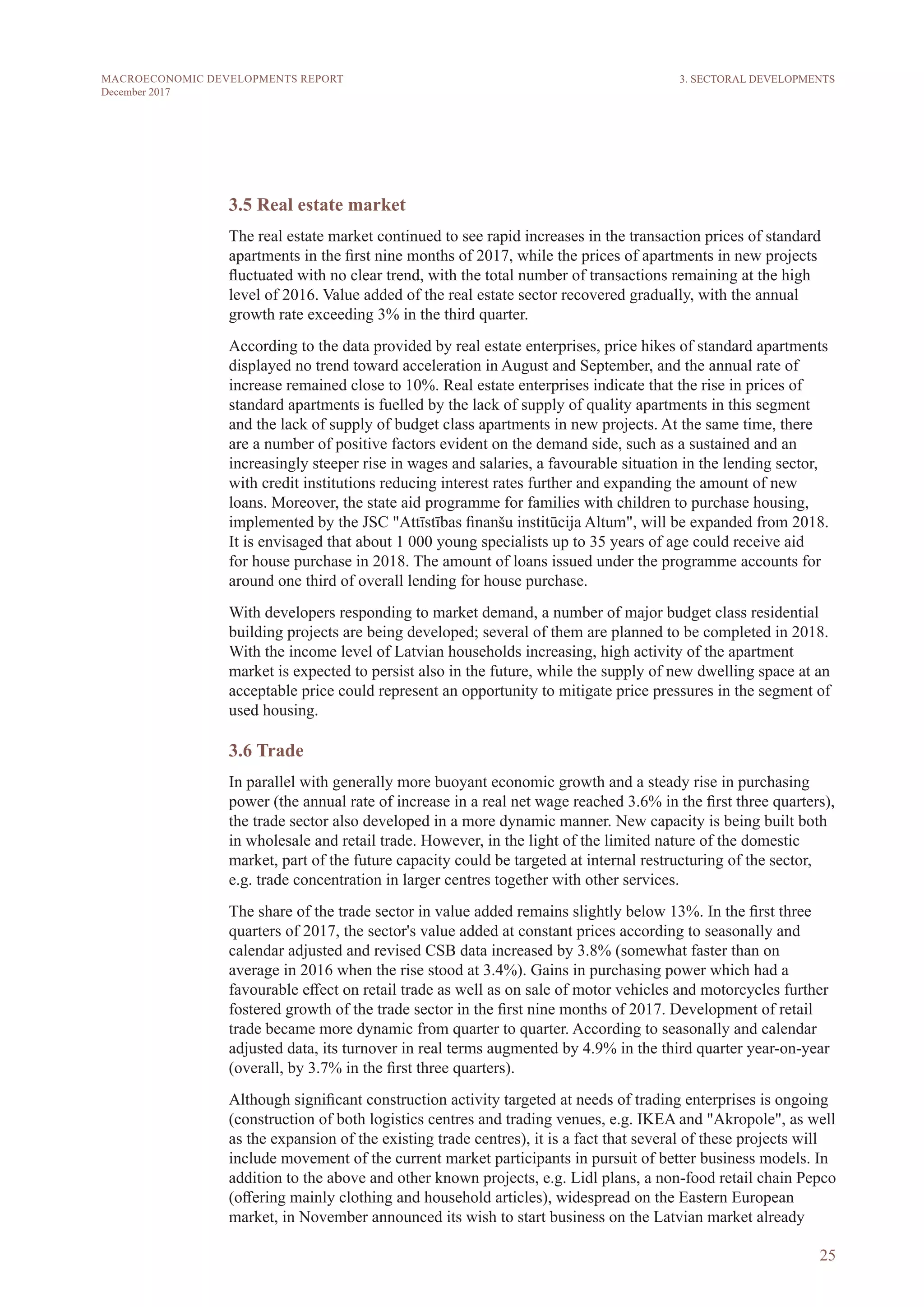
DECEMBER
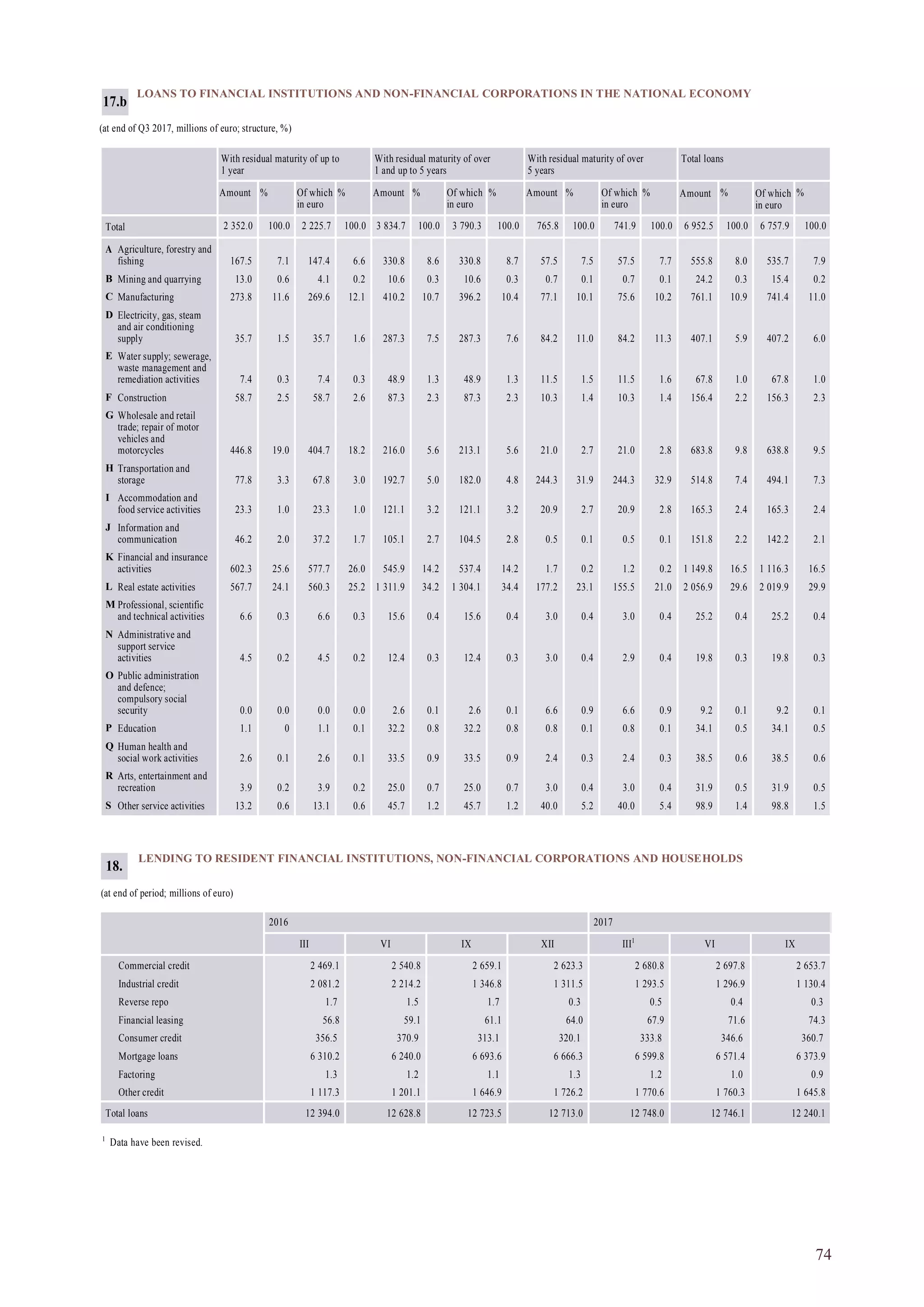
MACROECONOMIC
DEVELOPMENTS
REPORT
MACROECONOMIC DEVELOPMENTS REPORT
December 2017
MACROECONOMIC DEVELOPMENTS REPORT
December 2017, No 26
© Latvijas Banka, 2017
The source is to be indicated when reproduced.
Latvijas Banka
K. Valdemāra iela 2A, Riga, LV-1050, Latvia
Tel.: +371 67022300
http://www.bank.lv; https://www.macroeconomics.lv
info@bank.lv
2
MACROECONOMIC DEVELOPMENTS REPORT
December 2017
CONTENTS
Contents
Abbreviations	 3
Introduction	4
1. External Demand	 5
2. Financial Conditions	 9
2.1 	ECB policy	 9	
2.2 	Other central bank decisions and financial markets	 10
2.3 	Latvia's balance of payments and cross-border financial flows	 13
2.4 	Securities market	 13
2.5 	Interest rates	 14
2.6 	Credits and deposits	 16
3. Sectoral Developments	 20
3.1 	Manufacturing	 21
3.2 	Energy	 22
3.3	Agriculture and forestry	 23
3.4 	Construction	 24
3.5 	Real estate market	 25
3.6 	Trade	 25
3.7 	Transport	 26
4. GDPAnalysis from the Demand Side	 28
4.1 Private consumption	 29
4.2 Investment	 30
4.3 Exports	 31
4.4 Imports	 33
4.5 Government consumption	 34
5. Labour Market	 35
6. Costs and Prices	 37
7. Conclusions and Forecasts	 40
8. Analysis of Scenarios	 42
8.1 Wages continue to rise faster than labour productivity	 42
8.2 Decline in housing prices in the Nordic countries	 44
Statistics	48
Additional Information	 100
3
MACROECONOMIC DEVELOPMENTS REPORT
December 2017
Abbreviations
APP – asset purchase programme
CPI – consumer price index
CIT – corporate income tax
CSB – Central Statistical Bureau of Latvia
EC – European Commission
ECB – European Central Bank
ERAF – European Regional Development Fund
ESA 2010 – European System of Accounts 2010
ESI – Economic Sentiment Indicator
EU – European Union
EU28 – 28 countries of the EU
EURIBOR – Euro Interbank Offered Rate
Eurostat – statistical office of the European Union
FRS – US Federal Reserve System
GDP – gross domestic product
HICP – Harmonised Index of Consumer Prices
IMF – International Monetary Fund
JSC – joint stock company
LIAA – Investment and Development Agency of Latvia
Ltd. – limited liability company
MFI – monetary financial institution
MPC – mandatory procurement component (electricity)
OPEC – Organization of Petroleum Exporting Countries
PIT – personal income tax
PMI – Purchasing Managers' Index
SRS – State Revenue Service
UK – United Kingdom
UN – United Nations
US – United States of America
VAT – value added tax
WTO – World Trade Organization
ABBREVIATIONS
4
MACROECONOMIC DEVELOPMENTS REPORT
December 2017
Introduction
Latvijas Banka's assessment of Latvia's economic outlook continued to improve in the
second half of the year, considering the strong external demand and favourable development
of the private consumption as well as the recovery of investment inflows. Latvia's economic
growth in 2017 was stronger than expected; therefore, the GDP growth forecasts were
gradually revised upwards both in September and December. Robust economic growth,
albeit decelerating, is expected also ahead, with more moderate rates reported for both
external demand and investment inflows. The current strengthening of demand in Lithuania,
Estonia and Poland as well as the fast economic recovery in Russia will decelerate in 2018,
while in the case of the UK demand it is happening already. Investment inflows both private
as well as from EU funds will remain substantial, yet the unusually high growth reported in
2017 can be explained by the low base for investment in vehicles as well as non-residential
buildings and engineering works.
Inflation growth has been broadly consistent with the forecast: the rising global oil prices
were offset by the strengthening of the euro against the US dollar, whereas the global food
prices stabilised. Amendments to legislation introducing higher rates for certain indirect
taxes and raising the minimum wage will have a significant effect on inflation in 2018.
Overall, inflation growth can be expected to remain at the level similar to that of 2017,
with the contribution of food prices decreasing, whereas the contribution of core inflation
increasing as a result of the robust domestic demand and rising labour costs.
Although the pressure on wages caused by the tightening labour market has a positive effect
on the disposable income of the population and consumption in the short-term, it weakens
business competitiveness and deteriorates the medium-term economic growth prospects.
The wage share in value added has already approached the EU average, causing Latvia to
gradually lose its competitive advantages of low wages. Therefore, larger investment inflows
in productive sectors (both private and government investment, including investment from
EU funds) as well as structural reforms to improve human capital are particularly important
to achieve strong and sustainable medium-term economic growth.
INTRODUCTION
5
MACROECONOMIC DEVELOPMENTS REPORT
December 2017
1. EXTERNAL DEMAND
1. External Demand1
Previous assessment Developments since the previous report New assessment1
External demand
Moderate yet slightly
faster-than-expected
growth related to
improved outlook
across the euro area
and for Latvia's
major trade partners.
– Increase of global commodity (including oil) prices in
the third quarter;
– recovery of global trade continues;
– improvement in sentiment indicators;
– acceleration of euro area economic growth and
improving confidence;
– upward revision of external demand forecast for Latvia;
– growing political disagreements in Europe.
Further growth
that will be based
on robust global
demand as well as
that of Latvia's main
trade partners.
Economic environment continues to improve in almost all advanced economies, except the
UK. At the same time, global economic sentiment indicators point to expected strong growth
at the end of 2017, whereas the forecasts of the leading institutions suggest sustainable
medium-term development.
Global financial conditions remain accommodative, although the USA is gradually moving
towards monetary policy normalisation. US data releases confirm the strength of its
economic potential as it has managed to recover from the August and September hurricanes
in a matter of less than a quarter. Unemployment sank below its pre-crisis low in October
and continues to decrease, although it was already below the level that the FRS considered
full employment. In the last 12 months, inflation (2.05%) has been overshooting the target
level of 2.0% again2
. Confidence indicators point to strong near-term growth expectations in
the USA. At the same time, the implementation of the tax reform initiative could provide an
additional support to real economic growth.
Depreciation of the British pound sterling improved the UK's export outlook slightly, but
also pushed up inflation and deteriorated the purchasing power and private sector demand,
thereby decelerating the economic growth. In the circumstances of high inflation and
unemployment hitting the lowest level in the last 42 years and continuing on a downward
trend, the UK's monetary policy faces challenges that are made even more complicated by
the political uncertainty. Given the number of unsolved issues in relation with Brexit, the
UK's chances to reach a more favourable international cooperation arrangement are also
unclear.
In the euro area, accommodative monetary policy along with rebounding economic activity
has revived the labour market, with unemployment declining to the lowest level since the
onset of the crisis.3
Nevertheless, higher employment has not been fully reflected in the
growth of wages and consequently also in the increase of consumer prices. Inflation remains
below the ECB's inflation target and the ECB's projections4
show only a gradual convergence
of inflation towards the target. Global environment and external demand-driven growth has
provided the euro area with a current account surplus that has reached a 10-year high and
continues to increase.5
Investment inflows in the euro area continue to grow, supported by
the easing of the credit standards. Leading indicators (for example, ESI and PMI) signal
strong economic activity in the near-term. In the IMF's World Economic Outlook of October
1
  Colours in tables are used to show differences in the assessment of impact on Latvia's GDP and inflation as compared to
the previous forecast.
Worsened Unchanged Improved
2
  https://fred.stlouisfed.org/series/CPIAUCSL.
3
  http://sdw.ecb.europa.eu/reports.do?node=10000055.
4
  https://www.ecb.europa.eu/stats/prices/indic/forecast/html/table_hist_hicp.en.html.
5
  http://sdw.ecb.europa.eu/home.do?chart=t1.8.
6
MACROECONOMIC DEVELOPMENTS REPORT
December 2017
2017, the euro area growth has been revised upwards by 0.2 percentage point, to 2.1% and
1.9% respectively. The outcome of Brexit is an equally important issue not only for the UK
itself but also to the euro area because of the trade relationships as well as in light of other
attempts to obtain political autonomy and independence (for example, in Catalonia).
The growth of the developing countries has been more divergent and with positive surprises
in China and Russia. This has been a good year for the Chinese economy. China had to
increase its overall national debt, however, although its performance in the second quarter
was stronger than expected and resulted in an improvement of the growth prospects1
. Russia,
in turn, has managed to tame the rising inflation surprisingly fast, pushing it back to as low
as 2.5% in November.
Stronger-than-expected global economic growth has been accompanied by a recovery in
prices on oil and other commodities from the low level observed over the most recent years.
The main driver of the oil prices was the joint initiative of OPEC and other oil-exporting
countries to cut the oil supply, whereas the prices of other commodities, including minerals
and ores, were supported by growing global demand.
Latvia's external demand is recovering at a slightly faster pace than previously expected.
In 2017, economic growth was supported by the continuation of already earlier-observed
global trends: further impact from the low oil prices, still-accommodative interest rates and
shrinking unemployment stimulated private consumption. Faster development of Latvia's
main trade partners was already taken into account when upgrading Latvia's GDP growth
forecasts in September. Russia, where the economy is recovering swiftly after the downturn
caused by the introduced sanctions and the falling oil prices, contributed significantly to the
rising demand. At the same time, the developments in the UK are unfavourable: economic
growth prospects are clouded by the high degree of uncertainly about the future associated
with Brexit.
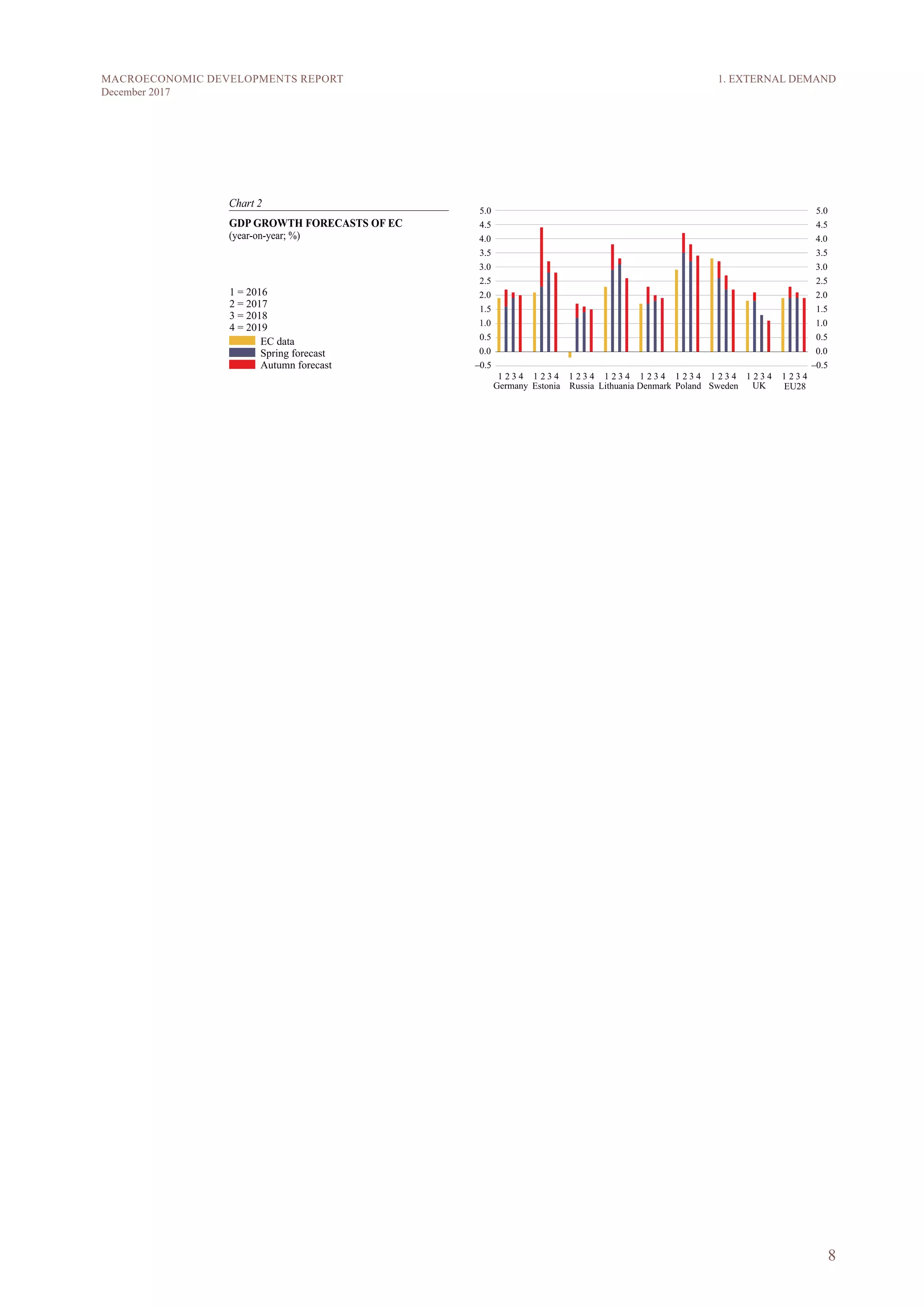
Russia's economy is recovering after the crisis. Data and forecasts available for 2017 point
to significant positive trends: annual GDP growth stands at 1.7% as opposed to a 0.2% fall
in 2016; inflation has retreated below 3%2
. This has supported Latvia's exports of goods:
annual growth of Latvia's exports of goods to Russia reached 37% in the first nine months
of the year. Nevertheless, on balance, this growth is to be viewed as fragile as the positive
effect on the Russian economy stemming from such factors as the rising prices on oil and
other commodities may be short-lived and it is likely that the rapid recovery will decelerate
into only moderate economic growth (medium-term forecasts expect growth below 2%).
Boosting growth requires structural reforms to improve business environment and increase
the currently-low investment inflows.
Same as Latvia, its Baltic neighbours also report high growth in 2017. According to
forecasts, Lithuania's annual GDP growth will be 3.8%. Export expansion is expected to
exceed 10% because of favourable external environment (developments in trade partners)
benefiting trade, with high rates reported already in the first half of the year. Nevertheless,
following the impressive performance in the first half of the year, Lithuania's economic
growth decelerated significantly in the third quarter of the year, with the quarterly rise
reaching merely 0.1%, due to weaker activity in retail trade and agriculture because of
the poor harvest. High GDP growth (4.4%) is also projected for Estonia in 2017. This is
based on the recovery of investment inflows (low base in 2016; EU funding cycle). Stable
medium-term development is expected in both countries, with growth decelerating as a
result of lower cost competitiveness due to shortage of qualified labour force which is
already exerting an upward pressure on wages, as well as weakening of investment inflows.
1
  World Economic Outlook, October 2017.
2
  Hereinafter, the growth forecasts of Latvia's main trade partners are the European Commission's Autumn 2017
forecasts.
1. EXTERNAL DEMAND
7
MACROECONOMIC DEVELOPMENTS REPORT
December 2017
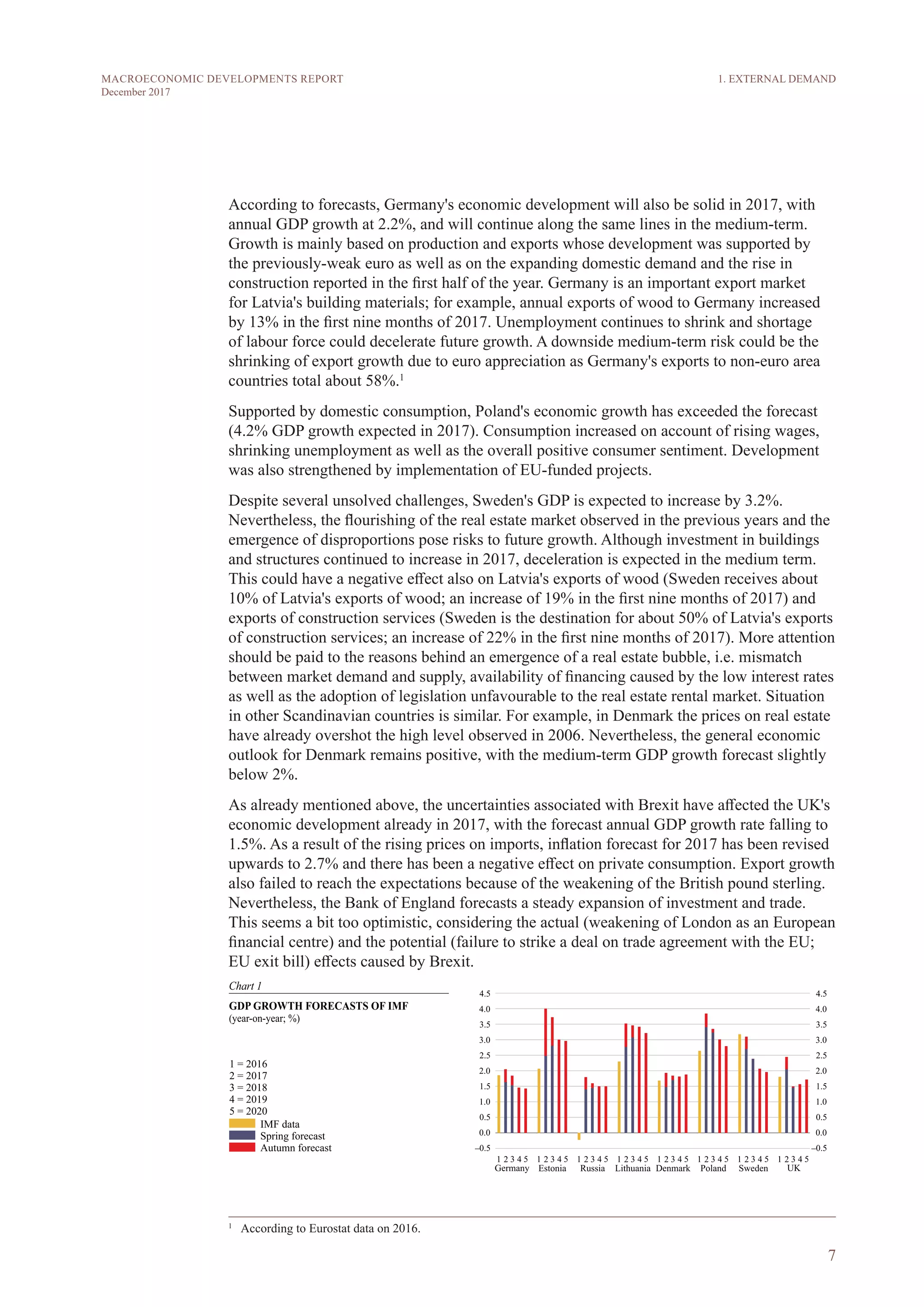
According to forecasts, Germany's economic development will also be solid in 2017, with
annual GDP growth at 2.2%, and will continue along the same lines in the medium-term.
Growth is mainly based on production and exports whose development was supported by
the previously-weak euro as well as on the expanding domestic demand and the rise in
construction reported in the first half of the year. Germany is an important export market
for Latvia's building materials; for example, annual exports of wood to Germany increased
by 13% in the first nine months of 2017. Unemployment continues to shrink and shortage
of labour force could decelerate future growth. A downside medium-term risk could be the
shrinking of export growth due to euro appreciation as Germany's exports to non-euro area
countries total about 58%.1
Supported by domestic consumption, Poland's economic growth has exceeded the forecast
(4.2% GDP growth expected in 2017). Consumption increased on account of rising wages,
shrinking unemployment as well as the overall positive consumer sentiment. Development
was also strengthened by implementation of EU-funded projects.
Despite several unsolved challenges, Sweden's GDP is expected to increase by 3.2%.
Nevertheless, the flourishing of the real estate market observed in the previous years and the
emergence of disproportions pose risks to future growth. Although investment in buildings
and structures continued to increase in 2017, deceleration is expected in the medium term.
This could have a negative effect also on Latvia's exports of wood (Sweden receives about
10% of Latvia's exports of wood; an increase of 19% in the first nine months of 2017) and
exports of construction services (Sweden is the destination for about 50% of Latvia's exports
of construction services; an increase of 22% in the first nine months of 2017). More attention
should be paid to the reasons behind an emergence of a real estate bubble, i.e. mismatch
between market demand and supply, availability of financing caused by the low interest rates
as well as the adoption of legislation unfavourable to the real estate rental market. Situation
in other Scandinavian countries is similar. For example, in Denmark the prices on real estate
have already overshot the high level observed in 2006. Nevertheless, the general economic
outlook for Denmark remains positive, with the medium-term GDP growth forecast slightly
below 2%.
As already mentioned above, the uncertainties associated with Brexit have affected the UK's
economic development already in 2017, with the forecast annual GDP growth rate falling to
1.5%. As a result of the rising prices on imports, inflation forecast for 2017 has been revised
upwards to 2.7% and there has been a negative effect on private consumption. Export growth
also failed to reach the expectations because of the weakening of the British pound sterling.
Nevertheless, the Bank of England forecasts a steady expansion of investment and trade.
This seems a bit too optimistic, considering the actual (weakening of London as an European
financial centre) and the potential (failure to strike a deal on trade agreement with the EU;
EU exit bill) effects caused by Brexit.
1
  According to Eurostat data on 2016.
1. EXTERNAL DEMAND
8
MACROECONOMIC DEVELOPMENTS REPORT
December 2017
1. EXTERNAL DEMAND
9
MACROECONOMIC DEVELOPMENTS REPORT
December 2017
2. Financial Conditions
2.1 ECB policy
Previous assessment Developments since the previous report New assessment
ECB decisions
Market expectations are in line
with the decision by the Governing
Council of the ECB to maintain
the key ECB interest rates at the
current level and to continue with
the implementation of the expanded
APP at least until the end of 2017;
raising of the interest rates is
expected in the second or third
quarter of 2018. Market participants
expect that the forward guidance
of the Governing Council of the
ECB will be changed in September
2017 with respect to tapering the
expanded APP.
– Economic growth fundamentals and
monetary aggregates continue to improve;
– euro appreciated from 1.12 to 1.20 
vis-à-vis the US dollar and then
depreciated slightly, to 1.18;
– the ECB has grown more confident
that inflation would gradually converge
towards its aim;
– the ECB extended the expanded APP
until at least the end of September 2018;
– the ECB will continue fixed rate
tender procedures with full allotment
at least until the end of the last reserve
maintenance period of 2019.
Expectations
that, with further
implementation of
the expanded APP at
least until September
2018, the interest
rates will remain
low for an extended
period of time are
strengthening.
Market participants
expect that the key
ECB interest rates
will be raised during
the first half of 2019.
ECB continued with a highly accommodative monetary policy, purchasing securities within
the framework of the expanded APP at a monthly pace of 60 billion euro. At the same time,
the practice of reinvesting the principal payments from maturing securities purchased under
the expanded APP was continued.
At its 26 October 2017 meeting, the Governing Council of the ECB decided to continue with
the asset purchases in 2018, stating that from January 2018 the net asset purchases would
continue at a monthly pace of 30 billion euro until the end of September 2018 or beyond,
if necessary, and in any case until the Governing Council of the ECB sees a sustained
adjustment in the path of inflation consistent with the ECB's inflation aim. At the press
conference, Mario Draghi, President of the ECB, stressed that the decision to recalibrate
the purchases reflected the growing confidence in the gradual convergence of inflation
rates towards the ECB's inflation aim. This is based on increasingly robust and broad-based
economic expansion, a rise in the measures of underlying inflation and the continued highly
stimulating pass-through of the monetary policy measures to the financing conditions of the
real economy.
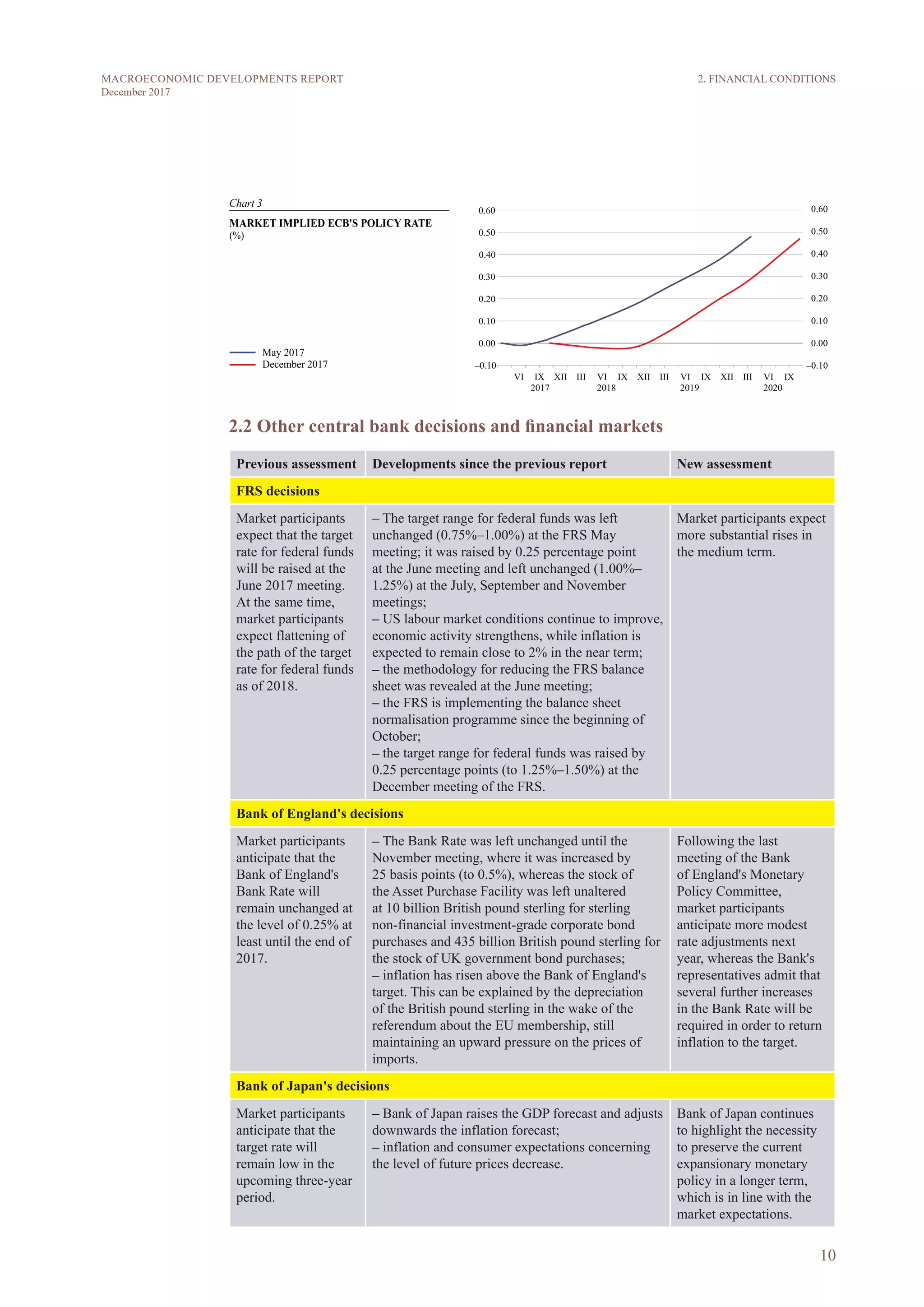
Survey results as well as the probability implied by the euro overnight index swaps suggest
that the financial market participants do not expect any raising of the ECB's deposit facility
rate earlier than in the first half of 2019. Market participants now expect a later interest rate
raise than they did at the beginning of June. Following the decision made at the October
meeting of the General Council of the ECB, euro depreciated against the US dollar.
As the amount of securities purchased within the framework of the extended APP is growing,
the redemption amounts in the ECB's securities portfolio are also increasing accordingly.
The ECB started to publish the data on the expected monthly redemption amounts, ensuring
higher transparency and providing market participants information on the size of the gross
interventions by the central bank. Redemptions in the amount of 134.0 billion euro1
are
expected from December 2017 to November 2018 within the framework of the expanded
APP; therefore, every month the ECB will have to buy, on average, a 11.2 billion euro larger
amount of securities.
1
  https://www.ecb.europa.eu/mopo/implement/omt/html/index.en.html.
2. FINANCIAL CONDITIONS
10
MACROECONOMIC DEVELOPMENTS REPORT
December 2017
2.2 Other central bank decisions and financial markets
Previous assessment Developments since the previous report New assessment
FRS decisions
Market participants
expect that the target
rate for federal funds
will be raised at the
June 2017 meeting.
At the same time,
market participants
expect flattening of
the path of the target
rate for federal funds
as of 2018.
– The target range for federal funds was left
unchanged (0.75%–1.00%) at the FRS May
meeting; it was raised by 0.25 percentage point
at the June meeting and left unchanged (1.00%–
1.25%) at the July, September and November
meetings;
– US labour market conditions continue to improve,
economic activity strengthens, while inflation is
expected to remain close to 2% in the near term;
– the methodology for reducing the FRS balance
sheet was revealed at the June meeting;
– the FRS is implementing the balance sheet
normalisation programme since the beginning of
October;
– the target range for federal funds was raised by
0.25 percentage points (to 1.25%–1.50%) at the
December meeting of the FRS.
Market participants expect
more substantial rises in
the medium term.
Bank of England's decisions
Market participants
anticipate that the
Bank of England's
Bank Rate will
remain unchanged at
the level of 0.25% at
least until the end of
2017.
– The Bank Rate was left unchanged until the
November meeting, where it was increased by
25 basis points (to 0.5%), whereas the stock of
the Asset Purchase Facility was left unaltered
at 10 billion British pound sterling for sterling
non-financial investment-grade corporate bond
purchases and 435 billion British pound sterling for
the stock of UK government bond purchases;
– inflation has risen above the Bank of England's
target. This can be explained by the depreciation
of the British pound sterling in the wake of the
referendum about the EU membership, still
maintaining an upward pressure on the prices of
imports.
Following the last
meeting of the Bank
of England's Monetary
Policy Committee,
market participants
anticipate more modest
rate adjustments next
year, whereas the Bank's
representatives admit that
several further increases
in the Bank Rate will be
required in order to return
inflation to the target.
Bank of Japan's decisions
Market participants
anticipate that the
target rate will
remain low in the
upcoming three-year
period.
– Bank of Japan raises the GDP forecast and adjusts
downwards the inflation forecast;
– inflation and consumer expectations concerning
the level of future prices decrease.
Bank of Japan continues
to highlight the necessity
to preserve the current
expansionary monetary
policy in a longer term,
which is in line with the
market expectations.
2. FINANCIAL CONDITIONS
11
MACROECONOMIC DEVELOPMENTS REPORT
December 2017
Previous assessment Developments since the previous report New assessment
EUR/USD exchange rate
Market participants
anticipate that the
euro exchange rate
against the USD will
be 1.08 USD per euro
in a year's time.
– Political risks in the euro area remain moderate;
a certain degree of uncertainty is associated with
Catalonia's attempts to secede from Spain;
– euro area's macroeconomic fundamentals are
improving;
– monetary policy implemented by the FRS and the
ECB is becoming increasingly more divergent.
Market participants
anticipate that the euro
exchange rate against the
USD will be 1.20 USD per
euro in a year's time.
Financial market sentiment continued to be positive in the second half of 2017. US stock
market activity continued to increase since the beginning of the year. This can mainly be
explained by the positive US macroeconomic data releases as well as the depreciation of the
US dollar. At the same time, the developments on the European stock markets were quite
volatile during the summer months. Nevertheless, with confidence and macroeconomic
fundamentals improving, the Euro Stoxx 50 index appreciated. The path of Germany's DAX
index was similar, with falls reported in the summer months, followed by a recovery in
autumn. As expected, at the end of September elections in Germany were again won by the
Christian Democratic Union of Germany led by Angela Merkel. Despite the complicated
process of forming a coalition, the effect of the elections on securities markets was minimal.
The slump in the European stock markets observed during the summer months was
accompanied by appreciation of the euro in the wake of the Presidential elections in France
won by Emmanuel Macron and by capital inflows in the euro area. At the same time, the
snap elections called by Theresa May in the UK at the beginning of summer did not yield
the intended result and the Conservative Party lost its parliamentary majority. There are
no significant changes in the UK stock markets and in mid-November the FTSE 100 index
was the same as in the beginning of summer. Looking at the bond markets, the yields of the
safest assets (e.g. German and US 10-year government bonds), however, have increased
slightly, while the yields of riskier debt securities have contracted. Investors continue to
keep a close eye on the latest Brexit updates and changes to the US tax code implemented by
Donald Trump's administration, and, to a much lesser extent, on the political crisis in Spain
(Catalonia's secession attempts).
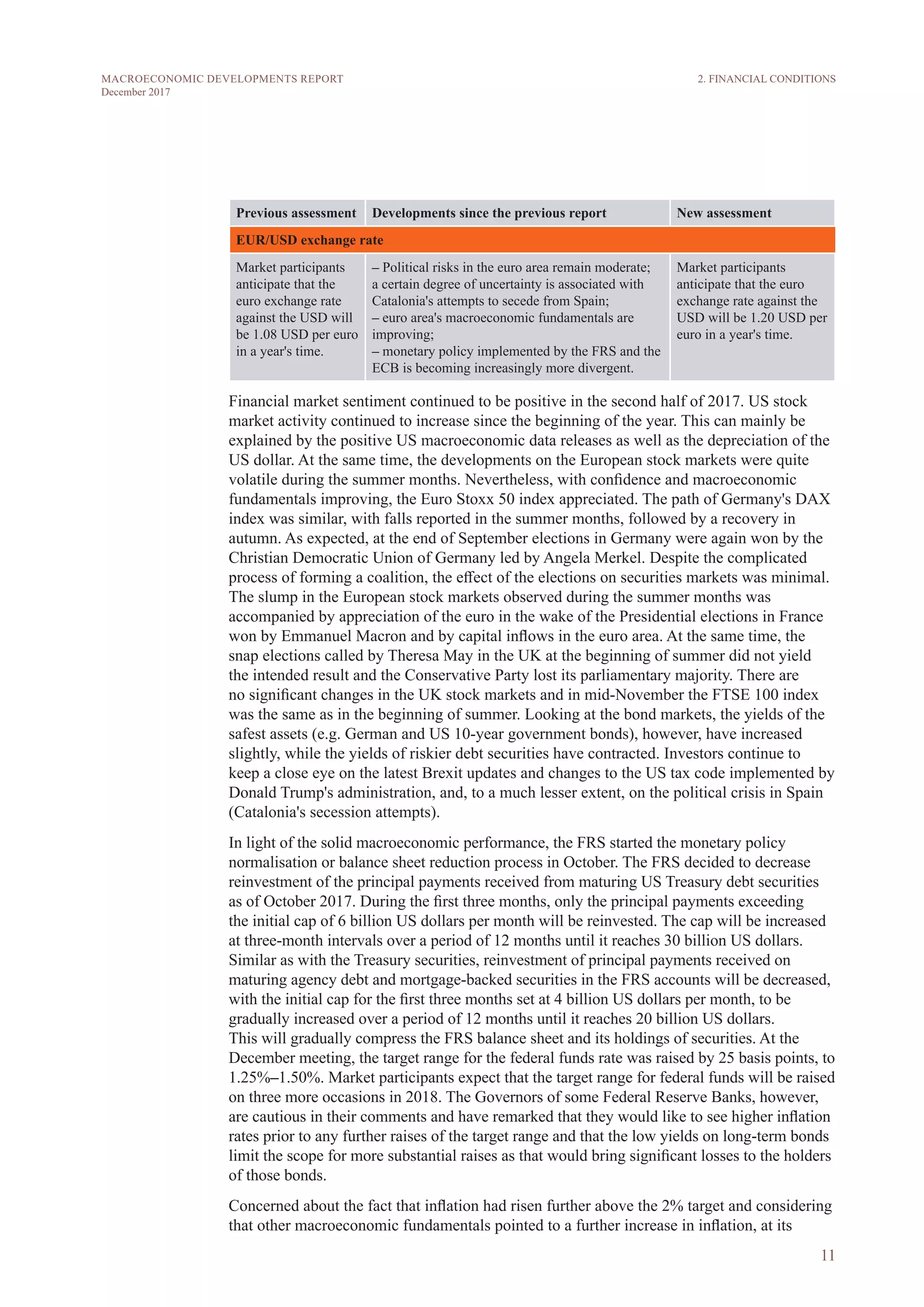
In light of the solid macroeconomic performance, the FRS started the monetary policy
normalisation or balance sheet reduction process in October. The FRS decided to decrease
reinvestment of the principal payments received from maturing US Treasury debt securities
as of October 2017. During the first three months, only the principal payments exceeding
the initial cap of 6 billion US dollars per month will be reinvested. The cap will be increased
at three-month intervals over a period of 12 months until it reaches 30 billion US dollars.
Similar as with the Treasury securities, reinvestment of principal payments received on
maturing agency debt and mortgage-backed securities in the FRS accounts will be decreased,
with the initial cap for the first three months set at 4 billion US dollars per month, to be
gradually increased over a period of 12 months until it reaches 20 billion US dollars.
This will gradually compress the FRS balance sheet and its holdings of securities. At the
December meeting, the target range for the federal funds rate was raised by 25 basis points, to
1.25%–1.50%. Market participants expect that the target range for federal funds will be raised
on three more occasions in 2018. The Governors of some Federal Reserve Banks, however,
are cautious in their comments and have remarked that they would like to see higher inflation
rates prior to any further raises of the target range and that the low yields on long-term bonds
limit the scope for more substantial raises as that would bring significant losses to the holders
of those bonds.
Concerned about the fact that inflation had risen further above the 2% target and considering
that other macroeconomic fundamentals pointed to a further increase in inflation, at its
2. FINANCIAL CONDITIONS
12
MACROECONOMIC DEVELOPMENTS REPORT
December 2017
November meeting the Bank of England decided to raise the Bank Rate by 25 basis points,
to 0.50%. At the same time, no changes were introduced to the Asset Purchase Facility,
maintaining the stock of UK government bond purchases at 435 billion British pounds
sterling and the stock of sterling non-financial investment-grade corporate bond purchases
at 10 billion British pounds sterling. The Bank of England also admitted that any future
increases in the Bank Rate would be expected to be at a gradual pace and to a limited extent.
The markets reacted immediately: the British pound sterling plunged and the yields on
government securities contracted. Market participants would have wanted to see clearer
forward guidance from the Bank of England as to the future interest rate raises. The unusual
market reaction was followed by the Bank of England representative's comments that, were
the economy to follow the current path, further increases in interest rates would be warranted
over the next few years, in order to return inflation to the target.
The Bank of Japan maintained the negative short-term policy interest rate at –0.1%, the
target level of 10-year government bond yields at 0% and the annual pace of increase of the
monetary base at 80 trillion Japanese yen. Its administration believes that keeping the current
monetary policy unchanged until 2019–2020 would push inflation towards its target level of
2%. Inflation forecasts for the current and the following year were revised downwards.
Political developments continue to be a source of higher uncertainty on the financial
markets. Brexit is still an open question, with representatives from both sides negotiating
the conditions of the UK's exit from the EU. Negotiations are dragging on and investors are
concerned that the UK might face deterioration in its terms of trade.
After the first year in office, Donald Trump continues his struggle to fulfil the promises made
prior to the elections. His unsuccessful attempts to repeal the Affordable Care Act or the so-
called Obamacare are now replaced by a tax reform initiative that would envisage tax cuts
on corporate profits. Although the initial proposal was strongly opposed and criticised by the
non-governmental organisations, the administration is moving forward with the tax reform.
Spain has declared the Catalan referendum held in the beginning of October illegitimate.
Following a month of uncertainty during which the Spanish government refused to start
negotiations with the Catalan government, the Parliament of Catalonia held a symbolical
independence vote. After that the Catalan government was dissolved and new elections
2. FINANCIAL CONDITIONS
13
MACROECONOMIC DEVELOPMENTS REPORT
December 2017
were called on 21 December. Investors keep a close watch on those developments, yet their
impact on the financial markets has so far been limited.
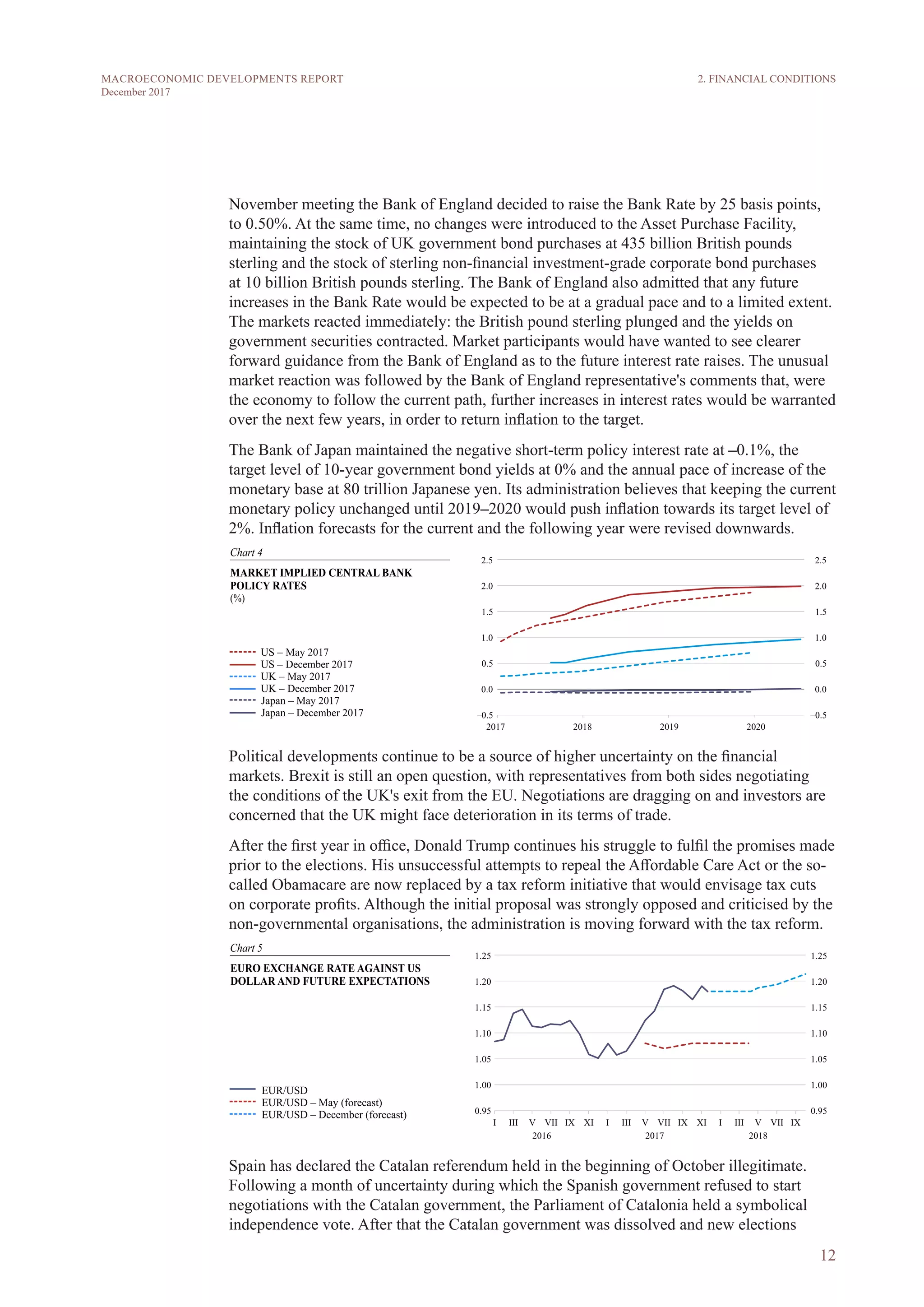
The second half of 2017 saw a substantial appreciation of the euro vis-à-vis the US dollar,
thereby continuing the trend that started already at the end of the first half of the year. Many
sources see it as a result of the strengthening of the euro area economy as well as Emmanuel
Macron's victory at the Presidential elections in France which reduced the uncertainty and
renewed capital inflows into the euro area. Market expectations regarding the euro exchange
rate in the coming 12-months period have also increased since the May assessment.
Currently, it is expected that the euro will trade at 1.20 USD in a year's time.
There is a general improvement in macroeconomic fundamentals as data releases show the
best results of the last few years; therefore, the major central banks have started to gradually
withdraw their monetary stimulus.
2.3 Latvia's balance of payments and cross-border financial flows
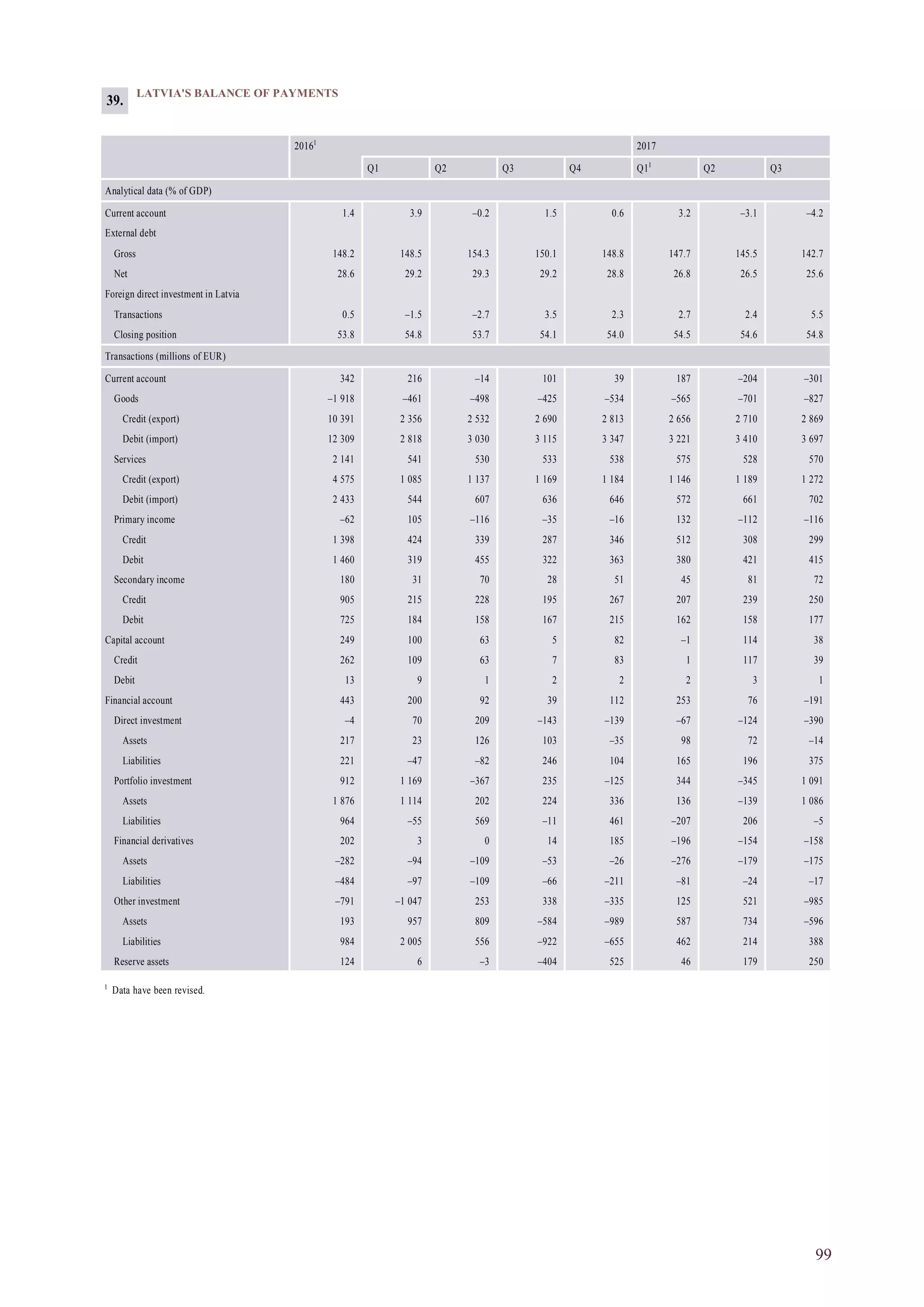
In the first half of the year, the increase of 929.7 million euro in foreign liabilities was more
than offset by the rise of 1.3 billion euro in foreign assets. In the third quarter, however, the
situation was the opposite, with foreign assets growing by 549.9 million euro and liabilities
by 741.0 million euro.
The net outflow of the first half of the year was primarily determined by non-bank financial
institutions increasing their portfolio investment abroad as well as the government placing
short-term deposits with foreign banks. The third-quarter inflow was a result of foreign
direct investment in Latvia. Although foreign deposits with Latvia's credit institutions
continued to decrease (at a lower rate than previously), this was offset by depleting foreign
assets. The cross-sectoral financial flows observed after Nordea Bank AB and DNB ASA
merged their banking operations in the Baltics and created JSC Luminor Bank left Latvia's
debt liabilities broadly unchanged. Although the foreign liabilities of credit institutions
decreased, as part of the current corporate loan contracts were transferred to Nordea Bank
AB, the foreign liabilities of those businesses increased accordingly. The largest financial
flows in the public sector were caused by Latvijas Banka participation in the expanded APP
within the framework of the Eurosystem's monetary policy, resulting in a further increase of
the foreign assets.
2.4 Securities market
Latvian government held no auctions of domestic government securities in the period from
June to October 2017. Two primary auctions were conducted in November and December
with an additional offer of four-year bonds. The average yield was 0.21% and 0.20%,
representing a 3 basis points and a 4 basis points decrease in comparison with the respective
yields at the May auction of those bonds.
2. FINANCIAL CONDITIONS
14
MACROECONOMIC DEVELOPMENTS REPORT
December 2017
On 8 November, the yield of the Latvian bonds launched on the international markets
and maturing in 2026 at 0.62% was another 32 basis points lower than at the end of May,
whereas the spread over the same maturity German government bonds narrowed from
81 basis points to 48 basis points. Favourable financial conditions supported a further
narrowing of the spreads between the sovereign bond yields of the euro area periphery
countries and those of Germany, with preference changing from safer to riskier securities.
Latvia's share price index OMXR appreciated by 10.7% from the end of May to 7 December,
whereas the Baltic share price index OMXBBGI grew by 12.6%. The increase in the share
price of JSC LATVIJAS KUĢNIECĪBA remained impressive at 52.7% and the turnover
of those shares was also quite high (28.2 million euro). Depreciation of share prices was
reported for only three Latvian companies.
2.5 Interest rates
Previous assessment Developments since the previous report New assessment
Interest rate on loans to non-financial corporations
A slight decrease due to the
shrinking of the risk premium
priced into the lending rates and
persistently favourable euro money
market conditions.
– Demand for loans to small and medium-
sized enterprises is growing, whereas demand
for loans to large enterprises is decreasing;
– euro money market rates are relatively
stable.
Composite
lending rates are
not expected to
decrease.
Interest rates on household loans
A slight decrease in the interest rates
of consumer credit and other lending
to households due to the shrinking
of the priced-in risk premium.
Interest rates on household loans for
house purchase unchanged.
– Margins on household loans for house
purchase decreased;
– euro money market rates are relatively
stable.
A slight decrease
in lending rates
as a result of the
narrowing of the
margins.
Weighted average interest rate on household deposits continued to fall from May to October
2017 and that on deposits by non-financial corporations also slightly declined. As to the
household deposits, the fall was supported by an increase in the share of demand deposits in
the overall household deposits.
Interest rates on household loans continued to decline mainly as a result of the shrinking
margin over the euro money market rate applied on new loans as well as cheaper
loans gradually replacing more expensive ones. Interest rates on loans to non-financial
corporations increased as a result of divergent demand development trends across non-
financial corporations of different sizes as well as the effect from the establishment of JSC
Luminor Bank by merging the banking operations of Nordea Bank AB and DNB ASA in the
Baltics. Weighted average interest rates on household loans for house purchase and loans to
non-financial corporations ranged from 2% to 3%. The respective rates on consumer credit
and other lending to households remained broadly unchanged at 11.7%.
2. FINANCIAL CONDITIONS
15
MACROECONOMIC DEVELOPMENTS REPORT
December 2017
The margins on new household loans for house purchase in euro continued to narrow, while
those on loans to enterprises and consumer credit remained unchanged. Assuming that the
economic and labour market developments remain favourable, interest rates on household
loans and deposits can be expected to decreased slightly in the coming quarters.
Long-term interest rates on new small and average loans to enterprises in euro, previously
rapidly approaching the respective rates of large loans, remained broadly unchanged from
May to October 2017. The low level of interest rates as well as the need for making fixed
investment, mergers, acquisitions and restructuring supported a higher demand for loans
in small and medium-sized enterprises which is reflected by the increase in new small and
average long-term euro-denominated loans to non-financial corporations in comparison with
the respective period of the previous year. At the same time, interest rates on new large euro
denominated loans to non-financial corporations somewhat decreased. With large enterprises
more frequently resorting to internal financing and other types of borrowing, their demand
for loans decreased. This was reflected by the year-on-year decline in new large long-term
loans.
The lending rates on new euro-denominated household loans for house purchase also
followed a downward trend in the period from May to October 2017, with competition
among credit institutions prompting them to reduce the margins over the reference rate.
Stronger consumer confidence and the development of the housing market resulted in
a higher household demand for new loans for house purchase and consequently a more
2. FINANCIAL CONDITIONS
16
MACROECONOMIC DEVELOPMENTS REPORT
December 2017
substantial rise in new loans in the respective sector. The share of loans with a higher
loan-to-value ratio in new household loans for house purchase increased. Weighted
average interest rate on consumer credit remained broadly unchanged in the period from
May to October 2017. Nevertheless, one of its components, the lending rate of new credit
agreements, slightly decreased.
2.6 Credits and deposits
Previous assessment Developments since the previous
report
New assessment
Lending
A steady increase in
the total loan portfolio
and that of non-
financial corporations
will continue in 2018
(active absorption of
EU funds, growing
capital of enterprises
and their readiness for
investment serving
as major factors).
Stabilisation of
the annual rate of
change of lending
to households in the
second half of 2017,
with government
continuing the state
support programme
for house purchase and
demand for consumer
credits rising.
– New loans to households are
increasing, those to non-financial
corporations – slightly shrinking;
– a commercial bank transfers the
portfolio of all loans granted to state
enterprises and almost a third of the
portfolio of loans granted to private
non-financial corporations (estimated
at approximately 600 million euro) to
its foreign parent bank;
– the state support programme for
house purchase for families with
children is ongoing;
– activity and prices in the real estate
market are augmenting;
– a gradual absorption of EU funds is
continuing;
– JSC "Attīstības finanšu institūcija
Altum" together with LIDA and
credit institutions offer various
financial instruments to small and
medium-sized enterprises.
A slight increase in the total loan
portfolio of non-financial corporations
will continue in 2018 (in annual
terms – excluding transfers of the
loan portfolio to the foreign parent
bank); however, growth estimates have
been reduced due to slower lending
to enterprises. The key factors are as
follows: more active absorption of EU
funds, the necessity to boost capacity
dictated by mounting foreign and
domestic demand; growing capital
of enterprises and their readiness
for investment. Recovery of the
annual growth rate of lending to
households in the first half of 2018,
with government continuing the
state support programme for house
purchase and expanding the range of
beneficiaries of guarantees by adding
young professionals as well as with the
demand for consumer credits rising.
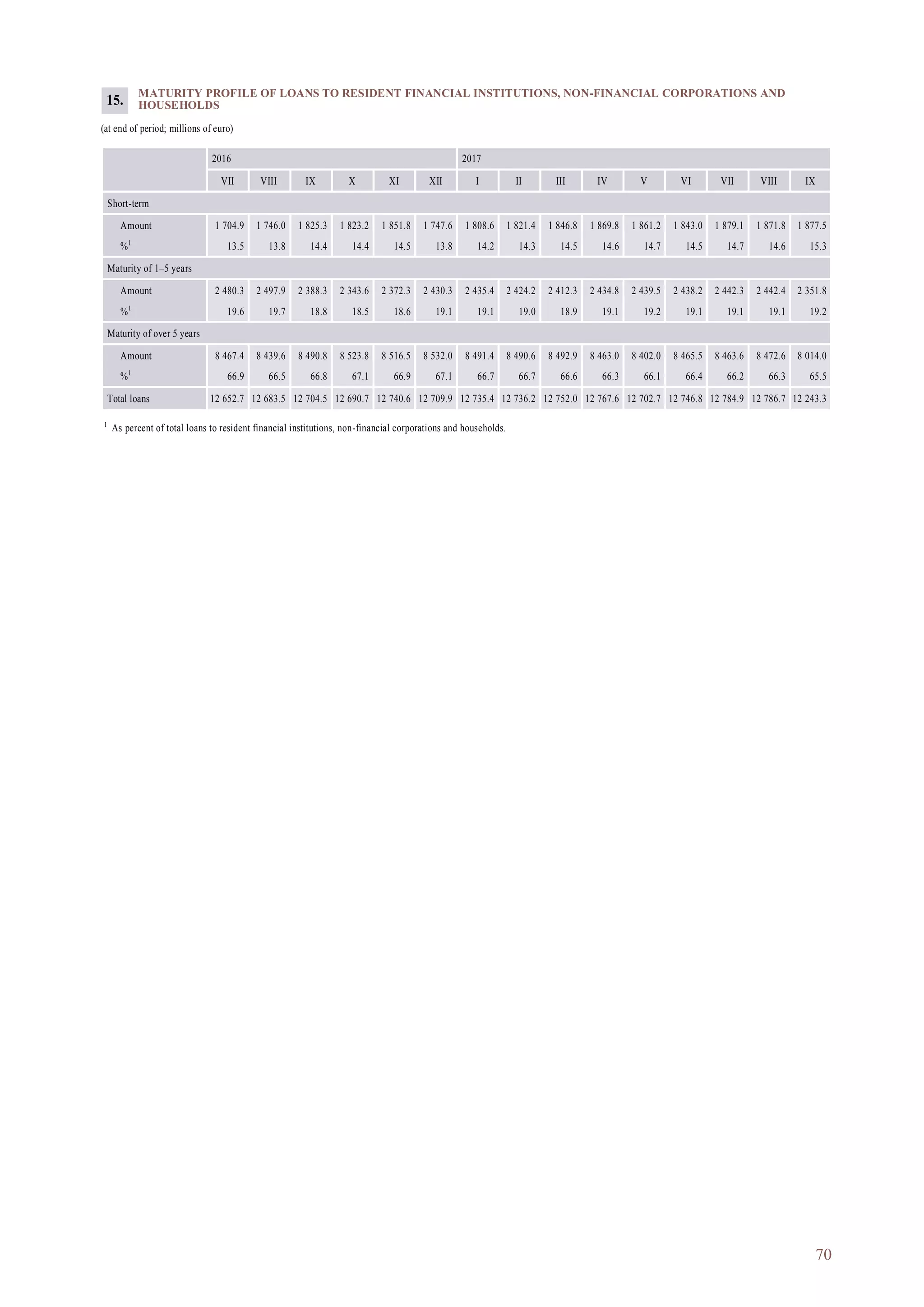
The second and third quarters of 2017 as well as October saw moderate development of
monetary indicators. Although new loans increased in individual months, it was only the
household loan portfolio that exceeded the respective amount of the previous year, but
loans granted to non-financial corporations shrank. Thus, the annual rate of change of the
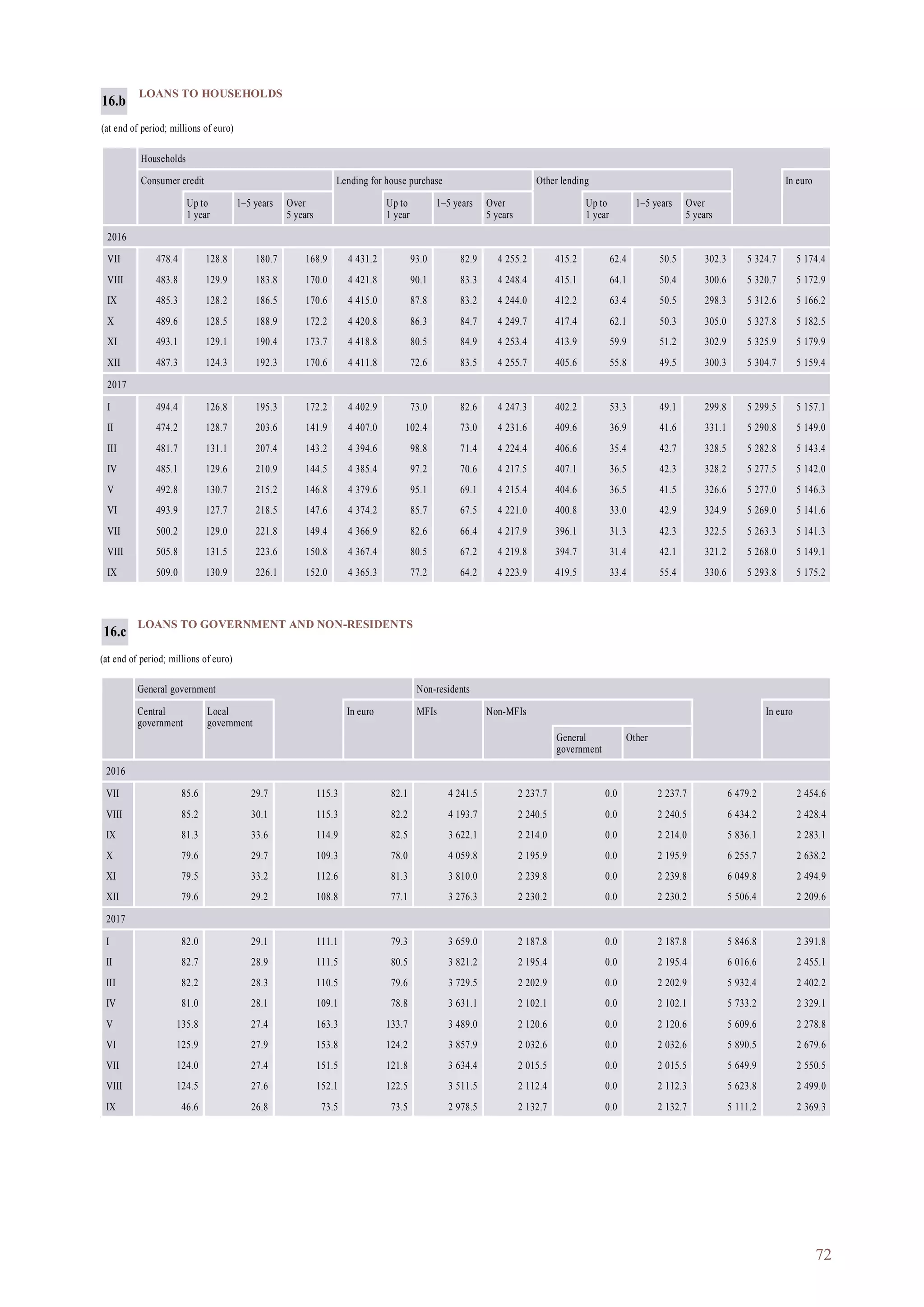
loan portfolio granted to households improved in a persistent manner, albeit it was still
in negative territory. This was affected by both the state support programme for house
purchase for families with children and an improvement of the overall economic situation,
i.e. a pickup in wages, decline in unemployment and growing savings. Meanwhile, the total
domestic loan portfolio and loans to non-financial corporations which increased moderately
in early 2017 have remained almost unchanged over the last period, and their annual rate of
change is approaching zero. The pace of increase in deposits received by credit institutions
2. FINANCIAL CONDITIONS
17
MACROECONOMIC DEVELOPMENTS REPORT
December 2017
is somewhat faster, and it is driven by household savings growth as well as by inflows of EU
funds and an expansion in exports.
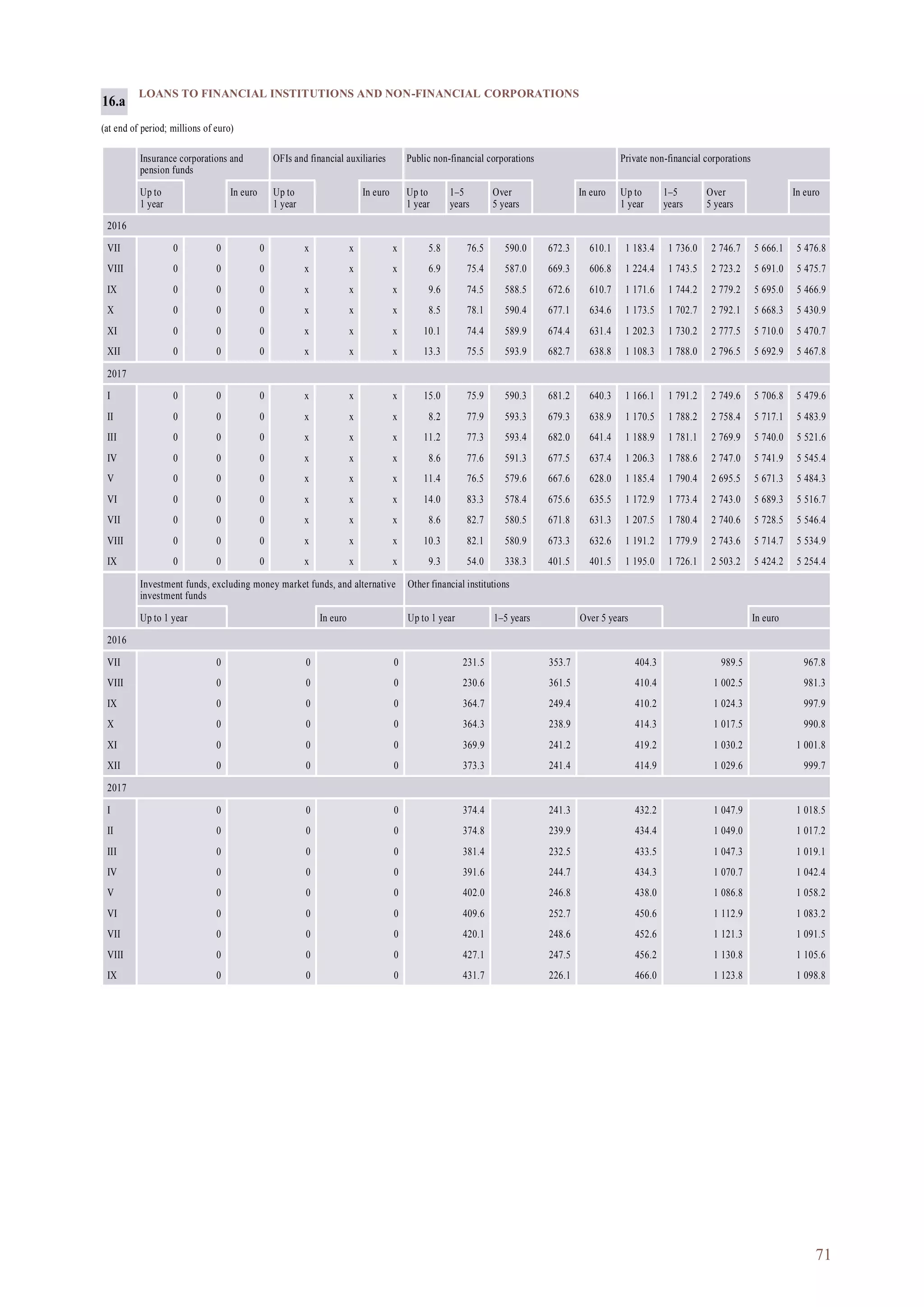
As a result of changes in the credit institutions sector, September saw a significant
contraction of the domestic non-financial corporations' loan portfolio whose annual rate of
change became negative once more. Prior to the reorganisation of the Latvian Branch of
Nordea Bank AB, it transferred all loans granted to state enterprises and almost a third of the
portfolio of loans granted to private non-financial corporations to Nordea Bank AB Sweden.
This had no effect on the Latvian economy as enterprises continue to use the received loans.
Meanwhile, if the above structural changes are not taken into account, the slightly upward
trend in loans (year-on-year) is continuing.
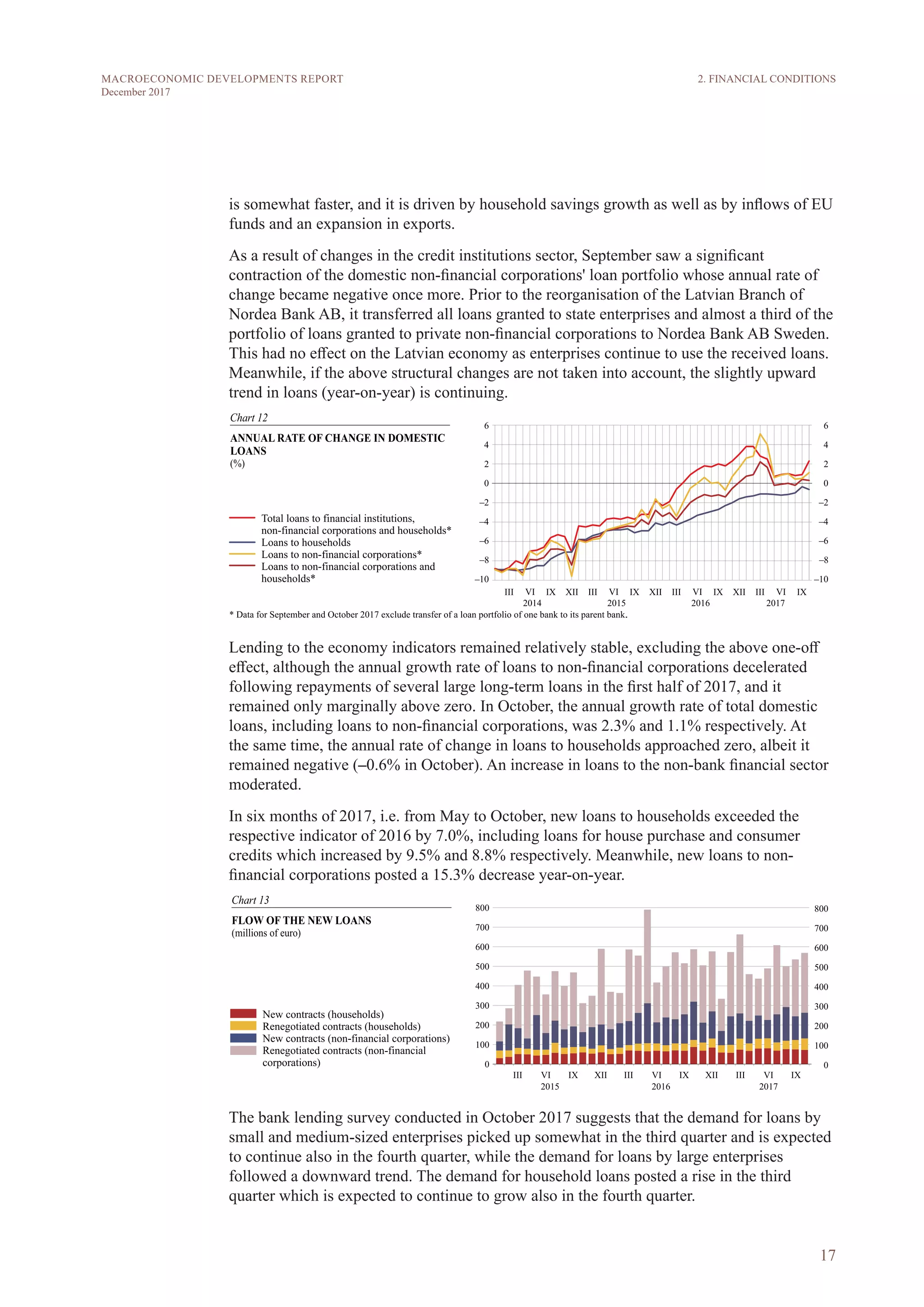
Lending to the economy indicators remained relatively stable, excluding the above one-off
effect, although the annual growth rate of loans to non-financial corporations decelerated
following repayments of several large long-term loans in the first half of 2017, and it
remained only marginally above zero. In October, the annual growth rate of total domestic
loans, including loans to non-financial corporations, was 2.3% and 1.1% respectively. At
the same time, the annual rate of change in loans to households approached zero, albeit it
remained negative (–0.6% in October). An increase in loans to the non-bank financial sector
moderated.
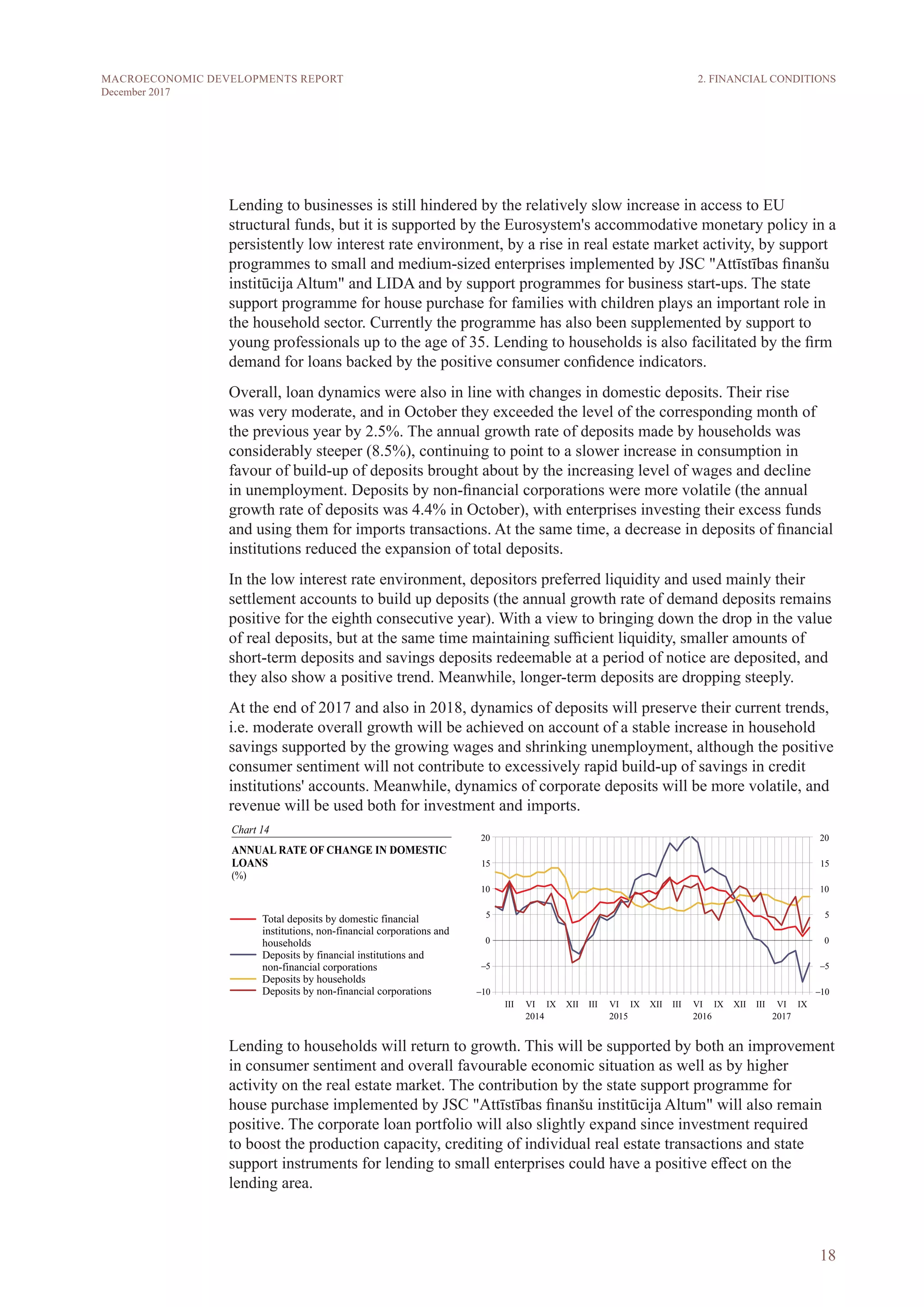
In six months of 2017, i.e. from May to October, new loans to households exceeded the
respective indicator of 2016 by 7.0%, including loans for house purchase and consumer
credits which increased by 9.5% and 8.8% respectively. Meanwhile, new loans to non-
financial corporations posted a 15.3% decrease year-on-year.
The bank lending survey conducted in October 2017 suggests that the demand for loans by
small and medium-sized enterprises picked up somewhat in the third quarter and is expected
to continue also in the fourth quarter, while the demand for loans by large enterprises
followed a downward trend. The demand for household loans posted a rise in the third
quarter which is expected to continue to grow also in the fourth quarter.
2. FINANCIAL CONDITIONS
18
MACROECONOMIC DEVELOPMENTS REPORT
December 2017
Lending to businesses is still hindered by the relatively slow increase in access to EU
structural funds, but it is supported by the Eurosystem's accommodative monetary policy in a
persistently low interest rate environment, by a rise in real estate market activity, by support
programmes to small and medium-sized enterprises implemented by JSC "Attīstības finanšu
institūcija Altum" and LIDA and by support programmes for business start-ups. The state
support programme for house purchase for families with children plays an important role in
the household sector. Currently the programme has also been supplemented by support to
young professionals up to the age of 35. Lending to households is also facilitated by the firm
demand for loans backed by the positive consumer confidence indicators.
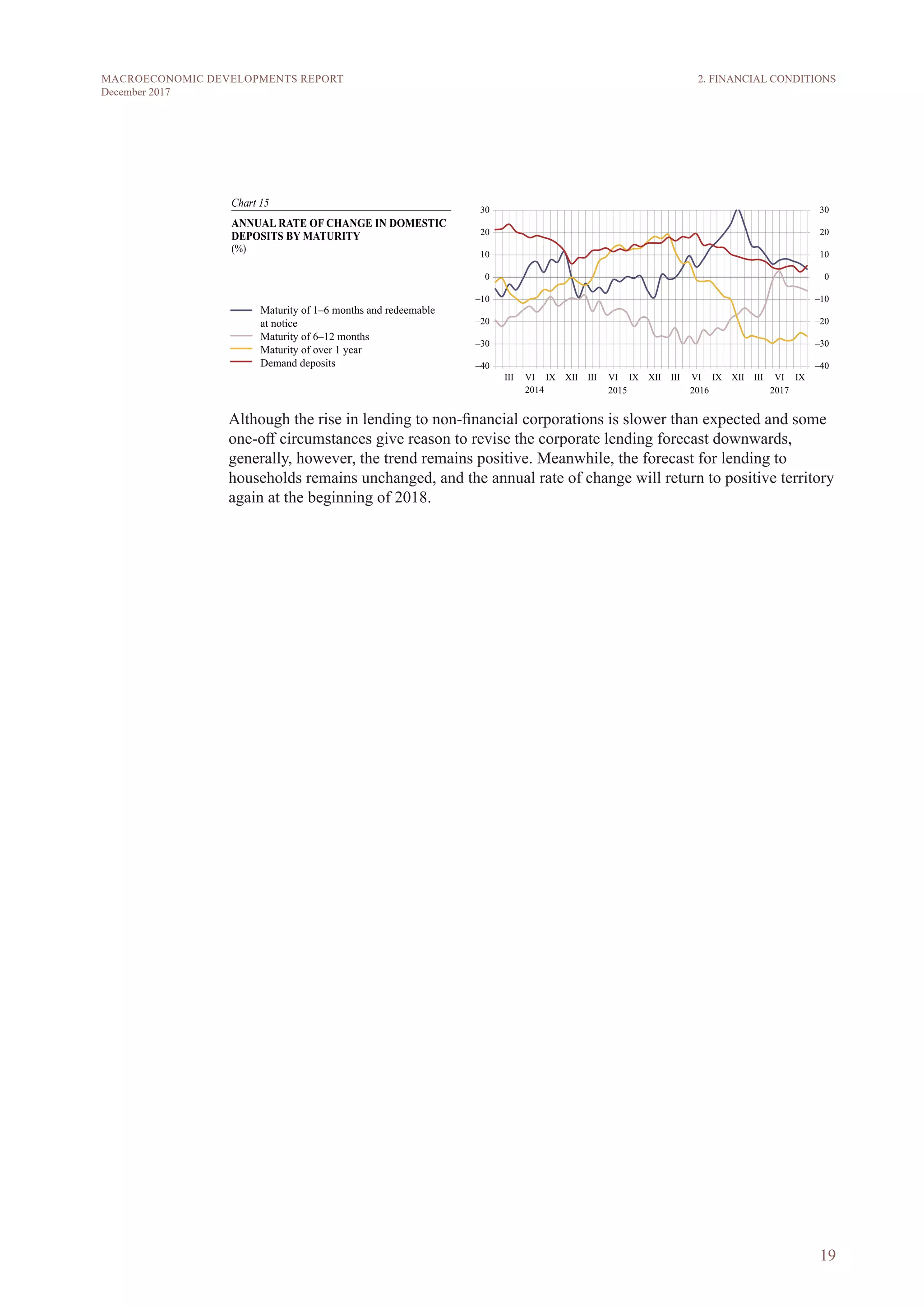
Overall, loan dynamics were also in line with changes in domestic deposits. Their rise
was very moderate, and in October they exceeded the level of the corresponding month of
the previous year by 2.5%. The annual growth rate of deposits made by households was
considerably steeper (8.5%), continuing to point to a slower increase in consumption in
favour of build-up of deposits brought about by the increasing level of wages and decline
in unemployment. Deposits by non-financial corporations were more volatile (the annual
growth rate of deposits was 4.4% in October), with enterprises investing their excess funds
and using them for imports transactions. At the same time, a decrease in deposits of financial
institutions reduced the expansion of total deposits.
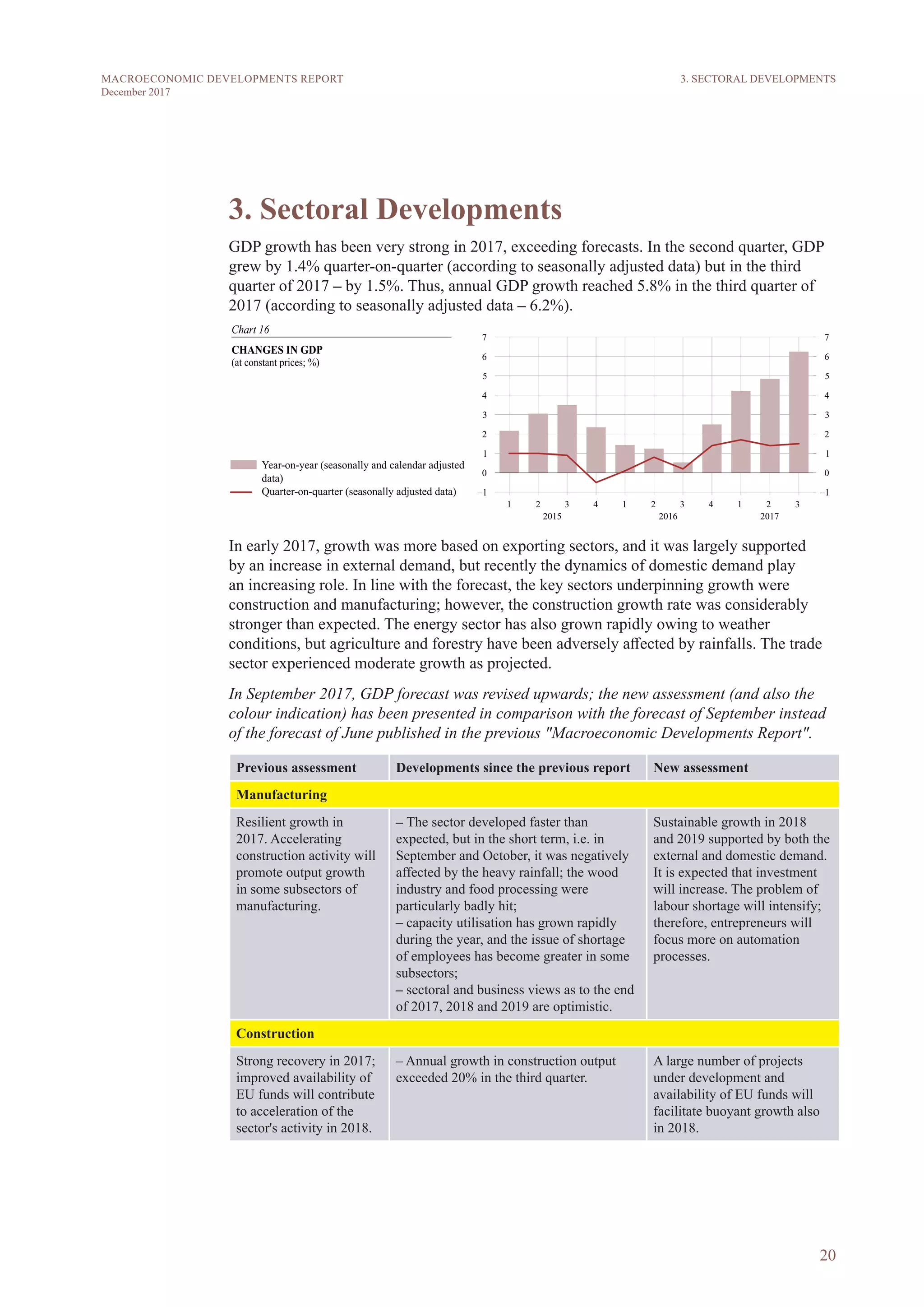
In the low interest rate environment, depositors preferred liquidity and used mainly their
settlement accounts to build up deposits (the annual growth rate of demand deposits remains
positive for the eighth consecutive year). With a view to bringing down the drop in the value
of real deposits, but at the same time maintaining sufficient liquidity, smaller amounts of
short-term deposits and savings deposits redeemable at a period of notice are deposited, and
they also show a positive trend. Meanwhile, longer-term deposits are dropping steeply.
At the end of 2017 and also in 2018, dynamics of deposits will preserve their current trends,
i.e. moderate overall growth will be achieved on account of a stable increase in household
savings supported by the growing wages and shrinking unemployment, although the positive
consumer sentiment will not contribute to excessively rapid build-up of savings in credit
institutions' accounts. Meanwhile, dynamics of corporate deposits will be more volatile, and
revenue will be used both for investment and imports.
Lending to households will return to growth. This will be supported by both an improvement
in consumer sentiment and overall favourable economic situation as well as by higher
activity on the real estate market. The contribution by the state support programme for
house purchase implemented by JSC "Attīstības finanšu institūcija Altum" will also remain
positive. The corporate loan portfolio will also slightly expand since investment required
to boost the production capacity, crediting of individual real estate transactions and state
support instruments for lending to small enterprises could have a positive effect on the
lending area.
2. FINANCIAL CONDITIONS
19
MACROECONOMIC DEVELOPMENTS REPORT
December 2017
Although the rise in lending to non-financial corporations is slower than expected and some
one-off circumstances give reason to revise the corporate lending forecast downwards,
generally, however, the trend remains positive. Meanwhile, the forecast for lending to
households remains unchanged, and the annual rate of change will return to positive territory
again at the beginning of 2018.
2. FINANCIAL CONDITIONS
20
MACROECONOMIC DEVELOPMENTS REPORT
December 2017
3. Sectoral Developments
GDP growth has been very strong in 2017, exceeding forecasts. In the second quarter, GDP
grew by 1.4% quarter-on-quarter (according to seasonally adjusted data) but in the third
quarter of 2017 – by 1.5%. Thus, annual GDP growth reached 5.8% in the third quarter of
2017 (according to seasonally adjusted data – 6.2%).
In early 2017, growth was more based on exporting sectors, and it was largely supported
by an increase in external demand, but recently the dynamics of domestic demand play
an increasing role. In line with the forecast, the key sectors underpinning growth were
construction and manufacturing; however, the construction growth rate was considerably
stronger than expected. The energy sector has also grown rapidly owing to weather
conditions, but agriculture and forestry have been adversely affected by rainfalls. The trade
sector experienced moderate growth as projected.
In September 2017, GDP forecast was revised upwards; the new assessment (and also the
colour indication) has been presented in comparison with the forecast of September instead
of the forecast of June published in the previous "Macroeconomic Developments Report".
Previous assessment Developments since the previous report New assessment
Manufacturing
Resilient growth in
2017. Accelerating
construction activity will
promote output growth
in some subsectors of
manufacturing.
– The sector developed faster than
expected, but in the short term, i.e. in
September and October, it was negatively
affected by the heavy rainfall; the wood
industry and food processing were
particularly badly hit;
– capacity utilisation has grown rapidly
during the year, and the issue of shortage
of employees has become greater in some
subsectors;
– sectoral and business views as to the end
of 2017, 2018 and 2019 are optimistic.
Sustainable growth in 2018
and 2019 supported by both the
external and domestic demand.
It is expected that investment
will increase. The problem of
labour shortage will intensify;
therefore, entrepreneurs will
focus more on automation
processes.
Construction
Strong recovery in 2017;
improved availability of
EU funds will contribute
to acceleration of the
sector's activity in 2018.
– Annual growth in construction output
exceeded 20% in the third quarter.
A large number of projects
under development and
availability of EU funds will
facilitate buoyant growth also
in 2018.
3. SECTORAL DEVELOPMENTS
21
MACROECONOMIC DEVELOPMENTS REPORT
December 2017
Previous assessment Developments since the previous report New assessment
Transport
Stabilisation of the
transport sector, i.e.
the situation in rail
transportation and at
ports could improve
in 2017 year-on-year;
however, development
of road transport will be
hindered by protectionist
measures in EU countries.
In comparison with 2016,
the sector's value added
will not rise notably.
– In line with the forecast, development
of ports and rail transportation was
considerably weaker than at the beginning
of the year;
– recovery of construction activities
contributes to development of road
transport domestically, income from
exports of road transport services has
augmented recently.
The situation with regard to
transportation by rail and at
ports will not improve in 2018.
However, a moderate increase
in transportation by road could
be observed if new protectionist
measures are not implemented
and economic recovery of
Europe and Russia continues.
The transport sector, in
comparison with the economy
as a whole, will experience
stagnation.
Real estate market
2017 has seen a pickup
in housing prices and
market activity.
– Price hikes of standard apartments retain
their rapid pace;
– the Saeima of the Republic of Latvia
approved the expansion of the range of
beneficiaries of guarantees (in 2018) under
the state support programme for house
purchase.
High activity of transactions
on the apartment market will
continue in 2018.
Trade
The sector's development
trends in 2017 are similar
to those observed in
2016. Somewhat faster
development of the sector
is possible in the coming
years.
– In the second quarter, the annual rate
of increase in real net wage remained the
same as in 2016 due to inflationary effects,
but in the first half of 2017 it did not reach
this level. Thus, the increase in purchasing
power developed moderately;
– the trade sector has developed capacity
mainly on account of previous investment
decisions; there is evidence of a tendency
towards trade concentration in larger
centres.
In line with the forecast, the
trade sector's growth rate
can somewhat pick up in
the coming years, mainly in
wholesale and non-food retail
trade.
3.1 Manufacturing
Dynamic development of manufacturing continued in the third quarter on account of both
increasing export volumes and growing demand on the domestic market. In September
and October, manufacturing experienced the worst results produced by the wood industry,
which was affected by heavy rainfalls restricting forest operations and transportation. This,
in turn, caused problems related to further processing of raw materials. The abundant rain
had an effect on agriculture, and the negative consequences became apparent also in food
processing. Overall, manufacturing faced increasing challenges inherent in availability of
labour. Moreover, capacity utilisation has surged in some sectors during the year, reaching a
historical high. Investment, which is currently low in manufacturing, plays an increasing role
in retaining competitiveness.
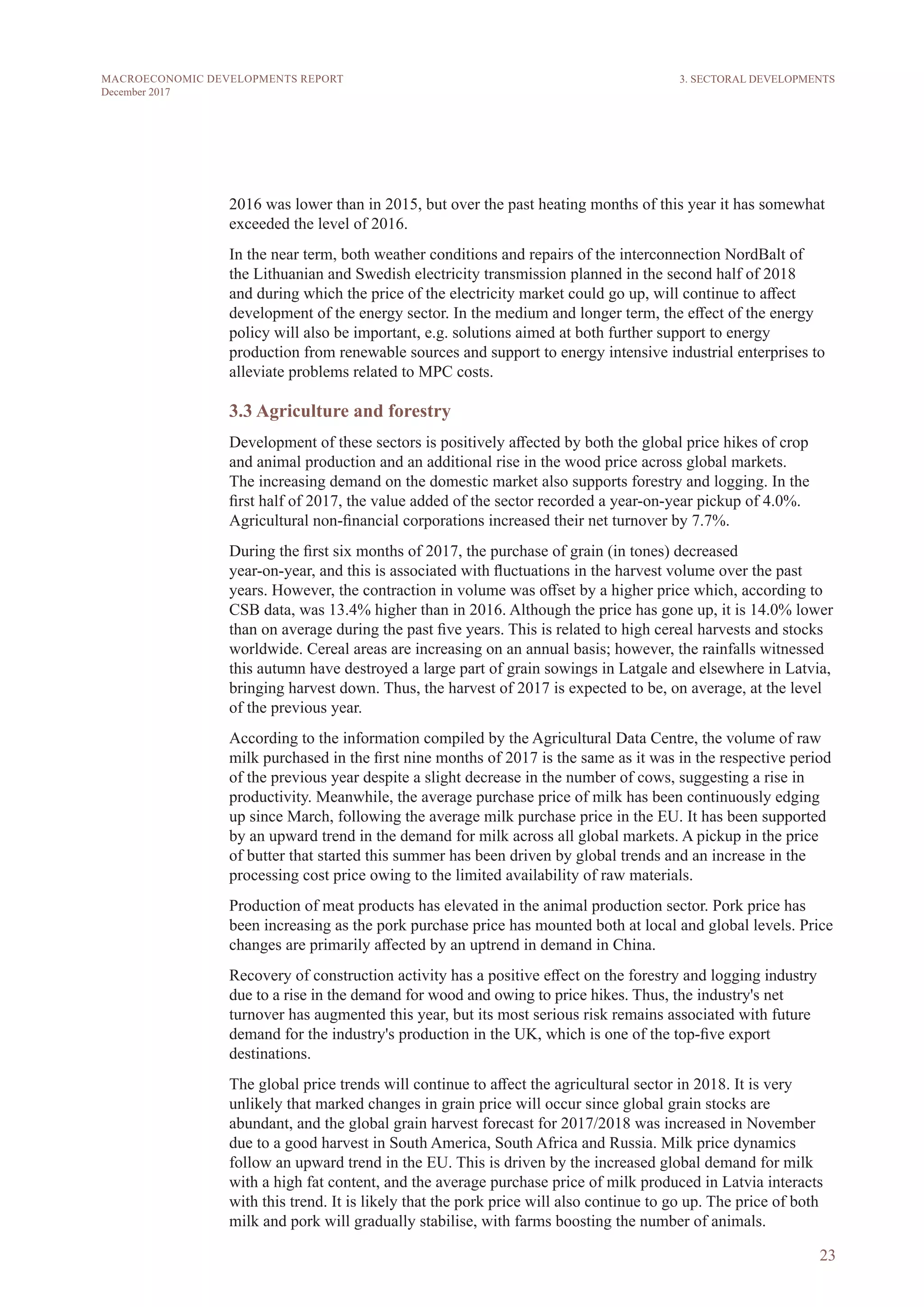
Manufacturing output increased substantially in the third quarter, i.e. by 1.2% quarter-on-
quarter (seasonally adjusted data) and by 9.3% year-on-year (adjusted for calendar effects).
October witnessed a more moderate growth rate (0.2% month-on-month and 5.9%
year-on-year).
Development was supported by both higher external demand and, to an increasingly
greater extent, growing domestic demand. This is particularly obvious when looking at
3. SECTORAL DEVELOPMENTS
22
MACROECONOMIC DEVELOPMENTS REPORT
December 2017
the inputs required by the robustly growing construction: wood, non-metallic mineral
products, metal structures, various building materials also produced by the subsectors
manufacturing chemicals, rubber and plastic products. Meanwhile, external markets have
been mostly interested in food, chemical products, electrical equipment, fabricated metal
products, transport vehicles and their components as well as pharmaceutical preparations
produced in Latvia. Although the overall industrial data do not provide information about
the pharmaceutical sector, the information made public by enterprises suggests that the
financial performance of JSC GRINDEKS and JSC OLAINFARM, the major players of the
pharmaceutical industry, is impressive this year.
Sentiment indicators of the fourth quarter suggest that the industrial sentiment is increasingly
becoming positive. Moreover, for the first time in the history of measuring sentiment, the
most frequent reply to the question on factors limiting production was that there were none.
The survey suggests that the demand-related problems have gradually lost their dominance,
yet shortage of labour is becoming increasingly stronger and the situation has particularly
worsened in 2017.
The level of investment in manufacturing is relatively low. This could have been affected
by changes in tax legislation since some potential investors possibly hold back to pay
dividends during the transitional period of CIT regulation, thus optimising taxes payable
and postponing investment to a later date. At the same time, capacity utilisation in some
subsectors has reached or is close to reaching its historical high. A particularly high level
of capacity utilisation can be observed in woodworking, manufacture of pharmaceutical
products as well as transport vehicles and their components. Therefore, investment in the
productive sector is becoming increasingly more important.
Manufacturing based on strong external and domestic demand will continue its dynamic
growth; however, the rate of increase will moderate. CIT exempt reinvested earning and
the expansion of the VAT reverse payment procedure, which will also be extended to
construction materials and fabricated metal products as of 2018, will give an additional
impetus to investment, improve competitiveness of domestic enterprises and their balance
sheets as well as curb the shadow economy. Thus, credit institutions will be able to cooperate
more successfully to receive loans.
3.2 Energy
Output of the energy sector in 2017 has augmented mainly on account of external factors and
weather conditions which favoured energy production. In the third quarter, inflows of water
in the Daugava river basin increased due to persistent heavy rainfalls in some eastern regions
of Latvia, thus boosting generation of electricity. The rainfalls, which had a negative impact
on agriculture, contributed positively to electricity production also in October.
In 2017, heat production could be unable to reach the results achieved in 2016, at least in
terms of growth rate, since the average outdoor temperature during the heating season of
3. SECTORAL DEVELOPMENTS
23
MACROECONOMIC DEVELOPMENTS REPORT
December 2017
2016 was lower than in 2015, but over the past heating months of this year it has somewhat
exceeded the level of 2016.
In the near term, both weather conditions and repairs of the interconnection NordBalt of
the Lithuanian and Swedish electricity transmission planned in the second half of 2018
and during which the price of the electricity market could go up, will continue to affect
development of the energy sector. In the medium and longer term, the effect of the energy
policy will also be important, e.g. solutions aimed at both further support to energy
production from renewable sources and support to energy intensive industrial enterprises to
alleviate problems related to MPC costs.
3.3 Agriculture and forestry
Development of these sectors is positively affected by both the global price hikes of crop
and animal production and an additional rise in the wood price across global markets.
The increasing demand on the domestic market also supports forestry and logging. In the
first half of 2017, the value added of the sector recorded a year-on-year pickup of 4.0%.
Agricultural non-financial corporations increased their net turnover by 7.7%.
During the first six months of 2017, the purchase of grain (in tones) decreased
year-on-year, and this is associated with fluctuations in the harvest volume over the past
years. However, the contraction in volume was offset by a higher price which, according to
CSB data, was 13.4% higher than in 2016. Although the price has gone up, it is 14.0% lower
than on average during the past five years. This is related to high cereal harvests and stocks
worldwide. Cereal areas are increasing on an annual basis; however, the rainfalls witnessed
this autumn have destroyed a large part of grain sowings in Latgale and elsewhere in Latvia,
bringing harvest down. Thus, the harvest of 2017 is expected to be, on average, at the level
of the previous year.
According to the information compiled by the Agricultural Data Centre, the volume of raw
milk purchased in the first nine months of 2017 is the same as it was in the respective period
of the previous year despite a slight decrease in the number of cows, suggesting a rise in
productivity. Meanwhile, the average purchase price of milk has been continuously edging
up since March, following the average milk purchase price in the EU. It has been supported
by an upward trend in the demand for milk across all global markets. A pickup in the price
of butter that started this summer has been driven by global trends and an increase in the
processing cost price owing to the limited availability of raw materials.
Production of meat products has elevated in the animal production sector. Pork price has
been increasing as the pork purchase price has mounted both at local and global levels. Price
changes are primarily affected by an uptrend in demand in China.
Recovery of construction activity has a positive effect on the forestry and logging industry
due to a rise in the demand for wood and owing to price hikes. Thus, the industry's net
turnover has augmented this year, but its most serious risk remains associated with future
demand for the industry's production in the UK, which is one of the top-five export
destinations.
The global price trends will continue to affect the agricultural sector in 2018. It is very
unlikely that marked changes in grain price will occur since global grain stocks are
abundant, and the global grain harvest forecast for 2017/2018 was increased in November
due to a good harvest in South America, South Africa and Russia. Milk price dynamics
follow an upward trend in the EU. This is driven by the increased global demand for milk
with a high fat content, and the average purchase price of milk produced in Latvia interacts
with this trend. It is likely that the pork price will also continue to go up. The price of both
milk and pork will gradually stabilise, with farms boosting the number of animals.
3. SECTORAL DEVELOPMENTS
24
MACROECONOMIC DEVELOPMENTS REPORT
December 2017
3.4 Construction
With the number of private sector construction projects growing and the flow of EU funds
being restored, construction growth has increasingly shown signs of acceleration already
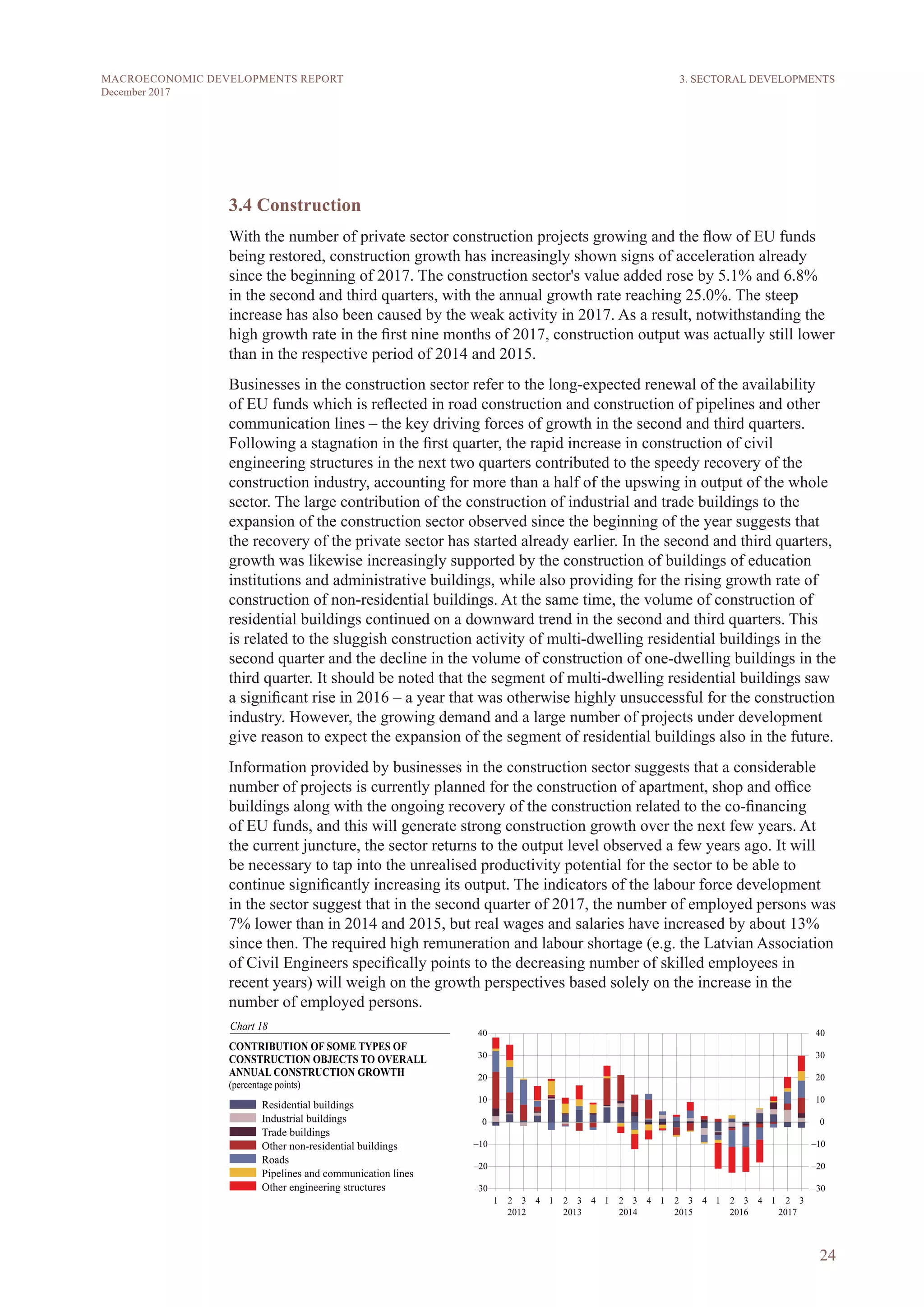
since the beginning of 2017. The construction sector's value added rose by 5.1% and 6.8%
in the second and third quarters, with the annual growth rate reaching 25.0%. The steep
increase has also been caused by the weak activity in 2017. As a result, notwithstanding the
high growth rate in the first nine months of 2017, construction output was actually still lower
than in the respective period of 2014 and 2015.
Businesses in the construction sector refer to the long-expected renewal of the availability
of EU funds which is reflected in road construction and construction of pipelines and other
communication lines – the key driving forces of growth in the second and third quarters.
Following a stagnation in the first quarter, the rapid increase in construction of civil
engineering structures in the next two quarters contributed to the speedy recovery of the
construction industry, accounting for more than a half of the upswing in output of the whole
sector. The large contribution of the construction of industrial and trade buildings to the
expansion of the construction sector observed since the beginning of the year suggests that
the recovery of the private sector has started already earlier. In the second and third quarters,
growth was likewise increasingly supported by the construction of buildings of education
institutions and administrative buildings, while also providing for the rising growth rate of
construction of non-residential buildings. At the same time, the volume of construction of
residential buildings continued on a downward trend in the second and third quarters. This
is related to the sluggish construction activity of multi-dwelling residential buildings in the
second quarter and the decline in the volume of construction of one-dwelling buildings in the
third quarter. It should be noted that the segment of multi-dwelling residential buildings saw
a significant rise in 2016 – a year that was otherwise highly unsuccessful for the construction
industry. However, the growing demand and a large number of projects under development
give reason to expect the expansion of the segment of residential buildings also in the future.
Information provided by businesses in the construction sector suggests that a considerable
number of projects is currently planned for the construction of apartment, shop and office
buildings along with the ongoing recovery of the construction related to the co-financing
of EU funds, and this will generate strong construction growth over the next few years. At
the current juncture, the sector returns to the output level observed a few years ago. It will
be necessary to tap into the unrealised productivity potential for the sector to be able to
continue significantly increasing its output. The indicators of the labour force development
in the sector suggest that in the second quarter of 2017, the number of employed persons was
7% lower than in 2014 and 2015, but real wages and salaries have increased by about 13%
since then. The required high remuneration and labour shortage (e.g. the Latvian Association
of Civil Engineers specifically points to the decreasing number of skilled employees in
recent years) will weigh on the growth perspectives based solely on the increase in the
number of employed persons.
3. SECTORAL DEVELOPMENTS
25
MACROECONOMIC DEVELOPMENTS REPORT
December 2017
3.5 Real estate market
The real estate market continued to see rapid increases in the transaction prices of standard
apartments in the first nine months of 2017, while the prices of apartments in new projects
fluctuated with no clear trend, with the total number of transactions remaining at the high
level of 2016. Value added of the real estate sector recovered gradually, with the annual
growth rate exceeding 3% in the third quarter.
According to the data provided by real estate enterprises, price hikes of standard apartments
displayed no trend toward acceleration in August and September, and the annual rate of
increase remained close to 10%. Real estate enterprises indicate that the rise in prices of
standard apartments is fuelled by the lack of supply of quality apartments in this segment
and the lack of supply of budget class apartments in new projects. At the same time, there
are a number of positive factors evident on the demand side, such as a sustained and an
increasingly steeper rise in wages and salaries, a favourable situation in the lending sector,
with credit institutions reducing interest rates further and expanding the amount of new
loans. Moreover, the state aid programme for families with children to purchase housing,
implemented by the JSC "Attīstības finanšu institūcija Altum", will be expanded from 2018.
It is envisaged that about 1 000 young specialists up to 35 years of age could receive aid
for house purchase in 2018. The amount of loans issued under the programme accounts for
around one third of overall lending for house purchase.
With developers responding to market demand, a number of major budget class residential
building projects are being developed; several of them are planned to be completed in 2018.
With the income level of Latvian households increasing, high activity of the apartment
market is expected to persist also in the future, while the supply of new dwelling space at an
acceptable price could represent an opportunity to mitigate price pressures in the segment of
used housing.
3.6 Trade
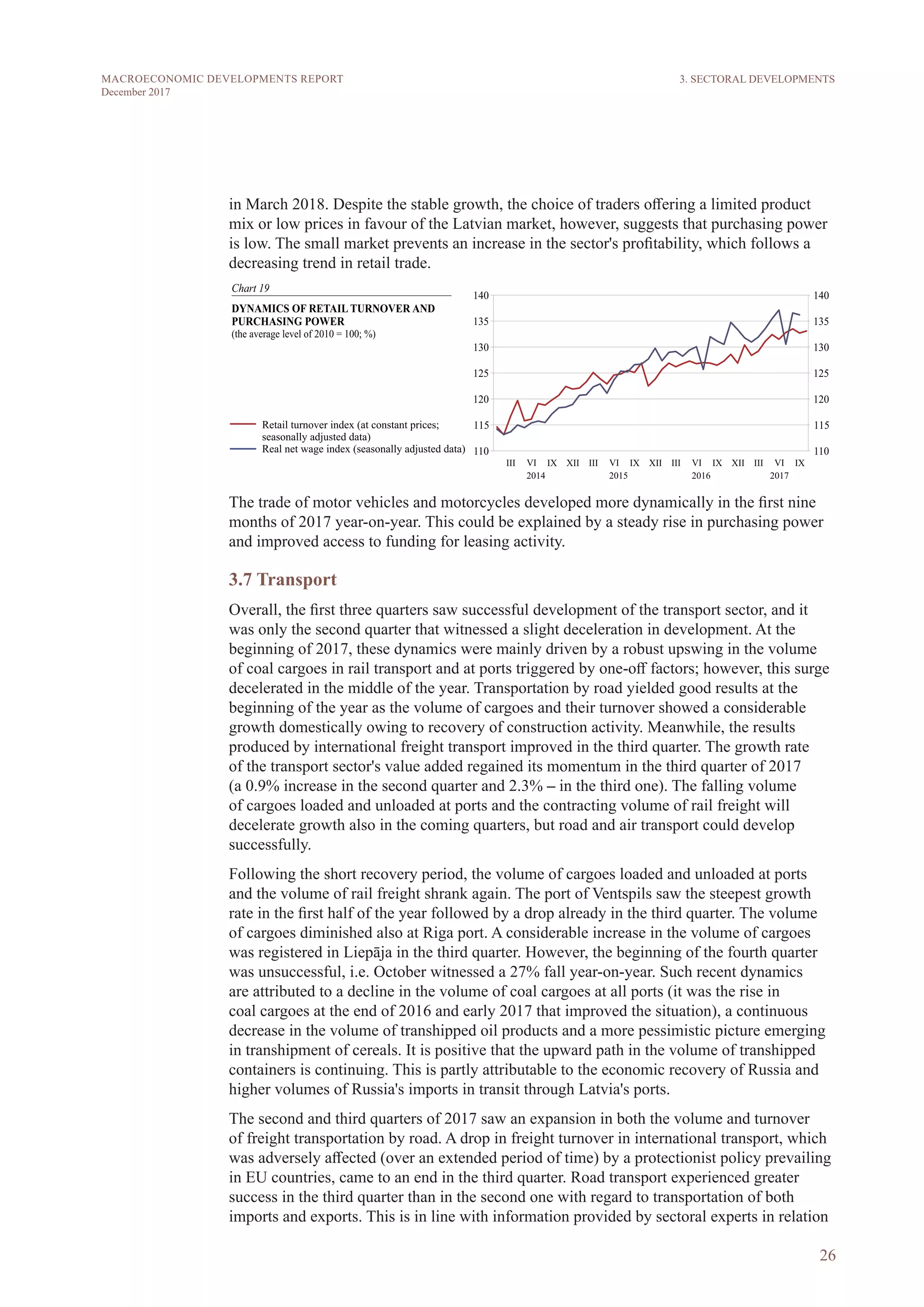
In parallel with generally more buoyant economic growth and a steady rise in purchasing
power (the annual rate of increase in a real net wage reached 3.6% in the first three quarters),
the trade sector also developed in a more dynamic manner. New capacity is being built both
in wholesale and retail trade. However, in the light of the limited nature of the domestic
market, part of the future capacity could be targeted at internal restructuring of the sector,
e.g. trade concentration in larger centres together with other services.
The share of the trade sector in value added remains slightly below 13%. In the first three
quarters of 2017, the sector's value added at constant prices according to seasonally and
calendar adjusted and revised CSB data increased by 3.8% (somewhat faster than on
average in 2016 when the rise stood at 3.4%). Gains in purchasing power which had a
favourable effect on retail trade as well as on sale of motor vehicles and motorcycles further
fostered growth of the trade sector in the first nine months of 2017. Development of retail
trade became more dynamic from quarter to quarter. According to seasonally and calendar
adjusted data, its turnover in real terms augmented by 4.9% in the third quarter year-on-year
(overall, by 3.7% in the first three quarters).
Although significant construction activity targeted at needs of trading enterprises is ongoing
(construction of both logistics centres and trading venues, e.g. IKEA and "Akropole", as well
as the expansion of the existing trade centres), it is a fact that several of these projects will
include movement of the current market participants in pursuit of better business models. In
addition to the above and other known projects, e.g. Lidl plans, a non-food retail chain Pepco
(offering mainly clothing and household articles), widespread on the Eastern European
market, in November announced its wish to start business on the Latvian market already
3. SECTORAL DEVELOPMENTS
26
MACROECONOMIC DEVELOPMENTS REPORT
December 2017
in March 2018. Despite the stable growth, the choice of traders offering a limited product
mix or low prices in favour of the Latvian market, however, suggests that purchasing power
is low. The small market prevents an increase in the sector's profitability, which follows a
decreasing trend in retail trade.
The trade of motor vehicles and motorcycles developed more dynamically in the first nine
months of 2017 year-on-year. This could be explained by a steady rise in purchasing power
and improved access to funding for leasing activity.
3.7 Transport
Overall, the first three quarters saw successful development of the transport sector, and it
was only the second quarter that witnessed a slight deceleration in development. At the
beginning of 2017, these dynamics were mainly driven by a robust upswing in the volume
of coal cargoes in rail transport and at ports triggered by one-off factors; however, this surge
decelerated in the middle of the year. Transportation by road yielded good results at the
beginning of the year as the volume of cargoes and their turnover showed a considerable
growth domestically owing to recovery of construction activity. Meanwhile, the results
produced by international freight transport improved in the third quarter. The growth rate
of the transport sector's value added regained its momentum in the third quarter of 2017
(a 0.9% increase in the second quarter and 2.3% – in the third one). The falling volume
of cargoes loaded and unloaded at ports and the contracting volume of rail freight will
decelerate growth also in the coming quarters, but road and air transport could develop
successfully.
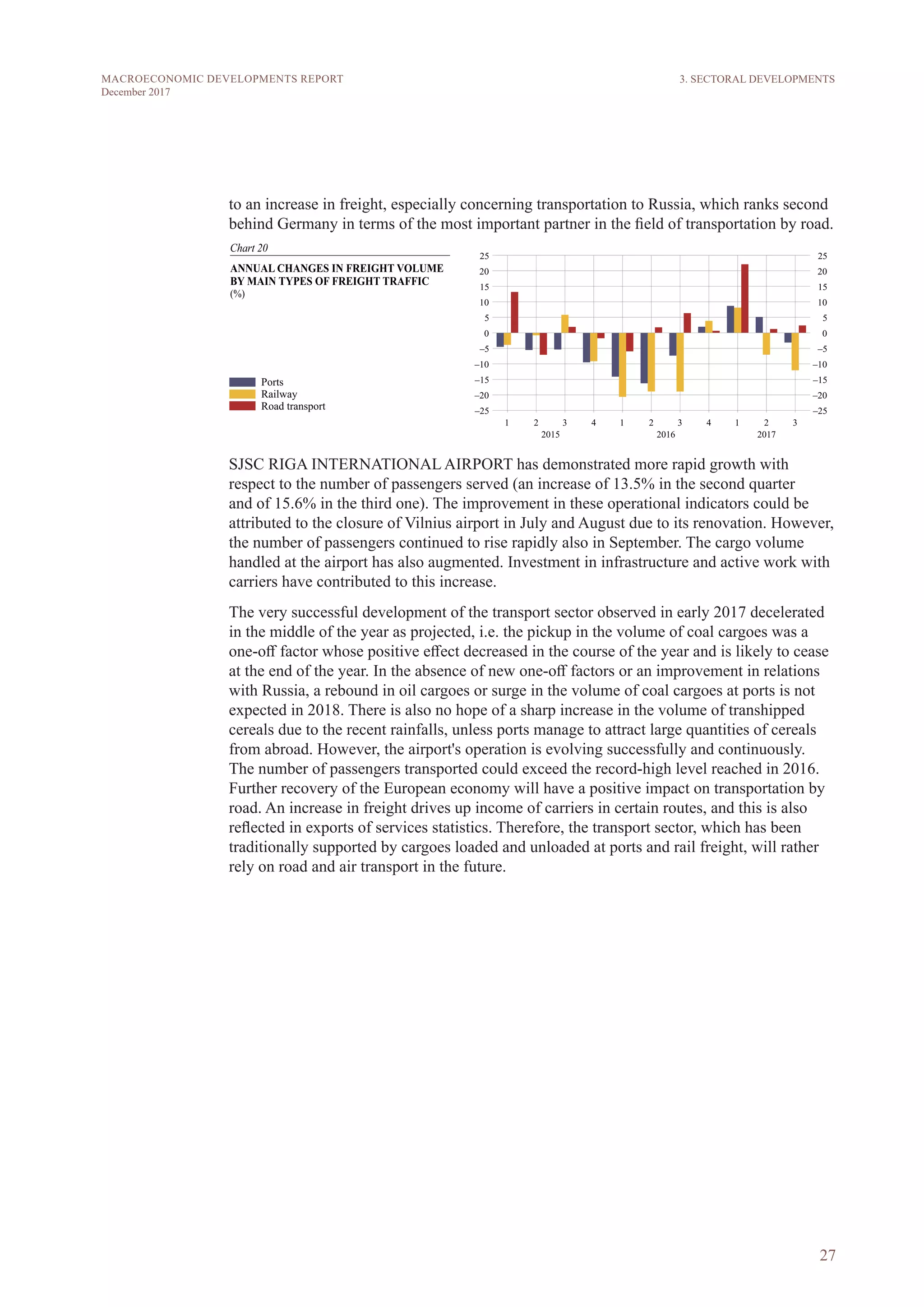
Following the short recovery period, the volume of cargoes loaded and unloaded at ports
and the volume of rail freight shrank again. The port of Ventspils saw the steepest growth
rate in the first half of the year followed by a drop already in the third quarter. The volume
of cargoes diminished also at Riga port. A considerable increase in the volume of cargoes
was registered in Liepāja in the third quarter. However, the beginning of the fourth quarter
was unsuccessful, i.e. October witnessed a 27% fall year-on-year. Such recent dynamics
are attributed to a decline in the volume of coal cargoes at all ports (it was the rise in
coal cargoes at the end of 2016 and early 2017 that improved the situation), a continuous
decrease in the volume of transhipped oil products and a more pessimistic picture emerging
in transhipment of cereals. It is positive that the upward path in the volume of transhipped
containers is continuing. This is partly attributable to the economic recovery of Russia and
higher volumes of Russia's imports in transit through Latvia's ports.
The second and third quarters of 2017 saw an expansion in both the volume and turnover
of freight transportation by road. A drop in freight turnover in international transport, which
was adversely affected (over an extended period of time) by a protectionist policy prevailing
in EU countries, came to an end in the third quarter. Road transport experienced greater
success in the third quarter than in the second one with regard to transportation of both
imports and exports. This is in line with information provided by sectoral experts in relation
3. SECTORAL DEVELOPMENTS
27
MACROECONOMIC DEVELOPMENTS REPORT
December 2017
to an increase in freight, especially concerning transportation to Russia, which ranks second
behind Germany in terms of the most important partner in the field of transportation by road.
SJSC RIGA INTERNATIONAL AIRPORT has demonstrated more rapid growth with
respect to the number of passengers served (an increase of 13.5% in the second quarter
and of 15.6% in the third one). The improvement in these operational indicators could be
attributed to the closure of Vilnius airport in July and August due to its renovation. However,
the number of passengers continued to rise rapidly also in September. The cargo volume
handled at the airport has also augmented. Investment in infrastructure and active work with
carriers have contributed to this increase.
The very successful development of the transport sector observed in early 2017 decelerated
in the middle of the year as projected, i.e. the pickup in the volume of coal cargoes was a
one-off factor whose positive effect decreased in the course of the year and is likely to cease
at the end of the year. In the absence of new one-off factors or an improvement in relations
with Russia, a rebound in oil cargoes or surge in the volume of coal cargoes at ports is not
expected in 2018. There is also no hope of a sharp increase in the volume of transhipped
cereals due to the recent rainfalls, unless ports manage to attract large quantities of cereals
from abroad. However, the airport's operation is evolving successfully and continuously.
The number of passengers transported could exceed the record-high level reached in 2016.
Further recovery of the European economy will have a positive impact on transportation by
road. An increase in freight drives up income of carriers in certain routes, and this is also
reflected in exports of services statistics. Therefore, the transport sector, which has been
traditionally supported by cargoes loaded and unloaded at ports and rail freight, will rather
rely on road and air transport in the future.
3. SECTORAL DEVELOPMENTS
28
MACROECONOMIC DEVELOPMENTS REPORT
December 2017
4. GDPAnalysis from the Demand Side
In September 2017, the GDP forecast was revised upwards; the new assessment, along with
the colour indication, is given in comparison with the September forecast and not that of
June published in the previous issue of the "Macroeconomic Developments Report".
Previous assessment Developments since the previous report New assessment
Private consumption
The annual growth
rate of private
consumption will
remain broadly
unchanged.
– In the first three quarters of 2017, the
real net wage grew by 3.6% year-on-year
maintaining a solid increase in consumption;
– a rise in the minimum wage and a
favourable influence of direct taxes on the real
net income dynamics can also be expected in
the future.
Growth in private consumption
will, on average, remain stable
over the projection period.
Investment
In 2017, the
contribution of
investment to
GDP growth
will increase and
approach the positive
contribution of private
consumption.
– A steep rise was recorded in the first three
quarters of 2017, amplified by a lower base
according to the revised data;
– projects scheduled to be implemented by the
time of Latvia's centenary remain relevant;
new projects have been announced and
launched.
In the projection period, the
annual growth of gross capital
formation could increase at a
slightly faster rate on account
of a lower base, the actual
activity in the construction
sector, the concentration of the
EU funds in the second half
of 2017 and new investment
projects.
Exports
The growth rate of
exports of goods and
services has been
revised upwards for
2017.
– With the growth outlook improving in many
countries, external demand forecasts have
been revised upwards;
– due to the data revisions carried out by the
CSB, the assessment of exports has been
revised upwards for 2015 and 2016;
– deteriorating cost competitiveness poses a
risk to the market share development;
– as a result of an upswing in construction,
certain manufacturing companies may be
focusing on the domestic market.
The assessment of exports of
goods and services will remain
unchanged over the medium
term.
Imports
A steeper rise in
investment will result
in an increase in
demand for imports
of capital and
intermediate goods.
– The data on the development of the
construction sector and the government capital
expenditure for the first nine months of 2017
suggest a more rapid expansion of imports in
real terms;
– with their income rising, Latvian travellers
have increased their spending abroad (travel
services imports).
On account of higher
investment activity, the growth
rate of imports will continue to
exceed that of exports.
Government consumption
The assessment
of the government
consumption
dynamics has
remained broadly
unchanged.
– 2017 data suggest somewhat accelerated
government consumption growth;
– certain measures, e.g. a rise in the
remuneration of health care professionals,
point to robust government consumption in
2018 (included in the September forecast).
The assessment of government
consumption dynamics has not
changed since September.
4. GDP ANALYSIS FROM THE DEMAND SIDE
29
MACROECONOMIC DEVELOPMENTS REPORT
December 2017
Looking at GDP by expenditure, in the first three quarters of 2017 the contribution of private
consumption to economic growth exceeded that recorded in the corresponding period of
2016. Nonetheless, investment has become an equivalent source of support for growth, as
was expected. However, investment is still insufficient to ensure growth in productivity.
Currently, the rapid rise in investment activity and the construction sector development
gives urgency to the issue of labour availability which, along with the difficulties of some
businesses to pay the increased minimum wage set for 2018, is adversely affecting the cost-
related competitive advantages. This is amplified by the uncertainty surrounding the future
policy regarding energy prices.
4.1 Private consumption
Looking at GDP by expenditure, the contribution of private consumption to economic
growth increased again in the third quarter of 2017. Following a four-and-a-half-year low at
the end of 2016, in the first half of 2017 consumer confidence gradually improved, inter alia,
on account of higher employment expectations. In the third quarter, however, it stabilised,
with the households' financial situation assessed most optimistically during this period, but
already in October and November a downward trend in consumer confidence followed.
In the first nine months of 2017, the expansion of private consumption was slightly more
rapid than that of retail trade, and the share of services by type of consumption expenditure
has recorded a year-on-year increase. The contribution from trade of household goods,
4. GDP ANALYSIS FROM THE DEMAND SIDE
30
MACROECONOMIC DEVELOPMENTS REPORT
December 2017
including durable goods, to retail trade remained one of the highest, also suggesting a
gradual increase in welfare. The number of cars newly registered with the Road Traffic
Safety Department, which had declined somewhat in 2016, is also increasing steadily.
In view of the planned rise in the minimum wage as well as the influence of direct taxes on
the real income dynamics, the assessment of consumption growth in the projection period
has been revised upwards.
4.2 Investment
As expected, investment has gradually become a source of support for growth in 2017.
However, gross fixed capital formation amounts to only approximately 20% of GDP, which
is insufficient to ensure productivity growth.
According to the CSB revised data, the decline in investment was more pronounced in
2016 (14.7%), thus the steep rise in investment observed in 2017, reaching 15.5% in the
first nine months of the year, was partly due to a lower base. With the private and public
sector projects financed both from the EU funds and by other means gaining momentum,
investment growth was supported particularly by investment in the so-called other buildings,
e.g. commercial buildings and warehouses as well as road construction and transport
equipment. In this respect, a significant contribution came from the aircraft purchases made
by the JSC Air Baltic Corporation.
Looking by type of investment, that in machinery and equipment is still modest, mainly
implying that it is the manufacturing sector that is currently providing insufficient capacity
strengthening. Unable to increase productivity more rapidly, the manufacturing sector
may, in the coming quarters, face additional competitiveness challenges due to the rise
in remuneration. At the same time, significant growth can be observed with respect to
investment in the so-called other buildings, e.g. commercial buildings, warehouses as well as
road construction. Infrastructure projects scheduled to be completed by the time of Latvia's
centenary remain relevant.
In the first half of 2017, the inflow of foreign direct investment in Latvia amounted
to 316.7 million euro, whereas in July–September it reached 464.2 million euro. The
4. GDP ANALYSIS FROM THE DEMAND SIDE
31
MACROECONOMIC DEVELOPMENTS REPORT
December 2017
largest inflows of investment were recorded in construction, trade, real estate and the
accommodation and catering services also in the first half of the year. The largest foreign
direct investment inflows were registered from Lithuania, Russia, Luxembourg, Germany
and Estonia. In July–September, foreign direct investment inflows were supported by the
financial and insurance sectors as well as the trade, manufacturing and construction sectors.
The largest inflows were from Sweden, Estonia, the Netherlands and Denmark.
4.3 Exports
Exports of Latvian goods and services continue to expand, yet the annual growth is
somewhat moderating. Higher activity in the global economy, sustainable growth in Latvia's
main trade partners and global price increases facilitated favourable terms of trade and
thus continued contributing to an increase in the export value of Latvian goods. In the third
quarter of 2017, nominal annual growth in exports of goods (7.9%) remained similar to
that of the second quarter (7.8%), facilitated by both an increase in real volumes of exports
and a rise in prices. In the third quarter, re-export growth was more pronounced than in the
previous quarter; but it is rather the exports manufactured domestically than re-exports that
ensured export growth both in the third quarter and in 2017 overall. The beginning of the
fourth quarter has also been favourable for exports with exports of goods reaching a monthly
record high in October.
As Russia's economic growth was stabilising, Latvia's exports of goods to Russia grew by
36.6% year-on-year in the first ten months of 2017. The expansion of exports was largely
supported by an increase in exports of beverages, machinery and electrical equipment and
pharmaceutical products. According to the WTO data, Latvia's export share also grew in the
Russian market in the first seven months of 2017.
In the breakdown by country, the rise in exports of goods was on account of both the
traditional partner markets and more remote markets. In the first ten months of 2017, exports
of goods to EU countries have increased by 8.9% year-on-year. Exports to Asian countries
have seen a very similar growth (8.8%), while exports to America have surged by 67%.
In 2017, exports of goods in nominal terms grew most notably to Russia, the US, Estonia,
Germany and Sweden.
In the first ten months of 2017, the largest positive contribution to the expansion of exports
was on account of export growth in food products, including beverages, articles of base
metals, machinery and electrical equipment, products of wood, animal products, and
products of the chemical industry, including pharmaceutical products. The food industry
has recovered from the difficulties of the past three years caused by the Russian embargo on
imports of certain food products and the resulting increase in competition in other countries.
Exports of food products to Lithuania have increased notably supported by the displacement
of the production of several Orkla Foods Latvija Ltd. products intended for the Lithuanian
market from Lithuania to a factory in Latvia, Babīte municipality. Exporters of fish, dairy
and meat products continue to search for or have found new markets or they have expanded
4. GDP ANALYSIS FROM THE DEMAND SIDE
32
MACROECONOMIC DEVELOPMENTS REPORT
December 2017
their product range in the existing markets. Latvia's producers of sweets are developing and
improving the range of their products on a continuous basis. An increasing number of new
export markets are conquered, e.g. in Central Europe, Nordic countries, the US, South Korea
and other countries, thus justifying the investment made in this sector.
Although growth in exports of wood can no longer be expressed in double-digit figures,
demand for Latvia's products of wood is still in place; therefore, exports of products of wood
have provided significant positive contribution to overall growth in exports of goods also
in 2017. The fall in exports of wood to the UK has been offset by its increase to Sweden,
Germany, Denmark, Italy, Korea, Lithuania, Norway, etc.
Income from exports of services continued on an upward trend posting increases of 5.1%
and 8.8% in the first half of 2017 and in the third quarter of 2017 respectively. The main
contribution came from exports of transport services, transportation by road in particular.
Exports of computer, information and construction services have also expanded and have
been growing for an extended period of time. Exports of construction services to Sweden,
the UK and Germany continue to increase, and those to Lithuania have expanded notably
in 2017. Transportation services provided in the first half and in the third quarter of 2017
increased on account of transportation services by sea, road and air. Decelerating expansion
of transportation services by sea in the third quarter was more than offset by accelerating
growth in exports of transportation services by road. Looking at travel services, the spending
of visitors from abroad overall was smaller in the first half of the year in comparison with
2016, although a slight increase was observed in the third quarter. Overall, the number of
visitors from abroad and the duration of their stay in Latvia continue to grow mainly on
account of visitors from Russia, Lithuania, Estonia and Finland.
According to preliminary data, total exports of services are expected to increase in 2017.
In 2018, the share of transportation services in the overall structure of services' exports is
expected to gradually decrease due to a decline in railroad and port services. The contraction
will be offset by IT and construction services as well as by the expected increase in the
number of visitors from abroad and higher spending on account of Latvia's centenary
celebration.
The real effective exchange rate remains on a gradual upward path, already suggesting
deteriorating cost competitiveness in a time when the rate of economic growth and the
increase in remuneration fail to reach their pre-crisis levels, whereas the gap between the
growth rates of remuneration and labour productivity has reached the previous level and the
shortage of investment hinders productivity growth.
Constant market share analysis of exports of goods suggests that the EU market
competitiveness is contracting. As a result of the negative competitiveness effect, the
market share is most notably shrinking in the nearest markets, i.e. in Lithuania and Poland.
Meanwhile, the most favourable market share development can be observed in Germany and
the Netherlands as well as in some smaller markets, e.g. the rapid market share increase in
Hungary and the Czech Republic.
According to the preliminary 2017 data collected by the WTO, the share of Latvia's
exports of goods and services in global imports has remained at the previous level despite
deteriorating cost competitiveness.
In some sectors, domestic market-oriented businesses and exporting businesses are facing
a cost competitiveness risk as the minimum wage has been raised to a level that part of
companies, given their current productivity, are unable to ensure, and the uncertainty
surrounding the future policy of the energy sector inter alia affects the pricing mechanism
and, consequently, significant cost components of many exporting businesses.
4. GDP ANALYSIS FROM THE DEMAND SIDE
33
MACROECONOMIC DEVELOPMENTS REPORT
December 2017
Latvia's foreign trade outlook is relatively favourable. Further economic growth of trade
partners will create opportunities for Latvian exporters. However, while facing the cost
competitiveness risk, businesses have maintained intensive capacity utilisation and
producers have been increasingly pointing to the labour shortage as a factor constraining
production. Against this background, it will be difficult to maintain a rapid and sustainable
export growth. Therefore, the growth rate of exports of goods is likely to slow down in
future.
4.4 Imports
The value of imported goods rises at a more rapid pace than that of exported goods, thus
increasing the foreign trade deficit in goods. A steeper increase in imports in 2017 is overall
related to a significantly stronger economic growth and export development. Imports are
positively affected by faster inflows of EU funds ensuring the recovery of investment
activity as well as by the renewal of the fleet of the JSC Air Baltic Corporation.
In the first ten months of 2017, imports of goods grew by 16.0% year-on-year. In the third
quarter, the expansion of the real volume of imports of goods was more significant than the
rise in prices. With Latvia's economic activity recovering, the growing domestic demand is
also increasing the demand for imported goods. Imports of consumer goods, intermediate
goods and capital goods expanded, and an increase was observed in the commodity groups
having a large share of re-exports, e.g. oil products, machinery and electrical equipment. The
impact of prices also played an important role.
According to the information provided by the JSC Air Baltic Corporation to the media,
a significant contribution to the increase in imports of goods came from purchasing
Bombardier CS300 aircrafts. Earlier in 2017, the JSC Air Baltic Corporation purchased
seven aircrafts and by the end of 2017 it had eight aircrafts of this kind. Meanwhile, in
2018 and 2019 twelve more aircrafts are planned to be received (six each year), providing a
further substantial contribution to imports of goods.
In 2018, the increase in imports of goods is also expected to decelerate somewhat mainly
due to the base effect; however, it will remain higher than export growth on account of an
upward trend in investment.
Nominal imports of services continued expanding also in the first half of 2017 (7.1%) and
in the third quarter of the year (10.3%). In both periods, growth was mostly driven by an
increase in transportation services, those by sea, road and air in particular. Over the same
periods, growth in imports was also facilitated by financial services mostly on account of
the credit institutions' foreign currency transactions. Imports of construction services also
increased slightly, and the spending of Latvian travellers picked up somewhat. The largest
imports of construction services came from Lithuania, Estonia, Finland, Germany and
Sweden. Meanwhile, the spending of Latvian travellers rose in Italy, Spain and somewhat
also in Switzerland.
4. GDP ANALYSIS FROM THE DEMAND SIDE
34
MACROECONOMIC DEVELOPMENTS REPORT
December 2017
4.5 Government consumption
Government expenditure data suggest that the government consumption expenditure
continued on an upward path also in the third quarter. The rise in the wages and salaries of
teachers, employees in the defence sector, police staff and judicial staff and other employees
in the interior system envisaged in the Law on State Budget 2017 along with an increase
in the minimum wage and a robust increase in the government expenditure on goods and
services contributed to a solid growth in government consumption in the third quarter of the
year. Moreover, the official data of the consolidated general government budget in October
and November suggest that the upward trend will also continue in the fourth quarter, albeit at
a slower pace.
The consolidated general government budget expenditure on compensation and that on
goods and services posted year-on-year increases of 9.3% and 5.9% respectively in the
third quarter accounting for more than a half of the overall rise in the consolidated general
government budget expenditure. An expansion of expenditure on social benefits contributes
to a stronger economic activity, thus supporting private consumption.
Alongside with high government expenditure, government investment has also been
recovering from a record low in 2016, with its growth in absolute terms accelerating
at an increasingly faster rate from quarter to quarter. In the third quarter and in the first
three quarters of 2017 overall, government capital expenditure increased by 41.1% and
44.6% respectively. The growing investment is related to a considerably more active
implementation of EU funds-financed infrastructure projects by local governments in
particular. Meanwhile, the large closure payments for the 2007–2013 programming period
funded by the Cohesion Fund and the ERDF and settled during the first four months of 2016
accounted for a seeming decline in subsidies and grants in the first half of 2017. With the
impact of the first four months of 2016 fading, the expenditure on subsidies and grants has
been growing since May, mainly as a result of higher EU structural funds expenditure in the
2014–2020 programming period. The plan for the absorption of EU funding provides for a
high concentration of expenditure in the fourth quarter. Since a number of expenditure items
partly offset the dynamics of one another, total government expenditure grew by 5.2% in
the first three quarters of 2017. Tax revenue rose at an even more rapid pace posting a 7.6%
increase in the first three quarters of 2017, including 9.2% growth in the third quarter, mainly
on account of VAT, PIT and mandatory state social insurance contributions. The increase
in revenue from taxes on labour is supported by a steady rise in remuneration improving
purchasing power and consumption which, in turn, results in higher VAT revenue.
The target of the general government budget deficit set by the Law on State Budget 2018
(according to ESA 2010) is 0.9% of GDP. However, the unexpectedly rapid economic
develop­ment observed in the third quarter and the excess of tax revenue as compared to
the budgeted amount recorded in the first ten months of the year suggest that revenue
collections are most likely to be more positive and will reflect in an improved budget
balance. Government consumption is lower than planned, and the implementation of the
projects financed from EU funds is delayed. This creates additional risks with respect to the
expenditure forecast execution which could result in even lower budget deficit at the end of
the year. Despite increasingly favourable economic conditions, the decisions adopted by the
government will not facilitate an improvement in the nominal budget balance in the coming
years. Even if higher economic activity will ensure additional budgetary tax revenue, the
recovery of government investment and the tax reform measures will generate an opposite
effect.
In the current favourable economic conditions, the government policy can be assessed
as expansionary and the measures implemented by the government, i.e. changes in tax
legislation, a more rapid pension indexation and a rise in wages and salaries in the public
sector, suggest procyclicality.
4. GDP ANALYSIS FROM THE DEMAND SIDE
35
MACROECONOMIC DEVELOPMENTS REPORT
December 2017
5. Labour Market
Previous assessment Developments since the previous report New assessment
Unemployment
A gradual decline in
unemployment (close to
its natural level).
– The unemployment rate declines
somewhat faster than projected;
– the labour market shows signs of labour
shortages.
The previous assessment has
remained broadly unchanged,
the risks are on the downside.
Remuneration
In 2017, the average
wage will increase
by 6%. The medium-
term rise in wages will
approach 5%.
– The private sector has recorded a more
buoyant increase in remuneration than
expected;
– the minimum wage will rise
substantially in 2018.
The average wage will rise
by 8% in 2017 and 2018. The
medium-term assessment has not
been changed significantly.
Owing to more accelerated economic growth, there are signs of labour shortages. The
unemployment rate has fallen below its natural rate, with the cyclical unemployment
component becoming negative. The rate of registered unemployment has followed a
downward trend, representing less than 7%, while the share of jobseekers is 8.5% of the
economically active population. The number of unfilled vacancies is rising rapidly, and
businesses increasingly complain about labour shortages. The stability of the Beveridge
curve over time confirms that the structural component of unemployment remains high.
It is the structural component of unemployment that should be combated in order to put
further decline in unemployment on a sustainable path. It could be done by improving the
efficiency of active labour market measures (retraining courses and purposeful integration of
certain population groups into the labour market); moreover, it can be also attained through
structural reforms in education and health care in a longer term perspective.
The number of employed persons has remained broadly unchanged for the last three years
(some statistical data sources may suggest an increase or a decrease in the number of
employed people in the short term). This does not point to weak labour demand (denoted
as jobless recovery in some European countries) as the share of employed persons reached
its historical high and exceeded the EU average. The stagnating number of the employed
reflects the tight labour supply, with the number of working age population decreasing
gradually on account of negative net migration and the fact that the mortality rate has
exceeded the birth rate for a protracted period.
The economic development is expected to continue on a labour productivity path also in
the future, with the number of the employed remaining broadly unchanged. Therefore, as
many businesses are planning to increase the number of their employees, the competition for
labour among businesses is growing. Overall in the economy, it will be reflected in higher
wages instead of increases in the number of employed persons.
Remuneration has slightly outpaced labour productivity in a couple of years, with the share
5. LABOUR MARKET
36
MACROECONOMIC DEVELOPMENTS REPORT
December 2017
of wages and salaries in value added approaching the EU average. It shows that labour-
intensive sectors in Latvia gradually lose the relative advantage at the EU level. If wages
continue on an upward trend at the current pace and outpace labour productivity growth,
the medium-term impact on economic activity will be negative as the short-term positive
effect on private consumption will be offset by the medium-term negative impact on
competitiveness.
Signs of labour shortages are expected to intensify in the next quarters. This will be due
to robust economic growth, with GDP exceeding its potential level. The actual and natural
unemployment rate will continue to decline gradually; however, the cyclical component of
unemployment will remain in negative territory. Thus, remuneration will keep rising steadily,
and it will be also supported by a significant rise in the minimum wage in 2018.
5. LABOUR MARKET
37
MACROECONOMIC DEVELOPMENTS REPORT
December 2017
6. Costs and Prices
The assessment (and also the colour indication) has been presented in comparison with the
forecast of September instead of the forecast of June published in the previous
"Macroeconomic Developments Report".
Previous assessment Developments since the previous report New assessment
Oil prices
It is expected that the
average price will be
51.1 US dollars per barrel
in 2017, 50.2 US dollars per
barrel in 2018 and 49.8 US
dollars per barrel in 2019.
– The price of Brent crude oil exceeded
60 US dollars per barrel in November 2017;
– OPEC extended oil production cuts until
the end of 2018;
– oil stocks in the US demonstrate a
downward trend.
It is expected that the
average price will be
54.1 US dollars per barrel
in 2017, 60.2 US dollars per
barrel in 2018 and 57.7 US
dollars per barrel in 2019.
Global food prices
A moderate rise in global
food prices is projected in
2017.
– Global food prices stabilised;
– the global forecast for the harvest of
cereal products could be at an all-time high
in 2017 and 2018.
The previous assessment
has remained broadly
unchanged.
Domestic labour costs and inflation expectations
In 2017, wages will
increase by 6%. Inflation
expectations will remain
at the same level as in the
spring of 2017.
– Labour costs rise slightly faster than
projected;
– inflation expectations follow an upward
trend.
In 2017 and 2018, the
average wage will increase
by 8%.
Indirect taxes and administered prices
An increase in the excise tax
in line with the approved
levels and the possible rise
in natural gas tariffs after
the liberalisation of the gas
market have been taken into
account.
– A faster than expected increase in excise
tax rates for fuel, alcohol and tobacco as of
2018 (their overall contribution to inflation
in 2018 (0.6 percentage point) has already
been taken into account in the forecast of
September);
– a reduced VAT rate on vegetables and
fruit typical of Latvia (the contribution to
inflation in 2018 is –0.1 percentage point).
Changes in VAT and excise
tax rates have been taken
into account according to
the approved levels.
Inflation dynamics in the second half of 2017 is in line with the expected dynamics, and
annual inflation continues to fluctuate around the level of 3%. Fuel prices posted an increase
in autumn due to a rise in oil prices, but this still did not reflect in natural gas and heating
tariffs; moreover, it was partly offset by the appreciation of the euro vis-à-vis the US dollar.
Although domestic economic activity and rising labour costs exceeded the projected growth,
it has not significantly translated into core inflation dynamics so far. Thus, Latvijas Banka's
inflation forecast for 2017 remains at 2.9%.
6. COSTS AND PRICES
38
MACROECONOMIC DEVELOPMENTS REPORT
December 2017
In November, the price of Brent crude oil reached 63 US dollars per barrel, and this is the
highest level of the last two and a half years. At the end of November, the OPEC countries
agreed to expand oil production cuts until the end of 2018. The oil price is supported by the
downward dynamics of oil stocks in the US, the political and military instability in Iraq's
Kurdistan region as well as the arrests related to corruption in Saudi Arabia. It is possible
that some of these events will affect oil prices only in the short term. Judging by the prices
of oil futures contracts, investors currently expect a fall (approximately to 57 US dollars per
barrel) in oil prices in the medium term. However, this price also exceeds the one projected
some months ago. Thus, the new assessment of the average oil price in 2018 also exceeds
the previous assessment.
Fuel prices reflected the oil price dynamics on the global stock exchanges and the
fluctuations of the euro exchange rate against the US dollar with a delay of a couple of
weeks. In November, the price of 95 octane petrol was 1.17 euro per litre or almost at the
same level as six months ago. In July, the natural gas tariff for households increased slightly,
reflecting a rise in the prices of oil products in the previous months. At the beginning of
the heating season, heating tariffs were similar to those imposed in spring. The correlation
between the natural gas price and the average price of oil products of the preceding nine
months means that the heating tariff could increase in the months ahead. No impact of the
liberalisation of the gas market on natural gas and heating prices (its impact on total inflation
can be estimated at 0.1 percentage point) has been observed so far.
Global food prices stabilised. The global forecast for the harvest of cereal products has been
revised upwards over the past months, and the current record high harvest is expected in
2017. Thus, the produced volume of cereal products could exceed the consumption rates
already for the fifth consecutive year, and the stocks of cereal products amount to an-all time
high. Following an upsurge in the run of several months, the global prices of dairy products
including the prices of butter decreased in October (out of dairy products, butter prices
witnessed the most pronounced increase in 2017). In the coming months, the stabilisation of
the global prices of dairy products will be also reflected in retail prices in Latvia.
6. COSTS AND PRICES
39
MACROECONOMIC DEVELOPMENTS REPORT
December 2017
Inflation in 2018 will be significantly affected by legislative amendments. A significant
increase in excise tax rates on fuel, alcohol and tobacco may push up inflation in 2018 by
0.6 percentage point comprising direct impact (0.4 percentage point) and indirect impact
(0.2 percentage point) (or higher prices of other goods and services as a result of rising fuel
prices). The minimum wage will also increase from January 2018 (from 380 euro to 430
euro per month), and this may push up inflation in 2018 by 0.1 percentage point. At the
same time, a lower VAT rate on vegetables and fruit typical of Latvia (from 21% to 5% as of
January 2018) may reduce inflation by 0.1 percentage point.
6. COSTS AND PRICES
40
MACROECONOMIC DEVELOPMENTS REPORT
December 2017
7. Conclusions and Forecasts
In 2017, GDP growth was very strong and higher than projected. According to Latvijas
Banka's forecasts, robust growth will continue also in the future; however, such a high level
of annual GDP growth is unlikely to persist.
Private consumption will remain strong on account of declining unemployment, an increase
in real income and the high consumer confidence. EU fund inflows will continue and
increase in 2018, supporting prospects of a notable positive contribution of the construction
sector to growth in the next few years. As a result of a persistently strong domestic and
external demand, high production capacity utilisation and low interest rates, private
investment is also expected to continue supporting economic growth. At the same time it
should be noted that only a modest recovery in lending has been projected. Moreover, the
accelerated rate of investment growth in 2017 resulted from both the low base of 2016 and
some one-off events, e.g. the purchase of planes.
Despite the robust external demand, its rate of increase in the next few years will be
slower than in 2017 and contribution of exports to economic growth is likely to decline.
Manufacturing, closely related to exports, will also continue on an upward trend, but the
growth will become less pronounced.
In September 2017, Latvijas Banka revised upwards its GDP forecast published in June.
Consequently, part of the factors, e.g. solid external demand, the effect of higher minimum
wage and other legislative act amendments on private consumption, and stronger growth in
some sectors, that had pointed to a required upward revision of the forecast since publishing
the previous issue of the Macroeconomic Developments Report, have already been included
in the September forecast.
However, positive sectoral preliminary statistical data and the GDP flash estimate for the
third quarter of 2017 allow a further upward revision of the GDP forecast. According to
data not adjusted for seasonal and calendar effects, in 2017 GDP growth is likely to stand
at 4.7% (4.2% in September), while in seasonally and calendar adjusted terms it is likely to
be 5.2% and 4.7% respectively. Further GDP growth of 4.1% is projected in 2018 (3.8%
in September) in both seasonally and calendar adjusted and non-adjusted terms. Although
the GDP forecast has been revised upwards, it is mostly based on the observed growth
data, while the outlook on future development and factors behind it has remained broadly
unchanged. In 2019, the pace of the economic growth is projected to remain sustained, albeit
not so rapid as before: 3.2% according to data adjusted and not adjusted for seasonal and
calendar effects.
In 2017, inflation developed along the expected path, therefore Latvijas Banka's inflation
forecast for 2017 remains unchanged at 2.9%. In 2018, inflation is also likely to stand at
2.9%. The change in the inflation forecast from the one published in the June issue of the
Macroeconomic Developments Report to that released in September, i.e. 0.8 percentage
point, to 2.8%, was mostly driven by the information on a steep rise in the excise tax and a
substantial increase in the minimum wage. The change in the inflation forecast in the period
from September to December, i.e. 0.1 percentage point, to 2.9%, mainly resulted from a
stronger-than-expected domestic demand and a further rise in oil prices. Core inflation in
2018 will be higher than in 2017 on account of a hike in labour costs. In 2018, service prices
are projected to rise by more than 3% on average, reflecting robust domestic demand and a
sustained pick-up in labour costs that will persist on the back of the cyclical unemployment
component remaining negative. Moreover, if the level of oil prices stabilises above 60 US
dollars per barrel, inflation may slightly exceed the forecast. In 2019, inflation is projected to
be 2.6%.
7. CONCLUSIONS AND FORECASTS
41
MACROECONOMIC DEVELOPMENTS REPORT
December 2017
7. CONCLUSIONS AND FORECASTS
42
MACROECONOMIC DEVELOPMENTS REPORT
December 2017
8. Analysis of Scenarios
8.1 Wages continue to rise faster than labour productivity
1. Motivation
The increase in remuneration in Latvia has exceeded that of labour productivity growth in
recent years. Moreover, the rise in remuneration accelerated in the first half of 2017, and a
rapid wage and salary growth is also expected in the coming years, both because of labour
demand exceeding labour supply and administrative decisions (an increase in the minimum
wage). To analyse the channels through which wage increases (that are not based on labour
productivity) affect the economy, a DSGE model for Latvia has been used for the simulation
of the business cycle (see Ginters Bušs. Wage formation, unemployment and business cycle
in Latvia. Riga: Latvijas Banka, 2017. Working Paper 1/2017, 70 p.)1
.
2. Simulation
Two scenarios are considered. Both scenarios assume that the upward phase of the business
cycle is caused by positive consumer sentiment. The private consumption growth that lasts
for two years and reaches around 7% is modelled. In case of the first scenario, economic
activity is not restricted by labour supply, and thereby no significant rise in wages and
salaries can be observed (see Chart 38). The second scenario takes into account tight labour
supply. Hence, labour shortages lead to stronger bargaining power granted to employees in
this case2
; therefore, remuneration outpaces labour productivity.
In both cases, the expansion of private consumption is similar as a slower growth rate in
employment is offset by a steeper rise in remuneration in the second case. However, an
increase in unit labour costs has an adverse effect on the economy. First, higher labour
costs are reflected in rising prices of products; therefore, local production is partly replaced
by relatively cheaper import goods (lower competitiveness in the local market). Second,
higher prices of export goods negatively affect external competitiveness, and this is why
real exports sees a decline. Third, investment inflows and consequently also the potential
economic growth slow down due to the deterioration of the profitability of businesses.
Hence, in the second scenario GDP growth is slower. The second scenario also assumes that
recession is deeper, GDP is lower and unemployment is higher in the downward phase of
the business cycle when businesses reduce employment and wages. The longer is the wage
adjustment process, the slower is the economic recovery.
1
  This is one of the models used by Latvijas Banka and representing just a part of the information taken into account
when forming an opinion on topical policy issues and economic development.
2
An increase of 10% in the opportunities for employees to earn money outside their full-time job has been recorded.
8. ANALYSIS OF SCENARIOS
43
MACROECONOMIC DEVELOPMENTS REPORT
December 2017
3. Conclusions
A rapid wage rise boosts income and consumption in the short term. However, the seemingly
positive momentum is not likely to continue and may last just as long as consumer and
business sentiments (affected also by external events, e.g. external demand) improve further.
If labour productivity does not grow simultaneously, the positive effect is temporary. The
fact that wages and salaries rise considerably faster than labour productivity has caused
negative consequences in the medium term – a few years after a positive wage shock has
occurred, real disposable income and output as well as exports, private consumption and
employment fall behind the projections of the scenario with no labour shortages. The loss
of internal and external competitiveness and reduced economic growth potential due to
weaker corporate financial positions and lower investment are the main channels. Thus, the
simulation results show that wage growth should be based on labour productivity growth to
be on a sustainable path.
8. ANALYSIS OF SCENARIOS
44
MACROECONOMIC DEVELOPMENTS REPORT
December 2017
8.2 Decline in housing prices in the Nordic countries
1. Motivation
The Latvian economy and financial system are very open. Thus, both regional and global
external shocks have a great potential to mirror in the country's economic and financial
indicators rather rapidly. A potential steep fall in Swedish real estate prices represents one of
the sources of systemic risk. Such a drop can cause macrofinancial tension throughout the
region of the Nordic and Baltic countries due to the close economic and financial ties that
exist between them.
The price dynamics of Swedish real estate in combination with an increase in lending and
private sector debt and the high debt level observed over the past years give rise to concerns
as to sustainability of the situation. Normalisation of historically low risk premiums at
global level could also mirror in erosion of real estate prices in Sweden and other Nordic
countries. Currently several indicators show that the Swedish housing market is witnessing
a slowdown in development. Most market participants and Sveriges Riksbank believe that
the Nordic countries will see healthy stabilisation of the real estate price level.1
Latvijas
Banka's forecast baseline scenario also contains an assumption of its gradual stabilisation.
Meanwhile, a risk scenario is aimed at modelling a steep decline in real estate prices peculiar
to deep crises and its potential impact on the Latvian economy. The likelihood that such a
scenario might occur is low, and the results obtained cannot be interpreted as forecast risks
of the baseline scenario. However, the results give an idea of the potential adverse effects if
developments were very unfavourable.
A significant drop in real estate prices in the Nordic countries would halt housing market
development, notably affecting consumer sentiment and investment in the economy. A
decline in demand in the Nordic countries would trigger a reduction in exports in their trade
partners (including the Baltic countries).
The halt in real estate market development would significantly deteriorate possibilities and
motivation of enterprises to make investment, using bank loans and their own funds or
capital market resources. Adverse development of the real estate market could worsen loan
quality in Nordic banks which in turn would increase the risk premium of these banking
groups, making market funding more expensive for them (as they would be considered
riskier). A rise in financing costs of Nordic banking groups could boost interest rates on new
loans both in the Nordic countries and subsidiaries and branches of Nordic banking groups
in the Baltic region (including Latvia). Although dependence of subsidiaries on their parent
bank funding has decreased considerably and the ratio of domestic loans to deposits has
improved over the past years, decisions on the policy of interest rates on loans are largely
1
  Press release by Sveriges Riksbank of 22 November 2017 A slower rate of increase of household indebtedness
is needed for stability. [viewed on 15 December 2017]. Available: http://www.riksbank.se/Documents/
Pressmeddelanden/2017/prm_171122_eng.pdf. Arnold, Martin, Milne, Richard. Sweden's big banks call an end to
decades-long housing boom. Financial Times. 14 November 2017 [viewed on 15 December 2017]. Available: https://
www.ft.com/content/07c97b9e-c633-11e7-b2bb-322b2cb39656. Bergqvist, Robert, et al. Theme: The resilience of the
Swedish housing market. SEB Nordic Outlook. 21 November 2017, pp. 33–34.
8. ANALYSIS OF SCENARIOS
45
MACROECONOMIC DEVELOPMENTS REPORT
December 2017
taken at the banking group level, and the financial position of the banking group affects also
subsidiaries. With interest rates on loans augmenting, the demand for loans would follow
a downward trend. With the quality of loans deteriorating in home countries of banking
groups, credit standards could be tightened in the Baltic countries, thus decelerating lending
development. The deterioration of financing conditions and narrowing of profit opportunities
would have an adverse effect on the market value of enterprises. Thus, investment activity
would contract also in cases when investment is made by using funds of enterprises or
capital market resources rather than bank loans.
Overall, this would have a negative impact on development of enterprises. Moreover,
business and consumer confidence could be deteriorated by an increase in macrofinancial
tension in the region, hampering the decision-making process in relation to investment and
consumption in the short term, thus slowing down domestic economic development.
2. Simulation
The simulation has been performed by employing the ESCB multi-country model and
Latvian DSGE model1
. A decline in housing prices in Sweden and other Nordic countries
on average by 30%2
, which would result in a rise in interest rates on short-term loans by
2 percentage points in the course of three years, is modelled. The drop in real estate prices
and the related effects are assumed to depreciate the effective exchange rate of the Swedish
krona by 15%3
in the first year and by 5% in the second one. Thus, in parallel with the
steep fall in real estate prices, deterioration of consumer sentiment, which would drive the
contraction in private consumption in the Nordic countries4
, is also modelled. The impact of
these four channels on the economy would materialise via weakening of Latvia's external
demand; therefore, for the purpose of further analysis they have been grouped together in
a single external demand channel. The effect of these channels is modelled by employing
the ESCB multi-country model which takes into account both the direct impact of a specific
Nordic country and Latvia's trade and the indirect impact via other trade partners of Latvia5
.
In addition to the external demand channel, deterioration of investment funding possibilities6
in Latvia is also modelled. Moreover, taking account of the deceleration in the economic
activity and weakening of sentiment in the region as a whole, an increase in uncertainty in
Latvia is also modelled. The adverse effect of the total drop in real estate prices in Sweden
and other Nordic countries on Latvia's GDP in the course of three years has been assessed at
2.3% vis-à-vis the baseline scenario (see Chart 40).
The Latvian economy would be affected by the external demand channel primarily via a
decline in exports. The Nordic countries are important partners of Latvia's exports, and their
total share in Latvia's exports of goods constitutes approximately 15%. Moreover, these
countries are also important partners of Latvia's largest trade partners, mainly Estonia, which
would also be adversely affected should this scenario materialises. The above aspect is taken
into account in this simulation. In the first year following a significant adjustment of real
estate prices in the Nordic countries, the level of Latvia's exports would be 1.5% below that
of the baseline scenario. In the second year, exports of Sweden and other Nordic countries
would become more competitive as a result of weakening of the effective exchange rate, and
1
  Bušs, Ginters. Wage formation, unemployment and business cycle in Latvia. Riga: Latvijas Banka, 2017. Working
Paper 1/2017, 70 p. Model simulations represent just part of the information taken into account when forming opinion on
topical policy issues and economic development.
2
  The assumption is based on the cumulative drop in housing prices in Sweden in the 1990s. Taking into account the
close mutual links among the economies of the Nordic countries and the boom in real estate prices seen by several of
these countries for a lengthy period, it is assumed that the plunge in housing prices experienced by Sweden will also
decrease housing prices in other Nordic countries.
3
  For example, in early 1990s, when Sweden witnessed a considerable drop in housing prices, the exchange rate decreased
by approximately 20%, with Sweden introducing the floating exchange rate.
4
  Consumption would fall by 5% in the Nordic countries in the course of two years.
5
  The model contains the mutual trade link among EU28 countries.
6
  A pickup in interest rate on short-term loans by 2 percentage points in Latvia over a three-year period has been
modelled.
8. ANALYSIS OF SCENARIOS
46
MACROECONOMIC DEVELOPMENTS REPORT
December 2017
this would soften the GDP fall in these countries. Therefore, a relatively small additional
decrease in the level of Latvia's exports vis-à-vis the baseline scenario (up to 2%) can be
observed in the second year of simulation. Meanwhile, exports would start recovering in the
third year, and after three years their level would remain about 1.4% lower compared to the
baseline scenario. Due to a decline in external demand, Latvia's GDP would be 0.6% lower
vis-à-vis the baseline scenario in the third year.
Deterioration of investment funding possibilities has the greatest negative effect on Latvia's
GDP, and this would materialise primarily via three channels. First, new loans to enterprises
would contract. Second, loans to households would shrink, thus reducing consumption and
also motivation of enterprises to make investment. Third, the deterioration of financing
conditions and narrowing of profit opportunities would have an adverse effect on the market
value of enterprises, impairing their possibilities to make investment also in the cases where
bank loans are not used for financing investment. Therefore, the decline in investment
would constitute 9% vis-à-vis the baseline scenario in the course of three years. Moreover,
enterprises would reduce not only investment but also the number of employees and
wages, thus exerting additional pressure on private consumption. Overall, the impact of the
investment financing channel on Latvia's GDP would be negative, i.e. it would decrease by
1.3% relative to the baseline scenario within three years.
The effect of the third, uncertainty, channel can be seen most during the initial period of the
simulation when investment and private consumption in Latvia would be postponed due to
the uncertainty surrounding the impact of the crisis, its depth and channels. In the first year,
private consumption would decrease by 1.1% vis-à-vis the baseline scenario. Due to a rise in
uncertainty, GDP would fall by approximately 0.5% relative to the baseline scenario in the
first year following the shock, but the coming years would experience no additional negative
impact of the channel owing to moderation of uncertainty.
8. ANALYSIS OF SCENARIOS
47
MACROECONOMIC DEVELOPMENTS REPORT
December 2017
3. Conclusions
In the event of a crisis which would be similar to that seen by the Nordic countries in early
1990s in terms of scope, a sharp drop in real estate prices in Sweden and the entire Nordic
region could have a significant effect on the Latvian economy, i.e. GDP deviation from the
baseline scenario in the course of three years has been modelled to reach approximately
2.3%. Deterioration of investment funding possibilities would provide the largest and most
lasting negative contribution. This can be explained by both the abundant presence of Nordic
banking groups in Latvia and the Baltic region as a whole and by the close links among the
economies which means that a negative shock in one country can have a negative
cross-border impact on the financial position of enterprises located in other countries within
a short period of time. Latvia's exports would contract due to the impact of the external trade
channel, but the elevated uncertainty would make enterprises further postpone investment
and households – their consumption, with a consequent negative impact on the overall
economic growth.
8. ANALYSIS OF SCENARIOS
48
MACROECONOMIC DEVELOPMENTS REPORT
December 2017
Statistics
List of tables
1.	 Monetary Indicators and Interest Rates	 50
2.ab	 Real Sector Indicators and Prices	 51
3.	 Analytical Accounts of the Central Bank	 52
4.	 Monetary Aggregates and Counterparts in the Euro Area: Latvian Contribution	 53
5.	 Key ECB Interest Rates	 54
6.	 Assets and Liabilities of Latvijas Banka	 55
7.	 Aggregated Balance Sheet of MFIs (excluding Latvijas Banka)	 57
8.	 Consolidated Balance Sheet of MFIs	 58
9.ab	 Aggregated Balance Sheet of MFIs (excluding Latvijas Banka)	 59
10.	 Monetary Survey MFI's (excluding Latvijas Banka)	 62
11.ab	 Foreign Assets and Liabilities of MFIs (excluding Latvijas Banka)	 63
12.	 Selected Items in the Monthly Financial Position Report of MFIs (excluding	
Latvijas Banka) by Group of Countries	 64
13.	 Maturity Profile of Deposits of Resident Financial Institutions, Non-Financial
Corporations and Households	 65
14.a	 Deposits by Financial Institutions	 66
14.b	 Deposits by Non-Financial Corporations	 68
14.c	 Deposits by Households	 69
14.d	 Deposits by Government and Non-Residents	 69
15.	 Maturity Profile of Loans to Resident Financial Institutions, Non-Financial
Corporations and Households	 70
16.a	 Loans to Financial Institutions and Non-Financial Corporations	 71
16.b	 Loans to Households	 72
16.c	 Loans to Government and Non-Residents	 72
17.ab	 Loans to Financial Institutions and Non-Financial Corporations in the National
Economy	 73
18.	 Lending to Resident Financial Institutions, Non-Financial Corporations and
Households	 74
19.a	 Holdings of Securities Other than Shares	 75
19.b	 Holdings of Shares and Other Equity	 75
20.a	 Currency Breakdown of Resident Deposits	 76
20.b	 Currency Breakdown of Non-Resident Deposits	 76
20.c	 Currency Breakdown of Loans to Residents	 77
20.d	 Currency Breakdown of Loans to Non-Residents	 77
20.e	 Currency Breakdown of Holdings of Resident Securities Other than Shares	 78
20.f	 Currency Breakdown of Holdings of Non-Resident Securities Other than
Shares	 78
20.g	 Currency Breakdown of Debt Securities Issued by MFIs	 79
21.a	 Weighted Average Interest Rates Charged by MFIs in Transactions with
Resident Non-Financial Corporations and Households in Euro	 79
21.b	 Weighted Average Interest Rates Charged by MFIs in Transactions with
Resident Non-Financial Corporations and Households in US Dollars	 83
21.c 	 Weighted Average Interest Rates Charged by MFIs in Transactions with Resident
Non-Financial Corporations (new business)	 87
22.	 Lending in the Interbank Markets	 88
23.	 Interest Rates in the Domestic Interbank Market	 89
24.	 Principal Foreign Exchange Transactions (by type, counterparty and currency)	 89
STATISTICS
49
MACROECONOMIC DEVELOPMENTS REPORT
December 2017
25.	 Non-cash Foreign Exchange Transactions	 90
26.	 Euro Foreign Exchange Reference Rates Published by the ECB	 90
27.	 Weighted Average Exchange Rates (cash transactions)	 91
28.	 Structure of Government Securities	 92
29.	 Auctions of Government Securities in the Primary Market	 93
30.	 Dynamics of GDP	 93
31.	 Changes in the Average Monthly Wages and Salaries and Unemployment	 93
32.	 Latvian Foreign Trade Balance	 94
33.	 Main Export Goods of Latvia	 94
34.	 Main Import Goods of Latvia	 95
35.	 Latvian Foreign Trade Partners	 96
36.	 Convenience and Extended Credit, Revolving Loans and Overdraft to Resident
Non-financial Corporations and Households	 96
37.a	 Loans to Resident Non-financial Corporations in the Breakdown
by Residual Maturity and by Interest Rate Reset Period	 97
37.b	 Loans to Resident Households in the Breakdown by Residual Maturity and
by Interest Rate Reset Period	 97
38.	 Volumes of new business and renegotiated loans in euro in MFI transactions
with resident non-financial corporations and households	 98
39.	 Latvia's Balance of Payments	 99
STATISTICS
50
MONETARY INDICATORS AND INTEREST RATES
2016 2017
Q1 Q2 Q3 Q4 Q1 Q2 Q3
Overnight deposits1
(Latvian
contribution to the euro area M1) 7.4 12.7 16.5 11.1 7.4 8.2 3.5 1.5
Latvian contribution to the euro
area M21 7.0 9.9 12.0 9.3 7.0 6.0 2.4 0.8
Latvian contribution to the euro
area M31 6.9 9.5 11.6 9.0 6.9 6.1 2.4 0.6
Loans to resident financial
institutions, non-financial
corporations and households1
3.0 –0.6 1.4 2.0 3.0 2.8 0.9 –3.6
Deposits of resident financial
institutions, non-financial
corporations and households1
7.7 10.9 12.4 9.7 7.7 4.7 2.1 0.8
Long-term interest rate for
convergence assessment purposes2
0.53 0.88 0.53 0.17 0.55 0.94 0.88 0.85
EURIBOR (3-month loans)3
–0.264 –0.187 –0.258 –0.298 –0.312 –0.328 –0.330 –0.330
Weighted average yield on
government bonds 0.34
0.34
0.44
0.14
–0.045
0.24
0.24
–
OMXR3
656.4 612.9 629.5 655.5 726.3 753.0 846.3 995.7
1.
2016 2017
VII VIII IX X XI XII I II III IV V VI VII VIII IX
Overnight deposits1
(Latvian
contribution to the euro area M1)
13.1 13.4 11.1 11.9 9.5 7.4 6.4 6.3 8.2 7.7 5.4 3.5 3.5 4.2 1.5
Latvian contribution to the euro
area M21 10.1 10.7 9.3 9.5 8.5 7.0 5.9 5.0 6.0 5.7 4.7 2.4 1.9 2.8 0.8
Latvian contribution to the euro
area M31 9.7 10.3 9.0 9.3 8.3 6.9 6.1 4.9 6.1 5.9 4.8 2.4 1.9 2.8 0.6
Loans to resident financial
institutions, non-financial
corporations and households1
1.8 1.7 2.0 1.8 2.3 3.0 3.8 3.8 2.8 2.5 0.7 0.9 1.0 0.8 –3.6
Deposits of resident financial
institutions, non-financial
corporations and households1
9.7 10.3 9.7 9.5 8.1 7.7 6.0 4.7 4.7 4.0 2.1 2.1 2.5 2.7 0.8
Long-term interest rate for
convergence assessment purposes2
0.30 0.12 0.10 0.19 0.56 0.90 0.89 0.99 0.94 0.92 0.88 0.85 0.98 0.85 0.72
EURIBOR (3-month loans)3
–0.294 –0.298 –0.302 –0.309 –0.313 –0.316 –0.325 –0.329 –0.329 –0.330 –0.329 –0.330 –0.330 –0.329 –0.329
Weighted average yield on
government bonds – 0.0055
0.14
–0.15
– –0.025
–0.035
– 0.24
– 0.24
– – – –
OMXR3
633.6 638.3 694.4 717.2 725.3 736.2 742.6 745.8 769.3 796.2 834.0 900.4 982.5 1 007.6 995.8
1
Year-on-year changes (%).
2
Average secondary market yield of 10-year government bonds.
3
Average of the period.
4
Weighted average primary market yield of 5-year government bonds.
5
Weighted average primary market yield of 3-year government bonds.
51
REAL SECTOR INDICATORS AND PRICES
2016 2017
Q1 Q2 Q3 Q4 Q1 Q2 Q3
Industrial output1, 2
Increase/decrease3
(at constant
prices; working day adjusted data; %) 5.0 2.1 4.5 3.7 9.2 6.7 8.8 9.3
Turnover (thousands of tons) 63 116 17 013 14 743 14 168 17 192 18 491 15 498 13 723
Increase/decrease3
(%) –9.3 –14.1 –16.3 –7.3 2.0 8.7 5.1 –3.1
Retail trade turnover 1, 2, 4
Turnover (at current prices; millions of euro) 6 697.2 1 485.2 1 683.7 1 754.9 1 773.4 1 597.9 1 788.8 1 881.3
Increase/decrease3
(at constant prices; %) 2.2 2.2 2.6 1.4 2.4 2.4 3.8 4.9
Unemployment rate (%) 8.4 9.1 8.3 7.9 8.4 8.3 7.2 6.6
Producer prices1
(increase/decrease compared with
the previous period; %) –2.4 –1.0 –0.8 0.4 0.2 1.3 1.1 0.7
Consumer price inflation (HICP)
Year-on-year basis (%) 0.1 –0.5 –0.7 0.2 1.5 3.1 3.0 2.9
Quarter-on-quarter basis (%) x –0.6 1.5 –0.3 0.9 1.0 1.4 –0.5
Financial surplus/deficit in the consolidated general government budget
Surplus/deficit (millions of euro) –101.7 48.4 137.8 117.4 –405.3 99.8 130.9 130.1
Ratio to GDP (%) 0.4 0.9 2.2 1.8 6.0 1.7 2.0 1.8
1
Data are calculated according to the Statistical classification of economic activities in the European Community (NACE Rev. 2).
2
Data have been revised.
3
Year-on-year basis.
4
Sale of motor vehicles and motorcycles not included.
2.a
52
ANALYTICAL ACCOUNTS OF THE CENTRAL BANK
(at end of period; millions of euro)
2016 2017
VII VIII IX X XI XII I II III IV V VI VII VIII IX
Latvia's contribution to the euro
area monetary base 7 887.5 7 810.6 8 122.5 8 446.8 8 507.6 8 453.7 8 109.5 8 201.1 8 020.7 8 545.8 8 254.9 8 305.4 8 120.4 8 377.1 8 477.5
Currency in circulation 4 231.2 4 217.5 4 229.7 4 250.2 4 256.3 4 262.6 4 199.3 4 206.7 4 217.5 4 256.8 4 260.0 4 300.4 4 322.7 4 317.7 4 326.7
Current accounts (covering
the minimum reserve system) 3 656.3 3 593.1 3 892.8 4 196.6 4 251.3 4 191.1 3 910.2 3 994.4 3 803.2 4 289.0 3 994.9 4 005.0 3 797.7 4 059.4 4 150.8
Deposit facility and other
liabilities related to monetary
policy operations 0 0 0 0 0 0 0 0 0 0 0 0 0 0 0
Credit 6 144.2 6 308.0 6 388.7 6 647.3 6 839.0 6 944.3 7 059.7 6 741.2 7 011.0 7 239.5 7 402.1 7 039.6 7 683.3 7 818.3 8 004.5
To MFIs in the euro area 694.7 690.8 528.2 572.6 607.0 548.0 520.8 530.2 523.2 519.9 530.6 524.8 504.6 499.2 495.1
To the general government
sector in the euro area 2 092.8 2 124.2 2 270.1 2 289.9 2 254.1 2 270.5 2 242.4 1 698.1 1 746.0 1 794.1 1 824.1 1 297.1 1 822.9 1 846.5 1 871.4
To other euro area residents 3 356.7 3 493.0 3 590.4 3 784.8 3 977.9 4 125.8 4 296.5 4 512.9 4 741.8 4 925.5 5 047.4 5 217.7 5 355.8 5 472.6 5 638.0
Foreign assets outside the euro
area 3 123.9 3 119.8 3 475.1 3 496.3 3 540.3 3 470.9 3 416.7 3 540.9 3 459.5 3 407.2 3 424.9 3 460.5 3 473.3 3 537.7 3 611.8
Foreign liabilities outside the
euro area 1.4 3.3 3.9 3.8 1.1 17.9 6.6 1.1 9.1 13.5 24.3 11.1 19.8 23.5 4.9
REAL SECTOR INDICATORS AND PRICES
2016 2017
VII VIII IX X XI XII I II III IV V VI VII VIII IX
Industrial output1, 2
Increase/decrease3
(at constant prices;
working day adjusted data; %) 3.4 2.3 5.6 7.3 9.1 11.6 7.7 4.9 7.3 6.3 10.1 10.1 8.3 12.5 7.1
Cargoes loaded and unloaded at ports
Turnover (thousands of tons) 4 880 4 468 4 820 5 769 5 257 6 166 6 449 5 503 6 538 6 038 4 724 4 736 4 221 4 854 4 648
Increase/decrease3
(%) –3.2 –11.0 –7.8 1.1 –4.7 9.3 13.4 –2.2 14.7 16.2 –9.2 8.9 –13.5 8.6 –3.6
Retail trade turnover1, 2, 4
Turnover (at current prices;
millions of euro) 593.6 598.0 563.2 573.6 551.2 648.6 530.7 498.8 568.3 569.7 608.2 611.0 629.7 648.5 603.2
Increase/decrease3
(at constant
prices; %) 1.9 1.2 1.0 0.3 4.9 2.3 3.8 1.1 2.3 3.4 4.1 3.7 4.6 5.3 4.9
Unemployment rate (%) 8.3 8.1 7.9 7.9 8.0 8.4 8.5 8.4 8.3 7.8 7.4 7.2 7.1 6.9 6.6
Producer prices1
(increase/decrease
compared with the previous period; %) –0.1 0.6 0.3 –0.4 0.3 0.4 0.7 0.4 0.1 0.1 0.4 0.5 0.4 0.1 0.3
Consumer price inflation (HICP)
Year-on-year basis (%) 0.1 –0.1 0.5 1.1 1.2 2.1 2.9 3.2 3.3 3.3 2.7 3.1 2.6 3.2 3.0
Month-on-month basis (%) –0.3 –0.7 0.4 0.6 0.1 0.6 0.1 0.4 0.9 0.4 0.2 0.4 –0.8 –0.1 0.2
Annual core inflation (total HICP
excluding fuel, regulated and
unprocessed food prices; %) 1.7 1.2 1.4 1.7 1.8 2.2 2.4 2.3 2.6 3.0 2.3 2.8 2.0 2.7 2.5
Financial surplus/deficit in the
consolidated general government
budget (millions of euro) 21.4 42.0 54.0 –67.5 –95.8 –242.0 121.8 11.0 –33.0 70.9 79.4 –19.4 62.9 74.2 –7.0
1
Data are calculated according to the Statistical classification of economic activities in the European Community (NACE Rev. 2).
2
Data have been revised.
3
Year-on-year basis.
4
Sale of motor vehicles and motorcycles not included.
2.b
3.
53
MONETARY AGGREGATES AND COUNTERPARTS IN THE EURO AREA: LATVIAN CONTRIBUTION
(at end of period; millions of euro)
2016 2017
VII VIII IX X XI XII I II III IV V VI VII VIII IX
Monetary aggregates: Latvian contribution
M3 11 863.7 11 973.3 11 989.1 12 030.9 12 234.1 12 375.6 12 128.2 12 303.5 12 345.9 12 508.8 12 367.7 12 219.3 12 093.3 12 306.7 12 065.0
Repurchase
agreements 0 0 0 0 0 0 0 0 0 0 0 0 0 0 0
Money market
fund shares and
units 0 0 0 0 0 0 0 0 0 0 0 0 0 0 0
Debt securities
issued with
maturity of up to
2 years 22.9 31.5 42.0 35.4 36.6 67.8 80.2 40.9 46.5 35.6 33.9 18.5 23.0 27.8 24.1
Deposits with
agreed maturity of
up to
2 years 1 233.7 1 231.7 1 237.9 1 245.8 1 303.4 1 285.2 1 225.7 1 153.5 1 143.0 1 138.7 1 169.3 1 070.0 1 037.1 1 071.4 1 112.2
Deposits
redeemable at
notice of up to
3 months 813.7 820.3 830.1 842.0 855.7 864.1 884.7 893.1 881.2 893.2 890.1 895.1 897.9 901.9 904.9
Overnight deposits 9 793.4 9 889.8 9 879.1 9 907.6 10 038.5 10 158.5 9 937.6 10 216.0 10 275.3 10 441.3 10 274.5 10 235.7 10 135.2 10 305.6 10 023.9
Counterparts of monetary aggregates and longer-term financial liabilities: Latvian contribution
Deposits of central
government 662.5 735.5 826.1 1 263.3 1 206.0 1 042.7 1 105.3 1 096.9 925.2 927.2 849.6 984.9 980.8 1 030.2 1 030.7
Longer-term financial
liabilities 3 923.7 3 961.9 3 994.7 3 973.8 3 888.9 3 924.7 3 897.7 3 921.4 3 846.4 3 730.8 3 820.9 3 784.6 3 819.7 3 868.4 4 095.4
Deposits with
agreed maturity of
over
2 years 411.9 405.9 405.3 406.9 368.6 365.6 321.0 320.2 317.2 310.2 300.5 302.5 307.4 306.4 297.3
Deposits
redeemable at
notice of over
3 months 4.7 4.6 4.5 4.3 4.5 4.5 4.4 8.4 8.3 8.4 8.3 8.3 8.3 8.2 8.3
Debt securities
issued with
maturity of over
2 years 37.9 38.5 38.9 39.5 40.2 95.3 110.2 111.0 111.5 113.0 114.2 86.1 82.7 83.6 76.7
Capital and
reserves 3 469.2 3 512.9 3 546.0 3 523.0 3 475.6 3 459.3 3 462.1 3 481.8 3 409.4 3 299.3 3 398.0 3 387.7 3 421.3 3 470.3 3 713.0
Credit to euro area
residents 17 642.7 17 660.9 17 893.8 17 950.4 18 010.2 18 049.1 17 994.9 17 193.1 17 313.0 17 329.5 17 392.0 16 867.1 17 461.9 17 559.3 16 964.2
Credit to general
government 3 472.5 3 460.0 3 691.8 3 765.4 3 762.1 3 786.2 3 719.7 2 919.1 3 009.5 3 043.5 3 145.6 2 630.5 3 162.7 3 180.4 3 122.7
Credit to other euro
area residents 14 170.1 14 200.8 14 202.0 14 185.1 14 248.1 14 262.8 14 275.2 14 274.0 14 303.5 14 285.9 14 246.4 14 236.6 14 299.2 14 379.0 13 841.5
Loans 13 388.1 13 425.4 13 443.3 13 423.4 13 483.9 13 481.9 13 489.9 13 482.8 13 527.1 13 506.2 13 461.3 13 453.4 13 494.9 13 574.5 13 041.7
Net external assets
outside euro area –1 704.7 –1 454.4 –1 134.0 –1 125.5 –1 195.2 –895.3 –929.3 –383.9 –595.6 –811.7 –473.1 –1 256.7 –667.3 –859.6 446.4
4.
54
KEY ECB INTEREST RATES
(percentages per annum)
With effect from
(dd.mm.yyyy)
Deposit facility Main refinancing operations Marginal lending facility
Fixed rate tenders Variable rate tenders
Fixed rate Minimum bid rate
01.01.1999 2.00 3.00 – 4.50
04.01.1999 2.75 3.00 – 3.25
22.01.1999 2.00 3.00 – 4.50
09.04.1999 1.50 2.50 – 3.50
05.11.1999 2.00 3.00 – 4.00
04.02.2000 2.25 3.25 – 4.25
17.03.2000 2.50 3.50 – 4.50
28.04.2000 2.75 3.75 – 4.75
09.06.2000 3.25 4.25 – 5.25
28.06.2000 3.25 – 4.25 5.25
01.09.2000 3.50 – 4.50 5.50
06.10.2000 3.75 – 4.75 5.75
11.05.2001 3.50 – 4.50 5.50
31.08.2001 3.25 – 4.25 5.25
18.09.2001 2.75 – 3.75 4.75
09.11.2001 2.25 – 3.25 4.25
06.12.2002 1.75 – 2.75 3.75
07.03.2003 1.50 – 2.50 3.50
06.06.2003 1.00 – 2.00 3.00
06.12.2005 1.25 – 2.25 3.25
08.03.2006 1.50 – 2.50 3.50
15.06.2006 1.75 – 2.75 3.75
09.08.2006 2.00 – 3.00 4.00
11.10.2006 2.25 – 3.25 4.25
13.12.2006 2.50 – 3.50 4.50
14.03.2007 2.75 – 3.75 4.75
13.06.2007 3.00 – 4.00 5.00
09.07.2008 3.25 – 4.25 5.25
08.10.2008 2.75 – – 4.75
09.10.2008 3.25 – – 4.25
15.10.2008 3.25 3.75 – 4.25
12.11.2008 2.75 3.25 – 3.75
10.12.2008 2.00 2.50 – 3.00
21.01.2009 1.00 2.00 – 3.00
11.03.2009 0.50 1.50 – 2.50
08.04.2009 0.25 1.25 – 2.25
13.05.2009 0.25 1.00 – 1.75
13.04.2011 0.50 1.25 – 2.00
13.07.2011 0.75 1.50 – 2.25
09.11.2011 0.50 1.25 – 2.00
14.12.2011 0.25 1.00 – 1.75
11.07.2012 0.00 0.75 – 1.50
08.05.2013 0.00 0.50 – 1.00
13.11.2013 0.00 0.25 – 0.75
11.06.2014 –0.10 0.15 – 0.40
10.09.2014 –0.20 0.05 – 0.30
09.12.2015 –0.30 0.05 – 0.30
16.03.2016 –0.40 0.00 – 0.25
5.
55
ASSETS AND LIABILITIES OF LATVIJAS BANKA
(at end of period; millions of euro)
2016 2017
VII VIII IX X XI XII I II III IV V VI VII VIII IX
ASSETS
Gold and gold
receivables 256.2 251.8 253.1 248.0 237.8 234.3 239.0 252.5 247.9 247.6 240.8 232.6 230.8 235.6 232.5
Claims on non-euro area
residents denominated in
foreign currency 2 690.4 2 705.0 2 471.6 3 101.2 3 150.2 3 092.1 3 058.9 3 158.4 3 101.3 3 048.7 3 070.7 3 104.9 3 121.0 3 189.3 3 263.6
Claims on euro area
residents denominated in
foreign currency 577.6 577.5 364.7 400.7 407.9 358.8 299.7 310.3 326.0 328.8 308.0 302.3 288.8 294.3 297.8
Claims on non-euro area
residents denominated in
euro 177.3 163.0 750.5 147.1 152.4 144.6 118.7 130.0 110.3 110.8 113.3 123.1 121.5 112.8 115.7
Lending to euro area
credit institutions related
to monetary policy
operations denominated
in euro 234.3 234.3 244.7 244.7 244.7 257.2 257.2 244.7 244.7 244.7 244.7 244.7 244.7 244.7 244.7
Main refinancing
operations 0 0 0 0 0 0 0 0 0 0 0 0 0 0 0
Longer-term
refinancing operations 234.3 234.3 244.7 244.7 244.7 257.2 257.2 244.7 244.7 244.7 244.7 244.7 244.7 244.7 244.7
Fine-tuning reverse
operations 0 0 0 0 0 0 0 0 0 0 0 0 0 0 0
Structural reverse
operations 0 0 0 0 0 0 0 0 0 0 0 0 0 0 0
Marginal lending
facility
0 0 0 0 0 0 0 0 0 0 0 0 0 0 0
Credits related to
margin calls
0 0 0 0 0 0 0 0 0 0 0 0 0 0 0
Other claims on euro
area credit institutions
denominated in euro 9.4 1.6 0.5 11.6 22.2 9.1 0.0 9.7 0.1 0.1 0.1 0.3 1.4 0.1 2.0
Securities of euro area
residents denominated in
euro 5 323.0 5 494.6 5 778.8 5 990.4 6 164.2 6 319.8 6 502.8 6 176.6 6 440.3 6 666.0 6 849.4 6 492.4 7 148.4 7 279.3 7 460.0
Securities held for
monetary policy
purposes 3 341.9 3 523.6 3 732.9 3 989.9 4 202.9 4 357.3 4 586.6 4 823.8 5 075.2 5 275.7 5 465.4 5 666.0 5 860.8 6 018.7 6 214.5
Other securities 1 981.2 1 971.0 2 045.9 2 000.5 1 961.2 1 962.4 1 916.2 1 352.8 1 365.1 1 390.3 1 384.0 826.4 1 287.6 1 260.6 1 245.5
Intra-Eurosystem claims 3 996.9 4 039.4 4 061.0 4 107.3 4 119.8 4 195.9 4 177.4 4 196.0 4 221.1 4 272.2 4 311.1 4 355.4 4 399.7 4 441.4 4 466.1
Other assets 144.5 144.8 145.2 137.8 145.5 160.1 203.4 144.6 162.3 214.7 233.6 197.4 248.6 226.8 158.5
Total assets 13 409.5 13 611.9 14 070.1 14 388.7 14 644.6 14 771.8 14 857.1 14 622.7 14 853.9 15 133.5 15 371.6 15 053.0 15 804.8 16 024.2 16 240.9
6.
56
ASSETS AND LIABILITIES OF LATVIJAS BANKA (CONT.)
(at end of period; millions of euro)
2016 2017
VII VIII IX X XI XII I II III IV V VI VII VIII IX
LIABILITIES
Banknotes in circulation 4 042.3 4 028.3 4 039.7 4 060.0 4 064.7 4 150.1 4 087.0 4 094.2 4 106.8 4 146.6 4 149.7 4 189.4 4 211.2 4 205.5 4 213.8
Liabilities to euro area
credit institutions
related to monetary
policy operations
denominated in euro 3 656.3 3 593.1 3 892.8 4 196.6 4 251.3 4 191.1 3 910.2 3 994.4 3 803.2 4 289.0 3 994.9 4 005.0 3 797.7 4 059.4 4 150.8
Current accounts
(covering the
minimum reserve
system) 3 656.3 3 593.1 3 892.8 4 196.6 4 251.3 4 191.1 3 910.2 3 994.4 3 803.2 4 289.0 3 994.9 4 005.0 3 797.7 4 059.4 4 150.8
Deposit facility 0 0 0 0 0 0 0 0 0 0 0 0 0 0 0
Fixed-term deposits 0 0 0 0 0 0 0 0 0 0 0 0 0 0 0
Fine-tuning reverse
operations 0 0 0 0 0 0 0 0 0 0 0 0 0 0 0
Deposits related to
margin calls 0 0 0 0 0 0 0 0 0 0 0 0 0 0 0
Other liabilities to euro
area credit institutions
denominated in euro 0.0 0.4 1.1 0.0 0.0 0.7 6.0 0.0 5.9 9.5 12.2 5.2 18.7 30.4 1.4
Liabilities to other euro
area residents
denominated in euro 179.1 175.0 171.9 176.8 178.7 212.2 181.7 225.7 192.9 208.6 190.1 262.7 277.7 324.2 243.6
General government 9.7 6.3 10.3 9.8 12.5 46.7 10.9 55.7 23.7 33.5 15.7 89.0 98.2 145.5 61.5
Other liabilities 169.4 168.7 161.6 167.1 166.3 165.5 170.7 170.0 169.2 175.0 174.5 173.6 179.5 178.8 182.1
Liabilities to non-euro
area residents
denominated in euro 1.4 2.0 3.7 3.8 1.1 17.9 6.4 1.1 8.7 12.6 22.1 9.8 16.6 18.7 4.0
Liabilities to euro area
residents denominated
in foreign currency 152.3 151.4 154.1 158.2 165.1 159.8 155.9 163.9 160.3 153.3 149.1 154.5 149.5 146.1 150.4
Liabilities to non-euro
area residents
denominated in foreign
currency 0.0 1.3 0.2 0.0 0.0 0.0 0.1 0.0 0.4 0.9 2.2 1.3 3.2 4.8 0.9
Intra-Eurosystem
liabilities 4 540.5 4 803.6 4 947.8 4 945.7 5 154.2 5 292.4 5 830.1 5 399.8 5 860.5 5 572.0 6 103.9 5 688.7 6 587.9 6 463.4 6 703.4
Other liabilities 252.5 267.1 259.2 311.8 364.5 294.1 272.5 298.0 273.9 279.5 263.4 260.3 264.4 271.4 292.2
Capital and reserves 585.1 589.7 599.6 535.7 464.9 453.4 407.2 445.6 441.4 461.6 484.0 476.1 478.0 500.3 480.5
Total liabilities 13 409.5 13 611.9 14 070.1 14 388.7 14 644.6 14 771.8 14 857.1 14 622.7 14 853.9 15 133.5 15 371.6 15 053.0 15 804.8 16 024.2 16 240.9
6.
57
AGGREGATED BALANCE SHEET OF MFIs (EXCLUDING LATVIJAS BANKA)
(at end of period; millions of euro)
2016 2017
VII VIII IX X XI XII I II III IV V VI VII VIII IX
ASSETS
Loans to euro area
residents 19 037.4 18 728.0 18 826.6 19 333.4 19 433.1 19 002.1 18 992.2 19 008.5 18 897.1 19 404.0 19 075.7 19 376.5 18 802.4 19 142.8 18 522.3
General government 115.3 115.3 114.9 109.3 112.6 108.8 111.1 111.5 110.5 109.1 163.3 153.8 151.5 152.1 73.5
Other residents 13 388.1 13 425.4 13 443.3 13 423.4 13 483.9 13 481.9 13 489.9 13 482.8 13 527.1 13 506.2 13 461.3 13 453.4 13 494.9 13 574.5 13 041.7
MFIs 5 534.0 5 187.3 5 268.4 5 800.6 5 836.5 5 411.3 5 391.2 5 414.2 5 259.4 5 788.8 5 451.1 5 769.3 5 156.0 5 416.2 5 407.2
Holdings of securities
other than shares
issued by euro area
residents 2 085.6 2 040.6 2 164.3 2 162.5 2 173.3 2 212.9 2 156.3 1 885.0 1 905.1 1 888.8 1 912.5 1 920.0 1 911.6 1 883.9 1 781.1
General government 1 264.4 1 220.5 1 306.8 1 366.2 1 395.3 1 406.9 1 366.3 1 109.4 1 152.9 1 140.4 1 158.2 1 179.5 1 188.4 1 181.7 1 177.9
Other residents 155.6 141.5 138.2 139.7 141.2 143.8 142.1 147.5 144.6 146.2 153.8 149.3 146.3 141.1 133.1
MFIs 665.6 678.6 719.3 656.7 636.8 662.2 647.9 628.1 607.7 602.2 600.4 591.1 576.9 561.1 470.1
Holdings of money
market fund shares or
units issued by euro
area residents 0 0 0 0 0 0 0 0 0 0 0 0 0 0 0
Holdings of shares/
other equity issued by
euro area residents 695.5 703.0 689.6 691.0 692.0 705.9 712.0 712.6 700.7 702.4 700.1 703.6 728.8 734.9 739.0
External1
assets 7 178.7 7 343.0 6 835.5 6 846.6 6 651.6 6 454.1 6 484.9 6 752.6 6 562.5 6 153.7 5 971.2 5 835.4 6 030.1 5 882.7 5 468.8
Fixed assets 168.8 169.1 176.6 176.6 176.1 176.4 175.8 176.8 177.2 174.5 174.8 177.0 175.6 175.4 175.0
Remaining assets 885.1 825.8 843.3 913.0 903.0 876.7 906.2 797.1 782.3 774.2 722.8 724.5 698.1 693.3 721.0
Total assets 30 051.1 29 809.6 29 535.9 30 123.2 30 029.1 29 428.1 29 427.5 29 332.5 29 024.9 29 097.6 28 557.1 28 736.9 28 346.6 28 513.1 27 407.2
LIABILITIES
Currency in
circulation x x x x x x x x x x x x x x x
Deposits of euro area
residents 13 543.5 13 438.6 13 648.1 14 088.5 14 077.1 14 021.1 13 961.8 14 061.5 13 925.3 14 228.8 14 303.9 13 824.3 13 794.9 13 832.5 14 162.2
Central government 500.5 577.8 661.7 1 095.4 1 028.4 836.1 938.5 877.2 741.2 740.4 684.8 741.4 733.1 738.6 818.9
Other residents 12 088.1 12 183.6 12 195.2 12 239.6 12 404.3 12 512.3 12 202.8 12 421.2 12 455.7 12 616.8 12 468.1 12 337.9 12 206.5 12 414.7 12 164.5
MFIs 954.9 677.2 791.2 753.5 644.4 672.7 820.5 763.1 728.4 871.7 1 151.0 744.9 855.3 679.1 1 178.8
Money market fund
shares or units held by
euro area residents 0 0 0 0 0 0 0 0 0 0 0 0 0 0 0
Debt securities issued
with a maturity of
over 2 years held by
euro area residents 38.0 38.4 38.7 39.5 40.2 96.3 112.5 113.6 114.0 115.6 117.5 89.6 86.2 87.0 80.1
Capital and reserves 2 884.1 2 923.2 2 946.5 2 987.3 3 010.7 3 006.0 3 054.9 3 036.2 2 968.0 2 837.6 2 914.0 2 911.5 2 943.3 2 969.9 3 232.6
External1
liabilities 12 005.5 11 913.6 11 440.5 11 464.2 11 385.9 10 801.2 10 821.9 10 673.3 10 605.7 10 356.2 9 841.3 10 537.7 10 147.2 10 252.8 8 625.9
Remaining liabilities 1 580.0 1 495.8 1 462.1 1 543.7 1 515.1 1 503.4 1 476.5 1 448.0 1 411.8 1 559.4 1 380.4 1 373.8 1 374.9 1 370.9 1 306.5
Total liabilities 30 051.1 29 809.6 29 535.9 30 123.2 30 029.1 29 428.1 29 427.5 29 332.5 29 024.9 29 097.6 28 557.1 28 736.9 28 346.6 28 513.1 27 407.2
1
Non-euro area countries.
7.
58
CONSOLIDATED BALANCE SHEET OF MFIs
(at end of period; millions of euro)
2016 2017
VII VIII IX X XI XII I II III IV V VI VII VIII IX
ASSETS
Loans to residents 12 768.0 12 798.8 12 819.3 12 800.0 12 853.2 12 818.7 12 846.5 12 847.7 12 862.5 12 876.7 12 866.0 12 900.6 12 936.4 12 938.8 12 316.8
General government 115.3 115.3 114.9 109.3 112.6 108.8 111.1 111.5 110.5 109.1 163.3 153.8 151.5 152.1 73.5
Other residents 12 652.7 12 683.5 12 704.5 12 690.7 12 740.6 12 709.9 12 735.4 12 736.2 12 752.0 12 767.6 12 702.7 12 746.8 12 784.9 12 786.7 12 243.3
Holdings of securities
other than shares
issued by other
residents 1 468.6 1 518.6 1 546.6 1 660.5 1 709.1 1 753.7 1 766.2 1 550.1 1 620.3 1 647.1 1 697.6 1 732.0 1 770.8 1 793.5 1 820.3
General government 1 446.2 1 497.5 1 525.6 1 639.5 1 688.5 1 732.6 1 745.1 1 529.1 1 598.8 1 625.6 1 676.0 1 710.5 1 748.8 1 771.6 1 798.1
Other residents 22.4 21.1 21.1 20.9 20.7 21.1 21.1 21.0 21.5 21.5 21.6 21.5 22.1 22.0 22.2
Holdings of shares
and other equity
issued by other
residents 601.1 608.6 594.9 596.2 597.5 612.0 618.2 618.6 611.9 613.1 610.8 613.4 637.6 640.7 644.0
Foreign assets 23 855.0 23 804.0 23 612.1 24 103.3 24 127.9 23 679.9 23 944.7 23 810.4 23 850.9 23 720.5 23 696.8 23 442.9 23 929.0 24 021.3 23 629.8
Fixed assets 206.4 206.7 214.2 214.3 213.7 214.0 213.2 214.1 214.6 212.2 213.0 215.5 214.2 214.4 214.2
Remaining assets 370.9 355.4 369.6 408.6 387.0 374.0 411.0 370.0 363.3 360.4 330.6 358.2 351.6 346.9 370.8
Total assets 39 270.0 39 292.2 39 156.8 39 782.9 39 888.4 39 452.3 39 799.7 39 411.0 39 523.5 39 430.0 39 414.8 39 262.6 39 839.5 39 955.6 38 995.8
LIABILITIES
Currency outside
MFIs 3 918.7 3 904.5 3 913.3 3 937.3 3 942.8 4 018.4 3 960.8 3 968.1 3 976.3 4 016.4 4 023.4 4 064.8 4 085.5 4 080.0 4 092.9
Deposits of central
government 661.8 734.8 825.2 1 262.7 1 205.2 1 042.2 1 104.8 1 096.2 924.5 926.6 848.9 984.3 980.0 1 029.4 1 029.9
Deposits of other
general government
and other residents 11 046.5 11 168.4 11 161.4 11 200.6 11 279.9 11 555.6 11 290.5 11 463.3 11 449.6 11 523.3 11 369.4 11 422.7 11 360.8 11 504.4 11 297.9
Money market fund
shares and units 0 0 0 0 0 0 0 0 0 0 0 0 0 0 0
Debt securities issued 65.0 65.4 65.5 56.5 57.2 80.3 86.1 82.5 84.9 86.8 89.4 90.5 84.4 84.8 80.8
Capital and rezerves 3 469.2 3 512.9 3 546.0 3 523.0 3 475.6 3 459.4 3 462.1 3 481.8 3 409.4 3 299.3 3 398.0 3 387.7 3 421.3 3 470.3 3 713.0
External liabilities 18 566.0 18 403.3 18 185.1 18 296.7 18 414.1 17 830.9 18 439.4 17 919.0 18 265.2 18 004.3 18 300.1 17 921.5 18 547.2 18 396.5 17 458.3
Remaining liabilities 1 542.6 1 503.1 1 460.1 1 508.6 1 513.1 1 470.4 1 456.0 1 399.3 1 413.3 1 572.9 1 385.6 1 391.2 1 360.7 1 389.3 1 322.7
Excess of inter-MFI
liabilities 0.2 –0.2 0.2 –2.5 0.4 –4.9 0.0 0.9 0.3 0.4 –0.1 0.1 –0.3 1.0 0.2
Total liabilities 39 270.0 39 292.2 39 156.8 39 782.9 39 888.4 39 452.3 39 799.7 39 411.0 39 523.5 39 430.0 39 414.8 39 262.6 39 839.5 39 955.6 38 995.8
8.
59
AGGREGATED BALANCE SHEET OF MFIs (EXCLUDING LATVIJAS BANKA )
(at end of period; millions of euro)
2016 2017
VII VIII IX X XI XII I II III IV V VI VII VIII IX
MFI reserves 3 836.7 3 774.3 4 077.7 4 378.2 4 434.0 4 383.5 4 097.2 4 181.8 3 993.4 4 478.8 4 181.2 4 190.3 3 985.1 4 247.5 4 335.1
Vault cash in euro 180.3 181.2 184.9 181.7 182.7 192.4 187.1 187.4 190.1 189.5 186.0 185.3 187.2 187.8 184.3
Deposits with
Latvijas Banka 3 656.4 3 593.1 3 892.8 4 196.5 4 251.3 4 191.1 3 910.1 3 994.4 3 803.3 4 289.3 3 995.2 4 005.0 3 797.9 4 059.7 4 150.8
Foreign assets 11 365.3 11 144.2 10 516.5 10 744.5 10 524.0 9 973.9 10 158.8 10 273.3 10 113.9 9 728.4 9 492.3 9 584.9 9 347.2 9 245.3 8 663.2
Claims on the central
government 893.2 914.4 926.6 983.7 1 023.8 1 056.2 1 062.1 822.0 857.2 856.0 935.7 933.8 943.4 944.6 867.5
Loans 85.6 85.2 81.3 79.6 79.5 79.6 82.0 82.7 82.2 81.0 135.8 125.9 124.0 124.5 46.6
Holdings of
securities other
than shares 807.6 829.2 845.3 904.1 944.3 976.6 980.1 739.4 775.0 775.0 799.9 807.9 819.4 820.1 820.9
Claims on the local
government 30.1 30.4 34.0 30.0 33.5 29.6 29.4 29.2 28.7 28.5 27.8 28.3 27.8 28.0 27.2
Loans 29.7 30.1 33.6 29.7 33.2 29.2 29.1 28.9 28.3 28.1 27.4 27.9 27.4 27.6 26.8
Holdings of
securities other
than shares 0.3 0.3 0.3 0.3 0.3 0.4 0.4 0.4 0.4 0.4 0.4 0.4 0.4 0.4 0.4
Claims on the
financial institutions 1 467.0 1 480.7 1 495.6 1 489.8 1 503.5 1 493.8 1 518.2 1 519.6 1 511.2 1 533.2 1 547.4 1 568.9 1 583.5 1 588.0 1 583.0
Loans 989.5 1 002.5 1 024.3 1 017.5 1 030.2 1 029.6 1 047.9 1 049.0 1 047.3 1 070.7 1 086.8 1 112.9 1 121.3 1 130.8 1 123.8
Holdings of
securities other
than shares 2.0 1.9 1.9 1.8 1.7 1.7 1.7 1.7 1.7 1.7 1.8 1.7 1.7 1.6 1.6
Holdings of shares
and other equity 475.5 476.4 469.4 470.5 471.6 462.5 468.5 468.9 462.2 460.8 458.7 454.2 460.5 455.7 457.6
Claims on public
non-financial
corporations 677.1 673.0 676.2 680.7 677.8 686.3 684.8 682.8 686.0 681.5 671.6 679.6 675.8 677.4 405.6
Loans 672.3 669.3 672.6 677.1 674.4 682.7 681.2 679.3 682.0 677.5 667.6 675.6 671.8 673.3 401.5
Holdings of
securities other
than shares 4.8 3.7 3.7 3.6 3.5 3.6 3.6 3.5 4.0 4.0 4.0 4.0 4.0 4.1 4.1
Holdings of shares
and other equity 0 0 0 0 0 0 0 0 0 0 0 0 0 0 0
Claims on private
non-financial
corporations 5 807.2 5 838.8 5 836.0 5 809.5 5 851.4 5 858.2 5 872.3 5 882.6 5 905.4 5 910.0 5 839.2 5 864.3 5 922.0 5 916.0 5 627.1
Loans 5 666.1 5 691.0 5 695.0 5 668.3 5 710.0 5 692.9 5 706.8 5 717.1 5 740.0 5 741.9 5 671.3 5 689.3 5 728.5 5 714.7 5 424.2
Holdings of
securities other
than shares 15.5 15.5 15.5 15.5 15.5 15.8 15.8 15.8 15.8 15.8 15.8 15.8 16.3 16.3 16.5
Holdings of shares
and other equity 125.6 132.3 125.5 125.7 125.9 149.5 149.7 149.7 149.7 152.4 152.1 159.2 177.1 185.0 186.4
Claims on
households 5 324.7 5 320.7 5 312.6 5 327.8 5 325.9 5 304.7 5 299.5 5 290.8 5 282.8 5 277.5 5 277.0 5 269.0 5 263.3 5 268.0 5 293.8
Loans 5 324.7 5 320.7 5 312.6 5 327.8 5 325.9 5 304.7 5 299.5 5 290.8 5 282.8 5 277.5 5 277.0 5 269.0 5 263.3 5 268.0 5 293.8
Holdings of
securities other
than shares 0 0 0 0 0 0 0 0 0 0 0 0 0 0 0
Fixed assets 168.8 169.1 176.6 176.6 176.1 176.4 175.8 176.8 177.2 174.5 174.8 177.0 175.6 175.4 175.0
Other assets 361.3 343.2 357.3 396.2 372.4 358.7 398.9 355.7 351.9 351.5 322.0 348.6 340.8 333.4 357.1
Claims on resident
MFIs 119.7 120.8 126.8 106.0 106.6 92.3 121.9 109.3 109.8 70.1 80.6 85.0 74.7 82.0 65.2
Holdings of MFI
securities other than
shares 0.0 0.0 0.0 0.0 0.0 14.5 8.7 8.6 7.5 7.5 7.4 7.4 7.4 7.4 7.4
Money market fund
shares and units 0 0 0 0 0 0 0 0 0 0 0 0 0 0 0
Holdings of MFI
shares and other
equity 0 0 0 0 0 0 0 0 0 0 0 0 0 0 0
TOTAL ASSETS 30 051.1 29 809.6 29 535.9 30 123.2 30 029.1 29 428.1 29 427.5 29 332.5 29 024.9 29 097.6 28 557.1 28 736.9 28 346.6 28 513.1 27 407.2
9.a
60
AGGREGATED BALANCE SHEET OF MFIs (EXCLUDING LATVIJAS BANKA)
(at end of period; millions of euro)
2016 2017
VII VIII IX X XI XII I II III IV V VI VII VIII IX
Overnight deposits in
euro
7 346.7 7 452.2 7 489.2 7 534.4 7 566.5 7 926.4 7 704.5 7 871.6 7 889.1 7 938.9 7 773.0 7 870.2 7 838.8 7 927.8 7 757.8
Financial institutions 590.7 724.9 719.9 623.3 560.7 557.0 494.1 519.1 472.7 550.9 478.2 498.9 462.6 510.4 460.2
Public non-financial
corporations 433.9 438.2 410.2 415.1 393.1 404.0 426.4 486.0 533.1 555.5 445.9 433.5 441.8 429.0 392.3
Private non-financial
corporations 2 656.6 2 642.1 2 698.6 2 791.6 2 840.8 3 025.3 2 868.6 2 935.7 2 935.4 2 802.1 2 838.2 2 848.5 2 854.9 2 928.0 2 762.1
Households 3 665.4 3 647.0 3 660.5 3 704.4 3 771.9 3 940.2 3 915.4 3 930.9 3 948.0 4 030.5 4 010.7 4 089.3 4 079.6 4 060.4 4 143.2
Time deposits in euro 1 150.9 1 133.2 1 121.1 1 118.5 1 134.7 1 029.6 973.1 947.2 916.5 896.3 886.0 876.5 870.8 871.6 883.4
Financial institutions 331.5 325.5 326.7 314.1 305.2 272.9 206.3 186.3 162.6 163.2 157.7 152.3 147.1 143.9 150.4
Public non-financial
corporations 33.1 34.8 32.8 42.4 42.8 21.1 21.1 19.8 20.3 20.9 17.9 9.5 5.3 14.6 15.9
Private non-financial
corporations 91.3 81.0 83.3 80.1 109.7 74.0 109.9 102.3 104.6 101.3 100.6 100.1 103.6 102.5 108.9
Households 695.1 691.9 678.3 682.0 677.1 661.6 635.7 638.8 629.0 610.9 609.8 614.6 614.8 610.6 608.3
Deposits redeemable at
notice in euro 757.8 764.1 774.2 788.2 801.0 808.9 831.8 841.6 830.1 842.8 843.6 847.7 850.6 853.3 857.9
Financial institutions 1.0 1.0 1.1 1.7 2.2 3.5 4.1 4.0 1.6 1.4 1.2 1.4 1.4 1.4 2.1
Public non-financial
corporations 6.5 6.8 6.8 6.8 8.7 9.0 9.0 9.0 9.0 9.0 8.6 16.6 16.6 16.6 16.6
Private non-financial
corporations 38.9 40.0 44.3 49.5 50.1 44.8 57.7 57.3 47.5 53.9 54.2 45.4 45.8 47.5 47.7
Households 711.3 716.3 722.0 730.2 740.1 751.6 761.0 771.3 772.1 778.5 779.6 784.2 786.8 787.7 791.5
Repos in euro 0 0 0 0 0 0 0 0 0 0 0 0 0 0 0
Foreign currency
deposits of residents 1 349.1 1 352.2 1 329.0 1 295.5 1 298.3 1 361.2 1 330.1 1 340.5 1 323.1 1 345.9 1 351.4 1 347.9 1 312.6 1 339.6 1 298.2
Financial institutions 179.6 158.8 158.7 141.8 136.6 83.3 86.3 125.7 123.3 128.2 131.2 120.9 124.1 137.0 137.3
Public non-financial
corporations 4.9 3.9 3.5 4.0 3.6 3.2 2.4 3.5 3.1 2.6 2.6 2.1 4.4 3.5 4.4
Private non-financial
corporations 503.3 526.5 510.3 505.4 502.3 605.0 569.8 530.0 516.0 537.7 547.0 561.7 534.9 550.7 498.5
Households 661.3 663.0 656.4 644.3 655.8 669.7 671.6 681.3 680.7 677.5 670.6 663.2 649.2 648.4 658.0
Deposits of central
government 499.7 577.1 660.7 1 094.8 1 027.6 835.6 937.9 876.5 740.5 739.8 684.1 740.8 732.3 737.8 818.1
Overnight deposits in
euro 289.3 345.4 379.3 574.4 517.9 373.6 397.9 486.7 383.7 387.0 330.9 407.0 399.2 408.0 488.3
Time deposits in euro 191.7 201.7 222.2 464.0 462.0 418.8 480.1 333.0 302.0 301.7 304.7 304.1 304.1 299.1 299.0
Deposits redeemable
at notice and repos in
euro 12.5 11.2 11.4 11.7 11.9 12.2 12.1 15.1 14.8 14.3 14.1 13.6 13.0 12.6 12.1
Foreign currency
deposits 6.3 18.8 47.9 44.6 35.8 31.1 47.9 41.7 40.0 36.7 34.5 16.0 16.0 18.2 18.7
Deposits of local
government 272.7 297.9 286.4 296.9 313.1 264.1 280.3 292.3 321.5 324.4 340.8 306.8 308.4 333.3 318.5
Overnight deposits in
euro 263.4 290.8 279.3 286.8 305.0 255.9 272.2 284.3 313.5 319.4 338.0 303.9 305.3 326.2 310.9
Time deposits in euro 6.6 4.3 4.3 7.3 5.3 5.3 5.3 5.3 5.3 2.3 0.0 0.0 0.0 4.0 4.0
Deposits redeemable
at notice and repos in
euro 2.6 2.7 2.7 2.7 2.8 2.8 2.7 2.7 2.7 2.8 2.8 2.8 3.0 3.1 3.6
Foreign currency
deposits 0 0 0 0 0 0 0 0 0 0 0 0 0 0 0
9.b
61
AGGREGATED BALANCE SHEET OF MFIs (EXCLUDING LATVIJAS BANKA) (CONT.)
(at end of period; millions of euro)
2016 2017
VII VIII IX X XI XII I II III IV V VI VII VIII IX
Foreign liabilities 14 016.8 13 574.2 13 218.5 13 281.8 13 142.2 12 481.1 12 580.1 12 476.4 12 369.6 12 399.4 12 150.1 12 209.5 11 910.8 11 862.8 10 711.2
Liabilities to Latvijas
Banka 234.3 234.3 244.7 244.7 244.7 257.2 257.2 244.7 244.7 244.7 244.7 244.7 244.7 244.7 244.7
Money market fund
shares and units 0 0 0 0 0 0 0 0 0 0 0 0 0 0 0
Debt securities issued 65.0 65.4 65.5 56.5 57.2 94.8 94.7 91.1 92.4 94.3 96.9 97.9 91.9 92.2 88.3
Capital and reserves 2 884.1 2 923.2 2 946.5 2 987.3 3 010.7 3 006.0 3 054.9 3 036.2 2 968.0 2 837.6 2 914.0 2 911.5 2 943.3 2 969.9 3 232.6
Residents 1 177.0 1 216.3 1 239.5 1 280.3 1 303.7 1 295.5 1 344.3 1 326.7 1 258.6 1 128.2 1 202.8 1 199.9 1 231.7 1 258.3 1 290.3
Retained earnings of
the reporting year 300.9 340.0 372.1 406.7 437.9 451.5 32.9 60.8 104.2 135.7 165.3 164.7 197.4 218.6 242.9
Non-residents 1 707.1 1 706.9 1 707.0 1 707.0 1 707.0 1 710.6 1 710.6 1 709.4 1 709.4 1 709.4 1 711.3 1 711.7 1 711.7 1 711.7 1 942.2
Provisions 800.8 791.6 786.3 785.4 779.3 768.6 760.8 766.7 783.4 775.1 758.2 762.6 751.8 747.3 732.7
Other liabilities (incl.
subordinated liabilities) 553.3 523.6 486.9 535.8 546.8 507.3 500.0 437.6 435.8 587.6 433.4 435.8 415.9 449.5 398.5
Liabilities to resident
MFIs 119.9 120.6 126.9 103.5 107.1 87.4 122.1 110.2 110.2 70.9 80.9 85.0 74.6 83.3 65.4
TOTAL LIABILITIES 30 051.1 29 809.6 29 535.9 30 123.2 30 029.1 29 428.1 29 427.5 29 332.5 29 024.9 29 097.6 28 557.1 28 736.9 28 346.6 28 513.1 27 407.2
Memo items
Trust assets 1 483.3 1 421.3 1 463.4 1 369.3 1 250.6 827.0 812.8 806.7 799.5 787.6 726.8 733.8 691.1 741.2 718.5
Foreign 1 344.9 1 282.2 1 339.4 1 246.1 1 125.0 697.5 691.3 691.0 680.5 671.6 610.0 618.0 576.2 625.2 603.3
Domestic 138.4 139.1 124.0 123.1 125.5 129.6 121.6 115.7 119.0 115.9 116.8 115.8 114.9 116.0 115.2
Trust liabilities 1 483.3 1 421.3 1 463.4 1 369.3 1 250.6 827.0 812.8 806.7 799.5 787.6 726.8 733.8 691.1 741.2 718.5
Foreign 1 393.6 1 331.2 1 376.1 1 277.8 1 157.0 726.6 714.9 710.2 699.6 689.0 629.6 640.2 596.7 624.8 604.8
Domestic 89.7 90.1 87.3 91.5 93.6 100.5 97.9 96.6 99.9 98.5 97.2 93.6 94.4 116.4 113.6
9.b
62
Net foreign
assets
Net domestic assets Total
Credit to residents Other items (net)
General
government
(net)
Households Financial
institutions and
private
non-financial
corporations
Public
non-financial
corporations
2016
VII –2 652.6 13 426.8 150.8 5 324.7 7 274.2 677.1 –169.8 13 257.0 10 604.4
VIII –2 430.0 13 383.1 69.9 5 320.7 7 319.5 673.0 –251.3 13 131.8 10 701.8
IX –2 702.0 13 333.9 13.5 5 312.6 7 331.6 676.2 81.5 13 415.4 10 713.4
X –2 537.3 12 929.9 –377.9 5 327.8 7 299.3 680.7 344.1 13 274.0 10 736.7
XI –2 618.2 13 075.2 –283.5 5 325.9 7 355.0 677.8 343.5 13 418.7 10 800.5
XII –2 507.2 13 329.1 –13.9 5 304.7 7 352.0 686.3 304.1 13 633.2 11 126.0
2017
I –2 421.3 13 248.1 –126.7 5 299.5 7 390.5 684.8 12.7 13 260.8 10 839.5
II –2 203.1 13 058.2 –317.6 5 290.8 7 402.2 682.8 145.9 13 204.1 11 001.0
III –2 255.8 13 209.3 –176.1 5 282.8 7 416.6 686.0 5.4 13 214.7 10 958.9
IV –2 671.0 13 222.6 –179.7 5 277.5 7 443.3 681.5 472.3 13 694.9 11 023.9
V –2 657.8 13 273.8 –61.4 5 277.0 7 386.6 671.6 238.1 13 511.9 10 854.1
VI –2 624.6 13 296.3 –85.4 5 269.0 7 433.1 679.6 270.6 13 566.9 10 942.3
VII –2 563.7 13 375.1 –69.5 5 263.3 7 505.5 675.8 61.5 13 436.6 10 872.9
VIII –2 617.9 13 350.8 –98.6 5 268.0 7 504.0 677.4 259.4 13 610.2 10 992.3
IX –1 991.6 12 667.6 –241.9 5 293.8 7 210.1 405.6 121.3 12 788.9 10 797.3
MONETARY SURVEY OF MFIs (EXCLUDING LATVIJAS BANKA)
(at end of period; millions of euro)
Overnight deposits (resident) Deposits with agreed maturity and redeemable at notice (resident) Total
Households Financial
institutions and
private
non-financial
corporations
Public
non-financial
corporations
Households Financial
institutions and
private
non-financial
corporations
Public
non-financial
corporations
2016
VII 8 320.6 4 100.0 3 784.5 436.1 2 283.8 1 633.0 608.5 42.3 10 604.4
VIII 8 412.2 4 086.4 3 885.6 440.2 2 289.6 1 631.9 614.3 43.4 10 701.8
IX 8 409.5 4 089.1 3 908.5 412.0 2 303.9 1 628.1 634.4 41.4 10 713.4
X 8 418.1 4 118.8 3 882.0 417.3 2 318.6 1 642.1 625.5 51.0 10 736.7
XI 8 429.8 4 178.4 3 855.7 395.7 2 370.7 1 666.4 651.9 52.4 10 800.5
XII 8 768.3 4 360.3 4 000.8 407.2 2 357.8 1 662.8 664.9 30.1 11 126.0
2017
I 8 550.9 4 342.2 3 779.9 428.8 2 288.5 1 641.5 617.0 30.0 10 839.5
II 8 778.4 4 364.0 3 925.9 488.5 2 222.6 1 658.3 534.6 29.7 11 001.0
III 8 774.1 4 383.9 3 854.9 535.2 2 184.8 1 645.9 508.7 30.2 10 958.9
IV 8 859.3 4 460.0 3 841.2 558.1 2 164.7 1 637.4 497.4 29.9 11 023.9
V 8 670.3 4 444.0 3 778.2 448.1 2 183.8 1 626.8 530.2 26.8 10 854.1
VI 8 763.6 4 514.9 3 813.4 435.2 2 178.6 1 636.3 515.9 26.4 10 942.3
VII 8 709.8 4 496.7 3 767.3 445.9 2 163.0 1 633.6 507.2 22.2 10 872.9
VIII 8 828.9 4 473.9 3 922.9 432.1 2 163.4 1 633.3 498.5 31.6 10 992.3
IX 8 610.6 4 564.5 3 649.9 396.2 2 186.7 1 636.5 517.2 33.0 10 797.3
10.
63
FOREIGN ASSETS AND LIABILITIES OF MFIs (EXCLUDING LATVIJAS BANKA)
(at end of period; millions of euro)
2016 2017
VII VIII IX X XI XII I II III IV V VI VII VIII IX
Claims on MFIs 5 702.3 5 665.8 5 083.6 5 465.7 5 195.9 4 694.1 5 058.9 5 192.7 5 048.7 4 899.2 4 715.3 5 013.5 4 752.2 4 607.9 3 935.0
Loans
Overnight 3 317.3 3 173.4 2 650.7 3 029.6 2 975.9 2 521.6 2 912.4 3 113.0 3 022.7 2 940.5 2 757.8 3 143.0 2 994.9 2 894.1 2 671.7
Short-term 907.7 1 003.8 955.1 1 013.2 819.6 740.8 743.2 706.2 706.6 690.4 730.2 713.9 638.5 616.6 306.1
Long-term 3.7 3.7 3.5 4.2 1.6 1.0 1.5 0.2 0.2 0.2 1.0 1.0 1.0 0.8 0.7
Redeemable at
notice
12.8 12.8 12.8 12.8 12.9 12.9 1.9 1.9 0.0 0.0 0.0 0.0 0.0 0.0 0.0
Holdings of
securities other than
shares 1 329.8 1 340.1 1 326.2 1 268.6 1 248.6 1 280.3 1 263.6 1 233.8 1 180.5 1 130.0 1 089.5 1 020.4 983.5 961.3 820.4
Holdings of shares
and other equity 1.7 1.9 1.6 1.7 2.1 0.5 0.4 0.5 0.4 0.4 0.3 1.2 2.2 3.0 3.6
Other claims 129.3 130.1 133.7 135.7 135.2 137.0 135.9 137.2 138.3 137.7 136.5 134.0 132.2 132.2 132.5
Claims on non-MFIs 5 284.3 5 135.8 5 095.5 4 908.1 4 941.7 4 915.1 4 747.2 4 787.3 4 791.8 4 559.2 4 523.9 4 351.3 4 390.9 4 430.0 4 507.9
Loans
Short-term 952.2 953.0 906.4 915.1 936.1 928.1 929.6 971.7 967.8 901.3 903.3 820.8 838.2 937.8 940.4
Long-term 1 285.5 1 287.6 1 307.5 1 280.9 1 303.6 1 302.1 1 258.3 1 223.7 1 235.1 1 200.8 1 217.3 1 211.8 1 177.3 1 174.5 1 192.3
Holdings of
securities other than
shares
General govern-
ment sector 1 559.0 1 398.3 1 403.9 1 302.3 1 284.5 1 274.5 1 200.6 1 210.5 1 215.9 1 134.8 1 136.8 1 138.7 1 241.5 1 232.5 1 312.6
Private sector 1 412.5 1 420.9 1 400.5 1 331.4 1 339.8 1 336.6 1 285.9 1 307.2 1 303.0 1 252.0 1 196.4 1 110.5 1 063.7 1 019.0 996.1
Holdings of shares
and other equity 43.0 43.5 44.3 45.7 45.0 39.5 39.1 40.4 35.4 36.0 35.9 35.6 36.3 37.2 37.5
Other claims 32.1 32.5 32.9 32.8 32.6 34.3 33.8 33.8 34.5 34.3 34.1 33.9 33.9 29.0 29.0
Vault cash in foreign
currencies 35.2 41.2 36.3 35.5 38.5 39.1 32.4 39.3 33.0 36.8 38.3 29.5 33.9 35.3 40.8
Other assets
Other assets 343.5 301.4 301.1 335.2 347.8 325.6 320.3 254.1 240.4 233.2 214.8 190.6 170.1 172.0 179.6
Total foreign assets 11 365.3 11 144.2 10 516.5 10 744.5 10 524.0 9 973.9 10 158.8 10 273.3 10 113.9 9 728.4 9 492.3 9 584.9 9 347.2 9 245.3 8 663.2
Memo items
Trust assets 1 344.9 1 282.2 1 339.4 1 246.1 1 125.0 697.5 691.3 691.0 680.5 671.6 610.0 618.0 576.2 625.2 603.3
11.a
64
FOREIGN ASSETS AND LIABILITIES OF MFIs (EXCLUDING LATVIJAS BANKA)
(at end of period; millions of euro)
2016 2017
VII VIII IX X XI XII I II III IV V VI VII VIII IX
Liabilities to MFIs
Overnight 659.8 479.4 401.2 393.8 336.6 409.6 407.4 373.9 345.0 533.4 825.5 411.5 721.4 439.3 933.8
Short-term 1 635.9 1 768.1 1 791.3 1 769.6 1 721.8 1 569.5 1 722.3 1 693.8 1 638.6 1 575.6 1 272.4 2 070.6 1 642.3 1 838.7 650.8
Long-term 918.3 818.2 816.2 808.4 811.1 857.2 911.2 846.0 939.4 958.3 956.3 951.3 939.8 890.1 768.9
Redeemable at notice 0 0 0 0 0 0 0 0 0 0 0 0 0 0 0
Of which liabilities to
associated and affiliated
MFIs 3 180.7 3 028.4 2 976.7 2 944.3 2 848.4 2 817.9 3 005.8 2 887.8 2 903.1 3 044.2 3 027.6 3 412.2 3 274.0 3 143.8 2 332.4
Non-MFI deposits
Overnight 9 030.6 8 790.5 8 475.2 8 551.3 8 468.5 7 933.5 7 912.4 7 889.3 7 805.7 7 718.7 7 517.2 7 306.7 7 083.9 7 149.8 6 830.9
Short-term 292.6 284.9 278.3 283.8 330.9 258.5 227.0 228.0 226.8 201.9 212.9 239.7 211.4 256.6 264.5
Long-term 602.4 599.9 609.2 607.9 607.4 596.4 577.2 576.7 581.9 578.7 558.4 467.9 465.8 481.0 469.6
Redeemable at notice 89.3 96.9 104.3 99.5 102.8 101.8 98.8 93.5 95.6 94.8 90.1 86.2 103.2 104.2 104.3
Other liabilities
Other liabilities1
787.9 736.2 742.8 767.6 762.9 754.4 723.9 775.3 736.6 737.9 717.2 675.6 743.0 703.2 688.4
Total foreign liabilities 14 016.8 13 574.2 13 218.5 13 281.8 13 142.1 12 481.1 12 580.1 12 476.4 12 369.6 12 399.4 12 150.1 12 209.5 11 910.8 11 862.8 10 711.2
Memo items
Trust liabilities 1 393.6 1 331.2 1 376.1 1 277.8 1 157.0 726.6 714.9 710.2 699.6 689.0 629.6 640.2 596.7 624.8 604.8
1
Including subordinated liabilities.
11.b
SELECTED ITEMS IN THE MONTHLY FINANCIAL POSITION REPORT OF MFIs (EXCLUDING LATVIJAS BANKA) BY
GROUP OF COUNTRIES
(excluding Latvia; at end of period; millions of euro)
Claims on MFIs Loans to non-MFIs Liabilities to MFIs Deposits by non-MFIs
EU Other
countries and
international
institutions
EU Other
countries and
international
institutions
EU Other
countries and
international
institutions
EU Other
countries and
international
institutions
incl. euro area
countries
incl. euro
area countries
incl. euro area
countries
incl. euro area
countries
2016
VII 2 765.2 1 757.9 1 476.3 1 014.5 735.4 1 223.3 2 645.6 600.6 568.5 3 521.0 1 211.7 6 493.8
VIII 2 548.5 1 473.4 1 645.2 1 014.1 741.9 1 226.4 2 486.4 322.4 579.3 3 358.2 1 184.6 6 414.0
IX 2 192.4 1 248.8 1 429.7 1 007.7 738.9 1 206.2 2 444.0 419.6 564.7 3 346.9 1 196.4 6 120.1
X 2 590.6 1 498.1 1 469.2 974.2 732.7 1 221.8 2 421.2 405.3 550.5 3 357.4 1 206.7 6 185.0
XI 2 459.5 1 478.6 1 350.5 999.2 743.4 1 240.5 2 330.6 292.7 539.0 3 415.3 1 291.4 6 094.4
XII 1 981.3 1 127.9 1 295.0 1 018.5 772.1 1 211.6 2 250.3 328.1 586.2 3 175.9 1 122.7 5 714.4
2017
I 2 369.7 1 359.2 1 289.3 991.9 754.5 1 195.9 2 439.5 441.3 601.4 3 161.1 1 083.5 5 654.3
II 2 484.1 1 310.5 1 337.1 1 010.2 746.6 1 185.1 2 338.6 408.3 575.0 3 219.8 1 128.6 5 567.6
III 2 452.1 1 346.3 1 277.4 1 035.3 775.1 1 167.6 2 381.3 373.6 541.7 3 172.2 1 176.1 5 537.9
IV 2 490.5 1 429.3 1 140.6 988.8 738.6 1 113.3 2 499.7 556.2 567.5 3 236.5 1 269.1 5 357.7
V 2 298.2 1 375.3 1 190.9 1 036.1 758.6 1 084.5 2 497.8 825.5 556.4 3 142.8 1 273.9 5 235.8
VI 2 698.2 1 679.3 1 159.7 970.0 706.7 1 062.5 2 903.2 415.2 530.2 2 913.2 1 089.5 5 187.3
VII 2 481.8 1 283.4 1 152.6 987.5 710.0 1 028.0 2 779.1 536.0 524.3 2 812.6 1 026.0 5 051.8
VIII 2 374.0 1 274.6 1 137.4 1 073.4 787.8 1 039.0 2 635.2 351.1 532.9 2 870.3 1 089.9 5 121.2
IX 2 113.1 1 191.2 865.4 1 060.8 798.4 1 071.9 1 851.9 868.8 501.6 2 742.9 1 049.4 4 926.4
12.
65
MATURITY PROFILE OF DEPOSITS OF RESIDENT FINANCIAL INSTITUTIONS, NON-FINANCIAL CORPORATIONS AND
HOUSEHOLDS
(at end of period; millions of euro)
2016 2017
VII VIII IX X XI XII I II III IV V VI VII VIII IX
Overnight deposits
Amount 8 320.6 8 412.2 8 409.5 8 418.1 8 429.8 8 768.3 8 550.9 8 778.4 8 774.1 8 859.3 8 670.3 8 763.6 8 709.9 8 828.9 8 610.6
%1
78.5 78.6 78.5 78.4 78.0 78.8 78.9 79.8 80.1 80.4 79.9 80.2 80.1 80.3 79.7
Time deposits
Maturity of
1–6 months
Amount 241.0 264.3 291.5 298.3 314.1 393.0 362.1 307.9 308.6 283.5 255.5 247.0 243.6 260.1 283.8
%1
2.3 2.5 2.7 2.8 2.9 3.5 3.3 2.8 2.8 2.6 2.4 2.3 2.2 2.4 2.6
Maturity of
6–12 months
Amount 583.9 563.9 561.2 560.9 586.1 529.5 526.8 504.1 500.6 504.8 567.0 571.3 562.9 541.2 534.3
%1
5.5 5.3 5.2 5.2 5.4 4.8 4.9 4.6 4.6 4.6 5.3 5.2 5.2 4.9 5.0
Long-term
Amount 647.5 643.4 623.3 619.7 617.1 574.2 517.2 515.7 492.5 481.5 469.8 464.0 458.7 459.0 463.0
%1
6.1 6.0 5.8 5.8 5.8 5.2 4.8 4.7 4.5 4.4 4.3 4.2 4.2 4.2 4.3
Maturity of
1–2 years
Amount 317.6 315.6 295.7 292.3 286.9 246.4 233.7 233.4 212.7 208.5 205.9 198.8 195.2 196.3 210.1
%1
3.0 2.9 2.8 2.7 2.7 2.2 2.2 2.1 1.9 1.9 1.9 1.8 1.8 1.8 2.0
Maturity of
over 2 years
Amount 329.9 327.7 327.6 327.4 330.2 327.8 283.5 282.3 279.8 273.0 263.9 265.2 263.5 262.7 252.9
%1
3.1 3.1 3.1 3.0 3.1 2.9 2.6 2.6 2.6 2.5 2.4 2.4 2.4 2.4 2.3
Deposits redeemable at notice
Up to 3 months
Amount 806.8 813.6 823.5 835.3 848.9 856.6 878.0 886.5 874.9 886.5 883.4 888.3 889.8 895.1 897.5
%1
7.6 7.6 7.7 7.8 7.9 7.7 8.1 8.0 7.9 8.0 8.1 8.1 8.2 8.1 8.3
Over 3 months
Amount 4.7 4.6 4.5 4.3 4.5 4.5 4.4 8.3 8.2 8.3 8.1 8.1 8.0 8.0 8.0
%1
0.0 0.0 0.0 0.0 0.0 0.0 0.0 0.1 0.1 0.1 0.1 0.1 0.1 0.1 0.1
Repos
Amount 0 0 0 0 0 0 0 0 0 0 0 0 0 0 0
%1
0 0 0 0 0 0 0 0 0 0 0 0 0 0 0
Total deposits 10 604.4 10 701.8 10 713.4 10 736.7 10 800.5 11 126.0 10 839.5 11 001.0 10 958.9 11 023.9 10 854.1 10 942.3 10 872.9 10 992.3 10 797.3
1
As percent of total deposits of resident financial institutions, non-financial corporations and households.
13.
66
DEPOSITS BY FINANCIAL INSTITUTIONS
(at end of period; millions of euro)
Overnight With agreed maturity Redeemable at notice Repos Total deposits
Up to 1 year 1–2 years Over 2 years Up to 3 months Over 3 months In euro
Insurance corporations
2016
VII 60.9 14.2 9.6 7.1 0.8 0 0 92.6 84.2
VIII 199.6 16.0 9.1 7.1 0.8 0 0 232.6 223.6
IX 196.3 16.6 9.1 7.0 0.9 0 0 229.9 221.0
X 136.1 13.7 9.1 7.0 0.8 0 0 166.8 158.4
XI 132.0 12.7 9.1 5.9 0.8 0 0 160.5 153.3
XII 105.6 10.2 6.7 5.9 0.8 0 0 129.1 123.5
2017
I 97.6 11.2 5.3 5.9 0.8 0 0 120.7 115.0
II 88.9 2.2 5.3 5.5 0.8 0 0 102.7 96.9
III 76.7 2.3 5.2 3.0 0.8 0 0 88.0 81.5
IV 76.6 2.2 5.2 3.0 0.8 0 0 87.9 81.5
V 77.3 1.1 5.2 3.0 0.8 0 0 87.5 82.7
VI 70.9 1.1 0.0 4.5 0.8 0 0 77.4 73.4
VII 80.6 1.2 0.0 4.6 0.8 0 0 87.3 83.3
VIII 78.2 1.2 0.0 4.6 0.8 0 0 84.8 80.8
IX 71.8 1.2 10.0 3.4 0.8 0 0 87.2 83.2
Pension funds
2016
VII 389.8 44.8 51.8 26.6 0 0 0 513.0 469.2
VIII 378.4 45.8 52.1 26.6 0 0 0 503.0 463.9
IX 369.9 45.6 52.1 26.3 0 0 0 493.9 458.9
X 326.5 36.8 52.1 24.8 0 0 0 440.2 414.5
XI 245.5 37.6 52.2 22.5 0 0 0 357.8 330.4
XII 269.1 38.7 22.6 22.2 0 0 0 352.6 335.6
2017
I 210.0 24.8 22.6 22.8 0 0 0 280.1 264.2
II 276.0 16.7 22.0 22.3 0 0 0 336.9 293.1
III 246.1 18.0 6.0 19.3 0 0 0 289.3 249.4
IV 328.7 17.8 6.0 19.3 0 0 0 371.7 325.4
V 274.8 19.6 6.0 13.6 0 0 0 314.0 254.2
VI 288.4 19.5 6.0 13.6 0 0 0 327.4 276.4
VII 233.8 19.8 6.0 13.6 0 0 0 273.2 216.0
VIII 306.8 12.8 6.0 13.6 0 0 0 339.1 268.2
IX 245.0 10.6 6.0 13.6 0 0 0 275.2 204.2
14.a
67
DEPOSITS BY FINANCIAL INSTITUTIONS (CONT.)
(at end of period; millions of euro)
Overnight With agreed maturity Redeemable at notice Repos Total deposits
Up to 1 year 1–2 years Over 2 years Up to 3 months Over 3 months In euro
Other financial institutions
2016
VII 272.9 80.5 7.9 58.8 0.3 0 0 420.4 315.9
VIII 261.3 76.5 8.1 56.7 0.3 0 0 403.0 311.2
IX 267.4 76.5 8.5 56.9 0.3 0 0 409.7 314.8
X 259.2 76.4 7.6 57.3 0.9 0 0 401.5 310.2
XI 280.3 71.6 7.9 56.8 1.4 0 0 418.2 329.7
XII 227.9 73.3 7.5 57.4 2.7 0 0 368.8 319.6
2017
I 232.2 73.9 8.3 3.0 3.4 0 0 320.8 269.0
II 243.3 72.2 7.2 3.0 3.3 0 0 329.0 265.9
III 227.1 72.5 6.0 3.4 0.8 0 0 309.8 249.4
IV 233.6 72.6 6.0 4.0 0.7 0 0 316.8 258.2
V 218.0 72.7 6.0 4.0 0.5 0 0 301.2 249.4
VI 222.8 71.3 4.2 4.3 0.6 0 0 303.4 253.9
VII 238.0 66.3 3.7 4.3 0.7 0 0 313.1 261.7
VIII 228.2 68.0 4.1 4.3 0.7 0 0 305.3 256.9
IX 252.1 66.8 4.1 5.6 1.3 0 0 330.0 279.0
Investment funds, excluding money market funds, and alternative investment funds
2016
VII 36.3 39.4 1.2 0 0.0 0 0 76.9 54.0
VIII 30.6 39.9 1.2 0 0.0 0 0 71.7 52.6
IX 30.5 41.3 1.2 0 0.0 0 0 73.0 53.1
X 29.7 42.2 0.5 0 0.0 0 0 72.5 56.0
XI 25.5 42.2 0.5 0 0.0 0 0 68.2 54.7
XII 23.4 42.3 0.5 0 0.0 0 0 66.1 54.6
2017
I 26.6 42.2 0.5 0 0.0 0 0 69.3 56.4
II 23.8 42.7 0.0 0 0.0 0 0 66.6 53.5
III 32.0 41.0 0.0 0 0.0 0 0 73.0 56.7
IV 26.2 41.0 0.0 0 0.1 0 0 67.3 50.5
V 24.6 41.0 0.0 0 0.1 0 0 65.7 50.9
VI 22.6 41.0 0.0 0 1.8 0 0 65.4 48.9
VII 19.7 40.1 0.0 0 1.9 0 0 61.7 50.2
VIII 17.8 40.6 0.0 0 5.1 0 0 63.5 49.9
IX 15.6 40.1 0.0 0 1.7 0 0 57.4 46.1
14.a
68
DEPOSITS BY NON-FINANCIAL CORPORATIONS
(at end of period; millions of euro)
Overnight With agreed maturity Redeemable at notice Repos Total deposits
Up to 1 year 1–2 years Over 2 years Up to 3 months Over 3 months In euro
Public non-financial corporations
2016
VII 436.1 34.0 0 1.7 6.5 0 0 478.4 473.5
VIII 440.3 34.9 0 1.7 6.8 0 0 483.7 479.8
IX 412.0 32.9 0 1.6 6.8 0 0 453.3 449.8
X 417.3 42.6 0 1.6 6.8 0 0 468.2 464.3
XI 395.7 42.2 0 1.6 8.7 0 0 448.2 444.6
XII 407.2 19.5 0 1.5 9.0 0 0 437.2 434.1
2017
I 428.8 19.5 0.0 1.5 9.0 0 0 458.9 456.5
II 488.5 20.5 0.0 0.2 9.0 0 0 518.2 514.7
III 535.2 21.0 0.0 0.2 9.0 0 0 565.4 562.3
IV 558.1 20.6 0.0 0.2 9.0 0 0 587.9 585.3
V 448.1 18.0 0.0 0.2 8.6 0 0 474.9 472.4
VI 435.2 9.6 0.0 0.2 16.6 0 0 461.7 459.6
VII 445.9 5.4 0.2 0.1 16.6 0 0 468.1 463.6
VIII 432.1 14.8 0.2 0.1 16.6 0 0 463.7 460.2
IX 396.2 16.1 0.2 0.1 16.6 0 0 429.2 424.8
Private non-financial corporations
2016
VII 3 024.7 193.3 14.6 15.9 41.5 0.1 0 3 290.1 2 786.8
VIII 3 015.7 201.3 15.1 14.8 42.7 0.0 0 3 289.7 2 763.2
IX 3 044.5 218.5 10.8 15.6 47.0 0.0 0 3 336.4 2 826.2
X 3 130.6 217.7 10.3 15.8 52.3 0.0 0 3 426.6 2 921.1
XI 3 172.3 250.2 11.5 15.8 53.0 0.0 0 3 502.8 3 000.5
XII 3 374.8 302.5 10.6 13.6 47.5 0.0 0 3 749.1 3 144.1
2017
I 3 213.6 296.7 11.2 23.3 61.1 0.0 0 3 606.0 3 036.2
II 3 293.9 236.6 10.8 23.3 60.7 0.0 0 3 625.3 3 095.3
III 3 273.1 243.6 10.3 25.8 50.8 0.0 0 3 603.5 3 087.4
IV 3 176.1 228.8 9.9 23.0 57.1 0.0 0 3 494.9 2 957.2
V 3 183.5 269.1 9.5 23.0 54.9 0.0 0 3 540.0 2 993.0
VI 3 208.7 268.4 9.7 22.8 46.1 0.0 0 3 555.8 2 994.1
VII 3 195.1 266.2 9.0 22.5 46.4 0.0 0 3 539.2 3 004.4
VIII 3 292.0 257.2 9.0 22.4 48.1 0.0 0 3 628.7 3 078.0
IX 3 065.3 276.7 9.5 16.7 49.1 0.0 0 3 417.2 2 918.7
14.b
69
DEPOSITS BY GOVERNMENT AND NON-RESIDENTS
(at end of period; millions of euro)
General government Non-residents
Central
government
Local
government
In euro MFIs Non-MFIs In euro
General
government
Other
2016
VII 499.7 272.7 772.5 766.2 3 214.1 10 014.8 5.0 10 009.8 13 228.9 5 953.6
VIII 577.1 297.9 875.0 856.1 3 065.7 9 772.2 4.5 9 767.7 12 837.9 5 746.3
IX 660.7 286.4 947.1 899.3 3 008.7 9 467.0 4.8 9 462.2 12 475.7 5 648.9
X 1 094.8 296.9 1 391.6 1 347.0 2 971.8 9 542.4 4.6 9 537.8 12 514.2 5 763.9
XI 1 027.6 313.1 1 340.8 1 305.0 2 869.6 9 509.6 4.4 9 505.2 12 379.2 5 676.1
XII 835.6 264.1 1 099.7 1 068.6 2 836.4 8 890.3 11.8 8 878.4 11 726.7 5 517.1
2017
I 937.9 280.3 1 218.2 1 170.3 3 040.9 8 815.4 11.9 8 803.5 11 856.3 5 645.7
II 876.5 292.3 1 168.8 1 127.2 2 913.6 8 787.5 6.1 8 781.4 11 701.1 5 502.2
III 740.5 321.5 1 062.0 1 021.9 2 923.0 8 710.1 5.5 8 704.6 11 633.1 5 504.5
IV 739.8 324.4 1 064.2 1 027.4 3 067.3 8 594.2 5.9 8 588.3 11 661.4 5 703.4
V 684.1 340.8 1 024.9 990.4 3 054.2 8 378.6 9.9 8 368.7 11 432.8 5 682.7
VI 740.8 306.8 1 047.5 1 031.5 3 433.4 8 100.5 8.1 8 092.4 11 533.9 6 007.4
VII 732.3 308.4 1 040.7 1 024.7 3 303.5 7 864.4 3.7 7 860.6 11 167.8 5 886.7
VIII 737.8 333.3 1 071.1 1 053.0 3 168.1 7 991.5 3.9 7 987.6 11 159.6 5 836.0
IX 818.1 318.5 1 136.6 1 117.9 2 353.5 7 669.3 9.2 7 660.1 10 022.8 5 193.5
14.d
DEPOSITS BY HOUSEHOLDS
(at end of period; millions of euro)
Overnight With agreed maturity Redeemable at notice Repos Total deposits
Up to 1 year 1–2 years Over 2 years Up to 3 months Over 3 months In euro
Households
2016
VII 4 100.1 418.6 232.3 219.8 757.7 4.5 0 5 733.0 5 071.8
VIII 4 086.4 413.7 229.9 220.8 762.9 4.5 0 5 718.2 5 055.2
IX 4 089.1 421.2 213.9 220.2 768.4 4.4 0 5 717.2 5 060.8
X 4 118.8 429.8 212.6 220.8 774.5 4.3 0 5 760.9 5 116.6
XI 4 178.4 443.7 205.7 227.6 785.0 4.4 0 5 844.8 5 189.0
XII 4 360.3 436.0 198.5 227.3 796.5 4.4 0 6 023.1 5 353.4
2017
I 4 342.2 420.6 185.7 227.1 803.7 4.4 0 5 983.7 5 312.1
II 4 364.0 421.2 188.1 228.2 812.6 8.3 0 6 022.3 5 341.0
III 4 383.9 410.8 185.2 228.2 813.5 8.2 0 6 029.8 5 349.1
IV 4 460.0 405.3 181.5 223.5 818.9 8.2 0 6 097.4 5 419.9
V 4 444.0 400.9 179.2 220.1 818.5 8.1 0 6 070.8 5 400.2
VI 4 514.9 407.5 178.8 219.7 822.3 8.1 0 6 151.3 5 488.0
VII 4 496.7 407.5 176.3 218.5 823.3 8.0 0 6 130.3 5 481.1
VIII 4 473.9 406.8 177.1 217.7 823.7 7.9 0 6 107.2 5 458.8
IX 4 564.5 406.4 180.5 213.6 828.0 8.0 0 6 201.1 5 543.0
14.c
70
MATURITY PROFILE OF LOANS TO RESIDENT FINANCIAL INSTITUTIONS, NON-FINANCIAL CORPORATIONS AND
HOUSEHOLDS
(at end of period; millions of euro)
2016 2017
VII VIII IX X XI XII I II III IV V VI VII VIII IX
Short-term
Amount 1 704.9 1 746.0 1 825.3 1 823.2 1 851.8 1 747.6 1 808.6 1 821.4 1 846.8 1 869.8 1 861.2 1 843.0 1 879.1 1 871.8 1 877.5
%1
13.5 13.8 14.4 14.4 14.5 13.8 14.2 14.3 14.5 14.6 14.7 14.5 14.7 14.6 15.3
Maturity of 1–5 years
Amount 2 480.3 2 497.9 2 388.3 2 343.6 2 372.3 2 430.3 2 435.4 2 424.2 2 412.3 2 434.8 2 439.5 2 438.2 2 442.3 2 442.4 2 351.8
%1
19.6 19.7 18.8 18.5 18.6 19.1 19.1 19.0 18.9 19.1 19.2 19.1 19.1 19.1 19.2
Maturity of over 5 years
Amount 8 467.4 8 439.6 8 490.8 8 523.8 8 516.5 8 532.0 8 491.4 8 490.6 8 492.9 8 463.0 8 402.0 8 465.5 8 463.6 8 472.6 8 014.0
%1
66.9 66.5 66.8 67.1 66.9 67.1 66.7 66.7 66.6 66.3 66.1 66.4 66.2 66.3 65.5
Total loans 12 652.7 12 683.5 12 704.5 12 690.7 12 740.6 12 709.9 12 735.4 12 736.2 12 752.0 12 767.6 12 702.7 12 746.8 12 784.9 12 786.7 12 243.3
1
As percent of total loans to resident financial institutions, non-financial corporations and households.
15.
71
LOANS TO FINANCIAL INSTITUTIONS AND NON-FINANCIAL CORPORATIONS
(at end of period; millions of euro)
Insurance corporations and
pension funds
OFIs and financial auxiliaries Public non-financial corporations Private non-financial corporations
Up to
1 year
In euro Up to
1 year
In euro Up to
1 year
1–5
years
Over
5 years
In euro Up to
1 year
1–5
years
Over
5 years
In euro
2016
VII 0 0 0 x x x 5.8 76.5 590.0 672.3 610.1 1 183.4 1 736.0 2 746.7 5 666.1 5 476.8
VIII 0 0 0 x x x 6.9 75.4 587.0 669.3 606.8 1 224.4 1 743.5 2 723.2 5 691.0 5 475.7
IX 0 0 0 x x x 9.6 74.5 588.5 672.6 610.7 1 171.6 1 744.2 2 779.2 5 695.0 5 466.9
X 0 0 0 x x x 8.5 78.1 590.4 677.1 634.6 1 173.5 1 702.7 2 792.1 5 668.3 5 430.9
XI 0 0 0 x x x 10.1 74.4 589.9 674.4 631.4 1 202.3 1 730.2 2 777.5 5 710.0 5 470.7
XII 0 0 0 x x x 13.3 75.5 593.9 682.7 638.8 1 108.3 1 788.0 2 796.5 5 692.9 5 467.8
2017
I 0 0 0 x x x 15.0 75.9 590.3 681.2 640.3 1 166.1 1 791.2 2 749.6 5 706.8 5 479.6
II 0 0 0 x x x 8.2 77.9 593.3 679.3 638.9 1 170.5 1 788.2 2 758.4 5 717.1 5 483.9
III 0 0 0 x x x 11.2 77.3 593.4 682.0 641.4 1 188.9 1 781.1 2 769.9 5 740.0 5 521.6
IV 0 0 0 x x x 8.6 77.6 591.3 677.5 637.4 1 206.3 1 788.6 2 747.0 5 741.9 5 545.4
V 0 0 0 x x x 11.4 76.5 579.6 667.6 628.0 1 185.4 1 790.4 2 695.5 5 671.3 5 484.3
VI 0 0 0 x x x 14.0 83.3 578.4 675.6 635.5 1 172.9 1 773.4 2 743.0 5 689.3 5 516.7
VII 0 0 0 x x x 8.6 82.7 580.5 671.8 631.3 1 207.5 1 780.4 2 740.6 5 728.5 5 546.4
VIII 0 0 0 x x x 10.3 82.1 580.9 673.3 632.6 1 191.2 1 779.9 2 743.6 5 714.7 5 534.9
IX 0 0 0 x x x 9.3 54.0 338.3 401.5 401.5 1 195.0 1 726.1 2 503.2 5 424.2 5 254.4
16.a
Investment funds, excluding money market funds, and alternative
investment funds
Other financial institutions
Up to 1 year In euro Up to 1 year 1–5 years Over 5 years In euro
2016
VII 0 0 0 231.5 353.7 404.3 989.5 967.8
VIII 0 0 0 230.6 361.5 410.4 1 002.5 981.3
IX 0 0 0 364.7 249.4 410.2 1 024.3 997.9
X 0 0 0 364.3 238.9 414.3 1 017.5 990.8
XI 0 0 0 369.9 241.2 419.2 1 030.2 1 001.8
XII 0 0 0 373.3 241.4 414.9 1 029.6 999.7
2017
I 0 0 0 374.4 241.3 432.2 1 047.9 1 018.5
II 0 0 0 374.8 239.9 434.4 1 049.0 1 017.2
III 0 0 0 381.4 232.5 433.5 1 047.3 1 019.1
IV 0 0 0 391.6 244.7 434.3 1 070.7 1 042.4
V 0 0 0 402.0 246.8 438.0 1 086.8 1 058.2
VI 0 0 0 409.6 252.7 450.6 1 112.9 1 083.2
VII 0 0 0 420.1 248.6 452.6 1 121.3 1 091.5
VIII 0 0 0 427.1 247.5 456.2 1 130.8 1 105.6
IX 0 0 0 431.7 226.1 466.0 1 123.8 1 098.8
72
LOANS TO HOUSEHOLDS
(at end of period; millions of euro)
Households
Consumer credit Lending for house purchase Other lending In euro
Up to
1 year
1–5 years Over
5 years
Up to
1 year
1–5 years Over
5 years
Up to
1 year
1–5 years Over
5 years
2016
VII 478.4 128.8 180.7 168.9 4 431.2 93.0 82.9 4 255.2 415.2 62.4 50.5 302.3 5 324.7 5 174.4
VIII 483.8 129.9 183.8 170.0 4 421.8 90.1 83.3 4 248.4 415.1 64.1 50.4 300.6 5 320.7 5 172.9
IX 485.3 128.2 186.5 170.6 4 415.0 87.8 83.2 4 244.0 412.2 63.4 50.5 298.3 5 312.6 5 166.2
X 489.6 128.5 188.9 172.2 4 420.8 86.3 84.7 4 249.7 417.4 62.1 50.3 305.0 5 327.8 5 182.5
XI 493.1 129.1 190.4 173.7 4 418.8 80.5 84.9 4 253.4 413.9 59.9 51.2 302.9 5 325.9 5 179.9
XII 487.3 124.3 192.3 170.6 4 411.8 72.6 83.5 4 255.7 405.6 55.8 49.5 300.3 5 304.7 5 159.4
2017
I 494.4 126.8 195.3 172.2 4 402.9 73.0 82.6 4 247.3 402.2 53.3 49.1 299.8 5 299.5 5 157.1
II 474.2 128.7 203.6 141.9 4 407.0 102.4 73.0 4 231.6 409.6 36.9 41.6 331.1 5 290.8 5 149.0
III 481.7 131.1 207.4 143.2 4 394.6 98.8 71.4 4 224.4 406.6 35.4 42.7 328.5 5 282.8 5 143.4
IV 485.1 129.6 210.9 144.5 4 385.4 97.2 70.6 4 217.5 407.1 36.5 42.3 328.2 5 277.5 5 142.0
V 492.8 130.7 215.2 146.8 4 379.6 95.1 69.1 4 215.4 404.6 36.5 41.5 326.6 5 277.0 5 146.3
VI 493.9 127.7 218.5 147.6 4 374.2 85.7 67.5 4 221.0 400.8 33.0 42.9 324.9 5 269.0 5 141.6
VII 500.2 129.0 221.8 149.4 4 366.9 82.6 66.4 4 217.9 396.1 31.3 42.3 322.5 5 263.3 5 141.3
VIII 505.8 131.5 223.6 150.8 4 367.4 80.5 67.2 4 219.8 394.7 31.4 42.1 321.2 5 268.0 5 149.1
IX 509.0 130.9 226.1 152.0 4 365.3 77.2 64.2 4 223.9 419.5 33.4 55.4 330.6 5 293.8 5 175.2
16.b
LOANS TO GOVERNMENT AND NON-RESIDENTS
(at end of period; millions of euro)
General government Non-residents
Central
government
Local
government
In euro MFIs Non-MFIs In euro
General
government
Other
2016
VII 85.6 29.7 115.3 82.1 4 241.5 2 237.7 0.0 2 237.7 6 479.2 2 454.6
VIII 85.2 30.1 115.3 82.2 4 193.7 2 240.5 0.0 2 240.5 6 434.2 2 428.4
IX 81.3 33.6 114.9 82.5 3 622.1 2 214.0 0.0 2 214.0 5 836.1 2 283.1
X 79.6 29.7 109.3 78.0 4 059.8 2 195.9 0.0 2 195.9 6 255.7 2 638.2
XI 79.5 33.2 112.6 81.3 3 810.0 2 239.8 0.0 2 239.8 6 049.8 2 494.9
XII 79.6 29.2 108.8 77.1 3 276.3 2 230.2 0.0 2 230.2 5 506.4 2 209.6
2017
I 82.0 29.1 111.1 79.3 3 659.0 2 187.8 0.0 2 187.8 5 846.8 2 391.8
II 82.7 28.9 111.5 80.5 3 821.2 2 195.4 0.0 2 195.4 6 016.6 2 455.1
III 82.2 28.3 110.5 79.6 3 729.5 2 202.9 0.0 2 202.9 5 932.4 2 402.2
IV 81.0 28.1 109.1 78.8 3 631.1 2 102.1 0.0 2 102.1 5 733.2 2 329.1
V 135.8 27.4 163.3 133.7 3 489.0 2 120.6 0.0 2 120.6 5 609.6 2 278.8
VI 125.9 27.9 153.8 124.2 3 857.9 2 032.6 0.0 2 032.6 5 890.5 2 679.6
VII 124.0 27.4 151.5 121.8 3 634.4 2 015.5 0.0 2 015.5 5 649.9 2 550.5
VIII 124.5 27.6 152.1 122.5 3 511.5 2 112.4 0.0 2 112.3 5 623.8 2 499.0
IX 46.6 26.8 73.5 73.5 2 978.5 2 132.7 0.0 2 132.7 5 111.2 2 369.3
16.c
73
LOANS TO FINANCIAL INSTITUTIONS AND NON-FINANCIAL CORPORATIONS IN THE NATIONAL ECONOMY
(at end of Q2 2017, millions of euro; structure, %)
With residual maturity of up to
1 year
With residual maturity of over
1 and up to 5 years
With residual maturity of over
5 years
Total loans
Amount % Of which
in euro
% Amount % Of which
in euro
% Amount % Of which
in euro
% Amount % Of which
in euro
%
2 492.2 100.0 2 360.2 100.0 4 058.2 100.0 3 996.8 100.0 1 007.3 100.0 928.4 100.0 7 557.8 100.0 7 285.4 100.0Total
A Agriculture, forestry and
fishing 187.2 7.5 166.3 7.1 311.3 7.7 311.2 7.8 60.2 6.0 60.2 6.5 558.7 7.4 537.7 7.4
B Mining and quarrying 14.3 0.6 5.2 0.2 10.0 0.3 10.0 0.2 0.4 0.0 0.4 0.0 24.8 0.3 15.6 0.2
C Manufacturing 292.2 11.7 287.3 12.2 402.0 9.9 390.3 9.8 107.2 10.6 107.2 11.6 801.4 10.6 784.8 10.8
D Electricity, gas, steam
and air conditioning
supply 36.2 1.4 36.2 1.5 386.1 9.5 386.1 9.7 87.6 8.7 87.6 9.4 509.9 6.7 509.9 7.0
E Water supply; sewerage,
waste management and
remediation activities 7.5 0.3 7.4 0.3 49.1 1.2 49.1 1.2 11.7 1.2 11.7 1.3 68.2 0.9 68.2 0.9
F Construction 59.4 2.4 59.3 2.5 103.2 2.5 88.9 2.2 64.0 6.3 38.1 4.1 226.5 3.0 186.3 2.6
G Wholesale and retail
trade; repair of motor
vehicles and motorcycles 390.6 15.7 354.2 15.0 215.3 5.3 213.9 5.4 25.8 2.6 25.8 2.8 631.8 8.4 593.9 8.1
H Transportation and
storage 109.2 4.4 97.5 4.1 247.8 6.1 235.8 5.9 298.7 29.6 298.7 32.2 655.6 8.7 632.0 8.7
I Accommodation and
food service activities 21.4 0.9 21.4 0.9 129.0 3.2 129.0 3.2 21.5 2.1 21.5 2.3 171.9 2.3 171.9 2.4
J Information and
communication 59.1 2.4 46.5 2.0 103.3 2.6 102.6 2.6 2.1 0.2 2.1 0.2 164.5 2.2 151.2 2.1
K Financial and insurance
activities 647.8 26.0 618.6 26.2 504.9 12.4 496.0 12.4 1.7 0.2 1.2 0.1 1 154.5 15.3 1 115.8 15.3
L Real estate activities 633.1 25.4 626.7 26.6 1 417.5 34.9 1 405.3 35.2 266.2 26.4 213.8 23.0 2 316.8 30.7 2 245.8 30.8
M Professional, scientific
and technical activities 5.6 0.2 5.6 0.2 16.3 0.4 16.3 0.4 2.7 0.3 2.7 0.3 24.6 0.3 24.6 0.3
N Administrative and
support service activities 5.6 0.2 5.5 0.2 17.9 0.4 17.9 0.4 3.3 0.3 3.3 0.4 26.8 0.3 26.7 0.4
O Public administration
and defence; compulsory
social security 0.0 0.0 0.0 0.0 2.8 0.1 2.8 0.1 6.9 0.7 6.9 0.7 9.7 0.1 9.7 0.1
P Education 0.8 0.0 0.8 0.0 33.0 0.8 33.0 0.8 0.6 0.1 0.6 0.1 34.5 0.5 34.4 0.5
Q Human health and social
work activities 3.9 0.2 3.9 0.2 31.6 0.8 31.6 0.8 2.0 0.2 2.0 0.2 37.6 0.5 37.5 0.5
R Arts, entertainment and
recreation 4.5 0.2 4.3 0.2 24.2 0.6 24.2 0.6 3.7 0.4 3.7 0.4 32.4 0.4 32.2 0.4
S Other service activities 13.8 0.5 13.5 0.6 52.9 1.3 52.8 1.3 41.0 4.1 40.9 4.4 107.6 1.4 107.2 1.5
17.a
74
LOANS TO FINANCIAL INSTITUTIONS AND NON-FINANCIAL CORPORATIONS IN THE NATIONAL ECONOMY
(at end of Q3 2017, millions of euro; structure, %)
With residual maturity of up to
1 year
With residual maturity of over
1 and up to 5 years
With residual maturity of over
5 years
Total loans
Amount % Of which
in euro
% Amount % Of which
in euro
% Amount % Of which
in euro
% Amount % Of which
in euro
%
2 352.0 100.0 2 225.7 100.0 3 834.7 100.0 3 790.3 100.0 765.8 100.0 741.9 100.0 6 952.5 100.0 6 757.9 100.0Total
A Agriculture, forestry and
fishing 167.5 7.1 147.4 6.6 330.8 8.6 330.8 8.7 57.5 7.5 57.5 7.7 555.8 8.0 535.7 7.9
B Mining and quarrying 13.0 0.6 4.1 0.2 10.6 0.3 10.6 0.3 0.7 0.1 0.7 0.1 24.2 0.3 15.4 0.2
C Manufacturing 273.8 11.6 269.6 12.1 410.2 10.7 396.2 10.4 77.1 10.1 75.6 10.2 761.1 10.9 741.4 11.0
D Electricity, gas, steam
and air conditioning
supply 35.7 1.5 35.7 1.6 287.3 7.5 287.3 7.6 84.2 11.0 84.2 11.3 407.1 5.9 407.2 6.0
E Water supply; sewerage,
waste management and
remediation activities 7.4 0.3 7.4 0.3 48.9 1.3 48.9 1.3 11.5 1.5 11.5 1.6 67.8 1.0 67.8 1.0
F Construction 58.7 2.5 58.7 2.6 87.3 2.3 87.3 2.3 10.3 1.4 10.3 1.4 156.4 2.2 156.3 2.3
G Wholesale and retail
trade; repair of motor
vehicles and
motorcycles 446.8 19.0 404.7 18.2 216.0 5.6 213.1 5.6 21.0 2.7 21.0 2.8 683.8 9.8 638.8 9.5
H Transportation and
storage 77.8 3.3 67.8 3.0 192.7 5.0 182.0 4.8 244.3 31.9 244.3 32.9 514.8 7.4 494.1 7.3
I Accommodation and
food service activities 23.3 1.0 23.3 1.0 121.1 3.2 121.1 3.2 20.9 2.7 20.9 2.8 165.3 2.4 165.3 2.4
J Information and
communication 46.2 2.0 37.2 1.7 105.1 2.7 104.5 2.8 0.5 0.1 0.5 0.1 151.8 2.2 142.2 2.1
K Financial and insurance
activities 602.3 25.6 577.7 26.0 545.9 14.2 537.4 14.2 1.7 0.2 1.2 0.2 1 149.8 16.5 1 116.3 16.5
L Real estate activities 567.7 24.1 560.3 25.2 1 311.9 34.2 1 304.1 34.4 177.2 23.1 155.5 21.0 2 056.9 29.6 2 019.9 29.9
M Professional, scientific
and technical activities 6.6 0.3 6.6 0.3 15.6 0.4 15.6 0.4 3.0 0.4 3.0 0.4 25.2 0.4 25.2 0.4
N Administrative and
support service
activities 4.5 0.2 4.5 0.2 12.4 0.3 12.4 0.3 3.0 0.4 2.9 0.4 19.8 0.3 19.8 0.3
O Public administration
and defence;
compulsory social
security 0.0 0.0 0.0 0.0 2.6 0.1 2.6 0.1 6.6 0.9 6.6 0.9 9.2 0.1 9.2 0.1
P Education 1.1 0 1.1 0.1 32.2 0.8 32.2 0.8 0.8 0.1 0.8 0.1 34.1 0.5 34.1 0.5
Q Human health and
social work activities 2.6 0.1 2.6 0.1 33.5 0.9 33.5 0.9 2.4 0.3 2.4 0.3 38.5 0.6 38.5 0.6
R Arts, entertainment and
recreation 3.9 0.2 3.9 0.2 25.0 0.7 25.0 0.7 3.0 0.4 3.0 0.4 31.9 0.5 31.9 0.5
S Other service activities 13.2 0.6 13.1 0.6 45.7 1.2 45.7 1.2 40.0 5.2 40.0 5.4 98.9 1.4 98.8 1.5
17.b
LENDING TO RESIDENT FINANCIAL INSTITUTIONS, NON-FINANCIAL CORPORATIONS AND HOUSEHOLDS
(at end of period; millions of euro)
2016 2017
III VI IX XII III1
VI IX
Commercial credit 2 469.1 2 540.8 2 659.1 2 623.3 2 680.8 2 697.8 2 653.7
Industrial credit 2 081.2 2 214.2 1 346.8 1 311.5 1 293.5 1 296.9 1 130.4
Reverse repo 1.7 1.5 1.7 0.3 0.5 0.4 0.3
Financial leasing 56.8 59.1 61.1 64.0 67.9 71.6 74.3
Consumer credit 356.5 370.9 313.1 320.1 333.8 346.6 360.7
Mortgage loans 6 310.2 6 240.0 6 693.6 6 666.3 6 599.8 6 571.4 6 373.9
Factoring 1.3 1.2 1.1 1.3 1.2 1.0 0.9
Other credit 1 117.3 1 201.1 1 646.9 1 726.2 1 770.6 1 760.3 1 645.8
Total loans 12 394.0 12 628.8 12 723.5 12 713.0 12 748.0 12 746.1 12 240.1
1
Data have been revised.
18.
75
HOLDINGS OF SHARES AND OTHER EQUITY
(at end of period; millions of euro)
Shares and other equity
MFIs Other residents Non-residents In euro
2016
VII 0.0 601.1 206.1 807.2 742.1
VIII 0.0 608.6 208.0 816.6 750.8
IX 0.0 594.9 212.5 807.4 740.8
X 0.0 596.2 215.8 812.1 743.5
XI 0.0 597.5 214.9 812.4 741.8
XII 0.0 612.0 211.3 823.3 756.5
2017
I 0.0 618.2 209.2 827.4 761.6
II 0.0 618.6 211.9 830.5 762.2
III 0.0 611.9 208.6 820.6 757.7
IV 0.0 613.1 208.5 821.6 759.1
V 0.0 610.8 206.8 817.6 756.0
VI 0.0 613.4 204.7 818.0 757.3
VII 0.0 637.6 204.5 842.1 776.5
VIII 0.0 640.7 201.4 842.1 775.5
IX 0.0 644.0 202.6 846.5 779.8
19.b
HOLDINGS OF SECURITIES OTHER THAN SHARES
(at end of period; millions of euro)
Securities other than shares
MFIs General government Other residents Non-residents In euro
incl. long-term incl. long-term incl. long-term incl. long-term
2016
VII 0.0 0.0 808.0 808.0 22.4 22.4 4 301.3 4 015.7 5 131.6 1 218.5
VIII 0.0 0.0 829.6 829.6 21.1 21.1 4 159.3 3 930.8 5 009.9 1 170.9
IX 0.0 0.0 845.7 845.7 21.1 21.1 4 130.6 3 922.4 4 997.3 1 262.1
X 0.0 0.0 904.4 904.4 20.9 20.9 3 902.3 3 701.6 4 827.6 1 317.4
XI 0.0 0.0 944.7 944.7 20.7 20.7 3 872.9 3 695.8 4 838.3 1 304.1
XII 14.5 14.5 977.0 977.0 21.1 21.1 3 891.5 3 738.9 4 904.0 1 316.3
2017
I 8.7 8.7 980.4 980.4 21.1 21.1 3 750.1 3 623.6 4 760.3 1 269.1
II 8.6 8.6 739.7 739.7 21.0 21.0 3 751.5 3 629.0 4 520.8 1 248.9
III 7.5 7.5 775.3 775.3 21.5 21.5 3 699.4 3 574.7 4 503.7 1 241.9
IV 7.5 7.5 775.4 775.4 21.5 21.5 3 516.8 3 397.4 4 321.2 1 259.5
V 7.4 7.4 800.3 800.3 21.6 21.6 3 422.8 3 304.6 4 252.1 1 321.8
VI 7.4 7.4 808.3 808.3 21.5 21.5 3 269.6 3 127.2 4 106.9 1 307.3
VII 7.4 7.4 819.7 819.7 22.1 22.1 3 288.7 3 147.3 4 137.9 1 307.6
VIII 7.4 7.4 820.5 820.5 22.0 22.0 3 212.8 3 071.8 4 062.7 1 292.1
IX 7.4 7.4 821.3 821.3 22.2 22.2 3 129.1 2 988.1 3 980.0 1 290.9
19.a
76
CURRENCY BREAKDOWN OF RESIDENT DEPOSITS
(at end of period)
MFIs Non-MFIs
Outstanding
amount (all
currencies;
millions of
euro)
Structure (%) Outstanding
amount (all
currencies;
millions of
euro)
Structure (%)
In euro In foreign currencies In euro In foreign currencies
incl. USD incl. JPY incl. CHF incl. GBP incl. USD incl. JPY incl. CHF incl. GBP
2016
VII 354.2 76.4 23.6 20.4 0.1 0.2 1.9 11 376.9 88.1 11.9 10.0 0.0 0.2 0.8
VIII 354.9 75.2 24.8 21.4 0.1 0.2 2.2 11 576.8 88.2 11.8 10.0 0.0 0.1 0.7
IX 371.6 75.8 24.2 21.4 0.0 0.2 2.4 11 660.5 88.2 11.8 9.9 0.0 0.1 0.8
X 348.1 77.9 22.1 19.7 0.1 0.1 1.9 12 128.3 89.0 11.0 9.3 0.0 0.1 0.6
XI 351.7 76.2 23.8 21.5 0.1 0.2 1.4 12 141.3 89.0 11.0 9.2 0.0 0.1 0.6
XII 344.6 78.6 21.4 17.7 0.0 0.2 1.5 12 225.7 88.6 11.4 9.7 0.0 0.2 0.6
2017
I 379.2 73.1 26.9 25.3 0.0 0.2 0.9 12 057.7 88.6 11.4 9.7 0.0 0.1 0.6
II 354.8 73.4 26.6 25.7 0.0 0.1 0.2 12 169.8 88.6 11.4 9.6 0.0 0.1 0.6
III 354.8 74.0 26.0 24.9 0.0 0.2 0.3 12 020.8 88.7 11.3 9.6 0.0 0.1 0.7
IV 315.5 83.6 16.4 15.3 0.0 0.2 0.4 12 088.0 88.6 11.4 9.7 0.0 0.1 0.6
V 325.5 81.4 18.6 17.4 0.0 0.2 0.4 11 879.0 88.3 11.7 9.8 0.0 0.2 0.7
VI 329.7 81.5 18.5 16.8 0.0 0.2 0.2 11 989.8 88.6 11.4 9.4 0.0 0.2 0.7
VII 319.2 82.8 17.2 15.0 0.0 0.2 0.4 11 913.6 88.8 11.2 9.2 0.0 0.1 0.8
VIII 328.0 78.8 21.2 18.4 0.0 0.1 0.6 12 063.4 88.7 11.3 9.3 0.0 0.1 0.8
IX 310.1 83.3 16.7 13.2 0.0 0.1 1.0 11 933.9 89.0 11.0 9.1 0.0 0.1 0.7
20.a
CURRENCY BREAKDOWN OF NON-RESIDENT DEPOSITS
(at end of period)
MFIs Non-MFIs
Outstanding
amount (all
currencies;
millions of
euro)
Structure (%) Outstanding
amount (all
currencies;
millions of
euro)
Structure (%)
In euro In foreign currencies In euro In foreign currencies
incl. USD incl. JPY incl. CHF incl. GBP incl. USD incl. JPY incl. CHF incl. GBP
2016
VII 3 214.1 88.3 11.7 5.6 0.0 2.1 0.2 10 014.8 31.1 68.9 63.9 0.1 0.4 1.9
VIII 3 065.7 87.4 12.6 6.5 0.0 1.8 0.2 9 772.2 31.4 68.6 63.2 0.1 0.3 2.0
IX 3 008.7 87.5 12.5 6.4 0.0 1.8 0.2 9 467.0 31.9 68.1 62.9 0.1 0.3 2.2
X 2 971.8 89.2 10.8 5.5 0.0 1.9 0.2 9 542.4 32.6 67.4 62.5 0.1 0.3 1.9
XI 2 869.6 88.5 11.5 6.0 0.0 1.9 0.2 9 509.6 33.0 67.0 61.4 0.1 0.3 1.9
XII 2 836.4 86.8 13.2 7.1 0.0 2.3 0.1 8 890.3 34.4 65.6 60.7 0.1 0.3 1.9
2017
I 3 040.9 87.0 13.0 7.7 0.0 1.8 0.2 8 815.4 34.0 66.0 60.7 0.1 0.3 1.9
II 2 913.6 86.4 13.6 7.7 0.0 2.0 0.4 8 787.5 34.0 66.0 60.7 0.1 0.3 2.0
III 2 923.0 87.4 12.6 6.4 0.0 2.0 0.5 8 710.1 33.9 66.1 60.8 0.0 0.3 2.0
IV 3 067.3 87.3 12.7 6.6 0.0 1.9 0.7 8 594.2 35.2 64.8 59.0 0.0 0.3 2.0
V 3 054.2 87.0 13.0 6.5 0.0 2.0 0.8 8 378.6 36.1 63.9 58.1 0.1 0.3 1.8
VI 3 433.4 89.1 10.9 5.3 0.0 1.8 0.6 8 100.5 36.4 63.6 59.3 0.1 0.3 1.8
VII 3 303.5 89.4 10.6 4.7 0.0 1.8 0.7 7 864.4 37.3 62.7 58.2 0.1 0.3 1.8
VIII 3 168.1 89.0 11.0 4.5 0.0 2.0 0.9 7 991.5 37.7 62.3 57.7 0.1 0.3 1.8
IX 2 353.5 93.7 6.3 3.1 0.0 1.8 0.2 7 669.3 39.0 61.0 56.2 0.1 0.3 1.8
20.b
77
CURRENCY BREAKDOWN OF LOANS TO RESIDENTS
(at end of period)
Non-MFIs
Outstanding amount
(all currencies;
millions of euro)
Structure (%)
In euro In foreign currencies
incl. USD incl. JPY incl. CHF incl. GBP
2016
VII 12 768.0 96.4 3.6 2.1 0.0 0.6 0.0
VIII 12 798.8 96.3 3.7 2.3 0.0 0.6 0.0
IX 12 819.3 96.1 3.9 2.4 0.0 0.6 0.0
X 12 800.0 96.2 3.8 2.5 0.0 0.6 0.0
XI 12 853.2 96.2 3.8 2.5 0.0 0.5 0.0
XII 12 818.7 96.3 3.7 2.4 0.0 0.5 0.0
2017
I 12 846.5 96.3 3.7 2.4 0.0 0.5 0.0
II 12 847.7 96.3 3.7 2.5 0.0 0.5 0.0
III 12 862.5 96.4 3.6 2.3 0.0 0.5 0.0
IV 12 876.7 96.7 3.3 2.1 0.0 0.5 0.0
V 12 866.0 96.8 3.2 2.0 0.0 0.5 0.0
VI 12 900.6 96.9 3.1 1.9 0.0 0.5 0.0
VII 12 936.4 96.9 3.1 2.0 0.0 0.5 0.0
VIII 12 938.8 97.0 3.0 1.9 0.0 0.4 0.0
IX 12 316.8 97.5 2.5 1.9 0.0 0.5 0.1
20.c
CURRENCY BREAKDOWN OF LOANS TO NON-RESIDENTS
(at end of period)
MFIs Non-MFIs
Outstanding
amount (all
currencies;
millions of
euro)
Structure (%) Outstanding
amount (all
currencies;
millions of
euro)
Structure (%)
In euro In foreign currencies In euro In foreign currencies
incl. USD incl. JPY incl. CHF incl. GBP incl. USD incl. JPY incl. CHF incl. GBP
2016
VII 4 241.5 38.6 61.4 47.6 0.2 5.3 4.1 2 237.7 36.6 63.4 58.9 0.0 0.1 1.0
VIII 4 193.7 38.4 61.6 43.5 0.2 9.1 4.2 2 240.5 36.4 63.6 58.9 0.0 0.1 1.1
IX 3 622.1 40.7 59.3 42.3 1.0 4.9 5.6 2 214.0 36.6 63.4 58.9 0.0 0.1 0.8
X 4 059.8 45.4 54.6 42.3 0.9 2.6 4.1 2 195.9 36.2 63.8 59.1 0.0 0.1 1.0
XI 3 810.0 44.5 55.5 42.1 0.5 2.2 4.6 2 239.8 35.8 64.2 59.4 0.0 0.1 1.1
XII 3 276.3 42.5 57.5 44.1 0.7 2.6 4.9 2 230.2 36.6 63.4 58.3 0.0 0.1 1.2
2017
I 3 659.0 43.8 56.2 43.1 0.3 1.7 5.2 2 187.8 36.1 63.9 58.8 0.0 0.1 1.1
II 3 821.2 43.9 56.1 41.9 0.8 2.0 4.6 2 195.4 35.3 64.7 59.3 0.0 0.1 1.2
III 3 729.5 42.6 57.4 41.3 1.3 1.6 5.7 2 202.9 37.0 63.0 57.1 0.0 0.1 1.5
IV 3 631.1 42.9 57.1 41.3 1.0 2.2 5.3 2 102.1 36.7 63.3 57.3 0.0 0.1 1.6
V 3 489.0 41.1 58.9 44.3 0.3 1.7 5.1 2 120.6 39.8 60.2 54.5 0.0 0.1 1.5
VI 3 857.9 46.6 53.4 41.7 0.3 1.3 4.3 2 032.6 43.4 56.6 54.6 0.0 0.1 1.5
VII 3 634.4 45.2 54.8 39.8 1.4 1.4 5.1 2 015.5 45.1 54.9 53.0 0.0 0.1 1.5
VIII 3 511.5 42.8 57.2 42.7 1.2 1.3 4.7 2 112.4 47.1 52.9 51.1 0.0 0.1 1.4
IX 2 978.5 46.5 53.5 38.5 1.8 0.7 4.6 2 132.7 46.2 53.8 52.1 0.0 0.1 1.3
20.d
78
CURRENCY BREAKDOWN OF HOLDINGS OF NON-RESIDENT SECURITIES OTHER THAN SHARES
(at end of period)
MFIs Non-MFIs
Outstanding
amount (all
currencies;
millions of
euro)
Structure (%) Outstanding
amount (all
currencies;
millions of
euro)
Structure (%)
In euro In foreign currencies In euro In foreign currencies
incl. USD incl. JPY incl. CHF incl. GBP incl. USD incl. JPY incl. CHF incl. GBP
2016
VII 1 329.8 17.0 83.0 81.6 0.0 0.0 0.9 2 971.5 16.3 83.7 80.0 1.4 0.1 1.0
VIII 1 340.1 17.0 83.0 81.6 0.0 0.0 0.9 2 819.2 14.8 85.2 82.3 0.2 0.1 1.2
IX 1 326.2 18.8 81.2 79.6 0.0 0.0 1.0 2 804.3 17.1 82.9 80.6 0.0 0.1 0.8
X 1 268.6 19.6 80.4 78.6 0.0 0.0 1.1 2 633.7 18.3 81.7 79.5 0.0 0.1 0.7
XI 1 248.6 16.8 83.2 81.0 0.0 0.0 1.3 2 624.3 18.2 81.8 79.4 0.0 0.1 0.7
XII 1 280.3 16.3 83.7 81.6 0.0 0.0 1.3 2 611.1 17.1 82.9 80.6 0.0 0.1 0.6
2017
I 1 263.6 17.7 82.3 80.3 0.0 0.0 1.3 2 486.5 15.2 84.8 82.5 0.0 0.2 0.6
II 1 233.8 14.5 85.5 83.4 0.0 0.0 1.4 2 517.7 14.8 85.2 82.9 0.0 0.2 0.6
III 1 180.5 13.7 86.3 84.1 0.0 0.0 1.4 2 518.9 14.6 85.4 84.2 0.0 0.2 0.6
IV 1 130.0 15.2 84.8 82.5 0.0 0.0 1.5 2 386.8 15.7 84.3 83.0 0.0 0.2 0.8
V 1 089.5 17.0 83.0 80.2 0.0 0.0 1.5 2 333.2 17.0 83.0 81.7 0.0 0.2 0.8
VI 1 020.4 17.0 83.0 80.5 0.0 0.0 1.6 2 249.2 17.1 82.9 81.5 0.0 0.2 0.8
VII 983.5 16.8 83.2 80.4 0.0 0.0 1.6 2 305.2 16.4 83.6 82.3 0.0 0.2 0.8
VIII 961.3 16.5 83.5 81.1 0.0 0.1 1.6 2 251.5 16.4 83.6 82.3 0.0 0.2 0.8
IX 820.4 19.6 80.4 77.5 0.0 0.1 2.0 2 308.7 15.9 84.1 82.7 0.0 0.2 0.8
20.f
CURRENCY BREAKDOWN OF HOLDINGS OF RESIDENT SECURITIES OTHER THAN SHARES
(at end of period)
MFIs Non-MFIs
Outstanding
amount (all
currencies;
millions of
euro)
Structure (%) Outstanding
amount (all
currencies;
millions of
euro)
Structure (%)
In euro In foreign currencies In euro In foreign currencies
incl. USD incl. JPY incl. CHF incl. GBP incl. USD incl. JPY incl. CHF incl. GBP
2016
VII 0.0 0.0 0.0 0.0 0.0 0.0 0.0 830.3 61.1 38.9 38.9 0.0 0.0 0.0
VIII 0.0 0.0 0.0 0.0 0.0 0.0 0.0 850.6 61.8 38.2 38.2 0.0 0.0 0.0
IX 0.0 0.0 0.0 0.0 0.0 0.0 0.0 866.7 61.6 38.4 38.4 0.0 0.0 0.0
X 0.0 0.0 0.0 0.0 0.0 0.0 0.0 925.4 63.4 36.6 36.6 0.0 0.0 0.0
XI 0.0 0.0 0.0 0.0 0.0 0.0 0.0 965.3 63.9 36.1 36.1 0.0 0.0 0.0
XII 14.5 100.0 0.0 0.0 0.0 0.0 0.0 998.0 64.8 35.2 35.2 0.0 0.0 0.0
2017
I 8.7 100.0 0.0 0.0 0.0 0.0 0.0 1 001.5 65.9 34.1 34.1 0.0 0.0 0.0
II 8.6 100.0 0.0 0.0 0.0 0.0 0.0 760.7 90.5 9.5 9.5 0.0 0.0 0.0
III 7.5 100.0 0.0 0.0 0.0 0.0 0.0 796.8 88.3 11.7 11.7 0.0 0.0 0.0
IV 7.5 100.0 0.0 0.0 0.0 0.0 0.0 796.9 88.6 11.4 11.4 0.0 0.0 0.0
V 7.4 100.0 0.0 0.0 0.0 0.0 0.0 821.9 89.2 10.8 10.8 0.0 0.0 0.0
VI 7.4 100.0 0.0 0.0 0.0 0.0 0.0 829.8 89.4 10.6 10.6 0.0 0.0 0.0
VII 7.4 100.0 0.0 0.0 0.0 0.0 0.0 841.8 89.8 10.2 10.2 0.0 0.0 0.0
VIII 7.4 100.0 0.0 0.0 0.0 0.0 0.0 842.5 89.8 10.2 10.2 0.0 0.0 0.0
IX 7.4 100.0 0.0 0.0 0.0 0.0 0.0 843.4 89.6 10.4 10.4 0.0 0.0 0.0
20.e
79
CURRENCY BREAKDOWN OF DEBT SECURITIES ISSUED BY MFIs
(at end of period)
Outstanding amount (all currencies; millions of euro) Structure (%)
In euro In foreign currencies
2016
VII 689.8 31.0 69.0
VIII 687.5 31.1 68.9
IX 685.6 31.3 68.7
X 656.9 31.1 68.9
XI 687.9 31.2 68.8
XII 710.1 33.3 66.7
2017
I 698.6 33.9 66.1
II 682.4 33.0 67.0
III 701.4 32.7 67.3
IV 696.2 34.0 66.0
V 683.5 34.8 65.2
VI 640.6 36.9 63.1
VII 668.8 34.9 65.1
VIII 662.4 35.5 64.5
IX 643.0 35.1 64.9
20.g
WEIGHTED AVERAGE INTEREST RATES CHARGED BY MFIs IN TRANSACTIONS WITH RESIDENT NON-FINANCIAL
CORPORATIONS AND HOUSEHOLDS IN EURO
(%)
1. Interest rates on deposits (new business)
2016 2017
VII VIII IX X XI XII I II III IV V VI VII VIII IX
Deposits from households
Overnight1
0.05 0.05 0.04 0.01 0.01 0.01 0.01 0.01 0.01 0.01 0.02 0.02 0.02 0.02 0.02
With agreed maturity
Up to 1 year 0.34 0.25 0.34 0.36 0.33 0.50 0.48 0.29 0.27 0.37 0.31 0.38 0.41 0.31 0.25
Over 1 and up to 2 years 1.19 0.97 1.09 1.00 0.76 1.07 0.92 0.73 1.12 1.10 1.25 1.09 1.11 1.05 1.14
Over 2 years 1.77 1.65 1.52 1.58 1.68 1.41 1.52 1.52 1.32 1.41 1.11 1.75 1.42 1.09 1.67
Redeemable at notice2
Up to 3 months 0.06 0.06 0.06 0.07 0.06 0.07 0.06 0.05 0.05 0.05 0.05 0.05 0.05 0.05 0.06
Over 3 months 6.88 x x x x x x 2.55 2.573
2.57 2.58 2.59 2.59 2.59 2.61
Deposits from non-financial corporations
Overnight1
0.04 0.03 0.04 0.01 0.01 0.01 0.01 0.01 0.00 0.00 0.01 0.01 0.01 0.01 0.01
With agreed maturity
Up to 1 year 0.01 0.08 0.02 0.07 0.02 0.07 0.04 0.01 0.03 0.00 0.16 0.01 0.00 0.04 0.19
Over 1 and up to 2 years x 1.33 1.40 1.07 0.35 1.42 x x x 0.56 0.43 – x x x
Over 2 years x x 0.64 0.70 x 1.56 x x x – x x x x 0.00
Repos – – – – – – – – – – – – – – –
1
End-of-period.
2
For this instrument category, households and non-financial corporations are merged and allocated to the household sector.
3
Data have been revised.
21.a
80
WEIGHTED AVERAGE INTEREST RATES CHARGED BY MFIs IN TRANSACTIONS WITH RESIDENT NON-FINANCIAL
CORPORATIONS AND HOUSEHOLDS IN EURO (CONT.)
(%)
21.a
2. Interest rates on deposits (outstanding amounts)
2016 2017
VII VIII IX X XI XII I II III IV V VI VII VIII IX
Households
Overnight1
0.05 0.05 0.04 0.01 0.01 0.01 0.01 0.01 0.01 0.01 0.02 0.02 0.02 0.02 0.02
With agreed maturity
Up to 2 years 0.80 0.81 0.80 0.80 0.79 0.79 0.79 0.78 0.75 0.72 0.73 0.75 0.76 0.77 0.77
Over 2 years 2.41 2.42 2.39 2.36 2.31 2.30 2.26 2.27 2.27 2.29 2.30 2.30 2.30 2.29 2.30
Redeemable at notice2
Up to 3 months 0.06 0.06 0.06 0.07 0.06 0.07 0.06 0.05 0.05 0.05 0.05 0.05 0.05 0.05 0.06
Over 3 months 6.88 x x x x x x 2.55 2.57 2.57 2.58 2.59 2.59 2.59 2.61
Non-financial corporations
Overnight1
0.04 0.03 0.04 0.01 0.01 0.01 0.01 0.01 0.00 0.00 0.01 0.01 0.01 0.01 0.01
With agreed maturity
Up to 2 years 0.20 0.21 0.21 0.20 0.17 0.17 0.13 0.13 0.13 0.12 0.13 0.13 0.12 0.13 0.34
Over 2 years 1.23 1.18 1.17 1.18 1.18 1.20 0.76 0.77 0.85 0.77 0.77 0.77 0.76 0.75 0.51
Repos – – – – – – – – – – – – – – –
1
End-of-period.
2
For this instrument category, households and non-financial corporations are merged and allocated to the household sector.
81
WEIGHTED AVERAGE INTEREST RATES CHARGED BY MFIs IN TRANSACTIONS WITH RESIDENT NON-FINANCIAL
CORPORATIONS AND HOUSEHOLDS IN EURO (CONT.)
(%)
21.a
1
End-of-period.
2
The annual percentage rate of charge (APRC) covers the total cost of a loan. The total cost comprises an interest rate component and a component of other (related) charges, such as
the cost of inquiries, administration, preparation of documents, guarantees, etc.
3. Interest rates on loans to households (new business)
2016 2017
VII VIII IX X XI XII I II III IV V VI VII VIII IX
Bank overdraft1
– – – – – – – – – – – – – – –
Revolving loans and overdraft1
17.83 17.74 17.45 17.52 17.07 17.49 18.47 18.02 17.98 18.02 18.42 18.17 18.11 17.72 17.07
Extended credit card credit1
23.14 23.15 23.16 23.15 23.12 23.10 23.08 22.73 22.74 22.75 22.68 22.62 22.54 22.51 22.45
Lending for house purchase
By initial rate fixation
Floating rate and up to 1 year 2.63 2.54 2.55 2.48 2.49 2.49 2.42 2.43 2.44 2.35 2.47 2.38 2.31 2.42 2.34
of wich with collateral or
guarantees 2.74 2.56 2.61 2.49 2.52 2.59 2.47 2.52 2.55 2.40 2.54 2.40 2.39 2.50 2.40
Over 1 and up to 5 years 7.14 6.94 6.88 5.57 5.25 5.37 6.11 6.68 5.68 6.42 5.80 5.57 5.67 5.79 5.79
of wich with collateral or
guarantees 3.43 3.64 3.59 3.69 3.56 3.04 4.75 3.34 3.39 3.63 3.62 3.28 3.53 3.36 3.33
Over 5 and up to 10 years 13.39 10.88 13.30 13.30 11.92 12.11 12.06 12.57 11.96 13.49 12.38 11.33 10.62 11.43 10.69
of wich with collateral or
guarantees 8.69 5.55 x x x 6.69 7.65 8.75 8.30 x 9.43 8.13 7.87 10.09 8.30
Over 10 years 4.64 4.65 5.98 6.36 4.94 5.12 5.11 5.15 5.12 5.28 5.19 2.81 4.70 4.87 5.56
of wich with collateral or
guarantees 4.74 4.64 5.98 6.71 4.94 4.97 5.29 5.14 5.27 5.31 5.58 2.39 4.79 x 5.62
Annual percentage rate of charge2
3.32 3.17 3.17 3.02 2.89 2.86 2.95 2.90 2.85 2.81 2.85 2.75 2.88 2.89 2.80
Consumer credit
By initial rate fixation
Floating rate and up to 1 year 20.95 20.82 19.80 20.42 20.69 19.63 20.50 17.68 17.58 17.93 18.34 17.53 17.72 16.85 17.28
of wich with collateral or
guarantees 16.02 11.93 8.02 9.23 10.07 8.24 10.49 6.03 9.05 11.35 13.21 13.60 9.21 7.68 9.90
Over 1 year 18.65 17.19 17.47 16.69 16.71 15.84 16.71 17.42 16.11 15.59 16.04 15.55 15.68 15.59 15.81
of wich with collateral or
guarantees 16.79 15.37 17.28 16.97 18.20 18.54 19.17 19.76 18.42 17.95 16.62 17.66 17.71 17.48 17.79
Annual percentage rate of charge2
25.80 23.89 23.87 23.38 23.22 22.64 23.07 22.58 21.55 21.13 21.55 20.99 21.60 20.91 21.37
Other lending by initial rate fixation
Floating rate and up to 1 year 4.44 3.95 4.31 3.45 3.78 3.90 3.88 3.74 3.45 3.26 3.76 4.02 3.92 4.14 4.18
Over 1 year 10.78 9.36 8.29 4.75 4.13 1.58 7.29 9.74 8.33 6.71 4.96 8.41 7.98 9.82 7.85
82
WEIGHTED AVERAGE INTEREST RATES CHARGED BY MFIs IN TRANSACTIONS WITH RESIDENT NON-FINANCIAL
CORPORATIONS AND HOUSEHOLDS IN EURO (CONT.)
(%)
21.a
4. Interest rates on loans to non-financial corporations (new business)
2016 2017
VII VIII IX X XI XII I II III IV V VI VII VIII IX
Bank overdraft1
– – – – – – – – – – – – – – –
Revolving loans and overdraft1
2.73 2.67 2.76 2.74 2.80 2.71 2.74 2.82 2.80 2.82 2.93 2.86 2.77 2.64 2.62
Extended credit card credit1
19.39 19.31 19.45 19.52 19.60 19.55 19.55 17.83 17.90 18.32 18.00 18.36 18.32 18.21 17.97
Other loans up to 0.25 million euro by initial rate fixation
Floating rate and up to 1 year 4.39 4.29 4.33 4.51 4.61 4.25 4.20 3.84 3.57 3.62 3.63 3.76 3.56 3.73 3.47
of wich with collateral or
guarantees 4.67 4.24 4.44 4.38 4.51 4.53 3.92 3.97 3.74 3.75 3.87 3.93 3.91 4.08 3.66
Over 1 year 5.54 7.04 6.01 4.26 5.45 3.33 7.01 6.31 7.74 6.58 7.62 6.03 6.11 8.50 6.76
of wich with collateral or
guarantees 7.32 7.59 6.16 6.49 6.92 5.52 6.22 7.31 7.95 5.89 7.67 x 6.05 x 7.21
Other loans over 0.25 million euro and up to 1 million euro by initial rate fixation
Floating rate and up to 1 year 3.46 4.10 4.21 3.88 3.68 3.97 3.74 3.33 3.43 3.52 2.94 3.66 3.52 3.46 3.65
of wich with collateral or
guarantees 3.65 4.28 4.45 3.97 3.61 4.30 3.70 3.41 3.67 3.87 3.34 4.24 3.78 3.80 4.13
Over 1 year x 2.58 3.22 3.44 x 1.40 4.04 3.02 3.91 x x x 1.67 x x
of wich with collateral or
guarantees x 2.45 x x x 2.38 x 4.32 3.86 x x x x x x
Other loans over 1 million euro by initial rate fixation
Floating rate and up to 1 year 2.57 2.16 2.47 2.37 2.34 2.95 2.43 2.50 2.19 2.44 2.48 2.31 2.36 2.69 2.63
of wich with collateral or
guarantees 2.57 2.24 2.51 2.54 2.31 3.31 2.88 2.57 1.97 2.40 2.86 2.32 2.86 2.59 2.70
Over 1 year 5.70 2.53 2.31 x x 1.84 x x x x – 3.26 x x 1.55
of wich with collateral or
guarantees x x 2.61 x x 2.83 x x x x – 3.32 x x 1.55
1
End-of-period.
83
WEIGHTED AVERAGE INTEREST RATES CHARGED BY MFIs IN TRANSACTIONS WITH RESIDENT NON-FINANCIAL
CORPORATIONS AND HOUSEHOLDS IN EURO (CONT.)
(%)
21.a
1
Including revolving loans, overdrafts, and extended and convenience credit card credit.
2
Including bank overdraft.
1
End-of-period.
2
For this instrument category, households and non-financial corporations are merged and allocated to the household sector.
WEIGHTED AVERAGE INTEREST RATES CHARGED BY MFIs IN TRANSACTIONS WITH RESIDENT NON-FINANCIAL
CORPORATIONS AND HOUSEHOLDS IN US DOLLARS
(%)
21.b
5. Interest rates on loans (outstanding amounts)
2016 2017
VII VIII IX X XI XII I II III IV V VI VII VIII IX
Loans to households
Lending for house purchase, with
maturity
Up to 1 year 3.53 3.48 3.51 3.59 3.84 3.96 3.88 3.68 3.33 3.69 3.74 3.64 3.76 3.37 3.44
Over 1 and up to 5 years 5.49 5.58 5.67 5.66 5.65 5.64 5.66 6.04 6.07 6.10 6.18 6.25 6.32 6.46 6.60
Over 5 years 2.23 2.22 2.22 2.21 2.21 2.20 2.20 2.20 2.20 2.18 2.17 2.17 2.17 2.17 2.17
Consumer credit and other loans,
with maturity1
Up to 1 year2
20.58 20.58 20.52 20.48 21.09 20.75 21.03 19.55 19.62 19.52 19.73 19.80 20.10 20.16 19.86
Over 1 and up to 5 years 16.05 16.02 15.96 15.87 15.77 15.70 15.63 15.79 15.62 15.54 15.50 15.35 15.30 15.26 14.59
Over 5 years 6.28 6.30 6.31 6.30 6.31 6.22 6.25 6.91 6.93 6.91 6.94 6.93 6.95 6.99 6.93
Loans to non-financial corporations
With maturity1
Up to 1 year2
2.81 2.75 2.76 2.72 2.73 2.72 2.72 2.75 2.77 2.81 2.93 2.96 2.94 2.98 2.96
Over 1 and up to 5 years 2.80 2.81 2.77 2.80 2.79 2.73 2.73 2.70 2.72 2.73 2.70 2.71 2.69 2.68 2.76
Over 5 years 2.29 2.26 2.25 2.25 2.25 2.26 2.25 2.22 2.22 2.26 2.27 2.29 2.28 2.29 2.41
1. Interest rates on deposits (new business)
2016 2017
VII VIII IX X XI XII I II III IV V VI VII VIII IX
Deposits from households
Overnight1
0.26 0.27 0.27 0.25 0.26 0.26 0.29 0.27 0.29 0.30 0.29 0.32 0.33 0.30 0.29
With agreed maturity
Up to 1 year 0.47 0.47 0.54 0.53 0.58 0.76 0.72 0.70 0.91 1.00 0.90 1.00 1.14 1.14 1.34
Over 1 and up to 2 years 1.35 1.04 1.13 1.97 1.38 1.46 1.25 1.56 1.52 2.25 1.37 1.56 1.37 1.33 1.05
Over 2 years 3.32 2.55 2.29 2.53 3.09 2.10 1.87 3.05 1.82 2.20 2.61 2.77 1.72 2.69 2.20
Redeemable at notice2
Up to 3 months 0.14 0.14 0.15 0.15 0.14 0.14 0.14 0.15 0.16 0.16 0.16 0.16 0.16 0.16 0.16
Over 3 months – – – – – – – x x x x x x x x
Deposits from non-financial corporations
Overnight1
0.17 0.18 0.18 0.11 0.10 0.21 0.18 0.19 0.25 0.30 0.22 0.27 0.23 0.32 0.23
With agreed maturity
Up to 1 year 0.40 0.39 0.39 0.49 0.42 0.62 0.70 0.65 0.69 0.85 1.03 1.06 1.10 1.07 1.08
Over 1 and up to 2 years – – – – – – – – – – – x – – x
Over 2 years – – x x – x – x – – – – – – x
Repos – – – – – – – – – – – – – – –
84
WEIGHTED AVERAGE INTEREST RATES CHARGED BY MFIs IN TRANSACTIONS WITH RESIDENT NON-FINANCIAL
CORPORATIONS AND HOUSEHOLDS IN US DOLLARS (CONT.)
(%)
21.b
1
End-of-period.
2
For this instrument category, households and non-financial corporations are merged and allocated to the household sector.
2. Interest rates on deposits (outstanding amounts)
2016 2017
VII VIII IX X XI XII I II III IV V VI VII VIII IX
Deposits from households
Overnight1
0.26 0.27 0.27 0.25 0.26 0.26 0.29 0.27 0.29 0.30 0.29 0.32 0.33 0.30 0.29
With agreed maturity
Up to 2 years 0.85 0.86 0.88 0.84 0.96 0.98 1.02 1.04 1.06 1.17 1.15 1.18 1.20 1.23 1.23
Over 2 years 3.12 3.11 3.15 3.15 3.05 3.08 3.12 3.13 3.14 3.16 3.14 3.14 3.15 3.16 3.11
Redeemable at notice2
Up to 3 months 0.14 0.14 0.15 0.15 0.14 0.14 0.14 0.15 0.16 0.16 0.16 0.16 0.16 0.16 0.16
Over 3 months – – – – – – – x x x x x x x x
Deposits from non-financial corporations
Overnight1
0.17 0.18 0.18 0.11 0.10 0.21 0.18 0.19 0.25 0.30 0.22 0.27 0.23 0.32 0.23
With agreed maturity
Up to 2 years 0.79 0.71 0.71 0.82 0.79 0.86 0.82 0.84 0.90 0.95 1.14 1.20 1.23 1.26 1.28
Over 2 years 0.32 0.50 3.27 3.15 3.15 3.84 3.84 3.84 3.85 3.89 3.89 3.90 3.90 3.90 4.01
Repos – – – – – – – – – – – – – – –
85
1
End-of-period.
2
The annual percentage rate of charge (APRC) covers the total cost of a loan. The total cost comprises an interest rate component and a component of other (related) charges, such as the
cost of inquiries, administration, preparation of documents, guarantees, etc.
WEIGHTED AVERAGE INTEREST RATES CHARGED BY MFIs IN TRANSACTIONS WITH RESIDENT NON-FINANCIAL
CORPORATIONS AND HOUSEHOLDS IN US DOLLARS (CONT.)
(%)
21.b
3. Interest rates on loans to households (new business)
2016 2017
VII VIII IX X XI XII I II III IV V VI VII VIII IX
Bank overdraft1
– – – – – – – – – – – – – – –
Revolving loans and overdraft1
21.86 21.01 21.87 16.12 20.11 18.82 15.90 17.27 10.83 9.29 10.48 13.36 12.51 13.35 17.56
Extended credit card credit1
26.13 26.96 24.95 26.14 26.20 27.20 26.14 25.65 26.25 26.08 25.14 26.49 25.31 26.79 25.80
Lending for house purchase
By initial rate fixation
Floating rate and up to 1 year 2.80 3.12 4.30 3.73 3.87 2.67 3.18 4.17 x 3.51 6.19 3.88 3.97 x 2.47
of wich with collateral or
guarantees 4.27 4.19 4.34 3.95 x x x 4.29 – 3.72 6.55 3.93 x x x
Over 1 and up to 5 years – – x – – x x x x – x – x – x
of wich with collateral or
guarantees – – x – – – – – x – – – x – –
Over 5 and up to 10 years – – – – – – – – – – – x x x –
of wich with collateral or
guarantees – – – – – – – – – – – – – x –
Over 10 years x – – – – x x x – – – x x x –
of wich with collateral or
guarantees – – – – – – – – – – – – – – –
Annual percentage rate of charge2
3.29 3.29 4.30 3.78 3.96 3.08 3.55 4.33 3.71 3.51 6.62 4.13 4.22 3.91 2.57
Consumer credit
By initial rate fixation
Floating rate and up to 1 year 17.29 x x x x x x x x x x x x x x
of wich with collateral or
guarantees x – x – x – – x – – x – x x –
Over 1 year – – – – – – – – – – x – – – –
of wich with collateral or
guarantees – – – – – – – – – – – – – – –
Annual percentage rate of charge2
17.35 x x x x x x x x x 15.33 x x x x
Other lending by initial rate fixation
Floating rate and up to 1 year x x x x x x x x x 4.58 4.08 – 4.10 x x
Over 1 year – – – – – x – – – – – – – – –
86
WEIGHTED AVERAGE INTEREST RATES CHARGED BY MFIs IN TRANSACTIONS WITH RESIDENT NON-FINANCIAL
CORPORATIONS AND HOUSEHOLDS IN US DOLLARS (CONT.)
(%)
21.b
1
End-of-period.
4. Interest rates on loans to non-financial corporations (new business)
2016 2017
VII VIII IX X XI XII I II III IV V VI VII VIII IX
Bank overdraft1
– – – – – – – – – – – – – – –
Revolving loans and overdraft¹ 4.44 4.14 4.20 4.07 4.03 4.11 4.12 4.07 4.20 4.16 4.16 4.18 4.34 4.38 4.94
Extended credit card credit¹ 6.59 24.86 6.67 24.97 24.94 25.03 24.74 20.02 20.40 x x x x x 32.10
Other loans up to 0.25 million euro by initial rate fixation
Floating rate and up to 1 year x x – x – – 9.90 x 4.12 x 3.90 x 4.14 4.85 x
of wich with collateral or
guarantees x x – – – – 9.90 x 4.12 x 3.90 x x 4.85 x
Over 1 year – – x – – x – x – – – – – – x
of wich with collateral or
guarantees – – – – – – – – – – – – – – –
Other loans over 0.25 million euro and up to 1 million euro by initial rate fixation
Floating rate and up to 1 year 2.87 x – x – – x x x x x – x – x
of wich with collateral or
guarantees x x – x – – x x x x x – – – –
Over 1 year – – – – – – – x – – – – – – –
of wich with collateral or
guarantees – – – – – – – x – – – – – – –
Other loans over 1 million euro by initial rate fixation
Floating rate and up to 1 year x x x 5.69 – 6.53 x – 4.63 – x x – x x
of wich with collateral or
guarantees x x x 5.69 – x x – x – x x – x x
Over 1 year – – – – – – – – – – – – – – –
of wich with collateral or
guarantees – – – – – – – – – – – – – – –
87
WEIGHTED AVERAGE INTEREST RATES CHARGED BY MFIs IN TRANSACTIONS WITH RESIDENT NON-FINANCIAL
CORPORATIONS AND HOUSEHOLDS IN US DOLLARS (CONT.)
(%)
21.b
1
Including revolving loans, overdrafts, and extended and convenience credit card credit.
2
Including bank overdraft.
5. Interest rates on loans (outstanding amounts)
2016 2017
VII VIII IX X XI XII I II III IV V VI VII VIII IX
Loans to households
Lending for house purchase, with
maturity
Up to 1 year 2.72 2.65 2.85 2.90 3.28 3.28 3.24 3.28 2.89 2.71 2.67 2.37 2.83 2.89 2.77
Over 1 and up to 5 years 5.08 4.94 4.84 4.76 4.78 4.76 4.89 4.78 4.77 4.78 4.82 4.69 4.82 4.85 4.99
Over 5 years 3.07 3.12 3.16 3.21 3.22 3.26 3.33 3.35 3.38 3.40 3.36 3.37 3.40 3.41 3.42
Consumer credit and other loans,
with maturity1
Up to 1 year2
9.04 10.08 10.28 11.86 11.64 12.75 12.76 13.45 13.22 13.24 13.57 13.93 12.11 13.46 13.60
Over 1 and up to 5 years 6.39 6.36 6.30 6.24 5.81 5.87 5.88 5.77 5.78 5.84 5.78 5.79 5.79 5.81 6.14
Over 5 years 4.12 4.04 4.09 4.39 4.41 4.42 4.51 4.24 4.25 4.26 4.30 4.31 4.26 4.36 4.30
Loans to non-financial corporations
With maturity1
Up to 1 year2
4.49 4.48 4.30 4.17 4.12 4.29 4.36 4.36 4.40 4.38 4.25 4.31 4.43 4.72 5.29
Over 1 and up to 5 years 5.57 5.52 5.65 5.62 5.62 5.75 5.85 5.87 6.42 6.44 5.56 5.52 5.56 5.56 5.57
Over 5 years 3.14 3.19 3.19 3.18 3.16 6.88 6.96 6.88 6.74 6.77 7.54 7.58 7.47 7.43 7.51
2016 2017
VII VIII IX X XI XII I II III IV V VI VII VIII IX
In euro
Loans up to an amount of
0.25 million euro 4.60 4.64 4.63 4.73 5.04 4.36 4.38 3.81 3.66 3.65 3.61 3.82 3.53 3.72 3.62
of wich with collateral or
guarantees 5.11 4.75 4.87 4.73 5.11 4.77 4.07 4.04 3.92 3.85 3.84 4.14 3.93 4.10 3.90
Loans over an amount of
0.25 million euro and up to
1 million euro 3.44 4.18 4.30 3.65 3.70 3.91 3.66 3.27 3.42 3.45 3.17 3.52 3.37 3.49 3.60
of wich with collateral or
guarantees 3.68 4.41 4.60 3.71 3.62 4.26 3.61 3.34 3.66 3.78 3.35 4.07 3.63 3.77 4.02
Loans over 1 million euro 2.45 2.02 2.49 2.58 2.26 3.33 2.76 2.47 2.18 2.38 2.87 2.48 2.39 2.63 2.67
of wich with collateral or
guarantees 2.45 2.06 2.50 2.46 2.23 3.47 2.77 2.53 1.93 2.49 2.92 2.51 2.88 2.56 2.70
In US dollars
Loans up to an amount of
0.25 million euro x x – x – – x x x x x x x – –
of wich with collateral or
guarantees x x – – – – x x x x x x x – –
Loans over an amount of
0.25 million euro and up to
1 million euro x – – x – – – – – – – – – – –
of wich with collateral or
guarantees x – – x – – – – – – – – – – –
Loans over 1 million euro x x x 5.47 – x – – 4.63 – x x – x –
of wich with collateral or
guarantees x x x 5.47 – x – – x – x x – x –
WEIGHTED AVERAGE INTEREST RATES CHARGED BY MFIs IN TRANSACTIONS WITH RESIDENT NON-FINANCIAL
CORPORATIONS (NEW BUSINESS)
(with floating interest rate, up to 1 year initial rate fixation and original maturity of over 1 year; %)
21.c
88
Loans to non-resident MFIs Total loans
Overnight Up to 1 month 1–3 months Over 3 months
2016
VII 19 031.6 1 318.5 29.1 5.0 20 384.2 20 803.8
VIII 21 275.9 1 580.2 115.2 35.6 23 006.9 23 509.6
IX 15 870.3 1 303.3 127.9 7.0 17 308.5 17 702.7
X 13 443.8 1 261.4 37.4 100.4 14 843.0 15 141.5
XI 14 486.6 1 493.5 101.1 4.1 16 085.3 16 273.6
XII 18 467.3 1 214.9 96.4 48.8 19 827.4 19 975.6
2017
I 14 598.3 602.8 104.7 17.1 15 322.9 15 832.3
II 13 879.0 497.9 94.6 – 14 471.5 15 050.1
III 16 590.4 893.1 81.3 3.0 17 567.8 17 823.0
IV 12 903.4 1 174.3 60.9 3.0 14 141.6 14 357.1
V 13 384.2 2 052.4 32.4 2.5 15 471.5 15 741.2
VI 13 459.2 2 306.5 83.5 – 15 849.2 16 160.0
VII 14 459.4 1 460.8 20.6 7.6 15 948.4 16 264.8
VIII 14 543.9 1 464.9 13.7 7.8 16 030.3 16 362.9
IX 11 835.1 1 265.6 35.7 4.4 13 140.8 13 376.7
LENDING IN THE INTERBANK MARKETS
(transactions; millions of euro)
Loans to resident MFIs
In euro In foreign currencies
Overnight Up to
1 month
1–3 months Over
3 months
Overnight Up to
1 month
1–3 months Over
3 months
2016
VII 0.0 16.5 0.5 – 17.0 356.7 45.9 – – 402.6 419.6
VIII 0.4 16.6 – – 17.0 385.9 99.8 – – 485.7 502.7
IX – 16.5 – – 16.5 283.7 93.5 0.5 – 377.7 394.2
X 0.1 – 0.5 – 0.6 226.6 67.8 3.5 – 297.9 298.5
XI 0.8 – 0.5 – 1.3 100.7 85.0 1.3 – 187.0 188.3
XII 0.8 2.5 – – 3.3 49.5 94.5 0.9 – 144.9 148.2
2017
I 0.1 2.4 0.7 0.6 3.8 426.9 78.1 0.6 – 505.6 509.4
II 0.5 1.3 – – 1.8 505.3 71.0 0.5 – 576.8 578.6
III 0.1 0.8 – – 0.9 200.5 52.9 0.9 – 254.3 255.2
IV 8.6 0.1 0.4 – 9.1 156.0 49.2 1.2 – 206.4 215.5
V 8.7 3.4 – – 12.1 238.3 19.3 – – 257.6 269.7
VI 2.0 2.6 0.5 0.2 5.3 269.9 35.2 0.4 – 305.5 310.8
VII 18.8 1.6 1.2 – 21.6 230.1 64.0 0.7 – 294.8 316.4
VIII 10.6 1.1 1.1 0.3 13.1 258.2 61.3 – – 319.5 332.6
IX 1.3 – – – 1.3 157.3 76.9 0.4 – 234.6 235.9
22.
89
INTEREST RATES IN THE DOMESTIC INTERBANK MARKET
(% per annum)
2016 2017
VII VIII IX X XI XII I II III IV V VI VII VIII IX
Weighted average interest rates on loans in euro
Overnight –0.4 –0.4 – –0.4 –0.4 –0.4 –0.4 –0.4 –0.4 –0.4 –0.4 –0.4 –0.4 –0.4 –0.4
Up to 1 month –0.4 –0.4 –0.4 – – –0.4 –0.4 –0.4 –0.4 –0.4 –0.4 –0.4 –0.4 –0.4 –
1–3 months 0.0 – – 0.0 –0.4 – –0.4 – – 0.0 – –0.4 –0.3 –0.4 –
Over 3 months – – – – – – 0.0 – – – – –0.4 – –0.4 –
Weighted average interest rates on loans in foreign currencies
Overnight 0.3 0.3 0.3 0.3 0.3 1.2 0.5 0.5 0.4 0.5 0.5 0.6 0.6 0.6 0.6
Up to 1 month 0.4 0.3 0.4 0.4 0.4 0.5 0.5 0.5 0.8 0.7 0.8 2.0 2.3 2.5 2.6
1–3 months – – 0.0 0.3 0.04 0.3 0.5 0.5 0.6 0.8 – 0.8 1.0 – 1.0
Over 3 months – – – – – – – – – – – – – – –
PRINCIPAL FOREIGN EXCHANGE TRANSACTIONS (BY TYPE, COUNTERPARTY AND CURRENCY)1
(millions of euro)
2016 2017
VII VIII IX X XI XII I II III IV V VI VII VIII IX
Type of transaction
Spot exchange
transactions 6 866.6 7 485.5 9 636.4 8 576.0 6 873.3 7 876.0 6 846.7 8 880.1 7 918.8 5 999.7 5 130.6 4 818.1 4 581.2 4 736.5 4 271.5
Forward exchange
contracts 262.1 261.5 395.0 415.0 364.2 252.5 413.1 273.9 271.8 348.9 354.4 238.3 205.9 208.0 242.9
Currency swap
arrangements 25 024.1 31 641.6 28 399.4 27 536.0 28 100.3 28 505.2 24 551.9 25 803.3 33 600.6 25 059.5 30 985.0 37 190.9 33 813.1 33 454.9 28 717.3
Counterparties
Resident MFIs 2 224.9 2 173.2 2 023.5 1807.8 850.8 1 354.9 2 105.7 1 500.2 1 808.7 1 363.4 1 541.0 1 579.4 1 623.6 1 247.2 1 075.3
Resident other financial
intermediaries, financial
auxiliaries, insurance
corporations and pension
funds 96.0 74.0 198.0 106.5 150.2 349.6 304.9 270.6 305.9 204.8 249.5 180.8 185.1 204.8 123.0
Resident government,
non-financial corporations
and non-profit institutions
serving households 222.8 265.2 301.7 261.6 306.3 307.4 243.4 265.6 328.0 296.5 261.2 283.7 261.9 328.8 294.4
Non-resident MFIs 23 779.5 30 315.5 28 266.1 24 866.0 25 798.3 25 291.7 19 705.7 20 724.0 26 767.3 20 849.3 25 775.7 30 775.9 29 435.8 30 517.7 24 752.5
Non-resident other
financial intermediaries,
financial auxiliaries,
insurance corporations
and pension funds 2 054.8 2 327.1 2 924.2 4 842.9 3 771.3 3 697.4 3 445.0 3 742.9 4 845.1 3 215.6 4 184.2 4 510.7 3 888.6 2 651.1 3 218.0
Non-resident government,
non-financial corporations
and non-profit institutions
serving households 3 389.7 3 683.7 3 658.0 3 453.3 3 415.2 4 925.5 4 952.4 8 104.9 7 326.9 4 902.3 3 755.3 4 439.3 2 756.5 2 794.0 3 129.9
Households 385.1 549.9 1 059.4 1 188.8 1 045.8 707.2 1 054.7 349.1 409.3 576.1 703.1 477.6 448.7 655.7 638.6
Currencies
Total in all currencies 32 152.9 39 388.6 38 430.8 36 527.0 35 337.8 36 633.7 31 811.7 34 957.4 41 791.2 31 408.0 36 470.0 42 247.4 38 600.2 38 399.4 33 231.7
incl. USD for EUR 16 488.1 22 057.7 20 450.9 19 480.1 19 779.1 20 954.8 15 931.0 18 469.0 21 154.2 16 373.1 22 975.9 26 965.1 25 823.7 26 539.9 23 000.3
incl. GBP for EUR 2 093.5 2 250.0 2 048.4 1 805.3 1 106.2 983.9 897.4 1 147.1 1 301.7 925.3 1 222.6 1 387.0 794.1 1 565.6 1 838.2
incl. other currencies for
EUR 4 145.7 2 371.0 2 851.6 2 159.9 3 523.4 2 976.0 2 338.2 1 455.7 2 845.4 1 605.7 2 334.9 2 791.1 2 936.9 2 578.4 1 999.8
1
Including the cash and non-cash transactions performed by credit institutions. The volume of cash and non-cash transactions has been translated into euro applying the exchange rate of
the respective foreign currency as set by Latvijas Banka on the last day of the reporting month.
23.
24.
90
NON-CASH FOREIGN EXCHANGE TRANSACTIONS1
(millions of euro)
2016 2017
VII VIII IX X XI XII I II III IV V VI VII VIII IX
USD for EUR2
Amount 16 476.2 22 046.4 20 442.0 19 469.0 19 766.8 20 942.5 15 922.1 18 461.3 21 146.3 16 366.5 22 969.7 26 956.9 25 816.6 26 531.9 22 994.0
%4
51.3 56.0 53.2 53.3 55.9 57.1 50.0 52.8 50.6 52.1 62.8 63.6 66.7 68.6 68.7
GBP for EUR2
Amount 2 088.1 2 243.0 2 042.5 1 799.4 1 096.7 977.9 893.2 1 139.1 1 294.1 915.4 1 217.3 1 382.3 790.2 1 561.4 1 832.9
%4
6.5 5.7 5.3 4.9 3.1 2.7 2.8 3.3 3.1 2.9 3.3 3.3 2.0 4.0 5.5
Other currencies (except
USD and GBP) for EUR2
Amount 4 142.5 2 366.5 2 845.6 2 156.1 3 519.3 2 969.6 2 335.3 1 451.9 2 841.9 1 600.5 2 330.5 2 785.7 2 930.4 2 573.0 1 996.5
%4
12.9 6.0 7.4 5.9 10.0 8.1 7.3 4.2 6.8 5.1 6.4 6.6 7.6 6.7 6.0
RUB for USD3
Amount 3 638.2 4 232.3 3 703.4 4 014.3 3 337.7 5 422.4 5 490.6 5 673.3 6 202.4 5 552.0 3 604.5 4 775.4 2 062.6 3 165.1 3 034.7
%4
11.3 10.8 9.6 11.0 9.4 14.8 17.2 16.2 14.8 17.7 9.9 11.3 5.3 8.2 9.1
GBP for USD3
Amount 1 711.0 2 916.3 3 212.1 2 825.7 1 596.6 1 099.7 2 246.3 2 925.5 1 703.9 1 689.1 1 615.3 1 858.4 1 351.8 927.1 814.6
%4
5.3 7.4 8.4 7.7 4.5 3.0 7.1 8.4 4.1 5.4 4.4 4.4 3.5 2.4 2.4
SEK for USD3
Amount 82.3 193.6 112.3 151.2 102.1 28.3 35.1 106.1 89.2 72.3 39.9 37.4 30.5 71.0 55.2
%4
0.2 0.5 0.3 0.4 0.3 0.1 0.1 0.3 0.2 0.2 0.1 0.1 0.1 0.2 0.2
Other currencies (except
EUR, RUB, GBP and
SEK) for USD3
Amount 3 656.0 4 584.4 4 861.3 5 174.4 5 445.2 4 745.3 4 363.8 4 757.0 8 191.1 4 829.5 4 466.2 4 090.0 5 496.2 3 660.9 2 533.2
%4
11.4 11.6 12.6 14.2 15.4 12.9 13.7 13.6 19.6 15.4 12.2 9.6 14.2 9.5 7.6
Other currencies (except
EUR and USD) for other
currencies3
Amount 345.5 796.6 1 216.1 937.0 493.8 463.0 555.0 426.1 323.6 416.2 320.5 454.7 202.2 187.3 216.2
%4
1.1 2.0 3.2 2.6 1.4 1.3 1.8 1.2 0.8 1.2 0.9 1.1 0.6 0.4 0.5
¹ Including non-cash transactions performed by credit institutions, reported by major currency.
2
The transaction volume has been translated into euro using the weighted average exchange rate of the respective foreign currency for the reporting month.
3
The volume of non-cash transactions has been translated into euro applying the accounting exchange rate of the respective foreign currency on the last day of the reporting month
(where the currency is not quoted by the ECB, exchange rates are determined using Thomson Reuters end-of-month closing price).
4
As per cent of the total.
25.
EURO FOREIGN EXCHANGE REFERENCE RATES PUBLISHED BY THE ECB
(end-of-period; foreign currency vs 1 EUR)
2016 2017
31July
31August
30September
31October
30November
31December
31January
28February
31March
30April
31May
30June
31July
31August
30September
USD 1.1113 1.1132 1.1161 1.0946 1.0635 1.0541 1.0755 1.0597 1.0691 1.0930 1.1221 1.1412 1.1727 1.1825 1.1806
GBP 0.8440 0.8481 0.8610 0.9005 0.8525 0.8562 0.8611 0.8531 0.8555 0.8447 0.8737 0.8793 0.8942 0.9197 0.8818
JPY 114.8300 115.0100 113.0900 114.9700 120.4800 123.4000 121.9400 118.8300 119.5500 121.7600 124.4000 127.7500 129.7000 130.8100 132.8200
CHF 1.0823 1.0957 1.0876 1.0820 1.0803 1.0739 1.0668 1.0648 1.0696 1.0831 1.0896 1.0930 1.1359 1.1446 1.1457
26.
91
WEIGHTED AVERAGE EXCHANGE RATES (CASH TRANSACTIONS)1
(foreign currency vs EUR)
2016 2017
VII VIII IX X XI XII I II III IV V VI VII VIII IX
USD
Buy 1.1190 1.1320 1.1337 1.1125 1.0856 1.0634 1.0721 1.0745 1.0791 1.0823 1.1195 1.1354 1.1649 1.1936 1.2037
Sell 1.1048 1.1156 1.1165 1.0988 1.0768 1.0500 1.0581 1.0601 1.0625 1.0671 1.1018 1.1199 1.1486 1.1773 1.1876
GBP
Buy 0.8522 0.8658 0.8614 0.9030 0.8748 0.8524 0.8689 0.8578 0.8720 0.8553 0.8621 0.8876 0.8972 0.9224 0.9037
Sell 0.8325 0.8475 0.8432 0.8824 0.8604 0.8364 0.8519 0.8442 0.8565 0.8391 0.8457 0.8684 0.8778 0.9025 0.8898
JPY
Buy 120.6191 117.2687 121.6475 118.5544 121.3693 125.7813 124.5833 124.0133 122.6867 120.1222 131.4957 127.2489 133.0279 138.6858 132.1771
Sell 113.5047 110.7532 112.1614 111.0345 113.2427 117.6622 118.8126 117.0006 117.4587 114.7740 119.8285 122.2291 126.4765 125.8436 126.4943
SEK
Buy 9.5733 9.6022 9.6486 9.8401 10.0011 9.8163 9.5905 9.6076 9.6843 9.7648 9.8356 9.8878 9.7125 9.6624 9.6413
Sell 9.3290 9.3573 9.4361 9.5542 9.7286 9.6179 9.3959 9.3825 9.4254 9.4451 9.5688 9.6020 9.4808 9.4672 9.3789
RUB
Buy 71.7452 73.4237 72.5679 70.1605 70.2186 66.1728 64.2010 62.7322 62.1997 60.9068 63.2289 64.8709 68.6531 70.5106 69.3660
Sell 69.6913 71.1134 70.8448 68.2576 68.5606 64.4040 62.4312 61.1011 60.7200 59.3428 61.6041 63.2023 66.0500 68.0874 67.3682
CHF
Buy 1.1081 1.1055 1.1022 1.1042 1.0952 1.0900 1.0877 1.0831 1.0883 1.0866 1.1091 1.1040 1.1213 1.1569 1.1569
Sell 1.0763 1.0924 1.0938 1.0897 1.0742 1.0780 1.0628 1.0537 1.0760 1.0647 1.0889 1.0879 1.0885 1.1286 1.1321
1
Including the weighted average exchange rates of cash transactions performed by credit institutions and currency exchange bureaus.
27.
92
STRUCTURE OF GOVERNMENT SECURITIES
(at end of period; millions of euro)
2016 2017
VII VIII IX X XI XII I II III IV V VI VII VIII IX
Stock of government
securities outstanding 928.2 958.2 1 000.7 1 030.8 1 030.8 1 060.8 1 048.1 1 048.1 1 078.1 1 078.1 1 094.9 1 108.1 1 108.1 1 108.1 1 108.1
Residents 852.4 876.1 905.2 946.8 946.7 972.0 952.7 952.4 980.5 980.5 999.1 1 004.8 992.7 1 002.2 1 001.8
Non-financial
corporations 20.6 20.6 20.6 20.6 20.6 20.6 17.1 16.8 16.8 16.8 16.8 16.8 16.8 16.8 16.8
Central bank 138.8 139.3 141.3 144.3 145.6 149.1 149.1 150.4 160.7 160.7 160.7 160.7 169.1 169.8 169.8
Credit institutions 320.1 343.3 352.6 393.3 392.3 424.0 433.0 436.3 453.9 456.5 475.6 481.3 497.3 502.1 501.7
Money market funds 0 0 0 0 0 0 0 0 0 0 0 0 0 0 0
Other financial
intermediaries excluding
investment funds 0.3 0.3 0.3 0.3 0.3 0.3 0.3 0.3 0.3 0.3 0.3 0.3 0.3 0.3 0.3
Financial auxiliaries 11.0 11.0 17.3 17.3 17.3 17.3 17.3 18.5 17.8 17.8 17.8 17.8 17.8 17.8 17.8
Insurance corporations
and pension funds 320.5 320.5 331.9 329.8 329.8 320.0 297.4 292.5 293.4 290.8 290.3 290.3 253.8 257.8 257.8
Insurance
corporations 40.5 40.5 40.6 40.6 40.6 40.6 37.5 37.2 37.2 37.2 37.2 37.2 22.7 22.7 22.7
Pension funds 280.0 280.0 291.3 289.2 289.2 279.4 259.9 255.3 256.2 253.6 253.1 253.1 231.1 235.1 235.1
Central government 32.1 32.1 32.1 32.1 32.1 32.1 32.1 32.1 32.1 32.1 32.1 32.1 32.1 32.1 32.1
Households 2.4 2.4 2.4 2.4 2.0 2.0 1.7 1.7 1.7 1.7 1.7 1.7 1.7 1.7 1.7
Non-profit institutions
serving households 6.7 6.7 6.7 6.7 6.7 6.7 4.8 3.9 3.9 3.9 3.9 3.9 3.9 3.9 3.9
Non-residents 75.8 82.1 95.5 84.0 84.1 88.8 95.3 95.6 97.5 97.5 95.8 103.3 115.4 105.9 106.2
Non-financial
corporations 0 0 0 0 0 0 0 0 0 0 0 0 0 0 0
Credit institutions 48.7 49.0 51.0 51.2 51.6 51.4 63.5 63.5 63.4 63.4 58.3 58.2 63.2 63.2 63.2
Money market funds 0 0 0 0 0 0 0 0 0 0 0 0 0 0 0
MFIs excluding central
banks, credit institutions
and money market funds 0 0 0 0 0 0 0 0 0 0 0 0 0 0 0
Other financial
intermediaries excluding
investment funds 0 0 0 0 0 0 0 0 0 0 0 0 0 0 0
Financial auxiliaries 27.1 33.1 44.5 32.8 32.5 37.3 31.8 32.1 34.1 34.1 37.5 44.0 51.2 41.7 42.1
Insurance corporations
and pension funds 0.0 0.0 0.0 0.0 0.0 0.0 0.0 0.0 0.0 0.0 0.0 1.0 1.0 1.0 1.0
Central government 0 0 0 0 0 0 0 0 0 0 0 0 0 0 0
Households 0 0 0 0 0 0 0 0 0 0 0 0 0 0 0
Non-profit institutions
serving households 0 0 0 0 0 0 0 0 0 0 0 0 0 0 0
28.
93
AUCTIONS OF GOVERNMENT SECURITIES IN THE PRIMARY MARKET
(Q2 and Q3 2017)
Date Initial maturity (months) Supply (thousands of euro) Demand (thousands of euro) Purchase (thousands of euro) Weighted average discount rate
(%)
Competitive multi-price auctions
31 May 60 24 000 127 295 24 000 0.236
Primary placement of government securities via outright sales of securities
31 May 60 – 29 900 6 000 0.236
29.
31.
DYNAMICS OF GDP
20161
2017
Q1 Q2 Q3 Q4 Q11
Q2 Q3
At current prices (millions of euro) 24 926.7 5 507.6 6 197.1 6 510.3 6 711.8 5 853.9 6 648.3 7 095.8
At constant prices2
(millions of euro) 21 785.7 4 813.2 5 471.4 5 632.1 5 869.1 5 006.4 5 691.4 5 961.3
Annual growth rate (%) 2.1 2.4 2.6 0.5 2.8 4.0 4.0 5.8
Gross value added (%) 1.4 1.8 1.8 0.0 2.2 4.4 4.5 5.8
1
Data have been revised.
2
Chain-linked; average prices in 2010. Data seasonally non-adjusted.
30.
CHANGES IN THE AVERAGE MONTHLY WAGES AND SALARIES AND UNEMPLOYMENT
2016 2017
VII VIII IX X XI XII I1
II1
III1
IV V VI VII VIII IX
Average gross wages and salaries
EUR per month 866 866 850 852 876 954 872 855 910 912 928 941 928 933 914
Year-on-year changes (%) 100.3 106.4 104.8 104.3 107.4 106.1 107.1 105.5 106.4 108.2 108.6 109.3 107.2 107.8 107.6
Real net wage index
(year-on-year basis; %) 99.8 106.0 103.8 102.9 105.6 103.5 103.3 101.3 102.1 103.9 104.8 105.6 103.7 103.8 103.9
Number of registered unemployed persons
At end of month 77 425 75 664 74 357 74 053 75 348 78 357 80 016 79 152 76 431 71 705 68 439 66 708 65 554 63 717 61 461
Year-on-year changes (%) 96.0 94.8 94.7 94.9 95.2 95.8 93.6 91.4 89.5 87.2 86.5 85.3 84.7 84.2 82.7
1
Data have been revised.
31.
94
LATVIAN FOREIGN TRADE BALANCE
(millions of euro; exports – in FOB prices, imports – in CIF prices)
20161
2017
Q1 Q2 Q3 Q4 Q11
Q2 Q3
Exports 10 357.7 2 362.6 2 529.5 2 646.4 2 819.2 2 676.9 2 726.8 2 850.9
Imports 12 249.2 2 788.3 3 022.6 3 093.3 3 345.0 3 223.4 3 438.4 3 713.2
Balance –1 891.5 –425.7 –493.1 –446.9 –525.8 –546.5 –711.7 –862.4
20161
2017
VII VIII IX X XI XII I1
II1
III1
IV V VI VII VIII IX
Exports 802.8 882.9 960.7 976.1 955.9 887.3 812.2 835.5 1 029.3 853.7 945.1 928.0 858.2 958.3 1 034.4
Imports 979.1 1 062.2 1 051.9 1 115.7 1 110.9 1 118.5 1 008.7 1 004.8 1 209.9 1 037.2 1 160.0 1 241.3 1 180.1 1 287.1 1 246.0
Balance –176.4 –179.2 –91.3 –139.6 –155.0 –231.2 –196.6 –169.3 –180.6 –183.5 –214.9 –313.3 –321.9 –328.9 –211.6
1
Data have been revised.
32.
MAIN EXPORT GOODS OF LATVIA
(in FOB prices)
20161
2017
Q11
Q2 Q3
Millions of
euro
% Millions of
euro
% Millions of
euro
% Millions of
euro
%
Total 10 357.7 100.0 2 676.9 100.0 2 726.8 100.0 2 850.9 100.0
Agricultural and food products 1 997.5 19.3 508.4 19.0 496.7 18.2 618.0 21.7
Mineral products 512.2 4.9 121.6 4.6 131.0 4.8 139.8 4.9
Products of the chemical and allied industries 805.0 7.8 207.2 7.8 221.2 8.1 215.2 7.5
Plastics and articles thereof; rubber and articles
thereof 340.2 3.3 88.7 3.3 97.1 3.6 91.1 3.2
Wood and articles of wood 1 779.9 17.2 472.3 17.6 474.8 17.4 447.5 15.7
Pulp of wood; paper and paperboard 230.4 2.2 60.0 2.2 60.3 2.2 64.6 2.3
Textiles and textile articles 314.2 3.0 88.3 3.3 82.4 3.0 89.7 3.1
Articles of stone, plaster, cement, glassware and
ceramic products 300.5 2.9 75.3 2.8 81.3 3.0 73.7 2.6
Base metals and articles of base metals 833.8 8.1 235.6 8.8 272.1 10.0 251.8 8.8
Machinery and mechanical appliances; electrical
equipment 1 857.9 17.9 464.6 17.4 470.4 17.2 534.8 18.8
Transport vehicles 660.8 6.4 188.2 7.0 170.7 6.3 148.5 5.2
Miscellaneous manufactured articles 368.2 3.6 91.5 3.4 95.6 3.5 99.0 3.5
Other goods 357.2 3.4 75.3 2.8 73.2 2.7 77.2 2.7
1
Data have been revised.
33.
95
MAIN IMPORT GOODS OF LATVIA
(in CIF prices)
20161
2017
Q11
Q2 Q3
Millions of
euro
% Millions of
euro
% Millions of
euro
% Millions of
euro
%
Total 12 249.2 100.0 3 223.4 100.0 3 438.4 100.0 3 713.2 100.0
Agricultural and food products 2 043.7 16.6 530.5 16.5 562.9 16.4 645.8 17.4
Mineral products 1 103.7 9.0 310.3 9.6 311.3 9.1 403.3 10.9
Products of the chemical and allied industries 1 291.5 10.6 372.9 11.6 352.2 10.2 354.7 9.5
Plastics and articles thereof; rubber and articles
thereof 684.7 5.7 183.9 5.7 199.9 5.8 223.1 6.0
Wood and articles of wood 406.7 3.3 108.2 3.4 117.0 3.4 116.6 3.1
Pulp of wood; paper and paperboard 279.9 2.3 69.4 2.1 76.3 2.2 79.7 2.1
Textiles and textile articles 473.6 3.9 123.7 3.8 119.7 3.5 147.9 4.0
Articles of stone, plaster, cement, glassware and
ceramic products 237.4 1.9 57.1 1.8 66.9 1.9 69.6 1.9
Base metals and articles of base metals 935.0 7.6 244.9 7.6 296.7 8.6 282.0 7.6
Machinery and mechanical appliances; electrical
equipment 2 631.8 21.5 633.0 19.6 701.5 20.4 785.4 21.2
Transport vehicles 1 223.8 10.0 289.6 9.0 343.7 10.0 293.5 7.9
Miscellaneous manufactured articles 303.5 2.5 71.2 2.2 77.8 2.3 84.0 2.3
Other goods 634.0 5.1 228.6 7.1 212.5 6.2 227.7 6.1
1
Data have been revised.
34.
96
LATVIAN FOREIGN TRADE PARTNERS
(exports – in FOB prices, imports – in CIF prices)
2017 Q11
Q2 Q3
Millions of euro % of the total Millions of euro % of the total Millions of euro % of the total
Exports Imports Balance Exports Imports Exports Imports Balance Exports Imports Exports Imports Balance Exports Imports
Total 2 676.9 3 223.4 –546.5 100.0 100.0 2 726.8 3 438.4 –711.7 100.0 100.0 2 850.9 3 713.2 –862.4 100.0 100.0
Euro area countries 1 356.8 1 818.5 –461.7 50.7 56.4 1 305.2 2 024.7 –719.5 47.9 58.9 1 358.8 2 089.8 –731.0 47.7 56.3
EU28 countries 2 018.5 2 467.3 –448.8 75.4 76.6 1 960.5 2 723.3 –762.8 71.9 79.2 1 985.2 2 807.7 –822.5 69.6 75.6
incl. Germany 209.5 348.1 –138.7 7.8 10.8 190.0 401.2 –211.1 7.0 11.7 210.7 399.8 –189.1 7.4 10.8
Sweden 168.3 97.6 70.8 6.3 3.0 181.6 107.5 74.1 6.7 3.1 155.3 104.4 50.8 5.4 2.8
UK 138.6 61.2 77.4 5.2 1.9 146.5 65.3 81.2 5.4 1.9 154.4 96.2 58.2 5.4 2.6
Finland 55.3 134.3 –79.0 2.1 4.2 56.5 146.5 –90.0 2.1 4.3 60.5 152.7 –92.2 2.1 4.1
Denmark 142.8 78.5 64.3 5.3 2.4 114.4 82.9 31.5 4.2 2.4 115.2 81.0 34.2 4.0 2.2
Netherlands 75.7 136.0 –60.2 2.8 4.2 64.7 144.1 –79.4 2.4 4.2 71.8 143.1 –71.3 2.5 3.9
Lithuania 458.0 571.7 –113.7 17.1 17.7 464.9 672.3 –207.5 17.0 19.6 480.9 679.5 –198.7 16.9 18.3
Estonia 336.7 243.2 93.5 12.6 7.5 322.8 270.9 51.9 11.8 7.9 316.2 261.8 54.3 11.1 7.1
Poland 138.9 316.4 –177.5 5.2 9.8 130.7 318.8 –188.1 4.8 9.3 126.1 320.9 –194.8 4.4 8.6
CIS 293.7 346.0 –52.3 11.0 10.7 339.8 323.5 16.3 12.5 9.4 388.2 421.2 –33.1 13.6 11.4
incl. Russia 204.4 260.4 –56.0 7.6 8.1 230.5 209.4 21.1 8.5 6.1 282.6 312.2 –29.6 9.9 8.4
Other countries 364.7 410.1 –45.4 13.6 12.7 426.4 391.7 34.7 15.6 11.4 477.5 484.3 –6.8 16.8 13.0
incl. USA 55.7 22.1 33.6 2.1 0.7 56.4 33.3 23.1 2.1 1.0 99.4 51.4 48.0 3.5 1.4
Norway 64.9 12.1 52.8 2.4 0.4 59.4 11.4 48.0 2.2 0.3 65.9 13.5 52.4 2.3 0.4
China 33.7 112.5 –78.8 1.3 3.5 24.4 99.0 –74.6 0.9 2.9 32.2 119.8 –87.7 1.1 3.2
1
Data have been revised.
35.
CONVENIENCE AND EXTENDED CREDIT, REVOLVING LOANS AND OVERDRAFT TO RESIDENT NON-FINANCIAL
CORPORATIONS AND HOUSEHOLDS
(at end of period; millions of euro)
Non-financial corporations Households
Revolving loans and
overdraft
Convenience credit Extended credit Revolving loans and
overdraft
Convenience credit Extended credit
2016
VII 691.1 1.6 2.5 41.4 6.3 117.1
VIII 722.0 1.6 2.8 42.3 6.2 119.1
IX 683.0 1.7 3.2 42.7 7.1 118.6
X 669.7 1.7 3.6 42.3 7.4 118.7
XI 692.1 1.7 3.9 42.7 7.3 119.2
XII 655.2 1.7 4.1 38.1 6.3 117.6
2017
I 702.4 1.6 4.6 37.0 6.2 118.9
II 682.9 1.5 5.0 35.8 6.5 116.7
III 714.9 1.6 5.8 35.8 6.6 118.1
IV 739.6 1.5 6.7 35.1 6.6 117.4
V 709.4 1.6 7.4 34.6 6.8 119.6
VI 737.0 1.5 7.7 33.1 6.2 118.2
VII 745.0 1.4 8.1 33.3 5.8 119.0
VIII1
853.4 1.5 8.1 34.5 6.0 121.2
IX 883.5 1.5 7.8 35.9 6.7 120.7
36.
1
In August 2017, changes in stock positions of revolving loans and overdraft granted to resident non-financial corporations are mainly related to the changes in credit instrument
classification made by several credit institutions.
97
LOANS TO RESIDENT NON-FINANCIAL CORPORATIONS IN THE BREAKDOWN BY RESIDUAL MATURITY AND BY
INTEREST RATE RESET PERIOD
(at end of period; millions of euro)
In euro
With original maturity of over 1 year With original maturity of over 2 years
with a residual maturity
of up to 1 year
with a residual maturity of
over 1 year and interest
rate reset period ≤1 year
with a residual maturity
of up to 2 years
with a residual maturity of
over 2 years and interest
rate reset period ≤2 years
2016
IX 5 023.8 686.0 4 075.3 4 873.6 1 274.0 3 367.5
XII 5 111.2 608.6 4 201.3 4 971.1 1 269.1 3 453.0
2017
III 5 083.7 569.2 4 255.3 4 939.9 1 305.9 3 422.8
VI 5 063.9 797.1 4 009.2 4 932.6 1 464.1 3 253.3
IX 4 550.6 723.3 3 684.7 4 408.5 1 274.9 3 031.8
37.a
LOANS TO RESIDENT HOUSEHOLDS IN THE BREAKDOWN BY RESIDUAL MATURITY AND BY INTEREST RATE RESET
PERIOD
(at end of period; millions of euro)
In euro
With original maturity of over 1 year With original maturity of over 2 years
with a residual maturity
of up to 1 year
with a residual maturity of
over 1 year and interest
rate reset period ≤1 year
with a residual maturity
of up to 2 years
with a residual maturity of
over 2 years and interest
rate reset period ≤2 years
2016
IX 4 897.5 220.6 4 194.6 4 849.3 334.3 4 233.7
XII 4 915.1 212.2 4 202.5 4 867.3 321.3 4 224.2
2017
III 4 886.5 168.5 4 156.3 4 843.7 280.8 4 153.0
VI 4 901.6 163.2 4 136.7 4 860.3 270.9 4 128.7
IX 4 938.8 160.3 4 315.6 4 898.5 267.3 4 294.4
37.b
98
VOLUMES OF NEW BUSINESS AND RENEGOTIATED LOANS1
IN EURO IN MFI TRANSACTIONS WITH RESIDENT
NON-FINANCIAL CORPORATIONS AND HOUSEHOLDS
(millions of euro)
Loans to households other than revolving loans and overdrafts, convenience and extended credit card debt Loans to non-financial corporations other
than revolving loans and overdrafts,
convenience and extended credit card debtFor house purchase For consumption For other purpose
of which
renegotiated loans
of which
renegotiated loans
of which
renegotiated loans
of which
renegotiated loans
2016
VII 69.1 27.9 19.3 0.6 7.2 2.2 386.9 245.1
VIII 74.7 29.4 20.0 0.8 9.7 4.5 456.3 334.7
IX 75.3 30.6 19.0 1.4 7.4 3.7 379.7 230.0
X 85.5 31.1 20.0 1.0 16.7 3.8 444.8 260.9
XI 76.5 33.1 19.5 0.9 12.7 6.8 394.8 293.0
XII 81.6 39.2 20.3 0.9 27.3 5.4 441.1 306.8
2017
I 69.1 33.3 20.9 0.8 5.1 2.5 233.9 161.3
II 72.0 35.1 20.1 1.3 5.6 4.0 471.5 326.2
III 83.1 36.3 23.7 1.0 22.2 18.3 521.5 398.0
IV 75.9 34.2 22.1 1.0 6.6 2.6 353.6 238.9
V 93.4 41.0 23.5 1.0 8.8 4.7 281.4 163.3
VI 97.3 44.8 23.0 1.7 10.1 3.8 353.4 259.8
VII 78.4 35.6 24.0 2.2 6.8 3.9 495.5 352.9
VIII 84.1 36.9 25.2 1.9 8.9 3.7 377.5 205.9
IX 87.8 37.3 20.7 1.9 13.0 7.6 403.8 289.4
38.
1
Loans whose contracts have been renegotiated following the active involvement of the household or non-financial corporation in adjusting the terms and conditions of an existing
contract, including the interest rate.
99
LATVIA'S BALANCE OF PAYMENTS
20161
2017
Q1 Q2 Q3 Q4 Q11
Q2 Q3
Analytical data (% of GDP)
Current account 1.4 3.9 –0.2 1.5 0.6 3.2 –3.1 –4.2
External debt
Gross 148.2 148.5 154.3 150.1 148.8 147.7 145.5 142.7
Net 28.6 29.2 29.3 29.2 28.8 26.8 26.5 25.6
Foreign direct investment in Latvia
Transactions 0.5 –1.5 –2.7 3.5 2.3 2.7 2.4 5.5
Closing position 53.8 54.8 53.7 54.1 54.0 54.5 54.6 54.8
Transactions (millions of EUR)
Current account 342 216 –14 101 39 187 –204 –301
Goods –1 918 –461 –498 –425 –534 –565 –701 –827
Credit (export) 10 391 2 356 2 532 2 690 2 813 2 656 2 710 2 869
Debit (import) 12 309 2 818 3 030 3 115 3 347 3 221 3 410 3 697
Services 2 141 541 530 533 538 575 528 570
Credit (export) 4 575 1 085 1 137 1 169 1 184 1 146 1 189 1 272
Debit (import) 2 433 544 607 636 646 572 661 702
Primary income –62 105 –116 –35 –16 132 –112 –116
Credit 1 398 424 339 287 346 512 308 299
Debit 1 460 319 455 322 363 380 421 415
Secondary income 180 31 70 28 51 45 81 72
Credit 905 215 228 195 267 207 239 250
Debit 725 184 158 167 215 162 158 177
Capital account 249 100 63 5 82 –1 114 38
Credit 262 109 63 7 83 1 117 39
Debit 13 9 1 2 2 2 3 1
Financial account 443 200 92 39 112 253 76 –191
Direct investment –4 70 209 –143 –139 –67 –124 –390
Assets 217 23 126 103 –35 98 72 –14
Liabilities 221 –47 –82 246 104 165 196 375
Portfolio investment 912 1 169 –367 235 –125 344 –345 1 091
Assets 1 876 1 114 202 224 336 136 –139 1 086
Liabilities 964 –55 569 –11 461 –207 206 –5
Financial derivatives 202 3 0 14 185 –196 –154 –158
Assets –282 –94 –109 –53 –26 –276 –179 –175
Liabilities –484 –97 –109 –66 –211 –81 –24 –17
Other investment –791 –1 047 253 338 –335 125 521 –985
Assets 193 957 809 –584 –989 587 734 –596
Liabilities 984 2 005 556 –922 –655 462 214 388
Reserve assets 124 6 –3 –404 525 46 179 250
39.
1
Data have been revised.
Additional Information
General notes
The cut-off date for the information used in the publication Macroeconomic Developments
Report (December 2017, No. 26) is 14 December 2017.
The Macroeconomic Developments Report (December 2017, No. 26) published by Latvijas
Banka is based on data provided by the CSB, ECB, Treasury, Nasdaq Riga, Euribor-EBF and
Latvijas Banka.
Data sources for charts are the IMF (Chart 1), the EC (Charts 2, 22, 23, 29, 30, 32 and 34),
the CSB (Charts 16–22, 24–29, 31, 32, 36 and 37), Bloomberg (Charts 3, 4, 6 and 33 ),
the Treasury (Chart 7), Latvijas Banka (Charts 8–15, 28, 30, 32, 33, 36–38 and 40), SRS
(Chart 29), Reuters (Charts 5 and 33), FAO (Chart 35) and Federal Reserve Bank of Dallas
(Chart 39).
Data sources for Statistics tables are Latvijas Banka (Tables 1, 3, 4, 6–25, 27, 28 and 36–39),
Nasdaq Riga (Table 1), the Treasury (Tables 1, 2.ab and 29), Euribor-EBF (Table 1), the
CSB (Tables 2.ab and 30–35) and ECB (Tables 5 and 26).
Details may not add because of rounding-off.
FOB value is the price of a commodity on the border of the exporting country, including the
transportation and insurance costs only up to the border.
CIF value is the price of a commodity on the border of the importing country, including the
transportation and insurance costs only up to the border.
"–" – no transactions in the period; "x" – no data available, no computation of indicators
possible or insufficient number of respondents to publish information.
Money and banking sector
Calculation of monetary aggregates includes the balance sheet data of Latvijas Banka and
information from the financial position reports of other MFIs, prepared using methodology
of Latvijas Banka (see Latvijas Banka Regulation No. 132 "Regulation for Compiling the
'Monthly Financial Position Report' of Monetary Financial Institutions" of 16 May 2014).
In the publication, the following terms have been used:
MFIs – financial institutions forming the money-issuing sector. In Latvia, MFIs include
Latvijas Banka, credit institutions and other MFIs in compliance with the List of Monetary
Financial Institutions of the Republic of Latvia compiled by Latvijas Banka. In the EU,
MFIs include the ECB, the national central banks of the euro area, credit institutions and
other MFIs (money market funds) in compliance with the original List of MFIs published by
the ECB.
Non-MFIs – entities other than MFIs.
Financial institutions – other financial intermediaries, excluding insurance corporations and
pension funds, (hereinafter, OFIs), financial auxiliaries, insurance corporations and pension
funds.
OFIs – financial corporations that are primarily engaged in financial intermediation by
incurring liabilities in forms other than currency, deposits and close substitutes for deposits
from their customers other than MFIs, or insurance technical reserves. OFIs are corporations
engaged in lending (e.g. financial leasing companies, factoring companies, export/import
financing companies), investment funds, investment brokerage companies, financial vehicle
corporations, financial holding corporations, and venture capital corporations. OFIs data
include also financial auxiliaries' data.
100
ADDITIONAL INFORMATIONMACROECONOMIC DEVELOPMENTS REPORT
December 2017
Financial auxiliaries – financial corporations that are primarily engaged in auxiliary financial
activities, i.e. activities that are closely related to financial intermediation but are not
financial intermediation themselves, e.g. investment brokers who do not engage in financial
intermediation services on their own behalf, corporations that provide infrastructure for
financial markets, central supervisory institutions of financial institutions and the financial
market provided that they are separate institutional units. In Latvia, the FCMC and the
Nasdaq Riga shall also be regarded as financial auxiliaries. Financial auxiliaries' data are
included in OFIs data.
Non-financial corporations – economic entities producing goods or providing non-financial
services with the aim of gaining profit or other yield.
Households – natural persons or groups of natural persons whose principal activity is
consumption and who produce goods and services exclusively for their own consumption,
as well as non-profit institutions serving households. The following are also regarded as
households in the Republic of Latvia: persons engaged in individual entrepreneurship
provided that they have not registered their activity with the Commercial Register of the
Enterprise Register of the Republic of Latvia.
Holdings of securities other than shares – financial assets, which are instruments of the
holder, usually negotiable and traded or compensated on secondary markets and which do
not grant the holder any ownership rights over the issuing institutional unit.
The following information is published in accordance with the ECB methodology:
1) Assets and liabilities of Latvijas Banka (Table 6), expanding the range of reported
financial instruments;
2) Aggregated balance sheet of MFIs (excluding Latvijas Banka), i.e. the sum of the
harmonised balance sheets of Latvia's MFIs, excluding Latvijas Banka (Table 7);
3) monetary aggregates and their components (Table 4) reflect Latvia's contributions to
the euro area monetary aggregates and their counterparts. These are obtained from the
consolidated balance sheet of MFIs. Latvia's contributions to the following monetary
aggregates are calculated and published:
– overnight deposits in all currencies held with MFIs;
– deposits redeemable at a period of notice of up to and including 3 months (i.e. short-term
savings deposits) made in all currencies and deposits with an agreed maturity of up to and
including 2 years (i.e. short-term time deposits) in all currencies held with MFIs.
– repurchase agreements, debt securities with a maturity of up to and including 2 years
issued by MFIs, and money market fund shares and units.
The monetary aggregates of Latvijas Banka (Table 3) are also published comprising the
national contribution to the euro area monetary base and the counterparts, as well as a
monetary survey of Latvia's MFIs (excluding Latvijas Banka; Table 10).
In view of the fact that Latvijas Banka collects more comprehensive information, the
following is also published:
1) consolidated balance sheet of MFIs obtained by netting out inter-MFI positions in the
aggregated balance sheet of Latvia's MFIs (Table 8). Due to slight accounting methodology
differences, the sum of the inter-MFI positions is not always zero; therefore, the balance is
reported under the item Excess of inter-MFI liabilities.
2) Aggregated balance sheet of Latvia's MFIs (excluding Latvijas Banka) which is the sum
of the harmonised balance sheets (Tables 9ab);
3) Information characterising foreign assets and foreign liabilities of MFIs (excluding
Latvijas Banka; Tables 11ab), including selected items in the monthly financial position
report of MFIs (excluding Latvijas Banka) by group of countries (Table 12);
101
ADDITIONAL INFORMATIONMACROECONOMIC DEVELOPMENTS REPORT
December 2017
4) Information characterising the maturity profile and types of deposits (including repo
agreements) of Latvia's financial institutions, non-financial corporations and households with
MFIs (excluding Latvijas Banka; Tables 13 and 14abc) as well as government and non-
resident deposits (Table 14d). Deposits redeemable at notice have been grouped by period
of notice. Long-term deposits include deposits with the original maturity of over 1 year. The
breakdown of MFI (excluding Latvijas Banka) deposits by currency is provided in Tables
20ab;
5) Information characterising the maturity profile and types of MFI (excluding Latvijas
Banka) loans to Latvia's financial institutions, non-financial corporations and households
(Tables 15, 16ab, 17, 18, 36 and 37) as well as government and non-resident loans (Table
16c). The breakdown of MFI (excluding Latvijas Banka) loans by currency is provided in
Tables 20cd;
6) Information characterising MFI (excluding Latvijas Banka) securities holdings (Tables
19ab and 20ef);
7) Information characterising debt securities issued by MFIs (excluding Latvijas Banka;
Table 20g).
Interest rates
The interest rates calculation includes information from MFI reports prepared in compliance
with Latvijas Banka Regulation No. 133 "Regulation for Compiling Interest Rate Reports of
Monetary Financial Institutions" of 16 May 2014. Based on the methodology laid out in the
above Regulation, credit institutions, branches of foreign credit institutions and particular
credit unions registered in the Republic of Latvia have to provide information on interest
rates on deposits and loans applied in transactions with resident non-financial corporations
and households.
Information on interest rates on deposits and loans applied in transactions with non-financial
corporations and households provided by credit institutions, branches of foreign credit
institutions and credit unions registered in the Republic of Latvia is collected (Table 21).
Interest rate statistics is collected on new business and outstanding amounts. All rates
included in the interest rate statistics are weighted average rates. When preparing the interest
rate statistics, credit institutions use annualised agreed rates (AAR) or narrowly defined
effective rates (NDER) and annual percentage rate of charge (APRC). Credit institutions
have to select the calculation of the AAR or the NDER based on the terms and conditions
of the agreement. The NDER can be calculated on any deposit or loan. In addition to the
AAR or the NDER, the APRC is reported for loans to households for house purchase and
consumer credits.
The interest rates on new business with overnight deposits and deposits redeemable at notice
and on their outstanding amounts coincide.
Interest rates on new loans are reported on the basis of the initial rate fixation period set in
the agreement, whereas overdraft interest rates are reported on loan balances.
When reporting the interest rates on consumer credit and other credit to households with the
maturity of up to 1 year and loans to non-financial corporations with the maturity of up to
1 year, interest rates on overdraft are included.
Interbank market lending interest rates (Table 23) are reported as weighted average interest
rates on new business, aggregating the information submitted by credit institutions, prepared
based on the methodology of Latvijas Banka (see Latvijas Banka Regulation No. 102
"Regulation for Compiling the 'Report on Monetary Market Transactions'" of 16 May 2013).
102
ADDITIONAL INFORMATIONMACROECONOMIC DEVELOPMENTS REPORT
December 2017
Foreign exchange and exchange rates
Information characterising the foreign currency selling and buying transactions is reported
based on the methodology of Latvijas Banka (see Latvijas Banka Regulation No. 36
"Regulation for Purchasing and Selling Cash Foreign Currency" of 13 May 2009 and
Latvijas Banka Regulation No. 101 "Regulation for Compiling Reports on Foreign Currency
Purchases and Sales" of 16 May 2013). The principal foreign exchange transactions (Table
24) comprise the cash and non-cash transactions conducted by credit institutions and
branches of foreign credit institutions, reported by transaction type and counterparty, and
currency. Non-cash foreign exchange transactions (Table 25) comprise non-cash transactions
performed by credit institutions and branches of foreign credit institutions, reported by major
currency.
The euro reference rates published by the ECB (Table 26) are reported as monthly
mathematical averages. Weighted average exchange rates (cash transactions; Table 27) are
reported based on the information provided by credit institutions and branches of foreign
credit institutions as well as currency exchange bureaus.
103
ADDITIONAL INFORMATIONMACROECONOMIC DEVELOPMENTS REPORT
December 2017

Macroeconomic Developments Report, December 2017

  • 1.
  • 2.
    MACROECONOMIC DEVELOPMENTS REPORT December2017 MACROECONOMIC DEVELOPMENTS REPORT December 2017, No 26 © Latvijas Banka, 2017 The source is to be indicated when reproduced. Latvijas Banka K. Valdemāra iela 2A, Riga, LV-1050, Latvia Tel.: +371 67022300 http://www.bank.lv; https://www.macroeconomics.lv info@bank.lv
  • 3.
    2 MACROECONOMIC DEVELOPMENTS REPORT December2017 CONTENTS Contents Abbreviations 3 Introduction 4 1. External Demand 5 2. Financial Conditions 9 2.1 ECB policy 9 2.2 Other central bank decisions and financial markets 10 2.3 Latvia's balance of payments and cross-border financial flows 13 2.4 Securities market 13 2.5 Interest rates 14 2.6 Credits and deposits 16 3. Sectoral Developments 20 3.1 Manufacturing 21 3.2 Energy 22 3.3 Agriculture and forestry 23 3.4 Construction 24 3.5 Real estate market 25 3.6 Trade 25 3.7 Transport 26 4. GDPAnalysis from the Demand Side 28 4.1 Private consumption 29 4.2 Investment 30 4.3 Exports 31 4.4 Imports 33 4.5 Government consumption 34 5. Labour Market 35 6. Costs and Prices 37 7. Conclusions and Forecasts 40 8. Analysis of Scenarios 42 8.1 Wages continue to rise faster than labour productivity 42 8.2 Decline in housing prices in the Nordic countries 44 Statistics 48 Additional Information 100
  • 4.
    3 MACROECONOMIC DEVELOPMENTS REPORT December2017 Abbreviations APP – asset purchase programme CPI – consumer price index CIT – corporate income tax CSB – Central Statistical Bureau of Latvia EC – European Commission ECB – European Central Bank ERAF – European Regional Development Fund ESA 2010 – European System of Accounts 2010 ESI – Economic Sentiment Indicator EU – European Union EU28 – 28 countries of the EU EURIBOR – Euro Interbank Offered Rate Eurostat – statistical office of the European Union FRS – US Federal Reserve System GDP – gross domestic product HICP – Harmonised Index of Consumer Prices IMF – International Monetary Fund JSC – joint stock company LIAA – Investment and Development Agency of Latvia Ltd. – limited liability company MFI – monetary financial institution MPC – mandatory procurement component (electricity) OPEC – Organization of Petroleum Exporting Countries PIT – personal income tax PMI – Purchasing Managers' Index SRS – State Revenue Service UK – United Kingdom UN – United Nations US – United States of America VAT – value added tax WTO – World Trade Organization ABBREVIATIONS
  • 5.
    4 MACROECONOMIC DEVELOPMENTS REPORT December2017 Introduction Latvijas Banka's assessment of Latvia's economic outlook continued to improve in the second half of the year, considering the strong external demand and favourable development of the private consumption as well as the recovery of investment inflows. Latvia's economic growth in 2017 was stronger than expected; therefore, the GDP growth forecasts were gradually revised upwards both in September and December. Robust economic growth, albeit decelerating, is expected also ahead, with more moderate rates reported for both external demand and investment inflows. The current strengthening of demand in Lithuania, Estonia and Poland as well as the fast economic recovery in Russia will decelerate in 2018, while in the case of the UK demand it is happening already. Investment inflows both private as well as from EU funds will remain substantial, yet the unusually high growth reported in 2017 can be explained by the low base for investment in vehicles as well as non-residential buildings and engineering works. Inflation growth has been broadly consistent with the forecast: the rising global oil prices were offset by the strengthening of the euro against the US dollar, whereas the global food prices stabilised. Amendments to legislation introducing higher rates for certain indirect taxes and raising the minimum wage will have a significant effect on inflation in 2018. Overall, inflation growth can be expected to remain at the level similar to that of 2017, with the contribution of food prices decreasing, whereas the contribution of core inflation increasing as a result of the robust domestic demand and rising labour costs. Although the pressure on wages caused by the tightening labour market has a positive effect on the disposable income of the population and consumption in the short-term, it weakens business competitiveness and deteriorates the medium-term economic growth prospects. The wage share in value added has already approached the EU average, causing Latvia to gradually lose its competitive advantages of low wages. Therefore, larger investment inflows in productive sectors (both private and government investment, including investment from EU funds) as well as structural reforms to improve human capital are particularly important to achieve strong and sustainable medium-term economic growth. INTRODUCTION
  • 6.
    5 MACROECONOMIC DEVELOPMENTS REPORT December2017 1. EXTERNAL DEMAND 1. External Demand1 Previous assessment Developments since the previous report New assessment1 External demand Moderate yet slightly faster-than-expected growth related to improved outlook across the euro area and for Latvia's major trade partners. – Increase of global commodity (including oil) prices in the third quarter; – recovery of global trade continues; – improvement in sentiment indicators; – acceleration of euro area economic growth and improving confidence; – upward revision of external demand forecast for Latvia; – growing political disagreements in Europe. Further growth that will be based on robust global demand as well as that of Latvia's main trade partners. Economic environment continues to improve in almost all advanced economies, except the UK. At the same time, global economic sentiment indicators point to expected strong growth at the end of 2017, whereas the forecasts of the leading institutions suggest sustainable medium-term development. Global financial conditions remain accommodative, although the USA is gradually moving towards monetary policy normalisation. US data releases confirm the strength of its economic potential as it has managed to recover from the August and September hurricanes in a matter of less than a quarter. Unemployment sank below its pre-crisis low in October and continues to decrease, although it was already below the level that the FRS considered full employment. In the last 12 months, inflation (2.05%) has been overshooting the target level of 2.0% again2 . Confidence indicators point to strong near-term growth expectations in the USA. At the same time, the implementation of the tax reform initiative could provide an additional support to real economic growth. Depreciation of the British pound sterling improved the UK's export outlook slightly, but also pushed up inflation and deteriorated the purchasing power and private sector demand, thereby decelerating the economic growth. In the circumstances of high inflation and unemployment hitting the lowest level in the last 42 years and continuing on a downward trend, the UK's monetary policy faces challenges that are made even more complicated by the political uncertainty. Given the number of unsolved issues in relation with Brexit, the UK's chances to reach a more favourable international cooperation arrangement are also unclear. In the euro area, accommodative monetary policy along with rebounding economic activity has revived the labour market, with unemployment declining to the lowest level since the onset of the crisis.3 Nevertheless, higher employment has not been fully reflected in the growth of wages and consequently also in the increase of consumer prices. Inflation remains below the ECB's inflation target and the ECB's projections4 show only a gradual convergence of inflation towards the target. Global environment and external demand-driven growth has provided the euro area with a current account surplus that has reached a 10-year high and continues to increase.5 Investment inflows in the euro area continue to grow, supported by the easing of the credit standards. Leading indicators (for example, ESI and PMI) signal strong economic activity in the near-term. In the IMF's World Economic Outlook of October 1   Colours in tables are used to show differences in the assessment of impact on Latvia's GDP and inflation as compared to the previous forecast. Worsened Unchanged Improved 2   https://fred.stlouisfed.org/series/CPIAUCSL. 3   http://sdw.ecb.europa.eu/reports.do?node=10000055. 4   https://www.ecb.europa.eu/stats/prices/indic/forecast/html/table_hist_hicp.en.html. 5   http://sdw.ecb.europa.eu/home.do?chart=t1.8.
  • 7.
    6 MACROECONOMIC DEVELOPMENTS REPORT December2017 2017, the euro area growth has been revised upwards by 0.2 percentage point, to 2.1% and 1.9% respectively. The outcome of Brexit is an equally important issue not only for the UK itself but also to the euro area because of the trade relationships as well as in light of other attempts to obtain political autonomy and independence (for example, in Catalonia). The growth of the developing countries has been more divergent and with positive surprises in China and Russia. This has been a good year for the Chinese economy. China had to increase its overall national debt, however, although its performance in the second quarter was stronger than expected and resulted in an improvement of the growth prospects1 . Russia, in turn, has managed to tame the rising inflation surprisingly fast, pushing it back to as low as 2.5% in November. Stronger-than-expected global economic growth has been accompanied by a recovery in prices on oil and other commodities from the low level observed over the most recent years. The main driver of the oil prices was the joint initiative of OPEC and other oil-exporting countries to cut the oil supply, whereas the prices of other commodities, including minerals and ores, were supported by growing global demand. Latvia's external demand is recovering at a slightly faster pace than previously expected. In 2017, economic growth was supported by the continuation of already earlier-observed global trends: further impact from the low oil prices, still-accommodative interest rates and shrinking unemployment stimulated private consumption. Faster development of Latvia's main trade partners was already taken into account when upgrading Latvia's GDP growth forecasts in September. Russia, where the economy is recovering swiftly after the downturn caused by the introduced sanctions and the falling oil prices, contributed significantly to the rising demand. At the same time, the developments in the UK are unfavourable: economic growth prospects are clouded by the high degree of uncertainly about the future associated with Brexit. Russia's economy is recovering after the crisis. Data and forecasts available for 2017 point to significant positive trends: annual GDP growth stands at 1.7% as opposed to a 0.2% fall in 2016; inflation has retreated below 3%2 . This has supported Latvia's exports of goods: annual growth of Latvia's exports of goods to Russia reached 37% in the first nine months of the year. Nevertheless, on balance, this growth is to be viewed as fragile as the positive effect on the Russian economy stemming from such factors as the rising prices on oil and other commodities may be short-lived and it is likely that the rapid recovery will decelerate into only moderate economic growth (medium-term forecasts expect growth below 2%). Boosting growth requires structural reforms to improve business environment and increase the currently-low investment inflows. Same as Latvia, its Baltic neighbours also report high growth in 2017. According to forecasts, Lithuania's annual GDP growth will be 3.8%. Export expansion is expected to exceed 10% because of favourable external environment (developments in trade partners) benefiting trade, with high rates reported already in the first half of the year. Nevertheless, following the impressive performance in the first half of the year, Lithuania's economic growth decelerated significantly in the third quarter of the year, with the quarterly rise reaching merely 0.1%, due to weaker activity in retail trade and agriculture because of the poor harvest. High GDP growth (4.4%) is also projected for Estonia in 2017. This is based on the recovery of investment inflows (low base in 2016; EU funding cycle). Stable medium-term development is expected in both countries, with growth decelerating as a result of lower cost competitiveness due to shortage of qualified labour force which is already exerting an upward pressure on wages, as well as weakening of investment inflows. 1   World Economic Outlook, October 2017. 2   Hereinafter, the growth forecasts of Latvia's main trade partners are the European Commission's Autumn 2017 forecasts. 1. EXTERNAL DEMAND
  • 8.
    7 MACROECONOMIC DEVELOPMENTS REPORT December2017 According to forecasts, Germany's economic development will also be solid in 2017, with annual GDP growth at 2.2%, and will continue along the same lines in the medium-term. Growth is mainly based on production and exports whose development was supported by the previously-weak euro as well as on the expanding domestic demand and the rise in construction reported in the first half of the year. Germany is an important export market for Latvia's building materials; for example, annual exports of wood to Germany increased by 13% in the first nine months of 2017. Unemployment continues to shrink and shortage of labour force could decelerate future growth. A downside medium-term risk could be the shrinking of export growth due to euro appreciation as Germany's exports to non-euro area countries total about 58%.1 Supported by domestic consumption, Poland's economic growth has exceeded the forecast (4.2% GDP growth expected in 2017). Consumption increased on account of rising wages, shrinking unemployment as well as the overall positive consumer sentiment. Development was also strengthened by implementation of EU-funded projects. Despite several unsolved challenges, Sweden's GDP is expected to increase by 3.2%. Nevertheless, the flourishing of the real estate market observed in the previous years and the emergence of disproportions pose risks to future growth. Although investment in buildings and structures continued to increase in 2017, deceleration is expected in the medium term. This could have a negative effect also on Latvia's exports of wood (Sweden receives about 10% of Latvia's exports of wood; an increase of 19% in the first nine months of 2017) and exports of construction services (Sweden is the destination for about 50% of Latvia's exports of construction services; an increase of 22% in the first nine months of 2017). More attention should be paid to the reasons behind an emergence of a real estate bubble, i.e. mismatch between market demand and supply, availability of financing caused by the low interest rates as well as the adoption of legislation unfavourable to the real estate rental market. Situation in other Scandinavian countries is similar. For example, in Denmark the prices on real estate have already overshot the high level observed in 2006. Nevertheless, the general economic outlook for Denmark remains positive, with the medium-term GDP growth forecast slightly below 2%. As already mentioned above, the uncertainties associated with Brexit have affected the UK's economic development already in 2017, with the forecast annual GDP growth rate falling to 1.5%. As a result of the rising prices on imports, inflation forecast for 2017 has been revised upwards to 2.7% and there has been a negative effect on private consumption. Export growth also failed to reach the expectations because of the weakening of the British pound sterling. Nevertheless, the Bank of England forecasts a steady expansion of investment and trade. This seems a bit too optimistic, considering the actual (weakening of London as an European financial centre) and the potential (failure to strike a deal on trade agreement with the EU; EU exit bill) effects caused by Brexit. 1   According to Eurostat data on 2016. 1. EXTERNAL DEMAND
  • 9.
  • 10.
    9 MACROECONOMIC DEVELOPMENTS REPORT December2017 2. Financial Conditions 2.1 ECB policy Previous assessment Developments since the previous report New assessment ECB decisions Market expectations are in line with the decision by the Governing Council of the ECB to maintain the key ECB interest rates at the current level and to continue with the implementation of the expanded APP at least until the end of 2017; raising of the interest rates is expected in the second or third quarter of 2018. Market participants expect that the forward guidance of the Governing Council of the ECB will be changed in September 2017 with respect to tapering the expanded APP. – Economic growth fundamentals and monetary aggregates continue to improve; – euro appreciated from 1.12 to 1.20  vis-à-vis the US dollar and then depreciated slightly, to 1.18; – the ECB has grown more confident that inflation would gradually converge towards its aim; – the ECB extended the expanded APP until at least the end of September 2018; – the ECB will continue fixed rate tender procedures with full allotment at least until the end of the last reserve maintenance period of 2019. Expectations that, with further implementation of the expanded APP at least until September 2018, the interest rates will remain low for an extended period of time are strengthening. Market participants expect that the key ECB interest rates will be raised during the first half of 2019. ECB continued with a highly accommodative monetary policy, purchasing securities within the framework of the expanded APP at a monthly pace of 60 billion euro. At the same time, the practice of reinvesting the principal payments from maturing securities purchased under the expanded APP was continued. At its 26 October 2017 meeting, the Governing Council of the ECB decided to continue with the asset purchases in 2018, stating that from January 2018 the net asset purchases would continue at a monthly pace of 30 billion euro until the end of September 2018 or beyond, if necessary, and in any case until the Governing Council of the ECB sees a sustained adjustment in the path of inflation consistent with the ECB's inflation aim. At the press conference, Mario Draghi, President of the ECB, stressed that the decision to recalibrate the purchases reflected the growing confidence in the gradual convergence of inflation rates towards the ECB's inflation aim. This is based on increasingly robust and broad-based economic expansion, a rise in the measures of underlying inflation and the continued highly stimulating pass-through of the monetary policy measures to the financing conditions of the real economy. Survey results as well as the probability implied by the euro overnight index swaps suggest that the financial market participants do not expect any raising of the ECB's deposit facility rate earlier than in the first half of 2019. Market participants now expect a later interest rate raise than they did at the beginning of June. Following the decision made at the October meeting of the General Council of the ECB, euro depreciated against the US dollar. As the amount of securities purchased within the framework of the extended APP is growing, the redemption amounts in the ECB's securities portfolio are also increasing accordingly. The ECB started to publish the data on the expected monthly redemption amounts, ensuring higher transparency and providing market participants information on the size of the gross interventions by the central bank. Redemptions in the amount of 134.0 billion euro1 are expected from December 2017 to November 2018 within the framework of the expanded APP; therefore, every month the ECB will have to buy, on average, a 11.2 billion euro larger amount of securities. 1   https://www.ecb.europa.eu/mopo/implement/omt/html/index.en.html. 2. FINANCIAL CONDITIONS
  • 11.
    10 MACROECONOMIC DEVELOPMENTS REPORT December2017 2.2 Other central bank decisions and financial markets Previous assessment Developments since the previous report New assessment FRS decisions Market participants expect that the target rate for federal funds will be raised at the June 2017 meeting. At the same time, market participants expect flattening of the path of the target rate for federal funds as of 2018. – The target range for federal funds was left unchanged (0.75%–1.00%) at the FRS May meeting; it was raised by 0.25 percentage point at the June meeting and left unchanged (1.00%– 1.25%) at the July, September and November meetings; – US labour market conditions continue to improve, economic activity strengthens, while inflation is expected to remain close to 2% in the near term; – the methodology for reducing the FRS balance sheet was revealed at the June meeting; – the FRS is implementing the balance sheet normalisation programme since the beginning of October; – the target range for federal funds was raised by 0.25 percentage points (to 1.25%–1.50%) at the December meeting of the FRS. Market participants expect more substantial rises in the medium term. Bank of England's decisions Market participants anticipate that the Bank of England's Bank Rate will remain unchanged at the level of 0.25% at least until the end of 2017. – The Bank Rate was left unchanged until the November meeting, where it was increased by 25 basis points (to 0.5%), whereas the stock of the Asset Purchase Facility was left unaltered at 10 billion British pound sterling for sterling non-financial investment-grade corporate bond purchases and 435 billion British pound sterling for the stock of UK government bond purchases; – inflation has risen above the Bank of England's target. This can be explained by the depreciation of the British pound sterling in the wake of the referendum about the EU membership, still maintaining an upward pressure on the prices of imports. Following the last meeting of the Bank of England's Monetary Policy Committee, market participants anticipate more modest rate adjustments next year, whereas the Bank's representatives admit that several further increases in the Bank Rate will be required in order to return inflation to the target. Bank of Japan's decisions Market participants anticipate that the target rate will remain low in the upcoming three-year period. – Bank of Japan raises the GDP forecast and adjusts downwards the inflation forecast; – inflation and consumer expectations concerning the level of future prices decrease. Bank of Japan continues to highlight the necessity to preserve the current expansionary monetary policy in a longer term, which is in line with the market expectations. 2. FINANCIAL CONDITIONS
  • 12.
    11 MACROECONOMIC DEVELOPMENTS REPORT December2017 Previous assessment Developments since the previous report New assessment EUR/USD exchange rate Market participants anticipate that the euro exchange rate against the USD will be 1.08 USD per euro in a year's time. – Political risks in the euro area remain moderate; a certain degree of uncertainty is associated with Catalonia's attempts to secede from Spain; – euro area's macroeconomic fundamentals are improving; – monetary policy implemented by the FRS and the ECB is becoming increasingly more divergent. Market participants anticipate that the euro exchange rate against the USD will be 1.20 USD per euro in a year's time. Financial market sentiment continued to be positive in the second half of 2017. US stock market activity continued to increase since the beginning of the year. This can mainly be explained by the positive US macroeconomic data releases as well as the depreciation of the US dollar. At the same time, the developments on the European stock markets were quite volatile during the summer months. Nevertheless, with confidence and macroeconomic fundamentals improving, the Euro Stoxx 50 index appreciated. The path of Germany's DAX index was similar, with falls reported in the summer months, followed by a recovery in autumn. As expected, at the end of September elections in Germany were again won by the Christian Democratic Union of Germany led by Angela Merkel. Despite the complicated process of forming a coalition, the effect of the elections on securities markets was minimal. The slump in the European stock markets observed during the summer months was accompanied by appreciation of the euro in the wake of the Presidential elections in France won by Emmanuel Macron and by capital inflows in the euro area. At the same time, the snap elections called by Theresa May in the UK at the beginning of summer did not yield the intended result and the Conservative Party lost its parliamentary majority. There are no significant changes in the UK stock markets and in mid-November the FTSE 100 index was the same as in the beginning of summer. Looking at the bond markets, the yields of the safest assets (e.g. German and US 10-year government bonds), however, have increased slightly, while the yields of riskier debt securities have contracted. Investors continue to keep a close eye on the latest Brexit updates and changes to the US tax code implemented by Donald Trump's administration, and, to a much lesser extent, on the political crisis in Spain (Catalonia's secession attempts). In light of the solid macroeconomic performance, the FRS started the monetary policy normalisation or balance sheet reduction process in October. The FRS decided to decrease reinvestment of the principal payments received from maturing US Treasury debt securities as of October 2017. During the first three months, only the principal payments exceeding the initial cap of 6 billion US dollars per month will be reinvested. The cap will be increased at three-month intervals over a period of 12 months until it reaches 30 billion US dollars. Similar as with the Treasury securities, reinvestment of principal payments received on maturing agency debt and mortgage-backed securities in the FRS accounts will be decreased, with the initial cap for the first three months set at 4 billion US dollars per month, to be gradually increased over a period of 12 months until it reaches 20 billion US dollars. This will gradually compress the FRS balance sheet and its holdings of securities. At the December meeting, the target range for the federal funds rate was raised by 25 basis points, to 1.25%–1.50%. Market participants expect that the target range for federal funds will be raised on three more occasions in 2018. The Governors of some Federal Reserve Banks, however, are cautious in their comments and have remarked that they would like to see higher inflation rates prior to any further raises of the target range and that the low yields on long-term bonds limit the scope for more substantial raises as that would bring significant losses to the holders of those bonds. Concerned about the fact that inflation had risen further above the 2% target and considering that other macroeconomic fundamentals pointed to a further increase in inflation, at its 2. FINANCIAL CONDITIONS
  • 13.
    12 MACROECONOMIC DEVELOPMENTS REPORT December2017 November meeting the Bank of England decided to raise the Bank Rate by 25 basis points, to 0.50%. At the same time, no changes were introduced to the Asset Purchase Facility, maintaining the stock of UK government bond purchases at 435 billion British pounds sterling and the stock of sterling non-financial investment-grade corporate bond purchases at 10 billion British pounds sterling. The Bank of England also admitted that any future increases in the Bank Rate would be expected to be at a gradual pace and to a limited extent. The markets reacted immediately: the British pound sterling plunged and the yields on government securities contracted. Market participants would have wanted to see clearer forward guidance from the Bank of England as to the future interest rate raises. The unusual market reaction was followed by the Bank of England representative's comments that, were the economy to follow the current path, further increases in interest rates would be warranted over the next few years, in order to return inflation to the target. The Bank of Japan maintained the negative short-term policy interest rate at –0.1%, the target level of 10-year government bond yields at 0% and the annual pace of increase of the monetary base at 80 trillion Japanese yen. Its administration believes that keeping the current monetary policy unchanged until 2019–2020 would push inflation towards its target level of 2%. Inflation forecasts for the current and the following year were revised downwards. Political developments continue to be a source of higher uncertainty on the financial markets. Brexit is still an open question, with representatives from both sides negotiating the conditions of the UK's exit from the EU. Negotiations are dragging on and investors are concerned that the UK might face deterioration in its terms of trade. After the first year in office, Donald Trump continues his struggle to fulfil the promises made prior to the elections. His unsuccessful attempts to repeal the Affordable Care Act or the so- called Obamacare are now replaced by a tax reform initiative that would envisage tax cuts on corporate profits. Although the initial proposal was strongly opposed and criticised by the non-governmental organisations, the administration is moving forward with the tax reform. Spain has declared the Catalan referendum held in the beginning of October illegitimate. Following a month of uncertainty during which the Spanish government refused to start negotiations with the Catalan government, the Parliament of Catalonia held a symbolical independence vote. After that the Catalan government was dissolved and new elections 2. FINANCIAL CONDITIONS
  • 14.
    13 MACROECONOMIC DEVELOPMENTS REPORT December2017 were called on 21 December. Investors keep a close watch on those developments, yet their impact on the financial markets has so far been limited. The second half of 2017 saw a substantial appreciation of the euro vis-à-vis the US dollar, thereby continuing the trend that started already at the end of the first half of the year. Many sources see it as a result of the strengthening of the euro area economy as well as Emmanuel Macron's victory at the Presidential elections in France which reduced the uncertainty and renewed capital inflows into the euro area. Market expectations regarding the euro exchange rate in the coming 12-months period have also increased since the May assessment. Currently, it is expected that the euro will trade at 1.20 USD in a year's time. There is a general improvement in macroeconomic fundamentals as data releases show the best results of the last few years; therefore, the major central banks have started to gradually withdraw their monetary stimulus. 2.3 Latvia's balance of payments and cross-border financial flows In the first half of the year, the increase of 929.7 million euro in foreign liabilities was more than offset by the rise of 1.3 billion euro in foreign assets. In the third quarter, however, the situation was the opposite, with foreign assets growing by 549.9 million euro and liabilities by 741.0 million euro. The net outflow of the first half of the year was primarily determined by non-bank financial institutions increasing their portfolio investment abroad as well as the government placing short-term deposits with foreign banks. The third-quarter inflow was a result of foreign direct investment in Latvia. Although foreign deposits with Latvia's credit institutions continued to decrease (at a lower rate than previously), this was offset by depleting foreign assets. The cross-sectoral financial flows observed after Nordea Bank AB and DNB ASA merged their banking operations in the Baltics and created JSC Luminor Bank left Latvia's debt liabilities broadly unchanged. Although the foreign liabilities of credit institutions decreased, as part of the current corporate loan contracts were transferred to Nordea Bank AB, the foreign liabilities of those businesses increased accordingly. The largest financial flows in the public sector were caused by Latvijas Banka participation in the expanded APP within the framework of the Eurosystem's monetary policy, resulting in a further increase of the foreign assets. 2.4 Securities market Latvian government held no auctions of domestic government securities in the period from June to October 2017. Two primary auctions were conducted in November and December with an additional offer of four-year bonds. The average yield was 0.21% and 0.20%, representing a 3 basis points and a 4 basis points decrease in comparison with the respective yields at the May auction of those bonds. 2. FINANCIAL CONDITIONS
  • 15.
    14 MACROECONOMIC DEVELOPMENTS REPORT December2017 On 8 November, the yield of the Latvian bonds launched on the international markets and maturing in 2026 at 0.62% was another 32 basis points lower than at the end of May, whereas the spread over the same maturity German government bonds narrowed from 81 basis points to 48 basis points. Favourable financial conditions supported a further narrowing of the spreads between the sovereign bond yields of the euro area periphery countries and those of Germany, with preference changing from safer to riskier securities. Latvia's share price index OMXR appreciated by 10.7% from the end of May to 7 December, whereas the Baltic share price index OMXBBGI grew by 12.6%. The increase in the share price of JSC LATVIJAS KUĢNIECĪBA remained impressive at 52.7% and the turnover of those shares was also quite high (28.2 million euro). Depreciation of share prices was reported for only three Latvian companies. 2.5 Interest rates Previous assessment Developments since the previous report New assessment Interest rate on loans to non-financial corporations A slight decrease due to the shrinking of the risk premium priced into the lending rates and persistently favourable euro money market conditions. – Demand for loans to small and medium- sized enterprises is growing, whereas demand for loans to large enterprises is decreasing; – euro money market rates are relatively stable. Composite lending rates are not expected to decrease. Interest rates on household loans A slight decrease in the interest rates of consumer credit and other lending to households due to the shrinking of the priced-in risk premium. Interest rates on household loans for house purchase unchanged. – Margins on household loans for house purchase decreased; – euro money market rates are relatively stable. A slight decrease in lending rates as a result of the narrowing of the margins. Weighted average interest rate on household deposits continued to fall from May to October 2017 and that on deposits by non-financial corporations also slightly declined. As to the household deposits, the fall was supported by an increase in the share of demand deposits in the overall household deposits. Interest rates on household loans continued to decline mainly as a result of the shrinking margin over the euro money market rate applied on new loans as well as cheaper loans gradually replacing more expensive ones. Interest rates on loans to non-financial corporations increased as a result of divergent demand development trends across non- financial corporations of different sizes as well as the effect from the establishment of JSC Luminor Bank by merging the banking operations of Nordea Bank AB and DNB ASA in the Baltics. Weighted average interest rates on household loans for house purchase and loans to non-financial corporations ranged from 2% to 3%. The respective rates on consumer credit and other lending to households remained broadly unchanged at 11.7%. 2. FINANCIAL CONDITIONS
  • 16.
    15 MACROECONOMIC DEVELOPMENTS REPORT December2017 The margins on new household loans for house purchase in euro continued to narrow, while those on loans to enterprises and consumer credit remained unchanged. Assuming that the economic and labour market developments remain favourable, interest rates on household loans and deposits can be expected to decreased slightly in the coming quarters. Long-term interest rates on new small and average loans to enterprises in euro, previously rapidly approaching the respective rates of large loans, remained broadly unchanged from May to October 2017. The low level of interest rates as well as the need for making fixed investment, mergers, acquisitions and restructuring supported a higher demand for loans in small and medium-sized enterprises which is reflected by the increase in new small and average long-term euro-denominated loans to non-financial corporations in comparison with the respective period of the previous year. At the same time, interest rates on new large euro denominated loans to non-financial corporations somewhat decreased. With large enterprises more frequently resorting to internal financing and other types of borrowing, their demand for loans decreased. This was reflected by the year-on-year decline in new large long-term loans. The lending rates on new euro-denominated household loans for house purchase also followed a downward trend in the period from May to October 2017, with competition among credit institutions prompting them to reduce the margins over the reference rate. Stronger consumer confidence and the development of the housing market resulted in a higher household demand for new loans for house purchase and consequently a more 2. FINANCIAL CONDITIONS
  • 17.
    16 MACROECONOMIC DEVELOPMENTS REPORT December2017 substantial rise in new loans in the respective sector. The share of loans with a higher loan-to-value ratio in new household loans for house purchase increased. Weighted average interest rate on consumer credit remained broadly unchanged in the period from May to October 2017. Nevertheless, one of its components, the lending rate of new credit agreements, slightly decreased. 2.6 Credits and deposits Previous assessment Developments since the previous report New assessment Lending A steady increase in the total loan portfolio and that of non- financial corporations will continue in 2018 (active absorption of EU funds, growing capital of enterprises and their readiness for investment serving as major factors). Stabilisation of the annual rate of change of lending to households in the second half of 2017, with government continuing the state support programme for house purchase and demand for consumer credits rising. – New loans to households are increasing, those to non-financial corporations – slightly shrinking; – a commercial bank transfers the portfolio of all loans granted to state enterprises and almost a third of the portfolio of loans granted to private non-financial corporations (estimated at approximately 600 million euro) to its foreign parent bank; – the state support programme for house purchase for families with children is ongoing; – activity and prices in the real estate market are augmenting; – a gradual absorption of EU funds is continuing; – JSC "Attīstības finanšu institūcija Altum" together with LIDA and credit institutions offer various financial instruments to small and medium-sized enterprises. A slight increase in the total loan portfolio of non-financial corporations will continue in 2018 (in annual terms – excluding transfers of the loan portfolio to the foreign parent bank); however, growth estimates have been reduced due to slower lending to enterprises. The key factors are as follows: more active absorption of EU funds, the necessity to boost capacity dictated by mounting foreign and domestic demand; growing capital of enterprises and their readiness for investment. Recovery of the annual growth rate of lending to households in the first half of 2018, with government continuing the state support programme for house purchase and expanding the range of beneficiaries of guarantees by adding young professionals as well as with the demand for consumer credits rising. The second and third quarters of 2017 as well as October saw moderate development of monetary indicators. Although new loans increased in individual months, it was only the household loan portfolio that exceeded the respective amount of the previous year, but loans granted to non-financial corporations shrank. Thus, the annual rate of change of the loan portfolio granted to households improved in a persistent manner, albeit it was still in negative territory. This was affected by both the state support programme for house purchase for families with children and an improvement of the overall economic situation, i.e. a pickup in wages, decline in unemployment and growing savings. Meanwhile, the total domestic loan portfolio and loans to non-financial corporations which increased moderately in early 2017 have remained almost unchanged over the last period, and their annual rate of change is approaching zero. The pace of increase in deposits received by credit institutions 2. FINANCIAL CONDITIONS
  • 18.
    17 MACROECONOMIC DEVELOPMENTS REPORT December2017 is somewhat faster, and it is driven by household savings growth as well as by inflows of EU funds and an expansion in exports. As a result of changes in the credit institutions sector, September saw a significant contraction of the domestic non-financial corporations' loan portfolio whose annual rate of change became negative once more. Prior to the reorganisation of the Latvian Branch of Nordea Bank AB, it transferred all loans granted to state enterprises and almost a third of the portfolio of loans granted to private non-financial corporations to Nordea Bank AB Sweden. This had no effect on the Latvian economy as enterprises continue to use the received loans. Meanwhile, if the above structural changes are not taken into account, the slightly upward trend in loans (year-on-year) is continuing. Lending to the economy indicators remained relatively stable, excluding the above one-off effect, although the annual growth rate of loans to non-financial corporations decelerated following repayments of several large long-term loans in the first half of 2017, and it remained only marginally above zero. In October, the annual growth rate of total domestic loans, including loans to non-financial corporations, was 2.3% and 1.1% respectively. At the same time, the annual rate of change in loans to households approached zero, albeit it remained negative (–0.6% in October). An increase in loans to the non-bank financial sector moderated. In six months of 2017, i.e. from May to October, new loans to households exceeded the respective indicator of 2016 by 7.0%, including loans for house purchase and consumer credits which increased by 9.5% and 8.8% respectively. Meanwhile, new loans to non- financial corporations posted a 15.3% decrease year-on-year. The bank lending survey conducted in October 2017 suggests that the demand for loans by small and medium-sized enterprises picked up somewhat in the third quarter and is expected to continue also in the fourth quarter, while the demand for loans by large enterprises followed a downward trend. The demand for household loans posted a rise in the third quarter which is expected to continue to grow also in the fourth quarter. 2. FINANCIAL CONDITIONS
  • 19.
    18 MACROECONOMIC DEVELOPMENTS REPORT December2017 Lending to businesses is still hindered by the relatively slow increase in access to EU structural funds, but it is supported by the Eurosystem's accommodative monetary policy in a persistently low interest rate environment, by a rise in real estate market activity, by support programmes to small and medium-sized enterprises implemented by JSC "Attīstības finanšu institūcija Altum" and LIDA and by support programmes for business start-ups. The state support programme for house purchase for families with children plays an important role in the household sector. Currently the programme has also been supplemented by support to young professionals up to the age of 35. Lending to households is also facilitated by the firm demand for loans backed by the positive consumer confidence indicators. Overall, loan dynamics were also in line with changes in domestic deposits. Their rise was very moderate, and in October they exceeded the level of the corresponding month of the previous year by 2.5%. The annual growth rate of deposits made by households was considerably steeper (8.5%), continuing to point to a slower increase in consumption in favour of build-up of deposits brought about by the increasing level of wages and decline in unemployment. Deposits by non-financial corporations were more volatile (the annual growth rate of deposits was 4.4% in October), with enterprises investing their excess funds and using them for imports transactions. At the same time, a decrease in deposits of financial institutions reduced the expansion of total deposits. In the low interest rate environment, depositors preferred liquidity and used mainly their settlement accounts to build up deposits (the annual growth rate of demand deposits remains positive for the eighth consecutive year). With a view to bringing down the drop in the value of real deposits, but at the same time maintaining sufficient liquidity, smaller amounts of short-term deposits and savings deposits redeemable at a period of notice are deposited, and they also show a positive trend. Meanwhile, longer-term deposits are dropping steeply. At the end of 2017 and also in 2018, dynamics of deposits will preserve their current trends, i.e. moderate overall growth will be achieved on account of a stable increase in household savings supported by the growing wages and shrinking unemployment, although the positive consumer sentiment will not contribute to excessively rapid build-up of savings in credit institutions' accounts. Meanwhile, dynamics of corporate deposits will be more volatile, and revenue will be used both for investment and imports. Lending to households will return to growth. This will be supported by both an improvement in consumer sentiment and overall favourable economic situation as well as by higher activity on the real estate market. The contribution by the state support programme for house purchase implemented by JSC "Attīstības finanšu institūcija Altum" will also remain positive. The corporate loan portfolio will also slightly expand since investment required to boost the production capacity, crediting of individual real estate transactions and state support instruments for lending to small enterprises could have a positive effect on the lending area. 2. FINANCIAL CONDITIONS
  • 20.
    19 MACROECONOMIC DEVELOPMENTS REPORT December2017 Although the rise in lending to non-financial corporations is slower than expected and some one-off circumstances give reason to revise the corporate lending forecast downwards, generally, however, the trend remains positive. Meanwhile, the forecast for lending to households remains unchanged, and the annual rate of change will return to positive territory again at the beginning of 2018. 2. FINANCIAL CONDITIONS
  • 21.
    20 MACROECONOMIC DEVELOPMENTS REPORT December2017 3. Sectoral Developments GDP growth has been very strong in 2017, exceeding forecasts. In the second quarter, GDP grew by 1.4% quarter-on-quarter (according to seasonally adjusted data) but in the third quarter of 2017 – by 1.5%. Thus, annual GDP growth reached 5.8% in the third quarter of 2017 (according to seasonally adjusted data – 6.2%). In early 2017, growth was more based on exporting sectors, and it was largely supported by an increase in external demand, but recently the dynamics of domestic demand play an increasing role. In line with the forecast, the key sectors underpinning growth were construction and manufacturing; however, the construction growth rate was considerably stronger than expected. The energy sector has also grown rapidly owing to weather conditions, but agriculture and forestry have been adversely affected by rainfalls. The trade sector experienced moderate growth as projected. In September 2017, GDP forecast was revised upwards; the new assessment (and also the colour indication) has been presented in comparison with the forecast of September instead of the forecast of June published in the previous "Macroeconomic Developments Report". Previous assessment Developments since the previous report New assessment Manufacturing Resilient growth in 2017. Accelerating construction activity will promote output growth in some subsectors of manufacturing. – The sector developed faster than expected, but in the short term, i.e. in September and October, it was negatively affected by the heavy rainfall; the wood industry and food processing were particularly badly hit; – capacity utilisation has grown rapidly during the year, and the issue of shortage of employees has become greater in some subsectors; – sectoral and business views as to the end of 2017, 2018 and 2019 are optimistic. Sustainable growth in 2018 and 2019 supported by both the external and domestic demand. It is expected that investment will increase. The problem of labour shortage will intensify; therefore, entrepreneurs will focus more on automation processes. Construction Strong recovery in 2017; improved availability of EU funds will contribute to acceleration of the sector's activity in 2018. – Annual growth in construction output exceeded 20% in the third quarter. A large number of projects under development and availability of EU funds will facilitate buoyant growth also in 2018. 3. SECTORAL DEVELOPMENTS
  • 22.
    21 MACROECONOMIC DEVELOPMENTS REPORT December2017 Previous assessment Developments since the previous report New assessment Transport Stabilisation of the transport sector, i.e. the situation in rail transportation and at ports could improve in 2017 year-on-year; however, development of road transport will be hindered by protectionist measures in EU countries. In comparison with 2016, the sector's value added will not rise notably. – In line with the forecast, development of ports and rail transportation was considerably weaker than at the beginning of the year; – recovery of construction activities contributes to development of road transport domestically, income from exports of road transport services has augmented recently. The situation with regard to transportation by rail and at ports will not improve in 2018. However, a moderate increase in transportation by road could be observed if new protectionist measures are not implemented and economic recovery of Europe and Russia continues. The transport sector, in comparison with the economy as a whole, will experience stagnation. Real estate market 2017 has seen a pickup in housing prices and market activity. – Price hikes of standard apartments retain their rapid pace; – the Saeima of the Republic of Latvia approved the expansion of the range of beneficiaries of guarantees (in 2018) under the state support programme for house purchase. High activity of transactions on the apartment market will continue in 2018. Trade The sector's development trends in 2017 are similar to those observed in 2016. Somewhat faster development of the sector is possible in the coming years. – In the second quarter, the annual rate of increase in real net wage remained the same as in 2016 due to inflationary effects, but in the first half of 2017 it did not reach this level. Thus, the increase in purchasing power developed moderately; – the trade sector has developed capacity mainly on account of previous investment decisions; there is evidence of a tendency towards trade concentration in larger centres. In line with the forecast, the trade sector's growth rate can somewhat pick up in the coming years, mainly in wholesale and non-food retail trade. 3.1 Manufacturing Dynamic development of manufacturing continued in the third quarter on account of both increasing export volumes and growing demand on the domestic market. In September and October, manufacturing experienced the worst results produced by the wood industry, which was affected by heavy rainfalls restricting forest operations and transportation. This, in turn, caused problems related to further processing of raw materials. The abundant rain had an effect on agriculture, and the negative consequences became apparent also in food processing. Overall, manufacturing faced increasing challenges inherent in availability of labour. Moreover, capacity utilisation has surged in some sectors during the year, reaching a historical high. Investment, which is currently low in manufacturing, plays an increasing role in retaining competitiveness. Manufacturing output increased substantially in the third quarter, i.e. by 1.2% quarter-on- quarter (seasonally adjusted data) and by 9.3% year-on-year (adjusted for calendar effects). October witnessed a more moderate growth rate (0.2% month-on-month and 5.9% year-on-year). Development was supported by both higher external demand and, to an increasingly greater extent, growing domestic demand. This is particularly obvious when looking at 3. SECTORAL DEVELOPMENTS
  • 23.
    22 MACROECONOMIC DEVELOPMENTS REPORT December2017 the inputs required by the robustly growing construction: wood, non-metallic mineral products, metal structures, various building materials also produced by the subsectors manufacturing chemicals, rubber and plastic products. Meanwhile, external markets have been mostly interested in food, chemical products, electrical equipment, fabricated metal products, transport vehicles and their components as well as pharmaceutical preparations produced in Latvia. Although the overall industrial data do not provide information about the pharmaceutical sector, the information made public by enterprises suggests that the financial performance of JSC GRINDEKS and JSC OLAINFARM, the major players of the pharmaceutical industry, is impressive this year. Sentiment indicators of the fourth quarter suggest that the industrial sentiment is increasingly becoming positive. Moreover, for the first time in the history of measuring sentiment, the most frequent reply to the question on factors limiting production was that there were none. The survey suggests that the demand-related problems have gradually lost their dominance, yet shortage of labour is becoming increasingly stronger and the situation has particularly worsened in 2017. The level of investment in manufacturing is relatively low. This could have been affected by changes in tax legislation since some potential investors possibly hold back to pay dividends during the transitional period of CIT regulation, thus optimising taxes payable and postponing investment to a later date. At the same time, capacity utilisation in some subsectors has reached or is close to reaching its historical high. A particularly high level of capacity utilisation can be observed in woodworking, manufacture of pharmaceutical products as well as transport vehicles and their components. Therefore, investment in the productive sector is becoming increasingly more important. Manufacturing based on strong external and domestic demand will continue its dynamic growth; however, the rate of increase will moderate. CIT exempt reinvested earning and the expansion of the VAT reverse payment procedure, which will also be extended to construction materials and fabricated metal products as of 2018, will give an additional impetus to investment, improve competitiveness of domestic enterprises and their balance sheets as well as curb the shadow economy. Thus, credit institutions will be able to cooperate more successfully to receive loans. 3.2 Energy Output of the energy sector in 2017 has augmented mainly on account of external factors and weather conditions which favoured energy production. In the third quarter, inflows of water in the Daugava river basin increased due to persistent heavy rainfalls in some eastern regions of Latvia, thus boosting generation of electricity. The rainfalls, which had a negative impact on agriculture, contributed positively to electricity production also in October. In 2017, heat production could be unable to reach the results achieved in 2016, at least in terms of growth rate, since the average outdoor temperature during the heating season of 3. SECTORAL DEVELOPMENTS
  • 24.
    23 MACROECONOMIC DEVELOPMENTS REPORT December2017 2016 was lower than in 2015, but over the past heating months of this year it has somewhat exceeded the level of 2016. In the near term, both weather conditions and repairs of the interconnection NordBalt of the Lithuanian and Swedish electricity transmission planned in the second half of 2018 and during which the price of the electricity market could go up, will continue to affect development of the energy sector. In the medium and longer term, the effect of the energy policy will also be important, e.g. solutions aimed at both further support to energy production from renewable sources and support to energy intensive industrial enterprises to alleviate problems related to MPC costs. 3.3 Agriculture and forestry Development of these sectors is positively affected by both the global price hikes of crop and animal production and an additional rise in the wood price across global markets. The increasing demand on the domestic market also supports forestry and logging. In the first half of 2017, the value added of the sector recorded a year-on-year pickup of 4.0%. Agricultural non-financial corporations increased their net turnover by 7.7%. During the first six months of 2017, the purchase of grain (in tones) decreased year-on-year, and this is associated with fluctuations in the harvest volume over the past years. However, the contraction in volume was offset by a higher price which, according to CSB data, was 13.4% higher than in 2016. Although the price has gone up, it is 14.0% lower than on average during the past five years. This is related to high cereal harvests and stocks worldwide. Cereal areas are increasing on an annual basis; however, the rainfalls witnessed this autumn have destroyed a large part of grain sowings in Latgale and elsewhere in Latvia, bringing harvest down. Thus, the harvest of 2017 is expected to be, on average, at the level of the previous year. According to the information compiled by the Agricultural Data Centre, the volume of raw milk purchased in the first nine months of 2017 is the same as it was in the respective period of the previous year despite a slight decrease in the number of cows, suggesting a rise in productivity. Meanwhile, the average purchase price of milk has been continuously edging up since March, following the average milk purchase price in the EU. It has been supported by an upward trend in the demand for milk across all global markets. A pickup in the price of butter that started this summer has been driven by global trends and an increase in the processing cost price owing to the limited availability of raw materials. Production of meat products has elevated in the animal production sector. Pork price has been increasing as the pork purchase price has mounted both at local and global levels. Price changes are primarily affected by an uptrend in demand in China. Recovery of construction activity has a positive effect on the forestry and logging industry due to a rise in the demand for wood and owing to price hikes. Thus, the industry's net turnover has augmented this year, but its most serious risk remains associated with future demand for the industry's production in the UK, which is one of the top-five export destinations. The global price trends will continue to affect the agricultural sector in 2018. It is very unlikely that marked changes in grain price will occur since global grain stocks are abundant, and the global grain harvest forecast for 2017/2018 was increased in November due to a good harvest in South America, South Africa and Russia. Milk price dynamics follow an upward trend in the EU. This is driven by the increased global demand for milk with a high fat content, and the average purchase price of milk produced in Latvia interacts with this trend. It is likely that the pork price will also continue to go up. The price of both milk and pork will gradually stabilise, with farms boosting the number of animals. 3. SECTORAL DEVELOPMENTS
  • 25.
    24 MACROECONOMIC DEVELOPMENTS REPORT December2017 3.4 Construction With the number of private sector construction projects growing and the flow of EU funds being restored, construction growth has increasingly shown signs of acceleration already since the beginning of 2017. The construction sector's value added rose by 5.1% and 6.8% in the second and third quarters, with the annual growth rate reaching 25.0%. The steep increase has also been caused by the weak activity in 2017. As a result, notwithstanding the high growth rate in the first nine months of 2017, construction output was actually still lower than in the respective period of 2014 and 2015. Businesses in the construction sector refer to the long-expected renewal of the availability of EU funds which is reflected in road construction and construction of pipelines and other communication lines – the key driving forces of growth in the second and third quarters. Following a stagnation in the first quarter, the rapid increase in construction of civil engineering structures in the next two quarters contributed to the speedy recovery of the construction industry, accounting for more than a half of the upswing in output of the whole sector. The large contribution of the construction of industrial and trade buildings to the expansion of the construction sector observed since the beginning of the year suggests that the recovery of the private sector has started already earlier. In the second and third quarters, growth was likewise increasingly supported by the construction of buildings of education institutions and administrative buildings, while also providing for the rising growth rate of construction of non-residential buildings. At the same time, the volume of construction of residential buildings continued on a downward trend in the second and third quarters. This is related to the sluggish construction activity of multi-dwelling residential buildings in the second quarter and the decline in the volume of construction of one-dwelling buildings in the third quarter. It should be noted that the segment of multi-dwelling residential buildings saw a significant rise in 2016 – a year that was otherwise highly unsuccessful for the construction industry. However, the growing demand and a large number of projects under development give reason to expect the expansion of the segment of residential buildings also in the future. Information provided by businesses in the construction sector suggests that a considerable number of projects is currently planned for the construction of apartment, shop and office buildings along with the ongoing recovery of the construction related to the co-financing of EU funds, and this will generate strong construction growth over the next few years. At the current juncture, the sector returns to the output level observed a few years ago. It will be necessary to tap into the unrealised productivity potential for the sector to be able to continue significantly increasing its output. The indicators of the labour force development in the sector suggest that in the second quarter of 2017, the number of employed persons was 7% lower than in 2014 and 2015, but real wages and salaries have increased by about 13% since then. The required high remuneration and labour shortage (e.g. the Latvian Association of Civil Engineers specifically points to the decreasing number of skilled employees in recent years) will weigh on the growth perspectives based solely on the increase in the number of employed persons. 3. SECTORAL DEVELOPMENTS
  • 26.
    25 MACROECONOMIC DEVELOPMENTS REPORT December2017 3.5 Real estate market The real estate market continued to see rapid increases in the transaction prices of standard apartments in the first nine months of 2017, while the prices of apartments in new projects fluctuated with no clear trend, with the total number of transactions remaining at the high level of 2016. Value added of the real estate sector recovered gradually, with the annual growth rate exceeding 3% in the third quarter. According to the data provided by real estate enterprises, price hikes of standard apartments displayed no trend toward acceleration in August and September, and the annual rate of increase remained close to 10%. Real estate enterprises indicate that the rise in prices of standard apartments is fuelled by the lack of supply of quality apartments in this segment and the lack of supply of budget class apartments in new projects. At the same time, there are a number of positive factors evident on the demand side, such as a sustained and an increasingly steeper rise in wages and salaries, a favourable situation in the lending sector, with credit institutions reducing interest rates further and expanding the amount of new loans. Moreover, the state aid programme for families with children to purchase housing, implemented by the JSC "Attīstības finanšu institūcija Altum", will be expanded from 2018. It is envisaged that about 1 000 young specialists up to 35 years of age could receive aid for house purchase in 2018. The amount of loans issued under the programme accounts for around one third of overall lending for house purchase. With developers responding to market demand, a number of major budget class residential building projects are being developed; several of them are planned to be completed in 2018. With the income level of Latvian households increasing, high activity of the apartment market is expected to persist also in the future, while the supply of new dwelling space at an acceptable price could represent an opportunity to mitigate price pressures in the segment of used housing. 3.6 Trade In parallel with generally more buoyant economic growth and a steady rise in purchasing power (the annual rate of increase in a real net wage reached 3.6% in the first three quarters), the trade sector also developed in a more dynamic manner. New capacity is being built both in wholesale and retail trade. However, in the light of the limited nature of the domestic market, part of the future capacity could be targeted at internal restructuring of the sector, e.g. trade concentration in larger centres together with other services. The share of the trade sector in value added remains slightly below 13%. In the first three quarters of 2017, the sector's value added at constant prices according to seasonally and calendar adjusted and revised CSB data increased by 3.8% (somewhat faster than on average in 2016 when the rise stood at 3.4%). Gains in purchasing power which had a favourable effect on retail trade as well as on sale of motor vehicles and motorcycles further fostered growth of the trade sector in the first nine months of 2017. Development of retail trade became more dynamic from quarter to quarter. According to seasonally and calendar adjusted data, its turnover in real terms augmented by 4.9% in the third quarter year-on-year (overall, by 3.7% in the first three quarters). Although significant construction activity targeted at needs of trading enterprises is ongoing (construction of both logistics centres and trading venues, e.g. IKEA and "Akropole", as well as the expansion of the existing trade centres), it is a fact that several of these projects will include movement of the current market participants in pursuit of better business models. In addition to the above and other known projects, e.g. Lidl plans, a non-food retail chain Pepco (offering mainly clothing and household articles), widespread on the Eastern European market, in November announced its wish to start business on the Latvian market already 3. SECTORAL DEVELOPMENTS
  • 27.
    26 MACROECONOMIC DEVELOPMENTS REPORT December2017 in March 2018. Despite the stable growth, the choice of traders offering a limited product mix or low prices in favour of the Latvian market, however, suggests that purchasing power is low. The small market prevents an increase in the sector's profitability, which follows a decreasing trend in retail trade. The trade of motor vehicles and motorcycles developed more dynamically in the first nine months of 2017 year-on-year. This could be explained by a steady rise in purchasing power and improved access to funding for leasing activity. 3.7 Transport Overall, the first three quarters saw successful development of the transport sector, and it was only the second quarter that witnessed a slight deceleration in development. At the beginning of 2017, these dynamics were mainly driven by a robust upswing in the volume of coal cargoes in rail transport and at ports triggered by one-off factors; however, this surge decelerated in the middle of the year. Transportation by road yielded good results at the beginning of the year as the volume of cargoes and their turnover showed a considerable growth domestically owing to recovery of construction activity. Meanwhile, the results produced by international freight transport improved in the third quarter. The growth rate of the transport sector's value added regained its momentum in the third quarter of 2017 (a 0.9% increase in the second quarter and 2.3% – in the third one). The falling volume of cargoes loaded and unloaded at ports and the contracting volume of rail freight will decelerate growth also in the coming quarters, but road and air transport could develop successfully. Following the short recovery period, the volume of cargoes loaded and unloaded at ports and the volume of rail freight shrank again. The port of Ventspils saw the steepest growth rate in the first half of the year followed by a drop already in the third quarter. The volume of cargoes diminished also at Riga port. A considerable increase in the volume of cargoes was registered in Liepāja in the third quarter. However, the beginning of the fourth quarter was unsuccessful, i.e. October witnessed a 27% fall year-on-year. Such recent dynamics are attributed to a decline in the volume of coal cargoes at all ports (it was the rise in coal cargoes at the end of 2016 and early 2017 that improved the situation), a continuous decrease in the volume of transhipped oil products and a more pessimistic picture emerging in transhipment of cereals. It is positive that the upward path in the volume of transhipped containers is continuing. This is partly attributable to the economic recovery of Russia and higher volumes of Russia's imports in transit through Latvia's ports. The second and third quarters of 2017 saw an expansion in both the volume and turnover of freight transportation by road. A drop in freight turnover in international transport, which was adversely affected (over an extended period of time) by a protectionist policy prevailing in EU countries, came to an end in the third quarter. Road transport experienced greater success in the third quarter than in the second one with regard to transportation of both imports and exports. This is in line with information provided by sectoral experts in relation 3. SECTORAL DEVELOPMENTS
  • 28.
    27 MACROECONOMIC DEVELOPMENTS REPORT December2017 to an increase in freight, especially concerning transportation to Russia, which ranks second behind Germany in terms of the most important partner in the field of transportation by road. SJSC RIGA INTERNATIONAL AIRPORT has demonstrated more rapid growth with respect to the number of passengers served (an increase of 13.5% in the second quarter and of 15.6% in the third one). The improvement in these operational indicators could be attributed to the closure of Vilnius airport in July and August due to its renovation. However, the number of passengers continued to rise rapidly also in September. The cargo volume handled at the airport has also augmented. Investment in infrastructure and active work with carriers have contributed to this increase. The very successful development of the transport sector observed in early 2017 decelerated in the middle of the year as projected, i.e. the pickup in the volume of coal cargoes was a one-off factor whose positive effect decreased in the course of the year and is likely to cease at the end of the year. In the absence of new one-off factors or an improvement in relations with Russia, a rebound in oil cargoes or surge in the volume of coal cargoes at ports is not expected in 2018. There is also no hope of a sharp increase in the volume of transhipped cereals due to the recent rainfalls, unless ports manage to attract large quantities of cereals from abroad. However, the airport's operation is evolving successfully and continuously. The number of passengers transported could exceed the record-high level reached in 2016. Further recovery of the European economy will have a positive impact on transportation by road. An increase in freight drives up income of carriers in certain routes, and this is also reflected in exports of services statistics. Therefore, the transport sector, which has been traditionally supported by cargoes loaded and unloaded at ports and rail freight, will rather rely on road and air transport in the future. 3. SECTORAL DEVELOPMENTS
  • 29.
    28 MACROECONOMIC DEVELOPMENTS REPORT December2017 4. GDPAnalysis from the Demand Side In September 2017, the GDP forecast was revised upwards; the new assessment, along with the colour indication, is given in comparison with the September forecast and not that of June published in the previous issue of the "Macroeconomic Developments Report". Previous assessment Developments since the previous report New assessment Private consumption The annual growth rate of private consumption will remain broadly unchanged. – In the first three quarters of 2017, the real net wage grew by 3.6% year-on-year maintaining a solid increase in consumption; – a rise in the minimum wage and a favourable influence of direct taxes on the real net income dynamics can also be expected in the future. Growth in private consumption will, on average, remain stable over the projection period. Investment In 2017, the contribution of investment to GDP growth will increase and approach the positive contribution of private consumption. – A steep rise was recorded in the first three quarters of 2017, amplified by a lower base according to the revised data; – projects scheduled to be implemented by the time of Latvia's centenary remain relevant; new projects have been announced and launched. In the projection period, the annual growth of gross capital formation could increase at a slightly faster rate on account of a lower base, the actual activity in the construction sector, the concentration of the EU funds in the second half of 2017 and new investment projects. Exports The growth rate of exports of goods and services has been revised upwards for 2017. – With the growth outlook improving in many countries, external demand forecasts have been revised upwards; – due to the data revisions carried out by the CSB, the assessment of exports has been revised upwards for 2015 and 2016; – deteriorating cost competitiveness poses a risk to the market share development; – as a result of an upswing in construction, certain manufacturing companies may be focusing on the domestic market. The assessment of exports of goods and services will remain unchanged over the medium term. Imports A steeper rise in investment will result in an increase in demand for imports of capital and intermediate goods. – The data on the development of the construction sector and the government capital expenditure for the first nine months of 2017 suggest a more rapid expansion of imports in real terms; – with their income rising, Latvian travellers have increased their spending abroad (travel services imports). On account of higher investment activity, the growth rate of imports will continue to exceed that of exports. Government consumption The assessment of the government consumption dynamics has remained broadly unchanged. – 2017 data suggest somewhat accelerated government consumption growth; – certain measures, e.g. a rise in the remuneration of health care professionals, point to robust government consumption in 2018 (included in the September forecast). The assessment of government consumption dynamics has not changed since September. 4. GDP ANALYSIS FROM THE DEMAND SIDE
  • 30.
    29 MACROECONOMIC DEVELOPMENTS REPORT December2017 Looking at GDP by expenditure, in the first three quarters of 2017 the contribution of private consumption to economic growth exceeded that recorded in the corresponding period of 2016. Nonetheless, investment has become an equivalent source of support for growth, as was expected. However, investment is still insufficient to ensure growth in productivity. Currently, the rapid rise in investment activity and the construction sector development gives urgency to the issue of labour availability which, along with the difficulties of some businesses to pay the increased minimum wage set for 2018, is adversely affecting the cost- related competitive advantages. This is amplified by the uncertainty surrounding the future policy regarding energy prices. 4.1 Private consumption Looking at GDP by expenditure, the contribution of private consumption to economic growth increased again in the third quarter of 2017. Following a four-and-a-half-year low at the end of 2016, in the first half of 2017 consumer confidence gradually improved, inter alia, on account of higher employment expectations. In the third quarter, however, it stabilised, with the households' financial situation assessed most optimistically during this period, but already in October and November a downward trend in consumer confidence followed. In the first nine months of 2017, the expansion of private consumption was slightly more rapid than that of retail trade, and the share of services by type of consumption expenditure has recorded a year-on-year increase. The contribution from trade of household goods, 4. GDP ANALYSIS FROM THE DEMAND SIDE
  • 31.
    30 MACROECONOMIC DEVELOPMENTS REPORT December2017 including durable goods, to retail trade remained one of the highest, also suggesting a gradual increase in welfare. The number of cars newly registered with the Road Traffic Safety Department, which had declined somewhat in 2016, is also increasing steadily. In view of the planned rise in the minimum wage as well as the influence of direct taxes on the real income dynamics, the assessment of consumption growth in the projection period has been revised upwards. 4.2 Investment As expected, investment has gradually become a source of support for growth in 2017. However, gross fixed capital formation amounts to only approximately 20% of GDP, which is insufficient to ensure productivity growth. According to the CSB revised data, the decline in investment was more pronounced in 2016 (14.7%), thus the steep rise in investment observed in 2017, reaching 15.5% in the first nine months of the year, was partly due to a lower base. With the private and public sector projects financed both from the EU funds and by other means gaining momentum, investment growth was supported particularly by investment in the so-called other buildings, e.g. commercial buildings and warehouses as well as road construction and transport equipment. In this respect, a significant contribution came from the aircraft purchases made by the JSC Air Baltic Corporation. Looking by type of investment, that in machinery and equipment is still modest, mainly implying that it is the manufacturing sector that is currently providing insufficient capacity strengthening. Unable to increase productivity more rapidly, the manufacturing sector may, in the coming quarters, face additional competitiveness challenges due to the rise in remuneration. At the same time, significant growth can be observed with respect to investment in the so-called other buildings, e.g. commercial buildings, warehouses as well as road construction. Infrastructure projects scheduled to be completed by the time of Latvia's centenary remain relevant. In the first half of 2017, the inflow of foreign direct investment in Latvia amounted to 316.7 million euro, whereas in July–September it reached 464.2 million euro. The 4. GDP ANALYSIS FROM THE DEMAND SIDE
  • 32.
    31 MACROECONOMIC DEVELOPMENTS REPORT December2017 largest inflows of investment were recorded in construction, trade, real estate and the accommodation and catering services also in the first half of the year. The largest foreign direct investment inflows were registered from Lithuania, Russia, Luxembourg, Germany and Estonia. In July–September, foreign direct investment inflows were supported by the financial and insurance sectors as well as the trade, manufacturing and construction sectors. The largest inflows were from Sweden, Estonia, the Netherlands and Denmark. 4.3 Exports Exports of Latvian goods and services continue to expand, yet the annual growth is somewhat moderating. Higher activity in the global economy, sustainable growth in Latvia's main trade partners and global price increases facilitated favourable terms of trade and thus continued contributing to an increase in the export value of Latvian goods. In the third quarter of 2017, nominal annual growth in exports of goods (7.9%) remained similar to that of the second quarter (7.8%), facilitated by both an increase in real volumes of exports and a rise in prices. In the third quarter, re-export growth was more pronounced than in the previous quarter; but it is rather the exports manufactured domestically than re-exports that ensured export growth both in the third quarter and in 2017 overall. The beginning of the fourth quarter has also been favourable for exports with exports of goods reaching a monthly record high in October. As Russia's economic growth was stabilising, Latvia's exports of goods to Russia grew by 36.6% year-on-year in the first ten months of 2017. The expansion of exports was largely supported by an increase in exports of beverages, machinery and electrical equipment and pharmaceutical products. According to the WTO data, Latvia's export share also grew in the Russian market in the first seven months of 2017. In the breakdown by country, the rise in exports of goods was on account of both the traditional partner markets and more remote markets. In the first ten months of 2017, exports of goods to EU countries have increased by 8.9% year-on-year. Exports to Asian countries have seen a very similar growth (8.8%), while exports to America have surged by 67%. In 2017, exports of goods in nominal terms grew most notably to Russia, the US, Estonia, Germany and Sweden. In the first ten months of 2017, the largest positive contribution to the expansion of exports was on account of export growth in food products, including beverages, articles of base metals, machinery and electrical equipment, products of wood, animal products, and products of the chemical industry, including pharmaceutical products. The food industry has recovered from the difficulties of the past three years caused by the Russian embargo on imports of certain food products and the resulting increase in competition in other countries. Exports of food products to Lithuania have increased notably supported by the displacement of the production of several Orkla Foods Latvija Ltd. products intended for the Lithuanian market from Lithuania to a factory in Latvia, Babīte municipality. Exporters of fish, dairy and meat products continue to search for or have found new markets or they have expanded 4. GDP ANALYSIS FROM THE DEMAND SIDE
  • 33.
    32 MACROECONOMIC DEVELOPMENTS REPORT December2017 their product range in the existing markets. Latvia's producers of sweets are developing and improving the range of their products on a continuous basis. An increasing number of new export markets are conquered, e.g. in Central Europe, Nordic countries, the US, South Korea and other countries, thus justifying the investment made in this sector. Although growth in exports of wood can no longer be expressed in double-digit figures, demand for Latvia's products of wood is still in place; therefore, exports of products of wood have provided significant positive contribution to overall growth in exports of goods also in 2017. The fall in exports of wood to the UK has been offset by its increase to Sweden, Germany, Denmark, Italy, Korea, Lithuania, Norway, etc. Income from exports of services continued on an upward trend posting increases of 5.1% and 8.8% in the first half of 2017 and in the third quarter of 2017 respectively. The main contribution came from exports of transport services, transportation by road in particular. Exports of computer, information and construction services have also expanded and have been growing for an extended period of time. Exports of construction services to Sweden, the UK and Germany continue to increase, and those to Lithuania have expanded notably in 2017. Transportation services provided in the first half and in the third quarter of 2017 increased on account of transportation services by sea, road and air. Decelerating expansion of transportation services by sea in the third quarter was more than offset by accelerating growth in exports of transportation services by road. Looking at travel services, the spending of visitors from abroad overall was smaller in the first half of the year in comparison with 2016, although a slight increase was observed in the third quarter. Overall, the number of visitors from abroad and the duration of their stay in Latvia continue to grow mainly on account of visitors from Russia, Lithuania, Estonia and Finland. According to preliminary data, total exports of services are expected to increase in 2017. In 2018, the share of transportation services in the overall structure of services' exports is expected to gradually decrease due to a decline in railroad and port services. The contraction will be offset by IT and construction services as well as by the expected increase in the number of visitors from abroad and higher spending on account of Latvia's centenary celebration. The real effective exchange rate remains on a gradual upward path, already suggesting deteriorating cost competitiveness in a time when the rate of economic growth and the increase in remuneration fail to reach their pre-crisis levels, whereas the gap between the growth rates of remuneration and labour productivity has reached the previous level and the shortage of investment hinders productivity growth. Constant market share analysis of exports of goods suggests that the EU market competitiveness is contracting. As a result of the negative competitiveness effect, the market share is most notably shrinking in the nearest markets, i.e. in Lithuania and Poland. Meanwhile, the most favourable market share development can be observed in Germany and the Netherlands as well as in some smaller markets, e.g. the rapid market share increase in Hungary and the Czech Republic. According to the preliminary 2017 data collected by the WTO, the share of Latvia's exports of goods and services in global imports has remained at the previous level despite deteriorating cost competitiveness. In some sectors, domestic market-oriented businesses and exporting businesses are facing a cost competitiveness risk as the minimum wage has been raised to a level that part of companies, given their current productivity, are unable to ensure, and the uncertainty surrounding the future policy of the energy sector inter alia affects the pricing mechanism and, consequently, significant cost components of many exporting businesses. 4. GDP ANALYSIS FROM THE DEMAND SIDE
  • 34.
    33 MACROECONOMIC DEVELOPMENTS REPORT December2017 Latvia's foreign trade outlook is relatively favourable. Further economic growth of trade partners will create opportunities for Latvian exporters. However, while facing the cost competitiveness risk, businesses have maintained intensive capacity utilisation and producers have been increasingly pointing to the labour shortage as a factor constraining production. Against this background, it will be difficult to maintain a rapid and sustainable export growth. Therefore, the growth rate of exports of goods is likely to slow down in future. 4.4 Imports The value of imported goods rises at a more rapid pace than that of exported goods, thus increasing the foreign trade deficit in goods. A steeper increase in imports in 2017 is overall related to a significantly stronger economic growth and export development. Imports are positively affected by faster inflows of EU funds ensuring the recovery of investment activity as well as by the renewal of the fleet of the JSC Air Baltic Corporation. In the first ten months of 2017, imports of goods grew by 16.0% year-on-year. In the third quarter, the expansion of the real volume of imports of goods was more significant than the rise in prices. With Latvia's economic activity recovering, the growing domestic demand is also increasing the demand for imported goods. Imports of consumer goods, intermediate goods and capital goods expanded, and an increase was observed in the commodity groups having a large share of re-exports, e.g. oil products, machinery and electrical equipment. The impact of prices also played an important role. According to the information provided by the JSC Air Baltic Corporation to the media, a significant contribution to the increase in imports of goods came from purchasing Bombardier CS300 aircrafts. Earlier in 2017, the JSC Air Baltic Corporation purchased seven aircrafts and by the end of 2017 it had eight aircrafts of this kind. Meanwhile, in 2018 and 2019 twelve more aircrafts are planned to be received (six each year), providing a further substantial contribution to imports of goods. In 2018, the increase in imports of goods is also expected to decelerate somewhat mainly due to the base effect; however, it will remain higher than export growth on account of an upward trend in investment. Nominal imports of services continued expanding also in the first half of 2017 (7.1%) and in the third quarter of the year (10.3%). In both periods, growth was mostly driven by an increase in transportation services, those by sea, road and air in particular. Over the same periods, growth in imports was also facilitated by financial services mostly on account of the credit institutions' foreign currency transactions. Imports of construction services also increased slightly, and the spending of Latvian travellers picked up somewhat. The largest imports of construction services came from Lithuania, Estonia, Finland, Germany and Sweden. Meanwhile, the spending of Latvian travellers rose in Italy, Spain and somewhat also in Switzerland. 4. GDP ANALYSIS FROM THE DEMAND SIDE
  • 35.
    34 MACROECONOMIC DEVELOPMENTS REPORT December2017 4.5 Government consumption Government expenditure data suggest that the government consumption expenditure continued on an upward path also in the third quarter. The rise in the wages and salaries of teachers, employees in the defence sector, police staff and judicial staff and other employees in the interior system envisaged in the Law on State Budget 2017 along with an increase in the minimum wage and a robust increase in the government expenditure on goods and services contributed to a solid growth in government consumption in the third quarter of the year. Moreover, the official data of the consolidated general government budget in October and November suggest that the upward trend will also continue in the fourth quarter, albeit at a slower pace. The consolidated general government budget expenditure on compensation and that on goods and services posted year-on-year increases of 9.3% and 5.9% respectively in the third quarter accounting for more than a half of the overall rise in the consolidated general government budget expenditure. An expansion of expenditure on social benefits contributes to a stronger economic activity, thus supporting private consumption. Alongside with high government expenditure, government investment has also been recovering from a record low in 2016, with its growth in absolute terms accelerating at an increasingly faster rate from quarter to quarter. In the third quarter and in the first three quarters of 2017 overall, government capital expenditure increased by 41.1% and 44.6% respectively. The growing investment is related to a considerably more active implementation of EU funds-financed infrastructure projects by local governments in particular. Meanwhile, the large closure payments for the 2007–2013 programming period funded by the Cohesion Fund and the ERDF and settled during the first four months of 2016 accounted for a seeming decline in subsidies and grants in the first half of 2017. With the impact of the first four months of 2016 fading, the expenditure on subsidies and grants has been growing since May, mainly as a result of higher EU structural funds expenditure in the 2014–2020 programming period. The plan for the absorption of EU funding provides for a high concentration of expenditure in the fourth quarter. Since a number of expenditure items partly offset the dynamics of one another, total government expenditure grew by 5.2% in the first three quarters of 2017. Tax revenue rose at an even more rapid pace posting a 7.6% increase in the first three quarters of 2017, including 9.2% growth in the third quarter, mainly on account of VAT, PIT and mandatory state social insurance contributions. The increase in revenue from taxes on labour is supported by a steady rise in remuneration improving purchasing power and consumption which, in turn, results in higher VAT revenue. The target of the general government budget deficit set by the Law on State Budget 2018 (according to ESA 2010) is 0.9% of GDP. However, the unexpectedly rapid economic develop­ment observed in the third quarter and the excess of tax revenue as compared to the budgeted amount recorded in the first ten months of the year suggest that revenue collections are most likely to be more positive and will reflect in an improved budget balance. Government consumption is lower than planned, and the implementation of the projects financed from EU funds is delayed. This creates additional risks with respect to the expenditure forecast execution which could result in even lower budget deficit at the end of the year. Despite increasingly favourable economic conditions, the decisions adopted by the government will not facilitate an improvement in the nominal budget balance in the coming years. Even if higher economic activity will ensure additional budgetary tax revenue, the recovery of government investment and the tax reform measures will generate an opposite effect. In the current favourable economic conditions, the government policy can be assessed as expansionary and the measures implemented by the government, i.e. changes in tax legislation, a more rapid pension indexation and a rise in wages and salaries in the public sector, suggest procyclicality. 4. GDP ANALYSIS FROM THE DEMAND SIDE
  • 36.
    35 MACROECONOMIC DEVELOPMENTS REPORT December2017 5. Labour Market Previous assessment Developments since the previous report New assessment Unemployment A gradual decline in unemployment (close to its natural level). – The unemployment rate declines somewhat faster than projected; – the labour market shows signs of labour shortages. The previous assessment has remained broadly unchanged, the risks are on the downside. Remuneration In 2017, the average wage will increase by 6%. The medium- term rise in wages will approach 5%. – The private sector has recorded a more buoyant increase in remuneration than expected; – the minimum wage will rise substantially in 2018. The average wage will rise by 8% in 2017 and 2018. The medium-term assessment has not been changed significantly. Owing to more accelerated economic growth, there are signs of labour shortages. The unemployment rate has fallen below its natural rate, with the cyclical unemployment component becoming negative. The rate of registered unemployment has followed a downward trend, representing less than 7%, while the share of jobseekers is 8.5% of the economically active population. The number of unfilled vacancies is rising rapidly, and businesses increasingly complain about labour shortages. The stability of the Beveridge curve over time confirms that the structural component of unemployment remains high. It is the structural component of unemployment that should be combated in order to put further decline in unemployment on a sustainable path. It could be done by improving the efficiency of active labour market measures (retraining courses and purposeful integration of certain population groups into the labour market); moreover, it can be also attained through structural reforms in education and health care in a longer term perspective. The number of employed persons has remained broadly unchanged for the last three years (some statistical data sources may suggest an increase or a decrease in the number of employed people in the short term). This does not point to weak labour demand (denoted as jobless recovery in some European countries) as the share of employed persons reached its historical high and exceeded the EU average. The stagnating number of the employed reflects the tight labour supply, with the number of working age population decreasing gradually on account of negative net migration and the fact that the mortality rate has exceeded the birth rate for a protracted period. The economic development is expected to continue on a labour productivity path also in the future, with the number of the employed remaining broadly unchanged. Therefore, as many businesses are planning to increase the number of their employees, the competition for labour among businesses is growing. Overall in the economy, it will be reflected in higher wages instead of increases in the number of employed persons. Remuneration has slightly outpaced labour productivity in a couple of years, with the share 5. LABOUR MARKET
  • 37.
    36 MACROECONOMIC DEVELOPMENTS REPORT December2017 of wages and salaries in value added approaching the EU average. It shows that labour- intensive sectors in Latvia gradually lose the relative advantage at the EU level. If wages continue on an upward trend at the current pace and outpace labour productivity growth, the medium-term impact on economic activity will be negative as the short-term positive effect on private consumption will be offset by the medium-term negative impact on competitiveness. Signs of labour shortages are expected to intensify in the next quarters. This will be due to robust economic growth, with GDP exceeding its potential level. The actual and natural unemployment rate will continue to decline gradually; however, the cyclical component of unemployment will remain in negative territory. Thus, remuneration will keep rising steadily, and it will be also supported by a significant rise in the minimum wage in 2018. 5. LABOUR MARKET
  • 38.
    37 MACROECONOMIC DEVELOPMENTS REPORT December2017 6. Costs and Prices The assessment (and also the colour indication) has been presented in comparison with the forecast of September instead of the forecast of June published in the previous "Macroeconomic Developments Report". Previous assessment Developments since the previous report New assessment Oil prices It is expected that the average price will be 51.1 US dollars per barrel in 2017, 50.2 US dollars per barrel in 2018 and 49.8 US dollars per barrel in 2019. – The price of Brent crude oil exceeded 60 US dollars per barrel in November 2017; – OPEC extended oil production cuts until the end of 2018; – oil stocks in the US demonstrate a downward trend. It is expected that the average price will be 54.1 US dollars per barrel in 2017, 60.2 US dollars per barrel in 2018 and 57.7 US dollars per barrel in 2019. Global food prices A moderate rise in global food prices is projected in 2017. – Global food prices stabilised; – the global forecast for the harvest of cereal products could be at an all-time high in 2017 and 2018. The previous assessment has remained broadly unchanged. Domestic labour costs and inflation expectations In 2017, wages will increase by 6%. Inflation expectations will remain at the same level as in the spring of 2017. – Labour costs rise slightly faster than projected; – inflation expectations follow an upward trend. In 2017 and 2018, the average wage will increase by 8%. Indirect taxes and administered prices An increase in the excise tax in line with the approved levels and the possible rise in natural gas tariffs after the liberalisation of the gas market have been taken into account. – A faster than expected increase in excise tax rates for fuel, alcohol and tobacco as of 2018 (their overall contribution to inflation in 2018 (0.6 percentage point) has already been taken into account in the forecast of September); – a reduced VAT rate on vegetables and fruit typical of Latvia (the contribution to inflation in 2018 is –0.1 percentage point). Changes in VAT and excise tax rates have been taken into account according to the approved levels. Inflation dynamics in the second half of 2017 is in line with the expected dynamics, and annual inflation continues to fluctuate around the level of 3%. Fuel prices posted an increase in autumn due to a rise in oil prices, but this still did not reflect in natural gas and heating tariffs; moreover, it was partly offset by the appreciation of the euro vis-à-vis the US dollar. Although domestic economic activity and rising labour costs exceeded the projected growth, it has not significantly translated into core inflation dynamics so far. Thus, Latvijas Banka's inflation forecast for 2017 remains at 2.9%. 6. COSTS AND PRICES
  • 39.
    38 MACROECONOMIC DEVELOPMENTS REPORT December2017 In November, the price of Brent crude oil reached 63 US dollars per barrel, and this is the highest level of the last two and a half years. At the end of November, the OPEC countries agreed to expand oil production cuts until the end of 2018. The oil price is supported by the downward dynamics of oil stocks in the US, the political and military instability in Iraq's Kurdistan region as well as the arrests related to corruption in Saudi Arabia. It is possible that some of these events will affect oil prices only in the short term. Judging by the prices of oil futures contracts, investors currently expect a fall (approximately to 57 US dollars per barrel) in oil prices in the medium term. However, this price also exceeds the one projected some months ago. Thus, the new assessment of the average oil price in 2018 also exceeds the previous assessment. Fuel prices reflected the oil price dynamics on the global stock exchanges and the fluctuations of the euro exchange rate against the US dollar with a delay of a couple of weeks. In November, the price of 95 octane petrol was 1.17 euro per litre or almost at the same level as six months ago. In July, the natural gas tariff for households increased slightly, reflecting a rise in the prices of oil products in the previous months. At the beginning of the heating season, heating tariffs were similar to those imposed in spring. The correlation between the natural gas price and the average price of oil products of the preceding nine months means that the heating tariff could increase in the months ahead. No impact of the liberalisation of the gas market on natural gas and heating prices (its impact on total inflation can be estimated at 0.1 percentage point) has been observed so far. Global food prices stabilised. The global forecast for the harvest of cereal products has been revised upwards over the past months, and the current record high harvest is expected in 2017. Thus, the produced volume of cereal products could exceed the consumption rates already for the fifth consecutive year, and the stocks of cereal products amount to an-all time high. Following an upsurge in the run of several months, the global prices of dairy products including the prices of butter decreased in October (out of dairy products, butter prices witnessed the most pronounced increase in 2017). In the coming months, the stabilisation of the global prices of dairy products will be also reflected in retail prices in Latvia. 6. COSTS AND PRICES
  • 40.
    39 MACROECONOMIC DEVELOPMENTS REPORT December2017 Inflation in 2018 will be significantly affected by legislative amendments. A significant increase in excise tax rates on fuel, alcohol and tobacco may push up inflation in 2018 by 0.6 percentage point comprising direct impact (0.4 percentage point) and indirect impact (0.2 percentage point) (or higher prices of other goods and services as a result of rising fuel prices). The minimum wage will also increase from January 2018 (from 380 euro to 430 euro per month), and this may push up inflation in 2018 by 0.1 percentage point. At the same time, a lower VAT rate on vegetables and fruit typical of Latvia (from 21% to 5% as of January 2018) may reduce inflation by 0.1 percentage point. 6. COSTS AND PRICES
  • 41.
    40 MACROECONOMIC DEVELOPMENTS REPORT December2017 7. Conclusions and Forecasts In 2017, GDP growth was very strong and higher than projected. According to Latvijas Banka's forecasts, robust growth will continue also in the future; however, such a high level of annual GDP growth is unlikely to persist. Private consumption will remain strong on account of declining unemployment, an increase in real income and the high consumer confidence. EU fund inflows will continue and increase in 2018, supporting prospects of a notable positive contribution of the construction sector to growth in the next few years. As a result of a persistently strong domestic and external demand, high production capacity utilisation and low interest rates, private investment is also expected to continue supporting economic growth. At the same time it should be noted that only a modest recovery in lending has been projected. Moreover, the accelerated rate of investment growth in 2017 resulted from both the low base of 2016 and some one-off events, e.g. the purchase of planes. Despite the robust external demand, its rate of increase in the next few years will be slower than in 2017 and contribution of exports to economic growth is likely to decline. Manufacturing, closely related to exports, will also continue on an upward trend, but the growth will become less pronounced. In September 2017, Latvijas Banka revised upwards its GDP forecast published in June. Consequently, part of the factors, e.g. solid external demand, the effect of higher minimum wage and other legislative act amendments on private consumption, and stronger growth in some sectors, that had pointed to a required upward revision of the forecast since publishing the previous issue of the Macroeconomic Developments Report, have already been included in the September forecast. However, positive sectoral preliminary statistical data and the GDP flash estimate for the third quarter of 2017 allow a further upward revision of the GDP forecast. According to data not adjusted for seasonal and calendar effects, in 2017 GDP growth is likely to stand at 4.7% (4.2% in September), while in seasonally and calendar adjusted terms it is likely to be 5.2% and 4.7% respectively. Further GDP growth of 4.1% is projected in 2018 (3.8% in September) in both seasonally and calendar adjusted and non-adjusted terms. Although the GDP forecast has been revised upwards, it is mostly based on the observed growth data, while the outlook on future development and factors behind it has remained broadly unchanged. In 2019, the pace of the economic growth is projected to remain sustained, albeit not so rapid as before: 3.2% according to data adjusted and not adjusted for seasonal and calendar effects. In 2017, inflation developed along the expected path, therefore Latvijas Banka's inflation forecast for 2017 remains unchanged at 2.9%. In 2018, inflation is also likely to stand at 2.9%. The change in the inflation forecast from the one published in the June issue of the Macroeconomic Developments Report to that released in September, i.e. 0.8 percentage point, to 2.8%, was mostly driven by the information on a steep rise in the excise tax and a substantial increase in the minimum wage. The change in the inflation forecast in the period from September to December, i.e. 0.1 percentage point, to 2.9%, mainly resulted from a stronger-than-expected domestic demand and a further rise in oil prices. Core inflation in 2018 will be higher than in 2017 on account of a hike in labour costs. In 2018, service prices are projected to rise by more than 3% on average, reflecting robust domestic demand and a sustained pick-up in labour costs that will persist on the back of the cyclical unemployment component remaining negative. Moreover, if the level of oil prices stabilises above 60 US dollars per barrel, inflation may slightly exceed the forecast. In 2019, inflation is projected to be 2.6%. 7. CONCLUSIONS AND FORECASTS
  • 42.
    41 MACROECONOMIC DEVELOPMENTS REPORT December2017 7. CONCLUSIONS AND FORECASTS
  • 43.
    42 MACROECONOMIC DEVELOPMENTS REPORT December2017 8. Analysis of Scenarios 8.1 Wages continue to rise faster than labour productivity 1. Motivation The increase in remuneration in Latvia has exceeded that of labour productivity growth in recent years. Moreover, the rise in remuneration accelerated in the first half of 2017, and a rapid wage and salary growth is also expected in the coming years, both because of labour demand exceeding labour supply and administrative decisions (an increase in the minimum wage). To analyse the channels through which wage increases (that are not based on labour productivity) affect the economy, a DSGE model for Latvia has been used for the simulation of the business cycle (see Ginters Bušs. Wage formation, unemployment and business cycle in Latvia. Riga: Latvijas Banka, 2017. Working Paper 1/2017, 70 p.)1 . 2. Simulation Two scenarios are considered. Both scenarios assume that the upward phase of the business cycle is caused by positive consumer sentiment. The private consumption growth that lasts for two years and reaches around 7% is modelled. In case of the first scenario, economic activity is not restricted by labour supply, and thereby no significant rise in wages and salaries can be observed (see Chart 38). The second scenario takes into account tight labour supply. Hence, labour shortages lead to stronger bargaining power granted to employees in this case2 ; therefore, remuneration outpaces labour productivity. In both cases, the expansion of private consumption is similar as a slower growth rate in employment is offset by a steeper rise in remuneration in the second case. However, an increase in unit labour costs has an adverse effect on the economy. First, higher labour costs are reflected in rising prices of products; therefore, local production is partly replaced by relatively cheaper import goods (lower competitiveness in the local market). Second, higher prices of export goods negatively affect external competitiveness, and this is why real exports sees a decline. Third, investment inflows and consequently also the potential economic growth slow down due to the deterioration of the profitability of businesses. Hence, in the second scenario GDP growth is slower. The second scenario also assumes that recession is deeper, GDP is lower and unemployment is higher in the downward phase of the business cycle when businesses reduce employment and wages. The longer is the wage adjustment process, the slower is the economic recovery. 1   This is one of the models used by Latvijas Banka and representing just a part of the information taken into account when forming an opinion on topical policy issues and economic development. 2 An increase of 10% in the opportunities for employees to earn money outside their full-time job has been recorded. 8. ANALYSIS OF SCENARIOS
  • 44.
    43 MACROECONOMIC DEVELOPMENTS REPORT December2017 3. Conclusions A rapid wage rise boosts income and consumption in the short term. However, the seemingly positive momentum is not likely to continue and may last just as long as consumer and business sentiments (affected also by external events, e.g. external demand) improve further. If labour productivity does not grow simultaneously, the positive effect is temporary. The fact that wages and salaries rise considerably faster than labour productivity has caused negative consequences in the medium term – a few years after a positive wage shock has occurred, real disposable income and output as well as exports, private consumption and employment fall behind the projections of the scenario with no labour shortages. The loss of internal and external competitiveness and reduced economic growth potential due to weaker corporate financial positions and lower investment are the main channels. Thus, the simulation results show that wage growth should be based on labour productivity growth to be on a sustainable path. 8. ANALYSIS OF SCENARIOS
  • 45.
    44 MACROECONOMIC DEVELOPMENTS REPORT December2017 8.2 Decline in housing prices in the Nordic countries 1. Motivation The Latvian economy and financial system are very open. Thus, both regional and global external shocks have a great potential to mirror in the country's economic and financial indicators rather rapidly. A potential steep fall in Swedish real estate prices represents one of the sources of systemic risk. Such a drop can cause macrofinancial tension throughout the region of the Nordic and Baltic countries due to the close economic and financial ties that exist between them. The price dynamics of Swedish real estate in combination with an increase in lending and private sector debt and the high debt level observed over the past years give rise to concerns as to sustainability of the situation. Normalisation of historically low risk premiums at global level could also mirror in erosion of real estate prices in Sweden and other Nordic countries. Currently several indicators show that the Swedish housing market is witnessing a slowdown in development. Most market participants and Sveriges Riksbank believe that the Nordic countries will see healthy stabilisation of the real estate price level.1 Latvijas Banka's forecast baseline scenario also contains an assumption of its gradual stabilisation. Meanwhile, a risk scenario is aimed at modelling a steep decline in real estate prices peculiar to deep crises and its potential impact on the Latvian economy. The likelihood that such a scenario might occur is low, and the results obtained cannot be interpreted as forecast risks of the baseline scenario. However, the results give an idea of the potential adverse effects if developments were very unfavourable. A significant drop in real estate prices in the Nordic countries would halt housing market development, notably affecting consumer sentiment and investment in the economy. A decline in demand in the Nordic countries would trigger a reduction in exports in their trade partners (including the Baltic countries). The halt in real estate market development would significantly deteriorate possibilities and motivation of enterprises to make investment, using bank loans and their own funds or capital market resources. Adverse development of the real estate market could worsen loan quality in Nordic banks which in turn would increase the risk premium of these banking groups, making market funding more expensive for them (as they would be considered riskier). A rise in financing costs of Nordic banking groups could boost interest rates on new loans both in the Nordic countries and subsidiaries and branches of Nordic banking groups in the Baltic region (including Latvia). Although dependence of subsidiaries on their parent bank funding has decreased considerably and the ratio of domestic loans to deposits has improved over the past years, decisions on the policy of interest rates on loans are largely 1   Press release by Sveriges Riksbank of 22 November 2017 A slower rate of increase of household indebtedness is needed for stability. [viewed on 15 December 2017]. Available: http://www.riksbank.se/Documents/ Pressmeddelanden/2017/prm_171122_eng.pdf. Arnold, Martin, Milne, Richard. Sweden's big banks call an end to decades-long housing boom. Financial Times. 14 November 2017 [viewed on 15 December 2017]. Available: https:// www.ft.com/content/07c97b9e-c633-11e7-b2bb-322b2cb39656. Bergqvist, Robert, et al. Theme: The resilience of the Swedish housing market. SEB Nordic Outlook. 21 November 2017, pp. 33–34. 8. ANALYSIS OF SCENARIOS
  • 46.
    45 MACROECONOMIC DEVELOPMENTS REPORT December2017 taken at the banking group level, and the financial position of the banking group affects also subsidiaries. With interest rates on loans augmenting, the demand for loans would follow a downward trend. With the quality of loans deteriorating in home countries of banking groups, credit standards could be tightened in the Baltic countries, thus decelerating lending development. The deterioration of financing conditions and narrowing of profit opportunities would have an adverse effect on the market value of enterprises. Thus, investment activity would contract also in cases when investment is made by using funds of enterprises or capital market resources rather than bank loans. Overall, this would have a negative impact on development of enterprises. Moreover, business and consumer confidence could be deteriorated by an increase in macrofinancial tension in the region, hampering the decision-making process in relation to investment and consumption in the short term, thus slowing down domestic economic development. 2. Simulation The simulation has been performed by employing the ESCB multi-country model and Latvian DSGE model1 . A decline in housing prices in Sweden and other Nordic countries on average by 30%2 , which would result in a rise in interest rates on short-term loans by 2 percentage points in the course of three years, is modelled. The drop in real estate prices and the related effects are assumed to depreciate the effective exchange rate of the Swedish krona by 15%3 in the first year and by 5% in the second one. Thus, in parallel with the steep fall in real estate prices, deterioration of consumer sentiment, which would drive the contraction in private consumption in the Nordic countries4 , is also modelled. The impact of these four channels on the economy would materialise via weakening of Latvia's external demand; therefore, for the purpose of further analysis they have been grouped together in a single external demand channel. The effect of these channels is modelled by employing the ESCB multi-country model which takes into account both the direct impact of a specific Nordic country and Latvia's trade and the indirect impact via other trade partners of Latvia5 . In addition to the external demand channel, deterioration of investment funding possibilities6 in Latvia is also modelled. Moreover, taking account of the deceleration in the economic activity and weakening of sentiment in the region as a whole, an increase in uncertainty in Latvia is also modelled. The adverse effect of the total drop in real estate prices in Sweden and other Nordic countries on Latvia's GDP in the course of three years has been assessed at 2.3% vis-à-vis the baseline scenario (see Chart 40). The Latvian economy would be affected by the external demand channel primarily via a decline in exports. The Nordic countries are important partners of Latvia's exports, and their total share in Latvia's exports of goods constitutes approximately 15%. Moreover, these countries are also important partners of Latvia's largest trade partners, mainly Estonia, which would also be adversely affected should this scenario materialises. The above aspect is taken into account in this simulation. In the first year following a significant adjustment of real estate prices in the Nordic countries, the level of Latvia's exports would be 1.5% below that of the baseline scenario. In the second year, exports of Sweden and other Nordic countries would become more competitive as a result of weakening of the effective exchange rate, and 1   Bušs, Ginters. Wage formation, unemployment and business cycle in Latvia. Riga: Latvijas Banka, 2017. Working Paper 1/2017, 70 p. Model simulations represent just part of the information taken into account when forming opinion on topical policy issues and economic development. 2   The assumption is based on the cumulative drop in housing prices in Sweden in the 1990s. Taking into account the close mutual links among the economies of the Nordic countries and the boom in real estate prices seen by several of these countries for a lengthy period, it is assumed that the plunge in housing prices experienced by Sweden will also decrease housing prices in other Nordic countries. 3   For example, in early 1990s, when Sweden witnessed a considerable drop in housing prices, the exchange rate decreased by approximately 20%, with Sweden introducing the floating exchange rate. 4   Consumption would fall by 5% in the Nordic countries in the course of two years. 5   The model contains the mutual trade link among EU28 countries. 6   A pickup in interest rate on short-term loans by 2 percentage points in Latvia over a three-year period has been modelled. 8. ANALYSIS OF SCENARIOS
  • 47.
    46 MACROECONOMIC DEVELOPMENTS REPORT December2017 this would soften the GDP fall in these countries. Therefore, a relatively small additional decrease in the level of Latvia's exports vis-à-vis the baseline scenario (up to 2%) can be observed in the second year of simulation. Meanwhile, exports would start recovering in the third year, and after three years their level would remain about 1.4% lower compared to the baseline scenario. Due to a decline in external demand, Latvia's GDP would be 0.6% lower vis-à-vis the baseline scenario in the third year. Deterioration of investment funding possibilities has the greatest negative effect on Latvia's GDP, and this would materialise primarily via three channels. First, new loans to enterprises would contract. Second, loans to households would shrink, thus reducing consumption and also motivation of enterprises to make investment. Third, the deterioration of financing conditions and narrowing of profit opportunities would have an adverse effect on the market value of enterprises, impairing their possibilities to make investment also in the cases where bank loans are not used for financing investment. Therefore, the decline in investment would constitute 9% vis-à-vis the baseline scenario in the course of three years. Moreover, enterprises would reduce not only investment but also the number of employees and wages, thus exerting additional pressure on private consumption. Overall, the impact of the investment financing channel on Latvia's GDP would be negative, i.e. it would decrease by 1.3% relative to the baseline scenario within three years. The effect of the third, uncertainty, channel can be seen most during the initial period of the simulation when investment and private consumption in Latvia would be postponed due to the uncertainty surrounding the impact of the crisis, its depth and channels. In the first year, private consumption would decrease by 1.1% vis-à-vis the baseline scenario. Due to a rise in uncertainty, GDP would fall by approximately 0.5% relative to the baseline scenario in the first year following the shock, but the coming years would experience no additional negative impact of the channel owing to moderation of uncertainty. 8. ANALYSIS OF SCENARIOS
  • 48.
    47 MACROECONOMIC DEVELOPMENTS REPORT December2017 3. Conclusions In the event of a crisis which would be similar to that seen by the Nordic countries in early 1990s in terms of scope, a sharp drop in real estate prices in Sweden and the entire Nordic region could have a significant effect on the Latvian economy, i.e. GDP deviation from the baseline scenario in the course of three years has been modelled to reach approximately 2.3%. Deterioration of investment funding possibilities would provide the largest and most lasting negative contribution. This can be explained by both the abundant presence of Nordic banking groups in Latvia and the Baltic region as a whole and by the close links among the economies which means that a negative shock in one country can have a negative cross-border impact on the financial position of enterprises located in other countries within a short period of time. Latvia's exports would contract due to the impact of the external trade channel, but the elevated uncertainty would make enterprises further postpone investment and households – their consumption, with a consequent negative impact on the overall economic growth. 8. ANALYSIS OF SCENARIOS
  • 49.
    48 MACROECONOMIC DEVELOPMENTS REPORT December2017 Statistics List of tables 1. Monetary Indicators and Interest Rates 50 2.ab Real Sector Indicators and Prices 51 3. Analytical Accounts of the Central Bank 52 4. Monetary Aggregates and Counterparts in the Euro Area: Latvian Contribution 53 5. Key ECB Interest Rates 54 6. Assets and Liabilities of Latvijas Banka 55 7. Aggregated Balance Sheet of MFIs (excluding Latvijas Banka) 57 8. Consolidated Balance Sheet of MFIs 58 9.ab Aggregated Balance Sheet of MFIs (excluding Latvijas Banka) 59 10. Monetary Survey MFI's (excluding Latvijas Banka) 62 11.ab Foreign Assets and Liabilities of MFIs (excluding Latvijas Banka) 63 12. Selected Items in the Monthly Financial Position Report of MFIs (excluding Latvijas Banka) by Group of Countries 64 13. Maturity Profile of Deposits of Resident Financial Institutions, Non-Financial Corporations and Households 65 14.a Deposits by Financial Institutions 66 14.b Deposits by Non-Financial Corporations 68 14.c Deposits by Households 69 14.d Deposits by Government and Non-Residents 69 15. Maturity Profile of Loans to Resident Financial Institutions, Non-Financial Corporations and Households 70 16.a Loans to Financial Institutions and Non-Financial Corporations 71 16.b Loans to Households 72 16.c Loans to Government and Non-Residents 72 17.ab Loans to Financial Institutions and Non-Financial Corporations in the National Economy 73 18. Lending to Resident Financial Institutions, Non-Financial Corporations and Households 74 19.a Holdings of Securities Other than Shares 75 19.b Holdings of Shares and Other Equity 75 20.a Currency Breakdown of Resident Deposits 76 20.b Currency Breakdown of Non-Resident Deposits 76 20.c Currency Breakdown of Loans to Residents 77 20.d Currency Breakdown of Loans to Non-Residents 77 20.e Currency Breakdown of Holdings of Resident Securities Other than Shares 78 20.f Currency Breakdown of Holdings of Non-Resident Securities Other than Shares 78 20.g Currency Breakdown of Debt Securities Issued by MFIs 79 21.a Weighted Average Interest Rates Charged by MFIs in Transactions with Resident Non-Financial Corporations and Households in Euro 79 21.b Weighted Average Interest Rates Charged by MFIs in Transactions with Resident Non-Financial Corporations and Households in US Dollars 83 21.c Weighted Average Interest Rates Charged by MFIs in Transactions with Resident Non-Financial Corporations (new business) 87 22. Lending in the Interbank Markets 88 23. Interest Rates in the Domestic Interbank Market 89 24. Principal Foreign Exchange Transactions (by type, counterparty and currency) 89 STATISTICS
  • 50.
    49 MACROECONOMIC DEVELOPMENTS REPORT December2017 25. Non-cash Foreign Exchange Transactions 90 26. Euro Foreign Exchange Reference Rates Published by the ECB 90 27. Weighted Average Exchange Rates (cash transactions) 91 28. Structure of Government Securities 92 29. Auctions of Government Securities in the Primary Market 93 30. Dynamics of GDP 93 31. Changes in the Average Monthly Wages and Salaries and Unemployment 93 32. Latvian Foreign Trade Balance 94 33. Main Export Goods of Latvia 94 34. Main Import Goods of Latvia 95 35. Latvian Foreign Trade Partners 96 36. Convenience and Extended Credit, Revolving Loans and Overdraft to Resident Non-financial Corporations and Households 96 37.a Loans to Resident Non-financial Corporations in the Breakdown by Residual Maturity and by Interest Rate Reset Period 97 37.b Loans to Resident Households in the Breakdown by Residual Maturity and by Interest Rate Reset Period 97 38. Volumes of new business and renegotiated loans in euro in MFI transactions with resident non-financial corporations and households 98 39. Latvia's Balance of Payments 99 STATISTICS
  • 51.
    50 MONETARY INDICATORS ANDINTEREST RATES 2016 2017 Q1 Q2 Q3 Q4 Q1 Q2 Q3 Overnight deposits1 (Latvian contribution to the euro area M1) 7.4 12.7 16.5 11.1 7.4 8.2 3.5 1.5 Latvian contribution to the euro area M21 7.0 9.9 12.0 9.3 7.0 6.0 2.4 0.8 Latvian contribution to the euro area M31 6.9 9.5 11.6 9.0 6.9 6.1 2.4 0.6 Loans to resident financial institutions, non-financial corporations and households1 3.0 –0.6 1.4 2.0 3.0 2.8 0.9 –3.6 Deposits of resident financial institutions, non-financial corporations and households1 7.7 10.9 12.4 9.7 7.7 4.7 2.1 0.8 Long-term interest rate for convergence assessment purposes2 0.53 0.88 0.53 0.17 0.55 0.94 0.88 0.85 EURIBOR (3-month loans)3 –0.264 –0.187 –0.258 –0.298 –0.312 –0.328 –0.330 –0.330 Weighted average yield on government bonds 0.34 0.34 0.44 0.14 –0.045 0.24 0.24 – OMXR3 656.4 612.9 629.5 655.5 726.3 753.0 846.3 995.7 1. 2016 2017 VII VIII IX X XI XII I II III IV V VI VII VIII IX Overnight deposits1 (Latvian contribution to the euro area M1) 13.1 13.4 11.1 11.9 9.5 7.4 6.4 6.3 8.2 7.7 5.4 3.5 3.5 4.2 1.5 Latvian contribution to the euro area M21 10.1 10.7 9.3 9.5 8.5 7.0 5.9 5.0 6.0 5.7 4.7 2.4 1.9 2.8 0.8 Latvian contribution to the euro area M31 9.7 10.3 9.0 9.3 8.3 6.9 6.1 4.9 6.1 5.9 4.8 2.4 1.9 2.8 0.6 Loans to resident financial institutions, non-financial corporations and households1 1.8 1.7 2.0 1.8 2.3 3.0 3.8 3.8 2.8 2.5 0.7 0.9 1.0 0.8 –3.6 Deposits of resident financial institutions, non-financial corporations and households1 9.7 10.3 9.7 9.5 8.1 7.7 6.0 4.7 4.7 4.0 2.1 2.1 2.5 2.7 0.8 Long-term interest rate for convergence assessment purposes2 0.30 0.12 0.10 0.19 0.56 0.90 0.89 0.99 0.94 0.92 0.88 0.85 0.98 0.85 0.72 EURIBOR (3-month loans)3 –0.294 –0.298 –0.302 –0.309 –0.313 –0.316 –0.325 –0.329 –0.329 –0.330 –0.329 –0.330 –0.330 –0.329 –0.329 Weighted average yield on government bonds – 0.0055 0.14 –0.15 – –0.025 –0.035 – 0.24 – 0.24 – – – – OMXR3 633.6 638.3 694.4 717.2 725.3 736.2 742.6 745.8 769.3 796.2 834.0 900.4 982.5 1 007.6 995.8 1 Year-on-year changes (%). 2 Average secondary market yield of 10-year government bonds. 3 Average of the period. 4 Weighted average primary market yield of 5-year government bonds. 5 Weighted average primary market yield of 3-year government bonds.
  • 52.
    51 REAL SECTOR INDICATORSAND PRICES 2016 2017 Q1 Q2 Q3 Q4 Q1 Q2 Q3 Industrial output1, 2 Increase/decrease3 (at constant prices; working day adjusted data; %) 5.0 2.1 4.5 3.7 9.2 6.7 8.8 9.3 Turnover (thousands of tons) 63 116 17 013 14 743 14 168 17 192 18 491 15 498 13 723 Increase/decrease3 (%) –9.3 –14.1 –16.3 –7.3 2.0 8.7 5.1 –3.1 Retail trade turnover 1, 2, 4 Turnover (at current prices; millions of euro) 6 697.2 1 485.2 1 683.7 1 754.9 1 773.4 1 597.9 1 788.8 1 881.3 Increase/decrease3 (at constant prices; %) 2.2 2.2 2.6 1.4 2.4 2.4 3.8 4.9 Unemployment rate (%) 8.4 9.1 8.3 7.9 8.4 8.3 7.2 6.6 Producer prices1 (increase/decrease compared with the previous period; %) –2.4 –1.0 –0.8 0.4 0.2 1.3 1.1 0.7 Consumer price inflation (HICP) Year-on-year basis (%) 0.1 –0.5 –0.7 0.2 1.5 3.1 3.0 2.9 Quarter-on-quarter basis (%) x –0.6 1.5 –0.3 0.9 1.0 1.4 –0.5 Financial surplus/deficit in the consolidated general government budget Surplus/deficit (millions of euro) –101.7 48.4 137.8 117.4 –405.3 99.8 130.9 130.1 Ratio to GDP (%) 0.4 0.9 2.2 1.8 6.0 1.7 2.0 1.8 1 Data are calculated according to the Statistical classification of economic activities in the European Community (NACE Rev. 2). 2 Data have been revised. 3 Year-on-year basis. 4 Sale of motor vehicles and motorcycles not included. 2.a
  • 53.
    52 ANALYTICAL ACCOUNTS OFTHE CENTRAL BANK (at end of period; millions of euro) 2016 2017 VII VIII IX X XI XII I II III IV V VI VII VIII IX Latvia's contribution to the euro area monetary base 7 887.5 7 810.6 8 122.5 8 446.8 8 507.6 8 453.7 8 109.5 8 201.1 8 020.7 8 545.8 8 254.9 8 305.4 8 120.4 8 377.1 8 477.5 Currency in circulation 4 231.2 4 217.5 4 229.7 4 250.2 4 256.3 4 262.6 4 199.3 4 206.7 4 217.5 4 256.8 4 260.0 4 300.4 4 322.7 4 317.7 4 326.7 Current accounts (covering the minimum reserve system) 3 656.3 3 593.1 3 892.8 4 196.6 4 251.3 4 191.1 3 910.2 3 994.4 3 803.2 4 289.0 3 994.9 4 005.0 3 797.7 4 059.4 4 150.8 Deposit facility and other liabilities related to monetary policy operations 0 0 0 0 0 0 0 0 0 0 0 0 0 0 0 Credit 6 144.2 6 308.0 6 388.7 6 647.3 6 839.0 6 944.3 7 059.7 6 741.2 7 011.0 7 239.5 7 402.1 7 039.6 7 683.3 7 818.3 8 004.5 To MFIs in the euro area 694.7 690.8 528.2 572.6 607.0 548.0 520.8 530.2 523.2 519.9 530.6 524.8 504.6 499.2 495.1 To the general government sector in the euro area 2 092.8 2 124.2 2 270.1 2 289.9 2 254.1 2 270.5 2 242.4 1 698.1 1 746.0 1 794.1 1 824.1 1 297.1 1 822.9 1 846.5 1 871.4 To other euro area residents 3 356.7 3 493.0 3 590.4 3 784.8 3 977.9 4 125.8 4 296.5 4 512.9 4 741.8 4 925.5 5 047.4 5 217.7 5 355.8 5 472.6 5 638.0 Foreign assets outside the euro area 3 123.9 3 119.8 3 475.1 3 496.3 3 540.3 3 470.9 3 416.7 3 540.9 3 459.5 3 407.2 3 424.9 3 460.5 3 473.3 3 537.7 3 611.8 Foreign liabilities outside the euro area 1.4 3.3 3.9 3.8 1.1 17.9 6.6 1.1 9.1 13.5 24.3 11.1 19.8 23.5 4.9 REAL SECTOR INDICATORS AND PRICES 2016 2017 VII VIII IX X XI XII I II III IV V VI VII VIII IX Industrial output1, 2 Increase/decrease3 (at constant prices; working day adjusted data; %) 3.4 2.3 5.6 7.3 9.1 11.6 7.7 4.9 7.3 6.3 10.1 10.1 8.3 12.5 7.1 Cargoes loaded and unloaded at ports Turnover (thousands of tons) 4 880 4 468 4 820 5 769 5 257 6 166 6 449 5 503 6 538 6 038 4 724 4 736 4 221 4 854 4 648 Increase/decrease3 (%) –3.2 –11.0 –7.8 1.1 –4.7 9.3 13.4 –2.2 14.7 16.2 –9.2 8.9 –13.5 8.6 –3.6 Retail trade turnover1, 2, 4 Turnover (at current prices; millions of euro) 593.6 598.0 563.2 573.6 551.2 648.6 530.7 498.8 568.3 569.7 608.2 611.0 629.7 648.5 603.2 Increase/decrease3 (at constant prices; %) 1.9 1.2 1.0 0.3 4.9 2.3 3.8 1.1 2.3 3.4 4.1 3.7 4.6 5.3 4.9 Unemployment rate (%) 8.3 8.1 7.9 7.9 8.0 8.4 8.5 8.4 8.3 7.8 7.4 7.2 7.1 6.9 6.6 Producer prices1 (increase/decrease compared with the previous period; %) –0.1 0.6 0.3 –0.4 0.3 0.4 0.7 0.4 0.1 0.1 0.4 0.5 0.4 0.1 0.3 Consumer price inflation (HICP) Year-on-year basis (%) 0.1 –0.1 0.5 1.1 1.2 2.1 2.9 3.2 3.3 3.3 2.7 3.1 2.6 3.2 3.0 Month-on-month basis (%) –0.3 –0.7 0.4 0.6 0.1 0.6 0.1 0.4 0.9 0.4 0.2 0.4 –0.8 –0.1 0.2 Annual core inflation (total HICP excluding fuel, regulated and unprocessed food prices; %) 1.7 1.2 1.4 1.7 1.8 2.2 2.4 2.3 2.6 3.0 2.3 2.8 2.0 2.7 2.5 Financial surplus/deficit in the consolidated general government budget (millions of euro) 21.4 42.0 54.0 –67.5 –95.8 –242.0 121.8 11.0 –33.0 70.9 79.4 –19.4 62.9 74.2 –7.0 1 Data are calculated according to the Statistical classification of economic activities in the European Community (NACE Rev. 2). 2 Data have been revised. 3 Year-on-year basis. 4 Sale of motor vehicles and motorcycles not included. 2.b 3.
  • 54.
    53 MONETARY AGGREGATES ANDCOUNTERPARTS IN THE EURO AREA: LATVIAN CONTRIBUTION (at end of period; millions of euro) 2016 2017 VII VIII IX X XI XII I II III IV V VI VII VIII IX Monetary aggregates: Latvian contribution M3 11 863.7 11 973.3 11 989.1 12 030.9 12 234.1 12 375.6 12 128.2 12 303.5 12 345.9 12 508.8 12 367.7 12 219.3 12 093.3 12 306.7 12 065.0 Repurchase agreements 0 0 0 0 0 0 0 0 0 0 0 0 0 0 0 Money market fund shares and units 0 0 0 0 0 0 0 0 0 0 0 0 0 0 0 Debt securities issued with maturity of up to 2 years 22.9 31.5 42.0 35.4 36.6 67.8 80.2 40.9 46.5 35.6 33.9 18.5 23.0 27.8 24.1 Deposits with agreed maturity of up to 2 years 1 233.7 1 231.7 1 237.9 1 245.8 1 303.4 1 285.2 1 225.7 1 153.5 1 143.0 1 138.7 1 169.3 1 070.0 1 037.1 1 071.4 1 112.2 Deposits redeemable at notice of up to 3 months 813.7 820.3 830.1 842.0 855.7 864.1 884.7 893.1 881.2 893.2 890.1 895.1 897.9 901.9 904.9 Overnight deposits 9 793.4 9 889.8 9 879.1 9 907.6 10 038.5 10 158.5 9 937.6 10 216.0 10 275.3 10 441.3 10 274.5 10 235.7 10 135.2 10 305.6 10 023.9 Counterparts of monetary aggregates and longer-term financial liabilities: Latvian contribution Deposits of central government 662.5 735.5 826.1 1 263.3 1 206.0 1 042.7 1 105.3 1 096.9 925.2 927.2 849.6 984.9 980.8 1 030.2 1 030.7 Longer-term financial liabilities 3 923.7 3 961.9 3 994.7 3 973.8 3 888.9 3 924.7 3 897.7 3 921.4 3 846.4 3 730.8 3 820.9 3 784.6 3 819.7 3 868.4 4 095.4 Deposits with agreed maturity of over 2 years 411.9 405.9 405.3 406.9 368.6 365.6 321.0 320.2 317.2 310.2 300.5 302.5 307.4 306.4 297.3 Deposits redeemable at notice of over 3 months 4.7 4.6 4.5 4.3 4.5 4.5 4.4 8.4 8.3 8.4 8.3 8.3 8.3 8.2 8.3 Debt securities issued with maturity of over 2 years 37.9 38.5 38.9 39.5 40.2 95.3 110.2 111.0 111.5 113.0 114.2 86.1 82.7 83.6 76.7 Capital and reserves 3 469.2 3 512.9 3 546.0 3 523.0 3 475.6 3 459.3 3 462.1 3 481.8 3 409.4 3 299.3 3 398.0 3 387.7 3 421.3 3 470.3 3 713.0 Credit to euro area residents 17 642.7 17 660.9 17 893.8 17 950.4 18 010.2 18 049.1 17 994.9 17 193.1 17 313.0 17 329.5 17 392.0 16 867.1 17 461.9 17 559.3 16 964.2 Credit to general government 3 472.5 3 460.0 3 691.8 3 765.4 3 762.1 3 786.2 3 719.7 2 919.1 3 009.5 3 043.5 3 145.6 2 630.5 3 162.7 3 180.4 3 122.7 Credit to other euro area residents 14 170.1 14 200.8 14 202.0 14 185.1 14 248.1 14 262.8 14 275.2 14 274.0 14 303.5 14 285.9 14 246.4 14 236.6 14 299.2 14 379.0 13 841.5 Loans 13 388.1 13 425.4 13 443.3 13 423.4 13 483.9 13 481.9 13 489.9 13 482.8 13 527.1 13 506.2 13 461.3 13 453.4 13 494.9 13 574.5 13 041.7 Net external assets outside euro area –1 704.7 –1 454.4 –1 134.0 –1 125.5 –1 195.2 –895.3 –929.3 –383.9 –595.6 –811.7 –473.1 –1 256.7 –667.3 –859.6 446.4 4.
  • 55.
    54 KEY ECB INTERESTRATES (percentages per annum) With effect from (dd.mm.yyyy) Deposit facility Main refinancing operations Marginal lending facility Fixed rate tenders Variable rate tenders Fixed rate Minimum bid rate 01.01.1999 2.00 3.00 – 4.50 04.01.1999 2.75 3.00 – 3.25 22.01.1999 2.00 3.00 – 4.50 09.04.1999 1.50 2.50 – 3.50 05.11.1999 2.00 3.00 – 4.00 04.02.2000 2.25 3.25 – 4.25 17.03.2000 2.50 3.50 – 4.50 28.04.2000 2.75 3.75 – 4.75 09.06.2000 3.25 4.25 – 5.25 28.06.2000 3.25 – 4.25 5.25 01.09.2000 3.50 – 4.50 5.50 06.10.2000 3.75 – 4.75 5.75 11.05.2001 3.50 – 4.50 5.50 31.08.2001 3.25 – 4.25 5.25 18.09.2001 2.75 – 3.75 4.75 09.11.2001 2.25 – 3.25 4.25 06.12.2002 1.75 – 2.75 3.75 07.03.2003 1.50 – 2.50 3.50 06.06.2003 1.00 – 2.00 3.00 06.12.2005 1.25 – 2.25 3.25 08.03.2006 1.50 – 2.50 3.50 15.06.2006 1.75 – 2.75 3.75 09.08.2006 2.00 – 3.00 4.00 11.10.2006 2.25 – 3.25 4.25 13.12.2006 2.50 – 3.50 4.50 14.03.2007 2.75 – 3.75 4.75 13.06.2007 3.00 – 4.00 5.00 09.07.2008 3.25 – 4.25 5.25 08.10.2008 2.75 – – 4.75 09.10.2008 3.25 – – 4.25 15.10.2008 3.25 3.75 – 4.25 12.11.2008 2.75 3.25 – 3.75 10.12.2008 2.00 2.50 – 3.00 21.01.2009 1.00 2.00 – 3.00 11.03.2009 0.50 1.50 – 2.50 08.04.2009 0.25 1.25 – 2.25 13.05.2009 0.25 1.00 – 1.75 13.04.2011 0.50 1.25 – 2.00 13.07.2011 0.75 1.50 – 2.25 09.11.2011 0.50 1.25 – 2.00 14.12.2011 0.25 1.00 – 1.75 11.07.2012 0.00 0.75 – 1.50 08.05.2013 0.00 0.50 – 1.00 13.11.2013 0.00 0.25 – 0.75 11.06.2014 –0.10 0.15 – 0.40 10.09.2014 –0.20 0.05 – 0.30 09.12.2015 –0.30 0.05 – 0.30 16.03.2016 –0.40 0.00 – 0.25 5.
  • 56.
    55 ASSETS AND LIABILITIESOF LATVIJAS BANKA (at end of period; millions of euro) 2016 2017 VII VIII IX X XI XII I II III IV V VI VII VIII IX ASSETS Gold and gold receivables 256.2 251.8 253.1 248.0 237.8 234.3 239.0 252.5 247.9 247.6 240.8 232.6 230.8 235.6 232.5 Claims on non-euro area residents denominated in foreign currency 2 690.4 2 705.0 2 471.6 3 101.2 3 150.2 3 092.1 3 058.9 3 158.4 3 101.3 3 048.7 3 070.7 3 104.9 3 121.0 3 189.3 3 263.6 Claims on euro area residents denominated in foreign currency 577.6 577.5 364.7 400.7 407.9 358.8 299.7 310.3 326.0 328.8 308.0 302.3 288.8 294.3 297.8 Claims on non-euro area residents denominated in euro 177.3 163.0 750.5 147.1 152.4 144.6 118.7 130.0 110.3 110.8 113.3 123.1 121.5 112.8 115.7 Lending to euro area credit institutions related to monetary policy operations denominated in euro 234.3 234.3 244.7 244.7 244.7 257.2 257.2 244.7 244.7 244.7 244.7 244.7 244.7 244.7 244.7 Main refinancing operations 0 0 0 0 0 0 0 0 0 0 0 0 0 0 0 Longer-term refinancing operations 234.3 234.3 244.7 244.7 244.7 257.2 257.2 244.7 244.7 244.7 244.7 244.7 244.7 244.7 244.7 Fine-tuning reverse operations 0 0 0 0 0 0 0 0 0 0 0 0 0 0 0 Structural reverse operations 0 0 0 0 0 0 0 0 0 0 0 0 0 0 0 Marginal lending facility 0 0 0 0 0 0 0 0 0 0 0 0 0 0 0 Credits related to margin calls 0 0 0 0 0 0 0 0 0 0 0 0 0 0 0 Other claims on euro area credit institutions denominated in euro 9.4 1.6 0.5 11.6 22.2 9.1 0.0 9.7 0.1 0.1 0.1 0.3 1.4 0.1 2.0 Securities of euro area residents denominated in euro 5 323.0 5 494.6 5 778.8 5 990.4 6 164.2 6 319.8 6 502.8 6 176.6 6 440.3 6 666.0 6 849.4 6 492.4 7 148.4 7 279.3 7 460.0 Securities held for monetary policy purposes 3 341.9 3 523.6 3 732.9 3 989.9 4 202.9 4 357.3 4 586.6 4 823.8 5 075.2 5 275.7 5 465.4 5 666.0 5 860.8 6 018.7 6 214.5 Other securities 1 981.2 1 971.0 2 045.9 2 000.5 1 961.2 1 962.4 1 916.2 1 352.8 1 365.1 1 390.3 1 384.0 826.4 1 287.6 1 260.6 1 245.5 Intra-Eurosystem claims 3 996.9 4 039.4 4 061.0 4 107.3 4 119.8 4 195.9 4 177.4 4 196.0 4 221.1 4 272.2 4 311.1 4 355.4 4 399.7 4 441.4 4 466.1 Other assets 144.5 144.8 145.2 137.8 145.5 160.1 203.4 144.6 162.3 214.7 233.6 197.4 248.6 226.8 158.5 Total assets 13 409.5 13 611.9 14 070.1 14 388.7 14 644.6 14 771.8 14 857.1 14 622.7 14 853.9 15 133.5 15 371.6 15 053.0 15 804.8 16 024.2 16 240.9 6.
  • 57.
    56 ASSETS AND LIABILITIESOF LATVIJAS BANKA (CONT.) (at end of period; millions of euro) 2016 2017 VII VIII IX X XI XII I II III IV V VI VII VIII IX LIABILITIES Banknotes in circulation 4 042.3 4 028.3 4 039.7 4 060.0 4 064.7 4 150.1 4 087.0 4 094.2 4 106.8 4 146.6 4 149.7 4 189.4 4 211.2 4 205.5 4 213.8 Liabilities to euro area credit institutions related to monetary policy operations denominated in euro 3 656.3 3 593.1 3 892.8 4 196.6 4 251.3 4 191.1 3 910.2 3 994.4 3 803.2 4 289.0 3 994.9 4 005.0 3 797.7 4 059.4 4 150.8 Current accounts (covering the minimum reserve system) 3 656.3 3 593.1 3 892.8 4 196.6 4 251.3 4 191.1 3 910.2 3 994.4 3 803.2 4 289.0 3 994.9 4 005.0 3 797.7 4 059.4 4 150.8 Deposit facility 0 0 0 0 0 0 0 0 0 0 0 0 0 0 0 Fixed-term deposits 0 0 0 0 0 0 0 0 0 0 0 0 0 0 0 Fine-tuning reverse operations 0 0 0 0 0 0 0 0 0 0 0 0 0 0 0 Deposits related to margin calls 0 0 0 0 0 0 0 0 0 0 0 0 0 0 0 Other liabilities to euro area credit institutions denominated in euro 0.0 0.4 1.1 0.0 0.0 0.7 6.0 0.0 5.9 9.5 12.2 5.2 18.7 30.4 1.4 Liabilities to other euro area residents denominated in euro 179.1 175.0 171.9 176.8 178.7 212.2 181.7 225.7 192.9 208.6 190.1 262.7 277.7 324.2 243.6 General government 9.7 6.3 10.3 9.8 12.5 46.7 10.9 55.7 23.7 33.5 15.7 89.0 98.2 145.5 61.5 Other liabilities 169.4 168.7 161.6 167.1 166.3 165.5 170.7 170.0 169.2 175.0 174.5 173.6 179.5 178.8 182.1 Liabilities to non-euro area residents denominated in euro 1.4 2.0 3.7 3.8 1.1 17.9 6.4 1.1 8.7 12.6 22.1 9.8 16.6 18.7 4.0 Liabilities to euro area residents denominated in foreign currency 152.3 151.4 154.1 158.2 165.1 159.8 155.9 163.9 160.3 153.3 149.1 154.5 149.5 146.1 150.4 Liabilities to non-euro area residents denominated in foreign currency 0.0 1.3 0.2 0.0 0.0 0.0 0.1 0.0 0.4 0.9 2.2 1.3 3.2 4.8 0.9 Intra-Eurosystem liabilities 4 540.5 4 803.6 4 947.8 4 945.7 5 154.2 5 292.4 5 830.1 5 399.8 5 860.5 5 572.0 6 103.9 5 688.7 6 587.9 6 463.4 6 703.4 Other liabilities 252.5 267.1 259.2 311.8 364.5 294.1 272.5 298.0 273.9 279.5 263.4 260.3 264.4 271.4 292.2 Capital and reserves 585.1 589.7 599.6 535.7 464.9 453.4 407.2 445.6 441.4 461.6 484.0 476.1 478.0 500.3 480.5 Total liabilities 13 409.5 13 611.9 14 070.1 14 388.7 14 644.6 14 771.8 14 857.1 14 622.7 14 853.9 15 133.5 15 371.6 15 053.0 15 804.8 16 024.2 16 240.9 6.
  • 58.
    57 AGGREGATED BALANCE SHEETOF MFIs (EXCLUDING LATVIJAS BANKA) (at end of period; millions of euro) 2016 2017 VII VIII IX X XI XII I II III IV V VI VII VIII IX ASSETS Loans to euro area residents 19 037.4 18 728.0 18 826.6 19 333.4 19 433.1 19 002.1 18 992.2 19 008.5 18 897.1 19 404.0 19 075.7 19 376.5 18 802.4 19 142.8 18 522.3 General government 115.3 115.3 114.9 109.3 112.6 108.8 111.1 111.5 110.5 109.1 163.3 153.8 151.5 152.1 73.5 Other residents 13 388.1 13 425.4 13 443.3 13 423.4 13 483.9 13 481.9 13 489.9 13 482.8 13 527.1 13 506.2 13 461.3 13 453.4 13 494.9 13 574.5 13 041.7 MFIs 5 534.0 5 187.3 5 268.4 5 800.6 5 836.5 5 411.3 5 391.2 5 414.2 5 259.4 5 788.8 5 451.1 5 769.3 5 156.0 5 416.2 5 407.2 Holdings of securities other than shares issued by euro area residents 2 085.6 2 040.6 2 164.3 2 162.5 2 173.3 2 212.9 2 156.3 1 885.0 1 905.1 1 888.8 1 912.5 1 920.0 1 911.6 1 883.9 1 781.1 General government 1 264.4 1 220.5 1 306.8 1 366.2 1 395.3 1 406.9 1 366.3 1 109.4 1 152.9 1 140.4 1 158.2 1 179.5 1 188.4 1 181.7 1 177.9 Other residents 155.6 141.5 138.2 139.7 141.2 143.8 142.1 147.5 144.6 146.2 153.8 149.3 146.3 141.1 133.1 MFIs 665.6 678.6 719.3 656.7 636.8 662.2 647.9 628.1 607.7 602.2 600.4 591.1 576.9 561.1 470.1 Holdings of money market fund shares or units issued by euro area residents 0 0 0 0 0 0 0 0 0 0 0 0 0 0 0 Holdings of shares/ other equity issued by euro area residents 695.5 703.0 689.6 691.0 692.0 705.9 712.0 712.6 700.7 702.4 700.1 703.6 728.8 734.9 739.0 External1 assets 7 178.7 7 343.0 6 835.5 6 846.6 6 651.6 6 454.1 6 484.9 6 752.6 6 562.5 6 153.7 5 971.2 5 835.4 6 030.1 5 882.7 5 468.8 Fixed assets 168.8 169.1 176.6 176.6 176.1 176.4 175.8 176.8 177.2 174.5 174.8 177.0 175.6 175.4 175.0 Remaining assets 885.1 825.8 843.3 913.0 903.0 876.7 906.2 797.1 782.3 774.2 722.8 724.5 698.1 693.3 721.0 Total assets 30 051.1 29 809.6 29 535.9 30 123.2 30 029.1 29 428.1 29 427.5 29 332.5 29 024.9 29 097.6 28 557.1 28 736.9 28 346.6 28 513.1 27 407.2 LIABILITIES Currency in circulation x x x x x x x x x x x x x x x Deposits of euro area residents 13 543.5 13 438.6 13 648.1 14 088.5 14 077.1 14 021.1 13 961.8 14 061.5 13 925.3 14 228.8 14 303.9 13 824.3 13 794.9 13 832.5 14 162.2 Central government 500.5 577.8 661.7 1 095.4 1 028.4 836.1 938.5 877.2 741.2 740.4 684.8 741.4 733.1 738.6 818.9 Other residents 12 088.1 12 183.6 12 195.2 12 239.6 12 404.3 12 512.3 12 202.8 12 421.2 12 455.7 12 616.8 12 468.1 12 337.9 12 206.5 12 414.7 12 164.5 MFIs 954.9 677.2 791.2 753.5 644.4 672.7 820.5 763.1 728.4 871.7 1 151.0 744.9 855.3 679.1 1 178.8 Money market fund shares or units held by euro area residents 0 0 0 0 0 0 0 0 0 0 0 0 0 0 0 Debt securities issued with a maturity of over 2 years held by euro area residents 38.0 38.4 38.7 39.5 40.2 96.3 112.5 113.6 114.0 115.6 117.5 89.6 86.2 87.0 80.1 Capital and reserves 2 884.1 2 923.2 2 946.5 2 987.3 3 010.7 3 006.0 3 054.9 3 036.2 2 968.0 2 837.6 2 914.0 2 911.5 2 943.3 2 969.9 3 232.6 External1 liabilities 12 005.5 11 913.6 11 440.5 11 464.2 11 385.9 10 801.2 10 821.9 10 673.3 10 605.7 10 356.2 9 841.3 10 537.7 10 147.2 10 252.8 8 625.9 Remaining liabilities 1 580.0 1 495.8 1 462.1 1 543.7 1 515.1 1 503.4 1 476.5 1 448.0 1 411.8 1 559.4 1 380.4 1 373.8 1 374.9 1 370.9 1 306.5 Total liabilities 30 051.1 29 809.6 29 535.9 30 123.2 30 029.1 29 428.1 29 427.5 29 332.5 29 024.9 29 097.6 28 557.1 28 736.9 28 346.6 28 513.1 27 407.2 1 Non-euro area countries. 7.
  • 59.
    58 CONSOLIDATED BALANCE SHEETOF MFIs (at end of period; millions of euro) 2016 2017 VII VIII IX X XI XII I II III IV V VI VII VIII IX ASSETS Loans to residents 12 768.0 12 798.8 12 819.3 12 800.0 12 853.2 12 818.7 12 846.5 12 847.7 12 862.5 12 876.7 12 866.0 12 900.6 12 936.4 12 938.8 12 316.8 General government 115.3 115.3 114.9 109.3 112.6 108.8 111.1 111.5 110.5 109.1 163.3 153.8 151.5 152.1 73.5 Other residents 12 652.7 12 683.5 12 704.5 12 690.7 12 740.6 12 709.9 12 735.4 12 736.2 12 752.0 12 767.6 12 702.7 12 746.8 12 784.9 12 786.7 12 243.3 Holdings of securities other than shares issued by other residents 1 468.6 1 518.6 1 546.6 1 660.5 1 709.1 1 753.7 1 766.2 1 550.1 1 620.3 1 647.1 1 697.6 1 732.0 1 770.8 1 793.5 1 820.3 General government 1 446.2 1 497.5 1 525.6 1 639.5 1 688.5 1 732.6 1 745.1 1 529.1 1 598.8 1 625.6 1 676.0 1 710.5 1 748.8 1 771.6 1 798.1 Other residents 22.4 21.1 21.1 20.9 20.7 21.1 21.1 21.0 21.5 21.5 21.6 21.5 22.1 22.0 22.2 Holdings of shares and other equity issued by other residents 601.1 608.6 594.9 596.2 597.5 612.0 618.2 618.6 611.9 613.1 610.8 613.4 637.6 640.7 644.0 Foreign assets 23 855.0 23 804.0 23 612.1 24 103.3 24 127.9 23 679.9 23 944.7 23 810.4 23 850.9 23 720.5 23 696.8 23 442.9 23 929.0 24 021.3 23 629.8 Fixed assets 206.4 206.7 214.2 214.3 213.7 214.0 213.2 214.1 214.6 212.2 213.0 215.5 214.2 214.4 214.2 Remaining assets 370.9 355.4 369.6 408.6 387.0 374.0 411.0 370.0 363.3 360.4 330.6 358.2 351.6 346.9 370.8 Total assets 39 270.0 39 292.2 39 156.8 39 782.9 39 888.4 39 452.3 39 799.7 39 411.0 39 523.5 39 430.0 39 414.8 39 262.6 39 839.5 39 955.6 38 995.8 LIABILITIES Currency outside MFIs 3 918.7 3 904.5 3 913.3 3 937.3 3 942.8 4 018.4 3 960.8 3 968.1 3 976.3 4 016.4 4 023.4 4 064.8 4 085.5 4 080.0 4 092.9 Deposits of central government 661.8 734.8 825.2 1 262.7 1 205.2 1 042.2 1 104.8 1 096.2 924.5 926.6 848.9 984.3 980.0 1 029.4 1 029.9 Deposits of other general government and other residents 11 046.5 11 168.4 11 161.4 11 200.6 11 279.9 11 555.6 11 290.5 11 463.3 11 449.6 11 523.3 11 369.4 11 422.7 11 360.8 11 504.4 11 297.9 Money market fund shares and units 0 0 0 0 0 0 0 0 0 0 0 0 0 0 0 Debt securities issued 65.0 65.4 65.5 56.5 57.2 80.3 86.1 82.5 84.9 86.8 89.4 90.5 84.4 84.8 80.8 Capital and rezerves 3 469.2 3 512.9 3 546.0 3 523.0 3 475.6 3 459.4 3 462.1 3 481.8 3 409.4 3 299.3 3 398.0 3 387.7 3 421.3 3 470.3 3 713.0 External liabilities 18 566.0 18 403.3 18 185.1 18 296.7 18 414.1 17 830.9 18 439.4 17 919.0 18 265.2 18 004.3 18 300.1 17 921.5 18 547.2 18 396.5 17 458.3 Remaining liabilities 1 542.6 1 503.1 1 460.1 1 508.6 1 513.1 1 470.4 1 456.0 1 399.3 1 413.3 1 572.9 1 385.6 1 391.2 1 360.7 1 389.3 1 322.7 Excess of inter-MFI liabilities 0.2 –0.2 0.2 –2.5 0.4 –4.9 0.0 0.9 0.3 0.4 –0.1 0.1 –0.3 1.0 0.2 Total liabilities 39 270.0 39 292.2 39 156.8 39 782.9 39 888.4 39 452.3 39 799.7 39 411.0 39 523.5 39 430.0 39 414.8 39 262.6 39 839.5 39 955.6 38 995.8 8.
  • 60.
    59 AGGREGATED BALANCE SHEETOF MFIs (EXCLUDING LATVIJAS BANKA ) (at end of period; millions of euro) 2016 2017 VII VIII IX X XI XII I II III IV V VI VII VIII IX MFI reserves 3 836.7 3 774.3 4 077.7 4 378.2 4 434.0 4 383.5 4 097.2 4 181.8 3 993.4 4 478.8 4 181.2 4 190.3 3 985.1 4 247.5 4 335.1 Vault cash in euro 180.3 181.2 184.9 181.7 182.7 192.4 187.1 187.4 190.1 189.5 186.0 185.3 187.2 187.8 184.3 Deposits with Latvijas Banka 3 656.4 3 593.1 3 892.8 4 196.5 4 251.3 4 191.1 3 910.1 3 994.4 3 803.3 4 289.3 3 995.2 4 005.0 3 797.9 4 059.7 4 150.8 Foreign assets 11 365.3 11 144.2 10 516.5 10 744.5 10 524.0 9 973.9 10 158.8 10 273.3 10 113.9 9 728.4 9 492.3 9 584.9 9 347.2 9 245.3 8 663.2 Claims on the central government 893.2 914.4 926.6 983.7 1 023.8 1 056.2 1 062.1 822.0 857.2 856.0 935.7 933.8 943.4 944.6 867.5 Loans 85.6 85.2 81.3 79.6 79.5 79.6 82.0 82.7 82.2 81.0 135.8 125.9 124.0 124.5 46.6 Holdings of securities other than shares 807.6 829.2 845.3 904.1 944.3 976.6 980.1 739.4 775.0 775.0 799.9 807.9 819.4 820.1 820.9 Claims on the local government 30.1 30.4 34.0 30.0 33.5 29.6 29.4 29.2 28.7 28.5 27.8 28.3 27.8 28.0 27.2 Loans 29.7 30.1 33.6 29.7 33.2 29.2 29.1 28.9 28.3 28.1 27.4 27.9 27.4 27.6 26.8 Holdings of securities other than shares 0.3 0.3 0.3 0.3 0.3 0.4 0.4 0.4 0.4 0.4 0.4 0.4 0.4 0.4 0.4 Claims on the financial institutions 1 467.0 1 480.7 1 495.6 1 489.8 1 503.5 1 493.8 1 518.2 1 519.6 1 511.2 1 533.2 1 547.4 1 568.9 1 583.5 1 588.0 1 583.0 Loans 989.5 1 002.5 1 024.3 1 017.5 1 030.2 1 029.6 1 047.9 1 049.0 1 047.3 1 070.7 1 086.8 1 112.9 1 121.3 1 130.8 1 123.8 Holdings of securities other than shares 2.0 1.9 1.9 1.8 1.7 1.7 1.7 1.7 1.7 1.7 1.8 1.7 1.7 1.6 1.6 Holdings of shares and other equity 475.5 476.4 469.4 470.5 471.6 462.5 468.5 468.9 462.2 460.8 458.7 454.2 460.5 455.7 457.6 Claims on public non-financial corporations 677.1 673.0 676.2 680.7 677.8 686.3 684.8 682.8 686.0 681.5 671.6 679.6 675.8 677.4 405.6 Loans 672.3 669.3 672.6 677.1 674.4 682.7 681.2 679.3 682.0 677.5 667.6 675.6 671.8 673.3 401.5 Holdings of securities other than shares 4.8 3.7 3.7 3.6 3.5 3.6 3.6 3.5 4.0 4.0 4.0 4.0 4.0 4.1 4.1 Holdings of shares and other equity 0 0 0 0 0 0 0 0 0 0 0 0 0 0 0 Claims on private non-financial corporations 5 807.2 5 838.8 5 836.0 5 809.5 5 851.4 5 858.2 5 872.3 5 882.6 5 905.4 5 910.0 5 839.2 5 864.3 5 922.0 5 916.0 5 627.1 Loans 5 666.1 5 691.0 5 695.0 5 668.3 5 710.0 5 692.9 5 706.8 5 717.1 5 740.0 5 741.9 5 671.3 5 689.3 5 728.5 5 714.7 5 424.2 Holdings of securities other than shares 15.5 15.5 15.5 15.5 15.5 15.8 15.8 15.8 15.8 15.8 15.8 15.8 16.3 16.3 16.5 Holdings of shares and other equity 125.6 132.3 125.5 125.7 125.9 149.5 149.7 149.7 149.7 152.4 152.1 159.2 177.1 185.0 186.4 Claims on households 5 324.7 5 320.7 5 312.6 5 327.8 5 325.9 5 304.7 5 299.5 5 290.8 5 282.8 5 277.5 5 277.0 5 269.0 5 263.3 5 268.0 5 293.8 Loans 5 324.7 5 320.7 5 312.6 5 327.8 5 325.9 5 304.7 5 299.5 5 290.8 5 282.8 5 277.5 5 277.0 5 269.0 5 263.3 5 268.0 5 293.8 Holdings of securities other than shares 0 0 0 0 0 0 0 0 0 0 0 0 0 0 0 Fixed assets 168.8 169.1 176.6 176.6 176.1 176.4 175.8 176.8 177.2 174.5 174.8 177.0 175.6 175.4 175.0 Other assets 361.3 343.2 357.3 396.2 372.4 358.7 398.9 355.7 351.9 351.5 322.0 348.6 340.8 333.4 357.1 Claims on resident MFIs 119.7 120.8 126.8 106.0 106.6 92.3 121.9 109.3 109.8 70.1 80.6 85.0 74.7 82.0 65.2 Holdings of MFI securities other than shares 0.0 0.0 0.0 0.0 0.0 14.5 8.7 8.6 7.5 7.5 7.4 7.4 7.4 7.4 7.4 Money market fund shares and units 0 0 0 0 0 0 0 0 0 0 0 0 0 0 0 Holdings of MFI shares and other equity 0 0 0 0 0 0 0 0 0 0 0 0 0 0 0 TOTAL ASSETS 30 051.1 29 809.6 29 535.9 30 123.2 30 029.1 29 428.1 29 427.5 29 332.5 29 024.9 29 097.6 28 557.1 28 736.9 28 346.6 28 513.1 27 407.2 9.a
  • 61.
    60 AGGREGATED BALANCE SHEETOF MFIs (EXCLUDING LATVIJAS BANKA) (at end of period; millions of euro) 2016 2017 VII VIII IX X XI XII I II III IV V VI VII VIII IX Overnight deposits in euro 7 346.7 7 452.2 7 489.2 7 534.4 7 566.5 7 926.4 7 704.5 7 871.6 7 889.1 7 938.9 7 773.0 7 870.2 7 838.8 7 927.8 7 757.8 Financial institutions 590.7 724.9 719.9 623.3 560.7 557.0 494.1 519.1 472.7 550.9 478.2 498.9 462.6 510.4 460.2 Public non-financial corporations 433.9 438.2 410.2 415.1 393.1 404.0 426.4 486.0 533.1 555.5 445.9 433.5 441.8 429.0 392.3 Private non-financial corporations 2 656.6 2 642.1 2 698.6 2 791.6 2 840.8 3 025.3 2 868.6 2 935.7 2 935.4 2 802.1 2 838.2 2 848.5 2 854.9 2 928.0 2 762.1 Households 3 665.4 3 647.0 3 660.5 3 704.4 3 771.9 3 940.2 3 915.4 3 930.9 3 948.0 4 030.5 4 010.7 4 089.3 4 079.6 4 060.4 4 143.2 Time deposits in euro 1 150.9 1 133.2 1 121.1 1 118.5 1 134.7 1 029.6 973.1 947.2 916.5 896.3 886.0 876.5 870.8 871.6 883.4 Financial institutions 331.5 325.5 326.7 314.1 305.2 272.9 206.3 186.3 162.6 163.2 157.7 152.3 147.1 143.9 150.4 Public non-financial corporations 33.1 34.8 32.8 42.4 42.8 21.1 21.1 19.8 20.3 20.9 17.9 9.5 5.3 14.6 15.9 Private non-financial corporations 91.3 81.0 83.3 80.1 109.7 74.0 109.9 102.3 104.6 101.3 100.6 100.1 103.6 102.5 108.9 Households 695.1 691.9 678.3 682.0 677.1 661.6 635.7 638.8 629.0 610.9 609.8 614.6 614.8 610.6 608.3 Deposits redeemable at notice in euro 757.8 764.1 774.2 788.2 801.0 808.9 831.8 841.6 830.1 842.8 843.6 847.7 850.6 853.3 857.9 Financial institutions 1.0 1.0 1.1 1.7 2.2 3.5 4.1 4.0 1.6 1.4 1.2 1.4 1.4 1.4 2.1 Public non-financial corporations 6.5 6.8 6.8 6.8 8.7 9.0 9.0 9.0 9.0 9.0 8.6 16.6 16.6 16.6 16.6 Private non-financial corporations 38.9 40.0 44.3 49.5 50.1 44.8 57.7 57.3 47.5 53.9 54.2 45.4 45.8 47.5 47.7 Households 711.3 716.3 722.0 730.2 740.1 751.6 761.0 771.3 772.1 778.5 779.6 784.2 786.8 787.7 791.5 Repos in euro 0 0 0 0 0 0 0 0 0 0 0 0 0 0 0 Foreign currency deposits of residents 1 349.1 1 352.2 1 329.0 1 295.5 1 298.3 1 361.2 1 330.1 1 340.5 1 323.1 1 345.9 1 351.4 1 347.9 1 312.6 1 339.6 1 298.2 Financial institutions 179.6 158.8 158.7 141.8 136.6 83.3 86.3 125.7 123.3 128.2 131.2 120.9 124.1 137.0 137.3 Public non-financial corporations 4.9 3.9 3.5 4.0 3.6 3.2 2.4 3.5 3.1 2.6 2.6 2.1 4.4 3.5 4.4 Private non-financial corporations 503.3 526.5 510.3 505.4 502.3 605.0 569.8 530.0 516.0 537.7 547.0 561.7 534.9 550.7 498.5 Households 661.3 663.0 656.4 644.3 655.8 669.7 671.6 681.3 680.7 677.5 670.6 663.2 649.2 648.4 658.0 Deposits of central government 499.7 577.1 660.7 1 094.8 1 027.6 835.6 937.9 876.5 740.5 739.8 684.1 740.8 732.3 737.8 818.1 Overnight deposits in euro 289.3 345.4 379.3 574.4 517.9 373.6 397.9 486.7 383.7 387.0 330.9 407.0 399.2 408.0 488.3 Time deposits in euro 191.7 201.7 222.2 464.0 462.0 418.8 480.1 333.0 302.0 301.7 304.7 304.1 304.1 299.1 299.0 Deposits redeemable at notice and repos in euro 12.5 11.2 11.4 11.7 11.9 12.2 12.1 15.1 14.8 14.3 14.1 13.6 13.0 12.6 12.1 Foreign currency deposits 6.3 18.8 47.9 44.6 35.8 31.1 47.9 41.7 40.0 36.7 34.5 16.0 16.0 18.2 18.7 Deposits of local government 272.7 297.9 286.4 296.9 313.1 264.1 280.3 292.3 321.5 324.4 340.8 306.8 308.4 333.3 318.5 Overnight deposits in euro 263.4 290.8 279.3 286.8 305.0 255.9 272.2 284.3 313.5 319.4 338.0 303.9 305.3 326.2 310.9 Time deposits in euro 6.6 4.3 4.3 7.3 5.3 5.3 5.3 5.3 5.3 2.3 0.0 0.0 0.0 4.0 4.0 Deposits redeemable at notice and repos in euro 2.6 2.7 2.7 2.7 2.8 2.8 2.7 2.7 2.7 2.8 2.8 2.8 3.0 3.1 3.6 Foreign currency deposits 0 0 0 0 0 0 0 0 0 0 0 0 0 0 0 9.b
  • 62.
    61 AGGREGATED BALANCE SHEETOF MFIs (EXCLUDING LATVIJAS BANKA) (CONT.) (at end of period; millions of euro) 2016 2017 VII VIII IX X XI XII I II III IV V VI VII VIII IX Foreign liabilities 14 016.8 13 574.2 13 218.5 13 281.8 13 142.2 12 481.1 12 580.1 12 476.4 12 369.6 12 399.4 12 150.1 12 209.5 11 910.8 11 862.8 10 711.2 Liabilities to Latvijas Banka 234.3 234.3 244.7 244.7 244.7 257.2 257.2 244.7 244.7 244.7 244.7 244.7 244.7 244.7 244.7 Money market fund shares and units 0 0 0 0 0 0 0 0 0 0 0 0 0 0 0 Debt securities issued 65.0 65.4 65.5 56.5 57.2 94.8 94.7 91.1 92.4 94.3 96.9 97.9 91.9 92.2 88.3 Capital and reserves 2 884.1 2 923.2 2 946.5 2 987.3 3 010.7 3 006.0 3 054.9 3 036.2 2 968.0 2 837.6 2 914.0 2 911.5 2 943.3 2 969.9 3 232.6 Residents 1 177.0 1 216.3 1 239.5 1 280.3 1 303.7 1 295.5 1 344.3 1 326.7 1 258.6 1 128.2 1 202.8 1 199.9 1 231.7 1 258.3 1 290.3 Retained earnings of the reporting year 300.9 340.0 372.1 406.7 437.9 451.5 32.9 60.8 104.2 135.7 165.3 164.7 197.4 218.6 242.9 Non-residents 1 707.1 1 706.9 1 707.0 1 707.0 1 707.0 1 710.6 1 710.6 1 709.4 1 709.4 1 709.4 1 711.3 1 711.7 1 711.7 1 711.7 1 942.2 Provisions 800.8 791.6 786.3 785.4 779.3 768.6 760.8 766.7 783.4 775.1 758.2 762.6 751.8 747.3 732.7 Other liabilities (incl. subordinated liabilities) 553.3 523.6 486.9 535.8 546.8 507.3 500.0 437.6 435.8 587.6 433.4 435.8 415.9 449.5 398.5 Liabilities to resident MFIs 119.9 120.6 126.9 103.5 107.1 87.4 122.1 110.2 110.2 70.9 80.9 85.0 74.6 83.3 65.4 TOTAL LIABILITIES 30 051.1 29 809.6 29 535.9 30 123.2 30 029.1 29 428.1 29 427.5 29 332.5 29 024.9 29 097.6 28 557.1 28 736.9 28 346.6 28 513.1 27 407.2 Memo items Trust assets 1 483.3 1 421.3 1 463.4 1 369.3 1 250.6 827.0 812.8 806.7 799.5 787.6 726.8 733.8 691.1 741.2 718.5 Foreign 1 344.9 1 282.2 1 339.4 1 246.1 1 125.0 697.5 691.3 691.0 680.5 671.6 610.0 618.0 576.2 625.2 603.3 Domestic 138.4 139.1 124.0 123.1 125.5 129.6 121.6 115.7 119.0 115.9 116.8 115.8 114.9 116.0 115.2 Trust liabilities 1 483.3 1 421.3 1 463.4 1 369.3 1 250.6 827.0 812.8 806.7 799.5 787.6 726.8 733.8 691.1 741.2 718.5 Foreign 1 393.6 1 331.2 1 376.1 1 277.8 1 157.0 726.6 714.9 710.2 699.6 689.0 629.6 640.2 596.7 624.8 604.8 Domestic 89.7 90.1 87.3 91.5 93.6 100.5 97.9 96.6 99.9 98.5 97.2 93.6 94.4 116.4 113.6 9.b
  • 63.
    62 Net foreign assets Net domesticassets Total Credit to residents Other items (net) General government (net) Households Financial institutions and private non-financial corporations Public non-financial corporations 2016 VII –2 652.6 13 426.8 150.8 5 324.7 7 274.2 677.1 –169.8 13 257.0 10 604.4 VIII –2 430.0 13 383.1 69.9 5 320.7 7 319.5 673.0 –251.3 13 131.8 10 701.8 IX –2 702.0 13 333.9 13.5 5 312.6 7 331.6 676.2 81.5 13 415.4 10 713.4 X –2 537.3 12 929.9 –377.9 5 327.8 7 299.3 680.7 344.1 13 274.0 10 736.7 XI –2 618.2 13 075.2 –283.5 5 325.9 7 355.0 677.8 343.5 13 418.7 10 800.5 XII –2 507.2 13 329.1 –13.9 5 304.7 7 352.0 686.3 304.1 13 633.2 11 126.0 2017 I –2 421.3 13 248.1 –126.7 5 299.5 7 390.5 684.8 12.7 13 260.8 10 839.5 II –2 203.1 13 058.2 –317.6 5 290.8 7 402.2 682.8 145.9 13 204.1 11 001.0 III –2 255.8 13 209.3 –176.1 5 282.8 7 416.6 686.0 5.4 13 214.7 10 958.9 IV –2 671.0 13 222.6 –179.7 5 277.5 7 443.3 681.5 472.3 13 694.9 11 023.9 V –2 657.8 13 273.8 –61.4 5 277.0 7 386.6 671.6 238.1 13 511.9 10 854.1 VI –2 624.6 13 296.3 –85.4 5 269.0 7 433.1 679.6 270.6 13 566.9 10 942.3 VII –2 563.7 13 375.1 –69.5 5 263.3 7 505.5 675.8 61.5 13 436.6 10 872.9 VIII –2 617.9 13 350.8 –98.6 5 268.0 7 504.0 677.4 259.4 13 610.2 10 992.3 IX –1 991.6 12 667.6 –241.9 5 293.8 7 210.1 405.6 121.3 12 788.9 10 797.3 MONETARY SURVEY OF MFIs (EXCLUDING LATVIJAS BANKA) (at end of period; millions of euro) Overnight deposits (resident) Deposits with agreed maturity and redeemable at notice (resident) Total Households Financial institutions and private non-financial corporations Public non-financial corporations Households Financial institutions and private non-financial corporations Public non-financial corporations 2016 VII 8 320.6 4 100.0 3 784.5 436.1 2 283.8 1 633.0 608.5 42.3 10 604.4 VIII 8 412.2 4 086.4 3 885.6 440.2 2 289.6 1 631.9 614.3 43.4 10 701.8 IX 8 409.5 4 089.1 3 908.5 412.0 2 303.9 1 628.1 634.4 41.4 10 713.4 X 8 418.1 4 118.8 3 882.0 417.3 2 318.6 1 642.1 625.5 51.0 10 736.7 XI 8 429.8 4 178.4 3 855.7 395.7 2 370.7 1 666.4 651.9 52.4 10 800.5 XII 8 768.3 4 360.3 4 000.8 407.2 2 357.8 1 662.8 664.9 30.1 11 126.0 2017 I 8 550.9 4 342.2 3 779.9 428.8 2 288.5 1 641.5 617.0 30.0 10 839.5 II 8 778.4 4 364.0 3 925.9 488.5 2 222.6 1 658.3 534.6 29.7 11 001.0 III 8 774.1 4 383.9 3 854.9 535.2 2 184.8 1 645.9 508.7 30.2 10 958.9 IV 8 859.3 4 460.0 3 841.2 558.1 2 164.7 1 637.4 497.4 29.9 11 023.9 V 8 670.3 4 444.0 3 778.2 448.1 2 183.8 1 626.8 530.2 26.8 10 854.1 VI 8 763.6 4 514.9 3 813.4 435.2 2 178.6 1 636.3 515.9 26.4 10 942.3 VII 8 709.8 4 496.7 3 767.3 445.9 2 163.0 1 633.6 507.2 22.2 10 872.9 VIII 8 828.9 4 473.9 3 922.9 432.1 2 163.4 1 633.3 498.5 31.6 10 992.3 IX 8 610.6 4 564.5 3 649.9 396.2 2 186.7 1 636.5 517.2 33.0 10 797.3 10.
  • 64.
    63 FOREIGN ASSETS ANDLIABILITIES OF MFIs (EXCLUDING LATVIJAS BANKA) (at end of period; millions of euro) 2016 2017 VII VIII IX X XI XII I II III IV V VI VII VIII IX Claims on MFIs 5 702.3 5 665.8 5 083.6 5 465.7 5 195.9 4 694.1 5 058.9 5 192.7 5 048.7 4 899.2 4 715.3 5 013.5 4 752.2 4 607.9 3 935.0 Loans Overnight 3 317.3 3 173.4 2 650.7 3 029.6 2 975.9 2 521.6 2 912.4 3 113.0 3 022.7 2 940.5 2 757.8 3 143.0 2 994.9 2 894.1 2 671.7 Short-term 907.7 1 003.8 955.1 1 013.2 819.6 740.8 743.2 706.2 706.6 690.4 730.2 713.9 638.5 616.6 306.1 Long-term 3.7 3.7 3.5 4.2 1.6 1.0 1.5 0.2 0.2 0.2 1.0 1.0 1.0 0.8 0.7 Redeemable at notice 12.8 12.8 12.8 12.8 12.9 12.9 1.9 1.9 0.0 0.0 0.0 0.0 0.0 0.0 0.0 Holdings of securities other than shares 1 329.8 1 340.1 1 326.2 1 268.6 1 248.6 1 280.3 1 263.6 1 233.8 1 180.5 1 130.0 1 089.5 1 020.4 983.5 961.3 820.4 Holdings of shares and other equity 1.7 1.9 1.6 1.7 2.1 0.5 0.4 0.5 0.4 0.4 0.3 1.2 2.2 3.0 3.6 Other claims 129.3 130.1 133.7 135.7 135.2 137.0 135.9 137.2 138.3 137.7 136.5 134.0 132.2 132.2 132.5 Claims on non-MFIs 5 284.3 5 135.8 5 095.5 4 908.1 4 941.7 4 915.1 4 747.2 4 787.3 4 791.8 4 559.2 4 523.9 4 351.3 4 390.9 4 430.0 4 507.9 Loans Short-term 952.2 953.0 906.4 915.1 936.1 928.1 929.6 971.7 967.8 901.3 903.3 820.8 838.2 937.8 940.4 Long-term 1 285.5 1 287.6 1 307.5 1 280.9 1 303.6 1 302.1 1 258.3 1 223.7 1 235.1 1 200.8 1 217.3 1 211.8 1 177.3 1 174.5 1 192.3 Holdings of securities other than shares General govern- ment sector 1 559.0 1 398.3 1 403.9 1 302.3 1 284.5 1 274.5 1 200.6 1 210.5 1 215.9 1 134.8 1 136.8 1 138.7 1 241.5 1 232.5 1 312.6 Private sector 1 412.5 1 420.9 1 400.5 1 331.4 1 339.8 1 336.6 1 285.9 1 307.2 1 303.0 1 252.0 1 196.4 1 110.5 1 063.7 1 019.0 996.1 Holdings of shares and other equity 43.0 43.5 44.3 45.7 45.0 39.5 39.1 40.4 35.4 36.0 35.9 35.6 36.3 37.2 37.5 Other claims 32.1 32.5 32.9 32.8 32.6 34.3 33.8 33.8 34.5 34.3 34.1 33.9 33.9 29.0 29.0 Vault cash in foreign currencies 35.2 41.2 36.3 35.5 38.5 39.1 32.4 39.3 33.0 36.8 38.3 29.5 33.9 35.3 40.8 Other assets Other assets 343.5 301.4 301.1 335.2 347.8 325.6 320.3 254.1 240.4 233.2 214.8 190.6 170.1 172.0 179.6 Total foreign assets 11 365.3 11 144.2 10 516.5 10 744.5 10 524.0 9 973.9 10 158.8 10 273.3 10 113.9 9 728.4 9 492.3 9 584.9 9 347.2 9 245.3 8 663.2 Memo items Trust assets 1 344.9 1 282.2 1 339.4 1 246.1 1 125.0 697.5 691.3 691.0 680.5 671.6 610.0 618.0 576.2 625.2 603.3 11.a
  • 65.
    64 FOREIGN ASSETS ANDLIABILITIES OF MFIs (EXCLUDING LATVIJAS BANKA) (at end of period; millions of euro) 2016 2017 VII VIII IX X XI XII I II III IV V VI VII VIII IX Liabilities to MFIs Overnight 659.8 479.4 401.2 393.8 336.6 409.6 407.4 373.9 345.0 533.4 825.5 411.5 721.4 439.3 933.8 Short-term 1 635.9 1 768.1 1 791.3 1 769.6 1 721.8 1 569.5 1 722.3 1 693.8 1 638.6 1 575.6 1 272.4 2 070.6 1 642.3 1 838.7 650.8 Long-term 918.3 818.2 816.2 808.4 811.1 857.2 911.2 846.0 939.4 958.3 956.3 951.3 939.8 890.1 768.9 Redeemable at notice 0 0 0 0 0 0 0 0 0 0 0 0 0 0 0 Of which liabilities to associated and affiliated MFIs 3 180.7 3 028.4 2 976.7 2 944.3 2 848.4 2 817.9 3 005.8 2 887.8 2 903.1 3 044.2 3 027.6 3 412.2 3 274.0 3 143.8 2 332.4 Non-MFI deposits Overnight 9 030.6 8 790.5 8 475.2 8 551.3 8 468.5 7 933.5 7 912.4 7 889.3 7 805.7 7 718.7 7 517.2 7 306.7 7 083.9 7 149.8 6 830.9 Short-term 292.6 284.9 278.3 283.8 330.9 258.5 227.0 228.0 226.8 201.9 212.9 239.7 211.4 256.6 264.5 Long-term 602.4 599.9 609.2 607.9 607.4 596.4 577.2 576.7 581.9 578.7 558.4 467.9 465.8 481.0 469.6 Redeemable at notice 89.3 96.9 104.3 99.5 102.8 101.8 98.8 93.5 95.6 94.8 90.1 86.2 103.2 104.2 104.3 Other liabilities Other liabilities1 787.9 736.2 742.8 767.6 762.9 754.4 723.9 775.3 736.6 737.9 717.2 675.6 743.0 703.2 688.4 Total foreign liabilities 14 016.8 13 574.2 13 218.5 13 281.8 13 142.1 12 481.1 12 580.1 12 476.4 12 369.6 12 399.4 12 150.1 12 209.5 11 910.8 11 862.8 10 711.2 Memo items Trust liabilities 1 393.6 1 331.2 1 376.1 1 277.8 1 157.0 726.6 714.9 710.2 699.6 689.0 629.6 640.2 596.7 624.8 604.8 1 Including subordinated liabilities. 11.b SELECTED ITEMS IN THE MONTHLY FINANCIAL POSITION REPORT OF MFIs (EXCLUDING LATVIJAS BANKA) BY GROUP OF COUNTRIES (excluding Latvia; at end of period; millions of euro) Claims on MFIs Loans to non-MFIs Liabilities to MFIs Deposits by non-MFIs EU Other countries and international institutions EU Other countries and international institutions EU Other countries and international institutions EU Other countries and international institutions incl. euro area countries incl. euro area countries incl. euro area countries incl. euro area countries 2016 VII 2 765.2 1 757.9 1 476.3 1 014.5 735.4 1 223.3 2 645.6 600.6 568.5 3 521.0 1 211.7 6 493.8 VIII 2 548.5 1 473.4 1 645.2 1 014.1 741.9 1 226.4 2 486.4 322.4 579.3 3 358.2 1 184.6 6 414.0 IX 2 192.4 1 248.8 1 429.7 1 007.7 738.9 1 206.2 2 444.0 419.6 564.7 3 346.9 1 196.4 6 120.1 X 2 590.6 1 498.1 1 469.2 974.2 732.7 1 221.8 2 421.2 405.3 550.5 3 357.4 1 206.7 6 185.0 XI 2 459.5 1 478.6 1 350.5 999.2 743.4 1 240.5 2 330.6 292.7 539.0 3 415.3 1 291.4 6 094.4 XII 1 981.3 1 127.9 1 295.0 1 018.5 772.1 1 211.6 2 250.3 328.1 586.2 3 175.9 1 122.7 5 714.4 2017 I 2 369.7 1 359.2 1 289.3 991.9 754.5 1 195.9 2 439.5 441.3 601.4 3 161.1 1 083.5 5 654.3 II 2 484.1 1 310.5 1 337.1 1 010.2 746.6 1 185.1 2 338.6 408.3 575.0 3 219.8 1 128.6 5 567.6 III 2 452.1 1 346.3 1 277.4 1 035.3 775.1 1 167.6 2 381.3 373.6 541.7 3 172.2 1 176.1 5 537.9 IV 2 490.5 1 429.3 1 140.6 988.8 738.6 1 113.3 2 499.7 556.2 567.5 3 236.5 1 269.1 5 357.7 V 2 298.2 1 375.3 1 190.9 1 036.1 758.6 1 084.5 2 497.8 825.5 556.4 3 142.8 1 273.9 5 235.8 VI 2 698.2 1 679.3 1 159.7 970.0 706.7 1 062.5 2 903.2 415.2 530.2 2 913.2 1 089.5 5 187.3 VII 2 481.8 1 283.4 1 152.6 987.5 710.0 1 028.0 2 779.1 536.0 524.3 2 812.6 1 026.0 5 051.8 VIII 2 374.0 1 274.6 1 137.4 1 073.4 787.8 1 039.0 2 635.2 351.1 532.9 2 870.3 1 089.9 5 121.2 IX 2 113.1 1 191.2 865.4 1 060.8 798.4 1 071.9 1 851.9 868.8 501.6 2 742.9 1 049.4 4 926.4 12.
  • 66.
    65 MATURITY PROFILE OFDEPOSITS OF RESIDENT FINANCIAL INSTITUTIONS, NON-FINANCIAL CORPORATIONS AND HOUSEHOLDS (at end of period; millions of euro) 2016 2017 VII VIII IX X XI XII I II III IV V VI VII VIII IX Overnight deposits Amount 8 320.6 8 412.2 8 409.5 8 418.1 8 429.8 8 768.3 8 550.9 8 778.4 8 774.1 8 859.3 8 670.3 8 763.6 8 709.9 8 828.9 8 610.6 %1 78.5 78.6 78.5 78.4 78.0 78.8 78.9 79.8 80.1 80.4 79.9 80.2 80.1 80.3 79.7 Time deposits Maturity of 1–6 months Amount 241.0 264.3 291.5 298.3 314.1 393.0 362.1 307.9 308.6 283.5 255.5 247.0 243.6 260.1 283.8 %1 2.3 2.5 2.7 2.8 2.9 3.5 3.3 2.8 2.8 2.6 2.4 2.3 2.2 2.4 2.6 Maturity of 6–12 months Amount 583.9 563.9 561.2 560.9 586.1 529.5 526.8 504.1 500.6 504.8 567.0 571.3 562.9 541.2 534.3 %1 5.5 5.3 5.2 5.2 5.4 4.8 4.9 4.6 4.6 4.6 5.3 5.2 5.2 4.9 5.0 Long-term Amount 647.5 643.4 623.3 619.7 617.1 574.2 517.2 515.7 492.5 481.5 469.8 464.0 458.7 459.0 463.0 %1 6.1 6.0 5.8 5.8 5.8 5.2 4.8 4.7 4.5 4.4 4.3 4.2 4.2 4.2 4.3 Maturity of 1–2 years Amount 317.6 315.6 295.7 292.3 286.9 246.4 233.7 233.4 212.7 208.5 205.9 198.8 195.2 196.3 210.1 %1 3.0 2.9 2.8 2.7 2.7 2.2 2.2 2.1 1.9 1.9 1.9 1.8 1.8 1.8 2.0 Maturity of over 2 years Amount 329.9 327.7 327.6 327.4 330.2 327.8 283.5 282.3 279.8 273.0 263.9 265.2 263.5 262.7 252.9 %1 3.1 3.1 3.1 3.0 3.1 2.9 2.6 2.6 2.6 2.5 2.4 2.4 2.4 2.4 2.3 Deposits redeemable at notice Up to 3 months Amount 806.8 813.6 823.5 835.3 848.9 856.6 878.0 886.5 874.9 886.5 883.4 888.3 889.8 895.1 897.5 %1 7.6 7.6 7.7 7.8 7.9 7.7 8.1 8.0 7.9 8.0 8.1 8.1 8.2 8.1 8.3 Over 3 months Amount 4.7 4.6 4.5 4.3 4.5 4.5 4.4 8.3 8.2 8.3 8.1 8.1 8.0 8.0 8.0 %1 0.0 0.0 0.0 0.0 0.0 0.0 0.0 0.1 0.1 0.1 0.1 0.1 0.1 0.1 0.1 Repos Amount 0 0 0 0 0 0 0 0 0 0 0 0 0 0 0 %1 0 0 0 0 0 0 0 0 0 0 0 0 0 0 0 Total deposits 10 604.4 10 701.8 10 713.4 10 736.7 10 800.5 11 126.0 10 839.5 11 001.0 10 958.9 11 023.9 10 854.1 10 942.3 10 872.9 10 992.3 10 797.3 1 As percent of total deposits of resident financial institutions, non-financial corporations and households. 13.
  • 67.
    66 DEPOSITS BY FINANCIALINSTITUTIONS (at end of period; millions of euro) Overnight With agreed maturity Redeemable at notice Repos Total deposits Up to 1 year 1–2 years Over 2 years Up to 3 months Over 3 months In euro Insurance corporations 2016 VII 60.9 14.2 9.6 7.1 0.8 0 0 92.6 84.2 VIII 199.6 16.0 9.1 7.1 0.8 0 0 232.6 223.6 IX 196.3 16.6 9.1 7.0 0.9 0 0 229.9 221.0 X 136.1 13.7 9.1 7.0 0.8 0 0 166.8 158.4 XI 132.0 12.7 9.1 5.9 0.8 0 0 160.5 153.3 XII 105.6 10.2 6.7 5.9 0.8 0 0 129.1 123.5 2017 I 97.6 11.2 5.3 5.9 0.8 0 0 120.7 115.0 II 88.9 2.2 5.3 5.5 0.8 0 0 102.7 96.9 III 76.7 2.3 5.2 3.0 0.8 0 0 88.0 81.5 IV 76.6 2.2 5.2 3.0 0.8 0 0 87.9 81.5 V 77.3 1.1 5.2 3.0 0.8 0 0 87.5 82.7 VI 70.9 1.1 0.0 4.5 0.8 0 0 77.4 73.4 VII 80.6 1.2 0.0 4.6 0.8 0 0 87.3 83.3 VIII 78.2 1.2 0.0 4.6 0.8 0 0 84.8 80.8 IX 71.8 1.2 10.0 3.4 0.8 0 0 87.2 83.2 Pension funds 2016 VII 389.8 44.8 51.8 26.6 0 0 0 513.0 469.2 VIII 378.4 45.8 52.1 26.6 0 0 0 503.0 463.9 IX 369.9 45.6 52.1 26.3 0 0 0 493.9 458.9 X 326.5 36.8 52.1 24.8 0 0 0 440.2 414.5 XI 245.5 37.6 52.2 22.5 0 0 0 357.8 330.4 XII 269.1 38.7 22.6 22.2 0 0 0 352.6 335.6 2017 I 210.0 24.8 22.6 22.8 0 0 0 280.1 264.2 II 276.0 16.7 22.0 22.3 0 0 0 336.9 293.1 III 246.1 18.0 6.0 19.3 0 0 0 289.3 249.4 IV 328.7 17.8 6.0 19.3 0 0 0 371.7 325.4 V 274.8 19.6 6.0 13.6 0 0 0 314.0 254.2 VI 288.4 19.5 6.0 13.6 0 0 0 327.4 276.4 VII 233.8 19.8 6.0 13.6 0 0 0 273.2 216.0 VIII 306.8 12.8 6.0 13.6 0 0 0 339.1 268.2 IX 245.0 10.6 6.0 13.6 0 0 0 275.2 204.2 14.a
  • 68.
    67 DEPOSITS BY FINANCIALINSTITUTIONS (CONT.) (at end of period; millions of euro) Overnight With agreed maturity Redeemable at notice Repos Total deposits Up to 1 year 1–2 years Over 2 years Up to 3 months Over 3 months In euro Other financial institutions 2016 VII 272.9 80.5 7.9 58.8 0.3 0 0 420.4 315.9 VIII 261.3 76.5 8.1 56.7 0.3 0 0 403.0 311.2 IX 267.4 76.5 8.5 56.9 0.3 0 0 409.7 314.8 X 259.2 76.4 7.6 57.3 0.9 0 0 401.5 310.2 XI 280.3 71.6 7.9 56.8 1.4 0 0 418.2 329.7 XII 227.9 73.3 7.5 57.4 2.7 0 0 368.8 319.6 2017 I 232.2 73.9 8.3 3.0 3.4 0 0 320.8 269.0 II 243.3 72.2 7.2 3.0 3.3 0 0 329.0 265.9 III 227.1 72.5 6.0 3.4 0.8 0 0 309.8 249.4 IV 233.6 72.6 6.0 4.0 0.7 0 0 316.8 258.2 V 218.0 72.7 6.0 4.0 0.5 0 0 301.2 249.4 VI 222.8 71.3 4.2 4.3 0.6 0 0 303.4 253.9 VII 238.0 66.3 3.7 4.3 0.7 0 0 313.1 261.7 VIII 228.2 68.0 4.1 4.3 0.7 0 0 305.3 256.9 IX 252.1 66.8 4.1 5.6 1.3 0 0 330.0 279.0 Investment funds, excluding money market funds, and alternative investment funds 2016 VII 36.3 39.4 1.2 0 0.0 0 0 76.9 54.0 VIII 30.6 39.9 1.2 0 0.0 0 0 71.7 52.6 IX 30.5 41.3 1.2 0 0.0 0 0 73.0 53.1 X 29.7 42.2 0.5 0 0.0 0 0 72.5 56.0 XI 25.5 42.2 0.5 0 0.0 0 0 68.2 54.7 XII 23.4 42.3 0.5 0 0.0 0 0 66.1 54.6 2017 I 26.6 42.2 0.5 0 0.0 0 0 69.3 56.4 II 23.8 42.7 0.0 0 0.0 0 0 66.6 53.5 III 32.0 41.0 0.0 0 0.0 0 0 73.0 56.7 IV 26.2 41.0 0.0 0 0.1 0 0 67.3 50.5 V 24.6 41.0 0.0 0 0.1 0 0 65.7 50.9 VI 22.6 41.0 0.0 0 1.8 0 0 65.4 48.9 VII 19.7 40.1 0.0 0 1.9 0 0 61.7 50.2 VIII 17.8 40.6 0.0 0 5.1 0 0 63.5 49.9 IX 15.6 40.1 0.0 0 1.7 0 0 57.4 46.1 14.a
  • 69.
    68 DEPOSITS BY NON-FINANCIALCORPORATIONS (at end of period; millions of euro) Overnight With agreed maturity Redeemable at notice Repos Total deposits Up to 1 year 1–2 years Over 2 years Up to 3 months Over 3 months In euro Public non-financial corporations 2016 VII 436.1 34.0 0 1.7 6.5 0 0 478.4 473.5 VIII 440.3 34.9 0 1.7 6.8 0 0 483.7 479.8 IX 412.0 32.9 0 1.6 6.8 0 0 453.3 449.8 X 417.3 42.6 0 1.6 6.8 0 0 468.2 464.3 XI 395.7 42.2 0 1.6 8.7 0 0 448.2 444.6 XII 407.2 19.5 0 1.5 9.0 0 0 437.2 434.1 2017 I 428.8 19.5 0.0 1.5 9.0 0 0 458.9 456.5 II 488.5 20.5 0.0 0.2 9.0 0 0 518.2 514.7 III 535.2 21.0 0.0 0.2 9.0 0 0 565.4 562.3 IV 558.1 20.6 0.0 0.2 9.0 0 0 587.9 585.3 V 448.1 18.0 0.0 0.2 8.6 0 0 474.9 472.4 VI 435.2 9.6 0.0 0.2 16.6 0 0 461.7 459.6 VII 445.9 5.4 0.2 0.1 16.6 0 0 468.1 463.6 VIII 432.1 14.8 0.2 0.1 16.6 0 0 463.7 460.2 IX 396.2 16.1 0.2 0.1 16.6 0 0 429.2 424.8 Private non-financial corporations 2016 VII 3 024.7 193.3 14.6 15.9 41.5 0.1 0 3 290.1 2 786.8 VIII 3 015.7 201.3 15.1 14.8 42.7 0.0 0 3 289.7 2 763.2 IX 3 044.5 218.5 10.8 15.6 47.0 0.0 0 3 336.4 2 826.2 X 3 130.6 217.7 10.3 15.8 52.3 0.0 0 3 426.6 2 921.1 XI 3 172.3 250.2 11.5 15.8 53.0 0.0 0 3 502.8 3 000.5 XII 3 374.8 302.5 10.6 13.6 47.5 0.0 0 3 749.1 3 144.1 2017 I 3 213.6 296.7 11.2 23.3 61.1 0.0 0 3 606.0 3 036.2 II 3 293.9 236.6 10.8 23.3 60.7 0.0 0 3 625.3 3 095.3 III 3 273.1 243.6 10.3 25.8 50.8 0.0 0 3 603.5 3 087.4 IV 3 176.1 228.8 9.9 23.0 57.1 0.0 0 3 494.9 2 957.2 V 3 183.5 269.1 9.5 23.0 54.9 0.0 0 3 540.0 2 993.0 VI 3 208.7 268.4 9.7 22.8 46.1 0.0 0 3 555.8 2 994.1 VII 3 195.1 266.2 9.0 22.5 46.4 0.0 0 3 539.2 3 004.4 VIII 3 292.0 257.2 9.0 22.4 48.1 0.0 0 3 628.7 3 078.0 IX 3 065.3 276.7 9.5 16.7 49.1 0.0 0 3 417.2 2 918.7 14.b
  • 70.
    69 DEPOSITS BY GOVERNMENTAND NON-RESIDENTS (at end of period; millions of euro) General government Non-residents Central government Local government In euro MFIs Non-MFIs In euro General government Other 2016 VII 499.7 272.7 772.5 766.2 3 214.1 10 014.8 5.0 10 009.8 13 228.9 5 953.6 VIII 577.1 297.9 875.0 856.1 3 065.7 9 772.2 4.5 9 767.7 12 837.9 5 746.3 IX 660.7 286.4 947.1 899.3 3 008.7 9 467.0 4.8 9 462.2 12 475.7 5 648.9 X 1 094.8 296.9 1 391.6 1 347.0 2 971.8 9 542.4 4.6 9 537.8 12 514.2 5 763.9 XI 1 027.6 313.1 1 340.8 1 305.0 2 869.6 9 509.6 4.4 9 505.2 12 379.2 5 676.1 XII 835.6 264.1 1 099.7 1 068.6 2 836.4 8 890.3 11.8 8 878.4 11 726.7 5 517.1 2017 I 937.9 280.3 1 218.2 1 170.3 3 040.9 8 815.4 11.9 8 803.5 11 856.3 5 645.7 II 876.5 292.3 1 168.8 1 127.2 2 913.6 8 787.5 6.1 8 781.4 11 701.1 5 502.2 III 740.5 321.5 1 062.0 1 021.9 2 923.0 8 710.1 5.5 8 704.6 11 633.1 5 504.5 IV 739.8 324.4 1 064.2 1 027.4 3 067.3 8 594.2 5.9 8 588.3 11 661.4 5 703.4 V 684.1 340.8 1 024.9 990.4 3 054.2 8 378.6 9.9 8 368.7 11 432.8 5 682.7 VI 740.8 306.8 1 047.5 1 031.5 3 433.4 8 100.5 8.1 8 092.4 11 533.9 6 007.4 VII 732.3 308.4 1 040.7 1 024.7 3 303.5 7 864.4 3.7 7 860.6 11 167.8 5 886.7 VIII 737.8 333.3 1 071.1 1 053.0 3 168.1 7 991.5 3.9 7 987.6 11 159.6 5 836.0 IX 818.1 318.5 1 136.6 1 117.9 2 353.5 7 669.3 9.2 7 660.1 10 022.8 5 193.5 14.d DEPOSITS BY HOUSEHOLDS (at end of period; millions of euro) Overnight With agreed maturity Redeemable at notice Repos Total deposits Up to 1 year 1–2 years Over 2 years Up to 3 months Over 3 months In euro Households 2016 VII 4 100.1 418.6 232.3 219.8 757.7 4.5 0 5 733.0 5 071.8 VIII 4 086.4 413.7 229.9 220.8 762.9 4.5 0 5 718.2 5 055.2 IX 4 089.1 421.2 213.9 220.2 768.4 4.4 0 5 717.2 5 060.8 X 4 118.8 429.8 212.6 220.8 774.5 4.3 0 5 760.9 5 116.6 XI 4 178.4 443.7 205.7 227.6 785.0 4.4 0 5 844.8 5 189.0 XII 4 360.3 436.0 198.5 227.3 796.5 4.4 0 6 023.1 5 353.4 2017 I 4 342.2 420.6 185.7 227.1 803.7 4.4 0 5 983.7 5 312.1 II 4 364.0 421.2 188.1 228.2 812.6 8.3 0 6 022.3 5 341.0 III 4 383.9 410.8 185.2 228.2 813.5 8.2 0 6 029.8 5 349.1 IV 4 460.0 405.3 181.5 223.5 818.9 8.2 0 6 097.4 5 419.9 V 4 444.0 400.9 179.2 220.1 818.5 8.1 0 6 070.8 5 400.2 VI 4 514.9 407.5 178.8 219.7 822.3 8.1 0 6 151.3 5 488.0 VII 4 496.7 407.5 176.3 218.5 823.3 8.0 0 6 130.3 5 481.1 VIII 4 473.9 406.8 177.1 217.7 823.7 7.9 0 6 107.2 5 458.8 IX 4 564.5 406.4 180.5 213.6 828.0 8.0 0 6 201.1 5 543.0 14.c
  • 71.
    70 MATURITY PROFILE OFLOANS TO RESIDENT FINANCIAL INSTITUTIONS, NON-FINANCIAL CORPORATIONS AND HOUSEHOLDS (at end of period; millions of euro) 2016 2017 VII VIII IX X XI XII I II III IV V VI VII VIII IX Short-term Amount 1 704.9 1 746.0 1 825.3 1 823.2 1 851.8 1 747.6 1 808.6 1 821.4 1 846.8 1 869.8 1 861.2 1 843.0 1 879.1 1 871.8 1 877.5 %1 13.5 13.8 14.4 14.4 14.5 13.8 14.2 14.3 14.5 14.6 14.7 14.5 14.7 14.6 15.3 Maturity of 1–5 years Amount 2 480.3 2 497.9 2 388.3 2 343.6 2 372.3 2 430.3 2 435.4 2 424.2 2 412.3 2 434.8 2 439.5 2 438.2 2 442.3 2 442.4 2 351.8 %1 19.6 19.7 18.8 18.5 18.6 19.1 19.1 19.0 18.9 19.1 19.2 19.1 19.1 19.1 19.2 Maturity of over 5 years Amount 8 467.4 8 439.6 8 490.8 8 523.8 8 516.5 8 532.0 8 491.4 8 490.6 8 492.9 8 463.0 8 402.0 8 465.5 8 463.6 8 472.6 8 014.0 %1 66.9 66.5 66.8 67.1 66.9 67.1 66.7 66.7 66.6 66.3 66.1 66.4 66.2 66.3 65.5 Total loans 12 652.7 12 683.5 12 704.5 12 690.7 12 740.6 12 709.9 12 735.4 12 736.2 12 752.0 12 767.6 12 702.7 12 746.8 12 784.9 12 786.7 12 243.3 1 As percent of total loans to resident financial institutions, non-financial corporations and households. 15.
  • 72.
    71 LOANS TO FINANCIALINSTITUTIONS AND NON-FINANCIAL CORPORATIONS (at end of period; millions of euro) Insurance corporations and pension funds OFIs and financial auxiliaries Public non-financial corporations Private non-financial corporations Up to 1 year In euro Up to 1 year In euro Up to 1 year 1–5 years Over 5 years In euro Up to 1 year 1–5 years Over 5 years In euro 2016 VII 0 0 0 x x x 5.8 76.5 590.0 672.3 610.1 1 183.4 1 736.0 2 746.7 5 666.1 5 476.8 VIII 0 0 0 x x x 6.9 75.4 587.0 669.3 606.8 1 224.4 1 743.5 2 723.2 5 691.0 5 475.7 IX 0 0 0 x x x 9.6 74.5 588.5 672.6 610.7 1 171.6 1 744.2 2 779.2 5 695.0 5 466.9 X 0 0 0 x x x 8.5 78.1 590.4 677.1 634.6 1 173.5 1 702.7 2 792.1 5 668.3 5 430.9 XI 0 0 0 x x x 10.1 74.4 589.9 674.4 631.4 1 202.3 1 730.2 2 777.5 5 710.0 5 470.7 XII 0 0 0 x x x 13.3 75.5 593.9 682.7 638.8 1 108.3 1 788.0 2 796.5 5 692.9 5 467.8 2017 I 0 0 0 x x x 15.0 75.9 590.3 681.2 640.3 1 166.1 1 791.2 2 749.6 5 706.8 5 479.6 II 0 0 0 x x x 8.2 77.9 593.3 679.3 638.9 1 170.5 1 788.2 2 758.4 5 717.1 5 483.9 III 0 0 0 x x x 11.2 77.3 593.4 682.0 641.4 1 188.9 1 781.1 2 769.9 5 740.0 5 521.6 IV 0 0 0 x x x 8.6 77.6 591.3 677.5 637.4 1 206.3 1 788.6 2 747.0 5 741.9 5 545.4 V 0 0 0 x x x 11.4 76.5 579.6 667.6 628.0 1 185.4 1 790.4 2 695.5 5 671.3 5 484.3 VI 0 0 0 x x x 14.0 83.3 578.4 675.6 635.5 1 172.9 1 773.4 2 743.0 5 689.3 5 516.7 VII 0 0 0 x x x 8.6 82.7 580.5 671.8 631.3 1 207.5 1 780.4 2 740.6 5 728.5 5 546.4 VIII 0 0 0 x x x 10.3 82.1 580.9 673.3 632.6 1 191.2 1 779.9 2 743.6 5 714.7 5 534.9 IX 0 0 0 x x x 9.3 54.0 338.3 401.5 401.5 1 195.0 1 726.1 2 503.2 5 424.2 5 254.4 16.a Investment funds, excluding money market funds, and alternative investment funds Other financial institutions Up to 1 year In euro Up to 1 year 1–5 years Over 5 years In euro 2016 VII 0 0 0 231.5 353.7 404.3 989.5 967.8 VIII 0 0 0 230.6 361.5 410.4 1 002.5 981.3 IX 0 0 0 364.7 249.4 410.2 1 024.3 997.9 X 0 0 0 364.3 238.9 414.3 1 017.5 990.8 XI 0 0 0 369.9 241.2 419.2 1 030.2 1 001.8 XII 0 0 0 373.3 241.4 414.9 1 029.6 999.7 2017 I 0 0 0 374.4 241.3 432.2 1 047.9 1 018.5 II 0 0 0 374.8 239.9 434.4 1 049.0 1 017.2 III 0 0 0 381.4 232.5 433.5 1 047.3 1 019.1 IV 0 0 0 391.6 244.7 434.3 1 070.7 1 042.4 V 0 0 0 402.0 246.8 438.0 1 086.8 1 058.2 VI 0 0 0 409.6 252.7 450.6 1 112.9 1 083.2 VII 0 0 0 420.1 248.6 452.6 1 121.3 1 091.5 VIII 0 0 0 427.1 247.5 456.2 1 130.8 1 105.6 IX 0 0 0 431.7 226.1 466.0 1 123.8 1 098.8
  • 73.
    72 LOANS TO HOUSEHOLDS (atend of period; millions of euro) Households Consumer credit Lending for house purchase Other lending In euro Up to 1 year 1–5 years Over 5 years Up to 1 year 1–5 years Over 5 years Up to 1 year 1–5 years Over 5 years 2016 VII 478.4 128.8 180.7 168.9 4 431.2 93.0 82.9 4 255.2 415.2 62.4 50.5 302.3 5 324.7 5 174.4 VIII 483.8 129.9 183.8 170.0 4 421.8 90.1 83.3 4 248.4 415.1 64.1 50.4 300.6 5 320.7 5 172.9 IX 485.3 128.2 186.5 170.6 4 415.0 87.8 83.2 4 244.0 412.2 63.4 50.5 298.3 5 312.6 5 166.2 X 489.6 128.5 188.9 172.2 4 420.8 86.3 84.7 4 249.7 417.4 62.1 50.3 305.0 5 327.8 5 182.5 XI 493.1 129.1 190.4 173.7 4 418.8 80.5 84.9 4 253.4 413.9 59.9 51.2 302.9 5 325.9 5 179.9 XII 487.3 124.3 192.3 170.6 4 411.8 72.6 83.5 4 255.7 405.6 55.8 49.5 300.3 5 304.7 5 159.4 2017 I 494.4 126.8 195.3 172.2 4 402.9 73.0 82.6 4 247.3 402.2 53.3 49.1 299.8 5 299.5 5 157.1 II 474.2 128.7 203.6 141.9 4 407.0 102.4 73.0 4 231.6 409.6 36.9 41.6 331.1 5 290.8 5 149.0 III 481.7 131.1 207.4 143.2 4 394.6 98.8 71.4 4 224.4 406.6 35.4 42.7 328.5 5 282.8 5 143.4 IV 485.1 129.6 210.9 144.5 4 385.4 97.2 70.6 4 217.5 407.1 36.5 42.3 328.2 5 277.5 5 142.0 V 492.8 130.7 215.2 146.8 4 379.6 95.1 69.1 4 215.4 404.6 36.5 41.5 326.6 5 277.0 5 146.3 VI 493.9 127.7 218.5 147.6 4 374.2 85.7 67.5 4 221.0 400.8 33.0 42.9 324.9 5 269.0 5 141.6 VII 500.2 129.0 221.8 149.4 4 366.9 82.6 66.4 4 217.9 396.1 31.3 42.3 322.5 5 263.3 5 141.3 VIII 505.8 131.5 223.6 150.8 4 367.4 80.5 67.2 4 219.8 394.7 31.4 42.1 321.2 5 268.0 5 149.1 IX 509.0 130.9 226.1 152.0 4 365.3 77.2 64.2 4 223.9 419.5 33.4 55.4 330.6 5 293.8 5 175.2 16.b LOANS TO GOVERNMENT AND NON-RESIDENTS (at end of period; millions of euro) General government Non-residents Central government Local government In euro MFIs Non-MFIs In euro General government Other 2016 VII 85.6 29.7 115.3 82.1 4 241.5 2 237.7 0.0 2 237.7 6 479.2 2 454.6 VIII 85.2 30.1 115.3 82.2 4 193.7 2 240.5 0.0 2 240.5 6 434.2 2 428.4 IX 81.3 33.6 114.9 82.5 3 622.1 2 214.0 0.0 2 214.0 5 836.1 2 283.1 X 79.6 29.7 109.3 78.0 4 059.8 2 195.9 0.0 2 195.9 6 255.7 2 638.2 XI 79.5 33.2 112.6 81.3 3 810.0 2 239.8 0.0 2 239.8 6 049.8 2 494.9 XII 79.6 29.2 108.8 77.1 3 276.3 2 230.2 0.0 2 230.2 5 506.4 2 209.6 2017 I 82.0 29.1 111.1 79.3 3 659.0 2 187.8 0.0 2 187.8 5 846.8 2 391.8 II 82.7 28.9 111.5 80.5 3 821.2 2 195.4 0.0 2 195.4 6 016.6 2 455.1 III 82.2 28.3 110.5 79.6 3 729.5 2 202.9 0.0 2 202.9 5 932.4 2 402.2 IV 81.0 28.1 109.1 78.8 3 631.1 2 102.1 0.0 2 102.1 5 733.2 2 329.1 V 135.8 27.4 163.3 133.7 3 489.0 2 120.6 0.0 2 120.6 5 609.6 2 278.8 VI 125.9 27.9 153.8 124.2 3 857.9 2 032.6 0.0 2 032.6 5 890.5 2 679.6 VII 124.0 27.4 151.5 121.8 3 634.4 2 015.5 0.0 2 015.5 5 649.9 2 550.5 VIII 124.5 27.6 152.1 122.5 3 511.5 2 112.4 0.0 2 112.3 5 623.8 2 499.0 IX 46.6 26.8 73.5 73.5 2 978.5 2 132.7 0.0 2 132.7 5 111.2 2 369.3 16.c
  • 74.
    73 LOANS TO FINANCIALINSTITUTIONS AND NON-FINANCIAL CORPORATIONS IN THE NATIONAL ECONOMY (at end of Q2 2017, millions of euro; structure, %) With residual maturity of up to 1 year With residual maturity of over 1 and up to 5 years With residual maturity of over 5 years Total loans Amount % Of which in euro % Amount % Of which in euro % Amount % Of which in euro % Amount % Of which in euro % 2 492.2 100.0 2 360.2 100.0 4 058.2 100.0 3 996.8 100.0 1 007.3 100.0 928.4 100.0 7 557.8 100.0 7 285.4 100.0Total A Agriculture, forestry and fishing 187.2 7.5 166.3 7.1 311.3 7.7 311.2 7.8 60.2 6.0 60.2 6.5 558.7 7.4 537.7 7.4 B Mining and quarrying 14.3 0.6 5.2 0.2 10.0 0.3 10.0 0.2 0.4 0.0 0.4 0.0 24.8 0.3 15.6 0.2 C Manufacturing 292.2 11.7 287.3 12.2 402.0 9.9 390.3 9.8 107.2 10.6 107.2 11.6 801.4 10.6 784.8 10.8 D Electricity, gas, steam and air conditioning supply 36.2 1.4 36.2 1.5 386.1 9.5 386.1 9.7 87.6 8.7 87.6 9.4 509.9 6.7 509.9 7.0 E Water supply; sewerage, waste management and remediation activities 7.5 0.3 7.4 0.3 49.1 1.2 49.1 1.2 11.7 1.2 11.7 1.3 68.2 0.9 68.2 0.9 F Construction 59.4 2.4 59.3 2.5 103.2 2.5 88.9 2.2 64.0 6.3 38.1 4.1 226.5 3.0 186.3 2.6 G Wholesale and retail trade; repair of motor vehicles and motorcycles 390.6 15.7 354.2 15.0 215.3 5.3 213.9 5.4 25.8 2.6 25.8 2.8 631.8 8.4 593.9 8.1 H Transportation and storage 109.2 4.4 97.5 4.1 247.8 6.1 235.8 5.9 298.7 29.6 298.7 32.2 655.6 8.7 632.0 8.7 I Accommodation and food service activities 21.4 0.9 21.4 0.9 129.0 3.2 129.0 3.2 21.5 2.1 21.5 2.3 171.9 2.3 171.9 2.4 J Information and communication 59.1 2.4 46.5 2.0 103.3 2.6 102.6 2.6 2.1 0.2 2.1 0.2 164.5 2.2 151.2 2.1 K Financial and insurance activities 647.8 26.0 618.6 26.2 504.9 12.4 496.0 12.4 1.7 0.2 1.2 0.1 1 154.5 15.3 1 115.8 15.3 L Real estate activities 633.1 25.4 626.7 26.6 1 417.5 34.9 1 405.3 35.2 266.2 26.4 213.8 23.0 2 316.8 30.7 2 245.8 30.8 M Professional, scientific and technical activities 5.6 0.2 5.6 0.2 16.3 0.4 16.3 0.4 2.7 0.3 2.7 0.3 24.6 0.3 24.6 0.3 N Administrative and support service activities 5.6 0.2 5.5 0.2 17.9 0.4 17.9 0.4 3.3 0.3 3.3 0.4 26.8 0.3 26.7 0.4 O Public administration and defence; compulsory social security 0.0 0.0 0.0 0.0 2.8 0.1 2.8 0.1 6.9 0.7 6.9 0.7 9.7 0.1 9.7 0.1 P Education 0.8 0.0 0.8 0.0 33.0 0.8 33.0 0.8 0.6 0.1 0.6 0.1 34.5 0.5 34.4 0.5 Q Human health and social work activities 3.9 0.2 3.9 0.2 31.6 0.8 31.6 0.8 2.0 0.2 2.0 0.2 37.6 0.5 37.5 0.5 R Arts, entertainment and recreation 4.5 0.2 4.3 0.2 24.2 0.6 24.2 0.6 3.7 0.4 3.7 0.4 32.4 0.4 32.2 0.4 S Other service activities 13.8 0.5 13.5 0.6 52.9 1.3 52.8 1.3 41.0 4.1 40.9 4.4 107.6 1.4 107.2 1.5 17.a
  • 75.
    74 LOANS TO FINANCIALINSTITUTIONS AND NON-FINANCIAL CORPORATIONS IN THE NATIONAL ECONOMY (at end of Q3 2017, millions of euro; structure, %) With residual maturity of up to 1 year With residual maturity of over 1 and up to 5 years With residual maturity of over 5 years Total loans Amount % Of which in euro % Amount % Of which in euro % Amount % Of which in euro % Amount % Of which in euro % 2 352.0 100.0 2 225.7 100.0 3 834.7 100.0 3 790.3 100.0 765.8 100.0 741.9 100.0 6 952.5 100.0 6 757.9 100.0Total A Agriculture, forestry and fishing 167.5 7.1 147.4 6.6 330.8 8.6 330.8 8.7 57.5 7.5 57.5 7.7 555.8 8.0 535.7 7.9 B Mining and quarrying 13.0 0.6 4.1 0.2 10.6 0.3 10.6 0.3 0.7 0.1 0.7 0.1 24.2 0.3 15.4 0.2 C Manufacturing 273.8 11.6 269.6 12.1 410.2 10.7 396.2 10.4 77.1 10.1 75.6 10.2 761.1 10.9 741.4 11.0 D Electricity, gas, steam and air conditioning supply 35.7 1.5 35.7 1.6 287.3 7.5 287.3 7.6 84.2 11.0 84.2 11.3 407.1 5.9 407.2 6.0 E Water supply; sewerage, waste management and remediation activities 7.4 0.3 7.4 0.3 48.9 1.3 48.9 1.3 11.5 1.5 11.5 1.6 67.8 1.0 67.8 1.0 F Construction 58.7 2.5 58.7 2.6 87.3 2.3 87.3 2.3 10.3 1.4 10.3 1.4 156.4 2.2 156.3 2.3 G Wholesale and retail trade; repair of motor vehicles and motorcycles 446.8 19.0 404.7 18.2 216.0 5.6 213.1 5.6 21.0 2.7 21.0 2.8 683.8 9.8 638.8 9.5 H Transportation and storage 77.8 3.3 67.8 3.0 192.7 5.0 182.0 4.8 244.3 31.9 244.3 32.9 514.8 7.4 494.1 7.3 I Accommodation and food service activities 23.3 1.0 23.3 1.0 121.1 3.2 121.1 3.2 20.9 2.7 20.9 2.8 165.3 2.4 165.3 2.4 J Information and communication 46.2 2.0 37.2 1.7 105.1 2.7 104.5 2.8 0.5 0.1 0.5 0.1 151.8 2.2 142.2 2.1 K Financial and insurance activities 602.3 25.6 577.7 26.0 545.9 14.2 537.4 14.2 1.7 0.2 1.2 0.2 1 149.8 16.5 1 116.3 16.5 L Real estate activities 567.7 24.1 560.3 25.2 1 311.9 34.2 1 304.1 34.4 177.2 23.1 155.5 21.0 2 056.9 29.6 2 019.9 29.9 M Professional, scientific and technical activities 6.6 0.3 6.6 0.3 15.6 0.4 15.6 0.4 3.0 0.4 3.0 0.4 25.2 0.4 25.2 0.4 N Administrative and support service activities 4.5 0.2 4.5 0.2 12.4 0.3 12.4 0.3 3.0 0.4 2.9 0.4 19.8 0.3 19.8 0.3 O Public administration and defence; compulsory social security 0.0 0.0 0.0 0.0 2.6 0.1 2.6 0.1 6.6 0.9 6.6 0.9 9.2 0.1 9.2 0.1 P Education 1.1 0 1.1 0.1 32.2 0.8 32.2 0.8 0.8 0.1 0.8 0.1 34.1 0.5 34.1 0.5 Q Human health and social work activities 2.6 0.1 2.6 0.1 33.5 0.9 33.5 0.9 2.4 0.3 2.4 0.3 38.5 0.6 38.5 0.6 R Arts, entertainment and recreation 3.9 0.2 3.9 0.2 25.0 0.7 25.0 0.7 3.0 0.4 3.0 0.4 31.9 0.5 31.9 0.5 S Other service activities 13.2 0.6 13.1 0.6 45.7 1.2 45.7 1.2 40.0 5.2 40.0 5.4 98.9 1.4 98.8 1.5 17.b LENDING TO RESIDENT FINANCIAL INSTITUTIONS, NON-FINANCIAL CORPORATIONS AND HOUSEHOLDS (at end of period; millions of euro) 2016 2017 III VI IX XII III1 VI IX Commercial credit 2 469.1 2 540.8 2 659.1 2 623.3 2 680.8 2 697.8 2 653.7 Industrial credit 2 081.2 2 214.2 1 346.8 1 311.5 1 293.5 1 296.9 1 130.4 Reverse repo 1.7 1.5 1.7 0.3 0.5 0.4 0.3 Financial leasing 56.8 59.1 61.1 64.0 67.9 71.6 74.3 Consumer credit 356.5 370.9 313.1 320.1 333.8 346.6 360.7 Mortgage loans 6 310.2 6 240.0 6 693.6 6 666.3 6 599.8 6 571.4 6 373.9 Factoring 1.3 1.2 1.1 1.3 1.2 1.0 0.9 Other credit 1 117.3 1 201.1 1 646.9 1 726.2 1 770.6 1 760.3 1 645.8 Total loans 12 394.0 12 628.8 12 723.5 12 713.0 12 748.0 12 746.1 12 240.1 1 Data have been revised. 18.
  • 76.
    75 HOLDINGS OF SHARESAND OTHER EQUITY (at end of period; millions of euro) Shares and other equity MFIs Other residents Non-residents In euro 2016 VII 0.0 601.1 206.1 807.2 742.1 VIII 0.0 608.6 208.0 816.6 750.8 IX 0.0 594.9 212.5 807.4 740.8 X 0.0 596.2 215.8 812.1 743.5 XI 0.0 597.5 214.9 812.4 741.8 XII 0.0 612.0 211.3 823.3 756.5 2017 I 0.0 618.2 209.2 827.4 761.6 II 0.0 618.6 211.9 830.5 762.2 III 0.0 611.9 208.6 820.6 757.7 IV 0.0 613.1 208.5 821.6 759.1 V 0.0 610.8 206.8 817.6 756.0 VI 0.0 613.4 204.7 818.0 757.3 VII 0.0 637.6 204.5 842.1 776.5 VIII 0.0 640.7 201.4 842.1 775.5 IX 0.0 644.0 202.6 846.5 779.8 19.b HOLDINGS OF SECURITIES OTHER THAN SHARES (at end of period; millions of euro) Securities other than shares MFIs General government Other residents Non-residents In euro incl. long-term incl. long-term incl. long-term incl. long-term 2016 VII 0.0 0.0 808.0 808.0 22.4 22.4 4 301.3 4 015.7 5 131.6 1 218.5 VIII 0.0 0.0 829.6 829.6 21.1 21.1 4 159.3 3 930.8 5 009.9 1 170.9 IX 0.0 0.0 845.7 845.7 21.1 21.1 4 130.6 3 922.4 4 997.3 1 262.1 X 0.0 0.0 904.4 904.4 20.9 20.9 3 902.3 3 701.6 4 827.6 1 317.4 XI 0.0 0.0 944.7 944.7 20.7 20.7 3 872.9 3 695.8 4 838.3 1 304.1 XII 14.5 14.5 977.0 977.0 21.1 21.1 3 891.5 3 738.9 4 904.0 1 316.3 2017 I 8.7 8.7 980.4 980.4 21.1 21.1 3 750.1 3 623.6 4 760.3 1 269.1 II 8.6 8.6 739.7 739.7 21.0 21.0 3 751.5 3 629.0 4 520.8 1 248.9 III 7.5 7.5 775.3 775.3 21.5 21.5 3 699.4 3 574.7 4 503.7 1 241.9 IV 7.5 7.5 775.4 775.4 21.5 21.5 3 516.8 3 397.4 4 321.2 1 259.5 V 7.4 7.4 800.3 800.3 21.6 21.6 3 422.8 3 304.6 4 252.1 1 321.8 VI 7.4 7.4 808.3 808.3 21.5 21.5 3 269.6 3 127.2 4 106.9 1 307.3 VII 7.4 7.4 819.7 819.7 22.1 22.1 3 288.7 3 147.3 4 137.9 1 307.6 VIII 7.4 7.4 820.5 820.5 22.0 22.0 3 212.8 3 071.8 4 062.7 1 292.1 IX 7.4 7.4 821.3 821.3 22.2 22.2 3 129.1 2 988.1 3 980.0 1 290.9 19.a
  • 77.
    76 CURRENCY BREAKDOWN OFRESIDENT DEPOSITS (at end of period) MFIs Non-MFIs Outstanding amount (all currencies; millions of euro) Structure (%) Outstanding amount (all currencies; millions of euro) Structure (%) In euro In foreign currencies In euro In foreign currencies incl. USD incl. JPY incl. CHF incl. GBP incl. USD incl. JPY incl. CHF incl. GBP 2016 VII 354.2 76.4 23.6 20.4 0.1 0.2 1.9 11 376.9 88.1 11.9 10.0 0.0 0.2 0.8 VIII 354.9 75.2 24.8 21.4 0.1 0.2 2.2 11 576.8 88.2 11.8 10.0 0.0 0.1 0.7 IX 371.6 75.8 24.2 21.4 0.0 0.2 2.4 11 660.5 88.2 11.8 9.9 0.0 0.1 0.8 X 348.1 77.9 22.1 19.7 0.1 0.1 1.9 12 128.3 89.0 11.0 9.3 0.0 0.1 0.6 XI 351.7 76.2 23.8 21.5 0.1 0.2 1.4 12 141.3 89.0 11.0 9.2 0.0 0.1 0.6 XII 344.6 78.6 21.4 17.7 0.0 0.2 1.5 12 225.7 88.6 11.4 9.7 0.0 0.2 0.6 2017 I 379.2 73.1 26.9 25.3 0.0 0.2 0.9 12 057.7 88.6 11.4 9.7 0.0 0.1 0.6 II 354.8 73.4 26.6 25.7 0.0 0.1 0.2 12 169.8 88.6 11.4 9.6 0.0 0.1 0.6 III 354.8 74.0 26.0 24.9 0.0 0.2 0.3 12 020.8 88.7 11.3 9.6 0.0 0.1 0.7 IV 315.5 83.6 16.4 15.3 0.0 0.2 0.4 12 088.0 88.6 11.4 9.7 0.0 0.1 0.6 V 325.5 81.4 18.6 17.4 0.0 0.2 0.4 11 879.0 88.3 11.7 9.8 0.0 0.2 0.7 VI 329.7 81.5 18.5 16.8 0.0 0.2 0.2 11 989.8 88.6 11.4 9.4 0.0 0.2 0.7 VII 319.2 82.8 17.2 15.0 0.0 0.2 0.4 11 913.6 88.8 11.2 9.2 0.0 0.1 0.8 VIII 328.0 78.8 21.2 18.4 0.0 0.1 0.6 12 063.4 88.7 11.3 9.3 0.0 0.1 0.8 IX 310.1 83.3 16.7 13.2 0.0 0.1 1.0 11 933.9 89.0 11.0 9.1 0.0 0.1 0.7 20.a CURRENCY BREAKDOWN OF NON-RESIDENT DEPOSITS (at end of period) MFIs Non-MFIs Outstanding amount (all currencies; millions of euro) Structure (%) Outstanding amount (all currencies; millions of euro) Structure (%) In euro In foreign currencies In euro In foreign currencies incl. USD incl. JPY incl. CHF incl. GBP incl. USD incl. JPY incl. CHF incl. GBP 2016 VII 3 214.1 88.3 11.7 5.6 0.0 2.1 0.2 10 014.8 31.1 68.9 63.9 0.1 0.4 1.9 VIII 3 065.7 87.4 12.6 6.5 0.0 1.8 0.2 9 772.2 31.4 68.6 63.2 0.1 0.3 2.0 IX 3 008.7 87.5 12.5 6.4 0.0 1.8 0.2 9 467.0 31.9 68.1 62.9 0.1 0.3 2.2 X 2 971.8 89.2 10.8 5.5 0.0 1.9 0.2 9 542.4 32.6 67.4 62.5 0.1 0.3 1.9 XI 2 869.6 88.5 11.5 6.0 0.0 1.9 0.2 9 509.6 33.0 67.0 61.4 0.1 0.3 1.9 XII 2 836.4 86.8 13.2 7.1 0.0 2.3 0.1 8 890.3 34.4 65.6 60.7 0.1 0.3 1.9 2017 I 3 040.9 87.0 13.0 7.7 0.0 1.8 0.2 8 815.4 34.0 66.0 60.7 0.1 0.3 1.9 II 2 913.6 86.4 13.6 7.7 0.0 2.0 0.4 8 787.5 34.0 66.0 60.7 0.1 0.3 2.0 III 2 923.0 87.4 12.6 6.4 0.0 2.0 0.5 8 710.1 33.9 66.1 60.8 0.0 0.3 2.0 IV 3 067.3 87.3 12.7 6.6 0.0 1.9 0.7 8 594.2 35.2 64.8 59.0 0.0 0.3 2.0 V 3 054.2 87.0 13.0 6.5 0.0 2.0 0.8 8 378.6 36.1 63.9 58.1 0.1 0.3 1.8 VI 3 433.4 89.1 10.9 5.3 0.0 1.8 0.6 8 100.5 36.4 63.6 59.3 0.1 0.3 1.8 VII 3 303.5 89.4 10.6 4.7 0.0 1.8 0.7 7 864.4 37.3 62.7 58.2 0.1 0.3 1.8 VIII 3 168.1 89.0 11.0 4.5 0.0 2.0 0.9 7 991.5 37.7 62.3 57.7 0.1 0.3 1.8 IX 2 353.5 93.7 6.3 3.1 0.0 1.8 0.2 7 669.3 39.0 61.0 56.2 0.1 0.3 1.8 20.b
  • 78.
    77 CURRENCY BREAKDOWN OFLOANS TO RESIDENTS (at end of period) Non-MFIs Outstanding amount (all currencies; millions of euro) Structure (%) In euro In foreign currencies incl. USD incl. JPY incl. CHF incl. GBP 2016 VII 12 768.0 96.4 3.6 2.1 0.0 0.6 0.0 VIII 12 798.8 96.3 3.7 2.3 0.0 0.6 0.0 IX 12 819.3 96.1 3.9 2.4 0.0 0.6 0.0 X 12 800.0 96.2 3.8 2.5 0.0 0.6 0.0 XI 12 853.2 96.2 3.8 2.5 0.0 0.5 0.0 XII 12 818.7 96.3 3.7 2.4 0.0 0.5 0.0 2017 I 12 846.5 96.3 3.7 2.4 0.0 0.5 0.0 II 12 847.7 96.3 3.7 2.5 0.0 0.5 0.0 III 12 862.5 96.4 3.6 2.3 0.0 0.5 0.0 IV 12 876.7 96.7 3.3 2.1 0.0 0.5 0.0 V 12 866.0 96.8 3.2 2.0 0.0 0.5 0.0 VI 12 900.6 96.9 3.1 1.9 0.0 0.5 0.0 VII 12 936.4 96.9 3.1 2.0 0.0 0.5 0.0 VIII 12 938.8 97.0 3.0 1.9 0.0 0.4 0.0 IX 12 316.8 97.5 2.5 1.9 0.0 0.5 0.1 20.c CURRENCY BREAKDOWN OF LOANS TO NON-RESIDENTS (at end of period) MFIs Non-MFIs Outstanding amount (all currencies; millions of euro) Structure (%) Outstanding amount (all currencies; millions of euro) Structure (%) In euro In foreign currencies In euro In foreign currencies incl. USD incl. JPY incl. CHF incl. GBP incl. USD incl. JPY incl. CHF incl. GBP 2016 VII 4 241.5 38.6 61.4 47.6 0.2 5.3 4.1 2 237.7 36.6 63.4 58.9 0.0 0.1 1.0 VIII 4 193.7 38.4 61.6 43.5 0.2 9.1 4.2 2 240.5 36.4 63.6 58.9 0.0 0.1 1.1 IX 3 622.1 40.7 59.3 42.3 1.0 4.9 5.6 2 214.0 36.6 63.4 58.9 0.0 0.1 0.8 X 4 059.8 45.4 54.6 42.3 0.9 2.6 4.1 2 195.9 36.2 63.8 59.1 0.0 0.1 1.0 XI 3 810.0 44.5 55.5 42.1 0.5 2.2 4.6 2 239.8 35.8 64.2 59.4 0.0 0.1 1.1 XII 3 276.3 42.5 57.5 44.1 0.7 2.6 4.9 2 230.2 36.6 63.4 58.3 0.0 0.1 1.2 2017 I 3 659.0 43.8 56.2 43.1 0.3 1.7 5.2 2 187.8 36.1 63.9 58.8 0.0 0.1 1.1 II 3 821.2 43.9 56.1 41.9 0.8 2.0 4.6 2 195.4 35.3 64.7 59.3 0.0 0.1 1.2 III 3 729.5 42.6 57.4 41.3 1.3 1.6 5.7 2 202.9 37.0 63.0 57.1 0.0 0.1 1.5 IV 3 631.1 42.9 57.1 41.3 1.0 2.2 5.3 2 102.1 36.7 63.3 57.3 0.0 0.1 1.6 V 3 489.0 41.1 58.9 44.3 0.3 1.7 5.1 2 120.6 39.8 60.2 54.5 0.0 0.1 1.5 VI 3 857.9 46.6 53.4 41.7 0.3 1.3 4.3 2 032.6 43.4 56.6 54.6 0.0 0.1 1.5 VII 3 634.4 45.2 54.8 39.8 1.4 1.4 5.1 2 015.5 45.1 54.9 53.0 0.0 0.1 1.5 VIII 3 511.5 42.8 57.2 42.7 1.2 1.3 4.7 2 112.4 47.1 52.9 51.1 0.0 0.1 1.4 IX 2 978.5 46.5 53.5 38.5 1.8 0.7 4.6 2 132.7 46.2 53.8 52.1 0.0 0.1 1.3 20.d
  • 79.
    78 CURRENCY BREAKDOWN OFHOLDINGS OF NON-RESIDENT SECURITIES OTHER THAN SHARES (at end of period) MFIs Non-MFIs Outstanding amount (all currencies; millions of euro) Structure (%) Outstanding amount (all currencies; millions of euro) Structure (%) In euro In foreign currencies In euro In foreign currencies incl. USD incl. JPY incl. CHF incl. GBP incl. USD incl. JPY incl. CHF incl. GBP 2016 VII 1 329.8 17.0 83.0 81.6 0.0 0.0 0.9 2 971.5 16.3 83.7 80.0 1.4 0.1 1.0 VIII 1 340.1 17.0 83.0 81.6 0.0 0.0 0.9 2 819.2 14.8 85.2 82.3 0.2 0.1 1.2 IX 1 326.2 18.8 81.2 79.6 0.0 0.0 1.0 2 804.3 17.1 82.9 80.6 0.0 0.1 0.8 X 1 268.6 19.6 80.4 78.6 0.0 0.0 1.1 2 633.7 18.3 81.7 79.5 0.0 0.1 0.7 XI 1 248.6 16.8 83.2 81.0 0.0 0.0 1.3 2 624.3 18.2 81.8 79.4 0.0 0.1 0.7 XII 1 280.3 16.3 83.7 81.6 0.0 0.0 1.3 2 611.1 17.1 82.9 80.6 0.0 0.1 0.6 2017 I 1 263.6 17.7 82.3 80.3 0.0 0.0 1.3 2 486.5 15.2 84.8 82.5 0.0 0.2 0.6 II 1 233.8 14.5 85.5 83.4 0.0 0.0 1.4 2 517.7 14.8 85.2 82.9 0.0 0.2 0.6 III 1 180.5 13.7 86.3 84.1 0.0 0.0 1.4 2 518.9 14.6 85.4 84.2 0.0 0.2 0.6 IV 1 130.0 15.2 84.8 82.5 0.0 0.0 1.5 2 386.8 15.7 84.3 83.0 0.0 0.2 0.8 V 1 089.5 17.0 83.0 80.2 0.0 0.0 1.5 2 333.2 17.0 83.0 81.7 0.0 0.2 0.8 VI 1 020.4 17.0 83.0 80.5 0.0 0.0 1.6 2 249.2 17.1 82.9 81.5 0.0 0.2 0.8 VII 983.5 16.8 83.2 80.4 0.0 0.0 1.6 2 305.2 16.4 83.6 82.3 0.0 0.2 0.8 VIII 961.3 16.5 83.5 81.1 0.0 0.1 1.6 2 251.5 16.4 83.6 82.3 0.0 0.2 0.8 IX 820.4 19.6 80.4 77.5 0.0 0.1 2.0 2 308.7 15.9 84.1 82.7 0.0 0.2 0.8 20.f CURRENCY BREAKDOWN OF HOLDINGS OF RESIDENT SECURITIES OTHER THAN SHARES (at end of period) MFIs Non-MFIs Outstanding amount (all currencies; millions of euro) Structure (%) Outstanding amount (all currencies; millions of euro) Structure (%) In euro In foreign currencies In euro In foreign currencies incl. USD incl. JPY incl. CHF incl. GBP incl. USD incl. JPY incl. CHF incl. GBP 2016 VII 0.0 0.0 0.0 0.0 0.0 0.0 0.0 830.3 61.1 38.9 38.9 0.0 0.0 0.0 VIII 0.0 0.0 0.0 0.0 0.0 0.0 0.0 850.6 61.8 38.2 38.2 0.0 0.0 0.0 IX 0.0 0.0 0.0 0.0 0.0 0.0 0.0 866.7 61.6 38.4 38.4 0.0 0.0 0.0 X 0.0 0.0 0.0 0.0 0.0 0.0 0.0 925.4 63.4 36.6 36.6 0.0 0.0 0.0 XI 0.0 0.0 0.0 0.0 0.0 0.0 0.0 965.3 63.9 36.1 36.1 0.0 0.0 0.0 XII 14.5 100.0 0.0 0.0 0.0 0.0 0.0 998.0 64.8 35.2 35.2 0.0 0.0 0.0 2017 I 8.7 100.0 0.0 0.0 0.0 0.0 0.0 1 001.5 65.9 34.1 34.1 0.0 0.0 0.0 II 8.6 100.0 0.0 0.0 0.0 0.0 0.0 760.7 90.5 9.5 9.5 0.0 0.0 0.0 III 7.5 100.0 0.0 0.0 0.0 0.0 0.0 796.8 88.3 11.7 11.7 0.0 0.0 0.0 IV 7.5 100.0 0.0 0.0 0.0 0.0 0.0 796.9 88.6 11.4 11.4 0.0 0.0 0.0 V 7.4 100.0 0.0 0.0 0.0 0.0 0.0 821.9 89.2 10.8 10.8 0.0 0.0 0.0 VI 7.4 100.0 0.0 0.0 0.0 0.0 0.0 829.8 89.4 10.6 10.6 0.0 0.0 0.0 VII 7.4 100.0 0.0 0.0 0.0 0.0 0.0 841.8 89.8 10.2 10.2 0.0 0.0 0.0 VIII 7.4 100.0 0.0 0.0 0.0 0.0 0.0 842.5 89.8 10.2 10.2 0.0 0.0 0.0 IX 7.4 100.0 0.0 0.0 0.0 0.0 0.0 843.4 89.6 10.4 10.4 0.0 0.0 0.0 20.e
  • 80.
    79 CURRENCY BREAKDOWN OFDEBT SECURITIES ISSUED BY MFIs (at end of period) Outstanding amount (all currencies; millions of euro) Structure (%) In euro In foreign currencies 2016 VII 689.8 31.0 69.0 VIII 687.5 31.1 68.9 IX 685.6 31.3 68.7 X 656.9 31.1 68.9 XI 687.9 31.2 68.8 XII 710.1 33.3 66.7 2017 I 698.6 33.9 66.1 II 682.4 33.0 67.0 III 701.4 32.7 67.3 IV 696.2 34.0 66.0 V 683.5 34.8 65.2 VI 640.6 36.9 63.1 VII 668.8 34.9 65.1 VIII 662.4 35.5 64.5 IX 643.0 35.1 64.9 20.g WEIGHTED AVERAGE INTEREST RATES CHARGED BY MFIs IN TRANSACTIONS WITH RESIDENT NON-FINANCIAL CORPORATIONS AND HOUSEHOLDS IN EURO (%) 1. Interest rates on deposits (new business) 2016 2017 VII VIII IX X XI XII I II III IV V VI VII VIII IX Deposits from households Overnight1 0.05 0.05 0.04 0.01 0.01 0.01 0.01 0.01 0.01 0.01 0.02 0.02 0.02 0.02 0.02 With agreed maturity Up to 1 year 0.34 0.25 0.34 0.36 0.33 0.50 0.48 0.29 0.27 0.37 0.31 0.38 0.41 0.31 0.25 Over 1 and up to 2 years 1.19 0.97 1.09 1.00 0.76 1.07 0.92 0.73 1.12 1.10 1.25 1.09 1.11 1.05 1.14 Over 2 years 1.77 1.65 1.52 1.58 1.68 1.41 1.52 1.52 1.32 1.41 1.11 1.75 1.42 1.09 1.67 Redeemable at notice2 Up to 3 months 0.06 0.06 0.06 0.07 0.06 0.07 0.06 0.05 0.05 0.05 0.05 0.05 0.05 0.05 0.06 Over 3 months 6.88 x x x x x x 2.55 2.573 2.57 2.58 2.59 2.59 2.59 2.61 Deposits from non-financial corporations Overnight1 0.04 0.03 0.04 0.01 0.01 0.01 0.01 0.01 0.00 0.00 0.01 0.01 0.01 0.01 0.01 With agreed maturity Up to 1 year 0.01 0.08 0.02 0.07 0.02 0.07 0.04 0.01 0.03 0.00 0.16 0.01 0.00 0.04 0.19 Over 1 and up to 2 years x 1.33 1.40 1.07 0.35 1.42 x x x 0.56 0.43 – x x x Over 2 years x x 0.64 0.70 x 1.56 x x x – x x x x 0.00 Repos – – – – – – – – – – – – – – – 1 End-of-period. 2 For this instrument category, households and non-financial corporations are merged and allocated to the household sector. 3 Data have been revised. 21.a
  • 81.
    80 WEIGHTED AVERAGE INTERESTRATES CHARGED BY MFIs IN TRANSACTIONS WITH RESIDENT NON-FINANCIAL CORPORATIONS AND HOUSEHOLDS IN EURO (CONT.) (%) 21.a 2. Interest rates on deposits (outstanding amounts) 2016 2017 VII VIII IX X XI XII I II III IV V VI VII VIII IX Households Overnight1 0.05 0.05 0.04 0.01 0.01 0.01 0.01 0.01 0.01 0.01 0.02 0.02 0.02 0.02 0.02 With agreed maturity Up to 2 years 0.80 0.81 0.80 0.80 0.79 0.79 0.79 0.78 0.75 0.72 0.73 0.75 0.76 0.77 0.77 Over 2 years 2.41 2.42 2.39 2.36 2.31 2.30 2.26 2.27 2.27 2.29 2.30 2.30 2.30 2.29 2.30 Redeemable at notice2 Up to 3 months 0.06 0.06 0.06 0.07 0.06 0.07 0.06 0.05 0.05 0.05 0.05 0.05 0.05 0.05 0.06 Over 3 months 6.88 x x x x x x 2.55 2.57 2.57 2.58 2.59 2.59 2.59 2.61 Non-financial corporations Overnight1 0.04 0.03 0.04 0.01 0.01 0.01 0.01 0.01 0.00 0.00 0.01 0.01 0.01 0.01 0.01 With agreed maturity Up to 2 years 0.20 0.21 0.21 0.20 0.17 0.17 0.13 0.13 0.13 0.12 0.13 0.13 0.12 0.13 0.34 Over 2 years 1.23 1.18 1.17 1.18 1.18 1.20 0.76 0.77 0.85 0.77 0.77 0.77 0.76 0.75 0.51 Repos – – – – – – – – – – – – – – – 1 End-of-period. 2 For this instrument category, households and non-financial corporations are merged and allocated to the household sector.
  • 82.
    81 WEIGHTED AVERAGE INTERESTRATES CHARGED BY MFIs IN TRANSACTIONS WITH RESIDENT NON-FINANCIAL CORPORATIONS AND HOUSEHOLDS IN EURO (CONT.) (%) 21.a 1 End-of-period. 2 The annual percentage rate of charge (APRC) covers the total cost of a loan. The total cost comprises an interest rate component and a component of other (related) charges, such as the cost of inquiries, administration, preparation of documents, guarantees, etc. 3. Interest rates on loans to households (new business) 2016 2017 VII VIII IX X XI XII I II III IV V VI VII VIII IX Bank overdraft1 – – – – – – – – – – – – – – – Revolving loans and overdraft1 17.83 17.74 17.45 17.52 17.07 17.49 18.47 18.02 17.98 18.02 18.42 18.17 18.11 17.72 17.07 Extended credit card credit1 23.14 23.15 23.16 23.15 23.12 23.10 23.08 22.73 22.74 22.75 22.68 22.62 22.54 22.51 22.45 Lending for house purchase By initial rate fixation Floating rate and up to 1 year 2.63 2.54 2.55 2.48 2.49 2.49 2.42 2.43 2.44 2.35 2.47 2.38 2.31 2.42 2.34 of wich with collateral or guarantees 2.74 2.56 2.61 2.49 2.52 2.59 2.47 2.52 2.55 2.40 2.54 2.40 2.39 2.50 2.40 Over 1 and up to 5 years 7.14 6.94 6.88 5.57 5.25 5.37 6.11 6.68 5.68 6.42 5.80 5.57 5.67 5.79 5.79 of wich with collateral or guarantees 3.43 3.64 3.59 3.69 3.56 3.04 4.75 3.34 3.39 3.63 3.62 3.28 3.53 3.36 3.33 Over 5 and up to 10 years 13.39 10.88 13.30 13.30 11.92 12.11 12.06 12.57 11.96 13.49 12.38 11.33 10.62 11.43 10.69 of wich with collateral or guarantees 8.69 5.55 x x x 6.69 7.65 8.75 8.30 x 9.43 8.13 7.87 10.09 8.30 Over 10 years 4.64 4.65 5.98 6.36 4.94 5.12 5.11 5.15 5.12 5.28 5.19 2.81 4.70 4.87 5.56 of wich with collateral or guarantees 4.74 4.64 5.98 6.71 4.94 4.97 5.29 5.14 5.27 5.31 5.58 2.39 4.79 x 5.62 Annual percentage rate of charge2 3.32 3.17 3.17 3.02 2.89 2.86 2.95 2.90 2.85 2.81 2.85 2.75 2.88 2.89 2.80 Consumer credit By initial rate fixation Floating rate and up to 1 year 20.95 20.82 19.80 20.42 20.69 19.63 20.50 17.68 17.58 17.93 18.34 17.53 17.72 16.85 17.28 of wich with collateral or guarantees 16.02 11.93 8.02 9.23 10.07 8.24 10.49 6.03 9.05 11.35 13.21 13.60 9.21 7.68 9.90 Over 1 year 18.65 17.19 17.47 16.69 16.71 15.84 16.71 17.42 16.11 15.59 16.04 15.55 15.68 15.59 15.81 of wich with collateral or guarantees 16.79 15.37 17.28 16.97 18.20 18.54 19.17 19.76 18.42 17.95 16.62 17.66 17.71 17.48 17.79 Annual percentage rate of charge2 25.80 23.89 23.87 23.38 23.22 22.64 23.07 22.58 21.55 21.13 21.55 20.99 21.60 20.91 21.37 Other lending by initial rate fixation Floating rate and up to 1 year 4.44 3.95 4.31 3.45 3.78 3.90 3.88 3.74 3.45 3.26 3.76 4.02 3.92 4.14 4.18 Over 1 year 10.78 9.36 8.29 4.75 4.13 1.58 7.29 9.74 8.33 6.71 4.96 8.41 7.98 9.82 7.85
  • 83.
    82 WEIGHTED AVERAGE INTERESTRATES CHARGED BY MFIs IN TRANSACTIONS WITH RESIDENT NON-FINANCIAL CORPORATIONS AND HOUSEHOLDS IN EURO (CONT.) (%) 21.a 4. Interest rates on loans to non-financial corporations (new business) 2016 2017 VII VIII IX X XI XII I II III IV V VI VII VIII IX Bank overdraft1 – – – – – – – – – – – – – – – Revolving loans and overdraft1 2.73 2.67 2.76 2.74 2.80 2.71 2.74 2.82 2.80 2.82 2.93 2.86 2.77 2.64 2.62 Extended credit card credit1 19.39 19.31 19.45 19.52 19.60 19.55 19.55 17.83 17.90 18.32 18.00 18.36 18.32 18.21 17.97 Other loans up to 0.25 million euro by initial rate fixation Floating rate and up to 1 year 4.39 4.29 4.33 4.51 4.61 4.25 4.20 3.84 3.57 3.62 3.63 3.76 3.56 3.73 3.47 of wich with collateral or guarantees 4.67 4.24 4.44 4.38 4.51 4.53 3.92 3.97 3.74 3.75 3.87 3.93 3.91 4.08 3.66 Over 1 year 5.54 7.04 6.01 4.26 5.45 3.33 7.01 6.31 7.74 6.58 7.62 6.03 6.11 8.50 6.76 of wich with collateral or guarantees 7.32 7.59 6.16 6.49 6.92 5.52 6.22 7.31 7.95 5.89 7.67 x 6.05 x 7.21 Other loans over 0.25 million euro and up to 1 million euro by initial rate fixation Floating rate and up to 1 year 3.46 4.10 4.21 3.88 3.68 3.97 3.74 3.33 3.43 3.52 2.94 3.66 3.52 3.46 3.65 of wich with collateral or guarantees 3.65 4.28 4.45 3.97 3.61 4.30 3.70 3.41 3.67 3.87 3.34 4.24 3.78 3.80 4.13 Over 1 year x 2.58 3.22 3.44 x 1.40 4.04 3.02 3.91 x x x 1.67 x x of wich with collateral or guarantees x 2.45 x x x 2.38 x 4.32 3.86 x x x x x x Other loans over 1 million euro by initial rate fixation Floating rate and up to 1 year 2.57 2.16 2.47 2.37 2.34 2.95 2.43 2.50 2.19 2.44 2.48 2.31 2.36 2.69 2.63 of wich with collateral or guarantees 2.57 2.24 2.51 2.54 2.31 3.31 2.88 2.57 1.97 2.40 2.86 2.32 2.86 2.59 2.70 Over 1 year 5.70 2.53 2.31 x x 1.84 x x x x – 3.26 x x 1.55 of wich with collateral or guarantees x x 2.61 x x 2.83 x x x x – 3.32 x x 1.55 1 End-of-period.
  • 84.
    83 WEIGHTED AVERAGE INTERESTRATES CHARGED BY MFIs IN TRANSACTIONS WITH RESIDENT NON-FINANCIAL CORPORATIONS AND HOUSEHOLDS IN EURO (CONT.) (%) 21.a 1 Including revolving loans, overdrafts, and extended and convenience credit card credit. 2 Including bank overdraft. 1 End-of-period. 2 For this instrument category, households and non-financial corporations are merged and allocated to the household sector. WEIGHTED AVERAGE INTEREST RATES CHARGED BY MFIs IN TRANSACTIONS WITH RESIDENT NON-FINANCIAL CORPORATIONS AND HOUSEHOLDS IN US DOLLARS (%) 21.b 5. Interest rates on loans (outstanding amounts) 2016 2017 VII VIII IX X XI XII I II III IV V VI VII VIII IX Loans to households Lending for house purchase, with maturity Up to 1 year 3.53 3.48 3.51 3.59 3.84 3.96 3.88 3.68 3.33 3.69 3.74 3.64 3.76 3.37 3.44 Over 1 and up to 5 years 5.49 5.58 5.67 5.66 5.65 5.64 5.66 6.04 6.07 6.10 6.18 6.25 6.32 6.46 6.60 Over 5 years 2.23 2.22 2.22 2.21 2.21 2.20 2.20 2.20 2.20 2.18 2.17 2.17 2.17 2.17 2.17 Consumer credit and other loans, with maturity1 Up to 1 year2 20.58 20.58 20.52 20.48 21.09 20.75 21.03 19.55 19.62 19.52 19.73 19.80 20.10 20.16 19.86 Over 1 and up to 5 years 16.05 16.02 15.96 15.87 15.77 15.70 15.63 15.79 15.62 15.54 15.50 15.35 15.30 15.26 14.59 Over 5 years 6.28 6.30 6.31 6.30 6.31 6.22 6.25 6.91 6.93 6.91 6.94 6.93 6.95 6.99 6.93 Loans to non-financial corporations With maturity1 Up to 1 year2 2.81 2.75 2.76 2.72 2.73 2.72 2.72 2.75 2.77 2.81 2.93 2.96 2.94 2.98 2.96 Over 1 and up to 5 years 2.80 2.81 2.77 2.80 2.79 2.73 2.73 2.70 2.72 2.73 2.70 2.71 2.69 2.68 2.76 Over 5 years 2.29 2.26 2.25 2.25 2.25 2.26 2.25 2.22 2.22 2.26 2.27 2.29 2.28 2.29 2.41 1. Interest rates on deposits (new business) 2016 2017 VII VIII IX X XI XII I II III IV V VI VII VIII IX Deposits from households Overnight1 0.26 0.27 0.27 0.25 0.26 0.26 0.29 0.27 0.29 0.30 0.29 0.32 0.33 0.30 0.29 With agreed maturity Up to 1 year 0.47 0.47 0.54 0.53 0.58 0.76 0.72 0.70 0.91 1.00 0.90 1.00 1.14 1.14 1.34 Over 1 and up to 2 years 1.35 1.04 1.13 1.97 1.38 1.46 1.25 1.56 1.52 2.25 1.37 1.56 1.37 1.33 1.05 Over 2 years 3.32 2.55 2.29 2.53 3.09 2.10 1.87 3.05 1.82 2.20 2.61 2.77 1.72 2.69 2.20 Redeemable at notice2 Up to 3 months 0.14 0.14 0.15 0.15 0.14 0.14 0.14 0.15 0.16 0.16 0.16 0.16 0.16 0.16 0.16 Over 3 months – – – – – – – x x x x x x x x Deposits from non-financial corporations Overnight1 0.17 0.18 0.18 0.11 0.10 0.21 0.18 0.19 0.25 0.30 0.22 0.27 0.23 0.32 0.23 With agreed maturity Up to 1 year 0.40 0.39 0.39 0.49 0.42 0.62 0.70 0.65 0.69 0.85 1.03 1.06 1.10 1.07 1.08 Over 1 and up to 2 years – – – – – – – – – – – x – – x Over 2 years – – x x – x – x – – – – – – x Repos – – – – – – – – – – – – – – –
  • 85.
    84 WEIGHTED AVERAGE INTERESTRATES CHARGED BY MFIs IN TRANSACTIONS WITH RESIDENT NON-FINANCIAL CORPORATIONS AND HOUSEHOLDS IN US DOLLARS (CONT.) (%) 21.b 1 End-of-period. 2 For this instrument category, households and non-financial corporations are merged and allocated to the household sector. 2. Interest rates on deposits (outstanding amounts) 2016 2017 VII VIII IX X XI XII I II III IV V VI VII VIII IX Deposits from households Overnight1 0.26 0.27 0.27 0.25 0.26 0.26 0.29 0.27 0.29 0.30 0.29 0.32 0.33 0.30 0.29 With agreed maturity Up to 2 years 0.85 0.86 0.88 0.84 0.96 0.98 1.02 1.04 1.06 1.17 1.15 1.18 1.20 1.23 1.23 Over 2 years 3.12 3.11 3.15 3.15 3.05 3.08 3.12 3.13 3.14 3.16 3.14 3.14 3.15 3.16 3.11 Redeemable at notice2 Up to 3 months 0.14 0.14 0.15 0.15 0.14 0.14 0.14 0.15 0.16 0.16 0.16 0.16 0.16 0.16 0.16 Over 3 months – – – – – – – x x x x x x x x Deposits from non-financial corporations Overnight1 0.17 0.18 0.18 0.11 0.10 0.21 0.18 0.19 0.25 0.30 0.22 0.27 0.23 0.32 0.23 With agreed maturity Up to 2 years 0.79 0.71 0.71 0.82 0.79 0.86 0.82 0.84 0.90 0.95 1.14 1.20 1.23 1.26 1.28 Over 2 years 0.32 0.50 3.27 3.15 3.15 3.84 3.84 3.84 3.85 3.89 3.89 3.90 3.90 3.90 4.01 Repos – – – – – – – – – – – – – – –
  • 86.
    85 1 End-of-period. 2 The annual percentagerate of charge (APRC) covers the total cost of a loan. The total cost comprises an interest rate component and a component of other (related) charges, such as the cost of inquiries, administration, preparation of documents, guarantees, etc. WEIGHTED AVERAGE INTEREST RATES CHARGED BY MFIs IN TRANSACTIONS WITH RESIDENT NON-FINANCIAL CORPORATIONS AND HOUSEHOLDS IN US DOLLARS (CONT.) (%) 21.b 3. Interest rates on loans to households (new business) 2016 2017 VII VIII IX X XI XII I II III IV V VI VII VIII IX Bank overdraft1 – – – – – – – – – – – – – – – Revolving loans and overdraft1 21.86 21.01 21.87 16.12 20.11 18.82 15.90 17.27 10.83 9.29 10.48 13.36 12.51 13.35 17.56 Extended credit card credit1 26.13 26.96 24.95 26.14 26.20 27.20 26.14 25.65 26.25 26.08 25.14 26.49 25.31 26.79 25.80 Lending for house purchase By initial rate fixation Floating rate and up to 1 year 2.80 3.12 4.30 3.73 3.87 2.67 3.18 4.17 x 3.51 6.19 3.88 3.97 x 2.47 of wich with collateral or guarantees 4.27 4.19 4.34 3.95 x x x 4.29 – 3.72 6.55 3.93 x x x Over 1 and up to 5 years – – x – – x x x x – x – x – x of wich with collateral or guarantees – – x – – – – – x – – – x – – Over 5 and up to 10 years – – – – – – – – – – – x x x – of wich with collateral or guarantees – – – – – – – – – – – – – x – Over 10 years x – – – – x x x – – – x x x – of wich with collateral or guarantees – – – – – – – – – – – – – – – Annual percentage rate of charge2 3.29 3.29 4.30 3.78 3.96 3.08 3.55 4.33 3.71 3.51 6.62 4.13 4.22 3.91 2.57 Consumer credit By initial rate fixation Floating rate and up to 1 year 17.29 x x x x x x x x x x x x x x of wich with collateral or guarantees x – x – x – – x – – x – x x – Over 1 year – – – – – – – – – – x – – – – of wich with collateral or guarantees – – – – – – – – – – – – – – – Annual percentage rate of charge2 17.35 x x x x x x x x x 15.33 x x x x Other lending by initial rate fixation Floating rate and up to 1 year x x x x x x x x x 4.58 4.08 – 4.10 x x Over 1 year – – – – – x – – – – – – – – –
  • 87.
    86 WEIGHTED AVERAGE INTERESTRATES CHARGED BY MFIs IN TRANSACTIONS WITH RESIDENT NON-FINANCIAL CORPORATIONS AND HOUSEHOLDS IN US DOLLARS (CONT.) (%) 21.b 1 End-of-period. 4. Interest rates on loans to non-financial corporations (new business) 2016 2017 VII VIII IX X XI XII I II III IV V VI VII VIII IX Bank overdraft1 – – – – – – – – – – – – – – – Revolving loans and overdraft¹ 4.44 4.14 4.20 4.07 4.03 4.11 4.12 4.07 4.20 4.16 4.16 4.18 4.34 4.38 4.94 Extended credit card credit¹ 6.59 24.86 6.67 24.97 24.94 25.03 24.74 20.02 20.40 x x x x x 32.10 Other loans up to 0.25 million euro by initial rate fixation Floating rate and up to 1 year x x – x – – 9.90 x 4.12 x 3.90 x 4.14 4.85 x of wich with collateral or guarantees x x – – – – 9.90 x 4.12 x 3.90 x x 4.85 x Over 1 year – – x – – x – x – – – – – – x of wich with collateral or guarantees – – – – – – – – – – – – – – – Other loans over 0.25 million euro and up to 1 million euro by initial rate fixation Floating rate and up to 1 year 2.87 x – x – – x x x x x – x – x of wich with collateral or guarantees x x – x – – x x x x x – – – – Over 1 year – – – – – – – x – – – – – – – of wich with collateral or guarantees – – – – – – – x – – – – – – – Other loans over 1 million euro by initial rate fixation Floating rate and up to 1 year x x x 5.69 – 6.53 x – 4.63 – x x – x x of wich with collateral or guarantees x x x 5.69 – x x – x – x x – x x Over 1 year – – – – – – – – – – – – – – – of wich with collateral or guarantees – – – – – – – – – – – – – – –
  • 88.
    87 WEIGHTED AVERAGE INTERESTRATES CHARGED BY MFIs IN TRANSACTIONS WITH RESIDENT NON-FINANCIAL CORPORATIONS AND HOUSEHOLDS IN US DOLLARS (CONT.) (%) 21.b 1 Including revolving loans, overdrafts, and extended and convenience credit card credit. 2 Including bank overdraft. 5. Interest rates on loans (outstanding amounts) 2016 2017 VII VIII IX X XI XII I II III IV V VI VII VIII IX Loans to households Lending for house purchase, with maturity Up to 1 year 2.72 2.65 2.85 2.90 3.28 3.28 3.24 3.28 2.89 2.71 2.67 2.37 2.83 2.89 2.77 Over 1 and up to 5 years 5.08 4.94 4.84 4.76 4.78 4.76 4.89 4.78 4.77 4.78 4.82 4.69 4.82 4.85 4.99 Over 5 years 3.07 3.12 3.16 3.21 3.22 3.26 3.33 3.35 3.38 3.40 3.36 3.37 3.40 3.41 3.42 Consumer credit and other loans, with maturity1 Up to 1 year2 9.04 10.08 10.28 11.86 11.64 12.75 12.76 13.45 13.22 13.24 13.57 13.93 12.11 13.46 13.60 Over 1 and up to 5 years 6.39 6.36 6.30 6.24 5.81 5.87 5.88 5.77 5.78 5.84 5.78 5.79 5.79 5.81 6.14 Over 5 years 4.12 4.04 4.09 4.39 4.41 4.42 4.51 4.24 4.25 4.26 4.30 4.31 4.26 4.36 4.30 Loans to non-financial corporations With maturity1 Up to 1 year2 4.49 4.48 4.30 4.17 4.12 4.29 4.36 4.36 4.40 4.38 4.25 4.31 4.43 4.72 5.29 Over 1 and up to 5 years 5.57 5.52 5.65 5.62 5.62 5.75 5.85 5.87 6.42 6.44 5.56 5.52 5.56 5.56 5.57 Over 5 years 3.14 3.19 3.19 3.18 3.16 6.88 6.96 6.88 6.74 6.77 7.54 7.58 7.47 7.43 7.51 2016 2017 VII VIII IX X XI XII I II III IV V VI VII VIII IX In euro Loans up to an amount of 0.25 million euro 4.60 4.64 4.63 4.73 5.04 4.36 4.38 3.81 3.66 3.65 3.61 3.82 3.53 3.72 3.62 of wich with collateral or guarantees 5.11 4.75 4.87 4.73 5.11 4.77 4.07 4.04 3.92 3.85 3.84 4.14 3.93 4.10 3.90 Loans over an amount of 0.25 million euro and up to 1 million euro 3.44 4.18 4.30 3.65 3.70 3.91 3.66 3.27 3.42 3.45 3.17 3.52 3.37 3.49 3.60 of wich with collateral or guarantees 3.68 4.41 4.60 3.71 3.62 4.26 3.61 3.34 3.66 3.78 3.35 4.07 3.63 3.77 4.02 Loans over 1 million euro 2.45 2.02 2.49 2.58 2.26 3.33 2.76 2.47 2.18 2.38 2.87 2.48 2.39 2.63 2.67 of wich with collateral or guarantees 2.45 2.06 2.50 2.46 2.23 3.47 2.77 2.53 1.93 2.49 2.92 2.51 2.88 2.56 2.70 In US dollars Loans up to an amount of 0.25 million euro x x – x – – x x x x x x x – – of wich with collateral or guarantees x x – – – – x x x x x x x – – Loans over an amount of 0.25 million euro and up to 1 million euro x – – x – – – – – – – – – – – of wich with collateral or guarantees x – – x – – – – – – – – – – – Loans over 1 million euro x x x 5.47 – x – – 4.63 – x x – x – of wich with collateral or guarantees x x x 5.47 – x – – x – x x – x – WEIGHTED AVERAGE INTEREST RATES CHARGED BY MFIs IN TRANSACTIONS WITH RESIDENT NON-FINANCIAL CORPORATIONS (NEW BUSINESS) (with floating interest rate, up to 1 year initial rate fixation and original maturity of over 1 year; %) 21.c
  • 89.
    88 Loans to non-residentMFIs Total loans Overnight Up to 1 month 1–3 months Over 3 months 2016 VII 19 031.6 1 318.5 29.1 5.0 20 384.2 20 803.8 VIII 21 275.9 1 580.2 115.2 35.6 23 006.9 23 509.6 IX 15 870.3 1 303.3 127.9 7.0 17 308.5 17 702.7 X 13 443.8 1 261.4 37.4 100.4 14 843.0 15 141.5 XI 14 486.6 1 493.5 101.1 4.1 16 085.3 16 273.6 XII 18 467.3 1 214.9 96.4 48.8 19 827.4 19 975.6 2017 I 14 598.3 602.8 104.7 17.1 15 322.9 15 832.3 II 13 879.0 497.9 94.6 – 14 471.5 15 050.1 III 16 590.4 893.1 81.3 3.0 17 567.8 17 823.0 IV 12 903.4 1 174.3 60.9 3.0 14 141.6 14 357.1 V 13 384.2 2 052.4 32.4 2.5 15 471.5 15 741.2 VI 13 459.2 2 306.5 83.5 – 15 849.2 16 160.0 VII 14 459.4 1 460.8 20.6 7.6 15 948.4 16 264.8 VIII 14 543.9 1 464.9 13.7 7.8 16 030.3 16 362.9 IX 11 835.1 1 265.6 35.7 4.4 13 140.8 13 376.7 LENDING IN THE INTERBANK MARKETS (transactions; millions of euro) Loans to resident MFIs In euro In foreign currencies Overnight Up to 1 month 1–3 months Over 3 months Overnight Up to 1 month 1–3 months Over 3 months 2016 VII 0.0 16.5 0.5 – 17.0 356.7 45.9 – – 402.6 419.6 VIII 0.4 16.6 – – 17.0 385.9 99.8 – – 485.7 502.7 IX – 16.5 – – 16.5 283.7 93.5 0.5 – 377.7 394.2 X 0.1 – 0.5 – 0.6 226.6 67.8 3.5 – 297.9 298.5 XI 0.8 – 0.5 – 1.3 100.7 85.0 1.3 – 187.0 188.3 XII 0.8 2.5 – – 3.3 49.5 94.5 0.9 – 144.9 148.2 2017 I 0.1 2.4 0.7 0.6 3.8 426.9 78.1 0.6 – 505.6 509.4 II 0.5 1.3 – – 1.8 505.3 71.0 0.5 – 576.8 578.6 III 0.1 0.8 – – 0.9 200.5 52.9 0.9 – 254.3 255.2 IV 8.6 0.1 0.4 – 9.1 156.0 49.2 1.2 – 206.4 215.5 V 8.7 3.4 – – 12.1 238.3 19.3 – – 257.6 269.7 VI 2.0 2.6 0.5 0.2 5.3 269.9 35.2 0.4 – 305.5 310.8 VII 18.8 1.6 1.2 – 21.6 230.1 64.0 0.7 – 294.8 316.4 VIII 10.6 1.1 1.1 0.3 13.1 258.2 61.3 – – 319.5 332.6 IX 1.3 – – – 1.3 157.3 76.9 0.4 – 234.6 235.9 22.
  • 90.
    89 INTEREST RATES INTHE DOMESTIC INTERBANK MARKET (% per annum) 2016 2017 VII VIII IX X XI XII I II III IV V VI VII VIII IX Weighted average interest rates on loans in euro Overnight –0.4 –0.4 – –0.4 –0.4 –0.4 –0.4 –0.4 –0.4 –0.4 –0.4 –0.4 –0.4 –0.4 –0.4 Up to 1 month –0.4 –0.4 –0.4 – – –0.4 –0.4 –0.4 –0.4 –0.4 –0.4 –0.4 –0.4 –0.4 – 1–3 months 0.0 – – 0.0 –0.4 – –0.4 – – 0.0 – –0.4 –0.3 –0.4 – Over 3 months – – – – – – 0.0 – – – – –0.4 – –0.4 – Weighted average interest rates on loans in foreign currencies Overnight 0.3 0.3 0.3 0.3 0.3 1.2 0.5 0.5 0.4 0.5 0.5 0.6 0.6 0.6 0.6 Up to 1 month 0.4 0.3 0.4 0.4 0.4 0.5 0.5 0.5 0.8 0.7 0.8 2.0 2.3 2.5 2.6 1–3 months – – 0.0 0.3 0.04 0.3 0.5 0.5 0.6 0.8 – 0.8 1.0 – 1.0 Over 3 months – – – – – – – – – – – – – – – PRINCIPAL FOREIGN EXCHANGE TRANSACTIONS (BY TYPE, COUNTERPARTY AND CURRENCY)1 (millions of euro) 2016 2017 VII VIII IX X XI XII I II III IV V VI VII VIII IX Type of transaction Spot exchange transactions 6 866.6 7 485.5 9 636.4 8 576.0 6 873.3 7 876.0 6 846.7 8 880.1 7 918.8 5 999.7 5 130.6 4 818.1 4 581.2 4 736.5 4 271.5 Forward exchange contracts 262.1 261.5 395.0 415.0 364.2 252.5 413.1 273.9 271.8 348.9 354.4 238.3 205.9 208.0 242.9 Currency swap arrangements 25 024.1 31 641.6 28 399.4 27 536.0 28 100.3 28 505.2 24 551.9 25 803.3 33 600.6 25 059.5 30 985.0 37 190.9 33 813.1 33 454.9 28 717.3 Counterparties Resident MFIs 2 224.9 2 173.2 2 023.5 1807.8 850.8 1 354.9 2 105.7 1 500.2 1 808.7 1 363.4 1 541.0 1 579.4 1 623.6 1 247.2 1 075.3 Resident other financial intermediaries, financial auxiliaries, insurance corporations and pension funds 96.0 74.0 198.0 106.5 150.2 349.6 304.9 270.6 305.9 204.8 249.5 180.8 185.1 204.8 123.0 Resident government, non-financial corporations and non-profit institutions serving households 222.8 265.2 301.7 261.6 306.3 307.4 243.4 265.6 328.0 296.5 261.2 283.7 261.9 328.8 294.4 Non-resident MFIs 23 779.5 30 315.5 28 266.1 24 866.0 25 798.3 25 291.7 19 705.7 20 724.0 26 767.3 20 849.3 25 775.7 30 775.9 29 435.8 30 517.7 24 752.5 Non-resident other financial intermediaries, financial auxiliaries, insurance corporations and pension funds 2 054.8 2 327.1 2 924.2 4 842.9 3 771.3 3 697.4 3 445.0 3 742.9 4 845.1 3 215.6 4 184.2 4 510.7 3 888.6 2 651.1 3 218.0 Non-resident government, non-financial corporations and non-profit institutions serving households 3 389.7 3 683.7 3 658.0 3 453.3 3 415.2 4 925.5 4 952.4 8 104.9 7 326.9 4 902.3 3 755.3 4 439.3 2 756.5 2 794.0 3 129.9 Households 385.1 549.9 1 059.4 1 188.8 1 045.8 707.2 1 054.7 349.1 409.3 576.1 703.1 477.6 448.7 655.7 638.6 Currencies Total in all currencies 32 152.9 39 388.6 38 430.8 36 527.0 35 337.8 36 633.7 31 811.7 34 957.4 41 791.2 31 408.0 36 470.0 42 247.4 38 600.2 38 399.4 33 231.7 incl. USD for EUR 16 488.1 22 057.7 20 450.9 19 480.1 19 779.1 20 954.8 15 931.0 18 469.0 21 154.2 16 373.1 22 975.9 26 965.1 25 823.7 26 539.9 23 000.3 incl. GBP for EUR 2 093.5 2 250.0 2 048.4 1 805.3 1 106.2 983.9 897.4 1 147.1 1 301.7 925.3 1 222.6 1 387.0 794.1 1 565.6 1 838.2 incl. other currencies for EUR 4 145.7 2 371.0 2 851.6 2 159.9 3 523.4 2 976.0 2 338.2 1 455.7 2 845.4 1 605.7 2 334.9 2 791.1 2 936.9 2 578.4 1 999.8 1 Including the cash and non-cash transactions performed by credit institutions. The volume of cash and non-cash transactions has been translated into euro applying the exchange rate of the respective foreign currency as set by Latvijas Banka on the last day of the reporting month. 23. 24.
  • 91.
    90 NON-CASH FOREIGN EXCHANGETRANSACTIONS1 (millions of euro) 2016 2017 VII VIII IX X XI XII I II III IV V VI VII VIII IX USD for EUR2 Amount 16 476.2 22 046.4 20 442.0 19 469.0 19 766.8 20 942.5 15 922.1 18 461.3 21 146.3 16 366.5 22 969.7 26 956.9 25 816.6 26 531.9 22 994.0 %4 51.3 56.0 53.2 53.3 55.9 57.1 50.0 52.8 50.6 52.1 62.8 63.6 66.7 68.6 68.7 GBP for EUR2 Amount 2 088.1 2 243.0 2 042.5 1 799.4 1 096.7 977.9 893.2 1 139.1 1 294.1 915.4 1 217.3 1 382.3 790.2 1 561.4 1 832.9 %4 6.5 5.7 5.3 4.9 3.1 2.7 2.8 3.3 3.1 2.9 3.3 3.3 2.0 4.0 5.5 Other currencies (except USD and GBP) for EUR2 Amount 4 142.5 2 366.5 2 845.6 2 156.1 3 519.3 2 969.6 2 335.3 1 451.9 2 841.9 1 600.5 2 330.5 2 785.7 2 930.4 2 573.0 1 996.5 %4 12.9 6.0 7.4 5.9 10.0 8.1 7.3 4.2 6.8 5.1 6.4 6.6 7.6 6.7 6.0 RUB for USD3 Amount 3 638.2 4 232.3 3 703.4 4 014.3 3 337.7 5 422.4 5 490.6 5 673.3 6 202.4 5 552.0 3 604.5 4 775.4 2 062.6 3 165.1 3 034.7 %4 11.3 10.8 9.6 11.0 9.4 14.8 17.2 16.2 14.8 17.7 9.9 11.3 5.3 8.2 9.1 GBP for USD3 Amount 1 711.0 2 916.3 3 212.1 2 825.7 1 596.6 1 099.7 2 246.3 2 925.5 1 703.9 1 689.1 1 615.3 1 858.4 1 351.8 927.1 814.6 %4 5.3 7.4 8.4 7.7 4.5 3.0 7.1 8.4 4.1 5.4 4.4 4.4 3.5 2.4 2.4 SEK for USD3 Amount 82.3 193.6 112.3 151.2 102.1 28.3 35.1 106.1 89.2 72.3 39.9 37.4 30.5 71.0 55.2 %4 0.2 0.5 0.3 0.4 0.3 0.1 0.1 0.3 0.2 0.2 0.1 0.1 0.1 0.2 0.2 Other currencies (except EUR, RUB, GBP and SEK) for USD3 Amount 3 656.0 4 584.4 4 861.3 5 174.4 5 445.2 4 745.3 4 363.8 4 757.0 8 191.1 4 829.5 4 466.2 4 090.0 5 496.2 3 660.9 2 533.2 %4 11.4 11.6 12.6 14.2 15.4 12.9 13.7 13.6 19.6 15.4 12.2 9.6 14.2 9.5 7.6 Other currencies (except EUR and USD) for other currencies3 Amount 345.5 796.6 1 216.1 937.0 493.8 463.0 555.0 426.1 323.6 416.2 320.5 454.7 202.2 187.3 216.2 %4 1.1 2.0 3.2 2.6 1.4 1.3 1.8 1.2 0.8 1.2 0.9 1.1 0.6 0.4 0.5 ¹ Including non-cash transactions performed by credit institutions, reported by major currency. 2 The transaction volume has been translated into euro using the weighted average exchange rate of the respective foreign currency for the reporting month. 3 The volume of non-cash transactions has been translated into euro applying the accounting exchange rate of the respective foreign currency on the last day of the reporting month (where the currency is not quoted by the ECB, exchange rates are determined using Thomson Reuters end-of-month closing price). 4 As per cent of the total. 25. EURO FOREIGN EXCHANGE REFERENCE RATES PUBLISHED BY THE ECB (end-of-period; foreign currency vs 1 EUR) 2016 2017 31July 31August 30September 31October 30November 31December 31January 28February 31March 30April 31May 30June 31July 31August 30September USD 1.1113 1.1132 1.1161 1.0946 1.0635 1.0541 1.0755 1.0597 1.0691 1.0930 1.1221 1.1412 1.1727 1.1825 1.1806 GBP 0.8440 0.8481 0.8610 0.9005 0.8525 0.8562 0.8611 0.8531 0.8555 0.8447 0.8737 0.8793 0.8942 0.9197 0.8818 JPY 114.8300 115.0100 113.0900 114.9700 120.4800 123.4000 121.9400 118.8300 119.5500 121.7600 124.4000 127.7500 129.7000 130.8100 132.8200 CHF 1.0823 1.0957 1.0876 1.0820 1.0803 1.0739 1.0668 1.0648 1.0696 1.0831 1.0896 1.0930 1.1359 1.1446 1.1457 26.
  • 92.
    91 WEIGHTED AVERAGE EXCHANGERATES (CASH TRANSACTIONS)1 (foreign currency vs EUR) 2016 2017 VII VIII IX X XI XII I II III IV V VI VII VIII IX USD Buy 1.1190 1.1320 1.1337 1.1125 1.0856 1.0634 1.0721 1.0745 1.0791 1.0823 1.1195 1.1354 1.1649 1.1936 1.2037 Sell 1.1048 1.1156 1.1165 1.0988 1.0768 1.0500 1.0581 1.0601 1.0625 1.0671 1.1018 1.1199 1.1486 1.1773 1.1876 GBP Buy 0.8522 0.8658 0.8614 0.9030 0.8748 0.8524 0.8689 0.8578 0.8720 0.8553 0.8621 0.8876 0.8972 0.9224 0.9037 Sell 0.8325 0.8475 0.8432 0.8824 0.8604 0.8364 0.8519 0.8442 0.8565 0.8391 0.8457 0.8684 0.8778 0.9025 0.8898 JPY Buy 120.6191 117.2687 121.6475 118.5544 121.3693 125.7813 124.5833 124.0133 122.6867 120.1222 131.4957 127.2489 133.0279 138.6858 132.1771 Sell 113.5047 110.7532 112.1614 111.0345 113.2427 117.6622 118.8126 117.0006 117.4587 114.7740 119.8285 122.2291 126.4765 125.8436 126.4943 SEK Buy 9.5733 9.6022 9.6486 9.8401 10.0011 9.8163 9.5905 9.6076 9.6843 9.7648 9.8356 9.8878 9.7125 9.6624 9.6413 Sell 9.3290 9.3573 9.4361 9.5542 9.7286 9.6179 9.3959 9.3825 9.4254 9.4451 9.5688 9.6020 9.4808 9.4672 9.3789 RUB Buy 71.7452 73.4237 72.5679 70.1605 70.2186 66.1728 64.2010 62.7322 62.1997 60.9068 63.2289 64.8709 68.6531 70.5106 69.3660 Sell 69.6913 71.1134 70.8448 68.2576 68.5606 64.4040 62.4312 61.1011 60.7200 59.3428 61.6041 63.2023 66.0500 68.0874 67.3682 CHF Buy 1.1081 1.1055 1.1022 1.1042 1.0952 1.0900 1.0877 1.0831 1.0883 1.0866 1.1091 1.1040 1.1213 1.1569 1.1569 Sell 1.0763 1.0924 1.0938 1.0897 1.0742 1.0780 1.0628 1.0537 1.0760 1.0647 1.0889 1.0879 1.0885 1.1286 1.1321 1 Including the weighted average exchange rates of cash transactions performed by credit institutions and currency exchange bureaus. 27.
  • 93.
    92 STRUCTURE OF GOVERNMENTSECURITIES (at end of period; millions of euro) 2016 2017 VII VIII IX X XI XII I II III IV V VI VII VIII IX Stock of government securities outstanding 928.2 958.2 1 000.7 1 030.8 1 030.8 1 060.8 1 048.1 1 048.1 1 078.1 1 078.1 1 094.9 1 108.1 1 108.1 1 108.1 1 108.1 Residents 852.4 876.1 905.2 946.8 946.7 972.0 952.7 952.4 980.5 980.5 999.1 1 004.8 992.7 1 002.2 1 001.8 Non-financial corporations 20.6 20.6 20.6 20.6 20.6 20.6 17.1 16.8 16.8 16.8 16.8 16.8 16.8 16.8 16.8 Central bank 138.8 139.3 141.3 144.3 145.6 149.1 149.1 150.4 160.7 160.7 160.7 160.7 169.1 169.8 169.8 Credit institutions 320.1 343.3 352.6 393.3 392.3 424.0 433.0 436.3 453.9 456.5 475.6 481.3 497.3 502.1 501.7 Money market funds 0 0 0 0 0 0 0 0 0 0 0 0 0 0 0 Other financial intermediaries excluding investment funds 0.3 0.3 0.3 0.3 0.3 0.3 0.3 0.3 0.3 0.3 0.3 0.3 0.3 0.3 0.3 Financial auxiliaries 11.0 11.0 17.3 17.3 17.3 17.3 17.3 18.5 17.8 17.8 17.8 17.8 17.8 17.8 17.8 Insurance corporations and pension funds 320.5 320.5 331.9 329.8 329.8 320.0 297.4 292.5 293.4 290.8 290.3 290.3 253.8 257.8 257.8 Insurance corporations 40.5 40.5 40.6 40.6 40.6 40.6 37.5 37.2 37.2 37.2 37.2 37.2 22.7 22.7 22.7 Pension funds 280.0 280.0 291.3 289.2 289.2 279.4 259.9 255.3 256.2 253.6 253.1 253.1 231.1 235.1 235.1 Central government 32.1 32.1 32.1 32.1 32.1 32.1 32.1 32.1 32.1 32.1 32.1 32.1 32.1 32.1 32.1 Households 2.4 2.4 2.4 2.4 2.0 2.0 1.7 1.7 1.7 1.7 1.7 1.7 1.7 1.7 1.7 Non-profit institutions serving households 6.7 6.7 6.7 6.7 6.7 6.7 4.8 3.9 3.9 3.9 3.9 3.9 3.9 3.9 3.9 Non-residents 75.8 82.1 95.5 84.0 84.1 88.8 95.3 95.6 97.5 97.5 95.8 103.3 115.4 105.9 106.2 Non-financial corporations 0 0 0 0 0 0 0 0 0 0 0 0 0 0 0 Credit institutions 48.7 49.0 51.0 51.2 51.6 51.4 63.5 63.5 63.4 63.4 58.3 58.2 63.2 63.2 63.2 Money market funds 0 0 0 0 0 0 0 0 0 0 0 0 0 0 0 MFIs excluding central banks, credit institutions and money market funds 0 0 0 0 0 0 0 0 0 0 0 0 0 0 0 Other financial intermediaries excluding investment funds 0 0 0 0 0 0 0 0 0 0 0 0 0 0 0 Financial auxiliaries 27.1 33.1 44.5 32.8 32.5 37.3 31.8 32.1 34.1 34.1 37.5 44.0 51.2 41.7 42.1 Insurance corporations and pension funds 0.0 0.0 0.0 0.0 0.0 0.0 0.0 0.0 0.0 0.0 0.0 1.0 1.0 1.0 1.0 Central government 0 0 0 0 0 0 0 0 0 0 0 0 0 0 0 Households 0 0 0 0 0 0 0 0 0 0 0 0 0 0 0 Non-profit institutions serving households 0 0 0 0 0 0 0 0 0 0 0 0 0 0 0 28.
  • 94.
    93 AUCTIONS OF GOVERNMENTSECURITIES IN THE PRIMARY MARKET (Q2 and Q3 2017) Date Initial maturity (months) Supply (thousands of euro) Demand (thousands of euro) Purchase (thousands of euro) Weighted average discount rate (%) Competitive multi-price auctions 31 May 60 24 000 127 295 24 000 0.236 Primary placement of government securities via outright sales of securities 31 May 60 – 29 900 6 000 0.236 29. 31. DYNAMICS OF GDP 20161 2017 Q1 Q2 Q3 Q4 Q11 Q2 Q3 At current prices (millions of euro) 24 926.7 5 507.6 6 197.1 6 510.3 6 711.8 5 853.9 6 648.3 7 095.8 At constant prices2 (millions of euro) 21 785.7 4 813.2 5 471.4 5 632.1 5 869.1 5 006.4 5 691.4 5 961.3 Annual growth rate (%) 2.1 2.4 2.6 0.5 2.8 4.0 4.0 5.8 Gross value added (%) 1.4 1.8 1.8 0.0 2.2 4.4 4.5 5.8 1 Data have been revised. 2 Chain-linked; average prices in 2010. Data seasonally non-adjusted. 30. CHANGES IN THE AVERAGE MONTHLY WAGES AND SALARIES AND UNEMPLOYMENT 2016 2017 VII VIII IX X XI XII I1 II1 III1 IV V VI VII VIII IX Average gross wages and salaries EUR per month 866 866 850 852 876 954 872 855 910 912 928 941 928 933 914 Year-on-year changes (%) 100.3 106.4 104.8 104.3 107.4 106.1 107.1 105.5 106.4 108.2 108.6 109.3 107.2 107.8 107.6 Real net wage index (year-on-year basis; %) 99.8 106.0 103.8 102.9 105.6 103.5 103.3 101.3 102.1 103.9 104.8 105.6 103.7 103.8 103.9 Number of registered unemployed persons At end of month 77 425 75 664 74 357 74 053 75 348 78 357 80 016 79 152 76 431 71 705 68 439 66 708 65 554 63 717 61 461 Year-on-year changes (%) 96.0 94.8 94.7 94.9 95.2 95.8 93.6 91.4 89.5 87.2 86.5 85.3 84.7 84.2 82.7 1 Data have been revised. 31.
  • 95.
    94 LATVIAN FOREIGN TRADEBALANCE (millions of euro; exports – in FOB prices, imports – in CIF prices) 20161 2017 Q1 Q2 Q3 Q4 Q11 Q2 Q3 Exports 10 357.7 2 362.6 2 529.5 2 646.4 2 819.2 2 676.9 2 726.8 2 850.9 Imports 12 249.2 2 788.3 3 022.6 3 093.3 3 345.0 3 223.4 3 438.4 3 713.2 Balance –1 891.5 –425.7 –493.1 –446.9 –525.8 –546.5 –711.7 –862.4 20161 2017 VII VIII IX X XI XII I1 II1 III1 IV V VI VII VIII IX Exports 802.8 882.9 960.7 976.1 955.9 887.3 812.2 835.5 1 029.3 853.7 945.1 928.0 858.2 958.3 1 034.4 Imports 979.1 1 062.2 1 051.9 1 115.7 1 110.9 1 118.5 1 008.7 1 004.8 1 209.9 1 037.2 1 160.0 1 241.3 1 180.1 1 287.1 1 246.0 Balance –176.4 –179.2 –91.3 –139.6 –155.0 –231.2 –196.6 –169.3 –180.6 –183.5 –214.9 –313.3 –321.9 –328.9 –211.6 1 Data have been revised. 32. MAIN EXPORT GOODS OF LATVIA (in FOB prices) 20161 2017 Q11 Q2 Q3 Millions of euro % Millions of euro % Millions of euro % Millions of euro % Total 10 357.7 100.0 2 676.9 100.0 2 726.8 100.0 2 850.9 100.0 Agricultural and food products 1 997.5 19.3 508.4 19.0 496.7 18.2 618.0 21.7 Mineral products 512.2 4.9 121.6 4.6 131.0 4.8 139.8 4.9 Products of the chemical and allied industries 805.0 7.8 207.2 7.8 221.2 8.1 215.2 7.5 Plastics and articles thereof; rubber and articles thereof 340.2 3.3 88.7 3.3 97.1 3.6 91.1 3.2 Wood and articles of wood 1 779.9 17.2 472.3 17.6 474.8 17.4 447.5 15.7 Pulp of wood; paper and paperboard 230.4 2.2 60.0 2.2 60.3 2.2 64.6 2.3 Textiles and textile articles 314.2 3.0 88.3 3.3 82.4 3.0 89.7 3.1 Articles of stone, plaster, cement, glassware and ceramic products 300.5 2.9 75.3 2.8 81.3 3.0 73.7 2.6 Base metals and articles of base metals 833.8 8.1 235.6 8.8 272.1 10.0 251.8 8.8 Machinery and mechanical appliances; electrical equipment 1 857.9 17.9 464.6 17.4 470.4 17.2 534.8 18.8 Transport vehicles 660.8 6.4 188.2 7.0 170.7 6.3 148.5 5.2 Miscellaneous manufactured articles 368.2 3.6 91.5 3.4 95.6 3.5 99.0 3.5 Other goods 357.2 3.4 75.3 2.8 73.2 2.7 77.2 2.7 1 Data have been revised. 33.
  • 96.
    95 MAIN IMPORT GOODSOF LATVIA (in CIF prices) 20161 2017 Q11 Q2 Q3 Millions of euro % Millions of euro % Millions of euro % Millions of euro % Total 12 249.2 100.0 3 223.4 100.0 3 438.4 100.0 3 713.2 100.0 Agricultural and food products 2 043.7 16.6 530.5 16.5 562.9 16.4 645.8 17.4 Mineral products 1 103.7 9.0 310.3 9.6 311.3 9.1 403.3 10.9 Products of the chemical and allied industries 1 291.5 10.6 372.9 11.6 352.2 10.2 354.7 9.5 Plastics and articles thereof; rubber and articles thereof 684.7 5.7 183.9 5.7 199.9 5.8 223.1 6.0 Wood and articles of wood 406.7 3.3 108.2 3.4 117.0 3.4 116.6 3.1 Pulp of wood; paper and paperboard 279.9 2.3 69.4 2.1 76.3 2.2 79.7 2.1 Textiles and textile articles 473.6 3.9 123.7 3.8 119.7 3.5 147.9 4.0 Articles of stone, plaster, cement, glassware and ceramic products 237.4 1.9 57.1 1.8 66.9 1.9 69.6 1.9 Base metals and articles of base metals 935.0 7.6 244.9 7.6 296.7 8.6 282.0 7.6 Machinery and mechanical appliances; electrical equipment 2 631.8 21.5 633.0 19.6 701.5 20.4 785.4 21.2 Transport vehicles 1 223.8 10.0 289.6 9.0 343.7 10.0 293.5 7.9 Miscellaneous manufactured articles 303.5 2.5 71.2 2.2 77.8 2.3 84.0 2.3 Other goods 634.0 5.1 228.6 7.1 212.5 6.2 227.7 6.1 1 Data have been revised. 34.
  • 97.
    96 LATVIAN FOREIGN TRADEPARTNERS (exports – in FOB prices, imports – in CIF prices) 2017 Q11 Q2 Q3 Millions of euro % of the total Millions of euro % of the total Millions of euro % of the total Exports Imports Balance Exports Imports Exports Imports Balance Exports Imports Exports Imports Balance Exports Imports Total 2 676.9 3 223.4 –546.5 100.0 100.0 2 726.8 3 438.4 –711.7 100.0 100.0 2 850.9 3 713.2 –862.4 100.0 100.0 Euro area countries 1 356.8 1 818.5 –461.7 50.7 56.4 1 305.2 2 024.7 –719.5 47.9 58.9 1 358.8 2 089.8 –731.0 47.7 56.3 EU28 countries 2 018.5 2 467.3 –448.8 75.4 76.6 1 960.5 2 723.3 –762.8 71.9 79.2 1 985.2 2 807.7 –822.5 69.6 75.6 incl. Germany 209.5 348.1 –138.7 7.8 10.8 190.0 401.2 –211.1 7.0 11.7 210.7 399.8 –189.1 7.4 10.8 Sweden 168.3 97.6 70.8 6.3 3.0 181.6 107.5 74.1 6.7 3.1 155.3 104.4 50.8 5.4 2.8 UK 138.6 61.2 77.4 5.2 1.9 146.5 65.3 81.2 5.4 1.9 154.4 96.2 58.2 5.4 2.6 Finland 55.3 134.3 –79.0 2.1 4.2 56.5 146.5 –90.0 2.1 4.3 60.5 152.7 –92.2 2.1 4.1 Denmark 142.8 78.5 64.3 5.3 2.4 114.4 82.9 31.5 4.2 2.4 115.2 81.0 34.2 4.0 2.2 Netherlands 75.7 136.0 –60.2 2.8 4.2 64.7 144.1 –79.4 2.4 4.2 71.8 143.1 –71.3 2.5 3.9 Lithuania 458.0 571.7 –113.7 17.1 17.7 464.9 672.3 –207.5 17.0 19.6 480.9 679.5 –198.7 16.9 18.3 Estonia 336.7 243.2 93.5 12.6 7.5 322.8 270.9 51.9 11.8 7.9 316.2 261.8 54.3 11.1 7.1 Poland 138.9 316.4 –177.5 5.2 9.8 130.7 318.8 –188.1 4.8 9.3 126.1 320.9 –194.8 4.4 8.6 CIS 293.7 346.0 –52.3 11.0 10.7 339.8 323.5 16.3 12.5 9.4 388.2 421.2 –33.1 13.6 11.4 incl. Russia 204.4 260.4 –56.0 7.6 8.1 230.5 209.4 21.1 8.5 6.1 282.6 312.2 –29.6 9.9 8.4 Other countries 364.7 410.1 –45.4 13.6 12.7 426.4 391.7 34.7 15.6 11.4 477.5 484.3 –6.8 16.8 13.0 incl. USA 55.7 22.1 33.6 2.1 0.7 56.4 33.3 23.1 2.1 1.0 99.4 51.4 48.0 3.5 1.4 Norway 64.9 12.1 52.8 2.4 0.4 59.4 11.4 48.0 2.2 0.3 65.9 13.5 52.4 2.3 0.4 China 33.7 112.5 –78.8 1.3 3.5 24.4 99.0 –74.6 0.9 2.9 32.2 119.8 –87.7 1.1 3.2 1 Data have been revised. 35. CONVENIENCE AND EXTENDED CREDIT, REVOLVING LOANS AND OVERDRAFT TO RESIDENT NON-FINANCIAL CORPORATIONS AND HOUSEHOLDS (at end of period; millions of euro) Non-financial corporations Households Revolving loans and overdraft Convenience credit Extended credit Revolving loans and overdraft Convenience credit Extended credit 2016 VII 691.1 1.6 2.5 41.4 6.3 117.1 VIII 722.0 1.6 2.8 42.3 6.2 119.1 IX 683.0 1.7 3.2 42.7 7.1 118.6 X 669.7 1.7 3.6 42.3 7.4 118.7 XI 692.1 1.7 3.9 42.7 7.3 119.2 XII 655.2 1.7 4.1 38.1 6.3 117.6 2017 I 702.4 1.6 4.6 37.0 6.2 118.9 II 682.9 1.5 5.0 35.8 6.5 116.7 III 714.9 1.6 5.8 35.8 6.6 118.1 IV 739.6 1.5 6.7 35.1 6.6 117.4 V 709.4 1.6 7.4 34.6 6.8 119.6 VI 737.0 1.5 7.7 33.1 6.2 118.2 VII 745.0 1.4 8.1 33.3 5.8 119.0 VIII1 853.4 1.5 8.1 34.5 6.0 121.2 IX 883.5 1.5 7.8 35.9 6.7 120.7 36. 1 In August 2017, changes in stock positions of revolving loans and overdraft granted to resident non-financial corporations are mainly related to the changes in credit instrument classification made by several credit institutions.
  • 98.
    97 LOANS TO RESIDENTNON-FINANCIAL CORPORATIONS IN THE BREAKDOWN BY RESIDUAL MATURITY AND BY INTEREST RATE RESET PERIOD (at end of period; millions of euro) In euro With original maturity of over 1 year With original maturity of over 2 years with a residual maturity of up to 1 year with a residual maturity of over 1 year and interest rate reset period ≤1 year with a residual maturity of up to 2 years with a residual maturity of over 2 years and interest rate reset period ≤2 years 2016 IX 5 023.8 686.0 4 075.3 4 873.6 1 274.0 3 367.5 XII 5 111.2 608.6 4 201.3 4 971.1 1 269.1 3 453.0 2017 III 5 083.7 569.2 4 255.3 4 939.9 1 305.9 3 422.8 VI 5 063.9 797.1 4 009.2 4 932.6 1 464.1 3 253.3 IX 4 550.6 723.3 3 684.7 4 408.5 1 274.9 3 031.8 37.a LOANS TO RESIDENT HOUSEHOLDS IN THE BREAKDOWN BY RESIDUAL MATURITY AND BY INTEREST RATE RESET PERIOD (at end of period; millions of euro) In euro With original maturity of over 1 year With original maturity of over 2 years with a residual maturity of up to 1 year with a residual maturity of over 1 year and interest rate reset period ≤1 year with a residual maturity of up to 2 years with a residual maturity of over 2 years and interest rate reset period ≤2 years 2016 IX 4 897.5 220.6 4 194.6 4 849.3 334.3 4 233.7 XII 4 915.1 212.2 4 202.5 4 867.3 321.3 4 224.2 2017 III 4 886.5 168.5 4 156.3 4 843.7 280.8 4 153.0 VI 4 901.6 163.2 4 136.7 4 860.3 270.9 4 128.7 IX 4 938.8 160.3 4 315.6 4 898.5 267.3 4 294.4 37.b
  • 99.
    98 VOLUMES OF NEWBUSINESS AND RENEGOTIATED LOANS1 IN EURO IN MFI TRANSACTIONS WITH RESIDENT NON-FINANCIAL CORPORATIONS AND HOUSEHOLDS (millions of euro) Loans to households other than revolving loans and overdrafts, convenience and extended credit card debt Loans to non-financial corporations other than revolving loans and overdrafts, convenience and extended credit card debtFor house purchase For consumption For other purpose of which renegotiated loans of which renegotiated loans of which renegotiated loans of which renegotiated loans 2016 VII 69.1 27.9 19.3 0.6 7.2 2.2 386.9 245.1 VIII 74.7 29.4 20.0 0.8 9.7 4.5 456.3 334.7 IX 75.3 30.6 19.0 1.4 7.4 3.7 379.7 230.0 X 85.5 31.1 20.0 1.0 16.7 3.8 444.8 260.9 XI 76.5 33.1 19.5 0.9 12.7 6.8 394.8 293.0 XII 81.6 39.2 20.3 0.9 27.3 5.4 441.1 306.8 2017 I 69.1 33.3 20.9 0.8 5.1 2.5 233.9 161.3 II 72.0 35.1 20.1 1.3 5.6 4.0 471.5 326.2 III 83.1 36.3 23.7 1.0 22.2 18.3 521.5 398.0 IV 75.9 34.2 22.1 1.0 6.6 2.6 353.6 238.9 V 93.4 41.0 23.5 1.0 8.8 4.7 281.4 163.3 VI 97.3 44.8 23.0 1.7 10.1 3.8 353.4 259.8 VII 78.4 35.6 24.0 2.2 6.8 3.9 495.5 352.9 VIII 84.1 36.9 25.2 1.9 8.9 3.7 377.5 205.9 IX 87.8 37.3 20.7 1.9 13.0 7.6 403.8 289.4 38. 1 Loans whose contracts have been renegotiated following the active involvement of the household or non-financial corporation in adjusting the terms and conditions of an existing contract, including the interest rate.
  • 100.
    99 LATVIA'S BALANCE OFPAYMENTS 20161 2017 Q1 Q2 Q3 Q4 Q11 Q2 Q3 Analytical data (% of GDP) Current account 1.4 3.9 –0.2 1.5 0.6 3.2 –3.1 –4.2 External debt Gross 148.2 148.5 154.3 150.1 148.8 147.7 145.5 142.7 Net 28.6 29.2 29.3 29.2 28.8 26.8 26.5 25.6 Foreign direct investment in Latvia Transactions 0.5 –1.5 –2.7 3.5 2.3 2.7 2.4 5.5 Closing position 53.8 54.8 53.7 54.1 54.0 54.5 54.6 54.8 Transactions (millions of EUR) Current account 342 216 –14 101 39 187 –204 –301 Goods –1 918 –461 –498 –425 –534 –565 –701 –827 Credit (export) 10 391 2 356 2 532 2 690 2 813 2 656 2 710 2 869 Debit (import) 12 309 2 818 3 030 3 115 3 347 3 221 3 410 3 697 Services 2 141 541 530 533 538 575 528 570 Credit (export) 4 575 1 085 1 137 1 169 1 184 1 146 1 189 1 272 Debit (import) 2 433 544 607 636 646 572 661 702 Primary income –62 105 –116 –35 –16 132 –112 –116 Credit 1 398 424 339 287 346 512 308 299 Debit 1 460 319 455 322 363 380 421 415 Secondary income 180 31 70 28 51 45 81 72 Credit 905 215 228 195 267 207 239 250 Debit 725 184 158 167 215 162 158 177 Capital account 249 100 63 5 82 –1 114 38 Credit 262 109 63 7 83 1 117 39 Debit 13 9 1 2 2 2 3 1 Financial account 443 200 92 39 112 253 76 –191 Direct investment –4 70 209 –143 –139 –67 –124 –390 Assets 217 23 126 103 –35 98 72 –14 Liabilities 221 –47 –82 246 104 165 196 375 Portfolio investment 912 1 169 –367 235 –125 344 –345 1 091 Assets 1 876 1 114 202 224 336 136 –139 1 086 Liabilities 964 –55 569 –11 461 –207 206 –5 Financial derivatives 202 3 0 14 185 –196 –154 –158 Assets –282 –94 –109 –53 –26 –276 –179 –175 Liabilities –484 –97 –109 –66 –211 –81 –24 –17 Other investment –791 –1 047 253 338 –335 125 521 –985 Assets 193 957 809 –584 –989 587 734 –596 Liabilities 984 2 005 556 –922 –655 462 214 388 Reserve assets 124 6 –3 –404 525 46 179 250 39. 1 Data have been revised.
  • 101.
    Additional Information General notes Thecut-off date for the information used in the publication Macroeconomic Developments Report (December 2017, No. 26) is 14 December 2017. The Macroeconomic Developments Report (December 2017, No. 26) published by Latvijas Banka is based on data provided by the CSB, ECB, Treasury, Nasdaq Riga, Euribor-EBF and Latvijas Banka. Data sources for charts are the IMF (Chart 1), the EC (Charts 2, 22, 23, 29, 30, 32 and 34), the CSB (Charts 16–22, 24–29, 31, 32, 36 and 37), Bloomberg (Charts 3, 4, 6 and 33 ), the Treasury (Chart 7), Latvijas Banka (Charts 8–15, 28, 30, 32, 33, 36–38 and 40), SRS (Chart 29), Reuters (Charts 5 and 33), FAO (Chart 35) and Federal Reserve Bank of Dallas (Chart 39). Data sources for Statistics tables are Latvijas Banka (Tables 1, 3, 4, 6–25, 27, 28 and 36–39), Nasdaq Riga (Table 1), the Treasury (Tables 1, 2.ab and 29), Euribor-EBF (Table 1), the CSB (Tables 2.ab and 30–35) and ECB (Tables 5 and 26). Details may not add because of rounding-off. FOB value is the price of a commodity on the border of the exporting country, including the transportation and insurance costs only up to the border. CIF value is the price of a commodity on the border of the importing country, including the transportation and insurance costs only up to the border. "–" – no transactions in the period; "x" – no data available, no computation of indicators possible or insufficient number of respondents to publish information. Money and banking sector Calculation of monetary aggregates includes the balance sheet data of Latvijas Banka and information from the financial position reports of other MFIs, prepared using methodology of Latvijas Banka (see Latvijas Banka Regulation No. 132 "Regulation for Compiling the 'Monthly Financial Position Report' of Monetary Financial Institutions" of 16 May 2014). In the publication, the following terms have been used: MFIs – financial institutions forming the money-issuing sector. In Latvia, MFIs include Latvijas Banka, credit institutions and other MFIs in compliance with the List of Monetary Financial Institutions of the Republic of Latvia compiled by Latvijas Banka. In the EU, MFIs include the ECB, the national central banks of the euro area, credit institutions and other MFIs (money market funds) in compliance with the original List of MFIs published by the ECB. Non-MFIs – entities other than MFIs. Financial institutions – other financial intermediaries, excluding insurance corporations and pension funds, (hereinafter, OFIs), financial auxiliaries, insurance corporations and pension funds. OFIs – financial corporations that are primarily engaged in financial intermediation by incurring liabilities in forms other than currency, deposits and close substitutes for deposits from their customers other than MFIs, or insurance technical reserves. OFIs are corporations engaged in lending (e.g. financial leasing companies, factoring companies, export/import financing companies), investment funds, investment brokerage companies, financial vehicle corporations, financial holding corporations, and venture capital corporations. OFIs data include also financial auxiliaries' data. 100 ADDITIONAL INFORMATIONMACROECONOMIC DEVELOPMENTS REPORT December 2017
  • 102.
    Financial auxiliaries –financial corporations that are primarily engaged in auxiliary financial activities, i.e. activities that are closely related to financial intermediation but are not financial intermediation themselves, e.g. investment brokers who do not engage in financial intermediation services on their own behalf, corporations that provide infrastructure for financial markets, central supervisory institutions of financial institutions and the financial market provided that they are separate institutional units. In Latvia, the FCMC and the Nasdaq Riga shall also be regarded as financial auxiliaries. Financial auxiliaries' data are included in OFIs data. Non-financial corporations – economic entities producing goods or providing non-financial services with the aim of gaining profit or other yield. Households – natural persons or groups of natural persons whose principal activity is consumption and who produce goods and services exclusively for their own consumption, as well as non-profit institutions serving households. The following are also regarded as households in the Republic of Latvia: persons engaged in individual entrepreneurship provided that they have not registered their activity with the Commercial Register of the Enterprise Register of the Republic of Latvia. Holdings of securities other than shares – financial assets, which are instruments of the holder, usually negotiable and traded or compensated on secondary markets and which do not grant the holder any ownership rights over the issuing institutional unit. The following information is published in accordance with the ECB methodology: 1) Assets and liabilities of Latvijas Banka (Table 6), expanding the range of reported financial instruments; 2) Aggregated balance sheet of MFIs (excluding Latvijas Banka), i.e. the sum of the harmonised balance sheets of Latvia's MFIs, excluding Latvijas Banka (Table 7); 3) monetary aggregates and their components (Table 4) reflect Latvia's contributions to the euro area monetary aggregates and their counterparts. These are obtained from the consolidated balance sheet of MFIs. Latvia's contributions to the following monetary aggregates are calculated and published: – overnight deposits in all currencies held with MFIs; – deposits redeemable at a period of notice of up to and including 3 months (i.e. short-term savings deposits) made in all currencies and deposits with an agreed maturity of up to and including 2 years (i.e. short-term time deposits) in all currencies held with MFIs. – repurchase agreements, debt securities with a maturity of up to and including 2 years issued by MFIs, and money market fund shares and units. The monetary aggregates of Latvijas Banka (Table 3) are also published comprising the national contribution to the euro area monetary base and the counterparts, as well as a monetary survey of Latvia's MFIs (excluding Latvijas Banka; Table 10). In view of the fact that Latvijas Banka collects more comprehensive information, the following is also published: 1) consolidated balance sheet of MFIs obtained by netting out inter-MFI positions in the aggregated balance sheet of Latvia's MFIs (Table 8). Due to slight accounting methodology differences, the sum of the inter-MFI positions is not always zero; therefore, the balance is reported under the item Excess of inter-MFI liabilities. 2) Aggregated balance sheet of Latvia's MFIs (excluding Latvijas Banka) which is the sum of the harmonised balance sheets (Tables 9ab); 3) Information characterising foreign assets and foreign liabilities of MFIs (excluding Latvijas Banka; Tables 11ab), including selected items in the monthly financial position report of MFIs (excluding Latvijas Banka) by group of countries (Table 12); 101 ADDITIONAL INFORMATIONMACROECONOMIC DEVELOPMENTS REPORT December 2017
  • 103.
    4) Information characterisingthe maturity profile and types of deposits (including repo agreements) of Latvia's financial institutions, non-financial corporations and households with MFIs (excluding Latvijas Banka; Tables 13 and 14abc) as well as government and non- resident deposits (Table 14d). Deposits redeemable at notice have been grouped by period of notice. Long-term deposits include deposits with the original maturity of over 1 year. The breakdown of MFI (excluding Latvijas Banka) deposits by currency is provided in Tables 20ab; 5) Information characterising the maturity profile and types of MFI (excluding Latvijas Banka) loans to Latvia's financial institutions, non-financial corporations and households (Tables 15, 16ab, 17, 18, 36 and 37) as well as government and non-resident loans (Table 16c). The breakdown of MFI (excluding Latvijas Banka) loans by currency is provided in Tables 20cd; 6) Information characterising MFI (excluding Latvijas Banka) securities holdings (Tables 19ab and 20ef); 7) Information characterising debt securities issued by MFIs (excluding Latvijas Banka; Table 20g). Interest rates The interest rates calculation includes information from MFI reports prepared in compliance with Latvijas Banka Regulation No. 133 "Regulation for Compiling Interest Rate Reports of Monetary Financial Institutions" of 16 May 2014. Based on the methodology laid out in the above Regulation, credit institutions, branches of foreign credit institutions and particular credit unions registered in the Republic of Latvia have to provide information on interest rates on deposits and loans applied in transactions with resident non-financial corporations and households. Information on interest rates on deposits and loans applied in transactions with non-financial corporations and households provided by credit institutions, branches of foreign credit institutions and credit unions registered in the Republic of Latvia is collected (Table 21). Interest rate statistics is collected on new business and outstanding amounts. All rates included in the interest rate statistics are weighted average rates. When preparing the interest rate statistics, credit institutions use annualised agreed rates (AAR) or narrowly defined effective rates (NDER) and annual percentage rate of charge (APRC). Credit institutions have to select the calculation of the AAR or the NDER based on the terms and conditions of the agreement. The NDER can be calculated on any deposit or loan. In addition to the AAR or the NDER, the APRC is reported for loans to households for house purchase and consumer credits. The interest rates on new business with overnight deposits and deposits redeemable at notice and on their outstanding amounts coincide. Interest rates on new loans are reported on the basis of the initial rate fixation period set in the agreement, whereas overdraft interest rates are reported on loan balances. When reporting the interest rates on consumer credit and other credit to households with the maturity of up to 1 year and loans to non-financial corporations with the maturity of up to 1 year, interest rates on overdraft are included. Interbank market lending interest rates (Table 23) are reported as weighted average interest rates on new business, aggregating the information submitted by credit institutions, prepared based on the methodology of Latvijas Banka (see Latvijas Banka Regulation No. 102 "Regulation for Compiling the 'Report on Monetary Market Transactions'" of 16 May 2013). 102 ADDITIONAL INFORMATIONMACROECONOMIC DEVELOPMENTS REPORT December 2017
  • 104.
    Foreign exchange andexchange rates Information characterising the foreign currency selling and buying transactions is reported based on the methodology of Latvijas Banka (see Latvijas Banka Regulation No. 36 "Regulation for Purchasing and Selling Cash Foreign Currency" of 13 May 2009 and Latvijas Banka Regulation No. 101 "Regulation for Compiling Reports on Foreign Currency Purchases and Sales" of 16 May 2013). The principal foreign exchange transactions (Table 24) comprise the cash and non-cash transactions conducted by credit institutions and branches of foreign credit institutions, reported by transaction type and counterparty, and currency. Non-cash foreign exchange transactions (Table 25) comprise non-cash transactions performed by credit institutions and branches of foreign credit institutions, reported by major currency. The euro reference rates published by the ECB (Table 26) are reported as monthly mathematical averages. Weighted average exchange rates (cash transactions; Table 27) are reported based on the information provided by credit institutions and branches of foreign credit institutions as well as currency exchange bureaus. 103 ADDITIONAL INFORMATIONMACROECONOMIC DEVELOPMENTS REPORT December 2017