cushmanwakefield.com | 1
CUSHMAN & WAKEFIELD RESEARCH
U.S. Macro Forecast
August 2016
Expansion: Seven Years & Going Strong
•	 The U.S. economic expansion weathered the global
shocks and remains on solid footing
•	 Low oil prices, rising wages, and improved job
security—consumers are well positioned to power
growth
•	 Brexit is proving to be a regional shock, so far, and
may create additional tailwinds for the U.S.
•	 Leasing fundamentals continue to tighten across
most product types and geographies, rent growth
is accelerating
•	 Sales volume slowing to a more sustainable pace;
pricing is holding up well
•	 Returns moving lower, but still attractive compared
to other asset classes
U.S. Economy
The U.S. economy faced some very difficult headwinds
in the first half of 2016, mostly coming from overseas.
In particular, the financial markets were rocked at
various points this year by several factors including
China’s decelerating economy, weakness in the
emerging markets caused by a long-term slump in
commodities, and more recently, Brexit. Throughout
all of these challenges, the U.S. economy has remained
impressively resilient. The key demand drivers that
support the property markets—consumer confidence,
job growth, low interest rates and consumer spending—
all remain firmly intact. The outlier, once again, is GDP.
Real GDP grew by a meager 1.0% in the first half of
the year, well below its potential growth rate which is
commonly believed to be closer to 3%.
Over the past three years, U.S. GDP and labor markets
have told two very different stories—the former
pointing to perpetual sluggishness, the latter to boom-
like strength. As of 2015, annual GDP growth has not
exceeded 3% for 10 consecutive years, a first since
the government began tracking GDP data in 1947.
But 2014 and 2015 were the strongest years for job
growth since 1998/1999. Through July 2016, 1.3 million
jobs were created. We anticipate total job creation
to surpass 2.2 million new nonfarm payrolls by the
end of the year. The year-over-year growth rate in the
Wages and Salary Index of the Employment Cost
Index (ECI) was 2.5% in the second quarter of this
year—the second highest rate since 2008. It is expected
to average above 2.8% through year-end 2017. The
clear strength of the labor markets, combined with
low energy and gas prices, has fueled a resilient and
robustly spending consumer. In fact, in the second
quarter of 2016, consumer spending contributed 2.8%
to GDP growth—the second strongest quarterly
contribution this cycle. But this strength has been
countered by the need to work down the third-largest
inventory build-up ever recorded. In addition,
consumers are spending differently than in the past
(more on services and imports). Consequently,
working through that inventory is taking more time
than normal for traditional retailers. The health of the
consumer is, however, observable in other data,
including vehicle sales (which are hovering near record
territory) and home sales (which hit a cyclical high in
June).
Brexit is proving to be more of a regional shock thus
far, not a global one. Other than a few tough days in
the stock market, the U.K. vote to exit the European
Union has not significantly altered the economic
trajectory in the U.S. The equity markets have already
shrugged off the June 23 referendum: The Monday
before the Brexit vote, the S&P 500 stood at 2,083;
as of this writing (August 15, 2016), it closed at 2,190,
more than 100 points higher and at a new record level.
Moreover, the direct economic ties between the U.S.
and the U.K. are not overly concerning. The U.K.
accounts for only 2.5% of total U.S. exports, and
represents less than 0.3% of U.S. GDP. Even prior to
By Kevin J. Thorpe, Global Chief Economist, & Rebecca Rockey, Head of Americas Forecasting
Click to view U.S. Macro Forecast Table
cushmanwakefield.com | 2
CUSHMAN & WAKEFIELD RESEARCH
U.S. Macro Forecast
August 2016
the vote, the real trade-weighted U.S. dollar Broad
Index was appreciating—albeit at a slower rate in the
second quarter of 2016 than a year earlier—4% versus
a surging 10%. In spite of these challenges, growth
in exports of goods remained
positive—but low—throughout the
first half of this year. A economic
shock to the global economy is
never desirable, but Brexit could
ultimately create renewed tailwinds
in the U.S. For instance, the
European-driven uncertainty is
likely to result in lower gas prices
staying lower for longer, which has
a positive multiplier effect on real
estate via consumer spending.
Interest rates are likely to remain lower for longer,
which creates room for new cap rate compression.
And foreign capital previously destined to land in
London may now find a home in quality assets based
in the U.S. Unless a darker scenario unfolds in Europe—
one of prolonged negotiations or a larger EU breakup—
the impact on the U.S. should be contained and will
largely manifest as episodes of heightened volatility.
In the midst of all of these events, the Federal Reserve
has continued to behave consistent with the Hippocratic
Oath: “first, do no harm.” As uncertainty around global
prospects, Brexit, and the U.S. presidential election
persist, the Federal Open Market Committee (FOMC)
has refrained from raising the target federal funds
rate, and the path to normalization has been delayed
yet again. In our baseline scenario, we assume the
FOMC will raise rates again by one quarter of a
percentage point at its next meeting
on September 21. That of course
assumes employment and inflation data
will remain on their current courses and
no major stumbles related to pre-
election jitters in the U.S. will occur.
International drivers that were
suppressing inflation are slowing, and
monthly noise aside, labor markets
continue to tighten. Further, we do not
expect any major shock relating to the
Presidential election, especially as
policy changes must be approved by Congress. With
both bond and stock prices at record highs—something
most analysts will acknowledge as unusual—the
sensitivity of investors to Fed policy will become
an important metric to watch. Indeed, we believe
diverging global monetary policies and the immense
size of global sovereign bond markets will present
challenges for the Fed in this new era of monetary
easing.
Macroeconomic Outlook
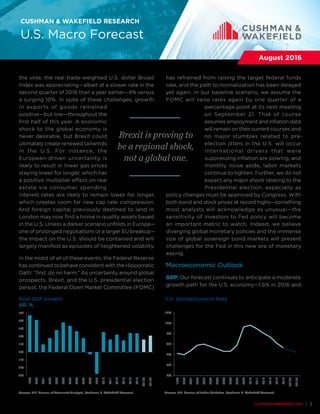
GDP: Our forecast continues to anticipate a moderate
growth path for the U.S. economy—1.6% in 2016 and
Real GDP Growth
AR, %
Source: U.S. Bureau of Economic Analysis, Cushman & Wakefield Forecast
-3%
-2%
-1%
0%
1%
2%
3%
4%
5%
1999
2000
2001
2002
2003
2004
2005
2006
2007
2008
2009
2010
2011
2012
2013
2014
2015
2016F
2017F
U.S. Unemployment Rate
Source: U.S. Bureau of Labor Statistics, Cushman & Wakefield Forecast
0%
2%
4%
6%
8%
10%
12%
1999
2000
2001
2002
2003
2004
2005
2006
2007
2008
2009
2010
2011
2012
2013
2014
2015
2016F
2017F
Brexit is proving to
be a regional shock,
not a global one.
cushmanwakefield.com | 3
CUSHMAN & WAKEFIELD RESEARCH
U.S. Macro Forecast
August 2016
2.1% in 2017. This represents a sizeable downward
revision from our last forecast and largely reflects
the downdraft created by the slowing Chinese
economy, the aftermath of Brexit, and the related
fallout in business investment. With these exogenous
shocks mostly settling down, we anticipate business
investment will improve and contribute positively to
stronger economic growth in the second half of 2016
and more so in 2017. Consumer spending will continue
to power the broader economy. Personal consumption
expenditures will grow by 2.5% in 2016 and 2.7% in
2017. Net exports will put pressure on overall growth
as exports fall year-over-year in 2016 before
rebounding by 1.1% in 2017 as global growth improves.
Employment: In line with revisions to the GDP
forecast, total employment growth is forecast to
increase, but by a lower amount than estimated in
our May forecast. After peaking above 3 million
payrolls this cycle in 2014, job creation tempered in
2015 to 2.8 million. As the economic cycle matures,
the core pace of monthly job creation is expected
to slow. Our forecast calls for 2.2 million new nonfarm
payroll jobs to be added in 2016, with monthly job
growth averaging 180,000 to 200,000 payrolls
through the remainder of the year. In 2017, we forecast
1.8 million jobs will be created at an average monthly
pace of 147,000.
The tightening labor market—evident in the decline
in the unemployment rate to 4.8% in 2016 and 4.4%
in 2017 from 5.3% in 2015—will also underpin inflation
pressures as wages and compensation notch higher.
Importantly, measures of wage, benefits, and
compensation inflation (captured by the U.S. Bureau
of Labor Statistics in various indices) will outpace
consumer inflation. The Personal Consumption
Expenditures (PCE) index (the Fed’s preferred
measure of inflation) is forecast to grow at 1.1% in
2016 and 2% in 2017, while the core PCE (excluding
the volatile energy and food components) is forecast
to grow at 1.5% and 1.6%, respectively.
U.S. Office Rents
Weighted Average Asking Rent ($/SF)
Source: Cushman & Wakefield
U.S. Office Net Absorption
MSF
Source: Cushman & Wakefield
-3%
-2%
-1%
0%
1%
2%
3%
-100
-80
-60
-40
-20
0
20
40
60
80
100
120
2000
2001
2002
2003
2004
2005
2006
2007
2008
2009
2010
2011
2012
2013
2014
2015
2016F
2017F
Absorption Net Abs % Inv
U.S. Office Vacancy Rate
Source: Cushman & Wakefield
5%
10%
15%
20%
2000
2001
2002
2003
2004
2005
2006
2007
2008
2009
2010
2011
2012
2013
2014
2015
2016F
2017F
$22
$24
$26
$28
$30
$32
2007
2008
2009
2010
2011
2012
2013
2014
2015
2016F
2017F
cushmanwakefield.com | 4
CUSHMAN & WAKEFIELD RESEARCH
U.S. Macro Forecast
August 2016
Implications for Commercial Real Estate
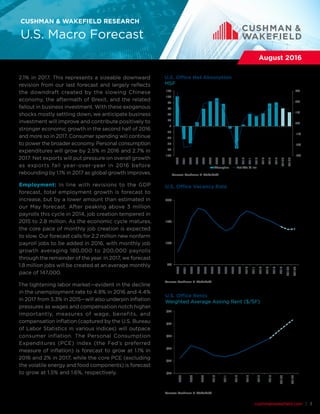
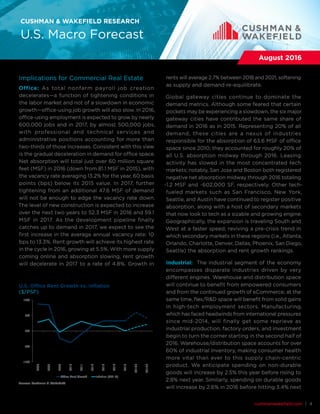
Office: As total nonfarm payroll job creation
decelerates—a function of tightening conditions in
the labor market and not of a slowdown in economic
growth—office-using job growth will also slow. In 2016,
office-using employment is expected to grow by nearly
600,000 jobs and in 2017, by almost 500,000 jobs,
with professional and technical services and
administrative positions accounting for more than
two-thirds of those increases. Consistent with this view
is the gradual deceleration in demand for office space.
Net absorption will total just over 60 million square
feet (MSF) in 2016 (down from 81.1 MSF in 2015), with
the vacancy rate averaging 13.2% for the year, 60 basis
points (bps) below its 2015 value. In 2017, further
tightening from an additional 47.6 MSF of demand
will not be enough to edge the vacancy rate down.
The level of new construction is expected to increase
over the next two years to 52.3 MSF in 2016 and 59.1
MSF in 2017. As the development pipeline finally
catches up to demand in 2017, we expect to see the
first increase in the average annual vacancy rate: 10
bps to 13.3%. Rent growth will achieve its highest rate
in the cycle in 2016, growing at 5.5%. With more supply
coming online and absorption slowing, rent growth
will decelerate in 2017 to a rate of 4.8%. Growth in
rents will average 2.7% between 2018 and 2021, softening
as supply and demand re-equilibrate.
Global gateway cities continue to dominate the
demand metrics. Although some feared that certain
pockets may be experiencing a slowdown, the six major
gateway cities have contributed the same share of
demand in 2016 as in 2015. Representing 20% of all
demand, these cities are a nexus of industries
responsible for the absorption of 63.6 MSF of office
space since 2010; they accounted for roughly 20% of
all U.S. absorption midway through 2016. Leasing
activity has slowed in the most concentrated tech
markets; notably, San Jose and Boston both registered
negative net absorption midway through 2016 totaling
-1.2 MSF and -602,000 SF, respectively. Other tech-
fueled markets such as San Francisco, New York,
Seattle, and Austin have continued to register positive
absorption, along with a host of secondary markets
that now look to tech as a sizable and growing engine.
Geographically, the expansion is traveling South and
West at a faster speed, reviving a pre-crisis trend in
which secondary markets in these regions (i.e., Atlanta,
Orlando, Charlotte, Denver, Dallas, Phoenix, San Diego,
Seattle) the absorption and rent growth rankings.
Industrial: The industrial segment of the economy
encompasses disparate industries driven by very
different engines. Warehouse and distribution space
will continue to benefit from empowered consumers
and from the continued growth of eCommerce; at the
same time, flex/R&D space will benefit from solid gains
in high-tech employment sectors. Manufacturing,
which has faced headwinds from international pressures
since mid-2014, will finally get some reprieve as
industrial production, factory orders, and investment
begin to turn the corner starting in the second half of
2016. Warehouse/distribution space accounts for over
60% of industrial inventory, making consumer health
more vital than ever to this supply chain-centric
product. We anticipate spending on non-durable
goods will increase by 2.5% this year before rising to
2.8% next year. Similarly, spending on durable goods
will increase by 2.6% in 2016 before hitting 3.4% next
U.S. Office Rent Growth vs. Inflation
($/PSF)
Source: Cushman & Wakefield
-10%
-5%
0%
5%
10%
2007
2008
2009
2010
2011
2012
2013
2014
2015
2016F
2017F
Office Rent Growth Inflation (CPI-U)
cushmanwakefield.com | 5
CUSHMAN & WAKEFIELD RESEARCH
U.S. Macro Forecast
August 2016
year. Total vehicle sales—a component of durable
goods spending—are not expected to peak until 2017,
at 17.9 million units, up from the 17.6 million expected
in 2016. All of these factors will fuel another year of
record-setting demand. We forecast U.S. industrial
net absorption in 2016 to surpass 250 MSF, besting
last year’s record-pace of 246 MSF. Net absorption
will ease somewhat in 2017 but still remain above 200
MSF—a level the industry never observed prior to the
current eCommerce-led boom.
The amount of new space in the construction pipeline
continues to climb, with more than 200 MSF of
deliveries slated for each of the next three years.
Occupiers will not feel relief for another year, as
vacancy will only see its first uptick in the latter half
of 2017. The vacancy rate is expected to fall 80 bps
this year to 5.8% in 2016 from 6.6% in 2015, before
rising to 6.0% in 2017. Strong leasing activity, appetite
for modern and transport-centric locations, and supply
constraints will feed rent growth which will hit 4.9%
in 2016 and 4.8% in 2017.
Retail: The retail landscape cannot be judged as a
monolith, but instead on the basis of individual
category (if not individual retailer) performance. But
the runways for growth for nearly every category that
has driven positive absorption in the shopping center
marketplace in the post-recession era are growing
shorter. Demand will largely remain focused on Class
A product and/or new space. Department store and
apparel users—particularly those publicly traded—will
remain in sharp contraction mode. Off-price apparel,
dollar stores, and discounters will remain in growth
mode, but these retailers will increasingly face the
challenge of market saturation after seven consecutive
years of aggressive growth. Food users (restaurants
and grocery stores) will remain in growth mode, but
saturation will increasingly lead to closures, with older
casual dining concepts the biggest losers. While plenty
of restaurant concepts remain firmly in aggressive
growth mode, look for an industry shakeout in 2017
led by weaker franchise players. Luxury demand will
continue to post positive metrics, but this category
is slowing as well. This is the case regardless of the
performance of the overall economy.
This means that the bifurcation in retail property
performance based upon class will only accelerate.
While this trend has lasted for the past five years, the
gulf between Class A and Class C properties will widen
more significantly heading into 2017. Class A projects
will continue to garner the highest levels of demand,
lowest levels of vacancy, and positive rental rate growth,
even though these metrics will be increasingly slow.
Meanwhile, Class B properties unable to improve their
position will increasingly fall into the extremely
challenged Class C category. Class B properties able
to withstand this trend include those in urban settings,
well-situated locations, and the beneficiaries of
significant capital investments that lure top level tenants.
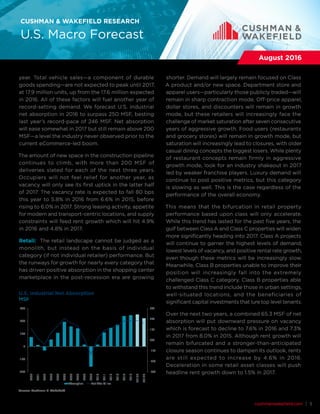
Over the next two years, a combined 65.3 MSF of net
absorption will put downward pressure on vacancy
which is forecast to decline to 7.6% in 2016 and 7.3%
in 2017 from 8.0% in 2015. Although rent growth will
remain bifurcated and a stronger-than-anticipated
closure season continues to dampen its outlook, rents
are still expected to increase by 4.6% in 2016.
Deceleration in some retail asset classes will push
headline rent growth down to 1.5% in 2017.
U.S. Industrial Net Absorption
MSF
Source: Cushman & Wakefield
-3%
-2%
-1%
0%
1%
2%
3%
-200
-100
0
100
200
300
2000
2001
2002
2003
2004
2005
2006
2007
2008
2009
2010
2011
2012
2013
2014
2015
2016F
2017F
Absorption Net Abs % Inv
cushmanwakefield.com | 6
CUSHMAN & WAKEFIELD RESEARCH
U.S. Macro Forecast
August 2016
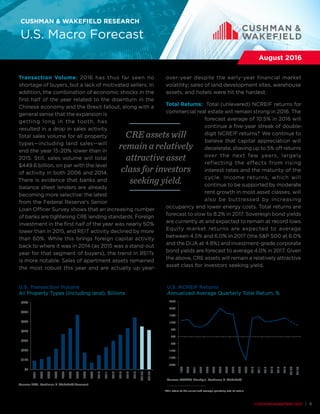
Transaction Volume: 2016 has thus far seen no
shortage of buyers, but a lack of motivated sellers. In
addition, the combination of economic shocks in the
first half of the year related to the downturn in the
Chinese economy and the Brexit fallout, along with a
general sense that the expansion is
getting long in the tooth, has
resulted in a drop in sales activity.
Total sales volume for all property
types—including land sales—will
end the year 15-20% lower than in
2015. Still, sales volume will total
$449.6 billion, on par with the level
of activity in both 2006 and 2014.
There is evidence that banks and
balance sheet lenders are already
becoming more selective: the latest
from the Federal Reserve’s Senior
Loan Officer Survey shows that an increasing number
of banks are tightening CRE lending standards. Foreign
investment in the first half of the year was nearly 50%
lower than in 2015, and REIT activity declined by more
than 60%. While this brings foreign capital activity
back to where it was in 2014 (as 2015 was a stand-out
year for that segment of buyers), the trend in REITs
is more notable. Sales of apartment assets remained
the most robust this year and are actually up year-
over-year despite the early-year financial market
volatility; sales of land development sites, warehouse
assets, and hotels were hit the hardest.
Total Returns: Total (unlevered) NCREIF returns for
commercial real estate will remain strong in 2016. The
forecast average of 10.5% in 2016 will
continue a five-year streak of double-
digit NCREIF returns.1
We continue to
believe that capital appreciation will
decelerate, shaving up to 5% off returns
over the next few years, largely
reflecting the effects from rising
interest rates and the maturity of the
cycle. Income returns, which will
continue to be supported by moderate
rent growth in most asset classes, will
also be buttressed by increasing
occupancy and lower energy costs. Total returns are
forecast to slow to 8.2% in 2017. Sovereign bond yields
are currently at and expected to remain at record lows.
Equity market returns are expected to average
between 4.5% and 6.0% in 2017 (the S&P 500 at 6.0%
and the DIJA at 4.8%) and investment-grade corporate
bond yields are forecast to average 4.0% in 2017. Given
the above, CRE assets will remain a relatively attractive
asset class for investors seeking yield.
1
This refers to the annualized average quarterly rate of return.
U.S. Transaction Volume
All Property Types (including land), Billions
Source: RCA, Cushman & Wakefield Forecast
$0
$100
$200
$300
$400
$500
$600
$700
2001
2002
2003
2004
2005
2006
2007
2008
2009
2010
2011
2012
2013
2014
2015
2016F
2017F
CRE assets will
remain a relatively
attractive asset
class for investors
seeking yield.
-20%
-15%
-10%
-5%
0%
5%
10%
15%
20%
25%
1999
2000
2001
2002
2003
2004
2005
2006
2007
2008
2009
2010
2011
2012
2013
2014
2015
2016F
2017F
U.S. NCREIF Returns
Annualized Average Quarterly Total Return, %
Source: NCREIF, Moody's, Cushman & Wakefield
cushmanwakefield.com | 7
CUSHMAN & WAKEFIELD RESEARCH
U.S. Macro Forecast
August 2016
Prices
Underlying the forecast for declines in capital returns
is a softening in pricing pressures. After rising by 13.8%
in 2015 in many asset classes, growth in CRE prices
is expected to moderate after reaching record price
levels. Price appreciation is forecast to hit 7.4% in 2016
before declining to 5.7% in 2017. Most of the decline
in pricing growth will occur towards the end of the
decade, although some softening is already evident:
luxury apartment rents have seen some steadying as
leasing velocity has weakened.
Conclusion
The slowdown in momentum in the first half of the
year was notable but unable to upset the current
economic expansion. Powered by continued
improvements in the labor markets, consumers are
and will continue to spend robustly. The headwinds
created by slowing global demand (led by a deceleration
in China’s economy) and by the uncertainty in financial
markets around Brexit did diminish trade and investment.
But as the second half of the year unfolds, we expect
those categories to pick up steam, supporting stronger
corporate profits, inflation, and real GDP growth. Though
monetary policy normalization is expected to unfold
at a slower pace than before, economic conditions
will likely warrant more rate hikes next year with the
next increase expected as soon as September.
Commercial real estate markets have fared well: vacancy
rates are falling, rent growth is positive and, for some
asset classes, reaching a cyclical peak, and leasing
velocity remains healthy. Capital markets activity will
see unique pressures from impending regulations, but
the slowdown in sales volume and pricing is in line
with a broader return to a more sustainable investment
environment.
cushmanwakefield.com | 8
CUSHMAN & WAKEFIELD RESEARCH
U.S. Macro Forecast
August 2016
U.S. Macro Forecast Table
U.S. Research • Kevin Thorpe, Global Chief Economist, • Rebecca Rockey, Head of Americas Forecasting • Tel: +1 202 463 2100
About Cushman & Wakefield
Cushman & Wakefield is a leading global real estate services firm that helps clients transform the way people work, shop, and live. Our 43,000 employees
in more than 60 countries help investors and occupiers optimize the value of their real estate by combining our global perspective and deep local
knowledge with an impressive platform of real estate solutions. To learn more, visit www.cushmanwakefield.com or follow @CushWake on Twitter
2015 2016 2017 Annual
Q4 Q1 Q2 Q3 Q4 Q1 Q2 2015 2016 2017
US Economy
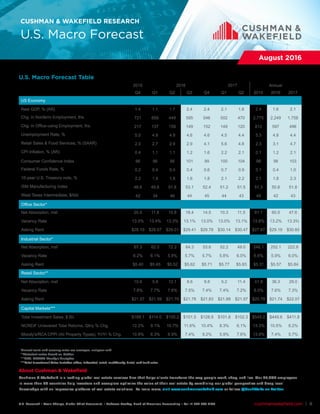
Real GDP, % (AR) 1.4 1.1 1.7 2.4 2.4 2.1 1.8 2.4 1.6 2.1
Chg. in Nonfarm Employment, ths. 721 659 449 595 546 502 470 2,775 2,249 1,758
Chg. in Office-using Employment, ths. 217 137 159 149 152 149 120 812 597 496
Unemployment Rate, % 5.0 4.9 4.9 4.6 4.6 4.5 4.4 5.3 4.8 4.4
Retail Sales & Food Services, % (SAAR) 2.0 2.7 2.9 2.9 4.1 5.6 4.8 2.3 3.1 4.7
CPI Inflation, % (AR) 0.4 1.1 1.1 1.2 1.6 2.2 2.1 0.1 1.2 2.1
Consumer Confidence Index 96 96 95 101 99 100 104 98 98 103
Federal Funds Rate, % 0.2 0.4 0.4 0.4 0.6 0.7 0.9 0.1 0.4 1.0
10-year U.S. Treasury note, % 2.2 1.9 1.8 1.6 1.8 2.1 2.2 2.1 1.8 2.3
ISM Manufacturing Index 48.6 49.8 51.8 53.1 52.4 51.2 51.5 51.3 50.8 51.8
West Texas Intermediate, $/bbl 42 34 46 44 45 44 43 49 42 43
Office Sector*
Net Absorption, msf 20.5 11.8 15.8 18.4 14.5 10.3 11.5 81.1 60.5 47.6
Vacancy Rate 13.5% 13.4% 13.3% 13.1% 13.0% 13.0% 13.1% 13.8% 13.2% 13.3%
Asking Rent $28.10 $28.57 $29.01 $29.41 $29.78 $30.14 $30.47 $27.67 $29.19 $30.60
Industrial Sector*
Net Absorption, msf 67.3 62.0 72.2 64.3 53.6 52.2 49.0 246.1 252.1 222.8
Vacancy Rate 6.2% 6.1% 5.8% 5.7% 5.7% 5.8% 6.0% 6.6% 5.9% 6.0%
Asking Rent $5.40 $5.45 $5.52 $5.62 $5.71 $5.77 $5.83 $5.31 $5.57 $5.84
Retail Sector**
Net Absorption, msf 10.6 5.8 12.1 8.6 9.8 5.2 11.4 41.8 36.3 29.0
Vacancy Rate 7.8% 7.7% 7.6% 7.5% 7.4% 7.4% 7.2% 8.0% 7.6% 7.3%
Asking Rent $21.57 $21.59 $21.76 $21.78 $21.83 $21.88 $21.97 $20.79 $21.74 $22.07
Capital Markets***
Total Investment Sales, $ Bil. $168.1 $114.0 $105.2 $101.5 $128.9 $101.8 $102.3 $545.0 $449.6 $411.8
NCREIF Unlevered Total Returns, Qtrly % Chg. 12.2% 9.1% 10.7% 11.6% 10.4% 8.3% 6.1% 13.3% 10.5% 8.2%
Moody's/RCA CPPI (All Property Types), Yr/Yr % Chg. 10.9% 6.3% 6.9% 7.4% 9.2% 5.9% 7.6% 13.8% 7.4% 5.7%
*Annual rents and vacancy rates are averages, not year-end
**Historical series based on CoStar
***RCA, NCREIF, Moody's Analytics
***Total Investment Sales includes office, industrial, retail, multifamily, hotel, and land sales

CUSHMAN & WAKEFIELD U.S. Macro Forecast

  • 1.
    cushmanwakefield.com | 1 CUSHMAN& WAKEFIELD RESEARCH U.S. Macro Forecast August 2016 Expansion: Seven Years & Going Strong • The U.S. economic expansion weathered the global shocks and remains on solid footing • Low oil prices, rising wages, and improved job security—consumers are well positioned to power growth • Brexit is proving to be a regional shock, so far, and may create additional tailwinds for the U.S. • Leasing fundamentals continue to tighten across most product types and geographies, rent growth is accelerating • Sales volume slowing to a more sustainable pace; pricing is holding up well • Returns moving lower, but still attractive compared to other asset classes U.S. Economy The U.S. economy faced some very difficult headwinds in the first half of 2016, mostly coming from overseas. In particular, the financial markets were rocked at various points this year by several factors including China’s decelerating economy, weakness in the emerging markets caused by a long-term slump in commodities, and more recently, Brexit. Throughout all of these challenges, the U.S. economy has remained impressively resilient. The key demand drivers that support the property markets—consumer confidence, job growth, low interest rates and consumer spending— all remain firmly intact. The outlier, once again, is GDP. Real GDP grew by a meager 1.0% in the first half of the year, well below its potential growth rate which is commonly believed to be closer to 3%. Over the past three years, U.S. GDP and labor markets have told two very different stories—the former pointing to perpetual sluggishness, the latter to boom- like strength. As of 2015, annual GDP growth has not exceeded 3% for 10 consecutive years, a first since the government began tracking GDP data in 1947. But 2014 and 2015 were the strongest years for job growth since 1998/1999. Through July 2016, 1.3 million jobs were created. We anticipate total job creation to surpass 2.2 million new nonfarm payrolls by the end of the year. The year-over-year growth rate in the Wages and Salary Index of the Employment Cost Index (ECI) was 2.5% in the second quarter of this year—the second highest rate since 2008. It is expected to average above 2.8% through year-end 2017. The clear strength of the labor markets, combined with low energy and gas prices, has fueled a resilient and robustly spending consumer. In fact, in the second quarter of 2016, consumer spending contributed 2.8% to GDP growth—the second strongest quarterly contribution this cycle. But this strength has been countered by the need to work down the third-largest inventory build-up ever recorded. In addition, consumers are spending differently than in the past (more on services and imports). Consequently, working through that inventory is taking more time than normal for traditional retailers. The health of the consumer is, however, observable in other data, including vehicle sales (which are hovering near record territory) and home sales (which hit a cyclical high in June). Brexit is proving to be more of a regional shock thus far, not a global one. Other than a few tough days in the stock market, the U.K. vote to exit the European Union has not significantly altered the economic trajectory in the U.S. The equity markets have already shrugged off the June 23 referendum: The Monday before the Brexit vote, the S&P 500 stood at 2,083; as of this writing (August 15, 2016), it closed at 2,190, more than 100 points higher and at a new record level. Moreover, the direct economic ties between the U.S. and the U.K. are not overly concerning. The U.K. accounts for only 2.5% of total U.S. exports, and represents less than 0.3% of U.S. GDP. Even prior to By Kevin J. Thorpe, Global Chief Economist, & Rebecca Rockey, Head of Americas Forecasting Click to view U.S. Macro Forecast Table
  • 2.
    cushmanwakefield.com | 2 CUSHMAN& WAKEFIELD RESEARCH U.S. Macro Forecast August 2016 the vote, the real trade-weighted U.S. dollar Broad Index was appreciating—albeit at a slower rate in the second quarter of 2016 than a year earlier—4% versus a surging 10%. In spite of these challenges, growth in exports of goods remained positive—but low—throughout the first half of this year. A economic shock to the global economy is never desirable, but Brexit could ultimately create renewed tailwinds in the U.S. For instance, the European-driven uncertainty is likely to result in lower gas prices staying lower for longer, which has a positive multiplier effect on real estate via consumer spending. Interest rates are likely to remain lower for longer, which creates room for new cap rate compression. And foreign capital previously destined to land in London may now find a home in quality assets based in the U.S. Unless a darker scenario unfolds in Europe— one of prolonged negotiations or a larger EU breakup— the impact on the U.S. should be contained and will largely manifest as episodes of heightened volatility. In the midst of all of these events, the Federal Reserve has continued to behave consistent with the Hippocratic Oath: “first, do no harm.” As uncertainty around global prospects, Brexit, and the U.S. presidential election persist, the Federal Open Market Committee (FOMC) has refrained from raising the target federal funds rate, and the path to normalization has been delayed yet again. In our baseline scenario, we assume the FOMC will raise rates again by one quarter of a percentage point at its next meeting on September 21. That of course assumes employment and inflation data will remain on their current courses and no major stumbles related to pre- election jitters in the U.S. will occur. International drivers that were suppressing inflation are slowing, and monthly noise aside, labor markets continue to tighten. Further, we do not expect any major shock relating to the Presidential election, especially as policy changes must be approved by Congress. With both bond and stock prices at record highs—something most analysts will acknowledge as unusual—the sensitivity of investors to Fed policy will become an important metric to watch. Indeed, we believe diverging global monetary policies and the immense size of global sovereign bond markets will present challenges for the Fed in this new era of monetary easing. Macroeconomic Outlook GDP: Our forecast continues to anticipate a moderate growth path for the U.S. economy—1.6% in 2016 and Real GDP Growth AR, % Source: U.S. Bureau of Economic Analysis, Cushman & Wakefield Forecast -3% -2% -1% 0% 1% 2% 3% 4% 5% 1999 2000 2001 2002 2003 2004 2005 2006 2007 2008 2009 2010 2011 2012 2013 2014 2015 2016F 2017F U.S. Unemployment Rate Source: U.S. Bureau of Labor Statistics, Cushman & Wakefield Forecast 0% 2% 4% 6% 8% 10% 12% 1999 2000 2001 2002 2003 2004 2005 2006 2007 2008 2009 2010 2011 2012 2013 2014 2015 2016F 2017F Brexit is proving to be a regional shock, not a global one.
  • 3.
    cushmanwakefield.com | 3 CUSHMAN& WAKEFIELD RESEARCH U.S. Macro Forecast August 2016 2.1% in 2017. This represents a sizeable downward revision from our last forecast and largely reflects the downdraft created by the slowing Chinese economy, the aftermath of Brexit, and the related fallout in business investment. With these exogenous shocks mostly settling down, we anticipate business investment will improve and contribute positively to stronger economic growth in the second half of 2016 and more so in 2017. Consumer spending will continue to power the broader economy. Personal consumption expenditures will grow by 2.5% in 2016 and 2.7% in 2017. Net exports will put pressure on overall growth as exports fall year-over-year in 2016 before rebounding by 1.1% in 2017 as global growth improves. Employment: In line with revisions to the GDP forecast, total employment growth is forecast to increase, but by a lower amount than estimated in our May forecast. After peaking above 3 million payrolls this cycle in 2014, job creation tempered in 2015 to 2.8 million. As the economic cycle matures, the core pace of monthly job creation is expected to slow. Our forecast calls for 2.2 million new nonfarm payroll jobs to be added in 2016, with monthly job growth averaging 180,000 to 200,000 payrolls through the remainder of the year. In 2017, we forecast 1.8 million jobs will be created at an average monthly pace of 147,000. The tightening labor market—evident in the decline in the unemployment rate to 4.8% in 2016 and 4.4% in 2017 from 5.3% in 2015—will also underpin inflation pressures as wages and compensation notch higher. Importantly, measures of wage, benefits, and compensation inflation (captured by the U.S. Bureau of Labor Statistics in various indices) will outpace consumer inflation. The Personal Consumption Expenditures (PCE) index (the Fed’s preferred measure of inflation) is forecast to grow at 1.1% in 2016 and 2% in 2017, while the core PCE (excluding the volatile energy and food components) is forecast to grow at 1.5% and 1.6%, respectively. U.S. Office Rents Weighted Average Asking Rent ($/SF) Source: Cushman & Wakefield U.S. Office Net Absorption MSF Source: Cushman & Wakefield -3% -2% -1% 0% 1% 2% 3% -100 -80 -60 -40 -20 0 20 40 60 80 100 120 2000 2001 2002 2003 2004 2005 2006 2007 2008 2009 2010 2011 2012 2013 2014 2015 2016F 2017F Absorption Net Abs % Inv U.S. Office Vacancy Rate Source: Cushman & Wakefield 5% 10% 15% 20% 2000 2001 2002 2003 2004 2005 2006 2007 2008 2009 2010 2011 2012 2013 2014 2015 2016F 2017F $22 $24 $26 $28 $30 $32 2007 2008 2009 2010 2011 2012 2013 2014 2015 2016F 2017F
  • 4.
    cushmanwakefield.com | 4 CUSHMAN& WAKEFIELD RESEARCH U.S. Macro Forecast August 2016 Implications for Commercial Real Estate Office: As total nonfarm payroll job creation decelerates—a function of tightening conditions in the labor market and not of a slowdown in economic growth—office-using job growth will also slow. In 2016, office-using employment is expected to grow by nearly 600,000 jobs and in 2017, by almost 500,000 jobs, with professional and technical services and administrative positions accounting for more than two-thirds of those increases. Consistent with this view is the gradual deceleration in demand for office space. Net absorption will total just over 60 million square feet (MSF) in 2016 (down from 81.1 MSF in 2015), with the vacancy rate averaging 13.2% for the year, 60 basis points (bps) below its 2015 value. In 2017, further tightening from an additional 47.6 MSF of demand will not be enough to edge the vacancy rate down. The level of new construction is expected to increase over the next two years to 52.3 MSF in 2016 and 59.1 MSF in 2017. As the development pipeline finally catches up to demand in 2017, we expect to see the first increase in the average annual vacancy rate: 10 bps to 13.3%. Rent growth will achieve its highest rate in the cycle in 2016, growing at 5.5%. With more supply coming online and absorption slowing, rent growth will decelerate in 2017 to a rate of 4.8%. Growth in rents will average 2.7% between 2018 and 2021, softening as supply and demand re-equilibrate. Global gateway cities continue to dominate the demand metrics. Although some feared that certain pockets may be experiencing a slowdown, the six major gateway cities have contributed the same share of demand in 2016 as in 2015. Representing 20% of all demand, these cities are a nexus of industries responsible for the absorption of 63.6 MSF of office space since 2010; they accounted for roughly 20% of all U.S. absorption midway through 2016. Leasing activity has slowed in the most concentrated tech markets; notably, San Jose and Boston both registered negative net absorption midway through 2016 totaling -1.2 MSF and -602,000 SF, respectively. Other tech- fueled markets such as San Francisco, New York, Seattle, and Austin have continued to register positive absorption, along with a host of secondary markets that now look to tech as a sizable and growing engine. Geographically, the expansion is traveling South and West at a faster speed, reviving a pre-crisis trend in which secondary markets in these regions (i.e., Atlanta, Orlando, Charlotte, Denver, Dallas, Phoenix, San Diego, Seattle) the absorption and rent growth rankings. Industrial: The industrial segment of the economy encompasses disparate industries driven by very different engines. Warehouse and distribution space will continue to benefit from empowered consumers and from the continued growth of eCommerce; at the same time, flex/R&D space will benefit from solid gains in high-tech employment sectors. Manufacturing, which has faced headwinds from international pressures since mid-2014, will finally get some reprieve as industrial production, factory orders, and investment begin to turn the corner starting in the second half of 2016. Warehouse/distribution space accounts for over 60% of industrial inventory, making consumer health more vital than ever to this supply chain-centric product. We anticipate spending on non-durable goods will increase by 2.5% this year before rising to 2.8% next year. Similarly, spending on durable goods will increase by 2.6% in 2016 before hitting 3.4% next U.S. Office Rent Growth vs. Inflation ($/PSF) Source: Cushman & Wakefield -10% -5% 0% 5% 10% 2007 2008 2009 2010 2011 2012 2013 2014 2015 2016F 2017F Office Rent Growth Inflation (CPI-U)
  • 5.
    cushmanwakefield.com | 5 CUSHMAN& WAKEFIELD RESEARCH U.S. Macro Forecast August 2016 year. Total vehicle sales—a component of durable goods spending—are not expected to peak until 2017, at 17.9 million units, up from the 17.6 million expected in 2016. All of these factors will fuel another year of record-setting demand. We forecast U.S. industrial net absorption in 2016 to surpass 250 MSF, besting last year’s record-pace of 246 MSF. Net absorption will ease somewhat in 2017 but still remain above 200 MSF—a level the industry never observed prior to the current eCommerce-led boom. The amount of new space in the construction pipeline continues to climb, with more than 200 MSF of deliveries slated for each of the next three years. Occupiers will not feel relief for another year, as vacancy will only see its first uptick in the latter half of 2017. The vacancy rate is expected to fall 80 bps this year to 5.8% in 2016 from 6.6% in 2015, before rising to 6.0% in 2017. Strong leasing activity, appetite for modern and transport-centric locations, and supply constraints will feed rent growth which will hit 4.9% in 2016 and 4.8% in 2017. Retail: The retail landscape cannot be judged as a monolith, but instead on the basis of individual category (if not individual retailer) performance. But the runways for growth for nearly every category that has driven positive absorption in the shopping center marketplace in the post-recession era are growing shorter. Demand will largely remain focused on Class A product and/or new space. Department store and apparel users—particularly those publicly traded—will remain in sharp contraction mode. Off-price apparel, dollar stores, and discounters will remain in growth mode, but these retailers will increasingly face the challenge of market saturation after seven consecutive years of aggressive growth. Food users (restaurants and grocery stores) will remain in growth mode, but saturation will increasingly lead to closures, with older casual dining concepts the biggest losers. While plenty of restaurant concepts remain firmly in aggressive growth mode, look for an industry shakeout in 2017 led by weaker franchise players. Luxury demand will continue to post positive metrics, but this category is slowing as well. This is the case regardless of the performance of the overall economy. This means that the bifurcation in retail property performance based upon class will only accelerate. While this trend has lasted for the past five years, the gulf between Class A and Class C properties will widen more significantly heading into 2017. Class A projects will continue to garner the highest levels of demand, lowest levels of vacancy, and positive rental rate growth, even though these metrics will be increasingly slow. Meanwhile, Class B properties unable to improve their position will increasingly fall into the extremely challenged Class C category. Class B properties able to withstand this trend include those in urban settings, well-situated locations, and the beneficiaries of significant capital investments that lure top level tenants. Over the next two years, a combined 65.3 MSF of net absorption will put downward pressure on vacancy which is forecast to decline to 7.6% in 2016 and 7.3% in 2017 from 8.0% in 2015. Although rent growth will remain bifurcated and a stronger-than-anticipated closure season continues to dampen its outlook, rents are still expected to increase by 4.6% in 2016. Deceleration in some retail asset classes will push headline rent growth down to 1.5% in 2017. U.S. Industrial Net Absorption MSF Source: Cushman & Wakefield -3% -2% -1% 0% 1% 2% 3% -200 -100 0 100 200 300 2000 2001 2002 2003 2004 2005 2006 2007 2008 2009 2010 2011 2012 2013 2014 2015 2016F 2017F Absorption Net Abs % Inv
  • 6.
    cushmanwakefield.com | 6 CUSHMAN& WAKEFIELD RESEARCH U.S. Macro Forecast August 2016 Transaction Volume: 2016 has thus far seen no shortage of buyers, but a lack of motivated sellers. In addition, the combination of economic shocks in the first half of the year related to the downturn in the Chinese economy and the Brexit fallout, along with a general sense that the expansion is getting long in the tooth, has resulted in a drop in sales activity. Total sales volume for all property types—including land sales—will end the year 15-20% lower than in 2015. Still, sales volume will total $449.6 billion, on par with the level of activity in both 2006 and 2014. There is evidence that banks and balance sheet lenders are already becoming more selective: the latest from the Federal Reserve’s Senior Loan Officer Survey shows that an increasing number of banks are tightening CRE lending standards. Foreign investment in the first half of the year was nearly 50% lower than in 2015, and REIT activity declined by more than 60%. While this brings foreign capital activity back to where it was in 2014 (as 2015 was a stand-out year for that segment of buyers), the trend in REITs is more notable. Sales of apartment assets remained the most robust this year and are actually up year- over-year despite the early-year financial market volatility; sales of land development sites, warehouse assets, and hotels were hit the hardest. Total Returns: Total (unlevered) NCREIF returns for commercial real estate will remain strong in 2016. The forecast average of 10.5% in 2016 will continue a five-year streak of double- digit NCREIF returns.1 We continue to believe that capital appreciation will decelerate, shaving up to 5% off returns over the next few years, largely reflecting the effects from rising interest rates and the maturity of the cycle. Income returns, which will continue to be supported by moderate rent growth in most asset classes, will also be buttressed by increasing occupancy and lower energy costs. Total returns are forecast to slow to 8.2% in 2017. Sovereign bond yields are currently at and expected to remain at record lows. Equity market returns are expected to average between 4.5% and 6.0% in 2017 (the S&P 500 at 6.0% and the DIJA at 4.8%) and investment-grade corporate bond yields are forecast to average 4.0% in 2017. Given the above, CRE assets will remain a relatively attractive asset class for investors seeking yield. 1 This refers to the annualized average quarterly rate of return. U.S. Transaction Volume All Property Types (including land), Billions Source: RCA, Cushman & Wakefield Forecast $0 $100 $200 $300 $400 $500 $600 $700 2001 2002 2003 2004 2005 2006 2007 2008 2009 2010 2011 2012 2013 2014 2015 2016F 2017F CRE assets will remain a relatively attractive asset class for investors seeking yield. -20% -15% -10% -5% 0% 5% 10% 15% 20% 25% 1999 2000 2001 2002 2003 2004 2005 2006 2007 2008 2009 2010 2011 2012 2013 2014 2015 2016F 2017F U.S. NCREIF Returns Annualized Average Quarterly Total Return, % Source: NCREIF, Moody's, Cushman & Wakefield
  • 7.
    cushmanwakefield.com | 7 CUSHMAN& WAKEFIELD RESEARCH U.S. Macro Forecast August 2016 Prices Underlying the forecast for declines in capital returns is a softening in pricing pressures. After rising by 13.8% in 2015 in many asset classes, growth in CRE prices is expected to moderate after reaching record price levels. Price appreciation is forecast to hit 7.4% in 2016 before declining to 5.7% in 2017. Most of the decline in pricing growth will occur towards the end of the decade, although some softening is already evident: luxury apartment rents have seen some steadying as leasing velocity has weakened. Conclusion The slowdown in momentum in the first half of the year was notable but unable to upset the current economic expansion. Powered by continued improvements in the labor markets, consumers are and will continue to spend robustly. The headwinds created by slowing global demand (led by a deceleration in China’s economy) and by the uncertainty in financial markets around Brexit did diminish trade and investment. But as the second half of the year unfolds, we expect those categories to pick up steam, supporting stronger corporate profits, inflation, and real GDP growth. Though monetary policy normalization is expected to unfold at a slower pace than before, economic conditions will likely warrant more rate hikes next year with the next increase expected as soon as September. Commercial real estate markets have fared well: vacancy rates are falling, rent growth is positive and, for some asset classes, reaching a cyclical peak, and leasing velocity remains healthy. Capital markets activity will see unique pressures from impending regulations, but the slowdown in sales volume and pricing is in line with a broader return to a more sustainable investment environment.
  • 8.
    cushmanwakefield.com | 8 CUSHMAN& WAKEFIELD RESEARCH U.S. Macro Forecast August 2016 U.S. Macro Forecast Table U.S. Research • Kevin Thorpe, Global Chief Economist, • Rebecca Rockey, Head of Americas Forecasting • Tel: +1 202 463 2100 About Cushman & Wakefield Cushman & Wakefield is a leading global real estate services firm that helps clients transform the way people work, shop, and live. Our 43,000 employees in more than 60 countries help investors and occupiers optimize the value of their real estate by combining our global perspective and deep local knowledge with an impressive platform of real estate solutions. To learn more, visit www.cushmanwakefield.com or follow @CushWake on Twitter 2015 2016 2017 Annual Q4 Q1 Q2 Q3 Q4 Q1 Q2 2015 2016 2017 US Economy Real GDP, % (AR) 1.4 1.1 1.7 2.4 2.4 2.1 1.8 2.4 1.6 2.1 Chg. in Nonfarm Employment, ths. 721 659 449 595 546 502 470 2,775 2,249 1,758 Chg. in Office-using Employment, ths. 217 137 159 149 152 149 120 812 597 496 Unemployment Rate, % 5.0 4.9 4.9 4.6 4.6 4.5 4.4 5.3 4.8 4.4 Retail Sales & Food Services, % (SAAR) 2.0 2.7 2.9 2.9 4.1 5.6 4.8 2.3 3.1 4.7 CPI Inflation, % (AR) 0.4 1.1 1.1 1.2 1.6 2.2 2.1 0.1 1.2 2.1 Consumer Confidence Index 96 96 95 101 99 100 104 98 98 103 Federal Funds Rate, % 0.2 0.4 0.4 0.4 0.6 0.7 0.9 0.1 0.4 1.0 10-year U.S. Treasury note, % 2.2 1.9 1.8 1.6 1.8 2.1 2.2 2.1 1.8 2.3 ISM Manufacturing Index 48.6 49.8 51.8 53.1 52.4 51.2 51.5 51.3 50.8 51.8 West Texas Intermediate, $/bbl 42 34 46 44 45 44 43 49 42 43 Office Sector* Net Absorption, msf 20.5 11.8 15.8 18.4 14.5 10.3 11.5 81.1 60.5 47.6 Vacancy Rate 13.5% 13.4% 13.3% 13.1% 13.0% 13.0% 13.1% 13.8% 13.2% 13.3% Asking Rent $28.10 $28.57 $29.01 $29.41 $29.78 $30.14 $30.47 $27.67 $29.19 $30.60 Industrial Sector* Net Absorption, msf 67.3 62.0 72.2 64.3 53.6 52.2 49.0 246.1 252.1 222.8 Vacancy Rate 6.2% 6.1% 5.8% 5.7% 5.7% 5.8% 6.0% 6.6% 5.9% 6.0% Asking Rent $5.40 $5.45 $5.52 $5.62 $5.71 $5.77 $5.83 $5.31 $5.57 $5.84 Retail Sector** Net Absorption, msf 10.6 5.8 12.1 8.6 9.8 5.2 11.4 41.8 36.3 29.0 Vacancy Rate 7.8% 7.7% 7.6% 7.5% 7.4% 7.4% 7.2% 8.0% 7.6% 7.3% Asking Rent $21.57 $21.59 $21.76 $21.78 $21.83 $21.88 $21.97 $20.79 $21.74 $22.07 Capital Markets*** Total Investment Sales, $ Bil. $168.1 $114.0 $105.2 $101.5 $128.9 $101.8 $102.3 $545.0 $449.6 $411.8 NCREIF Unlevered Total Returns, Qtrly % Chg. 12.2% 9.1% 10.7% 11.6% 10.4% 8.3% 6.1% 13.3% 10.5% 8.2% Moody's/RCA CPPI (All Property Types), Yr/Yr % Chg. 10.9% 6.3% 6.9% 7.4% 9.2% 5.9% 7.6% 13.8% 7.4% 5.7% *Annual rents and vacancy rates are averages, not year-end **Historical series based on CoStar ***RCA, NCREIF, Moody's Analytics ***Total Investment Sales includes office, industrial, retail, multifamily, hotel, and land sales