MNI Connect
Video Conference
Governor of Latvijas Banka
Member of the ECB's Governing Council
Mārtiņš Kazāks, PhD
Labour markets remain tight across most dimensions; upside
risks to wage growth.
Main
takeaways
Profit margins remain strong, implying robust demand.
Headline inflation is falling, core remains stubbornly high; strong
labour markets and profit margins may strengthen persistence;
risks of inflation de-anchoring remain.
The economy more resilient than it was forecasted late last year;
recession avoided so far; some rebound in growth in the short term.
Some tightening of financial conditions, generally in line with
monetary tightening; no signs of disorderly developments so far.
Monetary policy: uncertainty remains high, policy lags uncertain; yet,
further rate hikes necessary to bring inflation to the target in a timely
manner (by end 2024?); rates to remain elevated at sufficiently
restrictive levels; balance sheet reduction to be cautious, but persistent.
Bloomberg 1-year ahead recession probability index (in %) and changes in probability since November, 2022 (% and % points)
-10
10
30
50
70
90
110
01/13
01/14
01/15
01/16
01/17
01/18
01/19
01/20
01/21
01/22
01/23
EA US UK
EA US UK
80
60
80
45
65 65
-40
-20
0
20
40
60
80
100
EA USA UK
Change since
Nov-22
Recession
probability in
Nov-22
Recession
probability, latest
(April, 2023)
3 Source: Bloomberg, Latvijas Banka staff calculations.
Economy more resilient than it was forecasted late last year:
recession fears have retreated
EA PMI (balance of answers)
30
35
40
45
50
55
60
65
70
05/21 08/21 11/21 02/22 05/22 08/22 11/22 02/23
Composite Manufacturing Services
EA GDP (%; q-o-q), Eurocoin (%; m-o-m) and
sentiment (point) indicators
4 Sources: S&P Global, Eurostat, EC, ECB, Eurocoin and Latvijas Banka's calculations.
Economy more resilient than it was forecasted late last year:
growth expected to rebound, albeit moderately
30
35
40
45
50
55
60
65
70
-1
-0.8
-0.6
-0.4
-0.2
0
0.2
0.4
0.6
0.8
1
02/22 06/22 10/22 02/23 06/23 10/23 02/24
GDP Mar MPE Dec BMPE
Eurocoin Composite PMI (rhs) ESI/2 (rhs)
Labor market indicators (normalized)
Unemployment rate (inv.)
Underemployment rate (inv.)
Youth employment rate (inv.)
Share long-term unemployment (inv.)
Short-term unemployment rate (three months)
(inv.)
Job separation rate (inv.)
Job finding rate
Job vacancy rate
Factors limiting production, shortage of labour
Employment (growth)
EEI (replace PMI on employment)
Compensation per hour (growth)
Labour productivity per hour (growth)
Average hours worked (growth)
Employment -population ratio (prime-age)
Labour force participation
2011-2015
2019
2022
Latest
5
Sources: Eurostat, EC and Latvijas Banka calculations.
Note: Based on ECB (2019). Momentum calculated as Principal component of the labor market indicators in radar chart, Q1 2010 – Q4 2022.
Labor market remains tight across most segments
Relationship between unemployment and wage
growth in EA, 1Q2012 - 4Q2022
Compensation per employee in EA countries
(annual % change)
6 Sources: Eurostat and Latvijas Banka's calculations.
Philips curve waking up?
Tight labour market and high inflation fuell wage demands
-10.0
-8.0
-6.0
-4.0
-2.0
0.0
2.0
4.0
6.0
8.0
10.0
12.0
14.0
Q1
2012
Q1
2013
Q1
2014
Q1
2015
Q1
2016
Q1
2017
Q1
2018
Q1
2019
Q1
2020
Q1
2021
Q1
2022
EA GER FRA
ESP ITA NED
0.0
1.0
2.0
3.0
4.0
5.0
6.0
6.0 8.0 10.0 12.0 14.0
Compensation
per
employee
(annual
%
change)
Unemployment rate (%)
Q1 2012-Q1 2021
Q3 2021-Q4 2022
Headline, core and energy inflation (%) and changes since November, 2022 (% points)
-15
0
15
30
45
60
-5
0
5
10
15
20
01/08 10/09 07/11 04/13 01/15 10/16 07/18 04/20 01/22
Headline inflation
Core inflation
Energy (rhs)
7 Source: Eurostat.
Energy prices have dropped, pulling down headline inflation;
core remains stubbornly high
7
5.6
2.5
-3.1
0.6
-32.4
-35
-30
-25
-20
-15
-10
-5
0
5
10
Headline inflation Core inflation Energy
Annual rate, April 2023
Changes from November
Inflation momentum (%; y-o-y and 3m/3m annualized; SA)
8
Apart for energy, inflation momentum has not turned yet
0
1
2
3
4
5
6
7
8
9
10
05/22 09/22 01/23
Momentum
Core
0
2
4
6
8
10
12
14
16
18
05/22 09/22 01/23
Momentum
Food
-30
-20
-10
0
10
20
30
40
50
60
05/22 09/22 01/23
Momentum
Energy
0
1
2
3
4
5
6
7
8
05/22 09/22 01/23
Momentum
NEIG
0
1
2
3
4
5
6
7
05/22 09/22 01/23
Momentum
Services
0
2
4
6
8
10
12
14
16
18
05/22 09/22 01/23
Momentum
Total
Sources: SDW and BoL calculations.
Latest data: March 2023 (flash April 2023 for total).
Gross profit margin of NFCs in EA
(% of value added)
25
30
35
40
45
50
2013 2014 2015 2016 2017 2018 2019 2020 2021 2022
Euro area Germany Spain
France Italy
Profit share of value added (nominal gross
operating surplus / nominal value added)
0.35
0.4
0.45
0.5
0.55
0.6
2013 2015 2016 2018 2020 2022
All activities
Construction
Industry (except construction)
Retail, transport, accommodation and food services
Sources: Eurostat and Latvijas Banka's calculations.
Latest data: Q4 2022.
Notes: when calculating profit share, taxes are not subtracted from profit due to lack of data. Actual profit share is lower.
Profit margins remain strong: firms able to pass through their
cost increases (and more?)
9
Outstanding MFIs’ loans in the Euro Area: stocks
(tn €) and growth rates (y-o-y %) by sector
Easing of credit standards by sector
(net % of reporting banks)
10 Source: ECB’s Statistical Data Warehouse, ECB`s Bank Lending Survey.
Credit growth is slowing, credit standarts become tighter
0
2
4
6
8
10
12
14
0
5
10
15
20
01/19 07/19 01/20 07/20 01/21 07/21 01/22 07/22 01/23
Stocks, households
Stocks, non-financial corporations
Growth rate, non-financial corporations (right)
Growth rate, households (right)
Growth rate, total (right)
-35
-30
-25
-20
-15
-10
-5
0
5
10
15
Q1
2019
Q3 Q1
2020
Q3 Q1
2021
Q3 Q1
2022
Q3 Q1
2023
Observed, non-financial corporations Observed, households (housing)
Forecasted, non-financial corporations Forecasted, households (housing)
Easing
Tightening
Factors determining tightening of credit standards for loans to enterprises (net % of reporting banks)
11 Source: ECB’s Bank lending survey.
-5% 0% 5% 10% 15% 20% 25% 30% 35% 40%
Capital position
Access to market financing
Liquidity position
Competition from other banks
Competition from non-banks
Competition from market financing
General economic situation and outlook
Industry or firm-specific situation and outlook
Risk related to the collateral demanded
Bank's risk tolerance
Q1, 22 Q2, 22 Q3, 22 Q4, 22 Q1, 23
Credit growth is slowing, limited spillovers from the US
Euro zone banks' bond yields spread versus 5Y
OIS swap rates (basis points)
0
50
100
150
200
250
300
350
400
450
01.2020 07.2020 01.2021 07.2021 01.2022 07.2022 01.2023
iBoxx EUR Collateralized Index iBoxx EUR Banks Subordinated
iBoxx EUR Banks Senior Preferred iBoxx EUR Banks Senior Bail-in
European and US banks stock price indexes
(01.01.2020. =100)
40
50
60
70
80
90
100
110
120
01.2020 07.2020 01.2021 07.2021 01.2022 07.2022 01.2023
EURO STOXX BANKS S&P 500 BANKS
12 Source: Refinitiv; Bloomberg, Latvijas Banka staff calculations.
Financial stability risks so far contained: no extra tightening
10Y government bond nominal yields (%) Government bond real yields* (%)
13
*Calculated as difference between GDP weighted nominal yield and corresponding euro area inflation swap rate.
Source: Bloomberg, Refinitiv, ECB.
Government bond yields rise along with policy rates;
back into positive territory
-5
-4
-3
-2
-1
0
1
2
3
2020 2021 2022 2023
Euro zone 2Y US 2Y Euro zone 10Y US 10Y
-1
0
1
2
3
4
5
01/20 07/20 01/21 07/21 01/22 07/22 01/23
IT PT ES FR NL DE
14 Source: Bloomberg, ECB SPF.
0
0.5
1
1.5
2
2.5
3
3.5
Q3
2004
Q1
2006
Q3
2007
Q1
2009
Q3
2010
Q1
2012
Q3
2013
Q1
2015
Q3
2016
Q1
2018
Q3
2019
Q1
2021
Q3
2022
EA 5y5y US 5y5y EA 1y1y ECB target
Market-based measure of inflation expectations Longer-term (2027) SPF inflation expectations (%)
Long-term inflation expectations: anchored, but risks remain
o o o o o o o o o o
15
Terminal rate
expectations at higher
level compared to end
of 2022, but still lower
than pre-SVB
With policy rates into restrictive territory,
smaller rate hikes appropriate;
transmission lags uncertain.
Policy decisions data-dependent: smaller
size of rate hikes does not necessarily
imply the near end of the tightening cycle.
Does the speed of travel matter or is it
only the total distance that matters?
Balance sheet reduction: alingning all
instruments and re-creating policy space.
Overnight money market and policy rates (%)
16 Source: ECB, LB estimates
With policy rates likely in restrictive territory,
smaller size of rate hikes is appropriate
-1.0
-0.5
0.0
0.5
1.0
1.5
2.0
2.5
3.0
3.5
01/20 07/20 01/21 07/21 01/22 07/22 01/23
Range of most plausible estimates of i* €STR Deposit facility rate
17 Source: Bloomberg, Refinitiv.
Monetary policy:
further rate increases
and balance sheet
reduction to follow
Current profile hard to square
with current inflation outlook.
-1
-0.5
0
0.5
1
1.5
2
2.5
3
3.5
4
4.5
2022 2023 2024 2025 2026
ESTR forward curve (% per annum)
ESTR forward curve, pre-SVB collapse (2023-03-09)
ESTR forward curve, pre-march GovC (2023-03-15)
ESTR forward curve, latest (2023-05-09)
ESTR
18
Risk management: minimize the worst-case scenario
Current balance in favour of resolute action to combat inflation forces
Risks of
doing too
much
Risks of
doing too
little
• Too low ex-ante real rates due
to persistent inflation surprises;
• Potential de-anchoring of
inflation expectations;
• Higher terminal rates, as policy
needs to correct for past
under-shooting;
• Interest rate volatility diluting
the impact of monetary policy
signal;
• Potential for a boom-bust cycle
in the economy;
• Potentially deeper recession
than in the case of gradual
interest rate adjustment.
• Policy overshooting leading to
renewed recession and deflation
risks over the medium term;
• Faster pace of interest rate hikes
may amplify credit slowdown,
lead to credit crunch and
financial stability concerns;
• Public debts sustainability
concerns rising (at least in some
jurisdictions);
• In case of a potentially quick
reversal of policy stance,
interest rate volatility may
increase;
• Risks of credibility weakening if
rate reversal perceived as a
policy mistake.
19
Balance sheet reduction: TLTRO repayments do the most,
APP to chip in, PEPP flexibility to be retained
Sources: ECB
Eurosystem’s monetary policy assets (EUR trillion)
-
1
2
3
4
5
6
7
8
Jan-19
Mar-19
May-19
Jul-19
Sep-19
Nov-19
Jan-20
Mar-20
May-20
Jul-20
Sep-20
Nov-20
Jan-21
Mar-21
May-21
Jul-21
Sep-21
Nov-21
Jan-22
Mar-22
May-22
Jul-22
Sep-22
Nov-22
Jan-23
Mar-23
May-23
Jul-23
Sep-23
Nov-23
Jan-24
Mar-24
May-24
Jul-24
Sep-24
Nov-24
Jan-25
Mar-25
May-25
Jul-25
Sep-25
Nov-25
Jan-26
Credit operations APP PEPP
20
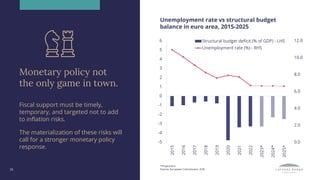
Unemployment rate vs structural budget
balance in euro area, 2015-2025
*Projections
Source: European Commission, ECB.
Monetary policy not
the only game in town.
0.0
2.0
4.0
6.0
8.0
10.0
12.0
-5
-4
-3
-2
-1
0
1
2
3
4
5
6
2015
2016
2017
2018
2019
2020
2021
2022
2023*
2024*
2025*
Structural budget deficit (% of GDP) - LHS
Unemployment rate (%) - RHS
Fiscal support must be timely,
temporary, and targeted not to add
to inflation risks.
The materialization of these risks will
call for a stronger monetary policy
response.
Thank you!
21

MNI Connect

  • 1.
    MNI Connect Video Conference Governorof Latvijas Banka Member of the ECB's Governing Council Mārtiņš Kazāks, PhD
  • 2.
    Labour markets remaintight across most dimensions; upside risks to wage growth. Main takeaways Profit margins remain strong, implying robust demand. Headline inflation is falling, core remains stubbornly high; strong labour markets and profit margins may strengthen persistence; risks of inflation de-anchoring remain. The economy more resilient than it was forecasted late last year; recession avoided so far; some rebound in growth in the short term. Some tightening of financial conditions, generally in line with monetary tightening; no signs of disorderly developments so far. Monetary policy: uncertainty remains high, policy lags uncertain; yet, further rate hikes necessary to bring inflation to the target in a timely manner (by end 2024?); rates to remain elevated at sufficiently restrictive levels; balance sheet reduction to be cautious, but persistent.
  • 3.
    Bloomberg 1-year aheadrecession probability index (in %) and changes in probability since November, 2022 (% and % points) -10 10 30 50 70 90 110 01/13 01/14 01/15 01/16 01/17 01/18 01/19 01/20 01/21 01/22 01/23 EA US UK EA US UK 80 60 80 45 65 65 -40 -20 0 20 40 60 80 100 EA USA UK Change since Nov-22 Recession probability in Nov-22 Recession probability, latest (April, 2023) 3 Source: Bloomberg, Latvijas Banka staff calculations. Economy more resilient than it was forecasted late last year: recession fears have retreated
  • 4.
    EA PMI (balanceof answers) 30 35 40 45 50 55 60 65 70 05/21 08/21 11/21 02/22 05/22 08/22 11/22 02/23 Composite Manufacturing Services EA GDP (%; q-o-q), Eurocoin (%; m-o-m) and sentiment (point) indicators 4 Sources: S&P Global, Eurostat, EC, ECB, Eurocoin and Latvijas Banka's calculations. Economy more resilient than it was forecasted late last year: growth expected to rebound, albeit moderately 30 35 40 45 50 55 60 65 70 -1 -0.8 -0.6 -0.4 -0.2 0 0.2 0.4 0.6 0.8 1 02/22 06/22 10/22 02/23 06/23 10/23 02/24 GDP Mar MPE Dec BMPE Eurocoin Composite PMI (rhs) ESI/2 (rhs)
  • 5.
    Labor market indicators(normalized) Unemployment rate (inv.) Underemployment rate (inv.) Youth employment rate (inv.) Share long-term unemployment (inv.) Short-term unemployment rate (three months) (inv.) Job separation rate (inv.) Job finding rate Job vacancy rate Factors limiting production, shortage of labour Employment (growth) EEI (replace PMI on employment) Compensation per hour (growth) Labour productivity per hour (growth) Average hours worked (growth) Employment -population ratio (prime-age) Labour force participation 2011-2015 2019 2022 Latest 5 Sources: Eurostat, EC and Latvijas Banka calculations. Note: Based on ECB (2019). Momentum calculated as Principal component of the labor market indicators in radar chart, Q1 2010 – Q4 2022. Labor market remains tight across most segments
  • 6.
    Relationship between unemploymentand wage growth in EA, 1Q2012 - 4Q2022 Compensation per employee in EA countries (annual % change) 6 Sources: Eurostat and Latvijas Banka's calculations. Philips curve waking up? Tight labour market and high inflation fuell wage demands -10.0 -8.0 -6.0 -4.0 -2.0 0.0 2.0 4.0 6.0 8.0 10.0 12.0 14.0 Q1 2012 Q1 2013 Q1 2014 Q1 2015 Q1 2016 Q1 2017 Q1 2018 Q1 2019 Q1 2020 Q1 2021 Q1 2022 EA GER FRA ESP ITA NED 0.0 1.0 2.0 3.0 4.0 5.0 6.0 6.0 8.0 10.0 12.0 14.0 Compensation per employee (annual % change) Unemployment rate (%) Q1 2012-Q1 2021 Q3 2021-Q4 2022
  • 7.
    Headline, core andenergy inflation (%) and changes since November, 2022 (% points) -15 0 15 30 45 60 -5 0 5 10 15 20 01/08 10/09 07/11 04/13 01/15 10/16 07/18 04/20 01/22 Headline inflation Core inflation Energy (rhs) 7 Source: Eurostat. Energy prices have dropped, pulling down headline inflation; core remains stubbornly high 7 5.6 2.5 -3.1 0.6 -32.4 -35 -30 -25 -20 -15 -10 -5 0 5 10 Headline inflation Core inflation Energy Annual rate, April 2023 Changes from November
  • 8.
    Inflation momentum (%;y-o-y and 3m/3m annualized; SA) 8 Apart for energy, inflation momentum has not turned yet 0 1 2 3 4 5 6 7 8 9 10 05/22 09/22 01/23 Momentum Core 0 2 4 6 8 10 12 14 16 18 05/22 09/22 01/23 Momentum Food -30 -20 -10 0 10 20 30 40 50 60 05/22 09/22 01/23 Momentum Energy 0 1 2 3 4 5 6 7 8 05/22 09/22 01/23 Momentum NEIG 0 1 2 3 4 5 6 7 05/22 09/22 01/23 Momentum Services 0 2 4 6 8 10 12 14 16 18 05/22 09/22 01/23 Momentum Total Sources: SDW and BoL calculations. Latest data: March 2023 (flash April 2023 for total).
  • 9.
    Gross profit marginof NFCs in EA (% of value added) 25 30 35 40 45 50 2013 2014 2015 2016 2017 2018 2019 2020 2021 2022 Euro area Germany Spain France Italy Profit share of value added (nominal gross operating surplus / nominal value added) 0.35 0.4 0.45 0.5 0.55 0.6 2013 2015 2016 2018 2020 2022 All activities Construction Industry (except construction) Retail, transport, accommodation and food services Sources: Eurostat and Latvijas Banka's calculations. Latest data: Q4 2022. Notes: when calculating profit share, taxes are not subtracted from profit due to lack of data. Actual profit share is lower. Profit margins remain strong: firms able to pass through their cost increases (and more?) 9
  • 10.
    Outstanding MFIs’ loansin the Euro Area: stocks (tn €) and growth rates (y-o-y %) by sector Easing of credit standards by sector (net % of reporting banks) 10 Source: ECB’s Statistical Data Warehouse, ECB`s Bank Lending Survey. Credit growth is slowing, credit standarts become tighter 0 2 4 6 8 10 12 14 0 5 10 15 20 01/19 07/19 01/20 07/20 01/21 07/21 01/22 07/22 01/23 Stocks, households Stocks, non-financial corporations Growth rate, non-financial corporations (right) Growth rate, households (right) Growth rate, total (right) -35 -30 -25 -20 -15 -10 -5 0 5 10 15 Q1 2019 Q3 Q1 2020 Q3 Q1 2021 Q3 Q1 2022 Q3 Q1 2023 Observed, non-financial corporations Observed, households (housing) Forecasted, non-financial corporations Forecasted, households (housing) Easing Tightening
  • 11.
    Factors determining tighteningof credit standards for loans to enterprises (net % of reporting banks) 11 Source: ECB’s Bank lending survey. -5% 0% 5% 10% 15% 20% 25% 30% 35% 40% Capital position Access to market financing Liquidity position Competition from other banks Competition from non-banks Competition from market financing General economic situation and outlook Industry or firm-specific situation and outlook Risk related to the collateral demanded Bank's risk tolerance Q1, 22 Q2, 22 Q3, 22 Q4, 22 Q1, 23 Credit growth is slowing, limited spillovers from the US
  • 12.
    Euro zone banks'bond yields spread versus 5Y OIS swap rates (basis points) 0 50 100 150 200 250 300 350 400 450 01.2020 07.2020 01.2021 07.2021 01.2022 07.2022 01.2023 iBoxx EUR Collateralized Index iBoxx EUR Banks Subordinated iBoxx EUR Banks Senior Preferred iBoxx EUR Banks Senior Bail-in European and US banks stock price indexes (01.01.2020. =100) 40 50 60 70 80 90 100 110 120 01.2020 07.2020 01.2021 07.2021 01.2022 07.2022 01.2023 EURO STOXX BANKS S&P 500 BANKS 12 Source: Refinitiv; Bloomberg, Latvijas Banka staff calculations. Financial stability risks so far contained: no extra tightening
  • 13.
    10Y government bondnominal yields (%) Government bond real yields* (%) 13 *Calculated as difference between GDP weighted nominal yield and corresponding euro area inflation swap rate. Source: Bloomberg, Refinitiv, ECB. Government bond yields rise along with policy rates; back into positive territory -5 -4 -3 -2 -1 0 1 2 3 2020 2021 2022 2023 Euro zone 2Y US 2Y Euro zone 10Y US 10Y -1 0 1 2 3 4 5 01/20 07/20 01/21 07/21 01/22 07/22 01/23 IT PT ES FR NL DE
  • 14.
    14 Source: Bloomberg,ECB SPF. 0 0.5 1 1.5 2 2.5 3 3.5 Q3 2004 Q1 2006 Q3 2007 Q1 2009 Q3 2010 Q1 2012 Q3 2013 Q1 2015 Q3 2016 Q1 2018 Q3 2019 Q1 2021 Q3 2022 EA 5y5y US 5y5y EA 1y1y ECB target Market-based measure of inflation expectations Longer-term (2027) SPF inflation expectations (%) Long-term inflation expectations: anchored, but risks remain o o o o o o o o o o
  • 15.
    15 Terminal rate expectations athigher level compared to end of 2022, but still lower than pre-SVB With policy rates into restrictive territory, smaller rate hikes appropriate; transmission lags uncertain. Policy decisions data-dependent: smaller size of rate hikes does not necessarily imply the near end of the tightening cycle. Does the speed of travel matter or is it only the total distance that matters? Balance sheet reduction: alingning all instruments and re-creating policy space.
  • 16.
    Overnight money marketand policy rates (%) 16 Source: ECB, LB estimates With policy rates likely in restrictive territory, smaller size of rate hikes is appropriate -1.0 -0.5 0.0 0.5 1.0 1.5 2.0 2.5 3.0 3.5 01/20 07/20 01/21 07/21 01/22 07/22 01/23 Range of most plausible estimates of i* €STR Deposit facility rate
  • 17.
    17 Source: Bloomberg,Refinitiv. Monetary policy: further rate increases and balance sheet reduction to follow Current profile hard to square with current inflation outlook. -1 -0.5 0 0.5 1 1.5 2 2.5 3 3.5 4 4.5 2022 2023 2024 2025 2026 ESTR forward curve (% per annum) ESTR forward curve, pre-SVB collapse (2023-03-09) ESTR forward curve, pre-march GovC (2023-03-15) ESTR forward curve, latest (2023-05-09) ESTR
  • 18.
    18 Risk management: minimizethe worst-case scenario Current balance in favour of resolute action to combat inflation forces Risks of doing too much Risks of doing too little • Too low ex-ante real rates due to persistent inflation surprises; • Potential de-anchoring of inflation expectations; • Higher terminal rates, as policy needs to correct for past under-shooting; • Interest rate volatility diluting the impact of monetary policy signal; • Potential for a boom-bust cycle in the economy; • Potentially deeper recession than in the case of gradual interest rate adjustment. • Policy overshooting leading to renewed recession and deflation risks over the medium term; • Faster pace of interest rate hikes may amplify credit slowdown, lead to credit crunch and financial stability concerns; • Public debts sustainability concerns rising (at least in some jurisdictions); • In case of a potentially quick reversal of policy stance, interest rate volatility may increase; • Risks of credibility weakening if rate reversal perceived as a policy mistake.
  • 19.
    19 Balance sheet reduction:TLTRO repayments do the most, APP to chip in, PEPP flexibility to be retained Sources: ECB Eurosystem’s monetary policy assets (EUR trillion) - 1 2 3 4 5 6 7 8 Jan-19 Mar-19 May-19 Jul-19 Sep-19 Nov-19 Jan-20 Mar-20 May-20 Jul-20 Sep-20 Nov-20 Jan-21 Mar-21 May-21 Jul-21 Sep-21 Nov-21 Jan-22 Mar-22 May-22 Jul-22 Sep-22 Nov-22 Jan-23 Mar-23 May-23 Jul-23 Sep-23 Nov-23 Jan-24 Mar-24 May-24 Jul-24 Sep-24 Nov-24 Jan-25 Mar-25 May-25 Jul-25 Sep-25 Nov-25 Jan-26 Credit operations APP PEPP
  • 20.
    20 Unemployment rate vsstructural budget balance in euro area, 2015-2025 *Projections Source: European Commission, ECB. Monetary policy not the only game in town. 0.0 2.0 4.0 6.0 8.0 10.0 12.0 -5 -4 -3 -2 -1 0 1 2 3 4 5 6 2015 2016 2017 2018 2019 2020 2021 2022 2023* 2024* 2025* Structural budget deficit (% of GDP) - LHS Unemployment rate (%) - RHS Fiscal support must be timely, temporary, and targeted not to add to inflation risks. The materialization of these risks will call for a stronger monetary policy response.
  • 21.