March 2023
Latvia's Macro Profile
Incl. macro comparison of LV, EE and LT.
Latvia's Economic Developments and Outlook
Latvia's Macro Profile, March 2023
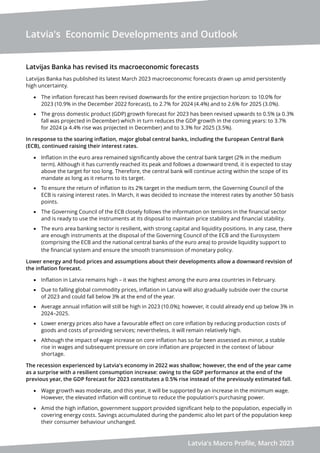
Latvijas Banka has revised its macroeconomic forecasts
Latvijas Banka has published its latest March 2023 macroeconomic forecasts drawn up amid persistently
high uncertainty.
• The inflation forecast has been revised downwards for the entire projection horizon: to 10.0% for
2023 (10.9% in the December 2022 forecast), to 2.7% for 2024 (4.4%) and to 2.6% for 2025 (3.0%).
• The gross domestic product (GDP) growth forecast for 2023 has been revised upwards to 0.5% (a 0.3%
fall was projected in December) which in turn reduces the GDP growth in the coming years: to 3.7%
for 2024 (a 4.4% rise was projected in December) and to 3.3% for 2025 (3.5%).
In response to the soaring inflation, major global central banks, including the European Central Bank
(ECB), continued raising their interest rates.
• Inflation in the euro area remained significantly above the central bank target (2% in the medium
term). Although it has currently reached its peak and follows a downward trend, it is expected to stay
above the target for too long. Therefore, the central bank will continue acting within the scope of its
mandate as long as it returns to its target.
• To ensure the return of inflation to its 2% target in the medium term, the Governing Council of the
ECB is raising interest rates. In March, it was decided to increase the interest rates by another 50 basis
points.
• The Governing Council of the ECB closely follows the information on tensions in the financial sector
and is ready to use the instruments at its disposal to maintain price stability and financial stability.
• The euro area banking sector is resilient, with strong capital and liquidity positions. In any case, there
are enough instruments at the disposal of the Governing Council of the ECB and the Eurosystem
(comprising the ECB and the national central banks of the euro area) to provide liquidity support to
the financial system and ensure the smooth transmission of monetary policy.
Lower energy and food prices and assumptions about their developments allow a downward revision of
the inflation forecast.
• Inflation in Latvia remains high – it was the highest among the euro area countries in February.
• Due to falling global commodity prices, inflation in Latvia will also gradually subside over the course
of 2023 and could fall below 3% at the end of the year.
• Average annual inflation will still be high in 2023 (10.0%); however, it could already end up below 3% in
2024–2025.
• Lower energy prices also have a favourable effect on core inflation by reducing production costs of
goods and costs of providing services; nevertheless, it will remain relatively high.
• Although the impact of wage increase on core inflation has so far been assessed as minor, a stable
rise in wages and subsequent pressure on core inflation are projected in the context of labour
shortage.
The recession experienced by Latvia's economy in 2022 was shallow; however, the end of the year came
as a surprise with a resilient consumption increase: owing to the GDP performance at the end of the
previous year, the GDP forecast for 2023 constitutes a 0.5% rise instead of the previously estimated fall.
• Wage growth was moderate, and this year, it will be supported by an increase in the minimum wage.
However, the elevated inflation will continue to reduce the population's purchasing power.
• Amid the high inflation, government support provided significant help to the population, especially in
covering energy costs. Savings accumulated during the pandemic also let part of the population keep
their consumer behaviour unchanged.
Macroeconomic Data
Latvia's Macro Profile, March 2023
• With businesses facing weakening demand and climbing costs, labour demand declined somewhat –
the number of job vacancies decreased.
• However, the projected short-lived recession and the expected labour shortage resulting from the
rebound in activity make businesses retain their employees, and there is no significant change in the
unemployment rate.
• At the same time, the investment growth prospects have not improved, taking into account the
sluggish absorption of European Union (EU) funds as well as the elevated uncertainty and rising
interest rates weakening the slow lending.
With the absorption of EU funds becoming more active and input prices normalising, 2024–2025 is
expected to witness economic growth above 3% (3.7% and 3.3% respectively).
The most significant risks to Latvia's economic growth involve the persistently low investment level and
deteriorating competitiveness. Following the steep rise over the previous years owing to a favourable
exports structure, Latvia's global export market share remains resilient. Nevertheless, due to the
accumulated input costs, exports could lag behind foreign demand. In the long term, investment is a
precondition for a competitive economy.
The general government deficit (4% of GDP this year) could decrease in the future; however, efforts related
to facilitating economic transformation are relevant. The full absorption of EU funds as well as an improved
quality and availability of public services are important aspects.
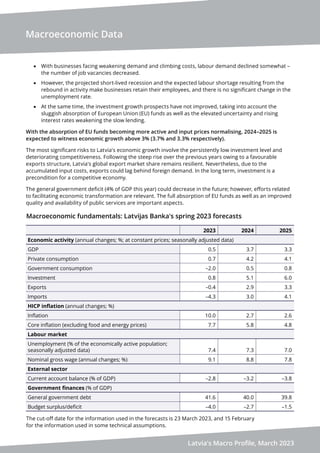
Macroeconomic fundamentals: Latvijas Banka's spring 2023 forecasts
2023 2024 2025
Economic activity (annual changes; %; at constant prices; seasonally adjusted data)
GDP 0.5 3.7 3.3
Private consumption 0.7 4.2 4.1
Government consumption –2.0 0.5 0.8
Investment 0.8 5.1 6.0
Exports –0.4 2.9 3.3
Imports –4.3 3.0 4.1
HICP inflation (annual changes; %)
Inflation 10.0 2.7 2.6
Core inflation (excluding food and energy prices) 7.7 5.8 4.8
Labour market
Unemployment (% of the economically active population;
seasonally adjusted data) 7.4 7.3 7.0
Nominal gross wage (annual changes; %) 9.1 8.8 7.8
External sector
Current account balance (% of GDP) –2.8 –3.2 –3.8
Government finances (% of GDP)
General government debt 41.6 40.0 39.8
Budget surplus/deficit –4.0 –2.7 –1.5
The cut-off date for the information used in the forecasts is 23 March 2023, and 15 February
for the information used in some technical assumptions.
Foreign Direct Investment
Latvia's Macro Profile, March 2023
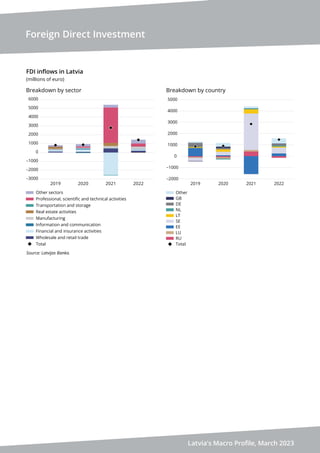
FDI inflows in Latvia
(millions of euro)
Breakdown by sector Breakdown by country
Source: Latvijas Banka.
–2000
–1000
0
1000
2000
3000
4000
5000
2019 2020 2021 2022
Other
GB
DE
NL
LT
SE
EE
LU
RU
Total
–3000
–2000
–1000
0
1000
2000
3000
4000
5000
6000
2019 2020 2021 2022
Other sectors
Professional, scientific and technical activities
Transportation and storage
Real estate activities
Manufacturing
Information and communication
Financial and insurance activities
Wholesale and retail trade
Total
Macroeconomic Indicators: Latvia, Lithuania and Estonia
Latvia's Macro Profile, March 2023
Latvia
Lithuania*
Estonia
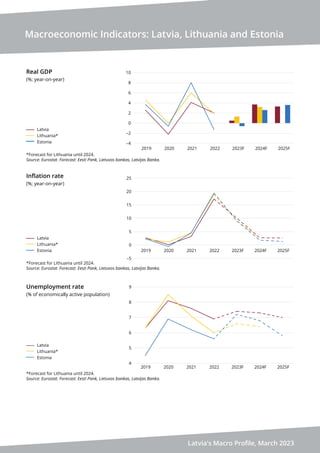
Real GDP
(%; year-on-year)
Unemployment rate
(% of economically active population)
*Forecast for Lithuania until 2024.
Source: Eurostat. Forecast: Eesti Pank, Lietuvos bankas, Latvijas Banka.
Latvia
Lithuania*
Estonia
*Forecast for Lithuania until 2024.
Source: Eurostat. Forecast: Eesti Pank, Lietuvos bankas, Latvijas Banka.
Inflation rate
(%; year-on-year)
*Forecast for Lithuania until 2024.
Source: Eurostat. Forecast: Eesti Pank, Lietuvos bankas, Latvijas Banka.
Latvia
Lithuania*
Estonia
–4
–2
0
2
4
6
8
10
2019 2020 2021 2022 2023F 2024F 2025F
–5
0
5
10
15
20
25
2019 2020 2021 2022 2023F 2024F 2025F
4
5
6
7
8
9
2019 2020 2021 2022 2023F 2024F 2025F
Macroeconomic Indicators: Latvia, Lithuania and Estonia
Latvia's Macro Profile, March 2023
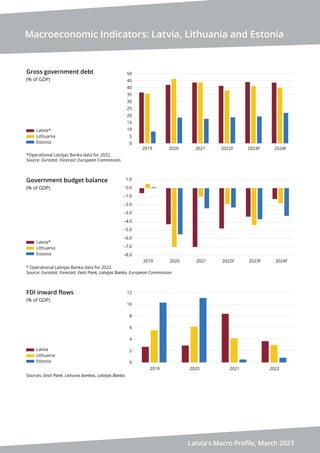
Gross government debt
(% of GDP)
Latvia*
Lithuania
Estonia
FDI inward flows
(% of GDP)
Sources: Eesti Pank, Lietuvos bankas, Latvijas Banka.
Latvia
Lithuania
Estonia
Government budget balance
(% of GDP)
Latvia*
Lithuania
Estonia
*Operational Latvijas Banka data for 2022.
Source: Eurostat. Forecast: European Commission.
* Operational Latvijas Banka data for 2022.
Source: Eurostat. Forecast: Eesti Pank, Latvijas Banka, European Commission.�
0
5
10
15
20
25
30
35
40
45
50
2019 2020 2021 2022F 2023F 2024F
–8.0
–7.0
–6.0
–5.0
–4.0
–3.0
–2.0
–1.0
0.0
1.0
2019 2020 2021 2022F 2023F 2024F
0
2
4
6
8
10
12
2019 2020 2021 2022
Latvia's Macro Profile, March 2023
Macroeconomic Indicators: Latvia, Lithuania and Estonia
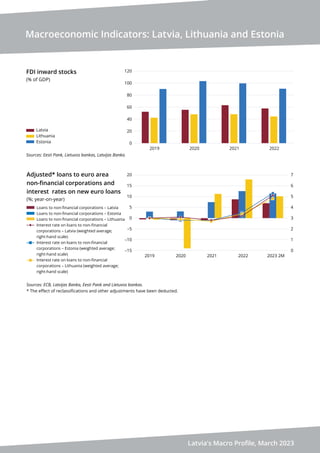
Adjusted* loans to euro area
non-financial corporations and
interest rates on new euro loans
(%; year-on-year)
Sources: ECB, Latvijas Banka, Eesti Pank and Lietuvos bankas.
* The effect of reclassifications and other adjustments have been deducted.
Loans to non-financial corporations – Latvia
Loans to non-financial corporations – Estonia
Loans to non-financial corporations – Lithuania
Interest rate on loans to non-financial
corporations – Latvia (weighted average;
right-hand scale)
Interest rate on loans to non-financial
corporations – Estonia (weighted average;
right-hand scale)
Interest rate on loans to non-financial
corporations – Lithuania (weighted average;
right-hand scale)
FDI inward stocks
(% of GDP)
Sources: Eesti Pank, Lietuvos bankas, Latvijas Banka.
Latvia
Lithuania
Estonia 0
20
40
60
80
100
120
2019 2020 2021 2022
0
1
2
3
4
5
6
7
–15
–10
–5
0
5
10
15
20
2019 2020 2021 2022 2023 2M

Latvia`s Macro Profile 2023

  • 1.
    March 2023 Latvia's MacroProfile Incl. macro comparison of LV, EE and LT.
  • 2.
    Latvia's Economic Developmentsand Outlook Latvia's Macro Profile, March 2023 Latvijas Banka has revised its macroeconomic forecasts Latvijas Banka has published its latest March 2023 macroeconomic forecasts drawn up amid persistently high uncertainty. • The inflation forecast has been revised downwards for the entire projection horizon: to 10.0% for 2023 (10.9% in the December 2022 forecast), to 2.7% for 2024 (4.4%) and to 2.6% for 2025 (3.0%). • The gross domestic product (GDP) growth forecast for 2023 has been revised upwards to 0.5% (a 0.3% fall was projected in December) which in turn reduces the GDP growth in the coming years: to 3.7% for 2024 (a 4.4% rise was projected in December) and to 3.3% for 2025 (3.5%). In response to the soaring inflation, major global central banks, including the European Central Bank (ECB), continued raising their interest rates. • Inflation in the euro area remained significantly above the central bank target (2% in the medium term). Although it has currently reached its peak and follows a downward trend, it is expected to stay above the target for too long. Therefore, the central bank will continue acting within the scope of its mandate as long as it returns to its target. • To ensure the return of inflation to its 2% target in the medium term, the Governing Council of the ECB is raising interest rates. In March, it was decided to increase the interest rates by another 50 basis points. • The Governing Council of the ECB closely follows the information on tensions in the financial sector and is ready to use the instruments at its disposal to maintain price stability and financial stability. • The euro area banking sector is resilient, with strong capital and liquidity positions. In any case, there are enough instruments at the disposal of the Governing Council of the ECB and the Eurosystem (comprising the ECB and the national central banks of the euro area) to provide liquidity support to the financial system and ensure the smooth transmission of monetary policy. Lower energy and food prices and assumptions about their developments allow a downward revision of the inflation forecast. • Inflation in Latvia remains high – it was the highest among the euro area countries in February. • Due to falling global commodity prices, inflation in Latvia will also gradually subside over the course of 2023 and could fall below 3% at the end of the year. • Average annual inflation will still be high in 2023 (10.0%); however, it could already end up below 3% in 2024–2025. • Lower energy prices also have a favourable effect on core inflation by reducing production costs of goods and costs of providing services; nevertheless, it will remain relatively high. • Although the impact of wage increase on core inflation has so far been assessed as minor, a stable rise in wages and subsequent pressure on core inflation are projected in the context of labour shortage. The recession experienced by Latvia's economy in 2022 was shallow; however, the end of the year came as a surprise with a resilient consumption increase: owing to the GDP performance at the end of the previous year, the GDP forecast for 2023 constitutes a 0.5% rise instead of the previously estimated fall. • Wage growth was moderate, and this year, it will be supported by an increase in the minimum wage. However, the elevated inflation will continue to reduce the population's purchasing power. • Amid the high inflation, government support provided significant help to the population, especially in covering energy costs. Savings accumulated during the pandemic also let part of the population keep their consumer behaviour unchanged.
  • 3.
    Macroeconomic Data Latvia's MacroProfile, March 2023 • With businesses facing weakening demand and climbing costs, labour demand declined somewhat – the number of job vacancies decreased. • However, the projected short-lived recession and the expected labour shortage resulting from the rebound in activity make businesses retain their employees, and there is no significant change in the unemployment rate. • At the same time, the investment growth prospects have not improved, taking into account the sluggish absorption of European Union (EU) funds as well as the elevated uncertainty and rising interest rates weakening the slow lending. With the absorption of EU funds becoming more active and input prices normalising, 2024–2025 is expected to witness economic growth above 3% (3.7% and 3.3% respectively). The most significant risks to Latvia's economic growth involve the persistently low investment level and deteriorating competitiveness. Following the steep rise over the previous years owing to a favourable exports structure, Latvia's global export market share remains resilient. Nevertheless, due to the accumulated input costs, exports could lag behind foreign demand. In the long term, investment is a precondition for a competitive economy. The general government deficit (4% of GDP this year) could decrease in the future; however, efforts related to facilitating economic transformation are relevant. The full absorption of EU funds as well as an improved quality and availability of public services are important aspects. Macroeconomic fundamentals: Latvijas Banka's spring 2023 forecasts 2023 2024 2025 Economic activity (annual changes; %; at constant prices; seasonally adjusted data) GDP 0.5 3.7 3.3 Private consumption 0.7 4.2 4.1 Government consumption –2.0 0.5 0.8 Investment 0.8 5.1 6.0 Exports –0.4 2.9 3.3 Imports –4.3 3.0 4.1 HICP inflation (annual changes; %) Inflation 10.0 2.7 2.6 Core inflation (excluding food and energy prices) 7.7 5.8 4.8 Labour market Unemployment (% of the economically active population; seasonally adjusted data) 7.4 7.3 7.0 Nominal gross wage (annual changes; %) 9.1 8.8 7.8 External sector Current account balance (% of GDP) –2.8 –3.2 –3.8 Government finances (% of GDP) General government debt 41.6 40.0 39.8 Budget surplus/deficit –4.0 –2.7 –1.5 The cut-off date for the information used in the forecasts is 23 March 2023, and 15 February for the information used in some technical assumptions.
  • 4.
    Foreign Direct Investment Latvia'sMacro Profile, March 2023 FDI inflows in Latvia (millions of euro) Breakdown by sector Breakdown by country Source: Latvijas Banka. –2000 –1000 0 1000 2000 3000 4000 5000 2019 2020 2021 2022 Other GB DE NL LT SE EE LU RU Total –3000 –2000 –1000 0 1000 2000 3000 4000 5000 6000 2019 2020 2021 2022 Other sectors Professional, scientific and technical activities Transportation and storage Real estate activities Manufacturing Information and communication Financial and insurance activities Wholesale and retail trade Total
  • 5.
    Macroeconomic Indicators: Latvia,Lithuania and Estonia Latvia's Macro Profile, March 2023 Latvia Lithuania* Estonia Real GDP (%; year-on-year) Unemployment rate (% of economically active population) *Forecast for Lithuania until 2024. Source: Eurostat. Forecast: Eesti Pank, Lietuvos bankas, Latvijas Banka. Latvia Lithuania* Estonia *Forecast for Lithuania until 2024. Source: Eurostat. Forecast: Eesti Pank, Lietuvos bankas, Latvijas Banka. Inflation rate (%; year-on-year) *Forecast for Lithuania until 2024. Source: Eurostat. Forecast: Eesti Pank, Lietuvos bankas, Latvijas Banka. Latvia Lithuania* Estonia –4 –2 0 2 4 6 8 10 2019 2020 2021 2022 2023F 2024F 2025F –5 0 5 10 15 20 25 2019 2020 2021 2022 2023F 2024F 2025F 4 5 6 7 8 9 2019 2020 2021 2022 2023F 2024F 2025F
  • 6.
    Macroeconomic Indicators: Latvia,Lithuania and Estonia Latvia's Macro Profile, March 2023 Gross government debt (% of GDP) Latvia* Lithuania Estonia FDI inward flows (% of GDP) Sources: Eesti Pank, Lietuvos bankas, Latvijas Banka. Latvia Lithuania Estonia Government budget balance (% of GDP) Latvia* Lithuania Estonia *Operational Latvijas Banka data for 2022. Source: Eurostat. Forecast: European Commission. * Operational Latvijas Banka data for 2022. Source: Eurostat. Forecast: Eesti Pank, Latvijas Banka, European Commission.� 0 5 10 15 20 25 30 35 40 45 50 2019 2020 2021 2022F 2023F 2024F –8.0 –7.0 –6.0 –5.0 –4.0 –3.0 –2.0 –1.0 0.0 1.0 2019 2020 2021 2022F 2023F 2024F 0 2 4 6 8 10 12 2019 2020 2021 2022
  • 7.
    Latvia's Macro Profile,March 2023 Macroeconomic Indicators: Latvia, Lithuania and Estonia Adjusted* loans to euro area non-financial corporations and interest rates on new euro loans (%; year-on-year) Sources: ECB, Latvijas Banka, Eesti Pank and Lietuvos bankas. * The effect of reclassifications and other adjustments have been deducted. Loans to non-financial corporations – Latvia Loans to non-financial corporations – Estonia Loans to non-financial corporations – Lithuania Interest rate on loans to non-financial corporations – Latvia (weighted average; right-hand scale) Interest rate on loans to non-financial corporations – Estonia (weighted average; right-hand scale) Interest rate on loans to non-financial corporations – Lithuania (weighted average; right-hand scale) FDI inward stocks (% of GDP) Sources: Eesti Pank, Lietuvos bankas, Latvijas Banka. Latvia Lithuania Estonia 0 20 40 60 80 100 120 2019 2020 2021 2022 0 1 2 3 4 5 6 7 –15 –10 –5 0 5 10 15 20 2019 2020 2021 2022 2023 2M