



BY:
MASNAH BINTI MAHMUD
L20081002833
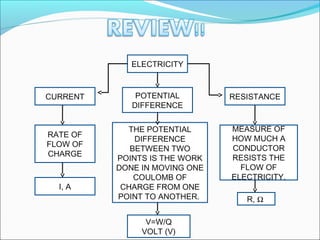
ELECTRICITY
THE POTENTIAL
DIFFERENCE
BETWEEN TWO
POINTS IS THE WORK
DONE IN MOVING ONE
COULOMB OF
CHARGE FROM ONE
POINT TO ANOTHER.
RATE OF
FLOW OF
CHARGE
RESISTANCEPOTENTIAL
DIFFERENCE
CURRENT
MEASURE OF
HOW MUCH A
CONDUCTOR
RESISTS THE
FLOW OF
ELECTRICITY.
I, A
V=W/Q
VOLT (V)
R, Ω
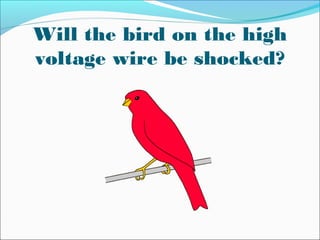
Will the bird on the high
voltage wire be shocked?
At the end of lesson, student should be able to;-
Describe the relationship between current
and potential difference.
State Ohm’s law.
Solve problems involving potential
difference, current and resistance
THE RELATIONSHIP BETWEEN
ELECTRIC CURRENT
&
POTENTIAL DIFFERENCE
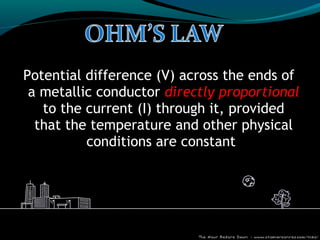
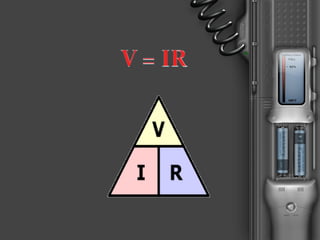
Potential difference (V) across the ends of
a metallic conductor directly proportional
to the current (I) through it, provided
that the temperature and other physical
conditions are constant.
What happen to current:-
If the voltage increases?
If the voltage decreases?
What happen to current:-
If the resistance increases?
If the resistance decreases?
At the end of lesson, student should be able to;-
Describe the relationship between current and
potential difference.
State Ohm’s law.
Solve problems involving potential difference,
current and resistance
EXERCISE 2.6 - PAGES 54
Submit before 18th
Jun 09
(12.05pm)
READ
TOPIC:
PARALLEL &
SERIES
CIRCUIT

Macro teaching

  • 1.
  • 2.
    ELECTRICITY THE POTENTIAL DIFFERENCE BETWEEN TWO POINTSIS THE WORK DONE IN MOVING ONE COULOMB OF CHARGE FROM ONE POINT TO ANOTHER. RATE OF FLOW OF CHARGE RESISTANCEPOTENTIAL DIFFERENCE CURRENT MEASURE OF HOW MUCH A CONDUCTOR RESISTS THE FLOW OF ELECTRICITY. I, A V=W/Q VOLT (V) R, Ω
  • 3.
    Will the birdon the high voltage wire be shocked?
  • 5.
    At the endof lesson, student should be able to;- Describe the relationship between current and potential difference. State Ohm’s law. Solve problems involving potential difference, current and resistance
  • 6.
    THE RELATIONSHIP BETWEEN ELECTRICCURRENT & POTENTIAL DIFFERENCE
  • 7.
    Potential difference (V)across the ends of a metallic conductor directly proportional to the current (I) through it, provided that the temperature and other physical conditions are constant.
  • 9.
    What happen tocurrent:- If the voltage increases? If the voltage decreases? What happen to current:- If the resistance increases? If the resistance decreases?
  • 10.
    At the endof lesson, student should be able to;- Describe the relationship between current and potential difference. State Ohm’s law. Solve problems involving potential difference, current and resistance
  • 11.
    EXERCISE 2.6 -PAGES 54 Submit before 18th Jun 09 (12.05pm)
  • 12.