Macro BusinessMacro Business
Environment in IndiaEnvironment in India
???????:-
 What is Business ?
 What is Environment ?
 What is Business Environment ?
 What is macro business ?
 What is strengths of macro business environment ?
 What is weakness of macro business environment ?
 What is opportunities of macro business environment ?
Introduction to Business:
Business is the organized efforts of enterprises to supply
consumers with goods and services. Businesses vary in size
as measured by number of employees or by sales volume.
All businesses share the same purpose to earn Profits.
However, the purpose of business goes beyond earning
profits.
Business is an important institution in society and the
role of business is crucial.
 Be it for the supply of goods and services
 Creation of job opportunities
 Offer of better quality of life
 Contributing to the economic growth of the country.
Scope of Business
 Business included all activities connected with
production, trade, banking, insurance, finance, agency,
advertising, packaging and numerous other related
activities.
 Businesses include all efforts to comply with
legal restrictions and government requirements and
discharging obligations to consumers, employees,
owners and to other interest groups which have stakes
in business directly or indirectly.
Society cannot do without business and vice versa.
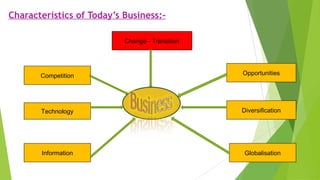
Characteristics of Today’s Business:-
Information
Competition
Change - Transition
Opportunities
Diversification
Globalisation
Technology
Environment:
• Environment refers to all external forces which have a bearing on
the functioning of business.
“Environment are largely if not totally external, and beyond the
control of individual industrial enterprises and their management.
These are essentially the givers within which firms and their
managements must operate in a specific country and they vary,
from country to country”.
• However, the term business environment refers to the External
Factors. The external environment has two components
1. business opportunities
2. threats to business.
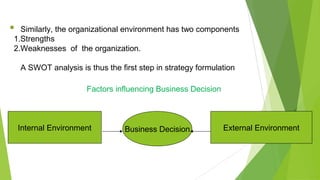
Business DecisionInternal Environment External Environment
Factors influencing Business Decision
Similarly, the organizational environment has two components
1.Strengths
2.Weaknesses of the organization.
A SWOT analysis is thus the first step in strategy formulation
 The term ‘Business Environment’ is used to describe
the general conditions for doing business that are
present in an economy.
 we will be using the word ‘business environment’ to
refer to those factors which influence business decisions
such as investment decisions, private
investment, etc. in an economy
BUSINESS ENVIRONMENT
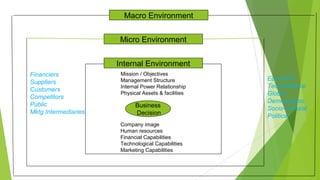
Business
Decision
Internal Environment
Mission / Objectives
Management Structure
Internal Power Relationship
Physical Assets & facilities
Company image
Human resources
Financial Capabilities
Technological Capabilities
Marketing Capabilities
Financiers
Suppliers
Customers
Competitors
Public
Mktg Intermediaries
Micro Environment
Economic
Technological
Global
Demographic
Socio-Cultural
Political
Macro Environment
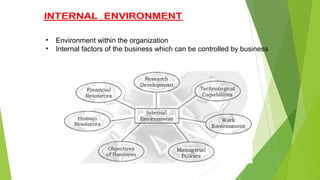
• Environment within the organization
• Internal factors of the business which can be controlled by business
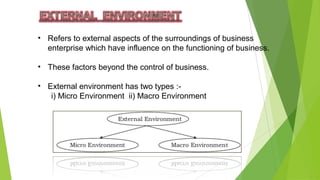
• Refers to external aspects of the surroundings of business
enterprise which have influence on the functioning of business.
• These factors beyond the control of business.
• External environment has two types :-
i) Micro Environment ii) Macro Environment
Micro Environment:
The Micro environment consists of different types of
stakeholders - customers, employees, suppliers,
marketing intermediaries, competitors.
It is also known s the “Task Environment and
Operating Environment” and has a direct bearing on
the operations of the firm. hanges in the micro
environment will directly affect and impinge on the
firm‘s activities.
MACRO
Environment ???
Macro Environment:
The macro environment consists of factors which are
beyond the control of the business. There is a symbiotic
relationship between “business and the environmental”
factors, environmental factors are dynamic and a
particular business firm, by itself, may not be in a position
to change it’s environment. Macro Environment includes:
 Being exposed to the news allows you a higher
level of awareness of the business environment.
 Certain environments influence your business
more than others.
Macro Business environmental analysis:
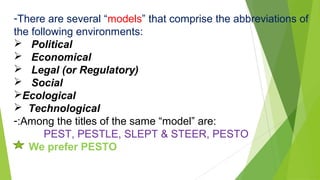
-There are several “models” that comprise the abbreviations of
the following environments:
 Political
 Economical
 Legal (or Regulatory)
 Social
Ecological
 Technological
-:Among the titles of the same “model” are:
PEST, PESTLE, SLEPT & STEER, PESTO
We prefer PESTO
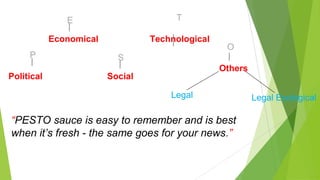
P
E
S
Political
Economical
Social
Technological
Others
“PESTO sauce is easy to remember and is best
when it’s fresh - the same goes for your news.”
Legal Legal Ecological
T
O
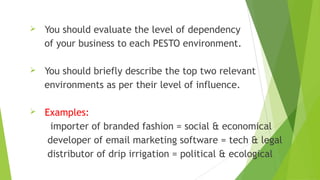
 You should evaluate the level of dependency
of your business to each PESTO environment.
 You should briefly describe the top two relevant
environments as per their level of influence.
 Examples:
importer of branded fashion = social & economical
developer of email marketing software = tech & legal
distributor of drip irrigation = political & ecological
In the past few years, India has proved to be the
nectar for major MNC’s around the world.
With favorable policies, India is now one of the
most favorable destination for FDI (Foreign
Direct Investment).
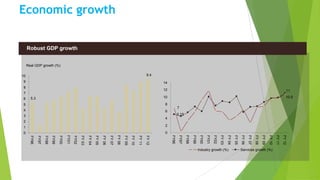
Economic growth
Robust GDP growth
Real GDP growth (%)
5.3
9.4
0
1
2
3
4
5
6
7
8
9
10
FY96
FY97
FY98
FY99
FY00
FY01
FY02
FY03
FY04
FY05
FY06
FY07
FY08
FY09
FY10
FY11
FY12
7
5.15
10.9
11
0
2
4
6
8
10
12
14
FY96
FY97
FY98
FY99
FY00
FY01
FY02
FY03
FY04
FY05
FY06
FY07
FY08
FY09
FY10
FY11
FY12
Industry growth (%) Services growth (%)
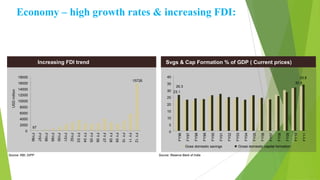
Economy – high growth rates & increasing FDI:
Increasing FDI trend
Source: RBI, DIPP Source: Reserve Bank of India
USDmillion
97
15726
0
2000
4000
6000
8000
10000
12000
14000
16000
18000
FY96
FY97
FY98
FY99
FY00
FY01
FY02
FY03
FY04
FY05
FY06
FY07
FY08
FY09
FY10
FY11
FY12
Svgs & Cap Formation % of GDP ( Current prices)
23.1
26.3
33.8
32.4
0
5
10
15
20
25
30
35
40
Goss domestic savings Gross domestic capital formation
FY96
FY97
FY98
FY99
FY00
FY01
FY02
FY03
FY04
FY05
FY06
FY07
FY08
FY09
FY10
FY11
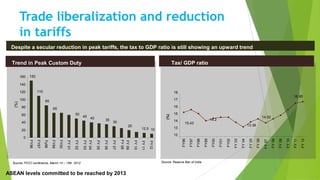
Trade liberalization and reduction
in tariffs
Source: Reserve Bank of India
Despite a secular reduction in peak tariffs, the tax to GDP ratio is still showing an upward trend
Trend in Peak Custom Duty
ASEAN levels committed to be reached by 2013
(%)
14.2
13.38
14.52
16.95
15.43
12
13
14
15
16
17
18
FY96
FY97
FY98
FY99
FY00
FY01
FY02
FY03
FY04
FY05
FY06
FY07
FY08
FY09
FY10
FY11
FY12
Tax/ GDP ratio
(%)
150
110
85
65
50
45
40
35
30
20
12.5 10
0
20
40
60
80
100
120
140
160
FY96
FY97
Fy98
FY99
FY00
FY11
FY12
FY08
FY09
FY10
FY01
FY02
FY03
FY04
FY05
FY06
FY07
Source: Reserve Ban of IndiaSource: FICCI conference, March 14 – 15th 2012
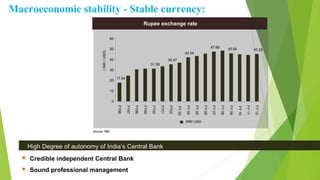
 Credible independent Central Bank
 Sound professional management
High Degree of autonomy of India’s Central Bank
Macroeconomic stability - Stable currency:
Rupee exchange rate
Source: RBI
(INR/USD)
INR/ USD
17.94
31.39
35.47
42.04
47.68 45.94 45.29
0
10
20
30
40
50
60
FY96
FY97
FY98
FY99
FY00
FY01
FY02
FY03
FY04
FY05
FY06
FY07
FY08
FY09
FY10
FY11
FY12
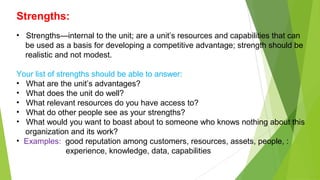
Strengths:
• Strengths—internal to the unit; are a unit’s resources and capabilities that can
be used as a basis for developing a competitive advantage; strength should be
realistic and not modest.
Your list of strengths should be able to answer:
• What are the unit’s advantages?
• What does the unit do well?
• What relevant resources do you have access to?
• What do other people see as your strengths?
• What would you want to boast about to someone who knows nothing about this
organization and its work?
• Examples: good reputation among customers, resources, assets, people, :
experience, knowledge, data, capabilities
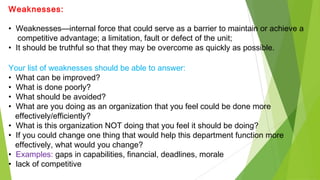
Weaknesses:
• Weaknesses—internal force that could serve as a barrier to maintain or achieve a
competitive advantage; a limitation, fault or defect of the unit;
• It should be truthful so that they may be overcome as quickly as possible.
Your list of weaknesses should be able to answer:
• What can be improved?
• What is done poorly?
• What should be avoided?
• What are you doing as an organization that you feel could be done more
effectively/efficiently?
• What is this organization NOT doing that you feel it should be doing?
• If you could change one thing that would help this department function more
effectively, what would you change?
• Examples: gaps in capabilities, financial, deadlines, morale
• lack of competitive
Opportunities:
• Opportunities—any favorable situation present now or in
the future in the external environment.
Examples: unfulfilled customer need, arrival of new technologies,
loosening of regulations, global influences, economic
boom, demographic shift
• Where are the good opportunities facing you?
• What are the interesting trends you are aware of?
• Think of: market developments; competitor;vulnerabilities; industry/
lifestyle trends;; geographical; partnerships
Threats:
• High fiscal deficit
• Threat of government intervention in some states
• Growing import bill
• Population explosion, rate of growth of population
• Agriculture excessively dependent on monsoon
 
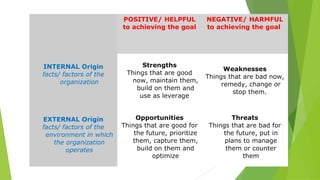
POSITIVE/ HELPFUL
to achieving the goal
  
NEGATIVE/ HARMFUL
to achieving the goal 
 
INTERNAL Origin
facts/ factors of the
organization
Strengths
Things that are good 
now, maintain them, 
build on them and 
use as leverage 
Weaknesses
Things that are bad now, 
remedy, change or 
stop them. 
 
EXTERNAL Origin
facts/ factors of the
environment in which
the organization
operates
Opportunities
Things that are good for 
the future, prioritize 
them, capture them, 
build on them and 
optimize
Threats
Things that are bad for 
the future, put in 
plans to manage 
them or counter 
them
Macro Business Environment in India

Macro Business Environment in India

  • 1.
    Macro BusinessMacro Business Environmentin IndiaEnvironment in India
  • 2.
    ???????:-  What isBusiness ?  What is Environment ?  What is Business Environment ?  What is macro business ?  What is strengths of macro business environment ?  What is weakness of macro business environment ?  What is opportunities of macro business environment ?
  • 3.
    Introduction to Business: Businessis the organized efforts of enterprises to supply consumers with goods and services. Businesses vary in size as measured by number of employees or by sales volume. All businesses share the same purpose to earn Profits. However, the purpose of business goes beyond earning profits.
  • 4.
    Business is animportant institution in society and the role of business is crucial.  Be it for the supply of goods and services  Creation of job opportunities  Offer of better quality of life  Contributing to the economic growth of the country.
  • 5.
    Scope of Business Business included all activities connected with production, trade, banking, insurance, finance, agency, advertising, packaging and numerous other related activities.  Businesses include all efforts to comply with legal restrictions and government requirements and discharging obligations to consumers, employees, owners and to other interest groups which have stakes in business directly or indirectly. Society cannot do without business and vice versa.
  • 6.
    Characteristics of Today’sBusiness:- Information Competition Change - Transition Opportunities Diversification Globalisation Technology
  • 7.
    Environment: • Environment refersto all external forces which have a bearing on the functioning of business. “Environment are largely if not totally external, and beyond the control of individual industrial enterprises and their management. These are essentially the givers within which firms and their managements must operate in a specific country and they vary, from country to country”. • However, the term business environment refers to the External Factors. The external environment has two components 1. business opportunities 2. threats to business.
  • 8.
    Business DecisionInternal EnvironmentExternal Environment Factors influencing Business Decision Similarly, the organizational environment has two components 1.Strengths 2.Weaknesses of the organization. A SWOT analysis is thus the first step in strategy formulation
  • 9.
     The term‘Business Environment’ is used to describe the general conditions for doing business that are present in an economy.  we will be using the word ‘business environment’ to refer to those factors which influence business decisions such as investment decisions, private investment, etc. in an economy BUSINESS ENVIRONMENT
  • 10.
    Business Decision Internal Environment Mission /Objectives Management Structure Internal Power Relationship Physical Assets & facilities Company image Human resources Financial Capabilities Technological Capabilities Marketing Capabilities Financiers Suppliers Customers Competitors Public Mktg Intermediaries Micro Environment Economic Technological Global Demographic Socio-Cultural Political Macro Environment
  • 11.
    • Environment withinthe organization • Internal factors of the business which can be controlled by business
  • 12.
    • Refers toexternal aspects of the surroundings of business enterprise which have influence on the functioning of business. • These factors beyond the control of business. • External environment has two types :- i) Micro Environment ii) Macro Environment
  • 13.
    Micro Environment: The Microenvironment consists of different types of stakeholders - customers, employees, suppliers, marketing intermediaries, competitors. It is also known s the “Task Environment and Operating Environment” and has a direct bearing on the operations of the firm. hanges in the micro environment will directly affect and impinge on the firm‘s activities.
  • 14.
  • 15.
    Macro Environment: The macroenvironment consists of factors which are beyond the control of the business. There is a symbiotic relationship between “business and the environmental” factors, environmental factors are dynamic and a particular business firm, by itself, may not be in a position to change it’s environment. Macro Environment includes:
  • 16.
     Being exposedto the news allows you a higher level of awareness of the business environment.  Certain environments influence your business more than others. Macro Business environmental analysis:
  • 17.
    -There are several“models” that comprise the abbreviations of the following environments:  Political  Economical  Legal (or Regulatory)  Social Ecological  Technological -:Among the titles of the same “model” are: PEST, PESTLE, SLEPT & STEER, PESTO We prefer PESTO
  • 18.
    P E S Political Economical Social Technological Others “PESTO sauce iseasy to remember and is best when it’s fresh - the same goes for your news.” Legal Legal Ecological T O
  • 19.
     You shouldevaluate the level of dependency of your business to each PESTO environment.  You should briefly describe the top two relevant environments as per their level of influence.  Examples: importer of branded fashion = social & economical developer of email marketing software = tech & legal distributor of drip irrigation = political & ecological
  • 20.
    In the pastfew years, India has proved to be the nectar for major MNC’s around the world. With favorable policies, India is now one of the most favorable destination for FDI (Foreign Direct Investment).
  • 22.
    Economic growth Robust GDPgrowth Real GDP growth (%) 5.3 9.4 0 1 2 3 4 5 6 7 8 9 10 FY96 FY97 FY98 FY99 FY00 FY01 FY02 FY03 FY04 FY05 FY06 FY07 FY08 FY09 FY10 FY11 FY12 7 5.15 10.9 11 0 2 4 6 8 10 12 14 FY96 FY97 FY98 FY99 FY00 FY01 FY02 FY03 FY04 FY05 FY06 FY07 FY08 FY09 FY10 FY11 FY12 Industry growth (%) Services growth (%)
  • 23.
    Economy – highgrowth rates & increasing FDI: Increasing FDI trend Source: RBI, DIPP Source: Reserve Bank of India USDmillion 97 15726 0 2000 4000 6000 8000 10000 12000 14000 16000 18000 FY96 FY97 FY98 FY99 FY00 FY01 FY02 FY03 FY04 FY05 FY06 FY07 FY08 FY09 FY10 FY11 FY12 Svgs & Cap Formation % of GDP ( Current prices) 23.1 26.3 33.8 32.4 0 5 10 15 20 25 30 35 40 Goss domestic savings Gross domestic capital formation FY96 FY97 FY98 FY99 FY00 FY01 FY02 FY03 FY04 FY05 FY06 FY07 FY08 FY09 FY10 FY11
  • 24.
    Trade liberalization andreduction in tariffs Source: Reserve Bank of India Despite a secular reduction in peak tariffs, the tax to GDP ratio is still showing an upward trend Trend in Peak Custom Duty ASEAN levels committed to be reached by 2013 (%) 14.2 13.38 14.52 16.95 15.43 12 13 14 15 16 17 18 FY96 FY97 FY98 FY99 FY00 FY01 FY02 FY03 FY04 FY05 FY06 FY07 FY08 FY09 FY10 FY11 FY12 Tax/ GDP ratio (%) 150 110 85 65 50 45 40 35 30 20 12.5 10 0 20 40 60 80 100 120 140 160 FY96 FY97 Fy98 FY99 FY00 FY11 FY12 FY08 FY09 FY10 FY01 FY02 FY03 FY04 FY05 FY06 FY07 Source: Reserve Ban of IndiaSource: FICCI conference, March 14 – 15th 2012
  • 25.
     Credible independentCentral Bank  Sound professional management High Degree of autonomy of India’s Central Bank Macroeconomic stability - Stable currency: Rupee exchange rate Source: RBI (INR/USD) INR/ USD 17.94 31.39 35.47 42.04 47.68 45.94 45.29 0 10 20 30 40 50 60 FY96 FY97 FY98 FY99 FY00 FY01 FY02 FY03 FY04 FY05 FY06 FY07 FY08 FY09 FY10 FY11 FY12
  • 26.
    Strengths: • Strengths—internal tothe unit; are a unit’s resources and capabilities that can be used as a basis for developing a competitive advantage; strength should be realistic and not modest. Your list of strengths should be able to answer: • What are the unit’s advantages? • What does the unit do well? • What relevant resources do you have access to? • What do other people see as your strengths? • What would you want to boast about to someone who knows nothing about this organization and its work? • Examples: good reputation among customers, resources, assets, people, : experience, knowledge, data, capabilities
  • 27.
    Weaknesses: • Weaknesses—internal forcethat could serve as a barrier to maintain or achieve a competitive advantage; a limitation, fault or defect of the unit; • It should be truthful so that they may be overcome as quickly as possible. Your list of weaknesses should be able to answer: • What can be improved? • What is done poorly? • What should be avoided? • What are you doing as an organization that you feel could be done more effectively/efficiently? • What is this organization NOT doing that you feel it should be doing? • If you could change one thing that would help this department function more effectively, what would you change? • Examples: gaps in capabilities, financial, deadlines, morale • lack of competitive
  • 28.
    Opportunities: • Opportunities—any favorablesituation present now or in the future in the external environment. Examples: unfulfilled customer need, arrival of new technologies, loosening of regulations, global influences, economic boom, demographic shift • Where are the good opportunities facing you? • What are the interesting trends you are aware of? • Think of: market developments; competitor;vulnerabilities; industry/ lifestyle trends;; geographical; partnerships
  • 29.
    Threats: • High fiscaldeficit • Threat of government intervention in some states • Growing import bill • Population explosion, rate of growth of population • Agriculture excessively dependent on monsoon
  • 30.
      POSITIVE/ HELPFUL to achieving the goal    NEGATIVE/ HARMFUL to achieving the goal    INTERNAL Origin facts/ factors ofthe organization Strengths Things that are good  now, maintain them,  build on them and  use as leverage  Weaknesses Things that are bad now,  remedy, change or  stop them.    EXTERNAL Origin facts/ factors of the environment in which the organization operates Opportunities Things that are good for  the future, prioritize  them, capture them,  build on them and  optimize Threats Things that are bad for  the future, put in  plans to manage  them or counter  them