Module 1
Business Environment
BIITM
Sem. I – (2023-’25)
Business
• It is a continuous production and distribution
of goods and services with the aim of earning
profits under uncertain market conditions.
• It is a form of regular activity conducted with
an objective of earning profits for the benefit
of those on whose behalf the activity is
conducted.
The Business & its Environment
• The relation of a Business Organisation with
its Environment,
– It receives Inputs from External Environment
– Converts them into Output
– Sells to External Environment
• How the transformation process is Planned,
Organised, and Controlled by the
Management.
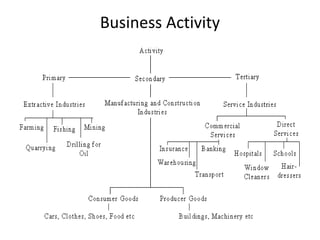
Business Activity
Business Environment
• The environment of any organization is “ the aggregate of all
conditions, events and influences that surround and affect it.”
• The business environment is dynamic in nature and it keeps on
changing.
• The changes of business environment are unpredictable. It is very
difficult to predict the exact nature of future happenings and the
changes in economic and social environment.
• Business environment differs from place to place, country to
country. Like political conditions in India will differ from those in
Pakistan
Importance
• First mover advantages: Grab the early opportunity in the market which
allow the enterprise to stay ahead from their competitors. Ex- Maruti
Udyog (need of the middle class people-small car)
• Early warning signal: Its all about environmental awareness. early signal
for the enterprise against upcoming threat. (Maruti proved itself against
the new entrant by tripling its production--- esteem to provide quick
customer delivery).
• Customer focus: facilitates the company to cater to the changing tastes
and preferences of the customer. (ex- introduction of HUL – small sachet
of shampoo)
• Strategy formulation: environmental analysis- provide various relevant
information – for future plan .(ITC – recognise – scope in travel and
tourism- opened new hotel)
• Image building: build company’s positive image in the mind of the
customer. Big Bazar, Fbb
Types of Bus. Env.
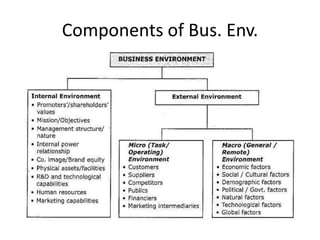
• Mainly Business Environment is divided into
two types:
1. Internal Environment
2. External Environment
Internal Environment
• The factors which can be controlled by
company to a good extent, or
• Primary factors which directly affects the
growth of organization….. man, material,
money, machinery and management
• However, the firm may not be able to change
or modify all the Internal factors.
Types of Internal Environment
• Value System
• Mission & Objectives
• Management Structure and Nature
- Organisation Structure, Style of functioning
• Internal Power relationship
• Human Resources
- Quality of HR, Labour Unions
• Physical Resources and Tech. Capabilities
- Physical Assets, Finance (Capital Structure)
• Company Image & Brand Equity …..
Significance of Internal factors
The internal factors basically include the inner strengths and weaknesses.
Internal factors can affect how a company meets its objectives.
Some examples of areas which are typically considered in internal factors
are:
• Financial resources like funding, investment opportunities and sources of
income.
• Physical resources like company’s location, equipment, and facilities
• Human resources like employees, target audiences, and volunteers
• Access to natural resources, patents, copyrights, and trademarks
• Current processes like employee programs, software systems, and
department hierarchies
External Environment
• Those factors that affect a Business from Outside.
• Those factors which are beyond the control of business
enterprise are included in external environment.
• External Environment is divided into two parts
1. Micro Environment: The environment which is close to
business and affects its capacity to work is known as Micro
Environment.
2. Macro Environment: It includes factors that create
opportunities and threats to business units.
External Micro Environment
• Suppliers
– Backward Integration associates
• Customers
– B2C, B2B
• Wholesalers
• Retailers
• Industries
• Government and Other Institutions
• Foreigners
• Market Intermediaries
– Agents, Stockist, Transporters
– Mktg. Service Agency (Mktg. Research, Consulting, Advt.)
– Financial Intermediaries
– Physical Intermediaries
– Forward Integration associates
• Competitors
– Product, Brand, Disposable Income/Budget
• Publics
– Environmentalists, Media, Consumer rights, Local groups, Citizen associations
External Micro Env....
• Suppliers: suppliers are those who supply raw materials components and
machines to the business enterprise. The suppliers are an important micro
factor in the business environment. They should be trustworthy and
cordial with business enterprise. This will help the enterprise to attain the
customer expectation and companies will become free from the burden of
keeping heavy stocks.
• Customer: customers are the most important element of the business
enterprise. The main aim of any business is to attract and retain its
customers. This helps the business to attain long term survival and
profitability. Therefore, to increase the level of loyal customers, business
enterprise should carefully observe the needs and wants of the customers
and fulfil them effectively. The business enterprises must also analyses the
changing tastes and preference of the customers and make changes in its
product and services accordingly.
External Micro Env...
• Market Intermediaries:
Intermediaries are those who act as a mediator between the
manufacturer and final consumer. The number of marketing
intermediaries varies according to size and type of distribution network.
Market intermediaries are beneficial to the organisation only when there
is a proper coordination between channel without any hurdle.
• Competitors: the organisation which manufacture similar products and try
to conquer over the market share are termed as competitors. To earn
more profit and stay competitive, the company needs to monitor the
competitor’s activities and then prepare its future plan.
• General public: the general public is also an indispensable part of business
environment. The positive and negative responses of the public directly
influences company’s image. This can also affect the sales and revenue of
the company.
Publics
• Ay group that has an actual or potential
interest in or on a company’s ability to achieve
its objective. (- Philip Kotler)
External Macro Environment
• Those determine the opportunities for a firm
to exploit for promoting its business and also
presents threats to it in the sense that it can
put restrictions on its expansion/growth.
• Both positive and negative aspects
• Uncontrollable by the firm, hence need to
adjust and or adapt to the external forces
External Macro Environment
Economic Environment:
It is very complex and dynamic in nature that keeps on
changing with the change in policies or political situations.
It has three elements:
• Economic Conditions of Public
• Economic Policies of the country
• Economic System
Other Economic Factors:
Infrastructural facilities, Banking, Insurance companies,
Money markets, Capital markets etc.
Economic Environment
• It relates to production and distribution of wealth of the country/
region. It also play with the word demand and supply of a
business of an organisation. It also said that from financial
perspective of a business firm. These also determine the
feasibility of a country or a region for the conduct of a particular
business from a financial perspective. The economic conditions of
a country include the nature of the economy, the stage of
development of the economy, economic resources, the level of
income, the distribution of income and assets.
• The purchasing power of consumers and consumer confidence or
insecurities strongly influences and impact the demand for the
products and services of an organisation. It is an important element
of the economic environment. In management decisions of all
businesses, the economic environment comes up for prime
consideration.
External Macro Env...
Non-Economic Environment:
Following are included in non-economic environment:
1) Political and Legal Environment:
It affects different business units extensively. Components are
• Political Belief of Government
• Political Strength of the Country
• Relation with other countries
• Defense and Military Policies
• Centre State Relationship in the Country
• Thinking of Opposition Parties towards Business Unit
Examples : Anti-Trust Regulations, Environmental Protection, Tax laws, Employment
Laws, Stability of Govt. Foreign Trade Protection
Macro Env.; Socio-Cultural
2) Socio-Cultural Environment
– Influence exercised by social and cultural factors, not
within the control of business, is known as Socio-Cultural
Environment.
– These factors include: attitude of people to work, family
system, caste system, religion, education, marriage etc.
(e.g., Language, Taste & Preference, Dressing & Lifestyle,
Religion)
Socio-cultural environment is a collection of social factors
affecting a business and includes social traditions, values
and beliefs, level of literacy and education the ethical
standards and state of society, the extent of social
stratification, conflict and cohesiveness and so forth.
External Macro Env... Technological
3) Technological Environment
A systematic application of scientific knowledge
to practical task is known as technology.
Everyday there has been vast changes in products,
services, lifestyles and living conditions, these
changes must be analysed by every business unit
and should adapt these changes.
Technological Environment
Technology is knowledge of methods to perform certain tasks or solve problems
pertaining to product and services.
The basic elements of Technology:
• Information on Product design
• Production techniques
• Quality Assurance measures
• Human Resource development (Skill development)
Technology provides opportunities for businesses to adopt new breakthroughs,
innovations, and inventions to cut costs and develop new products.
A business producing confectionery like Cadbury, Schweppes examines S L E P T
factors in designing new products. Technological change is particularly important
today, for example, the development of new technologies that have enabled
variations on chocolate bars to be produced in an ice cream format.
External Macro Env...
4) Natural Environment and Ecological Effects
It includes natural resources, weather, climatic
conditions, port facilities, topographical factors
such as soil, sea, rivers, rainfall etc.
Every business unit must look for these factors
before choosing the location for their business.
Thus, SLEPT got revised/improvised to PESTEL
(another ‘ E ’- the Environmental effect, got added)
Natural Environment
Here the term is applies to Ecological complex, include plants, animals, micro-
organism, minerals, rock, water bodies. The set of living and non-living things on
Earth, which occur in a state sustainably (not to be influenced by humans).
Includes all of the plants; animal; microorganism; abiotic factors such mineral; rocks
and magma; water bodies and atmosphere layers. There are extremely complex
interaction between the living organisms and abiotic elements as well as
meteorological influences.
Components of Natural environment are:
• Land resources: Land is certainly important. Man and other living beings use it
for their habitation.
• Water resources: Water is a prime natural resource. It is required for satisfying
one of the basic needs of humans. Thus, water has become a precious national
asset.
• Forest resources: Forests occupy an important place among natural resources of
a country.
• Mineral resources: Availability of mineral has a unique distinction of influencing
the course of economic development of a country.
External Macro Env... Demographic
5) Demographic
It is a study of perspective of population i.e. its size, standard of living,
growth rate, age-sex composition, family size, income level (upper
level, middle level and lower level), education level etc.
Every business unit must see these features of population and
recognize their various needs and produce accordingly.
Demographic environment:
Population size, growth-rate of population, Gender
Age composition of the population, Life cycle stage
Education level, Employment status, Marital status, Family size
Caste, Religion, Race, Location
Income, Assets ownership, Social class, Home ownership
Demographic...
For example, premium products such as high-end women’s clothing usually appeal to
women with higher incomes. Conversely, people with comparatively lower
incomes are more sensitive to price and, therefore, may prefer purchasing
discount products. People with lower incomes have less disposable income. Value
is a major determinant in the products they purchase.
• Hence, a company may best reach lower-income people through discount retailers
and wholesalers and attract higher-income buyers in specialty retail shops.
Younger people under 35 are often the first consumers to purchase high-tech products
like cell phones, electronic books and video games. Certain buying groups also
have more buying power than others.
For example, there are about 76 million baby boomers in the United States, according
to "Entrepreneur" online.
• This is the single largest population segment. Baby Boomers spent $400 billion
more than any other age group, according to a June 2009 report by
"Entrepreneur." Small business owners have much to gain by selling products to
this population.
External Macro Env... International
6) International Environment
It is particularly important for industries directly depending on
import or exports.
Form of Govt., Political Ideology, Protectionist Sentiment,
Terrorism, Legal System, Govt.’s Attitude towards Foreign
Firms
The factors that affect the business are
• Globalization
• Liberalization
• Foreign business and Investment policies
• Cultural exchange across
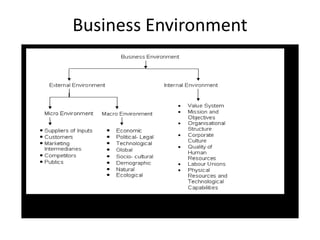
Components of Bus. Env.
Business Environment
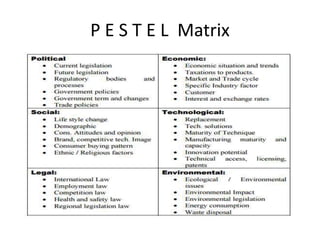
P E S T E L Matrix
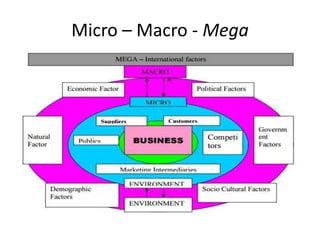
Micro – Macro - Mega
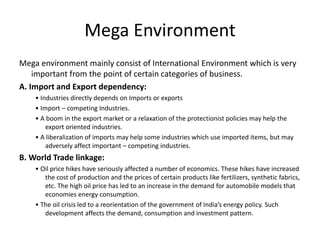
Mega Environment
Mega environment mainly consist of International Environment which is very
important from the point of certain categories of business.
A. Import and Export dependency:
• Industries directly depends on Imports or exports
• Import – competing Industries.
• A boom in the export market or a relaxation of the protectionist policies may help the
export oriented industries.
• A liberalization of imports may help some industries which use imported items, but may
adversely affect important – competing industries.
B. World Trade linkage:
• Oil price hikes have seriously affected a number of economics. These hikes have increased
the cost of production and the prices of certain products like fertilizers, synthetic fabrics,
etc. The high oil price has led to an increase in the demand for automobile models that
economies energy consumption.
• The oil crisis led to a reorientation of the government of India’s energy policy. Such
development affects the demand, consumption and investment pattern.
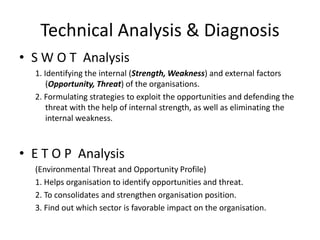
Technical Analysis & Diagnosis
• S W O T Analysis
1. Identifying the internal (Strength, Weakness) and external factors
(Opportunity, Threat) of the organisations.
2. Formulating strategies to exploit the opportunities and defending the
threat with the help of internal strength, as well as eliminating the
internal weakness.
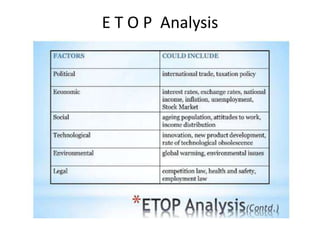
• E T O P Analysis
(Environmental Threat and Opportunity Profile)
1. Helps organisation to identify opportunities and threat.
2. To consolidates and strengthen organisation position.
3. Find out which sector is favorable impact on the organisation.
S W O T Analysis example
Generating Strategic Alternatives
Internal Factors (→)
External Factors (↓)
Strength
(S)
Weakness
(W)
Opportunities
(O)
S O
Utilise Strength while
capitalise on Opportunity
W O
Minimise Weaknesses
while capitalising on
Opportunities
Threat
(T)
S T
Utilise Strengths while
neutralising Threats
W T
Minimise Weaknesses
while neutralising Threats
S W O T – Application Steps
• Broadly the application of SWOT Analysis involves following
steps,
• Setting the Objectives of the Organization/ Unit
• Identifying all Strengths, Weaknesses, Opportunities and
Threats
• Exploring for answers to Four Questions
– How to maximize the Strengths
– How to minimize the Weaknesses
– How to capitalize on the Opportunities in external environment
– How to protect the organizations from the Threats in external
environment
• Formulating Strategies that Optimizes the answers from the
above four questions
SWOT; Hospital example
SWOT – Coca Cola Example
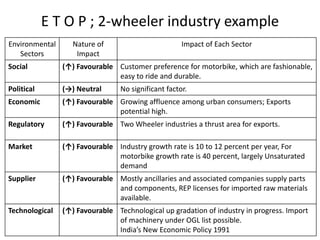
E T O P Analysis
Environmental
Sectors
Nature of
Impact
Impact of Each Sector
Social (↑) Favourable Customer preference for motorbike, which are fashionable,
easy to ride and durable.
Political (→) Neutral No significant factor.
Economic (↑) Favourable Growing affluence among urban consumers; Exports
potential high.
Regulatory (↑) Favourable Two Wheeler industries a thrust area for exports.
Market (↑) Favourable Industry growth rate is 10 to 12 percent per year, For
motorbike growth rate is 40 percent, largely Unsaturated
demand
Supplier (↑) Favourable Mostly ancillaries and associated companies supply parts
and components, REP licenses for imported raw materials
available.
Technological (↑) Favourable Technological up gradation of industry in progress. Import
of machinery under OGL list possible.
India’s New Economic Policy 1991
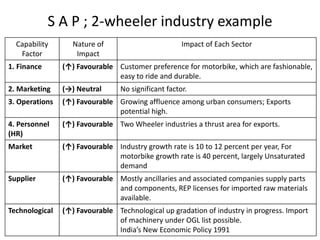
E T O P ; 2-wheeler industry example
Capability
Factor
Nature of
Impact
Impact of Each Sector
1. Finance (↑) Favourable Customer preference for motorbike, which are fashionable,
easy to ride and durable.
2. Marketing (→) Neutral No significant factor.
3. Operations (↑) Favourable Growing affluence among urban consumers; Exports
potential high.
4. Personnel
(HR)
(↑) Favourable Two Wheeler industries a thrust area for exports.
Market (↑) Favourable Industry growth rate is 10 to 12 percent per year, For
motorbike growth rate is 40 percent, largely Unsaturated
demand
Supplier (↑) Favourable Mostly ancillaries and associated companies supply parts
and components, REP licenses for imported raw materials
available.
Technological (↑) Favourable Technological up gradation of industry in progress. Import
of machinery under OGL list possible.
India’s New Economic Policy 1991
S A P ; 2-wheeler industry example
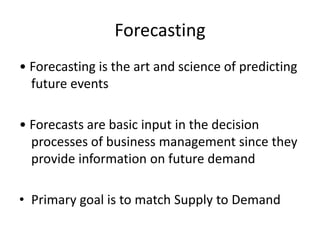
Forecasting
• Forecasting is the art and science of predicting
future events
• Forecasts are basic input in the decision
processes of business management since they
provide information on future demand
• Primary goal is to match Supply to Demand
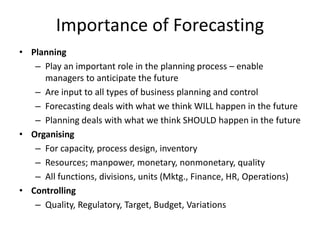
Importance of Forecasting
• Planning
– Play an important role in the planning process – enable
managers to anticipate the future
– Are input to all types of business planning and control
– Forecasting deals with what we think WILL happen in the future
– Planning deals with what we think SHOULD happen in the future
• Organising
– For capacity, process design, inventory
– Resources; manpower, monetary, nonmonetary, quality
– All functions, divisions, units (Mktg., Finance, HR, Operations)
• Controlling
– Quality, Regulatory, Target, Budget, Variations
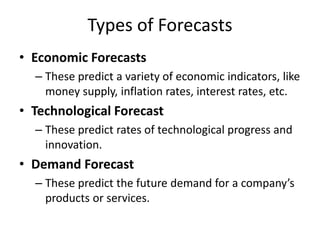
Types of Forecasts
• Economic Forecasts
– These predict a variety of economic indicators, like
money supply, inflation rates, interest rates, etc.
• Technological Forecast
– These predict rates of technological progress and
innovation.
• Demand Forecast
– These predict the future demand for a company’s
products or services.
EXTRAPOLATION TECHNIQUES OF
DEMAND FORECASTING
• Time Series Analysis
– Based on the assumption that the item forecasted follows a
similar pattern over time.
• Qualitative Forecasting
– Consists of gathering opinions from a variety of people, then
applying their own judgment
– Best used when there is insufficient historical data
• Causal
– Refers to the application of leading indicators to make forecast .
(e.g., Mortgage rates affect the purchase of new homes)
• Simulation Forecasting
– Combines the causal and the time series methods; often used in
“what-ifs” scenarios”
Qualitative and Quantitative
1. Qualitative Techniques
–based on judgments, opinions, intuition,
emotions, or personal experiences and are
subjective in nature.
2. Quantitative Techniques
–based on mathematical (quantitative)
models, and are objective in nature
Qualitative Methods
• JURY OF EXECUTIVE OPINION
– Approach in which a group of managers meet and collectively develop
a forecast
• OPINIONS OF THE SALES PERSON/SALES FORCE MEMBERS
– Approach in which each salesperson estimates future sales in his or
her region
• CONSUMER’S EXPECTATIONS
– Involves a survey of the customers (via questionnaires, researches and
other tools) as to their future needs
– The surveys are used to judge preferences of customer and to assess
demand.
• THE DELPHI METHOD
– Approach in which consensus agreement is reached among a group of
experts
– Developed by Rank Corporation in 1969 for forecasting military events
Qualitative....
• BAYESIAN DECISION THEORY
– Uses a network diagram and probability must be estimated for each
event over the network
• SCENARIO WRITING METHOD
– The forecaster generates several different future scenarios
(corresponding to different sets of assumptions).
• SUBJECTIVE APPROACH METHOD
– Allows individuals participating in the forecasting decision to arrive at
a forecast based on their feelings, ideas, and personal experiences
• EXECUTIVE OPINIONS
– Usually involve a small group of upper- level managers (marketing,
operations and finance)
– Often used as a part of long-range planning and new product
development
QUANTITATIVE FORECASTING
METHODS
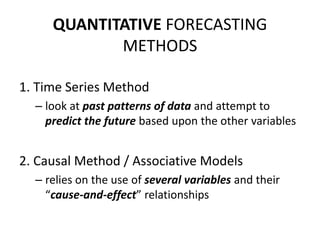
1. Time Series Method
– look at past patterns of data and attempt to
predict the future based upon the other variables
2. Causal Method / Associative Models
– relies on the use of several variables and their
“cause-and-effect” relationships
Simple Moving Average
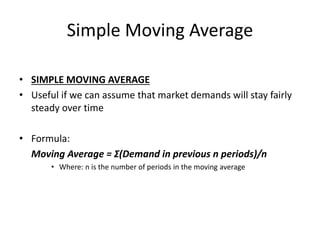
• SIMPLE MOVING AVERAGE
• Useful if we can assume that market demands will stay fairly
steady over time
• Formula:
Moving Average = Σ(Demand in previous n periods)/n
• Where: n is the number of periods in the moving average
Simple Moving Average
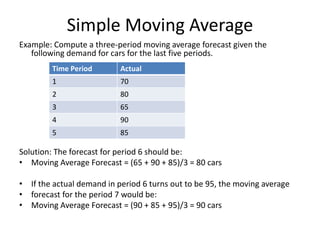
Example: Compute a three-period moving average forecast given the
following demand for cars for the last five periods.
Solution: The forecast for period 6 should be:
• Moving Average Forecast = (65 + 90 + 85)/3 = 80 cars
• If the actual demand in period 6 turns out to be 95, the moving average
• forecast for the period 7 would be:
• Moving Average Forecast = (90 + 85 + 95)/3 = 90 cars
Time Period Actual
1 70
2 80
3 65
4 90
5 85
Weighted Moving Average
• WEIGHTED MOVING AVERAGE
• Uses an average of a specified number of the
most recent observations, with each
observation receiving a different emphasis
(weighted) when there is a trend or pattern
• Formula: Weighted Moving Average =
Σ[(Weight for period n).(demand in period n)] / Σ(Weights)
W M A
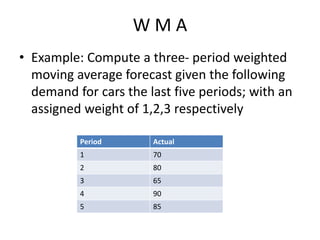
• Example: Compute a three- period weighted
moving average forecast given the following
demand for cars the last five periods; with an
assigned weight of 1,2,3 respectively
Period Actual
1 70
2 80
3 65
4 90
5 85
W M A
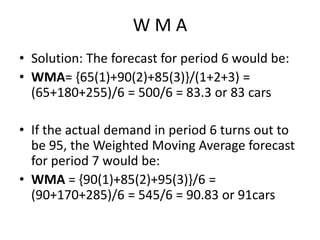
• Solution: The forecast for period 6 would be:
• WMA= {65(1)+90(2)+85(3)}/(1+2+3) =
(65+180+255)/6 = 500/6 = 83.3 or 83 cars
• If the actual demand in period 6 turns out to
be 95, the Weighted Moving Average forecast
for period 7 would be:
• WMA = {90(1)+85(2)+95(3)}/6 =
(90+170+285)/6 = 545/6 = 90.83 or 91cars
Simple Exponential Smoothing
• Used to forecast sales when there is no trend
in the demand for goods or services
• Formula: Ft = Ft-1 + ∝ [ At-1 – Ft-1]
;Where: Ft = new forecast or forecast for period
Ft-1 = previous forecast
∝ = smoothing constant; represents percentage of the
forecast error
At-1 = actual demand or sales for period t-1
Exponential Smoothing
• Example 1: A car dealer predicted a January demand
for 550 Honda V-tech cars. Actual January demand was
680 Honda V-tech cars and ∝ = 0.10.
Forecast the demand using the exponential smoothing
model.
• Solution:
Ft = Ft-1 + ∝ [ At-1 – Ft-1]
= 550 + 0.10 [680-550]
= 550 + 0.10 [130]
= 550 + 13
Ft = 563
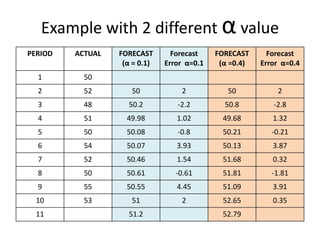
Exponential Smoothing Example
(different α value scenario)
• Example 2: Use exponential smoothing model to
develop a series of forecast for the following data
and compute:
[Actual - Forecast] = Error for each period
(i) Use a smoothing factor of .10
(ii) Again use smoothing factor of .40
• Compute the actual data and both sets of
forecast on a single table.
Example with 2 different α value
PERIOD ACTUAL FORECAST
(α = 0.1)
Forecast
Error α=0.1
FORECAST
(α =0.4)
Forecast
Error α=0.4
1 50
2 52 50 2 50 2
3 48 50.2 -2.2 50.8 -2.8
4 51 49.98 1.02 49.68 1.32
5 50 50.08 -0.8 50.21 -0.21
6 54 50.07 3.93 50.13 3.87
7 52 50.46 1.54 51.68 0.32
8 50 50.61 -0.61 51.81 -1.81
9 55 50.55 4.45 51.09 3.91
10 53 51 2 52.65 0.35
11 51.2 52.79
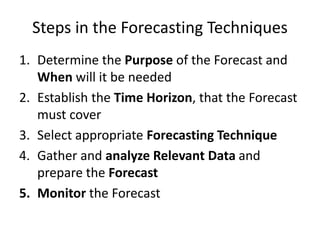
Steps in the Forecasting Techniques
1. Determine the Purpose of the Forecast and
When will it be needed
2. Establish the Time Horizon, that the Forecast
must cover
3. Select appropriate Forecasting Technique
4. Gather and analyze Relevant Data and
prepare the Forecast
5. Monitor the Forecast
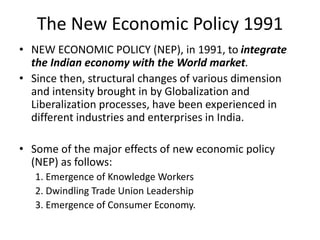
The New Economic Policy 1991
• NEW ECONOMIC POLICY (NEP), in 1991, to integrate
the Indian economy with the World market.
• Since then, structural changes of various dimension
and intensity brought in by Globalization and
Liberalization processes, have been experienced in
different industries and enterprises in India.
• Some of the major effects of new economic policy
(NEP) as follows:
1. Emergence of Knowledge Workers
2. Dwindling Trade Union Leadership
3. Emergence of Consumer Economy.
N E P ‘91 ; Main Characteristics
• 1. De-Licencing. Only six industries were kept under Licensing scheme.
• 2. Entry to Private Sector. The role of public sector was limited only to
four industries; rest all the industries were opened for private sector.
• 3. Disinvestment. Disinvestment was carried out in many public sector
enterprises.
• 4. Setting up of Small Scale Industries. Various benefits were offered to
small scale industries.
• 5. Liberalization of Foreign Policy. The limit of foreign equity was raised to
100% in many activities, i.e., NRI and foreign investors were permitted to
invest in Indian companies.
• 6. Liberalization in Technical Area. Automatic permission was given to
Indian companies for signing technology agreements with foreign
companies.
• 7. Setting up of Foreign Investment Promotion Board (FIPB). This board
was set up to promote and bring foreign investment in India.
N E P – 3 Major Components/Elements
Three Major Components/Elements of New
Economic Policy: (L P G)
• Liberalisation
• Privatisation
• Globalisation
Liberalization
• Liberalization refers to end of licence, quota and many more
restrictions and controls which were put on industries before 1991.
• Indian companies got liberalization in the following way:
• (a) Abolition of licence except in few.
• (b) No restriction on expansion or contraction of business activities.
• (c) Freedom in fixing prices.
• (d) Liberalization in import and export.
• (e) Easy and simplifying the procedure to attract foreign capital in
India.
• (f) Freedom in movement of goods and services
• (g) Freedom in fixing the prices of goods and services.
Privatization
• Privatization refers to giving greater role to private sector and
reducing the role of public sector. To execute policy of privatization
government took the following steps:
• (a) Disinvestment of public sector. i.e., transfer of public sector
enterprise to private sector.
• (b) Setting up of Board of Industrial and Financial Reconstruction
(BIFR). This board was set up to revive sick units in public sector
enterprises suffering loss.
• (c) Dilution of Stake of the Government. If in the process of
disinvestments private sector acquires more than 51% shares then
it results in transfer of ownership and management to the private
sector.
Globalization
• It refers to integration of various economies of world. Till 1991 Indian government
was following strict policy in regard to import and foreign investment in regard to
licensing of imports, tariff, restrictions, etc. but after new policy government
adopted policy of globalisation by taking following measures:
• (i) Liberal Import Policy. Government removed many restrictions from import of
capital goods.
• (ii) Foreign Exchange Regulation Act (FERA) was replaced by Foreign Exchange
Management Act (FEMA)
• (iii) Rationalization of Tariff structure
• (iv) Abolition of Export duty.
• (v) Reduction of Import duty.
• As a result of globalization physical boundaries and political boundaries remained
no barriers for business enterprise. The Whole world becomes a global village.
• Globalization involves greater interaction and interdependence among the various
nations of global economy.
Impact / Effects
The factors and forces of business environment have lot of influence over the
business. The common influence and impact of such changes in business
and industry are explained below:
1. Increasing Competition.
After the new policy, Indian companies had to face all round competition
which means competition from the internal market and the competition
from the MNCs. The companies which could adopt latest technology and
which were having large number of resources could only survive and face
the competition. Many companies could not face the competition and had
to leave the market.
2. More Demanding Customers:
Prior to new economic policy there were very few industries or production
units. As a result there was shortage of product in every sector. Because of
this shortage the market was producer-oriented, i.e., producers became
key persons in the market.
But after new economic policy many more businessmen joined the
production line and various foreign companies also established their
production units in India.
Impact / Effects...
3. Rapidly Changing Technological Environment:
Before or prior to new economic policy there was a small internal
competition only. But after the new economic policy the world class
competition started and to stand this global competition the companies
need to adopt the world class technology.
To adopt and implement the world class technology the investment in R &
D department has to increase. Many pharmaceutical companies increased
their investment in R and D department from 2% to 12% and companies
started spending a large amount for training the employees.
4. Necessity for Change:
Prior to 1991 business enterprises could follow stable policies for a long
period of time but after 1991 the business enterprises have to modify
their policies and operations from time to time.
5. Need for Developing Human Resources:
Before 1991 Indian enterprises were managed by inadequately trained
personnel’s. New market conditions require people with higher
competence skill and training. Hence Indian companies felt the need to
develop their human skills.
Impact/Effects...
6. Market Orientation:
Earlier firms were following selling concept, i.e., produce first and then go to market but now
companies follow marketing concept, i.e., planning production on the basis of market
research, need and want of customer.
7. Loss of Budgetary Support to Public Sector:
Prior to 1991 all the losses of Public sector were used to be made good by government by
sanctioning special funds from budgets. But today the public sectors have to survive and
grow by utilizing their resources efficiently otherwise these enterprises have to face
disinvestment.
On the whole the policies of Liberalisation, Globalisation and Privatisation have brought
positive impacts on Indian business and industry. They have become more customer focus
and have started giving importance to customer satisfaction.
8. Export a Matter of Survival:
The Indian businessman was facing global competition and the new trade policy made the
external trade very liberal. As a result to earn more foreign exchange many Indian companies
joined the export business and got lot of success in that. Many companies increased their
turnover more than double by starting export division.
Example, the Reliance Group(RIL), Videocon Group, MRF Tyres, Ceat Tyres, etc. got a great
hold in the export market.
Economic Policies - India
The ten major economic policies which are followed in India and has played a major
role in the growth of Indian economy.
1) Industrial Policy,
2) Trade Policy,
3) Monetary Policy,
– Open Market Operations for purchase and sale of Bonds, Reserve Deposit
Ratio, Discount rate of Interest for loan to banks,
4) Fiscal Policy,
5) Indian Agricultural Policy (Post-Independence),
6) National Agricultural Policy (July 2000),
7) Industrial Policies,
8) International Trade Policy,
9) Exchange Rate Management Policy, and
10) EXIM Policy.
Industrial Policy
It is an strategic attempt to influence the growth of various sectors. For
the industrial development, specific roles are allocated to the
different types of industrial organisation like public, private, joint
and cooperative sectors.
• What are the roles of industrial policy?
• Formulation of Labour policy
• Tariff policy
• Fiscal policy
• Monetary policy
• According to world bank, “Industrial policy comprises government
efforts to alter industrial structure to promote productivity based
growth”.
Fiscal Policy
• Fiscal policy relates to the impact of government
spending and tax on aggregate demand and the
economy.
• Expansionary fiscal policy is an attempt to increase
aggregate demand and will involve higher government
spending and lower taxes.
• Expansionary fiscal policy will lead to a larger budget
deficit.
• Deflationary fiscal policy is an attempt to reduce
aggregate demand and will involve lower spending and
higher taxes.
• This deflationary fiscal policy will help reduce a budget
deficit.
Monetary Policy
• Monetary policy involves influencing the supply and demand for
money through interest rates and other monetary tools.
• Monetary policy is usually conducted by the Central Bank, e.g. India
- RBI, UK – Bank of England, US – Federal Reserve.
• The target of Monetary policy is to achieve low inflation (and
usually promote economic growth)
• The main tool of monetary policy is changing interest rates. For
example, if the Central Bank feel the economy is growing too
quickly and inflation is increasing, then they will increase interest
rates to reduce demand in the economy.
• In some circumstances, Central Banks may use other tools than just
interest rates. For example, in the great recession 2008-12, Central
Banks in UK and US pursued quantitative easing. This involved
increasing the money supply to increase demand.
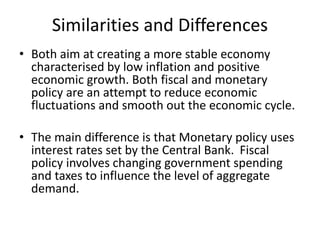
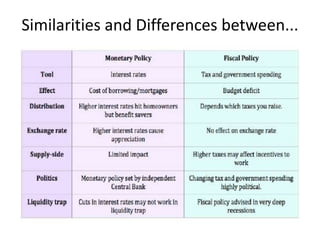
Similarities and Differences
• Both aim at creating a more stable economy
characterised by low inflation and positive
economic growth. Both fiscal and monetary
policy are an attempt to reduce economic
fluctuations and smooth out the economic cycle.
• The main difference is that Monetary policy uses
interest rates set by the Central Bank. Fiscal
policy involves changing government spending
and taxes to influence the level of aggregate
demand.
Similarities and Differences between...
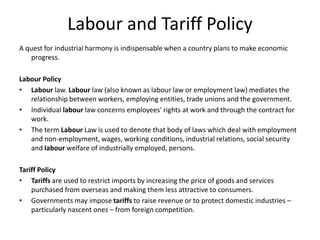
Labour and Tariff Policy
A quest for industrial harmony is indispensable when a country plans to make economic
progress.
Labour Policy
• Labour law. Labour law (also known as labour law or employment law) mediates the
relationship between workers, employing entities, trade unions and the government.
• Individual labour law concerns employees' rights at work and through the contract for
work.
• The term Labour Law is used to denote that body of laws which deal with employment
and non-employment, wages, working conditions, industrial relations, social security
and labour welfare of industrially employed, persons.
Tariff Policy
• Tariffs are used to restrict imports by increasing the price of goods and services
purchased from overseas and making them less attractive to consumers.
• Governments may impose tariffs to raise revenue or to protect domestic industries –
particularly nascent ones – from foreign competition.
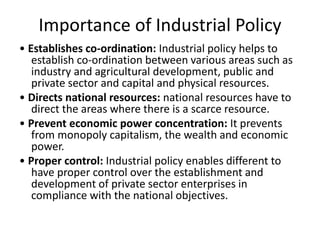
Importance of Industrial Policy
• Establishes co-ordination: Industrial policy helps to
establish co-ordination between various areas such as
industry and agricultural development, public and
private sector and capital and physical resources.
• Directs national resources: national resources have to
direct the areas where there is a scarce resource.
• Prevent economic power concentration: It prevents
from monopoly capitalism, the wealth and economic
power.
• Proper control: Industrial policy enables different to
have proper control over the establishment and
development of private sector enterprises in
compliance with the national objectives.
National Level Industrial Policies
• Industrial policy resolution 1948: after the independence, India was going through
the issue related with the partition of the country like scarcity of food, loss and
land and property, rehabilitation of people, reformation of states.
Different group used to look at the problem and proposed remedial actions in
different manner. (For example, Labour Leaders and Indian Capitalists)
• In order to get rid of this situation, government formulate industrial policy resolution
1948.
Industrial policy resolution 1956
• Industrial policy became socialist –oriented with the resolution of 1956 which
helped the public sector to wider their scope.
• This resolution was based on the Mahalanobis Model. This model said that the long
term growth can only be achieved by dealing in heavy industries.
Industrial policy resolution 1973:
• In this resolution joint sector idea suggested by the Dutt Committee. Licensing was
made strict and it had a strong favouritism for the large and heavy enterprises.
Industrial policy resolution 1977:
This resolution passed by Janta party, the ruling government at that time. the main aim was to
improve the living conditions of the policy were as follows:
• 1. Prevention of economic power concentration and monopoly.
• 2. Production of consumer goods at maximum level.
• 3. Enabling industries to respond towards the needs of the society.
Industrial policy resolution 1980
After defeating Janta party, congress government introduced new industrial policy.
• The main aim was to benefit masses of the society by fast and reasonable industrialisation.
• Policy includes:
• 1. Creation of employment at large scale.
• 2. Maximise the production.
• 3. Supporting industrially weak areas for their development.
• 4. Development in agriculture.
• 5. focusing on import and export oriented business.
• 6. Protection of consumers against costly and poor quality product.
Industrial Policy 1991
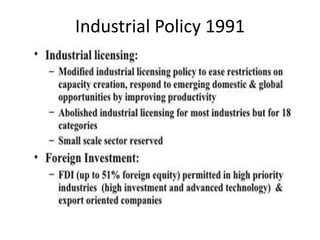
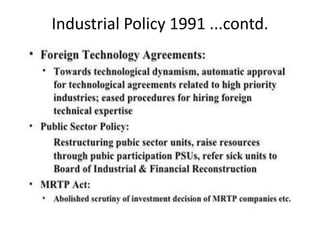
In pursuit of the stated objectives, Govt. decided
to take up series of initiatives with regards to
following,
• A. Industrial Licensing
• B. Foreign Investment
• C. Foreign Technology Agreements
• D. Public Sector Policy
• E. MRTP Act
Industrial Policy 1991
Industrial Policy 1991 ...contd.
State Level Industrial Policies
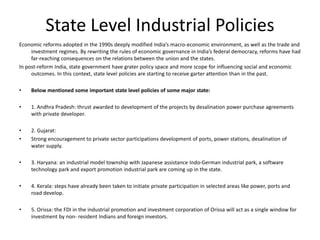
Economic reforms adopted in the 1990s deeply modified India’s macro-economic environment, as well as the trade and
investment regimes. By rewriting the rules of economic governance in India’s federal democracy, reforms have had
far-reaching consequences on the relations between the union and the states.
In post-reform India, state government have grater policy space and more scope for influencing social and economic
outcomes. In this context, state level policies are starting to receive garter attention than in the past.
• Below mentioned some important state level policies of some major state:
• 1. Andhra Pradesh: thrust awarded to development of the projects by desalination power purchase agreements
with private developer.
• 2. Gujarat:
• Strong encouragement to private sector participations development of ports, power stations, desalination of
water supply.
• 3. Haryana: an industrial model township with Japanese assistance Indo-German industrial park, a software
technology park and export promotion industrial park are coming up in the state.
• 4. Kerala: steps have already been taken to initiate private participation in selected areas like power, ports and
road develop.
• 5. Orissa: the FDI in the industrial promotion and investment corporation of Orissa will act as a single window for
investment by non- resident Indians and foreign investors.
Industrial Policy Resolution 2015 –
Govt. Of Odisha
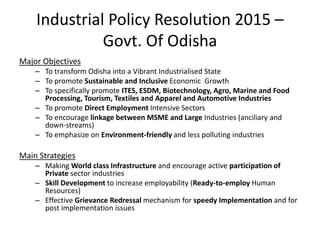
Major Objectives
– To transform Odisha into a Vibrant Industrialised State
– To promote Sustainable and Inclusive Economic Growth
– To specifically promote ITES, ESDM, Biotechnology, Agro, Marine and Food
Processing, Tourism, Textiles and Apparel and Automotive Industries
– To promote Direct Employment Intensive Sectors
– To encourage linkage between MSME and Large Industries (anciliary and
down-streams)
– To emphasize on Environment-friendly and less polluting industries
Main Strategies
– Making World class Infrastructure and encourage active participation of
Private sector industries
– Skill Development to increase employability (Ready-to-employ Human
Resources)
– Effective Grievance Redressal mechanism for speedy Implementation and for
post implementation issues
I P R 2015 – Odisha ...
• General Policy Framework emphasizes on,
– Investment Promotion
– Ease of Doing Business
– Simplification and Rationalisation of Regulatory Mechanism
• Important Incentives include,
– Land (Zone - A, B ..... Zone - F denoted)
– Interest Subsidy
– Stamp duty exemption (in varying degree)
– Electricity bill exemption (in slabs)
– Tax reimbursement (VAT, Entry tax)
– Employment Cost subsidy
– Market Syndication and Assistance
• Other prominent focus
– Human Resource Development
– Labour Reforms
– Export promotion
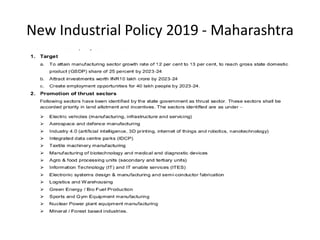
New Industrial Policy 2019 - Maharashtra
N I P 2019 - Maharashtra
• It covers
– Special emphasis on Promotion of MSME
– And also covers LSI (Large Scale Industries)
– And Mega & Ultra-Mega Projects

BusinessEnvironment_Module-1_BBDas_Mar21.pptx

  • 1.
  • 2.
    Business • It isa continuous production and distribution of goods and services with the aim of earning profits under uncertain market conditions. • It is a form of regular activity conducted with an objective of earning profits for the benefit of those on whose behalf the activity is conducted.
  • 3.
    The Business &its Environment • The relation of a Business Organisation with its Environment, – It receives Inputs from External Environment – Converts them into Output – Sells to External Environment • How the transformation process is Planned, Organised, and Controlled by the Management.
  • 4.
  • 5.
    Business Environment • Theenvironment of any organization is “ the aggregate of all conditions, events and influences that surround and affect it.” • The business environment is dynamic in nature and it keeps on changing. • The changes of business environment are unpredictable. It is very difficult to predict the exact nature of future happenings and the changes in economic and social environment. • Business environment differs from place to place, country to country. Like political conditions in India will differ from those in Pakistan
  • 6.
    Importance • First moveradvantages: Grab the early opportunity in the market which allow the enterprise to stay ahead from their competitors. Ex- Maruti Udyog (need of the middle class people-small car) • Early warning signal: Its all about environmental awareness. early signal for the enterprise against upcoming threat. (Maruti proved itself against the new entrant by tripling its production--- esteem to provide quick customer delivery). • Customer focus: facilitates the company to cater to the changing tastes and preferences of the customer. (ex- introduction of HUL – small sachet of shampoo) • Strategy formulation: environmental analysis- provide various relevant information – for future plan .(ITC – recognise – scope in travel and tourism- opened new hotel) • Image building: build company’s positive image in the mind of the customer. Big Bazar, Fbb
  • 7.
    Types of Bus.Env. • Mainly Business Environment is divided into two types: 1. Internal Environment 2. External Environment
  • 8.
    Internal Environment • Thefactors which can be controlled by company to a good extent, or • Primary factors which directly affects the growth of organization….. man, material, money, machinery and management • However, the firm may not be able to change or modify all the Internal factors.
  • 9.
    Types of InternalEnvironment • Value System • Mission & Objectives • Management Structure and Nature - Organisation Structure, Style of functioning • Internal Power relationship • Human Resources - Quality of HR, Labour Unions • Physical Resources and Tech. Capabilities - Physical Assets, Finance (Capital Structure) • Company Image & Brand Equity …..
  • 10.
    Significance of Internalfactors The internal factors basically include the inner strengths and weaknesses. Internal factors can affect how a company meets its objectives. Some examples of areas which are typically considered in internal factors are: • Financial resources like funding, investment opportunities and sources of income. • Physical resources like company’s location, equipment, and facilities • Human resources like employees, target audiences, and volunteers • Access to natural resources, patents, copyrights, and trademarks • Current processes like employee programs, software systems, and department hierarchies
  • 11.
    External Environment • Thosefactors that affect a Business from Outside. • Those factors which are beyond the control of business enterprise are included in external environment. • External Environment is divided into two parts 1. Micro Environment: The environment which is close to business and affects its capacity to work is known as Micro Environment. 2. Macro Environment: It includes factors that create opportunities and threats to business units.
  • 12.
    External Micro Environment •Suppliers – Backward Integration associates • Customers – B2C, B2B • Wholesalers • Retailers • Industries • Government and Other Institutions • Foreigners • Market Intermediaries – Agents, Stockist, Transporters – Mktg. Service Agency (Mktg. Research, Consulting, Advt.) – Financial Intermediaries – Physical Intermediaries – Forward Integration associates • Competitors – Product, Brand, Disposable Income/Budget • Publics – Environmentalists, Media, Consumer rights, Local groups, Citizen associations
  • 13.
    External Micro Env.... •Suppliers: suppliers are those who supply raw materials components and machines to the business enterprise. The suppliers are an important micro factor in the business environment. They should be trustworthy and cordial with business enterprise. This will help the enterprise to attain the customer expectation and companies will become free from the burden of keeping heavy stocks. • Customer: customers are the most important element of the business enterprise. The main aim of any business is to attract and retain its customers. This helps the business to attain long term survival and profitability. Therefore, to increase the level of loyal customers, business enterprise should carefully observe the needs and wants of the customers and fulfil them effectively. The business enterprises must also analyses the changing tastes and preference of the customers and make changes in its product and services accordingly.
  • 14.
    External Micro Env... •Market Intermediaries: Intermediaries are those who act as a mediator between the manufacturer and final consumer. The number of marketing intermediaries varies according to size and type of distribution network. Market intermediaries are beneficial to the organisation only when there is a proper coordination between channel without any hurdle. • Competitors: the organisation which manufacture similar products and try to conquer over the market share are termed as competitors. To earn more profit and stay competitive, the company needs to monitor the competitor’s activities and then prepare its future plan. • General public: the general public is also an indispensable part of business environment. The positive and negative responses of the public directly influences company’s image. This can also affect the sales and revenue of the company.
  • 15.
    Publics • Ay groupthat has an actual or potential interest in or on a company’s ability to achieve its objective. (- Philip Kotler)
  • 16.
    External Macro Environment •Those determine the opportunities for a firm to exploit for promoting its business and also presents threats to it in the sense that it can put restrictions on its expansion/growth. • Both positive and negative aspects • Uncontrollable by the firm, hence need to adjust and or adapt to the external forces
  • 17.
    External Macro Environment EconomicEnvironment: It is very complex and dynamic in nature that keeps on changing with the change in policies or political situations. It has three elements: • Economic Conditions of Public • Economic Policies of the country • Economic System Other Economic Factors: Infrastructural facilities, Banking, Insurance companies, Money markets, Capital markets etc.
  • 18.
    Economic Environment • Itrelates to production and distribution of wealth of the country/ region. It also play with the word demand and supply of a business of an organisation. It also said that from financial perspective of a business firm. These also determine the feasibility of a country or a region for the conduct of a particular business from a financial perspective. The economic conditions of a country include the nature of the economy, the stage of development of the economy, economic resources, the level of income, the distribution of income and assets. • The purchasing power of consumers and consumer confidence or insecurities strongly influences and impact the demand for the products and services of an organisation. It is an important element of the economic environment. In management decisions of all businesses, the economic environment comes up for prime consideration.
  • 19.
    External Macro Env... Non-EconomicEnvironment: Following are included in non-economic environment: 1) Political and Legal Environment: It affects different business units extensively. Components are • Political Belief of Government • Political Strength of the Country • Relation with other countries • Defense and Military Policies • Centre State Relationship in the Country • Thinking of Opposition Parties towards Business Unit Examples : Anti-Trust Regulations, Environmental Protection, Tax laws, Employment Laws, Stability of Govt. Foreign Trade Protection
  • 20.
    Macro Env.; Socio-Cultural 2)Socio-Cultural Environment – Influence exercised by social and cultural factors, not within the control of business, is known as Socio-Cultural Environment. – These factors include: attitude of people to work, family system, caste system, religion, education, marriage etc. (e.g., Language, Taste & Preference, Dressing & Lifestyle, Religion) Socio-cultural environment is a collection of social factors affecting a business and includes social traditions, values and beliefs, level of literacy and education the ethical standards and state of society, the extent of social stratification, conflict and cohesiveness and so forth.
  • 21.
    External Macro Env...Technological 3) Technological Environment A systematic application of scientific knowledge to practical task is known as technology. Everyday there has been vast changes in products, services, lifestyles and living conditions, these changes must be analysed by every business unit and should adapt these changes.
  • 22.
    Technological Environment Technology isknowledge of methods to perform certain tasks or solve problems pertaining to product and services. The basic elements of Technology: • Information on Product design • Production techniques • Quality Assurance measures • Human Resource development (Skill development) Technology provides opportunities for businesses to adopt new breakthroughs, innovations, and inventions to cut costs and develop new products. A business producing confectionery like Cadbury, Schweppes examines S L E P T factors in designing new products. Technological change is particularly important today, for example, the development of new technologies that have enabled variations on chocolate bars to be produced in an ice cream format.
  • 23.
    External Macro Env... 4)Natural Environment and Ecological Effects It includes natural resources, weather, climatic conditions, port facilities, topographical factors such as soil, sea, rivers, rainfall etc. Every business unit must look for these factors before choosing the location for their business. Thus, SLEPT got revised/improvised to PESTEL (another ‘ E ’- the Environmental effect, got added)
  • 24.
    Natural Environment Here theterm is applies to Ecological complex, include plants, animals, micro- organism, minerals, rock, water bodies. The set of living and non-living things on Earth, which occur in a state sustainably (not to be influenced by humans). Includes all of the plants; animal; microorganism; abiotic factors such mineral; rocks and magma; water bodies and atmosphere layers. There are extremely complex interaction between the living organisms and abiotic elements as well as meteorological influences. Components of Natural environment are: • Land resources: Land is certainly important. Man and other living beings use it for their habitation. • Water resources: Water is a prime natural resource. It is required for satisfying one of the basic needs of humans. Thus, water has become a precious national asset. • Forest resources: Forests occupy an important place among natural resources of a country. • Mineral resources: Availability of mineral has a unique distinction of influencing the course of economic development of a country.
  • 25.
    External Macro Env...Demographic 5) Demographic It is a study of perspective of population i.e. its size, standard of living, growth rate, age-sex composition, family size, income level (upper level, middle level and lower level), education level etc. Every business unit must see these features of population and recognize their various needs and produce accordingly. Demographic environment: Population size, growth-rate of population, Gender Age composition of the population, Life cycle stage Education level, Employment status, Marital status, Family size Caste, Religion, Race, Location Income, Assets ownership, Social class, Home ownership
  • 26.
    Demographic... For example, premiumproducts such as high-end women’s clothing usually appeal to women with higher incomes. Conversely, people with comparatively lower incomes are more sensitive to price and, therefore, may prefer purchasing discount products. People with lower incomes have less disposable income. Value is a major determinant in the products they purchase. • Hence, a company may best reach lower-income people through discount retailers and wholesalers and attract higher-income buyers in specialty retail shops. Younger people under 35 are often the first consumers to purchase high-tech products like cell phones, electronic books and video games. Certain buying groups also have more buying power than others. For example, there are about 76 million baby boomers in the United States, according to "Entrepreneur" online. • This is the single largest population segment. Baby Boomers spent $400 billion more than any other age group, according to a June 2009 report by "Entrepreneur." Small business owners have much to gain by selling products to this population.
  • 27.
    External Macro Env...International 6) International Environment It is particularly important for industries directly depending on import or exports. Form of Govt., Political Ideology, Protectionist Sentiment, Terrorism, Legal System, Govt.’s Attitude towards Foreign Firms The factors that affect the business are • Globalization • Liberalization • Foreign business and Investment policies • Cultural exchange across
  • 28.
  • 29.
  • 30.
    P E ST E L Matrix
  • 31.
  • 32.
    Mega Environment Mega environmentmainly consist of International Environment which is very important from the point of certain categories of business. A. Import and Export dependency: • Industries directly depends on Imports or exports • Import – competing Industries. • A boom in the export market or a relaxation of the protectionist policies may help the export oriented industries. • A liberalization of imports may help some industries which use imported items, but may adversely affect important – competing industries. B. World Trade linkage: • Oil price hikes have seriously affected a number of economics. These hikes have increased the cost of production and the prices of certain products like fertilizers, synthetic fabrics, etc. The high oil price has led to an increase in the demand for automobile models that economies energy consumption. • The oil crisis led to a reorientation of the government of India’s energy policy. Such development affects the demand, consumption and investment pattern.
  • 33.
    Technical Analysis &Diagnosis • S W O T Analysis 1. Identifying the internal (Strength, Weakness) and external factors (Opportunity, Threat) of the organisations. 2. Formulating strategies to exploit the opportunities and defending the threat with the help of internal strength, as well as eliminating the internal weakness. • E T O P Analysis (Environmental Threat and Opportunity Profile) 1. Helps organisation to identify opportunities and threat. 2. To consolidates and strengthen organisation position. 3. Find out which sector is favorable impact on the organisation.
  • 34.
    S W OT Analysis example
  • 35.
    Generating Strategic Alternatives InternalFactors (→) External Factors (↓) Strength (S) Weakness (W) Opportunities (O) S O Utilise Strength while capitalise on Opportunity W O Minimise Weaknesses while capitalising on Opportunities Threat (T) S T Utilise Strengths while neutralising Threats W T Minimise Weaknesses while neutralising Threats
  • 36.
    S W OT – Application Steps • Broadly the application of SWOT Analysis involves following steps, • Setting the Objectives of the Organization/ Unit • Identifying all Strengths, Weaknesses, Opportunities and Threats • Exploring for answers to Four Questions – How to maximize the Strengths – How to minimize the Weaknesses – How to capitalize on the Opportunities in external environment – How to protect the organizations from the Threats in external environment • Formulating Strategies that Optimizes the answers from the above four questions
  • 37.
  • 38.
    SWOT – CocaCola Example
  • 39.
    E T OP Analysis
  • 40.
    Environmental Sectors Nature of Impact Impact ofEach Sector Social (↑) Favourable Customer preference for motorbike, which are fashionable, easy to ride and durable. Political (→) Neutral No significant factor. Economic (↑) Favourable Growing affluence among urban consumers; Exports potential high. Regulatory (↑) Favourable Two Wheeler industries a thrust area for exports. Market (↑) Favourable Industry growth rate is 10 to 12 percent per year, For motorbike growth rate is 40 percent, largely Unsaturated demand Supplier (↑) Favourable Mostly ancillaries and associated companies supply parts and components, REP licenses for imported raw materials available. Technological (↑) Favourable Technological up gradation of industry in progress. Import of machinery under OGL list possible. India’s New Economic Policy 1991 E T O P ; 2-wheeler industry example
  • 41.
    Capability Factor Nature of Impact Impact ofEach Sector 1. Finance (↑) Favourable Customer preference for motorbike, which are fashionable, easy to ride and durable. 2. Marketing (→) Neutral No significant factor. 3. Operations (↑) Favourable Growing affluence among urban consumers; Exports potential high. 4. Personnel (HR) (↑) Favourable Two Wheeler industries a thrust area for exports. Market (↑) Favourable Industry growth rate is 10 to 12 percent per year, For motorbike growth rate is 40 percent, largely Unsaturated demand Supplier (↑) Favourable Mostly ancillaries and associated companies supply parts and components, REP licenses for imported raw materials available. Technological (↑) Favourable Technological up gradation of industry in progress. Import of machinery under OGL list possible. India’s New Economic Policy 1991 S A P ; 2-wheeler industry example
  • 42.
    Forecasting • Forecasting isthe art and science of predicting future events • Forecasts are basic input in the decision processes of business management since they provide information on future demand • Primary goal is to match Supply to Demand
  • 43.
    Importance of Forecasting •Planning – Play an important role in the planning process – enable managers to anticipate the future – Are input to all types of business planning and control – Forecasting deals with what we think WILL happen in the future – Planning deals with what we think SHOULD happen in the future • Organising – For capacity, process design, inventory – Resources; manpower, monetary, nonmonetary, quality – All functions, divisions, units (Mktg., Finance, HR, Operations) • Controlling – Quality, Regulatory, Target, Budget, Variations
  • 44.
    Types of Forecasts •Economic Forecasts – These predict a variety of economic indicators, like money supply, inflation rates, interest rates, etc. • Technological Forecast – These predict rates of technological progress and innovation. • Demand Forecast – These predict the future demand for a company’s products or services.
  • 45.
    EXTRAPOLATION TECHNIQUES OF DEMANDFORECASTING • Time Series Analysis – Based on the assumption that the item forecasted follows a similar pattern over time. • Qualitative Forecasting – Consists of gathering opinions from a variety of people, then applying their own judgment – Best used when there is insufficient historical data • Causal – Refers to the application of leading indicators to make forecast . (e.g., Mortgage rates affect the purchase of new homes) • Simulation Forecasting – Combines the causal and the time series methods; often used in “what-ifs” scenarios”
  • 46.
    Qualitative and Quantitative 1.Qualitative Techniques –based on judgments, opinions, intuition, emotions, or personal experiences and are subjective in nature. 2. Quantitative Techniques –based on mathematical (quantitative) models, and are objective in nature
  • 47.
    Qualitative Methods • JURYOF EXECUTIVE OPINION – Approach in which a group of managers meet and collectively develop a forecast • OPINIONS OF THE SALES PERSON/SALES FORCE MEMBERS – Approach in which each salesperson estimates future sales in his or her region • CONSUMER’S EXPECTATIONS – Involves a survey of the customers (via questionnaires, researches and other tools) as to their future needs – The surveys are used to judge preferences of customer and to assess demand. • THE DELPHI METHOD – Approach in which consensus agreement is reached among a group of experts – Developed by Rank Corporation in 1969 for forecasting military events
  • 48.
    Qualitative.... • BAYESIAN DECISIONTHEORY – Uses a network diagram and probability must be estimated for each event over the network • SCENARIO WRITING METHOD – The forecaster generates several different future scenarios (corresponding to different sets of assumptions). • SUBJECTIVE APPROACH METHOD – Allows individuals participating in the forecasting decision to arrive at a forecast based on their feelings, ideas, and personal experiences • EXECUTIVE OPINIONS – Usually involve a small group of upper- level managers (marketing, operations and finance) – Often used as a part of long-range planning and new product development
  • 49.
    QUANTITATIVE FORECASTING METHODS 1. TimeSeries Method – look at past patterns of data and attempt to predict the future based upon the other variables 2. Causal Method / Associative Models – relies on the use of several variables and their “cause-and-effect” relationships
  • 50.
    Simple Moving Average •SIMPLE MOVING AVERAGE • Useful if we can assume that market demands will stay fairly steady over time • Formula: Moving Average = Σ(Demand in previous n periods)/n • Where: n is the number of periods in the moving average
  • 51.
    Simple Moving Average Example:Compute a three-period moving average forecast given the following demand for cars for the last five periods. Solution: The forecast for period 6 should be: • Moving Average Forecast = (65 + 90 + 85)/3 = 80 cars • If the actual demand in period 6 turns out to be 95, the moving average • forecast for the period 7 would be: • Moving Average Forecast = (90 + 85 + 95)/3 = 90 cars Time Period Actual 1 70 2 80 3 65 4 90 5 85
  • 52.
    Weighted Moving Average •WEIGHTED MOVING AVERAGE • Uses an average of a specified number of the most recent observations, with each observation receiving a different emphasis (weighted) when there is a trend or pattern • Formula: Weighted Moving Average = Σ[(Weight for period n).(demand in period n)] / Σ(Weights)
  • 53.
    W M A •Example: Compute a three- period weighted moving average forecast given the following demand for cars the last five periods; with an assigned weight of 1,2,3 respectively Period Actual 1 70 2 80 3 65 4 90 5 85
  • 54.
    W M A •Solution: The forecast for period 6 would be: • WMA= {65(1)+90(2)+85(3)}/(1+2+3) = (65+180+255)/6 = 500/6 = 83.3 or 83 cars • If the actual demand in period 6 turns out to be 95, the Weighted Moving Average forecast for period 7 would be: • WMA = {90(1)+85(2)+95(3)}/6 = (90+170+285)/6 = 545/6 = 90.83 or 91cars
  • 55.
    Simple Exponential Smoothing •Used to forecast sales when there is no trend in the demand for goods or services • Formula: Ft = Ft-1 + ∝ [ At-1 – Ft-1] ;Where: Ft = new forecast or forecast for period Ft-1 = previous forecast ∝ = smoothing constant; represents percentage of the forecast error At-1 = actual demand or sales for period t-1
  • 56.
    Exponential Smoothing • Example1: A car dealer predicted a January demand for 550 Honda V-tech cars. Actual January demand was 680 Honda V-tech cars and ∝ = 0.10. Forecast the demand using the exponential smoothing model. • Solution: Ft = Ft-1 + ∝ [ At-1 – Ft-1] = 550 + 0.10 [680-550] = 550 + 0.10 [130] = 550 + 13 Ft = 563
  • 57.
    Exponential Smoothing Example (differentα value scenario) • Example 2: Use exponential smoothing model to develop a series of forecast for the following data and compute: [Actual - Forecast] = Error for each period (i) Use a smoothing factor of .10 (ii) Again use smoothing factor of .40 • Compute the actual data and both sets of forecast on a single table.
  • 58.
    Example with 2different α value PERIOD ACTUAL FORECAST (α = 0.1) Forecast Error α=0.1 FORECAST (α =0.4) Forecast Error α=0.4 1 50 2 52 50 2 50 2 3 48 50.2 -2.2 50.8 -2.8 4 51 49.98 1.02 49.68 1.32 5 50 50.08 -0.8 50.21 -0.21 6 54 50.07 3.93 50.13 3.87 7 52 50.46 1.54 51.68 0.32 8 50 50.61 -0.61 51.81 -1.81 9 55 50.55 4.45 51.09 3.91 10 53 51 2 52.65 0.35 11 51.2 52.79
  • 59.
    Steps in theForecasting Techniques 1. Determine the Purpose of the Forecast and When will it be needed 2. Establish the Time Horizon, that the Forecast must cover 3. Select appropriate Forecasting Technique 4. Gather and analyze Relevant Data and prepare the Forecast 5. Monitor the Forecast
  • 60.
    The New EconomicPolicy 1991 • NEW ECONOMIC POLICY (NEP), in 1991, to integrate the Indian economy with the World market. • Since then, structural changes of various dimension and intensity brought in by Globalization and Liberalization processes, have been experienced in different industries and enterprises in India. • Some of the major effects of new economic policy (NEP) as follows: 1. Emergence of Knowledge Workers 2. Dwindling Trade Union Leadership 3. Emergence of Consumer Economy.
  • 61.
    N E P‘91 ; Main Characteristics • 1. De-Licencing. Only six industries were kept under Licensing scheme. • 2. Entry to Private Sector. The role of public sector was limited only to four industries; rest all the industries were opened for private sector. • 3. Disinvestment. Disinvestment was carried out in many public sector enterprises. • 4. Setting up of Small Scale Industries. Various benefits were offered to small scale industries. • 5. Liberalization of Foreign Policy. The limit of foreign equity was raised to 100% in many activities, i.e., NRI and foreign investors were permitted to invest in Indian companies. • 6. Liberalization in Technical Area. Automatic permission was given to Indian companies for signing technology agreements with foreign companies. • 7. Setting up of Foreign Investment Promotion Board (FIPB). This board was set up to promote and bring foreign investment in India.
  • 62.
    N E P– 3 Major Components/Elements Three Major Components/Elements of New Economic Policy: (L P G) • Liberalisation • Privatisation • Globalisation
  • 63.
    Liberalization • Liberalization refersto end of licence, quota and many more restrictions and controls which were put on industries before 1991. • Indian companies got liberalization in the following way: • (a) Abolition of licence except in few. • (b) No restriction on expansion or contraction of business activities. • (c) Freedom in fixing prices. • (d) Liberalization in import and export. • (e) Easy and simplifying the procedure to attract foreign capital in India. • (f) Freedom in movement of goods and services • (g) Freedom in fixing the prices of goods and services.
  • 64.
    Privatization • Privatization refersto giving greater role to private sector and reducing the role of public sector. To execute policy of privatization government took the following steps: • (a) Disinvestment of public sector. i.e., transfer of public sector enterprise to private sector. • (b) Setting up of Board of Industrial and Financial Reconstruction (BIFR). This board was set up to revive sick units in public sector enterprises suffering loss. • (c) Dilution of Stake of the Government. If in the process of disinvestments private sector acquires more than 51% shares then it results in transfer of ownership and management to the private sector.
  • 65.
    Globalization • It refersto integration of various economies of world. Till 1991 Indian government was following strict policy in regard to import and foreign investment in regard to licensing of imports, tariff, restrictions, etc. but after new policy government adopted policy of globalisation by taking following measures: • (i) Liberal Import Policy. Government removed many restrictions from import of capital goods. • (ii) Foreign Exchange Regulation Act (FERA) was replaced by Foreign Exchange Management Act (FEMA) • (iii) Rationalization of Tariff structure • (iv) Abolition of Export duty. • (v) Reduction of Import duty. • As a result of globalization physical boundaries and political boundaries remained no barriers for business enterprise. The Whole world becomes a global village. • Globalization involves greater interaction and interdependence among the various nations of global economy.
  • 66.
    Impact / Effects Thefactors and forces of business environment have lot of influence over the business. The common influence and impact of such changes in business and industry are explained below: 1. Increasing Competition. After the new policy, Indian companies had to face all round competition which means competition from the internal market and the competition from the MNCs. The companies which could adopt latest technology and which were having large number of resources could only survive and face the competition. Many companies could not face the competition and had to leave the market. 2. More Demanding Customers: Prior to new economic policy there were very few industries or production units. As a result there was shortage of product in every sector. Because of this shortage the market was producer-oriented, i.e., producers became key persons in the market. But after new economic policy many more businessmen joined the production line and various foreign companies also established their production units in India.
  • 67.
    Impact / Effects... 3.Rapidly Changing Technological Environment: Before or prior to new economic policy there was a small internal competition only. But after the new economic policy the world class competition started and to stand this global competition the companies need to adopt the world class technology. To adopt and implement the world class technology the investment in R & D department has to increase. Many pharmaceutical companies increased their investment in R and D department from 2% to 12% and companies started spending a large amount for training the employees. 4. Necessity for Change: Prior to 1991 business enterprises could follow stable policies for a long period of time but after 1991 the business enterprises have to modify their policies and operations from time to time. 5. Need for Developing Human Resources: Before 1991 Indian enterprises were managed by inadequately trained personnel’s. New market conditions require people with higher competence skill and training. Hence Indian companies felt the need to develop their human skills.
  • 68.
    Impact/Effects... 6. Market Orientation: Earlierfirms were following selling concept, i.e., produce first and then go to market but now companies follow marketing concept, i.e., planning production on the basis of market research, need and want of customer. 7. Loss of Budgetary Support to Public Sector: Prior to 1991 all the losses of Public sector were used to be made good by government by sanctioning special funds from budgets. But today the public sectors have to survive and grow by utilizing their resources efficiently otherwise these enterprises have to face disinvestment. On the whole the policies of Liberalisation, Globalisation and Privatisation have brought positive impacts on Indian business and industry. They have become more customer focus and have started giving importance to customer satisfaction. 8. Export a Matter of Survival: The Indian businessman was facing global competition and the new trade policy made the external trade very liberal. As a result to earn more foreign exchange many Indian companies joined the export business and got lot of success in that. Many companies increased their turnover more than double by starting export division. Example, the Reliance Group(RIL), Videocon Group, MRF Tyres, Ceat Tyres, etc. got a great hold in the export market.
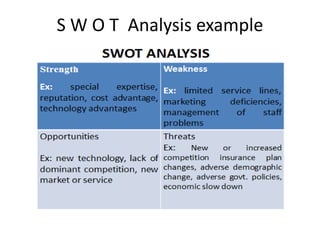
  • 69.
    Economic Policies -India The ten major economic policies which are followed in India and has played a major role in the growth of Indian economy. 1) Industrial Policy, 2) Trade Policy, 3) Monetary Policy, – Open Market Operations for purchase and sale of Bonds, Reserve Deposit Ratio, Discount rate of Interest for loan to banks, 4) Fiscal Policy, 5) Indian Agricultural Policy (Post-Independence), 6) National Agricultural Policy (July 2000), 7) Industrial Policies, 8) International Trade Policy, 9) Exchange Rate Management Policy, and 10) EXIM Policy.
  • 70.
    Industrial Policy It isan strategic attempt to influence the growth of various sectors. For the industrial development, specific roles are allocated to the different types of industrial organisation like public, private, joint and cooperative sectors. • What are the roles of industrial policy? • Formulation of Labour policy • Tariff policy • Fiscal policy • Monetary policy • According to world bank, “Industrial policy comprises government efforts to alter industrial structure to promote productivity based growth”.
  • 71.
    Fiscal Policy • Fiscalpolicy relates to the impact of government spending and tax on aggregate demand and the economy. • Expansionary fiscal policy is an attempt to increase aggregate demand and will involve higher government spending and lower taxes. • Expansionary fiscal policy will lead to a larger budget deficit. • Deflationary fiscal policy is an attempt to reduce aggregate demand and will involve lower spending and higher taxes. • This deflationary fiscal policy will help reduce a budget deficit.
  • 72.
    Monetary Policy • Monetarypolicy involves influencing the supply and demand for money through interest rates and other monetary tools. • Monetary policy is usually conducted by the Central Bank, e.g. India - RBI, UK – Bank of England, US – Federal Reserve. • The target of Monetary policy is to achieve low inflation (and usually promote economic growth) • The main tool of monetary policy is changing interest rates. For example, if the Central Bank feel the economy is growing too quickly and inflation is increasing, then they will increase interest rates to reduce demand in the economy. • In some circumstances, Central Banks may use other tools than just interest rates. For example, in the great recession 2008-12, Central Banks in UK and US pursued quantitative easing. This involved increasing the money supply to increase demand.
  • 73.
    Similarities and Differences •Both aim at creating a more stable economy characterised by low inflation and positive economic growth. Both fiscal and monetary policy are an attempt to reduce economic fluctuations and smooth out the economic cycle. • The main difference is that Monetary policy uses interest rates set by the Central Bank. Fiscal policy involves changing government spending and taxes to influence the level of aggregate demand.
  • 74.
  • 75.
    Labour and TariffPolicy A quest for industrial harmony is indispensable when a country plans to make economic progress. Labour Policy • Labour law. Labour law (also known as labour law or employment law) mediates the relationship between workers, employing entities, trade unions and the government. • Individual labour law concerns employees' rights at work and through the contract for work. • The term Labour Law is used to denote that body of laws which deal with employment and non-employment, wages, working conditions, industrial relations, social security and labour welfare of industrially employed, persons. Tariff Policy • Tariffs are used to restrict imports by increasing the price of goods and services purchased from overseas and making them less attractive to consumers. • Governments may impose tariffs to raise revenue or to protect domestic industries – particularly nascent ones – from foreign competition.
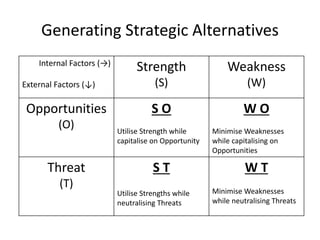
  • 76.
    Importance of IndustrialPolicy • Establishes co-ordination: Industrial policy helps to establish co-ordination between various areas such as industry and agricultural development, public and private sector and capital and physical resources. • Directs national resources: national resources have to direct the areas where there is a scarce resource. • Prevent economic power concentration: It prevents from monopoly capitalism, the wealth and economic power. • Proper control: Industrial policy enables different to have proper control over the establishment and development of private sector enterprises in compliance with the national objectives.
  • 77.
    National Level IndustrialPolicies • Industrial policy resolution 1948: after the independence, India was going through the issue related with the partition of the country like scarcity of food, loss and land and property, rehabilitation of people, reformation of states. Different group used to look at the problem and proposed remedial actions in different manner. (For example, Labour Leaders and Indian Capitalists) • In order to get rid of this situation, government formulate industrial policy resolution 1948. Industrial policy resolution 1956 • Industrial policy became socialist –oriented with the resolution of 1956 which helped the public sector to wider their scope. • This resolution was based on the Mahalanobis Model. This model said that the long term growth can only be achieved by dealing in heavy industries. Industrial policy resolution 1973: • In this resolution joint sector idea suggested by the Dutt Committee. Licensing was made strict and it had a strong favouritism for the large and heavy enterprises.
  • 79.
    Industrial policy resolution1977: This resolution passed by Janta party, the ruling government at that time. the main aim was to improve the living conditions of the policy were as follows: • 1. Prevention of economic power concentration and monopoly. • 2. Production of consumer goods at maximum level. • 3. Enabling industries to respond towards the needs of the society. Industrial policy resolution 1980 After defeating Janta party, congress government introduced new industrial policy. • The main aim was to benefit masses of the society by fast and reasonable industrialisation. • Policy includes: • 1. Creation of employment at large scale. • 2. Maximise the production. • 3. Supporting industrially weak areas for their development. • 4. Development in agriculture. • 5. focusing on import and export oriented business. • 6. Protection of consumers against costly and poor quality product.
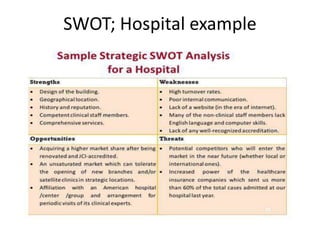
  • 80.
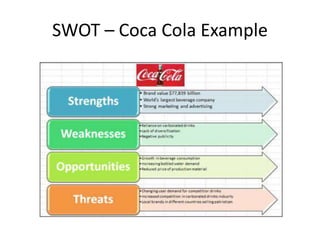
    Industrial Policy 1991 Inpursuit of the stated objectives, Govt. decided to take up series of initiatives with regards to following, • A. Industrial Licensing • B. Foreign Investment • C. Foreign Technology Agreements • D. Public Sector Policy • E. MRTP Act
  • 81.
  • 82.
  • 83.
    State Level IndustrialPolicies Economic reforms adopted in the 1990s deeply modified India’s macro-economic environment, as well as the trade and investment regimes. By rewriting the rules of economic governance in India’s federal democracy, reforms have had far-reaching consequences on the relations between the union and the states. In post-reform India, state government have grater policy space and more scope for influencing social and economic outcomes. In this context, state level policies are starting to receive garter attention than in the past. • Below mentioned some important state level policies of some major state: • 1. Andhra Pradesh: thrust awarded to development of the projects by desalination power purchase agreements with private developer. • 2. Gujarat: • Strong encouragement to private sector participations development of ports, power stations, desalination of water supply. • 3. Haryana: an industrial model township with Japanese assistance Indo-German industrial park, a software technology park and export promotion industrial park are coming up in the state. • 4. Kerala: steps have already been taken to initiate private participation in selected areas like power, ports and road develop. • 5. Orissa: the FDI in the industrial promotion and investment corporation of Orissa will act as a single window for investment by non- resident Indians and foreign investors.
  • 84.
    Industrial Policy Resolution2015 – Govt. Of Odisha Major Objectives – To transform Odisha into a Vibrant Industrialised State – To promote Sustainable and Inclusive Economic Growth – To specifically promote ITES, ESDM, Biotechnology, Agro, Marine and Food Processing, Tourism, Textiles and Apparel and Automotive Industries – To promote Direct Employment Intensive Sectors – To encourage linkage between MSME and Large Industries (anciliary and down-streams) – To emphasize on Environment-friendly and less polluting industries Main Strategies – Making World class Infrastructure and encourage active participation of Private sector industries – Skill Development to increase employability (Ready-to-employ Human Resources) – Effective Grievance Redressal mechanism for speedy Implementation and for post implementation issues
  • 85.
    I P R2015 – Odisha ... • General Policy Framework emphasizes on, – Investment Promotion – Ease of Doing Business – Simplification and Rationalisation of Regulatory Mechanism • Important Incentives include, – Land (Zone - A, B ..... Zone - F denoted) – Interest Subsidy – Stamp duty exemption (in varying degree) – Electricity bill exemption (in slabs) – Tax reimbursement (VAT, Entry tax) – Employment Cost subsidy – Market Syndication and Assistance • Other prominent focus – Human Resource Development – Labour Reforms – Export promotion
  • 86.
    New Industrial Policy2019 - Maharashtra
  • 87.
    N I P2019 - Maharashtra • It covers – Special emphasis on Promotion of MSME – And also covers LSI (Large Scale Industries) – And Mega & Ultra-Mega Projects

Editor's Notes