Contents:
Business Environment
Detailing the Types of Environment
External and Internal Environment
Controllable and Non
Controllable.
BUSINESS ENVIRONMENT
 Business environment consist of all those factors that
have a bearing on the business. The term 'business
environment implies those external forces, factors and
institutions that are beyond the control of individual
business organizations and their management and affect
the business enterprise
FEATURES OF BUSINESS ENVIRONMENT
 Business environment is the sum total of all factors
external to the business firm and that greatly
influence their functioning.
 It covers factors and forces like customers,
competitors, suppliers, government, and the social,
cultural, political, technological and legal conditions.
 The business environment is dynamic in nature
 The changes in business environment are
unpredictable
 Business Environment differs from place to place,
region to region and country to country.
IMPORTANCE OF BUSINESS ENVIRONMENT
 Determining Opportunities and Threats
 Giving Direction for Growth
 Continuous Learning
 Image Building
 Meeting Competition
 Identifying Firm’s Strength and Weakness
WHY STUDY BUSINESS ENVIRONMENT
Development of broad strategies to ensure sustainability
To foresee the impact of socio-economic changes at the national and
international levels on firm’s ability
Analysis of competitor’s strategies and formulation of effective counter
measures
To keep oneself dynamic
DETAILING THE TYPES OF ENVIRONMENT
INTERNAL ENVIRONMENT
 VALUE SYSTEM
 VISION MSSION OBJECTIVE
 MANAGEMENT STRUCTURE & NATURE
 CULTURE & CLIMATE
 HUMAN RESOURCES
EXTERNAL ENVIRONMENT
Uncontrollable by the business. There are two types of
external environment:
 Macro Environment
 Micro Environment
MICRO ENVIRONMENT
 Supplier
 Customer
 Marketing Intermediaries
 Financers
 Public
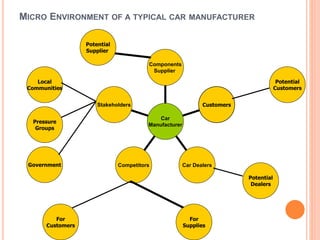
MICRO ENVIRONMENT OF A TYPICAL CAR MANUFACTURER
Components
Supplier
Customers
Car DealersCompetitors
Stakeholders
Car
Manufacturer
Potential
Supplier
Potential
Customers
Customers
Pressure
Groups
For
Supplies
For
Customers
Potential
Dealers
Government
Local
Communities
MACRO ENVIRONMENT
 Macro environment is also known as General
environment and remote environment. Macro factors are
generally more uncontrollable than micro environment
factors. When the macro factors become uncontrollable ,
the success of company depends upon its adaptability to
the environment.
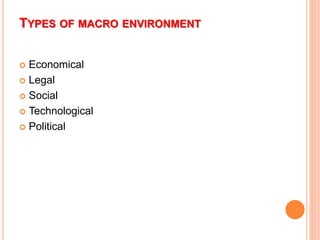
TYPES OF MACRO ENVIRONMENT
 Economical
 Legal
 Social
 Technological
 Political
ECONOMICAL
 Economic Conditions: The economic conditions
of a nation refer to a set of economic factors that
have great influence on business organizations and
their operations. These include gross domestic
product, per capita income, markets for goods and
services, availability of capital, foreign exchange
reserve, growth of foreign trade, strength of capital
market etc. All these help in improving the pace of
economic growth.
IMPORTANT ECONOMIC POLICIES
 Industrial policy: The Industrial policy of the
government covers all those principles, policies,
rules, regulations and procedures, which direct and
control the industrial enterprises of the country and
shape the pattern of industrial development.
 Fiscal policy: It includes government policy in
respect of public expenditure, taxation and public
debt.
IMPORTANT ECONOMIC POLICIES
 Monetary policy: It includes all those activities and
interventions that aim at smooth supply of credit to
the business and a boost to trade and industry.
 Foreign investment policy: This policy aims at
regulating the inflow of foreign investment in
various sectors for speeding up industrial
development and take advantage of the modern
technology.
IMPORTANT ECONOMIC POLICIES
 Export–Import policy (Exim policy): It aims at
increasing exports and bridge the gap between
expert and import. Through this policy, the
government announces various duties/levies. The
focus now-a-days lies on removing barriers and
controls and lowering the custom duties.
ECONOMIC SYSTEM:
 The world economy is primarily governed by
three types of economic systems, viz.,
 (i) Capitalist economy;
 (ii) Socialist economy; and
 (iii) Mixed economy.
 India has adopted the mixed economy system
which implies co-existence of public sector and
private sector.
LEGAL EMVIRONMENT
 This refers to set of laws, regulations, which
influence the business organizations and their
operations. Every business organization has to
obey, and work within the framework of the law. The
important legislations that concern the business
enterprises include:
LEGAL PROVISIONS
 (i) Companies Act, 1956
 (ii) Foreign Exchange Management Act, 1999
 (iii) The Factories Act, 1948
 (iv) Industrial Disputes Act, 1972
 (v) Payment of Gratuity Act, 1972
 (vi) Industries (Development and Regulation) Act, 1951
 (vii) Prevention of Food Adulteration Act, 1954
 (viii) Essential Commodities Act, 2002
 (ix) The Standards of Weights and Measures Act, 1956
 (x) Monopolies and Restrictive Trade Practices Act, 1969
 (xi) Trade Marks Act, 1999
 (xii) Bureau of Indian Standards Act, 1986
 (xiii) Consumer Protection Act, 1986
 (xiv) Environment Protection Act
 (xv) Competition Act, 2002
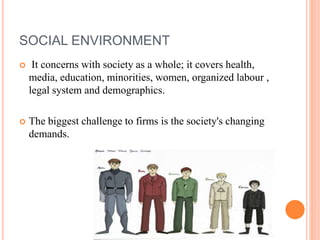
SOCIAL ENVIRONMENT
 It concerns with society as a whole; it covers health,
media, education, minorities, women, organized labour ,
legal system and demographics.
 The biggest challenge to firms is the society's changing
demands.
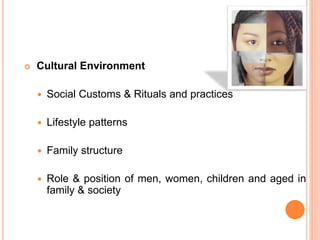
 Cultural Environment
 Social Customs & Rituals and practices
 Lifestyle patterns
 Family structure
 Role & position of men, women, children and aged in
family & society
 Demographic Environment
 Growth of population
 Age Composition
 Life Expectancy
 Sex Ratio
 Fertility and Mortality rates
 Inter-state migration
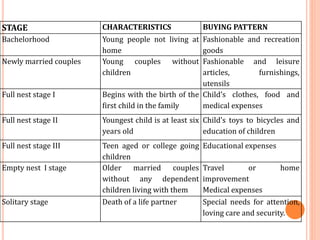
STAGE CHARACTERISTICS BUYING PATTERN
Bachelorhood Young people not living at
home
Fashionable and recreation
goods
Newly married couples Young couples without
children
Fashionable and leisure
articles, furnishings,
utensils
Full nest stage I Begins with the birth of the
first child in the family
Child’s clothes, food and
medical expenses
Full nest stage II Youngest child is at least six
years old
Child’s toys to bicycles and
education of children
Full nest stage III Teen aged or college going
children
Educational expenses
Empty nest I stage Older married couples
without any dependent
children living with them
Travel or home
improvement
Medical expenses
Solitary stage Death of a life partner Special needs for attention,
loving care and security.
POLITICAL ENVIRONMENT
 Political environment gives shape to business. Political
stability, Government administration, Philosophy of the
political parties are some of political factor which
affects the business environment
TECHNOLOGICAL ENVIRONMENT
 Technology is about application of tools, methods and
techniques to improve production and processes.
Technology is life for growth and competitiveness of
Business
QUESTIONS
 Identify the types of non-economic environment in
the following cases:
(a) Demand for new clothes increases during festive
session.
(b) Computer has outdated typewriter.
(c) Coca-Cola is now being freely sold in the Indian
market.
(d) Sugar factories are being set up where sugarcane
is grown abundantly.
(e) Availability of skilled labour in a particular region.
 A multinational two wheeler company in wants to
start its operations in India. Identify the relevant
environmental factors they would consider &
describe how they will influence the decision
 Azim Premji of Wipro has announced that he is
donating Rs. 9,000/- crores for the education of
children. Comment on it, in the context of social
responsibility of business.

Business Environment

  • 1.
    Contents: Business Environment Detailing theTypes of Environment External and Internal Environment Controllable and Non Controllable.
  • 2.
    BUSINESS ENVIRONMENT  Businessenvironment consist of all those factors that have a bearing on the business. The term 'business environment implies those external forces, factors and institutions that are beyond the control of individual business organizations and their management and affect the business enterprise
  • 3.
    FEATURES OF BUSINESSENVIRONMENT  Business environment is the sum total of all factors external to the business firm and that greatly influence their functioning.  It covers factors and forces like customers, competitors, suppliers, government, and the social, cultural, political, technological and legal conditions.  The business environment is dynamic in nature  The changes in business environment are unpredictable  Business Environment differs from place to place, region to region and country to country.
  • 4.
    IMPORTANCE OF BUSINESSENVIRONMENT  Determining Opportunities and Threats  Giving Direction for Growth  Continuous Learning  Image Building  Meeting Competition  Identifying Firm’s Strength and Weakness
  • 5.
    WHY STUDY BUSINESSENVIRONMENT Development of broad strategies to ensure sustainability To foresee the impact of socio-economic changes at the national and international levels on firm’s ability Analysis of competitor’s strategies and formulation of effective counter measures To keep oneself dynamic
  • 6.
    DETAILING THE TYPESOF ENVIRONMENT
  • 7.
    INTERNAL ENVIRONMENT  VALUESYSTEM  VISION MSSION OBJECTIVE  MANAGEMENT STRUCTURE & NATURE  CULTURE & CLIMATE  HUMAN RESOURCES
  • 8.
    EXTERNAL ENVIRONMENT Uncontrollable bythe business. There are two types of external environment:  Macro Environment  Micro Environment
  • 9.
    MICRO ENVIRONMENT  Supplier Customer  Marketing Intermediaries  Financers  Public
  • 10.
    MICRO ENVIRONMENT OFA TYPICAL CAR MANUFACTURER Components Supplier Customers Car DealersCompetitors Stakeholders Car Manufacturer Potential Supplier Potential Customers Customers Pressure Groups For Supplies For Customers Potential Dealers Government Local Communities
  • 11.
    MACRO ENVIRONMENT  Macroenvironment is also known as General environment and remote environment. Macro factors are generally more uncontrollable than micro environment factors. When the macro factors become uncontrollable , the success of company depends upon its adaptability to the environment.
  • 12.
    TYPES OF MACROENVIRONMENT  Economical  Legal  Social  Technological  Political
  • 13.
    ECONOMICAL  Economic Conditions:The economic conditions of a nation refer to a set of economic factors that have great influence on business organizations and their operations. These include gross domestic product, per capita income, markets for goods and services, availability of capital, foreign exchange reserve, growth of foreign trade, strength of capital market etc. All these help in improving the pace of economic growth.
  • 14.
    IMPORTANT ECONOMIC POLICIES Industrial policy: The Industrial policy of the government covers all those principles, policies, rules, regulations and procedures, which direct and control the industrial enterprises of the country and shape the pattern of industrial development.  Fiscal policy: It includes government policy in respect of public expenditure, taxation and public debt.
  • 15.
    IMPORTANT ECONOMIC POLICIES Monetary policy: It includes all those activities and interventions that aim at smooth supply of credit to the business and a boost to trade and industry.  Foreign investment policy: This policy aims at regulating the inflow of foreign investment in various sectors for speeding up industrial development and take advantage of the modern technology.
  • 16.
    IMPORTANT ECONOMIC POLICIES Export–Import policy (Exim policy): It aims at increasing exports and bridge the gap between expert and import. Through this policy, the government announces various duties/levies. The focus now-a-days lies on removing barriers and controls and lowering the custom duties.
  • 17.
    ECONOMIC SYSTEM:  Theworld economy is primarily governed by three types of economic systems, viz.,  (i) Capitalist economy;  (ii) Socialist economy; and  (iii) Mixed economy.  India has adopted the mixed economy system which implies co-existence of public sector and private sector.
  • 18.
    LEGAL EMVIRONMENT  Thisrefers to set of laws, regulations, which influence the business organizations and their operations. Every business organization has to obey, and work within the framework of the law. The important legislations that concern the business enterprises include:
  • 19.
    LEGAL PROVISIONS  (i)Companies Act, 1956  (ii) Foreign Exchange Management Act, 1999  (iii) The Factories Act, 1948  (iv) Industrial Disputes Act, 1972  (v) Payment of Gratuity Act, 1972  (vi) Industries (Development and Regulation) Act, 1951  (vii) Prevention of Food Adulteration Act, 1954  (viii) Essential Commodities Act, 2002  (ix) The Standards of Weights and Measures Act, 1956  (x) Monopolies and Restrictive Trade Practices Act, 1969  (xi) Trade Marks Act, 1999  (xii) Bureau of Indian Standards Act, 1986  (xiii) Consumer Protection Act, 1986  (xiv) Environment Protection Act  (xv) Competition Act, 2002
  • 20.
    SOCIAL ENVIRONMENT  Itconcerns with society as a whole; it covers health, media, education, minorities, women, organized labour , legal system and demographics.  The biggest challenge to firms is the society's changing demands.
  • 21.
     Cultural Environment Social Customs & Rituals and practices  Lifestyle patterns  Family structure  Role & position of men, women, children and aged in family & society
  • 22.
     Demographic Environment Growth of population  Age Composition  Life Expectancy  Sex Ratio  Fertility and Mortality rates  Inter-state migration
  • 23.
    STAGE CHARACTERISTICS BUYINGPATTERN Bachelorhood Young people not living at home Fashionable and recreation goods Newly married couples Young couples without children Fashionable and leisure articles, furnishings, utensils Full nest stage I Begins with the birth of the first child in the family Child’s clothes, food and medical expenses Full nest stage II Youngest child is at least six years old Child’s toys to bicycles and education of children Full nest stage III Teen aged or college going children Educational expenses Empty nest I stage Older married couples without any dependent children living with them Travel or home improvement Medical expenses Solitary stage Death of a life partner Special needs for attention, loving care and security.
  • 24.
    POLITICAL ENVIRONMENT  Politicalenvironment gives shape to business. Political stability, Government administration, Philosophy of the political parties are some of political factor which affects the business environment
  • 25.
    TECHNOLOGICAL ENVIRONMENT  Technologyis about application of tools, methods and techniques to improve production and processes. Technology is life for growth and competitiveness of Business
  • 26.
    QUESTIONS  Identify thetypes of non-economic environment in the following cases: (a) Demand for new clothes increases during festive session. (b) Computer has outdated typewriter. (c) Coca-Cola is now being freely sold in the Indian market. (d) Sugar factories are being set up where sugarcane is grown abundantly. (e) Availability of skilled labour in a particular region.
  • 27.
     A multinationaltwo wheeler company in wants to start its operations in India. Identify the relevant environmental factors they would consider & describe how they will influence the decision
  • 28.
     Azim Premjiof Wipro has announced that he is donating Rs. 9,000/- crores for the education of children. Comment on it, in the context of social responsibility of business.