BUSINESSBUSINESS
ENVIRONMENTENVIRONMENT
Introduction to BusinessIntroduction to Business
 Business is the organized efforts of enterprises to supply consumers with
goods and services. Businesses vary in size as measured by number of
employees or by sales volume.
 All businesses share the same purpose to earn Profits. However, the
purpose of business goes beyond earning profits.
 It is an important institution in society and the role of business is crucial.
◦ Be it for the supply of goods and services
◦ Creation of job opportunities
◦ Offer of better quality of life
◦ Contributing to the economic growth of the country and putting it on the
global map
Scope of Business
◦ Business included all activities connected with production, trade,
banking, insurance, finance, agency, advertising, packaging and
numerous other related activities. Businesses include all efforts
to comply with legal restrictions and government requirements
and discharging obligations to consumers, employees, owners
and to other interest groups which have stakes in business
directly or indirectly.
EnvironmentEnvironment
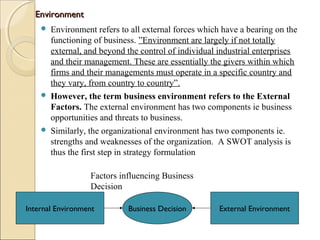
 Environment refers to all external forces which have a bearing on the
functioning of business. ”Environment are largely if not totally
external, and beyond the control of individual industrial enterprises
and their management. These are essentially the givers within which
firms and their managements must operate in a specific country and
they vary, from country to country”.
 However, the term business environment refers to the External
Factors. The external environment has two components ie business
opportunities and threats to business.
 Similarly, the organizational environment has two components ie.
strengths and weaknesses of the organization. A SWOT analysis is
thus the first step in strategy formulation
Business DecisionInternal Environment External Environment
Factors influencing Business
Decision
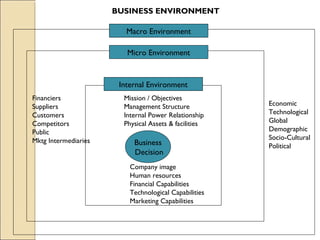
Business
Decision
Internal Environment
Mission / Objectives
Management Structure
Internal Power Relationship
Physical Assets & facilities
Company image
Human resources
Financial Capabilities
Technological Capabilities
Marketing Capabilities
Financiers
Suppliers
Customers
Competitors
Public
Mktg Intermediaries
Micro Environment
Economic
Technological
Global
Demographic
Socio-Cultural
Political
Macro Environment
BUSINESS ENVIRONMENT
INTRODUCTIONINTRODUCTION
 Business decisions are influenced by two sets of factors
Internal factors (The Internal Environment
External Factors( The External Environment)
 Business Environment presents two challenges to the enterprise
The challenge to combat the environmental threats
Exploit the business opportunities
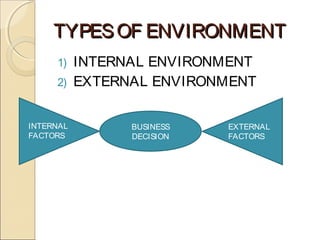
TYPESOF ENVIRONMENTTYPESOF ENVIRONMENT
1) INTERNAL ENVIRONMENT
2) EXTERNAL ENVIRONMENT
BUSINESS
DECISION
INTERNAL
FACTORS
EXTERNAL
FACTORS
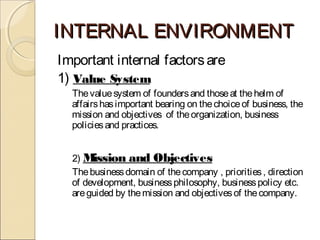
INTERNAL ENVIRONMENTINTERNAL ENVIRONMENT
Important internal factorsare
1) Value System
Thevaluesystem of foundersand thoseat thehelm of
affairshasimportant bearing on thechoiceof business, the
mission and objectives of theorganization, business
policiesand practices.
2) Mission and Objectives
Thebusinessdomain of thecompany , priorities, direction
of development, businessphilosophy, businesspolicy etc.
areguided by themission and objectivesof thecompany.
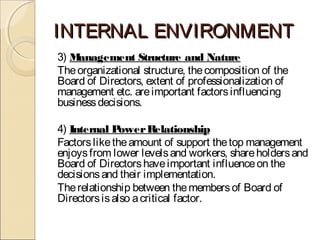
INTERNAL ENVIRONMENTINTERNAL ENVIRONMENT
3) Management Structure and Nature
Theorganizational structure, thecomposition of the
Board of Directors, extent of professionalization of
management etc. areimportant factorsinfluencing
businessdecisions.
4) Internal PowerRelationship
Factorsliketheamount of support thetop management
enjoysfrom lower levelsand workers, shareholdersand
Board of Directorshaveimportant influenceon the
decisionsand their implementation.
Therelationship between themembersof Board of
Directorsisalso acritical factor.
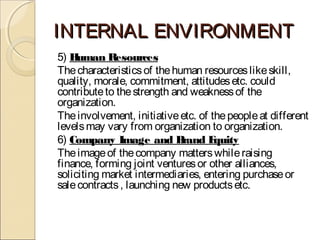
INTERNAL ENVIRONMENTINTERNAL ENVIRONMENT
5) Human Resources
Thecharacteristicsof thehuman resourceslikeskill,
quality, morale, commitment, attitudesetc. could
contributeto thestrength and weaknessof the
organization.
Theinvolvement, initiativeetc. of thepeopleat different
levelsmay vary from organization to organization.
6) Company Image and Brand Equity
Theimageof thecompany matterswhileraising
finance, forming joint venturesor other alliances,
soliciting market intermediaries, entering purchaseor
salecontracts, launching new productsetc.
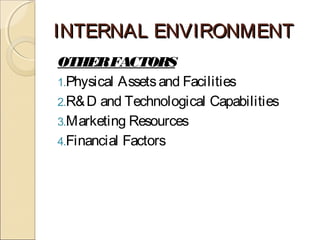
INTERNAL ENVIRONMENTINTERNAL ENVIRONMENT
OTHERFACTORS
1.Physical Assetsand Facilities
2.R&D and Technological Capabilities
3.Marketing Resources
4.Financial Factors
EXTERNAL ENVIRONMENTEXTERNAL ENVIRONMENT
Two Types
a)Micro Environment
Consistsof actorsin thecompany’simmediate
environment, that affectstheperformanceof the
company.
a)Macro Environment
Consistsof larger societal forcesthat affect all
theactorsin company’smicro environment.
MICROENVIRONMENTMICROENVIRONMENT
 Also known astaskenvironment and operating
environment
 Include
Thesuppliers
Marketing intermediaries
Competitors
Customers
Publics
 Moreintimately linked with thecompany than macro
factors
 Themicro forcesneed not necessarily affect all the
firmsin aparticular industry in thesameway.
 Someof themicro factorsareparticular to afirm
supplierssuppliers
Thosewho supply theinputsto thecompany.
Source/Sourcesshould beReliable
Uncertainty regarding thesupply or other
supply constraints compel companiesto
maintain high inventoriescausing cost
increases.
Very risky to depend on asinglesupplier
Thepurchasing department should “market”
itself to suppliers, to obtain favourable
treatment during theperiodsof shortages.
customerscustomers
 Major task of businessisto createand sustain
customers
 Different categoriesof consumers
Individuals
Households
Industriesand other commercial establishments
Government and other institutions
 Depending on singlecustomer istoo risky
 Choiceof customer should bedoneby considering
Relativeprofitability
dependability
stability of demand
growth prospectus
extent of competition
competitorscompetitors
A firm’scompetitorsincludenot only the
other firmswhich market thesameor
similar product but also all thosewho
competefor theincomeof theconsumers
Desirecompetition
Generic competition
Product form competition
Brand competition
Marketing intermediariesMarketing intermediaries
 Firmsthat aid thecompany in promoting, selling and
distributing itsgoodsto final buyers.
 Include
themiddlemen and merchantswho “help thecompany find
customersor closesaleswith them”
Physical distribution firmswhich “ assist thecompany in
stocking and moving goodsfrom their origin to their
destinations”
Marketing serviceagencies which “assist thecompany in
targeting and promoting itsproductsto theright markets”
Financial intermediarieswhich “financemarketing
activitiesand insurebusinessrisks”
 Vital linksbetween thecompany and thefinal
consumers.
PublicsPublics
 Any group that hasan actual or potential interest in or
impact on an organization’sability to achieveits
interests
E.g. Mediapublics, citizensaction publics, local publics
 Mediaattack on any company can influencethe
government decisions affecting thecompany.
 Environmental pollution isan issueoften taken up by
number of local publics
 Publicsarenot alwaysthreat to thebusiness.
 Fruitful cooperation between acompany and thelocal
publicsmay beestablished for themutual benefit.
MACRO ENVIRONMENTMACRO ENVIRONMENT
Consistsof larger societal forcesthat affect all the
actorsin company’smicro environment-namely
thedemographic,
economic,
natural,
technological,
political and
cultural forces
Also known asSo cietal Enviro nment
TheSocietal Environment includesgeneral forces
that do not directly touch on short-run activitiesof
theorganization but that can, and often do,
influenceitslong-run decisions.
Economic EnvironmentEconomic Environment
Important factorsare:
Economic conditions
Economic policies
Economic systems
Economic condition
Theeconomic conditionsof acountry –for example,
thenatureof theeconomy, thestageof development
of theeconomy, economic resources, thelevel of
income, thedistribution of incomeand assets, etc.- are
among thevery important determinantsof business
strategies.
In adeveloping country, thelow incomemay bethe
reason for thevery low demand for theproduct.
Economic EnvironmentEconomic Environment
Economic policies
Sometypesor categoriesof businessarefavourably
affected by government policy, someadversely affected,
whileit isneutral to someothers.
E.g. arestrictiveimport policy may greatly help the
import competing industries, whilealiberalisation of the
import policy may createdifficultiesfor such industries
Economic System
Thescopeof theprivatebusinessdependson the
economic system.
Thefreedom of theprivateenterpriseis thegreatest in the
freemarket economy.
Political & GovernmentPolitical & Government
EnvironmentEnvironment
Hascloserelationship with theeconomic system
and economic policy.
In many countriesregulationsto protect consumer
interestshavebecomestronger.
Somegovernmentsspecify certain standards for
theproductsto bemarketed in thecountry; some
even prohibit themarketing of certain products.
Promotional activitiesaresubject to varioustypes
of controls.
E.g.: In India, Advertisement of alcoholic product
isprohibited and thepackagesmust carry
“injuriousto health” warnings
Socio-cultural environmentSocio-cultural environment
Major factorsare:
thebuying and consumption habitsof people,
their languagebeliefsand values,
customsand traditions,
tastesand preferences,
Education
Strategy should beappropriatein thesocio-
cultural environment.
Eg: nestlebrewsavery largevariety of instant
coffeeto satisfy different national tastes
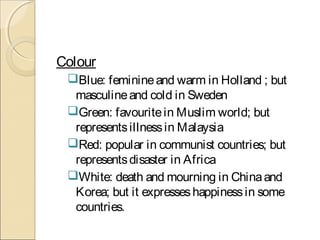
Colour
Blue: feminineand warm in Holland ; but
masculineand cold in Sweden
Green: favouritein Muslim world; but
representsillnessin Malaysia
Red: popular in communist countries; but
representsdisaster in Africa
White: death and mourning in Chinaand
Korea; but it expresseshappinessin some
countries.
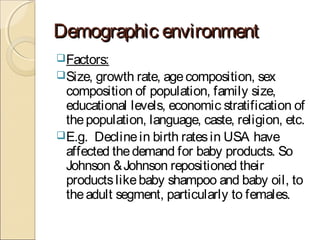
Demographic environmentDemographic environment
Factors:
Size, growth rate, agecomposition, sex
composition of population, family size,
educational levels, economic stratification of
thepopulation, language, caste, religion, etc.
E.g. Declinein birth ratesin USA have
affected thedemand for baby products. So
Johnson &Johnson repositioned their
productslikebaby shampoo and baby oil, to
theadult segment, particularly to females.
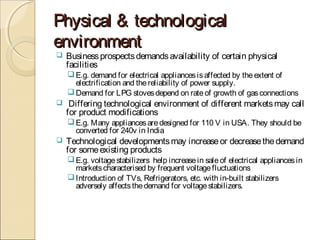
Physical & technologicalPhysical & technological
environmentenvironment
 Businessprospectsdemandsavailability of certain physical
facilities
E.g. demand for electrical appliancesisaffected by theextent of
electrification and thereliability of power supply.
Demand for LPG stovesdepend on rateof growth of gasconnections
 Differing technological environment of different marketsmay call
for product modifications
E.g. Many appliancesaredesigned for 110 V in USA. They should be
converted for 240v in India
 Technological developmentsmay increaseor decreasethedemand
for someexisting products
E.g. voltagestabilizers help increasein saleof electrical appliancesin
marketscharacterised by frequent voltagefluctuations
Introduction of TVs, Refrigerators, etc. with in-built stabilizers
adversely affectsthedemand for voltagestabilizers.
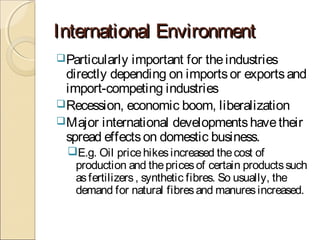
International EnvironmentInternational Environment
Particularly important for theindustries
directly depending on importsor exportsand
import-competing industries
Recession, economic boom, liberalization
Major international developmentshavetheir
spread effectson domestic business.
E.g. Oil pricehikesincreased thecost of
production and thepricesof certain productssuch
asfertilizers, synthetic fibres. So usually, the
demand for natural fibresand manuresincreased.
SWOT Analysis
SWOT stands for Strengths, Weaknesses, Opportunities
and Threats.
Identification of the threats and opportunities in the external
environment and strengths and weaknesses in the internal
environment of the firms are the cornerstone of business policy
formulation.
It is the SWOT analysis which determines the course of action to
ensure the growth / survival of the firm.
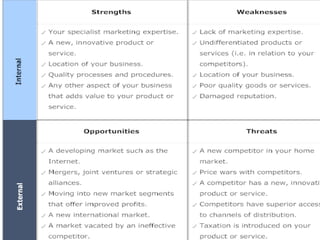
Strengths
•Strengths—internal to the unit; are a unit’s resources and capabilities that can
be used as a basis for developing a competitive advantage; strength should be
realistic and not modest.
Your list of strengths should be able to answer:
•What are the unit’s advantages?
•What does the unit do well?
•What relevant resources do you have access to?
•What do other people see as your strengths?
•What would you want to boast about to someone who knows nothing about this
organization and its work?
•Examples: good reputation among customers, resources, assets, people, :
experience, knowledge, data, capabilities
•Think in terms of: capabilities; competitive advantages; resources, assets,
people(experience, knowledge); marketing; quality; location; accreditations
qualifications, certifications; processes/systems
Weaknesses
•Weaknesses—internal force that could serve as a barrier to maintain or achieve
a competitive advantage; a limitation, fault or defect of the unit . It should be
truthful so that they may be overcome as quickly as possible.
Your list of weaknesses should be able to answer:
•What can be improved?
•What is done poorly?
•What should be avoided?
•What are you doing as an organization that you feel could be done more
effectively/efficiently?
•What is this organization NOT doing that you feel it should be doing?
•If you could change one thing that would help this department function more
effectively, what would you change?
•Examples: gaps in capabilities, financial, deadlines, morale, lack of
competitive.
Opportunities
•Opportunities—any favorable situation present now or in the
future in the external environment.
Examples: unfulfilled customer need, arrival of new technologies,
loosening of regulations, global influences, economic boom,
demographic shift.
•Where are the good opportunities facing you?
•What are the interesting trends you are aware of?
•Think of: market developments; competitor; vulnerabilities;
industry/ lifestyle trends;; geographical; partnerships
Threats
•External force that could inhibit the maintenance or attainment of a
competitive advantage; any unfavorable situation in the external environment that
is potentially damaging now or in the future.
•Examples: shifts in consumer tastes, new regulations, political or legislative
effects, environmental effects, new technology, loss of key staff, economic
downturn, demographic shifts, competitor intent; market demands; sustaining
internal capability; insurmountable weaknesses; financial backing.
Your list of threats should be able to answer:
•What obstacles do you face?
•What is your competition doing?
•Are the required specifications for your job/services changing?
•Is changing technology threatening your position?
•Do you have financial problems?
 
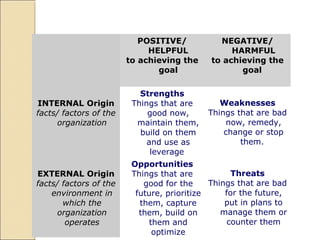
POSITIVE/ 
HELPFUL
to achieving the 
goal
  
NEGATIVE/ 
HARMFUL
to achieving the 
goal 
 
INTERNAL Origin
facts/ factors of the
organization
Strengths
Things that are 
good now, 
maintain them, 
build on them 
and use as 
leverage 
Weaknesses
Things that are bad 
now, remedy, 
change or stop 
them. 
 
EXTERNAL Origin
facts/ factors of the
environment in
which the
organization
operates
Opportunities
Things that are 
good for the 
future, prioritize 
them, capture 
them, build on 
them and 
optimize
Threats
Things that are bad 
for the future, 
put in plans to 
manage them or 
counter them
Competitive Structure of IndustriesCompetitive Structure of Industries
The competitive structure of industries is a very important business environment.
Identification of forces affecting the competitive dynamics of an industry is very useful
in formulation of strategies.
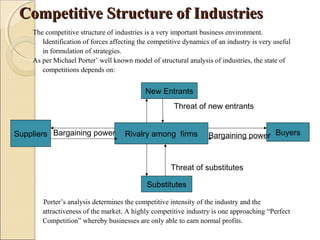
As per Michael Porter’ well known model of structural analysis of industries, the state of
competitions depends on:
Porter’s analysis determines the competitive intensity of the industry and the
attractiveness of the market. A highly competitive industry is one approaching “Perfect
Competition” whereby businesses are only able to earn normal profits.
Rivalry among firms Buyers
Substitutes
New Entrants
Suppliers
Threat of new entrants
Threat of substitutes
Bargaining powerBargaining power
Rivalry Among Existing Firms:
Firms in an industry are mutually dependent – competitive motives of a firm
usually affects others and may be retaliated. Factors influencing the intensity of
rivalry are:
 Number of firms and their Relative market share
 State of Growth of Industry: In stagnant, declining and slow growth
industries, a firm is able to increase its sales by increasing the market share.
 Fixed or storage costs: In case of high fixed costs, strategy of firms is to
increase sales which in turn would improve on capacity utilization.
 Indivisibility of capacity augmentation : Where there are economies of scale,
capacity increases would be in large blocks necessitating, efforts to increase
sales to achieve capacity utilization norms.
 Product standardization
Threat of EntryThreat of Entry
 New entrants are newcomers to an existing industry. They typically
bring new capacity. A desire to gain market share and substantial
resources. Therefore they are threats to an established corporation.
 The threat of entry depends on the presence of entry barriers and
the reaction that can be expected from existing competitors .
 An entry barrier is an obstruction that makes it difficult for a
company to enter an industry.
Threat of Entry
Potential competition tends to be high if the industry is profitable or
critical and entry barriers are low. Some of the common entry barriers
are:
 Government Policy: Government can limit entry into industry
through licensing requirements by restricting access to raw materials.
 Product Differentiation: Characterized by brand image, customer
loyalty etc. may deter new firms from entering the market.
 Capital Requirements : High capital intensive nature of the industry
is an entry barrier to small firms .
 Economies of Scale : Scale economies in production and sales of
microprocessors, gave Intel a significant cost advantage over any new
arrival.
 Switching Costs : Once a software program such as excel or word
becomes established in Office, office managers are reluctant to switch
to a new program because of high training costs.
Threat of SubstitutesThreat of Substitutes
 An industry which has close substitutes available is highly
competitive in nature. Existence of close substitutes increases the
propensity of consumers to switch to alternatives in response to
price increases.
 Substitutes limit the potential returns of an industry by placing a
ceiling on the prices firms in industry can profitably charge.
Bargaining power of BuyersBargaining power of Buyers
Buyers affect an industry through their ability to force down
prices , bargain for higher quality or more services and play
competitors against each other.
A buyer or distributor is powerful if some of the following factors is true :
 A buyer purchases a large proportion of sellers product or service (eg :
oil filters purchased by a major automaker)
 A buyer has the potential to integrate backward by producing the
product itself (eg: a newspaper chain could make its own paper)
 Alternate suppliers are plentiful because the product is standard or
undifferentiated.
 Changing suppliers cost title. (eg: office supplies are sold by many
vendors)
 The purchased product is unimportant to the final quality or a price of a
buyers products (eg: electric wire bought for use in lamps)
Bargaining power of SuppliersBargaining power of Suppliers
Suppliers can affect an industry through their ability to raise
prices or reduce the quality of purchased goods and services.
A buyer or distributor is powerful if some of the following factors is
true :
 Supplier industry is dominated by a few companies but it sells too
many(eg: petroleum industry)
 Service is unique or it has built up switching costs (eg: word processing
software)
 Substitutes are not readily available (eg: electricity)
 Suppliers are able to integrate forward and compete directly with their
present customers (eg: a microprocessor producer like Intel could make
the complete PC)
 A purchasing industry buys only a small portion of the suppliers groups
goods (eg: sales of lawn mower tires are less important to the tire
industry than are sales of auto tires)
Environment Scanning And MonitoringEnvironment Scanning And Monitoring
“The pro cess by which strategists mo nito r
the eco no mic, go vernmental/legal,
market/co mpetitive,techno lo gical,
geo graphic and so cialsettings to
determine o ppo rtunities and threats to
their firms”
Stages of Environmental Analysis:
The analysis consists of four steps:
Scanning : It is process of analyzing environment for the
identification of factors which impact or have implications for
business.
Monitoring : It involves more in-depth analysis of environmental
trends identified at the scanning stage . Purpose of monitoring is to
assemble sufficient data to discern whether certain patterns are
emerging.
Forecasting : Anticipating future is essential for identifying future
threats and opportunities and formulating strategic plans.
Assessment : It involves drawing up implications/possible impacts
THANK YOU….

Business environment

  • 1.
  • 2.
    Introduction to BusinessIntroductionto Business  Business is the organized efforts of enterprises to supply consumers with goods and services. Businesses vary in size as measured by number of employees or by sales volume.  All businesses share the same purpose to earn Profits. However, the purpose of business goes beyond earning profits.  It is an important institution in society and the role of business is crucial. ◦ Be it for the supply of goods and services ◦ Creation of job opportunities ◦ Offer of better quality of life ◦ Contributing to the economic growth of the country and putting it on the global map
  • 3.
    Scope of Business ◦Business included all activities connected with production, trade, banking, insurance, finance, agency, advertising, packaging and numerous other related activities. Businesses include all efforts to comply with legal restrictions and government requirements and discharging obligations to consumers, employees, owners and to other interest groups which have stakes in business directly or indirectly.
  • 4.
    EnvironmentEnvironment  Environment refersto all external forces which have a bearing on the functioning of business. ”Environment are largely if not totally external, and beyond the control of individual industrial enterprises and their management. These are essentially the givers within which firms and their managements must operate in a specific country and they vary, from country to country”.  However, the term business environment refers to the External Factors. The external environment has two components ie business opportunities and threats to business.  Similarly, the organizational environment has two components ie. strengths and weaknesses of the organization. A SWOT analysis is thus the first step in strategy formulation Business DecisionInternal Environment External Environment Factors influencing Business Decision
  • 5.
    Business Decision Internal Environment Mission /Objectives Management Structure Internal Power Relationship Physical Assets & facilities Company image Human resources Financial Capabilities Technological Capabilities Marketing Capabilities Financiers Suppliers Customers Competitors Public Mktg Intermediaries Micro Environment Economic Technological Global Demographic Socio-Cultural Political Macro Environment BUSINESS ENVIRONMENT
  • 6.
    INTRODUCTIONINTRODUCTION  Business decisionsare influenced by two sets of factors Internal factors (The Internal Environment External Factors( The External Environment)  Business Environment presents two challenges to the enterprise The challenge to combat the environmental threats Exploit the business opportunities
  • 7.
    TYPESOF ENVIRONMENTTYPESOF ENVIRONMENT 1)INTERNAL ENVIRONMENT 2) EXTERNAL ENVIRONMENT BUSINESS DECISION INTERNAL FACTORS EXTERNAL FACTORS
  • 8.
    INTERNAL ENVIRONMENTINTERNAL ENVIRONMENT Importantinternal factorsare 1) Value System Thevaluesystem of foundersand thoseat thehelm of affairshasimportant bearing on thechoiceof business, the mission and objectives of theorganization, business policiesand practices. 2) Mission and Objectives Thebusinessdomain of thecompany , priorities, direction of development, businessphilosophy, businesspolicy etc. areguided by themission and objectivesof thecompany.
  • 9.
    INTERNAL ENVIRONMENTINTERNAL ENVIRONMENT 3)Management Structure and Nature Theorganizational structure, thecomposition of the Board of Directors, extent of professionalization of management etc. areimportant factorsinfluencing businessdecisions. 4) Internal PowerRelationship Factorsliketheamount of support thetop management enjoysfrom lower levelsand workers, shareholdersand Board of Directorshaveimportant influenceon the decisionsand their implementation. Therelationship between themembersof Board of Directorsisalso acritical factor.
  • 10.
    INTERNAL ENVIRONMENTINTERNAL ENVIRONMENT 5)Human Resources Thecharacteristicsof thehuman resourceslikeskill, quality, morale, commitment, attitudesetc. could contributeto thestrength and weaknessof the organization. Theinvolvement, initiativeetc. of thepeopleat different levelsmay vary from organization to organization. 6) Company Image and Brand Equity Theimageof thecompany matterswhileraising finance, forming joint venturesor other alliances, soliciting market intermediaries, entering purchaseor salecontracts, launching new productsetc.
  • 11.
    INTERNAL ENVIRONMENTINTERNAL ENVIRONMENT OTHERFACTORS 1.PhysicalAssetsand Facilities 2.R&D and Technological Capabilities 3.Marketing Resources 4.Financial Factors
  • 12.
    EXTERNAL ENVIRONMENTEXTERNAL ENVIRONMENT TwoTypes a)Micro Environment Consistsof actorsin thecompany’simmediate environment, that affectstheperformanceof the company. a)Macro Environment Consistsof larger societal forcesthat affect all theactorsin company’smicro environment.
  • 13.
    MICROENVIRONMENTMICROENVIRONMENT  Also knownastaskenvironment and operating environment  Include Thesuppliers Marketing intermediaries Competitors Customers Publics  Moreintimately linked with thecompany than macro factors  Themicro forcesneed not necessarily affect all the firmsin aparticular industry in thesameway.  Someof themicro factorsareparticular to afirm
  • 14.
    supplierssuppliers Thosewho supply theinputstothecompany. Source/Sourcesshould beReliable Uncertainty regarding thesupply or other supply constraints compel companiesto maintain high inventoriescausing cost increases. Very risky to depend on asinglesupplier Thepurchasing department should “market” itself to suppliers, to obtain favourable treatment during theperiodsof shortages.
  • 15.
    customerscustomers  Major taskof businessisto createand sustain customers  Different categoriesof consumers Individuals Households Industriesand other commercial establishments Government and other institutions  Depending on singlecustomer istoo risky  Choiceof customer should bedoneby considering Relativeprofitability dependability stability of demand growth prospectus extent of competition
  • 16.
    competitorscompetitors A firm’scompetitorsincludenot onlythe other firmswhich market thesameor similar product but also all thosewho competefor theincomeof theconsumers Desirecompetition Generic competition Product form competition Brand competition
  • 17.
    Marketing intermediariesMarketing intermediaries Firmsthat aid thecompany in promoting, selling and distributing itsgoodsto final buyers.  Include themiddlemen and merchantswho “help thecompany find customersor closesaleswith them” Physical distribution firmswhich “ assist thecompany in stocking and moving goodsfrom their origin to their destinations” Marketing serviceagencies which “assist thecompany in targeting and promoting itsproductsto theright markets” Financial intermediarieswhich “financemarketing activitiesand insurebusinessrisks”  Vital linksbetween thecompany and thefinal consumers.
  • 18.
    PublicsPublics  Any groupthat hasan actual or potential interest in or impact on an organization’sability to achieveits interests E.g. Mediapublics, citizensaction publics, local publics  Mediaattack on any company can influencethe government decisions affecting thecompany.  Environmental pollution isan issueoften taken up by number of local publics  Publicsarenot alwaysthreat to thebusiness.  Fruitful cooperation between acompany and thelocal publicsmay beestablished for themutual benefit.
  • 19.
    MACRO ENVIRONMENTMACRO ENVIRONMENT Consistsoflarger societal forcesthat affect all the actorsin company’smicro environment-namely thedemographic, economic, natural, technological, political and cultural forces Also known asSo cietal Enviro nment TheSocietal Environment includesgeneral forces that do not directly touch on short-run activitiesof theorganization but that can, and often do, influenceitslong-run decisions.
  • 20.
    Economic EnvironmentEconomic Environment Importantfactorsare: Economic conditions Economic policies Economic systems Economic condition Theeconomic conditionsof acountry –for example, thenatureof theeconomy, thestageof development of theeconomy, economic resources, thelevel of income, thedistribution of incomeand assets, etc.- are among thevery important determinantsof business strategies. In adeveloping country, thelow incomemay bethe reason for thevery low demand for theproduct.
  • 21.
    Economic EnvironmentEconomic Environment Economicpolicies Sometypesor categoriesof businessarefavourably affected by government policy, someadversely affected, whileit isneutral to someothers. E.g. arestrictiveimport policy may greatly help the import competing industries, whilealiberalisation of the import policy may createdifficultiesfor such industries Economic System Thescopeof theprivatebusinessdependson the economic system. Thefreedom of theprivateenterpriseis thegreatest in the freemarket economy.
  • 22.
    Political & GovernmentPolitical& Government EnvironmentEnvironment Hascloserelationship with theeconomic system and economic policy. In many countriesregulationsto protect consumer interestshavebecomestronger. Somegovernmentsspecify certain standards for theproductsto bemarketed in thecountry; some even prohibit themarketing of certain products. Promotional activitiesaresubject to varioustypes of controls. E.g.: In India, Advertisement of alcoholic product isprohibited and thepackagesmust carry “injuriousto health” warnings
  • 23.
    Socio-cultural environmentSocio-cultural environment Majorfactorsare: thebuying and consumption habitsof people, their languagebeliefsand values, customsand traditions, tastesand preferences, Education Strategy should beappropriatein thesocio- cultural environment. Eg: nestlebrewsavery largevariety of instant coffeeto satisfy different national tastes
  • 24.
    Colour Blue: feminineand warmin Holland ; but masculineand cold in Sweden Green: favouritein Muslim world; but representsillnessin Malaysia Red: popular in communist countries; but representsdisaster in Africa White: death and mourning in Chinaand Korea; but it expresseshappinessin some countries.
  • 25.
    Demographic environmentDemographic environment Factors: Size,growth rate, agecomposition, sex composition of population, family size, educational levels, economic stratification of thepopulation, language, caste, religion, etc. E.g. Declinein birth ratesin USA have affected thedemand for baby products. So Johnson &Johnson repositioned their productslikebaby shampoo and baby oil, to theadult segment, particularly to females.
  • 26.
    Physical & technologicalPhysical& technological environmentenvironment  Businessprospectsdemandsavailability of certain physical facilities E.g. demand for electrical appliancesisaffected by theextent of electrification and thereliability of power supply. Demand for LPG stovesdepend on rateof growth of gasconnections  Differing technological environment of different marketsmay call for product modifications E.g. Many appliancesaredesigned for 110 V in USA. They should be converted for 240v in India  Technological developmentsmay increaseor decreasethedemand for someexisting products E.g. voltagestabilizers help increasein saleof electrical appliancesin marketscharacterised by frequent voltagefluctuations Introduction of TVs, Refrigerators, etc. with in-built stabilizers adversely affectsthedemand for voltagestabilizers.
  • 27.
    International EnvironmentInternational Environment Particularlyimportant for theindustries directly depending on importsor exportsand import-competing industries Recession, economic boom, liberalization Major international developmentshavetheir spread effectson domestic business. E.g. Oil pricehikesincreased thecost of production and thepricesof certain productssuch asfertilizers, synthetic fibres. So usually, the demand for natural fibresand manuresincreased.
  • 28.
    SWOT Analysis SWOT standsfor Strengths, Weaknesses, Opportunities and Threats. Identification of the threats and opportunities in the external environment and strengths and weaknesses in the internal environment of the firms are the cornerstone of business policy formulation. It is the SWOT analysis which determines the course of action to ensure the growth / survival of the firm.
  • 29.
    Strengths •Strengths—internal to theunit; are a unit’s resources and capabilities that can be used as a basis for developing a competitive advantage; strength should be realistic and not modest. Your list of strengths should be able to answer: •What are the unit’s advantages? •What does the unit do well? •What relevant resources do you have access to? •What do other people see as your strengths? •What would you want to boast about to someone who knows nothing about this organization and its work? •Examples: good reputation among customers, resources, assets, people, : experience, knowledge, data, capabilities •Think in terms of: capabilities; competitive advantages; resources, assets, people(experience, knowledge); marketing; quality; location; accreditations qualifications, certifications; processes/systems
  • 30.
    Weaknesses •Weaknesses—internal force thatcould serve as a barrier to maintain or achieve a competitive advantage; a limitation, fault or defect of the unit . It should be truthful so that they may be overcome as quickly as possible. Your list of weaknesses should be able to answer: •What can be improved? •What is done poorly? •What should be avoided? •What are you doing as an organization that you feel could be done more effectively/efficiently? •What is this organization NOT doing that you feel it should be doing? •If you could change one thing that would help this department function more effectively, what would you change? •Examples: gaps in capabilities, financial, deadlines, morale, lack of competitive.
  • 31.
    Opportunities •Opportunities—any favorable situationpresent now or in the future in the external environment. Examples: unfulfilled customer need, arrival of new technologies, loosening of regulations, global influences, economic boom, demographic shift. •Where are the good opportunities facing you? •What are the interesting trends you are aware of? •Think of: market developments; competitor; vulnerabilities; industry/ lifestyle trends;; geographical; partnerships
  • 32.
    Threats •External force thatcould inhibit the maintenance or attainment of a competitive advantage; any unfavorable situation in the external environment that is potentially damaging now or in the future. •Examples: shifts in consumer tastes, new regulations, political or legislative effects, environmental effects, new technology, loss of key staff, economic downturn, demographic shifts, competitor intent; market demands; sustaining internal capability; insurmountable weaknesses; financial backing. Your list of threats should be able to answer: •What obstacles do you face? •What is your competition doing? •Are the required specifications for your job/services changing? •Is changing technology threatening your position? •Do you have financial problems?
  • 33.
      POSITIVE/  HELPFUL to achieving the  goal    NEGATIVE/  HARMFUL to achieving the  goal    INTERNAL Origin facts/ factors ofthe organization Strengths Things that are  good now,  maintain them,  build on them  and use as  leverage  Weaknesses Things that are bad  now, remedy,  change or stop  them.    EXTERNAL Origin facts/ factors of the environment in which the organization operates Opportunities Things that are  good for the  future, prioritize  them, capture  them, build on  them and  optimize Threats Things that are bad  for the future,  put in plans to  manage them or  counter them
  • 35.
    Competitive Structure ofIndustriesCompetitive Structure of Industries The competitive structure of industries is a very important business environment. Identification of forces affecting the competitive dynamics of an industry is very useful in formulation of strategies. As per Michael Porter’ well known model of structural analysis of industries, the state of competitions depends on: Porter’s analysis determines the competitive intensity of the industry and the attractiveness of the market. A highly competitive industry is one approaching “Perfect Competition” whereby businesses are only able to earn normal profits. Rivalry among firms Buyers Substitutes New Entrants Suppliers Threat of new entrants Threat of substitutes Bargaining powerBargaining power
  • 36.
    Rivalry Among ExistingFirms: Firms in an industry are mutually dependent – competitive motives of a firm usually affects others and may be retaliated. Factors influencing the intensity of rivalry are:  Number of firms and their Relative market share  State of Growth of Industry: In stagnant, declining and slow growth industries, a firm is able to increase its sales by increasing the market share.  Fixed or storage costs: In case of high fixed costs, strategy of firms is to increase sales which in turn would improve on capacity utilization.  Indivisibility of capacity augmentation : Where there are economies of scale, capacity increases would be in large blocks necessitating, efforts to increase sales to achieve capacity utilization norms.  Product standardization
  • 37.
    Threat of EntryThreatof Entry  New entrants are newcomers to an existing industry. They typically bring new capacity. A desire to gain market share and substantial resources. Therefore they are threats to an established corporation.  The threat of entry depends on the presence of entry barriers and the reaction that can be expected from existing competitors .  An entry barrier is an obstruction that makes it difficult for a company to enter an industry.
  • 38.
    Threat of Entry Potentialcompetition tends to be high if the industry is profitable or critical and entry barriers are low. Some of the common entry barriers are:  Government Policy: Government can limit entry into industry through licensing requirements by restricting access to raw materials.  Product Differentiation: Characterized by brand image, customer loyalty etc. may deter new firms from entering the market.  Capital Requirements : High capital intensive nature of the industry is an entry barrier to small firms .  Economies of Scale : Scale economies in production and sales of microprocessors, gave Intel a significant cost advantage over any new arrival.  Switching Costs : Once a software program such as excel or word becomes established in Office, office managers are reluctant to switch to a new program because of high training costs.
  • 39.
    Threat of SubstitutesThreatof Substitutes  An industry which has close substitutes available is highly competitive in nature. Existence of close substitutes increases the propensity of consumers to switch to alternatives in response to price increases.  Substitutes limit the potential returns of an industry by placing a ceiling on the prices firms in industry can profitably charge.
  • 40.
    Bargaining power ofBuyersBargaining power of Buyers Buyers affect an industry through their ability to force down prices , bargain for higher quality or more services and play competitors against each other. A buyer or distributor is powerful if some of the following factors is true :  A buyer purchases a large proportion of sellers product or service (eg : oil filters purchased by a major automaker)  A buyer has the potential to integrate backward by producing the product itself (eg: a newspaper chain could make its own paper)  Alternate suppliers are plentiful because the product is standard or undifferentiated.  Changing suppliers cost title. (eg: office supplies are sold by many vendors)  The purchased product is unimportant to the final quality or a price of a buyers products (eg: electric wire bought for use in lamps)
  • 41.
    Bargaining power ofSuppliersBargaining power of Suppliers Suppliers can affect an industry through their ability to raise prices or reduce the quality of purchased goods and services. A buyer or distributor is powerful if some of the following factors is true :  Supplier industry is dominated by a few companies but it sells too many(eg: petroleum industry)  Service is unique or it has built up switching costs (eg: word processing software)  Substitutes are not readily available (eg: electricity)  Suppliers are able to integrate forward and compete directly with their present customers (eg: a microprocessor producer like Intel could make the complete PC)  A purchasing industry buys only a small portion of the suppliers groups goods (eg: sales of lawn mower tires are less important to the tire industry than are sales of auto tires)
  • 42.
    Environment Scanning AndMonitoringEnvironment Scanning And Monitoring “The pro cess by which strategists mo nito r the eco no mic, go vernmental/legal, market/co mpetitive,techno lo gical, geo graphic and so cialsettings to determine o ppo rtunities and threats to their firms”
  • 43.
    Stages of EnvironmentalAnalysis: The analysis consists of four steps: Scanning : It is process of analyzing environment for the identification of factors which impact or have implications for business. Monitoring : It involves more in-depth analysis of environmental trends identified at the scanning stage . Purpose of monitoring is to assemble sufficient data to discern whether certain patterns are emerging. Forecasting : Anticipating future is essential for identifying future threats and opportunities and formulating strategic plans. Assessment : It involves drawing up implications/possible impacts
  • 44.