MACRO AND MICRO
NUTRIENTS.
* Please check out this link to know if there are any changes or additions.
Color index: Important | Doctors notes | Further explanation.
Important Note:
Dr. Ghani: you don’t have
to memorize the RDAs
neither the Sources.
and RDAs.
O
B
J
E
C
T
I
V
E
S
:
435 Biochemistry Team
 Understand the nutritional importance of dietary macro and
micronutrients.
 Identify major dietary sources and RDAs of macro and
micronutrients. Evaluate the nutritional quality of proteins, the
types of dietary carbohydrates, fibers and fats and their
benefits.
 Discuss the role of macronutrients in causing diseases or
conditions such as nitrogen imbalance, diabetes, obesity,
atherosclerosis and heart disease.
 Understand the functions of micronutrients (vitamins, minerals
and trace elements) and the diseases due to their deficiencies.
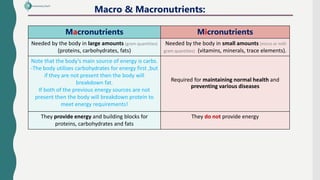
Macro & Macronutrients:
Macronutrients Micronutrients
Needed by the body in large amounts (gram quantities)
(proteins, carbohydrates, fats)
Needed by the body in small amounts (micro or milli
gram quantities) (vitamins, minerals, trace elements).
Note that the body’s main source of energy is carbs.
-The body utilizes carbohydrates for energy first ,but
if they are not present then the body will
breakdown fat.
If both of the previous energy sources are not
present then the body will breakdown protein to
meet energy requirements!
Required for maintaining normal health and
preventing various diseases
They provide energy and building blocks for
proteins, carbohydrates and fats
They do not provide energy
ENERGY CONTENT OF FOOD
 What is a calorie?
- The amount heat required to raise the temperature of 1 gm. of
water by 1oC.
• Proteins  4 kcal/gm (if you burn 1 gm of protein then it is
going to provide 4 kilocalories)
• Carbohydrates  4 kcal/gm
• Fat  9 kcal/gm “Fat is considered the macronutrient with
the HIGHEST energy”
Body obtains energy
as: ATP.
ATP is used for:
all body functions
The energy content
of food is measured
in:
calories (Kilocalories)
435 Biochemistry Team
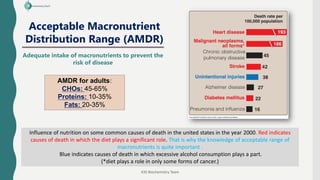
Acceptable Macronutrient
Distribution Range (AMDR)
Adequate intake of macronutrients to prevent the
risk of disease
Influence of nutrition on some common causes of death in the united states in the year 2000. Red indicates
causes of death in which the diet plays a significant role. That is why the knowledge of acceptable range of
macronutrients is quite important .
Blue indicates causes of death in which excessive alcohol consumption plays a part.
(*diet plays a role in only some forms of cancer.)
AMDR for adults:
CHOs: 45-65%
Proteins: 10-35%
Fats: 20-35%
Proteins:
Proteins supply amino acids and amino nitrogen for the body. Proteins are the only source of nitrogen in the body.
 Nutritional Importance of Proteins:
1-Essential amino acids :
• Body can’t synthesize, must be supplied in the diet
• PVT TIM HALL: Pheylalanine, Valine, Tryptophan, Threonine, Isoleucine,
Methionine, Histidine, Arginine, Lysine, Leucine. “you should memorize them”
2-Non-essential: Body can synthesize them.
 Types of proteins:
These amino acids are used in the synthesis of different tissues and enzymes.
If you are eating an extra amount of proteins ,then the body can react in two ways:
1- either the excess protein is broken down and used as an energy source .
2- or it will convert into acetyl coA which is used in fat synthesis( so we can conclude that excessive amounts of protein are stored as FAT. )
 Sources and RDA:
- Sources: Meat, poultry, fish, milk, wheat, corn, beans, nuts
- RDA “Recommended dietary intake” (gms/kg body weight)
• Normal adults: 0.8
• Athletes: 1.0
• Pregnancy / lactation: upto 30
• Children: 2.0
435 Biochemistry Team
Proteins:
 Nutritional Quality of Proteins:
 What is it?
A measure of a protein’s ability to provide the essential amino acids required for tissue maintenance. “to know
which protein is more beneficial than the other”
 Measured in: PDCAAS units (protein Digestibility-Corrected Amino Acid Scoring) An amino acid score provided
for each amino acid present in that protein
• High value indicates more digestibility and high quality (maximum score 1.0) Why is the score of animal
proteins higher than the score of plant proteins? Because the constituents of animal proteins are similar to the
requirements of the body ,hence these proteins will have a higher nutritional quality ,and ultimately a higher score.
• Proteins from animal sources: 0.82-1.0
• Proteins from plant sources: 0.4
The nutritional quality of proteins Depends upon two things : 1-the amount of essential amino acids provided by that protein 2-the digestibility of
that protein (Because some proteins are not easily digested such as bean which will affect their nutritional quality)
Why is the knowledge of protein nutritional quality important ? Because if you are eating a type of protein with a low score (meaning it has a low
nutritional value),then you can combine it with another protein that has a higher nutritional quality ,hence the body will get its requirements!
The proteins with the highest nutritional score:
1- Milk protein (casein ) it is of good nutritional quality (easily digestible ,provides many essential amino acids) So it has a score of 1
2-egg white
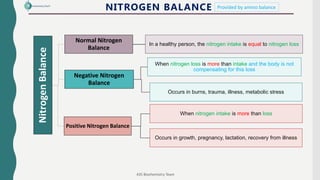
NITROGEN BALANCE
435 Biochemistry Team
Nitrogen
Balance Normal Nitrogen
Balance
In a healthy person, the nitrogen intake is equal to nitrogen loss
Negative Nitrogen
Balance
When nitrogen loss is more than intake and the body is not
compensating for this loss
Occurs in burns, trauma, illness, metabolic stress
Positive Nitrogen Balance
When nitrogen intake is more than loss
Occurs in growth, pregnancy, lactation, recovery from illness
Provided by amino balance
435 Biochemistry Team
Explanation :
Note that in order for positive nitrogen to occur, two things must happen:
1-intake is more than excretion
2-body keeps on forming more tissue protein( in children during growth , during lactating , metabolic stress) *if only the first condition happens, the proteins will be
stored as fat ( as mentioned earlier) , so positive nitrogen balance will not happen that is why we specified that positive N balance happens in growth and
lactation..and not just by increasing amino acid intake!!!
Image d:
1-dietary intake protein is normal But the
amount used to synthesize tissue protein is less
(why?) due to lack of amino acids from the diet
2- so all other amino acids not being used in
synthesis will be degraded and excreted from
the body ( increased nitrogen loss, hence
negative nitrogen balance occurs)
Image c:
Negative nitrogen balance occurred due to the
following:
1-malnutrition (intake of nitrogen is low)
2- hence the amount of tissue protein being
synthesized is low
3-but the breakdown and excretion remain
normal (do not decrease proportionately to
the decreased intake)
4- hence , person has negative nitrogen
balance
Image b:
Negative nitrogen balance occurred
Because the body is in metabolic stress>
breakdown is much more > the amount of
nitrogen excreted (as urea and ammonia)
is much more
Image a :
positive nitrogen balance 1-increased amount of
Dietary proteins taken in and added to the existing
amino acid pool in the body
2-tissue protein is synthesized from said pool
3-the amount of excretion and the amount being
used for energy Purine, and heme is normal( not
increased ) 4-intake more than excretion because
your body is taking up more and synthesizing
more tissue protein , WITHOUT increased
excretion ,then your body is in positive nitrogen
balance .
PROTEIN-ENERGY MALNUTRITION
435 Biochemistry Team
 What is it ?
A condition or disease caused by not eating enough food leading to energy malnutrition or not eating a
balanced diet leading to protein malnutrition
 Malnutrition due to inadequate intake of proteins or energy
Either the amount of total protein taken Is inadequate Or protein taken in is adequate but the caloric intake is not enough to sustain life
Kwashiorkor
Marasmus
disorders
Inadequate intake of proteins with adequate energy intake
(kwashiorkor is more of an acute state while marasmus is
chronic)
Inadequate intake of energy with adequate protein
intake
Causes
• After weaning (few months to at about 1 year).
• Diet mainly contains CHOs.
• Why does kwashiorkor occur? Sometimes mothers wean the babies
much earlier than they should (take them off milk) So now the
baby's diet is composed of carbs mostly So the amount of blood
protein will go down ,hence edema will occur
• 1-3 year
• Mother’s milk is supplemented with food (cereals)
deficient in calories.
Age and
food
intake
• Edema “due to decreased protein levels”
• Distended abdomen
• Diarrhea
• Dermatitis due to fat loss / thin hair
• Enlarged fatty liver due to decrease in lipoproteins so the lipids
will accumulate in the liver.
• Low plasma albumin
• Arrested growth
• Extreme muscle wastingWhy does this occur even
though protein intake is adequate?
• Because you are not getting enough energy from carbs, so
the proteins will be used as an energy source
• Weakness
• Weight loss
• No edema or changes in plasma proteins.
Symptom
s
‫كايس‬ ‫شكل‬ ‫على‬ ‫بيجينا‬ ‫وغالبا‬ ‫جدا‬ ‫مهم‬ ‫الجدول‬
!
‫زين‬ ‫احفظوه‬
!!
PROTEIN-ENERGY MALNUTRITION
435 Biochemistry Team
CARBOHYDRATES
• Their major role in diet is energy production.
• RDA: 130 grams/day for adults and children
• CHO intake above RDA causes: weight gain or obesity due to increased fat storage in
adipose tissue
Complex CHOs
Simple CHOs:
Types of CHO in the diet
sucrose, fructose, lactose, corn syrup whole grains, pasta, wheat, starch
What is difference between the simple and complex: carbs?
The body requires more energy to breakdown complex carbs than in simple carbs. One should
include more complex carb in his/her diet
435 Biochemistry Team
Dietary protein requirement and CHO diet are related to each other.
PROTEIN-SPARING EFFECT
They inhibit
gluconeogenesis
from amino
acids.
That way amino acids
are used for repair and
maintenance of tissue
protein and not for
gluconeogenesis.
If CHO intake is
less than the
RDA (130
g/day)
more proteins will be
metabolized.
more gluconeogenesis
will take place.
As long as you have a good amount of carbs in the body, proteins will NOT be used as an energy source
How can proteins provide energy?
First they have to be turned into glucose by gluconeogenesis. The amino acids that can be used in the synthesis
of glucose are called : glycogenic amino acids
CHO have protein-sparing effect:
435 Biochemistry Team
DIETARY FIBER
 The component of food that cannot be broken down by human digestive enzymes.
 RDA (gm/day): Men: 38, Women: 25
Benefits
Slows gastric
emptying (long-term
glucose control in
patients with
diabetes mellitus)
Reduces exposure
of gut to
carcinogens
(free radicals of the
carcinogen are
excreted with the
soluble fiber)
Lowers serum
LDL levels
Reduces
constipation
and also diarrhea
Promotes
feeling of
fullness
By slowing gastric emptying
There are two types
of fibers:
- Soluble fibers:
“can be solubolized
in water” : they can
get rid of
carcinogens and
they help when a
person has
constipation .
- The insoluble
fibers: give bulk to
the stool if a person
has diarrhea.
Where are bile salts synthesized? Liver
What is the parent compound of bile
salts? cholesterol
How does fiber lower serum LDL?
Because the soluble fibers interfere
with the reabsorption of bile salts.
Bile salts that are released into the gut
for the digestion and the absorption
process will be reabsorbed by a
percentage of 90% (normally) .
These bile salts are reabsorbed 
then taken to the liver  then to
gallbladder.
how do the soluble fibers interfere
with this process?
by binding to bile salts!
This binding inhibits the reabsorption
of bile salt that normally occurs -so less
bile salts are available in the body 
the body will synthesize more bile salts
by using the cholesterol in the body ?
hence depleting serum cholesterol
(LDL)
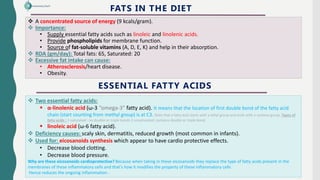
 A concentrated source of energy (9 kcals/gram).
 Importance:
• Supply essential fatty acids such as linoleic and linolenic acids.
• Provide phospholipids for membrane function.
• Source of fat-soluble vitamins (A, D, E, K) and help in their absorption.
 RDA (gm/day): Total fats: 65, Saturated: 20
 Excessive fat intake can cause:
• Atherosclerosis/heart disease.
• Obesity.
FATS IN THE DIET
 Two essential fatty acids:
 α-linolenic acid (ω-3 “omega-3” fatty acid). It means that the location of first double bond of the fatty acid
chain (start counting from methyl group) is at C3. Note that a fatty acid starts with a ethyl group and ends with a carboxy group. Types of
fatty acids : 1-saturated : no double or triple bonds 2-unsaturated: contains double or triple bond.
 linoleic acid (ω-6 fatty acid).
 Deficiency causes: scaly skin, dermatitis, reduced growth (most common in infants).
 Used for: eicosanoids synthesis which appear to have cardio protective effects.
• Decrease blood clotting.
• Decrease blood pressure.
Why are these eicosanoids cardioprotective? Because when taking in these eicosanoids they replace the type of fatty acids present in the
membranes of these inflammatory cells and that's how it modifies the property of these inflammatory cells
Hence reduces the ongoing inflammation .
ESSENTIAL FATTY ACIDS
Omega-3 Fatty Acids
 Mainly found in: cold-water ocean fish such as: albacore, mackerel, salmon, sardines, tuna, whitefish.
Omega-3 Fatty Acids: Omega-6 Fatty Acids:
Sources
:
Plants - Fish oil containing docosahexaenoic acid (DHA)
and eicosapentaenoic acid (EPA).
Nuts – Olives – Avocados - Soybeans – Oils (sesame
, cottonseed , corn oil )
Effects: • Suppress cardiac arrhythmias.
•  Serum triacylglycerols (main function) &
Tendency to thrombosis.
•  blood pressure &  the risk of cardiovascular
mortality
Little effect on LDL or HDL levels
•  Plasma cholesterol
•  LDL
•  HDL
Structural membrane lipids.
Play an important role as:
Modulator of w-6 (omega-6) fatty acid metabolism.
So when you are eating these omega
three fatty acids or take them as
supplements ,then they will replace the
membrane lipids, modifying them.
People with high cholesterol should take omega 6 fatty acids even
though they decrease HDL (why?) Because in these patients it is of
great importance to lower LDL levels And because HDL can be
increased by life style modifications such as exercise.
Recommendations for Omega-3 Fatty Acid Intake
American
Heart
Association
Guidelines
Patients without CHD
But have an increased risk
1- Fatty fish twice a week.
2- Include oils and foods rich in a-linolenic acid (flaxseed,
canola and soybean oils; flaxseed and walnuts)
Patients with CHD
1- 1 gm of EPA+DHA per day from fatty fish.
2- EPA+DHA supplements
Patients who need to
lower triglycerides (fats)
2 to 4 grams of EPA+DHA per day
Population Recommendation
CHD : coronary heart disease
435 Biochemistry Team
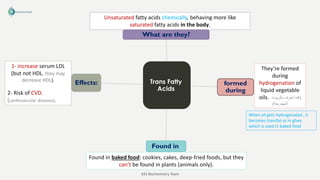
Trans Fatty
Acids
What are they?
formed
during
Found in
Effects:
Unsaturated fatty acids chemically, behaving more like
saturated fatty acids in the body.
They’re formed
during
hydrogenation of
liquid vegetable
oils. (
‫بالزيوت‬ ‫تعرف‬ ‫كما‬
‫المهدرجة‬
)
Found in baked food: cookies, cakes, deep-fried foods, but they
can’t be found in plants (animals only).
1- increase serum LDL
(but not HDL, they may
decrease HDL).
2- Risk of CVD.
(cardiovascular diseases).
When oil gets hydrogenated , it
becomes transfat as in ghee
which is used in baked food
435 Biochemistry Team
Vitamins
Organic compounds
present in small
quantities in different
types of food
Help in various
biochemical
processes in cell
Most act as
coenzymes
Important for
growth and
maintaining good
health
Essential
Non-caloric, they
don’t give energy
Required in very
small amounts
Vitamins
Vitamins are Classified Based on Solubility:
Fat-Soluble Vitamins Water-Soluble Vitamins
• Vitamin A
• Vitamin D
• Vitamin E
• Vitamin K
• STORED IN THE BODY
ADEK
1. Ascorbic acid (vitamin C)
2. Thiamin (vitamin B1)
3. Riboflavin (vitamin B2)
4. Niacin (vitman B3)
5. Pyridoxine (vitamin B6)
6. Biotin
7. Pantothenic acid
8. Folate
9. Cobalamin (vitamin B12)
Vitamin E Vitamin B1 (Thiamin)
Active
form
a-Tocopherol is the most active form in the body Thiamin pyrophosphate (TPP).
function Antioxidant (prevents oxidation of cell
components by molecular oxygen and free
radicals).
May have a role in fertility and anti-aging effect.
As a Coenzyme for transketolase in HMP pathway and
oxidative decarboxylation reactions
In krebs cycle +I inking krebs cycle with glycolysis)
Sources Vegetable Oil -nuts - Seeds – vegetables Plants – Cereals - Meat.
RDA • Adults:15 mg/day.
• Children:7 mg/day.
• Adults: 1.2 mg/day
• Children: 0.6 mg/day
Vitamin E & Vitamin B1
Deficiency of vitamin E results in:
Defective
lipid
absorption
Anemia due
to oxidative
damage to
RBCs
Neurologic
al problems
Male
infertility
Thiamin Deficiency
 In thiamin deficiency:
• the activity of these two dehydrogenase-catalyzed reactions (transketolase and oxidative
decarboxylation reactions) is decreased.
 Causing:
• Low ATP production and, therefore, defective cellular function.
Disorders of Vitamin B1 (Thiamin) Deficiency
Wernicke-Korsakoff syndrome
Beriberi
Disorder
:
Common in alcoholics due to defective
intestinal absorption of thiamin or dietary
insufficiency.
A type of chronic peripheral neuritis due to
severe thiamin deficiency.
What is
it?
apathy, loss of memory
weakness, paralysis, neuropathy, disorderly
thinking.
Leads to
:
- Thiamin has a role in nerve conduction.
- Neuropathy affects glial cells (astrocytes) of
the brain and spinal cord causing neuron death.
Facts
Vitamin C: Functions
functions
Powerful
antioxidant
(prevents
some cancers)
Helps in dentine,
intercellular matrix
and collagen
formation as a coenzyme.
Increases iron
absorption
That is why iron supplements
are recommended to be
taken with fruit!
Helps in the
maturation of
RBCs
Promotes
wound healing
Stimulates
phagocytic
action of
leukocytes
Reduces risk
of cataract
formation
Vitamin C
Sources and RDA (mg/day):
• Citrus fruits, tomatoes, melon, peppers
• Men: 90, Women: 75, Children: 15-25
Deficiency of vitamin C results in a disease called:
Scorbutic gums in vitamin C deficiency.
Gums are swollen, ulcerated, and bleeding
due to vitamin C-induced defects in oral
epithelial basement membranes and
periodontal collagen fiber synthesis.
Scurvy (also called sailor disease)
It’s an
abnormal
collagen
production
Gums become
painful, swollen
and spongy and
bleeding
The pulp is
separated and
the teeth are
lost
Minerals and Trace Elements
Macrominerals
(>100 mg/day)
Microminerals
(<100 mg/day)
• Calcium
• Phosphorous
• Sodium
• Potassium
• Chloride
• Magnesium
• Iron
• Iodine.
• Molybdenum
• Copper, selenium
• Manganese, Fluoride
• Zinc, Chromium
• Cobalt, Silicon
Minerals
• If the minerals are needed more than 100 mg per day = macro
• If the minerals are required less than 100 mg per day then we
call them trace elements(microminerals)
 Trace elements are metal elements
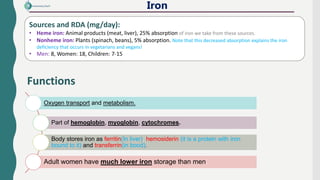
Iron
Sources and RDA (mg/day):
• Heme iron: Animal products (meat, liver), 25% absorption of iron we take from these sources.
• Nonheme iron: Plants (spinach, beans), 5% absorption. Note that this decreased absorption explains the iron
deficiency that occurs in vegetarians and vegans!
• Men: 8, Women: 18, Children: 7-15
Oxygen transport and metabolism.
Part of hemoglobin, myoglobin, cytochromes.
Body stores iron as ferritin(In liver), hemosiderin (it is a protein with iron
bound to it) and transferrin(in bood).
Adult women have much lower iron storage than men.
Functions
Iron deficiency
Iron-related
disorders
Iron deficiency
anemia
is most common in growing children, pregnant, lactating
and menstruating women which need more iron.
Hemosiderosis
(iron overload
disorder)
Due to: iron excess (toxicity).
Hemosiderin: Iron stored in complex with
ferritin protein in liver and spleen.
Occurs in: persons receiving repeated blood
transfusions.
Check your understanding!
Q1: Which of the following are classified as
“Macronutrients”?
A. Proteins
B. Fats
C. Vitamins
D. A+B.
Q2: Which of the following is an essential Amino Acid?
A. Arginine
B. Alanine
C. Tyrosine
D. Serine
Q3: Which of the following statements is true?
A. Proteins from plant sources are more digestible than
those from animal sources
B. Proteins from animal sources are more digestible than
those from plant sources.
C. Proteins from plant sources have equal digestibility as
those from animal sources
D. None of the Above
Q4: Normally in a healthy person, Nitrogen intake is….
A. Greater than Nitrogen loss
B. Less than Nitrogen loss
C. Equal to Nitrogen loss.
D. None of the Above
Q5: Marasmus condition arises due to:
A. Inadequate intake of proteins with adequate intake of
energy
B. Inadequate intake of energy with adequate intake of
proteins.
C. Inadequate intake of proteins with inadequate intake of
energy
D. Excess intake of protein with adequate intake of energy
Q6: What will happen if a person’s CHO intake is less than
required?
A. Proteins will be spared and fats will be metabolized instead
B. Proteins will be metabolized to make up for the energy
deficit
C. More Gluconeogenesis will take place
D. B+C.
1.D 2.A 3.B 4.C 5.B 6.D
Check your understanding!
Q1: Which of the following statements is incorrect?
A. Dietary Fibers cannot be broken down by humans
B. Dietary Fibers promote gastric emptying.
C. Dietary Fibers promote a feeling of fullness
D. Dietary Fibers lower serum LDL levels
Q2: What are the effects of Omega-6 Fatty acids on the
body?
A. Lower LDL and VLDL only
B. Lower LDL and HDL only
C. Lower plasma cholesterol levels only
D. None of the Above.
Q3: Which of these nutrients helps suppress Cardiac
Arrhythmias?
A. Omega-6 Fatty acids
B. Omega-3 Fatty acids
C. α-linolenic acid
D. B+C.
a-linolenic
Q4: What are the fat-soluble vitamins stored in the body?
A. Vitamins K, A, E, D.
B. Vitamins A, D, C, K
C. Vitamins B, D, K , C
D. None of the Above
Q5: Wernicke-Korsakoff Syndrome occurs due to:
A. Vitamin A deficiency
B. Vitamin B12 deficiency
C. Vitamin B1 Deficiency.
D. Vitamin D deficiency
Q6: Iron is stored in the body as:
A. Ferritin
B. Transferrin
C. Hemosiderin
D. All of the Above.
1.B 2.D 3.D 4.A 5.C 6.D
Done by:
-
‫العنزي‬ ‫شهد‬
.
-
‫الغزي‬ ‫عبداهلل‬
-
‫هاشم‬ ‫ريفان‬
.
-
‫الطويل‬ ‫عبداهلل‬
.
-
‫القحطاني‬ ‫عمر‬
.
-
‫الشنيفي‬ ‫عبداهلل‬
.
-
‫املنصور‬ ‫رغد‬
.
-
‫احلربي‬ ‫مروج‬
.
-
‫الرويلي‬ ‫أمحد‬
. @435biochemteam
435biochemistryteam@gmail.com
@biochemteam435
435 Biochemistry Team
Resource:
- 435’s slides and notes.
Revised by:
‫الرشيد‬ ‫نوف‬

Macro and micro nutrients (Updated)..pdf

  • 1.
    MACRO AND MICRO NUTRIENTS. *Please check out this link to know if there are any changes or additions. Color index: Important | Doctors notes | Further explanation. Important Note: Dr. Ghani: you don’t have to memorize the RDAs neither the Sources. and RDAs.
  • 2.
    O B J E C T I V E S : 435 Biochemistry Team Understand the nutritional importance of dietary macro and micronutrients.  Identify major dietary sources and RDAs of macro and micronutrients. Evaluate the nutritional quality of proteins, the types of dietary carbohydrates, fibers and fats and their benefits.  Discuss the role of macronutrients in causing diseases or conditions such as nitrogen imbalance, diabetes, obesity, atherosclerosis and heart disease.  Understand the functions of micronutrients (vitamins, minerals and trace elements) and the diseases due to their deficiencies.
  • 3.
    Macro & Macronutrients: MacronutrientsMicronutrients Needed by the body in large amounts (gram quantities) (proteins, carbohydrates, fats) Needed by the body in small amounts (micro or milli gram quantities) (vitamins, minerals, trace elements). Note that the body’s main source of energy is carbs. -The body utilizes carbohydrates for energy first ,but if they are not present then the body will breakdown fat. If both of the previous energy sources are not present then the body will breakdown protein to meet energy requirements! Required for maintaining normal health and preventing various diseases They provide energy and building blocks for proteins, carbohydrates and fats They do not provide energy
  • 4.
    ENERGY CONTENT OFFOOD  What is a calorie? - The amount heat required to raise the temperature of 1 gm. of water by 1oC. • Proteins  4 kcal/gm (if you burn 1 gm of protein then it is going to provide 4 kilocalories) • Carbohydrates  4 kcal/gm • Fat  9 kcal/gm “Fat is considered the macronutrient with the HIGHEST energy” Body obtains energy as: ATP. ATP is used for: all body functions The energy content of food is measured in: calories (Kilocalories)
  • 5.
    435 Biochemistry Team AcceptableMacronutrient Distribution Range (AMDR) Adequate intake of macronutrients to prevent the risk of disease Influence of nutrition on some common causes of death in the united states in the year 2000. Red indicates causes of death in which the diet plays a significant role. That is why the knowledge of acceptable range of macronutrients is quite important . Blue indicates causes of death in which excessive alcohol consumption plays a part. (*diet plays a role in only some forms of cancer.) AMDR for adults: CHOs: 45-65% Proteins: 10-35% Fats: 20-35%
  • 6.
    Proteins: Proteins supply aminoacids and amino nitrogen for the body. Proteins are the only source of nitrogen in the body.  Nutritional Importance of Proteins: 1-Essential amino acids : • Body can’t synthesize, must be supplied in the diet • PVT TIM HALL: Pheylalanine, Valine, Tryptophan, Threonine, Isoleucine, Methionine, Histidine, Arginine, Lysine, Leucine. “you should memorize them” 2-Non-essential: Body can synthesize them.  Types of proteins: These amino acids are used in the synthesis of different tissues and enzymes. If you are eating an extra amount of proteins ,then the body can react in two ways: 1- either the excess protein is broken down and used as an energy source . 2- or it will convert into acetyl coA which is used in fat synthesis( so we can conclude that excessive amounts of protein are stored as FAT. )  Sources and RDA: - Sources: Meat, poultry, fish, milk, wheat, corn, beans, nuts - RDA “Recommended dietary intake” (gms/kg body weight) • Normal adults: 0.8 • Athletes: 1.0 • Pregnancy / lactation: upto 30 • Children: 2.0
  • 7.
    435 Biochemistry Team Proteins: Nutritional Quality of Proteins:  What is it? A measure of a protein’s ability to provide the essential amino acids required for tissue maintenance. “to know which protein is more beneficial than the other”  Measured in: PDCAAS units (protein Digestibility-Corrected Amino Acid Scoring) An amino acid score provided for each amino acid present in that protein • High value indicates more digestibility and high quality (maximum score 1.0) Why is the score of animal proteins higher than the score of plant proteins? Because the constituents of animal proteins are similar to the requirements of the body ,hence these proteins will have a higher nutritional quality ,and ultimately a higher score. • Proteins from animal sources: 0.82-1.0 • Proteins from plant sources: 0.4 The nutritional quality of proteins Depends upon two things : 1-the amount of essential amino acids provided by that protein 2-the digestibility of that protein (Because some proteins are not easily digested such as bean which will affect their nutritional quality) Why is the knowledge of protein nutritional quality important ? Because if you are eating a type of protein with a low score (meaning it has a low nutritional value),then you can combine it with another protein that has a higher nutritional quality ,hence the body will get its requirements! The proteins with the highest nutritional score: 1- Milk protein (casein ) it is of good nutritional quality (easily digestible ,provides many essential amino acids) So it has a score of 1 2-egg white
  • 8.
    NITROGEN BALANCE 435 BiochemistryTeam Nitrogen Balance Normal Nitrogen Balance In a healthy person, the nitrogen intake is equal to nitrogen loss Negative Nitrogen Balance When nitrogen loss is more than intake and the body is not compensating for this loss Occurs in burns, trauma, illness, metabolic stress Positive Nitrogen Balance When nitrogen intake is more than loss Occurs in growth, pregnancy, lactation, recovery from illness Provided by amino balance
  • 9.
    435 Biochemistry Team Explanation: Note that in order for positive nitrogen to occur, two things must happen: 1-intake is more than excretion 2-body keeps on forming more tissue protein( in children during growth , during lactating , metabolic stress) *if only the first condition happens, the proteins will be stored as fat ( as mentioned earlier) , so positive nitrogen balance will not happen that is why we specified that positive N balance happens in growth and lactation..and not just by increasing amino acid intake!!! Image d: 1-dietary intake protein is normal But the amount used to synthesize tissue protein is less (why?) due to lack of amino acids from the diet 2- so all other amino acids not being used in synthesis will be degraded and excreted from the body ( increased nitrogen loss, hence negative nitrogen balance occurs) Image c: Negative nitrogen balance occurred due to the following: 1-malnutrition (intake of nitrogen is low) 2- hence the amount of tissue protein being synthesized is low 3-but the breakdown and excretion remain normal (do not decrease proportionately to the decreased intake) 4- hence , person has negative nitrogen balance Image b: Negative nitrogen balance occurred Because the body is in metabolic stress> breakdown is much more > the amount of nitrogen excreted (as urea and ammonia) is much more Image a : positive nitrogen balance 1-increased amount of Dietary proteins taken in and added to the existing amino acid pool in the body 2-tissue protein is synthesized from said pool 3-the amount of excretion and the amount being used for energy Purine, and heme is normal( not increased ) 4-intake more than excretion because your body is taking up more and synthesizing more tissue protein , WITHOUT increased excretion ,then your body is in positive nitrogen balance .
  • 10.
    PROTEIN-ENERGY MALNUTRITION 435 BiochemistryTeam  What is it ? A condition or disease caused by not eating enough food leading to energy malnutrition or not eating a balanced diet leading to protein malnutrition  Malnutrition due to inadequate intake of proteins or energy Either the amount of total protein taken Is inadequate Or protein taken in is adequate but the caloric intake is not enough to sustain life
  • 11.
    Kwashiorkor Marasmus disorders Inadequate intake ofproteins with adequate energy intake (kwashiorkor is more of an acute state while marasmus is chronic) Inadequate intake of energy with adequate protein intake Causes • After weaning (few months to at about 1 year). • Diet mainly contains CHOs. • Why does kwashiorkor occur? Sometimes mothers wean the babies much earlier than they should (take them off milk) So now the baby's diet is composed of carbs mostly So the amount of blood protein will go down ,hence edema will occur • 1-3 year • Mother’s milk is supplemented with food (cereals) deficient in calories. Age and food intake • Edema “due to decreased protein levels” • Distended abdomen • Diarrhea • Dermatitis due to fat loss / thin hair • Enlarged fatty liver due to decrease in lipoproteins so the lipids will accumulate in the liver. • Low plasma albumin • Arrested growth • Extreme muscle wastingWhy does this occur even though protein intake is adequate? • Because you are not getting enough energy from carbs, so the proteins will be used as an energy source • Weakness • Weight loss • No edema or changes in plasma proteins. Symptom s ‫كايس‬ ‫شكل‬ ‫على‬ ‫بيجينا‬ ‫وغالبا‬ ‫جدا‬ ‫مهم‬ ‫الجدول‬ ! ‫زين‬ ‫احفظوه‬ !! PROTEIN-ENERGY MALNUTRITION
  • 12.
    435 Biochemistry Team CARBOHYDRATES •Their major role in diet is energy production. • RDA: 130 grams/day for adults and children • CHO intake above RDA causes: weight gain or obesity due to increased fat storage in adipose tissue Complex CHOs Simple CHOs: Types of CHO in the diet sucrose, fructose, lactose, corn syrup whole grains, pasta, wheat, starch What is difference between the simple and complex: carbs? The body requires more energy to breakdown complex carbs than in simple carbs. One should include more complex carb in his/her diet
  • 13.
    435 Biochemistry Team Dietaryprotein requirement and CHO diet are related to each other. PROTEIN-SPARING EFFECT They inhibit gluconeogenesis from amino acids. That way amino acids are used for repair and maintenance of tissue protein and not for gluconeogenesis. If CHO intake is less than the RDA (130 g/day) more proteins will be metabolized. more gluconeogenesis will take place. As long as you have a good amount of carbs in the body, proteins will NOT be used as an energy source How can proteins provide energy? First they have to be turned into glucose by gluconeogenesis. The amino acids that can be used in the synthesis of glucose are called : glycogenic amino acids CHO have protein-sparing effect:
  • 14.
    435 Biochemistry Team DIETARYFIBER  The component of food that cannot be broken down by human digestive enzymes.  RDA (gm/day): Men: 38, Women: 25 Benefits Slows gastric emptying (long-term glucose control in patients with diabetes mellitus) Reduces exposure of gut to carcinogens (free radicals of the carcinogen are excreted with the soluble fiber) Lowers serum LDL levels Reduces constipation and also diarrhea Promotes feeling of fullness By slowing gastric emptying There are two types of fibers: - Soluble fibers: “can be solubolized in water” : they can get rid of carcinogens and they help when a person has constipation . - The insoluble fibers: give bulk to the stool if a person has diarrhea. Where are bile salts synthesized? Liver What is the parent compound of bile salts? cholesterol How does fiber lower serum LDL? Because the soluble fibers interfere with the reabsorption of bile salts. Bile salts that are released into the gut for the digestion and the absorption process will be reabsorbed by a percentage of 90% (normally) . These bile salts are reabsorbed  then taken to the liver  then to gallbladder. how do the soluble fibers interfere with this process? by binding to bile salts! This binding inhibits the reabsorption of bile salt that normally occurs -so less bile salts are available in the body  the body will synthesize more bile salts by using the cholesterol in the body ? hence depleting serum cholesterol (LDL)
  • 15.
     A concentratedsource of energy (9 kcals/gram).  Importance: • Supply essential fatty acids such as linoleic and linolenic acids. • Provide phospholipids for membrane function. • Source of fat-soluble vitamins (A, D, E, K) and help in their absorption.  RDA (gm/day): Total fats: 65, Saturated: 20  Excessive fat intake can cause: • Atherosclerosis/heart disease. • Obesity. FATS IN THE DIET  Two essential fatty acids:  α-linolenic acid (ω-3 “omega-3” fatty acid). It means that the location of first double bond of the fatty acid chain (start counting from methyl group) is at C3. Note that a fatty acid starts with a ethyl group and ends with a carboxy group. Types of fatty acids : 1-saturated : no double or triple bonds 2-unsaturated: contains double or triple bond.  linoleic acid (ω-6 fatty acid).  Deficiency causes: scaly skin, dermatitis, reduced growth (most common in infants).  Used for: eicosanoids synthesis which appear to have cardio protective effects. • Decrease blood clotting. • Decrease blood pressure. Why are these eicosanoids cardioprotective? Because when taking in these eicosanoids they replace the type of fatty acids present in the membranes of these inflammatory cells and that's how it modifies the property of these inflammatory cells Hence reduces the ongoing inflammation . ESSENTIAL FATTY ACIDS
  • 16.
    Omega-3 Fatty Acids Mainly found in: cold-water ocean fish such as: albacore, mackerel, salmon, sardines, tuna, whitefish. Omega-3 Fatty Acids: Omega-6 Fatty Acids: Sources : Plants - Fish oil containing docosahexaenoic acid (DHA) and eicosapentaenoic acid (EPA). Nuts – Olives – Avocados - Soybeans – Oils (sesame , cottonseed , corn oil ) Effects: • Suppress cardiac arrhythmias. •  Serum triacylglycerols (main function) & Tendency to thrombosis. •  blood pressure &  the risk of cardiovascular mortality Little effect on LDL or HDL levels •  Plasma cholesterol •  LDL •  HDL Structural membrane lipids. Play an important role as: Modulator of w-6 (omega-6) fatty acid metabolism. So when you are eating these omega three fatty acids or take them as supplements ,then they will replace the membrane lipids, modifying them. People with high cholesterol should take omega 6 fatty acids even though they decrease HDL (why?) Because in these patients it is of great importance to lower LDL levels And because HDL can be increased by life style modifications such as exercise.
  • 17.
    Recommendations for Omega-3Fatty Acid Intake American Heart Association Guidelines Patients without CHD But have an increased risk 1- Fatty fish twice a week. 2- Include oils and foods rich in a-linolenic acid (flaxseed, canola and soybean oils; flaxseed and walnuts) Patients with CHD 1- 1 gm of EPA+DHA per day from fatty fish. 2- EPA+DHA supplements Patients who need to lower triglycerides (fats) 2 to 4 grams of EPA+DHA per day Population Recommendation CHD : coronary heart disease 435 Biochemistry Team
  • 18.
    Trans Fatty Acids What arethey? formed during Found in Effects: Unsaturated fatty acids chemically, behaving more like saturated fatty acids in the body. They’re formed during hydrogenation of liquid vegetable oils. ( ‫بالزيوت‬ ‫تعرف‬ ‫كما‬ ‫المهدرجة‬ ) Found in baked food: cookies, cakes, deep-fried foods, but they can’t be found in plants (animals only). 1- increase serum LDL (but not HDL, they may decrease HDL). 2- Risk of CVD. (cardiovascular diseases). When oil gets hydrogenated , it becomes transfat as in ghee which is used in baked food 435 Biochemistry Team
  • 19.
    435 Biochemistry Team Vitamins Organiccompounds present in small quantities in different types of food Help in various biochemical processes in cell Most act as coenzymes Important for growth and maintaining good health Essential Non-caloric, they don’t give energy Required in very small amounts Vitamins Vitamins are Classified Based on Solubility: Fat-Soluble Vitamins Water-Soluble Vitamins • Vitamin A • Vitamin D • Vitamin E • Vitamin K • STORED IN THE BODY ADEK 1. Ascorbic acid (vitamin C) 2. Thiamin (vitamin B1) 3. Riboflavin (vitamin B2) 4. Niacin (vitman B3) 5. Pyridoxine (vitamin B6) 6. Biotin 7. Pantothenic acid 8. Folate 9. Cobalamin (vitamin B12)
  • 20.
    Vitamin E VitaminB1 (Thiamin) Active form a-Tocopherol is the most active form in the body Thiamin pyrophosphate (TPP). function Antioxidant (prevents oxidation of cell components by molecular oxygen and free radicals). May have a role in fertility and anti-aging effect. As a Coenzyme for transketolase in HMP pathway and oxidative decarboxylation reactions In krebs cycle +I inking krebs cycle with glycolysis) Sources Vegetable Oil -nuts - Seeds – vegetables Plants – Cereals - Meat. RDA • Adults:15 mg/day. • Children:7 mg/day. • Adults: 1.2 mg/day • Children: 0.6 mg/day Vitamin E & Vitamin B1 Deficiency of vitamin E results in: Defective lipid absorption Anemia due to oxidative damage to RBCs Neurologic al problems Male infertility
  • 21.
    Thiamin Deficiency  Inthiamin deficiency: • the activity of these two dehydrogenase-catalyzed reactions (transketolase and oxidative decarboxylation reactions) is decreased.  Causing: • Low ATP production and, therefore, defective cellular function. Disorders of Vitamin B1 (Thiamin) Deficiency Wernicke-Korsakoff syndrome Beriberi Disorder : Common in alcoholics due to defective intestinal absorption of thiamin or dietary insufficiency. A type of chronic peripheral neuritis due to severe thiamin deficiency. What is it? apathy, loss of memory weakness, paralysis, neuropathy, disorderly thinking. Leads to : - Thiamin has a role in nerve conduction. - Neuropathy affects glial cells (astrocytes) of the brain and spinal cord causing neuron death. Facts
  • 22.
    Vitamin C: Functions functions Powerful antioxidant (prevents somecancers) Helps in dentine, intercellular matrix and collagen formation as a coenzyme. Increases iron absorption That is why iron supplements are recommended to be taken with fruit! Helps in the maturation of RBCs Promotes wound healing Stimulates phagocytic action of leukocytes Reduces risk of cataract formation
  • 23.
    Vitamin C Sources andRDA (mg/day): • Citrus fruits, tomatoes, melon, peppers • Men: 90, Women: 75, Children: 15-25 Deficiency of vitamin C results in a disease called: Scorbutic gums in vitamin C deficiency. Gums are swollen, ulcerated, and bleeding due to vitamin C-induced defects in oral epithelial basement membranes and periodontal collagen fiber synthesis. Scurvy (also called sailor disease) It’s an abnormal collagen production Gums become painful, swollen and spongy and bleeding The pulp is separated and the teeth are lost
  • 24.
    Minerals and TraceElements Macrominerals (>100 mg/day) Microminerals (<100 mg/day) • Calcium • Phosphorous • Sodium • Potassium • Chloride • Magnesium • Iron • Iodine. • Molybdenum • Copper, selenium • Manganese, Fluoride • Zinc, Chromium • Cobalt, Silicon Minerals • If the minerals are needed more than 100 mg per day = macro • If the minerals are required less than 100 mg per day then we call them trace elements(microminerals)  Trace elements are metal elements
  • 25.
    Iron Sources and RDA(mg/day): • Heme iron: Animal products (meat, liver), 25% absorption of iron we take from these sources. • Nonheme iron: Plants (spinach, beans), 5% absorption. Note that this decreased absorption explains the iron deficiency that occurs in vegetarians and vegans! • Men: 8, Women: 18, Children: 7-15 Oxygen transport and metabolism. Part of hemoglobin, myoglobin, cytochromes. Body stores iron as ferritin(In liver), hemosiderin (it is a protein with iron bound to it) and transferrin(in bood). Adult women have much lower iron storage than men. Functions
  • 26.
    Iron deficiency Iron-related disorders Iron deficiency anemia ismost common in growing children, pregnant, lactating and menstruating women which need more iron. Hemosiderosis (iron overload disorder) Due to: iron excess (toxicity). Hemosiderin: Iron stored in complex with ferritin protein in liver and spleen. Occurs in: persons receiving repeated blood transfusions.
  • 27.
    Check your understanding! Q1:Which of the following are classified as “Macronutrients”? A. Proteins B. Fats C. Vitamins D. A+B. Q2: Which of the following is an essential Amino Acid? A. Arginine B. Alanine C. Tyrosine D. Serine Q3: Which of the following statements is true? A. Proteins from plant sources are more digestible than those from animal sources B. Proteins from animal sources are more digestible than those from plant sources. C. Proteins from plant sources have equal digestibility as those from animal sources D. None of the Above Q4: Normally in a healthy person, Nitrogen intake is…. A. Greater than Nitrogen loss B. Less than Nitrogen loss C. Equal to Nitrogen loss. D. None of the Above Q5: Marasmus condition arises due to: A. Inadequate intake of proteins with adequate intake of energy B. Inadequate intake of energy with adequate intake of proteins. C. Inadequate intake of proteins with inadequate intake of energy D. Excess intake of protein with adequate intake of energy Q6: What will happen if a person’s CHO intake is less than required? A. Proteins will be spared and fats will be metabolized instead B. Proteins will be metabolized to make up for the energy deficit C. More Gluconeogenesis will take place D. B+C. 1.D 2.A 3.B 4.C 5.B 6.D
  • 28.
    Check your understanding! Q1:Which of the following statements is incorrect? A. Dietary Fibers cannot be broken down by humans B. Dietary Fibers promote gastric emptying. C. Dietary Fibers promote a feeling of fullness D. Dietary Fibers lower serum LDL levels Q2: What are the effects of Omega-6 Fatty acids on the body? A. Lower LDL and VLDL only B. Lower LDL and HDL only C. Lower plasma cholesterol levels only D. None of the Above. Q3: Which of these nutrients helps suppress Cardiac Arrhythmias? A. Omega-6 Fatty acids B. Omega-3 Fatty acids C. α-linolenic acid D. B+C. a-linolenic Q4: What are the fat-soluble vitamins stored in the body? A. Vitamins K, A, E, D. B. Vitamins A, D, C, K C. Vitamins B, D, K , C D. None of the Above Q5: Wernicke-Korsakoff Syndrome occurs due to: A. Vitamin A deficiency B. Vitamin B12 deficiency C. Vitamin B1 Deficiency. D. Vitamin D deficiency Q6: Iron is stored in the body as: A. Ferritin B. Transferrin C. Hemosiderin D. All of the Above. 1.B 2.D 3.D 4.A 5.C 6.D
  • 29.
    Done by: - ‫العنزي‬ ‫شهد‬ . - ‫الغزي‬‫عبداهلل‬ - ‫هاشم‬ ‫ريفان‬ . - ‫الطويل‬ ‫عبداهلل‬ . - ‫القحطاني‬ ‫عمر‬ . - ‫الشنيفي‬ ‫عبداهلل‬ . - ‫املنصور‬ ‫رغد‬ . - ‫احلربي‬ ‫مروج‬ . - ‫الرويلي‬ ‫أمحد‬ . @435biochemteam 435biochemistryteam@gmail.com @biochemteam435 435 Biochemistry Team Resource: - 435’s slides and notes. Revised by: ‫الرشيد‬ ‫نوف‬