MACHINE VISION
7A5-MECHANICAL ENGINEERING
Prepared by: Alpesh C. Patel
Enrollment no: 160303109749
PARUL
UNIVERSITY
INDUSTRIAL AUTOMATION AND ROBOTICS
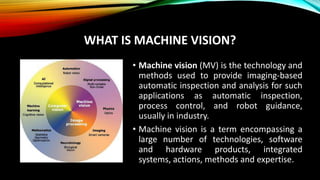
WHAT IS MACHINE VISION?
• Machine vision (MV) is the technology and
methods used to provide imaging-based
automatic inspection and analysis for such
applications as automatic inspection,
process control, and robot guidance,
usually in industry.
• Machine vision is a term encompassing a
large number of technologies, software
and hardware products, integrated
systems, actions, methods and expertise.
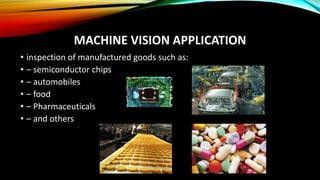
MACHINE VISION APPLICATION
• inspection of manufactured goods such as:
• – semiconductor chips
• – automobiles
• – food
• – Pharmaceuticals
• – and others
MACHINE VISION CAPABILITIES
• Checks for:
– Gauging or measurement : Dimensions
– Serial numbers
– Presence of components
– Pattern matching
– Blob analysis or Edge detection
– Optical character recognition (OCR)
and barcode decoding
– Surface inspection
– Colour analysis
GENERAL PROCESS
• 1. Image Capture
• 2. Image Pre-processing
• 3. Definition of one or more (manual) regions of interest
• 4. Segmentation of the objects
• 5. Computation of object features
• 6. Decision as to the correctness of the segmented objects
TYPICAL SYSTEM
– 1 or more digital cameras (CCD or CMOS sensor)
– Optics : Lenses / mirrors
– Light Sources
– Input / Output hardware
– Synchronizing Trigger sensor
– Actuator
– A program
IMAGE CAPTURE
• note the difference between a vector & bitmap image
LIGHTING
• Front Lighting
– Best for surface items
Print
Etched numbers
• Back Lighting
– Better contrast for:
Gauging
positioning
• Ring lighting
– Intense, shadow-free
lighting along optical axis
• Directional
– Picking out surface effects
• Diffused
– Better for positioning
Less shadows & reflections
• Polarized light
– With polarized lens on camera
– Polarizing back lighting can
even render surface tensions visible
• Infrared or Ultraviolet
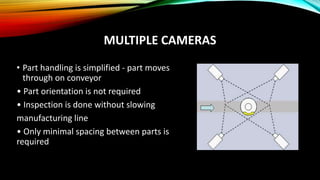
MULTIPLE CAMERAS
• Part handling is simplified - part moves
through on conveyor
• Part orientation is not required
• Inspection is done without slowing
manufacturing line
• Only minimal spacing between parts is
required
MULTIPLE CAMERAS (COND.)
•Processing of the image
Machine vision

Machine vision

  • 1.
    MACHINE VISION 7A5-MECHANICAL ENGINEERING Preparedby: Alpesh C. Patel Enrollment no: 160303109749 PARUL UNIVERSITY INDUSTRIAL AUTOMATION AND ROBOTICS
  • 2.
    WHAT IS MACHINEVISION? • Machine vision (MV) is the technology and methods used to provide imaging-based automatic inspection and analysis for such applications as automatic inspection, process control, and robot guidance, usually in industry. • Machine vision is a term encompassing a large number of technologies, software and hardware products, integrated systems, actions, methods and expertise.
  • 3.
    MACHINE VISION APPLICATION •inspection of manufactured goods such as: • – semiconductor chips • – automobiles • – food • – Pharmaceuticals • – and others
  • 4.
    MACHINE VISION CAPABILITIES •Checks for: – Gauging or measurement : Dimensions – Serial numbers – Presence of components – Pattern matching – Blob analysis or Edge detection – Optical character recognition (OCR) and barcode decoding – Surface inspection – Colour analysis
  • 5.
    GENERAL PROCESS • 1.Image Capture • 2. Image Pre-processing • 3. Definition of one or more (manual) regions of interest • 4. Segmentation of the objects • 5. Computation of object features • 6. Decision as to the correctness of the segmented objects
  • 6.
    TYPICAL SYSTEM – 1or more digital cameras (CCD or CMOS sensor) – Optics : Lenses / mirrors – Light Sources – Input / Output hardware – Synchronizing Trigger sensor – Actuator – A program
  • 7.
    IMAGE CAPTURE • notethe difference between a vector & bitmap image
  • 8.
    LIGHTING • Front Lighting –Best for surface items Print Etched numbers • Back Lighting – Better contrast for: Gauging positioning • Ring lighting – Intense, shadow-free lighting along optical axis • Directional – Picking out surface effects • Diffused – Better for positioning Less shadows & reflections • Polarized light – With polarized lens on camera – Polarizing back lighting can even render surface tensions visible • Infrared or Ultraviolet
  • 9.
    MULTIPLE CAMERAS • Parthandling is simplified - part moves through on conveyor • Part orientation is not required • Inspection is done without slowing manufacturing line • Only minimal spacing between parts is required
  • 10.