

TOPIC : MACHINE VISION
Submitted By:
Sanjana Rastogi
CS-15
Shri Ram Murti Smarak College Of Engineering,
Technology & Research, Bareilly
Outlines
• Introduction to Machine Learning
• Introduction to Machine Vision
• History of Machine Vision
• Application of Machine Vision
• Cost efficiency of Machine Vision
• Machine Vision v/s Human Inspectors
• Components of Machine Vision
• Uses of machine vision
• Advantages of Machine Vision
• Disadvantages of Machine Vision
• Conclusion
• References
Introduction To Machine Learning
• The name machine learning was coined in 1959 by Arthur Samuel.
• Training machines by providing them statistical data without being explicitly
programmed is called machine learning.
• Machine Learning is closely related to Data Mining more than Artificial Intelligence.
• Machine Learning requires a large amount of data sets to be processed through
classifiers that classify data on the basis of algorithms.
• Machine learning is dependent on maths that is its base core setup is dependent on
designing patterns, neural networks etc.
• Machine learning can be learnt by PYTHON programming language (uses library
features like Scikit & Tensorflow).
Introduction To Machine Vision
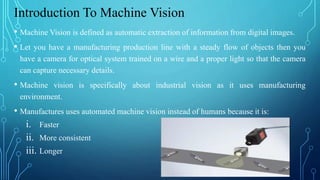
• Machine Vision is defined as automatic extraction of information from digital images.
• Let you have a manufacturing production line with a steady flow of objects then you
have a camera for optical system trained on a wire and a proper light so that the camera
can capture necessary details.
• Machine vision is specifically about industrial vision as it uses manufacturing
environment.
• Manufactures uses automated machine vision instead of humans because it is:
i. Faster
ii. More consistent
iii. Longer
History Of Machine Vision
• Vision technology got started in 1950’s .
• A wide spread use of machine vision in the industry arose in the 1980’s-90’s.
• This further shows a tiny demonstration on 1983’s trade shell on the system of
AUTOMATIX which is now a part of microscan.
• Machine vision is used for many wide processes of manufacturing.
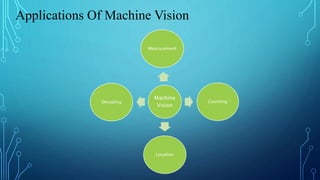
Applications Of Machine Vision
Machine
Vision
Measurement
Counting
Location
Decoding
Cont..
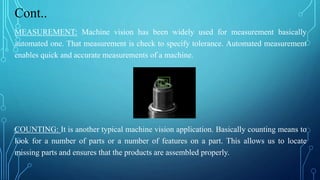
MEASUREMENT: Machine vision has been widely used for measurement basically
automated one. That measurement is check to specify tolerance. Automated measurement
enables quick and accurate measurements of a machine.
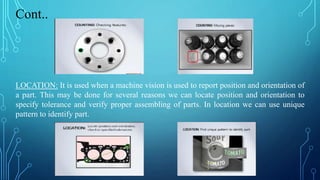
COUNTING: It is another typical machine vision application. Basically counting means to
look for a number of parts or a number of features on a part. This allows us to locate
missing parts and ensures that the products are assembled properly.
Cont..
LOCATION: It is used when a machine vision is used to report position and orientation of
a part. This may be done for several reasons we can locate position and orientation to
specify tolerance and verify proper assembling of parts. In location we can use unique
pattern to identify part.
Cont..
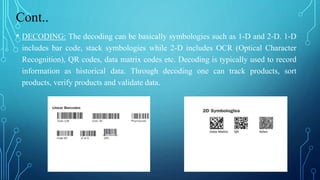
• DECODING: The decoding can be basically symbologies such as 1-D and 2-D. 1-D
includes bar code, stack symbologies while 2-D includes OCR (Optical Character
Recognition), QR codes, data matrix codes etc. Decoding is typically used to record
information as historical data. Through decoding one can track products, sort
products, verify products and validate data.
Cost Efficiency Of Machine Vision
$
Increasing
yield
Track
and
trace
comply with
regulations
Reduce
defects
1-Reduce Defects:-Machine vision inspection can reduce defects or cause for work
off. It also helps in preventing mislabelled products parts where the label doesn’t
match the content. Considering all these consequences machine vision is meant to
verify contents and ensure that the products are labelled properly.
Cont..
2-Increase Yield:- It simply means the ability to turn more of the input material into
saleable end product. If you catch defects early in the production process you reduce
waste because bad parts can be identified and eliminated before they are build into
larger assemblies.
Cont..
3-Track & Trace:- Machine vision helps in uniquely identify products so that they
can be tracked and traced in manufacturing and stocking process in less time.
Machine vision uses 1-D& 2-D symbologies to trace the product.
4-Comply with regulations:- If we are not comply with regulations leading to a
particular product you may not able to take part in market. Being able to do is
possible with low and efficient cost. A common application of this is verification of
launch, datametrices and other code formats. Machine vision system not only read
the code but also verify that the labels are printed accurately.
Machine Vision V/S Human Inspectors
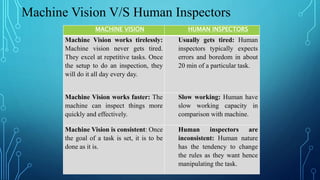
MACHINE VISION HUMAN INSPECTORS
Machine Vision works tirelessly:
Machine vision never gets tired.
They excel at repetitive tasks. Once
the setup to do an inspection, they
will do it all day every day.
Usually gets tired: Human
inspectors typically expects
errors and boredom in about
20 min of a particular task.
Machine Vision works faster: The
machine can inspect things more
quickly and effectively.
Slow working: Human have
slow working capacity in
comparison with machine.
Machine Vision is consistent: Once
the goal of a task is set, it is to be
done as it is.
Human inspectors are
inconsistent: Human nature
has the tendency to change
the rules as they want hence
manipulating the task.
Components Of Machine Vision
Lighting
It is a critical piece because it illuminates the part to be inspected allowing its features
to stand out so that the camera can clearly see them. The type and position of a light
should be carefully selected. For ex- this pair of images shows real packaging
expiration date.
Ring light
Drum light
Lens
It captures the image and delivers it to the sensor in the form of light at centre.
The lens will determine the field of view, depth of focus and focal point.
Generally there are two types of lens in a Machine Vision – interchangeable
lens and fixed lens. A fixed lens is a part of fully integrated smart camera.
Sensor
The sensor in a Machine Vision camera converts this light into a digit image which
is then send to the processor for analysis. Its important to ensure your camera
has the right sensor resolution figure application. . It uses CCD or CMOS
technology. For example- The same image has captured from different resolutions.
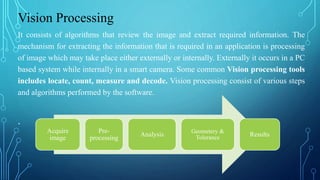
Vision Processing
It consists of algorithms that review the image and extract required information. The
mechanism for extracting the information that is required in an application is processing
of image which may take place either externally or internally. Externally it occurs in a PC
based system while internally in a smart camera. Some common Vision processing tools
includes locate, count, measure and decode. Vision processing consist of various steps
and algorithms performed by the software.
.
Acquire
image
Pre-
processing
Analysis Geometery &
Tolerance Results
Communication
This is a critical stage and is done by either discrete I/O signal or data. Discrete
I/O signals are used for data communication of a serial connection i.e., Trigger
inspection, drive indicator lights, PLCs, diverters. Data signal include login devices
and many connections built-in with the devices i.e., RS-2332, Ethernet, IP.
Uses Of Machine Vision
The following industries uses machine vision:
• Semiconductor
• Automotive
• Pharmaceutical
• Packaging
• Military
• Food Processing
• Medical devices
• Primary metals
Advantages Of Machine Vision
• It is used in so many industry such as banking and financial sector, healthcare,
retail, publishing and social media, etc.
• First and foremost, the quality of the product is increased.
• Machine vision can lead to significant cost reductions.
• Reducing the need to labor force, reduction of tiresome and subjective human
visual involvement.
• The ability to conducting the process 24 hours a day and increasing the capacity
of production (kg/h).
Disadvantages Of Machine Vision
• The prices of these machines are relatively high which eliminates use of them in
small enterprises and corporations.
• Data has to be processed before providing as input to various algorithms.
• Sometimes or most of the times machine learning will fail, thus it requires some
understanding of the problem at hand in order to apply the right machine learning
algorithm.
• Some machine learning algorithms need a lot of training data such as training data
for image recognition purposes.
• Detecting errors and making corrections is difficult.
Conclusion
• It is faster, more objective, and works continuously. Machine vision can inspect
hundreds or even thousands of parts per minute, and provides more consistent and
reliable inspection results 24 hours a day, 7 days a week.
• Measurement, counting, location, and decoding are some of the most common
applications for machine vision in manufacturing today. By reducing defects,
increasing yield, facilitating compliance with regulations and tracking parts with
machine vision, manufacturers can save money and increase profitability.
References
http://www.machinevision.co.uk
http://www.opto-engineering.com/telecentric.php
http://www.surface-inspection.com
http://www.microscan.com
http://googleweblight.com/Machine_vision
THANK YOU…!
ANY QUERY??

Machine Vision

  • 1.
    TOPIC : MACHINEVISION Submitted By: Sanjana Rastogi CS-15 Shri Ram Murti Smarak College Of Engineering, Technology & Research, Bareilly
  • 2.
    Outlines • Introduction toMachine Learning • Introduction to Machine Vision • History of Machine Vision • Application of Machine Vision • Cost efficiency of Machine Vision • Machine Vision v/s Human Inspectors • Components of Machine Vision • Uses of machine vision • Advantages of Machine Vision • Disadvantages of Machine Vision • Conclusion • References
  • 3.
    Introduction To MachineLearning • The name machine learning was coined in 1959 by Arthur Samuel. • Training machines by providing them statistical data without being explicitly programmed is called machine learning. • Machine Learning is closely related to Data Mining more than Artificial Intelligence. • Machine Learning requires a large amount of data sets to be processed through classifiers that classify data on the basis of algorithms. • Machine learning is dependent on maths that is its base core setup is dependent on designing patterns, neural networks etc. • Machine learning can be learnt by PYTHON programming language (uses library features like Scikit & Tensorflow).
  • 4.
    Introduction To MachineVision • Machine Vision is defined as automatic extraction of information from digital images. • Let you have a manufacturing production line with a steady flow of objects then you have a camera for optical system trained on a wire and a proper light so that the camera can capture necessary details. • Machine vision is specifically about industrial vision as it uses manufacturing environment. • Manufactures uses automated machine vision instead of humans because it is: i. Faster ii. More consistent iii. Longer
  • 5.
    History Of MachineVision • Vision technology got started in 1950’s . • A wide spread use of machine vision in the industry arose in the 1980’s-90’s. • This further shows a tiny demonstration on 1983’s trade shell on the system of AUTOMATIX which is now a part of microscan. • Machine vision is used for many wide processes of manufacturing.
  • 6.
    Applications Of MachineVision Machine Vision Measurement Counting Location Decoding
  • 7.
    Cont.. MEASUREMENT: Machine visionhas been widely used for measurement basically automated one. That measurement is check to specify tolerance. Automated measurement enables quick and accurate measurements of a machine. COUNTING: It is another typical machine vision application. Basically counting means to look for a number of parts or a number of features on a part. This allows us to locate missing parts and ensures that the products are assembled properly.
  • 8.
    Cont.. LOCATION: It isused when a machine vision is used to report position and orientation of a part. This may be done for several reasons we can locate position and orientation to specify tolerance and verify proper assembling of parts. In location we can use unique pattern to identify part.
  • 9.
    Cont.. • DECODING: Thedecoding can be basically symbologies such as 1-D and 2-D. 1-D includes bar code, stack symbologies while 2-D includes OCR (Optical Character Recognition), QR codes, data matrix codes etc. Decoding is typically used to record information as historical data. Through decoding one can track products, sort products, verify products and validate data.
  • 10.
    Cost Efficiency OfMachine Vision $ Increasing yield Track and trace comply with regulations Reduce defects 1-Reduce Defects:-Machine vision inspection can reduce defects or cause for work off. It also helps in preventing mislabelled products parts where the label doesn’t match the content. Considering all these consequences machine vision is meant to verify contents and ensure that the products are labelled properly.
  • 11.
    Cont.. 2-Increase Yield:- Itsimply means the ability to turn more of the input material into saleable end product. If you catch defects early in the production process you reduce waste because bad parts can be identified and eliminated before they are build into larger assemblies.
  • 12.
    Cont.. 3-Track & Trace:-Machine vision helps in uniquely identify products so that they can be tracked and traced in manufacturing and stocking process in less time. Machine vision uses 1-D& 2-D symbologies to trace the product. 4-Comply with regulations:- If we are not comply with regulations leading to a particular product you may not able to take part in market. Being able to do is possible with low and efficient cost. A common application of this is verification of launch, datametrices and other code formats. Machine vision system not only read the code but also verify that the labels are printed accurately.
  • 13.
    Machine Vision V/SHuman Inspectors MACHINE VISION HUMAN INSPECTORS Machine Vision works tirelessly: Machine vision never gets tired. They excel at repetitive tasks. Once the setup to do an inspection, they will do it all day every day. Usually gets tired: Human inspectors typically expects errors and boredom in about 20 min of a particular task. Machine Vision works faster: The machine can inspect things more quickly and effectively. Slow working: Human have slow working capacity in comparison with machine. Machine Vision is consistent: Once the goal of a task is set, it is to be done as it is. Human inspectors are inconsistent: Human nature has the tendency to change the rules as they want hence manipulating the task.
  • 14.
  • 15.
    Lighting It is acritical piece because it illuminates the part to be inspected allowing its features to stand out so that the camera can clearly see them. The type and position of a light should be carefully selected. For ex- this pair of images shows real packaging expiration date. Ring light Drum light
  • 16.
    Lens It captures theimage and delivers it to the sensor in the form of light at centre. The lens will determine the field of view, depth of focus and focal point. Generally there are two types of lens in a Machine Vision – interchangeable lens and fixed lens. A fixed lens is a part of fully integrated smart camera.
  • 17.
    Sensor The sensor ina Machine Vision camera converts this light into a digit image which is then send to the processor for analysis. Its important to ensure your camera has the right sensor resolution figure application. . It uses CCD or CMOS technology. For example- The same image has captured from different resolutions.
  • 18.
    Vision Processing It consistsof algorithms that review the image and extract required information. The mechanism for extracting the information that is required in an application is processing of image which may take place either externally or internally. Externally it occurs in a PC based system while internally in a smart camera. Some common Vision processing tools includes locate, count, measure and decode. Vision processing consist of various steps and algorithms performed by the software. . Acquire image Pre- processing Analysis Geometery & Tolerance Results
  • 19.
    Communication This is acritical stage and is done by either discrete I/O signal or data. Discrete I/O signals are used for data communication of a serial connection i.e., Trigger inspection, drive indicator lights, PLCs, diverters. Data signal include login devices and many connections built-in with the devices i.e., RS-2332, Ethernet, IP.
  • 20.
    Uses Of MachineVision The following industries uses machine vision: • Semiconductor • Automotive • Pharmaceutical • Packaging • Military • Food Processing • Medical devices • Primary metals
  • 21.
    Advantages Of MachineVision • It is used in so many industry such as banking and financial sector, healthcare, retail, publishing and social media, etc. • First and foremost, the quality of the product is increased. • Machine vision can lead to significant cost reductions. • Reducing the need to labor force, reduction of tiresome and subjective human visual involvement. • The ability to conducting the process 24 hours a day and increasing the capacity of production (kg/h).
  • 22.
    Disadvantages Of MachineVision • The prices of these machines are relatively high which eliminates use of them in small enterprises and corporations. • Data has to be processed before providing as input to various algorithms. • Sometimes or most of the times machine learning will fail, thus it requires some understanding of the problem at hand in order to apply the right machine learning algorithm. • Some machine learning algorithms need a lot of training data such as training data for image recognition purposes. • Detecting errors and making corrections is difficult.
  • 23.
    Conclusion • It isfaster, more objective, and works continuously. Machine vision can inspect hundreds or even thousands of parts per minute, and provides more consistent and reliable inspection results 24 hours a day, 7 days a week. • Measurement, counting, location, and decoding are some of the most common applications for machine vision in manufacturing today. By reducing defects, increasing yield, facilitating compliance with regulations and tracking parts with machine vision, manufacturers can save money and increase profitability.
  • 24.
  • 25.
  • 26.