Acquisition of image data, followed by the
processing and interpretation of these data by
computer for some useful application like
inspection, counting etc.
 2D system
◦ Most commonly using system.
◦ For measuring dimensions of parts.
 Verifying presence of components.
 Checking features of Flat or semi flat surfaces.
 3D system
◦ Only for special purpose
 Application include 3D analysis of scenes.
 Image acquisition and digitization
 Image processing and analysis
 Interpretation
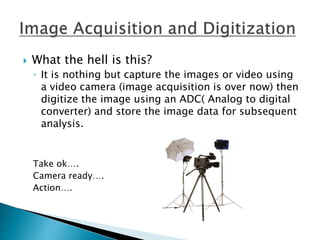
 What the hell is this?
◦ It is nothing but capture the images or video using
a video camera (image acquisition is over now) then
digitize the image using an ADC( Analog to digital
converter) and store the image data for subsequent
analysis.
Take ok….
Camera ready….
Action….
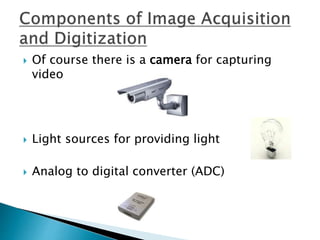
 Of course there is a camera for capturing
video
 Light sources for providing light
 Analog to digital converter (ADC)
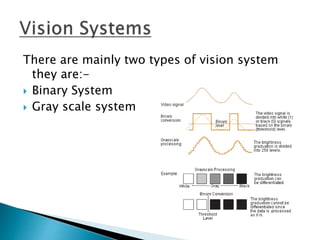
There are mainly two types of vision system
they are:-
 Binary System
 Gray scale system
 Vidicon Cameras
 Solid-State Cameras
The scene captured by the vision camera
must be well illuminated and the illum
ination must be constant over time
 There are mainly five categories of lighting
systems.
◦ Front lighting
◦ Back lighting
◦ Side lighting
◦ Structured lighting
◦ Strobe lighting.
 Front lighting.
◦ Light source is located at the same side of the
camera.
◦ Produces a reflected light from the object that allow
inspection of surface features.
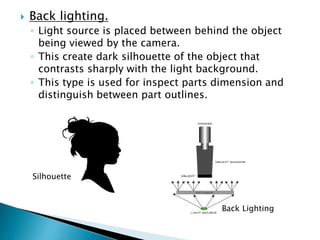
 Back lighting.
◦ Light source is placed between behind the object
being viewed by the camera.
◦ This create dark silhouette of the object that
contrasts sharply with the light background.
◦ This type is used for inspect parts dimension and
distinguish between part outlines.
Silhouette
Back Lighting
 Side lighting
◦ Light source is placed at the side of the surface to
be illuminated.
◦ For finding out surface irregularities, flaws, defects
on the surface.
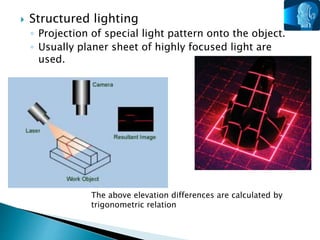
 Structured lighting
◦ Projection of special light pattern onto the object.
◦ Usually planer sheet of highly focused light are
used.
The above elevation differences are calculated by
trigonometric relation
 Strobe Lighting.
◦ The scene is illuminated by short pulse of high
intensity light which causes moving object appear
to be stationary.
◦ This is dangerous causing migraine, fizz to the
operator… 
Different techniques for image processing and
analysis the image data in machine vision
system.
 Segmentation( consist of two different
technique)
◦ Thresholding
◦ Edge detection
 Feature extraction
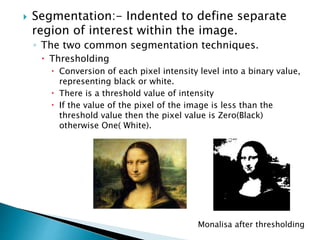
 Segmentation:- Indented to define separate
region of interest within the image.
◦ The two common segmentation techniques.
 Thresholding
 Conversion of each pixel intensity level into a binary value,
representing black or white.
 There is a threshold value of intensity
 If the value of the pixel of the image is less than the
threshold value then the pixel value is Zero(Black)
otherwise One( White).
Monalisa after thresholding
Edge detection
 Determines the location of boundaries between an
object and its surroundings in an image.
 This is accomplished by identifying the contrast in
light intensity that exists between adjecent pixels at
the border of the objects.
Monolisa after edge detection
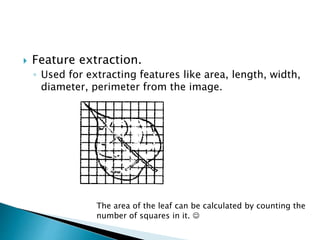
 Feature extraction.
◦ Used for extracting features like area, length, width,
diameter, perimeter from the image.
The area of the leaf can be calculated by counting the
number of squares in it. 
 Pattern recognition.
 Two common pattern recognition technique
are:-
◦ Template matching
◦ Feature weighting.
 Pattern recognition
◦ Recognizing the object
◦ Comparing the image with predefined models or
standard values.
◦ Template matching:-
 Compare one or more feature of an image with the
corresponding feature of model or template stored in
computer memory.
 Image is compared pixel by pixel.
 Disadvantage : very difficult to aligning the part in the
same position and orientation in front of the camera,
to allow the comparison to be made with out
complication in the image processing.
◦ Feature Weighting.
 Several features like area, length and perimeter are
combined into a single measure by assigning a weight
to each feature according to the relative importance in
the identifying the object.
 The score of the object in the image is compared with
the score of the image in the computer memory to
achieve proper identification.
 Inspection
 Identification
 Visual guidance and control
 Machine vision in inspection
◦ 80% of inspection works in industries are done by
machine vision
◦ Save lot’s of time
 Dimensional measurement
 Dimensional gaging.
 Verification of the presence of components.
 Verification of hole location and number of holes.
 Detection of surface flaws and defects.
 Detection of flaws in a printed label.
 Automation, Production system and computer
integrated manufacturing by Mikell P Groover.

50424340-Machine-Vision3 (1).pptx

  • 1.
    Acquisition of imagedata, followed by the processing and interpretation of these data by computer for some useful application like inspection, counting etc.
  • 2.
     2D system ◦Most commonly using system. ◦ For measuring dimensions of parts.  Verifying presence of components.  Checking features of Flat or semi flat surfaces.  3D system ◦ Only for special purpose  Application include 3D analysis of scenes.
  • 3.
     Image acquisitionand digitization  Image processing and analysis  Interpretation
  • 4.
     What thehell is this? ◦ It is nothing but capture the images or video using a video camera (image acquisition is over now) then digitize the image using an ADC( Analog to digital converter) and store the image data for subsequent analysis. Take ok…. Camera ready…. Action….
  • 5.
     Of coursethere is a camera for capturing video  Light sources for providing light  Analog to digital converter (ADC)
  • 6.
    There are mainlytwo types of vision system they are:-  Binary System  Gray scale system
  • 7.
     Vidicon Cameras Solid-State Cameras
  • 8.
    The scene capturedby the vision camera must be well illuminated and the illum ination must be constant over time  There are mainly five categories of lighting systems. ◦ Front lighting ◦ Back lighting ◦ Side lighting ◦ Structured lighting ◦ Strobe lighting.
  • 9.
     Front lighting. ◦Light source is located at the same side of the camera. ◦ Produces a reflected light from the object that allow inspection of surface features.
  • 10.
     Back lighting. ◦Light source is placed between behind the object being viewed by the camera. ◦ This create dark silhouette of the object that contrasts sharply with the light background. ◦ This type is used for inspect parts dimension and distinguish between part outlines. Silhouette Back Lighting
  • 11.
     Side lighting ◦Light source is placed at the side of the surface to be illuminated. ◦ For finding out surface irregularities, flaws, defects on the surface.
  • 12.
     Structured lighting ◦Projection of special light pattern onto the object. ◦ Usually planer sheet of highly focused light are used. The above elevation differences are calculated by trigonometric relation
  • 13.
     Strobe Lighting. ◦The scene is illuminated by short pulse of high intensity light which causes moving object appear to be stationary. ◦ This is dangerous causing migraine, fizz to the operator… 
  • 14.
    Different techniques forimage processing and analysis the image data in machine vision system.  Segmentation( consist of two different technique) ◦ Thresholding ◦ Edge detection  Feature extraction
  • 15.
     Segmentation:- Indentedto define separate region of interest within the image. ◦ The two common segmentation techniques.  Thresholding  Conversion of each pixel intensity level into a binary value, representing black or white.  There is a threshold value of intensity  If the value of the pixel of the image is less than the threshold value then the pixel value is Zero(Black) otherwise One( White). Monalisa after thresholding
  • 16.
    Edge detection  Determinesthe location of boundaries between an object and its surroundings in an image.  This is accomplished by identifying the contrast in light intensity that exists between adjecent pixels at the border of the objects. Monolisa after edge detection
  • 17.
     Feature extraction. ◦Used for extracting features like area, length, width, diameter, perimeter from the image. The area of the leaf can be calculated by counting the number of squares in it. 
  • 18.
     Pattern recognition. Two common pattern recognition technique are:- ◦ Template matching ◦ Feature weighting.
  • 19.
     Pattern recognition ◦Recognizing the object ◦ Comparing the image with predefined models or standard values. ◦ Template matching:-  Compare one or more feature of an image with the corresponding feature of model or template stored in computer memory.  Image is compared pixel by pixel.  Disadvantage : very difficult to aligning the part in the same position and orientation in front of the camera, to allow the comparison to be made with out complication in the image processing.
  • 20.
    ◦ Feature Weighting. Several features like area, length and perimeter are combined into a single measure by assigning a weight to each feature according to the relative importance in the identifying the object.  The score of the object in the image is compared with the score of the image in the computer memory to achieve proper identification.
  • 21.
     Inspection  Identification Visual guidance and control
  • 22.
     Machine visionin inspection ◦ 80% of inspection works in industries are done by machine vision ◦ Save lot’s of time  Dimensional measurement  Dimensional gaging.  Verification of the presence of components.  Verification of hole location and number of holes.  Detection of surface flaws and defects.  Detection of flaws in a printed label.
  • 23.
     Automation, Productionsystem and computer integrated manufacturing by Mikell P Groover.