Introduction to Machine Vision
Introduction to
machine vision
Rule-based vs.
AI-powered machine
vision
Machine vision
hardware components
The importance of
lighting in machine
vision applications
Image analysis
software
Types of machine
vision systems and
what they can do
PAGE 9
PAGE 5
PAGE 2
PAGE 13 PAGE 16 PAGE 18
Table of contents
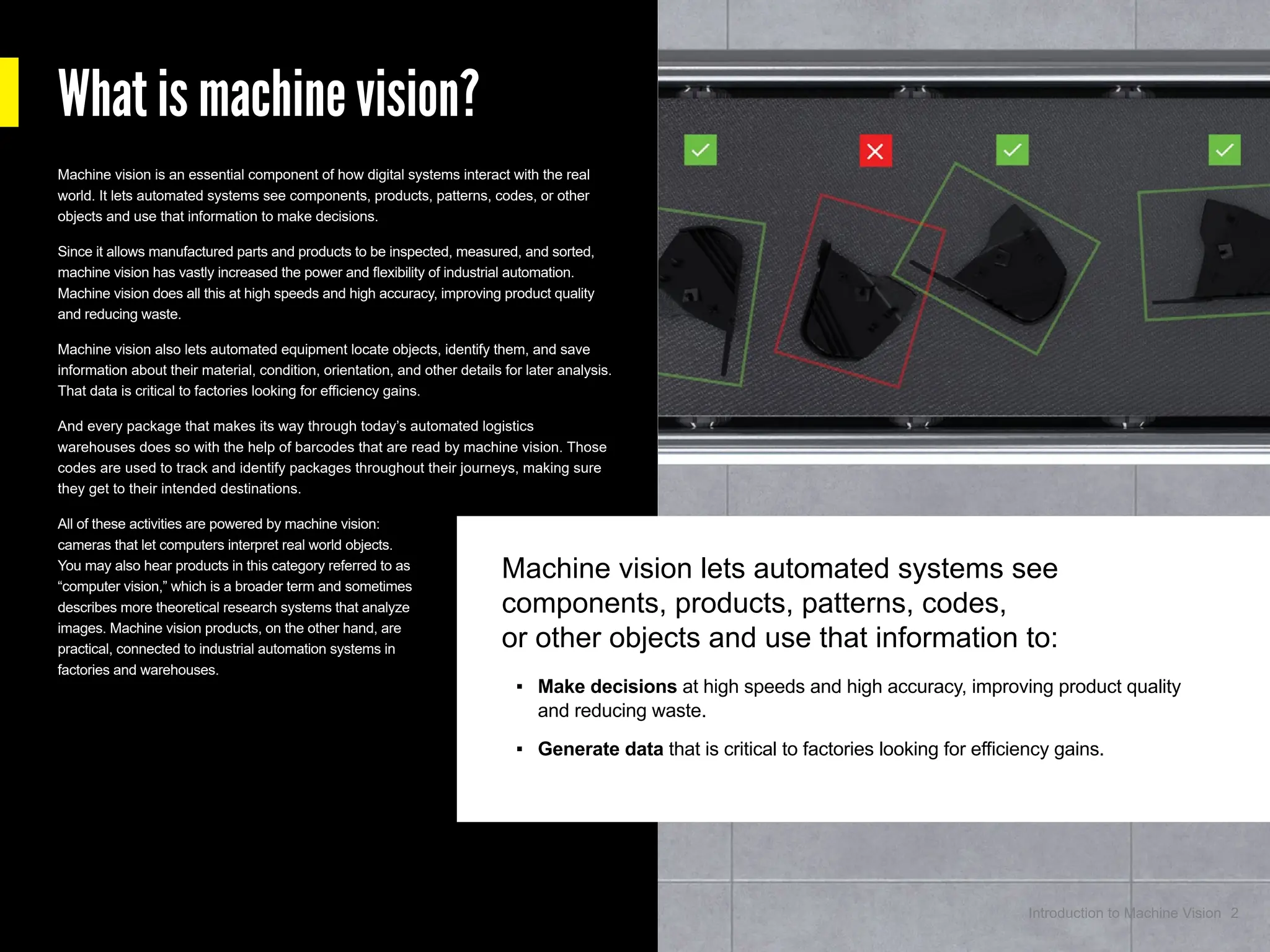
Machine vision lets automated systems see
components, products, patterns, codes,
or other objects and use that information to:
▪ Make decisions at high speeds and high accuracy, improving product quality
and reducing waste.
▪ Generate data that is critical to factories looking for efficiency gains.
Machine vision is an essential component of how digital systems interact with the real
world. It lets automated systems see components, products, patterns, codes, or other
objects and use that information to make decisions.
Since it allows manufactured parts and products to be inspected, measured, and sorted,
machine vision has vastly increased the power and flexibility of industrial automation.
Machine vision does all this at high speeds and high accuracy, improving product quality
and reducing waste.
Machine vision also lets automated equipment locate objects, identify them, and save
information about their material, condition, orientation, and other details for later analysis.
That data is critical to factories looking for efficiency gains.
And every package that makes its way through today’s automated logistics
warehouses does so with the help of barcodes that are read by machine vision. Those
codes are used to track and identify packages throughout their journeys, making sure
they get to their intended destinations.
All of these activities are powered by machine vision:
cameras that let computers interpret real world objects.
You may also hear products in this category referred to as
“computer vision,” which is a broader term and sometimes
describes more theoretical research systems that analyze
images. Machine vision products, on the other hand, are
practical, connected to industrial automation systems in
factories and warehouses.
What is machine vision?
2
Introduction to Machine Vision
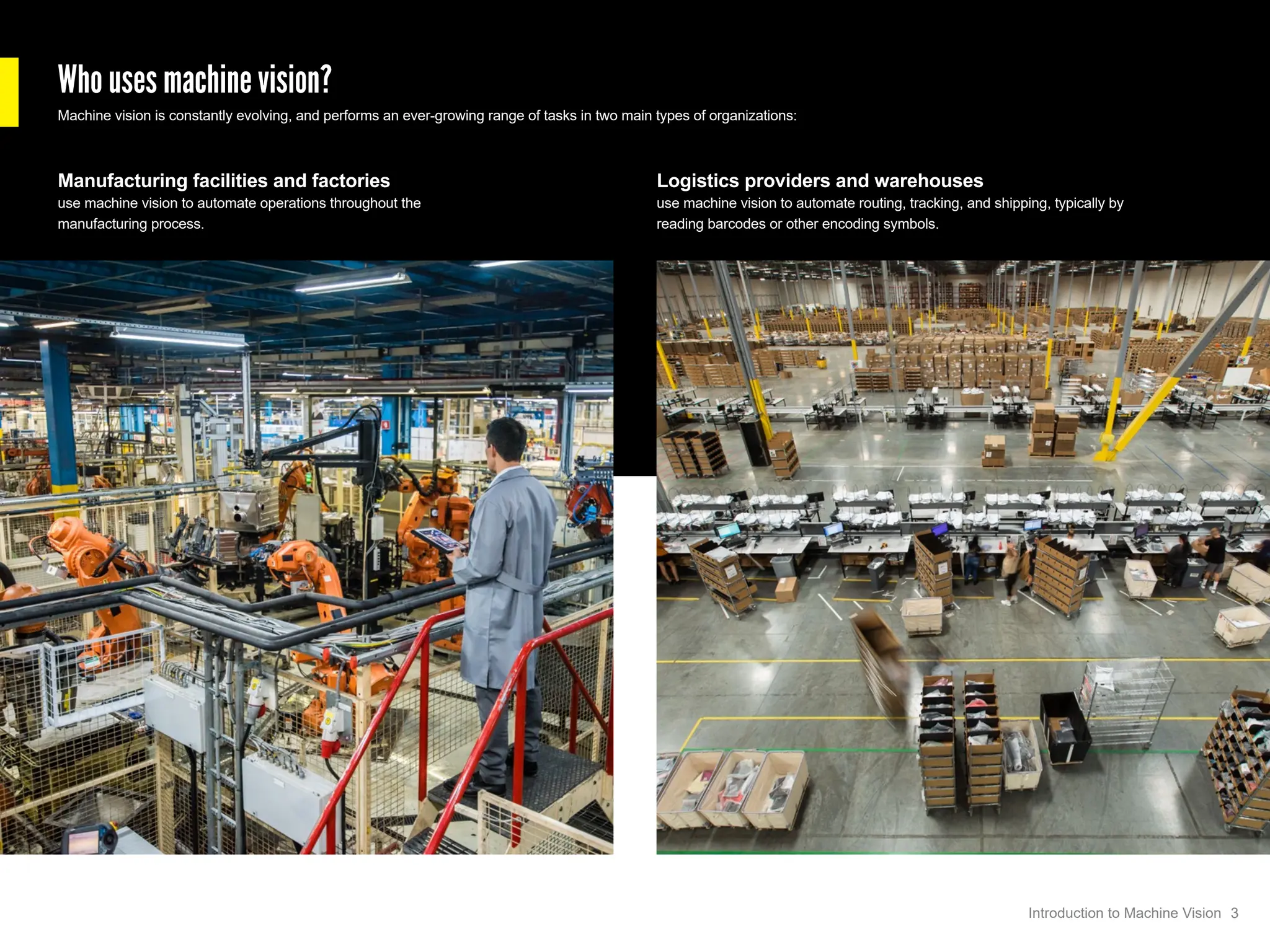
Who uses machine vision?
Machine vision is constantly evolving, and performs an ever-growing range of tasks in two main types of organizations:
Logistics providers and warehouses
use machine vision to automate routing, tracking, and shipping, typically by
reading barcodes or other encoding symbols.
Manufacturing facilities and factories
use machine vision to automate operations throughout the
manufacturing process.
3
Introduction to Machine Vision
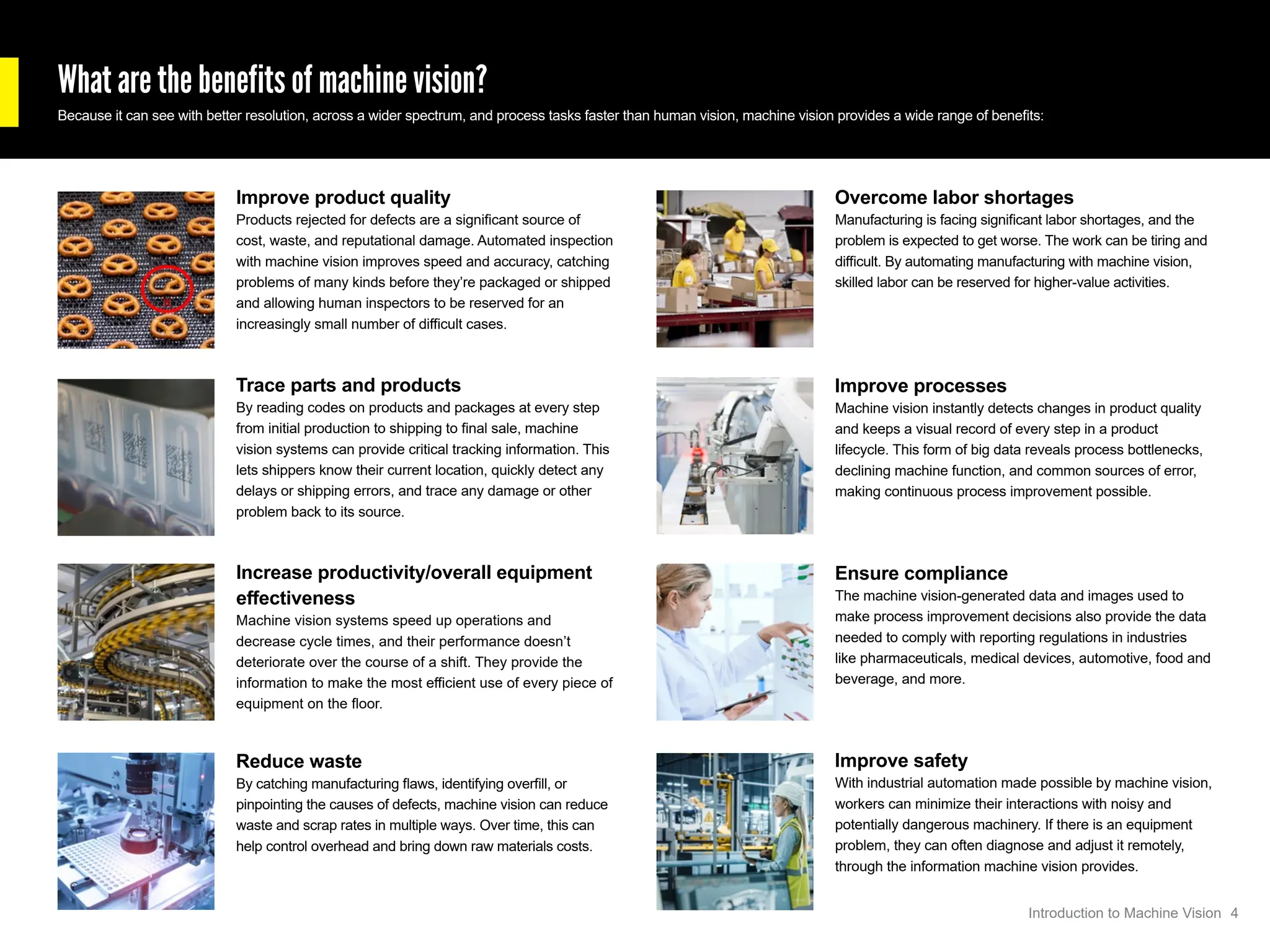
What are the benefits of machine vision?
Because it can see with better resolution, across a wider spectrum, and process tasks faster than human vision, machine vision provides a wide range of benefits:
Improve product quality
Products rejected for defects are a significant source of
cost, waste, and reputational damage. Automated inspection
with machine vision improves speed and accuracy, catching
problems of many kinds before they’re packaged or shipped
and allowing human inspectors to be reserved for an
increasingly small number of difficult cases.
Trace parts and products
By reading codes on products and packages at every step
from initial production to shipping to final sale, machine
vision systems can provide critical tracking information. This
lets shippers know their current location, quickly detect any
delays or shipping errors, and trace any damage or other
problem back to its source.
Increase productivity/overall equipment
effectiveness
Machine vision systems speed up operations and
decrease cycle times, and their performance doesn’t
deteriorate over the course of a shift. They provide the
information to make the most efficient use of every piece of
equipment on the floor.
Reduce waste
By catching manufacturing flaws, identifying overfill, or
pinpointing the causes of defects, machine vision can reduce
waste and scrap rates in multiple ways. Over time, this can
help control overhead and bring down raw materials costs.
Overcome labor shortages
Manufacturing is facing significant labor shortages, and the
problem is expected to get worse. The work can be tiring and
difficult. By automating manufacturing with machine vision,
skilled labor can be reserved for higher-value activities.
Improve processes
Machine vision instantly detects changes in product quality
and keeps a visual record of every step in a product
lifecycle. This form of big data reveals process bottlenecks,
declining machine function, and common sources of error,
making continuous process improvement possible.
Ensure compliance
The machine vision-generated data and images used to
make process improvement decisions also provide the data
needed to comply with reporting regulations in industries
like pharmaceuticals, medical devices, automotive, food and
beverage, and more.
Improve safety
With industrial automation made possible by machine vision,
workers can minimize their interactions with noisy and
potentially dangerous machinery. If there is an equipment
problem, they can often diagnose and adjust it remotely,
through the information machine vision provides.
4
Introduction to Machine Vision
Types of machine vision systems and what they can do
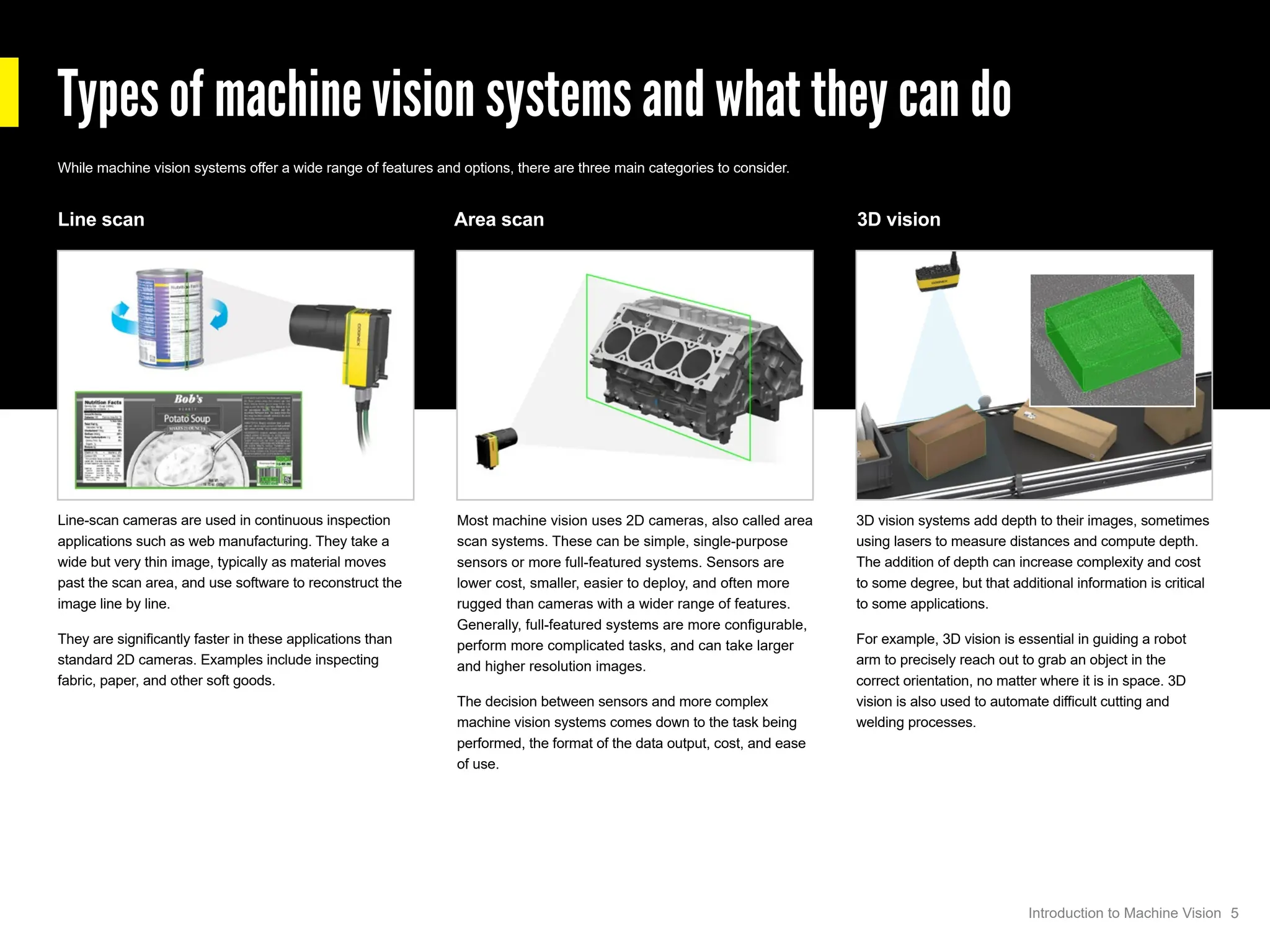
Most machine vision uses 2D cameras, also called area
scan systems. These can be simple, single-purpose
sensors or more full-featured systems. Sensors are
lower cost, smaller, easier to deploy, and often more
rugged than cameras with a wider range of features.
Generally, full-featured systems are more configurable,
perform more complicated tasks, and can take larger
and higher resolution images.
The decision between sensors and more complex
machine vision systems comes down to the task being
performed, the format of the data output, cost, and ease
of use.
3D vision systems add depth to their images, sometimes
using lasers to measure distances and compute depth.
The addition of depth can increase complexity and cost
to some degree, but that additional information is critical
to some applications.
For example, 3D vision is essential in guiding a robot
arm to precisely reach out to grab an object in the
correct orientation, no matter where it is in space. 3D
vision is also used to automate difficult cutting and
welding processes.
Line-scan cameras are used in continuous inspection
applications such as web manufacturing. They take a
wide but very thin image, typically as material moves
past the scan area, and use software to reconstruct the
image line by line.
They are significantly faster in these applications than
standard 2D cameras. Examples include inspecting
fabric, paper, and other soft goods.
While machine vision systems offer a wide range of features and options, there are three main categories to consider.
Line scan Area scan 3D vision
5
Introduction to Machine Vision
What does machine vision do?
Machine vision providers sometimes classify what
their systems can do with the acronym GIGI, for
Guidance, Identification, Gauging, and Inspection.
This guide breaks down the types of applications
into slightly more detail:
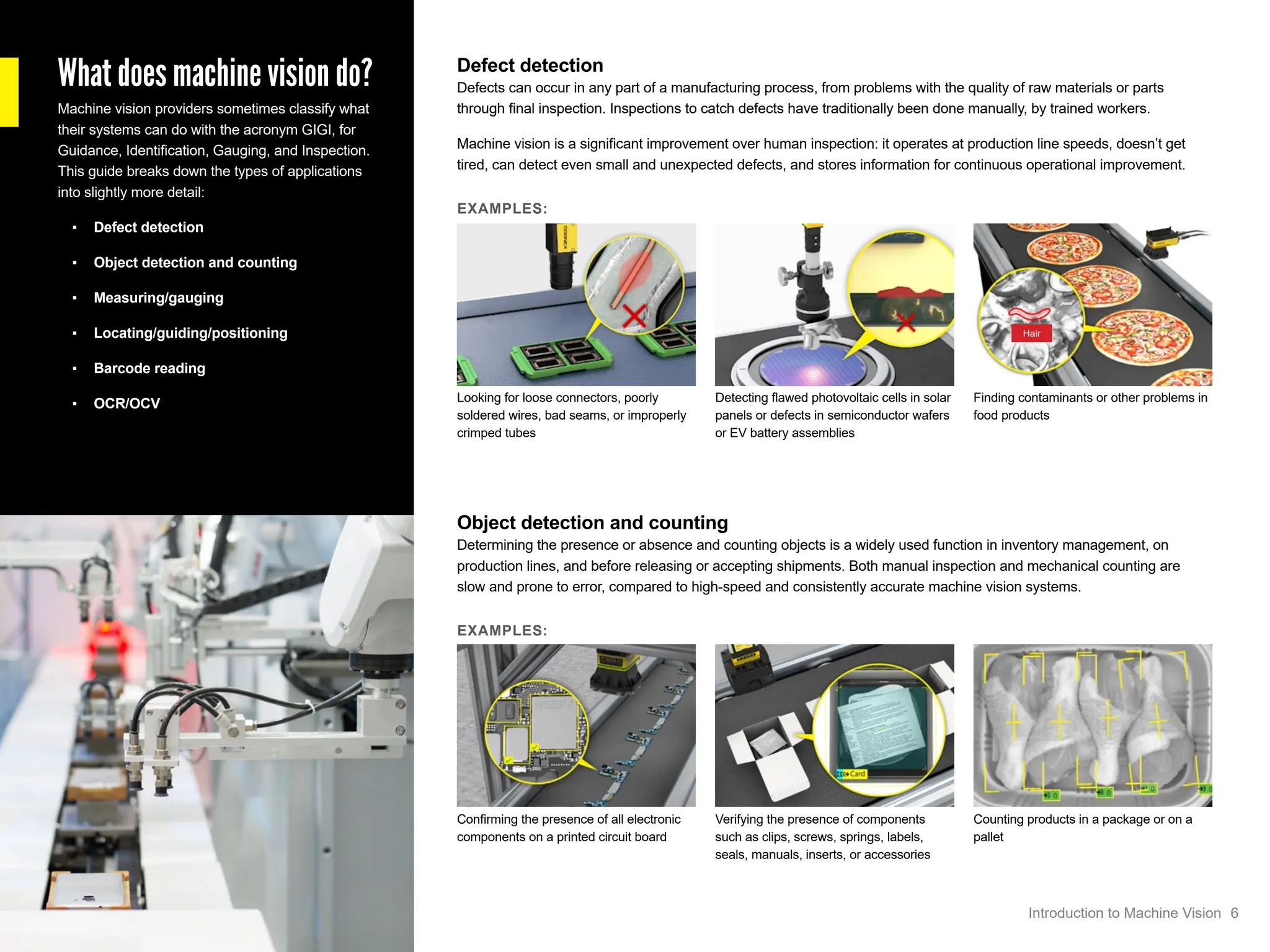
▪ Defect detection
▪ Object detection and counting
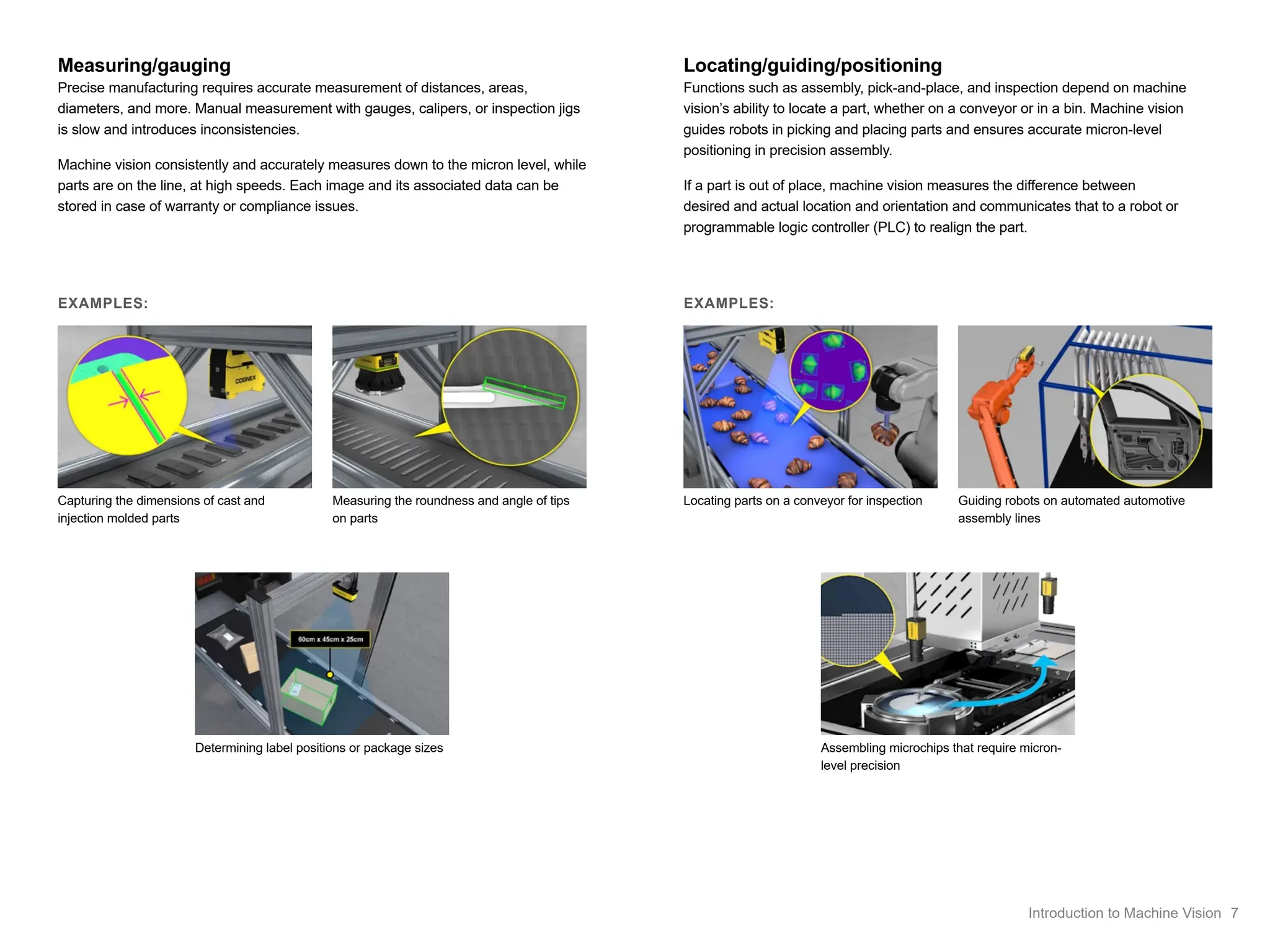
▪ Measuring/gauging
▪ Locating/guiding/positioning
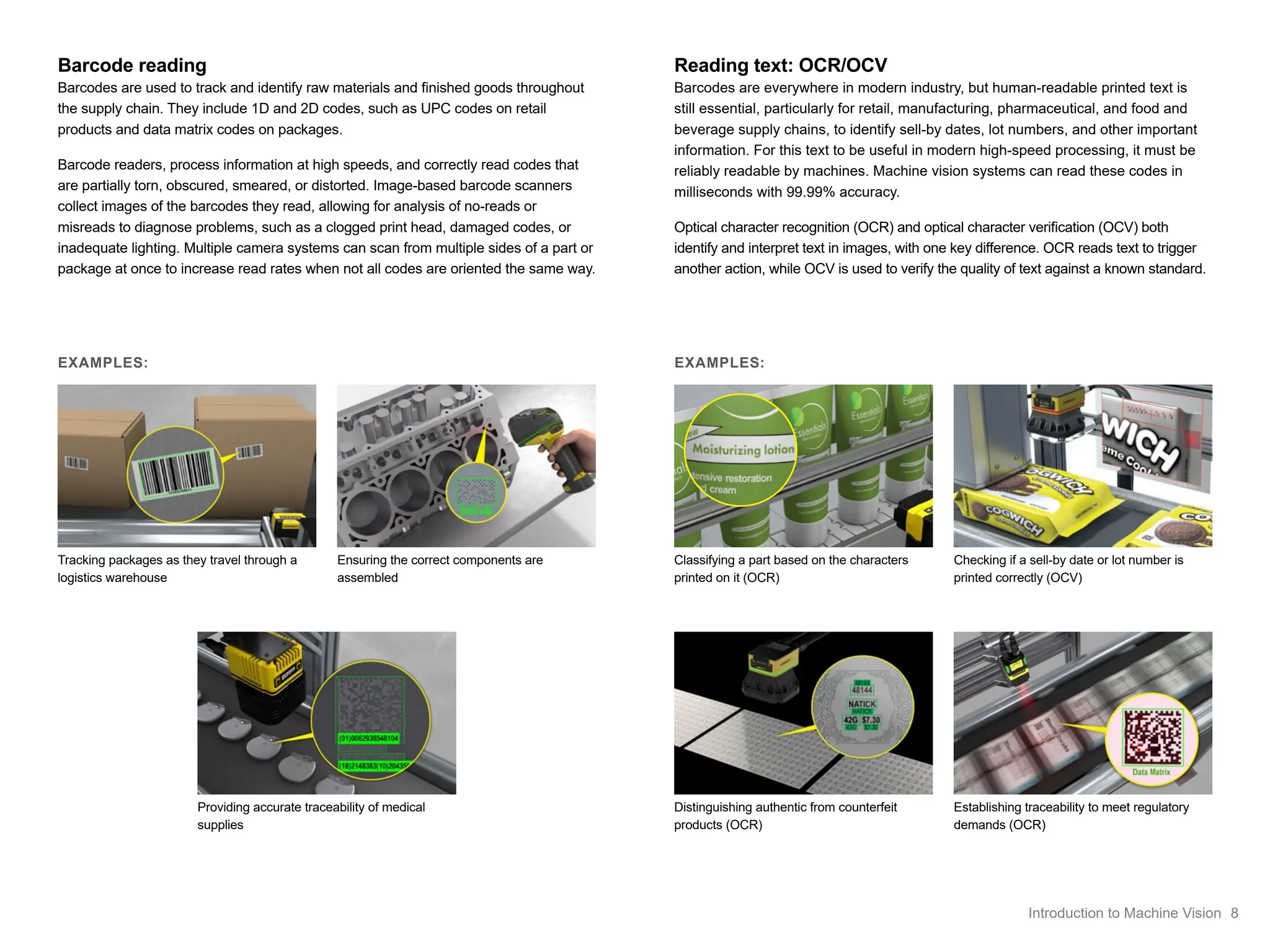
▪ Barcode reading
▪ OCR/OCV
Defect detection
Defects can occur in any part of a manufacturing process, from problems with the quality of raw materials or parts
through final inspection. Inspections to catch defects have traditionally been done manually, by trained workers.
Machine vision is a significant improvement over human inspection: it operates at production line speeds, doesn’t get
tired, can detect even small and unexpected defects, and stores information for continuous operational improvement.
EXAMPLES:
Looking for loose connectors, poorly
soldered wires, bad seams, or improperly
crimped tubes
Detecting flawed photovoltaic cells in solar
panels or defects in semiconductor wafers
or EV battery assemblies
Finding contaminants or other problems in
food products
Object detection and counting
Determining the presence or absence and counting objects is a widely used function in inventory management, on
production lines, and before releasing or accepting shipments. Both manual inspection and mechanical counting are
slow and prone to error, compared to high-speed and consistently accurate machine vision systems.
EXAMPLES:
Confirming the presence of all electronic
components on a printed circuit board
Verifying the presence of components
such as clips, screws, springs, labels,
seals, manuals, inserts, or accessories
Counting products in a package or on a
pallet
Hair
6
Introduction to Machine Vision
Measuring/gauging
Precise manufacturing requires accurate measurement of distances, areas,
diameters, and more. Manual measurement with gauges, calipers, or inspection jigs
is slow and introduces inconsistencies.
Machine vision consistently and accurately measures down to the micron level, while
parts are on the line, at high speeds. Each image and its associated data can be
stored in case of warranty or compliance issues.
Capturing the dimensions of cast and
injection molded parts
Measuring the roundness and angle of tips
on parts
Determining label positions or package sizes
Locating/guiding/positioning
Functions such as assembly, pick-and-place, and inspection depend on machine
vision’s ability to locate a part, whether on a conveyor or in a bin. Machine vision
guides robots in picking and placing parts and ensures accurate micron-level
positioning in precision assembly.
If a part is out of place, machine vision measures the difference between
desired and actual location and orientation and communicates that to a robot or
programmable logic controller (PLC) to realign the part.
Locating parts on a conveyor for inspection Guiding robots on automated automotive
assembly lines
Assembling microchips that require micron-
level precision
EXAMPLES:
EXAMPLES:
7
Introduction to Machine Vision
Barcode reading
Barcodes are used to track and identify raw materials and finished goods throughout
the supply chain. They include 1D and 2D codes, such as UPC codes on retail
products and data matrix codes on packages.
Barcode readers, process information at high speeds, and correctly read codes that
are partially torn, obscured, smeared, or distorted. Image-based barcode scanners
collect images of the barcodes they read, allowing for analysis of no-reads or
misreads to diagnose problems, such as a clogged print head, damaged codes, or
inadequate lighting. Multiple camera systems can scan from multiple sides of a part or
package at once to increase read rates when not all codes are oriented the same way.
Tracking packages as they travel through a
logistics warehouse
Ensuring the correct components are
assembled
Providing accurate traceability of medical
supplies
Reading text: OCR/OCV
Barcodes are everywhere in modern industry, but human-readable printed text is
still essential, particularly for retail, manufacturing, pharmaceutical, and food and
beverage supply chains, to identify sell-by dates, lot numbers, and other important
information. For this text to be useful in modern high-speed processing, it must be
reliably readable by machines. Machine vision systems can read these codes in
milliseconds with 99.99% accuracy.
Optical character recognition (OCR) and optical character verification (OCV) both
identify and interpret text in images, with one key difference. OCR reads text to trigger
another action, while OCV is used to verify the quality of text against a known standard.
Classifying a part based on the characters
printed on it (OCR)
Checking if a sell-by date or lot number is
printed correctly (OCV)
Distinguishing authentic from counterfeit
products (OCR)
EXAMPLES:
EXAMPLES:
Establishing traceability to meet regulatory
demands (OCR)
8
Introduction to Machine Vision
Rule-based vs.
AI-powered
machine vision
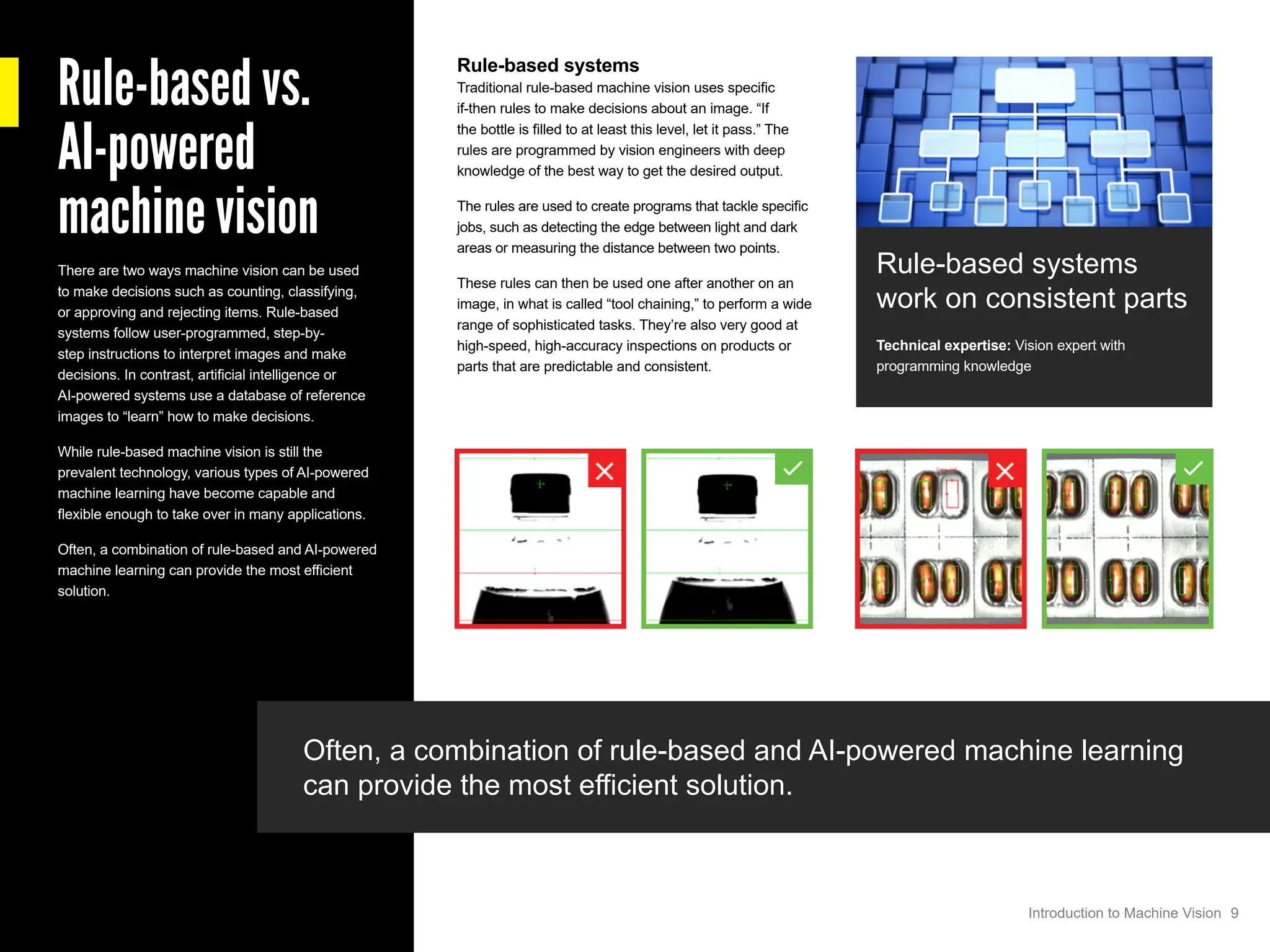
There are two ways machine vision can be used
to make decisions such as counting, classifying,
or approving and rejecting items. Rule-based
systems follow user-programmed, step-by-
step instructions to interpret images and make
decisions. In contrast, artificial intelligence or
AI-powered systems use a database of reference
images to “learn” how to make decisions.
While rule-based machine vision is still the
prevalent technology, various types of AI-powered
machine learning have become capable and
flexible enough to take over in many applications.
Often, a combination of rule-based and AI-powered
machine learning can provide the most efficient
solution.
Rule-based systems
Traditional rule-based machine vision uses specific
if-then rules to make decisions about an image. “If
the bottle is filled to at least this level, let it pass.” The
rules are programmed by vision engineers with deep
knowledge of the best way to get the desired output.
The rules are used to create programs that tackle specific
jobs, such as detecting the edge between light and dark
areas or measuring the distance between two points.
These rules can then be used one after another on an
image, in what is called “tool chaining,” to perform a wide
range of sophisticated tasks. They’re also very good at
high-speed, high-accuracy inspections on products or
parts that are predictable and consistent.
Often, a combination of rule-based and AI-powered machine learning
can provide the most efficient solution.
Rule-based systems
work on consistent parts
Technical expertise: Vision expert with
programming knowledge
9
Introduction to Machine Vision
Deep learning
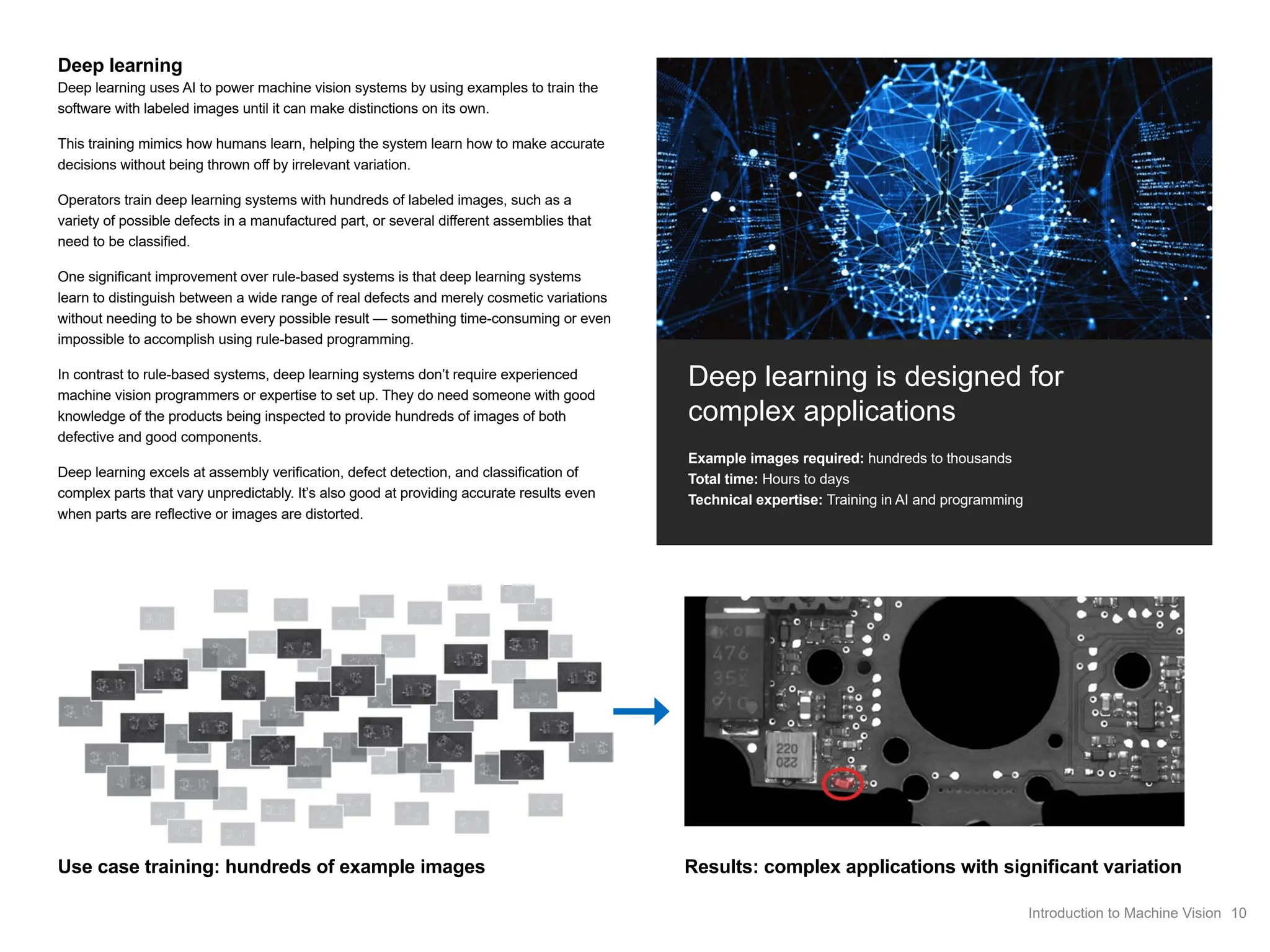
Deep learning uses AI to power machine vision systems by using examples to train the
software with labeled images until it can make distinctions on its own.
This training mimics how humans learn, helping the system learn how to make accurate
decisions without being thrown off by irrelevant variation.
Operators train deep learning systems with hundreds of labeled images, such as a
variety of possible defects in a manufactured part, or several different assemblies that
need to be classified.
One significant improvement over rule-based systems is that deep learning systems
learn to distinguish between a wide range of real defects and merely cosmetic variations
without needing to be shown every possible result — something time-consuming or even
impossible to accomplish using rule-based programming.
In contrast to rule-based systems, deep learning systems don’t require experienced
machine vision programmers or expertise to set up. They do need someone with good
knowledge of the products being inspected to provide hundreds of images of both
defective and good components.
Deep learning excels at assembly verification, defect detection, and classification of
complex parts that vary unpredictably. It’s also good at providing accurate results even
when parts are reflective or images are distorted.
Deep learning is designed for
complex applications
Example images required: hundreds to thousands
Total time: Hours to days
Technical expertise: Training in AI and programming
Results: complex applications with significant variation
Use case training: hundreds of example images
10
Introduction to Machine Vision
Edge learning
Edge learning is another type of AI, optimized to meet the needs of industrial
automation. It comes pre-trained to solve the types of problems typically faced by
industrial automation.
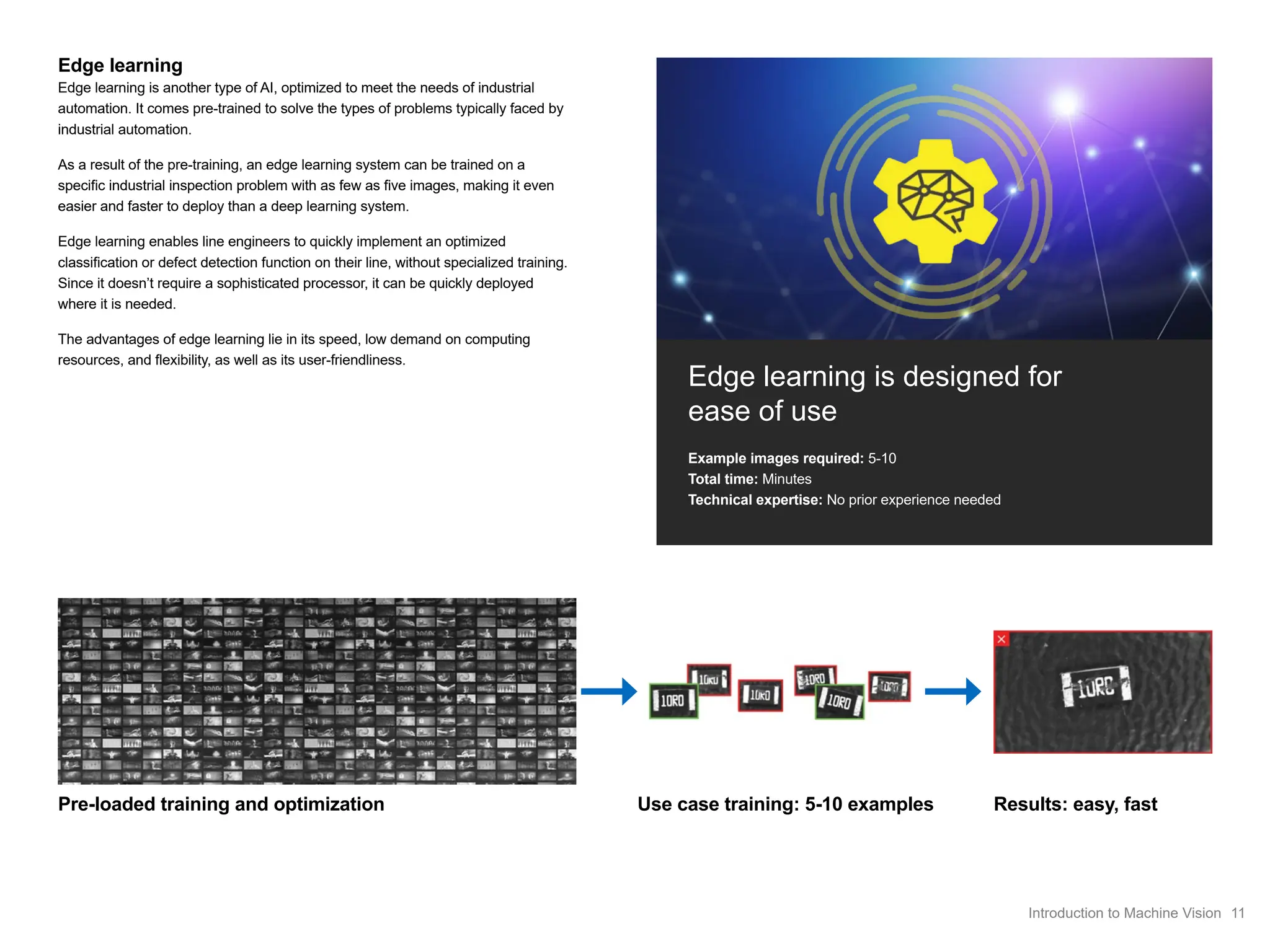
As a result of the pre-training, an edge learning system can be trained on a
specific industrial inspection problem with as few as five images, making it even
easier and faster to deploy than a deep learning system.
Edge learning enables line engineers to quickly implement an optimized
classification or defect detection function on their line, without specialized training.
Since it doesn’t require a sophisticated processor, it can be quickly deployed
where it is needed.
The advantages of edge learning lie in its speed, low demand on computing
resources, and flexibility, as well as its user-friendliness.
Use case training: 5-10 examples Results: easy, fast
Pre-loaded training and optimization
Edge learning is designed for
ease of use
Example images required: 5-10
Total time: Minutes
Technical expertise: No prior experience needed
11
Introduction to Machine Vision
Comparing rule-based and
AI-powered systems
The decision between rule-based, deep learning,
and edge learning systems mainly comes down
to the type of application you’re implementing.
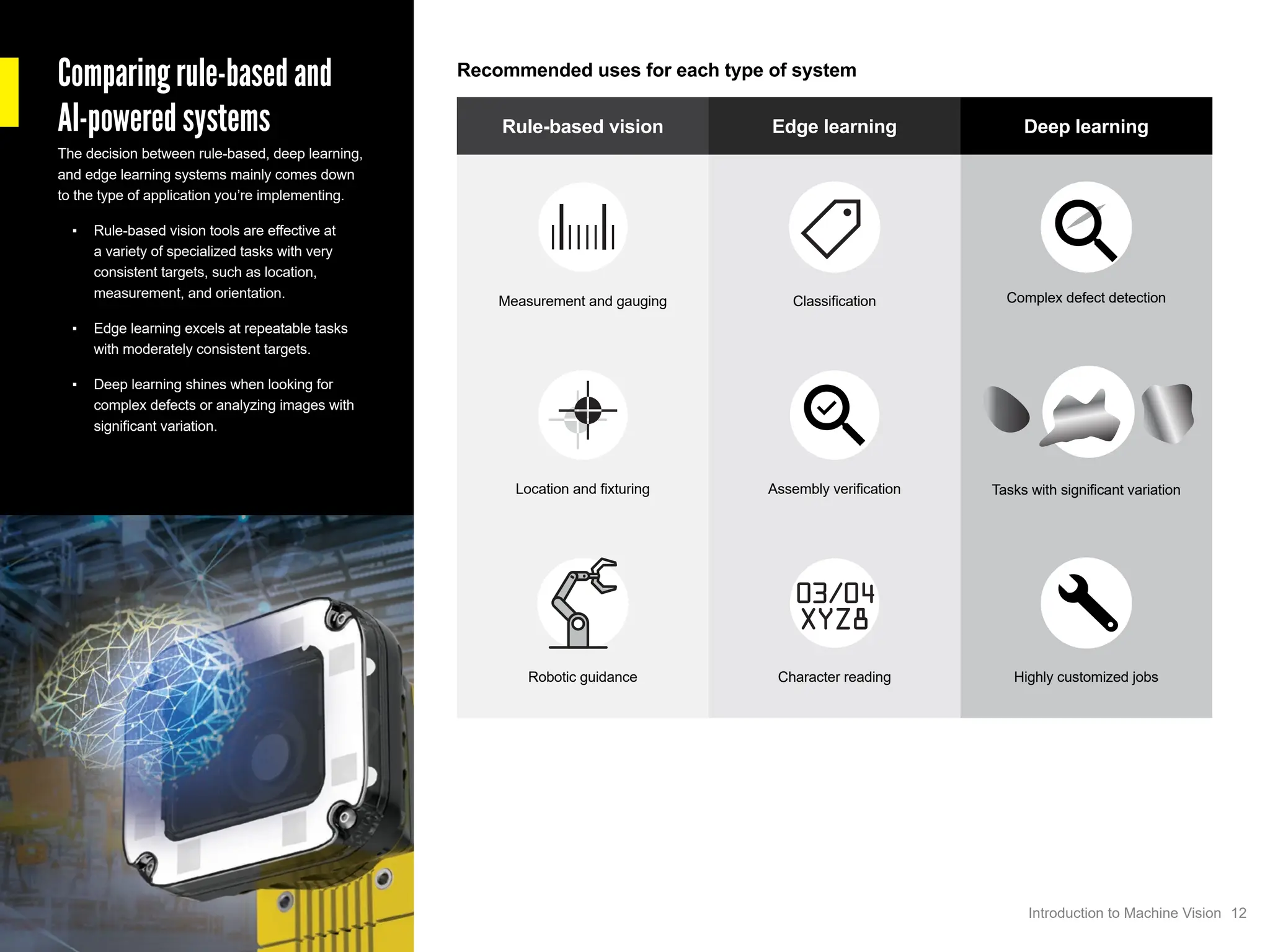
▪ Rule-based vision tools are effective at
a variety of specialized tasks with very
consistent targets, such as location,
measurement, and orientation.
▪ Edge learning excels at repeatable tasks
with moderately consistent targets.
▪ Deep learning shines when looking for
complex defects or analyzing images with
significant variation.
Recommended uses for each type of system
Rule-based vision Edge learning Deep learning
Measurement and gauging Classification Complex defect detection
Location and fixturing Assembly verification Tasks with significant variation
Robotic guidance Character reading Highly customized jobs
12
Introduction to Machine Vision
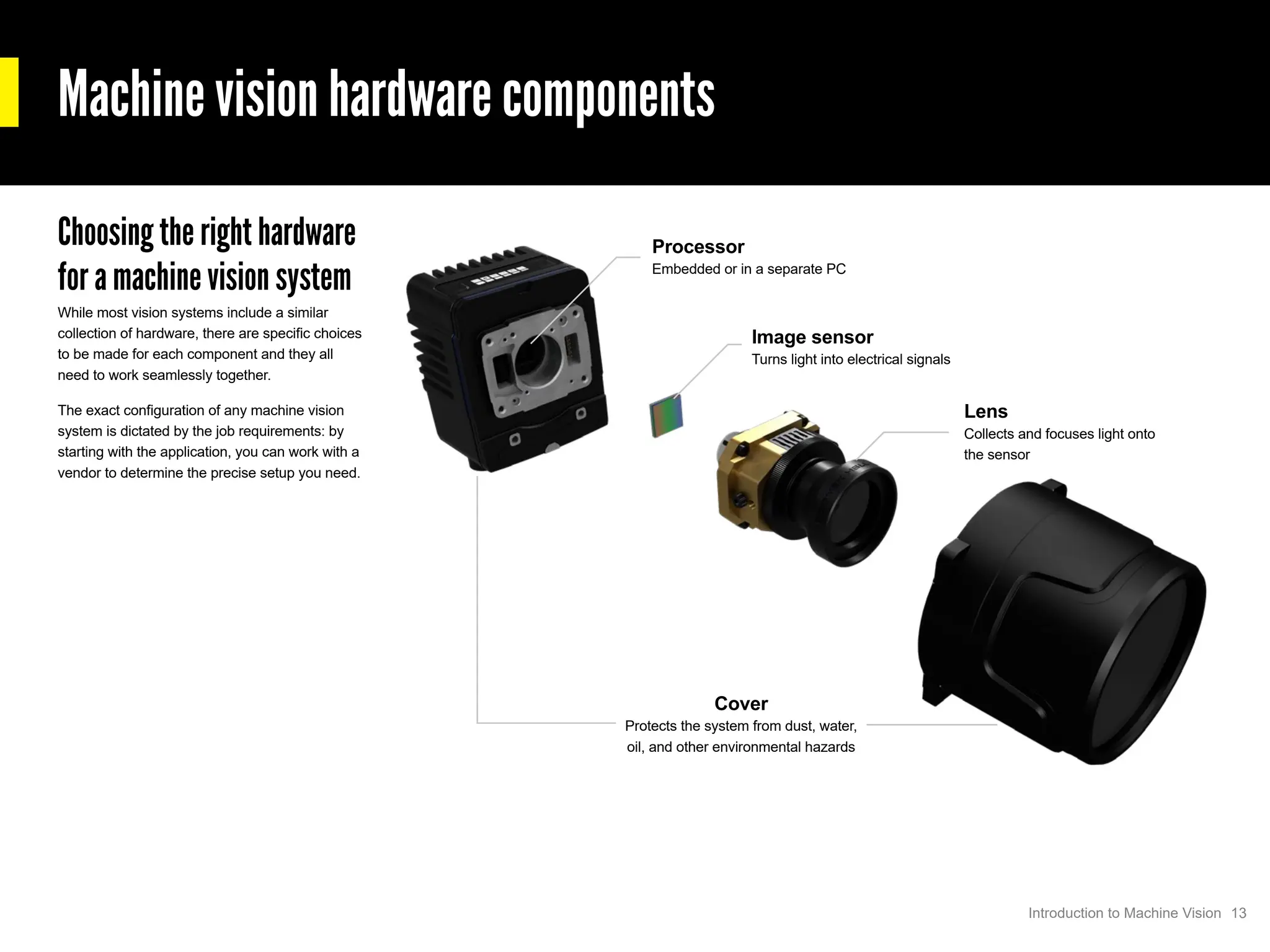
Machine vision hardware components
Image sensor
Turns light into electrical signals
Lens
Collects and focuses light onto
the sensor
Cover
Protects the system from dust, water,
oil, and other environmental hazards
Processor
Embedded or in a separate PC
Choosing the right hardware
for a machine vision system
While most vision systems include a similar
collection of hardware, there are specific choices
to be made for each component and they all
need to work seamlessly together.
The exact configuration of any machine vision
system is dictated by the job requirements: by
starting with the application, you can work with a
vendor to determine the precise setup you need.
13
Introduction to Machine Vision
Image sensors
At the center of any vision system, an image
sensor converts light energy into electrical
signals that can be analyzed by software.
Image sensors are solid-state semiconductor
chips comprising millions of photodetectors
called pixels, which convert light into electrical
signals. The two main technologies used are
charge-coupled device (CCD) or complementary
metal oxide semiconductor (CMOS). CMOS
technology is newer and taking an increasing
share of the market, thanks to lower costs and
faster processing speeds, but CCD sensors are
still used in applications that require extremely
high-quality images.
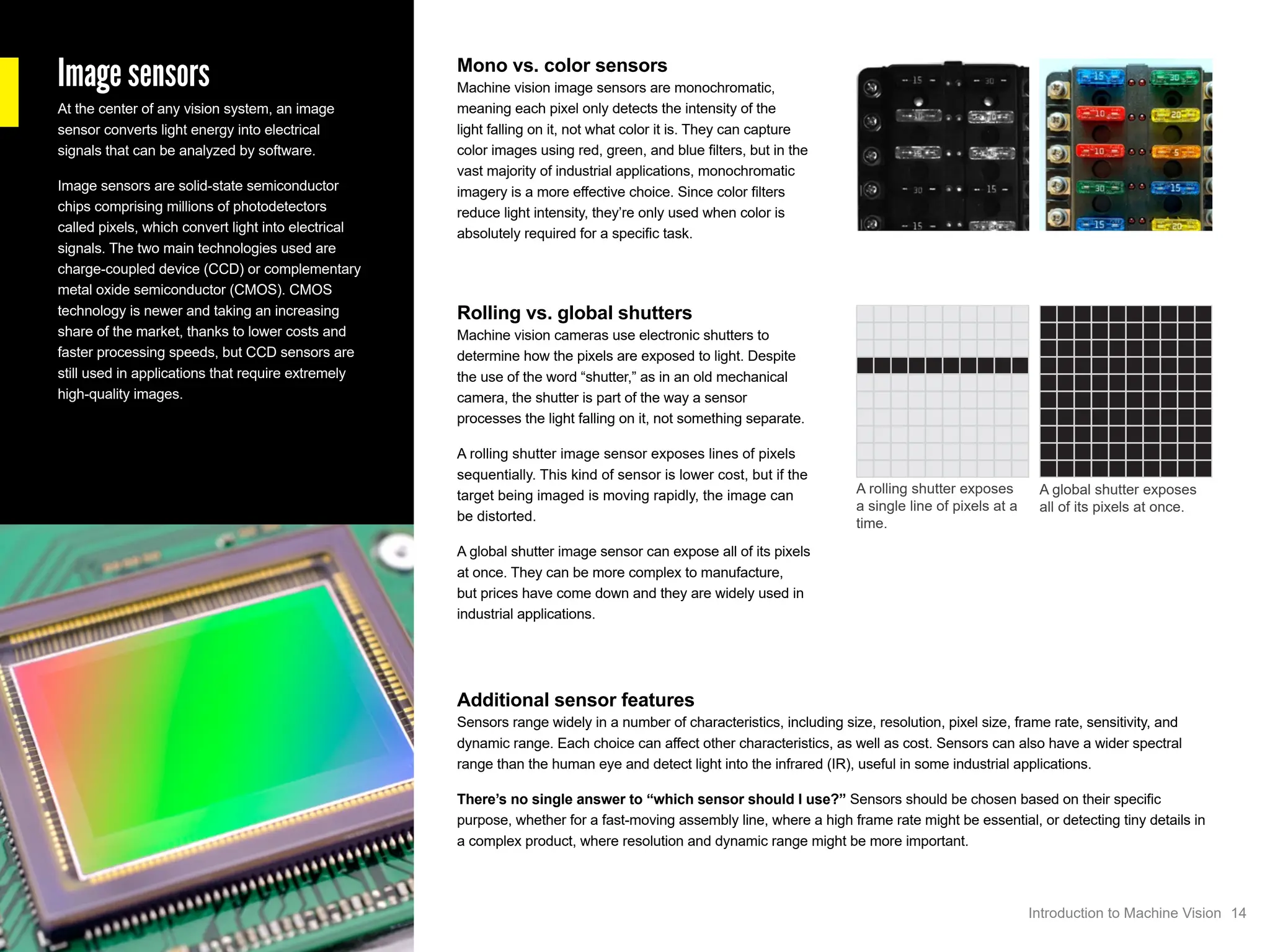
Mono vs. color sensors
Machine vision image sensors are monochromatic,
meaning each pixel only detects the intensity of the
light falling on it, not what color it is. They can capture
color images using red, green, and blue filters, but in the
vast majority of industrial applications, monochromatic
imagery is a more effective choice. Since color filters
reduce light intensity, they’re only used when color is
absolutely required for a specific task.
Rolling vs. global shutters
Machine vision cameras use electronic shutters to
determine how the pixels are exposed to light. Despite
the use of the word “shutter,” as in an old mechanical
camera, the shutter is part of the way a sensor
processes the light falling on it, not something separate.
A rolling shutter image sensor exposes lines of pixels
sequentially. This kind of sensor is lower cost, but if the
target being imaged is moving rapidly, the image can
be distorted.
A global shutter image sensor can expose all of its pixels
at once. They can be more complex to manufacture,
but prices have come down and they are widely used in
industrial applications.
Additional sensor features
Sensors range widely in a number of characteristics, including size, resolution, pixel size, frame rate, sensitivity, and
dynamic range. Each choice can affect other characteristics, as well as cost. Sensors can also have a wider spectral
range than the human eye and detect light into the infrared (IR), useful in some industrial applications.
There’s no single answer to “which sensor should I use?” Sensors should be chosen based on their specific
purpose, whether for a fast-moving assembly line, where a high frame rate might be essential, or detecting tiny details in
a complex product, where resolution and dynamic range might be more important.
A rolling shutter exposes
a single line of pixels at a
time.
A global shutter exposes
all of its pixels at once.
14
Introduction to Machine Vision
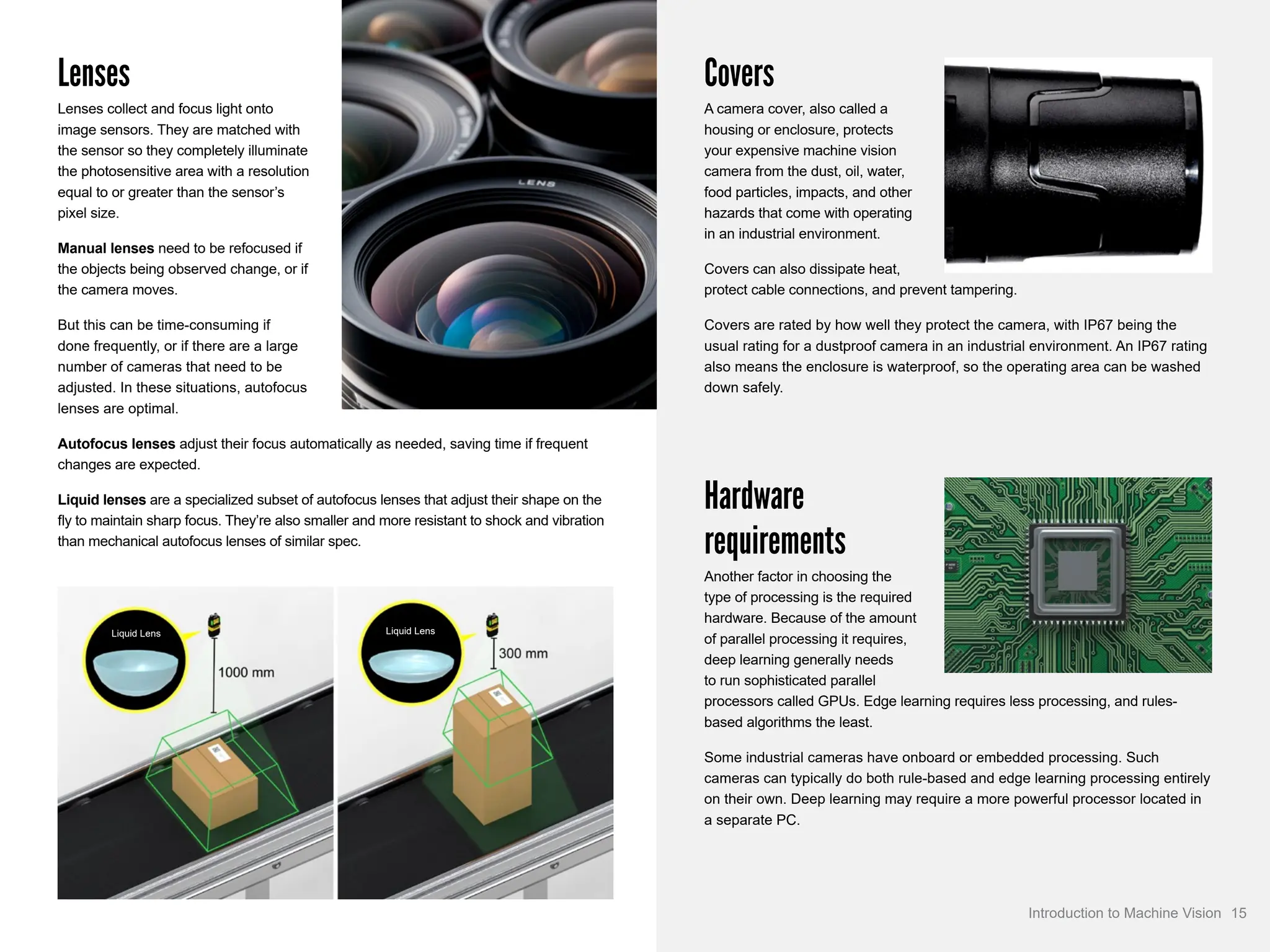
Lenses
Lenses collect and focus light onto
image sensors. They are matched with
the sensor so they completely illuminate
the photosensitive area with a resolution
equal to or greater than the sensor’s
pixel size.
Manual lenses need to be refocused if
the objects being observed change, or if
the camera moves.
But this can be time-consuming if
done frequently, or if there are a large
number of cameras that need to be
adjusted. In these situations, autofocus
lenses are optimal.
Autofocus lenses adjust their focus automatically as needed, saving time if frequent
changes are expected.
Liquid lenses are a specialized subset of autofocus lenses that adjust their shape on the
fly to maintain sharp focus. They’re also smaller and more resistant to shock and vibration
than mechanical autofocus lenses of similar spec.
Covers
A camera cover, also called a
housing or enclosure, protects
your expensive machine vision
camera from the dust, oil, water,
food particles, impacts, and other
hazards that come with operating
in an industrial environment.
Covers can also dissipate heat,
protect cable connections, and prevent tampering.
Covers are rated by how well they protect the camera, with IP67 being the
usual rating for a dustproof camera in an industrial environment. An IP67 rating
also means the enclosure is waterproof, so the operating area can be washed
down safely.
Hardware
requirements
Another factor in choosing the
type of processing is the required
hardware. Because of the amount
of parallel processing it requires,
deep learning generally needs
to run sophisticated parallel
processors called GPUs. Edge learning requires less processing, and rules-
based algorithms the least.
Some industrial cameras have onboard or embedded processing. Such
cameras can typically do both rule-based and edge learning processing entirely
on their own. Deep learning may require a more powerful processor located in
a separate PC.
Liquid Lens Liquid Lens
15
Introduction to Machine Vision
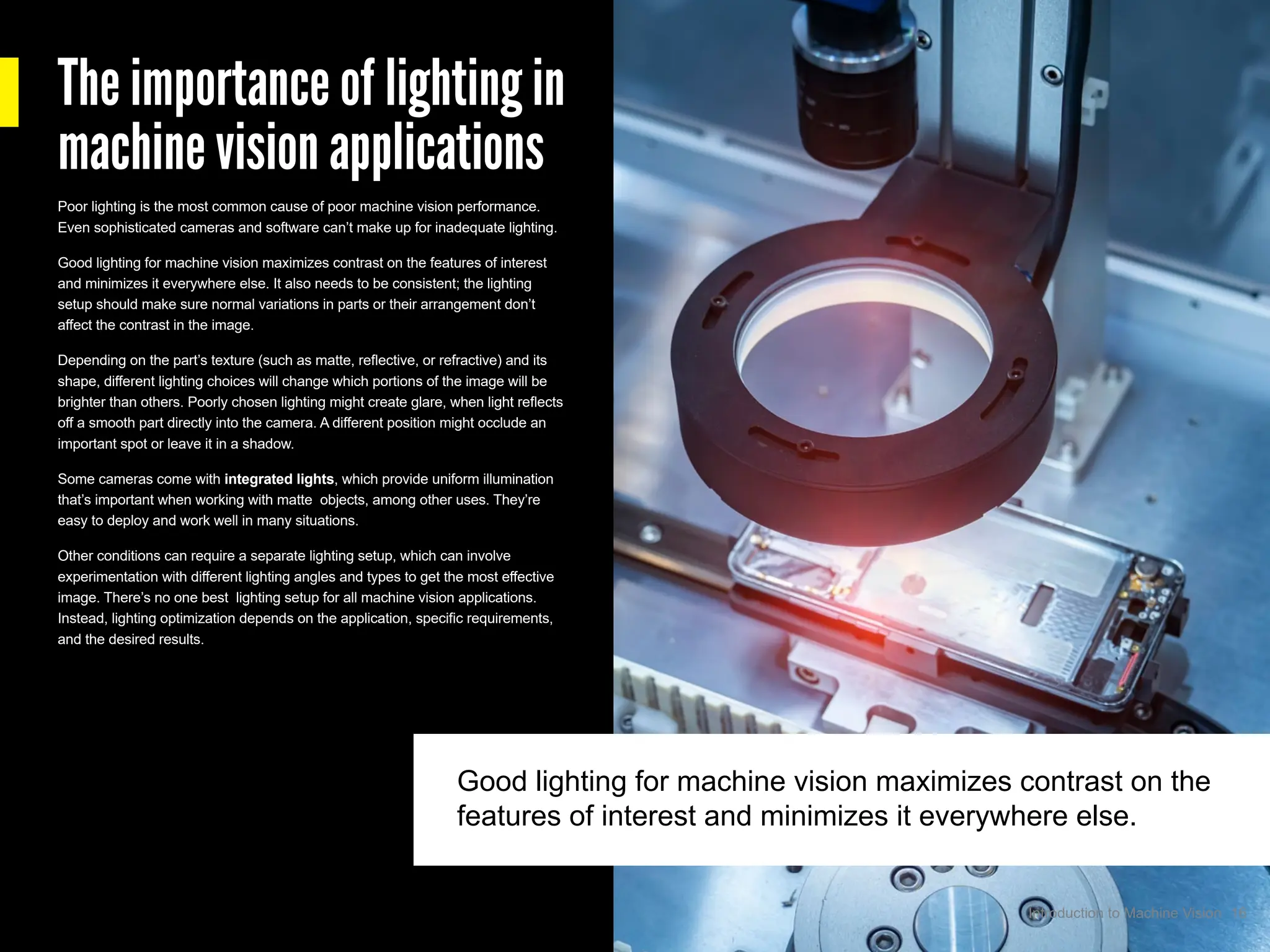
The importance of lighting in
machine vision applications
Poor lighting is the most common cause of poor machine vision performance.
Even sophisticated cameras and software can’t make up for inadequate lighting.
Good lighting for machine vision maximizes contrast on the features of interest
and minimizes it everywhere else. It also needs to be consistent; the lighting
setup should make sure normal variations in parts or their arrangement don’t
affect the contrast in the image.
Depending on the part’s texture (such as matte, reflective, or refractive) and its
shape, different lighting choices will change which portions of the image will be
brighter than others. Poorly chosen lighting might create glare, when light reflects
off a smooth part directly into the camera. A different position might occlude an
important spot or leave it in a shadow.
Some cameras come with integrated lights, which provide uniform illumination
that’s important when working with matte objects, among other uses. They’re
easy to deploy and work well in many situations.
Other conditions can require a separate lighting setup, which can involve
experimentation with different lighting angles and types to get the most effective
image. There’s no one best lighting setup for all machine vision applications.
Instead, lighting optimization depends on the application, specific requirements,
and the desired results.
Good lighting for machine vision maximizes contrast on the
features of interest and minimizes it everywhere else.
16
Introduction to Machine Vision
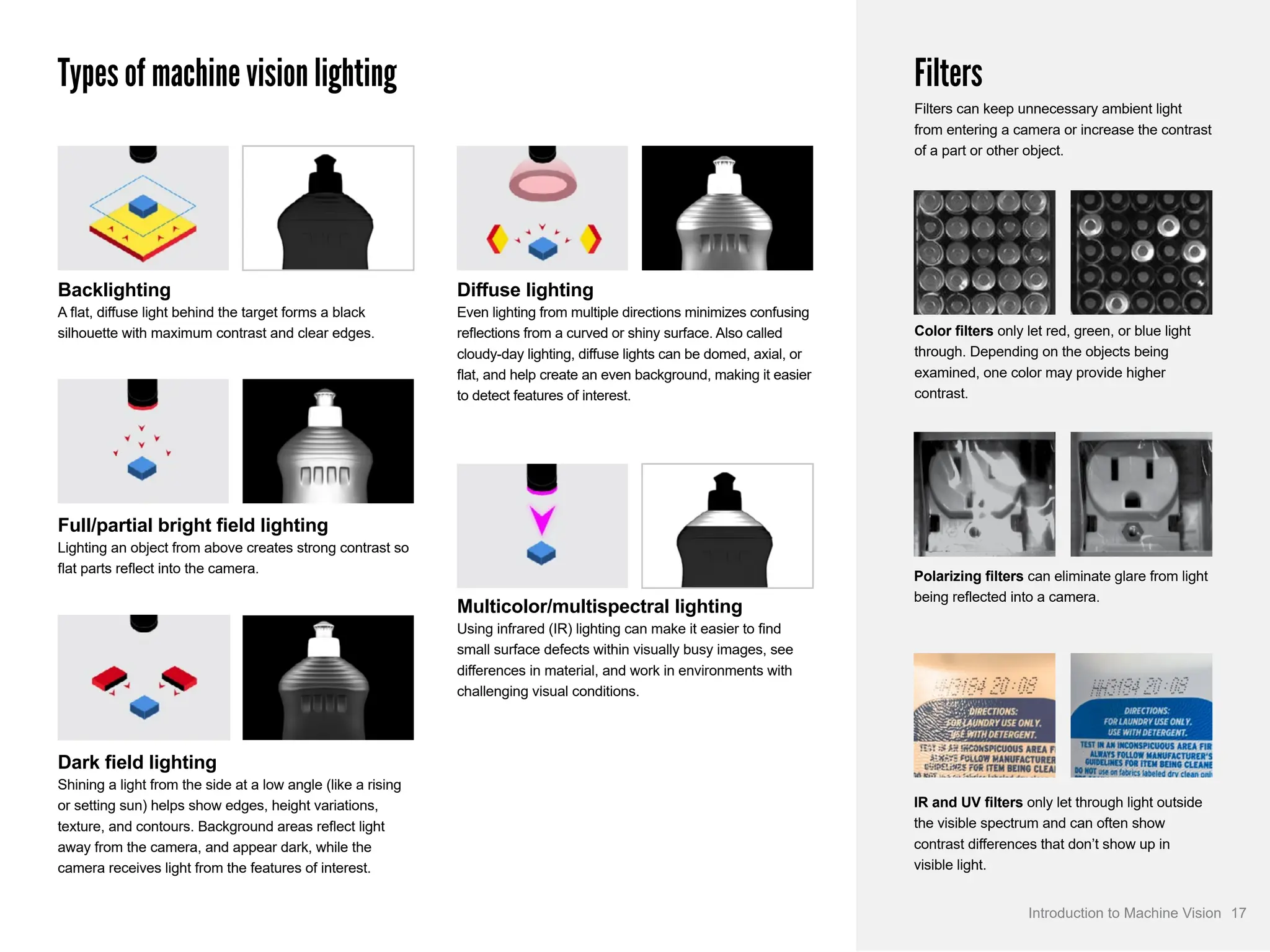
Types of machine vision lighting Filters
Filters can keep unnecessary ambient light
from entering a camera or increase the contrast
of a part or other object.
Backlighting
A flat, diffuse light behind the target forms a black
silhouette with maximum contrast and clear edges.
Full/partial bright field lighting
Lighting an object from above creates strong contrast so
flat parts reflect into the camera.
Dark field lighting
Shining a light from the side at a low angle (like a rising
or setting sun) helps show edges, height variations,
texture, and contours. Background areas reflect light
away from the camera, and appear dark, while the
camera receives light from the features of interest.
Diffuse lighting
Even lighting from multiple directions minimizes confusing
reflections from a curved or shiny surface. Also called
cloudy-day lighting, diffuse lights can be domed, axial, or
flat, and help create an even background, making it easier
to detect features of interest.
Multicolor/multispectral lighting
Using infrared (IR) lighting can make it easier to find
small surface defects within visually busy images, see
differences in material, and work in environments with
challenging visual conditions.
Color filters only let red, green, or blue light
through. Depending on the objects being
examined, one color may provide higher
contrast.
IR and UV filters only let through light outside
the visible spectrum and can often show
contrast differences that don’t show up in
visible light.
Polarizing filters can eliminate glare from light
being reflected into a camera.
17
Introduction to Machine Vision
Image analysis
software
With the right combination of sensor, lens, lights,
and other components in place, a machine vision
system is ready to capture images. But that’s only
the first step.
Once it acquires an image, the system needs
to process and analyze the result to make a
decision: to read a barcode, detect a defect,
confirm that a kit contains all of its items, or
measure a part.
Historically, the only way to get enough
processing power to do image analysis was to
send the image to an external PC. Depending
on the size and complexity of the image, that
could take time, potentially slowing down the line,
requiring a separate PC dedicated to the task.
Today, highly capable vision systems have
embedded processing, which speeds computation
and reduces possible points of failure.
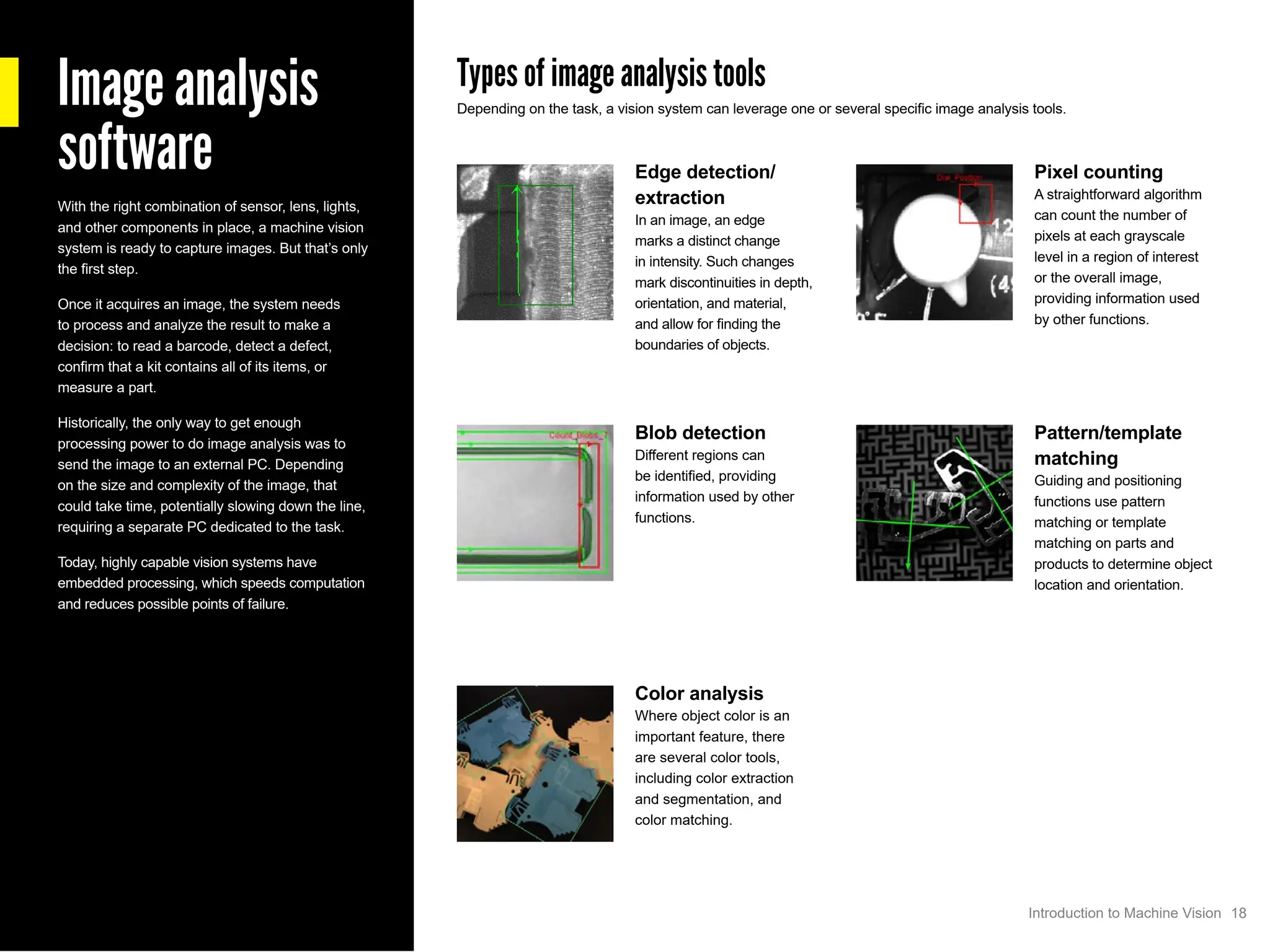
Types of image analysis tools
Depending on the task, a vision system can leverage one or several specific image analysis tools.
Edge detection/
extraction
In an image, an edge
marks a distinct change
in intensity. Such changes
mark discontinuities in depth,
orientation, and material,
and allow for finding the
boundaries of objects.
Pixel counting
A straightforward algorithm
can count the number of
pixels at each grayscale
level in a region of interest
or the overall image,
providing information used
by other functions.
Blob detection
Different regions can
be identified, providing
information used by other
functions.
Pattern/template
matching
Guiding and positioning
functions use pattern
matching or template
matching on parts and
products to determine object
location and orientation.
Color analysis
Where object color is an
important feature, there
are several color tools,
including color extraction
and segmentation, and
color matching.
18
Introduction to Machine Vision
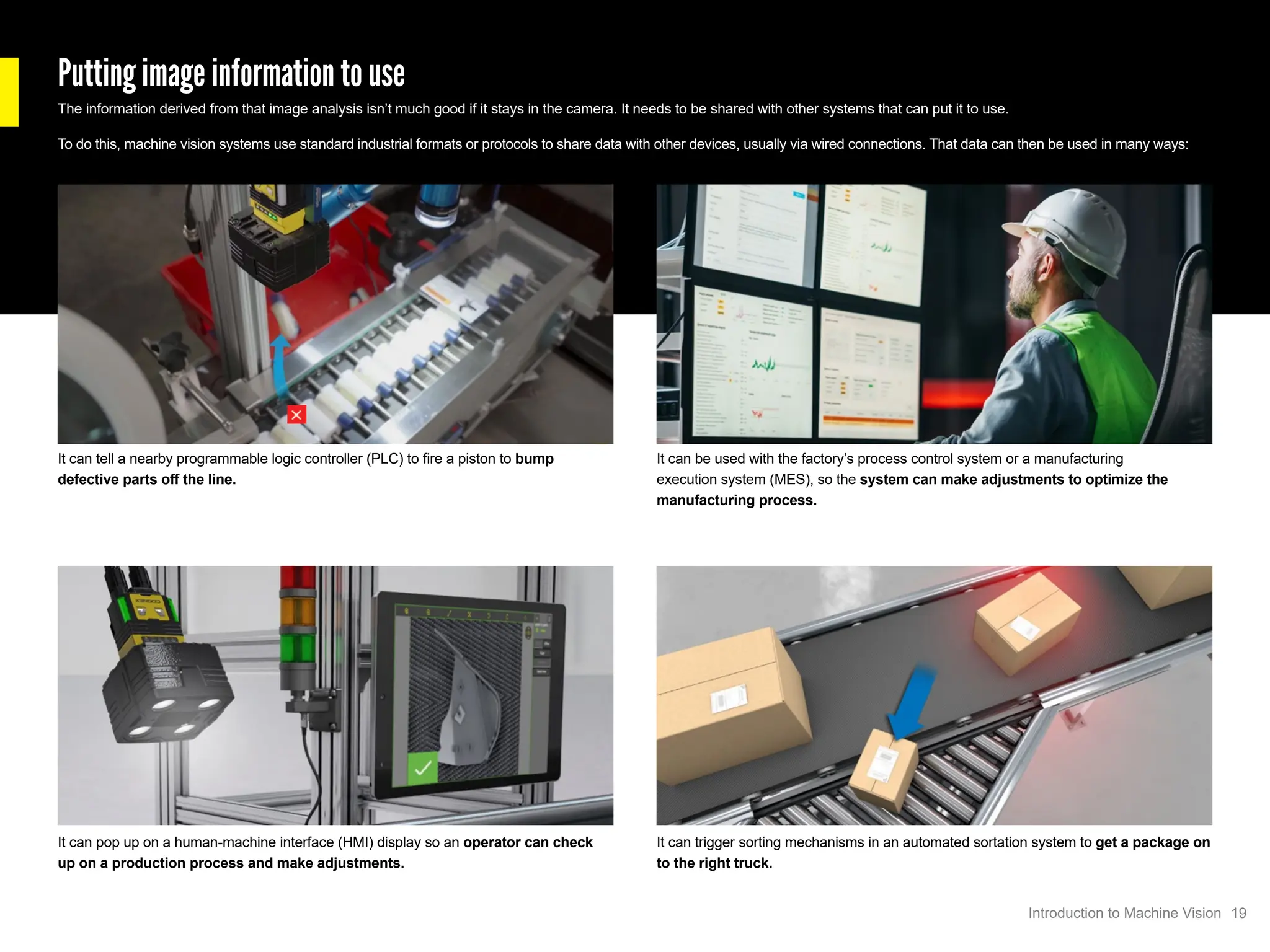
Putting image information to use
The information derived from that image analysis isn’t much good if it stays in the camera. It needs to be shared with other systems that can put it to use.
To do this, machine vision systems use standard industrial formats or protocols to share data with other devices, usually via wired connections. That data can then be used in many ways:
It can tell a nearby programmable logic controller (PLC) to fire a piston to bump
defective parts off the line.
It can pop up on a human-machine interface (HMI) display so an operator can check
up on a production process and make adjustments.
It can be used with the factory’s process control system or a manufacturing
execution system (MES), so the system can make adjustments to optimize the
manufacturing process.
It can trigger sorting mechanisms in an automated sortation system to get a package on
to the right truck.
19
Introduction to Machine Vision
Image-based data drives larger decisions, too
In addition to individual actions on single parts, products, or packages, the data
generated through machine vision applications can also be aggregated and used to
tackle larger business issues.
For example, businesses can use the data to find the root causes behind delays,
defects, and missed shipments. Is one supplier using inferior raw materials for their part?
Or is the problem caused by how parts are stored or shipped? Are workers being trained
inadequately? Machine vision data can be analyzed to identify the source of the problem.
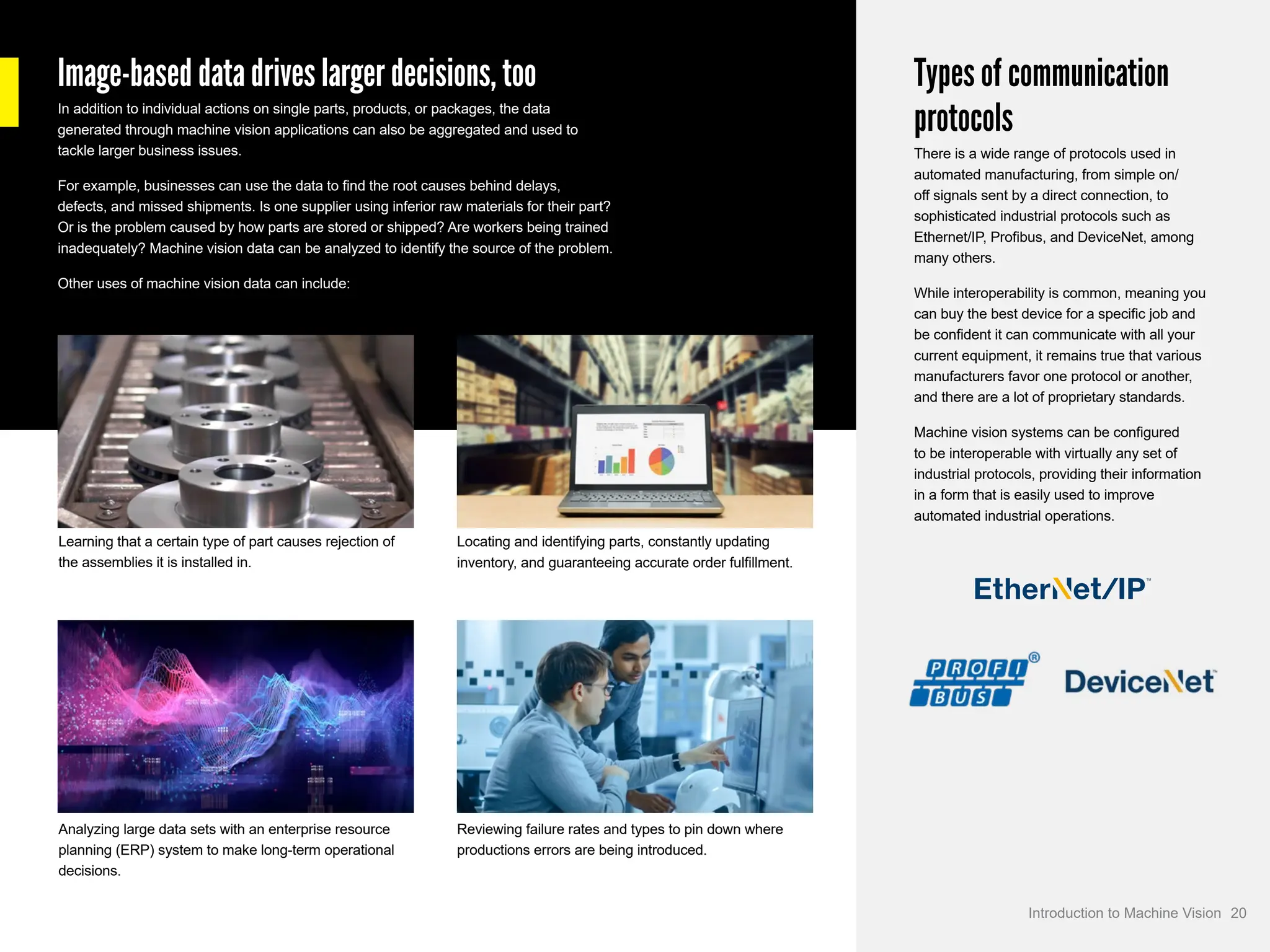
Other uses of machine vision data can include:
Types of communication
protocols
There is a wide range of protocols used in
automated manufacturing, from simple on/
off signals sent by a direct connection, to
sophisticated industrial protocols such as
Ethernet/IP, Profibus, and DeviceNet, among
many others.
While interoperability is common, meaning you
can buy the best device for a specific job and
be confident it can communicate with all your
current equipment, it remains true that various
manufacturers favor one protocol or another,
and there are a lot of proprietary standards.
Machine vision systems can be configured
to be interoperable with virtually any set of
industrial protocols, providing their information
in a form that is easily used to improve
automated industrial operations.
Learning that a certain type of part causes rejection of
the assemblies it is installed in.
Locating and identifying parts, constantly updating
inventory, and guaranteeing accurate order fulfillment.
Analyzing large data sets with an enterprise resource
planning (ERP) system to make long-term operational
decisions.
Reviewing failure rates and types to pin down where
productions errors are being introduced.
20
Introduction to Machine Vision
Conclusion
Industrial automation enabled by machine vision is
increasingly essential for competing in the market and
meeting compliance requirements. Machine vision
reduces costs, generates data for process improvement,
increases OEE, enables new types of automation, and
improves safety.
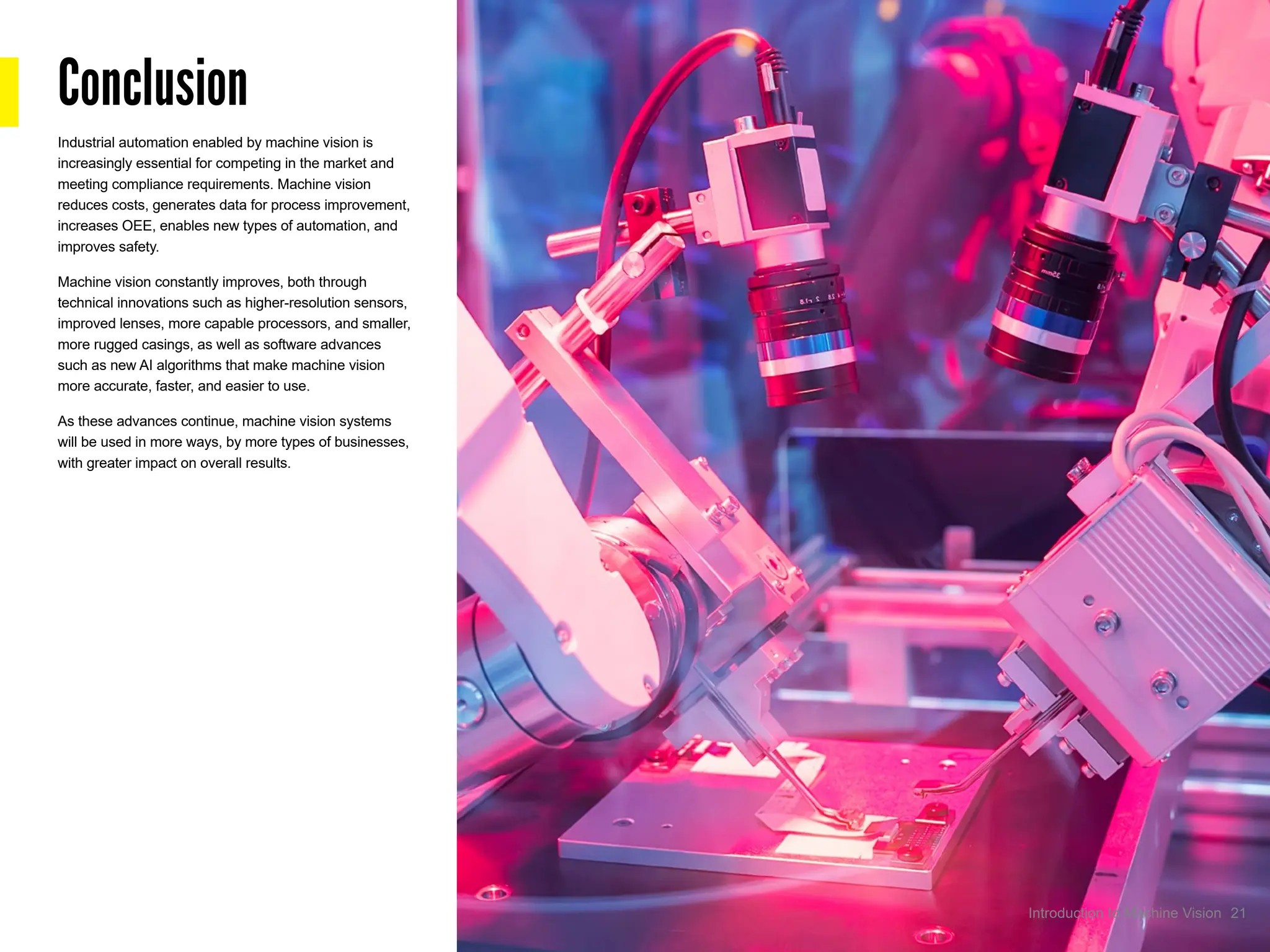
Machine vision constantly improves, both through
technical innovations such as higher-resolution sensors,
improved lenses, more capable processors, and smaller,
more rugged casings, as well as software advances
such as new AI algorithms that make machine vision
more accurate, faster, and easier to use.
As these advances continue, machine vision systems
will be used in more ways, by more types of businesses,
with greater impact on overall results.
21
Introduction to Machine Vision
www.cognex.com
© Copyright 2024, Cognex Corporation. All information
in this document is subject to change without notice. All
Rights Reserved. Cognex is a registered trademarks of
Cognex Corporation. All other trademarks are property of
their respective owners. Lit. No. ItMV-EN-02-2024
www.cognex.com
Corporate Headquarters One Vision Drive Natick, MA 01760 USA
Companies around the world rely on Cognex vision and barcode reading
solutions to optimize quality, drive down costs, and control traceability.
Regional Sales Offices
Americas
North America +1 844 999 2469
Brazil +55 11 4210 3919
Mexico +800 733 4116
Europe
Austria +43 800 28 16 32
Belgium +32 289 370 75
Czechia +420 800 023 519
France +33 1 76 54 93 18
Germany +49 721 958 8052
Hungary +36 800 80291
Ireland +353 21 421 7500
Italy +39 02 3057 8196
Netherlands +31 207 941 398
Poland +48 717 121 086
Romania +40 741 041 272
Spain +34 93 299 28 14
Sweden +46 21 14 55 88
Switzerland +41 445 788 877
Turkey +90 216 900 1696
United Kingdom +44 121 29 65 163
Asia-Pacific
Australia +61 2 7202 6910
China +86 21 5875 1133
India +91 7305 040397
Indonesia +62 21 3076 1792
Japan +81 3 5977 5400
Korea +82 2 539 9047
Malaysia +6019 916 5532
New Zealand +64 9 802 0555
Phillipines +63 2 8539 3990
Singapore +65 3158 3322
Taiwan +886 02 7703 2848
Thailand +66 6 3230 9998
Vietnam +84 98 2405167

Introduction to Machine Vision by Cognex

  • 1.
  • 2.
    Introduction to MachineVision Introduction to machine vision Rule-based vs. AI-powered machine vision Machine vision hardware components The importance of lighting in machine vision applications Image analysis software Types of machine vision systems and what they can do PAGE 9 PAGE 5 PAGE 2 PAGE 13 PAGE 16 PAGE 18 Table of contents
  • 3.
    Machine vision letsautomated systems see components, products, patterns, codes, or other objects and use that information to: ▪ Make decisions at high speeds and high accuracy, improving product quality and reducing waste. ▪ Generate data that is critical to factories looking for efficiency gains. Machine vision is an essential component of how digital systems interact with the real world. It lets automated systems see components, products, patterns, codes, or other objects and use that information to make decisions. Since it allows manufactured parts and products to be inspected, measured, and sorted, machine vision has vastly increased the power and flexibility of industrial automation. Machine vision does all this at high speeds and high accuracy, improving product quality and reducing waste. Machine vision also lets automated equipment locate objects, identify them, and save information about their material, condition, orientation, and other details for later analysis. That data is critical to factories looking for efficiency gains. And every package that makes its way through today’s automated logistics warehouses does so with the help of barcodes that are read by machine vision. Those codes are used to track and identify packages throughout their journeys, making sure they get to their intended destinations. All of these activities are powered by machine vision: cameras that let computers interpret real world objects. You may also hear products in this category referred to as “computer vision,” which is a broader term and sometimes describes more theoretical research systems that analyze images. Machine vision products, on the other hand, are practical, connected to industrial automation systems in factories and warehouses. What is machine vision? 2 Introduction to Machine Vision
  • 4.
    Who uses machinevision? Machine vision is constantly evolving, and performs an ever-growing range of tasks in two main types of organizations: Logistics providers and warehouses use machine vision to automate routing, tracking, and shipping, typically by reading barcodes or other encoding symbols. Manufacturing facilities and factories use machine vision to automate operations throughout the manufacturing process. 3 Introduction to Machine Vision
  • 5.
    What are thebenefits of machine vision? Because it can see with better resolution, across a wider spectrum, and process tasks faster than human vision, machine vision provides a wide range of benefits: Improve product quality Products rejected for defects are a significant source of cost, waste, and reputational damage. Automated inspection with machine vision improves speed and accuracy, catching problems of many kinds before they’re packaged or shipped and allowing human inspectors to be reserved for an increasingly small number of difficult cases. Trace parts and products By reading codes on products and packages at every step from initial production to shipping to final sale, machine vision systems can provide critical tracking information. This lets shippers know their current location, quickly detect any delays or shipping errors, and trace any damage or other problem back to its source. Increase productivity/overall equipment effectiveness Machine vision systems speed up operations and decrease cycle times, and their performance doesn’t deteriorate over the course of a shift. They provide the information to make the most efficient use of every piece of equipment on the floor. Reduce waste By catching manufacturing flaws, identifying overfill, or pinpointing the causes of defects, machine vision can reduce waste and scrap rates in multiple ways. Over time, this can help control overhead and bring down raw materials costs. Overcome labor shortages Manufacturing is facing significant labor shortages, and the problem is expected to get worse. The work can be tiring and difficult. By automating manufacturing with machine vision, skilled labor can be reserved for higher-value activities. Improve processes Machine vision instantly detects changes in product quality and keeps a visual record of every step in a product lifecycle. This form of big data reveals process bottlenecks, declining machine function, and common sources of error, making continuous process improvement possible. Ensure compliance The machine vision-generated data and images used to make process improvement decisions also provide the data needed to comply with reporting regulations in industries like pharmaceuticals, medical devices, automotive, food and beverage, and more. Improve safety With industrial automation made possible by machine vision, workers can minimize their interactions with noisy and potentially dangerous machinery. If there is an equipment problem, they can often diagnose and adjust it remotely, through the information machine vision provides. 4 Introduction to Machine Vision
  • 6.
    Types of machinevision systems and what they can do Most machine vision uses 2D cameras, also called area scan systems. These can be simple, single-purpose sensors or more full-featured systems. Sensors are lower cost, smaller, easier to deploy, and often more rugged than cameras with a wider range of features. Generally, full-featured systems are more configurable, perform more complicated tasks, and can take larger and higher resolution images. The decision between sensors and more complex machine vision systems comes down to the task being performed, the format of the data output, cost, and ease of use. 3D vision systems add depth to their images, sometimes using lasers to measure distances and compute depth. The addition of depth can increase complexity and cost to some degree, but that additional information is critical to some applications. For example, 3D vision is essential in guiding a robot arm to precisely reach out to grab an object in the correct orientation, no matter where it is in space. 3D vision is also used to automate difficult cutting and welding processes. Line-scan cameras are used in continuous inspection applications such as web manufacturing. They take a wide but very thin image, typically as material moves past the scan area, and use software to reconstruct the image line by line. They are significantly faster in these applications than standard 2D cameras. Examples include inspecting fabric, paper, and other soft goods. While machine vision systems offer a wide range of features and options, there are three main categories to consider. Line scan Area scan 3D vision 5 Introduction to Machine Vision
  • 7.
    What does machinevision do? Machine vision providers sometimes classify what their systems can do with the acronym GIGI, for Guidance, Identification, Gauging, and Inspection. This guide breaks down the types of applications into slightly more detail: ▪ Defect detection ▪ Object detection and counting ▪ Measuring/gauging ▪ Locating/guiding/positioning ▪ Barcode reading ▪ OCR/OCV Defect detection Defects can occur in any part of a manufacturing process, from problems with the quality of raw materials or parts through final inspection. Inspections to catch defects have traditionally been done manually, by trained workers. Machine vision is a significant improvement over human inspection: it operates at production line speeds, doesn’t get tired, can detect even small and unexpected defects, and stores information for continuous operational improvement. EXAMPLES: Looking for loose connectors, poorly soldered wires, bad seams, or improperly crimped tubes Detecting flawed photovoltaic cells in solar panels or defects in semiconductor wafers or EV battery assemblies Finding contaminants or other problems in food products Object detection and counting Determining the presence or absence and counting objects is a widely used function in inventory management, on production lines, and before releasing or accepting shipments. Both manual inspection and mechanical counting are slow and prone to error, compared to high-speed and consistently accurate machine vision systems. EXAMPLES: Confirming the presence of all electronic components on a printed circuit board Verifying the presence of components such as clips, screws, springs, labels, seals, manuals, inserts, or accessories Counting products in a package or on a pallet Hair 6 Introduction to Machine Vision
  • 8.
    Measuring/gauging Precise manufacturing requiresaccurate measurement of distances, areas, diameters, and more. Manual measurement with gauges, calipers, or inspection jigs is slow and introduces inconsistencies. Machine vision consistently and accurately measures down to the micron level, while parts are on the line, at high speeds. Each image and its associated data can be stored in case of warranty or compliance issues. Capturing the dimensions of cast and injection molded parts Measuring the roundness and angle of tips on parts Determining label positions or package sizes Locating/guiding/positioning Functions such as assembly, pick-and-place, and inspection depend on machine vision’s ability to locate a part, whether on a conveyor or in a bin. Machine vision guides robots in picking and placing parts and ensures accurate micron-level positioning in precision assembly. If a part is out of place, machine vision measures the difference between desired and actual location and orientation and communicates that to a robot or programmable logic controller (PLC) to realign the part. Locating parts on a conveyor for inspection Guiding robots on automated automotive assembly lines Assembling microchips that require micron- level precision EXAMPLES: EXAMPLES: 7 Introduction to Machine Vision
  • 9.
    Barcode reading Barcodes areused to track and identify raw materials and finished goods throughout the supply chain. They include 1D and 2D codes, such as UPC codes on retail products and data matrix codes on packages. Barcode readers, process information at high speeds, and correctly read codes that are partially torn, obscured, smeared, or distorted. Image-based barcode scanners collect images of the barcodes they read, allowing for analysis of no-reads or misreads to diagnose problems, such as a clogged print head, damaged codes, or inadequate lighting. Multiple camera systems can scan from multiple sides of a part or package at once to increase read rates when not all codes are oriented the same way. Tracking packages as they travel through a logistics warehouse Ensuring the correct components are assembled Providing accurate traceability of medical supplies Reading text: OCR/OCV Barcodes are everywhere in modern industry, but human-readable printed text is still essential, particularly for retail, manufacturing, pharmaceutical, and food and beverage supply chains, to identify sell-by dates, lot numbers, and other important information. For this text to be useful in modern high-speed processing, it must be reliably readable by machines. Machine vision systems can read these codes in milliseconds with 99.99% accuracy. Optical character recognition (OCR) and optical character verification (OCV) both identify and interpret text in images, with one key difference. OCR reads text to trigger another action, while OCV is used to verify the quality of text against a known standard. Classifying a part based on the characters printed on it (OCR) Checking if a sell-by date or lot number is printed correctly (OCV) Distinguishing authentic from counterfeit products (OCR) EXAMPLES: EXAMPLES: Establishing traceability to meet regulatory demands (OCR) 8 Introduction to Machine Vision
  • 10.
    Rule-based vs. AI-powered machine vision Thereare two ways machine vision can be used to make decisions such as counting, classifying, or approving and rejecting items. Rule-based systems follow user-programmed, step-by- step instructions to interpret images and make decisions. In contrast, artificial intelligence or AI-powered systems use a database of reference images to “learn” how to make decisions. While rule-based machine vision is still the prevalent technology, various types of AI-powered machine learning have become capable and flexible enough to take over in many applications. Often, a combination of rule-based and AI-powered machine learning can provide the most efficient solution. Rule-based systems Traditional rule-based machine vision uses specific if-then rules to make decisions about an image. “If the bottle is filled to at least this level, let it pass.” The rules are programmed by vision engineers with deep knowledge of the best way to get the desired output. The rules are used to create programs that tackle specific jobs, such as detecting the edge between light and dark areas or measuring the distance between two points. These rules can then be used one after another on an image, in what is called “tool chaining,” to perform a wide range of sophisticated tasks. They’re also very good at high-speed, high-accuracy inspections on products or parts that are predictable and consistent. Often, a combination of rule-based and AI-powered machine learning can provide the most efficient solution. Rule-based systems work on consistent parts Technical expertise: Vision expert with programming knowledge 9 Introduction to Machine Vision
  • 11.
    Deep learning Deep learninguses AI to power machine vision systems by using examples to train the software with labeled images until it can make distinctions on its own. This training mimics how humans learn, helping the system learn how to make accurate decisions without being thrown off by irrelevant variation. Operators train deep learning systems with hundreds of labeled images, such as a variety of possible defects in a manufactured part, or several different assemblies that need to be classified. One significant improvement over rule-based systems is that deep learning systems learn to distinguish between a wide range of real defects and merely cosmetic variations without needing to be shown every possible result — something time-consuming or even impossible to accomplish using rule-based programming. In contrast to rule-based systems, deep learning systems don’t require experienced machine vision programmers or expertise to set up. They do need someone with good knowledge of the products being inspected to provide hundreds of images of both defective and good components. Deep learning excels at assembly verification, defect detection, and classification of complex parts that vary unpredictably. It’s also good at providing accurate results even when parts are reflective or images are distorted. Deep learning is designed for complex applications Example images required: hundreds to thousands Total time: Hours to days Technical expertise: Training in AI and programming Results: complex applications with significant variation Use case training: hundreds of example images 10 Introduction to Machine Vision
  • 12.
    Edge learning Edge learningis another type of AI, optimized to meet the needs of industrial automation. It comes pre-trained to solve the types of problems typically faced by industrial automation. As a result of the pre-training, an edge learning system can be trained on a specific industrial inspection problem with as few as five images, making it even easier and faster to deploy than a deep learning system. Edge learning enables line engineers to quickly implement an optimized classification or defect detection function on their line, without specialized training. Since it doesn’t require a sophisticated processor, it can be quickly deployed where it is needed. The advantages of edge learning lie in its speed, low demand on computing resources, and flexibility, as well as its user-friendliness. Use case training: 5-10 examples Results: easy, fast Pre-loaded training and optimization Edge learning is designed for ease of use Example images required: 5-10 Total time: Minutes Technical expertise: No prior experience needed 11 Introduction to Machine Vision
  • 13.
    Comparing rule-based and AI-poweredsystems The decision between rule-based, deep learning, and edge learning systems mainly comes down to the type of application you’re implementing. ▪ Rule-based vision tools are effective at a variety of specialized tasks with very consistent targets, such as location, measurement, and orientation. ▪ Edge learning excels at repeatable tasks with moderately consistent targets. ▪ Deep learning shines when looking for complex defects or analyzing images with significant variation. Recommended uses for each type of system Rule-based vision Edge learning Deep learning Measurement and gauging Classification Complex defect detection Location and fixturing Assembly verification Tasks with significant variation Robotic guidance Character reading Highly customized jobs 12 Introduction to Machine Vision
  • 14.
    Machine vision hardwarecomponents Image sensor Turns light into electrical signals Lens Collects and focuses light onto the sensor Cover Protects the system from dust, water, oil, and other environmental hazards Processor Embedded or in a separate PC Choosing the right hardware for a machine vision system While most vision systems include a similar collection of hardware, there are specific choices to be made for each component and they all need to work seamlessly together. The exact configuration of any machine vision system is dictated by the job requirements: by starting with the application, you can work with a vendor to determine the precise setup you need. 13 Introduction to Machine Vision
  • 15.
    Image sensors At thecenter of any vision system, an image sensor converts light energy into electrical signals that can be analyzed by software. Image sensors are solid-state semiconductor chips comprising millions of photodetectors called pixels, which convert light into electrical signals. The two main technologies used are charge-coupled device (CCD) or complementary metal oxide semiconductor (CMOS). CMOS technology is newer and taking an increasing share of the market, thanks to lower costs and faster processing speeds, but CCD sensors are still used in applications that require extremely high-quality images. Mono vs. color sensors Machine vision image sensors are monochromatic, meaning each pixel only detects the intensity of the light falling on it, not what color it is. They can capture color images using red, green, and blue filters, but in the vast majority of industrial applications, monochromatic imagery is a more effective choice. Since color filters reduce light intensity, they’re only used when color is absolutely required for a specific task. Rolling vs. global shutters Machine vision cameras use electronic shutters to determine how the pixels are exposed to light. Despite the use of the word “shutter,” as in an old mechanical camera, the shutter is part of the way a sensor processes the light falling on it, not something separate. A rolling shutter image sensor exposes lines of pixels sequentially. This kind of sensor is lower cost, but if the target being imaged is moving rapidly, the image can be distorted. A global shutter image sensor can expose all of its pixels at once. They can be more complex to manufacture, but prices have come down and they are widely used in industrial applications. Additional sensor features Sensors range widely in a number of characteristics, including size, resolution, pixel size, frame rate, sensitivity, and dynamic range. Each choice can affect other characteristics, as well as cost. Sensors can also have a wider spectral range than the human eye and detect light into the infrared (IR), useful in some industrial applications. There’s no single answer to “which sensor should I use?” Sensors should be chosen based on their specific purpose, whether for a fast-moving assembly line, where a high frame rate might be essential, or detecting tiny details in a complex product, where resolution and dynamic range might be more important. A rolling shutter exposes a single line of pixels at a time. A global shutter exposes all of its pixels at once. 14 Introduction to Machine Vision
  • 16.
    Lenses Lenses collect andfocus light onto image sensors. They are matched with the sensor so they completely illuminate the photosensitive area with a resolution equal to or greater than the sensor’s pixel size. Manual lenses need to be refocused if the objects being observed change, or if the camera moves. But this can be time-consuming if done frequently, or if there are a large number of cameras that need to be adjusted. In these situations, autofocus lenses are optimal. Autofocus lenses adjust their focus automatically as needed, saving time if frequent changes are expected. Liquid lenses are a specialized subset of autofocus lenses that adjust their shape on the fly to maintain sharp focus. They’re also smaller and more resistant to shock and vibration than mechanical autofocus lenses of similar spec. Covers A camera cover, also called a housing or enclosure, protects your expensive machine vision camera from the dust, oil, water, food particles, impacts, and other hazards that come with operating in an industrial environment. Covers can also dissipate heat, protect cable connections, and prevent tampering. Covers are rated by how well they protect the camera, with IP67 being the usual rating for a dustproof camera in an industrial environment. An IP67 rating also means the enclosure is waterproof, so the operating area can be washed down safely. Hardware requirements Another factor in choosing the type of processing is the required hardware. Because of the amount of parallel processing it requires, deep learning generally needs to run sophisticated parallel processors called GPUs. Edge learning requires less processing, and rules- based algorithms the least. Some industrial cameras have onboard or embedded processing. Such cameras can typically do both rule-based and edge learning processing entirely on their own. Deep learning may require a more powerful processor located in a separate PC. Liquid Lens Liquid Lens 15 Introduction to Machine Vision
  • 17.
    The importance oflighting in machine vision applications Poor lighting is the most common cause of poor machine vision performance. Even sophisticated cameras and software can’t make up for inadequate lighting. Good lighting for machine vision maximizes contrast on the features of interest and minimizes it everywhere else. It also needs to be consistent; the lighting setup should make sure normal variations in parts or their arrangement don’t affect the contrast in the image. Depending on the part’s texture (such as matte, reflective, or refractive) and its shape, different lighting choices will change which portions of the image will be brighter than others. Poorly chosen lighting might create glare, when light reflects off a smooth part directly into the camera. A different position might occlude an important spot or leave it in a shadow. Some cameras come with integrated lights, which provide uniform illumination that’s important when working with matte objects, among other uses. They’re easy to deploy and work well in many situations. Other conditions can require a separate lighting setup, which can involve experimentation with different lighting angles and types to get the most effective image. There’s no one best lighting setup for all machine vision applications. Instead, lighting optimization depends on the application, specific requirements, and the desired results. Good lighting for machine vision maximizes contrast on the features of interest and minimizes it everywhere else. 16 Introduction to Machine Vision
  • 18.
    Types of machinevision lighting Filters Filters can keep unnecessary ambient light from entering a camera or increase the contrast of a part or other object. Backlighting A flat, diffuse light behind the target forms a black silhouette with maximum contrast and clear edges. Full/partial bright field lighting Lighting an object from above creates strong contrast so flat parts reflect into the camera. Dark field lighting Shining a light from the side at a low angle (like a rising or setting sun) helps show edges, height variations, texture, and contours. Background areas reflect light away from the camera, and appear dark, while the camera receives light from the features of interest. Diffuse lighting Even lighting from multiple directions minimizes confusing reflections from a curved or shiny surface. Also called cloudy-day lighting, diffuse lights can be domed, axial, or flat, and help create an even background, making it easier to detect features of interest. Multicolor/multispectral lighting Using infrared (IR) lighting can make it easier to find small surface defects within visually busy images, see differences in material, and work in environments with challenging visual conditions. Color filters only let red, green, or blue light through. Depending on the objects being examined, one color may provide higher contrast. IR and UV filters only let through light outside the visible spectrum and can often show contrast differences that don’t show up in visible light. Polarizing filters can eliminate glare from light being reflected into a camera. 17 Introduction to Machine Vision
  • 19.
    Image analysis software With theright combination of sensor, lens, lights, and other components in place, a machine vision system is ready to capture images. But that’s only the first step. Once it acquires an image, the system needs to process and analyze the result to make a decision: to read a barcode, detect a defect, confirm that a kit contains all of its items, or measure a part. Historically, the only way to get enough processing power to do image analysis was to send the image to an external PC. Depending on the size and complexity of the image, that could take time, potentially slowing down the line, requiring a separate PC dedicated to the task. Today, highly capable vision systems have embedded processing, which speeds computation and reduces possible points of failure. Types of image analysis tools Depending on the task, a vision system can leverage one or several specific image analysis tools. Edge detection/ extraction In an image, an edge marks a distinct change in intensity. Such changes mark discontinuities in depth, orientation, and material, and allow for finding the boundaries of objects. Pixel counting A straightforward algorithm can count the number of pixels at each grayscale level in a region of interest or the overall image, providing information used by other functions. Blob detection Different regions can be identified, providing information used by other functions. Pattern/template matching Guiding and positioning functions use pattern matching or template matching on parts and products to determine object location and orientation. Color analysis Where object color is an important feature, there are several color tools, including color extraction and segmentation, and color matching. 18 Introduction to Machine Vision
  • 20.
    Putting image informationto use The information derived from that image analysis isn’t much good if it stays in the camera. It needs to be shared with other systems that can put it to use. To do this, machine vision systems use standard industrial formats or protocols to share data with other devices, usually via wired connections. That data can then be used in many ways: It can tell a nearby programmable logic controller (PLC) to fire a piston to bump defective parts off the line. It can pop up on a human-machine interface (HMI) display so an operator can check up on a production process and make adjustments. It can be used with the factory’s process control system or a manufacturing execution system (MES), so the system can make adjustments to optimize the manufacturing process. It can trigger sorting mechanisms in an automated sortation system to get a package on to the right truck. 19 Introduction to Machine Vision
  • 21.
    Image-based data driveslarger decisions, too In addition to individual actions on single parts, products, or packages, the data generated through machine vision applications can also be aggregated and used to tackle larger business issues. For example, businesses can use the data to find the root causes behind delays, defects, and missed shipments. Is one supplier using inferior raw materials for their part? Or is the problem caused by how parts are stored or shipped? Are workers being trained inadequately? Machine vision data can be analyzed to identify the source of the problem. Other uses of machine vision data can include: Types of communication protocols There is a wide range of protocols used in automated manufacturing, from simple on/ off signals sent by a direct connection, to sophisticated industrial protocols such as Ethernet/IP, Profibus, and DeviceNet, among many others. While interoperability is common, meaning you can buy the best device for a specific job and be confident it can communicate with all your current equipment, it remains true that various manufacturers favor one protocol or another, and there are a lot of proprietary standards. Machine vision systems can be configured to be interoperable with virtually any set of industrial protocols, providing their information in a form that is easily used to improve automated industrial operations. Learning that a certain type of part causes rejection of the assemblies it is installed in. Locating and identifying parts, constantly updating inventory, and guaranteeing accurate order fulfillment. Analyzing large data sets with an enterprise resource planning (ERP) system to make long-term operational decisions. Reviewing failure rates and types to pin down where productions errors are being introduced. 20 Introduction to Machine Vision
  • 22.
    Conclusion Industrial automation enabledby machine vision is increasingly essential for competing in the market and meeting compliance requirements. Machine vision reduces costs, generates data for process improvement, increases OEE, enables new types of automation, and improves safety. Machine vision constantly improves, both through technical innovations such as higher-resolution sensors, improved lenses, more capable processors, and smaller, more rugged casings, as well as software advances such as new AI algorithms that make machine vision more accurate, faster, and easier to use. As these advances continue, machine vision systems will be used in more ways, by more types of businesses, with greater impact on overall results. 21 Introduction to Machine Vision
  • 23.
    www.cognex.com © Copyright 2024,Cognex Corporation. All information in this document is subject to change without notice. All Rights Reserved. Cognex is a registered trademarks of Cognex Corporation. All other trademarks are property of their respective owners. Lit. No. ItMV-EN-02-2024 www.cognex.com Corporate Headquarters One Vision Drive Natick, MA 01760 USA Companies around the world rely on Cognex vision and barcode reading solutions to optimize quality, drive down costs, and control traceability. Regional Sales Offices Americas North America +1 844 999 2469 Brazil +55 11 4210 3919 Mexico +800 733 4116 Europe Austria +43 800 28 16 32 Belgium +32 289 370 75 Czechia +420 800 023 519 France +33 1 76 54 93 18 Germany +49 721 958 8052 Hungary +36 800 80291 Ireland +353 21 421 7500 Italy +39 02 3057 8196 Netherlands +31 207 941 398 Poland +48 717 121 086 Romania +40 741 041 272 Spain +34 93 299 28 14 Sweden +46 21 14 55 88 Switzerland +41 445 788 877 Turkey +90 216 900 1696 United Kingdom +44 121 29 65 163 Asia-Pacific Australia +61 2 7202 6910 China +86 21 5875 1133 India +91 7305 040397 Indonesia +62 21 3076 1792 Japan +81 3 5977 5400 Korea +82 2 539 9047 Malaysia +6019 916 5532 New Zealand +64 9 802 0555 Phillipines +63 2 8539 3990 Singapore +65 3158 3322 Taiwan +886 02 7703 2848 Thailand +66 6 3230 9998 Vietnam +84 98 2405167