Download to read offline
![International Research Journal of Engineering and Technology (IRJET) e-ISSN: 2395-0056
Volume: 10 Issue: 07 | July 2023 www.irjet.net p-ISSN: 2395-0072
© 2023, IRJET | Impact Factor value: 8.226 | ISO 9001:2008 Certified Journal | Page 1087
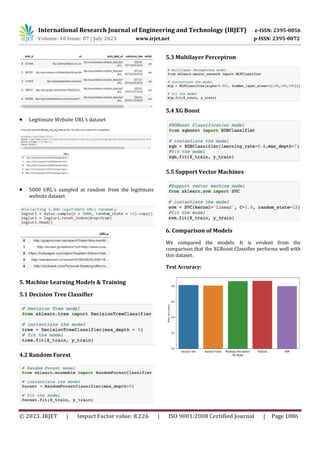
Train Accuracy:
7. RESULTS OBTAINED
To see if the model is effective, we test it using a well-
known phishing website.
7. CONCLUSION
One of the best and simplest ways for hackers to
defraud us of our money and obtain our financial and
personal information is still phishing. Machine learning
algorithms can learn to differentiate between
trustworthy and fraudulent websites by being trained
on a sizable dataset of both. This may result in the
creation of efficient phishing detection tools that can
instantly recognise and alert users to potentially
hazardous websites. We have determined that XGBoost
Classifier is the best method for this particular
application after researching several ML algorithms.
Even though employing machine learning for phishing
detection has numerous advantages, there are some
restrictions and difficulties that need to be resolved.
Making sure the algorithms can recognise new and
evolving phishing attack types is one of the major
problems. The training data and algorithmic feature
sets must be continuously updated for this.
Additionally, adversarial assaults, in which attackers
alter the characteristics of phishing websites to avoid
detection, might expose machine learning algorithms to
risk. Using machine learning models that are secure and
resistant to these assaults is crucial to addressing this.
REFERENCES
[1] Jun Ho Huh and Hyoungshick Kim, "Phishing Detection
with Popular Search Engines: Simple and Effective", May
12-13 2011, Springer.
[2] Thomas Rincy N 1 and Roopam Gupta, Design and
Development of an Efficient Network Intrusion Detection
System Using Machine Learning Techniques, Hindawi
Wireless Communications and Mobile Computing Volume
2021, Article ID 9974270, 35
pages https://doi.org/10.1155/2021/9974270
[3] Gadge, Jayant; Patil, Anish Anand (2008). [IEEE 2008
16th IEEE International Conference on Networks - New
Delhi, India (2008.12.12-2008.12.14)] 2008 16th IEEE
International Conference on Networks - Port scan
detection.
[4] Vasilomanolakis, Emmanouil; Sharief, Noorulla;
Muhlhauser, Max (2017). [IEEE 2017 IFIP/IEEE
Symposium on Integrated Network and Service
Management (IM) - Lisbon, Portugal (2017.5.8-
2017.5.12)] 2017 IFIP/IEEE Symposium on Integrated
Network and Service Management (IM) - Defending
against Probe-Response Attacks. , (), 1046–1051.
doi:10.23919/inm.2017.7987436
[5] Kalyan Nagaraj, Biplab Bhattacharjee, Amulyashree
Sridhar and Sharvani GS, “Detection of phishing websites
using a novel two fold ensemble model ”, July 2018,
Emerald insight.
[6] Shweta Sankhwar , Dhirendra Pandey and R.A Khan ,
“Email Phishing: An Enhanced Classification Model to
Detect Malicious URLs ”, April 2019 , EAI.](https://image.slidesharecdn.com/irjet-v10i7147-230816095807-98c4e052/85/Machine-Learning-Based-Phishing-Detection-5-320.jpg)

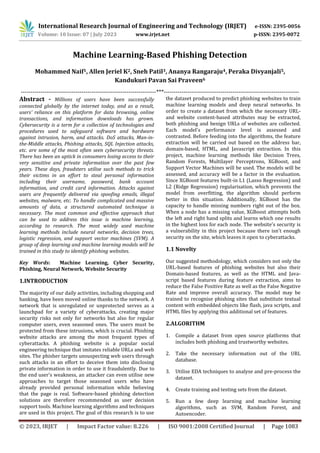
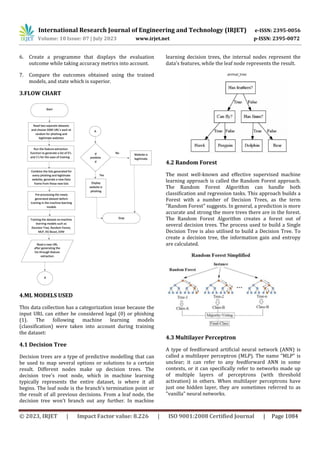
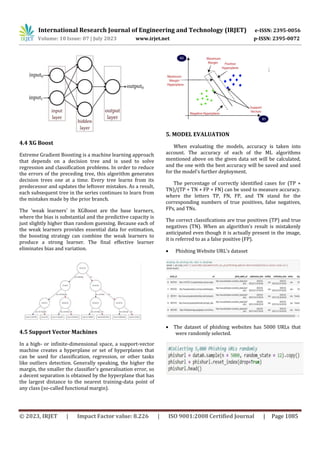
This document summarizes a research paper that proposes using machine learning models to detect phishing websites. It begins with an abstract that introduces the growing problem of phishing attacks and how machine learning can help address it. The document then provides more detail on the proposed methodology, which includes collecting a dataset of legitimate and phishing URLs, extracting features from the URLs, and training/comparing several machine learning models (decision trees, random forests, XGBoost, etc.). It finds that the XGBoost model performs best at classifying URLs as legitimate or phishing. The summary concludes by noting this approach could help create effective phishing detection tools, while acknowledging challenges like accounting for evolving attack types and adversarial examples.
![TEAM.MAJOR[1] project based on the .pptx](https://cdn.slidesharecdn.com/ss_thumbnails/team-240624193657-6c8dbe6e-thumbnail.jpg?width=640&height=640&fit=bounds)


