International Research Journal of Engineering and Technology (IRJET) e-ISSN: 2395-0056
Volume: 09 Issue: 04 | Apr 2022 www.irjet.net p-ISSN: 2395-0072
© 2022, IRJET | Impact Factor value: 7.529 | ISO 9001:2008 Certified Journal | Page 2567
AI-Based Pet Adoption System
Sumit Kajbaje1, Rohit Sawant2, Ronit Loke3 Vishwajeet Patil4
1,2,3,4 Dept of Computer, Siddhant College of Engineering, Maharashtra, India
---------------------------------------------------------------------***---------------------------------------------------------------------
Abstract - Every year, 3.3 million canines visit animal
shelters, out of a total population of 200 million. Only 2% to
17% of pets are returned to their owners. The remaining
animals are euthanized due to a shortage of room in
shelters (killed). The present procedures for adapting or
finding a pet are inefficient and haphazard. People
disseminated leaflets to the general public and spread the
word to others in the vicinity of the pet's disappearance.
When individuals print fliers, they waste paper and money
since there is no good impact. People also share their tales
on social media sites like Instagram and Facebook. There
are also several fraudsters who attempt to fraudulently
claim the incentive for returning the pet to its legitimate
owner. We want to give a platform for all animal lovers to
provide a pet partner of their choosing by giving all of the
required information, which is generally missing when
compared to any other platform or shelter so that you can
care for your new little buddy.
Key Words: Animal detection, classification, deep learning
algorithms, Adoption, Sentiment Analysis.
1. INTRODUCTION
Animal adoption is the procedure through which a
human takes in an animal, most often a cat or a dog.
Animal control takes these lost or abandoned animals and
places them in animal shelters. Pets that have been in
shelters for an extended period of time are killed in order
to alleviate the overpopulation of undesirable animals.
This idea was inspired by a web-based adoption portal
that raises awareness of abandoned animals waiting to be
adopted. Users and administrators may visit the website,
where they can register to examine the list of animals
waiting to be adopted, as well as each animal's
information, such as its (estimated) age, gender, and
description. The administrators have the most power in
the system and are in charge of adding, changing,
updating, and removing information as needed.
2. LITERATURE SURVEY
The literature reveals a number of animal identification
approaches that use image processing and entail numerous
procedures to carry out the whole algorithm. Data capture,
segmentation, feature extraction, representation, and
matching are examples of such procedures. Many current
strategies have been investigated by Animal Classification
researchers. Several of these are described more below.
“Animal Identification“ International Conference on
Advanced Computation and Telecommunication
(ICACAT) - 2019”
Animal identification has become a global need in livestock
management. It is one of the three pillars of traceability,
along with premises identification and mobility. Radio-
frequency identification tags send data about animals. This
work demonstrates and adds to the many techniques of
recognizing animals that use radio frequency identification.
“JSP-based Pet Adoption System” 2019 International
Conference on Virtual Reality and Intelligent Systems
(ICVRIS)
The system is divided into four modules: user
management, pet management, pet adoption, and pet
statistics. Vs-Code, MongoDB, and other tools were used, as
well as the SSM framework, bootstrap framework, various
plug-ins, and related JSP technologies. Among them is the
bootstrap framework's modal box, which is used to reduce
the number of JSP pages. To finish the waterfall stream
design for visitors to peruse while exploring pets, I used a
plug-in created entirely in CSS. The Echarts plug-in is used
to finish the chart generation in the adoption of the pet
statistics module, making the data seem more lively and
understandable. It may also download the picture to the
local system for administrators to download and utilise.
When a user signs in, the user name is identified based on
the logged-in user name, and the identity of the user is
determined depending on whether the user is an ordinary
member or an administrator, in order to identify the right
and go to the page corresponding to the permission. When
you log in, you may remember your password and log in to
two functions to make the design more user-friendly.
“Scrutiny of Methods for Image Detection and
Recognition of Different Species of Animals”
International Journal of Recent Technology and
Engineering (IJRTE) ISSN: 2277-3878, Volume-8 Issue-
3S3, November 2019
A research based on animal detection may be used in a
number of real-world scenarios. Animal detection methods
are useful in monitoring the motor activity of the engaged
animal and, as a result, avoiding harmful interruption of
animals in residential areas. As a consequence, this journal
will cover some of these branches. Humans have developed
several methods and tactics in order to get a better
understanding of animal behavior. As a consequence, for
early preventative measures, these technologies may also
International Research Journal of Engineering and Technology (IRJET) e-ISSN: 2395-0056
Volume: 09 Issue: 04 | Apr 2022 www.irjet.net p-ISSN: 2395-0072
© 2022, IRJET | Impact Factor value: 7.529 | ISO 9001:2008 Certified Journal | Page 2568
serve as a warning system for people in the case of a
harmful wild animal invasion. These tasks are classified
into three types: animal detection, tracking, and
recognition. These publications highlight new research
approaches, as well as a range of technologies/algorithms
that have been employed in the past, as well as feasible
answers to research gaps.
3. EXISTING SYSTEM
Fig - 1: Existing System
In the current system, if a user wishes to adopt a pet, he or
she must call and visit animal shelters. When the user
enters the pet shop, they may choose their pet based on
their preferences. After that, if the user loves the pet and
wants to adopt it, he or she must fill out an application
form. After completing the application procedure, the
customer must wait for a period of (24 - 48 hrs.). After
receiving clearance from the pet business owner, the user
may sign a contract and pay the money. They must go
through a trial period after adopting the pet.
4. PROPOSED SYSTEM
The suggested technology allows users to identify possible
adopters for their dogs, making the adoption process more
efficient. It assists the user by presenting all of the
information needed to make an educated choice. Users
will also be able to give money to rescue shelters in order
to support their mission. Users may also make an
appointment with the client to begin the adoption process.
The technology delivers a smooth experience for adopters,
allowing them to concentrate only on finding the pet of
their dreams.
5. BLOCK DIAGRAM
Fig - 2: Block Diagram
6. ALGORITHM
6.1 Convolutional Neural Network
A convolutional neural network (CNN) is a form of
artificial neural network that analyses data using
a perceptron, a machine learning unit method.
CNNs are useful for image processing, natural
language processing, and other cognitive tasks. An
input layer, an output layer, and multiple hidden
layers comprise a convolutional neural network.
Some of these layers are convolutional, meaning
they use a mathematical model to pass findings on
to subsequent layers.
 The input will include the image's raw pixel
values as well as three colour channels (R, G, B).
 The CONV layer will calculate the output of
neurons that are linked to local areas in the input,
with each neuron calculating a dot product
between its weights and a tiny region in the input
volume to which it is connected.
 The RELU layer will use an element-by-element
activation function. This has no effect on the
volume's size.
 The POOL layer will down sample along the
spatial dimensions (width and height), resulting
in a volume of [16x16x12].
The class scores will be computed by the FC
(completely connected) layer, resulting in a
volume of size. As with regular Neural Networks,
and as the name suggests, each neuron in this
layer will be linked to all of the numbers in the
preceding volume.
International Research Journal of Engineering and Technology (IRJET) e-ISSN: 2395-0056
Volume: 09 Issue: 04 | Apr 2022 www.irjet.net p-ISSN: 2395-0072
© 2022, IRJET | Impact Factor value: 7.529 | ISO 9001:2008 Certified Journal | Page 2569
Fig - 3: Convolutional Neural Network
6.1.1 ARCHITECTURE OF CNN FOR ANIMAL
DETECTION
Fig - 4: Architecture of CNN
6.1.2 Design:
Fig - 5: CNN Design
6.2 KNN
 K-Nearest Neighbor is a basic Machine Learning
method that uses the Supervised Learning
approach.
 The K-NN method assumes similarity between the
new case/data and existing cases and places the
new case in the category that is most similar to
the existing categories.
 The K-NN algorithm maintains all existing data
and classifies new data points based on
similarities. This implies that when fresh data
arrives, it may be quickly sorted into an
appropriate suite category using the K- NN
technique.
 The K-NN method may be used for both
Regression and Classification, however it is more
often employed for Classification tasks.
 K-NN is a non-parametric method, which means it
makes no assumptions about the data.
 It is also known as a lazy learner algorithm
because it does not instantly learn from the
training set; instead, it stores the dataset and then
takes an action on it during classification.
 During the training phase, the KNN algorithm
simply saves the dataset, and when new data is
received, it classifies it into a category that is quite
similar to the new data.
 Assume we have a picture of a critter that
resembles a cat or a dog and we want to know
whether it is a cat or a dog. So, since the KNN
method is based on a similarity measure, we may
utilize it for this identification. Our KNN model
will look for similarities between the new data set
and the photographs of cats and dogs and place it
in either category depending on the most
comparable attributes.
Fig - 6: KNN Classifier
The following method may be used to describe how K-NN
works:
 Step 1: Determine the number K of neighbors.
 Step 2: Determine the Euclidean distance
between K neighbors.
International Research Journal of Engineering and Technology (IRJET) e-ISSN: 2395-0056
Volume: 09 Issue: 04 | Apr 2022 www.irjet.net p-ISSN: 2395-0072
© 2022, IRJET | Impact Factor value: 7.529 | ISO 9001:2008 Certified Journal | Page 2570
 Step 3: Determine the K closest neighbors based
on the estimated Euclidean distance.
 Step 4: Count the number of data points in each
category among these k neighbors.
 Step 5: Assign the new data points to the category
with the greatest number of neighbors.
 Step 6: Our model is complete.
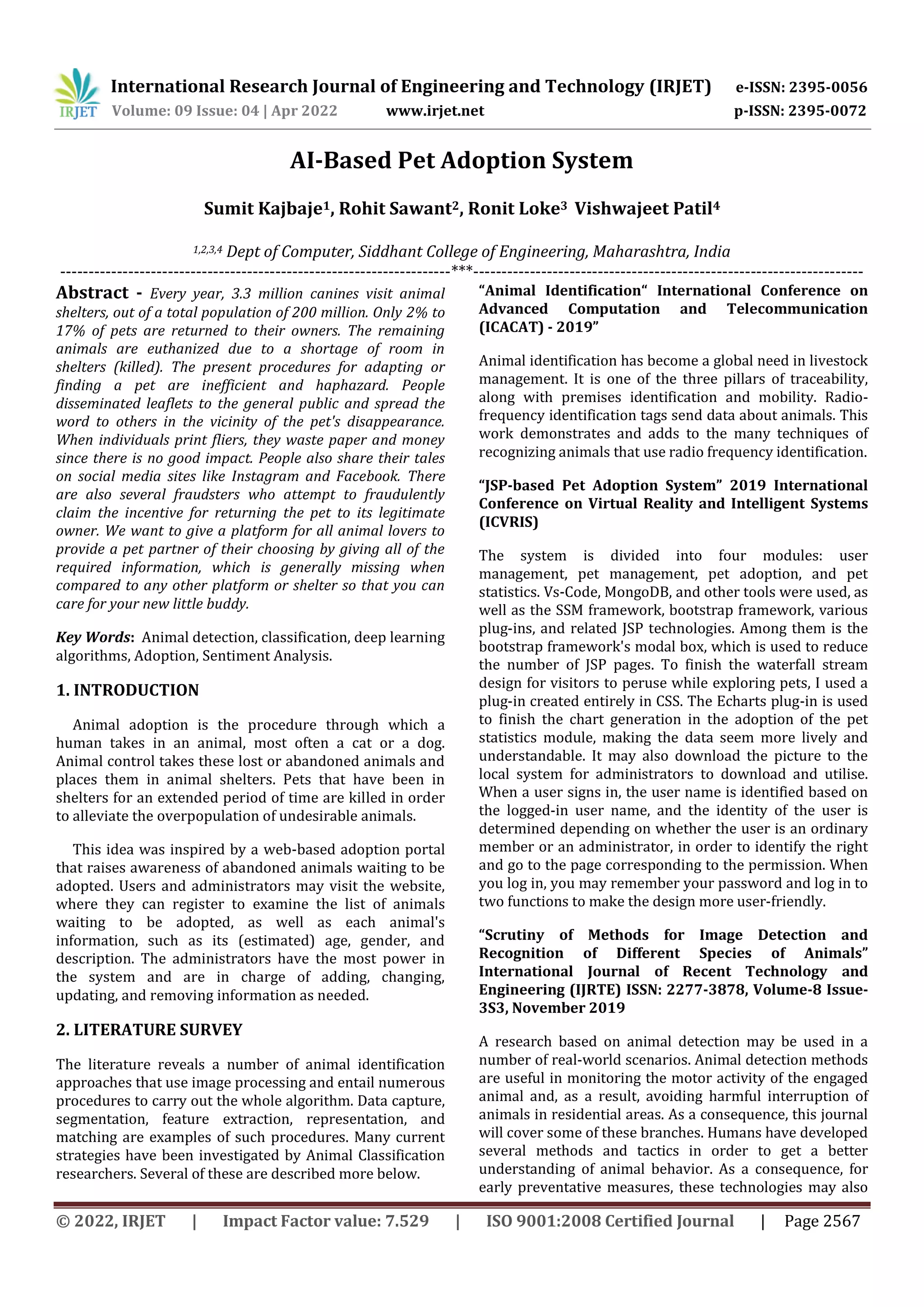
6.3 Question-based Recommend System
In our question-based approach, users will be given a few
questions about their living space, lifestyle, and how much
care they are prepared to take, as well as how much time
their pet will spend with you and alone. Based on the
user's response, our algorithm will choose from a range of
breeds available the one that best meets your
requirements and offer the top closest matches. The user
may then examine the advice and, if desired, see the
available choices. This makes it simpler for new or "first-
time" adopters to find the proper pet.
Fig - 7: User-based Question recommendation System
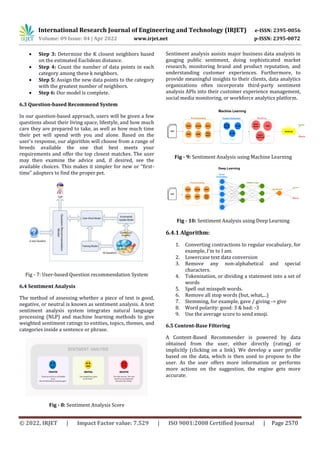
6.4 Sentiment Analysis
The method of assessing whether a piece of text is good,
negative, or neutral is known as sentiment analysis. A text
sentiment analysis system integrates natural language
processing (NLP) and machine learning methods to give
weighted sentiment ratings to entities, topics, themes, and
categories inside a sentence or phrase.
Fig - 8: Sentiment Analysis Score
Sentiment analysis assists major business data analysts in
gauging public sentiment, doing sophisticated market
research, monitoring brand and product reputation, and
understanding customer experiences. Furthermore, to
provide meaningful insights to their clients, data analytics
organizations often incorporate third-party sentiment
analysis APIs into their customer experience management,
social media monitoring, or workforce analytics platform.
Fig - 9: Sentiment Analysis using Machine Learning
Fig - 10: Sentiment Analysis using Deep Learning
6.4.1 Algorithm:
1. Converting contractions to regular vocabulary, for
example, I'm to I am.
2. Lowercase text data conversion
3. Remove any non-alphabetical and special
characters.
4. Tokenization, or dividing a statement into a set of
words
5. Spell out misspelt words.
6. Remove all stop words (but, what,...)
7. Stemming, for example, gave / giving -> give
8. Word polarity: good: 3 & bad: -3
9. Use the average score to send emoji.
6.5 Content-Base Filtering
A Content-Based Recommender is powered by data
obtained from the user, either directly (rating) or
implicitly (clicking on a link). We develop a user profile
based on the data, which is then used to propose to the
user. As the user offers more information or performs
more actions on the suggestion, the engine gets more
accurate.
International Research Journal of Engineering and Technology (IRJET) e-ISSN: 2395-0056
Volume: 09 Issue: 04 | Apr 2022 www.irjet.net p-ISSN: 2395-0072
© 2022, IRJET | Impact Factor value: 7.529 | ISO 9001:2008 Certified Journal | Page 2571
Fig - 11: Content-based Filtering
Collaborative filtering techniques are recommender
system approaches that are mostly dependent on prior
interactions between users and the target items.
As a consequence, all previous data pertaining to user
interactions with target items will be supplied into a
collaborative filtering system. This data is often stored as a
matrix, with rows representing users and columns
representing things.
The underlying idea of such systems is that prior data
from users should be enough to make a forecast. That is,
we don't need anything more but historical data, no more
user input, no current trending data, and so on.
In addition, collaborative filtering approaches are
classified into two types: memory-based methods and
model-based methods.
7. CONCLUSION
The prototype of our Pet Adoption Application was
developed successfully. The major objectives covered by
our application are as follows:-
 People will come to know about stray animals
that need their help around their vicinity.
 The number of stray animals euthanized will be
reduced.
 Kind-hearted people will get an opportunity to do
something for helpless animals.
 People will be able to share their stories of how
they rescued pets and motivate others to do so.
REFERENCES
[1] Elham Mohammed Thabit A. ALSADI, Nidhal K. El
Abbadi, “Scrutiny of Methods for Image Detection And
Recognition of Different Species of Animals,” Nov.
2019, doi: 10.35940/ijrte.C1046.1183S319.
[2] Haoran Liu, Xiue Meng, “JSP-Based Pet Adoption
System,” Sept. 2019, doi:
10.1109/ICVRIS.2019.00064.
[3] Gavali, P. P., Abhijeet Mhetre, M. P., Chandrakhant
Patil, M. N., Suresh Bamane, M. N., & Dipak Buva, M.H. ,
“Bird Species Identification Using Deep Learning,” Apr.
2019, doi: IJERTV8IS040112
[4] Saundarya Junjur, Punam Avhad, Deepika Tendulkar,
“Bird Species Identification Using Image Mining & Cnn
Algorithm,” Feb. 2020, , doi: 10.17577 /
IJERTV9IS060279
[5] Wikipedia, “Prevention Of Cruelty To Animals Act,”
Dec. 2020
[6] Pawsome Advice, “Stray Animal Statistics - What Are
The Actual Numbers In 2022,” Jan. 2022

AI-Based Pet Adoption System

  • 1.
    International Research Journalof Engineering and Technology (IRJET) e-ISSN: 2395-0056 Volume: 09 Issue: 04 | Apr 2022 www.irjet.net p-ISSN: 2395-0072 © 2022, IRJET | Impact Factor value: 7.529 | ISO 9001:2008 Certified Journal | Page 2567 AI-Based Pet Adoption System Sumit Kajbaje1, Rohit Sawant2, Ronit Loke3 Vishwajeet Patil4 1,2,3,4 Dept of Computer, Siddhant College of Engineering, Maharashtra, India ---------------------------------------------------------------------***--------------------------------------------------------------------- Abstract - Every year, 3.3 million canines visit animal shelters, out of a total population of 200 million. Only 2% to 17% of pets are returned to their owners. The remaining animals are euthanized due to a shortage of room in shelters (killed). The present procedures for adapting or finding a pet are inefficient and haphazard. People disseminated leaflets to the general public and spread the word to others in the vicinity of the pet's disappearance. When individuals print fliers, they waste paper and money since there is no good impact. People also share their tales on social media sites like Instagram and Facebook. There are also several fraudsters who attempt to fraudulently claim the incentive for returning the pet to its legitimate owner. We want to give a platform for all animal lovers to provide a pet partner of their choosing by giving all of the required information, which is generally missing when compared to any other platform or shelter so that you can care for your new little buddy. Key Words: Animal detection, classification, deep learning algorithms, Adoption, Sentiment Analysis. 1. INTRODUCTION Animal adoption is the procedure through which a human takes in an animal, most often a cat or a dog. Animal control takes these lost or abandoned animals and places them in animal shelters. Pets that have been in shelters for an extended period of time are killed in order to alleviate the overpopulation of undesirable animals. This idea was inspired by a web-based adoption portal that raises awareness of abandoned animals waiting to be adopted. Users and administrators may visit the website, where they can register to examine the list of animals waiting to be adopted, as well as each animal's information, such as its (estimated) age, gender, and description. The administrators have the most power in the system and are in charge of adding, changing, updating, and removing information as needed. 2. LITERATURE SURVEY The literature reveals a number of animal identification approaches that use image processing and entail numerous procedures to carry out the whole algorithm. Data capture, segmentation, feature extraction, representation, and matching are examples of such procedures. Many current strategies have been investigated by Animal Classification researchers. Several of these are described more below. “Animal Identification“ International Conference on Advanced Computation and Telecommunication (ICACAT) - 2019” Animal identification has become a global need in livestock management. It is one of the three pillars of traceability, along with premises identification and mobility. Radio- frequency identification tags send data about animals. This work demonstrates and adds to the many techniques of recognizing animals that use radio frequency identification. “JSP-based Pet Adoption System” 2019 International Conference on Virtual Reality and Intelligent Systems (ICVRIS) The system is divided into four modules: user management, pet management, pet adoption, and pet statistics. Vs-Code, MongoDB, and other tools were used, as well as the SSM framework, bootstrap framework, various plug-ins, and related JSP technologies. Among them is the bootstrap framework's modal box, which is used to reduce the number of JSP pages. To finish the waterfall stream design for visitors to peruse while exploring pets, I used a plug-in created entirely in CSS. The Echarts plug-in is used to finish the chart generation in the adoption of the pet statistics module, making the data seem more lively and understandable. It may also download the picture to the local system for administrators to download and utilise. When a user signs in, the user name is identified based on the logged-in user name, and the identity of the user is determined depending on whether the user is an ordinary member or an administrator, in order to identify the right and go to the page corresponding to the permission. When you log in, you may remember your password and log in to two functions to make the design more user-friendly. “Scrutiny of Methods for Image Detection and Recognition of Different Species of Animals” International Journal of Recent Technology and Engineering (IJRTE) ISSN: 2277-3878, Volume-8 Issue- 3S3, November 2019 A research based on animal detection may be used in a number of real-world scenarios. Animal detection methods are useful in monitoring the motor activity of the engaged animal and, as a result, avoiding harmful interruption of animals in residential areas. As a consequence, this journal will cover some of these branches. Humans have developed several methods and tactics in order to get a better understanding of animal behavior. As a consequence, for early preventative measures, these technologies may also
  • 2.
    International Research Journalof Engineering and Technology (IRJET) e-ISSN: 2395-0056 Volume: 09 Issue: 04 | Apr 2022 www.irjet.net p-ISSN: 2395-0072 © 2022, IRJET | Impact Factor value: 7.529 | ISO 9001:2008 Certified Journal | Page 2568 serve as a warning system for people in the case of a harmful wild animal invasion. These tasks are classified into three types: animal detection, tracking, and recognition. These publications highlight new research approaches, as well as a range of technologies/algorithms that have been employed in the past, as well as feasible answers to research gaps. 3. EXISTING SYSTEM Fig - 1: Existing System In the current system, if a user wishes to adopt a pet, he or she must call and visit animal shelters. When the user enters the pet shop, they may choose their pet based on their preferences. After that, if the user loves the pet and wants to adopt it, he or she must fill out an application form. After completing the application procedure, the customer must wait for a period of (24 - 48 hrs.). After receiving clearance from the pet business owner, the user may sign a contract and pay the money. They must go through a trial period after adopting the pet. 4. PROPOSED SYSTEM The suggested technology allows users to identify possible adopters for their dogs, making the adoption process more efficient. It assists the user by presenting all of the information needed to make an educated choice. Users will also be able to give money to rescue shelters in order to support their mission. Users may also make an appointment with the client to begin the adoption process. The technology delivers a smooth experience for adopters, allowing them to concentrate only on finding the pet of their dreams. 5. BLOCK DIAGRAM Fig - 2: Block Diagram 6. ALGORITHM 6.1 Convolutional Neural Network A convolutional neural network (CNN) is a form of artificial neural network that analyses data using a perceptron, a machine learning unit method. CNNs are useful for image processing, natural language processing, and other cognitive tasks. An input layer, an output layer, and multiple hidden layers comprise a convolutional neural network. Some of these layers are convolutional, meaning they use a mathematical model to pass findings on to subsequent layers.  The input will include the image's raw pixel values as well as three colour channels (R, G, B).  The CONV layer will calculate the output of neurons that are linked to local areas in the input, with each neuron calculating a dot product between its weights and a tiny region in the input volume to which it is connected.  The RELU layer will use an element-by-element activation function. This has no effect on the volume's size.  The POOL layer will down sample along the spatial dimensions (width and height), resulting in a volume of [16x16x12]. The class scores will be computed by the FC (completely connected) layer, resulting in a volume of size. As with regular Neural Networks, and as the name suggests, each neuron in this layer will be linked to all of the numbers in the preceding volume.
  • 3.
    International Research Journalof Engineering and Technology (IRJET) e-ISSN: 2395-0056 Volume: 09 Issue: 04 | Apr 2022 www.irjet.net p-ISSN: 2395-0072 © 2022, IRJET | Impact Factor value: 7.529 | ISO 9001:2008 Certified Journal | Page 2569 Fig - 3: Convolutional Neural Network 6.1.1 ARCHITECTURE OF CNN FOR ANIMAL DETECTION Fig - 4: Architecture of CNN 6.1.2 Design: Fig - 5: CNN Design 6.2 KNN  K-Nearest Neighbor is a basic Machine Learning method that uses the Supervised Learning approach.  The K-NN method assumes similarity between the new case/data and existing cases and places the new case in the category that is most similar to the existing categories.  The K-NN algorithm maintains all existing data and classifies new data points based on similarities. This implies that when fresh data arrives, it may be quickly sorted into an appropriate suite category using the K- NN technique.  The K-NN method may be used for both Regression and Classification, however it is more often employed for Classification tasks.  K-NN is a non-parametric method, which means it makes no assumptions about the data.  It is also known as a lazy learner algorithm because it does not instantly learn from the training set; instead, it stores the dataset and then takes an action on it during classification.  During the training phase, the KNN algorithm simply saves the dataset, and when new data is received, it classifies it into a category that is quite similar to the new data.  Assume we have a picture of a critter that resembles a cat or a dog and we want to know whether it is a cat or a dog. So, since the KNN method is based on a similarity measure, we may utilize it for this identification. Our KNN model will look for similarities between the new data set and the photographs of cats and dogs and place it in either category depending on the most comparable attributes. Fig - 6: KNN Classifier The following method may be used to describe how K-NN works:  Step 1: Determine the number K of neighbors.  Step 2: Determine the Euclidean distance between K neighbors.
  • 4.
    International Research Journalof Engineering and Technology (IRJET) e-ISSN: 2395-0056 Volume: 09 Issue: 04 | Apr 2022 www.irjet.net p-ISSN: 2395-0072 © 2022, IRJET | Impact Factor value: 7.529 | ISO 9001:2008 Certified Journal | Page 2570  Step 3: Determine the K closest neighbors based on the estimated Euclidean distance.  Step 4: Count the number of data points in each category among these k neighbors.  Step 5: Assign the new data points to the category with the greatest number of neighbors.  Step 6: Our model is complete. 6.3 Question-based Recommend System In our question-based approach, users will be given a few questions about their living space, lifestyle, and how much care they are prepared to take, as well as how much time their pet will spend with you and alone. Based on the user's response, our algorithm will choose from a range of breeds available the one that best meets your requirements and offer the top closest matches. The user may then examine the advice and, if desired, see the available choices. This makes it simpler for new or "first- time" adopters to find the proper pet. Fig - 7: User-based Question recommendation System 6.4 Sentiment Analysis The method of assessing whether a piece of text is good, negative, or neutral is known as sentiment analysis. A text sentiment analysis system integrates natural language processing (NLP) and machine learning methods to give weighted sentiment ratings to entities, topics, themes, and categories inside a sentence or phrase. Fig - 8: Sentiment Analysis Score Sentiment analysis assists major business data analysts in gauging public sentiment, doing sophisticated market research, monitoring brand and product reputation, and understanding customer experiences. Furthermore, to provide meaningful insights to their clients, data analytics organizations often incorporate third-party sentiment analysis APIs into their customer experience management, social media monitoring, or workforce analytics platform. Fig - 9: Sentiment Analysis using Machine Learning Fig - 10: Sentiment Analysis using Deep Learning 6.4.1 Algorithm: 1. Converting contractions to regular vocabulary, for example, I'm to I am. 2. Lowercase text data conversion 3. Remove any non-alphabetical and special characters. 4. Tokenization, or dividing a statement into a set of words 5. Spell out misspelt words. 6. Remove all stop words (but, what,...) 7. Stemming, for example, gave / giving -> give 8. Word polarity: good: 3 & bad: -3 9. Use the average score to send emoji. 6.5 Content-Base Filtering A Content-Based Recommender is powered by data obtained from the user, either directly (rating) or implicitly (clicking on a link). We develop a user profile based on the data, which is then used to propose to the user. As the user offers more information or performs more actions on the suggestion, the engine gets more accurate.
  • 5.
    International Research Journalof Engineering and Technology (IRJET) e-ISSN: 2395-0056 Volume: 09 Issue: 04 | Apr 2022 www.irjet.net p-ISSN: 2395-0072 © 2022, IRJET | Impact Factor value: 7.529 | ISO 9001:2008 Certified Journal | Page 2571 Fig - 11: Content-based Filtering Collaborative filtering techniques are recommender system approaches that are mostly dependent on prior interactions between users and the target items. As a consequence, all previous data pertaining to user interactions with target items will be supplied into a collaborative filtering system. This data is often stored as a matrix, with rows representing users and columns representing things. The underlying idea of such systems is that prior data from users should be enough to make a forecast. That is, we don't need anything more but historical data, no more user input, no current trending data, and so on. In addition, collaborative filtering approaches are classified into two types: memory-based methods and model-based methods. 7. CONCLUSION The prototype of our Pet Adoption Application was developed successfully. The major objectives covered by our application are as follows:-  People will come to know about stray animals that need their help around their vicinity.  The number of stray animals euthanized will be reduced.  Kind-hearted people will get an opportunity to do something for helpless animals.  People will be able to share their stories of how they rescued pets and motivate others to do so. REFERENCES [1] Elham Mohammed Thabit A. ALSADI, Nidhal K. El Abbadi, “Scrutiny of Methods for Image Detection And Recognition of Different Species of Animals,” Nov. 2019, doi: 10.35940/ijrte.C1046.1183S319. [2] Haoran Liu, Xiue Meng, “JSP-Based Pet Adoption System,” Sept. 2019, doi: 10.1109/ICVRIS.2019.00064. [3] Gavali, P. P., Abhijeet Mhetre, M. P., Chandrakhant Patil, M. N., Suresh Bamane, M. N., & Dipak Buva, M.H. , “Bird Species Identification Using Deep Learning,” Apr. 2019, doi: IJERTV8IS040112 [4] Saundarya Junjur, Punam Avhad, Deepika Tendulkar, “Bird Species Identification Using Image Mining & Cnn Algorithm,” Feb. 2020, , doi: 10.17577 / IJERTV9IS060279 [5] Wikipedia, “Prevention Of Cruelty To Animals Act,” Dec. 2020 [6] Pawsome Advice, “Stray Animal Statistics - What Are The Actual Numbers In 2022,” Jan. 2022