Reverse Logistics
Group 4:
Nripesh Sen
Pratik Poddar
Pratyusha Dash
Preetish Swain
Priyaranjan Mohanty
Rahul Jain
“Reverse Logistics is the process of moving
products from their typical final
destination to another point, for the
purpose of capturing value otherwise
unavailable, or for the proper disposal of
the products.
2
» Forecasting
» Carrying costs
» Processing costs
» Warehousing
» Distribution
» Transportation
» Personnel
» Marketing
IMPACT OF REVERSE LOGISTICS
Comparison between forward and Reverse logistics 4
Workflow 5
» Processing returned merchandise - damaged, seasonal, restock,
salvage, recall, or excess inventory
» Recycling packaging materials/containers
» Reconditioning, refurbishing, remanufacturing
» Disposition of obsolete stuff
» Hazmat recovery
6Typical Reverse Logistics Activities
Impact of Reverse Logistics on Brand 7
0%
20%
40%
60%
80%
100%
120%
85% of
customers WILL
NOT shop again
if the return
process is not
convenient
0%
0%
0%
1%
1%
1%
1%
95% of
customers WILL
shop again if the
return process is
convenient
Impact of a negative
returns experience.
Impact of a positive returns
experience.
Business Drivers of RL
Internal
External
Operational Strategic
Legislation
• WEEE directive
• Potential EU legislation on re-use
of packaging material
• RoHS directive
• Sarbanes-Oxley
Business Strategy
• Customer Retention/Loyalty
• Corporate citizenship
• Market/customer behavior analysis
• Reduce risk for forward channel
• Drive sales
• Feedback to new product development/IT
• Recover assets
• Recapture value
• Control gray market
• Global Labor Cost
Economic BenefitsCustomer Service Initiatives
• Return of defective products
• Product disposal after end-of-life
• Product upgrades
• Product recall
• Warranty returns
• Product defect analysis
Source: Infosys & Cisco Systems
Key Parameters for RL supply chain
»Rate of returns?
»Cost to process a return?
»Time to get the item back on the shelf if resaleable?
9
Costs above the cost of item
»Merchandise credits to the customers.
»The transportation costs of moving the items from the retail
stores to the central returns distribution center.
»The repackaging of the serviceable items for resale.
»The cost of warehousing the items awaiting disposition.
»The cost of disposing of items that are unserviceable,
damaged, or obsolete.
10
Costs in RL Supply Chain
»Process inbound shipment at a major distribution center = 1.1
days
»Process inbound return shipment = 8.5 days
»Cost of lost sales
»Wal-Mart: Christmas 2003 - returns = 4 Days of Supply for all of
Wal-Mart = 2000 Containers
»PalmOne - 25% return rate on PDAs
»Wal-Mart: $6 Billion in annual returns = 17,000 truck loads
(>46 trucks a day)
»Electronics: $10 Billion annually in returns
»PCs: $1.5 Billion annually = approx $95 per PC sold
11
RL Adds to Bottom Line
»Your Company Manufactures 1 Million Units Per Year
»Revenue per Unit is $1 or $1,000,000
»Profit per unit is 5% After Tax or $50,000
»Return Rate Average is 10% or 100,000 units
»Returns Represents $100,000 of Sales or $50,000 negative
to bottom line
»Reverse Logistics Recovers 80% of the Returns or $80,000
to company bottom line
»Company’s After Tax Profit is $30,000
12
What Value Can Reverse Logistics Deliver? 13
Function Key Objective How Reverse Logistics Can Help
Finance
Maximize
profitability
• Control costs with efficient operations
• Recover value from returns
Sales Grow the business
• Make returns process painless, to increase customer
satisfaction
• Support growth by making product available to
surgically resell
Marketing Build the brand • Control the gray market
Quality
Improve customer
experience
• Feed returns data back upstream to drive process and
product design improvements
CEO
All of the above,
+ Corporate Social
Responsibility
• Ensure environmental protection
• Leverage returns to accelerate giving back to the
community
Returns: An Operations Perspective
»Emerging industry in infancy stage
»Many skill sets involved, deep
knowledge of some skills
»Person on Warehouse floor –needs
tools
»No Schooling for Reverse Logistics
»No rules or standards
»No methods
»Few Best Practices
»Few comparisons
»How do we know WHAT we should be
doing?
»How do we know HOW WELL we are
doing?
»Where are the opportunities to
improve PROFITS?
14
Some Key Challenges Operations people face:
 So many people, from so many departments, at so many locations, from different
companies, needed to process one return.
 For the group managers, returns is a small, annoying part of their group – Most of a
Return is someone else’s problem /fault.
 Turn Around Time is often very slow and difficulties often arise that add days to the
processing of a Return.
 Stressful work environment due to frequent issues that need to be resolved ASAP
15
Some Key Challenges Operations people face:
 Difficulties arise with process Hand-offs between groups, Outsourced providers and
multiple data systems
 Collect little data about a Returned unit; it often has errors, so it may get handled
incorrectly or we have to believe what the customer tells us
 Often time consuming or difficult to track down the status of a unit
 Senior staff spend considerable time solving processing problems or escalated issues
16
Best Practices
»All Returns under control of ONE GROUP.
»Very Defined Business Processes
»Process Mapping – companies that develop process maps saved up to 40%
»Map all processes and add timelines
»Automate processes where possible
17
Flipkart Reverse Logistics
• eKart's reach - 150 Cities,
the largest such network set
up by an online retailer in
India
• eKart currently offers
services such as delivery
logistics, reverse logistics
and pay on delivery
18
How does Flipkart handle its returns? 19
Product is
Defective/Damaged/Quality
Issues
Wrong Product
Customer is not willing to
buy anymore
Exchange of Product (Ex:
Old phone exchange with
new phone)
When?
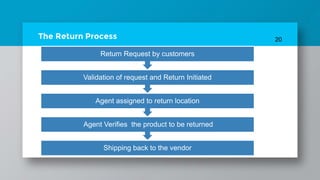
The Return Process 20
Shipping back to the vendor
Agent Verifies the product to be returned
Agent assigned to return location
Validation of request and Return Initiated
Return Request by customers
Thank you.
Any questions?

Reverse Logistics in Different Industries

  • 1.
    Reverse Logistics Group 4: NripeshSen Pratik Poddar Pratyusha Dash Preetish Swain Priyaranjan Mohanty Rahul Jain
  • 2.
    “Reverse Logistics isthe process of moving products from their typical final destination to another point, for the purpose of capturing value otherwise unavailable, or for the proper disposal of the products. 2
  • 3.
    » Forecasting » Carryingcosts » Processing costs » Warehousing » Distribution » Transportation » Personnel » Marketing IMPACT OF REVERSE LOGISTICS
  • 4.
    Comparison between forwardand Reverse logistics 4
  • 5.
  • 6.
    » Processing returnedmerchandise - damaged, seasonal, restock, salvage, recall, or excess inventory » Recycling packaging materials/containers » Reconditioning, refurbishing, remanufacturing » Disposition of obsolete stuff » Hazmat recovery 6Typical Reverse Logistics Activities
  • 7.
    Impact of ReverseLogistics on Brand 7 0% 20% 40% 60% 80% 100% 120% 85% of customers WILL NOT shop again if the return process is not convenient 0% 0% 0% 1% 1% 1% 1% 95% of customers WILL shop again if the return process is convenient Impact of a negative returns experience. Impact of a positive returns experience.
  • 8.
    Business Drivers ofRL Internal External Operational Strategic Legislation • WEEE directive • Potential EU legislation on re-use of packaging material • RoHS directive • Sarbanes-Oxley Business Strategy • Customer Retention/Loyalty • Corporate citizenship • Market/customer behavior analysis • Reduce risk for forward channel • Drive sales • Feedback to new product development/IT • Recover assets • Recapture value • Control gray market • Global Labor Cost Economic BenefitsCustomer Service Initiatives • Return of defective products • Product disposal after end-of-life • Product upgrades • Product recall • Warranty returns • Product defect analysis Source: Infosys & Cisco Systems
  • 9.
    Key Parameters forRL supply chain »Rate of returns? »Cost to process a return? »Time to get the item back on the shelf if resaleable? 9
  • 10.
    Costs above thecost of item »Merchandise credits to the customers. »The transportation costs of moving the items from the retail stores to the central returns distribution center. »The repackaging of the serviceable items for resale. »The cost of warehousing the items awaiting disposition. »The cost of disposing of items that are unserviceable, damaged, or obsolete. 10
  • 11.
    Costs in RLSupply Chain »Process inbound shipment at a major distribution center = 1.1 days »Process inbound return shipment = 8.5 days »Cost of lost sales »Wal-Mart: Christmas 2003 - returns = 4 Days of Supply for all of Wal-Mart = 2000 Containers »PalmOne - 25% return rate on PDAs »Wal-Mart: $6 Billion in annual returns = 17,000 truck loads (>46 trucks a day) »Electronics: $10 Billion annually in returns »PCs: $1.5 Billion annually = approx $95 per PC sold 11
  • 12.
    RL Adds toBottom Line »Your Company Manufactures 1 Million Units Per Year »Revenue per Unit is $1 or $1,000,000 »Profit per unit is 5% After Tax or $50,000 »Return Rate Average is 10% or 100,000 units »Returns Represents $100,000 of Sales or $50,000 negative to bottom line »Reverse Logistics Recovers 80% of the Returns or $80,000 to company bottom line »Company’s After Tax Profit is $30,000 12
  • 13.
    What Value CanReverse Logistics Deliver? 13 Function Key Objective How Reverse Logistics Can Help Finance Maximize profitability • Control costs with efficient operations • Recover value from returns Sales Grow the business • Make returns process painless, to increase customer satisfaction • Support growth by making product available to surgically resell Marketing Build the brand • Control the gray market Quality Improve customer experience • Feed returns data back upstream to drive process and product design improvements CEO All of the above, + Corporate Social Responsibility • Ensure environmental protection • Leverage returns to accelerate giving back to the community
  • 14.
    Returns: An OperationsPerspective »Emerging industry in infancy stage »Many skill sets involved, deep knowledge of some skills »Person on Warehouse floor –needs tools »No Schooling for Reverse Logistics »No rules or standards »No methods »Few Best Practices »Few comparisons »How do we know WHAT we should be doing? »How do we know HOW WELL we are doing? »Where are the opportunities to improve PROFITS? 14
  • 15.
    Some Key ChallengesOperations people face:  So many people, from so many departments, at so many locations, from different companies, needed to process one return.  For the group managers, returns is a small, annoying part of their group – Most of a Return is someone else’s problem /fault.  Turn Around Time is often very slow and difficulties often arise that add days to the processing of a Return.  Stressful work environment due to frequent issues that need to be resolved ASAP 15
  • 16.
    Some Key ChallengesOperations people face:  Difficulties arise with process Hand-offs between groups, Outsourced providers and multiple data systems  Collect little data about a Returned unit; it often has errors, so it may get handled incorrectly or we have to believe what the customer tells us  Often time consuming or difficult to track down the status of a unit  Senior staff spend considerable time solving processing problems or escalated issues 16
  • 17.
    Best Practices »All Returnsunder control of ONE GROUP. »Very Defined Business Processes »Process Mapping – companies that develop process maps saved up to 40% »Map all processes and add timelines »Automate processes where possible 17
  • 18.
    Flipkart Reverse Logistics •eKart's reach - 150 Cities, the largest such network set up by an online retailer in India • eKart currently offers services such as delivery logistics, reverse logistics and pay on delivery 18
  • 19.
    How does Flipkarthandle its returns? 19 Product is Defective/Damaged/Quality Issues Wrong Product Customer is not willing to buy anymore Exchange of Product (Ex: Old phone exchange with new phone) When?
  • 20.
    The Return Process20 Shipping back to the vendor Agent Verifies the product to be returned Agent assigned to return location Validation of request and Return Initiated Return Request by customers
  • 21.