Kaizen and Six Sigma
Kaizen
Kaizen is...
... a system of continuous improvement in quality,
technology, processes, company culture, productivity,
safety and leadership
Kaizen was created in Japan following World War II. The
word Kaizen means "continuous improvement". It comes
from the Chinese characters 改 ("kai") which means
"change" or "to correct" and 善 ("zen") which means
"good".
Kaizen (Continuous Improvement)
 Focus on gradual and continuous
improvement
 A whole business philosophy
 Importance of EVERYONE buying into
the concept and the vision
Six Sigma Methodology
Six Sigma relies heavily on advanced statistical methods
that complement and reduce the process and product
variations. It is a new way of doing business that would
eliminate the existing defects efficiently and would
prevent defects from occurring.
 Coined by Motorola Engineer Bill
Smith
 Now a major influence on production
methods and quality assurance
 Data and statistical driven approach to
eliminate defects in production
 Aims to improve processes and reduce
variations in quality
 Necessitates organisational change,
training and planning
What Is Six Sigma? 7
"Zero Defect"
 "Defect" – any product or service that
does not conform to the set standards
or satisfaction of the customer.
 Now, Six Sigma is a concept that tries
to achieve a near zero defect with 3.4
defects in a million events.
 Early adopters include Bank of
America, Caterpillar, Honeywell
International (previously known as
Allied Signal), Raytheon, Merrill Lynch
and General Electric.
What Is Six Sigma? 8
What is Six Sigma?
 A methodology to improve a business process by
constantly reviewing, updating and re-tuning the
existing process.
 Six Sigma improves the process performance,
decreases variation and maintains consistent quality
of the process output. This leads to defect reduction
and improvement in profits, employee morale,
product quality and finally customer satisfaction.
 Six Sigma Strives for perfection. It allows for only
3.4 defects per million opportunities for each product
or service transaction.
 Six Sigma relies heavily on statistical techniques to
reduce defects and measure quality.
What Is Six Sigma? 9
Evolution of Six Sigma
 Japan has been credited with the evolvement of
Quality Systems like TQM, Kanban, Kaizen, etc.
 Pioneered in the U.S. by Bill Smith at Motorola in
1986; originally used as a metric for measuring
defects for improving quality; a methodology to
reduce defect levels <3.4 Defects Per Million
Opportunities (DPMO). Motorola has reported
>US$17b savings as of 2006.
 Early adopters include Bank of America, Caterpillar,
Honeywell International (previously known as Allied
Signal), Raytheon, Merrill Lynch and General Electric.
 Six Sigma was originally centered around
manufacturing improvements. The reason for this
was knowledge of the statistical tools in the
manufacturing functions and the ease with which we
can quantify the benefits.
What Is Six Sigma? 10
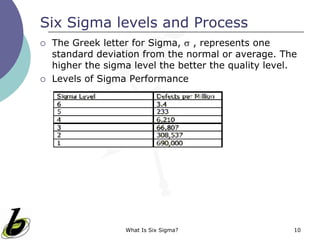
Six Sigma levels and Process
 The Greek letter for Sigma,  , represents one
standard deviation from the normal or average. The
higher the sigma level the better the quality level.
 Levels of Sigma Performance
What Is Six Sigma? 11
 Three levels of Six Sigma:
 As a Metric
 As a Methodology
 As a Management system
 Essentially, Six Sigma is all three at
the same time.
is a registered service mark and
trademark of Motorola, Inc.
What Is Six Sigma? 12
1. As a Metric
 The term “Sigma” is often used as a
scale for levels of "goodness" or
quality.
 Equates to 3.4 defects per one million
opportunities (DPMO).
 Six Sigma started as a defect reduction
effort in manufacturing and was then
applied to other business processes for
the same purpose.
What Is Six Sigma? 13
2. As a Methodology
 A business improvement
methodology that focuses an
organization on:
 Understanding and managing customer
requirements
 Aligning key business processes to
achieve those requirements
 Utilizing rigorous data analysis to
minimize variation in those processes
 Driving rapid and sustainable
improvement to business processes
What Is Six Sigma? 14
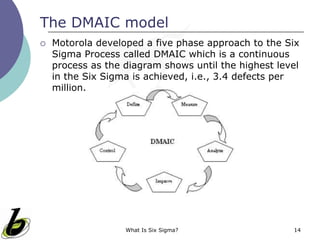
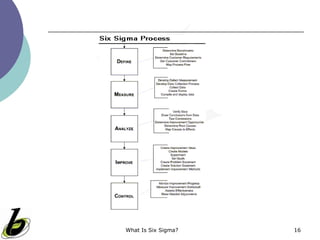
The DMAIC model
 Motorola developed a five phase approach to the Six
Sigma Process called DMAIC which is a continuous
process as the diagram shows until the highest level
in the Six Sigma is achieved, i.e., 3.4 defects per
million.
What Is Six Sigma? 15
 At the heart of the methodology is the
DMAIC model for process
improvement
 Define opportunity
 Measure performance
 Analyze opportunity
 Improve performance
 Control performance
What Is Six Sigma? 16
What Is Six Sigma? 17
3. As a Management system
 A top-down solution to help organizations:
 Align their business strategy to critical
improvement efforts
 Mobilize teams to attack high impact projects
 Accelerate improved business results
 Govern efforts to ensure improvements are
sustained
 Framework to prioritize resources for
projects that will improve the metrics, and it
leverages leaders who will manage the
efforts for rapid, sustainable, and improved
business results.
What Is Six Sigma? 18
Levels of Six Sigma Implementation
1. Six Sigma Champion: Champions undergo five
days of training and are taught how to manage
projects and act as advisors to various project
teams.
2. Green Belts: They undergo two weeks of training
that includes project-oriented tasks. They act as
team members to the Six Sigma project team. Their
cooperation and involvement is necessary for
projects success.
3. Black belts: They receive four weeks of trainings
and are directly involved in the implementation of
Six Sigma Projects. They are the project leaders and
go through in-depth training on Six Sigma approach
and tools and work full time on the project.
4. Master Black Belts: These are the people who
conduct Six Sigma Training and also have on the job
training and experience
Some Six Sigma Tools
What Is Six Sigma? 20
Quality Function Deployment
 QFD helps Six Sigma Black Belts drive
customer-focused development across the
design process.
 QFD is a system and set of procedures to
identify, communicate, and prioritize
customer requirements.
 Did you know? With QFD, Six Sigma teams
can more effectively focus on the activities
that mean the most to the customer, beat
the competition, and align with the mission
of the organization.
What Is Six Sigma? 21
Cause and Effect Matrix
 The C&E Matrix helps Six Sigma project
leaders facilitate team decision-making.
 The C&E Matrix is a tool that helps Six
Sigma teams select, prioritize, and analyze
the data they collect over the course of a
project to identify problems in that process.
 Six Sigma teams typically use the C&E
Matrix in the Measure phase of the DMAIC
methodology.
 The C&E Matrix is particularly great for
obtaining team consensus on the potential
relationships between factors that affect a
process and the output of that process.
What Is Six Sigma? 22
Failure Modes Effects Analysis
 FMEA helps Six Sigma teams to identify and
address weaknesses in a product or process,
before they occur.
 Before implementing new products,
processes, or services, Six Sigma teams use
FMEA to identify ways their new
introductions might fail, and then to develop
preventative measures targeted at the
failure scenarios.
 Did you know? An effective FMEA identifies
corrective actions required to prevent
failures from reaching the customer and will
improve performance, quality, and reliability.
What Is Six Sigma? 23
t-test
 The t-test helps Six Sigma teams validate
test results using small sample sizes.
 The t-test is used to determine the statistical
difference between two groups, not just a
difference due to random chance. Six Sigma
teams might use it to determine if a plan for
a comparative analysis of patient blood
pressures, before and after they receive a
drug, is likely to provide reliable results.
 Did you know? Guinness Brewery is the work
environment that led to W.S. Gossett's
creation of the t-test. While an executive at
the brewery in Dublin, Gossett created the t-
test to help select the best barley for
Guinness beer.
What Is Six Sigma? 24
Control Charts
 Six Sigma teams use Control Charts to
assess process stability.
 Control Charts are a simple but highly
effective tool for monitoring and improving
process performance over time because they
help Six Sigma teams to observe and
analyze variation.
 The three basic components of any control
chart are a centerline, upper and lower
statistically determined control limits, and
performance data plotted over time.
What Is Six Sigma? 25
Design of Experiments
 DOE helps Six Sigma Black Belts make the
most of valuable resources.
 DOE is a statistical technique that
encompasses the planning, design, data
collection, analysis and interpretation
strategy used by Six Sigma professionals.
 Did you know? Six Sigma teams use DOE to
determine the relationship between factors
(Xs) affecting a process and the output of
that process (Y).

Six Sigma

  • 1.
  • 2.
    Kaizen Kaizen is... ... asystem of continuous improvement in quality, technology, processes, company culture, productivity, safety and leadership
  • 3.
    Kaizen was createdin Japan following World War II. The word Kaizen means "continuous improvement". It comes from the Chinese characters 改 ("kai") which means "change" or "to correct" and 善 ("zen") which means "good".
  • 4.
    Kaizen (Continuous Improvement) Focus on gradual and continuous improvement  A whole business philosophy  Importance of EVERYONE buying into the concept and the vision
  • 5.
    Six Sigma Methodology SixSigma relies heavily on advanced statistical methods that complement and reduce the process and product variations. It is a new way of doing business that would eliminate the existing defects efficiently and would prevent defects from occurring.
  • 6.
     Coined byMotorola Engineer Bill Smith  Now a major influence on production methods and quality assurance  Data and statistical driven approach to eliminate defects in production  Aims to improve processes and reduce variations in quality  Necessitates organisational change, training and planning
  • 7.
    What Is SixSigma? 7 "Zero Defect"  "Defect" – any product or service that does not conform to the set standards or satisfaction of the customer.  Now, Six Sigma is a concept that tries to achieve a near zero defect with 3.4 defects in a million events.  Early adopters include Bank of America, Caterpillar, Honeywell International (previously known as Allied Signal), Raytheon, Merrill Lynch and General Electric.
  • 8.
    What Is SixSigma? 8 What is Six Sigma?  A methodology to improve a business process by constantly reviewing, updating and re-tuning the existing process.  Six Sigma improves the process performance, decreases variation and maintains consistent quality of the process output. This leads to defect reduction and improvement in profits, employee morale, product quality and finally customer satisfaction.  Six Sigma Strives for perfection. It allows for only 3.4 defects per million opportunities for each product or service transaction.  Six Sigma relies heavily on statistical techniques to reduce defects and measure quality.
  • 9.
    What Is SixSigma? 9 Evolution of Six Sigma  Japan has been credited with the evolvement of Quality Systems like TQM, Kanban, Kaizen, etc.  Pioneered in the U.S. by Bill Smith at Motorola in 1986; originally used as a metric for measuring defects for improving quality; a methodology to reduce defect levels <3.4 Defects Per Million Opportunities (DPMO). Motorola has reported >US$17b savings as of 2006.  Early adopters include Bank of America, Caterpillar, Honeywell International (previously known as Allied Signal), Raytheon, Merrill Lynch and General Electric.  Six Sigma was originally centered around manufacturing improvements. The reason for this was knowledge of the statistical tools in the manufacturing functions and the ease with which we can quantify the benefits.
  • 10.
    What Is SixSigma? 10 Six Sigma levels and Process  The Greek letter for Sigma,  , represents one standard deviation from the normal or average. The higher the sigma level the better the quality level.  Levels of Sigma Performance
  • 11.
    What Is SixSigma? 11  Three levels of Six Sigma:  As a Metric  As a Methodology  As a Management system  Essentially, Six Sigma is all three at the same time. is a registered service mark and trademark of Motorola, Inc.
  • 12.
    What Is SixSigma? 12 1. As a Metric  The term “Sigma” is often used as a scale for levels of "goodness" or quality.  Equates to 3.4 defects per one million opportunities (DPMO).  Six Sigma started as a defect reduction effort in manufacturing and was then applied to other business processes for the same purpose.
  • 13.
    What Is SixSigma? 13 2. As a Methodology  A business improvement methodology that focuses an organization on:  Understanding and managing customer requirements  Aligning key business processes to achieve those requirements  Utilizing rigorous data analysis to minimize variation in those processes  Driving rapid and sustainable improvement to business processes
  • 14.
    What Is SixSigma? 14 The DMAIC model  Motorola developed a five phase approach to the Six Sigma Process called DMAIC which is a continuous process as the diagram shows until the highest level in the Six Sigma is achieved, i.e., 3.4 defects per million.
  • 15.
    What Is SixSigma? 15  At the heart of the methodology is the DMAIC model for process improvement  Define opportunity  Measure performance  Analyze opportunity  Improve performance  Control performance
  • 16.
    What Is SixSigma? 16
  • 17.
    What Is SixSigma? 17 3. As a Management system  A top-down solution to help organizations:  Align their business strategy to critical improvement efforts  Mobilize teams to attack high impact projects  Accelerate improved business results  Govern efforts to ensure improvements are sustained  Framework to prioritize resources for projects that will improve the metrics, and it leverages leaders who will manage the efforts for rapid, sustainable, and improved business results.
  • 18.
    What Is SixSigma? 18 Levels of Six Sigma Implementation 1. Six Sigma Champion: Champions undergo five days of training and are taught how to manage projects and act as advisors to various project teams. 2. Green Belts: They undergo two weeks of training that includes project-oriented tasks. They act as team members to the Six Sigma project team. Their cooperation and involvement is necessary for projects success. 3. Black belts: They receive four weeks of trainings and are directly involved in the implementation of Six Sigma Projects. They are the project leaders and go through in-depth training on Six Sigma approach and tools and work full time on the project. 4. Master Black Belts: These are the people who conduct Six Sigma Training and also have on the job training and experience
  • 19.
  • 20.
    What Is SixSigma? 20 Quality Function Deployment  QFD helps Six Sigma Black Belts drive customer-focused development across the design process.  QFD is a system and set of procedures to identify, communicate, and prioritize customer requirements.  Did you know? With QFD, Six Sigma teams can more effectively focus on the activities that mean the most to the customer, beat the competition, and align with the mission of the organization.
  • 21.
    What Is SixSigma? 21 Cause and Effect Matrix  The C&E Matrix helps Six Sigma project leaders facilitate team decision-making.  The C&E Matrix is a tool that helps Six Sigma teams select, prioritize, and analyze the data they collect over the course of a project to identify problems in that process.  Six Sigma teams typically use the C&E Matrix in the Measure phase of the DMAIC methodology.  The C&E Matrix is particularly great for obtaining team consensus on the potential relationships between factors that affect a process and the output of that process.
  • 22.
    What Is SixSigma? 22 Failure Modes Effects Analysis  FMEA helps Six Sigma teams to identify and address weaknesses in a product or process, before they occur.  Before implementing new products, processes, or services, Six Sigma teams use FMEA to identify ways their new introductions might fail, and then to develop preventative measures targeted at the failure scenarios.  Did you know? An effective FMEA identifies corrective actions required to prevent failures from reaching the customer and will improve performance, quality, and reliability.
  • 23.
    What Is SixSigma? 23 t-test  The t-test helps Six Sigma teams validate test results using small sample sizes.  The t-test is used to determine the statistical difference between two groups, not just a difference due to random chance. Six Sigma teams might use it to determine if a plan for a comparative analysis of patient blood pressures, before and after they receive a drug, is likely to provide reliable results.  Did you know? Guinness Brewery is the work environment that led to W.S. Gossett's creation of the t-test. While an executive at the brewery in Dublin, Gossett created the t- test to help select the best barley for Guinness beer.
  • 24.
    What Is SixSigma? 24 Control Charts  Six Sigma teams use Control Charts to assess process stability.  Control Charts are a simple but highly effective tool for monitoring and improving process performance over time because they help Six Sigma teams to observe and analyze variation.  The three basic components of any control chart are a centerline, upper and lower statistically determined control limits, and performance data plotted over time.
  • 25.
    What Is SixSigma? 25 Design of Experiments  DOE helps Six Sigma Black Belts make the most of valuable resources.  DOE is a statistical technique that encompasses the planning, design, data collection, analysis and interpretation strategy used by Six Sigma professionals.  Did you know? Six Sigma teams use DOE to determine the relationship between factors (Xs) affecting a process and the output of that process (Y).