Business Strategy – Internal Analysis of the Company
Prepeared By Debashish Bramha. Please Click Debashish Bramha’s Blog: http://debashishbramha.blogspot.com
What do we mean by strategy? Strategy refers to the plans made and action taken to enable an organization to fulfill its indented objectives Strategy is management’s game plan for strengthening the organization’s position, pleasing customers, and achieving performance targets. http:// debashishbramha.blogspot.com
Without a strategy, managers have: No thought-out course to follow No roadmap to manage by No action program to produce the intended result http:// debashishbramha.blogspot.com
Good strategy and good strategy execution are the most trustworthy signs of good management. http:// debashishbramha.blogspot.com
Components of Strategic Management Process Vision Company Mission Company Profile Recognizing and evaluating external and internal environment. Strategic Analysis and Choice Strategy Formulation Strategy Implementation Evaluation of performance http:// debashishbramha.blogspot.com
which are required for firms to achieve: Above-Average Returns Strategic Competitiveness Sustained Competitive Advantage The Strategic Management Process Involves the full set of: http:// debashishbramha.blogspot.com Actions Commitments Decisions
Sustained Competitive Advantage Above-Average Returns Returns in excess of what an investor expects to earn from other investments with  similar risk Occurs when a firm develops a strategy that competitors are not simultaneously implementing Provides benefits which current and potential competitors are unable to duplicate Strategic Competitiveness Achieved when a firm successfully formulates and implements a value-creating strategy http:// debashishbramha.blogspot.com
What does a company’s strategy consist of? How to satisfy customers Broad or narrow product line? Amount of customer service provided? How to grow the business Concentrate on a single business strategy? Diversify into related or unrelated industries? Expand globally? Company strategies concern: http:// debashishbramha.blogspot.com
How to respond to changing industry and market conditions How best to capitalize on new opportunities How to manage each functional piece of the business How to achieve strategic and financial objectives What does a company’s strategy consist of? http:// debashishbramha.blogspot.com
What is an Internal Analysis? Internal Analysis Identifies and evaluates resources, capabilities, and core competencies Looks at the organization’s Current vision Mission Strategic objectives Strategies
Why Do an Internal Analysis? It is the only way to identify an organization’s strengths and weaknesses It’s needed for making good strategic decisions http:// debashishbramha.blogspot.com
Value Chain Analysis The  premise  behind value chain analysis is that customers demand value from goods and services they obtain Customer value Product is unique and different Product is low priced Quick response to specific or distinctive customer needs A value chain is a  systematic  way of examining organization’s functional activities http:// debashishbramha.blogspot.com
http:// debashishbramha.blogspot.com General administration Human resource management Technology development Procurement Inbound logistics Operations Outbound logistics Marketing and sales Service The Value Chain
Value Chain Analysis Inbound  Logistics • • • Materials control system Inventory control system Raw material handling and warehousing Operations • • • • Equipment comparison to competitors Plant layout Production control system Level of automation in production processes http:// debashishbramha.blogspot.com
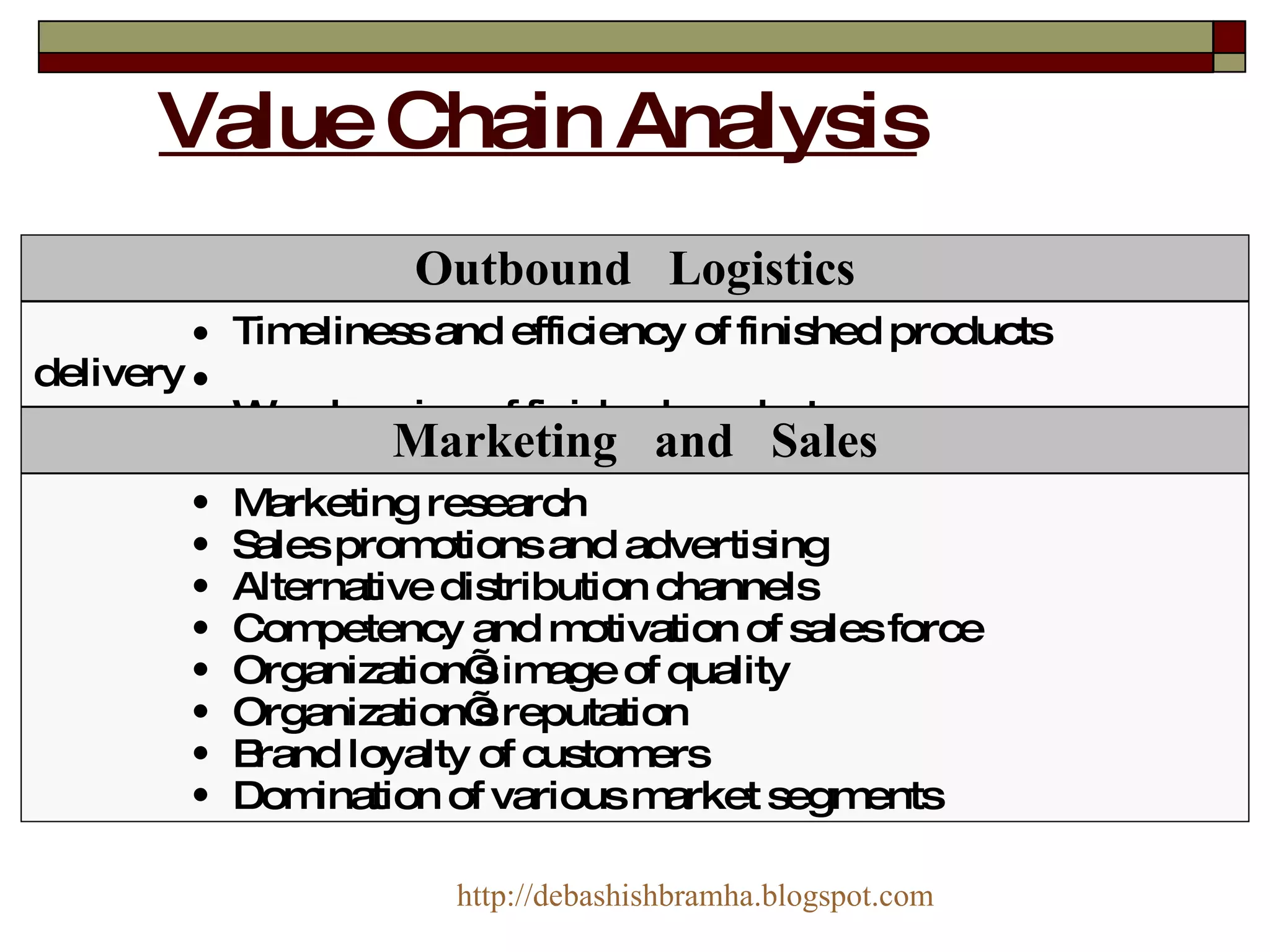
Value Chain Analysis Outbound  Logistics • • Timeliness and efficiency of finished products delivery Warehousing of finished products Marketing  and  Sales • • • • • • • • Marketing research Sales promotions and advertising Alternative distribution channels Competency and motivation of sales force Organization’s image of quality Organization’s reputation Brand loyalty of customers Domination of various market segments http:// debashishbramha.blogspot.com
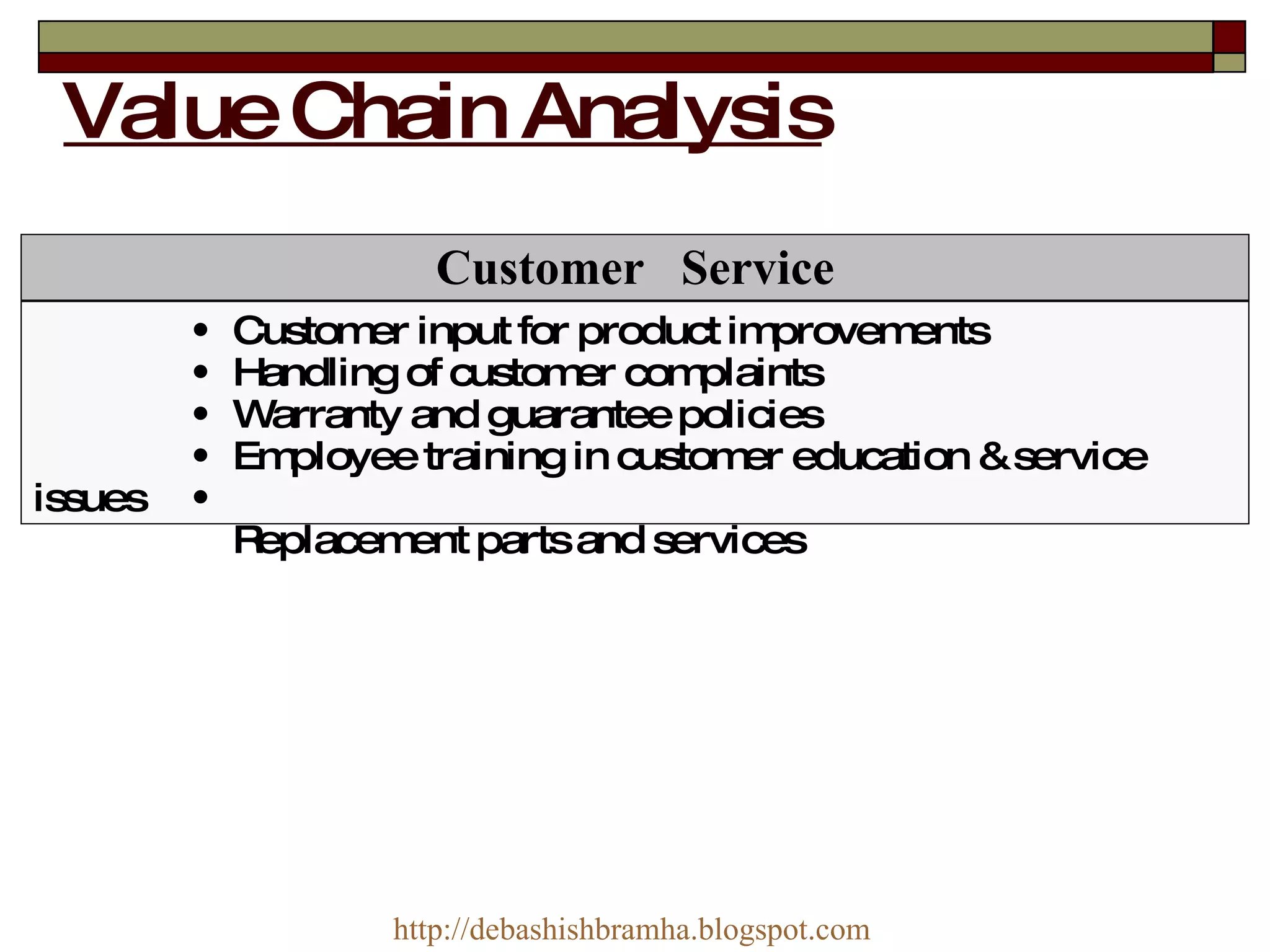
Value Chain Analysis Customer  Service • • • • • Customer input for product improvements Handling of customer complaints Warranty and guarantee policies Employee training in customer education & service issues Replacement parts and services http:// debashishbramha.blogspot.com
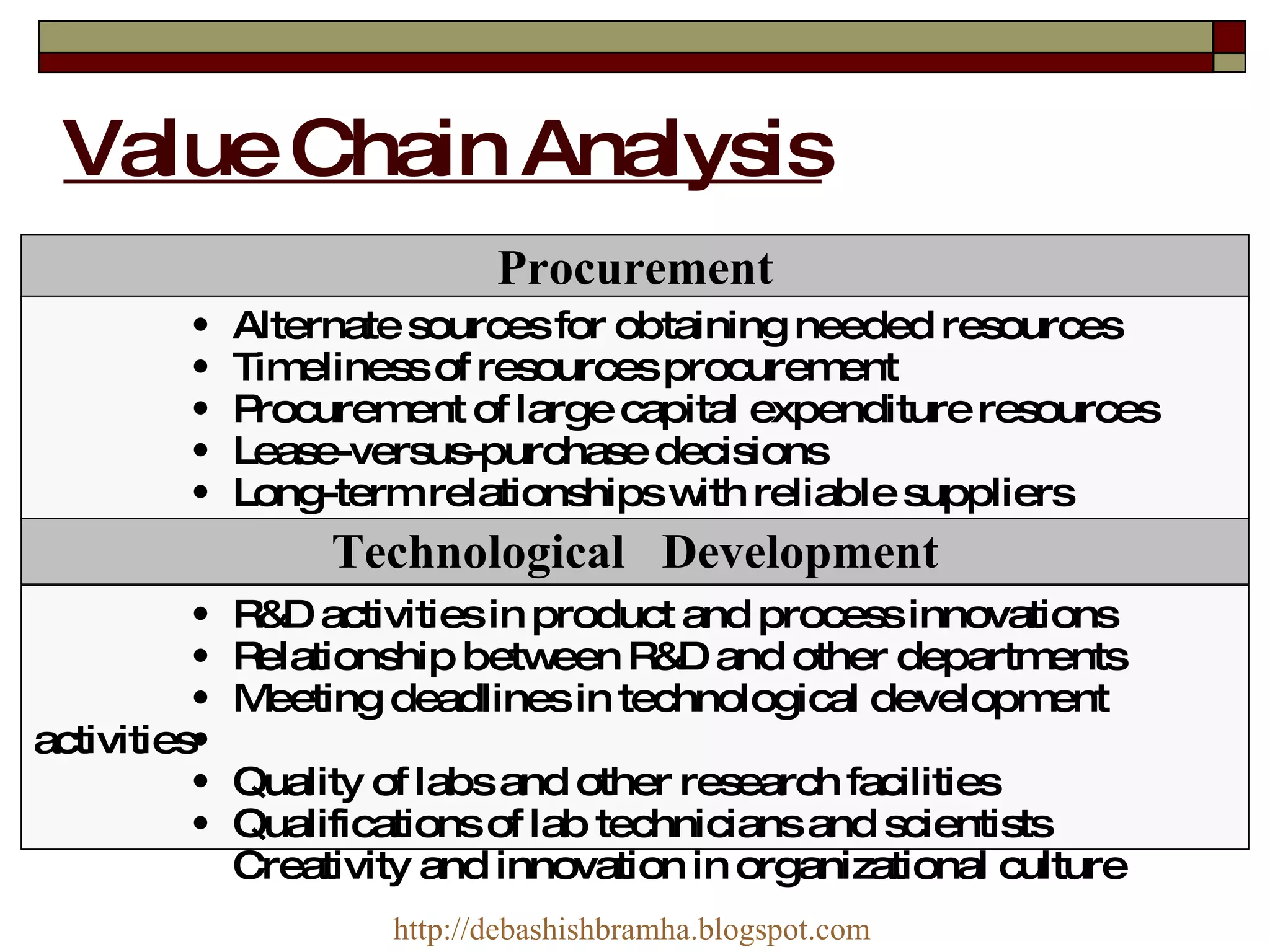
Value Chain Analysis Procurement • • • • • Alternate sources for obtaining needed resources Timeliness of resources procurement Procurement of large capital expenditure resources Lease-versus-purchase decisions Long-term relationships with reliable suppliers Technological  Development • • • • • • R&D activities in product and process innovations Relationship between R&D and other departments Meeting deadlines in technological development activities Quality of labs and other research facilities Qualifications of lab technicians and scientists Creativity and innovation in organizational culture http:// debashishbramha.blogspot.com
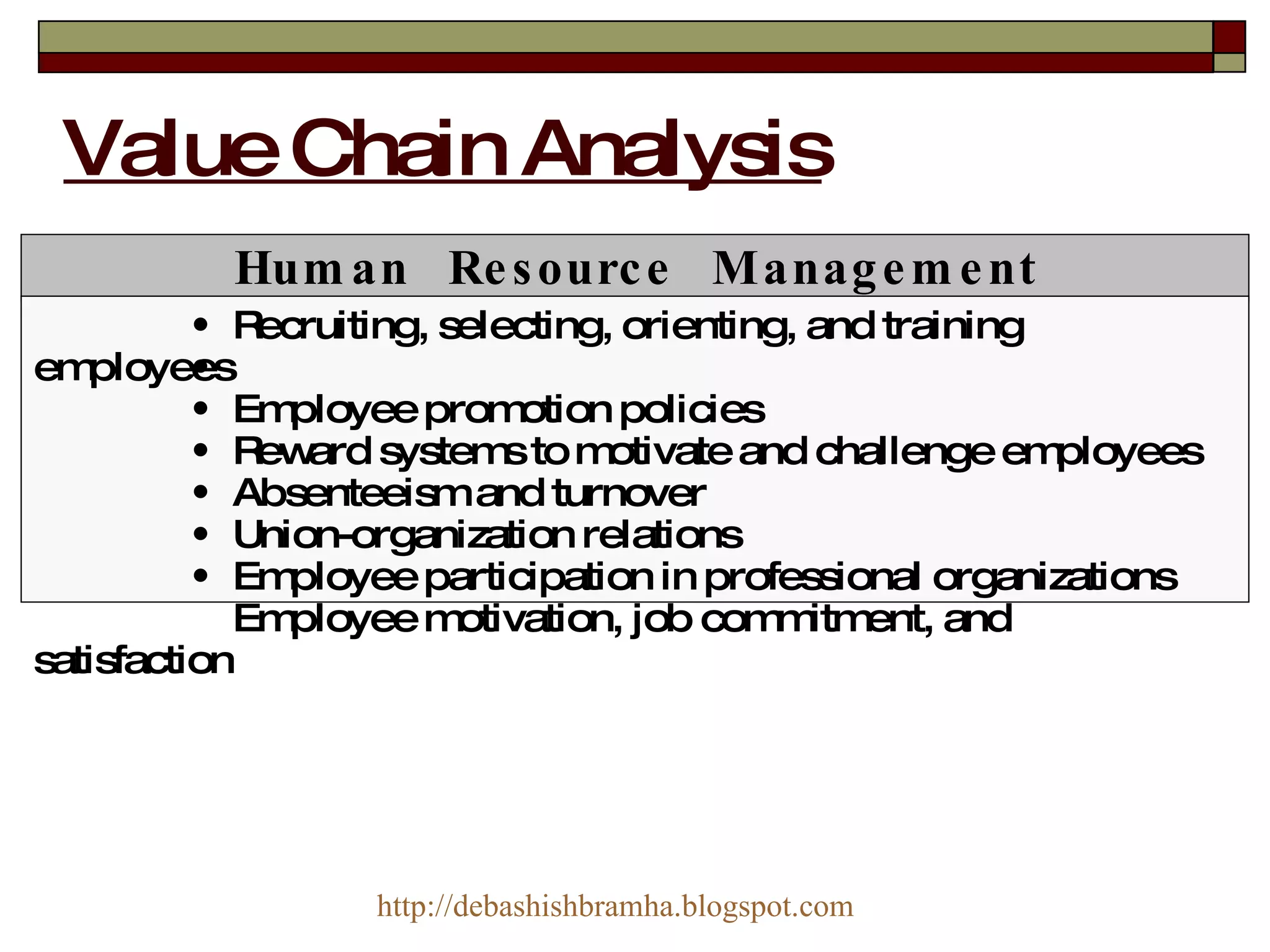
Value Chain Analysis Human  Resource  Management • • • • • • • Recruiting, selecting, orienting, and training employees Employee promotion policies Reward systems to motivate and challenge employees Absenteeism and turnover Union-organization relations Employee participation in professional organizations Employee motivation, job commitment, and satisfaction http:// debashishbramha.blogspot.com
Value Chain Analysis Firm  Infrastructure • • • • • • • Identification of external opportunities and threats Accomplishing goals with strategic planning system Coordination and integration of value chain activities Low-cost capital expenditures & working capital funds IS support for strategic and operational decisions Relationships with stakeholders Public image as a responsible corporate citizen http:// debashishbramha.blogspot.com
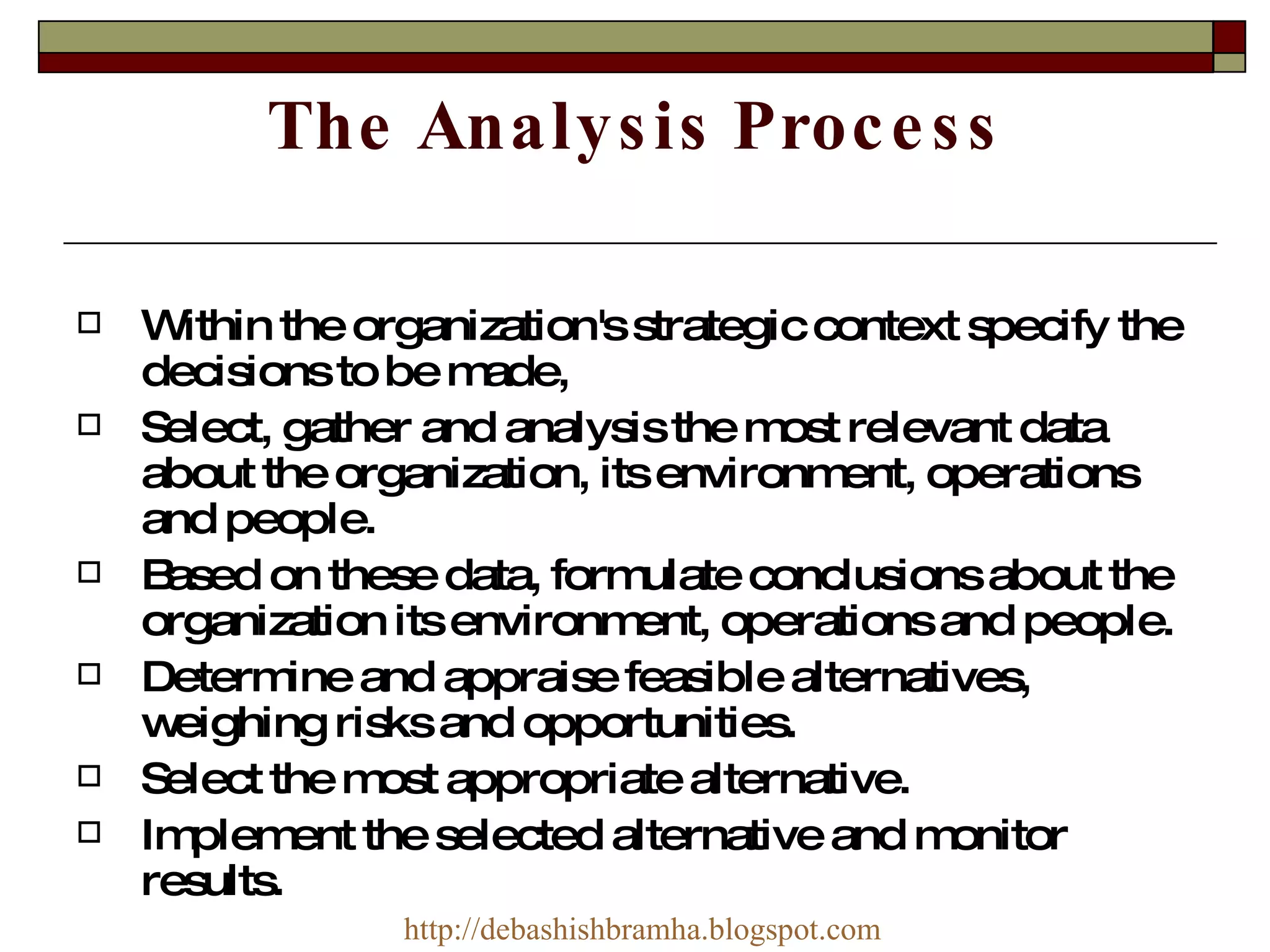
The Analysis Process Within the organization's strategic context specify the decisions to be made, Select, gather and analysis the most relevant data about the organization, its environment, operations and people. Based on these data, formulate conclusions about the organization its environment, operations and people. Determine and appraise feasible alternatives, weighing risks and opportunities. Select the most appropriate alternative. Implement the selected alternative and monitor results. http:// debashishbramha.blogspot.com
Interrelationships among Value-Chain Activities within and across Organizations Interrelationships among  activities within the firm Relationships among  activities within the firm and with other organizations (e.g., customers and suppliers)
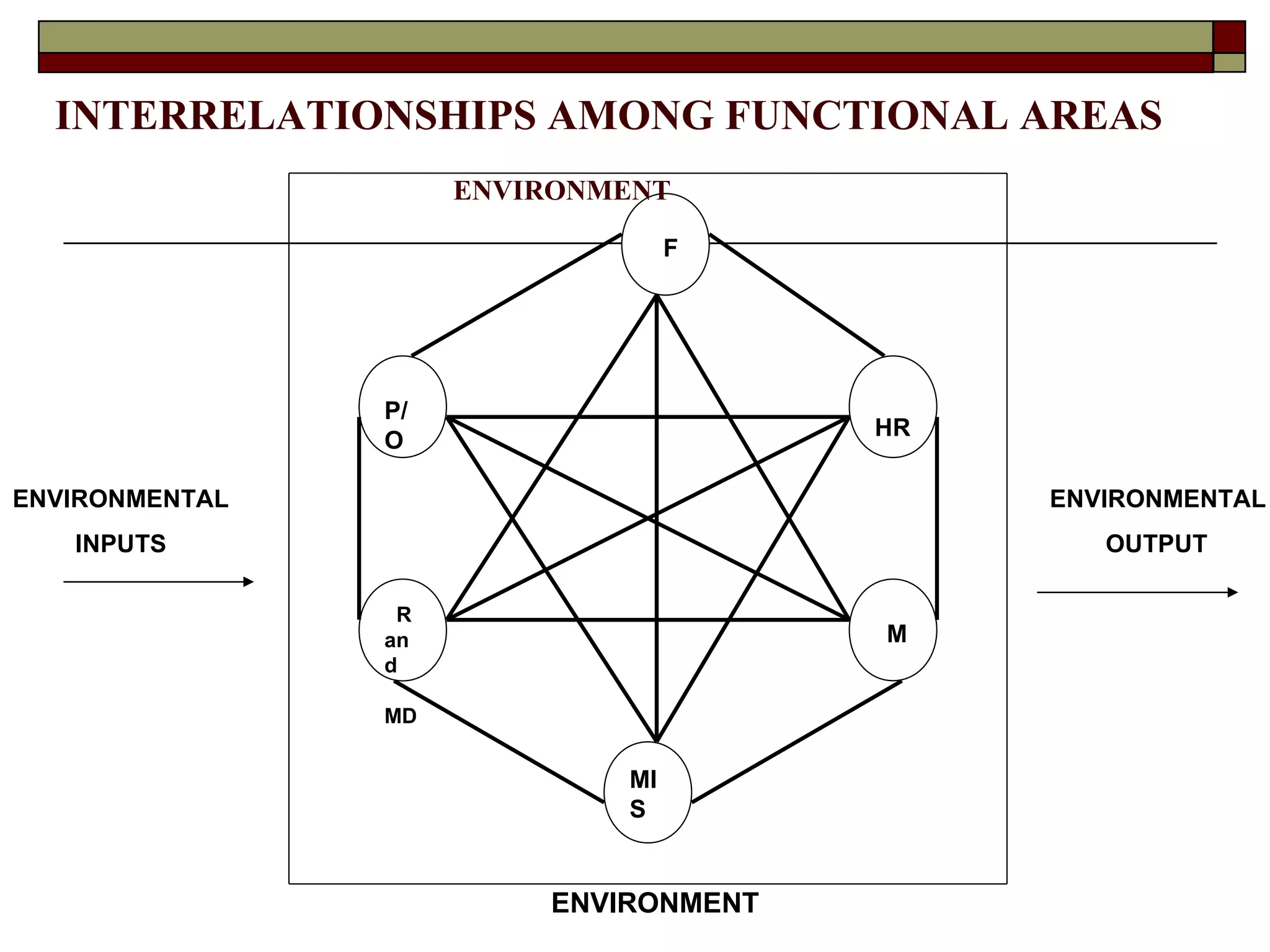
INTERRELATIONSHIPS AMONG FUNCTIONAL AREAS   ENVIRONMENT ENVIRONMENTAL INPUTS ENVIRONMENTAL  OUTPUT ENVIRONMENT HR M MIS R and  MD P/O F
STRATEGIC INTERNAL FACTORS
Relatively easy to identify, and include physical and financial assets used to create value for customers Financial resources Firm’s cash accounts Firm’s capacity to raise equity Firm’s borrowing capacity Physical resources Modern plant and facilities Favorable manufacturing locations State-of-the-art machinery and equipment Tangible Resources
Technological resources Trade secrets Innovative production processes Patents, copyrights, trademarks Organizational resources Effective strategic planning processes Excellent evaluation and control systems Tangible Resources
Innovation and creativity Technical and scientific skills Innovation capacities Reputation Effective strategic planning processes Excellent evaluation and control systems Difficult for competitors (and the firm itself) to account for or imitate, typically embedded in unique routines and practices that have evolved over time Intangible Resources
Human Experience and capabilities of employees Trust Managerial skills Firm-specific practices and procedures Intangible Resources
Competencies or skills that a firm employs to transform inputs to outputs, and capacity to combine tangible and intangible resources to attain desired end Outstanding customer service Excellent product development capabilities Innovativeness of products and services Ability to hire, motivate, and retain human capital Organizational Capabilities
For a strategic capability to be a Core Competency, it must be: Core Competencies What a firm  Does ... that is Strategically Valuable Valuable Rare Costly to Imitate No substitutable
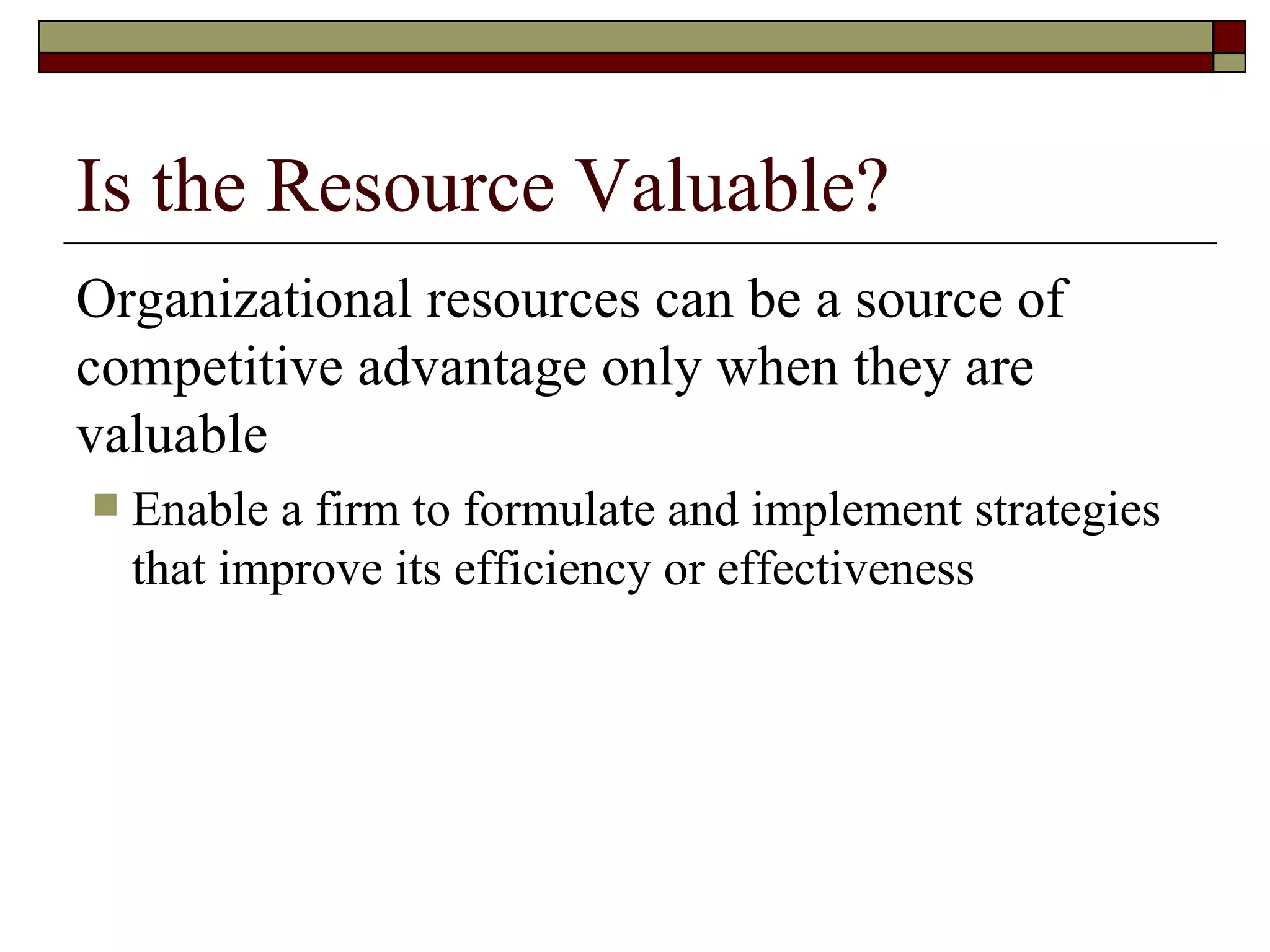
Is the Resource Valuable? Organizational resources can be a source of competitive advantage only when they are valuable Enable a firm to formulate and implement strategies that improve its efficiency or effectiveness
Is the Resource Rare? Organizational resources also possessed by competitors are not sources of competitive advantage Common strategies based on similar resources give no one firm an advantage Competitive advantages are gained only from uncommon resources, resources that are rare to other competitors
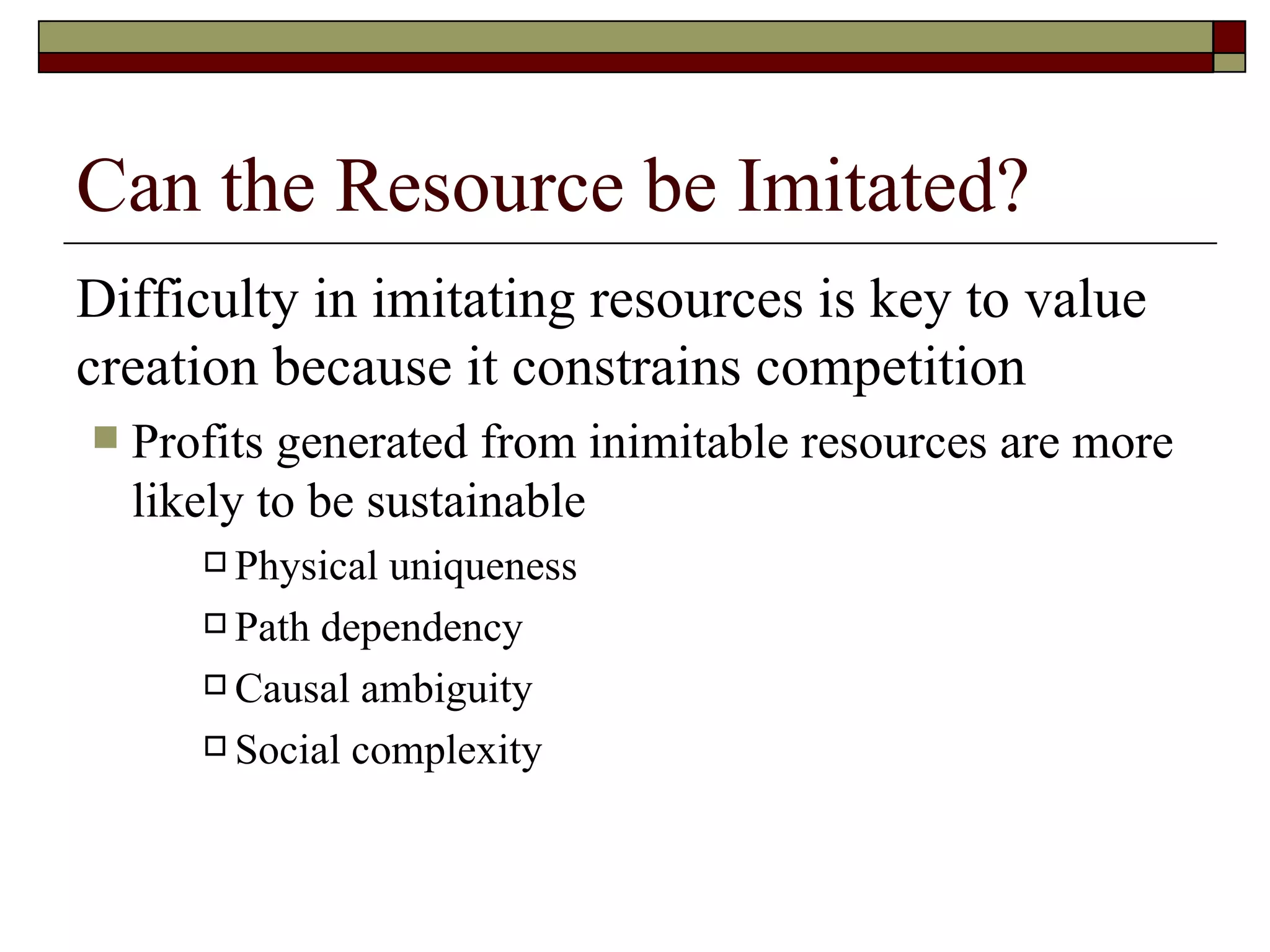
Can the Resource be Imitated? Difficulty in imitating resources is key to value creation because it constrains competition Profits generated from inimitable resources are more likely to be sustainable Physical uniqueness Path dependency Causal ambiguity Social complexity
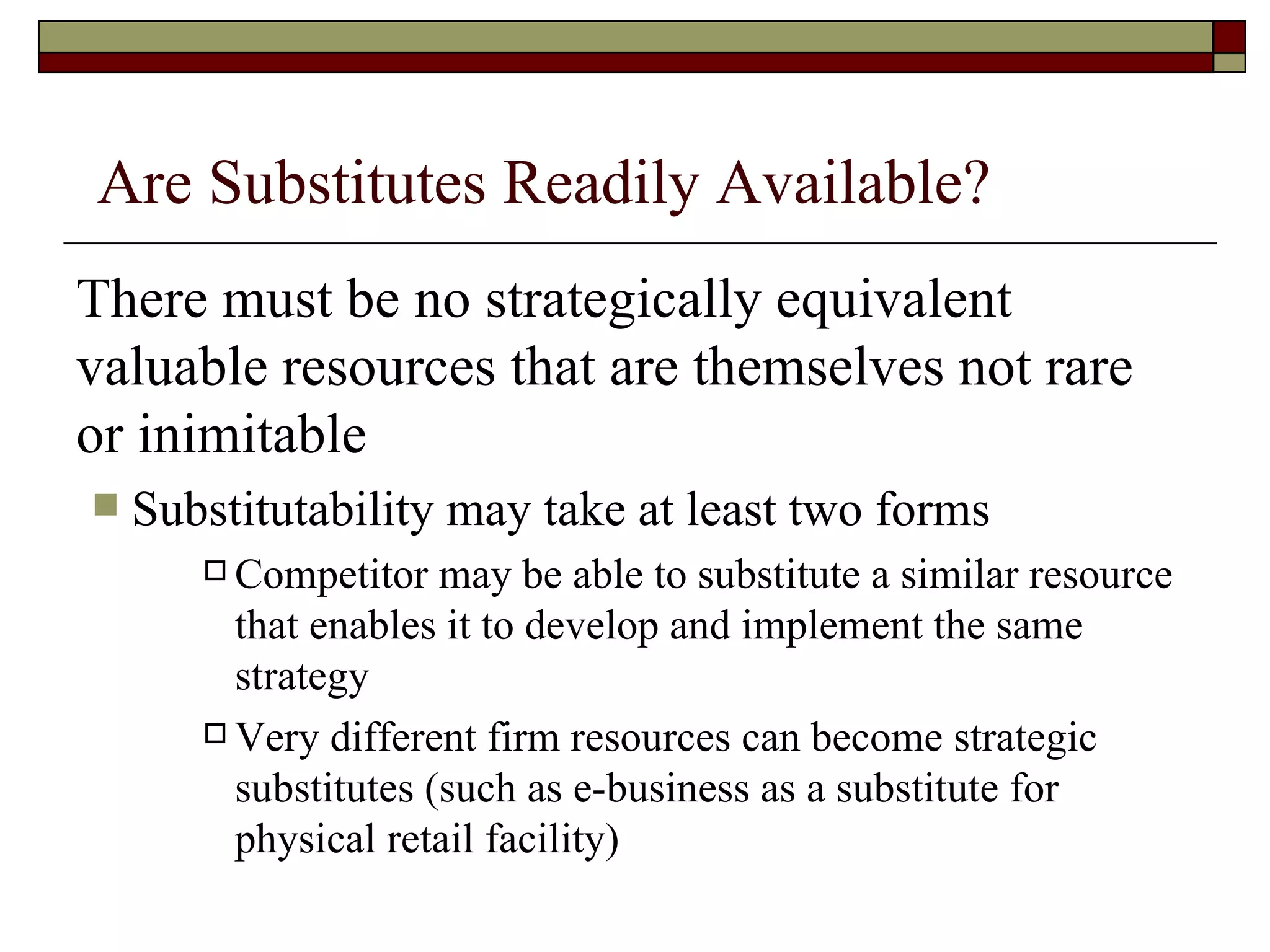
Are Substitutes Readily Available? There must be no strategically equivalent valuable resources that are themselves not rare or inimitable Substitutability may take at least two forms Competitor may be able to substitute a similar resource that enables it to develop and implement the same strategy Very different firm resources can become strategic substitutes (such as e-business as a substitute for physical retail facility)
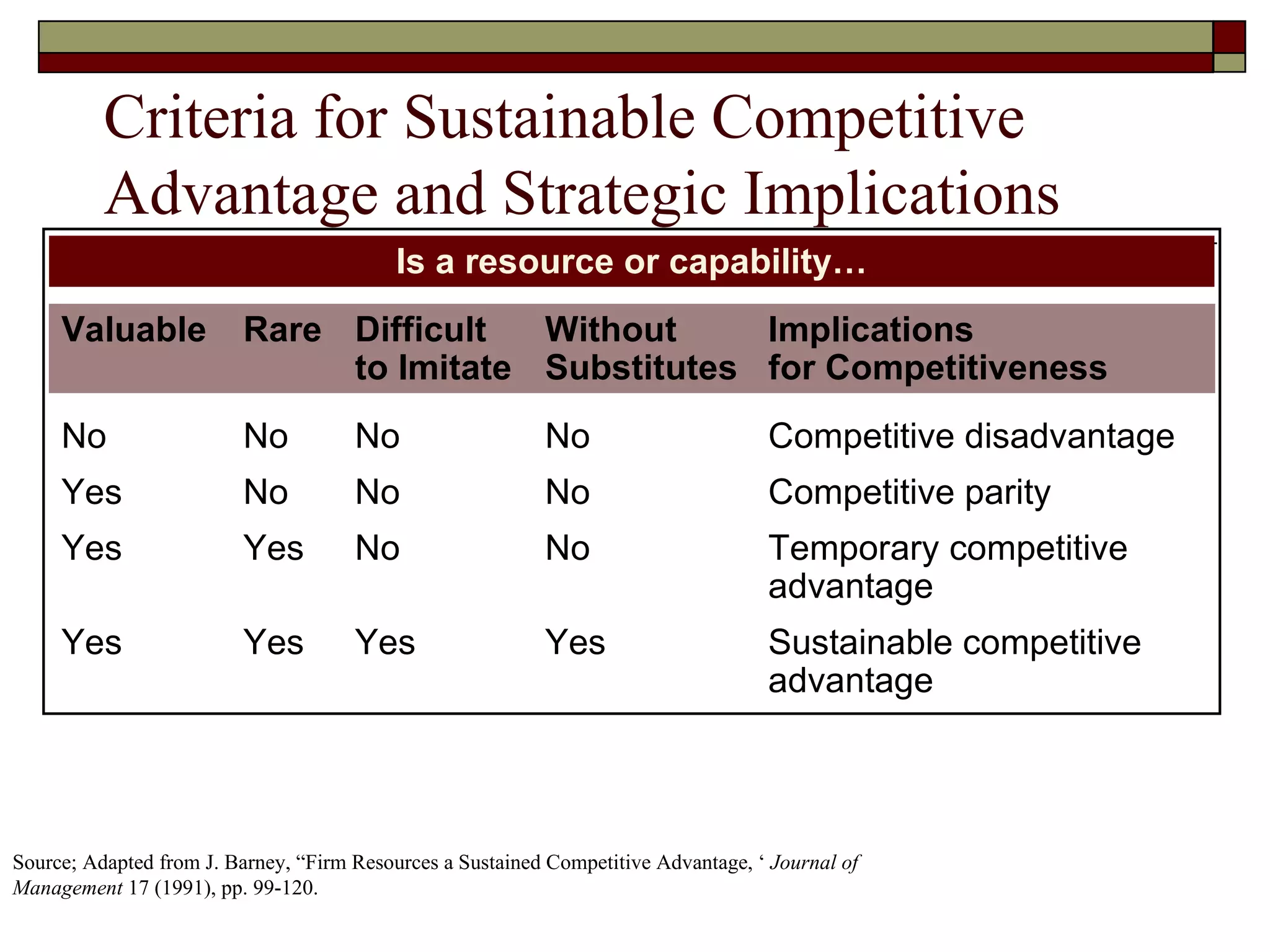
Criteria for Sustainable Competitive Advantage and Strategic Implications Valuable Rare Difficult  Without Implications to Imitate Substitutes for Competitiveness No No No No Competitive disadvantage Yes No No No Competitive parity Yes Yes No No Temporary competitive  advantage Yes Yes Yes Yes Sustainable competitive  advantage Is a resource or capability… Source; Adapted from J. Barney, “Firm Resources a Sustained Competitive Advantage, ‘  Journal of Management  17 (1991), pp. 99-120.
Challenge of Internal Analysis How do we effectively manage current core competencies while simultaneously developing new ones? How do we assemble bundles of resources, capabilities and core competencies to create value for customers? How do we learn to change rapidly?
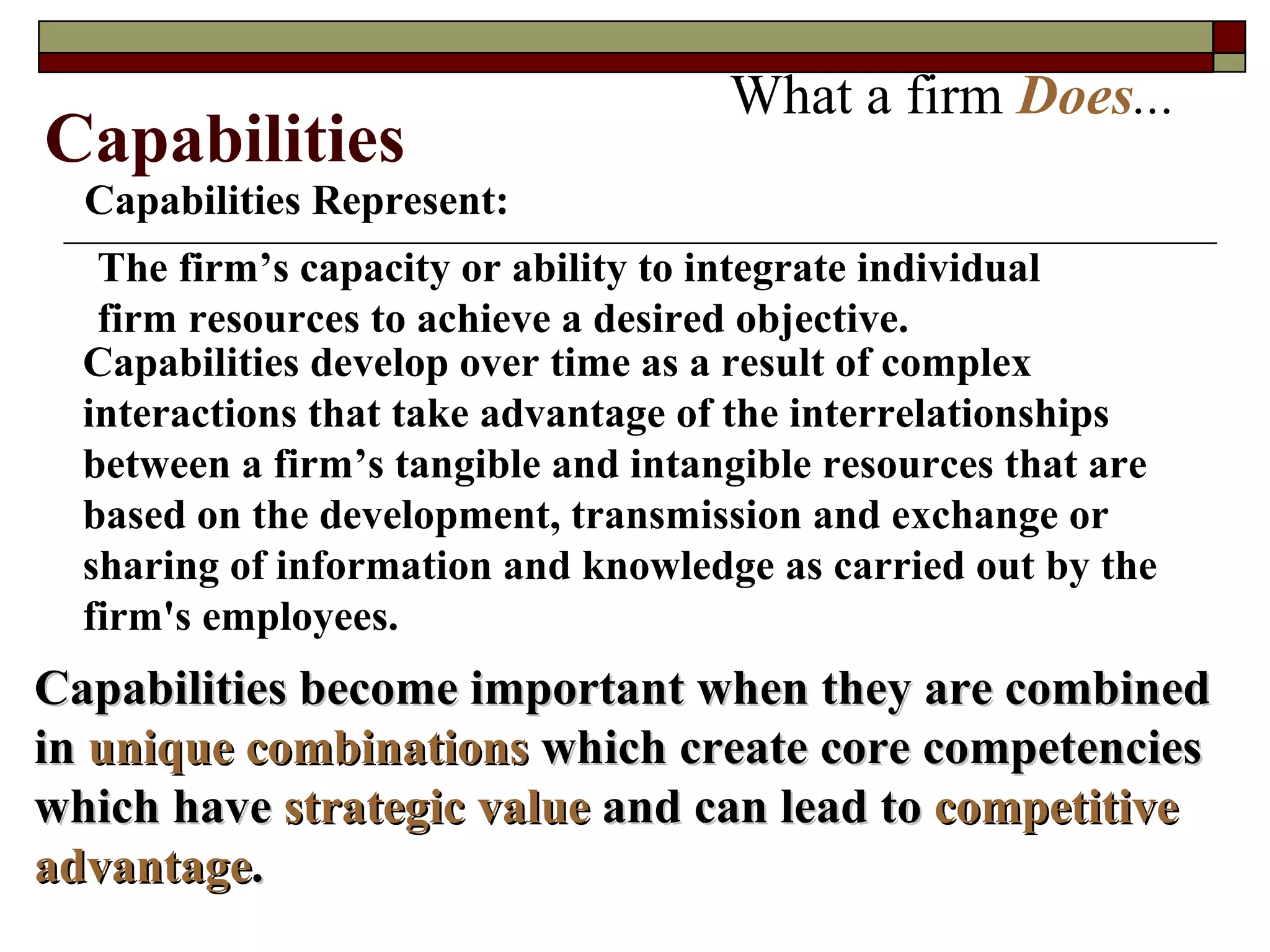
What a firm  Does ... Capabilities Represent: The firm’s capacity or ability to integrate individual firm resources to achieve a desired objective. Capabilities develop over time as a result of complex interactions that take advantage of the interrelationships between a firm’s tangible and intangible resources that are based on the development, transmission and exchange or sharing of information and knowledge as carried out by the firm's employees. Capabilities become important when they are combined in  unique combinations  which create core competencies which have   strategic value  and can lead to   competitive advantage . Capabilities
Human Resource Development Initiations Measures :-  Employee  Motivation For Strategic   Effectiveness Developed in-built appraisal system like–   (a) Productivity Honorarium Scheme  (b) Quarterly Incentive Scheme  (c ) Group Incentives for cohesive team working &  (d) Reward and Reconviction Scheme.
Coverage and Evaluation of Ratios The different types of financial ratios in Financial Strategic Management includes: Liquidity  Activity Debt  Profitability
Liquidity Ratio Analysis Liquidity ratios measure a firm’s ability to meet its current financial obligations. Liquidity Ratios include:  Net working capital Current Ratio Quick Ratio
Net Working Capital While not technically a ratio, Net Working Capital (NWC) is a key element for internal control. The higher this number the better. NWC is found by subtracting current liabilities from current assets. This is a sign of growing assets while keeping their liabilities stable.
Current Ratio The Current Ratio is a direct evaluation of a company’s liquidity. The higher this value, the more liquid a firm’s resources are. Current Ratio is found by dividing current assets by current liabilities. This could be improved by lowering the reliance on debt financing.
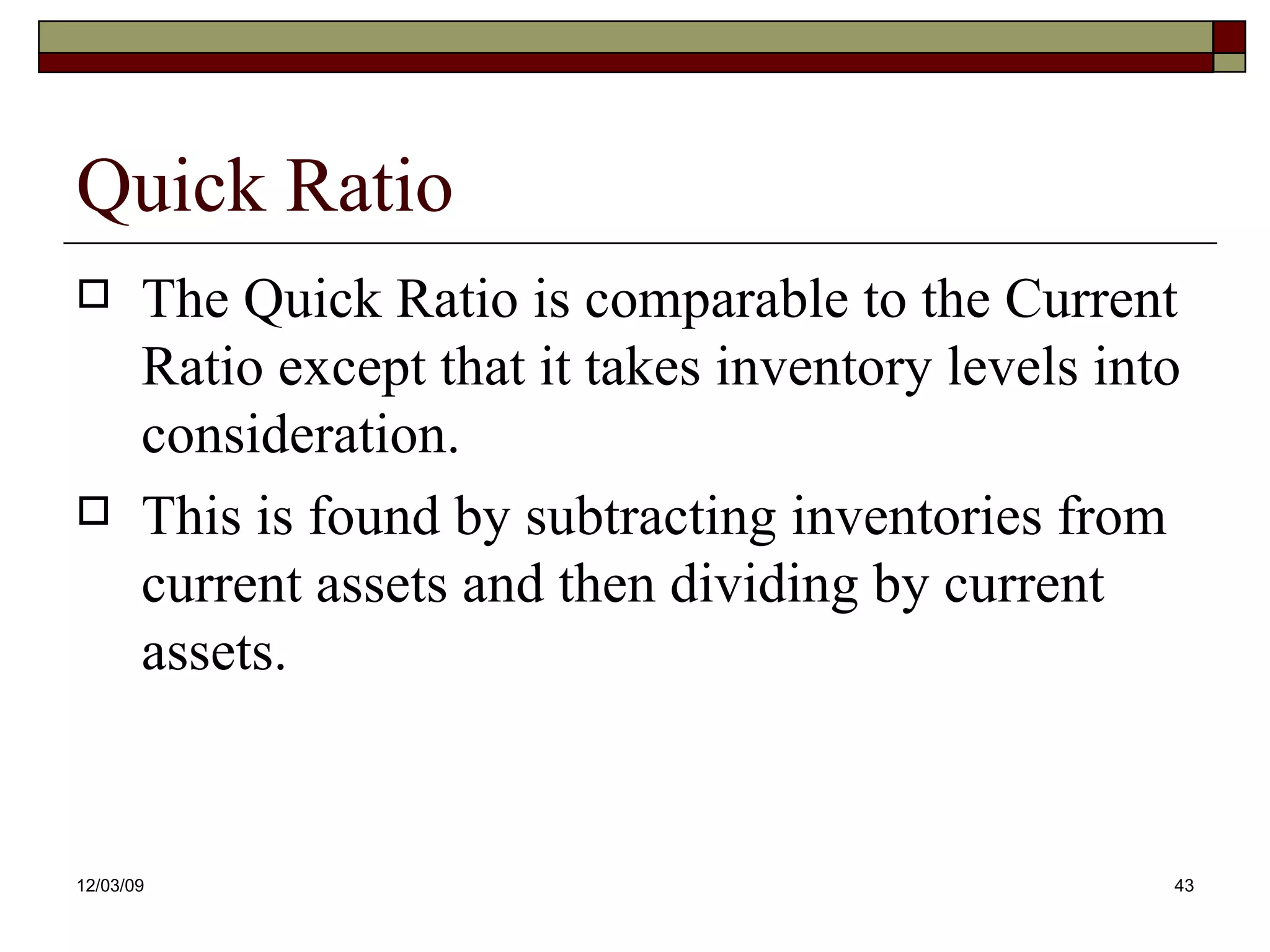
Quick Ratio The Quick Ratio is comparable to the Current Ratio except that it takes inventory levels into consideration. This is found by subtracting inventories from current assets and then dividing by current assets.
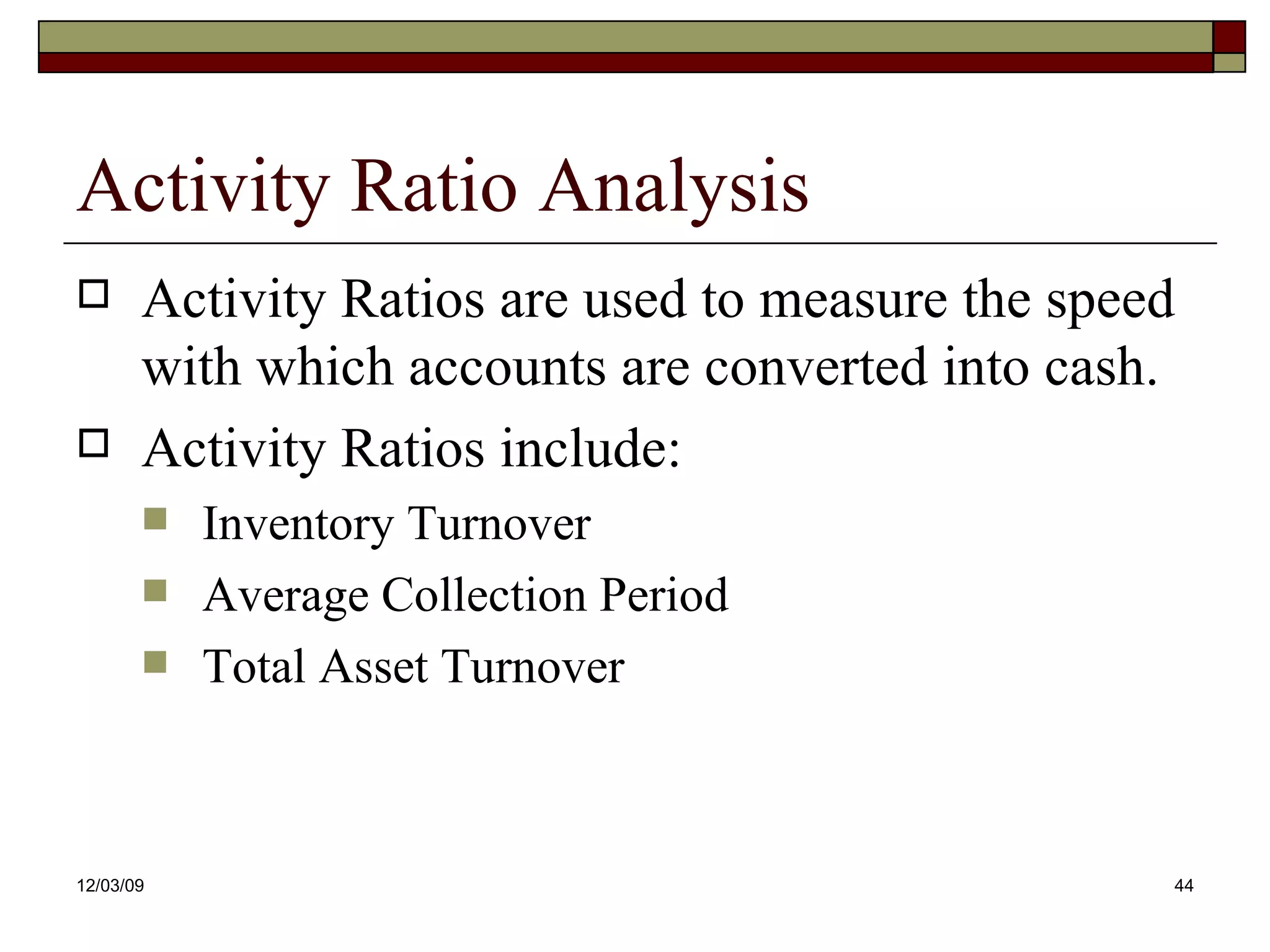
Activity Ratio Analysis Activity Ratios are used to measure the speed with which accounts are converted into cash.  Activity Ratios include: Inventory Turnover Average Collection Period Total Asset Turnover
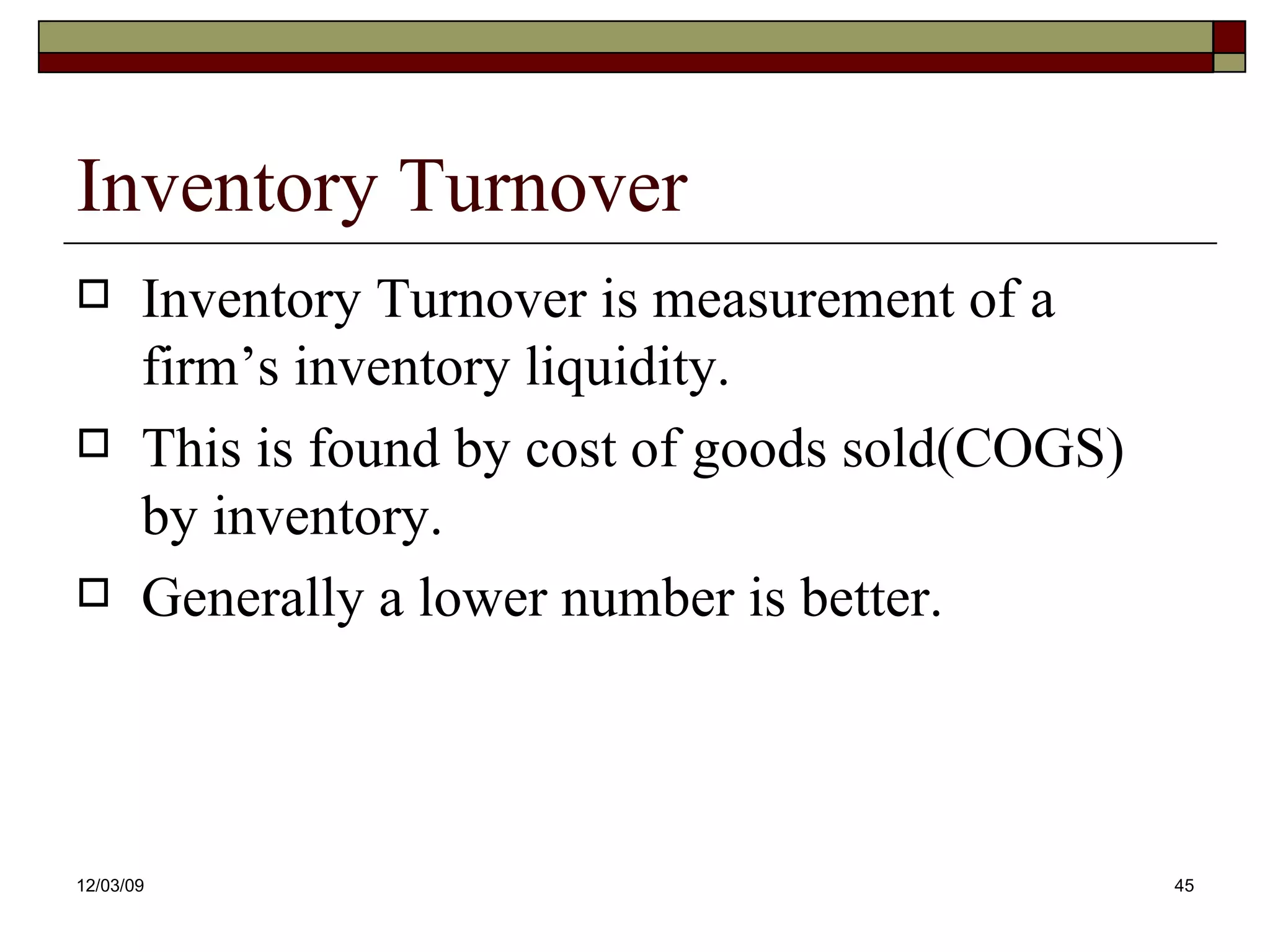
Inventory Turnover Inventory Turnover is measurement of a firm’s inventory liquidity. This is found by cost of goods sold(COGS) by inventory. Generally a lower number is better.
Total Asset Turnover Total Asset Turnover illustrates the firm’s ability and proficiency in using its assets to generated sales. It is found by dividing sales by total assets, and is measured in times per year When using cross-sectional analysis, a company must take special care in comparing Total Asset Turnover because new assets tend to have lower turnover.
Debt Ratio Analysis A company’s debt position is a measure of how much of the firm’s profits are generated using money borrowed from other companies or individuals. Debt Ratios include: Financial Leverage Multiplier Debt Ratio Interest Coverage Ratio
Financial Leverage Multiplier The Financial Leverage Multiplier (FLM) is used to convert the company’s Return On Assets to its Return on Equity.  This reflects the impact of leverage, or use of debt, on owners’ return. It is the ratio of total assets to stockholders’ equity.
Profitability Ratio Analysis Profitability Ratios evaluate a company’s earnings with respect to sales, assets, owner’s investments and share values. Profitability Ratios include Gross Profit Margin Operating Profit Margin Net Profit Margin  Return on Total Assets Return on Equity
Gross Profit Margin The Gross Profit Margin(GPR) is the percentage of each sales dollar that remains after the firm has paid for the goods sold. It is found by subtracting COGS from sales and dividing by sales.
Net Profit Margin Net Profit Margin(NPR), one of the most popular indicators of company health, measures the percentage of sales revenue remaining after  ALL  expenses are paid. NPR is found by dividing net profits by sales
Return on Total Assets Return of Total Assets(ROA), also known as return on investment, measures a firm’s effectiveness at generating profits with its assets. ROA is found by dividing the net profits after taxes by total assets.
Return on Equity The Return on Equity(ROE) is extremely important to potential investors. ROE is found by dividing net profit by owner’s equity.

Internal Analysys Of Strategic Management

  • 1.
    Business Strategy –Internal Analysis of the Company
  • 2.
    Prepeared By DebashishBramha. Please Click Debashish Bramha’s Blog: http://debashishbramha.blogspot.com
  • 3.
    What do wemean by strategy? Strategy refers to the plans made and action taken to enable an organization to fulfill its indented objectives Strategy is management’s game plan for strengthening the organization’s position, pleasing customers, and achieving performance targets. http:// debashishbramha.blogspot.com
  • 4.
    Without a strategy,managers have: No thought-out course to follow No roadmap to manage by No action program to produce the intended result http:// debashishbramha.blogspot.com
  • 5.
    Good strategy andgood strategy execution are the most trustworthy signs of good management. http:// debashishbramha.blogspot.com
  • 6.
    Components of StrategicManagement Process Vision Company Mission Company Profile Recognizing and evaluating external and internal environment. Strategic Analysis and Choice Strategy Formulation Strategy Implementation Evaluation of performance http:// debashishbramha.blogspot.com
  • 7.
    which are requiredfor firms to achieve: Above-Average Returns Strategic Competitiveness Sustained Competitive Advantage The Strategic Management Process Involves the full set of: http:// debashishbramha.blogspot.com Actions Commitments Decisions
  • 8.
    Sustained Competitive AdvantageAbove-Average Returns Returns in excess of what an investor expects to earn from other investments with similar risk Occurs when a firm develops a strategy that competitors are not simultaneously implementing Provides benefits which current and potential competitors are unable to duplicate Strategic Competitiveness Achieved when a firm successfully formulates and implements a value-creating strategy http:// debashishbramha.blogspot.com
  • 9.
    What does acompany’s strategy consist of? How to satisfy customers Broad or narrow product line? Amount of customer service provided? How to grow the business Concentrate on a single business strategy? Diversify into related or unrelated industries? Expand globally? Company strategies concern: http:// debashishbramha.blogspot.com
  • 10.
    How to respondto changing industry and market conditions How best to capitalize on new opportunities How to manage each functional piece of the business How to achieve strategic and financial objectives What does a company’s strategy consist of? http:// debashishbramha.blogspot.com
  • 11.
    What is anInternal Analysis? Internal Analysis Identifies and evaluates resources, capabilities, and core competencies Looks at the organization’s Current vision Mission Strategic objectives Strategies
  • 12.
    Why Do anInternal Analysis? It is the only way to identify an organization’s strengths and weaknesses It’s needed for making good strategic decisions http:// debashishbramha.blogspot.com
  • 13.
    Value Chain AnalysisThe premise behind value chain analysis is that customers demand value from goods and services they obtain Customer value Product is unique and different Product is low priced Quick response to specific or distinctive customer needs A value chain is a systematic way of examining organization’s functional activities http:// debashishbramha.blogspot.com
  • 14.
    http:// debashishbramha.blogspot.com Generaladministration Human resource management Technology development Procurement Inbound logistics Operations Outbound logistics Marketing and sales Service The Value Chain
  • 15.
    Value Chain AnalysisInbound Logistics • • • Materials control system Inventory control system Raw material handling and warehousing Operations • • • • Equipment comparison to competitors Plant layout Production control system Level of automation in production processes http:// debashishbramha.blogspot.com
  • 16.
    Value Chain AnalysisOutbound Logistics • • Timeliness and efficiency of finished products delivery Warehousing of finished products Marketing and Sales • • • • • • • • Marketing research Sales promotions and advertising Alternative distribution channels Competency and motivation of sales force Organization’s image of quality Organization’s reputation Brand loyalty of customers Domination of various market segments http:// debashishbramha.blogspot.com
  • 17.
    Value Chain AnalysisCustomer Service • • • • • Customer input for product improvements Handling of customer complaints Warranty and guarantee policies Employee training in customer education & service issues Replacement parts and services http:// debashishbramha.blogspot.com
  • 18.
    Value Chain AnalysisProcurement • • • • • Alternate sources for obtaining needed resources Timeliness of resources procurement Procurement of large capital expenditure resources Lease-versus-purchase decisions Long-term relationships with reliable suppliers Technological Development • • • • • • R&D activities in product and process innovations Relationship between R&D and other departments Meeting deadlines in technological development activities Quality of labs and other research facilities Qualifications of lab technicians and scientists Creativity and innovation in organizational culture http:// debashishbramha.blogspot.com
  • 19.
    Value Chain AnalysisHuman Resource Management • • • • • • • Recruiting, selecting, orienting, and training employees Employee promotion policies Reward systems to motivate and challenge employees Absenteeism and turnover Union-organization relations Employee participation in professional organizations Employee motivation, job commitment, and satisfaction http:// debashishbramha.blogspot.com
  • 20.
    Value Chain AnalysisFirm Infrastructure • • • • • • • Identification of external opportunities and threats Accomplishing goals with strategic planning system Coordination and integration of value chain activities Low-cost capital expenditures & working capital funds IS support for strategic and operational decisions Relationships with stakeholders Public image as a responsible corporate citizen http:// debashishbramha.blogspot.com
  • 21.
    The Analysis ProcessWithin the organization's strategic context specify the decisions to be made, Select, gather and analysis the most relevant data about the organization, its environment, operations and people. Based on these data, formulate conclusions about the organization its environment, operations and people. Determine and appraise feasible alternatives, weighing risks and opportunities. Select the most appropriate alternative. Implement the selected alternative and monitor results. http:// debashishbramha.blogspot.com
  • 22.
    Interrelationships among Value-ChainActivities within and across Organizations Interrelationships among activities within the firm Relationships among activities within the firm and with other organizations (e.g., customers and suppliers)
  • 23.
    INTERRELATIONSHIPS AMONG FUNCTIONALAREAS ENVIRONMENT ENVIRONMENTAL INPUTS ENVIRONMENTAL OUTPUT ENVIRONMENT HR M MIS R and MD P/O F
  • 24.
  • 25.
    Relatively easy toidentify, and include physical and financial assets used to create value for customers Financial resources Firm’s cash accounts Firm’s capacity to raise equity Firm’s borrowing capacity Physical resources Modern plant and facilities Favorable manufacturing locations State-of-the-art machinery and equipment Tangible Resources
  • 26.
    Technological resources Tradesecrets Innovative production processes Patents, copyrights, trademarks Organizational resources Effective strategic planning processes Excellent evaluation and control systems Tangible Resources
  • 27.
    Innovation and creativityTechnical and scientific skills Innovation capacities Reputation Effective strategic planning processes Excellent evaluation and control systems Difficult for competitors (and the firm itself) to account for or imitate, typically embedded in unique routines and practices that have evolved over time Intangible Resources
  • 28.
    Human Experience andcapabilities of employees Trust Managerial skills Firm-specific practices and procedures Intangible Resources
  • 29.
    Competencies or skillsthat a firm employs to transform inputs to outputs, and capacity to combine tangible and intangible resources to attain desired end Outstanding customer service Excellent product development capabilities Innovativeness of products and services Ability to hire, motivate, and retain human capital Organizational Capabilities
  • 30.
    For a strategiccapability to be a Core Competency, it must be: Core Competencies What a firm Does ... that is Strategically Valuable Valuable Rare Costly to Imitate No substitutable
  • 31.
    Is the ResourceValuable? Organizational resources can be a source of competitive advantage only when they are valuable Enable a firm to formulate and implement strategies that improve its efficiency or effectiveness
  • 32.
    Is the ResourceRare? Organizational resources also possessed by competitors are not sources of competitive advantage Common strategies based on similar resources give no one firm an advantage Competitive advantages are gained only from uncommon resources, resources that are rare to other competitors
  • 33.
    Can the Resourcebe Imitated? Difficulty in imitating resources is key to value creation because it constrains competition Profits generated from inimitable resources are more likely to be sustainable Physical uniqueness Path dependency Causal ambiguity Social complexity
  • 34.
    Are Substitutes ReadilyAvailable? There must be no strategically equivalent valuable resources that are themselves not rare or inimitable Substitutability may take at least two forms Competitor may be able to substitute a similar resource that enables it to develop and implement the same strategy Very different firm resources can become strategic substitutes (such as e-business as a substitute for physical retail facility)
  • 35.
    Criteria for SustainableCompetitive Advantage and Strategic Implications Valuable Rare Difficult Without Implications to Imitate Substitutes for Competitiveness No No No No Competitive disadvantage Yes No No No Competitive parity Yes Yes No No Temporary competitive advantage Yes Yes Yes Yes Sustainable competitive advantage Is a resource or capability… Source; Adapted from J. Barney, “Firm Resources a Sustained Competitive Advantage, ‘ Journal of Management 17 (1991), pp. 99-120.
  • 36.
    Challenge of InternalAnalysis How do we effectively manage current core competencies while simultaneously developing new ones? How do we assemble bundles of resources, capabilities and core competencies to create value for customers? How do we learn to change rapidly?
  • 37.
    What a firm Does ... Capabilities Represent: The firm’s capacity or ability to integrate individual firm resources to achieve a desired objective. Capabilities develop over time as a result of complex interactions that take advantage of the interrelationships between a firm’s tangible and intangible resources that are based on the development, transmission and exchange or sharing of information and knowledge as carried out by the firm's employees. Capabilities become important when they are combined in unique combinations which create core competencies which have strategic value and can lead to competitive advantage . Capabilities
  • 38.
    Human Resource DevelopmentInitiations Measures :- Employee Motivation For Strategic Effectiveness Developed in-built appraisal system like– (a) Productivity Honorarium Scheme (b) Quarterly Incentive Scheme (c ) Group Incentives for cohesive team working & (d) Reward and Reconviction Scheme.
  • 39.
    Coverage and Evaluationof Ratios The different types of financial ratios in Financial Strategic Management includes: Liquidity Activity Debt Profitability
  • 40.
    Liquidity Ratio AnalysisLiquidity ratios measure a firm’s ability to meet its current financial obligations. Liquidity Ratios include: Net working capital Current Ratio Quick Ratio
  • 41.
    Net Working CapitalWhile not technically a ratio, Net Working Capital (NWC) is a key element for internal control. The higher this number the better. NWC is found by subtracting current liabilities from current assets. This is a sign of growing assets while keeping their liabilities stable.
  • 42.
    Current Ratio TheCurrent Ratio is a direct evaluation of a company’s liquidity. The higher this value, the more liquid a firm’s resources are. Current Ratio is found by dividing current assets by current liabilities. This could be improved by lowering the reliance on debt financing.
  • 43.
    Quick Ratio TheQuick Ratio is comparable to the Current Ratio except that it takes inventory levels into consideration. This is found by subtracting inventories from current assets and then dividing by current assets.
  • 44.
    Activity Ratio AnalysisActivity Ratios are used to measure the speed with which accounts are converted into cash. Activity Ratios include: Inventory Turnover Average Collection Period Total Asset Turnover
  • 45.
    Inventory Turnover InventoryTurnover is measurement of a firm’s inventory liquidity. This is found by cost of goods sold(COGS) by inventory. Generally a lower number is better.
  • 46.
    Total Asset TurnoverTotal Asset Turnover illustrates the firm’s ability and proficiency in using its assets to generated sales. It is found by dividing sales by total assets, and is measured in times per year When using cross-sectional analysis, a company must take special care in comparing Total Asset Turnover because new assets tend to have lower turnover.
  • 47.
    Debt Ratio AnalysisA company’s debt position is a measure of how much of the firm’s profits are generated using money borrowed from other companies or individuals. Debt Ratios include: Financial Leverage Multiplier Debt Ratio Interest Coverage Ratio
  • 48.
    Financial Leverage MultiplierThe Financial Leverage Multiplier (FLM) is used to convert the company’s Return On Assets to its Return on Equity. This reflects the impact of leverage, or use of debt, on owners’ return. It is the ratio of total assets to stockholders’ equity.
  • 49.
    Profitability Ratio AnalysisProfitability Ratios evaluate a company’s earnings with respect to sales, assets, owner’s investments and share values. Profitability Ratios include Gross Profit Margin Operating Profit Margin Net Profit Margin Return on Total Assets Return on Equity
  • 50.
    Gross Profit MarginThe Gross Profit Margin(GPR) is the percentage of each sales dollar that remains after the firm has paid for the goods sold. It is found by subtracting COGS from sales and dividing by sales.
  • 51.
    Net Profit MarginNet Profit Margin(NPR), one of the most popular indicators of company health, measures the percentage of sales revenue remaining after ALL expenses are paid. NPR is found by dividing net profits by sales
  • 52.
    Return on TotalAssets Return of Total Assets(ROA), also known as return on investment, measures a firm’s effectiveness at generating profits with its assets. ROA is found by dividing the net profits after taxes by total assets.
  • 53.
    Return on EquityThe Return on Equity(ROE) is extremely important to potential investors. ROE is found by dividing net profit by owner’s equity.