AND THE GLOBAL
DIAMOND INDUSTRY
DEBEERS
Contents
The Problems
Analysis
De Beers Story
Conclusion and Recommendation
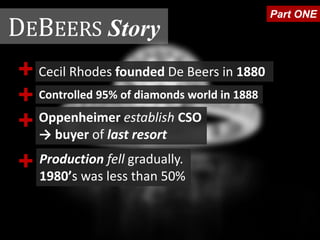
DEBEERS Story
Part ONE
Cecil Rhodes founded De Beers in 1880+
Controlled 95% of diamonds world in 1888+
Oppenheimer establish CSO
→ buyer of last resort
+
Production fell gradually.
1980’s was less than 50%
+
Part ONE
DEBEERS Story
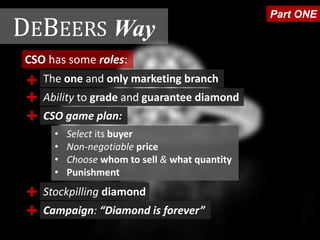
CSO has some roles:
The one and only marketing branch
Ability to grade and guarantee diamond
CSO game plan:
• Select its buyer
• Non-negotiable price
• Choose whom to sell & what quantity
• Punishment
Stockpilling diamond
Campaign: “Diamond is forever”
Part ONE
DEBEERS Way
+
+
+
+
+
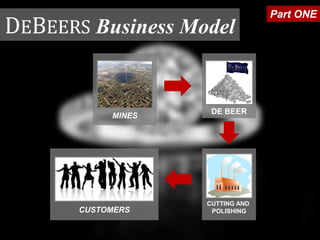
DE BEER
CUTTING AND
POLISHING
Part ONE
DEBEERS Business Model
MINES
CUSTOMERS
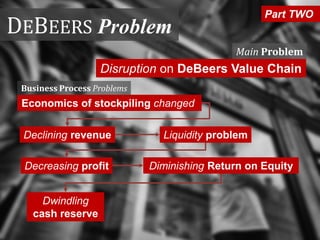
DEBEERS Problem
Part TWO
Main Problem
Disruption on DeBeers Value Chain
Economics of stockpiling changed
Declining revenue Liquidity problem
Decreasing profit Diminishing Return on Equity
Dwindling
cash reserve
Business Process Problems
DEBEERS Problem
Part TWO
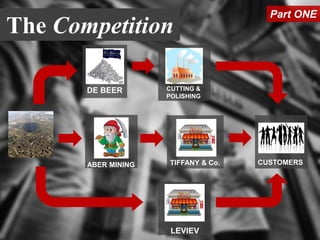
ABER MINING TIFFANY & Co.
DE BEER CUTTING &
POLISHING
LEVIEV
Part ONE
The Competition
CUSTOMERS
Analysis
Part THREE
+ Strong Brand
+ Trust already built with consumers
and partners
+ Historical holdings
+ Expertise
+ Control of output
+ Distribution channel
+ Controls output
+ Owns distribution channel
+ Alliances
+ Relationships with foreign
governments
+ Cash on delivery
+ Only game in town
+ No substitutes for diamonds
+ Customs/tradition
+ War
+ Quality of product
- Luxury item / not necessity
-/+ Economy
+ No substitutes for
diamonds
+ Cultural history
+ Social issues/status
+ High cost of entry
+ Cornered the market
+ Strong Brand
+ Existing mining and political
relationships
+ Access to new mines
+ Owns distribution channel
+ Control of output
BARGAINIG POWER OF SUPPLIER
EXISTING CUSTOMER RIVALRY
THREAT OF NEW ENTRY
BARGAINING POWER OF CUSTOMER
THREAT OF SUBSTITUTES
PORTER’s
5 Forces
Part THREE
Before Disruption
+ Strong Brand
+ Trust already built with consumers
and partners
+ Historical holdings
+ Expertise
+ Control of output
+ Distribution channel
+ Controls output
+ Owns distribution channel
+ Alliances
+ Controls output
+ Owns distribution channel
+ Alliances
+ Relationships with foreign
governments
- Cash is dwindling
- Zaire does not renew contract
(1980)
- Argyle insists on right to market
25% of near-gem & industrial
- Sightholders decrease from over
250 to 150
+ Only game in town
+ No substitutes for
diamonds
+ Customs/tradition
+ War
+ Quality of product
- Luxury item / not necessity
- Decreasing retail demand
+ No substitutes for diamonds
+ Cultural history
+ Social issues/status
+ High cost of entry
+ Cornered the market
+ Strong Brand
+ Existing mining and political
relationships
+ Access to new mines
+ Owns distribution channel
- Zaire sells on open market
- Argyle markets its output
BARGAINING POWER OF
SUPPLIER
EXISTING CUSTOMER RIVALRY
THREAT OF NEW ENTRY
BARGAINING POWER OF
CUSTOMER
THREAT OF SUBSTITUTES
Part THREEPORTER’s
5 Forces
After Disruption
“Reverse innovation is innovating in poor countries and
selling those products in rich countries”
VIJAY GOVINDARAJAN
Once products are developed for
these markets, they are then sold
elsewhere - even in the West - at
low prices which creates new
markets and uses for these
innovations.
Focusing on needs and
requirements for low-
cost products in
countries like India and
China.
Part THREE
Reverse Innovation
Creating Local-Based Cutting
and Polishing Workshop
Synthetic Diamond
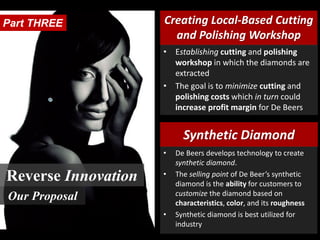
• Establishing cutting and polishing
workshop in which the diamonds are
extracted
• The goal is to minimize cutting and
polishing costs which in turn could
increase profit margin for De Beers
• De Beers develops technology to create
synthetic diamond.
• The selling point of De Beer’s synthetic
diamond is the ability for customers to
customize the diamond based on
characteristics, color, and its roughness
• Synthetic diamond is best utilized for
industry
Part THREE
Reverse Innovation
Our Proposal
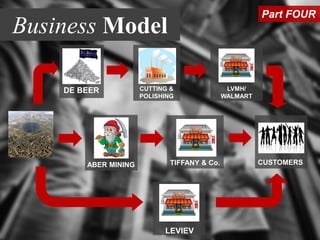
ABER MINING TIFFANY & Co.
DE BEER CUTTING &
POLISHING
LEVIEV
Part FOUR
Business Model
CUSTOMERS
LVMH/
WALMART
Conclusion & Recommendation
Part FOUR
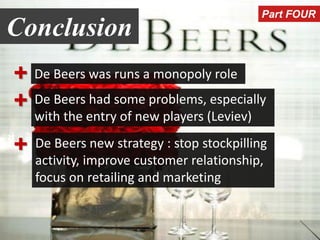
De Beers was runs a monopoly role+
De Beers had some problems, especially
with the entry of new players (Leviev)
+
De Beers new strategy : stop stockpilling
activity, improve customer relationship,
focus on retailing and marketing
+
Conclusion
Part FOUR
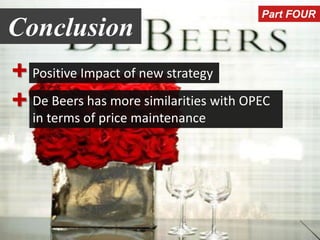
Positive Impact of new strategy+
De Beers has more similarities with OPEC
in terms of price maintenance
+
Conclusion
Part FOUR
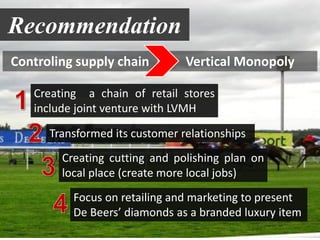
Controling supply chain Vertical Monopoly
Creating a chain of retail stores
include joint venture with LVMH
Transformed its customer relationships
Creating cutting and polishing plan on
local place (create more local jobs)
Focus on retailing and marketing to present
De Beers’ diamonds as a branded luxury item
Recommendation
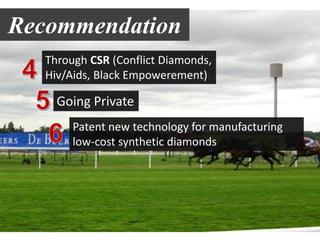
Through CSR (Conflict Diamonds,
Hiv/Aids, Black Empowerement)
Going Private
Patent new technology for manufacturing
low-cost synthetic diamonds
Recommendation

De Beers and The Global Diamond Industry

  • 1.
    AND THE GLOBAL DIAMONDINDUSTRY DEBEERS
  • 2.
    Contents The Problems Analysis De BeersStory Conclusion and Recommendation
  • 3.
  • 4.
    Cecil Rhodes foundedDe Beers in 1880+ Controlled 95% of diamonds world in 1888+ Oppenheimer establish CSO → buyer of last resort + Production fell gradually. 1980’s was less than 50% + Part ONE DEBEERS Story
  • 5.
    CSO has someroles: The one and only marketing branch Ability to grade and guarantee diamond CSO game plan: • Select its buyer • Non-negotiable price • Choose whom to sell & what quantity • Punishment Stockpilling diamond Campaign: “Diamond is forever” Part ONE DEBEERS Way + + + + +
  • 6.
    DE BEER CUTTING AND POLISHING PartONE DEBEERS Business Model MINES CUSTOMERS
  • 7.
  • 8.
    Main Problem Disruption onDeBeers Value Chain Economics of stockpiling changed Declining revenue Liquidity problem Decreasing profit Diminishing Return on Equity Dwindling cash reserve Business Process Problems DEBEERS Problem Part TWO
  • 9.
    ABER MINING TIFFANY& Co. DE BEER CUTTING & POLISHING LEVIEV Part ONE The Competition CUSTOMERS
  • 10.
  • 11.
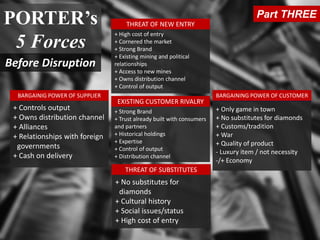
    + Strong Brand +Trust already built with consumers and partners + Historical holdings + Expertise + Control of output + Distribution channel + Controls output + Owns distribution channel + Alliances + Relationships with foreign governments + Cash on delivery + Only game in town + No substitutes for diamonds + Customs/tradition + War + Quality of product - Luxury item / not necessity -/+ Economy + No substitutes for diamonds + Cultural history + Social issues/status + High cost of entry + High cost of entry + Cornered the market + Strong Brand + Existing mining and political relationships + Access to new mines + Owns distribution channel + Control of output BARGAINIG POWER OF SUPPLIER EXISTING CUSTOMER RIVALRY THREAT OF NEW ENTRY BARGAINING POWER OF CUSTOMER THREAT OF SUBSTITUTES PORTER’s 5 Forces Part THREE Before Disruption
  • 12.
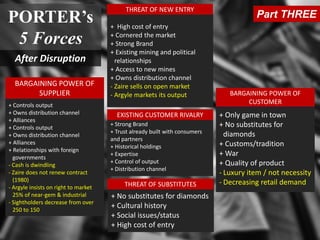
    + Strong Brand +Trust already built with consumers and partners + Historical holdings + Expertise + Control of output + Distribution channel + Controls output + Owns distribution channel + Alliances + Controls output + Owns distribution channel + Alliances + Relationships with foreign governments - Cash is dwindling - Zaire does not renew contract (1980) - Argyle insists on right to market 25% of near-gem & industrial - Sightholders decrease from over 250 to 150 + Only game in town + No substitutes for diamonds + Customs/tradition + War + Quality of product - Luxury item / not necessity - Decreasing retail demand + No substitutes for diamonds + Cultural history + Social issues/status + High cost of entry + High cost of entry + Cornered the market + Strong Brand + Existing mining and political relationships + Access to new mines + Owns distribution channel - Zaire sells on open market - Argyle markets its output BARGAINING POWER OF SUPPLIER EXISTING CUSTOMER RIVALRY THREAT OF NEW ENTRY BARGAINING POWER OF CUSTOMER THREAT OF SUBSTITUTES Part THREEPORTER’s 5 Forces After Disruption
  • 13.
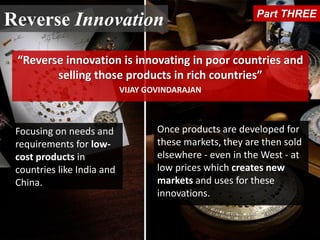
    “Reverse innovation isinnovating in poor countries and selling those products in rich countries” VIJAY GOVINDARAJAN Once products are developed for these markets, they are then sold elsewhere - even in the West - at low prices which creates new markets and uses for these innovations. Focusing on needs and requirements for low- cost products in countries like India and China. Part THREE Reverse Innovation
  • 14.
    Creating Local-Based Cutting andPolishing Workshop Synthetic Diamond • Establishing cutting and polishing workshop in which the diamonds are extracted • The goal is to minimize cutting and polishing costs which in turn could increase profit margin for De Beers • De Beers develops technology to create synthetic diamond. • The selling point of De Beer’s synthetic diamond is the ability for customers to customize the diamond based on characteristics, color, and its roughness • Synthetic diamond is best utilized for industry Part THREE Reverse Innovation Our Proposal
  • 15.
    ABER MINING TIFFANY& Co. DE BEER CUTTING & POLISHING LEVIEV Part FOUR Business Model CUSTOMERS LVMH/ WALMART
  • 16.
  • 17.
    De Beers wasruns a monopoly role+ De Beers had some problems, especially with the entry of new players (Leviev) + De Beers new strategy : stop stockpilling activity, improve customer relationship, focus on retailing and marketing + Conclusion Part FOUR
  • 18.
    Positive Impact ofnew strategy+ De Beers has more similarities with OPEC in terms of price maintenance + Conclusion Part FOUR
  • 19.
    Controling supply chainVertical Monopoly Creating a chain of retail stores include joint venture with LVMH Transformed its customer relationships Creating cutting and polishing plan on local place (create more local jobs) Focus on retailing and marketing to present De Beers’ diamonds as a branded luxury item Recommendation
  • 20.
    Through CSR (ConflictDiamonds, Hiv/Aids, Black Empowerement) Going Private Patent new technology for manufacturing low-cost synthetic diamonds Recommendation