4-1


         CHAPTER 4
  Risk and Return: The Basics

 Basic return concepts
 Basic risk concepts
 Stand-alone risk
 Portfolio (market) risk
 Risk and return: CAPM/SML
4-2

    What are investment returns?

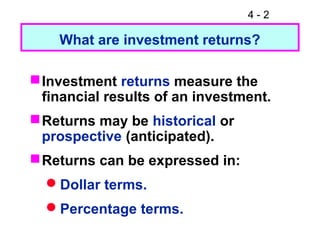
 Investment returns measure the
  financial results of an investment.
 Returns may be historical or
  prospective (anticipated).
 Returns can be expressed in:
  Dollar terms.
  Percentage terms.
4-3

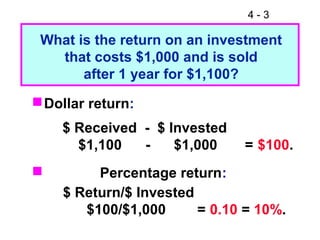
 What is the return on an investment
   that costs $1,000 and is sold
       after 1 year for $1,100?
 Dollar return:
    $ Received - $ Invested
      $1,100   -    $1,000    = $100.
        Percentage return:
    $ Return/$ Invested
       $100/$1,000      = 0.10 = 10%.
4-4

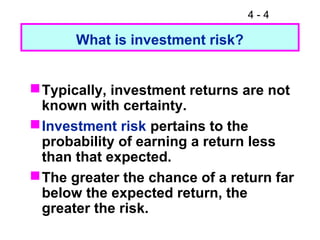
      What is investment risk?


 Typically, investment returns are not
  known with certainty.
 Investment risk pertains to the
  probability of earning a return less
  than that expected.
 The greater the chance of a return far
  below the expected return, the
  greater the risk.
4-5

              Focus on Ethics
If It Sounds Too Good To Be True...
  For many years, investors around the world
   clamored to invest with Bernard Madoff.
  Madoff generated high returns year after year,
   seemingly with very little risk.
  On December 11, 2008, the U.S. Securities and
   Exchange Commission (SEC) charged Madoff with
   securities fraud. Madoff’s hedge fund, Ascot
   Partners, turned out to be a giant Ponzi scheme.
  What are some hazards of allowing investors to
   pursue claims based their most recent accounts
   statements?
4-6
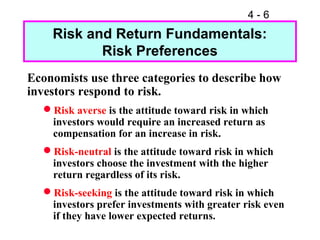
    Risk and Return Fundamentals:
           Risk Preferences
Economists use three categories to describe how
investors respond to risk.
  Risk averse is the attitude toward risk in which
   investors would require an increased return as
   compensation for an increase in risk.
  Risk-neutral is the attitude toward risk in which
   investors choose the investment with the higher
   return regardless of its risk.
  Risk-seeking is the attitude toward risk in which
   investors prefer investments with greater risk even
   if they have lower expected returns.
4-7

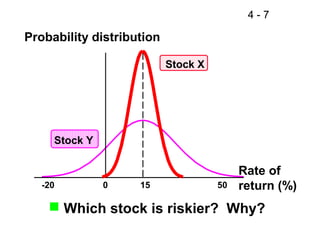
Probability distribution

                           Stock X


     Stock Y

                                          Rate of
   -20         0    15               50   return (%)
     Which stock is riskier? Why?
4-8

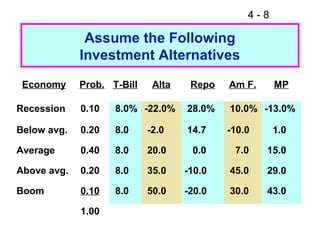
              Assume the Following
             Investment Alternatives
 Economy     Prob. T-Bill    Alta    Repo   Am F.     MP

Recession    0.10   8.0% -22.0%     28.0%   10.0% -13.0%

Below avg.   0.20   8.0     -2.0    14.7    -10.0     1.0

Average      0.40   8.0     20.0     0.0     7.0    15.0

Above avg.   0.20   8.0     35.0    -10.0   45.0    29.0

Boom         0.10   8.0     50.0    -20.0   30.0    43.0

             1.00
4-9

        What is unique about
         the T-bill return?


 The T-bill will return 8% regardless
  of the state of the economy.
 Is the T-bill riskless? Explain.
4 - 10
Do the returns of Alta Inds. and Repo
  Men move with or counter to the
             economy?

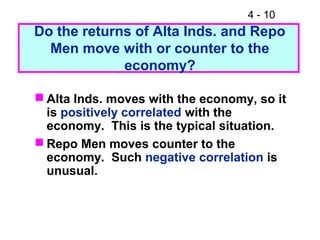
 Alta Inds. moves with the economy, so it
  is positively correlated with the
  economy. This is the typical situation.
 Repo Men moves counter to the
  economy. Such negative correlation is
  unusual.
4 - 11

Calculate the expected rate of return
        on each alternative.
     ^
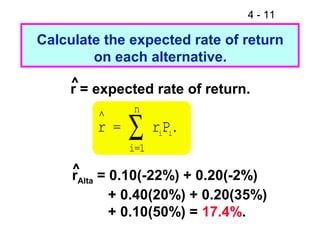
     r = expected rate of return.
         ∧     n
         r =   ∑ rP .
               i=1
                     i i


     ^ = 0.10(-22%) + 0.20(-2%)
     rAlta
           + 0.40(20%) + 0.20(35%)
           + 0.10(50%) = 17.4%.
4 - 12


                         ^
                          r
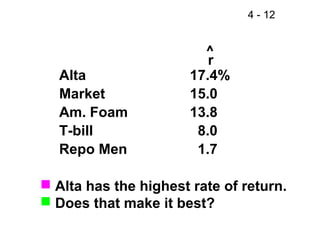
  Alta                 17.4%
  Market               15.0
  Am. Foam             13.8
  T-bill                8.0
  Repo Men              1.7

 Alta has the highest rate of return.
 Does that make it best?
4 - 13

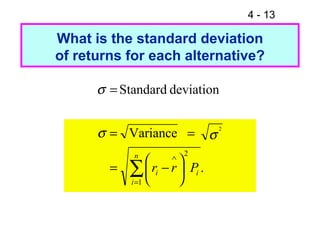
What is the standard deviation
of returns for each alternative?

      σ = Standard deviation


      σ = Variance =          σ
                                  2


            n       ∧ 2
                    
        = ∑  ri − r  Pi .
          i =1      
4 - 14

         n      ∧ 2
                
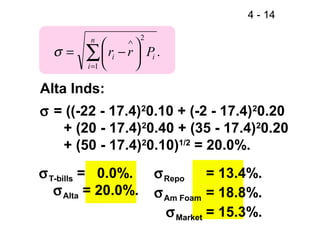
  σ = ∑  ri − r  Pi .
      i =1      
Alta Inds:
σ = ((-22 - 17.4)20.10 + (-2 - 17.4)20.20
   + (20 - 17.4)20.40 + (35 - 17.4)20.20
   + (50 - 17.4)20.10)1/2 = 20.0%.
σ T-bills = 0.0%.     σ Repo     = 13.4%.
   σ Alta = 20.0%.    σ Am Foam = 18.8%.
                        σ Market = 15.3%.
4 - 15

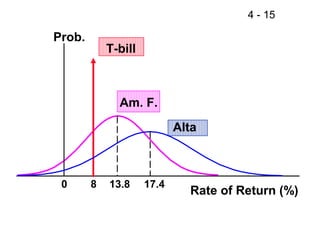
Prob.
            T-bill


              Am. F.
                            Alta


 0      8   13.8     17.4
                              Rate of Return (%)
4 - 16


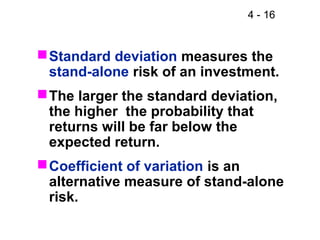
 Standard deviation measures the
  stand-alone risk of an investment.
 The larger the standard deviation,
  the higher the probability that
  returns will be far below the
  expected return.
 Coefficient of variation is an
  alternative measure of stand-alone
  risk.
4 - 17

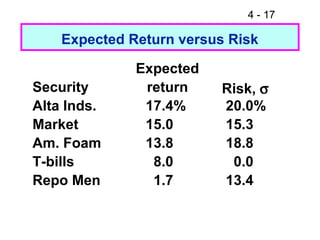
    Expected Return versus Risk

              Expected
Security       return    Risk, σ
Alta Inds.     17.4%     20.0%
Market         15.0      15.3
Am. Foam       13.8      18.8
T-bills         8.0       0.0
Repo Men        1.7      13.4
4 - 18
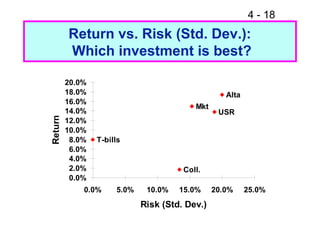
         Return vs. Risk (Std. Dev.):
         Which investment is best?

         20.0%
         18.0%                                     Alta
         16.0%
                                          Mkt
         14.0%                                   USR
Return


         12.0%
         10.0%
          8.0%   T-bills
          6.0%
          4.0%
          2.0%                         Coll.
          0.0%
             0.0%     5.0%    10.0%   15.0%     20.0%     25.0%
                             Risk (Std. Dev.)
4 - 19
            Risk of a Single Asset:
            Coefficient of Variation
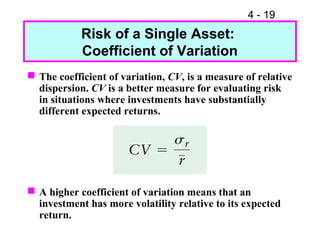
 The coefficient of variation, CV, is a measure of relative
  dispersion. CV is a better measure for evaluating risk
  in situations where investments have substantially
  different expected returns.


 A higher coefficient of variation means that an
  investment has more volatility relative to its expected
  return.
4 - 20
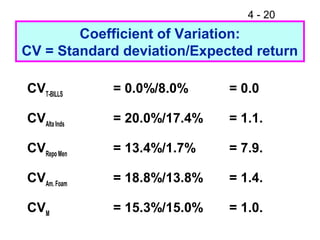
        Coefficient of Variation:
CV = Standard deviation/Expected return

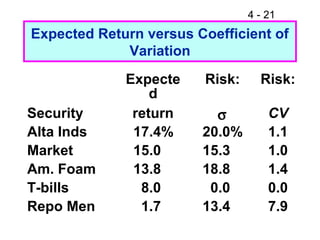
CVT-BILLS     = 0.0%/8.0%     = 0.0

CVAlta Inds   = 20.0%/17.4%   = 1.1.

CVRepo Men    = 13.4%/1.7%    = 7.9.

CVAm. Foam    = 18.8%/13.8%   = 1.4.

CVM           = 15.3%/15.0%   = 1.0.
4 - 21
Expected Return versus Coefficient of
             Variation
             Expecte     Risk:     Risk:
                 d
Security      return      σ          CV
Alta Inds     17.4%     20.0%        1.1
Market        15.0      15.3         1.0
Am. Foam      13.8      18.8         1.4
T-bills        8.0       0.0         0.0
Repo Men       1.7      13.4         7.9
4 - 22

            Risk of a Portfolio

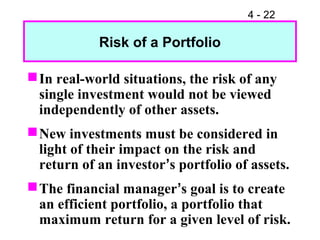
 In real-world situations, the risk of any
  single investment would not be viewed
  independently of other assets.
 New investments must be considered in
  light of their impact on the risk and
  return of an investor’s portfolio of assets.
 The financial manager’s goal is to create
  an efficient portfolio, a portfolio that
  maximum return for a given level of risk.
4 - 23

      Portfolio Risk and Return


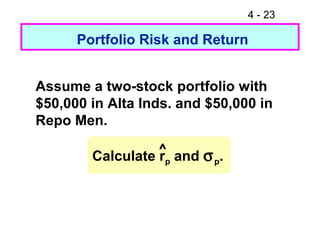
Assume a two-stock portfolio with
$50,000 in Alta Inds. and $50,000 in
Repo Men.

                  ^ and σ .
        Calculate rp     p
4 - 24

        Portfolio Return, ^p
                          r

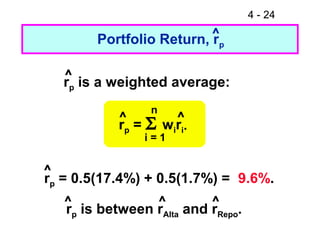
   ^ is a weighted average:
   rp
                 n
            ^        ^
            rp = Σ wiri.
                i=1


^
rp = 0.5(17.4%) + 0.5(1.7%) = 9.6%.
   ^             ^         ^
   rp is between rAlta and rRepo.
4 - 25

             Alternative Method
                           Estimated Return
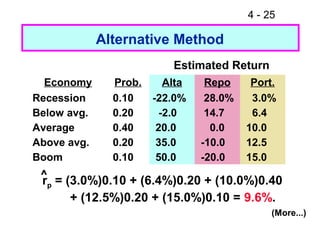
  Economy      Prob.      Alta    Repo     Port.
Recession      0.10    -22.0%     28.0%    3.0%
Below avg.     0.20      -2.0     14.7     6.4
Average        0.40     20.0       0.0    10.0
Above avg.     0.20     35.0     -10.0    12.5
Boom           0.10     50.0     -20.0    15.0
 ^ = (3.0%)0.10 + (6.4%)0.20 + (10.0%)0.40
 rp
      + (12.5%)0.20 + (15.0%)0.10 = 9.6%.
                                               (More...)
4 - 26


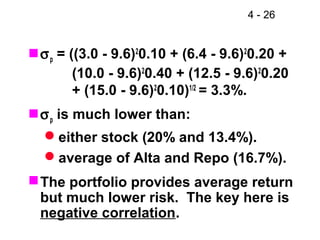
 σ p = ((3.0 - 9.6)20.10 + (6.4 - 9.6)20.20 +
         (10.0 - 9.6)20.40 + (12.5 - 9.6)20.20
         + (15.0 - 9.6)20.10)1/2 = 3.3%.
 σ p is much lower than:
  either stock (20% and 13.4%).
  average of Alta and Repo (16.7%).
 The portfolio provides average return
  but much lower risk. The key here is
  negative correlation.
4 - 27

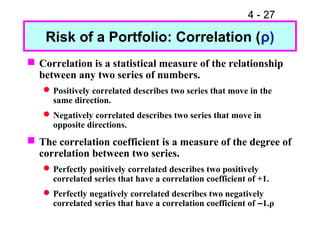
    Risk of a Portfolio: Correlation (ρ)
 Correlation is a statistical measure of the relationship
  between any two series of numbers.
    Positively correlated describes two series that move in the
     same direction.
    Negatively correlated describes two series that move in
     opposite directions.
 The correlation coefficient is a measure of the degree of
  correlation between two series.
    Perfectly positively correlated describes two positively
     correlated series that have a correlation coefficient of +1.
    Perfectly negatively correlated describes two negatively
     correlated series that have a correlation coefficient of –1.ρ
4 - 28

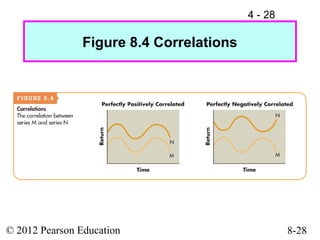
                Figure 8.4 Correlations


© 2012 Pearson Education                           8-28
4 - 29

        Risk of a Portfolio: Diversification

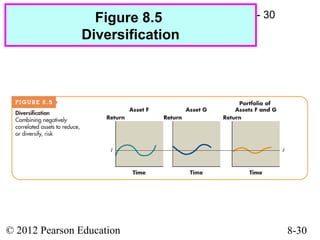
     To reduce overall risk, it is best to diversify by
      combining, or adding to the portfolio, assets that have
      the lowest possible correlation.
     Combining assets that have a low correlation with each
      other can reduce the overall variability of a portfolio’s
      returns.
     Uncorrelated describes two series that lack any
      interaction and therefore have a correlation coefficient
      close to zero.


© 2012 Pearson Education                                        8-29
Figure 8.5      4 - 30
               Diversification


© 2012 Pearson Education                  8-30
4 - 31

        Two-Stock Portfolios

 Two stocks can be combined to form
  a riskless portfolio if ρ = -1.0.
 Risk is not reduced at all if the two
  stocks have ρ = +1.0.
 In general, stocks in US markets have
  ρ ≈ 0.65, so risk is lowered but not
  eliminated.
 Investors typically hold many stocks.
 What happens when ρ = 0?
4 - 32

      What would happen to the
       risk of an average 1-stock
      portfolio as more randomly
     selected stocks were added?

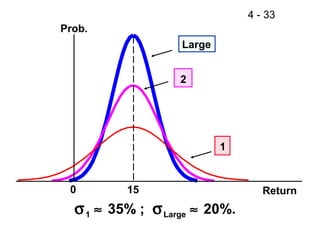
 σ p would decrease because the added
  stocks would not be perfectly correlated,
  but rp would remain relatively constant.
      ^
 In the real world, it is impossible to form a
  completely riskless stock portfolio.
4 - 33
Prob.
                   Large


                   2


                           1


 0        15                      Return
  σ 1 ≈ 35% ; σ Large ≈ 20%.
4 - 34


σ p (%)
                 Company Specific
35
                (Diversifiable) Risk
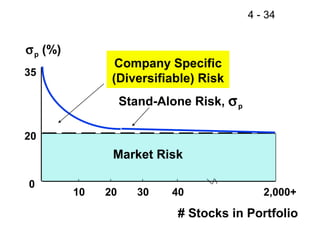
                    Stand-Alone Risk, σ p

20
                Market Risk

0
          10   20      30    40                2,000+

                              # Stocks in Portfolio
4 - 35

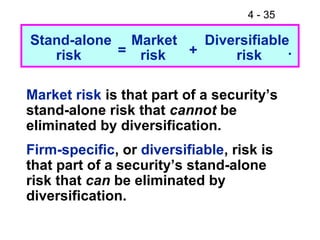
Stand-alone Market   Diversifiable
   risk    = risk  +     risk     .


Market risk is that part of a security’s
stand-alone risk that cannot be
eliminated by diversification.
Firm-specific, or diversifiable, risk is
that part of a security’s stand-alone
risk that can be eliminated by
diversification.
4 - 36

             Conclusions

 As more stocks are added, each new
  stock has a smaller risk-reducing
  impact on the portfolio.
 σ p falls very slowly after about 40
  stocks are included. The lower limit
  for σ p is about 20% = σ M .
 By forming well-diversified
  portfolios, investors can eliminate
  about half the riskiness of owning a
  single stock.
4 - 37

Can an investor holding one stock earn
 a return commensurate with its risk?

 No. Rational investors will minimize
  risk by holding portfolios.
 They bear only market risk, so prices
  and returns reflect this lower risk.
 The one-stock investor bears higher
  (stand-alone) risk, so the return is less
  than that required by the risk.
4 - 38

    How is market risk measured for
         individual securities?
 Market risk, which is relevant for stocks
  held in well-diversified portfolios, is
  defined as the contribution of a security
  to the overall riskiness of the portfolio.
 It is measured by a stock’s beta
  coefficient. For stock i, its beta is:
                bi = (ρ iM σ i) / σ M
4 - 39

      How are betas calculated?

 In addition to measuring a stock’s
  contribution of risk to a portfolio,
  beta also which measures the
  stock’s volatility relative to the
  market.
4 - 40

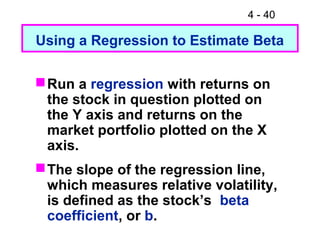
Using a Regression to Estimate Beta

 Run a regression with returns on
  the stock in question plotted on
  the Y axis and returns on the
  market portfolio plotted on the X
  axis.
 The slope of the regression line,
  which measures relative volatility,
  is defined as the stock’s beta
  coefficient, or b.
4 - 41
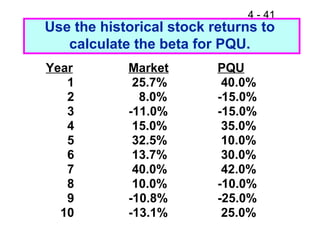
Use the historical stock returns to
   calculate the beta for PQU.
Year        Market        PQU
   1         25.7%         40.0%
   2          8.0%        -15.0%
   3        -11.0%        -15.0%
   4         15.0%         35.0%
   5         32.5%         10.0%
   6         13.7%         30.0%
   7         40.0%         42.0%
   8         10.0%        -10.0%
   9        -10.8%        -25.0%
  10        -13.1%         25.0%
4 - 42
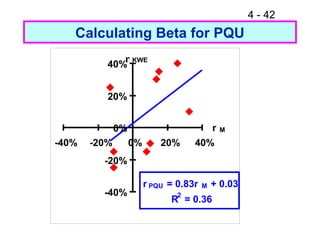
   Calculating Beta for PQU

          40%
               r KWE


          20%


              0%                            r   M

-40%   -20%        0%       20%     40%
         -20%

                        r PQU = 0.83r   M   + 0.03
         -40%                   2
                              R = 0.36
4 - 43

       What is beta for PQU?

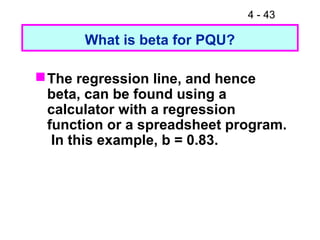
 The regression line, and hence
  beta, can be found using a
  calculator with a regression
  function or a spreadsheet program.
   In this example, b = 0.83.
4 - 44

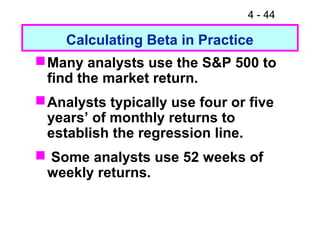
    Calculating Beta in Practice
 Many analysts use the S&P 500 to
  find the market return.
 Analysts typically use four or five
  years’ of monthly returns to
  establish the regression line.
 Some analysts use 52 weeks of
 weekly returns.
4 - 45

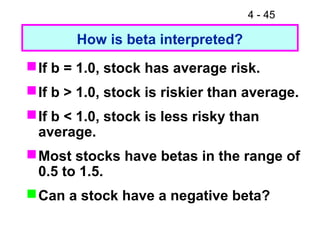
        How is beta interpreted?
 If b = 1.0, stock has average risk.
 If b > 1.0, stock is riskier than average.
 If b < 1.0, stock is less risky than
  average.
 Most stocks have betas in the range of
  0.5 to 1.5.
 Can a stock have a negative beta?
4 - 46

 Finding Beta Estimates on the Web

Go to www.thomsonfn.com.
Enter the ticker symbol for a
 “Stock Quote”, such as IBM
 or Dell, then click GO.
When the quote comes up,
 select Company Earnings,
 then GO.
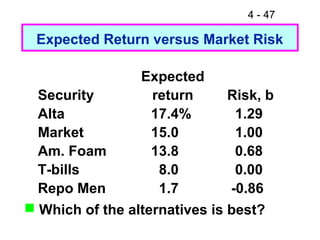
4 - 47

 Expected Return versus Market Risk

                 Expected
  Security        return      Risk, b
  Alta            17.4%        1.29
  Market          15.0         1.00
  Am. Foam        13.8         0.68
  T-bills          8.0         0.00
  Repo Men         1.7        -0.86
 Which of the alternatives is best?
4 - 48

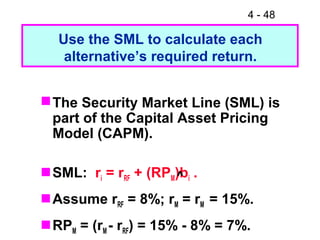
  Use the SML to calculate each
   alternative’s required return.


 The Security Market Line (SML) is
  part of the Capital Asset Pricing
  Model (CAPM).

SML: ri = rRF + (RPM)bi .
                     ^
 Assume rRF = 8%; rM = rM = 15%.
 RPM = (rM - rRF) = 15% - 8% = 7%.
4 - 49

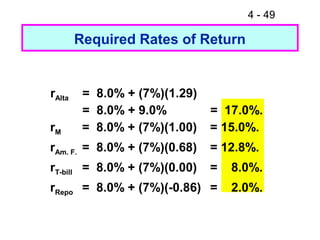
        Required Rates of Return


rAlta    = 8.0% + (7%)(1.29)
         = 8.0% + 9.0%         = 17.0%.
rM       = 8.0% + (7%)(1.00)   = 15.0%.
rAm. F. = 8.0% + (7%)(0.68)    = 12.8%.
rT-bill = 8.0% + (7%)(0.00)    =   8.0%.
rRepo = 8.0% + (7%)(-0.86) =       2.0%.
4 - 50

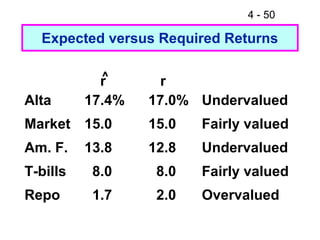
  Expected versus Required Returns

            ^
            r      r
Alta      17.4%   17.0% Undervalued
Market 15.0       15.0   Fairly valued
Am. F.    13.8    12.8   Undervalued
T-bills    8.0     8.0   Fairly valued
Repo       1.7     2.0   Overvalued
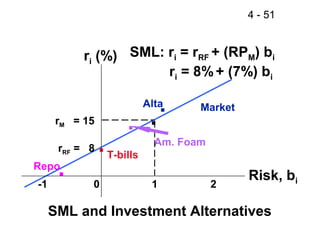
4 - 51


           ri (%) SML: ri = rRF + (RPM) bi
                       ri = 8% + (7%) bi

                            Alta .   Market
      rM = 15         . .
      rRF = 8   . T-bills     Am. Foam

Repo
      .                                       Risk, bi
-1          0                1           2

     SML and Investment Alternatives
4 - 52

Calculate beta for a portfolio with 50%
         Alta and 50% Repo


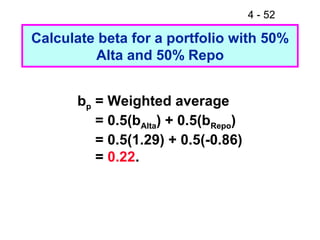
      bp = Weighted average
         = 0.5(bAlta) + 0.5(bRepo)
         = 0.5(1.29) + 0.5(-0.86)
         = 0.22.
4 - 53

 What is the required rate of return
   on the Alta/Repo portfolio?

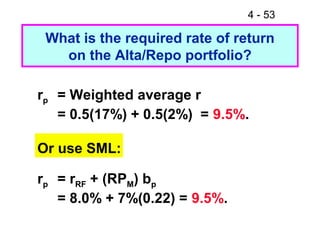
rp = Weighted average r
   = 0.5(17%) + 0.5(2%) = 9.5%.

Or use SML:

rp = rRF + (RPM) bp
   = 8.0% + 7%(0.22) = 9.5%.
4 - 54

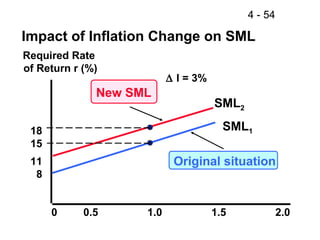
Impact of Inflation Change on SML
Required Rate
of Return r (%)
                          ∆ I = 3%
              New SML
                                     SML2

 18                                    SML1
 15
 11                        Original situation
  8


      0     0.5     1.0              1.5             2.0
Impact of Risk Aversion Change           4 - 55

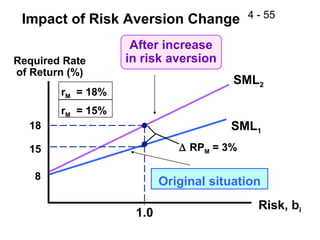
                    After increase
Required Rate      in risk aversion
of Return (%)
                                       SML2
        rM = 18%
        rM = 15%
  18                                  SML1
  15                         ∆ RPM = 3%

   8
                          Original situation
                                            Risk, bi
                    1.0
4 - 56
Has the CAPM been completely confirmed
   or refuted through empirical tests?
 No. The statistical tests have
  problems that make empirical
  verification or rejection virtually
  impossible.
   Investors’ required returns are
    based on future risk, but betas are
    calculated with historical data.
   Investors may be concerned about
    both stand-alone and market risk.

CH 04 - Risk & Return Basics

  • 1.
    4-1 CHAPTER 4 Risk and Return: The Basics  Basic return concepts  Basic risk concepts  Stand-alone risk  Portfolio (market) risk  Risk and return: CAPM/SML
  • 2.
    4-2 What are investment returns?  Investment returns measure the financial results of an investment.  Returns may be historical or prospective (anticipated).  Returns can be expressed in: Dollar terms. Percentage terms.
  • 3.
    4-3 What isthe return on an investment that costs $1,000 and is sold after 1 year for $1,100?  Dollar return: $ Received - $ Invested $1,100 - $1,000 = $100.  Percentage return: $ Return/$ Invested $100/$1,000 = 0.10 = 10%.
  • 4.
    4-4 What is investment risk?  Typically, investment returns are not known with certainty.  Investment risk pertains to the probability of earning a return less than that expected.  The greater the chance of a return far below the expected return, the greater the risk.
  • 5.
    4-5 Focus on Ethics If It Sounds Too Good To Be True... For many years, investors around the world clamored to invest with Bernard Madoff. Madoff generated high returns year after year, seemingly with very little risk. On December 11, 2008, the U.S. Securities and Exchange Commission (SEC) charged Madoff with securities fraud. Madoff’s hedge fund, Ascot Partners, turned out to be a giant Ponzi scheme. What are some hazards of allowing investors to pursue claims based their most recent accounts statements?
  • 6.
    4-6 Risk and Return Fundamentals: Risk Preferences Economists use three categories to describe how investors respond to risk. Risk averse is the attitude toward risk in which investors would require an increased return as compensation for an increase in risk. Risk-neutral is the attitude toward risk in which investors choose the investment with the higher return regardless of its risk. Risk-seeking is the attitude toward risk in which investors prefer investments with greater risk even if they have lower expected returns.
  • 7.
    4-7 Probability distribution Stock X Stock Y Rate of -20 0 15 50 return (%)  Which stock is riskier? Why?
  • 8.
    4-8 Assume the Following Investment Alternatives Economy Prob. T-Bill Alta Repo Am F. MP Recession 0.10 8.0% -22.0% 28.0% 10.0% -13.0% Below avg. 0.20 8.0 -2.0 14.7 -10.0 1.0 Average 0.40 8.0 20.0 0.0 7.0 15.0 Above avg. 0.20 8.0 35.0 -10.0 45.0 29.0 Boom 0.10 8.0 50.0 -20.0 30.0 43.0 1.00
  • 9.
    4-9 What is unique about the T-bill return?  The T-bill will return 8% regardless of the state of the economy.  Is the T-bill riskless? Explain.
  • 10.
    4 - 10 Dothe returns of Alta Inds. and Repo Men move with or counter to the economy?  Alta Inds. moves with the economy, so it is positively correlated with the economy. This is the typical situation.  Repo Men moves counter to the economy. Such negative correlation is unusual.
  • 11.
    4 - 11 Calculatethe expected rate of return on each alternative. ^ r = expected rate of return. ∧ n r = ∑ rP . i=1 i i ^ = 0.10(-22%) + 0.20(-2%) rAlta + 0.40(20%) + 0.20(35%) + 0.10(50%) = 17.4%.
  • 12.
    4 - 12 ^ r Alta 17.4% Market 15.0 Am. Foam 13.8 T-bill 8.0 Repo Men 1.7  Alta has the highest rate of return.  Does that make it best?
  • 13.
    4 - 13 Whatis the standard deviation of returns for each alternative? σ = Standard deviation σ = Variance = σ 2 n ∧ 2   = ∑  ri − r  Pi . i =1  
  • 14.
    4 - 14 n ∧ 2   σ = ∑  ri − r  Pi . i =1   Alta Inds: σ = ((-22 - 17.4)20.10 + (-2 - 17.4)20.20 + (20 - 17.4)20.40 + (35 - 17.4)20.20 + (50 - 17.4)20.10)1/2 = 20.0%. σ T-bills = 0.0%. σ Repo = 13.4%. σ Alta = 20.0%. σ Am Foam = 18.8%. σ Market = 15.3%.
  • 15.
    4 - 15 Prob. T-bill Am. F. Alta 0 8 13.8 17.4 Rate of Return (%)
  • 16.
    4 - 16 Standard deviation measures the stand-alone risk of an investment.  The larger the standard deviation, the higher the probability that returns will be far below the expected return.  Coefficient of variation is an alternative measure of stand-alone risk.
  • 17.
    4 - 17 Expected Return versus Risk Expected Security return Risk, σ Alta Inds. 17.4% 20.0% Market 15.0 15.3 Am. Foam 13.8 18.8 T-bills 8.0 0.0 Repo Men 1.7 13.4
  • 18.
    4 - 18 Return vs. Risk (Std. Dev.): Which investment is best? 20.0% 18.0% Alta 16.0% Mkt 14.0% USR Return 12.0% 10.0% 8.0% T-bills 6.0% 4.0% 2.0% Coll. 0.0% 0.0% 5.0% 10.0% 15.0% 20.0% 25.0% Risk (Std. Dev.)
  • 19.
    4 - 19 Risk of a Single Asset: Coefficient of Variation  The coefficient of variation, CV, is a measure of relative dispersion. CV is a better measure for evaluating risk in situations where investments have substantially different expected returns.  A higher coefficient of variation means that an investment has more volatility relative to its expected return.
  • 20.
    4 - 20 Coefficient of Variation: CV = Standard deviation/Expected return CVT-BILLS = 0.0%/8.0% = 0.0 CVAlta Inds = 20.0%/17.4% = 1.1. CVRepo Men = 13.4%/1.7% = 7.9. CVAm. Foam = 18.8%/13.8% = 1.4. CVM = 15.3%/15.0% = 1.0.
  • 21.
    4 - 21 ExpectedReturn versus Coefficient of Variation Expecte Risk: Risk: d Security return σ CV Alta Inds 17.4% 20.0% 1.1 Market 15.0 15.3 1.0 Am. Foam 13.8 18.8 1.4 T-bills 8.0 0.0 0.0 Repo Men 1.7 13.4 7.9
  • 22.
    4 - 22 Risk of a Portfolio  In real-world situations, the risk of any single investment would not be viewed independently of other assets.  New investments must be considered in light of their impact on the risk and return of an investor’s portfolio of assets.  The financial manager’s goal is to create an efficient portfolio, a portfolio that maximum return for a given level of risk.
  • 23.
    4 - 23 Portfolio Risk and Return Assume a two-stock portfolio with $50,000 in Alta Inds. and $50,000 in Repo Men. ^ and σ . Calculate rp p
  • 24.
    4 - 24 Portfolio Return, ^p r ^ is a weighted average: rp n ^ ^ rp = Σ wiri. i=1 ^ rp = 0.5(17.4%) + 0.5(1.7%) = 9.6%. ^ ^ ^ rp is between rAlta and rRepo.
  • 25.
    4 - 25 Alternative Method Estimated Return Economy Prob. Alta Repo Port. Recession 0.10 -22.0% 28.0% 3.0% Below avg. 0.20 -2.0 14.7 6.4 Average 0.40 20.0 0.0 10.0 Above avg. 0.20 35.0 -10.0 12.5 Boom 0.10 50.0 -20.0 15.0 ^ = (3.0%)0.10 + (6.4%)0.20 + (10.0%)0.40 rp + (12.5%)0.20 + (15.0%)0.10 = 9.6%. (More...)
  • 26.
    4 - 26 σ p = ((3.0 - 9.6)20.10 + (6.4 - 9.6)20.20 + (10.0 - 9.6)20.40 + (12.5 - 9.6)20.20 + (15.0 - 9.6)20.10)1/2 = 3.3%.  σ p is much lower than: either stock (20% and 13.4%). average of Alta and Repo (16.7%).  The portfolio provides average return but much lower risk. The key here is negative correlation.
  • 27.
    4 - 27 Risk of a Portfolio: Correlation (ρ)  Correlation is a statistical measure of the relationship between any two series of numbers.  Positively correlated describes two series that move in the same direction.  Negatively correlated describes two series that move in opposite directions.  The correlation coefficient is a measure of the degree of correlation between two series.  Perfectly positively correlated describes two positively correlated series that have a correlation coefficient of +1.  Perfectly negatively correlated describes two negatively correlated series that have a correlation coefficient of –1.ρ
  • 28.
    4 - 28 Figure 8.4 Correlations © 2012 Pearson Education 8-28
  • 29.
    4 - 29 Risk of a Portfolio: Diversification  To reduce overall risk, it is best to diversify by combining, or adding to the portfolio, assets that have the lowest possible correlation.  Combining assets that have a low correlation with each other can reduce the overall variability of a portfolio’s returns.  Uncorrelated describes two series that lack any interaction and therefore have a correlation coefficient close to zero. © 2012 Pearson Education 8-29
  • 30.
    Figure 8.5 4 - 30 Diversification © 2012 Pearson Education 8-30
  • 31.
    4 - 31 Two-Stock Portfolios  Two stocks can be combined to form a riskless portfolio if ρ = -1.0.  Risk is not reduced at all if the two stocks have ρ = +1.0.  In general, stocks in US markets have ρ ≈ 0.65, so risk is lowered but not eliminated.  Investors typically hold many stocks.  What happens when ρ = 0?
  • 32.
    4 - 32 What would happen to the risk of an average 1-stock portfolio as more randomly selected stocks were added?  σ p would decrease because the added stocks would not be perfectly correlated, but rp would remain relatively constant. ^  In the real world, it is impossible to form a completely riskless stock portfolio.
  • 33.
    4 - 33 Prob. Large 2 1 0 15 Return σ 1 ≈ 35% ; σ Large ≈ 20%.
  • 34.
    4 - 34 σp (%) Company Specific 35 (Diversifiable) Risk Stand-Alone Risk, σ p 20 Market Risk 0 10 20 30 40 2,000+ # Stocks in Portfolio
  • 35.
    4 - 35 Stand-aloneMarket Diversifiable risk = risk + risk . Market risk is that part of a security’s stand-alone risk that cannot be eliminated by diversification. Firm-specific, or diversifiable, risk is that part of a security’s stand-alone risk that can be eliminated by diversification.
  • 36.
    4 - 36 Conclusions  As more stocks are added, each new stock has a smaller risk-reducing impact on the portfolio.  σ p falls very slowly after about 40 stocks are included. The lower limit for σ p is about 20% = σ M .  By forming well-diversified portfolios, investors can eliminate about half the riskiness of owning a single stock.
  • 37.
    4 - 37 Canan investor holding one stock earn a return commensurate with its risk?  No. Rational investors will minimize risk by holding portfolios.  They bear only market risk, so prices and returns reflect this lower risk.  The one-stock investor bears higher (stand-alone) risk, so the return is less than that required by the risk.
  • 38.
    4 - 38 How is market risk measured for individual securities?  Market risk, which is relevant for stocks held in well-diversified portfolios, is defined as the contribution of a security to the overall riskiness of the portfolio.  It is measured by a stock’s beta coefficient. For stock i, its beta is: bi = (ρ iM σ i) / σ M
  • 39.
    4 - 39 How are betas calculated?  In addition to measuring a stock’s contribution of risk to a portfolio, beta also which measures the stock’s volatility relative to the market.
  • 40.
    4 - 40 Usinga Regression to Estimate Beta  Run a regression with returns on the stock in question plotted on the Y axis and returns on the market portfolio plotted on the X axis.  The slope of the regression line, which measures relative volatility, is defined as the stock’s beta coefficient, or b.
  • 41.
    4 - 41 Usethe historical stock returns to calculate the beta for PQU. Year Market PQU 1 25.7% 40.0% 2 8.0% -15.0% 3 -11.0% -15.0% 4 15.0% 35.0% 5 32.5% 10.0% 6 13.7% 30.0% 7 40.0% 42.0% 8 10.0% -10.0% 9 -10.8% -25.0% 10 -13.1% 25.0%
  • 42.
    4 - 42 Calculating Beta for PQU 40% r KWE 20% 0% r M -40% -20% 0% 20% 40% -20% r PQU = 0.83r M + 0.03 -40% 2 R = 0.36
  • 43.
    4 - 43 What is beta for PQU?  The regression line, and hence beta, can be found using a calculator with a regression function or a spreadsheet program. In this example, b = 0.83.
  • 44.
    4 - 44 Calculating Beta in Practice  Many analysts use the S&P 500 to find the market return.  Analysts typically use four or five years’ of monthly returns to establish the regression line.  Some analysts use 52 weeks of weekly returns.
  • 45.
    4 - 45 How is beta interpreted?  If b = 1.0, stock has average risk.  If b > 1.0, stock is riskier than average.  If b < 1.0, stock is less risky than average.  Most stocks have betas in the range of 0.5 to 1.5.  Can a stock have a negative beta?
  • 46.
    4 - 46 Finding Beta Estimates on the Web Go to www.thomsonfn.com. Enter the ticker symbol for a “Stock Quote”, such as IBM or Dell, then click GO. When the quote comes up, select Company Earnings, then GO.
  • 47.
    4 - 47 Expected Return versus Market Risk Expected Security return Risk, b Alta 17.4% 1.29 Market 15.0 1.00 Am. Foam 13.8 0.68 T-bills 8.0 0.00 Repo Men 1.7 -0.86  Which of the alternatives is best?
  • 48.
    4 - 48 Use the SML to calculate each alternative’s required return.  The Security Market Line (SML) is part of the Capital Asset Pricing Model (CAPM). SML: ri = rRF + (RPM)bi . ^  Assume rRF = 8%; rM = rM = 15%.  RPM = (rM - rRF) = 15% - 8% = 7%.
  • 49.
    4 - 49 Required Rates of Return rAlta = 8.0% + (7%)(1.29) = 8.0% + 9.0% = 17.0%. rM = 8.0% + (7%)(1.00) = 15.0%. rAm. F. = 8.0% + (7%)(0.68) = 12.8%. rT-bill = 8.0% + (7%)(0.00) = 8.0%. rRepo = 8.0% + (7%)(-0.86) = 2.0%.
  • 50.
    4 - 50 Expected versus Required Returns ^ r r Alta 17.4% 17.0% Undervalued Market 15.0 15.0 Fairly valued Am. F. 13.8 12.8 Undervalued T-bills 8.0 8.0 Fairly valued Repo 1.7 2.0 Overvalued
  • 51.
    4 - 51 ri (%) SML: ri = rRF + (RPM) bi ri = 8% + (7%) bi Alta . Market rM = 15 . . rRF = 8 . T-bills Am. Foam Repo . Risk, bi -1 0 1 2 SML and Investment Alternatives
  • 52.
    4 - 52 Calculatebeta for a portfolio with 50% Alta and 50% Repo bp = Weighted average = 0.5(bAlta) + 0.5(bRepo) = 0.5(1.29) + 0.5(-0.86) = 0.22.
  • 53.
    4 - 53 What is the required rate of return on the Alta/Repo portfolio? rp = Weighted average r = 0.5(17%) + 0.5(2%) = 9.5%. Or use SML: rp = rRF + (RPM) bp = 8.0% + 7%(0.22) = 9.5%.
  • 54.
    4 - 54 Impactof Inflation Change on SML Required Rate of Return r (%) ∆ I = 3% New SML SML2 18 SML1 15 11 Original situation 8 0 0.5 1.0 1.5 2.0
  • 55.
    Impact of RiskAversion Change 4 - 55 After increase Required Rate in risk aversion of Return (%) SML2 rM = 18% rM = 15% 18 SML1 15 ∆ RPM = 3% 8 Original situation Risk, bi 1.0
  • 56.
    4 - 56 Hasthe CAPM been completely confirmed or refuted through empirical tests?  No. The statistical tests have problems that make empirical verification or rejection virtually impossible. Investors’ required returns are based on future risk, but betas are calculated with historical data. Investors may be concerned about both stand-alone and market risk.