The Learning Designer
and the International Learning Designs
Challenge
Eileen Kennedy
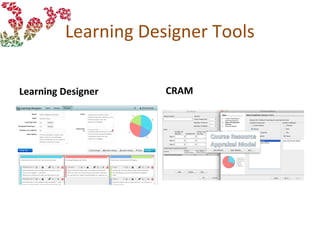
Learning Designer Tools
Learning Designer CRAM
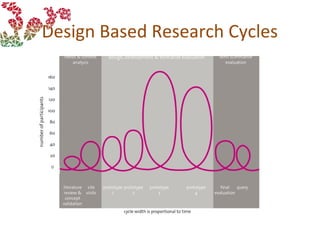
Design Based Research Cycles
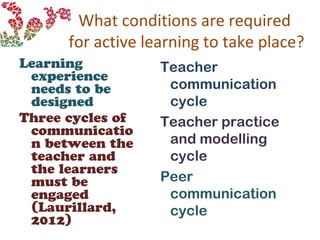
What conditions are required
for active learning to take place?
Learning
experience
needs to be
designed
Three cycles of
communicatio
n between the
teacher and
the learners
must be
engaged
(Laurillard,
2012)
Teacher
communication
cycle
Teacher practice
and modelling
cycle
Peer
communication
cycle
Teacher and peer
communication cycles
1. The teacher must communicate their
concepts for the learner to
understand;
2. The teacher must provide an
environment to model the learning and
for the learner to practice within;
3. The learners must engage in peer
communication, providing their own
modelling and practice environments
to support each other’s learning.
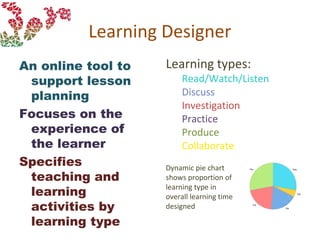
Learning Designer
An online tool to
support lesson
planning
Focuses on the
experience of
the learner
Specifies
teaching and
learning
activities by
learning type
Learning types:
Read/Watch/Listen
Discuss
Investigation
Practice
Produce
Collaborate
Dynamic pie chart
shows proportion of
learning type in
overall learning time
designed
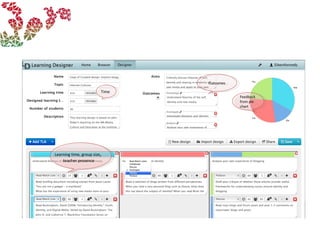
Time
OutcomesOutcomes
Feedback
from pie
chart
Learning time, group size,
teacher presence
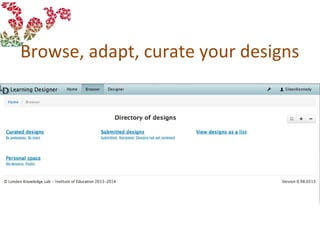
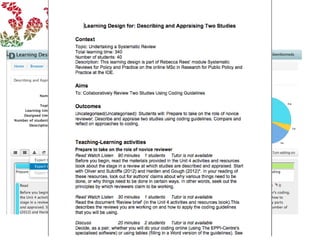
Browse, adapt, curate your designs
Export to MS Word
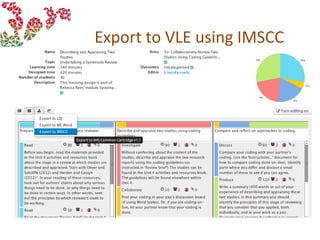
Export to VLE using IMSCC
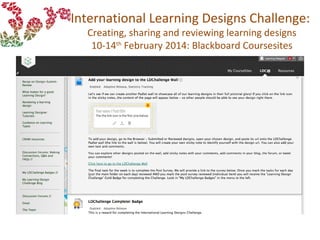
International Learning Designs Challenge:
Creating, sharing and reviewing learning designs
10-14th
February 2014: Blackboard Coursesites
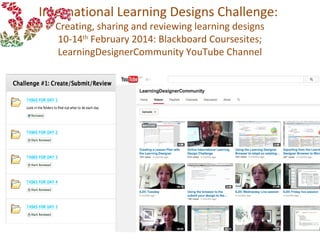
International Learning Designs Challenge:
Creating, sharing and reviewing learning designs
10-14th
February 2014: Blackboard Coursesites;
LearningDesignerCommunity YouTube Channel
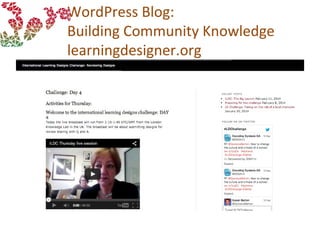
WordPress Blog:
Building Community Knowledge
learningdesigner.org
What makes a good design?
Peer review criteria for learning designs
1 Test? Is there a
‘produce’ activity, or
some way the teacher
can use to test whether
outcomes are met?
2 Aligned? Are
outcomes, activities,
and produce activity
aligned?
3 Feedback? Is there
feedback from the
teacher, other
students, or the
technology?
4 Technology? Does the
technology support the
learning type(s)? Does
the design support
critical digital literacy?
5 Other? Are there
individual criteria that
are specific to this
design?
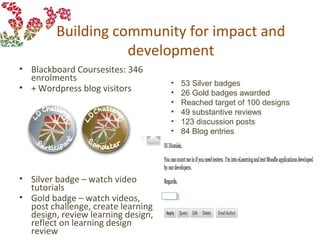
Building community for impact and
development
• Blackboard Coursesites: 346
enrolments
• + Wordpress blog visitors
• Silver badge – watch video
tutorials
• Gold badge – watch videos,
post challenge, create learning
design, review learning design,
reflect on learning design
review
• 53 Silver badges
• 26 Gold badges awarded
• Reached target of 100 designs
• 49 substantive reviews
• 123 discussion posts
• 84 Blog entries
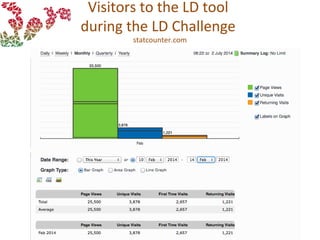
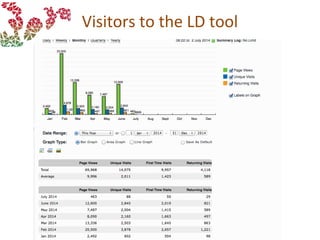
Visitors to the LD tool
during the LD Challenge
statcounter.com
Visitors to the LD tool
The Value of The Challenge
A valuable experience
•Just putting yourself into the
perspective of some else gives you new
insights.
•Getting over organisational blindness by
critique of peers.
•Getting to know other approaches in
teaching and learning.
•Looking at the teaching preparation
(design) of other people is a little bit like
a look into their head (blogger5).
Value of live video
I was pleasantly surprised to discover
that there are live synchronous Google
Hangouts on air in YouTube (blogger16).
Development of the tool
It would be good … if the designer was
happy to have a conversation with the
reviewer and that was indicated
somewhere, a conversation could take
place elsewhere.
N.B. Just saw the information for
Thursday and that there is already a
'message box' so my last sentence has
already been achieved (blogger13).
Desire for community and
communication 
It would be nice if could see what others
are doing (blogger20).
A participant’s perspective:
Elizabeth Charles
Motivation
Having completed
Open Course in
Technology Enhanced
Learning in 2013 and
produced a lesson plan for
an information literacy
session – I wanted to flip
this session
The duration was one
week and I could fit that
into my work schedule it
wouldn’t feel like a long
drawn out commitment.
Gave me an
opportunity to use the
Learning Designer tool
with a live (real) lesson
plan rather than it being
just a theoretical exercise.
Affirm good pedagogy
Would help with
ensuring that the
underlying pedagogy was
sound and would make it
very apparent re the pie-
chart element of Learning
Designer based on
Bloom’s Taxonomy which
of the different elements
of learning theory my
lesson plan relied on
This also gave me the
opportunity to experiment
with changing this to see
what impact it had in how
I delivered the session and
what users would be
expected to do and learn
during the lesson
Elizabeth’s Experience of the
Challenge
I found it interesting and well structured, and the
platform used was a new one to me – CourseSites
Daily webinars provided context and discussion on
the Learning Designer tool itself
I enjoyed being able to have a look at the other
submitted lesson plans and reviewed one such
using the evaluation rubric.
A very informative exercise that gave me new
perspective on how I could possibly amend my
lesson plans
Also gave me the opportunity to provide feedback
and share my expertise by suggesting other options or
changes to the lesson plan I was reviewing and the use of
other more relevant technology that might be employed
in the class.
The course was undertaken I felt in a very supportive
environment and participants were encouraged to be
constructive in the feedback being given
I enjoyed the first challenge so much – I participated
in the second challenge that took place a couple of
months later!
Conclusions
Mini-MOOCs work for design based research
projects
Create engagement
Build community
Involve users in design process
Enable testing & evaluation at scale
Create resources to sustain engagement

The Learning Designer and the International Learning Designs Challenge

  • 1.
    The Learning Designer andthe International Learning Designs Challenge Eileen Kennedy
  • 2.
  • 3.
  • 4.
    What conditions arerequired for active learning to take place? Learning experience needs to be designed Three cycles of communicatio n between the teacher and the learners must be engaged (Laurillard, 2012) Teacher communication cycle Teacher practice and modelling cycle Peer communication cycle
  • 5.
    Teacher and peer communicationcycles 1. The teacher must communicate their concepts for the learner to understand; 2. The teacher must provide an environment to model the learning and for the learner to practice within; 3. The learners must engage in peer communication, providing their own modelling and practice environments to support each other’s learning.
  • 6.
    Learning Designer An onlinetool to support lesson planning Focuses on the experience of the learner Specifies teaching and learning activities by learning type Learning types: Read/Watch/Listen Discuss Investigation Practice Produce Collaborate Dynamic pie chart shows proportion of learning type in overall learning time designed
  • 7.
  • 8.
  • 10.
  • 11.
    Export to VLEusing IMSCC
  • 12.
    International Learning DesignsChallenge: Creating, sharing and reviewing learning designs 10-14th February 2014: Blackboard Coursesites
  • 13.
    International Learning DesignsChallenge: Creating, sharing and reviewing learning designs 10-14th February 2014: Blackboard Coursesites; LearningDesignerCommunity YouTube Channel
  • 14.
    WordPress Blog: Building CommunityKnowledge learningdesigner.org
  • 15.
    What makes agood design? Peer review criteria for learning designs 1 Test? Is there a ‘produce’ activity, or some way the teacher can use to test whether outcomes are met? 2 Aligned? Are outcomes, activities, and produce activity aligned? 3 Feedback? Is there feedback from the teacher, other students, or the technology? 4 Technology? Does the technology support the learning type(s)? Does the design support critical digital literacy? 5 Other? Are there individual criteria that are specific to this design?
  • 16.
    Building community forimpact and development • Blackboard Coursesites: 346 enrolments • + Wordpress blog visitors • Silver badge – watch video tutorials • Gold badge – watch videos, post challenge, create learning design, review learning design, reflect on learning design review • 53 Silver badges • 26 Gold badges awarded • Reached target of 100 designs • 49 substantive reviews • 123 discussion posts • 84 Blog entries
  • 17.
    Visitors to theLD tool during the LD Challenge statcounter.com
  • 18.
  • 19.
    The Value ofThe Challenge A valuable experience •Just putting yourself into the perspective of some else gives you new insights. •Getting over organisational blindness by critique of peers. •Getting to know other approaches in teaching and learning. •Looking at the teaching preparation (design) of other people is a little bit like a look into their head (blogger5). Value of live video I was pleasantly surprised to discover that there are live synchronous Google Hangouts on air in YouTube (blogger16). Development of the tool It would be good … if the designer was happy to have a conversation with the reviewer and that was indicated somewhere, a conversation could take place elsewhere. N.B. Just saw the information for Thursday and that there is already a 'message box' so my last sentence has already been achieved (blogger13). Desire for community and communication  It would be nice if could see what others are doing (blogger20).
  • 20.
    A participant’s perspective: ElizabethCharles Motivation Having completed Open Course in Technology Enhanced Learning in 2013 and produced a lesson plan for an information literacy session – I wanted to flip this session The duration was one week and I could fit that into my work schedule it wouldn’t feel like a long drawn out commitment. Gave me an opportunity to use the Learning Designer tool with a live (real) lesson plan rather than it being just a theoretical exercise.
  • 21.
    Affirm good pedagogy Wouldhelp with ensuring that the underlying pedagogy was sound and would make it very apparent re the pie- chart element of Learning Designer based on Bloom’s Taxonomy which of the different elements of learning theory my lesson plan relied on This also gave me the opportunity to experiment with changing this to see what impact it had in how I delivered the session and what users would be expected to do and learn during the lesson
  • 22.
    Elizabeth’s Experience ofthe Challenge I found it interesting and well structured, and the platform used was a new one to me – CourseSites Daily webinars provided context and discussion on the Learning Designer tool itself I enjoyed being able to have a look at the other submitted lesson plans and reviewed one such using the evaluation rubric. A very informative exercise that gave me new perspective on how I could possibly amend my lesson plans
  • 23.
    Also gave methe opportunity to provide feedback and share my expertise by suggesting other options or changes to the lesson plan I was reviewing and the use of other more relevant technology that might be employed in the class. The course was undertaken I felt in a very supportive environment and participants were encouraged to be constructive in the feedback being given I enjoyed the first challenge so much – I participated in the second challenge that took place a couple of months later!
  • 24.
    Conclusions Mini-MOOCs work fordesign based research projects Create engagement Build community Involve users in design process Enable testing & evaluation at scale Create resources to sustain engagement